Archive

Tag Archives: politics

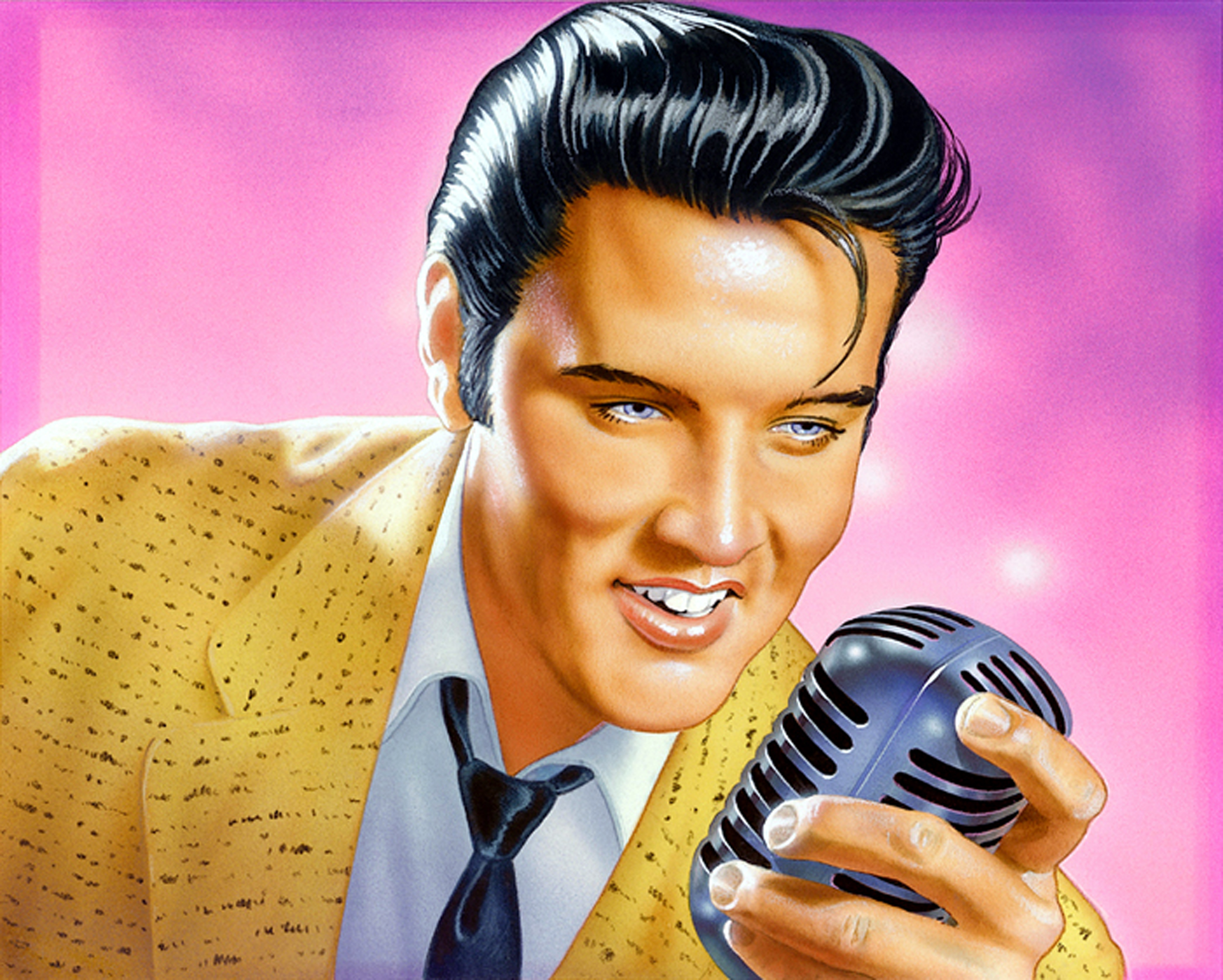
old elvis 1

Elvis is America.

I am not entirely delighted by that fact — even somewhat embarrassed by it — but there is no other figure, public or private, from the past 200 years that sums up so succinctly what the United States is all about.

And three and a half decades after his disappearance and reported death, Elvis Presley remains both what Americans are and what they want to be.

Of course, what they want to be is Young Elvis — brash, sexy, talented. And, compared to most Old World cultures, that is just what America is. Its pop culture has preempted many indigenous folkways throughout the planet precisely because it is so appealingly energetic. Content doesn’t matter nearly so much as style points, and Elvis — and America — can swivel and two-step like a blue demon.6/30/00 DS - REF="Elvis_ao_MCos.psd"

The effect is so pervasive that in deepest Africa, you don’t hear tribal drumming so much as you hear Top-40 tunes. And Japanese karaoki is not, after all, based on the music of the classical Noh plays.

No, what appeals to the world is America’s optimism, its lack of guilt, its comfort with itself. America may be a novice in world history, but it is a refreshingly guileless novice — or at least, it has been.

Like Young Elvis, we think of ourselves as dangerous without being threatening.

But America would prefer not to notice the Old Elvis in the mix, which is also part of our Elvis-selves.

For America is also crass, loaded with bad taste, money-chasing, conspicuous consumption, anti-intellectualism, sentimental Christianity, drug hypocrisy, junk food and mindless consumerism.

On the surface, the Young and Old Elvises seem like opposites, but they are not: The one naturally evolves from the other. You cannot have the Young Elvis without the Old One waddling behind, two halves to the same coin.

The flip side of our energy is our anti-intellectualism; our self-confidence is also our provincialism.

Our sober, well-educated founding fathers envisioned an America modeled on republican Rome — or rather modeled on imperial Rome’s nostalgic vision of its republican past.

Washington, Madison, Adams and Jefferson imagined something brand new in the world, something bursting with energy, new ideas and vitality.

That is Young Elvis. But just as republican Rome turned into the empire of Tiberius, Nero and Elagabalus, so America quickly added to its repertoire the Jacksons, the No-Nothings and the Tea Party and Neocons.

Indeed, Andrew Jackson, who kept goats in the White House and stabled his race horses on the grounds, was probably the first Old Elvis in our history. He was even known as “The King,” in his day — King Andrew, he was called by his political opponents, who disliked his monarchical yet proletarian ways.

There is something in American culture that is illogically ambivalent about royalty. We claim to be a classless society and righteously argue that anyone in America is as good as anyone else. Heaven help anyone who “puts on airs.”

Yet, Old Elvis is what America wants to be, too.old elvis 2

It is the ultimate goal of American democracy, not that we all share equally a modest and comfortable life, but that everyone should be a millionaire — and Old Elvis is America’s vision of what a millionaire should dress and act like.

So, we make an image of our desires and create a kind of celebrity aristocracy and pay homage to them by gobbling up tales of their every peccadillo in tabloid exposes.

It is a kind of trailer-park version of royalty: Bad taste, emphasis on wealth and glamor.

Glamor is to beauty as rhinestones are to rubies: There was some genuine grace in the Young Elvis; the Old Elvis is cubic zirconia to the bone.

race gravure

When I was a schoolboy and too young to know better than to ask foolish questions, I wondered why I, with my ruddy pink skin, was called ”White” and why Charlie Johnson, with chocolate skin, was called ”Black.”

What I saw around me was a huge variety of skin color, from the pasty Irish winter skin to the darkest African blue-black. There weren’t two colors, but thousands.

It was one of those cultural inconsistencies that sometimes bother children, but that adults seldom seem to puzzle over. I now recognize that it is as if a linguistic pattern were cast over reality, taking its place, so that we see words and not skin.

The question of race has followed me into adulthood, as I see people argue back and forth, usually at cross purposes, without ever having stopped to ask themselves, ”What is race?”

If they took time to define what they mean, they might have a better chance of making themselves understood.

For race isn’t one self-contained category; we mean many things by it, and sometimes contradictory things.

It would help if we could tease out some of the strands of the knotty problem.

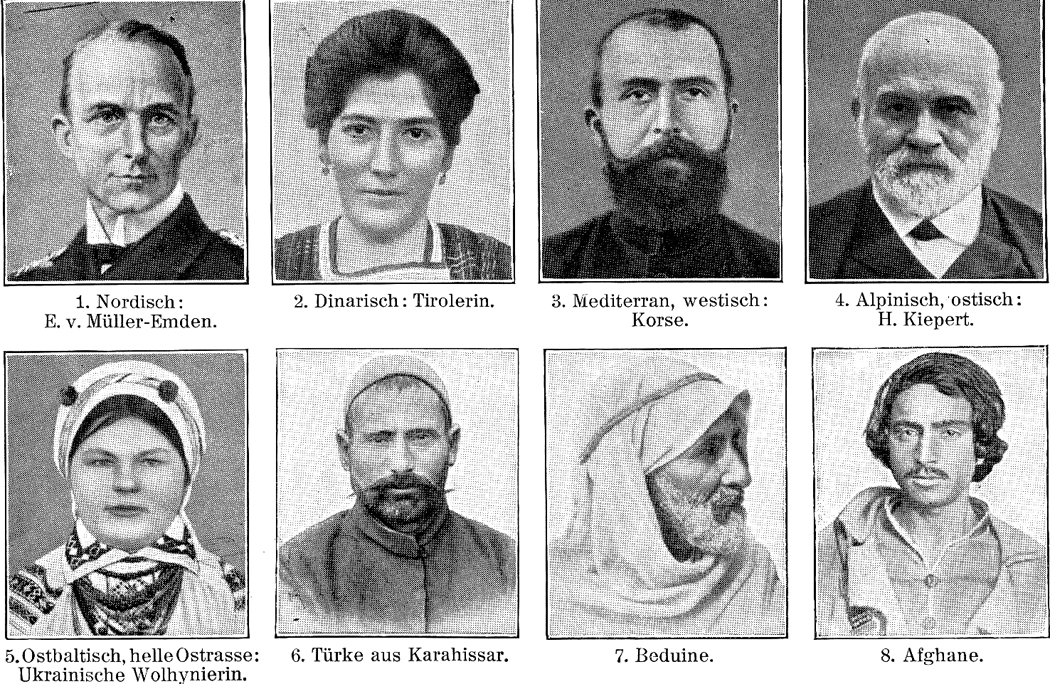
The problem of definition began with the 18th century European obsession with taxonomy. They wanted to name everything. Europaeid types
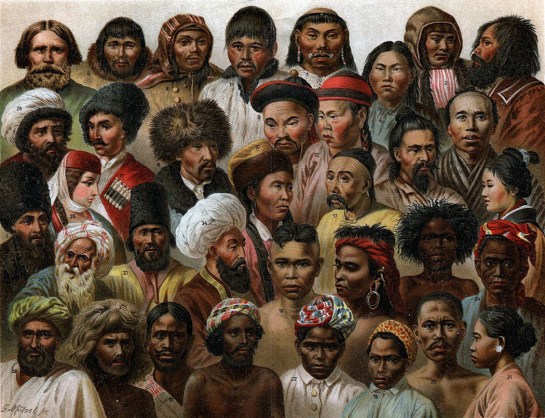
While it had been recognized for millennia that there were distinctive population groups in the world — The Greeks knew their Ethiopians, Shakespeare knew his Othello was a Moor — it is only during the Enlightenment that anyone tried to pin the variations down to uniform categories.

Race as a scientific idea began with the Swede Carl Linne, who devised an ingenious system for classifying animals and plants by morphology. He devised a system of phyla, orders, families and genera that worked its way down to species and, occasionally, subspecies.

A dog is Canis familiaris, a swamp rose is Rosa palustris. Humans are Homo sapiens.

Linne further divided humans into four ”races,” or subspecies, which he named H. sapiens americanus, europaeus, asiaticus and afer. These, he said, were red, White, yellow and Black. He also defined them by personality and culture.

H. sapiens europaeus, for instance, ”wears tight-fitting clothes” and is ”nimble, of the keenest mind, innovator.” H. sapiens afer, however, are ”cunning, lazy, careless,” and they ”smear self with fat.” Guess which race Linne considered himself to be.

American Indians, by this system, are cheerful and resolute, and Asians are proud and greedy. It should be noted that Linne didn’t get to travel much; it was the 18th century, and what he knew of other peoples was largely peculiar hearsay.

The confusion of race and behavior continues. I remember one White minister in Greensboro, N.C., who announced that his ministry was to aid ”the alcoholic, the drug addict and the Negro.”

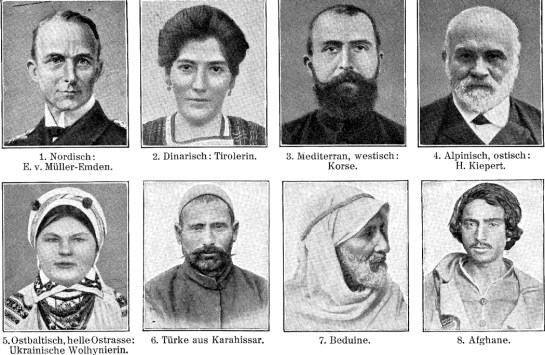
Later biologists narrowed the races to three, eliding the red and yellow races, and they called the three Caucasoid, Mongoloid, and Negroid. Then others, noting the number of population groups that could not easily fit into these three classes — Polynesians, for instance, or Australian aborigines — came up with newer and more distinct races and sub-races. The number proliferated to the point that there were nearly as many races as there were people, and race as a useful scientific classification evaporated.

MISSING IN MODERN SCIENCE

Most scientists now discount the idea of race; you will be hard pressed to find the term used in any modern text.

The initial idea was that genetic ”types” exist in regional populations. The problem is that there is more variation between individuals within each group than there is between the groups themselves. Dravidian Caucasoids may very well be darker of skin than Nilotic Negroids.

As a biological concept, race was a convenient but misleading shorthand, made nonsense after a deeper look at the facts. race types

And the very distinctions made between populations — skin color, nose shape, resistance to malaria, lactose tolerance, etc. — are not distributed uniformly through the so-called races. The characteristics are likely to be distributed regionally, but the regions are multifarious and overlapping, not monolithic and co-equal.

It is a very few people who have all the many characteristics used to define a ”Negroid” or ”Caucasoid.” There are dark-skinned Caucasoids and straight-haired Negroids.

It makes even less sense in America, where the variations are no longer regional, and the bloodlines are no longer separate.

Yet, the notion of race persists. It is this nation’s most intractable social problem. If it is not biological, what is it?

Even before science took over the idea, race was a short word for ”bloodline.” Each family, insofar as it can be distinguished from its neighbors, is the culmination of a race. In Wagner’s version of Germanic myth, for instance, there is the race of Wolsungs, the race of Gibichungs, the race of Niebelungs.

I come from a race of Nilsens, although I can only trace it back a handful of generations, and there is no eponymous hero at its source.

But that is not what most Americans mean when they evoke the word ”race.”

In this country, with its peculiar history, race most immediately means skin color.

Yet the distinction is the least useful. If you took all the peoples of the world and lined them up, not as in an old grammar school photograph, by height, but by skin shade, you would not find any distinct breaks, but a continuous spectrum of color: a wash, not a palette. average female face
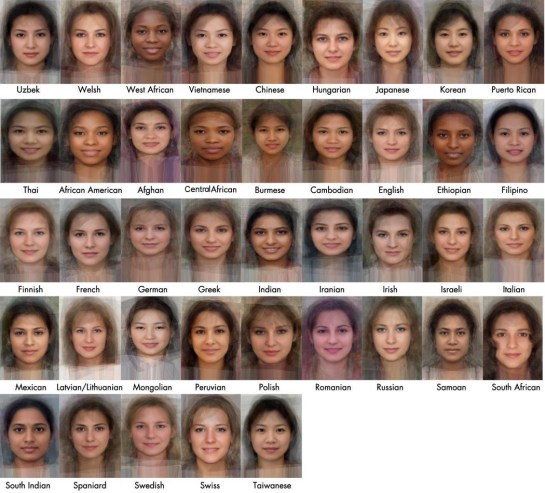
In the U.S., we have an artificial sampling of skin color. It is as if a dollop of red from one end of the spectrum were plopped down square on the blue end. The colors seem distinct and different, but this is a historical accident, not a true picture of racial difference.

While skin color is the most obvious racial marker, the most important is culture. People brought here from Africa had a different culture from those who came here from Europe.

The cultures have blended together quite a bit, yet it is astonishing how conservative culture is. Cultural forms can be maintained over centuries without anyone really thinking about it. Why does a wooden church in New England so often have the pointed arch of a Gothic stone cathedral? It makes no sense in wood.

We enter our jet planes from the left side, just as we mounted our horses. We let our children play with ”choo-choo trains,” despite the fact that their grandparents were likely the last in their race to have ever seen a steam locomotive.

When I visited South Africa, I was astonished to find it seemed so much like the North Carolina I had lived in for 20 years. I saw an old Black man in a worn blue suit and no shoes, waiting in front of a wooden store/service station for a ride. He could have been from Hobgood, N.C.

I heard a choir of cleaning women singing as they worked, and I recognized in the tone of their voices Ma Rainey and Aretha Franklin.

It is often these cultural differences that we use to separate the races in the U.S. — Rap vs. bluegrass; basketball vs. hockey, grape soda vs. root beer.

We feel comfortable with our own way of doing things, suspicious of other ways. There is considerable xenophobia in our racial attitudes.

Another important facet of what we call race is more accurately called class.

The reaction of many well-to-do Whites to poor Blacks is not much different from their reaction to poor Whites. “Trailer trash,” they call them. One remembers that in the 19th century, when there was so much prejudice against Irish working-class immigrants to the U.S., there were attempts to prove that the Irish were little different from African slaves. Irish negroes
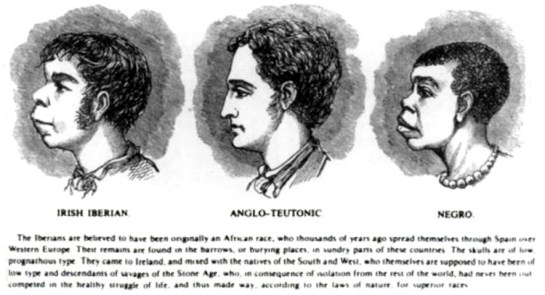
Poor people are seen to have different work ethics, different hygiene patterns, different cultural ideals. That so many more Blacks than Whites, by percentage, are poor, leads to a bleeding of one attitude into another. Much of what is ascribed to African-Americans by their White neighbors is class consciousness, not simple racism.

Both are pernicious, but the two become confused in argument.

POLITICS AND POWER

Then, too, race has become politics. And by politics, I mean power.

Political leaders speak as if they mean to ameliorate the problems of society, but the main goal of politics is power, its acquisition and maintenance. Those in power don’t want to give it up, those disenfranchised want to get it. When they can use race, from either side, they will.

This is used by both sides: White politicians have a glossary of code words that warn their voters that Blacks will take their jobs and their women. The privileged mean to prevent the dispossessed from getting power.

But the Black politician often complains about a Black conservative that he is somehow turning his back on the ”solidarity,” which is needed to gain power. Voter blocks on each side line up to scrimmage at the poll.

If a demonstration of the political definition of race were needed, one only has to consider the concept of ”race mixing,” seen in two different contexts.

Consider these two political systems and their apportionment of political power. In South Africa under apartheid, the admixture of White blood and Black ”ennobled” and made a new category, ”Colored,” above Black and not far under White and with most of the rights of Whites, whereas in the old U.S., a percentage of Black blood mixed with White ”degraded” and created a Black person and the lack of rights that came with the color.

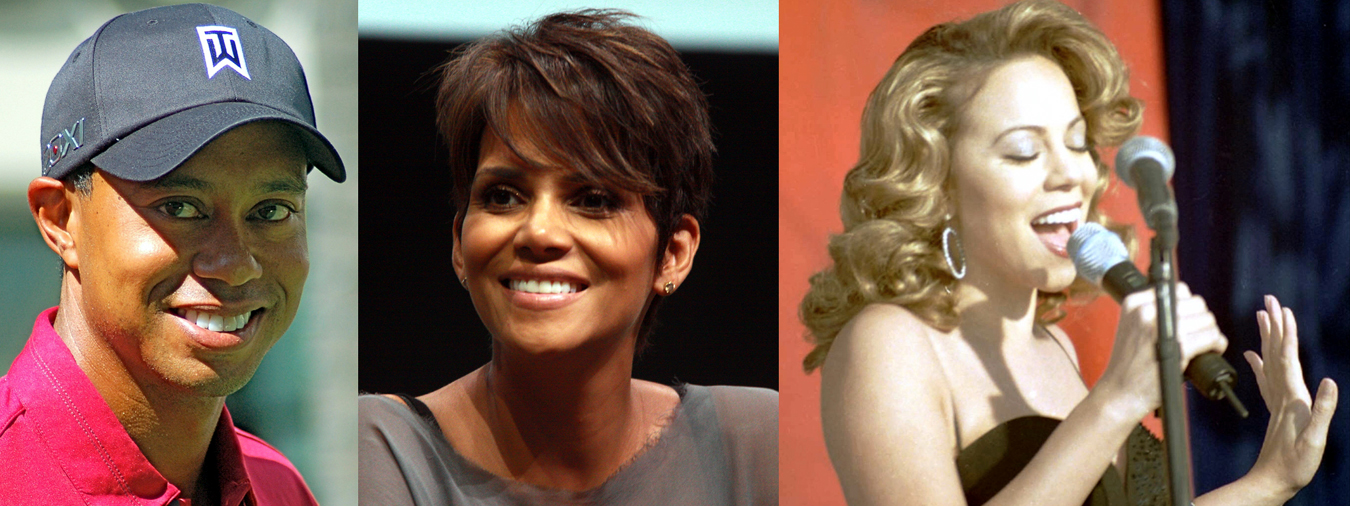
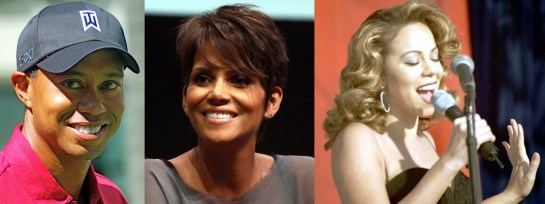
It is an odd system indeed that forces Mariah Carey or Halle Berry into the category, “Black woman.” And how we scratch our heads over the categorization of Tiger Wood. trio
Nor can we forget history when we talk of race. The United States cannot escape the evils of its own past. Whites would like to forget slavery: ”That was a long time ago. I never owned any slaves,” they say. They seem to have no sense of history (unless it’s the Southern White’s sense of grievance about the Civil War.)

But Black Americans cannot avoid the burden of history. It is brought home to them every day. They cannot forget that they arrived on this continent under protest. They cannot forget that they were once legally less than fully human.

They cannot help seeing the vestiges of that past, even when such vestiges are invisible to Whites. What they call ”racism,” is often just the comet-tail of history, still affecting the course of events.

There are still more facets of race: linguistic usage, self-image, marketing. In one sense, race has turned from being a caste marker and into a demographic group.

So, when we open a dialogue on race, as the president has asked, we need to try to be clear about what we mean, and not address skin color when we mean class, not argue over culture, when it’s politics we are concerned with.

I don’t have the solutions to America’s race problems, but I am certain that unless we begin by defining what we mean by race, by beginning with the simplest questions, we will continue to repeat ourselves over and over until we are neither Black nor White, but are merely blue in the face.

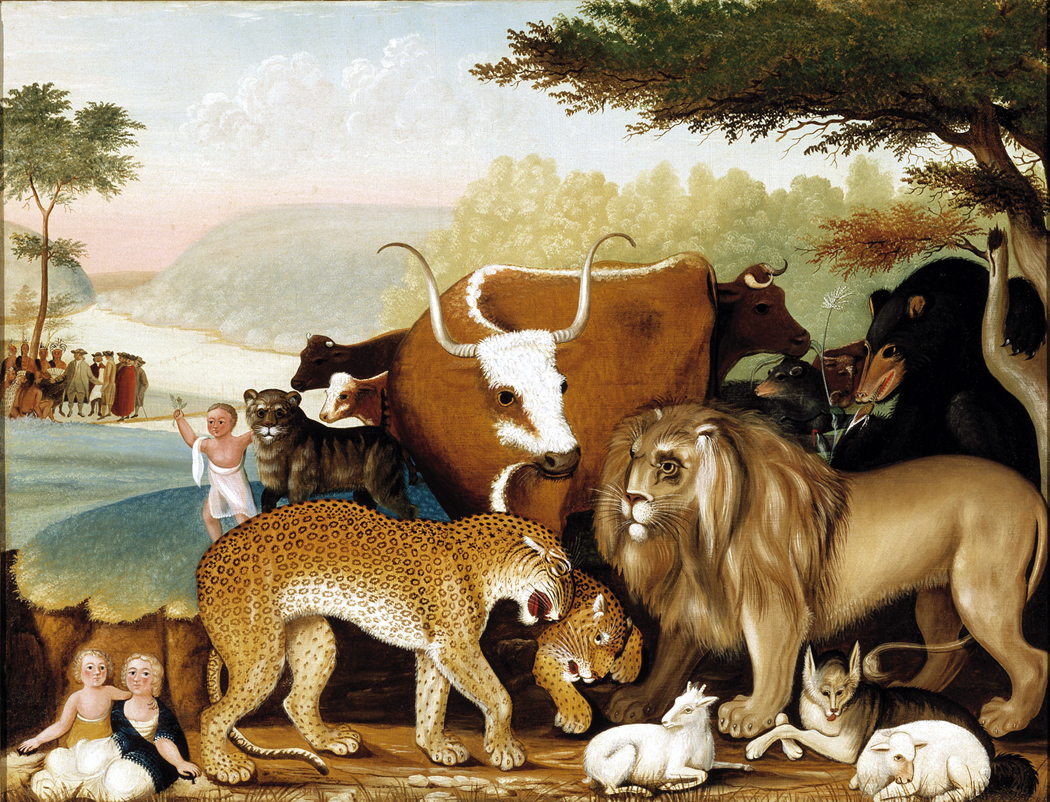
"Peaceable Kingdom" by Edward Hicks

“Peaceable Kingdom” by Edward Hicks

We have a two-party system in this country, but until recent decades, it wasn’t always easy to tell them apart. Southern conservatives tended to be Democrats and Northern liberals were just as likely to be Republicans.

In the old days, the parties were more like clubs, each with a full range of ideologies represented in their membership. When Eisenhower’s name came up for president before the 1952 elections, he could have run comfortably in either party. Sure, the Republicans were a wealthier club and tended to think kindly of big business and leather furniture. Democrats were always a little more scruffy.

”I’ve never been a member of any organized political party,” Will Rogers said. ”I’m a Democrat.”

The current trend, however, is to understand the parties as standing for ideologies.

But what those ideologies are has been harder to pinpoint. After all, the people calling themselves conservatives are no longer for conserving anything. Conservatives used to believe in the status quo; liberals wanted change.

Nowadays, the conservatives are calling for a radical agenda. That is what they used to accuse liberals of wanting.

The problem is that we have defined the two points of view wrongly. They are not merely conservative vs. liberal. In fact, the specific ”litmus test” issues raised by them are fairly recent. Those issues — welfare reform, reduced taxes and prayer in school on the so-called ”conservative” side and gender equity, racial equality and food labeling on the liberal side — are not beliefs held in a vacuum, but represent a deeper difference in how the two sides understand the world.

Underneath the specific issues there are deeper tendencies: Government redress of social inequity and regulation of powerful entities to protect the consumer and environment on the one side and smaller government and individual responsibility on the other.

Those competing world views can best be understood as the view of the lions and that of the lambs.

The lions are in charge of their lives. They do what they want when they want to do it. Food is there for the taking and they are king of all they survey. It is hardly surprising they value initiative.

Lions start businesses and create jobs; they provide leadership.

Ah, but the lambs flock together helplessly, blown about by fortune and foul winds. And they have a worrisome likelihood of becoming someone’s bowl of Cheerios. Initiative doesn’t have much to do with it.

In reality, the world is made up of both lambs and lions, and a sound public policy needs to accept this duality. The problems and arguments arise because Republicans create policy based on their belief that everyone is a lion. Democrats make policy believing that everyone is a lamb.

Neither will make lasting, effective policy beginning from such partial visions of human nature.

You can see the reality of the metaphor in the culture of victimhood that pervades Democratic constituency.

”I can’t succeed because X won’t let me.” Let X stand for white males, poverty, lack of self-esteem, or any of a host of bogeymen.

In each, the victim remains passive, a lamb bleating helplessly.

As for the Republicans, their rhetoric is largely a holdover from Victorian Horatio Alger books, where to be poor is to be lazy, and anyone with gumption can become a millionaire and smoke large, smelly cigars.

Neither world view alone is sufficient and true.

Lions recognize that ”empowerment” doesn’t come from committees, it comes from within. Lambs recognize that if the lion is allowed to have his way, someone will get hurt.

So Republicans hate any law that holds personal initiative in check, even when that initiative may pollute our air or enslave our populace.

And Democrats hate any law that fails to protect the helpless, even when the helpless may not need protecting.

One irony is that although most Republican movers and shakers are in fact lions, many of their constituents are helpless lambs who feel powerful by proxy, growing puff-cheeked in the fantasy of individual freedom and power.

Look at any Klan meeting in the South or any militia in Idaho and you will see a flock of losers strutting their stuff.

Concomitantly, although Democrats act as if everyone were a lamb, the party leadership is almost wholly made up of lions. At some level, they must recognize this disparity.

Nancy Pelosi doesn’t need welfare.

A lot of vitriol is thrown in the mistaken belief that Republicans or Democrats are the Great Satan who either oppresses the little guy or constrains our initiative.

As English poet William Blake would have it, “One law for the lion and the ox is oppression.”

In fact, the balance of carnivore and herbivore is a sign of ecological health.

Without a certain amount of regulation, we would have no air to breathe and no water to drink. With no regulation, what you get is Bhopal, Minimata and Chernobyl.

But too much regulation and you get a nation of faceless bureaucrats.

It is the nature of politics, as that of animals, to find its balance precariously and fitfully.

fighting for peace 1950

Politics and art; oil and water; Mitch McConnell and charisma.

Like alternate universes, the oppositions seem utterly irreconcilable.

”The only thing poetry and politics have in common are the letters P and O,” the late poet Joseph Brodsky once quipped.

Yet, there are clearly many cases of political art. Much of the world’s greatest art, from the Antigone to Angels in America, has concerned politics.

So when I say art and politics are death to each other, what I mean is not politics as a subject — anything in life is fit subject for art — but politics as a lens, as dictator of what is permissible. If you have a political ax to grind, don’t try hacking tree stumps with it, hoping to make a masterpiece.

Another way of looking at it is that there are two types of political art.

The good and the bad.

If you are politically inclined, good political art is art that advances your ideology, and bad art is anything else. This was the inspiration for most Socialist Realism, and it’s making a comeback in a raft of forgettable politically correct art and theater.

But if you are aesthetically inclined, the good and bad are not defined by ideology but by aesthetic persuasiveness. Does the work ring true?

Politics itself can be seen as two separate, almost incompatible things. On the basic level, politics is the acquisition and use of power. It is a basic characteristic of humanity. Politics on this level can be used for ill or good. It is not a thing about which a value judgment can be made. Like gravity, it just is.

But to too many people, ”politics” means political theory. It means not the way things are, but the way things should be. Life should be more fair, the aristocracy should rule, power to the people, a flat tax will solve all ills. Name your poison. human pyramid

When American politics works as it is supposed to, factions promote their causes and compromise is reached. The result is a continuous tension of interests, like a human pyramid in the circus.

But when ideology takes over, compromise is seen as an evil. Through the ideological lens, there is only one truth and everything else will lead to ruin. This is equally the case with Marxists and the Christian right.

”One law, one God, one king,” as William Blake has it. You are either with us or against us.

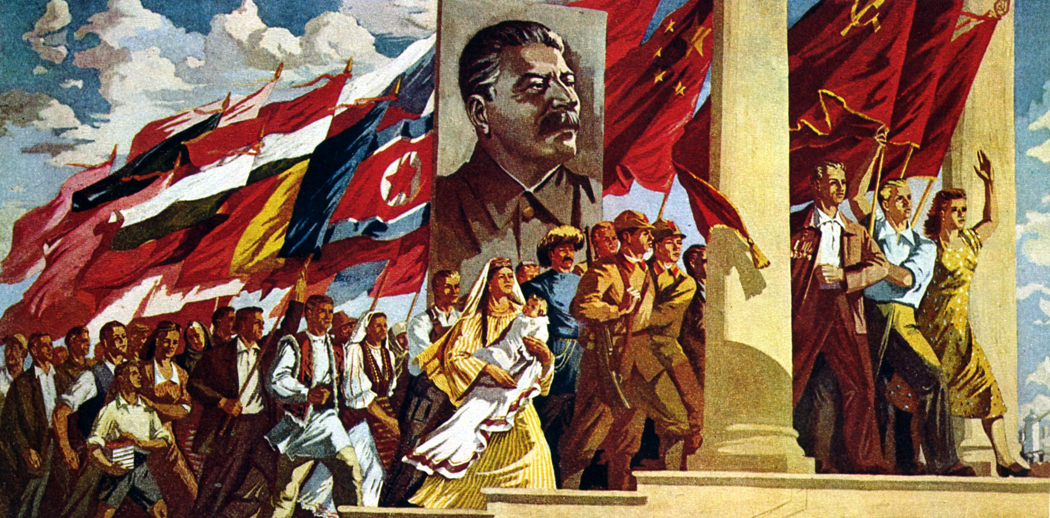
So, lost in the discussion is the fact that when we say something is ”political art,” we mean two very different things. On one side, there is partisan art, which takes a political stand and uses the art to proselytize. It is the art of the street theater, meant to persuade — although more often than not, its audience has already signed on, so its purpose really is to reinforce beliefs already held. socialist realism

At its worst, partisan art is Nazi and Soviet propaganda; at its best, it is Brecht. Always, it is didactic, and more often than not, it is forgotten by the following year. Name a Socialist Realist painter, I challenge you.

But art may approach political questions from another direction:

There is an art that is interested in the ironies and passions of politics, in its human toll, not its theories.

Partisan art is interested in answers, certainty and action; the other direction is interested in questions, ambiguity and contemplation.

The problem is that ideology is system, and systems are dehumanizing. It matters not whether it is left- or right-wing. The machine is supreme: We measure success not in human terms, but by whether it adheres to theory. Read any Marxist criticism and you will see such. Or listen to a House Republican talking about the National Endowment for the Arts.

In both cases, the question is whether the art is orthodox — does it adhere to the party line.

It is a mark of critic John Berger’s intelligence that his Marxist theory inevitably leads to gibberish and double talk. He must wind up saying something patently silly or else he must ultimately abandon the theory.

People simply do not act the way Marxist theoreticians say they do; neither do they act the way capitalist theoreticians say. Humans are much more complex, much more contradictory.

No, art, if it is to last, must concern itself with the human, not the system.

Goya’s Disasters of War, Picasso’s Guernica, Tolstoy’s War and Peace, even Homer’s Iliad, all approach political questions from a human point of view.

So do Citizen Kane and Oliver Stone’s Nixon. And so does Anna Deavere Smith’s Fires in the Mirror. It does not take a stand on one side or the other; rather, it allows each side to say its piece, incompatible as those sides may be.

Such art examines the possibilities and tests them against the human heart.

Such art is dedicated to this one human truth: There is always a larger context.

Compare Maria Irene Fornes’ A Conduct of Life with Ariel Dorfman’s Death and the Maiden. The first deals with the rape of a 12-year-old girl; it knows who the villains are and what we should think of them, and it tells us in no uncertain terms.

Death and the Maiden, about a woman brutally tortured under a South American military regime, is much more equivocal. We are never quite sure whether the man she accuses of carrying out the torture is guilty or innocent, and we surely find that the woman’s revenge on him is brutal in return. There is blame to go around.

As W.H. Auden wrote, ”Those to whom evil is done do evil in return.”

Or Barbara Garson’s MacBird, which lampooned Lyndon Johnson as a Macbeth who killed his Kennedy/Duncan for his own political ends. It is a sour-toned comedy and nearly forgotten except by graduate students with theses to complete.

And that brings up another reason the narrow partisan art dies such a stiff death. Its concerns are almost always so transitory. Does MacBird still have meaning 45 years after the events it describes?

Nothing is more dated than a superannuated political idea. We’ve moved on; we have our own problems, thank you.

Compare that with Citizen Kane, which is equally a hatchet job on a public figure. But because filmmaker Orson Welles concentrates on the human rather than the partisan, it still contains meaning, still has that resonance which is the ultimate test of a work of art.

reidmcconnellduo

The world is filled with republicans, that is, republicans with a lowercase “r” — they are the white-bread people. They make none of the art but buy most of it. They are those who never question socks, meatloaf or the existing world order. This has nothing to do with political parties. By my definition, Senate Majority Leader Harry Reid is a republican. For that matter, so is Vladimir Putin.

They are the men in the blue suits who turn the world gray.

Those engaged in party politics cannot understand this. The current fight between “tax-and-spend liberals” and “fiscal conservatives” is only a parochial fight on a narrow issue between two groups that don’t really disagree much. It is like the vicious infighting between certain communist and socialist parties: They had rather kill their own over which end of the egg to crack.

Reid and Mitch McConnell agree on almost everything; they are both the progeny of Plato, Aquinas, Tom Paine, the French Revolution, Horatio Alger and Lucy Ricardo. They both wear suits and ties. To my knowledge, neither has ever worn a fez (with the possible exception of McConnell looking for votes at a Shriners’ convention).

mcconnell in fez

And “convention” may be the operative word here. The horizon of the republican is very narrow, very conventional. Three squares a day, square rooms, square windows, square TV screens. From inside the culture, it can be very hard to see just how similar Reid and McConnell are. We all swim in our culture like fish unaware of the water.

But step outside and look back, and the squabbling becomes risible. Or tragic.

From our position outside, we look at all the factions that turned Beirut into a concrete Swiss cheese and wonder, how could they shoot at each other? Sunni and Shia? We sure can’t tell them all apart, even with the help of David Brooks and Mark Shields. Can’t they see how they are all so much the same?

But to a Maldive Islander, Reid in his suit is the twin of McConnell in his. They are both republicans.

That means they both tend to look at problems in the old ways, come up with old answers, even when dressing them in new words, and pretty much expect that the world they grew up in is the world they will send their grandchildren into. Good luck.

When you are interested only in answers, as politicians are, you tend not to notice that the questions change.

Republicans buy life insurance, sign on for gold cards, think there is a difference between Coke and Pepsi, flee to the suburbs, send their kids to preschool and eat one meat, one starch and one vegetable off round plates on a square table.

So when I hear a politician talking about “imaginative answers,” I break out laughing. He should better search for imaginative questions. The answers usually take care of themselves.

What the republican lacks is what I call a “lively mind,” that is, one that is eager for new experience, new ways of reassembling information, new ways of seeing old sights.

Why is the north on top in a map? Why not Antarctica? There is no reason but convention. The world looks very different upside down. Try it. Dick Cheney never has; you’d be one up on him.

Why are there four cardinal directions? Convention. I count seven: North, east, south, west, up, down and center — that inner direction.

Is there any difference at all between blue eye shadow and Sioux war paint? Between pierced ears and pierced nipples? Why does anyone think one form is acceptable and another barbarism? Convention.

Is the three-meal day a good one? Why are there seven days in a week? Oh, I know how it happened historically, and we can thank Babylon for it, but why not some other way? The French tried to change it once with a 10-hour day, a 10-day week and a 10-month year. Of course, the math didn’t work out for the “metric year,” but what the heck, it was a fun experiment.

The republicans say there is no virtue in being different just to be different. But I say there is. It is a sign of being alive.

Sideways thinking is the only thinking that can move forward. Everything else is a wheel stuck in a rut.

So, what are the men in the blue suits so afraid of?

Nixon birthplace

”I was born in a house my father built.”

It is one of the great first lines in American literature and says more than perhaps the entire rest of the book toward explaining Richard M. Nixon. It is an expression of the politician’s essentially mythological sense of his own life.

Others might have written, “I was born in Yorba Linda, Calif.,” or “I was born a month before the 16th Amendment was ratified, creating the income tax.” But no, Nixon goes for the archetypes: birth, father, home.

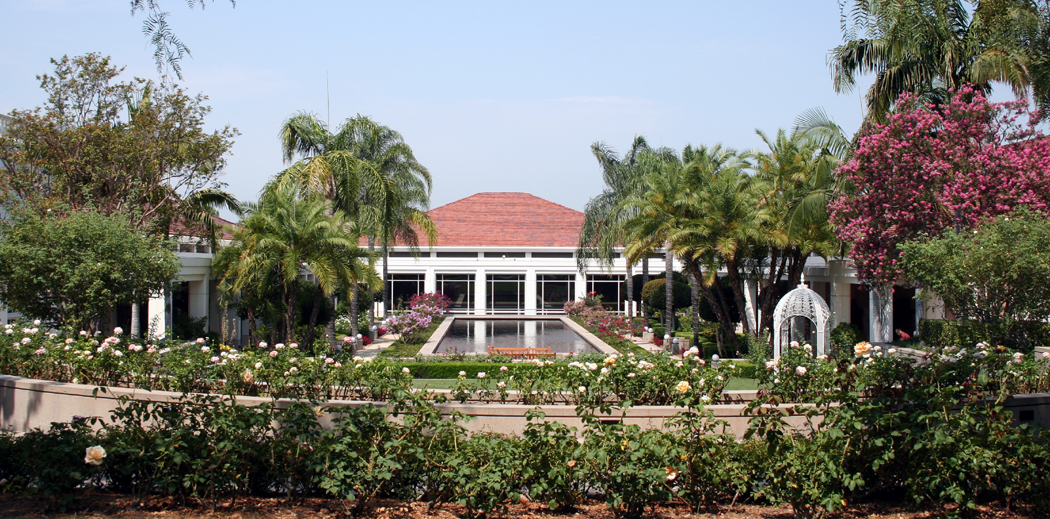
The little white clapboard house that Nixon’s father built, and that opens his memoirs, still can be found, at the Richard Nixon Library and Birthplace in Yorba Linda.

The house, shaded under a grove, is rather dwarfed by the huge, impersonal marble and glass library, with its parking lot and fountains.

Nixon Library and Gardens

But the house is the only real reason to visit. Inside the tiny cottage, which Nixon’s father had ordered from a catalog, is the niche of a bedroom and the bed on which the future president was born.

Richard Nixon's birth bed

Richard Nixon’s birth bed

It makes Nixon feel almost human.

You can get a sense of the small-town bourgeois life that he sprang from, the piano in the parlor and the small bookshelf with the equivalent of the Harvard Classics that must have given Nixon his early sense of education and culture.

I have to admit, I never much liked Nixon — more accurately, I despised him and his politics — until Watergate. My reaction is probably the opposite of most of those who lived through those times: Nixon was elected in a landslide in 1972 and after his resignation, widely denounced. For me, I hated him until his crimes and venality humanized him.

Politics tends to flatten its heroes, to turn them into one-dimensional factional puppets. We don’t like to find out that our presidents are mere people, that they have faults, fudge the truth, create political lists, philander.

It was only after Watergate that the more complicated, vast, conflicted, confusing, contradictory Nixon became widely known and written about. Nixon, the contemporary Richard III, the one candidate who could deal with evil in foreign affairs because he was conversant with it in himself.

He was surely the only 20th-century politician who plausibly can star in his own opera: John Adams’ Nixon in China.

The real Nixon won my respect because he was larger than life, or, more precisely, he was as big as life.

So, it was a huge disappointment to discover that the Nixon Library, and the museum attached, do their best to turn Nixon back into a plaster bust, denying him all the richness that made him so fascinating.

It is a sanitized Richard Nixon that shows up at the library, one who doesn’t use expletives, deleted or otherwise. The old newspaper clippings glorify his career without ever mentioning his pink-paper campaign tactics, his smearing of Helen Gahagan Douglas, his ”enemies” list.

The real Nixon was Shakespearean, the enshrined Nixon is as polyethylene as Reagan.

The real Nixon saw himself mythologically, and like myth, is open to various, equally defensible interpretations. He was not coherent, but multifarious. There is something in his life for everyone, whether they want to hate or admire.

Which is why the Oliver Stone movie seems so true, no matter how loose he plays with fact. Stone recognizes the essentially mythic quality of Nixon’s personality, which is why he built his entire movie as a gloss on Nixon’s farewell speech to his staff, which is concocted of archetype: ”I remember my old man. I think that they would have called him sort of a little man, common man. He didn’t consider himself that way.” And, ”Nobody will ever write a book, probably, about my mother. Well, I guess all of you would say this about your mother: My mother was a saint.”

It was a gloriously bathetic speech, mawkish and sentimental, but it summed up the essential Nixon, not as one man in a planet full of its congested billions, but as the single Shakespearean king, the central player, not only in history, but in his own life story, as in each of our lives, where we are all the king.

One glorious piece of mythologizing snuck in, although the museum staff doesn’t seem to recognize it for the glorious kitsch it is.

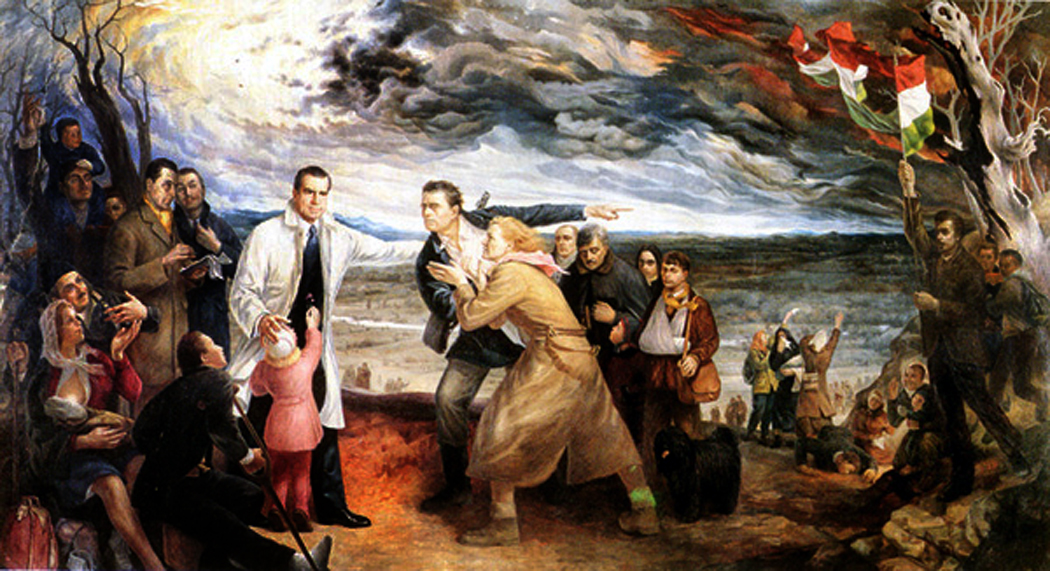
There is a large painting of Nixon by the Hungarian-American artist Ferenc Daday. In 1956, Eisenhower sent Vice-President Nixon on a fact-finding tour of Europe. He made an unscheduled late-night visit with refugees of the Hungarian Revolt at the Austrian border town of Andau.

One can imagine Nixon in reality, getting out of his limo, stopping to talk with a few people, as awkward as he was with the anti-war protesters at the Lincoln Memorial. But the painting doesn’t show that; it shows a heroic Nixon in a white trench coat under an anagogic sky — it could be a leftover from Gone With the Wind. The refugees plead with him for succor.

nixon painting

The whole thing is a wild sendup of the great history paintings of art history, populated with suffering masses, a man on crutches, another with a Hungarian flag unfurled in the wind. The vast plains of Hungary spread out in the background like the landscape in an Altdorfer painting.

And standing next to one poor woman, her arm in a sling, is a shaggy Puli hound, its tongue hanging out. It is such a piece of deflating silliness, the artist surely must have put it there satirically. But if so, the Nixon Library staffers are not in on the joke. Apparently, they have since taken the painting down, perhaps embarrassed by its schmaltz. They should reconsider; the painting says more about Nixon than all the official policy papers and bronze statuary.

When I asked about the painting, many years ago, when I first visited, I got only the party-line response, almost as if the staffer were reading off a TelePrompTer.

The only one who got it was the young man at the gift shop.

”What’s the kitschiest thing you have here?” I asked him.

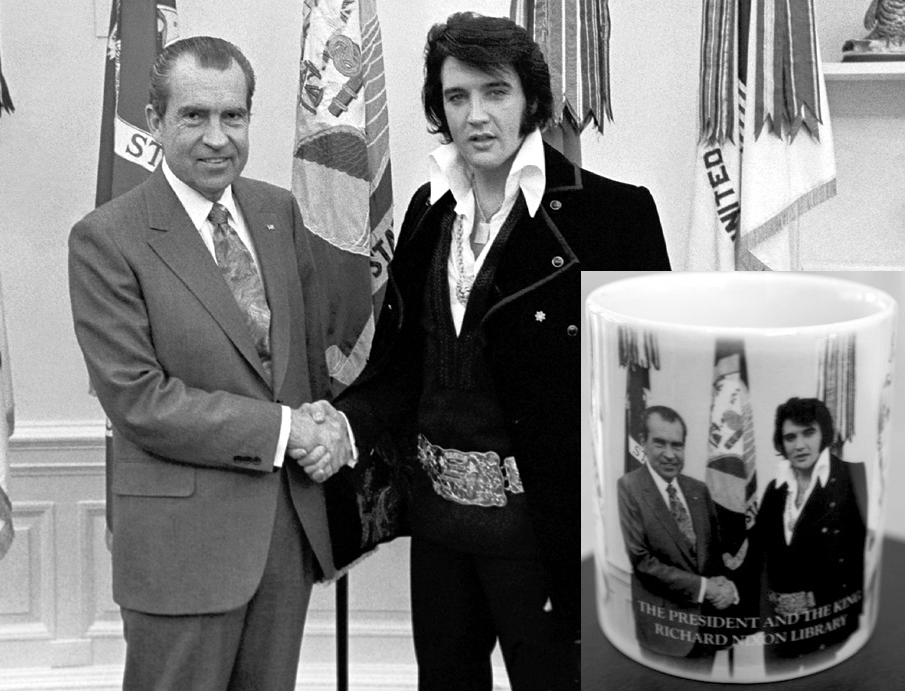
”This is our bestseller,” he told me, and dragged me with a smile over to the shelf with the coffee mug on which is printed a photograph of Nixon and Elvis.

nixon and elvis with mug

Now, that’s mythology.

Stop-The-War-Coalition

There is so much twaddle written about politics – and even more of it shouted on cable TV – that perhaps it’s time to slow down, take a breath and cast a cold eye.

You listen to both sides of the acrid political squabbles of the past few decades, and you’d swear the survival of civilization hangs in the balance.

In part, this is only the standard-issue partisan politics. No different now between Republicans and Democrats than it was between Federalists and Jeffersonians, between the Girondists and Montagnards or between factions at any time through history.

Today, the two sides are called conservative and liberal: conflicting ideologies.

The problem is, they aren’t really ideologies. They pretend to be fully-formed reasoned arguments on each side, but in fact, they are really just personality traits.

Calling them ideologies makes them seem impersonal and rational, but in fact, they are purely emotional responses to the world.

That is, the essential emotional approach one takes to living in the world.

Some people are by nature conservative, which means they mistrust change and cling to what they already know. Others are by nature adventurous and see only benefit coming from trying out new stuff.

This, more than political theory, defines the two sides. The ideology follows, not precedes.

It is why we could talk about Kremlin conservatives wanting to preserve Communism, or Chinese liberals wanting to open up the market economy. The stance isn’t ideology, but inclination.

Neither inclination is by itself good or bad. Or rather, they are both both.

Conservatism seeks to preserve the status quo. “Whatever is, is right,” said poet Alexander Pope.

Unfortunately, the historical record of conservatives has quite a bit to answer for. It was conservatives who fought civil rights tooth and nail. It was an ugly time, and their use of an argument in favor of states’ rights to cover a craven racism has forever destroyed the utility of the states’ rights argument.

Perhaps that is why conservatives now don’t seem to notice the contradiction when they oppose state laws allowing same-sex marriage, medical marijuana or assisted suicide.

It’s not an ideological argument, but a desire to keep things the way they have “always been,” although that usually means the way they were when the speaker grew up.

The call for small government is the same: We want the government off our backs, unless it comes to abortion or homosexuality.

That is because, the real watch-spring of conservatism isn’t anything so high-flown as principle, but rather, a constitutional disinclination to try anything different. There is comfort in the familiar.

Yet, that mistrust of the new may sometimes be quite healthy. And sometimes, the tried-and-true is worth keeping. Not everything new is good.

Sometimes it is a fad, sometimes it is truly misguided.

For liberals have a lot to answer for, also. “I have seen the future and it works,” said liberal American writer Lincoln Steffens on visiting the Soviet Union in 1921. He was referring to Lenin’s Soviet Union, where, during the time Steffens was visiting, some 280,000 people were killed in the government-sponsored “Red Terror.” To say nothing of the between 3 million and 10 million peasants who died of starvation that year, due in part to government policy.

Talk about backing the wrong horse!

The fact is, with all this talk about ideology, we have forgotten the basic truth: Politics isn’t about ideology.

It might be hard to remember that when listening to the yammering heads on Fox News or MSNBC, each side so convinced of the purity of its views.

Politics is now, has always been, and always will be the contention of conflicting interests, and the necessary accommodations that must be made, depending on the temper of the times, the political – or physical – strength of the contending sides, the willingness to compromise, the moral persuasiveness of one side or another on an issue, and the confluence of historical forces.

We each have things we want: core beliefs, economic desires, the wish not to have a new freeway cut our neighborhood in half, or to avoid paying taxes. Some of these we’re willing to trade away, if we gain something we want more.

But one person’s wasteful government spending is another person’s crop subsidy and yet another’s government cheese.

Politics, whether local, national or international, is always a competition of interests.

It is not a fight between good and evil, pace Rush Limbaugh. In fact, there are almost always not two sides to an issue, but a dozen or more, each with something to lose or gain. We can see this multifariousness in the current splintering of the Republican party among its many factions.

If there is an evil, it is ideology, itself. It is the true Great Satan. It is ideology that builds gulags, ideology that carpet bombs, ideology that gasses Jews and exterminates Indians, blows up Iraqi markets or Hindu temples. It makes Robespierres, Bin Ladens, Father Coughlins.

Robespierre2

Ideology is the enemy of politics: It is the great conversation stopper.

And ideology is always mistaken. Always. It cannot be otherwise.

The reason is that every ideology is based on a synoptic description of the world, a limited model of the way things are. That model, whether it is the right-wing model of nationalism, privatized economy, traditional marriage and organized religion, or the left-wing model of fair distribution of wealth, cultural tolerance, the evils of a class system and mistrust of big business – that model is always too simplistic, too limited, too rationalized, too coherent, to encompass the vast, unwieldy, incoherent, and imponderable experience of being alive.

No ideology can grasp the shifting variety of the world: When we look for the particle, we find the wave; when we look for the wave, we find the particle.

The fact is, the world is way too diverse to be summarized in a party platform.

Ideology also posits a static, teleological end of history: When we have finally achieved everything we set out to, the world will be perfect, will run forever on the principles we have set down. That was true for Marxism, and for the National Review. Well, unfortunately, things change, time moves on. Something that may have worked in 1787 may no longer make sense (the “three-fifths rule,” or the mechanism for electing vice presidents, say), and both science and technology create new problems along with new solutions. New political processes will be needed for them. Ideology is a strait-jacket.

Panta rei,” as Heraclitus said: “Everything flows.”

That is why that politics in practice, if not in theory, will always be sausage-making. This is not a fault, but a strength of politics.

Sarah Palin and Joe the Plumber

Sarah Palin and Joe the Plumber

I had always assumed that as I got older, I would eventually turn conservative. It seemed as inevitable as wrinkles, paunch and hair loss.

Radicalism, after all, is an affliction of the young: Too little life experience to know that existence cannot be better than it is; too full of oneself to recognize the limitations of our agency in making the world a different and better place; too full of books and pretty thoughts to realize that theory always falls short of the unpredictable and slippery ice of life.

And the harrumph of the jowly elder speaks of long life lived through disappointment and lowered expectations. The reality bulldozes the hope. A sense of realism settles in like joint pain.

It’s how all those New Deal liberals turned into Bush-era Neo-Cons.

So, I waited to become a curmudgeon, to become my own father. I knew it was coming; I expected it. But over six decades, it hasn’t happened.

I blame conservatives for this.

What was once an intellectual movement, even cosmopolitan in its outlook, with its elders educated at Yale, and able to pun in Latin, has decayed into a kind of anti-intellectual populism built on a foundation of bumper stickers. You elect someone you’d like to have a beer with; you get your political endorsement from an unlicensed plumber.

I do not suspect that Sarah Palin or Todd Akin has ever read Edmund Burke, Leo Strauss or even heard of them. So, I roll my eyes heavenward, twiddle my thumbs, whistle unobtrusively and back slowly away. I cannot sign on.

What has replaced the ideas is a low, rumbling fear of the rest of the world. One thinks of a badger hunkering in its burrow baring its teeth at any by-passers.

badger

The issues that engage conservatism may change over time and circumstance. But at bottom, what is unchanging is its fear of change. Doesn’t matter if it’s our fear of losing our capitalism to a supposed creeping socialism, or Russia’s fear of losing its Communism to creeping oligarchic anarchy. Hardline conservatives everywhere want to keep what they have.

Unfortunately, in the U.S., that means holding down the 15th place in the United Nation’s Human Development Index (a sort of standard-of-living measurement). If we were not so stubborn, we might learn from others, even those that conservatives fear despite their higher standards of living: Scandinavia, France, Canada.

That fear of others is diametrically opposed to the lessons I have learned in my six decades of life: Instead, I’ve discovered that intelligence and ignorance – and virtue – are pretty well equally salted across the globe. America has no monopoly on any of it.

“We’re Number One!” It’s one of the silliest things I’ve heard.

The U.S. is only 16th in its poverty rate, 17th in literacy, 30th in life expectancy, 33rd in infant mortality, and does not even make the list of top-20 nations in student performance in math, science or reading. Yeah, let’s keep on doing more of that.

Worse, you cannot forget that in the past, conservatives defended some pretty indefensible things, like segregation and the Vietnam War. The current fear of gays, or women in the military, or immigrants is just more of the same. Anti-science, anti-education, anti-evolution. “Whatever it is,” sang Rufus T. Firefly, “I’m against it.”

Outside this sad history of bigotry, I had once come to believe the possibility that conservatives had a firmer grasp on fiscal matters than their opposites. I knew I didn’t understand money – other than earning it and spending it – but I assumed someone did.

Perhaps I was wrong. It has been conservatives Reagan and Bush who blasted the roof off the federal deficit. It was the supposedly liberal Clinton who balanced the budget.

Now, conservatives seem to think the answer to anything is tax cuts. Economy good: reason to cut taxes; economy bad: reason to cut taxes. I scratch my head. I’m looking for complex answers to complex problems, not simple-minded and self-interested cure-alls.

Taxes may be a necessary evil, but conservatives have forgotten the “necessary” part of it. After all, when you live in a country club, you have to pay the dues. Fear of taxes is our national neurosis.

Then, too, I once believed that the conservative view of national defense was more realistic than the “ban-the-bomb” attitude of the anti-war demonstrators (of which I was one in the ’60s).

I know that there are people out there, across oceans, who would like to harm us, either from zealotry or rising national interest. The world is certainly nasty, brutal and doing its best to make our life short.

But, the conservative suspicion of other peoples’ motives and other nations’ motives was once based on a belief that human nature was self-interested, and that others’ interests may be inimical to our own. It was a question of survival. If we were smart, we could use their self interest to further our own. But that would require learning something about them, and what their interests are.

Nowadays, too often the conservative sees the world through Manichean lenses: Our American motives are good, even altruistic; “they” are all evil. White hats, black hats. “Axis of evil.” Such miserable lack of self-awareness is never a good way to build policy. And worse, it is patently sentimental. Sentimentality used to be a vice of the liberals.

Teddy Roosevelt – America’s arch-colonialist and hardly a darling of the Left – said “Speak softly but carry a big stick.” Conservatives seem to have forgotten the “speak softly” part, and prefer a great deal of unproductive saber rattling. We really don’t have to do that: The world knows we have the bombs and airplanes. It is our trump card, and shouldn’t be our opening gambit.

And the conservative’s insistence on self-reliance also used to ring true, although the actions of their avatars – Republicans in government – give lie to their convictions as they seem to believe in self-reliance for the poor and government hand-outs for cronies.

I should make it clear, though, that I am not making my point against Republicans, per se. Party politics has almost nothing to do with political philosophy; it is a dog-eat-dog struggle for raw, bloody-clawed power. Either party will toss its convictions into the fire in a wink if it thinks it can gain an advantage over its opponent. One thinks of a scrum of sled dogs snarling in the snow over a chunk of meat.

This partisan game of “king of the hill” is so discouraging that Americans of all stripes now throw up their hands in disgust.

So, it isn’t just Republicans. It is conservatism. There is its undercurrent of tribalism that is ugly and intolerant. People who don’t look like us, or share our beliefs, or worship our god, are proscribed.

The world is full of different kinds of people, and most have something to offer. It would be better to learn from them. As China and India gain on us, we can see they learned a lot by watching us.

And finally, the anti-environmentalism of lumpen conservatives makes me wonder. They seem to think it is a fight between endangered snails and The American Way of Life. Somehow they forget that the first conservationists were conservatives.

One hears the argument that global warming isn’t real, and forgets that it hardly matters: Civilized people don’t shit in their own nests. It shouldn’t take environmental Armageddon to make you realize it isn’t good to pump your waste into the water and air. It should be common sense.

Oh, there is something small and parochial about contemporary conservatism; it should be large and worldly. As I age, I hope I’ve grown; modern conservatism seems to have regressed into a kind of infantilism.

Please, conservatives, show me where I’m wrong, so I can sign up. Harrumph.

Lincoln seated

What we know best of Abraham Lincoln is his face. Gaunt and furrowed, with hollow cheeks, dark, shadowed eyes and a cowlick in his hair, as if he didn’t quite know what to do with a comb.

It may be partly that we know him from black-and-white photographs, but it is a gray face that already seems to be cut from stone. It is a monumental face.

It is also an ambiguous face. Perhaps because of the longer exposures needed to make those portrait photos in the 1860s, his expression is blank. We don’t have images of Lincoln smiling or talking. He is always sitting still, waiting for Matthew Brady to say, “OK, thank you, Mr. President. We are done.” And he can then relax, stretch his long legs and perhaps crack a joke. “Mr. Brady, it reminds me of the one about …”

But the static pose means we look at the face and read into it what we want: fatigue, care, wisdom, faith, despair, grief or distraction. Maybe just boredom.

Lincoln 1865

And it isn’t only in the photographs that Lincoln is more mirror than figure. Everything in his life is ambiguous, and lets us find the Lincoln that reflects the image of ourselves. What we know best is his face, but it tells us the least.

Nathaniel Hawthorne called it “this sallow, queer, sagacious visage, with the homely human sympathies that warmed it.”

The words are from Library of America’s Lincoln Anthology, a collection of writings about our 16th president edited by Lincoln scholar Harold Holzer. It contains a century and a half of writing, from the recollections of his contemporaries to recent ruminations and lucubrations by writers such as Gore Vidal and Garry Wills. Each has his own Lincoln.

In it, you can read the shifting versions of the man. For some he is the preserver of freedom, for others he is a bloody tyrant. Some saw a sober man of deep reflection, others a jokester who would jibe at the most inappropriate moments. Some saw him as a statesman, others as an opportunistic politician.

For some he was a pious Christian; for others, he was an atheist.

You can find proof of any of these views in the more than 10,000 books that have been written about him.

Did he prosecute the Civil War to end slavery or to preserve the Union? There is evidence for all these Lincolns, and more.

Recent books have suggested everything from a closeted gay Lincoln to one afflicted with one or another form of undiagnosed genetic neurological infirmity.

Perhaps nothing illustrates the problem better than Lincoln’s attitude toward race. His early writings can be hard to read nowadays, from a post-Obama perspective: “There is a physical difference between the white and black races which I believe will forever forbid the two races living together on terms of social and political equality. And I … am in favor of having the superior position assigned to the white race,” he said in a speech in 1858. He was an avid user of the N-word, hardly excused by the fact that almost everyone did back then.

Yet freed slave Frederick Douglass, who frequently held Lincoln’s feet to the fire over slavery, after meeting him in 1863 wrote in his autobiography that Lincoln was “the first great man that I talked with in the United States freely who in no single instance reminded me of the difference between himself and myself, of the difference of color.”

“He was big enough to be inconsistent,” wrote W.E.B. Du Bois in 1922. “Cruel, merciful; peace-loving, a fighter; despising Negroes and letting them fight and vote; protecting slavery and freeing slaves. He was a man – a big, inconsistent, brave man.”

There are three explanations for Lincoln’s inconsistencies.

The first and easiest is that he was a politician and said to people what they wanted to hear. This is certainly true in many cases.

The second is that his views changed over time, and that what he said in 1858 cannot accurately reflect what he believed in 1863. This is also true. Few presidents show so much growth in office as Lincoln.

But the third is more important: He was simply a complex man. He seemed able to hold opposing points of view in mind at the single moment.

Unlike many later presidents, who grasp unwaveringly to their ideologies, Lincoln approached the world as a multifarious and varied place in which a single point of view cannot encompass. It allowed him a pragmatic flexibility.

One of the lies of history is that it follows a script. We tend to see history as a story with a beginning, middle and end. We know how the Civil War turned out. But in the midst of it, no one knew how it would turn out, and Lincoln faced new problems every day and no single policy would work in every case.

And every day presented choices that could lead to an infinity of results: Behind every door, a dozen more waited to be opened.

“I claim not to have controlled events, but confess plainly that events have controlled me,” he said in 1864. His genius – his political and moral genius – it to have been a great surfer of events, turning this way or that to maintain his balance and herd those events toward the general goal he held firm to.

“My policy is to have no policy,” he once said.

It is what made him the right man for the job in 1860: An abolitionist could not be elected; a Southern sympathizer would only have prolonged the agony, like his predecessor, James Buchanan. Lincoln’s steadfastness of purpose was matched with a flexibility that many saw as being unprincipled. Yet, that flexibility is what worked.

“The scars and foibles and contradictions of the Great do not diminish but enhance their worth,” Du Bois wrote.

“I love him not because he was perfect, but because he was not and yet triumphed.”

LINCOLN

George and Barry

In America, anyone can grow up to become president. At least, that’s what we were taught in school.

The reality is a little more complicated. It turns out that if you want the office, it really, really helps to be related to someone who has already held the office.

Even Barack Obama is 11th cousin to both the Georges Bush, according to noted genealogist Gary Boyd Roberts, who has studied such things and written the book Ancestors of American Presidents.

Certainly, 11th cousin is a little too distant to be meaningful — at that distance, an amazing number of people are related to everyone. It turns out that if you carry it all back far enough, every American president except Rutherford B. Hayes is ultimately descended from Alfred the Great. But then, you might be, too. I don’t know why Hayes misses out.

But we don’t have to go that deep into genealogical minusculae to realize that having a relative in the Oval Office helps: Four presidents are father-son (Bushes and Adamses), two more are grandfather-grandson (William Henry and Benjamin Harrison). Just at that level of connectedness, that means that just under 14 percent of our chief executives are related to other chief executives. That is already statistically significant.

If you add the Roosevelts, that number jumps up to just under 20 percent. Nearly one in five of our presidents is closely related to another president.

But it doesn’t end there. James Madison was second cousin to Zachary Taylor. At the third-cousin level, Martin Van Buren claims the Roosevelts, John Adams adds Calvin Coolidge.

That raises the percentage up to just a hair under 30 percent.

Beyond that, at the fourth-cousin level, you have to include John Tyler and the Harrisons, Ulysses Grant and the Roosevelts (and Van Buren), Zachary Taylor and the Roosevelts, James Garfield and the Bushes, Franklin Pierce and Herbert Hoover, Millard Fillmore and the Adamses, Calvin Coolidge and the Adamses, William Howard Taft and the Adamses. Everyone seems to be related to the Adamses. The presidency is in some respect an Adams Family thing.

If we count all the fourth cousins, that means that 43 percent of American presidents are related to other presidents.

The myth tells us that the common man is king in America, the reality is that America has its own sort of aristocracy: Those in power tend to be born of those who held power before them. Kind of like a legacy admission to Yale or Harvard.

Beyond fourth cousin, the connections become admittedly more tenuous, But there are other notable relationships that might be mentioned: Hoover and Richard Nixon, both Quakers and distantly related, Nixon and Jimmy Carter, Nixon and Gerald Ford.

Ford is an instructive case: The simplest and folksiest of recent presidents is in some ways the best connected. He is distantly related to Franklin Roosevelt, Abraham Lincoln, Millard Fillmore, Garfield, Hayes, Taft and Coolidge. He is also related to George W. Bush.

George W. Bush, in turn, is related to Pierce, Garfield, Hoover, Fillmore, Taft, Grant and Nixon — and, of course, George Herbert Walker Bush — not exactly the most illustrious line of presidents, and several who have been considered at the bottom of the barrel.

Admittedly, many of these more distant relationships are slender, at best. But if you count everyone down to 10th cousin among this presidential inbreeding, you come up with the astonishing figure that 61 percent of our presidents are related to other presidents.

And that doesn’t count such things as: George Washington’s half aunt married James Madison’s half first-cousin, once removed, or that Woodrow Wilson’s second wife was the great-great-great-niece of Thomas Jefferson.

So, it’s not just who you know, but who you’re related to.