Archive

Tag Archives: protestant work ethic

Is just being alive enough? It is a question I have been facing, with continued difficulty, ever since I retired a dozen years ago after 25 years as a newspaper writer. 

For all those years, and for the many years before, I held jobs that contributed, in some way — often small, even negligible — to the business of society. I had a sense of being productive. This is not to make any major claim about how important my production was. It was admittedly quite minor. But it was a contribution. 

Doing so was a part of my sense of self, that being a productive member of society was not merely a way of occupying my time, but was actually a moral duty. If I were slacking off, I would be harming my society. And even worse, harming my immortal soul (something I don’t actually believe in).  

This is not something I thought much about on a conscious level. In fact, when I do think about it, I realize it’s quite silly. Society gets along quite well without my input. But it is buried deep down somewhere in my psyche that I must be productive. 

The opposite of being productive is being lazy. And I can’t help but feel that laziness is a moral failing. I have tried to excavate my brain to discover where this sense comes from and I cannot be sure. 

The easy answer comes up, “Protestant work ethic,” and it is true that I was raised in such an environment. But religion has never played an important part of my life. As I have said before, I have no religion; I’m not even an atheist. 

But somehow, I seem to have been injected with this guilt about not always doing something. Making something; teaching something; selling something; performing something. 

It is true that my grandparents, on both sides of the family were quite religious. My father’s parents were even infected with a kind of Lutheran religious mania. They went to church three times a week, prayed constantly, and when they were young, before World War II, my father and his siblings were not allowed to listen to the radio, to music or to dance. In fact, this church-craziness led my father to promise never to inflict this kind of joyless religion on his children. 

And so, although we all went to church on Christmas and Easter, it was only to make my mother’s mother happy. She was religious in a more normal way, and was always kind and loving. But I and my two brothers managed to escape our childhoods without any religious sentiment at all. 

 Or so it seems. While I have no supernatural beliefs — the whole idea of a god or gods seems pointless — something of the culture seems to have leaked in. 

For all of my 25 years at the newspaper, I averaged about three stories per week. I always felt as if I were slacking off and that I should be writing more. My editors constantly told me I was the most productive member of the features staff. But it never felt that way. Even on vacations, I took daily notes before going to bed, and used those notes to write travel stories for the paper when I got back to the office. 

Before I retired, I used the computerized data base to check on my output and discovered I had written something like 3 million words during my tenure. If an average novel is about 90,000 words, it means I wrote the equivalent of more than 30 novels in that time. My last project for the paper was a 40,000 word history of architecture in Phoenix. 

And so, when I left my job, it was like stepping off a moving bus,  racing to a halt and trying to keep my balance. 

My colleagues at the paper bought me a blog site as a retirement gift, and I began writing for it instead of the newspaper. At first, I was writing an average of three blog posts per week, unchanged from my time at work. 

I have slowed down greatly since then, and am now aiming for about three posts a month. I don’t always make that many. But I have written more than 750 blog entries in the 12 years since I left the newspaper. which is still more than one a week. And I also write a monthly essay for the online journal of the Spirit of the Senses salon group of Phoenix. That’s an additional 103 essays, each averaging about 1500 words. Blog and journal, it all adds up to about an additional million and a half words written since giving up employment. Old writers never really retire, they just stop getting paid. 

And none of this is paid work. I write because I cannot not write. When I am not blogging, I am writing e-mails. Old-fashioned e-mails that are more like actual letters than the quick one- or two-sentence blips that constitute most e-mails. Scribble, scribble, scribble, eh, Mr. Nilsen? 

But that all brings me back to my original concern: Is just being alive enough? Can I in good conscience spend an hour or two sitting in my back yard and listening to the dozens of birds chattering on, watching the clouds form and reform as they sail across the sky dome, enjoying the random swaying of the tallest tree branches in the intermittent wind? Thinking unconnected thoughts and once in a while noticing that I am breathing?

In 1662, Lutheran composer Franz Joachim Burmeister wrote a hymn titled Es ist genug (“It is enough”) that Johann Sebastian Bach later wrote into one of his more famous cantatas. It is notable for including a tritone in its melody. And, in 1935 Alban Berg incorporated it in his violin concerto, written “in memory of an angel” after the death of 18-year-old Manon Gropius, daughter of Alma Mahler. It is one of the most heartbreakingly beautiful musical compositions of the 20th century. Es ist genug

I remember reading that in India, the idealized life is understood to be a youth of play, and adulthood of work and an old age of seeking spiritual truths. That one is meant to lay down one’s tools and contemplate what it has all been about. And I take some comfort in the possibility that, at the age of 76, it is now my job no longer to produce, but to absorb all those things that were irrelevant to a normally productive life. To notice my own breathing; to feel the air on my skin; to recognize my tiny spot at the axis of my own infinitesimal consciousness in an expansive cosmos. To attempt to simply exist and to feel the existence as it passes. 

I wrote, by actual word count, two-and-a-half million words during my 25-year career at The Arizona Republic. I retired in 2012 and couldn’t stop. Since then, I have written another million words for this blog. As I have said before, a writer never really retires, he just stops getting paid for it. 

There is also a collection of five years worth of monthly essays written for The Spirit of the Senses web journal, which averages out to something like another hundred thousand words. The monthly essay gives me a deadline, something I miss terribly since leaving the newspaper. 

I loved my work. My editors will tell you, that even when I went on vacation, I came back with a packet of travel stories. I worked even when I wasn’t working. I don’t know if it is a blessing or a curse, but I am saddled with that stupid Protestant work ethic — even though I haven’t been a Protestant since childhood. It feels wrong, morally delinquent, if I am not producing something to justify my continued existence on this planet. 

And I wasn’t just a writer. I also made photographs, artwork, and sometimes even typography for the stories I wrote. And for the continuing blog, I continue to fill it with my own images. Before I was a writer, I was a photographer: I have had gallery shows and self-published books. I remind myself of William Blake’s mythical figure of Los, whose job in the cosmos is to create a chain of links forever; he cannot help himself — indeed his very definition is his production. 

In my case, it is to invent a project and then work on it. And whenever I feel I have sat on my duff too long, I work up another. And this covid “vacation” has left me too inactive, too dulled out. And so, yesterday, I set off with my camera. 

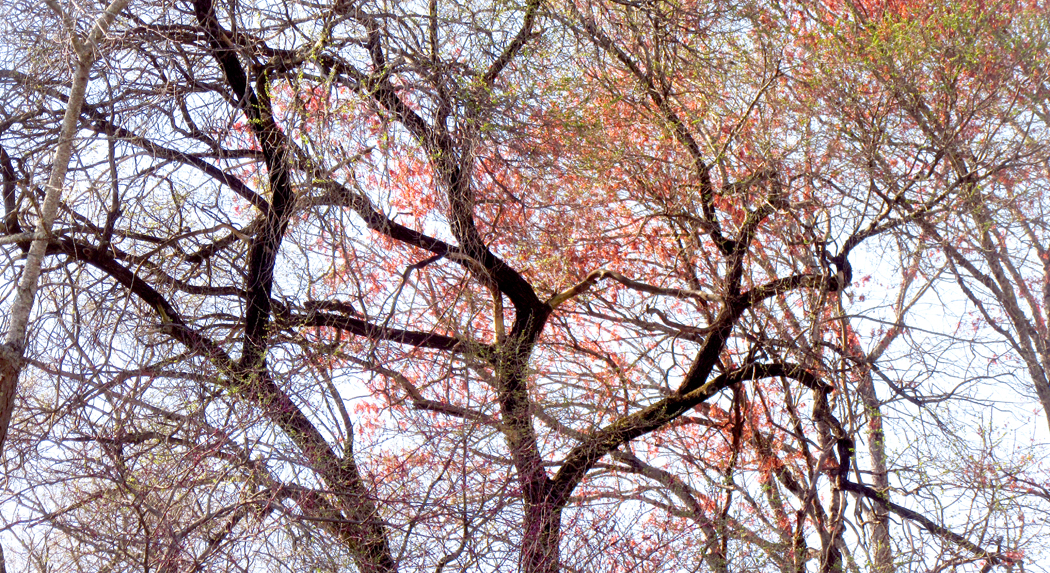
It is November and the sun is lower in the sky, and that “certain slant of light” creates long shadows and teases out any textures to be had. Bark on trees becomes rougher, pebbles on gravel roads become sharper, the scribble-lines of leafless trees in the woods, cross each other like Jackson Pollock paint drips. The sunlight is less bright, but more incisive. Late afternoon becomes a drama. 

And so, my project for yesterday was to drive the back roads of Buncombe County, North Carolina and see if I could capture some of that feeling. (Today’s project is to write this and post the pictures). 

U.S. 70 runs east-west through the mountains east of Asheville, and a series of back roads parallel the highway, with many spurs heading back into the coves nested between the hills. I drove up each one for miles until the pavement ran out, stopping to make photographs whenever I saw something that caught my eye and I didn’t have to block traffic to snap the shutter. 

The trip alone was restorative. The pandemic keeps too many of us holed up in our houses. We watch way too much Netflix. Sit too much. Eat too much. Getting out in the nippy air seemed healthier even than a workout at the gym. 

Asheville sits in a broad, flat-ish valley. Mountains are all around, including the tallest in the East. U.S. 70 runs along the Swannanoa Mountains and south of the Black Mountains and the back roads snooker up into the crenelations between peaks, always coming to an end at the foot of some steep incline. 

Waterfalls wash under culverts and lines of mailboxes sit by the road where a dirt drive heads up into the trees. It is late fall, not yet winter. The trees have not lost all their leaves, but many of them are bare skeletons, or have a shag of hangers-on, dry as cellophane. 

I drove for about four hours, until the sun was so low, whole mountainsides were darkened on eastern side and their shadows drowned out by grayness. In all, I wound up with about 70 images, of which about half were decent enough to edit into a set. I usually think of my photographs in sets, rather than as individual images, the way a novel is not simply discreet chapters. In the past, I would print them out as “books” and show them that way. 

Now I no longer have a darkroom, nor an art-grade digital printer. My publication preference is the blog. I have posted quite a few sets of photographs over these past eight years. 

In this posting are a sampling of the photos I’m calling “A Certain Slant of Light,” after the poem by Emily Dickenson. I am 72 years old and nearing the end of my own day. My own shadows are bringing out the texture of my selfness. Things like the lowering sun speak to me ever more than they did when I was young and had no meaningful idea of an end. 

And so, perhaps these images have more emotional import for me than for my viewers (or readers). I cannot help that. After all, I began writing this blog not for its potential readers (although I always hope what I write is worth the time it takes to read them), but for myself. I write because I have to. I make photographs because I have to. I breathe because I have to. 

The landscape listens — shadows — hold their breath. 

Click any image to enlarge

I am a retired writer, although a writer never really retires, he just stops getting paid for it. 

In the six years since I left The Arizona Republic in Phoenix, Ariz., I have written 532 blog posts and another 35 monthly essays for the Spirit of the Senses salon group there (link here). That works out to just under two blog entries per week since I stopped getting paid. That is not many fewer than my weekly average while working. 

I have also taken and published countless photographs, usually in series, mostly in my blog. (One advantage of writing for the Web instead of for print, is that I can run as many images as I need. At the paper, I was frequently frustrated by the lack of space for photos along with my writing. Unlike most reporters, I usually took my own photographs.)

In 25 years in Phoenix, I wrote more than two-and-a-half million words and had four exhibitions of my photographs (catalog of the most recent: Link here) and produced 14 self-published books of my photographs (link here).  

I just can’t seem to stop working. Huff, puff. 

Yet, I have always had one nagging fear: that I am lazy. That I am just not doing enough. I have proof that I have been productive, but underneath, it always feels as if I’m slacking. I blame the PWE — the Protestant Work Ethic. It is something I don’t believe in, but it is so deeply buried in there, that it simply doesn’t matter if I believe in it or not. 

It is a disease, like an STD or PTSD; the dreaded PWE. It makes it a moral failing if I don’t match my self-imposed quota of productivity. Even a vacation is just another opportunity to create new stuff.

I am reminded of William Blake’s mythical deity, Los. Blake’s poetic universe is filled with mythic beings, each a projection of some psychological state. Los is a blacksmith (among other things — Blake is hardly consistent) and he is pictured as eternally forging a chain, one link after another. It is not clear there is any reason for the chain, but that doesn’t stop Los. It is his metaphorical job to produce. It is creativity unlinked to any other purpose. Make, make, make. 

So it is, during a time of Hurricane Florence, I was visiting my brother- and sister-in-law in Reidsville, in central North Carolina, and made yet another series of photographs. These.

I usually work in series. I cannot count the number of them I have made; I often think of them as “books,” that is, a group of photographs that work together as a single statement. I have photographed dozens of gardens, public and private, that way, with anywhere from a dozen to 40 images intended to be seen together. 

These are not meant to be seen as records of places I have been, but for their own esthetic pleasure. I have done clouds above Phoenix (link here), the interior of a house in Maine (link here), and the view from an airplane window seat (link here). On an earlier visit to Reidsville, I found a trove of abstract patterns in little things (link here). 

This time, I looked at the ceiling, and then, the floor. Humble subjects, without much intrinsic interest, but with shapes, shadows and subtle colors in which I found a visual tickle. 

Make no mistake, I do not present these with any pretense that they are important, or even that they might count as art. They are more like simple exercises in seeing. I believe they are of sufficient interest to award a quick gaze. 

But I didn’t make them because I wanted to add to my “ouevre” — my “corpus” — but because if I am sitting around not doing anything, I feel I am being insufficiently productive. That damned PWE infection that I can’t seem to shake. 

That is also why I keep making these blogs. Please accept my apologies. 

Click on any image to enlarge