Archive

Tag Archives: proust

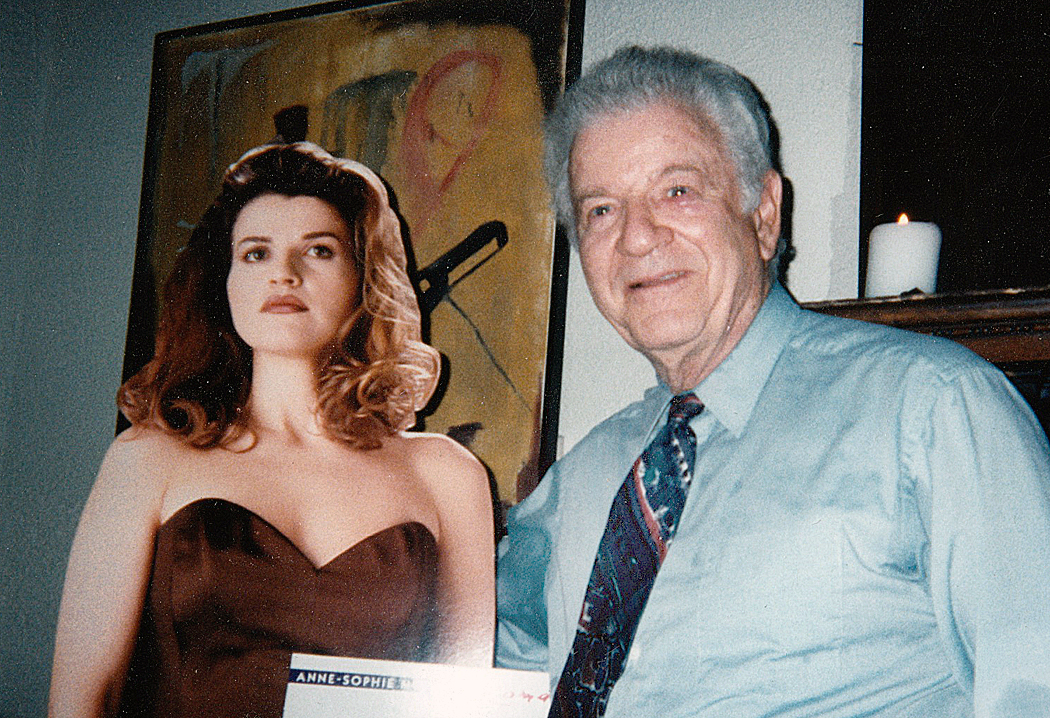
Dimitri Drobatschewsky was the most erudite man I ever knew. He spoke, wrote and read in German, French, and English. Born in Berlin and raised mostly in Luxembourg, his French and German were native, down to idiom, argot and accent. He was also conversant in Spanish, Italian and Polish (at least, he said, he knew several dirty jokes in Polish). 

He was born in 1923, fled the Nazis with his family, joined the French Foreign Legion, deserted to fight with the Free French forces in Italy in World War II. Later, he became the classical music critic with The Arizona Republic, where he and I became friends. 

(Once, when confronted by a musician who had gotten a bad review, he was challenged on his credentials. “What do you think is the most important qualification for a classical music critic?” the musician demanded. “Well,” Dimitri said. “He must have a long and unpronounceable name.”) 

Because he was still a boy when moving to Luxembourg, he was able to learn French as a native. “I had to,” he told me. “French girls wouldn’t date you if you didn’t speak perfect French.” And that’s why, after the war, when he emigrated to the U.S., he kept his accent. “American girls loved a foreign accent.” 

Dimitri felt that French was the most beautiful language, by the sounds it makes in your mouth. But for Dimitri, the best poetry was in German, and further, the greatest poet was Johann Wolfgang von Goethe. For this, I had to take his word.

Because I don’t read German, and when I approach Goethe in translation, he sounds earthbound, even banal. 
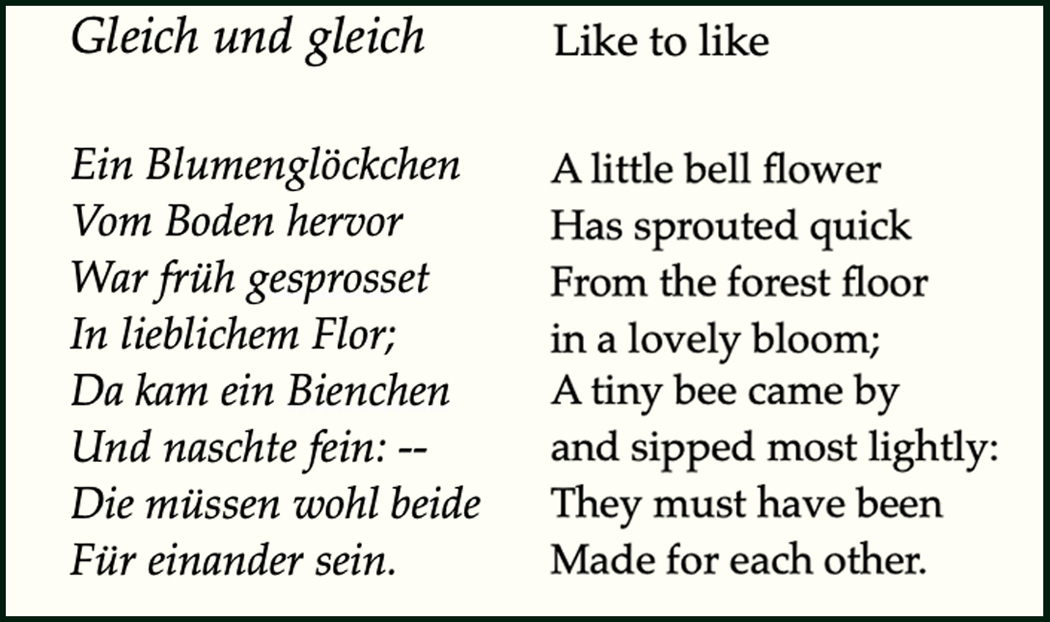
I try to hear the German in my mind to catch its melody, but I am walled out by my English. All I can gain from the reading is a commonplace. 

“Little rose, little rose, little red rose

Little rose of the heath.”

It sounds better when set to Schubert’s music, but still, in English, the words are a touch sappy, and the sentiment pedestrian.

“You have to read him in German,” Dimitri said. “The sound of words, the language is unbelievably beautiful.”

Röslein, Röslein, Röslein rot,

Röslein auf der Heiden.”

So, I’m afraid Goethe is closed to me. I’ve read Faust several times in several translations, and it never seems to quite get airborne, yet everyone who knows the original feels it is one of the greatest works of literature ever, and that Goethe is the equal of Shakespeare. 

I have the same problem with Quintus Horatius Flaccus, or Horace, in English. In English, his poetry is flat as yesterday’s ginger ale. “You have to read him in Latin,” says my friend Alexander, whose degree is in Classical languages. “In Latin, he is truly exceptional — lapidary perfection.”

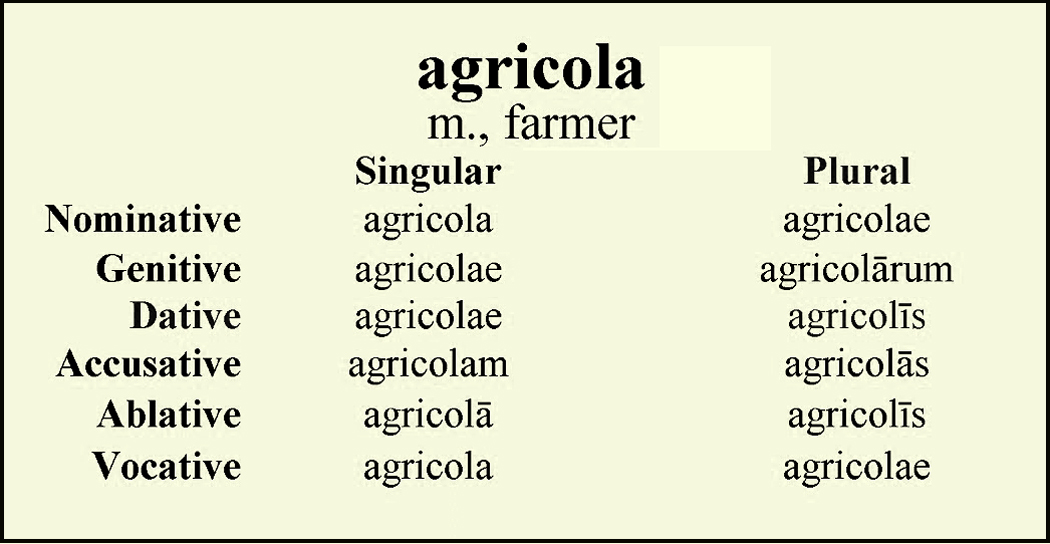
Again, I have to take his word for it. Shakespeare may have had “small Latin and less Greek,” but my Latin is even smaller than the Bard’s. I studied it in eighth grade, and mostly what I recall is “agricola.” 
I freely confess it is my loss. But there it is; I am stuck with it. 

There are those who hold that all literature is untranslatable, that you have to read it in the original language, and while I concede that you can never get all of a poem in a translation, nevertheless, I feel there is a class of work that functions perfectly well shapeshifted. 

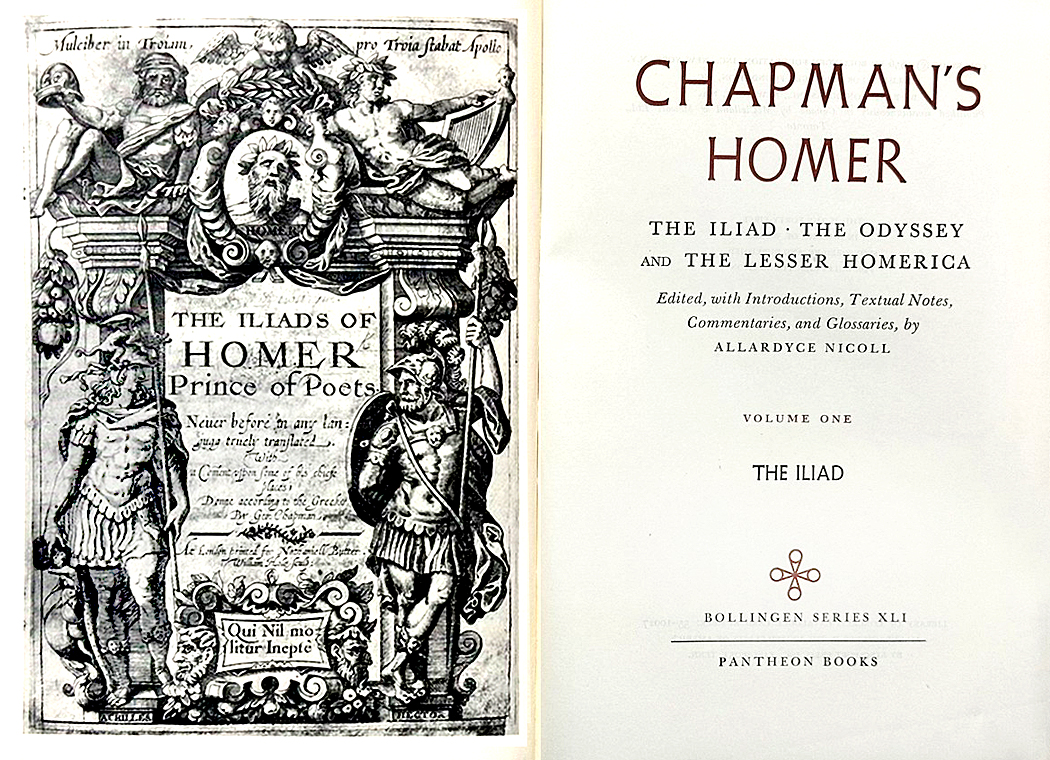
I can read my Homer not only in English, but in multiple translations, from Chapman to Pope to Fitzgerald to Fagles and I am sucked in by the poetry every time. It may very well be better in Greek, but it’s the best thing I’ve ever read even in English. I reread the Iliad once a year, and try to find a new translation each time. (I read the Odyssey, too, and I especially love the translation by T.E. Lawrence — Lawrence of Arabia. Who knew?)
The same thing happens with Dostoevsky. I’m sure it’s better in Russian, but even a good translation moves swiftly and powerfully and I am rapt by the story and moved by the humanity. There is a swift current underneath the surface of language. 

It can make a difference which translation you read. I am told by those who know, that the Scott Moncrieff translation of The Remembrance of Things Past is closest to the quality of Proust’s French, yet I find his English stuffy and outdated. The newer translations — by a range of translators for Viking (Swann’s Way is translated by Lydia Davis) — is easier to digest and flows with the quickness that ensures pleasure in the reading. But am I getting the pith of Proust? My French is better than my German, but it is still small beer. 

Constance Garnett gave us English versions of what must be every Russian novel ever written. She was a factory. And her versions are still the most widely read. But the more recent by Richard Pevear and Larissa Volokhonsky are much easier going. The duo now seem to be challenging Garnett also for the shear number of volumes converted.

Tolstoy’s War and Peace, in the English of Louise and Aylmer Maude, is the most profound and moving piece of literature I have ever read, despite the profusion of names. How much better would it read if I could understand it in Russian (and French, let’s not forget)? Its power transcends its tongue. 

This all raises the question, however, of why Homer or Tolstoy can be read in translation and Horace cannot. And the reason, I believe, is that greatness in writing comes on two essential levels: content and style. That is, how deeply it connects with our human-ness, on one hand, and on the other, how deeply it connects with its medium. This is not an either-or situation; there should always be awareness of both sides. But in practice, one side or the other tends to predominate. The more it is the universal connection with life and experience that we read, the easier the literature can travel. The more it is the words themselves, the more insular the audience.

It would be difficult to illustrate this dichotomy if we try to look at examples of foreign literature translated to English; we would need to be conversant with the original language to see how it morphs in the conversion. But consider attempting to translate several English authors into some other language.
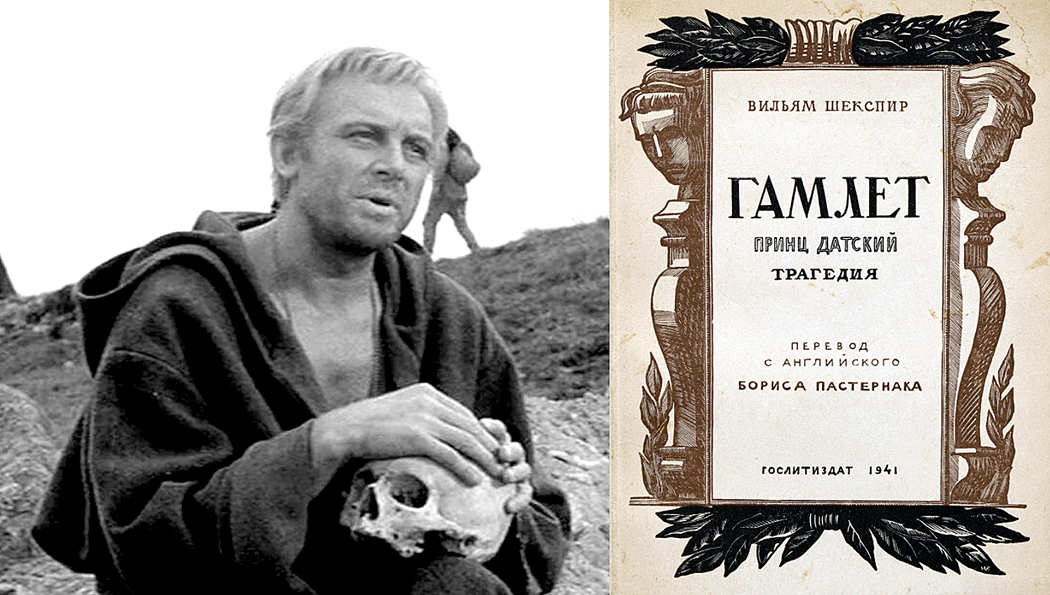
Shakespeare tends to travel well. His plays are valued in many lands and many languages. There are famous examples of Macbeth in Swahili, of Hamlet in Russian, and dozens of operatic versions in Italian, French and German. They all pack a wallop. And Shakespeare is loved in all those languages by their native speakers.

On the other hand, how in hell can you translate John Milton into French? You can tell the story of Paradise Lost, sure, but how can you convey the special organ-tone quality of his language.
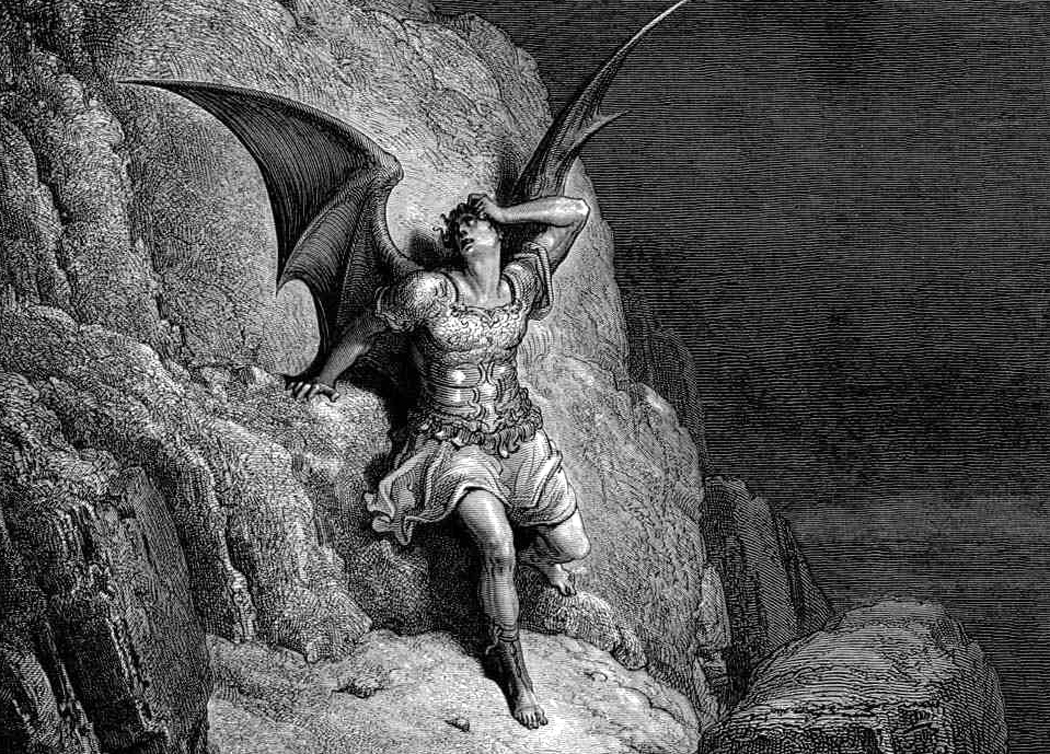
“Round he throws his baleful eyes.”

Translate it into French and it comes out as the equivalent of: “He looks around malevolently.” Not the same thing, all the poetry is gone out of it. Deflated; a flat tire.

Or: “When I consider how my light is spent.”

It is only in English that the word “spent” has the two meanings: a spent taper; or money (or life) spent. The word in the opening of his sonnet “On his Blindness” has a nimbus of ambiguity about it. The primary meaning is that he is now blind, but he spreads the halo out from the word “spent” by following it up with several other financial words: “the one Talent which is death to hide” where a talent is also a biblical monetary denomination, and brings to mind the New Testament story of the servants and the talents, and the poor servant who is “cast into the outer darkness, where there will be much weeping and gnashing of teeth.” And then there is, “present my true account,” and its hint of double entry bookkeeping. It is this expansiveness in language that is the key to Milton’s greatness. He is large; he contains multitudes. But they are bound in English, anodized, as it were, not separable. How do you work that magic in French? Or German? Or Japanese?

These things are untranslatable, and hence, Milton can never have the global currency of Shakespeare. 

Or consider translating Chaucer from his own time to ours. The poetry — The sound of the words, phrases, sentences and stanzas — cannot hypnotize us as the original does. Yes, we get the sense, but we miss the art.

“And smale fowles maken melodye, that slepen all the night with open ye.” 

Or imagine James Joyce in German. The melody is gone. “Stattlich rundlich Buck Mulligan…” 
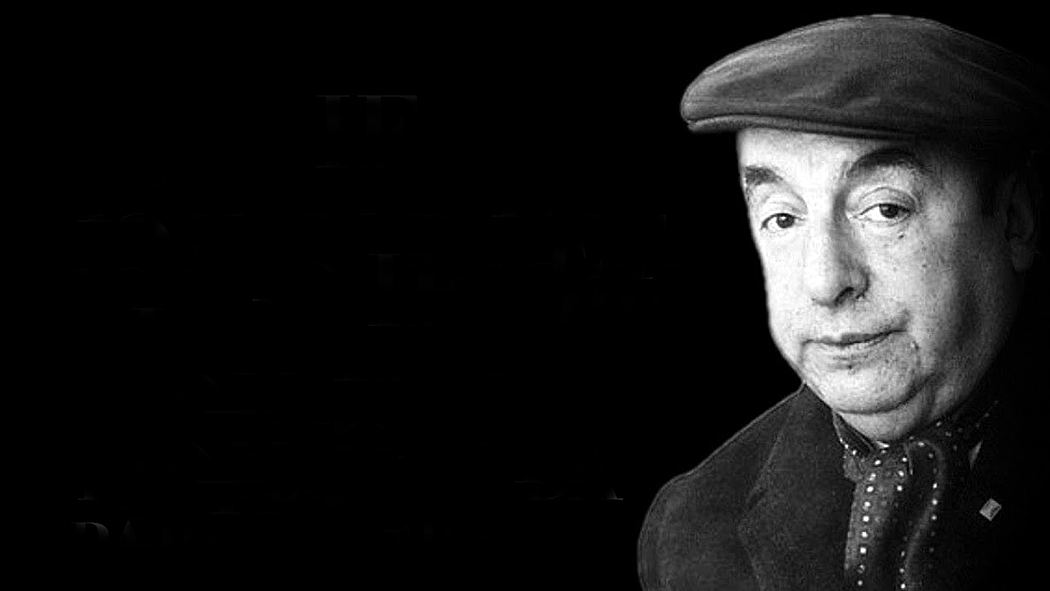
If I turn to a poet I love very deeply, and whose language I can parse, it survives translation very well. Pablo Neruda’s Spanish is so transparent, that the ideas embodied in it are clearly seen in any lingo. It is that Neruda’s primary concern in his poetry is not language, but experience. They are real pears and plums in his poetry, real life and death, real love, real sex, real toes and real stones. The poetry is about the things of this world, and not the way we express them.

The poetry is highly wrought, and in Spanish, there is a linguistic layer Neruda also cares about, but the power of the poems come from Neruda’s connection with his own life, his own experience, and that it is possible to share in any language.

Quiero conocer este mundo,” “I want to know this world,” he says in his Bestiario/“Bestiary.”

“The spider is an engineer,/ a divine watchmaker./ For one fly more or less/ the foolish can detest them:/ I wish to speak with spiders./ I want them to weave me a star.”

Language is a mask. Behind it there is a world. You can concentrate on the language, or on the world. It is easy to be lulled into forgetting the difference, to think that words describe the world, and that the best language is the most accurate lens on the things of this world — este mundo — but they are not the same, but rather, parallel universes, and what works in words does not necessarily explain how the world functions. In reality, there are no nouns, no participles. There is only “is.” Can you squeeze that “is” through words? We try. And we try again.

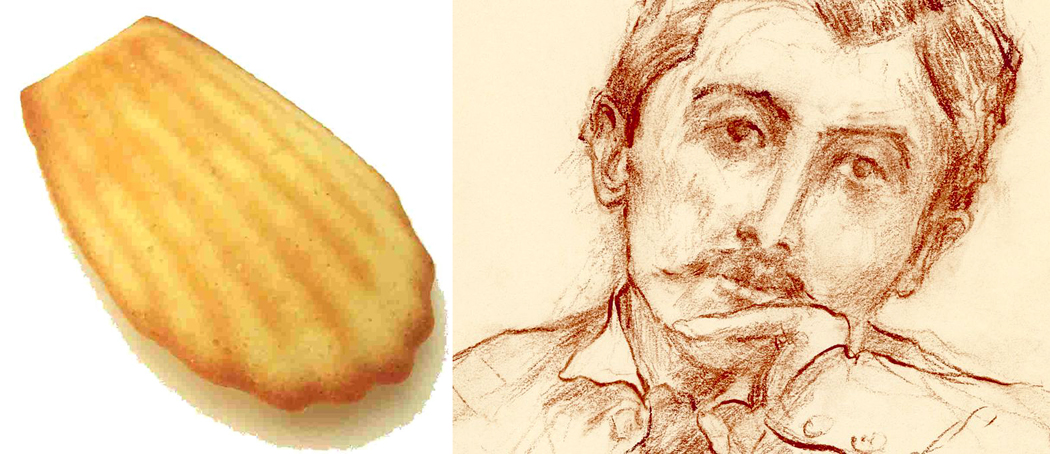
There is an experience that many well-read Americans have when they visit Paris. They head to the first patisserie and order up a small box of madeleines. The result of this purchase is universally the same: utter disappointment, because the madeleine of their imagination is rife with the magic of memory, the power invested in this tiny cookie by the words of Marcel Proust. In the most famous section of his seven-volume A la recherche du temps perdu, when Proust bit into one as an adult, the taste caused his childhood to flood back in an irrepressible wave of nostalgia.

The disappointment these readers feel is caused by the fact that a madeleine is such an unimpressive morsel, a sponge of little flavor or texture. It is primarily used for soaking in a cup of sweetened tea — the way we dunk a plain donut into our morning coffee.  The madeleine itself is insipid and boring.

Its magic for Proust was not in the eating, but in the association of the madeleine with his childhood. His, not yours. It was a door to who-he-used-to-be. But we have all had a similar, if not so profound experience concerning our own past. Often it is a tune. Perhaps you don’t immediately recognize why you react so emotionally to it, but then, you can recall exactly where you were when you heard it.

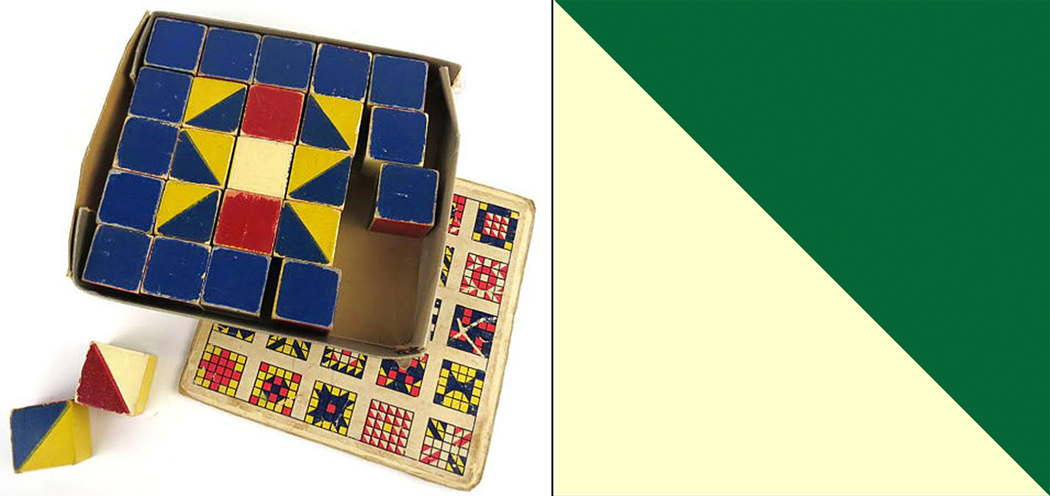
For me, it is often a color, a deep, dark blue, or the mix of green and cream white. That blue paired with yellow brings to mind a set of blocks I played with as a bairn. Not just any blue and yellow will trigger this rush, but only a very specific combination of colors.

One puzzles over what, in fact, a memory is. It would seem to be a videotape filed away in the synapses that can be retrieved by pressing the right buttons. But science can tell us memories are encoded as electrical impulses, carried between neurons by chemicals known as neurotransmitters. How does that farm I visited when I was two become a little zap in the cells of my brain, and what magic mechanism retranslates that buzz into the pictures I see so clearly behind my eyelids?

For Proust, the madeleine brought an involuntary flood of memory. And that memory inevitably exists not as a discrete neutral image, but as a wooly complex of image, emotion and thought, a whole ball of inextricable who-you-used-to-be.

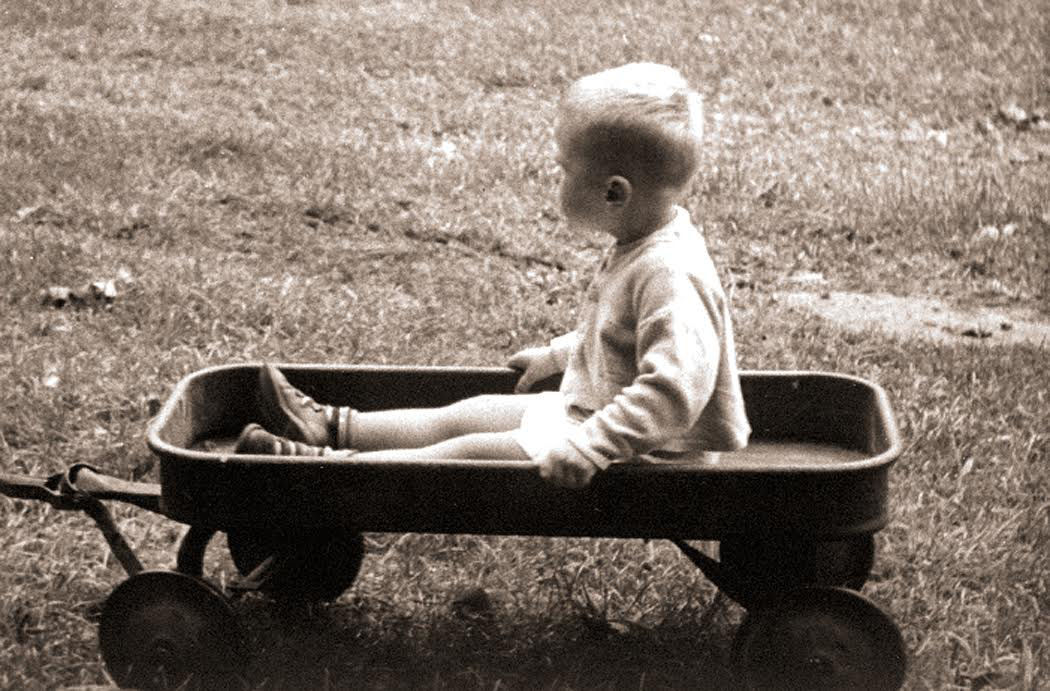
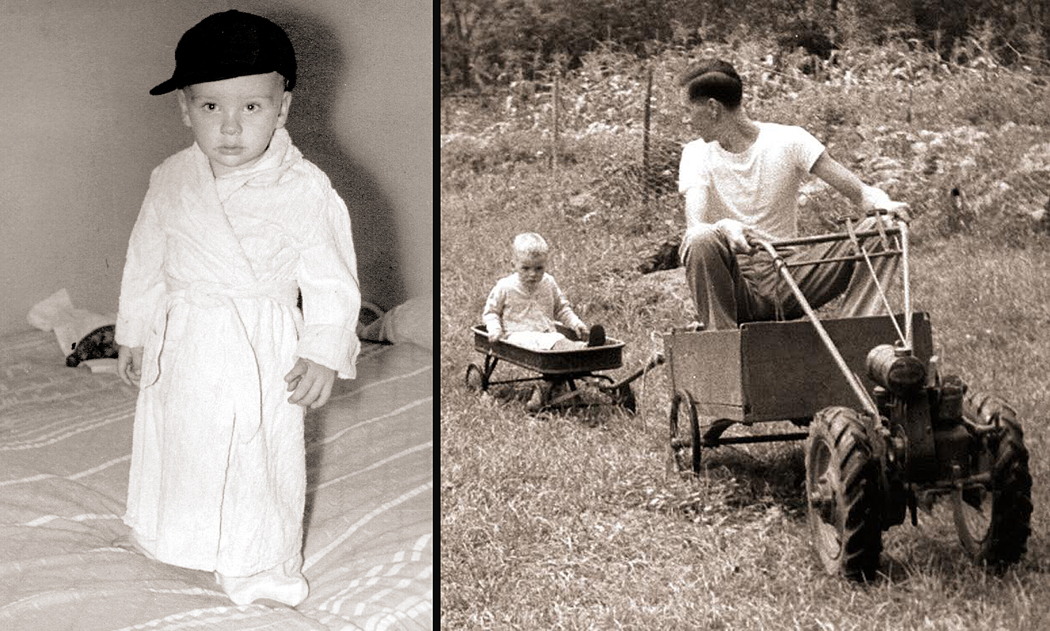
The easiest aides-de-memoire are old photographs. That box of family snapshots holds a passel of memories. But there is always the sneaking suspicion that what you remember are not the events, but the pictures themselves. But then, some research implies that each time we retrieve a memory, what we are remembering is the last time we remembered that event, and so the memory degrades, like succeeding copies of a Xerox image — copying the copy multiple times. Details are lost, and what remains becomes murky and misremembered. You visit your brother or sister, now all grown up, perhaps retired, and you say, “Remember that day you fell into the creek?” and they reply, “That wasn’t me, that was your other brother, and it wasn’t the creek, it was the river upstate.”

Whose memory, then, do you trust? Your own feels so real, so re-lived in the recollection.

My late wife had a supernatural memory. She recalled events from her childhood in infinite detail. I asked her to write those stories down for her grandchildren, but she declined. “Then I will start remembering the remembering,” she complained, “and the original will be lost,” its authenticity diluted.

There is a difference, noted Proust, between the memory you search for voluntarily, and the involuntary memory summoned up, like a genie from a lamp, when you smell a smell; hear a sound, a song; see a color or a picture. The first, while not so spontaneous, is often more rewarding.

A number of years ago, I made a pact with my two brothers. We had all gone to college and moved away to our separate jobs, wives and lives. I wanted to know more about those missing years we had been apart. I suggested we each write a short autobiography for the other two brothers. I  began mine, which covered only the years from my birth to when I was about 30. Even though I thought of it as a summary, it grew to 250 typed pages. Even now, I could go back and between each paragraph add new detail.

Where does all this stuff come from? Each time I call up a memory, it is like opening a door into a forgotten room, and each room has three or four other doors, each of which opens into yet another room, each with its four doors, and on and on, like Borges’s fictional library. 

There seems no end, as one memory suggest two or three others. Colors come back, sounds, emotions, textures, smells, chronologies, acquaintances, pains both caused and suffered, moments of transcendence, moments of relief.

As I get older — I am already old — it becomes harder to retrieve simple things, such as words and names, but the older memories still burn underneath and can be accessed. I will sometimes, when I have trouble going to sleep, call up a scene of tranquility and walk through it like a movie or play and slowly drift off as the memory metamorphoses into a dream.

Originally posted Dec. 1, 2017 on the Spirit of the Senses website

We’re approaching a full year of pandemic lockdown, barely leaving the house except to restock the larder. But at least the house is full of books, music and DVDs. It would take more than a single year to run out. 

But it puts me in mind of the old cliche: What book would you take to a desert island? It’s a silly question, really. If you are stranded on a desert island, a source of fresh water is a need infinitely more immediate than a good read. But even if we take it as simply a trope, the answers people give are seldom very satisfying. Most list a book they enjoy, which is fine, except that you can only read most of those books once, maybe twice, before they grow stale. 

No, the trick is to find a book that can reward multiple re-readings. And the same for “desert island music” or “desert island movies” (ignoring the problem of finding a DVD player in the middle of the Pacific, or the electrical outlet to plug it into.) Just picking favorites is a sucker’s game. How long would it take before listening to Stairway to Heaven for the hundredth or thousandth time to reduce you to a gibbering idiot? 

So, I set to make a list of things that could reward many traversals. This is, of course, a game and is utterly meaningless — but then most fun is. I task each of you to find a list of your own of things you could stand listening to, re-reading, or re-watching for endless times. I’m going to present my choices as they would an awards show: nominees and winners. 

Desert Island book

The sign of any good book is its re-readability. But even some of the best have just so much to offer. Madame Bovary is a great book, but once you’ve unwrapped its meaning, you are finished — unless you can read it in French and can unpack its verbal brilliance. I’ve seen many desert-island lists that offer things like Harry Potter books or Diana Gabaldon’s Outlander. And no knock on them as good reads, they aren’t books you can marry for the long haul. 

My nominees for Desert Island Book are:

War and Peace, by Leo Tolstoy. This may be the best novel I have ever read, full of people who are so real they seem not to be characters in a book, but transcriptions of life. I am in awe of this book. 

Moby Dick, by Herman Melville. This counts as my favorite book, and I have indeed re-read it many times — at least I’ve re-read the opening chapter, “Loomings,” scores of times. It was my original problem with the book. I loved Melville’s way with words so much, that each time I picked up the book, I’d start from the beginning, which made it a very long time before I ever actually finished the thing. When I pick it up again, I’ll start with “Call me Ishmael.” Again. 

Tristram Shandy, by Laurence Sterne. This is the funniest book I’ve ever read (pace P.G. Wodehouse), but funny books tend not to outlive their punchlines. You can only tell a joke once to the same audience. But Tristram Shandy isn’t a joke book, and its inhabitants are so ridiculously human and its wordplay so trippingly choreographed, that it never wears out for me. 

À la recherche du temps perdu, by Marcel Proust. This seems like the perfect choice for the desert island. First, it is exceedingly long — seven volumes and more than 4,000 pages. Second, it is filled with memorable people and discursive episodes that never seem to come to a final conclusion. It goes on. And on. The biggest problem with it, in English, is to find a decent translation that isn’t too Victorian sounding and stuffy, or too modern and chatty. 

Ulysses, by James Joyce. This is a book that not only can stand a re-reading, it requires it. No one can get it all in one go-through. Joyce’s prose, in those chapters that aren’t purposely difficult, is the most perfect prose I know in the English language. Its cadence is musical, its word-choice precise, its flavor yummy. And the difficult chapters — you know who you are — take parsing like so many physics formulae and can keep you fully occupied while you wait for a passing steamship. 

And the award goes to:

Ulysses. It wins because it is in English to begin with. You can never be sure with Tolstoy or Proust, that you are getting what is in the original. They are always at a remove. Ulysses is your own tongue, taken to its stretching point. I can’t imagine, say, reading it in a French translation, or in Mandarin. It is not transmutable. And it can stand a lifetime of re-reading without ever being sucked dry. 

Desert Island Music

This is the category that most exposes the problem. For most people, music means song, and no three-minute ditty can wear long enough to keep you going under the coconut tree. This isn’t a place for your favorite tune. This then requires something like classical music. But even most classical music can’t take the over-and-over again requirements of the island isolation. The obvious choice would be Beethoven’s Ninth, but really, you can only listen on special occasions. Over and over would be torture. 

My nominees for Desert Island Music are:

 —Quartet in C-minor, op. 131, by Ludwig van Beethoven. Really, any of the late quartets. But this is music so profound and so emotional that any barrier between the highest thought and deepest emotion is erased. They are the same thing. The C-minor quartet has six movements and each is distinct and each is a pool to dive deeply into. 

—The Goldberg Variations, BWV 988, by Johann Sebastian Bach. Thirty variations on a simple sarabande tune, arranged with a complex cleverness hard to credit. This is music to last a lifetime. Indeed, it was the first thing that pianist Glenn Gould ever recorded and the last thing. To paraphrase Sam Johnson, “To tire of the Goldbergs is to tire of the world.” 

—Symphony No. 3 by Gustav Mahler. The composer said a symphony “should contain the world,” and no work more completely attempts this than Mahler’s Third, with a first movement that is longer than most full Haydn symphonies (“Pan Awakes: Summer Marches In”) and ends with an adagio just as long, which is built from a theme borrowed from Beethoven’s final string quartet and utters “What Love Tells Me.” I cannot hear the work without disintegrating into a puddle. 

—The Passion According to St. Matthew, BWV 244, by Johann Sebastian Bach. This is the human condition in sound. All of it. No music I know of is more profound nor more emotionally direct. It lasts for nearly three hours and includes not only all the world, but heaven and hell, too. From the opening chorus, with three choirs and two orchestras, to the final “Wir setzen uns mit Tränen nieder,” which expresses infinite sorrow, this is music that shoots directly into the psyche and soul. It cannot be worn out. 

—24 Preludes and Fugues, op. 87, by Dmitri Shostakovich. I considered Bach’s Well Tempered Clavier, but I already have Bach down twice. He is the obvious choice for desert island music, so rich is his music, but I also think of Shostakovich’s version, which is just as varied both technically and emotionally. I could live with this for a very long time. 

And the winner is: 

St. Matthew Passion. This is so all-encompassing, so complex technically, so disturbing emotionally, that I cannot bear to give it up. I am not religious and the doctrinal aspects of the story mean nothing to me, but the metaphorical import is overwhelming. This is what it means to be human. And what music!

Desert Island Film

Of course, the film you want on a desert island is a documentary about how to get off a desert island. And if you need a film you can watch over and over, I’ve proved already I can do that with the 1933 King Kong. I’ve watched it a thousand times since I was four years old. But that is not the kind of thing I mean, not what can sustain you through multiple dives into a film’s interior.

My nominees for Best Desert Island Film are: 

Rules of the Game, directed by Jean Renoir. La Règle du Jeu (1939), which many critics have called the best movie ever made, is certainly the most human, humane and forgiving film ever, while at the same time being satirical and biting about human foible and hypocrisy. Yes, it’s in French, with subtitles.

La Dolce Vita, directed by Federico Fellini. The great 1960 Italian classic of the Roman “sweet life” in the postwar years shows us Marcello Rubini (Marcello Mastroianni) as he negotiates personal relationships, professional crises and spiritual doldrums. The meaning of the movie has been debated for 40 years. It has been seen as anti-Catholic and as a reactionary embrace of religion. It has been seen as an angry critique of modern life, but also a celebration of it. It has been called pornography, and also one of the most moral movies ever made. It’s rich enough to embrace many meanings. Fellini said he was not a judge, “but rather an accomplice.”

Andrei Rublev, directed by Andrei Tarkovsky. If La Dolce Vita was ambiguous, Andrei Rublev is close to impenetrable. There is no slower film, outside Andy Warhol’s 8-hour-long Empire State Building. It is not so much a story as a dream, full of significance, but not explainable meaning. It is so unutterably beautiful it simply doesn’t matter what is happening on screen.  I love this film. I don’t mean enjoy, I mean love. 

Fanny and Alexander, directed by Ingmar Bergman. Some films are art, some are great stories, some are deeply understanding. Fanny and Alexander is all three. It exists in multiple versions — a single one for movie houses at 188 minutes and a 312 minute version originally intended as a TV miniseries. I choose the longer version for my desert island. This is Bergman at his most human, least artsy and symbolic. It can engulf you. 

Dekalog, directed by Krzysztof Kieślowski. Polish director Kieślowski made this 10-part film on the Ten Commandments, although not in any literal way. Each film is directed in a different style, and none is religious. The two best concern “Thou shalt not kill” and “not commit adultery,” Your heart will be wrenched from your chest and stomped upon. 

And my choice is:

Rules of the Game. I cannot count the number of times I have watched this film. Not as many as King Kong, I guess, but close. And I know from experience it can hold up under uncounted viewings. There is plenty to enjoy from a filmmaking point of view, just as there is in Citizen Kane, but it is also a profoundly forgiving film — the single most important quality in a human life. 

Bonus 

I have a few more categories, that I’ll suggest in abbreviated form. There you are on the desert island with a bookshelf and a DVD player. You can add a desert island opera, a desert island epic poem, a desert island play. 

Opera

An art form that puts it all together in one package, opera would be an excellent way to spend your island time. But again, we have to consider which opera can stand multiple viewings, that has multiple meanings or interpretations. We all love La Boheme, but there is only so much there under the hood. And Wagner would just wear us out. We are down to Mozart. The Marriage of Figaro is a perfect choice, but I’m going with my favorite: 

Don Giovanni, by W.A. Mozart and Lorenzo da Ponte. Is it a comedy? Is it a tragedy? Is it a dramedy? Whatever it is, it is filled with real people doing things real people do (aside from talking to statues and falling into hell, that is) and with some of the best music Mozart ever wrote. Fin ch’han dal vino

Epic poem

There is not a wide field to choose from, and how can you pick among the Iliad, the Odyssey, Dante’s Commedia, or Milton’s Paradise Lost? (Notice, I did not include Vergil. Dull stuff). Nor can I pick an Icelandic saga or a Medieval droner, like Parzival or the Nibelungenlied. I’ve tried slogging my way through Tasso and Ariosto, but get dragged down in slow motion. There is just one for me, and I re-read it every year: 

The Iliad, by Homer. How can the first entry in the Western canon still be the best? Nothing beats Homer. His imagination is immense, from the largest cosmic scene to the fingernail of a flea, it is all encompassing, and moves with the instantaneity of movie cutting from the one to the other. Actually, if I had to leave behind novel, music, film and everything else, and had only one companion with me, it would be the Iliad. 

Live theater

What do you mean “live theater?” We’re on a desert island. But, if I can imagine a DVD player and an electric socket on the bare sand, I can imagine a stage play. This is all theoretical anyway, remember? 

Angels in America, by Tony Kushner. Without doubt the greatest thing I’ve ever seen on the live stage is the original New York production of Angels in America — both parts. It is overwhelming, and will demonstrate to anyone who hasn’t had the experience yet, that live theater is unmatchable by seeing the same thing on PBS Live From Lincoln Center or even in Mike Nichols’ filmed version. Wow. And I’ve seen some great Shakespeare live, even by the Royal Shakespeare Company. Angels rules. 

————————————

And so, we’ve turned an isolated desert island into a library, concert hall, movie house, opera house and legitimate stage. Far from being solitary, we’re crowded. Pandemic be damned.

Do you think you know the title of this painting?

Do you think you know the title of this painting?

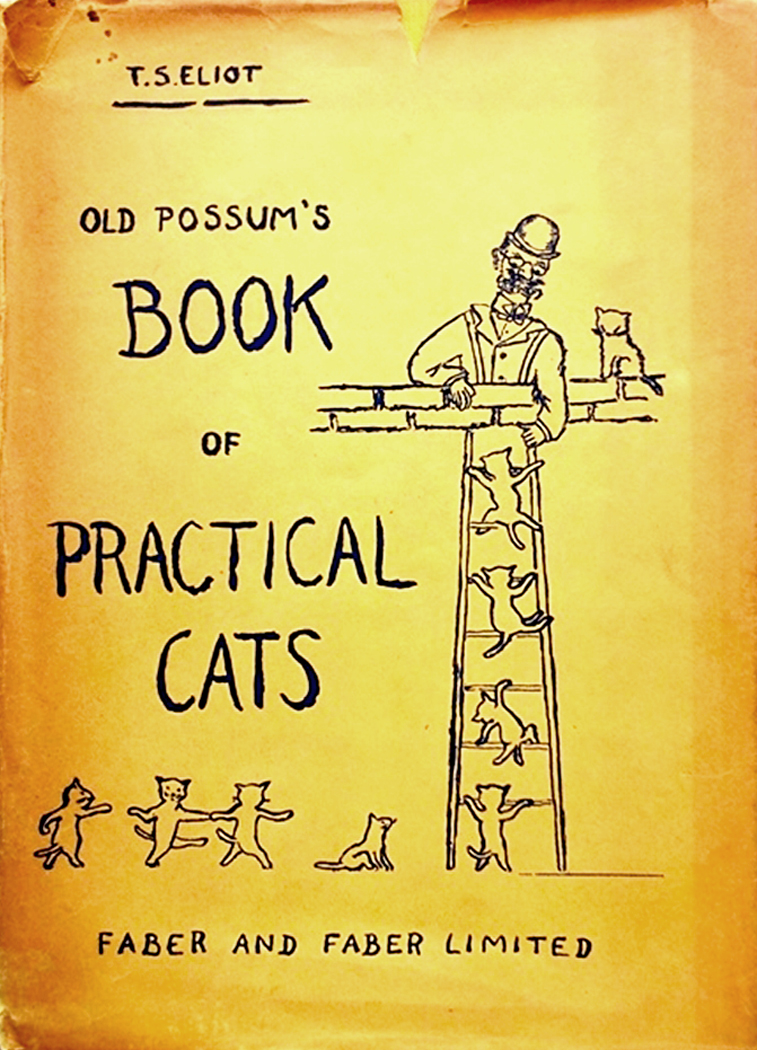
In T.S. Eliot’s Old Possum’s Book of Practical Cats, he writes, “The naming of cats is a difficult matter,/ it isn’t just one of your holiday games.old possum

“You may think at first that I’m mad as a hatter/ when I tell you a cat must have three different names.”

Of course, that book of poems went on to become the beloved and behated Broadway musical Cats, with people who should know better running around onstage dressed up in Halloween costumes as felines. The high-church Eliot probably rolled over in his grave.

But in the real world, it isn’t just cats. It’s a problem that comes up in the art world all the time: What’s the real and true name of a painting, a symphony or a poem?

When I was a working journalist, this would sometimes present a problem: Copy editors would demand the precise title of a work mentioned in a story, and they could be quite the sticklers. The Beatles’ “White Album” (by which name the entire world recognizes the double-disc album put out in 1968) is not “really” the title. So, we would have to call it The Beatles, which for most people is unhelpfully indistinct.

The world of the arts is filled with such issues over titles. It makes it sometimes quite chaotic. Of course, to live in the world of the arts requires a significant ability to endure the vague, but many people, especially engineers and editors, are as uncomfortable with the vague as Indiana Jones is uncomfortable with a snakepit.

And if engineers or biologists lived with such a level of unclarity, bridges would fall and the contents of petri dishes would infect the world.

But it is true. Titles are a frustratingly messy bogeyman.

We think of titles as being a simple issue: The painter or writer or composer gives his or her work a title, and it somehow gets registered somewhere — maybe the Library of Congress — and that’s that.

But that’s not the reality.

Consider Antonin Dvorak’s New World Symphony. Or is it the Symphony No. 9 in E-minor, op. 95, or is it Symphony No. 9, “From the New World.” Must a symphony have three different names?

Your grandparents knew it as Dvorak’s Symphony No. 5. So, where is reality?

(Before recent scholarship and a fetish for completism, Dvorak’s first four symphonies were not much played, being considered “student work”; therefore, his final symphony was his fifth. We now count the early ones and have bumped the “New World” up to No. 9.)

The problem, in part, is caused by history. History causes many problems.mona lisa

What we take today to be a hard-and-fast category — titles — turns out to be a fluid concept. When Leonardo da Vinci and Rembrandt were working, they never titled their works.

Da Vinci’s The Mona Lisa also is called La Gioconda. One of Rembrandt’s most famous paintings, The Night Watch, also is called The Shooting Company of Franz Banning Cocq and The Company of Frans Banning Cocq and Willem van Ruytenburch. So, what are their “real” titles?

Well, there aren’t any.

Such titles originally were descriptions of the paintings written for sales catalogs, most often for estate sales after the artists’ deaths. The widow pulls together all the unsold work, and someone writes down “Summer Evening” or “Young Woman With a Milk Pail.” Not titles, just short descriptions to help potential buyers tell one painting from another.

And they often have multiple titles, from subsequent sales.

It wasn’t until the 19th century that paintings or sculptures were given anything like what we now would call an official title. And even then, the artists tended to make their titles descriptive, to help gallery-goers explain to gallery representatives which paintings they were interested in buying.

The music world is even more byzantine, because there is no consensus at all on what to call a given work.

Take Beethoven’s Eroica.

When we call it that, pretty much everyone knows what we’re referring to: the symphony in E-flat, or the Third Symphony, or the Symphony No. 3 in E-flat, “Eroica.” There are a dozen other names in common usage.

What did Beethoven call it? Well, the title page of the manuscript, in Beethoven’s hand, calls it: Sinfonia eroica, composta per festeggiare il sovvenire d’un grand’uomo (“Heroic symphony, composed to celebrate the memory of a great man.” But then when it was first published, the cover page called it Symphony for Grand Orchestra in E-flat, op. 55, and the title page read something like: Symphony in E-flat for 2 flutes, 2 oboes, 2 clarinets in B flat, 2 bassoons, 3 horns in E flat, 2 trumpets in E flat and C, timpani in E flat and B flat and strings, op. 55.

It also is ascribed to “Luigi van Beethoven.” The French version calls him Louis van Beethoven.

So, what is its title?

As with the paintings, Beethoven’s original audience was comfortable with descriptions rather than titles. Any of the above sufficiently describes the symphony so it won’t be confused with anything else.

There are other problems.

Even in works that have real, official titles, we don’t always use the full version.

Brahms’ German Requiem is more properly A German Requiem, to Words of the Holy Scriptures.

This is pretty common. After all, Shakespeare’s Merchant of Venice was given the fuller title in the First Folio, The Most Excellent History of the Merchant of Venice. With the extreme cruelty of Shylock the Jew towards the said Merchant, in cutting a just pound of his flesh: and the obtaining of Portia by the choice of three chests.

Quite a mouthful.

Mozart’s Marriage of Figaro is actually titled The Marriage of Figaro, or One Crazy Day.

Which raises another problem: The title, really, is Le nozze di Figaro, ossia la folle giornata, but we commonly translate the title into English for the sake of being understood. So, Die Walkure becomes The Valkyrie, and Mondscheinsonate becomes the Moonlight Sonata, which, of course, is really the Sonata quasi una fantasia, in C-sharp minor, op. 27, No. 2, or, by another convention, Beethoven’s Sonata No. 14. Confusing enough?

Titles in translation are often changed if their original meaning might be misunderstood in the new language’s idiom, or if it comes across unidiomatically, so that Proust’s A la Recherche du temps perdu was known for years in America as “Remembrance of Things Past.” Presumably “About the Search for Lost Time” falls considerably flatter in English than in French.

Discussing such things with copy editors may or may not go anywhere: We are stuck with the whole idea that an art work or poem or piece of music could no more not have one final true title than a person could have no name on a birth certificate.

And one final thought: By far, the most popular title in art galleries is  “Untitled.”

Is that its title?