Archive

Tag Archives: television

cosmos logo

The new science series, Cosmos: A Spacetime Odyssey, has been a huge disappointment.

Rife with cliches, cheap-looking animation and lack of coherent structure, after its first two episodes, it is proven a shallow and glib sequel to Carl Sagan’s 1980 original, Cosmos: A Personal Voyage.

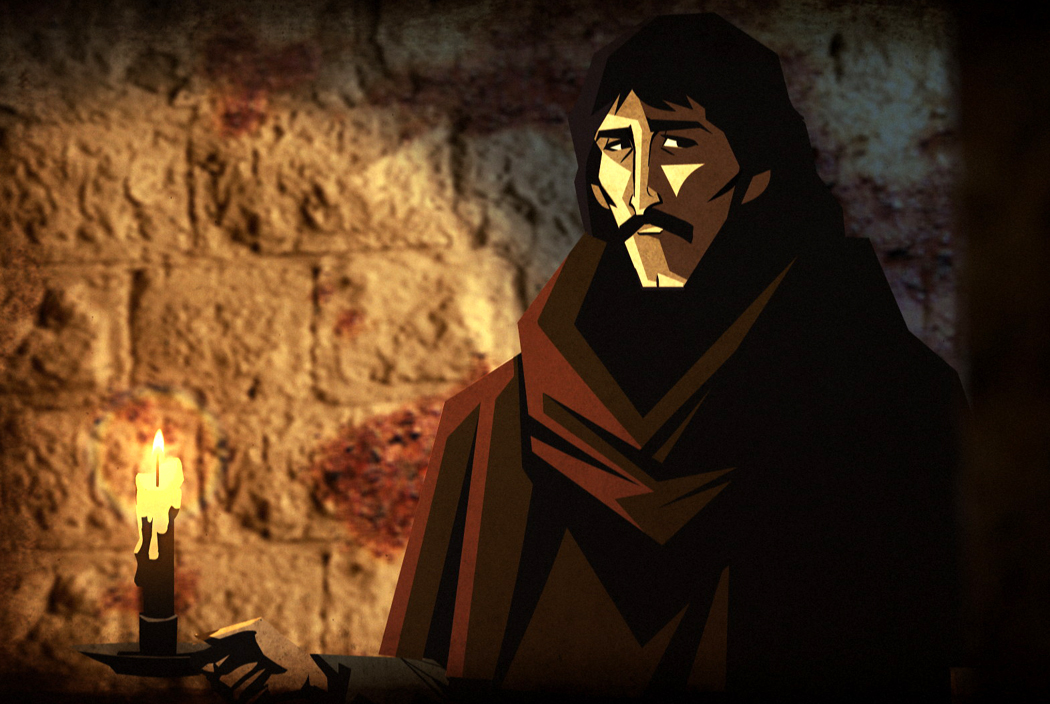
The problems are myriad. The animated sequences are just embarrassing; they remind one of Sunday-school Bible story videos. Graphic ideas that were original 30 years ago now seem tired and worn; if I never see another green-screen calendar standing in for the 13.8 billion years of the universe and an actor standing on Dec. 31, pointing to the last 16 seconds as all of recorded history — well, let’s just say I will survive if I never see that again. There has to be a fresher way of presenting the material. giordano bruno animation

I don’t have a problem, per se, with Neil deGrasse Tyson as presenter, except that he is given such a lame script to read. He has been a persuasive and entertaining host on many another appearance, but here, he is reduced to being a hired-gun presenter, reading someone else’s words. One of the primary strengths of the original series was that it was Sagan’s words, his ideas and his idiosyncrasies that gave the series such strength and authority. tyson 2

You have to look long and hard deep into the credits to even discover who wrote this new series. The surprise is that the script is by Sagan’s widow, Ann Druyan and astrophysicist Steven Soter, both of whom collaborated with Sagan on the first series. It is astonishing that the original was so personal and this sequel so deadeningly impersonal.

The second episode of the sequel was marginally better than the first, so maybe the series will get better as it goes along, although I doubt it. There is a serious flaw in its conception.

Television has a marvelous history of documentary series, beginning — by most people’s reckoning — with Kenneth Clark’s Civilisation: A Personal View, from 1969. That series set the parameters for those that followed: Jacob Bronowski’s The Ascent of Man (1973), Alistair Cooke’s America: A Personal History of the United States (1972), Robert Hughes’ The Shock of the New (1980),  and, of course, Sagan’s Cosmos (1980).

There were others, too. Jonathan Miller’s The Body in Question (1978), Phillip Morrison’s The Ring of Truth: An Inquiry into How We Know What We Know (1987), David Attenborough’s Life on Earth (1979). What makes each of these series memorable is that they are told through a presenter who has personal knowledge of what he is talking about, and more than that, has a point of view.

Whether it is Hughes, looking like a pugnacious longshoreman, or Cooke looking exactly not like a longshoreman, they each ooze personality from every pore. Neil deGrasse Tyson has personality, too. But the earlier presenters had more than personality: They had something to say.

Many documentaries — and most so-called contemporary documentary series on cable TV channels — present either a dumbed-down version of the accepted wisdom, the handed-down story, or else an “objective” and impersonal “encyclopedia-entry” regurgitation of factoids.

There are different ways of being objective. Frederick Wiseman gives us long documentary films with no narration at all — just immediate immersion into his subject, leaving us to figure it all out. Or, like the PBS series, Frontline, give us a clear narrative, read in the Voice of Doom timbre of Will Lyman — the most distinctive and recognizable faceless voice since John Facenda telling us of the frozen tundra of Lambeau Field.

And at least one great television documentary series has come from this objective school: The World at War, the 1973 Thames Television series created by Jeremy Isaacs and narrated by Laurence Olivier. For that, the enormity of its subject seemed to require a certain distance.

But most of the great and memorable educational series have come through the sensibility of a single presenter — Clark’s take on European art, Bronowski on science or Martin Scorsese on film.

It is important to recognize that it is not the personality of the presenter so much as it is that important word: sensibility. It is not the knowledge that the host conveys as his relationship to the knowledge, the connections between things, the understanding. As Albert Einstein said, “When I need a fact, I can look it up.” It isn’t facts we need but the appreciation of our ineluctable relation to those facts. Sensibility is fact filtered through the human mind. It is where poetry comes from and it is poetry that is missing in the new series. sagan with dandelion

Just one example: In the original Cosmos series, the “spaceship of the imagination” that Sagan offers us comes in the form of a starburst, or, as it later turns out, the fluffy starburst achene of a dandelion. In the final episode, Sagan speaks to us directly on a rocky seashore and picks up a tiny white seedhead and lets it fly with the breeze, and we are shocked into the recognition that the spaceship of the imagination is a metaphor — the small achene and the immense starburst are micro and macro version of the same thing — that the earthly weed from our front lawns and the burning starry dynamo in the machinery of night are one and the same substance.

As William Blake put it: “Infinity in a grain of sand and eternity in an hour.”spaceship tyson

In contrast, the new Cosmos has us riding in what looks like a giant letter opener, shiny as chromium steel and just as hard and impersonal — it is a symbol of technology, not science. Sagan would never confuse the two.

It tells us how advanced have become the tools of computer graphics and their ability to create the illusion of reflections on a moving surface. We may admire the software that produced the visuals, but we are hardly edified by them.

One other comparison: Tyson in the new series tries to inject a bit of himself in the opening episode, telling us how when he was 17, he met Carl Sagan and how much it meant to him as a young man interested in astronomy. It is the one moment of authenticity in the otherwise stumbling artificiality of the show.

The injection of the personal has often been a tactic used in documentaries. But compare Tyson’s moment of authenticity with Jacob Bronowski in the episode of The Ascent of Man in which he discusses the impossibility of certainty in science. At the end, he stand at the edge of a pond in the Auschwitz death camp and defends science as the best we can know in our own fallibility, and the evils visited upon us by certainty.

“This is the concentration camp and crematorium at Auschwitz. This is where people were turned into numbers. Into this pond were flushed the ashes of some four million people. And that was not done by gas. It was done by arrogance. It was done by dogma. It was done by ignorance. When people believe that they have absolute knowledge, with no test in reality, this is how they behave.”

He bends down and puts his fist in the muck, drawing up a handful.

“I owe it as a human being to the many members of my family who died here, to stand here as a survivor and a witness. We have to cure ourselves of the itch for absolute knowledge and power. We have to close the distance between the push-button order and the human act. We have to touch people.”

It is the difference between the trivial and the profound.

So, in response to the banality of the new, lesser Cosmos, we should look back at some of the best that television has given us, and the people who have something to say who have stood in front of the cameras to express their connection to the world they live in, to share their sense of attachment and their fresh words, so lacking in glibness and cant.

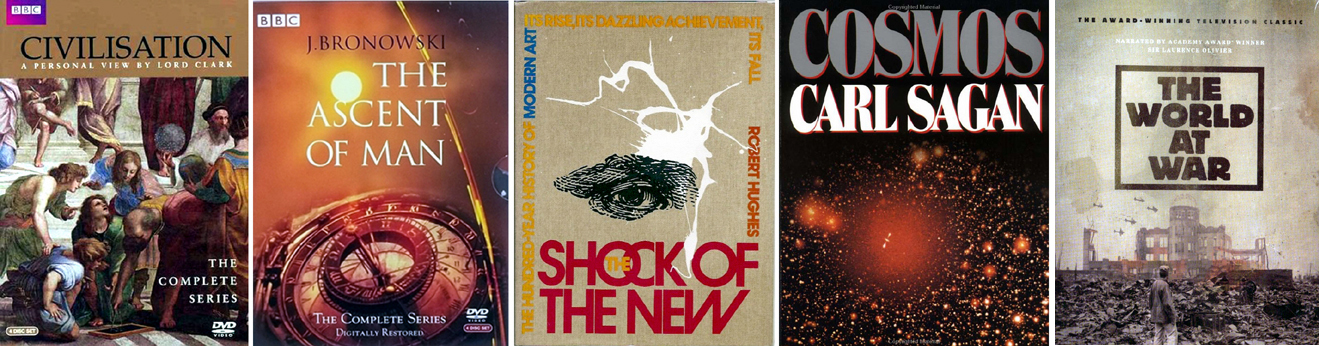
These are my nominees for the five best television documentary series ever produced.The five best

Civilisation: A Personal View (1969) — Sir Kenneth Clark provides a heartbreaking overview of European art and civilization in a series that is a much better, more nuanced view of its subject than you probably remember. If you recall it as Clark, with the British public-school back-palate drawl, talking about the “great masterpieces” as if he were an Oxfordian tour bus guide, you will be in for a surprise: His view is much more subtle than that. He makes a serious attempt to discover just what civilization might be, and uses the past 500 years of European history to make his discovery.

The Ascent of Man (1973) — Mathematician Jacob Bronowski reacted to Clark’s view of civilization, deciding it placed too much emphasis in art and not enough on science, so he attempted to do the job. With his unfortunate 1970’s fashion sense and a slight lisp, he could sometimes sound a bit pompous, but the content of his cosmopolitan mind was a tremendous gift to anyone willing to listen.

The Shock of the New (1980) — Art critic Robert Hughes tried to make sense of Modernism in art, and gave us many profound insights, including the uncomfortable relationship of Surrealism and Fascism. Hughes can be confrontational and pugilistic, but unlike most art critics, whose prose is often no more digestible than an old mattress, he wrote with grace, wit and memorability.

Cosmos: A Personal Voyage (1980) — Astronomer Carl Sagan made the universe personal, gave us a way in to a subject usually obscured in the jungle foliage of higher mathematics. What is surprising, more than 30 years on, is just how much he got right. Yes, you can make fun of “billions and billions,” but the truth is, there are billions of billions out there.

The World at War (1973) — The exception that proves the rule, this 26-episode series combines archival film footage with meaningful interviews with surviving participants from all sides. Written and produced by Jeremy Isaacs, it comes with the voice-over of Sir Laurence Olivier, using his most serious and least thespianic narrative powers. This is a triumph of direct and unmannered documentation.

It should be a hallmark of television literacy to have seen all of these series.

The BEST of the REST

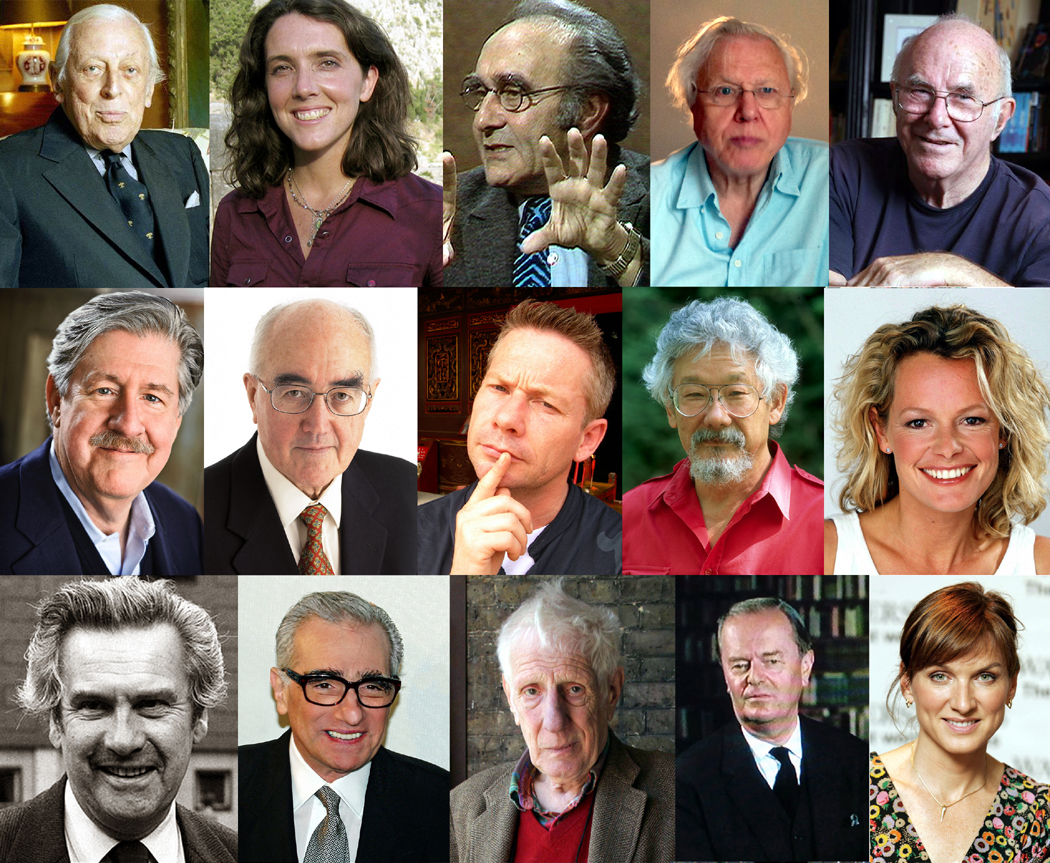
Can you name these presenters? Answers below

Can you name these presenters? Answers below

Since it is the presenter (a very British term, but more accurate than “narrator,” “host” or “emcee”) that makes the series, one should look for any programs by

Michael Wood, whose boyish enthusiasm brought us In Search of the Trojan War, In Search of the Dark Ages, The Story of India and many more. He is best when the material is his own; when he is just a hired gun, as in the Art of the Western World, he is entertaining, but less engaging.

Michael Palin, the former Monty Python stalwart, who has become the best travel presenter ever. He began doing shows on railroad trains, but hit his stride with Around the World in 80 Days, in which he met the challenge of Phileas Fogg. He followed that series with Pole to Pole, Full Circle with Michael Palin, Sahara, Himalaya and Michael Palin’s Hemingway Adventure.

Ian Wright, a cherubic and outgoing Englishman with a Suffolk born glottal stop, he is a frequent presenter of Lonely Planet travelogs. No one joins in with whatever local population, or with less self-consciousness than Wright. You want him to be your permanent travel partner.

Martin Scorsese, the current reigning king of movie directors, has to be the best informed historian of film ever, with an encyclopedic knowledge of all things cinematic and always and engaged and engaging way of speaking about his passion. He has made two series about films that are a must: A Personal Journey with Martin Scorsese Through American Movies, and My Voyage to Italy, in which he does the same thing for the classic Italian films he grew up with.

Leonard Bernstein, who can be more annoying than anyone else on my list, with his stentorian voice and oracular pronouncements, is nevertheless a great teacher who can disclose the secrets of classical music even to the uninitiated, as long as they are willing to pay attention. His series of Harvard lectures, The Unanswered Question, is one of the best discussions of the changing history of classical music out there, even if you have to put up with a dose of Chomskian linguistics.

Sister Wendy Beckett, who can also be annoying, is nevertheless one of the most patient and thorough observers of the narrative content of Renaissance and Baroque paintings. If Modernism has made us condescending to subject matter in art, this English nun reawakens us to the subtlety and power of that content.

Simon Schama, the polymath, has given us series on The History of Britain and The Power of Art, which looks with some detail at eight artists and eight paintings. He can be snide and sometimes sounds like an English public school don, but he has a good sense of humor. His newest series, The Story of the Jews, begins this week on PBS.

There are others, too. James Burke, Bettany Hughes, Niall Ferguson. The BBC especially, is ripe with presenters.

Can you name these presenters? Answers below

Can you name these presenters? Answers below

But the king of all of them, largely unmentioned until now, but only because he deserves the Big Finish, is the greatest presenter of all, David Attenborough. For more than 60 years, he has been presenting nature programs for the BBC and has written and presented some of the best documentary series ever made. In fact, of the Top 20 TV documentary series listed on IMDb, Attenborough created 10 of them.

David Attenborough

David Attenborough

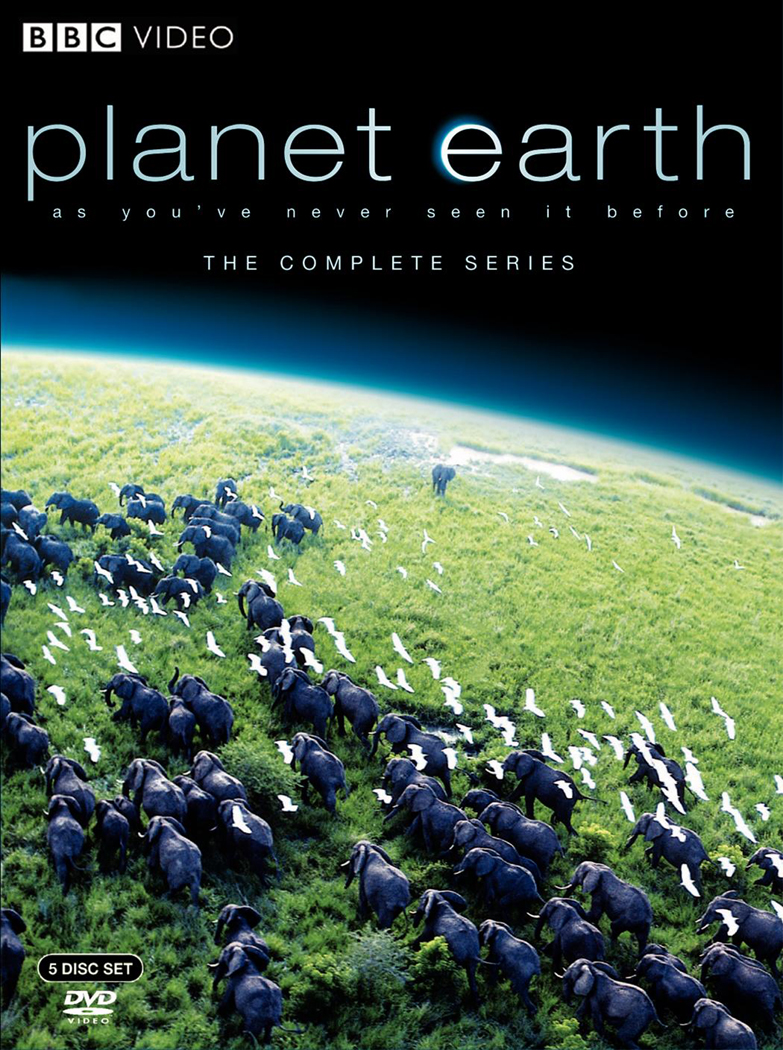
No one is more genuine on screen, nor more cosmopolitan in approach, or more knowledgeable about his subject or more personable than Attenborough. A list of his accomplishments takes up 16 pages on Wikipedia. He has made the definitive series of programs about life on the planet five times, each one better than the last, beginning with Life on Earth in 1979, The Living Planet in 1984, The Trials of Life in 1990, Planet Earth in 2006, and Life in 2009. That doesn’t count Blue Planet (2001), The Life of Birds (1998), The Life of Mammals (2002). In 2013, at the age of 86, he gave us Africa.planet earth cover

The quality of these series, the many others, and the scores of one-offs — not to mention that as head of programing at the BBC, he greenlighted such classics as Civilisation, Ascent of Man and Alistair Cooke’s America —  makes Attenborough not just a hero, but a god. At least a divi filius.

He is a paragon of humanistic awareness, curiosity and fairness, and has not, to my knowledge, ever in his life uttered a cliche. I’ve never seen anyone more present in the world. If he is not awarded some sort of Nobel Prize for his life work, the universe will have to be declared deficient.

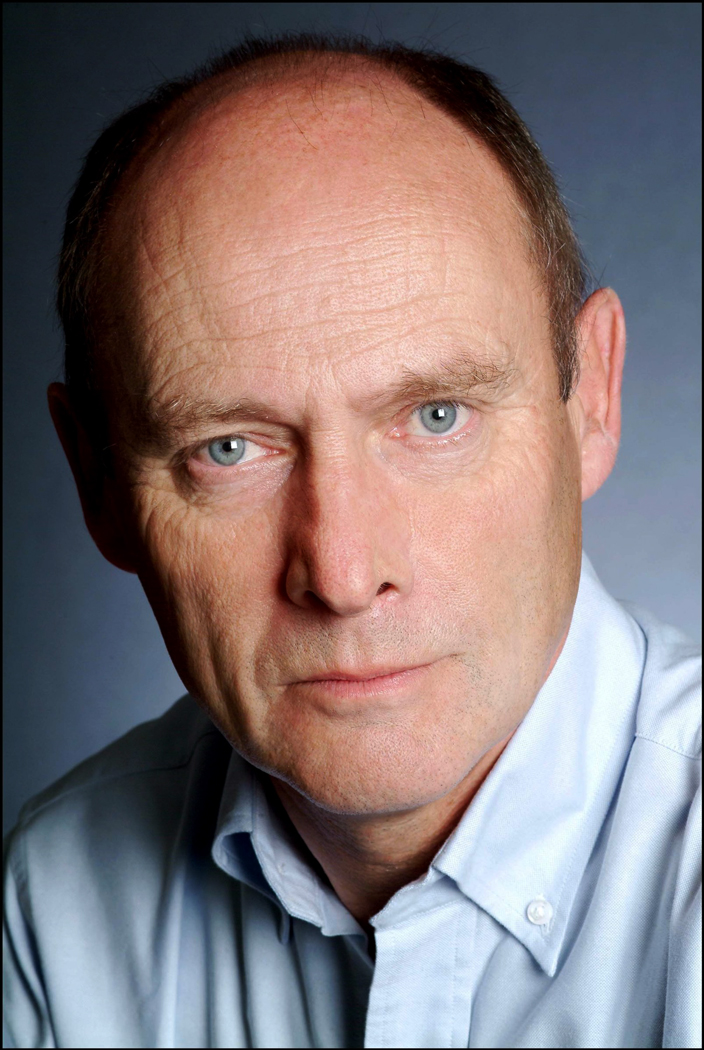
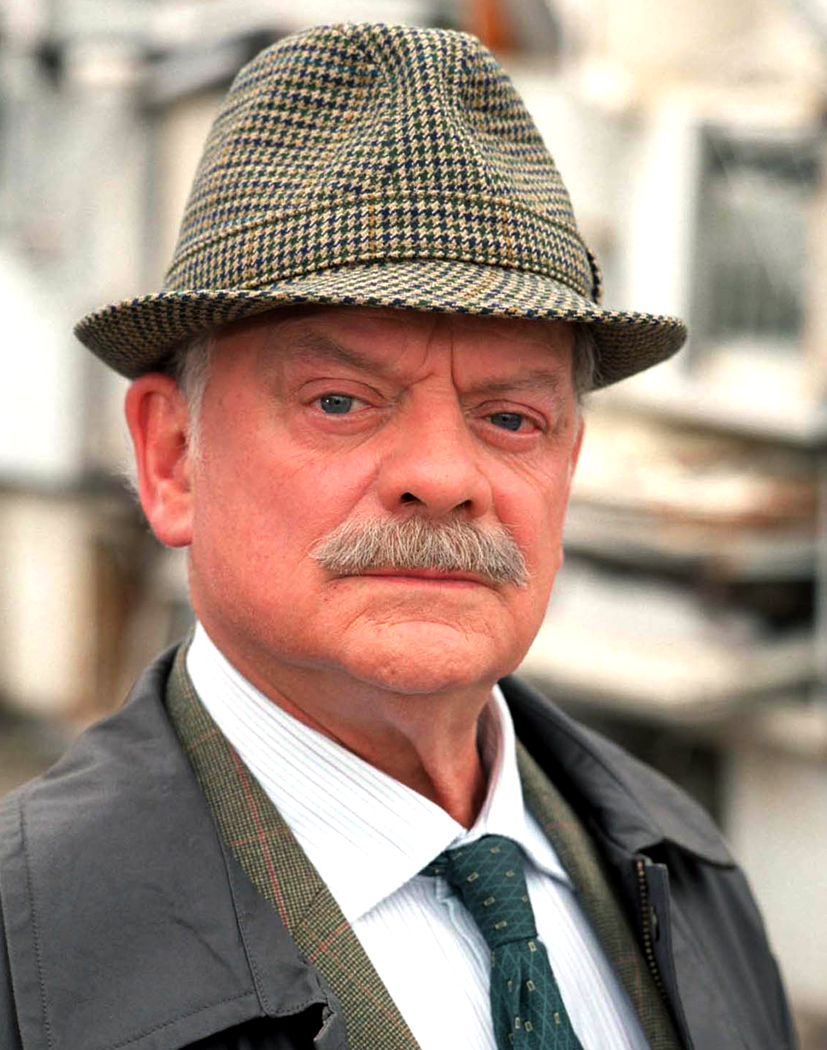
Presenter mugs: Top photo, top row (L-R): Alistair Cooke, Bettany Hughes, Jacob Bronowski, David Attenborough, Clive James. Middle row: Edward Herrmann, James Burke, Ian Wright, David Suzuki, Kate Humble. Bottom row: Ludovic Kennedy, Martin Scorsese, Jonathan Miller, Kenneth Clark, Fiona Bruce.

Bottom photo, top row: Michael Palin, Michio Kaku, Niall Ferguson, Morgan Freeman, Michael Wood. Middle row: Simon Schama, Peter Coyote, Robert Hughes, Carl Sagan, Sigourney Weaver. Bottom row: Sister Wendy Beckett, Trevor McMillan, Neil deGrasse Tyson, Will Lyman, Terry Jones. 

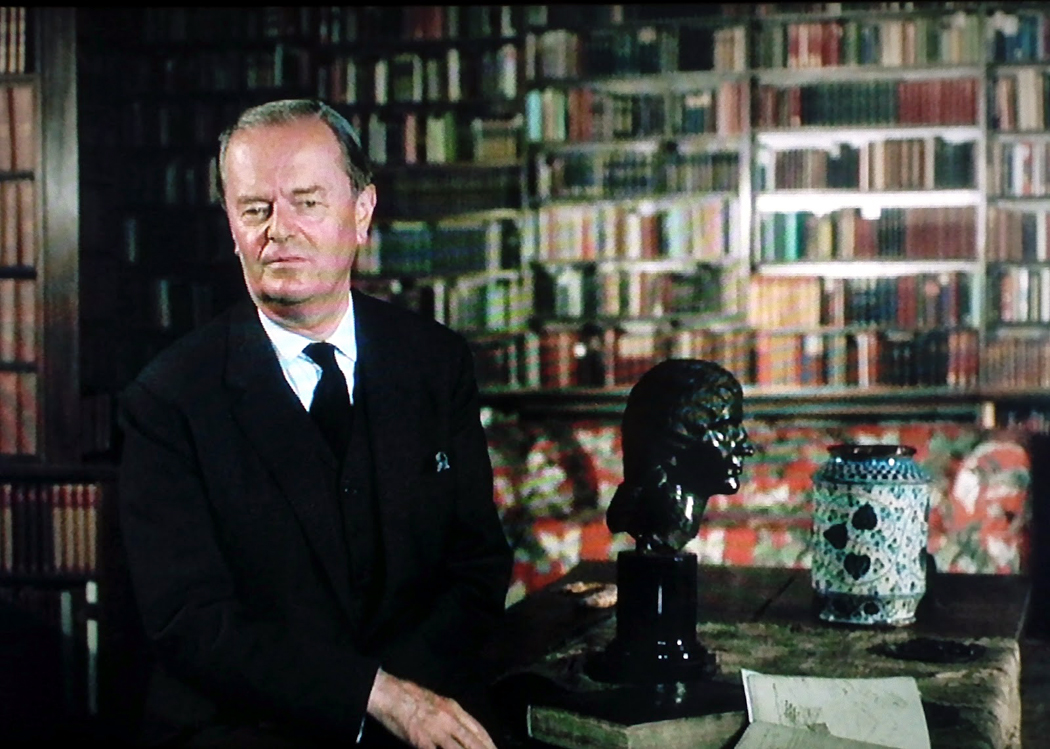
kenneth clark

Without the cosmos, there would have been no civilization.

But, without Civilisation, there would have been no Cosmos.

Bettany Hughes

Bettany Hughes

And probably no Civil War or Jazz. And no jobs for all those BBC presenters, from Bettany Hughes to Michael Wood.

And Michael Palin would have been merely another retired Python.

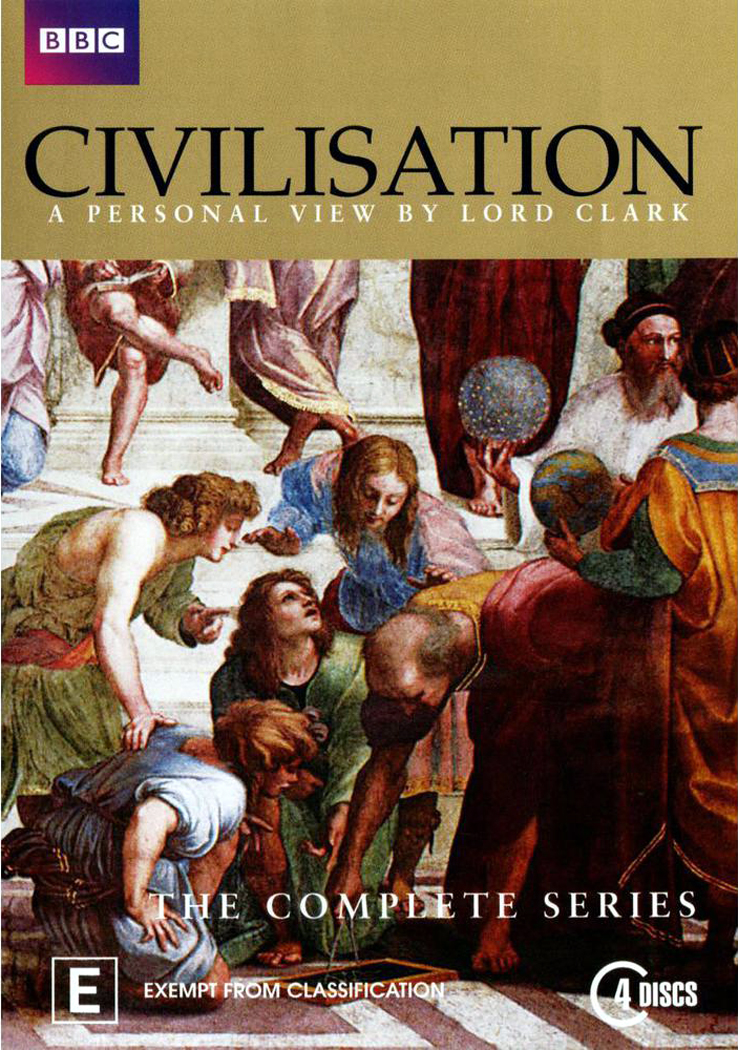
Sir Kenneth Clark’s 1969 BBC television series is the granddaddy of all BBC and PBS high-culture series, where an engaging personality teaches us history or art from a personal point of view. For anyone who remembers seeing Civilisation when it was first broadcast in the United States in 1970, seeing it again, now on DVD, will be a revelation.

First of all, the film quality is excellent. Unlike other old series, presented in grainy, contrasty aged versions, Civilisation looks mahvelous, just as crisp and bright as when it was first broadcast. civilisation dvd cover

The series was initially filmed in color, and on 35mm stock, making it visually stunning. The BBC has remastered the original films onto HD and they are now available on Blu-Ray, at least in Europe. (One hopes that an American Blu-Ray version is soon in the offing).

Second, it is a much better, more nuanced view of its subject than you probably remember. If you recall it as Clark, with the British public-school back-palate drawl, talking about the “great masterpieces” as if he were an Oxfordian tour bus guide, you will be in for a surprise: His view is much more subtle than that.

Certainly, since the series was made, the general view of art and history has broadened, and the view of Western civilization as the be-all and end-all of human existence has been tossed out on the rubbish heap of ideas. Deconstructionists have shown us how our aggrandization of certain fetish items of cultural history has merely served to legitimize a particular ruling elite.

Yeah, yeah, yeah — we know that. But Clark’s view isn’t so simple. It is true that he exemplifies an old-fashioned “great man” view of history, and for that we have to listen to him with a grain or two of sodium chloride, but he is not merely the smug purveyor of status quo. He makes a serious attempt to discover just what civilization might be, and uses the past 500 years of European history to make his discovery.

“Writers and politicians may come out with all sorts of edifying sentiments,” he says in the series, “but they are what is known as declarations of intent. If I had to say which was telling the truth about society, a speech by a minister of housing or the actual buildings put up in his time, I should believe the buildings.”

And look at the buildings, we do. That is a third surprise in the series: Clark’s willingness to shut up for long periods of time while the camera shows us the art, the building or the landscape, so we may discover it for ourselves and not just take Clark’s word for it. He is more interested in sharing something with us than pounding us with his point of view.

We could do worse than consider his point of view, for it isn’t just about justifying power, but about seeing the results of how we view ourselves and our culture.

Civilization, Clark says, is energetic above all, always making something new. It is aware of the past and supremely confident and willing to plan for a future that will extend beyond our lifetimes, and therefore has a belief in permanence. It also has a firm belief in self-doubt. It fosters compassion and is willing to consider other points of view.

It is this last that the current wave of deconstructionists has failed to notice: Deconstruction itself depends on one of the supreme ideals of Western culture.

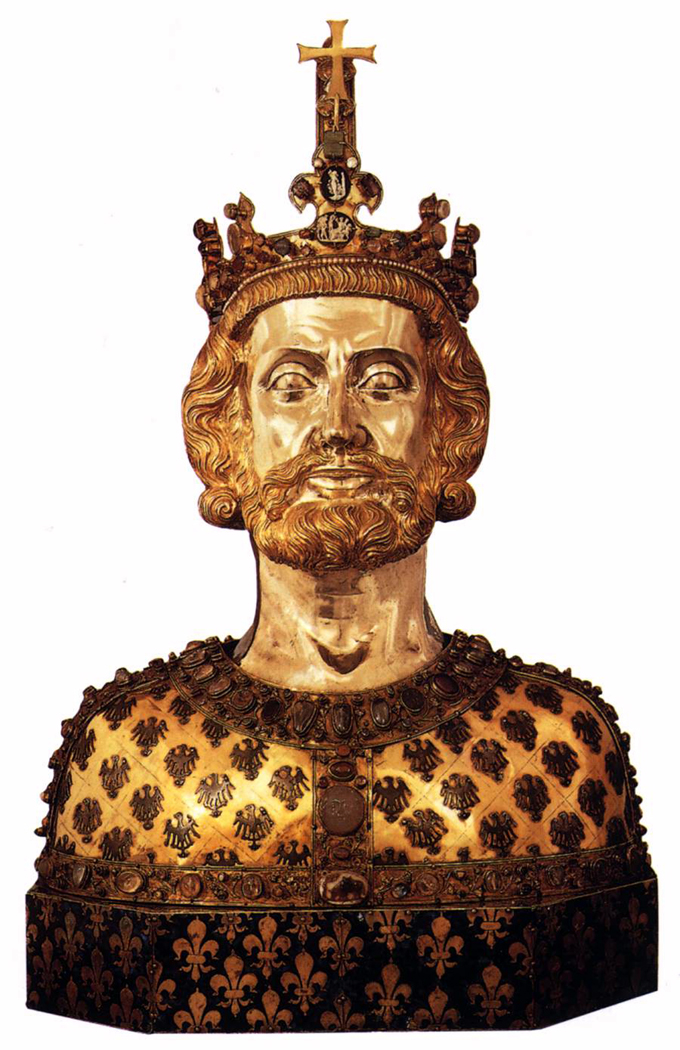
Charlemagne reliquary

Charlemagne reliquary

The full title of the series, with its British spelling, is Civilisation: A Personal View, and we should never forget — and Clark never forgets — that it is a single take on the subject. It is an opening statement in a conversation, not a final word to close off discussion.

And carping critics who complain that Western civilization — and post-Classical civilization at that — is hardly the be-all and end-all of civilizations in the world — well, Clark admits he has enough on his plate to cover Charlemagne to Monet. We wait for his counterpart to give us a similar personal overview of China, India, Africa or the New World. Clark has given us the template. Have at it.

The BBC took a chance when it made its first full-color TV series. It ultimately proved so popular that it was followed by Jacob Bronowsky’s The Ascent of Man and a host of others, from James Burke’s Connections to Ken Burns’ Civil War. It has proved a durable genre, but this release shows the first of its type remains one of the best of its type.

washington and d day

”For one million dollars, how do you spell IQ?”

If you asked America that question, America would not win a million dollars.

What can I say? When Who Wants to Be a Millionaire was popular on network TV, a study by the Annenberg Public Policy Center found that most Americans thought it counted as educational television.

Some 70 percent of those asked also identified the Oprah Winfrey Show as ”serving their children’s educational needs.”

It has only gotten worse since then.

As a nation, we are dumbing down. We have decided, like one third-grader told my wife when she was teaching, that ”my mama says there’s only so much the brain can hold or it will explode.” And we’re playing it safe. monte cristo

So we think the questions Regis Philbin asked were actually tough.

”Who is buried in Grant’s Tomb?”

Although, actually, most of the questions on that show involved celebrities rather than past presidents. The only Grant who counted was Hugh.

Another study found that 80 percent of seniors at 55 top universities flunked or nearly flunked a basic high school history test. ludden and princeton

So that, nowadays, it is rare to find an actual quiz show on TV, outside Jeopardy, which keeps up a decent and atavistic standard. Instead of watching smart people answer questions, we now prefer to watch people being stupid and doing stupid things on “reality TV.” Perhaps this gives us the illusion that if we are not as idiotic as the contestants, perhaps we are now the “smart” ones. cedric the entertainer

Nothing says as much about the course of empire than the slow dumbing down of quiz shows, from the really arcane questions that Allen Ludden asked on the G.E. College Bowl to the pap that passes for knowledge on Millionaire. It is no surprise that in its current syndicated incarnation Millionaire is hosted by Cedric the Entertainer.

Nowadays, we are amazed when a contestant remembers the name of the cute little girl on Family Affair.

It tells us what we, as a culture, value. And we don’t value learning. We value entertainment.

In the past, even people who didn’t have much education valued it and made sure their children received its benefits. Older schools often have the names of great thinkers or artists carved into friezes around their sides: Aristotle, Mozart, Pasteur, Newton. They stood for high goals we should set and aim our efforts at.

That all has changed.

It isn’t merely that schools being built now might scribe the names of Katy Perry, Justin Bieber or Beyonce, but that we think there should be no names at all.

For in our warped sense of democracy, we have decided that ”all men are created equal” means that no one should be better than anyone else.

I never have understood this: We somehow maintain the belief that there are basketball players who are more talented than everyone else, and we reward them richly. We keep the belief that there are more successful CEOs and reward them richly too. But somehow we are not to believe — or at least applaud the fact — that there are some people who are smarter or more talented academically or artistically. We reward such people only with suspicion.

And we make our education system inane to the point that everyone can earn a ”B” and keep their wonderful sense of self-esteem.

Then we wonder why our kids don’t know where Chicago is on a map, can’t balance a checkbook, or believe George Washington was the general on D-Day.

Obviously, we decide, our school standards are set too high, and we lower them yet further.

For it isn’t just the students who don’t know anything of history, geography or spelling but also their parents and teachers who don’t know and don’t think it important.

Another study, by the non-profit Foundation for Academic Standards and Tradition, found that half of all current education majors in college — those who will become the teachers of our children — don’t read books other than what is required for class. And 60 percent think there is too much emphasis placed on books.

What do they want instead? If they are like most Americans, they want to be entertained. They want wall-to-wall television. And they’re getting it.

It is the democratization of culture, so that if you have the Encyclopedia Britannica on one side and Project Runway on the other, we decide they have equal weight.

Learning gives us the context to understand events. It prevents us from making egregious choices. It gives us skepticism.

Learning turns us into individuals rather than demographic statistics, rather than mere consumers. It gives us the confidence to make difficult choices and makes us the free agents for political choice that democracy was originally meant to nurture.

But we have become instead a nation of intellectual and emotional infants, swayed by commercial advertising, hoodwinked by ”alternative” science, led by politicians who can utter no thought longer than a sound bite.

We have the world’s largest and most sophisticated military yet are left defenseless by our own embrace of ignorance. Read your Gibbon.

cletus spuckler and wife

There is little science on the Science Channel, almost no history on the History Channel, nothing to discover on Discover, and you will look long and hard to find any art on the Arts and Entertainment network.

And if you learn anything from The Learning Channel, it is that America’s intellectual level has dropped from the sky like a disabled alien spacecraft, to crash and burn in a desert of mindlessness.

The History Channel, for instance, now specializes in (as explained on Wikipedia): “mythical creatures, monsters, UFOs, aliens, truck drivers, alligator hunters, pawn stores, antique and collectible ‘pickers,’ car restoring, religions, disaster scenarios, and apocalyptic ‘after man’ scenarios,” to say nothing about credulous explorations of the writings of Nostradamus. ancient aliens

Each of these channels began with virtuous motives, and for their early years, created or acquired genuine documentaries for TV viewers, but as they have come to seek ratings over virtue, each has bitten the bait, and now gives us “reality” programming, sensationalist pseudoscience, and celebrities, celebrities, celebrities.

The prime offender of this last are the cooking and food channels, which at one time gave us instruction on cooking and food, but now concentrate on celebrity chefs, some even with studio audiences to applaud and ooh. Julia Child actually taught us something. david pogue

And it isn’t just that Bravo or A&E have given us the bait-and-switch, but that even once laudable programming on PBS has been dumbed down to provide more “entertainment” and less hard information. Their once-proud flagship program NOVA has become a showcase for the high-jinx of such “info-comics” as David Pogue, “Destroyer of Brain Cells.”

It is as if no one believes that actual history or science or art can hold its own in a world of Gypsy housewives of LA married to lumberjacks who look for gold in Alaska and find Nazi ghosts piloting flying saucers from the future, as predicted by Nostradamus.

(Note to Discovery: I now have a copyright on that idea, in case you decide to make such a series.)

I have no complaints with science writers who make complex and often mathematically dense material comprehensible for laymen, such as myself. That is what NOVA used to do: It was aimed at intelligent non-scientists, people with an interest but without the background and training; it now seems aimed at Cletus Spuckler and his family of slack-jawed yokels from The Simpsons.

Is it any wonder that American students fail so badly in math and science, or that a scary percentage of American voters don’t believe in basic scientific principles, and that a major political party carries on a non-too-disguised war on science? We believe in ghosts, UFOs, and ESP, but not in evolution, global warming or environmental degradation. One scratches one’s head.

At least PBS still maintains a veneer of science or history in their documentaries, the commercial cable channels have given up completely. It is all hokum shot through night-vision goggles looking for trumped up ghosts, or teams of competing slackers moaning and groaning about how hard it is to beat the deadline making spangles for their dresses or how to turn squid beaks into desserts for the panel of judges. TLC

How is America not embarrassed to show its face in the world for presenting Toddlers and Tiaras, Here Comes Honey Boo Boo, I Didn’t Know I Was Pregnant, I Eat 33,000 Calories A Day, Potty Power, Sarah Palin’s Alaska, Starter Wives Confidential, Trading Spouses, Wedding Dress Wars, or Big Hair Alaska? And those are just from Discovery.

The History Channel (now, of course, rebranded as History, keeping the only part of their name that doesn’t describe anything true about itself) has offered: Ancient Aliens, Ancients Behaving Badly, Angels and Demons: Decoded, Ax Men, The Bible Code: Predicting Armegeddon, Big Shrimpin’, Cajun Pawn Stars, Comic Book Superheroes Unmasked, God, Guns and Automobiles, Hairy Bikers, Ice Road Truckers, Shark Wranglers, Swamp People, and, of course, UFO HuntersPawn Stars photographed by Blair Bunting

Its highest-rated show, Pawn Stars, exemplifies one of the unpleasant trends in this new field of television.  So many “reality” shows (I can’t help but put quotes around the word “reality,” since the word is so horribly misused in this application) rely on having a bully at its center, whether it was Simon Cowell on American Idol or here, with “Old Man” Richard Harrison, a truly repulsive ignorant blusterer lording it over his clan like a cartoon patriarch, an uneducated know-it-all, with little sense of curiosity — there is no glow in his ball-bearing eyes, just the dull, yellowish glare of a sluggish dragon guarding its horde.

So much of TV is either aimed at or about the unwashed, uneducated and superstitious, as if all of America lived in a trailer park and had only half its teeth. It’s the Jerry-Springerization of America, and it cannot bode well for our future.

So, the rest of us find ourselves either leaving TV altogether, or braving the ridicule of our friends and family, tuning in to C-Span 2 on the weekends to watch Book TV. It’s the last bastion of a medium that used to bring us Omnibus, Young People’s Concerts and BBC nature programs.


img0151A

I want to acknowledge a debt. It comes as a bit of an ugly confession. And it comes wrenchingly from my throat: I write a great deal about books and poetry. I spout Roman history a little too glibly and am apt to swoon glowingly about Homer’s Iliad.

But I must acknowledge that the high tone of fine art and literature is only a patina. I have been most hewn and polished not by literary sources, but by television. It is the same for most people under the age of 65.

Television is not often enough considered when we talk about intellectual development; it actually hurts to put the words ”intellectual” and ”television” in the same sentence — and I just did it twice. I’m a masochist.

But it is true. My first introduction to classical music was on the Bugs Bunny cartoons I watched on the box. First introduction to jazz from the added soundtrack to the silent Terrytoons I saw on Junior Frolics, an afternoon kiddie show on New Jersey’s Channel 13, hosted by “Uncle” Fred Sayles. Those silent-era animations, with their added jazz scores influenced my youth in a way that Aeschylus would never be able to.

farmer alfalfa

My first theater came in the form of sitcoms; first sculpture was the Rodin Thinker that Dobie Gillis sat under to question why he could never make time with Thalia Menninger.

dobiegillis

Oh, there were a few ”highbrow” things on the tube: Sometimes we watched Omnibus with Alistair Cook or the Young People’s Concerts with Leonard Bernstein.

Nevertheless, the effect of such educational shows was as a single tiny green pea to the overwhelming harvest of corn that poured out of the box.

Bonanza, Ed Sullivan, Jackie Gleason, Ozzie and Harriet, Dave Garroway’s meaty palm held forward to the screen as he intoned the word, ”Peace.”

I learned about animals from Ivan Sanderson and, later, Marlin Perkins. I learned about Eastern Europe from Boris Badinov. It all twirled around in a great pop-culture spin cycle.

It’s frightening to think how much American history was gathered from watching Hugh O’Brian as Wyatt Earp or Guy Madison as Wild Bill Hickok.

It is all still there, like petroleum under the covering layers of rock. If I dig deep enough, the Tacitus recedes and Sky King comes back to the fore.

But it isn’t mere nostalgia that I mean to invoke, but rather a change that has come about as television has come of age.

What distinguishes the generation that came after mine — those called ”X” to my ”boomer” — is the quotes that have now been put around everything that appears on the screen.

Television was new to us. We approached it naively. What we saw on its glowing front we took to be an image of the real world. Those that came after us were enormously more sophisticated about what they saw. Television was for them clearly an ironic ”parallel universe,” which they somehow lived in, used for their cultural reference point, but never took seriously.

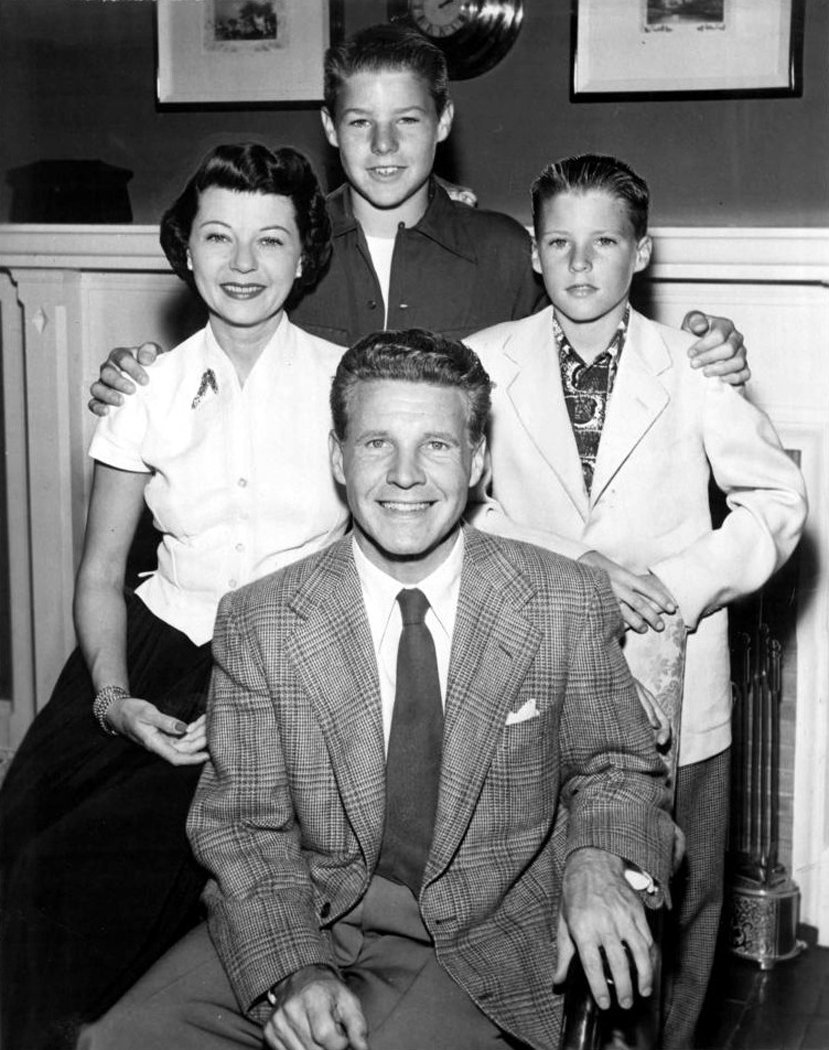
The Adventures of Ozzie and Harriet was not exactly the world I inhabited, but it bore a close enough resemblance to it that I could read it as ”real.” Ozzie really was married to Harriet.

By the time The Brady Bunch came on, it so deviated from the reality of its viewers that the only way to enjoy it was as an in-joke.

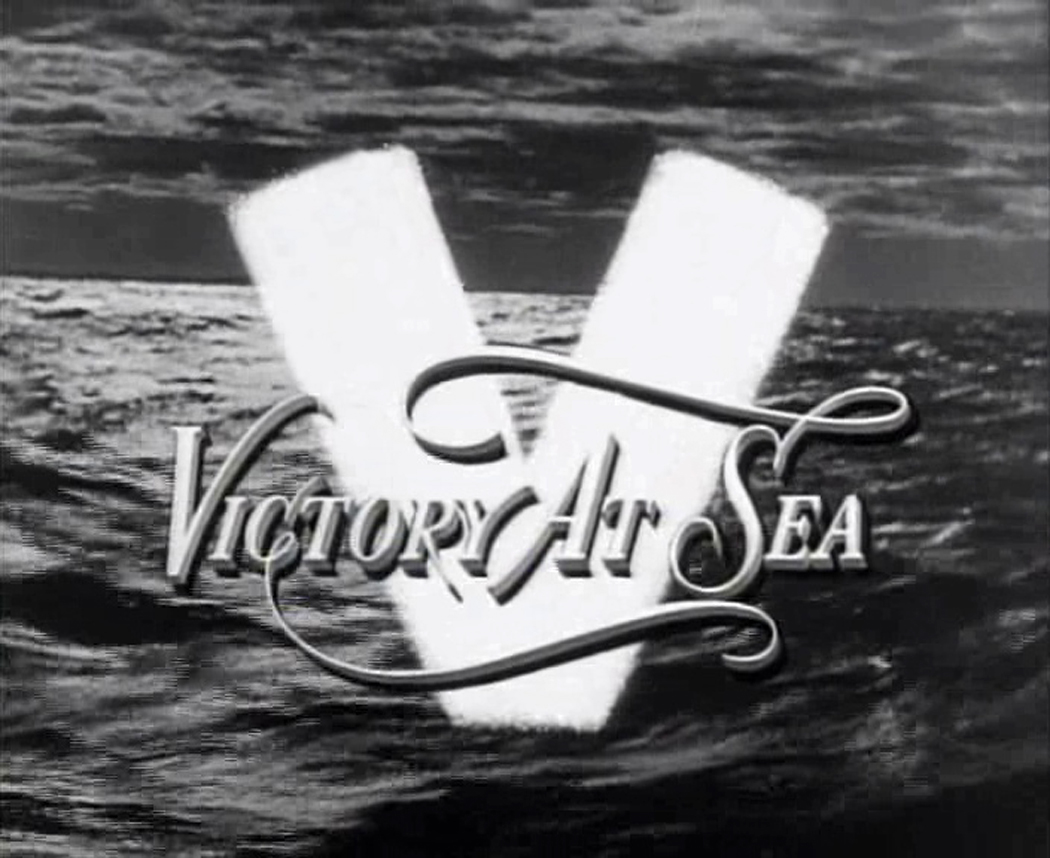
victory at sea

My generation learned about World War II from Victory at Sea; the following generation learned from Hogan’s Heroes.

There are many a plus and beaucoup minuses to both sides of the generational equation. It is usually better to be sophisticated than naive. I’m mortified that I ever thought that Gene Autry really was a cowboy.

But the downside for the later generation is the disconnect they make between life and art. For them, culture is a web of references they get, the way you either get or don’t get Stephen Colbert. If you suggest to them that art might somehow mirror their daily existence and confront the questions that arise outside the TV world, they look at you like you just suggested Larry the Cable Guy should be the next James Bond.

If we have all become much more knowing about the apparatus of media, we are also in danger of drowning in that world in a kind of cultural schizophrenia, and forgetting that the world that counts is found outside prime time.