Archive

Tag Archives: vocabulary

I was an English major and I’m married to an English major and it’s hard being an English major and only getting harder. An English major feels genuine pain hearing the language abused, mal-used, corrupted and perverted. 

I’m not talking here about outdated grammar rules and a fussy sort of prisspot pedantry. As a matter for fact, one of the most persistent pains a true English major suffers is such misplaced censure, especially when interrupting a casual speaker to let them know that “them” is plural and “speaker” is singular. In my book, this is merely rude. A caboose preposition is nothing to lose sleep over. 

No, what I’m writing about here is are things that are genuinely ugly or purposely unclear, or overly trendy, to the point of losing all meaning. You know — politics. That and corporate language, or management speech — which I call “Manglish” — is a great corrupter of speech. 

“We have assessed the unprecedented market shifts and have decided to pivot this company’s new normal to a deep-dive into a robust holistic approach to our core competency, circling back to a recalibrated synergy amid human capital in solidarity with unprecedented times.”

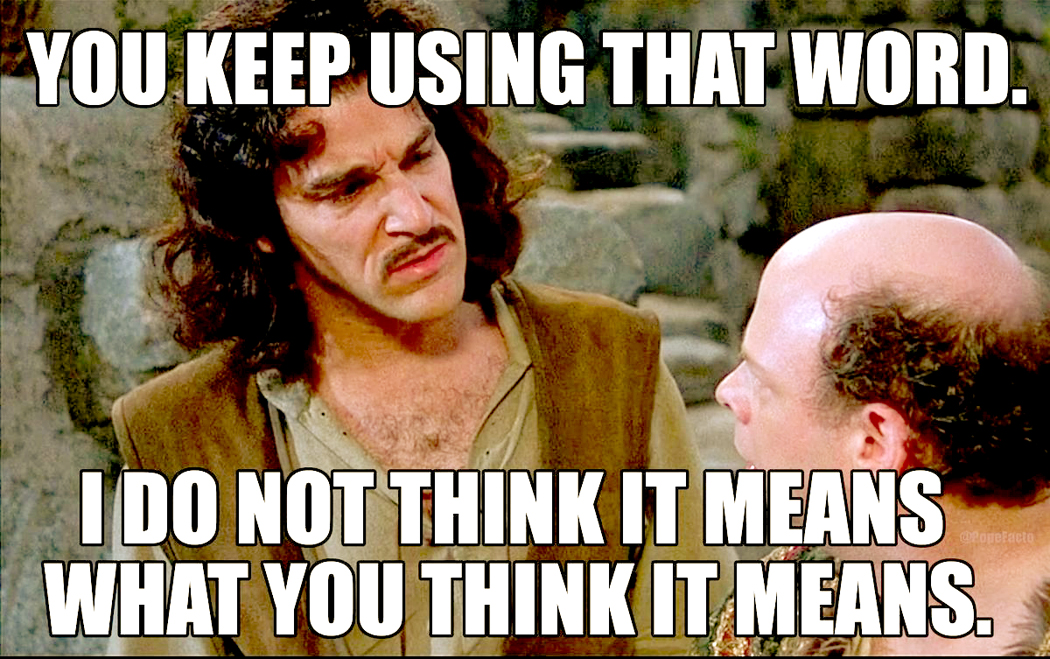
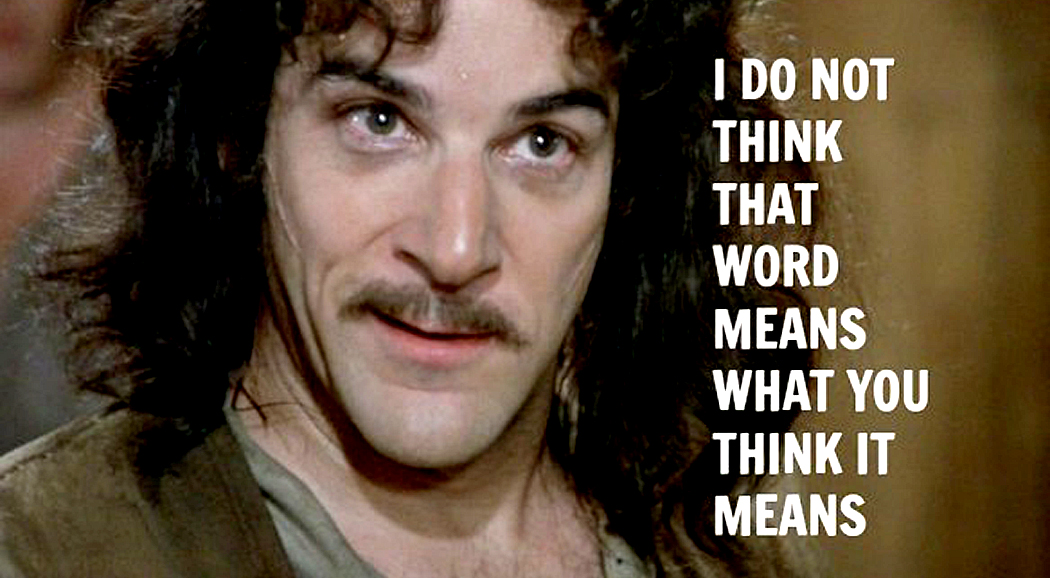
Committees try to make language sound profound and wind up writing piffle. I’m sure it was a committee that agreed in Iredell County, N.C., to make the county slogan, “Crossroads for the future.” I do not think that word means what you think it means. 
I wrote for a daily newspaper and language was my bread and butter, but the higher you go up the corporate ladder, the worse your words become. I remember the day they posted a new “mission statement” on every other column in the office, filled with buzz-word verbiage that didn’t actually mean anything. I looked at my colleague and said, “If I wrote like that, I’d be out of a job.”

But it isn’t just Manglish. Ordinary people are becoming quite lax about words and meanings. Too often, if it sounds vaguely right, it must be so. And you get “For all intensive purposes,” “It’s a doggy-dog world,” being on “tender hooks,” or “no need to get your dandruff up.”

“I’ve seen ‘viscous attack’ too many times recently,” my wife says. “It gives me an interior pain like a gall bladder attack.” 

And the online world is full of shortcuts, some of which are quite clever, but most of which are just barbarous. An essay about digital usage is a whole nother thing. Not room here to dive in. 

But, there is a world of alternative usage that is not standard English, that any real English major will welcome as adding richness to the mother tongue. Regionalisms, for instance. Appalachian dialect: “I’m fixin’ to go to the store;”— actually, that is “stoe,” rhymes with “toe” —  “I belong to have a duck;” “I have drank my share of Co-Cola.”

And Southern English has served to solve the historical problem of having lost the distinction between the singular “thee,” and the plural “you,” with the plural “you all,” or “y’all.” Although, more and more “y’all” is now being used also for the singular, and so is becoming replaced with “all y’all.” Keep up, folks. 

Then, there’s African-American English, which has enriched the American tongue immensely, as has Yiddish: “Shtick,” “chutzpah,” “klutz,” “schmooze,” “tchotchke.”

Regionalisms and borrowings are like idioms. Sometimes they don’t really make sense, but they fall comfortably on the tongue. “Who’s there?” “It’s me.” Grammatically, it would be proper to say “It is I,” but no one not a pedant would ever say such a thing. The ear is a better arbiter than a rulebook. 

George Orwell ended his list of rules for writing with the most important: “Break any of these rules sooner than say anything outright barbarous.”

English is a happily promiscuous tongue and so much of the richness of the language comes from borrowings. But there are still other problems: bad usage, misuse of homonyms, loss of distinctions. The English major’s ears sting with each onslaught. 

What causes our ears to burn falls into three broad categories. Things that are just wrong; things that are changing; and things that offend taste. Each is likely to set off an alarm ping in our sensitive English major brains. 
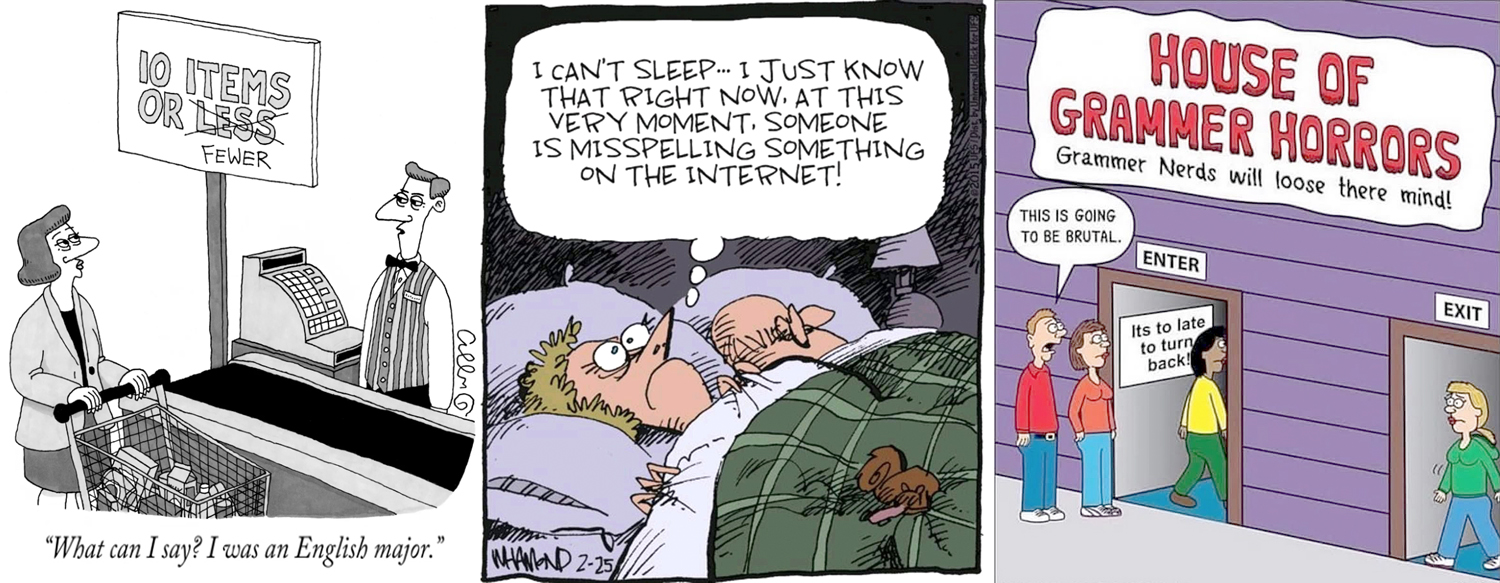
Every time I go to the grocery store I am hit with “10 items or less.” Few people even notice, but the English major notices; we don’t like it. “Comprised of” is a barbarism. “Comprises” includes all of a certain class, not some items in a list of choices. I feel slapped on the cheek every time I come across it mal-used. 

And homonyms: a king’s “rein,” or a book “sited” by an article, or a school “principle” being fired. It happens all the time. It is endemic online. “Their,” “they’re,” “there” — do you know the difference? “You’re,” “your?” Most young’uns IM-ing on their iPhones don’t seem to care. 

And fine distinctions of usage: I am always bothered when I see a murderer get “hung” in an old Western, when we know he was “hanged.” 

Again, most Americans hardly even notice such things. They all get by just fine not caring about the distinction between “e.g.” and “i.e.” In fact, they can get all sniffy about it. 

I know a former medical transcriptionist who typed up a doctor’s notes each day, and would correct his grammar and vocabulary. She corrected the man’s “We will keep you appraised of the outcome,” with “apprised,” and each time, he would “correct” that back to “appraised.” Eventually, she gave up on that one. 

English majors know the difference between “imply” and “infer,” and it causes a hiccup when they are mixed up. “Disinterested” mean having no stake in the outcome; “uninterested” means you cannot be arsed. They are not interchangeable. 

We EMs cringe when we hear “enormity” being used to mean “big,” when it actually means a “great evil.” And “unique” should remain unique, unqualifiable. Of course, “literally” is used figuratively literally all the time.  Something is not “ironic” simply because it is coincidental. 

I hear the phrase “begging the question” almost every day, and always misused. It refers to circular reasoning, not to “raising the question.” I hold my ears and yell “Nya-nya-nya” until it is over. 

Some things, which used to be wrong, are slowly being folded into the language quietly, and our EM ears may still jump at hearing them. “Can” and “may” used to mean distinct things, but that difference was lost at least 100 years ago. We can give that one up. And “hopefully” used to be a pariah word, but we have to admit, it serves a grammatical function and we have to let it in, however grudgingly. 

My wife is particularly sensitive to the non-word, “alot.” She absolutely hates it. I understand, although I recognize a need for it. “A lot” is a noun, and sometimes we use it as an adjective: “I like chocolate a lot.” Perhaps “alot” will eventually become an adjective. Not for Anne. 

People are different and have differing talents. We seem to be born with them. Some people grasp mathematics in a way a humanities student will never be able to match. Some have artistic or musical talent. We can all learn to play the piano, but only certain people can squeeze actual music out of the notes. 
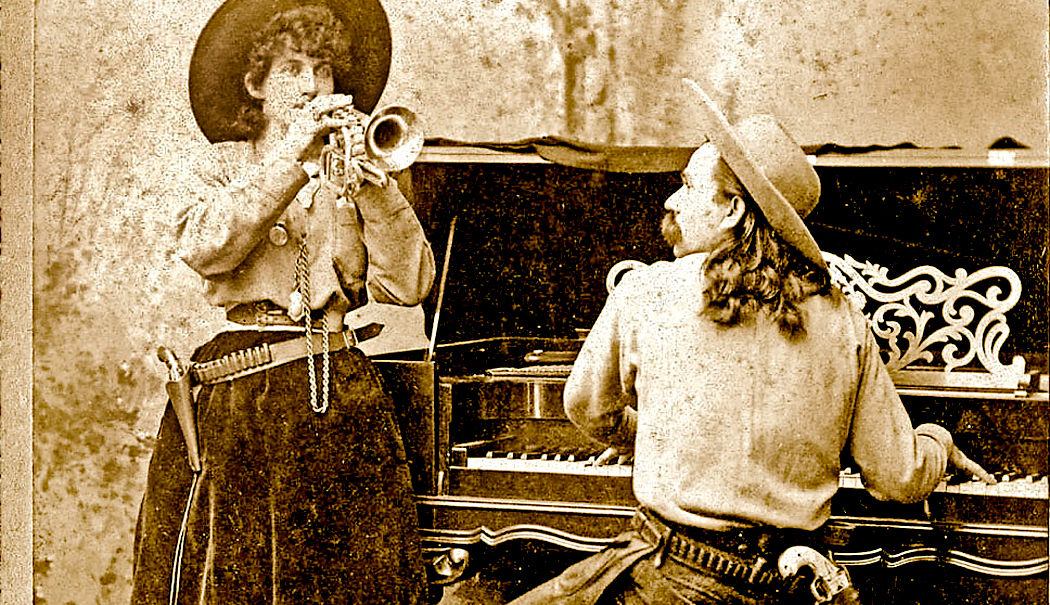
And each of us can learn our native tongue, but some of us were born with a part of our brains attuned to linguistic subtlety. We soaked up vocabulary in grade school; we won spelling bees; we wrote better essays; we cringe at the coarseness of political speech. Language for the born English major is a scintillating art, with nuance and emotion, shadings and flavors. We savor it: It is not merely functional. 

(I loved my vocabulary lessons in grade school, and when we were asked to write sentences using that week’s new words, I tried to use them all in a single sentence. People who show off like that often become writers.)
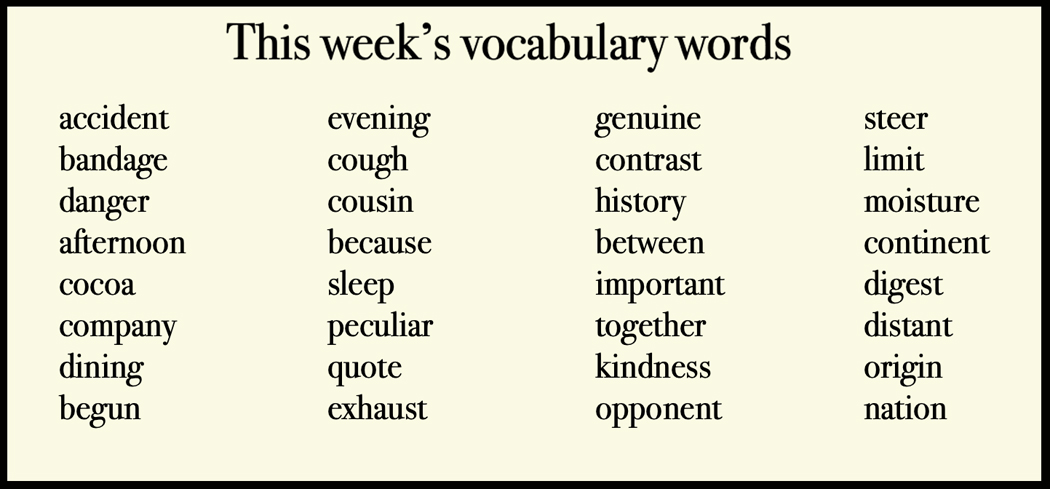
Just as my piano playing, even when I learned whole movements of Beethoven sonatas, was always the equivalent of speaking English as a second language, my best friend, Sandro, could sit at a piano and every key was fluent, natural, and expressive. It was a joy to hear him play; a trial for me just to hit the right notes. 

I am saying that those of us who gravitate to speech, writing, and language in general, have something akin to that sort of talent. It is inherent, and it can be a curse. Bad language has the same effect on our ear as a wrong note on a piano. 

We can feel the clunkiness of poorly expressed thoughts, even if they are grammatical. Graceful language is better. And so, we can rankle at awkward expressions.
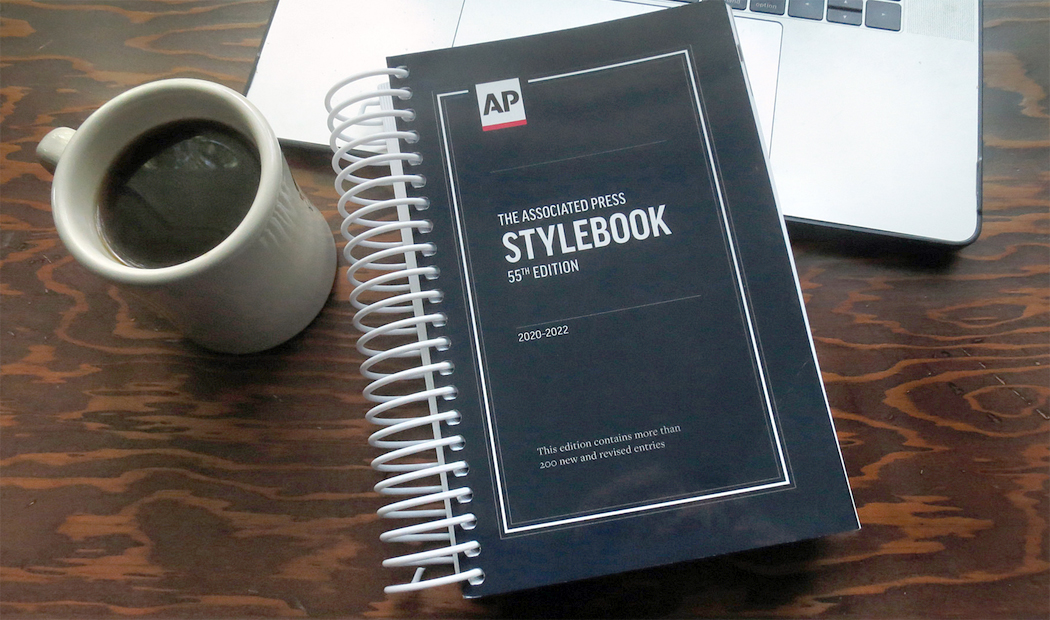
I have a particular issue, which I share with most aging journalists, which is that I had AP style drummed into me — that is, the dicta of the Associated Press Stylebook, that coil-bound dictator of spelling, grammar and usage. One understands that AP style was never meant to be an ultimate arbiter of language, but rather a means of maintaining consistency of style in a newspaper, so that, for instance, on Page 1 we didn’t have a “gray” car and on Page 3 one that was “grey.” 

And so, the rules I lived by meant that there was no such thing as 12 p.m. Is that noon or is that midnight? Noon was neither a.m. nor p.m. Same for midnight. They had their own descriptors. “Street” might be abbreviated in an address, but never “road.” Why? I never knew, but in my first week on the copy desk I had it beaten into me when I goofed. 

“Back yard” was two words, but one word as an adjective, “backyard patio.” Always. “Air bag,” two words; “moviegoer, one word. “Last” and “past” mean different things, so, not “last week,” unless Armageddon is nigh, but “this past week.” Picky, picky. 

I had to learn all the entries in the stylebook. The 55th edition of the AP Stylebook is 618 pages. And this current one differs from the one I had back in 1988; some things have changed. Back then, the hot pepper was a “chilli pepper,” and the Southwestern stew was “chili.” I lived and worked in Phoenix, Ariz., and we all understood this would get us laughed off the street, and so exceptions were made: yes, it’s a chile. 

Here I am, nearly 40 years later, and retired for the past 12 years, and I still tend to follow AP style in this blog, with some few exceptions I choose out of rebellion. But I still italicize formal titles of books, music and art, while not italicizing chapter names or symphony numbers, per AP style. I still spell out “r-o-a-d.” It’s a hard habit to break. 
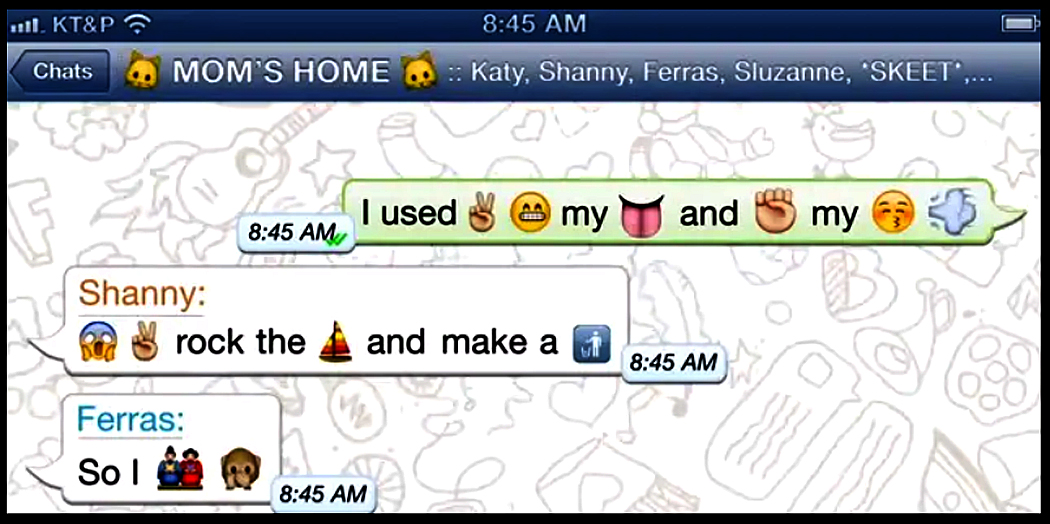
The online world seems to care little for the niceties of English. We are even tending back to hieroglyphs, where emojis or acronyms take the place of words and phrases. LMAO, and as a card-carrying alte kaker, I often have to Google these alphabet agglutinations just to know what my granddaughters are e-mailing me. Their seam to be new 1s each wk. 

And don’t get me started on punctuation.
This is the 600th blog entry I’ve written since retiring eight years ago from the writing job I held for 25 years. But as I’ve said many times, a real writer never retires, he just stops getting paid for it. 

During my career, I wrote over 2.5 million words. Since then, I’ve added another million. If you are born a writer, you simply can’t help it. 

(In addition, since 2015, I’ve written a monthly essay for the website of The Spirit of the Senses salon group in Phoenix, Ariz., a continuation of the many salon lectures I gave there for years.)

And even when I write an e-mail to friends or family — the kind of note that for most people contains a short sentence, a quick “LOL” and an emoji — I am more likely to write what looks like an old-fashioned missive, the kind that used to come in a stamped envelope and delivered by a paid government worker. An e-mail from me will take a while to read through.They are sent not merely to convey information, but to be read. They have been written, not just jotted down. 

Over the eight years of blogifying, I’ve covered a great many topics. Many on art and art history — I was an art critic, after all — many on history and geography, a trove of travel pieces, a few frustrated political musings and a hesitant offering of oddball short stories (if you can call them by that name.) 

People say, “Write what you know,” but most real writers, myself included, write to find out what I know. The writing is, itself, the thinking. Any mis-steps get fished out in the re-writing. 

Ah, words. I love words. I love sentences, paragraphs, chapters. Although I wrote for a newspaper, where short, simple sentences are preferred, I often tested the patience of my editors as I proved my affection for words by using obscure and forgotten words and by using them often in long congregations. 

“I love long sentences. I’m tired of all the short ones. Hemingway can keep them. Newspapers can urge them. Twitter can mandate them. To hell with them.

“My ideal can be found in the long serpentine railways of words shunted hither and thither over dependent clauses, parenthetical remarks, explanatory discursions and descriptive ambiguities; sentences such as those found in the word-rich 18th century publishing world of Fielding, Sterne, Addison, Steele, or Boswell, and perhaps most gratifyingly in the grand, gravid, orotund sentences of Edward Gibbon, whose work I turn to not so much for information about the grandeur that was Rome, but for the pure sensuous pleasure to be had from those accretive tunes built from the pile of ideas and imagery (to say nothing of ironic asides), and peppered liberally with the notations of colons, semicolons, dashes and inverted commas.”

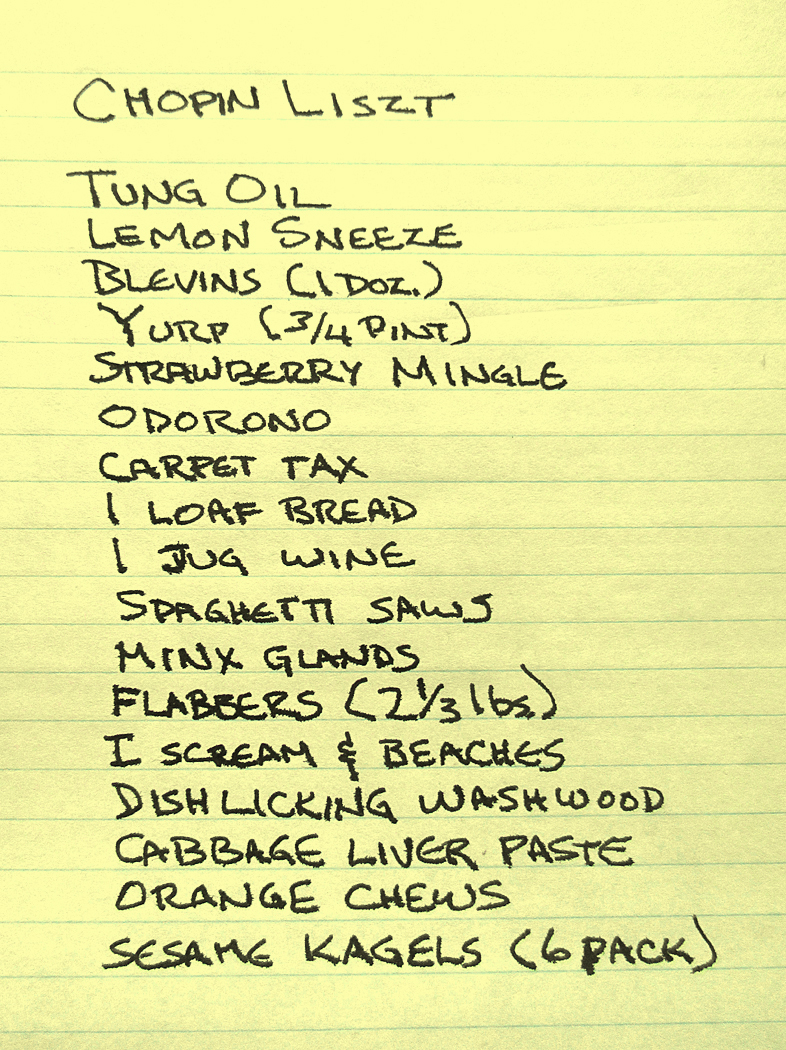
The love of words fuels a fascination with paronomasia. I make up words, play with them, coin spoonerisms and mondegreens and pepper my everyday speech with them. As music critic, I reviewed sympathy orchestras. Sometimes I have trouble trying to mirimba a name. On my shopping list I may need dishlicking washwood. 

I often give my culinary creations names such as Chicken Motocross, Mentil Soup, Ratatootattie, or  — one I borrowed from my brother — Mock Hawaiian Chile. 

When my wife came home from work, I usually asked “How did your Italian?” (“How did your day go?”)

When asked for my astrological sign, I say, “I’m a Copernicus.” My late wife was a Virago. And I’m pretty sure our Orange Bunker Boy was born under the sign of Feces. I call him a would-be Moose-a-loony.

I try to keep unfashionable words in currency. On long car trips with granddaughters, we didn’t count cows, we counted kine. I tend to refer to the girls as the wee bairns, or the kidlings. 

I have no truck with simplifying the language; I will not brook dumbification. The more words we use, the better, and the better inflected those words will be. As we lose words, the slight difference in emphasis and meaning is lost, and a simple word then has to do extra duty to encompass ideas and things that are better understood as different. 

Every word has a dictionary definition, but that definition is little but the skeleton on which the meat and muscle is hung onto. Each word has a nimbus of meaning and affect around it, which is learned by its speakers and readers through long acquaintance. You can always tell when someone has snuffled through a thesaurus, because the fancy word they choose has been stripped of its nimbus, or has an aura that is the wrong color for the spot in which it is placed. In other words, such a writer doesn’t really know the word that has been chosen. The Webster version is only a fuzzy black-and-white photo, not the real thing. 

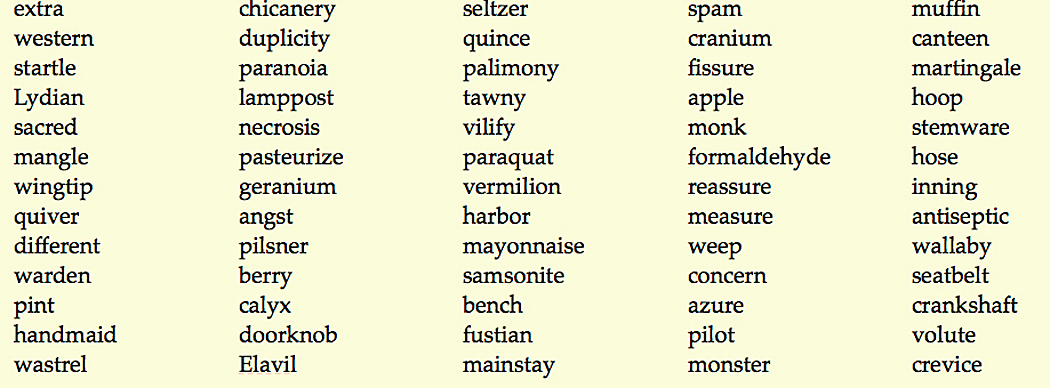
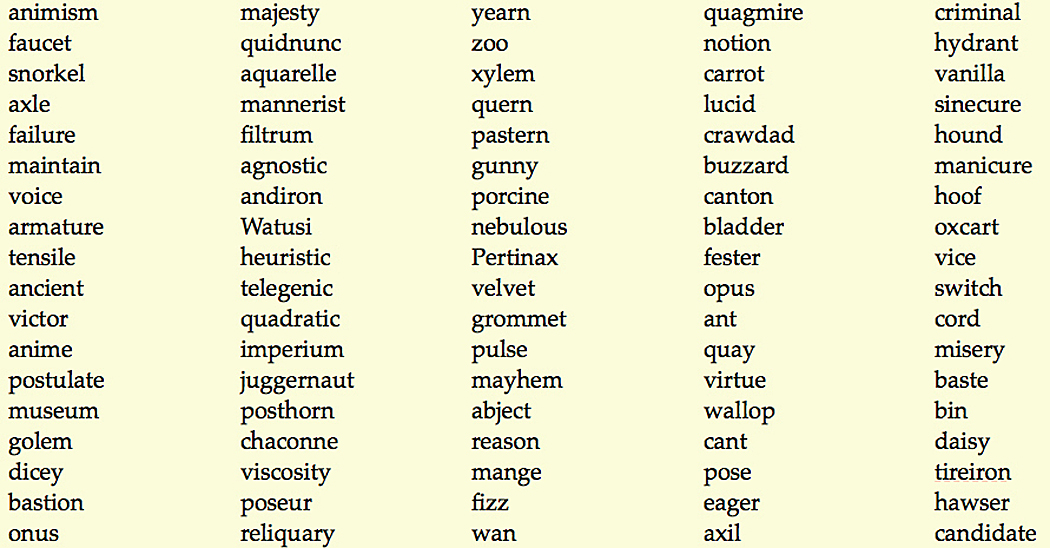
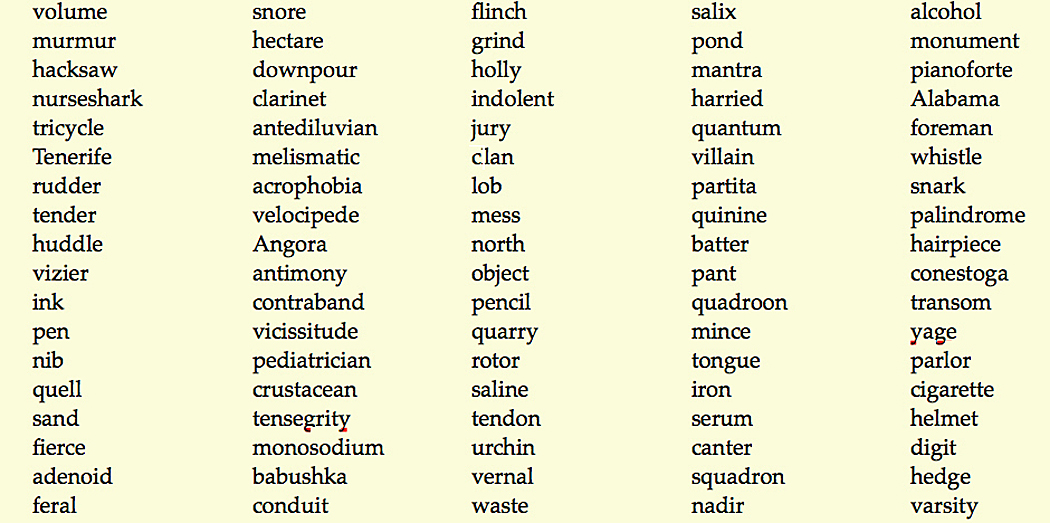
I have written before how sometimes, instead of doing a crossword puzzle or rearranging my sock drawer, I will make lists of words. Each has a flavor and reading such lists is like perusing a restaurant menu and imagining the aroma and flavor of each offering. It is a physical pleasure, like the major or minor chords of a symphony. Here is a brassy word, there the pungency of an oboe, and over there, the sweet melancholy of a solo cello. 

I think all writers must have something of the same feel for the roundness, spikiness, warmth, dryness or wetness of words. And the way they connect to make new roundnesses, coolnesses, stinks or arousals in sentences. 

Yes, there are some writers — and I can’t pooh-pooh them — who use words in a blandly utilitarian way. Stephen King, for instance, is a great storyteller. He can force you by a kind of sorcery to turn pages. But on a word-by-word level, his writing is flavorless, almost journalistic. I suspect this is a quality he actually aspires to — to make the language so transparent as to be unobservable. I have to admit there are virtues in this, also. But not for me. 

I want a five-course meal of my words. 

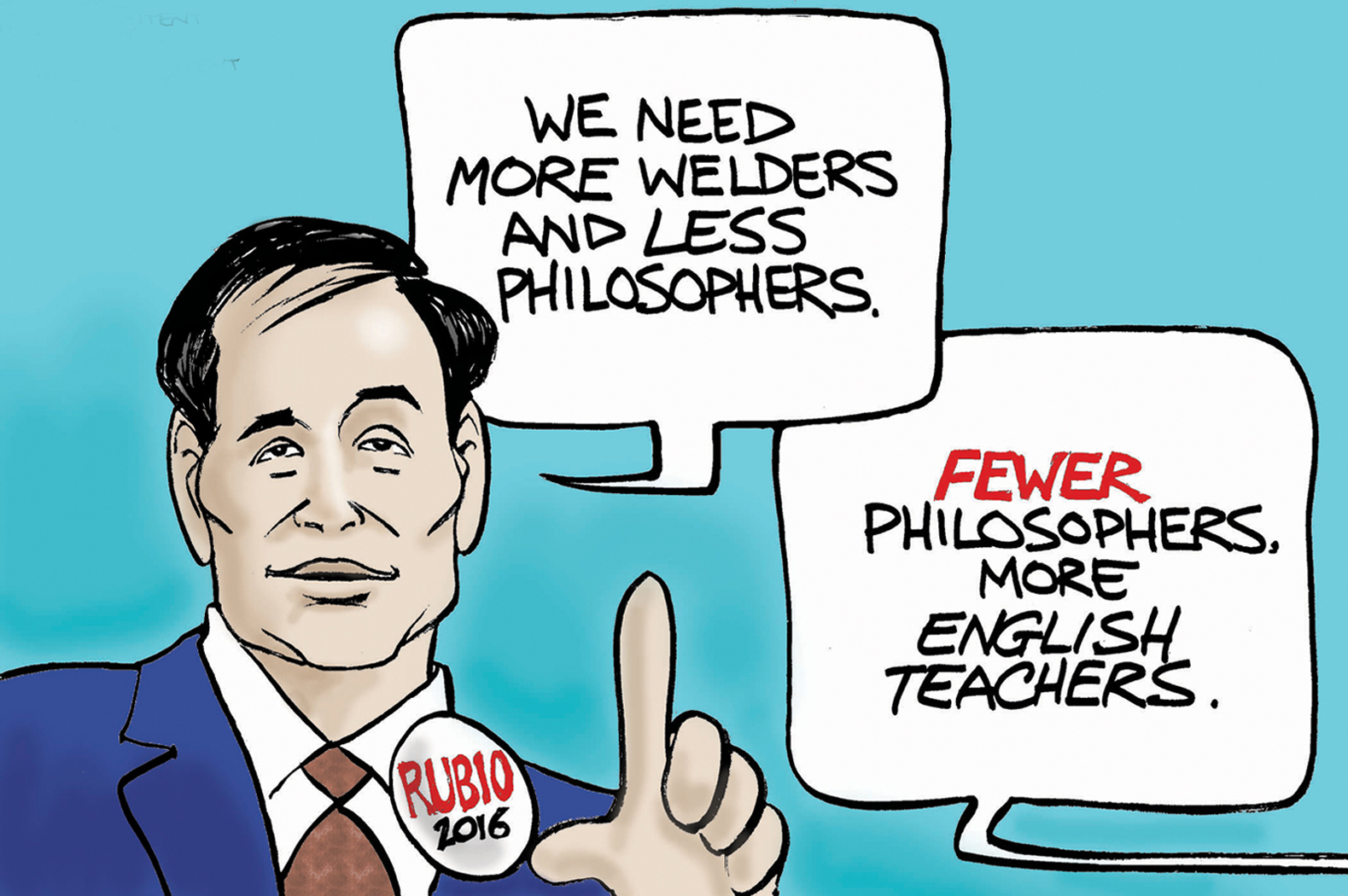
Language can take either of two paths: prose or poetry. The first invests its faith in language as a descriptor of systems. It reaches its nadir in philosophy. It makes little difference if it is Plato or Foucault; philosophy — especially the modern sort — is essentially a branch of philology. It seeks to deconstruct the language, as if understanding the words we use will tell us anything about the world we live in. It tells us only about the language we use. Language is a parallel universe to the one we inhabit, with its own rules and grammar, different from the rules and grammar of the real world. 

This has been a constant theme in my own writing. When we say, “A whale is not a fish,” or “A tomato is a fruit, not a vegetable,” we are talking about language only, not about whales or tomatoes. But beyond the language we use to communicate our understanding of the world, no matter how vast our vocabulary, the world itself is infinitely larger, more complex, diverse, chaotic and unsystematic, not to be comprehensively understood by mere mortal. 

And I should clarify, by language, I mean any organized system of thought or communication. Math is just language by other means. When I use the term “language” here, I mean what the Greeks called “logos” — not simply words, or grammar, syntax or semantics, but any humanly communicated sense of the order of the cosmos. Not one system can encompass it all. 

Consider Zeno’s paradox: That in a race between Achilles and a tortoise, if you give the tortoise a headstart, no matter how little, Achilles can never catch up. Before he does, he has to go halfway, and so is still behind the tortoise, and before he goes the remaining distance he must go again halfway. Thus he can never catch up. The paradox is purely in the forms of logic, not in the reality. We all know Achilles will catch up in only a few strides. But the system — the logic, or the words — tells us he cannot. Do not trust the words, at least not by themselves, without empirical evidence to back them up. 

All systems of thought, whether religious, political or scientific, ultimately break down when faced with the weedy complexity of existence.

And so, a good deal of what we all argue about is simply the words we choose to use, not the reality. We argue over terminology. Conservative, liberal? Is abortion murder? These depends entirely on your definitions. 

Poetry, on the other hand — and I’m using the word in its broadest and metaphorical sense — is interested in the things of this world. Yes, it may use words, and use them quite inventively, but its goal is to reconnect us with our own lives. It lives, not in a world of isms, but in one of mud, tofu, children, bunions, clouds and red wheelbarrows. This is the nimbus of which I speak. 

It is ultimately our connection with our own lives that matters, with the things of this world, with the people of our lives that should concern us. It is what provides that nimbus of inexactitude that gives resonance to the words. 

I recently wrote a piece about grammar and vocabulary peeves. And I mean “peeves.” It’s too common to take such language infractions as if federal law had been broken. For me, such things are merely irritants. Others may take such examples as I gave as bad grammar, or mistaken grammar, but I meant to show the personal reaction some of us get when the way we were trained to use language gets trampled on by those not similarly trained. 

Sometimes, there is truly a misuse of language and creates misunderstanding or even gobbledegook, but at other times, it is merely a failure to recognize how language changes and grows through time, or a refusal to understand idiom or regionalism. 

The war between descriptionists and prescriptionists is never-ending. As for me, I have matured from being a mild prescriptionist to a rather forgiving descriptionist, with some few hard rules added. I feel that to be either all one way or all the other is a kind of blind stupidity. 

For instance, I would never use the word “irregardless.” It is unnecessary. But neither will I claim it is not a word. Maybe it didn’t used to be, but it is now, even if it is an ugly word. If someone wants to sound coarse and unlettered, he or she is free to use “irregardless,” regardless of its gaucheness. 

There was a notepad full of examples that I did not fit into the previous blog post, and some newer ones sent me by friends or readers. So, I thought a followup might be due. Some of these are clearly mistakes and misusage, but others are just rules I or we learned at an early age and now flinch at whenever we hear or read them flouted (the confusion of “flouted” and “flaunted” being one of the mistakes that make us flinch). 

I am at a particular disadvantage because I was horsewhipped into shape by the Associated Press Stylebook. I never use an abbreviation for “road” when writing an address, while I have no problem with “St.” for “street.” Why the AP chose this path, I have no clue, but they did and now I am stuck with it. It was driven into me by a rap on the knuckles during my first week working on the copy desk. I am also stuck with “baby sitter” as two words, while “babysitting” is one. 

(Sometimes the stylebook is brutally ignorant. When I began as a copy editor, it told us to spell the little hot pepper as a “chili” and the dinner made with it and meat and/or beans as “chilli,” but we were in Arizona, where Spanish and Spanglish are common, and would have looked like idiots to our readers if we had followed that rule, so we were allowed to transgress and spell the word for both as “chile.” I believe that the Associated Press has finally caught up. I am retired now, and no longer have the most recent copy of the book.)

Of course, the AP Stylebook wasn’t designed to decide once and for all what is correct usage, but rather only to standardize usage in the newspaper, so different reporters didn’t spell “gray” in one story and “grey” in another. But the result of this standardization is the implication that what’s in that book is “right and true.” As a result, I almost always avoid saying “last year,” or “the last time so-and-so did this,” but rather contort the sentence so I can use “past” instead of “last,” the logic of which is that last year wasn’t the last one — at least not yet. Yes, I know that is stupid and that everyone says “last year” and no one is confused, but the AP has rewired my neurons through constant brainwashing. 

It also has me aware of distinguishing jail from prison. People are held in jail awaiting trial; after conviction, they serve their sentence in prison (yes, some convicts serve their time in jails, but that doesn’t change things. Jails tend to be run by counties; prisons by state or federal governments.)

And so, here is my list of additional words and phrases that get under my skin when used or misused. 

For me, the worst, is the common use of “enormity” to describe anything large. I twitch each time it sails past me. An enormity is a moral evil of immense proportions. The Shoah was an enormity; the vastness of the ocean is not. 

Then, there is the confusion between “imply” and “infer.” To imply is to slip a clue into the flow; to infer is to pick up on the clue. 

One hears constantly “literally” used instead of “figuratively.” Ouch. It debases the strength of the literal. 

There are rhetorical figures that are misapplied over and over. Something isn’t ironic simply by being coincidental, nor is oxymoron the same as paradox — the latter is possible through reinterpretation, the former must be linguistically impossible. To be uninterested is not the same as being disinterested. It causes me minor physical pain each time I hear some bored SOB called “disinterested.” 

I have other peeves, lesser ones. “My oldest brother,” when there are only one other brother. “Between” three people rather than “among.” Using “that” instead of “who” when referring to a person: “He was the person that sent me the letter.” Pfui. 

There is a particular personal proscription list for anyone who uses “which” instead of “that” in a sentence with a defining adjectival phrase, as in: “It was the dog on the left which bit me.” It’s OK in: “It was the dog on the left, which bit me, that I came to despise.” 

Some of us still make a distinction between “anxious” and “eager.” The virus makes me anxious. I am eager to get past the threat. There are other pairs that get confused. I try to ensure that I never use “insure” when I’m not talking about an insurance policy; the wrong use of “effect” can affect the meaning of a sentence; further, I never confuse “farther” with something other than physical distance. “Floundered” and “foundered” mean different things, please. 

From other people and from comments to the blog, I have heard complaint of “bringing something with me when I go” or “taking something home with me.” “Bring” comes home; “Take” goes away. 

Another hates seeing “a lot” as one word, unless, of course, it has two “Ls” and means to portion something out. Yet another yells at the TV screen every time someone says “nucular” for “nuclear.” I share that complaint, although I remember many decades ago, Walter Cronkite making a reasoned case for pronouncing “February” without the first “R.” “It is an acceptable pronunciation,” he said, “It is listed as a secondary pronunciation in the Webster’s Dictionary.” I’m afraid “nucular” has become so widespread that it is in the process of becoming, like “Febuary” an accepted alternate. But it hurts my ear. 

Trump give “free rein” to his son-in-law, but perhaps it really is “free reign.” Confusion abounds. 

All this can reek of pedantry. I’m sorry; I don’t mean it to. There are many times you might very well subvert any of these grammatical conventions. I have heard complaints about sentences that start off as “I and Matilda took a vacation” as ugly and wrong, (really, the grammatically worse “Me and Matilda” is idiomatically better, like “Me and Bobby McGee”) but I remember with literary fondness the opening of Herman Melville’s “I and My Chimney:”

I and my chimney, two gray-headed old smokers, reside in the country. … Though I always say, I and my chimney, as Cardinal Wolsey used to say, I and my King, yet this egotistic way of speaking, wherein I take precedence of my chimney, is hardly borne out by the facts; in everything, except the above phrase, my chimney taking precedence of me.

And there are presidential precedents. “Normalcy” wasn’t a word until Warren G. Harding used it to describe a vision of life after World War I (there are examples from earlier, but he popularized its use and was ridiculed for it — “normality” being the normal word). 

I would hate to have to do without George W. Bush’s word: “misunderestimate.” If that hasn’t made it into Webster’s, it should. I think it’s a perfectly good word. Language sometimes goes awry. We don’t always hear right and sometimes new words and phrases emerge. I knew someone who planned to cook dinner for a friend. “Is there anything I should know about your diet? Anything you don’t eat?” “I don’t eat sentient beans,” she said. He had never heard of that sort of bean. It was only much later that he smiled at his own misunderstanding. Since then, I have always kept a bin of dried sentient beans to make “chilli” with. At least, that’s how I label the tub. 

Language shifts like tides. Words come and words go; rules pop up and dissipate; ugly constructions are normalized and no longer noticed, even by grammarians. I have listed here some of the formulations that still rankle me, but I am old and wear the bottoms of my trousers rolled. I’m curious, though, what bothers you? Let me know in the comments. 

When I was in second or third grade, we had weekly lists of vocabulary words to learn, lists of ten or a dozen new words. And we were assigned to write sentences using these words. And me, being a smartass even back then, I worked hard each week to write a single sentence using all ten words. Even now I’m not sure if I did it to be clever or because I was lazy and didn’t want to write ten sentences.

But when I look back on it, I realize it was a dead give-away clue that I would later earn my crust by becoming a writer. I loved words, and I loved using words.

Other kidlings might groan when the teacher picked up the chalk to diagram sentences, but I loved those underlines and slants, those networks of adjectives and conjunctions. It was fun, like doing a crossword puzzle or connecting the dots.

When I was young enough, before the cutoff date for it, I didn’t learn words so much as acquire them. But even when it later took the effort, I still did my best to expand my word trove.

And as I grew into adolescence and I read constantly — everything from Lew Wallace to the backs of cereal boxes — I continued to absorb words. I would sometimes pore over a dictionary, picking out new and intriguing words. They were not merely signifiers of semantic meaning, but entities in and of themselves. Others might go “ooh” and “aww” over a puddle of newborn kittens, I did the same thing over bits of verbal amber and gleam.

It did not seem at all odd when the ailing pulp writer Philip Marlow in The Singing Detective asked his nurse, “What’s the loveliest word in the English language? In the sound it makes in the mouth? In the shape it makes in the page?” His answer was “elbow.” That would not have been mine, but I’m not sure I could have chosen. Words have a taste in the mouth, and however much one might like foie gras, one cannot do without ripe peaches or buttered asparagus. I loved all words, fair and foul. And I loved the mouth-feel of them, like a perfect custard.

British polymath Stephen Fry often tells the story (perhaps too often) of how when he was a wee bairn, he saw on the small black-and-white TV in his home the 1952 film version of The Importance of Being Earnest. He was struck by a line spoken by Algernon: “I hope, Cecily, I shall not offend you if I state quite frankly and openly that you seem to me to be in every way the visible personification of absolute perfection.”

“How unbelievably beautiful,” Fry says. “The swing, balance and rhythm. I’d known you could use language to say, ‘May I please be excused to go to the washroom,’ or ‘I want some more,’ but the idea that it could be used to dance, to delight, to enthrall — it was new to me.”

And Fry became what he called “a celebrant and worshipper at the altar of language.”

For me, it wasn’t Wilde, but James Joyce, first reading A Portrait of the Artist as a Young Man when I was in high school and being swept along in a tidal current of language. “Once upon a time and a very good time it was there was a moocow coming down along the road and this moocow that was down along the road met a nicens little boy named baby tuckoo …”

We had been taught in grade school to speed read, along with a dreadful little machine that mechanically drew a rod down along a page, drawing one to move line by line in a forced march through the text; we would then be tested on our comprehension. Day by day, the guide rod was moved more and more speedily down the page, making us read faster and faster, until we could skim and recall very well, thank you.

But that wasn’t the kind of reading that gave me physical, bodily pleasure. And when I came across books like Joyce’s, I slowed down. I could not read them without hearing the words in my head. Without feeling them on my tongue and teeth.

A sentence such as our introduction to our hero in Ulysses cannot be read merely for sense. It has to be understood for its music, almost ecstatic, like Handel’s Zadok the Priest or Beethoven’s Great Fugue: “Mr. Leopold Bloom ate with relish the inner organs of beasts and fowls.” Your tongue creates phonic choreography in your mouth as you form those words.

I remember when I was perhaps 24 or 25, reading Lawrence Durrell’s Alexandria Quartet and stumbling on so many odd and eccentric words, that I kept a notepad next to my desk to write down such words as I underlined in my copies of the books (yes, I write in my books. If you don’t write in the margins or underline passages, you haven’t really read the book). “Pegamoid,” “ululation,” “usufruct,” “exiguous,” chthonic,” “etiolation,” “boustrophedon,” “tenebrous,” “crepitating,” “cachinnation,” “comminatory,” and, apropos our current resident of the White House, “troglodyte.” (Another great word to remember in this regard is the title of a satiric philippic by Seneca the Younger — “apocalocyntosis” the “Pumpkinification,” in the original of the emperor Claudius, but our case of the Great Orange Boor.)

You probably have to be young to read Durrell, when you still hold idealistic and romantic expectations, and to put up with the prose pourpre, but my word-hoard grew. It became something of a joke when I wrote for my newspaper, where I’m sure the copy editors were laughing at me for using six-dollar words like chocolate sprinkles on a donut. I used them because I loved them, and because they were precise: When you develop a ripe vocabulary, you learn there are no synonyms in the English language: Each word carries with it a nimbus of connotation, a flavoring or a shade that makes it the right or wrong word for the context. No matter how close their dictionary definitions, words are not simply interchangeable.

Anyway, I had my little joke back on the copy editors. For a period of about six months back in the 1990s, every story I wrote had in it a word I plain made up. My game was to see if I could sneak them past the copy desk. Some were onomatopoeic, some were Latinate or Hellenic portmanteaus, some were little more than dripping streams of morphemes. And, to my utter delight, every one of them made it through the editors. A few were questioned, but when I explained them, they were permitted. Looking back, I regret this persistent joke, because it was aimed at that little-praised but admirable set of forgotten heroes, who have many times saved my butt when I wrote something stupid. Let me express my gratitude for them; everyone needs a copy editor.

Occasionally, when I have an empty moment, and I don’t have access to a crossword puzzle, I will sit and write lists of words as they come to my brain. Each word has its own cosmos of meaning, an electron-cloud of ambiguity and precision, its emotional scent, its sound and its fury. As I write them down, I savor each one, like an hors d’oeuvre. Such lists, in their way, are my billets doux to my native tongue, which has fed me both spiritually and financially over many decades.

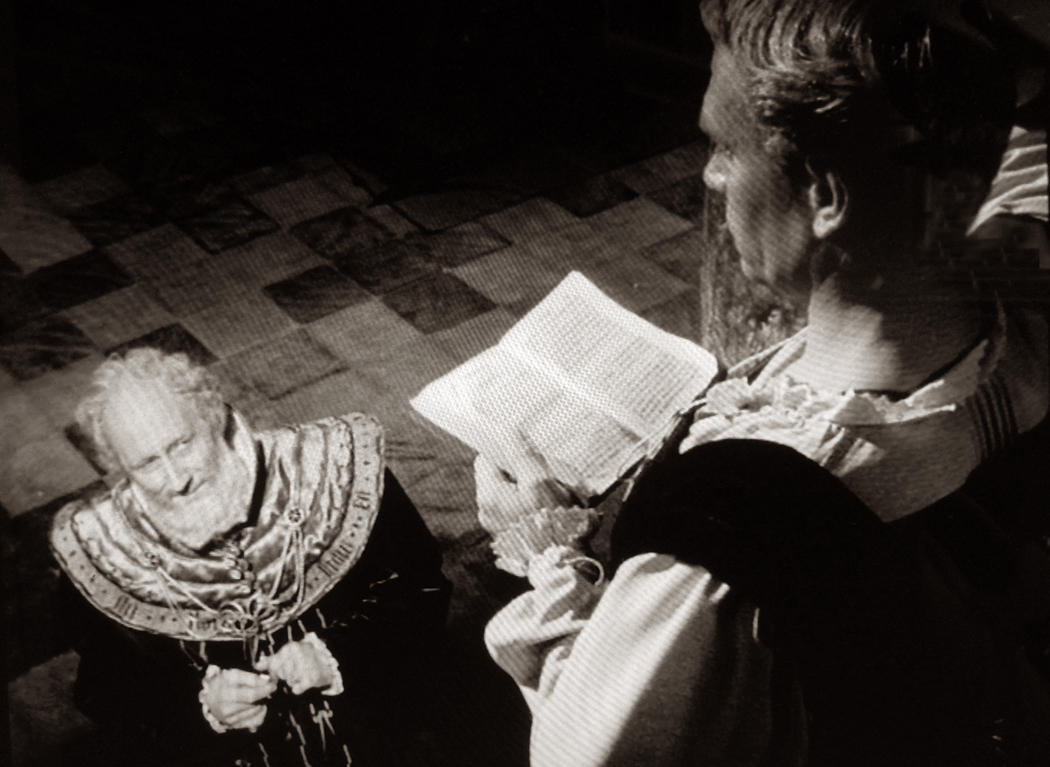
“What do you read, my lord?”
“Words, words, words.”

words words words

For 25 years, I made my living by writing words. In all, some two and a half million of them, writing an average of three stories a week. Yet, in all that time, I had an underlying mistrust of language, a sense that, even if I could still diagram a compound-complex sentence on a blackboard, the structure I saw in chalk did not necessarily mirror the structure of things I saw around me in the world before it is named. The one was neat and tidy, the other was wooly and wiggly.

A good deal of misery and misunderstanding derives from a failure to recognize that the logic of language and that of the real world are not the same.

tomatoWe find this in simple form whenever someone tells you that, for instance, “a tomato is not a vegetable, it is a fruit.” This is a sorry assertion. A tomato is neither animal nor mineral, therefore, it is a vegetable. But, of course, that is not what is meant. In common usage, we use the word, “fruit,” to name a sweet edible and “vegetable” to name a savory. But “vegetable” is also an umbrella word, describing all things vegetative. To aver that a tomato is not a vegetable is to confuse these two usages, and therefore to make an assertion both pedantic and ignorant.

More importantly, this doesn’t really say anything about the Solanum lycopersicum, but about the categories we use language to establish. It is an argument not about the berry (and that is the technical term for the red globe you slice onto your salad), but about the English language.

Whales GoldsmithOr consider this: “A whale is not a fish.” When such a statement is made, it does not discuss whales or fish, but rather, makes a claim about language. The whale is unaffected by the words and fish swim happily past it. But it is a discussion about the categories of nouns: We choose to make the definition of the two classes mutually exclusive. A whale is a mammal.

But it needn’t be so. Through the 18th century, a whale was a fish. Jonah was swallowed by a “great fish.” Anything torpedo-shaped that swims in the sea by the action of its fins was considered a fish. A whale was a very large fish, who just happened to be one that gave birth to live young and suckled them. It was an idiosyncrasy of the whale, just as it is an idiosyncrasy of the salmon that it swims upriver to spawn.

spinous and testaceous fish goldsmithgoldsmith crustaceous fishIn fact, if you read Oliver Goldsmith’s “History of the Earth and Animated Nature,” the best-selling nature book of its century, the category “fish,” also included many other things that live in the watery parts of the world. Whales were “cetaceous fishes,” flounder were “spinous fishes,” sharks were “cartilaginous fishes,” crabs and lobsters were “crustaceous fishes,” and clams and oysters were “testaceous fishes.” It was a perfectly natural way to divide up the various denizens of the undersea. It wasn’t till Carl Linne decided to slice up the world in a new way, based on a combination of skeletal morphology and reproduction, that the whale was surgically removed from the universe of fishes and told to line up on the other side of the room with lemurs, llamas and raccoons. Did the whales even notice?

The basic problem is that language is an intercessor. It sits between experience and understanding. When we approach language, we see only the intercessor — we mistake the priest for the deity.

Words always distort, they always lie. Yet, at bottom, we trust words more than we trust our own eyes. We judge politicians by the labels they are tagged with, not by paying attention to what they actually say or do: Conservative or liberal — when applied to reality, the labels are close to meaningless.

The case may be a little easier to understand in terms of Greek. The ancient Greeks were the first logarchs, they valued verbal meaning over experiential meaning; they actually thought language was a one-to-one descriptor of reality. Their faith is naive to us now. For instance, Zeno’s paradox is only possible in words. Set a tortoise and Achilles out on a race and see if Achilles can’t catch it. No problem. Set it in words, and suddenly, it can’t be done: The problem is entirely in the words, words, words.

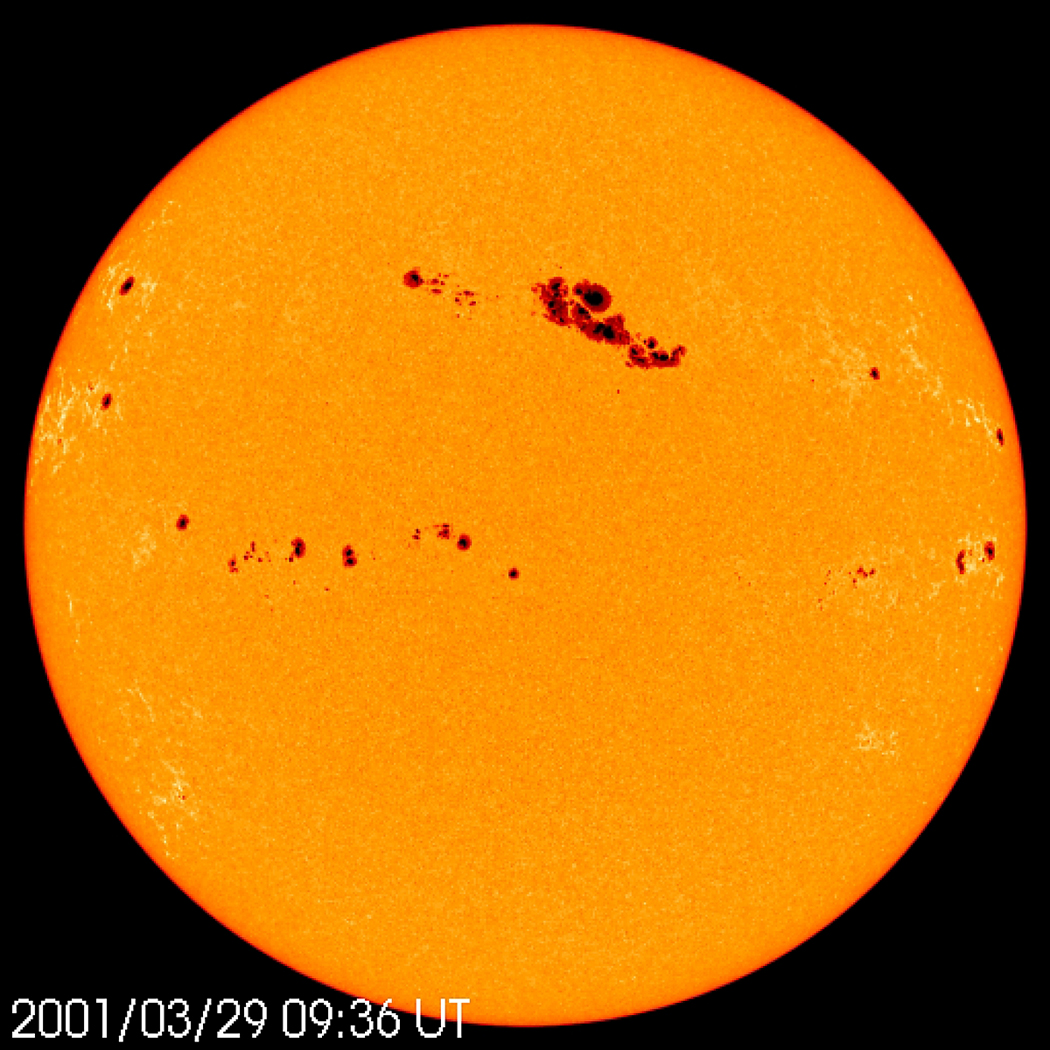
sunspotsIt is the logic of language that frustrates Achilles, not the tortoise. It guided how the Greek thought about the world. Polarity, opposites, hidden ironies and surprising conjunctions,  it’s how the language is organized,  even before you even consult reality. So, when the Greek saw language as a mirror of the reality and language posits polarity, it must be because the world is polar. But is it? Opposites are only a linguistic trick. Hot and cold are just relative points on a single thermometer: Sunspots are “cold” places on the sun, even though they are thousands of degrees Farenheit; liquid nitrogen is “warmer” than absolute zero. Linguistic legerdemain.

Even liberals and conservatives are just guys in the same blue suits. They don’t look like a dime’s worth of difference to the Fiji Islander.

By the logic of language, the world is divided into nouns and verbs; look out the window, however, and what you see is the conflation of noun and verb: something very much closer to Ovid’s Metamorphoses: a constant velocity of things ever growing and changing. No noun is static; no verb without its referent.

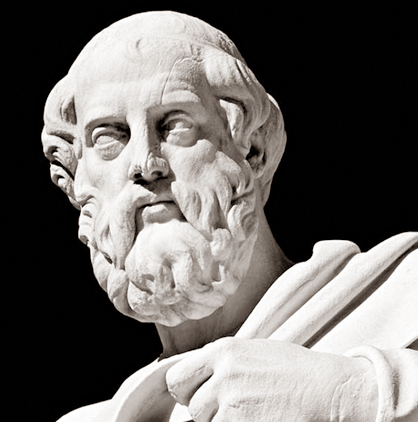
Marble statue of the ancient greek philosopher PlatoThe issue I have with Plato — aside from his totalitarian fascism — is his faith in an “ideal” of things. The ideal bed, unlike any real bed, is a stultified noun, not a bed. To Plato, the world is cataloged with nouns, only nouns. The perfect human is a form of arrested development. For Plato, the perfect human form is a male figure, age of about 25, all muscle and lithe, with little fat. But a real person is born tiny, grows, ages, marries, has his own bairns, gains experience, grows feeble and dies. Just as a rose isn’t the pretty flower, but a shoot, a bud, a flower, a rose-hip bursting to seed and once more from the top. Over and over. All the world is at every moment changing, growing, shrinking, spreading, running, molting, squawking, collapsing, weeping and rising. It is a churn, not a noun. “Panta horein,” as Heraclitus says: “Everything changes.”

Language is this thin veneer, the shiny surface, the packaging we are cajoled by. Break open the box, and the reality is something else.

It is much like the belief that geometry transcends embodiment. In other words, a triangle is a universal possibility, no matter if one was ever built. It is one of Plato’s ideals. God himself cannot create a four-sided triangle. But to change this “truth,” all we have to do is change our definition of the word. We don’t need a deity to do that, all we need is a lexicographer.

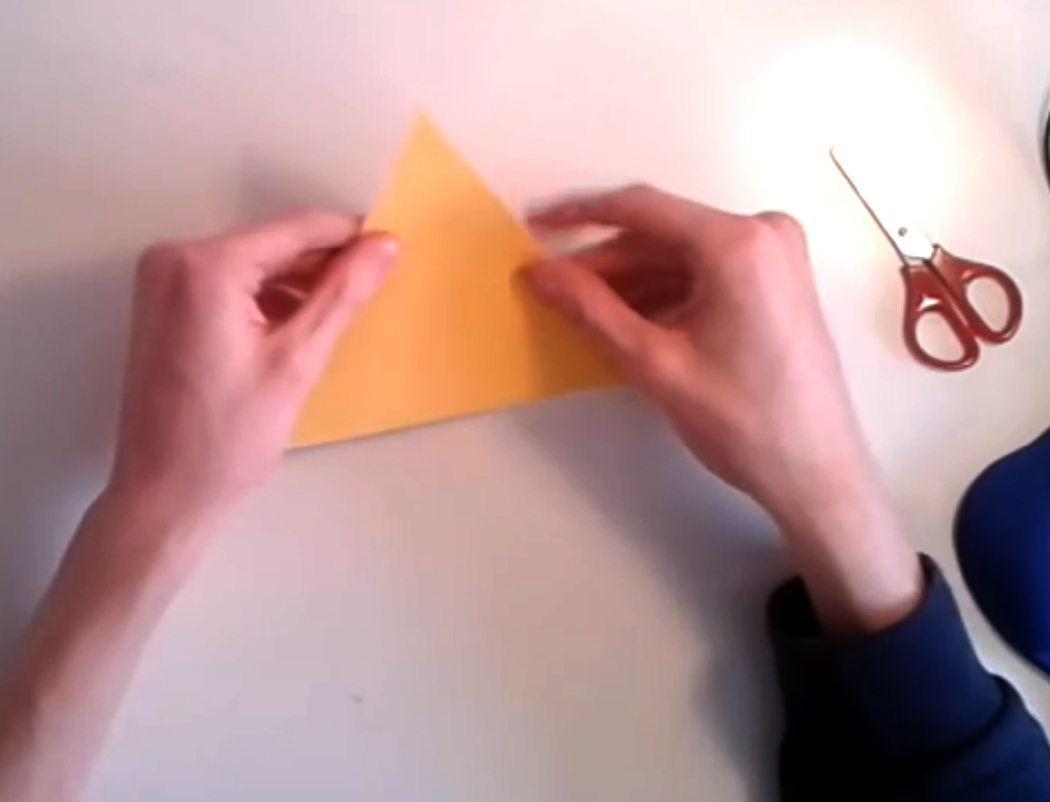
Or better, we can look at the problem a different way: I have written elsewhere (https://richardnilsen.com/2012/06/24/artists-math) that a triangle is a five-sided figure — the three usual sides, plus the top, looking down on it, and the bottom, resting on the desk. You can turn any triangle over from its back and lay it on its belly. triangleIf triangles exist in the world of things, they must have five sides. Language, like the axioms in geometry, pales in comparison to the real world of mud and bricks. There are 300,000 words defined in the Oxford English Dictionary, but that is an infinitesimal number compared with the number of things, acts, colors and sizes in the phenomenological world. There are an infinitely large number of things in the universe for which there are no words.

Take this, for instance. Here, where two walls meet is a corner. But where the wall and the ceiling meet? What is its name? In English, it has none.

Or this place on the wall — it is named the “center.” But this point, just as real, only a few inches from the center, is nameless and so is the one a few inches beyond that.

starsNames are like the stars in the sky, only points, between which is an infinity of space, just as real as the stars.

Language is feeble. It is up to us to see the space between the words, to recognize the feelings between the signpost emotions of hate, joy, anger, sadness — this million slight inflections that are nameless.

Up to us to explore the confusing rush of sense data, the confusing signals of society and nature, the overwhelming input that we censor with our language, allowing only those portions that sport nametags, as if they were Shriners at a convention.

It is up to us to recognize and celebrate all the things, times, places, acts, flavors, feelings, breath and abysses that don’t have names, to enjoy the cold floor and sunlight coming through the window in the morning when the birds haven’t yet begun chattering.