Archive

Author Archives: Richard Nilsen

Mahler conducting

There are rainstorms, and then there are hurricanes.

There are symphonies, and then there is Gustav Mahler.

The Austrian composer is like nothing else in classical music, and his unique brand of emotional fury inspires a cultish following. You may love Mozart or Chopin, but if you’re a Mahler fan, you are in love. Devoted. An acolyte; it’s akin to religious conversion.

“I love all composers,” said the late music critic Dimitri Drobatschewsky, “but the composer for whom I will make the greatest effort, or spend the most money, is Mahler. There is nothing in life that can replace what Mahler’s music does to and for me.”

It is almost an addiction.

The music hits closer to the experience of being alive than almost any other: deeper, more emotional, more direct. The Mahler addict measures a performance not so much by whether he leaves the hall whistling the tunes, as whether he has lost control of his lacrimal glands and has to hide his face as he leaves, so as not to show himself weeping in public. Mahler’s music is personal; it batters your heart. Zasche Theo Gustav Mahler 1906

He asks you the questions you think about only at the most extreme moments of your life: Why are we here? What is death? Love? How has the child become the man? It isn’t the intellectual answers he seeks, but the emotional landscape of the questions themselves.

There is nothing moderate in music or performance. Leonard Bernstein, often credited with starting the modern Mahler revival, was a particularly passionate exponent of the music.

“People are always saying that I exaggerate Mahler, which is so stupid,” he said, “because you cannot exaggerate Mahler enough! To play a Mahler symphony, you have to give it your whole heart and body and soul and everything.”

As William Blake said, “Enough or Too Much! Less than all cannot satisfy.”

‘3 times an outsider’

Gustav Mahler was born in 1860, one year before the American Civil War began, to a Jewish family in what now is the Czech Republic. He rose to prominence as a conductor in Vienna, where he was alternately lionized and vilified. By all accounts, he was one of the greatest conductors of his time, but a vicious element of anti-Semitism conspired against him, despite his careerist conversion to Roman Catholicism.Gustav Mahler Emil Orlik 1902

“I am three times an outsider,” he famously said, “as a Bohemian in Austria, as an Austrian among Germans and as a Jew throughout the world.”

He finished his first symphony in 1889, and he put into it much of his life up to that time. Every Mahler symphony is in some way autobiographical. It’s not just abstract music; the symphonies are his life.

Even in the First, the opening section depicts recollections of his childhood, of taking walks in the woods in Moravia with his father. So those high harmonics in the violins depict the wind blowing through the pine needles, and the clarinet depicts cuckoo calls, and then an offstage trumpet plays a fanfare because, in the woods they used to walk, there was a distant army barracks.

Mahler himself said, “A symphony must be like the world. It must embrace everything.”

It must be made the musical version of D.H. Lawrence’s “bright book of life.”

A challenge

Mahler presents an initial challenge to the newcomer, who is used to attending a concert for the purpose of hearing the great abstract artform left to us by Mozart, Beethoven, Brahms, Stravinsky, Copland, Prokofiev. But nothing in Mahler is merely abstract: It is all personal. All life. All extreme. The composer asks his audience not to enjoy his melodies, but to use the music to search their own lives for the return of serve he rockets into your court.

The Fourth Symphony is the best entry point for the neophyte: Mahler’s shortest symphony, filled with all the things that make the composer so compelling. There are great tunes, inspired orchestration, a vocal part and many of the deeper themes that pervade all his symphonies: Nature, nostalgia, tragedy, death and innocence.Mahlercartoon 1907

From there, you can move on to his more intense symphonies, where he feels compelled to throw at you everything he knows, everything he’s ever felt.

For him, that meant adding to his already huge orchestra such things as sleigh bells (which open the Fourth Symphony), cowbells, mandolins and — in his tragic Sixth Symphony, hammer blows that “fell a man like an ax cutting a tree.” The First Symphony has everything from klezmer bands to military marches.

He was trying to make a world, and that world is as much marching bands, elegant waltzes and earthy landlers as it is soaring, breathless melodies.

There is Mahler counterpoint, too: layers of tunes and snippets of tunes, less like the long line of a Bach fugue, and more like a Picasso collage, with torn fragments overlapped.

That mixture of high and low is both the hallmark of Mahler’s world view and our own Postmodern world. Perhaps that is why Mahler feels so contemporary to us. For Mahler’s contemporaries, his symphonies too often seemed to be infected by the worst sort of vulgarity. They had come to hear hochste deutsche Kunst — high German art — and got tin whistles and banjos thrown in in the bargain.

The “unmedicated” Mahler

If Mahler is about anything, it is about these extremes: sublimity and camp, aspiration and despair, irony and sentimentality.

In his famous essay about the composer, Bernstein wrote: “Think of it, Mahler the creator vs. Mahler the performer; the Jew vs. the Christian; the believer vs. the doubter; the naif vs. the sophisticate; the provincial Bohemian vs. the Viennese homme du monde; the Faustian philosopher vs. the Oriental mystic; the operatic symphonist who never wrote an opera.”mahler caricature 4

Mahler can whip you around these opposites, turning his music on a dime, snapping your emotions back and forth like a pennant in a Wrigley Field bluster. Not only between movements, but he can be ecstatic for three bars, and, suddenly, you’re in the deepest depression for six, only to snap to attention with 12 bars so alert that they seem electrified.

If he were alive today, he’d probably be on medication.

The slow movement of the Fourth Symphony is that way: It is a theme and variations on two themes, one elevated and serene, the other devilish and taunting. The two themes merge in variations, finally both stopping as the orchestra bellows a loud cry — for some, it is the gates of heaven opening. Time, and the music’s forward motion, stop dead in glory.

All that is followed in the finale by a song sung by a soprano, directed to sing in a childlike, innocent way, about the wonders of that heaven, imagined by a child, where “the angels bake the bread.” From the sublime to the ridiculous in one easy step.

Exhausting pinnacle of art

You can leave a concert humming Mozart’s tunes or inspired by Beethoven’s nobility, but after Mahler, you are simply spent. You’ve been “rode hard and put up wet.” He has dragged you from pillar to emotional post, pounded your deepest fears, pointed with your most fervent hopes. Mahler exhausts.mahler caricature 2

For those who are up to it, it is the pinnacle of art. For those who ask for something less exaggerated from their music, Mahler can be interminable and exasperating.

The symphonies are long — some single movements are longer than whole Beethoven symphonies. Mahler is an acquired taste.

Yet, while they are sonically splendorous, they are spiritually deep, and if music is an expression of the human spirit, Mahler is exploring its deepest depths.

For Drobatschewsky, it is summed up in the Mahler Ninth that he heard conducted by Claudio Abbado in Amsterdam.

“I am not a religious man, but what other people get out of religion, I get out of Mahler: solace, joy, every feeling that’s known to man.

“All out of Mahler’s music.”

NAG NAG NAG: An ADDENDUM

Gustav Mahler was a control freak.

Look at most music scores and you see not only notes but some basic instruction: tempo markings, how loud to play, whether to speed up or not.Mahler silhouette Otto Böhler

Look at a Mahler symphony score and you see enough writing to fill a book. He was a micromanager.

The Dover miniature score for his Fifth Symphony, for instance, has four pages of small-print glossary to translate Mahler’s German instructions. Hardly a bar goes by without some nudge by the composer.

In the first four bars alone of Mahler’s Fourth Symphony, he asks the orchestra to play “Moderately, not rushed,” and with “Grace notes very short,” “staccato” and “piano” (“quietly”), followed by “sempre piano” (“always quiet”), followed immediately by a diminuendo (“get quieter) — which would seem to contradict the sempre piano by asking the orchestra to change. Meanwhile, he asks that the music be played “grazioso” (gracefully), while also asking for a “poco ritardando” (“slow down a little”).

That’s in three bars. In the fourth, he asks for a return to the original tempo, but it should also now be “comfortable.” Meanwhile, he throws in a reminder: “Expressively.”

That’s only four bars out of an hourlong symphony.

You have to give yourself over to Mahler’s intentions, perhaps more than for any other composer, due to the sheer volume of specific instructions he has left us.

The markings can be difficult to interpret, however. The very first instruction Mahler gives for his “Songs of a Wayfarer,” before he says anything else, is “Faster.” Faster than what? That is followed by “Slower” and, two bars later, “Faster,” and back and forth until he gets to “Smoothly agitated.”

Most conductors mark up their scores with little notes to themselves to remember this or that detail in the music. Mahler was a conductor, too, and has given the performer the benefit of his own marking up.

Basically, Mahler was a backseat driver.

Apollo

Apollo

The older I get, the less reading I do, and the more re-reading. It’s a common symptom of age. There are many things that change as you leave behind the enthusiasms of youth.

I remember the complaints about conductor Arturo Toscanini that his repertoire was small and repetitive: How many times can you play the Beethoven and Brahms symphonies, and why don’t you play more contemporary music?

Toscanini 2First, you have to remember that when Toscanini was young, he gave world premiere performances of many new works, including Puccini’s La Boheme and Sam Barber’s Adagio for Strings. He gave world premieres of at least 25 operas. When he was young, the music of Richard Strauss and Claude Debussy were brand new, not the concert stalwarts they later became. He gave the American premiere of Shostakovich’s Seventh Symphony. He programmed all of George Gershwin’s major pieces, even if his Italian soul never quite beat to the jazz rhythm. 

But it is true that after he came to the NBC Symphony, he concentrated on the war horses. His repertoire did narrow as he got old. The problem is that we know Toscanini mainly these days for his RCA Victor recordings, made near the end of his life, and so we have a skewed vision of his career.

That narrowing is not uncommon in artists, who generally — if they get to live long enough — develop a streamlined “late style,” which eschews much of the complexity they favored as young Turks, and gets straight to the point, as if the knew they didn’t have time for all the hoopla and somersaults. 

And so, as his hair whitened, Toscanini focused on those works he knew he could never exhaust: things like the Beethoven symphonies. They provide endless riches, endless possibilities, and endless satisfactions. 

I say I recognize this because as I’ve aged, I, too, have narrowed my focus. As a young art critic, I kept up with all the newest trends in contemporary art. I loved the buzz and fizz: Who’s up, who’s out. What’s the latest and greatest. I even went so far as to disparage much of what is found in our art museums as “relics” of the art process, and therefore not really art — real art is what is coming out of the studios today. Or even better, tomorrow.

And, as a music critic, I felt the same way. Give me something to shock my ears and lord keep me from having to hear another Beethoven’s Fifth! 

But there is a great change in one’s approach to art as one matures. Maturity isn’t just a slowing down and tightening up: It is the weight of experience. When we are young, we know so little, yet we think we know so much. We have the answers, and why don’t the fogeys understand that?

Life, however, burdens you with the accumulation of experience and what was clear as an adolescent is infinitely muddy as a grandfather. 

When we are striplings and in love with art, we tend to idolize it, and its makers. We test ourselves against our heroes, and against the art they made. Are we up to it? Can we maintain in ourselves the vibrancy and aliveness of the art we adore? Aren’t we “special,” too? Of course, we are! The world in art seems so much more brilliant and colorful, so much more emotionally intense. 

But, after a few marriages, a few divorces, a few illnesses, a few disappointments and the deaths of too many of those we loved, after seeing the politics of our time repeat themselves endlessly and stupidly, after seeing more genocides in the world, and hearing the idiocies of dogma and doctrine, the evils of ideologies and the fears of unknowing engender the hatreds of tribes and nations, after all that and the heavy weight of more, we — if we have been lucky — have earned a portion of wisdom. What we once valued from books, we know know more directly from life. And now, instead of measuring ourselves against the art we love to see if we measure up, instead we measure the art against our lives and experience to see whether the art measures up. And very often, it doesn’t. 

So, in our dotage, we fall back on a few trusted worthies, those poems, books, paintings, symphonies, choreographies that we have tested against our experience and which hold up and continue to give pleasure, consolation, understanding and — I hesitate to use the word — what we have come to regard as truth. 

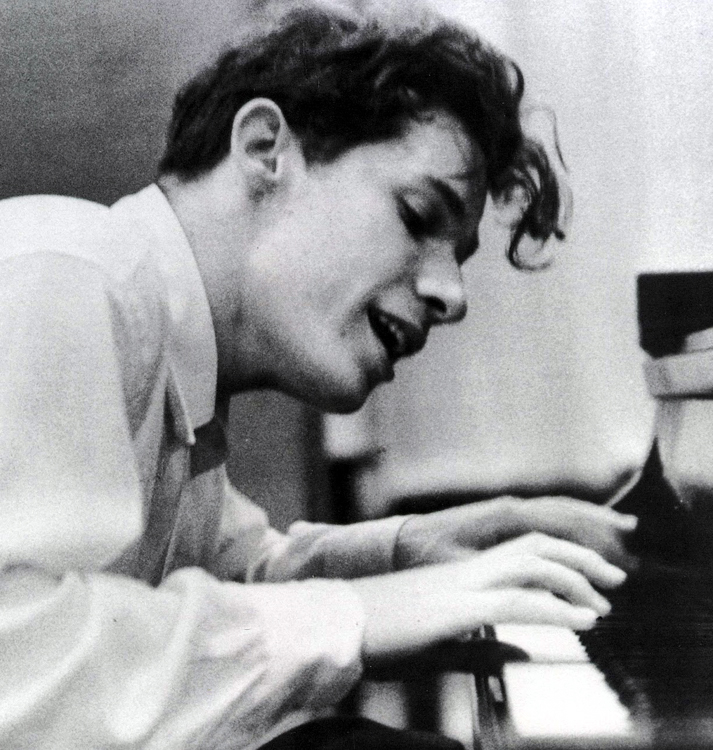
It is what I find in those books and in that music that I re-read and re-listen to — that give me sustenance, that feeds my inner life and tells me that I am not alone but share something with those writers, those composers, those painters and sculptors who have gone through enough life to have developed enough emotional complexity to make art that says something real, and doesn’t just tickle my need for novelty, or — as in my youth — my self-announced grandiosity. glenn gould

So, I re-read The Iliad at least once a year, and re-read Ovid’s Metamorphoses, Melville’s Moby Dick, Shakespeare’s Hamlet and Goethe’s Faust. I just finished again Dante’s Commedia, and expect to take on Chaucer next. I listen to Glenn Gould playing the Goldberg Variations, or to the Budapest Quartet and the late Beethovens. I weep every time I see Balanchine’s Apollo or his Prodigal Son. I cannot get all the way through Wordsworth’s Intimations Ode without sobbing quietly. 

And Toscanini doing Brahms’ Fourth. I don’t know how many times he conducted that piece, and I certainly cannot count how many times I’ve listened to that recording. I can hear it all the way through now purely in my mind; I don’t even need the score. 

These things — and many more — seem rock-solid and true. 

I expect you have or will have your own list of works that do it for you. They shouldn’t be the same ones; after all, you have lived your own life and collected your own list of wounds and sorenesses, giving you your own sense of what life must be, despite all our best efforts. 

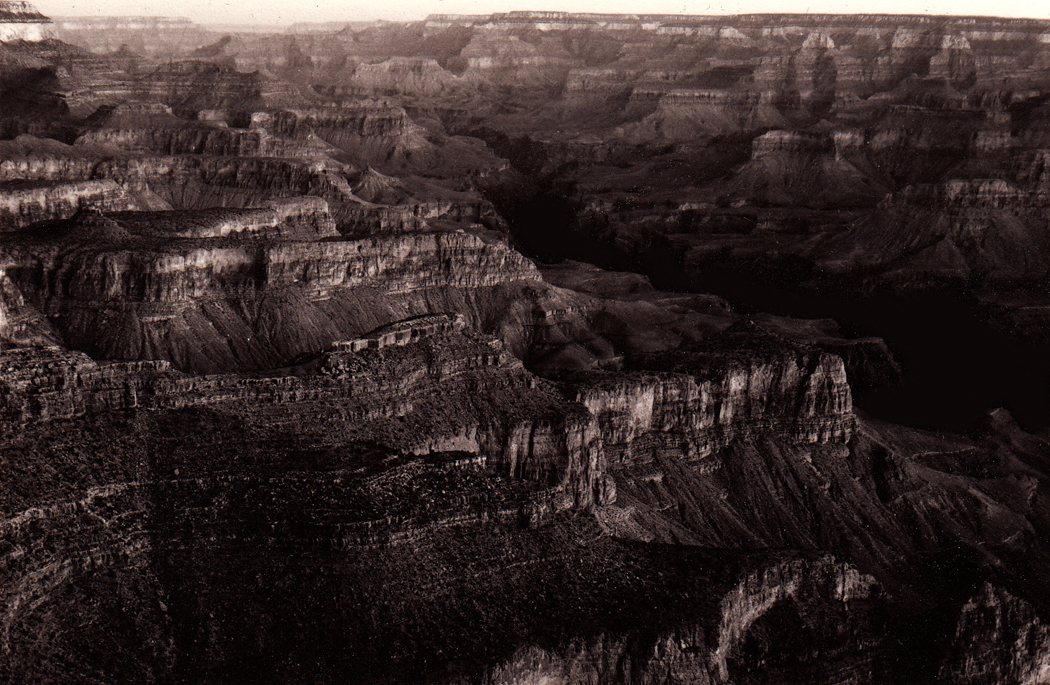
Dawn, Grand Canyon National Park

Dawn, Grand Canyon National Park

It’s nice to be reminded every once in a while that we live on a planet.

That we are lodged on a wet rock spinning in cold, black, empty space and hurtling through the void, down through time like water into a storm drain.

You are not likely to notice this while waiting at a red light downtown although sometimes waiting for the thing to change will get you a glimpse of eternity. Nor are you likely to notice it on the recliner, tuning in to American Idol. Or waiting for a table at the IHOP.

Consumer culture and all of our measly daily scratching conspires to hide from us the fact that the ground under our feet is really a large bolting asteroid.

But there are places you cannot avoid the sensation.

For me, driving long distances on the prairies of Saskatchewan or Alberta will do the trick. You watch the grain elevators rise up on the horizon in front of you like the sails on a clipper ship, and watch them lower down behind you after you pass: You know you are on a sphere and every direction falls off downhill around you.

You recognize it on an airplane, too, watching miles pass under your seat like so many inches, seeing at one time Lake Superior to your aft and Lake Michigan afore. You can take in a significant arc of the planet’s circumference at 30,000 feet.

But each of these epiphanies requires that you be traveling: the moving point on a geologic ordinate and abscissa.

If you want to have the planetary feeling without racing around the globe, you can get it standing still in Arizona: with your feet planted at the edge of the Grand Canyon. In that case, you stand stock-still and let the planet do the moving.

The first time I saw sunrise at the Grand Canyon, my wife and I were camping on the North Rim outside the National Park. We had arrived with the naive assumption we could wander in late in the afternoon and get a room at the lodge. Or failing that, we could get a slot at the campgrounds.

The desk clerk took pity on us and explained that although they were completely booked, lodge and campground, for the foreseeable future, we could find a dirt road just outside the park that would take us to a place in the National Forest where people often camped.

It was dark by the time we got to that road, and when we turned into an open place where two or three other tents were set up, it was already night.

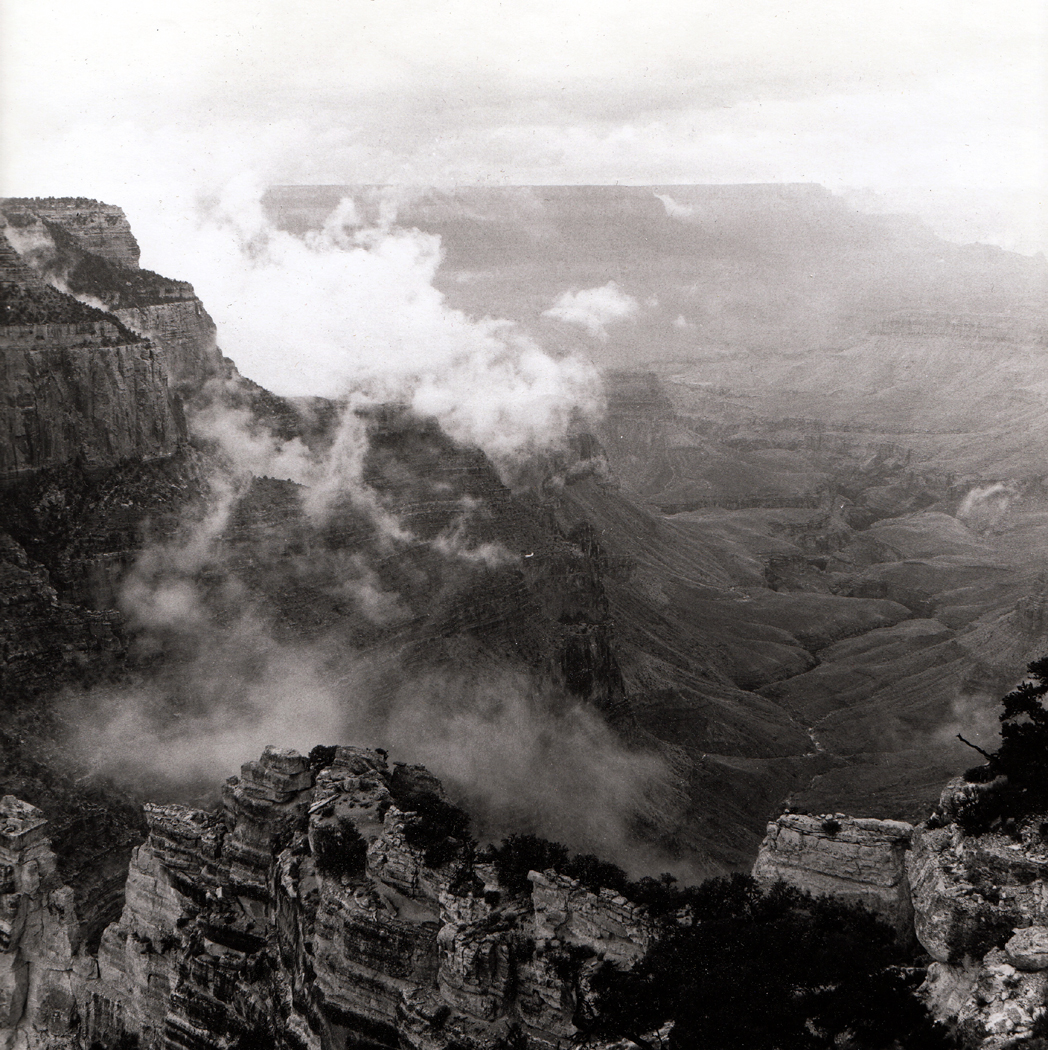
North Rim, Grand Canyon

North Rim, Grand Canyon

We slept, we dreamed, and we woke before sunrise, when the earliest glow floated in through our tent flap. And when we got out to stretch and start up the camp stove, we gasped: We were about 15 feet from the rim of the canyon. It dropped out of sight below us.

If we had pulled forward just a little farther the night before in the blackness, it would have been Thelma-and-Louise time for us. We were hard on the edge.

But more impressive, the humid late-July weather had left the entire canyon as a gigantic dish of cotton. The clouds filled in the canyon-hollow like apples in a fruit bowl. A 215-mile long fruit bowl.

The mists swirled and wisped below us, over precipices and down canyonlets, in constant motion, rising and subsiding as the new-hatched sun warmed patches of the air the mist rode upon and the breezes wafted the veils.

The Classical writer, Longinus, said that we enjoy the day-to-day things of our lives, but when it comes to awe, we get that only from the sublime. Hearth fires, he said, were nice, but erupting volcanoes make us consider a planet and cosmos larger than we are and well beyond our control. The sublime is beautiful, but it is also scary: It is the source of religious feeling.

You cannot avoid that at the Grand Canyon, with its stony layers of eons piled upon each other. The Canyon is a great wound in the Earth into which we can look and see its organs pulsating at a rate so slow as to make all of human history a mere blip on its EKG.

Sunrise is always a magic time. For me, all the more magic for how seldom I see it, being a night person and late-riser during every time of the year except vacation. Familiarity has not had a chance to dull the morning’s effect for me: Every dawn I witness is a rebirth.

The following summer, we came to the Canyon again, to the South Rim. We camped outside the park once more, and got up at 3 in the morning to drive to the rim to see the whole process of sunrise.

Even in July, it was cold in the dark. We parked at Lipan Point, where we would be able to see northeast into the canyon, where the sun should pop up. With a flashlight, I set up my 4X5 camera, with its bellows and tripod, and pointed it down into the blackness below.

By 4 a.m., the glow on the horizon widened into a band of dull brightness. I managed to focus the camera on the now-visible horizon line, and then pointed it back down into the ink.

A minivan pulled into the turnout and a few people got out, looked around at the black hole, and deciding there was nothing to see, got back in and drove off.

I moved the camera over the restraining fence and out onto a rocky knob with an unhindered view. My wife fretted I might slip off the cliff and down into the hard centuries of geology below: A very physical way to meet eternity.

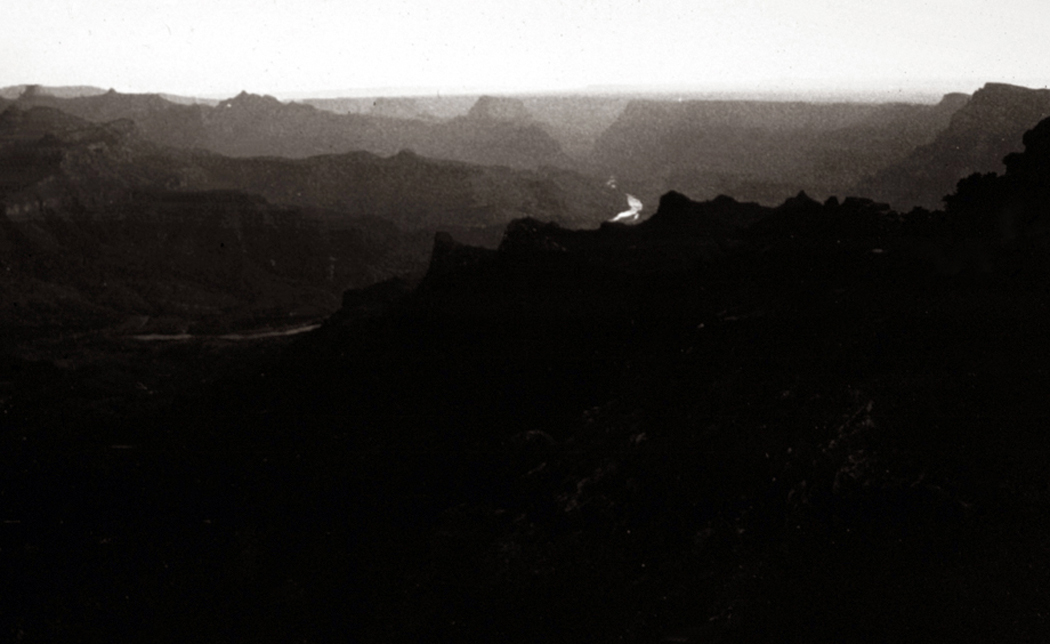
By the time I got the camera set, the glow from the horizon had made the rock below us seem less like the river Styx and more like a darkened charcoal drawing. It was beginning to take on detail. I made an exposure of five minutes or so, to try to get some of the charcoal registered on my film. Dawn, Grand Canyon with river

The river below us began to reflect the lightening sky and became a glowing white streak in the sooty rock. It pointed in one direction northeast directly at the place the sun would arise, in the other direction, it curved around the coal-colored cliffs and disappeared.

The moment the sun broke the horizon, though, was the moment we realized we were sitting on a spinning round rock: The effect is unsettling and eerie.

I’ve had this happen a few rare times in my life. When the sun is still in contact with the horizon, its motion is quite noticeable. You can actually see it move.

But at that moment, the sun stopped moving, just as if Joshua had commanded it. And as the sun stopped, the Earth like a giant machine, whirring its gears began rotating forward in front of us, lurching from under our feet. An earthquake wouldn’t have felt more tactile.

It was as if we were coming over the top of some giant Ferris wheel. The still sun made our motion all the more apparent. It was Einstein in action: relativity made palpable. A shift in frame of reference.

The rock we were reeling on, trying to keep our balance, was pulling forward toward the sunrise.

”Whew! What was that?”

It didn’t take long, though, after the disc of the sun broke free from the horizon, all that motion ceased. The common light of day had re-inaned the world. We would eat breakfast, talk about baseball, read the newspaper all the quotidian fuss of our lives and rejoin the society where the search for a good five-cent cigar seems important.

A friend was telling me once about the trouble he has been having with his insurance company. He had run into a bureaucratic Catch-22 in which he needed an official letter before the insurance would take effect, but couldn’t get the letter until the insurance was working.

”Sometimes, I don’t know how the world keeps turning,” he said.

As we fight rush-hour traffic, heat up our Pop Tarts, pay our bills, worry if our taxes will devour our raise or if Congress will ever become more than monkeys squabbling over a banana;

As we worry if our daughters will safely negotiate the pitfalls of adolescence, if the rebuilt transmission can last another 30,000 miles, and we put a few more dollars into an IRA;

As we submerge ourselves once again into the inclarity of what we call our lives, it’s good to remember that there is something larger out there, with a wider frame of reference.

We need to be reminded every once in a while that we live on a planet.

olana

Everyone likes a home with a view. If you are rich enough, you can afford to buy such a property, and if you are an artist, you can design such a house.

Frederic Edwin Church was both of these things, and the estate he created, Olana, is now a state park near Hudson, N.Y., where it sits on the top of a hill overlooking the Hudson River and the Catskill Mountains. catskills from olana

Church worked obsessively on the house and grounds from 1860 until age and arthritis forced him to give management of the estate to his son in 1891. Always, Church’s goal was to create natural landscape views from every turn of road on the 250-acre estate and from every window in the house. And he knew something about landscape views.

Church was one of the most famous of American painters of the previous century. His work commanded the highest prices of any American art when it was new, and inexpensive prints made from them were sold by the thousands to his middle-class audience.

Niagara Falls

Niagara Falls

He found in the New World apt subject matter: the American landscape, from Niagara Falls to the volcanoes of South America. The land he painted was vast, romantic and sublime. It told of a new Eden, almost a new covenant for which America was the herald.

The Heart of the Andes

The Heart of the Andes

Frederic Edwin Church

Frederic Edwin Church

From the 1850s through the next two decades, Church’s paintings glorified America’s vision of itself and the Manifest Destiny that was the root of the vision.

Others painted the same subjects. What made Church distinct was his scale and detail: His paintings were big enough to be exhibited like movies, in their own venues with an admission charge, and they didn’t generalize or idealize their flora and fauna, but instead painted them in Peterson field-guide detail. You can name the plants in a Church painting; you can almost name the week and month by their stage of development.

Rainy Season in the Tropics

Rainy Season in the Tropics

The same kind of obsessive detail marks his house, too. Church couldn’t stand an empty wall or a broad expanse of window. Victorian houses are often chock-a-block with bric-a-brac, but Church is notable even by these standards.

The house was originally intended to be a French chateau-style building. But when Church and his wife toured the Middle East in 1869-70, they became infatuated with what they called ”Persian” architecture. It was actually a little closer to the Arabian Nights style Hollywood eventually adopted for its version of Baghdad. olana front hall

They called it Olana after an ancient treasure-fort in Persia. olana studio

Inside, Church displayed all of his many souvenirs. Most look like they’re straight from Pier One Imports. One lesson to be learned: Being an important artist doesn’t automatically confer good taste.

One room avoids the Scheherazade look. The dining room instead mimics a Medieval castle. And on its walls are the paintings Church called his ”Old Masters.” In fact, they are old, dusty souvenirs of Europe, sans provenance, sans signatures, sans anything else but an old look. If a painting was too bright for his taste, Church himself dimmed it in brown varnish.

The dining room is also one of the few places in the house without a view. Everywhere else, each window or balustrade frames what could as well be a painting. view from olana

In 1884, one visitor wrote about her trip to Olana: ”Mrs. Church met me at the Hudson and we drove up here, several miles, through thick woods, like the ascent to the Alhambra. In fact, Olana is placed somewhat like that, on the top of a cone-like height commanding the Hudson. The house is large and all open on the lower floor, with wide doors and windows a daux battants, so that everywhere you look through vistas to shining oak boughs at hand, and dim, blue hills far beyond, middle distance omitted because so far below.”

The Icebergs

The Icebergs

The house stayed in the Church family until 1966, when it was purchased and later donated to the state of New York. It had fallen into a bad state of repair, but renovation has brought the property up to code and turned it into a beautiful place to spend a day.

Caricature by Tony Bustos

Caricature by Tony Bustos

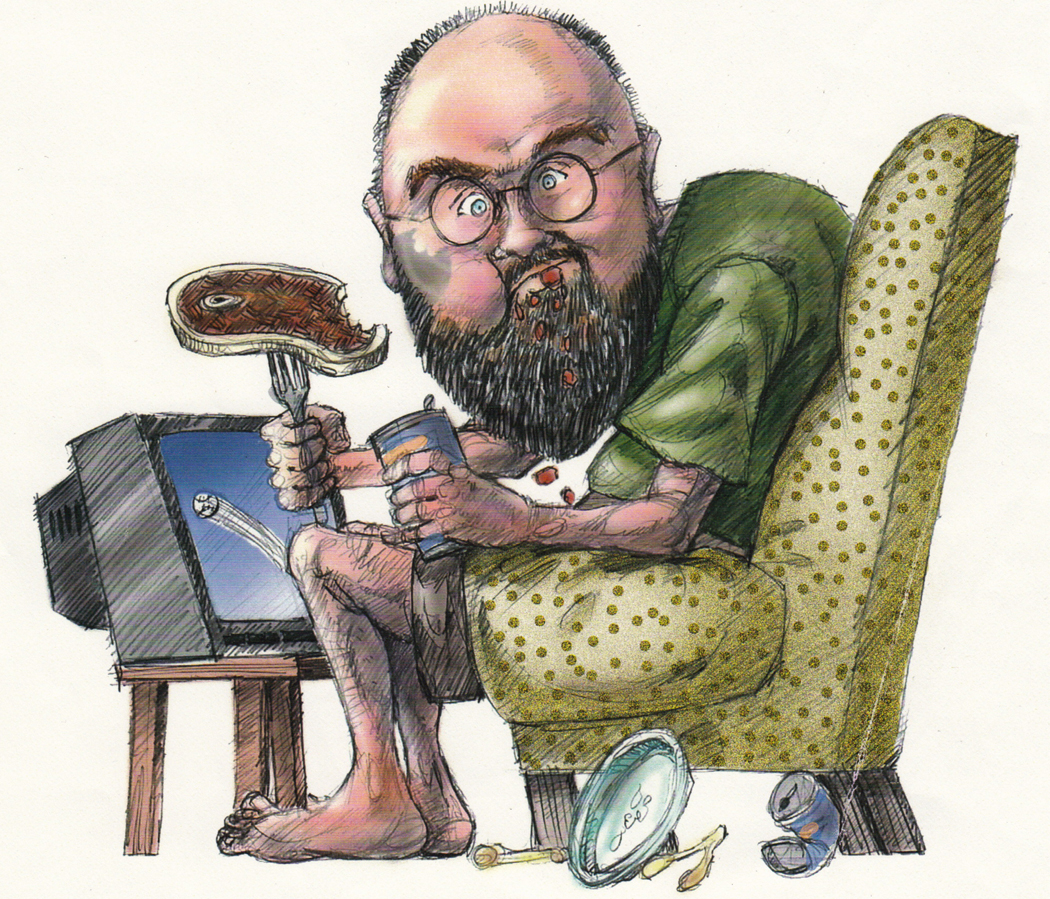
Leave a man to his own devices and he becomes a grunting carnivore. Let him make his own food for a month, and he will turn his home into a Aurignacian cave.

I’ve done this myself many times, when my wife left home to visit our daughter out of state. At such times, any vegetable in the fridge has ample time to turn into brown goo out of malignant neglect.

It is an odd development. I can cook; I did so for many years on a daily basis. I even enjoy making a nice rogan josh or Mexican mole. But with my wife gone, and with the advent of summer, I’ve lost all desire to cook.

And it isn’t about thinking a wife is only good for cooking and cleaning. I sometimes cook, and we share housework. This is the 21st Century. No, it is that I’m a better person all around when she is home. When we are separated, I don’t function. I seize up like an unoiled motor.

So, I live the bachelor life. I watch baseball and I sleep and I go to work.

I lose the gift of speech.

Typical dinner: I stoke up the patio gas grill, take a steak out of the freezer, drop it thunk-rock solid on the gridiron, go inside and watch an inning of baseball, go out and flip the meat over, watch another inning and then plop the steak on a paper plate and eat it with a beer as I watch the rest of the game.

I don’t even need a knife and fork. I just bite off mouthfuls. I am Attila, scourge of God.

Every once in a while, I feel the genetic need for something vegetable. On those rare days, I order a pizza with the works.

The dishes pile up. The cave floor is paved in chicken bones and the cat wanders around them licking the last bits of tissue off them with her rasping tongue.

It is an ugly sight.

It is a good thing men don’t run the world, or we would be in one heck of a hopeless mess.

museum gorilla

I had two homes as a boy. First, there was the house my family kept, where I was fed and went to sleep. But second, there was The American Museum of Natural History in Manhattan. Its vast halls and marble floors held the wonders of the world. I couldn’t get enough of it. To say nothing of the Hayden Planetarium next door.

There were dinosaurs and sharks the size of split-levels; there were dioramas and a life-size blue whale; there were vast vitrines of rocks in darkened rooms where sound bounced off the hard floors and walls, giving young ears their first taste of echo location — the inner ear knew this was a large space.

There was the “Soil Profiles of New York State,” always one of my favorite places. The museum opened me up to the wide world and the things in it. The woods I grew up knowing were enshrined behind glass, letting me know that such things were important enough to study. It first showed me that there was nothing truly “ordinary,” that everything was somehow miraculous, like the gigantic centipede in the leaf litter exhibit.museum postcard

I have gone back to the museum countless times in the ensuing years, and it has always been a joy. But something has changed, and not just in the Wordsworthian sense.

What has changed is museum philosophy. Back then, museums were collections displayed indiscriminately: glass cases of quartz crystals; boxes of dragonflies; walls of stuffed birds.

Today, the emphasis is on education and, as a result, the displays are smaller, more organized and accompanied by explanatory text, with maps and diagrams. What used to be a pile of rocks is now one or two dramatically lit examples with a video display next to them with a media baritone giving us the pertinent facts.

It used to be the museum was about stuff. Now it is about words, and the stuff has been turned into visual aids. museum blue whale

The new museum is less cluttered, has greater clarity and is easier to digest. And, for me, that is just the problem. I feel cheated: My museum experience becomes passive.

I am no longer allowed to think for myself but am given only a single interpretation of the material, one that can only be called ”the official story.”

What I loved, and what sparked my boyhood imagination, was the profusion of specimens, and the lack of coherent explanation. There were those vitrines, with their hundreds of small chunks of quartz, and next to each a tiny typewritten label saying it came from Haddonfield, N.J., or Bloemfontein, South Africa. It was up to me to figure out why they all meant something, and why they were exhibited together. I got to make up my own story from the blizzard of data. museum butterflies

Surely, my stories might not be accurate, but then, they might be more accurate than the “official story.” That’s how Alfred Wegener figured out that the continents were rafts, how Johannes Kepler figured out — from the rafts of data collected by Tycho Brahe — that the planets move in ellipses.

Science, after all, like history, is made up of two elements: data and hypothesis, that is, primary material and the sense we make of it.

A historian, for instance, doesn’t write history from history books, but from the letters people have left behind, the church records and deed registers, old clothes and kitchen middens. A mass of confusing detail comes into his hands, and he has to whittle it down to a believable story. Only then is the history book written, and, if the historian has done a good job, his version becomes the accepted version.

Just being spoon fed the accepted version hinders our ability to make progress. Because the accepted version is always, to larger or smaller degree, imperfect. museum elephants

Part of the wonder of museums for me was just that: seeing a jumble of minerals or scarab beetles and figuring them out. I miss the confusion and the creative thought that is born of it.

The history of science is littered with abandoned theories, from geologic catastrophism to uniformatarianism, from geocentrism to heliocentrism, from Newton to Einstein.

In the science of history, this is often called ”revisionism” and thought of as a bad thing, although I can’t imagine why. New information or better hypotheses are good: They are truer.

So, when I go to the American Museum of Natural History and I see a few dinosaur bones with a timeline on the wall, I know the version I’m being fed is no more sacred than the version it replaced: coldblooded, lumbering lizards replaced by warmblooded, twitching, nervous birds 20 feet tall. museum dinosaur

The new museum thinks it is being educational, but more exactly, it is being entertainment. It is like TV.

And I cannot call that an improvement.

plums 2

I spent a quarter of a century being an art critic, but try as I will, I just cannot read art criticism. 

Although there are a few bright exceptions, art critics write in a prose that can clog drains. And too often, their only purpose is to fix the national borders of an art with a jargonish ”ism.” As if there were no difference between a dog and its name. 

The problem, of course, is that the critics (and art historians — let’s not forget the aiders and abettors) see the art they write about as information, as knowledge to be learned. But art isn’t something you learn about, it is something you experience. 

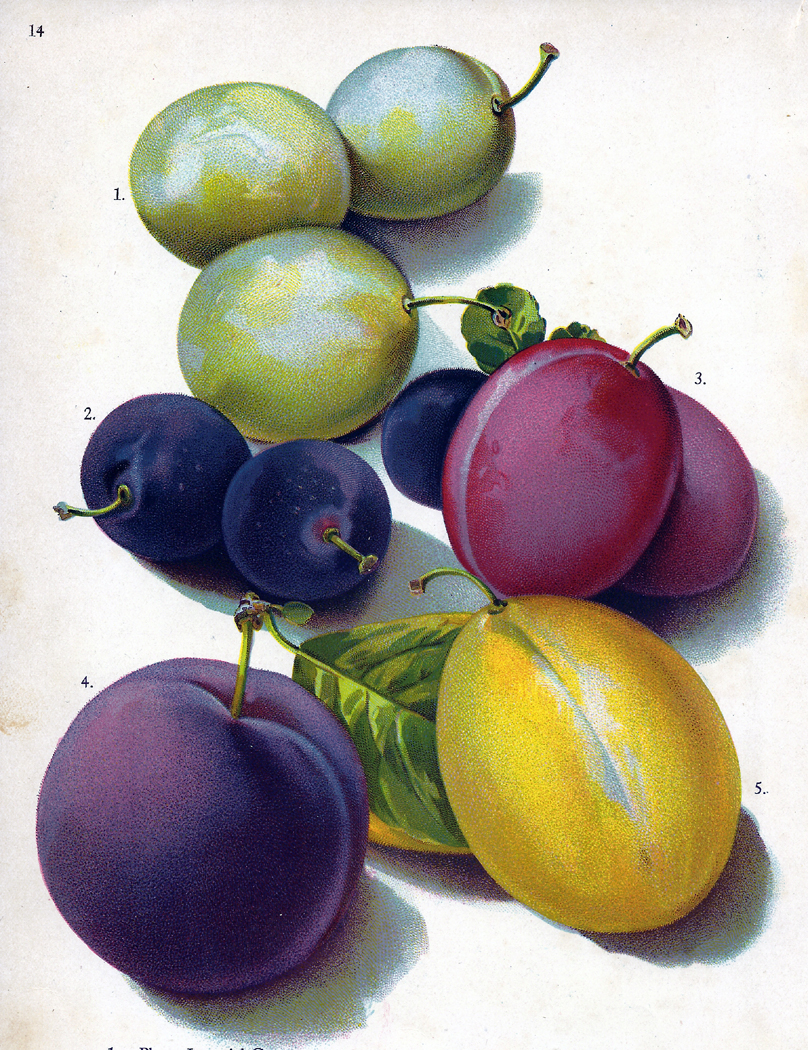
A plum tree has a scientific name — Prunus domestica — but the name tells you nothing about the blossom. It can tell the botanist a few things: how many petals there are, and how many stamens. It is useful for scientists who write scientific papers on arcane aspects of horticulture, but for the rest of us, ”Prunus” is a poor substitute for the smell, color and form of the flower. 

Let me try your patience with one of my favorite examples of art palaver. It is from a very good, very well-known sculptor, whom I don’t want to embarrass by naming. 

”Sculpture deals with basic forms. All basic forms exist as volumes. Volumes penetrate each other and in this way are no longer single formations. Through penetration, space is created in its entirety. Every portion of space results from it. Basic forms are positive space volumes; negative space is created through the opposition of these positive space volumes. Positive space is life-fulfilled; negative space is force-impelled. Both exist simultaneously, both conceivable with each other. It is only the simultaneous existence of positive and negative space that creates the plastic unity.” 

You can stuff mattresses with prose like that. 

I can begin to fathom what he is trying to say: more or less, that the subject matter of art cannot be separated from its background — a basic Design I concept. But I can only conjecture about the ”life-fulfilled, force-impelled” jargon. It is a paragraph that sounds about 23 times more important than it is. 

And as such, it is a version of bureaucratic English. Language that is meant to impress without saying anything. Certainly without conveying the experience of the art. mu qi six persimmons

And prose like that scares many people away from art. If they can’t understand what is written about art, how can they ever understand the art itself? To many people, the world of art might as well be populated by Martians. 

Yet it is not the art that is Martian, only the prose. 

One of the glories of art is that it is available to everyone willing to put in the time and effort. Specialists may know more about a piece, its provenance or historical context, but a rank beginner can experience the color and form with the same appreciation as a critic — or even greater. 

That doesn’t mean that everyone’s opinion is equally valid. You have to be willing to work at experiencing a piece of art. It does not give up its depth and meaning quickly. You have to be open to seeing and feeling things you may not have felt before, and may not feel comfortable with. 

Art requires not knowledge but openness. Knowledge will come of its own accord, as the deeper you experience a work, the more you want to know about it. 

But would you rather read Krafft-Ebing or have sex? 

Nothing can substitute for the experience.

spilled glue

When you’ve heard a piece of late 18th century music on the radio and you don’t know who wrote it, how do you tell whether it was by Haydn or by Mozart?

A former teacher of mine had a simple answer: “If you can remember the tunes when it’s over, it’s by Mozart.”

They were both great composers, but Mozart — in his best music — had a quality that Haydn lacked: He could write “sticky” tunes.

I’ve lately been thinking about this quality, because while we instantly recognize “stickiness” (that recognition itself is practically the definition of “sticky”), it’s difficult to know why one tune is sticky and another isn’t.sticky bun

And it is important to recognize that stickiness is only one quality of good music. Some composers, like Haydn, still wrote great music without it. Heck, the composer most people name as the greatest ever — Beethoven — hardly ever wrote a memorable tune. I mean memorable in the way that even a Rodgers and Hammerstein tune can be memorable. Let’s face it, “Da-Da-Da-Dum” is not really even a tune: It’s a pattern repeated so many times in that damn symphony it is pile-driven into our memories. Anything we rehearse over and over can be memorized. Like multiplication tables.

In contrast, the first thing you hear in, say, the Mendelssohn violin concerto is so sticky, if heard once, it is instantly becomes part of your life.

It should be acknowledged that stickiness is not the be-all and end-all of music. Marvin Hamlisch had it and Stephen Sondheim lacks it, but who is generally held to be the better composer? Sometimes, a catchy tune just means a shallow tune. library paste

There are those composers we instantly recognize for the warmth and catchiness of their melody writing: Mozart, Rossini, Schubert, Dvorak, Tchaikovsky, Verdi, Mendelssohn, Schumann. And there are those whose music finds its strength in other qualities, such as Beethoven, Brahms, Stravinsky.

That stickiness is a distinct quality of music can be seen in the descending careers of both Mendelssohn and Schumann. After Schumann’s breakdown, his music lost its stickiness. It maintained all its craft, but none of its memorability. Mendelssohn wrote the Octet and the Overture to Midsummer Night’s Dream when he was a teenager, but by the time he became the pious paragon of English Victorian culture, he was pumping out some very dull music, indeed. The two composers simply lost their adhesiveness. rolling stones sticky fingers

In contrast, two later composers took the other route: Early music by Cesar Franck and by Leos Janacek chuff-chuffs by on sheer force of will, while when their hair turned gray, they were both touched by the sticky muse and gave us music we can’t get out of our heads.

One thing that seems to be true about sticky melodies is that they feel somehow complete in themselves. The secret of most great symphonic music is that it is built on patterns of notes that can be altered and developed, the tune can be taken apart and rearranged, turned upside down, slowed down or sped up, without losing its fly paperidentity — like Beethoven’s “Da-Da-Da-Dum.” But a sticky tune, like the Mendelssohn concerto, is so complete in itself that it doesn’t easily bear symphonic development: Change a note or rhythm and it loses its identity. This is the downfall of so much music from the Romantic era, where a tune is so good to start with, the composer has nowhere to go with it, so he just repeats it with different instruments or at a different register. It can make for monotony in a 40-minute symphony, a monotony that Haydn never courts, because he is always doing something fresh and new with his themes.

But stickiness isn’t just for music. Some paintings are sticky, even after they’ve dried. Some poetry is sticky, some architecture is sticky.

Just compare, say, Alexander Pope with John Dryden. Pope, sticky, Dryden, dry. All the craft is there in Dryden, and some very lovely turns of phrase, but nothing as memorable as “The proper study of mankind is man.” Pope ranks third as most quoted poet in Bartlett’s.

Keats: sticky. Shelley: not so much.

Wordsworth, like Schumann, lost his youthful stickiness.jam face

Again, stickiness is not the sole measure of worth. Joyce Kilmer’s “Trees” is as sticky as a caramel apple, but not exactly on a level with John Milton.

Claude Lorrain, sticky; Nicolas Poussin, not so sticky. Henri Toulouse-Lautrec is one of the stickiest artists ever. You can come up with your own list of sticky paintings, sculpture and photographs. The subject of stickiness is wide and deserves deeper critical attention.

Stickiness is what every “hook” is in a pop tune, it is the sine-qua-non of a magazine ad or a TV commercial. It may have something to do with simplicity and clarity, but even a complex tune can be sticky.

I would welcome some scientific study of stickiness.

old elvis 1

Elvis is America.

I am not entirely delighted by that fact — even somewhat embarrassed by it — but there is no other figure, public or private, from the past 200 years that sums up so succinctly what the United States is all about.

And three and a half decades after his disappearance and reported death, Elvis Presley remains both what Americans are and what they want to be.

Of course, what they want to be is Young Elvis — brash, sexy, talented. And, compared to most Old World cultures, that is just what America is. Its pop culture has preempted many indigenous folkways throughout the planet precisely because it is so appealingly energetic. Content doesn’t matter nearly so much as style points, and Elvis — and America — can swivel and two-step like a blue demon.6/30/00 DS - REF="Elvis_ao_MCos.psd"

The effect is so pervasive that in deepest Africa, you don’t hear tribal drumming so much as you hear Top-40 tunes. And Japanese karaoki is not, after all, based on the music of the classical Noh plays.

No, what appeals to the world is America’s optimism, its lack of guilt, its comfort with itself. America may be a novice in world history, but it is a refreshingly guileless novice — or at least, it has been.

Like Young Elvis, we think of ourselves as dangerous without being threatening.

But America would prefer not to notice the Old Elvis in the mix, which is also part of our Elvis-selves.

For America is also crass, loaded with bad taste, money-chasing, conspicuous consumption, anti-intellectualism, sentimental Christianity, drug hypocrisy, junk food and mindless consumerism.

On the surface, the Young and Old Elvises seem like opposites, but they are not: The one naturally evolves from the other. You cannot have the Young Elvis without the Old One waddling behind, two halves to the same coin.

The flip side of our energy is our anti-intellectualism; our self-confidence is also our provincialism.

Our sober, well-educated founding fathers envisioned an America modeled on republican Rome — or rather modeled on imperial Rome’s nostalgic vision of its republican past.

Washington, Madison, Adams and Jefferson imagined something brand new in the world, something bursting with energy, new ideas and vitality.

That is Young Elvis. But just as republican Rome turned into the empire of Tiberius, Nero and Elagabalus, so America quickly added to its repertoire the Jacksons, the No-Nothings and the Tea Party and Neocons.

Indeed, Andrew Jackson, who kept goats in the White House and stabled his race horses on the grounds, was probably the first Old Elvis in our history. He was even known as “The King,” in his day — King Andrew, he was called by his political opponents, who disliked his monarchical yet proletarian ways.

There is something in American culture that is illogically ambivalent about royalty. We claim to be a classless society and righteously argue that anyone in America is as good as anyone else. Heaven help anyone who “puts on airs.”

Yet, Old Elvis is what America wants to be, too.old elvis 2

It is the ultimate goal of American democracy, not that we all share equally a modest and comfortable life, but that everyone should be a millionaire — and Old Elvis is America’s vision of what a millionaire should dress and act like.

So, we make an image of our desires and create a kind of celebrity aristocracy and pay homage to them by gobbling up tales of their every peccadillo in tabloid exposes.

It is a kind of trailer-park version of royalty: Bad taste, emphasis on wealth and glamor.

Glamor is to beauty as rhinestones are to rubies: There was some genuine grace in the Young Elvis; the Old Elvis is cubic zirconia to the bone.

NFL 1

We enter the second week of the pro-football season, and I have to make a decision: To watch or not to watch.

Like any red-blooded American male, sporting the mangled Y-chromosome that defines malehood, I cannot easily resist armored behemoths in a demolition derby of sinews and ligaments, with the prize being lifelong damage from accumulated concussions.

(A confession here: I am really a baseball fan, so my interest now is whether the Red Sox will be able to hold on, or whether they will collapse in the next few weeks. I care rather less about the NFL.)

I watch football, though, it’s just that I cannot justify the time wasted doing so. It is something like an addiction and just as fruitless and just as absurd.

After all, the game really can be summed up, as my wife says, as “he runs with the ball, he throws the ball, he falls down with the ball.” There isn’t much else that happens. Oh, yes, there is quite a bit of measuring.

Not that much happens to fill up that three-and-a-half hours on TV that a game takes. And, as a recent experiment on my part proves, even those things don’t happen much.

I timed a game.

What I actually did was record the game and play it back with a stopwatch in hand, fast-forwarding through the chaff, timing everything from each snap of the ball to the referee’s whistle ending each play.

To my utter amazement, three minutes and 25 seconds into the experiment, the gun sounded on the first quarter. Whoa, that was a rush.

In the three hours-plus that the game would have eaten up of  my Sunday afternoon, there was exactly 14 minutes and six seconds worth of actual playing time.

The rest was huddling, timeouts, zebras in confabulation, replays, reverse-angles, ex-jocks analyzing the fine points of the left tackle’s trap block and, most importantly, beer commercials with pneumatic women.

I have tried to go cold turkey. Last season I went 11 weeks into the NFL season before watching a game. I was a more productive member of society; I felt righteous.

But I finally caved in, sneaking a bit of a Giants-Redskins game. I watched till the end of the season.

This year so far, I have only watched one half of one game. I am hoping to avoid the steroidal monkey on my back.

But I have also found a way to enjoy the game without wasting my time waiting three hours for those few minutes of actual football: I have learned to dilute my drug of choice. I now put the game on and turn the sound off. I put some Brahms or Stravinsky on the stereo and I sit down in my favorite chair with the Sunday paper. I read, I listen, and when the ball is snapped, I can look up at the screen and catch all the action. And I mean all the action. It’s a great way to get something done and see those 14 minutes and six seconds that actually count.