Archive

Author Archives: Richard Nilsen

bipolarportrait

I’m going to make an argument here that will perturb any normal classical music lover: The atonal music of Arnold Schoenberg is not atonal.

Schoenberg is a whipping boy for all those who hate, just hate what happened to music in the 20th century. He is held to be the archdeacon of unlistenable cacophony. But whether you like his music, the way you might like the music of Mozart, or not, a good deal of the disapprobation that has been visited upon him is undeserved and derives from a complete misunderstanding of his music, and I would argue a misunderstanding of what is called classical music, in general. 

Some background: Arnold Schoenberg was born in Vienna in 1874, when Richard Wagner and Johannes Brahms were still alive, and the two ruled the German music world, as two poles of artistic radicalism and conservatism. Schoenberg was 8 when Wagner’s final opera, Parsifal, premiered in 1882. He was 23 when Brahms died (when Schoenberg was born, Brahms had not even written his first symphony). 

He became a composer, writing first in the arch-Romantic style that borrowed a good deal from Wagner’s chromaticism and Brahms’ idiosyncratic rhythmic complexity. He came of age in a Vienna dominated by the musical will of Gustav Mahler.

As a composer, he believed he was moving on the logical path set forward by Wagner, Brahms and Mahler, among others, a path that moved historically from diatonic to chromatic music, and then to music of indistinct tonality — which has sometimes been called atonal. His final move was to a structured composing method he felt would reimpose order in the making of music. In this, he was one of the two primary sources of Modernism in music, along with his “archenemy,” Igor Stravinsky.

(That “method” was, of course, the 12-tone, or dodecaphonic system, also called “serial” music — more of that later). 

To those ears used to hearing music with tonic and dominant harmonies in major and minor modes, Schoenberg’s later music seemed hopelessly aimless, and worse, ungrounded in traditional harmony. To them, it seemed like noise rather than music.

Setting aside questions of taste: For some of us, Schoenberg’s music is unutterably beautiful, while others may never see (or hear) past the dissonances. But as I said at the beginning, there is a serious misunderstanding of Schoenberg’s aim. 

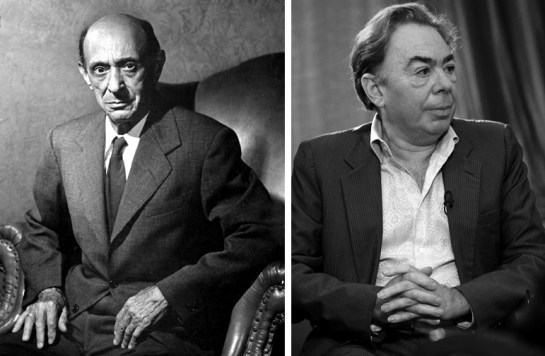
By my definition, Schoenberg’s music — even his later 12-tone music — is not actually atonal. If I want atonal music, I must look to Andrew Lloyd Webber.

What! You say? How can that be?

I’m not being facetious: I’m making a central point about classical music.

For the sake of argument, we should say that what we call music is often broken down into three primary components: melody, rhythm and harmony. It is admittedly simplistic to make this generalization, but it has a kernel of truth to it: If we divide the world’s music up, it can be said that Asian music is given over to the primacy of melody and can consist of melodies of incredible complexity; African music respectively finds enormous complexity and expressiveness in rhythm. Yes, there is melody, harmony and rhythm in all these musics, but there is a special place given to melody in the often drone-harmonied Asian music, and a special place to rhythmic complexity on sub-Saharan African music.

But European music has placed its money on harmony. Since the Renaissance, harmony has been the most expressive, and certainly the most complex element of European music. By the 18th century, this had evolved into a system of keys and key relationships.

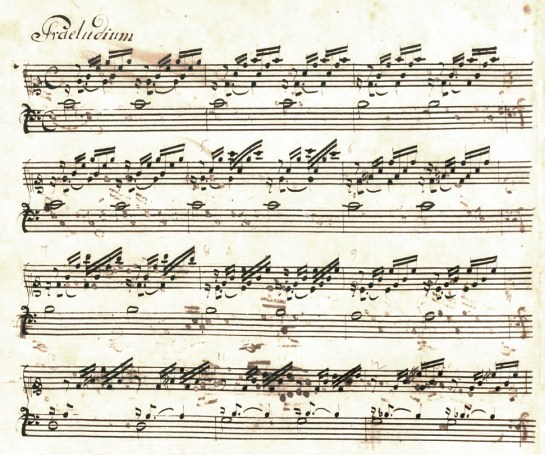
If you want a demonstration of what I mean by harmony being the central element, consider something as simple as Bach’s Prelude in C-major from the first book of the Well-Tempered Clavier. In it a simple eight-note rhythmic figure is repeated, over and over, twice to a bar, unchanged for 32 bars. That is 64 identical iterations. It serves as both melody and rhythm. The only thing that changes is the harmony, constantly shifting: It is beautifully expressive in its simplicity. 
BachPrelude

Or take a Schubert song. It would appear that the melody is what makes Schubert so can’t-get-out-of-your-head, but in fact, it is the often-wild and inventive harmonies he has underpinned them with. Try re-harmonizing any of his songs and the magic evaporates. 

Reharmonize Andrew Lloyd Webber and it hardly matters; in fact, his music is commonly reharmonized with each new arrangement, so indifferent is the harmonic underpinning. In a good deal of contemporary music (mostly pop) the harmonies are merely ornaments to the beat and tune, and can be interchanged with impunity. The “chords” are just called “changes,” and little thought is given to them, or to their interrelationships. 

This is what I consider atonal music. It may be consonant and it may all sound very pleasant, but it does nothing expressive with its harmonies and there is no coherence to key relationships. 

All music also depends on the setting up of expectations and then satisfying them or deflecting them. This is true of the changing rhythms of African drums or the melisma of the Arabian oud. 

Tension and resolution. 

In Western music, this creation of expectation and its subsequent completion falls primarily to harmony. 

The primary engine of this tension is dissonance and the primary resolution is found in the subsequent consonance. But that is only in the short term. To make a piece of art that lasts longer, requires a more sophisticated pattern: how to delay the final resolution until it comes to us like a dawn sun after a dark night. 

Consider the slow tread to C-major in Beethoven’s Fifth Symphony, where the tonal resolution comes after many short glimpses, but not in full till the finale. Or even more extreme: the way Bruckner withholds the genuine tonal resolution until the very last B-flat chord of his Fifth Symphony. 

Wagner depends on holding off that longed-for resolution; it’s what gives the Liebestod its unendurable sense of longing.

The history of Western music is the history of what Leonard Bernstein once called “newer and better ambiguities” in tonality. The thumping tonic-dominant structure of Beethoven turns eventually to the sliding chromaticism of Wagner, and later, the battering tone clusters of Stravinsky. 

You can hear the way tonality gives direction to music in something as simple as the blues. The chord changes in the blues, although they are sometimes given a little kick by adding sixths or sevenths to the basic chords, is a very simple set of chord progressions. Tonic, tonic; subdominant, tonic; dominant, tonic. Over and over. You can feel the movement at each chord change.

Classical music does that to, albeit in a more complex, subtle and varied manner. You need to feel the chords — the harmonies, change under your feet.

Listen to the second movement of Beethoven’s Seventh Symphony, one the most memorable and moving in his oeuvre. The melody is hardly more than a single repeated note in a repeated “Dum-ditty-dum-dum” rhythm. But the harmony changes constantly and meaningfully: It moves from A-minor and into C-major and on to B-major and B-minor before noodling back through the dominant E to the home A-minor at the end of the phrase. Beethoven keeps it alive and fresh; he keeps it interesting. 
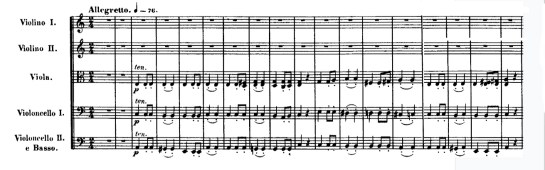
Beethoven7

You should not only notice, you should feel the harmony. It is meant to convey emotion.

The best way to do this is to listen more to the bass line than the soprano. You’ll get the tune whether you listen especially to it or not, but listen to the bass, and you’ll hear where the music is going.

Brahms always used to cover up everything but the bass staff in a score when looking at the printed version of a new piece of music. He claimed it was the best way to tell whether the music had any lasting value. 

Of course, music isn’t just the triads on parade: It is the non-harmonic tones that give it spice. 

Dissonance is everywhere in music. You cannot have music without it. If you think Schoenberg is dissonant, you should consider Johann Sebastian Bach. He is probably the most dissonant composer of all time. Of course, there is this central distinction between his dissonance and that of Schoenberg: Bach always resolves his dissonance.

If you were to take a simple choral tune, say, “Ein feste Burg,” (“A Mighty Fortress is our God”) and play only the off beats, you would hear something as modern and dissonant as Schoenberg himself. All those passing tones, all those appoggiaturas, all those mordants and nachschlags. Most of the vertical harmony (harmony at any given moment, seen from highest note to lowest bass) in Bach is clangorous , but always resolved immediately and given a place in the key structure of the melody. 

When we are comfortable in C major or G minor, we feel comfortable also to take minor departures, in full expectation of the resurrection of harmonic order. All is right in Bach’s universe.

Schoenberg lived in a different time from Bach, a time when all was not right. It was the early 20th century, and wars, ethnic cleansing, fascism, colonialism’s evils and even the death of God made life seem less secure. For Schoenberg, tension was the order of the day, not resolution. And so, in his so-called atonal music, each cluster of tones, although the equal of any tone cluster in Bach, is not fit into a hierarchy of key, and does not anticipate its own resolution into something emotionally satisfying. 

If Wagner attempted to keep resolution at bay for minutes and quarter-hours at a time, Schoenberg keeps it at bay for entire pieces of music.

Each cluster twists in a matrix of implied tonal structure, but moves from one to the next in such an eel-like manner that no tonal structure is ever settled or constructed. We are never in D minor, although it may seem at certain instants that we are headed there.

The meaning of Schoenberg’s music, thus, depends on our ears expectation of tonality, and its meaning depends on the denial of the same. In this sense, Schoenberg’s music is still tonal, even when it avoids any key center. Even at its most radical, his music relies on our own ear’s sense of the harmonic universe in which it exists to provide “Luft von anderem Planeten:” “air from another planet.”
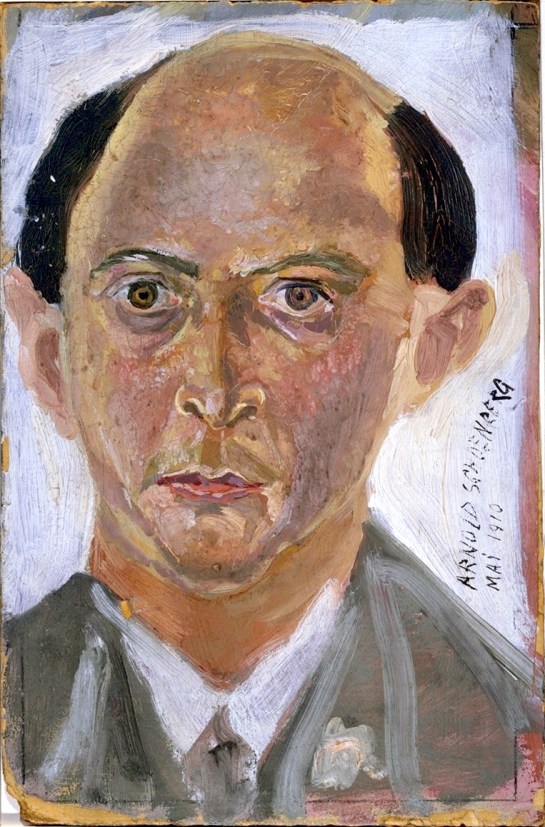
Schoenbergselfportrait

That is true even of the serial music he wrote. It’s emotional resonance depends on our placing it in an endlessly shifting tonal universe, a ball of mercury that cannot be pinned down. 

In this sense, Andrew Lloyd Webber’s music, although it is written in a key, does not depend on tonality the way Western music from Bach to Debussy did. Its tonality is mere happenstance, something unconsidered because merely habitual, something virtually unseen, or unheard by its creator. 

And hence, I claim that Schoenberg’s music is tonal, and Webber’s music is not.

Blake_ancient_of_days

I’ve always been interested in the way things translate from one language to another. Of course, that also means from one culture to another, and, as in the case of Bible translation, from one era to another. Time changes, language metamorphoses, and our world-views alter with our understanding of the world around us.

There is no question that the most powerful translation of Genesis can be found in the King James version, but words that meant one thing in the era of Shakespeare may very well mean something different now. And the verse forms of ancient Hebrew are different from our expectations of poetry, now.

So, I’ve always wondered, what does the original Hebrew mean in the Torah? Is there a way to make a translation that hews closely to the original meaning, the tribal meaning of the language?

I’ve gone through several interlinear translations, several translations in clear text, and lots and lots of footnotes to come up with something that gives me as close as I can tell, what the original Creation story meant in its Hebrew iteration, uninflected by several millennia of religious interpretation, sectarian wars and violence, pogroms and anathemae.

In the interests of disclosure, I should admit up front that I have no stake in this game: I am not a believer (when asked, I usually say I have no religion, I’m not even an atheist), so I’m not trying to persuade anyone that the Bible is true, or not true, or that this or that dogma is the “true” one. This is just my attempt to understand what metaphors and language was used in the ancient Middle East as they slowly came to terms with what would become their religion.

Believe me, I don’t claim this is a good translation of the first Creation story in Genesis. But it is a defensible one.

King James is still the king, but its rather archaic feeling — which, of course, was not archaic when it was written — has unfortunately become the default diction and rhetoric of belief. (So much that Joseph Smith’s “Book of Mormon” is written in a botched imitation of the sound of KJV, albeit with lousy grammar and many gross lexical misunderstandings).

There are many points in the Hebrew text where scholars either disagree, or throw up their hands and say, “We just don’t know what is being said here.” They give it their best guess, like the bit about the stars being created for calendar use. The original Hebrew is obscure.

Anyway, here’s my version:

Genesis, the beginning

When it all started up, and the gods were arranging the sky and the ground,

When the earth was emptiness with darkness over the ocean,

the wind of the gods hung over the face of the water

The gods said:

“Let there be light,” and light happened.

And the gods said, “We did a good job.”

the gods split up the light and the dark,

calling the light “Day,” and the dark, “Night.”

There was a sunset; there was a sunrise — One Day.

The gods said:

“Let there be a bowl over the water and let it split up water from water.”

The gods made the bowl

and separated the water that was below the bowl

from the water that was above the bowl.

It Was.

The gods called the bowl, “Sky.”

There was a sunset; there was a sunrise — Two Days.

The gods said:

“Let the water under the sky be brought together in one place

and let the dry land be seen.”

It Was.

The gods called the dry part “Ground,” and the collected waters they called “Sea.”

The gods saw the craftsmanship was good.

The gods said:

“Let the ground sprout with growing sprouts —

plants that seed-forth seeds, fruits trees that fruit, according to their type.”

It Was.

The ground grew growing sprouts, seeding plants seeding seed plants, fruiting fruit trees.

The gods recognized they were well made.

There was a sunset; there was a sunrise — Three Days.

The gods said:

“Let there be lamps in the bowl of the sky to split up the day from the night, that they may be signs (Hebrew “difficult”) for a calendar, and let them be lamps in the bowl of the sky to provide light on the ground.”

It Was.

The gods made two big lamps:

The bigger lamp for ruling the day; the smaller lamp for ruling the night.

And the stars.

The gods placed them in the bowl of the sky to provide light on the ground and to rule the day and the night.

The gods liked what they saw.

There was a sunset; there was a sunrise — Four Days.

The gods said:

“Let the water swarm with a swarm of beings, and let the birds fly across the bowl of the sky.”

The gods created huge sea serpents and all the crawly things that crawl about, with which the water swarmed, after their type, and all the birds, after their type.

And the gods saw they looked good.

And the gods blessed them, saying:

“Grow fruit and be many and fill the water of the seas and let the birds be many.”

There was a sunset; there was a sunrise — Five Days.

The gods said:

“Let the ground bear creatures in types, herd-animals, crawling things, wild things of the earth, all divided by type.”

It Was.

The gods made the wild things of the earth, divided by type, and the herd animals, divided by type, and the crawling things in the dirt, divided by type.

The gods saw it was working out well.

The gods said:

“Let us make people in our shape, looking like us.

Let them rule over the fish in the sea, the birds in the sky, all the earth, all the crawling things that crawl on the ground.”

So the gods made people in their shape, so they looked like the gods,

male and female, the gods created them.

The gods blessed them and said to them:

“Grow fruit and be many and fill up the earth and conquer it. Have rule over the fish in the sea, the birds in the sky and all the crawly things that crawl on the ground.”

The gods said:

“Here, we give you all the seeding plants that seed that are on the face of the earth, all the trees in which fruits fruit. For you they will be for eating. And also for all the living things of the earth — all the birds of the sky and the crawly things that crawl about on the ground — all green plants for eating.”

It Was.

Then the gods looked at all they had done with exceeding satisfaction.

There was a sunset; there was a sunrise — Six Days.

So, everything was finished — sky and earth, with all their entourages.

The gods had finished, on the seventh day, the work they had done

Then they stopped on the seventh day, all the work they had done.

The gods gave the seventh day their blessing and made it sacred, for on that day, they stopped working on all that they had done.

This is how it all began, the sky and the earth and all history.

Movies for list

With the end of the year coming up, everyone’s already getting into the list-making game. Top 10 lists are about to descend on us like an asteroid descending on the dinosaurs.

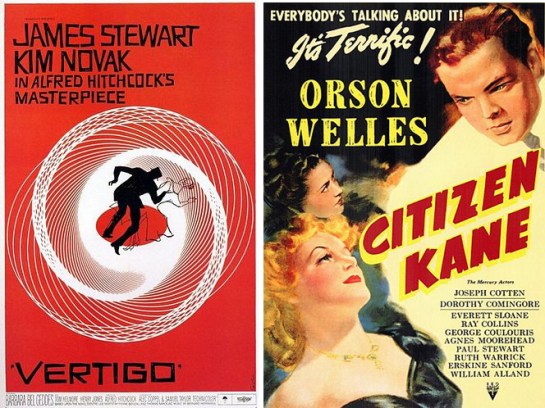
Sometimes, it seems as if lists are the central cultural form of the nation. We’d rather scan a list than read the book. Untold significant conversations are prompted by the idea that Alfred Hitchcock’s Vertigo might be the alltime greatest movie ever made, and whether something is seriously wrong in the cultural ethos if Citizen Kane is bumped down a few pegs.

So far, James Joyce’s Ulysses seems to be holding onto its rank as the Number One novel of the 20th Century, although there are enough quibbles to warrant the opinion that the only thing they all seem to agree on is that Ulysses is hard to read.

Of course, lists have been around a long time. They predate writing. Some of the first evidence we have of human existence are the odd scratchings on bone or stone that anthropologists believe are calendar listings. Prehistoric people notched their medicine sticks to remind them of significant events — they were memory aids.

And the ancient Incas communicated with a knotted string, a “quipu,” each knot standing for an item the messenger was required to remember.

So, why not cut to the chase. It is lists that matter in the new century, so let’s forget the long difficult novels, or the subtitled films, and decide what are the 50 Best Lists of All Time.

It is no surprise that the 10 Commandments come in at No. 1. It is a consensus choice. There were a few rumblings among the more erudite judges that perhaps Hammurabi’s Law should displace the Decalogue, but finally, the conciseness of the Torah beats out the comprehensiveness of the Babylonian ruler.

The list of the Seven Wonders of the Ancient World, compiled by the Byzantine mathematician Philon, one of the oldest and most venerable in the world. In his De Septem Orbis Spectaculis, he listed the Pyramids, the Hanging Gardens, the Olympian Zeus, The Ephesian temple of Diana, the Mausoleum of Halicarnassus, the Colossus of Rhodes and the Lighthouse of Pharos.

His list was so influential, that when they made King Kong in 1933, they called the big ape, the “Eighth Wonder of the World.” And everyone in the audience knew what the reference was.

The Bill of Rights comes in at No. 3, although it is a list of amendments to the Constitution that many Americans are vague about, except for their favorite one, whether it be the First and Larry Flynt, the Second and Wayne LaPierre or the Seventh and David Petraeus — No, wait, sorry: That last one is the 10 Commandments.

Fourth is the Index Librorum Prohibitorum, or the “Index of Prohibited Books” first published by the Vatican in 1557. At one time, it listed 5,000 books that were bad for you, and undoubtedly more lively than many of the moldy classics on the Modern Library list.

Index for list

And rounding out the top five is the Maya Lin’s Vietnam War Memorial in Washington, D.C., perhaps the most moving of the lists and the only one that people actually make a pilgrimage to.

This last proves that lists need not be trivial.

Vietnamvet for list

The 50 top lists of all time

1. The 10 Commandments

2. The Seven Wonders of the World

3. The Bill of Rights

4. Vatican’s Index of Forbidden Books.

5. The Vietnam Memorial, Washington DC.

6. FBI’s 10 Most Wanted List

7. Billboard’s Top 40

8. New York Times’ Bestseller List

9. Nixon’s Enemies List

10. The Periodic Table of the Elements.

11. The Seven Deadly Sins.

12. National Register of Historic Places.

13. AFI’s 100 Best American Movies.

14. The Book of Lists by David Wallechinsky, Irving Wallace and Amy Wallace.

15. Joe McCarthy’s list of Communists in the State Department

16. 50 Ways to Leave Your Lover by Paul Simon

17. Elizabeth Taylor’s husbands

18. AP’s Top 20 College Football list

19. The zodiac

20. The Fortune 500

21. Schindler’s List

22. Charles Messier’s catalog of astronomical nebulae

23. The Koechel catalog of Mozart’s works

24. TV Guide

25. People magazine’s list of the 50 most fascinating people.

26. Butler’s Lives of the Saints

27. Standard and Poor index

29. Dow Jones Industrials

30. Martin Luther’s 95 Theses.

31. The Arbitron Ratings.

33. Oxford English Dictionary

34. USA Today Weather Page

35. Readers’ Guide to Periodical Literature

36. Google.com

37. The “catalog of ships” in the Iliad.

38. The notches in Wild Bill Hickock’s revolver handle

39. End credits of Airplane  

40. Money magazine’s Best Places to Live in the U.S.

41. Military Manual of Arms.

42. David Letterman’s list of “Top Ten Things That Sound Good When Said by James Earl Jones.”

43. The list of uses for WD-40.

44. Mr. Blackwell’s “worst-dressed” list.

45. The List of Adrian Messenger

46. Franz Liszt

47. Martha Stewart’s “To-Do” list.

48. Santa’s list of those who are naughty and nice.

49. JFK’s little black book.

50. 50 Top Lists of All Time.

Part 2 of 2

Mont-Saint-Michel

What was there about the Normans? That they covered the countryside in forts, castles, abbeys, churches, all with heavy, heavy stone architecture that says, in no uncertain terms, “I’m not here for fun. I mean business.”

The architecture feels almost Protestant in its brutal directness and lack of ornament. Like the dragon in its determination not to move, but squat on a hill, glowering.

Is there something about this rainy, gray countryside that made the Normans that way? Is it a residue of their Nordic blood? Is it a response to the brutality of the Dark Ages, when every duke or king had to defend his kingdom at every season?

Surely, Mont-St.-Michel is an interesting case: Part monastery, part fortress.

Who but a Norman, it seems, would build a monastery on the top of a giant rock out in the middle of a bay whose feature is killer tides?

You can see Mont-St.-Michel from the other side of the bay, 20 miles or so off. It hovers over the water like a mountain in the distance, with a needle spire pointing up at God.

The island — it was once an island, even if now it is connected to the mainland by a causeway, and the bay has so silted up that scientists say that soon, there will be no way for water to surround the place, even at high tide — the island is a rock.

In 708, Aubert, bishop of Avranches, had a vision of the sword-bearing St. Michael and built a sanctuary on the rock. It later became an abbey. The monastery grew, burned down, grew some more, caught the interest of a king, grew even bigger, and the monastery became surrounded by a fortress wall. Was the king interested in protecting the monks, or was he more interested in co-opting the island as a coastal defense under the disguise of peaceful religious orders?

At any rate, the result is a merveille — a marvel.

In England and Normandy, they call this stony style of building “Norman.” Elsewhere it is Romanesque, with arches like the Romans built.

The Romanesque is a heavy style, with thick walls and tiny windows. It can be claustrophobic, unlike the open Gothic style that followed it.

The Gothic cathedrals are famous for height: As you walk through them, your eye is drawn toward heaven.

The older Mont-St.-Michel is also vertical, but it is an external verticality: something you see from a distance, and becomes more imposing the closer you come, until, after you reach the island, the stonework rises over you in ways that make you feel not just small, but powerless. Is there any way you can climb to the peak, where God is, or where religious dispensation is? The monastery towers over you, ever upward, reaching its finish in the spire of the topmost church and the golden statue of St. Michael on top of that.

This is a Sisyphean hill that you clamber up and slide back down over and over. It is an impossible thing to master. It is Lurch the Butler looking down at you. It is the model for Citizen Kane’s Xanadu and King Kong’s Skull Island.

Around the base of the island, running higher or lower as the rock underneath decrees, is a rampart, with towers and loopholes. At its highest point, it intersects with the stone stairways that lead even higher, into the lamasery of the abbey. For the pilgrim, or for the tourist, the stairs seem endless. Each time you reach a landing, you look up and the buildings seem higher, and looking down, the earth seems farther away. The stairs actually exaggerate the verticality of the place.

The engineering was state-of-the-art for the time: They managed to build a functioning monastery on top of and around a pinnacle of rock, so that all you see from the outside is human stonework. The core of rock is concealed inside.

But the rock shapes the rooms, chambers, dungeons, refectories, chapels, meeting halls and workrooms that had to be built not simply on the stone, but around it.

The result is a warren of buildings, a hodgepodge, so split-level that you never can tell where you are in the compound. You move from one side of the rock to the other, while traveling up staircases and down staircases, through vaulted rooms and up more staircases, so that when you reach the other side, you cannot tell if you are on the same level, have gone down one or two levels, or a level and a half. Blueprints are no help. They seem to regularize what on the ground is chaos. The confusion is increased by the mess of architectural styles.

Take the abbey church at the very top. Its nave is Romanesque, with a barrel vaulted ceiling lined with wood, spread out like the wooden bars of a Japanese suit of armor. It is the oldest part remaining from the original construction.

The middle of the church — the transept — is Gothic, but of an early sort, with coarse vaulting and dirt-plain stone walls.

The apse at the far end, however, is later Gothic, with all the lightness that implies: complex stone tracery, windows piled on windows.

One end, dead weight — although the sternness of it also reflects a basic majesty — at the other end, all filigree and sunlight. The halves cannot mesh, but somehow they do: It is the magic of the Gothic style that it can accept any number of stylistic additions and just wear them like a great patchwork.

When you leave the church and head down a staircase and up another, and around a passageway, you come to a Romanesque room, dark and somber, in the bowels of the complex.

Pass through that and you eventually find your way to the three-story section called “La Merveille,” the marvel, an astonishing piece of engineering and construction. There, primitive fan vaulting spreads out from graceful piers, and you see the obvious aesthetic superiority of the Gothic. This is what the Middle Ages mean to most people.


Up and down stairs, through dark corridors, through stone doors, past arched windows, beyond a cloister with a double-columned colonnade.

The towering mass of stone and glass is like nothing else in Christendom.

Certainly, Notre Dame de Chartres has an imposing exterior, but it is the interior that carries its essential message. At Mont-Saint-Michel, it is the opposite: While the interiors are certainly interesting, it is the exterior that carries the central message of the warrior Christian saint.


Part 1 of 2

Introduction

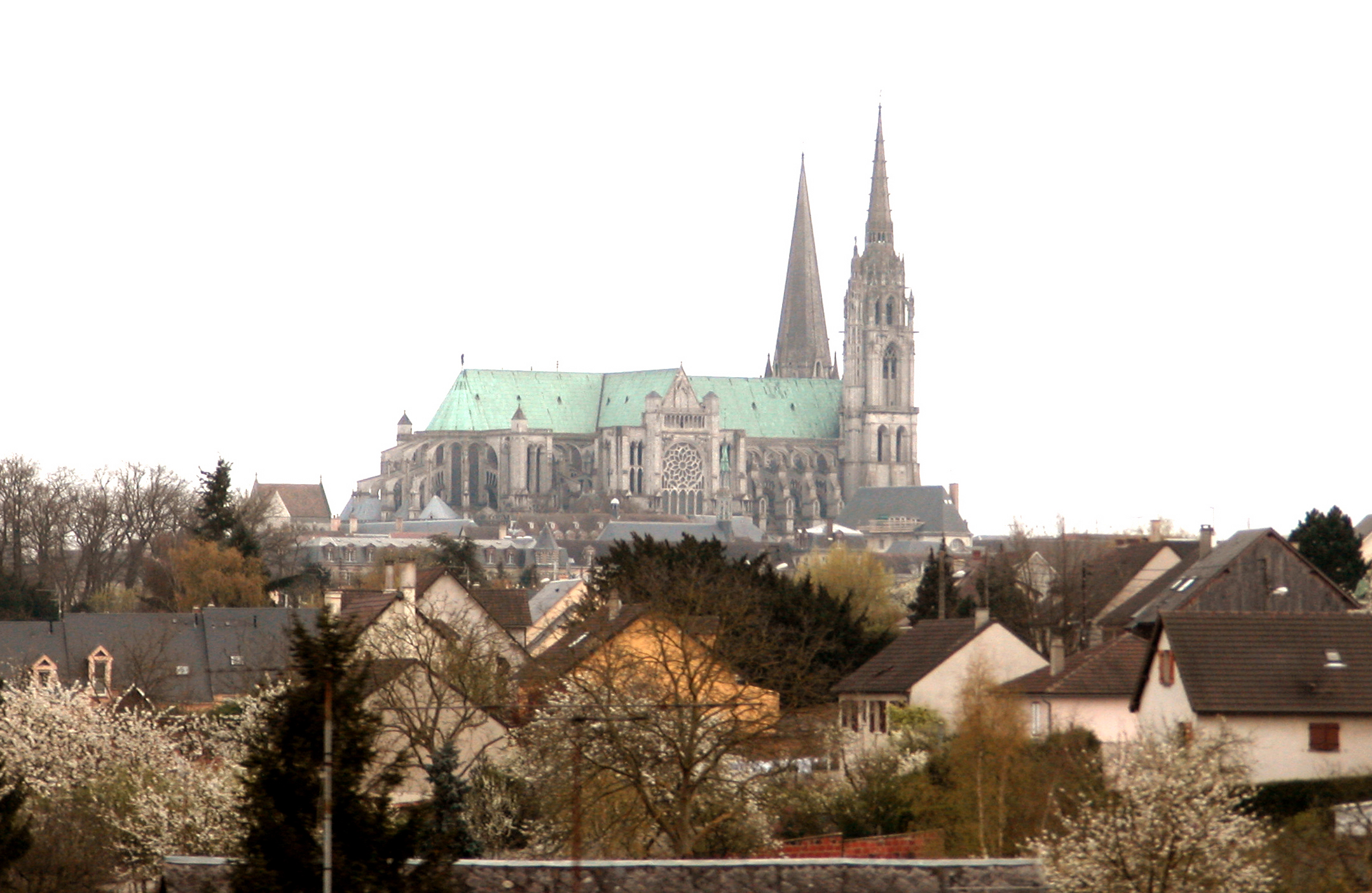
West of Paris in northern France are two monuments of the Middle Ages: the cathedral at Chartres and the abbey at Mont-St.-Michel.

In 1904, American historian Henry Adams privately printed a classic book that he called “Mont-Saint-Michel and Chartres,” after the two signature sites of his thesis: that the older Romanesque architecture celebrated the masculine, martial virtues of St. Michael, while the newer Gothic style worshiped the “eternal feminine” of the Virgin Mary. Most of the major cathedrals of northern France are called “Notre Dame” — “our Lady.”

Notre Dame de Chartres is the ur-cathedral, the one used everywhere as the prototype cathedral. Mont-St.-Michel is less clear: It is a palimpsest of styles, bunched one over the other.

A trip to both still can be the best way to experience the art and culture of the Middle Ages.

And it is a very personal experience.

Chartres

 Visiting the Gothic cathedrals of northern France is a kind of spelunking.

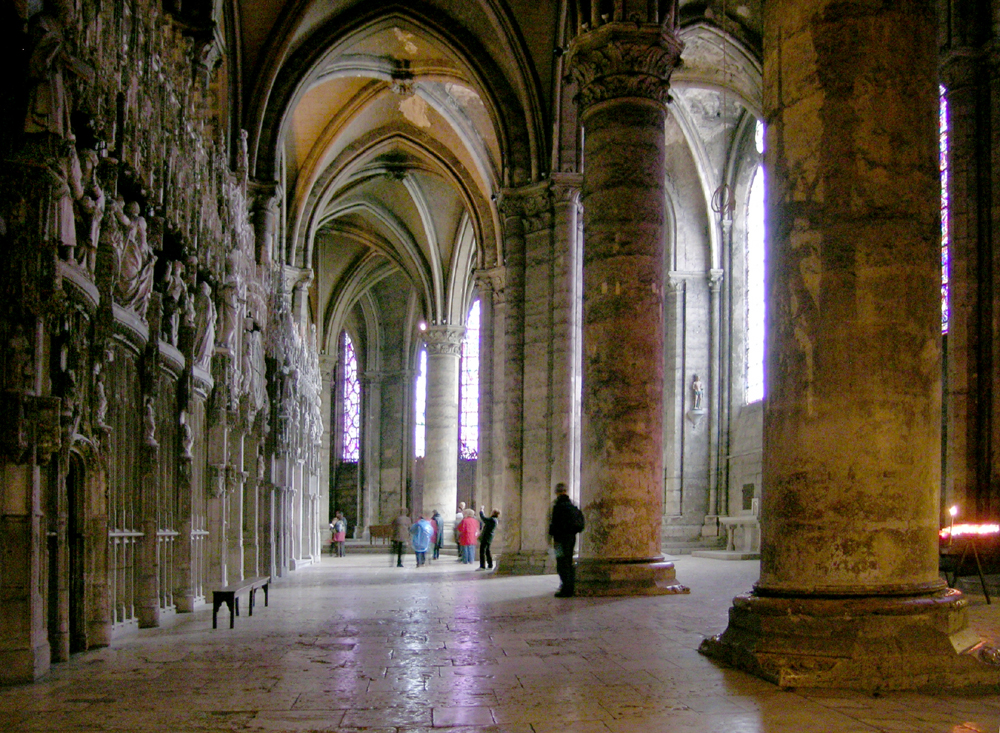
You enter the cavernous, dark spaces of the cathedral at Chartres and you hardly can avoid thinking of Carlsbad or Luray. The spaces defined by those stone walls and stained glass are always cooler than the weather and dimmer than the day, and the oldest, damp churches even can show you a stalactite or two in a draftier corner.

In the cathedrals you also descend, but you descend into the past, a darker past, barely recognized, of a Europe 700 years ago, when the church was the center of town and the source of political as well as spiritual power.

Expression of civic pride

Most of the famous cathedrals are built at the highest point in town, and can be seen for many miles, declaring their hegemony.

The churches were built as an expression of civic pride: In Chartres, it was primarily textile merchants who paid for the cathedral. They wanted to attract pilgrims — tourists — to spend money.

But the descent into the past is matched with another — a voyage into your own psyche, your sense of spirit.

The church takes you out of the daily world of business and family, and plops you down into a kind of eternity, a place where time and effort, gain and loss disappear and you are left face to face with what really counts.

Outside the cathedral, people are hawking postcards, souvenirs and crepes. Cars buzz by; the pompiers — France’s emergency workers — pass a block or two away to the sound of their tritone sirens.

But step inside, and you are blasted by the quiet. Even the tourists tend to whisper.

It has nothing to do with whether you are a believer. It is such an extraordinary experience, it can knock the breath out of you.

Spare in the extreme 

Notre Dame de Chartres is a veritable Spartan of cathedrals. Her west facade, for instance, is spare in the extreme, with only a few decorations, not counting the portals and their sculpture. But the portals are small and restrained, unlike their cousins at Notre Dame in Paris. You almost get the idea of a facade that isn’t yet finished, that it is waiting for someone to come along and add the finials, Hebrew kings, garlands of trefoils and quatrefoils.

Instead, it almost looks like the Gothic cathedral equivalent of plywood.

The proportions of the nave seem almost primitive. The large side-aisle arcades take up almost half the height of the central nave. The small triforium leaves room for a rather scaled-down clerestory — those windows at the upper edge of the walls. The result of these odd proportions is that not much light drifts down to the nave floor. It takes quite a while for your eyes to adjust.

When they do, there is a good deal of wear to be seen. Not only is the stone floor worn wobbly, but the vaulting in places is peeled or exfoliated, showing brickwork behind the stone.

Attend Sunday Mass 

The interior almost gives you the feeling of an empty apartment. Where are the paintings, the furniture, the curtains? In Chartres, where are the windows, the interior carving, the elaborate bosses in the vaulting?

One of the reasons Chartres is so highly prized is that so much of it is original. The statuary at Notre Dame de Paris is cleaner and more neatly featured, but then, it is only 150 years old, having been restored by Eugene Viollet-le-Duc in the 19th century. Viollet-le-Duc was a magnificent man, and his restoration work at Paris is convincingly original looking. You don’t sense much of the 19th century in it.

But it is still pristine and new looking. At Chartres, the statuary is weathered. You can see the lichen growing on the stone. Even the walls of the cathedral sport tufts of daisies high up, in unlikely places, growing straight out of the masonry.

Intoxicating chant 

The limestone is mossy, lichened and eroded. Paris looks fresher than her matronly cousin in Chartres. Paris recently has been sandblasted.

For some, the best time to visit is off-season on a weekday, when you can have the place nearly to yourself. But a cathedral wasn’t built to be empty. You should try to take in a Sunday Mass.

A machine is always more beautiful when it is running, and a cathedral is a machine to take you someplace. It’s best to see that machine with all its gears rotating and its cylinders pumping.

The church is packed. At the altar, spotlighted as if on a theater stage, there are priests and a choir, which is chanting plainsong that echoes through the building like surf.

Grasping the metaphor 

A priest is swinging a censer around the altar, spreading smoke through the crossing of the transept. It is intoxicating to hear the chant, melismatically floating like the censer smoke, under the brilliant blues and reds of the rose window, high above.

One doesn’t have to be a believer to appreciate how the Mass, spoken and sung in the space built for it 700 years ago, addresses the magnum misterium.

The vaulting, the lights, the stained glass, the church spread out in it is cruciform, that is also the diagrammatic shape of my body and your body, with the vast ceiling, which is metaphorical of the inner dome of the skull. You can see how the priest at the crossing of the transept — the place that counts as the heart of the cruciform homunculus — is casting us out into the cosmos, out into the mystery, out into an intense beauty we only rarely let ourselves become aware of.

One listens to the choir, now taking on a descant from the 15th or 16th century, with the soprano floating her melos out over an alto’s lower harmony, and look up, and on raising eyes, one sees the axis of the rose window, with all the light pouring through the interstices in the tracery, very like the angels dancing around the divine center of Dante’s mystical rose.

The vastness of the cathedral interior became the vastness of the universe, the singing became the music of the spheres.

That melisma becomes something completely separate from music as an aesthetic event. It becomes the closest thing we can hear — outside the sounds of children playing — to the human equivalent of a bird’s song, a sound beautiful beyond its need to be beautiful, uttered out of instinct and joy.

The doctrine doesn’t matter, except to the faithful. The metaphor behind the doctrine — the metaphor truer than the sometimes unknowing doctrine — takes over.

And you will be privileged to witness the building doing what it was designed to do, like a jet breaking the sound barrier, or the dynamos at Hoover Dam spinning out electrical power.

Let there be Light

From our vantage point, eight centuries later, Gothic architecture looks as old as dirt, but it is important to remember that it was once as new as the iPhone. It was innovative, and a craze for the new style of building spread across France and the rest of Europe.

People get taught about Gothic and Romanesque architecture in schools in the most boring way: a list of arcane terms and concepts.

But in reality, you can grasp the difference if you recognize the difference between a brownstone apartment building and the Empire State Building. It’s exactly the same difference, really.

Think of it: The brownstone is built brick on brick. You can build your edifice only so high, or the weight of the brick will crush your foundation.

In the late 19th century, they figured out that you didn’t have to make your walls hold the weight of the building. You could build a steel frame and hang your bricks on it, so the steel carries the weight, not the wall.

In fact, that led to the modern buildings of glass and steel with no walls at all, only windows.

It was the same thing in the 12th century. The older buildings, called Romanesque, were built brick on brick, or stone on stone, and in order to support the great weight of the stone, the walls had to be thick and strong, and windows tiny.

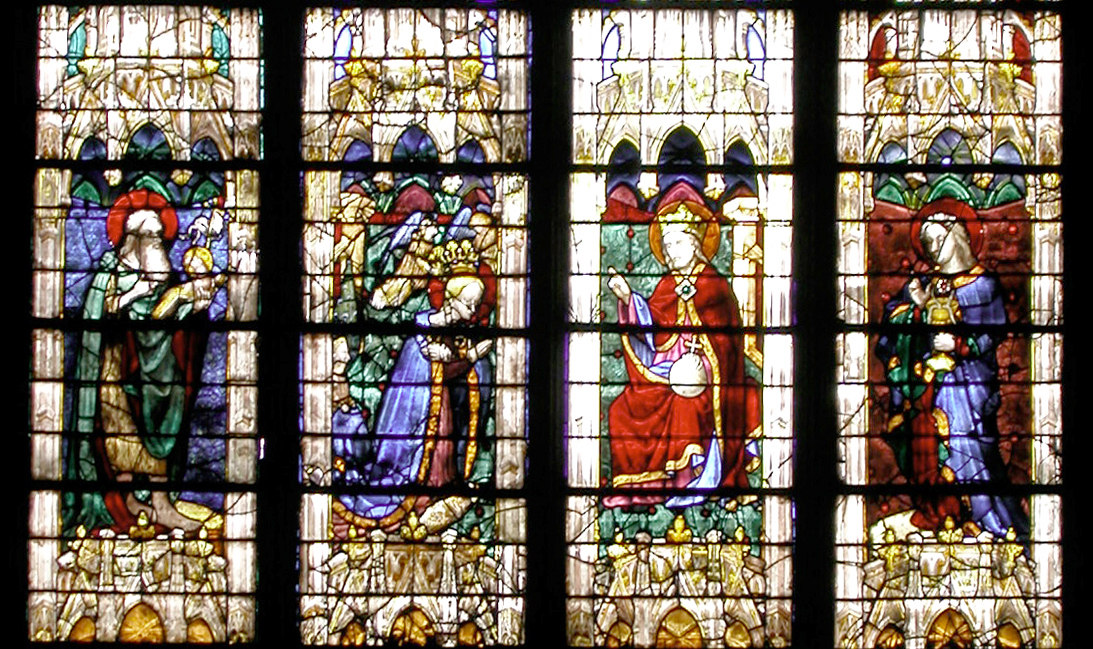
But builders realized that you really didn’t need the wall to hold up your roof. You could put your roof on stilts — columns or piers — and fill in the space between them with glass — stained glass.

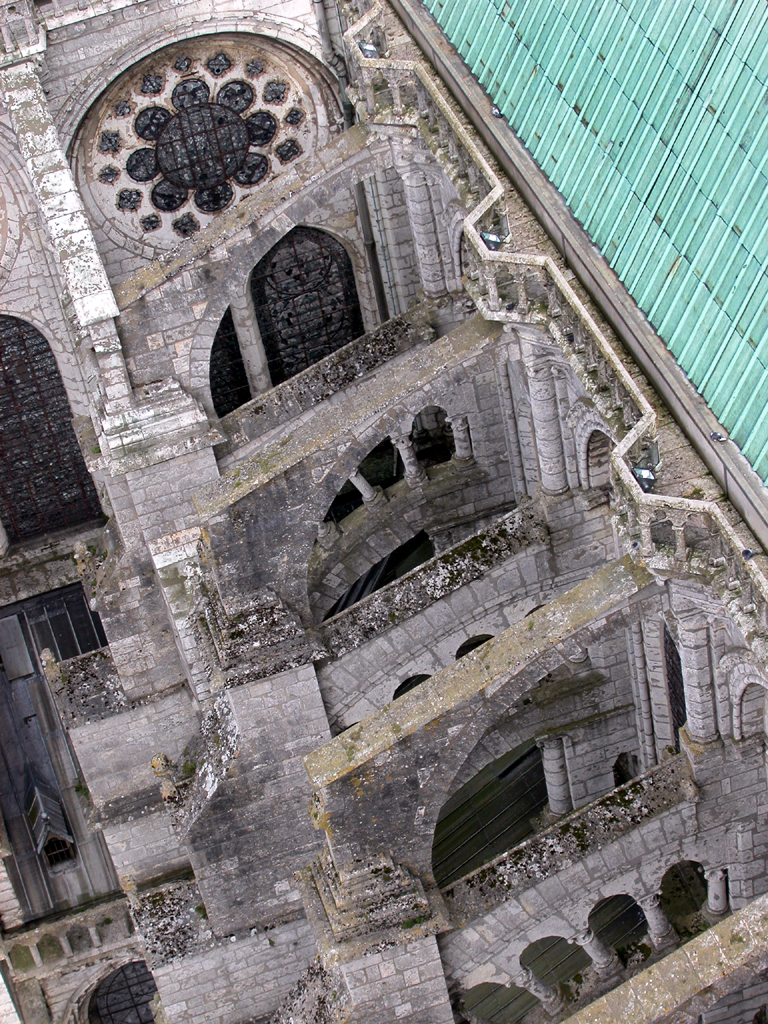
This is the Gothic: vast open spaces instead of heavy walls. To strengthen the columns and distribute the thrust of the roof weight, buttresses were added. They didn’t need to be so heavy, either, if they were placed in the right place at the correct angle, so they were opened up the same, and you had the flying buttress, the arch of stone to help hold up the roof.

The stained glass let streams of light enter the building.

This wasn’t just practical. Abbot Suger, the head of the church in Paris in the mid-12th century, was part of an intellectual renaissance, a Gothic renaissance, and had read the Classical and early Christian authors, Aristotle and Plotinus, and believed that light was the primary metaphor of divinity. God dispels darkness. So, he wanted his new church, now called the Basilica of St. Denis, in northern Paris, to be bright and well-lighted. The new architecture was just what he needed.

Now, the church wouldn’t seem heavy and dismal, but brilliant and airy. It was perfect, and within 20 years, everyone who was building a church used the new style, which lasted for 300 years before being rivaled by the Italian Renaissance and the Baroque.

But even now, you find new churches in America with their Gothic pointed-arch windows and their naves and aisles.

The style persists in our cultural memory.

To be continued

I have never been in even the meanest, lowest streetside cafe in Paris — or anywhere in France — and gotten anything but the most perfect omelet. Smooth, creamy, buttery and eggy. There’s magic in a perfect omelet.

The most bored counterman in the least prepossessing dive in the 13th arrondissement knows how to do it to a T.

On the other hand, I’ve never had an omelet made in the U.S. that wasn’t a close cousin to a vinyl floor tile. Overcooked, dry, tough and tasteless.

“It’s the law,” my wife says. “They have to cook it to a certain temperature to kill the germs.”

I’m sure she’s right, but that’s only part of the problem: Most Americans have never tasted what an omelet can be, and therefore, don’t miss it. Our idea of an omelet over on this side of the waters is an arid eggy mass filled with onions, bell peppers, ham and orange cheese. The more compost that you can stuff into the poor thing, the better — mostly to mask the miserable taste of the desiccated egg.

One can lament our health laws that make it nearly impossible to find unpasteurized milk and make it impossible to import European cheeses. And I’m sure there are laws that require the refrigeration of raw eggs in American restaurants. No Frenchman would refrigerate his eggs. Ruins them.

We fear germs too much, despite the increasing scientific evidence that germs — even pathogens — play an important part in maintaining the health of the human organism.

But more important than our fetish for antisepsis is the lack of regard most Americans seem to have for the pleasures of the senses. Food with actual flavor is not an important consideration for appetites dulled by too much salt, too much sugar and almost no sense on the palate of texture.

Hence, our plastic omelets.

And it isn’t just our eggs we ruin, of course. I recently had the misfortune to taste some packaged macaroni and cheese that my granddaughters were eating. Mac and cheese is one of the most popular lunches found in the average teenage menu. Why this should be is a mystery: The food was appalling. The so-called “cheese” was a chemical yellow powder dumped into the hot, cooked noodles. It tasted like something excreted from one of those cancer factories along the lower Mississippi just south of Baton Rouge. I’m sure it would have glowed a science-fiction green under ultra-violet light. Never again.

Our steaks are chemically tenderized, our bread is gummy and flavorless — best used as a pencil eraser — our beer is yellow seltzer, and our gigantic chicken breasts have had all their flavor bred out of them.

If you have your flavor buds trained at the local franchise restaurant, it is no wonder you think American food is food the way it is supposed to be. It is not.

There is a trend toward better food, at least among the suburban and city affluent, and you can find more varieties of fruit and vegetable at the local supermarket than you ever could before, but a good deal of this is indeed just trendiness. The locovore movement, the raw food movement, the organic food movement.

But mostly it has just meant that you have even more diced veggies stuffed into your inedible omelet. The folded vinyl tile is bursting with exotic ingredients.

It isn’t fancy filling that makes an omelet good; it is the omelet itself, and failing that, nothing will help.

On a recent “Top Chef” TV program I came across while channel surfing, chef Wolfgang Puck gave a task to his contestants: Make an omelet.

He explained that when he had been 18 and beginning in the kitchen, his master of cuisine had given him this test and he had failed. He practiced and practiced until he could make an acceptable omelet. He was now using the same test on the new aspirants.

But no. Not really. Instead, the contestants spent the 45 minutes alloted to them not on making a good omelet, but on coming up with an unbelievable variety of complicated fillings to tart the omelets up, leaving almost not a thought to the egg itself. The results looked like a nouveau riche idea of haute cuisine.

And that is the problem. With the rise of a foodie culture, the result is not better food, but rather a lusting after exotic ingredients, a desire to make a tart with medlar fruit and Cambozola blue cheese, topped with macadamia nuts and matsutake mushrooms macerated in rainwater Madeira.

While it is a delight to see so many new varieties of food available at the supermarket, I suspect the result is not better food, but rather a modern recreation of Trimalchio’s feast. Where are the sparrow tongues and live birds sewn into roast pork?

It is the gastronomic version of thinking that hookers are the model for beauty and fashion.

So, we become caught as a culture between jello salad with mayonnaise and tournedos Rossini. In either case, little thought is given to the gout, the taste, the pleasure for the tongue and palate.

And so back to the humble omelet. A good omelet is simple food made well. It is a lesson: Incredible dinners can still be made from potatoes, chuck roast and cabbage. Prepared well with care and thought, our food should not only nourish, but delight the senses and make us happy to be alive for this meal in front of us.


I have spent my life and career with art and with nature, and as an art critic, many times I’ve been asked, “What’s your favorite art?”

Favorite changes, of course, with time. Hundreds of paintings, sculptures and buildings have taken their turn as my favorite, just as my favorite corner of nature changes depending on where I am. But if asked the more precise question, “What is the most beautiful human-made thing you have ever seen?,” my answer is unequivocal: The north Rose Window at Chartres cathedral in France.

All rose windows are beautiful; at least, I’ve never seen one that didn’t leave me transported. But the north window at Chartres is special, even in that transcendent rank.

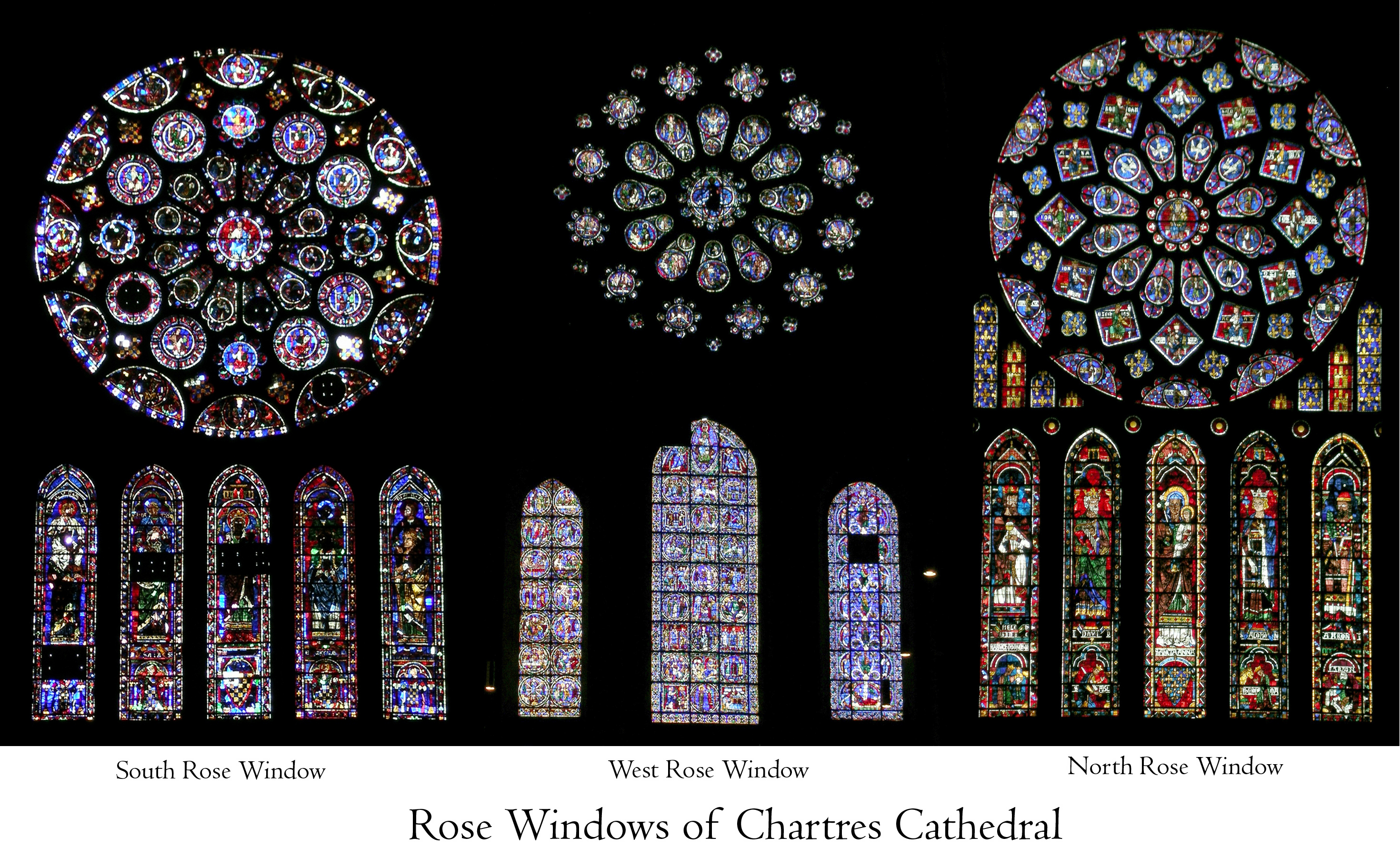
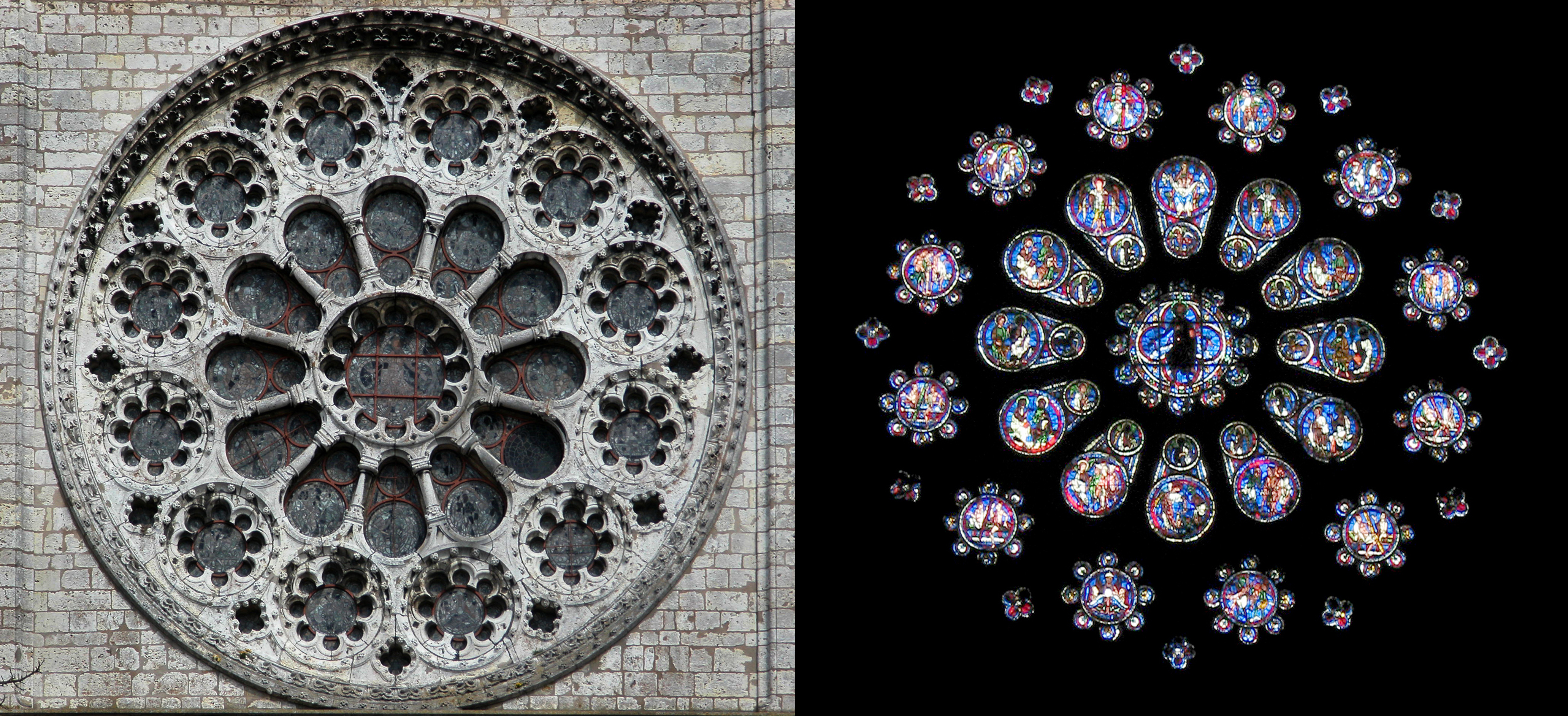
The first time I visited, I sat and stared into each for at least 20 minutes. I’ve been back many times, and can always sit and stare for endless time and times. First, the west window, which I have always thought peculiar, heavy and stoney, with a low proportion of glass.

But as I looked — meditated — today, I could see the beauty in its heavy tracery and porthole glass. There is a central circle surrounded by 12 teardrop panels, like the petals of a sunflower. But outside that, there are 12 more little round windows — miniature rose windows themselves — that float like snowflakes. And beyond that, the final outer circle of miniature dots, 12 of them, also, and less like part of the window design itself, and more like an optical afterimage, phantoms of the retina.

I looked and the light glowed in the glass like the fading glow of the coals in a woodfire, when most of the wood has gone to charcoal and only fleeting lines of incandescent red show through the interstices.

The West rose window corruscated the same way, like the fading coals of inspiration that Shelley wrote about.

And what is more, the fact that the tracery grows increasingly thick as you widen from the center, it looks almost as if the whole ball is expanding, like Hubble’s universe: It is a metaphor of fragmentation. Tight in the center, spinning away at the edges, with those tiny studs of light at the periphery like quasars, so distant you cannot name the distance.

The south rose window makes a different effect.

It’s tracery is more delicate and its design more coherent.

The axle in the middle is surrounded by 12 teardrop shapes — more like coffin shapes really – that radiate from the center, surrounded by 12 circles, larger and more tightly packed than in the west window, and finally, the half-circles of 12 more larger circles cut off by the perimeter of the enclosing circle, so that the overall design is one of larger circles on the outside and ever smaller ones on the inside. It gives the appearance of depth, as if you are looking into a tunnel.

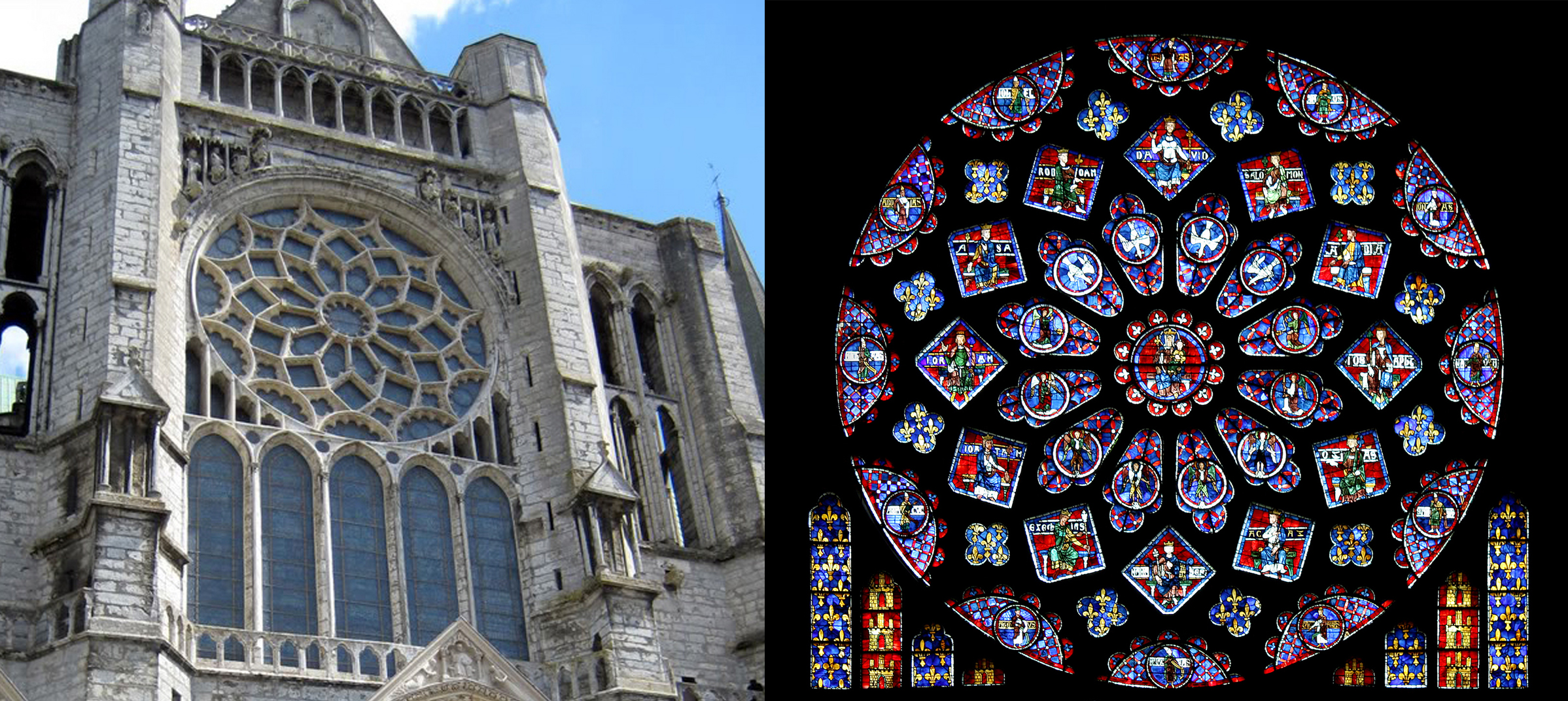
But the north window is the prodigy of Chartres.

Unlike the south window, where the delicate tracery disappears as mere background for the glass, the tracery of the north window is a design and pattern in itself. If there were no glass and no color, the design of the stonework would still describe a giant dahlia, a circular flower with ray petals arrayed around a center.

Place upon that pattern the pattern of the glass panels, with the smaller round panel at the center, surrounded by 12 elongated diamond windows, splayed out like petals, surrounded by a magical circle of tumbling squares, with another ring of smaller tumbling squares around that, and the 12 large half-moons, flat side outward to make the periphery.

It is a multiple image effect. Look one way, and you see one thing, rub your eyes and look again, and it is something else. It is layered imagery.

Both the west and south windows are simple in their plan. The north is complex.

The tumbling boxes, around the circle look like they move, but in fact each one is merely 45 degrees turned from its neighbor, so that every two squares are 90 degrees twisted. With them arranged as a wreath, you cannot see them simply as each square oriented as a diamond with its point toward the center of the rose, but must see them as tumbling over and over as they spin around the wheel. It is a miracle of implied motion.

Layer that over the absolutely still dahlia, and you recognize what genius went into this window.

What is more, this implied motion, and the tunnel of the south window, and the fragmentation of the west window, all create mandalas that scintillate like the light show near the end of 2001: A Space Odyssey. This is a light show, of a kind and nobility hardly to be credited.

I sat on the church chair staring, with tears streaming down my cheeks. This is visionary art, and you don’t have to believe in the dogma to understand the metaphor: This is the Great Mystery. The magnum misterium. You could be looking at photographs from the Hubble telescope. You could be looking at the visions of a peyote dream. You could be looking at the eye of god.

I am putting up my tent 45 miles from the nearest paved road and, as far as I can tell, at least 10 miles from another human being.

I have come to this place to find solitude, to be alone for a day — or more properly a night. The car pulled up alongside a half-fallen barbed-wire fence about 2:30 p.m. I expect not to move it for 18 hours.

To the east, I can look into the wide mouth of Broad Canyon; to the west, the dark, tree-covered bulge of Mount Trumbull. Something like 15 miles to the south is the Grand Canyon. Sagebrush and dust fill the flat bottom of Toroweap Valley where I have chosen to stop.

It is the quietest I have ever experienced.

When the wind dies, the loudest sound is my own breathing.

Isolation and solitude have long been a part of the American Western experience, when you could ride for days and not see another human being. But empty places are harder and harder to find, as the West fills in with master-planned housing developments and outlet malls.

There is a tradition of solitude in almost every culture: It is the chance our busy, crowded societies make for going into ourselves to find ourselves.

In Australia, they go on a walkabout; American Indians have their vision quest. Even stodgy 19th-century Englishmen had their “Grand Tour,” which served the function of giving them some time to themselves.

But finding the isolation for such a quest is becoming harder. With 7 billion people on the planet, we now have an average of more than 100 people per square mile of the Earth’s dry land. The planet has become a tenement.

The desert city, Phoenix, Ariz., registers in with 2,300 people per square mile and New York with 10 times that density. Nowhere in America, though, comes close to Hong Kong, with more than 77,000 people per square mile. Is it any wonder solitude is a lost virtue?

America as a whole has about 400 people per square mile; Arizona has fewer than 50.

But the Arizona Strip — that region I have chosen to camp in, the land north of the Grand Canyon and south of Utah — is genuinely empty. If you subtract the piddling population of Fredonia, the Strip has 0.14 person per square mile — or fewer than three people every 20 square miles!

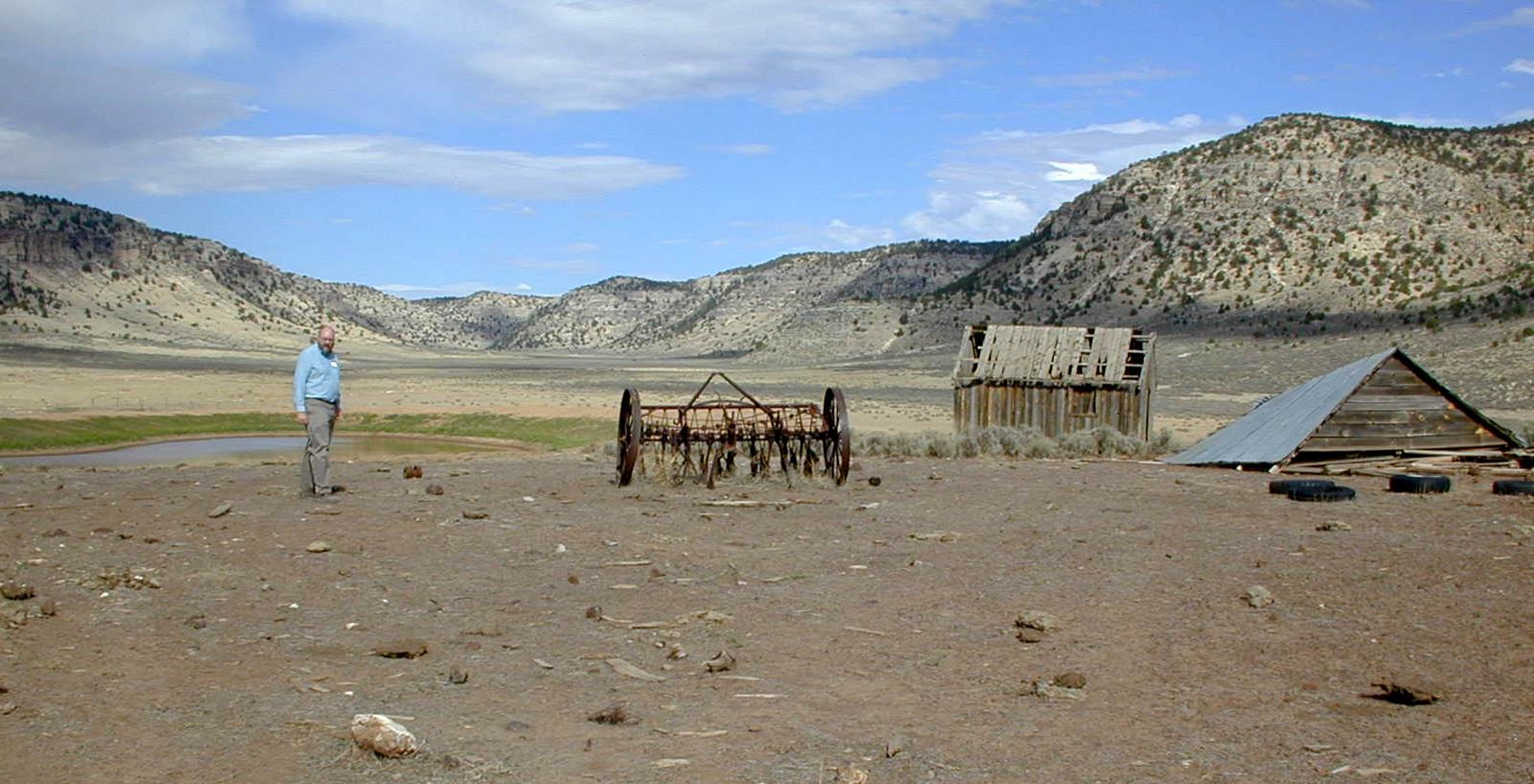
So. Toward Broad Canyon, there is an abandoned two-room shack — an old line house for the cattle ranchers — and another that has collapsed. There is also an old harrow and an empty galvanized steel water tank and 687,000 cow pies. When you are alone for long, you have time for things like counting.

Why choose an abandoned line camp as a place to be alone? I find solitude has more to do with your awareness of being alone than with the mere facts of the case. The most isolated man I ever saw was sitting on the floor of the 42nd Street Bus Terminal in New York City.

So I chose the old tires and weathered shack because they said more about absence than the landscape did by itself.

Unwinding solitude 

The first thing you notice about being stuck out in the middle of nowhere is the boredom. You look at your watch and realize you have survived 12 minutes alone so far. Time seems to come to a halt. You cannot imagine what to do for the next 18 hours.

What one normally does, of course, is fill up time with work and entertainment. But my work is being alone and I have taken a vow of media chastity for the duration: no car radio, no books, no iPod. I have promised to face the silence.

To fill that void, at first you create busyness. I hike up the knoll to see from one end of the valley to the other. I walk down the knoll. I use my binoculars to look at some birds and to scout the neighboring hills for signs of human habitation. There are none. I set up my tent and cook stove.

Breaking through that boredom is an important first step.

You come to realize that the buzz of constant media is a kind of shell protecting you from boredom. Without it, you must come to terms with your physical existence.

TV and radio make us aware of our cultural existence, but can hide ourselves from ourselves. Being in the open with no chance to escape forces you to “front the essential facts of life,” as Thoreau had it, and find a way to do nothing.

Time slows down. The buzz-buzz, quickstep of daily life makes us believe the world is actually moving as fast as our illusion of it. But that forced march is something we impose on ourselves. In solitude, you find the world is glacial. As you become accustomed to that tempo, you find it expansive, full, teeming and ripe.

Certain Native American cultures recognized this. They taught their young people to look without naming. To see without asking why.

“They were taught to use their organs of smell,” recalled Lakota elder Luther Standing Bear, “to look when there was apparently nothing to see, and to listen intently when all seemingly was quiet. A child that cannot sit still is a half-developed child.”

My wife’s grandfather taught her something of the same lesson, when he took her out to the woods to watch wildlife. They would say absolutely nothing, but they would see a great deal.

“We didn’t talk about what we looked at,” she told me. “When you drive out the meaning, what you find is the meaning. It has a life you soak into. I call it ‘falling into the world.’ ”

In Japanese Zen, the same thing is called “quieting the mind” — wu-nien in Chinese. If you can empty your brain of all its chatter, you can begin to exist on the knife edge of this clock tick and not some other.

Or, as French poet Paul Valery said, “To see is to forget the name of the thing one sees.”


Not alone after all

At 6:30 exactly, with the sun already below the planet’s edge, the first star came out, directly overhead. It was Vega, in the constellation Lyra. The rest of the sky is still a glowing cyan with an orange wedge in the west.

So far from civilization, the night sky is a revelation. As the night darkens, the stars pour out like sand from a beach pail. By 7:30 the sky is hysterical. I haven’t seen so many stars since I was a child. The Milky Way ran from north to south like the river of incandescence it is, splitting like a tributary stream from Cygnus to Sagittarius.

I sat on the car hood, leaning back with my head against the windshield and looked straight up. For 2 1/2 hours, I sat there, looking up, trying to do nothing and think nothing. Just look.

What at first seemed to be a solid bowl overhead, with pinpricks punched in it for the light to shine through, later took on depth. It became a lake with fish-stars swimming in it at all depths. As I reclined on the hood, I suddenly had the sensation of being a figurehead on a ship, or a hood ornament on a car, speeding into the three-dimensional emptiness defined by those stars.

And, of course, I was. I was having my vision, as it were. But it is my particular stubborn sensibility that my vision turned out to be factual. This has happened to me before. Each time I enter the visionary world, it turns out that the transforming image I am given is grounded in simple fact.

I really am on a stony vehicle careening through stars. It is just that in everyday life, we never think of it that way. Given the solitude and the velvet sky, the obvious becomes apparent.

When my joints were finally too stiff from sitting in one position for so long, I decided it was time to sleep. I crawled in the tent and dozed off in the silence.

Less than an hour later, I was started awake by the Coyote Tabernacle Choir.

At least 20 of them, from all directions in the hills surrounding me, began their yipping and yowling. For about 30 seconds, they established their identities and locations and fell silent again.

I realized that alone in the dark silence, my senses were electric. I thought of the monkey-men in 2001: A Space Odyssey when they huddle in the cave, growling apprehensively at the growling predators in the distance. Solitude makes you vulnerable.

But drowsiness conquers alertness. An hour later, I woke up again — popped awake, really, like bread from a toaster — as a great horned owl screamed. His “Hu-Hu … Hu … Hu” was as loud as a man yelling next to the tent.

That instant before I knew what it was, I was riveted, as alert, awake and ready for action as I have ever been. The moment I could name the experience, however, it quieted down once more and became part of everyday reality. It lost its sheen.

Later, I woke up again as a bug, caught between my tent and rainfly, buzzed away, vibrating the nylon like a dentist’s drill. I cursed myself for going to the extra trouble of adding the rainfly in such a dry landscape.

An hour later, I woke up again as lightning and thunder clapped around me and rain spattered on the rainfly. I praised my wisdom.

At 3:30 in the morning, I got out of the tent to look at the sky again. It was all turned around. Orion was now up and bright as searchlights. And the Milky Way went east and west, having revolved around the pole star.


Senses of time

So, this bullet we’re riding on is rifled.

The night went on like that: One sense input after another, so busy through the nocturnal time-sluice that I hardly got any sleep at all. At 6 in the morning, the coyotes yowled again, and I decided it must be time to get up. The east was whitening, although the sun was behind the mesa.

When I drew open the tent flap, I saw the blue sky patched with gray-brown clouds, and dangling from one of them was a rainbow. It was not much more than a yellowish bright spot against the angry cloud, but I saw its familiar arc and promise.

We live two lives. In the common one, we are one in 7 billion, a single voice in a clamor of humanity, spaced 100 per square mile. We function as part of the crowd. But in that other life, we’re alone. We are the one, the singular — heroes in our own life’s epic, even, and we recognize the solitary importance of ourselves to ourselves.

It is this second life — so rich and so important to our sense of meaning and purpose — that we come to meet in solitude. That is perhaps what Montaigne meant when he wrote, “The greatest thing in the world is to know how to belong to oneself.”

The first life is brought to you by television, newspapers, books, radio and movies. It is a cultural existence, defined by other people. It is the madding crowd we are never far from.

The second life comes to you when you seek it, alone, in quiet. Ultimately, to yourself and your family, it is this second self that is important.

When my great experiment was over, and my tent packed up and my car finally back down the 45 miles of dirt road and back on the highway headed home, I automatically reached for the radio, to end my media fast. But after only a few seconds of music, I found the sound annoying. The quiet felt more satisfying. And although I almost always drive with the music blaring, I just couldn’t bear it.

I have not turned it on since. I am not sure how long this will last.

What is culture and why should we care?

These are questions that don’t get asked often enough when we discuss such inflammatory issues as government funding of the arts and humanities.

To many people, culture simply means a lot of wealthy people going to the opera and sitting through a hare-brained story in a language they don’t understand while listening to a soprano shriek so loud their elbows go numb.

Or it means drinking bad white wine from a plastic champagne glass at an art gallery opening or long, dense scholarly papers deconstructing Little Red Riding Hood.

We too often talk about culture as if it meant only long Russian novels and evenings in the theater with the plays of Edward Albee.

But what would happen if all these so-called “high” arts suddenly disappeared? Do we actually need them?

To understand the answer, we need to understand what culture is.

Culture is broader than just the arts.

It’s what you eat for breakfast and whether your trousers have cuffs.

It is who you are allowed to marry and what happens to your body when you die.

Culture is the set of rules — mostly in the form of traditions — that society runs by.

It is the software for our social lives.

In fact, far from being a luxury, culture is something you cannot live without.

It is religion, art, laws, ethics, history and even our clothing.

Culture is who we are.

And who we are at this moment: No culture is static. It is an evolving thing — to keep up with the computer metaphor, there are constant upgrades. Culture 2.7 gives way to Culture 3.0, as the circumstances of our lives and our cultural needs change. The culture of the clipper ship means little on a jumbo jet.

This plays out in our politics: Those who want define marriage one way, and those who believe things have changed and that we need a new definition. Those who define government in 18th century terms and those who recognize that history has bypassed those narrow terms.

Yet, it needs to be remembered that culture is passed on through tradition, through doing the things that worked for our parents and forebears. We hesitate to change our ways: In fact, we think our ways are the only ways, that trousers are for men and that dinner is served at 8.

Culture is inherently conservative. It changes very slowly. If we need periodically to upgrade our software, nobody wants to get caught with a beta version.

Patterns from our ancestors persist in our lives. Because our (mostly) right-handed great grandfathers carried their swords on their left hip and to keep them from getting caught up, mounted their horses from the left.

When the “air cavalry” of World War I began flying their biplanes, there was a “stirrup” on the left side of the fuselage that pilots used to mount their aircraft.

Now, at every airport in the world, we cross the ramp to the left door of the jumbo jet.

These things tend to persist, even when we don’t think about them, or rather because we don’t think about them.

How many children today play with “choo-choo trains,” although not even their parents ever lived in a world with steam locomotives.

The patterns stick with us even when they no longer make sense.

But culture does change. The three-minute song is still the cultural pattern, although Dinah Shore has given way to Taylor Swift.

And churches still sport pointed arches, although they are more likely mullioned with wood than stone tracery.

Songs from our agricultural past, lauding springtime and the moon, make little sense to our urban present, where nocturnal lighting is more likely neon.

So we change. Slowly.

And where does cultural change come from? The single biggest contributor to cultural change is art, the fine arts. This is what Shelley meant when he said “Poets are the unacknowledged legislators of the world.”

The arts try out possible ideas on stage to see if they might make sense. Sometimes they do, sometimes they don’t. But the best minds and imaginations give it their best.

Science is the test we give to hard fact; art is the test we give to everything else.

That is why we think of theater as “culture.” Or literature, or painting.

If the old idea of marriage is due for an upgrade, it is in the arts we should look to find the experimental evidence for what form the new versions will look like.

Yes, there are some people who want to keep their old software version, and some who want to return to earlier versions. But culture cannot stand still.

Therefore, we need to be on the lookout for meaningful directions to go in.

Art is our investigation of our values, testing them and throwing out some and reinforcing others.

Without art, culture ossifies and the people become emotionally and spiritually dead.

So, if we mean to maintain a vital culture, we must support the best in the arts.

There is another computer saying: GIGO — Garbage In, Garbage Out. In other words, if we don’t care for the changes in our culture, we are likely to wind up with the lowest common denominator. We are likely to wind up with nothing more than Keeping Up With the Kardashians and cheese in a squirt can.

When I retired from the newspaper business, my wife and I moved from Phoenix to Asheville, N.C. It was a big shake-up in our lives. There were lots of adjustments we had to make.

When we moved, one of the the biggest problems I faced was getting rid of CDs. I had thousands. We also reduced the books by four fifths, but the CDs caused me more heartache. I had been the classical music critic for my newspaper and I had an amazing collection of music.

I felt that I needed to cut my CD collection by at least two-thirds. Part of this was made easier because in retirement, I think differently about the collection. I once felt deep in my bones that I needed to have a recording of everything that was every composed, and that in mainstream repertoire, I needed to have the spectrum of performance practice and styles. At peak, I had 18 different sets of the complete Beethoven piano sonatas, and 27 sets of the late sonatas (counting those in the complete sets). You want Solomon Cutner? I got’im. Want Mieczyslaw Horszowski? Got’im. Ashkenazy? Arrau? Baremboim? Yeah. Wilhelm Kempff? Two sets, the early mono set and the later stereo recordings.

And, of course, Artur Schnabel. Could never do without those. If I had to have only one set — and idea not conceivable in this universe — it would be Schnabel.

But this lunacy continued through most repertoire. I don’t know how many sets of Mahler symphonies I once owned. I daren’t actually count’em. I had Bruckner out the wazoo, and Stravinsky — well, I owned nearly everything by him ever recorded, at one point.

The winner in this competition was the Beethoven Violin Concerto. I had more than 50 recordings of it, including one each on flute and clarinet, and versions on authentic instruments and electric violin. It was insane, and yes, I had listened to all of them, most with score. Let’s say, it is a piece I know well.

While packing to move, I put on my most stingy hat, and said, I really only need one of everything, and that, only for the mainstream repertoire. Do I really need all of Boccherini’s string sextets? Do I really need all of Field’s nocturnes? So, they went into the giveaway box. In Phoenix, I had three walls covered with bookcases filled with CDs. Here in Asheville, I have only most of one wall covered. It was painful. But in the years I have left, how many of those obscure CDs would I actually listen to? When I was working, I felt I had to have them in case a visiting string quartet came to town and programed a Miaskovsky string quartet, and I would need to be able to listen to it before reviewing the concert. To say nothing of glossing the CD notes for info. There is actually some stuff I don’t have stored in the old cerebral file cabinet.

So, one of each, not 10 of each. But. And this is the problem. But.

But, can I really have only one set of Beethoven quartets? And if so, how could I possibly decide between which of my children I would keep. There’s the old Budapest set, the tremendous mono set by the Hungarian Quartet. The Emersons are really good. And the Guarneri. I can’t leave them behind. I probably listen to the Guarneri more than any others. Yes, I can give up the Tokyos. They play the music too smoothly. All the difficulty has been ironed out of the music, and if the Beethoven quartets don’t sound difficult, they’re not the Beethoven quartets. But there are the Cleveland Quartet recordings, too. What a problem. And the Fine Arts Quartet. Not a great recording, but I have sentimental affection for them, since, in an old bargain Murray Hill box set of LPs, they were the first complete set I owned, back when I was a student.

Well, I wound up with two sets of Budapests — one commercial recording and one set from the Smithsonian concerts — the Guarneris, the Hungarians and the Emersons. I reluctantly said bye-bye to the Clevelands. There are other single disc recordings of individual quartets I had to keep, too, by the Busch Quartet and Yale.

But then, after we moved, I found a set of the early mono Budapest recordings available by mail order. I had to buy them. (Sony, which now owns the old Columbia Masterworks recordings, had only released on CD the later stereo Budapest recordings, which are often embarrassing and in bad intonation. So, to have the mono recording set, made in the 1950s, was a must.) This set is now my constant companion.

Aside from some of these catalog entries, which are the core of my musical being, I really was a good boy, and really did ditch a Noah’s Ark-load of my collection. I now have only two complete sets of Haydn symphonies. Only one complete set of Haydn quartets.

Which brings me to the point of this note. The Beethoven symphonies.

Certainly, for 150 years, they were at the center of the core of the heart of the classical repertoire. Every conductor worth his salts had recorded a set of them, had played them in concert a billion times. They were the one true test of a conductor’s mettle. One might specialize in Sibelius, or another in Mozart. But how does he do Beethoven? That is the question.

As Alex Ross wrote in this week’s New Yorker: “The canon … never stops evolving. The symphonies of Beethoven have never budged from the center, but almost everything else is up for negotiation, and each era has its passing fancies.”

The problem with this centrality has been, of course, overexposure. There are time when you feel if you have to hear another goddamn Beethoven’s Fifth, you will pull out your 30.06 and look for a tall tower to climb. Da-da-da-DUMB.

Strangely, though, in the past couple of years, I’ve had a rebirth of interest in the Big Nine. I can’t explain it, other than, after all, they are genuinely great pieces of music, every one of ’em. And letting them lie fallow for so many years, meant I could approach them again, in Nietzsche’s words, “again for the first time.” Then too, I am more mature now, and I can hear more in the music.

Twenty years ago, I felt I had enough of them, and rather ignored them in favor of Mahler, Bruckner, Wagner, Schoenberg (yes, I actually love Schoenberg, with the same warm feelings I have for Mozart) or Schubert. Or Debussy — for a while I was Debussy crazy.

But, through it all, the Beethoven symphonies maintained a kind of emotional, intellectual and musical solidity that I could not gainsay. And my CD collection reflected that. I had more than a dozen complete sets, and uncounted individual recordings. They ranged all the way from the depressingly uninflected recording of the Fifth made by Gunther Schuller, who set out to prove that Beethoven’s music should not be “interpreted,” but only played straight through, by the notes, through to the other end of the spectrum, where Sergiu Celibidache drew the music out to absurd lengths of interpretive shenanigans.

I had to get rid of an awful lot of those recordings. I felt an almost Protestant virtue in denying myself. It was mortification of the ears. Yes, get rid of Klemperer, get rid of Bruno Walter. Out goes Bohm, out goes Karajan, out goes Szell. Yes, it hurt, but I had to be realistic.

The Norrington set I tossed with relish and glee. God, they were awful.

So, I kept one mainstream set — the Bernstein DG set — and one original instruments set — the John Eliot Gardiners — and one set for sentimental reasons, the Barenboim set with the Berliner Staatskapelle. I also came across a set of all of Beethoven’s orchestral music by Nikolaus Harnoncourt, which I simply had to keep, because, well, it’s Harnoncourt. And then, the most recent set of the Nine Symphonies by Mikhail Pletnev and the Russian National Orchestra (currently my favorite set, although this may be a mere flirtation). Oh, and the set of the Liszt piano transcriptions of the Beethoven symphonies. Can’t get rid of that. Around them, there were many individual recordings to keep, too. I won’t mention all of them.

But I kept discovering other sets that I kept, and hadn’t even known it. Most of my music is filed chronologically, so all my Bach comes first, all my Haydn followed by all my Mozart, followed by my Beethoven, etc., up through John Adams and Philip Glass. But in a separate bookshelf, I have my extensive collection of historical recordings. I couldn’t get rid of my Toscanini set of Beethoven symphonies, of course. But there are also several sets of Furtwanglers — he recorded the Beethoven symphonies so many times I don’t think anyone has an accurate count. And then, there are the Mengelbergs. Can’t get rid of them; sometimes I think Mengelberg is my favorite conductor. And then, there is the set of acoustic recordings made in the 1920s, conducted by Hans Pfitzner, Oscar Fried and Richard Strauss, dividing the nine symphonies up among themselves.

The thing is, when you know such music as intimately as I do (and I don’t claim the intimacy of anyone who has actually performed the music, or those who have studied it relentlessly for years), the music becomes much more than a set of notes, and you know its variations and parameters with something that approaches love, you simply cannot imagine them set down in a single performance any more than you can imagine the woman you love being defined by how she acts on a single day. There is mood, there is growth, there is complexity. Yes, the Beethoven First can be big and overwhelming, the way Klemperer plays it, but it can also be — perhaps should be — Beethoven’s wittiest symphony, as played by David Zinman and the Tonhalle Orchester Zurich. If you haven’t heard that recording, I strongly recommend it: Beethoven taking on Haydn’s game and showing us that he has the chops.

Ezra Pound once wrote that anyone who loves the same poetry (or by extension, music) when he is 20 and when he is 40, is an adenoidal idiot. And now past 60, I can add on that while one never quite gives up one’s first love, one constantly finds new loves, not only in repertoire (I didn’t appreciate Bruckner until I was well past 40), but in performance, too. Always something new to discover, always something new to love.

My shelves are lined with the love notes of my former lives, and the billets-doux of my senescence. Music is large, it contain multitudes.