Archive

Author Archives: Richard Nilsen

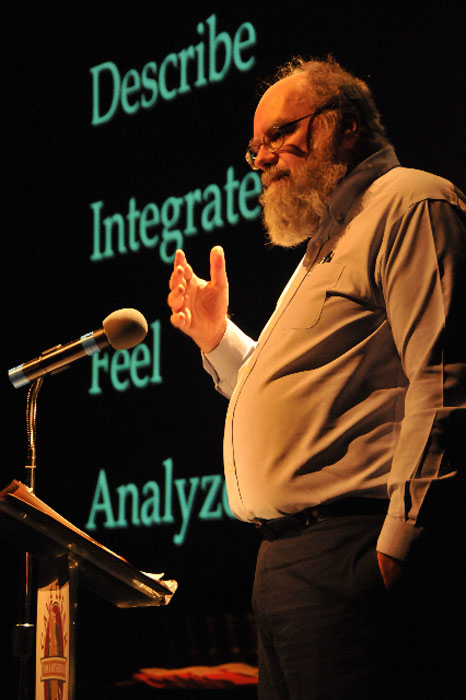
The lecturer stands in front of class, looking dignified and serious. He collects his papers, taps them into line on the podium, sets them down and gets the attention of his audience.

Then he SCREAMS at the top of his lungs like a banshee with kidney stones. It’s a horrifying scream, blood curdling, ear splitting. 

The class reacts with alarm and goosebumps, then worry over the health of the lecturer. Is he having a stroke?

The lecturer continues:


What does THAT mean?

I mean, did I make that noise because I wanted to call attention to the traditional neglect visited upon art critics in American society?

Was it a sign of the fall of the patriarchy?

Did someone goose me?

It may have been, in some part, any of those things, but first and foremost, it was an EXPERIENCE.

It was a jangle of your nerves that buzzed in your synapses

Before it MEANT anything.

That is important to note — your perception of it and your reaction to it were PREVERBAL.

That is, you did not have to have ideas about it. You only had to be aware. To sense it. No words: They come later.

As an art critic, I get to see a lot of art and read a lot of artists’ statements. Those statements are chock full of ideas about things, concepts about art, politics, but they are too often deadly unaware.

UNAWARE.

I’m here tonight to talk about TEXT.

Or rather, text versus art.

Text is very hot these days in the art world.

Students, especially, are seen as cool to the extent that they misquote Jacques Derrida, to the extent that they can say, “I’m into deconstruction.” When they have little idea of what it means.

What they usually mean by “deconstruction” is that they have found the arcane and secret meaning of very ordinary things.

That marriage is a plot by the patriarchy to oppress women, for instance, or that — and I’m serious here, this has actually been suggested by a true academic:

that white people traditionally play games, like baseball and golf, with small white balls while black athletes play games that use large brown balls, like basketball.

Needless to say, this popularized version of deconstruction is not what the French philosophers meant, who invented it.

And to think that finding the hidden message is a new pursuit is typical of the grandiose self-assurance of youth. Only students can believe such stuff.

But in the rage for the latest, young artists are full of a belief that art is TEXT. Text to be explicated, or deconstructed.

But no matter how current the belief is, it runs headlong into the problem that art — although it may have a text, just as a Schubert song has lyrics —  is no more text than my scream.

Art does not spring from concepts, it springs from EXPERIENCE.


Here the lecturer stops to gauge his audience, moving his eyes from left to right, pausing for effect. He continues: 

In fact, it is art’s very job to try to make sense of experience — to comprehend the experience — not in neat little formulations, but as primary sensibility, facing what is incomprehensible.

Too many artists working today — especially in academic settings — believe they are supposed to make a great statement — often a political one — and illustrate it with an installation piece (it used to be site-specific art, but fashions change in art, too).

What is amusing to anyone with a longer view of history and art is how much this all sounds like Victorian art.

It is an age-old American tendency — beginning with the Puritans who distrusted images and continuing through the Victorians who distrusted sex, to today and people who distrust any number of things, from competition to violence to meat.

The formulation seems to be, that if you can describe it, circumscribe it, you can control it and therefore, eradicate it.

What I’m getting at is that there isn’t much difference — isn’t ANY difference — between condemning art for its violence now and condemning it for its sexual vulgarity a hundred years ago.

Victorianism and P.C. both have their roots in a vision of  the world as we would wish it to be.

In other words, not the world as we experience it.

Much of contemporary art is prescriptive rather than descriptive.

It is moralizing. It is also a lie.

Victorians are laughed at for calling the leg of a piano bench a “limb,” and well-bred young ladies were wont to get an attack of the vapours when someone used the wrong word.

Today, we flinch at calling a cripple a cripple. It is the same thing, and just as silly. We’ve all seen jokes about just how far this can be carried: a Caucasian is sometimes called “melanin challenged,” or a criminal has “alternative ethics.”

Another problem of text is that it comes from a trend that is mindlessly democratic. In this world everything and everyone is of equal value, which translates as meaning, of equal talent, of equal intelligence, equal wisdom, equal everything. It’s a world, again, as we might wish it to be.

But Michael Jordan could play basketball, with its large brown ball, a whole lot better than I can; and Jim Dine can draw a whole lot better than I can.

When all art is seen as neutral TEXT, and all art is held as essentially equal, with no masterpieces, no QUALITY — quality, in this view is only a plot by dead white guys to disenfranchise people of color and women, both with color and without.

Now I don’t deny that historically quality has been used as a kind of gatekeeper for the men’s club of art and achievement, but that is only one definition of quality — quality as shibboleth.

But EXPERIENCE, if we listen to it rather than to ideas — tells us that quality is more than merely a culturally defined ticket to the art history textbook.

Listen to Salieri’s overture to “La Fiera di Venezia” and then listen to Mozart’s overture to “Marriage of Figaro.” Your ear —  well before you get any idea in your head — tells you one is hopelessly dull and unmemorable and that the other dances with life.

Quality is never a set of criteria for judging a piece of work — such a view is best left to old German-speaking pedants and should indeed be cast away — but quality is MANIFEST. It is a gut-level experience.

(By the way, quality in all things is the subject of a holy book you might want to read — a great book by a very unpleasant man named Robert Pirsig. Check out “Zen and the Art of Motorcycle Maintenance.” Ignore the dated title and attend to the words inside. Pirsig is a very wise man with a very subtle mind, although he does have the personality of a porcupine and the affability of a Viking berserker.)

One’s reaction to a great work of art is a preverbal AWE.

I always say, what I look for in art is:

What I can’t understand, but I can’t get out of my head.

It excites the neurons and is in some ways analogous to the experience of life. And like life, it is always at bottom incomprehensible.

When we look at a great piece of art, the first thing that strikes us is a wave of recognition. We don’t know what it is , but we recognize it.

It is like I have often said: You cannot create profundity; you can only recognize it.

The experience of art is profound — moving in ways we cannot label.


The lecturer shifts his papers, coughs lightly to clear his throat: 


When I read one of those P.C.-clotted artist’s statements on a gallery wall, I can’t help but think that TEXT is above all, a way of AVOIDING art. Art muddies the waters — text believes they should be clear and healthy.

Take the art of Francesc Torres, who is an academically respected contemporary artist, whose work “deconstructs” history and colonialism. One gets the idea that Torres had an IDEA about history and colonialism and cast about to find a way of illustrating the idea, almost as if he were a political cartoonist.
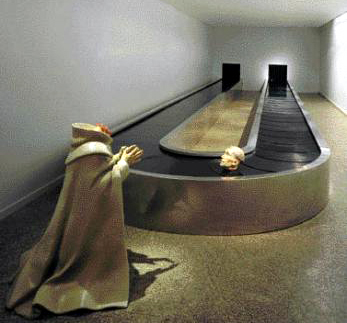
The result is an art whose mind is made up. You either agree with him or you don’t. He might as well be William F. Buckley.

And, let’s face it, the people who go to see his shows probably already agree with him politically, so what possible point is he really making?

As experience, his art is thin gruel. You get the point, like the punchline on a New Yorker cartoon. But what have you seen? What have your felt?

What is there to experience??

Some slowly moving newsreels; a rotating monkey; a battalion of toy battle tanks.

Each is patently symbolic without ever understanding that for a symbol to work, it has to function on at least TWO levels.

Torres uses his images as “signs,” not symbols, that is, they have no organic connection to what he is trying to say, but only a rote connection, an artificial connection, such as that between a group of letters, say A – P – E, and the hairy, smelly, energetic homunculus that is signified.

Great symbols always function first on a PRIME — that is, Experiential — level. Secondary meaning is then spun off.

As Minor White put it, not only what something is, but what ELSE it is.

Melville didn’t decide to write about God and Nature and then use the whale as a shorthand for it. He wrote about a big, scary animal in the sea and it resonated.

Once, when told “Moby Dick” was about the ineffability of God, Melville was taken aback. He hadn’t realized it.

He know there was a great deal of philosophical stuff in the book — primarily the difference between Ahab and Ishmael, the actor and the observer, the doer and the meditator. But he hadn’t set out to make the whale the SYMBOL for the meaning of the book.

I.e. Symbols happen. They are not manufactured. When they are, you have rhetoric, not poetry.

(As William Yeats wrote: “Out of our arguments with others, we make rhetoric; poetry, out of our arguments with ourselves.”)

Rhetorical symbols — such as those of Torres — are the stuff of political speeches.

Part of the problem is that politics and art are mortal enemies. It is no surprise that the political right hates it so much. It isn’t just that they are all  right-wing boobs and Babbitts, but that the very aim of art is inimical to the  very aim of politics. Left wing politics hates art just as much as the right wing. History is fairly clear on that point.

I don’t mean that art can’t have a political component — it often does — Wagner’s “Ring” for instance, or Shakespeare’s plays — But I mean that politics, as in political theories — are always interested in answers. They are meant to solve problems.

Art, on the other hand, is interested in questions. Politics, for instance, wants to end violence against women, or abuse of children and these are very admirable motives — but art is more interested in the impulse that causes violence or abuse. Let’s act it out and see if we can discover where it comes from. We usually discover it comes from being human. To be human is to cause suffering. If anything, art tells us, to attempt to end suffering is to end humanity. Robot people can follow all the rules, flesh and blood cannot, without giving up something essential.

I ran into a classic case, or rather a rash of classic cases over the past few years, in the form of numerous Anti-Columbus shows. This is art meant to show how horrible mean old Christopher Columbus was — how he raped and murdered, stole and colonialized. Columbus became the black hat. He is allowed no redeeming characteristics, no shading of personality. He is demonized. He also takes it on the chin for all white European males, he is the classic disenfranchising, male chauvinist genocide.

What you wound up with in all these shows was strident, self-righteous whining. It is an irony that escaped them all that no one who is self-righteous has any self-knowledge.

Sure, Columbus did horrible things — I don’t find fault with the politics of the art, other than to find it a tad naive — BUT

Not one of the participating artists made the slightest effort to UNDERSTAND what drove Columbus.

Nor did they recognize the universal brutality of humankind — that the brotherhood of man is the brotherhood of Cain and Abel.

All evil was invested in Columbus and he was sent off into the desert of oblivion as our scapegoat.

No mention was made the possibility that even before Columbus, Native Americans caused each other suffering, death and genocide: No mention of Awatovi, where the supposedly peaceful Hopi annihilated one of their own villages in a horrible bloodbath;

No mention is made of Crow attacking Cheyenne;

Nor Aztec enslaving Mixtec;

Or other non-European evils:

Pol Pot’s Cambodian genocide;

Nor Japan in China or Manchuria;

Tutsis slaughtering Hutus;

Shia bombing Suni.

If history teaches us anything it is that in all times and places murder and rapine is the norm, not the exception. Our heroes kill them; their heroes kill us. What difference if it is Azerbaijanis killing Armenians, or Serbs killing Croats or Somalians slaughtering their own.

These anti-Columbus artists had the chance to open up to the experience of the true vicious brutality of life. They could have looked into their own hearts to find it.

Columbus didn’t invent gangs, drive-bys or initiation rapes — all of these had their antecedents in pre-Columbian Central America.

If one of the artists had said, “I recognize Columbus in myself,” he would have gone a long way to complexifying his art, finding the EXPERIENCE that all art is born of.


Another pause as the lecturer gazes across the faces of his listeners. Are they getting it? Just as it seems he is about to start again, he screams again, at the top of his lungs:


There it is again. But by now, you’re familiar with the scream and you react differently. You know it is a pedagogical ploy, and you wait for the explanation. The experience has been tamed. The art has been drained from it. It no longer brings up fight-or-flight, the goosebumps just aren’t there.

So where does one start?

Consider what my wife does with her first grade students.

She does not teach them the color wheel or the elements of design. Or any other abstraction or concept. She brings animals to class, currently two bunnies named Pansy and Thurman.

The kids get to play with the rabbits — to feel their fur, their soft breath, their nibbles, their toenails, even their poo and pee.

They are utterly fascinated by them — They go out of themselves and experience something new — new and unexplainable.

Then they descend on their paper with their tempera paints and express what they have experienced.

They do not ask what does it mean?

Rather, they express that they have been excited.

This is what I call true art — These first graders are trying to make sense — visual and emotional — of what they have just witnessed and felt.

The paintings flow naturally.


There is an unease in the audience. They are mostly students, and have to provide their professors with words: term papers, quizzes and tests. 


It is OK to have ideas about art, after the fact. Sure, we can all sit around and discuss what the hell is going on in Jeff Koons’ two basketballs floating in an aquarium  — two large BROWN balls — and to try to understand what it means.

If talking and writing about art were useless, I would be out of work.

But in trying to make sense of a work of art, we are participating in the work, just as the artist participated in life. The words are a response to experiencing the art. They have to come AFTERWARDS, not before.

This is very different from setting the words first, deciding what our art is going to mean and then making what in effect is a mixed-media political cartoon making our point.

Thin gruel.

Lame art.


The lecturer now comes the the primary point of his talk. 


The basic problem is that text is an intercessor. It sits between experience and understanding. When we approach art as text, we see only the intercessor — we mistake the priest for the deity.

Words always distort, they always lie. At bottom, we need to recognize a few things about words.

First, words are not reality. This sounds simpleminded when you say it, but the fact is, we trust words more than we trust our eyes. We read the wall text next to a painting in a museum and trust what it says, even if it contradicts what we see.

I remember a wonderful video display. In it a nude woman is floating in deep water surrounded by thousands of jellyfish. The sunlight dapples her skin. It was intensely beautiful and disturbing at the same time.

But the wall text told us it was a feminist commentary on Irish politics. Huh? No, it was a naked woman in sunlight and jellyfish.

The words left many a museum visitor convinced he was a dunce for not getting it. But the words were simply stupid.


The lecturer is bringing it home, even if it seems rather a roundabout way to get there:


The case may be a little easier to understand in terms of Greek. The ancient Greeks were the first logarchs, they valued verbal meaning over experiential meaning — Zeno’s paradox is only possible in words. Set a turtle and Achilles out on a race and see if Achilles can’t catch the turtle. The paradox is purely linguistic; the experience is straightforward.

The Greek language is a highly ordered language. And the Greeks never made much distinction between the order of their language and the order of the universe. The felt language perfectly described experience: One to one.

The opening of the gospel of John, for instance. It sounds quasi-mystical in English, and that is how most American’s understand it.

“In the beginning was the Word, and the Word was with God, and the Word was God.” “En Arche hen ho logos …”

But in Greek, “logos” doesn’t mean “word” the way the English “word” means “word.” It can be used to mean a single word, but it also means language — the Greek language, that is — in general, and more important, it means the structure of language.

Greek is often built of preexisting sentence structures — “One the one hand …blah blah blah, yet on the other hand … blah blah.” Or “his words say this, but his actions say that,”

The language has these contrasts and comparisons built in. It guided how the Greek thought about the world. Polarity, opposites, hidden ironies and surprising conjunctions,  it’s all in the language even before you decide what to say.

So the Greek sees language as a mirror of the reality. If language says polarity, it must be because the world is polar.

It is much like the belief that geometry transcends embodiment. In other words, a triangle is a universal possibility, no matter if one was ever built. It is like one of Plato’s ideals. God himself cannot create a four-sided triangle. But the definition of a triangle is only words.

Language structure was understood by the Greeks in much the same way. And when they said “In the beginning was the word,” they meant, in the beginning, before anything else, the structure of the universe existed, and the structure WAS God.

Their language created a whole theology. Was it based on experience? You will have to be the judge of that.

Language is a tyrant. It can only discuss a minuscule portion of reality, yet we take it to be the whole.

Language is, in fact, a very poor mirror of reality.

There are an infinitely large number of things in the universe for which there are no words.

Take this, for instance. Here, where two walls meet is a corner. But where the wall and the ceiling meet? What is its name? In English, it has none.

Or this place on the wall — it is named the “center.” But this point, just as real, only a few inches from the center, is nameless.

Names are like the stars in the sky, only points, between which is an infinity of space, just as real as the stars.

Language is feeble. It is up to artists to see the space between the words, to recognize the feelings between the signpost emotions of hate, joy, anger, sadness — this million slight inflections that are nameless.

Up to art to explore the confusing rush of sense data, the confusing signals of society and nature, the overwhelming input that we censor with our language, allowing only those portions that sport nametags, as if they were Shriners at a convention.

As artists, it is up to you to make that unnamed curve that feels the way you do when you first wake up in the morning, when the floor is cold and sunlight comes in through the window and the birds haven’t yet begun chattering.

It is up to you to forge that surface that feels like your nerves when you are nearly run down by a bus on Main Street.

Up to you to make it heavy as your heart or light as your window curtain.

Up to you to make it new.

Make it meaningful.

Make it complex.

Make it richer than words.

Truer than politics.

More curious than a curator.

It is your job to be open to experience, before it is named and tamed.


The lecturer picks up his notes, steps away from the podium and stubs his toe on the railing along the stairway. He screams once more like a banshee with kidney stones. 



Part 6: The lower Mississippi

The Lower Mississippi begins at Cairo, Ill., where its character is radically altered.

Gone are the bluffs along the Upper river. Gone, too, are the quaint river cities and the thick woods that harbor flocks of birds and wildlife.

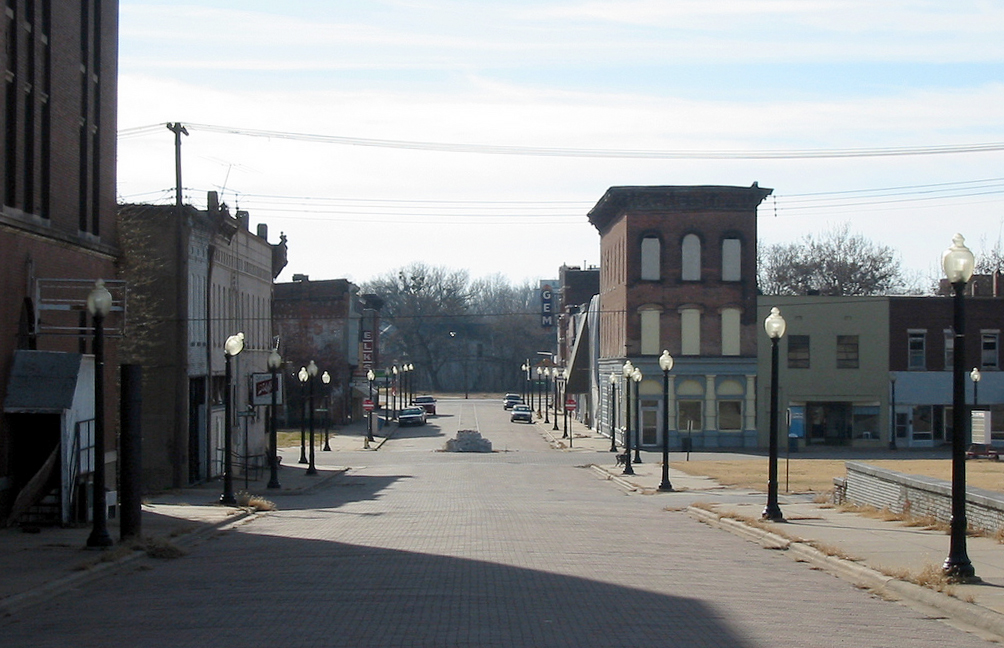
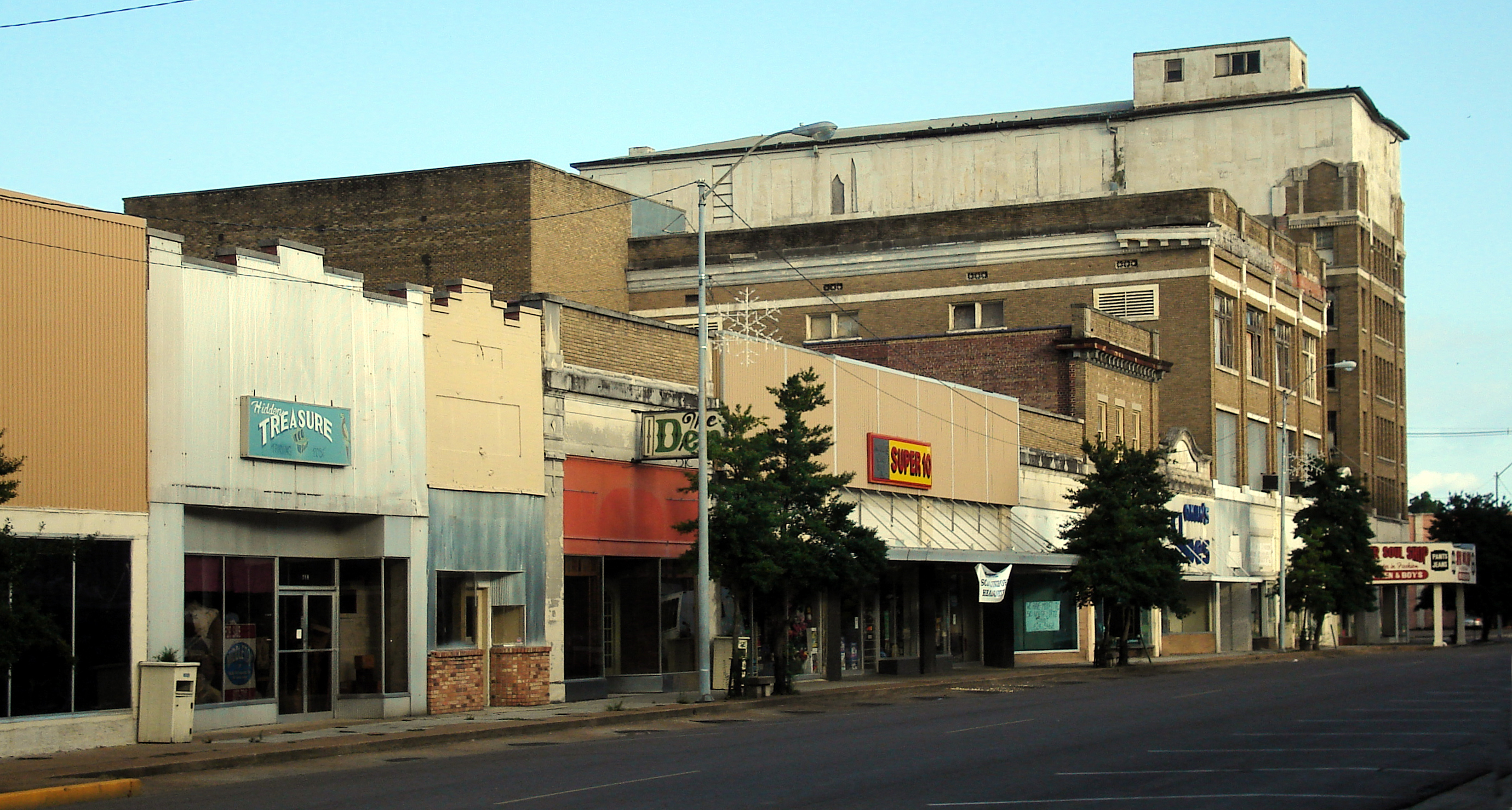
Cairo is a flat muddy town built on a flat muddy place where the Mississippi and Ohio rivers join. It is old wooden houses falling down, half a brick building here, old church there, boarded up storefronts and the Hub Lounge. “Package goods,” says the sign. Darryl Shemwell’s BBQ is closed on a Sunday morning.

Plaster is falling off the side of a brick building now used as a thrift store. In some old towns the paint is peeling, but in Cairo, even the stucco is peeling. Flocks of pigeons dive by the hundreds around the city streets and a new town clock is built on the crossroads of Eighth Street and Commercial Avenue, a road paved with bricks — an attempt at urban renewal and by the look of things, a complete failure.

Lee’s coffee shop and lounge is all plywood instead of plate glass.

The town is pretty well close to Twilight Zone empty.

At Fort Defiance Park at the south end of the city, the Ohio and Mississippi finally join. The Mississippi has the stronger current, and it rubs up against the Ohio and creates a string of eddies that spin out toward the middle of the river. Standing at the tip of Illinois, you look east to Kentucky and west to Missouri.

An old black man is casting his fishing line out into the river.

“I came here in 1980 from Kentucky when I retired,” he says. “I’m out here fishing every day.”

He’s fishing for catfish, he says, “or anything else that will bite.”

He’s just about the only live human being I’ve seen in Cairo and he tells me that times in the once-prosperous river town are hard. There are no jobs to be had and most of the younger people are leaving.

“The town’s dead, dead, dead, dead,” he says, turning his head with each “dead,”

“They ain’t nothing here.

“I don’t mind it. It’s nice. If I had wanted to work, I wouldn’t have retired.”

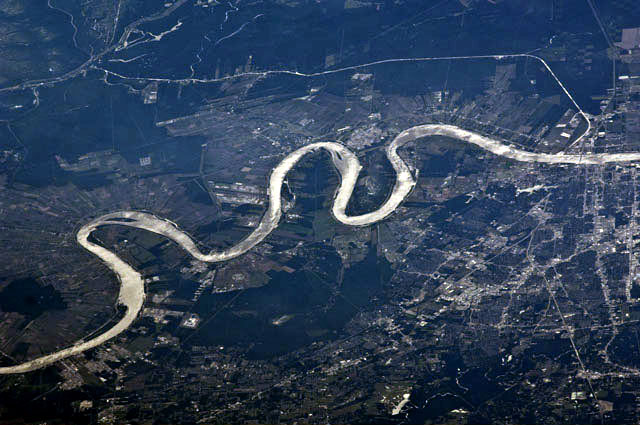
From Cairo to its mouth, 984 river miles away — although only little more than half that as the crow flies — the course of the river meanders like a dropped noodle, often looping back on itself, even cutting itself off. It is a lazy route, in no hurry to get to its end.

In such literature as Joseph Conrad’s Heart of Darkness, we travel   upriver, always getting closer to the mysterious center of the continent and the closer we get to its source, the closer we come to an experience of evil.

The Mississippi is backwards in this respect. In Minnesota, the river seems simple and the people around it comfortably bright-faced, optimistic and naive. The farther south we travel, the more complex becomes geography, history and the inhabitants.

The river is divided into three sections by geography, but it might as well be divided by religious attitude.

If the first part of the river is Lutheran, the middle Baptist, the final run is Roman Catholic, with a fine sense of its own sin, from slavery to modern casino gambling.

The Lower Mississippi is a fine, decrepit, history-ridden piece of geography.

South of Cape Girardeau, Mo., the river flows through its own waste. Thousands of years ago, the Gulf of Mexico extended north to Cape Girardeau, but the river dropped its silt at its mouth and slowly built up the earth underneath it, spreading its flood plain out to fill up the bay and create a valley four times as large as that of the Nile.

That soil was incredibly fertile, and the wandering river periodically flooded, maintaining fertility.

And American farmers figured out a way to grow rice, sugar and cotton and create huge plantations along the river: They invited a large number of Africans to cross the ocean and do the work for them.

Hard figures are hard to come by, but in the antebellum South, there were something like 4 million slaves. Most white Southerners didn’t own slaves, and most slaveowners didn’t own more than a half-dozen. Yet three quarters of the slave population was owned by planters with 20 slaves or more — and one quarter owned by planters with 50 or more.

This left the majority of slaves to a very small percentage of very wealthy Southern whites. Fewer than 3,000 Southern whites owned the huge plantations that existed on the labor of 100 slaves or more.

And these large plantations were found mainly in two places: the wet coastal plains of South Carolina and the shores of the Mississippi River.

In the alluvial bottomland of the Mississippi Delta country — an agricultural region in the northern part of the state of Mississippi — about 70 percent of the population was black. In some counties, blacks outnumbered whites by 10 to 1.

So, when one visits the grand antebellum homes of Vicksburg or Natchez, and contemplates the refined culture of the Southern aristocracy, one has to remember the vast suffering that built them.

“Slavery is a huge stain on us,” Mississippi-born novelist and historian Shelby Foote once explained. “We all carry it. I carry it deep in my bones, the consequences of slavery.”

You can feel it, too, in the dusty cotton fields of the Delta. The air seems thicker than elsewhere, the dirt worn out, the towns withering.

Between 1970 and 1990, Tunica County, Miss., lost one fourth of its population and ranked in those years as the nation’s poorest county, with nearly half of its residents below the poverty level. In the Delta as a whole, one quarter are in poverty and per capita income is half the national average.

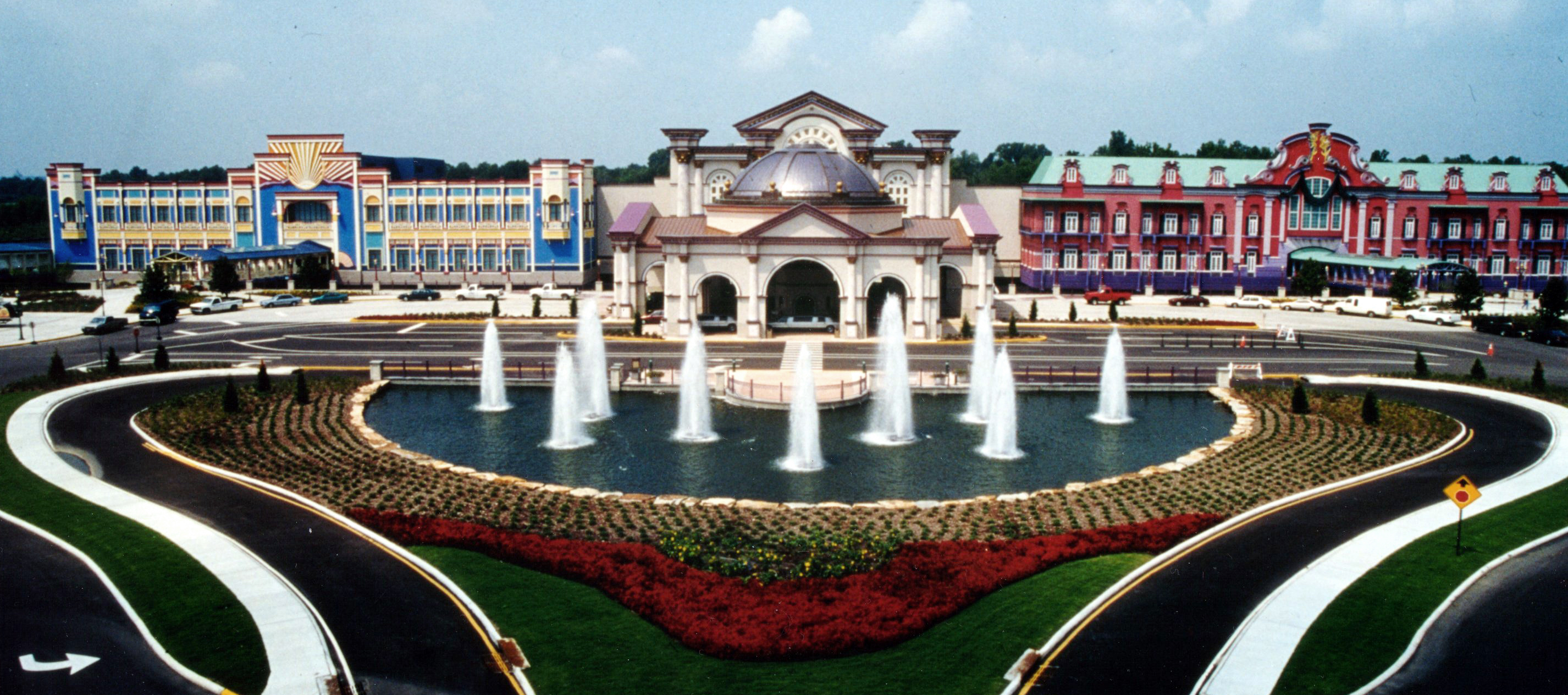
Yet, in Tunica, that has changed changing. For Tunica is now a center for gambling. In the past few years, a veritable Disneyland of casinos have opened up in this town about 30 miles south of Memphis. There are gambling boats all up and down the river, but Mississippi’s peculiar state law requires only that a casino be afloat, not that it be an actual boat. So, developers have even dug shallow lakes to build their casinos on.

In Tunica, a long sideroad takes you from U.S. 61 into the complex, where you will find the Grand Casino on Buck Lake, Bally’s Cash Country, the Horseshoe Casino and Hotel, the Sheraton Casino, and the Circus Circus casino. You see the high rises looming surrealistically over the cotton and soybean fields.

Tunica now draws more than 14 million visitors a year and has nearly 6,000 hotel rooms. And after its first casino opened in 1992, the county budget went from $3.5 million to $34 million and unemployment dropped from 30 percent to 5 percent.

And the water tower in town reads: “Tunica, Miss. A Good Place to Live.”

Tunica is in the Bible belt, but income is income, so most residents who have new jobs dealing blackjack or serving cocktails don’t think too deeply about whether gambling is a sin.

The Delta is unfathomably rich culturally. It is almost as if American culture begins in the dark soil. For the Delta gave us the Blues, which take all the layers of human suffering and make out of it something beautiful and profoundly moving. The Blues spawned Rhythm and Blues and that spawned Rock and Roll and rock has pretty well conquered the world.

But the Delta ends at Vicksburg, where the bluffs resume temporarily along the east bank of the river. They continue past Natchez, where busloads of tourists stop at the town’s most splendid mansions.

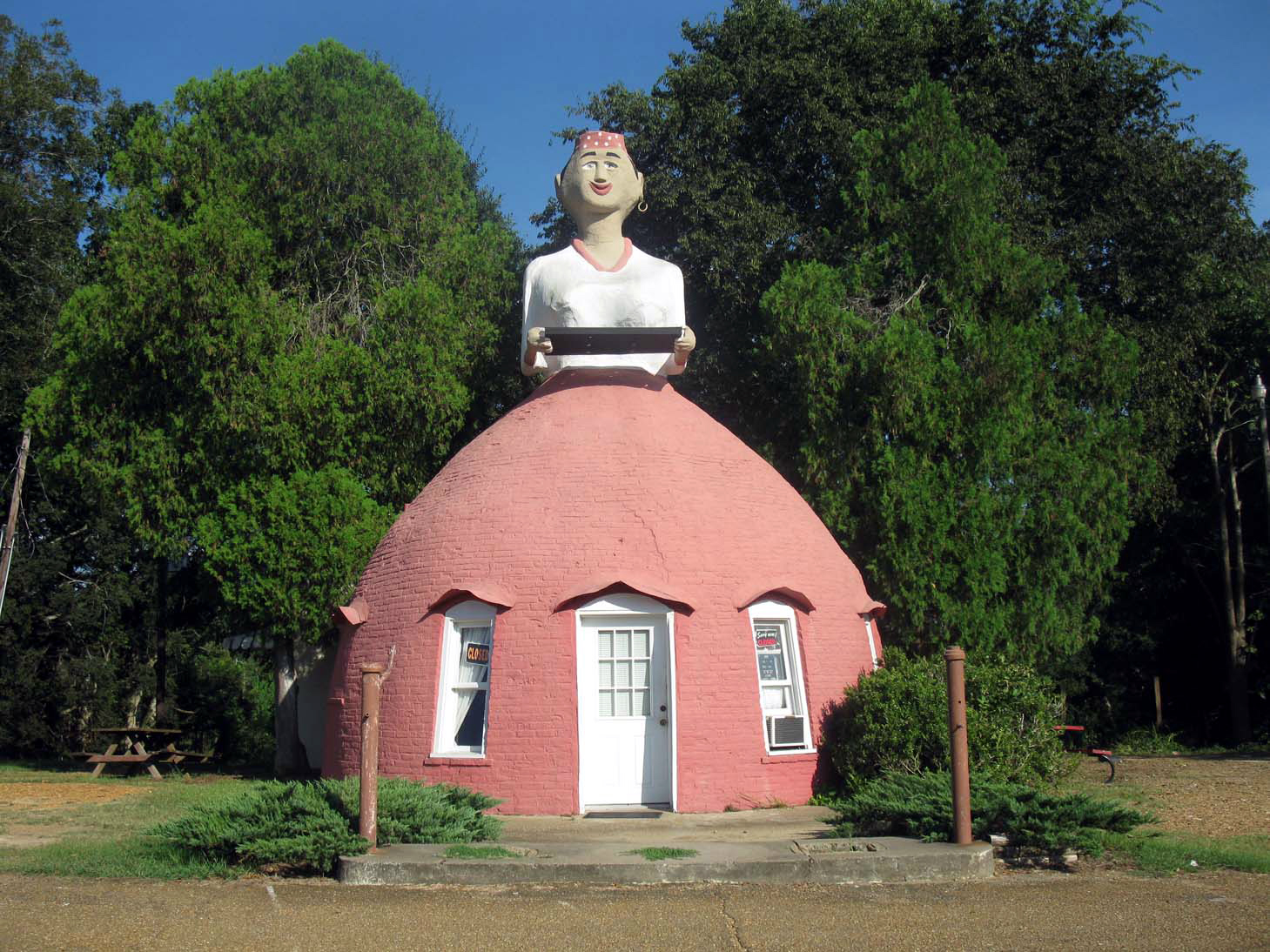
In 1940, Edward Weston photographed the American South and one of the oddest images he found was of a gas station in the shape of a black mammy.

Well, that piece of American vernacular architecture is still around, and what is more, it is still in business, although it doesn’t sell gas anymore. It is called Mammy’s Cupboard about 10 miles south of Natchez on U.S. 61.

It was created as a combination gas station and gift shop by Henry Gaude for his wife, in order, as the Southern expression goes, to give her something to do. What she did, however, was run off with a salesman who frequented the place.

In intervening years, it was turned into a restaurant and a craft center.

Currently, it is a restaurant again, and one of the best in the area. The chocolate cream pie tastes like 18 ounces of chocolate squeezed into 6 ounces of pie. It is a feat of physics.

The large igloo shaped skirts of the Mammy holds three small tables and the larger addition on the back holds another five or six.

Most of the customers are middle-age women, which it seems is the major demographic of Natchez. But one man, sitting at one of the other tables in the brick skirt reminds me that some things are very slow to change in the South. He is a pleasant-enough looking man in his mid 30s and he exchanges palaver with the cashier.

“They opened up a new restaurant downtown,” he says. “If there’s one thing Natchez don’t need, it’s another restaurant.” He’s a well-dressed businessman, obviously educated.

“You’re right about that,” she says. “Or more gas stations, either.”

“I’ll tell you what we got too much of,” he continues, “but I don’t think they’re willing to go back to Africa.”

I’m shocked at hearing this so baldly said as banter, although I have lived in the South long enough in my life that I shouldn’t be. It isn’t only rednecks that can spout such stuff.

I am most struck by the historic irony of his slander.

“If you don’t want them here,” I want to tell him, “blame your own great grandfather. I don’t think their great grandfathers were all that happy about leaving Africa in the first place.”

But for me, I can hardly imagine America without black culture. It is the depth our easygoing souls require. It keeps us from being idiots.

As it flows south, the river gains depth too. The Upper river strains to maintain a 9-foot channel. But by Baton Rouge, La., the river channel is 45-feet deep.

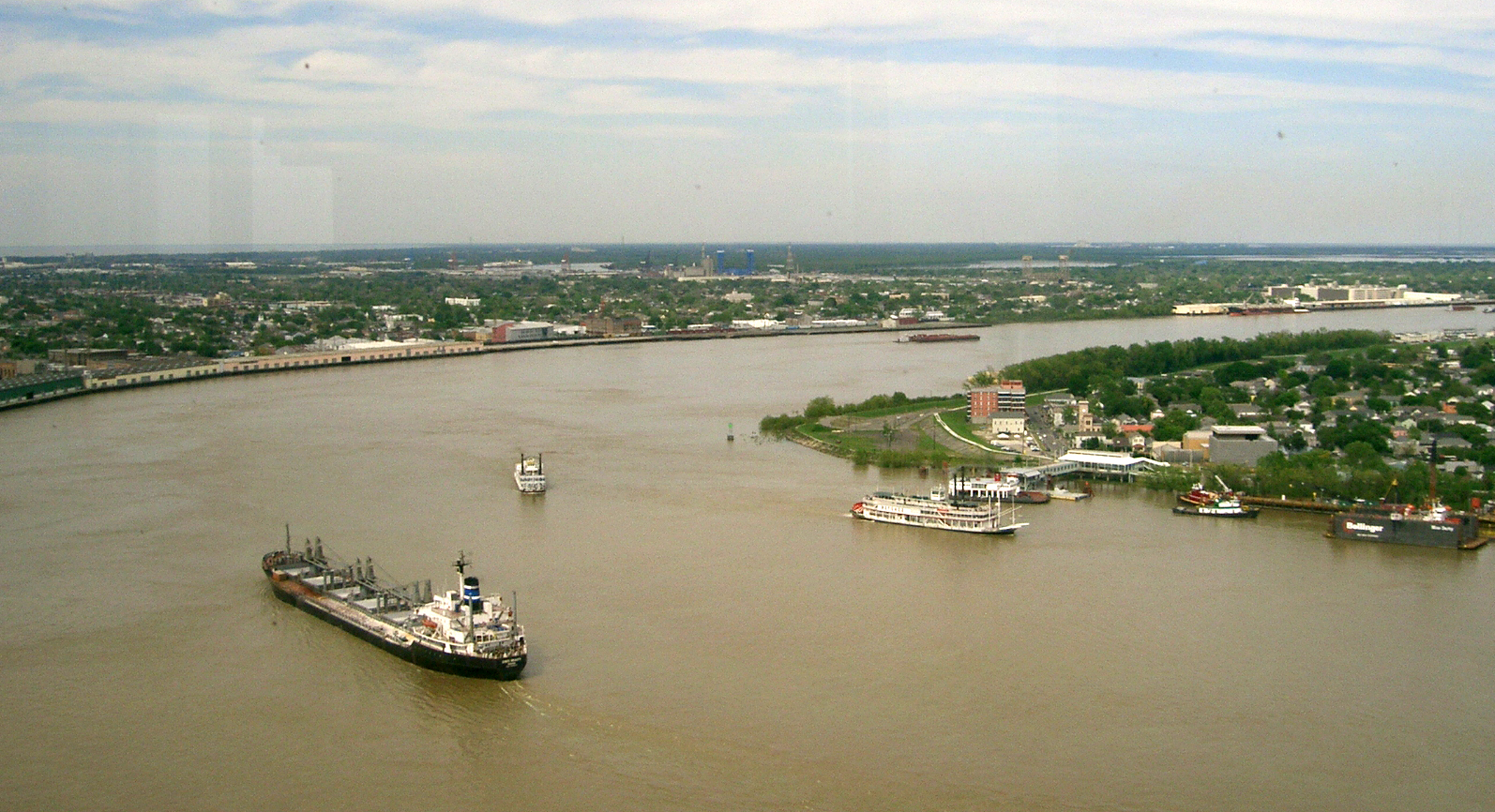
And by New Orleans, the river is narrower and deeper still.

All along the final miles of the river, venerable old plantation homes are tooth by jowl beside fuming, smelly, sooty chemical plants and oil refineries. Beginning at Baton Rouge, you can hardly find a mile of the river without its industry.

It is a vast ugliness, and Louisiana has a reputation for lax enforcement of environmental laws. It is here that the Mississippi earned its reputation for being a sewer. What was once called “Plantation Alley” is now “Chemical Corridor.”

New Orleans, itself, sits mostly below sea level, with the river channeled by levees above the streets, almost like the New York City El.

The town has four parts: a business district, a chi-chi historical district, a kitschy tourist district, and everything else. Everything else is decay. New Orleans is the most decrepit city in the nation: Walls are falling, covered in graffiti; garbage piles in the streets; drunks sleep in the trash; cockroaches scurry into corners. The famous cemeteries are mostly crumbling concrete, dusky with soot.

And that was even before Hurricane Katrina hit in 2005. Now, whole sections of the city look like Berlin after the war, burned out and broken.

Outside of the tourist and business area, it is a city that looks homeless and destitute

One writer said that New Orleans “is where alcoholics go to retire.”

But like everything else along the lower river in the Deep South, this very decrepitude is part of the city’s charm. It is a city where every corner is bent under the burden of history. There was the slave trade, the red-light district, the Prohibition alcohol, the gambling, toxic waste and environmental irresponsibility and it all serves to create a culture that recognizes the necessity of evil.

Every Southerner — and the deeper in the South the more this is true — knows sin. He knows he has to live with it; history loads it on his shoulders.

In Minnesota, the Lutheran accountant can believe in the basic goodness of life; in the Deep South, they know what goodness there is is dearly bought.

It is why there have been so many great writers grown on its soil. It is why no one who has ever written about the South has ever caught it accurately.

From New Orleans, the river spends its mighty flow, and by the time it reaches its mouth — or its mouths, for there are many — it has become the seepage of a great swamp. The single channel spreads out into hundreds, then thousands. Four are maintained deep enough for ocean-going traffic, but most just ooze out into the shallow, warm, salty Gulf of Mexico.

It expires in the complexity of exhaustion.

End of series

Part 5: The Delta, the blues

Clarksdale, Miss., is known for two things: cotton and the blues. You cannot imagine the one without the other.

The endless flat fields all around the town are snowy with the white tufts even this late in October. “They start picking it in September,” a young  woman tells me, “And sometimes, if they have rain or bad weather, they don’t finish until February.” Her smooth skin is the color of coffee; it is also the color of the soil in the Mississippi Delta, that flat, fertile bottomland that stretches along the eastern flanks of the Mississippi River, running, as the saying goes, “from Beale Street in Memphis to Catfish Row in Vicksburg.”

As I drive through, about half the fields are harvested. Those yet to be picked are thickly dotted with puffs like a mackarel sky of cumulus clouds and they alternate with the fields picked through, which are only slightly less speckled with the white cottonballs.

In 1944, Clarksdale was home to the first cotton produced entirely by machine, from planting to bailing.

In the old days, when the cotton was picked by hand, the field would be cleaned out of the cotton. Nowadays, with machines to do the work, the work is done so much more cheaply that they can afford to be grossly inefficient. So the finished fields are a stubble of brittle cotton stalks from which dangle the felted balls of unpicked fibers.

The Delta — a 200-mile long section of northwest Mississippi stretching up to 60 miles east of the river — is more than cotton, though. It is also the blues.

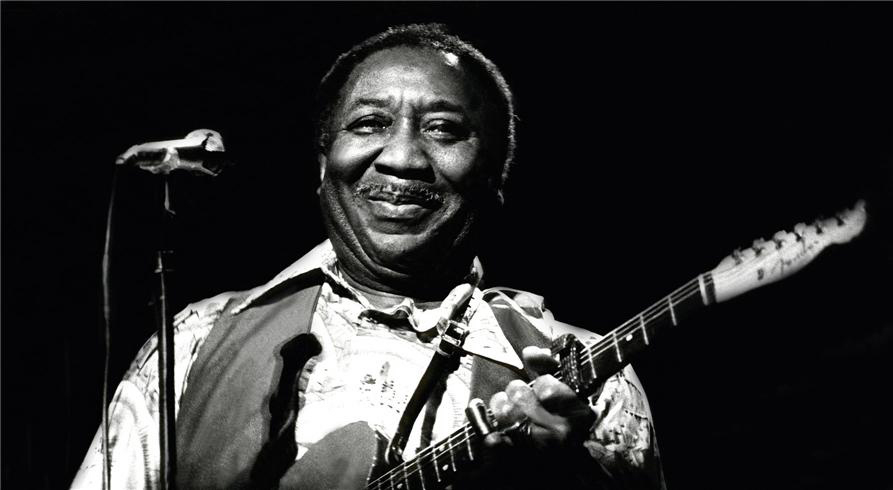
It is where Muddy Waters was born and Bessie Smith died; it is where Robert Johnson sold his soul to the devil. It is the epicenter from which the rolling earthquake of blues spread out across the South.

That wailing, flatted lament first came from the throats of the black field workers and former slaves. If I ever doubted the African origins of the blues, that was laid to rest when I visited South Africa in 1988 and heard, in the back country of Venda, a chorus of women sweeping streets and singing, call and response, as they backed their way along. It was as if a high-tension line had been thrown over the oceans and the electricity of one continent powered the song of another.

The blues, of course, is a refinement of the field song, a freight train of inevitable chord progressions thrown over the rawest and deepest emotions.

Clarksdale itself is a worn-out town. The downtown is filled with empty storefronts and boarded up windows. A J.C. Penney’s takes up one of the larger corners.

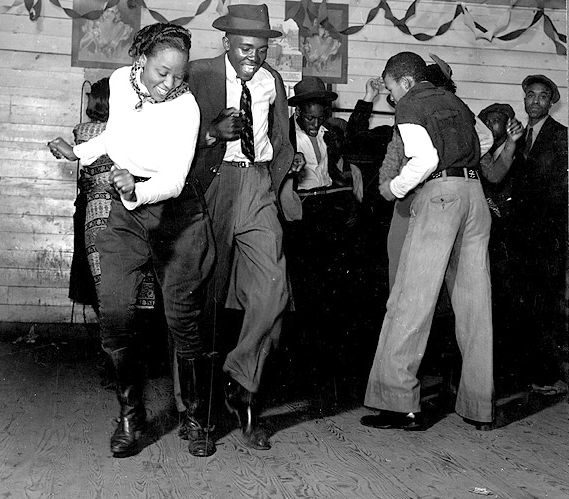
And across the tracks that split the town, the older, more decayed buildings sometimes contain a handwritten sign calling it a “Paradise Lounge,” or “Abe’s Bar and Grille.” These are the juke joints, where, on some Saturday nights, the current blues singers play out their changes.

It’s a Monday when I drive through town, and any potential bluesman is more likely at work, or sitting on the sidewalk outside a falling brick building on Issaquena Street with his friends.

I pass two of them, squatting in a vacant lot.

“Hey, friend, com’eer,” says one. He is about 65 and in a suit jacket.

His sidekick is maybe a decade younger, and in jeans and an old cotton shirt.

“Hey, friend,” he says. “Can you do me a favor?”

I walk up to him and he says, “Can you help us get a pint of wine?”

“Pint of wine?” I ask. “How much is a pint of wine?”

“A dollar seventy-five,” he says, as straight as if I asked him his name.

“Here’s two. Enjoy yourselves. I always like to see young people have a good time,” I say.

He stretched up and said, “Lemme shake your hand,” and took the two singles I held out. “You see that,” he said to his friend. “You see that?”

He pumped my arm ferociously for about one and three-quarter seconds and sat down once more on his hams.

It’s the blues and they soak this old town. It’s where John Lee Hooker was born. So were Ike Turner, Little Junior Parker and Sam Cooke. Robert Nighthawk, Bukka White, “Gatemouth” Moore, Eddie Boyd, Son House and Charley Patton all once lived in the area. So did Ma Rainey and W.C. Handy. And the town’s most famous son was probably Muddy  Waters, who grew up on a cotton field south of here and plugged the blues into AC current.

Clarksdale is where Highway 61 crosses Highway 49 and it is at that crossroads that Robert Johnson is said to have sold his soul to the devil.

None of the juke joints are open, mid-day, mid-week, but when I stop to visit the Delta Blues Museum, housed in the town’s old Carnegie library, there’s blues being played in the back. An old man is sitting by a teenager, on a steel folding chair, playing an electric guitar, with another boy on drums behind him. They noodle through a few blues chords and the old man nods in appreciation.

The electric guitar sighs long and loud, the bass walks a steady pace and the drums wham a simple beat. The blues are siphoned from age to youth.

To be continued

Part 4: The locks

The Mississippi River drops 420 feet in the 699 miles from Minneapolis to the mouth of the Ohio River. In the past, it made those drops through waterfalls and rapids, but now, 29 locks and dams have turned the river into that many placid lakes for towboats and barges to ride up and down, taking grain south and fertilizer north.

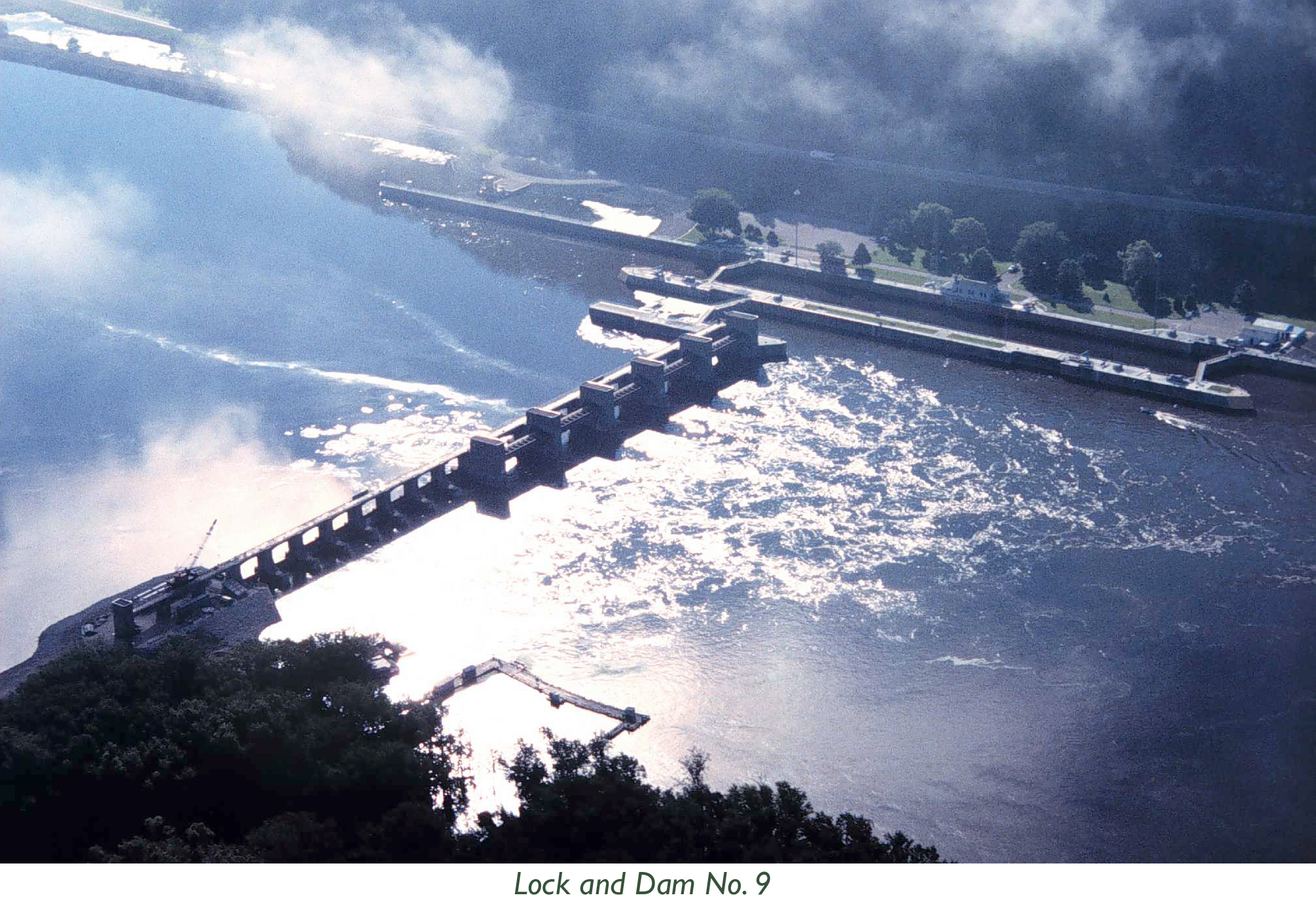
Lock and Dam No. 9, a few miles south of Lynxville, Wisc., was built in 1938 and cost $4.7 million. It runs about two miles across the river from Iowa to Wisconsin, beneath the woodsy bluffs that mark the course of the river.

The Sierra Dawn is churning upstream along the 9-foot deep channel cut close to the Wisconsin shore. Further west, the river cuts through a maze of channels and islands that create an unnavigable morass of sloughs and shallows.

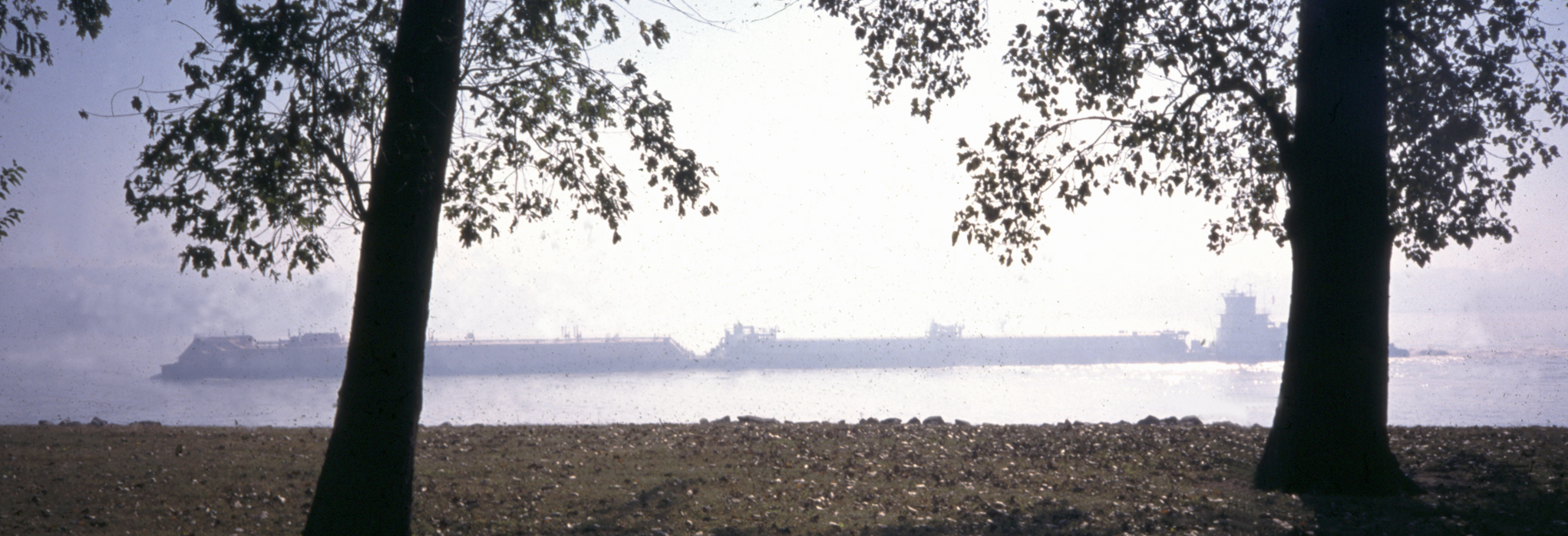
The Sierra Dawn is one of those four-story high, white painted vessels known as towboats, although the name is clearly a misnomer: It pushes rather than pulls. Imagine, instead of towing a boat-trailer behind your Suburban, you tied 15 trailers together and pushed them up the highway. That is what these towboats do.

And the Sierra Dawn is pushing the full complement of 15, tied together in five ranks each three barges wide. Each barge is nearly 200 feet long, followed by the towboat that is another 150 feet.

With five ranks of barges and the towboat, the whole assembly stretches up the river for a quarter of a mile, aimed rather than steered up against the current.

The size is immense. Each barge weighs 15,000 tons and altogether, the raft of them weighs in at 22,500 tons and carries 6.8 million gallons of cargo. Each barge holds the equivalent of 15 railway cars and one tow unit equals  more than two full-length freight trains.

It approaches the lock, which is only 600 feet long, a thin channel only  feet wide, a well-worn and scraped concrete canyon right beside the shoreline.

The barge-and-boat freight train slows and inches into the slot of the lock, with its deckhands speaking to the pilot in the towboat’s wheelhouse via walkie-talkie. It slows to a near halt just before bumping the north end of the slot and a lockworker tosses a small line to the bargehand, who attaches it to a hawser and has it hauled up and hitched to a kevel — one of those anvil-shaped cleats — on the lockside.

It grinds and moans as the rope stretches and tightens around the metal. It sounds like the groaning of a horror-movie door, although with the sound-volume of a chain saw.

Obviously, the boat assembly is too long for the lock, so the first nine barges are separated from following six and the towboat, which inch back out of the lock.

This is a slow and tedious process. Those of us in the lookout tower watching the event have plenty of time to take in the other happenings on the river.

Out toward the middle of the stream, a flock of 50 or more ducks sits in a crowd, floating on the water, pulled slowly by the current downstream. The flock drifts dangerously close to the spillway of the dam, where the current speeds up and drops over the edge into the rapids just below the dam.

But just as the ducks look like they are goners, the few closest to the havoc skitter forward into the middle of the flock and settle down once more, floating backwards again.

Over and over the nearest three or five birds splash their way up in the flock, spinning a rooster-tail of water behind them as their feet catch in the water.

During this little comedy, the locks close on the nine separated barges and the water level rises to match the upstream level.

The upstream gates then swing open and spectators wonder: How will they move the barges without a towboat attached?

Well, a lock worker drags a heavy steel cable back with a Cushman vehicle — like a golf cart — along the top of the lock to a point about halfway down the bargeline, and with a talent worthy of a Will Rogers, swings it over the side and loops it around a kevel on the gunwale of the barge, yanking it shut like a rodeo cowboy roping a steer. A winch at the far end of the lock begins moving the barges out of the slot.

As the last barge passes under us, I can see one deckhand, dressed in overalls and a bright orange flotation device, sitting on the deck at the back of the barge, his legs stretched straight out. He is relaxing, smoking a cigarette.

“Where’s these barges from?” I yell down to him.

“St. Louis, I guess. I got on at Rock Island.”

The morning had been foggy on the river. I asked him about that.

“Yep, we had to tie up about two last night and didn’t start again till nearly noon.”

He floated right on past us.

Normally, towboat crews work smaller sections of the river, and sign up for a 30-day-on and 30-day-off schedule.

“What’s in the barges?”

“Fertilizer.”

So far, this has all taken a little over an hour. It is excruciatingly slow.

When the loose barges are tied up north of the lock, the gates close upstream, the water level lowers once more and the downstream gate opens for the second  half of the train.

It churns into the lock a slowly as glacier. There is not two-feet of leeway on either side.

The flat fore-end of the lashed barges creates a series of artificially straight bow waves that move up the slot of the lock like the waves from a wave generator in a demonstration box.

And not seven feet in front of the tons of rusty creaking steel swim two tiny mallards, as though oblivious of the doom crashing down on them. They swim, waggle their tails, plunk their heads under the surface and shake their beaks free of water, always just that little step ahead of the barges. It almost looks as if the ducks are towing them.

The gates close, the water rises, the gates open and the front and back halves of the barge assembly are once again rejoined. The whole process takes over two hours. Another raft of barges heading south is waiting for the lock to clear so it can have its turn.

Lock No. 9 goes through this process about 6,000 times a year. And there are 28 other locks along the stretch of river between St. Anthony Falls in  Minneapolis and the mouth of the Ohio River at Cairo, Ill.

Below that, the river flattens out and flows naturally.

As the towboat chugs its way out of the lock, a half-dozen seagulls swoop in behind it to see what might be edible in the churn of the wake.

To be continued

Part 3: Becoming a great river

The Grand Canyon is 277 miles long, and one of the most spectacular sights in the world. But the Upper Mississippi River runs through its own spectacular canyon nearly three times as long.

Perhaps most people don’t think of the Mississippi as a canyon river, since what first springs to mind is the flat agricultural land of the Lower river — the cotton fields of Mississippi or the levees of Louisiana — but from Minnesota to the mouth of the Ohio River, the mighty river courses down a canyon bordered by rocky bluffs on either side.

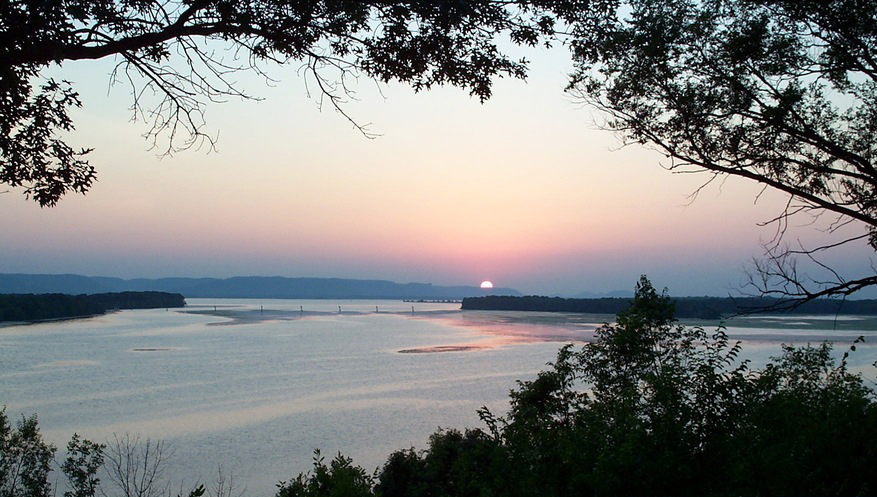
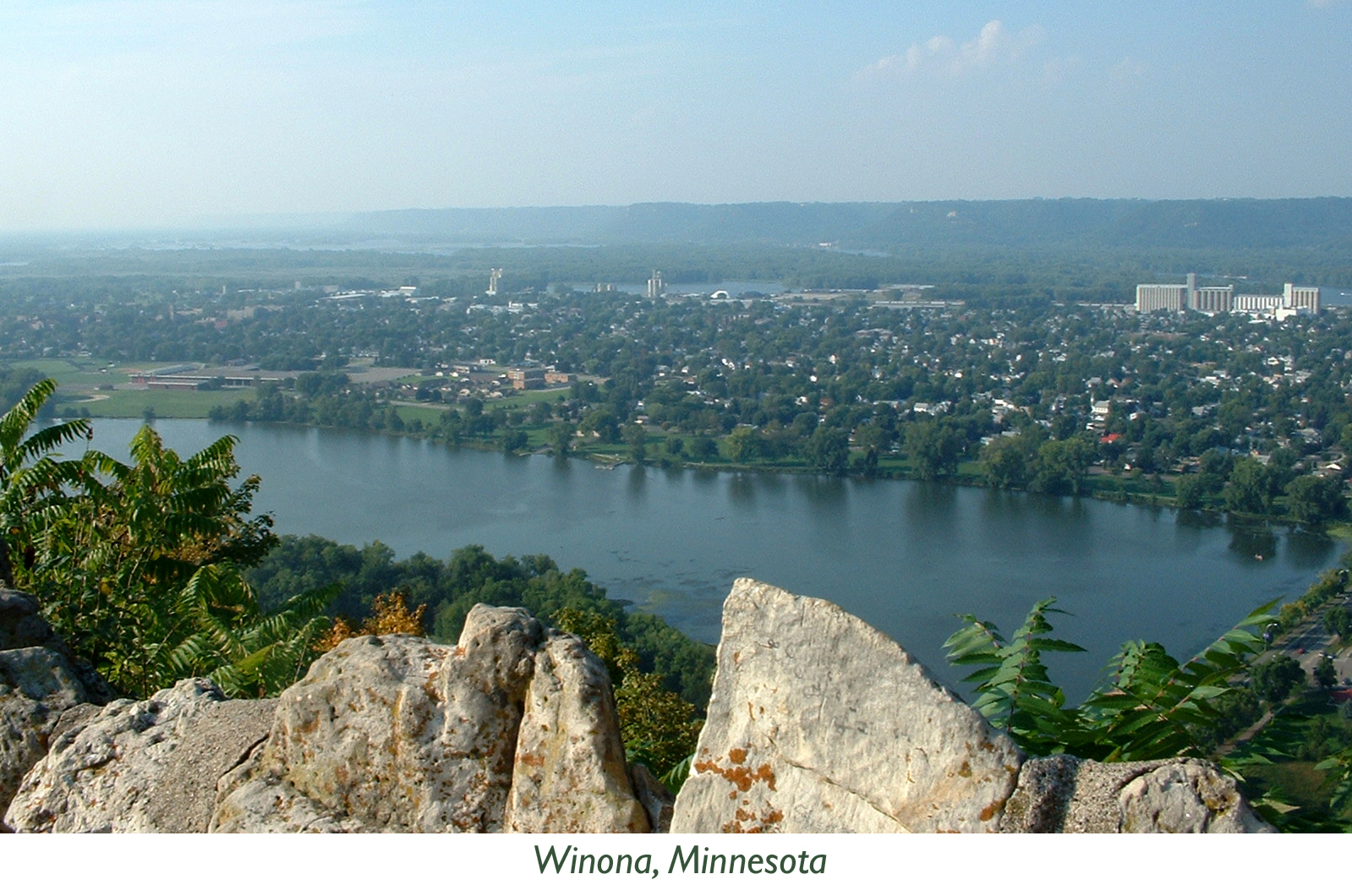
The bluffs over Winona, Minn., for instance, look like mountains in the early morning mist, something from a Chinese painting hanging there over the town. They are not actually that high — only a few hundred feet — but in the exaggeration of the mist, they might as well be Rockies.

On the top of one of those bluffs, south of La Crosse, Wisc., you look out over the placid river and there’s a skin of fog that blanks the river from your face and all you can see is the top of the bluff on the other side. Trees run up their sides, and at the top, is the beginning of endless farm land.

“The majestic bluffs that overlook the river, along through this region, charm one with the grace and variety of their forms and the soft beauty of the their adornment,” wrote Mark Twain in his Life on the Mississippi. “And it is all as tranquil and reposeful as dreamland, and has nothing this-worldly about it — nothing to hang a fret or a worry upon.”

In the autumn, nearly every day begins with a thick fog filling the bottom of the canyon like bisque in a bowl. Sometimes it doesn’t burn off till 2 in the afternoon.

When the mist does burn off, the clouds reflected in the calm water seem to be twice as deep as the surface. They are ghosts of clouds on the surface of the water that mottle its color.

The opposing bluffs are in places as close as two miles and elsewhere,  as near St. Louis where the Missouri joins the Mississippi, they are as far apart as 11 miles.

Between the two palisades the river meanders from bank to bank, a mazy, braided stream that creates shallows, sand bars, reefs, islands and channels. Before the river was dammed and controlled, the constantly shifting channels gave river pilots fits. The education required to run a steamboat packet up the river is retold in Twain’s book.

It was a river, he wrote, “whose alluvial banks cave and change constantly, whose snags are always hunting up new quarters, whose sandbars are never at rest, whose channels are forever dodging and shirking, and whose obstructions must be confronted in all nights and all weathers without the aid of a single lighthouse or a single buoy; for there is neither light nor buoy to be found anywhere in all this three or four thousand miles of villainous river.”

The dams brought a change to that. Now the upper river is in part a string of placid lakes, between which the watercourse wanders in willow thickets and island labyrinths.

The seasons also bring change to the river, which is always either rising or falling. In spring, the river is usually highest; in late fall, the most shallow.

But even at its lowest, the river has a channel 9-feet deep and 300-feet wide maintained by the Army Corps of Engineers. Towboats lashed to their barge rafts churn up and downstream constantly. Twain would have been astounded.

From the beginning of its American history, the river was a commercial route and towns sprang up along its banks. Steamboats ran up and down the waters with the regularity of freight trains and the regular trade kept the towns solvent.

In 1834, 230 steamboats and 4,000 flatboats were listed on the Mississippi alone. In 1853, St. Louis had 3,307 visits from steamboats, exclusive of the daily mailboat.

Along the banks there appeared such towns such as Davenport, Rock Island, Burlington, Keokuk, Quincy and Memphis. Boats carried skins and lumber from the north, grain and meat from the central region, coal from Ohio — all heading south to New Orleans. Northbound boats carried cotton, sugar, molasses and a host of raw materials for the factories of the north.

But history, the westward expansion and the railroads have changed that. What had been north-south river traffic before the Civil War, afterwards became east-west rail traffic. The towns along the Upper Mississippi shores shriveled and shrank.

Boats that made whistle-stops at every small town disappeared and the large rafts of barges took over, with point-to-point cargo service that hit only the larger cities.

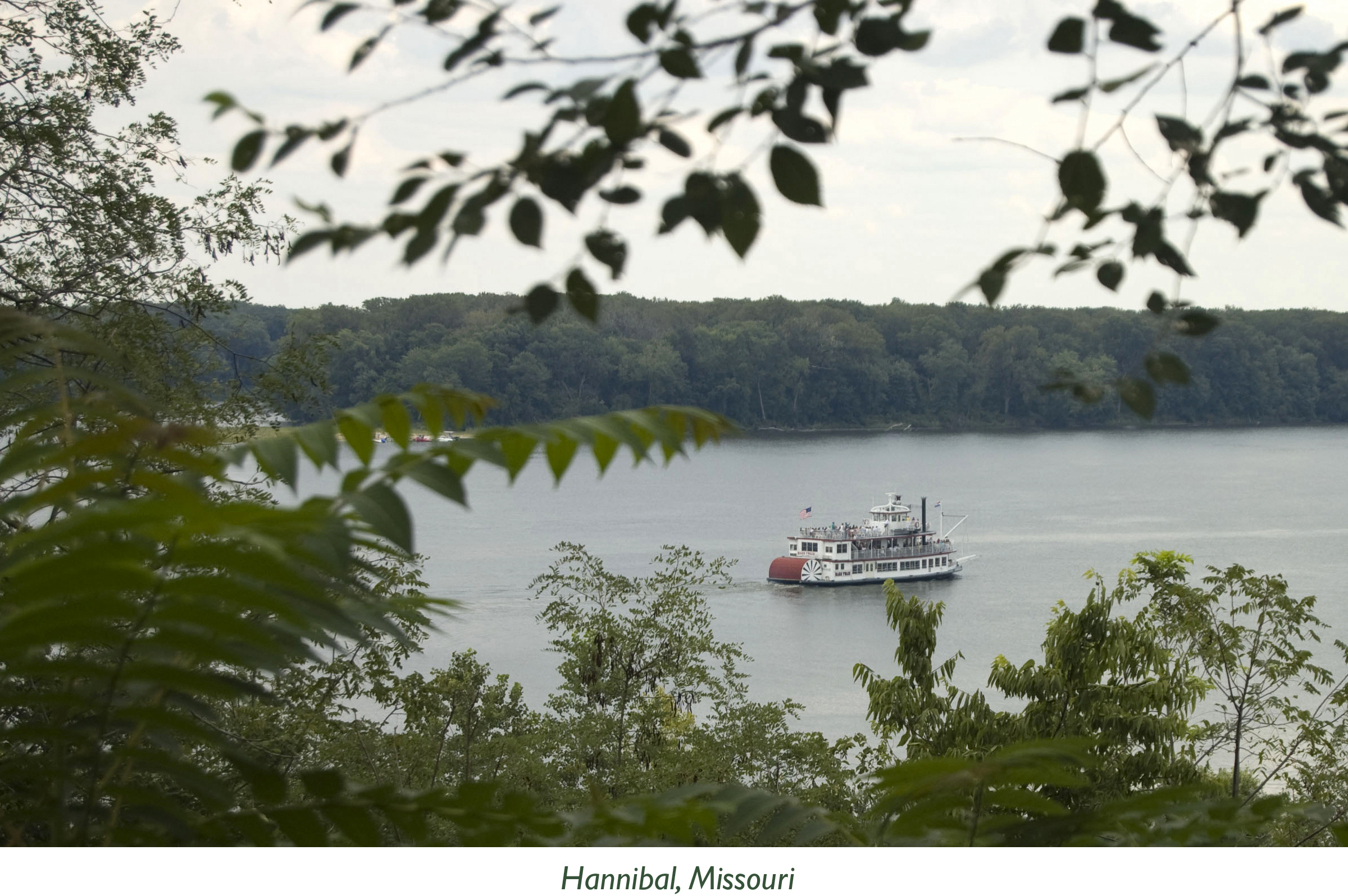
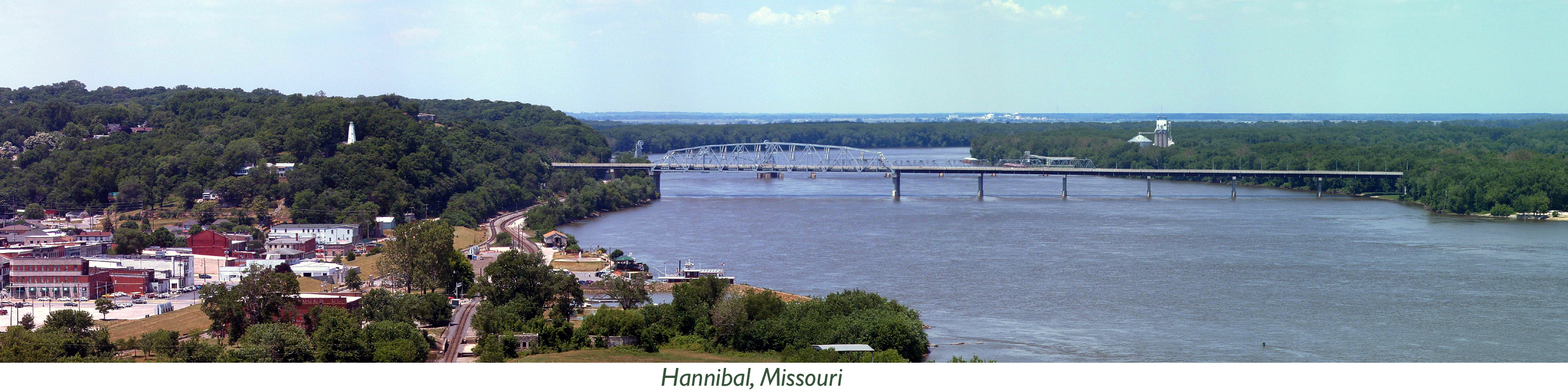
You can see the effect in towns like Dubuque, Iowa, or Twain’s own Hannibal, Mo.

The old part of town is built down at the bottom of the bluffs along the waterfront. Old houses with graceful 19th-century architecture inhabit the decaying grid of streets. Often the buildings are abandoned, with missing window glass and crumbling brickwork.

In the best places, like Dubuque, the cities are still nostalgically beautiful. In the less lucky, more windows are boarded up than open.

And in all of them, the road to the top of the bluff behind the city tells the tale of modern America. Dubuque by the river may be picturesque, but on top of the bluff looking down on the town, there are strip malls, KFCs, Burger Kings and car dealerships. The town is on two levels, and two degrees of esthetics.

But also from the top of the bluffs, you get the real sense of the river as a canyon. For the bluffs are only one-sided. There is no crest and back side to them: On their top, they stretch out in an infinite plateau of rolling farm country.

One moment, you are driving through a landscape that could have been painted by Grant Wood, the next, you descend to the river and corn or wheat gives way to silver maple and thick alder and willow tangles.

To be continued

Part 2: The Upper Mississippi

It is the third largest river system in the world by area; it is the fourth longest. It drains all or parts of 31 states and two Canadian provinces and is one of the busiest commercial waterways on the planet.

It is Ol’ Man River and it is the Father of Waters, and its central branch, running from Minnesota to the Gulf of Mexico south of Louisiana, is named the Mississippi. The muddy river is the “strong, brown god” of T.S. Eliot and for Mark Twain, it was “too thick to drink, too thin to plow.”

Huckleberry Finn floated down it on a raft; I drove its length. Huck had the  advantage: Floating on it, he could always see it but driving along it, its waters were a rare sight. The road darts in and along the riverbank only intermittently, giving the traveler the same sense of the river’s power that one gets from the sun breaking through a sky of clouds.

Not counting its larger tributaries — the Ohio and Missouri rivers — the winding Mississippi is 2,350 miles long, although it covers only a little more than half that distance as the crow flies. “If you will throw a long, pliant apple-paring over your shoulder, it will pretty fairly shape itself into an average section of the Mississippi River,” Twain wrote.

Most writers divide its length into three characteristic sections, and so will we, as we follow its course for the next several entries.

The first section is commercially unnavigable and runs from its source to Minneapolis; the second runs through 29 locks and dams from Minneapolis to St. Louis; and finally, the river reaches its full maturity from there to New Orleans and on to the sea.

Above Minneapolis, the river describes a question mark, curving from Lake Itasca north to Bemidji, thence eastward through a series of lakes to Grand Rapids, recurving to the southwest through Brainerd and St. Cloud and finally straight to the Twin Cities, which function as the point below the question mark.

But it is also a question mark because it is not widely known. Unlike its southern reaches, the upper river is quick and clear, flowing like a mountain stream swelled with snowmelt.

At its source, it is less than a dozen feet wide and only calf-deep; by the time it reaches Bemidji, 25 miles away, it has grown to be as wide as a football field.

By Brainerd, it is a full-fledged river and as it crosses St. Anthony Falls in Minneapolis — or what used to be a waterfall before it was dammed to make power — the river has earned its reputation as a great watercourse.

The numbers are clear: Before it reaches Bemidji, the river flows at the rate of 100 cubic feet per second; at Grand Rapids, 1,000 cubic feet per second; and at St. Paul, below the confluence of the Minnesota River, 10,000 cubic feet — still only one-half of one percent of the Mississippi’s volume at its mouth.

It is this North Woods river, with lakes along its length like pearls on a string, that runs past dark forests of tamarack and spruce, through Indian lands and the beds of wild rice — “a clean, free little flowage with the innocence and freshness of youth, mostly unblemished by the corruptions of maturity,” as John Madson writes in his book, Up On the River.

The sources of the river’s name are as confusing as the sources of its water.

It is an Indian name, no question, and it most likely is a French corruption of an Ojibway word, “Mis-sipi,” meaning either “large waters,” or “great river,” or “place where water is everywhere.” This last fits the headwaters best, for the forest is filled with boggy lakes and you can’t drive a hundred yards without crossing some sort of stream or passing a lake.

An alternate etymology holds the Indian name for the stream was “Mee-zee-see-bee” or “the father of waters.”

Other Indians had their own names for the river. It might instead have been named Sassagoula, Culata, Nomosi-sipu or Pekitanoui.

And if the river system were named in accordance with our habits of naming others, the smaller Mississippi would enter the greater Missouri north of St. Louis and end there. At Cairo, the Missouri would end as it enters the greater Ohio and it would be the Ohio that passes through the levees as it loops past New Orleans and drains into the Gulf of Mexico.

But the river on which New Orleans was founded was named the Mississippi before anyone had traveled its length. The river that forms at Pittsburgh was named the Ohio and the one that floats past Kansas City and off into the wilderness was named Missouri. It is a fluke of history and nomenclature.

The water’s source is just as foggy. Although Lake Itasca is chosen as the officially recognized headwaters, it is really more true, as T.S. Eliot — who grew up on its banks — has written, “The River itself has no beginning or end. In its beginning, it is not yet the River. What we call the headwaters is only a selection from among the innumerable sources which flow together to compose it.”

Or, as Walt Whitman wrote, “time beginningless and endless.”


To be continued

Part 1 The lie at the start

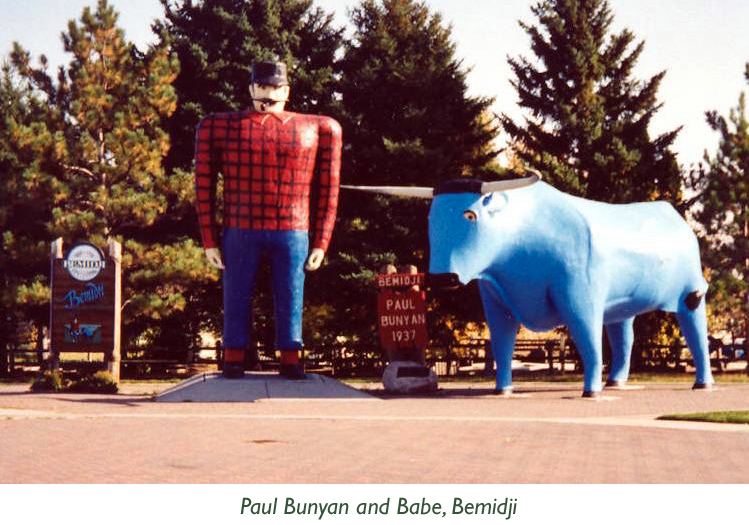
The Mississippi River begins with a lie. This probably shouldn’t be surprising, since it begins in the land of Paul Bunyan and Babe the Blue Ox. One should expect some tall tales.

But the layer upon layer of distortion, misunderstanding and outright fib is quite astonishing.

The Mississippi is widely accepted as beginning at Lake Itasca in northern Minnesota. It is a smallish lake by the state’s standards, but especially attractive, surrounded by a state park that was established in 1891; the land  has been protected for a long time.

A Minnesota tourism brochure gives one origin of the lake’s name: Itasca was the daughter of the mythical Ojibwe Chief Hiawatha. She was stolen by the ruler of the spirits of the dead to be his bride and live in the dark underworld. Her tears, shed in sadness for the world she was forced to leave behind, flowed together, forming Lake Itasca and poured out into the mighty  Mississippi.

A very pretty tale, but a complete fabrication.

The Paul Bunyan version says that a gigantic water wagon pulled by Babe sprung a leak and created Lake Itasca.

In reality, the lake was formed by the retreat of glaciers and was named by its supposed discoverer, Henry Rowe Schoolcraft, who, in the early 1800s was one of an army of “discoverers” out to find the headwaters of the great river.

Schoolcraft had once accompanied an expedition led by Lewis Cass as Cass searched for the “true source” of the river. Cass discovered one of the thousand lakes in the area that feed into the river and named it Lake Cass and pronounced it the source of the source of the Father of Waters.

Twelve years later, in 1832, Schoolcraft, in the Indian Service, came back to Minnesota and took it on himself to prove Cass wrong and take the honor for himself.

He was only one of dozens searching for the mythical “source:” Father Louis Hennepin, Antoine Auguelle, La Salle, British surveyor David Thompson, Zebulon Pike, Giacomo Beltrami, among others, each claimed at one time or another to have found the “true source.”

At least one explorer published findings that later turned out to be pure fraud: He had invented a lake and claimed supremacy for it.

There was a veritable frenzy of adventurers looking for true sources at the time: Explorers looked for the source of the Nile, of the Amazon, of the Congo. Just a few years before, Lewis and Clark had traveled to the source of the Missouri. It was in the air.

Well, Schoolcraft knew from his earlier expedition, that there were feeder streams to Lake Cass. He figured he could ride up one to find the ultimate source. He persuaded an Ojibwe Indian named Ozaawindib to take him to a lake he had heard of that the Indian had assured him was the real source of the river. Together they went and found it and Schoolcraft named it Itasca, compounding the name from the middle syllables of the Latin phrase, “Veritas caput,” or “true head.”

So much for the Indian princess.

Ah, but the shenanigans have only begun. Schoolcraft slyly ignored the fact that there are feeder streams entering his own choice for the ultimate lake.

“They are too small to count,”  Ozaawindib told him. Schoolcraft said he took the Indian’s word for it and never bothered to check out the feeder streams.

This was the same mistake the dozen other adventurers had made, and their claims had all been superseded by Schoolcraft’s. Schoolcraft turned out to be lucky and although his claim was no better researched than anyone else’s, he had the good fortune ultimately to be accepted.

Schoolcraft wrote a book about his adventure and claimed the credit for the discovery, ignoring the fact that it was Ozaawindib who knew about the lake and guided him there. Perhaps Ozaawindib should be credited with discovering the source of the Mississippi.

But the real lie is that there is a source to any river, let alone one as huge as the Mississippi. The river is more in the nature of a giant old oak tree, and who is to point to one twig end of one branch on one bough and say, “This is the beginning of this oak tree.”

The fact is, the river is not a single course, but the confluence of thousands of branches that eventually coalesce into the great muddy trunk that dumps into the Gulf of Mexico.

It is only an accident of history that the river that ends at the Gulf isn’t called the Ohio, which contributes more water to the river than the Mississippi and Missouri combined; or called the Missouri,  which is by far the longest tributary and, if the river system had not been discovered piecemeal, would have been the Mississippi from Montana to Louisiana. By rights, the headwaters of the Mississippi could as well be declared in Yellowstone National Park.

The weak sister of the three largest branches, flowing from the north and Minnesota, is only by default the Mississippi.

But there is still one more delicious lie in this tale.

For it turns out that the beautiful cascading waters that spill over the rocks at the edge of the lake are also a fabrication.

A hundred years after Schoolcraft claimed its discovery, a park superintendent took it on himself to improve reality. It turns out that the lake outlet was a swampy, muddy morass, only gradually sorting out into a stream.

“Since the water is sluggish at this point,” he wrote in a report, “all the debris and wild grasses form there. This is, indeed, a sight that is not becoming to such a great river.”

His idea was to make a hidden concrete dam that would direct the flow of water through a channel he wanted to dig.

“It will take 2,000 loads of sand and gravel. I can say our river can be built up to a point of beauty and also have the running effect of water that will really make it the Source of the Father of Waters.”

So, with the help of the National Parks Service and the Civilian Conservation Corps: A new route and channel for the first 2,000 feet of river was created; some 40,000 cubic yards of fill coaxed the water to flow in the channel; 16 acres of trees were planted “so grouped that their ultimate growth will produce a naturalistic effect;” and a concrete dam was built to stabilize the flow, with rocks placed on top to make it appear natural. These are the present headwater rocks that so many visitors tiptoe across each year.

To be continued

When you look at the pictures in those glossy travel magazines, it is always sunny in Aruba.

I don’t understand this obsession Americans have for sunshine and blue skies. Sunlight blands out the world and obliterates every mystery.

But weather is what gives a place emotional resonance. If you travel through a location for the first time and there is a thunderstorm, then, in your mind, it is always raining there. I had that experience in the flats of southern Minnesota, where it must have rained 10 inches in a half hour. I have not yet been back, so, I naturally assume it’s still raining in Pipestone.

And even when you have visited a place as often as I have visited the Great Smoky Mountains National Park, it is the constantly changing weather that most clearly defines the place.

I’ve seen the Smokies in sun and rain, in haze, drizzle, and shimmering in summer heat. I’ve seen it crystalized in ice, with each tree jacketed with a solid sheath of glass. I’ve seen the foggy snow clouds rise up from the coves to sugar the ridge crests and I’ve seen the dark diagonals of rain drop from the sunbrightened clouds to the north, while I sit dry and warm at Newfound Gap.

In short, the Smokies are weather.

And this most recent visit gave me something new once more.

I entered the park from the Tennessee side, driving up Little River Road from Townsend. The road follows an old logging railroad right-of-way along the Little River, which is perhaps even too little to be called a river.

It is only a creek, but it has gouged out an impressive gorge through the hills on the northwest side of the park. The road winds erratically along the stream path, around knolls and into coves, always with a slope of greenery above you.

At 6 in the morning, there were no other cars on the road, although I would have had a hard time seeing them if there had been. The route was whited out in fog, yet a peculiar kind of fog that was of uniform density, so that no matter in what direction I looked, I could see about 60 feet.

So I drove upstream in what I called a “sphere of clarity” with a diameter of 120 feet. It was a ball of visibility and my eye was at its center. It moved with the car, always unfolding new scenes before me and closing up those behind.

And what is more, it was a green fog: Everything was colored by the light reflected from the leafy forest above and around, making the scene soft-edged, mossy and wet with dripping dew.

Beside the road, the creek cascaded downhill  with boulder breaking up the water into white rapids overarched with willows and witch hazel. When I pulled into a turnout and got out of the car, I could hear the squawk of crows and blackbirds over the roar of the stream.

Little River Road eventually turns away from the stream and up and over Sugarland Mountain and into the main part of the park, where it joins with U.S. 441, or Newfound Gap Road, which crosses the crest of the Smokies into North Carolina.

The road climbs steeply up the north side of the mountains. At one point, it even circles above itself in a great corkscrew called The Loop. The highest point on the road is Newfound Gap, at 5,048 feet.

Here, there is a view both north into Tennessee and south into North Carolina. Or, there is sometimes a view.

On this trip, the sphere of clarity lets me see only a portion of the parking lot and a red spruce tree growing just on the other side of the stone wall that bounds the road.

That and my own frosty breath.

In such weather, it is easy to notice how limited your vision is. Sometimes the air is so clear, your sphere expands to the horizon and you don’t notice it.


We hear the phrase, “dead white guys,” a lot these days. It disparages a good deal of what has been taken for art and culture for the past 2000 years or so.

Now, we hear instead of women’s art, Hispanic art, Native American art. Identity, whether by gender, race, religion, nationality or even political outlook has splintered the culture, and what was once “universal” is now merely men’s art.

So, if we take there to be such a thing as men’s art, I wondered what that might be.

Surely that is what the rising tide of feminist art criticism tells us: That the so-called “canonic” art of the art history books and the institutional museums is biased in favor of colonialist, patriarchal and, well, male art.

It is seen as aggressive, competitive and with an undue emphasis on what has been labeled “quality.”

In this instance, “quality” is used as a shibboleth to exclude artists of color and gender.

And I would have a hard time arguing the reverse.

Through history, most artists recognized in the West — and by that I mean European artists — have been men.

And the art history texts have conspired to exclude the Sofonisbas and Artemesias, to say nothing of the Angelica Kauffmans and Judith Leysters.

So, if the art world has been a “old boy’s club” it stands to reason that its art must speak for old boys.

Well, let’s look first at what identity art — and identity politics — is all about.

It is assumed, first off, that each person is somehow defined by his race, culture and gender and that an art, to speak for them, must share the race, culture and gender.

I don’t want to argue that at the moment. Let’s assume it to be true.

So, let’s see how that plays out in the art of an artist generally acknowledged to be a woman: Judy Chicago.

Her first notable work was a series called “The Dinner Party” and it consisted of dozens of table settings, each built around a large dinner plate of her own creation. And each dinner plate was decorated with an ornamental vagina. Some looked more like flowers, some like, well, snails, I guess. But each was the female organ.

When they first were shown, at least, the art critics were largely hostile. “This isn’t art,” they all said, “This is a joke. Where is the beauty? Where is the craftsmanship?”

Well, they are fairly widely accepted as art now. I don’t know what else they would be. They aren’t Haviland china, that’s for sure.

Chicago’s feminist supporters declared that since the critics were, for the most part, men, they were prevented from understanding what made “Dinner Party” art.

And they also explained that what made them “women’s art” was the joining of the generative organ with the symbol of nurturance, the food that the woman prepared for her brood.

I’m making the argument particularly blunt, because, after all, I’m a man and wouldn’t understand otherwise.

On something of the same level, there must be something that counts as men’s art, that features symbols of male virtues. And here, I’m speaking of white male virtues, because black male art has its own niche filled not only by such historical luminaries as Romare Bearden and Jacob Lawrence. Or the more modern Jean-Michel Basquiat.

Or, in literature, think LeRoi Jones.

This whole problem is easier to understand, I think, if we use music instead of painting.

If you are Jewish, you have klezmer music;

If you are black, you have the blues

If you are white, you have the famous “dead white guys” — people like Brahms, Beethoven, Mozart.

What, after all, does Mozart have to say to a home-boy in the streets of South Central L.A? What does he care about proportion, harmonic rhythm and sonata form?

He has his rap music that speaks to his condition much more directly.

To his life, Mozart is irrelevant.

Or, let’s think of Beethoven and his Fifth Symphony. It used to be said always that the Great Art, with a capital “A” was universal, that is spoke for all mankind.

But what does a symphony orchestra mean to that same homeboy? Tuxedos? Money? Privilege?

And to a woman? Beethoven is badgering, hectoring, aggressive. It’s a constant wham-wham-wham of tonic-dominant forte chords.

Beethoven is men’s art, if ever there were such.

It is an art about hammering out a place in the universe, hammering out meaning.

Where is the grace? where the gentleness? Can Beethoven be said to be, in any sense, “nurturing.”

The recent spate of pop-psychology books telling us that men are from one planet and women from another would have us believe — and I’m not so sure it isn’t true — that women have a whole different way of processing information.

Women cooperate, support each other and generally attempt to create community and consensus.

Men play a life-and-death version of “king of the mountain.” They are inordinately concerned with who’s on top and where they might rank in the society. They are concerned with competition, with besting the other guy and proving they are the biggest damn gorilla on the block.

Sounds like Beethoven to me.

Who else might count as a male artist?

Michelangelo, with his “divine spark” and ranks of angels.

David, with his morality tableaux and ranks of nobles.

Picasso, surely, for his biography tells us he hated women.

And actually, almost everything in your standard Janson art history text.

The men are interested in manipulating things, altering the environment, creating a rigid social order and making “quality distinctions” that rank the artists’ products.

It is men who tell us Van Gogh is great and that Fantin-Latour is less so.

It is men who tell us Judy Chicago shouldn’t be taken seriously.

It is men who tell us that Beethoven is universal.

After all these years of so believing, I have come to question these assumptions. Perhaps Beethoven is really very provincial and speaks to white German males. Maybe that is why Debussy hated him. Maybe Wagner really does speak for the anti-Semitic; maybe Sibelius speaks only to the Finns.

As evidence for this I search myself.

I come from a Norwegian background. And sure enough, I feel something special, something very personal when I watch a Bergman film. I love a lot of cinema. Fellini is a dear; Kurosawa moves me to tears. But Scandinavian Bergman speaks to me as without a middle man; His images and words pierce directly to my heart and make an effect even before they reach my brain.

There is something perhaps even genetic to this. I recognize those iron-grey skies in his films, those tight-lipped volcanoes raging inside with never a ripple on their surface. That icy intensity is what rages through my own veins.

What doesn’t rage through my veins is the extroverted menagerie of Fellini. His Adriatic sun is not the midnight sun. Even his most sarcastic satire is optimistic. Just the opposite in Bergman, he sings with Brahms, “The grave is my joy.” There is something quintessentially gloomy about Scandinavians.

Lest you forget, the old Norse mythology is the only one, at least as far as I’ve ever found, wherein good battles evil and evil is predestined to win. The good gods will die.

I feel something of the same bleakness in Sibelius — less so in the Norwegian, Grieg, but that has more to do with his cosmopolitan leanings.

Think of the painter Edvard Munch — now there’s a cheerful guy.

The deal is that if your name is Abromowitz or Kelly or Riportella, you may not have that same blood-bond with Bergman. You may feel it for Fellini, or Rossini; or for Chaim Potok or klezmer music.

If you are black, you may feel that blood-tie to B.B. King or even L.L. Cool J.

And I have no doubt the women who tell us they feel a tie with Georgia O’Keeffe or Frida Kahlo and don’t feel the same with Cezanne or Braque are not merely making political points, but are telling us how they honestly feel.

Which brings us to the black briny problem of isolation. Does this mean that we have to throw out our Rembrandt and Renoir? Do we have to give up on 600 years or a thousand years of art history?

Does identity art render all other art null and void?

Well, the truth is that although I feel that kinship with Bergman, I truly do love Fellini as well. He speaks to me perhaps on a different level, and perhaps even a better level.

Fellini speaks to me not on the blood level, but on the level of esthetics. Even if my relatives are those in “Wild Strawberries” and not those in “Amarcord,” that doesn’t mean I don’t recognize the central core of humanity of the people in it. Fellini makes me believe in his people by force of will and imagination. He makes me believe in them as blood and flesh. He forces me to transcend the tribal.

And whether Georgia O’Keeffe speaks directly to women in a way she doesn’t speak to me I can’t know, but I can know that she speaks to me as well.

There is something in the best art that transcends race, culture and gender.

Sure, there is something on the surface that may speak more directly to others, but there is something in the core that speaks to us all.

It is, of course, that universality that I maligned earlier.

All art, of course, comes out of a culture, all art is made by a man or a woman and those roots must be the starting point. It would be as silly for a Chicano artist to mimic quattrocento Florentine art as it would be for me to write a rap song, but the soil, as they say, is where it starts.

And that soil gives birth to a great amount of art that never transcends its origin. That art can still speak to its nation or gender or color.

Most rap songs will never mean anything to me, although I can recognize in the best of it something genuine and true: Public Enemy is making real art even if others are only making headlines.

And Ditters von Dittersdorf writes concertos that really do appeal only to dead white Germans.

But the best of any art, from anywhere in the world and from any gender can communicate something genuine.

It is that nugget that Beethoven attempted to reach in his Ninth Symphony, for instance. “Alle Menschen werden Brüder” — “All men are brothers” or, in more gender neutral terms, as spoken by Willie Stargell: “We are family.”

So, what does all this mean?

First, that we must keep our ears and eyes open to that universal meaning in all art, whether it is Judy Chicago or Romare Bearden.

Second, we should always recognize that all art comes from a tribe, that white males are only one more tribe — certainly a historically privileged tribe — but that the tribe is the starting line, the checkered flag lies elsewhere.

We should never deny our origin, or attempt to suppress our origin as a seed for the art — the terroir we grow in — but we should always attempt to transcend our tribe and recognize not the differences between the tribes of humankind, but their similarities.

Sometimes, when you’re stuck on the “A” Train between 168th Street and 175th Street — that curve in the subway track that always makes the train squeal like a banshee from hell and you wish to god only dogs could hear it — and there are 43 high school kids riding home from class and making a party on the train at the top of their 86 lungs, and two or three winos are sleeping on the seats, so you have to stand, and you can’t really tell if that twitchy man who got on your car at 145th Street is carrying a knife or a letter opener — sometimes you wonder whether the 20th Century has really been worth it.

If only there were a way to go back in time to the 17th Century, or the 15th, or what the heck, the 12th Century. Ah, but there is. Just tough out the train ride to 190th Street and take the elevator up from the bowels of the station, the elevator pasted with 50 or 60 cute photographs of kitty cats and puppy dogs — and the tag-team New York Transit Authority elevator operators who taped them there and operate the elevator from behind the walls of a corrugated cardboard box “office” they imported into the elevator — and step out into the fresh air of Fort Tryon Park at the northern tip of Manhattan.

It is a short walk through the greenery and over the black basalt outcroppings to the Cloisters.

The Cloisters is a place of cold stone, vaulted ceilings and stained glass, only not stained the way the windows are stained on the “A” train.

Opened in 1938, the Cloisters is a branch of the Metropolitan Museum of Art and contains part of its Medieval collection. It is a castle on the Hudson River on a stony prominence overlooking Dyckman Street. It is a rent in time.

It is a sort of monastery built from sections of 12th and 13th Century French and Spanish cloisters, reassembled in New York City. Inside, you can set in stony silence in a Gothic chapel and watch the play of light on the stained glass windows and contemplate the tomb effigies of noblemen and their wives.

The best part of the Cloisters is that it is so far from the city’s “museum row” along Fifth Avenue that few tourists trouble to make the trip and it is thus one of the least crowded major museums in America.

But the trip will be worth your while. Inside the stone edifice are the famous Unicorn Tapestries, the gargoyled column capitals of the Cuxa Cloister and a boxwood rosary bead no larger than an inch and a half in circumference, but which splits in half and opens into a triptych of carved biblical scenes with more than 40 tiny figures sculpted into it.

I try to visit the Cloisters each time I find myself in New York, usually on the final day of my trip, when I am exhausted by the stress and energy of the great crowded noisy squealing smelly city. The Cloisters is a refuge, a place to regain the center of your being, the unmoving axis of the earth.

You first see the place — or see its tower — as you wind the paths of Fort Tryon Park past the beech trees and the retirees feeding squirrels. They are very fat squirrels.

But there, over the treetops, it seems farther away than it is. As you get closer the path takes you up to a tiny door in the bottom of the castle and you go in, up some stone steps and up to the admissions booth. Pay the fee, get your museum map and step into the 12th Century.

The main hall at the entrance is a modern piece of architecture, but evoking the style of the Middle Ages. It is a tall hexagonal vaulted dome. Off to the side are the bookshop in one direction and the Romanesque Hall to the other.  From there, you can take a side trip to the Fuentiduena Chapel, the St. Guilhem Cloister and the Pontaut Chapter House.

Each of them was collected in Europe, taken down stone by stone, with each piece carefully numbered, shipped to New York and rebuilt as part of the sprawling museum. In some cases, the originals were in ruins or only partially surviving and the museum has fleshed out the missing parts in the proper style.

On a cold October day, the sandstone is icy to the touch and the low-hanging sun outside throws the shadows of the surrounding trees up against the stained glass, making a second web of leading swaying against the motionless first

There are four things I never miss on a visit.

The first is the Gothic Chapel, which is a modern recreation of an 11th Century chapel, filled out with statues and stained glass. It is quiet as a tomb, and I always find a seat on the stone and sit quietly for 20 minutes or a half hour, waiting for the occasional visitor to pass through and bring me silence once again.

It is hard to believe a place this still can exist in a city this impatient.

In the center of the chapel is the tomb of the chevalier Jean d’Alluye, who died in 1248. On top of the sarcophagus lies the effigy of the knight, with his palms pressed together in prayer and his chain-mailed feet resting on a small stone lion. Jean had been to the Holy Land during a crusade in 1240 and had brought back what he believed was a piece of the true cross. He was originally entombed at the abbey of La Clarte-Dieu, near Le Mans, which he had built in 1239.

The second station of my ritual is the room containing the Unicorn Tapestries. These seven giant weavings depict the hunt and capture of a unicorn and are also allegorical of the suffering and crucifixion of Christ.

The last of these tapestries, the Unicorn in Captivity, is the most popular. A poster of it is sold at the gift shop. The unicorn rests in a circular corral resting on a field of hundreds of flowers, a particular style called “millefleur,” or “Thousand flowers” in French. The millefleur is more stylized than naturalistic, but it does demonstrate a quality that is particularly Medieval, and a quality I especially respond to.

The Medieval mind didn’t care much for artistic unity. They never generalized in their artwork. The later Renaissance loved to make a landscape of generalized trees, although you can never quite tell what kind of tree they mean. In a Medieval piece, like this millefleur, you can name every single plant by genus and frequently by species.

They may sit on a flat black field, but there is the strawberry, the columbine, the daisy, the iris, no two alike.

That same impulse can be found in the next stop, the intimate Trie Cloister, which is open to the weather. A cloister is a garden surrounded by a stone walkway bordered with columns. What marks it as Medieval, specifically Gothic, is that no two column heads are the same. Every one of the 20-plus double columns has a different capital, and they run from tragic to comical.

The ancient Greeks would have been horrified by this lack of unity: They built their temples so that all the columns and capitals matched. The Renaissance that came later was shocked: They, too liked uniformity of effect. They were so put off by the helter-skelter design of the age that preceded them, that they named it Gothic, which is to say, barbarian.

Yet, the profusion of styles all yoked together gives the impression of profound fecundity. The Medievals lived in a world made vivid by its variety: the wealth of animals, of plants, of social classes, of biblical stories. There are kings and saints on these capitals; there are dancing bears and demons; acanthus leaves and oak leaves. There are trade union labels and a man in a funny hat.

It is a sense of rich profusion, and one I find myself deeply sympathetic towards, which is why the cloister is a mandatory stop, again for 20 minutes or so, to soak it all in, like a deep breath of air.

The final required stop is the herb garden. I am a sucker for herb gardens,  especially the highly regimented kind that the Middle Ages were so fond of. The herb garden at the Cloisters is in the form of a cross, with beds of herbs surrounding the four central quince trees.

In October, the quince are ripening to a mottled yellow, looking something halfway between apples and pears. Their subtle fruity smell is exquisite.

Whenever I find myself in an herb garden, I always nip off tiny bits of the leaves and crush them between my fingers under my nose. The smell of the lavender, sage, thyme, borage or camphor wakes up that olfactory sense that you do your best to put to sleep in the grimy downtown.

It is for me, as it was for the Medievals, as perfect a model of Paradise as can be found on earth. Paradise is a Persian word for garden, and it is only proper that our culture has taken it over to name the single plot of earth that remains unmolested by the clutter, noise and ambition of the everyday world we inhabit.

There are dozens of other attractions at the Cloisters, every one of them worthy of your whole attention. I mention only the tapestry of the stag hunted by old age, which is the equal of the Unicorn tapestries, or the 15th Century wooden pieta, which makes the dead Christ seem more like a lifeless piece of meat than any other pieta I’ve seen, only heightening the pity we feel looking on at Mary’s sorrow.

So, if you are lucky, you can carry back with you into the city some of the stillness of the Cloisters, and until it wears off, hold onto the unmoving center of the universe.