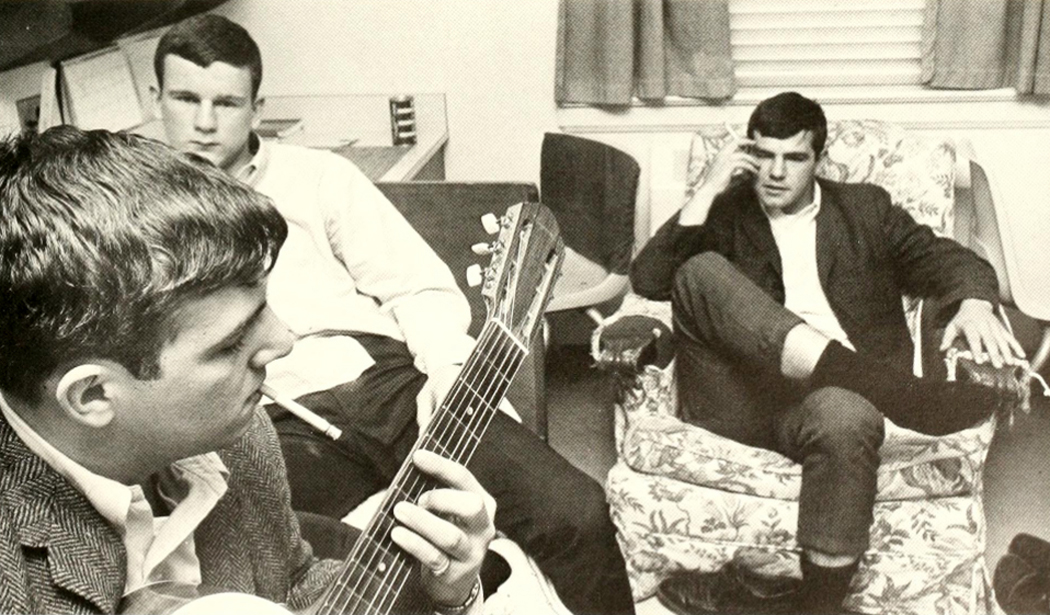
It is early spring in 1967, I’m in college and the country is heading toward the Summer of Love, and in my Shakespeare class we have just been given a pop quiz on, I think, Antony and Cleopatra.

“Well, now you know what my little quizzies are like,” said the professor.
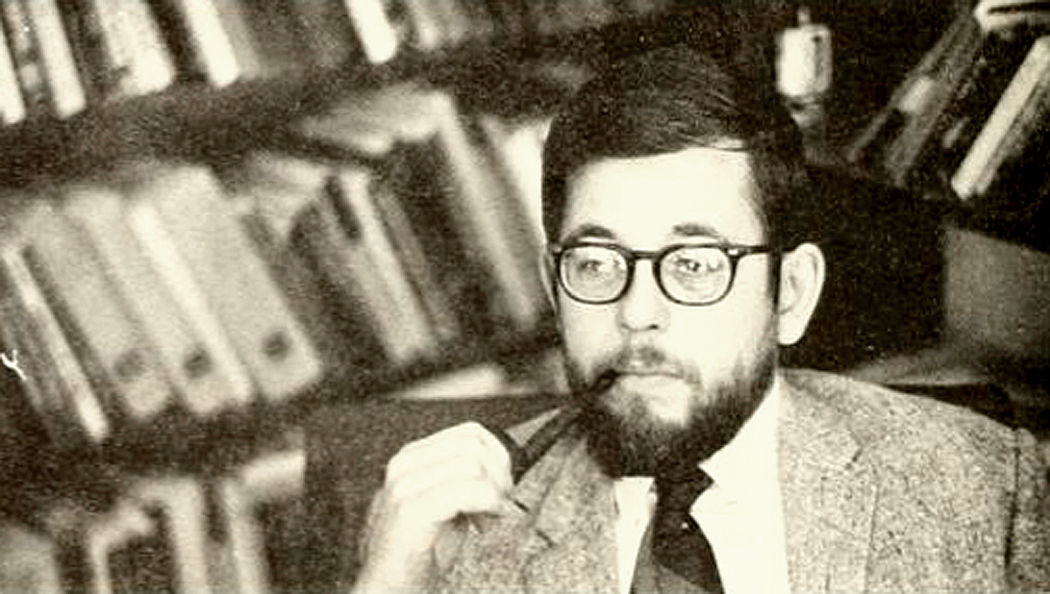
And from the back of class a small, demure student, innocent and unknowing as a lamb bounding in the meadows said, “If that’s what your quizzies are like, Dr. Gutsell, I’d hate to see what your testies are like.”

That is what I remember most from that class. Most of what I know about Shakespeare I learned later on my own. But the small episodes of those years stand out.
Like in an astronomy class. The regular teacher had retired a year earlier and our class was assigned to a very nice and soft-spoken man — everyone liked him — who was a math professor. He didn’t know much about astronomy and was racing ahead of us in the textbook. When he came across something he didn’t really understand, he invariably turned to the smartest student in class, Bill McAllister, and asked for clarification. “Mac, tell us about Uranus.”

I’m not claiming that I didn’t learn anything at college. There were many excellent classes that opened me up. But the information from those has been stored in a different place in my head. More distinct are the bits of condiment that flavored the experience.

The biology teacher was a highly eccentric man who had been teaching forever. Richard Carleton Ward talked with his teeth clenched and out of the side of his mouth, making his every utterance seem both like a snarky aside, and at the same time and exasperated threat. His explanation of sex on campus was: “Some do, some don’t.”

One day, he brought a potted plant to class, and as the bell sounded, he held it up in front of us. “This is the sacred lotus of India,” he said through his teeth. “It sheds water as we are supposed to shed our sins.” He took up a pitcher of water and poured it over the plant, dripping onto the floor, saying to us in biblical voice, “Go forth and sin no more.”

It was 50 years ago — a half century of water under the dam — and it is the quirks of the professors, it is the adventures with fellow students, the petty “crimes” we committed that remain.

Once, Martha Jane Burton and her boyfriend and Mary Winslow and I drove to Washington, D.C. When Martha Jane hinted she wanted some time alone with Tom, Mary and I went out walking. We walked from Georgetown, where we were staying, all the way to the Lincoln Memorial.

Now, I know we were idiots and the walk, at 2 in the morning was suicidal, but we were protected by the angel of fools and had not an unpleasant moment.
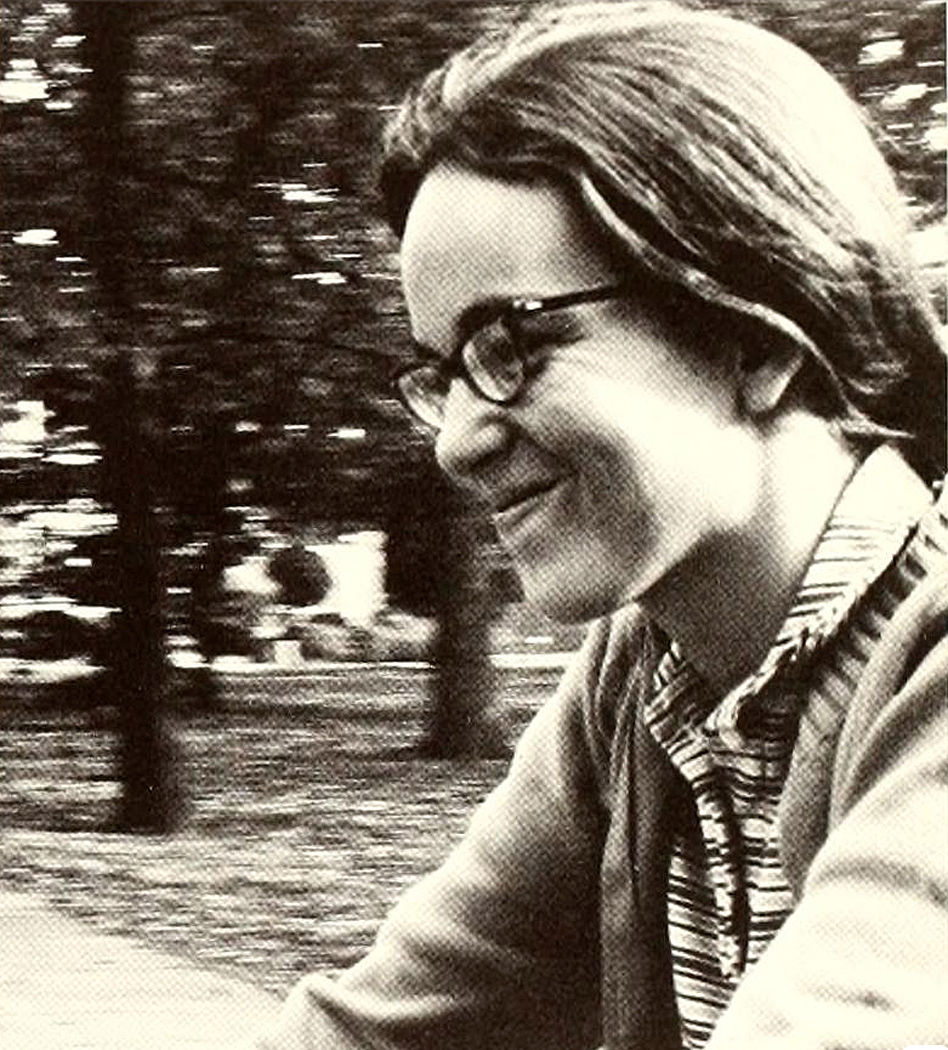
Mary was an athletic sort of girl, a real tomboy who prided herself on her physical fitness. She had once said, “The man who will have my virginity will be the man who can outwalk me.”

We walked a good deal in the wee hours of the morning, and on the way back to the apartment, came across an all-night movie theater that was showing the Pasolini Gospel According to St. Matthew. Mary had never seen it; I had and recommended we stop in. About an hour and a half into the story, Mary fell asleep.

I reminded her, when we got back to campus, that I was now the man destined to take her virginity. “You owe me,” I said. The next day I got an envelope with a note from her; inside was a 2-inch wood screw. “Debt paid,” said the note.
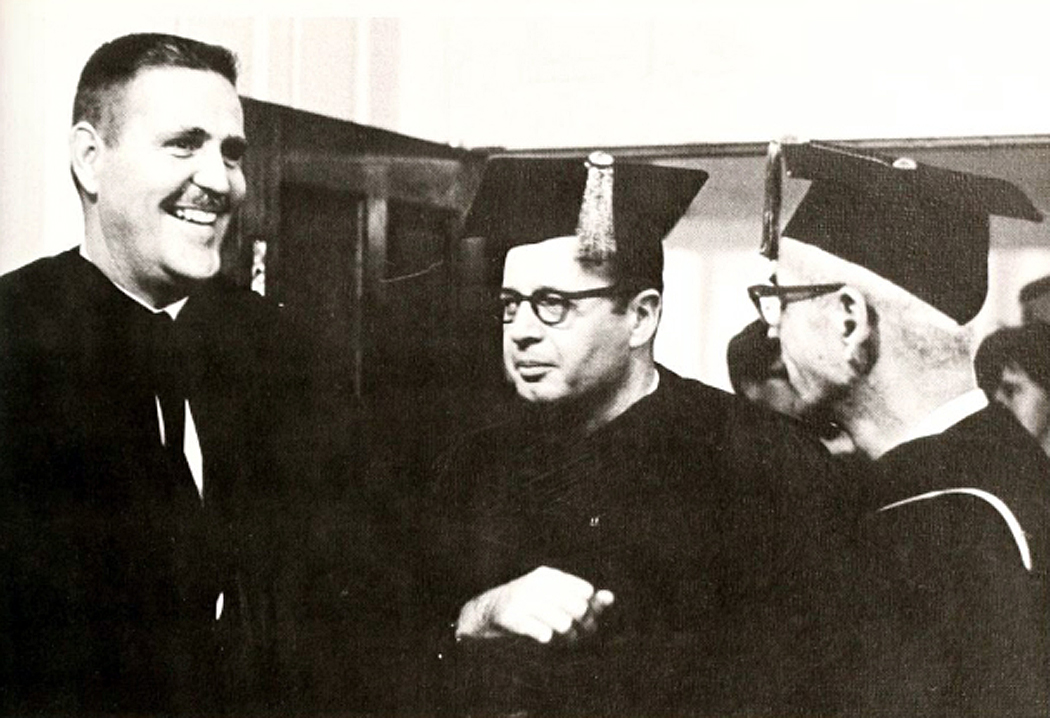
My sophomore year, I took an Aesthetics class with the most august and revered philosophy professor. After a week, he fell ill from an amoebic infection he had picked up in India and the school president, Grimsley T. Hobbs, took over the class. Let’s just say, it was a step down in the intellectual rigor of the course. Hobbs actually taught aesthetics with flash cards. We took turns reading from the textbook (I’m not making this up), and whenever we came across the name of an artist, say, Michelangelo, he’s make the reader stop and we’d pass around the seminar table a picture of Michelangelo. A paragraph or two later, it might be a picture of Leonardo.

“I’ll trade you two Leonardos for a Mickey Mantle,” said one of the students.

It was the era when Timothy Leary was dropping acid, and drugs were first becoming widely available on campus.

Hank Hackett, my roommate for part of this time, smoked constantly. He took one summer off and basically dropped out, and turned on.
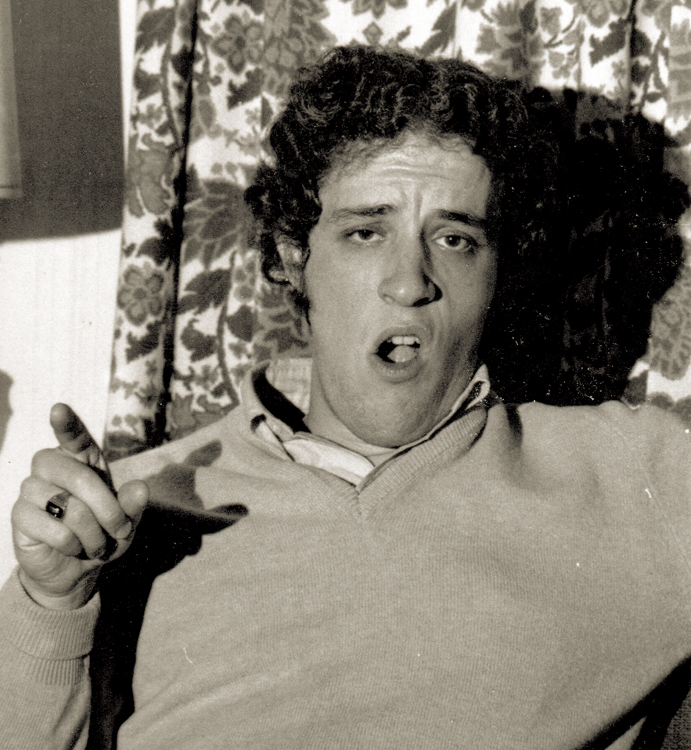
When he came back in the fall, he had something of a glassy stare and perpetual grin.

“Why do you smoke so much reefer?” I asked him.

“Oh, I don’t smoke all that much, just five or six joints a day.”

Another time, Hank bought several packets of garden seeds for morning glory.

“They add something to make you nauseous, so you won’t take them for the trip,” he said. “But I thought I’d see just how bad the nausea is. It can’t be as bad as the high is good.”

But a few hours later, Hank was retching up his innards over the toilet and swearing never to do that again.

One day, Hank came to the house, sat down on the floor and didn’t move for several minutes, and then turned to me and said, “You know, I feel more like I do now than I did when I came in.”

Others took different drugs: Phil Sanders tried smoking Spanish moss one night and went into heart palpitations. He had to be taken to the hospital, where he was too embarrassed about what he’d done to tell the doctors what his problem was. He recovered anyway.

And then, there was Larry Mackie, our campus’s own Timothy Leary. Larry lived downstairs from Hank and me. His bedroom was painted in bright colors, with a geometric mandala in red and green painted on the wall above his bed as a headboard. Larry was a small guy, both short and slight, with a head of blond hair, looking something like a thinner, adolescent Bill Gates. He would wander campus in robes and talk about the religious significance of acid. He had a small but loyal following, mainly women. One night his two girlfriends drove up with Larry in the car barely conscious.

“We went out to the airport to drop acid,” one of them told me. “It was neat watching the lights of the jets as they came overhead and screamed their jet noise.”

This was something Larry did on occasion.

“But then he sat, lotus position, in the middle of the road and wouldn’t move.”

“He said he was enjoying the headlights of a truck move farther and farther apart,” the other girlfriend said. The truck squealed to a halt and the driver came out cussing and threatening. Larry wouldn’t move, so we put him in the car and decided to come back home.”

The downstairs apartment saw a parade of colorful and disreputable types. One was a freak named Jim Nyland, who drove one of those tiny British sports cars. Shortly after he moved in, we noticed a large dark car parked on the road in front of the house. This was unusual because our street was a dead-end. Yet, night after night, there it was, with two men sitting in the front seat.

One day, walking in the vacant lot behind the house, I came across a patch of very healthy, green marijuana plants and things began to fall into place. I phoned the police and reported the illicit weed. They came with a team and uprooted it. “Street value of $140,000,” they told us. We eyed their exaggeration as suspiciously as they eyed us. The car never showed up again.

I remember the last time I voluntarily took mind-altering drugs. Hank had brought to campus some mescaline-laced hashish. At a small party at our apartment on Francis King Street, with maybe 20 others, mostly drinking beer and discussing Kant or Vietnam, Hank and I lit up his tiny hash pipe, with the glowing coal of chemical in its brass bowl. It was the most trippy high I had experienced. At one moment, everything anyone said appeared in a cartoon word-balloon over their heads and when they finished talking, the word-balloon took off like a balloon let go, spinning and making the sound of a raspberry and flying out the window. It was quite an amusing sensation.

At another party, I witnessed a feat of strength I doubt I will ever see matched.

One of the hotshot humanities students and publisher of the underground campus newspaper was Richard Horne, known to his friends as Dick, and here’s why: At this party, he won a bar bet by balancing an unabridged dictionary on his erect penis. He did this as a matter of course. You could tell how far along the party was by whether Dick Horne had pulled out the Webster’s. It was a sight you didn’t soon forget.

In my class of English Romantic Poetry, I met my first wife. Annie was skinny, funny and whip smart. She could say any name or word backwards instantly. In class one day, the professor called on her to answer a question about Keats.

“Don’t look at me, I’m just a girl,” she said. The professor had that made into a needlepoint sampler and framed it.
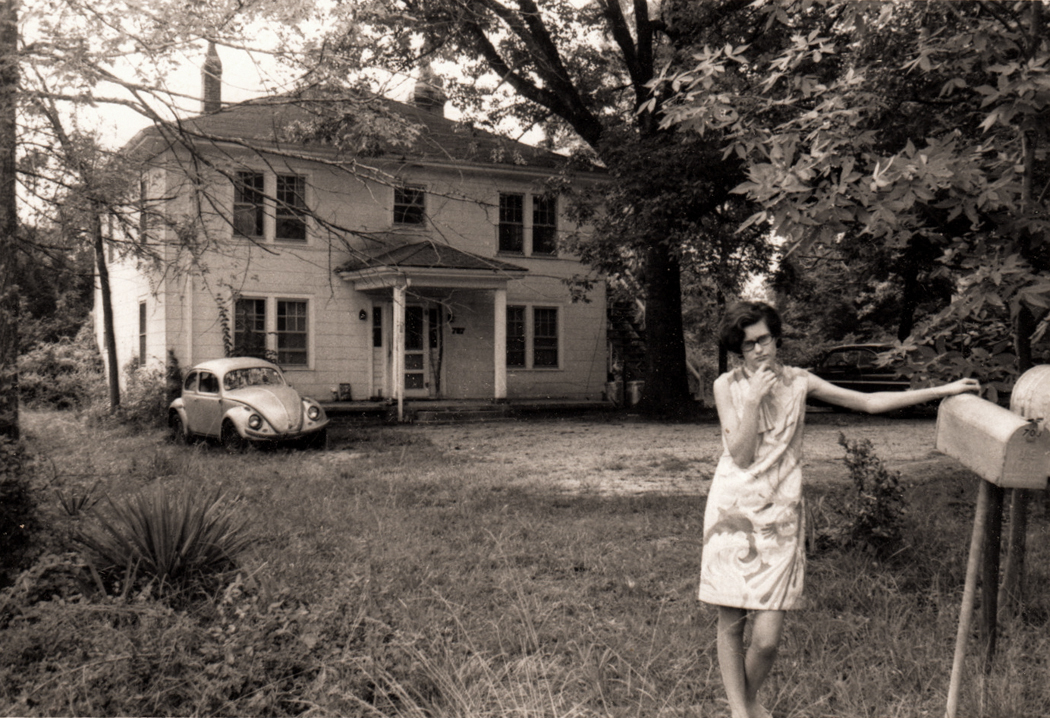
When we got married, we moved into a second-floor apartment on that dead-end street just south of campus. It was a cheap run-down place with only one kerosene heater for warmth. The stairs to the apartment ran up the outside of the house and on frozen, cold days, I had to walk down the icy steps to the oil drum and bring up a gallon of fuel, load it into the stove and light up. It took a half-hour or so for any heat to make itself felt.

The apartment rented for $50 a month, which was a lot for us. Annie bought a book called Dinner for Two on a Dollar a Day, and made up menus from it. We lived very cheaply. It was a wonderful time for me; I was finally a real bohemian. I painted the living room fire orange with deep avocado-green trim. It was hard even to think in such decor.

Annie was from eastern North Carolina cotton and tobacco country. Her mother was not one of my fans. In fact, I think I can state with reasonable confidence that she loathed me. I was not the steady provider and solid citizen she had envisioned for her daughter and besides, I was a Yankee. But she had a saying that I have kept in my heart for lo these 50 years:

“Cheer up, the worst is yet to come.”
Part 1: The Thing

Abstract art has several jobs, but one of the most important is to take the bits of the visual world around us, separate them from their context, and allow us to see them freshly. By removing color, texture, and pattern from their received meaning allows us to pay attention to the building blocks of vision. As if we could take the music of speech and remove the words from them, so only the sensuous vestige remains.

In most of the visual world we live in, we have given meanings to what we see, like seeing the diagrammatic picture of a man or woman on the restroom door. And in “reading” the visual world this way, as a sort of language, we too easily fail to actually see what we are looking at: We simplify and name: That is “green,” rather than “that is the green of kelp,” or “the green of grass.” Two very different greens. And there are thousands of greens. If we abstract the color from its worldly signature, we can place two greens next to each other and force ourselves to notice.

The same is true for texture, reflectivity, surface (whether matte or glossy), size or scale, the opacity or translucency of pigment — a thousand different qualities of sight, and of the visual world we inhabit, but where habit has dulled our perception — and our delight.

Still, no matter how abstracted from the quotidian an image may be, there remains some remnant of its source. We tend to recognize a certain green by the chords it sounds in our memory, our sense memory. We respond to this green or that in part — and idiosyncratically — by the way it calls to mind the emotions and pleasures we attach to it in a rather Proustian way.

Thus, although we may think of abstract art as a kind of rationalized set of color and pattern, line and texture, we can never entirely divorce our response to it from the experience of our own lives.

So, we are left with complicated response to art that on the surface seems to have no meaning.

(It’s no use making the argument that such response is too subjective, too personal. Our response to any art, no matter how abstract or how realistic, is always personal. Abstraction, again, reminds us of what we don’t normally think about.)

Painters have the advantage that they can invent shapes and lines from nothing but cobalt blue and vermilion. But a photographer is left with a more direct connection to the world outside his head. The camera must be pointed at something.

So, to make the same sort of visual argument as an abstract painter, the photographer has to use the real world and re-see it in some way as to make it unrecognizable. The two most immediate ways to do that are to get so close that all context is stripped away, or to step so far back that the perspective is one that no ordinary human can recognize it.

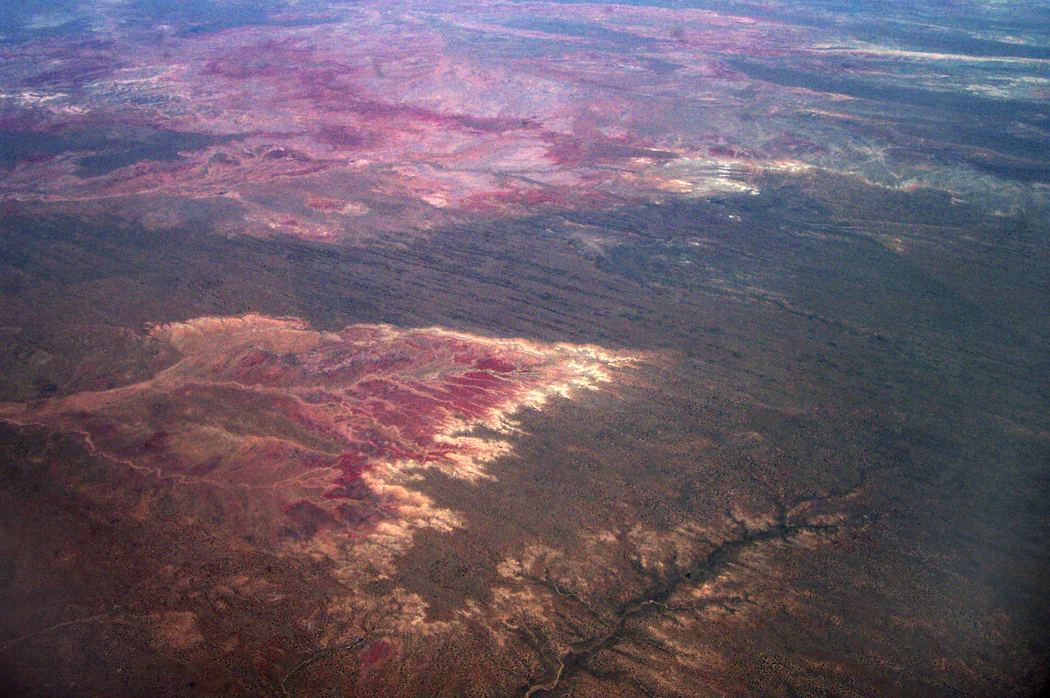
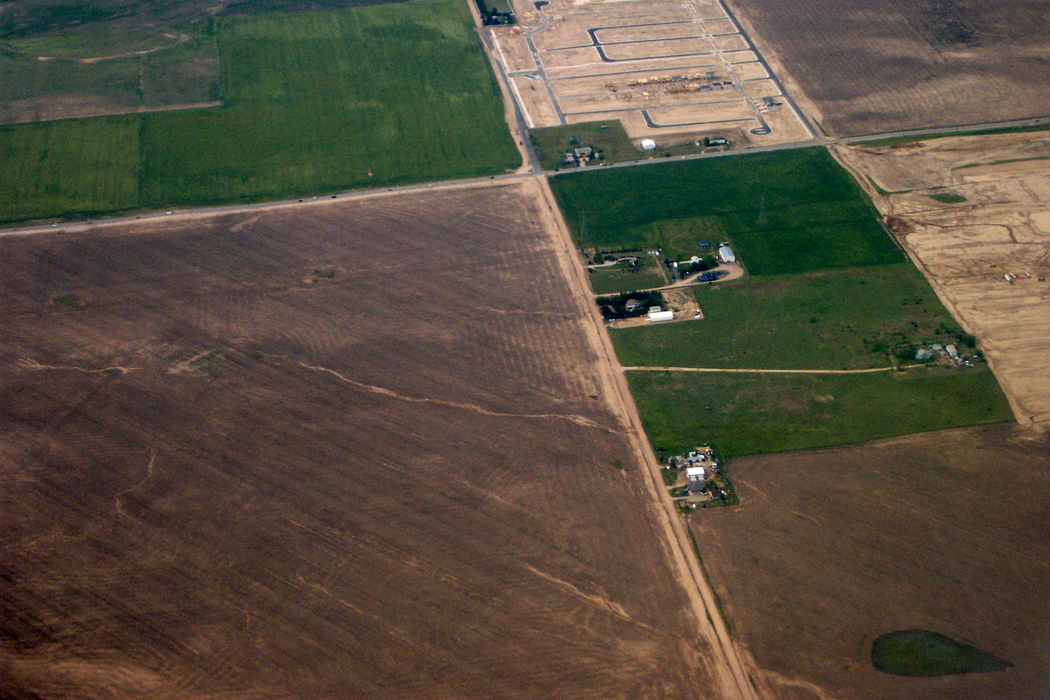
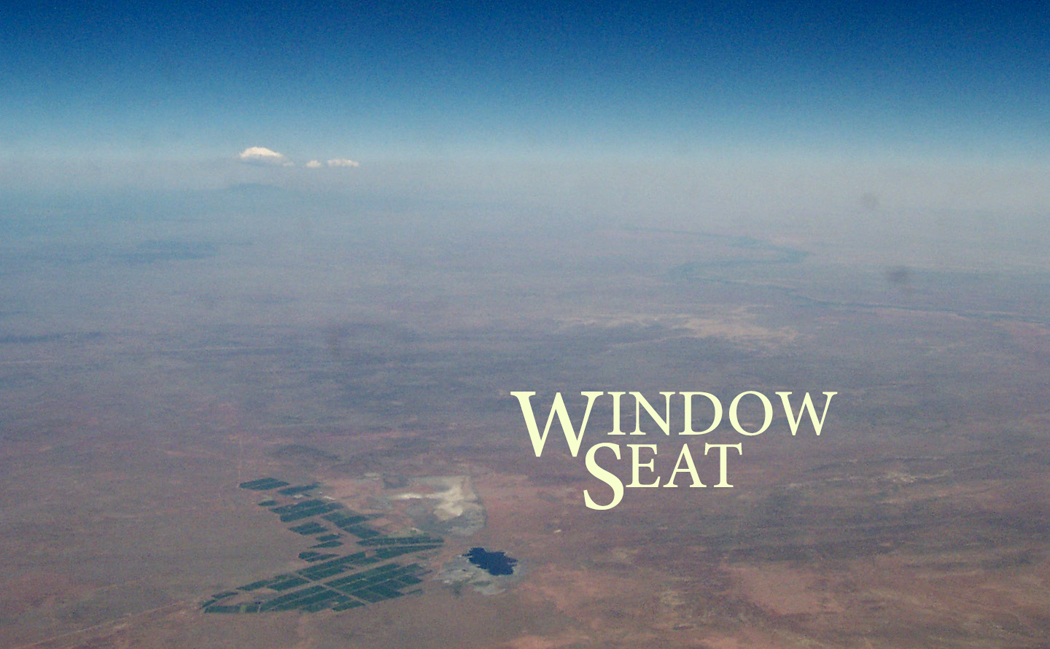
It is why I always book a seat by a window when I fly. I can look out the window and see the colors, textures and patterns of the planet below me, and make designs with them with my camera.

I self-published a book of such abstractions using the website, blurb.com. You can find the book here, and open it up in preview mode: http://www.blurb.com/b/1376943-windowseat

The skin of the continent becomes a canvas painted in swirls and pools, like some de Kooning or Pollock, Rothko or Diebenkorn. If you look, you can see again.

Part 2: The Metaphor

We live on a planetary canvas; colors and shapes are spread across the stretched linen of the Earth’s surface, although we have to step back to see it with any clarity.

The best way to do that is to climb up into the air. Up a tree and the neighborhood looks different; up a mountain and the valleys change; up in a jet plane and whole quarters of the continent are transformed.

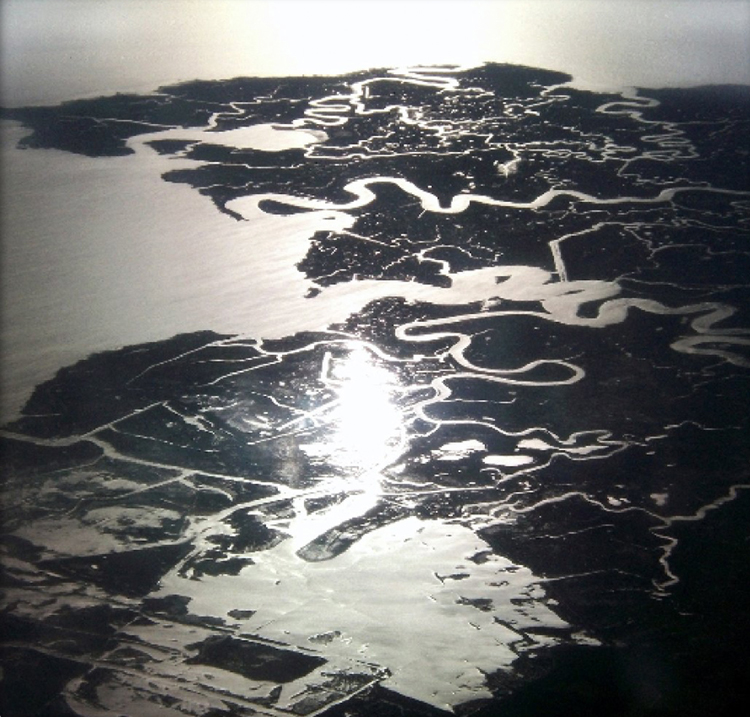
That is the gift of the window seat. The view out and down paints a completely different picture of the world: clouds below us; shadows stretch out for dozens of miles late in the day, or as the sun rises; seas catch the sunlight in a scatter of sparks; the sky overhead is so dark a blue as to mimic midnight at midday.

I love flying. There is nothing quite so exciting as seeing a whole state underneath you opened up like a life-size map.

From 30,000 feet, you get a sense of the world as a tiny globe and can see whole ranges of many mountains as single features, like wrinkles on a face.

Few of us will ever see the Earth from the moon, or even from orbit, but anyone with a boarding pass can have his sensibility slapped silly with the incredible beauty of the planet.

So I always book a window seat for the show. And no matter how long the flight, I’m glued, stiff-necked, to the view.

You can spot the Rio Grande and its terrace, the Mississippi and its wiggle. You can tell Chicago from Detroit, Oklahoma from Arkansas.

Several times on cross-country flights, sitting on the north side of the plane, away from the glare of the direct sun, I looked out the window and down below the jet would be a floating pool of light, moving with the plane at some 500 mph. It is called a “glory” and it is certainly well-named. It is a visual effect much like a rainbow, and no two people see it in just the same place.

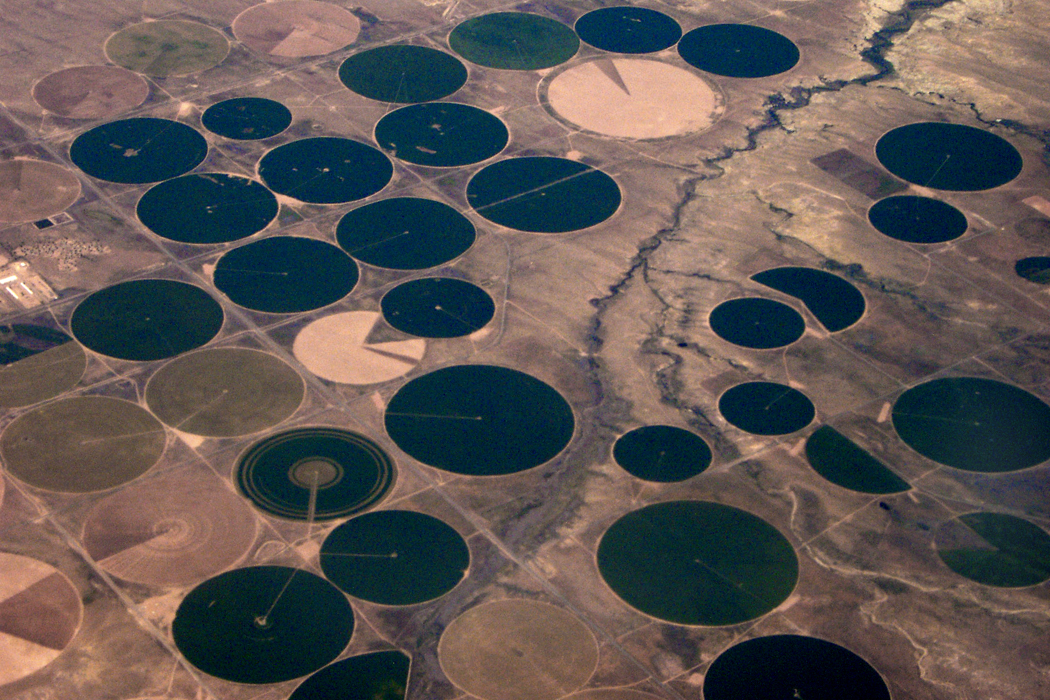
It can be seen at a point 180 degrees opposite the sun, speeding across the map-landscape below, crossing interstates and rivers, past the pegged dots of new housing developments, looking like mitochondria in an electron microscope, or the great circles of irrigated crops — great green coins spaced across Texas.

But it isn’t just the landforms that excite me. Even bad weather keeps my attention. Think of all the thousands of generations of humans who were never able to see the tops of clouds, which form their own fantastic landscapes, with mountains and valleys of crenellated whiteness.

The pilot curves the jet route in wide circles around a towering thunderhead, bleach-white at top and sooty at bottom, with its cauliflower protuberances catching new light. The distance is crowded with them, sprouting like mushrooms to the horizon. Dozens of fresh, new thunderstorms rising sunward like children reaching up for their mothers.

Over California once, after a rainstorm, with a low mist of water evaporating up into the atmosphere, the millions of puddles aggregated their mirror effect into a single flash, moving at the speed of the plane and making Fourth of July lightning bolts that flashed just beneath the surface of the mist, the way you can sometimes see the blood pulsing under the skin of a newborn. It gave me a feeling of intimacy with the planet.

Or a night flight, with the ground black underneath you as you fly over the empty expanses of the Southwest, with the small embers of tiny desert communities coming periodically into view, glowing like the last bit of a dying campfire. As you approach Phoenix, those embers gather into a vast pattern of incandescence, like some great lava field, with the glowing magma breaking through the cracks of the cooling stone above it. Almost nothing is as radiant as a city at night seen from the air. You want to hold your palms out toward it, to warm your hands in its heat.


Earthbound, we have a very bland, utilitarian sense of the celestial body we ride around on. It is all streets and signage, houses and mini malls. It is the place we go to work every day, the place where we watch television in the evening.

It is true, to those who have the eyes to see it, the planetary nature of our home is there to be seen: Daybreak shows us the sun breeching the horizon and moving across the heavens; the stars are there to see at night; there are rainy days and lightning storms to remind us of the larger forces. But they have all become ordinary through habit and usage. How many of us take the time to look up and admire a mackerel sky or a fair-weather cumulus cloud floating puffy on the slightly denser air beneath it?

But take an elevator to 30,000 feet and you get the god’s-eye view, moving across the curved surface of the world, where the people aren’t even ants and where the Earth is one small aggie in a great colliding pile of cosmic marbles.

Click any image to enlarge

TOWAN

Nearly 40 years ago, I moved to Seattle and eventually got a job at the zoo. Not a glamorous job, but rather manager of the food services. That is rather a hyperbolic name for what it actually was: A set of three iron trailers spread around the zoo from which we sold popcorn, hot dogs, soda and candy bars.

It was a good vantage point to watch human behavior and even better to observe the functioning of a zoo. I’ve written about this before, and you can visit Part 1 of this zoo story at: https://richardnilsen.com/2013/12/13/memoir-life-at-the-zoo-2/

When I started, I wasn’t the only newby. There was a new director, David Hancocks, and as with every new administration, the old hands resented the changes being proposed. Later, Hancocks proved a farsighted and innovative head of this zoo, and later the Sonoran-Desert Museum in Tucson, Arizona. He won over the old hands in Seattle, but when he first arrived, there was suspicion and even hostility.

You have to remember that until the mid-1970s, zookeepers were low-level city employees. The bear-keeper had been a city garbage collector before transferring to the zoo. Few had a college degree, and Hancocks proposed to up the level of professionalism at the zoo.

Nevertheless, at the first meeting with the zoo staff, Hancocks impressed at least some of the keepers as a bureaucrat and they felt he had condescended to them.

“You know what he said at the meeting?” complained one of the monkey keepers. “You have to wash your hands after going to the bathroom. Geezuz, does he even know what we do all day? We shovel animal shit. I wash my hands before going to the bathroom.”

Everyone at the zoo was known not by their proper names, but by their descriptions: There was Monkey Man, Gorilla Lady, Large Pepsi No Ice — he was known by his perpetual order at the food stand. Gorilla Lady had a second career as a belly dancer in a local Greek restaurant. The old bear keeper, on the verge of retirement was universally known as “Grampa.”

There were Bandana Man with the giraffes, Macho Man with the apes, the Bike Woman who was in charge of the gates. I was single at the time and lonely in a new city and Bike Lady was attractive. I’ll get to her in a bit.

But I want to mention Tree. She worked the admission gate, was about six-foot-four tall and studying poison-arrow toads.

Periodically, the alligators had to be emptied of the pennies they had swallowed. Signs said not to throw coins into the gator pool, but people are jerks. If the beasts had not been disgorged of their pennies, the copper  and zinc would have poisoned them.

Needless to say, getting an alligator to cooperate was not an easy thing. They had to be sedated and a plastic hoop or funnel stuck between their jaws to hold them open. One of the first public-relations events to happen after I got to the zoo was a gator purging, and the press was invited, with TV cameras covering the event, and newspaper photographers gathered around. The gator was laid up on a table with the hoop in its mouth. A zookeeper stuck his arm down the gullet of the beast to scoop out the coins. His arm was not long enough to reach the stomach and he had to give up. A second keeper tried; his arm was not long enough either.

Finally Tree was called. She reached her long arm down, glommed onto a pile of coins and coagulated gator-gut goo and pulled it out. Everyone seemed content. Pictures had been gotten. Stories were writing themselves. But the moment Stick pulled herself out from the digestive tract of the reptile, the beast woke, snapped its mouth shut, cracked the plastic hoop into bits and writhed on the table. Talk about nick of time.

Then, there was Ape Man Jack. He was in charge of the lion-tailed macaques. Jack was a true misanthropist. He never had more than a grunt for another of his own species. But he would talk all day long with his monkeys. He had down all their idioms and seemed to fit into the troop very well. He was a sort of alpha-male to the monkeys, taking over from the dominant Junior, whenever he was around. Ape Man scowled around the zoo, glowering at everyone. But then he would come home to the monkey island and a broad grin would show — or at least he would bare his teeth to the macaques and reassert his dominance.

Grampa was a relief keeper, usually working the bears and sealions. Often, I would donate the day’s leftover hotdogs and the two of us would take them to the backstage of the grizzly bear enclosure and toss them down the bears’ gullets. Those maws were as big as the Lincoln Tunnel. There was no swallowing involved; the wieners just rattled down the chute to the bears’ tummies.

The main snack stand, where I worked, was right next to the large-ape house. I got to know the orangutans really well. They got to know me, too, and each day, as the hours wore down, I would visit Towan, the male, Chinta, his sister and mother of his child, and Melati, a small breeding female on loan from the National Zoo. Towan became my fast friend. I have a signed photo of him.

When the zoo had cleared out, the sun was setting, the peacocks screaming their banshee-calls, the siamangs whooping and the teens working for me in the stand were emptying the snot-thick hot water from the hot-dog boiler and mopping the steel floors, I would wander over to Towan. When he saw me approach, Towan would amble over to the front of his enclosure to greet me. Often, in a gesture of Orang generosity, he would stop chewing on his food and offer the chyme out to me on his extended lower lip.

We had a close relationship. He was like a bartender to me. I would pour out my troubles to him, complain about my loneliness, and he would sit opposite me, on the other side of the glass, with his forearm resting on the sill, staring into my face, listening intently. He would take the burlap cloth that was his main plaything and use it to wipe down the sill, like barkeep swabbing down the bar. It was a nearly daily routine.

In later years, after I was long gone, Towan took up art. He became famous, if that’s the right word, for scribbling with magic markers and paintbrushes on large sheets of cardboard. In this, he followed the lead of the former artistic star of the Phoenix Zoo, Ruby the Elephant, who had died in 1998, and whose canvases had sold for up to  $25,000.

I was saddened to hear, in 2016, that Towan had died, at the age of 48. He was the oldest Orangutan who had been born in captivity.

I had my name, too. Since Grampa was already taken, I was Dad to my employees — most of them high school kids working a summer job. Eventually I had two assistant managers, splitting the week between them.

One was Colin, who pronounced his name the way Colin Powell pronounces his. He was the son of a black geneticist from D.C. and a white mother. He said he was one of his father’s genetic experiments. Colin was gay and his ambition was to become a fashion model or an architect. Colin was very bright and what he lacked in dependability, he made up for in brains.

I was living at the time in a house with the world’s most obscene man and two lesbian doctors. Their names were Cam and Clink. Hard to beat that name combo. But Colin’s boyfriend was named Dick. Need I say more?

My other assistant was a redhead called the Vixen. The Vixen had a temper that blew at least twice a day — as dependable as Old Faithful — usually when customers continued to ask her the same stupid questions. “You have root beer?” “No, we have Pepsi, Sprite and Grape.” “OK, I’ll have a root beer.”

The Vixen and I got to be good friends, but I thought it wise, as her boss, not to mess with her romantically. I stayed away from all my employees — I had about 25 during the summer. But later, I learned that The Vixen was gay, too, so the question had always been academic.

When the machinery was running smoothly at the zoo, I didn’t have to do anything but supervise my help. That gave me a great deal of free time at the zoo and I used it to get to know all the animals and keepers.

Then there was Carma, a volunteer, and her mother. Nancy was 38 and dressed and acted 15. She dated a different boy each night. She collected admissions. To the zoo, I mean.

Carma was indeed 15, but she was the adult in the family. I liked Carma and we went out for lunch occasionally. The world’ most obscene man liked her, too, and tried to date her. (“Imagine, if she were only a year younger, she could get into the movies cheap!”) But she fended off his drooling, or most of it.

At the zoo, we provided coffee every day for the keepers. We had several regulars and I got to be good buddies with them. They would take their breaks with a hand around a hot paper cup of rancid black java and we would talk. One of these was an alternate primates keeper named Macho Man. He would tell me  story after twisted story about his relationship with Bike Woman. Ah, Bike Woman.

He beat her and verbally abused her. She had aborted their accidental baby. He took that as an insult to his masculinity and beat on her some more. She had him arrested for assault and he asked me one day, “Do you think I should jump bail and get out of the state? That woman is crazy. She’s out to get me. If I stay here, she’s bound to get my ass thrown in the slammer. When I think of jail, it gives me the creeps, and all because I had the gumption to discipline my woman.”

“What did you do?” I asked.

“Not much. I just slapped her around a bit.”

Later that day, I talked with Bike Woman.

“That bastard saw me leaving the parking lot the other day and he rammed his pickup truck into my Rabbit. Then he jumped from the cab and pulled me from the car and started hitting me in the face, calling me a whore and a slut. When I escaped from him and drove home, he followed me, trying to bump into my rear as I drove. When I got to the house, he chased me and caught me before I could get to the door and he dragged me behind the bushes and started beating on me again.”

She had a black eye and welts on her neck and legs. I don’t know how they eventually resolved their battles. I hope Macho Man found out what prison is like.

Bike Lady was attractive, about my age, and clearly in need of a more sympathetic male friend.

I asked Carma about Bike Woman. “What is her real name? How old is she? And is she married?”

Carma had previously ruined one of my fantasies with the bulletin that Tree — remember Tree? — who had blond hair and a smile that melted me every time she aimed it, was married.

“Bike Woman’s real name is Joan and she’s not married. I think she’s a bit flaky, though.”

“How?”

“Oh, I don’t know.”

“What else do you know about her?”

“She’s got two kids. One of them is under a year old.”

Not what I wanted to hear, but I still was interested.

The following day, I was walking from my little tin office to stand No. 3 when I hear the ratchet sound of a coasting bicycle behind me. The bike slows down. It was Joan.

“I saw you driving this morning,” I said. “I was disappointed. I thought you rode that bike to work every day.”

“Oh, no,” she said. “It’s too far for that and besides, this old bike is too broken down. The brakes barely work.”

“So who needs brakes?” I said. “Just aim it at some children and you’ll slow down fast enough. Like a runaway truck into a sandpile.”

“I don’t think the kids are big enough to stop me.”

“So, just run into fat kids. There are plenty of them around. See, look there.” I pointed at a trio of grotesque monsters waddling along behind a grotesque mother. “The middle one is Grendel, but its’ the mama you have to watch out for.
“By the way,” I said, “Would you care to go out for dinner Thursday night. I was thinking of the India House. I haven’t been there in quite a while.”

“Well, let me think about it,” the bike stopped and Joan rested her feet on the ground. “I’d have to get a baby sitter … hmm … How about the next Thursday. That would be nice.” She gave me a broad smile.
I picked her up on the bus and we went to India. But the dinner didn’t go all that well. We were awkward together and the conversation went something like this:

“What I really want to do is go back to school,” she said.

“And what do you want to study?”

“Philosophy. I love philosophy.”

“That’s a pretty serious subject,” I said, “Are you an Aristotelian or a Platonist?”

“What are they?”

“You know, Aristotle, Plato.”

“Oh, but I mean, I’m into metaphysics.”

“Ah, but Plato is the great metaphysician …”

“No, I mean like the spirit world and astral-projection. My aunt was taken up in a flying saucer last year and communicated to them through ESP …”

My interest flagged.

But there was another woman I saw walking into the children’s zoo with Carma one day. A blond woman who looked at home in the pinstriped overalls that are a part of her uniform. She wore clear plastic glasses, totally unstylish, and my heart fluttered. No makeup, an assertive walk and interesting hands, such as you find on an artist or car mechanic.

Carma was my spy. When I needed to find out anything about anybody at the zoo, I needed only to ask Carma.

A few days later, Carma and I went up to Val’s Cafe for lunch, since we had been in the middle of a conversation when the lunch hour hit. Val’s was a greasy spoon two blocks north of the zoo on Phinney. It was run by the inevitable Greek and had to its credit two huge front windows with seats by them offering a sunny view of the gas station across the street.

Carma ordered a Denver omelet and I ordered a cheeseburger.

“Who was that blonde I saw you talking to the other day going into the children’s zoo?” I asked.

“That was Robin. She works in the CZ, with the springboks and at the Old Farm.”

“Well, how old is she?”

“I think she is about 28.”

“Is she … uh … marrrried?”

“No.”

“Does she listen to classical music?” You can see I had special requirements.

“Yeah. They all do down at the CZ.”

“Does she have any … children?”

“No kids, Richard. Don’t worry.”

My brain was abuzz. I had asked my worst and Robin had passed so far with flying colors.

“Oh, wait,” said Carma. “I just remembered that she said the other day that she will be 30 in a few weeks.”

“Thirty!  … That’s even better.”

I was becoming intoxicated. Robin wore dresses. I hadn’t seen that on a woman in quite some time and it was quite a turn-on. The only thing blonder than her hair was the sun. It turns out she had been a professional swing dancer and had lived on a houseboat. But this saga is a sad tale for some other time.

This is a cautionary tale about the importance of clarity in language.

Ordinary conversation is often ambiguous. We speak to our friends in sentence fragments punctuated with “uhs,” “likes” and “ya knows.” But the meaning comes through by context. A good deal of what we communicate comes via gesture, tone of voice, and the fact that our conversant shares our experience. But when instructions are given, it is important that there be no room for misinterpretation.


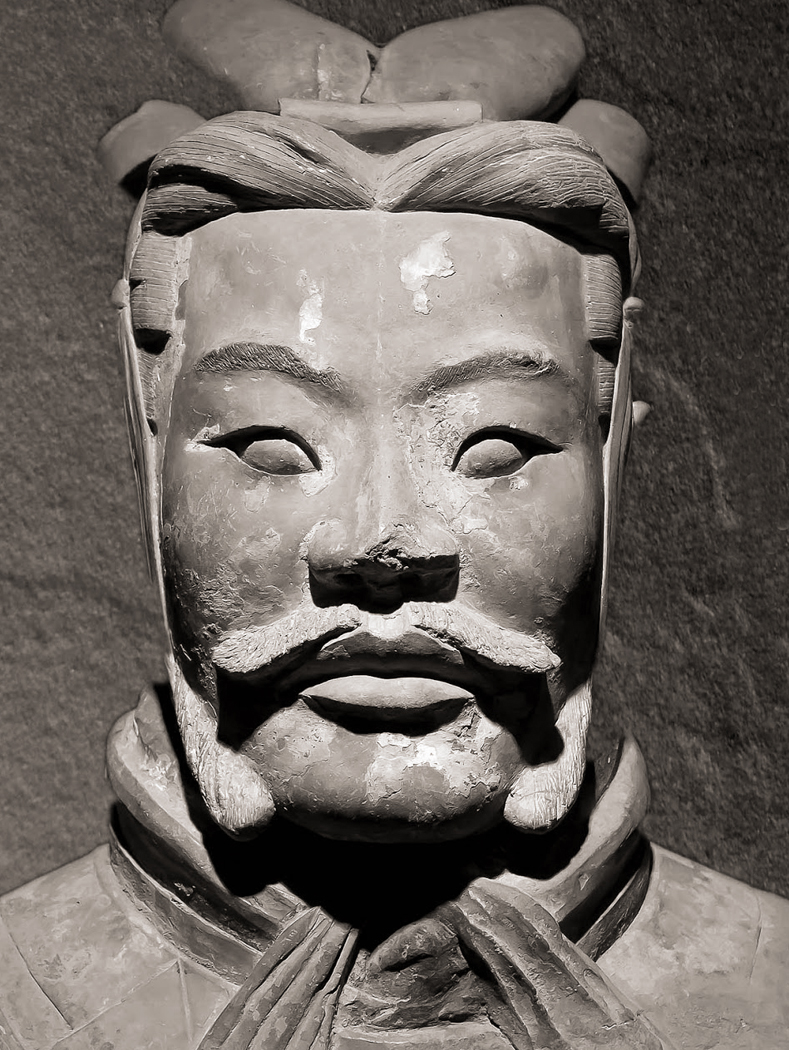
As Chinese war philosopher Sun Tzu wrote, “If words of command are not clear and distinct, if orders are not thoroughly understood, then the general is to blame.”

And so, I have no one to blame but myself.

I am forced to recall the case of Robert E. Lee and Richard Ewell at Gettysburg in 1863. Lee, being a Southern gentleman, had always had a hard time issuing direct orders, choosing instead to make polite suggestions, which he fully expected his officers to understand as commands. When Ewell didn’t do so in front of Culp’s Hill on July 2, the Confederate army lost the advantage, and ultimately, the battle.

Would clearer orders have changed the course of battle and war? Maybe not, but it certainly meant that the battle would continue for days, and it is clear that Gettysburg marked the turning point in the war.

What does this mean for me and my beard?

I have had a beard for 50 years. It has been my constant chin companion. In that time, it has been kept long, sometimes short and often unkempt. It was a rich hue when I was young, has progressively become gray, and finally, so light a shade of gray as to be indistinguishable from white.

I began the shaggy thing in college, not so much as a fashion choice, and not to brag of my manfulness, but rather because I was too lazy to shave. In fact, I hated shaving. Let the damn thing propagate, I thought. After a few years, the beard became so much a part of me, that I never even fancied the thought of seeing what might lie beneath. My chin was obscured by the duck blind of whisker.


The hair on the bottom of my head has grown lush even as the hair on the top has become sparse. Younger men whose hairlines have begun to draw back sometimes shave it all off, preferring the billiard-ball look to the billboard admission of creeping baldness. In recent years, the sheen of scalp has become something of a fashion statement. I have never chosen this route, but have had something of a similar reaction to tonsorial care as I once had on the issue of shaving.

For years now, I have gone to the barber and asked to have my hair trimmed down to an eighth of an inch. This strategy began in Arizona when the summer threatened and an ultra buzzcut promised to be marginally cooler than anything else. I would get the scalp mowed about every six months, after that point where it was necessary to take a comb to it. I didn’t like combing my hair much more than I ever liked shaving my beard. The close crop solved that problem.

“Would you like me to trim the beard, too,” the barber would say. “No, I trim that myself.” And I did, for 50 years, periodically taking a scissors to it to curb its profusion.

Recently, however, I have asked my current barber to tackle the beard also. She is so much more refined a topiarist than I am, and she has been training my shaggy beard into something more delightfully Hemingwayesque.

Well, last week, it was time for my semi-annual. I went to my usual barber shop and waited my turn.

Unfortunately, my regular barber was not there, and I was invited to recline on the chair of an alternate. He was a very kindly old Southern fellow, with hair as snowy as my own. With my regular barber, I never had to explain what I wanted, since she knew very well. “Here for your six-month?” she would say, laughing at my hair-cutting habits.

Alas, she was not there, and my bullpen needed instruction. This is where I should have been more specific. This is where the lessons of General Lee and Sun Tzu should have instructed me.

“What do you want?” the old barber asked.

“Cut it down to about an eighth of an inch,” I said.

“And do you want me to trim your beard, too?”

“Yes,” I said, and the die was cast.
At first, I had no clue of disaster. He took the electric buzzer to my dome and started mowing the hair down. But before I noticed, and before I could say anything, he dragged the mower down my cheek and the glorious chin-garden was deflowered.

Because I am now living in the South, I couldn’t get all Yankee and scream imprecations at the poor barber. “You damn beard murderer! Why, I’ll get my cousin Tony to come down here and burn your house down and see how you like that!”

No, we don’t do things like that in North Carolina, so instead, I said, “Well, it’s a new look, I guess. I’ll see if I can come to like it. But it does mean I won’t be able to dress up as Santa this Christmas.”

But I would be able to impersonate Harvey Weinstein or Steve Bannon. This is not a situation devoutly to be wished. He held a mirror up for me to look at and Harvey and Steve both looked back at me. This was more suited to Halloween than Christmas. I cringed. I weeped inside. I looked facially naked. And the three-day-growth look that seems so sexy with buff young studs looks on me more like grandpa forgot to shave again. And believe me, I don’t wish to be mistaken for either Weinstein or Bannon.

Or, nearly as bad, the sagging skin-sack, stubble-bound and watery-eyed, of Orson Welles as Hank Quinlan in A Touch of Evil. Gives me the creeps.

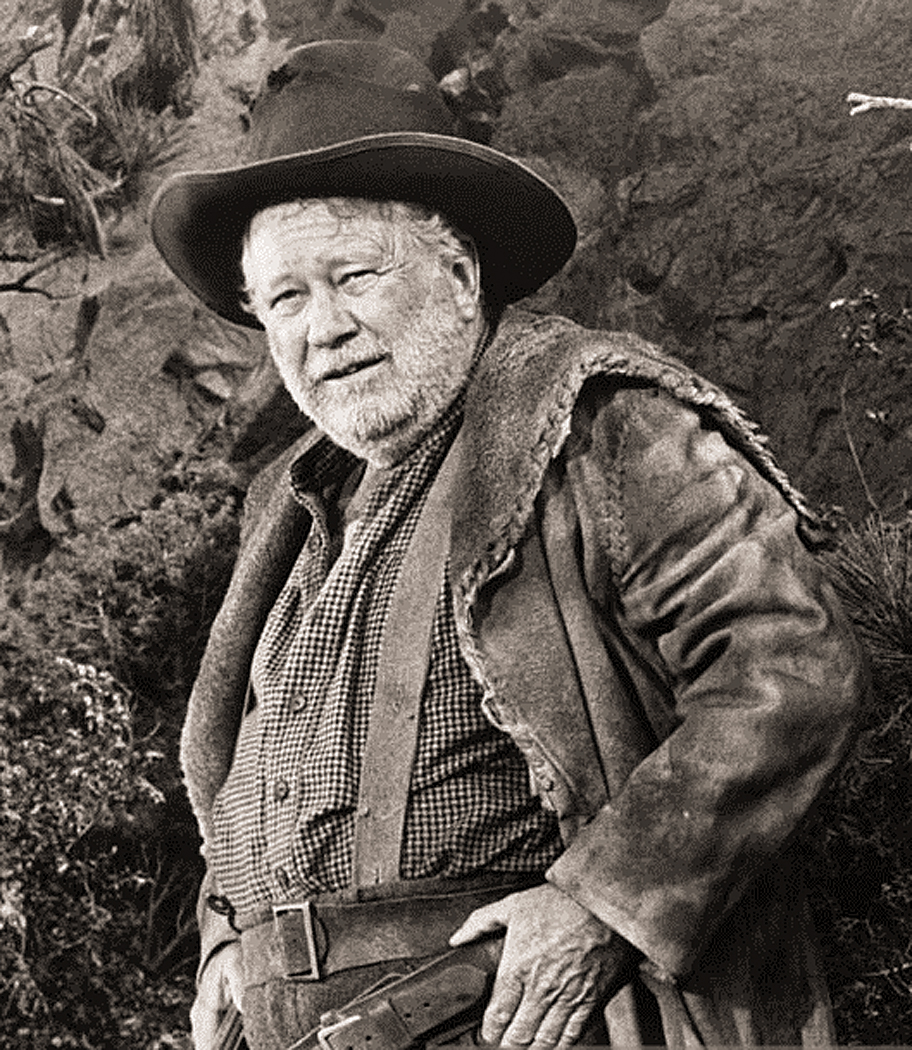
The best I can hope for is that others my age will remember Red Connors from the Hopalong Cassidy TV series of the early 1950s. Red was played by the venerable Edgar Buchanan, veteran of hundreds of movies and latterly of dozens of TV shows. His chin stubble defined him for me, through the Hoppy series and the Judge Roy Bean TV show after that, and, although I was too old to watch it regularly by the time it came on, through his stint as Uncle Joe on Petticoat Junction.

So, I wait patiently to age into my beard once again, learning the ancient sage lesson of the slow progress of life, and, of course, to be more careful in my language.

We know what photography is: You point a camera at something and take its picture. But what if you don’t use a camera? And what if there is nothing to make a picture of?

Certainly, many have used their cameras to make abstract or quasi abstract images. Sometimes you just have to get close enough to avoid any context, or take it from some extreme angle.
Many decades ago, when I was teaching photography — so long ago that the photo lab was filled with noxious chemicals and darkness visible — I played around with making abstract photographs. Most of my photographs were landscapes and portraits, but in the darkroom between classes, I had time on my hands and tried a number of things out.

But let’s take this a step at a time. First, some straight photographs.

Many years before I began teaching, I knew an artist in Greensboro, NC, named Aime Groulx (he signed his name with a dot over the “X” as if it were an “I”). He was primarily a sculptor, but he also made photographs. One he made was of a doorknob in his house that looked like nothing else but a newly discovered planet. He called it “Doorknob to the Door of Perception.” He was an indifferent printer, but I used his negative to make a good silver print, which I still have.

The image was both totally realistic — it was a doorknob — and yet, as Minor White used to say, it is “what it is, and what else it is.”

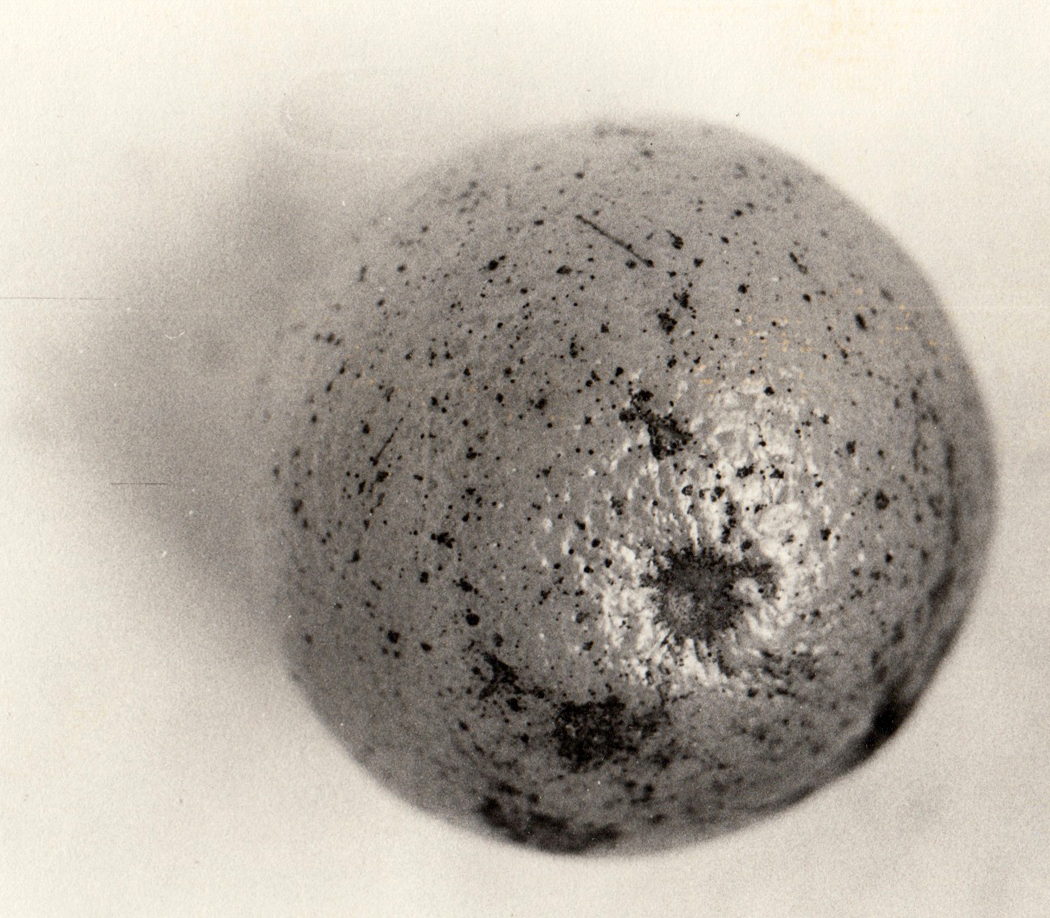
Over the years, I took this lesson to heart and made many an image that seemed to be something more than what it is. An orange can be a planet, too.

Or a sand dune can be a spiral.

Finding interesting and beautiful shapes divorced from their quotidian meaning can make us see them more sharply, make us understand something about the colors, shapes, textures, that being able simply to name the subject of a photo prevents us from acknowledging. When we recognize too easily what our photo is of, the image ceases being visual and becomes instead a word. “That’s a picture of a house;” “That’s a picture of a dog,” and by naming it, we find we have done our job and neglect to actually look and to see.

Making something abstract forces us to see those colors, shapes, textures — allows us to find new emotional meanings in the familiar, and new designs.

So, then, let’s take the camera out of the process. Once digital photography nudged out the silver, dried out the Dektol and replaced the Beseler 23C with Photoshop, there were other ways of making image files.

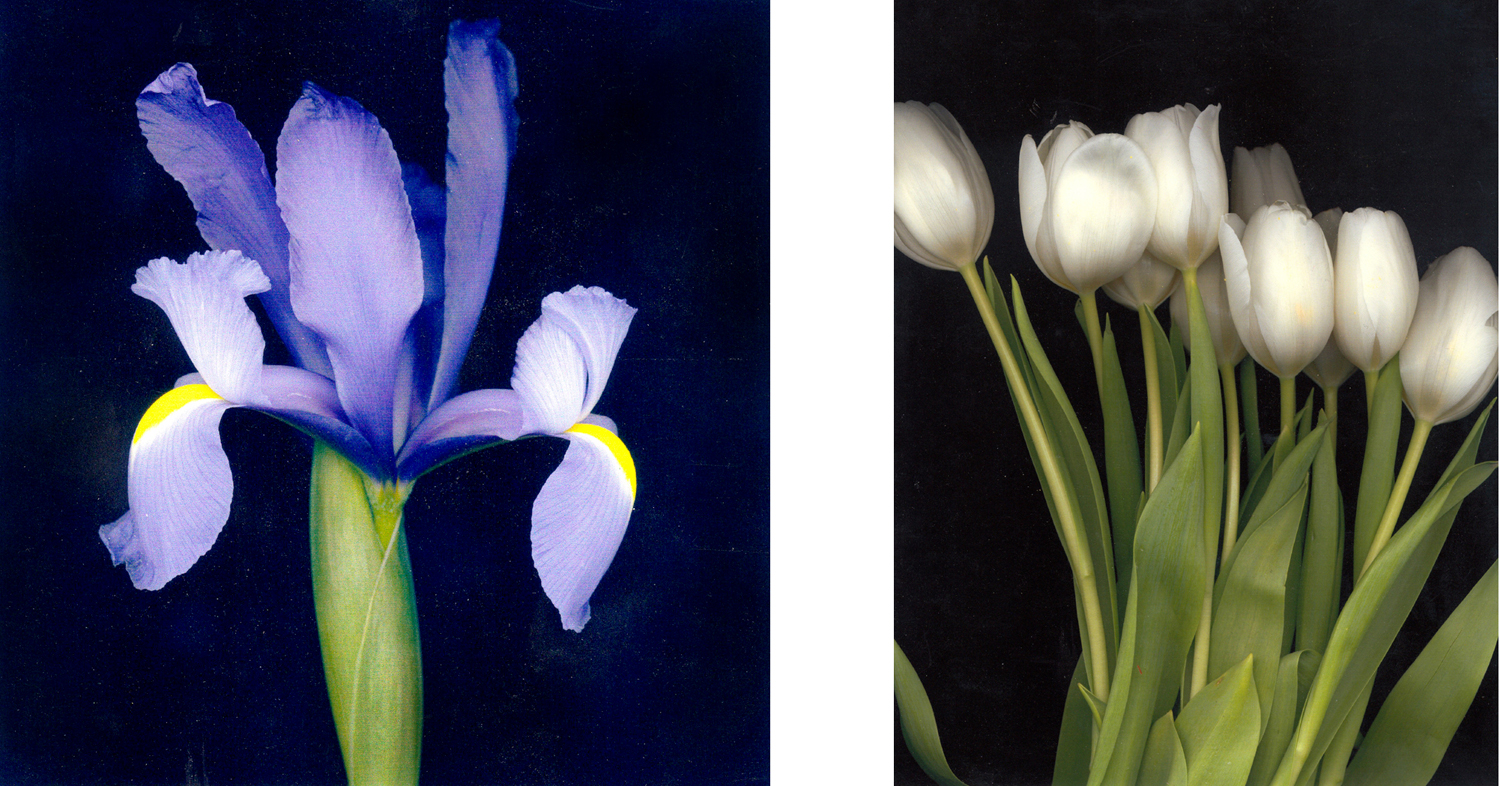
I began experimenting with a flatbed scanner, making extremely high-definition images of flowers. With the scanner cover left open, the background of these images became a very deep black or blue-black and only the parts of the flowers held flat on the glass platen were fully focused. The images were stunning and essentially shadowless.

I tried other things, too.

But there was still a lens involved in the scanner. So, let us return to earlier days, when chemicals still stained a photographer’s hands. I tried scratching the end-bits of developed rolls of film and printing them as if they were negatives.

Still, however, there was the lens of the enlarger focusing the negative down onto the silver paper.

I wanted to get into the image directly, with no mechanical mediation. I wanted to get my hands into the process the way a potter gets his hands into the clay.

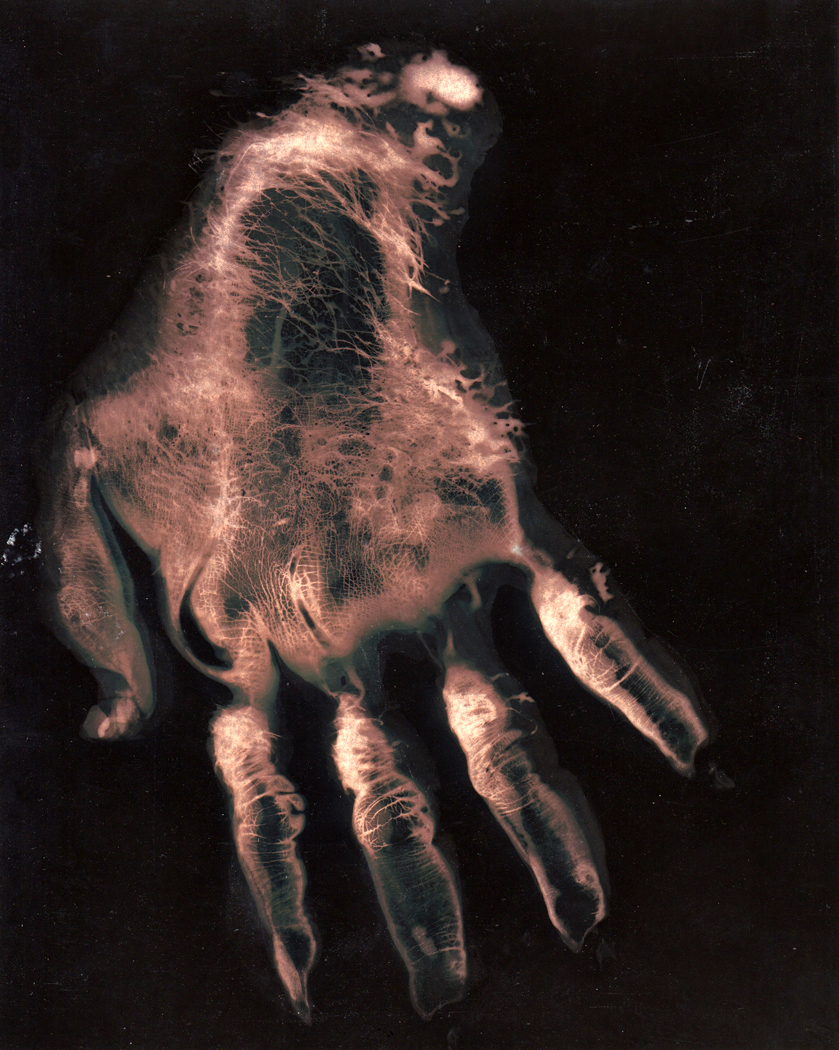
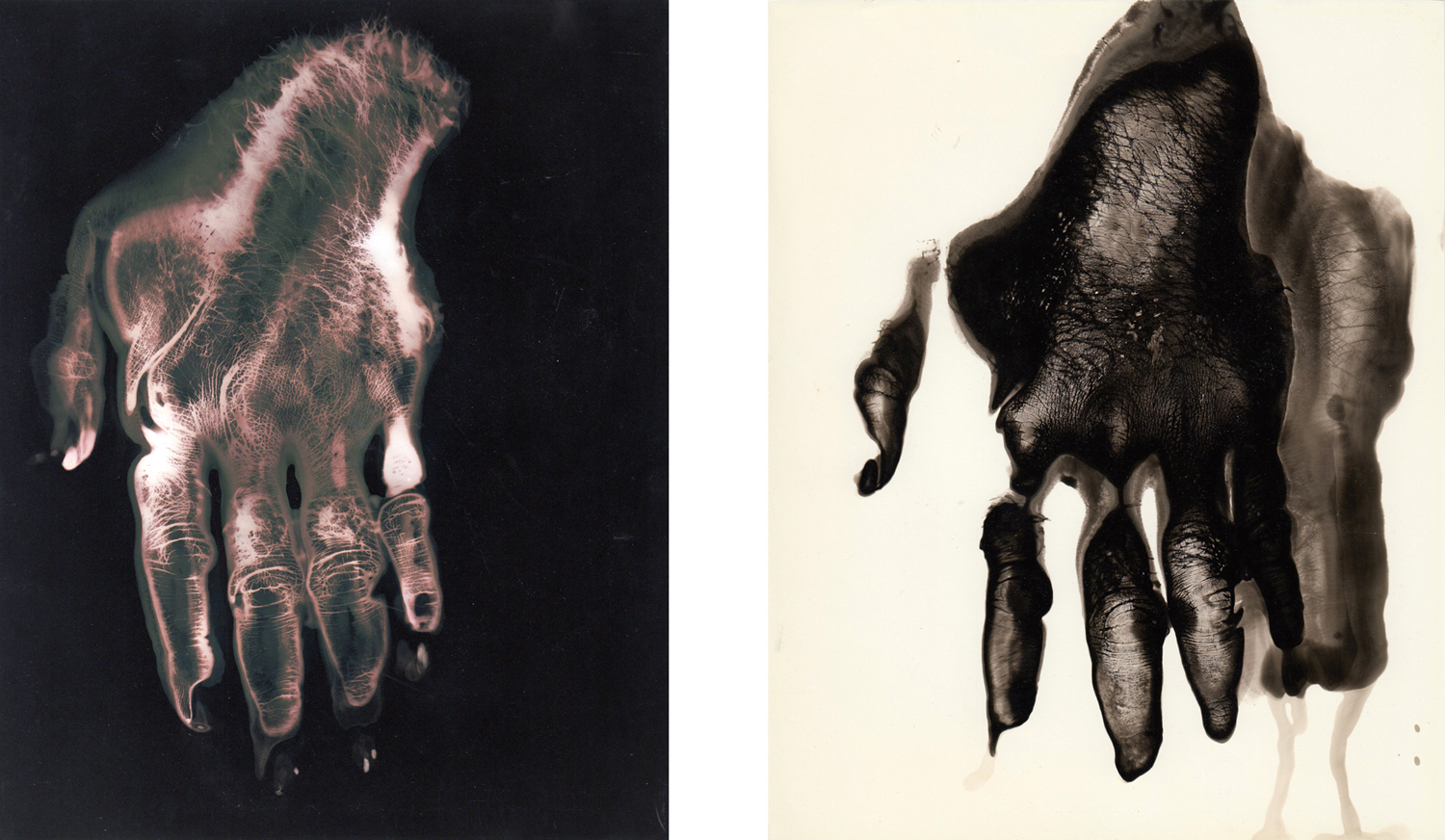
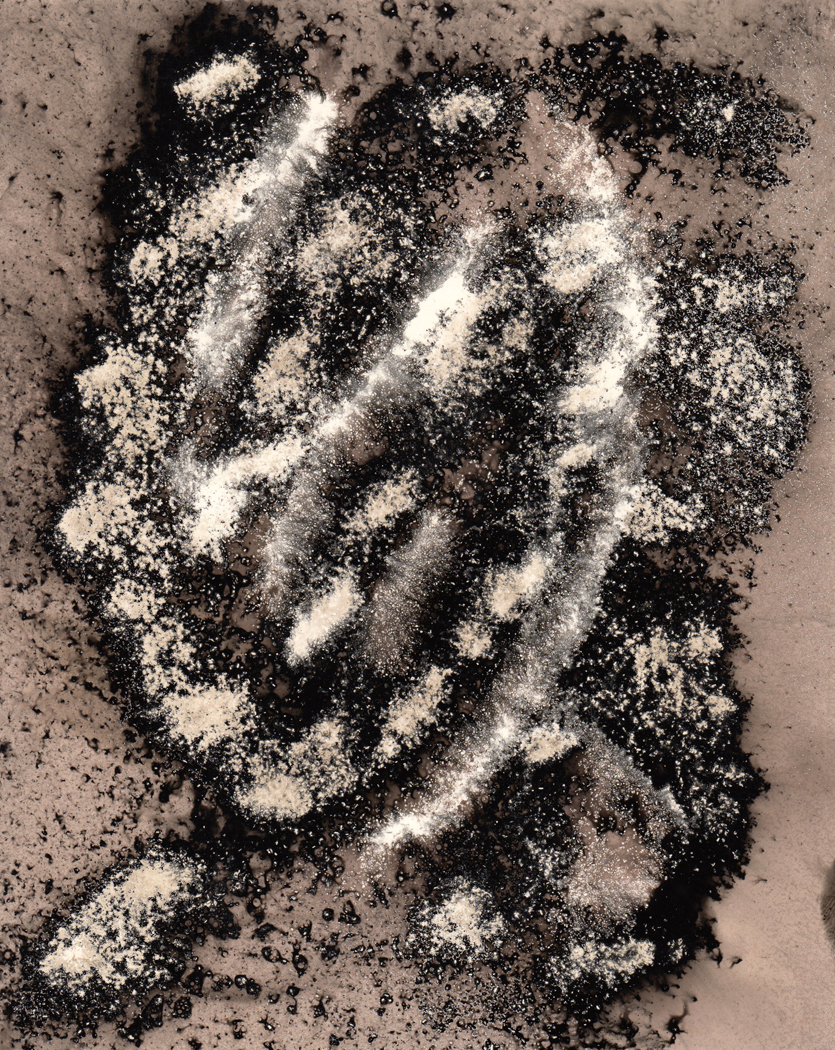
So, I dipped my hand into the tray of sodium hyposulfite and pressed it wet onto a sheet of light-sensitive paper, then washed the hypo off the paper and doused it in the developer, which turned the image black except for where the hypo had left its imprint. It made for rather spooky gorilla hands.

I tried it in the reverse way, too, dipping my hand into the developer and then, after the blacked image appeared, finished the process in stop bath and hypo. That gave me a black hand on a white sheet.

Certainly, this gave me an image of the familiar that was decontextualized and made strange. I saw my hand very differently.

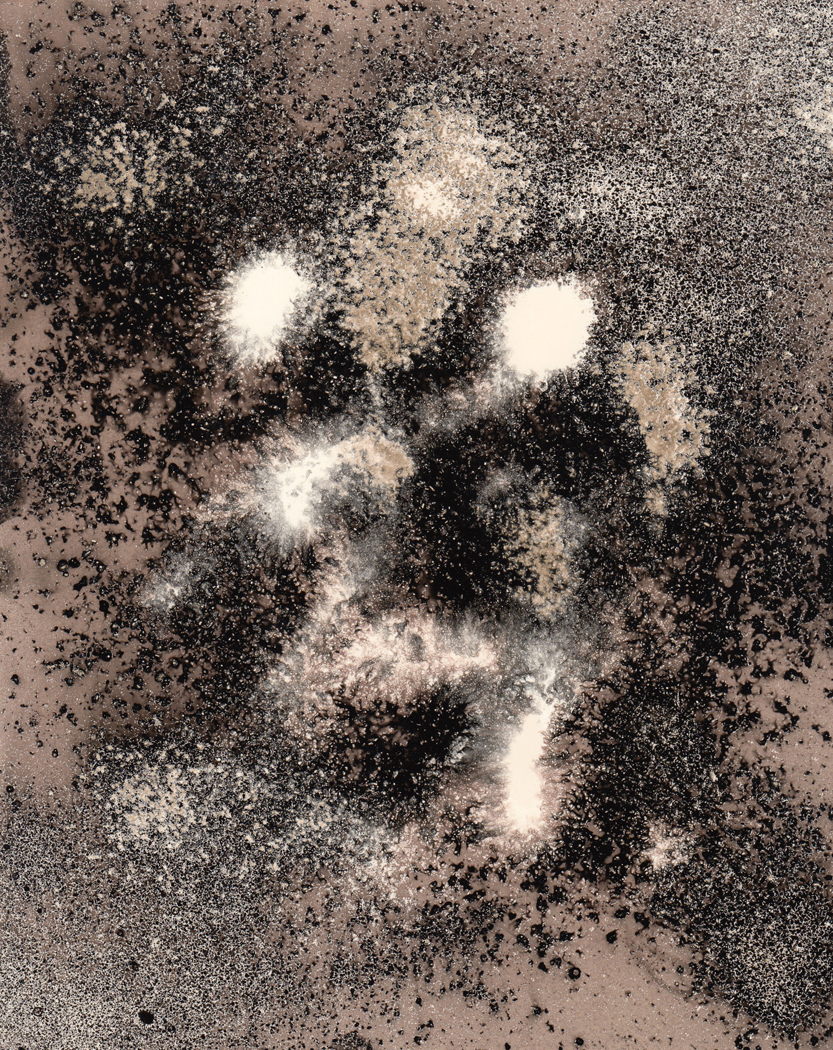
There is, however, only so much you can do with a hand. After the first hundred or so versions of my hand, I tried some other things. Like scattering salt on the paper and spraying the developer like Windex down onto the sheet, leaving a scattering of stars on the paper.

I also tried dusting the paper with dry developer granules and spraying it with water, making the black specks on the lighter background. The spray made the salt or the developer wash weakly over the paper, making mid-tones that I enjoyed.

You could make an image that vaguely resembled a portrait.

These experiments continued over the six years I taught, but when I left that job, I became a writer instead of a photographer. My camera was used primarily to illustrate stories I was writing.

I look back at some of the images I made so long ago and feel there might have been something in them. Whether there is or not, the process was worth the time; it gave me great pleasure.

Click on any image to enlarge

When I was in second or third grade, we had weekly lists of vocabulary words to learn, lists of ten or a dozen new words. And we were assigned to write sentences using these words. And me, being a smartass even back then, I worked hard each week to write a single sentence using all ten words. Even now I’m not sure if I did it to be clever or because I was lazy and didn’t want to write ten sentences.

But when I look back on it, I realize it was a dead give-away clue that I would later earn my crust by becoming a writer. I loved words, and I loved using words.

Other kidlings might groan when the teacher picked up the chalk to diagram sentences, but I loved those underlines and slants, those networks of adjectives and conjunctions. It was fun, like doing a crossword puzzle or connecting the dots.

When I was young enough, before the cutoff date for it, I didn’t learn words so much as acquire them. But even when it later took the effort, I still did my best to expand my word trove.

And as I grew into adolescence and I read constantly — everything from Lew Wallace to the backs of cereal boxes — I continued to absorb words. I would sometimes pore over a dictionary, picking out new and intriguing words. They were not merely signifiers of semantic meaning, but entities in and of themselves. Others might go “ooh” and “aww” over a puddle of newborn kittens, I did the same thing over bits of verbal amber and gleam.

It did not seem at all odd when the ailing pulp writer Philip Marlow in The Singing Detective asked his nurse, “What’s the loveliest word in the English language? In the sound it makes in the mouth? In the shape it makes in the page?” His answer was “elbow.” That would not have been mine, but I’m not sure I could have chosen. Words have a taste in the mouth, and however much one might like foie gras, one cannot do without ripe peaches or buttered asparagus. I loved all words, fair and foul. And I loved the mouth-feel of them, like a perfect custard.

British polymath Stephen Fry often tells the story (perhaps too often) of how when he was a wee bairn, he saw on the small black-and-white TV in his home the 1952 film version of The Importance of Being Earnest. He was struck by a line spoken by Algernon: “I hope, Cecily, I shall not offend you if I state quite frankly and openly that you seem to me to be in every way the visible personification of absolute perfection.”

“How unbelievably beautiful,” Fry says. “The swing, balance and rhythm. I’d known you could use language to say, ‘May I please be excused to go to the washroom,’ or ‘I want some more,’ but the idea that it could be used to dance, to delight, to enthrall — it was new to me.”

And Fry became what he called “a celebrant and worshipper at the altar of language.”

For me, it wasn’t Wilde, but James Joyce, first reading A Portrait of the Artist as a Young Man when I was in high school and being swept along in a tidal current of language. “Once upon a time and a very good time it was there was a moocow coming down along the road and this moocow that was down along the road met a nicens little boy named baby tuckoo …”

We had been taught in grade school to speed read, along with a dreadful little machine that mechanically drew a rod down along a page, drawing one to move line by line in a forced march through the text; we would then be tested on our comprehension. Day by day, the guide rod was moved more and more speedily down the page, making us read faster and faster, until we could skim and recall very well, thank you.

But that wasn’t the kind of reading that gave me physical, bodily pleasure. And when I came across books like Joyce’s, I slowed down. I could not read them without hearing the words in my head. Without feeling them on my tongue and teeth.

A sentence such as our introduction to our hero in Ulysses cannot be read merely for sense. It has to be understood for its music, almost ecstatic, like Handel’s Zadok the Priest or Beethoven’s Great Fugue: “Mr. Leopold Bloom ate with relish the inner organs of beasts and fowls.” Your tongue creates phonic choreography in your mouth as you form those words.

I remember when I was perhaps 24 or 25, reading Lawrence Durrell’s Alexandria Quartet and stumbling on so many odd and eccentric words, that I kept a notepad next to my desk to write down such words as I underlined in my copies of the books (yes, I write in my books. If you don’t write in the margins or underline passages, you haven’t really read the book). “Pegamoid,” “ululation,” “usufruct,” “exiguous,” chthonic,” “etiolation,” “boustrophedon,” “tenebrous,” “crepitating,” “cachinnation,” “comminatory,” and, apropos our current resident of the White House, “troglodyte.” (Another great word to remember in this regard is the title of a satiric philippic by Seneca the Younger — “apocalocyntosis” the “Pumpkinification,” in the original of the emperor Claudius, but our case of the Great Orange Boor.)

You probably have to be young to read Durrell, when you still hold idealistic and romantic expectations, and to put up with the prose pourpre, but my word-hoard grew. It became something of a joke when I wrote for my newspaper, where I’m sure the copy editors were laughing at me for using six-dollar words like chocolate sprinkles on a donut. I used them because I loved them, and because they were precise: When you develop a ripe vocabulary, you learn there are no synonyms in the English language: Each word carries with it a nimbus of connotation, a flavoring or a shade that makes it the right or wrong word for the context. No matter how close their dictionary definitions, words are not simply interchangeable.

Anyway, I had my little joke back on the copy editors. For a period of about six months back in the 1990s, every story I wrote had in it a word I plain made up. My game was to see if I could sneak them past the copy desk. Some were onomatopoeic, some were Latinate or Hellenic portmanteaus, some were little more than dripping streams of morphemes. And, to my utter delight, every one of them made it through the editors. A few were questioned, but when I explained them, they were permitted. Looking back, I regret this persistent joke, because it was aimed at that little-praised but admirable set of forgotten heroes, who have many times saved my butt when I wrote something stupid. Let me express my gratitude for them; everyone needs a copy editor.

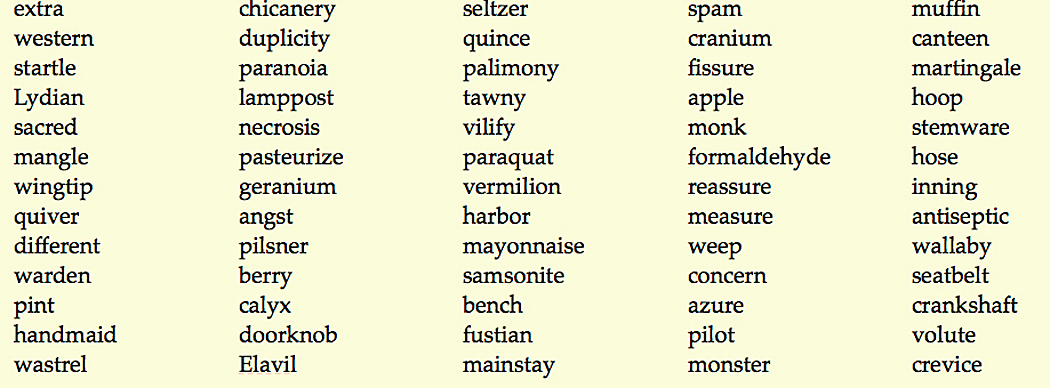
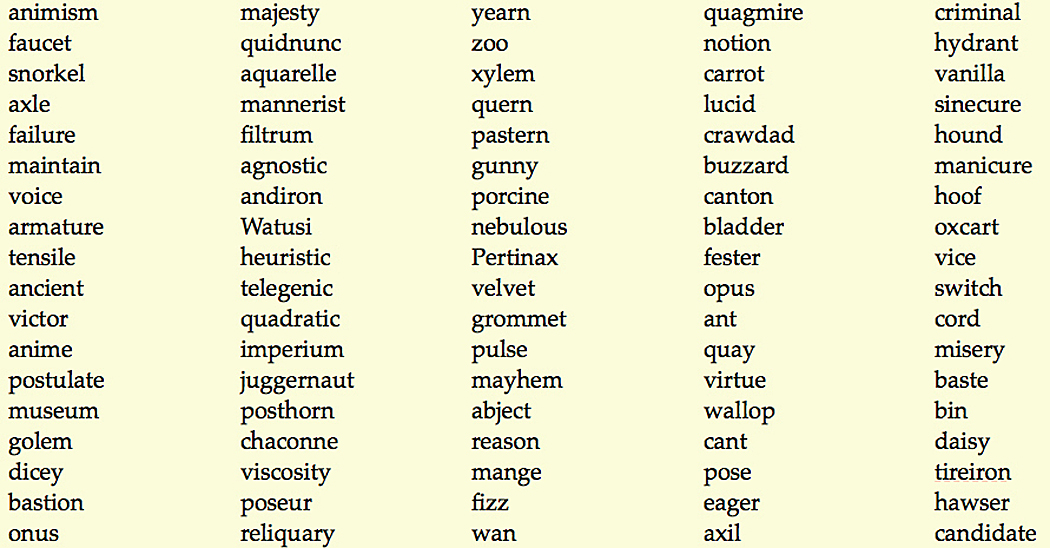
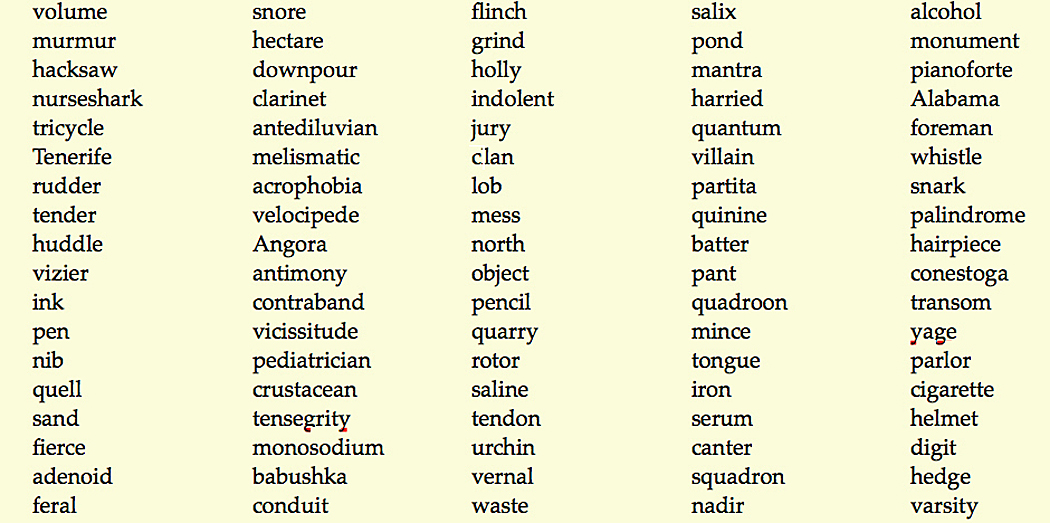
Occasionally, when I have an empty moment, and I don’t have access to a crossword puzzle, I will sit and write lists of words as they come to my brain. Each word has its own cosmos of meaning, an electron-cloud of ambiguity and precision, its emotional scent, its sound and its fury. As I write them down, I savor each one, like an hors d’oeuvre. Such lists, in their way, are my billets doux to my native tongue, which has fed me both spiritually and financially over many decades.

Roll on, thou deep and dark blue ocean, roll.

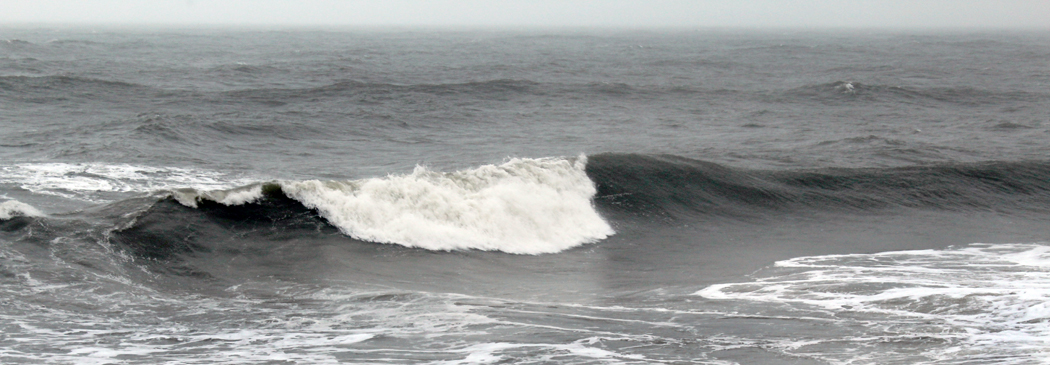
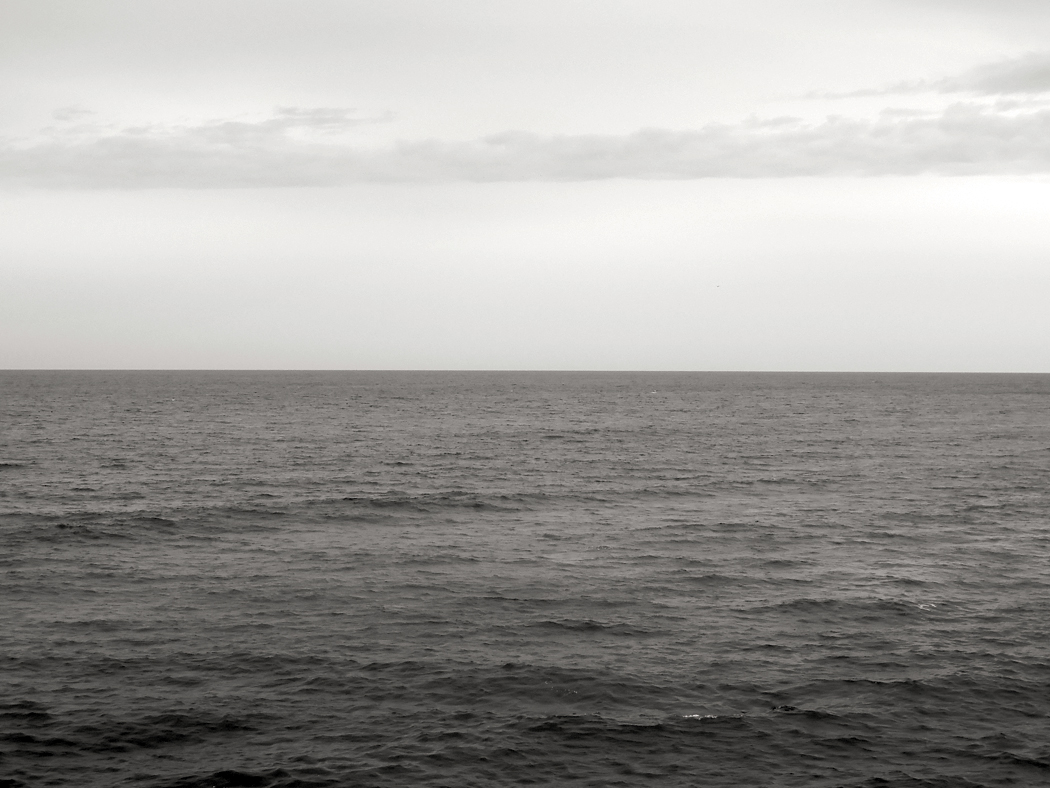
I am sitting at the edge of a continent, looking out at a flat expanse of grayish blue, which falls away from me, and when I force myself to notice it, rolls downward at the horizon and below my line of sight – it is the rounded top of a ferris wheel revolving eastward at some speed.

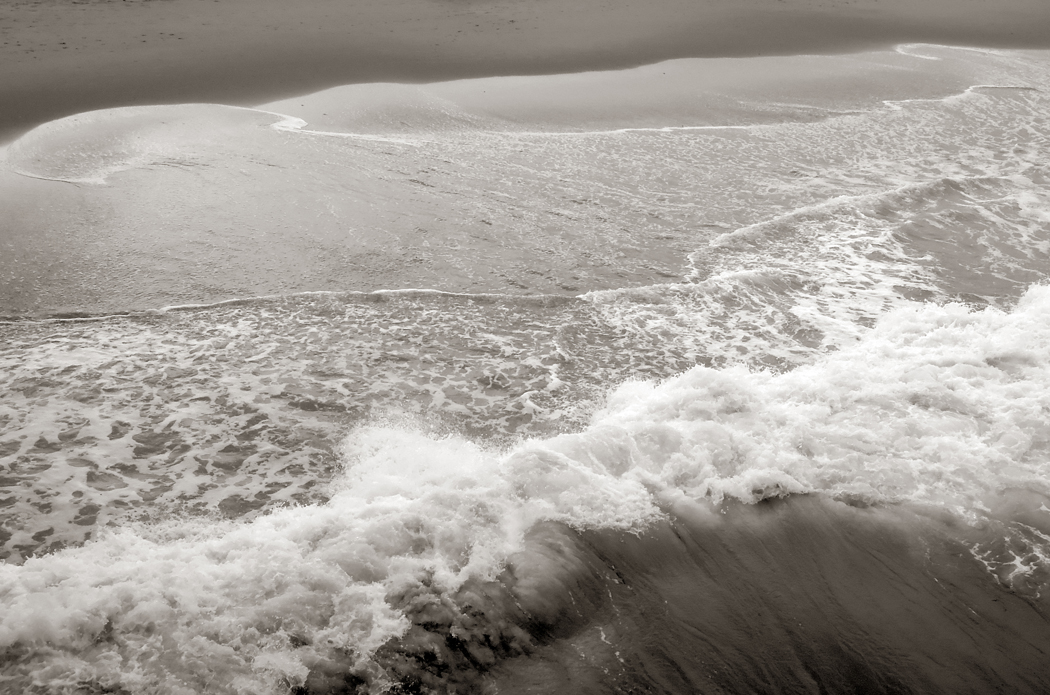
Nearer to shore, the color is broken with bands of white, breakers on the beach, but further out it is expansive. Somewhat below the horizon, far out to sea, a hurricane is sending its message in waves to our shore. Wind blows the trees nearby, and the surf is riled. There is mizzle in the air. The storm has passed here once again, only glancing at us as it moves by.

When we are young, the sea is romantic. It is the cradle endlessly rocking, we write poems about it, spindrift and seawrack, we stare out at it as if we were expecting to discover our adventure.

Many of us manage to maintain this sense of awe in the face of the waters, but for others, the sea has become a summer rental, or a weekend away from the city. If you were privileged to sail across the ocean on a ship, you will change your attitude in another way: It will become a daily monotony of wet flatness. Either way, the ocean will lose some of its mastery over us.

It is the edge of a continent. I have been back and over that continent more times than I can count, and have a body memory of its extent. I know in my bones the size of it, measured in days on the road, in the exchange of one horizon for the succeeding one. There are hills, cities, forests, grasslands, rivers, traffic lights – let’s not forget the traffic lights – and the homes of friends we stop to visit.

Looking east from here, though, out to sea, the globe is not speckled with features; it is uniform, save for the wiggle of waves and the rise and fall of the swell. It is a face without eyes, nose or mouth. And one senses that if you were to reach the horizon – that edge of your vision from any single location – you would find only another, identical horizon the same distance hence.

Inland, the picture is busy, it is our daily lives, the commerce between people, the schedules, the hubbub, the striving, the disappointment. It is populated and squirming. In that sense, it is life.

Outward, the sea shows us blankness of the non-human cosmos, seeming to be unlimited, at the very least, with no surveyor’s stakes plotting out squares of ownership. It is the blankness of death, and therefore, death itself. It is why we stare out at it, why it stares back, why it fills us up so we are like a bottle overflowing.

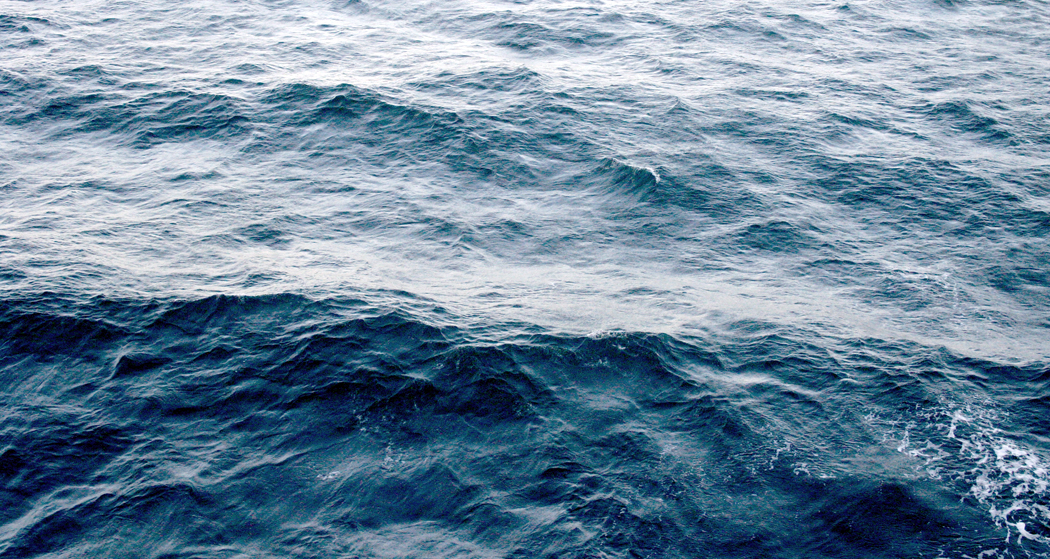
I have seen three of the planet’s oceans and several of its smaller seas – small but still immense. I have lived on the Atlantic shore and on the Pacific Coast and felt very different oceans. I have sailed on both. I have seen the Indian Ocean, and felt the warm, humid air, thick as a fur coat, from its shore. I have seen the North Sea and the Mediterranean, the Gulf of Mexico and the Sea of Cortez. And all of them leave me with a sense of a flatness stretching out like a drumhead, but curling down over their horizons, and always, I know that past that eye-reach is more flatness. More water; more swell, more wave, more whitecaps, more low clouds, shifting with the barometer.

The oceans are not infinite, I know. They are not eternal, I know. Byron’s encomium is nowadays wishful thinking: “Man marks the earth with ruin; his control/ Stops with the shore.” Pace Byron, but we are fouling the seas quite efficiently now.

Nevertheless, that does not change our sense of the watery parts of the world. They beckon us to our life adventure – at least in our minds, they do – and they speak what Whitman called the low, delicious word, “The word final, superior to all.”

They remind us of the vastness of the universe, our measly place in it as pismires, our short parole upon the watery planet, to be revoked at a time unknown to us – a knock on the door, a suitcase packed ready to go.

No doubt it is why the oceans look so beautiful to us. They promise that there is something larger, less transitory, less mutable.

I look out on the Atlantic this morning, storm offshore, waves pawing the sand around like a cat playing with a mouse. I look up at the clouds, gray as the water beneath; I look beyond them.

“If they but knew it, almost all men in their degree, some time or other, cherish very nearly the same feelings towards the ocean with me.”

I recently wrote about the Bible as part of our cultural heritage, along with Ovid, and the importance for our younger readers to be familiar with both of them, since they provide such an important resonance for so much of our art and literature. Not simply as footnotes to explain some obscure allusion in some poem you are studying, but as a kind of foundation layer — a diapason for everything that has followed and sounding deeply underneath it.

I received one rather snarky comment complaining that my piece was characteristically over-weighted with Western culture, and that I should have also mentioned non-Western writings.

My reader, I think, had rather missed the point. I was talking about the Western culture we were born into. I was not making a value judgement that ours is necessarily better or more important than others. But I was not born into the Chinese, Indian, African or Native American cultures.

I have always encouraged the widest possible exposure to the rest of the world. I have tried to read widely in other cultures, and to familiarize myself with the art and music of other peoples.

But there are two problems inherent in the criticism my misguided reader has leveled at me. This is not to exculpate myself — I do sometimes overvalue my own culture — but rather to point out some serious problems with trying to be too cosmopolitan. I wish I could embrace all times and all cultures, and god knows, I have tried my best. I read widely, whether the Mahabharata or the Tao Te Ching; I have studied the development of Chinese landscape painting and the impenetrable glyphs of Mesoamerica; I have attended Chinese opera; I watch the new cinema of Iran. I traveled to South Africa to study contemporary art there.

One should be familiar with the Popol Vuh, with the Egyptian and Tibetan books of the dead, Gilgamesh and the Shahnameh.

One should also read more recent things by Chinua Achebe, Athol Fugard, R.K. Narayan, Kobo Abe, Isabel Allende, Mario Vargas Llosa. Jorge Luis Borges, Pablo Neruda and Gabriel Garcia Marquez are hardly less essential than Leo Tolstoy or William Faulkner.

Still, there are insurmountable problems with the whole idea.

The first is that no matter how much I study, how much I learn — even if I were to get my Ph.D. in the Fu poets of China and were able to read them in their original language — Chinese culture would never be native to me. Culture, like language, is acquired, not learned. And just as it is impossible after the teen years to acquire a new language as a native tongue, no matter how well you learn that new language, you can never fully absorb a non-native culture. You will always know it from the outside.  Its idioms are elusive.

So, the sort of resonance I wrote about — the unconscious undertones you pick up when reading in your own lingua that deepen your emotional understanding of your text — you can never fully acquire in a culture you study later in life. Deep as you penetrate, you cannot soak it in the same way a Chinese child, or an Indian child soaks in his own.

Related to this is the second problem.

The pretense of assuming a non-native culture is almost always a form of Orientalizing. That is, there is a kind of romanticized sheen that is cast over the other culture. And that other culture is often used as a flail to scourge one’s native culture.

Lord knows, Europe has a lot to answer for historically. And those who bemoan Western culture use the counter-example from some other culture to make the point. The problem with this kind of cultural self-loathing is that it ignores the simple fact that it is not Western culture that creates the evil, it is human beings that do so. Every culture has its evils to answer for. Europe may, in the past 500 years been dominant, and have a list of sins more immediate in our cultural memory, but we should never forget that all cultures are made up of humans, and humans do and have always done reprehensible things.

I once made a study of genocides, and which religions have been responsible for the largest portion of them. Turns out they all have their murders. The religion least likely to turn on others is Buddhism. Yet, even they have their share; not the least is the current situation with the Rohingya in Burma. So, historically speaking, no one escapes blame. Before Columbus, Native Americans were not living in peace and amity: They were killing each other. China had Mao; Cambodia had Pol Pot; Rwanda had its Tutsis and Hutus. Humans red in tooth and claw.

The romanticization of other cultures leads to some utter silliness. I never cease to be stunned by all the “harmony with nature” blather about American Indians, as if they, as a group (and not a hundred different languages and cultures), had some magic relationship with the natural world that Europeans do not. You look at European painting or read Western poetry and practically all you see or hear is nature, finely seen and deeply felt.

And conversely, you travel through the Navajo reservation in Arizona and see the profound overgrazing that has devastated grasslands. Or visit First Mesa on the Hopi reservation (one of the places I most love in the world), and peek over the edge of the precipice and see the trash and old mattress springs tossed down the cliff as a trash dump. Talk to me then about how Native Americans live in harmony with nature.

No, I don’t mean to imply that Europeans are better than Native Americans, nor do I mean that some Native Americans don’t have a specific cultural relationship with the natural world. What I mean to state is that Native Americans are people too, and are just as capable of being less than their best selves.

These two problems together mean that when we leave our own milieu, we are always tourists — or at best, travelers — strangers in a strange land, fascinated by this bauble or that, able to learn lessons and pick up fresh ways of understanding existence, but these are always souvenirs, the benefits of travel that broaden our horizons.

When we Orientalize — idealize the foreignness of others — we can easily toss away the pith and suck on the bark. There is much value, say, in Buddhism. And if one is to have a religion, it is certainly the least offensive, with the least blood on its hands. But if you want to be one, be a Buddhist in a jacket and tie; don’t shave your head and wear yellow robes. If you were born in Indiana or West Anglia, these Volkgedanken externals miss the elemental meaning and turn profound ideas into cosplay.

So, be aware of the rest of the world. Read widely and deeply. But also, drink deeply from the culture that gave you birth. You may understand other places and other peoples in your head, but you feel your own in your belly. If you are Chinese, dive into Chinese culture; if Mexican, soak in your history, literature and art; if you are born into the culture of Chaucer and King James, imbibe deeply of the Pierian Spring. Learning from other cultures broadens you, but your mother culture nourishes you.

A few years ago, I read the Bible, cover to cover, and my general response was “These people were out in the desert sun too long.”

I mean, you must slice off bits of your private parts, but you must never cut off your sideburns? You cannot wear cotton blends without risking being stoned to death or eternally damned? If you have a flat nose, you cannot go to your house of worship? I mean, either you have to allow the possibility that in 40 years in the wilderness of the Sinai Desert, someone suffered sunstroke, or that perhaps the manna from heaven was actually some sort of psychotropic mushroom.

Or, you can read the so-called prophetic books and ask yourself, is this some sort of occult conspiracy gibberish? It too often reads like word salad. There is some sanity in the gospels, but then you descend back into paranoid craziness with St. Paul.

I can think of no better prophylactic against religion than actually reading the Bible. Those who profess belief too often cherry-pick the parts they like and ouija-board interpret the prophesies and ignore the batshit nutjob stuff that surrounds it all.

So, I hope I have established my bona fides as a non-believer when I say I am against removing the Bible from public schools. That’s right — I believe the Bible should be taught in school from an early age. Not for religious indoctrination, and also not for religious inoculation, but rather to familiarize the upcoming students with the stories from the book.

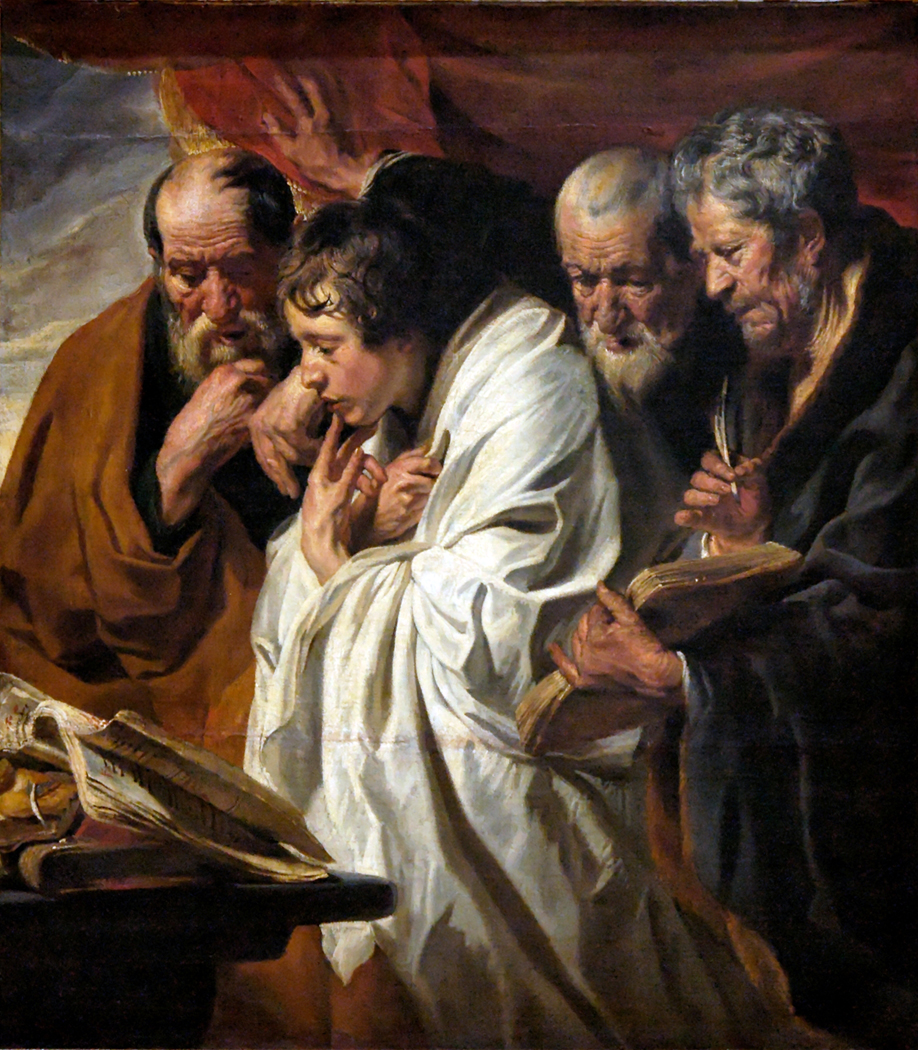
The Four Evangelists by Jacob Jordaens

When I was teaching art history, many, many years ago, I was surprised that my students knew so little about the subject matter of the paintings we were studying. Renaissance and Baroque paintings are suffused with biblical imagery, and to understand what is going on in many of those paintings, you need to know the cultural context — i.e., you need to know the Bible stories.

But, in a test, when I asked “Who were the four Evangelists,” only two of a class of 22 knew. One of them half-remembered, “John, Paul, George and Ringo.”

It hardly mattered if the students considered themselves Christian, or even merely generally religious. They were by and large, astonishingly ignorant of their cultural patrimony.

Abraham and Isaac. Cain and Abel. Lot’s wife. Jacob and Esau. Potiphar’s wife. Jacob’s ladder. Aaron’s rod. The golden calf. Balaam’s ass. Joshua and Jericho. David and Jonathan.

There are tons of stories that were once the common well of cultural reference for all European and Euro-American peoples, and by extension and the African-American church, for Black Americans, too.

It isn’t just Renaissance paintings, but in everything from Medieval illuminated manuscripts to the poetry of W.H. Auden. It shows up in sculpture, in novels, in dance, in symphonic music and Baroque opera.

The Slaughter of the Innocents by Rubens

Daniel in the lion’s den. Boaz and Ruth. Jonah and the great fish. Paul and the road to Damascus. The massacre of the innocents. The wedding at Cana. The raising of Lazarus. The giving unto Caesar. Doubting Thomas.

The loss of these stories in popular parlance isn’t just a loss of religious faith, but a casting off of hundreds of years of art, literature and mores.

When Herman Melville begins his magnum opus with “Call me Ishmael,” we need to understand who Ishmael was in the Bible if we want to feel the depth of the meaning of such a simple statement. It resonates.

When John Steinbeck titles his book, East of Eden, do we know what geography he is laying out for us? When William Jennings Bryan exhorts us not be be crucified on a “cross of gold,” do we feel the mythic undertones of his rhetoric? Everything we say has resonance, more and less, with the long line of cultural continuity. We have lived with the Bible, in one form or another (depending on denomination) for nearly 2,000 years, and the Torah, for even longer and the residue from it has colored almost every cultural effusion since the Emperor Constantine decided to change the rules for the Roman Empire.

Of course, it isn’t only the Bible that needs to be taught. All of Greek and Roman mythology is equally part of our cultural inheritance. It should also be taught. How can you read Shakespeare or Milton — or John Updike — without it? I would recommend that everyone by the 8th grade have read Ovid’s Metamorphoses.

What I see is a rising population of those cut off from their past, from their inheritance. They are like untuned strings, with no fiddle or lute to provide resonance. And it is this resonance that is so important. A familiarity with our cultural origins allows meaning to open up when you read, that emotions become complex and connections are made. The world is electrified: A switch has been turned on and a darkened room is lit.

And what do you get without this resonance? I fear you need only look at the White House and its current occupant (and I use the word advisedly: an “occupant,” like an anonymous piece of junk mail rather than a “resident,” which implies roots.) For without resonance, you have simplicity instead of complexity, you have response without consideration of consequence. If someone insults you, heck, punch him in the face — a simple and simple-minded response. And a dangerous imbecility in the face of the complex cross-forces and dangers of the interconnected world.

Tower of Babel, by Pieter Brueghel the Elder

Resonance is complexity. It is the plate tectonics under the surface geography.

A great deal of art and literature has something important to say to us, and the best of it resonates within the sounding board of 6,000 years of cultural development, with each layer built on the last and a through-line of meaning. Without it we are intellectually, emotionally and morally naked.

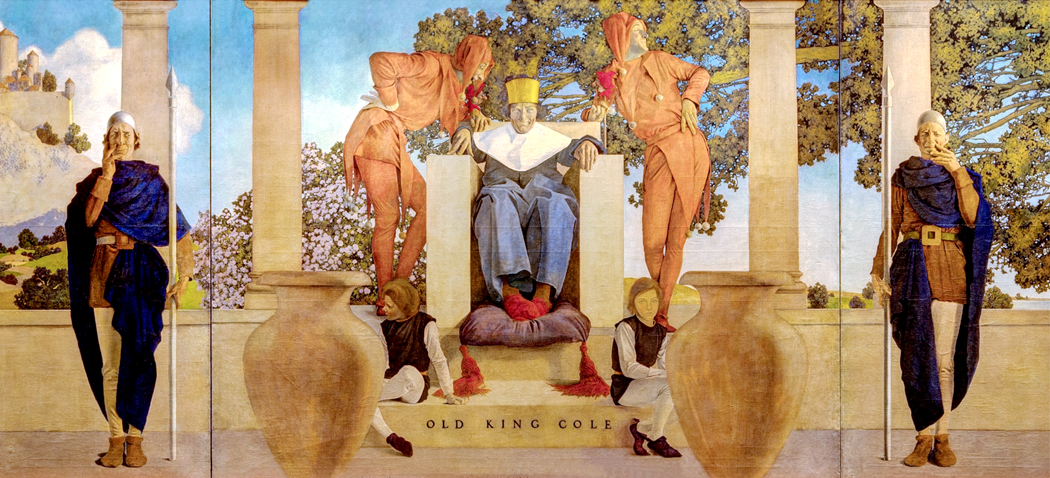
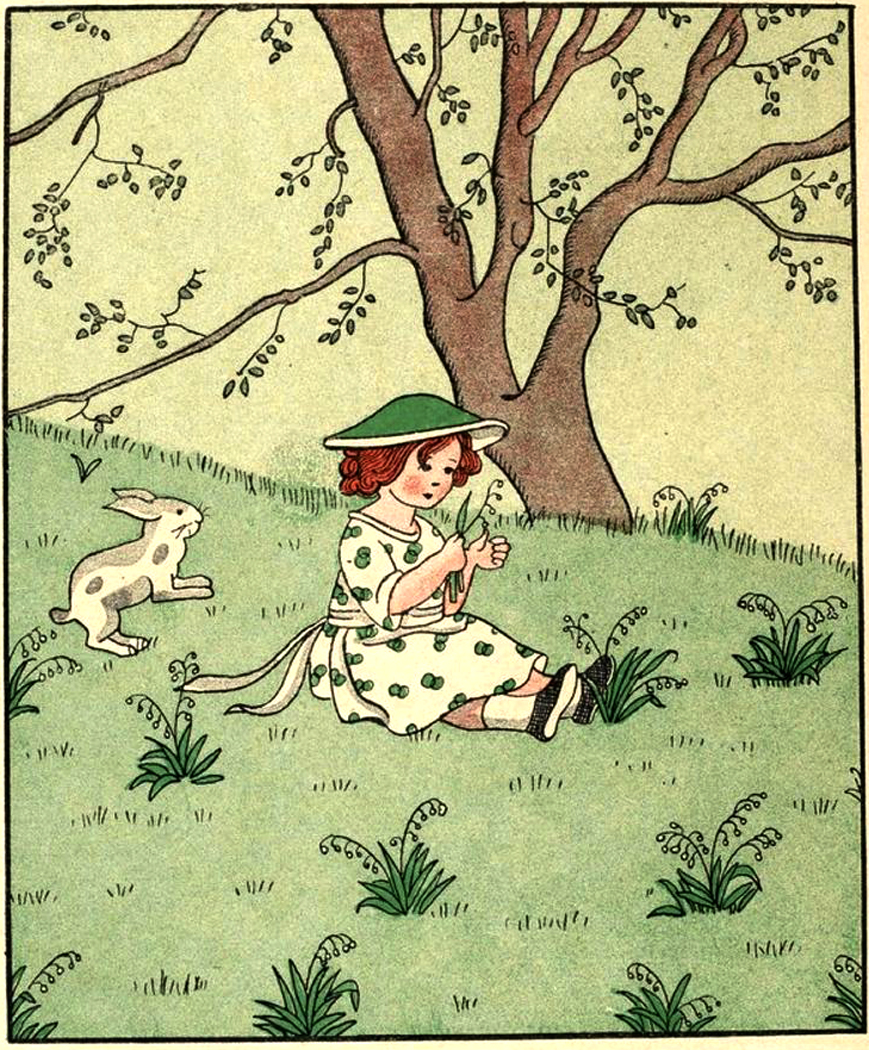
I have a book I love greatly. In august buckram, of a deep navy blue, with gold embossed letters on the spine, it is the Oxford Dictionary of Nursery Rhymes, compiled in 1951 by Iona and Peter Opie. It is more than an anthology; it is a deeply researched tome of scholarship, as one would expect from the Universitatis Oxoniensis.

Each rhyme is compiled with variorum versions and usually several pages of history, interpretation and arcana. Humpty Dumpty covers four pages, with footnotes. We learn that versions exist in Sweden (“Thille Lille”); in Switzerland (“Annebadadeli”); Germany (“Rüntzelkien-Püntzelken”); France (“Boule Boule”) and elsewhere. That Humpty-Dumpty is the name of a boiled ale-and-brandy drink; that there is a little girls’ game by the same name; that the name was also given to a siege engine in the English Civil War.

And we learn that there is a commonly-held belief that the rhyme (I can’t really call it a poem) is really about the fall of “My kingdom for a horse” Richard III. Not, apparently, true.

If there is a common theme in the book, it is that although so many people believe there is a “secret” meaning to so many of these nonsensical nursery rhymes, and seek out who in history is really being referenced, almost always such belief is unfounded. The poems are either attested to much earlier than the historical figure, or we know by internal evidence, it could not be.

How many people believe “Ring around the rosey” is about the Black Death or the Great Plague of 1665? This folk etymology doesn’t appear until after World War II, but now seems universally accepted, despite all evidence to the contrary. The symptoms in the verse are simply not the symptoms of the disease.

Or take “Sing a song of sixpence, A pocket full of rye; Four and twenty blackbirds, Baked in a pie.” The Opies relate several “interpretations” of the rhyme: “Theories upon which too much ink has been expended are (1) that the twenty-four blackbirds are the hours of the day; the king, the sun; the queen, the moon; (2) that the blackbirds are the choirs of the about-to-be dissolved monasteries making a dainty pie for Henry; the queen, Katherine; the maid, Anne Boleyn; (3) that the king, again, is Henry VIII; the rye, tribute in kind; the birds, twenty-four manorial title deeds presented under a crust; (4) that the maid is a sinner; the blackbird, the demon snapping off the maid’s nose to reach her soul; (5) that the printing of the English Bible is celebrated, blackbirds being the letters of the alphabet which were ‘baked in a pie’ when set up by the printers in pica form. … If any particular explanation is required of the rhyme, the straightforward one that it is a description of a familiar entertainment is the most probable.”

Occam’s razor, once again.

I grew up in suburban New Jersey, largely destitute of what Bruno Bettelheim called the “enchantment of childhood.” I never read any fairy tales until college. And the child rhymes I had about me were not usually the ancyent classiques, but rather, the newer comic ones.

Fuzzy Wuzzy was a bear

Fuzzy Wuzzy had no hair

Fuzzy Wuzzy wasn’t fuzzy

Wuz he?

or:

Oo-ee Goo-ee was a worm

A mighty worm was he

He sat upon the railroad track

The train he did not see

Oo-ee goo-ee!

Then there were the spelling rhymes:

Chicken in the car

The car won’t go

That’s how you spell

Chicago.

or

A knife and a fork

A bottle and a cork

That’s the way to spell

New York.

There were those set to familiar tunes, like the “Great green gobs of gooey grimy gopher guts,” or:

Be kind to your webfooted friends

For a duck may be somebody’s mother.

Be kind to your friends in the swamp,

where the weather is very, very damp.

Now you may think that this is the end —

Well, it is!

That abrupt ending was a theme, as in “Ooey-Gooey” and in

There was an old crow 

Sat upon a clod; 

That’s the end of my song. 

—That’s odd.

When I was a kid, I thought that kind of deconstruction of the scansion was hilarious.

Later, I learned such eternal classics as:

O I had a little chicken and she wouldn’t lay an egg

So I ran hot water up and down her leg

O the little chickie cried and the little chickie begged

And the little chickie laid me a hard boiled egg.

Which we rounded off with the modern rewrite of “Shave and a haircut, Five cents:”

Match in the gas tank:

Boom-boom.

Also hilarious:

On top of spaghetti,

All covered with cheese,

I lost my poor meatball

When somebody sneezed.

It rolled off the table

And onto the floor,

And then my poor meatball

Rolled right out the door.

“Rolled right out the door,” had me rolling on the floor.

Almost as much as:

I see London, I see France;

I see someone’s underpants.

Underwear being, of course, in grade school second in delirious comedy only to farts.

Such rhymes may refer to real personages, of course, as:

Lizzie Borden took an ax

And gave her mother forty whacks

And when she saw what she had done,

She gave her father forty-one.

(Although court records tell us Lizzie’s stepmother received 18 blows and her father, 11. Still, we don’t go to children’s doggerel for historical research.)

The fact is, this stuff is just nonsense verse, and we loved it, not only because we were immature little brats who found bodily functions risible, but because rhyme and meter delight the mind and ear. The children’s rhymes we recited when we were bairns were one of the ways we acquired language. (It has often been pointed out that we don’t “learn” our native tongue, but rather “acquire” it, picking it up by example, and examples that are memorable are easier to remember, QED.)

I don’t mean to imply these versicles were understood to be, or designed to be pedagogical, but that their effect was to make language magical and something we didn’t simply use, but delighted in.

Of course, sometimes the stupid rhymes were meant to teach, like “In Fourteen-hundred and Ninety-two, Columbus sailed the ocean blue.” Or, in even more egregious form, causing lifelong damage to those required to memorize them in music-appreciation classes, those mnemonics that taught classical music:

This is the symphony

That Schubert wrote

And never finished.

Or:

In the hall of the Mountain King

Mountain King

Mountain king

In the hall of the Mountain King

Was written by Edvard Grieg.

Can’t unhear what you’ve heard. Such things led to parodies, also, sung to the opening of Mozart’s Symphony No. 40:

It’s a bird, it’s a plane, it’s a Mozart

Shoot him down, shoot him down, shoot him down…

So, as we grew up, we still loved the silliness that we first encountered with our nursery rhymes and nonsense verse. It is why Walt Kelly’s Christmas carols are sung even by people who don’t know where they come from:

Deck us all with Boston Charlie

Walla-Walla, Wash., and Kalamazoo

Nora’s freezing on the trolley

Swaller dollar cauliflower alley-garoo!

It is why we love Shel Silverstein’s ditties:

The Slithergadee has crawled out of the sea.

He may catch all the others, but he

won’t catch me.

No you won’t catch me, old slithergadee,

you may catch all the others, but you wo— 

My brother says he doesn’t even remember writing this one, but I wrote it down many, many years ago:

Watch your scotch

Or it’ll get brittle.

And I was once asked to be a Cyrano for a college roommate I detested and to write a poem that he could pretend he wrote for a girl he fancied. Her name?

If you have a yen,

Don’t ask if, ask Gwen.

I don’t remember how that romance turned out, but, you know, “Match in the gas tank; Boom-boom.”