Nixon birthplace

”I was born in a house my father built.”

It is one of the great first lines in American literature and says more than perhaps the entire rest of the book toward explaining Richard M. Nixon. It is an expression of the politician’s essentially mythological sense of his own life.

Others might have written, “I was born in Yorba Linda, Calif.,” or “I was born a month before the 16th Amendment was ratified, creating the income tax.” But no, Nixon goes for the archetypes: birth, father, home.

The little white clapboard house that Nixon’s father built, and that opens his memoirs, still can be found, at the Richard Nixon Library and Birthplace in Yorba Linda.

The house, shaded under a grove, is rather dwarfed by the huge, impersonal marble and glass library, with its parking lot and fountains.

Nixon Library and Gardens

But the house is the only real reason to visit. Inside the tiny cottage, which Nixon’s father had ordered from a catalog, is the niche of a bedroom and the bed on which the future president was born.

Richard Nixon's birth bed

Richard Nixon’s birth bed

It makes Nixon feel almost human.

You can get a sense of the small-town bourgeois life that he sprang from, the piano in the parlor and the small bookshelf with the equivalent of the Harvard Classics that must have given Nixon his early sense of education and culture.

I have to admit, I never much liked Nixon — more accurately, I despised him and his politics — until Watergate. My reaction is probably the opposite of most of those who lived through those times: Nixon was elected in a landslide in 1972 and after his resignation, widely denounced. For me, I hated him until his crimes and venality humanized him.

Politics tends to flatten its heroes, to turn them into one-dimensional factional puppets. We don’t like to find out that our presidents are mere people, that they have faults, fudge the truth, create political lists, philander.

It was only after Watergate that the more complicated, vast, conflicted, confusing, contradictory Nixon became widely known and written about. Nixon, the contemporary Richard III, the one candidate who could deal with evil in foreign affairs because he was conversant with it in himself.

He was surely the only 20th-century politician who plausibly can star in his own opera: John Adams’ Nixon in China.

The real Nixon won my respect because he was larger than life, or, more precisely, he was as big as life.

So, it was a huge disappointment to discover that the Nixon Library, and the museum attached, do their best to turn Nixon back into a plaster bust, denying him all the richness that made him so fascinating.

It is a sanitized Richard Nixon that shows up at the library, one who doesn’t use expletives, deleted or otherwise. The old newspaper clippings glorify his career without ever mentioning his pink-paper campaign tactics, his smearing of Helen Gahagan Douglas, his ”enemies” list.

The real Nixon was Shakespearean, the enshrined Nixon is as polyethylene as Reagan.

The real Nixon saw himself mythologically, and like myth, is open to various, equally defensible interpretations. He was not coherent, but multifarious. There is something in his life for everyone, whether they want to hate or admire.

Which is why the Oliver Stone movie seems so true, no matter how loose he plays with fact. Stone recognizes the essentially mythic quality of Nixon’s personality, which is why he built his entire movie as a gloss on Nixon’s farewell speech to his staff, which is concocted of archetype: ”I remember my old man. I think that they would have called him sort of a little man, common man. He didn’t consider himself that way.” And, ”Nobody will ever write a book, probably, about my mother. Well, I guess all of you would say this about your mother: My mother was a saint.”

It was a gloriously bathetic speech, mawkish and sentimental, but it summed up the essential Nixon, not as one man in a planet full of its congested billions, but as the single Shakespearean king, the central player, not only in history, but in his own life story, as in each of our lives, where we are all the king.

One glorious piece of mythologizing snuck in, although the museum staff doesn’t seem to recognize it for the glorious kitsch it is.

There is a large painting of Nixon by the Hungarian-American artist Ferenc Daday. In 1956, Eisenhower sent Vice-President Nixon on a fact-finding tour of Europe. He made an unscheduled late-night visit with refugees of the Hungarian Revolt at the Austrian border town of Andau.

One can imagine Nixon in reality, getting out of his limo, stopping to talk with a few people, as awkward as he was with the anti-war protesters at the Lincoln Memorial. But the painting doesn’t show that; it shows a heroic Nixon in a white trench coat under an anagogic sky — it could be a leftover from Gone With the Wind. The refugees plead with him for succor.

nixon painting

The whole thing is a wild sendup of the great history paintings of art history, populated with suffering masses, a man on crutches, another with a Hungarian flag unfurled in the wind. The vast plains of Hungary spread out in the background like the landscape in an Altdorfer painting.

And standing next to one poor woman, her arm in a sling, is a shaggy Puli hound, its tongue hanging out. It is such a piece of deflating silliness, the artist surely must have put it there satirically. But if so, the Nixon Library staffers are not in on the joke. Apparently, they have since taken the painting down, perhaps embarrassed by its schmaltz. They should reconsider; the painting says more about Nixon than all the official policy papers and bronze statuary.

When I asked about the painting, many years ago, when I first visited, I got only the party-line response, almost as if the staffer were reading off a TelePrompTer.

The only one who got it was the young man at the gift shop.

”What’s the kitschiest thing you have here?” I asked him.

”This is our bestseller,” he told me, and dragged me with a smile over to the shelf with the coffee mug on which is printed a photograph of Nixon and Elvis.

nixon and elvis with mug

Now, that’s mythology.

grave digging patrol antietam 1862

Most Americans’ response to the Civil War depends on which side of the Mason-Dixon Line they were born.

And they can endlessly discuss the causes of the war and its meaning. Was it fought to end slavery, or to impose Northern industrial power on the agricultural South? Was the Confederacy an evil attempt to perpetuate racism or a noble attempt to protect its native soil and individual rights?

But when you are standing in Bloody Lane, you can’t pick sides. It no longer matters who was right and who was wrong.

Before Sept. 17, 1862, the brief dirt drive was called the Sunken Road, and it was a shortcut between two farm roads near Sharpsburg, Md. All around were cornfields rolling up and down on the hilly Appalachian landscape.

The narrow dirt road, depressed into the ground like a cattle chute, now seems more like a mass grave than a road.

And it was just that in 1862, when during the battle of Antietam Creek, Confederate soldiers mowed down the advancing Federals and were in turn mowed down. The slaughter was unimaginable.

You can see it in the photographs made a few days after the battle. The soldiers, mostly Southerners, fill the sunken road like executed Polish Jews. It was so bad, as one Union private said, “You could walk from one end of Bloody Lane to the other on dead soldiers and your feet would never touch the ground.”

Civil War 150 The Lost Order

Even today, with the way covered with crushed blue stone, the dirt underneath seems maroon. Perhaps it is the iron in the ground that makes it so; perhaps it is the blood, still there after 135 years.

Antietam was the worst single day of the Civil War. Nearly 23,000 men were killed or wounded. They were piled like meat on the ground and left for days before enough graves could be dug for them. There were flies, there was a stench.

The whole thing was a fiasco, for both sides, really. Robert E. Lee had taken his Confederate forces, numbering about 40,000 men, into the North, intending to take Union supplies at Harrisburg, Pa. It was a strategic move that Lee hoped would lend the Confederacy enough respect so that England would recognize the presumptive nation diplomatically. This, many Southerners hoped, would force the Union to negotiate a peace with the seceding states.

But he didn’t get farther than Maryland before the Union, under the sluggish General George McClellan, showed up with 87,000 men.

After a period of jockeying for position, Lee wound up with his troops in a long line, running north and south along Antietam Creek and through the town of Sharpsburg. The Union approached from the east.

Lee braced for a battle, but McClellan hesitated. When he attacked, his battle plan was botched by his field commanders. In the early morning, his men attacked the north part of Lee’s line. They fought relentlessly for several bloody hours, only to reach an exhausted standoff.

antietam harpers weekly

In the middle of the battle, the Union soldiers attacked at about 9:30 a.m. That is where the Southerners had set themselves in the Sunken Road. It was a perfect defensive position, and when the Federal troops marched over the rise a few tens of yards above the road, the fire devastated their ranks.

For four hours, the battle went on, soldier falling on dead soldier, and at the end, the Confederate commander at one end of the road misjudged an order, and retreated, opening up the end of the road to Northern reinforcements.

Given a clean line of fire on the remaining Rebels, the Yankees hacked through them like machetes through a jungle.

That is where the midden of bodies came from that filled the hollow of the road.

Later that day, along the southern boundary of the battle, the Yankees tried to cross a bridge over the creek and were held back for several hours by the Confederates.

But at the end of the battle, both Northern and Southern battle lines were nearly exactly where they had been in the morning. The battle had been a pointless bloodbath. The cocky McClellan claimed victory, but he could not say what he had won.

McClellan had lost every chance he had been given, hesitating and halting. “It wouldn’t be prudent to fight at this time,” he said at just the moment he might have broken Lee’s line and finished off the whole blood-soaked Civil War in an afternoon. As a result, Lee managed to get his army back safely south of the Potomac River. McClellan had lost his chance.

bodies on battlefield antietam

But all these years later, as you stand in Bloody Lane, the grassy margins of the road inclining up around you and the way lined with the criss-cross of split-rail fencing, it doesn’t matter if the soldiers were Yankee or Reb. They were all young, brave, impetuous and dead.

It is painful to stand in the declivity, looking up at the mound in front of you, covered in cornstalks in a mid-July day. You can see that when the Yankees came over the rise, they were already close enough to touch. There was no neutralizing distance for your rifle fire to travel, no bang-bang-you’re-dead, no time, no room for playing soldier. Your enemy was in your face and you had to tear through that face with lead, the blood splattered was both Federal and Confederate, in one red pond among the furrows.

It is only made more poignant by the peacefulness of the countryside  now, turned into a National Battlefield Park. Birds and butterflies play among the grassy seedheads, tourists come with their videocams and enjoy the scene. Husbands regale their wives with statistics:

In four hours on 200-yard stretch of Bloody Lane, 5,000 men were blown apart.

In another part of the battlefield, Union General John Sedgewick lost more than 2,200 men in less than half an hour in a charge into the West Woods.

In the Miller Farm cornfield, Union General Hooker later wrote, “every stalk of corn in the northern and greater part of the field was cut as closely as could have been done with a knife, and the slain lay in rows precisely as they had stood in their ranks a few moments before. It was never my fortune to witness a more bloody, dismal battlefield.”

I am not a superstitious man. I lay hold of empirical evidence, hard fact. But it is difficult to stand in Bloody Lane and not feel that all the soldiers are still there, perhaps not as ghosts, but as a presence under your boot-sole, there, soaked into the dirt.

It is almost, as some cultures believe, as if everything that happens in a place is always happening in that place. The battle was not something that occurred before my great-grandfather was born, but a palpable electricity in the air. You can not stand there in Bloody Lane and not be moved by that presence.


It Stinks

Wall Street Journal writer Charles Passy recently wrote a piece describing “10 Things Movie Critics Won’t Tell You.” Some of those things were certainly true: “We’re not as powerful as we once were;” “My Top 10 List is Full of Movies Nobody’s Seen.” But one of his observations made me cringe: “We’re Not in Tune with the Public’s Taste.”

To ordinary moviegoers, critics seem often to project a snobbish attitude to movies the ticket-buyers most enjoy. Critics love to dump on Michael Bay, for instance, even as theater lines extend around the block. The public (or at least the part of the public that is the demographic for most current blockbuster movies) loves to see things blow up real good. The critics? Not so much. It seems they would much rather see a film in Hungarian shot on poorly lit video in which a lonely widow starves slowly to death in real time.

Passy is not a film critic, and he cannot possibly understand one of the basic dynamics of the career he criticizes. But I’ve seen it in action.

He complains: “How to explain this gap between critics and the public? Some filmgoers see it as elitism at its worst: ‘Most critics are trying to impress the public (and other critics) by flaunting their perceived affluent taste and intelligence,’ one movie fan wrote on a Yahoo message board about the issue.”

He points out that Rotten Tomatoes, a film website that gives scores to movies based on a survey of reviews from as many as 200 critics, gives Tyler Perry’s Diary of a Mad Black Woman a 15 percent approval rating, while in the audience rating section of the website, Diary received an 88 percent approval. How can critics and audiences be at such odds?

Passy quotes Leslie Gray Streeter, a film writer with The Palm Beach Post, who observed: “The most objectionable reviews are disturbingly dismissive of the movie’s audience and its presumably simplistic religious or cultural attitudes. They read like ‘Who is this Tyler Perry fellow and who does he think he is?’”

Surely, the movie audience reacts, the critics must be snobs, showing off their “superior” taste and cinematic knowledge. Cries of elitism abound.

Yet, as I say, I have seen the true dynamic at work. It has nothing to do with showing off, or any feeling of cultural superiority (except perhaps for John Simon: There is no excuse for John Simon).

When I wrote for The Arizona Republic in Phoenix, Ariz., the old movie critic moved on to greener pastures, and the paper’s management decided to replace him with an “Everyman” reviewer. Exactly the kind of critic who would see movies through the eyes of the ordinary film goer. They fixed on  Bill Muller, an award-winning former investigative and political reporter, full of extroverted bonhomie and a regular guy if ever there was one. Not only was he someone you would like to have a beer with, he was someone you, in fact, did have a beer with.

Muller

When Muller arrived in the Features department, he professed to having no knowledge of movies at all. He didn’t know a DP from a grip from a Foley artist. It wasn’t that he was proud of his ignorance; in fact, he immediately set to learning his new field. He asked questions constantly of those around him who were movie buffs. Muller was ignorant of movies, but he was incredibly intelligent. Hungrily curious.

His first reviews were just what his bosses were looking for: true appreciation of movies in which things blew up real good. For the first year of his tenure, he continued to be the voice of the common man.

The problem is, that if you see one movie where things blow up real good, you can really enjoy the fireworks. If you see 10 such movies, you begin to rate which of them does the blowing up better than the others. If you see 100 of them, you really cannot avoid developing what can only be called “taste.” The more movies you see, the higher rises your taste level. It is inevitable. Critics see a lot of movies.

The monotony of fireballs and car crashes eventually become wearing. At some point, you have simply seen enough.

When Muller first began writing about movies, he avoided Foreign Films. Like most Americans, he hated subtitles. I was the beneficiary of his aversion: He passed on most foreign language films to me to review. I got to see scores of great films that he just wasn’t interested in. I was in pig heaven.

The result, for me, was that seeing so many French films, made me realize that not all foreign films are masterpieces. I began to recognize the dross (at a lower percentage than Muller and Hollywood: Americans get to see only a preselected group of foreign films. Most French films never see the light of Dayton, Ohio).

But, as I say, Muller’s taste level unavoidably began to rise as he realized one blowing-up movie was pretty much like another. And after a few years, he began looking forward to the so-called “art films” he had once tossed aside.

He never became a hoity-toity snob. There was nothing preventing him from enjoying a popular movie that was well made and original. It wasn’t a movie’s popularity that interested him. But having seen thousands of movies over that time made him able to distinguish between movies that tackled something real and worthy, and those that just fed fodder into the studio machine and spit out unimaginative clones.

And so, some readers began to complain about Muller, calling him an elitist and a snob. It was unfortunate. If you see only a few movies a year, like most people, most of them seem exciting; if you see hundreds, like a professional movie critic, the dreck stands out by contrast. I’m talking to you, Michael Bay.

By the time of his untimely death, in 2007, Bill Muller had become one of the best movie critics in the country. Nobody was less elitist than Muller, but he could never be less than honest about his judgement.

This is an affliction that visits anyone, like Muller, who sees that many films.

The solution, obviously, is for newspapers to change film critics at least once a year. That way, the critic is always in the unlearned state of the beginner. We should pluck him out of his desk the moment he begins to say nice things about Pedro Almodovar or has his first qualms about “Spiderman 5: The Regurgitation.”

Of course, this has already happened, in its way. As newspapers spiral down the drain of historical insignificance, their place is taken by an infinite number of bloggers (mea culpa) who cannot afford to see a film a day, sometimes two, and have their tastes involuntarily elevated.

These happy many, writing online, can pour forth panegyrics about the latest Adam Sandler film, or find the virtues in Tyler Perry, or conversely, complain about the casting of the latest Star Trek feature.

Every man his own critic. And nothing rises to converge.

thumbsupdown

solomon and sheba lollabrigida

The problem with reading history in books is that there are never enough dancing girls.

We can sit in silence with our Gibbon, Prescott or Tacitus and turn pages like a hermit, one after the other, but nothing makes history come alive like Hollywood. No footnotes, no pesky scholarship, no long sentences and paragraphs, no boring analyses: Hollywood gives us the battles, the orgies, the casts of thousands, the costumes and the lack thereof.

It gives us Victor Mature, Gene Tierney, Yul Brynner and all-time champ Charlton Heston.

It gives us Cleopatras, Caesars, Delilahs, Mata Haris, Lucretia Borgias and Genghis Khans.

They wear togas, tunics, buckskins, goat-skins and mastodon skins. They bring with them plagues, wars, dynasties, lust and ambition. They speak in a language with no contractions and in ponderous formalities and utter such memorable lines as ”Harness my zebras, gift of the Nubian King!,” and ”War, war! That’s all you think about, Dick Plantagenet.”

Or ”Take a letter. Mark Antony, The Senate, Rome . . .”

Or ”This Tartar woman is for me, and my blood says, ‘Take her!’ ”

Yes, Hollywood has a certain way with history. When director Alex Korda was told he needed six demurely dressed vestal virgins, he snapped back, ”I want 60, and I want them naked!”

Or, as James Thurber once remarked after seeing Cecil B. De Mille’s Ten Commandments, ”It makes you realize what God could have done if he’d had the money.”

History continues to inspire Hollywood execs, from Steven Spielberg’s Lincoln to Quentin Tarantino’s Inglourious Basterds. We even get a history lesson from Bill and Ted’s Excellent Adventure (1989) and Brad Pitt’s Troy (2004). Not to forget the forgettable Gladiator (200), with Russell Crowe killing the Roman emperor, Commodus in the somewhat historically questionable coliseum.

But the heyday of historical dramas came with the studios, and the sword and sandal epics, with their “cast of thousands” before CGI made such a claim unnecessary.

kitschy posters

This all comes up because that megaturkey epic, Cleopatra (1963), with Liz and Dick, has been issued on Blu-Ray. All 243 bloated minutes of it. Stilted dialog, purple eye shadow, togas out the wazoo, to say nothing of barges on the Nile. And Rex Harrison as Caesar.

Hollywood is always historically accurate, at least in so far as there actually was a Caesar. After the establishment of that fact, all bets are off. Hollywood has made many Cleopatras, but I wouldn’t try to look for any fact larger than a mouse in any of them.

cleopatraposters

But accuracy is overrated in history. Some of the greatest artistic successes make for questionable history, such as Shakespeare’s Richard III or Oliver Stone’s Nixon.

The facts may be in question, but you nevertheless feel this is the way it should have been.

It’s like the dictum from The Man Who Shot Liberty Valance: ”When the legend becomes fact, print the legend.”

And if there’s not a legend, let the publicity department invent one.

What’s the point of reading all those scholarly books if, once you put them down, you can’t remember anything in them? On the other hand, who can forget Claudette Colbert as Nero’s wife in The Sign of the Cross, bathing in asses’ milk?

sign of the cross colbert bath

So, Hollywood provides us with a history that sticks to the brain like used chewing gum.

Think of your video store as a university.

It begins with prehistory.

raquel welch

Your main problem will be in choosing which movies to watch from the riches available: Do you want Raquel Welch in One Million Years B.C. (1966) , Darryl Hannah in Clan of the Cave Bear (1986) or Rae Dawn Chong in Quest for Fire (1981)?

I always go for the last. I tell people it is because of the clever artificial language created by linguist and novelist Anthony Burgess, but it is really because Chong takes her clothes off. Several times.

quest for fire rae dawn chong

When it comes to pharaohs and Caesars, the film world is immense. There must be thousands of movies featuring Romans, from 1908’s silent Julius Caesar to 1980’s Caligula, by Penthouse publisher Bob Guccione, which wouldn’t shut up.

It is interesting: Hollywood loves Ancient Rome, but it ignores Ancient Greece. As I look down the long list of history, I can’t help but notice that every time civilization reaches an apex of intelligence and literacy, Hollywood grows mum. We have lots of gladiators, but few philosophers onscreen.

The pattern holds up in later history, too. It’s hard to find a good movie that takes on the Enlightenment or the Reformation. But give us revolution, debauchery or intrigue, and the cameras start spinning.

You’d think there would be something to film in the 18th century: Perhaps Hollywood has not yet discovered the Duc de Richelieu, who invented mayonnaise in 1756 and was notorious for holding nude dinner parties. I’m sure the two things must be related in a way Hollywood can use.

But there is something about knee-britches that puts Hollywood off. For all the films on the Civil War, there are darn few on the Revolution. Lincoln shows up over and over, but George Washington might as well never have lived. I guess Hollywood thinks he looks too foppish in that satin and wig.

To do their patriotic duty, Hollywood has managed two films on the Revolution. It tried to tart it up once in 1776 (1972) by turning the war into a musical; the next time, it thought it could make Al Pacino sound like an 18th-century Bostonian in Revolution (1985). Both films are predictably awful.

Intolerance

An entire history curriculum could be devised from Hollywood films, matching titles with history’s centuries and movements.

As with any course of study, there are crib notes for those who cannot take the time for the whole thing.

You can get an overview of history from these three films:

1. D.W. Griffith’s Intolerance.

2. The Story of Mankind, with the Marx Brothers.

3. Mel Brooks’ History of the World Part One — ”It’s good to be da king.”

I can’t give you a diploma for completing this curriculum, but I can promise that you’ll have as good a grasp on history as the average American student.


Ives portrait

The music of Charles Ives has been thought gnarly and noisy, difficult and dissonant. And it is, for sure. But it is also profoundly nostalgic and deeply American.

Instead of avoiding his music because it is so “modern,” you should let the music steep inside your consciousness and let it dredge up all your most inkept feelings of loss and childhood. Ultimately, his music is not so much avant-garde as it is heartbreaking. Fireworks, parades, summer vacations, church picnics — it’s all there in the music. And all the more potent for its evocation of the New England that Ives grew up in.

For Ives, New England was America. He was born from the soil of New England and finally was returned 79 years later to that same soil. He inherited the culture of Emerson, Thoreau and Hawthorne and turned it into sound.

His piano sonata Concord, Mass. 1840-1860, his Holidays Symphony and his Third Symphony (Camp Meeting) all grow from his New England roots, full of the marching-band tunes, patriotic airs and revival-meeting hymns he heard as a boy.

But one piece above all sums up his New England experience, and it is one of his easiest to digest and, therefore, most popular. It is Three Places in New England, and it describes in music three very precise landscapes.

Sometimes called the “New England Symphony,” it was written by Ives between 1903 and 1911. It contains three movements that are unforgettable impressions of the land and people.

Landscape plays a big part in the history of painting and hardly less in literature. We can visit the very square foot of land in Canada where painter Frederic Edwin Church stood to paint his monumental Niagara Falls or we can tour the Lake District that inspired William Wordsworth and Samuel Taylor Coleridge.

But it is not often that landscape inspires music. There is the occasional Moldau or La Mer, but scene-painting in sound is not often as precise as a painting. Smetana takes in the whole river, not a single view, and Debussy’s ocean is any ocean.

Yet Ives gave us in his Three Places three distinct sites that can be visited and enjoyed and compared with the sound portraits.

Shaw Memorial, Boston

Shaw Memorial, Boston

The SHAW MEMORIAL, Boston

The first section in Ives’ music is titled ”The St. Gaudens in Boston Common” and is subtitled ”Col. Shaw and his Colored Regiment.”

The St. Gaudens is a Civil War monument, considered by some people to be the best American example of memorial sculpture. It was created by Augustus Saint-Gaudens and unveiled in 1897 at the northeast end of Boston Common, across the street from the Massachusetts Statehouse.

The deep-relief sculpture commemorates the 54th Massachusetts Volunteer Infantry Regiment and its commander, Col. Robert Gould Shaw, who died in the Civil War.

The 54th was unusual at the time because its enlisted ranks were composed entirely of African-Americans. On May 28, 1863, the largest crowd in Boston’s history came out to see the 54th march off. They saw the thousand Black soldiers marching, accompanied by their White officers on horseback.

A souvenir of the day quoted Byron: ”Who would be free, themselves must strike the blow.”

Two months later, Shaw and a third of his command were dead, killed in the attack on South Carolina’s Fort Wagner in Charleston Harbor. Their charge had failed, but the soldiers had fought so well that they legitimized what had been considered a questionable idea: African-Americans in combat.

Shaw initially was buried in a common combat grave with his dead troops, and after the war, when plans were made to exhume the gallant young officer and give him an official ceremony in a Massachusetts cemetery, his parents refused, writing that they could hope for ”no holier place” for him than ”surrounded by his brave and devoted soldiers.”

Saint-Gaudens, America’s premier sculptor at the time, was commissioned in 1883 to monumentalize Shaw, and briefly considered a standard equestrian statue, but finally decided that the Black troops deserved the memorial as much as Shaw and devised plans to include them.

He wanted to represent the soldiers accurately; some were as young as 16, others were bearded grandfathers. So he hired African-Americans to pose for him and made 40 heads as studies. Sixteen went into the final bronze.

So Shaw rides his horse in front of a rhythmical line of marching soldiers, their heads, sleeping packs and rifles creating a visual drumbeat.

Ives’ 8-minute portrait of the monument is a diffuse, dissonant wash, as though not only the images of the Civil War but also its very idea were obscured in the haze of memory and history.

”Moving — marching — faces of souls! Marked with the generations of pain, Part-freers of a destiny, slowly, restlessly swaying us on with you towards other freedom!” Ives wrote in his score.

The monument was only a few years old when Ives began writing about it, and the layers of time show through in the music: the war, the remembrance of war, the causes and unfinished business of the war in a conflicting mass of sound.

Often, in the welter, you can make out a familiar tune: Marching Through Georgia or Battle Hymn of the Republic.

Then it all fades away into the nostalgic past.

Today, the sculpture is nearly black in its patina. It sits on its granite plinth looking vaguely like a plaque on a headstone. The tour buses stop, and the tourists pour out with their cameras. Some shoot the gold-domed statehouse, others shoot the St. Gaudens.

One bus unloads two dozen Japanese tourists. They also point their cameras. The amplified sound of a tour guide overpowers the street noise — but in Japanese — and I cannot possibly know what she is saying or what the Japanese tourists can make of the racial complexity involved in the war, the monument and American history.

Putnam's Camp, Redding, Connecticut

Putnam’s Camp, Redding, Connecticut

PUTNAM’S CAMP

The second movement is called ”Putnam’s Camp, Redding, Connecticut.”

Gen. Israel Putnam, like most American generals in the Revolutionary War, was better known for strategic and tactical retreats than for victories. Charged with holding the Hudson Highlands in 1777, he lost Fort Monroe and Fort Clinton while backing up into Connecticut.

He and his troops wintered near Redding, Conn., in 1778, undergoing much of the same privation and hardship Washington endured at Valley Forge.

But Ives isn’t remembering the Revolutionary War in his music. Rather, he is remembering his childhood, when he used to visit the site of Putnam’s Camp and fantasize what it must have been like in the winter of 1778-79.

He also recalls the patriotic Fourth of July picnics he attended there and the brass bands that played.

”Long rows of stone campfire-places still remain to stir a child’s imagination,” Ives wrote.

What he hears is a grand cacophony of marching bands, playing different tunes at the same time. It is loud, bouncy and ear-blasting, getting louder and louder, with strains of The British Grenadiers and other songs, and ending in a misquoted bar and a half of reveille.

It is all a jolly 6-minute joke but the kind of music Ives loved best. ”Pretty sounds are for pretty ears,” he said, deriding those who wanted pleasant melodies from his orchestra.

Once, upset over the hoots and boos of an audience listening to some modern music, Ives got out of his seat and exhorted the unappreciative crowd to ”Stand up and take your music like a man!”

Putnam’s Camp is today a state park, half on the east side of Connecticut 58, half on the west. It is the eastern half that is most visited; it has a lake, a parking lot and picnic tables, and many of the people who come there probably give little thought to the Colonial army that once wintered there.

On the other side of the road, there is a path through the woods that passes the lines of camp hearths and a hilltop cemetery full of the unmarked graves of those who died fighting for American independence.

At the lake, a man — who looks like he’s playing hooky from work — casts his fishing line into the water. The fall remnants of waterlily leaves are curled and brown on the water, and a few Canada geese honk on the lawn.

The sky is overcast, and the woods are brown as tweed, with neither shadows nor highlights. And the old-fashioned New England Fourth of July patriotic and religious picnic is as much a part of the past as Putnam’s war.

Housatonic River, Stockbridge, Massachusetts

Housatonic River, Stockbridge, Massachusetts

HOUSATONIC at STOCKBRIDGE

The last section of Three Places in New England is perhaps the most moving. It is ”The Housatonic at Stockbridge.”

That is, the Housatonic River at Stockbridge, Mass.

The Housatonic is one of those alternating lazy and cascading streams that run from north to south, along which New England’s factories were built in the early years of the Industrial Revolution.

It begins at a small pond in Washington, Mass., and wends its way 149 miles to Long Island Sound at Stratford, Conn.

Along its banks are both towns and woods. Ives honeymooned in the Berkshires in 1908 with his new wife, Harmony, and one Sunday morning, they strolled near Stockbridge and the river.

”We walked in the meadows along the river,” he wrote many years later, ”and heard the distant singing from the church across the river. The mist had not entirely left the riverbed and the colors, the running water, the banks and the trees were something that one would always remember.”

The 4-minute movement that Ives wrote captures the quiet and the mist: It is ambiguous tonally and melodically, like a remembered dream, builds to a climax that evaporates abruptly, uncovering the quiet chords playing on the orchestral strings as if they had been sounding all along, but drowned out by the noise.

Like the strings in Ives’ Unanswered Question, which are drowned out by chattering woodwinds, the final quiet strings in Three Places are the eternal harmonies of nature.

Ives liked his piece well enough that he turned it into a song later, with words by poet Robert Underwood Johnson:

”Contented river! In thy dreamy realm — the cloudy willow and the plumy elm.”

It is an elegy to nostalgia.

Stockbridge has changed since the Iveses visited. It is now a prime tourist destination, full of gift shops and art galleries, with frozen yogurt. It is also the home of the Norman Rockwell Museum. Rockwell made his home there and used Stockbridge natives as models for his magazine-cover paintings.

The river eases in and out of town, crossed by four or five small bridges. The Housatonic is an average of only 35 yards across in Stockbridge, hardly more than a brook.

On a cloudy day in October, it also is hidden by the grayness. I have visited every spot along the river in town and enjoyed its quiet but missed its beauty.

Until late that afternoon when I stand on the hill by the Rockwell Museum looking over the river out at Pleasant Hill and a chink in the clouds widens, throwing a spotlight on the meadow across the water. The bare winter sycamores along its banks suddenly stand out like neon, and the band of sunlight sweeps from left to right, finally in its passing leaving the scene in gray once more.

And the riverbed and the colors, the running water, the banks and the trees were something that one would always remember.

DEEP TIME 

The search for Ives’ three places has turned into a pile of time on time, present on past, past on deeper past, all wound up in a single point of geography.

It is as if the Indians, who were in New England before the Pilgrims came, had a deeper understanding of reality. When something happens, they believed, it is always happening. Time is not a straight line but a basket full of harvest, all piled in together.

So that I cannot see this single piece of real estate, the Housatonic, the Yankee military camp or the St. Gaudens statue, without thinking of history, memory, my past and my nation’s past, all balled up into a single, complex thing.

All happening at once and all happening in my eye, looking at the past.

And I know it is not just true for these three places, caught in Ives’ web of meaningful noise, but for all places and all times.

Charles and Harmony Ives

Charles and Harmony Ives

CHARLES IVES

Charles Ives is the father of American music.

Before him, what American composers wrote for the concert hall was a dim reflection of European — and especially German — art music, with its sonatas and symphonies. After him, it was possible to feel truly American.

You can see his influence in the folk tunes that show up in Aaron Copland, the spare orchestrations and open harmonies of Roy Harris and the avant-garde fun John Cage has with noise.

Ives was a funny duck. Born in 1874, he studied composition at Yale, but instead of becoming a poverty-stricken composer, he became a wealthy insurance executive. Ives and his partner, Julian Myrick, founded a successful agency that pioneered much of the industry’s modern practice. Myrick had the business sense, Ives brought the creativity.

Together they prospered, ultimately becoming the largest insurance agency in America. In 1929, the firm sold $49 million worth of insurance.

But he was also a genius in music, taking little stock of what he learned from his stuffy college professors and feeding large on the oddball music education he received from his father, George Ives, who was bandmaster for the small Connecticut town of Danbury.

George Ives loved to experiment with sound, playing with microtones, out-of-tune instruments, polytonality and organized noise. That enthusiasm for experiment, which in George was a variety of practical Yankee inventiveness, became for his son a creed and a muse.

Yet although Charles Ives’ music was more modern than Stravinsky’s and more dissonant than Bartok’s, he really was not concerned with fitting into the long history of European art music. It is obvious in the music; Ives was not writing about modern things.

For although the music is filled with ear-splitting dissonances, it is unabashedly nostalgic. Ives felt a powerful nostalgia for the past — his past — and his music drips with bits of the music he heard when he was a boy: old hymn tunes and marching-band music.

No matter how loud and incoherent Ives sounds at first, at long last, it settles into Bringing in the Sheaves and Columbia the Gem of the Ocean — not whole but in snippets, as if half-remembered.

Ives wrote the bulk of his music in the first years of this century. His business and his ailments — he suffered from a poor heart muscle — kept him from concentrating on composition after 1918.

Or perhaps, as Ives’ early biographers, Henry and Sidney Cowell, suggested, ”The war was a shock of the first magnitude to a man whose life was based on his confidence in human progress.”

He lived on until 1954, becoming for many American composers a kind of father figure and rallying point.

Dawn, Grand Canyon

Dawn, Grand Canyon

When my wife and I were first married, we lived on the Atlantic Ocean, facing east. It was the direction we knew best: We both were born and raised on the East Coast, and although we sometimes migrated north and south, we had never been to the West.

So, as a kind of honeymoon, several years after the fact, we decided to spend one summer driving west to see the West.

The question became something of a joke on that trip: Where does the West begin?

When the country was young, the Western frontier was the Appalachian Mountains. It took people like Daniel Boone to blaze trails over the ridges into the new, green country beyond. We drove across those mountains the first day. It didn’t feel any more like the West than New Jersey.

The first real milestone was the bridge over the Mississippi River. In some ways, it is still the unofficial boundary between the nation’s East and West. We looked at each other as we drove with smiles of excitement; we were finally in the West.

Yet, the West turned out to be Arkansas and it didn’t look any different from Tennessee on the other side of the river.

We could convince ourselves that Arkansas really was the West; it was where “Hangin’ Judge” Isaac Parker held his court, it was where Jesse James robbed trains. Yet, a look out the window told us it wasn’t really true. We hadn’t reached the West yet.

Thunderstorm, Hydro, Oklahoma

Thunderstorm, Hydro, Oklahoma

Surely, then, Texas was the West. As we cruised through on Interstate 40, though, it was a nondescript, flat, boring land. The Texas Panhandle might be technically in the West, but it wasn’t the West of the Randolph Scott movies we knew when we were young. Where were the canyons? Where were the cactus and the Indians? Even the people sounded more Southern than Western.

The first moment we really felt as if we hit the West was the Texas-New Mexico line, when the Interstate suddenly comes down off the high plains and into the eroded country of the Canadian River bottom. We saw, for the first time in our lives, mesas and buttes, red rock under smooth blue sky.

We sat bouncing up and down in our car seats for the excitement. It was like seeing the moon for the first time, it was so alien, so fresh, so different from anything we had ever known.

But were we yet in the West? The question may seem silly, but all the rain that hit the dry ground would eventually aim to drain into the Atlantic Ocean. The Canadian River dumps into the Arkansas River, into the Mississippi and into the Gulf of Mexico.

So our next goal was the Continental Divide, which we crossed near Thoreau, N.M., camping the night at Blue Water Lake.

Yet even the next day, driving across Arizona, we knew that for most of the pioneers who crossed this country a century and a half ago, the desert was just one more obstacle on the way to California. In some sense, this still wasn’t the West.

Tsegi Canyon, Navajo Reservation, Arizona

Tsegi Canyon, Navajo Reservation, Arizona

And when we finally got to the coast, we got out of the car and stood on a cliffside among the tall, drying cow parsnip and looked out over the Pacific Ocean, feeling like stout Balboa with wild surmise, silent, upon a peak in Darien. There could be no question but that we had reached the West.

Olympic Coast, Washington

Olympic Coast, Washington

But looking out over the blue sea, we knew there was yet somewhere further. Beyond was Hawaii, Japan, China, Tibet, India, Iran, North Africa — and that eventually, the westward search would lead us back to Virginia — where we began — and we would see it again as if for the first time.

And we recognized that the West isn’t a place you can ever really reach, but a destination beyond the horizon, or conversely, that every point on the planet is the West to somewhere else, and when you can see that, you can recognize the even the familiar ground on which you stand as electric with the same excitement you feel when you leave it.

For all points on the planet are its still center and that all real travel takes place not on the ground, but in the heart and mind.

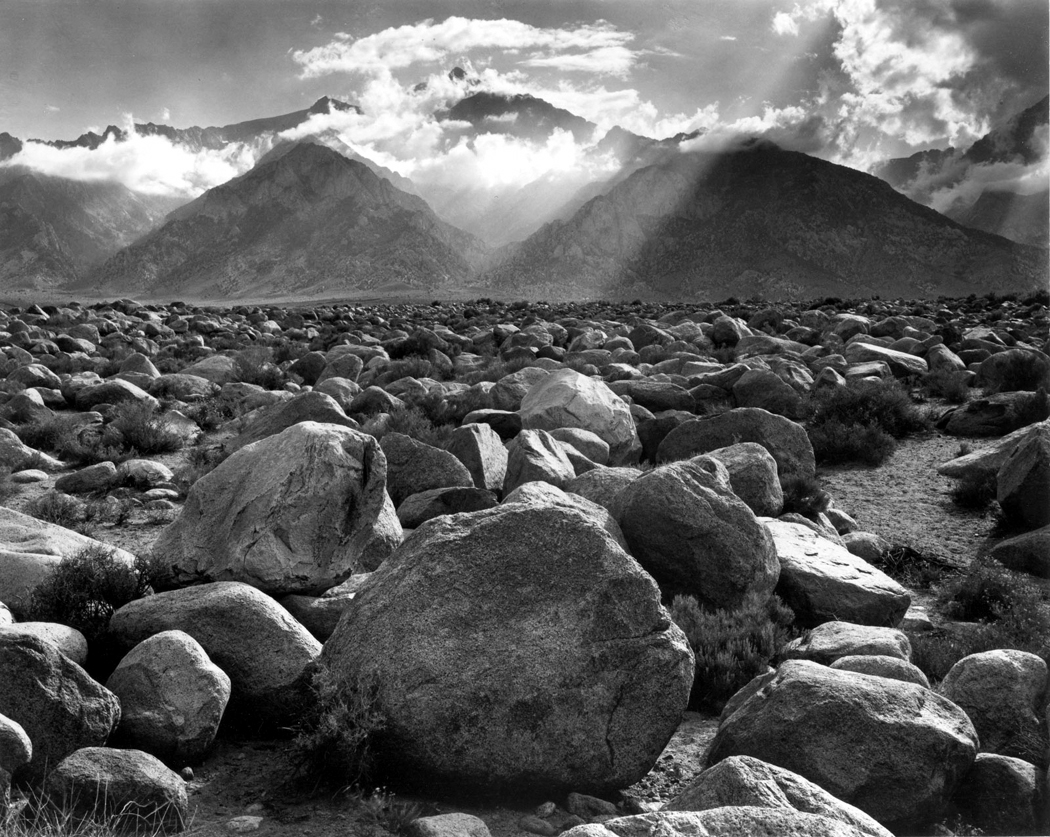
Sierra Nevada, Lone Pine, California

Sierra Nevada, Lone Pine, California

albers1

The right angle is king of the world.

Look around you and everything is square. The streets, the buildings, the windows in the buildings. The TV you watch and the refrigerator you lean into to grab a snack.

If there is a single, overarching symbol of civilization, it is its rectilinearity. Honeybees make hexagons; humans make squares.

I write this in a square office in my square woodframe home on a suburban block, staring at a rectangular computer monitor, typing in letters on little cubic keys embedded in a rectangular keyboard.

The books I consult are square-edged, the file cabinets I keep my research in are boxes. Even the take-out Chinese food I eat at my square desk comes in a plastic foam clamshell cube.

We are so inundated with right angles, that I’m afraid we don’t see them anymore. They become like the invisible air we breathe. Yet, if you begin to notice them, they can become oppressive. There is a tyranny of the box.

There are reasons, of course, that our built environment relies on the square. Of all shapes, it is the most space-efficient. The dairy industry, for instance, discovered many years ago that square milk bottles took up less space on the delivery truck than the older round bottles.

And because they can share walls, square buildings can fill up space just as efficiently as the milk bottles. It becomes like playing dots-and-boxes, connecting the dots to make little sub-squares.

suncity

There are attempts to break up the squares: the swirling streets of planned retirement cities, such as Sun City, Ariz., for instance. Even in the larger city, new tract housing is often built on curvy streets, but those streets are all contained within the larger squares — the “major cross streets” — of the larger Phoenix metro area. Those mitochondriacal squiggles are almost like the irregular growth of cancer cells inside the regular structure of the urban grid — a virus waiting to bust out and infect the next municipality.

square blocks

What is round is escape: the wheels of our cars, the CDs of our Walkmen, the cylinders of our vodka bottles.

Considering how ubiquitous the square is in the human world, it is striking to discover how rare it is in nature. Certain crystals are square — look at a grain of salt under a magnifying glass — but more common are rhomboids and hexagons.

And nature so dislikes the cubic salt crystal, that she dissolves most of them in seawater as if they were collectively the Wicked Witch of the West.

In fact, nature seems perpetually at odds with right angles. She wears them down through erosion, attacking the sharp mesa edge or the overhanging rocks of Niagara Falls.

Nature grows things asymmetrically, profusely, and just as avidly, breaks them up into chunks and sands them down into dust. You cannot expect humans to match that fecundity or ferocity, so instead, we build safe, boring little squares and put cupboards in the corners.

If you look out over any American city, you can see the incessant cubicularity of its architecture, tiny and regular against the larger, organic rising and falling forms of the landscape it occupies and the constant metamorphosis of the amoebic cumulus clouds that break up the shapes with moving shadows.

How static the architecture seems.

cun 18th century

What does the midday sun look like?

That may sound like a simple question, but it’s not. You can’t really look at the sun: If you try, the result is sensory overload, like the distortion of loud music on cheap speakers. You can even go blind, rather quickly.

Yet, everyone thinks he knows what the sun looks like. It’s everywhere in art, beginning with the tempera paintings kids make in elementary school: They so often put a wedge of sun in the corner of the painting, with rays spread out below like sea urchin spines.

kid turtle

But the sun doesn’t look like that: The child’s version of the sun is a symbolic representation of the solar disk.

But then, so are all adult representations.

So we also recognize the gilt centrifugal rays of Louis XIV’s Sun King symbol and the terra cotta sun face of Mexico and the red ball and rays of the World War II Japanese “Rising Sun” naval ensign.

sunmosaic

The sun is the paradigm of art problems, because it can never be portrayed accurately as it looks. Paint cannot be so bright.

But that doesn’t stop artists from attempting it. Van Gogh painted the solar disk over and over in his landscapes. Usually, the sun is a yellow circle surrounded by concentric brushstrokes in a darker ocher. The only way he could make the sun seem bright was by making the sky unnaturally dark.

vangoghsun1


Ansel Adams had a photograph he called The Black Sun, in which a long exposure caused the image of the sun to solarize, making it a dark dot in the picture, surrounded by a halo of rays. It looks almost like an eclipse photo.


Ansel Adams' "Black Sun"

Ansel Adams’ “Black Sun”

In Picasso’s Guernica, the sun is an edgy elliptical disk with spiked rays, in the middle of which is a light bulb.

guernica detail

Each of these is an attempt to portray something that cannot be portrayed.

On a piece of paper or a canvas, the brightest white is no more than 40 times brighter than the deepest black. In the Arizona summer, the sun is thousands of times brighter than the shadow under a mesquite. A canvas just cannot accommodate that brightness range. We compress that range and accept it.

But the emotional effect of the sun’s brightness is just as hard to portray. When artists attempt it, they have to leave the realm of naturalism and create a fiction, a symbol for the sun instead of its snapshot.

So, what does the world look like? The sun is only one minor example of the complexity of this question. It is a question that has been at the core of art for 30,000 years and has still not been answered in any finality.

The problem in formulating an answer is that human perception is both so complex — scientists keep finding more astonishing whirligigs in the brain’s apparatus — and at the same time, so universally believed simple. We all have eyes; and seeing, after all, is believing.

We see with our eyes, most people think. The world looks the way a photograph makes it look.

But of course, we don’t see with our eyes, but with our brains – and even more difficult, with our minds, which means we see through the haze of emotions, culture and individual life experience. We so thoroughly process the data that our eyes collect that the final result barely matches the patterns on the tickled retina.

Seeing doesn’t just happen; it is a complex mental process. And it is a learned process, as any of hundreds of studies have confirmed. One of the ways it is learned is through art — or, to use the more modern term, through media.

Which is why, until the Modernist revolution in this century, artists concerned themselves with attempting to accurately depict the world around them.

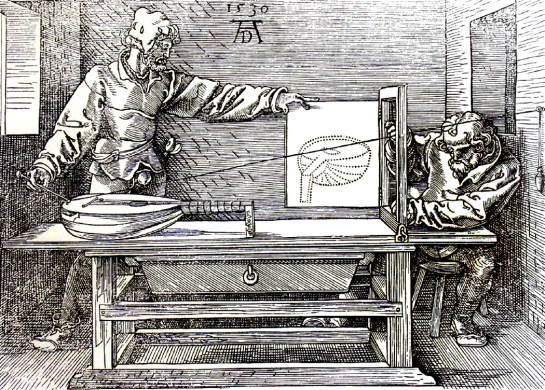
It was to this end that such men as Leon Battista Alberti and Filippo Brunelleschi attempted in the 15th century to devise a mathematical formula for creating the illusion of three-dimensional reality on a two-dimensional canvas. The linear perspective they created became the mother tongue of European painting for four centuries.

But perspective wasn’t the only question: We’ve all seen the obsessive drawings of Leonardo da Vinci, attempting to get down on paper the swirl of water in motion.

leonardowater

Or Michelangelo’s attempts to show every anatomical muscle under the marble skin of his statuary.

The Italian Renaissance was so thorough in its quest for realism, and so successful, in contrast to the Romanesque and Gothic art that came before it, that we have on some level considered the question answered ever since: This is what the world looks like.

Yet, it isn’t so. There are gross distortions built into perspective: Its grid of parallel lines is pure fiction. Leonardo’s water looks more like masonry than fluid, and Michelangelo’s muscles are a little too manic to be visually true.

Yet, the schematic system of image-making they came up with was so persuasive that we still accept the look of it.

Photographs, for instance, which are often taken for the ultimate in realism, are actually made through lenses carefully designed to mimic Renaissance perspective. Rectilinear imagery doesn’t happen naturally.

No art is ultimately realistic. What we tend to call realistic art, whether it is 200 years old and hanging on a museum wall, or hanging in the “starving artist” corner of your shopping mall, is more properly called ”conventional” art. It partakes of the conventions of art that we have, for the moment, accepted.

But those conventions are just as stylized – just as unrealistic – as the ”King Tut” angular figures on an Egyptian frieze, or the misty landscapes on Chinese scrolls.

Take any so-called realistic piece of art and ask just how like life it might be.

When a British cleric, Dr. Thomas Church, visited Rome in 1816, he sat to have his portrait drawn by Jean Auguste Dominique Ingres, one of the leading French artists of the time. The 6- by 8-inch pencil drawing Ingres made is now owned by the Los Angeles County Museum of Art. It is a drawing almost everyone would call a realistic likeness. Certainly, if you knew the drawing, you could have picked out Church from a police lineup.

Ingres' Dr. Thomas Church

Ingres’ Dr. Thomas Church

Yet, the drawing is realistic in only a conventional sense; we are so used to those conventions, we don’t even think about them. We are fish, the conventions are water. It almost seems silly if I point them out. But it isn’t silly; it is profoundly important for us to think about them.

First of all, I doubt the good reverend was only 15 inches tall, as he is in the drawing, or would be if he stood up and his legs hadn’t been cut off by the edge of the paper. We have no trouble believing that a small likeness is realistic, any more than we have trouble with Georgia O’Keeffe’s larger-than-life flowers.

Second, Church probably had a little more color in his cheeks than in this monochrome drawing. We accept black and white as realistic.

We even accept his high-collared coat as black because we know such coats, even though in the drawing, it is the same blank-paper color as his nose and cheek.

Third, the real doctor was three-dimensional; the drawing is not. We could walk around the real person and see his back; the verso of the drawing is just blank paper.

Then, too, the real person moved and the drawing is frozen still.

The real person moved through time, too. It should also be noted that the drawing still exists; the same cannot be said for the good cleric. Ars longa, vita brevis.

The real person made noise — I cannot imagine such a cleric not talking constantly, even prattling. The only noise the drawing can make is a crinkling sound if you were to crush it in your hands — a sound to draw the immediate attention of the museum guard, no doubt, but not exactly conversation.

The drawing also has no odor of humanity about it. Then, too, the drawing is made up of pencil lines. Examine as you will the world around you, you will not discover lines in it that outline the borders of objects. The use of line in drawing is one of the most persistent, and least realistic conventions.

And the last thing I’ll mention: There is a frame, an edge of the picture that cuts off the bottom half of the good reverend. Real experience does not come with a frame line.

All these things we look right past and accept the drawing as an accurate rendering of reality. I’m sure you can come up with a dozen other hidden conventions I have passed over. But that is the power of convention. And it is all the more reason we should be concerned with the question: What does the world look like?

A century of Modernism has taught us not to ask such a question, and we have largely bought into the propaganda. Instead of asking the question, “What does the world look like, from the time of Cezanne on, art has primarily asked, ”What does art look like?” When a visitor looked at one of Jackson Pollock’s swirls of paint drippings, he asked, wondering what the picture’s subject might be, ”What is it?” Pollock answered, ”A painting.” He wasn’t just being cute. All of art critical theory at the time asked us to consider the effects of colors against other colors, forms against form, line against line.

But as great as some of the century’s art is, the overall effect is of a mirror held up to a mirror. It is intentionally mute: ”Music can express nothing,” said the arch-Modernist composer Igor Stravinsky. He was wrong, but he summed up this century’s own unacknowledged provincialism.

Art must regain its connection with the life we live. There is no better way to do this than attempt to answer the basic question about the appearance of the world.

For seeing is active, not passive. It is something we do, not something that happens to us. Each generation must keep up this dialogue with the world.

It is still a noble goal of art: to discover the difference between the schematic and the mimetic, between convention and experience — between what is and what has to be.

To parse it all out.

What is called Postmodernism doesn’t effectively do this. If Modernism is a mirror looking at a mirror, what has followed is a TV set looking at a TV set.

nam june paik1

A generation of media-savvy savants has created an art that is self-referential, and its main reference is The Brady Bunch.

I am certainly not calling for artists to imitate the look of Norman Rockwell. I hope I have made clear that Rockwell is not realistic.

I am calling for artists to take a really close look at the world around them — actually, I am calling for them to love the world, to caress the things of the world with their eyes.

The most effective way of doing that is to draw. Not until you have drawn something have you really seen it, felt its texture in your mind, tasted its color on front and back of tongue, known its shape and the shape of the air around it.

You can see this in Ingres’ drawing again. The coat, the pose, the chair arm — they are all merely conventional. But look at the eyes. They fairly swell with life, there is a softness to the bags underneath, a bristliness to the eyebrows and a live intensity to their gaze. The eyes are the animated center of the drawing, a jewel in a supportive setting.

In the coat, one sees the artist’s training; in the eyes, his connection with the world. There is no doubt which is more important.

So I ask the question of artists, what does the world look like?

Take take just one of those issues: motion, for instance. In the early Renaissance, it was not unusual to repeat a figure several times in a painting, depicting action as it is shown in the frames of a comic strip – showing the same figure in different parts of the frame at different moments in the action.

salome

One depicts Salome dancing in one part of the picture and John the Baptist in his cell in another. Another corner of the picture shows John bent over the block with an executioner’s ax raised over his head and a final portion has Salome watching John’s head on a platter.

Even God appears twice, from front and back, in Michelangelo’s Sistine Chapel Creation.

An entire century of art grappled with this problem as Baroque artists painted violent action at its most unstable point in time, suggesting the motion even when the figures are still as statuary.

Marcel Duchamp’s Nude Descending a Staircase is an attempt to portray the motion itself.

nudedescendingstair

Jackson Pollock’s action paintings are visually active with the result of the painter’s own motion.

Jean Tinguely created kinetic sculpture that actually did move.

Which of these is most “realistic”?

The depiction of visual reality is only one of the purposes of art, but it is a great and noble purpose that has been in eclipse as artists have been seduced by the cleverness of conceptual art.

As though the problem of mimesis in art had somehow been solved, freeing us for other endeavors.

But every time an artist picks up a pencil and tries to get the proportions of a figure right, every time an artist mixes a rose madder with an alizarin crimson to match the color of a landscape, she is tackling the biggest and most intractable question of art.

Looking is hard work, worthy work for an artist.

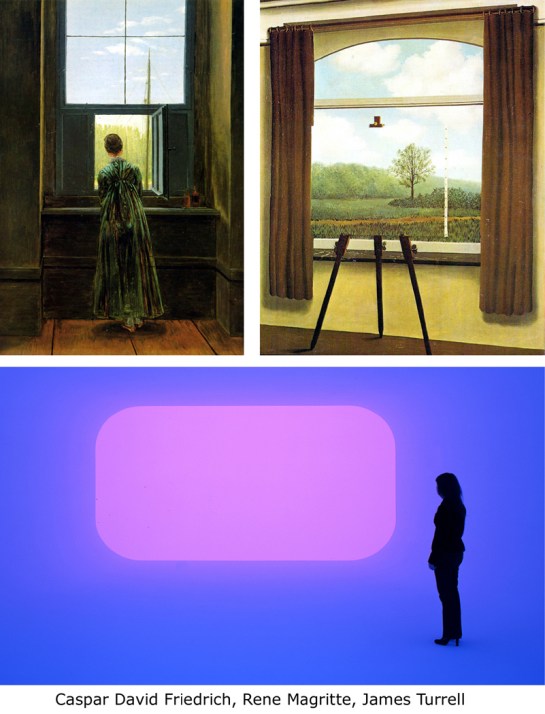
The sun streams in through the window, I go to it, look out at the world beyond and wonder what it looks like.

Astonish us.

poconosnow3

There is no silence more palpable than when you’re alone in the woods on a windless winter morning with new snow a foot deep on everything.

It is eastern Pennsylvania, in the meatloaf Pocono Mountains on a late November weekend and when we pitched our tent late the night before it was cold and dry. The stars were acetylene, caught in the naked treebranches.

But during the night, it began to snow and when we got out of our sleeping bags in the morning, there was a new layer of white caught in those branches and all over the rocky ground underneath.

Winter camping has many rewards, but certainly the most magical is the weird acoustic effect of snow. It sucks sound out of the air and replaces it with something as solid as styrofoam.

What breaks the silence are your own squeaky footsteps in the snow as you step out of the tent and start to prepare breakfast. You rub your hands together noisily and blow fog into them with your breath.

Silence is an exotic commodity and we should learn to value it and enjoy it as if it were a balm from heaven.

It is a rare place that you can find where you can’t hear a gasoline engine.

The internal combustion engine fills our noses with stink and makes the roadside clutter of ugly billboards and fast-food restaurants inevitable. But what is worse, it fills our ears with the rattle of rpms and gears.

You stand on the rim of the Grand Canyon and the tour busses roar by. You take a sailboat out on the water and the lake-shrinking Evinrudes drown out the sound of your luffing jib.

I knew a woman once who told me that when she was a little girl, she heard the summer sky hum.

As children, we often are content with the mystery and don’t ask for an explanation. It’s just the way the world is: The summer sky hums.

As an adult, she came to recognize what the noise was, and how banal. She was hearing a sound hardly known anymore: a propeller-driven airliner flying too high to be seen.

That was more than half a century ago, when the planet was still quiet enough that you could pick out the airplane’s buzz over the local noise. Nowadays, even though jets are much louder, you seldom hear them flying at 30,000 feet because their roar is drowned by the din of traffic, the boom of car stereos, the cackle of the TV set and the occasional gunshot from a few blocks away.

Complete silence is profound and rare. It is the aural equivalent of complete darkness: the place where no sound exists at all.

In a cave, for instance, when you are still and your lamps are turned off. The deadest sound and most obscure blackness are somehow cousins. But even that silence isn’t complete: In such a silence, you can hear the blood squirting through the capillaries of your inner ear. Perhaps you can hear your relaxed heart thumping.

At such a time, there is nothing that exists but your autonomic sense of your own meat and nerves. You face only inward; the outer has ceased to matter.

And the only quiet more utter is death.

But that isn’t the kind of silence that recharges our batteries. For that we turn to nature and wilderness.

It is the reason we drive to the Poconos and hike into the campground.

If there is a place we can get out in nature, away from the parking lot and out from under the flight path, we can let our ears register the planetary rhythm. There are dry beech leaves that crackle in the breeze all through winter before they fall off in spring, there are the squirrels chattering in the elms and the occasional cardinal flapping its wings in the snow to clear a spot where it searches for some food.

Sounds such as these are always present, but are suffocated by the commotion of daily urban living. If somehow all the electricity and gasoline were instantly neutralized, and our ears somehow adjusted, we would hear the natural sounds even on Main Street downtown.

You recognize the symptoms: The air conditioner suddenly cycles down in the office and you notice that you hadn’t known it was making noise till it stopped. Silence is in part only known in relief, against the unheeded white noise.

Part of the appeal of wilderness hiking is the silence we enjoy there. Our cochleas catch their breath and come to terms with the persistent quiet of the natural world. And if we stay long enough, and our ears catch up with the reality, the birds begin to seem noisy and even sunrise groans.

poconosnow2

Spillane

Wham! The book socked me right where it does the most good.

“What’s this?” I thought as my brains came to their senses, “Mickey Spillane as a literary author?”

I could hardly shake the fuzz from my credulity.

It isn’t exactly a prestigious Library of America anthology, but the Mike Hammer detective novels from the 1950s and ’60s have been collected by New American Library, three to a volume. The first, the Mike Hammer Collection, Vol. 1 contains I, the Jury, My Gun is Quick and Vengeance is Mine. Volume 2 contains One Lonely Night, The Big Kill and, Spillane’s magnum opus, Kiss Me, Deadly. The third volume comprises The Girl Hunters, The Snake and The Twisted Thing.

And while Library of America, with its acid-free paper and navy fabric bindings has already begun reprinting the more respectable Raymond Chandler and Dashiell Hammett, it will probably be a while before they acknowledge Spillane. It’s hard to think of Spillane in literary terms: The books practically define “pulp” as a genre. Yet, it turns out that the literary qualities of the books far outweigh their slender ambition.

The violent stories and their stereotyped characters are pure cliché: The tough gumshoe, the vinegar-mouthed secretary with the unspoken crush on her boss, the harried pal at the precinct office. These were commonplaces of the genre before Spillane changed his first typewriter ribbon.

But there is something about the prose they come packaged in, something fresh as a slap on the cheek:

“The guy was dead as hell. He lay on the floor in his pajamas with his brains scattered all over the rug and my gun was in his hand.”

Or: “There were two bums down at one end of the counter taking their time about finishing a ten-cent bowl of soup; making the most out of the free crackers and catsup in front of them. Halfway down a drunk concentrated between his plate of eggs and hanging on to the stool to keep from falling off the world. Evidently he was down to his last buck, for all his pockets had been turned inside out to locate the lone bill that was putting a roof on his load.”

One shouldn’t overstate the case. Spillane is no James Joyce, but looking back from the vantage of half a century, we can see the Modernism in his sleek style. The story almost doesn’t matter: They are all cut from the same bolt of blue serge. But the manner of the telling — the choice of the bon mot, the clarity of emotional drive in the prose — these tell of a stylist, not a hack.

More than Kerouac, Spillane speaks to the underside of the Eisenhower years. Vets who had come back from Europe knew they had done unspeakable things for the greater good. It was something they didn’t talk about.

Spillane put that undercurrent into print. His Mike Hammer — left as undescribed as Everyman — uses the methods of evil to perpetrate justice. Still, it is the words, spare as Hemingway and direct as Homer — that make Spillane a memorable writer.

I would venture to assert that Spillane has had more effect on writers his better than any other. Reading Spillane is a postgraduate course in using verbs that have punch, in creating a sense of here-and-now, of relating a story through a sensibility.

Perhaps if Mickey Spillane had tried his hand at a better book he would have failed; perhaps he has no interest in anything but the process: those word middens toppling out of the page.

But these reprinted classics prove that Mickey Spillane is a first-rate second rate writer. Maybe the best.