Archive

Tag Archives: appalachians

Part 1: In which the mountains change character

Bear Mountain Bridge, Hudson River

Bear Mountain Bridge, Hudson River

If you look at a map of Pennsylvania, you will notice that all roads through the central part of the state seem to travel in long parallel curves, sweeping like lines of marching soldiers taking a ”column right.” eastern pa map

In few places in the country do the road maps so accurately reflect the topography: Those highways follow the valleys between the Appalachian ridges that bend through the state. One ridge lies behind another, lined up like so many pleats in a curtain.

The high, wild Appalachians of the South give way to the rural hillsides of Pennsylvania, New Jersey and New York.

The central Appalachians are even pronounced differently. In the South, the middle syllable rhymes with the ”a” of ”apple;” in the North, the ”a” becomes long and rhymes with ”hey,” a word you will hear with increasing frequency the closer you draw to Philadelphia. harvestore silo and barn

So, as the ”Apple-LATCH-ins” give way to the ”Apple-LAY-chins,” the whole character of the land changes. Hardscrabble family farms give way to large dairies. Small gray weatherboard barns give way to large red barns with blue Harvestore silos. Tobacco gives way to coal mining and steel mills.

Finally, as you travel north and east near Philadelphia and New York, the land becomes suburban.

The roads do manage to cross the ridges occasionally, although something as big as the Pennsylvania Turnpike finds it easier to tunnel under Tuscarora and Blue mountains on its way to the flatter eastern portion of the state.

What is more surprising is that at least three major rivers cut through the mountains, too.

Susquehanna River

Susquehanna River

The Susquehanna and Delaware rivers in Pennsylvania slice through them in what are called water gaps. The most famous of these, the Delaware Water Gap, knifes through the Kittatinny Ridge and divides its Pennsylvania and New Jersey halves.

Old post card

Old post card

And in New York, the Hudson River cuts through the Ramapo and Catskill mountains as it drops south from Albany to Manhattan.

These rivers helped create the history of the area, providing routes for early settlers to cross the difficult mountains.

Most famous among the early settlers are the Pennsylvania Dutch peoples of Lancaster and York counties — although you will find them north well into the mountains. Among them are the Amish and Mennonite ”Plain People” of the popular imagination.

They were German immigrants who began coming to the religious-tolerant commonwealth in the 1600s. Others were Swiss, and French Huguenots.

The Pennsylvania Dutch, though, were not Dutch. They were mostly German, and the German word for themselves, ”Deutsch,” was mistranslated.

By 1790, they made up a third of the state’s population.

But there were many real Dutch immigrants up the Hudson River Valley. Their influence is found in such names as Yonkers, Peekskill, Staatsburg and the Catskills.

Catskill Mountains and Hudson River

Catskill Mountains and Hudson River

All through the region you can find the influence of ethnic groups unheard of in the more culturally uniform Southern mountains: There are Irish, Italian, Spanish and Jewish enclaves in the mountains. It is in the Catskills of New York that the famous ”Borscht Belt” of Jewish resorts gave rise to a whole generation of stand-up comics. Does the name Shecky Greene ring a bell?

Shecky Greene

Shecky Greene

What may be surprising, though, is how much nature there is surviving in the central Appalachians. So close to Pittsburgh, Philadelphia and New York City, there are still forest and wild lands.

You can find much of this along the Appalachian Trail as it curls through the region.

The footpath, which begins in Georgia and ends in Maine, enters Pennsylvania near Gettysburg, climbing through the Michaux State Forest and along the ridge of South Mountain. Geologically speaking, this is the northernmost tip of the Blue Ridge. Snowy Mountain, Mount Alto and Pleasant Peak are all just about 2,000 feet high.

Devil's Den, Gettysburg, Penn.

Devil’s Den, Gettysburg, Penn.

The trail crosses the Susquehanna just north of Harrisburg and climbs along Blue Mountain, the largest of the parallel ridges.

Big Mountain, Penn.

Big Mountain, Penn.

There it passes Hawk Mountain Sanctuary, where geology and prevailing winds create a perfect spot to view migrating birds, and especially a series of birds of prey, including Cooper’s, sharp-shinned, red-tailed and red-shouldered hawks and bald eagles.

On the ridge, at about 1,500 feet, you can see the quilt of farms and forests that spread out in the valleys below. The gray Tuscarora sandstone is tumbled about the peak, covered by patches of green lichen.

Past the resort-area Poconos, the trail follows the Kittatinny Ridge to the Delaware Water Gap and on into New Jersey, following the wooded northwestern edge of that state past long, clear lakes and Boy Scout summer camps to High Point State Park, at 1,800 feet the highest elevation in the state.

The trail loops to the southeast for a short bit before heading north into New York near Greenwood Lake.

There, it follows the Ramapo Mountain into Harriman and Bear Mountain state parks, finally crossing the Hudson River on the Bear Mountain Bridge before heading north again, across the Taconic Mountains and into New England. Hudson panorama

At the bridge, the Appalachian Trail is only 35 miles north of Manhattan and only about 100 feet above sea level.

The woods along the trail are increasingly littered with boulders — chunks of granite or sandstone torn from the bedrock by the continental glaciers of 18,000 years ago. It makes for a beautiful woodland vista, but it is hell for farming.

Storm King Mountain, Hudson River

Storm King Mountain, Hudson River

And unlike the woodlands in the South, cluttered with undergrowth, the woods of Pennsylvania and New York are easy to traipse through. There are rocks underfoot, but not a lot of shrubbery. You step through a cushion of rotting leaves, brown and soft to the sole of your shoe.

It is true that the central Appalachians are less distinctively mountains than their brothers to north and south. They often feel more like hills. Yet the farther you manage to find yourself from the population centers, the more you will uncover the familiar Appalachian culture.

In the plateaus south and east of Pittsburgh, for instance, you still can be eyed suspiciously by a farmer who wonders why you are taking a photograph of his farm. If you hear him talk, you still will hear the short syllables and clipped speech of the mountaineer. You will find homesteads with kitchen gardens and men on autumn weekends walking the gravel back roads with their sons, shotguns slung middle-broke over their shoulders and the two in matching red plaid coats, out for a bit of hunting, hoping perhaps to scare up a turkey.

NEXT: Home of the diner

Part 7: In which the author’s belly bursts

shatley meal

‘Forty-five years ago, I broke out with a most terrible skin disease all over me, which remained on me seven years, supposed to originate from measles; I also had indigestion, and the last two years of that seven years, I had a bad cough. I had bleeding of my right lung and had nightly sweats for two years.”

How’s that for an appetizing advertisement for a good restaurant?

It is the opening of a testimonial written by Martin Shatley in 1925 about a radium spring he discovered in 1890 in northwestern North Carolina that miraculously cured his ailment.

”It has been about 35 years since I found the spring and got well. I have done as much hard work since that time as any man I know of, and after I was cured, many people went to this spring with skin diseases, rheumatism and nervous diseases, and were all cured.”

People still come to Shatley Springs in Ashe County, and they still drink the water. But most people don’t come to have their afflictions cured, but rather to have their hunger assuaged. shatley springs exterior 2

For while the radium water still flows freely, and free — anyone can drive up with a bottle and fill up — it is the restaurant at Shatley Springs that is the real miracle.shatley springs spring

Shatley Springs is on North Carolina 16, five miles north of Jefferson and eight miles south of the Virginia border.

It is found in a grassy hollow with a fishing pond in the middle. Around the pond are a handful of ramshackle cabins. shatley cabins with ducks

Their floors creak and the breeze blows through the walls; a single, 100-watt bulb hangs in the middle of the ceiling in each room. There is nary a picture on the wall, and the exterior red paint is flaking off the clapboard.

It is spartan in a way a Spartan would never tolerate. But then, the room costs only $45 per night for two. And the air is cool and clean, and you can hear the birds in the trees and the rustling leaves. There is no interstate, and the quiet is salutary.

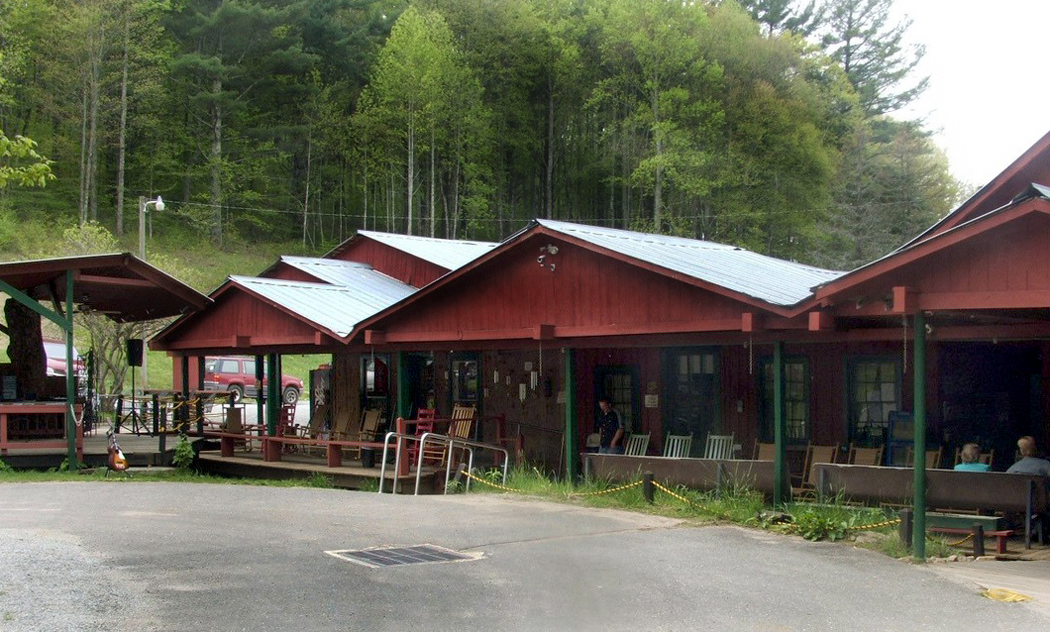
But walk up to the large, red ranch house with the roaring kitchen fans. Screen doors slam and ruddy-faced people laugh and talk as they always do in the North Carolina mountains.

Dinner is the specialty of the house. If you need to save money, you can opt for the single entree dinners. Fried chicken is $7.95, country ham is $8.95. But I’ve never actually met anyone who has ordered them.

No, the meal of choice is the ”Family Style Country Meal,” which gives you, for an outrageous $16.95 per person, enough food to bloat an army. Greenfield's meal

There are ham and chicken,

Mashed potatoes,

Green beans,

Creamed corn,

Fried cabbage,

Pinto beans,

Fried apples,

Cole slaw,

Country gravy (the white kind),

Red-eye gravy,

Buttermilk biscuits,

And your choice of fruit cobbler with vanilla ice cream.

All washed down with radium water and iced tea as sweet as molasses.

And refills on everything, if the first round doesn’t rupture your diaphragm.

This is all Blue Ridge cooking, so the vegetables are all fresh and boiled with fatback or bacon and set down in front of you in bowls. This is not ”lean and healthy” cuisine, but it is real eatin’. Shatley Springs

People walk into the large common eating area, but they waddle out. On the long wooden porch that runs the length of the building, old-timers sit in rocking chairs, smoke and chat with their neighbors.

And if you do stay overnight and manage to right yourself for breakfast, the family-style breakfast — which will set you back $9.95 — includes cereal, juice, eggs, bacon, ham, sausage, gravy, biscuits, hotcakes, potatoes, grits, baked apples, strawberry preserves and coffee. That’s not a list of possibilities to choose from; that’s breakfast. You get them all, set down on an old wobbly table by a bustling waitress.

NEXT: The Central Appalachians

Part 6: In which a sour old man says some difficult things about some very nice people

Alan Hollar

Alan Hollar

Alan Hollar is a wood carver from Crossnore. He stands about 6-foot-seven and wears a ball cap and big frame glasses. He is giving demonstrations on cutting lathe-turned wood bowls at the craft center at the Moses Cone mansion along the Blue Ridge Parkway.

The craft center is a kind of fantasy world, filled with quilts, stained glass, preciously carved wood and beautifully glazed pottery. As soon as you enter, you are hit with the odor of sachet and the sound of Irish flute and dulcimer music.

None of this has anything to do with the Appalachian Mountains, except as it is marketed to wealthy yuppies looking for faux-authentic mountain crafts.

“It’s true, I suppose,” says Hollar. “It used to be that mountain crafts were things that people couldn’t buy and so made for themselves. Now, they can buy pretty much anything they need at the Wal Mart. Crafts have become things that cannot be made by machine.”

Folk Art Center, Blue Ridge Parkway

Folk Art Center, Blue Ridge Parkway

The problem is one of integrating a past of poverty and make-do with a present of money and art galleries. Hollar is certainly correct when he says, “A culture cain’t stand still.”

Appalachian mountain crafts has suffered from the same forces that stultify Native American arts. both cultures have not stood still and are part of the same 21st century that we all live and breathe, but the market has identified their niches, and forced a “brand” or identity on them that is inauthentic.

In terms of Native American art, there are many fully-integrated artists working, as Native Americans, without having to resort to Indian stereotypes — artists such as Rik Danay, Bob Haozous and Kay Walkingstick — but too often the art-buying public wants instead pots and blankets. It is why artist Fritz Scholder once exhorted, “Stop painting Indians!”

by Harrison Begay

by Harrison Begay

Despite his warning, the market for so-called “traditional” Native American art is clotted with talking blue coyotes, lance-carrying warriors and never-ending rainbirds. And the inevitable “Bambi paintings” of deer and bear.

Originally, the creation of this Dorothy Dunn-style of Indian art was to help promote Native American arts and give talented Native artists a chance to make a living from their art. Perhaps it was too successful: Now, that style is considered “traditional,” and ordinary buyers of the art don’t want to look at anything that doesn’t fit the mold. And “Indian art” is a ghetto from which the truly talented feel pulled two ways: They want to escape the ghetto, yet, they want to create art from their cultural roots.

The Southern Highland Craft Guild has done something of the same for mountain crafts. It was formed in 1929, and was an attempt to make some money for poverty-sticken mountain folk.

Perhaps it has also worked too well, for there is little left of the mountains in these elegant doo-dads.

The tourists who glide through the Parkway Craft Center at Moses Cone Memorial Park, or the Folk Art Center on the Blue Ridge Parkway in Asheville, N.C., want souvenirs more than art, and they want something that portrays the fantasy of a “simpler way of life” that people “used to live” in the rural mountains. So, they find candles, stained glass, soft-colored quilts and jewelry in the form of dogwood flowers or bluebirds and feel they have come in contact with a more authentic way of life.

But it ain’t so. Instead, they have come in contact with a successful marketing strategy.

Some of the art is very nice, even beautiful in its way, but it is a far cry from anything that was made back in the hollers and coves when if you needed a ladle, you carved one from a chunk of wood.

“We were born into a world filled with random shapes and odd angles,” Hollar says, “but we made for ourselves a world of wallboard cubicles and we long for something with a touch of that randomness we miss. That’s why people like those bowls with the uneven edges turned from wood boles.”

Burl vase by Alan Hollar

Burl vase by Alan Hollar

And Hollar’s bowls are beautiful: They exploit the essential beauty of woodgrain and its colors. He is a master craftsman. But no matriarch living in the cut-off coves of Appalachia before electrification who required a bowl for kneading dough would have been happy with one that sported a great hole in its side.

It isn’t only the visual arts. The mountains are full of music. There was church music — some of it nearly unlistenable — and dance music, and the music that was played on front porches when the aunts and uncles gathered together and played old “chunes.”

Emmett Lundy

Emmett Lundy

You can find old recordings of some of that in the Alan Lomax collections. It is rough-hewn music, in a style that valued a keening, flat-affect voice — a style copied by Bill Monroe that he called the “high lonesome” — and always clearly amateur.

You can hear the old music in re-releases of those Lomax recordings, like those made in 1941 of Emmett Lundy from Graham County in Virginia. There is a plaintive sourness in the playing, learned from his teacher, Green Leonard. No one would call the music pretty, yet it is intensely beautiful. It is authentic.

The racks of CDs at the craft centers feature instead the commercial recordings of professional musicians who have created an ersatz “traditional” music that is hardly distinguishable from New Age pap. It is music with no angles or edges — completely unlike the hard-muscled people of the hills, who were all angles and edges — “with the bark still on.”

The soft-toned flute jigs on the stereo are like no music I ever heard in the Appalachians. Where were the scratchy fiddle tunes with every note slightly flat? Where were the affectless hymn tunes sung by straight-lipped mountain families? Why is that hammer dulcimer playing The Two Fairy Hills instead of the the strummed dulcimer playing Rock of Ages?

This is the mountain experience smoothed out and made marketable, giving the uninitiated the illusion of authenticity with none of the wood soot and bacon grease.

The CDs are on a rack by the register. They are all prettified.

“Do you have any really ugly music?” I ask. The young clerk — probably a college student from the flatlands come up to the mountains for a summer job among the “plainer, simpler folk” — doesn’t understand what I mean.

NEXT: food


Part 4: In which a mountain county is described

Mt. Jefferson

Mt. Jefferson

This morning, an incandescent white fog filled the river valley and the ground was covered with frost. The cows that graze on the bottom land exhaled steam, when you could see them at all. Yesterday was much the same; most of the afternoon was ”whited out,” meaning that everything past four or five feet from your eyes was obliterated by the mist.

Weather like this is one of my reasons for loving these mountains in the Blue Ridge of North Carolina. I have never seen so much weather. It is as though the weather were condensed, like a stew cooked down from a soup. Ashe County Holler vert

Even fair weather is magnified, the air clearer, the sun bigger and brighter, the clouds more manic. The air is often so clear that you’d swear you could resolve individual blades of grass on the side of Mount Jefferson, five miles away.

And the weather changes quickly and dramatically. It is all foretold on the face of Mount Jefferson, in the middle of North Carolina’s Ashe County.

We can see the mountain from the house we are staying at, out the kitchen window. It dominates the more populous half of Ashe County, raising its humped peak over the surrounding hills like ”a Charlemagne among his peers.”

Mount Jefferson will glow with sunlight one moment and turn dark and baleful the next, signifying the coming of a storm. He will evaporate before your eyes in portent of snow, growing whiter and whiter as the snow becomes a veil between our window and the peak. Some days he is blue, some days, gray. In early morning, the sunlight sparks the peak into a glowing orange. At other, very clear times, the mountain is green. Blue, Gray, Orange, Green — Union, Rebel, Protestant, Catholic — they all war on the mountainside.

And every day, the mountain has shown me something new in color, tone, shape, shadow, contrast, mist, camouflage.

And all night long, when the winds calm, as they seldom do, I can hear the rush of water over the rocks in the New River.

New River

New River

Ashe County, in the extreme northwest corner of North Carolina, is 427 square miles of wrinkled green mountain irrigated by clear cascading streams. Away from any major highways, and with no high-profile attractions, it is not overrun with tourists, even in the height of summer.

The people who are sprinkled through these hills and hollows are open, friendly and helpful, especially in winter, when cooperation is a necessity.

The whole county, populated by only about 27,000 people, is a haven for outdoor activities, and visitors find plenty of fishing, canoeing, hiking and camping.

West Jefferson

West Jefferson

The New River flows through Ashe County, or rather, both New Rivers, for it is divided into the North Fork and South Fork. Between them, they section off the county by thirds, running from the southwest to northeast.

The river is very old, the oldest in the New World according to some geologists, and it meanders like the Mississippi rather than straightaway seeking its own level and cascading over anything in its path, the way most mountain rivers do. And every other river in the state flows, eventually, southeast. The New River flows north, eventually joining the Kanawha River in West Virginia and then following the Ohio and Mississippi rivers to the Gulf of Mexico.

The river twists and folds on itself so mazily that you are constantly surprised, on coming to the river by the highway, that it always flows in the opposite direction you would have thought it should.

About half the roads in the county are paved, but a large percentage are only gravel. Some are only Jeep trails. And all along these roads there are random mountain houses and bordering fences. Actually, the county seems divided in character into its southeastern and northwestern halves. Near Meat Camp NC copy

In the southeast, rolling knolls of pastureland at average heights between 2,500 and 3,000 feet above sea level look as if they had been misplaced from England’s Yorkshire. This half of the county is well populated. The county seat is Jefferson, with about 4,700 people; West Jefferson is slightly less populated but is more developed. When people go ”to town,” they mean West Jefferson. It’s where you’ll find Geno’s Pizza.

There are many farms with tobacco patches, cornfields and oceans of wheat. The biggest industry is beef cattle, and nearly every farmer in this half of the county grows his own steers. Dairy cows are common, too, and Ashe County has its own cheese factory, the only one in the state. Tours are popular, and so are samples. Ashe Co. hillside cows

Also in Glendale Springs is the Last Supper fresco painted by artist Ben Long IV in the 1970s at Holy Trinity Church. Long spent years in Italy studying the technique for painting on wet plaster and had searched vainly in the United States for a place to practice his craft. When he came to Ashe County in 1973, he approached Father Faulton Hodge with his proposal to make a fresco in his church and Hodge told him, ”We’ll take it. What’s a fresco?” lastsupper

Actually, Long’s first work for Hodge and the parish was at the smaller and older St. Mary’s Church in Beaver Creek. His first work was a large painting of the pregnant Virgin Mary, holding her swollen belly. Some 75,000 people come each year to see the frescoes. Both churches are open 24 hours a day.

But the northwestern portion of the county is broken up with long, high mountains, and settlers have built tiny wind-weathered shacks in the coves. A few longer valleys are nicked with strings of homes, but there is none of the broad farmland that makes the other half of the county so habitable.

Ashe County was once called ”the Lost County” because it was hidden up behind the Blue Ridge — a virtual escarpment that separates the Appalachian Mountains to the west from the rolling hills of the Piedmont to the east — and there was virtually no way to travel up and down the Ridge to communicate with the rest of the state.

What travel and communication early Ashe County residents had was with Virginia, not North Carolina. Even now, there is only one road — North Carolina 16 — that dares climb the face of the Blue Ridge to enter Ashe County.

One of the results of the isolation was that early settlers felt an alienation from the rest of the state. Because they believed that the Raleigh government was ignoring them, portions of mountain North Carolina — including Ashe County, and parts of what would later become eastern Tennessee — seceded and formed their own state, which they named Franklin. It lasted from 1784 to 1788, eventually fizzling out when no one paid it much attention. Ashe County branch

Historically, the mountains of the South have always been distinct from the rest of the region. Even during the Civil War, when Southern patriotism was supreme, abolitionist sentiment ran high among the poor farmers of the mountains, and the ”Underground Railway” had a regular stop in Ashe County. In fact, before the United States Geological Survey named the central peak after our third president, it was locally called Negro Mountain, or some less polite version of that, after the number of runaway slaves that found shelter in its shadow.

In 1840, there were just under a hundred registered (and legal) distilleries in Ashe County. When North Carolina voted itself dry, the distilleries went underground, or more properly, uphill.

Corn liquor is still being made. It is popular and available, despite the ”revenooers.” Commercial whiskeys are now available again, but many prefer the corn squeezings; it has a reputation for smoothness. ”Goes down like a pussycat; flies through your veins like a wildcat.”

A tax-paid legal and commercial version of the moonshine is available in some portions of the mountains for those who want to find out legally what it’s like to drink their hooch from a Mason jar. Ashe County hillside

The best times of year to visit Ashe County are the spring, when the season works its way up the mountain, trailing clouds of azalea and rhododendron glory behind; and fall, when the season comes back down the mountain, coloring all the trees with orange, yellow and red. Fall colors in the North Carolina mountains have few rivals anywhere.

NEXT: North Carolina Pig Pickin’ 

Part 3: In which a Freethinker goes to Church

Big Creek, Great Smoky Mountains National Park

Big Creek, Great Smoky Mountains National Park

Tourists flock to Cades Cove in the Great Smoky Mountains National Park. They come to see old houses, old mills, the wooden tools of the past and the peculiar folkways of the Tennessee mountain people.

The Smokies are among the highest mountains in the East — their tallest peak is Clingman’s Dome, at 6,643 feet — but they aren’t a neatly organized range of peaks like the Tetons. Instead, they are a maze of headlands and coves, forks and ridges. And also unlike most Western mountains, they have been thoroughly lived in. At the bottom of every valley — which are locally called ”coves” — you can find either a farm or the remnant of one. cades cove panorama

Cades Cove is particularly attractive, for it is a broad valley surrounded by darkly treed hills. It is rare to find a valley this wide and flat in the Southern Appalachians. And it was an attractive place for settlers to build and raise families.

So Cades Cove began its existence as a community in 1819, when the first settlers moved in. By midcentury, there were about 685 people living in 137 households.

The 5- by 2-mile cove now seems remote. To get there you have to drive 10 miles from the nearest town, or about 20 miles from the Sugarland Visitors Center down narrow, winding, crowded roads. If it is midsummer, you can expect to average 20 mph at best, although it will be frequent stopping and starting around congested areas where vacationers are tubing down Abrams Creek and the Little River. log cabin

It seems remote, but when it was a thriving community, it was no more remote than most like it in the mountains. It was not considered unusual to take three days for a shopping trip to Tuckaleechee to bring back the salt and sugar that you needed to go along with the produce you grew and the animals you raised.

Cades Cove got telephones and electricity about the same time as other communities in eastern Tennessee. It was not any place special.

But when the national park was created in 1934, Cades Cove was chalked off for abandonment. Most private properties were bought up; the remaining ones were bought up giving their residents lifelong leases. By the 1960s, all the residents were gone.

Cantilevered barn

Cantilevered barn

I feel an odd sensation driving the 11-mile loop trail through the Cove following a caravan of tourists. For most of them, the log cabins and weathered corn cribs must look like something from hillbilly mythology. I’m sure most of them think of the Cove’s late residents as backward and misbegotten. They see the rough-hewn beams and the sorghum mill with its long pole for the mule to pull in a circle. They see the potbellied stoves and the rope beds and think the residents must be something out of a time machine, some forgotten remnant of the 19th century.

But it is different for me and my wife. Her folks came from these mountains and we once lived there together. She made corn-husk dolls as a girl, she cooked on a wood stove as an adult — and not all that long ago.

For the Southern mountain life has not disappeared. It is everywhere out there in the hills of eastern Tennessee and western North Carolina. It is a shame to see the log houses and cantilever barns presented as museum pieces. You can see dozens more like them, with people living in them and using them, all through Buncombe, Ashe, Watauga and Mitchell counties. church

We stopped at the Primitive Baptist Church in Cades Cove, where a wiry, wizened old Southern man stood at the pulpit, reading through the Bible that rested on the lectern. He could have been the lean, sinewed type of farmer that used to work the fields here. But he was a visitor. He’d been here before and seemed proud that the Bible that he’d seen on his last trip was still there, unmolested by the tourists.

”Hit’s been there three years now and none the worse for wear,” he said. He also pointed at a box of a single layer of bricks on the floor in the middle of the room and said, ” ‘At’s where the stove use ter be, you can see the flashin’ for the stovepipe in the ceiling.” He obviously knew the church, or churches like it.

For you still can find them, whitewashed clapboard, warped foundations, unfinished floors and stiff pews, in scores of community churches throughout the region.

And that is the most peculiar part of Cades Cove. It is presented as a kind of museum. But you can attend a service at a church not one board different from its exhibit, an active congregation of the same leather-faced, hard-farming people.

They still grow apples, they still grind corn. They still slaughter hogs and make sausage. They still singe off the pinfeathers of a chicken that they are going to fry for dinner.

"Leather britches" drying

“Leather britches” drying

Honey for saleThey still make apple butter, still put up fruits and vegetables. They still make half-moon pies from biscuit dough and dried fruit. They still make ”leather britches” — the dried green beans threaded together on a string. Many a home still has a springhouse where milk is kept cold in the running water.

They still make hay from the grass in the bottom lands and keep hives of honeybees. These things are not quaint customs of the past, but a way of life.

Sure, the log cabin very well may have a satellite dish on its roof, and the mule has given way to a John Deere.

But what is important is not the remoteness of history, but its continuity.

NEXT: Ashe County, NC

Appalachians Part 2: In which the author eats a persimmon

OLYMPUS DIGITAL CAMERA

On a late October morning, after a solid frost, you can find a bushel of brownish mottled balls scattered on the ground in the rime under the persimmon tree. They look spoiled and perhaps their thin skin has cracked.

You pick one up and tear its skin wide, forcing the orange flesh through, against your teeth. You push the soft, puddinglike flesh against the roof of your mouth with your tongue, separating it from the hard, grasshopper-size pits that you suck on for a few minutes before spitting out.

There are few wild foods sweeter and more delicious than the ‘simmon you find for yourself on an old, deserted farm in the mountains of North Carolina.

The farmhouse has lost most of its paint, there are spider webs on the dusty windows, and a few boards have fallen through on the front porch. The house sits at the bottom of a hill, where hay still is mown in the summer. At the top, there is the edge line of a hardwood forest. At this time of year, along the creek at the bottom of the slope, the red maples are scarlet and the sweet gums are yellow.

And the ubiquitous zigzag rail fence will seem to outlast everything in the decaying farmhouse but its chimney. ashe county back road

It is the Blue Ridge, the first range of the Southern Appalachian Mountains. It rises as low hills in northern Alabama and continues north, growing higher through Georgia, South and North Carolina and Tennessee, then thinning out and shrinking again in Virginia, only to sink below the soil once more in Maryland.

The Blue Ridge is what we think of first when we consider the Southern mountains. Its people, its wildlife and its landscape are distinct: black bears, porcupines and possums play in thickly forested hills interspersed with valleys, or ”coves,” where leather-skin farmers grow feed corn and burley tobacco and pasture their cattle.

These Eastern mountains are very different from the higher, wilder, but simpler ranges of the West. They are lower for one thing — the highest is Mount Mitchell, at a mere 6,684 feet. They are round, soft, fuzzy with trees. road up Mt. Mitchell copy

And they are inhabited.

There are wildernesses in the Blue Ridge, accessible only by serious hikers, but you can’t really think of the Appalachians without thinking of the people who live there. Every creek-filled crease in the folded rock has its two-story clapboard house, its barn, springhouse and root cellar.

In the cool fall days, you can see the blue smoke rising from stone chimneys and hear the distant sound of chain saws bucking another cord of wood.

Times have changed some: You also might find a satellite dish in the yard. Because these old houses — some a century and a half old — are so hard to heat, the descendants of their builders sometimes have moved into a mobile home parked right next to the noble old house.

However, you will always find the woodpile, the kitchen garden and the pickup truck on the dirt driveway.

The people of the mountains, however, are not mere stereotypes.

By and large, they are comfortably in the 21st century. There are fast foods, hardware stores and Kia dealerships. High-school kids wear Nikes and everyone waiting for the schoolbus seems to have an iPhone.

However, there is something different about them, their clipped dialect, wary sense of humor, flat-pitch singing, white-clapboard religion and, above all else, an unbreakable attachment to the land. Those who leave spend the rest of their lives pining for it, dreaming of going back.

”I lied to my God when I left the mountains and kem to these devilish cotton mills,” said one old mountaineer, quoted by Appalachian historian Horace Kephart. ”Ef only he’d turn me into a varmint I’d run back tonight. Boys, I dream I’m in torment; and when I wake up, I lay thar an’ think o’ the spring branch runnin’ over the root o’ that thar poplar; and I say, could I git me one drink o’ that water I’d be content to lay me down and die.” snow

For nature is so insistent, both for the brutality of its winter and the beauty of its summer, that the mountain population grows right into the rocks and soil of the hillsides. Pull one out and his roots remain in the ground.

I know. I have become one of them.

Everything about the Southern Appalachians sticks in one’s innards.

So that when the midwinter snows close the schools for weeks at a time and the white tufts gather in the pine needles, deadening all the sound of the landscape, you might hear in the distance the county plow scraping the pavement and the clatter of tire chains. catawba rhododendron

The hillsides are scratchy with gray branches and beech trees with smooth aluminum bark, and last year’s dry papery copper leaves rattle in the breeze.

Then the spring: It is spring when the Appalachians are most themselves.

The cool humid air hangs as fog in the river bottoms and the dew hangs on the stamens of the rhododendron, which snake out of the flowers like a lizard tongue.

Witch hazels spread over the ice-water stream.

The area’s waterfalls are at their peak, spreading water like a coat of varnish over the gray, lichened and mossy granite. Trilium

There is color under your feet and over your head. The redbud tree spatters the forest with a spray of reddish purple; the wake-robin grows pinker by the day. There are buttercups, columbine, maypops, geraniums, trilliums, mayflowers, fire pinks and yellow lady’s slipper.

Everywhere, low under your ankle, there are the leaf-whorl and drooping antenna-flower of the common humble violet.

The mountain winters are frozen solid, so when the spring thaw comes, the whole landscape pops open.

And no matter where I was living, when spring came, I thought of it in these mountains.

Next: Cades Cove, Great Smoky Mountains National Park

View from Craggy Gardens

The East Coast of North America varies more widely than any other region of the continent. Westerners are Westerners, but no one could confuse a Manhattanite with a Cajun, a Down Easter with Virginia gentry.

There are drawls in the South, missing R’s in New England, even French in Quebec.

But there is one thing that ties the East together, a kind of central nervous system that defines both its history and emotional core: the Appalachian Mountains.

Running from southwest to northeast for 2,000 miles from Alabama to the Gulf of St. Lawrence, the Appalachians are a true cordillera, not a single mountain range of peaks but a chain of ranges that span a continent.

There are the Unakas, the Blue Ridge, the Alleghenies, the Green, White, Black, Blue and Brown mountains, the Berkshires and Catskills, the Notre Dames and Shickshocks.

They were this nation’s first frontier, a physical barrier to continental expansion in the 18th century that helped define the original 13 colonies.

It took an unusual sort of pioneer to settle the green stony hills, and their inhabitants to this day maintain much of their independent nature. It is one of the strengths of the Appalachians.

They are among the oldest mountains — parts are more than a billion years old — and they are also structurally complex. Appalachian map

They can be divided into three very different sections from east to west. This structure is clearest in Virginia.

There in the front range of the Appalachians are the old, volcanic Blue Ridge, rising abruptly from the Piedmont. Behind it lies the broad, fertile Great Valley — a kind of cordillera of valleys — best-known in northern Virginia as the Shenandoah Valley. The Ridge and Valley Province comes next, fronted by the Alleghenies. It is a long series of low sedimentary ridges, like a line of breakers at the shore. In these loaf mountains are some of the nation’s early iron and copper mines.

Behind that is the Appalachian, or Cumberland Plateau, the wide belt of rocky bumps of almost equal height extending through most of West Virginia and into Kentucky. In these hills, miners still dig out the soft, bituminous coal that is the nation’s greatest single natural resource.

But the Appalachians are also partitioned from north to south. It is traditionally divided into the southern, central and northern sections: The first, from Alabama to Maryland, includes the highest peaks in the East. The second, running through Pennsylvania, New Jersey and New York, are mostly long ridges. And in the north, encompassing New England and Atlantic Canada, the mountains grow once more in height and ruggedness.

For the several blog entries, we will look at the Appalachians and the people who live in them, taking them section by section.

NEXT: The Southern Appalachians

apple

If you could be anywhere at all on the planet at this moment, where would you choose? As for me, I have no hesitation: the Blue Ridge. 

If there is an Eden on this Earth, it must be among the Appalachian Mountains. More specifically, the section in North Carolina and Virginia. When I am away from it, I pine. 

This time of year, the black-eyed Susans and the ironweed play their orange and blue against each other, and the asters line the road cuts with yellow irises in their violet eyes. At the higher elevations, the bite of autumn is already on the dry grasses. blackeyedsusan1 copy

The smaller waterfalls have slowed with the drought of summer, and the green oak leaves have begun turning leathery. In my mind’s ear, I can hear the cicadas and redwings, the caw of a crow in the cornfield and the buzz of the distant chain saw cutting through the corpse of a tree downed in the last thunderstorm. OLYMPUS DIGITAL CAMERA

The Appalachians run more than 1,500 miles, from the Gaspe Peninsula in Quebec southwest to northern Alabama. The range is seldom more than 100 miles wide, and it is made up of a whole series of smaller ranges: among them the White Mountains, the Taconics, the Adirondacks, the Kittatinnies, the Blue Ridge, the Smokies, the Black and the Nantahala mountains. road up Mt. Mitchell

Each range is a pearl with its own colors and beauties, and the string that ties them all together is the Appalachian Trail, which wanders for 2,034 miles from Springer Mountain in Georgia to Mount Katahdin in Maine. 

The wilderness trail crosses 14 states, eight national forests and two national parks. It varies from just above sea level at the Bear Mountain Bridge in New York to 6,634 feet at Clingman’s Dome in the Smokies. 

Each year, hundreds of eager hikers attempt to walk the whole thing or large sections of it. It can take three to six months to do, depending on your speed and fitness. 

Some years ago, I was one of those eager hikers. I had saved my earnings for a year so I could afford to take six months off from work and hike from southern Virginia to Maine. OLYMPUS DIGITAL CAMERA

Large sums went into buying a lightweight backpack, tent and down sleeping bag. I learned to weigh the quarter-ounces when deciding which things were necessities and which I could do without. Even so, my pack weighed in at about 65 pounds, including the complete Milton I took with me. Necessities are necessities. 

It was early spring when I took off, and the spongy forest floor was covered in trilliums and geraniums. 

My goal each day was to make the seven or eight miles between the simple wooden shelters that were provided for sleeping. When I woke in the morning, the dew would drop from the trees like rain. 

In April and May, the trail was laced with rhododendron and azalea. Maypops were in flower down at my feet, and tulip-tree blossoms showed their rosy green over my head. flower - Catawba Rhododendron pistils

Early in the morning, the redheaded woodpecker rattled in the oaks and the phoebe tweeted his name 20 or 30 times a minute. 

But hiking does something to you. Physical exertion propels your appetite and lowers your standards: At lunch, a Slim Jim and a chunk of Velveeta tastes like ambrosia. And at an icy mountain spring, I would mix Tang in a tin cup and slurp it down like the finest German beer. dec016

I had little time to read Milton. 

And after a few weeks, I recognized that goal-oriented hiking was qualitatively different from a weekend hike or a day in the woods. Because I had to make a certain distance each day, the hike soon ceased being a celebration of nature and wilderness and became a dutiful trudge, watching for the paint blazes on trees or rocks that marked the trail, plopping one waffle-stomper down in front of the other, watching out for roots or stones that might twist an ankle. It became work. flower - fiddleheads2005

I took a day off here or there to enjoy the woods, but it didn’t blot out the need to make up miles. 

So I — in the greatest physical condition of my life — quit the trail before I even left Virginia and spent the rest of my six months traveling by other means. 

Many years later, I met and married my wife in the Blue Ridge and continued hiking smaller sections of the trail, among the magnolias and witch hazels, beech trees and hickories. 

And I’m there again as I write this.Blue Ridge horizon2 copy