Archive

Tag Archives: art

By Mel Ramos

By Mel Ramos

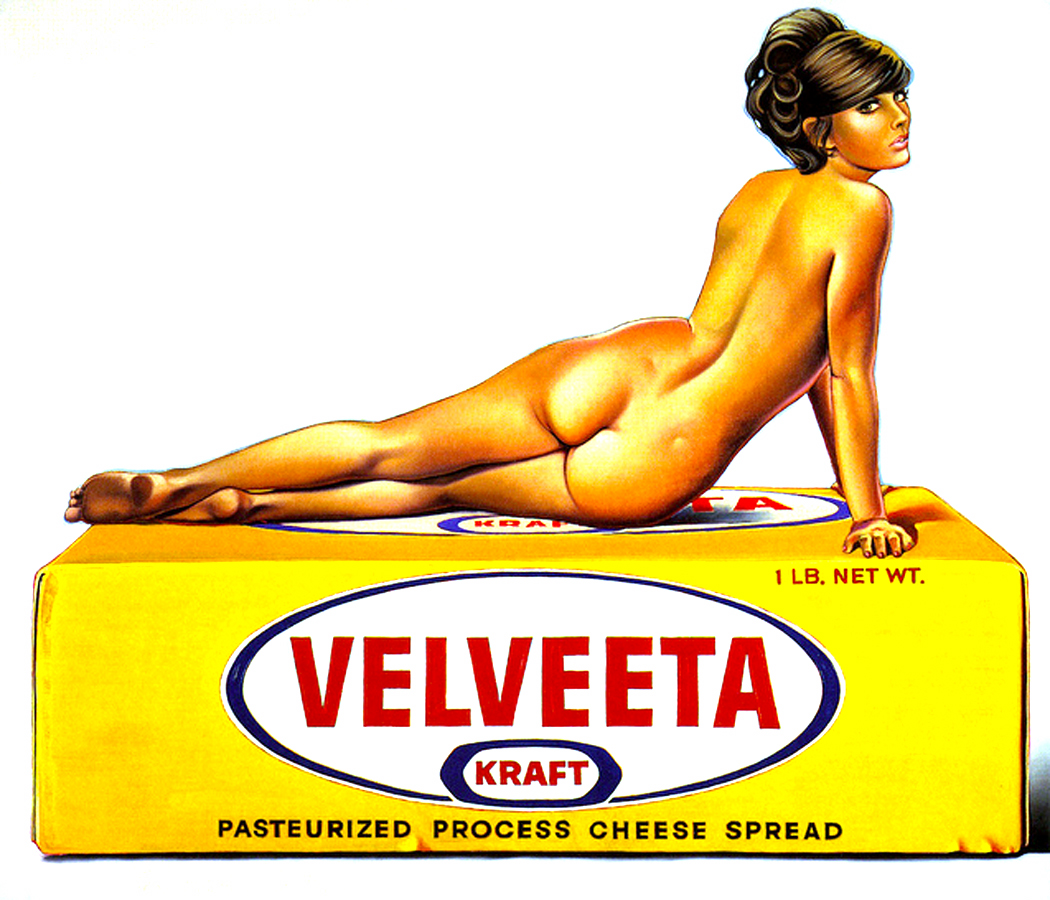
America isn’t a big cheese country. We do Velveeta and Cheez Whiz, and when we’re really adventurous, we ask for that so-called blue cheese dressing on our salads that is really no more than ranch dressing a few weeks past its expiration date. thunderbird wine

Velveeta, of course, isn’t cheese at all. It is officially a ”cheese food product.” That is, it’s a congealed block of yellowed lipids and tastes as much like cheese as Thunderbird wine tastes like Bordeaux. And the new cheese substitutes are worse. They may be healthy, but are they food? Ever tried to make a grilled cheese sandwich with that synthetic stuff? It doesn’t melt, it blackens at the edges and buckles under the heat like linoleum.

Anyone for a scorched floor tile sandwich?

All this came to mind as I searched town for some Gorgonzola. For those who haven’t developed the taste, that is an Italian blue cheese that is greenish and runny, with a smell like laundry left damp too long in the washing machine. It is a taste that grows on you. Of course, something grows on the cheese, too.

But it made me consider how taste changes as we age. When I was young, I ate Hostess cupcakes like everyone else. Adults seemed to like beer and brussels sprouts. Kids drank soda pop, adults drank coffee. SONY DSC

Now that I’m old enough for my toes to start growing funny, I have learned to like rutabagas, glazed parsnips, pickled herring, Stilton cheese and single-malt scotch.

And those cupcakes are poison. As an adult, I taste every gram of sulfated polysaccharide, every microscopic speck of potassium sorbate and monoglyceride. A Hostess cupcake really and truly tastes to me now like an eighth-grade science project.

For me, it all began changing when I was about 18 and one day I tasted coffee for the thousandth time — and for the first time, it tasted good. Really good. manischewitz

I had sampled wines when a child — my parents would give me a little Manischewitz, which is really only fruit syrup with a kick — and I would make a sour little face.

Suddenly, as an adult, I tasted something really dry from France and wine seemed like ichor. Perhaps a little Alsatian Riesling to taste with foie gras and onion confit. Later, I developed a taste for Greek retsina, which tastes the way turpentine smells. It has character.

Then came yogurt, lassi, kefir, Roquefort cheese, herring, corned beef, horseradish. pear and gorgonzola

As kids, we like Hershey bars, as adults we come to enjoy a slice of pear with a bit of cheese.

Maturing taste is certainly not restricted to food. Most of us wear different clothes as we grow up, leaving the sneakers and T-shirts behind. We grow out of our metal-fleck magenta Mustangs with the flames on the hood.

Although not everyone matures: The other day I saw a BMW with racing stripes.

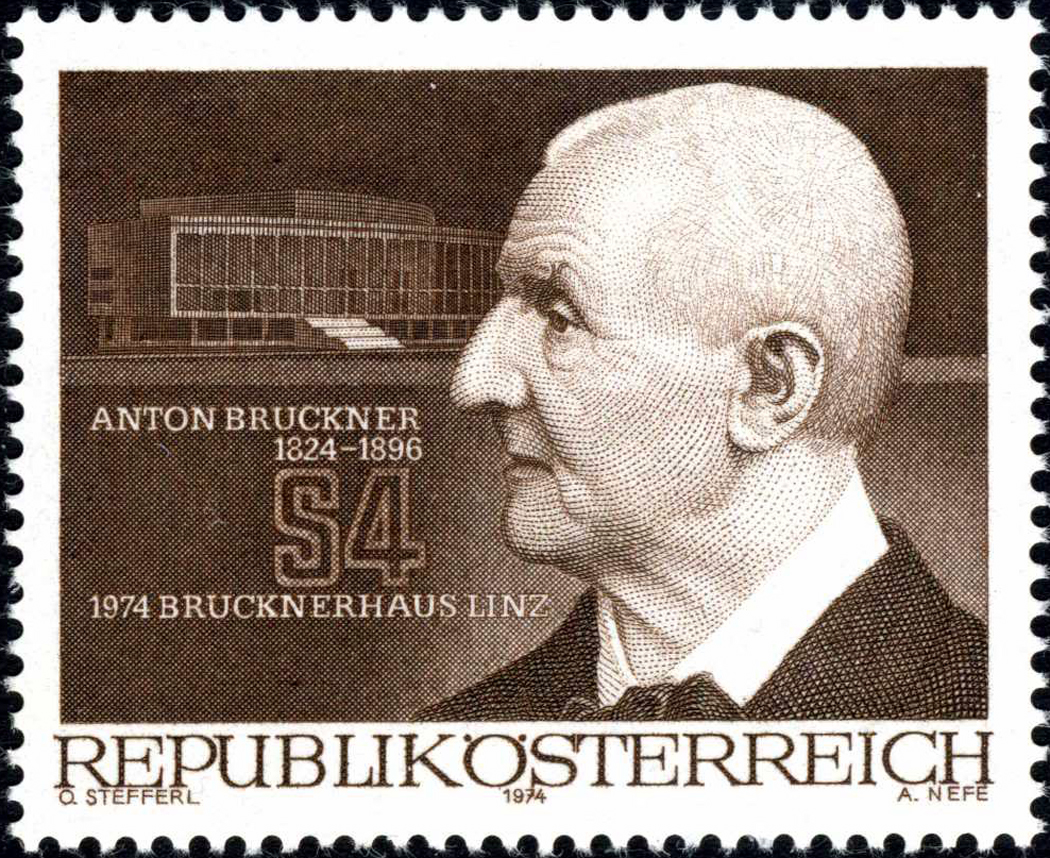
And we stop reading Nancy Drew and take on Eudora Welty. We go from Tchaikovsky to Bruckner and Schoenberg. From Modigliani to Poussin.

Nations go through the same transitions, though on a vaster and slower scale.

It takes centuries for a culture to create and enjoy a Poussin, a Goethe, a Corneille. They are vegetables and whole grains of the art world. And only cultures with enough maturity come to appreciate them. Poussin

France, with 10 centuries of history, can nurture a Samuel Beckett or a Sidney Bechet. Italy, with 20 centuries of history, can’t feed enough opera to its truck drivers and factory workers. The fine arts in those countries are a part of their national identity.

But America, with its two measly centuries, is still a fuzzy-cheeked pubescent soaking up Lion King.

Until America starts eating stinky cheese, it is futile to expect it to support the arts.

W. Eugene Smith

W. Eugene Smith

Sometimes, failure is the greatest success.

That is the key to the secular sainthood of photojournalist W. Eugene Smith. He aspired to such purity of esthetic and moral vision, that, in a way, if he had succeeded, it would only have proved to himself that his sights had been set too low.

Smith is the patron saint of photojournalists. During his stint as a Life magazine photographer in the 1940s and ’50s, his picture essays — of World War II, an American country doctor, a nurse midwife and a Spanish village, among others — made his reputation as not only a fine journalist but also a photographic stylist. A Gene Smith photograph had a look all its own. schweitzer in pith helmet

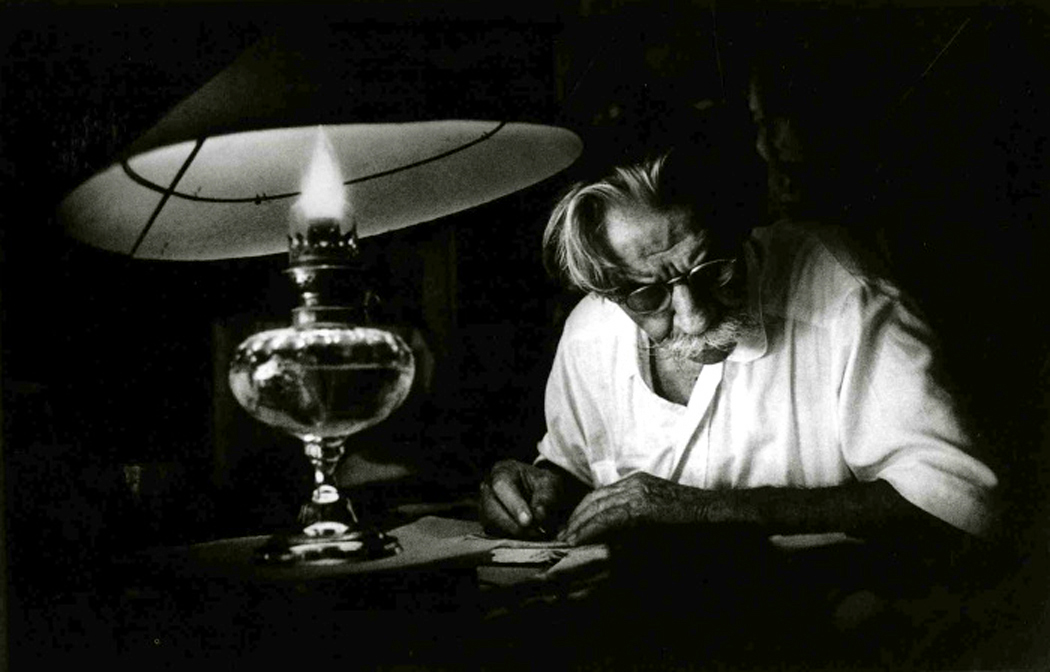
Smith’s reputation as saint began in 1954, when he quit Life after a dispute over the editorial layout for a story he did on Dr. Albert Schweitzer. Smith had photographed Schweitzer in the context of his hospital at Lambarene in what was then French Equatorial Africa and concentrated on the difficulties of providing health care in the Third World. Life’s editors trimmed the essay back and made Schweitzer into a one-dimensional white hero among the natives.

From Smith’s point of view, it would be as if the editors had taken an essay of emotional depth and turned it into an Entertainment Tonight sound bite.

It wasn’t the first time Smith had fought with his editors (in fact, he had quit the magazine once before), but the Schweitzer imbroglio caused him to leave the magazine permanently. Depending on whether you were a photographer or an editor, Smith’s single-minded insistence on the integrity of his work made him a saint or a crybaby prima donna.

Zoot Sims

Zoot Sims

Time has come down on Smith’s side. No one remembers the editors’ names now.

(Smith couldn’t stand even to edit himself. When he gave his archives to the Center for Creative Photography in Tucson, Ariz., before his death in 1978, the negatives, prints, letters and notes weighed 22 tons. He could never bring himself to throw anything away — included in the archives is laundry.)

There are other great photojournalists, but there is no one like Smith.

His images from World War II were so uncompromising, half the pictures he made were censored by the government as too grisly and not heroic enough for public consumption.

“I would that my photographs might be, not the coverage of a news event, but an indictment of war,” he wrote, “the brutal corrupting viciousness of its doing to the minds and bodies of men.”

But what distinguishes his work is quite apart from journalism. Now that we have the perspective of time, we can see that Smith wasn’t really a journalist at all; he was an artist. His success is not that of showing us events, but of showing us his own mental and emotional insides. They were not bright and happy insides. schweitzer with lamp

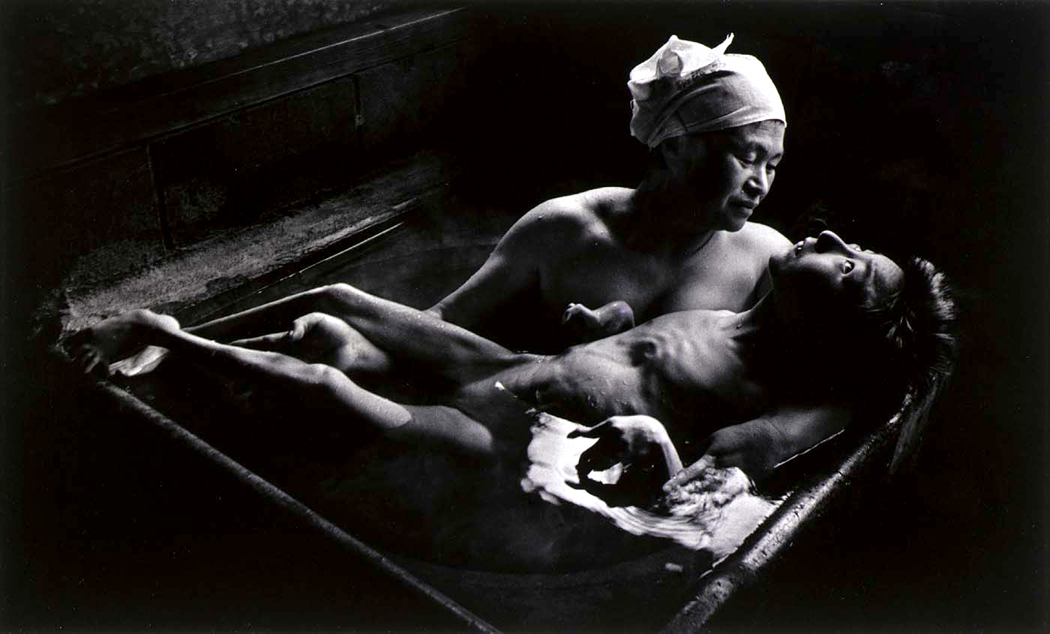
The first thing you notice about the mass of Smith’s work is its darkness. Almost all the photographs are predominantly black. The standard Smith photograph shows a working face lighted in the darkness.

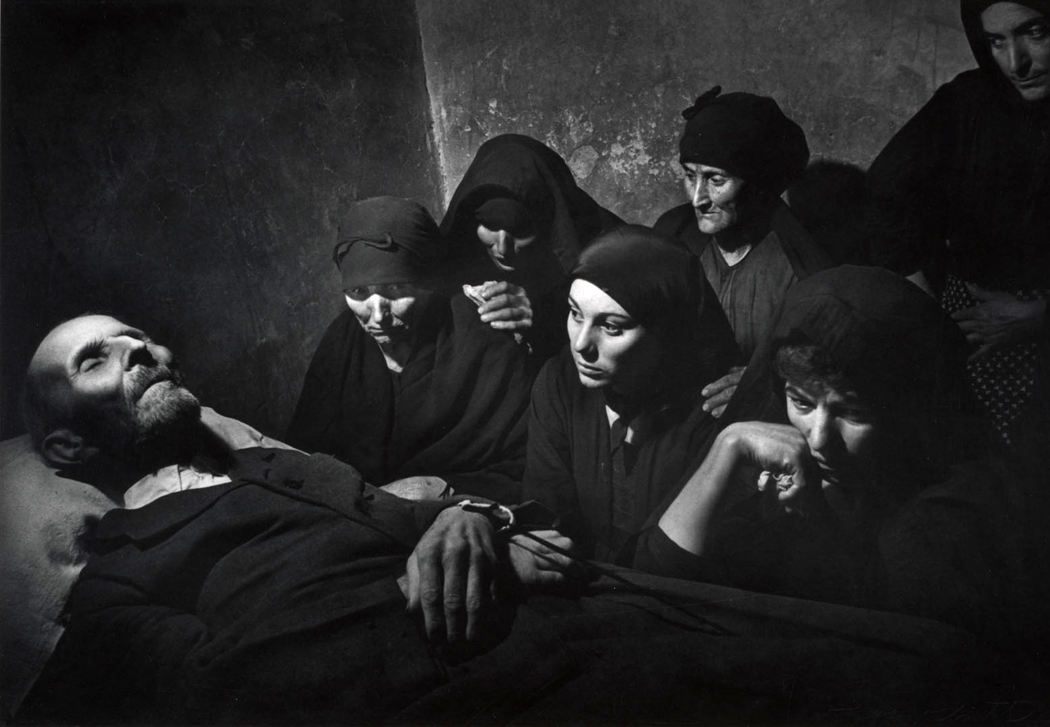
The darkness is universal and threatening, and against it, Smith pits his hero, always a working man. It matters not what else the man may be, Smith pictures him at work and at work with an intensity that shows the hero’s effort alone holding back the perimeters of darkness, whether he is a surgeon saving a baby or a mourner at work watching a corpse. country doctor

The blacks and whites of the photos take on symbolic meaning.

Smith’s world was one of alienation, darkness, maimed and diseased people, back-busting labor, sweat, hardship and fear — but against it Smith put heroism of the common man trying to make a difference. Volare Digital Capture

For Smith, every man was a working man, and the working man became Everyman. Smith could give a symphony musician a blue collar. In one photo, soloist Gregor Piatagorsky takes a drag on a cigarette and looks like Edward R. Murrow holding a cello. In another, Igor Stravinsky in short sleeves and pullover works out a point of interpretation with a violinist. This preoccupation with labor may reflect the influence of the WPA photographers of the Depression.

There are machines, tools and human flesh, often mangled by disease or accident. His subjects are constantly ”fronting the essential facts of life,” as Thoreau put it. Never are any of the people in a Smith photograph relaxed. They are always in rapt contemplation or action. Intensity beams from their faces — the kind of blade-edged intensity most people feel uncomfortable with and cannot live with. It is a grim but heroic world.

One wonders how Smith ever survived at Life, with its celebration of middle-class optimism. Smith’s mythology is more Nordic. One is sure the darkness eventually will win.

People are apt to be alone in his photos. When they are not alone, they don’t interact with each other, instead staring in different directions. And when they do interact, they do not do so with each other, but through a common task, a dying patient, a dead relative. The task is the unifying element of Smith’s world. spanish funeral

One is struck by the extent to which Smith’s own neuroses and anxieties turned the world into darkness. Smith was a great artist, not merely a photojournalist, because of the myth he made of the world. In the guise of presenting fact, he presented a version of truth.

Smith had a powerful if idiosyncratic style. He was not a stylish photographer in the ordinary sense — there is little that is self-consciously visual or artistic in Smith. Irving Penn and Richard Avedon are stylish photographers. Smith was interested in truth, not style.

Yet his design is striking, beautiful, considering how uninvolved Smith was in making things look good.

walk to paradise gardenThe “truth” was his passion, a truth he never understood as subjective. Like a good Calvinist, he was utterly convinced that his vision presented the world as it is. And it is that unwavering belief that makes his photos so compelling. They convince us that Smith’s personal vision was, and is, the truth.

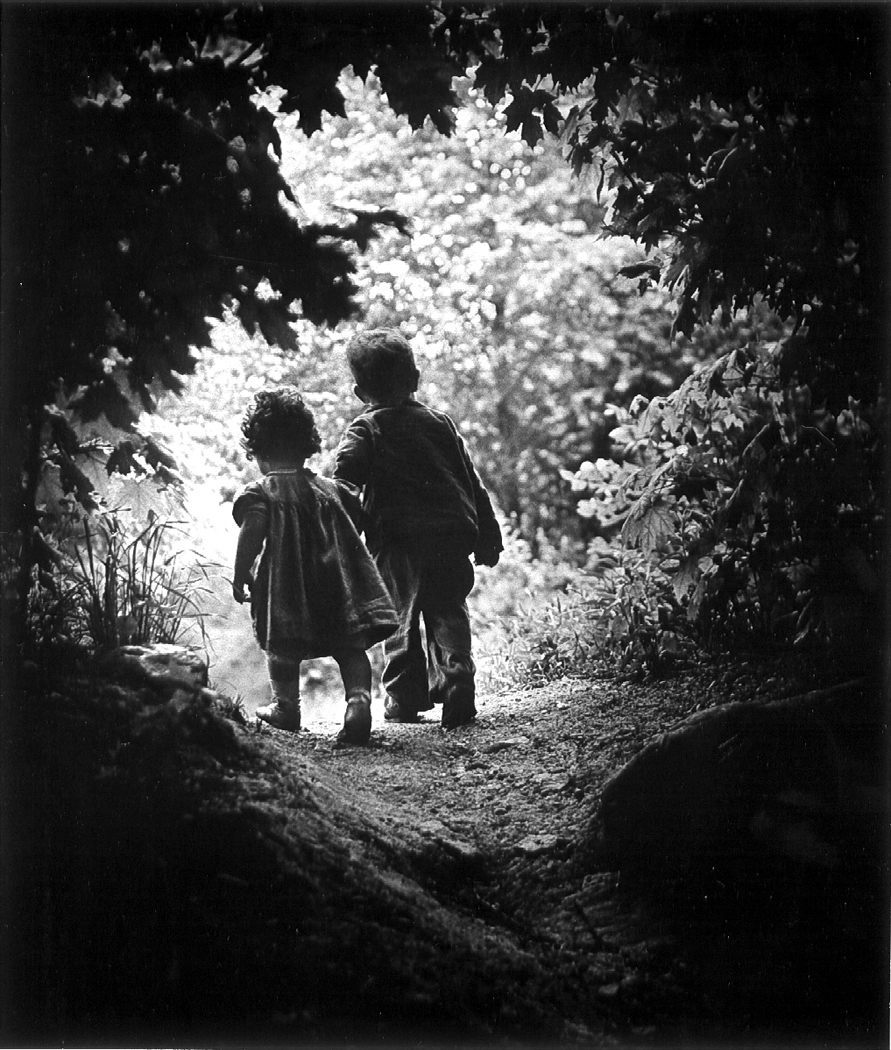
There is no humor in Smith; saints rarely crack jokes. No wit, no irony. He believed in the world he created. He could not have irony about that. That is why when he tried to create a purposely optimistic photo, as in Walking to Paradise Garden, a picture of his two children walking into the light of a break in the woods, the result was mawkish and sentimental.

Smith’s strengths are not found in such uncharacteristic photographs. Smith’s strengths are found in his illumination of darkness.

The darkness is all enveloping and irreducible. It is no surprise then, that he saw his work rather like that of Sisyphus, doomed to failure.

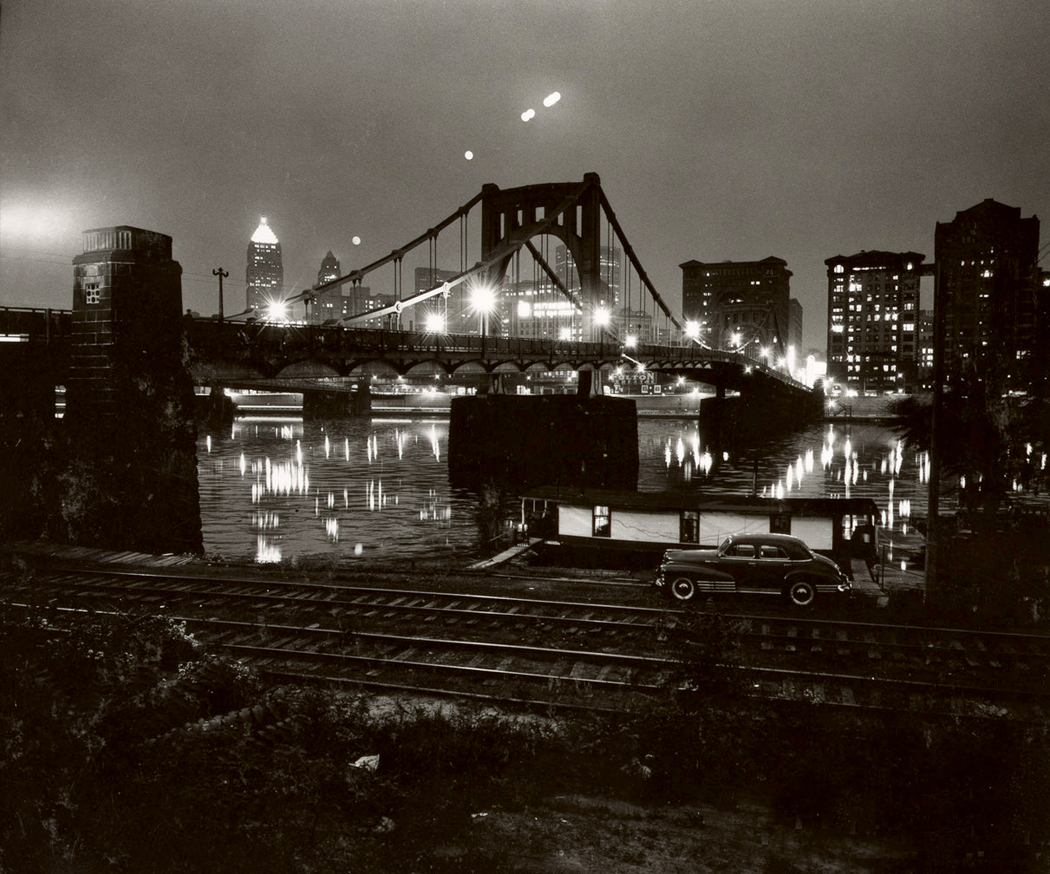
Therefore, his greatest failure is also his greatest success: The images he made as a “portrait” of Pittsburgh in 1955-57. The photographs make a kind of composite picture of place, an attempt to present the complexities and contradictions of the Iron City, leaving nothing out.steel worker flaming coke

The series has seldom been shown separately as a group since Smith threw his hands up on the project 55 years ago, having failed to finish it to his strict satisfaction.

The story of the Pittsburgh failure — and its ultimate success — parallels almost everything in Smith’s life.

He was nearly killed on Okinawa in 1945 when a shell tore through his skull. It took two years of rehabilitation and plastic surgery before he could resume his existence.nurse midwife

Then, he produced some of the signature photo-essays in Life, including stories on Schweitzer, a country doctor, a black midwife and a Spanish village under the Franco regime.

But each photo essay was a failure in Smith’s mind, because photo-editors altered his conception of the pictures.

No doubt, Smith was a difficult man to work with, and no doubt, he was his own worst enemy. He knew no motivation except truthtelling — and that meant the truth as he knew it, told the way he envisioned it being told.

“I cannot accept many of the conditions common within journalism without tremendous self-dishonesty and without it being a grave breach of the responsibilities, the moral obligations within journalism, as I have determined them for myself,” he wrote about his Life magazine resignation.

Yet, he needed to work. He had a wife and family to support. Even so, the inner demons refused to let him take a simple assignment and complete it simply. He was incapable of being a hack.pittsburgh at night

In 1955, he was hired to illustrate a book about Pittsburgh’s bicentennial. He was supposed to provide the 50 or so pictures that would accompany the text. It was an assignment that should have lasted less than two weeks. He wound up working more than three years and taking something like 17,000 negatives.

No wonder, when he taught a course at the New School for Social Research in New York, it was called “Photography Made Difficult.”

His marriage did not survive his obsessive drive to tell truth.

The Pittsburgh photographs are the perfect introduction to Smith’s work. Instead of objective reportage, they are profoundly metaphorical. Smith felt the world a dark, cold, even malevolent place, softened only briefly and minutely by the warmth and light of human love and caring.Tamoko

The pictures obsessively show a small point of light in a dark, obscure background. Whether it is the brilliantly lit face of an millworker in a black universe, or the small touch of a bride’s hands spot-lit in a dark room, they pound home Smith’s personal world view.steel worker

When he died, in Tucson, in 1978, he was the closest thing photojournalists had to a saint, and his work is a constant reminder of what the highest goals of the profession should be.

He may have been a pain in the ass to work with, but he created a deeply moving body of work, one it is nearly impossible to be indifferent to.

Maxim Gun

Nobody writes epigrams anymore, and we are the worse for it. Instead, they are too busy writing Tweets. The difference? A Tweet says in 140 characters what no one needs to say. An epigram says in a few short words what can be unfolded and stretched out into a book: It is a seed waiting to sprout in the mind of the hearer. A Tweet goes everywhere in the world, but goes nowhere.

A Tweet is flaccid and generally pointless; an epigram, or maxim, is a gun that fires rapidly.

La Rochefoucauld

La Rochefoucauld

I love rambling through such terse cynics as La Rochefoucauld, and I eat up the ”eternity in a phrase of glass” of Ralph Waldo Emerson and the punchy paragraph perorations Henry Thoreau.

I don’t claim to be any Martial, but over the years, I’ve squeezed out a few. Here are some, strung together and pretending to be pearls:

–› Curiosity is the libido of art.

–› Art doesn’t come from the brain; it comes from the base of the spine.

–› I don’t want to know an artist is clever; I want to know he is more alive than me.

–› We need to know that the moments of time are connected to one another and are not merely adjacent.

–› Meaning depends on ambiguity. The more precise a word is, the less it describes.

–› You can forget knowledge; understanding changes your life.

–› It is the conservative’s impotence that he can only react, never create.

–› Ultimately, what counts is not the wisdom of Solomon, but stories of that wisdom.

–› Design is your awareness of everything in the frame.

–› Western art is really a branch of physics.

–› Art history is fine for the historians, but the rest of us must watch not to be hit by the flying debris.

–› Reality is no excuse.

–› What you know prevents learning.

–› There can be no great beauty that doesn’t know tragedy.

–› There are those for whom the world is rote. For whom knowledge is an orderly collection of facts, not the experience of understanding. For whom a set of rules prescribes behavior and describes art, music, politics, commerce. They are the managers, the commissars, the education reformers — for them, the planet turns on a dry axle.

–› To the degree that you use someone else’s words to express yourself, to that degree you don’t understand what you are saying.

–› The difference between a commercial artist and a fine artist is that a commercial artist knows what he is doing.

–› Art is the discovery or creation of meaning and order from the chaos of perception and experience.

–› The artist knows that 1 plus 1 equal 3. There is the one apple, the other apple and the two together.

–› Art is not a product; it is a byproduct.

–› A fact is a fragment, a truth is a wholeness.

–› Science is the test we give to hard facts, art is the test we give to everything else.

–› Art makes you aware that you are alive. That is not always very pleasant.

–› Art worth remembering is art that tackles knotty problems. Everything else is wallpaper.

–› Entertainment diverts us from the cares of life; art makes us feel alive. The two things are opposites.

–› Design is not a set of rules, it is a level of awareness.

–› All the questions that matter are insoluble.

–› Civilization is an irrational fear of the irrational.

–› Art creates civilization, not the other way around.

–› Everyone asks questions; intellectuals ask questions about the questions.

–› Opposites do not exist in the world separate from the language that describes them.

–› One end of the cigar is lit, the other is where we draw smoke. We call the two ends opposites, but there is only one cigar.

–› You can teach knowledge, but understanding has to be learned.

–› Aesthetics is the use of large words to describe what you can feel in your fingertips without any words at all.

–› Everything changes, said Heraclitus. Nature is a verb; a noun is only a parking space.

–› All art is regional art; New York City is a region, too.

–› A Truth is never probable.

–› A Truth satisfies an inner need for order.

–› It’s not what you know, but what you are willing to be aware of.

–› Words are the smoke screen art attempts to penetrate.

–› You must look at art longer than you can stand.

–› Boredom is an essential part of the art process, for artist and viewer alike.

–› Art starts out with only one belief: that the intuitions and emotions of the artist are valid. Period.

Chihuly 2

I am of two minds about Dale Chihuly, and I cannot imagine any thoughtful person being otherwise.

The stunning array of gorgeous glass is certainly the most interesting work in the medium done in a long time. The Chihuly name on a piece of glass is blue-chip all the way.

Yet, one cannot get past the sense that the name on the glass is less a signature than a brand name.

There are those who call the Seattle artist the “Liberace of glass.” He is a huge crowd pleaser — perhaps his work is too pretty. Chihuly 6

In addition, he’s everywhere, doing scores of museum and gallery shows each year. His studio produces so much work that critics consider it an industrial production line rather than an artist’s studio.

And, detractors point out, he hasn’t made much of anything himself since 1979. Since then, almost everything that has been sold with his name on it has been created by his hundreds of staffers. Worse, Chihuly is a tireless self-promoter. His genius is as much in marketing as it is in aesthetics.

Several Web sites are dedicated to dissing Chihuly, including one that avers it’s “OK to hate Dale Chihuly.”

It isn’t just that his studio produces so much in his name; it’s a veritable factory. It isn’t just that the glass sometimes is too pretty.

Take a look at it as it is displayed at any museum. The installations makes them look more like a showroom than a gallery. All that dramatic lighting and black background sets off one’s instinct to look for price tags and bar codes. Chihuly 11

So, looking at a Seaform, it might come from the show window at Tiffany, with all that glistening light and black background. I look for a salesman sizing me — and my bank account — up.

It isn’t that the work isn’t stunning in its effect, but that the effect is a little too slick.

Although Chihuly calls the show “Installations,” these are not installations as the art world usually means the term. These are rather settings for jewels, meant to show them off.chihuly installation

In most art-world installations, the individual pieces are subordinated to the meaning of the larger assembly. In Chihuly’s installations, the individual pieces are glorified by the presentation. They are set off heroically, like a protagonist in Italian opera hogging the spotlight.

But for all that, the problem with dismissing Chihuly because of his marketing and production strategies is that the argument ignores the art itself, which is hard to dismiss.

Even if you’re skeptical, the work itself is dazzling, really dazzling. Chihuly 10

Eminent art writer Barbara Rose puts it directly: “Chihuly has literally changed the definition of glass.”

Chihuly was born in 1941 in Tacoma, Wash., and began working with glass 20 years later. After school at the University of Washington, he did graduate work at the Rhode Island School of Design and won a Fulbright Fellowship to study glass in Venice.

In 1976, he lost his left eye in an automobile accident in England — his eye patch is his trademark — and the following year, he became head of the sculpture department at the Rhode Island school. Chihuly portrait

With his shock of wild hair and his eye patch over a face that looks like a caricature, he could be the Quasimodo of art glass.

All along, he continued to win awards and place work in major museums. Today, there is hardly a museum, major or minor, that doesn’t own Chihuly’s work.

In 1983, Chihuly moved to Seattle, where his studio grew to the point that it is a major industry, nearly as well known as Boeing or Microsoft.

On the way, he raised glass from a craft to a fine art. Chihuly certainly has pretensions of fine art. This glass is not meant to be seen as merely craft.

The difference between fine art and craft is metaphor. Fine art functions because of its metaphor; craft survives happily without it. Chihuly has consciously developed the metaphorical side of the glass.

There are organic shapes, there are womblike baskets with “baby” baskets inside, there are anemones and jellyfish, all in bright colors with brilliant accents. Chihuly 8

At their best, the metaphor resonates, as with the odd squid tentacles and octopus arms of his chandeliers, or the beautiful crimson grass stalks of Red Reeds.chihuly painting

The least effective works are his paintings, which strike one as nothing more than abstract LeRoy Neimans in glitter paint.

Like I said, I’m of two minds about Chihuly, and I cannot imagine any thoughtful person being otherwise.

Mahler conducting

There are rainstorms, and then there are hurricanes.

There are symphonies, and then there is Gustav Mahler.

The Austrian composer is like nothing else in classical music, and his unique brand of emotional fury inspires a cultish following. You may love Mozart or Chopin, but if you’re a Mahler fan, you are in love. Devoted. An acolyte; it’s akin to religious conversion.

“I love all composers,” said the late music critic Dimitri Drobatschewsky, “but the composer for whom I will make the greatest effort, or spend the most money, is Mahler. There is nothing in life that can replace what Mahler’s music does to and for me.”

It is almost an addiction.

The music hits closer to the experience of being alive than almost any other: deeper, more emotional, more direct. The Mahler addict measures a performance not so much by whether he leaves the hall whistling the tunes, as whether he has lost control of his lacrimal glands and has to hide his face as he leaves, so as not to show himself weeping in public. Mahler’s music is personal; it batters your heart. Zasche Theo Gustav Mahler 1906

He asks you the questions you think about only at the most extreme moments of your life: Why are we here? What is death? Love? How has the child become the man? It isn’t the intellectual answers he seeks, but the emotional landscape of the questions themselves.

There is nothing moderate in music or performance. Leonard Bernstein, often credited with starting the modern Mahler revival, was a particularly passionate exponent of the music.

“People are always saying that I exaggerate Mahler, which is so stupid,” he said, “because you cannot exaggerate Mahler enough! To play a Mahler symphony, you have to give it your whole heart and body and soul and everything.”

As William Blake said, “Enough or Too Much! Less than all cannot satisfy.”

‘3 times an outsider’

Gustav Mahler was born in 1860, one year before the American Civil War began, to a Jewish family in what now is the Czech Republic. He rose to prominence as a conductor in Vienna, where he was alternately lionized and vilified. By all accounts, he was one of the greatest conductors of his time, but a vicious element of anti-Semitism conspired against him, despite his careerist conversion to Roman Catholicism.Gustav Mahler Emil Orlik 1902

“I am three times an outsider,” he famously said, “as a Bohemian in Austria, as an Austrian among Germans and as a Jew throughout the world.”

He finished his first symphony in 1889, and he put into it much of his life up to that time. Every Mahler symphony is in some way autobiographical. It’s not just abstract music; the symphonies are his life.

Even in the First, the opening section depicts recollections of his childhood, of taking walks in the woods in Moravia with his father. So those high harmonics in the violins depict the wind blowing through the pine needles, and the clarinet depicts cuckoo calls, and then an offstage trumpet plays a fanfare because, in the woods they used to walk, there was a distant army barracks.

Mahler himself said, “A symphony must be like the world. It must embrace everything.”

It must be made the musical version of D.H. Lawrence’s “bright book of life.”

A challenge

Mahler presents an initial challenge to the newcomer, who is used to attending a concert for the purpose of hearing the great abstract artform left to us by Mozart, Beethoven, Brahms, Stravinsky, Copland, Prokofiev. But nothing in Mahler is merely abstract: It is all personal. All life. All extreme. The composer asks his audience not to enjoy his melodies, but to use the music to search their own lives for the return of serve he rockets into your court.

The Fourth Symphony is the best entry point for the neophyte: Mahler’s shortest symphony, filled with all the things that make the composer so compelling. There are great tunes, inspired orchestration, a vocal part and many of the deeper themes that pervade all his symphonies: Nature, nostalgia, tragedy, death and innocence.Mahlercartoon 1907

From there, you can move on to his more intense symphonies, where he feels compelled to throw at you everything he knows, everything he’s ever felt.

For him, that meant adding to his already huge orchestra such things as sleigh bells (which open the Fourth Symphony), cowbells, mandolins and — in his tragic Sixth Symphony, hammer blows that “fell a man like an ax cutting a tree.” The First Symphony has everything from klezmer bands to military marches.

He was trying to make a world, and that world is as much marching bands, elegant waltzes and earthy landlers as it is soaring, breathless melodies.

There is Mahler counterpoint, too: layers of tunes and snippets of tunes, less like the long line of a Bach fugue, and more like a Picasso collage, with torn fragments overlapped.

That mixture of high and low is both the hallmark of Mahler’s world view and our own Postmodern world. Perhaps that is why Mahler feels so contemporary to us. For Mahler’s contemporaries, his symphonies too often seemed to be infected by the worst sort of vulgarity. They had come to hear hochste deutsche Kunst — high German art — and got tin whistles and banjos thrown in in the bargain.

The “unmedicated” Mahler

If Mahler is about anything, it is about these extremes: sublimity and camp, aspiration and despair, irony and sentimentality.

In his famous essay about the composer, Bernstein wrote: “Think of it, Mahler the creator vs. Mahler the performer; the Jew vs. the Christian; the believer vs. the doubter; the naif vs. the sophisticate; the provincial Bohemian vs. the Viennese homme du monde; the Faustian philosopher vs. the Oriental mystic; the operatic symphonist who never wrote an opera.”mahler caricature 4

Mahler can whip you around these opposites, turning his music on a dime, snapping your emotions back and forth like a pennant in a Wrigley Field bluster. Not only between movements, but he can be ecstatic for three bars, and, suddenly, you’re in the deepest depression for six, only to snap to attention with 12 bars so alert that they seem electrified.

If he were alive today, he’d probably be on medication.

The slow movement of the Fourth Symphony is that way: It is a theme and variations on two themes, one elevated and serene, the other devilish and taunting. The two themes merge in variations, finally both stopping as the orchestra bellows a loud cry — for some, it is the gates of heaven opening. Time, and the music’s forward motion, stop dead in glory.

All that is followed in the finale by a song sung by a soprano, directed to sing in a childlike, innocent way, about the wonders of that heaven, imagined by a child, where “the angels bake the bread.” From the sublime to the ridiculous in one easy step.

Exhausting pinnacle of art

You can leave a concert humming Mozart’s tunes or inspired by Beethoven’s nobility, but after Mahler, you are simply spent. You’ve been “rode hard and put up wet.” He has dragged you from pillar to emotional post, pounded your deepest fears, pointed with your most fervent hopes. Mahler exhausts.mahler caricature 2

For those who are up to it, it is the pinnacle of art. For those who ask for something less exaggerated from their music, Mahler can be interminable and exasperating.

The symphonies are long — some single movements are longer than whole Beethoven symphonies. Mahler is an acquired taste.

Yet, while they are sonically splendorous, they are spiritually deep, and if music is an expression of the human spirit, Mahler is exploring its deepest depths.

For Drobatschewsky, it is summed up in the Mahler Ninth that he heard conducted by Claudio Abbado in Amsterdam.

“I am not a religious man, but what other people get out of religion, I get out of Mahler: solace, joy, every feeling that’s known to man.

“All out of Mahler’s music.”

NAG NAG NAG: An ADDENDUM

Gustav Mahler was a control freak.

Look at most music scores and you see not only notes but some basic instruction: tempo markings, how loud to play, whether to speed up or not.Mahler silhouette Otto Böhler

Look at a Mahler symphony score and you see enough writing to fill a book. He was a micromanager.

The Dover miniature score for his Fifth Symphony, for instance, has four pages of small-print glossary to translate Mahler’s German instructions. Hardly a bar goes by without some nudge by the composer.

In the first four bars alone of Mahler’s Fourth Symphony, he asks the orchestra to play “Moderately, not rushed,” and with “Grace notes very short,” “staccato” and “piano” (“quietly”), followed by “sempre piano” (“always quiet”), followed immediately by a diminuendo (“get quieter) — which would seem to contradict the sempre piano by asking the orchestra to change. Meanwhile, he asks that the music be played “grazioso” (gracefully), while also asking for a “poco ritardando” (“slow down a little”).

That’s in three bars. In the fourth, he asks for a return to the original tempo, but it should also now be “comfortable.” Meanwhile, he throws in a reminder: “Expressively.”

That’s only four bars out of an hourlong symphony.

You have to give yourself over to Mahler’s intentions, perhaps more than for any other composer, due to the sheer volume of specific instructions he has left us.

The markings can be difficult to interpret, however. The very first instruction Mahler gives for his “Songs of a Wayfarer,” before he says anything else, is “Faster.” Faster than what? That is followed by “Slower” and, two bars later, “Faster,” and back and forth until he gets to “Smoothly agitated.”

Most conductors mark up their scores with little notes to themselves to remember this or that detail in the music. Mahler was a conductor, too, and has given the performer the benefit of his own marking up.

Basically, Mahler was a backseat driver.

Apollo

Apollo

The older I get, the less reading I do, and the more re-reading. It’s a common symptom of age. There are many things that change as you leave behind the enthusiasms of youth.

I remember the complaints about conductor Arturo Toscanini that his repertoire was small and repetitive: How many times can you play the Beethoven and Brahms symphonies, and why don’t you play more contemporary music?

Toscanini 2First, you have to remember that when Toscanini was young, he gave world premiere performances of many new works, including Puccini’s La Boheme and Sam Barber’s Adagio for Strings. He gave world premieres of at least 25 operas. When he was young, the music of Richard Strauss and Claude Debussy were brand new, not the concert stalwarts they later became. He gave the American premiere of Shostakovich’s Seventh Symphony. He programmed all of George Gershwin’s major pieces, even if his Italian soul never quite beat to the jazz rhythm. 

But it is true that after he came to the NBC Symphony, he concentrated on the war horses. His repertoire did narrow as he got old. The problem is that we know Toscanini mainly these days for his RCA Victor recordings, made near the end of his life, and so we have a skewed vision of his career.

That narrowing is not uncommon in artists, who generally — if they get to live long enough — develop a streamlined “late style,” which eschews much of the complexity they favored as young Turks, and gets straight to the point, as if the knew they didn’t have time for all the hoopla and somersaults. 

And so, as his hair whitened, Toscanini focused on those works he knew he could never exhaust: things like the Beethoven symphonies. They provide endless riches, endless possibilities, and endless satisfactions. 

I say I recognize this because as I’ve aged, I, too, have narrowed my focus. As a young art critic, I kept up with all the newest trends in contemporary art. I loved the buzz and fizz: Who’s up, who’s out. What’s the latest and greatest. I even went so far as to disparage much of what is found in our art museums as “relics” of the art process, and therefore not really art — real art is what is coming out of the studios today. Or even better, tomorrow.

And, as a music critic, I felt the same way. Give me something to shock my ears and lord keep me from having to hear another Beethoven’s Fifth! 

But there is a great change in one’s approach to art as one matures. Maturity isn’t just a slowing down and tightening up: It is the weight of experience. When we are young, we know so little, yet we think we know so much. We have the answers, and why don’t the fogeys understand that?

Life, however, burdens you with the accumulation of experience and what was clear as an adolescent is infinitely muddy as a grandfather. 

When we are striplings and in love with art, we tend to idolize it, and its makers. We test ourselves against our heroes, and against the art they made. Are we up to it? Can we maintain in ourselves the vibrancy and aliveness of the art we adore? Aren’t we “special,” too? Of course, we are! The world in art seems so much more brilliant and colorful, so much more emotionally intense. 

But, after a few marriages, a few divorces, a few illnesses, a few disappointments and the deaths of too many of those we loved, after seeing the politics of our time repeat themselves endlessly and stupidly, after seeing more genocides in the world, and hearing the idiocies of dogma and doctrine, the evils of ideologies and the fears of unknowing engender the hatreds of tribes and nations, after all that and the heavy weight of more, we — if we have been lucky — have earned a portion of wisdom. What we once valued from books, we know know more directly from life. And now, instead of measuring ourselves against the art we love to see if we measure up, instead we measure the art against our lives and experience to see whether the art measures up. And very often, it doesn’t. 

So, in our dotage, we fall back on a few trusted worthies, those poems, books, paintings, symphonies, choreographies that we have tested against our experience and which hold up and continue to give pleasure, consolation, understanding and — I hesitate to use the word — what we have come to regard as truth. 

It is what I find in those books and in that music that I re-read and re-listen to — that give me sustenance, that feeds my inner life and tells me that I am not alone but share something with those writers, those composers, those painters and sculptors who have gone through enough life to have developed enough emotional complexity to make art that says something real, and doesn’t just tickle my need for novelty, or — as in my youth — my self-announced grandiosity. glenn gould

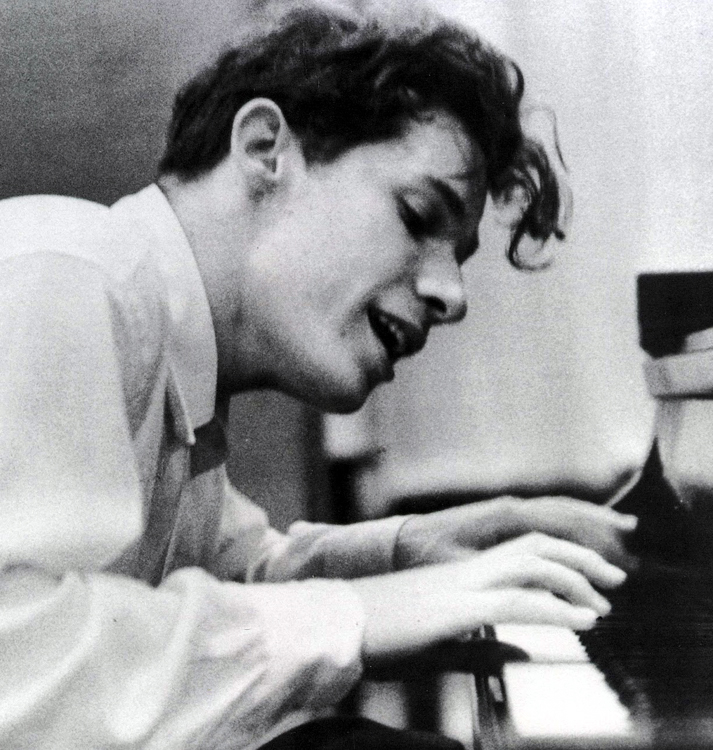
So, I re-read The Iliad at least once a year, and re-read Ovid’s Metamorphoses, Melville’s Moby Dick, Shakespeare’s Hamlet and Goethe’s Faust. I just finished again Dante’s Commedia, and expect to take on Chaucer next. I listen to Glenn Gould playing the Goldberg Variations, or to the Budapest Quartet and the late Beethovens. I weep every time I see Balanchine’s Apollo or his Prodigal Son. I cannot get all the way through Wordsworth’s Intimations Ode without sobbing quietly. 

And Toscanini doing Brahms’ Fourth. I don’t know how many times he conducted that piece, and I certainly cannot count how many times I’ve listened to that recording. I can hear it all the way through now purely in my mind; I don’t even need the score. 

These things — and many more — seem rock-solid and true. 

I expect you have or will have your own list of works that do it for you. They shouldn’t be the same ones; after all, you have lived your own life and collected your own list of wounds and sorenesses, giving you your own sense of what life must be, despite all our best efforts. 

olana

Everyone likes a home with a view. If you are rich enough, you can afford to buy such a property, and if you are an artist, you can design such a house.

Frederic Edwin Church was both of these things, and the estate he created, Olana, is now a state park near Hudson, N.Y., where it sits on the top of a hill overlooking the Hudson River and the Catskill Mountains. catskills from olana

Church worked obsessively on the house and grounds from 1860 until age and arthritis forced him to give management of the estate to his son in 1891. Always, Church’s goal was to create natural landscape views from every turn of road on the 250-acre estate and from every window in the house. And he knew something about landscape views.

Church was one of the most famous of American painters of the previous century. His work commanded the highest prices of any American art when it was new, and inexpensive prints made from them were sold by the thousands to his middle-class audience.

Niagara Falls

Niagara Falls

He found in the New World apt subject matter: the American landscape, from Niagara Falls to the volcanoes of South America. The land he painted was vast, romantic and sublime. It told of a new Eden, almost a new covenant for which America was the herald.

The Heart of the Andes

The Heart of the Andes

Frederic Edwin Church

Frederic Edwin Church

From the 1850s through the next two decades, Church’s paintings glorified America’s vision of itself and the Manifest Destiny that was the root of the vision.

Others painted the same subjects. What made Church distinct was his scale and detail: His paintings were big enough to be exhibited like movies, in their own venues with an admission charge, and they didn’t generalize or idealize their flora and fauna, but instead painted them in Peterson field-guide detail. You can name the plants in a Church painting; you can almost name the week and month by their stage of development.

Rainy Season in the Tropics

Rainy Season in the Tropics

The same kind of obsessive detail marks his house, too. Church couldn’t stand an empty wall or a broad expanse of window. Victorian houses are often chock-a-block with bric-a-brac, but Church is notable even by these standards.

The house was originally intended to be a French chateau-style building. But when Church and his wife toured the Middle East in 1869-70, they became infatuated with what they called ”Persian” architecture. It was actually a little closer to the Arabian Nights style Hollywood eventually adopted for its version of Baghdad. olana front hall

They called it Olana after an ancient treasure-fort in Persia. olana studio

Inside, Church displayed all of his many souvenirs. Most look like they’re straight from Pier One Imports. One lesson to be learned: Being an important artist doesn’t automatically confer good taste.

One room avoids the Scheherazade look. The dining room instead mimics a Medieval castle. And on its walls are the paintings Church called his ”Old Masters.” In fact, they are old, dusty souvenirs of Europe, sans provenance, sans signatures, sans anything else but an old look. If a painting was too bright for his taste, Church himself dimmed it in brown varnish.

The dining room is also one of the few places in the house without a view. Everywhere else, each window or balustrade frames what could as well be a painting. view from olana

In 1884, one visitor wrote about her trip to Olana: ”Mrs. Church met me at the Hudson and we drove up here, several miles, through thick woods, like the ascent to the Alhambra. In fact, Olana is placed somewhat like that, on the top of a cone-like height commanding the Hudson. The house is large and all open on the lower floor, with wide doors and windows a daux battants, so that everywhere you look through vistas to shining oak boughs at hand, and dim, blue hills far beyond, middle distance omitted because so far below.”

The Icebergs

The Icebergs

The house stayed in the Church family until 1966, when it was purchased and later donated to the state of New York. It had fallen into a bad state of repair, but renovation has brought the property up to code and turned it into a beautiful place to spend a day.

plums 2

I spent a quarter of a century being an art critic, but try as I will, I just cannot read art criticism. 

Although there are a few bright exceptions, art critics write in a prose that can clog drains. And too often, their only purpose is to fix the national borders of an art with a jargonish ”ism.” As if there were no difference between a dog and its name. 

The problem, of course, is that the critics (and art historians — let’s not forget the aiders and abettors) see the art they write about as information, as knowledge to be learned. But art isn’t something you learn about, it is something you experience. 

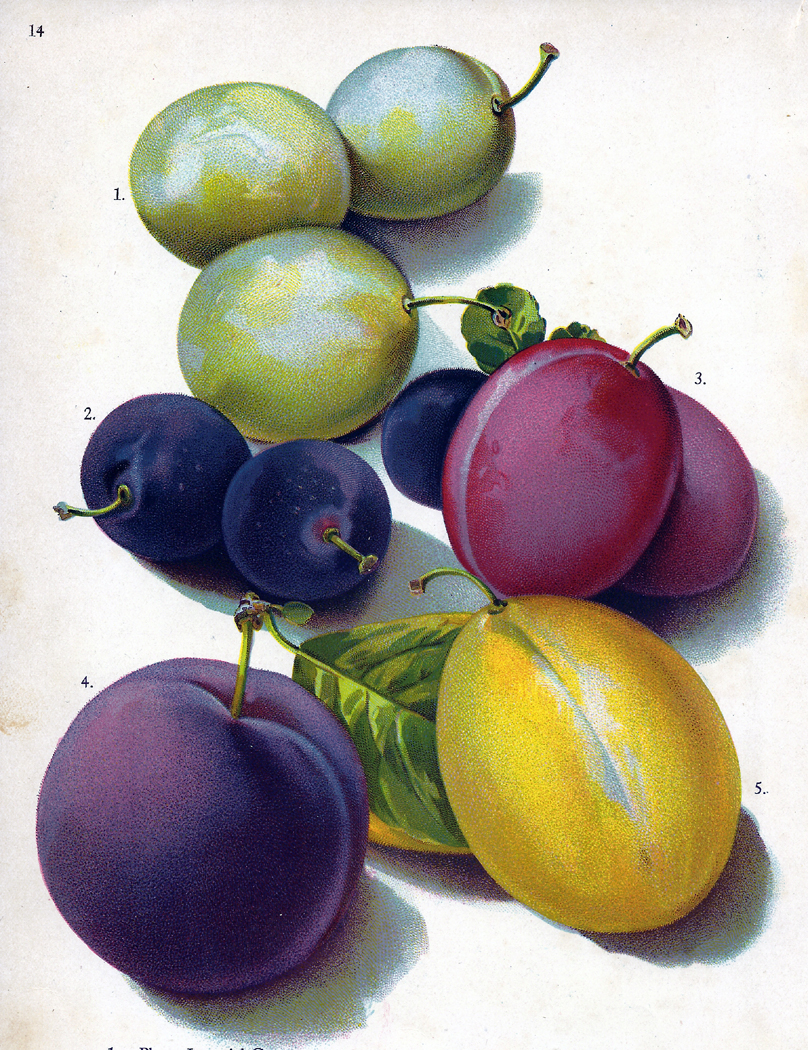
A plum tree has a scientific name — Prunus domestica — but the name tells you nothing about the blossom. It can tell the botanist a few things: how many petals there are, and how many stamens. It is useful for scientists who write scientific papers on arcane aspects of horticulture, but for the rest of us, ”Prunus” is a poor substitute for the smell, color and form of the flower. 

Let me try your patience with one of my favorite examples of art palaver. It is from a very good, very well-known sculptor, whom I don’t want to embarrass by naming. 

”Sculpture deals with basic forms. All basic forms exist as volumes. Volumes penetrate each other and in this way are no longer single formations. Through penetration, space is created in its entirety. Every portion of space results from it. Basic forms are positive space volumes; negative space is created through the opposition of these positive space volumes. Positive space is life-fulfilled; negative space is force-impelled. Both exist simultaneously, both conceivable with each other. It is only the simultaneous existence of positive and negative space that creates the plastic unity.” 

You can stuff mattresses with prose like that. 

I can begin to fathom what he is trying to say: more or less, that the subject matter of art cannot be separated from its background — a basic Design I concept. But I can only conjecture about the ”life-fulfilled, force-impelled” jargon. It is a paragraph that sounds about 23 times more important than it is. 

And as such, it is a version of bureaucratic English. Language that is meant to impress without saying anything. Certainly without conveying the experience of the art. mu qi six persimmons

And prose like that scares many people away from art. If they can’t understand what is written about art, how can they ever understand the art itself? To many people, the world of art might as well be populated by Martians. 

Yet it is not the art that is Martian, only the prose. 

One of the glories of art is that it is available to everyone willing to put in the time and effort. Specialists may know more about a piece, its provenance or historical context, but a rank beginner can experience the color and form with the same appreciation as a critic — or even greater. 

That doesn’t mean that everyone’s opinion is equally valid. You have to be willing to work at experiencing a piece of art. It does not give up its depth and meaning quickly. You have to be open to seeing and feeling things you may not have felt before, and may not feel comfortable with. 

Art requires not knowledge but openness. Knowledge will come of its own accord, as the deeper you experience a work, the more you want to know about it. 

But would you rather read Krafft-Ebing or have sex? 

Nothing can substitute for the experience.

spilled glue

When you’ve heard a piece of late 18th century music on the radio and you don’t know who wrote it, how do you tell whether it was by Haydn or by Mozart?

A former teacher of mine had a simple answer: “If you can remember the tunes when it’s over, it’s by Mozart.”

They were both great composers, but Mozart — in his best music — had a quality that Haydn lacked: He could write “sticky” tunes.

I’ve lately been thinking about this quality, because while we instantly recognize “stickiness” (that recognition itself is practically the definition of “sticky”), it’s difficult to know why one tune is sticky and another isn’t.sticky bun

And it is important to recognize that stickiness is only one quality of good music. Some composers, like Haydn, still wrote great music without it. Heck, the composer most people name as the greatest ever — Beethoven — hardly ever wrote a memorable tune. I mean memorable in the way that even a Rodgers and Hammerstein tune can be memorable. Let’s face it, “Da-Da-Da-Dum” is not really even a tune: It’s a pattern repeated so many times in that damn symphony it is pile-driven into our memories. Anything we rehearse over and over can be memorized. Like multiplication tables.

In contrast, the first thing you hear in, say, the Mendelssohn violin concerto is so sticky, if heard once, it is instantly becomes part of your life.

It should be acknowledged that stickiness is not the be-all and end-all of music. Marvin Hamlisch had it and Stephen Sondheim lacks it, but who is generally held to be the better composer? Sometimes, a catchy tune just means a shallow tune. library paste

There are those composers we instantly recognize for the warmth and catchiness of their melody writing: Mozart, Rossini, Schubert, Dvorak, Tchaikovsky, Verdi, Mendelssohn, Schumann. And there are those whose music finds its strength in other qualities, such as Beethoven, Brahms, Stravinsky.

That stickiness is a distinct quality of music can be seen in the descending careers of both Mendelssohn and Schumann. After Schumann’s breakdown, his music lost its stickiness. It maintained all its craft, but none of its memorability. Mendelssohn wrote the Octet and the Overture to Midsummer Night’s Dream when he was a teenager, but by the time he became the pious paragon of English Victorian culture, he was pumping out some very dull music, indeed. The two composers simply lost their adhesiveness. rolling stones sticky fingers

In contrast, two later composers took the other route: Early music by Cesar Franck and by Leos Janacek chuff-chuffs by on sheer force of will, while when their hair turned gray, they were both touched by the sticky muse and gave us music we can’t get out of our heads.

One thing that seems to be true about sticky melodies is that they feel somehow complete in themselves. The secret of most great symphonic music is that it is built on patterns of notes that can be altered and developed, the tune can be taken apart and rearranged, turned upside down, slowed down or sped up, without losing its fly paperidentity — like Beethoven’s “Da-Da-Da-Dum.” But a sticky tune, like the Mendelssohn concerto, is so complete in itself that it doesn’t easily bear symphonic development: Change a note or rhythm and it loses its identity. This is the downfall of so much music from the Romantic era, where a tune is so good to start with, the composer has nowhere to go with it, so he just repeats it with different instruments or at a different register. It can make for monotony in a 40-minute symphony, a monotony that Haydn never courts, because he is always doing something fresh and new with his themes.

But stickiness isn’t just for music. Some paintings are sticky, even after they’ve dried. Some poetry is sticky, some architecture is sticky.

Just compare, say, Alexander Pope with John Dryden. Pope, sticky, Dryden, dry. All the craft is there in Dryden, and some very lovely turns of phrase, but nothing as memorable as “The proper study of mankind is man.” Pope ranks third as most quoted poet in Bartlett’s.

Keats: sticky. Shelley: not so much.

Wordsworth, like Schumann, lost his youthful stickiness.jam face

Again, stickiness is not the sole measure of worth. Joyce Kilmer’s “Trees” is as sticky as a caramel apple, but not exactly on a level with John Milton.

Claude Lorrain, sticky; Nicolas Poussin, not so sticky. Henri Toulouse-Lautrec is one of the stickiest artists ever. You can come up with your own list of sticky paintings, sculpture and photographs. The subject of stickiness is wide and deserves deeper critical attention.

Stickiness is what every “hook” is in a pop tune, it is the sine-qua-non of a magazine ad or a TV commercial. It may have something to do with simplicity and clarity, but even a complex tune can be sticky.

I would welcome some scientific study of stickiness.

The Fall of Babylon, John Martin

The Fall of Babylon, John Martin

We all have our guilty pleasures. One of mine is the art of John Martin. Actually, I love all the various painters of hysteria and grandiosity, of vast Romantic and Baroque spaces, like the prisons of Piranesi and Superman’s Fortress of Solitude.

These incredible spaces — and I use the word “incredible” in its technical sense — are projections of the Romantic sensibility, that desire for transcendence and a grasping for the cosmic. And always, with the dark shade of annihilation lurking behind it.

There is a delightful strain of paranoia in the paintings of John Martin (1789-1854). It is that touch of insanity that makes his Romantic landscapes so, well, Romantic. He was known to many as ”Mad Martin.”

He certainly came by it honestly: His brother William called himself the ”philosophical conqueror of the universe” and wrote pamphlets that proved beyond question — to himself at any rate — that the prime element out of which everything in creation is made — is air.

His other brother, Jonathan, is known to history as the ”incendiary of Yorkminster,” after he set fire to Yorkminster Cathedral because of some presumed ecclesiastical insult.

The painter himself devised a vast plan to reform the sewer system of London and held patents on hundreds of inventions of questionable usefulness.

His one lasting invention was the steel mezzotint engraving. The copper and zinc plates used for etching and engraving made beautiful prints, but the edges of the engraved line wore down too soon to make the thousands of copies necessary to feed the growing mass media. Martin’s steel plates, while unable to take the fine and subtle detail of copper, lasted forever.

But fine and subtle weren’t in Martin’s vocabulary, anyway.

Of biblical proportions

Balshazzar's Feast

Balshazzar’s Feast

He specialized in biblical paintings that would make C.B. DeMille seem like a miniaturist in comparison. One painting of Balshazzar’s Feast (he painted several) includes a building 7 miles long.

You can tell, because he includes, among the hundreds of writhing figures, one man standing beside one of the columns in a gallery that extends nearly to the horizon line. If you take that figure, meant to provide scale, at 6 feet tall, you can extrapolate, via the rules of Renaissance perspective, the length of the building. At least, so Martin wrote. When I have tried to follow his directions, the measurements get snarled up in swirling mist and the diminution of distance. But I’ll take his word for it.

The Evening of the Deluge

The Evening of the Deluge

This weakness for gigantism is the defining quality of Martin’s art. Other titles bear this out: Joshua Commanding the Sun to Stand Still Upon Gideon; The Fall of Ninevah; and trilogies on the themes of The Deluge and Last Judgment.

My favorite is his Sadak in Search of the Waters of Oblivion, in which the tiny, exhausted and naked figure of Sadak, in the bottom corner of the canvas, climbs the sublime precipice complete with waterfalls that make Angel Falls in South America look like a drinking fountain.

Sadak in Search of the Waters of Oblivion

Sadak in Search of the Waters of Oblivion

Martin’s best work is his series of steel mezzotints illustrating Milton’s Paradise Lost. He had some trouble drawing figures, which are often awkward, even childish, but he had no trouble imagining and picturing the vastness of time and space. Satan, of course, is his Byronic hero.

The Bridge Over Chaos, from Paradise Lost

The Bridge Over Chaos, from Paradise Lost

Martin was enormously popular through the 1820s and ’30s — he was knighted by Leopold I of Belgium in 1833 — and small engraved versions of his huge paintings were as popular in England at the time as Taylor Swift posters are now. He became very wealthy, but lost most of his fortune on his sewer-improvement scheme.

Critical favor turned away from Martin by the time of his death, and a century after his peak fame, his canvases sold for as little as $10.

American landscapes by Thomas Cole, Frederic Church, Albert Bierstadt and Thomas Moran owe much of their sense of hysterical grandeur not merely to the scenery they painted — and exaggerated in the process — but to the Romanticism that inspired Martin. Cole, especially, admitted his debt to the Englishman and at times imitated him outright.

But Martin’s most familiar progeny are heavy-metal bands such as Black Sabbath, King Diamond, Slayer, AC/DC, Napalm Death and Cannibal Corpse. There is the same obsession with death, Satan and the black arts. king kong 3

And that sense of dark, vast space, craggy rocks extending to the skies, and winking light back in the distance, was an inspiration to the makers of the original King Kong, too.

It is all driven by an adolescent understanding of what Longinus called ”the Sublime.”