Archive

Tag Archives: art

cun 18th century

What does the midday sun look like?

That may sound like a simple question, but it’s not. You can’t really look at the sun: If you try, the result is sensory overload, like the distortion of loud music on cheap speakers. You can even go blind, rather quickly.

Yet, everyone thinks he knows what the sun looks like. It’s everywhere in art, beginning with the tempera paintings kids make in elementary school: They so often put a wedge of sun in the corner of the painting, with rays spread out below like sea urchin spines.

kid turtle

But the sun doesn’t look like that: The child’s version of the sun is a symbolic representation of the solar disk.

But then, so are all adult representations.

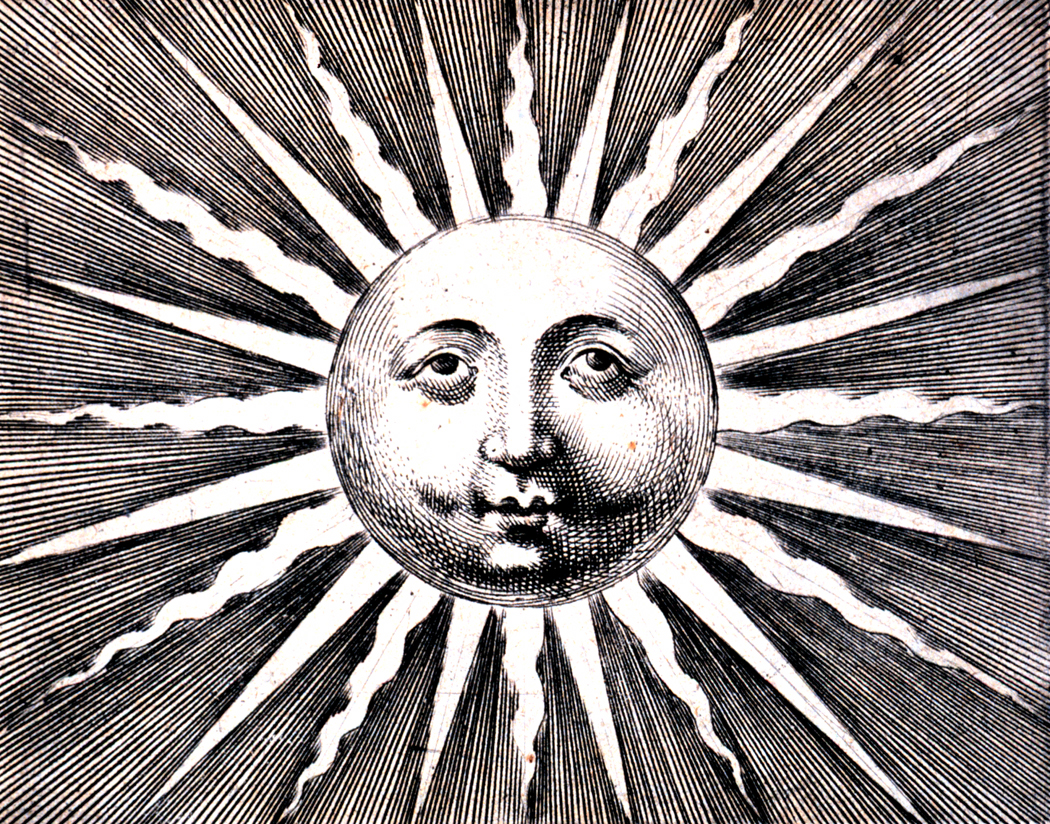
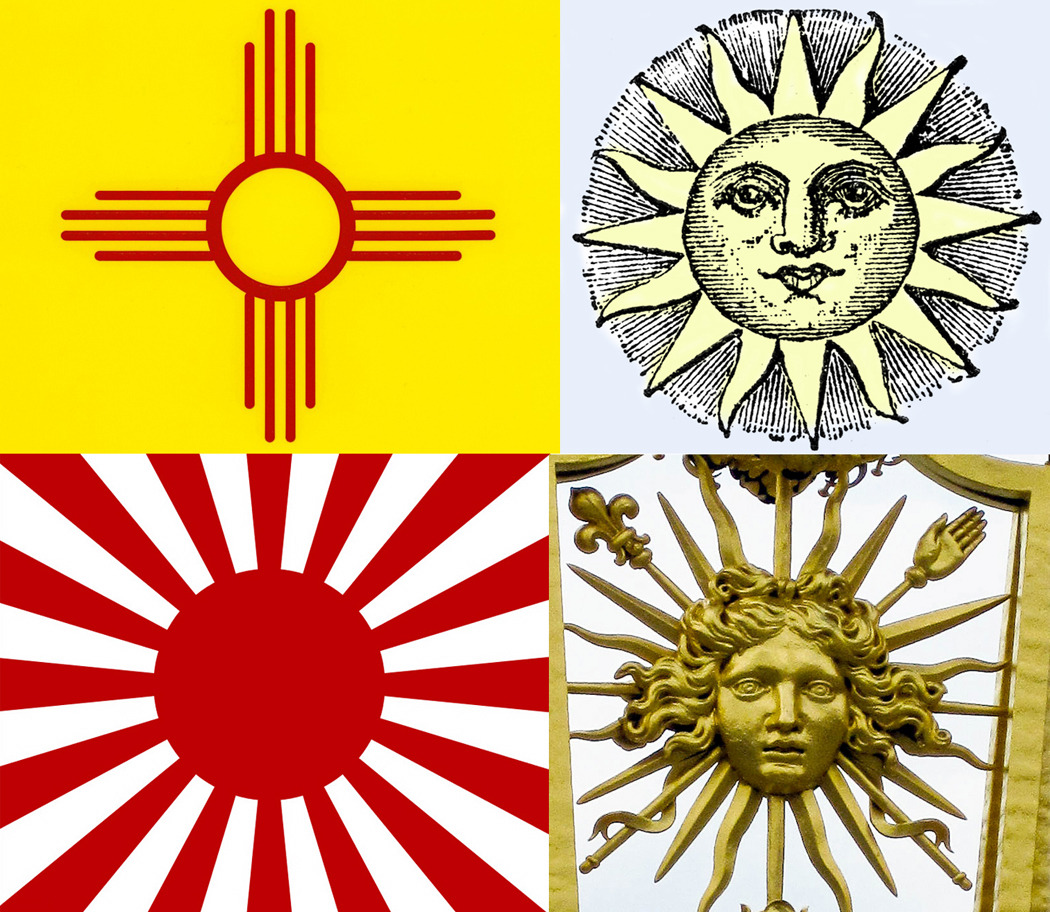
So we also recognize the gilt centrifugal rays of Louis XIV’s Sun King symbol and the terra cotta sun face of Mexico and the red ball and rays of the World War II Japanese “Rising Sun” naval ensign.

sunmosaic

The sun is the paradigm of art problems, because it can never be portrayed accurately as it looks. Paint cannot be so bright.

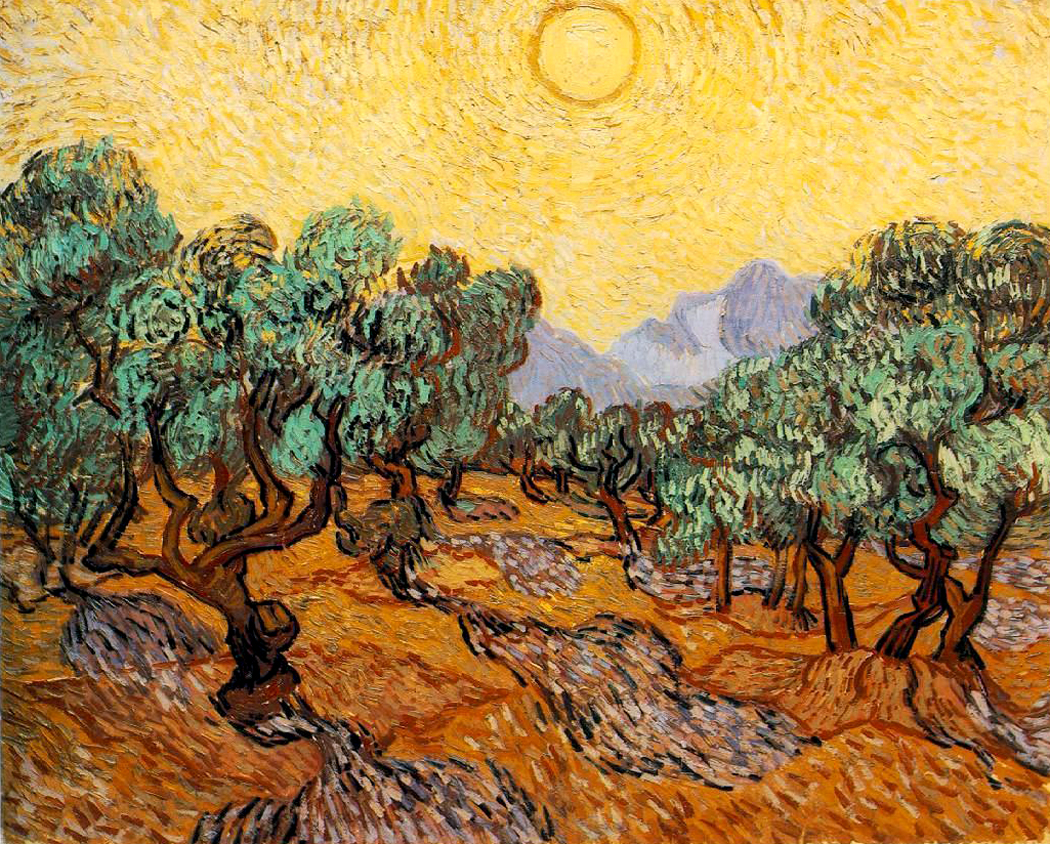
But that doesn’t stop artists from attempting it. Van Gogh painted the solar disk over and over in his landscapes. Usually, the sun is a yellow circle surrounded by concentric brushstrokes in a darker ocher. The only way he could make the sun seem bright was by making the sky unnaturally dark.

vangoghsun1


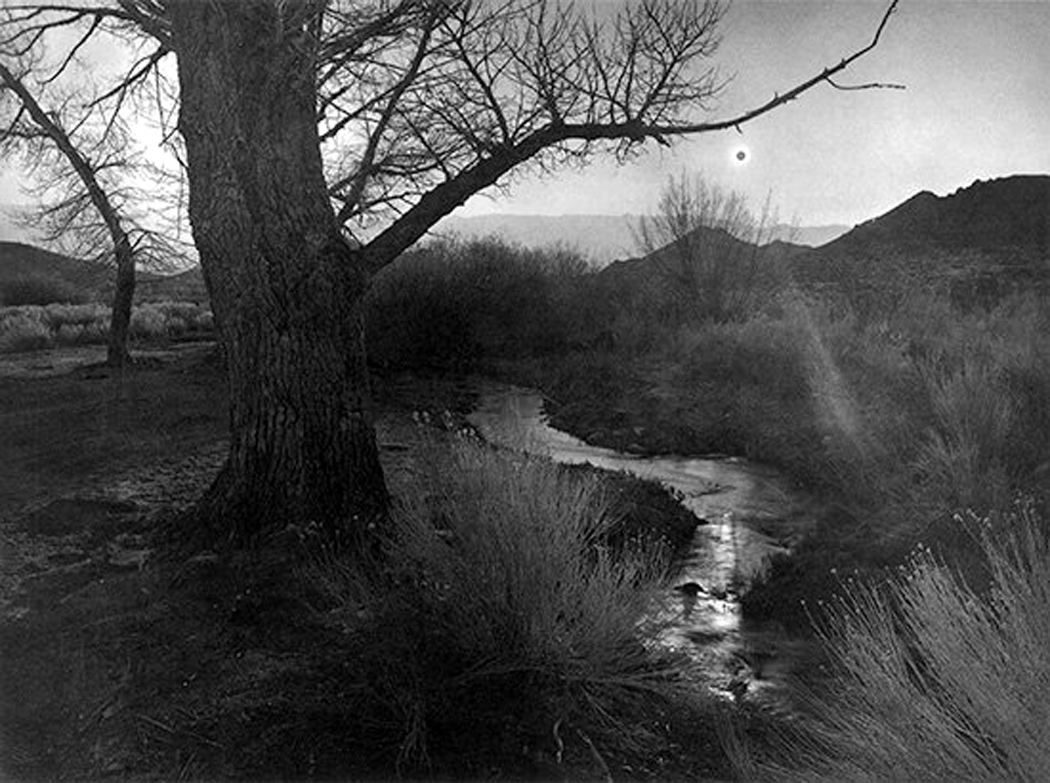
Ansel Adams had a photograph he called The Black Sun, in which a long exposure caused the image of the sun to solarize, making it a dark dot in the picture, surrounded by a halo of rays. It looks almost like an eclipse photo.


Ansel Adams' "Black Sun"

Ansel Adams’ “Black Sun”

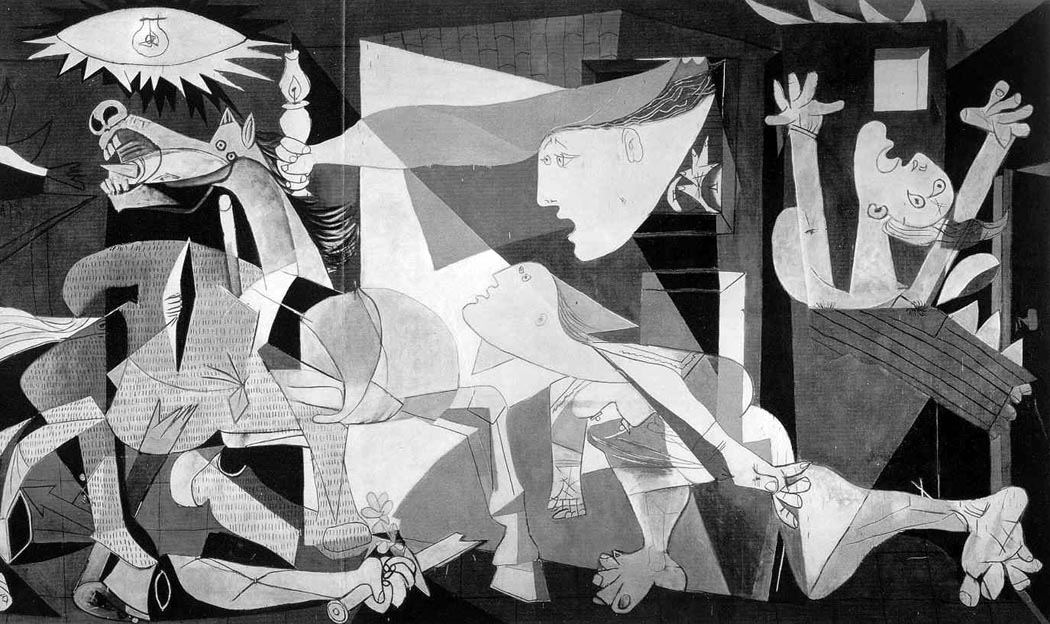
In Picasso’s Guernica, the sun is an edgy elliptical disk with spiked rays, in the middle of which is a light bulb.

guernica detail

Each of these is an attempt to portray something that cannot be portrayed.

On a piece of paper or a canvas, the brightest white is no more than 40 times brighter than the deepest black. In the Arizona summer, the sun is thousands of times brighter than the shadow under a mesquite. A canvas just cannot accommodate that brightness range. We compress that range and accept it.

But the emotional effect of the sun’s brightness is just as hard to portray. When artists attempt it, they have to leave the realm of naturalism and create a fiction, a symbol for the sun instead of its snapshot.

So, what does the world look like? The sun is only one minor example of the complexity of this question. It is a question that has been at the core of art for 30,000 years and has still not been answered in any finality.

The problem in formulating an answer is that human perception is both so complex — scientists keep finding more astonishing whirligigs in the brain’s apparatus — and at the same time, so universally believed simple. We all have eyes; and seeing, after all, is believing.

We see with our eyes, most people think. The world looks the way a photograph makes it look.

But of course, we don’t see with our eyes, but with our brains – and even more difficult, with our minds, which means we see through the haze of emotions, culture and individual life experience. We so thoroughly process the data that our eyes collect that the final result barely matches the patterns on the tickled retina.

Seeing doesn’t just happen; it is a complex mental process. And it is a learned process, as any of hundreds of studies have confirmed. One of the ways it is learned is through art — or, to use the more modern term, through media.

Which is why, until the Modernist revolution in this century, artists concerned themselves with attempting to accurately depict the world around them.

It was to this end that such men as Leon Battista Alberti and Filippo Brunelleschi attempted in the 15th century to devise a mathematical formula for creating the illusion of three-dimensional reality on a two-dimensional canvas. The linear perspective they created became the mother tongue of European painting for four centuries.

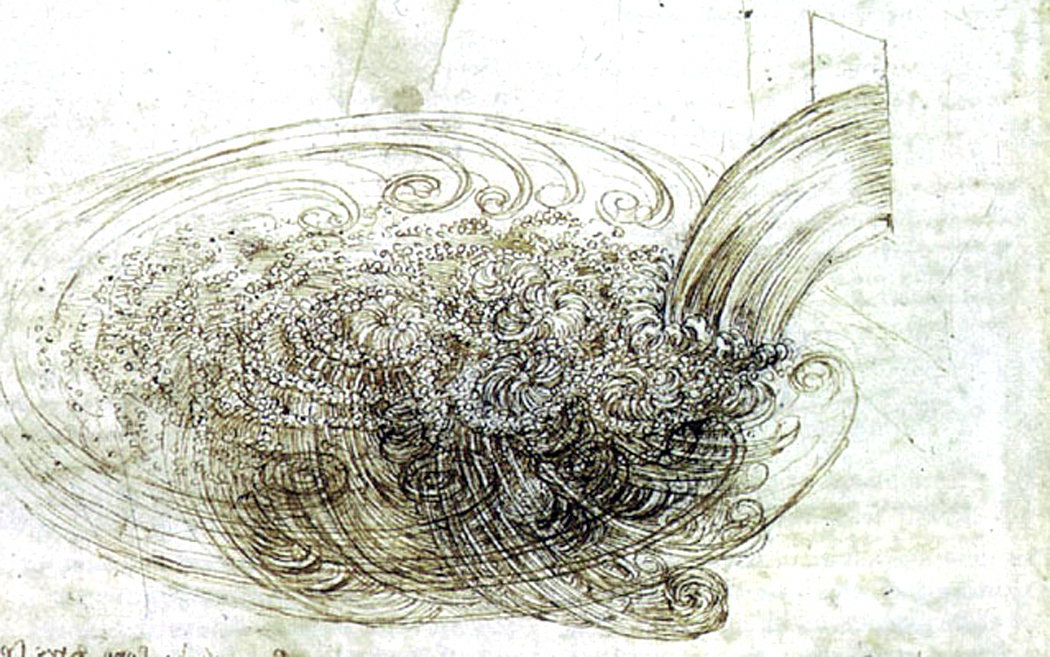
But perspective wasn’t the only question: We’ve all seen the obsessive drawings of Leonardo da Vinci, attempting to get down on paper the swirl of water in motion.

leonardowater

Or Michelangelo’s attempts to show every anatomical muscle under the marble skin of his statuary.

The Italian Renaissance was so thorough in its quest for realism, and so successful, in contrast to the Romanesque and Gothic art that came before it, that we have on some level considered the question answered ever since: This is what the world looks like.

Yet, it isn’t so. There are gross distortions built into perspective: Its grid of parallel lines is pure fiction. Leonardo’s water looks more like masonry than fluid, and Michelangelo’s muscles are a little too manic to be visually true.

Yet, the schematic system of image-making they came up with was so persuasive that we still accept the look of it.

Photographs, for instance, which are often taken for the ultimate in realism, are actually made through lenses carefully designed to mimic Renaissance perspective. Rectilinear imagery doesn’t happen naturally.

No art is ultimately realistic. What we tend to call realistic art, whether it is 200 years old and hanging on a museum wall, or hanging in the “starving artist” corner of your shopping mall, is more properly called ”conventional” art. It partakes of the conventions of art that we have, for the moment, accepted.

But those conventions are just as stylized – just as unrealistic – as the ”King Tut” angular figures on an Egyptian frieze, or the misty landscapes on Chinese scrolls.

Take any so-called realistic piece of art and ask just how like life it might be.

When a British cleric, Dr. Thomas Church, visited Rome in 1816, he sat to have his portrait drawn by Jean Auguste Dominique Ingres, one of the leading French artists of the time. The 6- by 8-inch pencil drawing Ingres made is now owned by the Los Angeles County Museum of Art. It is a drawing almost everyone would call a realistic likeness. Certainly, if you knew the drawing, you could have picked out Church from a police lineup.

Ingres' Dr. Thomas Church

Ingres’ Dr. Thomas Church

Yet, the drawing is realistic in only a conventional sense; we are so used to those conventions, we don’t even think about them. We are fish, the conventions are water. It almost seems silly if I point them out. But it isn’t silly; it is profoundly important for us to think about them.

First of all, I doubt the good reverend was only 15 inches tall, as he is in the drawing, or would be if he stood up and his legs hadn’t been cut off by the edge of the paper. We have no trouble believing that a small likeness is realistic, any more than we have trouble with Georgia O’Keeffe’s larger-than-life flowers.

Second, Church probably had a little more color in his cheeks than in this monochrome drawing. We accept black and white as realistic.

We even accept his high-collared coat as black because we know such coats, even though in the drawing, it is the same blank-paper color as his nose and cheek.

Third, the real doctor was three-dimensional; the drawing is not. We could walk around the real person and see his back; the verso of the drawing is just blank paper.

Then, too, the real person moved and the drawing is frozen still.

The real person moved through time, too. It should also be noted that the drawing still exists; the same cannot be said for the good cleric. Ars longa, vita brevis.

The real person made noise — I cannot imagine such a cleric not talking constantly, even prattling. The only noise the drawing can make is a crinkling sound if you were to crush it in your hands — a sound to draw the immediate attention of the museum guard, no doubt, but not exactly conversation.

The drawing also has no odor of humanity about it. Then, too, the drawing is made up of pencil lines. Examine as you will the world around you, you will not discover lines in it that outline the borders of objects. The use of line in drawing is one of the most persistent, and least realistic conventions.

And the last thing I’ll mention: There is a frame, an edge of the picture that cuts off the bottom half of the good reverend. Real experience does not come with a frame line.

All these things we look right past and accept the drawing as an accurate rendering of reality. I’m sure you can come up with a dozen other hidden conventions I have passed over. But that is the power of convention. And it is all the more reason we should be concerned with the question: What does the world look like?

A century of Modernism has taught us not to ask such a question, and we have largely bought into the propaganda. Instead of asking the question, “What does the world look like, from the time of Cezanne on, art has primarily asked, ”What does art look like?” When a visitor looked at one of Jackson Pollock’s swirls of paint drippings, he asked, wondering what the picture’s subject might be, ”What is it?” Pollock answered, ”A painting.” He wasn’t just being cute. All of art critical theory at the time asked us to consider the effects of colors against other colors, forms against form, line against line.

But as great as some of the century’s art is, the overall effect is of a mirror held up to a mirror. It is intentionally mute: ”Music can express nothing,” said the arch-Modernist composer Igor Stravinsky. He was wrong, but he summed up this century’s own unacknowledged provincialism.

Art must regain its connection with the life we live. There is no better way to do this than attempt to answer the basic question about the appearance of the world.

For seeing is active, not passive. It is something we do, not something that happens to us. Each generation must keep up this dialogue with the world.

It is still a noble goal of art: to discover the difference between the schematic and the mimetic, between convention and experience — between what is and what has to be.

To parse it all out.

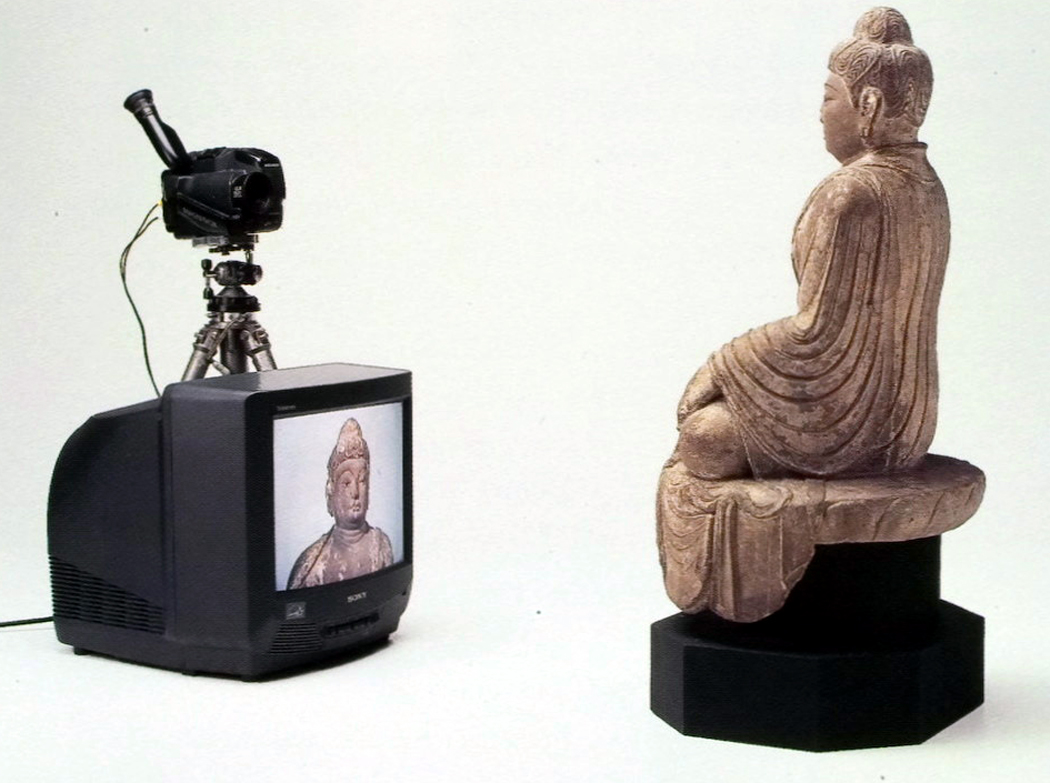
What is called Postmodernism doesn’t effectively do this. If Modernism is a mirror looking at a mirror, what has followed is a TV set looking at a TV set.

nam june paik1

A generation of media-savvy savants has created an art that is self-referential, and its main reference is The Brady Bunch.

I am certainly not calling for artists to imitate the look of Norman Rockwell. I hope I have made clear that Rockwell is not realistic.

I am calling for artists to take a really close look at the world around them — actually, I am calling for them to love the world, to caress the things of the world with their eyes.

The most effective way of doing that is to draw. Not until you have drawn something have you really seen it, felt its texture in your mind, tasted its color on front and back of tongue, known its shape and the shape of the air around it.

You can see this in Ingres’ drawing again. The coat, the pose, the chair arm — they are all merely conventional. But look at the eyes. They fairly swell with life, there is a softness to the bags underneath, a bristliness to the eyebrows and a live intensity to their gaze. The eyes are the animated center of the drawing, a jewel in a supportive setting.

In the coat, one sees the artist’s training; in the eyes, his connection with the world. There is no doubt which is more important.

So I ask the question of artists, what does the world look like?

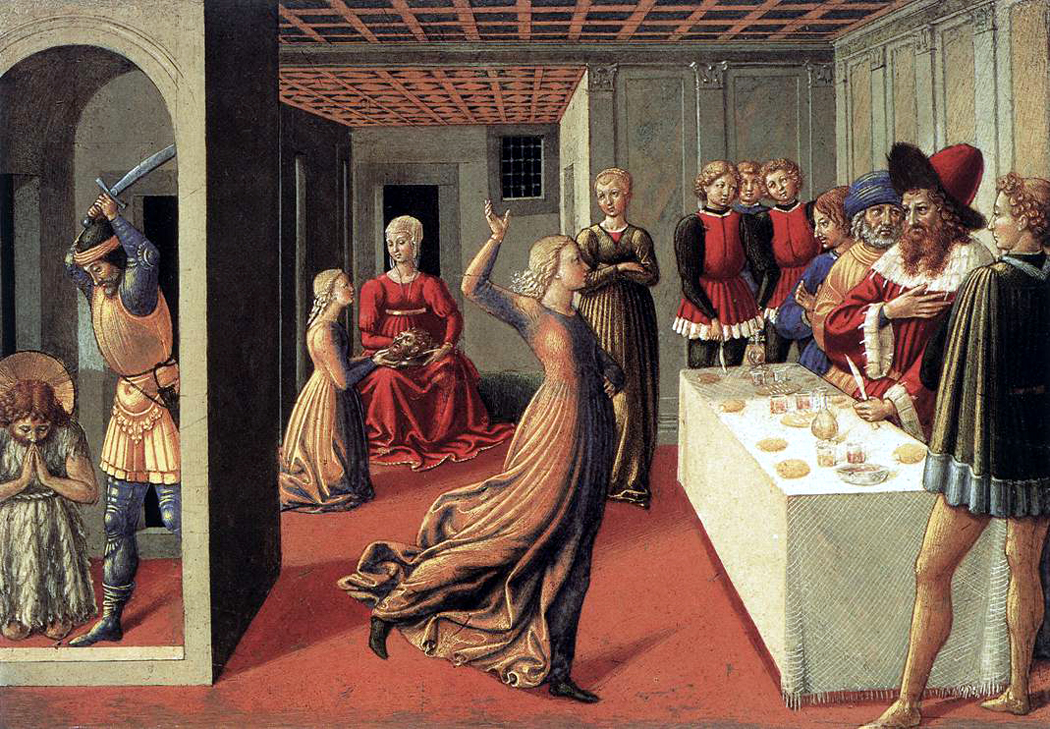
Take take just one of those issues: motion, for instance. In the early Renaissance, it was not unusual to repeat a figure several times in a painting, depicting action as it is shown in the frames of a comic strip – showing the same figure in different parts of the frame at different moments in the action.

salome

One depicts Salome dancing in one part of the picture and John the Baptist in his cell in another. Another corner of the picture shows John bent over the block with an executioner’s ax raised over his head and a final portion has Salome watching John’s head on a platter.

Even God appears twice, from front and back, in Michelangelo’s Sistine Chapel Creation.

An entire century of art grappled with this problem as Baroque artists painted violent action at its most unstable point in time, suggesting the motion even when the figures are still as statuary.

Marcel Duchamp’s Nude Descending a Staircase is an attempt to portray the motion itself.

nudedescendingstair

Jackson Pollock’s action paintings are visually active with the result of the painter’s own motion.

Jean Tinguely created kinetic sculpture that actually did move.

Which of these is most “realistic”?

The depiction of visual reality is only one of the purposes of art, but it is a great and noble purpose that has been in eclipse as artists have been seduced by the cleverness of conceptual art.

As though the problem of mimesis in art had somehow been solved, freeing us for other endeavors.

But every time an artist picks up a pencil and tries to get the proportions of a figure right, every time an artist mixes a rose madder with an alizarin crimson to match the color of a landscape, she is tackling the biggest and most intractable question of art.

Looking is hard work, worthy work for an artist.

The sun streams in through the window, I go to it, look out at the world beyond and wonder what it looks like.

Astonish us.

Back Bay, Virginia

Back Bay, Virginia

When you are young, it is easy to be in love with art. You may love its artifice, you may love the colors or the rhymes or the great blaring sounds of the music you listen to. Art is vibrant; it seems so alive. But most of all, you are in love with the sense of importance art brings: It seems to validate the belief we all have when we are young that our own lives matter, that we count in the larger scheme of things.

We are all Tristan or Holden Caulfield.

Perhaps that is why the young make so much art. They are not yet unhappy with it, not yet dissatisfied at the lies that art creates, not yet disgusted with the prettiness of it all.

Most of all, the art we make when we are young imitates the art we have come to love: Art most often imitates art, not life. There is so much bad imitation T.S. Eliot written in college, so much abstract painting of no consequence, so much herd-instinct.

I have been as guilty as anyone. In 45 years of photography, the bulk of my work has been imitation Ansel Adams or Edward Weston or Irving Penn. I make my confession: I have photographed a pepper. I was learning to make images that I could recognize as art, because it looked like the art I knew. Big mistake.

Go to any art gallery and you see the same process unfolding. Imitation Monet here, imitation Duchamp there, imitation Robert Longo there. Whatever the current trend in art is, there are acolytes and epigones.

At some point, as you age and if you are lucky, you let all this shed off you, and you no longer care about art. What takes its place is caring about the world, caring about the experience of being alive. It isn’t going to last long, so you begin paying attention: close attention to soak in as much as you can before you die.

And if you are inclined toward art, you give up caring whether you are making “great” art, or whether you are part of the great parade of art history, and you care only about what you see, hear, touch, smell and taste. The world becomes alive and art fades to pathetic simulacrum.

When you reach this point, then you can begin making art. And you make it for yourself, not for posterity. You make it to attempt to capture and hold the world you love, or to understand the world, or to transcend it, when it becomes too difficult to endure or accept.

Art becomes a response to the world, rather than a substitute for it.

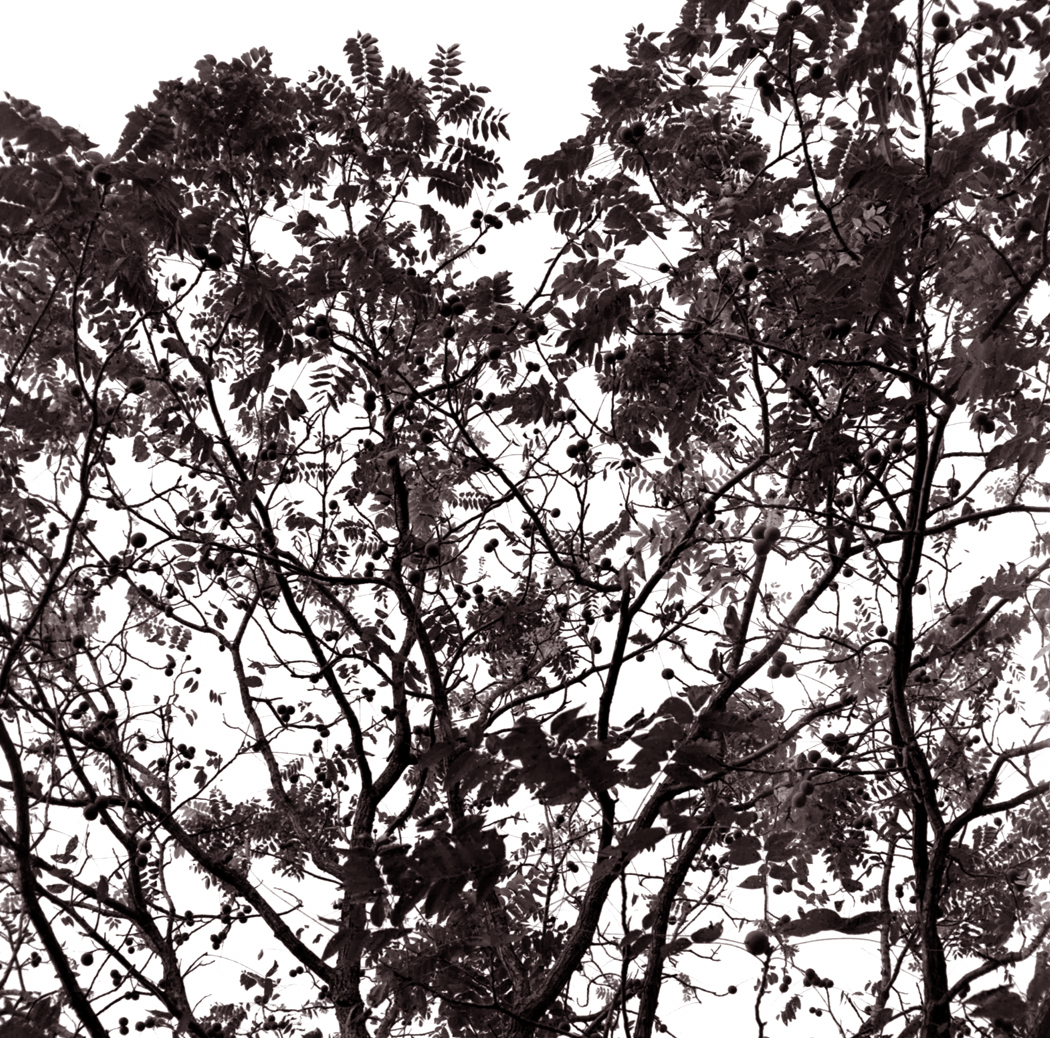
Walnut Tree, Greensboro, NC

Walnut Tree, Greensboro, NC

 2.

The first garden I made was a vegetable garden in the front yard of the North Carolina house I was renting in the early 1970s. I grew the usual tomatoes and peppers, beans and spinach. I also ventured into eggplant, which turned into the most successful part of the garden, to my surprise.

But what I really learned from my garden is the difference between the neat, orderly photographs in the seed catalogs and the rampant, weedy, dirt-clod messiness of the real thing. Gardens, I discovered, were not military rows of uniform plants, but a vegetative chaos.

The stupid thing was that I should have known this going in. All around me trees, vines, shrubs, roadside flowers and Bermuda grass were telling me one single thing, over and over: Profusion is the order of nature. Variety, profligacy, energy, expediency, growth.

Whether it is a kudzu shell over a stand of trees, or the tangle of saplings that close over an abandoned farm field, or the knot of rhizomes that run under the turf, the rule of nature is clutter.

The walnut tree outside the front door was old, and its bark was stratified with moss, lichen, beads of sap, and a highway of ants running up and down. From a distance, it was just a tree, but up close, it was a city.

When I was a boy, there was an abandoned farm beside our property. An old, unpainted barn and farmhouse stood in the center of a field of grass and weeds. When I was maybe 8 years old, those buildings burnt down one night, in a glory of flame.

In the years that followed, the course of plant succession took over. I learned my lessons from the Boy Scout merit badges I earned, but even there, the story of succession seemed much more orderly than what I saw out my window. Plant succession wasn’t a clear progression from annuals to perennials to shrubs and through a clearly delineated march of one kind of tree into another till we reached climax growth. It was instead a tangle of saplings through which it was nearly impossible to walk. There was not a “baby forest” that we saw, but an overpopulated struggle for sunlight, every plant elbowing its neighbor for survival. In a forest, the trees stand a certain distance apart, their crowns touching to make a roof. But this young version was more like a thick head of hair; there was no distance between the shoots.

Everything in nature told me the same thing: busyness, struggle and chaos. It was all exhilarating, and I loved the tangle of it all, the textures, the smells, loam and rot, the mud and dew.

And yet, that isn’t what I saw when I looked at art about nature, whether it was glossy calendar photos or Arizona Highways’ covers on the low end, or whether it was Raphael and Delacroix on the high end.

The nature I saw in most art was tame as a housecat. And the art wasn’t really about nature at all, but about order. It wasn’t made to see the world we saunter through, but to see how our minds organize and codify it.

Whether it was 18th century paintings or Ansel Adams’ photographs, the art was all about order. In fact, you could say that the point of the art wasn’t to make us see nature, but to understand order.

I was unsatisfied with it and with my own art. I wanted to make an art that would look at the natural world and make images that spoke to me about what I was really seeing and feeling.

Notre Dame de Paris

Notre Dame de Paris

 3.

I recognized something of what I wanted in the arts of the Gothic, Baroque and Romantic periods, eras in art that glorified the energy and visual confusion of the world. They are arts that responded to the profuse variety of experience. They were also arts that were devalued by the mainstream art world of the 20th century. Eliot deprecated Milton; Stravinsky insulted Berlioz; Mies van der Rohe is the anti-Gothic architect.

Yet, I loved Shelley, Schumann, Chartres. And I wanted to find a way to make that art over in our new century, in a new way, and reattach art to the world around me. It had been untethered too long; too long it had been its own reason for being. Art for art’s sake? Not any more.

It can be hard — it is probably impossible — to make art completely divorced from one’s time. The visual universe is too persuasive. We cannot even know how deeply we are affected by the stylistic twitches of our own age, and I am not saying my own work is sui generis. It certainly is not.

The light that knocked me off my horse on my own way to Damascus was a single book of photographs — still a fairly obscure book — by Lee Friedlander, titled  Flowers and Trees, from 1981. It was spiral bound, printed in a matte finish, and had virtually no text. Inside, I found a mirror of the nature I knew and felt. Nothing was framed neatly, nothing was glorified by the light poured on it, nothing was reified into monumentality. Instead, there was the profusion, confusion and organicism that I recognized from my own experience.

And I realized that I had been working in that same direction for years, but had buried those photographs among the more conventional mountainscapes and detail photographs where I had imitated my betters. I had several series of images that were my own immediate response to nature and they were all photographs I had made in the gardens of friends. I gathered them together and looked. The conventional photographs seemed to have no value whatsoever and these others, almost random, usually confused, and always ad hoc, seemed to breathe the life I had been looking for.

Since that time, and with the advent of digital photography, I have been liberated. I take my camera with me, point it at something I want to feed it, and let it do the chewing. I never look through the viewfinder anymore, but instead look at the larger shapes, darks and lights, that show in the digital screen on the back of my camera. I see how I see, and click the shutter.

Over the years, I have made many of these sets of photographs, usually 15 to 35 pictures in a group, and printed together to be seen as a “book,” that is, a print cabinet, where my audience can spend as much or as little time as they wish and shuffle to the next.

And the unit of my work is the book, not the individual photo. You can’t see a forest by looking at a single tree.

Baldwin County, Alabama

Baldwin County, Alabama

4.

If I have succeeded, I have also failed.

For in the end, my attempt to wrestle with the world has turned into an art that is also about order, about how the mind engages with the things around it. I have wound up doing exactly what my predecessors have done.

It isn’t surprising. After all, when I turn on my elders and find their efforts insufficient, I am doing nothing different from what they did when they turned on their elders. It is how art grows. Wordsworth rebels against Pope, Eliot rebels against Wordsworth, Ginsburg rebels against Eliot. One generation finds its parents lacking and tries its on its own to finally express the truth.

And I can only be happy when a generation after mine points its own finger backward and wiggles it in reproach at me.

It seems we never get closer to what we are all after. Value is all in the trying.

Reno, Nevada

Reno, Nevada

This is the Information Age, a century choked with facts and factoids, bites and gigabites. Yet, for all the blizzard of data, it has been a century of drought for Truth.

As the century has progressed, we have become increasingly suspicious of the very idea of Truth, to the point that many younger people simply no longer believe there is such a thing.

I ran into this attitude in a university art seminar I was asked to address. The brightest and most talented student in the class took exception to my exhortation that they use their art to discover truth.

Art, of course, often pretends to address “universal truths.”

“There is nothing universal,” she said, giving words to the common belief, which in itself is a sweepingly universal statement. “It’s all just personal preference.”

I asked her if she didn’t think that her art had validity for her viewers.

“No, it’s just my version. I don’t expect anyone else to believe it,” she said.

Why, then, I wondered, did she bother to make art? What was the point, beyond self-gratification?

It was, as I saw it, utter capitulation.

Yet, I still understood why she might think that way. It was a previous “universal truth” held by everyone from Aristotle to Southern Baptist Convention that prevented women from making art in the past — or at least kept them from being taken seriously. Universal truths held people back, subjected them, disenfranchised them, enslaved them, justified the status quo and glorified local circumstances — that is all she cared about the subject.

The century has had its belly full of horror perpetrated in the name of “universal truths.” Cambodia cleared out its cities and slaughtered its citizens in the name of a great truth. The Soviet Union starved its provinces and imprisoned its best in the name of a “historical truth.” Germany’s big truth was a big lie and ended in genocide.

And in the centuries before ours, truth had a nasty habit of justifying colonialism, war, racism, the subjugation of women and the worst aspects of jingoistic nationalism. Just read any 19th Century justification of slavery. Is it any wonder that we have become nervous and twitchy about anyone claiming a franchise on Truth?

Even in our own time, those who profess to know the Truth habitually kill those who don’t agree. It doesn’t matter if they are Christian or Muslim, Tamil or Sikh. Truth is too often just a good excuse to blow each other to kingdom come. The nightly news carries new proof of this every day.

Yet, the loss of a sense of universal truth is in some ways just as bad.

We have no core beliefs to unify our culture; it fragments into interest groups and the groups fragment into individuals, each with his own desires and directions. The groups quarrel and soon, like Tutsis and Hutus, they are at each others throats.

Seven billion screaming ids. Either way, people wind up dead.

It used to be one of the functions of art and literature that it tested the veracity of purported truths, taking exception to ideas that had become outworn and making provisional stabs at creating substitutes. Art was the attempt to find universal truths that could stand up to the sulfuric acid used to separate the gold from metals more base.

As D.H. Lawrence said about the novel, meretricious ideas are easier to spot in fiction than in everyday life.

But the problem now is that it isn’t just that we no longer know which truth to believe, but that we simply don’t believe there is any truth.

We have reached an uncomfortable impasse. We need belief to make life meaningful, yet we cannot allow ourselves to believe in anything. Every faith, institution, political faction and ideal has proved at some level to be a tissue of hypocrisy. We decry our own cynicism, but recognize that at some level, it is merely realism.

Some retreat into conventional orthodoxies; others free float, aimless in an increasingly valueless society.

But there is another alternative: starting from scratch to see if we may discover for ourselves something like universal truth and build the whole thing all over again.

If we could only find a starting point, a single truth that everyone can agree is universal.

I suggest there is one such truth: We all die.

Death, if nothing else, is common to all 7 billion people on this planet. It is common to all living things, and metaphorically, common to all inorganic things, too. Perhaps if we recognize the universality of death, we can allow the possibility of other universals, even if we tread such territory gingerly.

If there is one truth, perhaps there are others. At the very least, it puts the lie to the canard that “it is all just personal preference.” At least one thing isn’t.

Death may seem a grisly place to start, but it doesn’t have to be.

The raw fact of death, when we are willing to be aware of it, also brightens and colors the gray ordinariness of daily life. It is what philosopher Martin Heidegger meant by the term, “authenticity.”

In simple terms: Death makes life more immediate.

If we ignore the fact of death, we can become bored with small things. But if we keep our death in mind, even mud becomes magic.

Perhaps just as important, it isn’t our own death that we feel most poignantly. We may not experience our own deaths at all — at least we have no reliable reports from after the fact — but we do feel the deaths of those around us in a profound sense of loss.

A sense of loss may be our second universal truth: It is certainly at the root of much mythology, from the expulsion from the Garden of Eden to the current New Age belief that Native American culture is somehow “in harmony with nature” and that our own culture is somehow cut off from it.

This loss is not merely generated by our awakened sense of our own mortality — in the face of loss, our own deaths often become insignificant — but of the recognition that we extend beyond our egos: We love.

Love — this opening up beyond self-interest — is perhaps a third truth, for whatever cultural inflection it picks up — and make no mistake: despite the rumblings of the Republican right, love is manifested in a million forms — the basic truth is that we all manage to break out of our blind egos and forge connections with others.

From love, we can begin to build a sense of morality. By breaking from our own egos, by imagining what it is to be other than ourselves, we begin to understand how our behavior affects those around us.

Young artists often deal with death in a symbolic fashion: skulls and blood. It is the mainstay of prison art, tattoos, heavy metal music and adolescent — primarily male adolescent — fantasies. Yet such doodling has as little to do with death as with art.

Such things are mere conceit.

It isn’t until we are older and come face-to-face with loss, that we begin to understand the meaning of death and the hundreds of emotional consequences that follow.

Beginning with one uncomfortable truth and wind up with a complex web of things, including that which makes us happiest.

I recommend to artists, not that they get all morbid, — quite the opposite — but that, starting with the universality of death, they may begin to build once more a fabric of belief that will sustain the human spirit.

Loon

Who is America’s greatest painter?

There are many who could be named, from Eakins to Homer to Whistler to Pollock, but the name I would like to place in nomination is John James Audubon.

That comes as a surprise to me as well. I once knew him, as most Americans do, as the author of a book of overly familiar colored engravings of birds.

But the original watercolor paintings reveal him to be a soul of great emotional power, even moral force. An exhibition of many of them is currently on view at the New York Historical Society, through May 19, and changing shows continue through 2015, until all of the 474 originals for his book have been displayed. (A stunning book, “Audubon’s Aviary,” is also available through the NYHS or Amazon).

Audubon — America’s most famous Haitian immigrant — was born there in 1785 as the illegitimate son of a French merchant and slave trader. He moved to France with his father when he was 5, and to the United States when he was 18.

He went through a series of disastrous business ventures, making and losing several fortunes and wound up, at 35, as a part-time taxidermist and portrait painter.

It was then he conceived a plan to publish a book about American birds with his paintings as illustrations. Audubon had been a nature lover since boyhood and had often drawn the birds he loved. It came to him that these drawings could be supplemented to illustrate all the bird species then known in America. It was an ambitious plan.

John_James_Audubon_1826

Too ambitious

Too ambitious, as it turned out, to interest any American publisher, so he wound up in England, where he found Robert Havell Jr., an engraver with the perfect talent match for Audubon’s drawings.

The book they published in installments over a dozen years beginning in 1827 was the ”double-elephant edition,” named after the page size: 29 1/2 by 39 1/2 inches, with engravings by Havell made from the paintings of Audubon and hand-colored by apprentices.

They sold by subscription for $1,000, an astronomical sum in those days. It is hard to compare dollars over centuries, but at the time, the average laborer made the proverbial dollar a day, so it would not be out of line to say they sold for the equivalent of about $30,000.

In Dec., 2010, a complete first edition of “The Birds of America” sold at Sotheby’s in London for $11.5 million — a record for the most expensive printed book ever sold at auction.

Over three decades, Audubon tracked down, studied, shot, drew and painted more than 400 of the country’s bird species, with the paintings turned into a book that would document them for the first time, and eventually make its author’s name synonymous with nature and conservation.

And he did so with a commitment so intense that he became one with his subject. In some sense, every bird he painted is a self-portrait.

More than anything else, it is for this reason they rise above documentary art to become among the greatest art ever made by an American.

But it was the book Audubon meant us to see, not the watercolors. They were painted only as studies for the engravings that illustrate the book.

And so, Audubon felt comfortable doing things he would never do for a display picture. He mixed media like crazy, using ink, watercolor, gouache, pencil, even collaging birds scissored from earlier drawings.

He used each of these techniques to particular expressive ends that could not always survive the engraving transformation. In the case of the Magnificent Frigatebird, for instance, he used the sheen of his graphite pencil over the top of watercolor to imitate the iridescent effect of the bird’s plumage.

Magnificent Frigatebird

Magnificent Frigatebird

Still, the very first thing that wallops you as you enter the Audubon show at the Art Institute is the monumental size of the paintings.

Everybody knows what Audubon’s bird pictures look like, or at least they think they do. But seeing poor reproductions in books will not prepare you for the real thing.

What we are used to seeing are small reproductions of large engravings that are themselves reproductions of Audubon’s original paintings. Each painting is about 2 by 3 feet. Poster size, not postage-stamp size.

In that giant space, Audubon places all his birds. It was his intention to paint every bird life-size, whether hummingbird or eagle.

It meant that very large birds, such as flamingoes or condors, had to be contorted to fit into the space.

Total involvement

Yet it isn’t mere exigency that causes Audubon’s animals to be so animated. More than anything else, it is his total body identification. He is one of the world’s most haptic artists.

Over and over, you sense that Audubon felt his own muscles and sinews moving in sympathy with the birds he drew.

Time after time, you can see the intense life reflected in the eyes of his birds. They are never mere circles, but always pools of living awareness.

One of his secrets may be that he remained always a child in his direct response to nature.

”Every child is an artist,” Picasso said. ”The problem is how to remain an artist once he grows up.”

It was a problem Audubon solved.

Look at his poses. The competency of the drawing is a different level from a child’s but the poses are straight out of first or second grade. The animal is always moving and live.

Naturalists have always carped that the Audubon bird prints are not as realistic as those of Louis Agassiz Fuertes or Roger Tory Peterson. They cavil that Audubon poses his birds in exaggerated positions that are unnatural for the real bird when alive.

But these people are not letting Audubon be Audubon. While it is true that he was on some level making identification pictures, it isn’t that level that rises to greatness. It isn’t as a field guide he is to be judged.

Audubon watched his birds with the minute carefulness of a mother bird, and recognized in every bird action an analogous human emotion. He then projected the human back into his avian. Like the leader strike of lightning that makes a path for the great burst of electricity back in the opposite direction.

A human element

Audubon’s birds function metaphorically as symbols of human affective states.

Fuertes is more useful scientifically precisely because he treats his birds as an ”it.” Audubon treats them as a ”thou.”

Detail, Chuck-Will's Widow

Detail, Chuck-Will’s Widow

You can see it in his Chuck-Will’s-Widow with its giant gaping mouth, the essence of appetite. In the uxorial affection of his Passenger Pigeons, which almost seem to kiss as the one feeds the other. In his nesting Barn Swallows, where the one shields the other with his upraised wing.

Ultimately, Audubon’s paintings are not about birds, but about human beings. Where Bach or Beethoven uses a series of notes to convey a human emotion, Audubon used a picture of a bird. And more than anything, it was that Audubon felt the importance of paying attention.

It isn’t that his paintings are so detailed, but that he paid attention to that detail with an urgency that approached love.

”To be awake is to be alive,” wrote Henry Thoreau. ”I have never yet met a man who was quite awake. How could I have looked him in the face?”

But to see the preliminary studies Audubon made for his “Birds of North America” is to see the work of a man wide awake and with his abilities at full throttle.

stooges2

There is nothing more American than the Three Stooges throwing a pie in the face of a soprano warbling “Voices of Spring” at a soiree.

The opposition of high and low culture has been so ingrained in us that it may come as a shock to find out that high culture as an idea is a fairly recent invention. And an unfortunate one.

It is one more cultural polarization stuck in the nation’s gullet. Not only blue and red states, but also the slack-jawed triumph of pop culture and the watering down of art.

Symphonies and ballet companies struggle more than they ever have. Arts commissions fund safe populist and folk art rather than more difficult work. Cities even consider closing public libraries.

It didn’t have to be this way.

It wasn’t until the middle and late 19th century that Americans with newfound wealth went to Europe, bought paintings and sculptures to prove their good taste and formed symphony societies and opera guilds to promote a form of culture that set them apart from the hoi polloi.

It isn’t that high art didn’t exist before high culture, but that before the bluebloods took it over, high art was just one end of a continuum of arts and entertainments that spanned everything from the drawing room to the barroom.

Thomas Jefferson, for instance, played fugues on his spinet and Virginia reels on his fiddle. There was no cognitive dissonance in this. It was assumed that those who wanted a more complex experience, who wanted to face the difficult paradoxes of life, would naturally gravitate to Euripides or Shakespeare, and those who wanted simpler pleasures and diversion would read Smollett or Poor Richard’s Almanack.

And it would be perfectly reasonable for a music lover to listen to Handel in one mood and sing a bawdy ballad in another.

This was true in both America and Europe. We think now of Mozart as being for the educated elite, but when he was alive, organ grinders on street corners played his arias, in simplified form. Non piu andrai could be struck up by a group of jolly topers at the public house. It was a good chune.

It was the same for the other classical composers of the time.

That all this changed, we can blame the Victorians. And worse, Victorians in America.

First, in England, Matthew Arnold wrote, in an influential essay titled “Culture and Anarchy” (1869), that culture is “contact with the best which has been thought and said in the world.” He separated all that was pure and holy, all that was serious and elevated, all that was morally improving, and put it in one pile, called “culture,” and relegated all that was trivial, simple, vulgar and fun to the pile marked “kitsch.”

Like all truly Victorian thinkers, his goal was to improve the world.

What had been a continuum has been reduced to a polarity: High Culture vs. Slob Culture.

It can hardly come as a surprise that “culture” became a synonym for snobbery.

In America, this general tendency to “improvement” — a buzzword of the 19th century — became mixed with a revivalist religious fervor and the many strains of utopian idealism. Art, like religion, was supposed to make you a better person.

Victorianism gave us the Metropolitan Opera, the civic symphony orchestra, the art museum and the Harvard “five-foot shelf.”

five foot shelf 2

In part, all this moral rectitude was a cover for vicious social Darwinism. Those who had made a fortune could buy the respectability of good taste. They improved themselves, in the jargon of the time. They deserved to be rich.

But America has an opposing force: From the time of Andrew Jackson on, there has been a second stream of American culture — although it would never use that word — that mistrusted education, mistrusted privilege, mistrusted any elite.

These are the denizens of Artemus Ward and Finley Peter Dunne writings. They valued common sense over erudition, elbow grease over talent and simple pleasure over taste. They tended to think of those too educated as effete, unmanly — “pointy-headed intellectuals.”

Until recently, these two strains coexisted in America, and acknowledged each other. Our intellectuals praised the common man, and although that common man never went to the opera, he recognized that his betters did go.

Many things went into the overthrow of this peaceful coexistence.

Certainly one irony is that the educated elite ceased to have any faith in their own superiority when they learned the wrong lesson from the civil-rights movement.

The social consciousness of the 1950s and ’60s did not come from the silent majority, for instance. It came from the elite in alliance with the oppressed. Both groups wished to replace the inequalities of society with social equality. Civil rights, social welfare, equality before the law, were all ideals that any educated and sensitive person could sign on to.

But, translated into “no one is better than anyone else,” there was no longer any reason to value Rembrandt over, say, Thomas Kinkade. Even the college-educated believed it was just a matter of personal preference.

kinkade sleigh

In America, even the intellectuals are anti-intellectual.

That’s where we are now: Instead of the death of Victorianism bringing back the full spectrum of human endeavor, it has marginalized the high end and glorified the bottom end. Those few remaining High Enders lament in books and Commentary articles the end of civilization and loss of the canon of Western literature.

At the other end, those many fans of Adam Sandler don’t even know Plato ever lived. They no longer throw a pie in the face of the soprano: Sopranos are no longer important enough to be targets. They throw pies at each other, gleefully and pointlessly. And make that American Pie.

But it isn’t all gloom.

The decline of high art is a temporary reaction to its history and its usurpation by moneyed classes.

The fact is, the high end is not going to go away. It cannot. There are people — of all classes, races, genders and ethnicities — who require an art of greater complexity than popular culture usually affords them. Whether you compare Kenny G with Miles Davis or Danielle Steel with Virginia Woolf, it hardly matters. The simpler, less comprehensive art is always eventually cloying or monotonous. Popular music is annoyingly repetitious; mass-market fiction helplessly shallow; the standard television fare is “chewing gum for the mind.”

All of it can distract us for a time, and some of it is genuine fun, but after a while, to anyone with an active mind, it becomes a droning in the ear, like a mosquito in the bedroom. There is a hunger for something deeper, more complex, something that reflects the human experience, or attempts to.

Perhaps, when the boat is righted, there will be a continuum again, with high, low and everything in between, with no artificial boundaries between them.

In the long run, this is good news for those looking for such things. In the short run, it will do very little to help the foundering symphony orchestras of America’s midlevel cities.

Because when the hunger for complexity is filled in the future, there is no reason for it to fill the vessels of the past. Art music will not be symphonic music. It may very well be electronic. Poetry needn’t be sonnets; novels needn’t be narrative; visual arts will almost certainly not be oil paint.

We are already seeing certain manifestations of the hunger for less trivial art: the independent film movement, for instance, and the re-emerging popularity of poetry.

Regional theater has burgeoned in recent years, bringing a higher-grade drama to part of the nation that used to satisfy itself with an annual Brigadoon put on by the high school.

Although television is usually the villain in this story, the boob tube increasingly offers us entertainment of complexity and depth. You cannot throw pies at The Sopranos — television has rarely offered something as rich. And when it comes to complexity, contemporary relevance and universal characters, you have The Simpsons, one of the best shows in the history of the medium. It includes both ends of the spectrum in one: low comedy and intellectual vigor.

Just like Shakespeare.

currierivesfiremansaves

This is a parable about beauty in art:

A child is trapped in a burning building; a fireman pulls her out, risking his own life in the process. He is hailed in newspapers as a hero.

And so he is. But did he enter the fire because he wanted to become a hero? Or did he want to save a threatened child?

His motivation tells us a great deal about his quality as a human being.

Most of us would agree that the purpose of a heroic rescue is not the heroism, but the saving of a life. Heroism may result, but it is not the reason the action was taken. If it were, we would suspect the hero of being shallow and self-involved.

It is much the same with beauty. It is no more the goal of art than heroism is the goal of the rescue.

And those many lesser artists who create art with only beauty in mind will come up with shallow results.

Because the authentic goal of art is more complex, more difficult and as a result, more lasting. It is no less than the creation of reality — or at least our ability to comprehend our little corner of it, like trying to palm flat the starched corner of a picnic cloth in a tornado.

It is the recognition that simple language can never effectively encompass the contradictory layers, complexities and confusions of experience’s windstorm and that such things can only be approached through metaphor: We cannot say what it is, we can only take stabs at what it is like.

In this sense, the true artists endeavors not to be pretty, but to be true. And if he manages to engage truth, the result will appear beautiful, if not to us today, then to posterity.

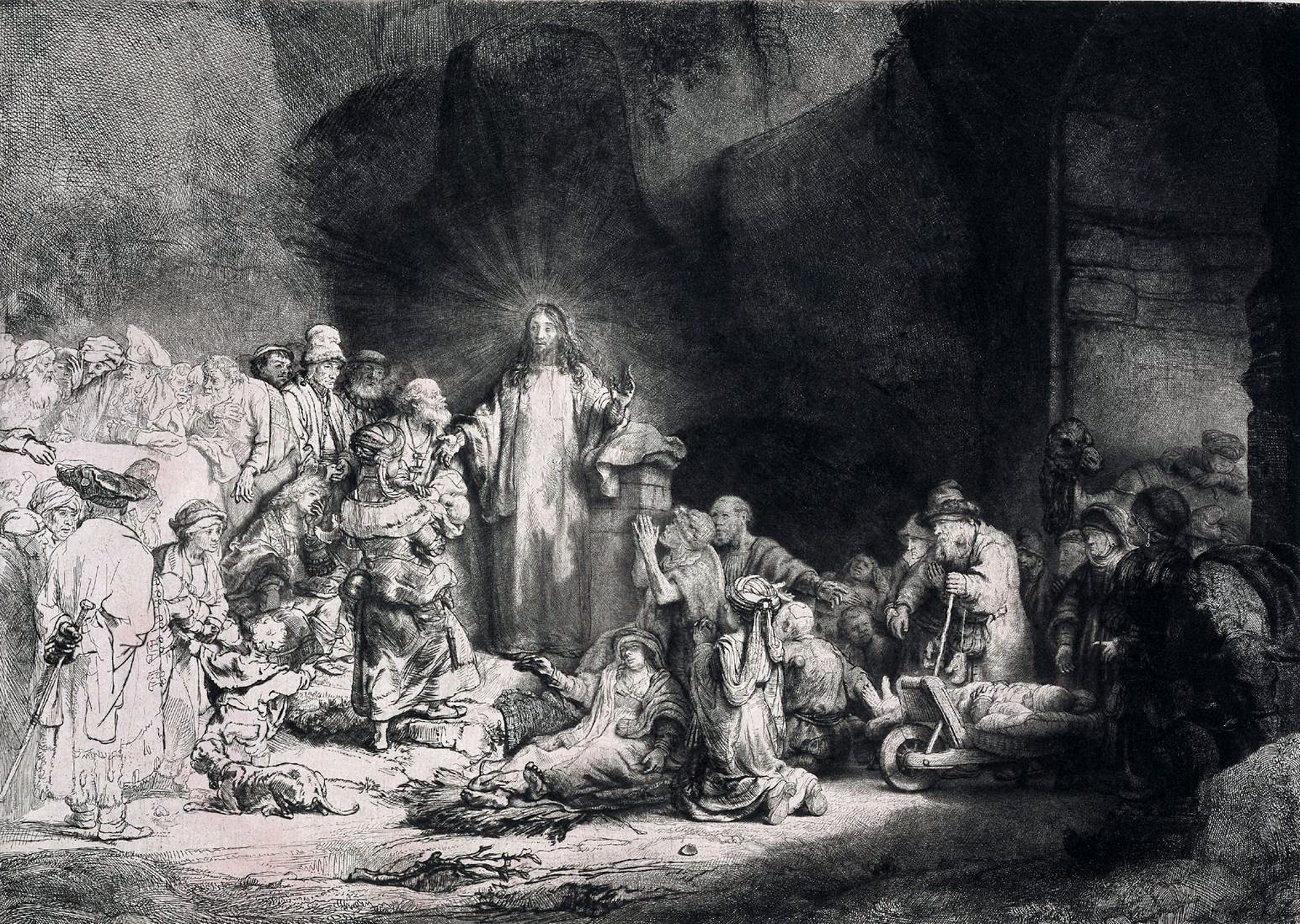
So when we think of beauty contests or the colorful landscapes of calendar art, we naturally think of beauty as something trivial and frivolous. And when we look at yet another American Impressionist oil-daub of a well-to-do young debutante in a white dress and parasol standing on a sunny turn-of-the-century lawn, we cannot but recognize that it has more in common with Robin Leach than it has with Rembrandt’s Hundred Guilder Print, Euripedes’ Medea or Bach’s B-minor Mass.

hundred guilder print

Conversely, when we discuss what is most profound in the world, it always seems to possess great beauty.

Such beauty is a natural byproduct of the search for truth.

But, when we use the word “beauty,” we mean different things at different times.

The word can mean “pretty,” as when we talk about a pretty picture or a blush-cheeked cheerleader.

Pretty almost always means, at some level, “conventional.” Pretty is something most people can agree on. There is a predictability to it, ultimately, a monotony.

And when a man says a woman is beautiful, he is almost always making a judgment that is not esthetic, but hormonal.

Beauty also refers to that which we find peaceful and productive of pleasant feelings. A lot of people find burbling brooks and meditative flower arrangements beautiful in this sense. It is also the genesis of New Age music and George Winston.

sunset

Then, there is beauty that is the precise and craftsmanly use of materials. Artists recognize this when they see the delightful line of Picasso’s drawings or the expressive and tight control of a Durer wood engraving.

Artists probably recognize this beauty more than most, but they are not alone. The wide popular appreciation of Salvador Dali owes greatly to the public perception of him as a magician of craftsmanship. The same of Andrew Wyeth.

Fourthly, beauty is sometimes reserved for the subject matter of a piece of art, where the audience pays little attention to the craftsmanship, but feels warm and fuzzy about the subject.

People respond to the religious sentiment rather than the art in most popular biblical art. Likewise, they respond to the scenery in an Ansel Adams photograph.

But all these are essentially lower orders of beauty. And much that is meretricious is deemed beautiful for a while, if it reinforces the prejudices of the age. What Victorians called beautiful, we largely snicker at now. But we shouldn’t be so smug, for our great grandchildren will undoubtedly giggle at our art and mores in just the same way.

The real thing doesn’t founder on the prejudices of the day. That is why we call it “classic.” that is why the best Rembrandt or Eakins speaks across the years and continue to move us.

The beauty of the art we recognize as great has a handful of special qualities that probably make it unsuitable for practical things, like magazine illustrations or political propaganda.

Ambiguity is one such quality. All great beauty is at some level equivocal: It can take no partisan stand because it holds all options open. It manages to allow of multiple, even contradictory interpretations because it is “large and contains multitudes.” Profound beauty makes no moral judgments, at least not on the rote level of dogma.

Real beauty must be ambiguous: like the smile of the Mona Lisa or the meaning of the white whale in Moby Dick.

That ambiguity is inextricably bound up with these other qualities of great beauty:

Metaphor — Not only what something is, but what else it is. A landscape is never only a piece of pretty scenery, but a metaphor for the structure of the human mind, or a metaphor for a nude torso, or a metaphor for the fecundity of nature. A still life usually tells us about death and transience. A portrait tells us about suffering and humanity. Moby Dick is a metaphor; so is the Creation of Adam on the Sistine ceiling.

Complexity — Not necessarily complication. Sometimes, a very simple gesture, in relation to the rest of the work, can be very complex. The complexity may be of character in a play, of metaphor in a painting or of a key relationship in a symphony.

But if a work of art is to mirror life in any meaningful way, it must reflect the complexity — even contradiction — of existence.

Memorability — The quality we say “haunts” us. In great art, we may often find ourselves saying: “I don’t know what it means, but I can’t get it out of my head.” The gift to create what is memorable in this sense is what we mean when we say an artist is “touched by the muse.”

Surprise — Great beauty is always fresh and it does unpredictable things. Why is there a little girl running through Rembrandt’s Night Watch? Why does Beethoven’s Fifth Symphony keep stopping?

Inevitability — But that surprise always forms part of the larger picture and we feel by the time we come to the end that it couldn’t be any other way. There is a “rightness” to every gesture, every musical modulation, every theatrical act.

Wholeness of form — This is almost mystical. The form that I’m talking about and the wholeness we recognize are almost certainly archetypes that are hidden deep in the psyche and the wholeness cannot be prescribed, but only recognized.

It is what makes us recognize when a play is over: The form is complete and whole. The same works in great paintings or music.

Ultimately, what you get from beauty is not a feeling of fuzzy complacency, but of transcendence, a feeling that there is something larger and more meaningful than the everyday, the quotidian. That life is part of some larger pattern, not necessarily religious — that within that pattern you share something with the Zulus in South Africa just as with your brother in Pittsburgh.

Or that there is a great mystery at the center of the universe, whether it is scientific or Hindu. That the simple everyday reality is somehow ennobled, though it may not include any concept of nobility.

And in the end, in a world of suffering, chaos and meaninglessness, the art, like the fireman, rescues us.

firemansavechild

georgeb&w

The dollar isn’t what it used to be.

I’m not talking economics here; I’m talking esthetics. And actually, the dollar bill is about the only one that actually IS what it used to be. The U.S. mint and the Bureau of Engraving and Printing have redesigned most of our money in ways that show a miserable falling off in design and execution.

Our $5, $10 and $20 bills and our coins have suffered a severe drop in quality when considered as art.

Yes, money is art, whether it’s the engraving that makes up the bills or the bas-relief sculpture on our coins. There are long histories in both as art mediums, from the intricate lozenge-and-dot portraits of the 17th and 18th centuries and the commemorative medallions struck from the Renaissance on.

But craftsmanship at the mint and at the Bureau of Engraving and Printing has declined precipitously, leaving us with wallets full of bad art. This wouldn’t be so noticeable if the older coins and bills hadn’t been so beautifully made.

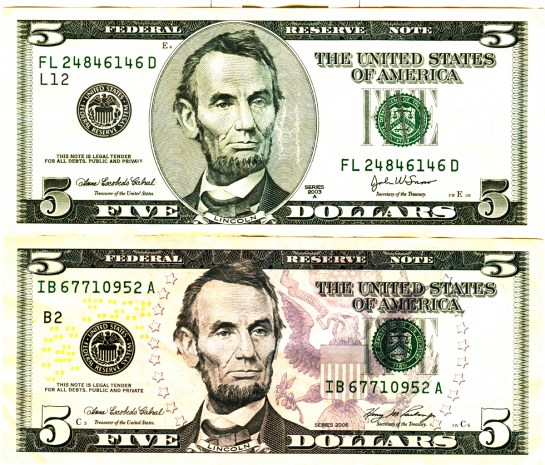
Look at an old bill, before the anti-counterfeiting “improvements” of the 21st century. Not only are the portraits more lifelike — there’s a personality behind the eyes in Grant’s picture on the $50 bill — the designs also are fuller, more detailed and graceful, full of trailing acanthus and olive leaves.

The vegetative growth and architectural motifs that used to grace our bills announced our national fecundity. We were a waxing moon, a rising tide. The scrollwork and border ornament recalled the inventive bustle of the Renaissance.

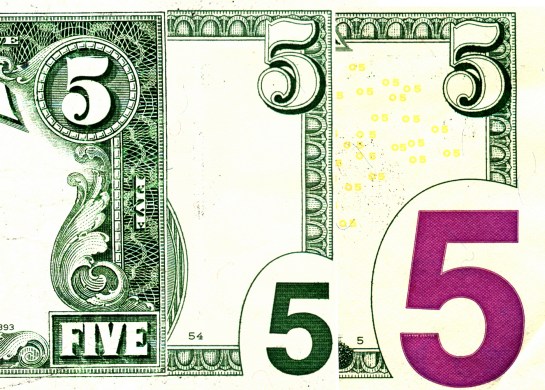
fivescrollcompare

The new bills, full of iridescent ink, microprinting and watermarks to discourage counterfeiting, are defensive and speak of a nation feeling the need to protect itself. There is no room now for the purely ornamental or decorative profusion of the old designs. Everything there has a purpose, stripped down like some typographic battlement.

twentyreversea

Genuine beauty comes from an effusion of confidence and grace; in contrast, our new bills look as though they were designed by forensic engineers.

Even worse are the newer coins, which look less like legal tender and more like tokens at a state fair. Or perhaps you catch yourself trying to peel back the foil to eat the chocolate inside.

The portraits on them are an embarrassment — one observer noted that the frontal portraits must have been “zombie presidents.”

One problem is that the coin designers have chosen to represent the faces not in profile, but head-on. It’s hard to make a shallow relief sculpture of a full face without having the nose stick out too much. The new coins try, but because they have to be flat — after all, they have to stack — the nose gets squashed flat into the cheeks, and the eyebrow ridge stick out as much as the nose. Hence the zombie look.

Looks not important

Madison looks more like Count Olaf in the Lemony Snicket movie than a founding father. Jefferson has an eyebrow ridge like Frankenstein’s monster.

madison snicket

The “Return to Monticello” nickel is just as bad, with its oddly squished portrait of Jefferson, off-center on the coin’s front.

The problem is that the rationale for changing the design is conceptual, not visual.
As Edmund Moy, most recent director of the U.S. Mint (resigned in 2011, leaving the office vacant), said, “We are proud of the result of interesting design innovations like the forward-facing Jefferson nickel, so appropriate in showing a forward-thinking president who had the foresight to expand our country westward through the Louisiana Purchase.”

Fine metaphor, lousy image. There’s a reason we have used profiles since the beginnings of coinage some 2 millennia ago.

The worst is probably the new State Quarters series. The many state designs vary in quality, but it’s the road-kill George Washington on the front that’s the main problem.

These things are hard to describe in words, but reach into your pocket and pull out some art — I mean, some change — to see for yourself.

If you have more than a couple of quarters, at least one is likely to be the old eagle-backed quarter that has been standard since 1932, and another will probably be one of the new state quarters.

Look at Washington’s head on both. The old head was satisfying and sculptural; the new head is flat, ugly and can’t make up its mind if it wants to be bas-relief sculpture or incised drawing. Sculpture and drawing are different things, and they don’t sit well together in such a tiny space as a coin.

OLYMPUS DIGITAL CAMERA

“Relief on most modern coins is lower,” says Michael White, spokesman for the Mint, “because of volume and vending-machine usage. When you make billions of coins, you don’t do the same relief.”

Little relief in sight

In fact, there’s hardly any relief at all.

You can see that confusion between the three-dimensional sculpture and the outlined two-dimensional drawing on many of the individual state designs. The Michigan quarter is practically nothing but an outline map of the state. That isn’t sculpture. Coins this dull could be molded out of plastic and tossed out at Mardi Gras parades.

Even the space around Washington’s head is a disgrace. Move the old quarter in the light to notice that the background space is not flat, but dish-shaped. Because it’s modulated, it catches the light as it moves in a way that makes the space — even the empty space — come alive. But the new quarter has a flat, uninflected background, as if no one really cared or paid attention.

All around, the founding fathers’ portraits have lost their vitality. Look at the lifeless portraits on the newer $5, $10, $20 and $50 bills. Hamilton’s nose is out of joint on the $10.

tenmedalliona

Look at Andrew Jackson on the $20 and ask yourself, “What’s going on with those shoulders?” His head looks like a giant paste-on over what might be taken for a volcano.

Aside from poor draftsmanship, there’s a lowering of craftsmanship in the bills.

The problem is that money is printed by engraving, and the engraving process is a slow, exacting one that few people have either the talent or patience for anymore.

We live in a time that moves much faster than it did in the 16th, 17th or 18th centuries, when engraving rose to a peak of craftsmanship. We don’t want to spend the time to do it anymore.

The engraver has to cut a line in a metal plate using a sharp metal burin. For the lozenge-and-dot technique used for portraiture, a series of parallel lines have to be drawn to follow the contours of the face. They are incised more shallowly in areas that should be light and more heavily in darker areas. Keeping the pressure even is a task for someone who has a great deal of time to spend getting it right.

In the details

Few people have the patience needed or the courage to attack a metal plate knowing that making a mistake means having to start over again.

We’re a nation with ADD, and our money shows it. The esthetic concern fades away. Who actually looks at money, anyway?

Perhaps decline is a historical inevitability. One remembers the incredible flowing drapery carved by Greek and Roman sculptors and the slow decline of the art into the third and fourth centuries, when the drapery folds no longer had any relation to the body underneath.

This is what happens when people lose their ability to see, to look with attention. It has often been said that we live in a visual culture, but that’s not really true. We may have given up the written word, but what we are calling visual is really just a written symbol: The stick-figure female that signifies the women’s restroom. It is an ideogram. You read such symbols, not see them. It gives up its meaning instantly.

A real woman, in contrast, can be studied for a lifetime.

There are hopeful signs. The initial design update of the bills had a giant medallion holding the presidential portraits. But instead of placing the medallion in the center, they shifted it off to the side. It may have looked more au courant, but it was totally out of balance.

But the newer bills, such as the most recent $5 bill, has done away with the medallion altogether, and although Lincoln is still large, he fits into the design better without the space-eating oval surrounding him. And with the addition of subtle colors, a line of stars and an eagle, it begins to recover from the disaster of the previous design.

newfivesobversea

They haven’t attacked the $1 bill yet. Perhaps that’s because the naked dollar simply isn’t worth counterfeiting.

onereversescroll01a

|

Money facts

* George Washington first appeared on a $1 bill in 1869.

* It wasn’t until 1907 that someone figured out that a lower relief, matched to the same height as the rim of a coin, would allow the coins to be stacked evenly.

* The first coin with a president on the front came in 1909, when the Lincoln-head penny made its debut on the centennial of Lincoln’s birth. The Washington quarter (1932) came second, followed by the Jefferson nickel (1938) and the Roosevelt dime (1946).

* The 5-cent nickel isn’t the only one: There used to be other nickels, worth 3 cents and 1 cent.

* The Eagle is not a nickname but a congressionally mandated coin with a $10 value. It’s no longer in circulation. There were also Double Eagles ($20), Half Eagles ($5) and Quarter Eagles ($2.50).

* Nickels were originally called half-dimes. Dime was originally spelled disme.

* The $10 bill was once called a sawbuck because a Roman numeral X on its face reminded some of a carpenter’s sawbuck. A $20 was called a double sawbuck.

* The $5 used to be nicknamed a fin, as in, “Buddy, can you spare a fin?”

* We are familiar with Washington on the $1 bill; Jefferson on the $2; Lincoln on the fiver, Hamilton on the sawbuck, Jackson on the $20, Grant on the $50 and Benjamin Franklin on the infrequently used $100 bill. But there used to be higher denominations: William McKinley on the $500, Grover Cleveland on the $1,000, James Madison on the $5,000 and Salmon P. Chase on the $10,000.

* Salmon Chase, secretary of the Treasury under Lincoln, was also on the first $1 bill (1862, when he was still in office — no shrinking violet, Chase).

* Martha Washington is the only woman whose portrait has appeared on a U.S. currency note. It appeared on the face of the $1 Silver Certificate of 1886 and 1891 and on the back of the $1 Silver Certificate of 1896.

* The highest denomination note ever put in circulation was Hungary’s 100 million-billion pengo, issued in 1946, worth about 20 cents at the time.

Sometime around 1515, the Venetian artist Titian painted a scene usually titled “Sacred and Profane Love.” In it, two women are seated at a marble well; one is nude, the other elaborately dressed. It comes as a shock to many Americans to find out that in this allegory, sacred love is represented by the naked lady.

And in general, Americans seem to have a difficult time with the nude in art. Maybe it is America’s Puritan heritage, maybe it is the low priority given art education in our schools.

Sometimes it’s just pig ignorance.

But to many Americans, the nude is something dirty, lewd and embarrassing. At the very least, nudity is equated with sexuality and eroticism.

As they said on “Seinfeld,” “Not that there’s anything wrong with that.”

We can laugh at the silliness of such a view, but it governs much of what Americans think about sexual morality, including former U.S. Attorney General John Ashcroft, who spent $8,000 in 2002 on blue drapes to hide two giant Art Deco statues — “The Spirit of Justice” and “The Majesty of Law” — at the Great Hall of the Department of Justice in Washington.

Certainly, there is a good deal of eros in art history.

Take for instance, Francois Boucher’s “Reclining Nude” from the French 18th century.

There is not much about this luscious painting that is different from, say a photograph with a staple in the middle.

An in America, too often, this is all that a nude is.

A few years ago, a woman in Tucson demanded that art and art books be removed from a public school, calling works by established masters ”pornographic and morbid.”

She was talking about Michelangelo’s “David” and Picasso’s  “Demoiselles d’Avignon.”

What is more astounding is that she managed, at least temporarily, to have 10 art books and four posters yanked from the school. The works in question were by Edouard Manet, Frida Kahlo, Paul Gauguin, Hieronymus Bosch and El Greco.

She said she considered El Greco a ”pervert.”

”We left the art teacher with about five books,” she said, with some pride. ”I took out anything with nudity in it. There’s no difference between a nude (in an art book) and a ‘Playboy’ picture.”

I’m not interested so much in the question of what is appropriate for fifth- and sixth-graders; there may be some legitimate concern for their sensibilities. Although, in this case, I doubt the kids are getting anything from Gauguin they haven’t learned long ago from Aaron Spelling.

But, I am very much interested in the widespread belief that nudes are necessarily pornographic.

Such a view ignores the evidence of centuries of art that has portrayed the human body for other, more complex purposes.

Varieties of nudity 

So what are those purposes? In other words, what does the nude mean?

All but a few cultures in the history of the world have had a place in their art for the undressed human body. Although it is probably more developed in European art than elsewhere, the nude body appears prominently in African, Persian, Hindu, Tibetan and Japanese arts.

It occurs with different meanings in them: In Chinese art, the nude is rare; the most frequent nudes are not sleek ideals of human form but fat Buddhist monks, looking like the sileni of Greek art.

But you will see that these are not different merely in style, but in purpose: These are all different meanings for the nude and the human form.

Of course, in the geography in which humans evolved, there was less need of heat-conserving hair. And in those climes, nudity has different cultural meanings.

And titillation is rarely the primary factor involved.

Like the prisoners in Abu Ghraib — Surely being made to exhibit themselves naked means more to them than it would to us, even if we feel humiliation in our nudity, how much worse is it for these Arab men?

In the temple art of India, nudity and copulation are used as a metaphor for the Cosmos. There is not one single meaning for the nude, but rather a series of layers of meaning that can overlap. Those layers run from the most primitive to the most sophisticated. There are at least four distinct layers of meaning to be addressed:

–> Appetite;

–> Intellect;

–> Power;

–> and Spirituality.

The first layer is really that of plumbing.   At the level of appetite, we have the gaze of the voyeur.

It is here we find everything from men’s room drawings to “Debbie Does Dallas” to the pillow books created by Japanese artists in the 18th century.

The faces mean little, the beauty or fitness of the physiques mean little. There is nothing going on but what Joseph Campbell has called the ”zeal of the organs for each other.”

All true pornography stops at this basement level.

And it is this level that most of the moralizing critics of the nude are stuck in, unable to see any higher.

The rippling of silk 

The second layer is that of both eroticism and idealization.

In both cases, the mind takes over from the organs and imposes standards.

Eroticism is the level at which the rippling of a silk dress is more arousing than raw flesh, with all its hair, bruises and cellulite. Pornography is stunningly literal-minded; eroticism is imaginative.

And eroticism’s flip side is the idealized nude of ancient Greece or “Playboy” centerfolds. In each case, an ideal form is held in the mind – an ideal the real world cannot actually live up to; hence the canon of Polyclitus, which defined the proportions of the perfect body, and the airbrush of Hugh Hefner.

When Sir Kenneth Clark wrote his famous book about the nude, he focused almost exclusively on this aspect of the figure in Western art: The idealization of beauty.

Here we find the pneumatic Boucher cuties and the massive Classic Zeus in bronze throwing his thunderbolt.

If pornography is often physically repulsive, no matter how fascinating, the idealized nude is  intended to be attractive. The idea of beauty enters into the equation.

The so-called Venus of Willendorf, from at least 24,000 years ago, found in what is now Austria. Is this an ideal of beauty? It is certainly an image of fertility. And fertility and beauty are often the same thing, when you live in a time and place that survival depends on fertility.

In Ancient Greece, where we generally start our narrative of Western art, the earliest statues were an expression of human perfection. And for the Greeks, human perfection meant the male human form. They worshipped male beauty. Greek vases are full of nude male bodies — athletes in the Panathanaic Games, for instance.

The early kouros was still rather stiff, by modern standards, but compared to what went before, in Egypt or Babylonia, it is a model of realism and accurate observation.

I don’t want to make this a chronological history. You have schools for that.

But you are familiar with lots of nudes in European art from the Renaissance to now.

Rather, I want to look at some thematic ideas, how the nude changes meaning.

The body still remains, however, essentially an object rather than a person.

How the world works 

We’ve seen the erotic nude, but that’s not all there is.

A third level, above the erotic and the idealized, is the level of power and the political, psychological and scientific.

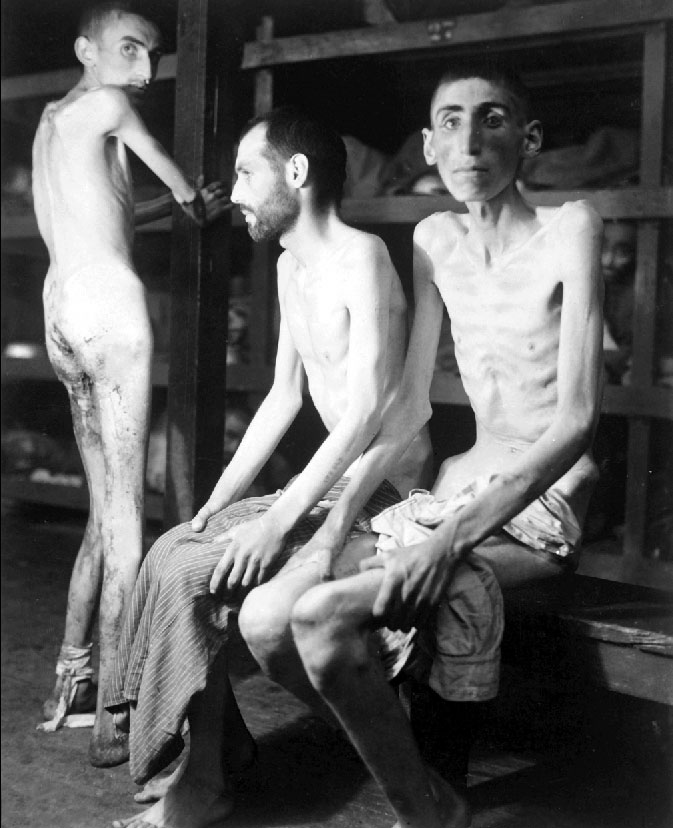
What does the nakedness here tell us? It tells us these people are powerless, humiliated, tortured and suffering.

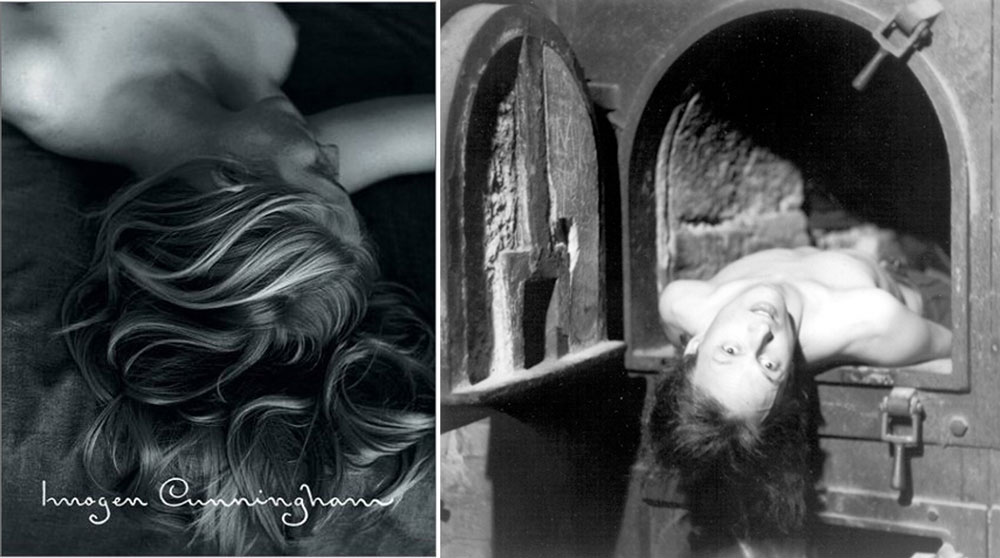
There is a famous picture by Imogen Cunningham of a young woman with her head and hair hanging off the edge of a bed. It is erotic.

But put it beside this and you see the similar pose with a completely different meaning.

No one who has seen pictures of naked Jews herded into the showers of Auschwitz can fail to recognize the political significance of nakedness. It functions to underline the powerlessness of the victims and their vulnerability.

Context makes a huge difference.

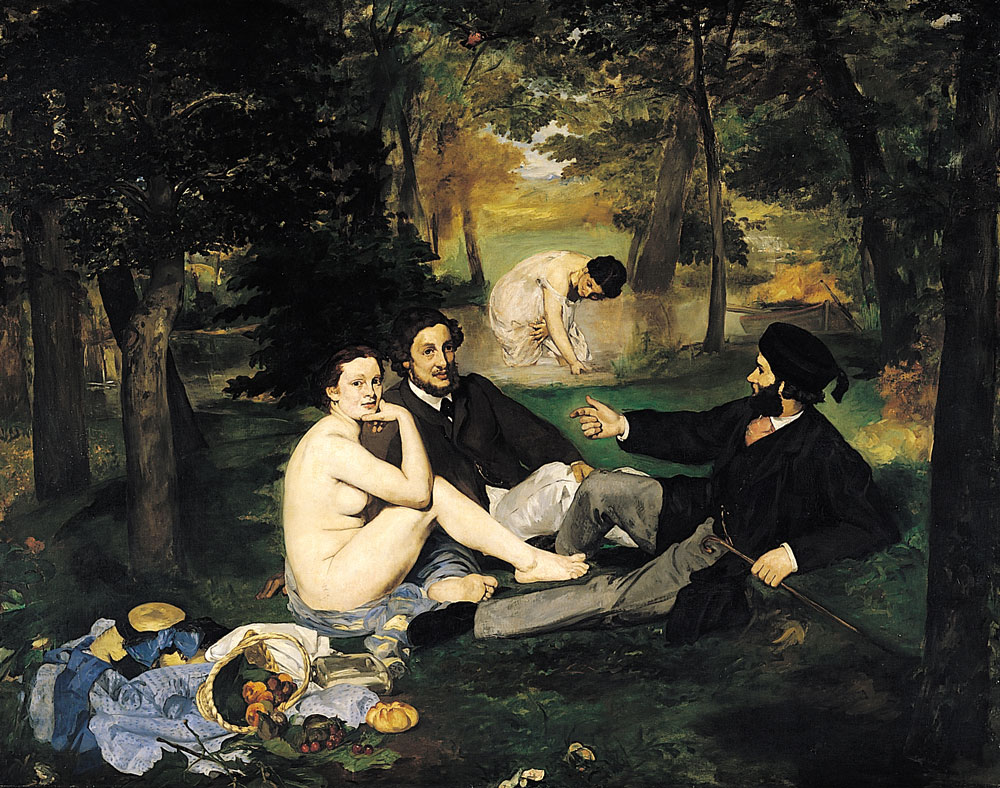
And in Manet’s famous painting, “Dejeuner sur l’herbe,” the message that comes through is ostensibly erotic, but in reality is political: Two fully clothed middle-class men are having a picnic with two nude women.

The ridiculousness of the scene makes fun of the traditional power relationship between men and women. The painting pointedly comments on such earlier paintings as Georgione’s “Fete Champetre,”   in which two Renaissance courtiers talk animatedly with each other while attended by two docile and idealized nude women.

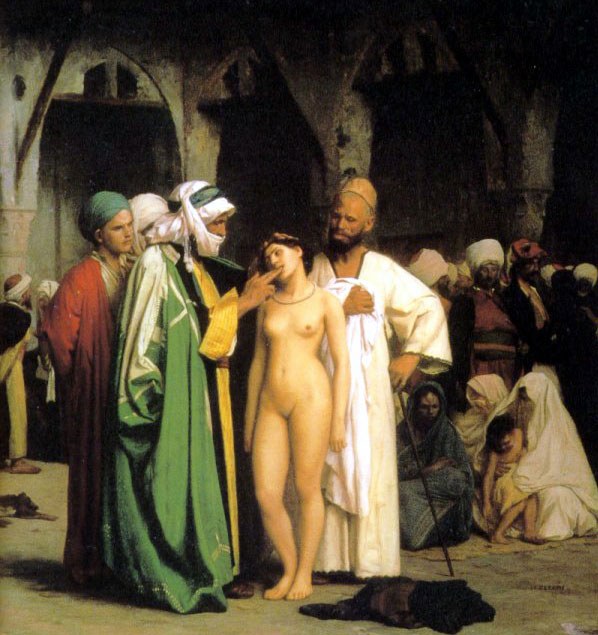
And it comments on such popular paintings of Manet’s time as Gerome’s “Slave Market,” in which clothed men paw over a nude woman, checking her teeth before purchasing her.

Gerome’s painting is merely a salacious bit of kitsch; Manet’s is biting and political. (One shouldn’t discount the tacit political message in the Gerome, probably unnoticed by the painter: Who has the power here? It isn’t the woman.)

It’s no wonder that “Dejeuner” was declared indecent while such paintings as the “Slave Market” made Gerome a wealthy man: By making his figures  bourgeois, Manet was pointing a finger at his audience. It is political commentary.

Many left-wing feminist critics of the nude get just as stuck in this level as their Christian right-wing counterparts get stuck in the first.

But the power I’m talking about at this level isn’t only political power. It is the power of  humankind over itself and the power to understand the world it lives in.

For instance: If Renaissance artists hadn’t become obsessed with drawing the nude figure, modern life expectancy would likely still be short and brutal. Modern medicine could not have developed without such artists as Leonardo and Michelangelo taking an interest in how the human body looks and how it is put together.

Before the Renaissance, Gothic artists created the figures they used to decorate the cathedrals from their imagined forms. If a figure had a torso, two legs, two arms and a head, it was enough. The bones, muscles, tendons and sinews that lay underneath the surface might as well not have existed.

”It seems rather as if you were looking at a sack of nuts than a human form, or at a bundle of radishes rather than the muscles of nudes,” wrote Leonardo of unobservant figure drawing.

But the Renaissance brought with it an interest in how the world works, how the parts of the body work.

Those artists studied the world around them intently. And to them, the most interesting thing in the universe was humankind. The human figure was to them the most perfect and beautiful form found below the level of the angels.

”Who is so barbarous as not to understand that the foot of a man is nobler than his shoe, and his skin nobler than that of the sheep with which he is clothed?” wrote Michelangelo.

In other words, clothes are trivial, the naked human body, essential.

But even at this level, so much more profound and moving, the figures still represent ideas and are not fully humanized, not fully individualized.

Empathetic encounters  

At its highest level, the nude represents spiritual virtues, unencumbered by fashion. The nude is universally true. That is why Titian’s sacred love must not wear the silks and finery of her earthly sister.

Angels are nude, and so are the putti, or cherubs, that flit around so many Baroque allegories.

Michelangelo’s designs for the Sistine Chapel are monumental nudes for that reason, and for another:

When art is most profound, it draws us out of  ourselves and forces us into an empathetic encounter with things and people who are radically different from us.

It is not possible to view the figures of the Sistine Chapel with any intensity and not feel your own body compared with them. Their sinews are your sinews; their contorted muscles are yours.

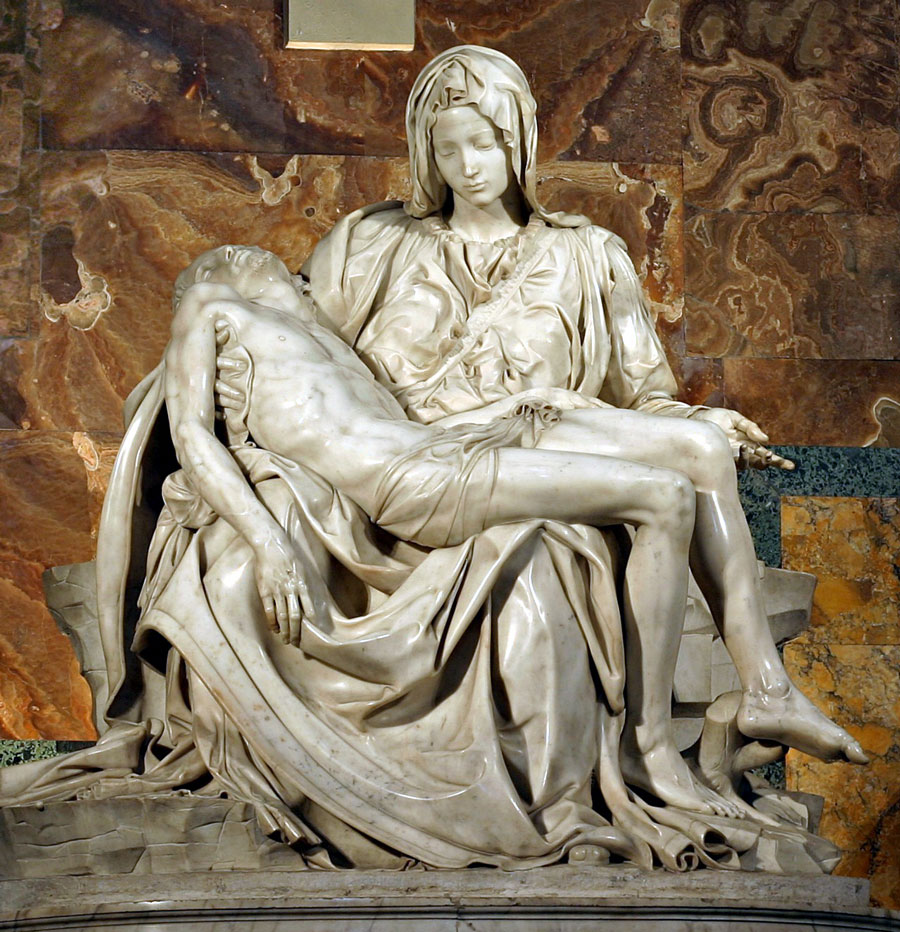
It is why the nude is used for the most profound tragedies in art: the nude Pieta and the Crucifixion, to name two very Christian uses of the nude.

Angels are often drawn as putti, or cupids, in part for their association with innocence.

We look at one of Matthias Grunewald’s tortured crucifixions and cannot help but feel the pain in our own flesh.

In all the greatest art, we are thus drawn out of ourselves and identify with the grace, power, suffering and love of others and come to escape   the isolation — and loneliness — of the ego. We recognize the similarities of all humanity and not its petty differences.

Whatever it means in religious dogma, the Christ is symbolic of our own mortality.

A lot of wind has been spent on the argument over whether there are any universal truths in the world. So many of the old Truths now seem mendacious. But there are two truths that are inescapable. We die, and people we love die. Loss is central to the human experience. It is why Michelangelo’s “Pieta” is meaningful, even for the atheist.

Our recognition of our humanity is one of the highest aims art can attempt.

It is why Rembrandt’s nude portraits of his two wives are so compelling, why Goya’s “Disasters of War” are so frightening.

And not only are the figures in the art thus humanized, but the viewers are as well.

I wanted to write something about the tree in my back yard.

It is a big red oak, growing on the hill that rises at the back of our house in the Blue Ridge Mountains of North Carolina. It is an old tree, with wide-spreading branches that swoop out over us like wooden contrails against the sky. It is a sky tree, high up over us, elevated by hill and by tree trunk.

Its bark is shingled and cracked. Its leaves in summer are insect-eaten, dry and leathery. Moss grows on the north side of its lower stories.

It dominates the small hill like “Charlemagne among his peers.” All lesser vegetation remain vassals, and the lawn mere peonage.

One sees on its trunk the evidence of cities of insects, largely black ants, which use its bark for highways. At night in June, fireflies act as streetlamps.

One could look at the tree and think it is just an old-growth oak. There are many such trees in the mountains. They grew back after the farms that covered the area fell into disuse decades or centuries ago. Now that old growth has been parted again for housing developments, but my one old tree survives. It is hard not to think of it as an individual and not merely a Quercus rubra, something from a page in a Peterson Guide.

It seems to be a kind of spiritual umbrella, protecting this house from whatever ashfall of misfortune may drop from the heavens.

The back yard is full of vegetative growth, each shoot contending with the rest for sunlight and water. Grandfather oak watches over the welter.

It is a mythic tree.

The world is filled with such mythic trees, from Yggdrasil, the Viking “World Ash Tree” to the Boddhi tree of the Buddha. Most fall into one of two varieties of tree in myth: the fruit tree of paradise or the druidic oak that marks the axis of the world.

Of the first, the best known is the tree of the knowledge of good and evil from the Bible, although only close readers of Genesis may notice there is yet another fruit tree there, the tree of eternal life, which the god does not forbid Adam and Eve, although they never get to test it.

Such trees of fertility include the vines that Bacchus makes grow on the pirate ship and the trees of life in Mexican folk art.

But my tree is the other kind, like an Ent from Tolkein, or the so-called “Lawrence Tree” in New Mexico, painted by Georgia O’Keeffe.

This is not a tree of beginnings, not a tree of new fruit, but the kind of tree that functions as a “witness.” It sees all that happens. It cannot change what happens; it cannot interact. But it knows. What it knows, we mere humans can never fully know, but myth tells us over and over, it is not necessarily a happy knowledge. The Garden of Eden may have contained the tree of immortality, but my tree tells me of a longer time, when everything passes. It is a tree of the knowledge of death.

What makes such a tree notable is that it does not comment on this fact: It just is. That is its role as witness. It sees the suffering and knows it cannot be otherwise. It sees the long time, when whole empires are born and vanish. Perhaps even the time when the cosmos explodes into existence and then fades like a dying ember into a wash of undifferentiated particles, the ash of the burned out universe.

This is why that Odin chose Yggdrasil as the tree on which to hang himself as a sacrifice to himself, to gain wisdom. And it is perhaps why Odin is not portrayed as a happy god.

That is my tree in the back yard, today dripping with the sweat of rain in the summer heat, in a humidity so thick it is almost a mist.

As you read this, you think, but it’s just a tree. And so it is. All mythology comes not from the things themselves, but from our investing them with significance. They seem to have meaning.

It can be like a dream, which, when we wake we remember and feel was trying to tell us something important. We don’t know what, but we felt its meaning.

And myth is that state, in waking life. Things are what they are, but they are also what else they are.

This may be something like a schizoid state, but it is where art comes from, and after art, where myth, and later religion comes from. Myth is our sense of the importance of things. Not important, like the paying of monthly bills, or remembering a wedding anniversary, but important in and of itself. It is significance.

You can see it in the utter care and utter frenzy of the paintings and drawings of Vincent Van Gogh. (Really, in every artist, whether Titian or Joseph Beuys). Look at those lines of energy as Vincent draws cypress trees.

This is his recognition that every bush is the burning bush.

There are two pieces of music that never fail to set off the waterworks in me.

I’m sure we all have some signature tune that turns us into maudlin fools crying into our beer.

Lots of music can have that effect, when you’re in the right mood. Mozart is full of such tunes. No one ever wrote about the forgiveness of human foibles like Mozart. It isn’t only in his “forgiveness arias,” but the same tone of music turns up in piano concertos and wind sextets. He had some tap into divine understanding.

When I’m in the right mood, Mozart wells up in my throat. But heck, if I’m really depressed, Stars and Stripes Forever can set me off.

But I’m talking about something that doesn’t require the right mood to work.

Anyone playing Shenandoah, for instance. I don’t care what the arrangement. You can play it on a chorus of kazoos and trombones. You can play it calypso style on steel drums — the moment I’m transported “across the wide Missouri,” I’m reduced to a blubbering mass.

Clearly, I’m responding to some sort of deep seated nostalgia, some trauma of childhood or failed romance. But strike up the tune and I’m like some drunk in a bar yelling “Play Melancholy Baby.”

Actually, I know what it is with Shenandoah: I know the Shenandoah River and the great valley it troughs through in northern Virginia, heading north to join the Potomac at Harper’s Ferry.

It is an especially beautiful river, and only more so on a cool autumn morning when a low fog hangs over the water and the sycamore trees along its banks seem to grow out of white nothing.

The Shenandoah Valley separates the Blue Ridge in the east from the great ridges of iron- and coal-laden mountains to the west. The river rises in twin forks, one on either side of Massanutten Mountain, which rises like a long, low bread loaf in the middle of the valley.

I used to live in the Blue Ridge; I have just moved back. It was the most beautiful place I ever knew. I missed it.

And when the song says, “I long to see your smiling valley,” I knew just what it meant. “Tis seven long years since I last saw thee,” the song continues. It was 25 years since my wife and I lived in the Appalachians.

We lived in Arizona, which has a beauty all its own, but is different from the Blue Ridge. And when the song reaches its climax, “across the wide Missouri,” I knew that I was on the wrong side of the Missouri, too, in a kind of self-imposed Babylonian captivity.

“By the waters of the Rio Salado, there we sat down, yea, we wept.”

The song speaks to me — as it does to so many other people — of that lost Eden we know we can never regain.

And so, I blubber.

But that second tune that sets me off is something different.

It is Christoph Willibald Gluck’s Dance of the Blessed Spirits.

Gluck was a Czech-born composer of the 18th century who rebelled against the ornate and conventional opera of the time. His opera, Orfeo ed Euridice, tells a simple myth in simple music. Almost too simple.

Two set pieces from that opera still are widely known. The Dance of the Furies was used behind the chase scene in almost every Hopalong Cassidy movie ever made. In those “B” Westerns, budgets didn’t allow new music, so they played old classics behind the action. The music was loud and furious.

But Dance of the Blessed Spirits was something else: quiet, almost  static, and with the grace only utter simplicity can convey.

Two flutes play the song-like melody over the accompaniment of strings. Chords change slowly and never stray from simple diatonic harmonies.

And when the tune’s first phrase reaches conclusion, it stretches out in a feminine ending, a slow suspension off the beat. Nothing is insistent in the music, but rather, like the Grecian maiden on Keats’ urn, it seems suspended in time, permanently in a state of grace.

I melt when I hear it.

But its power comes from the same kind of emotion that drives Shenandoah: a sense of loss and a sense that somewhere there is an Eden where spirits are blessed.

Yet the tunes are very different, too. My reaction to Shenandoah is personal, very personal. Its power — for me — comes from my biography. I don’t expect everyone will react the same way.

The Gluck, though, has a more ritualized, formal power. It comes from its stylization.

For Gluck was aiming not for biography, but for the universal.

Art’s emotional wallop often comes not from its literal portrayal of raw feelings, but from the Apollonian distancing and formalization of those feelings. By understatement, it draws up a skeleton that we flesh out with our own experience.

The so-called Romantic artist often fails to exactly the extent he overplays his hand. Such an artist wants us to feel his feelings.

The Classic speaks not of his personal emotion, but of human emotion. Hence, they are our emotions.

In other words, when I hear Shenandoah, I feel the turns my life has taken; when I hear the Gluck I weep for the inescapable lot of humankind. The one traps me in my ego, the other frees me from it.

This is the power one feels in Homer, in Joyce, in Flaubert. It is the reason Haydn is still played along with the more personal Berlioz.

And it is the power at the end of Beethoven’s immense Diabelli Variations, those 32 monumental changes on the “cobbler’s patch” waltz sent to Beethoven by music publisher Anton Diabelli, who asked the great composer for a variation he might publish.

Through those variations, Beethoven dives deep into some of the most personal music he ever wrote, with adagios of desolation and pathos, culminating in a clattering, raging fugue that is as hard to listen to as to play.

But he winds up in Arcadia, just like Gluck: His final overwhelming variation is a dignified minuet, which takes all the terror and anger, all the humor and misery of the previous 31 variations and sublimates all that personal angst into an Olympian, stylized dance.

It is this ritualization of the overwhelming emotions that make those emotions important: The personal is mere autobiography. The ritual dispenses grace: the freedom from ego.

It is why our most important thoughts and feelings are turned into meter and rhyme, why our bodies move to the numbers of choreography, why the novel is the “bright book of life.”

And why art matters.