Archive

Tag Archives: history

fog bank

Life is made up of experiences. Not thoughts, but body-experience. It is what brings us wisdom, what brings us the game pieces we draw out of the well of our lives, that make up our literature, our art, and the myths we make of our own lives. Experiences are the building blocks of our psyches.

And the experiences of one generation are different from those of the next or the previous. We can never really know what it was like to be in Napoleon’s army or Wyatt Earp’s Dodge City or on a viking ship sailing the coast of Greenland.

Our children will never know what it was like to be us. You didn’t listen to your parents lecturing you, and you shouldn’t expect your children to be any more interested in what you have to say to them. Experience, it turns out, is non-tranferable.

But, at times, we get hints. Some bit of the past reoccurs and we get an insight.

There is little in travel so romantic sounding as a trans-Atlantic ocean voyage, and little in reality quite so tedious. When I was a teenager, I got the chance, in the dying days of ocean liners, to sail from New York to Oslo aboard the MS Oslofjord. Oslofjord postcard
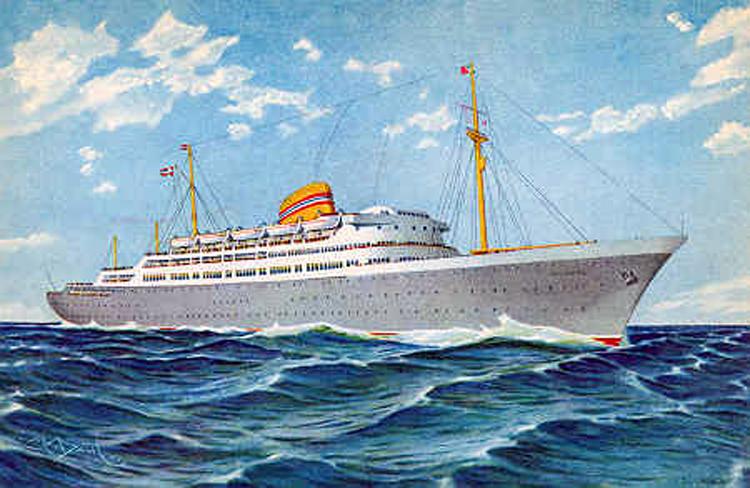
Day after day, the horizon remains pancake flat, and the only thing that changes is the dining-room menu.

Maybe it was because I was young and most passengers seemed so ancient: Shuffleboard was the amusement of choice, followed by casino night in the lounge. Neither was particularly appealing to me.

Yet, despite the monotony of the weeklong voyage, there is something about the sea that lodges itself deep inside and refuses to go away, even all these years later, in an age when crossing the ocean on a ship is no longer a realistic possibility.

It began in New York, a harbor crisscrossed by wakes like particle trails in a Wilson cloud chamber. The ship I was on threaded its way among the bee-buzz of harbor activity and passed the Statue of Liberty, which my grandmother saw on entering the same harbor in 1905, when she was a little girl.

I was on my way to the ”old country” to see where she had come from and was taking a boat, just as she had coming the other way.

But you can’t get the feel of ocean travel while in the harbor. You have to get out into the sea swell for that.

If you have never been out there, you might not have any sense of just how hilly the ocean is. Sure, the horizon looks flat, but nearby, you can sense the shifting pileup of waves of all sizes.

On the water’s surface are the wavelets, blown into white horses by the wind that always blows at sea. And the wavelets skitter up and down with the larger waves that move with more stately pomp, coming at the ship from all directions and crossing each other in patterns so complex that even chaos theory has a hard time dealing with them. swell1

But more impressive is the slow, almost geologic movement of the swell, that massive up and down that is measured by the rise and drop of the ship.

On some days, the swell is hardly felt, as the calm ocean sprinkles the sunlight in its shivered surface. But out in the North Atlantic, it is never long before some distant storm rocks the water into the swell that is the oceanic equivalent of the long ridge mountains of eastern Pennsylvania, one after the other, up and down, twisting the ship into yaw and roll.

The constant rumble of the engines shake the walls in ”D” deck, deep in the hull of the ship. Every surface is painted and repainted and each iron surface is covered in enamel like the thick shiny glazing of a doughnut. In the stateroom, there is no sense of motion, only the vibration of the engines. It has been the same for six days.

In midsummer, the sun doesn’t set until nearly midnight, rising again a few hours later. Most of the evening is spent in the low sunlight, which rakes the waves into glitter.

And I am up at 3:30 in the morning, walking the decks of the ship, which seems ready to roll over on first one side and then the other. Nearly a week into this trance-inducing boredom, I have read all my books and cannot sleep any more. The walk on deck in the dusky dark is meant to wake me up from the hypnotic state the ocean can put you in.

Then, out in the darkness I can see a light, miles off through the humid air. It is another ship going the other way. But no, it is not a ship, the lights are too irregular. In the growing light, I can begin to make out the grayish shape of it, barely legible in the murk.

It is one of the Orkney Islands, off northern Scotland. The trance is broken. The Atlantic is crossed, land is sighted.

I have some sense of what Columbus must have felt, although I have eaten better than he did, and my six days is rather less than the months he spent at sea.

But I still felt something special when the sea birds once more began flying overhead.gull

Ashe Co. plowed field

You cannot walk five feet in the South without knowing there is blood in the dirt.

It gives July 4 a special meaning, for you know that no matter where you turn, there is history under your foot.

There is history elsewhere in the country, too: Bunker Hill, Mass., Fort Ticonderoga in New York or Tombstone, Ariz. But they are singular places you go to visit — somebody else’s history. The South is so full of history that its land and people seem buried under the sense of it.

The first democratic legislature in the New World was Virginia’s House of Burgesses. The author of the Declaration of Independence was a Virginian. And the Revolutionary War came to a close at Yorktown, Va.

Each state has its Civil War sites, where thousands of its men are buried.

There are the street corners where civil-rights workers were hosed and beaten by police. Cotton fields where slaves were whipped.

It is interesting that the one place in the country where Black and White share the most is the South.

For most Americans, history is a story told in a schoolbook. It seems removed from the lives we live. For most Southerners, history is something their grandparents did or was done to them.

It isn’t just that the Civil War raged over the landscape. No part of the United States has suffered so much warfare on its land.

There had been battles with Indians from the very first European settlements.

The Revolutionary War brought Gen. Nathanael Greene to the South, where he led the British on a wild goose chase. The South also was the stage for Francis Marion, called the ”Swamp Fox.” Towns are named for them throughout the South.

natgreenemonument

The War of 1812 brought Andrew Jackson to fight with both the British and the Creek Indians.

The Mexican War helped bring Texas to the South and later to the Confederacy.

And, in the meantime, the blood of countless slaves and freedmen enlarged the tragedy of the South. There were lynchings and later the violence of the civil-rights movement.

It isn’t only rancor and slaughter that give the South its sense of history, but the land itself.

sprott evans

You can stand in a cornfield in rural Sprott, Ala., 25 miles north of Selma, and see the stand of trees at its border, knowing the trees are no more than 60 years old. And that before those trees began filling in the countryside, there were cotton, sharecroppers and poverty. A dilapidated wooden shack sits in the middle of the woods, and you wonder why anyone ever built there.

sprott farmhouse

Then you recognize they didn’t. The sharecroppers’ home — just like those written about by James Agee in his Let Us Now Praise Famous Men of 1941 — was built by a cotton field, but times change and history presses on and the fields are now woods.

I have lived in the South for the better part of my life. Every town, every pasture, every street corner brings to mind details of what they call ”The Great War.”

The library in Greensboro, N.C., where I lived, was a wartime hospital. In Madison, N.C., where my wife grew up, the family names of the wealthy whites and the poorest blacks were often the same, a legacy of slave times. The constant presence of the Civil War in the South crosses color lines.

In most other regions of the United States, the Civil War is something you read about in a book. In the South, the Civil War is now, a perennial now. A Southerner’s perspective on the war is personal. It is in the blood.

So, when I hear the battle names reeled off on TV documentaries — Shiloh, Vicksburg, Gettysburg — they sound distant on the narrator’s tongue, distant as Gallipoli, Waterloo or Omaha Beach. To most Northerners, they are just distant names.

But when I lived near Norfolk, Va., and traveled to Richmond on Interstate 64, I passed the Elizabeth River, where the Monitor steamed out to meet the Virginia (nee Merrimac); I passed Fort Monroe, where Jefferson Davis was imprisoned after the war; I passed Malvern Hill, where the Peninsular Campaign sputtered in frustration.

My wife, Carole Steele, was born in North Carolina and learned about the war firsthand from her great-grandmother, Nancy Hutcherson Steele, who was 10 when it began. She had plowed the fields during the war while her father and brothers were away fighting. When she died at the age of 98, she did so in my wife’s childhood bed in a small house on the banks of the Dan River. Carole was 8 at the time.

Nancy Hutcherson Steele

Nancy Hutcherson Steele

After the war, Nancy had married Rowan Steele, who had joined the Confederate army at the age of 14, becoming a bugler in the cavalry. He was allowed to join the cavalry because he owned his own horse.

At war’s end, as a courier for the 16th Battalion, N.C. Cavalry, he was wounded in the head at Appomattox and left deaf in one ear.

One of the first things he told his family when he returned from the war was that he could no longer tolerate to eat black-eyed peas. In one of his battles — he would never say which one — in a field of black-eyed peas the blood flowed in the furrows like irrigation water, a vision he could never shake when confronted with a bowl of the peas.

Rowan and Nancy were married in 1868. He lived until 1917, when because of his deafness, he didn’t hear the train that killed him.

Rowan Steele

Rowan Steele

She lived long enough to teach Carole how to tie things up with hickory strips instead of rope, a trick she had learned in the great deprivation of the war, when they stretched what little game they could kill with ”peckerwood dressing” (sawdust), when they ate pokeweed and made ”coffee” from parched rye and wheat.

And she taught Carole to make the paper flowers that many Confederate women sold after the war to make a few dollars for disabled veterans.

As Henry Miller wrote, ”The Old South was ploughed under. But the ashes are still warm.”

For a Fourth of July in the South, history is what fertilizes the rich red clay.

solomon and sheba lollabrigida

The problem with reading history in books is that there are never enough dancing girls.

We can sit in silence with our Gibbon, Prescott or Tacitus and turn pages like a hermit, one after the other, but nothing makes history come alive like Hollywood. No footnotes, no pesky scholarship, no long sentences and paragraphs, no boring analyses: Hollywood gives us the battles, the orgies, the casts of thousands, the costumes and the lack thereof.

It gives us Victor Mature, Gene Tierney, Yul Brynner and all-time champ Charlton Heston.

It gives us Cleopatras, Caesars, Delilahs, Mata Haris, Lucretia Borgias and Genghis Khans.

They wear togas, tunics, buckskins, goat-skins and mastodon skins. They bring with them plagues, wars, dynasties, lust and ambition. They speak in a language with no contractions and in ponderous formalities and utter such memorable lines as ”Harness my zebras, gift of the Nubian King!,” and ”War, war! That’s all you think about, Dick Plantagenet.”

Or ”Take a letter. Mark Antony, The Senate, Rome . . .”

Or ”This Tartar woman is for me, and my blood says, ‘Take her!’ ”

Yes, Hollywood has a certain way with history. When director Alex Korda was told he needed six demurely dressed vestal virgins, he snapped back, ”I want 60, and I want them naked!”

Or, as James Thurber once remarked after seeing Cecil B. De Mille’s Ten Commandments, ”It makes you realize what God could have done if he’d had the money.”

History continues to inspire Hollywood execs, from Steven Spielberg’s Lincoln to Quentin Tarantino’s Inglourious Basterds. We even get a history lesson from Bill and Ted’s Excellent Adventure (1989) and Brad Pitt’s Troy (2004). Not to forget the forgettable Gladiator (200), with Russell Crowe killing the Roman emperor, Commodus in the somewhat historically questionable coliseum.

But the heyday of historical dramas came with the studios, and the sword and sandal epics, with their “cast of thousands” before CGI made such a claim unnecessary.

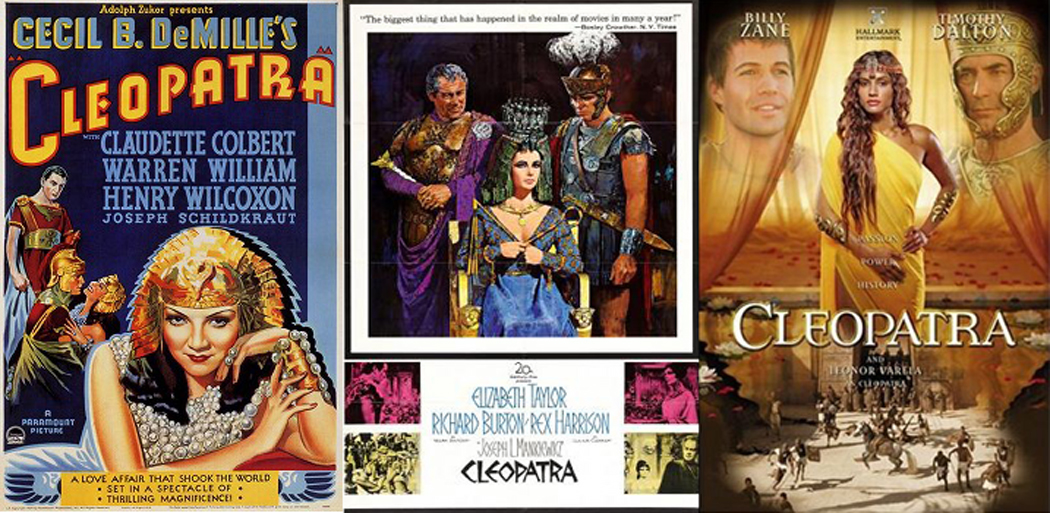
kitschy posters

This all comes up because that megaturkey epic, Cleopatra (1963), with Liz and Dick, has been issued on Blu-Ray. All 243 bloated minutes of it. Stilted dialog, purple eye shadow, togas out the wazoo, to say nothing of barges on the Nile. And Rex Harrison as Caesar.

Hollywood is always historically accurate, at least in so far as there actually was a Caesar. After the establishment of that fact, all bets are off. Hollywood has made many Cleopatras, but I wouldn’t try to look for any fact larger than a mouse in any of them.

cleopatraposters

But accuracy is overrated in history. Some of the greatest artistic successes make for questionable history, such as Shakespeare’s Richard III or Oliver Stone’s Nixon.

The facts may be in question, but you nevertheless feel this is the way it should have been.

It’s like the dictum from The Man Who Shot Liberty Valance: ”When the legend becomes fact, print the legend.”

And if there’s not a legend, let the publicity department invent one.

What’s the point of reading all those scholarly books if, once you put them down, you can’t remember anything in them? On the other hand, who can forget Claudette Colbert as Nero’s wife in The Sign of the Cross, bathing in asses’ milk?

sign of the cross colbert bath

So, Hollywood provides us with a history that sticks to the brain like used chewing gum.

Think of your video store as a university.

It begins with prehistory.

raquel welch

Your main problem will be in choosing which movies to watch from the riches available: Do you want Raquel Welch in One Million Years B.C. (1966) , Darryl Hannah in Clan of the Cave Bear (1986) or Rae Dawn Chong in Quest for Fire (1981)?

I always go for the last. I tell people it is because of the clever artificial language created by linguist and novelist Anthony Burgess, but it is really because Chong takes her clothes off. Several times.

quest for fire rae dawn chong

When it comes to pharaohs and Caesars, the film world is immense. There must be thousands of movies featuring Romans, from 1908’s silent Julius Caesar to 1980’s Caligula, by Penthouse publisher Bob Guccione, which wouldn’t shut up.

It is interesting: Hollywood loves Ancient Rome, but it ignores Ancient Greece. As I look down the long list of history, I can’t help but notice that every time civilization reaches an apex of intelligence and literacy, Hollywood grows mum. We have lots of gladiators, but few philosophers onscreen.

The pattern holds up in later history, too. It’s hard to find a good movie that takes on the Enlightenment or the Reformation. But give us revolution, debauchery or intrigue, and the cameras start spinning.

You’d think there would be something to film in the 18th century: Perhaps Hollywood has not yet discovered the Duc de Richelieu, who invented mayonnaise in 1756 and was notorious for holding nude dinner parties. I’m sure the two things must be related in a way Hollywood can use.

But there is something about knee-britches that puts Hollywood off. For all the films on the Civil War, there are darn few on the Revolution. Lincoln shows up over and over, but George Washington might as well never have lived. I guess Hollywood thinks he looks too foppish in that satin and wig.

To do their patriotic duty, Hollywood has managed two films on the Revolution. It tried to tart it up once in 1776 (1972) by turning the war into a musical; the next time, it thought it could make Al Pacino sound like an 18th-century Bostonian in Revolution (1985). Both films are predictably awful.

Intolerance

An entire history curriculum could be devised from Hollywood films, matching titles with history’s centuries and movements.

As with any course of study, there are crib notes for those who cannot take the time for the whole thing.

You can get an overview of history from these three films:

1. D.W. Griffith’s Intolerance.

2. The Story of Mankind, with the Marx Brothers.

3. Mel Brooks’ History of the World Part One — ”It’s good to be da king.”

I can’t give you a diploma for completing this curriculum, but I can promise that you’ll have as good a grasp on history as the average American student.


Lincoln seated

What we know best of Abraham Lincoln is his face. Gaunt and furrowed, with hollow cheeks, dark, shadowed eyes and a cowlick in his hair, as if he didn’t quite know what to do with a comb.

It may be partly that we know him from black-and-white photographs, but it is a gray face that already seems to be cut from stone. It is a monumental face.

It is also an ambiguous face. Perhaps because of the longer exposures needed to make those portrait photos in the 1860s, his expression is blank. We don’t have images of Lincoln smiling or talking. He is always sitting still, waiting for Matthew Brady to say, “OK, thank you, Mr. President. We are done.” And he can then relax, stretch his long legs and perhaps crack a joke. “Mr. Brady, it reminds me of the one about …”

But the static pose means we look at the face and read into it what we want: fatigue, care, wisdom, faith, despair, grief or distraction. Maybe just boredom.

Lincoln 1865

And it isn’t only in the photographs that Lincoln is more mirror than figure. Everything in his life is ambiguous, and lets us find the Lincoln that reflects the image of ourselves. What we know best is his face, but it tells us the least.

Nathaniel Hawthorne called it “this sallow, queer, sagacious visage, with the homely human sympathies that warmed it.”

The words are from Library of America’s Lincoln Anthology, a collection of writings about our 16th president edited by Lincoln scholar Harold Holzer. It contains a century and a half of writing, from the recollections of his contemporaries to recent ruminations and lucubrations by writers such as Gore Vidal and Garry Wills. Each has his own Lincoln.

In it, you can read the shifting versions of the man. For some he is the preserver of freedom, for others he is a bloody tyrant. Some saw a sober man of deep reflection, others a jokester who would jibe at the most inappropriate moments. Some saw him as a statesman, others as an opportunistic politician.

For some he was a pious Christian; for others, he was an atheist.

You can find proof of any of these views in the more than 10,000 books that have been written about him.

Did he prosecute the Civil War to end slavery or to preserve the Union? There is evidence for all these Lincolns, and more.

Recent books have suggested everything from a closeted gay Lincoln to one afflicted with one or another form of undiagnosed genetic neurological infirmity.

Perhaps nothing illustrates the problem better than Lincoln’s attitude toward race. His early writings can be hard to read nowadays, from a post-Obama perspective: “There is a physical difference between the white and black races which I believe will forever forbid the two races living together on terms of social and political equality. And I … am in favor of having the superior position assigned to the white race,” he said in a speech in 1858. He was an avid user of the N-word, hardly excused by the fact that almost everyone did back then.

Yet freed slave Frederick Douglass, who frequently held Lincoln’s feet to the fire over slavery, after meeting him in 1863 wrote in his autobiography that Lincoln was “the first great man that I talked with in the United States freely who in no single instance reminded me of the difference between himself and myself, of the difference of color.”

“He was big enough to be inconsistent,” wrote W.E.B. Du Bois in 1922. “Cruel, merciful; peace-loving, a fighter; despising Negroes and letting them fight and vote; protecting slavery and freeing slaves. He was a man – a big, inconsistent, brave man.”

There are three explanations for Lincoln’s inconsistencies.

The first and easiest is that he was a politician and said to people what they wanted to hear. This is certainly true in many cases.

The second is that his views changed over time, and that what he said in 1858 cannot accurately reflect what he believed in 1863. This is also true. Few presidents show so much growth in office as Lincoln.

But the third is more important: He was simply a complex man. He seemed able to hold opposing points of view in mind at the single moment.

Unlike many later presidents, who grasp unwaveringly to their ideologies, Lincoln approached the world as a multifarious and varied place in which a single point of view cannot encompass. It allowed him a pragmatic flexibility.

One of the lies of history is that it follows a script. We tend to see history as a story with a beginning, middle and end. We know how the Civil War turned out. But in the midst of it, no one knew how it would turn out, and Lincoln faced new problems every day and no single policy would work in every case.

And every day presented choices that could lead to an infinity of results: Behind every door, a dozen more waited to be opened.

“I claim not to have controlled events, but confess plainly that events have controlled me,” he said in 1864. His genius – his political and moral genius – it to have been a great surfer of events, turning this way or that to maintain his balance and herd those events toward the general goal he held firm to.

“My policy is to have no policy,” he once said.

It is what made him the right man for the job in 1860: An abolitionist could not be elected; a Southern sympathizer would only have prolonged the agony, like his predecessor, James Buchanan. Lincoln’s steadfastness of purpose was matched with a flexibility that many saw as being unprincipled. Yet, that flexibility is what worked.

“The scars and foibles and contradictions of the Great do not diminish but enhance their worth,” Du Bois wrote.

“I love him not because he was perfect, but because he was not and yet triumphed.”

LINCOLN

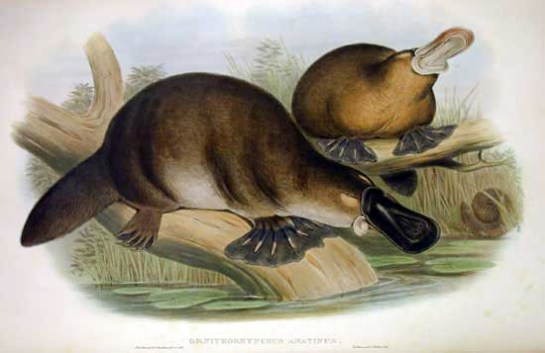
Platypus-sketch

Contemporary American conservatism is a very strange duck. Maybe a platypus. 

To begin with, it espouses what has always previously been called liberalism: When our nation was founded, it was the conservative Hamilton who imagined a strong central government and the liberal Jefferson who feared it. 

Conservatism has traditionally been in favor of strong government. It is one of its hallmarks through history. Of course, behind that belief in central power was the heart of true conservatism: maintaining privilege for those who enjoyed it. That is why we could talk about Soviet hardline conservatives hanging on to Communism. It was their own privilege they were attempting to save. 

It was conservatives who supported the aristocracy in monarchist Europe; it was conservatives who fought reform in 19th century England and justified the subjugation of Ireland; it was conservatives who supported segregation in the American Jim Crow South. The record of conservatives on the progress of human liberation is a dismal one. 

There is a graspingness and miserliness at the heart of historical conservatism. All change threatens the status quo and that threatens those who hold the best cards.

But what remains the oddest thing about the current iteration of conservatism in America is the way it marries this retention of old social norms — even injust ones — with a form of political radicalism that would have dumbfounded the founders. 

At the heart of the Tea Party movement is what can only be described as “soft” anarchism. One central tenet is the dictum that government is not the solution, government is the problem, and therefore, we need to eradicate government. This is not, in any way, shape or form, conservatism. It has no relation to conservatism historically, nor conservatism in ideal or theory. 

The philosophical grandfathers of the Tea Party, let’s face it, are Mikhail Bakunin, Peter Kropotkin and Max Stirner. Get the government out of the way and everything will be peachy-hunky.

Kropotkin2

Those who call themselves libertarians can sign on to this soft anarchism and feel their views are coherent. But so-called conservative Republicans have a hard time reconciling this anti-government sentiment with the converse idea that everyone should behave according to the Judeo-Christian norms they observe. On one hand, they extoll personal freedom, and on the other hand, they negate it to anyone who disagrees with them. 

Even more, those Republicans who have signed on to the Tea Party’s soft anarchism have a difficult time matching that up with their own drive for political power. And we must face the fact that our two-party system is just a bipolar grasping of power. Republicans can claim that government should be smaller, but a short gander at the record proves that after years of striving for the power, when they have it, Republicans use it just as much as Democrats. What’s the point of winning if you don’t get the perks? 

That’s why I call this a platypus. The parts don’t belong together.

I suppose one shouldn’t expect any political movement to be philosophically coherent. Politics remains sausage manufacturing and always will. But the part that causes thoughtful people profound disquiet comes with the reflection on history.

This marriage of one radical idea with reactionary social conservatism has along history, and not a history that inspires much confidence or hope.

Every tyranny or reign of terror has its own version of a radical idea melded with a nostalgic longing for a past where everyone was good and righteous and behaved in the old-fashioned ways. Look at the incorruptible Robespierre; look at the agrarian virtues of Mao; look at xenophobic Stalin. 

Not to put too fine a point to it, and I don’t mean to equate one-to-one Republicans with Nazis, but the same principle is at work. No one extolled the virtues of family and marriage more than the National Socialists. Hitler loved children and dogs, as they say. The combination of reactionary social ideas with radical political ideas has fueled this kind of crackpotism since the days of Plato. 

During the last election, a healthy percentage of Americans turned away from the extremism of the Tea Party, and I don’t have a fear that this platypus will reconquer our politics. America has a long history of quietism, and has always in the past, so far, retreated from any radical departure from the comfort it finds in a stodgy middle class normality. It’s one of our country’s saving graces: We don’t go in, like the French, for theory. 

But nonetheless, this water-and-oil mixture of radicalism and reaction is something, as the doctors always say, we should keep an eye on.