Archive

Tag Archives: music

deep end of the poolThere are two approaches to learning: Some prefer to take small steps and try out the simplest and easiest first; others like to dive headfirst into the deep end of the pool.

When it comes to classical music, the first approach is most common. We don’t want to scare our pupil, so we spoon feed the shorter, easier, more comfortable pieces to them: a Chopin waltz or a Rachmaninoff piano concerto. At its worst, this leads to a belief in the student, that classical music is a warm bath to soak in, a place to let your mind drift, to let soothing images wander through your imagination.

Dickand JaneThe “Dick and Jane” approach, though, can be patronizing. If you have a real hunger for emotional and intellectual depth, the approach trivializes the subject. It pretends that the more difficult music isn’t the real heart of classical music, but some sort of broccoli to be had along with your Satie Gymnopedie or your Carmen Suite. Classical music is meant to be listened to with intensity and focus, as you might read Dostoevsky or a Greek tragedy. If your mind wanders, you have lost the trail.

I recently wrote a blog about sharing my music with my granddaughter, Tallulah Rose; she, in turn, shared with me her contemporary indie-pop music (You can find it here: https://richardnilsen.com/2016/03/14/both-sides-now).

The response to this blog entry was overwhelming: More people have clicked on it than any other, and the comments added to it are legion. The piece must have hit a nerve.

Among those comments have been a number of repeated questions, and one of those is a request for further “guidance,” as to what to listen to in order to become more familiar with classical music. There is a hunger out there for something more serious or formal than the 3-minute song.

So, I’m assuming an adventurous listener, perhaps with a collection of Frank Zappa, Nick Cave or Radiohead. That is a listener who does not want to start out on baby food, but wants to dive into the deep end, who wants to drink the hard stuff.

So, here is my preliminary list of deep-end music for those who want to find out what classical music is really all about: It isn’t about style (there is a great deal of so-called classical music that is really just the conventional style of its day and has no particular claim to posterity — one thinks of Ditters von Dittersdorf or Friedrich Kalkbrenner) but about sounding depths, expanding on form, creating sound narratives and searching for meaning. I have written in the past that the essential question of classical music is “How do you write a piece of music that lasts longer than three minutes?”monk stamp And that the idea of classical music needs to be expanded to include the classical musics of other cultures, such as that of India or Japan, and also to include jazz, which is really just another classical music, at least in the hands of its most serious practitioners, such as Miles Davis, Thelonious Monk or Duke Ellington.

But here, I am going to restrict myself to what is commonly called classical music: the European-American tradition of art music.

So, here’s a first go-round of suggestions for the brave new listener.

Ludwig van Beethoven, Grosse Fuge. Originally the final movement of his string quartet in B-flat, Op. 130, it proved to challenging for both the audiences and the performers of his day, so he felt compelled to write a replacement for it and publish the fugue separately as his Op. 133. It might be the toughest nut to crack in all of classical music. In it, Beethoven builds such a huge double fugue (that is, a fugue not on one theme, but on two themes played simultaneously, upping the ante and the difficulty by not doubling, but squaring the complexity), that it breaks the mold of what a fugue can be, as the fiddlers nearly saw their instruments in half. Playing this music is like taming wild tigers. If you survive this, everything else is a piece of cake.

grosse fuge furtwangler

There is one performance that nearly tames this wild animal, and that is a recording from 1954 with conductor Wilhelm Furtwangler leading the Vienna Philharmonic in an orchestral version of the music. It can be found on You Tube at: https://www.youtube.com/watch?v=pSfcE3HH7dk.

Grosse fuge animation

A version for quartet in more modern sound can be had from an unidentified quartet with an entertaining animation that makes visual the notes at: https://www.youtube.com/watch?v=6s0Mp7LFI-k.

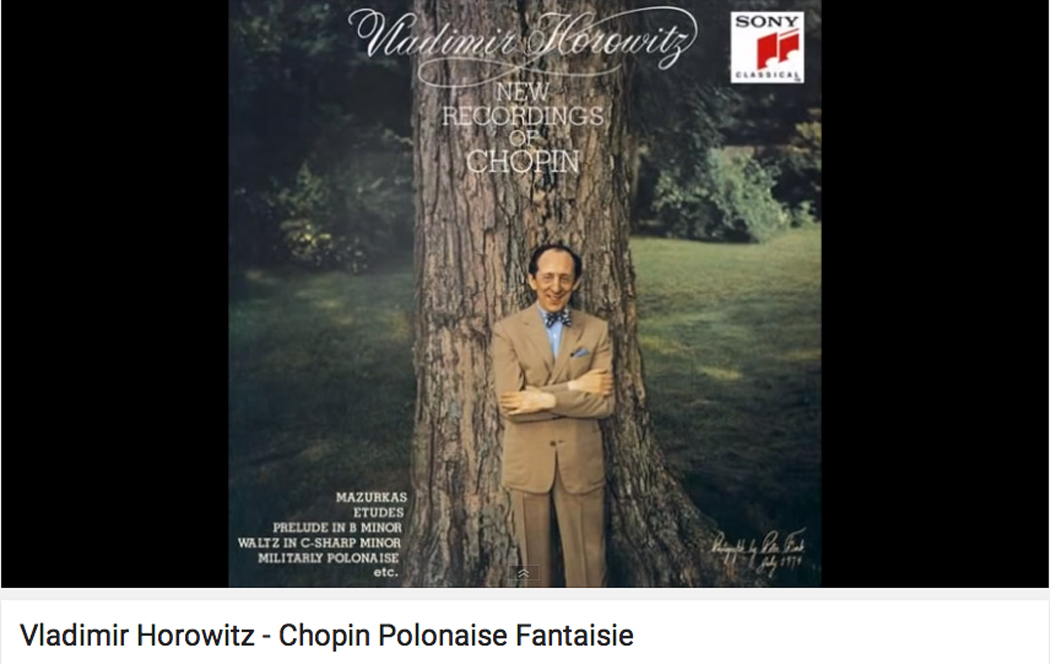
polonaise fantaisie horowitz

Frederic Chopin, Polonaise Fantaisie, Op. 61. This must be the hairiest thing Chopin ever wrote, incomprehensible on first listening — it seems to wander and never make up its mind. But after many hearings, it is one of the high points of western music. Give it a chance. Those opening chords are the most desolate in all music, especially the way Vladimir Horowitz plays them. Horowitz owned this piece. Here he is from 1966 in Carnegie Hall: https://www.youtube.com/watch?v=KI38MuQ4YdQ.

bach chaconne heifetz

Johann Sebastian Bach, Chaconne from Partita in D-minor for solo violin. A great teacher of mine said that this is what he called “serious” music, that is, music not meant to paint a picture or tell a story, but music so abstract, so pure as to exist practically in a Platonic realm. On a single fiddle, he has the violinist play variants of the same series of chords over and over, gaining in depth and complexity as it moves along. Here is Jascha Heifetz playing at about the age of 70. It doesn’t get much better than this: https://www.youtube.com/watch?v=6q-Zqz7mNjQ.

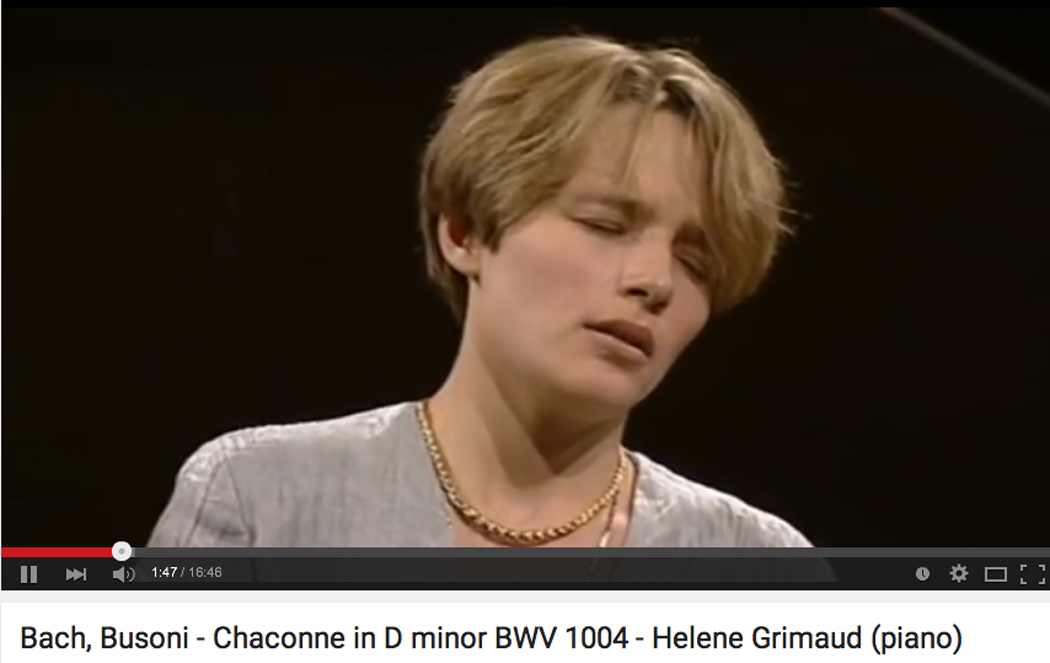
bach chaconne grimaud

For contrast, the Chaconne has been transcribed several times for piano. Here is Helene Grimaud playing it as opened up by the great pianist Ferruccio Busoni (don’t expect pure Bach; this is a 19th century re-imagining, but it is glorious): https://www.youtube.com/watch?v=sw9DlMNnpPM.

bartok quartet

Bela Bartok, String Quartet No. 5. Written in 1934, Bartok’s next-to-last string quartet is a model of construction, built in an arch-like form, so that it moves fast-slow-fast-slow-fast, with key structures and melodies equally symmetrical. The two slow movements imitate the sounds of night, with chirping and cawing, crickets and crows. The central movement is in a time signature typical of Bulgarian folk music, with beats broken up into nines broken into patterns of 4+2+3 and later into tens, broken into 3+2+2+3. And, in the finale, just before the end, you hear an imitation of a hurdy gurdy. It’s a lot to fit into a tightly argued quartet. Here it is played by the Hungarian String Quartet: https://www.youtube.com/watch?v=lMjRjLHbacw

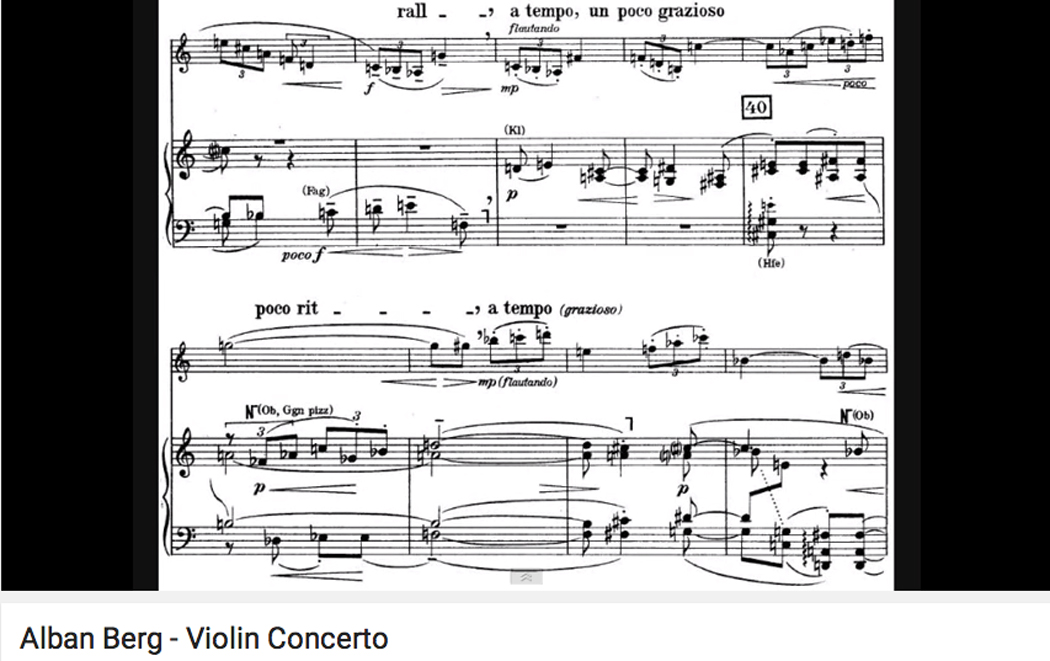
berg violin concerto

Alban Berg, Violin Concerto. This is one of the most emotionally draining pieces of music from the 20th century, written “in memory of an angel,” the angel being Manon Gropius, daughter of Alma

Manon Gropius

Manon Gropius

Mahler and Walter Gropius. Manon died a teenager from Polio in 1934 and Berg, who was exceptionally close to the family, wrote this concerto in elegy. It is composed in the 12-tone technique, but in an accessible style, because the tone-row he built the music around has obvious tonal implications. It is heartfelt and moving, and in the final movement, the last notes of the tone row miraculously turn into the Bach chorale, “Is est Genug,” “It is enough.” If you can hear this and not blubber like a baby, you are more stalwart than me. Anne-Sophie Mutter, New York Philharmonic, Lorin Maazel. https://www.youtube.com/watch?v=gd0dMs0MTg8.


kelly briar

It is impossible to listen to the final quartets of Beethoven and not recognize in them something quite different from the optimistic and heroic thrust of his most popular works, the Eroica, the Appassionata, the Razumovskies. The quartets in question no longer follow the standard four-movement shape of the classical quartet and symphony, and they no longer seem addressed to the world and society, but rather, they are discursive, wandering and seem turned completely inward.

Innigkeit

Innigkeit

It has been called his “late style” ever since 1855, when Wilhelm von Lenz wrote his book, “Beethoven and his three styles,” which attempts to give shape to the composer’s career, with an “early style” in imitation of Haydn and Mozart; a “middle period” with all those grand exhortations to heroism and the overcoming of obstacles and the establishment of freedom and individualism; to the “late style” of innigkeit and apparent formlessness.

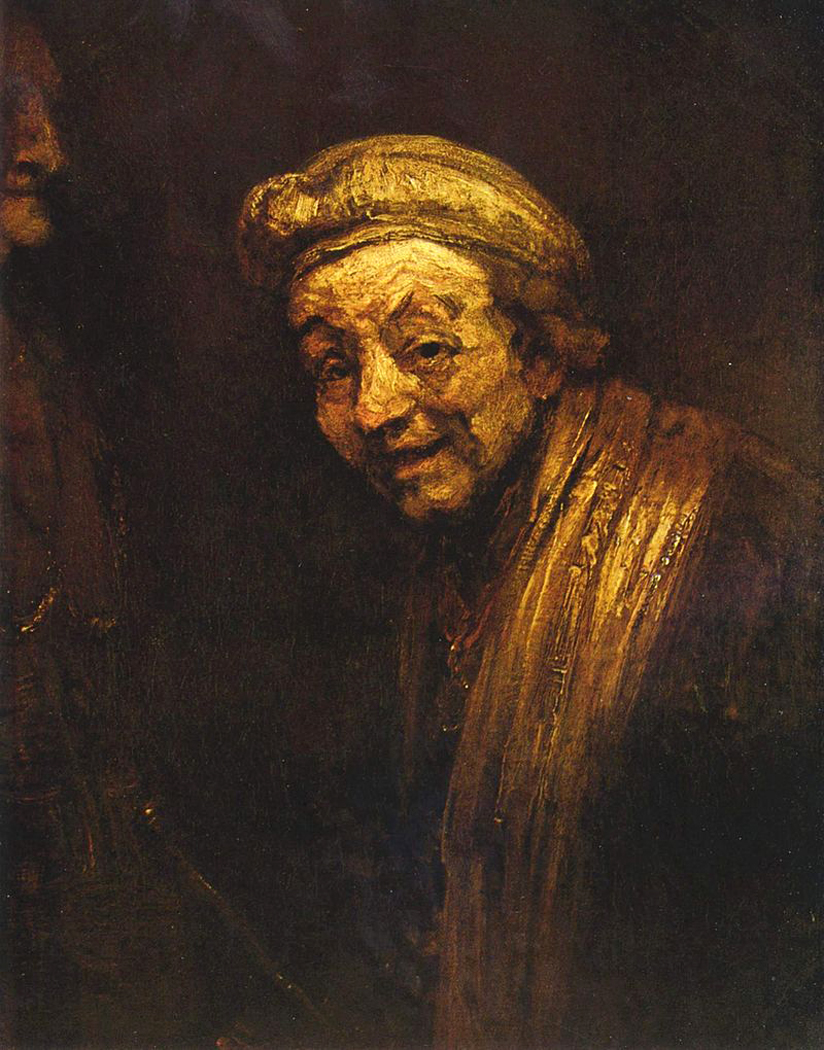
Since then, it has become standard to view an artist’s career into three: apprenticeship, mastery, and a “late style” in which the artist perhaps gives up his public function to investigate his private concerns. Within this pattern, it has become usual to see the late period as the culmination of an artist’s life and work, as its height, as its reduced essence.rembrandt self portrait

And so, we see the final paintings of Rembrandt, the late romances of Shakespeare, the last dark photographs of Edward Weston or the Ninth Symphony of Mahler as somehow special, as more meaningful, as “better” even as “best.” We look to them for something like a peroration of wisdom, the final words or notes or brushstrokes of a sage. Goya’s black paintings, or the black paintings of Jackson Pollock. (Usually, there is some element of darkness in late work, whether it is the Beethoven quartets or the quiet “ersterbend” that ends the Mahler Ninth.)

weston china cove pointlobosAs Minor White said of the Weston photographs: “Rarely are we shown the maturest work of men who have lived richly and whose spirit has grown all their lives … the last photographs of Edward Weston made at Point Lobos … may parallel in content the last quartets of Beethoven.”

There are many problem with this formulation. First, so many artists — certainly the majority — don’t fit into this pattern. Second, while we can recognize a “late style” in the final works of Franz Schubert, Schubert died at 31. Can that be considered his late period? Suppose he had lived his three score years and ten? What would have followed his “late style?” Obviously, a late style is something we apply only in retrospect. Even Beethoven, whose late style defines the idea, died at a fairly young age of 56. Where would he have gone if he had lived to 70? His late style would then have been something transitional.

Then, there are artists whose supposed late style is generally admitted to be a decline. One thinks of the final paintings of De Kooning. And there is the problem of someone like Wagner, who strove self-consciously for the prestige of having a late style with the artificial spirituality of “Parsifal.”

There is another issue, too. Late style means more than one thing. Initially, we think of art that is intensely personal rather than public, art that reaches the darker and more private parts of the human experience. But that is not the only thing — perhaps not even the primary thing — that defines late style. As Edward Said said in his study of the subject, late style is characterized by an increasing simplicity of technique. Take those late quartets, which are a bouquet of dances, marches, recitativ and arias, and movements sometimes so short, they hardly count as movements at all. They alternate with long fugal passages where the counterpoint is hidden in blocks of chordal harmony. Even their sonata-form movements are choppy with short, punchy themes entering stage right and quickly running off stage left, chased by the next patch of tune. There is a superfluity of material and an economy of means.Heiliger Dankgesang

It is as though an artist, a composer, a poet, had spent his youth perfecting an elaborate craft, the mastery of which is part of his declaration to the world, but having become increasingly confident of his ability, he no longer considers it to be the important part of his work. The competence is still there, but the showing-off is gone: The artist only uses so much of his virtuosity as is needed to make his point.

Another way of putting it is that when young, an artist is in love with his artform — with his villanelle, his twelve tones, his impasto — and so aware of the tradition and history of that technique, that he wants to strive to shoulder his way into that history, to take his place. But as age and its concomitant wisdom encroach, the technique seems a shallow exercise compared with the content: The balance shifts to what he has to say rather than how he says it.

As Arnold Schoenberg said, “There is still plenty of good music to be written in C major.”

This is Picasso’s arc: Early work is meant to rattle art history. He goes through his “periods,” which are each an exploration of a particular technique or “ism.” But in his later life, he freed himself to simply play with his paints or his pottery. It is clearly Picasso’s “voice,” his “look,” but the ism ceases to be the point: the work becomes an endless parade of bulls, women, birds, still lifes and images of concupiscent artists, often with bulls or women.matisse cutout

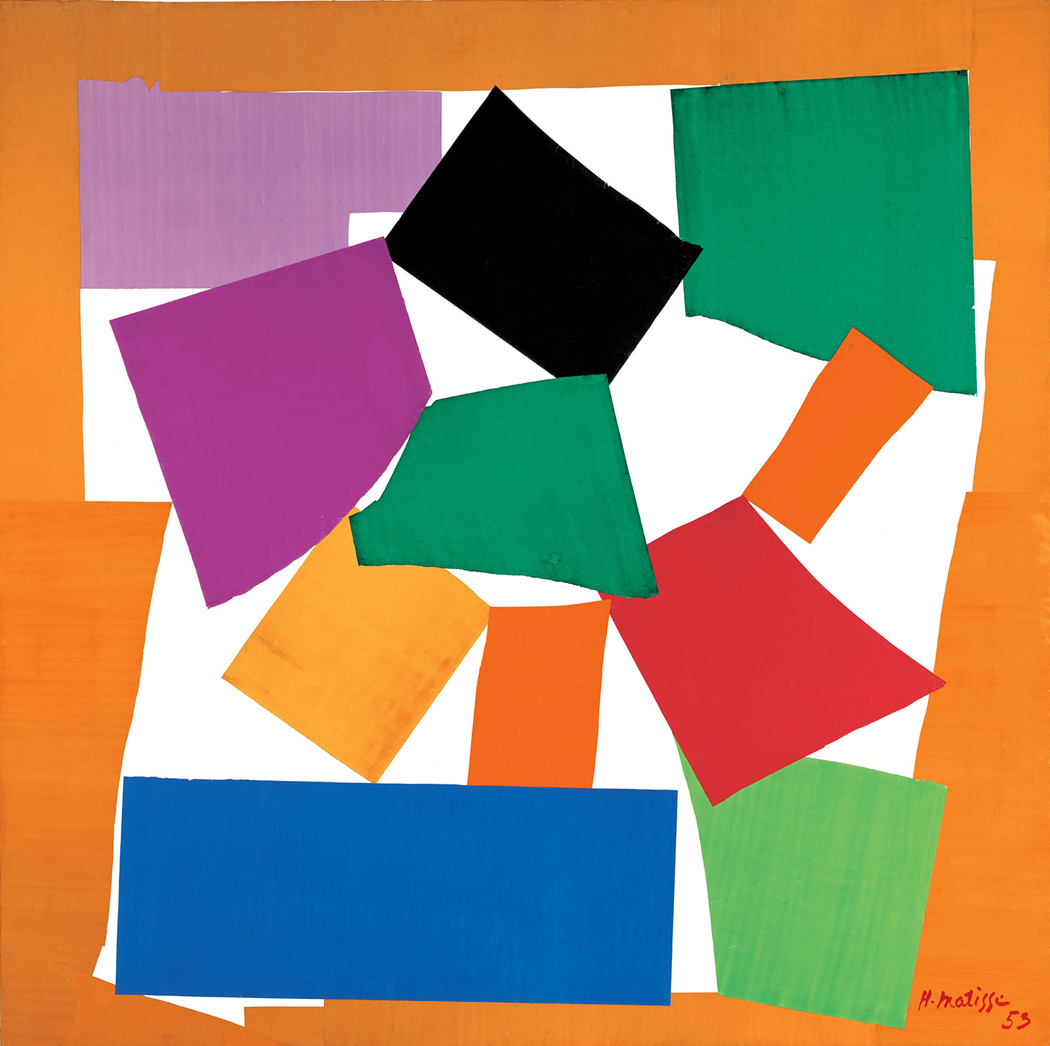
Or Matisse, who ended with paper cutouts, as simple as a child’s finger painting.

One sees this in many a career, where the young artist finds his voice and shouts to make a name, but once having established his bona fides, feels then free to explore what he is really interested in. One thinks perhaps of Richard Diebenkorn, who made a name with abstract art, and after becoming famous, started making “pictures.”

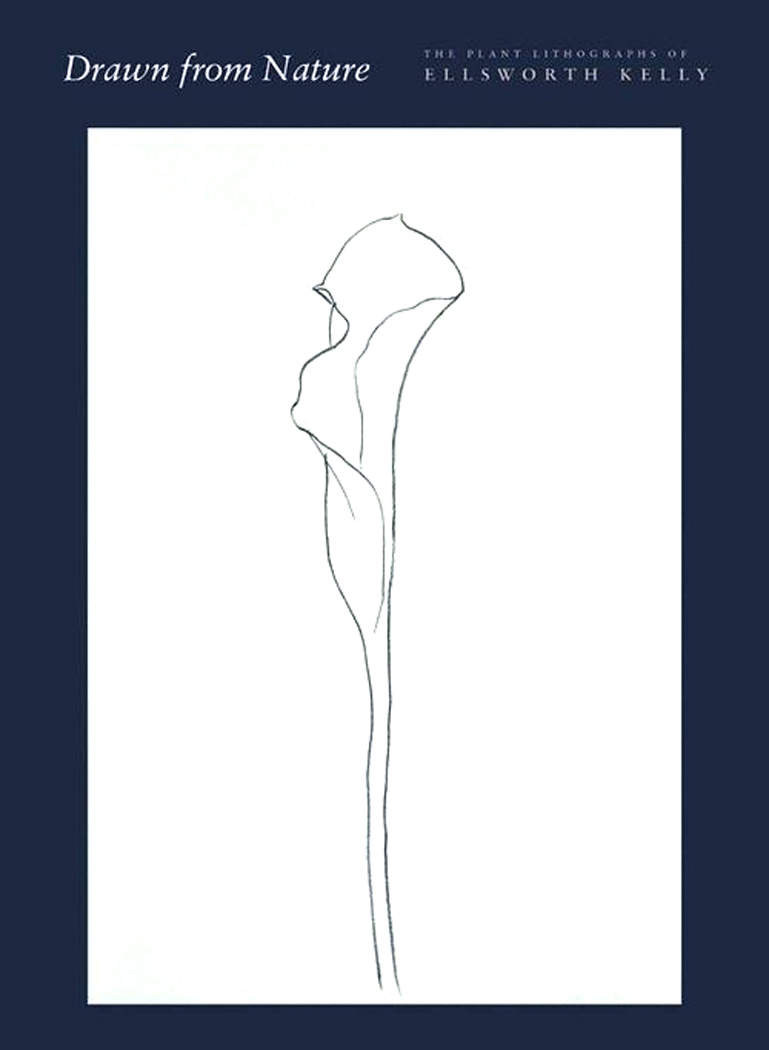
kelly coverI was struck seeing some drawings by Ellsworth Kelly, who made his career with minimalist Color Field paintings — they might as well have been models for flags — but these drawings were of plants, in simple black line on simple white paper. They were elegant and expressive and nothing like the bland paintings. He has made them throughout his career, but they had been seen only once (in 1970) before they made a big splash, showing them in 2012 at the Metropolitan Museum of Art in New York. Kelly clearly loved the plant forms he drew.

There comes with age and experience — and perhaps prodded along by the awareness of the extreme shortness of life — a need to say what needs saying unencumbered by all the apparatus and hoopla that seduce our younger selves.

And this is where the simplicity of means becomes the same thing as the profundity of meaning. In his middle period, at the height of his Beethoven-ness, he can spend an entire symphony showing us how an obsessive rhythmic motiv in C-minor can grow into a triumphal shout of joy in C-major. But by the late quartets, the emotional expressions pass moment by moment, as if attention to the present were more important than presentiment of the future or reminiscence of what has gone before. There is an intensity of the now, an urgency of being present. And that is where we find the marriage of the late style’s depth and its simplicity.

Tallulah Rose

Tallulah Rose

I have an interesting “contest” going on with my granddaughter, Tallulah Rose. She is 16 and immersed in music, taking guitar, piano and banjo lessons; she has some genuine talent. When I chauffeur her around on those occasions when I am called on, and am playing some Bach or Beethoven on the car CD, she is apt to say something like, “Classical music is so boring; it all sounds the same.” And, of course, when I hear her listening to pop music on her iPad, my reaction is the mirror: Pop music is so boring; it all sounds the same. So, I scratch my head and wonder.

How can something sound so monotonous to me and not bore her to tears? How can something so varied and glorious as classical music possible sound to her as if it is all the same gluey mush? It is more than a question of taste; we are clearly hearing different things.

Most people are likely to think of this as merely a matter of taste — “I like indie rock, but she likes country,” —  and it is, to some degree — but while someone who likes Taylor Swift may say they don’t like Justin Bieber, they recognize it as merely a different genre of pop, and they wedge into their corner of sound comfort. Is there anything more insular than heavy metal?

But classical music doesn’t seem to function to Tallulah Rose as just one more Billboard magazine chart category, like soul or country-Western or hip hop. Those are all options out there for popular consumption and one chooses the category one feels most simpatico with.

But classical seems to be a different species altogether. It isn’t, for its serious listeners, just one more entertainment option. Its goals are elsewhere.

Modest Mouse

Modest Mouse

Tallulah Rose and I thought we might explore this question. She suggested an exchange. She would choose 10 pieces of pop music for me to listen to and I would choose 10 pieces of classical music for her. Tallulah Rose isn’t one of your ordinary junk-music fans: She has high standards for her music and would consider the bands she has chosen for me to be “art,” or at very least music that no one of any musical sophistication would be embarrassed to be heard listening to. She has excellent taste in her music. She picked for me music by Wilco, Vampire Weekend, Arcade Fire, Modest Mouse and Death Cab for Cutie, among others. I was to listen to her music and write about it, and she was to do the same for my choices.

What T-Rose chose for me:

1. Jesus, Etc. by Wilco
2. Australia by The Shins
3. Hannah Hunt by Vampire Weekend
4. Ragged Wood by Fleet Foxes
5. Wake Up by Arcade Fire
6. Young Folks by Peter Bjorn & John
7. Little Black Submarines by The Black Keys
8. This Charming Man by The Smiths
9. Missed the Boat by Modest Mouse
10. Dance Yrself Clean by LCD Sound System
Bonus track: Title and Registration by Death Cab for Cutie

In choosing music for her, I felt it only fair that I not bury her under the Bruckner Fifth or the Mahler Third, but try to find pieces of reasonable length, and I chose several movements instead of whole concertos or symphonies. Her music for me tends to run between 3 and 5 minutes. Here is my list for her (She snuck in an extra for me, so I added one extra Mahler track for her):

1. Gabrieli — Canzon Septimi Toni No. 2 for brass choirs
2. Bach — Prelude and Fugue in c-minor from WTC Book 1
3. Mozart — First movement of the Piano Concerto No. 20 in d-minor
4. Beethoven — Third movement from the “Tempest” sonata, Op. 31, no. 2
5. Chopin — Mazurka Op. 30, no. 4
6. Brahms — Finale of the Fourth Symphony
7. Mahler — Two songs: Wer hat das Liedlein erdacht? from Das Knaben Wunderhorn and Ging heut Morgen ubers Feld from Songs of a Wayfarer
8. Rachmaninoff — Finale from Piano Concerto No. 3
9. Villa Lobos — First movement from Bachianas Brasileiras No. 5
10. Copland — Fanfare for the Common Man

I have listened four times through to all of T-Rose’s music and I can say that none of them is musically unsophisticated, but neither can I say, outside the LCD Sound System’s Dance yrslf Clean, which actually does something with the music,  that they engage my deepest sympathies. Again, I am convinced that my music and hers simply are not attempting the same thing.

For a start, her music’s appeal depends greatly on the lyrics. Even when I read rock criticism in, say Rolling Stone, the criticism is less about the music qua music, and more about the quality of the words. The sentiment expressed is expressed verbally, not musically. (More on lyrics later).

Second, the parts of music that seem most treasured by the rock and pop listener is a consistent beat, often aggressively propulsive. Following that, it is a melody — although in contemporary pop music, melody sounds more like chant than tune — prosody is so slipshod that the same melodic note can sustain a single syllable or three or four, if that is what the words demand.

Johannes Brahms

Johannes Brahms

For my classically oriented ear, the unrelenting rhythm is monotonous; I keep hoping it will lead to something, but it doesn’t. For my ear, harmony is paramount. I am always aware of it, shifting from major to minor, or to a Phrygian mode or the endless unresolved but constantly yearning dissonances of atonal or serial music. I am always aware — more than the melody at the top of the orchestral heap — of the bass line. I remember Brahms saying when he got a new piece of music to look at, he’d cover up the top staves and look at the bass line. That way, he said, he could tell if the music was good or not. When I listen to popular music, the bass line is generally undistinguished, often repetitive, and rather more in the way of a continuo — a second reinforcement of the beat slammed out by the drums and cymbals.

When I say her music and mine are not doing the same thing, I mean, in part, that the music part of her music is meant to be a place to drop her head into for a few minutes, to grok on a pulse, while the verbal part is there to express, often elliptically, the concerns of a young mind. At worst, in the kind of pop music T-Rose wouldn’t be caught dead listening to, those concerns are numbingly conventional, but even the more sophisticated lyrics speak to the exaggerated optimism or cynicism of adolescence, the need to be appreciated as wise and knowing, even when those of us who have been through it already, now recognize those attitudes as pose.

angry young men

Slight digression: The question of pose is most obvious in the many band photos used for PR or for CD covers. The musicians look so serious and world-wise: You can’t put anything over on them. But you can run through hundreds of photos and they all seem to be the same people: surly faces, collars drawn up, hands in their pockets standing in a warehouse district street to prove their working-class origins. One can’t help recognize the same memes from the Angry Young Men of England in the 1950s and ’60s. It’s as if every band has seen photos of John Osborne and wants to be Richard Burton from Look Back in Anger or Tom Courtney from Loneliness of the Long Distance Runner. The straight-jacket of the meme is limiting.

Vampire Weekend: More hands in pockets

Vampire Weekend: More hands in pockets

Back to the main issue: The music of rock and pop seems meant to create a pervasive mood throughout the length of a song — and except for a few experiments, all this music falls into the 3 to 5 minute song form.

Classical music, on the other hand, revels in contrast: The tempos keep changing, vigorous first themes alternate with quiet second themes. An established key center is disrupted by a series of wrenching modulations only to be reaffirmed. Instead of a single simple emotion, there is a constant development of emotions. When I find T-Rose’s music boring, what I mean is it doesn’t grow — but then, it’s not meant to. And one of the things she finds boring in my music is that it never settles down into something she can depend on, to give her that one single, clear emotion she wants from her tune.

Another thing: For her music, as I said, the words are paramount. The music behind the words seems to function more like the music in a film: to underline the sentiment, but not to express it directly. Something interesting to hear while the “real” action is happening in the words. For my music — at least for the big 19th century pieces that make up the bulk of the repertoire — the music attempts to make an argument from start to finish, like the slow shift from c-minor to C major in Beethoven’s Fifth, or the chapters of Mahler’s Third, “What the fields tell me,” “What the birds tell me,” “What love tells me.” It works like an opera, telling a story — musically — from start to finish. To hear its meaning, you have to be aurally sensitive to changes in harmony, in orchestration, in dynamics, in the ways the themes change and grow. The way you hear the E-flat arpeggiated tune at the beginning of the Eroica changes from a closed-off, harmony-denying drop to its D-flat in the third bar to that bright, victorious arpeggio in the recap and coda, where the same tune ends on the upper B-flat dominant that seems to rise above all the violence and disaster of the previously heard music. Classical music is about development; pop music seems to be about stasis.

Arcade Fire: yet again -- hands in pockets

Arcade Fire: yet again — hands in pockets

I write as if I think classical music is superior to pop music — and I would be lying if I didn’t fess up to that prejudice — but that is not what I’m writing about here. Rather than argue that one music is superior, I’m saying their goals are so different, so at odds, that it is almost silly to compare them at all. One might as well compare apples to double-entry bookkeeping.

But I wanted to note something interesting about the words in the music T-Rose gave me.

The conventions of prosody have shifted dramatically. In the “old days” — as recently as the Beatles — words were written as poetry and scanned with regular meter, and carefully crafted to fit the tunes. In this, Paul McCartney and John Lennon were no different from Oscar Hammerstein II. Think of such lyrics as, “I once had a girl, or should I say, she once had me.” Every accented word drops on every accented note, with the weaker beats hitting off-beats in the tune. A comfortable fit. The same with “Some enchanted evening,” or “I’m gonna wash that man right outa my hair.”

“Blackbird singing in the dead of night…” or “You should see Polythene Pam, she’s so good lookin’ she looks like a man.”

Even the Rolling Stones followed the conventions: “I see the girls walk by dressed in their summer clothes; I have to turn my head until the darkness goes.”

This is what Robert Frost would call playing tennis with a net.

Playing with the net can bring delightful surprise and pleasure. Think of, “In olden days a glimpse of stocking was looked on as something shocking, now heaven knows, anything goes.”

Words and music: Hand in glove.

But listen to the songs T-Rose gave me, and something different is happening: First, the words don’t scan; they are more like snippets of prose. Some words have a strong beat, others fit in the space between, no matter how many or how few syllables. They just cram into whatever space is left for them.

Death Cab for Cutie

Death Cab for Cutie

The song is designed around a short, repeated pattern of notes that are memorable, or are meant to be memorable. The words fill in the interstices and the music is a mortar between the word-bricks. (This method would seem to derive from the blues, with its statement and licks, but they no longer follow the 12-bar harmonic pattern of the blues).

“You’ll be damned to pining through the windowpanes,/ You know you’d trade your life for any ordinary Joe’s,/ Well do it now or grow old,/ Your nightmares only need a year or two to unfold.”

There’s no regular rhythm to the words. But over and over in these songs, I do hear a pattern, and it is a surprising “revenant” from the past: It is the pattern of Medieval English verse — the four-beat line split in half with a caesura, or pause. Like The Seafarer or Piers Ploughman, the lines come with heavy stresses counted, but unstressed syllables come willy-nilly, and always that pause in the middle.

“I looked on my left side (pause) as the lady me taught
and was aware of a woman (pause) worthily clothed.”

Think of the line by Pope: To err is human; to forgive, divine.”

Then try these lines from Ragged Wood, by Fleet Foxes:

“Come down from the mountain (pause) you have been gone too long
The spring is upon us (pause) follow my ornate song.”

If Norwegian Wood had been written by Wilco, no doubt its words would be something like: “I got a girl (pause) She had me.”

(I doubt this is in any way a conscious or even unconscious DNA reappearing in pop music from the distant past, but rather that there is something meaningful in such a line that means it can reappear like convergent evolution that makes a marsupial Dingo look like a canine. Anyway, I’m sure I’m over-analyzing that habit.)

The pattern occurs in song after song that T-Rose gave me. With this one variation. In some songs, the two-beat (pause) two-beat is followed by a closing three-beat line. The Black Keys’ Little Black Submarine:

“I should’ve seen it glow (pause) But everybody knows
That a broken heart is blind” (three beats).

(In conventional prosody, “I should’ve seen it glow” would scan at three beats — “I SHOULD have SEEN it GLOW” — but with the music under it, it has only two beats: “I SHOULD’ve seen it GLOW.”)

It’s a whole different prosody; a whole nother esthetic.

I have listened yet again to the songs on T-Rose’s list, and I can hear many interesting bits in them. I even came to think very highly of the music in Dance yrself Clean — it actually goes somewhere. But overall, I’m stuck where I began: Popular and rock music — even indie music — is too simple musically, too repetitive, too harnessed in its beat, and written with lyrics created under an esthetic that I am simply too old to be simpatico with. I can respect it, but I cannot enjoy it.

I think the same for Tallulah Rose: I believe, on her part, she has already given up on Bach and Copland. I have not heard anything from her about it.

conductor ecstasy

“It doesn’t matter how badly they played,” said my old mentor, Dimitri, “if the symphony ends with a lot of loud, rousing brass, it will get a standing ovation.”

It is the end of a symphony, more than anything that has gone before, that leaves the most vivid impression on its audience. And I don’t mean the coda of the finale, but those last repeated chords that hammer home the end, those tonic, dominant, tonic, dominant tuttis that were so viciously lampooned by Eric Satie in his Embryons Deséchés.

Satie embryons deseches 1

Sometimes they never seem to be willing to give up and let you go home. Beethoven’s Fifth is the poster child for this cliche (not that it was a cliche when the composer first did it).

But ever since, the bringing home the tonic key and signing off a 45-minute symphony has been left to block chords pounding our ears.

There are exceptions, of course, and there are many examples of composers doing something interesting, surprising and creative with those end notes.

Here are my top five symphony conclusions:

Brahms symphony 2 with arrows

Brahms, Symphony No. 2 in D, op. 73 — This is the symphony that Dimitri meant when he talked about rousing brass. No symphony comes close to the exciting, fresh, explosive yelling-it-out in ecstasy rah-rah that winds up this monument. It’s already loud and compelling when the trumpets, horns and winds sing out a quadruple-repeated and harmonized Nachschlag (turn) and do it again a third higher (first yellow arrow in the score). The audience is going “whoopee” and then the trombones and bass trombone hit and hold a D-major chord (which Brahms particularly marks fortissimo) over the staccato final chords of the rest of the orchestra, and finally resting on a tutti D. Wow. You always want to stand up and cheer at the end — which audiences habitually do.

Haydn Farewell Symphony

Haydn, Symphony No. 45 in F-sharp, “Farewell” — Modern instruments can negotiate most keys fairly well, but in Haydn’s day, F-sharp was a pretty out-there key, which made this symphony strange sounding to begin with. There was an extra bite of instruments that could not quite play easily in key. This is the only symphony Haydn wrote in this orphan key. It is a “Sturm und Drang” symphony, full of sound and fury, accentuated by the odd key choice, but the finale ends in a whimper, not a bang. It is the opposite of the Brahms. In fact, Haydn has the instruments stop playing, one by one, and walk off the stage, leaving only two violins at the end playing a simple A-sharp below an F-sharp, as the concertmaster blows out the candle that would have illuminated his sheet music. A visually dramatic end, and a musically audacious feat.

Sibelius symphony 5 piano score

Sibelius, Symphony No. 5 in E-flat, op. 82 — Silence is the astonishing surprise at the end of Sibelius’s Fifth, also, but loaded in between otherwise standard cadential chords. It was a really audacious thing to do — bring the symphony to a rousing climax and then stop everything for five beats, then hit another chord and wait again. Over and over at the end, with irregular silences between the bang-chords. If you count them, you can see the rests are oddly spaced, which gives the music a real off-balance feeling, like you cannot know what to expect. If you count out the rests in quarter-note time and the outbursts of tutti, you get: 1-2-Bang, 1-2-3-4-5-Bang, 1-2-3-4-5-6-7-Bang, 1-2-3-4-5-6-7-Bang, 1-2-3-4-5-6-7-8-9-Bang, 1-2-3-Bang. (When he wrote the first draft of the symphony, those rests were filled in with noodling in the orchestra, the effect was bland, but he left these “black holes” there instead and blew the minds of his audience.)

Mahler symphony 9

Mahler, Symphony No. 9 — The last notes of Mahler’s final symphony, after 80 minutes of angst and rancor, are marked “ersterbend,” “dying.” The last two pages of the symphony take a full six minutes to play, attenuated and stretched to the limit of concentration by player and audience alike. They are orchestral whispers — death-bed speech as the music quietly accepts death. When played with the proper attitude, the audience greets the final silence not with applause, but with hush. In Amsterdam in 1995, when Claudio Abbado played it with the Berlin Philharmonic at the Mahler Festival, the audience stayed silent for several literal minutes before any applause, each member gazing into his or her own private abyss before coming back to reality and applauding the performance.

Leningrad children prepare for gas attack

Shostakovich, Symphony No. 15 in A, op. 141 — This has to be one of the most peculiar symphonies in the repertoire, with its quotation of the Lone Ranger tune from Rossini’s William Tell in the first movement, and turning Wagner’s Tristan und Isolde into a waltz in the finale. But the final moments of the symphony are a complete enigma: Over a hushed pedal point in the violins, which goes on for two minutes, the percussion ding, snap and clang quietly in a mechanical tick-tock over and over, with xylophone, woodblock, castanets, glockenspiel, tympani, snare drum and triangle until a final C-sharp (the third of the tonic A-major chord) dings a final punctus, sounded on glockenspiel and celeste. What was Shostakovich thinking? He never explained. He smiled like the Cheshire cat.

Beethoven symphony 9 strings

One last note — There is one symphony ending that has a surprising finish that you almost never phase 4hear. It is buried under a welter of excited sound. When the chorus sings its final “Götterfunken” at the end of Beethoven’s Ninth Symphony, the coda that follows builds up steam quickly and drives home to a final D major chord. It is in the final chords that Beethoven hides an extra fillip: He has his fiddles, which are already racing as fast as they can go, double the number of notes they have to play — dig-ga-dig-ga to diggadada–diggadada — and the tympani doubles its speed, too. This detail is usually buried in the overwhelming drive of the rest of the orchestra, but one recording makes the change clear: a 1967 recording by Leopold Stokowski and the London Symphony, originally released on a London Phase 4 LP, with singers Heather Harper, Helen Watts, Alexander Young and Donald McIntyre. Its drive is overwhelming.

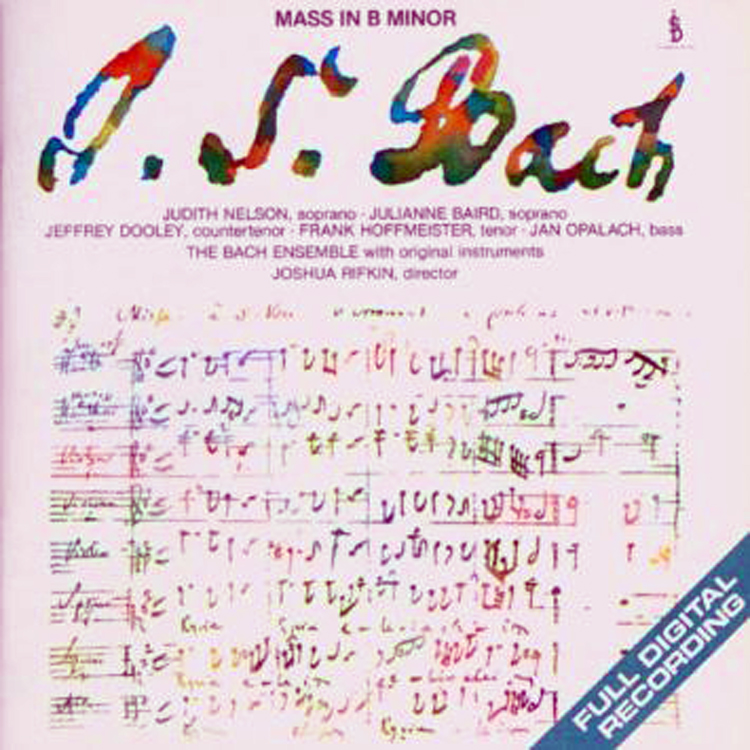
klemperer 6I am listening as I write this to Bach’s Mass in B-minor, in a version recorded in 1967 by the New Philharmonia Orchestra and BBC Chorus conducted by Otto Klemperer. I am blown away. rifkin cd cover

Not just at the music, which I know well, and have nearly a dozen recordings of, from Joshua Rifkin’s spare-outline version, with one singer per part, to the more full-blooded Robert Shaw version with his chorale and orchestra, to the zippy race-through by John Eliot Gardiner. Each is an event in its way — it is hard to make Bach’s music anything but beautiful and profound.

But Klemperer brings something else to the performance. You hear it with the first notes, the solemn adagio opening Kyrie. This is no period-instrument version, thin and edgy. This is the full power of Milton’s heaven resounding. You know this is not a collection of tunes, but rather a calling-into-being of the entire universe. One is reminded of the opening of the King James Genesis. This is serious music.

kyrie adagio

Since this recording, a prejudice has developed against grandeur: The authentic-instrument, period-practice movement took hold. One year after Klemperer’s recording, Nikolaus Harnoncourt released his stripped-down, lean and brisk period performance. Since then only a very few have ventured to record the music with a symphony orchestra and large chorus. Instead, we have chamber versions, and even smaller ones, such as Rifkin’s. I am not here to complain about them: Many are beautiful and thoughtful. And I would not want to do without Gardiner’s version. But in the quest for authenticity, something has been lost: In the search for “what Bach actually heard” using instruments of his time, we have given up what Bach meant.

This raises the question of “intent.” Period advocates measure intent by musicological and historical standards: Bach’s brass players had no valves, strings were gut, bows were slack, pitch was lower. All these things can be documented. But intent is more than that. Bach intended to create the glories of the heavens on earth. And one doubts Gabriel’s singers and instrumentalists were bound by the constraints of period technology. Bach intended his music to be as grand has possible. If what was possible in his age was limited, that should not restrict us to 18th century limitations.

Klemperer was famous for what has charitably been called “granitic” performances of Beethoven and Mozart: His slow tempos and careful orchestral balance underline the monumental structure of the music. If rhythmically driven or lyrically pretty music is what you seek, look elsewhere. Klemperer makes you see the music as something sculptural, complete from all angles and subject to minute scrutiny. This is certainly not to everyone’s taste, and when it comes to Beethoven symphonies or Mozart operas, Klemperer is a world I wish to enter only periodically, as a sort of reminder that not everything is Riccardo Chailly or Leonard Bernstein. Klemperer does not seem interested in our pleasure, and even less with our attention spans. This is serious music and he intends you to take it like that: It may be work, but you are better off for it in the long run.cd cover 2

But when it comes to Bach — and here we must mention also his monumental recording of the St. Matthew Passion — this approach gives us a weight and profundity that elevates the music. Instead of using his musicality to discover what Bach wrote, he uses Bach to discover the vastness and emotional depth of Creation. Bach is not the end, but the tool.

Now, for many current music lovers, this is a distortion of what Bach meant. And for many, this can come off like grandiosity. Expectations are lower these days: We find solemnity and profundity suspect. And Postmodern culture looks for art to be about art, about culture, and not about Providence or our place in the cosmos. We wish to remain modest about such things. “About what we cannot speak we must remain silent.”

The historical-performance people have this take on the music. Bach used dance movements, they tell us, and so the music should dance. They hit bar-lines like blacksmiths, beating out the rhythm, as if every movement were a Landler, OOM-pa-pa, OOM-pa-pa. They break phrases up into choppy bits, claiming scholarship for authority. And I won’t even mention the flat, vibrato-less performance and often-squeaky 18th century instruments. The results become not music, but a museum display.

I don’t dispute that we may learn something about how music was performed 250 years ago and I don’t dispute such knowledge can be important and interesting. But I will continue to dispute this is music. This is academia invading the concert halls. And it comes off as interesting as academic prose. And who but a scholar wants to read a dissertation?

So, Klemperer uses the music to find a place in the cosmos, and if the cosmos is vast, so the music expatiates. It fills the space of the heavens. If it takes three days for an astronaut to reach even our closest neighbor, the moon, then so what if it takes the conductor 13 minutes to span the Kyrie. Yes, we could get there faster if we up the tempo, but we lose the metaphor in doing so.

It should also be noted that Klemperer has some of the best soloists available at the time: Janet Baker, Nicolai Gedda, Hermann Prey and others. Full-throated singers who can rise above a full orchestra. klemperer caricature

One looks back at the history of art, music and culture and sees the pulse, diastolic and systolic, changing from an era that sees itself examining itself and human societies to one that looks for humanity’s place in the universe. We often call these impulses “classical” and “romantic,” but these terms are quite gross. The realities are more subtle. But think of Alexander Pope and compare him with Byron, for instance. Or compare Gluck with Wagner. We are in a slack period, uncertain about insisting on great themes, large statements, universal truths. In fact, we are likely to say there are no universal truths. The violent, murderous 20th century we lived through, full of ideologies and dogmas — all claiming to be universal truths — taught us to be more humble. Universal truths can be genocidal.

So, we have drawn back, like turtles into our shells, and claim that since a belief in truth can be bloody, therefore, there must be no truth. We have become a generation of Pontius Pilates. This makes emotional and historical sense, but it does not follow logically.

There is at least one universal truth, I believe, that is impossible to deny: We will all die. Death is universal. And if our own extinction is inevitable, so is its corollary: Everyone we love will die; everyone we love will leave us. Loss is a universal human experience.

If we start from first principles — and death and loss count as just that — perhaps there are inferences we can draw from these axioms. And even if some of them are not universal, they may still be widely prevalent among human cultures. Of course, we want to tread lightly with these. Stalin, Franco, Hitler, Pol Pot, Osama bin Laden may still give us pause. But we should not be deterred from seeking these inferences from first principles. Art that merely looks at art seems pasty-faced and weasely compared with the larger attempts of artists such as Michelangelo, Tolstoy, Homer, Beethoven — and Bach.

So, I say, open up the floodgates, let the dam overflow, give Klemperer his head and let it all fill us up, fill up that empty space we all feel, the community of humanity in our loss, our finality, our upward vision into the starry night for the immensity of creation.

And I say this as an atheist. Bach may be using the Catholic liturgy, but we don’t need to be Catholic to feel the power of the universe behind his notes. Bach, himself, wasn’t Catholic. His religion did not use the full Mass. But that didn’t stop him from filling out the words, in a language he did not speak, with counterpoint and harmony that reflects that immensity.

So, I don’t wish my Bach shrunk down to human size; I want my Bach to be a Mount Palomar opening into the cosmos.

The Mass has played out in the time it took me to write this short note. Now, I think I am ready to change the CD and begin the Matthew Passion. Open heavens, let me see into you.

Strauss IIThe German conductor Hans Knappertsbusch summed up the personality of composer Richard Strauss. “I knew him very well,” he said. “We played cards every week for 40 years and he was a pig.”

And yet he wrote some of the most beautiful music of the late 19th and early 20th century. He may have been a careerist, and his relationship with the Nazi regime was equivocal — he clearly despised them, but he nevertheless accepted the job as head of the Nazi musical apparatus. He frequently wrote how he despised Nazi propaganda minister Joseph Goebbels, calling him a “pipsqueak,” yet dedicated the orchestral song “Das Bachlein” to him in 1933 to enlist Goebbels support for extending his copyright from 30 to 50 years. Strauss was always looking after No. 1.Strauss I

When he took the job as president of the Nazi Reichsmusikkammer (State Music Bureau), Arturo Toscanini famously said, “To Strauss the composer, I take my hat off; to Strauss the man, I put it back on.”

In his youth, he wrote tone poems, lush in orchestration and hyper-romantic in emotional urgency. As the 19th century rolled the odometer over, he composed operas, beginning with Salome in 1905, which took his music in more Modernist and dissonant direction, then mellowing out and writing glory after glory, culminating in that most glorious of operas, Der Rosenkavalier.

But however effective the music at eliciting an emotion in the audience, there is often something reptilian about the music; Strauss is always cleverly manipulative and calculating; one never has the feeling that he is sharing an emotion, but rather that he is the puppetmaster who can control the feelings of others.

Something happened during the war that changed all that. Strauss clearly despised the Nazis — his daughter-in-law was Jewish; he continued to collaborate with Jewish librettists and as a conductor programmed banned music. But the war heralded a Gotterdaemmerung for German music and culture. Around him Strauss saw death, destruction, ruins and devastation. The music he wrote during and just after the war no longer seemed contrived and remote. There is an emotional immediacy to it that was new in his oeuvre. You can see the bombed-out city of Berlin in the soundscape of his Metamorphosen for 23 Solo Stringed Instruments, a profound and moving elegy filled with despair. In contrast, there is the modest, light and beautiful Oboe Concerto written for American oboist and soldier John de Lancie, who contacted Strauss during the occupation after the war and asked him for the piece. It is the masterwork of an aging master no longer needing to prove his genius, but simply expressing it.

But most importantly, there are the Four Last Songs, the final work Strauss composed before his death, at age 85 in 1949. No composer ever wrote a more moving farewell to life.

They were not originally intended as a group. He had written a song setting the poem “Im Abendrot” by Joseph von Eichendorff, and followed that two months later with three settings of poems by Herman Hesse. They were published as a set and ever since have been inseparable. It is impossible to engage with these songs and not feel the tears burn down your cheeks. This is emotion embodied perfectly in sound.

Before he died, Strauss requested that the premiere of the songs be given by soprano Kirsten Flagstad, and on May 20, 1950 at the Royal Albert Hall, she sang the songs, accompanied by the Philharmonia Orchestra conducted by Wilhelm Furtwangler. A recording of that performance, in bad sound, is available.Norman 4

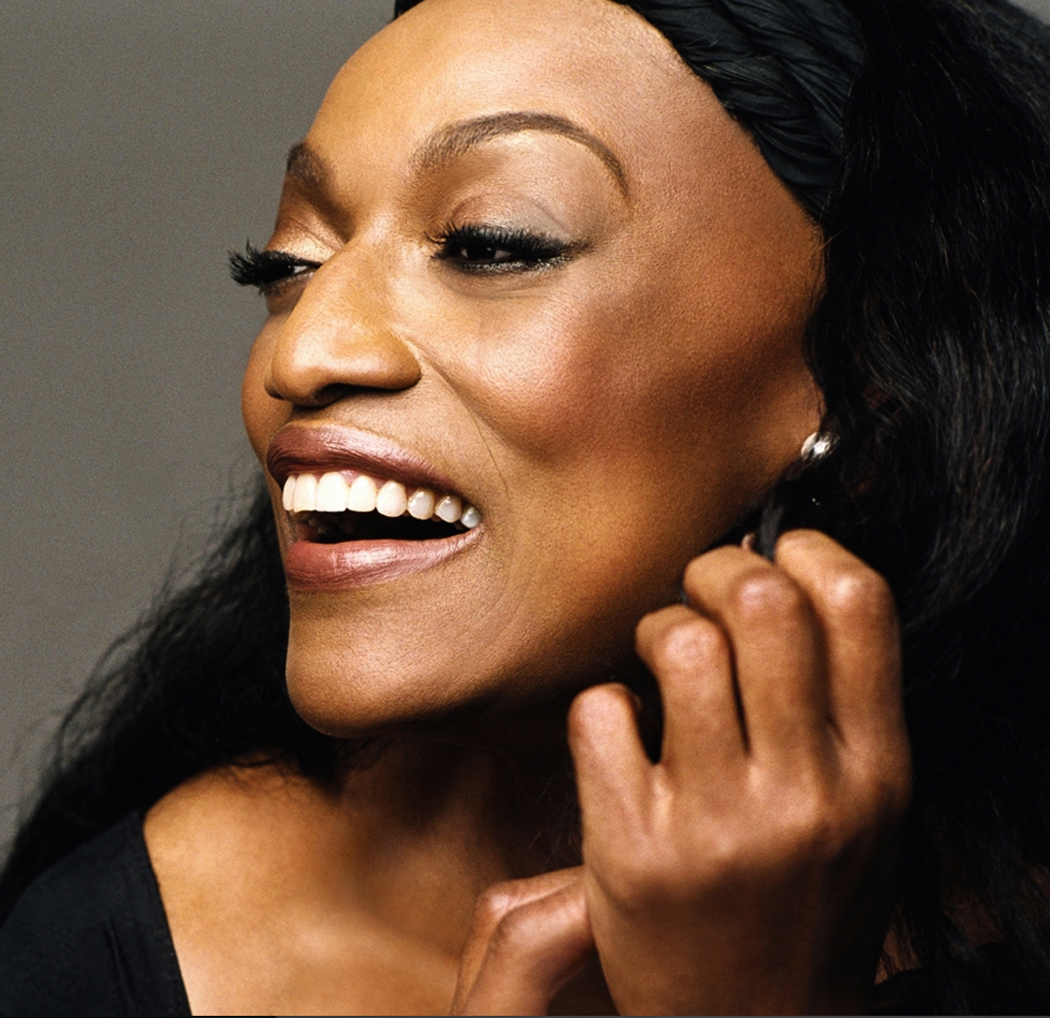
Much better is the overpowering performance on CD by Jessye Norman with the Leipzig Gewandhaus Orchestra and Kurt Masur.

It is the marriage of music and text that give the songs their power. I felt an overwhelming urge to translate the poems myself, lingering over the German words — words that have such cultural resonance in themselves: “Augen,” “Traum,” Denken,” “Einsamkeit,” “Tod.”

These are words that appear over and over in German lied, German poetry.

I was unhappy with the translations I have come across, often versified in singing versions, so to match the syllabification of the the German and the music. This turns the poetry into doggerel. I wanted to recreate the poems for myself, to make them my own. I give them here, for better or worse.

VIER LETZTE LIEDER

SPRING flowering tree

1. Spring

When I was living through dark,

Rocky places, I longed for

Your forests and blue breezes

Your smells and birdsongs.

Now you have arrived

In all the gleam and equipage,

Swimming in green light

Like a miracle.

You know who I am once more,

And you call to me sweetly.

And I give a shudder

As you run through my veins.

SEPTEMBER twig

2. September

The garden mourns.

The cold rain drains into the flowers.

Summertime gives its rattle

and dies once again.

Leaf after leaf, the gold drops

From the tall acacia.

Summer smiles broadly,

Amazed, sapped,

At its own dying gardendream.

It lingers by the roses,

And doesn’t want to leave.

Yet its hesitation is really exhaustion.

Slowly it shuts its tired eye.

SCHLAFENGEHEN wall

3. Going to Sleep

It’s been a long day,

And I need for the night sky

To gather me up in its sparkling arms

Like I was a sleepy child.

Hands, stop your running around;

Head, forget your buzzing.

All my senses now want to sink

Into the cool pillow.

And my soul, in an unguarded moment,

Sets upward in free flight,

Till in the magic ring of night

It takes on another life, deep and

A thousand times over.

ABENDROT tree in fog

4. In the Red of Evening

Through good times and bad,

Anger and joy,

We have walked hand in hand;

And now we take a moment’s rest

With the world all before us.

And everywhere, the valleys dim away,

And the details gray out.

You can begin to see the lights below.

And overhead, two larks fly alone,

half-dreaming into the velveting air.

Come closer to me,

And let them fly over us;

Soon it is time for sleep.

And we must not let the darkness

Separate us from each other.

The peace is wide and still,

Deep in the redness of the western sky.

How tired we are of this need to keep moving.

Is that what death is?

bachtrack page
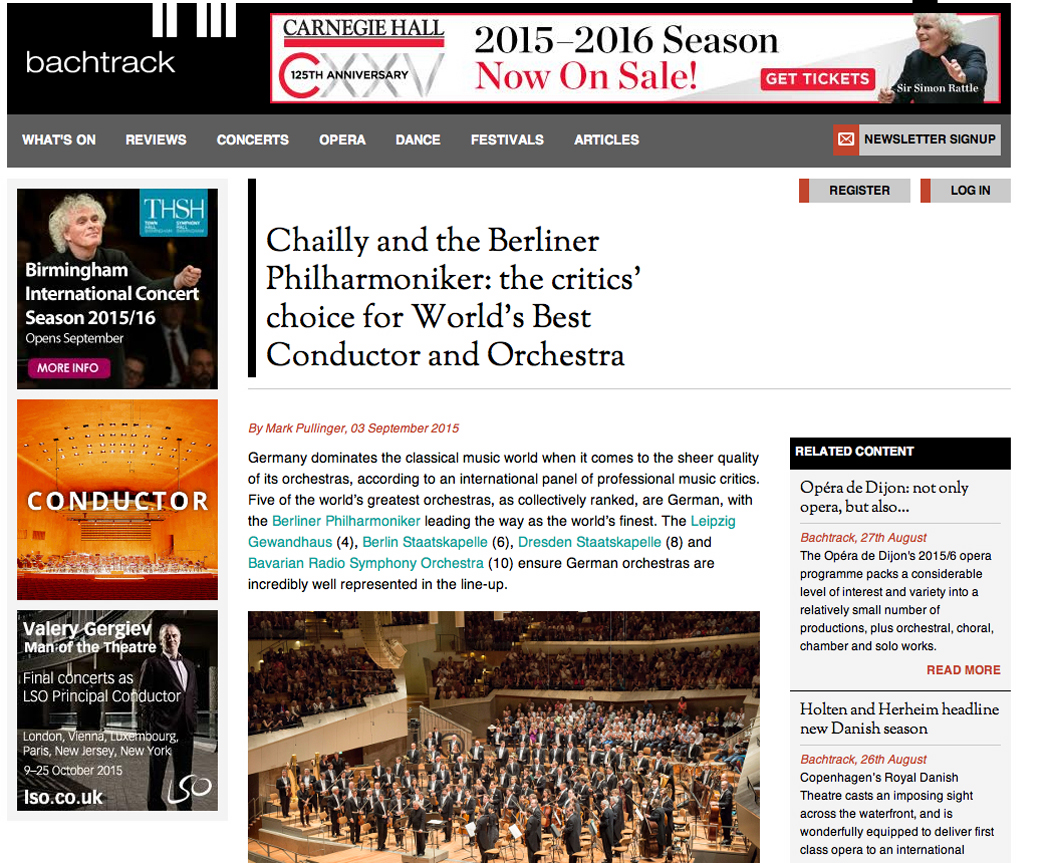
The website Bachtrack has just released its poll of (mostly) European classical music critics, choosing the top ten orchestras and top ten conductors in the world. It is a list designed to be argued with — as most such lists are — and a list with some very odd missing persons.

First, the primary news, which is hardly news at all: The top three bands in the world are Berlin, Vienna and the Royal Concertgebouw Orchestra. These three orchestras top almost everyone’s list. If they hadn’t been in win-place-and-show, we would all have known the contest was rigged.worlds best_orchestra_2015_bachtrackz

The rest of the list includes, in order, No. 4 through No. 10: The Leipzig Gewandhaus Orchestra; the Chicago Symphony Orchestra; The London Symphony Orchestra; the Berlin Staatskapelle; the Dresden Staatskapelle; the Boston Symphony Orchestra; and the Bavarian Radio Symphony Orchestra. All perfectly deserving bands, although some people in Cleveland might be squawking.

Only two American orchestras made the cut, but then, the ranking was made by Europeans (with only a handful of American critics included), so the bias is natural — they haven’t had a chance to hear the American groups. And of course, it goes without saying (except I’m saying it here) that all such rankings are essentially meaningless and serve only to start bar fights.

I can’t have any real opinion on orchestra rankings, because I only know most of them them through recordings. I haven’t heard all of them live.

The top conductor of the day, according to Bachtrack, is Riccardo Chailly, currently head of the Leipzig Gewandhaus. Also on the list: Simon Rattle; Mariss Jansons; Andris Nelsons; Riccardo Muti; Daniel Barenboim; Kiril Petrenko; Esa-Pekka Salonen; Yannick Nezet-Seguin; and Christian Thielemann. What? You say, no Bernard Haitink? No Pierre Boulez? There are several heavy hitters that are Missing in Action.

Such lists are inevitably subjective, and also political: Most of the critics gauged were German, so perhaps it is Valery Gergiev’s friendship with Vladimir Putin that has kept him off the list.

And I can say, from personal experience, that if you have only heard Haitink conduct on recordings, you may very well think of him as a timid kapellmeister. He is one of those musicians who seems to tone down his personality on recordings. I have heard him live with the London Symphony at the Salle Pleyel in Paris doing Beethoven’s Eroica, and it was one of the most exciting, and deeply moving performances I have ever heard. Live Haitink can be electric.

Still, for most of the baton-wavers, most of our experience of them comes on disc, and for most of them, the discs give us a very decent idea of their abilities. Chailly on disc is riveting. His Mahler Third is my personal favorite, and his recent Matthew Passion — swift enough to fit on two discs instead of the usual three — is a revelation.

So, I have an opinion on the top conductors, and it differs from Bachtrack’s list. My top conductors are not time-beaters, but have distinct personalities, so that you might hear a recording cold and think, that must be Gergiev, or that must be Pletnev. Many critics value the impersonal in performance: “Just the facts, ma’am,” and look for each performance to embody a Platonic ideal mystically assumed to be embedded in the score, with no “interpretation.” I don’t buy it. I want my music brought alive by someone who sees something in the music beyond the bar lines and semiquavers.

If I had a mission as a music critic for all those years, it was to make the case that music — particularly what is called classical music — is about more than entertainment, and that it has meaning beyond the mere patterns of notes on the page, and that musicians, no less than actors, must interpret the music, and bring their individuality to the game. No one wants a Hamlet where the best thing you can say is, “He stuck to the words on the page and didn’t try to interpret them.”

So, here is my list of the top conductors of the day, based both on live experience and on recordings: These are the conductors who give me exciting performances, show me something new, bring out the hidden, find the humanity behind the Pythagorean mathematics, and rattle my cage.

I can’t place them in order, like a horse race. So, as a group they are, in alphabetical order:barenboim

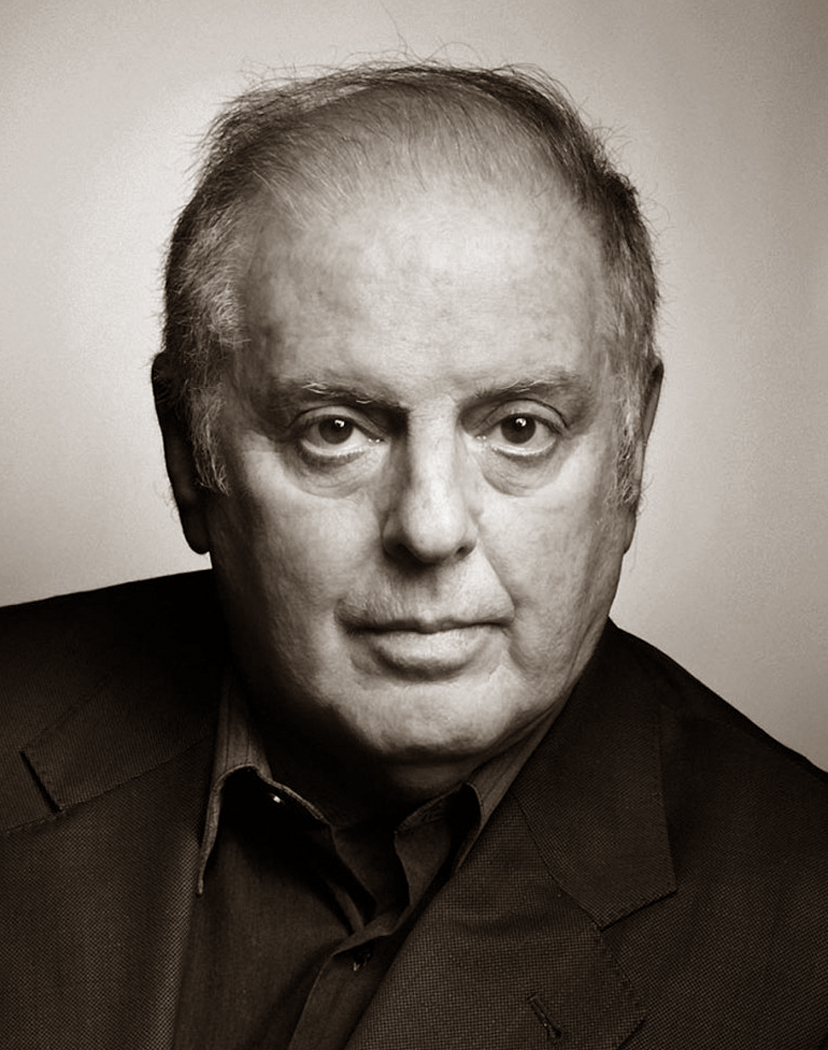
Daniel Barenboim — There is no doubt that Barenboim has ambitions of becoming the grand old man of classical music, and he has largely succeeded, taking up the mantle of a Furtwangler or Casals. There are times when his imitation of those giants of the past has been a kind of pastiche, an aping of idiosyncracies. But he has grown into a musician of considerable maturity and depth. The wishing-to-be has been overtaken by the has-become. His recordings of the Beethoven symphonies joins a few others as definitive, and his Bruckner recordings with the Chicago Symphony match brilliant engineering with perfect performances. boulez

Pierre Boulez — There is no one who does quite what Boulez does on the podium. His sense of color and balance is supernatural, and the crispness and cleanness of his performances are signature. He first became known to me through his recording of the Chereau Ring Cycle, where he managed to make Richard Wagner’s din sound like chamber music. His Mahler may be more “objective” and less manic than others, but no one makes the score more brilliantly etched. And he has a lock on the Second Vienna School. chailly

Riccardo Chailly — Over a long career, Chailly has found a corner all his own, bringing clarity and energy to familiar scores. His tempi tend to the speed-demon edge — he cuts an hour off the normal performance time for Bach’s Matthew Passion — but through some kind of maestro-magic, he makes those tempi expressive. Any performance by Chailly — especially with his house band, the Leipzig Gewandhaus — is worth hearing for what will be revealed. dudamel

Gustavo Dudamel — Yes, he’s the wunderkind and all that, and yes, there has been a kind of backlash against his celebrity status, but I heard him lead the Israel Philharmonic in Carnegie Hall playing the Tchaikovsky Fifth and that group of old pros — the kind of musicians who have played the music so many times, they don’t even need a conductor and who can be a little jaded — they looked like little boys being given a pony. Their eyes burned and they played like demons. I also heard him with his own LA Phil playing the Mahler First, and it was gangbusters. He’s for real. gergiev

Valery Gergiev — You have to see this guy on the podium; he’s all fingers. When he conducts, with both hands waving about spastically and each finger on each hand giving different cues, you have to wonder that his players can follow him at all. He has a very personal sound he draws from them: darker than other conductors, richer in the bass regions. I heard him twice in New York with his Mariinsky musicians dong Prokofiev and I feel I was given special insight into that composer. His recordings of Shostakovich’s “War Symphonies” are the best I know of that group of works. haitink

Bernard Haitink — There are unfortunately some musicians who just don’t record well. Yo-Yo Ma, for instance — his recordings are letter perfect and you could hardly ask for better, but they seem weak and pale compared to hearing him live, when you realize that you are, in fact, hearing God on the cello. Haitink can sound strait-laced on disc, but live, he can blow the roof off the dump. harnoncourt

Nikolaus Harnoncourt — This is a man who can be so perverse that you want to strangle him, yet, at times, that waywardness means you understand something you never did before. He brought “original instruments” out of the dark ages, but even with modern orchestras, he is likely to shake things up. And even when he’s not playing bad boy, as in his recordings of the Beethoven symphonies, he makes a personal mark on the music. The world will be a lesser planet when he leaves it. pletnev

Mikhail Pletnev — Pianists don’t always make great conductors. Barenboim and Ashkenazy are two of the few, and Pletnev, who is as wild a pianist as he is a conductor, makes my case that music needs to be interpreted. His Eroica is my personal favorite, played as I have never heard it before, with different accents and rhythms that bring the old chestnut back to its rightful place as being revolutionary.Berliner Philharmonie Gruppenbild Dez Berliner Philharmonie Gruppenbild Dez 2011 253

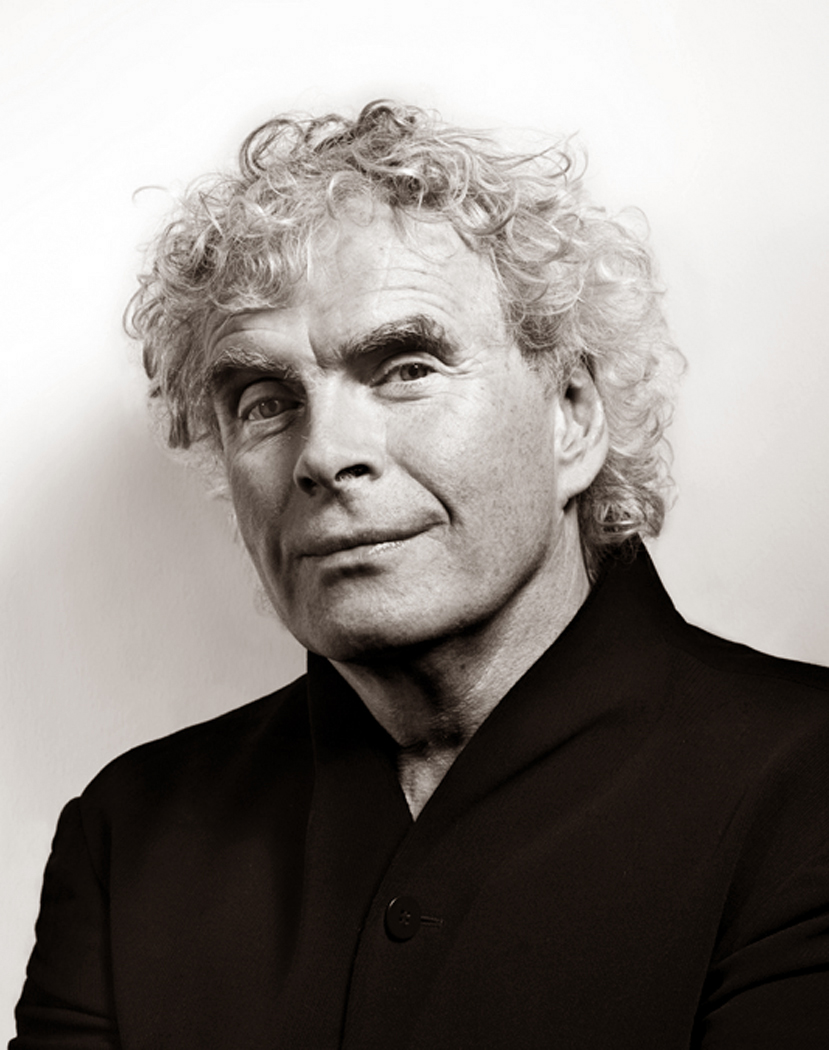
Simon Rattle — From the beginning, when he was the upstart at the City of Birmingham Symphony Orchestra, Rattle showed a talent for both new music, new angles on old music, and a general awakeness to the world and its music. When he moved on the Berlin, he was a race car driver given the fastest machine in the world. The recordings he has made with them are nearly perfect. There is a depth behind the sheen. He finds the wit in Haydn and the neuroses in Mahler, the Weltschmerz in Brahms and the impishness in Stravinsky. His range is spectacular.

That is my list. It has nine conductors. You get to choose the tenth.

stokie bach 2
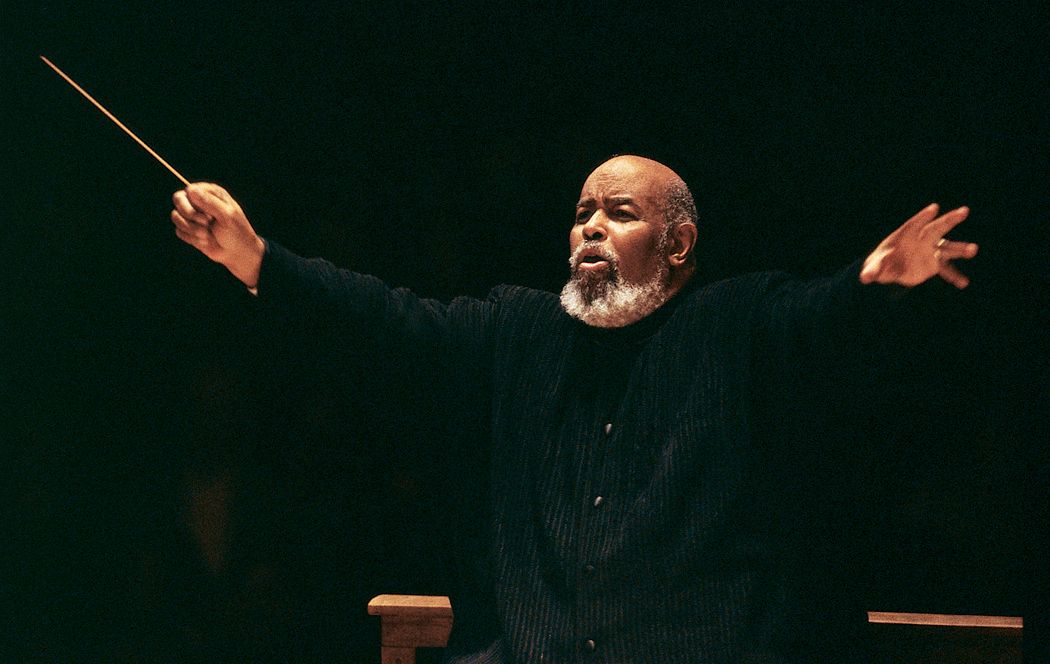
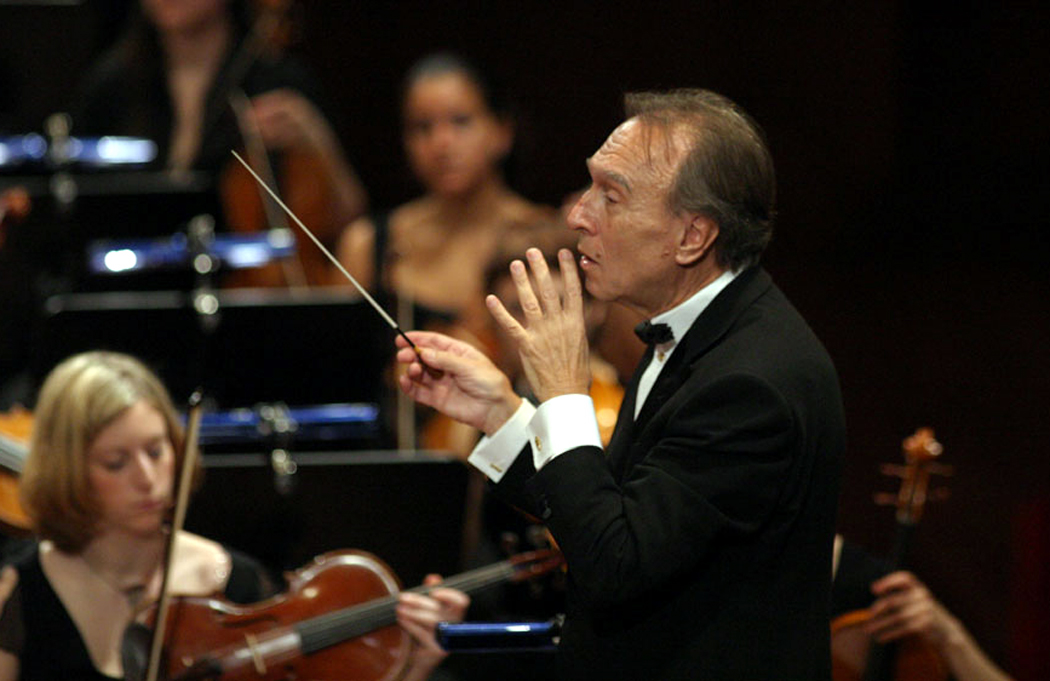
He stand up on stage, his back to the audience, raises his arms, flicks a thin shaft of wood and the orchestra sounds. As he beats time, the musicians keep up. He slows his arms, they slow the music; he speeds up, they race forward.

What is the magic of a symphony conductor?

The single most-often asked question I got as a classical music critic by a non-musician is: Just what does a conductor do? Is he necessary? Could I do it?

And this is a difficult question to answer, because orchestras differ, conductors differ and the music they play varies. No single answer is quite right. conductor 3 Lenny

For instance, when a Leonard Bernstein stands up in front of the venerable Vienna Philharmonic and gives a tiny wiggle of his wrist, the music stirs, just as if the baton were a swizzle stick; if a journeyman conductor stands in front of, say, an orchestra in Muncie, Indiana, and waves his arms like a madman, the players likely puzzle what the dickens he is trying to accomplish, or worse, are forced to ignore him.

(Or her — there are finally a growing number of women maestros, or maestras).

We say the conductor “leads” the orchestra, but what that means can vary quite a bit.

conductor 11 eduardo marturetIn current times, many conductors find themselves primarily in the position of traffic cops, keeping the music running on time, slowing the aggressiveness of the brass, or encouraging the timid violas to speak up.

In past times, the podium-master was a magician, drawing from the orchestra a singular and personal reinterpretation of the score.

But, you say, aren’t the musicians professionals? Don’t they know how to play the music? And, of course, in a good orchestra, they are. If it is an “old hand” group, with a long history of playing together, the orchestra may decide they know better than the tyro conductor how that Mozart symphony should go, and then, no matter what the minimaestro signals from the stand, they ignore him and go their own way. This often improves the performance; old hands often DO know what they’re doing.james de preist

It also depends on whether the conductor is attempting a “standard model” performance, matching the so-called Platonic ideal performance that almost every classical music fan has in his head — in such cases, the orchestra can run on auto pilot quite well — or whether he is an idiosyncratic baton waver, who will be asking the musicians to rethink the warhorse, in which case, if they are a conscientious orchestra, they will attempt to follow the baton.

Some famous conductors were notorious for changing their interpretations during performance. Wilhelm Furtwangler, most notoriously, could ask them to do the opposite of what they had rehearsed. He often defended this by saying he doesn’t know what will happen in the hall, where acoustics can change with the audience, how full it is, or how much wool overcoat the crowd — and the reverberant sound — may be buried under. He also depended on momentary inspiration for his performances: This gave the Berlin Phil under his stick a presence and vitality rare in the industry: Every moment was alive with possibility, and never a routine run through.

Or Sir Thomas Beecham, who famously hated to rehearse, and would spend the time running quickly through each piece and then announce, “That sounds about right,” and then, during performance, ask them all kinds of somersaults and bounce from the podium.conductor 2

Needless to say, not everyone can get an orchestra to turn on a dime, follow the baton like a setter on a leash, and roll over the interpretive cliff with the arch of an eyebrow. The major maestros can and could do this. The itinerant guest conductor is not often in that league (make that “almost never” and then cross out the “almost”).

There are those who decry an overly demonstrative baton-waver (Bernstein used to alarm an army of critics, who found him frantic on the podium, only later to change their initial opinions of him when they discovered he could draw life-altering performances from his charges). And there are those who praise the Laconian reserve of others, believing that there is some virtue in not hamming it up.

The truth is, either approach can create great music.abbado conducting

A symphony conductor has several jobs, not all apparent to the audience.

Let’s take them one at a time.

First, the major part of his work is done in rehearsal, not in performance. While working with the musicians, the conductor lays down the outlines of what he wants in the performance, things such as how fast they should play, how loud, and when the oboe should play louder to be heard over the horns, and when the horns should tone it down, so the oboe can be heard.

They work over phrasings, over such arcane things as the bowings to be used by the string players, the amount of vibrato, or when to alter the scorings (there are times when the parts must be gently rewritten for better effect — each conductor has his own conscience on such matters, but even the score-fanatic Arturo Toscanini regularly touched up his Beethoven).

conductor 4 kentThey also decide when to take marked repeats and when to ignore them. (Failure to make such things clear can create disaster, as when Beethoven screwed up a repeat during the premiere of his Choral Fantasy and had to stop the music altogether and restart the band.)

In rehearsal, the conductor’s personality and approach can make a difference. In the past, some conductors were absolute dictators, brooking no backtalk from the galley slaves. Others were more collegial, asking in conversation with the musicians what might work best. (Sometimes the orchestra, for instance, knowing the hall better than the visiting conductor, can help him understand the idiosyncrasies of the performance space).

Nowadays, dictators are rare. Musicians unions and simple common-sense have toned town the tyrants. A conductor cannot easily get away treating his subordinates like dogs. This is better for the poor musicians, but not always better for the music.conductor 7

Second, during the actual performance, the conductor tries to keep the music running on the schedule he has set during rehearsals, and tries to keep the musicians from straying too far from the plan. He beats time with his baton and uses his free hand to give hints, such as “more vibrato, please,” or “you, up there with the trombones, a little humility, please, we’re trying to listen to the cellos.”

But there is a third job the conductor has, and it is sometimes overlooked, indeed, oftentimes derided. That is the conductor’s duty to the audience. And I mean his visual duty, not merely his sonic one.

That is, the conductor, who knows the music well, can help the unsuspecting public understand what is going on in the music. Regular concertgoers don’t need much help with Beethoven’s Fifth, but especially in less familiar music, the body language of the conductor can point the listener in the right direction. The motions of the conductor can be theatrical for the audience, not merely technical for the players.

Certainly, there is a level of puritanism rampant in the classical music world that frowns on conductorial theatrics with the same disapproving hauteur that it reserves for those neophytes who applaud between movements, or leave the hall before the encores in what is sometimes called a “standing evacuation.” But a certain amount of theater can be a great help for the audience, who are often in the process of falling into a “confused slumber” while the music is droning on, and they can wake up for those moments when the conductor is hovering mid-air like an apache helicopter.bugs bunny conducting

The magic a great conductor can create is one of those things, like charisma, that we have all experienced but can never explain. Some got it, some don’t. The pretenders are embarrassing.

There are fashions in classical music, just as there are with everything else. Currently, there is a widespread prejudice that a good conductor shouldn’t “interpret” the music, but should let the music speak for itself. This sounds nice, but it is rather like telling an actor playing Hamlet, just speak the words clearly, don’t “interpret” them. There is a reverence for the score that would do a hardshell Baptist proud speaking about holy writ.

Yet, some of the greatest recordings to come down to us demonstrate that the personal vision of the conductor can make the music, not only come alive, but provide for the audience such a profound and moving experience that they are willing to shell out the price, often dear, of a ticket for the next concert, in hopes of something equally thrilling, even life-changing.

And anyone who actually looks at a score will know, there are hundreds of details that need interpreting. A score is by necessity a rather vague document. It tells us the notes, but not the music.opening two pages

Click to enlarge

Let us take a well-known example: the first page and a half of Beethoven’s Fifth Symphony. We can point out a few of the puzzles a conductor must deal with. Sure, he can rely on his memory of a thousand other performances, but a conductor should always start with the score, and this one has lots and lots of questions for him.

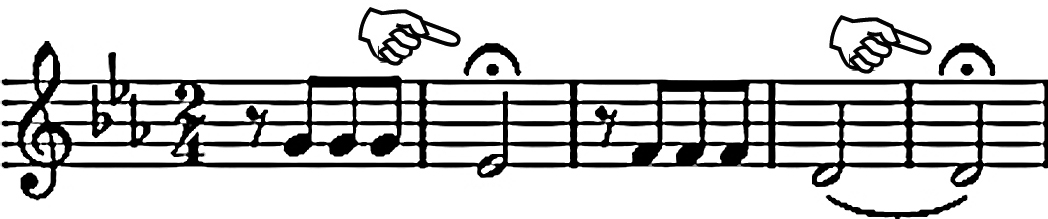
Right from the get-go, there are those four opening notes: “Dah-dah-dah-Dum.” Then repeated a step lower. opening motif

They are usually played as a triplet and a downbeat: “ONE-2-3-ONE.” But notice that the score actually begins with a rest. This is in 2/4 time and there are four eighth-note beats before the bar line. It is “(rest) 1-2-3-ONE.” Which throws the rhythm slightly off and turns it from a triplet to a pair of iambs. The first and third beats of a bar are accented; the second and fourth are recessive. The first note is on the second beat, so, the first bars go like: “I CAME to PLAY; I’m HERE to STAY.”

OK, but that creates a problem. As the symphony progresses, we hear that four note motif hundreds of times, and often so fast, piled one on the other that keeping the fine point of the rhythm is very difficult, especially for lesser orchestras. And when we hear it so often as a pattern, we tend to hear it as a triplet and downbeat.

Further, if we look deeper into the symphony, we find that the four note motif is repeated in all four movements, and in the third, it comes in a triple meter: It actually becomes ONE-2-3-ONE.scherzo

So, perhaps Beethoven always intended it to sound like three-and-one. Here is a decision that has to be made in rehearsal: The orchestra has to all agree, or at least the conductor has to decide which way he’s going to play it.

You can hear different recordings of the symphony and in some, you can hear the triplet-and-downbeat and in others you hear the pair of iambs.

The next decision you have to make concerns those two prominent fermatas (the “eyebrows”) over the second bar and the fifth bar.opening bar with fermata pointed

They indicate Beethoven want you to lengthen those notes and hold them longer than their measured length. But how long should you hold them? This will depend on how you see the rest of the symphony, or at least the rest of the movement.

Look at the first page and a half and notice how often there are rests and fermatas. This is a very odd symphony. It begins with a lot of ambiguities. Not only the issue of triplet or iamb, but what key is the damn thing in? The first four pitches are G to E-flat and F to D. There is no bass note to tell us whether we are in the key of E-flat major or in C-minor. It could be either. And with all those pauses and fermatas, we can’t initially tell whether the movement will be fast or slow.

As Professor Peter Schickele says in his sportscast of the Fifth Symphony, “I can’t tell if it’s fast or slow, because it keeps stopping.”
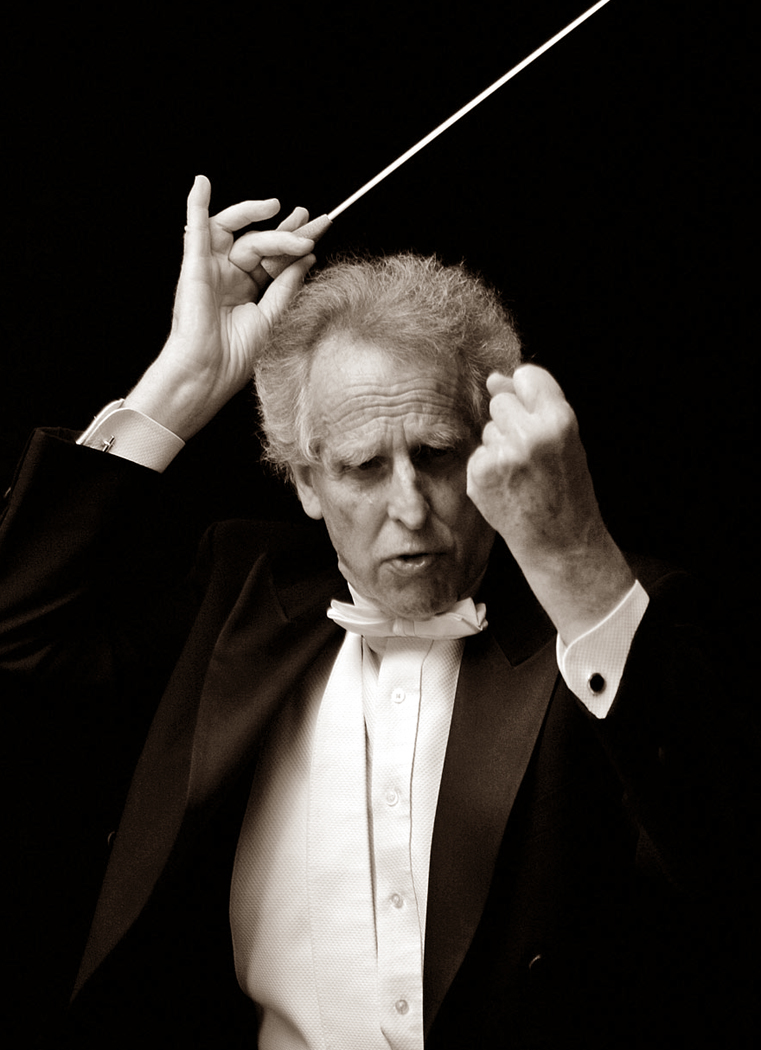
benjamin zander conducting vertical

This brings up a major interpretive choice the conductor has to make. Should he try to smooth things out to make a continuous movement with a propulsive sense of drive, or should he emphasize the herky-jerky stop and go? After all, Beethoven intentionally put all those stop signs along the road.

You can get an immediate idea of what your conductor thinks with how he handles those two first fermatas.
If he wants to drive the thing forward, he will barely hold the E-flat and D under the eyebrows, and keep the rhythm as propulsive as possible. Otherwise, he may tend to  hold those notes a very, very long time, breaking up any sense of forward motion.

Listen to two extremes: First, conductor Benjamin Zander, with a student orchestra plays the first movement like a bat out of hell, running through the stop signs. It is exciting and propulsive. It’s hard not to be caught up in the excitement.

Listen at: https://www.youtube.com/watch?v=4gXdWELSgEQ

LEAD Technologies Inc. V1.01Then, listen to Wilhelm Furtwangler and the Berlin Philharmonic in 1947, in the first performance the conductor was allowed to lead, after being finally cleared of Nazi leanings. The emotions, not just the thrill, are deep and profound. The world has just survived the worst war in history and the man who loved music and Beethoven above all else is finally allowed back with his beloved musicians. What a deeply moving performance, but how utterly different from Zander’s.

Listen at: https://www.youtube.com/watch?v=2qMwGeb6SfY

Some will say that it is Furtwangler’s emotions we are hearing, not Beethoven’s, but perhaps they need to be reminded that what we’re really talking about is emotions we all share. The audience had just been through a great conflagration. Their nerves were shot, emotions were near the surface. The performance acknowledges that: It is music for the NOW of the moment, and not a recreation of some 19th century moment. Surely this is the true purpose of the concert. If Furtwangler makes the undercurrent all the more palpable, he is truly giving us the heart of the music.conductor 9 mahler

This may seem like a lot of fuss to be made over four lousy bars of music, but they are essential to understand the music.

Now, if you look at the succeeding bars, you will see that the four-note motif gets tossed around the string section, from second violin to viola to first violin, and then repeats, as if it is piling the motif up on itself.

Taking approach No. 1, you want the motif to build into a theme, and you want the pattern to play as if it were performed by a single instrument, in a single singing line. If you take approach No. 2, you want to phrase the thing so that there is just a little hitch between violin 2, viola, and violin 1, so they can be heard as separate voices.

That phrase repeats, and then the four-note motif goes through its first metamorphosis, and becomes not three repeated notes, but in the treble, two repeated notes, and descending eighth note and then the downbeat note. It is a slide downhill. It is answered by the bass notes doing two repeats and a rising eighth note before the downbeat. Going uphill. with sine wave overlappedApproach No. 1 is to play these patterns almost as a sine-wave down-up, down-up, again as if it were a single singing voice. Approach No. 2 plays treble against bass, as if they were arguing, “I’m going downhill!” “NO! I want to go UP!” Back and forth.

Again, you accomplish this by phrasing the notes with a little hitch between the parts. That hitch is too short to be notated, and in fact, doesn’t necessarily alter the beat at all, but rather you simply hesitate a microsecond before each entry, creating a minuscule gap between the phraselets. Disintegration, not the through-line, is the guiding metaphor for this version of a performance.

You might notice in the score that underlying this sine-wave/argument the cellos and bassoons are playing an alternating C and B, which are the home note and leading tone of the key of C-minor. The conductor has to decide how prominent to make this counter-melody. Is it merely background, or is it something paying auditory attention to?

You might also notice that until this point, the double bass has had nothing to play, outside underlining the opening motif notes. Since then, they have been silent. But now, the whole orchestra lights up in a tutti cadence, and we come to a natural “joint” in the structure of the symphony, a big gesture rounding off a section of the musical argument. (You don’t need to understand this, but the cadence uses a D-major chord, technically the dominant of the dominant, to end the cadence on a G-major chord, the dominant chord of C-minor — for the first time, Beethoven has used a chord outside the key of the symphony).

But wait, as Ron Popeil might say. That cadential G-major chord includes a whole note with fermata on the first violin section, which seems to have taken it upon itself to play “outside the box,” as it were, refusing to punch out that G-major with the same brusk hit that the rest of the orchestra uses, it holds on, as if it were a misbehaving child.

violin fermata 2

Again: How long should the violins hold that fermata? Approach No. 1 says, not long, we don’t want to slow things down. Approach No. 2 says “But we’re trying to interrupt the flow as often as we can.”

While we are on that half-note G that the violins hold, a decision has to be made whether the note should be played at a constant dynamic level, and a constant intensity, or whether it should include a bit of a climax: Should they slightly increase the volume as they hold the note, or slide the bow lower on the string to change the intensity and timbre of the tone as they hold it; should they do a slight decrescendo on that note, letting it die away; should they do a slight increase and then decrease in volume or intensity, making a kind of whoooOOOOooo out of the note; and should they just end the note, or let it die away, or should they punctuate the end with a kind of plosive end, as if they ended in a “T” or “P” sound? The choice will depend on what the conductor believes the symphony is trying to accomplish.

So, with that fermata, does the conductor hold up the next series of notes a bit, or does he dive ahead as strictly as he can? Of course, the next notes are the four-note motif again, and another fermata and another stutter and hold. conductor 5 bert hulselmans

One thing I haven’t mentioned yet is the basic tempo. Beethoven gives us a metronome marking for the movement, where a half-note beat registers 108 on the Maelzel metronome. This is very fast, indeed. There is a  problem — or at least a question — about Beethoven’s metronome markings. They are all rather fast, compared to the way the symphonies have been traditionally performed. The HIPP (“historically informed performance practice”) crowd believes the metronome markings should be taken seriously and biblically. The traditional crowd notes that Beethoven didn’t come up with these metronome markings until late in his career — they are retrofit to the scores — and that when he came up with them, he was stone deaf. They point out that the early metronome Beethoven had may have been malfunctioning. And that if you hear music only in your head, it is likely to be heard faster than you would experience it in a working ear.

When he actually tried to perform the allegro of his Ninth Symphony at the tempo marking he originally indicated, he realized it was off by a third, and reduced it from a metronome marking of 120 to 88. We should keep that in mind when we proscribe any variations from the printed metronome numbers.

Either way, Beethoven made clear that he wanted the tempo indicated to refer to the beginning tempo only, and that he expected his musicians to alter the tempo as the music progressed to further its expressivity.

The quote: “My tempo markings are valid only for the first bars, as feeling and expression must have their own tempi,” he wrote.

Beethoven was no fan of metronomic performance.

And, how can you have a meaningful metronome marking when the music keeps stopping and notes are asked to be held against the prevailing metronome beat?

A lot of decision have to be made even in this first page and a half. Many of them have to be hashed out in rehearsal, so the orchestra is on the same page with the conductor.

But others can change during performance. Orchestra overhead shot copy

The phrasing has to be agreed on before the performance, but things like how long to hold the fermatas may change during performance depending on many factors.

You know in theater, how the audience can affect the actors’ performance. A good audience brings out a better performance; a bad audience can turn the actors into automatons or can make them exaggerate their performances to try to force a reaction from a recalcitrant audience.

The same in music, and the conductor may alter his tempo, the length of holds and rests, in order to underline some interpretive detail that he believes the audience is not paying attention to, or conversely, is so in tune with the music, that he can risk some interpretive byways he would not attempt with a less attentive group.conductor 14 muslim

Or, it could be the occasion: Some national figure has just been assassinated, or some city has been bombed: the ritual significance of the music may make for a deliberately more emotional performance.

Furtwangler recorded the Fifth at least 12 times over the course of his career, from 1926 to 1954, and anyone who cares about the music deeply wants to have as many as possible, because they are each different. There’s one from before the war, during the war, the one just after the war when the conductor was first freed to perform again, and then recordings from the 1950s, in better sound, but as the conductor was aging. In 1943 in Berlin, the war was in everyones’ hearts and minds, and Furtwangler brings greater intensity to the music, with longer fermatas and more intense phrasing. Other recordings he made at different times are quite different. The particular way he plays the music was most likely spur of the moment, created during performance and not in rehearsal, as he asked the orchestra to “feel” along with him what he was attempting to do.

I hope I haven’t bored you with too much detail, or patronized you by saying things you already know quite well. I just want to help you enjoy classical music as much as I do. I cannot imagine life without it: As Nietzsche said, “Life without music would be a mistake.”


triangles
The late writer George Plimpton was famous for his participatory journalism: He risked life and limb while playing quarterback for the Detroit Lions, trading punches with boxer Archie Moore, blocking 100-mile-an-hour hockey pucks as goaltender for the Boston Bruins. All to get a good story. plimpton

But the only time Plimpton admitted getting scared was when he played triangle for the New York Philharmonic, facing conductor Leonard Bernstein.

“He would stare at Bernstein over the top of the triangle, metal rods gripped tightly, and look for some cue in the whirlwind of Bernstein’s movements that suggested it was time for him to play. And then: Ping!

The story was remembered in Barry Green’s book The Mastery of Music, by Philharmonic percussionist Walter Rosenberg, who tried to help the poor journalist.

“Bernstein would look at him and say, ‘George, would you play that note for us again?’

“George would pick up the triangle and play it again: Ping!

“The maestro would ask George to try it one more time.

“Another, rather tentative Ping.

“‘Once more,’ Bernstein would say as he cupped his hand behind his ear.

Ping.

“The tension in the room was mounting — the orchestra members didn’t quite know where Lenny was going to take this one. Finally, he said to George in a rather impatient, dissatisfied manner:

” ‘Now, which of those four pings do you mean? They’re all different.’

“Poor George was obviously in shock. He stood there trembling, his face a complete blank, not knowing what he had done wrong, or what he could possibly do to play his ping any better.”

He was playing the triangle, for goodness’ sake, an instrument that even kindergartners negotiate easily in rhythm bands. How hard could it be?

“A lot of people come up to me and say it must be easy to hit the triangle,” says Bill Wanser, former principal percussionist for the Phoenix Symphony, who retired in 2013 after 38 years at the back of the orchestra. “I tell all my students, you don’t hit anything, you play it. You touch the instrument because the touch you give the instrument determines the kind of sound you get from the instrument.”bill wanser and triangle

Bill Wanser

I talked to Wanser when the orchestra was going to play the Franz Liszt Piano Concerto No. 1 in E-Flat, which has such a prominent part for the lowly triangle that when critic Eduard Hanslick first heard it in during its premiere in 1855, he dubbed it the “Triangle Concerto.”

We talked in his home studio, surrounded by the drums, xylophones and timpani of his trade. A soft-spoken man, then 62, he had been with the Phoenix Symphony since 1975. He was hired by the late Eduardo Mata and has seen the orchestra through five music directors.

He has thought a lot about the lowly triangle and his part in the concerto.

“You have to have a concept in your head of what you want that sound to be like, before you actually play that note, because that’s going to translate, if you practice, to what kind of touch you give that beater when the triangle and the beater meet. If the touch is correct, the sound you have in your mind will come out correctly. But you have to have that idea.

“I’ve heard recordings when the triangle just sounds terrible because someone’s just hitting it. But with the right kind of touch, the right feel to the rhythm, the whole thing sparkles. That is what I try to do.”

Thus begins a mini lesson on the complexities of playing the triangle.Grover Pro triangle

First, there’s the triangle itself. It comes in many forms and sizes, mostly from 4 inches to 8 inches, made from steel, bronze or some alloy.

While a grade-school triangle can cost as little as a couple of bucks, a professional triangle sells for an average of about $75.

A Grover Pro bronze model is “meticulously hammered in a compact randomized pattern,” as the company’s catalog says, which “ensures that the inherent fundamental pitch is dampened and that the instrument’s intricate and complex harmonic structure is enhanced.”

The 6-inch version sells for $140.buddy and thien gold triangle

For those who admire James Galway’s gold flute, there is a 9-inch all-gold triangle, sold by Buddy and Thein, which goes for a cool $650.

The triangle came to European orchestras from Turkish janissary — or military — bands. The original version of the triangle had a series of rings attached to the bottom rung to make more jangle when the instrument was played.

It came to Europe after the defeat of the Ottoman Turks outside Vienna in 1683, when, supposedly, the fleeing Turks dropped their instruments in the field. By the time of Mozart and Beethoven, such “Turkish” instruments as cymbals and triangles had become part of the orchestra, at least for military effects.

That percussion became a regular part of the orchestra in the 19th century, and such exotic instruments as the cymbal, the tam-tam (Chinese gong) and the lowly triangle became means for composers to “colorize” their music.

But the triangle itself is only the beginning. There is the beater to consider.triangle beaters

Black Swan Percussion offers a set of six differently weighted beaters in a nylon case for $127.

“I have a collection of color-coded beaters,” Wanser says. “They’re various thicknesses. They used to make triangle beaters from solid metal, but these are not solid.

“We found that we can eliminate some of the contact sound if we don’t use solid beaters. So this guy came up with different thicknesses of metal wrapped around a shaft and separated from the shaft with epoxy.”abel triangle

Wanser has spread out his collection of triangles and beaters on a soft cloth over one of his xylophones. There are eight triangles of various sizes and metals and some 20 beaters.

He picks one up.

“I’ll probably use this one for the Liszt,” he says. “The metal is fairly thin, just a nylon insert in there, but still enough weight I can produce a pretty big sound. And then, it won’t have quite the tick.”

The tick, he says, is the enemy. You don’t want a metallic sound, like machine parts clanging together. You want something more like the “eructation of an angel,” a scintillant, chiming ping. If you hit the triangle the wrong way, or with the wrong beater, you can make it sound like a traffic accident.

“You have to think about where you hit the triangle. These are things most people don’t know.

“Hit it here and you get this tone: Ping.

“If I play more toward the corner, where the metal is a little denser, then you get this: Ping, but a different ping.

“Or hit it near the top, and you have this: Ping.”

The sound of a triangle is not a simple note, like a violin note or a piano note. It is a mix of upper harmonics, all mixed together in a ping without a pitch. But hit it in different places, and you draw out different harmonics.

“You can almost get a triad out of it,” Wanser says. “Ping; ping; ping.

“And, of course, if I play at the very tip of the beater, I’m going to get a brighter sound. If I play more in the center of the beater, I get a much darker sound. Halfway in between, I get this sound: Ping.”

The sound of the triangle is usually meant to blend in with the orchestra, a coloration effect.

“There are not a lot of triangle solos,” Wanser says. “One that comes to mind is in Brahms’ Third Symphony. It’s a single triangle note that comes at the end of a quiet string passage and puts a period at the end of it: ‘Ding.’ It’s just a color that you want.

“But for the Liszt concerto, you want a bright, articulate sound because it’s a rhythmic passage, not just color, and you don’t want too much shimmer in it.

“When I play that, I’m going to move the beater around on the triangle because the second note is going to be a little brighter than the first, a little sharper sounding.

“Plus, it’s easier rhythmically if you move your beater along the triangle instead of hitting it in the same spot over and over. If you’re playing rapid successive notes, if you move just a little bit, it’s easier to phrase and make the rhythm clear and more articulate.”

And we haven’t even mentioned counting.liszt score

The score for the triangle — like that of many percussion instruments — has very few notes on it and many, many rests. Sometimes a hundred bars of rest before a note is hit. Percussionists count those rests. Wanser’s score for the Liszt concerto shows four lines of empty staves, with bars numbered on them. Over a single rest on the staff, there will be a number — 17 in one place, 32 in another — that tells you that rest covers 17 or 32 bars of tacit, or silence from the triangle. Wanser counts each bar.

“There’s tons of counting,” he says. “I’ve played for a lot of years, and I’ll find myself counting my steps as I walk down the street. I’ll sit and have big, long rests, and it’s a challenge to keep focused on what you’re doing.”

Click to enlarge

There are stories of percussionists reading books or checking how their stocks are doing while they are waiting for their single cymbal crash or gong cataclysm.

“That was probably more prevalent in the past than it is today,” Wanser says. “I studied with the legendary Fred Hinger, who was percussionist for the Philadelphia Orchestra and later for the Metropolitan Opera. I asked him, ‘How do you count?’

” ‘First of all,’ he said, ‘Never rely on any cues; never rely on anybody else. Do your own counting and always be 100 percent sure of where you are in the score.’angelica kauffmann Allegra

“You have cues written in your score,” Wanser says, “but I don’t rely on those cues because maybe the horn has miscounted or something. It doesn’t happen very often, but it would be the one time it happens, and it could throw everybody off.”

Is it any wonder that Plimpton sweated his time with Bernstein?

Of course, a triangle player doesn’t only play the triangle. He is a percussionist who will play whatever instruments are called for, drums, xylophones, woodblocks, glockenspiels, and even back up the principal timpanist if needed.

“I have a friend who plays with local amateur groups, and he’ll come over to discuss a part once in a while,” Wanser says. “He’s a decent drummer, but I’ll show him what I would do, and he’s amazed because he hasn’t been able to do it. He’s not a professional player.

“The perception is that anyone can be a drummer, but it’s not so. There’s a lot of people who can play drums and pick up the sticks and hit a drum, they have the coordination and can play very complicated rhythms. But do they practice eight hours a day, the way a professional musician does? Have they developed the muscle memory?

“So, when people say, ‘You’re a drummer,’ I say, ‘No, I’m a musician.’ “


beethovn lede photo
Ludwig van Beethoven would have turned 244 this week. belushi beethoven

Everyone knows Beethoven. He wrote “Da-da-da-dum” and “Ode to Joy.” He’s the scowling visage parodied by John Belushi on Saturday Night Live. He’s the plaster bust on Schroeder’s toy piano.

Ask anyone to name a classical music composer and nine out of 10 will utter his name. Even those with no familiarity with classical music know he’s the one who rolls over to tell Tchaikovsky the news.

So it’s not surprising that symphonies program his music more than anyone else’s, and often devote entire festivals to the music. schroeder 2
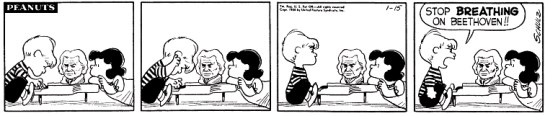
It would be silly to call anyone the “greatest” composer, but Beethoven — along with only Bach — is the one most often given that honor. Such is his power as a producer of human emotion through the ear canal, that his only real rivals in European art music are Bach and perhaps Mozart. That doesn’t mean he is everyone’s favorite composer. There are many who cannot stand his relentless pounding and drive. And surely among “great” composers, Beethoven probably has the third-most detractors, after Schoenberg and Wagner.

But it would be hard to find anyone who has altered Western music history more directly and obviously than the scowling master from Bonn. michael christie

“There are many reasons one could say Beethoven’s music is the greatest. His music speaks to the listener from the first note,” says conductor Michael Christie, music director of the Minnesota Opera.

It isn’t just that the music is familiar, it’s overpowering. It’s big, loud, sublime and of an intensity unheard before him.

“Just take the opening of the ‘Eroica’ symphony,” conductor Joel Revzen says. “The first two chords. Haydn or Mozart used a slow introduction to prepare us for what is to come. Beethoven takes a hammer and hits you over the head with it.”

Two crisp E-flat chords, and we’re off to the races.steve moeckel

“You can listen to one chord and know it’s Beethoven,” conductor James Sedares says. “He had a voice that was completely unique for his time and always.”

Violinist Steven Moeckel has given wonderfully insightful performances of Beethoven’s violin concerto.

“This may sound cheesy, but it feels, when you play it, Beethoven got a glimpse of heaven. Audiences are taken on this journey, so epic. Beethoven is on a heroic scale — and he means to be.”

Difficult to appreciate

But why does Moeckel qualify it? “It may sound cheesy … . ”

There are several things that stand between us and Beethoven, and make both the performance and appreciation of his music difficult.

Beethoven’s music is about big ideas, such as heroism, nobility, struggle, brotherhood. He believed in them; the question is, do we? Or have such ideas been rendered into toothless bromides and platitudes?

Can we still understand Beethoven’s music after the trenches of World War I, after Auschwitz, after all the dehumanizing misery of the 20th century?

Music historian Richard Taruskin has written about the difficulty of accepting the grand vision of Beethoven’s Ninth Symphony, with its paean to universal brotherhood.

“Why? Because it is at once incomprehensible and irresistible, and because it is at once awesome and naive,” he wrote.

“We have our problems with demagogues who preached to us about the brotherhood of man. We have been too badly burned by those who have promised Elysium and given us gulags and gas chambers.”

You can hear the problem in many modern performances of Beethoven. The conductor no longer believes in the grand ideas and falls back instead on the music’s obvious rhythm and drive. There’s a great divide between the conductors who performed before World War II and those who came after.james de preist
“I look for the old depth and breadth of expression that was there and can be retrieved if we listen to the right master,” the late conductor James DePreist said. “And most of the right masters are dead.”

You listen to recordings by Wilhelm Furtwangler or Willem Mengelberg and you hear a Beethoven different from that of Roger Norrington or David Zinman.

To many modern ears, the older performances seem melodramatic and overwrought. The modern performances seem cleaner and less fussy. The older conductors interpreted the music and massaged its rhythms. They conducted by phrase length, not by bar length, and they knew the rhetoric of performance and often spoke to their orchestras about the philosophy and meaning of the music. Modern conductors speak of the notes.

But Beethoven was clear about this. In the same way a great actor interprets Shakespeare when performing as Hamlet, and makes pauses and emphases, the musician was asked by Beethoven to do the same.

“The poet writes his monologue or dialogue in a certain continuous rhythm, but the elocutionist, in order to ensure an understanding of the sense of the lines, must make pauses and interruptions at places where the poet was not permitted to indicate it by punctuation,” Beethoven told his friend Anton Schindler. “The same manner of declamation must be applied to music.”

‘Writing for history’

But ours is an unheroic age. We reserve the word for firemen and soldiers, who certainly perform courageous acts. But a hero is more than that. Mythologically speaking, a hero is the individual who translates the will of the gods into history.

This is no small claim: A hero changes the world. Beethoven certainly did.

There is good reason to be suspicious of such things now. Too many have changed the world for the worse.lawrence golan

But Beethoven, born in Bonn, Germany, in 1770, clearly saw himself as a hero. He knew he was changing the world. He championed freedom and democracy in a restricted and aristocratic age.

“He changed the world of music,” conductor Lawrence Golan says. “Right off the bat, with the first chord of his first symphony. It was revolutionary at the time.”

He performed for the aristocracy and slummed with the nobility, but he told Schindler, “My nobility is here,” pointing to his heart, “and here,” pointing to his head.

“We’re clearly looking at big ideas in Beethoven’s music,” conductor Timothy Russell says. “Mozart wrote for an audience, but Beethoven knows he’s writing for history.”

History, however, has moved on.

Disposable music

For the 21st century, music has mostly become entertainment. Music written to be pondered and meditated upon does not fit into the jigsaw puzzle of a niche-market audience, where music is used and discarded in months.beethoven bust

“Beethoven wrote Velcro music and this is a Teflon Age,” DePreist says.

“We have deconstructed the 19th century and have an initial impulse to jettison so much of it. But the idea that the 20th century — or the 21st century — would simply supplant the 19th was absurd,” he says. “But we have much to learn from every century.”

The difficulty has been to separate the desire to be free from the past — which is an honest desire — from the tendency to ignore the past and refuse to look at what the past teaches us.

“It teaches us more than the notes of the stylistic things,” DePreist says.

Art has a responsibility to challenge people, says Moeckel.

“To broaden their horizons, and, so, if you don’t like it, that’s fine, but let’s talk.”

And what he confronts us with is the struggle of being alive.Joel Revzen 1

“Beethoven was a man who struggled every day of his life, a man shaking his fist at the heavens constantly,” says Revzen. “It is the human condition to struggle against adversity, whether socially, politically or one’s physical limitations. It is the struggle of the human condition through eternity.”

If you want to relate it to the contemporary world, he says, just think of what the people in in Syria or Afghanistan are going through just to survive, “or the people who struggle against oppression every day around the world, or the people who struggle in this recession.”

“How can I survive until tomorrow in hopes maybe my life will change?”

It is that engagement with the big things that drives Beethoven’s music and gives it such power to move us, even when we are suspicious of its meaning. The problem is ours, not Beethoven’s.

“There is still a message in the ‘Eroica’ or the ‘Ode to Joy,’ ” conductor Benjamin Rous says.

“Our time is broken in a way Beethoven’s music isn’t. Maybe a broken era needs an art that is whole.”

Three creative periods

Critics, biographers and historians divide Beethoven’s life and work into three periods: early, middle and late.

Since Beethoven, the tripartite division has come to fit the careers of many artists, but it began with the composer.beethoven young man

His Early Period features music that imitates the style of Haydn and Mozart, and although the music sometimes strains to escape the bonds of that style, it’s thoroughly Classical.

His Middle Period contains most of the music for which he’s best loved: the “Eroica” symphony, the “Emperor” concerto, the “Archduke” trio, the “Appassionata” sonata. It is big, brawny, heroic music that strains to escape not just the style but the very limits of the musical instruments of his time, the philosophical and religious conventions of his era, and sometimes the very heart in his breast. It is loud, pounding music.

“He grabs you by the collar and says, ‘I’m Beethoven, and I have something to say!’ ” says Revzen.

There are a lot of musical exclamation points in this very publicly aimed music.beethoven primary portrait

It is in the Middle Period that Beethoven staked his claim to being the first Romantic composer, emphasizing emotion over formal restraint. But, as conductor Benjamin Rous puts it, “He started out as Classical and ended up as Romantic, but in reality, he was Classical and Romantic at every moment in his life.”

Finally, Beethoven’s Late Period defines the term for all others: The music becomes more inward and searching, it has left behind the formal constraints of the time and experiments with new form, new meaning and expression. His late quartets bewildered not only the audiences of his time but the musicians who played them.schuppanzigh

“Do you imagine, when the spirit speaks to me, I have your wretched fiddle in mind?” he asked violinist Ignaz Schuppanzigh, whose string quartet premiered most of Beethoven’s late quartets.

Beethoven’s late music remains a challenge for many listeners. The “Grosse Fuge,” was his final movement to the string quartet op. 130, but was a movement so difficult for both listeners and performers that when Beethoven originally submitted it for publication, his publisher requested he substitute something easier. It is still work to listen to, albeit work with a tremendous payoff to those willing to dive in.

The rondo he wrote in its place as the quartet’s finale turned out to be the last piece of music Beethoven wrote before his death.

A gut reaction

Ludwig van Beethoven was probably history’s most famous sufferer of irritable-bowel syndrome. It made the composer’s life miserable and likely accounts for the scowl he wears in almost every portrait.

“The cause of this must be the condition of my belly which, as you know, has always been wretched and has been getting worse, since I am always troubled with diarrhea, which causes extraordinary weakness,” the composer wrote a friend in 1801.beethoven death mask
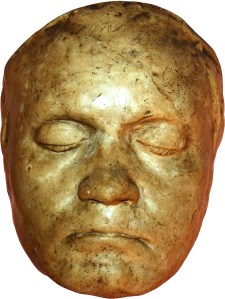
It was a problem that plagued him his entire life, and its likely cause is what killed him.

This may seem an undignified way to introduce “the greatest composer in history,” but you have to do something to clear away the idolatry that accumulates around a world-changing figure, to see him as a man rather than a demigod.

Otherwise, when we spin panegyrics about the man’s greatness, our eyes will glaze over, reading it as conventional boilerplate.

So, it must be said that this colossus who changed music and directed its course for more than a century was in reality a short, stocky German with a provincial accent, boorish manners, who wrote in bad grammar and frequently uttered banal platitudes as if they were earth-shaking profundities.

He was born in Bonn in 1770, and his drunken father tried to pass the child off as a prodigy, like Mozart. But Beethoven’s virtues were not Mozart’s: He had none of the grace and felicity of Mozart; his music grew from hard work and infinite rewriting.

Beethoven went to Vienna to make his fortune as a piano virtuoso and found many aristocratic patrons. He frequently insulted the hand that fed him.

He told one of his patrons, “Prince, what you are, you are by accident of birth; what I am, I am through my own efforts. There have been thousands of princes and will be thousands more; there is only one Beethoven!”beethoven ear trumpet

But just as he began to achieve fame, his hearing started to fail. In later years, he was completely deaf: At the premiere of his Ninth Symphony, a soprano had to turn him around onstage so he could see the applause he could not hear.

Each new piece found both acclaim and criticism: Conservatives disliked the profusion of ideas in the music, finding them confusing and the works too long and difficult; admirers recognized in his work overwhelming emotional power.

By the time of his death, in 1827 at the mere age of 56, he was generally acclaimed as the greatest composer in the world. More than 20,000 people attended his funeral.

It is only in recent years, after scientific analysis of a few strands of his hair, that we know how the composer died: It was lead poisoning, probably by drinking wine from a lead-lined cup, that slowly killed the composer and probably caused his lifetime of colic.

The ‘Mighty Nine’

Beethoven’s nine symphonies are the cornerstone of classical music. Every conductor cuts his teeth on them; every audience expects them.

Their monumentality influenced every composer who came after him for at least a century, and even now, it’s impossible to dip into classical music without addressing “The Nine,” as they’re known.

But the symphonies are very distinct; each has its own personality. Collectively, they are probably the best entry point for discovering the music of the titan, Beethoven.

There are many sets of them on CD, spanning nearly the entire history of recorded music. The first complete set of symphonies was recorded in 1920 and since then there have been at least 100 traversals. There have been 60 full sets sold since 1960. Herbert von Karajan recorded them all four times, Bernard Haitink and Eugen Jochum each did it three times. Any conductor worth his salt wants to prove his mettle by tackling the nine.

There is no one “best” set — pretty much everyone is agreed on that point — but if you want them all in one package, you could hardly to better than the set with Daniel Barenboim and the Staatskapelle Berlin recorded on Teldec. Both the performance and engineering are tops. Teldec makes the orchestra sound like it’s in your room with you. Barenboim has a unified and coherent view of the cycle which is intelligent and emotionally persuasive.

But for some, it will feel old-style. It is. If you want the modern huff-and-puff race to the finish, then you should look to John Eliot Gardiner and the Orchestre Revolutionnaire et Romantique on so-called original instruments.

You could hardly find two more different views of the music, but both are played with commitment and musicality. (Avoid the Norrington sets, which are dreadful and downright unmusical).

One-by-one

There are many who insist the best way to acquire the best of them is to get them individually and not in complete sets. Different orchestras and different conductors respond to certain symphonies better than others. David Zinman and the Tonhalle Orchestra Zurich, for instance, cannot be beat for discovering the wit and verve in Beethoven’s first symphony, but they don’t really believe in the nobility and heroism inherent in the bigger, odd-number symphonies, like the Fifth. For that, you have to go to an old-order conductor, such as Wilhelm Furtwangler and the Berlin Philharmonic, which recorded the most harrowing and emotionally wrought versions of the Fifth Symphony.

Any choices among the symphonies will be idiosyncratic: As listeners we are just a variable in our sympathies as the conductors themselves. You may want the bounce and beat of a modern performance, or you may be more moved by the old tradition.

These are a few of my suggestions, along with some information about each of the Nine.

Please note that modern critics aren’t the only ones who are idiots.

Symphony No. 1 in C

First performed: 1801.
david zinmanBeethoven’s first is his lightest, brightest and funniest, an obvious imitation of the spirit of his teacher, Joseph Haydn. Its jokes begin with the very first notes: a dissonance in the wrong key!

Initial critical response: One critic called it “a caricature of Haydn pushed to absurdity.”

Suggested recording: No one has captured the wit of this symphony better than David Zinman and the Tonhalle Orchestra Zurich.

Symphony No. 2 in D

First performed: 1803.

bernard haitinkNow considered one of Beethoven’s “shorter, lighter” symphonies, it was a large symphony by the standards of the time and a challenge for its first audience.

Initial critical response: The Leipzig critic called it “a gross enormity, an immense wounded snake, unwilling to die, but writhing in its last agonies, and (in the finale) bleeding to death.”

Suggested recording: Bernard Haitink and the London Symphony.

Symphony No. 3 in E-flat, “Eroica”

First performed: 1805.

bernstein youngThis immense symphony single-handedly changed the course of music history; twice as long as the standard Haydn symphony and built on ideas of heroism, with a great funeral march as a slow movement.

Initial critical response: The leading music journal of the day described it as “a daring wild fantasia of inordinate length and extreme difficulty of execution. … There is no lack of striking and beautiful passages in which the force and talent of the author are obvious; but, on the other hand, the work seems often to lose itself in utter confusion.”

Suggested recording: Many modern performances are too tame. For the needed heroism and grandeur, and the sheer visceral excitement, try Leonard Bernstein and the New York Philharmonic.

Symphony No. 4 in B-flat

First performed: 1807.

claudio abbado 2Robert Schumann called it a “graceful Grecian maiden between two Norse giants.” It seems like a retreat after the furious charge of the “Eroica,” but if it is less noisy, it is subtly subversive, with an introduction in the “wrong” key.

Initial critical response: Carl Maria von Weber wrote a review in which the orchestra instruments all bitterly complain about having to play this symphony and then are threatened with being forced to play the “Eroica” if they don’t shut up.

Suggested recording: Claudio Abbado and the Berlin Philharmonic are as elegant as it gets.

Symphony No. 5 in C-minor

First performed: 1808.

wilhelm furtwanglerFor two centuries, this has been Beethoven’s calling card, the primal symphony, restless, turbulent, an epic struggle to wrest a triumphant C-major out of an obsessive C-minor, and with more than 700 relentless iterations of the iconic rhythm: “Da-da-da-dum.”

Initial critical response: French critic Jean Lesueur said it was such exciting music that it shouldn’t even exist.

Suggested recording: The music is so familiar, and so emotional, it’s hard to play now without irony, but when attacked with conviction, it still packs a wallop. Wilhelm Furtwangler and the Vienna Philharmonic are still the champs in a pre-stereo recording, but in modern sound, Carlos Kleiber and the same orchestra come very close.

Symphony No. 6 in F, “Pastoral”

First performed: 1808.
bruno walter 2This is Beethoven’s musical picture of nature, complete with birdcalls and thunderstorm. But it’s also one of the composer’s most tightly argued pieces musically, with much of the symphony drawn from the first two bars: It’s a miracle of concision, even when most discursive.

Initial critical response: Berlioz agreed with critics, “as far as the nightingale is concerned: the imitation of its song is no more successful here than in M. Lebrun’s well-known flute solo, for the very simple reason that since the nightingale only emits indistinct sounds of indeterminate pitch it cannot be imitated by instruments with a fixed and precise pitch.”

Suggested recording: Every critic’s choice in this seems to be Bruno Walter and the pickup Columbia Symphony Orchestra.

Symphony No. 7 in A

First performed: 1813.
arturo toscanini 1Richard Wagner called this the “apotheosis of the dance,” and it is the most rhythmically driven of all symphonies; the second movement hardly contains anything but its rhythm. It all comes together in a Dionysian paean to the spirit of life.

Initial critical response: Weber expressed the opinion that Beethoven “was now ripe for the madhouse.”

Suggested recording: Even though it’s a pre-stereo recording, you have to hear Arturo Toscanini and the NBC Symphony in a driven performance that wrests every ounce of power out of the score.

Symphony No. 8 in F

First performed: 1814.

georg solti 1The composer looks backward with a smaller, almost Haydnish symphony, full of Haydnesque “jokes,” such as the metronome tick-tick of the second movement.

Initial critical response: One critic wrote that “the applause it received was not accompanied by that enthusiasm which distinguishes a work which gives universal delight; in short — as the Italians say — it did not create a furor.”

Suggested recording: Georg Solti and the Chicago Symphony give a brawny performance of this work and include a really fine Symphony No. 7 as well.

Symphony No. 9 in D-minor, “Choral”

First performed: 1824.
bernstein oldBeethoven’s magnum opus, which adds singers and chorus to the symphony and expresses the composer’s view of universal brotherhood and the joy of the cosmos. At more than an hour long, it is immense and usually performed for ceremonial occasions.
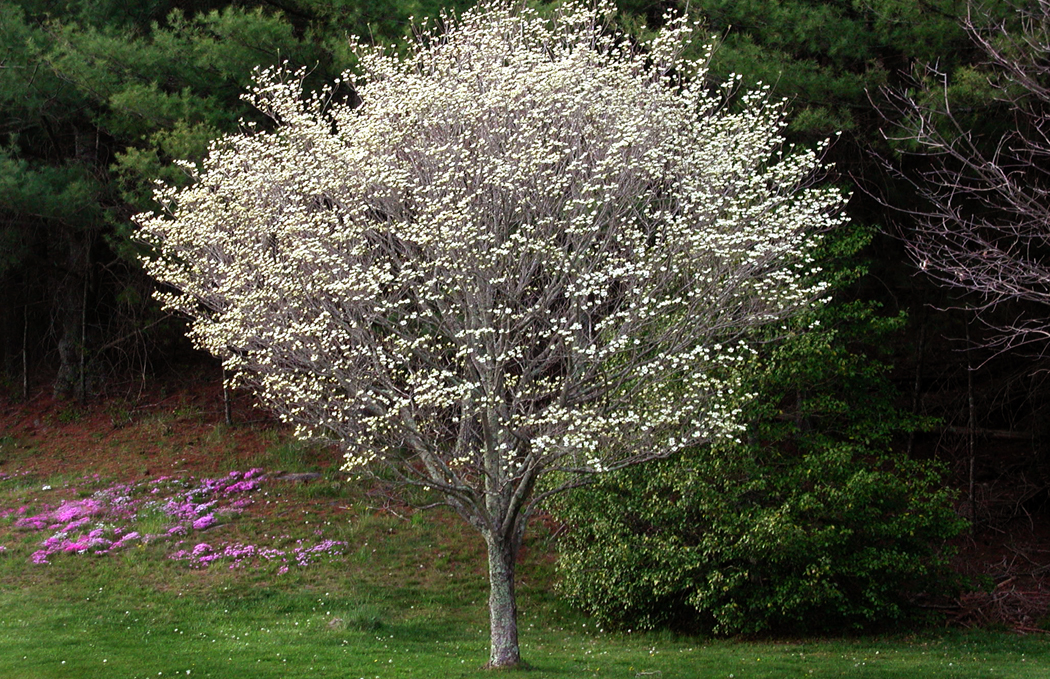
Initial critical response: “Beethoven is still a magician, and it has pleased him on this occasion to raise something supernatural, to which this critic does not consent.”

Suggested recording: Despite mangling the finale by changing Beethoven’s “Freude” (“joy”) to “Freiheit” (“freedom”), there is no more committed performance than the one given by Leonard Bernstein at the fall of the Berlin Wall in 1989 with an orchestra composed of musicians from many orchestras in both East and West Germany.