Archive

Tag Archives: paris

PARIS 2002
Days 1-3

Along the Seine

The Flight

In the spring of 2002, my wife, Carole, and I went to Paris for the first time. Some friends had just got back from Rome and waxed effusive over the experience and they encouraged us to follow their example and travel. We thought about it but decided that the north felt more simpatico than the sunny Mediterranean, and so finally decided on France. On March 25, we flew from Phoenix to London and on to the City of Light.

We left the house in Phoenix, Ariz., at 4:15 on Monday and got to our hotel in Paris at 4 p.m. the next day. It isn’t as bad as it sounds: With the 9 hour time difference, we were only in transit 15 hours. Well, it is as bad as it sounds. The time waiting in airports, cramped on airplanes, and riding around town adds up to one great pain in the ass.

And while British Airways is much to be preferred to most American airlines, that is still faint praise. The seats were sardined, the hours tedious, and the food bland. The flight from Phoenix to London was bad enough, but the short hop from London to Paris was a nightmare. The plane loaded up with Scottish soccer fans, all dressed in kilts, with tam-o-shanters and beer guts, and they yammered and yelled for the whole flight, making it more like a school bus than a jet plane.

“Hey, laddie, when you gonna take a rest,” yelled a Scot from one end of the plane to another. “Aye, and I suppose you are, too,” said his buddy at the back. And they all laughed at the joke, which was mute to the rest of us. It was like that the whole way.

One minor note: On the short leg, they fed us only drinks and snacks, which were “Pfeiffers’s Bread Sticks with Worcester Sauce Flavour.” Truly a bizarre taste. Little pegs of dry bread, about 3/4 inch long with the sharp taste of worcestershire sauce, coated as a dry powder on the surface.

Worse: the note on the back of the pack. “Best before Sep 02 2059.”

Now that’s a shelf life.

The following notes are from the daily journal I kept of the journey, day by day, excising some of the more quotidian bits. The photographs were all taken on the day described in the journal, even if better examples might be had on revisits. Click on any photo to enlarge. Each entry ends with a short summation, one each by me and by Carole. The first three days get kind of garbled together. That’s the way it felt with the jet lag.

Hotel Vendome horiz

The Hotel
March 27, 2002

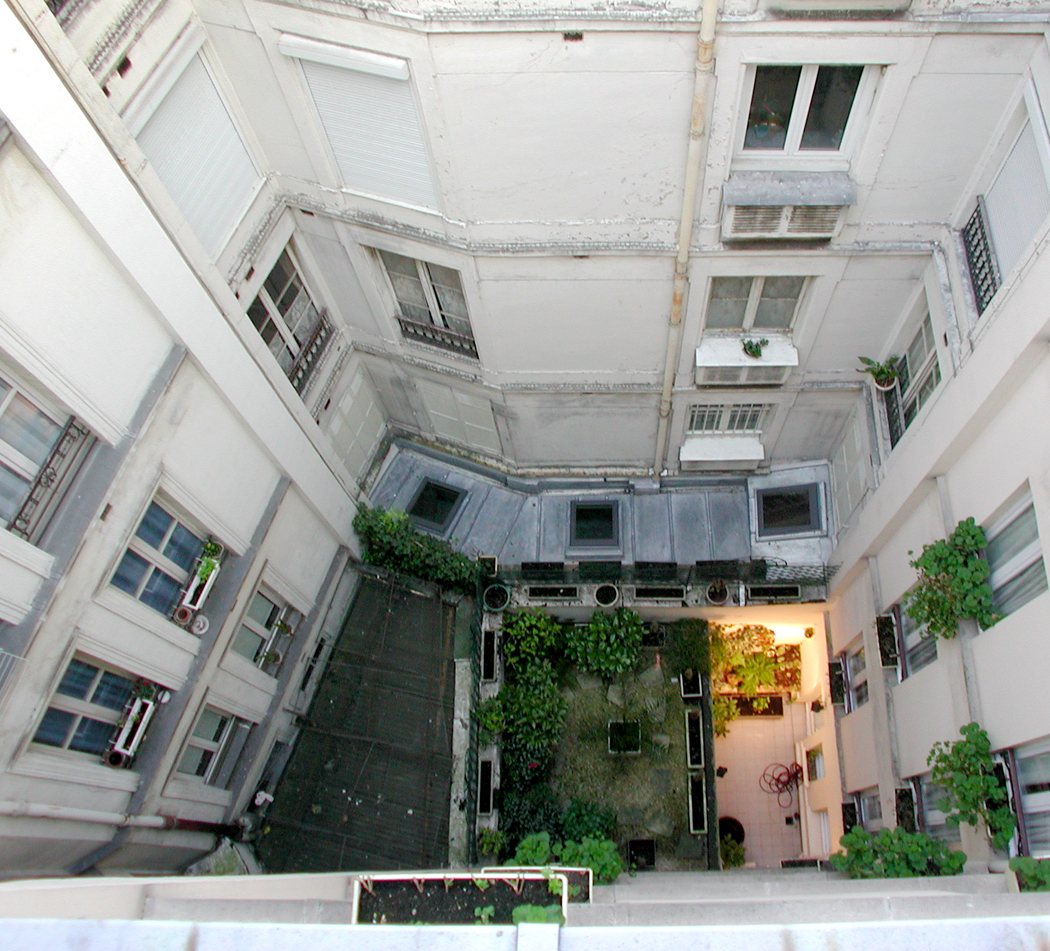
Paris airshaftWe stayed at the Hotel Vendome St. Germain, which is a hole in the wall place off the Rue Monge in the Quartier Latin. We got a room on the sixth floor, the top floor, looking into the courtyard. At the bottom, there are a few potted plants that serve as the “jardin,” of which the hotel website promises a “view.”

The hotel couldn’t be more Parisian, as far as we could tell. It is old, with peeling paint on the exterior — although the interior was nice enough.
The rooms are tiny, just room for a double bed, a small desk and closet. But it has a bathroom — even tinier — right off the room.Through window
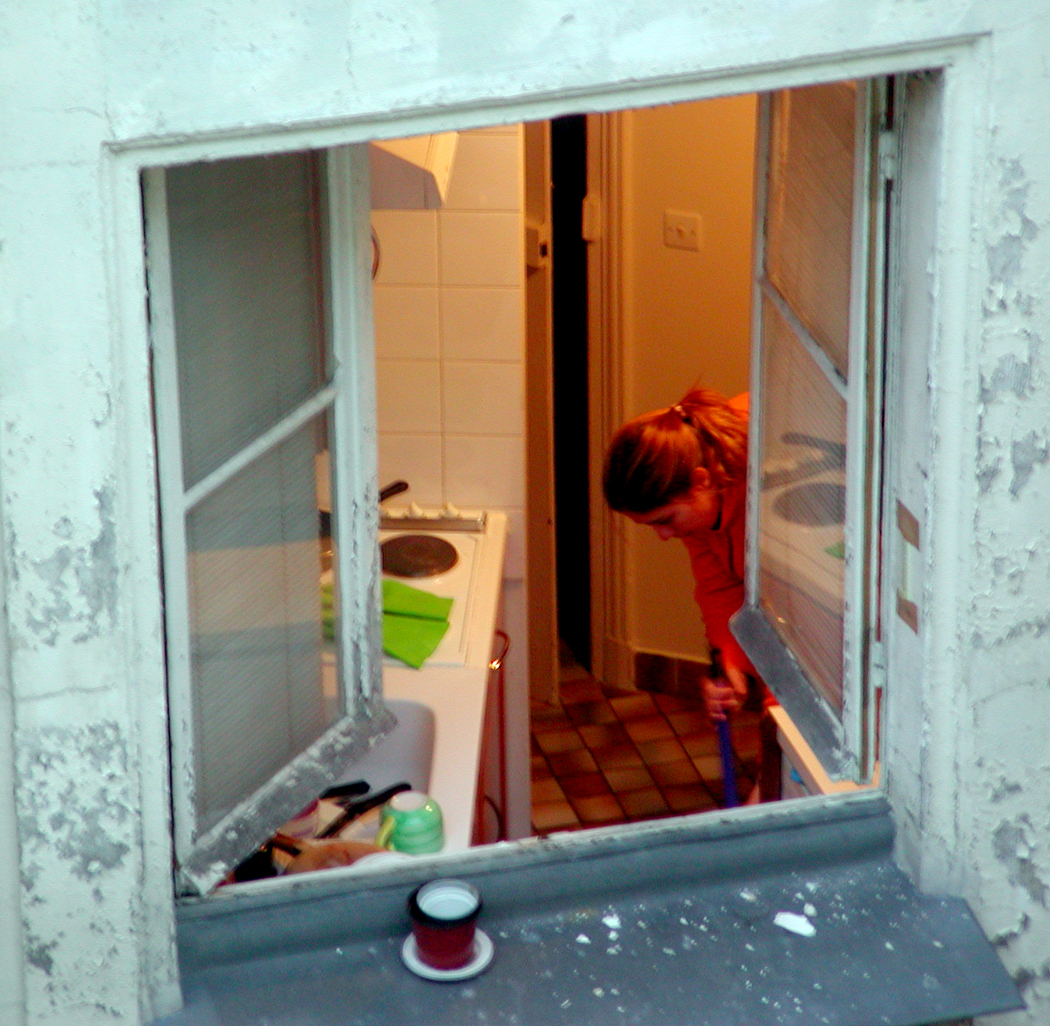
As night descended, we could see the people in the rooms across the “view,” apparently in apartments, cooking their suppers and sitting down to eat.

I could practically hear accordion music. Ou est Jacques Tati?

We were so exhausted from our flight that we collapsed in the bed without supper and fell asleep. Which sleep proved fitful at best, with both of us waking up about hourly, and trying to get back to slumberland.

By 6 a.m., we gave up trying to sleep and got up to start our first day in Paris.
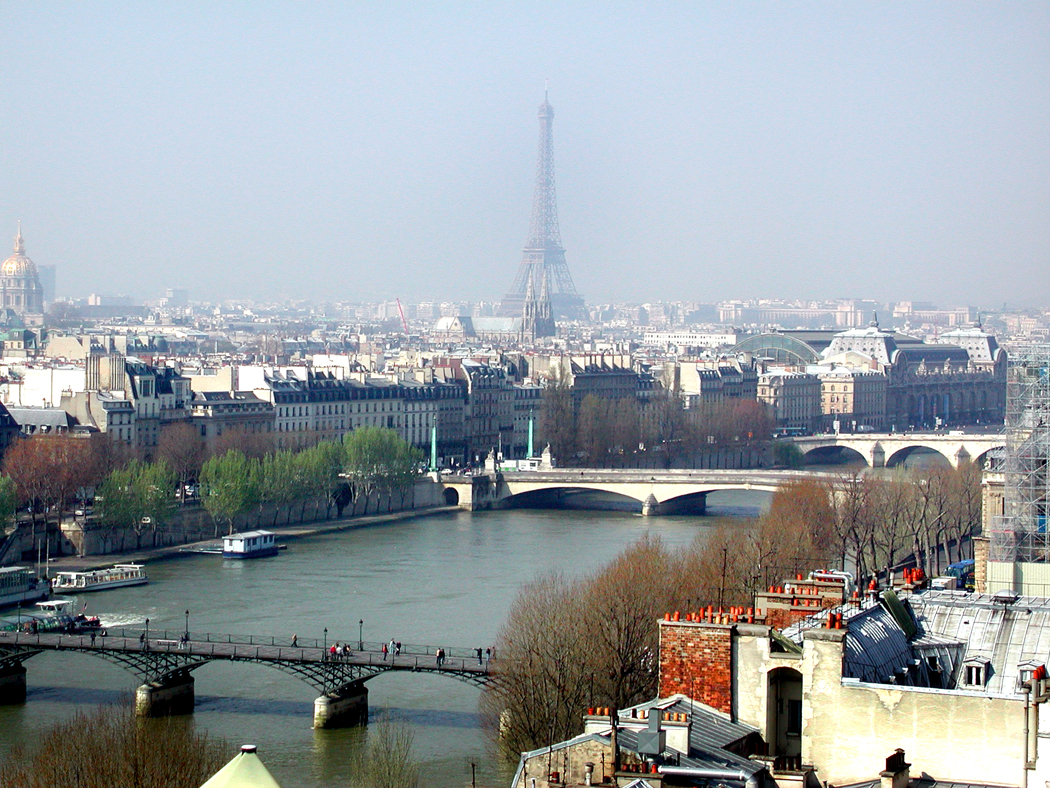
Seine with tower
WEDNESDAY

Breakfast

Breakfast in the hotel cafe — really just a room in the basement where they stack up a bunch of croissants and baguettes with some rolled ham, yogurt, butter, Laughing Cow cheese and confiture (jam).

The coffee machine hissed and spumed, and the hotel maid, doing morning cafe service, brought out the cafe au lait.

To say the least, even this modest petit déjeuner was a revelation.
The croissant was flaky and buttery. But that we expected. The coffee was marvelous. But that Carole expected, too.selling strawberries
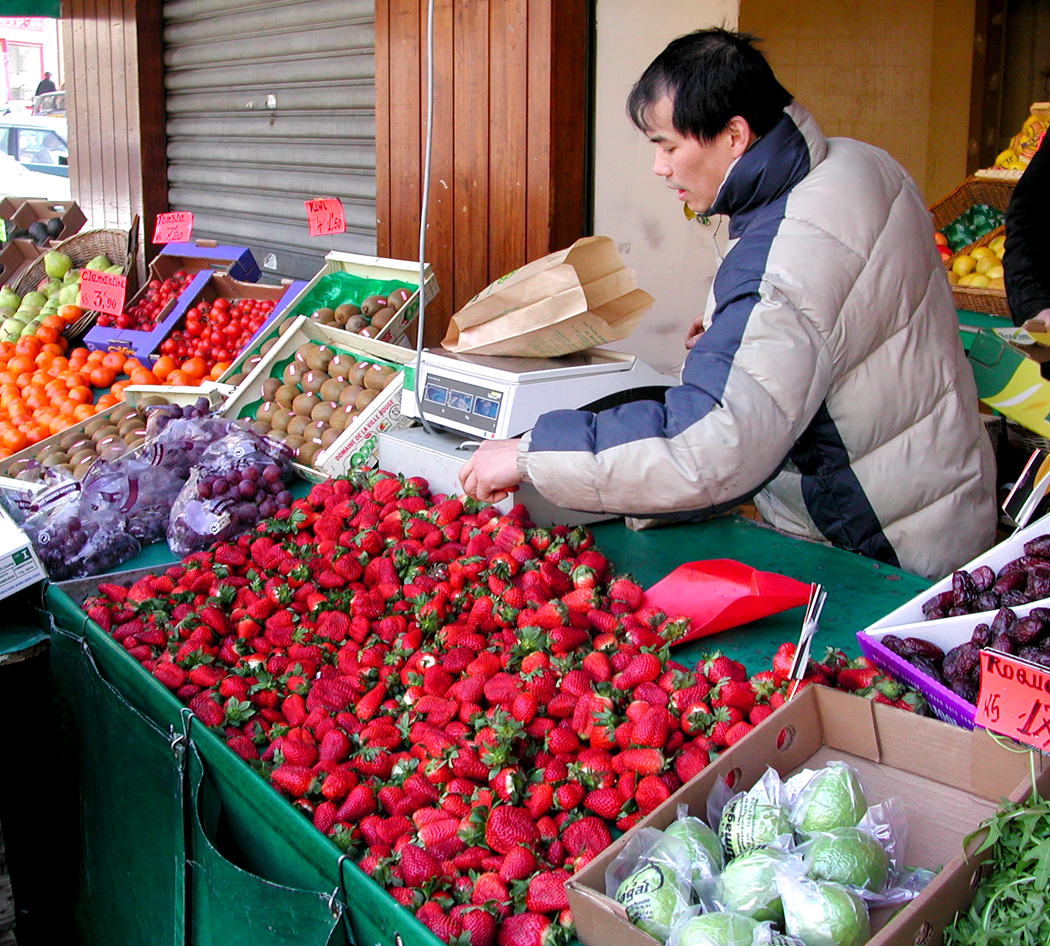
“The butter is too rich for me,” she said, after spreading a little on the croissant. I pointed out that it wasn’t butter, but cheese in a package that said, “la Vache qui Rit.”

The real butter was from Normandy: ice cold and fresh, and was as tasty a spread as you could put on a bread.

But the real champ was the baguette. Who knew bread could taste this good. With a shattering crust and a light interior, it had that kind of browned, crusty flavor you can only imagine.

I remembered growing up on Wonder Bread. American white bread. Wretched stuff. I could never understand, as a kid, why people would call bread the “staff of life.” Uncle Tony loved bread. And food writers wrote panegyrics to the stuff. But the bread I knew — and the ONLY bread I had any experience of — was banal, pasty, tasteless, or when not completely devoid of flavor, redolent of the stale air of the grocery store.

I hated bread as a kid. I hated sandwiches, which only wasted good filling between slices of inanity.

That isn’t this French bread.

Now, I’m not a complete tyro. Certainly in my adult years I got over my childish hate of bread. I make my own, which is wonderful hot out of the oven. And local bakeries make baguettes that are a pleasure to eat.

But I wasn’t prepared for the difference between even good American French-bread and plain, ordinary old French French-bread. This was bread to give you orgasms. Flavor — no, flavors — that rang from lip to pharynx with a medley of sensations, and those sensations were as physical as they were chemical. The initial crunch led to a repertoire of smaller crunches inside the closed mouth, and then the teeth broke through the crust into the heart of the bread and felt the giving elasticity of the gluten.

This was no bread to erase errant pencil lines with. This is bread to build an altar to.

Notre Dame west facade

Notre Dame de Paris

After our repast, we walked up the rue Monge toward the Seine. We could see the spire of Notre Dame at the end of the road, less than a half-mile off. Along the way, we past a billion cafes, bistros, tea bars and restaurants. In between were shops, fruit stands, book stores and churches.Notre Dame interior

A lot of churches. Anything built after 1700 is hardly worth mentioning, but there are plenty built before then, and you can enter them at any time, gaze up the nave toward the apse and see the sunlight throw color from the south clerestory onto the stone of the north triforium.

We got to Notre Dame, crossed the river to the Ile de la Cite and walked along the southern edge of the building, around the apse and along the north side, taking the exterior measure of the place.

Carole became fascinated with the scores of gargoyles. Some are truly spooky.Notre Dame exterior
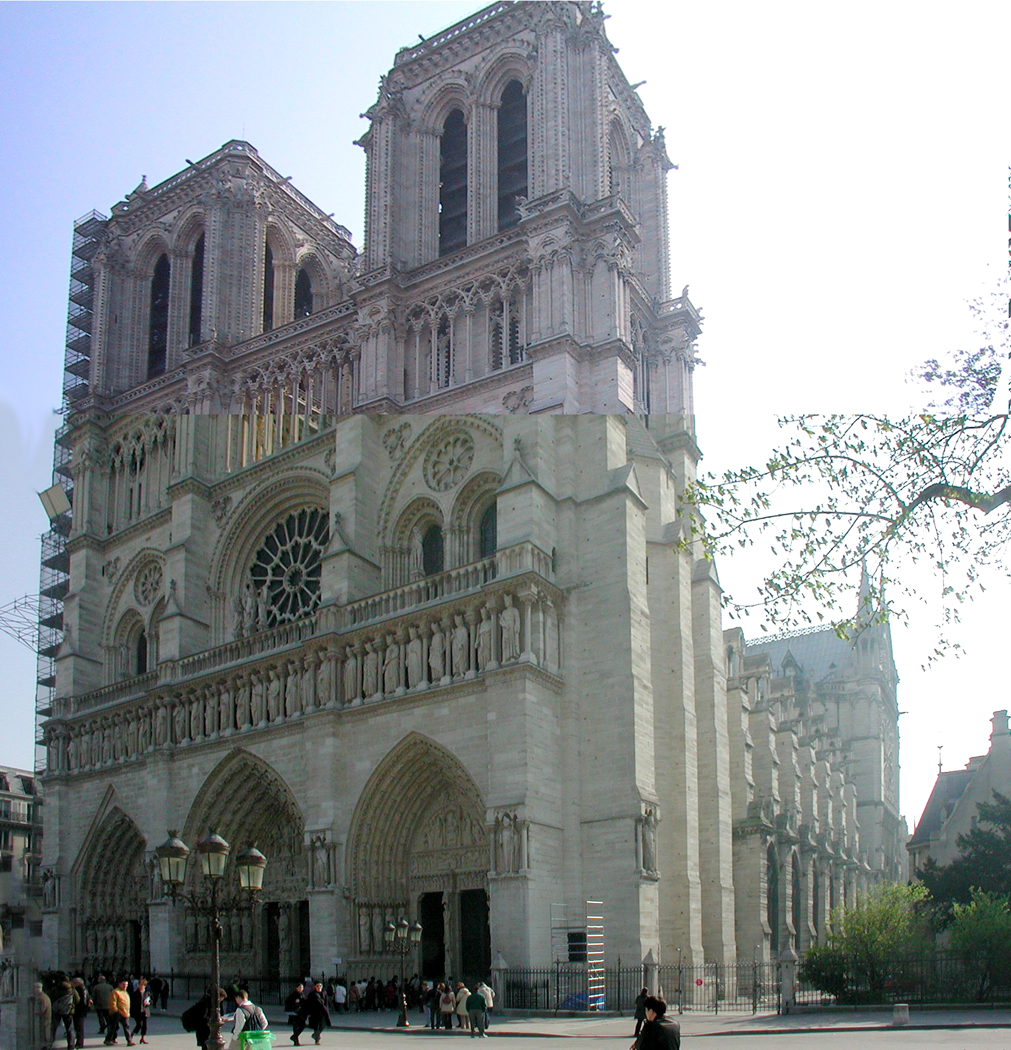
The building’s age is obvious. Many of the stone blocks are so eroded they look “texturized.” The difference between the weathered old masonry from the 12th century, and the tighter, cleaner restoration of Viollet-le-Duc in the 19th century is quite apparent. And although he tried his best to match his restoration work with the original Gothic, there is still a kind of Romantic sensibility to it.

That is fits right in with the original work is another proof of the kinship between the Gothic and the 19th century Romantic.

When we came around to the West side of the cathedral, which is all a tawny white since the sandblasting of the 1960s, when they cleaned the place, and walked inside.

Notre Dame de Paris is not the biggest of the famous Gothic cathedrals. Nor is it the most beautiful, either by reputation or by the photos I have studied. And much is defaced by either restoration or careless modernization. A tres moderne altar is greatly out of place.

But none of that matters, as the building moves its visitors. Turn one way and the light breaks through the clerestory. Turn another and you can see the great rose windows. Walk past the crossing and you see the choir screen.

At every turn, there is something pure, beautiful, unconcerned with profit and loss. Something meant to awe its visitors. Something which does awe its visitors.Notre Dame north Rose Window
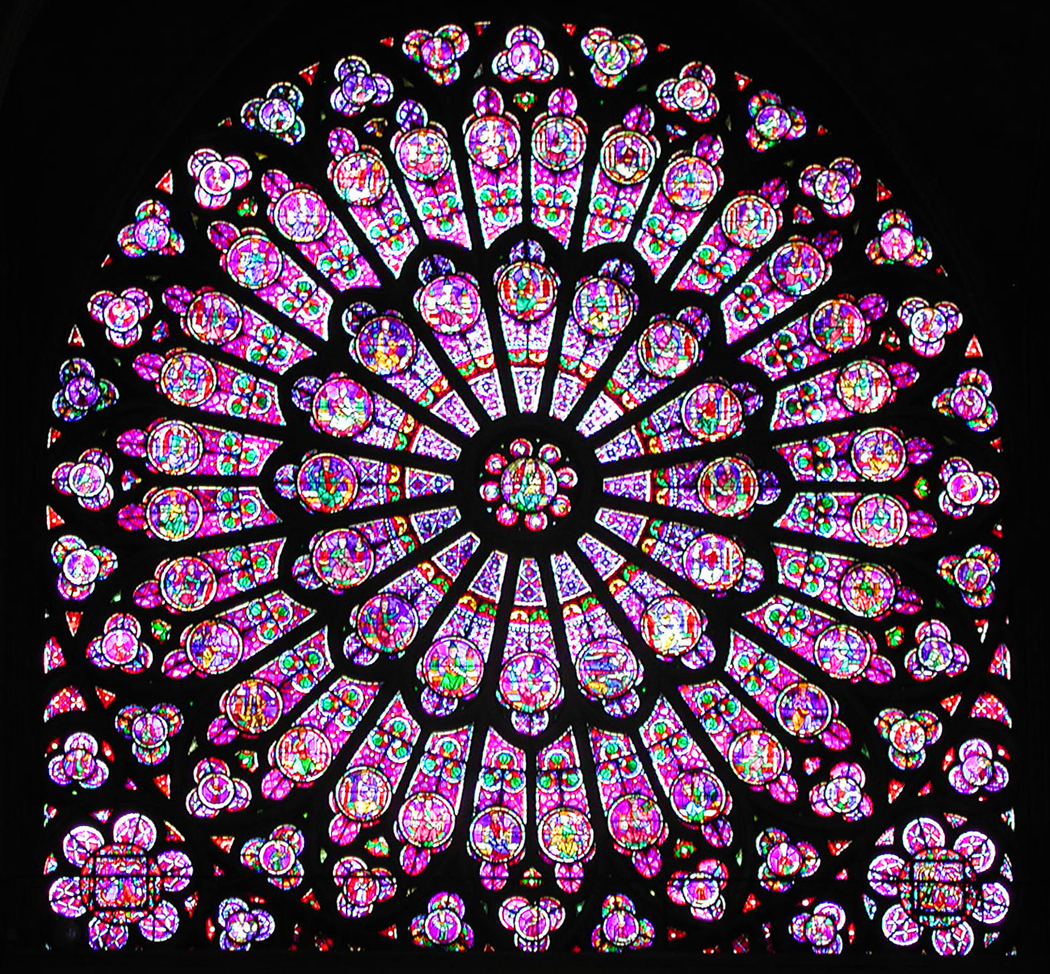
The north and south transepts are shallow, but that hardly matters, given the splendor of the two rose windows. Carole and I had the same response: being overwhelmed.

It’s one thing to see pictures in books. It’s quite another to experience the flesh. The windows are huge, colorful, intricate. They serve as metaphors for the same thing as Dante’s mystic rose at the end of the Paradiso. Radiant, radiating, they speak — no they sing — of a divine order, a shape and meaning to the universe. You can practically hear a great C-major chord sung by a Mormon Tabernacle Choir, or more apt, like the great C-major chord in Haydn’s Creation at the moment they chorus sings, “And there was …. LIGHT!!!!!”

As a well-known atheist, I don’t believe in anything like the theology of this masonry, yet, I cannot help being moved deeply by the spiritual metaphor. Ranks of angels, rotating as they sing, like some ethereal Busby Berkeley choreography, singing in 8-part polyphony to elaborate harmonies, sliding from suspension to suspension — dissonance, resolution, all headed for that great C-major.

“When you see this,” I said to Carole, “it kind of makes you laugh when they call some pop star an ‘artist.’ “

Whoever made the great rose windows knew what real art was, and how difficult it is, and what ambition it takes, and how impossible it is to be satisfied with less.

I nearly broke out in sobs.

We will return to Notre Dame later to spend more time and do the tower tour, or “tour de la tour.”
Toupary horiz

Lunch

We walked along the Ile de la Cite, past flower stands on the north side of the island, past the horologue, the city jail, and on to Sainte  Chapelle. Unfortunately, by that time, the crowds had assembled, and the line to the church was down the street. We decided to wait until tomorrow and try to get there early, before the throngs.

We continued down the south side of the island to its very end, under the Pont Neuf. The current of the Seine is surprisingly strong, causing standing waves across its surfaced.

When we consider what makes Paris different from Phoenix — well, there are many things — but one that is not often noted is that the river, with its current, gives a kind of physical yet metaphorical pulse to the city, serving as its aorta, shooting blood and life through it. In comparison, Town Lake is a clogged artery of stagnant algae.Samaritaine
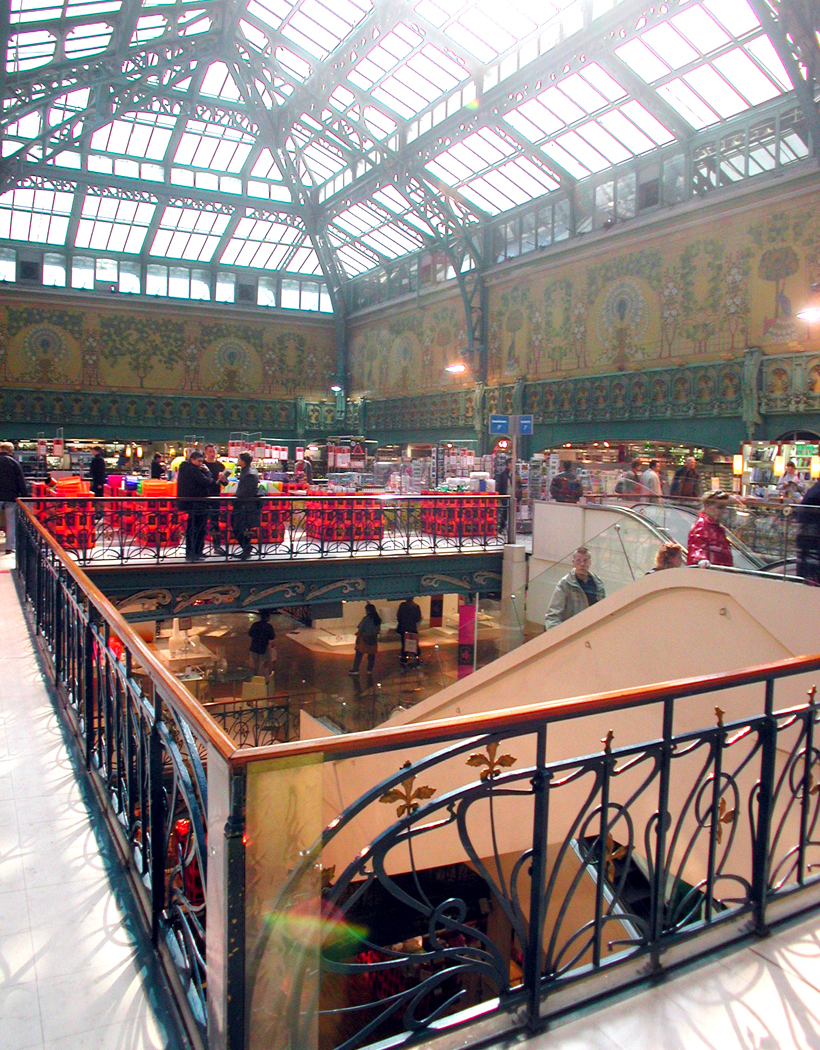
Just north of the Ile, we could see the great Samaritaine department store and I remembered that there was a restaurant at its top with a legendary view.

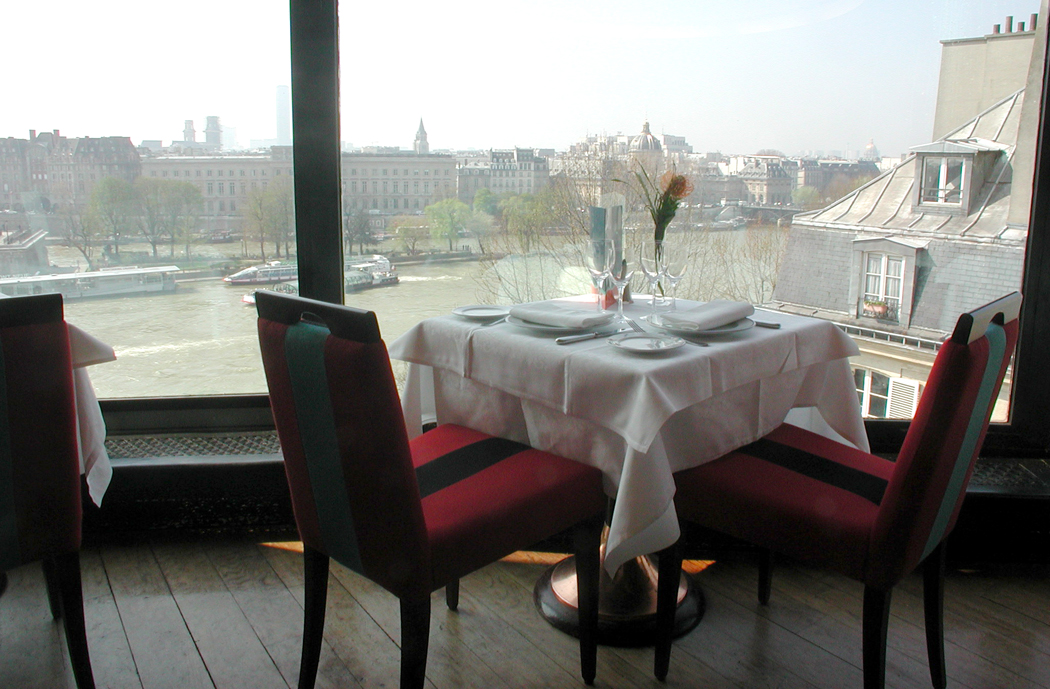
When we got there, the fifth floor restaurant, Toupary, was not yet open for lunch. It was about 11:15, and it opens at 11:45. So we toured the store first. It is stunning with its Art Nouveau details, its glass roof, five floor escalators running like a “canyon” down the center of the building, and the peacock murals across the top floor of the store.

The Toupary is the kind of restaurant where they don’t look at you standing there until 11:45 sharp. You are invisible. Suddenly, as if a bell went off, the hostess suddenly has her eyesight back and asks if there are two for dejeuner. She seats us near a window out which we can see the Seine, and off in the distance, the Eiffel Tower.

There is a crisp linen tablecloth, linen napkins, plates engraved with the name of the restaurant.

A young man brings the cartes and asks us if we want wine or water. We opt for water. We order the Lambchop grille aux herbes de Provence avec pommes sautees Provencales.

When it comes, it is artistically presented on the plate, with the lambchop symmetrically cut and dropped on top of the diced potatoes and garnished with some spring greens.

I put the fork in the potatoes and raise it to my mouth and I realize we have entered heaven. With a garlic and wine sauce, but not too much of either, the potatoes are divine.

The meat and salad followed suit, and we recognized that gastronomically, Paris is already a success, a triumph, a coup de brilliance.
St Germain Aucerrois nave

Afternoon

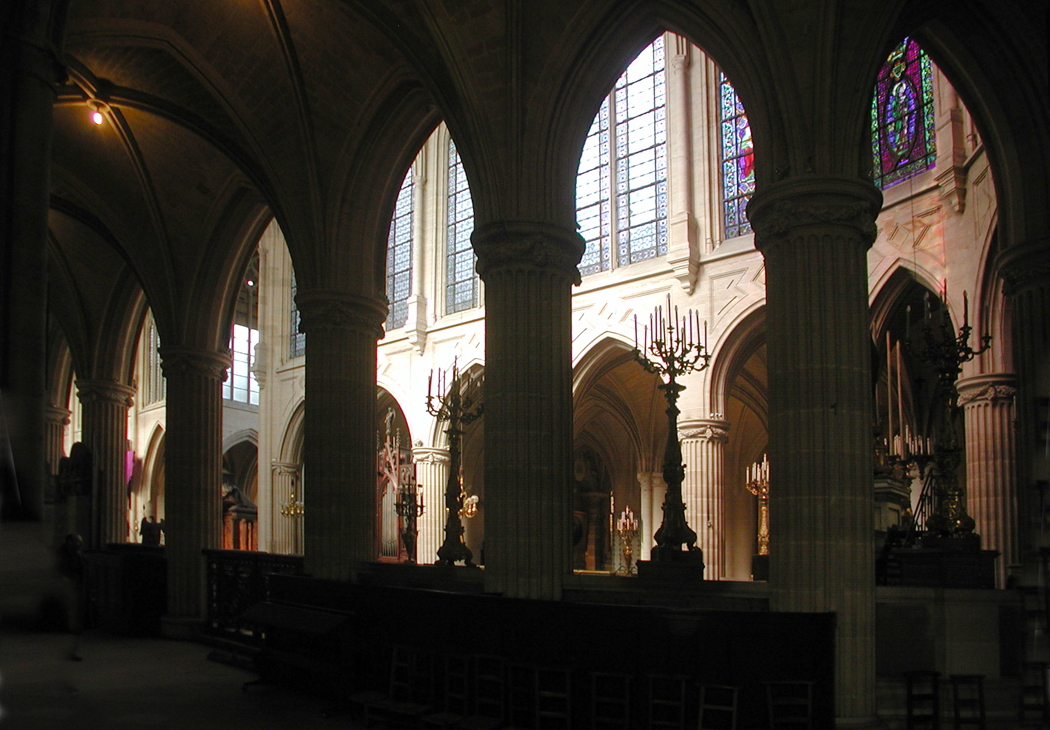
After lunch we drop into the St. Germain Auxerrois, the Gothic church next door to the department store. Miniscule compared with the cathedral, it is nevertheless beautiful.

What makes all these ancient churches so compelling is the way their history is composted on their faces, a palimpsest, a pentimento, with each age remaking a part of the past in its image, so that a 17th century door gets spliced onto a 14th century transept, or a 19th century stained glass replaces a missing earlier scene.St Severin 1

A Neoclassic church cannot stand this tampering: the effect is ruined. But the Gothic style screams out for such fecundity. It is a style rooted in the variety and richness of the world, and its strength is in that stylistic midden. It also makes us all the more aware of the age of the edifice.

We stopped also at St. Severin to see the sunlight on the nave walls.

We walked back toward the hotel by a different route, through the worst of the tourist section of the Latin Quarter, past endless little restaurants and souvenir stands, although there were also all those book stalls along the river.

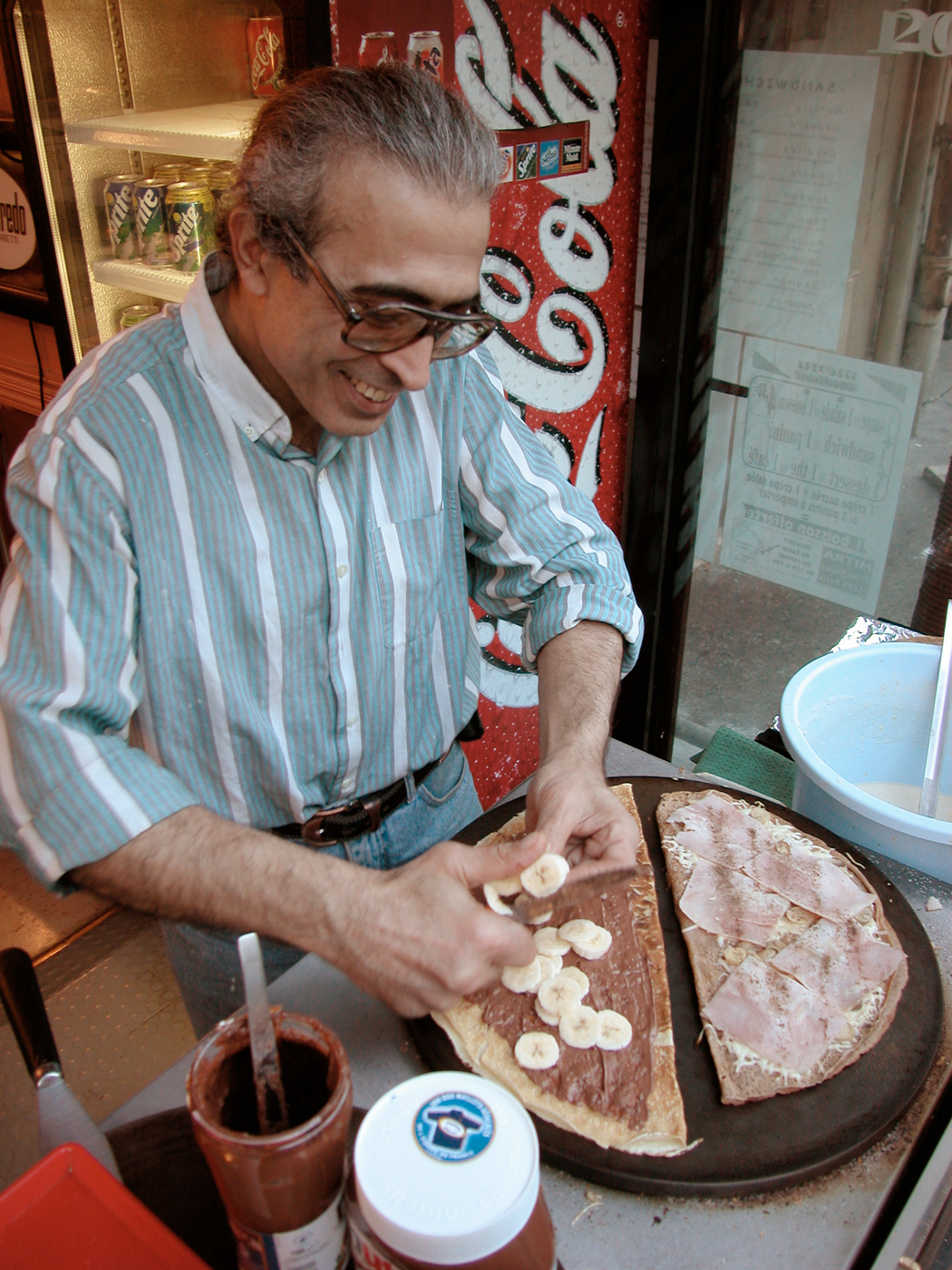
And Carole found a place that sells crepes, and bought a chocolate one. It was a tiny storefront, with a shelf along the street lined with colored decanters, presumably flavoring agents. Through the door and inside, Carole ordered a crepe de chocolate.

The young woman, who seemed to be an apprentice, dropped a load of batter on a large round hotplate, using a special device somewhat like a flour sifter, but with a funnel shape that dropped the batter out the small end. She then took a squeegee and dragged the batter out on the hot surface to cook. Before it was completely done, she turned part of it over with a long metal spatula onto itself, then turned the whole thing over to finish cooking, ladled some chocolate sauce on the upraised surface, smoothing it out with the ladle bottom.

Then she very neatly folded half of the crepe back on itself, forming a line in the middle, then folded the other side, making a seam in the middle.

Then, wrapping the whole thing in wax paper, she handed it to Carole, who joined the angels for a polka around the divinity.

Carole said it reminded her of the Hopis making piki.

We passed by some exceptional architecture on the way. Paris is an oddly layered city, with the newest on the bottom and the oldest above. Almost every building houses some modern shop on the ground floor, with neon lights, plate glass and corporate logo. While from the second floor upwards, you see the old wrought iron balconies to the small casement windows, peeling paint, rotting plaster or concrete, and surmounted by a gaggle of chimneys, each with a half dozen flues poking out the top.

How they got those modern shops underneath the old apartments, I don’t know. It looks like they jacked the buildings up and constructed a shopping mall underneath.

We got back to the hotel about 3 p.m. and rested a bit.

About 7 p.m. we went out for dinner, wandered around the neighborhood looking at all the bistros and Turkish restaurants. We finally decided on a Afghan restaurant, called Kootchi, and had a grand saebzi chalow.

Carole’s highlights of the day:

Mary standing on a demon, the roots on the wall at Notre Dame, the rose window. The chocolate crepe, the cafe au lait in the morning. All the pink jasmine I saw for sale on the sidewalk. The tree just budding with the sparrows mating in it under the Pont Neuf. And all the bridges over the Seine. The gargoyle with the human face. Learning about Notre Dame from Richard while standing in it. Oh, and finding out that I can communicate a little bit in French.St Germaine light on floor

There is some gray area when deciding whether the biggest event of the day was Notre Dame de Paris or the chocolate crepe.

Richard’s highlights of the day:

The baguettes at breakfast. The rose windows of the north and south transepts at Notre Dame. The current of the Seine. The smaller churches of St. Germain Auxerrois and St. Severin, and most particularly, the colored sunlight filtered through the stained glass at St. Germain Auxerrois and hitting the wall of the chapel of the apse, and spreading across the checkered floor.

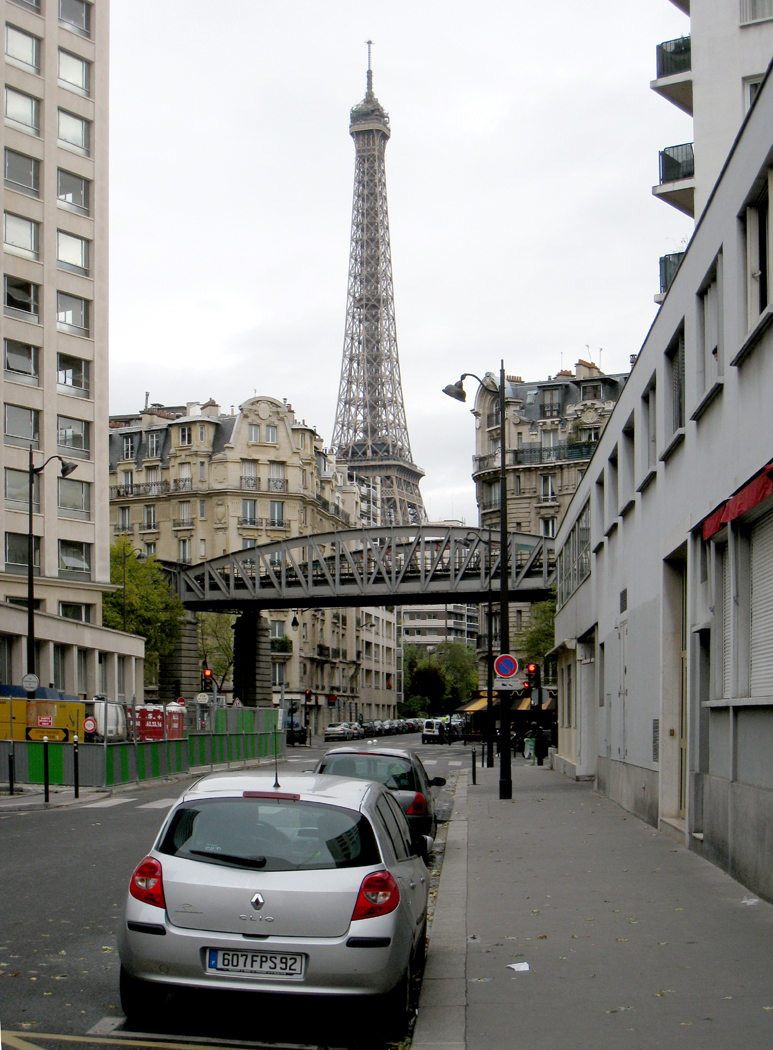
Eiffel TowerI am not watching Downton Abbey. I reached my quotient of British TV drama with Upstairs, Downstairs 40 years ago. Since then, it has been rehash on rehash, and I no longer feel any connection.

It is a widely held truism that American intelligentsia is divided between Anglophiles and Francophiles. The one portion watches Masterpiece Theatre on PBS and cannot get enough of Edwardian melodrama. They swoon over Merchant-Ivory films and generally rate Henry James as readable.Books

The other half reads Camus, loves Montaigne, adores Truffaut.

The one side grieved the death of Princess Di; the other the death of Claude Levi-Strauss.

It is a divide as solid as red-state, blue-state: In one corner, you have Sherlock Holmes, in the other, Inspector Maigret.

The English sleuth, cool, rational, friendless; the Frenchman, intuitive, patient, uxorious and with a small glass of pastis in one hand.

When the English talk of logic, you know a tweedy lecture is in the offing. When the French talk of logique, you know something as baroque as an 18-car pile-up will follow.Palais Garnier - putti

Just as psychologists can divide personalities into types: introvert vs. extrovert — so, too, can we divide Americans into those who identify with the island or the continent.

This is, of course, a divide entirely set amongst the reading, thinking public.  Outside of the library, Americans are suspicious of anything foreign, and especially anything European.

Which is why Americans so much love to despise France. It is hard to understand this, given the history of our two countries, from the time of the American Revolution onwards.

“Cheese-eating surrender monkeys,” we say. Which shows how little we Americans understand about French history. Doesn’t exactly describe Napoleon or his army. And who was it, after all, who won the American Revolution for us? Ah, yes, Admiral de Grasse. And Lafayette was no monkey of any sort.

But back to the bookish Yankee: Perhaps this divide became palpable in 1789. Many Englishman at first applauded the French Revolution, but even most of them eventually grew horrified at the excesses of the Terror.Rabbitshangingmarche

It left England with a slowly dwindling monarchy, and gave France a fresh, if confused start. It has never really comfortably settled, the current Republic being the Fifth, merely five decades old.

The English much earlier had their own paroxysm, but that one ended with the restoration of the monarchy, and an inbred conservatism that has lasted to this day, and I believe, is what so appeals to that brand of American college-educated reader who would rather watch The English Patient.

Or perhaps it is the British Protestant history vs. the lingering Catholicism of France. America is more at ease with the strict, moralistic Puritanism it inherited from its English forebears. There is something suspect about the theatrical exuberance of the Roman religion that is the cultural inheritance of even French atheists.

England says, No, or at least, Not Now. France says Yes, or at least Let’s Try. It is why English food is the butt of jokes, while French food is the world’s standard for gustation. The English do not believe they should enjoy their food.Bayeux store window

For the English, anything of which you partake should be good for you, that is, make you a better person. For the French, it is the same with this difference: Something that excites the senses is good for you and does make you a better person.

The Puritan influence in America wishes to outlaw foie gras.

Well, I love foie gras. It is the most intense flavor I can remember eating,  sunburst of umami, with the cloak of saccharine provided by the onion confiture and finally washed with an excellent fruity sauterne — not the cheap sugary drink Americans buy by that name.

Which means I fall into the camp of Francophiles. I love everything about the country, even their craziness.Rouen Lingerie shop window

I love that the French Revolution elevated reason above all other virtues, and proceeded to get all unreasonable about it. I love that they have a theory for everything, and will argue for an hour on a TV talk show, not about whether a speaker has his facts right, but whether he has his theory right. There is a kind of divine looniness in it all.

In contrast, the British can suck the life out of any proposition. While we can agree that Adam Smith was a genius, have you ever actually tried to read him? Or David Hume? Not bloody likely.

So, you can have your boiled joint and your suet pudding, I will always go for the cassoulet and the moules Normande. There is nothing better tasting than a properly prepared magret de canard. You can keep your English goose.Driving France

When I am in France, I feel at home in a way that is irrational. I do not speak the language; I can never dress as stylishly; I can barely read Le Monde or Figaro. But somehow the culture feels familiar. There is an easy fit, a comfortable tolerance, in the engineer’s sense, you have room to rattle around.

Even the landscape is home. The trees of Verdun, the mountains of the Vosges, the beaches of Normandy, the craggy peaks of the Massif Central, the caves of the Perigord, the waves of the Mediterranean, the 2,000 year history of Arles, the white hills of Aix.Forests of Verdun

And finally, and most importantly, the small, highway-ringed city of Paris, where the girl in the flower shop asks how your wife is doing when you pass in the afternoon and your wife is resting in the hotel room.

I find it all so inviting, so warm, friendly and comfortable. Paris is a city you can negotiate, where every corner — every one of its 20 arrondissements spiraling out from the Ile de la Cité — is as familiar as a classmate from school, and just as distinct.

It is the Berber faces, the Jews of the Marais, the Asians running the butcher shop, the Turks selling pizza, the line each morning and evening at the boulangerie for baguettes, the sculptured heads over the doors, the fountains, the public statues, the warren of roads changing names every few blocks. The squalid suburbs, the train stations, the Bois de Vincennes, the violinist echoing through the tunnels of the Metro, the fromage blanc at the Chinese restaurant, the old men playing pétanque in the flat dust of the Tuileries.Blvd de l'Hopital

There is nothing wrong if you prefer London. If you like bad food and dirty streets, boring television and infuriating politeness.

À chacun ses goûts.

My wife and I have been to France many times and cannot wait to get back. I recently came across the diary I kept on our first trip there, in 2002 (I had visited much earlier — in 1966) and I will be sharing portions of it over the next several blog entries. I don’t know if I can persuade any of you to give up your Downton Abbey for the French version of Inspector Maigret (with Bruno Cremer), but perhaps I can suggest why we find the nation so compelling.

paris night 01jpgThe first time my wife remembers being aware of the night was when she was a little girl and thought the darkness was a liquid, a flood tide overtaking the world.

“I was afraid I would drown in it,” she says.

If she wasn’t careful, it might seep under the window sash and fill her bedroom while she slept.paris night 02x

My experience was different. I grew up outside New York City, and for me, night was an empty container to fill with light. It wasn’t night that flowed, but rather the lights that were like opened faucets draining into the darkness, to be diluted by it. The view of the Manhattan skyline at night, seen from the New Jersey Palisades, was the most beautiful thing I knew. It glowed like embers. paris night 03x

Either way, night was something poetic, although we would never have used the term. When you are a kid, when everything is new, and everything is poetic, there is no humdrum, no banality, against which the poetic, the beautiful, can be offset. It is just the way things are.

Now, as a grown up, chastened and wary, night is the black velvet on which we place the emerald ring, to show off its brilliance. And night is the time that gives the day its mythic resonance. We do our work during the day, so that night can work on us. paris night 04x

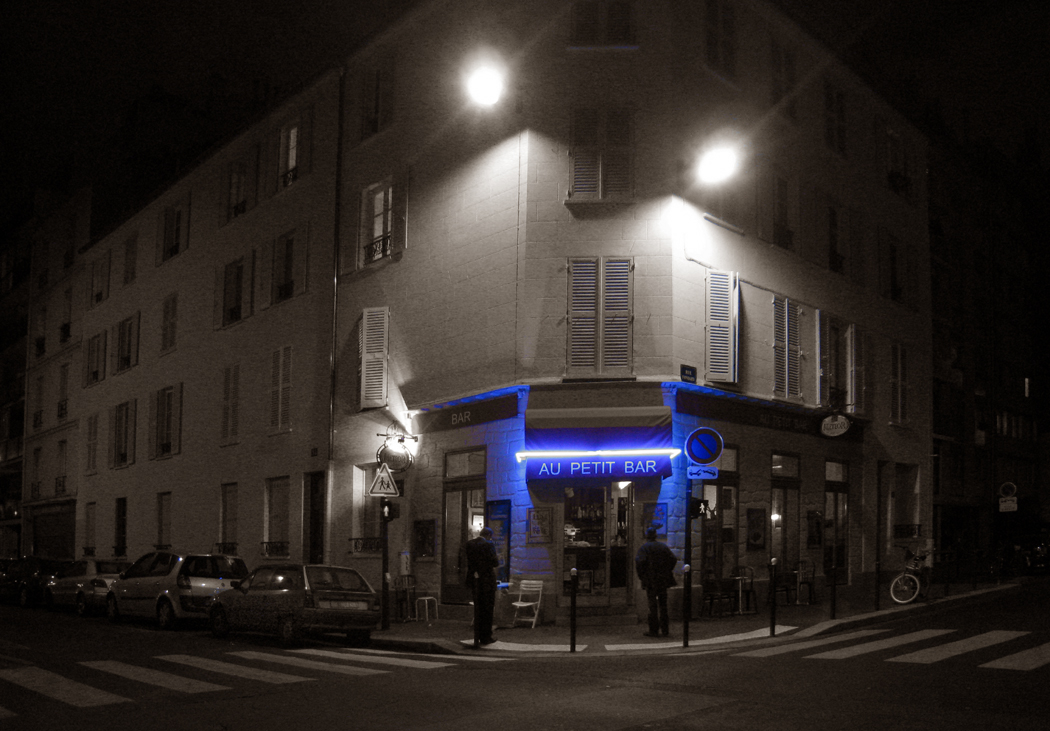
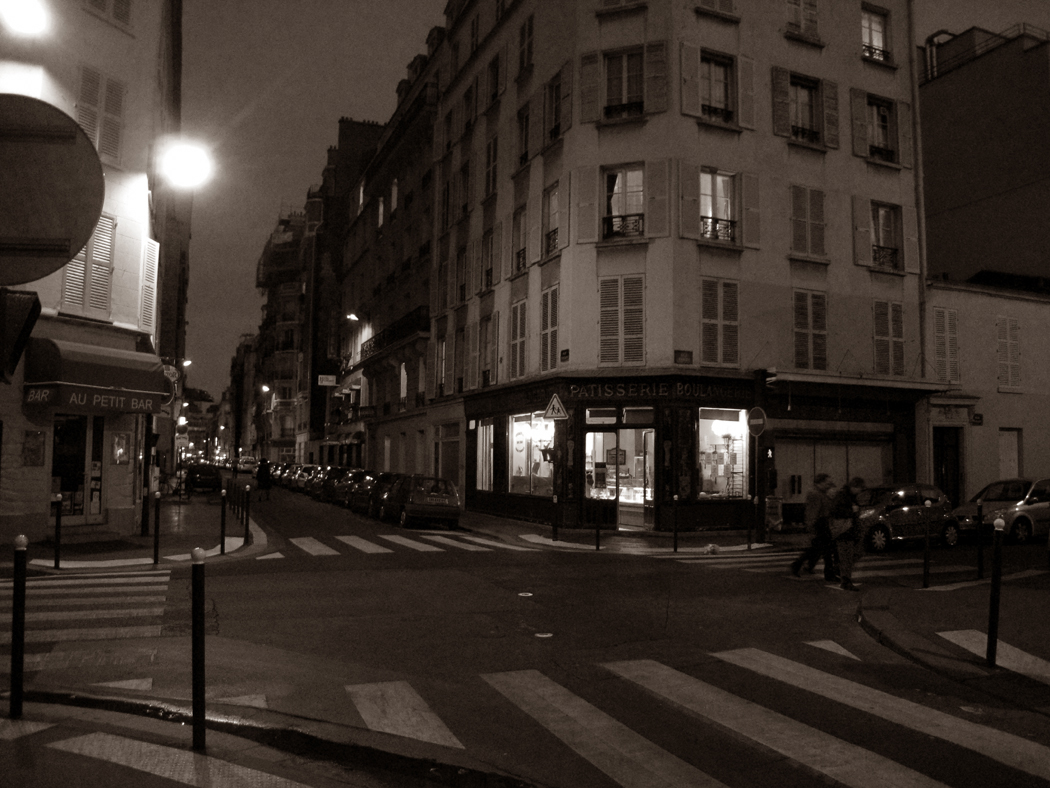
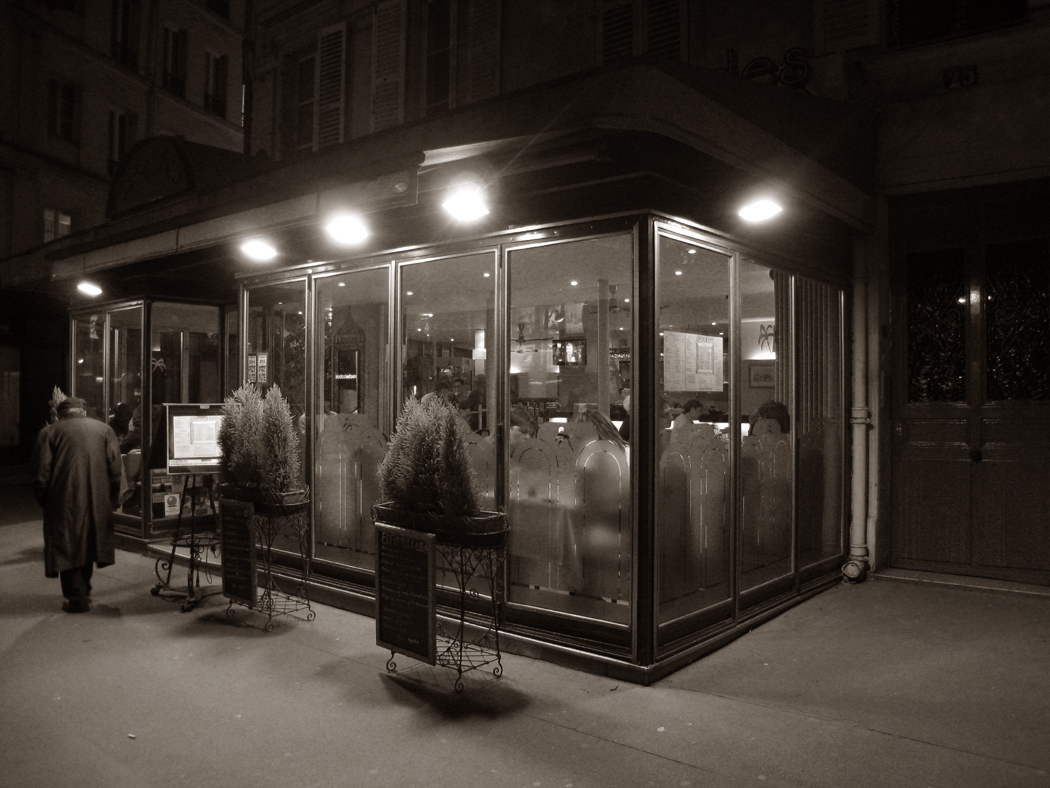
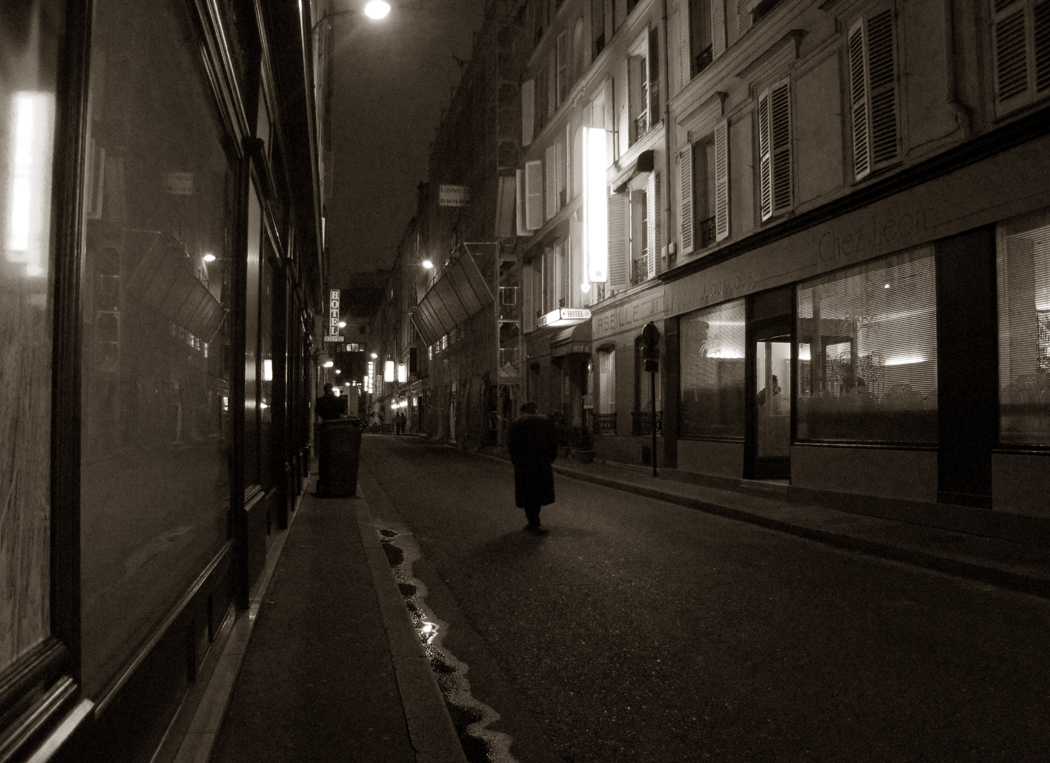
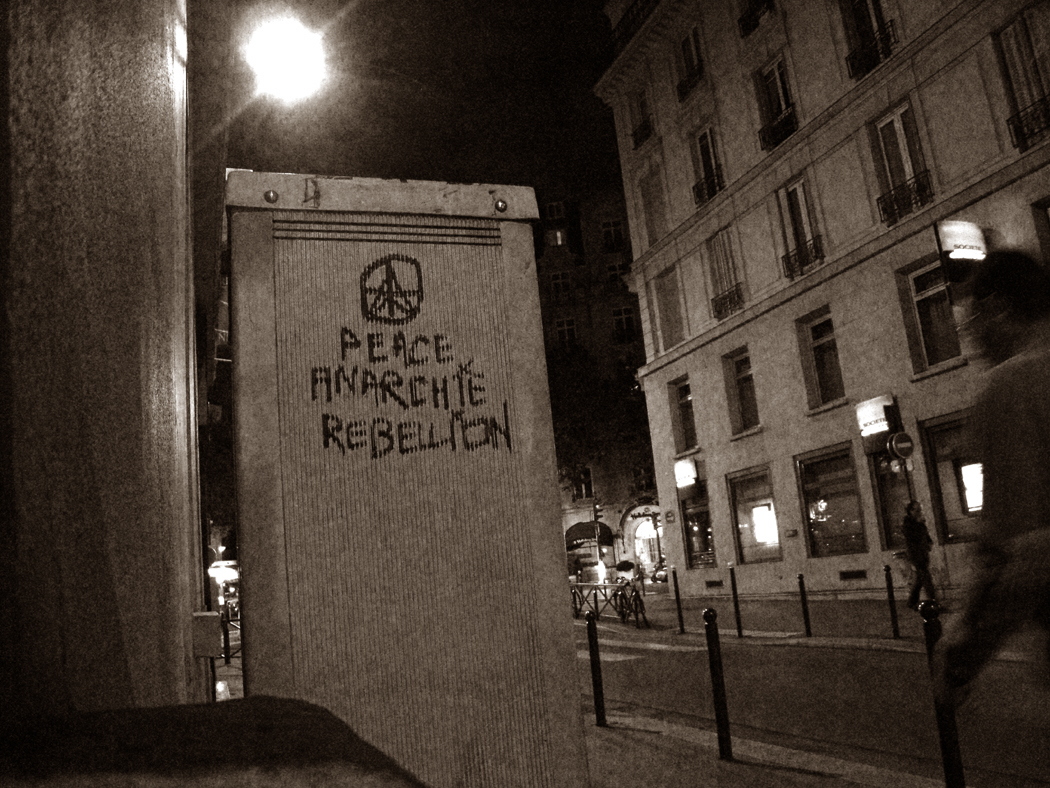
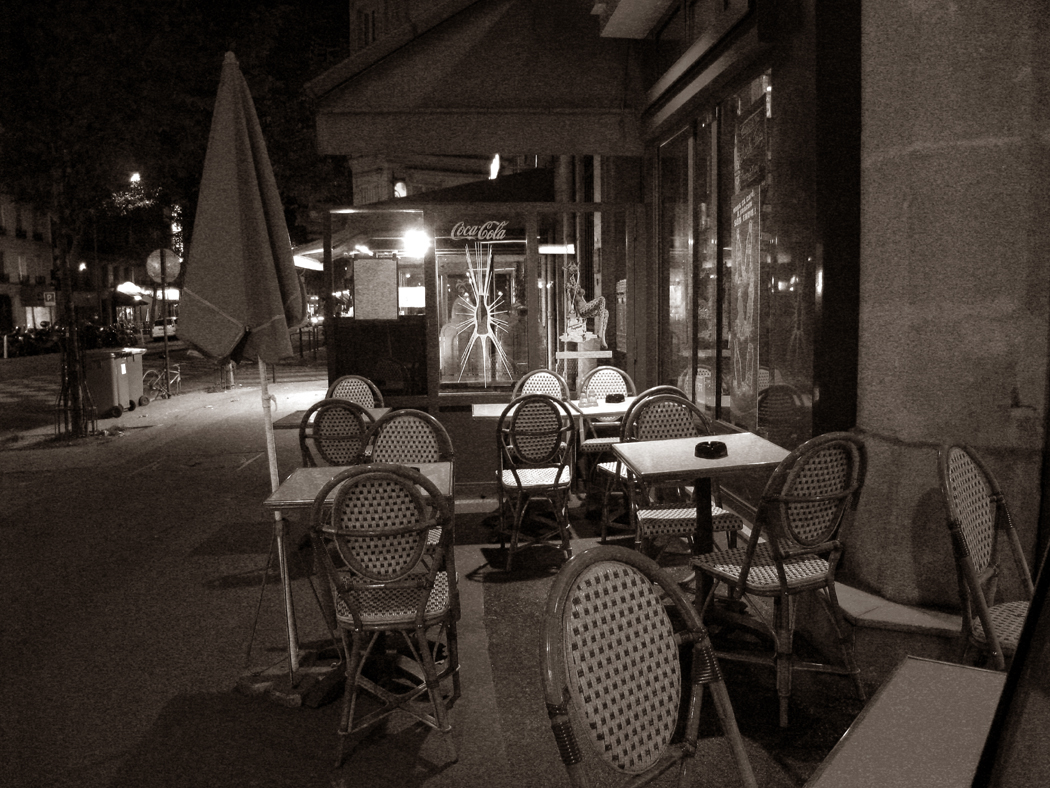
I go walking in Paris at night, because that is when I feel most completely there. Paris becomes itself when the streets are dark, with storefront windows and the streetlamps pour forth their fluid light, diluted on the curbs and parked cars. I am washed in that thin light. paris night 05x

One feels most deeply the difference between Paris and New York. At night, Manhattan seems just as busy as it was earlier. Traffic is dense, pedestrians fill the streets. You can ride the subway at 2 in the morning and still see a car full of faces.paris night 06x

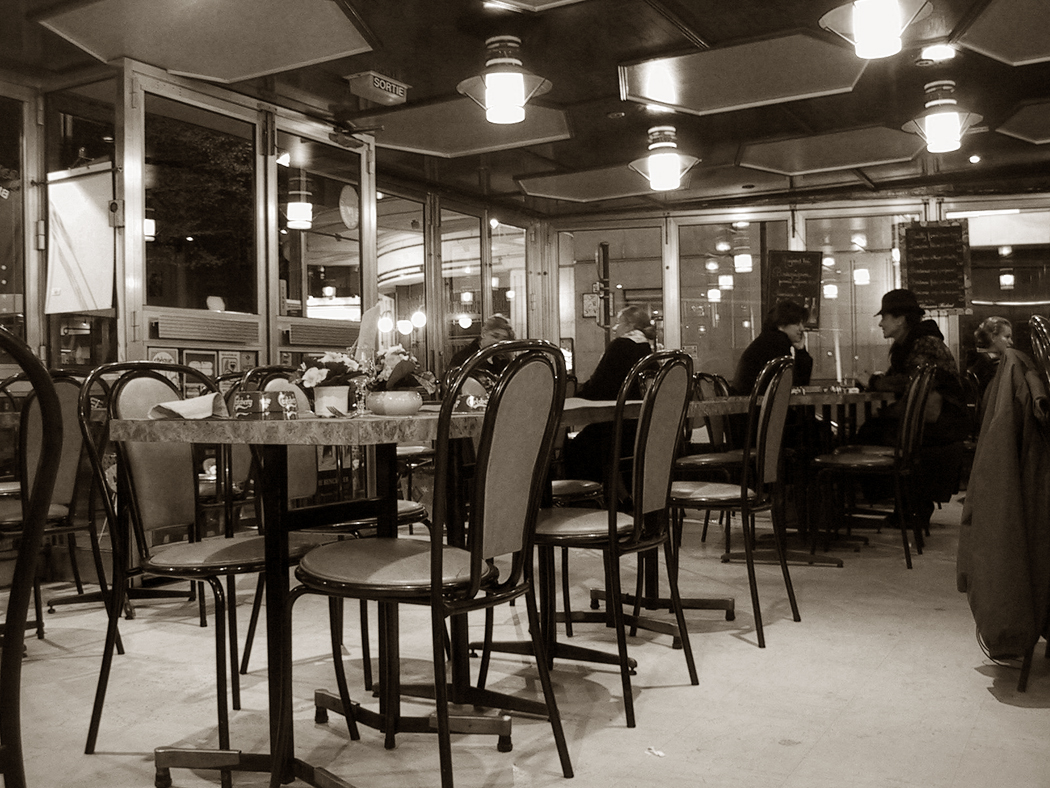
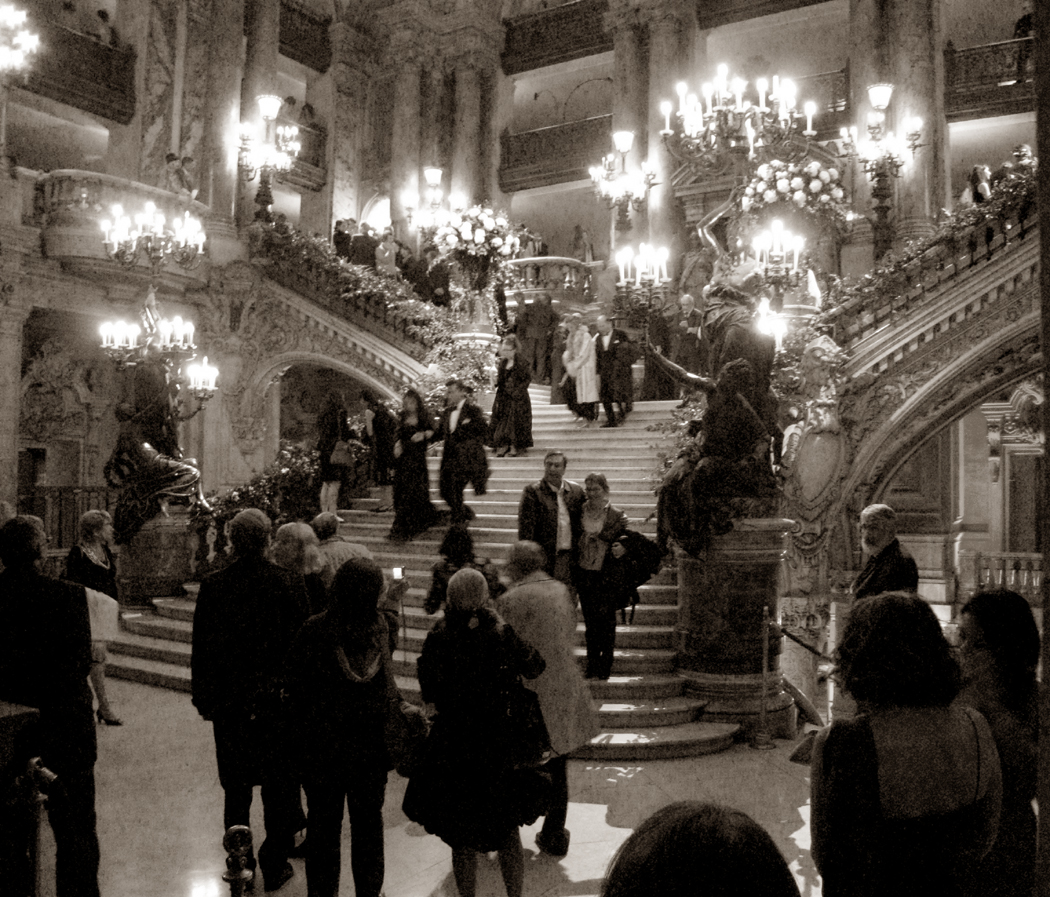
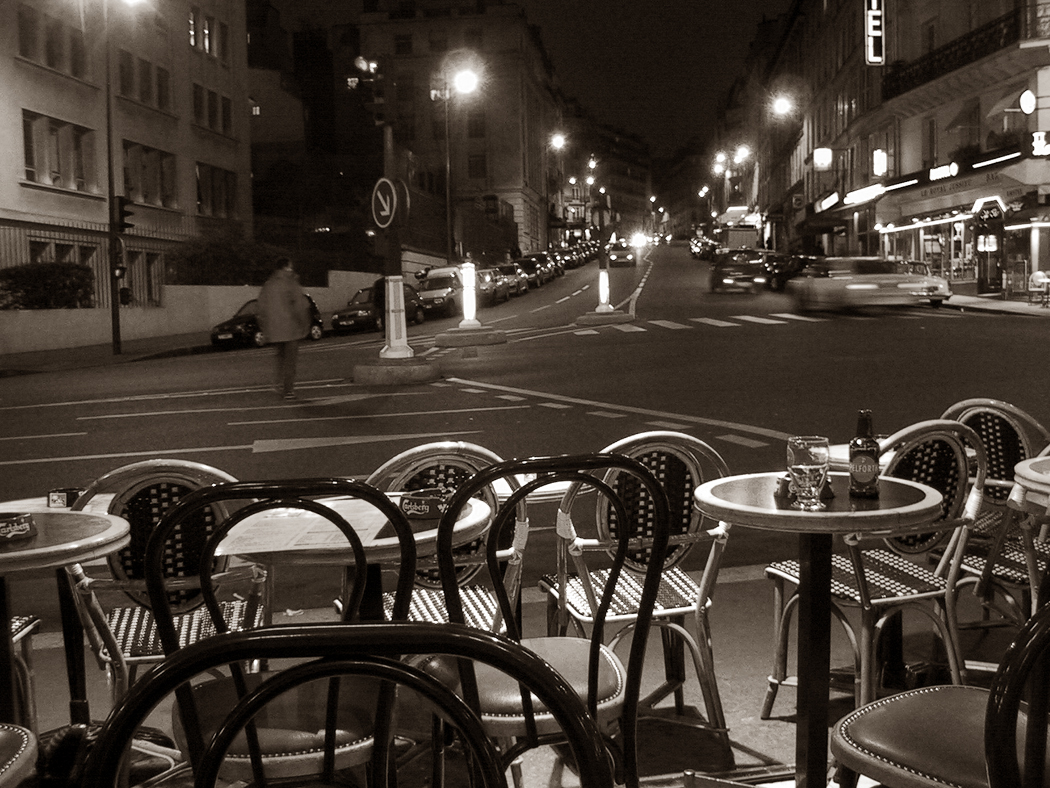
But, Paris at night is oddly empty, and what people you see are clustered around the steamed windows of cafes and bistros, or on the front steps of the opera house as it lets out, or waiting to get into the disco. It is almost as if these were the campfires that draw the bodies turned from the darkness. paris night 07x

You can walk down the streets and peer into the shop windows, with their wares lit and forgotten, as if the Rapture had occurred last week, and left behind the kitchen furnishings, or the bicycles, or books, and behind the glass, there is a humanless simulacrum of the world we know. paris night 08x

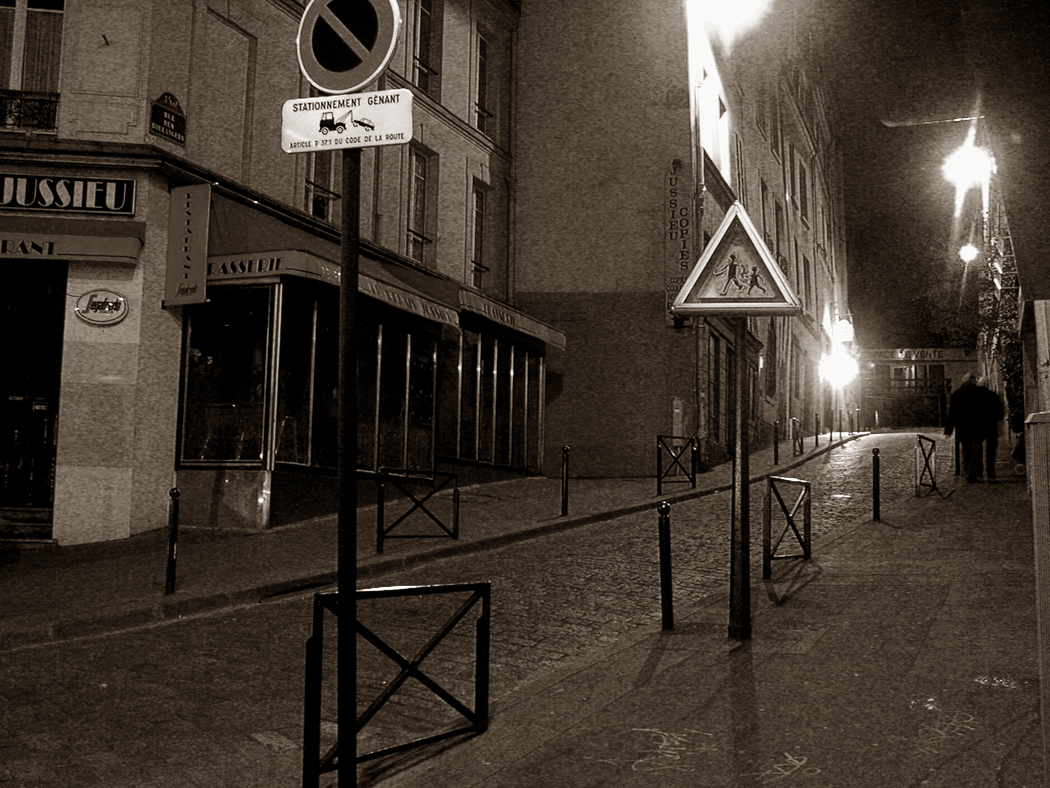
Or you follow some old man in a long coat as he turns the corner and walks down a dark street toward the next streetlight.

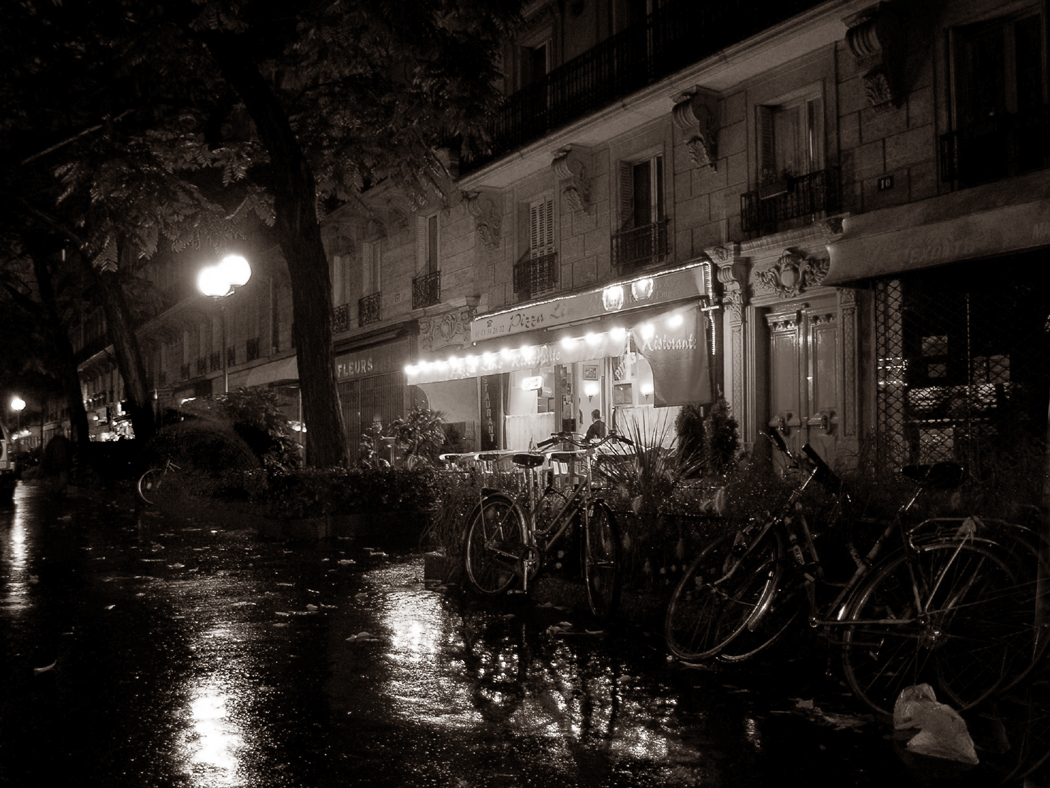
Paris is made more magical by the night. In October there is the slight bite to the air, and the rain makes pointillist mirrors of the pavement, redoubling all that dissipating light.paris night 09x

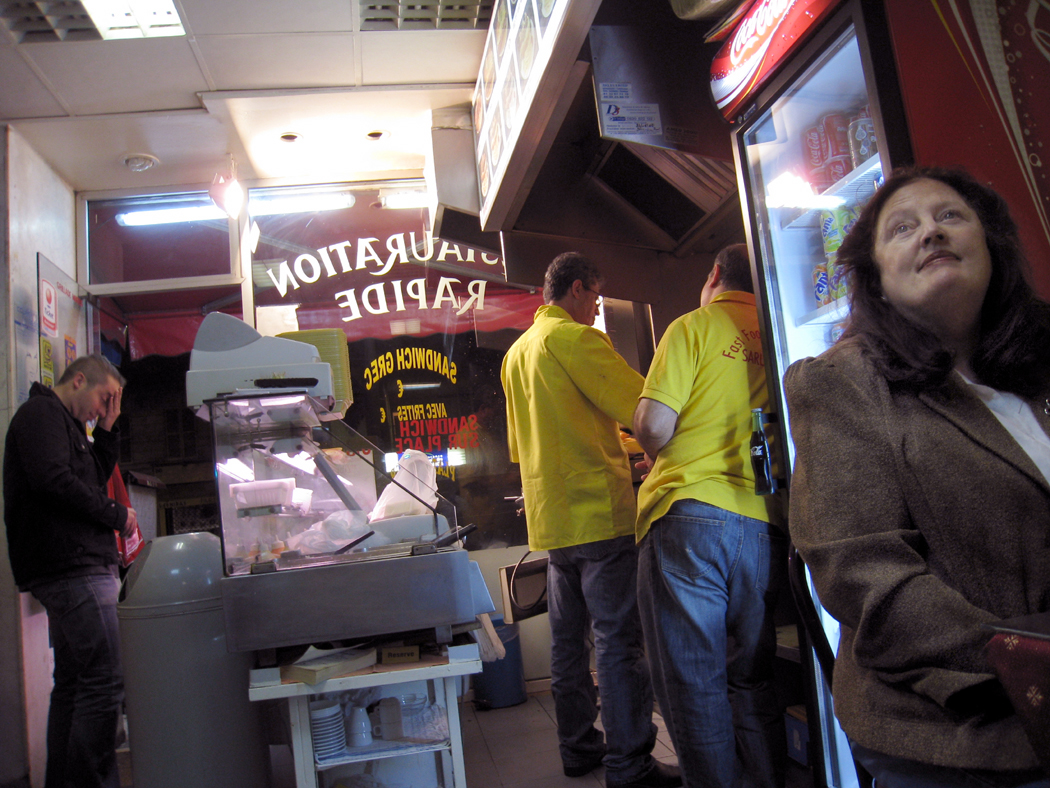
You wander into a Turkish souvlaki restaurant, a cheap storefront halfway down the street, and the man behind the counter is on the phone speaking some language you don’t know — it isn’t French — and he smiles at you as you sit on the molded plastic chair with the rocking table between you and your wife. The wall is bright yellow behind the glass counter, with garish purple writing offering the usual fare, lit with a glare. Gyros, souvlaki, pilaf. It is warm inside, and humid and the food is comforting.paris night 10x

Even the sound is different at night. Like the campfire, the sound is huddled, localized. In this restaurant, the sound is held in by the walls and front window. Outside it is silent once again.paris night 11x

There is cheer in the contact, and when you leave, there is an alive aloneness in the night street. paris night 12x

When I think of Paris, I think of it at night. I hear the voices and see the maitre pulling the Stella Artois from the tap. Most of the seat are empty and those filled are on the way home after a night at the cinema or theater. They may stop at the 8 a Huit for a pack of cigarettes. (Say it like “wee-a-wee,” it is the French equivalent of a 7-Eleven, only tighter packed and with one wall covered with wine bottles. The man sitting by the cash register is Algerian and tired after spending 12 hours in his shop.)paris night 13x

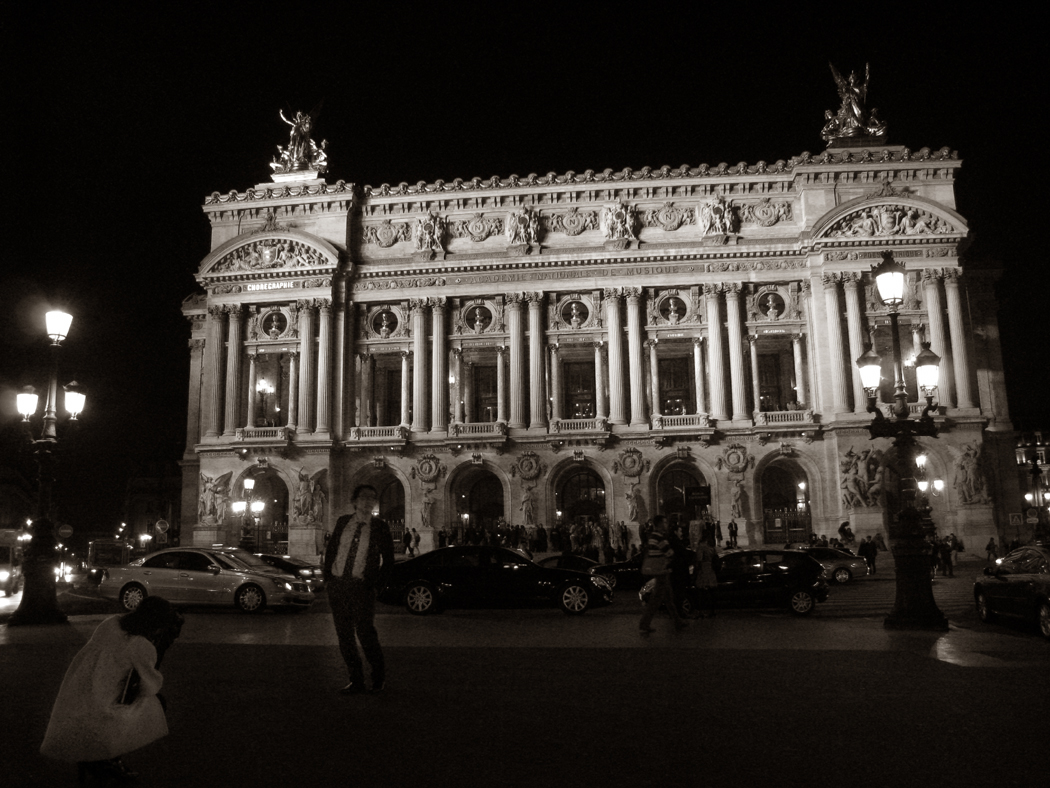
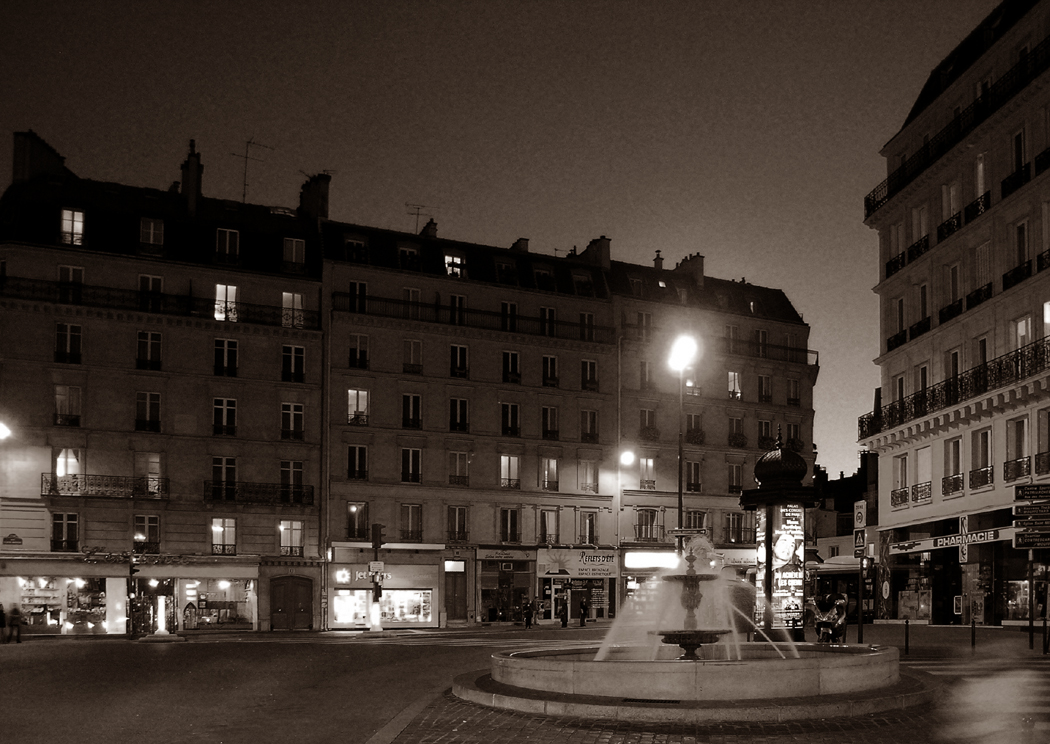
Compared to anything American, Paris is small. You can walk almost anywhere inside the Peripherique, and all the familiar signposts of the city are visible — Montmartre lit by floodlights on the hill, the Eiffel Tower turned into a fireworks display, the Palais Garnier pinned down by its own lights in the darkened city. paris night 14x

I love to get out into that night, and walk those streets, nodding to the proprietor of the flower shop as he stands by the door, stopping by the patisserie for the last pain au chocolate of the day, and finally passing the concierge of my hotel as he sits behind the desk, reading an Arab newspaper and drinking a small glass of Kirsch, not noticing me as I go through the lobby. Up the elevator, hardly bigger than a phone booth, and flipping on the timed hall light that busts open the darkness on my way to my room. paris night 17x

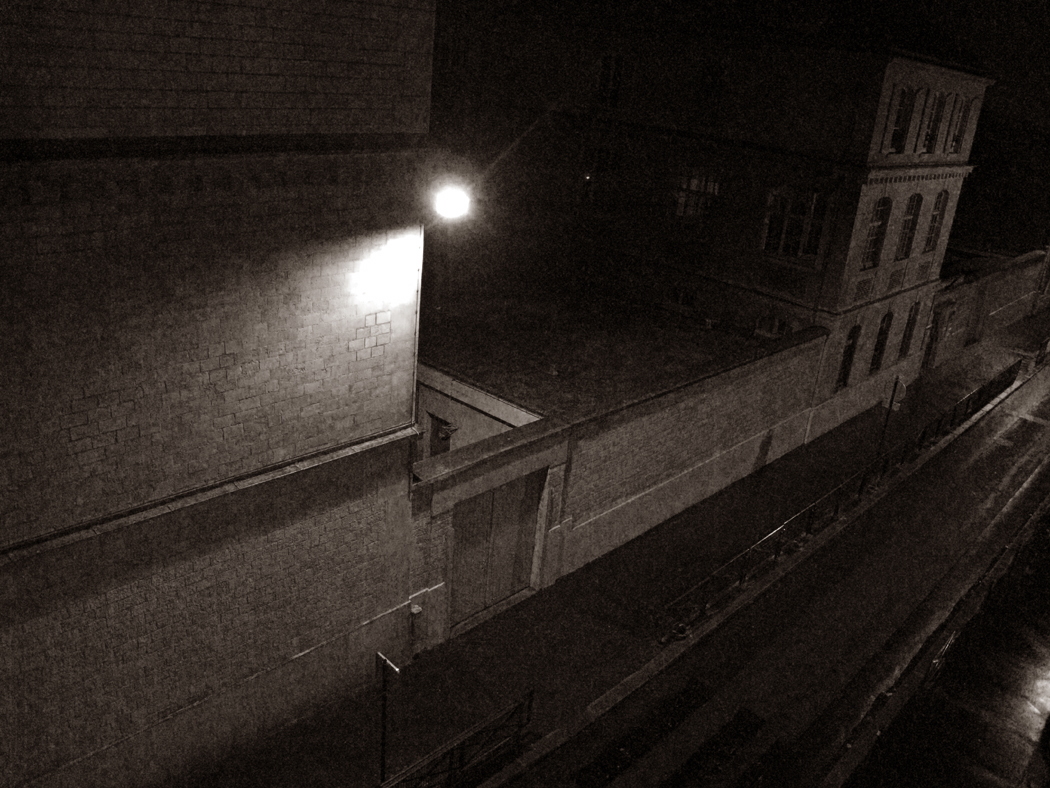
Out the window when I draw back the curtain, the city street is black, with highlights drawn by the lamps and the trees beneath my room shimmer in the light. paris night 18x


paris night 20x
paris night 21x
paris night 22x
paris night 23x
paris night 24x
paris night 25x
paris night 27x
paris night 28x
paris night 29x
paris night 30x
paris night 31x
paris night 32x
paris night 33x
paris night 34x

paris night 35x


paris night 36x


paris night 26x

paris night 37x
paris night 38x


paris night 39x

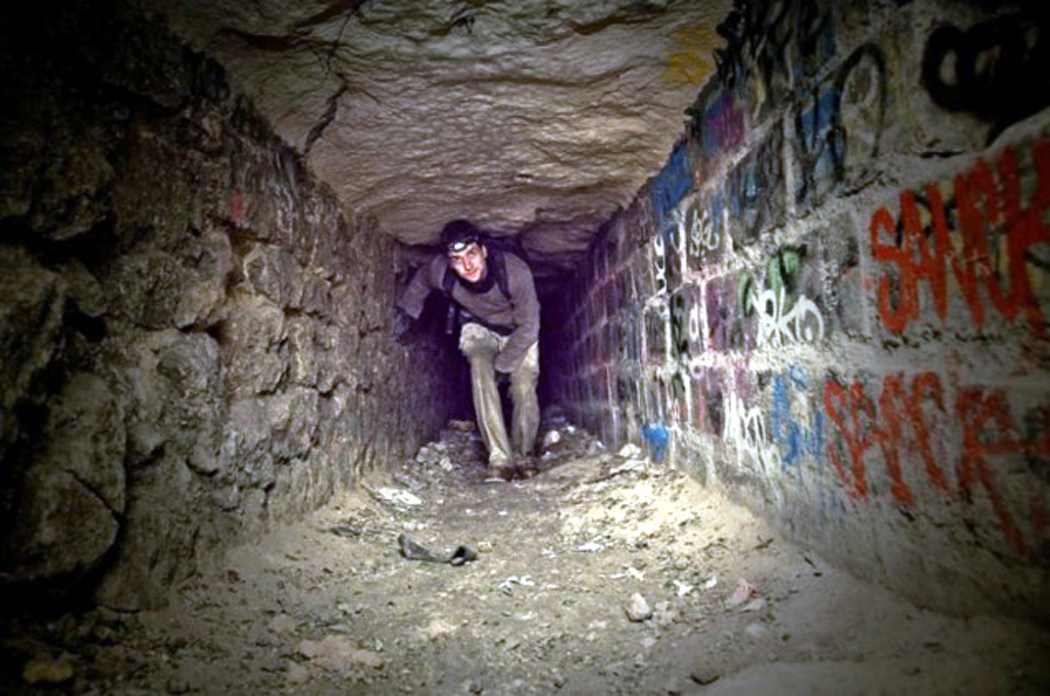
skull heartTen years ago, the Paris police discovered an outlaw movie theater, complete with bar and restaurant, hidden in a sealed-off old quarry tunnel under the 16th Arrondissement, just across the Seine from the Eiffel Tower.

“The whole thing ran off a professionally installed electricity system and there were at least three phone lines down there,” police were reported to say.

Three days later, when they came back to dismantle the illegal theater, it had all been packed up and shipped out, leaving only a single note for the police: “Do not try to find us.”

Every city has an underground.

But in Paris, the underground is literal. Ten percent  of the city is built above underground caves, tunnels and medieval limestone quarries. When building foundations are constructed, the tunnels have to be taken into account, and since no one in Paris has a complete and accurate map of the tunnels, it sometimes becomes a problem.

It is estimated that there are some 180 miles  of tunnel beneath the streets of Paris – and that’s not counting the 1,300 miles of sewers or 125 miles  of subways.old paris tunnel

Access to most of the tunnels has been illegal for civilians since 1955, but hordes of young people have been using them for recreation – of various sorts – since they were constructed. Even now, everything from rock concerts to picnics are held in the limestone tunnels by those called “cataphiles,” after the catacombs of the city. Less innocently, they are also the site of many drug deals and other underworld activity.

During World War II, the tunnels provided shelter for the Resistance. In the 1950s, there were underground jazz clubs. A fascination with the underworld is hardly a new thing.

From Ulysses to Dante, we have been deeply curious about a world that seems mysterious and dark, dangerous and illicit. And even for some tourists, a visit to the sunless portions of a city is an irresistible draw.

Luckily, there are legal ways to visit the subterranean Paris.

catacombs 1

CATACOMBS

When Paris was young and the Romans gave the orders, many of its important buildings were constructed of limestone quarried in the local hills. As the city grew, the quarries dug deeper into the hills, and the beige limestone city overtook its suburbs and their quarries, which now honeycomb the hills of Montparnasse and Montmartre.

By 1786,  Paris had grown to more than a half-million people, and there was need for fresh real estate. The city council decided it could empty out the cemeteries and use the land to build on, and so, from 1786 to 1860, graveyards were dug up and their bones transported to the tunnels under Montparnasse. In all, more than 5 million bodies made the move.

They are an eerie sight in the dark. All that death, all those bones, all that underworld, Avernus, Chiron, Cerberus.

The trip through the catacombs is long and arduous, with stairs going down six stories into the bedrock of Paris, then a good half mile of twisting narrow tunnels before you ever even get to the bones.catacombs halt sign

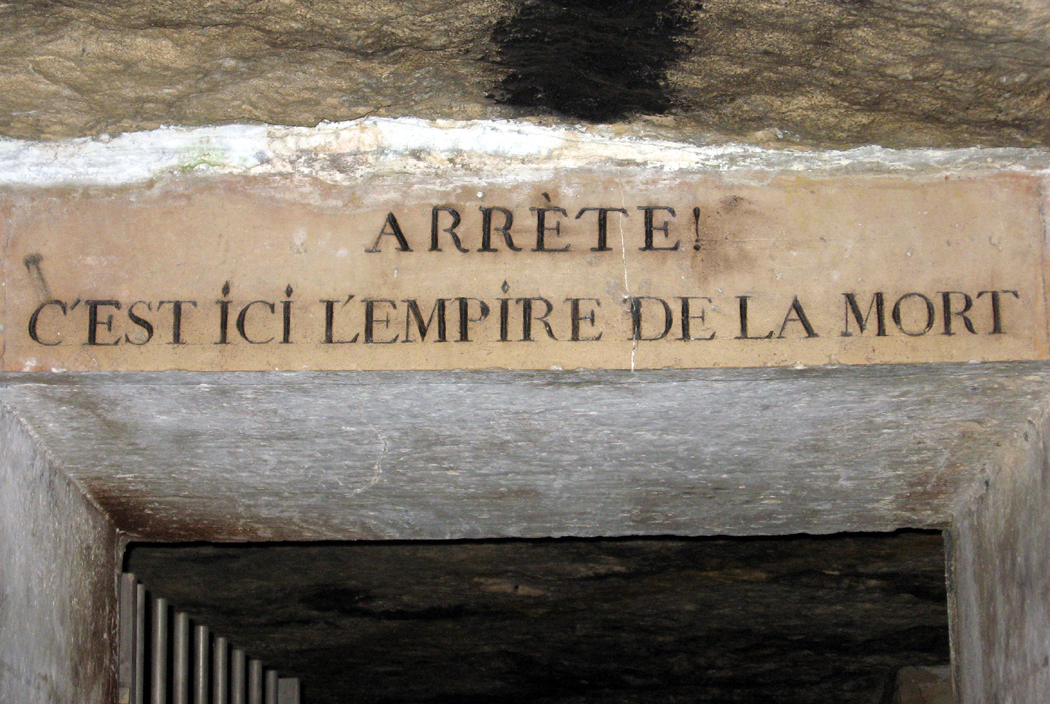
“Stop!” said the sign above the final door. “You are entering the empire of the dead.”
The tunnel contorts around in the underworld, with niches to right and left piled with the bones torn up from Paris graveyards.catacombs 2 - skulls

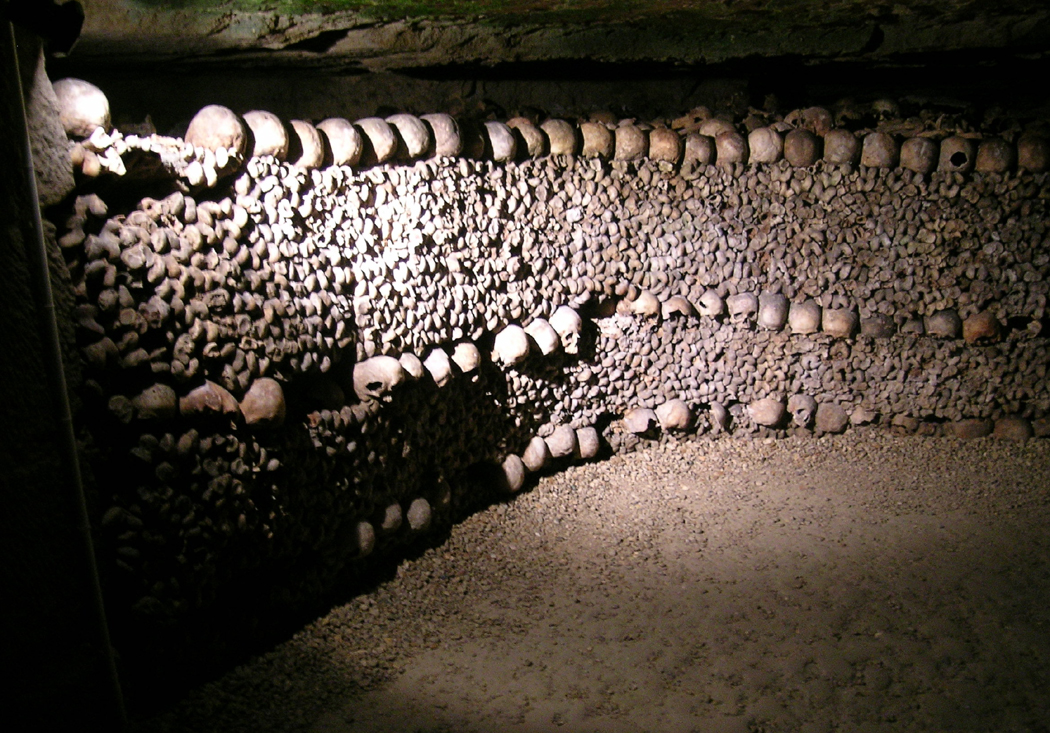
Millions of the dead from Paris’s past are piled here, with a wall of tibias and skulls making a kind of bone-dike, holding the remaining body parts behind it. Usually, the bones are assembled almost like masonry, with the knob-ends of the tibia bones left end out, and a line of skulls across them, like strata in rocks, or ornament in brickwork.

The tunnels are never higher than about 6-feet and maybe 2 inches high, and only one person wide. Their floors are often damp or wet with cave-drizzle.

Electric lights are placed on the walls every 10 or 15 feet, but with fairly low wattage bulbs.

catacomb cornerSigns were left with the bones describing what cemetery they were disinterred from, almost like regimental monuments in a battlefield.

After snaking through the underworld for perhaps a mile, you came to an even narrower spiral stone staircase with 84 steps, as the sign says, bringing you those six stories up from Hades, and you open out into a side street from a nondescript stone building-front with no markings to warn anyone this is the exit from Tartarus.

The trip is a genuine experience, an encounter with history.

Going through the tunnels is a completely alimentary experience. The bowels of the earth. Expelled into sunlight.

paris sewer 5

THE SEWERS

The sewer system of Paris is one of the world’s wonders. If straightened out, they could run from Paris to Istanbul.

They have a place in fable and lore far exceeding that of any other sewer system in the world: They are the tunnels through which Jean Valjean carried the wounded Marius in Les Miserables.

“By degrees, we will admit, a certain horror seized upon him. The gloom which enveloped him penetrated his spirit. He walked in an enigma. … How was he to get out? Would he find an exit? Would he find it in time? Would that colossal subterranean sponge with its stone cavities, allow itself to be penetrated and pierced? …Would they end by both getting lost, and by furnishing two skeletons in a nook of that night? He did not know. He put all these questions to himself without replying to them. The intestines of Paris form a precipice. Like the prophet, he was in the belly of the monster.”

The “intestines,” is the right word. They are called in French, Des Egouts — the “guts.”paris sewer 9

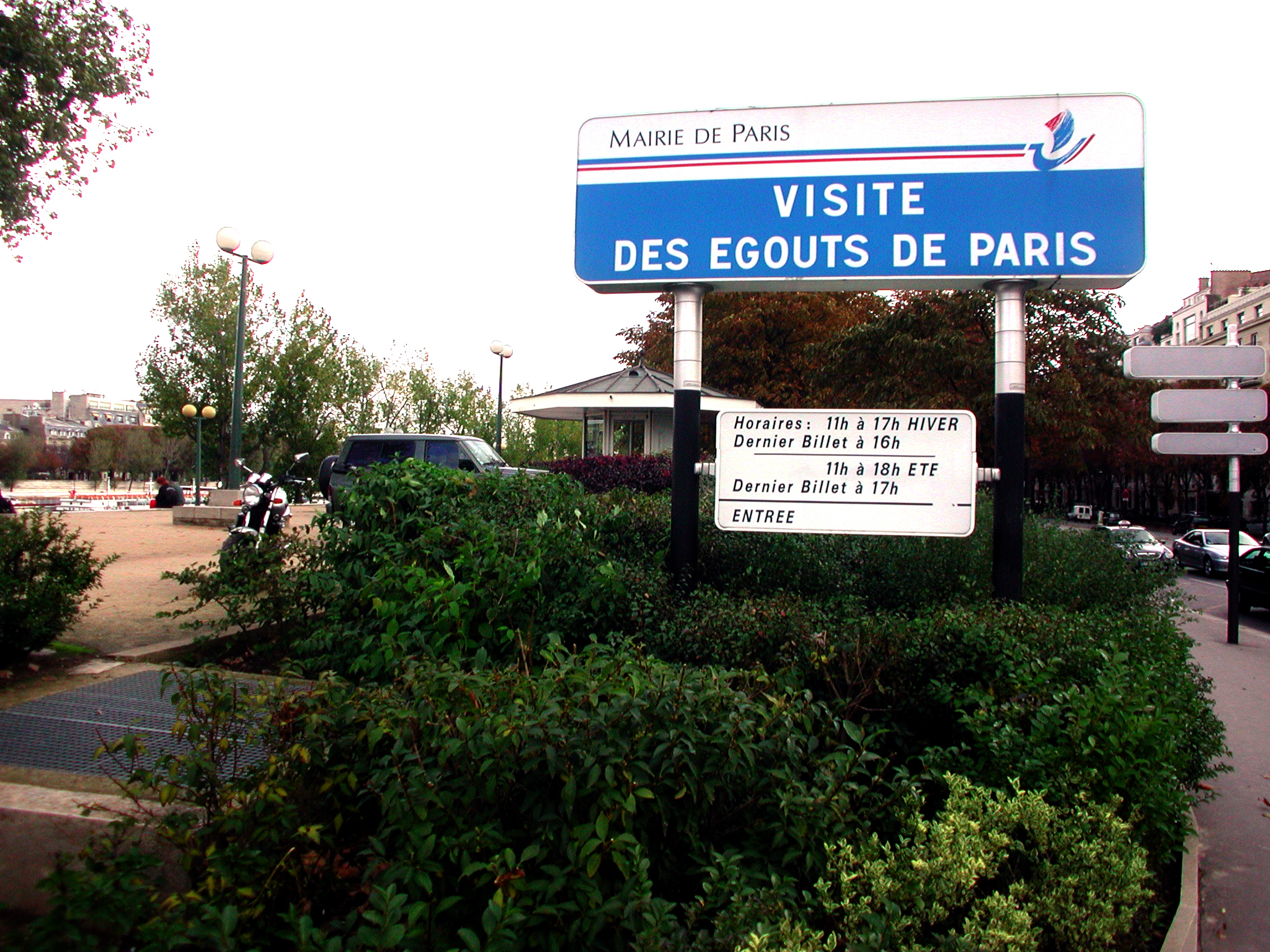
The entrance to the portion open to the public is like a tiny lemonade stand beside the bridge over the Seine. You buy tickets and descend into the depths, where a very faint odor of sewage wafts up — so faint that in a few moments, you no longer notice it.

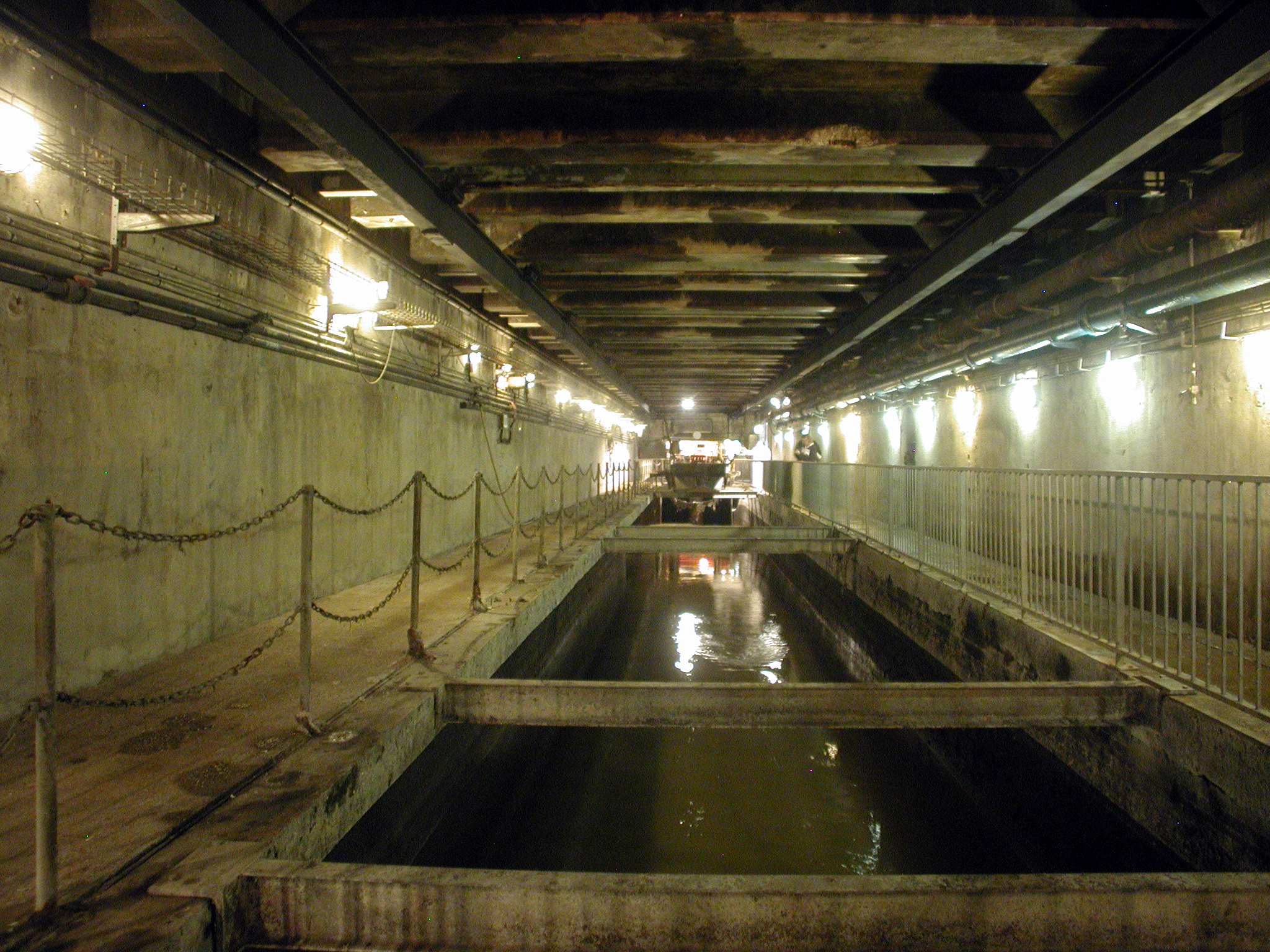
What first hits you in the darkness of the sewer tunnels is the sound, the thunderous sound of water, like a torrent over a waterfall. Part of this is the sound amplification of the tunnels, but most is the enormous quantity of water passing through the system. As you walk down one wide tunnel – more like an extended garage — the water passes underneath you as you walk over a steel mesh walkway.paris sewer 3

There are signs along the way explaining not only the sewers, but the history of the sewers, beginning in Roman times. The current system is a gift of Baron Haussmann from his city rebuilding plan of the mid 1800s.

There is a kind of pulse, or bloodflow, that the system implies, a circulation system for the city.

One looks at a city from above ground and sees the traffic, the shops, the restaurants, the pedestrians, the apartments above the stores, the metro stations, the statuary and monuments, but they are all just the skin of the city.

Under it run the subways, the catacombs, the sewers, the remains of hundreds of years of quarrying, the abandoned tunnels of previous water and sewer lines, abandoned subway tunnels, and millions of miles of cable.

And, of course, the people milling around on the surface, drinking their cafe cremes, could not exist in the city without the subsurface infrastructure.

cimetiere montparnasse

THE CEMETERIES

It says something about Charles Baudelaire that he is buried in a grave listed under his despised step-father’s name. It is odd, that someone as famous and accomplished as the poet was, of course, baudelaire 1someone’s son, and part of a family, and all the wretched dynamics that implies: Charles was Petit Charles  to his mom and step-dad, and even after he grew up, he seemed to remain their little boy, so that, unlike other more pompous and be-medalled Frenchmen, with their giant sepulture, with statues and trumpeting angels, he gets second billing on a plain headstone in the cimetiere Montparnasse, with his mother — who outlived him by two or three years — billed third.

It is her revenge on her wayward child.

There are three large cemeteries in Paris, and they each have their celebrity tombs.

Most famous is the grave of Jim Morrison of The Doors at the cimetiere du Pere-Lachaise near Montmartre.

There, you can also discover Apollinaire, Balzac, Beaumarchais, Sarah Bernhardt and Frederic Chopin.

At the cimetiere de Passy you find Debussy, Manet and Joan of Arc.three graves

Visiting the cimetiere Montparnasse leads one to discover things about personages that one might not have guessed: Henri Langlois, who ran the Cinémathèque Française, has a gravestone filled with publicity photos from scores of movies; Jean-Paul Sartre and Simone de Beauvoir share a headstone with only their names and dates; actress Jean Seberg has a simple flat stone grave with a tiny headstone with her name in a badly written script, as though done by an amateur. Many small stones had been left on the sarcophagus lid.
It is no surprise that composer Camille Saint-Saens has a sepulcher with sculpture carved inside. He was an honored figure from the French intelligentsia, but all his pomp doesn’t say as much as the one grave, with no name, and the only thing written on it, in elegant letters is “Le paradis c’est Paris.”le paradis c'est paris

Paradise, but also the underworld.

leo gorcey

Americans have always had a cultural inferiority complex. In other areas, we may walk with a swagger of a bully, but from our earliest years, when the colonists imported all their music and tea, to the 20th century, when we looked to France for our avant garde, Americans have not had the self-confidence to be who they are.

And so, we often try our hardest to climb the social ladder by imitating others.

Certainly this impulse is behind the current epidemic of saying ”you and I” when we mean ”you and me.” As in, ”He left a message for Harry and I.” The hair twitches on the back of my neck every time I hear it.

I know where this ugly solecism comes from: We have been told not to say, ”Me and Harry are going down to the shop to work on the carburetor,” but rather, ”Harry and I are going.”

”It’s a question of breeding,” our matronly third-grade teachers told us, lorgnette over nose.

Henry Thoreau noticed that when a cat jumps on a hot stove and is burned, it will never jump on a hot stove again. But then, it will never jump on a cold one, either.

And we transfer this delicacy to the wrong place, saying ”you and I” whether as subject or object.

It’s like holding up our pinkie when we pick up our teacup.

In the process, we often make ourselves look foolish, as we attempt to be more French than the French or more English than the queen. Only this attempt to borrow class can explain the success of such monumental bores as Masterpiece Theatre.

But America ain’t Cole Porter; America is Leo Gorcey.

This has been brought back to me hearing local TV news anchors attempt to stuff self-consciously correct Spanish pronunciations into the middle of middle-brow English sentences.

”In the latest news from ‘Nee-hah-RAH-wah’ . . .,” the anchor will say, and I am embarrassed for him. Not because he’s trying to be politically correct, but because he doesn’t seem to know that ”Nicaragua” is an English word. Sure, it is spelled just like the Spanish word, but like so many formerly foreign words, it has become naturalized.

The American pronunciation falls off the tongue better, certainly, than the British pronunciation: Nick-uh-RAG-yoo-wa.

”But we need to show respect for Hispanic culture,” he says.

And I agree. Americans are miserable when it comes to learning second languages. I am all for a bilingual America; we should not be so provincial as we are. But my simple answer is a question:

What is the capital of France?

Are we showing disrespect for the French when we blithely mispronounce ”Paris”? Why should it not be ”Par-ee?”

Well, because it sounds pretentious, that’s why. Pronunciation is guided by usage. We say ”Paris” in English and ”Par-ee” when we speak French.

Which is why the same news anchor isn’t consistent and doesn’t bring us news from ”Meh-hee-ko,” our neighbor to the south. It would sound silly. Long usage in English makes us pronounce the ”X” in Mexico as a ”ks” sound, its habitual sound in English.

Are we dissing Russia when we say ”Moscow” instead of ”Moosk-vah?” And after all, what do the Chinese call their country? Certainly it isn’t ”China.”

Are you suggesting we should say ”Nihon” instead of ”Japan”?

This isn’t really about respect but about communication: Usage allows our hearer to understand our words.

And conversely, is the Puerto Rican immigrant showing disrespect for American when he calls our largest city ”Noo Jork?” Of course not, but certainly respect has to be a two-way street. Those who demand we show respect for other cultures often share the familiar lack of ”cultural self-esteem” for their American roots.

If it is a moral question to give up our American pronunciation of familiar foreign words, why is it not also a moral question for others to give up their accents when they speak English?

Put that way, the silliness of it all becomes clear.

English is a wonderfully rich and adaptable language, and it has borrowed from almost every other language on the planet over the years. But it changes the words it borrows and makes them fit comfortably on the English-speaking tongue.

Certain words and names through long usage have developed idiomatic English pronunciations. We listen to the mazurkas of ”Show-pan” and look at the canvases of ”Van-go.”  It puts people off — and certainly puts me off — when people attempt to be more correct than necessary. In essence, they are merely showing off.

It is that unattractive element of social climbing.

When there is not a habitual English idiomatic usage, I’m all for pronouncing words as accurately as possible in their original language. But some things have become English.

I remember an object lesson listening to classical music radio in North Carolina many years ago.

The station was traditionally run by engineering students who were more interested in radio than in music. They couldn’t pronounce anything right. They mangled composers’ names. Bach was ”Baytch,” Chopin was a phonetical ”Chop-in,” as in ”there’s a pork chop in the freezer.”

We suffered for years, until they went the exact opposite way. One day they got an announcer who was more French than De Gaulle, or thought he was.

All of a sudden, Chopin’s name was ”Fray-der-EEK France-WAH Show-(something swallowed in the back of the throat and simultaneously sneezed out the nose after wrapping around the adenoids).”

It was a pretentious-sounding rectitude.

That same announcer later gave away the game, demonstrating what level of sophistication he’d actually achieved, when he played a Mahler symphony and he called out the name ”Goose-TAHV Mah-LAY.”


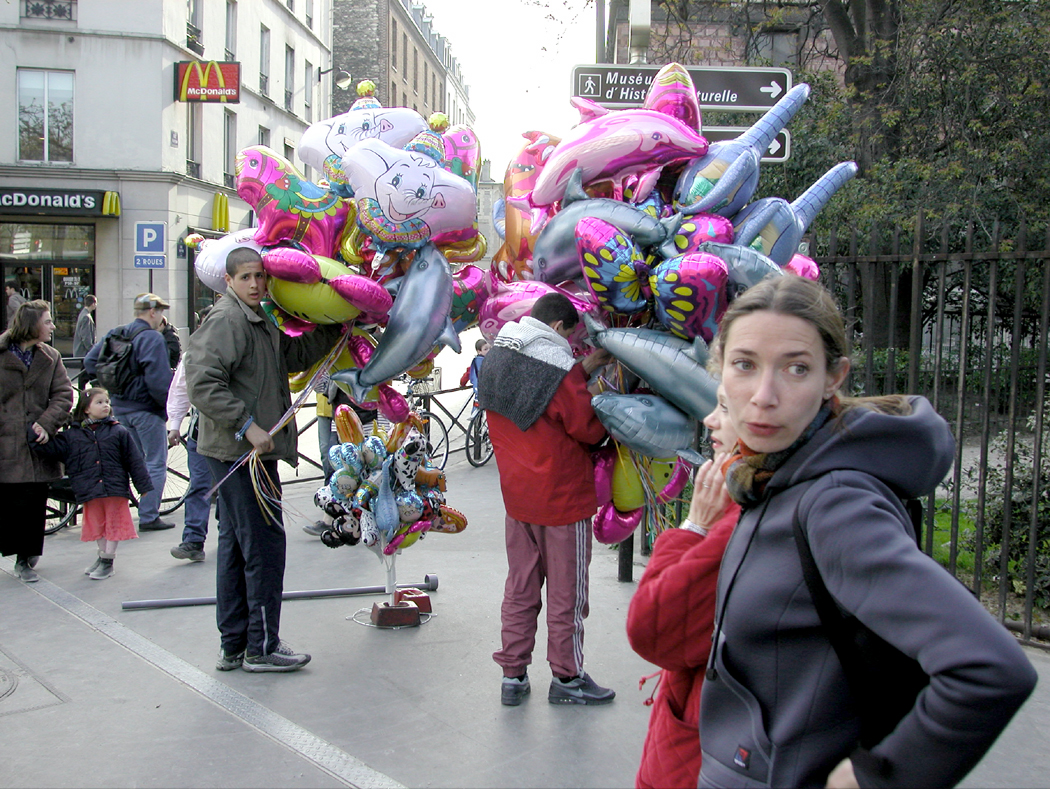
baloon guys copy

Ah, Paris! The Eiffel Tower, the bérets, the Apache dancers, “La Vie en Rose,” haute couture, zee Fransh ak-sant, onion soup, vin rouge, escargot.

Baloney.

The Paris of movies and tourist brochures is, frankly, a load of hooey. If you go to Paris to see the city of  Amélie or Avenue Montaigne, or worse, the city of An American in Paris, you will be disappointed. There is no Maurice Chevalier here, singing “Louise,” no Piaf, regrets or otherwise.

Paris is a city, not a romantic illusion. There is traffic, there is noise, there is filth on the streets. On street corners, teenage toughs with shaggy hair make out with the girls during school lunch hours and workmen carry long pipes of PVC to replace worn out Paris plumbing, and cars stop midstreet to block those behind, while someone jumps out and opens the rear door to make deliveries, oblivious.

It is a working city; not a theme park. It has edges, it has smells. It has its crankiness as well as its graces.

Yet, Paris is still one of the greatest cities in the world. For some of us, the greatest, no contest.

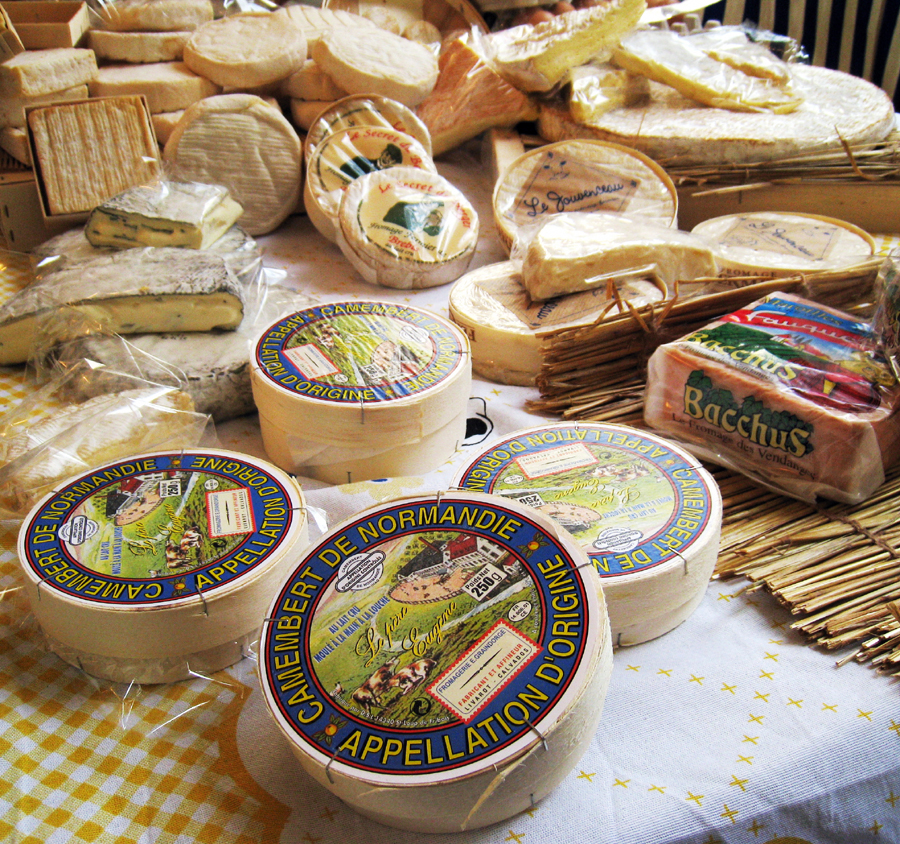
Oh, you can still get a bowdlerized version of the city from on top of a tour bus, with a cheesy tour guide pointing out all the familiar places: Napoléon’s tomb, the Notre Dame cathedral, the Panthéon, the Opéra, the Louvre. But if you only look for the guidebook Paris, you will miss the real city. It is there to be soaked in, like the fragrance of a newly cut camembert.

cheese copy

The best way to discover the real Paris is to find a neighborhood to stay in, and then to walk the streets, shop in the stores and eat in the cafes and restaurants. Avoid the usual areas: Don’t book a room in the Latin Quarter or the Marais or, god help you, Montmartre.

Paris is divided into administrative districts, called arrondissements. The Fifth is a huge tourist area; try the nearly forgotten 12th or the off-on-the-side 16th. You will hear the screams and chatter of school children playing at recess. You will see the regulars downing their apéritifs at the corner bars. You will find not only the boulangeries (bakeries), patisseries (pastry shops) and épiceries (corner grocers), but also the small shop where a seamstress can repair a torn trouser leg, the cheap, smarmy cadeaux shops, with their cheap plastic “gifts” — the kind people give each other when they don’t really care what the recipient thinks, but nevertheless feel socially obligated to offer. You find the pharmacies under the flashing green neon crosses, where the pharmacist can help you find anything from a toothbrush to doctor when you need one on a Saturday morning.

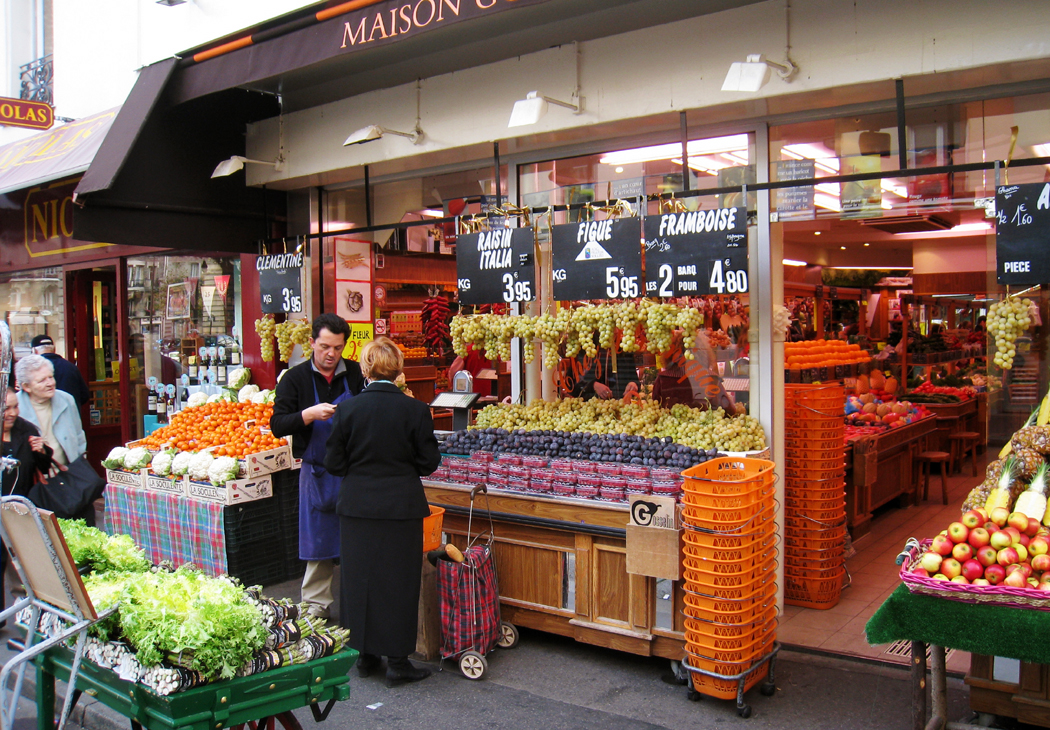
produce copy

If you walk around your neighborhood, in a very short time, the tradesmen will begin to recognize you as you pass. They’ll smile and wave, perhaps ask about your family.

The butcher will be a larger man, with a mustache; you can see him through the window hacking away at a side of beef.

The épicier, or corner grocer, is most likely an immigrant, maybe Korean, perhaps Algerian. He will greet you when you enter: “Bonjour.” He will ask what you need and help you find it.

There are self-service supermarkets in the city – the Champion or the Monoprix – but it is still the épicier that you should go to, with wine ranked on one wall like books in a Victorian library, shelves of canned goods, a refrigerator for milk and crème fraiche.

You always let the grocer pick out your tomatoes or onions. He is expected to know which ones are best and is expected to have your interest at heart. As Captain Renault says in Casablanca, “It is a little game we play.”

In the morning, you stop at the boulangerie for a croissant and a coffee – the national breakfast; in the afternoon, you stop again for a baguette, which may be the best bread in the world. If you are in a hurry, you can stop at lunchtime and get a tartine, a sandwich made on an open face half-baguette.

Making crepes copy

One of the best parts of a visit to Paris is the outdoor market, or marché. Once or twice a week, in certain sections of the city, awnings will be erected and from early morning to early afternoon, booths will offer vegetables, fruit, fish, meat, poultry, wristwatches, purses and overcoats. The markets throng with people.

You couldn’t walk without a “pardonnez-moi” or “excusez-moi” every 20 seconds. Little old ladies with their two-wheeled grocery carts trailing along behind them like luggage. Young couples eyeing the cheap jewelry and gaudy watches. Old men looking acerbic and grumpy, with their hands in their overcoat pockets and a scratchy white three-day stubble on their double chins. Little schoolchildren on aluminum scooters.

10-08-08 copy 1

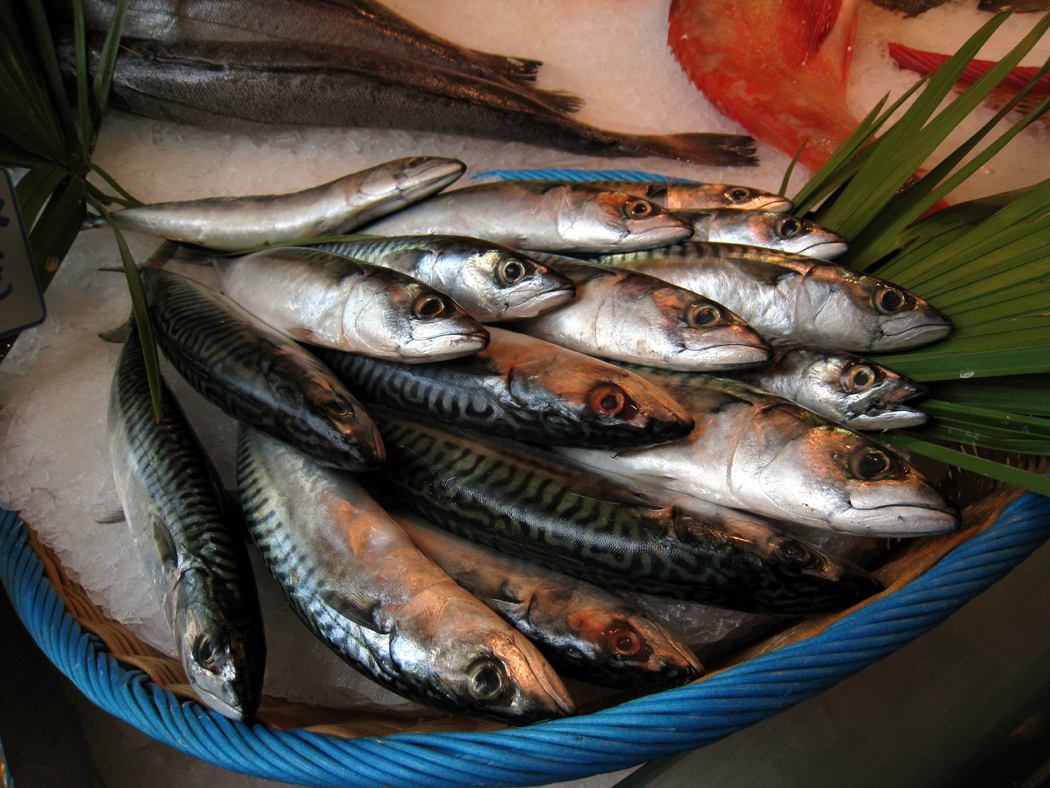
One stall will be a fishmonger, with heaps of silvery dace and mackerel, red-fleshed, skinned flatfish, piles of oysters, boxes of shrimp and langoustine.

fishbasket2 copy

The next will offer meat, with freshly butchered shanks and steaks, and platters of livers, kidneys and other oddments. Perhaps a fresh rabbit, fur on, hangs upside down. More than one stall will be end to end vegetables and fruits, with cauliflowers, tomatoes, leeks, cabbages, peaches, apples, pears.

A few meters down the road, the food will give way to junk jewelry and hairpins. Further, there will be clothing stalls, shoes, jackets.

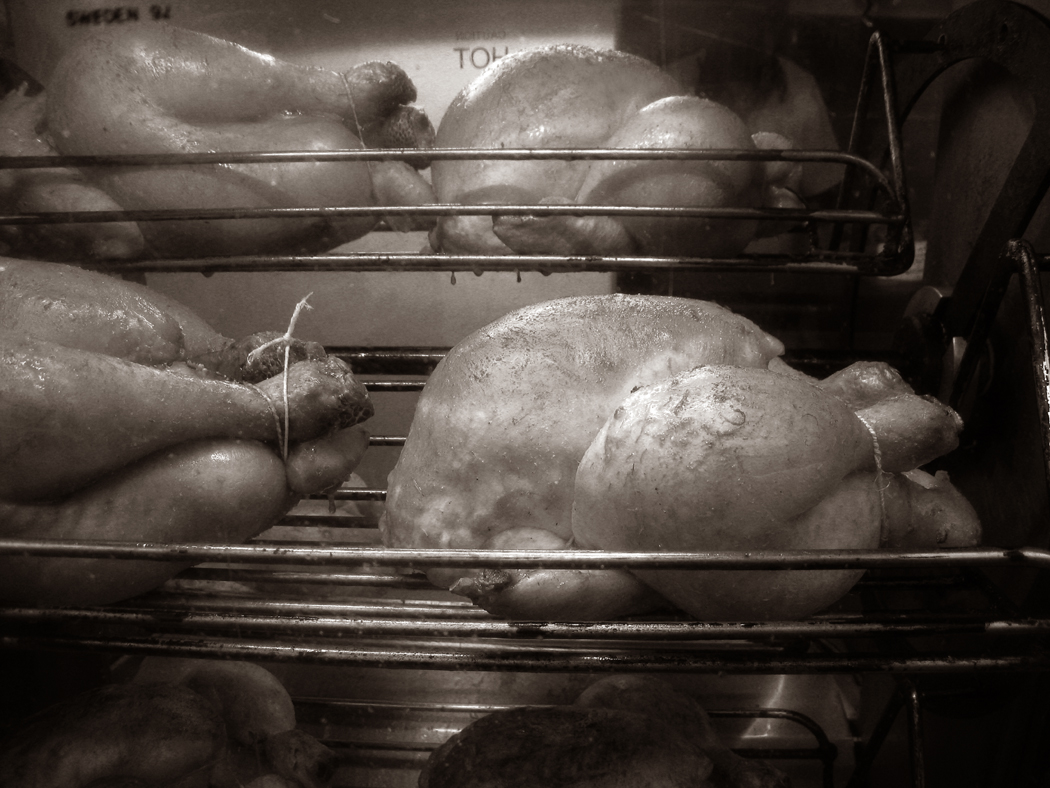
Then, more food. One great-smelling stall has whole chickens on rotisserie racks, about 6 skewers high, over a trough with golden roasted new potatoes glistening in tasty duck fat.

The hawkers all smile and call out as you pass. “Poissons très fraiches,” or “Poulet, poulet, six Euro, deux pour dix Euro.”

Some markets, like the one at rue Mouffetard in the spring and summer, is a hook for tourists, but most of them, and all of them in the off-season, are really there for Parisians, who really do load up every Saturday, or Wednesday or Sunday — whichever day their particular market opens. By 2 p.m., everyone is packing up their wares and getting ready for the new market tomorrow in another part of the city.

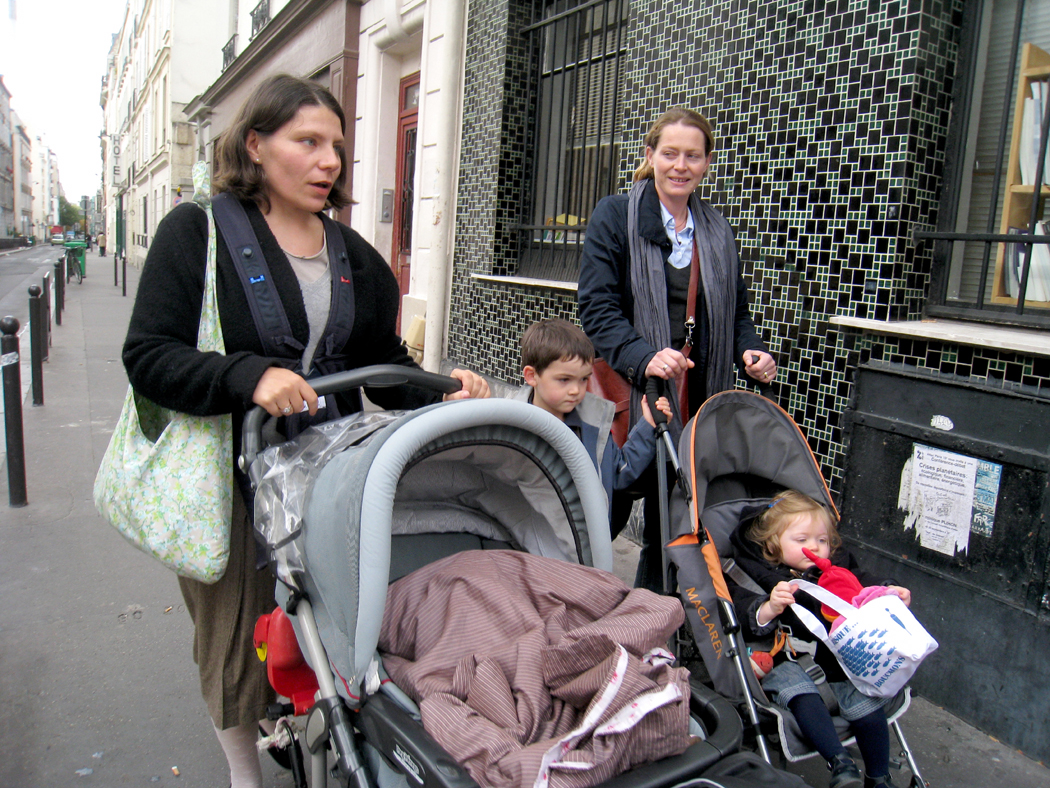
A neighborhood consists of apartment buildings, primarily. In the older neighborhoods, the buildings were erected in the 19th or early 20th century. They will have sculpture over the doorways and carvings on the windows. They are elegant; they are everywhere. But in newer neighborhoods, the apartments can be outright ugly: Designed in the 1960s as modernistic, and now grimy with soot on what was once shiny brushed aluminum paneling, or covered with graffiti on bland stucco. Parents walk their infants in strollers or hold their older kids’ hands as they walk to the market, the school or the post office. Bicycles are everywhere and so are the motorcycles and scooters, making up most of the background noise of Paris, mixed with the perennial “eeee-aaaaw, eeee-aaaw” of the emergency vehicles – les pompiers.

10-05-04 copy 1

I cannot know what others find in Paris, but this is what we find that keeps drawing us back, every two years, when we can round up the wherewithal to go. There is certainly an exoticism in a place where no one speaks your language and they eat kidneys and snails, but it isn’t the strangeness of the place that draws us back; it is the familiarity, the sense of having found a home — a spiritual home, a place where the populace seems connected to the things we feel connected to.

Living in America, we are miserably confined to a world view that simply isn’t satisfying. I bump into those who reflexively insult the French — “cheese-eating surrender monkeys,” and the like — but who have never been to France. Or Chile, or Shanghai. They tend to believe the American way is the only way, and evince little curiosity concerning how others may live, and whether it may, in fact, be a satisfying way to live.

Yes, the hotel rooms may be small, very small; if they have an elevator, it is hardly larger than a phone booth; if they don’t, the stairs will not have met anything like a building code. Floors will likely have steps up or down in unexpected places.

The concierge will be of great help, or at least willingness to help, and almost always speaks pretty good English, but will also almost always be speaking on the phone to a friend.

But the small rooms should not be a problem. After all, we’re just sleeping there.

But I have heard many an American whine and complain about the size of the French hotel room. If they want a Holiday Inn, they might consider a vacation in Missoula or Muscle Shoals.


EATING

Neighborhoods thrive on their restaurants. Every street is filled with them.

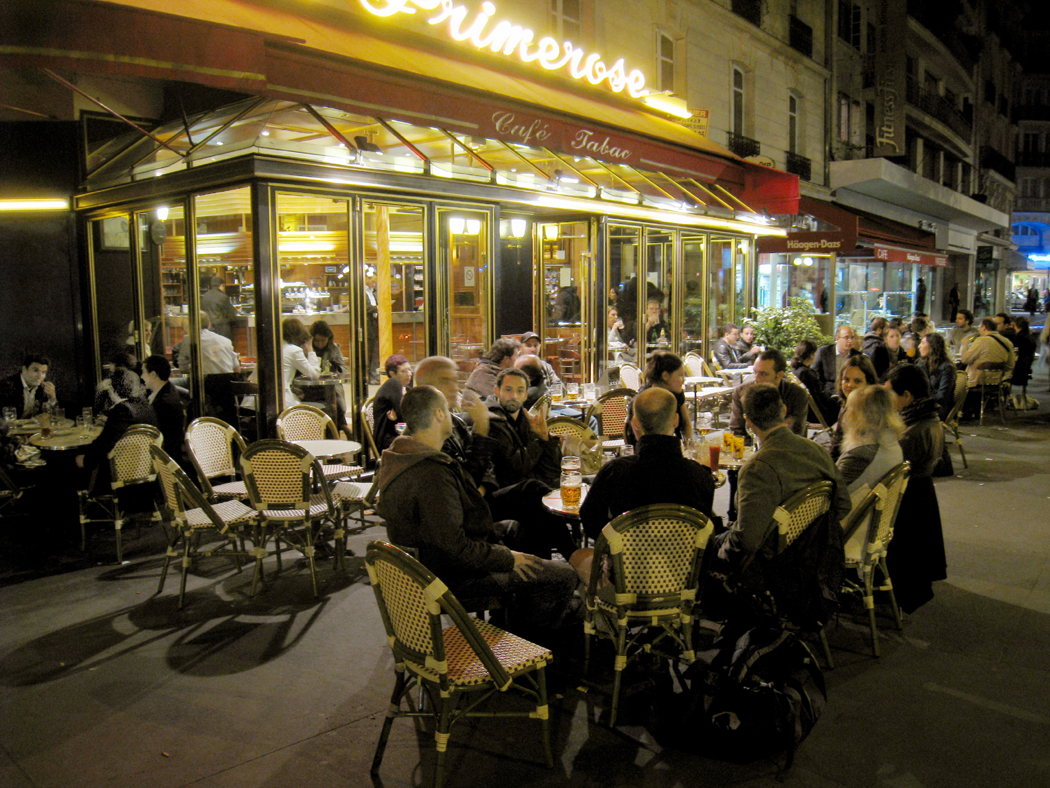
Each night, they will be full from 8 to 10 p.m., with gesticulating diners talking and drinking. But not smoking: Smoking has been banned in all Paris restaurants. The obnoxious smoker spewing cigarette ash all over the place used to be one of the signature characteristics of the city, but that is all gone now. Diners will occasionally excuse themselves from their table and step outside for a furtive puff and come back in when they’re done.

The guide books spend a lot of time explaining the difference between a cafe and a bistro or brasserie or salon de thé, but really, all that is old hat. Most often you see signs for cafe-restaurant or bar-brasserie. Everything has morphed into everything else.

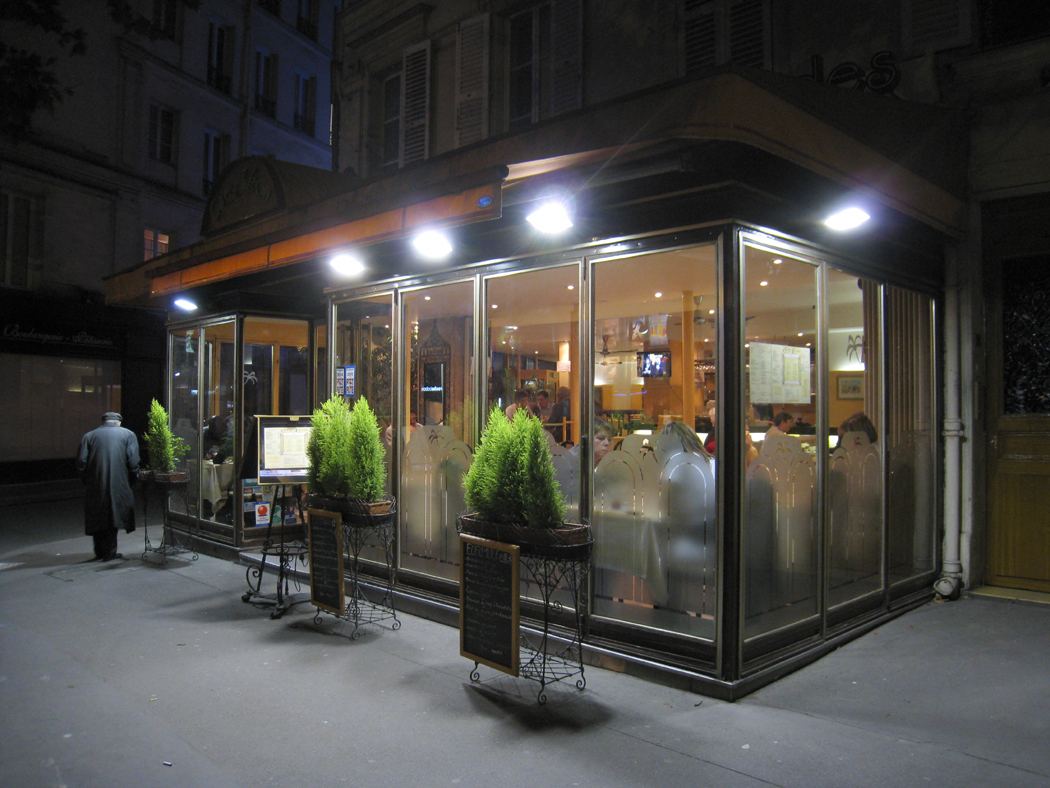
cafenight copy 1

The real difference to notice isn’t the cafe and bistro, but the pizzeria and gyros shop. Most of the restaurants you come across, outside the billions of cafes that line almost every street and bedizen most street corners, will be ethnic: Thai, Korean, Italian, Basque, Indian, Japanese.

turkishfood copy

They will, of course, be French in their approach. Even if you are ordering Chinese, expect a three-course meal with a wine list. Fromage blanc for dessert? Don’t be surprised to find things you’d never find in a Chinese restaurant at home, or in China.

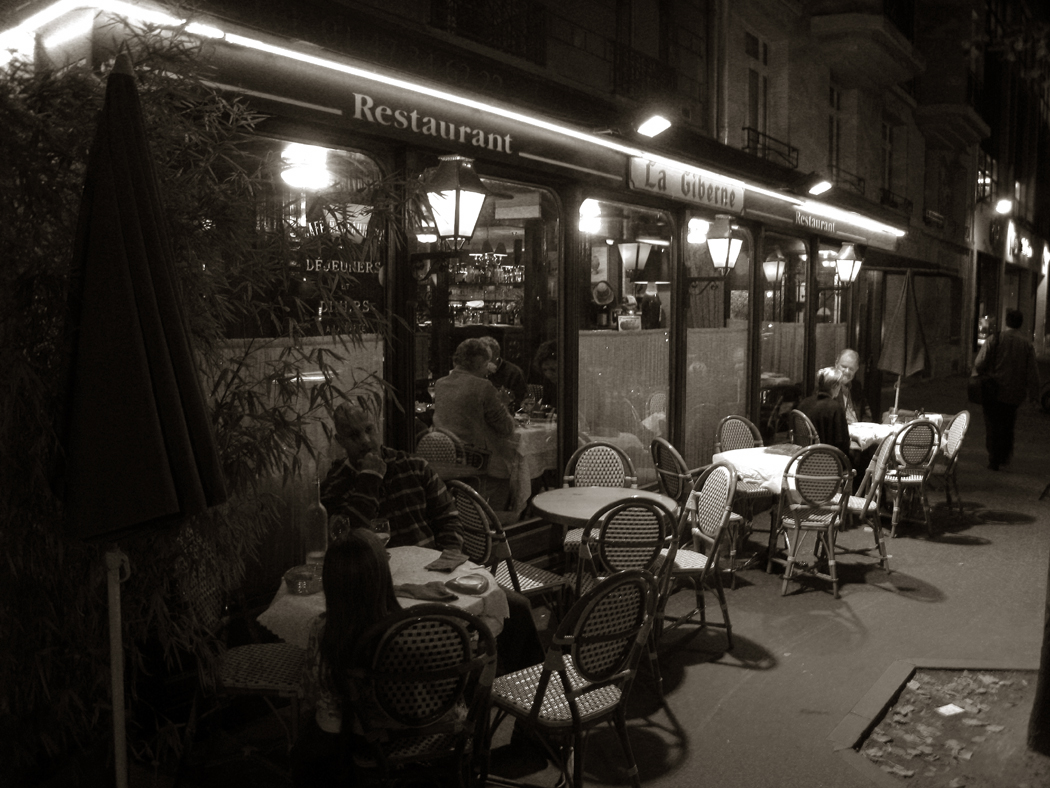
The standard neighborhood restaurant is a two-man affair. It will be a storefront with a few tables outdoors, unused in the autumn chill, and about six tables inside, with a bar at the back of the room, where the waiter stands.

Waiter isn’t quite the right word for him. He is host, bartender and, sometimes, streetside barker. He will be friendly, will smile, will point out what is best on the menu tonight. He is an indispensable part of the dining experience.

But behind the door at the back of the small room, where you see a dim light and perhaps some steam, there is the cook and scullery man, working like a slave, pumping out the escalope de veau or the tortellini Provençal.

He will be a frumpy, dumpy man, or a lean, wiry Algerian, and periodically he will pop out of the kitchen in long, formerly white apron, a shirt with its tails hanging out and a five-o’clock shadow on his face, will scurry like a rodent from the kitchen to the stairs — every such restaurant has a spiral staircase to the basement, located among the tables, where the pantry is kept — and he will disappear for a few minutes and then reemerge, like a prairie dog from his hole, with an armload of fish or potatoes or cooking oil, then disappear back into the hot kitchen.

The first time he did this, as he came up, he looked over at me and smiled, almost like a child. He knew how pathetic he looked, but how competent he knew he was in the kitchen. I’m sure he and the waiter could not possibly have switched jobs.

I mentioned the menu, but in fact, the menu is something else: You order from the “carte,” which is the bill of fare. A “menu” is a prix fixe dinner, offered as either a money-saving alternative for the price-conscious (and a chance for the restaurant to move any items too long hanging around, or in too abundant a supply), or an obvious gimmick for tourists, to make their choices easier among the many strange-sounding food items available.

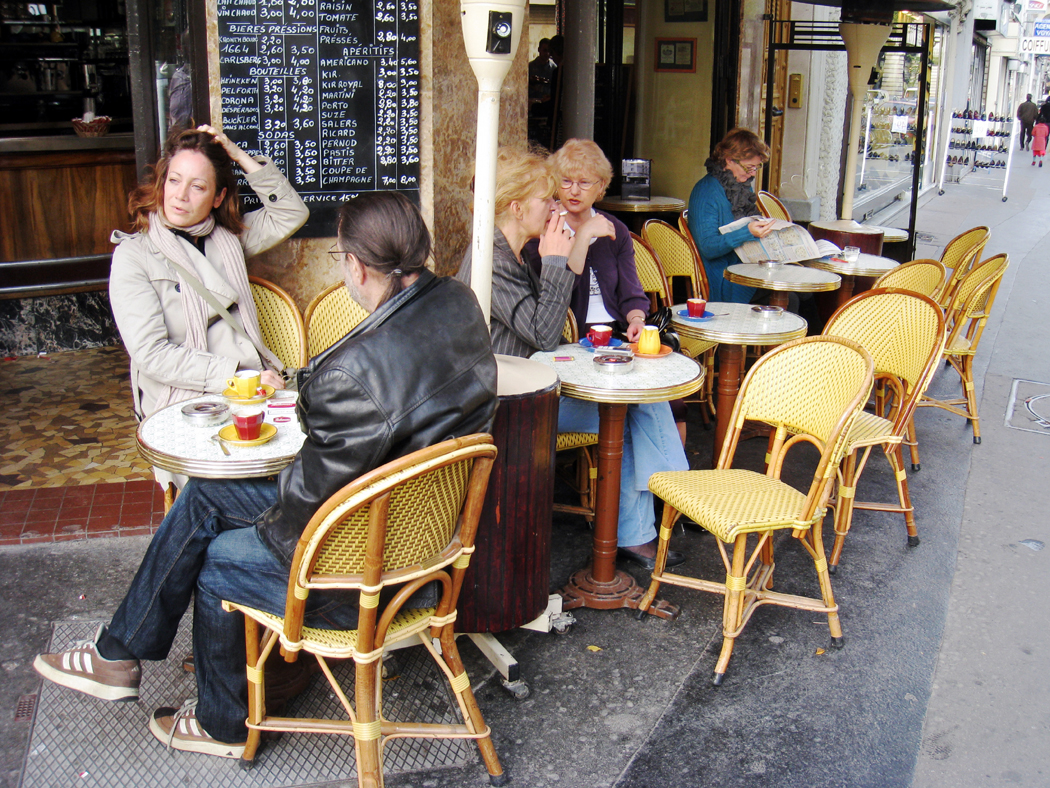
eatingatcafe copy

The menu (or formule, as it is also called) will usually offer an entrée (or first course) and plat (main course), or plat and dessert, for a very low 10 Euro or 13 or 15 Euro, depending on how swanky the food is or in what neighborhood the restaurant is located.

A good menu will offer all three courses. Drinks are extra. Coke is more expensive than wine. Literally. Oh, you can buy really expensive and good wines to have with your cote de veau, but in a cheap cafe, a glass of vin du pays will set you back 2 Euro, while a Coke is likely to run 3.50.

On a chilly, drizzly fall evening, the warmth, physical and emotional, of the neighborhood restaurant, is the essence of the Paris experience.

IMG_0215 copy