Archive

Tag Archives: publishing

The perpetual face-off between writers and editors can frustrate both sides. I remember well once at my newspaper when a copy editor questioned my use of the word “paradiddle.” It didn’t exist, he insisted. I had thought it a perfectly normal word; it is a kind of drum beat. He wanted me to change it. This was fairly unusual; copy editors are usually right, and have an almost preternatural sensitivity to words and usage. But I showed him my word in the dictionary and he was abashed. Paradiddle made it into print. 

But this became a kind of grudge I held (in a mild way — the copy desk saved my bacon many a time, so it was more a slight nettle than a grudge). And so, for the next six months, I got my own back by including in every story I wrote, a word I made up. To quote Captain Renault in Casablanca, “It is a little game we play.” 

These were not outrageous words. Some were onomatopoetic, like the Batman “Groink!” or “Shwak!” Others were neologisms derived from Latin or Greek, and therefore easy to parse. Others were verbs in noun clothing, or common words with new prefixes or suffixes. And for six months, not a single one of them was questioned by the copy desk. Perhaps they just thought if they didn’t poke at me, I would leave them alone. 
 Writers (and editors) live in a world of words. We have all been English majors, came to love language and have developed a word trove far in excess of that of the standard math major or the athlete. We have absorbed most words, including the shibboleth words of numbers or sports. Words B Us. 

This starts at a very early age. In second grade, when we were given vocabulary lists to memorize, I loved soaking them in. And when asked to write sentences using the new words, I tasked myself with using them all up in as few sentences as possible. When I could combine all 10 of them in a single sentence, it was the jackpot. It was a game and fun to play. 

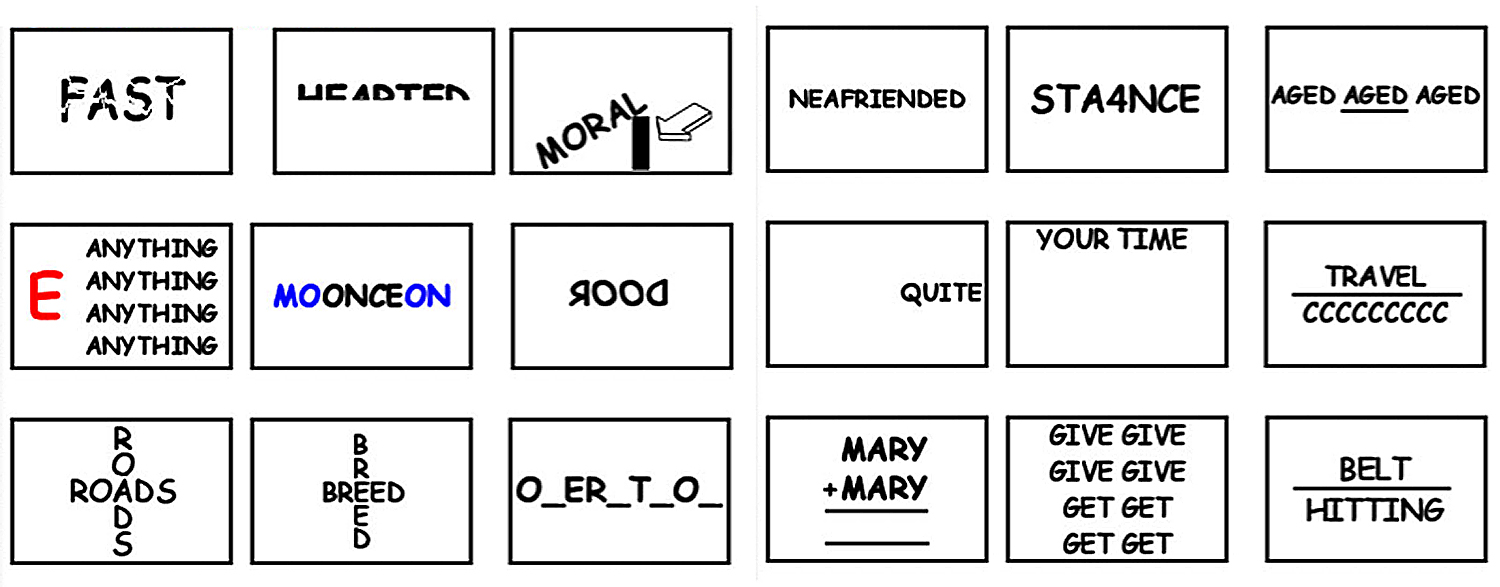
Words are things and English majors like to move them around, rearrange them, misspell them, invent new malapropisms. The wordplay involves mondegreens, eggcorns, puns, spoonerisms and other fun ways to mangle the mother tongue. They are terms used for language mistakes, but what do you call them when you commit them on purpose?

I have been doing this for as long as I can remember, or, as I usually say, “marimba.” As my newspaper’s classical music critic, I frequently attended concerts by the “sympathy orchestra.” I used these terms so often, I had to be careful when speaking to more sober-minded audiences. 

I make “chilled grease” sandwiches, and oyster stew becomes “moister stew.” Lasagne becomes “la zagnee,” or “lazza gonya.” (Yes, I know this can become quite annoying.) 

In college, a friend had scribbled on the side of his refrigerator a shopping list: 
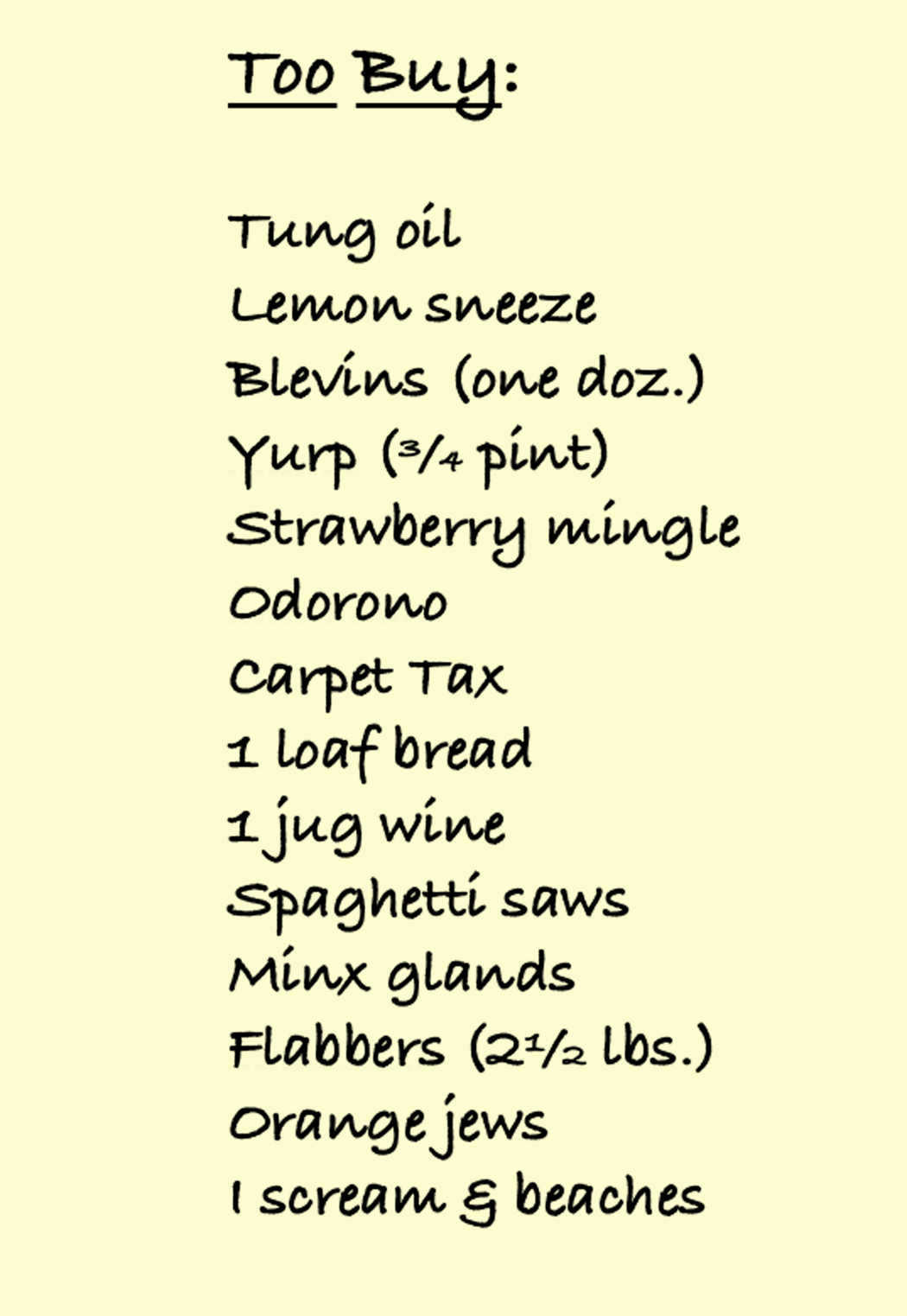
I have since embroidered that original list with a few extra items, including sesame kagels, cabbage-liver paste, and dishlicking washwood. 

I have since then always referred to my “Chopin Liszt” and I carry around a notebook in my back pocket for random notes, and my weekly Chopin Liszt, and often mess around with the items. 

Among these are: munchworms; scream cheese; switch cheese; mouse wash; shower kraut; permission cheese. Sour cream becomes “hour scream;” dill pickles turns into “pill dickles;” ginger ale becomes “Injure jail;” and toilet paper (i.e., loo roll) becomes “Lou Rawls.” In a nod to Homer Simpson, avocado becomes “avamocado.” 

Perhaps this keeps my list safe from prying eyes. Ground beef is “bound grief;” chicken legs is “lickin’ chegs;” and there are “corn flecks;” “tumble fish;” “ravilowly;” and “bisgetti sores.” 

All this just to amuse myself. It isn’t really to entertain the public, just my own list in my own back pocket when I grocery shopping. Shake the phonemes around and make surprising combinations. 

I imagine those with different talents play games in their own disciplines. There must be fun things to do with numbers — different ways of thinking about them. I have always insisted that one plus one equals three: There is the one thing, the other thing, and the two things together — three things. 

And historians can play with their counterfactuals. I imagine lawyers can work some fairly dirty jokes into their depositions. What is the Dirac Sea but some physicists having fun with quantum mechanics. 

The world would be a very dreary place with no play. Even for grown-ups. Especially for grown-ups. 
everymans-library-lede-pic

As I’ve become older, I have become less tolerant of badly-designed, -printed and or -bound books. When I was younger, often I didn’t really know the difference, or thought there was nothing I could do about it — I would just have to read whatever volume came to hand.

These days, however, if a book is the wrong size, has print too tiny, or margins to slender, or its binding cracks when opened too often, I simply put it aside and pick up another book.

It helps that the books I read are primarily classics — that is, books that come in various published versions. Best sellers tend to come only in the version their publishers produce, but when it comes to Lucretius or Melville, you can find a choice of version. You don’t have to put up with yellowing paper or brittle glued bindings.

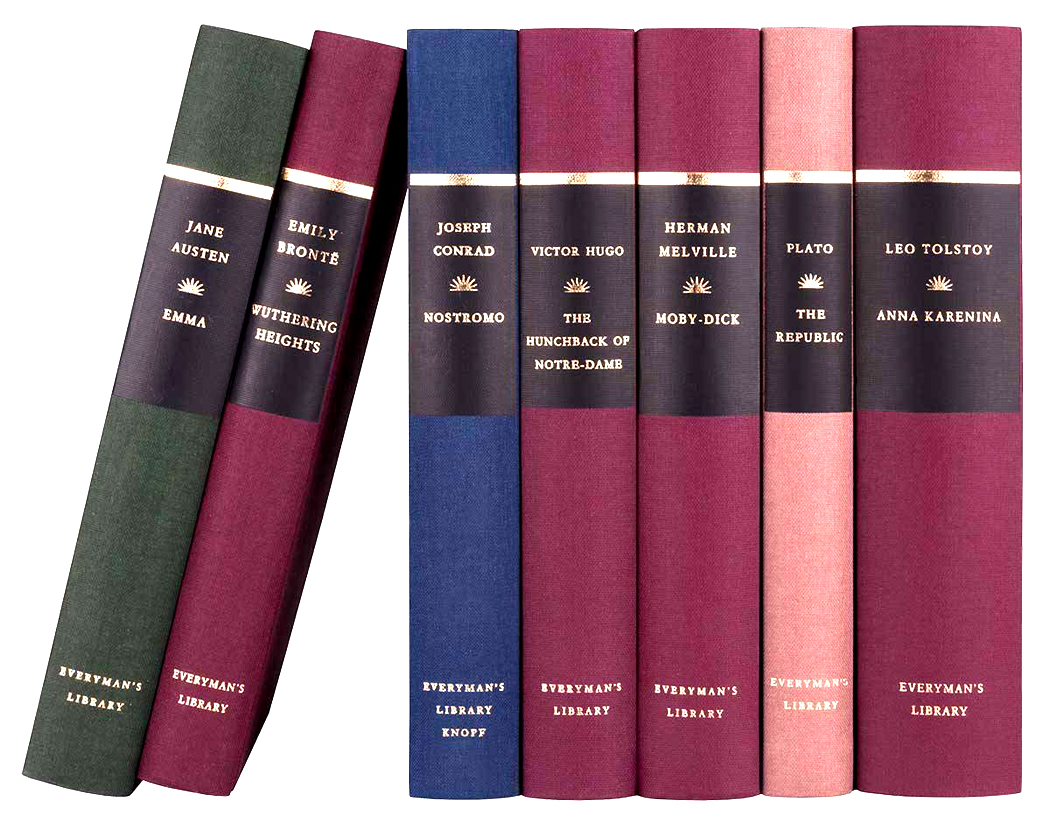
I bring this up, because I have settled on a prodigy of good book production. The paper is acid free, the type is neither too small or too big, the ink is solidly black, the margins adequate for scribbling, the bindings tight and the covers covered in a beautiful linen. As a bonus, each book comes with its own ribbon bookmark attached to the spine. They are sold under the name Everyman’s Library and in the U.S. are an imprint of Knopf.modern-library-2

The current editions are not the same as the classic Everyman’s Library books that are the hidden treasure dug up in every excavation of a dusty old used bookstore in an off-the-way road in rural America. In the past, avid prospectors of used books to read (as opposed to the more modern perversion of seeking first-editions and rare books for a “collection” shown off to visitors and seldom actually read) would seek out Everyman’s books and their American equivalent, Modern Library books. They were cheap, well made and gave you access to all the classic novels and poetry you craved. You can still uncover Modern Library books on the swayback shelves of those bookstores, but some of them have actually become “collectible,” and therefore unaffordable.

everyman-old-style

everyman-old-style-stackThe original Everyman’s Library was devised in 1905 by J.M. Dent and Company in London, with the idea of creating a 1,000 book library of world literature affordable to the ordinary man (and woman). The books originally sold for a shilling apiece (roughly $5 in current U.S. dollars). The books were beautifully designed, in imitation of the books of the Kelmscott Press, and were pocket size and hard cover. I still own several titles, including the entire Spectator series written by Joseph Addison and Richard Steele, from the 18th century. Four volumes of enameled prose.

The current Everyman’s Library books are full size, with nice curved spines, clean linen hard covers, color coded by which century a book was written in, and offer more than 300 titles. They also produce a series of pocket-sized volumes of poetry that you can carry around with you without tearing open the corners of your jacket pockets.

The first of the new Everyman’s Library I became aware of was when I looked for a version of Tristram Shandy I could read. The one I had was a lousy paperback in dense print with insufficient leading between lines. It was an offset print version poorly inked, meaning the letters often grayed out on the yellowed pages. Pfui. But I found a used copy of the Everyman’s Library version and it was as if the sun shone from behind the clouds and the angels’ sang. I read it cover to cover, enjoyed the hell out of it and realized how much the book design helped me navigate it.

library-of-america-shelf

There is another excellent series of books published as the Library of America, which reprints American classics in beautiful editions. Compared with the Everyman’s Library, the Library of America suffers from slightly smaller type and thinner paper. They are excellently edited and offer many tomes not even available elsewhere (such as William Bartram’s Travels and Francis Parkman’s histories). As I gaze to my left at the floor-to-ceiling bookshelf in my office, I count 49 Library of America book spines. I seek them out in used bookstores to save a few bucks — another advantage of the Everyman’s Library books is that, while they are no longer a shilling apiece, they do run an average of a third less than the Library of America offerings.

best-of-wodehouse-coverI bring all this up because I am presently reading the Everyman’s Library edition of P.G. Wodehouse. It is 840 pages of Jeeves, Bertie Wooster, Blandings Castle and Mr. Mulliner in prose as frothy as the foam above a double latte. Friends who know me well knot their eyebrows and wonder what’s going on with Nilsen. Where is the man who would rather collate translations of Vergil than dive into a chocolate sundae?

As it turns out, one needs some balance in a life. As I consider my recent reading history I see the obvious pattern. After diving deep (and I mean deep) into Timothy Snyder’s Bloodlands, I needed to blow off the louring clouds, and took on John Updike’s Bech books — collected, as it turned out, in an Everyman’s Library volume. Enjoyed the heck out of them.

After that I took on Alexander Solzhenitsyn’s Gulag Archipelago. It is three giant volumes long of depression, depravity, injustice, sadism and totalitarianism. I got through the first volume and a half before I had to put it down for a spell. In the interim, I took up Jean Renoir’s memoir of his father. It was a joy to read. I am not a big fan of Pierre Auguste’s paintings, but his son is an excellent writer and I came to value Renoir pere as a man, even if the book didn’t change my thinking about him as an artist.

It felt like diving into the sea, coming up for air, diving down once again, and coming up into the sunlight for relief.

After Renoir, I got back into the Gulag, but soon needed more oxygen, so before I even finished Vol. 2, I headed off to reread Melville’s I and My Chimney — my favorite of his Piazza Tales, and then into A Mencken Chrestomathy, for a good draught of cynicism and cold water before returning to the Solzhenitsyn. But I got sidetracked by another Everyman’s Library book: The Book of Common Prayer.

I don’t know if it was the recent election or what, but I felt I needed the cleansing of some very pure language. You may ask, why would a hardened atheist decide to read Thomas Cranmer’s iconic prayer book? It certainly wasn’t for the theology; it was for the words, so familiar to us, speaking to us of hundreds of years of linguistic tradition, a source of all we take as serious and dignified in the English language. It is hard to turn the page and not find some phrase that is our mother tongue’s subconscious. There is comfort in those cadences.

After that, I took on D.H. Lawrence’s Mornings in Mexico. I enjoy his travel books more than his fiction. He is one odd fellow, idiosyncratic, often wrong-headed in the extreme, but always fun to read.

Other palate-cleansers I have dipped into include Nabokov’s Speak, Memory, Laurence Sterne’s A Sentimental Journey and James Michener’s Tales of the South Pacific.

war-and-peaceWhen I have done with Wodehouse, the next in the queue is War and Peace. It is a book that if I were to go to a Roman Catholic confession, I would have to admit, “Father forgive me, for I have sinned. I have never read War and Peace.” I know it is on the list of books that one should have read, but although I had begun the thing several times over the years, I had never found a volume comfortable enough to read. The thing is immense. One version I bought came with a complimentary hydraulic lift to help lug it around.

Then I discovered the Everyman’s Library edition — in three easily handled volumes, breaking up the density into digestible bits. It comes in its own box, with small wheels attached to help roll it around. (Actually, I’m making up the wheels, but it does have its own box.)

It sits there staring at me, waiting for me to finish with Bertie Wooster and challenging me with Pierre Bezukhov. If I make it through — like trudging from St. Petersburg to Vladivostok — I will find something a little lighter to serve as a sherbet dessert before taking up Vol. 3 of the Gulag.