Archive

Tag Archives: seattle

A Facebook friend left a challenge for her followers: 

“In a text post, list 10 books that have stayed with you in some way. Don’t take but a few minutes, and don’t think too hard — they don’t have to be the “right” or “great” works, just the ones that have touched you. Tag ten friends, including me, so I’ll see your list.”

bear after me

It was after college that my real education began.

There was one official marriage of three years and one unofficial marriage of seven. There were also several crash-and-burn episodes of affection and desire before, during and after. There were many jobs, too: sales clerk, grounds crew, substitute teacher, delivery driver, teacher of crime-scene photography, editor of a black weekly newspaper, and year spent working at the Seattle zoo, but also a year and a half spent almost homeless and broke. At one point, I was literally down to two nickels and three pennies.

There was nevertheless much travel, north and south along the East Coast and east-west taking a train cross country. I knew what it like to sit in the smelly back of a Trailways bus watching 2 a.m. passing in Virginia. And there was a summer hiking part of the Appalachian Trail and feasting on Velveeta, Slim Jims, and Tang mixed with Blue Ridge spring water.Doug as pervert 1978

In Seattle, I lived in a house with two lesbian medical students and the world’s most obscene man. When I was broke and moved back to North Carolina, I was taken in by my college best friend, who, with his wife, nurtured me back to something like sanity.

One learns a lot this way, although they are often things you wish you didn’t have to learn.

But there was a parallel education, and that came from endless reading.

The thing about hard knocks and waxing maturity is that the books and the knocks come to be mirror reflections of each other. You learn the answer to the surly, snotty question you probably asked in high school: “Why do I have to read Jane Austen? It has nothing to do with my life.” Or Gatsby, or Dickens. At that callow age, it all seems so irrelevant (outside, say, Catcher in the Rye, which you insert directly into your vein with a needle).

It is as if they are trying to make you learn things you don’t want to learn. (Hint: They are; and hint: You’re an idiot at that age). Richard back porch 1975

But with a few divorces under your belt, and a couple of employers whipping you from pillar to post, and a few miles under your tires, the world opens up and you begin to understand things you blessedly had no clue of.

It is that parallel education, then, I mean to write about. Those books that cascaded through the years in the wilderness. I tore through a lot of books. Frequently unemployed, I had a lot of time on my hands.

And I didn’t just read books; I read authors. I read all of Hawthorne, all of Melville, all of Thoreau. And when I say all, I mean Israel Potter and A Yankee in Canada. Reams of Faulkner, Hemingway and Steinbeck. I couldn’t get enough Wallace Stevens, Pablo Neruda or William Carlos Williams.

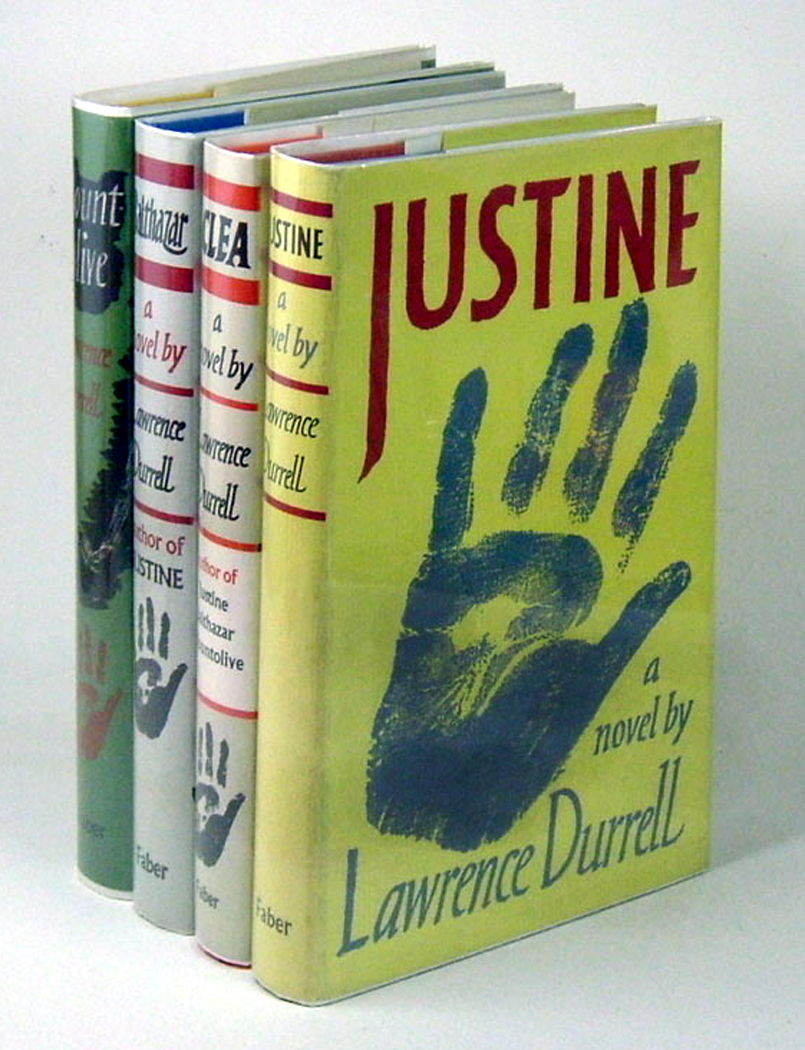
A few spoke to me most directly.alexandria quartet

One was Lawrence Durrell’s Alexandria Quartet. You have to be a certain age and in a certain state to take in those four books. I was. Thirty is its age, just as 14 is Salinger’s.

The “trick”of the four books is a kind of Rashomon retelling of the story several times. First through the eyes of a man in love, second from the point of view of a disinterested outsider, and third from an omniscient narrator and each version contradicts the previous and fills in missing information and corrects their misunderstandings and misperceptions. It is a byzantine tale set in a duplicitous ex-pat Egypt before and during World War II. The prose is dense and florid; the plot is even more so, and the characters even more than that. It is a huge pile of musk, perfume and offal.

I read it with a dictionary at hand. Durrell rather likes arcane and esoteric words and the list I drew up while reading became a daily vocabulary lesson. Etiolated, pegamoid, ululation, exiguous, exigent, vulpine, objurgations, tenebrous, integument, hebetude, fatidic, pullulation, crepitating, emollient, cachinnation, splenetic, comminatory, plethoric, usufruct, mansuetude, titubating.

The author’s habit leads to such sentences as:  “He has manumitted the colloquial…”

But there is a concomitant grace and directness of balancing sentences, such as: “She took kisses like so many coats of paint.”

It is a baroque style that is meat to only a few. I was hungry for it and the reasons were personal.

I only late found out that the woman I had been living with had had a very active secret life of which I knew nothing. I was as naive as Darley in Justine. I had friends who could have written me a Balthazar, but they didn’t and I fled cross country in exile and in metaphysical pain.

This was a devastating case of literature as a mirror and the face I saw there shamed me. But it also instilled in me a sense of caution, a humility concerning what I think I know and a skepticism for what others think they know.

Balthazar at one point says, “Truth naked and unashamed. That’s a splendid phrase. But we always see her as she seems, never as she is. Each man has his own interpretation.” rules of the game

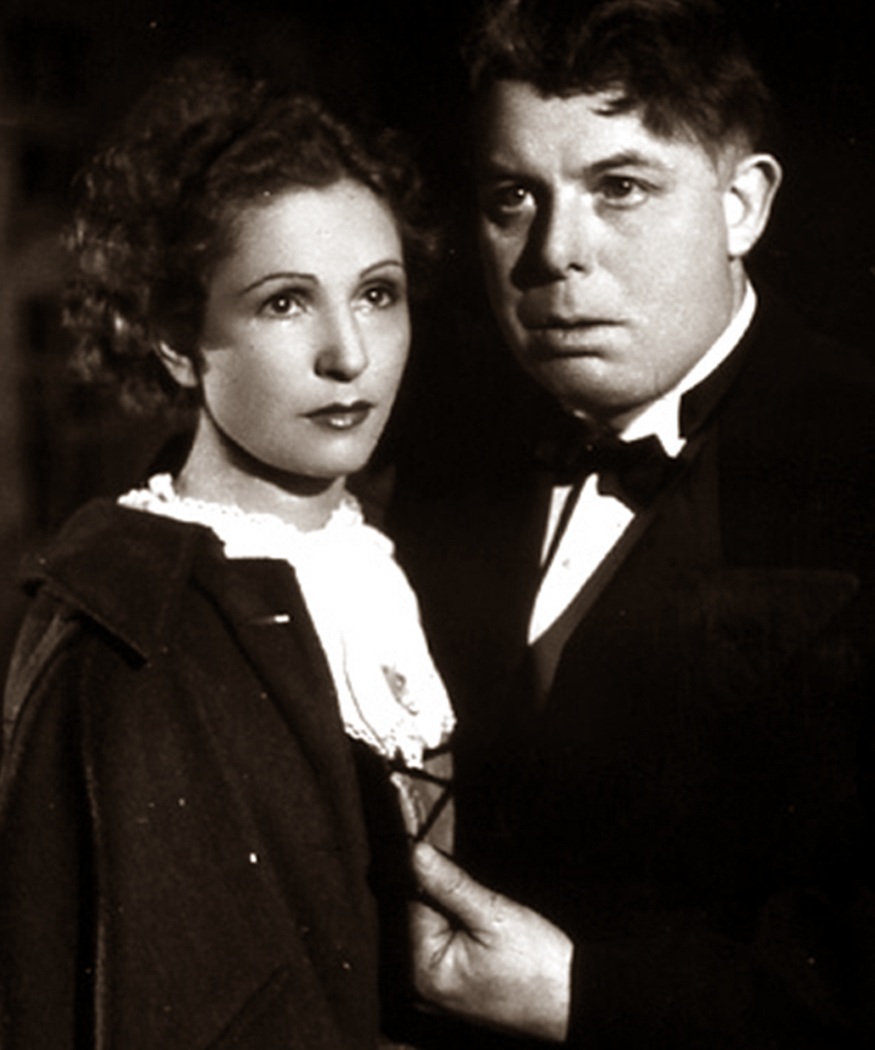
Or, as Octave says in Jean Renoir’s film, Rules of the Game, “The awful thing about life is this: Everyone has his reasons.”

We almost never know enough to make informed judgments: The truth is always hidden from us and people act from motives we cannot be privy to.

Durrell taught me to be perpetually in a state of tolerant unknowing.

Or at least he reinforced through art the lesson I had been given but perhaps did not fully comprehend. Some lessons come in the form of a ball-peen hammer to the head.

NEXT: Part 2 Wilderness years: A bigger library

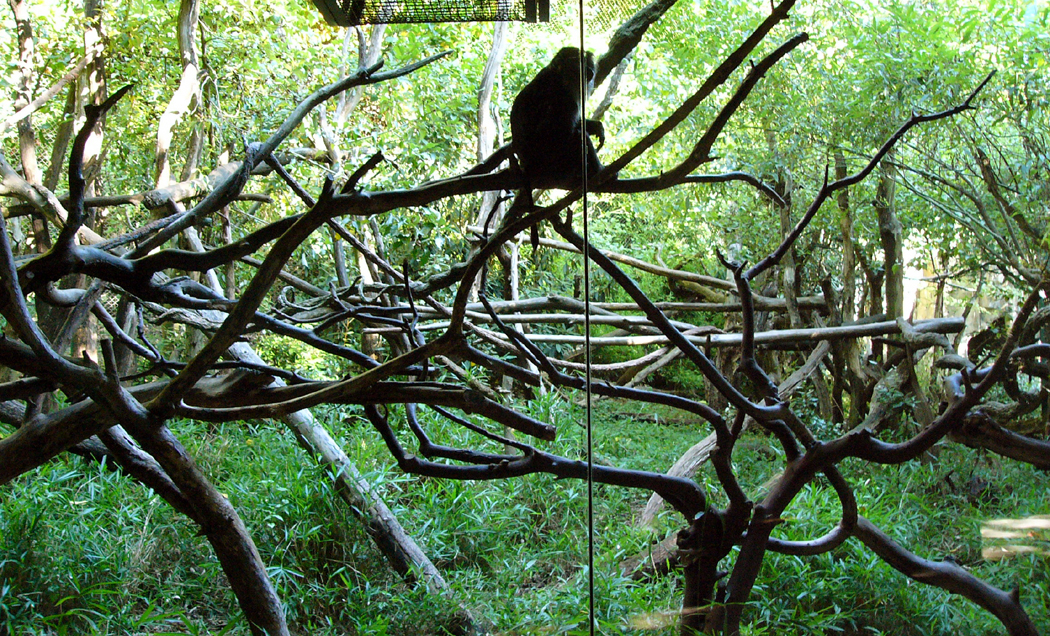
Lion-tail macaques, Woodland Park Zoo, Seattle

Lion-tail macaques, Woodland Park Zoo, Seattle

Woodland Park Zoo, Seattle 1978

When I finally got a job, it was at the zoo. I was hired as a peon to sell popcorn. A week later, I had been promoted to manager and had the safe combination. The concessions stand at the zoo became my little kingdom; I ran it just as I wanted to. I hired the people I wanted and ignored company regulations when they seemed stupid. As a result, our zoo business made money even when the tourist season was over and all the other “restaurants” in the company were losing money down at the Puget Sound docks.

I worked in an iron box maybe 11 feet by six feet deep surrounded by Rube Goldberg steaming, fuming machines.

The concessions stand is a trailer, like those seen at little league games of county fairs, and at lunchtime, the lines for wieners and Pepsi stretch around the children’s zoo. I felt like some zoo animal myself, people staring as they walked past at this six-foot simian with a white snapper cap and striped vest smiling through his beard. But the real zoo was outside my steel cage:

“What do you have to drink?”

“Pepsi, 7-Up, Orange, Diet Pepsi and milk.”

“No grape?”

“No grape.”

“I’ll have root beer, then.”

One woman whose root beer thirst couldn’t be satisfied elsewise asked my to mix half orange and half Pepsi. (I tried it after she left to see if it was as vile as it sounds and it is.)

“You have peanuts?”

“No peanuts. We have popcorn.”

“I never heard of a zoo without peanuts. What do we feed the animals?”

(Under my breath: “That’s WHY we don’t have the damn peanuts, idiot.”)

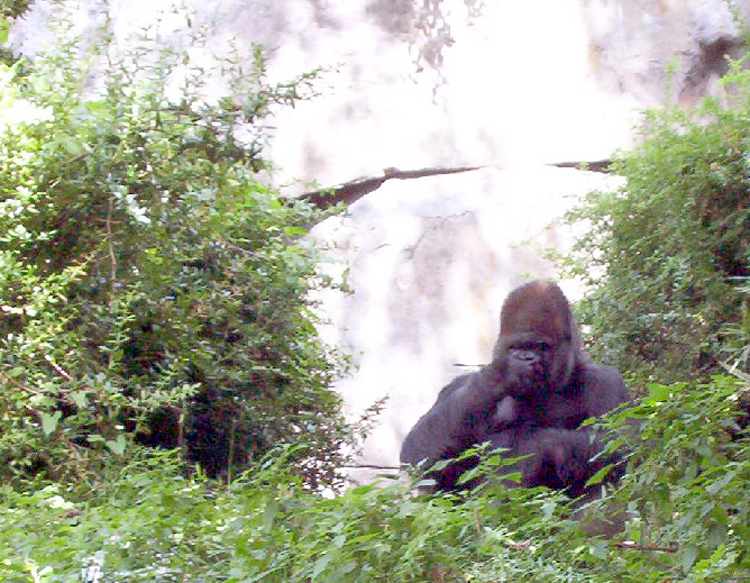
One sweet motherly woman took us for an information booth and asked, “Do they mate the gorillas every day?”

“I think they pretty much let the gorillas do what they want.”

Early on one day, a young woman in a zookeepers uniform wandered by carrying a baby gorilla like a two-year-old in her arms. He must have weighed nearly 100 pounds. Around lunchtime, an elephant walked past, guided by two men who had to whip his trunk to prevent him from turning at us and snaffling popcorn. In the afternoon, the gorilla woman went by in the other direction with the gorilla twitching one hand on her breasts.
Bobo all grown up

Bobo all grown up

We sold only a few items. There were the aforementioned drinks, hot dogs, potato chips, popcorn, coffee, crackerjacks, Cheez-twirlz and an abominable nougat candy called Big Hunk. It was our only candy bar and no one seemed to want it, and considering the crap that they were willing to eat, that was surprising.

“What kind of candy you got?”

“Big Hunk,” I said, grinning and holding out a bar.

“Izatall? No thanks.”

And considering what we sold, I was amazed at the naivete of another with-it mother, who asked, “Do your hot dogs have any nitrates? We don’t want any nitrates.”

“Nitrates? I don’t know, but there are some mighty tasty fly legs, and if you look close, you can see the coagulated sputum.”

She also asked if the orange pop was carbonated, apparently wanting to protect her urchin from carbonic acid. She settled on a bag of barbecue potato chips “with no preservatives.”

The hot dogs were made of turkey and spices and anything else, and they sat all day bloating in a steel box of simmering water. When I picked up the little suckers with the tongs, they sometimes disintegrated. But they were better than the buns.

The buns sat in a steamer that hissed and sputtered all day, acting like some volcanic fumerole. If they remained too long, they turned into a finger of wallpaper paste and were as appetizing as jellied snot.

And with the bun steamer blasting, the pup steamer simmering, the coffee machine blustering and the tea pot heating that little trailer was one large Vicks Vaporizer. Steam condensed everywhere and the bottoms of all the shelves dripped, leaving the floor eternally sopping. I enjoyed that. I enjoyed the infernal, brimstone appearance of all that venting steam. At least I enjoyed it the first day.

Meanwhile, I just had to enjoy watching people like the couple who walked toward us from the children’s zoo talking about how cute all the loose animals were. There were peacocks, guinea fowl, mallards, cocks and hens. Then a squirrel jumped out of the bushes and ran right up to the woman stopping just short of hopping on her leg. They stood there, startled, not knowing what to expect. The squirrel twitched his nose suddenly and the wife jumped behind her hubby, screaming and he, no John Wayne, couldn’t think of anything to do. The squirrel had made his point, and feeling reasonably superior, he dived back into the geraniums, looking for another victim.

And yes, I got to eat hot dogs free for lunch.
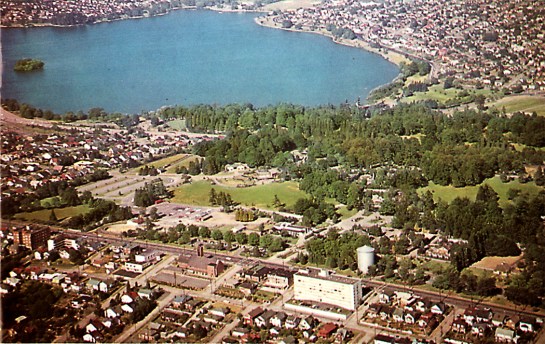
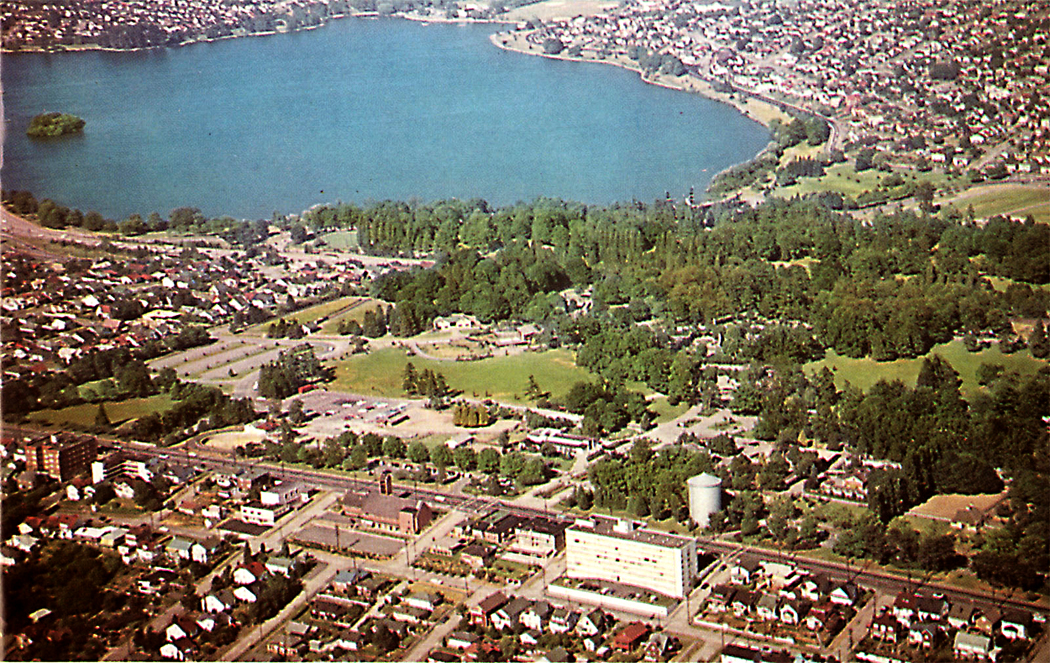
Woodland Park and Green Lake, 4 decades ago

Woodland Park and Green Lake, 4 decades ago

Of course, the zoo had its share of misfits, people who may well have belonged on the other side of the bars.

There was Bill Cowell, the old relief keeper. He had seniority and could vary his routine, taking care of whatever animals needed help while their regular keeper was sick or on vacation. Bill was getting on and had lost some of his former sharpness, but he still talked over the speed limit.

One day, he brought in a newspaper story about Johnny Weismuller, ex-Tarzan and faded Olympic star. Johnny was in a sanitarium and apparently senile, running through the halls, scaring the other geriatrics with his Tarzan yells. Bill brought out this piece of paper clipped from the Post-Intelligencer and started telling me, “You are too young to remember this guy, but maybe you’ve read about him. Johnny Weismuller, he used to swim in the Olympics. You ever heard of him?”

“Yeah,” I said. “He was Tarzan.”

“Uh-huh. He starred with, uh, Muriel O’Sullivan, I think it was. But you’re too young to know those movies.”

“I saw them all on television.”

“Oh, yeah. I guess they have been on TV. Well, read this. It’s real sad. I guess I’m next. But I really think someone’s trying to make him look crazy to get at his money, you know, like they did with Groucho Marx. I bet he ain’t crazy at all.”

Another time, he endeared himself to me when, on a busy Saturday, with crowds of kids screaming and spilling their popcorn and crying and parents at the end of their patience, he said, as he bought his daily hot dog, “These goddamn kids — Dont’cha just wanna run them over?”zoo bear
As in any retail business, whether it’s a tavern or a hot dog stand, you got to know regular customers by their orders. One regular was Large Pepsi No Ice. He was on the maintenance crew and picked up the mess we caused by handing kids all the paper wrappings they loved to strew across the grounds. LPNI was about 50 with a permanent 5-O’clock shadow and a view of the world honed on his dedication to professional wrestling. He was married but professed to hate his wife, saying so in a tone of voice I understood to be the tenderest expression he was capable of. Or the next tenderest: I remember him saying as he took a break to go over and watch the orangutans, “I’ve got to go see my babies today.”

He loved sports and Seattle was a good city for it. He brought me all the news everyday of his beloved Sonics. He also kept up with the Mariners and Seahawks. He had tickets to the last playoff game between the Sonics and the Lakers, but was torn between going to watch the roundball and watching his favorite wrestler at the Arena. he had tickets to both and finally decided to watch Nasty McGurdle fight Big Anastasio for a while (“There should be lots of blood flowing tonight”) and then move over to the Coliseum to catch the last half of the Sonics game.

We talked about how good it was that the Sonics got rid of Marvin Webster and then how Bob McAdoo was hurting the Celtics by being a one-man team. LPNI Liked McAdoo a lot, however. He explained himself: “McAdoo is like me; I’m a great pig fucker.”

Then there was Eugene. He was also maintenance. He was about 60 and black. He talked about when he used to live in Oakland, but I could tell by his rural accent that he used to live on a farm somewhere before Oakland.

“Yes, yes. I comes from Arkansas.”

He drank five or six cups of coffee a day, paying for maybe two of them. (“How about a heatin’ up for this cup?”)

“I don’ believe in doin’ no work. I never worked in Oakland. I jus’ hustled the streets. Made a good livin’ at it, too. But when I gets to Seattle, I finds a good woman and she makes me get this here job. I don’ mind it much, I guess. It ain’t hard. But this rheumatiz in my neck is gettin’ me. I got to go see a doctor ’bout it. I thinks the bones in my neck is grinding themselves and the marrow is comin’ out, like you see on a hog when the bone is wearin’ and busted. You ever see the marrow of a hog’s bone?”

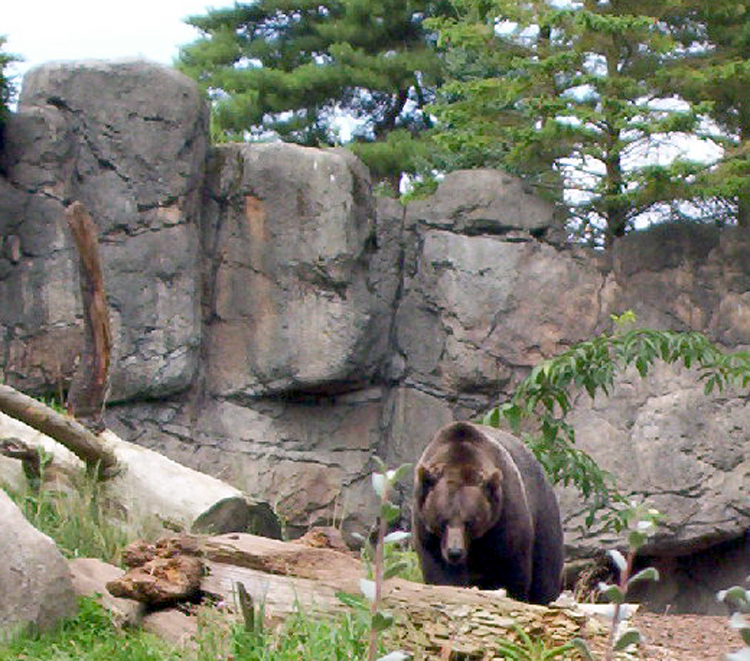
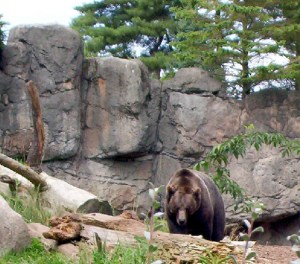
And to anyone who hangs around them, the people working at the zoo are often just as exotic as the slow loris or Przewalski’s Wild Horse. There is the twitch-eyed monkey keeper who looks like his lion-tailed macaques, the avuncular bear keeper who likes to pitch day-old hot dogs down the bottomless maw of his grizzlies, the tropical-house keeper who has to dig down the throat of a questionably sedated crocodile to pull out the gobs of ingested pennies heedless zoogoers have tossed into his water.

But the oddest zookeeper of all is the night-keeper, who skulks around the grounds in the dark with his flashlight and walkie-talkie.

I met one  one evening just before closing time. We were both leaning over the rail in front of the orangutans.

“Fascinating, aren’t they?,” I asked.

“Oh, hell, they ain’t too fascinating,” he answered in a growling voice of a 50-ish blue-collar man who knows what it is to be an alpha male.

I said I thought he must have been a zookeeper too long, if the animals had lost their appeal.

“Well, I used to think they were fascinating,” he said, “but then I got to know them pretty close. They are stupid.

“As far as evolution goes, the orangs are just hanging on. They aren’t adapted well. They need a specialized habitat and it’s disappearing.”

A staccato of static blasted from his intercom and he answered something back, then stuck it back in the leather holster on his belt.
Towan

Towan

“Now, I’ve known some pretty smart gorillas, and a lot of mediocre ones, and a few dumb gorillas. And the chimpanzees — I’ve known a whole lot of really smart chimps. There are some stupid chimps, too, but not many. But I’ve never known a smart orang.

“Once, when I was in Sumatra, I was walking out in the brush and this huge male orang came walking up to near where I was. He came to maybe 10 feet from me and I stood stock still so I wouldn’t disturb him. I thought he knew I was there, but wasn’t going to give an inch of his territory. He was the biggest orang I ever saw and he was standing around digging up grasses and roots. He finally walked on without so much as acknowledging my presence.

“That was the start of my fascination with orangs. It wasn’t until years later that I found out the ape got that close to me only because he was too dumb to know what I was and what a threat mankind posed for him.”

“You seem to like the apes,” I said. “Do you know why this zoo doesn’t have any chimpanzees?”

“Well, a few years ago, a political decision was made somewhere in the front office that we didn’t have enough money to support all three great apes, so they decided to get rid of the chimps. It’s always politics that runs things, never what the zoo needs or how we can solve a problem.

“Someone in the administration, who probably had never even been to the zoo, decided to get rid of the chimps. It’s like the new displays that are being built.”

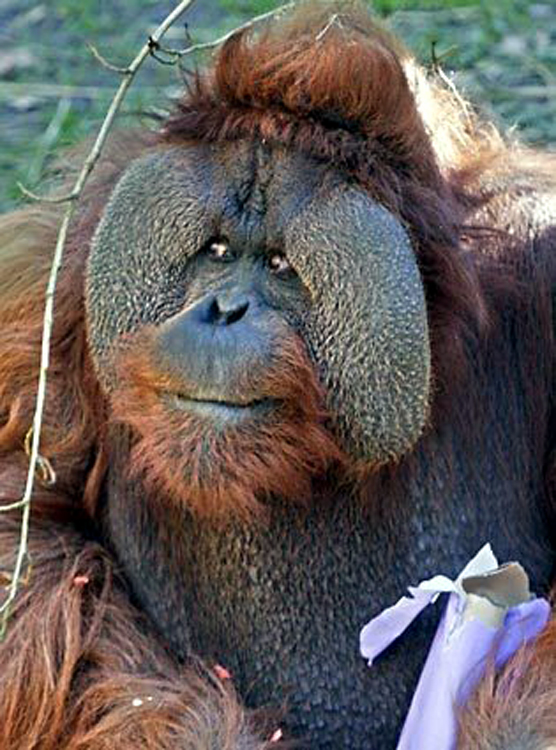
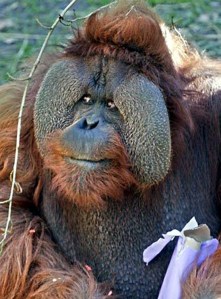
Towan, the male orang in the cage, looked through the glass and offered us some chime from his outstretched lower lip. It’s an orang’s way of saying, “grab a seat, make yourself at home.”

We talked about the new gorilla exhibit, one of those open-ground enclosures that replaced the dingy old glass-front cages that used to be used.

“It’s all political,” the zookeeper said, with some bite in his tone. “These people think it will be better for the gorillas to be out in a more ‘natural habitat.’ But, hell, our gorillas were born in captivity. They’ve never known what it is to be out in the open. We don’t know what will happen; chances are, the gorillas will be freaked out by the change. We introduce stressors in their life, saying it will reduce them. But it is only our own conscience that is calmed. Five of our gorillas were born in captivity. For them the cage is the natural habitat. I’m sure the stress will kill at least one of them. But I was never asked. Someone up front decided it was politically better to give them trees and concrete mountains. At least one will die.

“I guess I’ve been around and I know about as much about departing as anyone on this earth and I know that you don’t die without giving up. That goes for apes and humans, too. No one ever died without giving up somehow. Even a wreck on the freeway means that someone gave up.

“Disease is just partial suicide. You give up part of your will to live and you get sick. The human body was designed to fight off disease. But when you give up, you let the germs and microbes into your system. I haven’t had so much as a cold in seven years. Not that I don’t take care of my body. I eat good foods and keep myself in shape. But I haven’t seen a doctor in a long time and I intend to keep it that way. Doctors are like mechanics. You keep your car healthy and you don’t need one. But if you have a wreck or it breaks down, the mechanic can fix it, but it’s never as good as it once was.

“People get sick because their will is worn down by stressors. Just like the apes will be worn by moving them; they can’t take the stressors.”

Towan tilted his red-haired simian head and began playing peek-a-boo with the remains of the burlap sack he is given daily.

“Like the IRS,” the nightkeeper went on. “Every year they take a little more out of your pay and they figure out some new way to make life harder.

“I wonder if the federal government knows how much disease it causes by not living within its budget.

“It’s not the money they take out. We can afford to pay it, but every year they take a little more and each increase is a stressor and someone gets sick, maybe dies because of the federal government. It’s all politics.”

And somewhere in the increasing dusk, a peacock screeched and it was time to close.

Towan reached his long arms side to side and embraced the glass. Then he climbed up the steel posts that made for trees in his cage and he sat in his roost next to Melati, one of the females.

Sleep well, Towan, I thought. Life could be worse. You could have to file a 1040.

seattle aquarium rainy day

It is one of the unexpected symmetries of nature that the tropics should spawn the zillions of exotic flowers and vines that are its trademark, but that the abundance of ocean life grows where the water is cold. Puget Sound is cold year round.

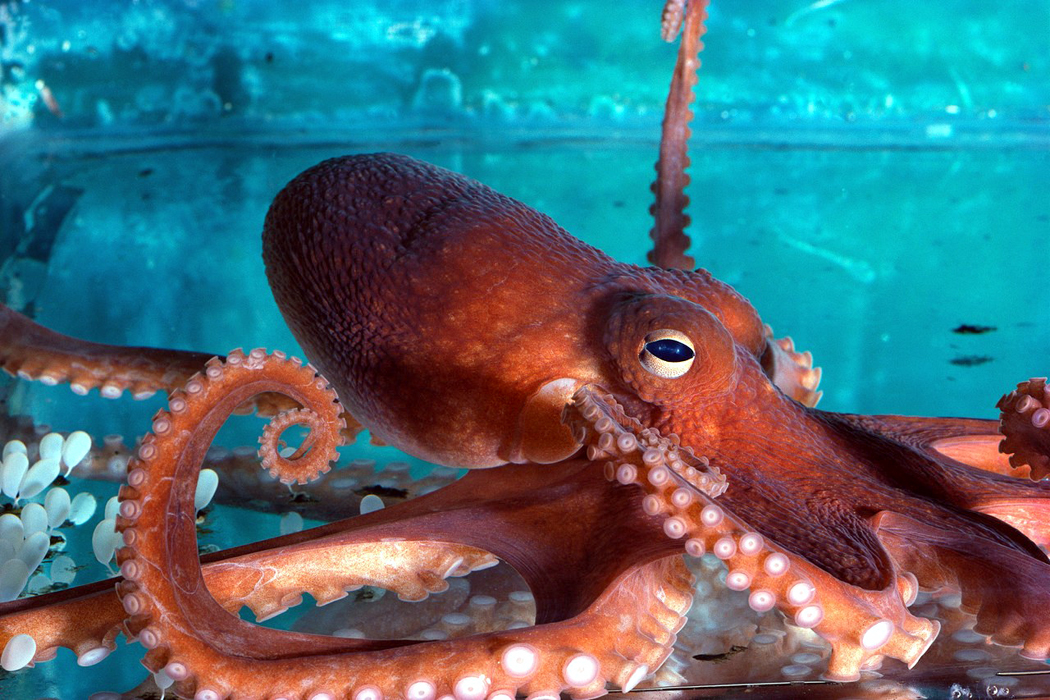
A short list. Puget Sound has: 50 species of sponge; 200 species of annelids; 20 species of anemone; 70 species of shrimp; 25 species of hermit crab; 20 species of seastars; 36 species of sculpin; 24 species of rockfish; 16 species of limpet; and four species of octopus, including the world’s largest at up to 20 feet across and over 100 lbs., the Octopus dofleini.

And the animals of the Sound are often as exotic and lurid as any humid liana or dripping orchid.sea pen 2

There is, for instance, the Ptilosarcus gurneyi, or seapen. This has nothing to do with the spiny bivalve of the East Coast. It is not even a bivalve. It is an aquatic plume with its nib in an inkwell, buried in the sandy bottom of the Sound. It is bright orange with a fringed plumage that stretches up to a foot long. It is luminescent and produces a bright green light when stroked.

Seapens belong to the same general group of Cnidarians as the sea anemones, but the fact that their polyps are small and organized into a featherlike colony obscures that relationship somewhat.

What binds most of the invertebrates of the Sound together is color. The richness of the colors on the seabed shame the peacock. There are the three sea urchins each a different lascivious hue. Stongylocentrotus purpuratus is dayglo purple; S. droebackiensis is forest green; and S. franciscanus is 6 to 8 inches across and bright red and purple. It is a basketball among urchins.

The white sea cucumber is white as milkglass with electric orange thorns along its length. starfish pile

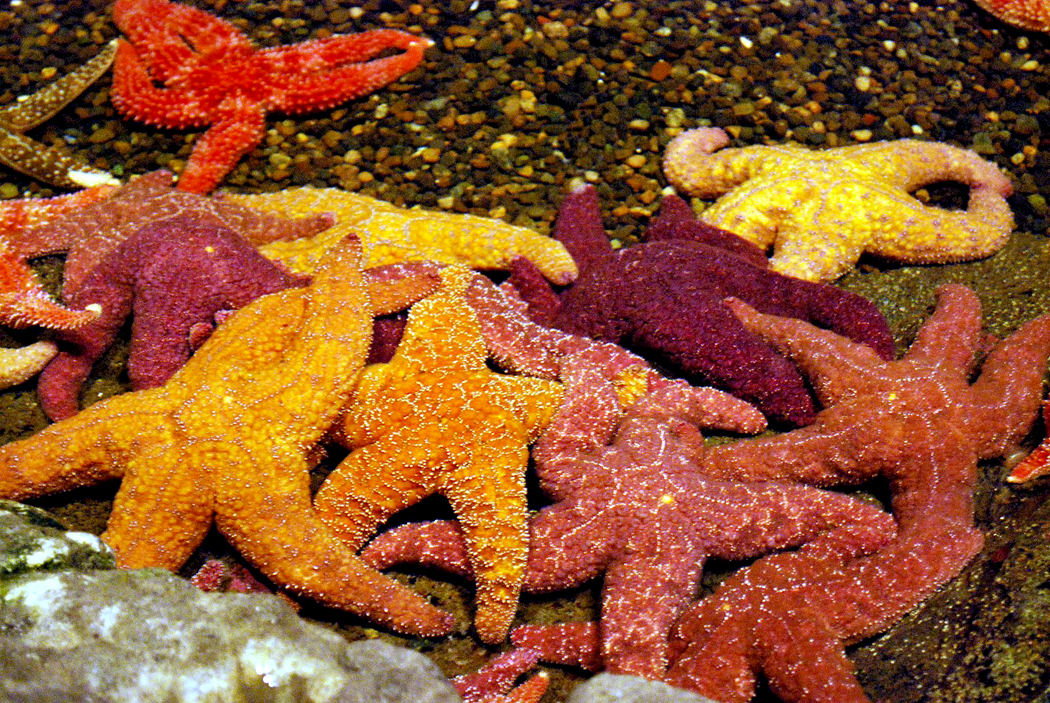
The starfish were manufactured by Binney and Smith. The Solaster stimsonii has 10 legs and each is striped with blue showing brightly against the field of ocher. The bloodstar is blood red; the rose star is pink; and Leptasterias hexactus has six legs and shows the color of a pomegranate.blood star

The sunflower star has up to 24 fat legs and is a dull yellow with bright orange rays.

The sea lemon is a 7-inch long nudibranch that is lemon yellow — a translucent yellow back with amorphous scores of lacy tubefeet. Puget Sound has more kinds of echinoderms than anywhere else in the world.

There are lavander abelones; 8-inch-long gumboot chitons; light blue filaments on algaed rocks that are an annelid, Thelepus crispus; crimson anemones; giant barnacles (Balanus nubilus) that are over 3 inches across; red-tissued scallops with rock colored shells and dozens of black eyes peering through the feathery antennae around the seems of the shell; gordian-knotted basket stars; warty, transparent, hairy sea squirts and sea pork; a red and pink anemone that is 12 to 15 inches across its waving tentacles.Green anemone

There is the edible pride of the Sound, the Panope generosa, or geoduck clam (pronounced as “gooey-duck.”) It is a bivalve that weighs up to 20 lbs. and, with its oversize siphon, looks like a bratwurst on a sliced kaiser roll. The meaty parts of the geoduck are so large that it cannot close its shell.geoduck

The other edible wonder is the sweet-meated Dungeness crab. Others may brag on their Alaskan king crab, but to those who have tasted the Dungeness, so much bragging on a thing merely because it is large is gauche, fit only for a Texan. The Dungeness makes the AKC seem like a can of tunafish.

So far, I have barely mentioned any fish. But they are as abundant and varied as the invertebrates. There are prickleback, gunnels, tubesnouts, pipefish, sea horses, sculpins, clingfish, and spiny lumpsuckers among the odder finny wonders.striped greenling

The painted greenling has zebra-stripes of cobalt blue on a salmon field with random purple and white spots. The Gobiesox, a clingfish, is round and fat with a flat head and a sucker on his bottom and is tan, netted with purple and with white spots or freckles. One tubesnout, Aulorhynchus flavidus, is translucent and yellow-green. It is 3 or 4 inches long, but narrow as a drinking straw and one can see his organs twitching on his insides.

By far the best place to see these zoological delights is the Seattle Aquarium. It is the best aquarium I have ever seen, making even the Coney Island show look bush league.

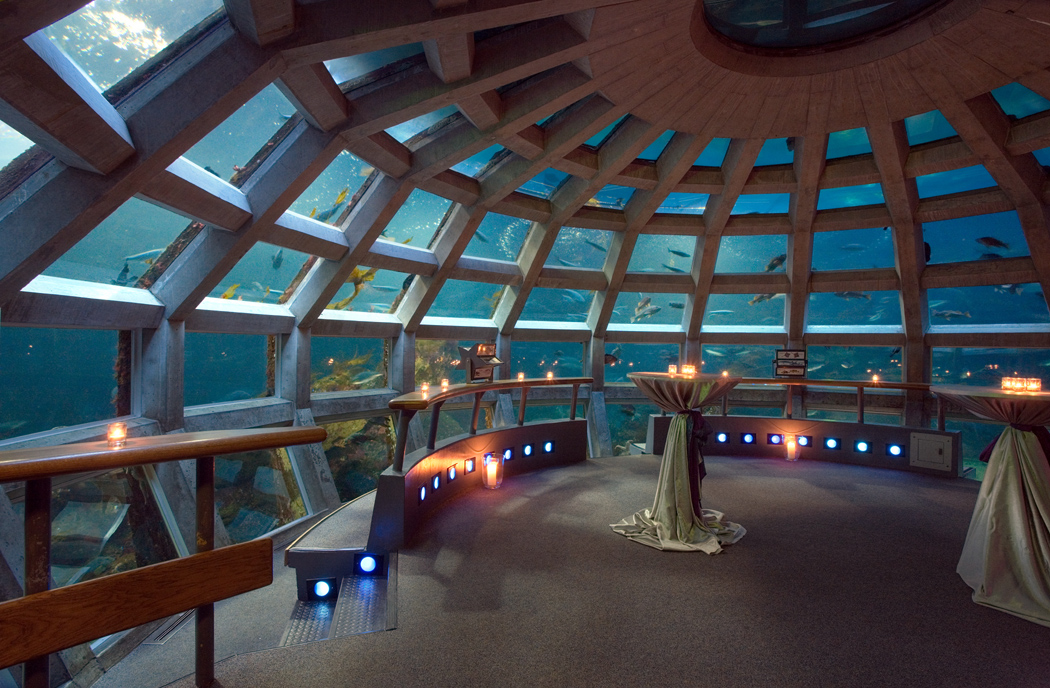
And the most wonderful feature of the Seattle Aquarium is the dome.Aquarium big room

Inside a huge tank of seawater, there is a many-windowed dome looking up and into the fish-filled water. The tank is decked out to look like the bottom of the Sound, one side complete with harbor pilings to gather barnacles, and the other strewn with rocks and sand. And swimming around are many of the aquadynamic shapes common to Puget Sound.

The sides of the tank scintillate with the wavering colors of sunlight broken up by the prisms of the waves on the tank surface. Through the spectrum swim trout, tomcod, salmon and catfish. The silvery salmon look like something manufactured by Boeing, like unpainted airplanes with scales for rivets. The glint of sun runs from nose to tail as the fish whips its body, propelling itself through the fluid.

The brown trout show an irridescent green when the sunlight hits.octopus 2

Huge scrotal octopods, all valves, siphons and tentacles, are strangely graceful.

A lime-white seastar rests on the sandand over it a flounder, like some Arabian magic carpet, flies, wavering its Persian body.

There are tomcod with supernumerary fins and charcoal gray dogfish with white-limned fins.

Looking sleepy among the rocks is a wolf eel with its prizefighter’s prognathous face. He is metallic blue with black coindots in bands across his body. He slithers around the floor boulders prehistorically.wolf eel 2

A sculpin stares straight at me from behind the glass with two Japanese fans for fins. A round, flattened seaperch floats slowly past the window. He has neon blue skin showing through rows of brown scales. Fom a distance he just looks brown, but up close, he is a vision.

Near me on one of the seats (church pews, I almost wrote) were four children, kicking their legs back and forth, ready to move on to whatever was next along the wall, and their shepherd, an older woman who must have been an aunt, asked almost of no one, but talking to the kids, “Isn’t it restful to watch them swim?”

But it is only restful to the adult, who has need of it. The children cannot yet understand the longing for such things.

coup de soleil, Puget Sound

coup de soleil, Puget Sound

Morning in Seattle and the drizzle slowly brightens in the dawn.

For those of us who wake up early, cities can be a problem. For although a city has a special attraction in the hours before traffic and business, it is also an oddly dead time. At 5 a.m., the light from an overcast sky slowly turns the glass on the empty bank buildings snow white; the downtown streets are vacant.Seattle roofs

And there’s really no place to find a good breakfast.

Sure, there are 24-hour chains like Denny’s, but I’m talking about a real breakfast. The fact is, a city is a slow riser. Like a groggy sleeper that first hits the snooze button, later spends a long time rubbing its eyes and finally stands under the shower half asleep, the city really takes all morning to get ready. Museums and the aquarium don’t open till 10. That’s five hours from now.

That’s one of the attractions of camping. No matter how early you get up in the wilderness, it’s open.

But there are secrets the urbanite knows. There are places he finds where he and his truck-driving buddies can get a plateful of scrambled eggs and a cup of coffee. The kind of place you don’t want to wander into and ask for Evian water or eggs Benedict.

Seattle is one of America’s great cities, or at least it was before all the Californians started moving there, before every streetcorner was anchored by a designer coffee stand.

It was a city that had a waterfront, with docks and boats. Most of the waterfront is now a tourist attraction, but the seafood companies and shipping wharfs can still be found, a little north of the aquarium and Ivar’s Acres of Clams.

In the early morning, before the tourists hit, the railroad switcher still shunts boxcars up and down a rain-shiny Alaskan Way and workers still pile fish into the backs of trucks.

There is an industrial clatter and clang along the road, under the viaduct, and steam mixes with exhaust in the mizzle.

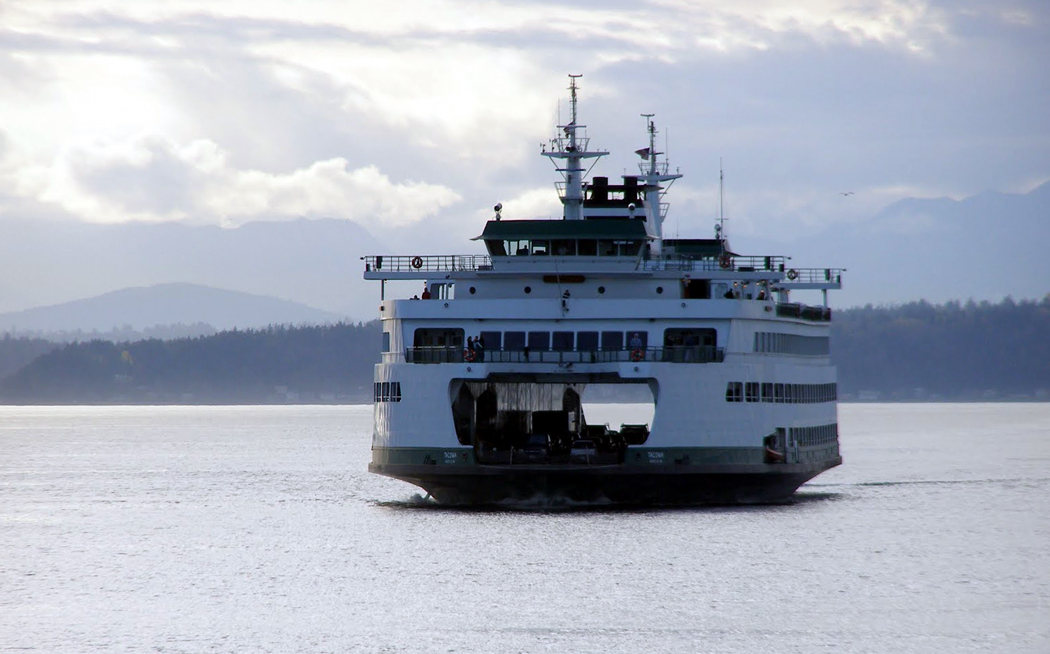
And the city’s most beautiful breakfast can be had beginning at 5:20 a.m. on board the Kitsap.

MV Kitsap arriving in Seattle

MV Kitsap arriving in Seattle

One of the jewels of Seattle is the Washington State Ferry System and the huge, 2,000-car ferries across Puget Sound start operating each day at that hour. For a round-trip ticket of $7.70, you can board the Kitsap (or Walla-Walla, depending on which one starts the morning in the city) and take the one hour ride to Bremerton on the Kitsap Peninsula.

On board, there is a cafeteria line where you can get eggs and bacon, or a sticky bun and a cup of coffee to take to the table by the thick-painted window where you can watch Alki Point glide by as you leave Elliot Bay and enter the sound proper.

From the water, Seattle shows itself off as a seaport. You pass Harbor Island and its 10-story tall orange cargo derricks, you pass the waiting Japanese freighters anchored in the bay, and you see the working wharfs along the waterside.Seattle docks and cranes

The ferry rumbles through the water with its great diesel engines rattling the floors and windows. It churns a frothing wake through the water behind you and your coffee seems more leisurely. You get a chance to observe the weather as you eat and notice the deep slate color of the water and the patch of sunlight that breaks through near Vachon Island. Maybe the rain will break, you say to yourself.

If you’ve been here long enough, you know better.

The ferry curls around the southern end of Bainbridge Island and through the tight passages of salt water running between red cedar trees.Tacoma head on

When it docks in Bremerton, you can just stay put and wait to take the boat back to the city.

If the 2 1/2-hour round trip to Bremerton is too much time for you to spend, the ferry to Winslow costs the same and takes only 35 minutes each way. For that trip you ride the Tacoma or Wanatchee.

Either way, the trip is Seattle’s greatest bargain.

Seattle skyline, Elliott Bay

Coffeemania has abated slightly in Seattle.

There are still ”espresso” signs in drugstores and hardware stores and a local radio station advertised ”egg nog latte” at Christmas. But there used to be a Starbuck’s or a coffee wagon on every street corner. Now, they are on only every other street corner.

And the image Seattle projects through movies and Frasier of an upwardly mobile society surviving on caffeine is still at least partly true.

But there are other Seattles. There is Ballard, for instance.

Ballard is a section of town where the Norwegians live. The tourist brochure actually says, ”Velkommen til Ballard,” in ekte Norsk.

And although most of Seattle is notoriously hilly, Ballard is flat. It is looked down upon, literally and figuratively, by most of the more trendy portions of the city.

Ballard

Ballard

I remember living on Phinney Ridge, directly above Ballard, and looking down at night to see the whole city illuminated below me. ”Ah, Ballard, City of Lights,” I used to sigh.

The point being that Ballard was entirely too dull a place for anyone to actually live.

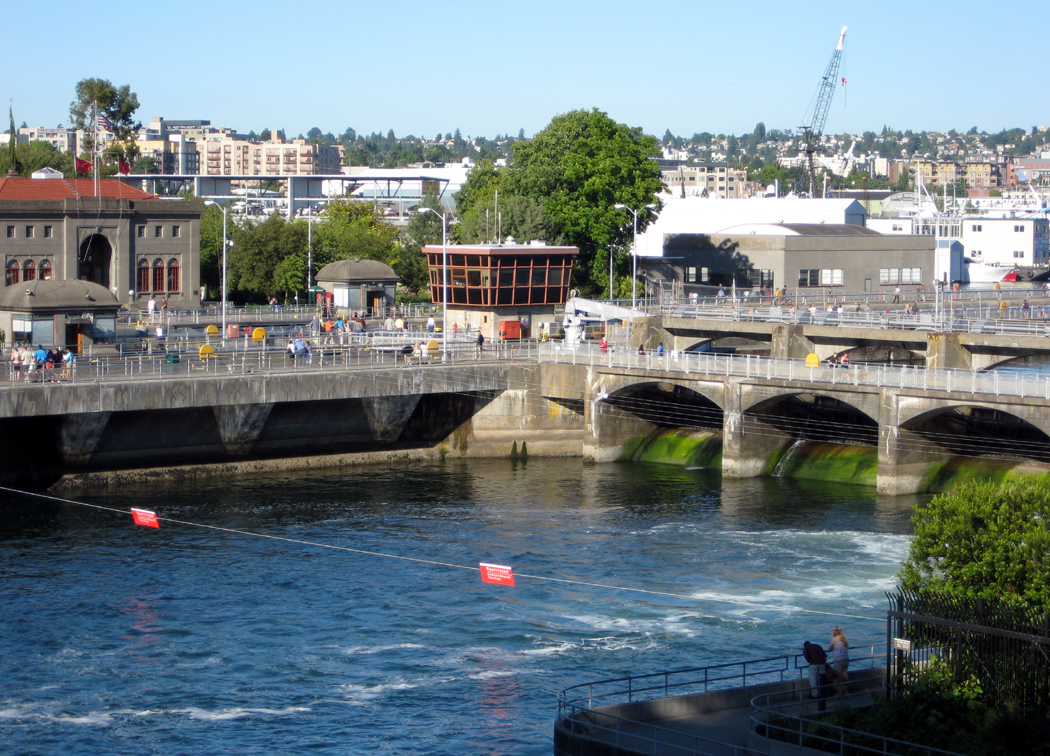
But although most of Seattle, at least in the media, is a white-collar town driven by Microsoft wonks and Boeing engineers, Ballard is uncompromisingly blue-collar. Along the Salmon Bay waterfront are working fishing boats. They pass under the steel-girder railroad drawbridge and through the Hiram M. Chittenden Locks that connect Salmon Bay with Puget Sound.

Hiram Chittenden Locks, Ballard

Hiram Chittenden Locks, Ballard

The main street, Market Street, is lined with stores where you can buy useful things, like tools and food, and the people who live there are soft-spoken and decidedly normal.

The locks are the main tourist attraction, with the salmon ladder where, in the proper season, you can watch coho and chinook salmon swim upstream to spawn. And in another season, you can see steelhead trout come back downstream and head out to sea.

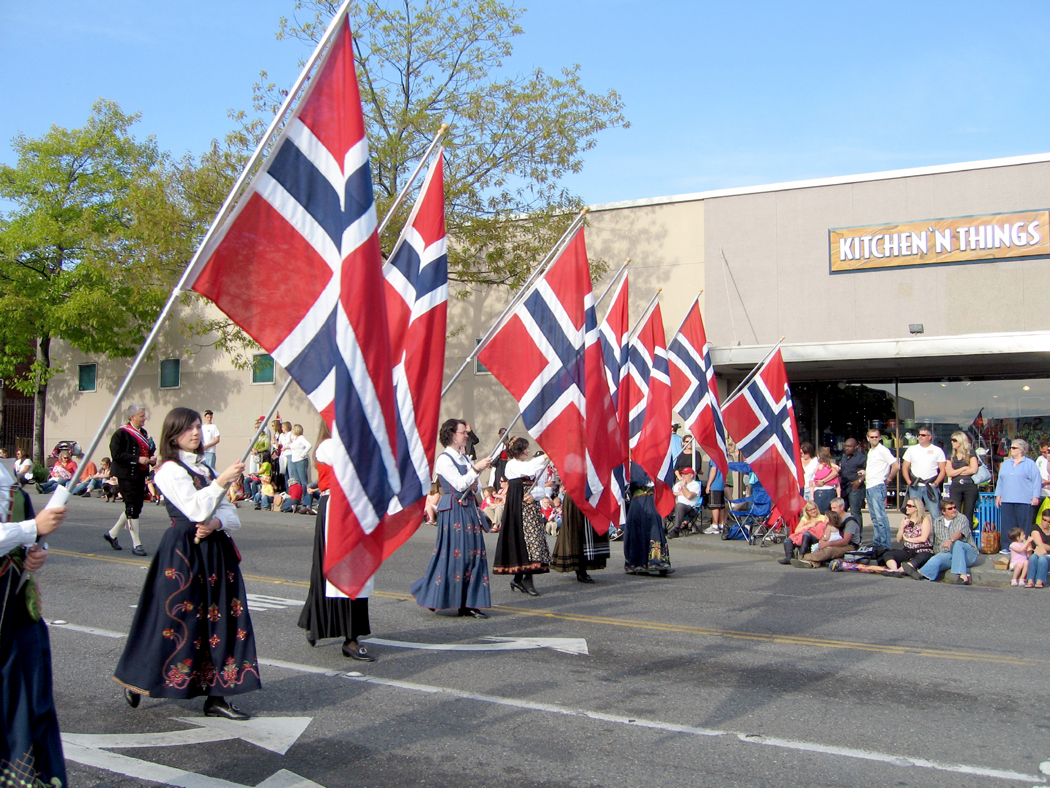
May 17 celebration, Ballard

May 17 celebration, Ballard

The Nordic Heritage Museum is a large and somewhat dusty collection of Norwegiania. Some of it is genuinely cultural, much of it has more to do with the folkways of second- and third-generation immigrants whose knowledge of the ”Old Country” is confined to woodcarvings in the form of trolls and funny-looking cookies made at Christmas.

Ballard is also a good place to shop for Norwegian cooking implements.

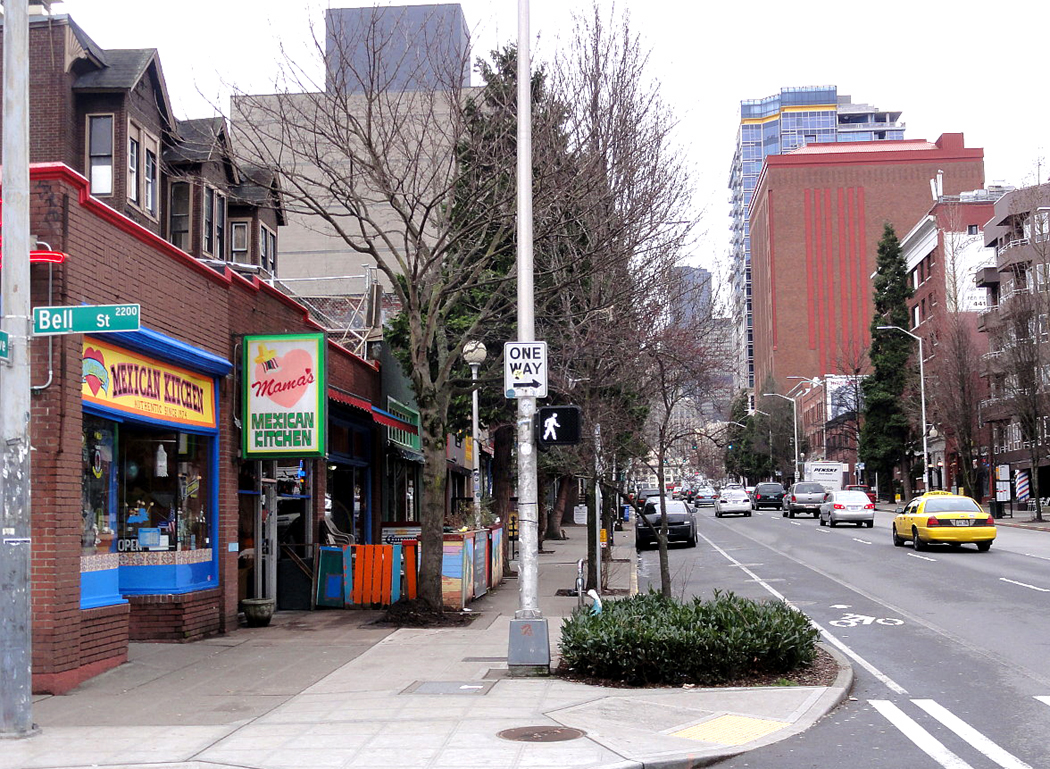
But if Ballard sounds more neighborly than exciting, then Bell Town may be more to your taste. That is, if you wear black clothes, tattoos and have parts of your body pierced. Belltown sign with space needle

In the area around Bell Avenue, between Second and Fourth avenues, there is a kind of neo-Haight-Ashbury growing up.

In the Speakeasy Cafe, you can order a vegetarian sandwich and sit down at a computer and check your e-mail or do the Internet research you need for the article you are writing on the resurgence of Marxism in counterculture music.

On certain days of the week at the Speakeasy, there are poetry readings and live music by bands you have not yet heard of. Belltown street

Up the street is Sit & Spin, a combination cafe and laundromat. Its walls are plastered with handbills for local bands and revolutionary art lectures.

”The Cacophony Society,” reads one, ”is a randomly gathered network of free spirits united in the pursuit of experiences beyond the pale of mainstream society. We are the irreverent industrialists of mirth, gleeful unionists struggling for the liberation of daydreams and special interest groups of absurdity. You may already be a member.”

While your underwear is in the spin-dry cycle, you can wander up to the counter and ask for homemade five-bean vegetarian chili on brown rice with cheese — $2.10 per cup — or the hummus plate, with cucumbers and pita bread, for $4.10. bell street belltown seattle

The place is decorated eclectically. Coaxial cable is a unifying motif, alternating with loops of old clothes-dryer exhaust hoses. There are video games, jigsaw puzzles and a lot of young, sturdy women in black wearing Doc Martens. The men are in black, too, with the occasional plaid shirt and jeans. There is an ethnic mix, although Seattle is predominantly white. Tans are even hard to find up here where it rains all winter.