Archive

Tag Archives: travel

For the next several weeks, this blog will chronicle a road trip taken from Tijuana, Mexico, to Vancouver, Canada, up through California, Oregon and Washington. In 1937, photographer Edward Weston was awarded a Guggenheim Fellowship and set out on a similar trip, and in 1940, published a book of his photographs, with text by his wife, Charis Wilson, called “California and the West.” In some humble way, this is an update. 

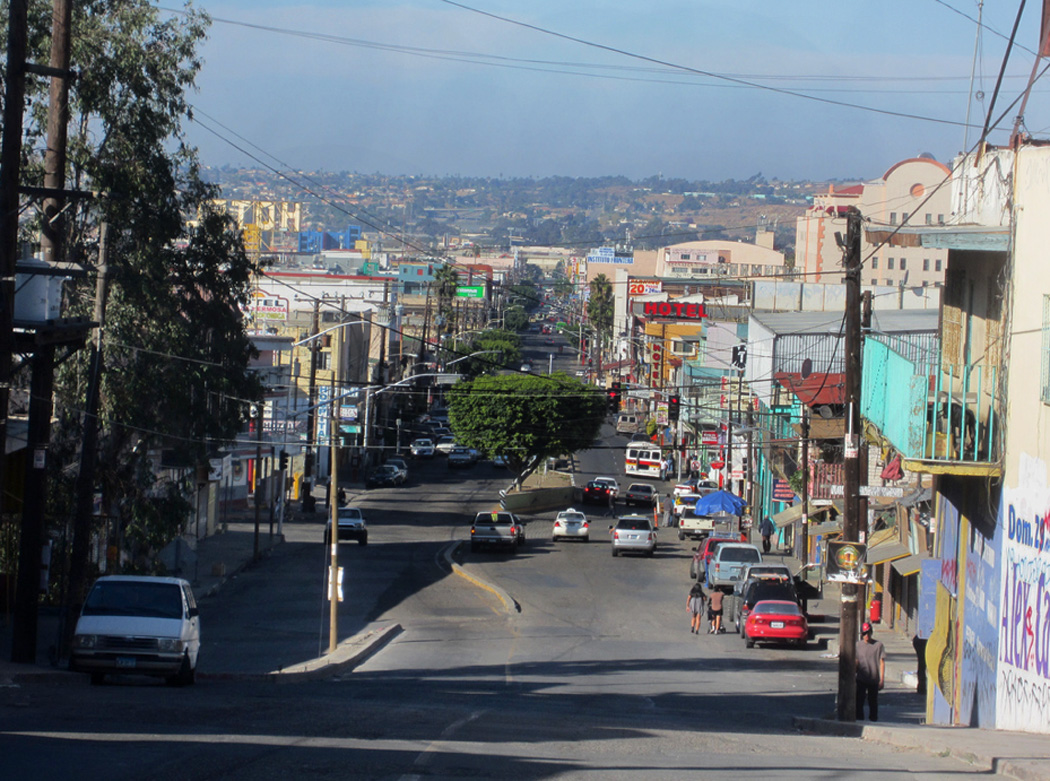
Avenida Constitucion

Avenida Constitucion

 VISITING TIJUANA

I hadn’t really looked forward to visiting Tijuana. It is, after all, a border town. Such places traditionally are tacky beyond belief. I’d seen Nogales, Sonoyta and Ciudad Juarez, and must say they give me the creeps.

But I was pleasantly surprised by Tijuana. Of course, it’s tacky. It wouldn’t be Tijuana without that. But it is also a legitimate city and, if you get off the main tourist drag, a thrilling town to be in.

Just a few hours in the city will teach you things about your own country that you hadn’t considered. Our own folkways contrast to the Mexican so that for the first time, you understand your own quirks.

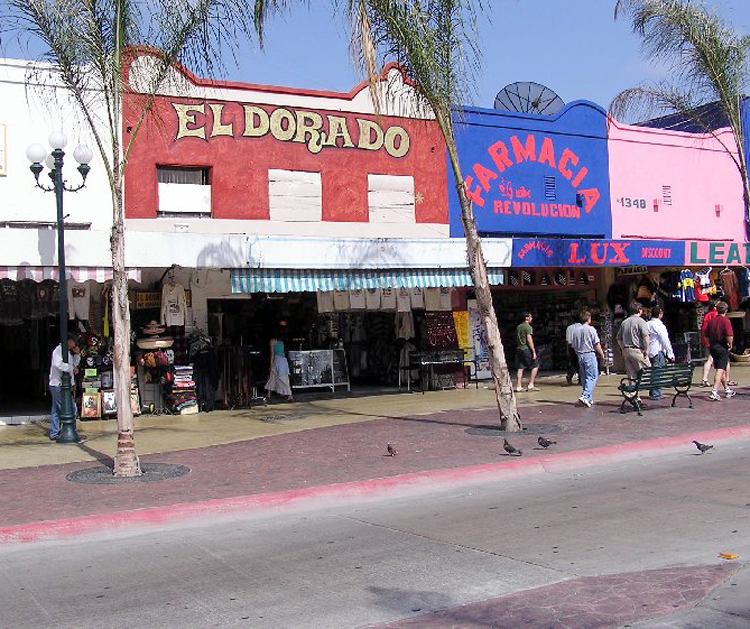
Noise, for instance. In the United States, we are used to a lower level of sound than you find in Tijuana, where every store seems to blast musica into the street in deafening volumes. tijuana storefront

And there are smells. Almost all of them are wonderful smells. I didn’t smell any stale urine until I walked back into the U.S.

Instead, I smelled lemons, roasting chickens, fresh leather, chile peppers, piles of fresh vegetables, cilantro and vanilla.

There are some less pleasant smells, too. Cigarette smoke is everywhere. And Mexican ideas of automobile emissions are very different from ours. They seem to think the more emissions, the more money you make.

Money is the single ubiquitous thought in Tijuana. Economics blot out every other concern. I didn’t see any religious symbols except those for sale, I didn’t see any art except that for sale, I didn’t see any culture except that for sale.

At every square inch of the city, there is somebody scratching out a buck, or a peso — although almost everything sold on Avenida Revolucion is priced in American dollars.

Jewelry, leather, tequila, cheap blankets, more marionettes than I’ve ever seen in one place — they tend to be Disney cartoon characters.

And questionably Cuban cigars — the sign on the store awning read: ”Cuban Cigars Since 1492.”

And mannequins. Most stores show off their wares on stiff Anglo-looking mannequins. In one, gender identity turned into street theater as fake beards were displayed on women’s fashion-model heads.

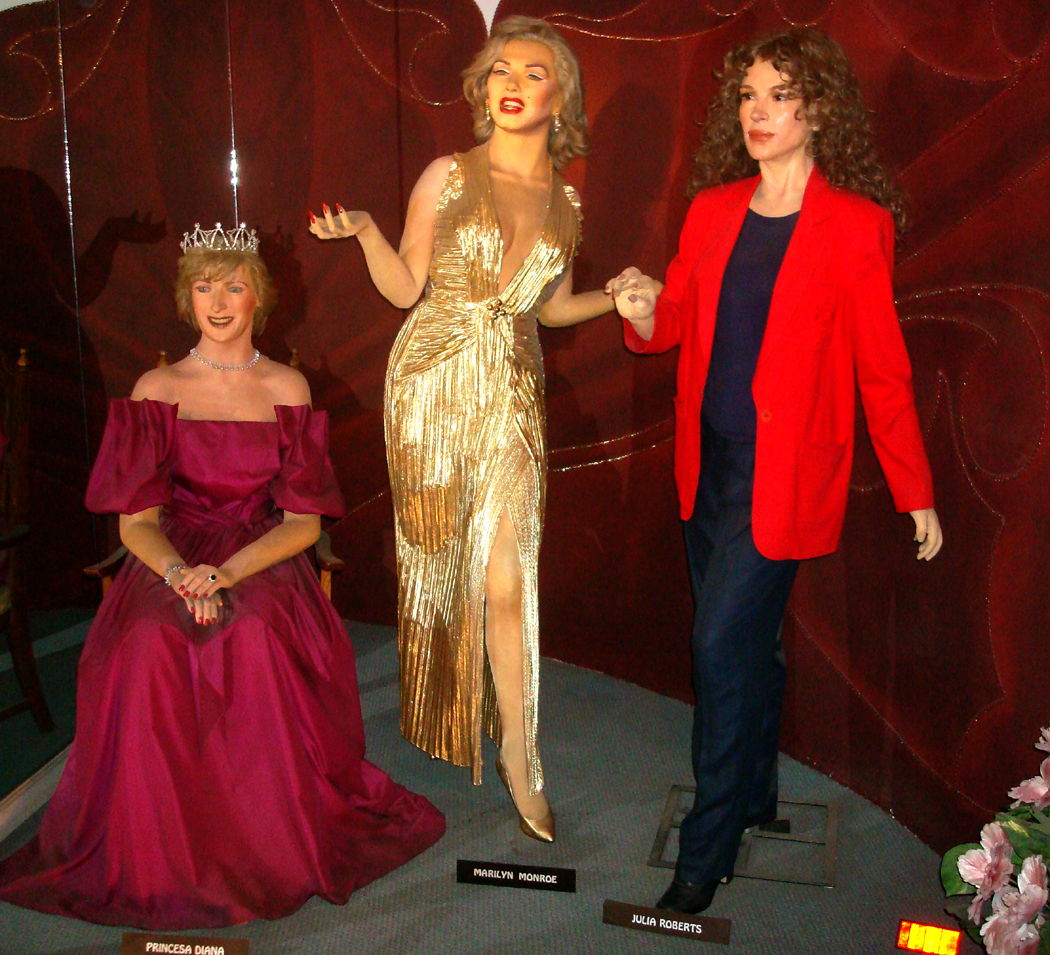
In another, the most elaborate wedding dresses were in the storefront, on mannequins with their faces turned away from the street. tijuana wax museum

MUSEO DE CERA

If you don’t find enough of the mannequins in the stores, you should try the Tijuana Wax Museum, which advertises ”More than 60 figures,” although I didn’t count quite that many when I walked through.

Many of the figures are distinctively Mexican: There are Emiliano Zapata and Pancho Villa. Cantinflas has his place of honor. But so do Elvis and Michael Jackson.

Mexican history is prominent, but the figure of Father Eusebio Kino looked uncomfortably like Bela Lugosi. I wondered if he had been recycled from an old Dracula tableau.

I was there at opening time, but no one else was, including the people who ran the place. About 15 minutes later, someone showed up and unlocked the door, flipped on the lights and began taking admission money.

Don’t miss Rita Canseco — she is a national heroine, although we know her here better as Rita Hayworth. And whole halls are devoted to the Mexican equivalents of Merle Haggard and Hank Snow.

I knew I couldn’t leave town without eating some Mexican food, so I wandered into Tilly’s Fifth Avenue, a dark little smoky place on Avenida Revolucion. An attractive young woman stood outside the door hawking for the place. There are people outside every door in Tijuana like carnival barkers trying to draw you in, even in mid-December, when I seemed to be about the only gringo on the streets. tijuana streethawker

The food was very good, a great deal funkier than the normal American version of the cuisine — with more character and flavor. The big combo plate and a homemade lemonade came to $6. But the best thing was the bowl of chips and salsa.

The chips were thick, crunchy and corn. The salsa fresca was the best I’ve ever eaten. It came in a tacky plastic bowl textured to imitate the ancient soapstone molcajetes of the countryside.

Meanwhile, American TV blasted over our heads on multiple monitors, flickering like moths. You couldn’t hear it, however, because the Beatles played on the jukebox without end. ”Love, love me do.”

TWO TASKS

I had two things I wanted to get done in Tijuana. First, I needed to find a place to buy crepe paper. My wife had charged me with the responsibility of bringing her the paper so she can make paper flowers.

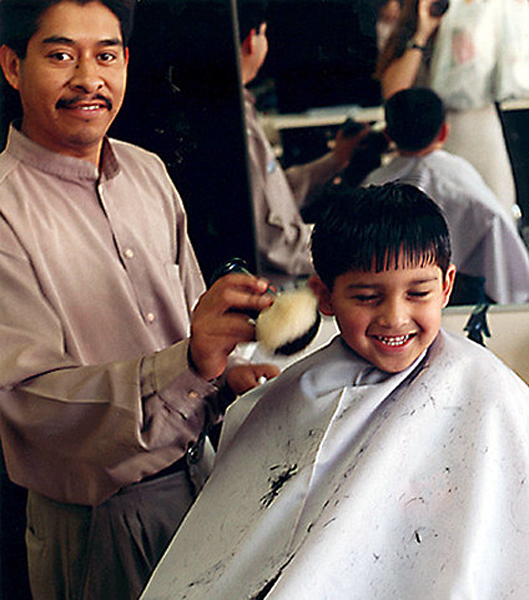
Second, I wanted a Tijuana haircut.

I know that sounds like something you say about Mexican traffic: ”That bus cut me off so close, I got a Tijuana haircut.” But really, I just wanted to try out a Mexican barber. Mexican barber

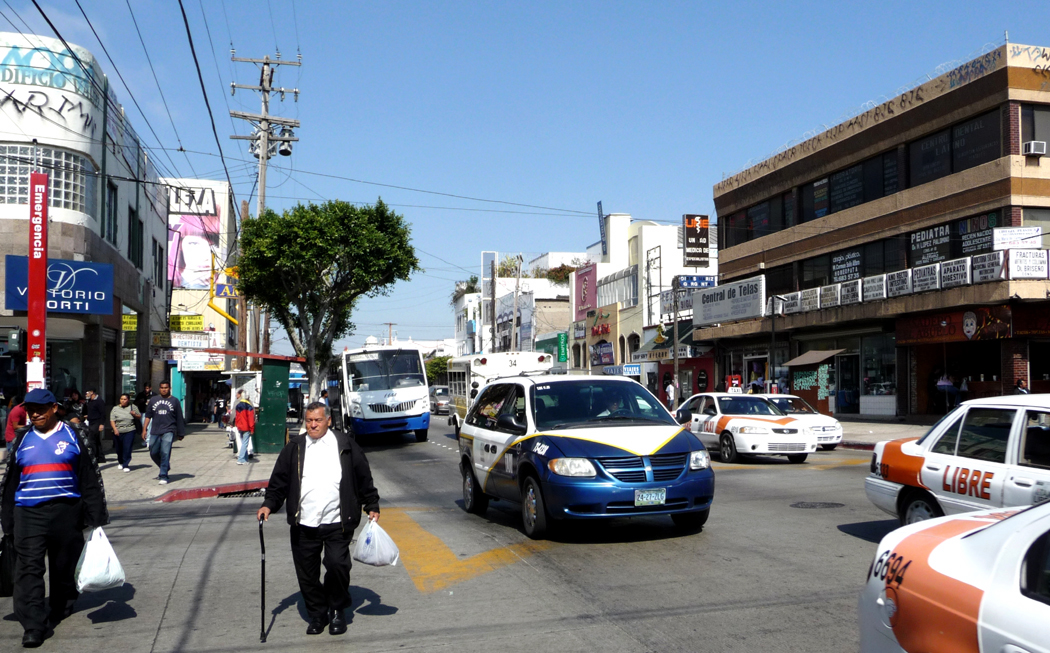
It was a chilly, drizzly December day and I walked up and down the streets of downtown. Men on street corners asked each time I went by, ”Taxi, you want taxi?” Others held out armfuls of cheap costume jewelry necklaces, ”Hey, Mr. Whiskers, look at this. You buy?”

Tijuana is a border town and full of all the heroic tackiness that implies, but it is different from Nogales. For one thing, it is bigger. It is the fourth-largest city in Mexico, with a population of about a million. Which makes it considerably more urban and cosmopolitan. You know you are in a city.

Avenida Revolucion, the main street in downtown, exists mainly for the tourists. It’s hard to believe there is a large enough market counting the entire world for all the leather that is being sold. Open-front stores with piles of cheap blankets alternate with shops selling cheap watches and restaurants selling cheap tequila. Outside every one of them, someone is calling out to you as you walk past: ”Look at this. You buy?” and ”Hungry, Mister? We got lunch.”

Even at 10 in the morning, they are selling lunch.

I soon wandered off Revolution Avenue. If you walk west a few blocks, past Avenida de Constitucion, you come across something a little less like Mexican Disneyland. Markets sell food, stationery supplies, wedding dresses — all the things a normal Mexican needs.

I was looking for a store that sold crepe paper. I stopped at a magazine kiosk and asked, in my best dime-store Spanish, ”Donde esta un papelador?” The news vendor looked at me as if I were speaking Uzbekh, so I tried again, ”Necesito papel para flores.” tijuana street

This made sense to him. His eyes lit up and he held up four fingers and pointed west. ”Tres cuadros,” he said, pulling back one of the fingers. ”Three blocks this way.”

So I walked through the rain past the hordes of people, smelling delicious food from streetside vendors as I went. After four blocks, there still was nothing that looked like it sold paper. I found lots of cassette tapes, more leather, plenty of fruit-juice stands, but no paper.

I asked another news vendor. He held up one finger, then held it up again, but covered the top joints. One and a half blocks, he means, and back the other way.

TIJUANA HAIRCUT

I walk, but find no store. What I do find is a barber. It is a tiny storefront shop with red and white stripes above the door. It is an old, falling-apart building wedged between leather shops.

So I go in. An elderly man is seated in the near chair, getting his hair trimmed. A woman sits in the other chair, waiting for a customer. She is not sure I am it.

I make the international gesture of haircut to her, swooping a karate chop over the top of my head, and she smiles, gets up and tells me to sit. I am not sure what to tell her. I want a crew cut — my semiannual hatchet job.

”Corta?” she asks.

”Cortissima,” I reply.

The shop is large enough for only two ancient barber chairs, a few waiting chairs and a mirror that hangs shoulder-high along the wall. At the back of the shop near the ceiling is printed, in very neat block letters, professionally painted, ”El Trabajo todo se vence” — Work conquers all.

I had the odd feeling that this sounded rather too much like the words over the front gate of Auschwitz, but I’m sure it had more to do with the barber’s work ethic.

And she gave me a full going-over. I swear before God and man that my ears have never been lower. After the buzz saw came the scissors to clean up anything left and finally, lather and straight razor to make a passing lane between my ears and hairline.

All this was accompanied by choking clouds of powder, brushed on liberally, and the splash of flowery, yet medicinal, cologne up the back of my neck.

It was all I could have asked for, short of macassar oil. I got my Tijuana haircut and I will wear it proudly for the rest of my travels.

FINALLY, PAPER

And as I left the shop, dropping a huge tip into the barber’s hand, I asked again for a paper shop. The barber took me outside the shop, pointed down the street and told me to go one block, cross the street, go a half-block up and on the right would be a papelaria. He repeated it.

And sure enough, when I walked there, a huge warehouse of a store was filled with everything you could possibly make from paper, from school notebooks to wallpaper. And down the end of the store were huge racks of crepe paper. Mexican papelaria

My wife had sent me to Mexico to buy the paper because, she says, American crepe paper is no good anymore. If you want to make Third World crafts, you have to start with Third World supplies.

I piled up about $20 worth in an assortment of floral colors and wrapped them up in a plastic garbage bag I had brought along for the purpose.

I felt like Martha Stewart or something: I had planned ahead, knowing it would likely be raining in Tijuana and I would likely be buying paper products, so I brought the bag to protect the paper from the rain.

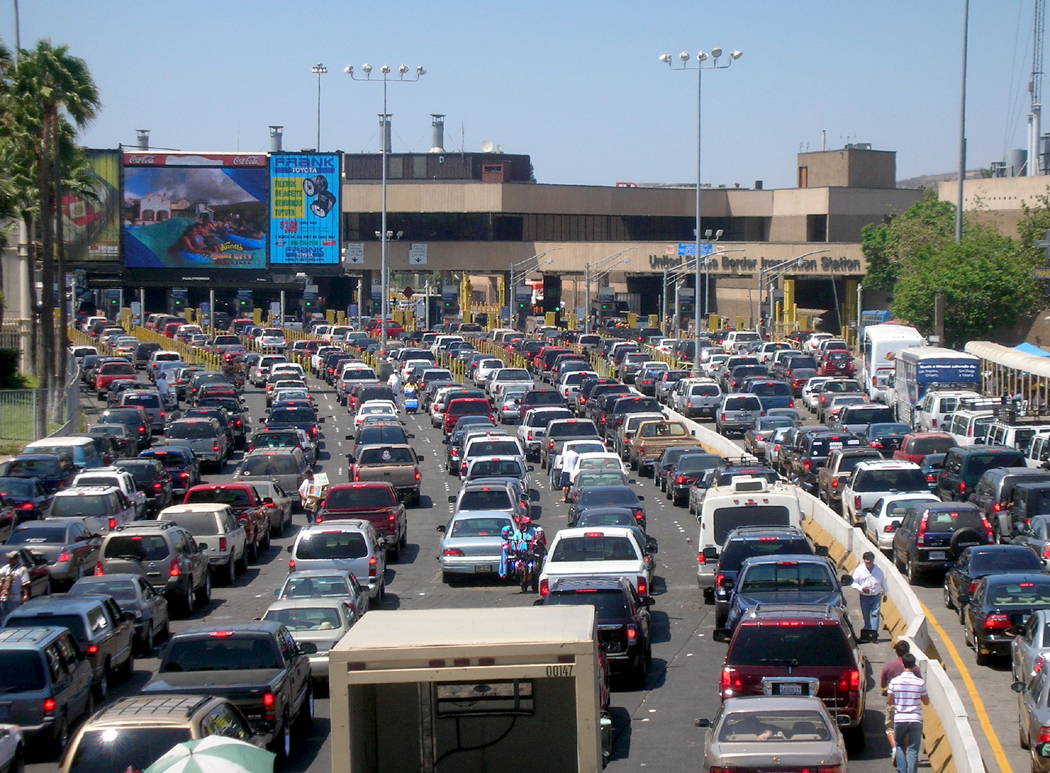
And when I got back on the bus to return to the United States, the sun broke through and briefly scratched a piece of rainbow against the dark clouds to the north.border crossing

As I left town, I passed more shops, more barkers yelping. I passed old women sitting on the sidewalk with trinkets for sale. I passed bars, restaurants and more leather.

And when we got as far as the lines of cars backed up at the border when the bus driver told me it might be faster if I got out and walked the rest of the way. I did.

texashillcountry1

I’ve gotten an early start on a long day’s driving. It is dawn on the plains of west Texas and as the sun pops its first bright blast over the horizon, Schubert’s Trout Quintet plays on the car stereo.

Its first chord is also a bright blast, beginning like a sunrise, with a skyrocket of an arpeggio on the keyboard that bounds out like that first instant blaze as the edge of the sun explodes on the horizon.trout score 2

And when the quintet’s first melody breaks free, the arpeggio is joined by the string bass descending to rock bottom. It’s like the unfolding of a musical universe. It’s almost like getting out of bed, stretching your arms up over your head and planting your feet firmly on the floor.trout score1

I often find myself whistling along with the music when I’m driving, but with the Trout, I find myself singing along, bellowing like a playful calf.

It’s a different thing altogether. The whistling is just a kind of inattentive tagging along with the tune.

The singing, however, is my physical presence in the music.

Bump-bump-bump-bummmmm, I yell out with the string bass.

It is that deep resonance that gives an anchor to the music. It is like the footings of a skyscraper dug 60 feet into the bedrock.

The Texas hill country glows in the first rays of the sun, each rolling rise of earth catching the light like the drapery on a Greek statue.

There are a few low sunrise clouds, but the sun enters underneath them and the road is so empty, they just undulate as they run up over the hills. There is nothing on the highway for miles, just the occasional transfer truck that you pass.

What gives the Trout its phenomenal sense of emotional rightness is its constant balancing of the upward and downward motion of its melodies, often at the same time, like the bass and piano at the outset.

It’s not often in life that the emotions coincide in such a perfect sense of morning, light, a new day, optimism and hope.

Such is the Texas daybreak; such is the Schubert. It is a sunny quintet, with hardly the whisper of a shadow in its five bright movements. Even the minor-key variation in the fourth movement is dispelled with a major chord — “I was just playing,” its composer seems to be saying.

Yet, the Trout is an anomaly among Schubert’s major compositions. He wrote it when he was only 22 and it spreads sunshine from beginning to end.

Through most of his best music — the late piano sonatas, late quartets and the great C-major string quintet — there is a strain of despair that is heartbreaking. Even in his short piano pieces, beloved of amateurs for a century and a half, there runs a vein of deep melancholy that shades even his happiest moments.

For soon after he wrote the Trout, Schubert knew he was going to die, and to die soon. He had contracted an incurable syphilis, and it left him an outcast. He was dead before he was 32.

That knowledge, along with his poverty and his habitual sense of isolation and loneliness, give the dark tincture to his mature music.trout titlepage

And even the Trout gives expression — although in the most oblique way — to the melancholy that was constitutional in the composer: The earlier song he had written, also called The Trout, was the basis for his variations in the fourth movement of the quintet. The song tells the story of a bright, wily trout — “who gaily shoots past me like an arrow” — who then gets caught by an “cold-blooded” angler. The poet laments the loss of such a happy, bright fish. It is a miniature exposition of the theme, “Et in Arcadia ego.”

Somewhere east of Balmorhea, sunflowers begin showing up on the shoulders of the highway, great yellow clumps of them — sunshine growing from the roadside dirt.

I drive along in the shade under a cloud, but the sunlight rings the horizon with the tawny sand color of dry grass. I am an audience in the shade, but the spotlight is on a stage in all directions.

The rays of the sun break through the clouds in the north, making lines like rain hitting the ground.

There are lots of birds — finches, and swallows and swifts — darting around in the air over the road. I’m one of them.

Panamint Valleybw

You know you are a devoted traveler — or a complete idiot — when you go to Death Valley in July. No mere vacationer or tourist would risk it.

But it is the only way to get the genuine Death Valley experience. After all, a cool, refreshing wintertime Death Valley isn’t really Death Valley at all.

No, the real deal is baking hot and glaring with sunlight. The air shimmers, as if uncertain on its feet and about to faint.

That’s the way I first saw it, about 15 years ago in a car with no air-conditioning. It’s the only way to go.

Since then, I’ve been back many times, and always in midsummer. Death Valley National Monument is one of the wonders of the world, and it will disabuse you of any notion that nature is a comfortable place or that wilderness should be equated with warm, furry animals with big brown eyes.

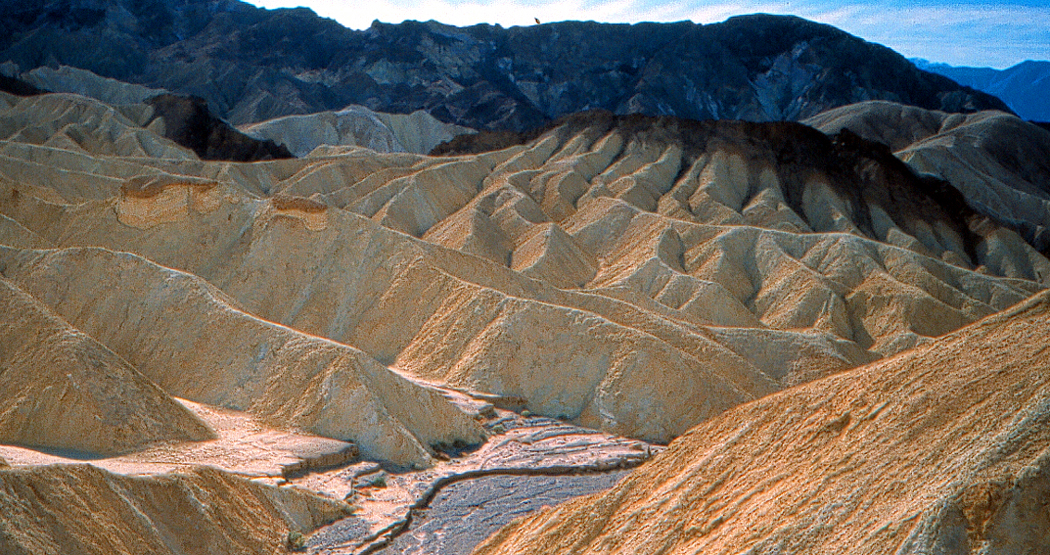
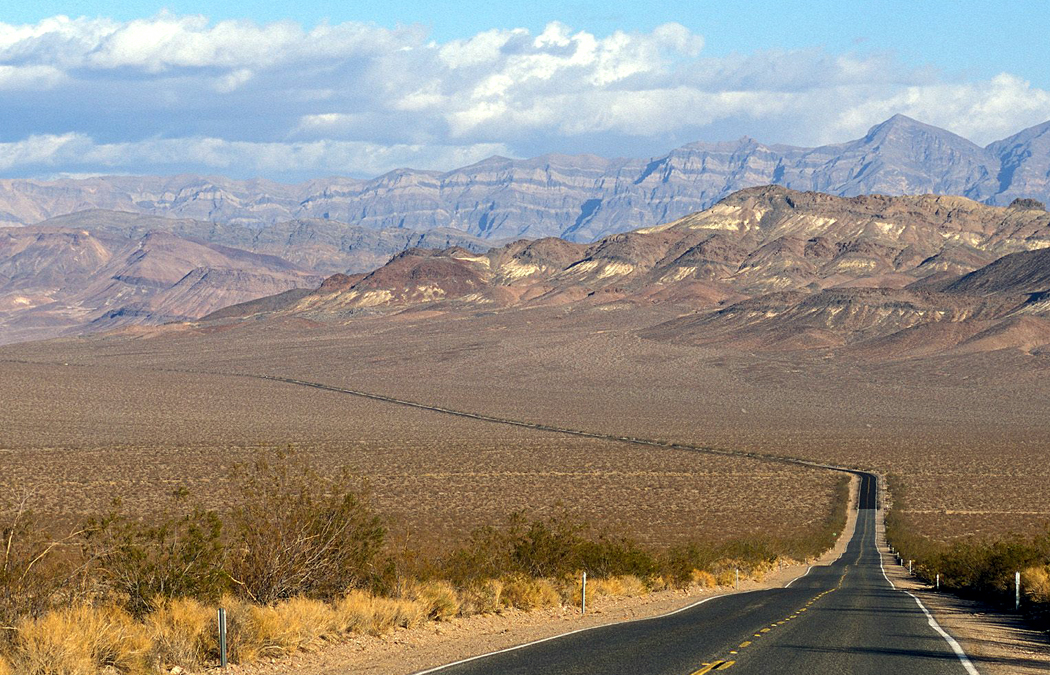
Even before reaching the National Monument, I was astonished by Nevada. The road north from Las Vegas passed the Sheep, Spotted and Pintwater ranges, and bordered the Desert National Wildlife Refuge, though it doesn’t look like the land could support any wildlife aside from sidewinders and scorpions. Zabriskie Point

I passed the Joshua trees in the flatlands of the Nellis Bombing and Gunnery Range. The armed forces have used Nevada to test weapons, though how they can interpret the results, I’ll never know. How can a bomb crater look much different from a soda wash?

The names of places in the area are trying to tell you something: Coffin Peak, Ash Springs, Last Chance Range, Valley of Fire State Park, Furnace Creek, Chloride Cliff — each geographic name serves as a warning sign.

The heat, as I descended the Funeral Mountains past Corkscrew Peak, rose even higher. At Stovepipe Wells in the center of Death Valley, the air temperature was more than 120 degrees and the ground was cooked to 150. The average high temperature in July is 116 degrees, and the highest ever recorded was 134 — on July 10, 1913, the highest temperature ever recorded in the Western Hemisphere, just over 100 years ago. That is serious heat.

The air rushing in through the open car window could have roasted a Christmas goose. It was literally like the blast of heat you get when your face is too close to the oven door when you open it. It singed my eyebrows. badwaterroad deathvalley

In Death Valley in July, you are alone in an area 1 1/2 times the size of Delaware, and all you can see are baked rock and the laser beam of sunlight. If you falter, no one is there to rescue you. And there are no Circle-Ks, no Slurpees, and most of all, no shade.

At a rest stop, I picked up a park brochure titled ”How to Survive Your Trip Through Death Valley.” And they weren’t kidding.

Even at rest in the shade, the brochure said, you can perspire away a quart of water in an hour. It admonished me to drink water frequently.

I had been getting a headache; I thought it was from driving hundreds of miles, but the brochure said it was more likely the first stage of heatstroke and I should down great quantities of water. I drank a half-gallon immediately and began to feel better. By noon, I had drunk well more than a gallon. Strangely, no matter how much I drank, I never needed to pee.

The high point of any trip to Death Valley has to be the lowest point: Badwater, at 282 feet below sea level — another record for the hemisphere.

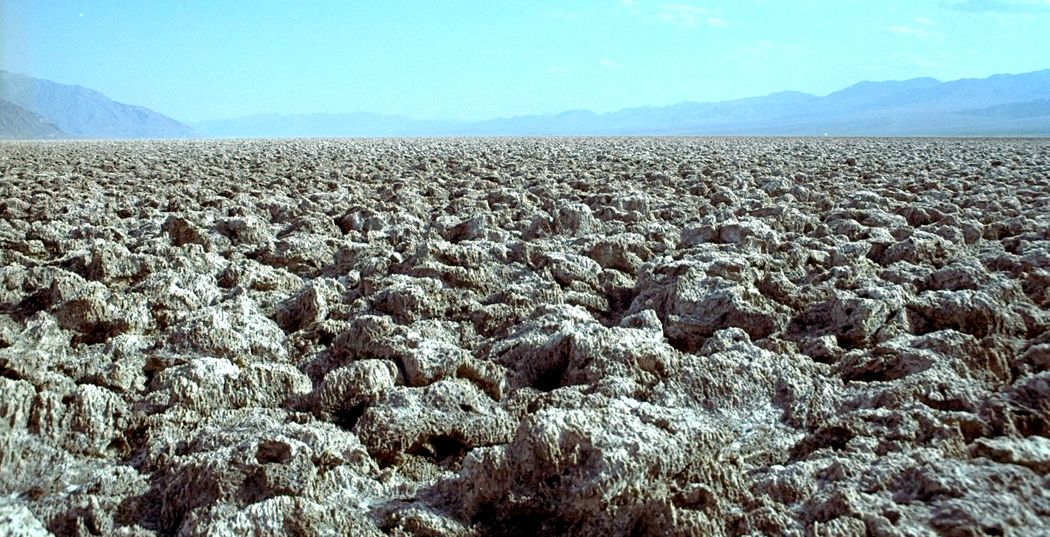
From your car, you look out on a vast sea of blinding white. You might mistake it for snow, but a closer look shows you the spiky, lacerating surface of evaporated salts, like the pavement of Hades. If you walk across it, it crunches under your boot sole like plaster, which it very nearly is.

Road to Dante's View

Road to Dante’s View

But the best vantage point on Badwater is more than a mile directly above it. Dante’s View is a scenic overlook on the crest of the Black Mountains at the end of a 12-mile road. It gives you a panoramic vista of Death Valley and its surrounding mountains, the Amargosas and Panamints. The flat basin stretches 100 miles north to south below you, glistening with the white of the salt pan.

You can see it over the shoulder of a soaring vulture a thousand feet below you, wondering what it will find to eat, and knowing it could have been you.

There are many roads through the park, but, for mortification of the flesh, none beats the West Side Road, a gravel route designed by Torquemada.

I love to drive my little sedan where sensible people fear to take their Range Rovers.

I’ve driven through dust, sand and slop, spinning my wheels and sliding back and forth through icy clay and spitting gravel. I always come prepared with a military-surplus entrenching tool and a Hudson Bay ax, though I have only had to use them twice. Once was on a dirt road near Dynamite Road in north Scottsdale, Ariz., as I got caught in the deep sand of a stream bed and had to dig the car out. In fact, I had to dig until I hit bedrock before I could muster any traction.

The second time was on the Navajo Reservation after a rain when the wheels sprayed so much mud on my running board that the Toyota weighed a good 50 percent more than it did when it came fully equipped from the factory. I had to use the ax to hack off layers of mudpack. I couldn’t get it all, and by the time I got back home, the remaining layer had so dried that it took a pneumatic drill to peel off the stucco. The whole thing looked like a gigantic corn dog with windshield wipers.

So, the thought of going down West Side Road had a certain martyrish appeal.

I packed a picnic lunch at Furnace Creek and headed south to the 36-mile West Side Road that would take me along the western edge of the valley. It is a hypocrite of a road: As you leave the solid pavement of Calif. 178, the gravel looks well graded and flat. Don’t believe it.westsideroad1

It turned out to be the worst piece of washboard driving I’ve ever suffered through. Usually, you can either slow down or speed up and escape the resonance of the corrugation, but not here. No matter how fast or how slow I drove, my teeth turned into castanets.

Every mile or so, there would come a smooth spot, just long enough to delude me into believing the rough part was over and dissuade me from turning back. But in a hundred yards, the bumping would begin again in earnest.

In fact, the rattle was so bad, it turned my pint of milk into butter. And when I stopped to make my sandwich, the bread had had the leavening shook out of it. So I buttered my matzoh and when I reached for my bottle of water, the vibration had turned it into seltzer. I received the benefit of sparkling water without having to pay the premium National Park price for Perrier.

There were several sights on the way, including the ruins of an old Borax works, which were now nothing more than a few mounds of dirt covering the archeology. The road flirted with the foothills of the Panamint range and every so often, a subsidiary road would head out perpendicular into the mountains. Most warned that they were recommended only for 4-wheel drive.devilsgolfcoursedeathvalley

They would have had to be better driving than the road I was on.

And the worst was the last bit of it. As I could see on the horizon the junction of my road with the main, smooth, paved road, the corrugation took a turn for the nasty.

The last bit looked especially smooth; it was white dust and gravel and promised a change from the rattle-bone right of way, but in fact, it was the worst lie of the day. When I got to that part, it was the equivalent of a speed bump every eight inches for a half mile. I had to take it in first gear.

When I finally made it back to the pavement, I made a solemn promise to the Toyota that I would not venture out onto the gravel again for the duration of the trip. The car had made it through with its only damage being a dangling muffler.

It took me a good half hour of driving into Nevada before my eyesight regained control of its vertical hold.

fog bank

Life is made up of experiences. Not thoughts, but body-experience. It is what brings us wisdom, what brings us the game pieces we draw out of the well of our lives, that make up our literature, our art, and the myths we make of our own lives. Experiences are the building blocks of our psyches.

And the experiences of one generation are different from those of the next or the previous. We can never really know what it was like to be in Napoleon’s army or Wyatt Earp’s Dodge City or on a viking ship sailing the coast of Greenland.

Our children will never know what it was like to be us. You didn’t listen to your parents lecturing you, and you shouldn’t expect your children to be any more interested in what you have to say to them. Experience, it turns out, is non-tranferable.

But, at times, we get hints. Some bit of the past reoccurs and we get an insight.

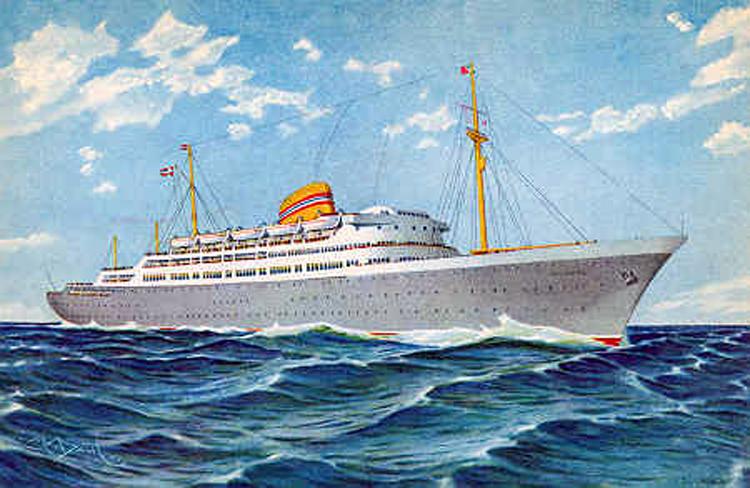
There is little in travel so romantic sounding as a trans-Atlantic ocean voyage, and little in reality quite so tedious. When I was a teenager, I got the chance, in the dying days of ocean liners, to sail from New York to Oslo aboard the MS Oslofjord. Oslofjord postcard

Day after day, the horizon remains pancake flat, and the only thing that changes is the dining-room menu.

Maybe it was because I was young and most passengers seemed so ancient: Shuffleboard was the amusement of choice, followed by casino night in the lounge. Neither was particularly appealing to me.

Yet, despite the monotony of the weeklong voyage, there is something about the sea that lodges itself deep inside and refuses to go away, even all these years later, in an age when crossing the ocean on a ship is no longer a realistic possibility.

It began in New York, a harbor crisscrossed by wakes like particle trails in a Wilson cloud chamber. The ship I was on threaded its way among the bee-buzz of harbor activity and passed the Statue of Liberty, which my grandmother saw on entering the same harbor in 1905, when she was a little girl.

I was on my way to the ”old country” to see where she had come from and was taking a boat, just as she had coming the other way.

But you can’t get the feel of ocean travel while in the harbor. You have to get out into the sea swell for that.

If you have never been out there, you might not have any sense of just how hilly the ocean is. Sure, the horizon looks flat, but nearby, you can sense the shifting pileup of waves of all sizes.

On the water’s surface are the wavelets, blown into white horses by the wind that always blows at sea. And the wavelets skitter up and down with the larger waves that move with more stately pomp, coming at the ship from all directions and crossing each other in patterns so complex that even chaos theory has a hard time dealing with them. swell1

But more impressive is the slow, almost geologic movement of the swell, that massive up and down that is measured by the rise and drop of the ship.

On some days, the swell is hardly felt, as the calm ocean sprinkles the sunlight in its shivered surface. But out in the North Atlantic, it is never long before some distant storm rocks the water into the swell that is the oceanic equivalent of the long ridge mountains of eastern Pennsylvania, one after the other, up and down, twisting the ship into yaw and roll.

The constant rumble of the engines shake the walls in ”D” deck, deep in the hull of the ship. Every surface is painted and repainted and each iron surface is covered in enamel like the thick shiny glazing of a doughnut. In the stateroom, there is no sense of motion, only the vibration of the engines. It has been the same for six days.

In midsummer, the sun doesn’t set until nearly midnight, rising again a few hours later. Most of the evening is spent in the low sunlight, which rakes the waves into glitter.

And I am up at 3:30 in the morning, walking the decks of the ship, which seems ready to roll over on first one side and then the other. Nearly a week into this trance-inducing boredom, I have read all my books and cannot sleep any more. The walk on deck in the dusky dark is meant to wake me up from the hypnotic state the ocean can put you in.

Then, out in the darkness I can see a light, miles off through the humid air. It is another ship going the other way. But no, it is not a ship, the lights are too irregular. In the growing light, I can begin to make out the grayish shape of it, barely legible in the murk.

It is one of the Orkney Islands, off northern Scotland. The trance is broken. The Atlantic is crossed, land is sighted.

I have some sense of what Columbus must have felt, although I have eaten better than he did, and my six days is rather less than the months he spent at sea.

But I still felt something special when the sea birds once more began flying overhead.gull

Linville falls from upper look

I first saw Linville Falls 40 years ago. Getting there meant finding an unmarked gravel road and an unmarked dirt parking lot — really just a thicker place in the road to pull over onto.

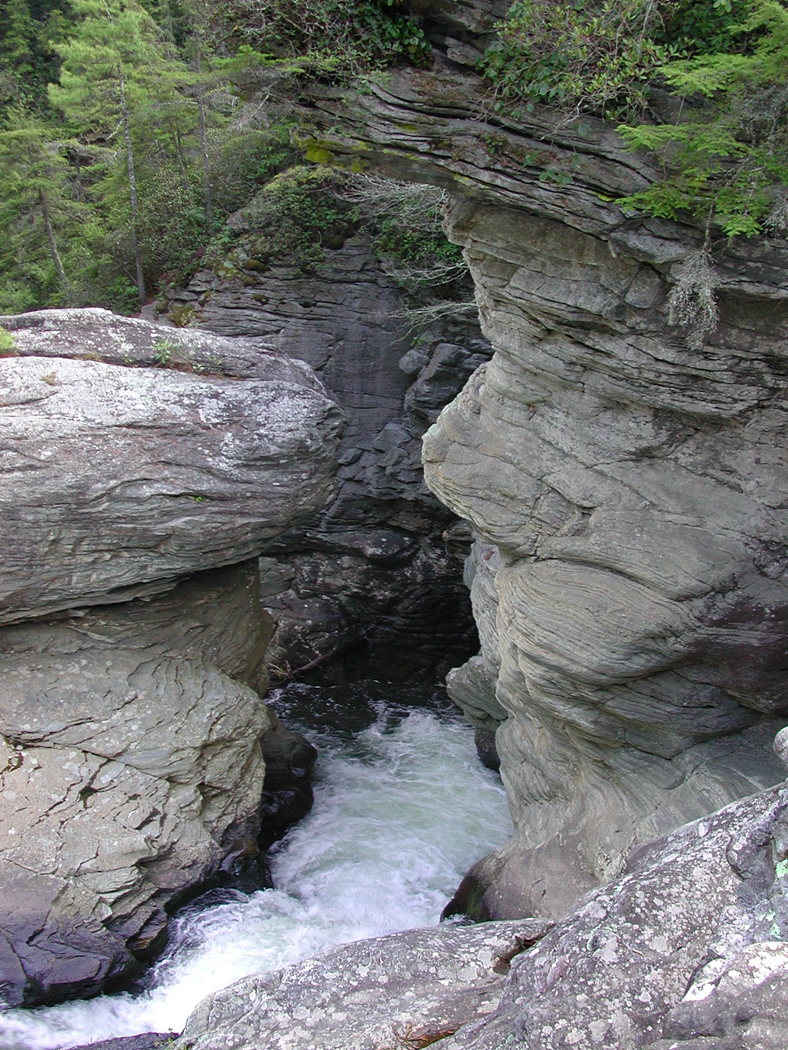
Then we followed a spongy, loamy footpath under the hickories and oaks toward the distant roar of the waterfall on North Carolina’s Linville River. No one was there but us, and we picnicked on the rocks over the crashing water. The upper falls are a broad, shallow drop, but at the lower falls, the quartzite pulls tight, constricting the river and forcing it down a spiraling chute that drops over the edge of the cliff and down 75 feet to the river and Linville Gorge.

Linville Falls 03

It is an impressive torrent with a basso profundo roar, and nothing will ever change the way it seemed to me that day, as I leaped over rocks, crossing the white water to the other shore so I could climb on the gnarled rock to see down the waterway.

I’ve been back many times over the years. The National Park Service built a paved road from the Blue Ridge Parkway, making it easier to find. Then they paved the parking lot and built a pedestrian bridge over the river upstream from the falls.

The last time I went back, there was a visitor’s center and a souvenir shop and a parade of vacationers trotting down the path to the fenced-in overlook. The falls are just as impressive, but the experience isn’t.

If I speed up those 40 years in my head like time-lapse photography, I can see time take shape. It builds and it destroys in a constant rise and fall like an ocean tide.

And what comes in, ebbs.

Linville trillium

A few years ago, my wife and I visited another familiar site, on Old Route 16, a dirt road that drops down the side of the Blue Ridge toward North Wilkesboro. When we lived in the mountains, we used to visit an abandoned farm along the road, halfway down the mountain face.

There was a clearing in the wood and an old wooden house with a broad porch that looked out over the steep valley below. Above us was the spot ominously known as the ”Jumpin’-Off Place.”

We could picnic on the porch with the bluebird and tanager singing in front of us, the buzz of insects all around and the gentle breeze rattling the grass in the field.

It had been 14 years since we visited that farmhouse, and we thought we should see what had become of it.

About three miles down the old dirt road, we passed where it should have been, but there was no break in the forest, no open field. We couldn’t find the house. We kept driving, hoping we’d find something that looked familiar, but we didn’t. Finally we stopped the car where the farm should have been and walked deep into the woods.

Buried a hundred yards into the tangle of maple trees was a naked standing chimney, completely eaten up by brush and undergrowth.

When I climbed down the hill toward it, I discovered the forest floor was spongy with rotten boards, completely collapsed in on themselves, with a few nail heads showing.

In the 14 years since we last visited, the old house had been completely digested by the woods, leaving only the indigestible brickwork of the twin-sided chimney.

And the once-glorious view of the declivity was now completely obscured by trees and brush. Instead of a vacant field overgrown, the house was survived only by complete woods.

In 14 years.

Nature can reclaim an entire farm in 14 years and leave nothing behind but the masonry. And that won’t last much longer.

Linville Gorge1

manzanar

My attraction to Manzanar was initially artistic, not political.

The 500-acre site in California’s Owens Valley on the eastern slope of the Sierra Nevada is now a dusty spot of desert under the snow-capped peaks, but in 1943 it was home to 10,000 Japanese-Americans detained under federal order in a concentration camp built there, one of 10 such camps in the American West.

That year, it was visited by photographer Ansel Adams, who was invited to make a series of photographs of camp life. I had seen prints of those photographs while doing research at the Library of Congress, where they are stored, and had long wondered about the place.
”My first impression of Manzanar,” Adams wrote in his autobiography, ”was of a dry plain on which appeared a flat rectangular layout of shacks, ringed with towering mountains. … row upon row of black tar-paper shacks only somewhat softened by the occasional greenery.”

manzanar barracks

Most of the photographs he made are of the people, their homes and the social lives they maintained under impossible circumstances. But he also found something redemptive in the landscape.

”I have been accused of sentimental conjecture when I suggest that the beauty of the natural scene stimulated the people in the camp. No other relocation center could match Manzanar in this respect, and many of the people spoke to me of these qualities and their thankfulness for them,” he wrote.

And the single most famous image from Adams’ time in the camp is his Mount Williamson, Sierra Nevada, from Manzanar, California. It was prominently featured in the Museum of Modern Art show ”The Family of Man” in the 1950s, with its foreground of gargantuan boulders and background of sunlight breaking through a storm over the mountain peak. If ever there was a photograph meant to evoke the spiritual power of landscape, this is it.

manzanar mt williamson

So I was drawn to Manzanar to see the land. Certainly nothing was left of the camp, I was certain.

And the only thing that gives away the location of the camp is a stone sentry booth off the side of U.S. 395 about 15 miles north of Lone Pine. Behind it, all you see at first glance is gravel, dry grass, mesquite trees and clumps of datura wobbling their coarse white lace in the breeze.

But as soon as you drive into the camp and crawl along the old dirt roads, you discover what the decades have tried to obscure: flat concrete foundations of barracks, some weathered lumber littering the ground and the odd sight of water-system standpipes poking up like leafless shrubbery in the emptiness.

Walking through the old foundations, you discover broken bits of dinner plates and an occasional fork with its tines splayed. In one plaza area between the concrete ruins, there was a 5-foot mound of earth ringed with stones. It had been a Japanese rock garden built by the internees.

Above the camp, Mount Williamson still looks impressive although nothing in nature ever looks quite so impressive as it does in Adams’ prints.

And the reality of American politics is sometimes less impressive than it looks in the Constitution. Here in Manzanar, American citizens were locked up for no reason but their race.
When Adams published a book, Born Free and Equal, of his Manzanar photographs in 1944, copies were actually burned by what Adams called ”reactionary groups with racial phobias and commercial interests” who questioned his loyalty and patriotism.

manzanar father and son

I became adult as the Vietnam War raged both here and in Asia, and I recall many of the same sentiments expressed then.

And as I left the camp, I poked through the sentry booth, which is filled with 50 years’ worth of graffiti, most of it in Japanese and left by those who were detained there and now by their descendants, who often come back to visit.

A young Japanese man pulled up on his Kawasaki while I was there and started photographing the booth interior. He spoke almost no English, but when I asked him if he could translate the words, he told me that most were names.

I pointed to one set of characters carved into the woodwork around a window, and he told me it was the Japanese transliteration of the name Clark.

In 1992 Congress designated Manzanar as a National Historic Site. It was the 50th anniversary of Franklin Roosevelt’s executive order authorizing the internment.
John Burroughs at Slabsides

John Burroughs at Slabsides

I doubt if you’ve ever heard of John Burroughs.

He died as an old, old whitebeard in 1921. Not many people now alive recognize his name.

But between the Civil War and his death, Burroughs was the most popular and respected writer in America on natural subjects.

His 23 volumes of essays sold millions of copies for his publisher, Houghton Mifflin. They sold in such profusion, in such a variety of formats, that they can still be found fairly easily in used-book stores. Many also remain in print.

I mention Burroughs because we share a connection, although I didn’t know it until a few years ago. Actually, what we share is a place: West Park, N.Y.

It is a tiny community on the western shore of the Hudson River, midway between Poughkeepsie and Kingston. It was there that Burroughs spent his adult life in a slate farmhouse he built called Riverby, on the Hudson, and a rustic cabin called Slabsides a mile back in the woods.


Slabsides

Slabsides

And it is in West Park that my grandparents had an even more rustic vacation bungalow with no name at all a hundred yards up a stony driveway in the woods.

Our bungalow was built in 1916. My grandfather worked in the Hoboken shipyards and had constructed it himself from wood salvaged from a burned ship.

The bungalow was primitive by any standards. There was no plumbing, no insulation and no room.

When they spent summers there before World War II, grandmother and six children slept, ate and lived in three tiny rooms and a screened-in porch. At the end of the school year, the seven rode the train from Fort Lee, N.J., to West Park and walked, carrying all their baggage, the two miles to the bungalow. Grandfather took the train up on weekends.

They bought their milk fresh from the cow at Vandewater’s farm over the hill and got their mail at the post office by the train station. When I was a boy, the postmaster was Mrs. Ackert. She was a very round woman and I remember the rhyme: ”Sweet Mrs. Ackert / is as wide as a Packard.”

The main road in West Park was named for her son, Floyd, who was killed in World War II.

After the war, with the six children grown, they would all continue to spend time in West Park, now with their own children.

My parents, aunts and uncles were less ecstatic about cramming up to 20 people in less than 200 square feet, less enthusiastic about using the ”two-seater” down the path in the back yard, less than happy about having to walk up the road to the pump for water.

And then there were the mosquitoes, as large as hailstones and just as stinging.

But even the adults loved the chance to do some fishing or go swimming in Charlie’s Lake on Black Creek, with its cascading waterfall down the slabs of rock by Valli Road.


Swimming hole

Swimming hole

Growing up as I did in suburban New Jersey, West Park was my introduction to nature: The lake was not a concrete-bottom swimming pool, and the little fish nips that you would get while swimming were reminders that nature is wild and unruly.

The loam underfoot was springy, the rocks covered with lichens and the underbrush thick as bird nests. The wood thrush sang in the trees and perch jumped in the lake.

These same birds and fish, the same spongy soil were written about nearly a century earlier by Burroughs.

”Life has a different flavor here,” he wrote in Wild Life About My Cabin. ”It is reduced to simpler terms; its complex equations all disappear.”

Instead, around his Slabsides grew the saxifrage, wood aster and witch hazel. He heard the whistle of the pewee and dry scratch of the cicada.

Slabsides was named for the slabs it was shingled with.

”A slab is the first cut from the log,” he wrote, ”and the bark goes with it. It is like the first cut from the loaf, which we call the crust, and which the children reject, but which we older ones often prefer. I wanted to take a fresh cut of life — something that had the bark on.”

Burroughs’ prose is leisurely; it breathes. It was certainly more popular with its Victorian reader than it would be now for a generation of short attention spans. But give him his space and his writing is still worth reading. It is detailed and humane; it gives a flavor and a sense of the place.


Burroughs fishing

Burroughs fishing

He was also surprisingly modern. In fact, I don’t know how he managed to be so popular in pious Victorian America. He had little use for the pat moral or anthropomorphic Disneyfication of nature. He was no Aesop.

Indeed the biggest controversy of his career was over an article he wrote excoriating the cute but popular ”nature fakers” who made up mawkish animal stories.

And unlike Henry Thoreau, for whom all nature was a metaphor, Burroughs wrote, ”The universe is no more a temple than it is a brothel or a library.”

John Burroughs

John Burroughs

He had a scientist’s sensibility, brooked no sentimentality and was as close as you could be to an atheist in 19th-century America. Several of his essays take organized religion to task. This doesn’t seem like the route to popularity in the time of Ella Wheeler Wilcox and James Whitcomb Riley.

He did not see any need for a providence that took interest in his life. Rather, he took great comfort in the impersonality of the beauty around him. ”I love nature, even if it does not love me,” he said.

Slabsides and the land around it is now a nature sanctuary and open to the public. His farmhouse, Riverby, is slowly falling into disrepair, and Burroughs’ vineyard is grown-over.

Our own bungalow is now long gone from the family. But I still visit West Park every time I drive to the East. Now I make the trip to visit Slabsides and slap the mosquitoes there.

Waterlily pond at Giverny

Waterlily pond at Giverny

When Claude Oscar Monet arrived at his new home in the spring of 1883, he had to borrow money to pay the rent.

The sturdy burger with the black Babylonian beard, smoker of strong cigarettes and painter of soft paintings was broke. He was one of many Frenchmen still suffering from the economic depression that had hit 10 years earlier and reduced the demand for paintings — among other things. Unable to sell his work, Monet had trouble feeding the mouths that depended on him.

For when he moved into the great barn of a house in Giverny, some 40 miles northwest of Paris, he didn’t come alone. He came equipped with his two sons, his companion, Alice Hoschede, and her six children. The youngest was only 5. They soon added a half-dozen servants.

The painter lived in his pink and green house in Giverny, along with his alternately growing and shrinking family, for the next 43 years, producing the body of work for which he is best known, a body of work that cannot be separated from the home he lived in.

That home served not only to shelter him, but to inspire him. The house and its surrounding gardens became, as he got older, the only thing he painted.


House at Giverny

House at Giverny

COMFORTABLY MIDDLE CLASS

Monet was born in 1840 in Paris and moved to Le Havre when he was 5 years old, and grew up there in comfortable middle-class surroundings. When he was a teenager, he decided he wanted to be an artist, began his studies and finally set up as a painter along with a ”brat pack” of his buddies, all of whom challenged the status quo in the French art world of the 1860s.

They later were called Impressionists and among their number was Renoir, Pissarro, Degas, Caillebotte, Sisley and Berthe Morisot.

They were beginning to achieve success when a double-headed ax fell on their careers. First, there was the Franco-Prussian War of 1870-71, and then the bank crash in 1873.

By 1880, things had improved, but Monet had to start from scratch building his career. He was lucky in that he had Paul Durand-Ruel as his dealer. Durand-Ruel was a saint among dealers and regularly advanced Monet money on paintings he hadn’t painted yet.

That is how he managed to pay the annual rent on the 2 acres of land with the house and outbuildings.

The bank crash had brought him Alice, too. Originally the wife of one of his benefactors, Ernest Hoschede, who had commissioned paintings and decorations from Monet, she gravitated to the painter when her husband fell bankrupt and abandoned his family.

At first, Alice and her six children lived with Monet and his wife, Camille, and their two boys in the town of Vetheuil. But Camille died in 1879 and Monet and Alice set up house together quickly after that.

It was one of the great partnerships in art, a perfect match between people, one intemperate and moody, the other steady and gracious, with all the tact the painter himself lacked.


Punt at waterlily pond

Punt at waterlily pond

ON THE BANKS OF THE SEINE 

Giverny was not more than a village, with fewer than 300 residents, when they moved there. It sat on the north bank of the Seine River in the angle where the Epte joins it, on a slightly rising bank above the river and below the wooded hills that rose behind.

Monet’s new home sat near the edge of town between the two main roads. The house itself was a monster of an old farmhouse, looking something more like a warehouse than a home. On one end was a barn that Monet turned into his studio. The building was covered in a pinkish stucco that Monet made pinker, with gray shutters that Monet painted green.

The yard that came with the house had an old orchard in it and room for the gardens that Monet planned. Within a few years, the grounds were overgrown with the many flowers and trees Monet planted.

And life began slowly to improve for the Monet-Hoschede family. At a time when a common laborer made about 10,000 francs a year, Monet was selling his canvases for 12,000 francs each. By 1888, Monet was making 100,000 francs a year.

He spent it lavishly, building studios and greenhouses, adding to the house, improving the garden.

”Everything I have earned has gone into these gardens,” he wrote.

And when his lease ran out in 1890, he had no trouble buying the house and grounds for 22,000 francs, payable over four years.

In 1893, he bought an adjacent lot, on the other side of the railroad tracks that bordered his property, and began making a pond to grow waterlilies.


Japanese bridge at Giverny

Japanese bridge at Giverny

AN EARLY RISER 

Monet’s life in Giverny turned into an ordered process of days, not only as the seasons progressed through the year, but even as the day progressed.

He got up early, between 5 and 6 in the morning, took a cold bath and ate a big breakfast, often an ”English” breakfast of bacon and eggs. From then until midday dinner, held promptly at 11:30 a.m. every day, he painted. He carried his canvases with him, often working on more than one, passing from canvas to canvas as the light changed with the hour.

He would sit out in the sun in his tweed suit and pleated shirt wearing a broad-brimmed old hat and smoking his stinky Caporal Rose cigarettes.

Monet had begun working in series, attempting to catch the evanescent effects of light as they flew by. A series of haystacks was followed by a series of poplar trees, each showing what their subject looked like at dawn, early morning, late morning, midday, afternoon and evening. As the sun changed, he changed canvases.

Monet poplars series

His critics complained that he was just trying to sell the same painting many times over. But Monet showed a dogged determination to make these series.

When the land with the poplars was sold, Monet paid the new owner not to cut down the trees until he was finished painting them.

Lunch was the major social event of the day. When Monet had visitors — which was often, more often than he sometimes wanted — they did their visiting at midday.

The afternoon was given over to painting once again, followed by a small supper at 7, and for Monet, bed by 9:30. He was notoriously bearish if this schedule wasn’t kept precisely.

So that, when his son-in-law, who was a slow eater, visited, Monet gave orders to the servants that no seconds should be offered.

And the painter could get out in the field with his canvases and brushes on time.


Dining room at Giverny

Dining room at Giverny

THE GOLDEN YEARS 

The 20 years after he moved to Giverny were the best of his life. His prices kept rising, he painted happily and productively through the year, taking time most years for an extended trip. One year, he went to Venice, another to Norway.

In 1892, after Ernest Hoschede’s death, Monet and Alice got married. The following year, he built his first water garden. In 1897, his son, Jean, married Alice’s daughter Blanche. Monet’s solo exhibitions regularly sold out.

The only troubles he had were in getting the municipal cooperation on improving his pond. Local residents were concerned that Monet’s plan to divert water from the Ru River, actually little more than a brook, would affect their crops and cattle grazing, but some help from the mayor swayed them and the permits were issued.

Alice’s daughter Suzanne married the American painter Theodore Butler and another daughter, Germaine, married a businessman from Monaco. The marriages soon brought four grandchildren to the family.

Meanwhile, Monet added more acreage to his holdings, including the ”Maison bleu” — the ”Blue House” — in the middle of town, where he installed a gardener named Florimond to cultivate his kitchen garden, which supplied the family with vegetables for their elaborate menus.

At one point, he employed six gardeners alone, along with a cook named Marguerite, a butler and valet named Paul, who was Marguerite’s husband, a maid named Delphine and a combination chauffeur and wine steward named Sylvain.

He needed the chauffeur because, although he owned automobile after fancy automobile — fast cars were a passion, along with watching auto racing — he never learned to drive.

The family also owned four boats, which they moored on the Seine, including the one boat Monet had fitted out as a floating studio. Monet often was accompanied on his painting forays by his step-daughter Blanche, also a painter, and they shared space on the boat.

Once a month, Monet retreated to Paris to have dinner with his circle of artist friends. He and Alice would take in the latest theater, see the gallery shows, and attend concerts.

Or watch wrestling — a particular favorite of the otherwise demure Alice.


Clos Normand

Clos Normand

A DISTRESSING UNDERTOW

Yet underneath the comfortable bourgeois existence of the increasingly wealthy painter was a distressing undertow. If Monet made paintings that soothed — he once called them a ”refuge for a peaceful meditation” — perhaps it was because he had a better than passing acquaintance with death and loss.

His mother had died when he was 18. Friends had died in the war. His wife, Camille, had died in 1879 after three years of lingering illness. The very month he moved into Giverny, his mentor, Edouard Manet, had died and Monet had served as pallbearer.

The early years at Giverny had proved a reprieve, but as Monet’s once black beard turned into a vast white haystack on his chest, time caught up with him.

Monet in the garden

In 1894, Suzanne developed a paralysis and five years later, she died. Alice went into a depression from which she never fully recovered.

”Our beloved Suzanne died last night,” Monet wrote Durand-Ruel, ”while her poor mother was in bed with a bad case of bronchitis which she caught the other day at Moret. One sorrow after another.”

Around him, his colleagues began dying, too. Caillebotte — a particular friend — had died in 1894. Alfred Sisley died only a week before Suzanne.

Pissarro died in 1903; Cezanne in 1906. By 1917, Rodin and Degas were dead, along with Monet’s friend, the playwright Mirbeau. And in 1919, Renoir died.

Part of this was the natural result of living a very long life. But there were special sorrows for Monet.

A flood destroyed his lily pond and large portions of his gardens in 1910. It took several years to rebuild.

In 1911, Alice died after a long illness. Monet entered a deep depression that prevented his painting for some time.

In 1914, his son, Jean, died. Jean’s widow, Blanche, returned to Giverny and served Monet as hostess and housekeeper.

And the outbreak of World War I weighed heavily on the painter.

”I’m back at work,” he wrote. ”It is still the best way of not thinking about present sorrows, although I’m rather ashamed of thinking about little researches into forms and colors while so many suffer and die for us.”


Pond edge, Giverny

Pond edge, Giverny


FAILING EYESIGHT

There was another sorrow for Monet, one that threatened his very identity as a painter.

Beginning at the turn of the century, Monet’s eyes, which had bothered him since his youth, began to develop thick cataracts that interfered with his vision.

He painted through them, but friends and critics noticed a change in the paintings, which sometimes seemed oddly colored.

”I’m working very hard and I would like to paint everything before I cannot see anymore,” he wrote Durand-Ruel.

The condition worsened and relented over the years, but by 1922, his eye doctor reported that Monet’s vision was reduced to ”one-tenth in the left eye and to perception of light with good projection in the right eye.”

Monet continued painting, sometimes knowing what color he used only by reading the label on the tube of paint.

”I could paint almost blind,” he told a visiting journalist, ”as Beethoven composed completely deaf.”

The operation his doctor recommended on his right eye helped things in 1923, but resulted in a peculiar condition called ”xanthopsia,” which caused him to see everything too yellow. When this condition abated, it resulted in its opposite, in which Monet saw everything as too blue.

”It’s disgusting, I see everything in blue,” Monet complained to a visiting professor.

”How do you know it’s blue?” the visitor asked.

”By the tubes of paint I choose.”

His ophthalmologist finally found a pair of tinted glasses that brought his vision back to something approaching normal, and Monet painted like a demon.

In 1925, he wrote, ”My vision has improved tremendously. I am working harder than ever, I am pleased with what I do, and if the new glasses are better still, I would like to live to be a hundred.”


Orangerie, Paris

Orangerie, Paris

A FINAL GIFT

He didn’t make it to a hundred, but the final years were spent on a vast project of painting the waterlilies in his water garden.

Conceived as a gift to France, he worked in increasingly larger formats, finally building a new studio to house the 8-foot-tall, 12-foot-long segments of the murals he was painting.

”These ‘water and reflection’ landscapes have become an obsession,” he wrote the journalist Gustave Geffroy in 1908. ”They’re too much for an old man’s strength, yet I should like to be able to reproduce what I feel.”

He destroyed paintings he didn’t think up to his standards. At one point, he wrote Durand-Ruel, ”I have five or six at most that merit consideration, and have just, to my great satisfaction, destroyed at least 30.”

The large waterlilies marked a significant change in Monet’s approach. In the past, he had been rigorous in painting outdoors, directly from life. But for these ”decorations,” as he called them, he worked inside, in his studio, from his imagination.

Monet at canvas

That underlined not just a change in technique, but in the basic purpose of his painting. What had been an attempt to reproduce an accurate record of what his eye saw became an involvement in what paint can do and mean.

Pablo Picasso had painted his first Cubist painting in 1906 and the winds of Modernism were blowing the old smoke out of the room. Monet caught the fresh air and enthusiastically took part in the change. The late waterlilies are no longer Impressionism; they are modern art.

”I am looking for something I have not done before, a shiver my painting has not yet given,” he wrote.

In 1926, a lifetime of smoking cigarettes caught up with Monet. By late summer, he was bedridden with pulmonary sclerosis. His eyesight had deteriorated; he no longer could paint. He died on Dec. 5 with his family around him.

The following year, his waterlily decorations were installed at the Musee de l’Orangerie in Paris.

As for his beloved home, it stayed in the family, eventually abandoned in World War II. But in 1957, Monet’s surviving son, Michel, donated the deteriorating property to the Academie des Beaux-Arts, along with the paintings left behind by the painter at his death.

The Giverny site, now renovated with gardens replanted in the 1970s, draws about a half-million visitors a year.

On Michel’s death in 1966, the paintings reverted to the Musee Marmottan in Paris.

It is hard to calculate how much this one small piece of provincial property has given to art. Monet painted what he loved, and what he loved for the final four decades of his life was his home in Giverny.

”My heart is to Giverny for ever and ever,” Monet wrote.


a house

You walk through New England and you sense that it is a place that has finished itself. It was once the seed from which America grew, but it is now the seed husk, and the growth is elsewhere.

The Southwest, for instance, where people move around like billiard balls on a break. Or the Northwest, where eyes watch the Pacific Rim for the coming millennium.

But New England has settled like an old house. It has become itself and leaves becoming to others.

I don’t mean to imply that New England is dead. Boston is a busy city, and Hartford or New Haven might as well be a suburb of Manhattan. Nor do I mean that change has left New England behind. They have their satellite dishes and their shopping malls, just like the rest of the country.

Yet, there is a sense, as you walk through the countryside, that New England has become comfortable with what it is, and no longer feels the need to change into something else.

Blueberry heath

New England wasn’t the first part of the New World settled. Not even the first part of the United States. Virginia, Florida and the Southwest can claim that distinction. But the settlers of Massachusetts gave us the first American myth: The hard-driving Yankee industriousness that weathered all kinds of inconvenience to create a government and an independent nation. We remember Plymouth Rock, the Pilgrims, Cotton Mather, Paul Revere, Samuel Adams — the myth of Yankee ingenuity, hardiness and perseverance.

It was a useful myth for our nation’s first 150 years or so. But the United States has left the Novae-Anglo myth behind in a spurt of expansion and immigration. Culturally, New England, outside the big cities, now looks kind of monochrome.

You travel through New England and you see the idea that America used to have of itself. There are paths through woods around lakes, roads through farms built on stony ground, old warping wooden houses with weathered clapboards along the Maine coast.

Fox lake

This is the New England that gave us our first cultural identity, through the writings of Nathaniel Hawthorne, Henry Thoreau, Ralph Waldo Emerson, Herman Melville, William Cullen Bryant, Henry Wadsworth Longfellow, James Russell Lowell, Emily Dickinson.

It was a cultural identity that taught hard work and little play. It taught guilt and redemption, tight lips and stoicism.

That once-ideal American, hard working and suspicious of pleasure, seems to have disappeared, replaced by a softer, fun-addicted American. But the habitat of that earlier American is still there to be seen.

Visit the less-populated portions of Cape Cod, for instance, south of Truro, and feel the salt wind whip over the sandy dunes. It’s a wind that can turn your face into leather.

Or climb Mount Greylock, with its granite and white pines. You get the long view from its summit.

Or watch the white water in the Swift River along the Kancamagus Highway in New Hampshire. You can see the power that New Englanders sought to run their mills.

Or walk along the Boston Common on a warm Sunday morning and see the office buildings that border it, the business that the Common grass provides relief from.

Perhaps you can saunter along the shore of Walden Pond in Concord, Mass., on an oak-orange fall afternoon. You know that the Massachusetts winter is coming soon. You feel, like cold humidity in your joints, that life is short.

You can see the aftermath of that first American in the emptied brick factories of Fall River and Lowell and the white steeples of the churches in every hamlet of Vermont.

Victorian house

Sometimes, New England seems surprisingly unpopulated. It was once the most crowded part of the country, but now, outside its main population centers, you can find a lot of empty space to walk through.

Your boots slog through piles of fallen leaves and stub on the outcropped stones that float in the New England soil.

And finally, you stop on the granite of the Maine coast and watch the surf peck away at the continent, slowly and with great noise.

indiana flatness

Not all of the Midwest is as flat as its reputed to be. Most of it rolls like an ocean. You ride to the top of one hill only to see a thousand others, trailing off into the distance.

However, in a few places, such as northwestern Indiana, the sea is calmed, and you are struck with the stunning horizontality of the place. There is nothing vertical that is not man-made: only the power poles that parallel the road through Remington.

You can stand in a field, and the top half of your world is blue sky and the bottom 40 percent is green farmland. Only a thin ribbon, perhaps 10 percent of the whole, rides around the horizon and holds within it almost everything you can see or name that is not grass or sky.

All the roads, for instance, sit visually just along that rim line, like cording. You can see the trucks running along the horizon and the cars on the interstate.

Houses ring the line, and the tractors pulling across the farm fields sit up high on that horizon, with wheels in the green and exhaust pipe in the blue.

It is not a ”big sky,” like they claim for Montana. The sky is too featureless and bland to seem big. It is pervasive, heavy, low, expansive but not big.

Perhaps it is the humidity in the middle of summer that makes the thick air seem like the bottom edge of the sky, pulling down your sense of it to human size.

But the land, that flatness that edges out away from you on all sides, does seem big. And it seems even bigger at night.

The planet has seemed to shrink dramatically over the course of the century. You can fly from New York to Paris in four hours. Listen to Russian TV news. Take the train at 200 mph in Japan.

But if you want to shake the world out and make it larger again, get up at 3 in the morning and drive across the flatness of Indiana and Illinois. It is dark, and the stars are thick as the July humidity. And the world seems quiet, empty and stretched once more to full size.

The sky grows upward as the stars populate it, light years away. Not only is the Earth big but you can see you are a pebble at the bottom of a very deep universe.

You drive alone for miles and the only thing you see is distant headlights, like fireflies, flitting along the horizon line that shows up as the boundary between two different shades of black.

One set of headlights gets closer. You recognize a kindred spirit, someone else is driving in the lonely, vacant night. You wait a very long time for the lights to draw close. They are still miles away.

As the car gets nearer and dims its headlights — that salute of recognition in the dark — you see it is the God of the Nighttime Highway, whose eyes are headlights and whose halogen gaze keeps the world from disappearing when everyone else is asleep.

And he passes and you drop once more into the large darkness.

god of nitetime hiway