Archive

Tag Archives: travel

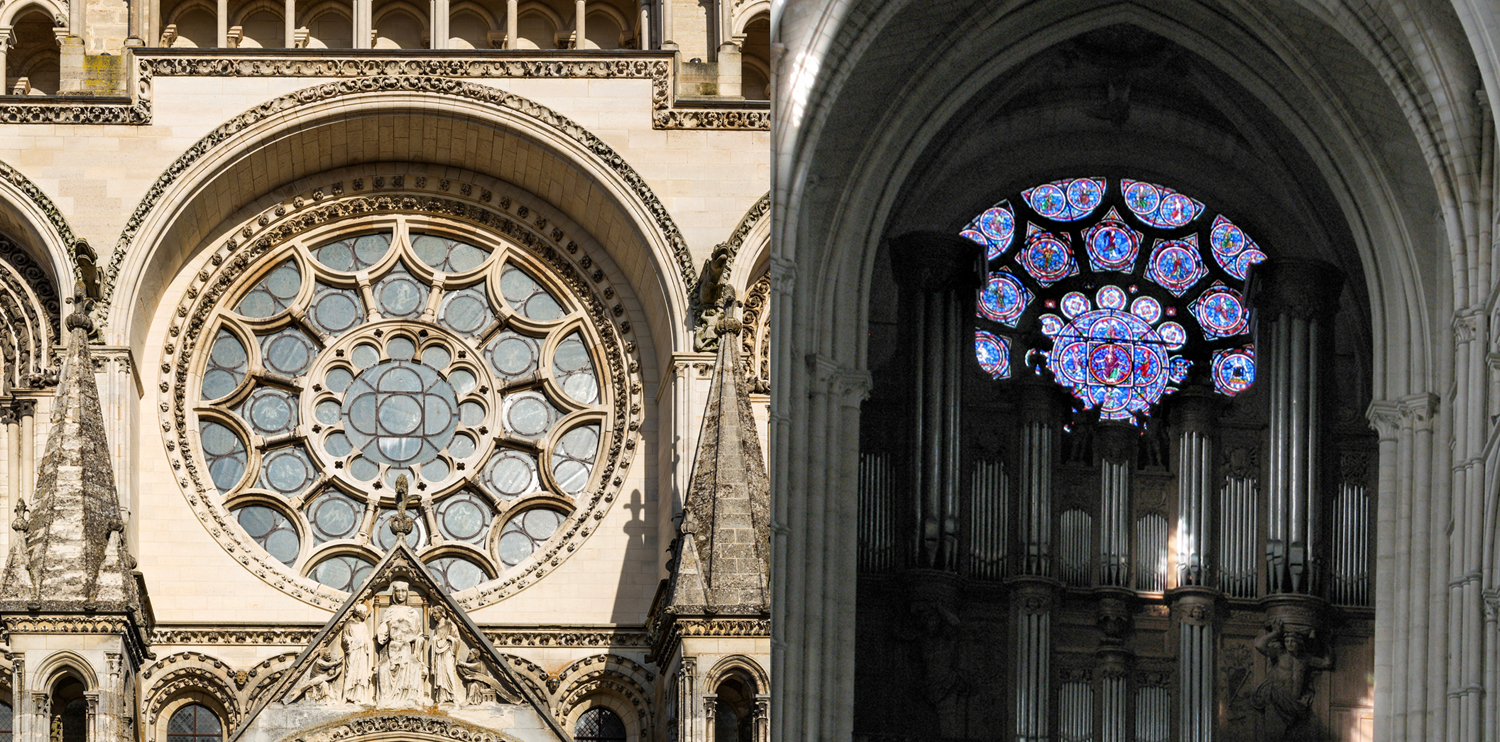
Noyon Cathedral is a shabby little church, in an obscure little town in northern France that almost no one has heard of. Yet, it holds a special place in my heart; it may be small, but I know it more intimately than most other Medieval churches from the time. I have crawled through its guts.

The town has about 13,000 inhabitants, making it roughly the size of Fergus Falls, Minnesota. Never heard of Fergus Falls? Well, that’s my point.

In the Middle Ages, it was the seat of a bishop, although the bishop left and moved to Beauvais in 1801 after the Concordat between Napoleon and Pope Pius VII. The town had had a bishop since AD 531, when the Bishop Medardus moved his seat to Noyon, choosing it over a rival city because he deemed the wine in Noyon superior.

A cathedral had been built on the spot since then, being the place where in AD 768 Charlemagne had been crowned co-king of the Franks, and later, in AD 987, Hugh Capet was crowned the first Capetian monarch. It’s hard to imagine that now, with Noyon being such a backwater.

That early church — or churches (there were probably a sequence of them) — burned down in 1131 and the current building was begun in the new Gothic style soon after. Like most such churches, it was constructed and renovated, rebuilt and added to over the centuries. But the major part of the church is in the early style, including some Romanesque holdovers.  Indeed, it looks rather plain compared with its compeers.

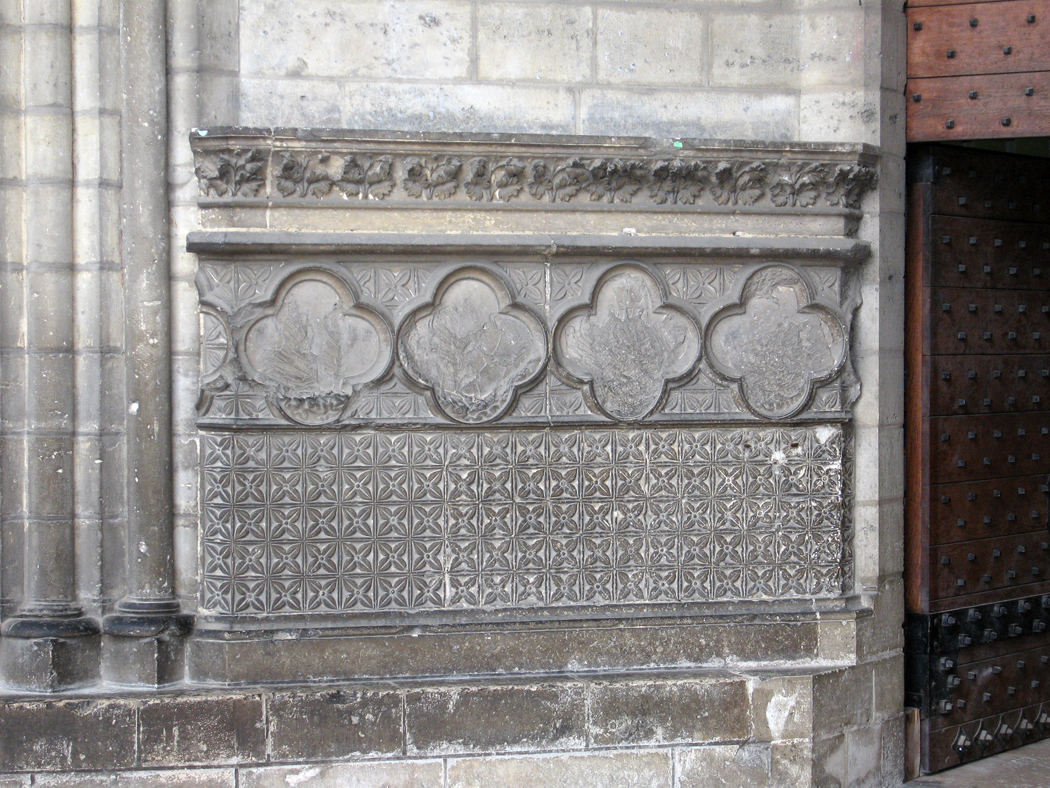
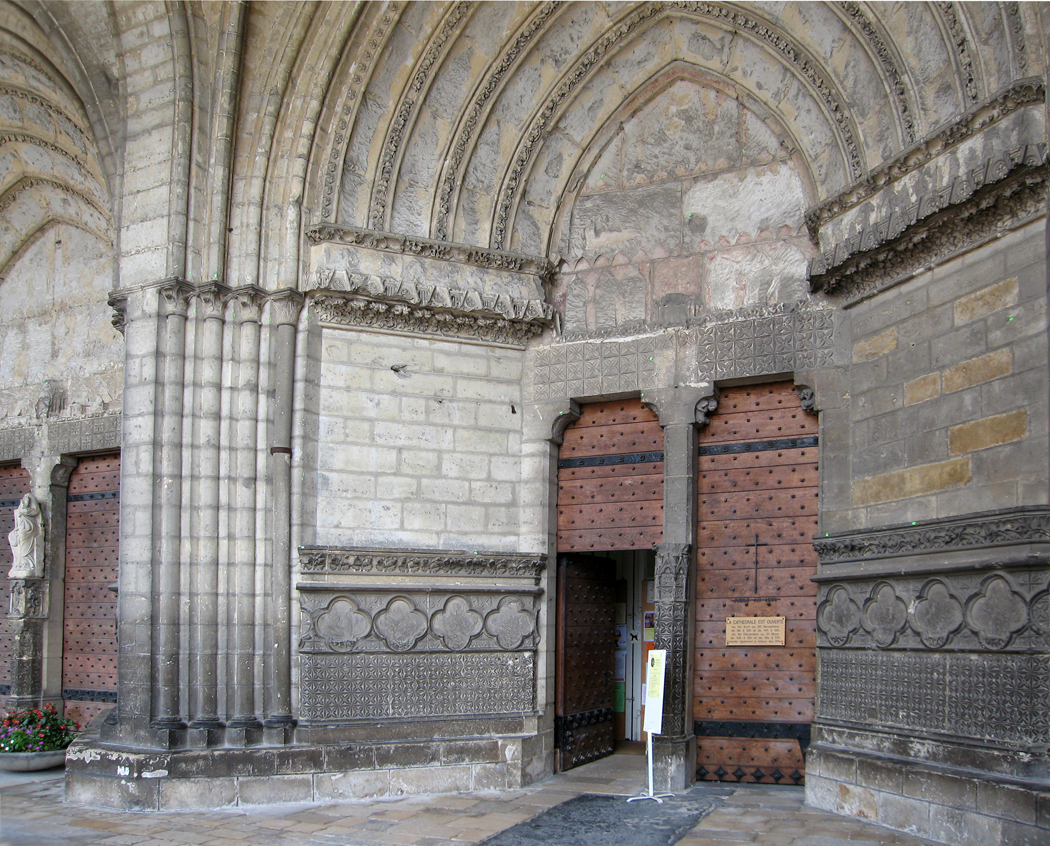
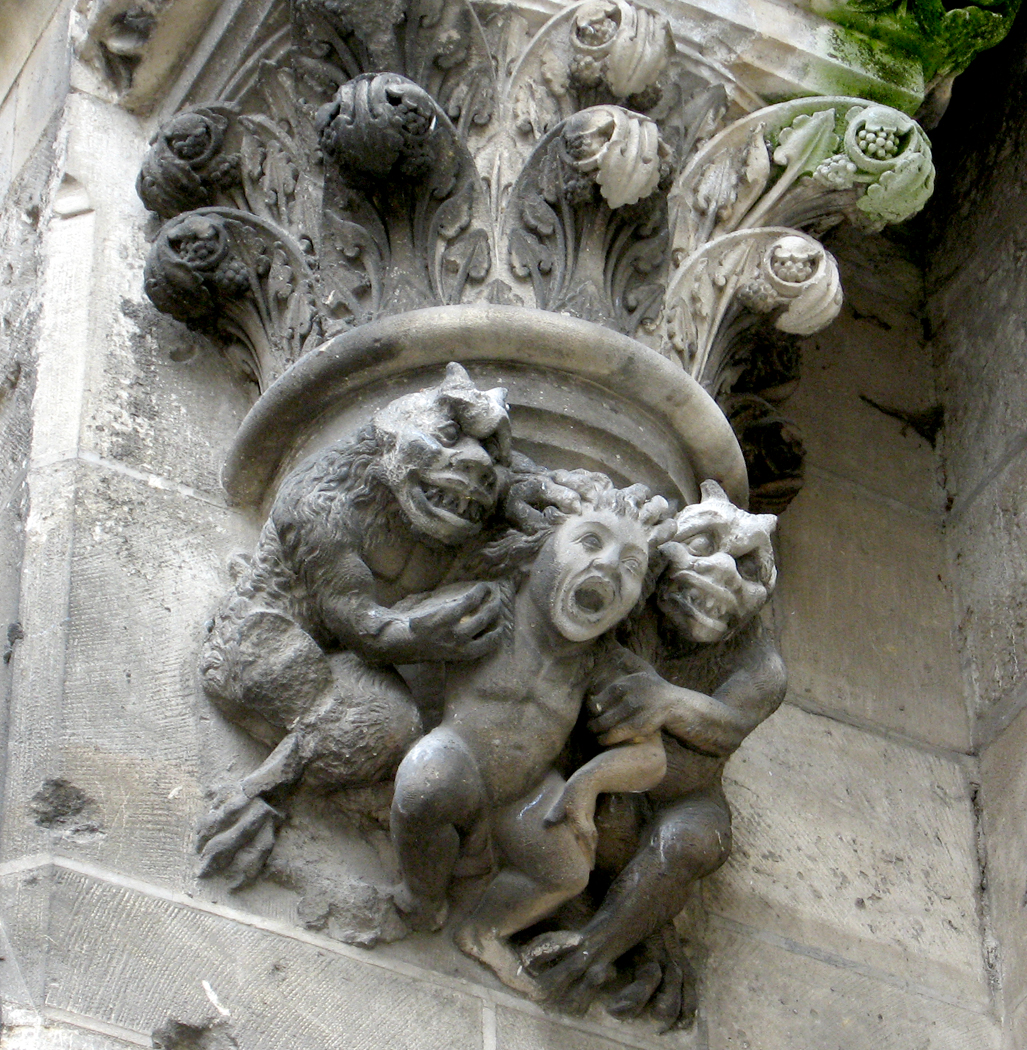
Noyon is notably smaller than Amien or Beauvais, and its cathedral is almost a miniature version of the familiar formula. Yet, it isn’t merely its style that explains its homeliness. The French Revolution had treated it miserably, knocking off pretty much all of its external sculpture. You can see the scars.

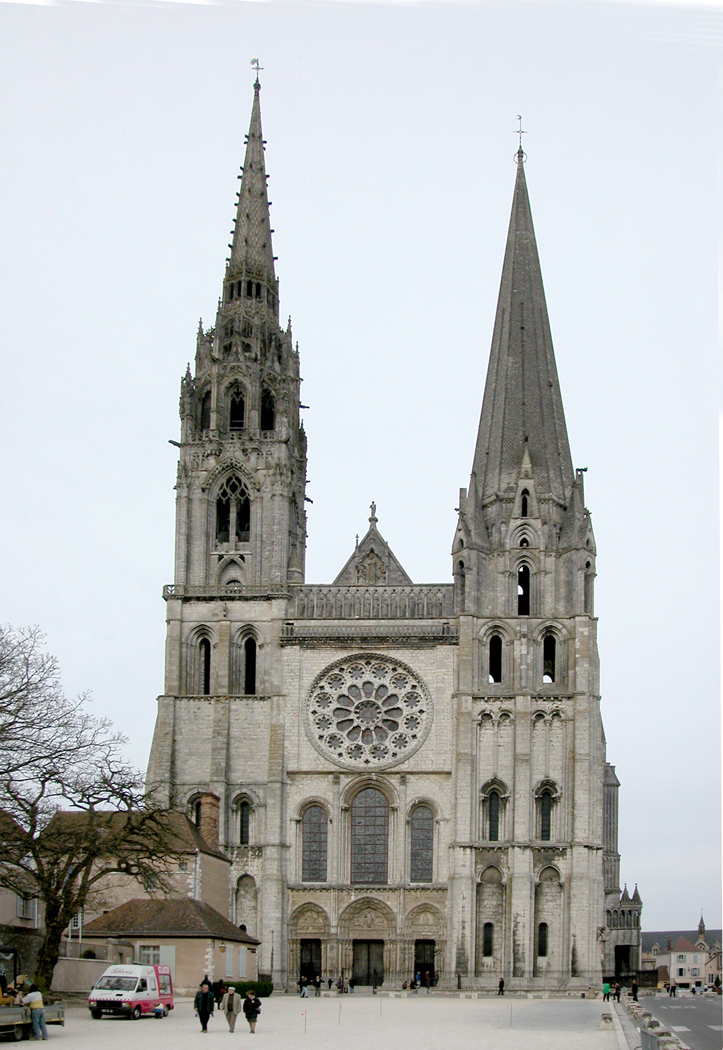
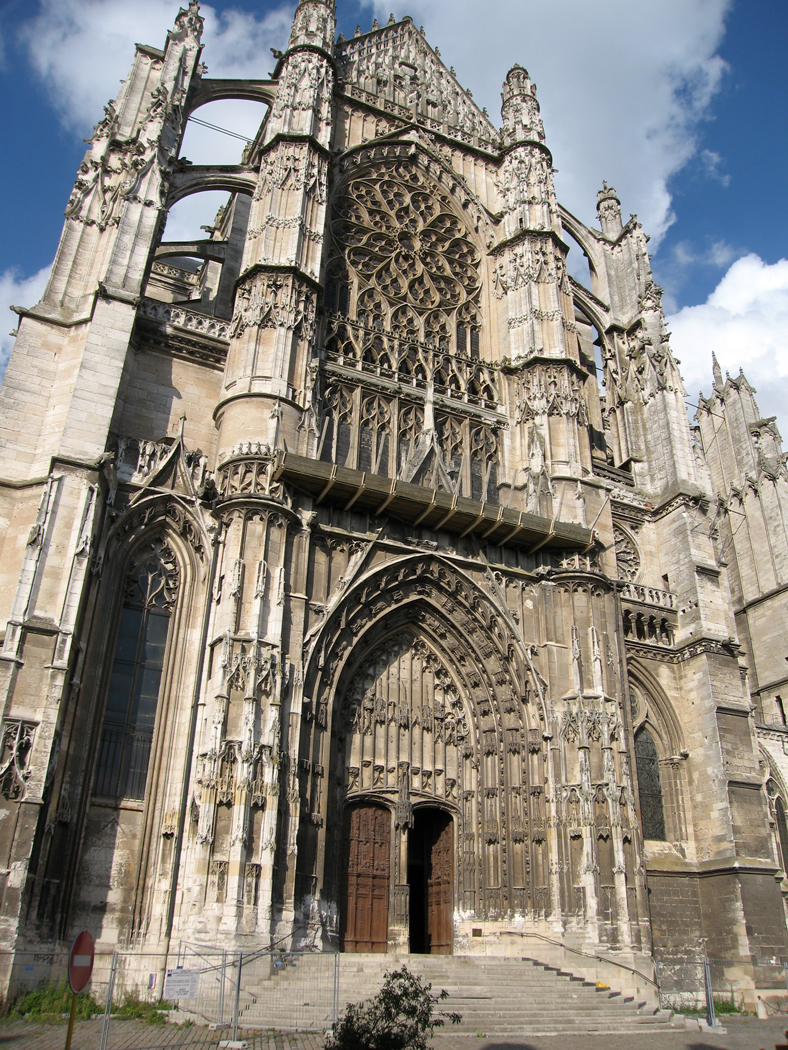
You approach the cathedral through some narrow streets and we could see it before us, plain-spoken, with no statuary on its facade. Two nearly identical towers framed the central portals, of worn and weathered wood. The West Facade also had two flying buttresses, something I had not seen before anywhere. They stuck out into the parvis.

When we got closer, we could see that there had once been sculpture on the exterior of the building, but it had been chiseled off. During the French Revolution, anticlerical feelings ran high and many of these old churches were defaced. Some, like Notre Dame in Paris had been restored in the 19th century, but poor Noyon had been left bereft.

During the Revolution, churches had been deconsecrated and repurposed as “Temples of Reason,” or had, like Notre Dame in Paris, turned into warehouses for grain storage.

Noyon was, apparently, too insignificant for thorough restoration.

Chapelle Episcopale Saint Nicolas

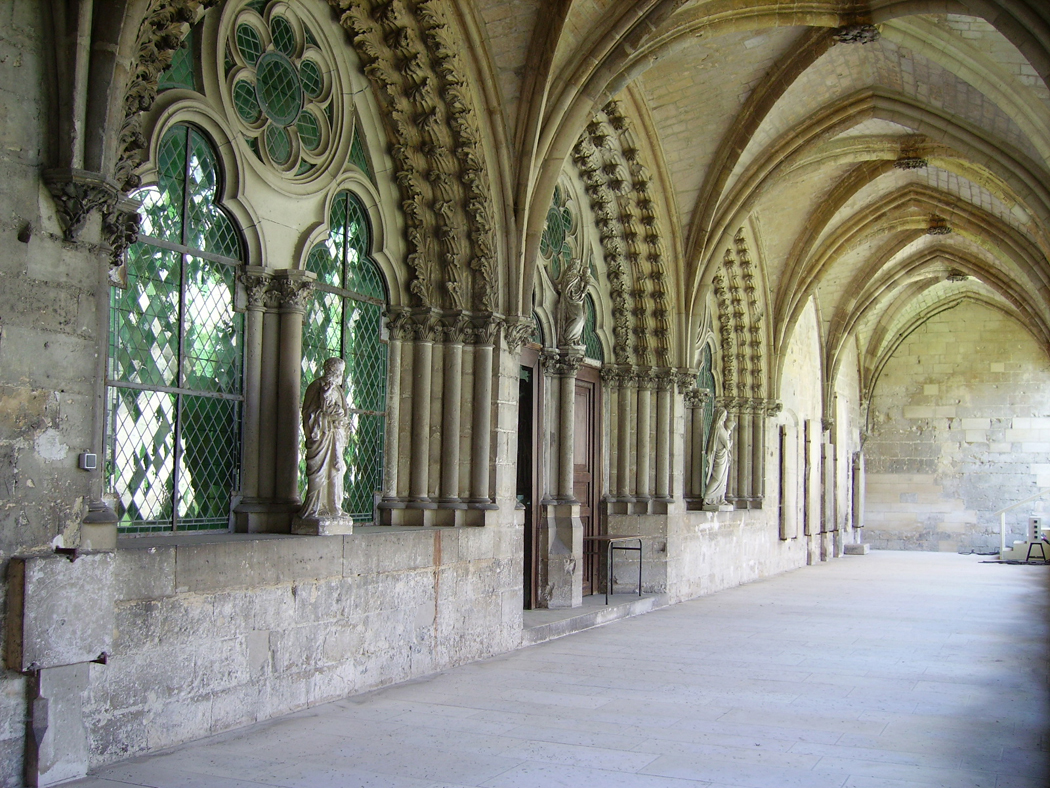
You can walk around the building. To the right you discover the ruins of the Chapelle Episcopale Saint Nicolas, an 11th century revenant, pass around the back and on the south side, the half-timber library. The larger stone edifice beyond that is the cloisters and refectory.

Library

Time to go through the portal.

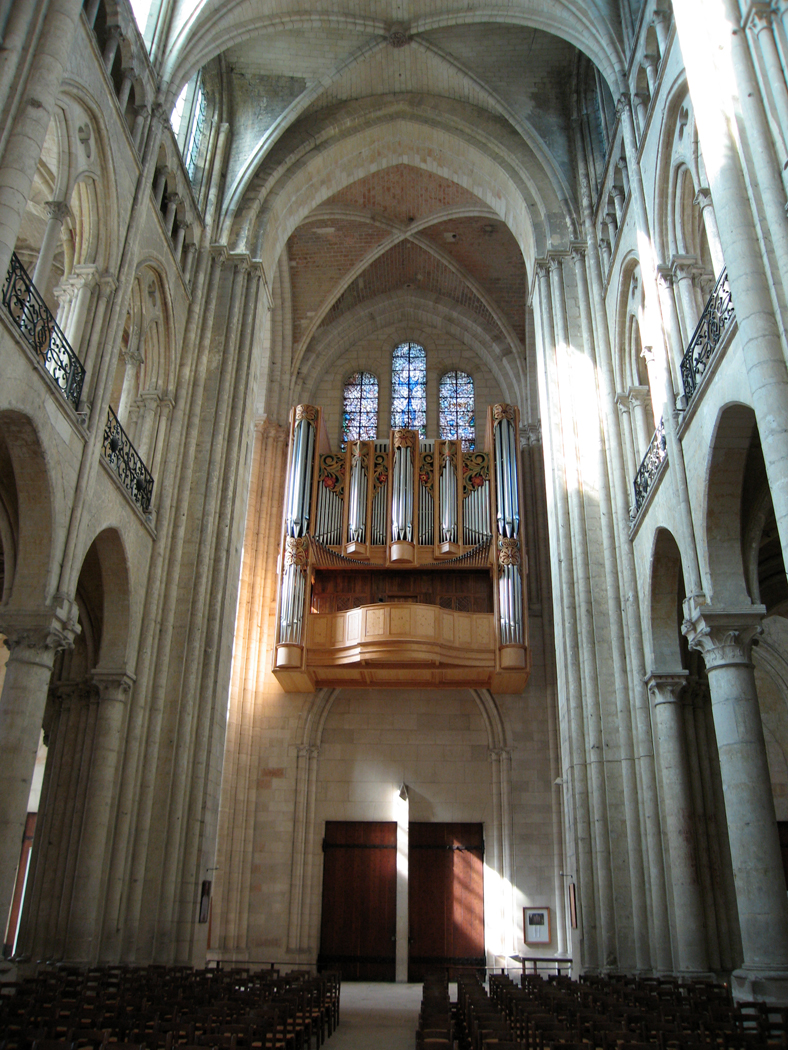
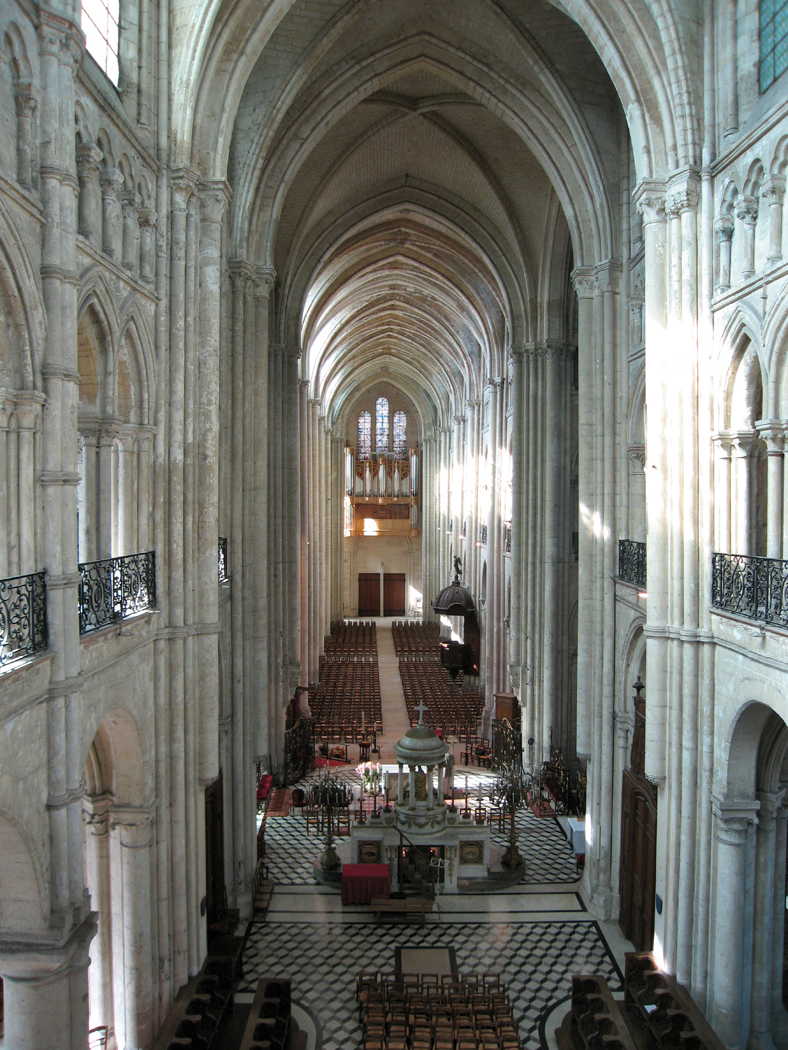
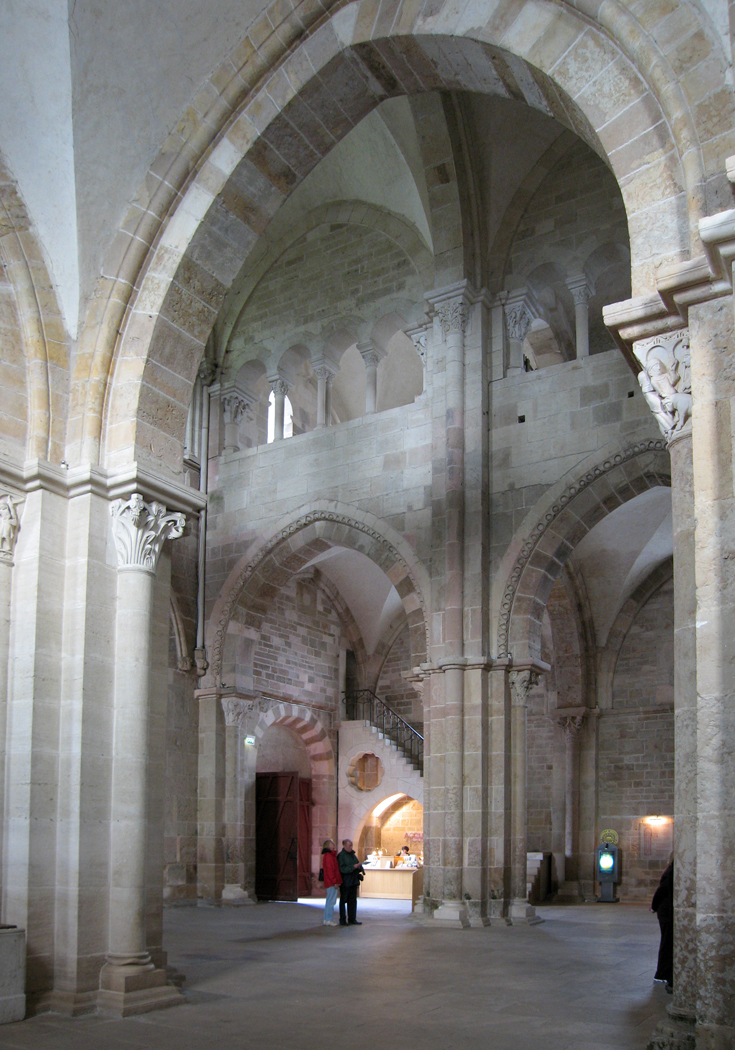
The interior is in better shape than the exterior and provides some of the awe and reverence you require from a Gothic church, and is truly their raison d’etre. It severs off a section of the universe, a bit of space, and lets you contemplate it divorced from the commotion and concerns of the day-to-day. You feel the immensity of that captured space and its stillness and it reminds you what is truly important, truly permanent. It is caged eternity and we watch it the way we see a panther at the zoo.

I walked around inside, taking photos. And when I got to the ambulatory and got around to the far point of the apse, I stepped up to take a few pictures of the altar and nave, when an old, withered man walked up to me and spoke rapid French to me in a stutter. I was worried I had broken some taboo or regulation, and the man indicated I should follow him. I thought I was being taken to the principal, or at least the monsignor. He dragged me along the length of the north aisle till he got to a side door, officiously pulled out a key and unlocked the door, opened it with a creak, and motioned for me to follow him into the cloister and garden that take up the north side of the church exterior.

Then he unlocked another door, to the refectory, and motioned for me to enter. Then he began speaking again, but with such a stutter, I couldn’t make anything out. I kept telling him, “Je ne comprend pas Francais,” and he kept answering, “Oui.”

He was thin as a rail, with a day’s whiskers on his pointy chin, and gnarled hands twisted with arthritis.

Je ne parle Francais pas,” I repeated. And he said, “Oui, oui,” again. Then I said, “I get ma femme. She parle Francais.” And he said “Oui, oui,” and I walked out of the refectory, down the cloister, into the nave, found Carole, waved at her wildly to get her attention, brought her back to the refectory, where the old man began speaking wildly to her.

She answered like she understood what he was saying and they had a grand conversation. I’m not convinced either one had a clue what the other was saying or intended.

“A frail old man with a terrible stuttering problem and crippled hands seemed to earnestly and excitedly be trying to communicate something to Richard,” Carole wrote in her diary entry for the trip. “And when I caught up with Richard, he took me to the cloister to the man and I told him I spoke only a little bit of French and he began speaking French as fast as he could. But, I was in luck. He was a terrible stutterer, so I got five or six reinforcements of every syllable. And after each of his phrases, I asked him in French, that is, my French, was I correct in thinking he had said so and so and so and so, and each time he replied “Oui,” and continued.

“Then I would speak five and six sentences at a time. I was totally on a roll. I was understanding everything he said. He was assuring me he was understanding everything I was saying. I left the conversation walking tall, my chest swelling with pride. Hell. I was ready to light up a Gauloise. Let’s go do something French. Let’s go drink some vin ordinaire.

“Then, Richard mentioned that this may have been a crazy man, and since the man was holding a basket, I asked Richard for some money and dropped coins in the basket. Now my confidence is going limp. I am realizing this is like the time I played the piano drunk. I could tell most of the notes I was hitting were wrong, but somehow, I felt it was my finest performance.

“I think what the man was telling me, and he reassured me at the time that I was correct, was that a great battle was fought in Noyon in the First World War, and that many British soldiers died and that this cloister, where he had taken us, was the part of the cathedral that was used for special prayers for those British men, who died in Noyon.”

He finally left us alone, and we enjoyed the refectory and the cloister and the garden.

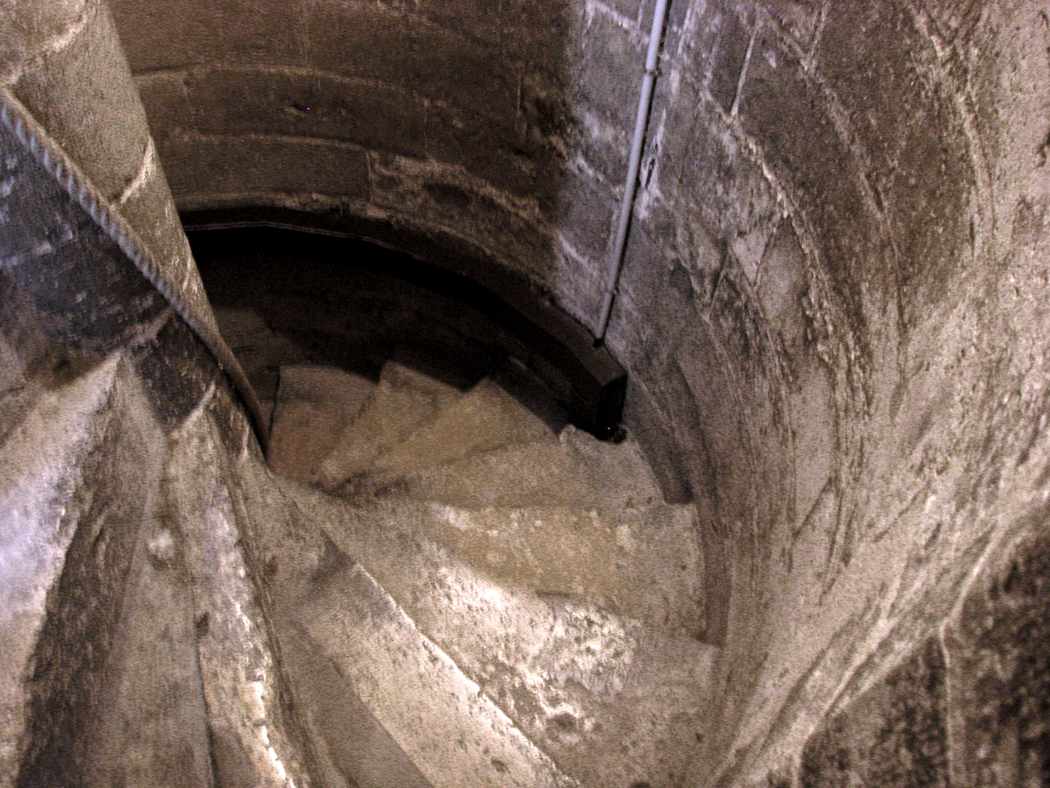
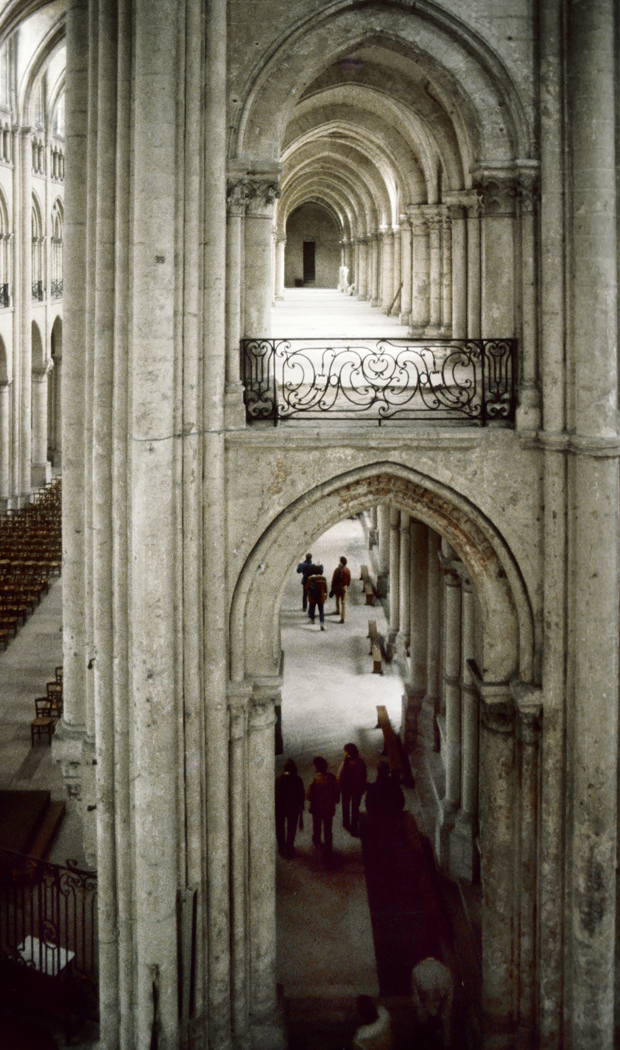
When we went back into the nave, Carole went off on her own and I walked back to finish what I had started at the apse end. When I noticed that there was a door open at the east end of the north transept, with a light on inside and a spiral stone staircase. I decided nothing ventured, nothing gained, and began climbing.

Where I got was the triforium around the apse, a second story ambulatory, covered in chunks of stone and mortar, with an uneven floor, loose electrical wiring and in places a floor that might as well be dirt. It looked as though in 800 years, it had never really been finished, but left roughed out, since it had no useful function other than to be looked at from the cathedral floor.

I walked to the far end of the apse, took some pictures of the nave, full length, and was ready to walk around the triforium to the transept to have a look when four more people came up the stairs.

Great, I thought. I’m OK. This must be part of the tour.

But no, one of the four scolded me and told me something in French that made it clear I was not supposed to be there.

I walked over to them, apologized, explained that the door was open, and I asked if they spoke English. The woman said “un peu.” and held up the thumb and index finger to indicate about three quarters of an inch.

I told her that I didn’t understand what the man had said to me. She told me that I was not permitted up here, that she was bringing these two journalists up for a tour, and the third man was the sexton, who had the keys.

The young sexton was grim and adamant, but when I explained that I was also a journalist, and that I was studying cathedrals and had been grateful for the chance to climb to the triforium, she smiled and said, “We are going to climb the tower now. If you would like, you can come with us.”

Merci, merci, plus merci,” I said, and tagged along.

We went to the south tower at a door on the south aisle. The sexton pulled out his handful of keys and opened the door very slowly, to reduce the squeal of old hinges. We mounted the stone spiral staircase and began climbing, me bringing up the rear.


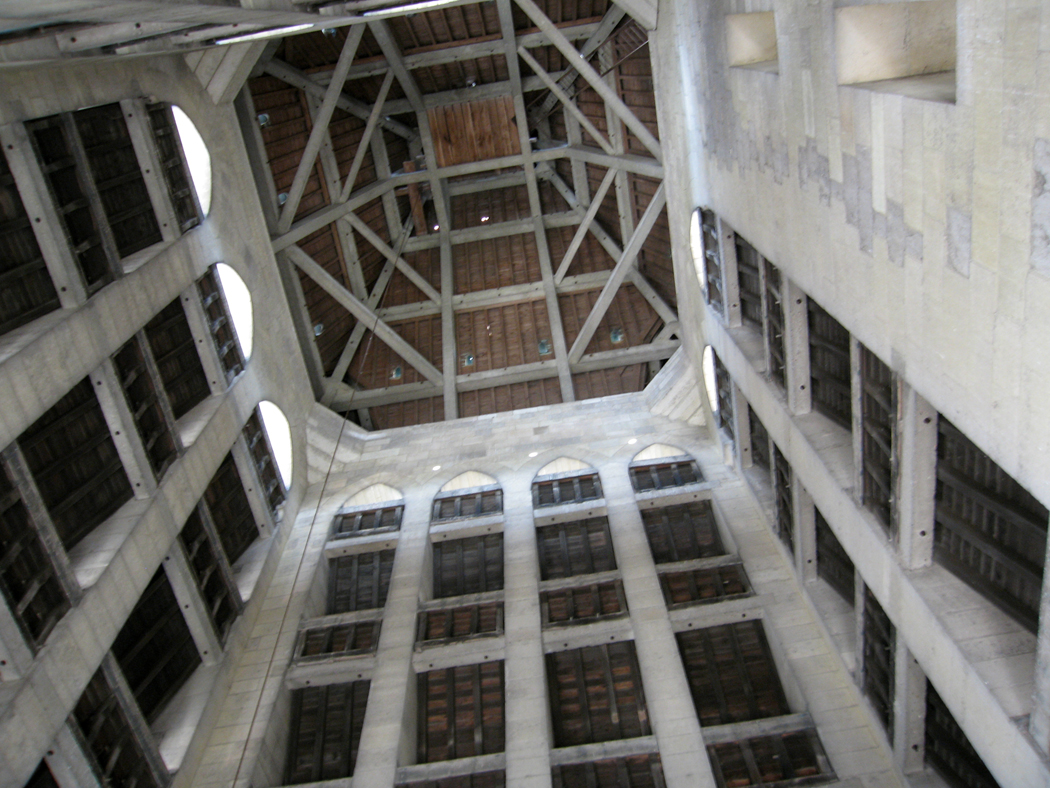
Well, I’ve been up towers before, and they can be worse than lighthouses: We climbed and climbed, with no relief of window or landing, till we got to the first level of the tower. The bells were clanging; it was quite an impressive sound, not quite enough to deafen poor Quasimodo, but loud enough. The floor looked like a construction site; the kind with grout and cement spilled on the ground and left to dry to a powder. The floor was bumpy and uneven, and the walls were unfaced stone, left as raw as when it was cut from the quarry. If it doesn’t show, why spend the time and money to finish it.

We went up another level — killing my poor knees, by the way, and practically bringing rigor mortis to my leg muscles. I huffed and puffed, but mostly, I sweated, Niagaras of sweat into my sports jacket. My shirt was a bathmat.

The next level was much like the previous, but with slots to the outside, allowing a cool breeze to filter through.

Yet one more level up, and we were at the top. Only the wooden roof was above us. Each of these levels was perhaps 30 feet high from floor to ceiling, and all left rough and unfinished.

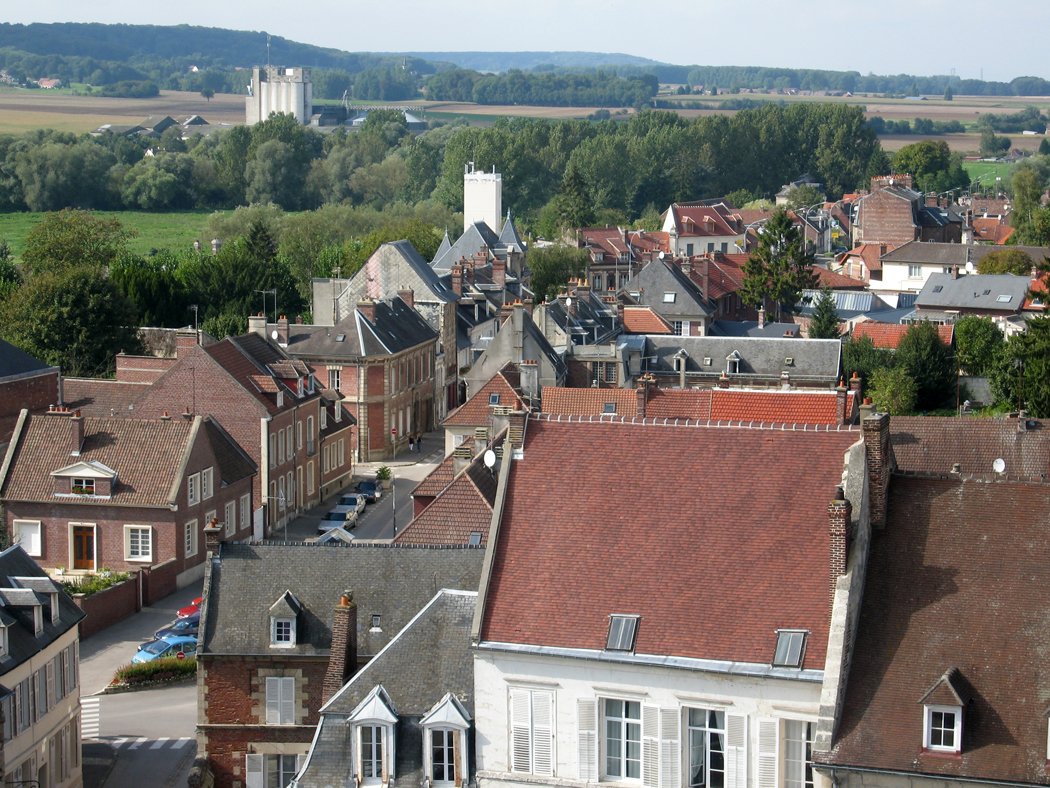
But we could look out at the city and see the paysage all around: Farm field and woods as far as the eye could see beyond the village.

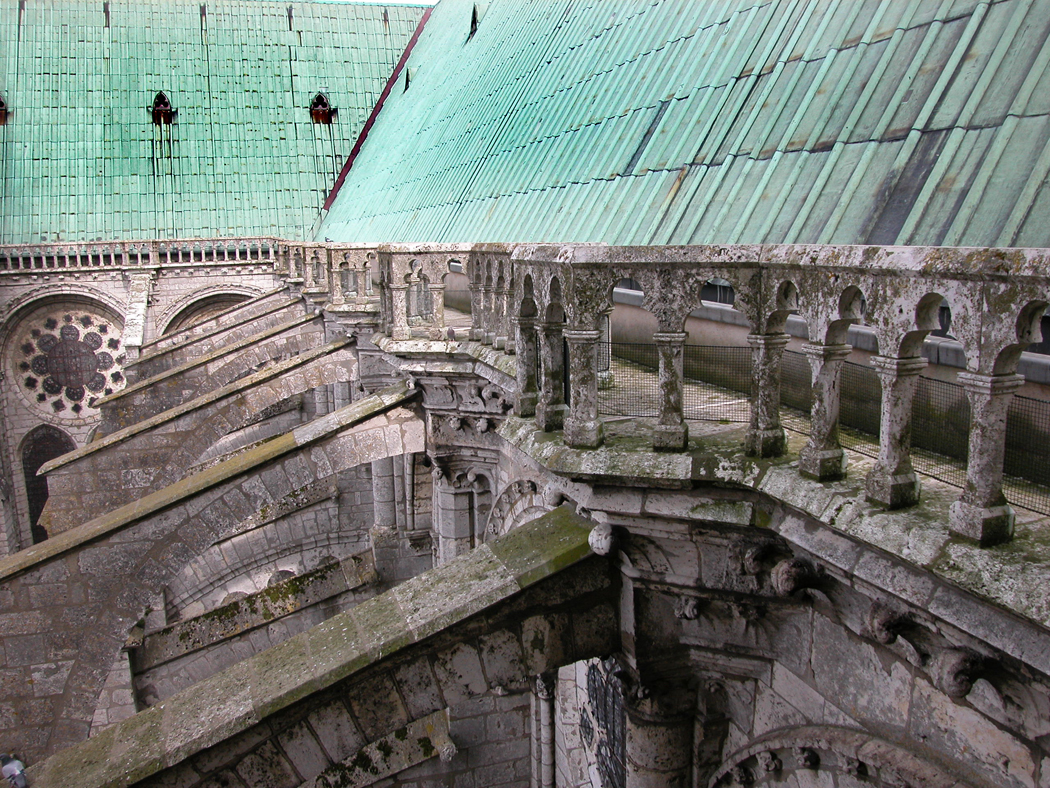
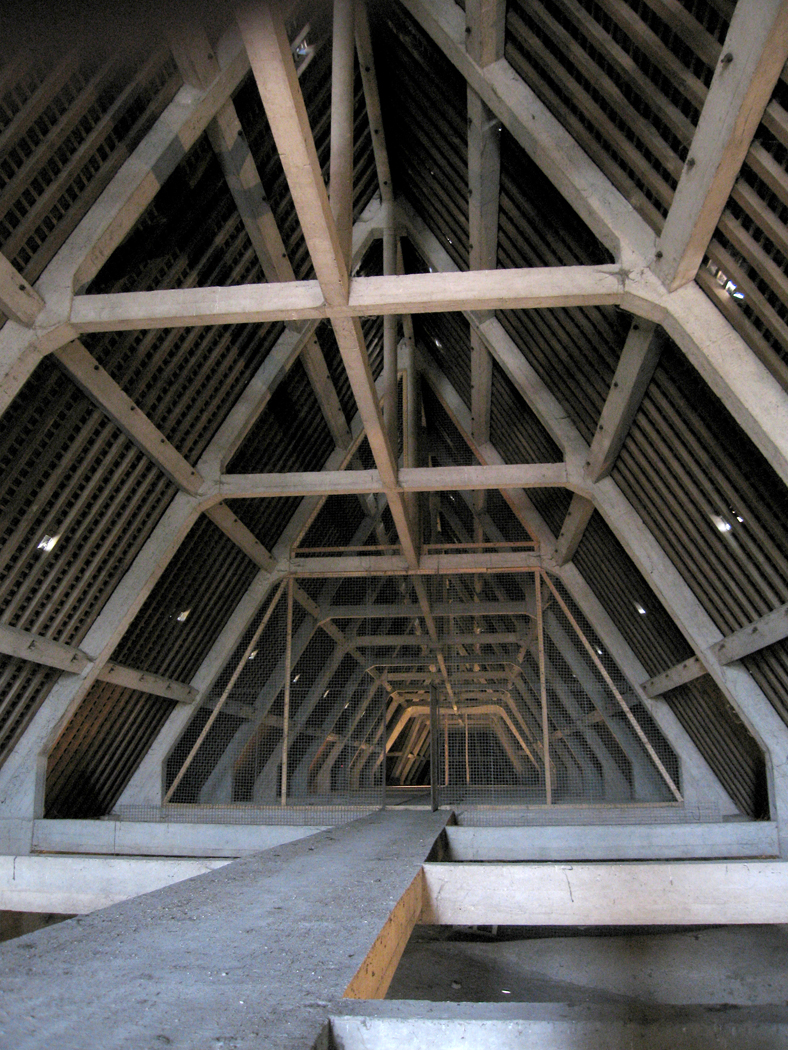
At one level, we ventured in towards the body of the church, and I could see the strut-work keeping the peaked roof up. Crawling through the guts of the cathedral, I felt the thrill of Rotwang and Maria traipsing among the buttresses and gargoyles.

Noyon may be a forgotten relic of centuries past, but it is now the church I feel most intimate with. I have seen it backstage as well as front.

After we walked back down, the church was being used for a funeral, and we all tried to be as quiet as possible. I thanked the woman and sexton for their hospitality, and left the church looking for Carole.

She was outside, having sat through some of the funeral, but then having felt a bit intrusive, left the building to walk around outside.

Anyway, it proved to be one of the best cathedral visits ever, and though I was drenched with sweat and beginning to stink that blue-collar stink, I was elated.

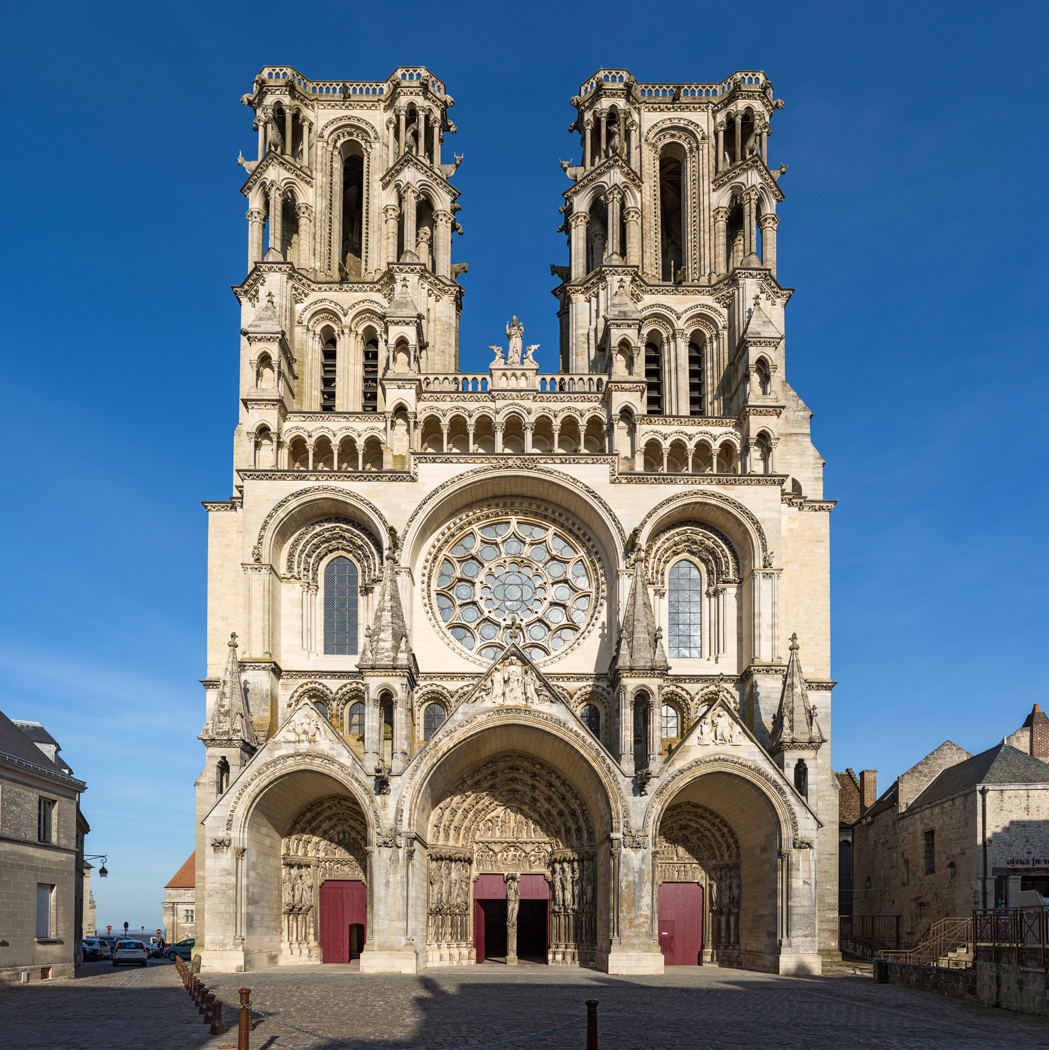
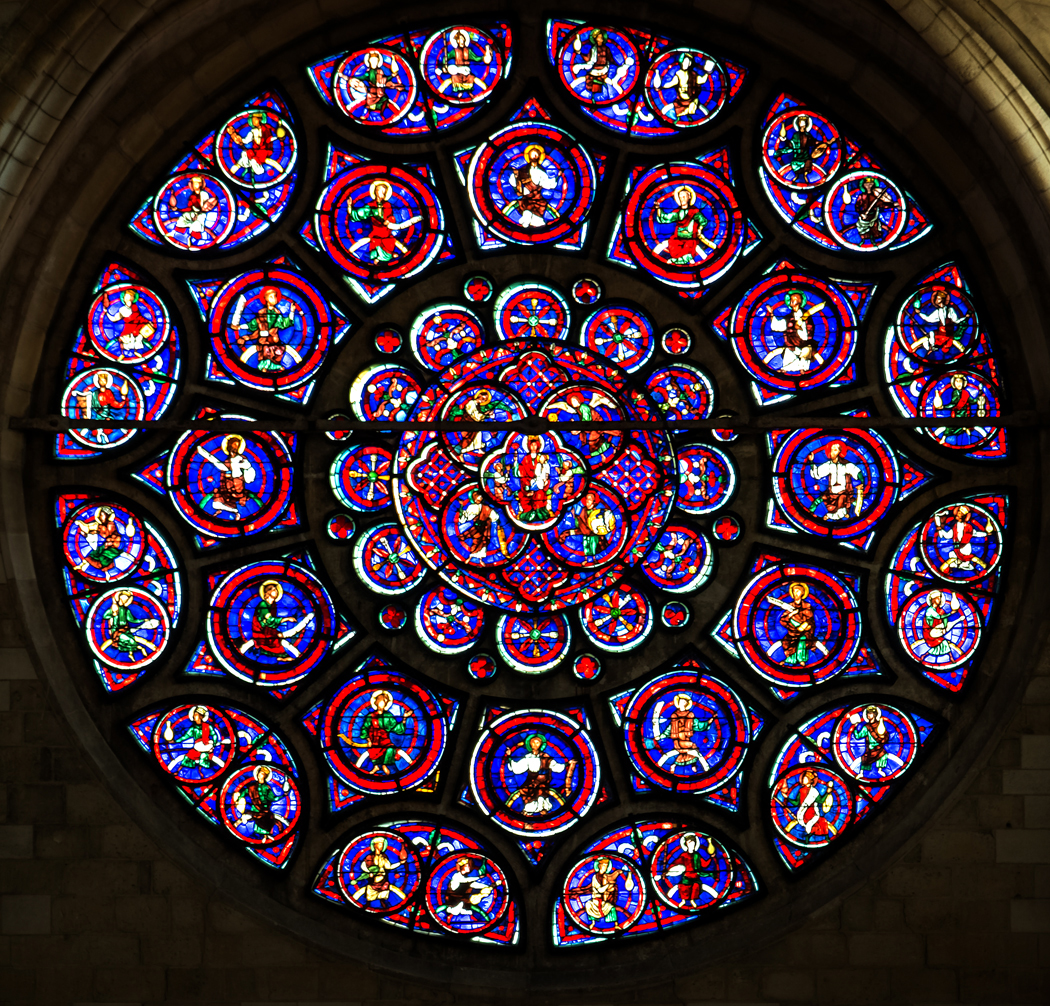
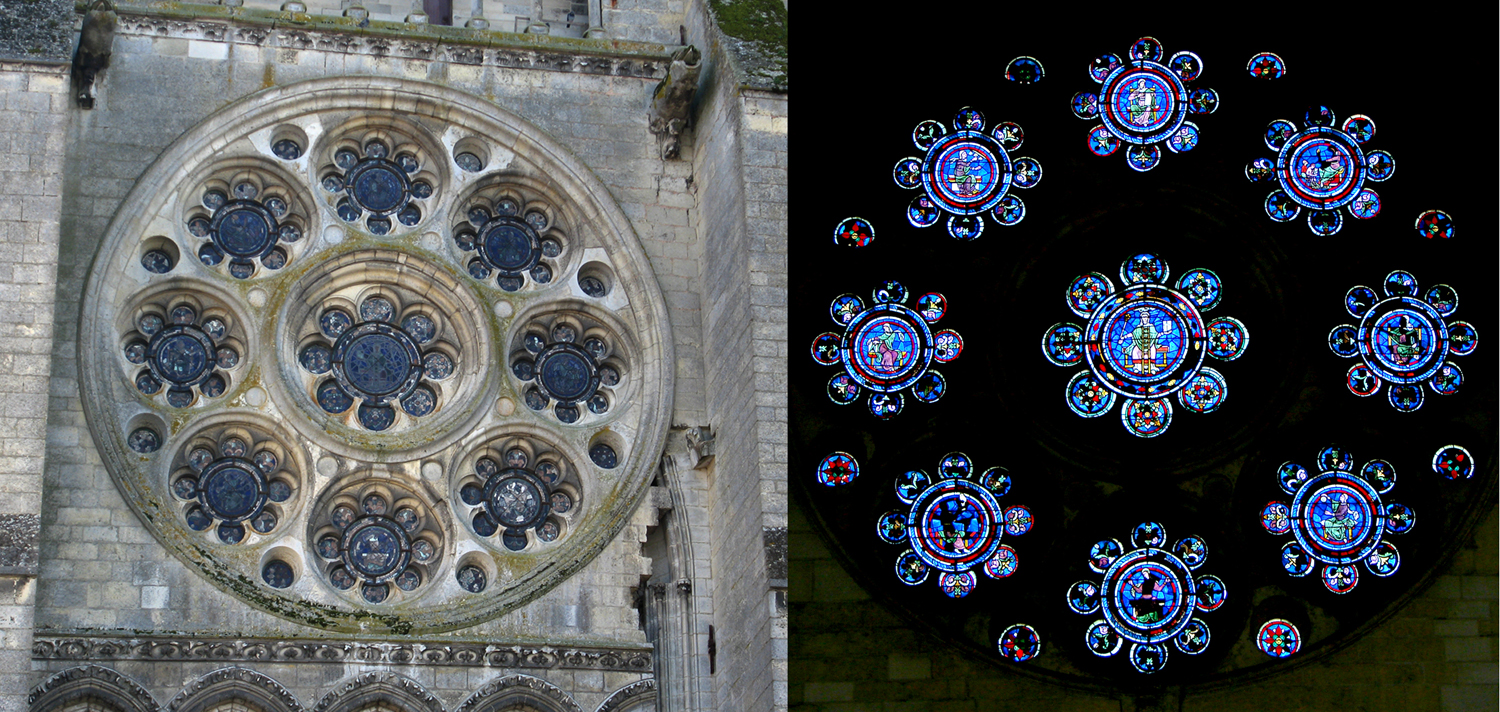
Next: Laon

Click on any image to enlarge

Size matters, at least in the case of Medieval churches vying with each other for bragging rights. The two tallest Gothic cathedrals in France are only a few miles apart, but they tell very different stories.

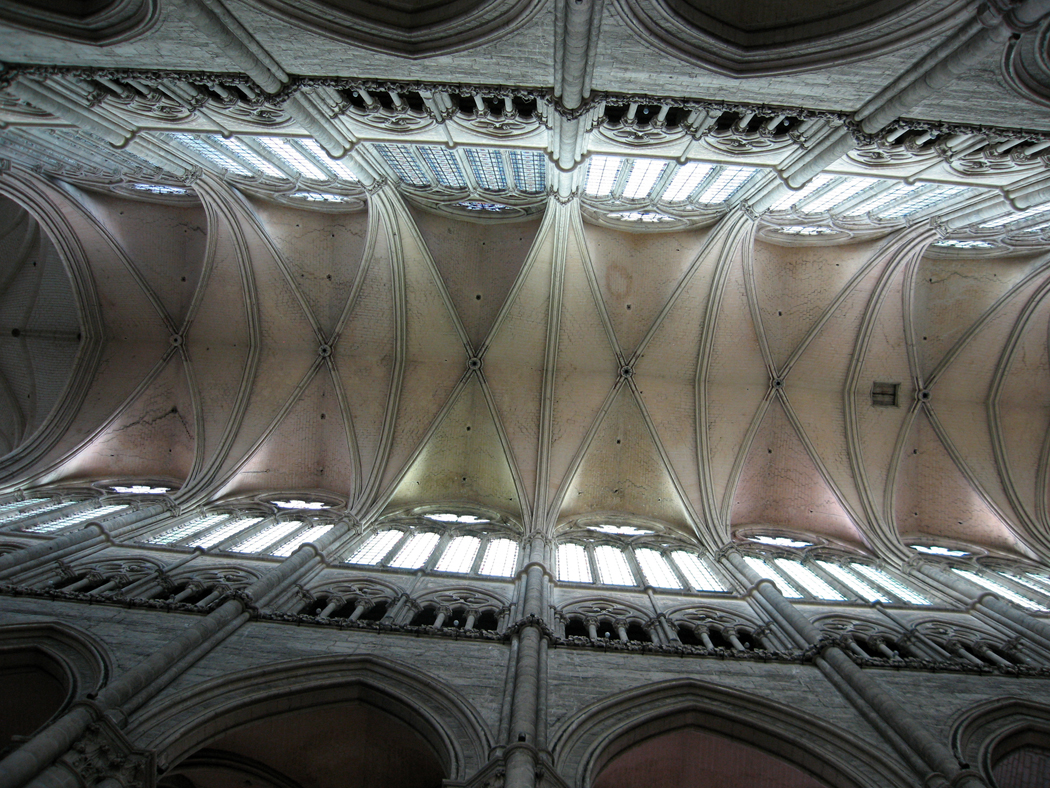
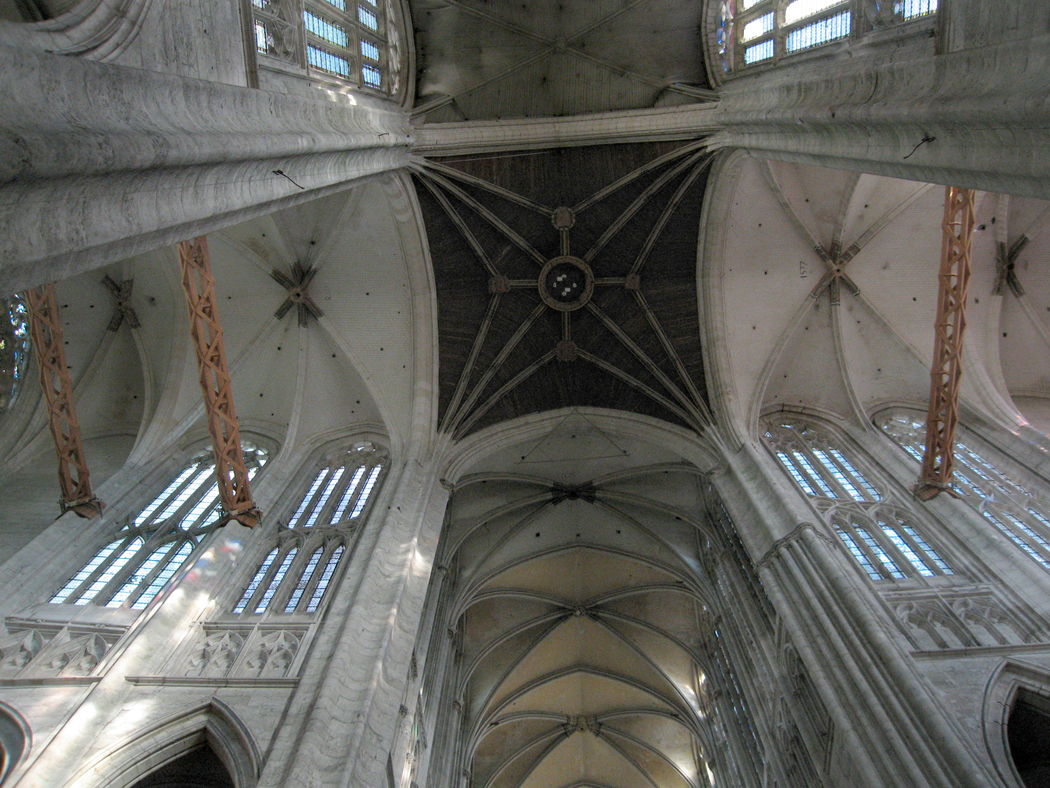
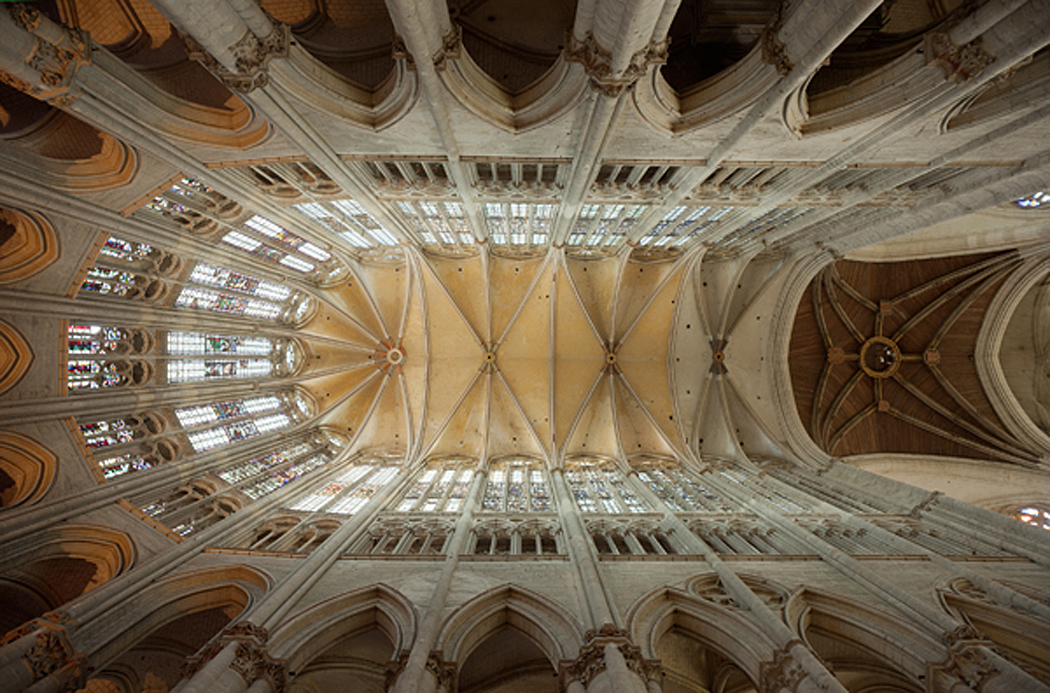
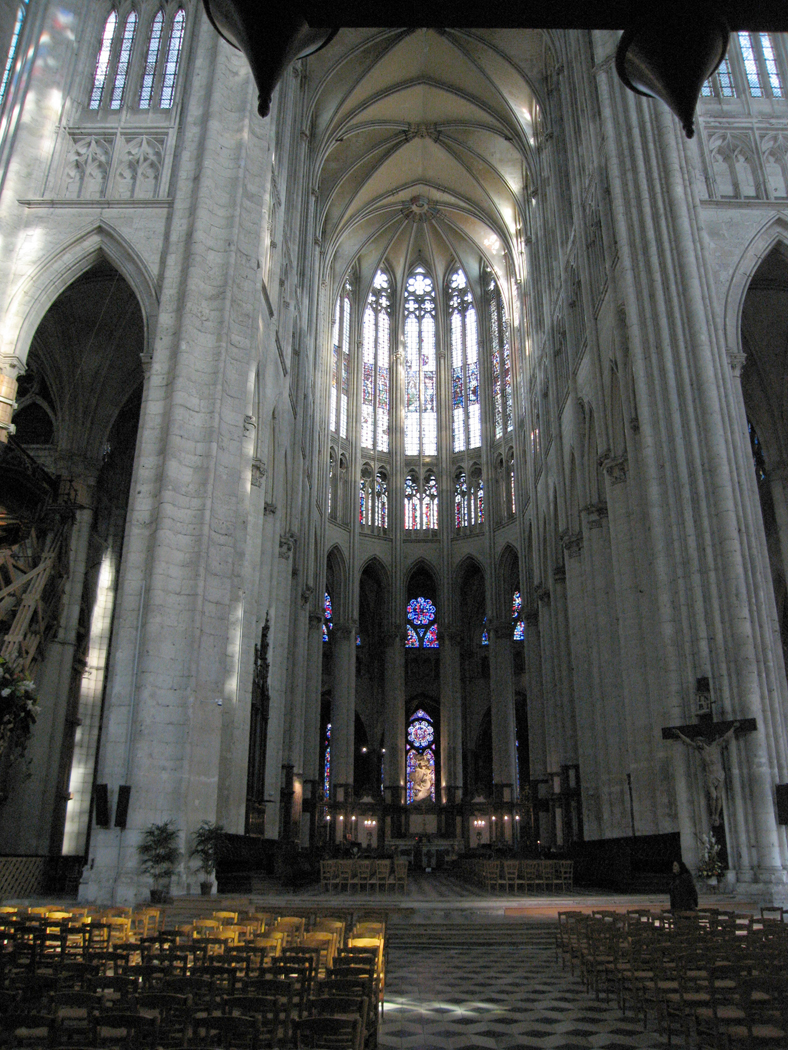
In the high Middle Ages, towns built churches the way American cities build sports stadiums, striving for the biggest, best and most impressive. They also advertised the best saintly relics, to draw pilgrims and their money to town. Some 70 miles north of Paris is the city of Amiens, which has the cathedral with the highest vaulted ceiling of any completed church and some 30 miles from that is the incomplete Beauvais, with a ceiling even higher, but an unfinished nave, leaving the church truncated and mutilated.

Amiens is a nearly perfect relict of the architecture of those years (and I shorthand the city’s name for the cathedral, otherwise I must write Notre Dame d’Amiens — or more precisely “The cathedral basilica of Our Lady of Amiens” to give it its official name — and almost all of these churches, cathedrals and basilicas are called Notre Dame or “Our Lady,” after the Marian cult that figured so prominently in Roman Catholicism in the area and at that time) It is the largest by volume and the tallest from floor to ceiling (save only the unfinished Beauvais, about which more later) with 13 stories of emptiness above the visitor.

It sits in the center of the town with a small by handsome parvis, or plaza, at its front. Three portals punctuate the western facade, which is covered with statues of saints and biblical figures. The north tower is slightly taller than the south, and because the building sits on a slight incline, there are more steps to climb at the north end of the facade than in the south.

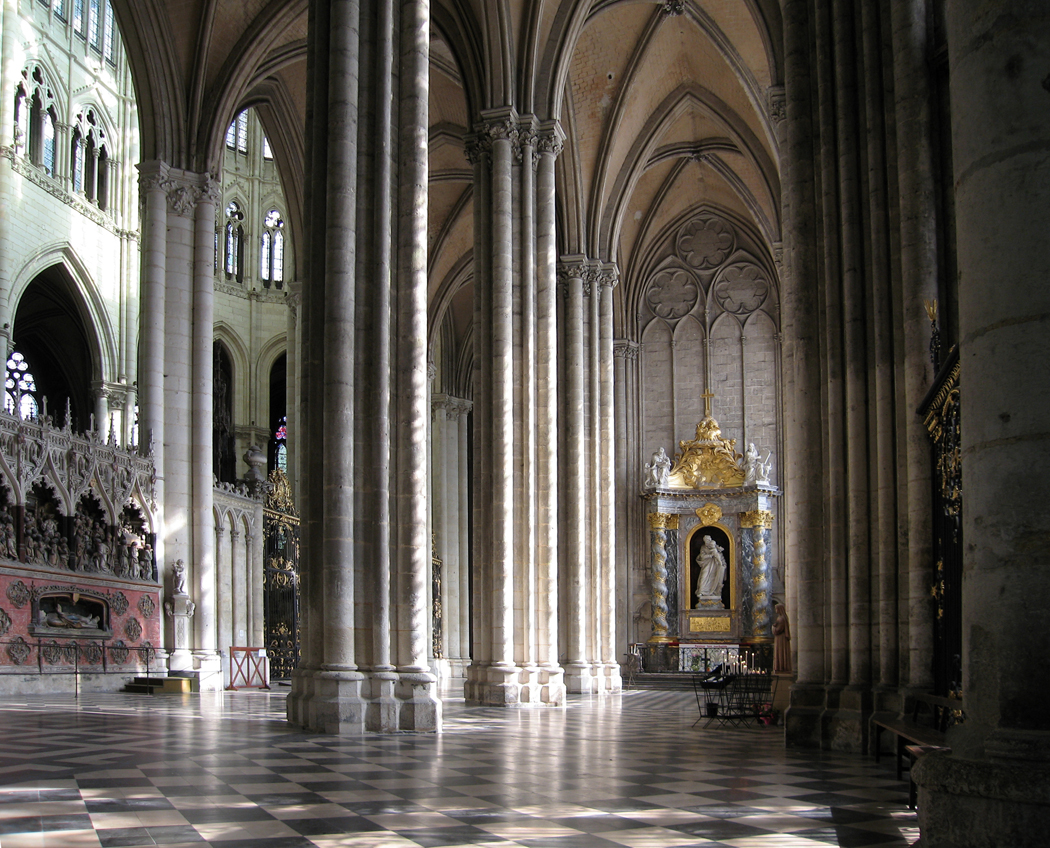
Inside is brightly lit. Like the cathedral at Rouen, most of its stained glass is gone and the clear or frosted glass lets sunlight stream in.

The odd effect of the church’s regularity, its brightness and its isolation from other buildings nearby, Amiens doesn’t seem as big as it is, with ceiling 138 feet above the floor, and encompassing 260,000 cubic yards of air inside — three times the volume of Notre Dame of Paris. It is, however, the perfect model of the Gothic cathedral and the one I would suggest be the first to see, so as to gauge all the other you find in the northern half of the hexagon that is France.

There are a whole series of such cathedrals and basilicas in northern France, usually not more than 50 miles between each, and in 2006, my wife and I took a trip through the area, visiting 11 of these monuments. From Paris, we took the train to Rouen, where we rented a car and drove to Amiens and Beauvais. Then to Noyon, Laon, Reims, Vezelay, Chartres and back to Paris and Sainte-Chapelle, ending at the earliest Gothic architecture at St. Denis.

Of all of them, Amiens is perhaps the most classical, the ur-cathedral, and certainly the most unified, having been built rather quickly, by Medieval standards, from 1220 to 1260, with additions made in following centuries. Where some other churches are still rather grimy from the exhaust of the Industrial Revolution, Amiens has been cleaned up and is bright and presentable.

If anything is true of these prodigies of architecture, it is that there is no such thing as a Gothic cathedral — at least no such thing as a “pure” Gothic cathedral. Each has been built over decades, even centuries, and each has add-ons in different styles, rebuilds made more “modern,” and restorations by well-meaning finaglers such as the 19th-century Eugene-Emmanuel Viollet-le-Duc, who replaced damaged statuary, added grotesques and redesigned finials and gargoyles according to his Victorian sense of what Gothic style should be.

Viollet-le-Duc was put in charge of restoring Amiens in the late 19th century, and he added a whole new line of statues at the top of the west facade, called the “Galerie des Sonneurs,” or “Gallery of Bell Ringers,” a passageway arcade between the two towers. He redid a good deal of the statuary and had the cathedral floor redone to smooth out the cobbling of centuries of foot traffic. Modern standards for restoration were not part of his procedure. “To restore an edifice”, he observed in his Dictionnaire raisonné, “is not to maintain it, repair or rebuild it, but to re-establish it in a complete state that may never have existed at a particular moment.” In other words, as he might imagine it

But such rejiggering is hardly unusual for these cathedrals.

Amiens was originally built in what is called “high Gothic” style, but all kinds of stylistic incongruities have been patched on. Although the building was essentially complete by 1280, in the 16th century, the mayor of  the city of Amiens decided it should have a spiffy new rose window in the then-current “flamboyant” style, highly sinuous and curvy, so the front window of Amiens doesn’t match the rest of the facade.

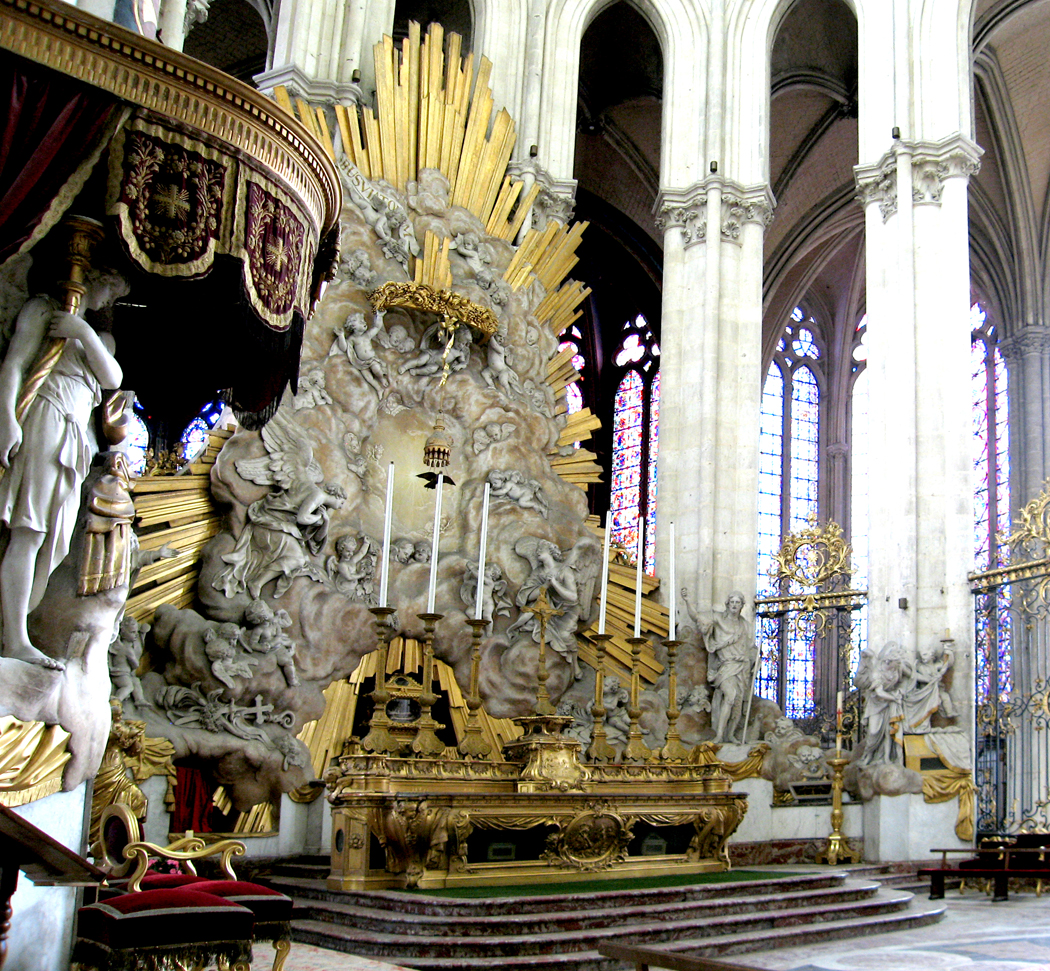
Not that one can complain. Inside, there are altars added in the Renaissance and the Baroque eras, so completely out of sympathy with the more rigorous taste of the Gothic. In some cathedrals, there are even Modernist stained glass windows.

It is the genius of the Gothic style that it can absorb almost anything and still seem perfectly harmonious. Some historical styles that strive for unity require any additions to be matched stylistically or the new parts seem like carbuncles grown where they are least desired. (Can  you imagine an addition to London’s Saint Paul’s Cathedral designed by, say, Louis Kahn?) But Gothic is an accepting style. There is not much you can do to it and not have it welcomed into the family.

The 19th century gave us a pervasive sense of the Middle Ages. Whether it was Victor Hugo in his hunchback novel, or Sir Walter Scott in his Waverly novels, Alfred Tennyson in his Idylls of the King, or Mark Twain (who tried to take the whole thing down a peg or two) in his Connecticut Yankee in King Arthur’s Court, there are knights in shining armor, kings and their courtiers, castles and cathedrals. Those artists and authors gave us an era of dour religion and grey stone monuments. And when we look at the front of Amiens, with its ranks of saints standing like an army between the portals, we tend to have a purist vision of the stern asceticism of that era. Yet, we now know, from recent restoration work, that those grey statues guarding the church were originally brightly colored with paint. Traces of that paint is found in the stone, and in recent years, a fancy computer program has managed to create a light show that projects the original colors back onto the neutral stone. We can see what the front of the cathedral was meant to look like. It comes as a shock. One is reminded of certain Arab sheikhs painting the statues in their gaudy Los Angeles mansions.


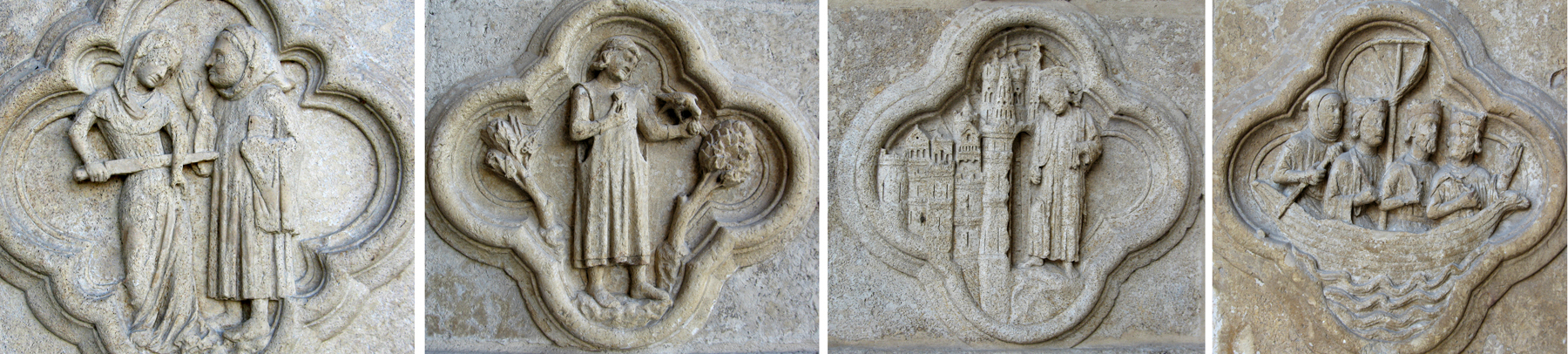
There are ranks of small bas reliefs at eye-height along the front of the cathedral that depict the zodiac signs, the works of the seasons, and the stories of local saints. They are now monochrome, but inside, you can find similar quatrefoil reliefs that are still painted.

The past as we imagine it is always a shaky construct. History is always being revised, and those scholars who do the work are initially derided as “revisionist,” when, of course, that is their job. To quote the revered Firesign Theatre, “Everything you know is wrong.”

Click any image to enlarge


Beauvais

Some 35 miles from Amiens, the cathedral at Beauvais is a testament to overreach. One cannot avoid thinking of the Tower of Babel, where cultural hubris outstrips engineering acumen and it all comes tumbling down.

The central metaphor of all these Gothic cathedrals is altitude, the sense inside them, that they reach to the heavens — or rather, to heaven. Their naves and choirs get taller and taller as the years move along, and when you are inside, it is nearly impossible not to be drawn upward, craning your neck into the vast space above your head. The light in a Gothic church also comes from above, reinforcing the metaphor: Above your head is divine.

This spiritual metaphor exists alongside the more earthly desire of city fathers to brag that they have the biggest and best, and so, a kind of competition existed in the 13th and 14th centuries to see who could build the most vertiginous vaulting. The winner of this inter-city battle was Beauvais, although its victory was Pyrrhic.

In AD 1225, the city authorities decided to replace an older church with one in the new Gothic style. The ambitions of the church and the local barons coincided in a plan to make this church the tallest and best in the world. The barons were in in  struggle with the French throne of Louis VIII and wished to assert their supremacy with the building, and the bishop wanted to assert his own primacy in this grand construction.

They finished the choir of the new church in 1272, with a ceiling vault that was 157 feet above the floor. An empty space the size of a 15 story building.

A Gothic church is usually built with a floorplan in the shape of a cross. The top part is called the choir, at the east end nearest the sunrise, the cross pieces are called the transept and the long side of the cross is the nave. Such churches were usually constructed with the choir made first, because that is where the Mass is celebrated and where the altar is located. (Amiens was unusual, in that the nave was built first and the whole constructed from west to east). So, in Beauvais, the choir was up and church services begun before the whole was finished.’’

It makers were proud, certainly, not only of the tallest church, but the finest, slenderest flying buttresses supporting the roof. But 12 years after it was finished, the roof collapsed. It seems to modern engineering studies, that a gale wind off the English Channel caused sympathetic vibrations in the structure and it shook apart. They rebuilt.

But the collapse, which caused concern about the engineering, and trouble fund raising to complete the whole left the church with only the choir and transept. At some point, it was decided that instead of using the money they had to finish the nave, they would use it to top the whole with a giant spire, which was finished in 1569 and left the church — at 502 feet high — the tallest building in the world at the time.

“We will construct a spire so high that once finished those who see it will think that we were crazy.”

Perhaps they were. Unfortunately, on April 30, 1573, it, too, came crashing down, along with three levels of the bell tower.

As described by author Elise Whitlock Rose, “On the eve of Ascension Day, 1573, a few small stones began to fall from its heights. The next morning, a mason, who had been sent to test it, cried out in alarm; the bearers of the reliquaries, about to join the Procession of the people and the clergy who were waiting outside, fled; — there was a violent cracking, — and in an instant, the vault crashed amidst a storm of dust and wind. Then, before the eyes of the terrified worshippers, the triple stories of the lantern sank, the needle fell, and a shower of stones rained into the church and on the roofs.”

The choir was rebuilt once more, but without the spire. But the nave (except for one bay) was never completed, leaving Beauvais as the trunk of a cathedral, a mutilated fragment.

The shakiness of its construction continues to threaten the building even today. The inside, meant to be an awe inspiring sublime holy space, is filled with trusses and braces, attempting to keep the whole from final catastrophe.

“I can remember Beauvais, because it didn’t have figurative sculpture on the outside and it didn’t have a nave” wrote Carole in our journal, “and inside I was frightened because so much of it was supported by wooden beams and screws. I wondered if it could fall.”

The lack of nave makes another point about the architecture: Despite Beauvais having the highest vaulting, its spiritual effect is diminished by the lack of nave. When you first enter Notre Dame de Paris, or Amiens, through the west portal, the view down the long stretch of nave gives you perspective on the height, making it all the more effective. You can see the height because of the length. At Beauvais, despite the height, there is something of a claustrophobic feel to it, squeezed into the heights instead of expanding to them.

Next: Noyons and Reims

rouen-facade-sunny

Visiting the churches, basilicas and cathedrals of Gothic northern Europe can be an intoxicating experience, and one can find oneself drugged into excessive panegyric. One recalls the excessive gushing of early 19th century writers and artists over the Romantic Middle Ages, with their knights in shining armor, courteous chivalry, and ladies in distress: Strawberry Hill, La Belle Dame sans Merci, Ivanhoe, et al.

rouen-chandelier

Certainly, a visit to Chartres or Sainte-Chapelle leaves one almost breathless in the sublimity of the interior space, the vaulting of heaven, the light through the stained glass. It is easy to become drunk with love for such buildings. But you should be careful not to fall into idolatry. They were, after all, built by human beings, and like their makers, can be imperfect.

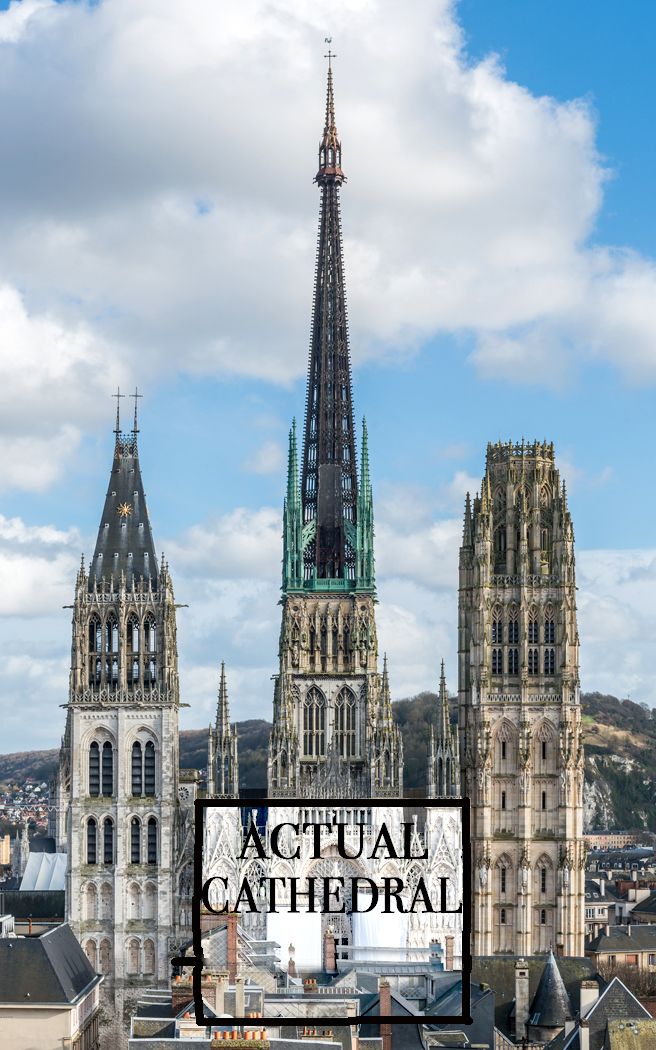
Rouen Cathedral as seen from Gros HorlogeThe antidote to such architectural genuflection can be a visit to a Gothic cathedral that fails to rise completely to such admiration. For me, that moment came on seeing the monster at the heart of Rouen in Normandy. Rouen cathedral bullies the town, dominating the city with its giant spire, so out of proportion.

There is a perfectly good cathedral in the middle of it all, but it is buttressed on both shoulders by giant towers so out of scale as to seem like prison guards hectoring the poor dwarf between them, and then topped with a Victorian-era cast-iron steeple that is twice the height of the church itself. It is this Gothic designed taffy-pulled into parody.

Inside, the cathedral is spare. It was badly damaged by bombs during World War II, and most of the stained glass has been replaced by clear frosted glass. This makes the interior brighter than in most cathedrals, but also makes it look, as Rick Steves says, “like the largest mens’ room ever.”

rouen-nave-toward-apse

It is hard to recognize just what the Victorian critic John Ruskin was thinking when he wrote of Rouen, “It is the most exquisite piece of pure Flamboyant work existing. There is not one cusp, one finial, that is useless, not a stroke of the chisel is in vain; the grace and luxuriance of it all are visible — sensible, rather, even to the un-inquiring eye; and all its minuteness does not diminish the majesty, while it increases the mystery of the noble and unbroken vault.” Ruskin may have been smoking something.

That is the kind of gushing I believe a modern visitor to Rouen will find quelled by simply looking at what is in front of him. Ruskin, it seems, was still blotto on the overkill of breathy Victorian enthusiasm.

rouen-angled-facade

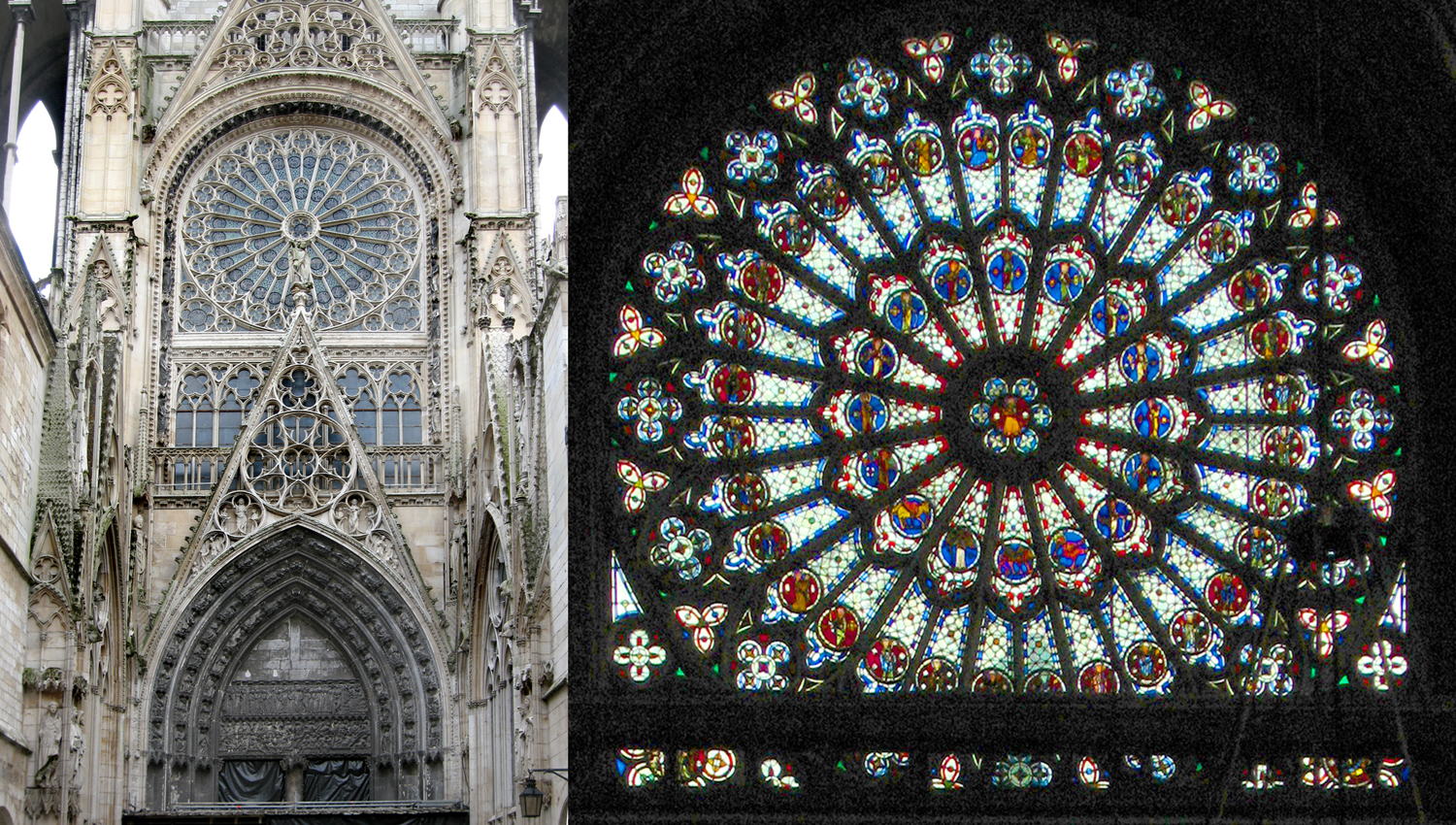
Historians like to divide the Gothic idea into subsets, early, high, rayonnant and flamboyant styles. Rouen, as it exists now, is primarily the last, gauded up with all kinds of filigree and tracery. Its west facade (aka, its front), is so detailed as to make it impossible to take it all in as a single entity. This is made worse by the twin towers muscling the central building into a cowering detainee. The older tower, the Tour St. Romain, sits to the left (to the south), and rises on decaying brick and stone. The newer one, the so-called Butter Tower, was added much later to balance the earlier one, and re-establish symmetry. The result is that the building’s footprint is wider than it is tall (not counting the spire, but just the actual nave and aisles huddled below) and therefore negating the whole upthrusting heavenward leap most characteristic of Gothic church architecture. Instead of reaching for the heavens, it seems as wide as a warehouse.

Most of the Medieval churches were constructed piecemeal over centuries, and in almost every case, styles changed over that time, and so Gothic architecture is an especially heterogeneous one: unity out of difference. Rouen takes that idea and runs with it. It was begun in 1035 on the ruins of a previous Romanesque site that had burnt down. Since then, the history of Rouen is one of calamity and rebuild. This constant reboot has made it a less harmonious jumble than one finds elsewhere, of ad hoc fixes, misguided redesigns and megalomaniac civic striving.

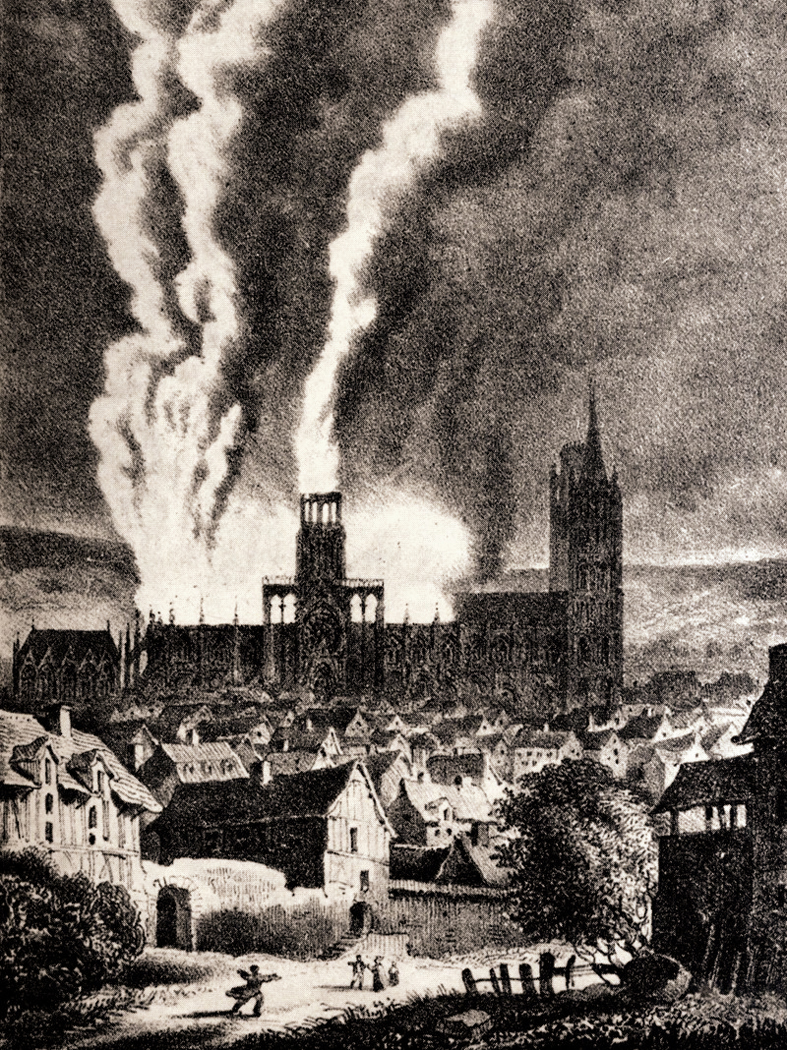
spire-destroyed-by-fire-in-1822It is the Peter Abelard of cathedrals, and a book could be written on the history of its misfortunes. The previous cathedral was struck by lightning in 1110, and construction began on the current building. The new one burnt again in 1200, destroying all but the nave arcades, the Saint-Romain tower and the left portal, with work ending in 1250. It was struck again by lightning in 1284, was partially taken down and rebuilt in 1302, the spire was blown down in a wind storm in 1353. The construction of the Butter Tower in the 16th century led to disturbances in the facade, which had to be reinforced (finished 1530). The original Gothic spire had burned down in 1514 and was finally replaced by a wooden spire covered in gold-plated lead in 1580, paid for, in part, by the selling of indulgences. In 1562, it was damaged by rebelling Calvinists  during the Wars of Religion, when much of the statuary and windows were destroyed. The cathedral was struck again by lightning in 1625 and 1642, damaged by a hurricane in 1683. The choir burnt in 1727 and a bell broke in 1786. During the French Revolution, the church, like many in France, was deconsecrated and turned into a civic building and metal parts of the church were melted down to make cannons and cannonballs. The spire was again blasted by lightning in 1822 and a new one made from cast iron added in 1876 (making it the tallest building in the world until displaced from atop the list four years later by the cathedral at Cologne. (Then to the Eiffel Tower in 1889).

rouen-wwii-2The misfortunes continued. In 1940, a fire damaged the building’s structure and burned that part of the city from the church to the Seine river, and later during World War II, the cathedral was bombed twice, first by the British, then by the Americans, just before D-Day. Parts of the south aisle were destroyed and the south tower burned. Much of the remaining stained glass was blown out, leading to the current situation with frosted glass in many of the windows.

Then, in 1999, a cyclone named Lothar destroyed one of the four wooden turrets surrounding the central lantern tower was blasted and fell crashing into the choir. The history of Rouen’s cathedral is one of constant upkeep and rebuilding, like trying to sustain a sand castle against the tide.

Yet, if the building seems a disappointment after Notre Dame de Paris, after Chartres or St. Denis, perhaps I am being too hard on it. It still has many redeeming details, and some very ancient survivors, like the north portal, or St. John the Baptist Portal. In its tympanum one sees the story of the prophet, Salome’s dance (more an gymnastics exhibition), the beheading of John and the presentation of his head on a platter. It was created in the 12th century and has survived fire, storm and the ravages of war.

rouen-tympanum

Then, there is the Booksellers’ Stairway (Escalier de la Librairie), which once led to the archives of the chapter, begun in 1479 and completed in 1788. And also on the north side is the only rose window that retains its stained glass, over the Portail des Libraires, created in the late 14th century by the artist Guillaume Nouel. The rose is partially blocked, but still can be seen. (The opposite rose window, above the Calende Portal in the south transept, is clear glass).

rouen-booksellers-rose-window-pair

There are some delightful tapestries hanging in the arcade between nave and aisle.

rouen-tapestry-1

Also, there is the Lady Chapel, growing out of the apse, like an elongated caterpillar, are some excellent windows and a huge 17th century altarpiece dedicated to the Virgin. The Lady Chapel (that is Our Lady — the Virgin Mary) was built in rayonnant style beginning in 1302 to replace an earlier, smaller chapel.

rouen-chapel

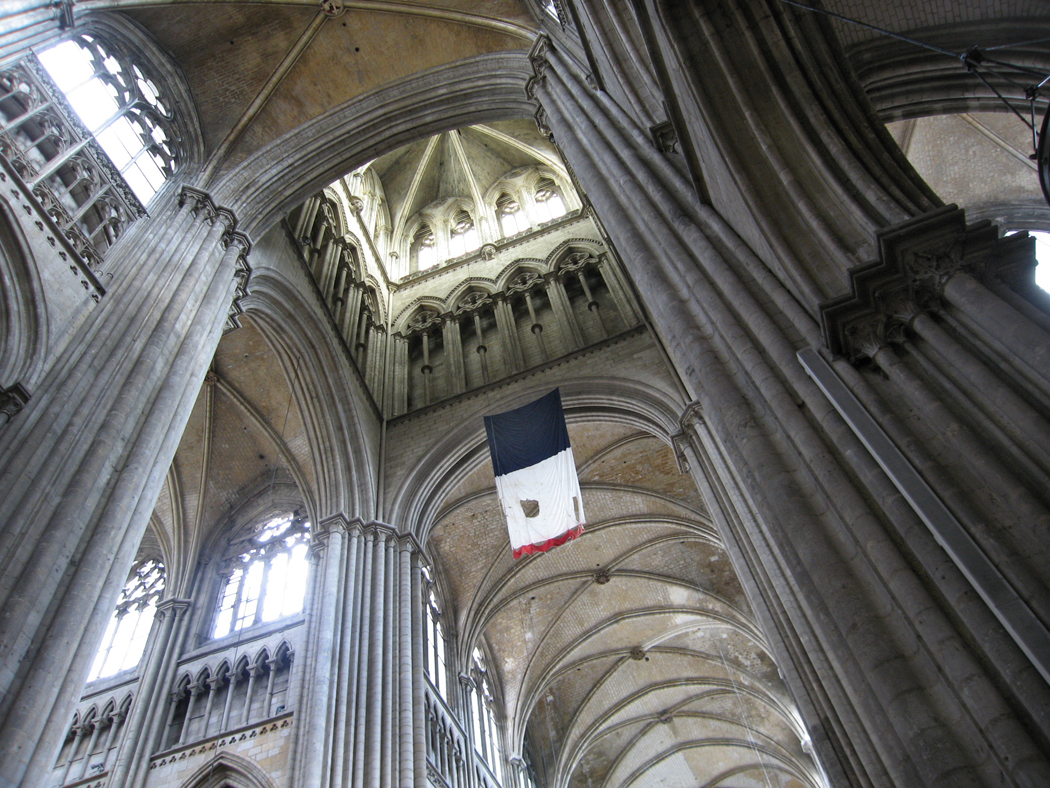
And rising from the crossing of the transept is the opening in the ceiling that leads upward to the spire. While the vaulting is impressive enough, it is ever more striking to see the empty space defined by the interior of the nave opened up even higher, as if the incense and prayers could escape heavenward through it, like smoke through a chimney hole in Medieval dwelling. The vast spire tower and the godawful cast-iron spire are supported by four grand pillars marking the crossing of nave and transept, but even with those giant supports, the ceiling and the hole in it inspire an exceptional sense of what you could call “spiritual uplift,” as if the chimney had an efficient updraft.

rouen-tricolor

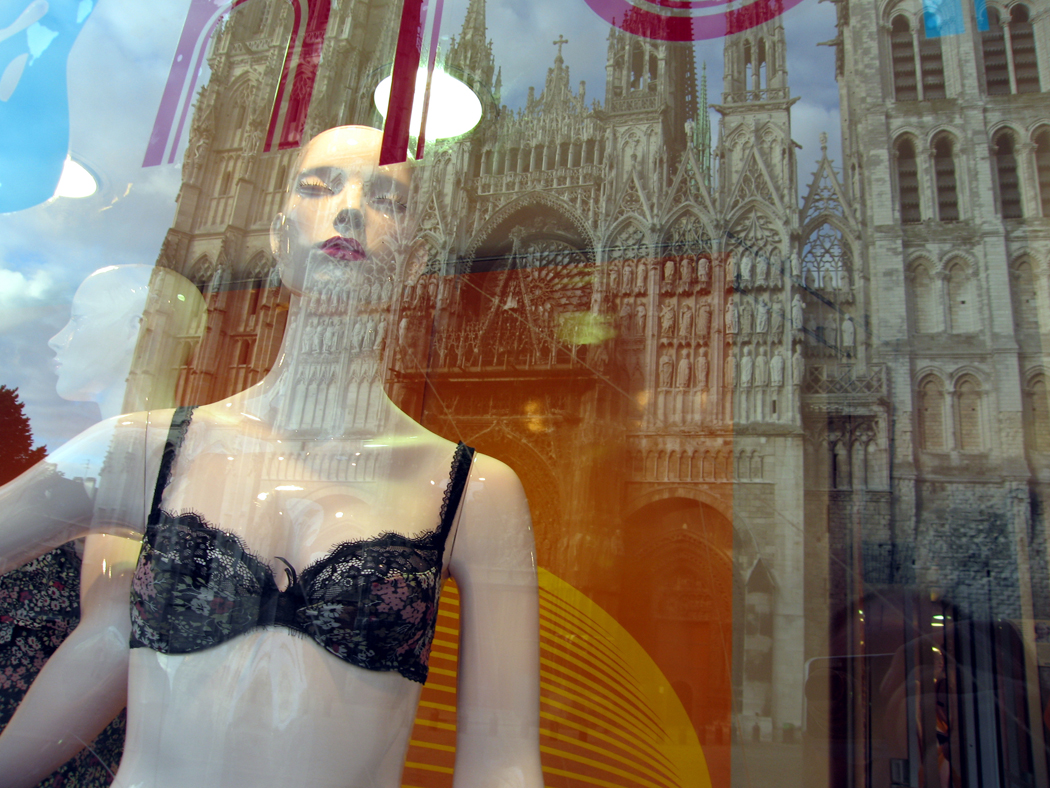
Nowadays, the parvis (plaza in front of the cathedral) is notably commercial, with an underwear store across from the triple portals —

rouen-lingerie-shop-window

the western exterior of the church has nevertheless inspired one of the great painting series of the Impressionist era. Claude Monet painted that cathedral front something like 30 times, in sun, shade, rain, moonlight and in morning, afternoon, and night. The paintings are now spread around the world in various museums.

The painter would set up his easel — sometimes easels — across from the church and paint on one canvas in the morning to catch the first glow of light, then switch to another canvas later on to paint the afternoon light. He might switch canvases many times, over days and weeks, to catch the various effects.

I couldn’t do that in my short visit to Rouen, but I did photograph the cathedral throughout the day to make my own mini-Monet spread.

rouen-poster-2


Click on any image to enlarge

nd-from-the-seine

Some years ago, we knew we wanted to see Europe. But we weren’t sure where we wanted to go. This was at the beginning of our new century. Friends had just visited Rome and brought back exciting video, photographs, watercolors they had made, and most of all, stories. It whetted our appetite.

But once we made the decision to go to Europe, we stopped to wonder if Rome was our only option. Perhaps we should think carefully if there might be some other destination that might call us.

We thought of Prague, Paris, London, Florence, Budapest.

London we ruled out because we wanted the experience of being somewhere that doesn’t speak English. We agonized for some months, fantasizing this place or that. We finally narrowed it down to Paris or Rome.

Rome — Baroque palaces, Classical ruins. Paris — Gothic cathedrals.  Do we want the classical experience, or the Medieval?

Yes, that’s what it came down to. Ultimately, the gray stone of the 11th century was more appealing to us than the sunnier marble of the Mediterranean.

nd-fruiting-branch-sculptureWe decided on Paris, with the plan to avoid all standard tourist fare and attempt to feel what it might be like to live in the city. We would eat in the neighborhood, shop in the neighborhood and walk up and down its streets. In addition, we would try to see as many Gothic churches as possible. In each subsequent visit to France, we managed to add to our life list of important architectural sites, and we developed a growing appreciation for both their beauty and their ability to inspire a profound inward-looking sense of the infinite.

I hope the reason for all this will be clear as I write about them. We kept a journal of our visits, over the years, and alternated portions written by me and often more personal portions written by my wife, Carole. There is an immediacy to these journals that cannot be recaptured in a more finished ready-for-print version and I hope you can enjoy them.

Over the years I have visited Notre Dame de Paris maybe a dozen times — multiple occasions each time we ventured to France. It was a lodestone that drew us back over and over for that glimpse into eternity that only an 800-year-old empty space can provide. The first time I went, was in 1964 and I was a teen ager, barely able to grasp what I had seen. It was before the cathedral was cleaned, and was a giant sooty briquette on the Île de la Cité. The second time was our first trip together in 2002, which was covered in an earlier series of blog entries (see: Paris 2002 Part 1). That included accidentally participating in an Easter Mass; we did not realize it was Easter. (See: Paris 2002 Part 5).
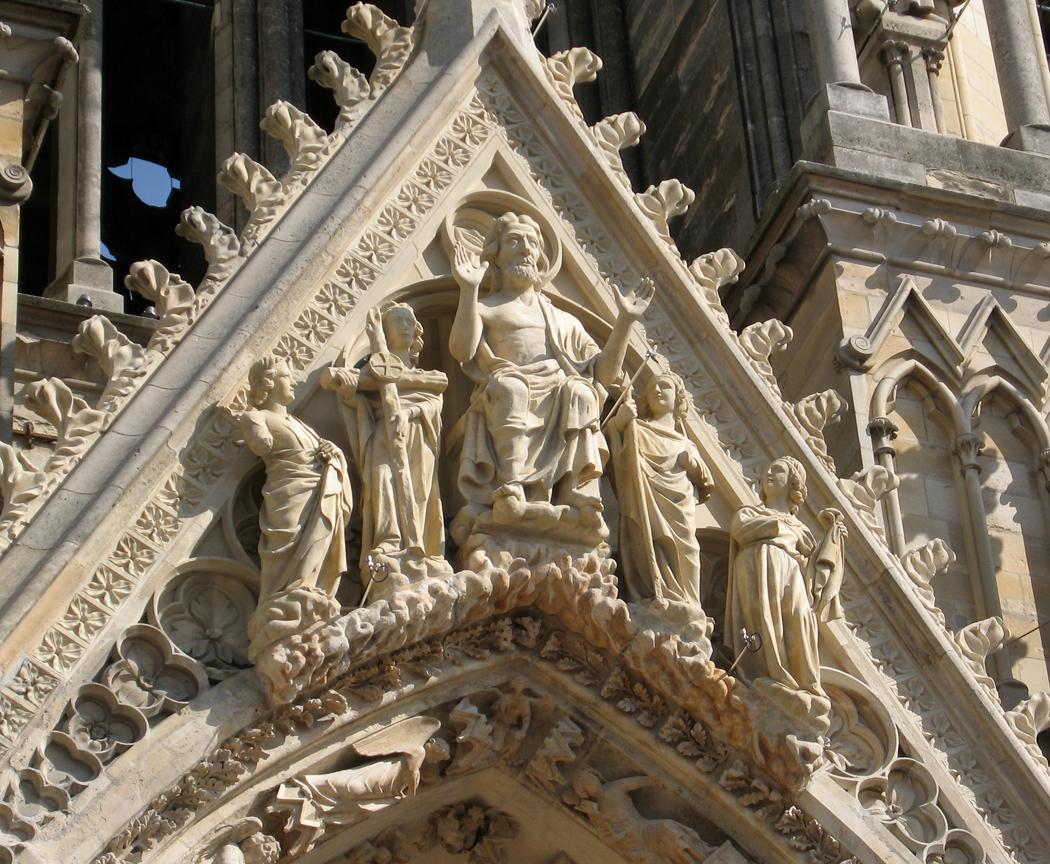
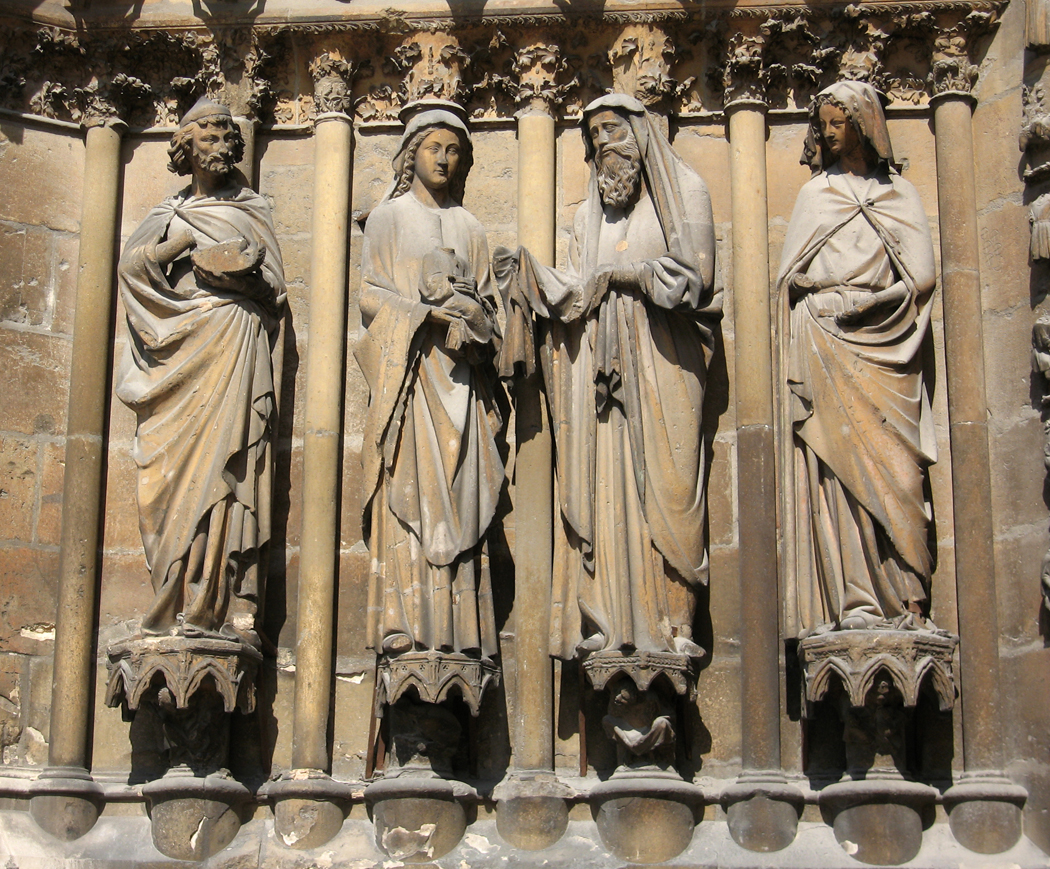
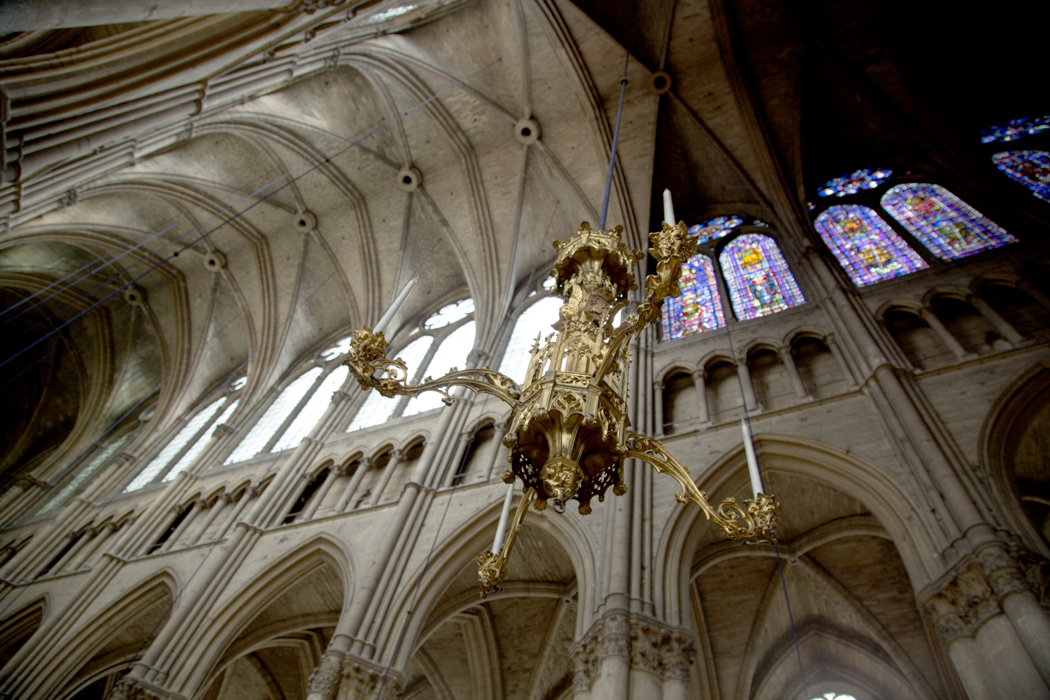
This new series of entries begins two years later when we went back. The photographs for each of these entries were taken at the time we wrote the journals.
Here is our return to Notre Dame in 2004, first my entry, then Carole’s (she puts me to shame).

nd-transept-and-north-rose-window

Richard’s entry:

We walked to the river and down the quai to the cathedral.

“This is why we came here,” said Carole.

And we walked in and the building did not disappoint us: The space remains magic. The rose windows remain the most beautiful art I have ever seen.

“Most buildings are constructed to contain something,” she said. “Most contain furniture, or people, or warehouses that contain lumber or dry goods. This building is constructed to contain the space itself.”

nd-vaulting-diagonalShe is certainly right about that. The space itself, the negative, if it were turned positive, is the shape of — what — infinity. The shape of the interior of our “souls.” The shape of the inner dome of our skulls projected out into space.

It was early in the morning and the rising sun poured directly in through the apse windows. A small mass was being said in the choir and the light shone down on them.

I went around making photographs, mostly of the sculpture at the west portals. Carole sat still inside and soaked up the ambiance.

We stayed most of the morning. We will go back.

Notre Dame is the reason we visit: There is nothing in the U.S. that gives quite this same spiritual sense. One begins to understand the appeal of Christianity to the Medieval mind. There is something mythological rather than ethical to the religion engendered by such a building, something theatrical rather than pious.

nd-carole-sitting-2

Carole’s entry:

Oh. Notre Dame was just the place, just the room, just the building.

nd-chandelier-2This time, I spent most of my time looking at the windows from the center of the cathedral. And I especially loved the trees around Notre Dame, because they have grown in a special environment. They haven’t been treated like ordinary trees and they’re just a short distance from trees of their same species, but they’ve been treated like sacred statues because they’re part of Notre Dame.

Something else I loved, was the wood in Notre Dame. It reminded very much of the logs in Aunt Donie’s house in Wilkes County (North Carolina). Aunt Donie’s cabin was very old and there is something about the wood in both places that is the same.

nd-nave-and-clerestory-2

This time, the part of Notre Dame that became very real for me is the empty space above my head and it was like the empty space around a still life that I drew a long time ago on the day I realized that the empty space was not empty.

nd-stained-glass-panel

Today I thought the most beautiful window was the one at floor level behind the altar because the sun was coming in and the leading in that window looked like a tree with branches and it gave me the very human feeling of sun behind trees in the evening.

nd-saints

Oh, the sculpture outside Notre Dame is a different color now and it is so smooth it looks like modeled clay.

I think maybe Notre Dame is the most important art that I’ve ever seen. I wanted to sit so I could line up the top of my head with the part of the ceiling that had a curve most like the top of my head.

I truly felt in a human attitude that I share with people who lived centuries ago, or maybe thousands of years ago. I was frustrated by knowing anything that I do know about architecture or art or history or Christianity and I kept trying to clear my mind so that I could put myself in the right relationship with the room that I was in and the same with the outside of the building.

nd-scenes-of-hellI almost got to the point where the demons on the outside of the cathedral were comprehended by me on a completely visual level. I wanted very much to have the experience of an ordinary person who was seeing Notre Dame for the very first time centuries ago and would have been able to read the building visually. Today the cathedral worked on me profoundly in a visual and spacial way, but I regret that I am not one of those who participated with that architecture with innocence and terror and devotion.

nd-rood-screen-2

And all of that is the part of today I don’t ever want to forget.

nd-ambulatory-vaulting-2
I feel like I don’t understand the windows yet, even though I did sit there and look, not at the side windows, but the three rose windows and they were beautiful, but I couldn’t make them work on me the way the window behind the altar began to work. I want that kind of thing to happen with the rose windows. But I do understand the rose windows at a level now that is not just intellectual and I think they’re very mysterious and that they must work but that I haven’t been able to get them turned on yet.

The sculptures of the actual humans and the idealized humans — the saints and the kings — and the symbolic humans suffering in hell, and the other worldly figures of angels and little grinning devils affect me in a way that is really beyond language except that if I try to describe it it would be like going on one of our trips out West and seeing really massive places of stone that nature had created naturally, and seeing how it was made completely by the mighty forces of time and weight and heat and wind and water, but especially time, and that those big outcroppings of rock, faces of rock, are completely indifferent to being perceived by any kind of intelligence, but are profound and affecting faces of rock and the statues affect me in almost the very same way, amazing and profound to me, and because they have been affected through time, they seem mighty to me.

nd-rood-screen-slaughter-of-innocents-2

Not just that they show the evidence of time, but most of all that they testify to the mystery that is inside our minds. I love the silence of Notre Dame, the silence of the architecture.

When we go to sleep at night here knowing that Notre Dame is there, it is a lot like going to sleep in the Blue Ridge knowing the mountains are there.

Click on any picture to enlarge

carnac-alignment

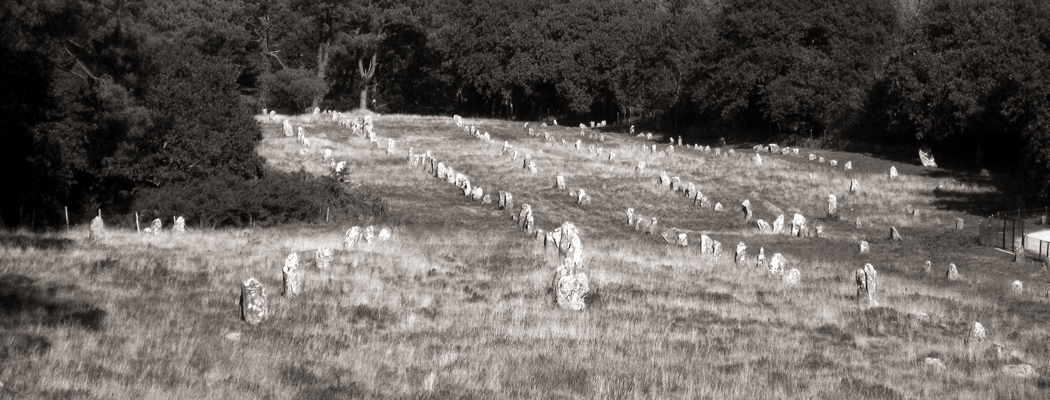
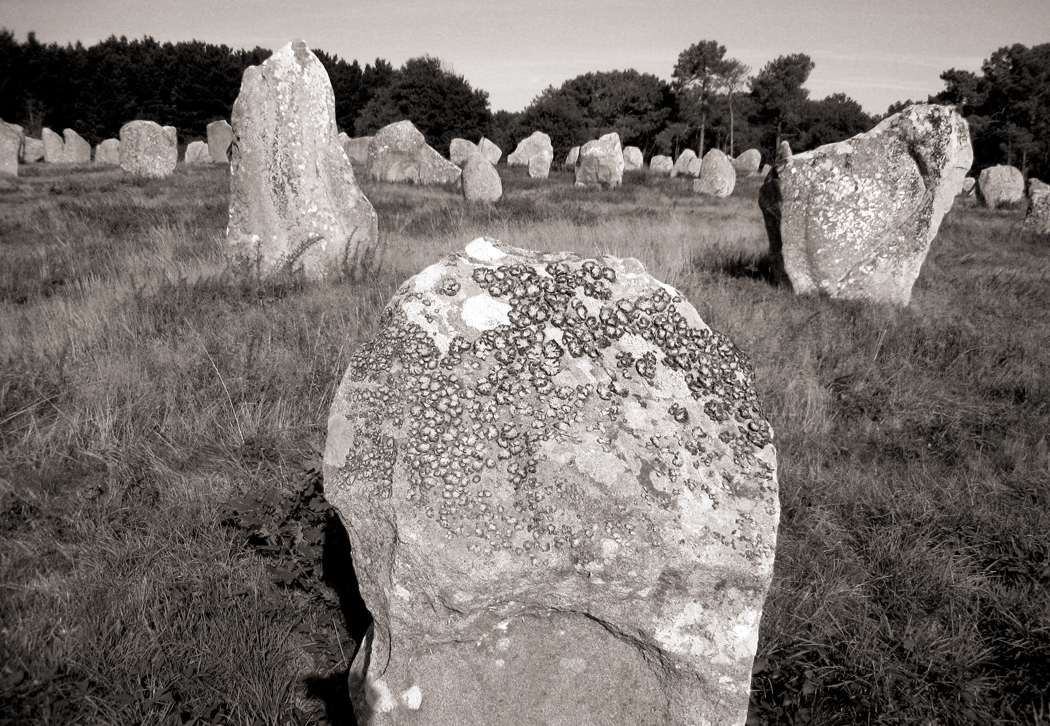
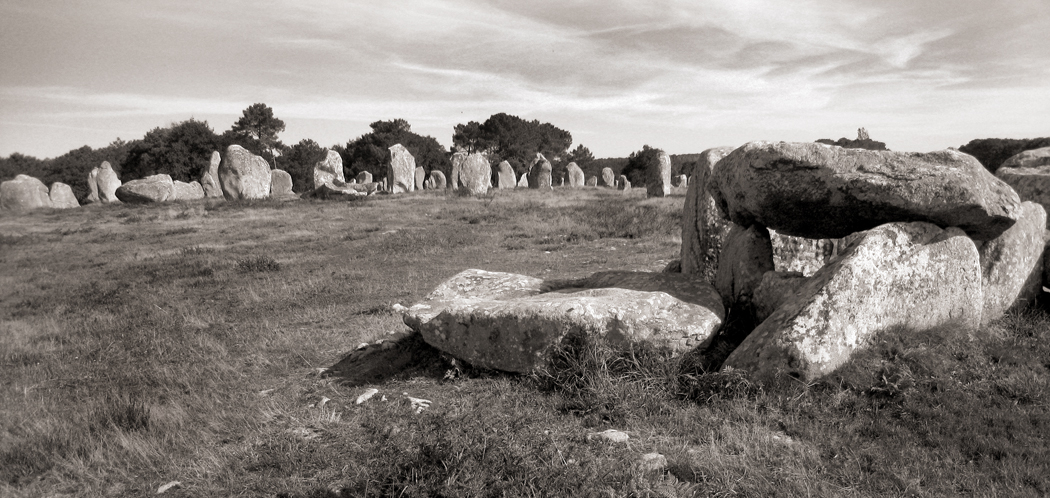
We went to see the stones. They stretched for miles, each stone like an  upright soldier in a formation. They are called “menhirs,” and they populate the area around the seaside town of Carnac in Brittany.

When we drove up to the first formation, the sun was low in the sky and shadows stretching long. We stopped by a field filled with menhir and dolmen, the ancient stones erected some 7,000 years ago for god knows what purpose. Thousands of the stones in stripes across fields, and made of a type of granite that is not local. No one knows how they were made nor why. Carole was especially worried about why.

“Maybe they were religious,” she said. That is the most common supposition. But that didn’t really satisfy her.

“I know,” she said, “they must have been used for some sport. If something was important enough for men to exert this much communal effort to transport tons of stones over miles and miles, there must be a stick and a ball involved.”

We’d drive for a few more miles and she’d pop out with, “Or maybe they were the foundation for some kind of building,” and then, after not saying anything for a long while, “Maybe they were meant to line up like soldiers; maybe they scared off an enemy.” She seemed obsessed with the stones.

tourists-at-the-menhir

Click on any photo to enlarge


The next day, we went out to explore. Some 4,000 menhirs, or upright granite stones, from about three feet high to almost 20 feet, are striped across the landscape in three or four major “alignments,” as they are called.

Erected some 5 thousand years ago, or maybe 7 thousand — it all seems lost in the haze of prehistory — the Celtic forebears of the Bretons hauled these logs of granite from their origin, miles away, and lined them up over the rolling meadows just north of town.

No one knows that they were erected for. The usual theories of religious meaning are trotted out, but no one really knows. Carole persists for a while that they must have been used for some sort of sport or game, going on the theory that only a Superbowl or the Olympics can bring that much commitment out of a guy, let alone a lot of guys.

menhir-3

We talked about it at lunch, in Locmariaquer, the site of some other megaliths.

Over the oysters, I said, “I think that it is just as likely that someone in the old days went crazy, heard voices in his head telling him to to this, and he then, through the intensity of his insanity, persuaded the community to erect the menhirs. Like a sachem in an Indian tribe. ”

Carole dislike the idea that this might reflect badly on shamans. She maintains there is a difference between visions and psychosis. She has her own reasons for holding this distinction.

“That’s not quite what I mean,” I said. “I mean that someone genuinely nutso hears voices, like Son of Sam — ‘My dog told me to do it’ — and because to ordinary people a shaman and a nutjob are very hard to tell apart, they might have signed on to follow him, the way the Germans signed on to follow Hitler to Valhalla.”

“But the shaman’s vision is always one to help the people, never to harm them,” Carole said.

“Well, Hitler certainly thought he was helping Germany, but we’re getting off on a tangent,” I said. “I just mean that, well, like Moses in the desert, perhaps touched by the sun and heat, came up with a lot of crazy ideas, maybe some prehistoric Celt went off the deep end and the voices in his head told him they needed to build a field of giant upright granite stones.

“It makes as much sense as any of the other ideas,” I said.

Of course, we’ll never know. Carole is obsessed with them right now, wanting to have an answer.

“Don’t you want to know?” She asked.

“But I can’t know.”

“But doesn’t it eat at you?”

“No, I can’t say so,” I said.

“It’s driving me nuts,” she said.

menhir-6

Later, in the evening, after supper, sitting in the hotel room, she started up once more.

“I thought they might be made as a display to the stars, or a sighting device to line up with stars or the sun or the moon seasonally,” she said. She sat for a moment and then began a litany of possible explanations.

“Maybe people stood on them and covered their bodies and the rocks with some sort of long garment that made them look like thousands of extremely tall and powerful people.

“Maybe they were set up to baffle a stampeding herd of animals.

“Maybe they were set up to make it difficult for an enemy to advance.”

I imagined them like some prefiguration of pachinko, used as a military tactic. Ingenious, I thought.

“Maybe,” she went on, “they were put in the ground so that if one were far, far from home, one could climb up into the mountains and look down and find these stones as a marker for home.”

The only problem with that: No mountains here.

menhhir-7

“Maybe they were part of corrals and used for the beginning domestication of animals.

“Maybe they were racetrack lanes for racing animals.

“Maybe they used to be part of another kind of a structure that included wood and animal hides.

“Maybe they were part of ancient stalls filled with trade goods.

“Maybe they were an arduous maze a person had to thread through like the meditation mazes in cathedrals.

“Maybe they had something to do with cognitive development — a step between concrete thinking and abstract thinking. Maybe they used them to learn to count from one to a thousand.”

After worrying about this for two days, she continued as we drove out of town, on to Concarneau.

“I need to know what they were for,” she said. “I still think my best guess is that they were for some sort of ball game. You know men are fascinated by a combination of sticks and balls and counting. The counting is important.”

menhir-7

A woman we met, who was from Great Britain, said that she read that the rocks at Stonehenge were transported from far away, also, and that there is a theory that they came from a site powerfully effective in healing.

“But I don’t think that is what these stones were for,” Carole said after we drove on. “They must have been for something massive, because there were thousands of them. They must have been very important for the people who arranged them, because the second group we looked at were actually stone paths, completely straight, leading toward the horizon for many many many miles. So I thought maybe this part of the stone arrangement is a runway for souls. Souls taking off to their journey to the afterlife on foot, that is.

“Maybe they were foundation stones upon which wooden logs were placed for some type of a floor and another structure made of wood came up higher. If they were used as foundation, the equidistant placing of them makes sense, because they are about as far apart as an ordinary tree trunk.

“Or maybe creatures with immense strength arrived from outer space and used some sort of anti-gravity device to pick the rocks up and put them down again in this part of France.

“Maybe they are thousands of monoliths like the black rectangle in 2001: A Space Odyssey.

“Maybe they were a huge dentist office and each person had his own stone to come to and bang his head against until he was senseless and no longer could feel the toothache.”

She was beginning to get a little punchy.

“I also think my first impression of them might be worth something —  that was that they were the earth’s teeth.”

cairn-frontispiece

Part 2

I am a reasonable man and my goals are reasonable. Some burn for the challenge of climbing great peaks; my more modest goals involve the less famous ones. They can have their Everest, their K-2, their Matterhorn or Aconcagua. I have Tucker Mountain.

It sits in Hancock County, on the coast of Maine, north of where any tourists go. From its summit, there is a great view to the south and Cadillac Mountain and Mt. Desert Isle. Its summit, by the way, tops out at 394 feet above sea level. More my style. Still, in places, it is a rugged enough hike.

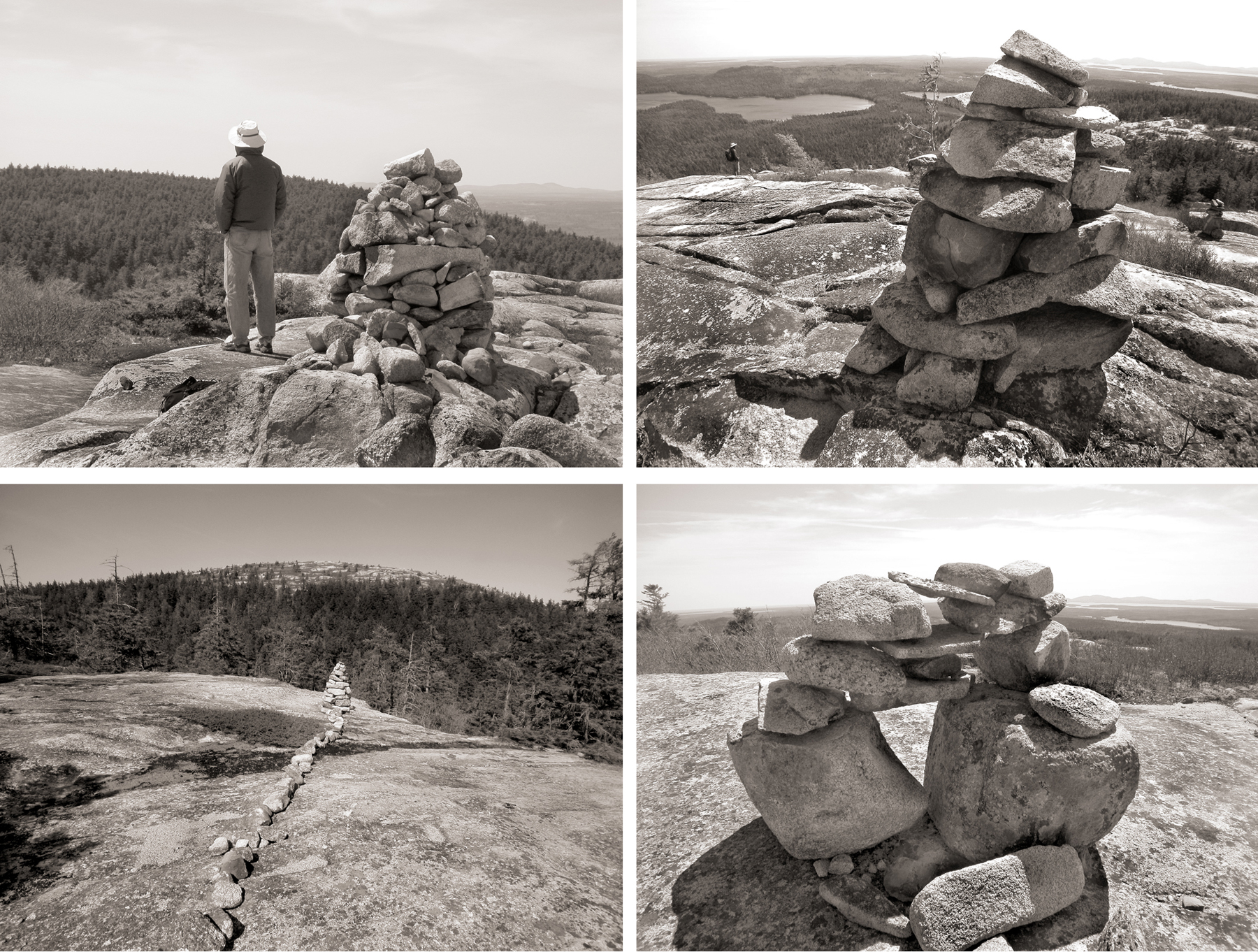
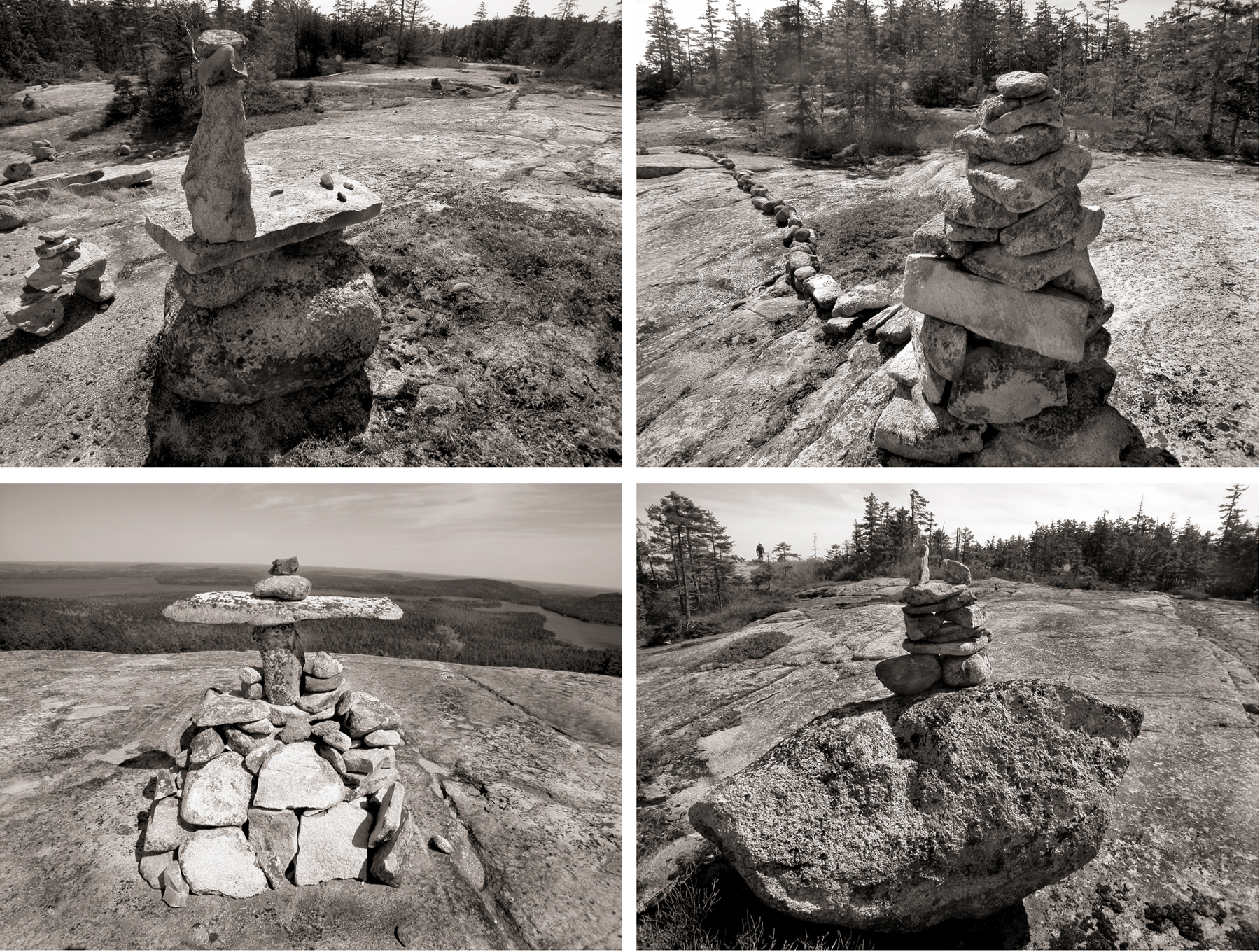
My friend Alexander wanted to show me the view, and we walked through the mossy woods up past rocky outcrops and on to the goal. Along the way, we kept passing cairns — piles of rock set up by hikers. Some were simply rock-piles, but others showed more ambition, and could easily have passed for sculpture in any trendy art gallery. The more of them we passed, the more it seemed as if something cultural were going on — that there must be some compulsion to make these stony reminders that Kilroy was here.

cairn-quad-01

I photographed them as we walked, and by the end of the day, I had something like 50 or 60 images of them, and that counts having given up on cataloging every single instance; I did not photograph many of the more mundane piles.

I don’t know if such things litter the tops of all the local mountains. I don’t remember seeing so many cairns when Alexander and I climbed the summit of the more daunting Schoodic Mountain nearby (summit: 1,069 feet). Perhaps the cairns on Tucker Mountain (I should call it Tucker Hill) are the work of a single artist, or a single obsessive personality, or a small group of people wanting to make a statement. Usually cairns are left either to mark the trail, or to commemorate some important event. These seemed to exist for their own sake.

But they certainly brought to mind the dolmens, cromlechs and menhirs of Celtic Europe. They don’t have the permanence of those menhirs, which have survived thousands of years; these cairns are just rock set on rock, so the first hard frost could topple them. But I had to wonder if the impulse might have been the same: Make my mark — the X on the dotted line — the proof that someone was here.

cairn-quad-02

There is a resistance to cairns; many dedicated hikers despise them for being unnatural, and for being the equivalent of vandalism. I can’t join their ranks. The best of these cairns are genuine works of art and should be appreciated for such. Their artifice can hardly be a valid source of complaint when the hikers are marching along equally artificial trails through the woods, marked with paint blazes or diamond-shaped route markers stapled to tree trunks.

The cairn-makers may well think of themselves as being clever, postmodern, or snarky, but the bottom line, on which their “X” resides, is that the cairns are the universal cry of the one among the many, like the opening wail of the newborn baby: I am here.

Forrest City Arkansas

Travel writing is so unbearably perky. Resorts are wonderful, restaurants are heavenly. In most such writing, even traffic jams are quaint. As if the entire planet were one big Club Med, full of martinis and masseurs.

But travel isn’t really like that. Despite the best propaganda from the nation’s chambers of commerce, often travel is bad food and lumpy beds. There is rain and mud, closed museums and long, hot queues. And with endless miles between destinations, one is often forced to choose interstate highways, which are endless miles of boredom. An interstate in Kansas doesn’t look much different from one in Vermont: just a closed off view of trees and crown vetch.

And so, you suffer soggy, cold fried chicken, motel mattresses with valleys running down both sides, showers with water that smells like a dead opossum, gas station restrooms smeared with grime and tar and perpetually wet floors, and occasional automobile breakdowns, flat tires or the anxiety of passing a sign that says, “next services 235 miles.”

What is all the more astonishing, and seldom written about, is that it is frequently the miserable portions of a trip that are most memorable. Surviving them can strengthen the bond between travelers the way surviving a war bonds veterans.

And when we reminisce, it is often as not about the night there were no motel rooms to be had, or the day the transmission fell out in Death Valley.

I call such occurrences “adventures.” We had many adventures during the 1980s, when my wife and I were both teachers and had long summers off. Each year, we packed up the car and set off on cross-continental trips. The first, in 1982, covered 10,000 miles in two months. If I recount a few of those adventures, we cannot hold it against the places where they happened. Times have changed. Some we have revisited and had a great time, even if our first impression was somewhere below the level of dismal.

Nathan Bedford ForrestTake Forrest City, Arkansas. It is now more than 30 years since we came to that benighted place in the flat floodplain farmlands just west of the Mississippi River. We had traveled some 600 miles that day, from western North Carolina and were too exhausted to go further.

The city was named for Nathan Bedford Forrest, one of the founders of the Ku Klux Klan and a notorious Confederate cavalry general during the Civil War. Today, I’m sure the town — for to call it a city is to inflate a civic brag — is much nicer now, with better accommodations and eateries, but when we stopped there, it was a sorry, forlorn town, in every particular on the wrong side of the tracks. We stopped at the D&M Motel, now long out of business, if my Google search is right, which was advertised as “the best in the state.”

sanitized for your protectionThe cracked concrete parking lot, with crabgrass poking through didn’t tip us off. The crazy old crone who was “concierge” didn’t give it away, either. I suppose our first real signal was when we got to our room, that underneath the paper “sanitized-for-your-protection” band on the toilet seat, a cigarette butt and a raft of soggy ashes floated in the water.

We needed to eat before turning in, and when I asked the hotel keeper for a dining recommendation, she told me, “If it’s just good old fashioned eatin’ yer after, I guess the best is the Blue and White Cafeteria. If ya want barbecued beef, then Barbecue Pete’s … no, wait, he was closed down by the health board. Yeah, I guess the Blue and White. It’s where we always go.”

The restaurant was a cracked stucco building next to a railroad bridge. We were the only car in the dirt parking lot. When we were seated, our booth had a view, through the flyspecks on the window, of the railroad embankment.

Three obese middle-age trailer-park renegades were dolled up in waitress uniforms and one took the pencil from behind her ear and stopped chewing gum long enough to bring us menus and greasy glasses filled with water. I removed a hair and took a slug, stared at the menu and tried to choose something non-toxic.

I forget what I ordered, but whatever it was, the flies loved it.

But even after this repast, I believe the concierge was right. After driving through the town, I believe the Blue and White was the best place in town. I had no reason to assume there was anything better on down the road and we had already driven 600 miles, so we did our best to sleep discovering to our itchy discomfort that the room had already been rented to a national convention of fleas. Too tired to complain, we slept and scratched.

Annual Sturgis Motorcycle Rally Celebrates Its 75th Year

A few years later on another trip we were in the upper Midwest, headed from the North to South Dakota to see Mount Rushmore. After a long day’s drive we looked for a motel only to discover it was the weekend of the Sturges Rally, and tens of thousands of motorcyclists had converged in that quadrant of the state. We steered slowly through Sturges in between large bearded men in sleeveless leather coats and biker chicks in jeans and boots, and among the thousands of shiny choppers leaning beside the road chock-a-block like schools of fish. We stopped at one motel and a very helpful concierge laughed a kindly sort of “what-fools-they-be” chuckle but phoned around to see if any other hostelry might have a chink in the wall they could rent to us. No luck. He finally found a place; it was a hundred miles away, off to the northeast from town, down endless state highways, well off any beaten track and well out of the itinerary we had so lovingly planned. Exhausted as we were, we wove our way back out of the invaded territory and its armies of bikers, and into the back of the back of beyond. We found when we got there, there was one single room left. We took it, slept in it, and felt grateful that the water coming out of the tap only smelled necrotic.

Rising storm, I-40 Texas

Another time, we camped near Shamrock, Texas, just off Interstate 40. It was one of those industrial campsites filled with RVs, with a laundry and camp store in the center. That evening a violent thunderstorm blew up. Before it hit, our neighbor, who had been there for a week, told us that the previous day, a tornado had ripped through the area. Did marvels for our confidence. When the storm came full, our the floor of our tent began to wobble like a water bed and the whole thing began to luff wildly. We were actually afloat in our tent. Then, we were airborne in the tent. We knew we had to get out, but when we did, the tent began to fly off. I held onto it as it gained altitude, and over my head, it tore back and forth like a kite out of control. The rain did not come down in drops, individuated, but more like Niagara Falls, a sheet of water.

Shamrock, Texas

My wife ran to cover in the brick laundry while I wrestled the tent to a draw as it got caught in the sheet metal roof of a concrete picnic table. I joined her in the safety of the building. All the campers were there. Babies were crying, newlyweds were feuding, old people were remembering the storm of ’47. As the worst of it passed those in camper-vans began to return to them and we went back to our car. I managed to disassemble the tent, and stow it. We got in the car and tried to sleep in the seats. It was misery.

Eventually, we gave up and drove into town looking for a motel and found one open at 1 a.m., with an office aromatic with curry. We woke up the concierge and got the last room, half hidden by a tool shed. Inside, the floor was covered in a none-too-clean grass-green shag carpet that not only sat on the floor like a bad toupee, but actually continued up the wall for three feet, like a hairy wainscoting, and also continued up the sides of the bed. We were soaked, our clothes were soaked, the car was soaked, the tent was a jumble of nylon and tentpoles puddled with water. But we slept well. We didn’t have to deal with any of it till the next morning.

Jersey City with Pulaski Skyway

Holland Tunnel

Holland Tunnel

Between the Pulaski Skyway and the Holland Tunnel sits Jersey City, one of those old urban conclaves of northern New Jersey. When I first knew the place, my great-grandmother lived there in a Victorian multi-story house filled with antimacassars and little glass dishes of hard candy. The neighborhood was solidly Norwegian, with a church where fire-and-brimstone sermons were preached in the language of the Old Country.

Before World War II, it was a city of immigrants, mostly from Ireland, Italy and Germany (in the 1940 census, it was 95 percent white), but now, it is the most ethnically diverse city in the nation, with the single largest chunk — over one-fourth — being Hispanic — and many of those from Puerto Rico.

I hadn’t been in Jersey City since the 1950s, when our family would drive down to see our great-granny and those giant overstuffed chairs and the pulled draperies and Oriental carpets. I went back in 1998 to cover a story in New York, but I decided to stay in a motel in Jersey City, which was not only much cheaper, but let me explore the nostalgia of the old city.

Jersey City

Jersey City hadn’t changed much, it seems. Oh, the ethnicity had changed from when my great grandmother lived here with a whole community of Norwegians. But the streets and buildings look the same: brownstone apartments, old two-story wooden homes and streets lined with first-floor shops. Bus fumes and knotted traffic add to the nostalgia.

puerto rico poster verticalUp three blocks and over 10 on Kennedy Boulevard, I found a tiny Puerto Rican restaurant. It was about 10 feet wide, with a white tile floor. Along the left wall ran a counter with some stools and a display case filled with pastries. Along the right wall ran, well, the right wall. There is no room for anything more. They managed to squeeze in some travel posters, but anything thicker than that and there would have been no room for paying customers.

I knew right off it was worth it: The smell was thick and spicy — the combined fragrance of hot cooking oil and achiote. The woman behind the counter was smiling and friendly. Her name was Nelly Cintron. An older man sat at the last stool dividing his attention among the newspaper spread out on the counter, the Spanish-network news on the TV up on the wall, and a cup of coffee. He turned out to be the cook’s husband, Angel.

These little shops are what make a place like Jersey City. The downtown may now be new and filled with high rises, but the old part of the city remains; it is not one of these brand-new plasterboard and stucco cities that seem to pop up all over the West. These cities were built when to build still meant to build to last. So, instead of tearing things down and putting up yet another Denny’s, they use the old buildings and recycle the businesses in them.

jersey city heights

The front window of this Candlelite Cafe displayed a pan of fried chicken, some pork chops and several varieties of bread that I’d never seen before, along with a menu sign in chalk that listed the day’s specials. The biftek encebollado looked good, so I went in, sat down on a stool and ordered it.

Nelly looked at me funny. My Spanish is not good, but I didn’t think it was that bad. I repeated it in Spanish and then in English — beef with onions?

She didn’t have that, she said, still looking at me funny. I pointed to the chalk board and she laughed.

“That was yesterday,” she said, figuring out what I meant. “Today, we have stew.”

I let on that stew would be quite nice, so she served it up: A plate piled high with yellow rice, beans and fried plantain, with a side bowl of stewed beef and potatoes. It smelled heavenly.

I downed it with a bottle of Goya Malta, a beverage whose existence had eluded me until then. It is sort of like an unbrewed beer drink, only very, very sweet. It had the flavor of a carbonated iron tonic. It sounds terrible; it looked terrible. But when I tasted it, to my surprise, it tasted very good, and what is more, it was the perfect accompaniment to my Puerto Rican beef stew. I have ever since appalled my friends by popping open a bottle of the dark, syrupy soda pop. I offer it but there are never any takers. Their loss.

We talked over the meal and Angel chimed in periodically, pointing to something interesting on the TV news. A hurricane headed for Honduras; someone he knew knifed at a service station; a political ad for Al D’Amato, aimed at the Hispanic voter. Angel laughed. Al D’Amato?

I answered their questions about Arizona, they were eager to tell me about Puerto Rico. He loved it; it was his motherland. She was a little more skeptical.

puerto rico poster 2

“I was born here,” she said. “We’ve gone to Puerto Rico. It’s beautiful, but I never want to drive there again; the traffic is worse than here. The roads are worse.”

“Yes,” Angel admitted. “Puerto Rico is only 100 miles long and 70 miles wide. To drive that far here takes what? I made a delivery last week to Hartford (Conn.) and it took me two hours to get there. In Puerto Rico, you’re lucky if you get there by next week.”

“It’s not that bad,” she responds, “but it’s close. And the road over the mountain. It’s all up and down and around.” She makes her hand into a karate chop and wiggles it around like a fish.

“The cars go around the corners like this and this and you don’t know what is around the curve” — at this point, her left hand makes an alternate wiggling fish and plunges into her right hand — “like that.”

“You’ve got to go there sometime,” Angel says. “You’ll love it.”

“Yes,” she says. “You’ll love it.”

The meal leaves me stuffed like a salami, is the best thing I have eaten in five days on the road and sets me back an entire $5.75.

“That’s too cheap,” I complain. “You can’t stay in business that way.”

“Oh, no. It’s fine. We Puerto Ricans know how to get the most from a dollar,” she says.

Nevertheless, I leave behind a very fat tip.

“What are you cooking tomorrow?,” I ask just before leaving.

3500 block Kennedy Blvd

I have searched for that restaurant and it is no longer there, replaced by a liquor store. I often think of Nelly and Angel.

Sic transit gloria mundi.

Big Baby

I have slighted a good deal of the state in these writings. So much is left out. I have barely mentioned the Navajo Reservation, an area the size of West Virginia. I have loved visiting the Rez, and the Hopi Reservation swallowed Jonah-like inside it. I have left out huge chunks of Arizona that I love and remember well: I scarcely nodded to Tucson, Aravaipa Canyon, Fort Huachuca, the Petrified Forest, Painted Desert, Payson, Showlow, the Mogollon Rim — the list is too long to number here. All of it fascinating either for its geology, its history, its development, its politics, its beauty or its characteristic ugliness. Whatever it is that makes it memorable.

Little Colorado River, Holbrook

Little Colorado River, Holbrook

I feel bad for not being able to squeeze it all in.

Cottonwood bark

I began in Phoenix, drove south then southeast; then up north and across Interstate 40, making a grand spiral. If I followed that logic, this entry should begin at Hoover Dam and continue on a plumb line south to Yuma, where the excursion should end. But I have left out the middle portion of the state so far. And I should like to be able to mention such prodigies as the pile of rocks at Granite Dells, the prehistoric ruins at Tuzigoot, the Verde River valley and the sliding town of Jerome.

Jerome

Jerome

This imaginary roadtrip began because I was feeling homesick for the state I left four years ago. I have seen its distances in dreams, when I wake and only half-remember that my eyes now open in the Blue Ridge Mountains of North Carolina. (When I lived in Phoenix, I often had this same homesickness for the Eastern forests and hills). The fact is, I want to engulf it all, sweep it all into my innards and swallow the map whole: I have loved travel more than anything in my six decades and eight years.

Verde River

Verde River

So, I finally recall the dusty streets of Kingman, the old road through Oatman, and the wastage south, through Spring Break Gomorrah (Lake Havasu City), and on to the remains of the internment camp at Poston, with its memorial (although more moving are the stumps of concrete foundations you can find throughout the area, where the barracks used to be that warehoused Japanese Americans), and Poston’s irrigation and farmland, all on the Indian reservation.

Poston

Poston

South of that, you follow the Colorado River to Yuma, where you can walk across the river most times of the year and hardly get your ankles wet. The green farmland along the river, all the way down to San Luis, remind you that so much of Arizona remains agricultural.

Crazy cactus

I have loved it all, and more: It has become a part of my inner landscape. Drop me anywhere — Burro Creek Canyon, Yarnell, Mormon Lake, Old Oraibi, Gila Bend — and I will know where I am instantly. I have soaked Arizona in like a sponge.

Yuma

Yuma

But I have lit out for the territories — in my case, that is returning to my past in the Blue Ridge, among the beech and oak and ash and dogwood, where bears scavenge my garbage and a pileated woodpecker knocks the old red maple in my front yard.

Quartzsite

Quartzsite

I have lived in the four corners of the continent: born in New Jersey, schooled in North Carolina, taught in Virginia, tested in Seattle and ripened in Arizona; visited every one of the contiguous 48 states at least a half-dozen times, not counting all the Canadian provinces save Prince Edward Island, and I’ve internalized it all. Now that I am old, and driving long distances is torture on my knees, I can revisit the places I know by writing about them. I recommend the maneuver to everyone: Write — or draw, or dance, or sing — and reconnect with the life you have led, with the world you inhabit. Everything written is a new Genesis: the world is created once more, and the world needs to be reborn constantly.

Tacna

Tacna

Monument valley windows 2

We’ve all had the experience of revisiting some place that meant something to us when we were young, only to find it ruined by the passing years — the blight in tract homes where there had been woods we played in; the proliferation of 7-Elevens or Starbucks; the widening of roads we had ridden our bikes down and the concomitant soot-spewing storm of traffic. The divided-highway bypass and the Walmart near the exit. Time has not been good to the landscape we knew.

But I have always thought, there must be someone of a generation previous who looked at the landscape I bicycled down and thought, how much better it had been when the road was gravel and there were no houses — including the one I grew up in — lining that road.

The fact is, time is furious and eats up the land just as it eats up the remaining years of my life. “Panta Horein” said the Greek philosopher Heraclitus: “Everything changes.” Doubtless, there was someone before my elder who loved the same land when there was nothing but a footpath through the forest and thought it better for all that.

And no doubt there will be some future progeny who will look at the scene some 50 years hence and lament the loss of those same 7-Elevens, replaced by something even crasser and more demoralizing. To them, the land I now lament will have been Eden.

Holbrook, Arizona

Holbrook, Arizona

Too often we think of the land as something permanent through which plays the impermanence of our comings and goings — a static stage set for our dramas. Its pace may be slower than ours, but the land changes, also; it has its own drama. I particularly love to see the scars of those changes, the evidence of what used to be, the peeping out from under the macadam of the buried eyes of the past.

Along old 66 Signs and storm

One of the prizes I have is a Rand-McNally road atlas from the year I was born (1948). The map of Arizona has no interstates on it, and you can see that the very getting from Phoenix to Flagstaff was a detour, driving first through Wickenburg and up to Prescott before either heading north to Ash Fork and then east on U.S. 66 to Flag, or taking the more mountainous route up Alternate 89 over Mingus Mountain, down to the Verde Valley and then up the hill through Sedona and up the face of the Mogollon Rim to your destination.

Along old 66 Tumbleweed

Of course, there was a more direct route, through Dugas and Camp Verde, but the road was mostly dirt and rutted.

The thing is, that if you look for them, all those ruts are still there. You can, if you wish, and if your car is sturdy enough, drive those roads up through Bumble Bee, through Orme, through Skull Valley, Iron Springs or Happy Jack. Like Schliemann digging down through layers of Troy, the archeology of Arizona is there — or its fossils are.

West of Kingman

West of Kingman

All of which brings me to the slice of Arizona across its northern tier, now defined by Interstate 40. The interstate ate up what used to be U.S. 66 — Route 66 of legend — and takes the speediferous driver across the flatter parts of the Colorado Plateau, up through Flagstaff, and down through Williams, Kingman and on to California. “You’ll see Amarillo, Gallup, New Mexico, Flagstaff, Arizona. Don’t forget Winona, Kingman, Barstow, San Bernardino…”

Along old 66 Interstate 40

But, if you get off the interstate, right at the state line in Lupton, you can find the ghost road, mostly paralleling the freeway, and you can drive along it, at a steady 45 mph, watching for potholes, and see the scars of the past dug into the dry stony soil. The road is discontinuous — you will have to get back on the interstate for an exit or so, or ride over the tide of traffic to pick up the auxiliary road on the other side, where old 66 will start again. It is a ghost of itself, and along it are a few forgotten towns, many gutted old service stations with their paint peeled, their windows blown out and their driveways split by weeds busting through.

Along old 66 Minyard Feed Store

Time is fierce, it eats everything.

I admit to a weakness for these pentimenti, for the palimpsest of time, showing through the later “improvements.” They provide a glimpse of the process, of the metamorphosis — using Ovid’s word — of the constant writhing and seething of the planet and our place as people in the ferment and bubbling.

Along old 66 sunflowers

It comes in the shorter term, such as old Route 66 being devoured by grasses and crucifers, but it also comes in longer terms, such as the Anasazi ruins of Canyon de Chelly and Betatakin, the petroglyphs of Rio Puerco in the Petrified Forest National Park.

Rio Puerco Ruins

There are remaining parts of old Route 66, running through Seligman, and it is mined constantly for nostalgia. But it isn’t that I am feeding on, but the sense of sand sifting through my fingers, of time leaving. It comes out of some chthonic well and runs past us and dissipating in an ocean of we know not where. The old road is still there, and it will be there even when there are no cars — just as the wagon ruts can still be found along the Santa Fe Trail, sunk into the grasses of Kansas.

Old 66 to Seligman

I relish all the different tickings and tockings of the various clocks running their various races.

Sliding Rock Ruins, Canyon de Chelly

Sliding Rock Ruins, Canyon de Chelly

You stand at the rim of Canyon de Chelly on the Navajo Reservation and look down to the braided stream at the bottom that scoured this great hole out of the sandstone and wonder how long it must have taken. Then you see the tiny Anasazi relics built into the walls of the rock and realize how long people have been living here, and then you see the sandstone itself an think about how much longer ago — exponentially longer — that ancient river deltas deposited the silt that later became that stone.

White House Ruins, Canyon de Chelly

White House Ruins, Canyon de Chelly

How much more do you sense these multiple time scales at this rift’s big brother, the Grand Canyon.

Marble Canyon

Marble Canyon

If you want to have the planetary feeling without racing around the globe, you can get it standing still in Arizona: with your feet planted at the edge of the Grand Canyon. In that case, you stand stock-still and let the planet do the moving.

North Rim, Grand Canyon

North Rim, Grand Canyon

The first time I saw sunrise at the Grand Canyon, my wife and I were camping on the North Rim outside the National Park. We had arrived with the naive assumption we could wander in late in the afternoon and get a room at the lodge. Or failing that, we could get a slot at the campgrounds.

The desk clerk took pity on us and explained that although they were completely booked, lodge and campground, for the foreseeable future, we could find a dirt road just outside the park that would take us to a place in the National Forest where people often camped.

It was dark by the time we got to that road, and when we turned into an open place where two or three other tents were set up, it was already night.

We slept, we dreamed, and we woke before sunrise, when the earliest glow floated in through our tent flap. And when we got out to stretch and start up the camp stove, we gasped: We were about 15 feet from the rim of the canyon. It dropped out of sight below us.

If we had pulled forward just a little farther the night before in the blackness, it would have been Thelma-and-Louise time for us. We were hard on the edge.

But more impressive, the humid late-July weather had left the entire canyon as a gigantic dish of cotton. The clouds filled in the canyon-hollow like apples in a fruit bowl. A 215-mile long fruit bowl.

The mists swirled and wisped below us, over precipices and down canyonlets, in constant motion, rising and subsiding as the new-hatched sun warmed patches of the air the mist rode upon and the breezes wafted the veils.

Grand Canyon West

Grand Canyon West

The Classical writer, Longinus, said that we enjoy the day-to-day things of our lives, but when it comes to awe, we get that only from the sublime. Hearth fires, he said, were nice, but erupting volcanoes make us consider a planet and cosmos larger than we are and well beyond our control. The sublime is beautiful, but it is also scary: It is the source of religious feeling.

You cannot avoid that at the Grand Canyon, with its stony layers of eons piled upon each other. The Canyon is a great wound in the Earth into which we can look and see its organs pulsating at a rate so slow as to make all of human history a mere blip on its EKG.

Grand Canyon

The Grand Canyon is a clock. It has a big hand and a little hand.

The little hand moves very slowly, telling the time in geologic terms. To see the hand move, you must wait millions of years.

In that time, you would see continental oceans lay down sediments and tectonic forces push those layers upward, only to be eroded by a river, like a sand pile washed by a hose.Grand View Point, Grand Canyon NP Ariz

One stands at the rim now and looks back into the past, washed away eon by eon, stratum by stratum, until one’s eye stands on the Vishnu schist, the Precambrian footings of the Canyon.

You hardly can take in the vastness of it. It is an earthly reminder of eternity, that time beyond time that turns our lives into flyspecks.

But this geological clock has a fast-moving big hand, too. And it changes all 200 miles of the Canyon second by second. It can seem to the observer like time-lapse photography in real time as the sun jumps from the horizon and changes the shadowed blacks of the deep walls to a burning cherry ruddiness and on much too quickly to the weathered indigo blueness of noon.

Cycles and epicycles, wheels inside wheels, the turning of time on itself in all its speeds.

The first time I saw the Canyon, I got there before dawn. My wife and I had arrived late the previous night and wound up camping in the Kaibab National Forest outside the park. I set our alarm clock for 4 a.m., and when we got up, it was completely dark.

We drove to the overlook at Lipan Point, and I set up my camera in the blackness, out on a rocky ledge beyond the guardrail.

The tripod barely could find purchase on the narrow outcrop, and my wife warned me about taking chances, especially by the glow of a flashlight.

A little after 4, the horizon began to appear. It was July, but it was icy cold before the sun rose. The batteries of my light meter ceased to work in the cold.

Yet it was beginning to be possible, as the far edge of the Canyon contrasted with the blue-gray of the lightening sky, to focus my lens on the ground glass of the camera. And I saw there little more than that dividing line.

But down in the bottom of the Canyon, a mile below us, there was a snaky line of a reflecting light.

Dawn, Grand Canyon

It was the river, a white tube of neon cut off here and there by the mesas and buttes below us. At times, the rope of water actually seemed brighter than the sky.

I managed to take a two- or three-minute exposure of the nearly black landscape. The glow in the sky had begun to make some of the rock texture visible, but less so to the eye than to the camera.

Dawn, Grand Canyon NP Ariz 2

Moment by moment, the scene changed, a slow crescendo of light that began where the river disappeared in the northeast until the fire broke the horizon and the first sliver of sun appeared.

What is most surprising is the quickness of the change. If you were to take a photograph once a minute over the course of a day, you hardly would have two alike.

When the sun is on the horizon, you actually can see it move. And as it rose and sank its light deeper into the Canyon, what had been a charcoal mass of rock mazes became lighted at the top ends of the rocks, like the cherry end of a cigarette in the dawn.

You could see probably scores of miles down the Canyon to the west and see the angle of the sun on the edge of the rock.

Nothing is so like the Earth waking up.

Grand Canyon NP, with shadow

Looking toward the sun, the Canyon became a receding stage set of silhouettes, each lighter and grayer as it retreated toward the sunrise. Looking away from the sun, the rock faces became increasingly red, then orange, then brick, with layers of white and green thrown in.

The Grand Canyon is grandest in the dawn. Those willing to awaken early enough stare into the clock of the day playing on the stone and see their lives moving before them. If time is a stream, as Thoreau says, at the Grand Canyon you can see its rapids. The change continues all day. On most summer days, the midday hours are the least interesting. The hazy blueness of the distant rim seems steady from about 10 a.m. to 2 or 3 p.m. But if you stare with enough commitment, you can see the changes even then as the downward angle of the sunlight twists slowly from one side of the cliffs to the other.

Grand Canyon West

Grand Canyon West

Later, when the sun’s angle lowers to day’s end, the changes accelerate once more, taking the rocks back from blue to red and into darkness.

There is no mistaking the Earth as a clock, turning with the sun as the hour marker, moving in orderly procession around the rim of the great circle we live on.

But the two clocks at the Canyon also remind of the conflicting realities of the place. On the one hand, the slow clock tells of the everlastingness of things, their physical endurance. On the other, how can you believe in reality if the same limestone that can be red at 8 a.m. can be blue by 9?

It reinforces your sense of rock-solid reality and undercuts your belief at the same time. To live in two times at once: This is the central message of all the world’s religions.

When people find spiritual meaning in the Canyon, perhaps it is these conflicting clocks more than anything else that create that sense. Certainly, the Canyon’s vast space is inspiring, but it is time that speaks of eternity and our place in it.

Snake infinityClick any image to enlarge

Miami, Arizona

Miami, Arizona

Many decades ago, when I first came through Arizona, I passed through a landscape so surreal that after I got home, I could not be sure, when I went back to my job in Virginia, that I had actually seen what I had seen: mountains and mountains of grayish-tan gravel, in a town so beaten down, so weathered, so spavined and dried out, that could not be sure that I had not dreamed the whole thing during a nap after an ill-advised meal of rarebit.

When we finally moved to Arizona, I rediscovered Miami-Claypool and it lost nothing of its Twilight Zone weirdness. To those of us not familiar with copper mining, the thought that humans could build cordilleras of utter waste — post-apocalyptic poetry — was hard to credit. Part of me wanted to live there. Nothing could possibly feel day-to-day, ordinary, or boring in such a nerve-frayed landscape.

Superior

Superior

If you drive east from Phoenix, out past Mesa, past Apache Junction, into the desert past Florence Junction and climb up into the hills, you will find a string of mining towns, mostly abandoned or dying, or hanging on by their fingernails, beginning with Superior. It was one of the locations for the 1997 Oliver Stone film, U Turn, and it feels like it could have been dreamed up by a Hollywood set designer. In 2005, a sci-fi film called Alien Invasion Arizona was filmed there. It isn’t quite a ghost town, but you could easily place a season of The Walking Dead there.

Superior Kellner Ave

Superior’s biography is like so many copper towns in Arizona part of a history that almost no one thinks about. It is an industrial history, full of smokestacks and labor disputes, and fills in the space between the six-gun Old West of popular mythology and the modern and often banal state of tourism and retirees.

Superior AZ Mission Cola

Unfortunately, it is an industry that cycles with the international market price of copper: The price plummets and Arizona mines lay off workers and shut down. If the price recovers sufficiently, the mines start up once more. Mine-worker families face an uncertain life.

Superior cliffs

Superior cliffs

The history of Arizona’s mining towns is generic. Whether it is Bisbee or Bagdad, Morenci or Globe, there is a familiar tale, altered only with variations on the tune.

For each, it begins in the 1860s or ’70s, when an army officer or a prospector picks up a rock and smiles, recognizing it as ore. Usually, they were looking for gold. Often what they got was copper. Then there is a period of individual prospecting, usually ending in bankruptcy all around. Then, financiers from New York or San Francisco add capital and mining picks up on an industrial basis. Towns spring up, usually shanty towns precariously perched on gravelly hillsides near the mines. During boom years, the towns grow. Wood is replaced by brick; large hotels are built and streets are paved.

One company buys out another until huge corporations are formed with names like Phelps Dodge  and Magma.  Ultimately they become multinationals with many interests beyond copper.

Between the wars, the underground mines are largely replaced by the great pit mines, man-made miniature Grand Canyons of ore-dig.

Morenci

Morenci

But then, after boom years and some bust years, the mines play out or are flooded or copper prices fall and the towns surrounding the mines die out.

Or, in a few cases, they persist, either as mining persists, as at Morenci, or as the towns find new purpose as tourist destinations, such as Bisbee, or county seats such as Globe.

But the past also persists, and those interested in this forgotten past of Arizona can still visit many of the best locations.

Mining hit Superior in 1870  when silver was discovered and the Silver King Mine  became one of the richest silver mines in Arizona history. But in 1912,  Boyce Thompson  bought the mine, formed Magma Copper and the area became one of the great copper mines. The smelter closed in 1971;  the mine remained in operation until 1982.  The mine has sporadically been worked since, depending on copper prices. But Superior, taking a cue from Bisbee and Jerome has tried to position itself as a tourist location. The wooing of Hollywood has been part of that resuscitation and the town has its own film board.

Hayden

Hayden

South of Superior, are mines at Mammoth and Kearny and Hayden, home to the ASARCO  smelter complex, which services several of that company’s state mines. It is rich in mining history, and union grumbling is still part of the town: One abandoned building has “Union Yes! Forever” painted on it, with one of the “Ns” in “Union” painted backward. The first parts of the plant were opened in 1912,  and now it covers 200 acres  with a smelter smokestack 1,000 feet  tall. Nearby Winkelman  and Kearny  are worth seeing, also, and the now-closed San Manuel  mine is several miles south near Mammoth.  The tell-tale tailings ridges run for miles.

ASARCO’s big open pit Ray Mine is 22 miles  south of Superior on Arizona 177.  The Ray Complex  covers 53,000 acres  and is the second largest copper mine in Arizona. There is an overlook off the highway that affords an unofficial peek at the mine.

But this is a detour. Back to Superior, and driving east up into Queen Creek Canyon and beyond to Miami-Claypool and its veritable Himalayas of detritus, where you will see what will be, depending on your esthetic sensibility, either a great warning of industrial environmental depredation, or an awesome visual wonderland, an eruption of surrealism in the middle of the quotidian.

Miami

Miami

The town looks like it was dropped as litter from some passing god’s chariot, scattered on the hillsides to either side of U.S. 60.  The smelter smokestack rises to the north, over the black drapings of slag across one tan tailings hill.

Bloody Tank Wash, Miami

Bloody Tank Wash, Miami

The town is younger than most of the mining towns in the state. In 1909  the Miami Copper Company  began operations on the hills beside Bloody Tanks Wash.  For a while, it was a rival to Globe, where the Old Dominion Mine  was one of the biggest producers. But Globe ceased being a mining power in 1931  when the mine flooded, and Miami became the center, not just of mining – several mines are nearby, including the Pinto Creek open pit – but the major smelting location for Phelps Dodge.

Now, the townsite, with its bridges over the wash looking like Venetian canal bridges gone terribly wrong, is home to many antiques stores. Unlike many old mining towns, the industry is in full swing, and the mines and processing plant prosper and wane with the price of copper.

San Carlos Lake

San Carlos Lake

Past Globe you enter the San Carlos Indian Reservation. Take a right down to Coolidge Dam and San Carlos Lake. Monuments to civilization are always so much more compelling when they are stuck in the middle of nowhere, like Shelley’s Ozymandias or Catherwood’s Palenque.

At least, that’s what comes to mind when you finally come upon Coolidge Dam, standing like a sentinel in the grass and hills of the Apache reservation.

Gila River from Coolidge Dam

Gila River from Coolidge Dam

Built in the late 1920s, it comes from that great era of dam building and dam architecture. Although it is much smaller than Hoover Dam on the Colorado, it shares an obvious family relationship, with its Art Deco details and horseshoe curvature. It looks like one of the great, archetypal dams.

It reaches a climax in two giant Deco eagle heads near its lip that watch over the downstream Gila River as it enters the Needles Eye Wilderness. They are eagles that pronounce the word “federal” with authority.

It was the Bureau of Indian Affairs that built the dam, to allow the San Carlos tribe to make use of the fluctuating water supply of the Gila. In 1994, the dam overflowed, with water released in such quantities through its spillways, that they had to be repaired. On the other hand, the lake has shrunk to practically nothing at least 20 times in its four-score years of life. In 1977, the lake got so low, there was a major fish kill, with an estimated 5 million fish going belly up. It took five years for the lake to recover.

At low water, the lake must look the way it did when the dam was dedicated in 1930, when humorist Will Rogers looked out at it during the ceremony and joked that, “If this were my lake, I’d mow it.”

By 2015, it could have used another good mowing, because the lake was down to about 5 percent of capacity, leaving most of the dam high and dry, exposing what is supposed to be under water. The current El Niño has raised the level once more.

Coolidge Dam

Coolidge Dam

Three great bulbous rounds of concrete make up the upstream part of the dam, and they are exfoliating sheets of concrete as they age, and looking more and more like a ruins in the making.

If you take the pilgrimage to see the dam, you might as well continue along Reservation Route 500 for 30 miles until it reunites with U.S. 70 at Bylas. Few drives in Arizona are as peaceful and solitary. Just watch out for the potholes.

Black Hills Back Country Byway

Black Hills Back Country Byway

Continue down U.S. 70 along the Gila River and farmland to Mt. Graham and Safford. From there you head toward Clifton and Morenci, up in the hills. There is a “short cut” — the 21-mile Black Hills Back Country Byway, which takes you through wilderness on a gravel road. This is what Arizona looked like when Geronimo hid in these canyons and arroyos. After you cross the Gila River on its Depression-era concrete bridge, you can see a parody “shining city on the hill,” Clifton, like a mirage.

"Shining city on the hill"

“Shining city on the hill”

If you really want to see the industrial power of Arizona, you can do no better than to visit Clifton-Morenci in Greenlee County.  The largest open pit copper mine in the nation has spread so many miles across, it actually ate up the original town of Morenci.

The Phelps Dodge mine can be viewed from an overlook on U.S. 191,  11 miles north of Clifton. It is a humbling experience: like looking at a manmade Grand Canyon, covered with trucks the size of five-story buildings busting dust up along the miles and miles of mine roads in the pit.

Morenci pit and road

One truck can haul 270 tons  of ore on tires 12 feet in diameter.  The biggest trucks carry 320 tons.

Morenci mine truck

Morenci is still a company town, the last in the state, where all the housing is company owned, and all the workers and families shop at the company store.

The mining potential of the area was discovered in 1865  by passing soldiers. The first mine opened in 1872,  but things took off when Phelps Dodge entered the picture in 1881.  The open pit was begun in 1937,  since then, 4.1 billion tons  of ore and rock have been dug out, leaving behind a hole big enough to see from outer space.

Morenci S-curve

The industrial complex is impressive. Miles of corrugated-metal processing plants and piles and piles of tailings and slag.

Morenci mine industry

Clifton, a few miles south, is practically a ghost town, but filled with the same kind of buildings that give Bisbee its period charm. Only in Clifton, they are rather more like Roman ruins.

Clifton

Clifton

Seeing these old mining towns, like Clifton, Miami or Winkelman, can leave you feeling quite conflicted. They are clearly evidence of monumental environmental destruction. Poison waters run off the tailings piles and nowadays have to be captured and treated, but in the past, just filtered down to the streams and water table. Whole mountains have been turned into holes in the ground. Ash heaps make new mountains. Lives are burned up, too. Miners attempting to find better conditions could find themselves dumped off a train in the emptiness of New Mexico and told not to return. Huge corporations buy up the hard work of the original prospectors and squeeze the profits out of the land, like water from a dishcloth. The land has been turned gray and dusty, and tire tracks the size of riverbeds gouge out the roadways. The air is heavy with dust and fumes, and men swarm over the desiccated heaps like ants on an ant hill.

Clifton

Clifton

"Picturesque"

“Picturesque”

Yet, it is hard not to be awed by the sublimity of such hugeness, vastness, even if vast destruction. One is left with two hearts.

In the 18th century, there was a fad for paintings of Classical ruins. Such paintings were called “picturesque,” and they depicted not merely the architecture of Rome and Greece, but the vines growing up the stones, and the peasants building cooking fires below the aqueducts. The cracked masonry, fallen blocks, glowing in a beautiful sunset, set 18th century sensibilities into a dither, fanning themselves in admiration of the beauty — a beauty that told of death and decay, of the falling of empires, and the persistence of life below the arches and gables. There is a sense of grandeur, even if we only live in reflection of it.

Clifton AZ bathtub

And while I cannot avoid seeing the landscape as some sort of movie set for a new Mad Max film, neither can I deny the grandeur of the landscape, the sense of loss that fuels the emotions, the sense of something larger, older, and more significant than myself alone.

Clifton

Clifton

Much of the mythology of Arizona revolves around cowboys and Indians, some fantasy version of the “Old West.” (Somehow, Scottsdale gets to call itself “the West’s most Western town,” while in reality being a commercial real-estate empire filled with shopping malls and freeways). The mythology is a commodity. Yet, there is real myth — the feeling in your psyche of the expansiveness of history and the world — in the union battles, corporate dealings, dying towns and Dante-esque pits into the earth.

Route 191 north of Morenci

Route 191 north of Morenci

As you head north out of Morenci, you enter the mountains and head to a completely different Arizona.