Archive

Author Archives: Richard Nilsen

Part 2 of 2

Mont-Saint-Michel

What was there about the Normans? That they covered the countryside in forts, castles, abbeys, churches, all with heavy, heavy stone architecture that says, in no uncertain terms, “I’m not here for fun. I mean business.”

The architecture feels almost Protestant in its brutal directness and lack of ornament. Like the dragon in its determination not to move, but squat on a hill, glowering.

Is there something about this rainy, gray countryside that made the Normans that way? Is it a residue of their Nordic blood? Is it a response to the brutality of the Dark Ages, when every duke or king had to defend his kingdom at every season?

Surely, Mont-St.-Michel is an interesting case: Part monastery, part fortress.

Who but a Norman, it seems, would build a monastery on the top of a giant rock out in the middle of a bay whose feature is killer tides?

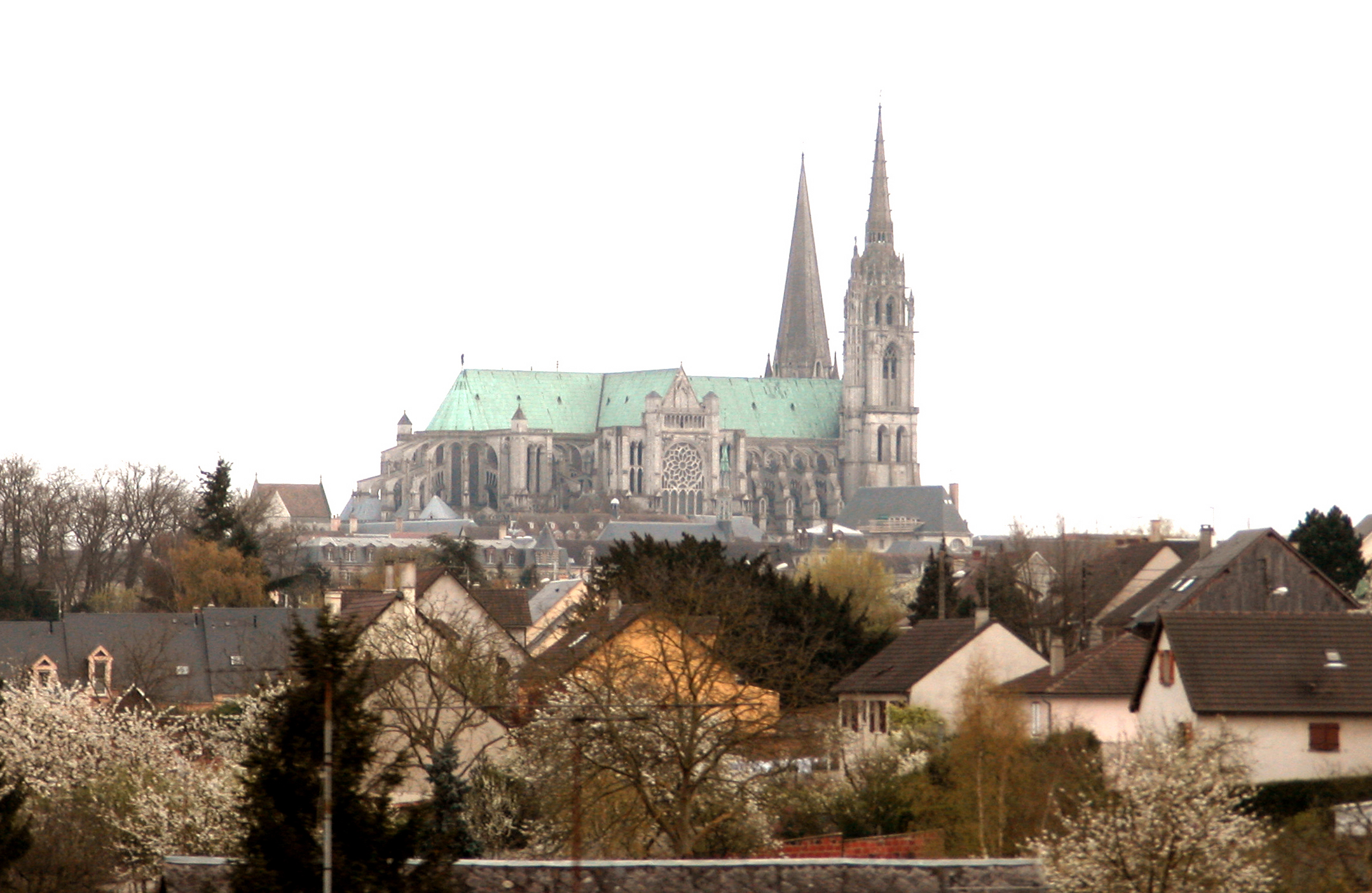
You can see Mont-St.-Michel from the other side of the bay, 20 miles or so off. It hovers over the water like a mountain in the distance, with a needle spire pointing up at God.

The island — it was once an island, even if now it is connected to the mainland by a causeway, and the bay has so silted up that scientists say that soon, there will be no way for water to surround the place, even at high tide — the island is a rock.

In 708, Aubert, bishop of Avranches, had a vision of the sword-bearing St. Michael and built a sanctuary on the rock. It later became an abbey. The monastery grew, burned down, grew some more, caught the interest of a king, grew even bigger, and the monastery became surrounded by a fortress wall. Was the king interested in protecting the monks, or was he more interested in co-opting the island as a coastal defense under the disguise of peaceful religious orders?

At any rate, the result is a merveille — a marvel.

In England and Normandy, they call this stony style of building “Norman.” Elsewhere it is Romanesque, with arches like the Romans built.

The Romanesque is a heavy style, with thick walls and tiny windows. It can be claustrophobic, unlike the open Gothic style that followed it.

The Gothic cathedrals are famous for height: As you walk through them, your eye is drawn toward heaven.

The older Mont-St.-Michel is also vertical, but it is an external verticality: something you see from a distance, and becomes more imposing the closer you come, until, after you reach the island, the stonework rises over you in ways that make you feel not just small, but powerless. Is there any way you can climb to the peak, where God is, or where religious dispensation is? The monastery towers over you, ever upward, reaching its finish in the spire of the topmost church and the golden statue of St. Michael on top of that.

This is a Sisyphean hill that you clamber up and slide back down over and over. It is an impossible thing to master. It is Lurch the Butler looking down at you. It is the model for Citizen Kane’s Xanadu and King Kong’s Skull Island.

Around the base of the island, running higher or lower as the rock underneath decrees, is a rampart, with towers and loopholes. At its highest point, it intersects with the stone stairways that lead even higher, into the lamasery of the abbey. For the pilgrim, or for the tourist, the stairs seem endless. Each time you reach a landing, you look up and the buildings seem higher, and looking down, the earth seems farther away. The stairs actually exaggerate the verticality of the place.

The engineering was state-of-the-art for the time: They managed to build a functioning monastery on top of and around a pinnacle of rock, so that all you see from the outside is human stonework. The core of rock is concealed inside.

But the rock shapes the rooms, chambers, dungeons, refectories, chapels, meeting halls and workrooms that had to be built not simply on the stone, but around it.

The result is a warren of buildings, a hodgepodge, so split-level that you never can tell where you are in the compound. You move from one side of the rock to the other, while traveling up staircases and down staircases, through vaulted rooms and up more staircases, so that when you reach the other side, you cannot tell if you are on the same level, have gone down one or two levels, or a level and a half. Blueprints are no help. They seem to regularize what on the ground is chaos. The confusion is increased by the mess of architectural styles.

Take the abbey church at the very top. Its nave is Romanesque, with a barrel vaulted ceiling lined with wood, spread out like the wooden bars of a Japanese suit of armor. It is the oldest part remaining from the original construction.

The middle of the church — the transept — is Gothic, but of an early sort, with coarse vaulting and dirt-plain stone walls.

The apse at the far end, however, is later Gothic, with all the lightness that implies: complex stone tracery, windows piled on windows.

One end, dead weight — although the sternness of it also reflects a basic majesty — at the other end, all filigree and sunlight. The halves cannot mesh, but somehow they do: It is the magic of the Gothic style that it can accept any number of stylistic additions and just wear them like a great patchwork.

When you leave the church and head down a staircase and up another, and around a passageway, you come to a Romanesque room, dark and somber, in the bowels of the complex.

Pass through that and you eventually find your way to the three-story section called “La Merveille,” the marvel, an astonishing piece of engineering and construction. There, primitive fan vaulting spreads out from graceful piers, and you see the obvious aesthetic superiority of the Gothic. This is what the Middle Ages mean to most people.


Up and down stairs, through dark corridors, through stone doors, past arched windows, beyond a cloister with a double-columned colonnade.

The towering mass of stone and glass is like nothing else in Christendom.

Certainly, Notre Dame de Chartres has an imposing exterior, but it is the interior that carries its essential message. At Mont-Saint-Michel, it is the opposite: While the interiors are certainly interesting, it is the exterior that carries the central message of the warrior Christian saint.


Part 1 of 2

Introduction

West of Paris in northern France are two monuments of the Middle Ages: the cathedral at Chartres and the abbey at Mont-St.-Michel.

In 1904, American historian Henry Adams privately printed a classic book that he called “Mont-Saint-Michel and Chartres,” after the two signature sites of his thesis: that the older Romanesque architecture celebrated the masculine, martial virtues of St. Michael, while the newer Gothic style worshiped the “eternal feminine” of the Virgin Mary. Most of the major cathedrals of northern France are called “Notre Dame” — “our Lady.”

Notre Dame de Chartres is the ur-cathedral, the one used everywhere as the prototype cathedral. Mont-St.-Michel is less clear: It is a palimpsest of styles, bunched one over the other.

A trip to both still can be the best way to experience the art and culture of the Middle Ages.

And it is a very personal experience.

Chartres

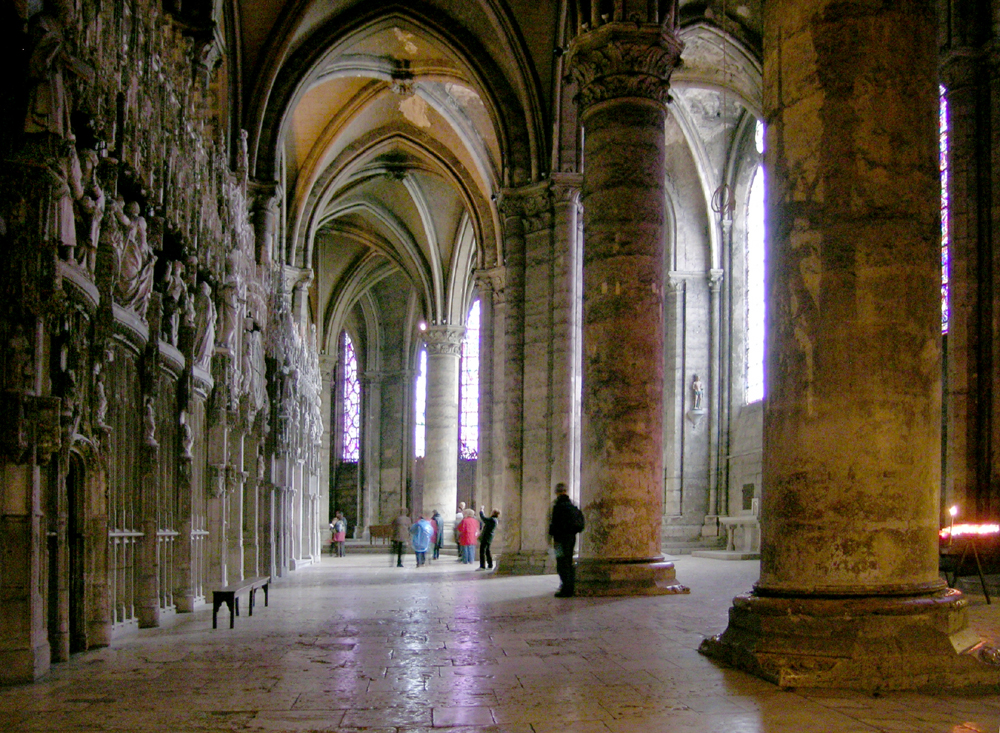
 Visiting the Gothic cathedrals of northern France is a kind of spelunking.

You enter the cavernous, dark spaces of the cathedral at Chartres and you hardly can avoid thinking of Carlsbad or Luray. The spaces defined by those stone walls and stained glass are always cooler than the weather and dimmer than the day, and the oldest, damp churches even can show you a stalactite or two in a draftier corner.

In the cathedrals you also descend, but you descend into the past, a darker past, barely recognized, of a Europe 700 years ago, when the church was the center of town and the source of political as well as spiritual power.

Expression of civic pride

Most of the famous cathedrals are built at the highest point in town, and can be seen for many miles, declaring their hegemony.

The churches were built as an expression of civic pride: In Chartres, it was primarily textile merchants who paid for the cathedral. They wanted to attract pilgrims — tourists — to spend money.

But the descent into the past is matched with another — a voyage into your own psyche, your sense of spirit.

The church takes you out of the daily world of business and family, and plops you down into a kind of eternity, a place where time and effort, gain and loss disappear and you are left face to face with what really counts.

Outside the cathedral, people are hawking postcards, souvenirs and crepes. Cars buzz by; the pompiers — France’s emergency workers — pass a block or two away to the sound of their tritone sirens.

But step inside, and you are blasted by the quiet. Even the tourists tend to whisper.

It has nothing to do with whether you are a believer. It is such an extraordinary experience, it can knock the breath out of you.

Spare in the extreme 

Notre Dame de Chartres is a veritable Spartan of cathedrals. Her west facade, for instance, is spare in the extreme, with only a few decorations, not counting the portals and their sculpture. But the portals are small and restrained, unlike their cousins at Notre Dame in Paris. You almost get the idea of a facade that isn’t yet finished, that it is waiting for someone to come along and add the finials, Hebrew kings, garlands of trefoils and quatrefoils.

Instead, it almost looks like the Gothic cathedral equivalent of plywood.

The proportions of the nave seem almost primitive. The large side-aisle arcades take up almost half the height of the central nave. The small triforium leaves room for a rather scaled-down clerestory — those windows at the upper edge of the walls. The result of these odd proportions is that not much light drifts down to the nave floor. It takes quite a while for your eyes to adjust.

When they do, there is a good deal of wear to be seen. Not only is the stone floor worn wobbly, but the vaulting in places is peeled or exfoliated, showing brickwork behind the stone.

Attend Sunday Mass 

The interior almost gives you the feeling of an empty apartment. Where are the paintings, the furniture, the curtains? In Chartres, where are the windows, the interior carving, the elaborate bosses in the vaulting?

One of the reasons Chartres is so highly prized is that so much of it is original. The statuary at Notre Dame de Paris is cleaner and more neatly featured, but then, it is only 150 years old, having been restored by Eugene Viollet-le-Duc in the 19th century. Viollet-le-Duc was a magnificent man, and his restoration work at Paris is convincingly original looking. You don’t sense much of the 19th century in it.

But it is still pristine and new looking. At Chartres, the statuary is weathered. You can see the lichen growing on the stone. Even the walls of the cathedral sport tufts of daisies high up, in unlikely places, growing straight out of the masonry.

Intoxicating chant 

The limestone is mossy, lichened and eroded. Paris looks fresher than her matronly cousin in Chartres. Paris recently has been sandblasted.

For some, the best time to visit is off-season on a weekday, when you can have the place nearly to yourself. But a cathedral wasn’t built to be empty. You should try to take in a Sunday Mass.

A machine is always more beautiful when it is running, and a cathedral is a machine to take you someplace. It’s best to see that machine with all its gears rotating and its cylinders pumping.

The church is packed. At the altar, spotlighted as if on a theater stage, there are priests and a choir, which is chanting plainsong that echoes through the building like surf.

Grasping the metaphor 

A priest is swinging a censer around the altar, spreading smoke through the crossing of the transept. It is intoxicating to hear the chant, melismatically floating like the censer smoke, under the brilliant blues and reds of the rose window, high above.

One doesn’t have to be a believer to appreciate how the Mass, spoken and sung in the space built for it 700 years ago, addresses the magnum misterium.

The vaulting, the lights, the stained glass, the church spread out in it is cruciform, that is also the diagrammatic shape of my body and your body, with the vast ceiling, which is metaphorical of the inner dome of the skull. You can see how the priest at the crossing of the transept — the place that counts as the heart of the cruciform homunculus — is casting us out into the cosmos, out into the mystery, out into an intense beauty we only rarely let ourselves become aware of.

One listens to the choir, now taking on a descant from the 15th or 16th century, with the soprano floating her melos out over an alto’s lower harmony, and look up, and on raising eyes, one sees the axis of the rose window, with all the light pouring through the interstices in the tracery, very like the angels dancing around the divine center of Dante’s mystical rose.

The vastness of the cathedral interior became the vastness of the universe, the singing became the music of the spheres.

That melisma becomes something completely separate from music as an aesthetic event. It becomes the closest thing we can hear — outside the sounds of children playing — to the human equivalent of a bird’s song, a sound beautiful beyond its need to be beautiful, uttered out of instinct and joy.

The doctrine doesn’t matter, except to the faithful. The metaphor behind the doctrine — the metaphor truer than the sometimes unknowing doctrine — takes over.

And you will be privileged to witness the building doing what it was designed to do, like a jet breaking the sound barrier, or the dynamos at Hoover Dam spinning out electrical power.

Let there be Light

From our vantage point, eight centuries later, Gothic architecture looks as old as dirt, but it is important to remember that it was once as new as the iPhone. It was innovative, and a craze for the new style of building spread across France and the rest of Europe.

People get taught about Gothic and Romanesque architecture in schools in the most boring way: a list of arcane terms and concepts.

But in reality, you can grasp the difference if you recognize the difference between a brownstone apartment building and the Empire State Building. It’s exactly the same difference, really.

Think of it: The brownstone is built brick on brick. You can build your edifice only so high, or the weight of the brick will crush your foundation.

In the late 19th century, they figured out that you didn’t have to make your walls hold the weight of the building. You could build a steel frame and hang your bricks on it, so the steel carries the weight, not the wall.

In fact, that led to the modern buildings of glass and steel with no walls at all, only windows.

It was the same thing in the 12th century. The older buildings, called Romanesque, were built brick on brick, or stone on stone, and in order to support the great weight of the stone, the walls had to be thick and strong, and windows tiny.

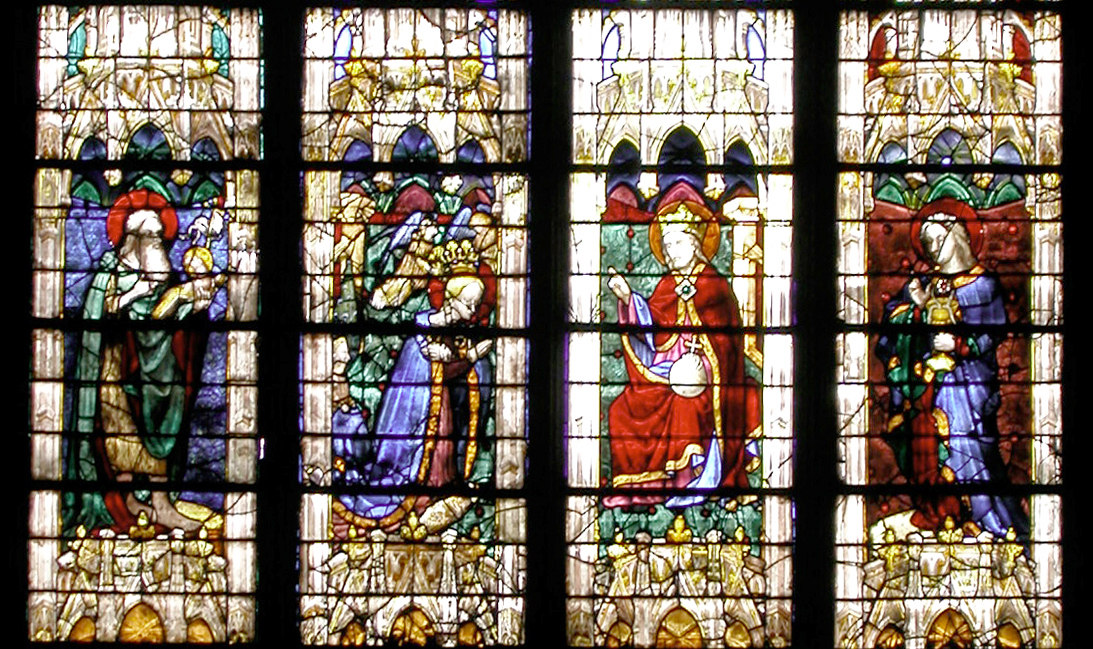
But builders realized that you really didn’t need the wall to hold up your roof. You could put your roof on stilts — columns or piers — and fill in the space between them with glass — stained glass.

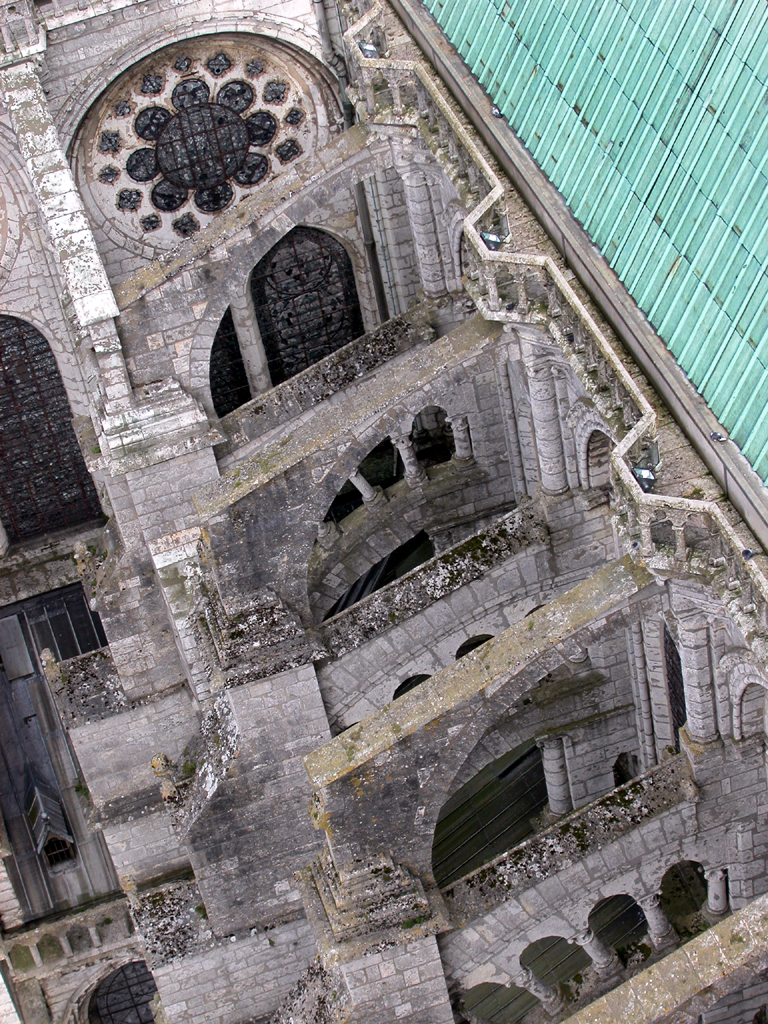
This is the Gothic: vast open spaces instead of heavy walls. To strengthen the columns and distribute the thrust of the roof weight, buttresses were added. They didn’t need to be so heavy, either, if they were placed in the right place at the correct angle, so they were opened up the same, and you had the flying buttress, the arch of stone to help hold up the roof.

The stained glass let streams of light enter the building.

This wasn’t just practical. Abbot Suger, the head of the church in Paris in the mid-12th century, was part of an intellectual renaissance, a Gothic renaissance, and had read the Classical and early Christian authors, Aristotle and Plotinus, and believed that light was the primary metaphor of divinity. God dispels darkness. So, he wanted his new church, now called the Basilica of St. Denis, in northern Paris, to be bright and well-lighted. The new architecture was just what he needed.

Now, the church wouldn’t seem heavy and dismal, but brilliant and airy. It was perfect, and within 20 years, everyone who was building a church used the new style, which lasted for 300 years before being rivaled by the Italian Renaissance and the Baroque.

But even now, you find new churches in America with their Gothic pointed-arch windows and their naves and aisles.

The style persists in our cultural memory.

To be continued

I have never been in even the meanest, lowest streetside cafe in Paris — or anywhere in France — and gotten anything but the most perfect omelet. Smooth, creamy, buttery and eggy. There’s magic in a perfect omelet.

The most bored counterman in the least prepossessing dive in the 13th arrondissement knows how to do it to a T.

On the other hand, I’ve never had an omelet made in the U.S. that wasn’t a close cousin to a vinyl floor tile. Overcooked, dry, tough and tasteless.

“It’s the law,” my wife says. “They have to cook it to a certain temperature to kill the germs.”

I’m sure she’s right, but that’s only part of the problem: Most Americans have never tasted what an omelet can be, and therefore, don’t miss it. Our idea of an omelet over on this side of the waters is an arid eggy mass filled with onions, bell peppers, ham and orange cheese. The more compost that you can stuff into the poor thing, the better — mostly to mask the miserable taste of the desiccated egg.

One can lament our health laws that make it nearly impossible to find unpasteurized milk and make it impossible to import European cheeses. And I’m sure there are laws that require the refrigeration of raw eggs in American restaurants. No Frenchman would refrigerate his eggs. Ruins them.

We fear germs too much, despite the increasing scientific evidence that germs — even pathogens — play an important part in maintaining the health of the human organism.

But more important than our fetish for antisepsis is the lack of regard most Americans seem to have for the pleasures of the senses. Food with actual flavor is not an important consideration for appetites dulled by too much salt, too much sugar and almost no sense on the palate of texture.

Hence, our plastic omelets.

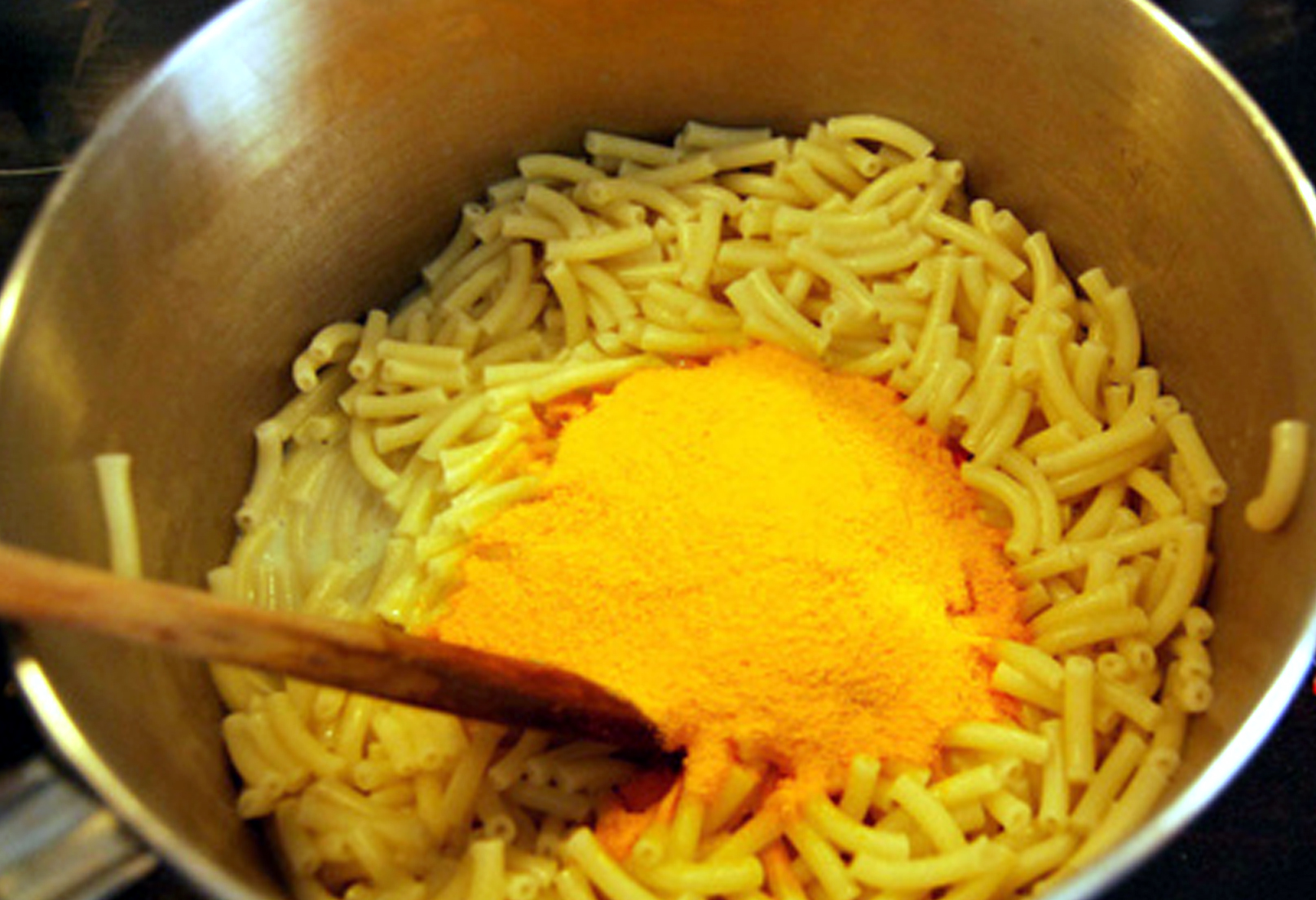
And it isn’t just our eggs we ruin, of course. I recently had the misfortune to taste some packaged macaroni and cheese that my granddaughters were eating. Mac and cheese is one of the most popular lunches found in the average teenage menu. Why this should be is a mystery: The food was appalling. The so-called “cheese” was a chemical yellow powder dumped into the hot, cooked noodles. It tasted like something excreted from one of those cancer factories along the lower Mississippi just south of Baton Rouge. I’m sure it would have glowed a science-fiction green under ultra-violet light. Never again.

Our steaks are chemically tenderized, our bread is gummy and flavorless — best used as a pencil eraser — our beer is yellow seltzer, and our gigantic chicken breasts have had all their flavor bred out of them.

If you have your flavor buds trained at the local franchise restaurant, it is no wonder you think American food is food the way it is supposed to be. It is not.

There is a trend toward better food, at least among the suburban and city affluent, and you can find more varieties of fruit and vegetable at the local supermarket than you ever could before, but a good deal of this is indeed just trendiness. The locovore movement, the raw food movement, the organic food movement.

But mostly it has just meant that you have even more diced veggies stuffed into your inedible omelet. The folded vinyl tile is bursting with exotic ingredients.

It isn’t fancy filling that makes an omelet good; it is the omelet itself, and failing that, nothing will help.

On a recent “Top Chef” TV program I came across while channel surfing, chef Wolfgang Puck gave a task to his contestants: Make an omelet.

He explained that when he had been 18 and beginning in the kitchen, his master of cuisine had given him this test and he had failed. He practiced and practiced until he could make an acceptable omelet. He was now using the same test on the new aspirants.

But no. Not really. Instead, the contestants spent the 45 minutes alloted to them not on making a good omelet, but on coming up with an unbelievable variety of complicated fillings to tart the omelets up, leaving almost not a thought to the egg itself. The results looked like a nouveau riche idea of haute cuisine.

And that is the problem. With the rise of a foodie culture, the result is not better food, but rather a lusting after exotic ingredients, a desire to make a tart with medlar fruit and Cambozola blue cheese, topped with macadamia nuts and matsutake mushrooms macerated in rainwater Madeira.

While it is a delight to see so many new varieties of food available at the supermarket, I suspect the result is not better food, but rather a modern recreation of Trimalchio’s feast. Where are the sparrow tongues and live birds sewn into roast pork?

It is the gastronomic version of thinking that hookers are the model for beauty and fashion.

So, we become caught as a culture between jello salad with mayonnaise and tournedos Rossini. In either case, little thought is given to the gout, the taste, the pleasure for the tongue and palate.

And so back to the humble omelet. A good omelet is simple food made well. It is a lesson: Incredible dinners can still be made from potatoes, chuck roast and cabbage. Prepared well with care and thought, our food should not only nourish, but delight the senses and make us happy to be alive for this meal in front of us.


I have spent my life and career with art and with nature, and as an art critic, many times I’ve been asked, “What’s your favorite art?”

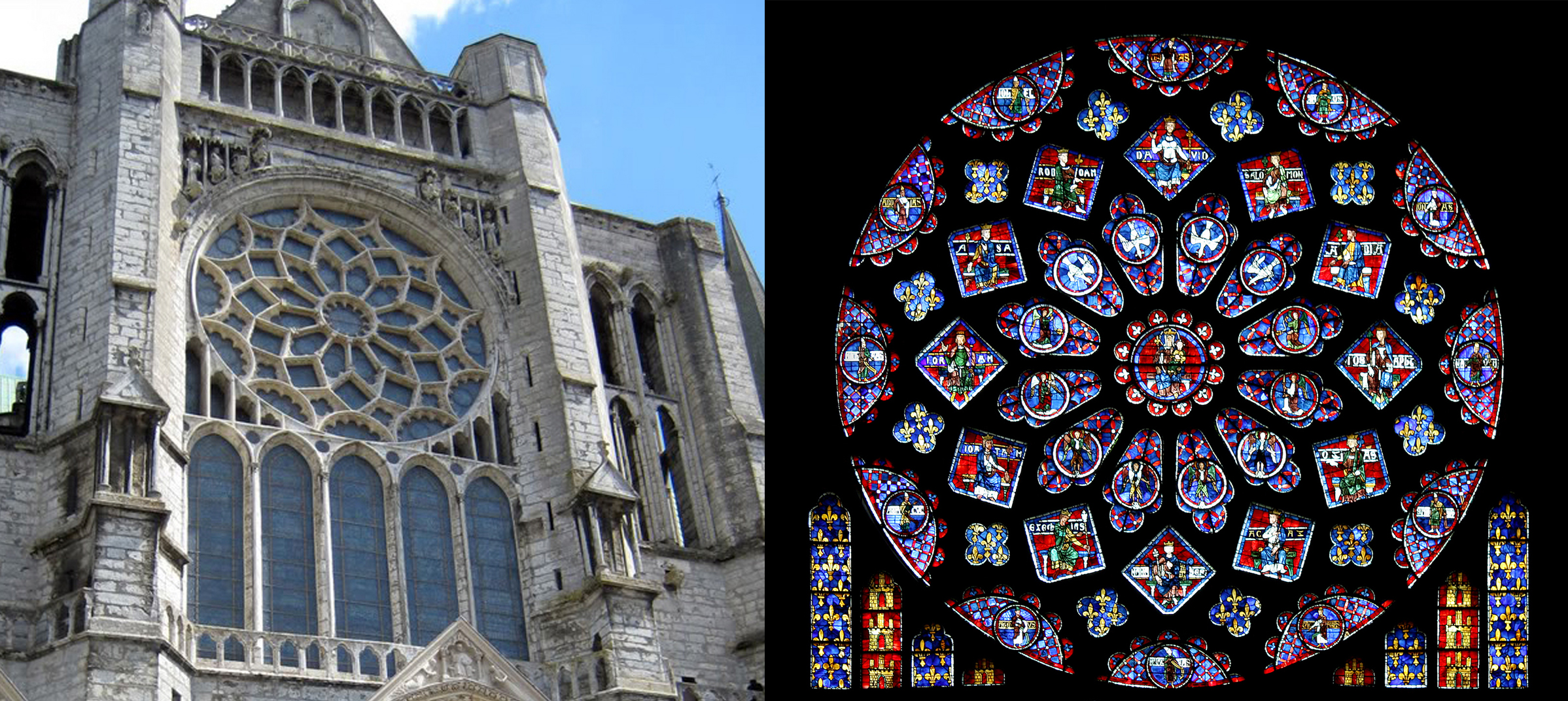
Favorite changes, of course, with time. Hundreds of paintings, sculptures and buildings have taken their turn as my favorite, just as my favorite corner of nature changes depending on where I am. But if asked the more precise question, “What is the most beautiful human-made thing you have ever seen?,” my answer is unequivocal: The north Rose Window at Chartres cathedral in France.

All rose windows are beautiful; at least, I’ve never seen one that didn’t leave me transported. But the north window at Chartres is special, even in that transcendent rank.

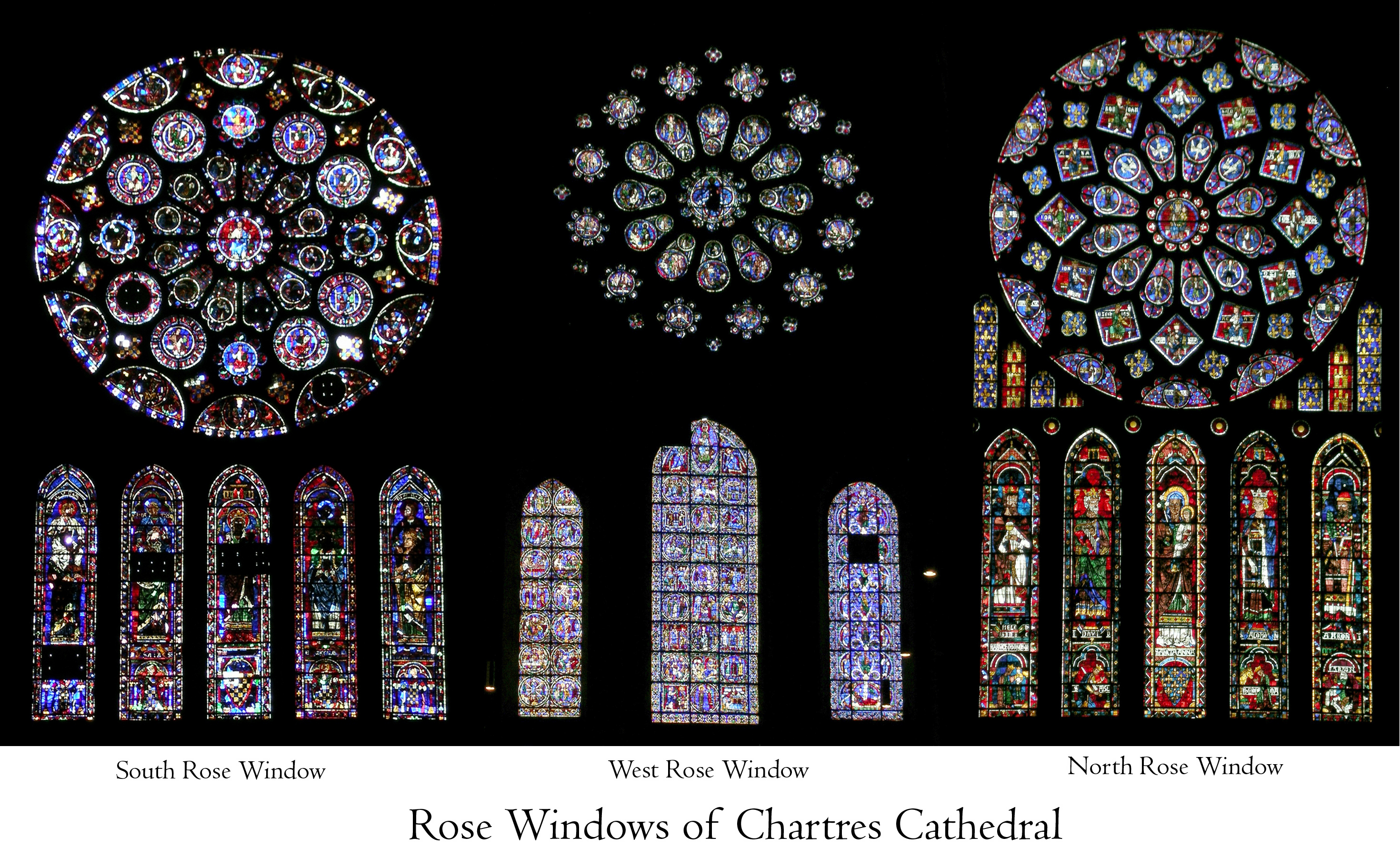
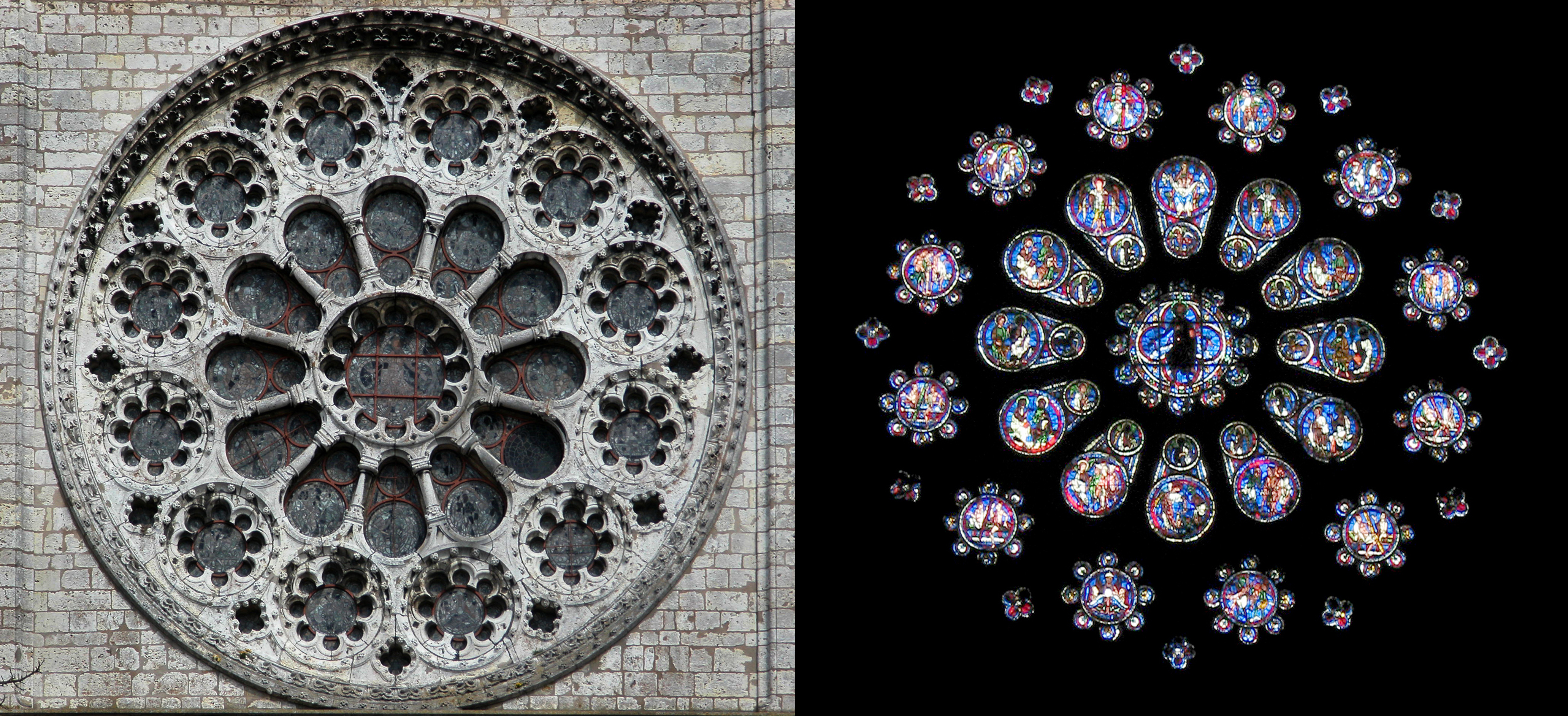
The first time I visited, I sat and stared into each for at least 20 minutes. I’ve been back many times, and can always sit and stare for endless time and times. First, the west window, which I have always thought peculiar, heavy and stoney, with a low proportion of glass.

But as I looked — meditated — today, I could see the beauty in its heavy tracery and porthole glass. There is a central circle surrounded by 12 teardrop panels, like the petals of a sunflower. But outside that, there are 12 more little round windows — miniature rose windows themselves — that float like snowflakes. And beyond that, the final outer circle of miniature dots, 12 of them, also, and less like part of the window design itself, and more like an optical afterimage, phantoms of the retina.

I looked and the light glowed in the glass like the fading glow of the coals in a woodfire, when most of the wood has gone to charcoal and only fleeting lines of incandescent red show through the interstices.

The West rose window corruscated the same way, like the fading coals of inspiration that Shelley wrote about.

And what is more, the fact that the tracery grows increasingly thick as you widen from the center, it looks almost as if the whole ball is expanding, like Hubble’s universe: It is a metaphor of fragmentation. Tight in the center, spinning away at the edges, with those tiny studs of light at the periphery like quasars, so distant you cannot name the distance.

The south rose window makes a different effect.

It’s tracery is more delicate and its design more coherent.

The axle in the middle is surrounded by 12 teardrop shapes — more like coffin shapes really – that radiate from the center, surrounded by 12 circles, larger and more tightly packed than in the west window, and finally, the half-circles of 12 more larger circles cut off by the perimeter of the enclosing circle, so that the overall design is one of larger circles on the outside and ever smaller ones on the inside. It gives the appearance of depth, as if you are looking into a tunnel.

But the north window is the prodigy of Chartres.

Unlike the south window, where the delicate tracery disappears as mere background for the glass, the tracery of the north window is a design and pattern in itself. If there were no glass and no color, the design of the stonework would still describe a giant dahlia, a circular flower with ray petals arrayed around a center.

Place upon that pattern the pattern of the glass panels, with the smaller round panel at the center, surrounded by 12 elongated diamond windows, splayed out like petals, surrounded by a magical circle of tumbling squares, with another ring of smaller tumbling squares around that, and the 12 large half-moons, flat side outward to make the periphery.

It is a multiple image effect. Look one way, and you see one thing, rub your eyes and look again, and it is something else. It is layered imagery.

Both the west and south windows are simple in their plan. The north is complex.

The tumbling boxes, around the circle look like they move, but in fact each one is merely 45 degrees turned from its neighbor, so that every two squares are 90 degrees twisted. With them arranged as a wreath, you cannot see them simply as each square oriented as a diamond with its point toward the center of the rose, but must see them as tumbling over and over as they spin around the wheel. It is a miracle of implied motion.

Layer that over the absolutely still dahlia, and you recognize what genius went into this window.

What is more, this implied motion, and the tunnel of the south window, and the fragmentation of the west window, all create mandalas that scintillate like the light show near the end of 2001: A Space Odyssey. This is a light show, of a kind and nobility hardly to be credited.

I sat on the church chair staring, with tears streaming down my cheeks. This is visionary art, and you don’t have to believe in the dogma to understand the metaphor: This is the Great Mystery. The magnum misterium. You could be looking at photographs from the Hubble telescope. You could be looking at the visions of a peyote dream. You could be looking at the eye of god.

I am putting up my tent 45 miles from the nearest paved road and, as far as I can tell, at least 10 miles from another human being.

I have come to this place to find solitude, to be alone for a day — or more properly a night. The car pulled up alongside a half-fallen barbed-wire fence about 2:30 p.m. I expect not to move it for 18 hours.

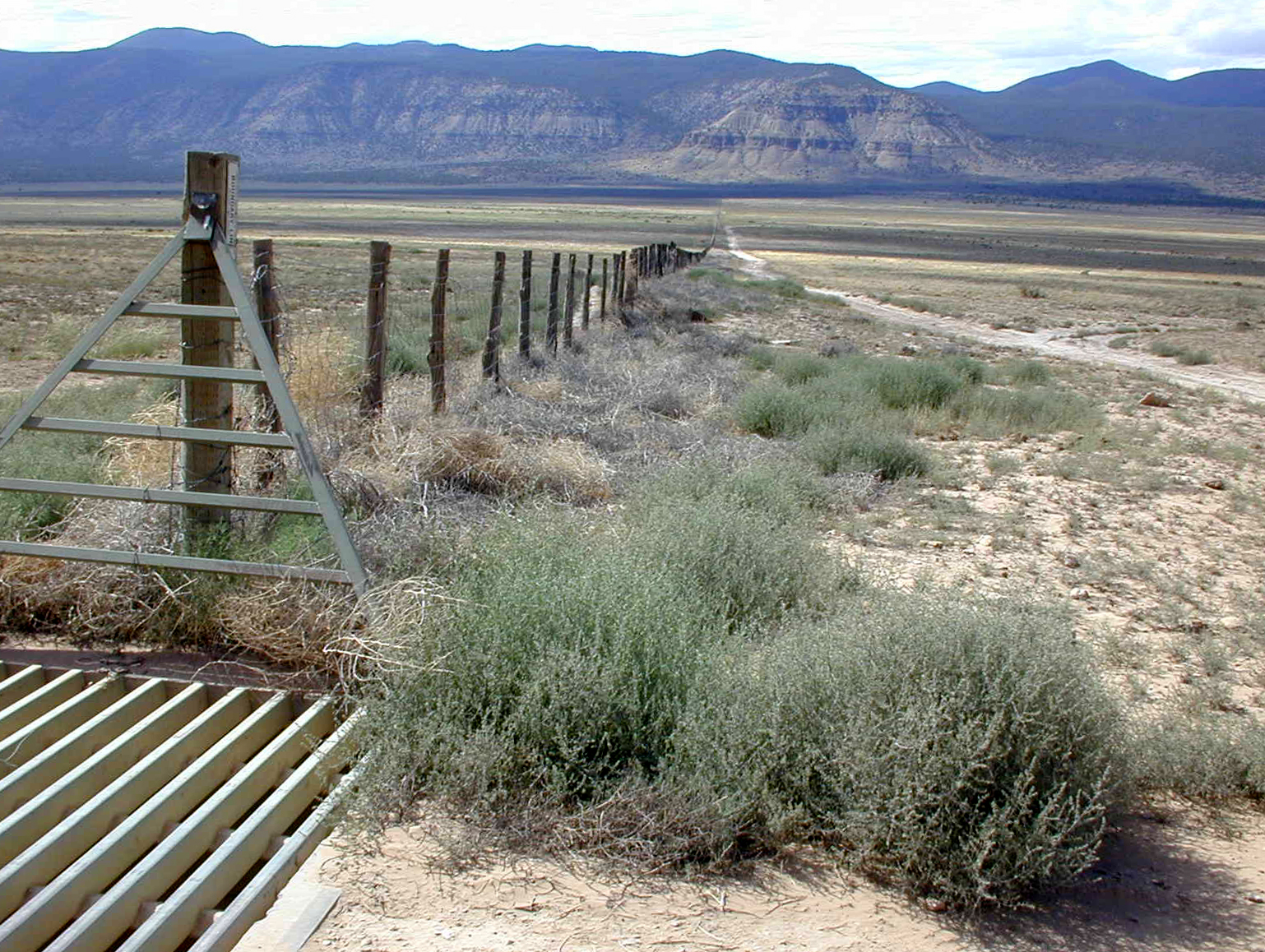
To the east, I can look into the wide mouth of Broad Canyon; to the west, the dark, tree-covered bulge of Mount Trumbull. Something like 15 miles to the south is the Grand Canyon. Sagebrush and dust fill the flat bottom of Toroweap Valley where I have chosen to stop.

It is the quietest I have ever experienced.

When the wind dies, the loudest sound is my own breathing.

Isolation and solitude have long been a part of the American Western experience, when you could ride for days and not see another human being. But empty places are harder and harder to find, as the West fills in with master-planned housing developments and outlet malls.

There is a tradition of solitude in almost every culture: It is the chance our busy, crowded societies make for going into ourselves to find ourselves.

In Australia, they go on a walkabout; American Indians have their vision quest. Even stodgy 19th-century Englishmen had their “Grand Tour,” which served the function of giving them some time to themselves.

But finding the isolation for such a quest is becoming harder. With 7 billion people on the planet, we now have an average of more than 100 people per square mile of the Earth’s dry land. The planet has become a tenement.

The desert city, Phoenix, Ariz., registers in with 2,300 people per square mile and New York with 10 times that density. Nowhere in America, though, comes close to Hong Kong, with more than 77,000 people per square mile. Is it any wonder solitude is a lost virtue?

America as a whole has about 400 people per square mile; Arizona has fewer than 50.

But the Arizona Strip — that region I have chosen to camp in, the land north of the Grand Canyon and south of Utah — is genuinely empty. If you subtract the piddling population of Fredonia, the Strip has 0.14 person per square mile — or fewer than three people every 20 square miles!

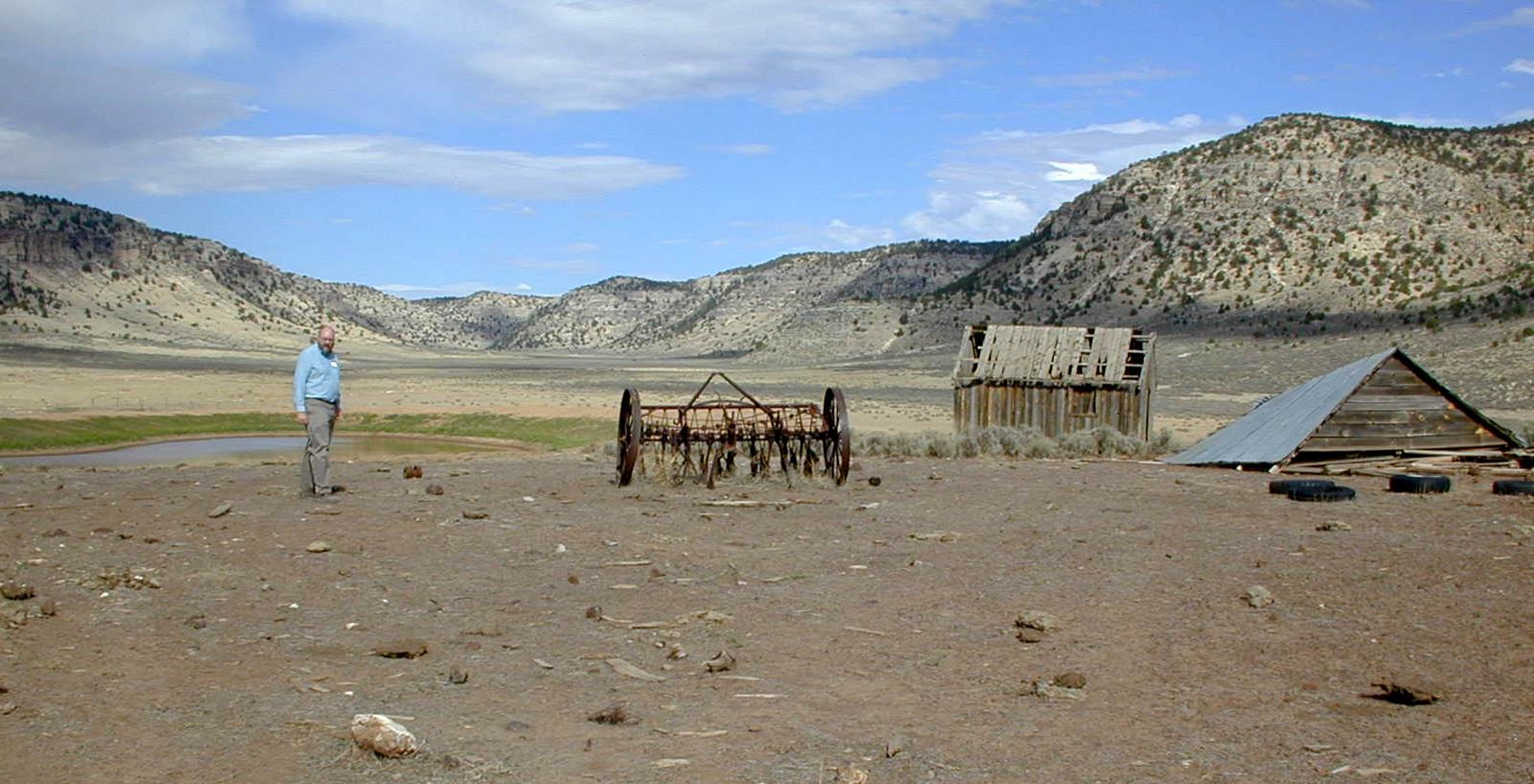
So. Toward Broad Canyon, there is an abandoned two-room shack — an old line house for the cattle ranchers — and another that has collapsed. There is also an old harrow and an empty galvanized steel water tank and 687,000 cow pies. When you are alone for long, you have time for things like counting.

Why choose an abandoned line camp as a place to be alone? I find solitude has more to do with your awareness of being alone than with the mere facts of the case. The most isolated man I ever saw was sitting on the floor of the 42nd Street Bus Terminal in New York City.

So I chose the old tires and weathered shack because they said more about absence than the landscape did by itself.

Unwinding solitude 

The first thing you notice about being stuck out in the middle of nowhere is the boredom. You look at your watch and realize you have survived 12 minutes alone so far. Time seems to come to a halt. You cannot imagine what to do for the next 18 hours.

What one normally does, of course, is fill up time with work and entertainment. But my work is being alone and I have taken a vow of media chastity for the duration: no car radio, no books, no iPod. I have promised to face the silence.

To fill that void, at first you create busyness. I hike up the knoll to see from one end of the valley to the other. I walk down the knoll. I use my binoculars to look at some birds and to scout the neighboring hills for signs of human habitation. There are none. I set up my tent and cook stove.

Breaking through that boredom is an important first step.

You come to realize that the buzz of constant media is a kind of shell protecting you from boredom. Without it, you must come to terms with your physical existence.

TV and radio make us aware of our cultural existence, but can hide ourselves from ourselves. Being in the open with no chance to escape forces you to “front the essential facts of life,” as Thoreau had it, and find a way to do nothing.

Time slows down. The buzz-buzz, quickstep of daily life makes us believe the world is actually moving as fast as our illusion of it. But that forced march is something we impose on ourselves. In solitude, you find the world is glacial. As you become accustomed to that tempo, you find it expansive, full, teeming and ripe.

Certain Native American cultures recognized this. They taught their young people to look without naming. To see without asking why.

“They were taught to use their organs of smell,” recalled Lakota elder Luther Standing Bear, “to look when there was apparently nothing to see, and to listen intently when all seemingly was quiet. A child that cannot sit still is a half-developed child.”

My wife’s grandfather taught her something of the same lesson, when he took her out to the woods to watch wildlife. They would say absolutely nothing, but they would see a great deal.

“We didn’t talk about what we looked at,” she told me. “When you drive out the meaning, what you find is the meaning. It has a life you soak into. I call it ‘falling into the world.’ ”

In Japanese Zen, the same thing is called “quieting the mind” — wu-nien in Chinese. If you can empty your brain of all its chatter, you can begin to exist on the knife edge of this clock tick and not some other.

Or, as French poet Paul Valery said, “To see is to forget the name of the thing one sees.”


Not alone after all

At 6:30 exactly, with the sun already below the planet’s edge, the first star came out, directly overhead. It was Vega, in the constellation Lyra. The rest of the sky is still a glowing cyan with an orange wedge in the west.

So far from civilization, the night sky is a revelation. As the night darkens, the stars pour out like sand from a beach pail. By 7:30 the sky is hysterical. I haven’t seen so many stars since I was a child. The Milky Way ran from north to south like the river of incandescence it is, splitting like a tributary stream from Cygnus to Sagittarius.

I sat on the car hood, leaning back with my head against the windshield and looked straight up. For 2 1/2 hours, I sat there, looking up, trying to do nothing and think nothing. Just look.

What at first seemed to be a solid bowl overhead, with pinpricks punched in it for the light to shine through, later took on depth. It became a lake with fish-stars swimming in it at all depths. As I reclined on the hood, I suddenly had the sensation of being a figurehead on a ship, or a hood ornament on a car, speeding into the three-dimensional emptiness defined by those stars.

And, of course, I was. I was having my vision, as it were. But it is my particular stubborn sensibility that my vision turned out to be factual. This has happened to me before. Each time I enter the visionary world, it turns out that the transforming image I am given is grounded in simple fact.

I really am on a stony vehicle careening through stars. It is just that in everyday life, we never think of it that way. Given the solitude and the velvet sky, the obvious becomes apparent.

When my joints were finally too stiff from sitting in one position for so long, I decided it was time to sleep. I crawled in the tent and dozed off in the silence.

Less than an hour later, I was started awake by the Coyote Tabernacle Choir.

At least 20 of them, from all directions in the hills surrounding me, began their yipping and yowling. For about 30 seconds, they established their identities and locations and fell silent again.

I realized that alone in the dark silence, my senses were electric. I thought of the monkey-men in 2001: A Space Odyssey when they huddle in the cave, growling apprehensively at the growling predators in the distance. Solitude makes you vulnerable.

But drowsiness conquers alertness. An hour later, I woke up again — popped awake, really, like bread from a toaster — as a great horned owl screamed. His “Hu-Hu … Hu … Hu” was as loud as a man yelling next to the tent.

That instant before I knew what it was, I was riveted, as alert, awake and ready for action as I have ever been. The moment I could name the experience, however, it quieted down once more and became part of everyday reality. It lost its sheen.

Later, I woke up again as a bug, caught between my tent and rainfly, buzzed away, vibrating the nylon like a dentist’s drill. I cursed myself for going to the extra trouble of adding the rainfly in such a dry landscape.

An hour later, I woke up again as lightning and thunder clapped around me and rain spattered on the rainfly. I praised my wisdom.

At 3:30 in the morning, I got out of the tent to look at the sky again. It was all turned around. Orion was now up and bright as searchlights. And the Milky Way went east and west, having revolved around the pole star.


Senses of time

So, this bullet we’re riding on is rifled.

The night went on like that: One sense input after another, so busy through the nocturnal time-sluice that I hardly got any sleep at all. At 6 in the morning, the coyotes yowled again, and I decided it must be time to get up. The east was whitening, although the sun was behind the mesa.

When I drew open the tent flap, I saw the blue sky patched with gray-brown clouds, and dangling from one of them was a rainbow. It was not much more than a yellowish bright spot against the angry cloud, but I saw its familiar arc and promise.

We live two lives. In the common one, we are one in 7 billion, a single voice in a clamor of humanity, spaced 100 per square mile. We function as part of the crowd. But in that other life, we’re alone. We are the one, the singular — heroes in our own life’s epic, even, and we recognize the solitary importance of ourselves to ourselves.

It is this second life — so rich and so important to our sense of meaning and purpose — that we come to meet in solitude. That is perhaps what Montaigne meant when he wrote, “The greatest thing in the world is to know how to belong to oneself.”

The first life is brought to you by television, newspapers, books, radio and movies. It is a cultural existence, defined by other people. It is the madding crowd we are never far from.

The second life comes to you when you seek it, alone, in quiet. Ultimately, to yourself and your family, it is this second self that is important.

When my great experiment was over, and my tent packed up and my car finally back down the 45 miles of dirt road and back on the highway headed home, I automatically reached for the radio, to end my media fast. But after only a few seconds of music, I found the sound annoying. The quiet felt more satisfying. And although I almost always drive with the music blaring, I just couldn’t bear it.

I have not turned it on since. I am not sure how long this will last.

What is culture and why should we care?

These are questions that don’t get asked often enough when we discuss such inflammatory issues as government funding of the arts and humanities.

To many people, culture simply means a lot of wealthy people going to the opera and sitting through a hare-brained story in a language they don’t understand while listening to a soprano shriek so loud their elbows go numb.

Or it means drinking bad white wine from a plastic champagne glass at an art gallery opening or long, dense scholarly papers deconstructing Little Red Riding Hood.

We too often talk about culture as if it meant only long Russian novels and evenings in the theater with the plays of Edward Albee.

But what would happen if all these so-called “high” arts suddenly disappeared? Do we actually need them?

To understand the answer, we need to understand what culture is.

Culture is broader than just the arts.

It’s what you eat for breakfast and whether your trousers have cuffs.

It is who you are allowed to marry and what happens to your body when you die.

Culture is the set of rules — mostly in the form of traditions — that society runs by.

It is the software for our social lives.

In fact, far from being a luxury, culture is something you cannot live without.

It is religion, art, laws, ethics, history and even our clothing.

Culture is who we are.

And who we are at this moment: No culture is static. It is an evolving thing — to keep up with the computer metaphor, there are constant upgrades. Culture 2.7 gives way to Culture 3.0, as the circumstances of our lives and our cultural needs change. The culture of the clipper ship means little on a jumbo jet.

This plays out in our politics: Those who want define marriage one way, and those who believe things have changed and that we need a new definition. Those who define government in 18th century terms and those who recognize that history has bypassed those narrow terms.

Yet, it needs to be remembered that culture is passed on through tradition, through doing the things that worked for our parents and forebears. We hesitate to change our ways: In fact, we think our ways are the only ways, that trousers are for men and that dinner is served at 8.

Culture is inherently conservative. It changes very slowly. If we need periodically to upgrade our software, nobody wants to get caught with a beta version.

Patterns from our ancestors persist in our lives. Because our (mostly) right-handed great grandfathers carried their swords on their left hip and to keep them from getting caught up, mounted their horses from the left.

When the “air cavalry” of World War I began flying their biplanes, there was a “stirrup” on the left side of the fuselage that pilots used to mount their aircraft.

Now, at every airport in the world, we cross the ramp to the left door of the jumbo jet.

These things tend to persist, even when we don’t think about them, or rather because we don’t think about them.

How many children today play with “choo-choo trains,” although not even their parents ever lived in a world with steam locomotives.

The patterns stick with us even when they no longer make sense.

But culture does change. The three-minute song is still the cultural pattern, although Dinah Shore has given way to Taylor Swift.

And churches still sport pointed arches, although they are more likely mullioned with wood than stone tracery.

Songs from our agricultural past, lauding springtime and the moon, make little sense to our urban present, where nocturnal lighting is more likely neon.

So we change. Slowly.

And where does cultural change come from? The single biggest contributor to cultural change is art, the fine arts. This is what Shelley meant when he said “Poets are the unacknowledged legislators of the world.”

The arts try out possible ideas on stage to see if they might make sense. Sometimes they do, sometimes they don’t. But the best minds and imaginations give it their best.

Science is the test we give to hard fact; art is the test we give to everything else.

That is why we think of theater as “culture.” Or literature, or painting.

If the old idea of marriage is due for an upgrade, it is in the arts we should look to find the experimental evidence for what form the new versions will look like.

Yes, there are some people who want to keep their old software version, and some who want to return to earlier versions. But culture cannot stand still.

Therefore, we need to be on the lookout for meaningful directions to go in.

Art is our investigation of our values, testing them and throwing out some and reinforcing others.

Without art, culture ossifies and the people become emotionally and spiritually dead.

So, if we mean to maintain a vital culture, we must support the best in the arts.

There is another computer saying: GIGO — Garbage In, Garbage Out. In other words, if we don’t care for the changes in our culture, we are likely to wind up with the lowest common denominator. We are likely to wind up with nothing more than Keeping Up With the Kardashians and cheese in a squirt can.

When I retired from the newspaper business, my wife and I moved from Phoenix to Asheville, N.C. It was a big shake-up in our lives. There were lots of adjustments we had to make.

When we moved, one of the the biggest problems I faced was getting rid of CDs. I had thousands. We also reduced the books by four fifths, but the CDs caused me more heartache. I had been the classical music critic for my newspaper and I had an amazing collection of music.

I felt that I needed to cut my CD collection by at least two-thirds. Part of this was made easier because in retirement, I think differently about the collection. I once felt deep in my bones that I needed to have a recording of everything that was every composed, and that in mainstream repertoire, I needed to have the spectrum of performance practice and styles. At peak, I had 18 different sets of the complete Beethoven piano sonatas, and 27 sets of the late sonatas (counting those in the complete sets). You want Solomon Cutner? I got’im. Want Mieczyslaw Horszowski? Got’im. Ashkenazy? Arrau? Baremboim? Yeah. Wilhelm Kempff? Two sets, the early mono set and the later stereo recordings.

And, of course, Artur Schnabel. Could never do without those. If I had to have only one set — and idea not conceivable in this universe — it would be Schnabel.

But this lunacy continued through most repertoire. I don’t know how many sets of Mahler symphonies I once owned. I daren’t actually count’em. I had Bruckner out the wazoo, and Stravinsky — well, I owned nearly everything by him ever recorded, at one point.

The winner in this competition was the Beethoven Violin Concerto. I had more than 50 recordings of it, including one each on flute and clarinet, and versions on authentic instruments and electric violin. It was insane, and yes, I had listened to all of them, most with score. Let’s say, it is a piece I know well.

While packing to move, I put on my most stingy hat, and said, I really only need one of everything, and that, only for the mainstream repertoire. Do I really need all of Boccherini’s string sextets? Do I really need all of Field’s nocturnes? So, they went into the giveaway box. In Phoenix, I had three walls covered with bookcases filled with CDs. Here in Asheville, I have only most of one wall covered. It was painful. But in the years I have left, how many of those obscure CDs would I actually listen to? When I was working, I felt I had to have them in case a visiting string quartet came to town and programed a Miaskovsky string quartet, and I would need to be able to listen to it before reviewing the concert. To say nothing of glossing the CD notes for info. There is actually some stuff I don’t have stored in the old cerebral file cabinet.

So, one of each, not 10 of each. But. And this is the problem. But.

But, can I really have only one set of Beethoven quartets? And if so, how could I possibly decide between which of my children I would keep. There’s the old Budapest set, the tremendous mono set by the Hungarian Quartet. The Emersons are really good. And the Guarneri. I can’t leave them behind. I probably listen to the Guarneri more than any others. Yes, I can give up the Tokyos. They play the music too smoothly. All the difficulty has been ironed out of the music, and if the Beethoven quartets don’t sound difficult, they’re not the Beethoven quartets. But there are the Cleveland Quartet recordings, too. What a problem. And the Fine Arts Quartet. Not a great recording, but I have sentimental affection for them, since, in an old bargain Murray Hill box set of LPs, they were the first complete set I owned, back when I was a student.

Well, I wound up with two sets of Budapests — one commercial recording and one set from the Smithsonian concerts — the Guarneris, the Hungarians and the Emersons. I reluctantly said bye-bye to the Clevelands. There are other single disc recordings of individual quartets I had to keep, too, by the Busch Quartet and Yale.

But then, after we moved, I found a set of the early mono Budapest recordings available by mail order. I had to buy them. (Sony, which now owns the old Columbia Masterworks recordings, had only released on CD the later stereo Budapest recordings, which are often embarrassing and in bad intonation. So, to have the mono recording set, made in the 1950s, was a must.) This set is now my constant companion.

Aside from some of these catalog entries, which are the core of my musical being, I really was a good boy, and really did ditch a Noah’s Ark-load of my collection. I now have only two complete sets of Haydn symphonies. Only one complete set of Haydn quartets.

Which brings me to the point of this note. The Beethoven symphonies.

Certainly, for 150 years, they were at the center of the core of the heart of the classical repertoire. Every conductor worth his salts had recorded a set of them, had played them in concert a billion times. They were the one true test of a conductor’s mettle. One might specialize in Sibelius, or another in Mozart. But how does he do Beethoven? That is the question.

As Alex Ross wrote in this week’s New Yorker: “The canon … never stops evolving. The symphonies of Beethoven have never budged from the center, but almost everything else is up for negotiation, and each era has its passing fancies.”

The problem with this centrality has been, of course, overexposure. There are time when you feel if you have to hear another goddamn Beethoven’s Fifth, you will pull out your 30.06 and look for a tall tower to climb. Da-da-da-DUMB.

Strangely, though, in the past couple of years, I’ve had a rebirth of interest in the Big Nine. I can’t explain it, other than, after all, they are genuinely great pieces of music, every one of ’em. And letting them lie fallow for so many years, meant I could approach them again, in Nietzsche’s words, “again for the first time.” Then too, I am more mature now, and I can hear more in the music.

Twenty years ago, I felt I had enough of them, and rather ignored them in favor of Mahler, Bruckner, Wagner, Schoenberg (yes, I actually love Schoenberg, with the same warm feelings I have for Mozart) or Schubert. Or Debussy — for a while I was Debussy crazy.

But, through it all, the Beethoven symphonies maintained a kind of emotional, intellectual and musical solidity that I could not gainsay. And my CD collection reflected that. I had more than a dozen complete sets, and uncounted individual recordings. They ranged all the way from the depressingly uninflected recording of the Fifth made by Gunther Schuller, who set out to prove that Beethoven’s music should not be “interpreted,” but only played straight through, by the notes, through to the other end of the spectrum, where Sergiu Celibidache drew the music out to absurd lengths of interpretive shenanigans.

I had to get rid of an awful lot of those recordings. I felt an almost Protestant virtue in denying myself. It was mortification of the ears. Yes, get rid of Klemperer, get rid of Bruno Walter. Out goes Bohm, out goes Karajan, out goes Szell. Yes, it hurt, but I had to be realistic.

The Norrington set I tossed with relish and glee. God, they were awful.

So, I kept one mainstream set — the Bernstein DG set — and one original instruments set — the John Eliot Gardiners — and one set for sentimental reasons, the Barenboim set with the Berliner Staatskapelle. I also came across a set of all of Beethoven’s orchestral music by Nikolaus Harnoncourt, which I simply had to keep, because, well, it’s Harnoncourt. And then, the most recent set of the Nine Symphonies by Mikhail Pletnev and the Russian National Orchestra (currently my favorite set, although this may be a mere flirtation). Oh, and the set of the Liszt piano transcriptions of the Beethoven symphonies. Can’t get rid of that. Around them, there were many individual recordings to keep, too. I won’t mention all of them.

But I kept discovering other sets that I kept, and hadn’t even known it. Most of my music is filed chronologically, so all my Bach comes first, all my Haydn followed by all my Mozart, followed by my Beethoven, etc., up through John Adams and Philip Glass. But in a separate bookshelf, I have my extensive collection of historical recordings. I couldn’t get rid of my Toscanini set of Beethoven symphonies, of course. But there are also several sets of Furtwanglers — he recorded the Beethoven symphonies so many times I don’t think anyone has an accurate count. And then, there are the Mengelbergs. Can’t get rid of them; sometimes I think Mengelberg is my favorite conductor. And then, there is the set of acoustic recordings made in the 1920s, conducted by Hans Pfitzner, Oscar Fried and Richard Strauss, dividing the nine symphonies up among themselves.

The thing is, when you know such music as intimately as I do (and I don’t claim the intimacy of anyone who has actually performed the music, or those who have studied it relentlessly for years), the music becomes much more than a set of notes, and you know its variations and parameters with something that approaches love, you simply cannot imagine them set down in a single performance any more than you can imagine the woman you love being defined by how she acts on a single day. There is mood, there is growth, there is complexity. Yes, the Beethoven First can be big and overwhelming, the way Klemperer plays it, but it can also be — perhaps should be — Beethoven’s wittiest symphony, as played by David Zinman and the Tonhalle Orchester Zurich. If you haven’t heard that recording, I strongly recommend it: Beethoven taking on Haydn’s game and showing us that he has the chops.

Ezra Pound once wrote that anyone who loves the same poetry (or by extension, music) when he is 20 and when he is 40, is an adenoidal idiot. And now past 60, I can add on that while one never quite gives up one’s first love, one constantly finds new loves, not only in repertoire (I didn’t appreciate Bruckner until I was well past 40), but in performance, too. Always something new to discover, always something new to love.

My shelves are lined with the love notes of my former lives, and the billets-doux of my senescence. Music is large, it contain multitudes.

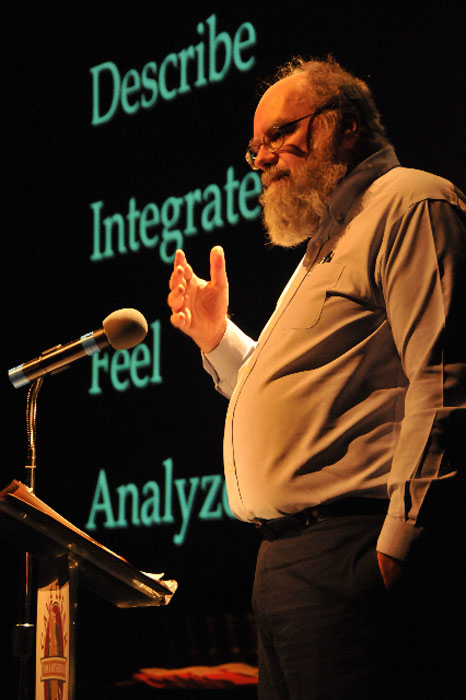
The lecturer stands in front of class, looking dignified and serious. He collects his papers, taps them into line on the podium, sets them down and gets the attention of his audience.

Then he SCREAMS at the top of his lungs like a banshee with kidney stones. It’s a horrifying scream, blood curdling, ear splitting. 

The class reacts with alarm and goosebumps, then worry over the health of the lecturer. Is he having a stroke?

The lecturer continues:


What does THAT mean?

I mean, did I make that noise because I wanted to call attention to the traditional neglect visited upon art critics in American society?

Was it a sign of the fall of the patriarchy?

Did someone goose me?

It may have been, in some part, any of those things, but first and foremost, it was an EXPERIENCE.

It was a jangle of your nerves that buzzed in your synapses

Before it MEANT anything.

That is important to note — your perception of it and your reaction to it were PREVERBAL.

That is, you did not have to have ideas about it. You only had to be aware. To sense it. No words: They come later.

As an art critic, I get to see a lot of art and read a lot of artists’ statements. Those statements are chock full of ideas about things, concepts about art, politics, but they are too often deadly unaware.

UNAWARE.

I’m here tonight to talk about TEXT.

Or rather, text versus art.

Text is very hot these days in the art world.

Students, especially, are seen as cool to the extent that they misquote Jacques Derrida, to the extent that they can say, “I’m into deconstruction.” When they have little idea of what it means.

What they usually mean by “deconstruction” is that they have found the arcane and secret meaning of very ordinary things.

That marriage is a plot by the patriarchy to oppress women, for instance, or that — and I’m serious here, this has actually been suggested by a true academic:

that white people traditionally play games, like baseball and golf, with small white balls while black athletes play games that use large brown balls, like basketball.

Needless to say, this popularized version of deconstruction is not what the French philosophers meant, who invented it.

And to think that finding the hidden message is a new pursuit is typical of the grandiose self-assurance of youth. Only students can believe such stuff.

But in the rage for the latest, young artists are full of a belief that art is TEXT. Text to be explicated, or deconstructed.

But no matter how current the belief is, it runs headlong into the problem that art — although it may have a text, just as a Schubert song has lyrics —  is no more text than my scream.

Art does not spring from concepts, it springs from EXPERIENCE.


Here the lecturer stops to gauge his audience, moving his eyes from left to right, pausing for effect. He continues: 

In fact, it is art’s very job to try to make sense of experience — to comprehend the experience — not in neat little formulations, but as primary sensibility, facing what is incomprehensible.

Too many artists working today — especially in academic settings — believe they are supposed to make a great statement — often a political one — and illustrate it with an installation piece (it used to be site-specific art, but fashions change in art, too).

What is amusing to anyone with a longer view of history and art is how much this all sounds like Victorian art.

It is an age-old American tendency — beginning with the Puritans who distrusted images and continuing through the Victorians who distrusted sex, to today and people who distrust any number of things, from competition to violence to meat.

The formulation seems to be, that if you can describe it, circumscribe it, you can control it and therefore, eradicate it.

What I’m getting at is that there isn’t much difference — isn’t ANY difference — between condemning art for its violence now and condemning it for its sexual vulgarity a hundred years ago.

Victorianism and P.C. both have their roots in a vision of  the world as we would wish it to be.

In other words, not the world as we experience it.

Much of contemporary art is prescriptive rather than descriptive.

It is moralizing. It is also a lie.

Victorians are laughed at for calling the leg of a piano bench a “limb,” and well-bred young ladies were wont to get an attack of the vapours when someone used the wrong word.

Today, we flinch at calling a cripple a cripple. It is the same thing, and just as silly. We’ve all seen jokes about just how far this can be carried: a Caucasian is sometimes called “melanin challenged,” or a criminal has “alternative ethics.”

Another problem of text is that it comes from a trend that is mindlessly democratic. In this world everything and everyone is of equal value, which translates as meaning, of equal talent, of equal intelligence, equal wisdom, equal everything. It’s a world, again, as we might wish it to be.

But Michael Jordan could play basketball, with its large brown ball, a whole lot better than I can; and Jim Dine can draw a whole lot better than I can.

When all art is seen as neutral TEXT, and all art is held as essentially equal, with no masterpieces, no QUALITY — quality, in this view is only a plot by dead white guys to disenfranchise people of color and women, both with color and without.

Now I don’t deny that historically quality has been used as a kind of gatekeeper for the men’s club of art and achievement, but that is only one definition of quality — quality as shibboleth.

But EXPERIENCE, if we listen to it rather than to ideas — tells us that quality is more than merely a culturally defined ticket to the art history textbook.

Listen to Salieri’s overture to “La Fiera di Venezia” and then listen to Mozart’s overture to “Marriage of Figaro.” Your ear —  well before you get any idea in your head — tells you one is hopelessly dull and unmemorable and that the other dances with life.

Quality is never a set of criteria for judging a piece of work — such a view is best left to old German-speaking pedants and should indeed be cast away — but quality is MANIFEST. It is a gut-level experience.

(By the way, quality in all things is the subject of a holy book you might want to read — a great book by a very unpleasant man named Robert Pirsig. Check out “Zen and the Art of Motorcycle Maintenance.” Ignore the dated title and attend to the words inside. Pirsig is a very wise man with a very subtle mind, although he does have the personality of a porcupine and the affability of a Viking berserker.)

One’s reaction to a great work of art is a preverbal AWE.

I always say, what I look for in art is:

What I can’t understand, but I can’t get out of my head.

It excites the neurons and is in some ways analogous to the experience of life. And like life, it is always at bottom incomprehensible.

When we look at a great piece of art, the first thing that strikes us is a wave of recognition. We don’t know what it is , but we recognize it.

It is like I have often said: You cannot create profundity; you can only recognize it.

The experience of art is profound — moving in ways we cannot label.


The lecturer shifts his papers, coughs lightly to clear his throat: 


When I read one of those P.C.-clotted artist’s statements on a gallery wall, I can’t help but think that TEXT is above all, a way of AVOIDING art. Art muddies the waters — text believes they should be clear and healthy.

Take the art of Francesc Torres, who is an academically respected contemporary artist, whose work “deconstructs” history and colonialism. One gets the idea that Torres had an IDEA about history and colonialism and cast about to find a way of illustrating the idea, almost as if he were a political cartoonist.
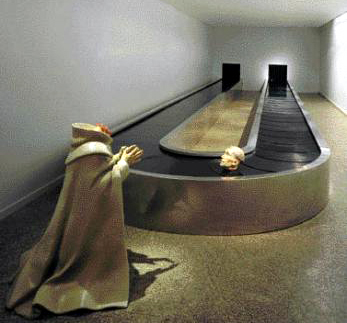
The result is an art whose mind is made up. You either agree with him or you don’t. He might as well be William F. Buckley.

And, let’s face it, the people who go to see his shows probably already agree with him politically, so what possible point is he really making?

As experience, his art is thin gruel. You get the point, like the punchline on a New Yorker cartoon. But what have you seen? What have your felt?

What is there to experience??

Some slowly moving newsreels; a rotating monkey; a battalion of toy battle tanks.

Each is patently symbolic without ever understanding that for a symbol to work, it has to function on at least TWO levels.

Torres uses his images as “signs,” not symbols, that is, they have no organic connection to what he is trying to say, but only a rote connection, an artificial connection, such as that between a group of letters, say A – P – E, and the hairy, smelly, energetic homunculus that is signified.

Great symbols always function first on a PRIME — that is, Experiential — level. Secondary meaning is then spun off.

As Minor White put it, not only what something is, but what ELSE it is.

Melville didn’t decide to write about God and Nature and then use the whale as a shorthand for it. He wrote about a big, scary animal in the sea and it resonated.

Once, when told “Moby Dick” was about the ineffability of God, Melville was taken aback. He hadn’t realized it.

He know there was a great deal of philosophical stuff in the book — primarily the difference between Ahab and Ishmael, the actor and the observer, the doer and the meditator. But he hadn’t set out to make the whale the SYMBOL for the meaning of the book.

I.e. Symbols happen. They are not manufactured. When they are, you have rhetoric, not poetry.

(As William Yeats wrote: “Out of our arguments with others, we make rhetoric; poetry, out of our arguments with ourselves.”)

Rhetorical symbols — such as those of Torres — are the stuff of political speeches.

Part of the problem is that politics and art are mortal enemies. It is no surprise that the political right hates it so much. It isn’t just that they are all  right-wing boobs and Babbitts, but that the very aim of art is inimical to the  very aim of politics. Left wing politics hates art just as much as the right wing. History is fairly clear on that point.

I don’t mean that art can’t have a political component — it often does — Wagner’s “Ring” for instance, or Shakespeare’s plays — But I mean that politics, as in political theories — are always interested in answers. They are meant to solve problems.

Art, on the other hand, is interested in questions. Politics, for instance, wants to end violence against women, or abuse of children and these are very admirable motives — but art is more interested in the impulse that causes violence or abuse. Let’s act it out and see if we can discover where it comes from. We usually discover it comes from being human. To be human is to cause suffering. If anything, art tells us, to attempt to end suffering is to end humanity. Robot people can follow all the rules, flesh and blood cannot, without giving up something essential.

I ran into a classic case, or rather a rash of classic cases over the past few years, in the form of numerous Anti-Columbus shows. This is art meant to show how horrible mean old Christopher Columbus was — how he raped and murdered, stole and colonialized. Columbus became the black hat. He is allowed no redeeming characteristics, no shading of personality. He is demonized. He also takes it on the chin for all white European males, he is the classic disenfranchising, male chauvinist genocide.

What you wound up with in all these shows was strident, self-righteous whining. It is an irony that escaped them all that no one who is self-righteous has any self-knowledge.

Sure, Columbus did horrible things — I don’t find fault with the politics of the art, other than to find it a tad naive — BUT

Not one of the participating artists made the slightest effort to UNDERSTAND what drove Columbus.

Nor did they recognize the universal brutality of humankind — that the brotherhood of man is the brotherhood of Cain and Abel.

All evil was invested in Columbus and he was sent off into the desert of oblivion as our scapegoat.

No mention was made the possibility that even before Columbus, Native Americans caused each other suffering, death and genocide: No mention of Awatovi, where the supposedly peaceful Hopi annihilated one of their own villages in a horrible bloodbath;

No mention is made of Crow attacking Cheyenne;

Nor Aztec enslaving Mixtec;

Or other non-European evils:

Pol Pot’s Cambodian genocide;

Nor Japan in China or Manchuria;

Tutsis slaughtering Hutus;

Shia bombing Suni.

If history teaches us anything it is that in all times and places murder and rapine is the norm, not the exception. Our heroes kill them; their heroes kill us. What difference if it is Azerbaijanis killing Armenians, or Serbs killing Croats or Somalians slaughtering their own.

These anti-Columbus artists had the chance to open up to the experience of the true vicious brutality of life. They could have looked into their own hearts to find it.

Columbus didn’t invent gangs, drive-bys or initiation rapes — all of these had their antecedents in pre-Columbian Central America.

If one of the artists had said, “I recognize Columbus in myself,” he would have gone a long way to complexifying his art, finding the EXPERIENCE that all art is born of.


Another pause as the lecturer gazes across the faces of his listeners. Are they getting it? Just as it seems he is about to start again, he screams again, at the top of his lungs:


There it is again. But by now, you’re familiar with the scream and you react differently. You know it is a pedagogical ploy, and you wait for the explanation. The experience has been tamed. The art has been drained from it. It no longer brings up fight-or-flight, the goosebumps just aren’t there.

So where does one start?

Consider what my wife does with her first grade students.

She does not teach them the color wheel or the elements of design. Or any other abstraction or concept. She brings animals to class, currently two bunnies named Pansy and Thurman.

The kids get to play with the rabbits — to feel their fur, their soft breath, their nibbles, their toenails, even their poo and pee.

They are utterly fascinated by them — They go out of themselves and experience something new — new and unexplainable.

Then they descend on their paper with their tempera paints and express what they have experienced.

They do not ask what does it mean?

Rather, they express that they have been excited.

This is what I call true art — These first graders are trying to make sense — visual and emotional — of what they have just witnessed and felt.

The paintings flow naturally.


There is an unease in the audience. They are mostly students, and have to provide their professors with words: term papers, quizzes and tests. 


It is OK to have ideas about art, after the fact. Sure, we can all sit around and discuss what the hell is going on in Jeff Koons’ two basketballs floating in an aquarium  — two large BROWN balls — and to try to understand what it means.
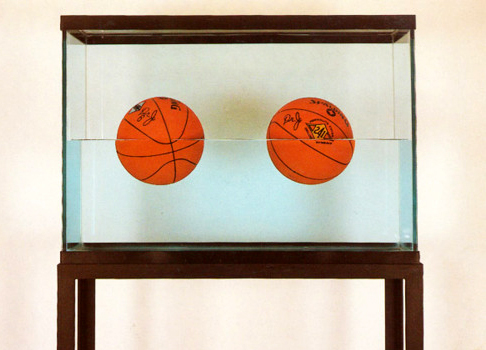
If talking and writing about art were useless, I would be out of work.

But in trying to make sense of a work of art, we are participating in the work, just as the artist participated in life. The words are a response to experiencing the art. They have to come AFTERWARDS, not before.

This is very different from setting the words first, deciding what our art is going to mean and then making what in effect is a mixed-media political cartoon making our point.

Thin gruel.

Lame art.


The lecturer now comes the the primary point of his talk. 


The basic problem is that text is an intercessor. It sits between experience and understanding. When we approach art as text, we see only the intercessor — we mistake the priest for the deity.

Words always distort, they always lie. At bottom, we need to recognize a few things about words.

First, words are not reality. This sounds simpleminded when you say it, but the fact is, we trust words more than we trust our eyes. We read the wall text next to a painting in a museum and trust what it says, even if it contradicts what we see.

I remember a wonderful video display. In it a nude woman is floating in deep water surrounded by thousands of jellyfish. The sunlight dapples her skin. It was intensely beautiful and disturbing at the same time.

But the wall text told us it was a feminist commentary on Irish politics. Huh? No, it was a naked woman in sunlight and jellyfish.

The words left many a museum visitor convinced he was a dunce for not getting it. But the words were simply stupid.


The lecturer is bringing it home, even if it seems rather a roundabout way to get there:


The case may be a little easier to understand in terms of Greek. The ancient Greeks were the first logarchs, they valued verbal meaning over experiential meaning — Zeno’s paradox is only possible in words. Set a turtle and Achilles out on a race and see if Achilles can’t catch the turtle. The paradox is purely linguistic; the experience is straightforward.

The Greek language is a highly ordered language. And the Greeks never made much distinction between the order of their language and the order of the universe. The felt language perfectly described experience: One to one.

The opening of the gospel of John, for instance. It sounds quasi-mystical in English, and that is how most American’s understand it.

“In the beginning was the Word, and the Word was with God, and the Word was God.” “En Arche hen ho logos …”

But in Greek, “logos” doesn’t mean “word” the way the English “word” means “word.” It can be used to mean a single word, but it also means language — the Greek language, that is — in general, and more important, it means the structure of language.

Greek is often built of preexisting sentence structures — “One the one hand …blah blah blah, yet on the other hand … blah blah.” Or “his words say this, but his actions say that,”

The language has these contrasts and comparisons built in. It guided how the Greek thought about the world. Polarity, opposites, hidden ironies and surprising conjunctions,  it’s all in the language even before you decide what to say.

So the Greek sees language as a mirror of the reality. If language says polarity, it must be because the world is polar.

It is much like the belief that geometry transcends embodiment. In other words, a triangle is a universal possibility, no matter if one was ever built. It is like one of Plato’s ideals. God himself cannot create a four-sided triangle. But the definition of a triangle is only words.

Language structure was understood by the Greeks in much the same way. And when they said “In the beginning was the word,” they meant, in the beginning, before anything else, the structure of the universe existed, and the structure WAS God.

Their language created a whole theology. Was it based on experience? You will have to be the judge of that.

Language is a tyrant. It can only discuss a minuscule portion of reality, yet we take it to be the whole.

Language is, in fact, a very poor mirror of reality.

There are an infinitely large number of things in the universe for which there are no words.

Take this, for instance. Here, where two walls meet is a corner. But where the wall and the ceiling meet? What is its name? In English, it has none.

Or this place on the wall — it is named the “center.” But this point, just as real, only a few inches from the center, is nameless.

Names are like the stars in the sky, only points, between which is an infinity of space, just as real as the stars.

Language is feeble. It is up to artists to see the space between the words, to recognize the feelings between the signpost emotions of hate, joy, anger, sadness — this million slight inflections that are nameless.

Up to art to explore the confusing rush of sense data, the confusing signals of society and nature, the overwhelming input that we censor with our language, allowing only those portions that sport nametags, as if they were Shriners at a convention.

As artists, it is up to you to make that unnamed curve that feels the way you do when you first wake up in the morning, when the floor is cold and sunlight comes in through the window and the birds haven’t yet begun chattering.

It is up to you to forge that surface that feels like your nerves when you are nearly run down by a bus on Main Street.

Up to you to make it heavy as your heart or light as your window curtain.

Up to you to make it new.

Make it meaningful.

Make it complex.

Make it richer than words.

Truer than politics.

More curious than a curator.

It is your job to be open to experience, before it is named and tamed.


The lecturer picks up his notes, steps away from the podium and stubs his toe on the railing along the stairway. He screams once more like a banshee with kidney stones. 


Part 6: The lower Mississippi

The Lower Mississippi begins at Cairo, Ill., where its character is radically altered.

Gone are the bluffs along the Upper river. Gone, too, are the quaint river cities and the thick woods that harbor flocks of birds and wildlife.

Cairo is a flat muddy town built on a flat muddy place where the Mississippi and Ohio rivers join. It is old wooden houses falling down, half a brick building here, old church there, boarded up storefronts and the Hub Lounge. “Package goods,” says the sign. Darryl Shemwell’s BBQ is closed on a Sunday morning.

Plaster is falling off the side of a brick building now used as a thrift store. In some old towns the paint is peeling, but in Cairo, even the stucco is peeling. Flocks of pigeons dive by the hundreds around the city streets and a new town clock is built on the crossroads of Eighth Street and Commercial Avenue, a road paved with bricks — an attempt at urban renewal and by the look of things, a complete failure.

Lee’s coffee shop and lounge is all plywood instead of plate glass.

The town is pretty well close to Twilight Zone empty.

At Fort Defiance Park at the south end of the city, the Ohio and Mississippi finally join. The Mississippi has the stronger current, and it rubs up against the Ohio and creates a string of eddies that spin out toward the middle of the river. Standing at the tip of Illinois, you look east to Kentucky and west to Missouri.

An old black man is casting his fishing line out into the river.

“I came here in 1980 from Kentucky when I retired,” he says. “I’m out here fishing every day.”

He’s fishing for catfish, he says, “or anything else that will bite.”

He’s just about the only live human being I’ve seen in Cairo and he tells me that times in the once-prosperous river town are hard. There are no jobs to be had and most of the younger people are leaving.

“The town’s dead, dead, dead, dead,” he says, turning his head with each “dead,”

“They ain’t nothing here.

“I don’t mind it. It’s nice. If I had wanted to work, I wouldn’t have retired.”

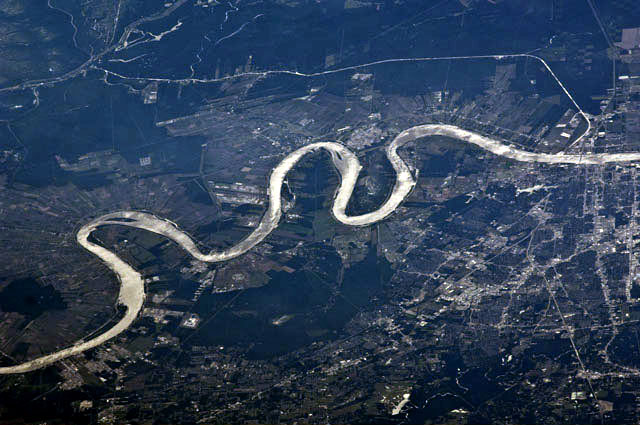
From Cairo to its mouth, 984 river miles away — although only little more than half that as the crow flies — the course of the river meanders like a dropped noodle, often looping back on itself, even cutting itself off. It is a lazy route, in no hurry to get to its end.

In such literature as Joseph Conrad’s Heart of Darkness, we travel   upriver, always getting closer to the mysterious center of the continent and the closer we get to its source, the closer we come to an experience of evil.

The Mississippi is backwards in this respect. In Minnesota, the river seems simple and the people around it comfortably bright-faced, optimistic and naive. The farther south we travel, the more complex becomes geography, history and the inhabitants.

The river is divided into three sections by geography, but it might as well be divided by religious attitude.

If the first part of the river is Lutheran, the middle Baptist, the final run is Roman Catholic, with a fine sense of its own sin, from slavery to modern casino gambling.

The Lower Mississippi is a fine, decrepit, history-ridden piece of geography.

South of Cape Girardeau, Mo., the river flows through its own waste. Thousands of years ago, the Gulf of Mexico extended north to Cape Girardeau, but the river dropped its silt at its mouth and slowly built up the earth underneath it, spreading its flood plain out to fill up the bay and create a valley four times as large as that of the Nile.

That soil was incredibly fertile, and the wandering river periodically flooded, maintaining fertility.

And American farmers figured out a way to grow rice, sugar and cotton and create huge plantations along the river: They invited a large number of Africans to cross the ocean and do the work for them.

Hard figures are hard to come by, but in the antebellum South, there were something like 4 million slaves. Most white Southerners didn’t own slaves, and most slaveowners didn’t own more than a half-dozen. Yet three quarters of the slave population was owned by planters with 20 slaves or more — and one quarter owned by planters with 50 or more.
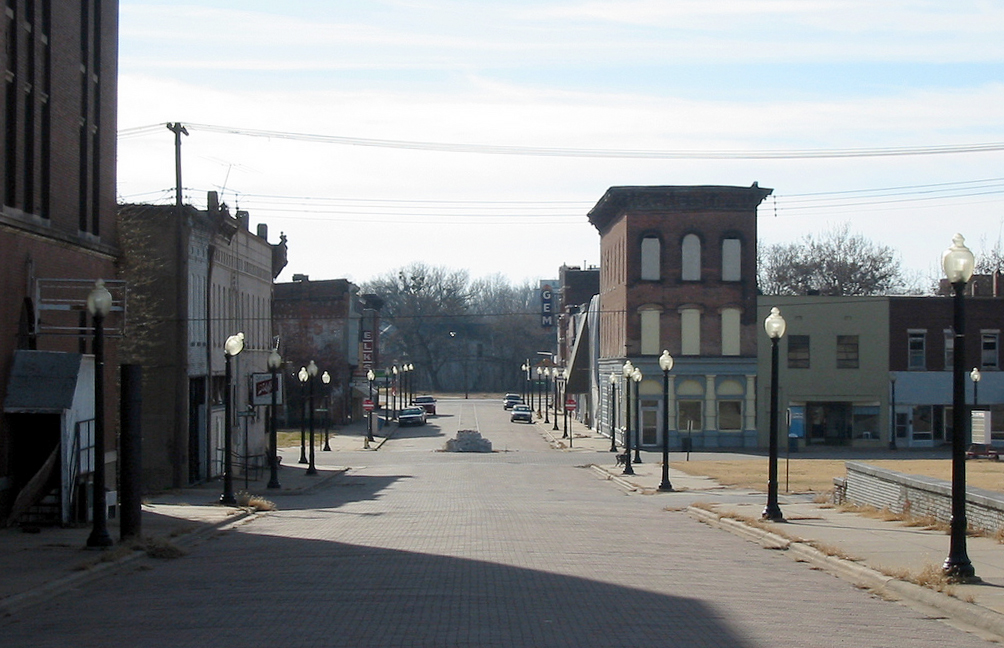
This left the majority of slaves to a very small percentage of very wealthy Southern whites. Fewer than 3,000 Southern whites owned the huge plantations that existed on the labor of 100 slaves or more.
And these large plantations were found mainly in two places: the wet coastal plains of South Carolina and the shores of the Mississippi River.

In the alluvial bottomland of the Mississippi Delta country — an agricultural region in the northern part of the state of Mississippi — about 70 percent of the population was black. In some counties, blacks outnumbered whites by 10 to 1.

So, when one visits the grand antebellum homes of Vicksburg or Natchez, and contemplates the refined culture of the Southern aristocracy, one has to remember the vast suffering that built them.

“Slavery is a huge stain on us,” Mississippi-born novelist and historian Shelby Foote once explained. “We all carry it. I carry it deep in my bones, the consequences of slavery.”

You can feel it, too, in the dusty cotton fields of the Delta. The air seems thicker than elsewhere, the dirt worn out, the towns withering.

Between 1970 and 1990, Tunica County, Miss., lost one fourth of its population and ranked in those years as the nation’s poorest county, with nearly half of its residents below the poverty level. In the Delta as a whole, one quarter are in poverty and per capita income is half the national average.

Yet, in Tunica, that has changed changing. For Tunica is now a center for gambling. In the past few years, a veritable Disneyland of casinos have opened up in this town about 30 miles south of Memphis. There are gambling boats all up and down the river, but Mississippi’s peculiar state law requires only that a casino be afloat, not that it be an actual boat. So, developers have even dug shallow lakes to build their casinos on.

In Tunica, a long sideroad takes you from U.S. 61 into the complex, where you will find the Grand Casino on Buck Lake, Bally’s Cash Country, the Horseshoe Casino and Hotel, the Sheraton Casino, and the Circus Circus casino. You see the high rises looming surrealistically over the cotton and soybean fields.

Tunica now draws more than 14 million visitors a year and has nearly 6,000 hotel rooms. And after its first casino opened in 1992, the county budget went from $3.5 million to $34 million and unemployment dropped from 30 percent to 5 percent.

And the water tower in town reads: “Tunica, Miss. A Good Place to Live.”

Tunica is in the Bible belt, but income is income, so most residents who have new jobs dealing blackjack or serving cocktails don’t think too deeply about whether gambling is a sin.

The Delta is unfathomably rich culturally. It is almost as if American culture begins in the dark soil. For the Delta gave us the Blues, which take all the layers of human suffering and make out of it something beautiful and profoundly moving. The Blues spawned Rhythm and Blues and that spawned Rock and Roll and rock has pretty well conquered the world.

But the Delta ends at Vicksburg, where the bluffs resume temporarily along the east bank of the river. They continue past Natchez, where busloads of tourists stop at the town’s most splendid mansions.

In 1940, Edward Weston photographed the American South and one of the oddest images he found was of a gas station in the shape of a black mammy.

Well, that piece of American vernacular architecture is still around, and what is more, it is still in business, although it doesn’t sell gas anymore. It is called Mammy’s Cupboard about 10 miles south of Natchez on U.S. 61.

It was created as a combination gas station and gift shop by Henry Gaude for his wife, in order, as the Southern expression goes, to give her something to do. What she did, however, was run off with a salesman who frequented the place.

In intervening years, it was turned into a restaurant and a craft center.

Currently, it is a restaurant again, and one of the best in the area. The chocolate cream pie tastes like 18 ounces of chocolate squeezed into 6 ounces of pie. It is a feat of physics.

The large igloo shaped skirts of the Mammy holds three small tables and the larger addition on the back holds another five or six.

Most of the customers are middle-age women, which it seems is the major demographic of Natchez. But one man, sitting at one of the other tables in the brick skirt reminds me that some things are very slow to change in the South. He is a pleasant-enough looking man in his mid 30s and he exchanges palaver with the cashier.

“They opened up a new restaurant downtown,” he says. “If there’s one thing Natchez don’t need, it’s another restaurant.” He’s a well-dressed businessman, obviously educated.

“You’re right about that,” she says. “Or more gas stations, either.”

“I’ll tell you what we got too much of,” he continues, “but I don’t think they’re willing to go back to Africa.”

I’m shocked at hearing this so baldly said as banter, although I have lived in the South long enough in my life that I shouldn’t be. It isn’t only rednecks that can spout such stuff.

I am most struck by the historic irony of his slander.

“If you don’t want them here,” I want to tell him, “blame your own great grandfather. I don’t think their great grandfathers were all that happy about leaving Africa in the first place.”

But for me, I can hardly imagine America without black culture. It is the depth our easygoing souls require. It keeps us from being idiots.

As it flows south, the river gains depth too. The Upper river strains to maintain a 9-foot channel. But by Baton Rouge, La., the river channel is 45-feet deep.

And by New Orleans, the river is narrower and deeper still.

All along the final miles of the river, venerable old plantation homes are tooth by jowl beside fuming, smelly, sooty chemical plants and oil refineries. Beginning at Baton Rouge, you can hardly find a mile of the river without its industry.

It is a vast ugliness, and Louisiana has a reputation for lax enforcement of environmental laws. It is here that the Mississippi earned its reputation for being a sewer. What was once called “Plantation Alley” is now “Chemical Corridor.”

New Orleans, itself, sits mostly below sea level, with the river channeled by levees above the streets, almost like the New York City El.

The town has four parts: a business district, a chi-chi historical district, a kitschy tourist district, and everything else. Everything else is decay. New Orleans is the most decrepit city in the nation: Walls are falling, covered in graffiti; garbage piles in the streets; drunks sleep in the trash; cockroaches scurry into corners. The famous cemeteries are mostly crumbling concrete, dusky with soot.

And that was even before Hurricane Katrina hit in 2005. Now, whole sections of the city look like Berlin after the war, burned out and broken.

Outside of the tourist and business area, it is a city that looks homeless and destitute

One writer said that New Orleans “is where alcoholics go to retire.”

But like everything else along the lower river in the Deep South, this very decrepitude is part of the city’s charm. It is a city where every corner is bent under the burden of history. There was the slave trade, the red-light district, the Prohibition alcohol, the gambling, toxic waste and environmental irresponsibility and it all serves to create a culture that recognizes the necessity of evil.

Every Southerner — and the deeper in the South the more this is true — knows sin. He knows he has to live with it; history loads it on his shoulders.

In Minnesota, the Lutheran accountant can believe in the basic goodness of life; in the Deep South, they know what goodness there is is dearly bought.

It is why there have been so many great writers grown on its soil. It is why no one who has ever written about the South has ever caught it accurately.

From New Orleans, the river spends its mighty flow, and by the time it reaches its mouth — or its mouths, for there are many — it has become the seepage of a great swamp. The single channel spreads out into hundreds, then thousands. Four are maintained deep enough for ocean-going traffic, but most just ooze out into the shallow, warm, salty Gulf of Mexico.

It expires in the complexity of exhaustion.

End of series

Part 5: The Delta, the blues

Clarksdale, Miss., is known for two things: cotton and the blues. You cannot imagine the one without the other.

The endless flat fields all around the town are snowy with the white tufts even this late in October. “They start picking it in September,” a young  woman tells me, “And sometimes, if they have rain or bad weather, they don’t finish until February.” Her smooth skin is the color of coffee; it is also the color of the soil in the Mississippi Delta, that flat, fertile bottomland that stretches along the eastern flanks of the Mississippi River, running, as the saying goes, “from Beale Street in Memphis to Catfish Row in Vicksburg.”

As I drive through, about half the fields are harvested. Those yet to be picked are thickly dotted with puffs like a mackarel sky of cumulus clouds and they alternate with the fields picked through, which are only slightly less speckled with the white cottonballs.

In 1944, Clarksdale was home to the first cotton produced entirely by machine, from planting to bailing.

In the old days, when the cotton was picked by hand, the field would be cleaned out of the cotton. Nowadays, with machines to do the work, the work is done so much more cheaply that they can afford to be grossly inefficient. So the finished fields are a stubble of brittle cotton stalks from which dangle the felted balls of unpicked fibers.

The Delta — a 200-mile long section of northwest Mississippi stretching up to 60 miles east of the river — is more than cotton, though. It is also the blues.

It is where Muddy Waters was born and Bessie Smith died; it is where Robert Johnson sold his soul to the devil. It is the epicenter from which the rolling earthquake of blues spread out across the South.

That wailing, flatted lament first came from the throats of the black field workers and former slaves. If I ever doubted the African origins of the blues, that was laid to rest when I visited South Africa in 1988 and heard, in the back country of Venda, a chorus of women sweeping streets and singing, call and response, as they backed their way along. It was as if a high-tension line had been thrown over the oceans and the electricity of one continent powered the song of another.

The blues, of course, is a refinement of the field song, a freight train of inevitable chord progressions thrown over the rawest and deepest emotions.

Clarksdale itself is a worn-out town. The downtown is filled with empty storefronts and boarded up windows. A J.C. Penney’s takes up one of the larger corners.

And across the tracks that split the town, the older, more decayed buildings sometimes contain a handwritten sign calling it a “Paradise Lounge,” or “Abe’s Bar and Grille.” These are the juke joints, where, on some Saturday nights, the current blues singers play out their changes.

It’s a Monday when I drive through town, and any potential bluesman is more likely at work, or sitting on the sidewalk outside a falling brick building on Issaquena Street with his friends.

I pass two of them, squatting in a vacant lot.

“Hey, friend, com’eer,” says one. He is about 65 and in a suit jacket.

His sidekick is maybe a decade younger, and in jeans and an old cotton shirt.

“Hey, friend,” he says. “Can you do me a favor?”

I walk up to him and he says, “Can you help us get a pint of wine?”

“Pint of wine?” I ask. “How much is a pint of wine?”

“A dollar seventy-five,” he says, as straight as if I asked him his name.

“Here’s two. Enjoy yourselves. I always like to see young people have a good time,” I say.

He stretched up and said, “Lemme shake your hand,” and took the two singles I held out. “You see that,” he said to his friend. “You see that?”

He pumped my arm ferociously for about one and three-quarter seconds and sat down once more on his hams.

It’s the blues and they soak this old town. It’s where John Lee Hooker was born. So were Ike Turner, Little Junior Parker and Sam Cooke. Robert Nighthawk, Bukka White, “Gatemouth” Moore, Eddie Boyd, Son House and Charley Patton all once lived in the area. So did Ma Rainey and W.C. Handy. And the town’s most famous son was probably Muddy  Waters, who grew up on a cotton field south of here and plugged the blues into AC current.

Clarksdale is where Highway 61 crosses Highway 49 and it is at that crossroads that Robert Johnson is said to have sold his soul to the devil.

None of the juke joints are open, mid-day, mid-week, but when I stop to visit the Delta Blues Museum, housed in the town’s old Carnegie library, there’s blues being played in the back. An old man is sitting by a teenager, on a steel folding chair, playing an electric guitar, with another boy on drums behind him. They noodle through a few blues chords and the old man nods in appreciation.

The electric guitar sighs long and loud, the bass walks a steady pace and the drums wham a simple beat. The blues are siphoned from age to youth.

To be continued