Archive

Uncategorized


We hear the phrase, “dead white guys,” a lot these days. It disparages a good deal of what has been taken for art and culture for the past 2000 years or so.

Now, we hear instead of women’s art, Hispanic art, Native American art. Identity, whether by gender, race, religion, nationality or even political outlook has splintered the culture, and what was once “universal” is now merely men’s art.

So, if we take there to be such a thing as men’s art, I wondered what that might be.

Surely that is what the rising tide of feminist art criticism tells us: That the so-called “canonic” art of the art history books and the institutional museums is biased in favor of colonialist, patriarchal and, well, male art.

It is seen as aggressive, competitive and with an undue emphasis on what has been labeled “quality.”

In this instance, “quality” is used as a shibboleth to exclude artists of color and gender.

And I would have a hard time arguing the reverse.

Through history, most artists recognized in the West — and by that I mean European artists — have been men.

And the art history texts have conspired to exclude the Sofonisbas and Artemesias, to say nothing of the Angelica Kauffmans and Judith Leysters.

So, if the art world has been a “old boy’s club” it stands to reason that its art must speak for old boys.

Well, let’s look first at what identity art — and identity politics — is all about.

It is assumed, first off, that each person is somehow defined by his race, culture and gender and that an art, to speak for them, must share the race, culture and gender.

I don’t want to argue that at the moment. Let’s assume it to be true.

So, let’s see how that plays out in the art of an artist generally acknowledged to be a woman: Judy Chicago.

Her first notable work was a series called “The Dinner Party” and it consisted of dozens of table settings, each built around a large dinner plate of her own creation. And each dinner plate was decorated with an ornamental vagina. Some looked more like flowers, some like, well, snails, I guess. But each was the female organ.

When they first were shown, at least, the art critics were largely hostile. “This isn’t art,” they all said, “This is a joke. Where is the beauty? Where is the craftsmanship?”

Well, they are fairly widely accepted as art now. I don’t know what else they would be. They aren’t Haviland china, that’s for sure.

Chicago’s feminist supporters declared that since the critics were, for the most part, men, they were prevented from understanding what made “Dinner Party” art.

And they also explained that what made them “women’s art” was the joining of the generative organ with the symbol of nurturance, the food that the woman prepared for her brood.

I’m making the argument particularly blunt, because, after all, I’m a man and wouldn’t understand otherwise.

On something of the same level, there must be something that counts as men’s art, that features symbols of male virtues. And here, I’m speaking of white male virtues, because black male art has its own niche filled not only by such historical luminaries as Romare Bearden and Jacob Lawrence. Or the more modern Jean-Michel Basquiat.

Or, in literature, think LeRoi Jones.
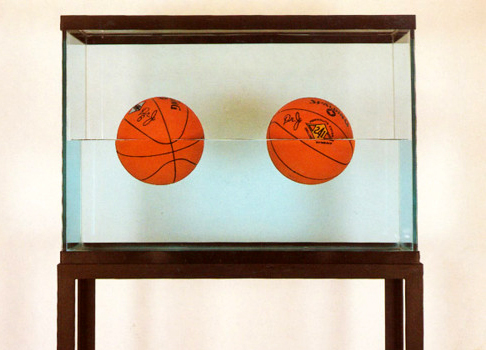
This whole problem is easier to understand, I think, if we use music instead of painting.

If you are Jewish, you have klezmer music;

If you are black, you have the blues

If you are white, you have the famous “dead white guys” — people like Brahms, Beethoven, Mozart.

What, after all, does Mozart have to say to a home-boy in the streets of South Central L.A? What does he care about proportion, harmonic rhythm and sonata form?

He has his rap music that speaks to his condition much more directly.

To his life, Mozart is irrelevant.

Or, let’s think of Beethoven and his Fifth Symphony. It used to be said always that the Great Art, with a capital “A” was universal, that is spoke for all mankind.

But what does a symphony orchestra mean to that same homeboy? Tuxedos? Money? Privilege?

And to a woman? Beethoven is badgering, hectoring, aggressive. It’s a constant wham-wham-wham of tonic-dominant forte chords.

Beethoven is men’s art, if ever there were such.

It is an art about hammering out a place in the universe, hammering out meaning.

Where is the grace? where the gentleness? Can Beethoven be said to be, in any sense, “nurturing.”

The recent spate of pop-psychology books telling us that men are from one planet and women from another would have us believe — and I’m not so sure it isn’t true — that women have a whole different way of processing information.

Women cooperate, support each other and generally attempt to create community and consensus.

Men play a life-and-death version of “king of the mountain.” They are inordinately concerned with who’s on top and where they might rank in the society. They are concerned with competition, with besting the other guy and proving they are the biggest damn gorilla on the block.

Sounds like Beethoven to me.

Who else might count as a male artist?

Michelangelo, with his “divine spark” and ranks of angels.

David, with his morality tableaux and ranks of nobles.

Picasso, surely, for his biography tells us he hated women.

And actually, almost everything in your standard Janson art history text.

The men are interested in manipulating things, altering the environment, creating a rigid social order and making “quality distinctions” that rank the artists’ products.

It is men who tell us Van Gogh is great and that Fantin-Latour is less so.

It is men who tell us Judy Chicago shouldn’t be taken seriously.

It is men who tell us that Beethoven is universal.

After all these years of so believing, I have come to question these assumptions. Perhaps Beethoven is really very provincial and speaks to white German males. Maybe that is why Debussy hated him. Maybe Wagner really does speak for the anti-Semitic; maybe Sibelius speaks only to the Finns.

As evidence for this I search myself.

I come from a Norwegian background. And sure enough, I feel something special, something very personal when I watch a Bergman film. I love a lot of cinema. Fellini is a dear; Kurosawa moves me to tears. But Scandinavian Bergman speaks to me as without a middle man; His images and words pierce directly to my heart and make an effect even before they reach my brain.

There is something perhaps even genetic to this. I recognize those iron-grey skies in his films, those tight-lipped volcanoes raging inside with never a ripple on their surface. That icy intensity is what rages through my own veins.

What doesn’t rage through my veins is the extroverted menagerie of Fellini. His Adriatic sun is not the midnight sun. Even his most sarcastic satire is optimistic. Just the opposite in Bergman, he sings with Brahms, “The grave is my joy.” There is something quintessentially gloomy about Scandinavians.

Lest you forget, the old Norse mythology is the only one, at least as far as I’ve ever found, wherein good battles evil and evil is predestined to win. The good gods will die.

I feel something of the same bleakness in Sibelius — less so in the Norwegian, Grieg, but that has more to do with his cosmopolitan leanings.

Think of the painter Edvard Munch — now there’s a cheerful guy.

The deal is that if your name is Abromowitz or Kelly or Riportella, you may not have that same blood-bond with Bergman. You may feel it for Fellini, or Rossini; or for Chaim Potok or klezmer music.

If you are black, you may feel that blood-tie to B.B. King or even L.L. Cool J.

And I have no doubt the women who tell us they feel a tie with Georgia O’Keeffe or Frida Kahlo and don’t feel the same with Cezanne or Braque are not merely making political points, but are telling us how they honestly feel.

Which brings us to the black briny problem of isolation. Does this mean that we have to throw out our Rembrandt and Renoir? Do we have to give up on 600 years or a thousand years of art history?

Does identity art render all other art null and void?

Well, the truth is that although I feel that kinship with Bergman, I truly do love Fellini as well. He speaks to me perhaps on a different level, and perhaps even a better level.

Fellini speaks to me not on the blood level, but on the level of esthetics. Even if my relatives are those in “Wild Strawberries” and not those in “Amarcord,” that doesn’t mean I don’t recognize the central core of humanity of the people in it. Fellini makes me believe in his people by force of will and imagination. He makes me believe in them as blood and flesh. He forces me to transcend the tribal.

And whether Georgia O’Keeffe speaks directly to women in a way she doesn’t speak to me I can’t know, but I can know that she speaks to me as well.

There is something in the best art that transcends race, culture and gender.

Sure, there is something on the surface that may speak more directly to others, but there is something in the core that speaks to us all.

It is, of course, that universality that I maligned earlier.

All art, of course, comes out of a culture, all art is made by a man or a woman and those roots must be the starting point. It would be as silly for a Chicano artist to mimic quattrocento Florentine art as it would be for me to write a rap song, but the soil, as they say, is where it starts.

And that soil gives birth to a great amount of art that never transcends its origin. That art can still speak to its nation or gender or color.

Most rap songs will never mean anything to me, although I can recognize in the best of it something genuine and true: Public Enemy is making real art even if others are only making headlines.
And Ditters von Dittersdorf writes concertos that really do appeal only to dead white Germans.

But the best of any art, from anywhere in the world and from any gender can communicate something genuine.

It is that nugget that Beethoven attempted to reach in his Ninth Symphony, for instance. “Alle Menschen werden Brüder” — “All men are brothers” or, in more gender neutral terms, as spoken by Willie Stargell: “We are family.”

So, what does all this mean?

First, that we must keep our ears and eyes open to that universal meaning in all art, whether it is Judy Chicago or Romare Bearden.

Second, we should always recognize that all art comes from a tribe, that white males are only one more tribe — certainly a historically privileged tribe — but that the tribe is the starting line, the checkered flag lies elsewhere.

We should never deny our origin, or attempt to suppress our origin as a seed for the art — the terroir we grow in — but we should always attempt to transcend our tribe and recognize not the differences between the tribes of humankind, but their similarities.

Sometimes, when you’re stuck on the “A” Train between 168th Street and 175th Street — that curve in the subway track that always makes the train squeal like a banshee from hell and you wish to god only dogs could hear it — and there are 43 high school kids riding home from class and making a party on the train at the top of their 86 lungs, and two or three winos are sleeping on the seats, so you have to stand, and you can’t really tell if that twitchy man who got on your car at 145th Street is carrying a knife or a letter opener — sometimes you wonder whether the 20th Century has really been worth it.

If only there were a way to go back in time to the 17th Century, or the 15th, or what the heck, the 12th Century. Ah, but there is. Just tough out the train ride to 190th Street and take the elevator up from the bowels of the station, the elevator pasted with 50 or 60 cute photographs of kitty cats and puppy dogs — and the tag-team New York Transit Authority elevator operators who taped them there and operate the elevator from behind the walls of a corrugated cardboard box “office” they imported into the elevator — and step out into the fresh air of Fort Tryon Park at the northern tip of Manhattan.

It is a short walk through the greenery and over the black basalt outcroppings to the Cloisters.

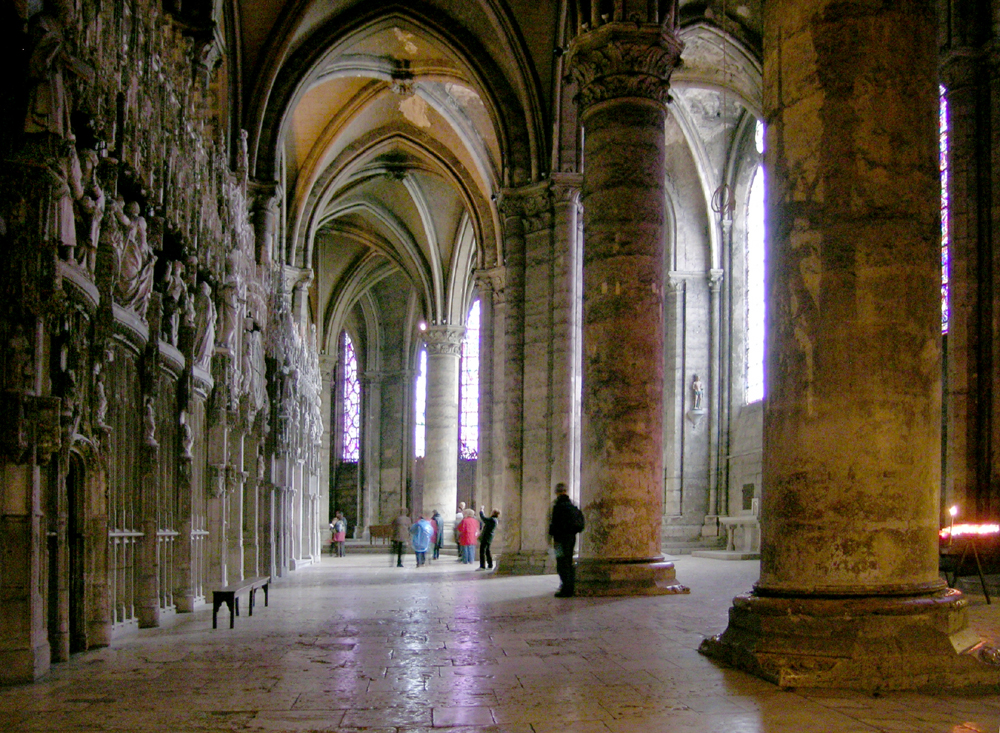
The Cloisters is a place of cold stone, vaulted ceilings and stained glass, only not stained the way the windows are stained on the “A” train.

Opened in 1938, the Cloisters is a branch of the Metropolitan Museum of Art and contains part of its Medieval collection. It is a castle on the Hudson River on a stony prominence overlooking Dyckman Street. It is a rent in time.

It is a sort of monastery built from sections of 12th and 13th Century French and Spanish cloisters, reassembled in New York City. Inside, you can set in stony silence in a Gothic chapel and watch the play of light on the stained glass windows and contemplate the tomb effigies of noblemen and their wives.

The best part of the Cloisters is that it is so far from the city’s “museum row” along Fifth Avenue that few tourists trouble to make the trip and it is thus one of the least crowded major museums in America.

But the trip will be worth your while. Inside the stone edifice are the famous Unicorn Tapestries, the gargoyled column capitals of the Cuxa Cloister and a boxwood rosary bead no larger than an inch and a half in circumference, but which splits in half and opens into a triptych of carved biblical scenes with more than 40 tiny figures sculpted into it.

I try to visit the Cloisters each time I find myself in New York, usually on the final day of my trip, when I am exhausted by the stress and energy of the great crowded noisy squealing smelly city. The Cloisters is a refuge, a place to regain the center of your being, the unmoving axis of the earth.

You first see the place — or see its tower — as you wind the paths of Fort Tryon Park past the beech trees and the retirees feeding squirrels. They are very fat squirrels.

But there, over the treetops, it seems farther away than it is. As you get closer the path takes you up to a tiny door in the bottom of the castle and you go in, up some stone steps and up to the admissions booth. Pay the fee, get your museum map and step into the 12th Century.

The main hall at the entrance is a modern piece of architecture, but evoking the style of the Middle Ages. It is a tall hexagonal vaulted dome. Off to the side are the bookshop in one direction and the Romanesque Hall to the other.  From there, you can take a side trip to the Fuentiduena Chapel, the St. Guilhem Cloister and the Pontaut Chapter House.

Each of them was collected in Europe, taken down stone by stone, with each piece carefully numbered, shipped to New York and rebuilt as part of the sprawling museum. In some cases, the originals were in ruins or only partially surviving and the museum has fleshed out the missing parts in the proper style.

On a cold October day, the sandstone is icy to the touch and the low-hanging sun outside throws the shadows of the surrounding trees up against the stained glass, making a second web of leading swaying against the motionless first

There are four things I never miss on a visit.

The first is the Gothic Chapel, which is a modern recreation of an 11th Century chapel, filled out with statues and stained glass. It is quiet as a tomb, and I always find a seat on the stone and sit quietly for 20 minutes or a half hour, waiting for the occasional visitor to pass through and bring me silence once again.

It is hard to believe a place this still can exist in a city this impatient.

In the center of the chapel is the tomb of the chevalier Jean d’Alluye, who died in 1248. On top of the sarcophagus lies the effigy of the knight, with his palms pressed together in prayer and his chain-mailed feet resting on a small stone lion. Jean had been to the Holy Land during a crusade in 1240 and had brought back what he believed was a piece of the true cross. He was originally entombed at the abbey of La Clarte-Dieu, near Le Mans, which he had built in 1239.

The second station of my ritual is the room containing the Unicorn Tapestries. These seven giant weavings depict the hunt and capture of a unicorn and are also allegorical of the suffering and crucifixion of Christ.

The last of these tapestries, the Unicorn in Captivity, is the most popular. A poster of it is sold at the gift shop. The unicorn rests in a circular corral resting on a field of hundreds of flowers, a particular style called “millefleur,” or “Thousand flowers” in French. The millefleur is more stylized than naturalistic, but it does demonstrate a quality that is particularly Medieval, and a quality I especially respond to.

The Medieval mind didn’t care much for artistic unity. They never generalized in their artwork. The later Renaissance loved to make a landscape of generalized trees, although you can never quite tell what kind of tree they mean. In a Medieval piece, like this millefleur, you can name every single plant by genus and frequently by species.

They may sit on a flat black field, but there is the strawberry, the columbine, the daisy, the iris, no two alike.

That same impulse can be found in the next stop, the intimate Trie Cloister, which is open to the weather. A cloister is a garden surrounded by a stone walkway bordered with columns. What marks it as Medieval, specifically Gothic, is that no two column heads are the same. Every one of the 20-plus double columns has a different capital, and they run from tragic to comical.

The ancient Greeks would have been horrified by this lack of unity: They built their temples so that all the columns and capitals matched. The Renaissance that came later was shocked: They, too liked uniformity of effect. They were so put off by the helter-skelter design of the age that preceded them, that they named it Gothic, which is to say, barbarian.

Yet, the profusion of styles all yoked together gives the impression of profound fecundity. The Medievals lived in a world made vivid by its variety: the wealth of animals, of plants, of social classes, of biblical stories. There are kings and saints on these capitals; there are dancing bears and demons; acanthus leaves and oak leaves. There are trade union labels and a man in a funny hat.

It is a sense of rich profusion, and one I find myself deeply sympathetic towards, which is why the cloister is a mandatory stop, again for 20 minutes or so, to soak it all in, like a deep breath of air.

The final required stop is the herb garden. I am a sucker for herb gardens,  especially the highly regimented kind that the Middle Ages were so fond of. The herb garden at the Cloisters is in the form of a cross, with beds of herbs surrounding the four central quince trees.

In October, the quince are ripening to a mottled yellow, looking something halfway between apples and pears. Their subtle fruity smell is exquisite.

Whenever I find myself in an herb garden, I always nip off tiny bits of the leaves and crush them between my fingers under my nose. The smell of the lavender, sage, thyme, borage or camphor wakes up that olfactory sense that you do your best to put to sleep in the grimy downtown.

It is for me, as it was for the Medievals, as perfect a model of Paradise as can be found on earth. Paradise is a Persian word for garden, and it is only proper that our culture has taken it over to name the single plot of earth that remains unmolested by the clutter, noise and ambition of the everyday world we inhabit.

There are dozens of other attractions at the Cloisters, every one of them worthy of your whole attention. I mention only the tapestry of the stag hunted by old age, which is the equal of the Unicorn tapestries, or the 15th Century wooden pieta, which makes the dead Christ seem more like a lifeless piece of meat than any other pieta I’ve seen, only heightening the pity we feel looking on at Mary’s sorrow.

So, if you are lucky, you can carry back with you into the city some of the stillness of the Cloisters, and until it wears off, hold onto the unmoving center of the universe.


There is little so depressing in the world as its conventionality. We are swamped by it, as if by a great sea wave.

Now, I don’t mean, when I say the world is conventional, that it is suburban, middle class or bourgeois. I am not merely talking about trim square lawns and grey-flannel suits. Those are conventional targets: Such things, in fact, are the conventional images of conventionality, and that gets me down just as much.

We need an unconventional view of what is conventional, or we may not notice the phenomenon at all.

And I’m not talking about conformity. That is another issue — one largely left over from the 1950s. You can see it discussed in rather conventional terms by many of the TV dramas from that “golden age” of television.

In the 1950s, there were so-called “non-conformists” who lived “unconventional lives” but they all dressed the same and they were just as conformist in their berets and turtlenecks as their elders in suits and ties. The same for hippies; the same for our goths, punks and homeboys.

There is nothing more boringly conventional than low-hanging shorts, a slogan T-shirt and a ballcap worn back-front. It is just as much a uniform as the grey-flannel suit.

I remember radio-storyteller Jean Shepherd complaining about this in the 1960s.

“If you really want to be unconventional,” he said, “wear a coal scuttle on your head.”

There is a tie between conventionality and conformity, but they are not the same thing. Conformity is acting the same as everyone else, so you don’t stand out.

Conventionalism is thinking the same as everyone else, and when you are conventional, you probably don’t even know it.

Conventions are not the province of any single social class, nation or nationality. They are a lazy habit of human thought. Conventions are things we accept without question as an accurate description of the way things are.

Songs are three minutes long. Men wear trousers; women wear skirts. Photographs are rectangular. Automobiles have four wheels. We eat with knives and forks.

Books open from the right. Stories have beginnings, middles and ends. Poetry rhymes. Brides wear white. Weeks have seven days.

All of these things are conventional; there is no obligation for them to be this way.

Some conventions serve useful purposes, such as having everyone drive on the same side of the road, but most are mere habits.

Most any widely held belief is conventional rather than active. You could take any one and turn it on its head and make a convincing argument.

We believe modern medicine is good, yet it has helped cause the overpopulation of the planet. Death is part of a healthy life, after all. Perhaps we were better off in the long run without penicillin. It has not stopped suffering but only postponed it.

We talk about species being higher or lower on the “evolutionary ladder..” Yet, there is really no higher or lower; there is only difference.

That sense that human beings are the culmination of an evolutionary teleology is quite absurd. We need to evict the squatting convention that everything is ordered hierarchically.

The reason we rely on convention so much is that it makes our decisions for us and solves problems that otherwise would vex us continually.

Convention is therefore a labor-saving device.

But are labor-saving devices all that good, in the long run? That is another convention that bears inspection. Families were certainly more tightly bonded before the proliferation of labor-saving devices freed us from having to cooperate on chores.

Convention is habit and the problem with habits is that they dull us down and dim our awareness.

And that is why we should worry about it.

For you might ask, if we are happy with the conventional, why should we be forced into an unknown we are uncomfortable with? Why should not a painting be something pretty we hang over a sofa? Why shouldn’t we wear matching socks?

But if you begin to recognize the conventionality around you, you won’t think convention all that pleasant. You will see it as the enemy. You will see it as a form of death. It makes inert a portion of life that should be perpetually active.

Convention is a substitute for being alive. It is a false path that will lead you to the point that you wake up one day and realize you have not lived.

To be most alive is to be most aware. Convention is a sleeping pill.

My wife has a simple theology. As far as she is concerned, Ray Charles is God.

This isn’t an organized religion and she doesn’t attend services. But I know what she means: When you hear Ray Charles sing, you can easily be convinced that there is a kind of divinity making itself heard through his throat.

It isn’t strictly speaking his music which causes this reaction. Some of the songs he sings are as trivial as any other pop music, the arrangements just as kitschy, and his backup musicians are often the same ones that show up elsewhere when no divinity is present.

No, it is a quality in his voice that transcends the pop music he sings. It is as if all of humanity is trying to crowd through the narrow pipe of his trachea.

What you hear is pain, joy, weariness, enthusiasm, strength, vulnerability, death and birth, all at once.

Well-trained voices of opera singers are meant to sound effortless; they know how to ease the notes across their vocal cords and project them to the back of the house. With Charles, the rasp of his voice underlines how hard the music is working to get so much meaning through so small a tube.

I’m going on about one singer-deity, but I am myself a polytheist. There are a tiny handful of others working in pop culture that bring so much to their medium that they transcend it and reach the rank of high art.

You hear something of the same going on in the tenor of Willie Nelson. Now, I am not a country-Western fan. Mostly such music gives me the worms. But Nelson is something beyond the category and every note he utters seems rife with human life.

Others on my list include Billie Holiday, John Lee Hooker, and — yes, I’m serious about this — Jerry Lee Lewis.

In each, there is an authenticity in their voice that only gets more profound as they age.

You should hear the Killer bend Somewhere Over the Rainbow into a melancholy confession of regret. I doubt he could have managed that when he was a young Turk.

And Billie Holiday, in the year before she died, worn threadbare by heroin and alcohol, sang her Don’t Explain at New York’s Plaza Hotel with Duke Ellington and you can barely stand listening to her pain:

“Cry to hear folks chatter/ And I know you cheat./ But right and wrong don’t matter/ When you’re with me, sweet.”

The same authenticity — the sense that the joy of life depends on the pain and loss caused by death — shows in the guitar solos of B.B. King and the comedy of Richard Pryor.

In all these cases, the quality that transcends pop is soaked thoroughly into the sound. Like a hologram, which you can scissor into many pieces and each contains the whole image, you can slice up a Ray Charles song or a B.B. King guitar lick and the whole of humanity is in every sliver, complete and undiminished.

When you hear something so human, you recognize instantly its status as art. Most pop is merely commercial and no matter how catchy the tune, it comes and goes quickly, with no more lasting influence than yesterday’s newspaper.

In an age that likes to downplay the difference between high and low art, it is important to recognize the difference. Too often, anyone who makes that suggestion is accused of being a snob and an elitist.

But there is a difference between those things which entertain us and those which make us recognize and feel our own humanity, that open us up to the wider world of thoughts and emotions. And despite the reigning egalitarianism, the one has more value than the other.

A snob is someone who believes one thing is better than another for the wrong reasons. But what do you call it if you recognize the right reasons?

A snob believes that money or birth or style makes one form of art better than another. But it is not money or style that makes something better.

It is quality, authenticity, genuineness: Mozart at his best had it and Ray Charles at his best has it. Style has nothing to do with it.

Which is why Ray Charles could sing country and Western, and why Willie Nelson could sing Stardust.

For style is merely the vessel the humanity pours into. And it is the humanity that makes it art, not the style.

TV is an odd medium, that is, if it is a medium at all.

I have been trying to understand my dissatisfaction with the box, and come to terms with why, despite watching regularly, I feel so empty afterwards.

First of all, it isn’t a question of the quality of the programing. While it is unarguably true that most of the stuff on TV is dreck, there are examples of quality. The Simpsons, for instance — which I think will eventually be compared quite favorably with Shakespeare — or Book Notes on C-Span.

Yet, when I turn off the box, I feel like I have just eaten a boxcar of Cheez Doodles, and am more than a little queasy.

And I need a spiritual Bromo Seltzer.

One of the issues is, I believe, that TV is different from other media. If TV is a medium, it is one that is already twice-removed. That is, television isn’t, in itself, a medium for ideas or images — a conduit for content — but a medium of media.

That is, a play can be seen as a medium for words and ideas, but television is a medium for plays: What we talk about when we discuss television isn’t TV, but the plays, or discussions, or documentaries, or stand-up routines that are carried by TV.

In that sense, it is theater we are critiquing when we complain about bad sitcoms, not TV per se.

Almost anything that appears on TV is really some other medium, carried at the second remove, over the airwaves and into our houses.

So, complaining about the quality of TV shows isn’t really complaining about TV at all.

This second-handedness of television is one of the things that bothers me about it most.

I see the consequences of a TV-based culture constantly, when young people quote old sitcoms for wisdom — as if the Brady Bunch were relevant to anything.

And now, with the pervasiveness of the box in our culture, we look to the second-hand image in preference to the the actuality: Nothing is accepted as real until it is validated by being shown on TV.

Like a bunch of people at a bar in New York, when a car crash occurs right outside and the customers watch the wreck on the TV over the bar, covered from local TV helicopter cameras, rather than look out the window. An image on TV now seems more real than the actuality.

Animals are what appear on TV nature programs. Police are what they see on Cops. And movies are what they see on HBO.

This second-handedness of television means that audiences often make no distinction between seeing a movie in a theater and seeing it on a 26-inch screen.

What is missing is the actuality of the event: For animals smell; their fur has a feel under the hand that TV cannot give us.

Cops spend a lot of time filling in paper work and waiting for court appearances; TV requires the chase.

And seeing a movie includes the visual density of a projected image, which is gutted by the low-resolution of a TV screen.

We build our lives from our experience. If our experience is already second-hand, our lives cannot be fully realized. There is a “nowness” — an actuality and presence — to real experience that cannot be duplicated on the box. I worry that educators show videos of cows in class of rather than taking their students on a class trip to a dairy. What you learn from the video is second hand. What you learn from an actual dairy enters that deep well of experience we can draw from for the rest of our lives. What is lost on TV is that 360-degreeness and three-dimensionality — the smell and grit — of reality.

It also, by its rapid image editing, cuts us off from the important possibility of learning through slow accumulation of detail. In TV, nothing is slow, and there is no detail, only a quick wash of effect.

So, if television cannot give us a meaningful experience, and is only a second-hand medium of media, giving us images of theater and music, what is essentially television?

What can we say about television that isn’t mistakenly critiquing the drama, or the discussion, or the music that is conducted through the box into our living rooms?

This, in addition to the medium’s second-handedness, is what really bothers me:

The actual TV-ness of the box can only accomplish two things.

TV can only make something look attractive, or make it look repellent.

The images that TV gives us cannot make political arguments, it cannot discuss issues, it cannot weigh difficult moral questions. That is the lesson we first widely learned during the Nixon-Kennedy television debates, when Kennedy smiled and Nixon glowered. Many listening to the debates on radio assumed Nixon had won. But on TV, Kennedy glowed and the box gleamed in response.

As a result, political campaigns now rely not on actual debate — no one who really understands the term believes the so-called TV debates are anything of the sort — but the presentation of images making “our guy” look heroic and “their guy” look like an oaf.

And this leads to the natural result of TV’s “attraction-repulsion” duality.

The only thing on television that naturally belongs there — as drama naturally belongs in the theater, or as political debate naturally belongs in the town hall — is advertising.

Television is ultimately the final and natural home of the commercial, that glossy dreamlike presentation of images of the libido, really well lit and set into a mythology of personal gratification.

In one way of defining the term, television is at its heart pornographic.

I don’t mean that it is filled with sexual imagery, but that the pictures on television short circuit complex reactions and substitute simple desire. Television is the ultimate “me see, me want” medium. It makes us want to possess those images it glamorizes. We are not meant to think about, feel deeply or discuss the ideas, but only to want the images. That is what I call pornographic.

TV suppresses the best in our natures and substitutes covetousness. We want the splash of the sports beverage, we want the wind rushing through our hair as we see the actor drive the SUV through the Tetons. We want the shiny hair, or the woman possessing the shiny hair.

In this, the programing is not substantially different from the commercials: We want the smiles and lifestyles of our TV Friends, and the clothes they wear on Sex and the City.

It is a world of pure fantasy, devoid of consequences, complexity or depth. It creates a world in which everything is an “it,” in the terms of Martin Buber.

That objectification of the world is the bottom line on pornography. And when we combine the problem of TV’s pornographic essence with its displacing actual experience, we wind up with a deep metaphysical tummy ache.

Which is why I really need a Bromo.

As I have become older, I have begun to think that the problem of color is primarily a linguistic one.

Color a problem? It seems like one of the clearest, most obvious of phenomena. We all see it: At least, we all stop at stop signs. We know red.

Or think we do.

Artists know about color, certainly. They know the primary colors of red, blue and yellow, and the secondary and tertiary colors they can mix.

Physicists know about color, too. They know about wavelengths of the electromagnetic spectrum and how one tiny segment of this huge megaband of waves can be perceived visually, from the longer wavelengths of red to the shorter, buzzier ones of blue.

But these two knowledges don’t agree. They are relativity and quantum mechanics.

Further, a printer will tell you that the primary colors are not red, blue and yellow, but cyan, magenta and yellow. And a television technician will tell you that the primary colors are blue, green and red.

What gives?

Perceptual psychologists and neuroscientists are still working on the problem of color. The first and most significant problem is that, realistically speaking, color does not exist. That is, what we see when we look at a tomato or an apple, that sensuous red we ascribe to the object, does not have an objective reality. It is a subjective additive that our brains give it so we may make sense of what we see. In evolutionary terms, we use color to know when fruit is ripe.

(Interestingly, it seems as if evolution continues to work in the human species and, as most people now buy food from markets rather than foraging for them, we may be losing our ability to distinguish reds and greens. The incidence of red-green color blindness is growing, and eventually, we may all share it.)

A simple view of how color vision works would seem to make sense of it all. In our eyes, on our retinas, are light-sensitive cells — we call them cones — that are alternately triggered by red, green and blue wavelengths of light, and those signals are transmitted to our brains, where they are synthesized into little color pictures of what we are looking at.

Unfortunately, this isn’t an accurate version of what happens.

First problem is that the cones are not discretely sensitive to red, green and blue. There is considerable overlap, as seen in this graph.

Second, the color we perceive is not always related to wavelength. Consider yellow. There is, of course, a yellow wavelength of light, and we see that wavelength because yellow light tickles both the green and red sensors in our eyes, and we blend them together in our brain to make yellow. The problem is that if something has no yellow wavelengths at all, but manages to tickle both the red and green sensors, we still see yellow. No yellow light at all, but still, we see yellow.

And consider magenta. It is a color that does not exist in the natural spectrum. There is no magenta wavelength of light. But if an object reflects both red and blue wavelengths of light, we are rewarded by the mental sensation of the hue we call magenta. No wavelength at all, but still, there is color.

So, color cannot simply be a mental recording of wavelength. Most of the colors we perceive are mixtures of other wavelengths according us the pleasant and often useful sensation of color, but without any strict accordance to the laws of physics.

What is more, current research on vision tells us that what we synthesize in our brains is not a twining of the three signals from the three types of cone, but rather a group of oppositions worked out by the brain.

Along with cones in the retina are the rods, which are tasked with the registration of light and dark — commonly called black and white. The electrical signals that are sent to our brain to be analyzed are first, the opposition of lights and darks, second the opposition of blues and yellows — which are the colors most other mammals work with — and thirdly, the addition we got from our primate ancestors, the ability to analyze the opposition of red and green.

So, as we now think it to be, the signals sent to our brains give us black-white, blue-yellow, and red-green.

Perhaps, then, what we call primary colors should be black, white, blue, yellow, red and green. That would make sense.

They are all simple names for colors that have clear identities. Everyone knows what green is, or blue.

Or do they? Here’s where the linguistic part comes in.

In English, for instance, there are other color names that have a similar direct and clear determination of hue. Orange and pink, for instance. Brown and purple. Simple names for hues we recognize has having distinct identities. And just because we speak English, we take our name-markers for a simple one-to-one description of reality.

But hold on: Other languages organize colors differently.

Consider Russian, where what we call light blue has one name and what we call simply a darker shade of blue, has another name. Siniy and Goluboy. The distinction is the same as we make between red and pink. We hold them to be distinct colors, not merely shades of the same color. In Russian, that distinction is accorded to the blues.

Or take Japanese, where all of blues and greens are covered by the single word, ai. There is the ai of the sky and the ai of the trees below it. It is all ai.

There are languages in which the surface reflectivity of an object changes its color name. We have that in English, where a metallic version of grey is called silver, and a version of yellow that maintains specular reflections is called gold.

“In certain languages there are names for colors that are descriptive in terms of surface, as a wet black or a dry black,” says painter Henry Leo Schoebel, whose paintings are all about the sheen of their surface.

“There is a big difference between a box merely painted black with glossy house paint, and a Japanese lacquer box. The lacquer is a blacker black.”

There are academic arguments going on all the time over whether the names of colors are universal or are culturally distinct. I’m not getting into that, except to say that both seem to be true. But colors are universal in the sense that everyone knows red is red and would not be confused with, say, blue. But when we say red, we don’t always mean the same thing.

“If one says ‘red’ and there are 50 people listening, it can be expected that there will be 50 different reds in their minds,” painter and color theorist Josef Albers once wrote.

The Zuni language classes yellow and orange together, which means that once they have coded it in language, say, as if to tell a friend what they have seen, the friend decodes the word into his trove of experience and comes up with something quite different. It may be orange; it may be yellow. That is a distinction that our language makes, but his does not.

The same as Russian separates siniy and goluboy and ours does not.

The tomato is a whole lot more close to the orange end of the red spectrum and the stop sign is closer to the magenta end of the red spectrum. Yet we call both red, and if we tell a friend about something we have seen and say it is red, the friend will decode the term the same inexact way the Zuni friend decodes orange-yellow.

And outside the limits of language, color is something we know from its embodiment, not from its abstraction. That is why so many secondary names for tints and hues are actually the names of those items who bear those colors, such as lavender, fuchsia, turquoise, teal, olive, coral, puce, salmon.

And it’s why painters cannot use tubes of paint called “red,” “green,” or “blue,” but instead rely on vermilion, phalo green or ultramarine. Pigments are not abstractions, but physical substances, and they differ in effect, hue and their properties of admixture. Mix blue and yellow to get green? Which blue? Which yellow?

This physicality of pigment also means that an artist’s colors don’t behave according to a neat color theory. Each pigment has its own idiosyncrasies and personality.

“For reds, I use acra violet, cadmium-red light, red oxide,” painter Anne Coe says. “Phthalo blue, ultramarine and cobalt for blues, cadmium-yellow light and medium and then yellow ocher.

“You do have to have a violet. It’s hard to mix a violet.

“And you can’t put black into a cadmium-yellow light: It turns green.”

So much for color theory.

In the end, colors are as individual as people, and any color theory is a compromise, fudging this or that for coherence. There is no theoretical certainty in color, and in the end, we have to admit that each of dozens — even thousands — of colors has its distinct identity and each pigment its distinct properties.

And so, I have given up on color theory.

What is the single greatest enemy of art?

What one thing more than any other manages to sabotage the efforts of the artist?

It’s not lack of money; it’s not the bourgeois tastes of the masses; it’s not cultural victimization.

The one great enemy of art is talent.

Well, maybe not talent, exactly, but the satisfaction of having talent and the willingness to settle for what talent gives you.

Being self-satisfied always makes the artist willing to settle for less.

I remember artist Frederick Sommer stating his case quite clearly: “Why would you ever do anything less well than you can?”

If you are going to attempt something, he says, you had better give it everything you have.

And talent simply isn’t everything you have.

Talent is like beauty; it comes with the genes. To rely on beauty to get you through the world is a shallow and unworthy existence. To rely on talent is equally unworthy.

Not that great artists aren’t talented. Talent is a gift, surely. But no artist ever produced anything great BECAUSE he had talent. In fact, many artists have had to work extremely hard to rise above their talent.

Talent, as I am using the word, is facility. It is the ease with which an artist — or poet or playwright or composer — can create something that looks like what society approves of as good art.

In the visual arts, this is often seen first in the ability to draw.

We think of Degas or Ingres or Picasso as great draftsmen, able to capture reality with the quick flick of a pencil, clean and unfussy.

But there are two things I want to say about that:

First, much of what passes for realistic drawing is in fact not realistic but conventional. We, the inheritors of the European traditions of art, have come to expect our art to LOOK a certain way, and when someone can produce that look, we mistake it for verisimilitude.

I don’t want to go into this too deeply here, because it will get me off the track.

But Suffice it to say, good draftsmanship, of this variety, says more about the acculturation of the artist than the artist’s engagement with the world.

And second, and more important, there have been great artists with little talent, at least, little of what we conventionally call talent.

I think of two in particular:

Paul Cezanne and Vincent van Gogh.

Both are among the greatest achievers Western art has ever known, and both did it despite having only middling talent. Consider Vincent’s drawing of a carpenter (above), from 1880. Almost childish.

One looks through van Gogh’s notebooks and looks in vain for facility. Nothing came easy for the Dutchman. The books are full of false starts and erasures. The pencil lines pile up on themselves in corrections and rethinkings.

One looks at Cezanne’s drawings and sees the work any moderately talented high school student could match, even exceed.

But the genius of both — indeed the genius of all great artists, even those like Degas who possessed talent out the wazoo — is their sense of commitment. They are committed unto death each time they essay a drawing.

It is always the depth of commitment that makes the artist. Talent helps, but talent is only a tool.

What do I mean by commitment?

I am talking about the ability to concentrate as if your life depended on it: To look at the world and steer your pencil as if you were defusing a bomb.

If the world falls away and only your task is real, you have made it to the first level.

But even that is only the first level.

Hey, we’re still only talking about drawing here. Drawings are wonderful — in many ways, I enjoy drawings more than I do paintings, just as I often enjoy symphony rehearsals more than concerts or dance rehearsals more than recitals.

What, then, takes us beyond the “preparatory drawing” and into the bigger, more important form.

AMBITION.

I don’t mean the worldly ambition of making money or reputation. Those are altogether unworthy ambitions, and rather small ambitions at that. Anyone with TALENT can achieve those ends.

No, by ambition, I mean the grand biting off more than you can chew. I mean always working at the outer edges of your talent, attempting to take off into the stratosphere.

When one looks at the artists who were truly great, and let’s name a few:

Besides van Gogh and Cezanne, there is Manet, Goya, Michelangelo, Raphael, Poussin, Picasso, Matisse, Rembrandt, Durer, Turner, Botticelli, Titian.

Each one of these had ambition to paint more than pretty pictures. Each attempted to wrestle with some aspect of reality and bring it into submission so we could see it, test it and comprehend it.

Art that does less, I have said before, is wallpaper.

So where does that leave talent?

Well, the same place as that other great bugaboo of art, “creativity.”

You have no idea how ill I get when I hear someone talking about creativity as if it were a good thing.

Creativity is, like talent, an excuse for laziness. An excuse to accept easy, slovenly or simple-minded art as “good enough”; It is not.

Creativity is almost always used as such an excuse when we hear it. It is one of those words that should immediately make you suspicious. People who really understand what is going on in art don’t rely on such a word. It is only for poseurs and dilettantes.

Creativity is the merest baby steps of art. It is sure nothing to be proud of. Anyone is capable of creativity. It is just looking for a new way to join two sticks.

If it isn’t joined to a critical mind that can then judge whether the new way these sticks are joined is or is not a BETTER way, it is worthless.

Sure, it can be fun. So can a cross-word puzzle. But that don’t make it art.

Art is hard. If it isn’t, it isn’t worth doing.

If you are comfortable with what you are doing, it isn’t worth doing.

If you know HOW to do what you are doing, it isn’t worth doing.

That reminds me of another thing Frederick Sommer says: “I never read a book I understand,” he says. “If I already understand it, why am I wasting my time chewing this stuff twice.”

We need to dive into those things we don’t understand and think and feel as hard as we can, making sense of it. Then we have accomplished something.

Creativity: I leave that to new-age wannabes, where nothing of real worth is possible.

Shall we find yet another popular bugaboo? How about spontaneity?

Did Milton create “Paradise Lost” spontaneously?

Real art comes as the result of great labor.

It is the highly polished and refined gem that is worked and reworked, thought through and re-thought through.

No great art comes spontaneously.

Think of the great Sumi paintings of Japan, that are made with a few deft strokes of brush and ink, with no erasings possible, no “redos.”

A great Zen painter can only produce such work after years of great labor. It doesn’t come without effort.

But go downtown to any poetry slam: You will find piles of really wretched poetry written by young people who think that every word they utter is sacred. That spontaneity is somehow Holy.

Jack Kerouac espoused this view. But his best books, and especially “On the Road,” were rewritten heavily. It is later in his career that he started writing genuinely “spontaneous prose,” as he called it. And those books are awful.

His friend, Allen Ginsberg, likewise liked to say, “First thought, best thought.” But all his best writing, from “Howl” to “Kaddish” exists in variorum editions that show how much they were reworked and rewritten.

“First thought, best thought,”my ass.

The secret of great writing is rewriting, someone once said. And that is certainly correct. The really proper word doesn’t always come the first time round, and then the greater structure of a piece must often be carpented and finessed.

Ask James Joyce, who spent 11 years writing “Ulysses.”

I see it all around me in art galleries. Artists want a pat on the back, as they got when they were children and their mothers patted them for drawing such a nice doggie and horsie.

That is good for children. It is insufficient for working artists.

It is a struggle, and should be a struggle.

Art isn’t easy and it wasn’t meant to be. No human endeavor worth pursuing is easy.


Finding directions is a trial for some. My wife — and no, this isn’t a wife joke — has trouble understanding the compass points. We lived just a few blocks south of Northern Avenue.

“How can it be south?” she asked. “If it’s Northern Avenue, it must be north.”

Another time I asked her, “Which is further west, California or Hawaii?”

“From here?” she asked.

Such answers dazzle me, because I have a preternatural sense of direction. I don’t take credit for this; I was born this way, the same way some people are born with a talent for music or with a photogenic face. When  such things were handed out, what I got was a sense of direction.

I have surprised even myself at times. When I was in third grade, the class took a bus trip to visit a nature preserve in northern New Jersey. Some 30 years later, revisiting my old haunts, I decided to find the nature preserve and drove right to it, no false turns or missed clues.

A few years ago, driving through Ontario, I saw a side street that looked as if it might lead to the motel my family had stayed at during a vacation we had made when I was in the 10th grade. I turned and found the motel, very distinct because in addition to the usual motel units, it had a two story stucco house attached to it.

I have wondered many a time about this sense of direction and tried to figure out its mechanism. For many, when they take or give directions, they use a kind of linear description: Go three blocks, turn left at the church, go another two blocks and turn right at the gas station, continue for four miles and look for a house with a red SUV in the driveway.

For those people, they are always traveling in a straight line forward. They may take a turn at a landmark, but they think of themselves as continuing to face forward and move in that conceptual straight line.

For me, and those like me, however, there is a starting point and an ending point and they remain aligned, as with the stars, or on a map, and I can negotiate any number of turns or diversions and never lose track of that map pin stuck into that place. It is as if I can always “see” them there, no matter how many buildings or miles intervene.

The mechanism for this I have not previously much thought about, but now, I have come across at least one aspect of what makes a sense of direction. It begins with one’s autonomic nervous system.

With eyes closed, I can touch my fingertips together. This is no great act; most anyone can do it. But doing it requires that I rely on my inner sense of where my body is. I know, spatially, where I extend to — i.e. the limits of my palpable being. Even without seeing, I can sense where my skin is and where I fill that sack of skin. We all, to greater and lesser extent, have that sense.

It is true that our “sense of ourselves” isn’t always accurate, in fact, it is grossly distorted — hands, tongue and head feel much bigger than they actually are — at least by the measuring tape.

It is not really the body which is distorted, but the “space” which our body fills. We move more precisely concerning those areas which seem large out of proportion. We can distinguish two very close points on our tongue yet cannot tell a much greater distance on our backs. It is as though we occupy, psychologically, a relativistic space — an Einsteinian universe with warps and curves in its substance. It is not just that my head feels larger than my back, it is that the space occupied by my head is larger — the increments of that space feel evenly distributed across my body and since there are more of those increments in my head or hands, they feel correspondingly bigger. The squares in the graph paper I might use to chart my body are drawn with warped lines.

A similar sense of position is felt in a room. The space of the room exists almost as a solid or “anti-solid” in which I determine my latitude and longitude. I feel closer to one wall than another. This is not merely a measurable phenomenon — I feel it.

In fact, my “felt being” includes not only my autonomic sense of myself, but also my sense of the walls almost as a projection of my skin. I can feel everything that goes on inside the room — accurately place proportions (is it 2/3 of the way across the room? 4/5? 5/6?) But what is outside the room is normally beyond thought, and unless actively thought about, does not exist.

Of course, I can go outside and look — but then I only change one room for a larger — the outdoors.

Sitting at my desk, I can throw a wadded up first-draft over my shoulder and have it land at the base of the far wall without looking — my autonomic sense of my position in the room tells me just how far to throw it.

The room, in a real sense, is just a part of me.

If I close my eyes and turn my head, I still know my orientation in the room; I still know the directions of the four walls.

This same sense of orientation exists when driving or parking a car. I know by pure feel how far behind me the car extends. Even though I cannot see the back bumper, I nevertheless don’t crunch into the car behind me when backing into a parking spot.

In my car, I have become a centaur, and my automotive rump is just as real as my carnal one.

I believe that this same autonomic sense, projected to a vaster landscape, is the root of a good sense of direction.

A person with a good sense of direction translates these instructions into spatial understanding. If he forgets the written instructions at home, he may still find the house with the red van.

The person without this sense of spatial orientation is lost without the step-by-step.

My brother has told me that when he is a passenger in a car, it is as though he entered an elevator and when the car finally stops, the door opens and he gets out. For me, with the spatial sense, I always feel, not only when the car turns right or left, not only how much off “straight” my internal gyroscope has been turned, but also how the space — the very large space — I am driving through has been altered, much the same way as I know — feel — my changed orientation in a room when I walk from one side to the other.

As your projected body limits change as you move from small room to larger, so the land I feel oriented to changes as I enter different kinds of terrain. And as I leave territory I am familiar with and enter that which is new. In a new city, my territory — my personal space — can be very small indeed: a few square blocks. But at home, my personal orientation easily covers 30 miles or more. And accurately.

At times, traveling through Montana or Nebraska, I feel secure in a “felt space” of hundreds of miles.

This space that I feel can be just as distorted as my simple body sense. Often the nearest 200 yards seem the biggest, like my tongue. The direction I am going in seems larger and more clearly defined than the space at 10 o’clock or 2 o’clock — which space is useless for my travels.

At any given moment, I can point to New York or Lake Superior. I don’t usually have to think first, which direction is North and then imagine in my head a map of the U.S. and figure from that where the Big Apple is. I am always aware of where north is, and east or south or northwest. I point as quickly to Los Angeles — thousands of miles away — as automatically as if asked to point to the front yard of my home from its living room.

In a sense, the map of the U.S. exists constantly inside my head and I know, without actively concerning myself with it, where on that map I am, where that little arrow is with the tag: “You are here.”

That map is, as in Steven Wright’s joke, “life size.”

I can visualize it spreading out and covering the actual land. In a sense, I drive on that life-size map, and never have to fold it up and stuff it in the glove compartment.

Envoi: When European mapmakers first began orienting their maps with north at the top, it was a new convention. And they found a neat little glyph to designate the directions. For them, there was a four-way divide: North, East, South and West. It could be subdivided into northeast or southwest, and further turned into such arcane weather forecast terms as east-northeast or south-southwest. A good glyph can include all these.

But I am reminded that not all cultures thought in terms of the four cardinal compass points. Many American Indian cultures had six directions, not four. They included North, East, South and West, but also Up and Down. Surely up and down deserve as much respect as north and south. They are as real, and work the same way as a directional framework, with ourselves always at the crossing of the moveable axes.

I am now in the habit of considering that there are really seven cardinal points, because while the original six compass points extend outward from the axis mundi of ourselves, there is the seventh, which is Inward. If, as I believe, all directions must needs reference our individual positions on the grid of the planet, the central point inward is as meaningful as those star rays outward from us. It is a two-way street.

So: North; South; East; West; Up; Down; and In — where it all happens.


No one who has seen a steam locomotive in action can fail to be moved. The massive iron comes to life and breathes clouds of hissing steam and dribbles condensation like sweat. It is 200 tons of steel muscle and tendon grunting into motion with first one shoulder and then the other.

They were living, breathing beings in a way modern diesels can never approximate. Diesels just begin moving, dragging their mile of boxcars behind them. Steam showed the labor involved. You could empathize.

When I consider why trains fascinate so many people, I have to begin with that power. All trains are brawny. You can feel the earth hum under your shoe leather as a hundred coal-heavy hopper cars clank past a grade crossing. They are like thunder. They are like gods.

I am just old enough to recall steam. When I was an infant, trains spewed soot through the neighborhood along the New York Central line. Hanging laundry out to dry was an iffy affair. If the winds were wrong, my mother’s linens grayed.

As I grew up, the steam disappeared, replaced by bulbous but beautifully painted diesels: purple Erie-Lackawanna, Tuscan red Pennsy. We saw pictures of the red, yellow and silver Santa Fe and green and gold Southern railways.

Those wonderful, old Electromotive F-7s and E-9s, with their round fronts and Packard windshields also have disappeared, replaced by the box-on-a-raft road switchers that most railroads currently are painting soot-black.

Yet the fascination remains.

What is there about trains that keeps us hypnotized?

As best as I can parse it out, there are two important elements: The power is only the first. There are other powerful machines, and although they maintain their own hold on our imaginations – 18-wheelers and bulldozers, for instance – they don’t quite capture us like railroads.

The second element is the rails themselves. The raw power of a locomotive is channeled by the iron parameters it rides.

Unchained power is potentially destructive: Godzilla terrorizing the city. But the train is a dragon with a single-minded purpose. It has to move where the tracks will take it.

Perhaps it is mainly men who respond thus. We look to our fathers for strength when we are young and proudly declare our old man can beat up your old man. When we are young, the power alone is enough.

But as we grow older and presumably wiser, we come to suspect power. We see the destruction it can cause. Gang violence, battered wives, war and oppression.

And as we grow into our own adult bodies, we are both excited by the muscular potential and worried by the havoc we can cause.

The train then speaks to us on a mythic level. Its wheels grind the iron like geology, yet there is a course for it to take, a goal at the end, a purpose for such power.

Human beings can stray. The train’s every temptation is yanked back by steel to the straight and narrow.

We begin our lives with some idea of where we are going but soon are distracted by the happenstances of life. We have need of something track-like to wrench us back into focus and concentration.

The train’s life has purpose, defined by the twin iron lines coming to a point on the horizon. We gaze off and see where we are headed and know that we can use all the force we have, knowing it will be channeled and not dissipated.

There are other sources of this sense of enforced direction: It is one of the attractions of the playground slide or roller coaster. It is the emotion of driving through a tunnel. It is the river flowing inevitably in its bed.

I have ridden trains most of my life, from commuter trains going daily into Manhattan to transcontinental luxury trains – with panoramic domes cut into their roofs – curling past the Rocky Mountains. There have been subways and, lately, excursion trains that attempt to replicate the romance of the passenger trains that have disappeared as surely as brontosaurs and 5-cent hamburgers.

There is other poetry of the rails: the low decaying horn call of a distant train in the night, the sense of hundreds of people gathered in temporary community with common destination, the slow rocking clicketyclack that eases you to sleep in your compartment.

There are lights that scream past your window at midnight and clanging crossing-gate bells that change tone as you pass them.

There is scenery that morphs from flatland to mountain in a matter of hours.

But mostly there is the sense of immense, machine-thick metal power, heavy and headlong, hurling through the landscape along a course preset and immutable.

Sometime around 1515, the Venetian artist Titian painted a scene usually titled “Sacred and Profane Love.” In it, two women are seated at a marble well; one is nude, the other elaborately dressed. It comes as a shock to many Americans to find out that in this allegory, sacred love is represented by the naked lady.

And in general, Americans seem to have a difficult time with the nude in art. Maybe it is America’s Puritan heritage, maybe it is the low priority given art education in our schools.

Sometimes it’s just pig ignorance.

But to many Americans, the nude is something dirty, lewd and embarrassing. At the very least, nudity is equated with sexuality and eroticism.

As they said on “Seinfeld,” “Not that there’s anything wrong with that.”

We can laugh at the silliness of such a view, but it governs much of what Americans think about sexual morality, including former U.S. Attorney General John Ashcroft, who spent $8,000 in 2002 on blue drapes to hide two giant Art Deco statues — “The Spirit of Justice” and “The Majesty of Law” — at the Great Hall of the Department of Justice in Washington.

Certainly, there is a good deal of eros in art history.

Take for instance, Francois Boucher’s “Reclining Nude” from the French 18th century.

There is not much about this luscious painting that is different from, say a photograph with a staple in the middle.

An in America, too often, this is all that a nude is.

A few years ago, a woman in Tucson demanded that art and art books be removed from a public school, calling works by established masters ”pornographic and morbid.”

She was talking about Michelangelo’s “David” and Picasso’s  “Demoiselles d’Avignon.”

What is more astounding is that she managed, at least temporarily, to have 10 art books and four posters yanked from the school. The works in question were by Edouard Manet, Frida Kahlo, Paul Gauguin, Hieronymus Bosch and El Greco.

She said she considered El Greco a ”pervert.”

”We left the art teacher with about five books,” she said, with some pride. ”I took out anything with nudity in it. There’s no difference between a nude (in an art book) and a ‘Playboy’ picture.”

I’m not interested so much in the question of what is appropriate for fifth- and sixth-graders; there may be some legitimate concern for their sensibilities. Although, in this case, I doubt the kids are getting anything from Gauguin they haven’t learned long ago from Aaron Spelling.

But, I am very much interested in the widespread belief that nudes are necessarily pornographic.

Such a view ignores the evidence of centuries of art that has portrayed the human body for other, more complex purposes.

Varieties of nudity 

So what are those purposes? In other words, what does the nude mean?

All but a few cultures in the history of the world have had a place in their art for the undressed human body. Although it is probably more developed in European art than elsewhere, the nude body appears prominently in African, Persian, Hindu, Tibetan and Japanese arts.

It occurs with different meanings in them: In Chinese art, the nude is rare; the most frequent nudes are not sleek ideals of human form but fat Buddhist monks, looking like the sileni of Greek art.

But you will see that these are not different merely in style, but in purpose: These are all different meanings for the nude and the human form.

Of course, in the geography in which humans evolved, there was less need of heat-conserving hair. And in those climes, nudity has different cultural meanings.

And titillation is rarely the primary factor involved.

Like the prisoners in Abu Ghraib — Surely being made to exhibit themselves naked means more to them than it would to us, even if we feel humiliation in our nudity, how much worse is it for these Arab men?

In the temple art of India, nudity and copulation are used as a metaphor for the Cosmos. There is not one single meaning for the nude, but rather a series of layers of meaning that can overlap. Those layers run from the most primitive to the most sophisticated. There are at least four distinct layers of meaning to be addressed:

–> Appetite;

–> Intellect;

–> Power;

–> and Spirituality.

The first layer is really that of plumbing.   At the level of appetite, we have the gaze of the voyeur.

It is here we find everything from men’s room drawings to “Debbie Does Dallas” to the pillow books created by Japanese artists in the 18th century.

The faces mean little, the beauty or fitness of the physiques mean little. There is nothing going on but what Joseph Campbell has called the ”zeal of the organs for each other.”

All true pornography stops at this basement level.

And it is this level that most of the moralizing critics of the nude are stuck in, unable to see any higher.

The rippling of silk 

The second layer is that of both eroticism and idealization.

In both cases, the mind takes over from the organs and imposes standards.

Eroticism is the level at which the rippling of a silk dress is more arousing than raw flesh, with all its hair, bruises and cellulite. Pornography is stunningly literal-minded; eroticism is imaginative.

And eroticism’s flip side is the idealized nude of ancient Greece or “Playboy” centerfolds. In each case, an ideal form is held in the mind – an ideal the real world cannot actually live up to; hence the canon of Polyclitus, which defined the proportions of the perfect body, and the airbrush of Hugh Hefner.

When Sir Kenneth Clark wrote his famous book about the nude, he focused almost exclusively on this aspect of the figure in Western art: The idealization of beauty.

Here we find the pneumatic Boucher cuties and the massive Classic Zeus in bronze throwing his thunderbolt.

If pornography is often physically repulsive, no matter how fascinating, the idealized nude is  intended to be attractive. The idea of beauty enters into the equation.

The so-called Venus of Willendorf, from at least 24,000 years ago, found in what is now Austria. Is this an ideal of beauty? It is certainly an image of fertility. And fertility and beauty are often the same thing, when you live in a time and place that survival depends on fertility.

In Ancient Greece, where we generally start our narrative of Western art, the earliest statues were an expression of human perfection. And for the Greeks, human perfection meant the male human form. They worshipped male beauty. Greek vases are full of nude male bodies — athletes in the Panathanaic Games, for instance.

The early kouros was still rather stiff, by modern standards, but compared to what went before, in Egypt or Babylonia, it is a model of realism and accurate observation.

I don’t want to make this a chronological history. You have schools for that.

But you are familiar with lots of nudes in European art from the Renaissance to now.

Rather, I want to look at some thematic ideas, how the nude changes meaning.

The body still remains, however, essentially an object rather than a person.

How the world works 

We’ve seen the erotic nude, but that’s not all there is.

A third level, above the erotic and the idealized, is the level of power and the political, psychological and scientific.

What does the nakedness here tell us? It tells us these people are powerless, humiliated, tortured and suffering.

There is a famous picture by Imogen Cunningham of a young woman with her head and hair hanging off the edge of a bed. It is erotic.

But put it beside this and you see the similar pose with a completely different meaning.

No one who has seen pictures of naked Jews herded into the showers of Auschwitz can fail to recognize the political significance of nakedness. It functions to underline the powerlessness of the victims and their vulnerability.

Context makes a huge difference.

And in Manet’s famous painting, “Dejeuner sur l’herbe,” the message that comes through is ostensibly erotic, but in reality is political: Two fully clothed middle-class men are having a picnic with two nude women.

The ridiculousness of the scene makes fun of the traditional power relationship between men and women. The painting pointedly comments on such earlier paintings as Georgione’s “Fete Champetre,”   in which two Renaissance courtiers talk animatedly with each other while attended by two docile and idealized nude women.

And it comments on such popular paintings of Manet’s time as Gerome’s “Slave Market,” in which clothed men paw over a nude woman, checking her teeth before purchasing her.

Gerome’s painting is merely a salacious bit of kitsch; Manet’s is biting and political. (One shouldn’t discount the tacit political message in the Gerome, probably unnoticed by the painter: Who has the power here? It isn’t the woman.)

It’s no wonder that “Dejeuner” was declared indecent while such paintings as the “Slave Market” made Gerome a wealthy man: By making his figures  bourgeois, Manet was pointing a finger at his audience. It is political commentary.

Many left-wing feminist critics of the nude get just as stuck in this level as their Christian right-wing counterparts get stuck in the first.

But the power I’m talking about at this level isn’t only political power. It is the power of  humankind over itself and the power to understand the world it lives in.

For instance: If Renaissance artists hadn’t become obsessed with drawing the nude figure, modern life expectancy would likely still be short and brutal. Modern medicine could not have developed without such artists as Leonardo and Michelangelo taking an interest in how the human body looks and how it is put together.

Before the Renaissance, Gothic artists created the figures they used to decorate the cathedrals from their imagined forms. If a figure had a torso, two legs, two arms and a head, it was enough. The bones, muscles, tendons and sinews that lay underneath the surface might as well not have existed.

”It seems rather as if you were looking at a sack of nuts than a human form, or at a bundle of radishes rather than the muscles of nudes,” wrote Leonardo of unobservant figure drawing.

But the Renaissance brought with it an interest in how the world works, how the parts of the body work.

Those artists studied the world around them intently. And to them, the most interesting thing in the universe was humankind. The human figure was to them the most perfect and beautiful form found below the level of the angels.

”Who is so barbarous as not to understand that the foot of a man is nobler than his shoe, and his skin nobler than that of the sheep with which he is clothed?” wrote Michelangelo.

In other words, clothes are trivial, the naked human body, essential.

But even at this level, so much more profound and moving, the figures still represent ideas and are not fully humanized, not fully individualized.

Empathetic encounters  

At its highest level, the nude represents spiritual virtues, unencumbered by fashion. The nude is universally true. That is why Titian’s sacred love must not wear the silks and finery of her earthly sister.

Angels are nude, and so are the putti, or cherubs, that flit around so many Baroque allegories.

Michelangelo’s designs for the Sistine Chapel are monumental nudes for that reason, and for another:

When art is most profound, it draws us out of  ourselves and forces us into an empathetic encounter with things and people who are radically different from us.

It is not possible to view the figures of the Sistine Chapel with any intensity and not feel your own body compared with them. Their sinews are your sinews; their contorted muscles are yours.

It is why the nude is used for the most profound tragedies in art: the nude Pieta and the Crucifixion, to name two very Christian uses of the nude.

Angels are often drawn as putti, or cupids, in part for their association with innocence.

We look at one of Matthias Grunewald’s tortured crucifixions and cannot help but feel the pain in our own flesh.

In all the greatest art, we are thus drawn out of ourselves and identify with the grace, power, suffering and love of others and come to escape   the isolation — and loneliness — of the ego. We recognize the similarities of all humanity and not its petty differences.

Whatever it means in religious dogma, the Christ is symbolic of our own mortality.

A lot of wind has been spent on the argument over whether there are any universal truths in the world. So many of the old Truths now seem mendacious. But there are two truths that are inescapable. We die, and people we love die. Loss is central to the human experience. It is why Michelangelo’s “Pieta” is meaningful, even for the atheist.

Our recognition of our humanity is one of the highest aims art can attempt.

It is why Rembrandt’s nude portraits of his two wives are so compelling, why Goya’s “Disasters of War” are so frightening.

And not only are the figures in the art thus humanized, but the viewers are as well.