Archive

Uncategorized

I wanted to write something about the tree in my back yard.

It is a big red oak, growing on the hill that rises at the back of our house in the Blue Ridge Mountains of North Carolina. It is an old tree, with wide-spreading branches that swoop out over us like wooden contrails against the sky. It is a sky tree, high up over us, elevated by hill and by tree trunk.

Its bark is shingled and cracked. Its leaves in summer are insect-eaten, dry and leathery. Moss grows on the north side of its lower stories.

It dominates the small hill like “Charlemagne among his peers.” All lesser vegetation remain vassals, and the lawn mere peonage.

One sees on its trunk the evidence of cities of insects, largely black ants, which use its bark for highways. At night in June, fireflies act as streetlamps.

One could look at the tree and think it is just an old-growth oak. There are many such trees in the mountains. They grew back after the farms that covered the area fell into disuse decades or centuries ago. Now that old growth has been parted again for housing developments, but my one old tree survives. It is hard not to think of it as an individual and not merely a Quercus rubra, something from a page in a Peterson Guide.

It seems to be a kind of spiritual umbrella, protecting this house from whatever ashfall of misfortune may drop from the heavens.

The back yard is full of vegetative growth, each shoot contending with the rest for sunlight and water. Grandfather oak watches over the welter.

It is a mythic tree.

The world is filled with such mythic trees, from Yggdrasil, the Viking “World Ash Tree” to the Boddhi tree of the Buddha. Most fall into one of two varieties of tree in myth: the fruit tree of paradise or the druidic oak that marks the axis of the world.

Of the first, the best known is the tree of the knowledge of good and evil from the Bible, although only close readers of Genesis may notice there is yet another fruit tree there, the tree of eternal life, which the god does not forbid Adam and Eve, although they never get to test it.

Such trees of fertility include the vines that Bacchus makes grow on the pirate ship and the trees of life in Mexican folk art.

But my tree is the other kind, like an Ent from Tolkein, or the so-called “Lawrence Tree” in New Mexico, painted by Georgia O’Keeffe.

This is not a tree of beginnings, not a tree of new fruit, but the kind of tree that functions as a “witness.” It sees all that happens. It cannot change what happens; it cannot interact. But it knows. What it knows, we mere humans can never fully know, but myth tells us over and over, it is not necessarily a happy knowledge. The Garden of Eden may have contained the tree of immortality, but my tree tells me of a longer time, when everything passes. It is a tree of the knowledge of death.

What makes such a tree notable is that it does not comment on this fact: It just is. That is its role as witness. It sees the suffering and knows it cannot be otherwise. It sees the long time, when whole empires are born and vanish. Perhaps even the time when the cosmos explodes into existence and then fades like a dying ember into a wash of undifferentiated particles, the ash of the burned out universe.

This is why that Odin chose Yggdrasil as the tree on which to hang himself as a sacrifice to himself, to gain wisdom. And it is perhaps why Odin is not portrayed as a happy god.

That is my tree in the back yard, today dripping with the sweat of rain in the summer heat, in a humidity so thick it is almost a mist.

As you read this, you think, but it’s just a tree. And so it is. All mythology comes not from the things themselves, but from our investing them with significance. They seem to have meaning.

It can be like a dream, which, when we wake we remember and feel was trying to tell us something important. We don’t know what, but we felt its meaning.

And myth is that state, in waking life. Things are what they are, but they are also what else they are.

This may be something like a schizoid state, but it is where art comes from, and after art, where myth, and later religion comes from. Myth is our sense of the importance of things. Not important, like the paying of monthly bills, or remembering a wedding anniversary, but important in and of itself. It is significance.

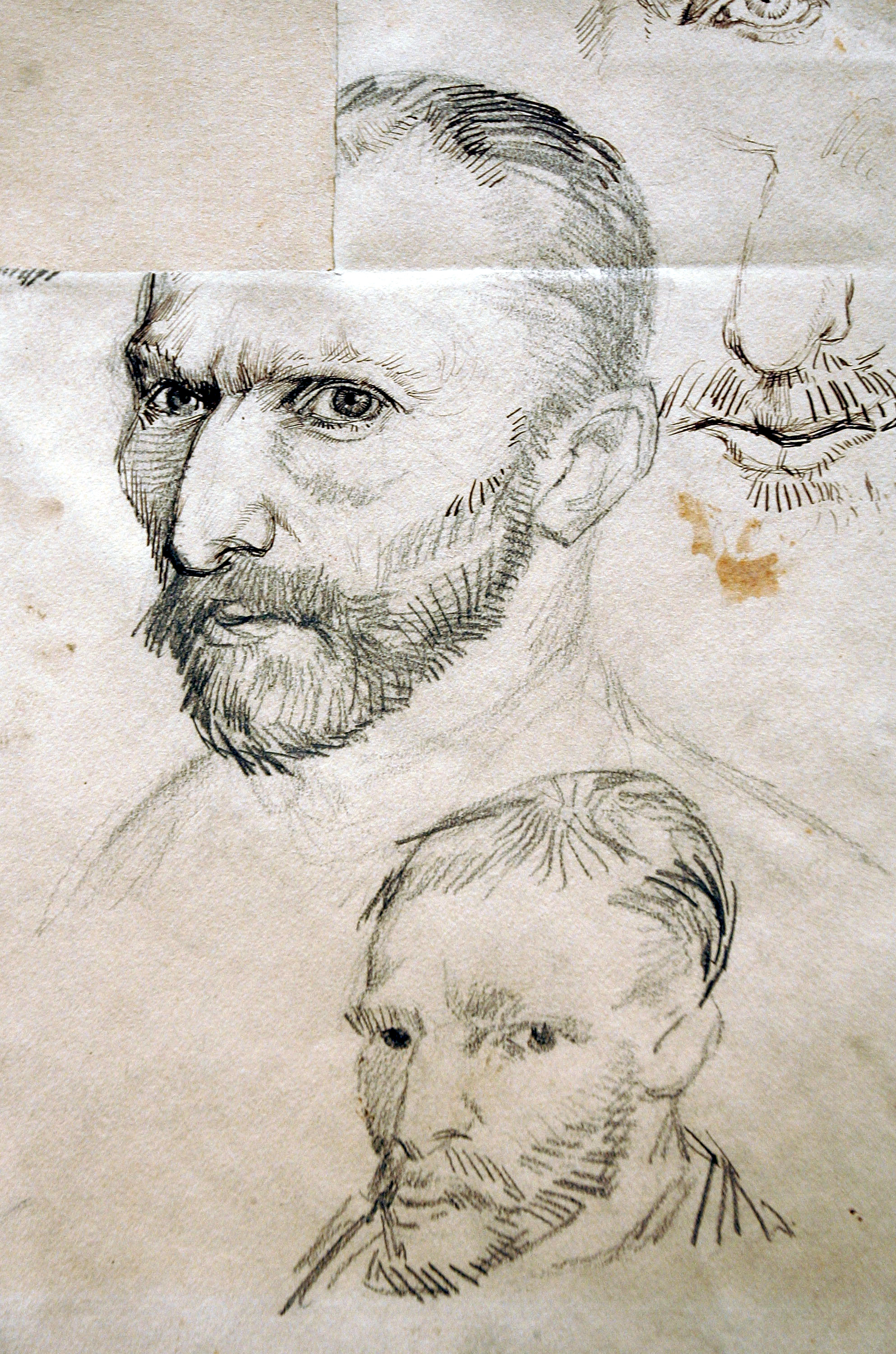
You can see it in the utter care and utter frenzy of the paintings and drawings of Vincent Van Gogh. (Really, in every artist, whether Titian or Joseph Beuys). Look at those lines of energy as Vincent draws cypress trees.

This is his recognition that every bush is the burning bush.

When I lived in Seattle, I often went to the Pike Place Market to buy bread. There was a small bakery whose only access to the public was a small sliding window behind which a wiry old woman with curly gray hair and skin an alligator would be proud of. She sat on a stool and would reach behind her to get what you asked for.

They had great rye bread, dark, yeasty, with a crust like a crustacean. We ate it with butter and chewed on it with gusto.

“What do you want?”

“I’m looking for the nastiest, darkest, heaviest, sourest, thing you’ve got.”

“You’re lookin’ at her,” she said.

I mention it because when I was growing up in New Jersey, the standard bread came wrapped in cellophane and had as much character as mattress stuffing.

Wretched stuff. Wonder Bread, Silvercup Bread, Merita Bread. “Builds strong bodies 12 ways.” I could never understand, as a kid, why people would call bread the “staff of life.”

And food writers wrote panegyrics to the stuff. But the bread I knew — and the only bread I had any experience of — was banal, pasty, tasteless, or when not completely devoid of flavor, redolent of the stale air of the grocery store.

I hated bread as a kid. I hated sandwiches, which only wasted good filling between insipid slices of inanity.

The greatest thing since sliced bread? I had to scratch my head. Bread wasn’t great; bread was boring.

Our neighbor, who was Italian, often praised bread. It was his favorite part of the meal.

“I always have to get another slice to wipe up the last of the spaghetti sauce,” he would say. “But then, I have to get some more sauce for the last bites of bread. It never comes out even.”

It was an idealistic quest for a universal balance to the universe.

But of course, it wasn’t Wonder Bread he was eating. Ethnic breads have always been available, to those who required them.

Things have gotten better in America. Baguettes – or something very like them – are available in many grocery stores, along with various ciabattas and focaccias, but the standard issue loaf of boredom is still the upholstery of the bread shelves in all the supermarkets of America. Bread with no crumb. How can you have bread with no crumb?

How different it was when I first went to France, a nation where the lack of decent bread could cause a revolution. Here was a people who valued the real thing. Whether it was a boule or a demi-baguette, a croissant or a brioche, the bread was full of character and taste.

But the real champ was the baguette. Who knew bread could taste this good. With a shattering crust and a light interior, it had a browned, crusty flavor.

Now, I’m not a complete tyro. Certainly in my adult years I got over my childish hate of bread. As a grown-up, I discovered New York bagels and bialys, and the real Kaiser roll, the kind that if you drop it, it can dent linoleum, and the perfect foil for piles of thin-sliced rare roast beef. And sour rye breads piled with pastrami.

America has its excellent breads.

I bake my own, which is wonderful hot out of the oven, with a melting square of ice-cold butter on it.

But I wasn’t prepared for the difference between even good American bread and plain, ordinary old French French bread. This was bread to give you orgasms. Flavor — no, flavors, plural — that range from lip to pharynx with a medley of sensations much as physical as they were chemical. The initial crunch led to a repertoire of smaller crunches inside the closed mouth, and then the teeth broke through the crust into the heart of the bread and felt the giving elasticity of the gluten. The aroma entered the back of your sinuses like the after-swallow of a good wine.

This was no bread to erase errant pencil lines with. This is bread to build an altar to.

Every morning, and every evening, you could see the lines of acolytes extending outside the boulangeries, waiting for their turn when the counter woman, or priestess, would give them their host.

And nothing in them but flour, water, yeast and salt.

One can float in rapture writing about the patisseries and boulangeries of Paris.

On one side of the door are shelves filled with some of the most scrumptious pastries: tart de framboises, tart de pomme, raisin horns, tiny chocolate tarts with a surface so deep and brown and so smooth you would swear they were varnished.

They pile high, with the more expensive and larger pies and cakes at the bottom, the slices of things for sale in the middle, and the individual pastries on the top: croissants, pain au chocolate, raisin pastry.

Behind the counter, baskets stuffed with baguettes, like arrows in a quiver.

You can see the process at the boulangerie at the south end of the Rue de Chaligny on the Right Bank. The bakers work behind glass, where you can see the boulangers themselves, working dough in 20-gallon bowls with industrial dough hooks. One pulls the dough out, cuts off a chunk with a kind of spatula, lifts it into a large plastic bowl on a scale, cutting off chunks or adding new to reach the proper weight, then hoisting the bowls onto a wheeled cart, stacked up, bowl on bowl, to take to the back for the rising.

Behind him another boulanger, a young man about 20, lines up the snakelike baguette dough on a large tray: 24 to a tray, eight snakes across, three lined longways. Then with a deftness of a samurai and the insouciance of a cabbie, he wields his knife and makes exactly eight diagonal cuts in each loaf.

Behind him are three or four flat ovens, rather like pizza ovens, stacked up.

He opened up the lowest door, takes a long peel, slides it into the shimmering heat and pulls out four toasty baguettes at a time, resting the spade end of the peel on a ledge of the oven, and pulling the loaves off by hand, one or two at a time, and dumping them vertically into a large basket beside the oven. He pokes the peel back in, pulling out another load and repeating till the oven is empty. He then moves to the next highest oven and repeats same; then the third oven.

When they were all empty, he takes the large slate of dough snakes and with a single move, slides them all into the oven at once, leaving their palette in the oven with them.

After a few minutes, he opened the door once more and yanks the palette out, the way a performer whips a tablecloth out from under a table setting, without disturbing anything: He leaves the loaves behind to cook, sets the palette back on its stand and immediately begins unloading new raw baguette snakes onto the palette with a flat piece of wood.

It’s an industrial process, perfected through years of repetition, making the perfect baguette. You cannot duplicate it at home.

The finished bread, of course, looked better than any bread an American could possibly imagine.

The staff of life.


I am in love with words. I think anyone who has made a living as a writer must feel something of the same.

But for me, it is not just the filial love one has for the mother tongue, it is the Tristram and Isolt, Abelard and Heloise sort of thing. I feel passion for some words — words that break my tongue across them, fill my cheeks as I say them — like “a strenuous tongue bursting Joy’s grape against its palate fine.” Talking, like eating, can be an erotic experience.

English is so rich, with its multiple inheritance from Celtic, Germanic and Romance languages, it might as well be chocolate.

“Chocolate,” by the way, was originally an Aztec word. English picks up its sexiness partly through its exoticisms.

Take “sexagesimal” from the Latin, “ketchup” from Chinese, “pajama” from the Hindi, “kiosk” from Turkish, “yam” from Africa, “alcohol” from Arabic, “berserk” from Old Norse. The language is nothing if not promiscuous.

French is called the language of love, but I cannot warm up to the sound of it. It is too smooth, all its edges are worn off. Italian and Spanish come forth in a torrent. Some languages flow out of the mouth like spring water, but English is chunky style; its consonants give texture.


Inconsequential coruscations

I think you can tell the true word lover from the showoff by which kind of word he chooses.

Take the late William Buckley. His vocabulary was immense, but I cannot take him for a genuine lover of English. He larded his prose with sesquipedalian hendecasyllables — a propensity for latinate neologisms and lexicographic arcana so impenetrable you would swear you were translating Vergil.

He was pure showoff. He abused the language, even when his words were ineluctably precise. There were times you have to sit back and admire his hot-dogging, but I no more believe it is love of his art that moves him than the bravura virtuoso who can bang out all the notes of a Liszt concerto without ever finding the music in it.

Another showoff is Lawrence Durrell. His Alexandria Quartet is a great piece of fiction, but I have always been unsettled by his insistence on dredging up tenpenny words.

In the first chapter of Justine, you can find “aniline,” “etiolated,” “pegamoid,” “adventive,” “lambence,” “ululations,” “exiguous” and “exigent.” To this day, I have never found “pegamoid” — or anything close — in any dictionary, no matter how unabridged.

You get the feeling he expended many hours of lucubration in the accumulation and exhibition of his erudition.


Words full of bone and bite 

But take Shakespeare. He uses more words than any other English writer. His vocabulary is huge — more than 22,000 words — yet, even when he is showing off, he is likely to stick to short ones.

The “To be or not to be” soliloquy from “Hamlet,” for instance, is 275 words long, out of which 222 are one-syllable. Whole lines go by with nothing but popping monosyllables:

“For in that sleep of death what dreams may come . . .”

“For who would bear the whips and scorns of time . . .”

In the whole speech, only 18 words are more than two syllables long, and only five are four syllables. Nothing longer.

Certainly, the Bard can sling out a “multitudinous seas incarnadine” when he wants, but the power of his speech comes not from Rome, but from English soil, where the short word has deep roots in Anglo-Saxon, Danish and Celtic antiquity.

The language offers such baroque concretions as “borborygmus,” “tintinnabulation” and “hemidemisemiquaver,” but what greater effect have “gurgle,” “clang” and “blip.” The crunch of such words on the teeth is sybaritic, more sensuous than their length in flat ink on a flat page.

Perhaps that is what I am most excited about: that language be recited aloud, that its physical reality in the mouth be remembered. That is hard to do when storing your prose on a thumb drive.

Perhaps if more people read their words aloud — and had the ear to hear them — there would be less bad writing published, and less bilge spoken by public figures.

My wife and I suffered a near-bear experience while camping in New Mexico.

Actually, I’ve had several near-bear experiences in my travel life.

The first was in Tennessee, when I was camping with a college buddy in the Great Smoky Mountain National Park. We were staying at Ice Water Springs on the crest line of the mountain range when a bear charged me. It was a young bear and I was photographing it and I guess it wanted to let me know I was too close.

In my defense, I must say, I did not approach the bear; he approached me.

But I was too close for his comfort nevertheless, so he turned and ran straight at me, loping from side to side as he did. You read about people saying their hair stood on end and I had always thought it was just a metaphor. No, it’s real. My hair stood on end. At the last moment, no more than two or three feet from me, the bear veered off and ran away.

I was so dumb, I actually stood there and snapped the picture.

My buddy, an old hand at camping, told me his secret for dealing with bears. “Just treat’em like a big dumb dog,” he said.

Years later, in Seattle, I got to know the bear-keeper at the zoo and I sometimes went with him to the back side of the bear cage at feeding time. The female grizzly bear loved to sock down a dozen or so hot dogs for a treat. I would toss them down her gullet, where they disappeared like raindrops in the ocean. A grizzly bear’s gullet is a prodigious thing.

Well, my wife has a thing for bears. She loves them. Every time PBS runs a nature program on bears, I have to videotape it. I don’t know how many times we’ve see the feature film The Bear.

And when we go camping, she is likely to walk to the edge of the camp ground and yell into the woods, “Here, Mr. Bear! Here, Mr. Bear!”

It actually worked once in the Canadian Rockies. Fortunately, we were driving at the time. We were in Jasper National Park and she had the window down, yelling for Mr. Bear. A grizzly showed up along the roadside and we stopped to enjoy his company for a while from the safety of our Chevrolet.

I’ve tried to discourage this practice in campgrounds, though, but she just suggests that maybe if she tied a string to a peanut butter sandwich and trailed it along behind her, she might attract one.

Visiting our friends in Maine once, my wife baked two coconut cream pies. A bear smelled them and came up to the house. He couldn’t get the pies, so he raided the bird feeder outside the kitchen window.

We named the bear Tupai for the two pies. Later, Tupai came back with another bear, looking for pie. My wife, who is an artist, made a paper cut of the event (see above).

Well, we were camping near Cloudcroft, N.M., in the Lincoln National Forest and in the middle of the night I was awakened by a noise outside the tent. There was a slow rummaging through whatever items we had left outside the tent. I looked over and saw my wife still asleep. My hair was standing up again.

My first thought was how I would protect my wife if the noise turned out to be a bear, and if the bear wasn’t satisfied with turning over the Coleman stove and water bucket.

The only weapon I had was a Swiss Army knife and I found it in the darkness and opened it in my sleeping bag. My plan was to attack the bears belly and try to find his heart with the blade. I knew it was a long shot, but I also believed it was my only shot. Big dumb dog, indeed.

Luckily, what really happened was that the sound went away and it was spookily quiet in the woods. I didn’t get much sleep that night and by morning I finally relaxed my grip on the knife.

Over breakfast, I told her the story and she broke out laughing. She had been awakened by the same noise and thought I was asleep. She went through the same reaction I had had and armed herself with a fingernail clippers, planning to save me from the beast.

It all reminded me of the old joke about two guys camping when a bear comes into camp.

“What should we do?” asks the one.

“Run for it,” says the other.

“You can’t outrun the bear,” says the first.

“No, but I can outrun you.

When you think of Los Angeles, the word “nature” comes to mind about as often as the combination of Genghis Khan and the word “delicate.”

LA is one of the world’s great cities, and one of the most artificial. It is all pavement and minimal, parking garage and chain store. I will cede LA no quarter when it comes to magnificence, but when it comes to nature, you’re barking up the wrong stop sign.

Or are you?

There is actually a lot of nature in LA, but like so much else in this sprawling, hazy, energetic city, it is sui generis — in a class of its own. And if you love LA and its artifice and unreality, then you may love its nature, too.

That includes the La Brea Tar Pits, the stuffed animals at the Natural History Museum, the concrete-lined Los Angeles River.

This isn’t nature all cute and cuddly like the nature films show. It is nature covered with graffiti, smelly with escaping gas, and turned into a simulacrum of itself.

But if you are in the right spirit, gravid with irony, there is a lot to love. Like the infamous LA River, a 50-mile-long concrete gutter paralleled by railroad yards, high-tension lines and freeways.

It provided the surreal landscape where giant ants built their nests in “Them!,” the 1954 sci-fi classic about giant ants.

It was also the racetrack for the great chase in “Terminator 2.” It can be seen as an integral part of the anomie in “Repo Man,” “To Live and Die in L.A.” and “Escape From New York.”

It is hard to imagine, but the river is the reason the City of Angels is where it is.

In 1781, the pueblo of “Nuestra Senora la Reina de los Angeles de Porciuncula” was founded on the banks of the free-flowing sweet-water river by Spanish settlers moving up from Mexico. That lasted 157 years, until the Army Corps of Engineers, reacting to a series of devastating floods, turned the river into a sluice, beginning in 1938. The river as we know it dates from then.

And what had been a common, nondescript — if pleasant — Western river became an icon for the city.

There are activists trying very hard to return the river to its natural state, and there are a few short sections — called “soft bottomed” — where the river is free from cement. One of the most pleasant borders the eastern edge of Griffith Park, paralleling Interstate 5 and its screaming-banshee traffic.

One has to admire the pluck of such civic-minded groups as Friends of the Los Angeles River, founded in 1986, but one also worries that all over the country, good-intentioned people try to change exactly those things that make their cities unique.

Like the tar pits.

Now part of the city’s Hancock Park, the remaining sticky-holes are surrounded by grass, trees and cute animal statuary. But the heart of the La Brea Tar Pits is the black asphalt, where countless Pleistocene mammals met their gummy end.

The pond at the entrance to the park, with its bronze elephants, is filled with water covered in a film of petroleum. In places a layer of tarry foam collects, and great bubbles of methane blub up like boiling oatmeal, filling the air with stink.

Researchers still are digging prehistoric bones out of the pits. There are more than 100 tar pits in Hancock Park, and Pit 91 is worked every summer, with an observation deck for visitors to watch the volunteers as they scrape goo from their findings.

You can see them below, tarred black and brown, with their shoes glued to the boards thrown across the excavation.

“The stickiness is part of the fun,” one of them says. “We wouldn’t be doing it if we didn’t enjoy getting sticky.”

The bones dug from the tar are stored and exhibited at the George C. Page Museum on-site, where you can see hundreds of dire wolf skulls, a reconstructed mammoth skeleton and the whole panoply of Cenozoic life from the LA area.

Farther south, you can see more animals at the Natural History Museum of Los Angeles County, one of those old, dusty antiquarian museums with high ceilings and marble floors.

The Hall of North American Mammals is a series of dioramas with the gems of the taxidermic art in situ: There are grizzly bears, bison, elk, weasels and Dahl sheep, all in amazing lifelike poses.

Ah, wilderness!

At the other end of the building is the Hall of African Mammals and a giant elephant at the watering hole.

This is show business.

There is also “megamouth,” a 14.5-foot male shark pickled in a bathtub of formaldehyde, which is always a favorite with schoolkids.

Nature lovers often are horrified by Los Angeles. The blue-white haze that leaves Angelenos wheezing and their eyes stinging. The pavement where chaparral should be. The ubiquitous power lines blocking the greenish skies.

But perhaps we simply have the wrong idea about nature.

If you want cute furry animals and fields of wildflowers, you’ve come to the wrong place. Try Maine, at the opposite corner of the continent.

But the Bambi vision is only one version of nature, and it is a conventional version, and LA is anything but conventional.

We should think of nature as anything that reminds us we live on a planet. That includes geology, climate, hydrology.

LA is a city inescapably bound up with the real effects of nature. LA is the city of earthquakes, mudslides, ozone and haze, the city of Santa Ana winds and wildfires, of mountain lions attacking joggers.

Despite its reputation, LA is all nature all the time.

That’s why I love the Baldwin Hills, a geologic bump south of Rodeo Road and north of Slauson Avenue. It is covered with pendulating oil rigs, like giant iron birds dipping their beaks to the ground for worms. Los Angeles is built over several oil fields, and these gritty iron industrial monsters are almost all that is left of what was once LA’s other great moneymaker.

You can see the landscape in the photos of Hollywood from the 1920s: It was a landscape prickly with stickleback oil derricks. It was a hell of industrial devastation.

But the oil under the rocks is also the source of the tar for the tar pits. And the geology that gives the oil also gives us the San Andreas Fault and the frequent earthquakes in the city. Small ones don’t even warrant a mention in the newspaper.

You look at the geology and you see the city built in a basin spreading like spilled ink on every flat surface south of the mountains.

There are the Santa Monica Mountains and Mulholland Drive, with its many turnoffs and vistas — smog depending.

And when the weather is clear enough, you can see the San Gabriel Mountains to the north, with peaks rising as high as Mount Baldy’s 10,064 feet and covered in snow as late as July.

If you take the Angeles Crest Highway north from La Canada Flintridge, you can drive the 20 miles or so to the Mount Wilson Observatory, where so much of the astronomy of the 20th century took place. It is at Mount Wilson that Fred Hubble first discovered the expansion of the universe, that the distance to the stars first was measured accurately, that the new science of astrophysics was developed.

The 100-inch telescope on Mount Wilson was the largest in the world from 1917, when it opened, to 1948, when the 200-inch telescope at Mount Palomar was finished. Some of the most aesthetically satisfying photographs of distant galaxies were taken at Mount Wilson.

If nature is about reminding us we live on a planet, Mount Wilson is a great place to start.

Or you could take a longitudinal section starting in San Pedro at the ocean.

The city begins in the sea, and at the

(1) Cabrillo Marine Aquarium you can see not only tanks of fish and invertebrates, you can walk out into the tide pools at the edge of Point Fermin.

Travel north on Hawthorne Boulevard and it becomes La Brea Avenue and takes you up over the Baldwin Hills, where you see the result of eons of squeezing and distillation on the ancient sea creatures that lived where LA now sits: the pumps that extract the oil from under the ground. The Baldwin Hills also are the home of the

(2) Kenneth Hahn State Recreation Area, where, in 1963, subsidence caused by the extraction of oil triggered an earthquake that breached the dam of the Baldwin Hills Reservoir and sent about 250 million gallons of water down on the city, destroying 277 homes.

Nature is always an instructive teacher; we are not always such attentive students.

A side trip to the east takes us to the

(3) Natural History Museum of Los Angeles County, where the exhibits range from pickled fish to dinosaur fossils.

Back on track, headed north, there are the

(4) La Brea Tar Pits in Hancock Park, with its

(5) George C. Page Museum of prehistoric finds, one of the uniquely LA natural landmarks.

Further north, there is LA’s

(6) Griffith Park, with golf courses, riding stables and picnic tables and the famous Griffith Park Observatory and the LA Zoo. The LA River shoulders the edge of the park, with one of its more attractive stretches.

(7) Mulholland Drive heads west atop the Santa Monica Mountains, affording views of Los Angeles to the south and the San Fernando Valley to the north, with frequent vista stops along the way.

If you stop at

(8) Laurel Canyon Park, along Mulholland Drive, you can get out and hike along hillside trails and enjoy all of the other hikers with their dogs. But starting at the park, you also can drive down the little-traveled Laurel Canyon Drive back to Hollywood Boulevard and get an intimate look, among the homes, at the city’s geology.

Take the Glendale Highway north to La Canada Flintridge and visit the beautiful

(9) Descanso Gardens, with its forests of camellias, lush rose plantings, California chaparral section and Japanese Gardens. This is nature the way we usually think of it.

Then continue north on the Angeles Crest Highway for 16 miles to the

(10) Mount Wilson turnoff, and another five miles up mountain roads to the great observatory, where you can look north into the wilderness of the San Gabriel Mountains and contemplate how the city sits at the feet of such glory.

Or you can look south and see the smog.

There are two pieces of music that never fail to set off the waterworks in me.

I’m sure we all have some signature tune that turns us into maudlin fools crying into our beer.

Lots of music can have that effect, when you’re in the right mood. Mozart is full of such tunes. No one ever wrote about the forgiveness of human foibles like Mozart. It isn’t only in his “forgiveness arias,” but the same tone of music turns up in piano concertos and wind sextets. He had some tap into divine understanding.

When I’m in the right mood, Mozart wells up in my throat. But heck, if I’m really depressed, Stars and Stripes Forever can set me off.

But I’m talking about something that doesn’t require the right mood to work.

Anyone playing Shenandoah, for instance. I don’t care what the arrangement. You can play it on a chorus of kazoos and trombones. You can play it calypso style on steel drums — the moment I’m transported “across the wide Missouri,” I’m reduced to a blubbering mass.

Clearly, I’m responding to some sort of deep seated nostalgia, some trauma of childhood or failed romance. But strike up the tune and I’m like some drunk in a bar yelling “Play Melancholy Baby.”

Actually, I know what it is with Shenandoah: I know the Shenandoah River and the great valley it troughs through in northern Virginia, heading north to join the Potomac at Harper’s Ferry.

It is an especially beautiful river, and only more so on a cool autumn morning when a low fog hangs over the water and the sycamore trees along its banks seem to grow out of white nothing.

The Shenandoah Valley separates the Blue Ridge in the east from the great ridges of iron- and coal-laden mountains to the west. The river rises in twin forks, one on either side of Massanutten Mountain, which rises like a long, low bread loaf in the middle of the valley.

I used to live in the Blue Ridge; I have just moved back. It was the most beautiful place I ever knew. I missed it.

And when the song says, “I long to see your smiling valley,” I knew just what it meant. “Tis seven long years since I last saw thee,” the song continues. It was 25 years since my wife and I lived in the Appalachians.

We lived in Arizona, which has a beauty all its own, but is different from the Blue Ridge. And when the song reaches its climax, “across the wide Missouri,” I knew that I was on the wrong side of the Missouri, too, in a kind of self-imposed Babylonian captivity.

“By the waters of the Rio Salado, there we sat down, yea, we wept.”

The song speaks to me — as it does to so many other people — of that lost Eden we know we can never regain.

And so, I blubber.

But that second tune that sets me off is something different.

It is Christoph Willibald Gluck’s Dance of the Blessed Spirits.

Gluck was a Czech-born composer of the 18th century who rebelled against the ornate and conventional opera of the time. His opera, Orfeo ed Euridice, tells a simple myth in simple music. Almost too simple.

Two set pieces from that opera still are widely known. The Dance of the Furies was used behind the chase scene in almost every Hopalong Cassidy movie ever made. In those “B” Westerns, budgets didn’t allow new music, so they played old classics behind the action. The music was loud and furious.

But Dance of the Blessed Spirits was something else: quiet, almost  static, and with the grace only utter simplicity can convey.

Two flutes play the song-like melody over the accompaniment of strings. Chords change slowly and never stray from simple diatonic harmonies.

And when the tune’s first phrase reaches conclusion, it stretches out in a feminine ending, a slow suspension off the beat. Nothing is insistent in the music, but rather, like the Grecian maiden on Keats’ urn, it seems suspended in time, permanently in a state of grace.

I melt when I hear it.

But its power comes from the same kind of emotion that drives Shenandoah: a sense of loss and a sense that somewhere there is an Eden where spirits are blessed.

Yet the tunes are very different, too. My reaction to Shenandoah is personal, very personal. Its power — for me — comes from my biography. I don’t expect everyone will react the same way.

The Gluck, though, has a more ritualized, formal power. It comes from its stylization.

For Gluck was aiming not for biography, but for the universal.

Art’s emotional wallop often comes not from its literal portrayal of raw feelings, but from the Apollonian distancing and formalization of those feelings. By understatement, it draws up a skeleton that we flesh out with our own experience.

The so-called Romantic artist often fails to exactly the extent he overplays his hand. Such an artist wants us to feel his feelings.

The Classic speaks not of his personal emotion, but of human emotion. Hence, they are our emotions.

In other words, when I hear Shenandoah, I feel the turns my life has taken; when I hear the Gluck I weep for the inescapable lot of humankind. The one traps me in my ego, the other frees me from it.

This is the power one feels in Homer, in Joyce, in Flaubert. It is the reason Haydn is still played along with the more personal Berlioz.

And it is the power at the end of Beethoven’s immense Diabelli Variations, those 32 monumental changes on the “cobbler’s patch” waltz sent to Beethoven by music publisher Anton Diabelli, who asked the great composer for a variation he might publish.

Through those variations, Beethoven dives deep into some of the most personal music he ever wrote, with adagios of desolation and pathos, culminating in a clattering, raging fugue that is as hard to listen to as to play.

But he winds up in Arcadia, just like Gluck: His final overwhelming variation is a dignified minuet, which takes all the terror and anger, all the humor and misery of the previous 31 variations and sublimates all that personal angst into an Olympian, stylized dance.

It is this ritualization of the overwhelming emotions that make those emotions important: The personal is mere autobiography. The ritual dispenses grace: the freedom from ego.

It is why our most important thoughts and feelings are turned into meter and rhyme, why our bodies move to the numbers of choreography, why the novel is the “bright book of life.”

And why art matters.

How many sides does a triangle have?

Don’t be too quick; it’s a trick question.

Usually, math is not thought of as something where you can have opinions over answers. It’s one of math’s most reassuring qualities.

But that doesn’t mean there aren’t alternative views. Artists’ math, for instance.

Artists have a different way of counting, of doing arithmetic and of contemplating geometry. It’s what makes them artists.

For an artist, one plus one equals three. It is a very clear formula: There is the one thing, the other thing, and the two together — a knife, a fork and a place setting. Three things.

And a triangle has five sides. There are the normal three, and then the front and back. You can turn any triangle over from its back and lay it on its belly.

Computer programmers talk about fuzzy logic as if they discovered it.

It is artists who wake up each morning in a Gaussian blur, after all. It is artists who first understood that all numbers are irrational numbers.

The primary difference between a mathematician’s logic and an artist’s is that the artist is unable to leave the world behind: The mathematician, the logician, the philosopher deal in abstractions; the artist deals in plums.

The artist lives in a world of things. Real things: palpable, noisy, smelly, difficult and beautiful. He mistrusts any answers not rooted in them.

The sentimental view of artists has them constructing “castles in the sky,” but the artist scratches his head over this, because to him, it is math and philosophy that are constructed out of air.

“No ideas but in things,” wrote poet William Carlos Williams. Like the plums that were so cold and so delicious in his poem.

Don’t get me wrong: One should not dismiss the practical world out of hand. It is good to know how to balance a checkbook, and artists’ math does not carry much clout with the bank.

I know, because my wife, who is an artist, uses something she calls “gut mathematics.”

But she also knows, as a banker usually doesn’t, that the shortest distance between two points is a leap of the imagination.

She also knows that three is more interesting than four. It just is. Ask any artist.

And when an artist talks of pie charts, she wants to know if it is cherry or lemon meringue.

Like the old math gag: “Pi R square.” “No, pie R round, cake R square.”

It’s fun to joke about artists’ idiosyncrasies, but there is a serious side to all this.

When we see yammering faces on TV shouting each other down over ideology, the artist is the one who can remind us that the world isn’t made up of theory or system, but is made up of hubcaps and clamshells. Ideology means very little to an asparagus.

The world falls into peril every time a system denies physical reality. It is abstractions, after all, that fueled the Cold War, abstractions that justify suicide bombing, the theory that built Auschwitz.

Artists remind us of flannel, of smoke, of mud. These are the things we share with our family and our friends. These are the things that ultimately count.

No ideas but in things.

It reminds me of a line written by the poet Tom Brown:

“The more perpendicular a line is to a curve,/ the more it is an orange slice.”

The field was green, the sky was blue, the chalk lines were white, and the announcer was Red Barber.

This was heaven for baseball fans in midcentury America, as the Ol’ Redhead crooned his way through nine innings of the game that defined the country, providing play-by-play that we recognize now was more poetry than prose, more evocation than flat fact.

“Preacher Roe is sitting in the catbird’s seat,” Barber would say in his smooth Florida drawl, as the count was 0-2 and the score was 6-1 in the ninth inning.

Red Barber was bringing poetry to an audience that, more than likely, would never pick up a volume of Shelley or Milton.

It was a style of talking one cannot imagine accompanying Monday Night Football, for although football is a fine sport with lots of excitement, it does not provide the deep soulful resonance that baseball does.

That is because football is just a sport. Baseball is life.

This is why there are so many great baseball novels and movies, and why there is memorable baseball verse by Walt Whitman, Marianne Moore and William Carlos Williams — all major-league poets.

“Baseball is ballet without music, drama without words,” said another announcer-poet, Ernie Harwell.

Football and basketball together would have to dig deep to find a tenth of the literature that wells up naturally from baseball. Of all major sports, only boxing carries with it the metaphorical punch of baseball.

It is ritual: Each batter re-enacts the motion of the heroes that preceded him. It is not necessarily religious, despite the monologue of Annie Savoy in Bull Durham, but it’s the repetition of solemn rites: the tapping of the bat on the plate, the pitcher’s windup, the pantomime of signals from the third-base coach.

It is drama: Like a play divided into acts and scenes, a game is divided into groups of threes: early, middle and late innings, and in each inning, three outs, and in each at-bat, three strikes. There is an aesthetic symmetry at work, like the formal plan of the best theater.

And each subset of the game has its own exposition, crisis, climax and denouement. Each pitch, each at-bat, each inning, each game, each homestand, each season, each career, and the whole long toss from Abner Doubleday to this year’s rookie. Wheels spinning within wheels.

It is poetry: Each game has its own rhythm, and there is the rhyme of inning-couplets. It is poetry, too, in the grace and beauty of the slide into second base, the suddenness of the unassisted triple play, the conjunction of time and space that meets for the play at the plate.

“Man may penetrate the outer reaches of the universe, he may solve the very secret of eternity itself,” said baseball’s greatest owner, Branch Rickey, “but for me, the ultimate human experience is to witness the flawless execution of a hit-and-run.”

It is history: Part of this is the historical hold baseball has held on the American imagination. If it is losing its grasp in the new century, for the past century, baseball was America.

But it is also the fact that baseball’s gaze is the long gaze over decades and centuries. In football, every new hotshot is a headline. In baseball, every accomplishment is measured against Ruth, Gehrig, Mays, Musial, Williams. There is a continuity in baseball that rivals continuity of genealogy or language. Football may keep us in the moment; baseball connects us with the past and reminds us that we are sons as much as we are fathers. Granddaughters as well as grandmothers.

But more than that, baseball is a metaphor for life.

“It’s about entering the game young and innocent and leaving older and wiser,” says Arizona Republic columnist E.J. Montini. “That’s what baseball has that football never will.”

Or, as the greatest baseball poet said — that would be Vin Scully, longtime Dodgers announcer — it has “the mathematical precision of the game moving with the kind of inevitability of Greek tragedy. With the Greek chorus in the bleachers.”

What makes it Greek tragedy, too, is its acknowledgment of failure. Baseball is the game where the best players are expected to fail two out of three times. There is doom in the game.

“If you play this game 20 years, go to bat 10,000 times, and get 3,000 hits, you know that that means? You’ve gone 0 for 7,000,” said all-time hits leader Pete Rose.

“Baseball is a lot like life,” said one-time Mets secondbaseman Ron Kanehl. “The line drives are caught, the squibbers go for base hits. It’s an unfair game.”

Cubs fans and Red Sox fans aren’t the only ones who have learned to live with years of disappointment; it is the nature of the game.

“Baseball breaks your heart,” wrote baseball’s intellectual commissioner, the late A. Bartlett Giamatti. “It’s designed to break your heart.”

Giamatti wrote poetry. Can you ever in your wildest imagination conceive of former NFL president Pete Rozelle doing so?

Talk of breaking your heart, is there any moment in sports more wrenching than Lou Gehrig’s farewell speech: “Today, I consider myself the luckiest man on the face of the earth.”

This is the stuff of tragedy. Life, death.

As Scully once said, “It’s a mere moment in a man’s life between the All-Star Game and an old-timer’s game.”

It is important to note that Barber or Harwell or Scully never, ever, seemed like they were trying to write poetry. Their figurative language and metaphorical approach is the natural language of baseball.

In the ninth inning, as the great southpaw Sandy Koufax worked toward his perfect game in 1965, Scully’s play-by-play caught the teeth-gnashing excitement of one of sport’s mightiest accomplishments in a masterpiece of wordcraft. It has been anthologized many times, and it was a first draft, live, extempore: “There’s 29,000 people in the ballpark and a million butterflies,” he said.

You can read and re-read Scully’s account, the way you can read and re-read a favorite sonnet.

It is only natural, then, that writers, playwrights, painters, sculptors, poets and above all, filmmakers have turned to baseball. It is all there, waiting to be mined.

“Is there anything that can tell more about an American summer than, say, the smell of the wooden bleachers in a small-town baseball park, that resinous, sultry and exciting smell of old dry wood,” wrote Thomas Wolfe.

Or as eventual Hall of Famer Rogers Hornsby answered when asked what he does in winter when there is no baseball:

“I’ll tell you what I do,” he said. “I stare out the window and wait for spring.”

It takes someone really whip-cracking smart to be so dumb.

I remember the first time I lived in the Blue Ridge Mountains of North Carolina, and spring morphed into summer and there was the kind of glory only a Dante could describe, and a friend of mine came to visit to see the spring wildflowers.

He was one of the smartest people I’ve ever known.

The wildflowers in Ashe County are lush, blinding, thick — the planet in rut.

But he went from patch to patch in an abandoned apple orchard with a Peterson’s guide in hand, checking the flowers off as he named them – Claytonia virginiana, Rhododendron nudiflorum, Trillium erectum. The quicker he identified them, the quicker he could get on to the next specimen.

We ID’d more than a hundred flowers in one morning, but didn’t see any of them.

I notice the same phenomenon every time I visit an art museum. People walk from picture to picture, identify what the picture is and move on to the next one.

First-timers name the pictures by subject – ”That’s a horse, that’s a tree.” More sophisticated types name the artists – ”That’s a Degas, that’s a Borofsky.” The really educated may name the style or era. But whatever level of education they bring to the work, the result is the same.

They have not seen the art.

‘Only a sunfish’ 

I remember the anecdote about the Swiss-American scientist Louis Agassiz and his hotshot graduate student.

One day, Agassiz put a fish down in front of the student and asked him to describe it. The student said, ”That’s only a sunfish.”

Agassiz said, ”I know that. Write a description of it.”

So the student came back with the scientific name for a sunfish. The scientist told him, no, describe it.

So the student wrote a four-page essay, covering everything that could possibly be known about the fish. Agassiz told him again to look at the fish.

As Ezra Pound relates the story, at the end of three weeks, the fish was putrid, but the student finally knew something about it.

Learning to see is hard work. We are not trained to see in this culture, but to make decisions and solve problems. When just enough information has been gained to make a good — yet quick — decision, we move on to the next problem, like the next painting. It is the mark of a good executive.

But seeing is much more than that. And it requires more time and effort. And it requires that the result of the process never be made more important than the process itself.

Imagine telling a corporate VP that the point of being in business is not making a profit, but the pleasure of committee meetings and phone calls. He will look at you like you’re an idiot.

But this is art, not business. In art, the profit is in the process.

When you go to the museum, don’t check paintings off on your ”life list,” but rather, spend an hour — a full hour — looking at just one painting. Come back another time to see a second painting. The museum’s not going anywhere.

Time to really see 

Here’s good practice: Stare at an apple for an hour. I dare you.

An apple is simple, available and familiar. But have you ever looked at one?

Put it down on the table in front of you when you are alone, and without any music or the TV on. Concentrate.

”I see it,” you say. ”It’s an apple.”

Bingo, you have named it, and you are immediately bored by this whole exercise. You want to get back to your e-mail or iPhone. Keep it moving, you say. “I don’t want to be bored.”

Good. You are supposed to be bored. Boredom is your friend. It is life’s great teacher, perhaps its only real teacher.

You have bottomed out with boredom.

Keep staring. Your brain won’t let you remain bored for long. You will break through the boredom and will begin seeing things you hadn’t noticed: An apple isn’t red, for instance. It is purple, yellow, green, blue, white and red. The colors are not on the surface of the apple but at different depths. The red seems to lie on top of the yellow. And all colors are under the thin layer of shiny cuticle. The surface of the apple is a pool your eye can dive into.

The ‘discovery’ level

The colors tend to run in streaks from top to bottom. The streaks break up into spatters of tiny dots of color, like airbrushing.

Hundreds of yellow dots cover the darker red like nighttime stars. In this case, the yellow seems to lie on top of the red.

The apple isn’t smooth and shiny, but has a lot of tiny flat spots on it, and the dimples at top and bottom are matte rather than glossy — actually seem to be covered with dust.

There is a navel at the bottom, amongst the four or five bumps that the apple sits on. It is filled with the remains of the sepals that originally protected the flower bud.

If you tap the apple, it thumps with a particular pulpy resonance that only an apple can make. And there is that multilayered apple smell.

This ”discovery” level is good for several minutes, as you get past the verbal level and pay attention to the apple.

But you reach boredom again. Good. You’re supposed to — again.

Keep staring. There are many more levels to reach. They needn’t follow the order I’m giving here. Everyone’s reactions will be different. But you have to trust your own boredom.

At one level your brain begins to wander, even as you concentrate. It will glue associations to your apple. You may remember Eve and Adam, New York City, the Beatles, apple bobbing, William Tell, Snow White, Atalanta, selling apples in the Depression, Isaac Newton, worms, an apple for the teacher, Alar, keeping doctors away, waxed fruit on top of the TV, the Osmonds singing “One Bad Apple.”

Or you will create constellations from the star-dots. Or count the number of lights in the room by the number of specular reflections on the apple.

You may start writing your own story about an apple.

But eventually, boredom returns. There is surely nothing else to see.

Keep at it. At one point the apple will disappear. Literally. The process of retinal fatigue will make the apple invisible. Twitch your eye just a hair, and the apple pops back into view. Stare and it fades, twitch and it pops back.

This eventually becomes only a party trick and you are bored once more.

A verb, not a noun

At another level, you will recognize that the apple is only a freeze-frame in a continuous process. Looking backward, you see the sepals at the apple base turn back into a blossom, back into a bud. In the other direction, the fruit browns, rots and frees the seeds inside.

Those seeds grow into sprouts, the sprouts to saplings, the saplings to trees. The trees flower, the flowers fruit, the fruit ripens and falls. Humans are born, they grow up, they have children, grow old and die, leaving the children to have children.

You recognize that nature is not a noun, but a verb.

An apple is not a Platonic “thing,” but a Heraclitan flux, always changing from one thing to another. Staring at the apple, you see the whole thing spread out like time-lapse photography.

Near the end of this exercise, when all your normal conscious functions have bugged out, unable to take the boredom, the apple may begin to glow from inside. Every electron in every atom vibrates.

This is the Blakean level, the mystical level. It is at this level that revelation occurs. If you can hold on to it, the entire world alters, not just the apple.

It is this level Dylan Thomas means when he writes, ”fire green as grass.”

This is the level of the art we as a culture most admire: Beethoven’s Ninth, Van Gogh’s sunflowers, Dante’s Paradiso, the second part of Goethe’s Faust.

”If the doors of perception were cleansed every thing would appear to man as it is, infinite,” wrote William Blake.

It is the point you realize that every bush is the burning bush.

Whether it is mystical revelation or merely hallucination hardly matters. It changes the way you see an apple.

And is there a boredom beyond that — a mystic’s boredom?

If there is, I suspect it is broken through also, and probably by the Zen state: The apple turns back into an apple.

But a very different apple.


I watched a filthy video the other day. It was made by my twin 12-year-old granddaughters. They made a video with their iPhones, a giant doll house and a bunch of their dolls. The scenario was not unusual, but the dialog was filled with four- and 12-letter words, often tangentially referencing the sacred institution of motherhood, and it was hilarious.

I doubt they understood most of the words they studded their screenplay with, and sometimes the words were used in ways that didn’t actually make sense. But they are words they have heard and words they understand are not used in polite company. Their mother has given them permission to use such words once a week on “Cussing Day.” It gets it out of their system. We hope.

At any rate, they reveled in them, spitting them out in the voice-over dialog like tobacco shots into a cuspidor. It was simultaneously shocking and cute. Mostly, it was funny.

But it made me worry about the state of cussing in America.

From bumper stickers to sitcoms, America is suffering an epidemic of nasty language. It is on TV, on ”shock” radio, in every best-selling novel. Stand-up comics make their reputations with it. From Nixon transcripts to Dick Cheney on the Senate floor, you can hardly escape a herd of discouraging words.

What is discouraging is not the words themselves, which are wonderfully functional, but the dilution of overuse.

Four-letter words are a treasure of the English language. They have the abrupt, plosive power of Anglo-Saxon, the redolent, atavistic force of Stone Age life breaking out of the grave to horrify the faint-eared. They are ruddy survivors of that time before the Latin invasion of the language in 1066.

Our language needs the ability to shock, and our four-letter heritage has done an admirable job until recently. Now they are endangered.

No, they are not dying out, like some verbal snail darter; they are everywhere, but they are enfeebled. When mothers show up at K mart trailing a half-dozen kids all in T-shirts with four-letter slogans printed on them, those slogans no longer mean anything. They might as well say ”Drink Coca-Cola.”

In their way, four-letter words are sacred. They need to have the awe of taboo around them. If a good, punchy epithet doesn’t make the ears of a schoolteacher turn red and heat up in embarrassment, what good is it?

Historically, it’s the difference between Lenny Bruce and Andrew Dice Clay. Bruce meant to shock you with his four-letter punch lines. He was making a point with them.

For Clay, the expletives were little more than shibboleths, letting you in his ”club.” And they don’t shock, they glut. After five minutes, you no longer hear them; they disappear like so many ”uhs,” ”likes” and ”y’knows” — the background noise of not-very-articulate conversation.

When George Carlin used those words, they had bite.

In this, the fate of the rougher language of our mother tongue has become much like that of organized religion: What once engendered the fear of eternal damnation now has become for some a Sunday social club and for others a 12-step program for ‘getting in harmony with the universe.”

When the deity begins to sound like Andrew Weil and an undeleted expletive cannot scare even little children, what power is left in the universe?

Yet, we will always have expletives: There is a primal need for them. But if we lose our Anglo-Saxon linguistic heritage, we will be forced to use Latinized, bureaucratic curses.

To forestall that, we need to conserve what juice is left in our swear words.

As for me, I would like to see less obscenity in American culture, not because I want to offend less, but because I want to offend more.