Miami, Arizona

Miami, Arizona

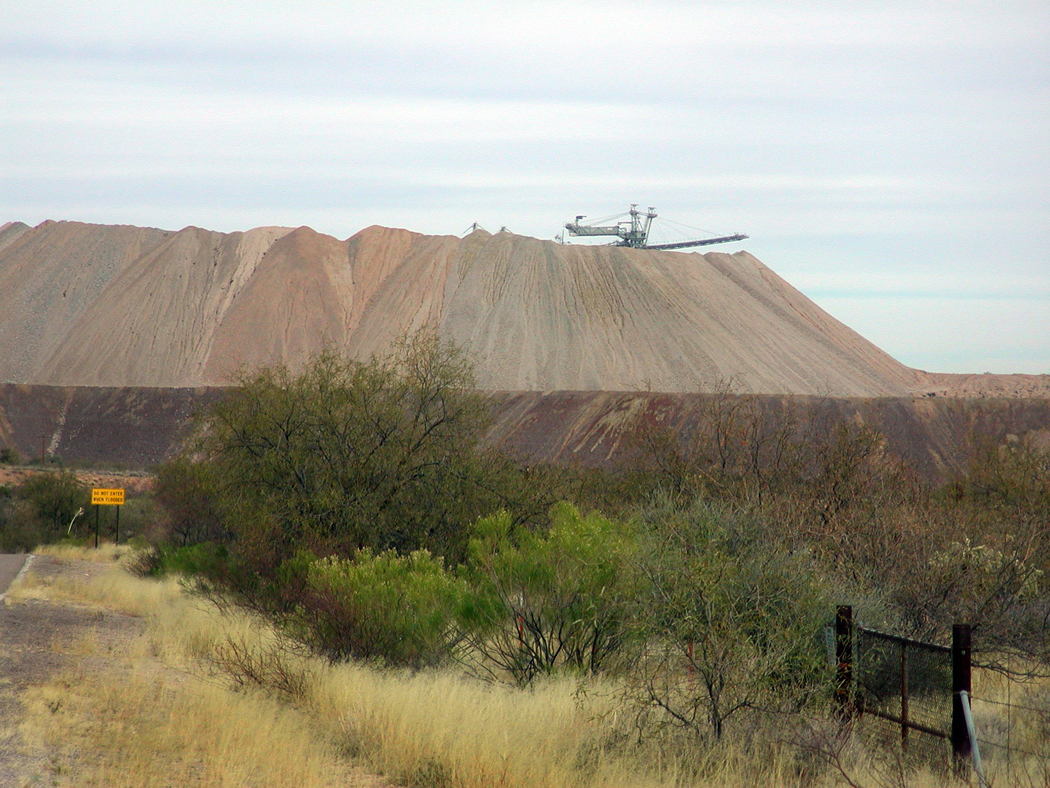
Many decades ago, when I first came through Arizona, I passed through a landscape so surreal that after I got home, I could not be sure, when I went back to my job in Virginia, that I had actually seen what I had seen: mountains and mountains of grayish-tan gravel, in a town so beaten down, so weathered, so spavined and dried out, that could not be sure that I had not dreamed the whole thing during a nap after an ill-advised meal of rarebit.

When we finally moved to Arizona, I rediscovered Miami-Claypool and it lost nothing of its Twilight Zone weirdness. To those of us not familiar with copper mining, the thought that humans could build cordilleras of utter waste — post-apocalyptic poetry — was hard to credit. Part of me wanted to live there. Nothing could possibly feel day-to-day, ordinary, or boring in such a nerve-frayed landscape.

Superior

Superior

If you drive east from Phoenix, out past Mesa, past Apache Junction, into the desert past Florence Junction and climb up into the hills, you will find a string of mining towns, mostly abandoned or dying, or hanging on by their fingernails, beginning with Superior. It was one of the locations for the 1997 Oliver Stone film, U Turn, and it feels like it could have been dreamed up by a Hollywood set designer. In 2005, a sci-fi film called Alien Invasion Arizona was filmed there. It isn’t quite a ghost town, but you could easily place a season of The Walking Dead there.

Superior Kellner Ave

Superior’s biography is like so many copper towns in Arizona part of a history that almost no one thinks about. It is an industrial history, full of smokestacks and labor disputes, and fills in the space between the six-gun Old West of popular mythology and the modern and often banal state of tourism and retirees.

Superior AZ Mission Cola

Unfortunately, it is an industry that cycles with the international market price of copper: The price plummets and Arizona mines lay off workers and shut down. If the price recovers sufficiently, the mines start up once more. Mine-worker families face an uncertain life.

Superior cliffs

Superior cliffs

The history of Arizona’s mining towns is generic. Whether it is Bisbee or Bagdad, Morenci or Globe, there is a familiar tale, altered only with variations on the tune.

For each, it begins in the 1860s or ’70s, when an army officer or a prospector picks up a rock and smiles, recognizing it as ore. Usually, they were looking for gold. Often what they got was copper. Then there is a period of individual prospecting, usually ending in bankruptcy all around. Then, financiers from New York or San Francisco add capital and mining picks up on an industrial basis. Towns spring up, usually shanty towns precariously perched on gravelly hillsides near the mines. During boom years, the towns grow. Wood is replaced by brick; large hotels are built and streets are paved.

One company buys out another until huge corporations are formed with names like Phelps Dodge  and Magma.  Ultimately they become multinationals with many interests beyond copper.

Between the wars, the underground mines are largely replaced by the great pit mines, man-made miniature Grand Canyons of ore-dig.

Morenci

Morenci

But then, after boom years and some bust years, the mines play out or are flooded or copper prices fall and the towns surrounding the mines die out.

Or, in a few cases, they persist, either as mining persists, as at Morenci, or as the towns find new purpose as tourist destinations, such as Bisbee, or county seats such as Globe.

But the past also persists, and those interested in this forgotten past of Arizona can still visit many of the best locations.

Mining hit Superior in 1870  when silver was discovered and the Silver King Mine  became one of the richest silver mines in Arizona history. But in 1912,  Boyce Thompson  bought the mine, formed Magma Copper and the area became one of the great copper mines. The smelter closed in 1971;  the mine remained in operation until 1982.  The mine has sporadically been worked since, depending on copper prices. But Superior, taking a cue from Bisbee and Jerome has tried to position itself as a tourist location. The wooing of Hollywood has been part of that resuscitation and the town has its own film board.

Hayden

Hayden

South of Superior, are mines at Mammoth and Kearny and Hayden, home to the ASARCO  smelter complex, which services several of that company’s state mines. It is rich in mining history, and union grumbling is still part of the town: One abandoned building has “Union Yes! Forever” painted on it, with one of the “Ns” in “Union” painted backward. The first parts of the plant were opened in 1912,  and now it covers 200 acres  with a smelter smokestack 1,000 feet  tall. Nearby Winkelman  and Kearny  are worth seeing, also, and the now-closed San Manuel  mine is several miles south near Mammoth.  The tell-tale tailings ridges run for miles.

ASARCO’s big open pit Ray Mine is 22 miles  south of Superior on Arizona 177.  The Ray Complex  covers 53,000 acres  and is the second largest copper mine in Arizona. There is an overlook off the highway that affords an unofficial peek at the mine.

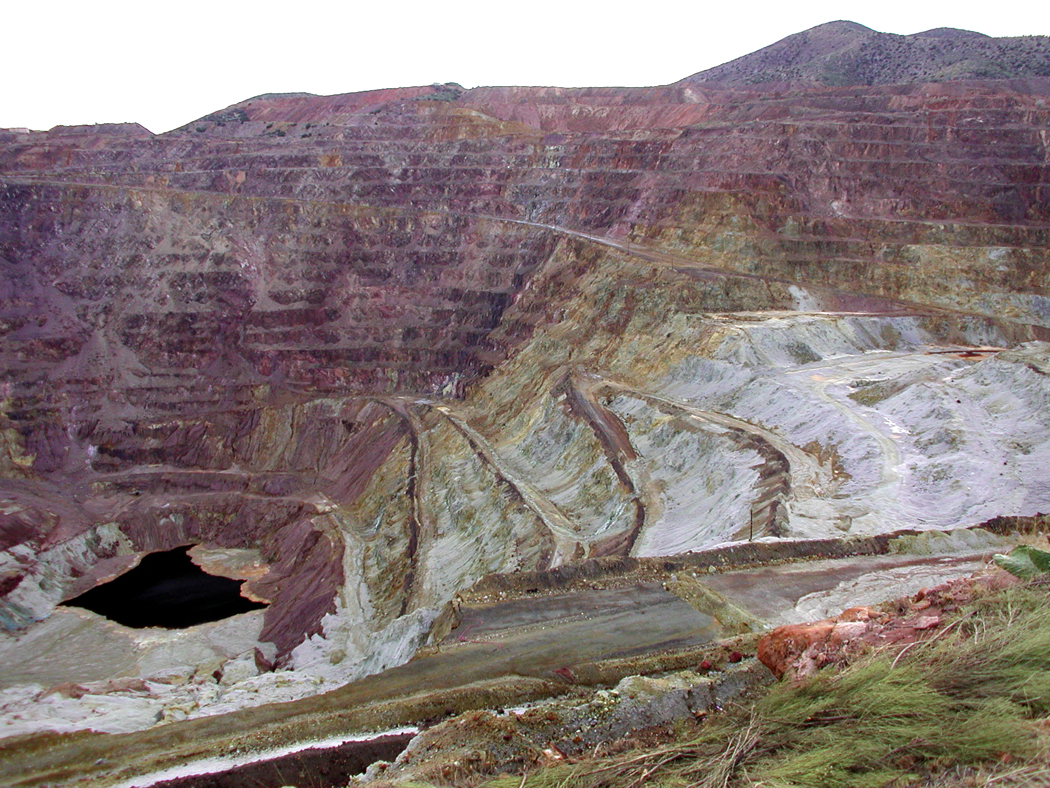
But this is a detour. Back to Superior, and driving east up into Queen Creek Canyon and beyond to Miami-Claypool and its veritable Himalayas of detritus, where you will see what will be, depending on your esthetic sensibility, either a great warning of industrial environmental depredation, or an awesome visual wonderland, an eruption of surrealism in the middle of the quotidian.

Miami

Miami

The town looks like it was dropped as litter from some passing god’s chariot, scattered on the hillsides to either side of U.S. 60.  The smelter smokestack rises to the north, over the black drapings of slag across one tan tailings hill.

Bloody Tank Wash, Miami

Bloody Tank Wash, Miami

The town is younger than most of the mining towns in the state. In 1909  the Miami Copper Company  began operations on the hills beside Bloody Tanks Wash.  For a while, it was a rival to Globe, where the Old Dominion Mine  was one of the biggest producers. But Globe ceased being a mining power in 1931  when the mine flooded, and Miami became the center, not just of mining – several mines are nearby, including the Pinto Creek open pit – but the major smelting location for Phelps Dodge.

Now, the townsite, with its bridges over the wash looking like Venetian canal bridges gone terribly wrong, is home to many antiques stores. Unlike many old mining towns, the industry is in full swing, and the mines and processing plant prosper and wane with the price of copper.

San Carlos Lake

San Carlos Lake

Past Globe you enter the San Carlos Indian Reservation. Take a right down to Coolidge Dam and San Carlos Lake. Monuments to civilization are always so much more compelling when they are stuck in the middle of nowhere, like Shelley’s Ozymandias or Catherwood’s Palenque.

At least, that’s what comes to mind when you finally come upon Coolidge Dam, standing like a sentinel in the grass and hills of the Apache reservation.

Gila River from Coolidge Dam

Gila River from Coolidge Dam

Built in the late 1920s, it comes from that great era of dam building and dam architecture. Although it is much smaller than Hoover Dam on the Colorado, it shares an obvious family relationship, with its Art Deco details and horseshoe curvature. It looks like one of the great, archetypal dams.

It reaches a climax in two giant Deco eagle heads near its lip that watch over the downstream Gila River as it enters the Needles Eye Wilderness. They are eagles that pronounce the word “federal” with authority.

It was the Bureau of Indian Affairs that built the dam, to allow the San Carlos tribe to make use of the fluctuating water supply of the Gila. In 1994, the dam overflowed, with water released in such quantities through its spillways, that they had to be repaired. On the other hand, the lake has shrunk to practically nothing at least 20 times in its four-score years of life. In 1977, the lake got so low, there was a major fish kill, with an estimated 5 million fish going belly up. It took five years for the lake to recover.

At low water, the lake must look the way it did when the dam was dedicated in 1930, when humorist Will Rogers looked out at it during the ceremony and joked that, “If this were my lake, I’d mow it.”

By 2015, it could have used another good mowing, because the lake was down to about 5 percent of capacity, leaving most of the dam high and dry, exposing what is supposed to be under water. The current El Niño has raised the level once more.

Coolidge Dam

Coolidge Dam

Three great bulbous rounds of concrete make up the upstream part of the dam, and they are exfoliating sheets of concrete as they age, and looking more and more like a ruins in the making.

If you take the pilgrimage to see the dam, you might as well continue along Reservation Route 500 for 30 miles until it reunites with U.S. 70 at Bylas. Few drives in Arizona are as peaceful and solitary. Just watch out for the potholes.

Black Hills Back Country Byway

Black Hills Back Country Byway

Continue down U.S. 70 along the Gila River and farmland to Mt. Graham and Safford. From there you head toward Clifton and Morenci, up in the hills. There is a “short cut” — the 21-mile Black Hills Back Country Byway, which takes you through wilderness on a gravel road. This is what Arizona looked like when Geronimo hid in these canyons and arroyos. After you cross the Gila River on its Depression-era concrete bridge, you can see a parody “shining city on the hill,” Clifton, like a mirage.

"Shining city on the hill"

“Shining city on the hill”

If you really want to see the industrial power of Arizona, you can do no better than to visit Clifton-Morenci in Greenlee County.  The largest open pit copper mine in the nation has spread so many miles across, it actually ate up the original town of Morenci.

The Phelps Dodge mine can be viewed from an overlook on U.S. 191,  11 miles north of Clifton. It is a humbling experience: like looking at a manmade Grand Canyon, covered with trucks the size of five-story buildings busting dust up along the miles and miles of mine roads in the pit.

Morenci pit and road

One truck can haul 270 tons  of ore on tires 12 feet in diameter.  The biggest trucks carry 320 tons.

Morenci mine truck

Morenci is still a company town, the last in the state, where all the housing is company owned, and all the workers and families shop at the company store.

The mining potential of the area was discovered in 1865  by passing soldiers. The first mine opened in 1872,  but things took off when Phelps Dodge entered the picture in 1881.  The open pit was begun in 1937,  since then, 4.1 billion tons  of ore and rock have been dug out, leaving behind a hole big enough to see from outer space.

Morenci S-curve

The industrial complex is impressive. Miles of corrugated-metal processing plants and piles and piles of tailings and slag.

Morenci mine industry

Clifton, a few miles south, is practically a ghost town, but filled with the same kind of buildings that give Bisbee its period charm. Only in Clifton, they are rather more like Roman ruins.

Clifton

Clifton

Seeing these old mining towns, like Clifton, Miami or Winkelman, can leave you feeling quite conflicted. They are clearly evidence of monumental environmental destruction. Poison waters run off the tailings piles and nowadays have to be captured and treated, but in the past, just filtered down to the streams and water table. Whole mountains have been turned into holes in the ground. Ash heaps make new mountains. Lives are burned up, too. Miners attempting to find better conditions could find themselves dumped off a train in the emptiness of New Mexico and told not to return. Huge corporations buy up the hard work of the original prospectors and squeeze the profits out of the land, like water from a dishcloth. The land has been turned gray and dusty, and tire tracks the size of riverbeds gouge out the roadways. The air is heavy with dust and fumes, and men swarm over the desiccated heaps like ants on an ant hill.

Clifton

Clifton

"Picturesque"

“Picturesque”

Yet, it is hard not to be awed by the sublimity of such hugeness, vastness, even if vast destruction. One is left with two hearts.

In the 18th century, there was a fad for paintings of Classical ruins. Such paintings were called “picturesque,” and they depicted not merely the architecture of Rome and Greece, but the vines growing up the stones, and the peasants building cooking fires below the aqueducts. The cracked masonry, fallen blocks, glowing in a beautiful sunset, set 18th century sensibilities into a dither, fanning themselves in admiration of the beauty — a beauty that told of death and decay, of the falling of empires, and the persistence of life below the arches and gables. There is a sense of grandeur, even if we only live in reflection of it.

Clifton AZ bathtub

And while I cannot avoid seeing the landscape as some sort of movie set for a new Mad Max film, neither can I deny the grandeur of the landscape, the sense of loss that fuels the emotions, the sense of something larger, older, and more significant than myself alone.

Clifton

Clifton

Much of the mythology of Arizona revolves around cowboys and Indians, some fantasy version of the “Old West.” (Somehow, Scottsdale gets to call itself “the West’s most Western town,” while in reality being a commercial real-estate empire filled with shopping malls and freeways). The mythology is a commodity. Yet, there is real myth — the feeling in your psyche of the expansiveness of history and the world — in the union battles, corporate dealings, dying towns and Dante-esque pits into the earth.

Route 191 north of Morenci

Route 191 north of Morenci

As you head north out of Morenci, you enter the mountains and head to a completely different Arizona.

Patagonia

Patagonia

The area in Arizona west of Interstate 19 and south of Interstate 10 is a forgotten quadrant of the state, perhaps because it is so lightly populated, perhaps because it is so heterogeneous, and perhaps because it chooses to be. It is a place where retirees and the remnant of hippiedom are often the same people, where irrigated farms fill the flatter areas and the hills are riddled like Swiss cheese with tunnels, more often abandoned than not.

I went there often, partly because I like the less formalized regions in general, and in part because I had so many newspaper assignments there: wine country, the opening of Kartchner Caverns, the anniversary of filming Oklahoma! in the grassy fields of Patagonia, the Amerind Foundation in Dragoon, historic Fort Bowie, birding in Ramsey Canyon, a tour of copper mining in the state, a travel piece about the Chiricahua Mountains.

Fort Bowie

Fort Bowie

It is home to some of the most picturesque desert and mountain landscape in Arizona, and it is also home to the army-base squalor and mini-mall-and-tattoo-parlor congestion of Sierra Vista.

This part of southern Arizona is defined, more than anything else, by what is no longer there.

Kartchner Caverns

Kartchner Caverns

Dozens of townsites are now only blowing grass; whole mountains have been turned into empty, terraced holes in the ground.

Geronimo’s been captured; the ores are largely played out; and the railroad doesn’t stop here anymore.

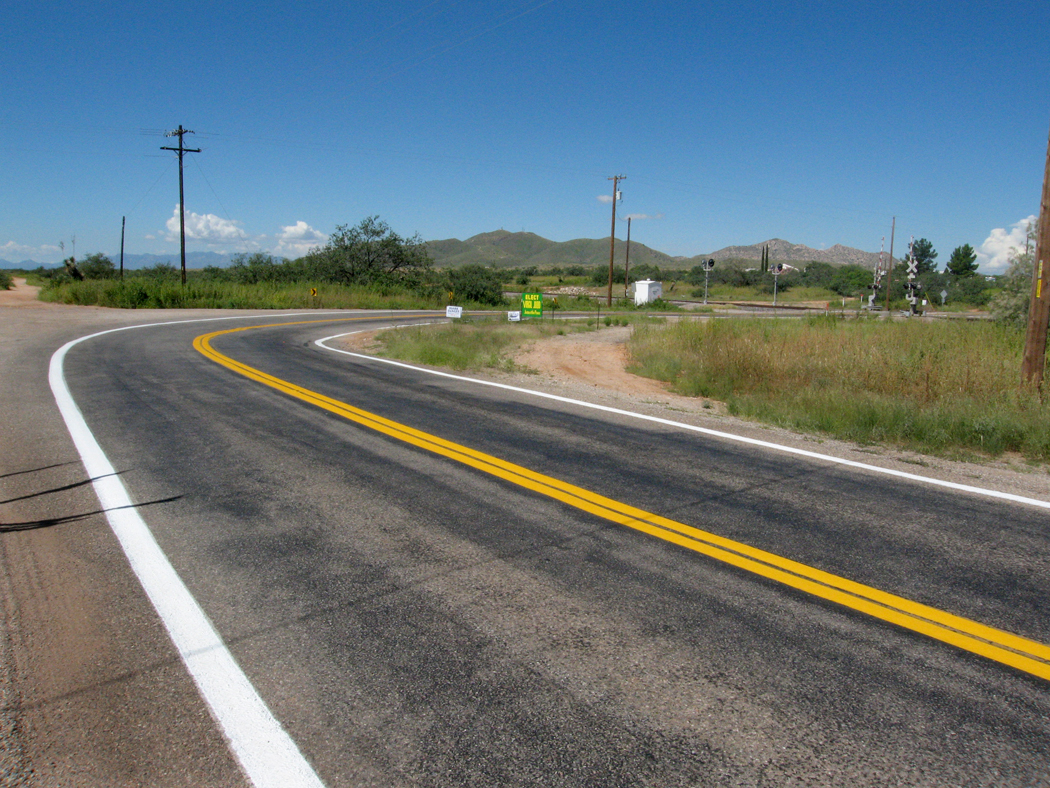
Elgin, Arizona

Elgin, Arizona

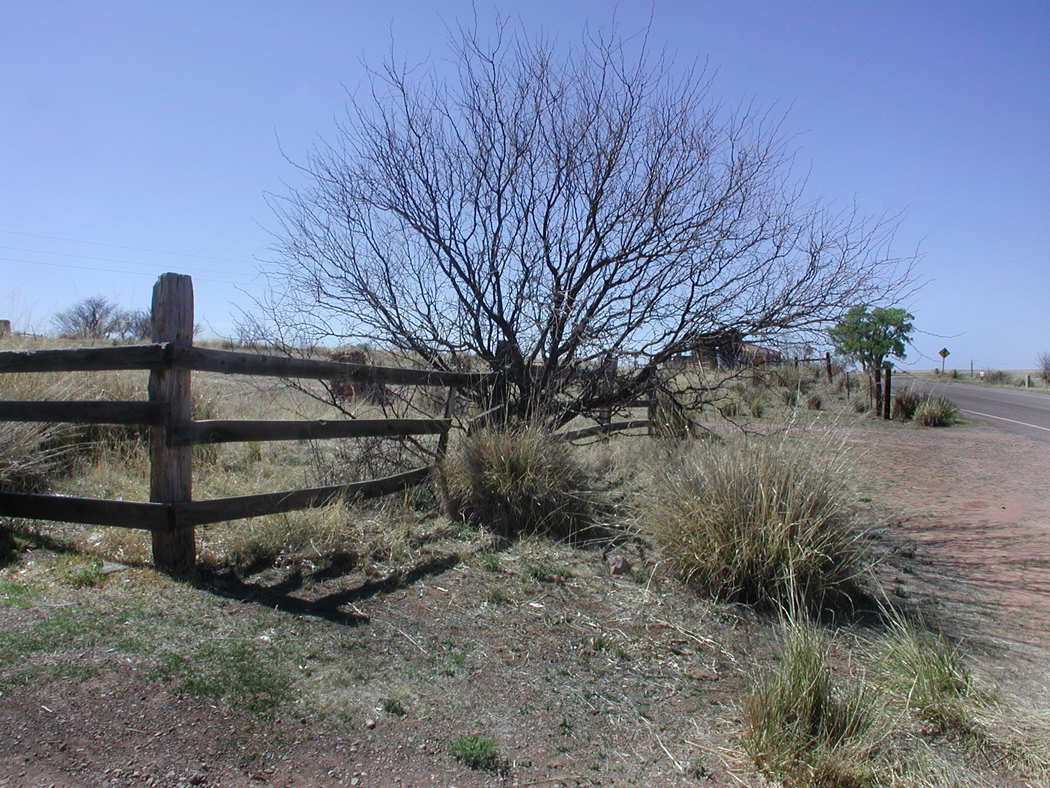
Yet, everywhere you turn are reminders of how things used to be. Old land grants show up on maps along with mountain ranges named after Indians. Abandoned mines perforate the hills and tell of short but acute prosperity. Former railroad rights-of-way cut across river bottoms that used to be littered with bustling towns.

Ruby, Gleeson, Charleston and a score more towns like them are now only crumbling adobe, gray weathered boards and unhinged tin roofs banging in the wind.

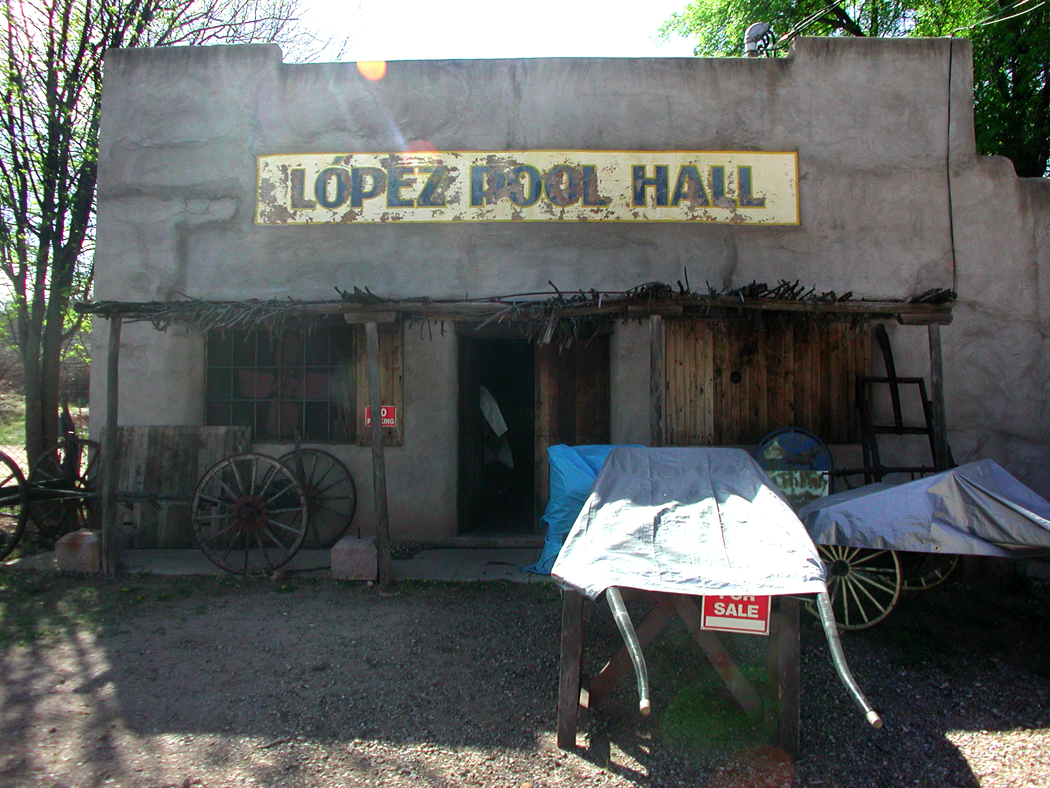
Lopez Pool Hall, Patagonia

Lopez Pool Hall, Patagonia

The area south of Interstate 10 is a gigantic history museum, and that history is based largely on copper, cattle and crops and the water needed to exploit them.

Drive to Bisbee and see the Copper Queen Mine, or drive east of Douglas and see the John Slaughter ranch, or drive north in the Sulphur Springs Valley to the farming community of Kansas Settlement where the irrigation still coaxes green out of the brown dirt.

It is a history of hard-working people wrestling an existence out of the ground beneath them.

Adobe Patagonia

You can see it in the drawn faces that stare out of century-old photographs: the Cornish miners, the Mexican vaqueros and the Mormon farmers. They lived hard lives and when the mines played out, or the ranch lost out to urban encroachment, they moved on.

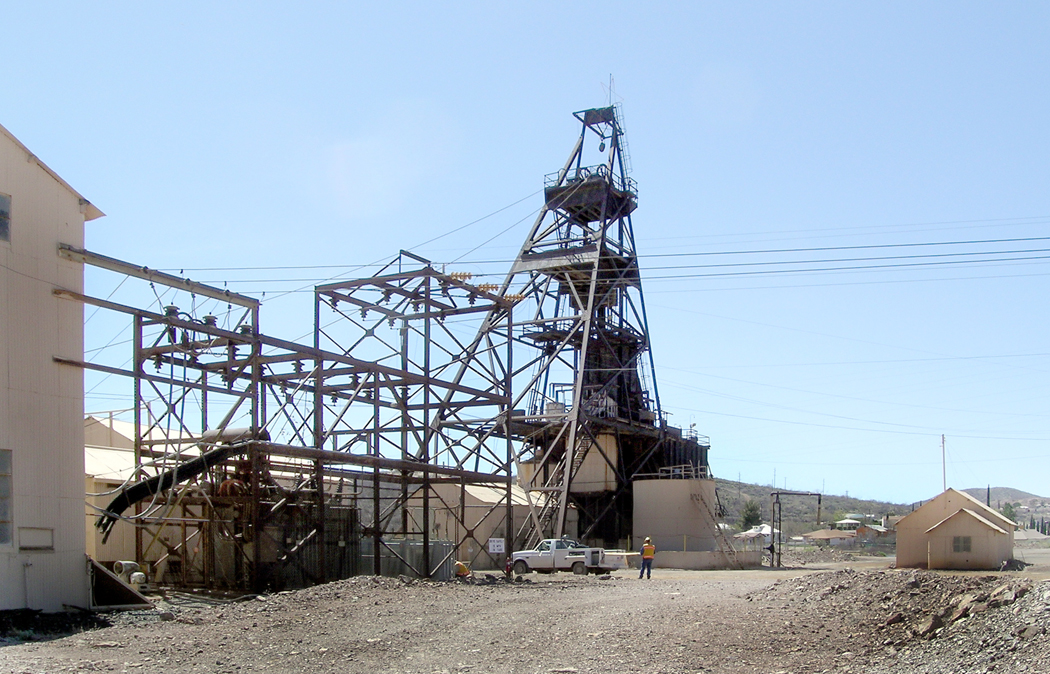
Warren pit head, Bisbee

Warren pit head, Bisbee

What they left behind more often than not, was the weathered bones of their existence, the frame houses, mine-shaft timbers and empty general stores.

The boom of the late 1800s died down. In 1882, Tombstone had an estimated 10,000 people and was the largest town in Arizona. By 1940, that number was just over 800. There were fewer people in Cochise County in 1950 than there were in 1910.

The first big wave of prospectors came to southern Arizona in the 1860s after the California gold rush. They came for gold and silver and found found what they were looking for.

In Tombstone, 5.8 million ounces of silver was mined in 1882 alone.

Dragoon

Dragoon

Dragoon cactusBut because the water needed to process the silver ore wasn’t to be had in Tombstone, a series of satellite communities were built along the San Pedro River, some 10 miles or so west of Tombstone, where Millville and Contention City gave rise to stamp mills that processed the ore that was hauled in in wagons.

Charleston and Fairbank arose to provide food and dry goods to the miners and mill workers. Fairbank became something of a shopping mall.

Built beside the railroad that followed the San Pedro, the town supplied Tombstone with its food and goods until well into this century. There were no groceries in Tombstone; residents had to ride the 10 miles down to the depot and the Fairbank Commercial Company. The town never had more than about 100 people, but it did have a hotel, and for a while, a Goldwater-owned store.

Texas Canyon

Texas Canyon

That all changed in 1884 when the Tombstone mines began flooding out. By 1888, the Contention City post office closed; other communities followed.

Fairbank lasted into the 1970s, with a population of 3 in 1971. Now there is only the volunteer site host for the San Pedro Riparian National Conservation Area, living in a trailer near the back of the “town.” The store and post office — built in 1883 — are still standing, as is the schoolhouse built in 1920 and a couple of homes and outbuildings.

Where the Montezuma Hotel used to stand, there is now the asphalt of Arizona Route 82, which runs past the site.

The pattern of boom and bust played out all through the region. Claims were filed, mines opened, saloons opened, mines played out, people left to move on to the next new ore pit.

Bisbee

Bisbee

One town that has lasted longer than most is Bisbee. It owes its existence to copper, which was discovered in the surrounding Mule Mountains in 1875. Three years later, it was profitable enough to haul ore to the railhead in Benson and send it on to Pennsylvania for smelting. By 1901, smelting operations were moved to Douglas, only 25 miles to the east, when a railroad was built.

The Bisbee mines successfully produced copper and its related metals for 90 years. Over that time, miners extracted more than 8 billion pounds of copper, worth about $2 billion. The mines also yielded 3.9 million pounds of lead, 3.8 million pounds of zinc, 2.7 million ounces of gold and more than 1 million ounces of silver. In the process, some 2,000 miles of tunnels were drilled through the mountains.

Dragoon Spanish sword

By the turn of the century, it was the largest city between St. Louis and San Francisco, with 20,000 residents.  With Brewery Gulch and a red-light district, it had all the color you could as for, and after a major fire in 1908, the city rebuilt largely in brick.

Those buildings still survive, largely unchanged, giving visitors a peek at what life was like back then.

The mines thrived, copper prices went bust, the mines suffered. There was union activity. In 1917,  there were strikes at most of Arizona’s major mines; Bisbee’s answer was to round up 1,200 strikers, herd them into railroad cars and ship them east to New Mexico where they were dumped unceremoniously. This was the infamous Bisbee Deportation.

Lavender Pit, Bisbee

Lavender Pit, Bisbee

By then, new technology allowed the introduction of open pit mining and the face of Bisbee began changing forever. The most famous of these pits opened in 1951: The giant Lavender Pit mine operated by Phelps Dodge dug a monster hole into the ground just south of town. It eventually wound up some 900 feet deep by the time it closed in 1974.Dragoon tree

Bisbee itself might have closed down soon after, but its residents liked living on the mountainside and a host of retirees and later, artists and lingering hippies, now long of beard and wide of girth, joined in to keep the town alive.

Where once you would find a miner tossing down rotgut whisky, you are now more likely to find microbrew or a hazelnut latte.

My favorite vista in the quadrant is the Willcox Playa, a huge dry lakebed that functions as a landmark along I-10. You can see it from dozens of miles away, and when you are traveling west on the interstate, it is when you know you are back home in Arizona. In the summer, dust devils whip the white dust into mini-tornadoes of grit and sand. Sandhill Cranes roost in the area. The giant white circle in the flatness of the desert is so dry you know you have to find something to drink.

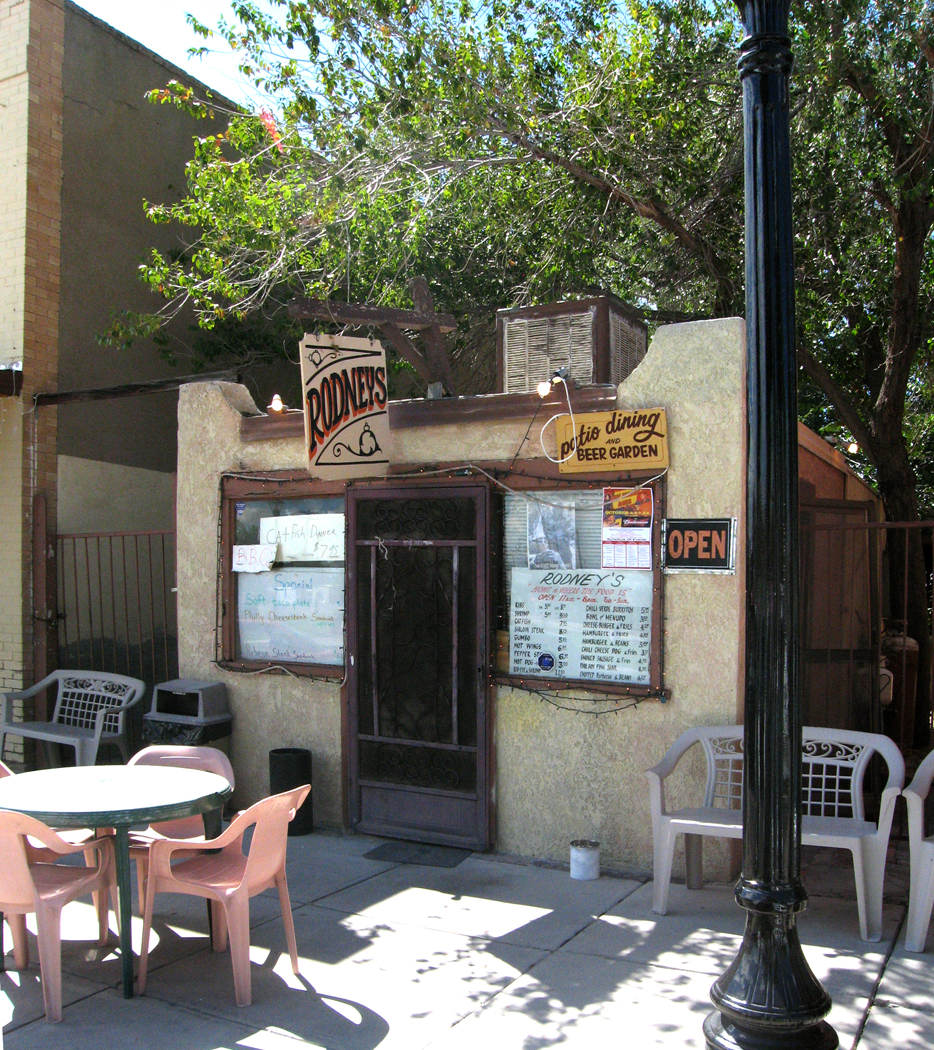
In Willcox, you can grab a soda at Rodney’s.

Wilcox Rodney's BBQRodney Brown has run his tiny eatery in Willcox for 20 years. It has a kitchen the size of a closet and no dining room at all — you find a seat out back at a picnic table.

“If you want an interesting place to eat, you should try Rodney’s,” says John Ware, director of the Amerind Foundation in Dragoon, about 20 miles to the west. “But it is kind of funky.”

It may be a measure of a traveler’s adventurousness to eat at Rodney’s. The building on Railroad Avenue, two doors down from the Rex Allen Museum, is barely large enough to qualify as real estate, and its walls are cracking.

“This crack in the concrete started only yesterday,” he says, pointing at the wall just outside the screen door to his backyard refectory.

Things are informal. If you want a drink, grab one from the ice-filled sports cooler on the floor.

There’s nary a vertical or perpendicular line in the building, which leans a bit, and the floor is wobbly at best. The screen door to the backyard doesn’t open all the way; it catches on the uneven ground.

Rodney stands behind the counter, taking your order, then spooning the dark, gooey barbecue into a tin pot to heat it up.

Wilcox Rodney fixing BBQ

The food is good. Lots of customers back up in the street at lunchtime, waiting for a chance to get inside and order.

Like a barber on caffeine, he keeps the conversation going, stirring your food, pointing to the signed picture on the wall: “To Rodney, all the best, Lorenzo Lamas,” it says.

Next to it is another celebrity photo that looks like Willie Nelson, but, says Rodney, “It’s not really. It’s a Willie Nelson impersonator. But he’s really good.”

Rodney moved to Willcox 20 years ago after working in Sierra Vista for 10 years. In Sierra Vista, he ran Rodney’s Southside BBQ.

Asked why he moved to Willcox, he says only, “We don’t know yet.”

Another freight train rumbles by across the street, rattling everything in the joint and drowning conversation. Rodney stops in midsentence, only to pick up again as the train passes and the dishes stop jumping.

“Ambience,” he says.

Sonoita vinyard

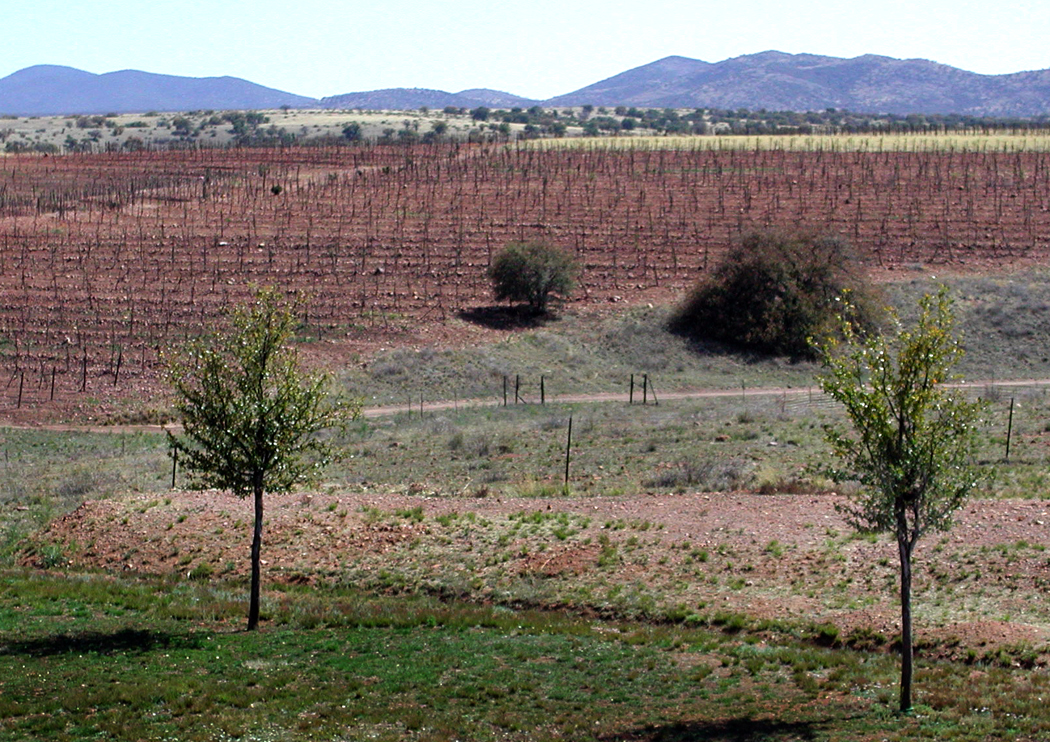
On the eastern side of the quadrant, you find the vinyards of Patagonia and Sonoita.

Sonoita wine barrel

East of Sonoita, the road weaves through more yellow grasslands, with the torso hills getting closer and closer to the road, finally coming together at a pass between the Mustang and Whetstone mountains and dipping then into the wishfully named Rain Valley.

Sonoita Creek

Sonoita Creek

The same road then continues down to the wooly bottomlands, thick with willow, along the San Pedro River. That’s San Peedro, if you want to fit in. All among the trees, the birds are thick as thieves and noisy as conventioneers. Looking down from the aging iron bridge into the water’s flow, you can see the green waterweeds individually pulled in direction of the current.

On a cold windy morning in spring, the blow twists the riverbank grasses the same way.

Patagonia Lake State Park

Patagonia Lake State Park

From there, the road goes south to Coronado National Memorial in the Huachuca Mountains. You gain altitude constantly from the river lowlands until you are under the mountain peaks. The pine trees are greenish black and burning in the late afternoon sun. When the pavement gives out, the switchbacks take you up Montezuma Canyon to the pass, where to the east you can see most of the San Pedro Valley and down into Mexico and to the west, you can see as far as Baboquivari and Nogales.

When the air is clear — and it is so more often than it is in Phoenix — the valleys below are straw yellow, lined with denim-blue mountain ranges.

On Ariz. 80 out of Douglas, you pass a misplaced corner of the Chihuahuan Desert in the San Bernardino Valley, a broad saucer of tawny grass and spiky lechuguilla and yucca. The sky near the horizon is the color of a robin’s egg; just below it, the distant mountains are dusky purple and below them, the grays and greens dotted with black trees. Nearer still are the chocolate brown hills and the bottomlands of yellow. It is all spread out like a geological rainbow.

The road is long, straight and smooth and you look at  the speedometer and are startled that you are doing 80. The horizon is always your destination.

The highway will take you, briefly into New Mexico, where you can turn back toward the Chiricahua Mountains.

Chiricahua Mountains

Chiricahua Mountains

Few Arizonans, I suspect, have ever crossed the backbone of the Chiricahuas from the east, but the drive through Portal into Cave Creek Canyon is a drive through a rocky portal into Paradise. The broad green canyon is lined with cliffs and pinnacles and could easily be mistaken for a scaled down Yosemite Valley.

Chiricahua National Monument

Chiricahua National Monument

Along the roadsides, the spring wildflowers dot the shoulders like stars in sparse constellations. They are not so thick this dry year as they have been, but the flowers are still there, lupine and brittlebush, penstemmon and globemallow. Each flowerhead pokes into the passerby’s awareness as individually beautiful and separately tenacious.

Benson

Benson

Perhaps that is why the desert attracts a certain kind of human, demanding their quirky individuality, no matter how bizarre or paranoid.

Click to enlarge any image

Mobile AZ graffiti

It is a truth universally acknowledged, that the drive from Phoenix to Tucson along Interstate 10, is the most boring stretch of road anywhere in American experience, outside of the state of Texas.

After you pass the stucco hell of Chandler, you must endure the endless greasewood flats of the Gila Indian Reservation, passing the bridge over the Gila River — although I doubt many drivers note the fact, because the dry riverbed is nearly indistinguishable from the non-river that surrounds it: just more greasewood and a pulverous dust-and-gravel mix that can get whipped up into the air by dust devils during the sun-baked summer months, by which we mean any month except December and maybe the early weeks of January.

Mission church on Gila Reservation

Mission church on Gila Reservation

Past the reservation, you hit the sprawl of Casa Grande and the junction with Interstate 8, where, as your rise up on the overpass, you can spot on the distant horizon the spire of Picacho Peak, which is your beacon for the next 45 miles. There are the pecan forests of Eloy, and, as you drone past Picacho, the ostrich farm, which is about the only meaningful punctuation in your journey until you hit the Ina Road exit, which marks the slow relief you feel as you finally approach your destination. Tucson! That outpost of civilization in the desert.Irrigated farmland

When my job took me to Tucson, I tried to find alternate routes whenever I could. The interstate is tedious, but usually, you had to find the fastest way between cities — it may surprise denizens of America’s eastern climes that in Arizona, it was not considered unusual or beyond the call of duty to drive to Tucson for an opera or a concert and afterwards, drive home to Phoenix the same night — each way a distance of some 125 miles.

Mobile, Arizona

Mobile, Arizona

But when I could — when it was still daytime, or when I had already spent the night in a Tucson motel — I would find some other road. If I had the whole day, I would drive up the foothills of the Santa Catalina Mountains, through Oracle Junction and along the Pima Pioneer Highway to Florence and then west through Apache Junction and back to Phoenix. It is a much more interesting drive, though considerably out of the way.

North Kinney Road, near Tucson

North Kinney Road, near Tucson

More often, in such circumstances, I would attempt to drive roads that paralleled Interstate 10, but entered the towns that the interstate bypassed, and looped widely through farm country and desert, giving a drive time to enjoy the exceptional Arizona landscape. The problem is that there are a couple of places where there is no alternative to the freeway, and for a few miles you have to hop back onto the mindless buzz and exhaust of the expressway before you can find an exit that lets you back into the reality of the land.Mobile Az train

I recommend the extra time it takes to take such a route. You see more of the state, partly because you are driving more slowly, but mostly because all the knobs and bosses on your map are wide of the I-10 right of way.

Casa Grande National Monument

Casa Grande National Monument

You can take 51st Avenue around the west end of South Mountain in Phoenix, and head into the Gila Reservation, and you can pass through Maricopa and Mobile — which began as an enclave for African-Americans when they were less than welcome in other towns — and you can see Sacaton.

I once committed a crime in Sacaton — breaking and entering. My wife and I culled our overwhelming book collection and came up with five or six boxes of books we decided to donate to the library in Sacaton. But when we got there, the old wooden library was closed. I broke into the building, picking the lock with my jackknife and leaving the boxes on the floor of the library with a note announcing “the midnight skulker” had left the books for the residents.

Several years later, we did the same thing again, except that the library had new deadbolt locks, increased security and a fence around the property. This time, we left the books on the front stoop, assuming that they would not be rained on as long as they were discovered before five months had passed.

Red Mesa

Red Mesa

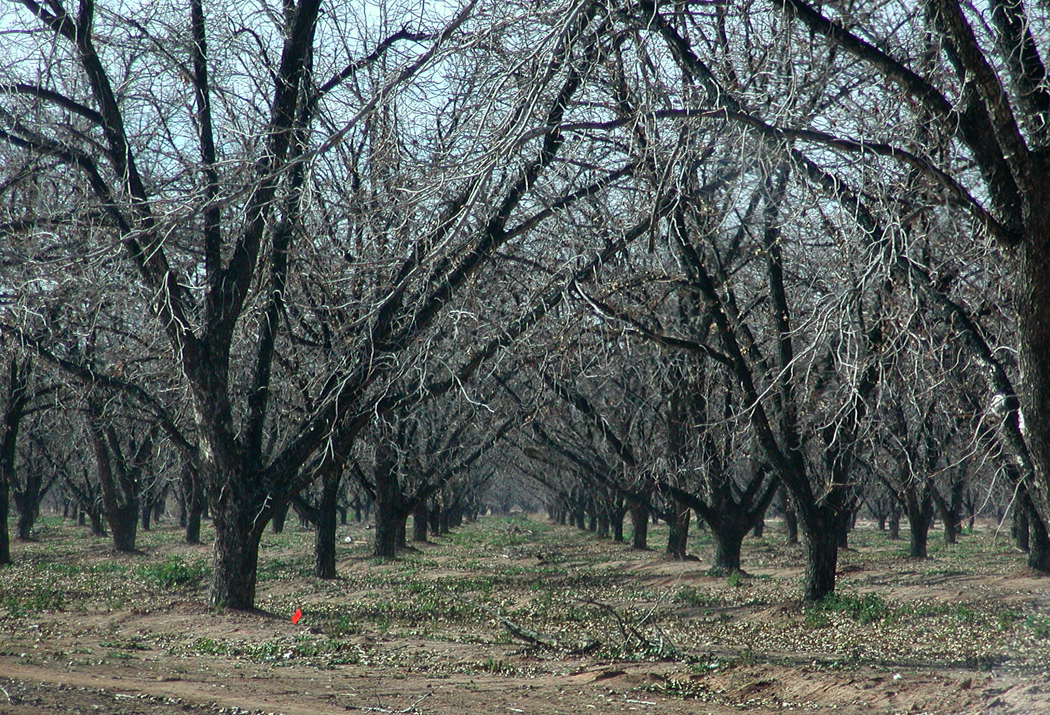
You can drive through the pecans of Eloy, not past them.

Eloy pecans

Eloy pecans

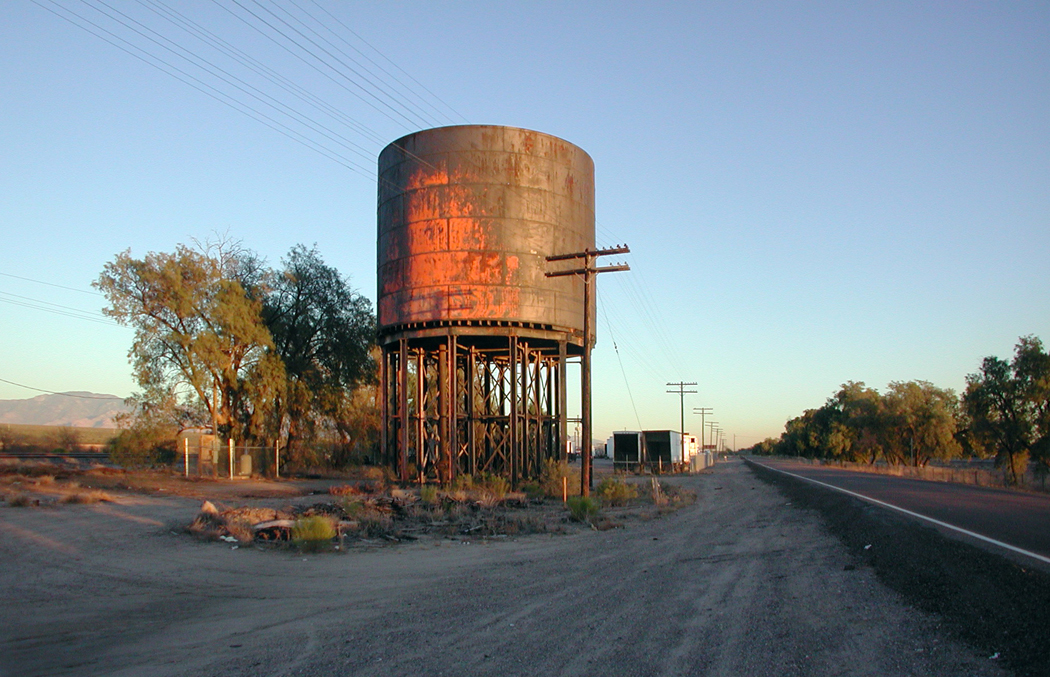
And when you get to the land just north of Tucson, there is farmland and the old railroad, including the abandoned water tower of Red Mesa, just north of Marana. From Marana, you can drive through the east section of Saguaro National Park (nee Monument), and past the Sonoran Desert Museum, past the Old Tucson movie set, up over Gates Pass Road and down onto Speedway Boulevard and Tucson.

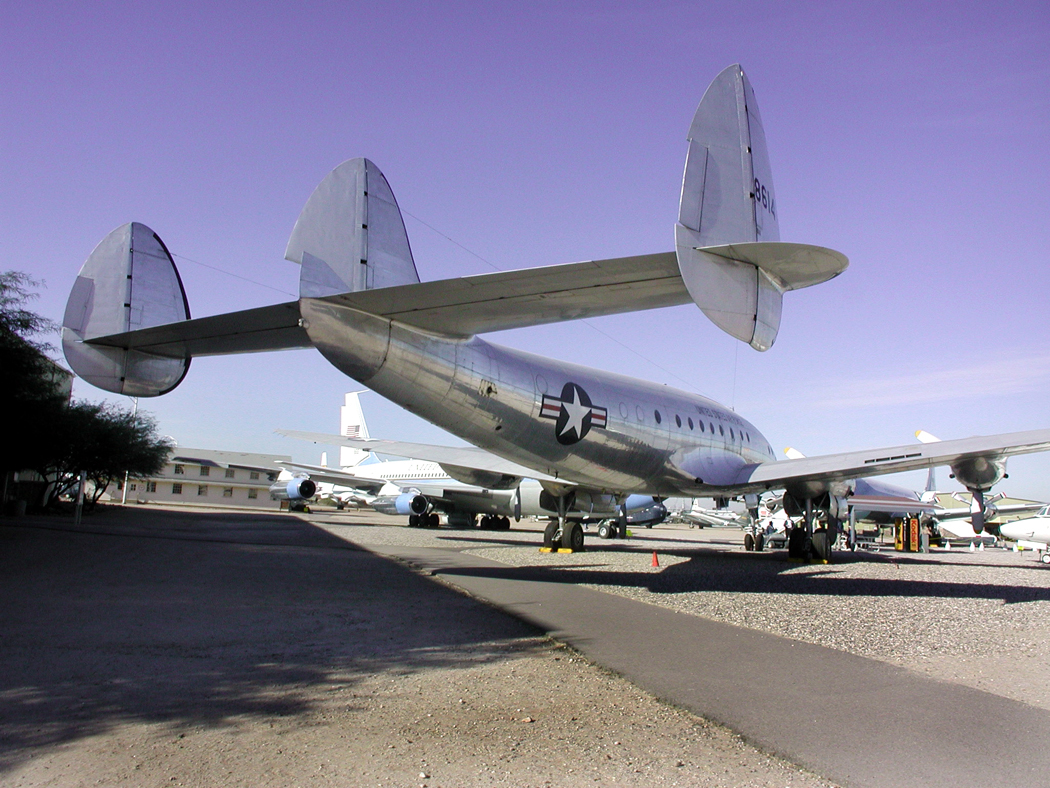
Pima Air Museum, Tucson

Pima Air Museum, Tucson

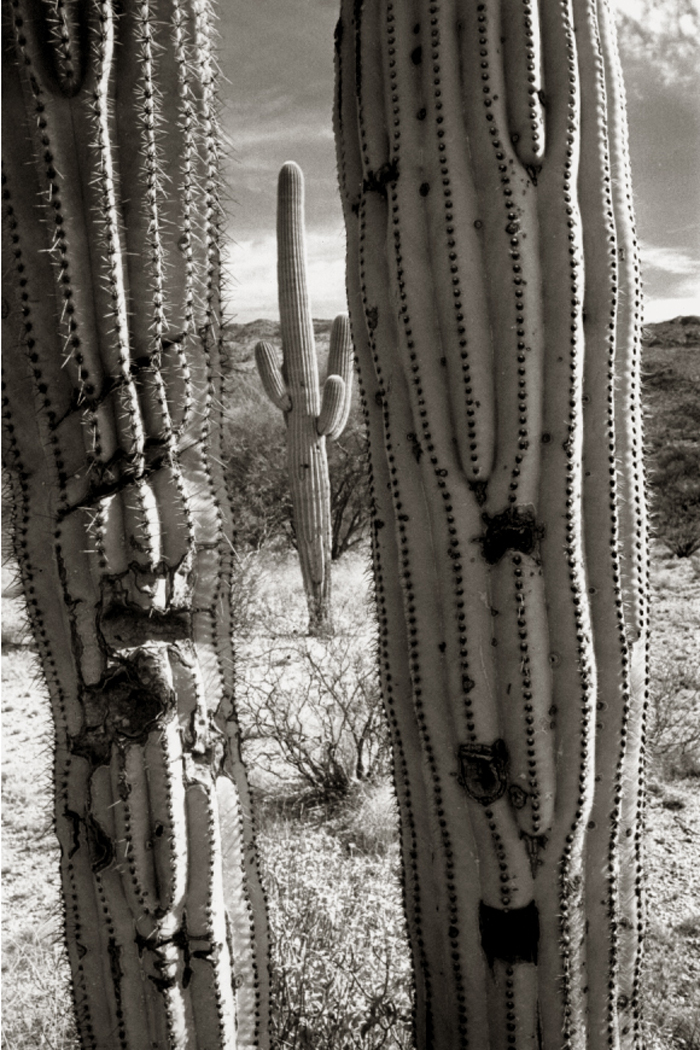
Saguaros TucsonIt used to be that Phoenix was the crass commercial center of the state, and Tucson was the cultural center, where you found the arts and the educated people. But as Phoenix grew, such institutions as the Arizona Theater Company and Arizona Opera migrated north to the bigger city and Tucson has its past to cling to. It is still a more livable city than Phoenix, though traffic on Speedway is getting to be as bad as that on Camelback Road.

But it is south of Tucson that things get interesting again. The corridor down Green Valley takes us past mission churches, artist colonies, copper mines and nuclear destruction.

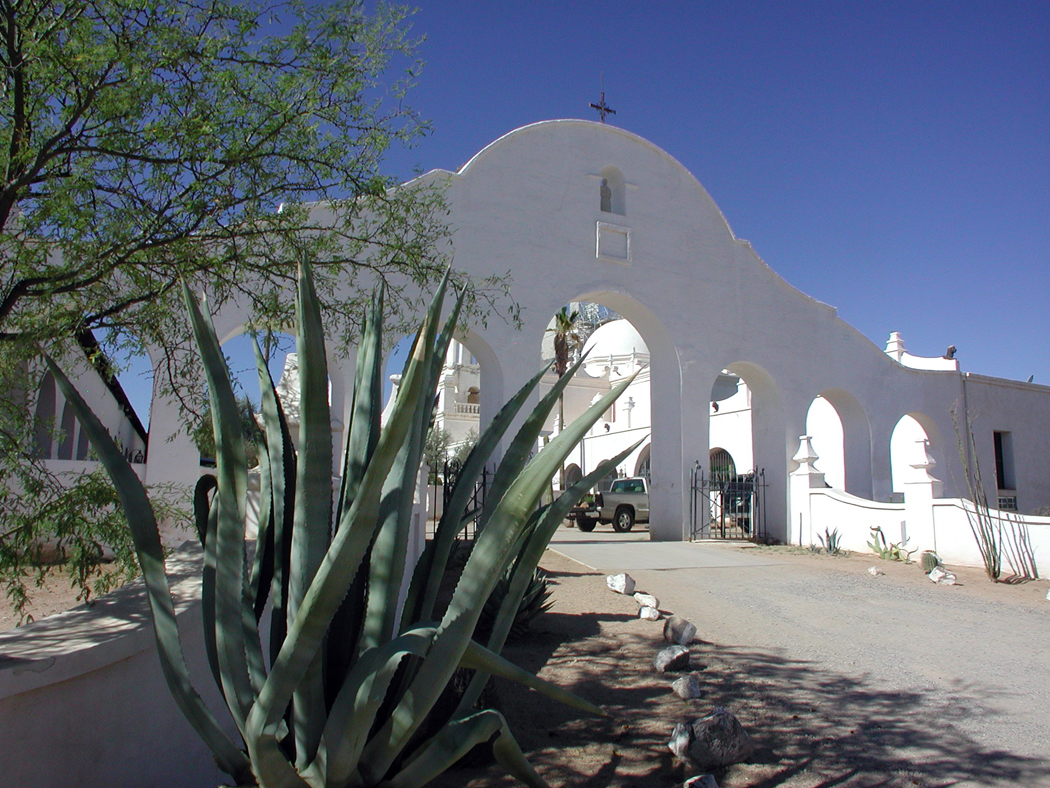
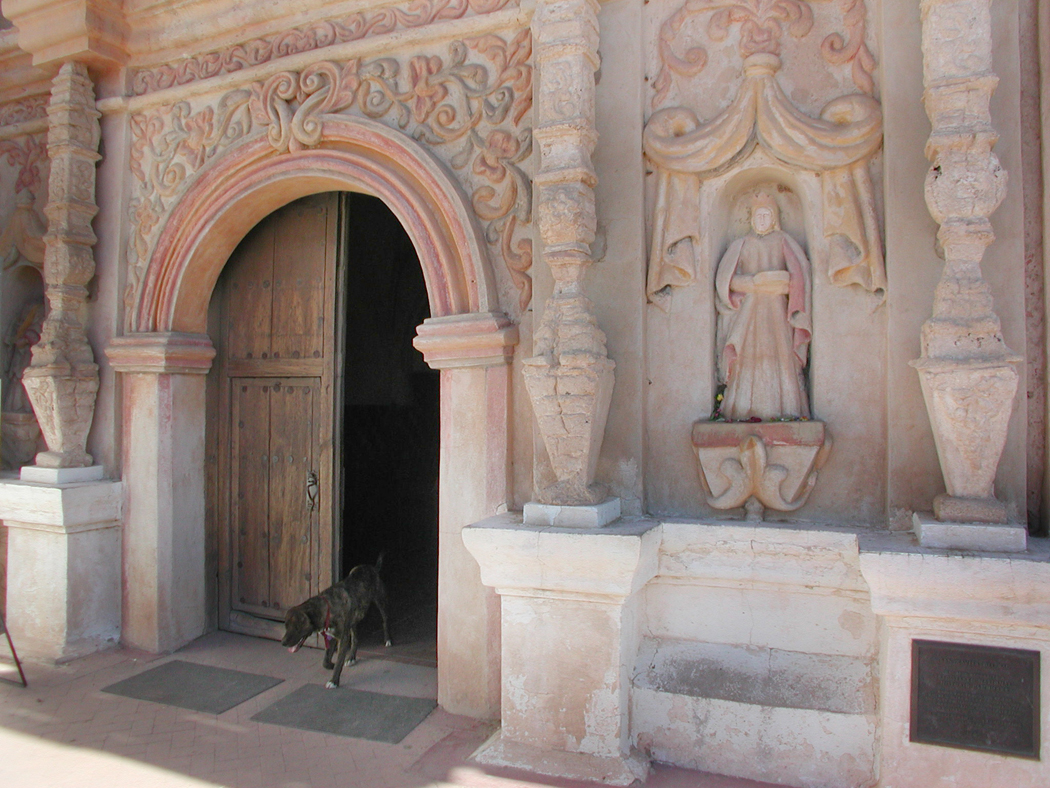
The highlight is the church of San Xavier del Bac, built in the late 18th century and recently restored. Services are still held, and while tourists run through the nave on weekdays, it is best seen in action during Mass.

San Xavier del Bac

San Xavier del Bac


San Xavier del bac dog at door


San Xavier del bac interior dome


San Xavier del Bac interior man sittingOn tourist days, the plaza in front is often filled with crafts and jewelry for sale, and a food truck.

Asarco mine tailings

Asarco mine tailings

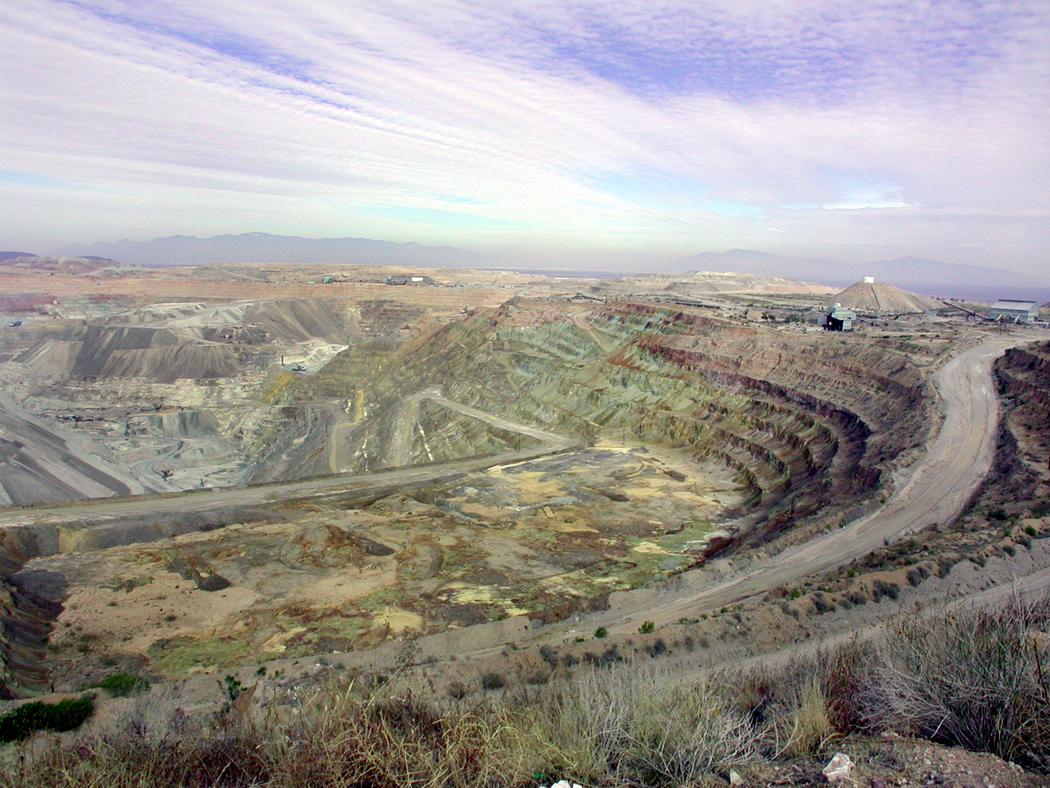
One thing that struck me, even the first time we drove through Arizona in 1980, was the prevalence of mountain ranges created by copper mines — the tailings piles that grew as large as the mountain ranges of New Jersey. They reach their Rocky Mountain stage further north, in the Miami-Claypool area, but you pass slightly newer and neater beside the roads as you head south from Tucson. The giant Asarco mines welcome visitors, and you can see a hole in the ground that makes you think someone is searching for Dante’s Inferno, having dug at least to the Malebolge. There are rings around the copper pit, just as Dante has his rings of Hell.Asarco mine 3

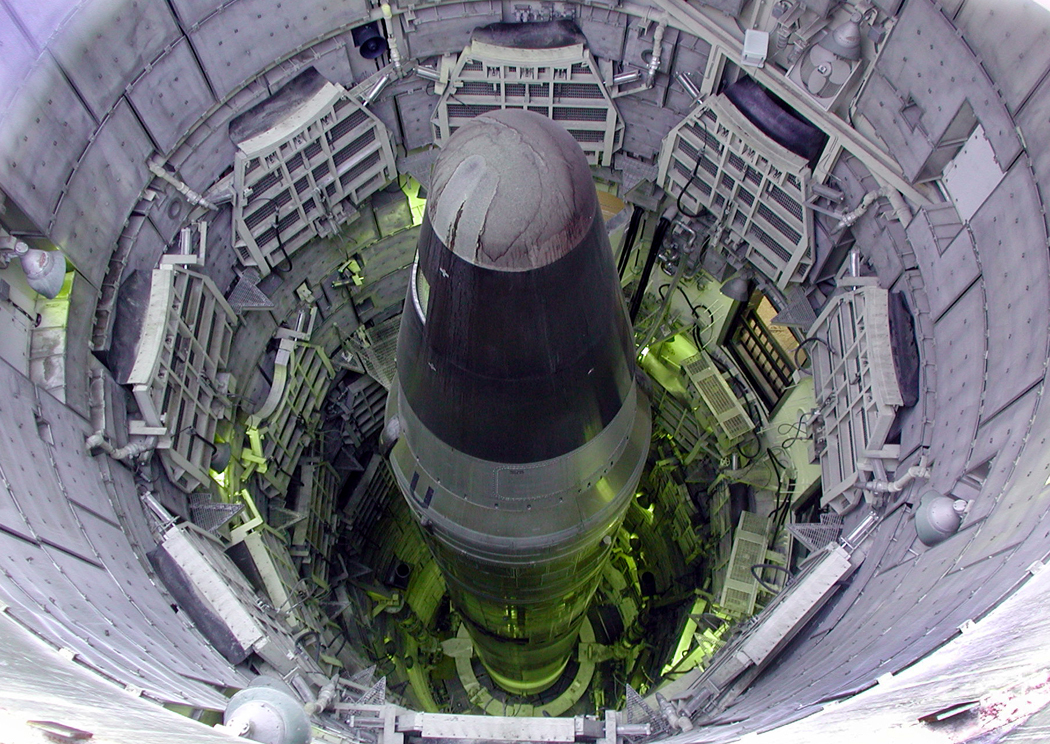
Perhaps a more literal hell is implied by the Titan Missile Museum next door, where you can see the implements of world destruction set out for you like a Disney attraction. Titan missile ArizFor those of us who grew up in the “duck-and-cover” 1950s, when nuclear annihilation seemed a palpable and immediate threat, the nose cone of the rocket seems a round pyramid of doom. Perhaps the mines are currently more immediate harbinger of doom, as the nuclear threat has stood down. For the moment.

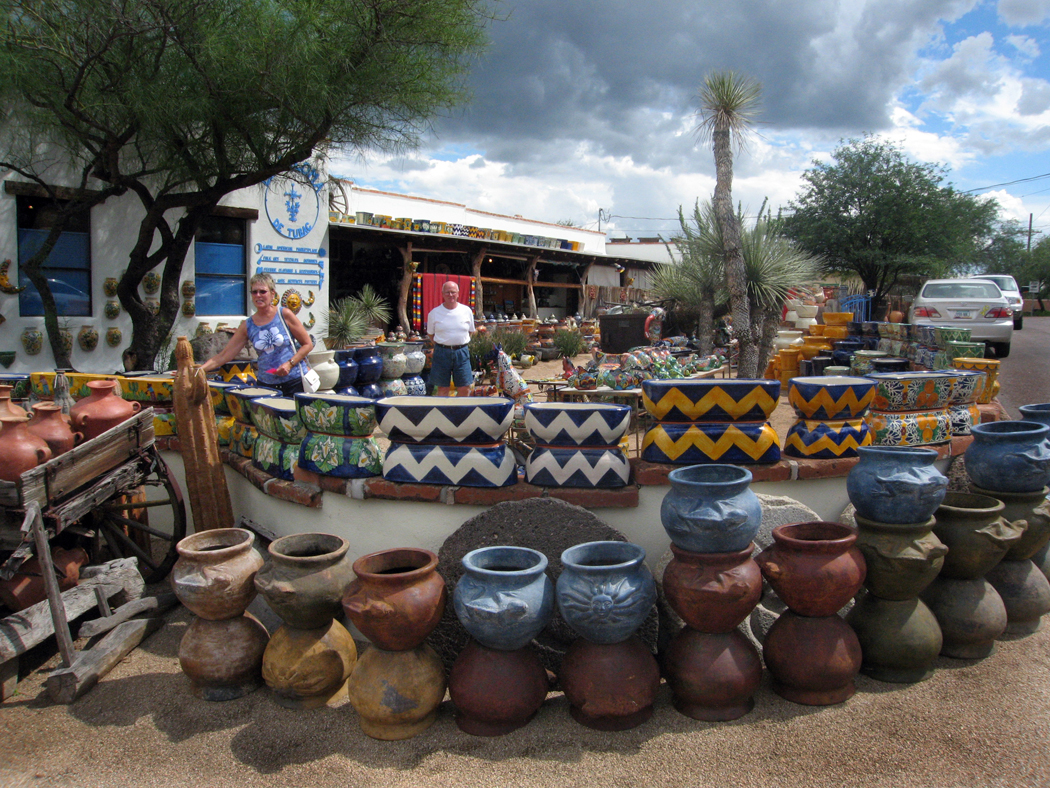
Tubac

Tubac

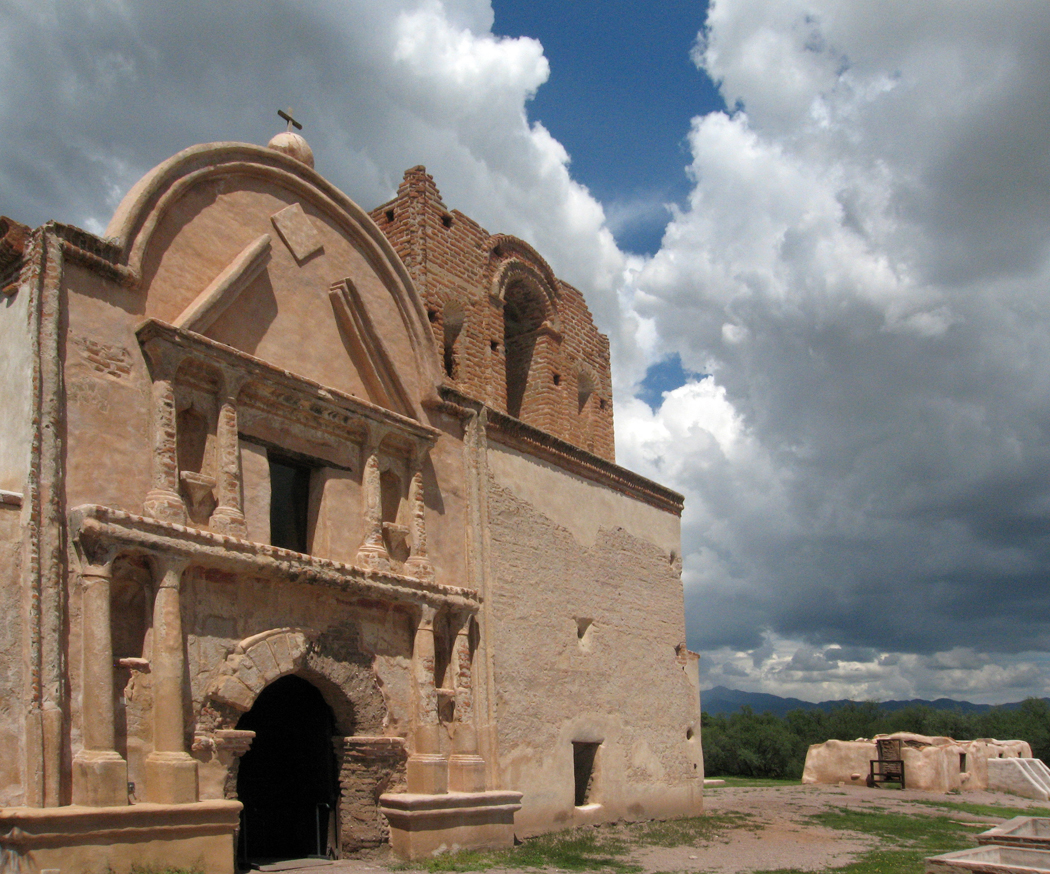
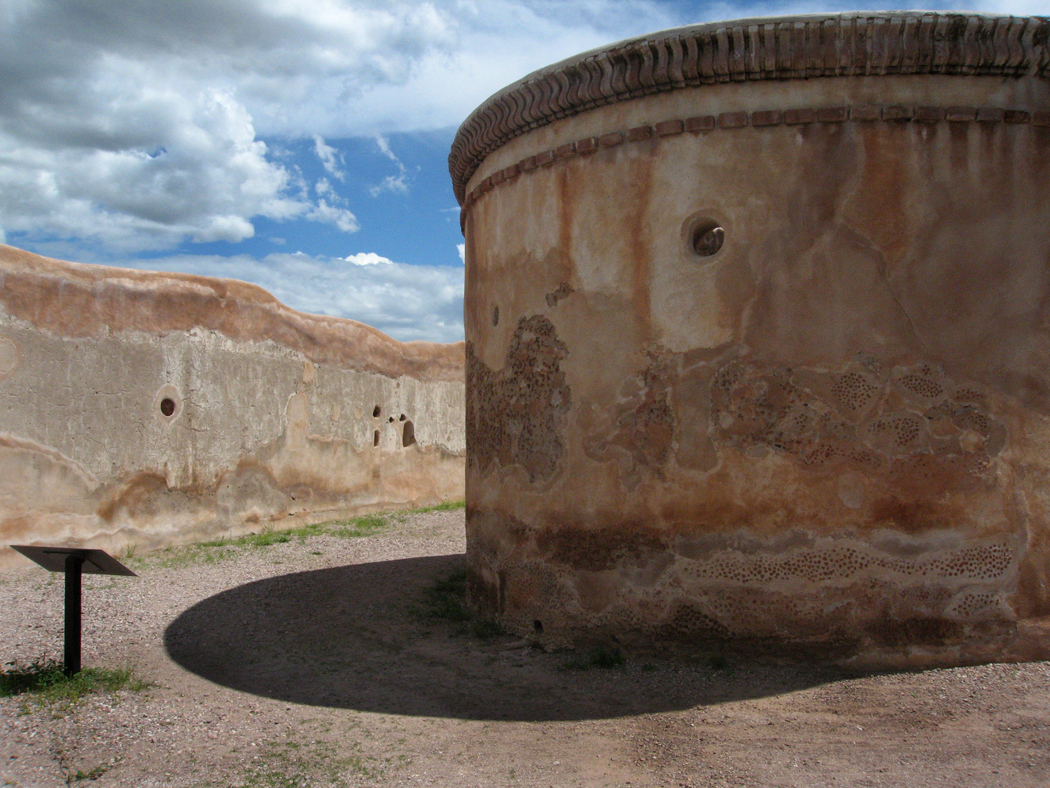
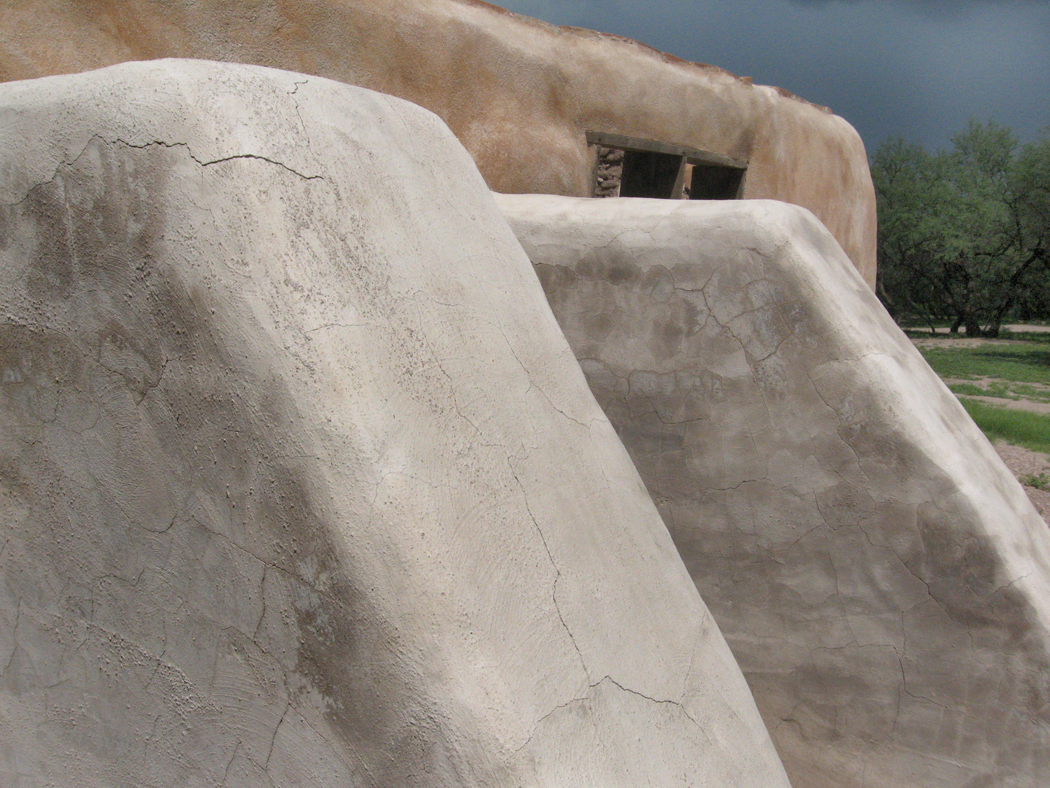
South of that, the traffic really dwindles, and you find the isolated and happy community of Tubac, an artists colony, and beyond that, the ruins of the Tumacacori Mission Church, with its adobe outbuildings and its recollection of the conversion of heathen Indios, whether they wanted it or not.

Tumacacori

Tumacacori

At Tumacacori, an ancient woman demonstrated the making of flour tortillas. At Mexican restaurants, I always specify corn tortillas, because the flour version seems insipid and pointless. But at her side, my wife tried patting out the masa triga and made a mess. The old lady made perfect circles and plopped them down on her comal, flipped them once and offered them for us to eat. The mission church has not lost its touch: I was converted. A fresh flour tortilla, hot off the griddle, is a joy and a wonder. It is the commercial flour tortillas that are tasteless wads of paste. This version was a gustatory revelation and I will never think poorly of the flour tortilla any more — although unless it is made for me immediately off the tin-plate stove over a fire of wood ash, I will continue to avoid the store-bought variety.Tumacacori baptistry

Down the road from Tumacacori, you used to be able to drive along back roads, dirt roads, through old farms and river beds. The drug wars have ended that. So many roads are blockaded now. Freedom of movement in Southern Arizona is severely curtailed. So, you might as well just drive on to Nogales and get a meal there.

Click any photo to enlarge

Click any photo to enlarge

Camelback from air

I have a love-hate relationship with Phoenix, Arizona. No, that’s too strong. I have a like-frown relationship. Living in its ever-expanding confines for an entire quarter of Arizona’s statehood, I never truly warmed up to it, the way one comes to love San Francisco, Seattle, New Orleans or Manhattan. There is a kind of numbing neutrality to Phoenix. It isn’t as bad as all that, but neither is there much to get excited about. It is a city with little personality.

Click any photograph to enlarge

Click any photograph to enlarge

I don’t mean that to sound too negative. There is much I miss. I loved my job; I can’t imagine being happier in employment than I was for most of my time at The Arizona Republic, or having better colleagues. When I retired, I didn’t so much leave the newspaper, as instead, the newspaper left me. It was going in directions that had less and less use for what I provided. It was time to go. But what happened to The Republic is true of newspapers all across the nation. It is journalism that left me.

Phoenix skyscraper

There are things I miss, besides the occasional meal at the Golden Greek or El Bravo.

OLYMPUS DIGITAL CAMERA

I sorely regretted leaving Ballet Arizona. By the time I left, ballet had become the art form I most loved. Ib Andersen had raised the local company up to a level that competed with the major troupes around the country, and even around the world. I miss the art museum and its staff (now, most of them are gone, too), I miss the symphony and the chamber music. I miss the lunches I shared with Phoenix Chorale’s Charles Bruffy. (Congratulations on yet another Emmy).
Phoenix Double sign

My wife and I have friends in the city and we miss them dearly.

Papago Buttes

But the city itself? Not so much. And here, I mean the whole metro area. It is hard to make any distinction between Phoenix, Glendale, Mesa, Scottsdale and Tempe, Chandler, Gilbert, Fountain Hills: It all turned into endless suburbia, 60 miles from east to west and 45 miles from north to south, and it continues to metastasize. The last time I drove south to Maricopa, it seemed like more of the same.

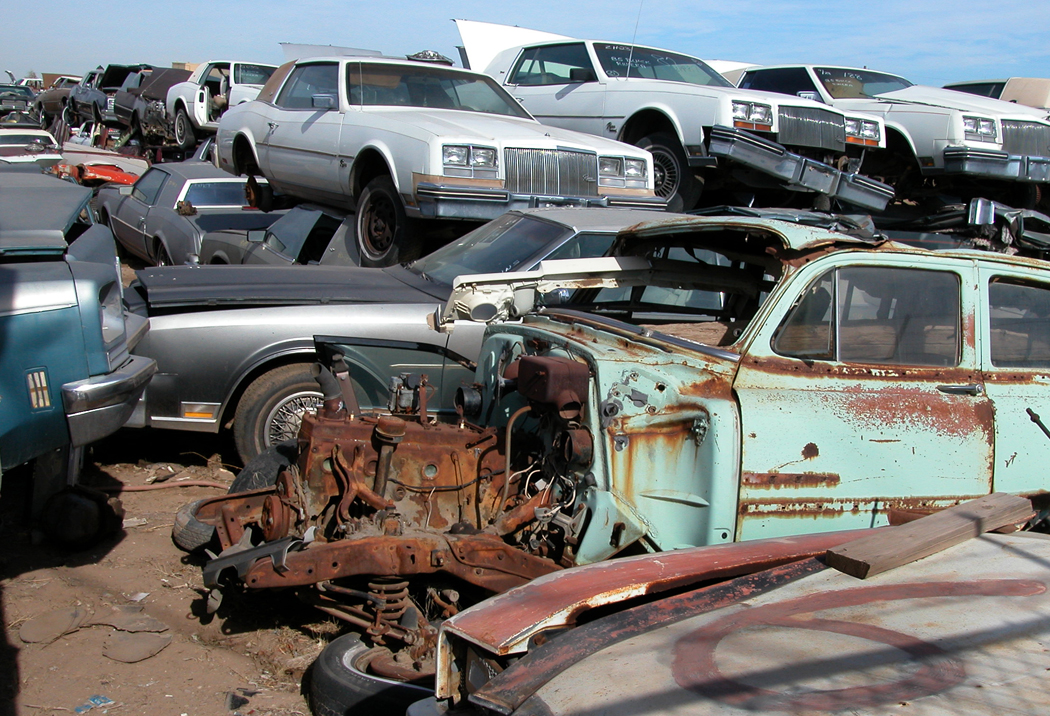
Phoenix car junkyard

The weather was brutal, the traffic brutish, the city politics banal (and state politics worse: delusional). New gated subdivisions gobbled up huge spreads of desert. Have you driven down Dynamite Road lately? Shopping malls, freeways, mobile-phone towers, endless Circle Ks and 7-Elevens, red-tile roofs, and stucco, stucco, stucco.

Phoenix washingtonia

But there were places I could retreat and find some character. South Phoenix, with its poor neighborhoods, houses with sun-warped wood and flaking paint, with its panaderias and tiendas. The gravel roads before they were chewed and digested into Macmansions; the old canals, not yet channelized and rinded with concrete; the farther expanses of the city limit where there are still working farms; and the old warehouses south of the railroad tracks. I like seeing the older stores painted garish colors, and the black-painted bars on windows and doors. My favorite Mexican food found at the hole-in-the-wall storefronts where the clients are all Hispanic and they still serve tongue and tripe, and where the frying is still done in lard. It isn’t so much that these things are old and I feel nostalgia, but rather that these things still have character, personality; they are not whitewashed into the great Osterized American culture. They battle the blandness of television and the chamber of commerce.

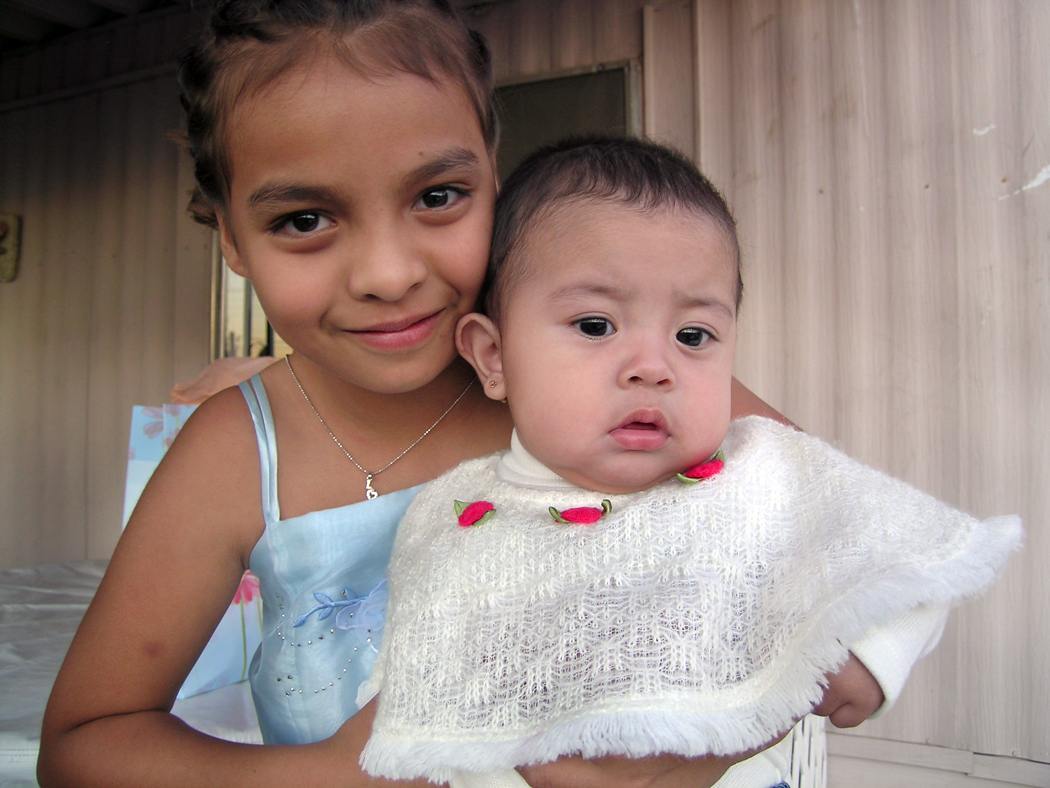
Maria's children

Maria’s children


In the next several blog entries, I plan to take a trip around the state, beginning in the Valley of the Sun, to see how much I can turn up of the lost and forgotten, the real flavor of the state, the part of it that I miss and wish I could experience all over again. I’ll move south through Tucson then west and north, traveling counter-clockwise around the state. Most of this virtual trip will be in photographs, with a few words stuck in here and there. They are the parts that to me feel alive and wriggling, even when abandoned or forgotten — the played out mines, the baked arroyos, the Native American ruins, the dusty places just outside of towns. This is the Arizona I miss when I remember my years there.

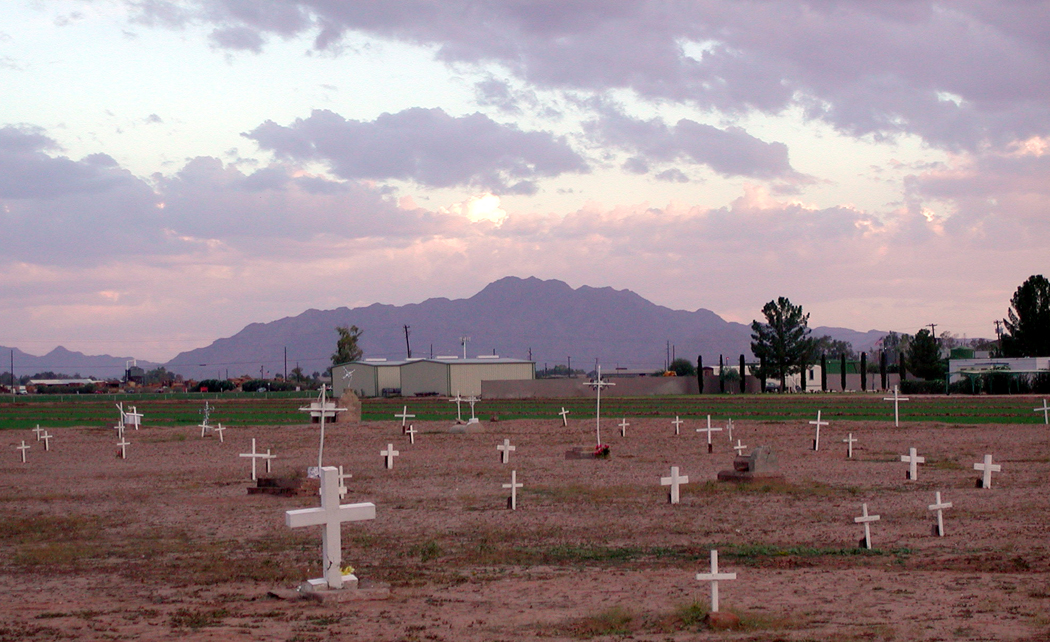
Goodyear Cemetery in Chandler

Goodyear Cemetery in Chandler


This Arizona is completely personal and subjective. But I suspect many of you harbor similar feelings, similar places in your psyches, whether it be in Ohio, Quebec, Idaho or Mazatlan. This is the Arizona that remains alive to me.

Here are some of those things and places:


South Phoenix

South Phoenix


Canal and farmland

Canal and farmland


Gila River south of Phoenix

Gila River south of Phoenix


Abandoned racetrack

Abandoned racetrack


Agricultural buildings west of Phoenix

Agricultural buildings west of Phoenix


Pueblo Grande

Pueblo Grande


Hiking around North Mountain

Hiking around North Mountain


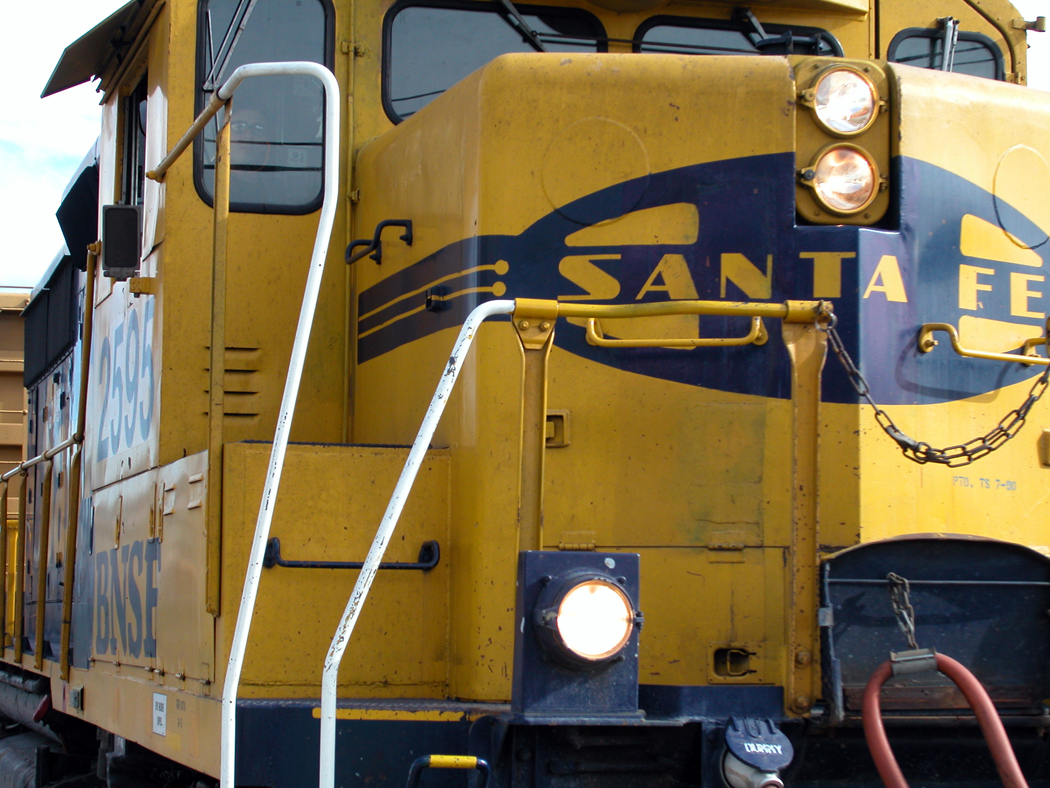
Phoenix Santa Fe close up


Near Fredonia

Near Fredonia

During the 25 years I lived in Arizona, I saw pretty much every dusty corner of the state, either on assignment for my newspaper, or on my own. I came to love the state — warts and all. And it has warts: Arizona politics is dismaying, its inhabitants sometimes astonishingly parochial, its sense of itself as “special” endearing; I’ve lived in enough different places to know that they each think of themselves as special: You can outright choke on Seattle; North Carolina Public Television crowds out PBS programming with self-congratulatory programs on local history, local events, restaurants, the cult of barbecue, its exceptionally progressive foresight, and its sports heroes. The self-regard is truly cloying. Arizona hasn’t a patch on that, even counting Arizona Highways magazine.

Brewery Gulch, Bisbee

Brewery Gulch, Bisbee

And speaking of warts, the city of Phoenix is essentially Cleveland in the Desert: ugly with traffic, convenience stores and real-estate deals. But in Arizona, the land is essential: The desert is like nothing else.

Red Mesa, Navajo Reservation

Red Mesa, Navajo Reservation

Arizona has a particular difficulty because its image of itself is incredibly beautiful. It is the Grand Canyon State, and its landscape has filled more calendars and books than horsehair has filled sofa cushions. The Arizona Highways effect prettifies the state so to anyone with clear eyes, it is no longer recognizable. Arizona for most people is a fictional Arizona, a fantasy landscape drawn by John Ford’s Monument Valley, Ansel Adams’ Grand Canyon, or the “Tonto Rim” of Zane Grey. The landscape we mail out to the rest of the world is one of pristine wilderness and vast vistas. This is not, however, the Arizona I came to love. Quartzsite in the middle of winter is not part of this picture, neither is Apache Junction or Sacaton.

Morenci

Morenci

My Arizona has been worked over pretty thoroughly, by mining companies, by ranching conglomerates, by real-estate developers, by tract housing, road-building, tourist traps, warehouses and farm tractors. It is canals, cotton gins, interstates, gas stations and Circle-Ks. And since leaving the state four years ago for retirement in North Carolina, I have often grown homesick for my Arizona.Washingtonias gone to beard

I actually love the forgotten places, the abandoned garages on the abandoned Route 66 that parallels Interstate 40. I love the grade crossings by the trash dumps near Mobile; the painted concrete dinosaurs that advertise eateries and tourist spots; the gravel roads across dry washes; the busted-out Gillespie Dam, choked with willows; the mountains of junked cars in South Phoenix wrecking yards; the eroded bentonite hills north of Cameron; the worked-out copper pits in Ajo and Bisbee — great gaping holes in the earth. I’ve been everywhere from San Luis to the Four Corners, from Hoover Dam to the Slaughter Ranch. How can you not love seeing the white expanse of the Wilcox Playa from a distance, knowing that when you get there, you can visit the statue of Rex Allen and have some great barbecue from Rodney’s hole-in-the-wall?

Yuma

Yuma

It isn’t that I don’t like the Grand Canyon. How can you not? But I love the North Rim, the 60-mile dirt road down to Toroweap, the beginning of the whole thing at Lees Ferry. Old apple trees and weathered wood buildings tell you about when old John Lee lived there and supervised the crossing of the Colorado River.

Coyote melons

Coyote melons

I began a few weeks ago collecting material for a potential book about this Arizona, as a kind of counterbalance to all the pretty-face calendar art that oozes from that quarter of the Southwest. Whether it ever actually turns into a book or not, I thought I might share a few of my images with my readers on the blog.

Roper Lake, Mt. Graham in storm

Roper Lake, Mt. Graham in storm

I have some 320 pictures filed for use in the book. I will post maybe 10 or 15 at a time for the blog. I hope they spark some of the same love for the real Arizona that I continue to feel from afar.

Tumacacori

Tumacacori

Click on any image to enlarge.

Morenci pit

Morenci pit

conductor ecstasy

“It doesn’t matter how badly they played,” said my old mentor, Dimitri, “if the symphony ends with a lot of loud, rousing brass, it will get a standing ovation.”

It is the end of a symphony, more than anything that has gone before, that leaves the most vivid impression on its audience. And I don’t mean the coda of the finale, but those last repeated chords that hammer home the end, those tonic, dominant, tonic, dominant tuttis that were so viciously lampooned by Eric Satie in his Embryons Deséchés.

Satie embryons deseches 1

Sometimes they never seem to be willing to give up and let you go home. Beethoven’s Fifth is the poster child for this cliche (not that it was a cliche when the composer first did it).

But ever since, the bringing home the tonic key and signing off a 45-minute symphony has been left to block chords pounding our ears.

There are exceptions, of course, and there are many examples of composers doing something interesting, surprising and creative with those end notes.

Here are my top five symphony conclusions:

Brahms symphony 2 with arrows

Brahms, Symphony No. 2 in D, op. 73 — This is the symphony that Dimitri meant when he talked about rousing brass. No symphony comes close to the exciting, fresh, explosive yelling-it-out in ecstasy rah-rah that winds up this monument. It’s already loud and compelling when the trumpets, horns and winds sing out a quadruple-repeated and harmonized Nachschlag (turn) and do it again a third higher (first yellow arrow in the score). The audience is going “whoopee” and then the trombones and bass trombone hit and hold a D-major chord (which Brahms particularly marks fortissimo) over the staccato final chords of the rest of the orchestra, and finally resting on a tutti D. Wow. You always want to stand up and cheer at the end — which audiences habitually do.

Haydn Farewell Symphony

Haydn, Symphony No. 45 in F-sharp, “Farewell” — Modern instruments can negotiate most keys fairly well, but in Haydn’s day, F-sharp was a pretty out-there key, which made this symphony strange sounding to begin with. There was an extra bite of instruments that could not quite play easily in key. This is the only symphony Haydn wrote in this orphan key. It is a “Sturm und Drang” symphony, full of sound and fury, accentuated by the odd key choice, but the finale ends in a whimper, not a bang. It is the opposite of the Brahms. In fact, Haydn has the instruments stop playing, one by one, and walk off the stage, leaving only two violins at the end playing a simple A-sharp below an F-sharp, as the concertmaster blows out the candle that would have illuminated his sheet music. A visually dramatic end, and a musically audacious feat.

Sibelius symphony 5 piano score

Sibelius, Symphony No. 5 in E-flat, op. 82 — Silence is the astonishing surprise at the end of Sibelius’s Fifth, also, but loaded in between otherwise standard cadential chords. It was a really audacious thing to do — bring the symphony to a rousing climax and then stop everything for five beats, then hit another chord and wait again. Over and over at the end, with irregular silences between the bang-chords. If you count them, you can see the rests are oddly spaced, which gives the music a real off-balance feeling, like you cannot know what to expect. If you count out the rests in quarter-note time and the outbursts of tutti, you get: 1-2-Bang, 1-2-3-4-5-Bang, 1-2-3-4-5-6-7-Bang, 1-2-3-4-5-6-7-Bang, 1-2-3-4-5-6-7-8-9-Bang, 1-2-3-Bang. (When he wrote the first draft of the symphony, those rests were filled in with noodling in the orchestra, the effect was bland, but he left these “black holes” there instead and blew the minds of his audience.)

Mahler symphony 9

Mahler, Symphony No. 9 — The last notes of Mahler’s final symphony, after 80 minutes of angst and rancor, are marked “ersterbend,” “dying.” The last two pages of the symphony take a full six minutes to play, attenuated and stretched to the limit of concentration by player and audience alike. They are orchestral whispers — death-bed speech as the music quietly accepts death. When played with the proper attitude, the audience greets the final silence not with applause, but with hush. In Amsterdam in 1995, when Claudio Abbado played it with the Berlin Philharmonic at the Mahler Festival, the audience stayed silent for several literal minutes before any applause, each member gazing into his or her own private abyss before coming back to reality and applauding the performance.

Leningrad children prepare for gas attack

Shostakovich, Symphony No. 15 in A, op. 141 — This has to be one of the most peculiar symphonies in the repertoire, with its quotation of the Lone Ranger tune from Rossini’s William Tell in the first movement, and turning Wagner’s Tristan und Isolde into a waltz in the finale. But the final moments of the symphony are a complete enigma: Over a hushed pedal point in the violins, which goes on for two minutes, the percussion ding, snap and clang quietly in a mechanical tick-tock over and over, with xylophone, woodblock, castanets, glockenspiel, tympani, snare drum and triangle until a final C-sharp (the third of the tonic A-major chord) dings a final punctus, sounded on glockenspiel and celeste. What was Shostakovich thinking? He never explained. He smiled like the Cheshire cat.

Beethoven symphony 9 strings

One last note — There is one symphony ending that has a surprising finish that you almost never phase 4hear. It is buried under a welter of excited sound. When the chorus sings its final “Götterfunken” at the end of Beethoven’s Ninth Symphony, the coda that follows builds up steam quickly and drives home to a final D major chord. It is in the final chords that Beethoven hides an extra fillip: He has his fiddles, which are already racing as fast as they can go, double the number of notes they have to play — dig-ga-dig-ga to diggadada–diggadada — and the tympani doubles its speed, too. This detail is usually buried in the overwhelming drive of the rest of the orchestra, but one recording makes the change clear: a 1967 recording by Leopold Stokowski and the London Symphony, originally released on a London Phase 4 LP, with singers Heather Harper, Helen Watts, Alexander Young and Donald McIntyre. Its drive is overwhelming.

Near Pendleton, Ore.

Near Pendleton, Ore.

There are books that give us pleasure in the reading, books that inform us, books we are required to read, and there are books that become so internalized, they essentially shape the course of our lives. We can probably all name such books for ourselves. I made a list, maybe 15 years ago, in a moment of quo vadis self reflection, of those books that have most shaped who I am. I stopped listing after 50 books. Since I made the list, I could add several more; after all, I keep reading.

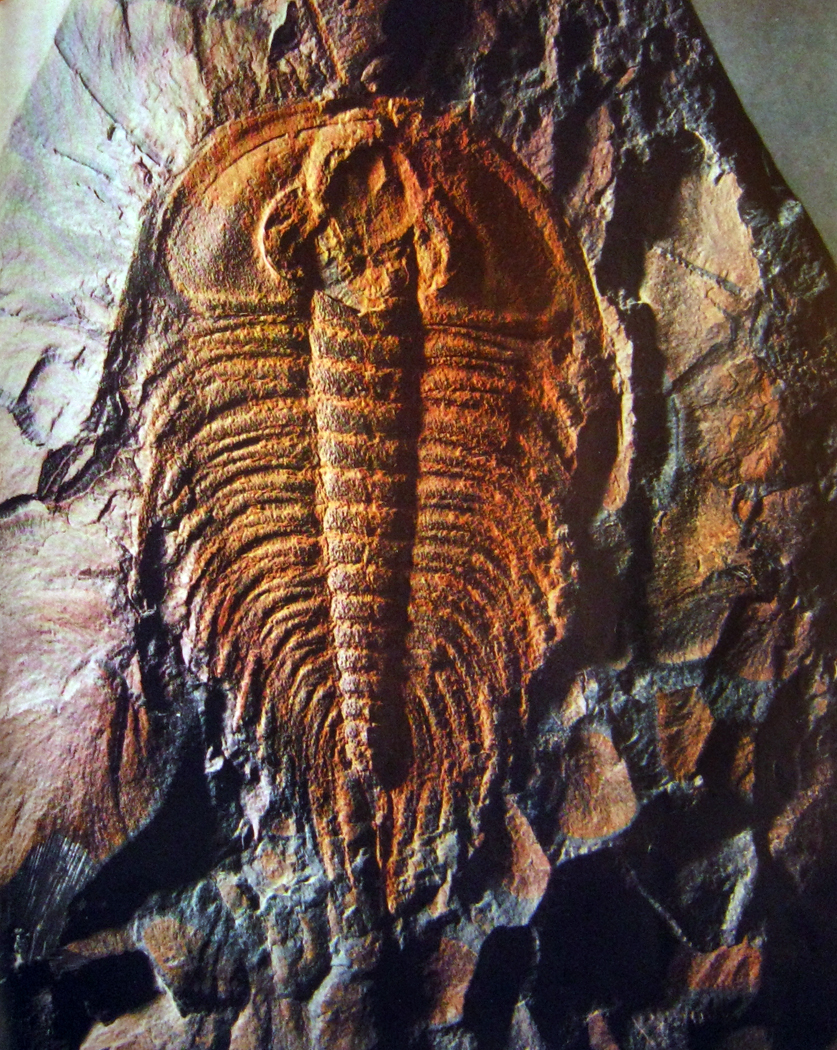
Pageant of Life

Pageant of Life

Of course, it is the earliest reading that had the most influence — as the twig is bent, so the tree inclines. Even the best of the more recent books cannot have influenced me even a percentage of how much I was shaped by, say, the Life magazine book, The World We Live In, which my grandmother gave me on my eighth birthday, and which left me wide-eyed at the wonder and diversity of nature  — volcanoes, blue whales, dinosaurs, jellyfish, rainforests, barchan sand dunes. I wear the badge of that book in my deepest heart’s core. It is the holy of holies.

But what caught my attention as I reread my old list, was that it continued to include lists of other things that shaped who I have become: music that influenced my developing psyche; art (that I saw in person, not just in books); movies; TV shows; — and last on the list of lists —  landscapes.

We don’t often think of how deeply landscape affects us, guides the direction of our lives — but how different might be the novels written by Fenimore Cooper or Washington Irving, or Mark Twain if those authors had lived elsewhere and seen different rivers, different mountains, different forests. I think of James Joyce’s Ulysses, which is practically a landscape — a cityscape — spread into lines of type.

Back Bay, Va.

Back Bay, Va.

Joyce had Dublin; Thomas Wolfe had Asheville, N.C., where my wife and I now live. Recently, I opened the first pages of Thomas Wolfe’s Look Homeward, Angel and read his description of Oliver Gant’s trip to western North Carolina. At one point, he describes a trip up the face of the Blue Ridge from “Old Stockade” to “Altamont” — thinly disguised versions of Old Fort and Asheville —  and as I read it, I knew that landscape — I knew that gravel road; I’ve driven it myself just last month. It’s still gravel and few cars venture it as it wanders and loops through the trees and snakes up the mountain. The interstate long ago made the trip faster and easier. But freeways are boring. As the old road loops and hairpins its way, you can frequently spy the railroad line as it winds its way uphill. That railroad was just being built as Wolfe wrote about it but even now, it  passes just under the hill where I live, and hear the locomotive whistle blow every night. It is uncanny to read about something fictionalized that you know as real.

But, in a sense, all the landscapes that are buried in the psyche are fictionalized: They have been transformed from mere fact into meaning. They are now metaphor and their existence takes on a reality that is imaginative rather than quotidian. It is imprinted as deeply as the smells of childhood, a mother’s kisses, the woodgrain of the school desk scratched with initials and scribbles.

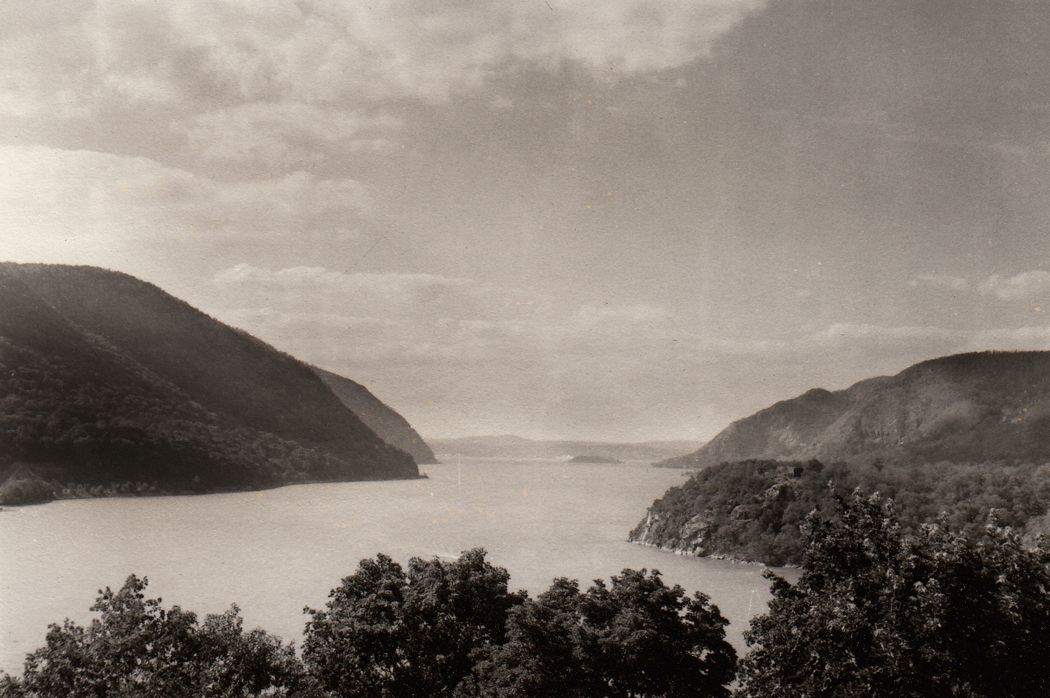
Hudson River, West Point

Hudson River, West Point

Dunderberg

Dunderberg

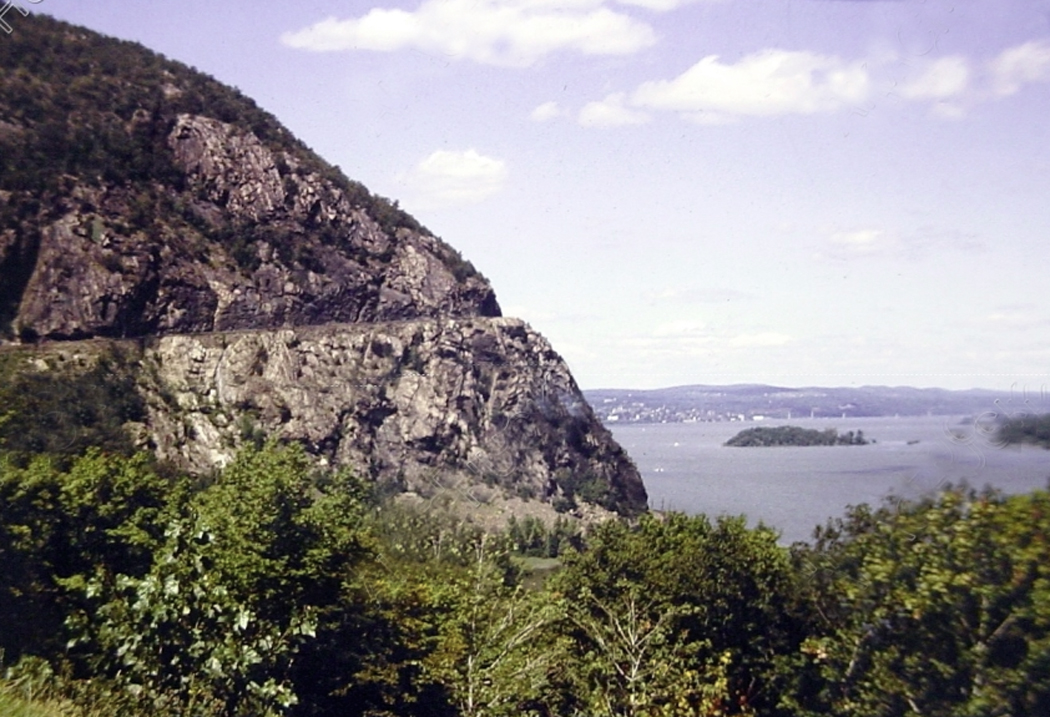
My own internal landscape begins as I do, in New Jersey and New York, with the Hudson River running through it and the Catskills bumping one bank and the Taconics the other. The automobile drive around the dizzying Dunderberg north of Tomkins Bay was a white-knuckle ride when I was young, the three-lane highway incised into the edge of the cliff. My father hated that part of the drive; we kids loved it. The “mothball fleet” of rusting liberty ships off Jones Point was a living link to the war my father had returned from only a few years before. There was Bear Mountain, with its ski jump and the suspension bridge over the Hudson; there was Seven Lakes Drive through Harriman State Park, all trees and granite; there was the Red Apple Rest and its billboards on the highway.Bear Mountain Bridge for blog copy

I don’t know why, but the suburban life I lived in Bergen County barely registered as landscape. The housing developments and county roads never embossed themselves on my synapses in any significant way. But the summer vacation trips we took up the Hudson to Newburgh, NY, and to the “bungalow” that was my father’s family summer cottage in West Park burned themselves deeply into my awareness of the world. The Hudson River was the aorta that pumped the lifeblood of my awareness of the larger world.

Deep River, NC

Deep River, NC

So, when I moved to North Carolina and college, I was amused at the Tar River or the Deep River. They weren’t rivers. The Hudson was a river. Guilford County’s Deep River was a wet gully. I could have jumped across it.

I have lived many places, and in many landscapes, but they haven’t all dug wormholes into my psyche. I’ve traveled to every continental state of the union — most several times. When Hank Snow sings, “I’ve been everywhere, man, I’ve been everywhere,” I can honestly say that I have been to the places he names in the song: “Hackensack, Cadillac, Fond Du Lac … Pittsburgh, Parkersburg, Gravellburg, Colorado, Ellensburg, Rexburg, Vicksburg, El Dorado, Larrimore, Atmore, Haverstraw” … the song goes on.

And all those places have landscapes that accompany them, the way a song accompanies each Fred Astaire dance number. They are there in the memory. But not all of them have transformed from geography to mythology. There are moments in life when you are particularly open, when your very skin seems adhesive to experience. It is like that when you are a child, but it also happens when you go through some life altering change, a first divorce, or a move across country, a close call, the birth of a child, or a new job. The rind of the psyche gets pulped, and becomes a place for a mythic sense of life to become rooted.

At vulnerable moments in the course of living, the world takes on an extra glow, a mythic noumenon and becomes fixed in the synapses as something larger than itself. The landscape thus internalized becomes an emotional nexus, a place where complex thoughts and feelings can be induced merely by seeing an image of that landscape, or reading an evocative description, perhaps even hearing a certain piece of music.

Mendocino County, Calif.

Mendocino County, Calif.

And so, these landscapes can influence the way you see the world. If you live by the river, you become Twain, if you live by the sea, you become Sarah Orne Jewett, if you live in Manhattan, you become Woody Allen — and all you write takes on the world view the land provides. Think of Faulkner and the red clay, of Hemingway and Michigan, of Henry Miller and Brooklyn (I know Paris comes first to mind, but it is the Brooklyn of the Rosy Crucifixion where you see the real Miller world view).

And so, when a seven-year relationship was breaking down in suspicion and acrimony, we took a trip up through Pennsylvania and the Delaware River to try to make things right. The heart was a sodden wet rag, and one chill fall morning at Port Jervis, the sun rose over a field by a railroad roundhouse that was choked with more wildflowers than I have ever seen before: yarrow, aster, ironweed, joe pye weed, mullein, sunflower, black-eyed susan, queen-anne’s lace. It burned into me, and is still there as a kind of metaphor for the infinite sadness of paradise.

Watauga County, NC

Watauga County, NC

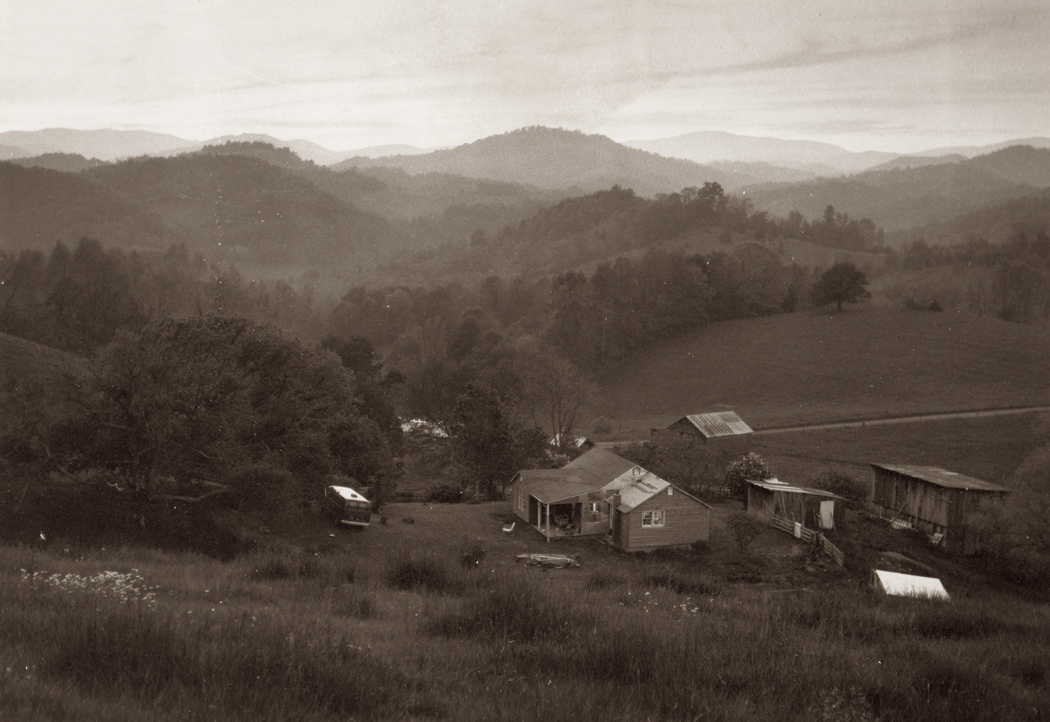
Years later, when I first came to live with the woman who has been my wife for the past 30 years, our house was on a ridge overlooking the New River in the Blue Ridge, and the landscape of rolling mountains and hills, divided between pastures and forest, coves and hollows, whitewashed churches and unpainted barns, took on that numinous glow. It is why we have moved back to the mountains, although the same landscape has now quieted down into comfortable daily life.

Hatteras

Hatteras

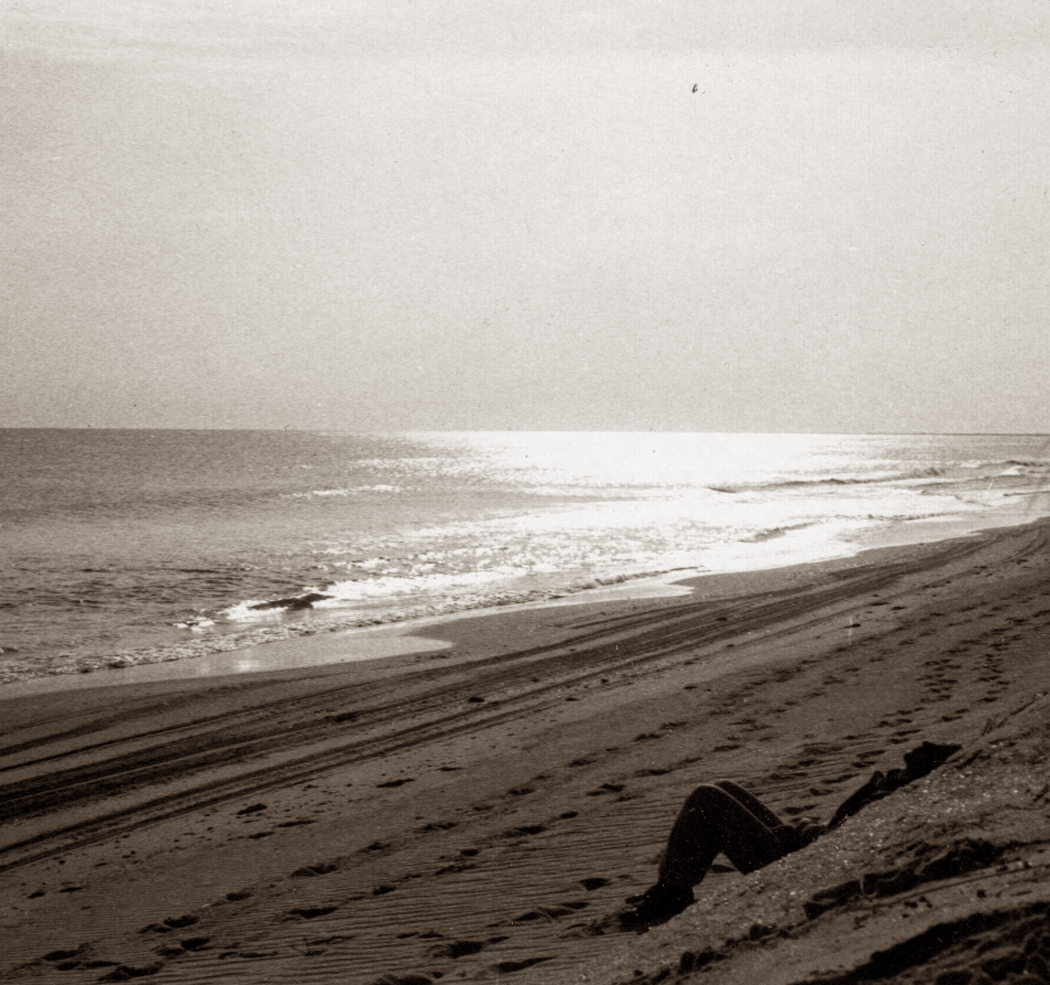
When I first entered college, and the intellectual world gaped open for me, I traveled several times with my friend Alexander to the Outer Banks. The sea oats and dunes, the long beach, Hatteras point — climbing illegally to the top of the lighthouse at night under a blanket of stars, feeling the steady wind on my cheeks, the smell of salt in the air — so that coming back to the dorm and  listening to Debussy’s La Mer on the tiny Sears Silvertone portable phonograph, sealed the experience into the brain like a mordant fixes dye in a fabric.

In the years I was unemployed and nearly homeless, I traveled back to New Jersey with my brother for Christmas. On the way back South, we drove through West Virginia, where he had friends, and we spent New Years Day on the top of a mountain. Before dawn, I woke and dressed and went out into the biting cold, where the grass was brittle with frost and my breath clouded in front of me and I surveyed the Cumberland Plateau, bumpy with mountains, spread out to the horizon. I felt lost and alone in all that frozen landscape.

Tsegi Canyon, Ariz.

Tsegi Canyon, Ariz.

The opposite emotions were engaged the first time my wife and I drove out West, in 1980, and the first time we saw buttes and mesas. The land seemed even more expansive than the West Virginia mountains, but they seemed to offer unlimited potential. The air was clear; you could see mountain ranges a hundred miles away. Over the quarter-century we lived in the West, there were many such landscapes printed on my psyche, from Christmas in the snow in Walpi, on First Mesa, spent with a Hopi family; to driving across the Escalante National Monument alone; to spending the night camping north of the Grand Canyon in a forsaken part of the Arizona Strip, one of the least populated plots of land in the country.

Landscape functions not merely as a stage set, a backdrop of other memorable occurrences, but for themselves alone, as metaphor, as an image of the inside state of one’s emotions and mind. It can be as if the landscape were not injected into your mind through your eyes, but rather, projected outward upon existence from the deepest recesses of your mind. If you were to enter my skull and photograph what you found, it would be landscape.

Big Bend NP, Texas

Big Bend NP, Texas

From my list, other landscapes you will find inside my head include the Olympic Mountains in Washington; Schoodic Point in Maine; Big Bend National Park in Texas; the sea-swell grasslands of eastern Montana that I rode past on the Empire Builder train from Chicago to Seattle; driving by night through the Big Sur in California; and Walden Pond in Concord, Mass., which I have circumambulated half a dozen times.

I do not know if it is rare — I have not asked many people — but many of the dreams I manage to remember as I wake up, are dreams consisting purely of landscape, often highly imaginary, exaggerated like the Andes of Frederick Church. It is the space in these dreams that seems to carry meaning, the emptiness from the spot where I stand to the thing I see before me: In between is air, and the air has shape and meaning.

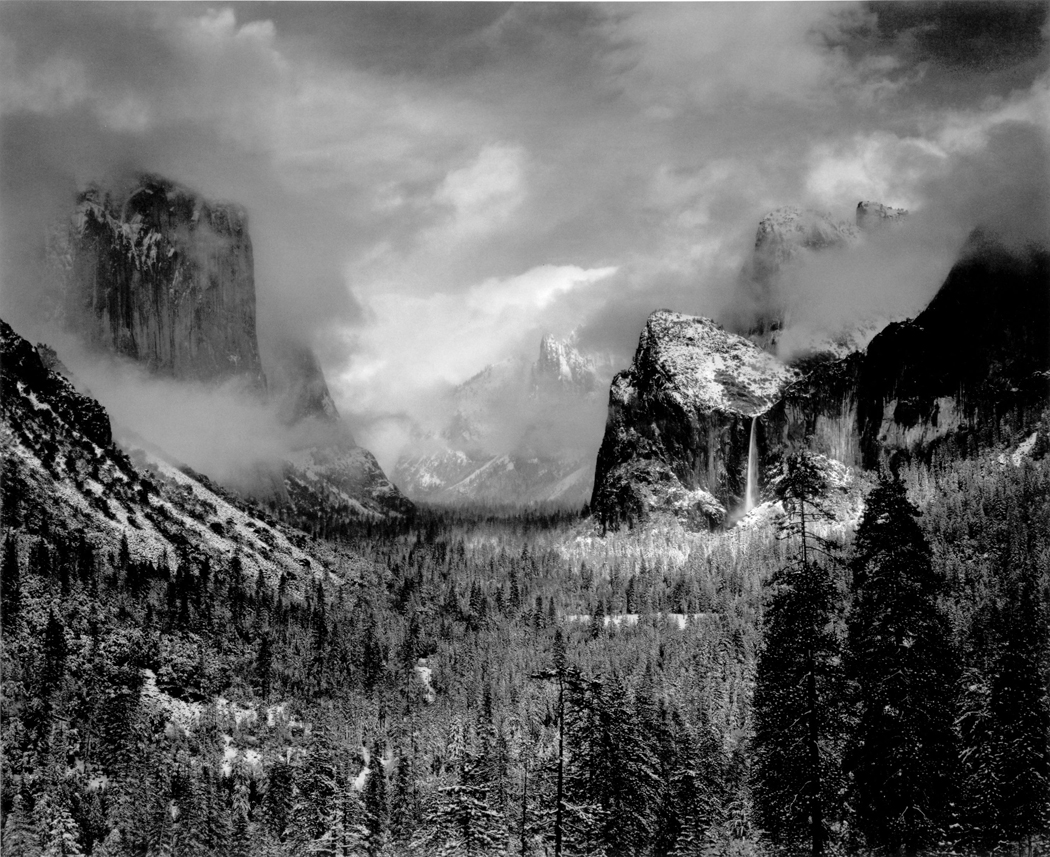
Ansel Adams, Clearing Storm, Yosemite

Ansel Adams, Clearing Storm, Yosemite

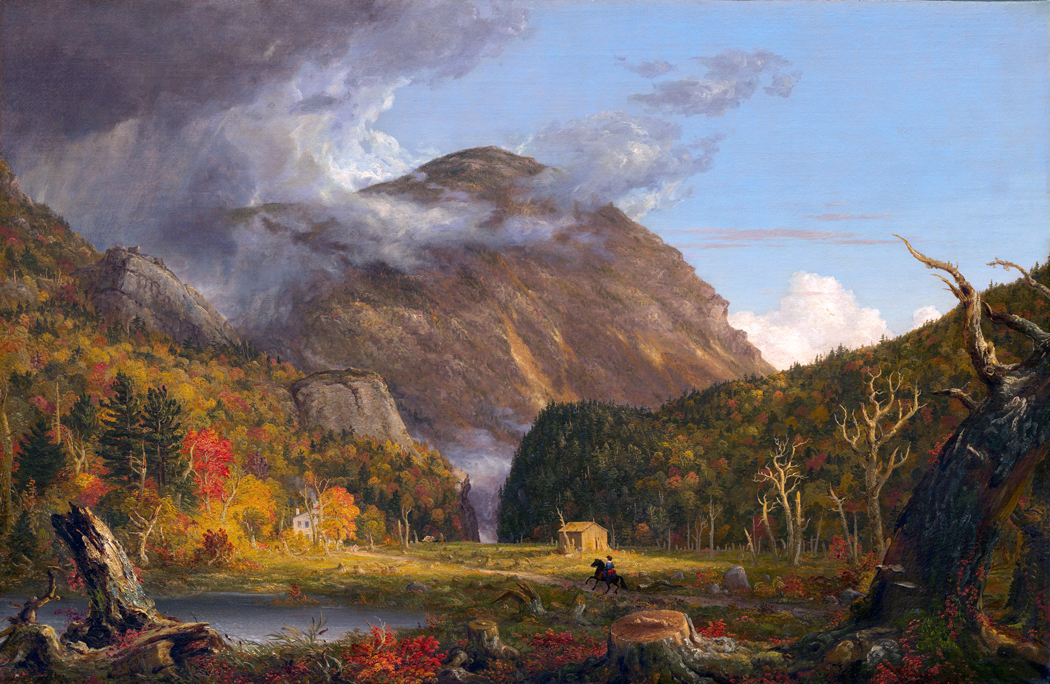
The best landscape painting and photography functions not as a record of the topography, but rather as an image of the interior state, vast and romantic, like Ansel Adams’ Yosemite in a winter storm, or Thomas Cole’s Crawford Notch. O blow you cataracts and hurricanoes, in the scumble of Turner, or cooly glow on the horizon, like the misty suns of Claude Lorrain, or the chessboard order of Canaletto.


Thomas Cole, Crawford Notch

Thomas Cole, Crawford Notch


Skull Island

Skull Island

When I was very young, perhaps 6 or 7, I first watched King Kong on TV, and what has stuck from then to now is the steamy, vine-clogged, rocky-cliffed landscape of Skull Island. That skull is mine, seen from the inside out.

If you want to shake the world out and make it larger again, get up at 3 in the morning and drive across the flatness of Indiana and Illinois. It is dark, the stars are thick as the July humidity. And the world seems quiet, empty and stretched once more to full size.

The sky grows upward as the stars populate it, lightyears away. Not only is the earth big, but you can see that you are a pebble at the bottom of a very deep universe.

You drive alone for miles and the only thing you see is distant headlights, like fireflies, flitting along the horizon line that shows up as the boundary between two different shades of black.

One set of headlights gets closer. You recognize a kindred spirit, someone else is driving in the lonely, vacant night. You wait a very long time for the lights to draw close. They are still miles away.

As the car gets nearer and dims its headlights — that salute of recognition in the dark — you see that it is the God of the Nighttime Highway, whose eyes are headlights and whose halogen gaze keeps the world from disappearing when everyone else is asleep.

And he passes and you drop once more into the large darkness.

Click on any image to enlarge

Baldwin County, Ala.
Baldwin County, Ala.
Caspar David Friedrich, Sea of Ice

Caspar David Friedrich, Sea of Ice

Werner Herzog can always give me a good chuckle.

Herzog's jokeThe dour German is more than a film director, he is a world treasure. If he did not exist, we would have to invent him. Just his voice, narrating a bit of documentary, or when filmed eating his own shoe, tells us that here is a man of substance, one who measures his gait against the cosmos. I will watch anything made by him, or in which he appears.

So, it made me laugh out loud when I was reading his book, Werner Herzog: A Guide for the Perplexed (conversations with journalist Paul Cronin), to see him disavow any romantic tendencies in his work.

“You can’t get a more contrary position towards the Romantic point of view than mine. Go back and listen to what I say in Burden of Dreams — the film Les Blank made on the set of Fitzcarraldo — about nature being vile and base, lacking in harmony, full of creatures constantly fighting for survival. Anyone who understands such things knows those could never be the words of a Romantic. If you’re interested in what I think about nature, take a look up into the night sky and consider it’s a complete mess, full of recalcitrant  chaos. …”

Does he know what Romanticism is? Here’s what he said in the film, talking about the Amazon jungle where he filmed Fitzcarraldo:

“The trees here are in misery and the birds are in misery. I don’t think they sing, they just screech in pain. … It’s a land that God, if he exists, has created in anger. It’s the only land where Creation is unfinished. Taking a close look at what’s around us, there is some sort of harmony. It is the harmony of overwhelming and collective murder. We in comparison to the articulate vileness and baseness and obscenity of all this jungle, we in comparison to that enormous articulation, we only sound and look like badly pronounced and half-finished sentences out of a stupid suburban novel, a cheap novel. And we have to become humble in front of this overwhelming misery and overwhelming fornication, overwhelming growth and overwhelming lack of order. Even the stars up here in the sky look like a mess. There is no harmony in the universe. We have to get acquainted to this idea that there is no real harmony as we have conceived it. But when I say this, I say this all full of  admiration for the jungle. It is not that I hate it. I love it very much. I love it against my better judgment.”

If that isn’t the very definition of Romanticism, I don’t know what is. It reminds me of the lines by Lord Byron in Manfred, when the hero is wandering the Alps in search of an escape from his suffering and guilt. He summons the spirits of nature, which are vast and impersonal. They describe nature much the same way Herzog does.

One says of nature, it is “ Where the slumbering earthquake/ Lies pillow’d on fire,/ And the lakes of bitumen/ Rise boilingly higher;/ Where the roots of the Andes/ Strike deep in the earth,/ As their summits to heaven/ Shoot soaringly forth …”

Another says, “ The star which rules thy destiny … became/ A wandering mass of shapeless flame,/ A pathless comet, and a curse,/ The menace of the universe;/ Still rolling on with innate force,/ Without a sphere, without a course,/ A bright deformity on high,/ The monster of the upper sky!”

Friedrich, The Monk at the Sea

Friedrich, The Monk at the Sea

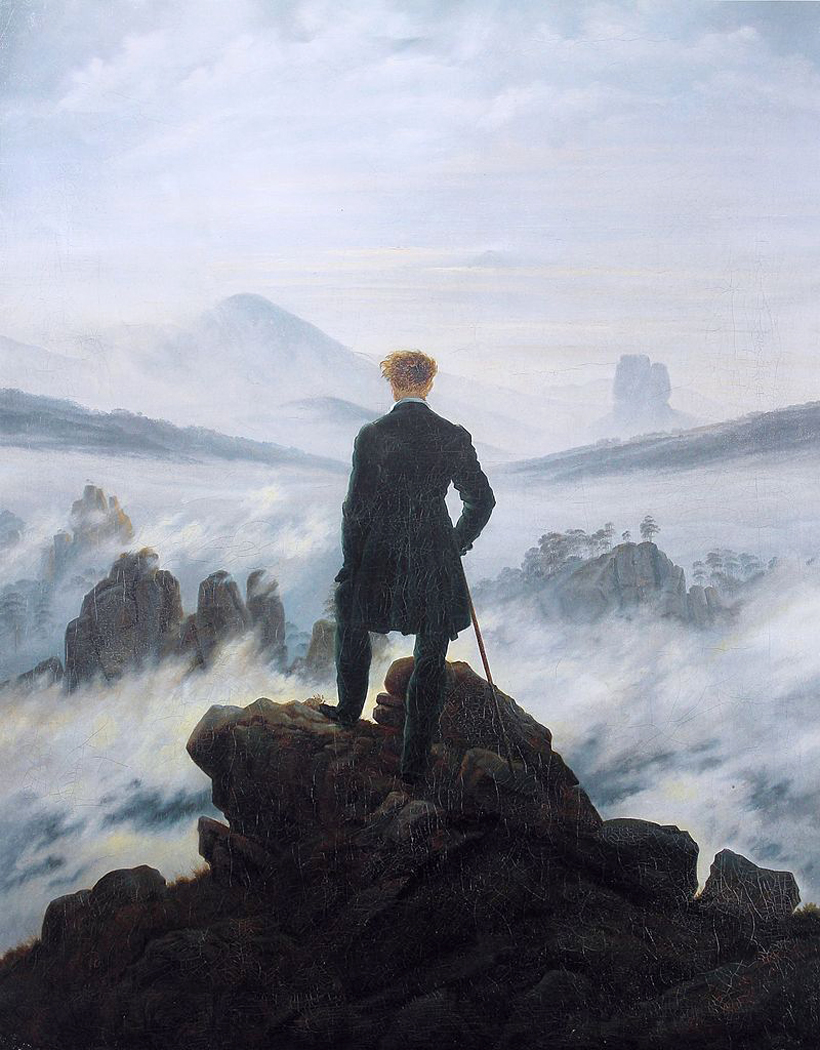
Wanderer Above the Sea of Fog

Wanderer Above the Sea of Fog

On the next page in Herzog’s book, even he seems to admit his basic romanticism, when he admires the German Romantic painter, Caspar David Friedrich. He is “someone I do have great affinity for. In his paintings Der Mönch am Meer [“The Monk by the Sea”] and Der Wanderer über dem Nebelmeer [“The Wanderer Before the Sea of Fog”] a man stands alone, looking out over the landscape. Compared to the grandeur of the environment surrounding him, he is small and insignificant. Friedrich didn’t paint landscapes per se, he revealed inner landscapes to us, ones that exist only in our dreams. It’s something I have always tried to do with my films.”

There is a common misunderstanding of Romanticism, that it is somehow warm and fuzzy, that it has something to do with being in love. But if you read the texts, look at the photos, listen to the music, you discover that Romanticism is something dark and mysterious, placing tiny humanity in the looming shadows of a vast, hard and roiling universe. You find it in Friedrich, with his ship crushed by

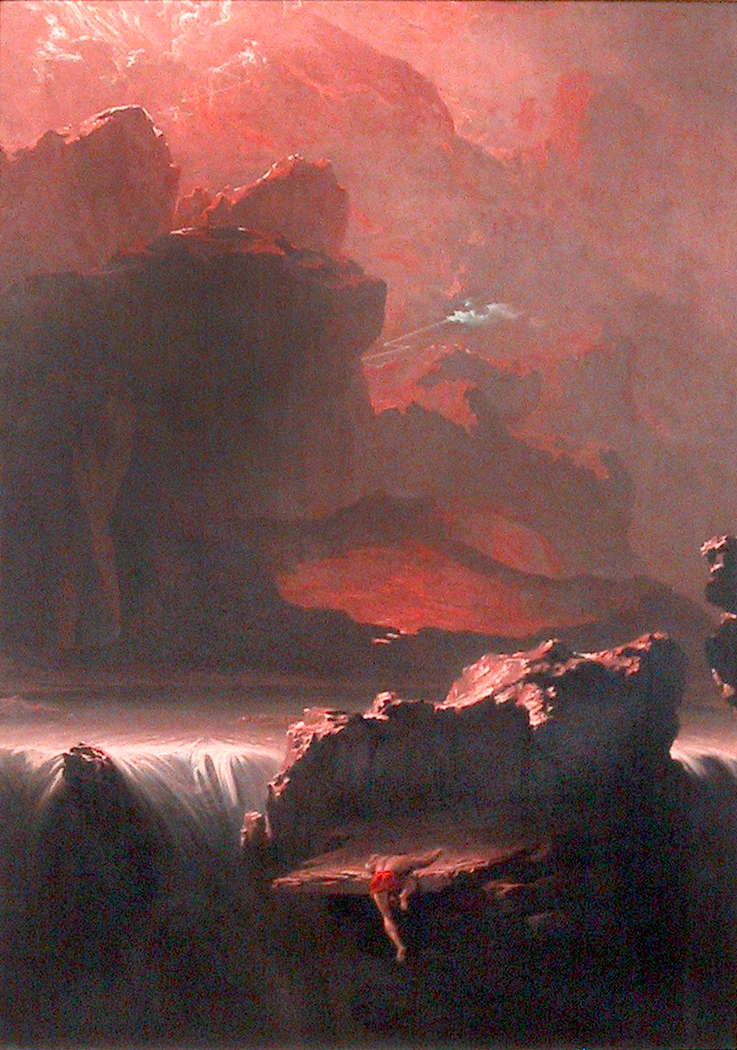
Sadak In Search of the Waters of Oblivion

Sadak In Search of the Waters of Oblivion

icebergs; or Shelley, with the depressing parade in Triumph of Life, or the spinning orbs  “intertranspicuous” grinding “the bright brook into an azure mist/ Of elemental subtlety, like light” in Prometheus Unbound; or William Blake staring down into the abyss in Marriage of Heaven and Hell, and seeing “beneath us at an immense distance was the sun, black but shining; round it were fiery tracks on which revolv’d vast spiders, crawling after their prey; which flew or rather swum in the infinite deep, in the most terrific shapes of animals sprung from corruption, & the air was full of them, & seem’d composed of them.”

Romanticism is John Martin’s Sadak in Search of the Waters of Oblivion, and Berlioz discovering his beloved is turned to a harpie at the Witches’ Sabbath at the end of the Symphonie Fantastique, and Ahab blaspheming on the quarter deck in Moby Dick.

So, Werner Herzog, you gave me a good laugh.

The last real day and night in Paris; the next day, we suffered the indignity of Charles de Gaulle airport, the tedium of being stuck on a jet for umpteen hours, and the disappointment of returning to “real” life, jobs and the traffic on Seventh Street and Camelback in Phoenix.

tuileries statue with bird

The Tuileries
Sunday April 7

tulipsLes jardins. The gardens. The trees, flower beds, weathered statues, green-painted benches, the gravel walkways, with the dust blown up by the gusts. These French gardens are not just places to see nature. In fact, the nature in them is so unnatural as to make the idea silly. But, they are places where nature is rendered symbolic, so that even the real flowers function as symbols for flowers. That doesn’t make them any the less beautiful: The tulips especially this time of year, are open with that gesture of the hand held upright and the fingers together giving way to the fingers spread apart to the sunlight.

tuileries reading a book

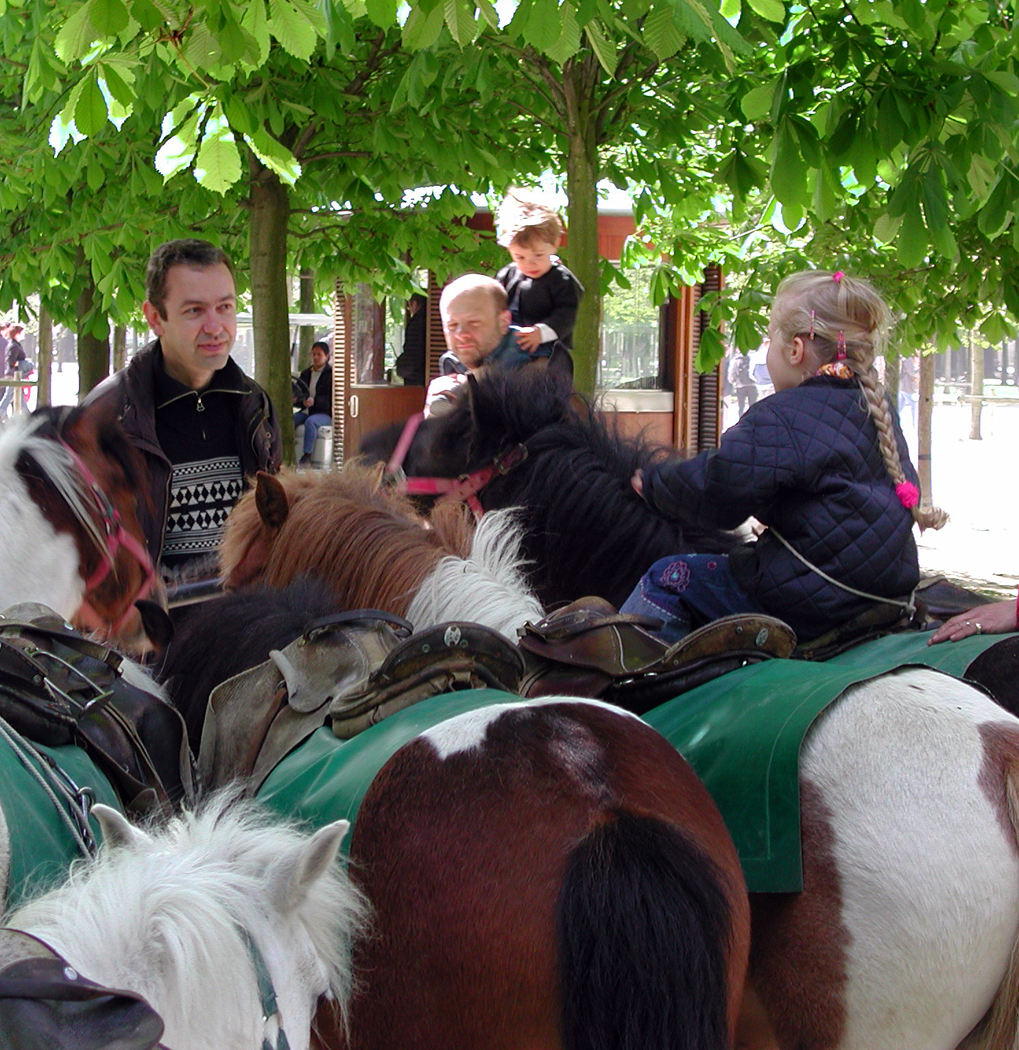
We walked in the Tuileries today, that remnant of Catherine de Medicis royal front yard. It was once the property of the monarchy; it is now owned by les citoyens de Paris, who use it on a Sunday morning to sit and read the paper, to play boules on the gravel, to ride the ponies or the carrousel, to sit at the edge of the water by the fountain and hold hands. But mostly, it is used as we used it: to walk through.

tuileries horsechestnuts

The half nearest the Louvre is open, grassy and planted with flower beds. The far half is covered in horsechestnuts. The whole is populated with Olympians, nymphs, Bourbon matrons and the illustrious of science and the arts, all stony in their marble, sandstone or bronze. The pigeons roost in Hercules’ hair.

tuileries hercules

This French idea of a garden — a French idea of Paradise, the original garden — is one like so much else French, a curious, even tortured combination of nature and art, or the natural world and the procrustean world of “le systematique,” or the theory, or the “logique.”

tuileries gate

It goes against everything I thought I held dear about English gardens, about wildflowers in the woods, or even my own vegetable gardens. Those are more about real flowers, about appreciating the azaleas, geraniums or spiderwort. These French gardens remove you from the actuality and put you in the position of appreciating them esthetically, which is quite different from appreciating them sensuously. It is an important difference: All high art is stylization, whether it is a waltz or a sonnet or a Shakespearean tragedy. One can see these French gardens aspiring to the same status. They don’t want us to feel cozy, but to feel serious, to attend, to hold oneself in relation to the nature parodied.

tuileries 5

In the wild, you feel yourself in nature, and the self more or less dissolves, leaving the nature. In the French garden, the self is amplified by being the perceiver rather than the participant.

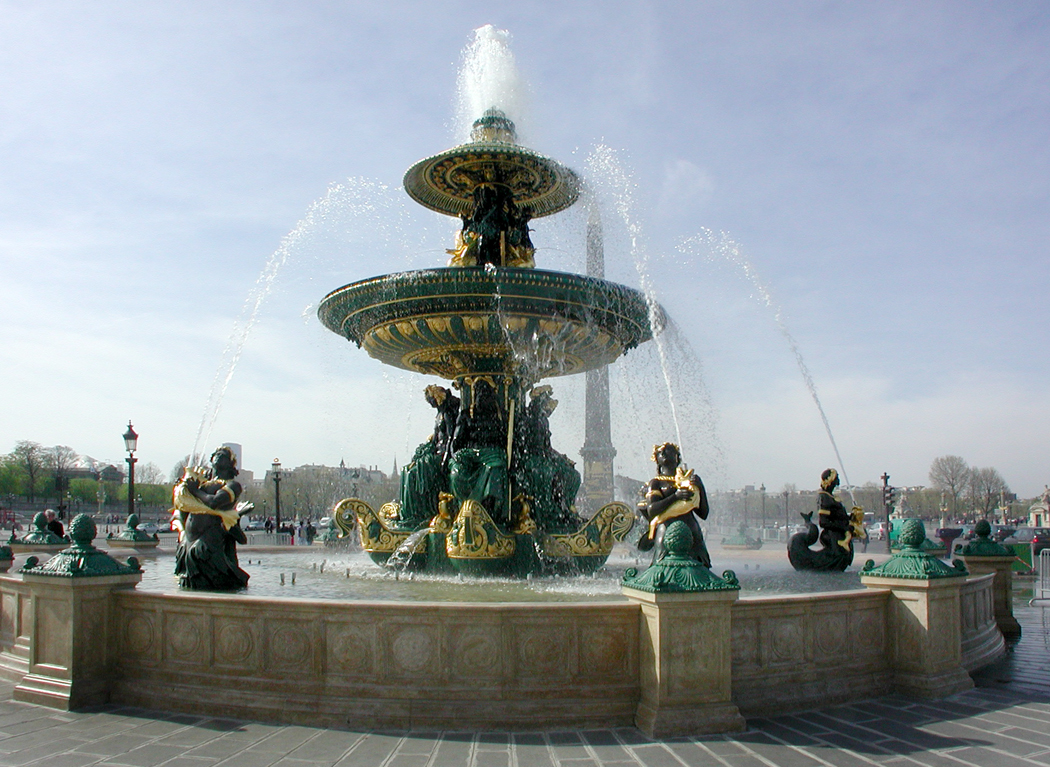
place de la concorde fountain horiz

In theory — to be French myself — I should hate the French gardens. I always thought I did. But the actuality is so highly wrought, so magnificently manufactured, so detailed and thought through, I cannot help myself admiring it, being moved by it, and actually loving it.


arena 2

Carole’s highlights:

tuileries horsey rideThe Roman amphitheater and the jonquils and tulips at the arena, and the little boys playing soccer. Also the Tuileries gardens today, and all the beautiful flowers there and the statues. And the large fountain with the black figures decorated in gold and green, by the obelisk. The happiest event of the day was seeing the waiter at L’Etoile d’Or and having him recognize me and asking me to speak French. I loved seeing the children in the pony cart and the little girl riding the pony at Tuileries, and the carrousel there. What I enjoyed most during the day was walking through the Tuileries garden today with Richard. I wish we could do it again tomorrow morning.

Richard’s top spots:

Musee d'Orsay

Musee d’Orsay

At the cafeI know what my least favorite thing is: that today is our final day in Paris. I’ve been grieving all day. Still, the Tuileries — Paris’s answer to Central Park — was like living in a live, full color Atget photograph, with the horsechestnut trees thick with flowers on their panicles, and the flower beds looking like the mille fleur embroidery in the tapestries. The short trip through the Musee d’Orsay was in all ways a disappointment, largely because of the crowds. But we had seen many of the most important paintings and sculptures in special traveling shows in the U.S., so it wasn’t like we hadn’t seen first-rate Monets or Van Goghs before. We pretty well wanted to get out of the joint as soon as we got in.

What never fails to give us pleasure is just walking around the streets. We walked along the quai, or even up the Rue Monge near our hotel, and look in the shop windows, drool at the patisserie, see what French vacuum cleaners look like, watch the people sitting at the round tables in the cafes sipping their cafe au laits. The cars are different; the way people walk or cross streets is different. It is all utterly and completely fascinating.

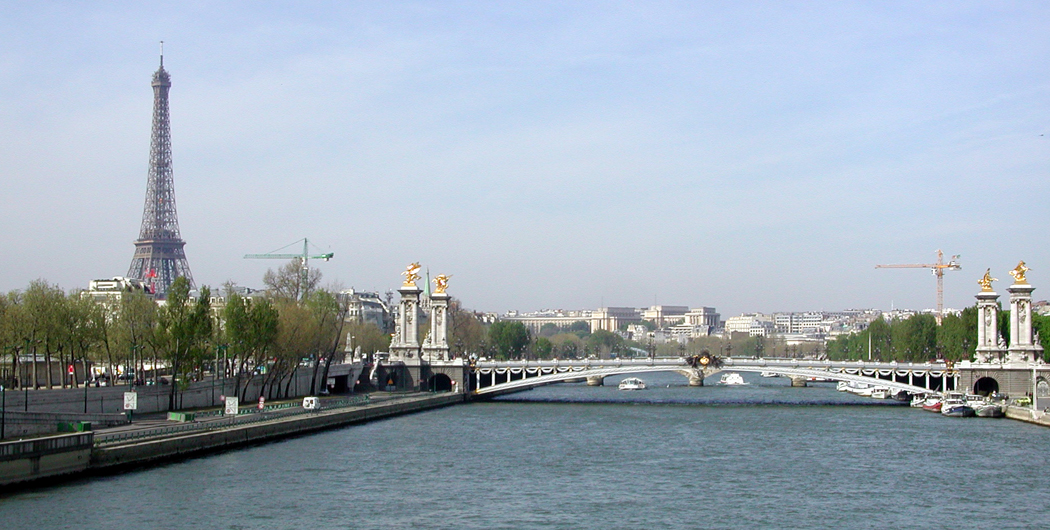
Pont Alexandre III and Tour Eiffel

Postlude: 2016

Our first trip to Paris was a kind of experiment. We worried — unnecessarily at it turned out — about not speaking French, about money conversion, about the pickpockets that guidebooks warned us of, about strange foods and the famed rudeness of Parisians. None of this was true. Parisians were uniformly warm and friendly, always helpful and frequently generous. After the first trip to France, I never brought along another money belt. Silly idea. And the era of plastic money meant conversion and cash were not serious issues. We paid at almost every restaurant with the bank card.Carole at the patisserie 3
And almost everyone we encountered either spoke English, or a little English, or with hand gestures, pidgin French and rudimentary English back-and-forth, we communicated just fine. I learned very quickly that you only really need three phrases in French to get by just fine: “Bon jour;” “Merci;” and “L’addition, s’il vous plait.” That is, “Good day;” “Thank you;” and “Check, please.” And the last can be sidestepped by the universal gesture of mime-scribbling on the palm of your left hand while smiling at the waiter.

As for the food, it turned out the stranger, the better. We have never had a bad meal in France. Even the cheapest dive we went to, for a cheap, fast lunch, gave us repast more delicious and better prepared than most we’ve eaten in the good ol’ US of A.

I remember particularly a day we popped in to a little charcuterie off the Boulevard Saint-Marcel and asked for some cold cuts we wanted to take back to our hotel room, and the proprietor smiled and spent about five minutes making up the most elaborate design on his platter, with about 10 different types of meat, amplified by several vegetative garnishes and pastas, and insisted we taste samples of each before he arranged each type on the plate. The obvious pride he showed in his workmanship, and in the quality of his meats, was not just palpable, it was absolutely joyous. With each sample he stared into our faces like a puppy dog to savor our approbation.Madjid and us

At a pizza joint we went to for a fast dinner, the waiter, Madjid Lahrouche, became a friend, and the second time we showed up, he wouldn’t give us pizza, but instead served us the cous-cous he made in the kitchen, so he could show us the food he grew up with as a Berber in North Africa, with great hunks of lamb and a tremendous soup of vegetables and potatoes. His grin was infectious. We have been back.

And going back is the watch-word. We have been back to France many times; on later trips, we tried to spend at least a month each time, and on subsequent trips, we got out of Paris, rented a car and have been to almost every quarter of the country, from Picardy to Provence, from Brittany to Alsace. Driving in France is a dream; one should not fear it. Signs are easily understood, and off the main freeways — which no sensible person want to drive on, anyway — traffic is light and easy, with many back roads practically empty.

When we are not there, we are always homesick for la belle France.

The last breakfast

The last breakfast

It has been an eye-opener to re-read my notes from our first trip, posted in these recent blogs. On later trips, the writing is less effusive, and show, I hope, a deeper understanding and appreciation for the culture, less wide-eyed and golly-gee than some of these entries. But there was a genuine openness that I sensed in these original notes that I thought might sustain an interest for readers. And I went through and re-edited the photographs I took from that trip and discovered several I had originally passed over, 14 years ago.

I certainly recommend for all Americans that they get out of their own country and limited experience and get to know a bit of the other parts of the world. It needn’t be France. It could be Japan, South Africa, New Zealand, Chile, Iran — just somewhere to escape the shackling prejudices of comfortable middle-class American assumptions. We are a provincial people, and that is actually dangerous when we are also the most powerful and influential nation in the world.

NDP under bridge

Notre Dame: round 3
Saturday, April 6

With only two days to go before leaving Paris, we have begun to feel a little frantic. We don’t want to go home. We want to stay here.

Meryon, Le StrygeBut even granted we have to go home, there is too much we haven’t gotten to do. So this morning was given over to making up some of the most important oversights — particularly, climbing the towers of Notre Dame de Paris to see the many carvings along the ramparts, including the most famous one, the Stryga, a grotesque with a garish nose, two horns, wings and the ears of Prince Charles, resting his chin in his hands looking out over Paris below him. He is a kind of ensignia for the cathedral, most famously in a 19th century photograph by Charles Negre, and an etching by Charles Meryon. If anything is the mascot of the church, it is the Stryga.

But he has a lot of company at the tops of the towers. Some have buzzard heads, some have wolves heads. One is eating the carrion of another, tearing long raw chunks from its side, like Goya’s painting of Cronus eating his children.NDP Gargoyle 6 hungry

We got to the cathedral by 9:30 a.m., when they open the tower, but there was already a long line. Weekends are busy for Notre Dame, with an invasion of tour busses parked under its apse and lines of tour groups flooding the parvis in front of the cathedral.

And the line for the tower proved to be even more infuriating, because they only let 20 people in at a time, and when you finally get inside, out of the blowing wind, you find yourself on another queue, just to pay your admission. You wait and wait, and finally, they let you through. The wait must have been a half hour.

The climb is at least as strenuous as the one at Chartres, but I’m in better shape after all the walking we’ve done, so although I got winded, my legs held up.NDP roof

The first stop is a large vaulted room with a gift shop. They don’t miss a trick on this tour. But you continue up till you get to the level just above the row of kings and pass around the north tower, where the Stryga holds court. As you pass between the towers, you get a look at the cathedral’s lead roof underneath you, and all the stone carvings that hide up in this stratosphere. And when you circle around the front of the south tower, you come upon a traffic cop who prevents you from climbing up to the very top of the south tower — at least until the previous 20 people have descended. They you get your turn, and are told you have only 5 minutes at the top.NDP Gargoyle 2

It is a heady view from on high, with the Eiffel tower in one direction, and the Pantheon in another. But you don’t get to see as much architecture as you do from the lower level, so when I climbed back down, I tried to reenter the chimeras gallery. The traffic copy stopped me and motioned for me to go down to the exit.

“But I am studying the architecture,” I told him. “I’m not just a tourist.”

He looked a little disgusted with me, in that particular French way, but let me pass and reenter the gallery, where I took another infinite number of photographs before finally descending the stairs to the bottom of the south Tower.NDP Stryga and friends

There were by actual count 3 billion people in the parvis waiting to enter the cathedral. There was a line just to get through the door. I’ll never find Carole in all this, I thought, but when I got in, I walked down the center of the nave, and there she way, sitting quietly, an unmoving point at the center of all the hubbub. She is always easy to find.la voie lactee vertical

On the way back to the hotel, we walked along the quai, did some last minute gift shopping and lunch at the Turkish restaurant around the corner from the hotel, the Voie Lactae. You can’t get a bad meal in Paris.

Later in the afternoon, we went for a longer walk down to the river, where we ran into a large angry protest parade along the quai, chanting for Israel to get out of Palestine. Carole was worried that they might do violence to Americans, but I plunged on ahead, walked across the parade and up the street. The walk along the quai beside the Curie Institute was a pleasant promenade, with flowers on one side and water on the other. We walked all the way past the Jardins des Plantes and up the streets past that, looking for a place to have supper. At 7 p.m. we came across a nice looking tiny Basque restaurant and thought it was just the ticket. We were the only customers at this early hour.prix pratiques

Until, that is, an invasion of American high school kids on a vacation tour of the Continent. With 13 instant new mouths to feed, the kitchen couldn’t keep up, and our meals took forever to get to our places.

The Piperade — a kind of scrambled egg with ratatouille in it, topped with a slice of Basque ham (think American Country Ham) — was magnificent, and a huge serving, so we hardly needed our plat. But we waited — and waited — and waited — while the chef and his one poor helpmate, a young woman, tried to trot out lots of snails and shrimp to the students. Meanwhile, more and more people started pouring into the restaurant. It was grand central station.street scene 1

It took so long, that after we finally got our plats, we declined the desserts — god knows how long it would take to get them — and paid our bill and got the heck out of that madhouse.

“We don’t want to go home,” we keep repeating. “We want to live in Paris.”

Carole’s recollections:

The pink petals from flowering trees were drifting in the air today and gathered in drifts in the gutters. I was frightened by a big white German shepherd looking dog on the loose.

There was a big demonstration in the streets with people carrying French flags and shouting “Quite Palestine,” and we stood around and R. kept leading us down into la monde arabe. But we came out on the other side and had a wonderful walk along the river and saw houseboats and cafe boats and one cafe boat also had a magic show.NDP Upper story with roofline

And when we went to Notre Dame this morning, while R. climbed the tower, I sat in the nave and looked at the windows for a very long time, and the ceiling of the cathedral gradually became rosy and a little bird, like a sparrow, flew up from the center of the nave to the top of the cathedral and sat on a ledge at the very peak of the arch of the central stained glass window. I spent a lot of time in the cathedral looking at the carved stone irises on the capitals of the piers, and outside, I compared the sculpture on the portals with the sculptures at St. Denis and I think the portals at St. Denis are more effective.

Supper at the Basque restaurant was wonderful and terrible: We had country ham on an omelet with ratatouille and it was glorious. But I ordered veal kidneys for my plat, and that is what they tasted like. We had wonderful wine and drank half a bottle.

At the fruit stands, I found three French apples — a big round ruddy apple; a smaller reddish one; and a little soft yellow one that looks wild.NDP gargoyle over street

Richard’s turn:

Climbing the tower at Notre Dame de Paris left me winded, but the treasures I found at the top took my breath away. The gremlins and gargoyles — mostly created by Eugene Viollet le Duc as replacements for the originals — were stunning, and like something created just for Victor Hugo. Most particular was the familiar Stryga, the grotesque resting his head in his hand surveying the city of Paris from the top of the tower.

NDP spire statues both sidesI spent more than my time up at the top, in the icy wind of this April day when the weather turned chill once more. Carole waited down in the church while I sauntered along the parapets taking pictures of every grotesque, chimera, every rain spout and quatrefoil. This visit finally completes the work of cataloguing the cathedral that we began three visits ago. Above all things, the Notre Dame de Paris has been the top of the list of things on our vacation, especially with the Easter service and the organ music. But the cathedral itself, above even Chartres or St. Denis, has been the revelation of this trip.NDP Gargoyle 1

Second to that has been the food, which is just as much a religious experience. After those two items, everything else is further down the list.


constant roux 1

Addendum, 2016:

For some reason, I didn’t mention in my notes the Institut de Paleontologie Humaine, which we passed on the Boulevard Saint-Marcel on our roundabout walk after dinner. I can’t imagine why I neglected it: It is a hoot. And a half. Constant Roux

The sculptor Constant Roux (1865-1942) designed a ribbon of sculpture around the building depicting “Primitive Man.” And it is an impressive display of invention and design. It is also a reminder of the pernicious racial ideas prevalent in anthropology then current. Roux has divided primitive peoples into racial groups, African, Asian, American Indian, Oceanic and Caucasian. For the Caucasians, “primitive” meant prehistoric, so his Caucasian examples are so-called “cave men.” For the others, his primitive peoples are contemporary, or at least existed within the past 100 years — like the Indians he sculpts stalking their prey in the skins of animals.Institut de paleontologie humaine Paris

Yet, if on the whole, it is hard to get past the inherent racism of his depictions, there is also something there to admire: He attempts to give a certain dignity to his idea of primitive peoples, and some individuality to his subjects. One feel apologetic for liking these friezes, but taking out the bias (admittedly hard — or even impossible to do), one can appreciate the  genuine life in them.

constant roux 2

And more, the variety of design, the variety of pose, and the ingenuity of making those designs in the restrictive space he has to work with, the thin band that circles the building. Each is broken into a nearly Cinemascope widescreen, and populated  with two, three or six individuals performing a task deemed characteristic for that ethnic group.

constant roux 10

Still, the problem is summed up most egregiously in one panel: A group of African women and a gorilla, or chimpanzee (it’s hard to tell exactly what is meant — it is a generalized ape). You sense the same root from which sprung King Kong in 1933. One of the women is tickling the ape with a flower. The women are naked with the same matter-of-fact prurience that used to fill the National Geographic magazine.

constant roux 3

We all grow up in a Zeitgeist, a common world view: Within it come wide variations. When Thomas Jefferson dithered over the morality of slavery, there were some few who recognized the enormity of it and rather more who accepted slavery as a given, even God ordained. But we look back at the founding fathers now with an uncomfortable eye. We find it easy to judge those earlier people by our contemporary standards. If we are to truly understand them, we need to have a second sight that judges them by what we know now, but also forgives them for what they didn’t comprehend.  We all accept things now that our progeny will condemn us for.

constant roux 5

Roux had a long career and his work is found all over: A journeyman sculptor, he chiseled out whatever was required for building design, cenotaph or memorial, and was at the very least, enormously talented.

constant roux 4

Born the year our Civil War ended, he died during World War II, and his style, formed in the Belle Epoque, never really caught up to the modern art that was being made all around him, yet, with commissions like the Institute for Human Paleontology, he was up to date with the now out-of-date science of his time. One has to feel a twinge of sympathy for a man of undoubted talent, but without individuality or genius, who struggles to use his gifts as best he can in a world that has shifted around him. While Roux was still making busts of Achilles or statues for the “gloire de la patrie,” Picasso was making Cubist portraits, Matisse was painting Dance, Kandinsky was theorizing the symbology of color, Egon Schiele was stretching bones and skin into contortions of angst. Modern art was exploding all around him, but Roux kept faith with his small art. One wonders if he was even aware of a world headed into two world wars and a culture turned topsy-turvy.

constant roux 9

I have been back to the Institute, and have photographed the panels again. These images are from the first day, and only from one side of the building. I wish I had them all catalogued.

constant roux 12

You will not find Roux in your Jansen, or taught in your art history classes. One feels a need occasionally, to appreciate the many excellent working artists who will never make a dent in the progress of culture, but merely do what they do well.