If there is one theme that overrides the whole set of notes on our trip to France in 2002, it is that of the French love of “logique” and systemization, versus the older Gothic love of “the things of this world.” Even the Baroque in France is oddly static and toned down. So, when we finally got to the megaplex that is the Louvre, it is hardly surprising that the same questions arose again.

As usual, click to enlarge any photo.

Louvre and pyramid

Louvre
Friday April 5

After nearly two weeks, we finally made it to the Louvre. It isn’t that we weren’t interested, but we’ve had a lot of other stuff on our agenda, mostly dealing with Gothic churches.

Hall of RubensTo say the Louvre is big is to say the Pacific Ocean is wide. It hardly covers it. We spent the whole day there and saw maybe a 20th of it. We saw parts of the Greek statuary, the northern European late Medieval painting, the big hall of Italian Renaissance and Baroque painting and a few halls of French Baroque painting, to take in the Poussins and Claudes, which I was hungry to see.

That not only wore us out, it took from about 10 a.m. to about 4:30 p.m., when, exhausted and with throbbing feet, we finally set our course back to the hotel.

There is a problem seeing so many “hall of fame” paintings, so many “greatest hits” in one go round. You cannot do much but cover the highlights and you look at one famous painting after another and take notes on this small aspect or that: the way the brushstrokes feather in Leonardo’s La belle jardiniereVirgin and Saint Anne; the overall bluish caste to Ingres’ Odalisque; the tricolor reflections of the water drops in Delacroix’s Dante in the Boat.

It isn’t just that there wasn’t time to spend an hour or two with each masterwork, but that just being in the Louvre, with the crowds of tourists, and the hugger-mugger of Jansen regulars, the occasion of it all, prevents you from being able to concentrate.

Here is Raphael’s Belle Jardiniere, there is the Mona Lisa. Here is the Avignon Pieta, there is the Bust of Homer. You take them in with the instantaneity of an art appreciation slide show, one after the other. Even if you wanted to spend a few extra minutes with the Wedding at Cana, there is Liberty on the Barricades calling to you.

Which is all a terrible shame, because even with the little time you get to spend with each painting, you recognize once and again, deep in your eye sockets, how different the real painting is from the picture in the book. The looking at libertythickness of the layer of oil paint, the fineness of detail, the actuality of the color — uncaptured by the cyan, magenta and yellow inks in your Jansen text — gives you that sense of quiddity, that sense of thusness, of actualness, of event, of richness, of sense experience, that the pictures in the book can never deliver.

It is probably the ubiquity of reproduction that has led to the pathetic and word-ridden French philosophies that rule art criticism currently. All you can get out of the reproduction is the iconography, which is the intellectualized part of the painting, and if that is all you get, you miss the sense experience, which subverts the intellectualization and renders it shallow.

For me, this is most evident in the northern Medieval and Renaissance paintings, which have a textured surface of paint, mimicking the damasked cloth being represented, or the gold leaf which sits atop the oil paint.Van Eyck Rolin Madonna

And what a deep and satisfying green Van Eyck has found. You can practically see it as ground up emerald or other jewel, suspended in the oil. The green is dark, intense as a clear night and transparent as stained glass. Louvre guardWhen one sees a real painting, one knows great beauty, and great joy in its apprehension. Though it soaks in through your eyes, you feel it in your fingertips, smell it, taste it, and almost hear it. It makes all your senses buzz.

Part of it is taste, certainly — gout. Others may prefer the Italian Renaissance to the Northern one, or may really like the sweeping flesh tones of Rubens or the sausage fingers of Ingres. But whether it is the vermilion in the cloth painted by Poussin or the ultramarine of Mary’s robe in a million other paintings, the direct, uninterpreted experience is the primary gift of great art.

Of course, not all the great art in Paris is paint.

Chez Alexis&DanielWe went back to Chez Daniel et Alexis for dinner tonight. The tiny toy pinscher met us at the door and followed us to the table. He must have remembered my petting him the other night, because he was all affection. He climbed up on the seat next to me and nuzzled his little nose in my coat the whole time we ate supper.

Which was, again, magnificent. Carole’s asparagus in melted gruyer was heaven in a dish. Our chicken plat, stuffed with mushrooms, was tres bien, and our desserts — well, we couldn’t finish them.Louvre lunch

And this is only dinner. For lunch, we ate at one of the Louvre restaurants and had quiche with tomato and chicken in it, and desserts: Carole had three little custards, and I had chocolate.

It is embarrassing to keep on about the food, but food by itself is sufficient reason to visit Paris. Everything else is gravy — I mean, sauce.

Carole’s take on things:

Felt good all day because I wore black, like the French women. And fashionable shoes, rather than the athletic shoes I’ve been wearing.

Thrilled to be going to the Louvre. I still can’t believe we went.

Carole & LaurenWe got a beautiful bouquet of lilacs for Lauren, our waitress at Le Petit Cardinal and she was very pleased.

Now, at the Petit Cardinal, no one even asks us what our breakfast order will be. This morning, it was simply delivered to our table.

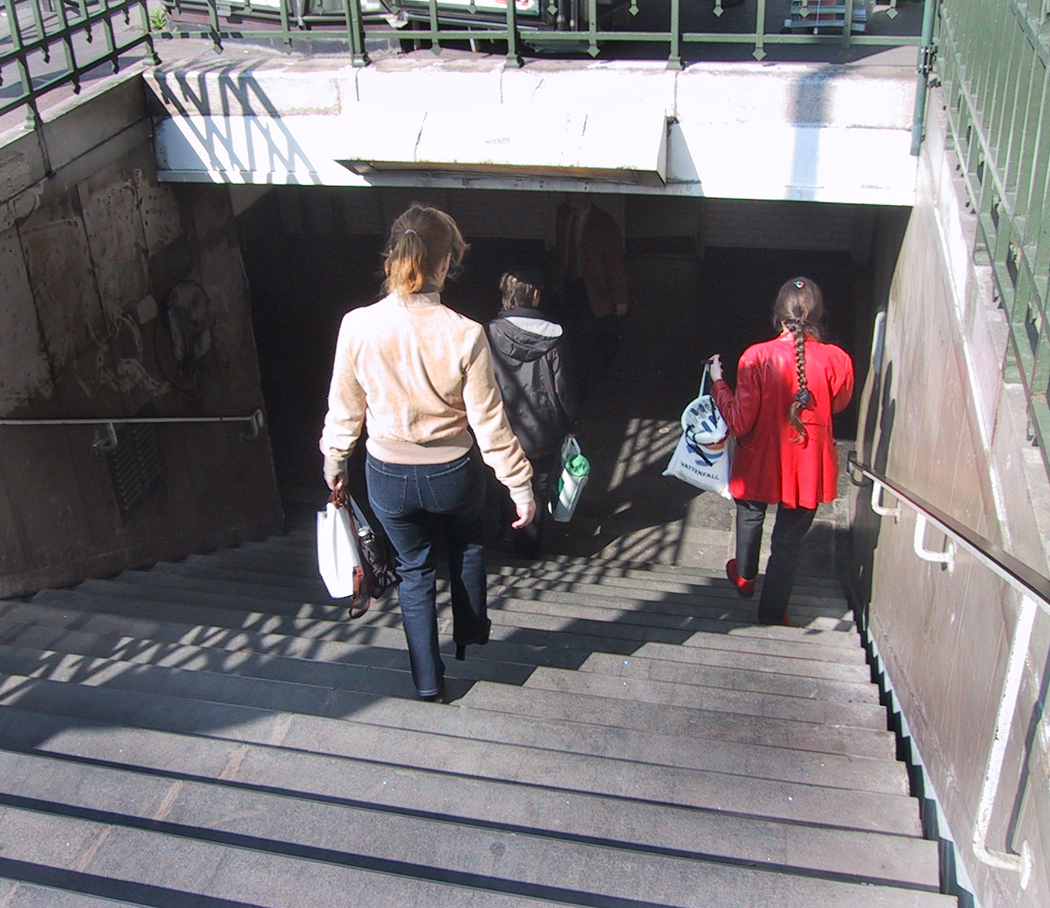
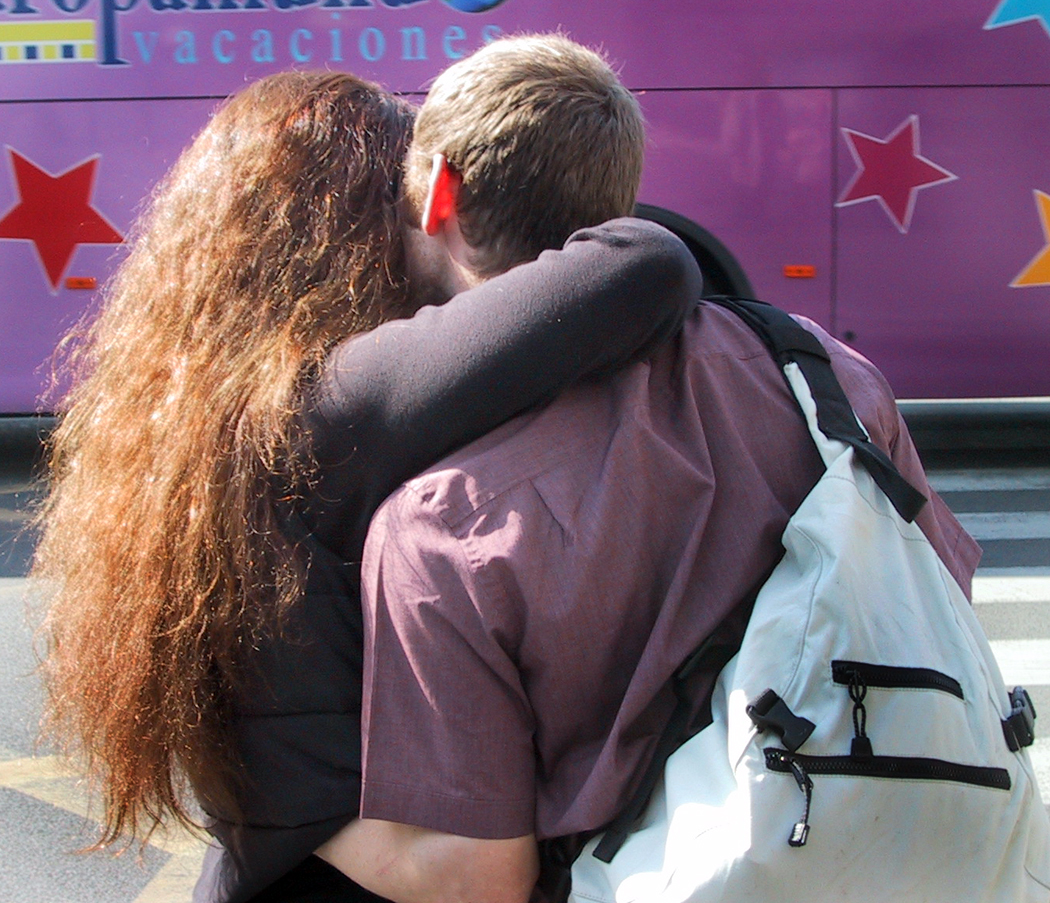
Richard hugged me on the way down the steps to the metro and smiled at me.

There’s no highlight better than that.

The Louvre was vast and I was amazed. I thought it would be like the old Smithsonian, with paintings from the floor to the ceiling, and the interior spaces jammed with objects, but it was very open and some rooms had only three paintings. I saw the son of god crucified for probably four continuous hours and then a lot of rosy flesh flying through the air (Rubens). A whole lot of satin flying through the air. But the first part of our visit to the Louvre was my favorite, seeing the northern European late Medieval paintings of the Virgin and child, and other religious subjects.

I like them because they’re fervent.Avignon Pieta

Winged VictoryNear the end of the day, after seeing all of the extravagant paintings on biblical subjects and historical paintings, the museum began to smell funny to me, at first it seemed like the bathrooms, then I thought maybe it was the restaurant. Then I became disgusted with what I thought might be the smell of all the people. And then, because I was getting so tired, I began to have a horrible feeling that I was smelling death around the old Grecian tombs and I was very happy to go out into the air.

On the way back to our hotel, we stopped at a perfumerie and I had a wonderful time there and got some Lalique for Paul, Jolie Madame for mother and a little tube of cologne for Aunt Veosie and a bottle La Nuit for myself. Jasmine.

I chose perfumes you could only get in France. These are not exported.

We came back and rested. And the sweetest part of the day was seeing the little dog nestled against Richard in the restaurant.

Richard’s version of events:

Carole wanted to see northern European late Medieval paintings. I wanted to see Claude and Poussin. We did both, but in the end, I had to agree the northern European art was better, or more enjoyable, with a deeper commitment to real life.

I was a bit surprised at how loose much of Poussin’s paintings are, and especially, how dark, brown and gray they are. How much of the dinginess comes from too much varnish over too many centuries and how much was by design, I cannot tell.

I wanted to love the Poussins more. But I have to admit, on the whole, they seem constipated, both in subject matter and in execution.

The Claudes fared a bit better, although they also seemed yellowed with ancient varnish. Perhaps the film of yellow suits him better than it suits Poussin.

But, ultimately, the Claudes disappoint, too. They are simply too far removed from real experience, too stylized, too fantasized. Too intellectualized, and not immediate enough.

Unlike the Memlings, Holbeins, van der Weydens and — hallelujah — van Eycks in the northern European section, which bristle with real experience.Graces recto et verso

Constitutionally, I also respond to the textures of those early Flemish and German paintings, with their tight patterns and brilliant color, so unlike the artificially brown and slate tones of the French Baroque.

Gericault dans le LouvreIt wasn’t really a big surprise to see how vast the Louvre is. I knew it was big. But I was surprised by several familiar paintings that are much bigger than I ever imagined: Veronese’s Wedding at Cana; Gericault’s Raft of the Medusa; David’s Rape of the Sabine Women; Gros’s Napoleon at the Pest House of Joffa. They would have taken scaffolding to paint.Twin Venuses

Oh, and Delacroix’s Death of Sardanapalus. Another giant.

I can’t say I was overwhelmed by the Big Noises in Hellenistic sculpture: the Venus de Milo, the Winged Victory of Samothrace. Yes, they’re nice enough, but a little too deracinated for my taste. I want either the Classical Hellenic sculpture of the Elgin marbles, or the really over the top Hellenism of the Laocoon. These marquee pieces at the Louvre seem a bit tame, and the stylization of the nude female figure bothers me: No real woman was ever built the way the Venus de Milo is — and I’m not referring to her missing arms.
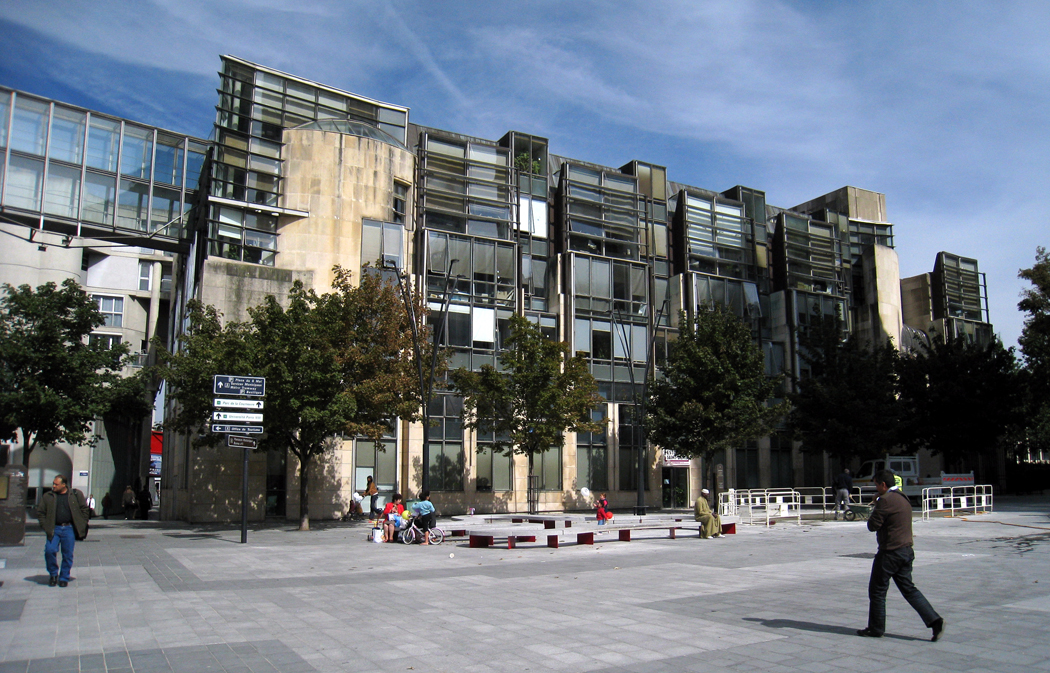
“You’re not going there, are you?” we heard, over and over, when we said we planned to go to St. Denis.
“It’s dangerous,” they said. The reputation of the Paris suburb, six miles north of the Ile de la Cite, couldn’t be worse. The crime rate was double that of France overall. It is a working-class suburb, with high unemployment, rampant poverty and a population that was one-third immigrant, largely from the Maghreb. It is where the Islamist attacks on Paris began on Nov. 13, 2015, when three suicide bombers tried to blow themselves up at the soccer stadium. St. Denis slum apartment
But, it is also where nearly all the kings of France were buried, and where the oldest Gothic church stands. The Basilica of St. Denis is one of the most beautiful, and most historically important icons of Gothic architecture.
“What, another Gothic church?” you say. I apologize, but the chance to visit a string of such churches was the primary reason we chose to visit France rather than Italy or Greece. There is something about the dark, old, art that drew both of us. The cloudy, rainy, cool-blooded Romantic north attracts us more than the sunny, warm, Classical Mediterranean south. For me, perhaps, it is my Scandinavian DNA.

Sunlight on the floor

                     Sunlight on the floor

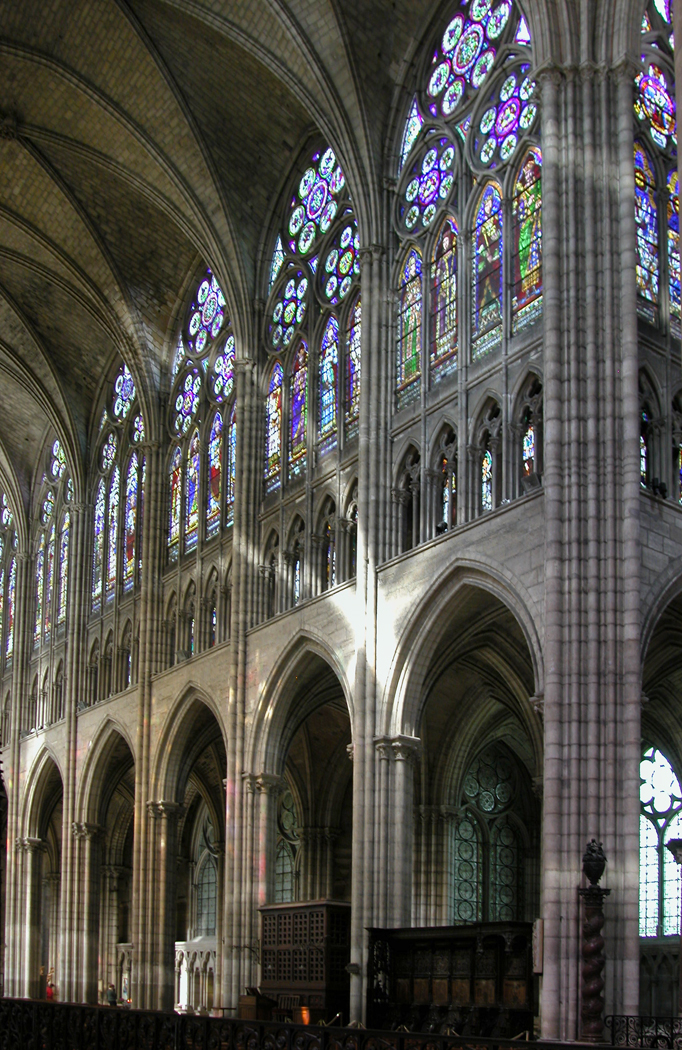
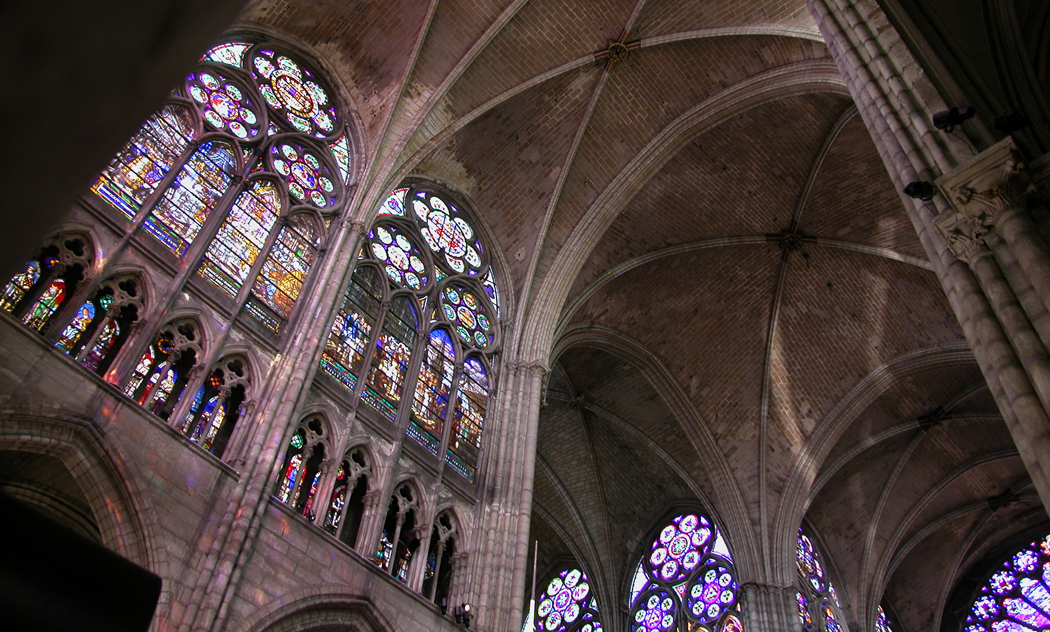
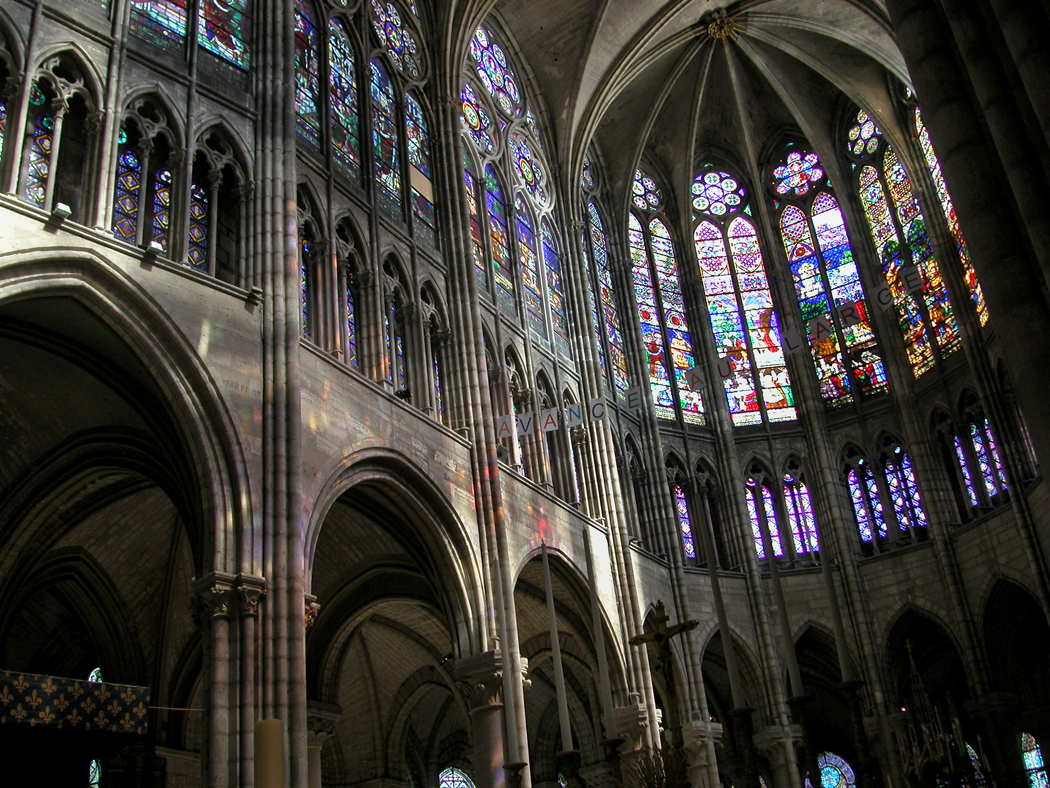
The Abbot Suger ordered the rebuilding of the church in St. Denis in the 12th century and its choir was completed in AD 1144. Suger was a Neoplatonist and saw in light — sunlight, daylight, any light — a metaphor of Deity. Churches built in the earlier Romanesque style were heavy, stone-ridden and with tiny windows, leaving their interiors dark and dank. Suger wanted to throw open the drapes and let the light in. The Gothic style, which he innovated, eliminated the heavy stone walls and replaced them with pillars and columns to hold up the roof, leaving the area in between to be filled with glass. As in Genesis 1: Let there be light, and there was light. A great C-major chord is sounded and a new vision of worship is begun.
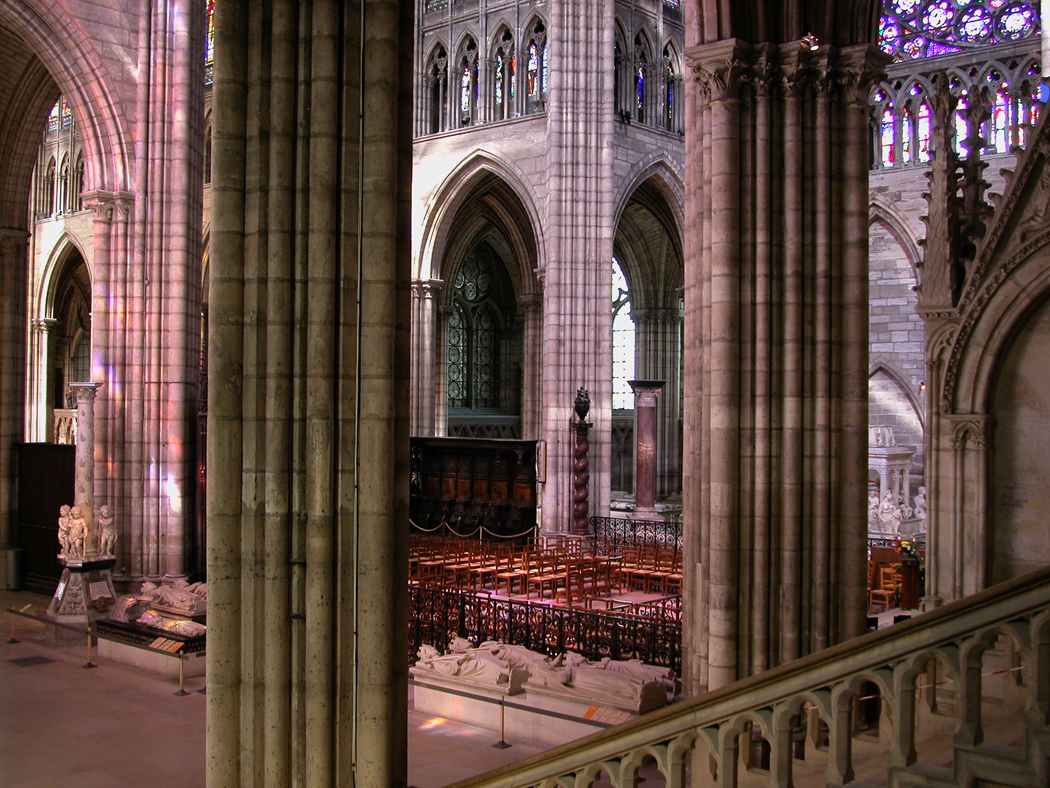
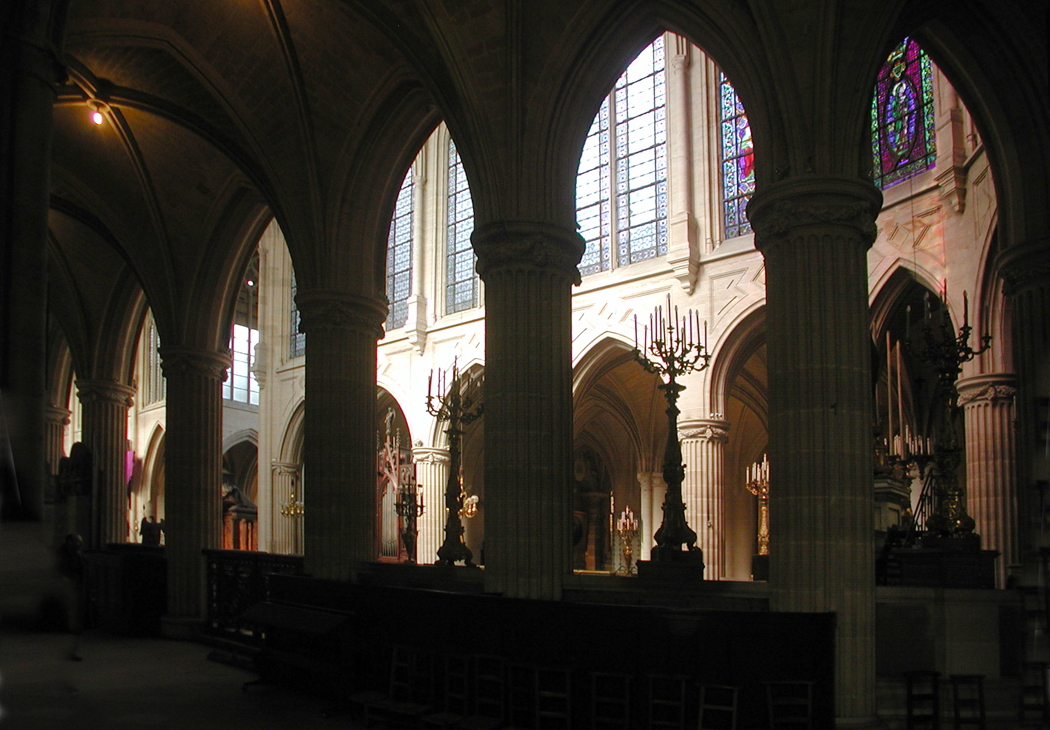
Much of the basilica of St. Denis has been altered, and most of what is there now post-dates Suger, but the choir (that area at the east end of the church where the altar and apse are located) is his, and shows the Gothic plan of three stories: a ground floor, a triforium and above that the glorious clerestory windows, all color and light. SD nave wallThe experiment was so successful, that for the next four hundred hears, it was the template for church construction. Churches under construction throughout Europe that had been begun in the Romanesque style were finished in the Gothic. Relics of the style remain even in churches built to this day: Somehow, like King James English becoming the sound and vocabulary for clerical language, Gothic has become the accepted ecclesiastical “look” for Christianity.
Entering St. Denis — like Chartres, or Rheims, or Notre Dame de Paris — you see the metaphor working: The light illuminates the darkness the way the moon and stars light up the night, or the burning embers of a hearthfire glow in the cracks of the dark ash. The building becomes an expansion of the human soul, spread upward and outward: The vaulting becomes the inside of your skull and the rose windows are its eyes.
The imagery is so successful that even a lumpen atheist can feel the emotional wallop: You can call it spiritual, if you want. The vocabulary is unimportant. The experience is genuine.

Again, click on any picture to enlarge

SD from ambulatory to crossing

St. Denis
Thursday April 4

Gothic architecture began at St. Denis and we were there to see it.

SD effigies in the naveAnother Gothic church? You may well ask, but the fact is, each experience has been singular and distinct. The Basilica of St. Denis, with its odd mixture of Romanesque and Gothic, is very different from Chartres, which seemed chaste in comparison, or from Paris, which seems even more baroque.

St. Denis is also the burial place of French kings, and their funeral effigies lie like so many tanning salon patrons in the transepts. The effigies are of a much later date and not at all Gothic (with a few exceptions), but they didn’t seem out of place. Again, this is the peculiar magic of the Gothic style. Nothing seems out of place in it: It absorbs everything and makes it part of itself.SD front view

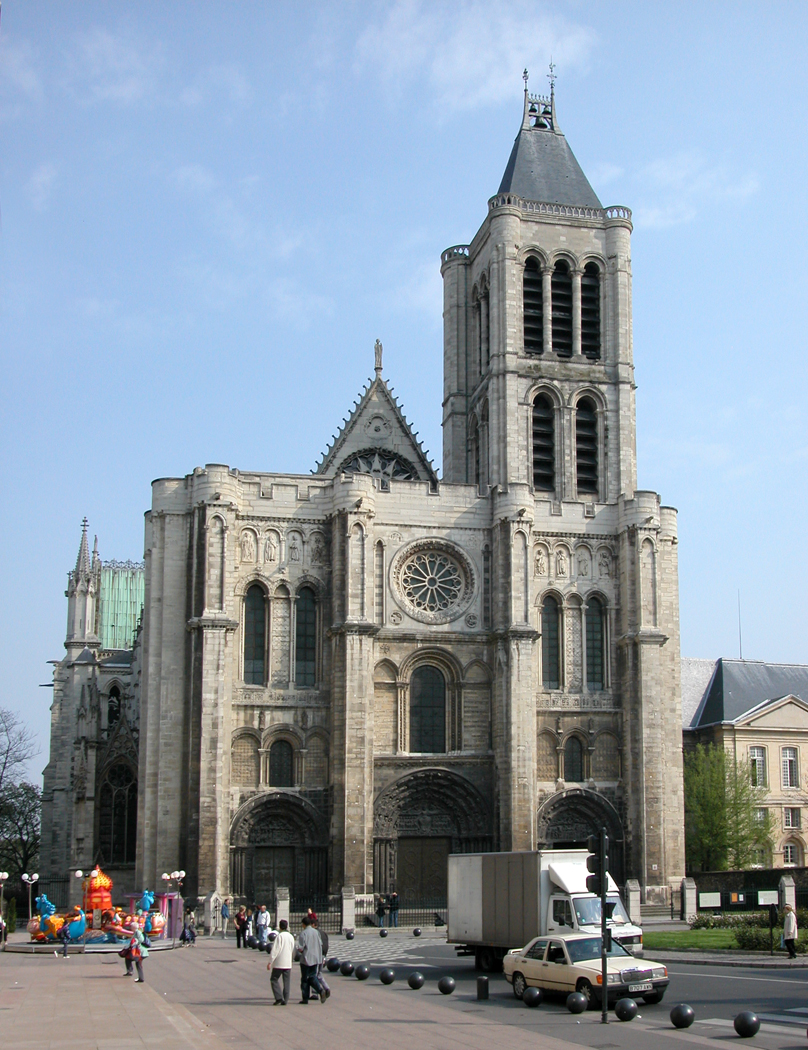
The west facade is rather blocky, with only one tower on the south side, leaving the north side truncated. There is the hint of a rose window in the center of the facade, but it doesn’t show inside, where a giant set of organ pipes takes pride of place at the west end of the nave.

Unlike Chartres, St. Denis is brilliant inside, which was the idea of its deviser, Abbot Suger in the 12th century, who had a rather neoPlatonic idea of divinity, with light being its metaphor. His design for St. Denis opened the way for the Gothic revolution in northern Europe.

The stone of St. Denis doesn’t seem as worn as that of Chartres. Certainly much of the sculpture is later restoration work, but even the oldest stonework seems a little crisper than its counterpart in Chartres. The basilica is also smaller than the cathedral, perhaps two thirds the size, or maybe a little smaller.

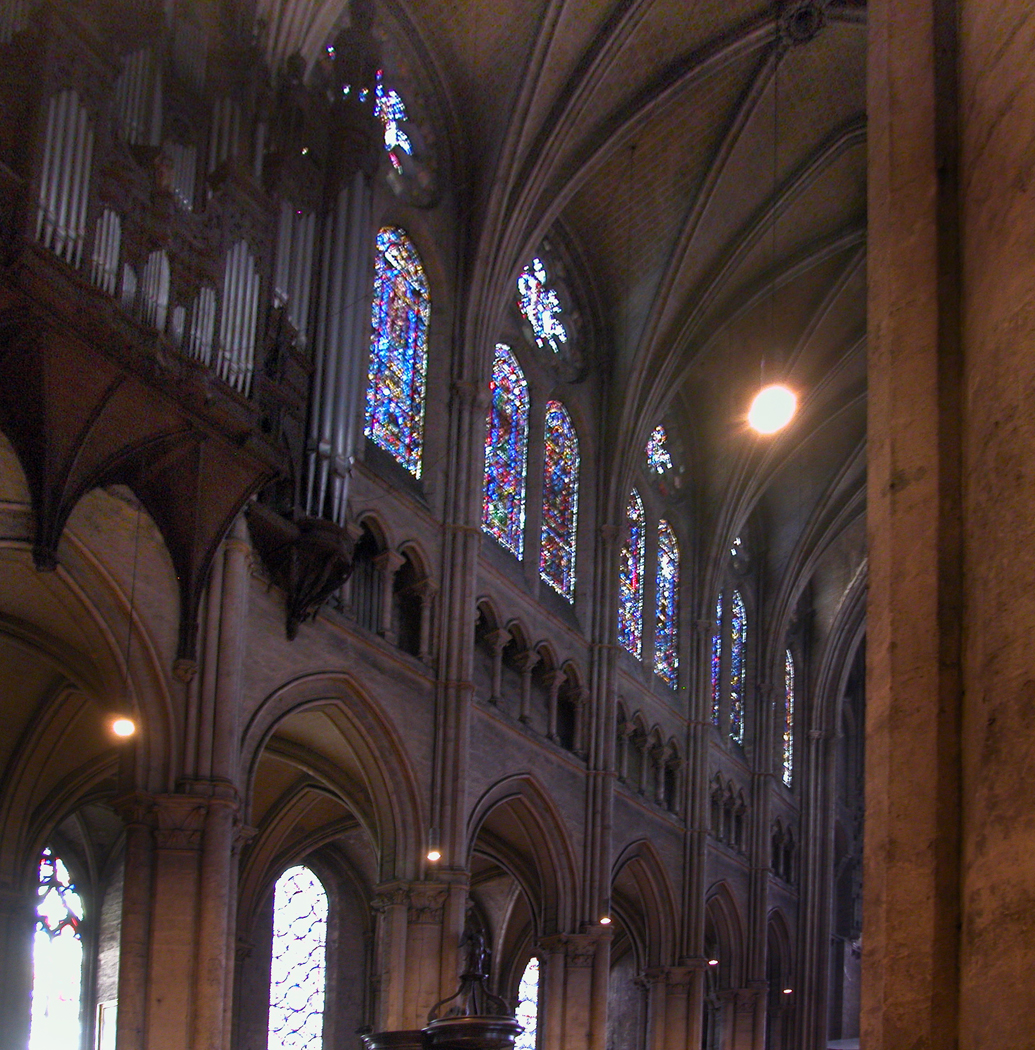
Yet, the proportion of the clerestory is greater and the nave arcade lower, making more room for glass — one of the things that makes the basilica so much more brilliant inside.SD clerestory horiz

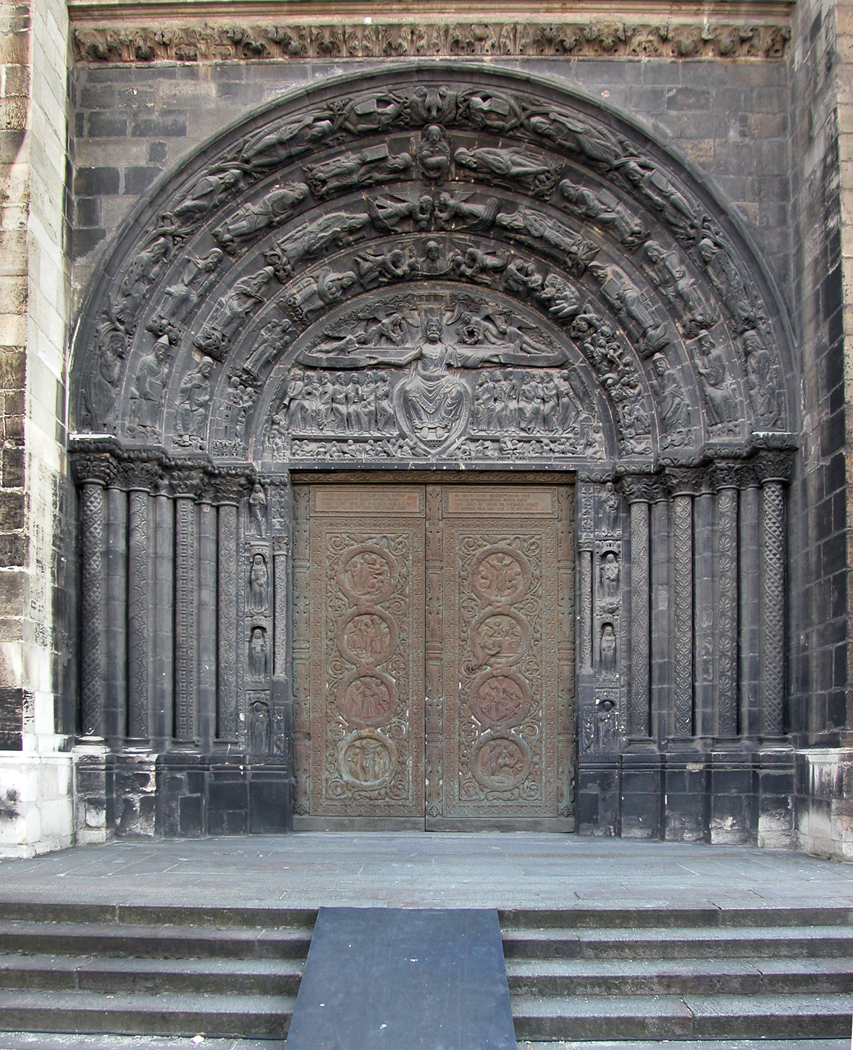
On the west face, the tripartite portal is black with soot. Carole first thought it was made of black stone, but you can see through nicks and chips that the stone is the typical limestone-sandstone grey. Paris has dumped a load of grime on St. Denis.SD central portal detail

The windows are also easier to read, with larger imagery in proportion to the size of the glass. Again, the windows are not as old as the oldest windows at Chartres, but they are old enough, and they are less obscure.

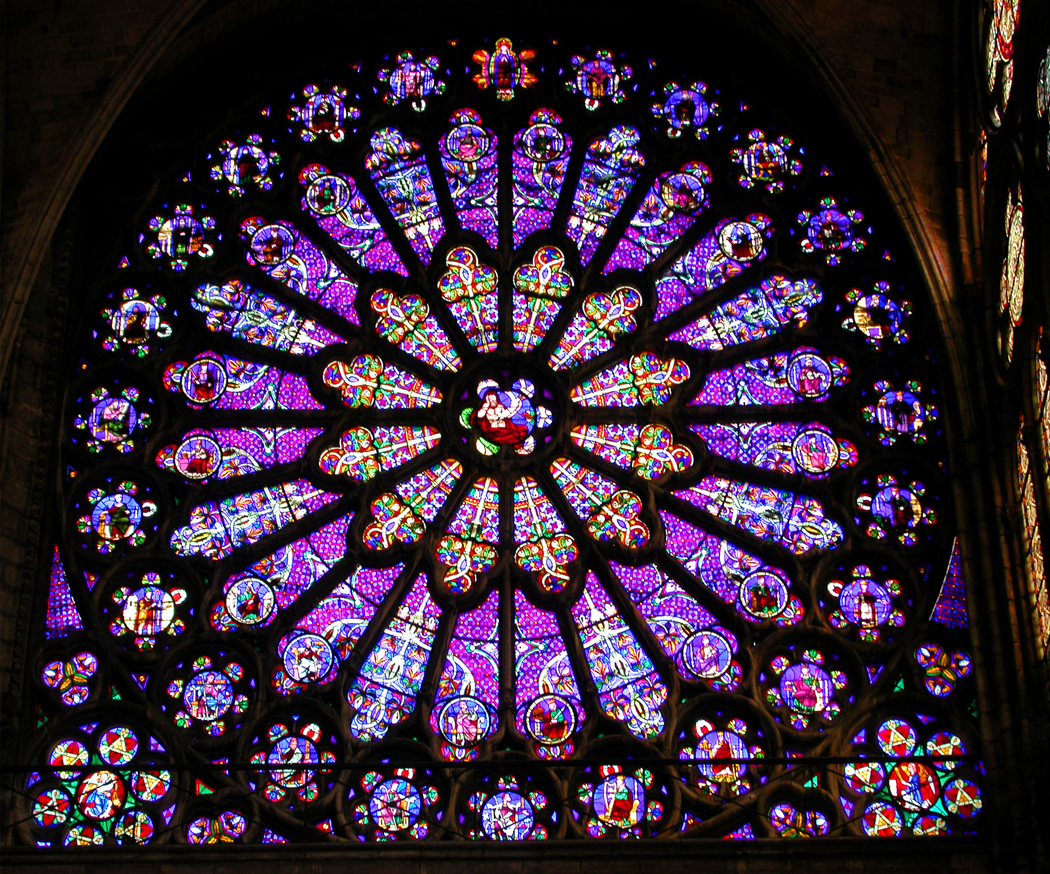
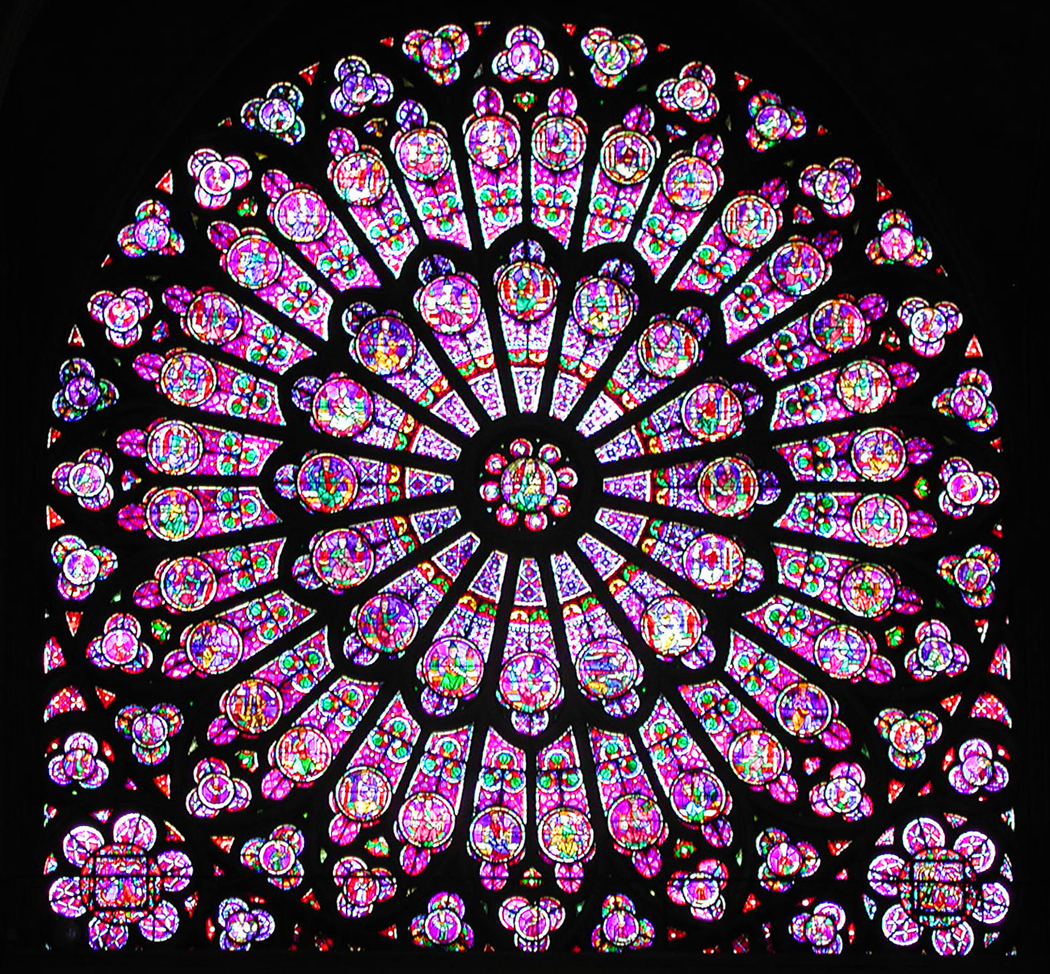
There are only two large rose windows, at the ends of the transepts, but they are particularly brilliant and colorful, with a deep purple blue and a bright stopsign red. And, like Notre Dame de Paris, they are large enough to fill the pediments they occupy.

Its setting favors Chartres, which looms high on a hill above its village, and can be seen for miles around, the highest and most impressive point. St. Denis is stuck in a streetcorner in a lower class neighborhood in a suburb of Paris, surrounded with low rent apartments, tobacco stores and a shopping center.SD rose window 2

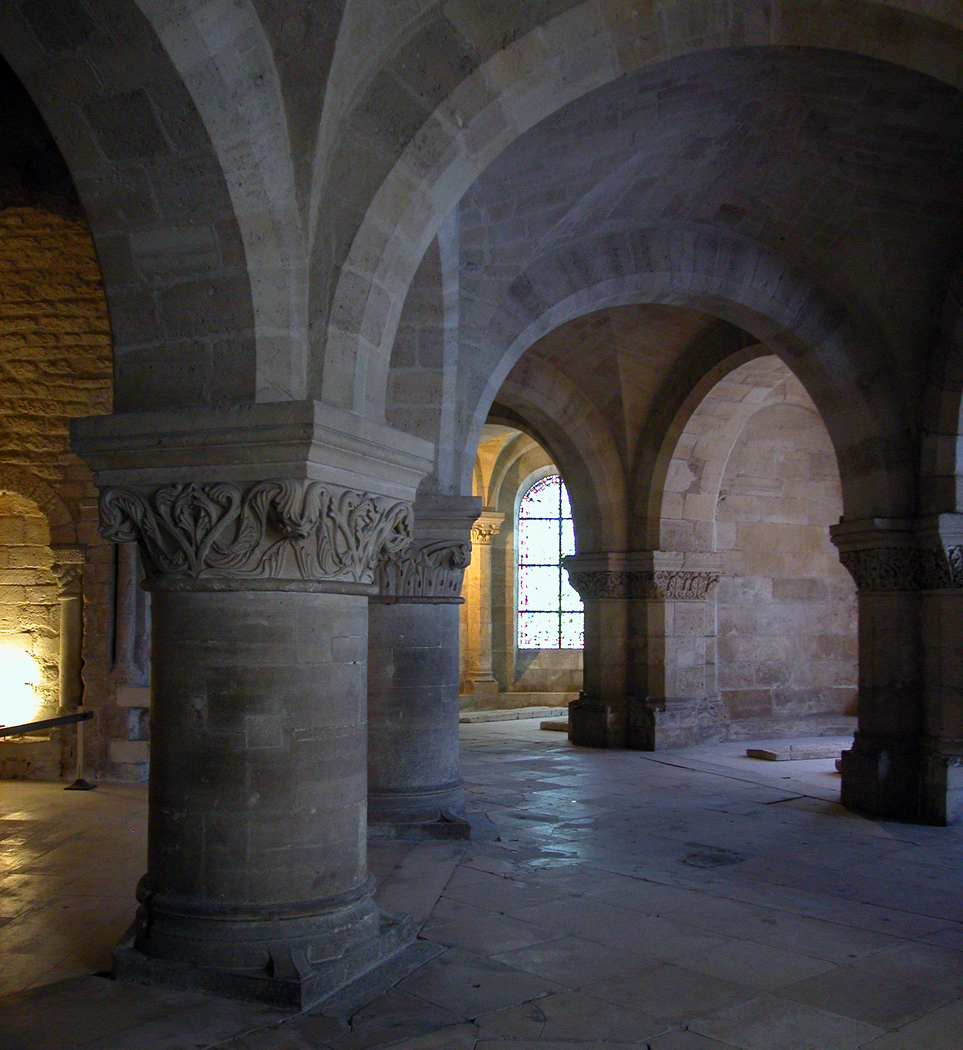
We spent most of the day at St. Denis, soaking it in, walking around the crypt, the raised ambulatory, the nave. Sitting and meditating on the rose windows, feeling the weight and lift of the stone, the intensity of the sculpture.SD apse at angle

I wound up making about 500 photos of the basilica and its surroundings. I got most of the sculpture and a good number of windows.

We have not tired of the Gothic, but each taste, like the food of Paris, only makes us want more.

chocolate bars

Carole’s notes of the day:

A veritable pyramid of chocolate exquisiteness, poire ganache with fluted shell on the outside and inside, the top layer, chocolate ganache flavored with pear liquore and the bottom half tasted like black walnuts and reminded me of wet black walnut shells on the ground in the rain in the wintertime at home.

In the morning, I had a wonderful time at the packing and mailing shop, because the couple running the establishment were so kind and intelligent. And the stationery products were so cool. I had fun picking out stuff for friends back home.

We had such a good time there, it put R in a happy mood, too.

Butcher, tree pruner, winemakers

                                           Butcher, tree pruner, winemakers

Then, I loved the sculpture on the entrance of St. Denis. It was black and smooth and looked like soapstone to me. And my favorite band in the arches was a passage of angels praying as they flew. And, stepping inside St. Denis made me gasp on the second step because of the ceiling and the light inside the basilica and the proportion of glass to stone. All of the sculpture on the outside of the basilica of workmen and farmers felt very fresh and took me back in history. There were lots of sculptures and carvings of musical instruments and musicians outside and inside, too.SD crypt 5

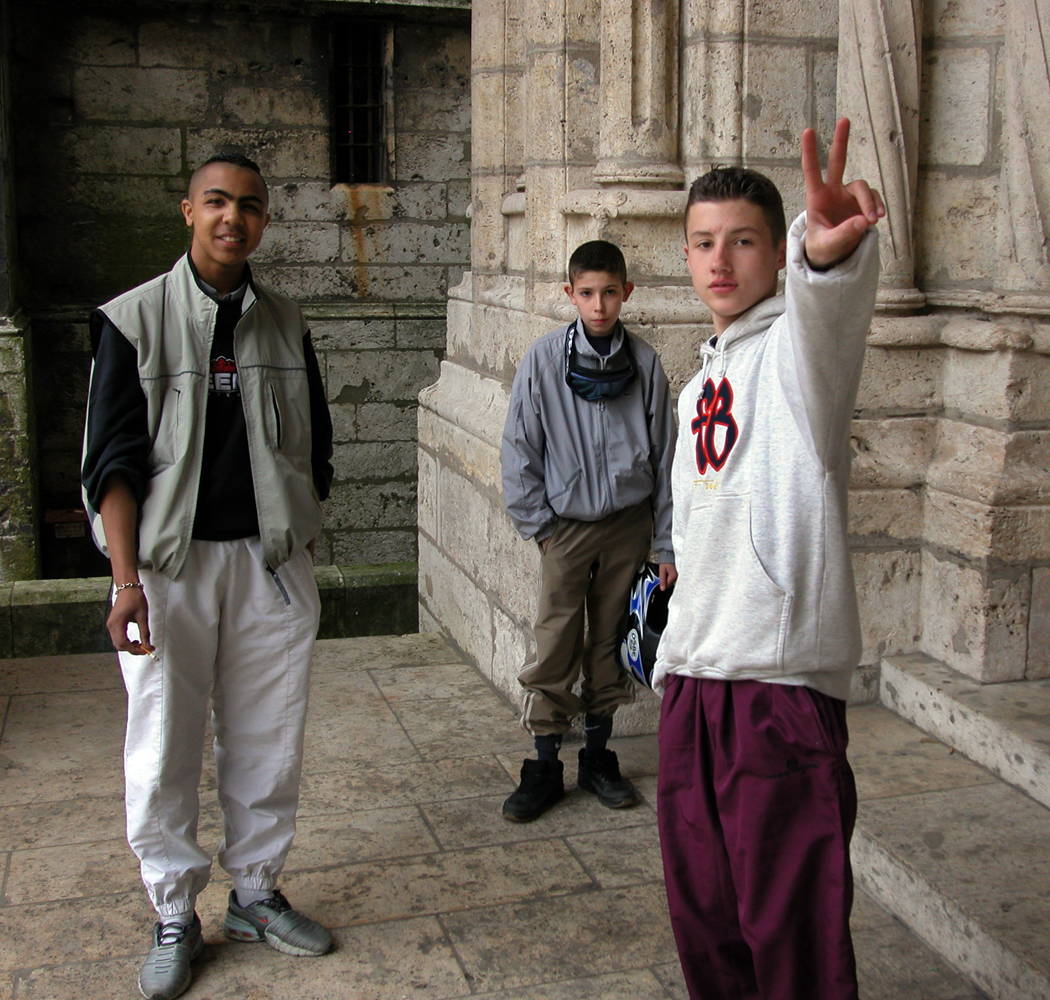
The experience of going down in the crypt was something I have always wanted and it also felt like going back in time. I enjoyed talking with the French black teenagers on the lawn who wanted to practice their English. They were so much like my old students at Lindley Jr. High, where I taught in Greensboro, NC, in the 1970s.

I met an English couple outside the basilica and chatted with them for an hour. They told me about all of their vacation travels in America, out West. They haven’t been east of the Mississippi. Richard has taken me many times to every place they mentioned and so we were able to have a good conversation. We got along very well and laughed almost the whole time. They had studied the basilica and had attended a lecture about it and they showed me where the building had been greatly damaged during the French Revolution and where Napoleon had had it repaired and they were very upset with the poor quality of the repairs. It really was sickening to see all the heads missing from the statues.

They asked me if we thought South Dakota was a bit barren, and I replied, “Oh, yeah.” They did not know there was any food available in America besides hamburgers and iceberg lettuce salads. They thought American milk was strangely sweet. They were amazed at the long distances between cities and points of interest in America.

Richard’s faves:

Greatest salad in the worldObviously, the basilica of St. Denis was the high point of the day. It was everything Chartres wasn’t: bright, colorful, richly adorned, well proportioned.

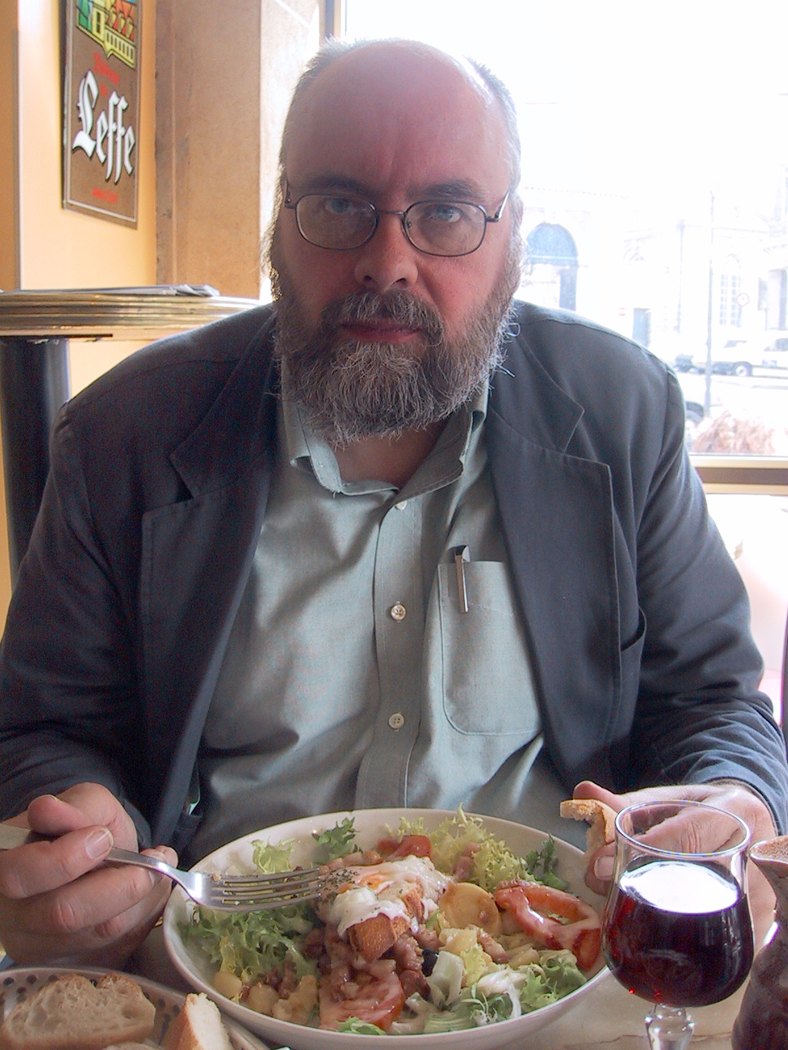
But I want to put in a word for the salad we had at lunch. Yes, the food again comes near the top of the list. The salad at Le Table Ronde in St. Denis, just across the square from the basilica was one of the best salads I’ve ever eaten. It was a “salad with ham and poached egg.” It had mixed greens, fried baconlike ham in shoestrings, artichoke hearts, black olives, pommes frites, tomatoes, a poached egg sitting on a slice of baguette, shoepeg corn, all lightly coated with a dressing of oil and vinegar mixed with mustard, salt and pepper. It was heaven.

Beside that, it hardly seem worth mentioning the pizza marguerite we had for supper. “Take that, Domino’s,” said Carole.

It isn’t only the cathedrals that lead our souls to the sublime; it is also the restaurants. On the other hand, sometimes the toilet facilities lead to the ridiculous. Three vignettes.

pastry

Shopping
Wednesday April 3

Unless you have experienced it, there is no way you can understand French restaurants and food.samaritaine

I can tell you that it is good, but that doesn’t do justice to the art of the cuisine. And it is an art. Not just of preparation, but of presentation, as well.

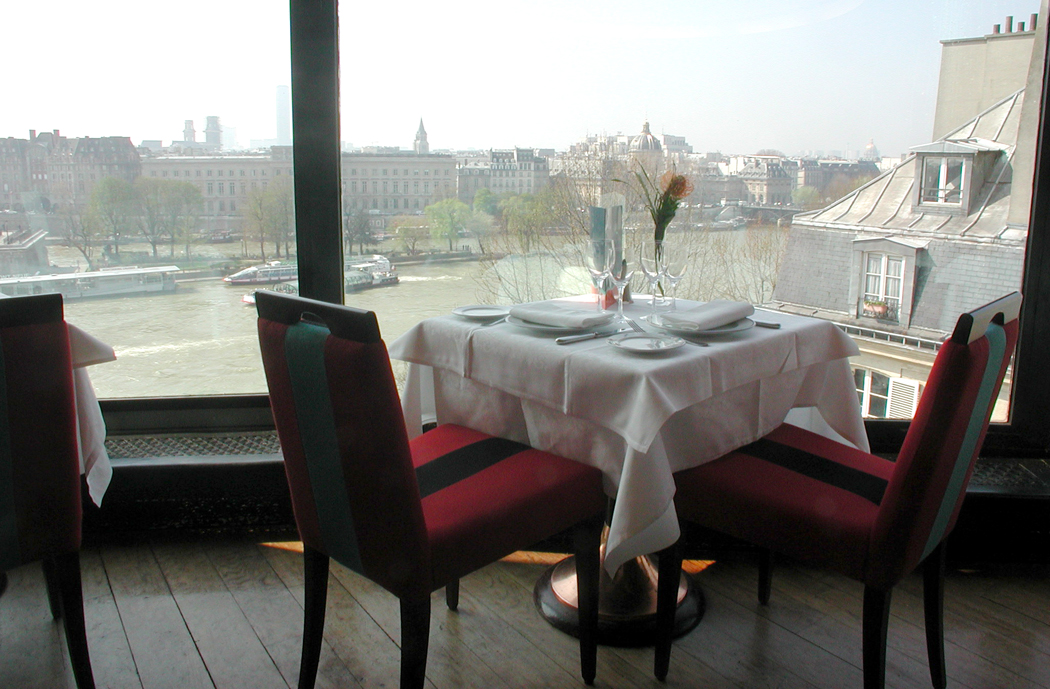
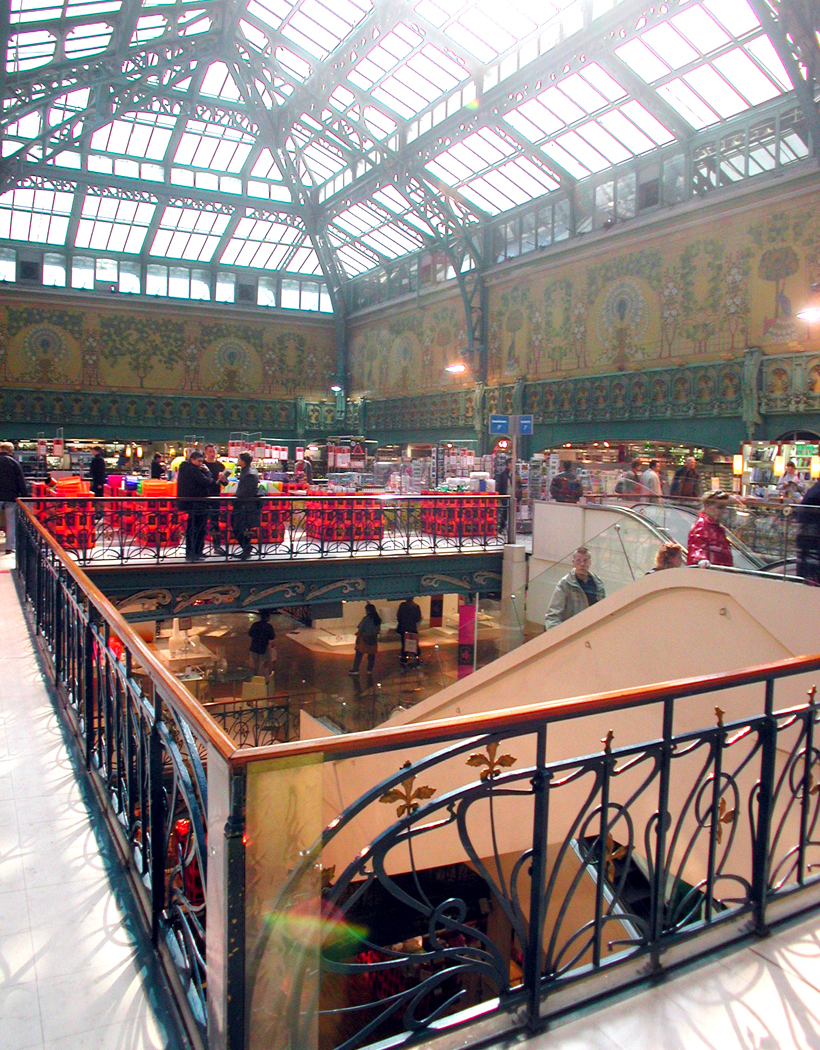
We spent most of today shopping at Samaritaine, trying to get a few souvenirs to bring home to friends and loved ones. We stopped for lunch again at Toupary, the fifth-floor restaurant at the department store.

We had a chunk of salmon on a bed of cabbage, covered in a bacon and cream sauce, that was exquisite. There are no words to describe the complexity of the flavors, and how well balanced they are.chez alexis et daniel exterior

But that takes second place to the dinner at Chez Alexis et Daniel tonight.

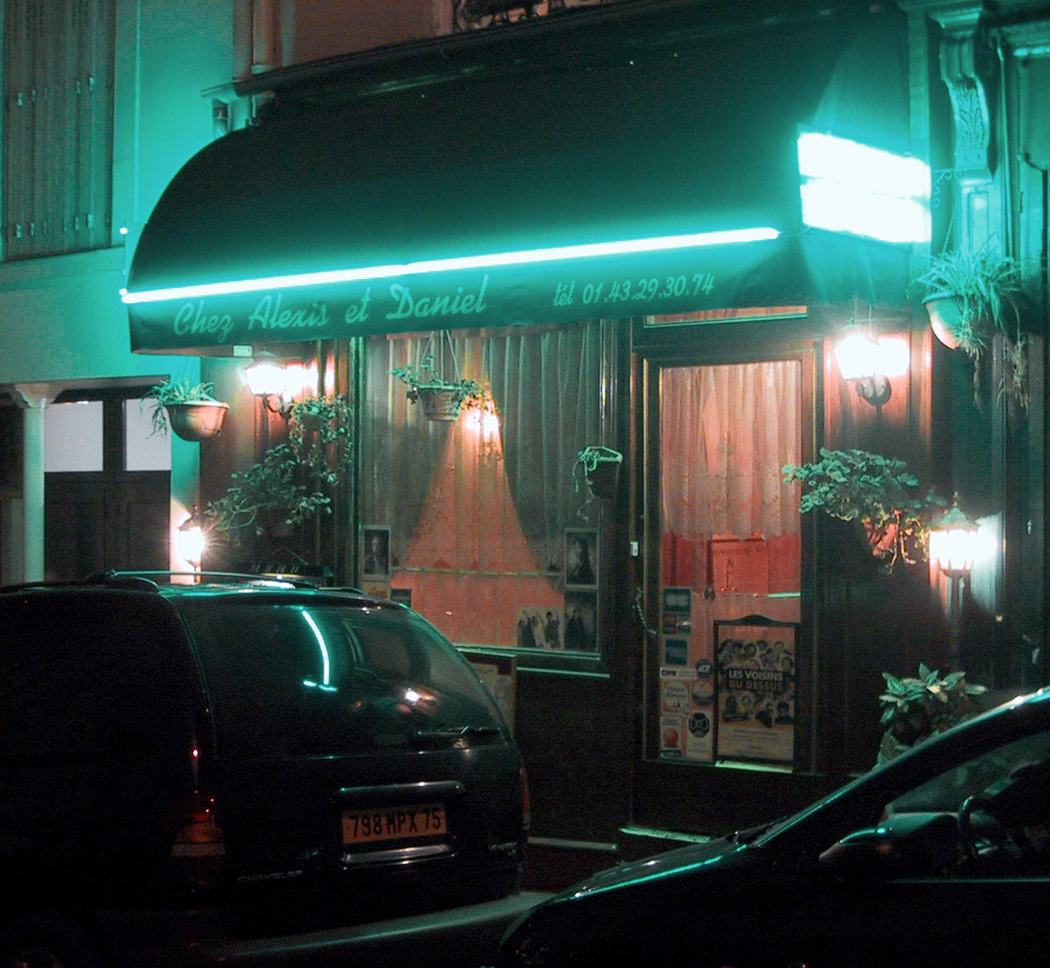
It is a little hole in the wall right across the street from our hotel. We hadn’t gone there before because it hadn’t been open.

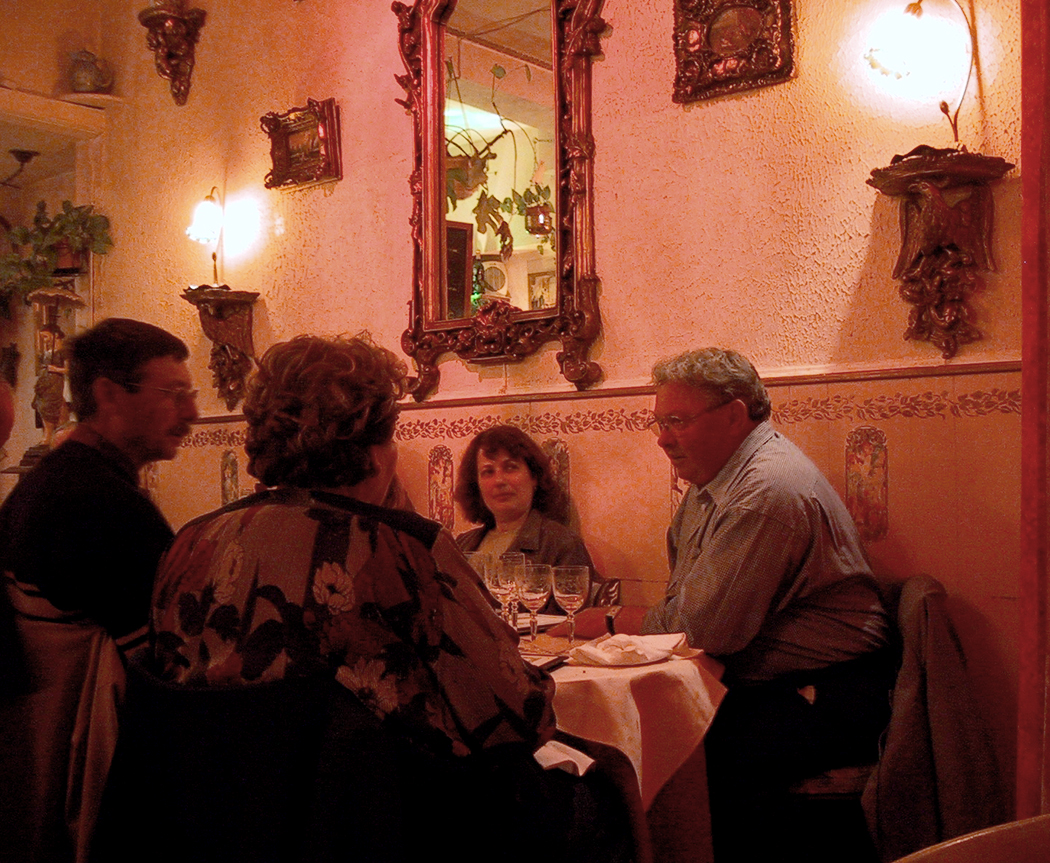
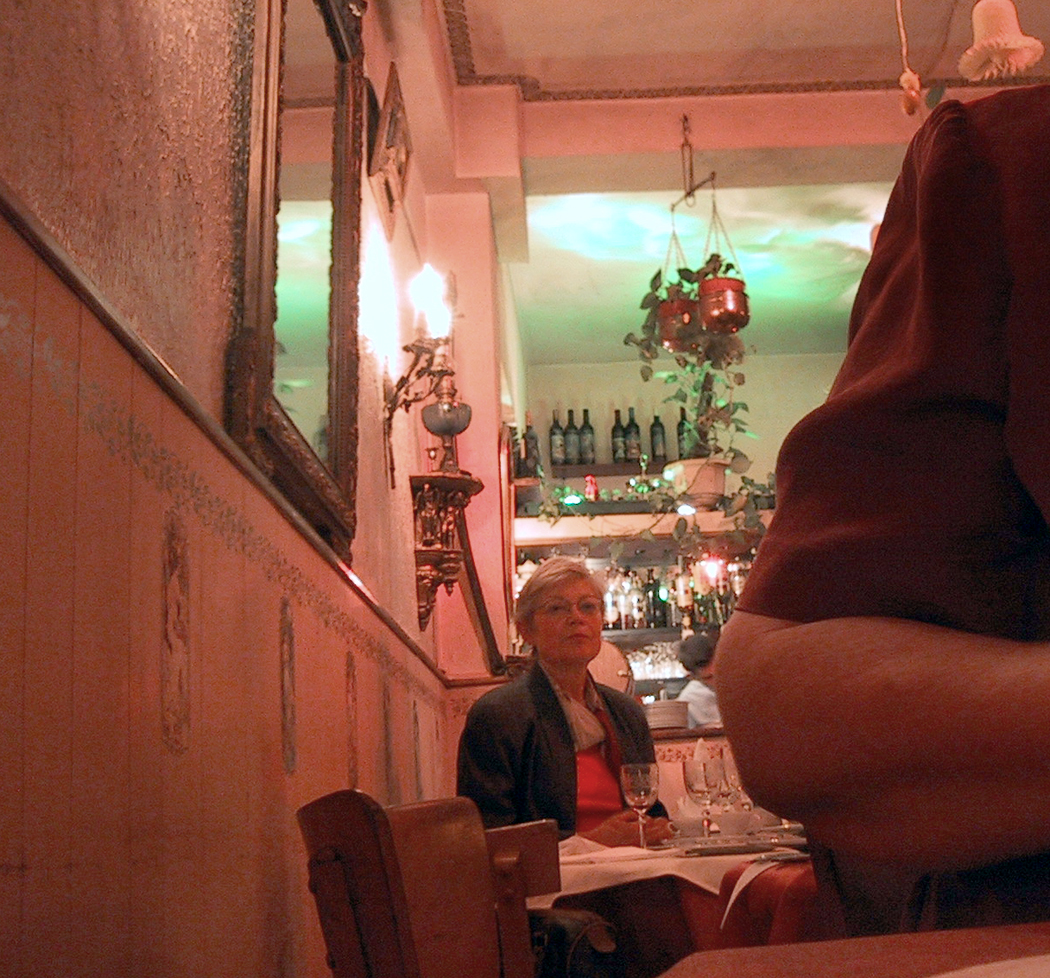
But tonight it was and we walked over. Inside, it is all tarted up with mirrors, putti, fringe, and red-filtered lights.

We had our only “bad” experience at a brasserie that catered to tourists. (The food was just fine, but we have come to expect magnificent, and just “fine” seemed like a total failure).

And Chez Alexis et Daniel has a menu posted outside in English. We were suspicious. But the items on the menu were too seductive to pass up, so we went in anyway.chez alexis et daniel statuette

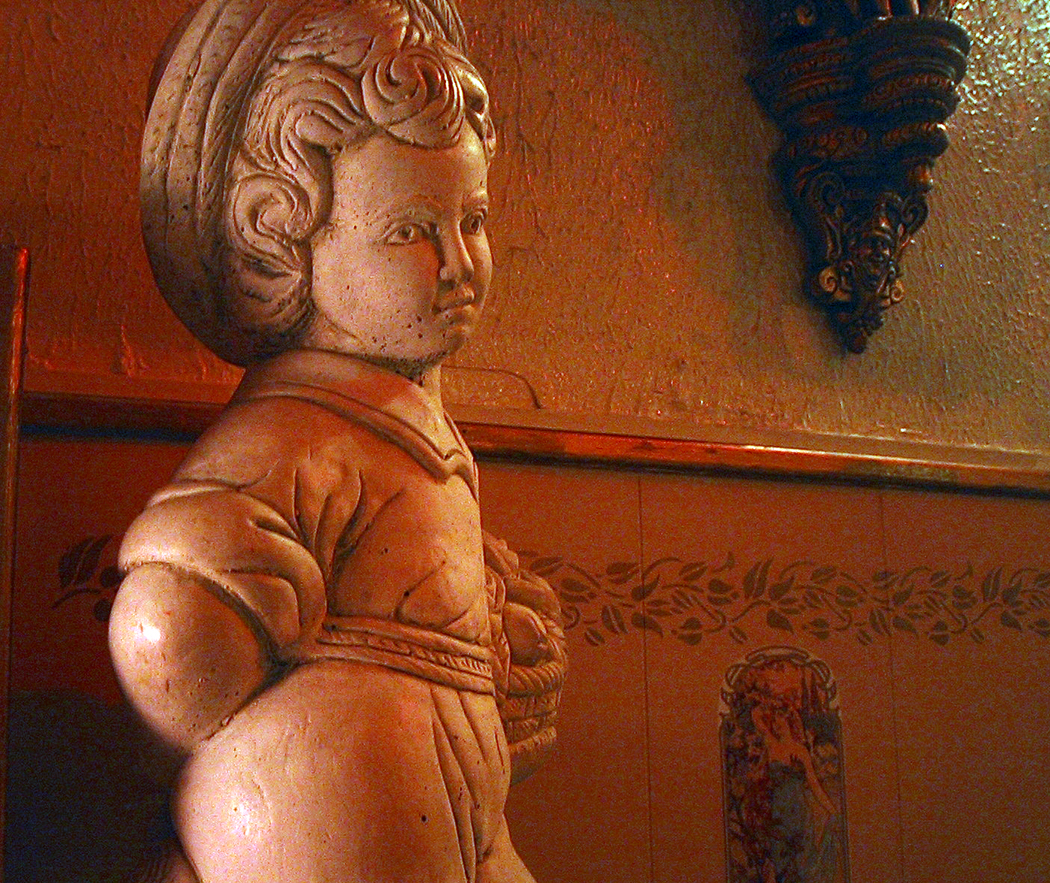
There were perhaps six or seven tables in the place, each about 2 foot square. A big mirror in a baroque frame hung on one wall. A plaster boy with big hips and bare feet stood on the remnants of a fluted column in the corner.

Daniel (or Alexis) sat us at our table up against the front window and handed us the giant menus. It went on for pages, but like many French menus, it features a prix fixe option (called a “menu” in French, where what we call a “menu” they call a “carte.”)

Every item on the list seemed fantastic. There was foie gras, goat cheese, pears, exotic mushrooms, snails, scampi and lamb.

There were three “menus:” one for €15.95, one for €19.95 and the most elaborate for €24.95. In each, diners had their choice of entree (first course), plat (main course) and dessert.

Carole ordered a chicken liver pate for her entree, with onion confit. When it came, it was the size of an American serving of meat loaf.chez alexis et daniel family at table

Richard ordered grilled goat cheese with mixed greens.

One bite, and I knew, this was not like the other restaurant. This was Beatrice pointing the way to Dante. This was the gates of heaven being thrown open and the light streaming through.

For her plat, Carole had a rump steak in poivre sauce. Richard had a beef rib with foie gras and poivre sauce. Both came with cubed fried potatoes.

But who could eat the potatoes? The beef rib was so big, and after an entree the size of most whole dinners, one had to conserve space for the impending dessert.chez alexis et daniel inside

Carole, being very continental, had a pear half with almonds. But Richard pigged out with a “cake of three chocolates.”

The L-tryptophan kicked in, the seratonin flowed like a water hose and the melatonin gushed like a geyser. I sat with a goofy grin on my face and lost the use of my mother language.

All the while, a tiny dog with skinny legs wandered around from table to table looking for a little loving.

We waddled back across the street to the hotel knowing that the promise of Christian salvation has little value compared with the presence of a good French meal.

pont neuf metro entrance horiz

Carole’s take on facilities:

I would like to entitle this essay, les toilettes du Paris. One approaches une toilette dan Paris with trepidation.  Because one does not know how much it may cost, or how to get in, and after one does get in, how to negotiate the flushing mechanism and how to get out.

Nine times out of ten, the light, which is inside the cubicle, shorts out while one is engaged. The toilet papers are most unusual and varied in color from newspaper gray to dusty liver.

The lavatories are sometimes in the cubicle, and when they are, they come out from the wall just a smidgen more than the length of my hand. They are totally cool and I wish I had one.

One never knows what device one will encounter for flushing. The most frightening ones make an alarming rushing sound on their own when one least expects it. The others flush with buttons on the wall, buttons on the top of the back of the toilet, a pedal on the floor, or a chain hanging down from the ceiling.pont neuf metro stairs

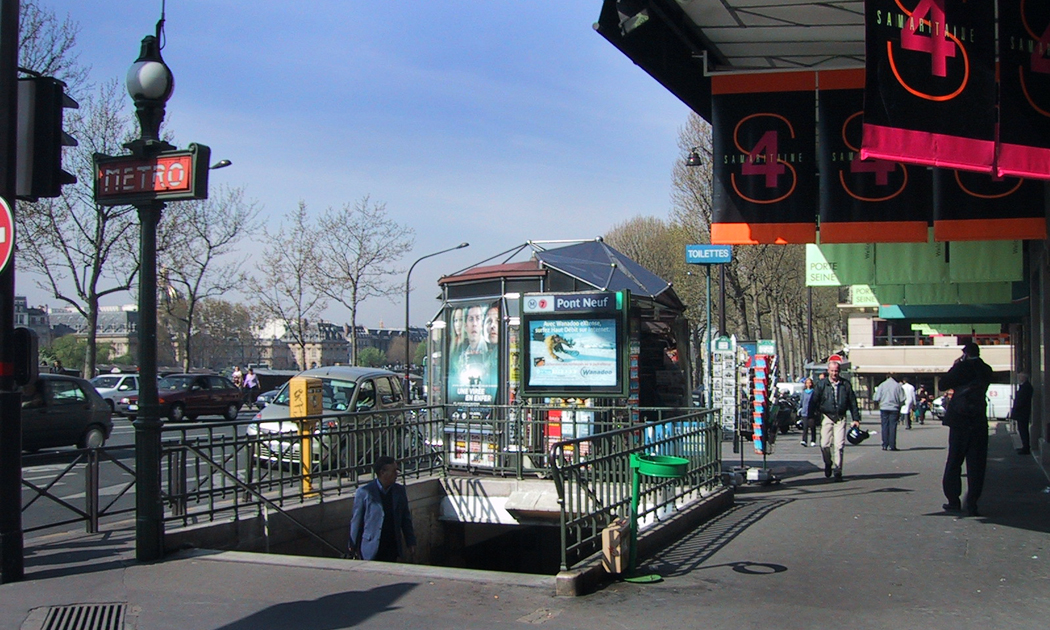
My most amazing urinary experience so far, was underground at the metro stop in front of Samaritaine, in a beautifully paneled labyrinth. There were about 10 stalls, some with doors, some without, all within view of each other.

Men and women integrated, not separated at all. One could pay 38 cents and relieve oneself before god and man with no door at all, or one could pay 50 cents and have a door.

I scampered behind my door as quickly as possible just barely missing a man attending to his ablutions a few feet away in the “economy class.”

I paid my money to a little Chinese woman (the hostess) and she was chopping onions, right there in the middle of the bathroom. As I departed, she had begun rolling these chopped onions into some kind of rice balls which I pray to god she was not prepared to sell to bathroom customers.

I have so much experience in these matters because I seem to have picked up a bit of a urinary tract infection. I have averaged going to these toilettes 10 times a day, when I can find them but I believe I have experienced a Catholic miracle, because yesterday, I gave money to beggars all day and I’m getting well.

Richard:

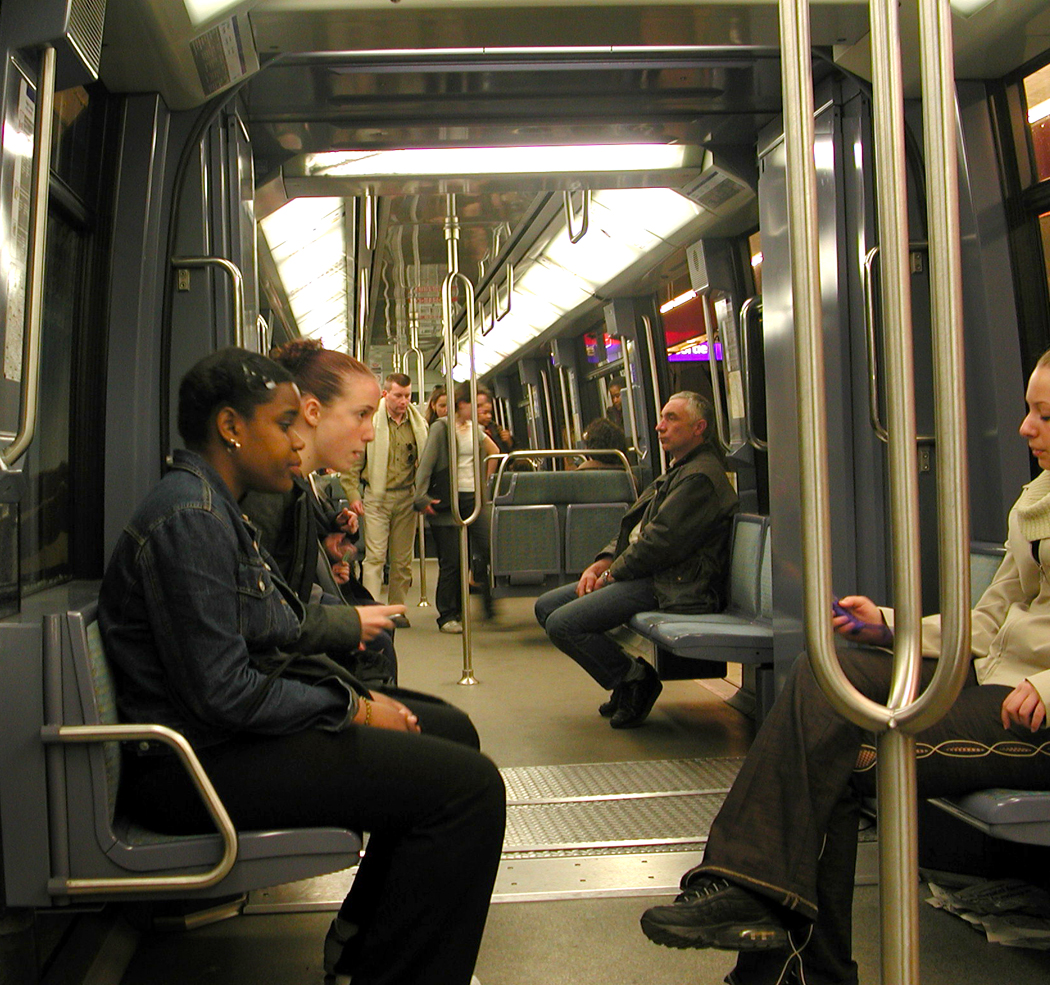
on the metroIt has become a regular thing on the metro for a group to jump on the train with accordions or guitars and start playing music with a little tin cup or a hat to collect donations.

There is little more annoying than accordion music on a subway, but today, at one stop, two accordions got on at once, accompanied by a woman with a tambourine.

There is a good deal of begging in the subways. Much of it includes music, either a violin or guitar. One black woman at the Odeon stop today was singing a beautiful, bell-clear soprano. It was a cross between plain song and something operatic. She rapped a small tuning fork in her hand periodically to keep on pitch. Whether she needed the help, I don’t know, but her voice was angelic. Carole gave her money.

Carole has been giving money right and left these past few days. She is a sucker for a beggar. I know they can see her coming up Sixth Avenue like a parade float.begger

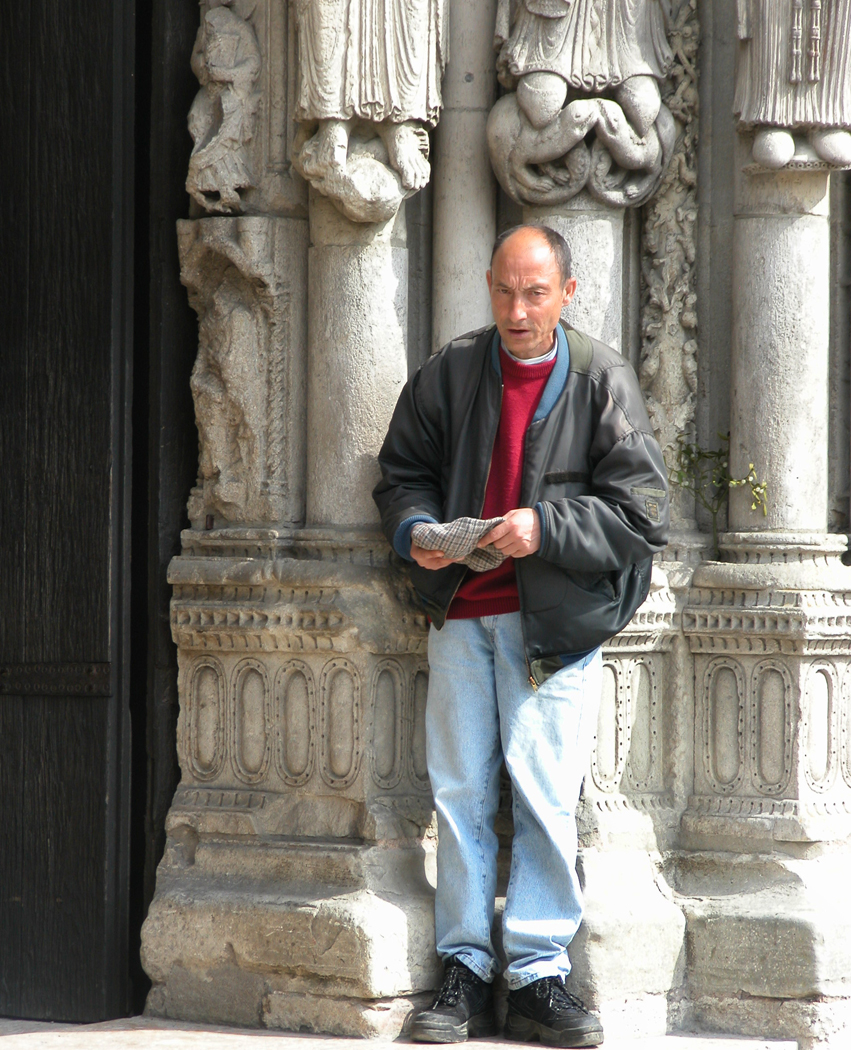
The championship beggar was the man at the entrance to the Chartres cathedral who was singing “Nobody knows the trouble I’ve seen, Hallelujah, Hallelujah.” It was a bizarre macaronic song, made up of bits of familiar tunes and words, but all jumbled up. And he kept repeating it over and over, hat in hand, waiting for people to drop him a Euro or two.

He snookered Carole when she went to give him some money. He had a little plastic cup with a lot of American change in it, but told Carole that he had trouble changing the coins for Euros, and would Carole consider giving him a substantial donation in Euros in return for the pile of nickels, dimes and quarters.

Well, Carole only had a 20 Euro note, and that was too much. So the guy took her to the toilette, where an attendant changes bills for coins so people can use the pay toilets. But the woman there refused the hugto change the bill for Carole (perhaps she knew what the guy was up to), so they went to the gift shop, where Carole bought some bijoux or other and with the change, gave the guy a 5 Euro note in exchange for about 3 pounds of American metal.

It weighed down her handbag for the rest of the day.

“That cured me of giving money to beggars,” she said, but experience has proved otherwise. She still stops, even when our train is in the station and we need to move expeditiously, and scours her handbag for something to give to the beggar.

We have now been to Chartres three times, and I pray we may get back there yet again. There are a few places on this planet that impress themselves into your experience so profoundly they define the joints and hinges of your biography, just as a marriage, birth or death can. Among those for me have been seeing the cave paintings from 30,000 years ago in the Vézère valley of France, standing in the breeze-twisted grasses of the Cape of Good Hope in South Africa, dawn at the Grand Canyon in Arizona — and Chartres Cathedral, some 60 miles southwest of Paris. looking into apse
 
Chartres is the archetype of northern Gothic cathedrals, and the one perhaps least touched by time and remodeling. Entering the cave feels like spelunking: it is a cave, huge, dark, cool, chthonic. On our first visit, in 2002, I was admittedly unprepared for it. As you will read in these notes, I was slightly underwhelmed; I must have been expecting something different. But in each subsequent visit, I have become more and more moved. For our first visit, the sky was a bit hazy, the temperature touching on the raw, and the interior of the cathedral was darker than it has been on our revisits. We made a trip in 2006 that made the rounds of the cathedrals in northern France, from Paris to St. Denis to Chartres to Amiens to Beauvais to Laon to Noyon to Rheims, and seeing them all has given Chartres pride of place. It is not just the architecture, not the sculpture or the stained glass — there is something singular about the site, as if it were the champion, having taken on all challengers and knows it has nothing left to prove. It was built by businessmen to advertise their market — the way cities now build NFL stadiums — but it has captured something sublime, something that speaks to the magnum misterium. If I were not an atheist, I might call it spiritual, but that word is so overused, it no longer has any real meaning. Suffice it to say, a day in Chartres cathedral lifts you out of the quotidian and places you among the stars. I am embarrassed that I was so thick-brained on first seeing it, that it could not penetrate.

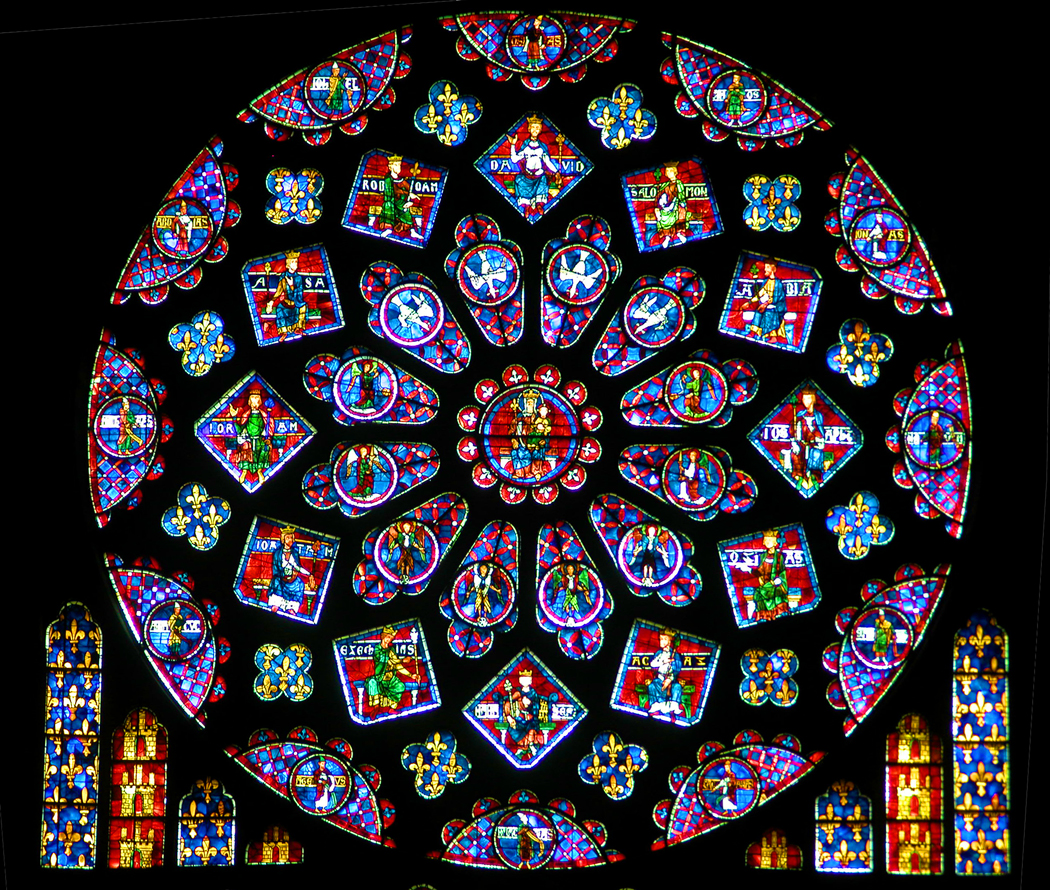
The north rose window remains the single most beautiful man-made thing I have ever seen — ever experienced.

There will be more photos with this entry than normal; click on any of them to enlarge.

row of saints horiz
Chartres
Tuesday, April 2

As they say about football: That’s why they play the game.

west facade fullYou can never know what an experience will be like until you have it. You can read about Chartres and see the photos. And you can visit other cathedrals, as we have on this trip. But you have to be there, at Chartres to see how it is different.

This is not a panegyric to Chartres. Others have written them. My reaction is a bit different. I was surprised to see how sparse the cathedral is. After Notre Dame de Paris, I was expecting something a little more crenelated, more decked out, more flamboyant.

After all, Notre Dame de Paris was an early example of Gothic architecture. Chartres is considered High Gothic. It was followed by Rayonnant and Flamboyant styles, each increasingly geegawed up.

But Chartres is a veritable Spartan of cathedrals. Her west facade, for instance, is spare in the extreme, with only a few decorations, not counting the portals and their sculpture. royal portalBut those portals are rather small and restrained, unlike their cousins in Paris. You almost get the idea of a facade that isn’t finished, that is waiting for someone to come along and add the finials, Hebrew kings, garlands of trefoils and quatrefoils.

Instead, it almost looks like the Gothic cathedral equivalent of plywood.

We walked first around the building, from the facade to the south transept, around the apse and treasury, along the north transept and back to the front.nave

Yes, the portals of the transepts are splendid, rich with sculpture. But the walls of the building are generally plain.

And when we went inside, we were blinded by the dark. It is a dimly lit nave — again contrasting with the brightness of Paris, to say nothing of Saint-Chapelle.

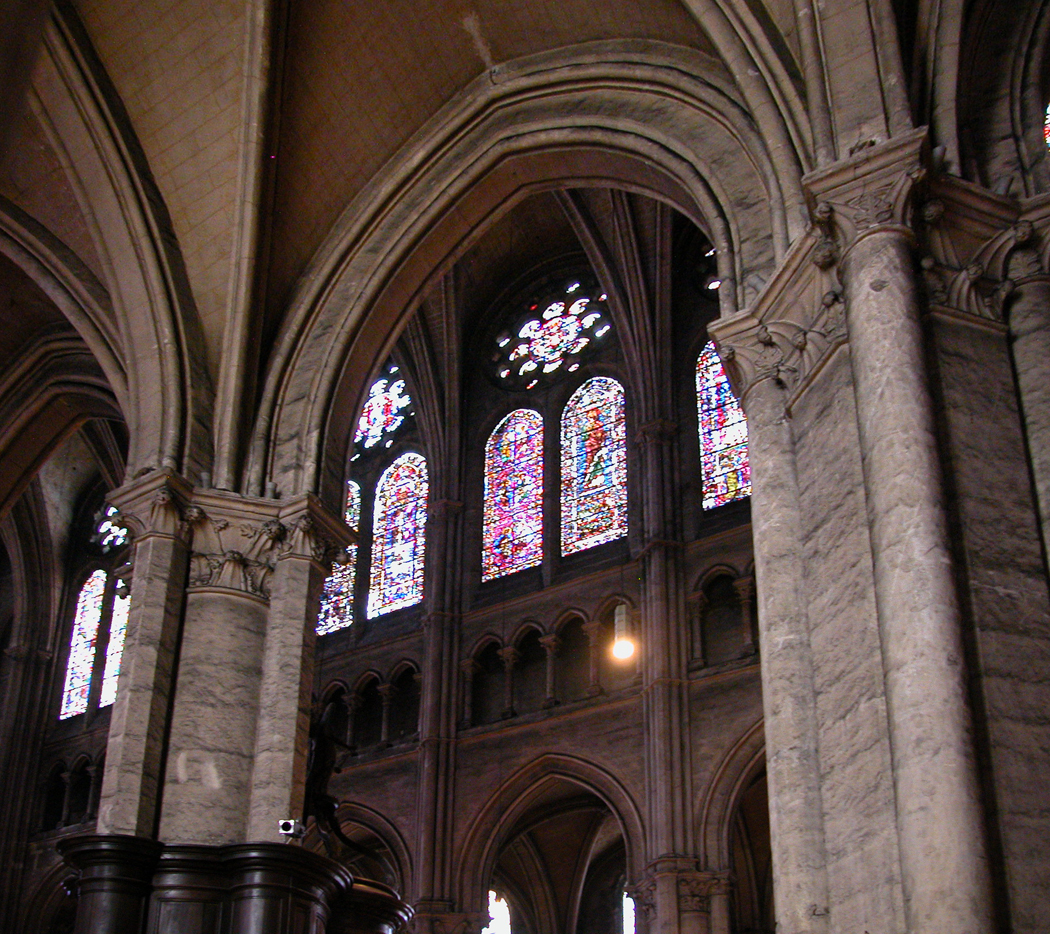
The proportions of the nave seem almost primitive. The large aisle arcades take up almost half the height of the nave. The small triforium leaves room for a rather scaled down clerestory. The result of these odd proportions is that not much light drifts down to the nave floor. It takes quite a while for your eyes to adjust.worn floor maze

When they do, there is a good deal of wear to be seen. Not only is the stone floor worn wobbly, but the vaulting in places is peeled or exfoliated, showing some brickwork behind the stone.

The rose windows are also smaller in proportion to their settings than those of Paris.

The west rose window, in particular, is at least half stone. The tracery is heavy and dense, leaving only small patches of glass to shine. Unlike the Paris rose windows, this one seems almost a crude, early attempt at constructing one.west rose window exterior

The north and south rose windows are more elaborate, but even they are small in comparison with the space of the transept walls. They could easily have been made 20 percent or 30 percent larger without overwhelming their setting.

The interior almost gives you the feeling of an empty apartment, after someone has moved out. Where are the paintings, the furniture, the curtains? In Chartres, where are the windows, the interior carving, the elaborate bosses in the vaulting?north rose window

Of course, we didn’t see Chartres in operation, as we did Paris. Perhaps it has the same awe inspiring grandeur when a mass is being said.cathedral on the hill

And you cannot fault its setting, on the hill above the town. From miles around, you can see the twin towers looming. It was the first thing we could see from the train arriving in the morning: Those towers poking up out of the countryside.statues 2

One of the reasons Chartres is so highly prized is because so much of it is original. The statuary at Paris is cleaner and more neatly featured. But then, it is only 150 years old, having been restored by Viollet le Duc in the 19th century. Viollet le Duc was a magnificent man, and his restoration work at Paris is convincingly original looking. You don’t sense much of the 19th century in it.

But it is still pristine. At Chartres, the statuary is weathered. You can see the lichen growing on the stone.

Even the walls of the cathedral sport tufts of daisies high up, in unlikely places, growing straight out of the masonry.north transept from roof

The limestone is mossy, lichened and eroded. Paris has only recently been sandblasted. Its stone seems newer — although there is plenty of erosion to go around there, too.

But Viollet le Duc’s restoration has made Paris look fresher than her matronly cousin in Chartres.

Don’t get me wrong. I don’t mean to pooh-pooh Chartres. It is glorious. And it is the very prototype of the high Gothic. But there was a certain musty odor in the nave; Paris smelled more urban, more used.

If I sound disappointed, I don’t mean to. This was one of the true high points of our travels. We spent 12 hours from the time we left the hotel in the morning till the time we returned. With an hour each way on the train, and time out for breakfast and lunch, that left a good 9 hours spent with Our Lady of Chartres. We spent that time feverishly. I photographed every one of the main sculptures of the portals, and a good deal else beside.south fleche

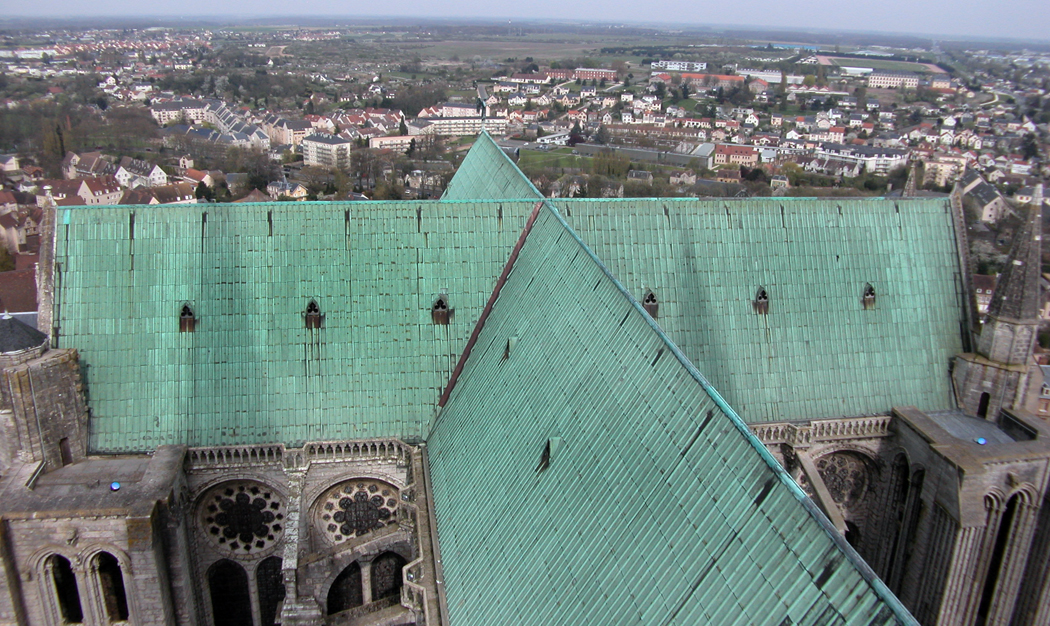
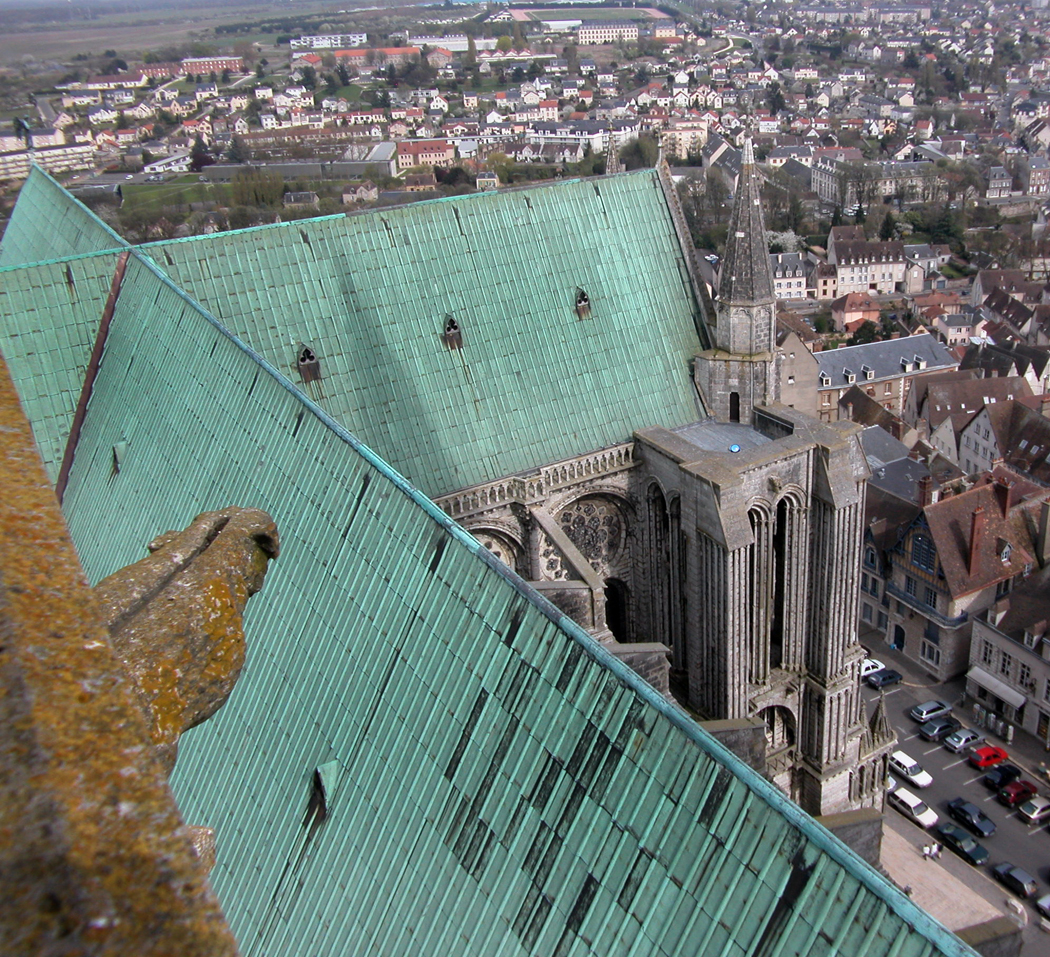
I walked the eleventy-hundred stairs up the north tower and dangled acrophobically over the roof, the bell and the south tower, taking photos of gargoyles, tracery and stone foliage. gargoyle pairLiability laws must be quite different in France. In the U.S., they would never allow anyone to climb up grotesquethose stairs, let alone hang out over the precipitous drop, with its low balustrades and that steady breeze that must often become a wind.

Visiting Chartres was one of the highlights of our lives.

Now we have experienced it, have it in our blood. This is very different from ID-ing the photos in the art history textbook.

For lunch — because we have to mention such lowly things among the lofty ones of the cathedral — we had a pot au feu at the Cathedral Bistro, just across the courtyard from the south nave exterior. As we sat eating our boiled beef, potatoes and turnips, restaurant interior with tablewe could see the masonry through the plate glass window of the restaurant front.

And when we finally got back to Paris, we went down to L’Etoile d’Or and had a cassoulet with duck and sausage. C’est magnifique.

Carole’s highlights from Chartres:

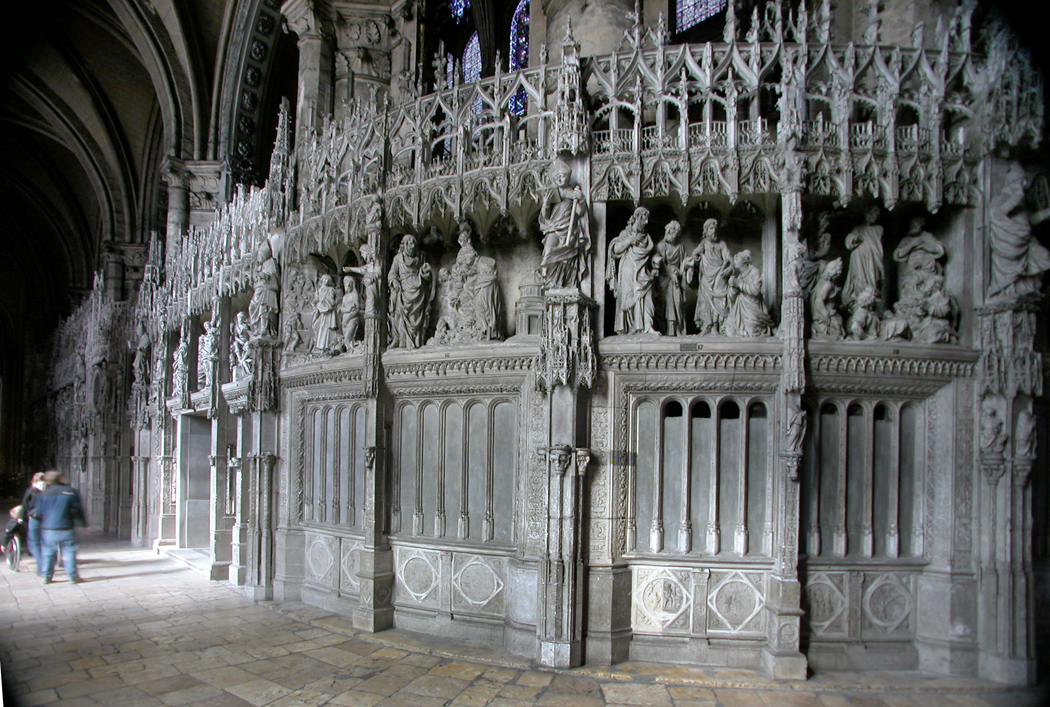
I loved the ride on the train. I loved the white flowering trees by the train tracks, and loved watching the men come out and work in their little back yard gardens. The sculpture outside the cathedral and the windows inside. Inside the cathedral, in the chapels, one of those had a statue of Mary and draped on her was what looked lancetlike a very old white silk garment encrusted with pearls and there was a little group of people sitting there and there were five or six fresh floral arrangements, and every time I walked past it I could feel the heat of the candles on my face. I walked by five or six times just to feel the heat. That was very nice. While R. was photographing outside, I walked around and around the carved stone rood screen pretending I was there in the Middle Ages and I was reading the stories from the statues; and the statues worked great. There was this really remarkable carpet at the altar in the center of the cathedral and it was tapestry work and it was blue and red and as a carpet it was made in the form of a cross, so it draped down all four sets of steps of the altar. It had 8 large medallions and each was different. One had roses another had wheat. Oh, and one of the things I liked best was the floral arrangement at the altar. It was branches of those white flowering trees with birds of paradise and orange day lilies. I spent a lot of time looking for a spot on the floor that looked like nobody had ever stepped on it, but I couldn’t find even an inch in a corner that wasn’t worn. I loved knowing R was happy all day.

Richard’s greatest hits:

south rose window exterior detailThere is no way to break it down: It is the sum total of Chartres cathedral, including its architecture, stained glass, sculpture, setting, the town around it and the people in it. If there was one event that stood out, it was the climbing of the north tower. It was a trial, but there were several stops along the way that I had all to myself and could sit in the air above the roof of the cathedral, contemplating the whole thing. The train ride was also good, through forests and past villages with old stone houses covered in vines and lichen. When we finally got back to Paris, there was a cassoulet with my name on it at L’Etoile d’Or.

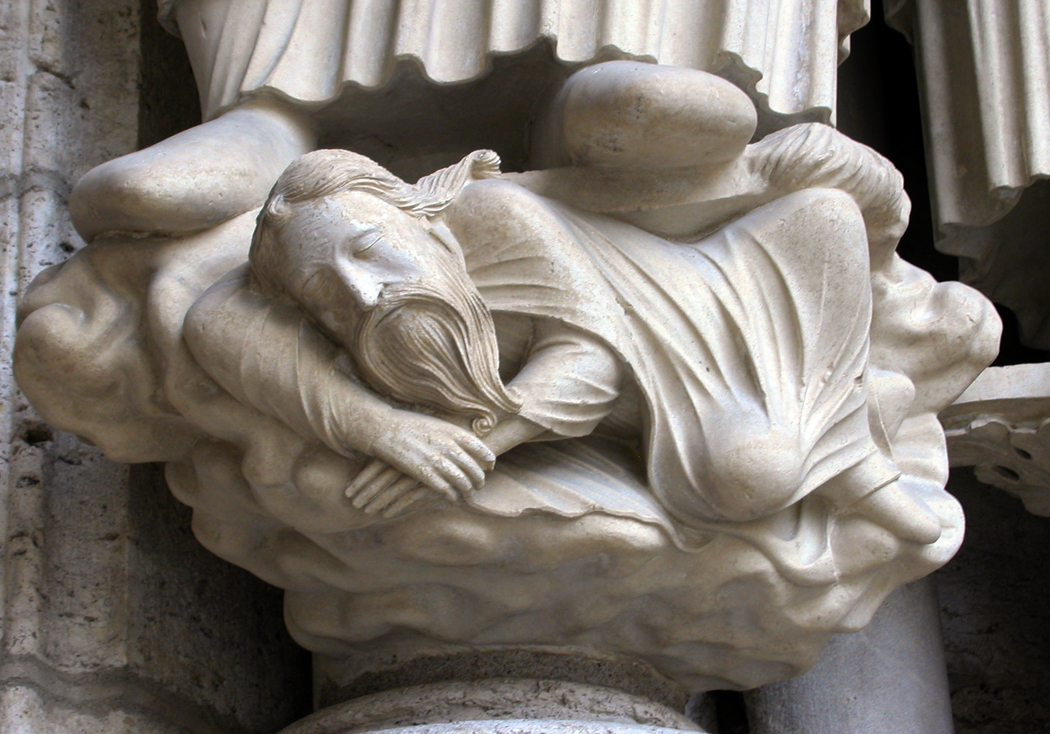
west facade 1west facade central portal tympanummary detailclerestory from navevaulting and organsouthside with treeroofroof and south transeptrood screen and ambulatorydreamer statue basebegger at the doorkids

When we first came to Paris, we didn’t know what we were doing, and because of that, we did everything right. We didn’t know where the best hotels would be, and we wound up in an unremarkable neighborhood along the rue Monge. Because it was unremarkable, it was the perfect location to discover a Paris where people work and live, rather than the part where businesses are set up to tap the passing tourist for his Euro. We didn’t know when to go, and so we wound up seeing Easter mass in the cathedral. We didn’t know that Parisians were supposed to be rude, and we had nothing but the friendliest and warmest interactions with the people we met. April in Paris.

Click on any photo to enlarge.

Petit Cardinal

Tout de Paris c’est ferme
Monday, April 1

We came to Paris to find out what the city is like. Instead of hopping on a tour bus or hitting all the usual suspects, we planted ourselves in a small hotel in an out-of-the-way neighborhood and took to walking around the streets.

One bonus of this strategy is coming to be known by the people in the neighborhood. This one, at the corner of Rue Monge and Rue Cardinal Lemoine, is at the edge of a student district, below the Pantheon and about 500m south of Notre Dame. It is filled with little grocery stores — alimentation generales — a few green-cross pharmacies, a computer game store, a couple of flower shops and a sprinkling of bookstores. As mortar, there are the brasseries and cafes, the restaurants and creperies.carole at petit cardinal

The woman who works mornings at Le Petit Cardinal knows our regular breakfast order; she smiles and says “Bon jour,” and asks if we want “deux pain au chocolates, un cafe au lait et un chocolate chaud.” We do.

This morning, she talked to Carole about how to make the cafe au lait. She hissed the steam tube in the espresso machine for us, showed us the stainless steel decanter that holds the milk, and explained how to use a whisk to foam the milk if we didn’t have an espresso machine. She is very pleasant.night scene 7

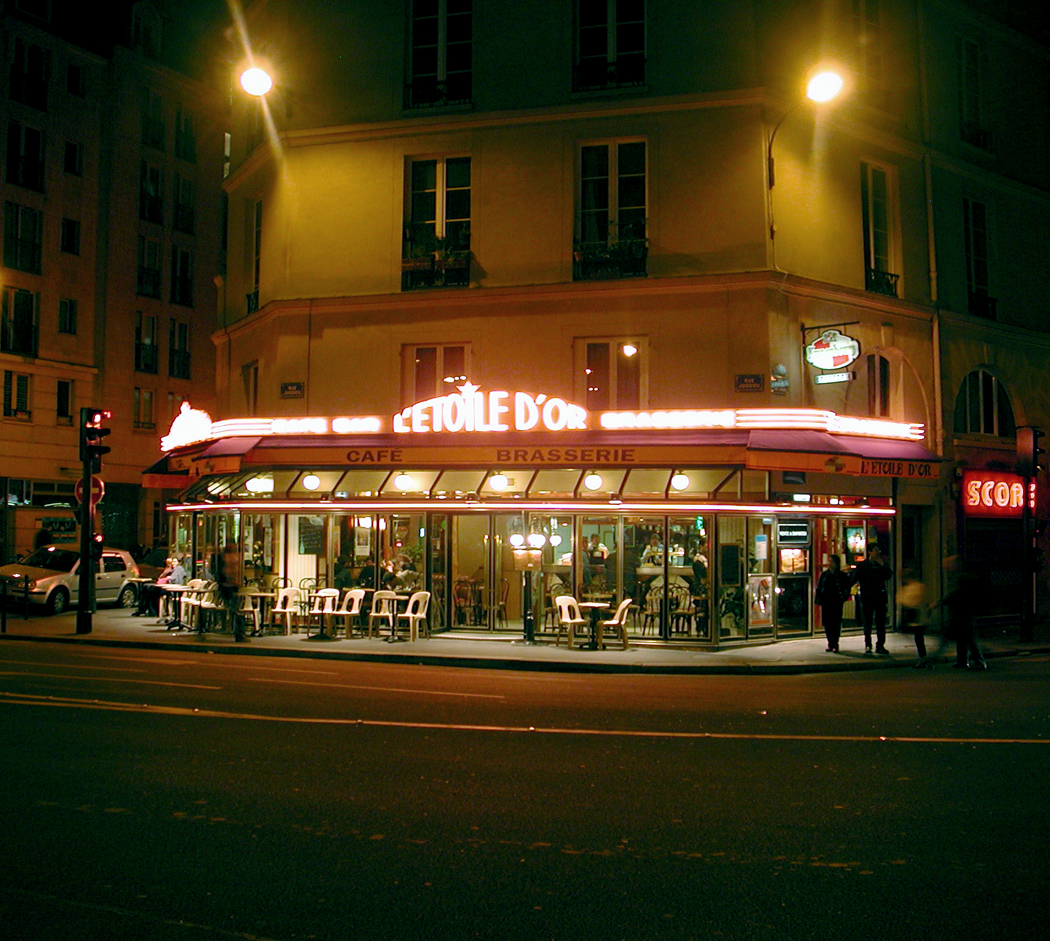
But so is the older man, with short bristly gray hair and a wrinkled nose, who waits at L’Etoile d’Or at the bottom of the hill. He recognizes us, too, and usually makes a joke about what we had last time we were there.

Despite its reputation for rudeness and smugness, we have found Paris to be friendly and cheerful. Certainly, there is a good deal of opportunism and grubbing in the tourist zones around Notre Dame. But here around the metro stop called Cardinal Lemoine, everyone — with the possible exception of our concierge, who merely seems constitutionally surly — has been a delight.mona lisait

The man at the Mona Lisait bookstore knows us by now, too. He refrained from closing up shop tonight at the usual hour, just to make us feel comfortable browsing. We were only browsing this time, but his kindness will certainly bring us back with money the next time.

I mention all this about the neighborhood because there wasn’t much else to write about today. Tout de Paris c’est ferme. It’s Easter Monday and nearly everything is closed.

We had planned to shop at Le Samaritaine today, picking up keepsakes for friends. But when we got there, it was all shut down.cat in a corset

We walked the quai along the right bank — a few of the book stalls were open — and Carole bought a small “cute” print of a cat wearing a corset for Susie.

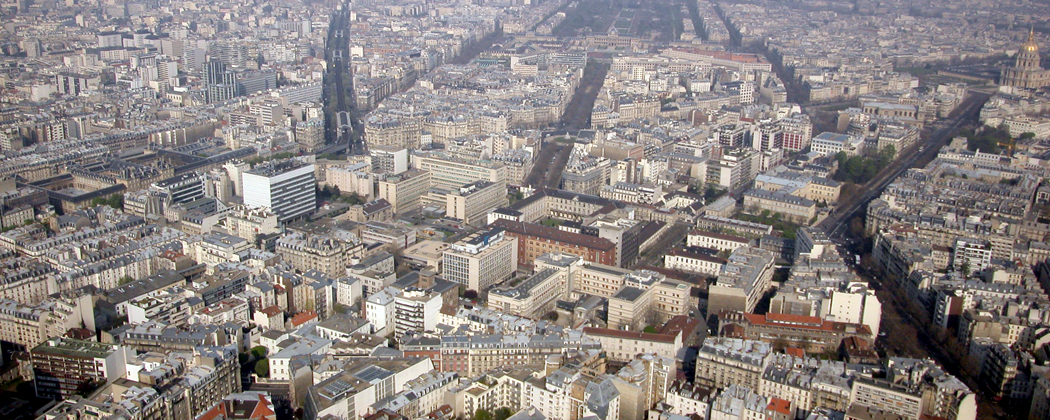
Earlier in the morning, we took the metro to Montparnasse to scope out the Gare Montparnasse, check the timetable for trains to Chartres and take the elevator to the 56th floor of the Tour Montparnasse.

“It’s smarter to use this panorama,” I said, “than to climb the Eiffel Tower. From here, you can see the Eiffel Tower; from the Eiffel Tower, you can’t, and then Paris just looks like a city.”paris jumble horiz

Well, that’s not really true. Paris has a look all its own. Even from the air — or the observation deck of a giant office tower. First, Paris streets never go anywhere. With a few notable exceptions, all of the streets in Paris run for a short distance and then give out.  It’s rare to find a street that continues for as much as a half mile.

And even if it does, chances are it does not have the same name at one end as at the other. Over and over, streets run a few blocks and then change names, changing yet again in another four or five blocks. It is disconcerting, and makes finding places by their addresses a nightmare.

The Tour Montparnasse (Montparnasse Tower) is a nondescript office building above the gare, or train station. It is considered by many the ugliest building in the city, but to anyone who grew up in any American city of size, it would simply be invisible — it would fade into the background as white noise.paris jumble square

On its top floor — the 56th — there is an observation deck from which you can see all of Paris spread out like a carpet below. Parisians say it is the best view in Paris because “from there, you cannot see the Tour Montparnasse.”

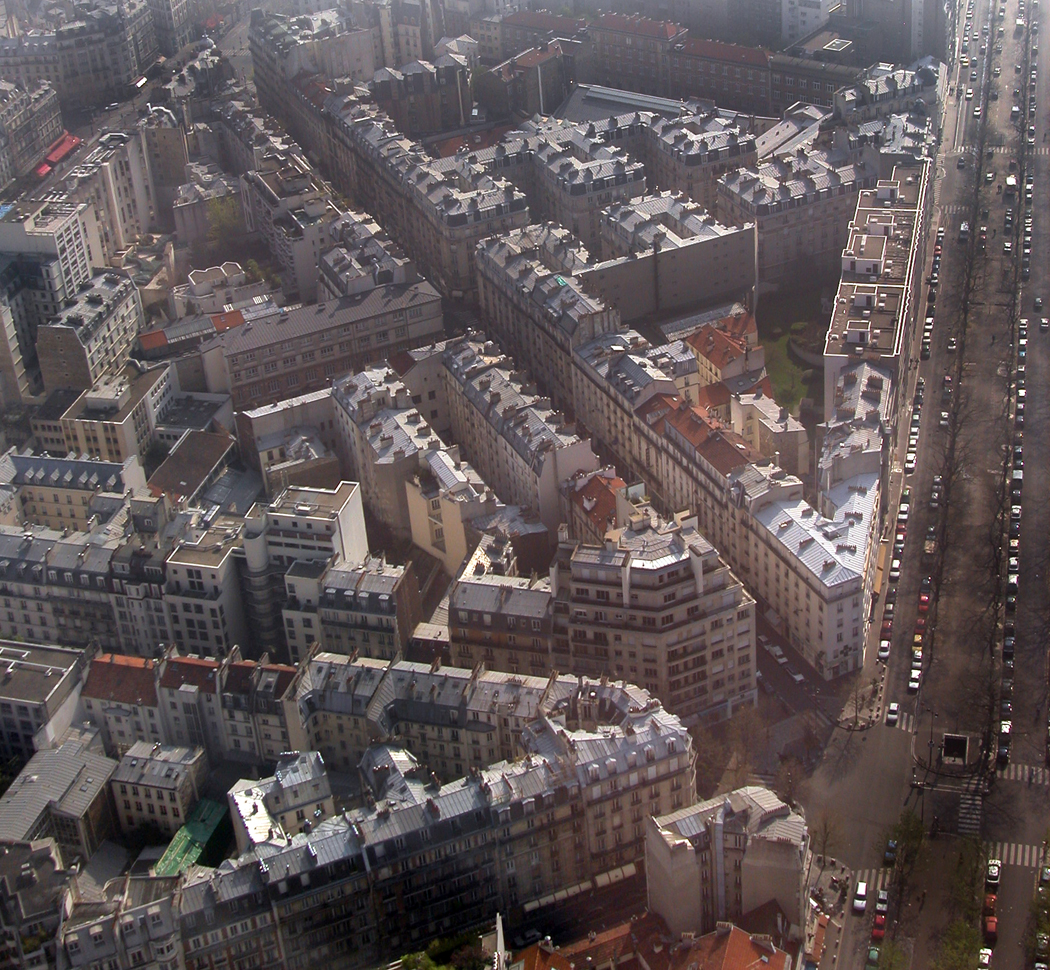
From the top, you can see those streets, a maze with no plan, grown like a crystal structure, or like the frost on a window, filling in here and there, but always cut off by a larger road at the end of a short run. You can get on the boulevard, too, and in a short while, it is an alley ending in a church and a no-parking zone.

From the air, you can see the architectural result of this helter-skelter urban planning — and I use the word “planning” ironically. triangle blockJust as it is rare to find a through street, so is it rare to find a rectangular building. Blocks tend to be triangles or trapezoids, and the buildings follow suit. Usually, they look perfectly normal from the street, but from above, you can see how their back yards are skewed, backed up to another building, nothing square, nothing even.

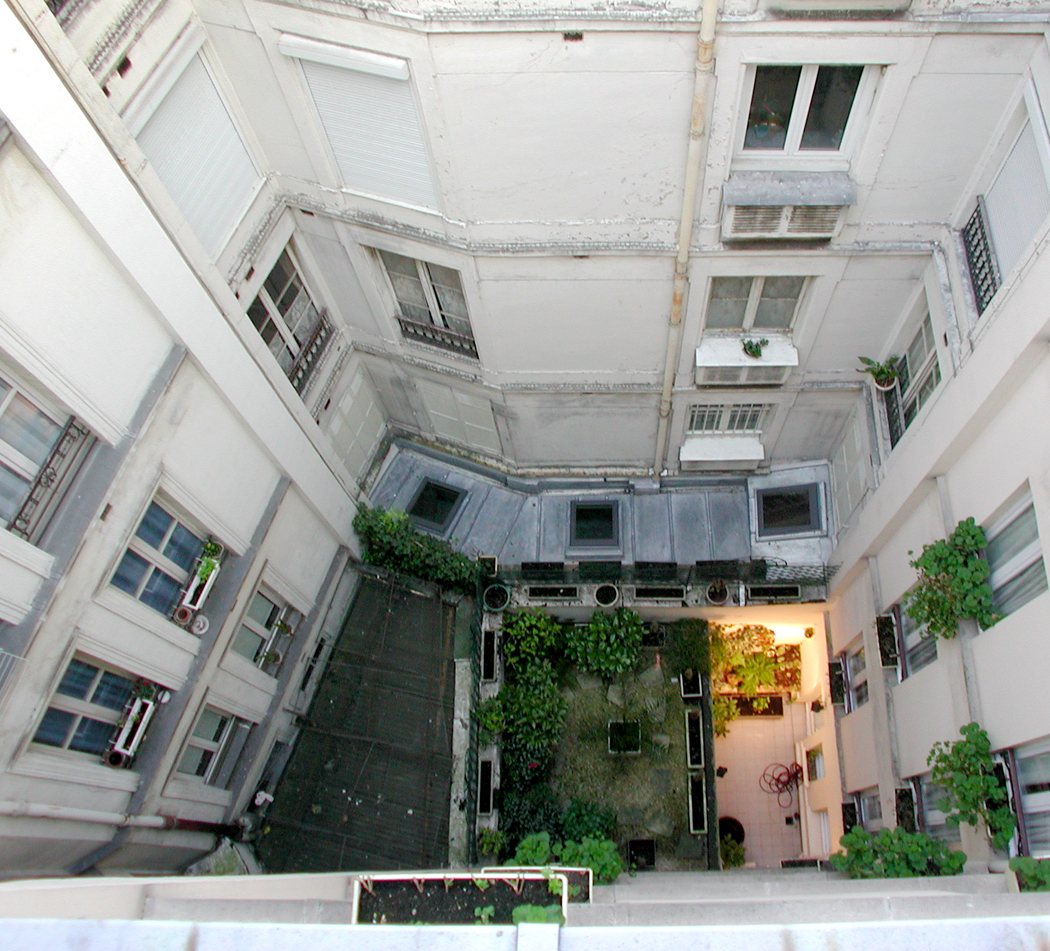
Just as the back of our hotel, which abuts two other buildings and leaves a “courtyard” in between — a kind of donut hole — but is not square, not oblong, not anything recognizable. Right angles might as well have been legally banned.

Perhaps that is what makes the people so accommodating. Their philosophy is “tres systematique” because their lives are not. The dissonance gives them a knowing tolerance.Paris floweriste

After the tour of the tower, and the frustration of a closed magasin, we came back to our hotel, which I have inadvertently begun calling “home.” Carole wasn’t feeling too well. Perhaps we overdid it yesterday, but she took a nap in the afternoon and was pretty well dead to the world.

I went for a short walk, brought “home” some groceries, including a couple of apples for Carole.

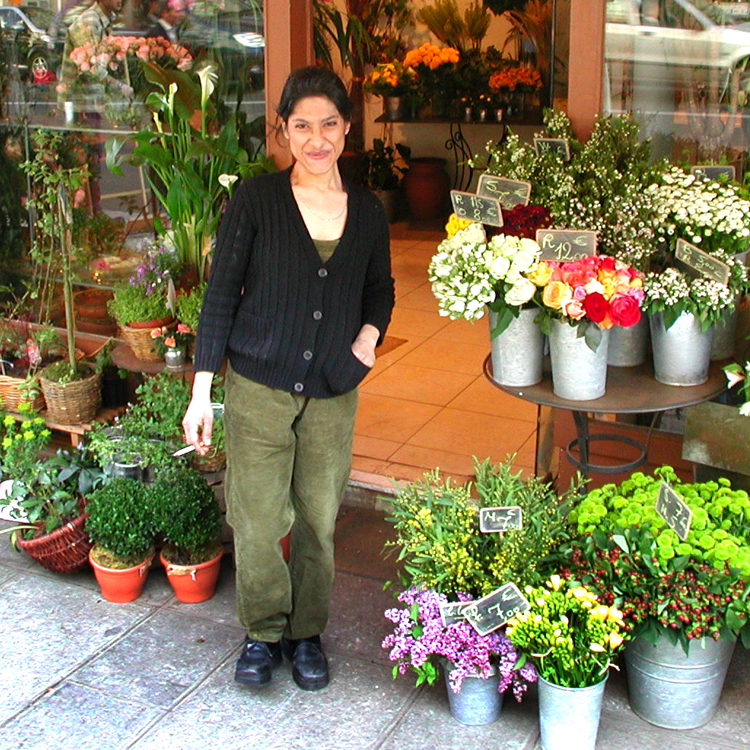
As I passed the flower shop on the rue Monge, the proprietor smiled and asked where my wife was. I told her she was feeling low and resting at the hotel.making crepes 2

About 6 p.m., we went for another walk in the hood, stopped at Mona Lisait, walked up to the old Roman arena, stopped to photograph the fountain honoring Cuvier, made goo-goo eyes at a few babies and finally stopped at Le Mitra for crepes. Mine was gooey with cheese, salty with ham and enriched with mushrooms. Carole asked for banana, and when the crepereuse asked if she wanted chocolate, you could see Carole’s face light up, as if she had recognized the inevitability of it all.

We sat on a bench and finished our wrapped-up dinner, came back to the hotel, got our key from surly joe, and plopped down for the night.

Even when you have a blah day in Paris, it seems a little more alive.

Carole’s highlights, such as they were:

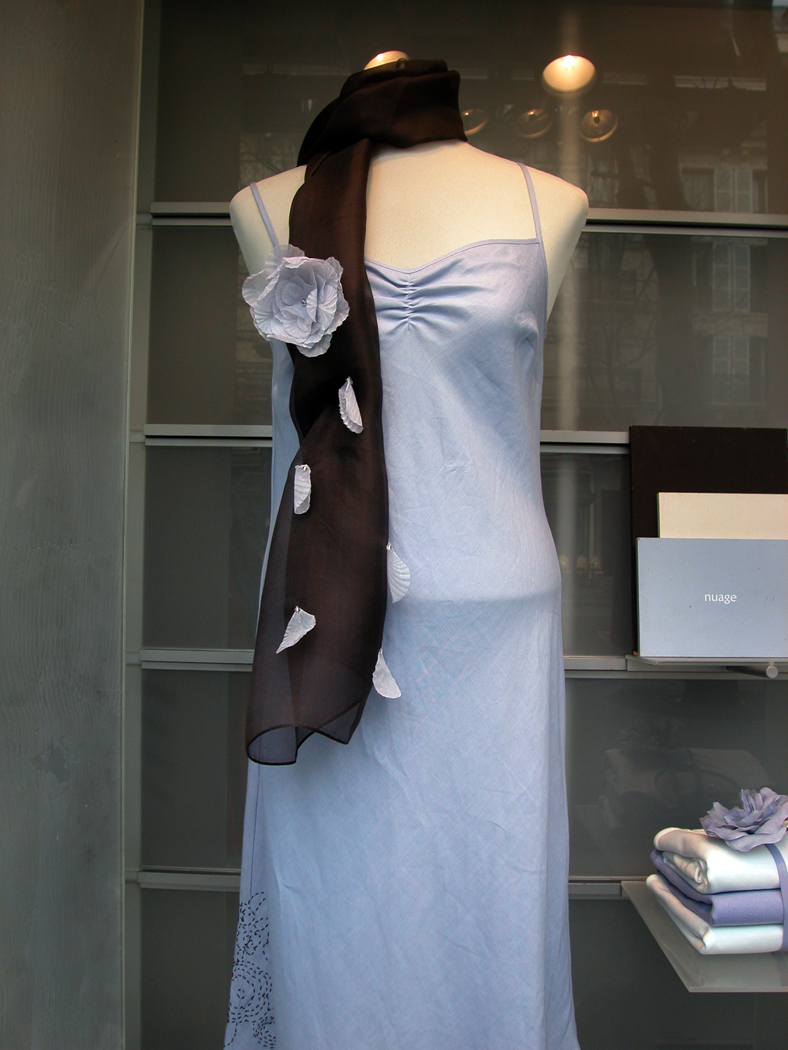
dress in windowThe cafe au lait and pain au chocolate at Petit Cardinal. I saw a young lady walking down the street with a flowering lily of the valley in a tin can. And I saw the latest French fashions in the store windows and they were chiffon slip dresses with spaghetti straps and little embroidery on one side of the skirt. And they were worn with chiffon scarves at the neck on which silk flowers were sewn. I liked the sculptures of animal heads at the Cuvier fountain at the gate of the Jardin des plantes. And today we saw many flower stalls. And one with blue roses, in the metro. Found a cat-in-a-corset print for Susie in one of the stalls along the quai on the Seine. Saw Notre Dame from a distance and that was wonderful. Tonight I was standing at a book store window looking at children’s books and a little boy was standing there, about two years old, and he was naming all the animals he could. Today I did not feel well. The woman at the Petit Cardinal told me how to make cafe au lait at home without an espresso machine.
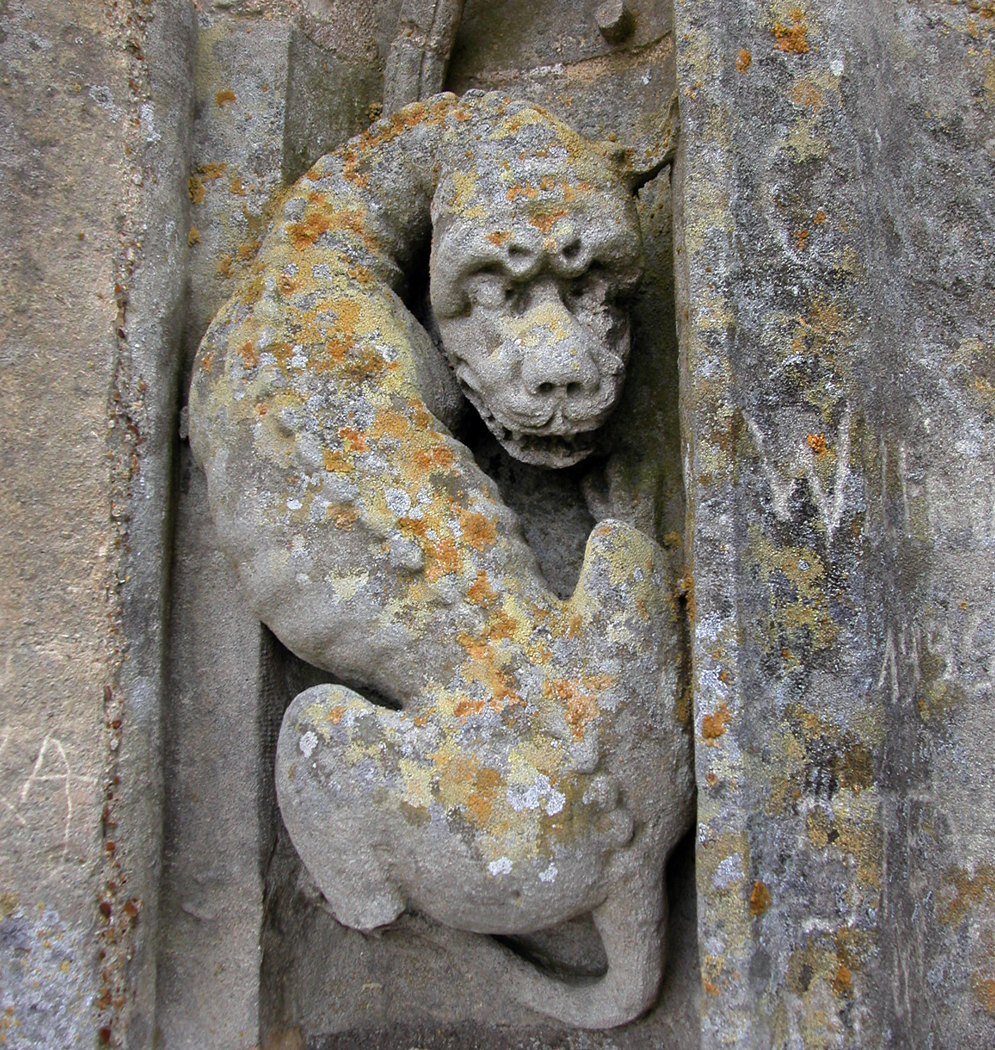
Richard’s high points:patisserie window

It was a day of few magnificences, but there was the Indian lunch with the chicken korma and spinach, at a restaurant called Chez Gandhi. And the buckwheat crepe filled with cheese, ham and mushrooms that stood in for supper. As usual, the food in Paris comes through for us.

Stories rise to climaxes, and our first trip to Paris reached that point on Sunday, when we accidentally stumbled into one of the most profound experiences of my life: seeing the Gothic cathedral in full tilt, with all its bells and whistles sounding. Later trips to France would be focused on the many cathedrals and churches built centuries ago across northern France.

Click any photo to enlarge.

NDP horiz with seine

Notre Dame: 2nd round
Sunday, March 30: Easter

A machine is always more beautiful when it is running.

A cathedral, as Carole said, is a machine to take you someplace.

Today, we saw that machine with all its gears rotating and its cylinders pumping.

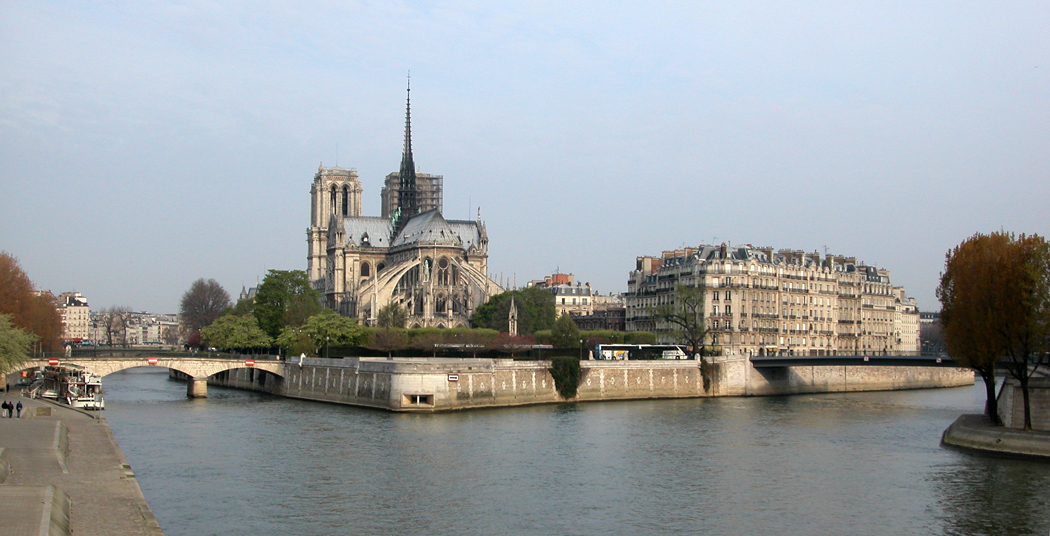
Not that we expected it when we left in the morning. We were just going to walk along the river, on the Ile St. Louis. We had a petit dejeuner at L’Etoile d’Or down the street, and wandered over the Pont de la Tournelle and along the Quai d’Orleans, to get a good photo of the cathedral of Notre Dame de Paris on its island.

NDP gargoylesAs we crossed over to Ile de la Cite, we noticed hordes of people, tour buses and commotion.

“Sunday,” I thought. Must bring out more tourists. They were everywhere.

We walked around the north side of the cathedral, to photograph details and gargoyles. But as we passed the transept portal, we noticed that, for the first time, the doors were open. Why not wander in and see.

Well, we should have realized, with the bells pealing all morning, that it was Easter. Not our religion, but still, we should have known.NDP Easter crowd

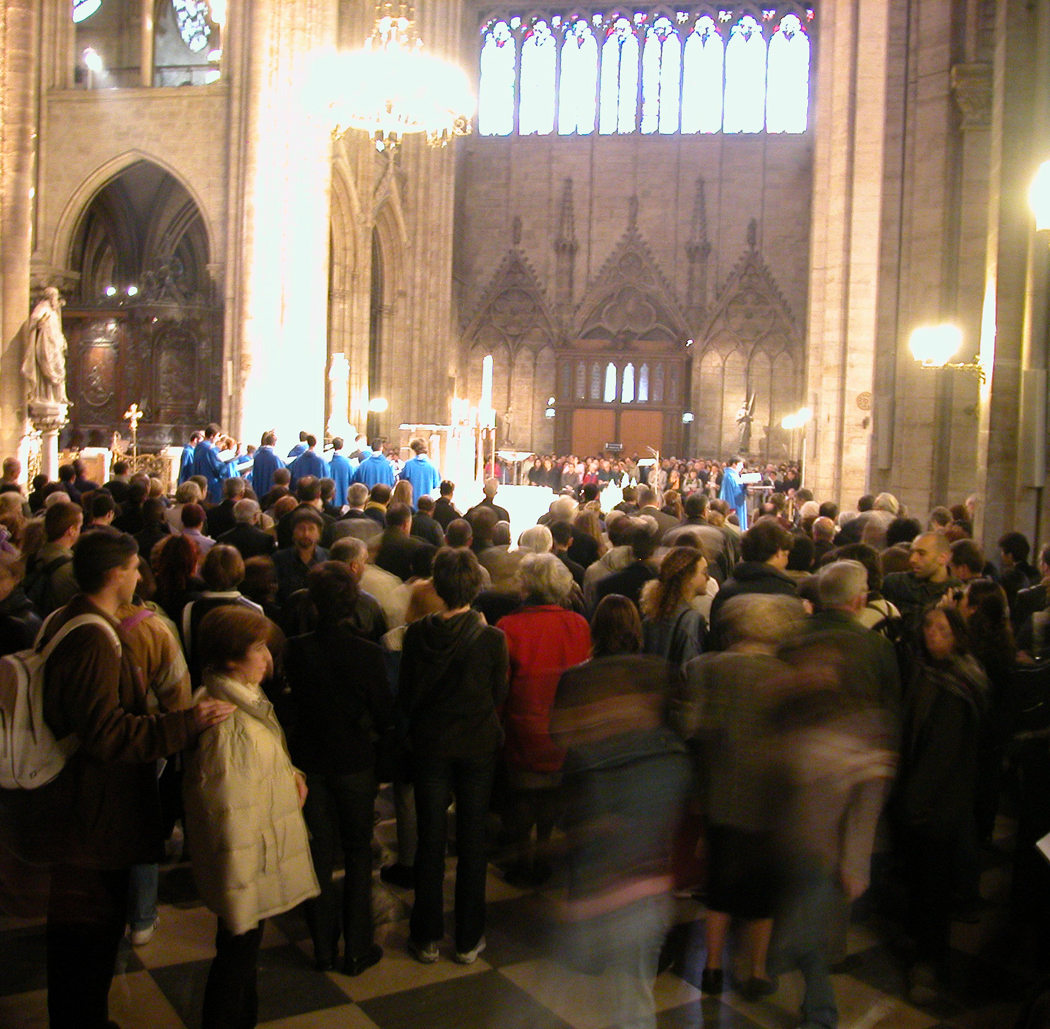
Inside, the big Easter mass was being celebrated. The church was packed. Most of the visitors were celebrants, but a good number around the edges were just tourists.

But at the altar, spotlighted like a good stage, there were priests and a choir, which was chanting plainsong that echoed through the building like surf.

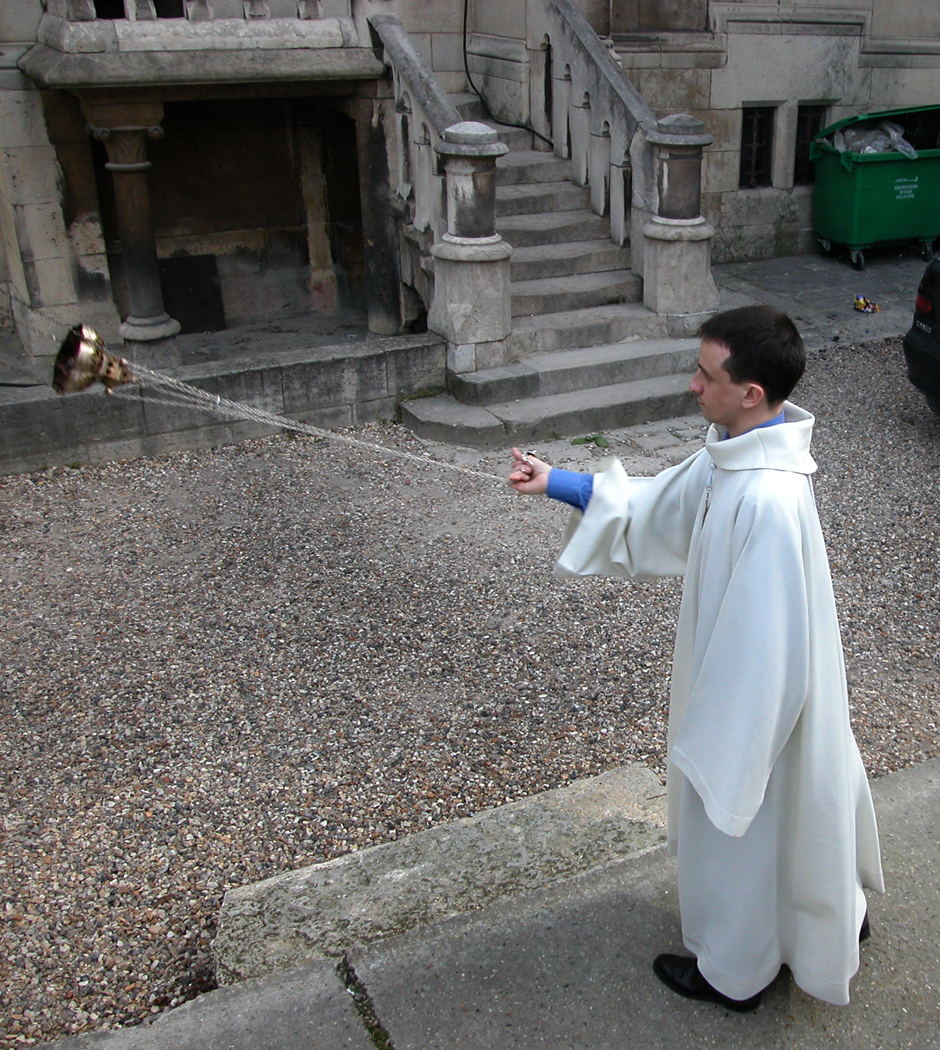
A priest was swinging a censer around the altar, spreading smoke through the crossing of the transept.

It took a while to get past the “gee whiz, what did we stumble into?” But soon we recognized the beauty and theater of the ceremony. It was intoxicating to hear the chant, melismatically floating like the censer smoke, under the brilliant blues and reds of the Rose Window, high above.

NDP bishop presidingOne doesn’t have to be a believer to appreciate how the mass, spoken and sung in the space built for it, 700 years ago, addresses the magnum misterium. Both Carole and I were soon caught up in it.

The vaulting, the lights, the stained glass, the church, spread out in its cruciform, that is also the diagrammatic shape of my body and your body, with the vast ceiling which is metaphorical of the inner dome of the skull — we could see how the priest at the crossing of the transept — the place that counts as the heart of the cruciform homunculus — was casting us out into the cosmos, out into the mystery, out into an intense beauty we only rarely let ourselves be aware of.NDP priest swinging censer

I was shaken. I believe Carole was, too. One listened to the choir, now taking on a later music, a descant from the 15th or 16th century, with the soprano floating her melos out over an altos lower harmony, and looked up, and on raising eyes, one sees the axis of the rose window, with all the light pouring through the interstices in the tracery, very like the angels dancing around the divine center of Dante’s mystical rose.

The vastness of the cathedral interior became the vastness of the universe, the singing became the music of the spheres.

The particular music split between soprano and alto was early enough that it did not participate in the tonic-dominant of classical music, but instead flowed endlessly in shifting concord, opening into landini cadences here and there to redirect the tonality.

And I heard in that melisma something completely separate from an esthetic event. It became the closest thing I have ever heard to the human equivalent of a bird’s song, a sound beautiful beyond its need to be beautiful, uttered out of instinct and joy. Shelley’s skylark, perhaps.

I don’t want to trivialize the event with frivolous hyperbole. But I swelled inside, and tears broke onto my cheek.NDP doorpost temptation

The doctrine simply didn’t matter. The metaphor behind the doctrine — the metaphor truer than the sometimes unknowing doctrine — took over.

We were privileged to witness the building doing what it was designed to do, like driving a Maserati across the countryside, or seeing the dynamos at Hoover Dam spin out electrical power.

I’ve often talked about the “business end” of the cathedral — the choir and apse — in a kind of jocular way, but now I have experienced just what a meaningful business it is.NDP through tree lace horiz

We stepped out of the church after about a half hour. The bells were pealing all over town. Easter morning bells, not only from Notre Dame de Paris, but from every small church and chapel.

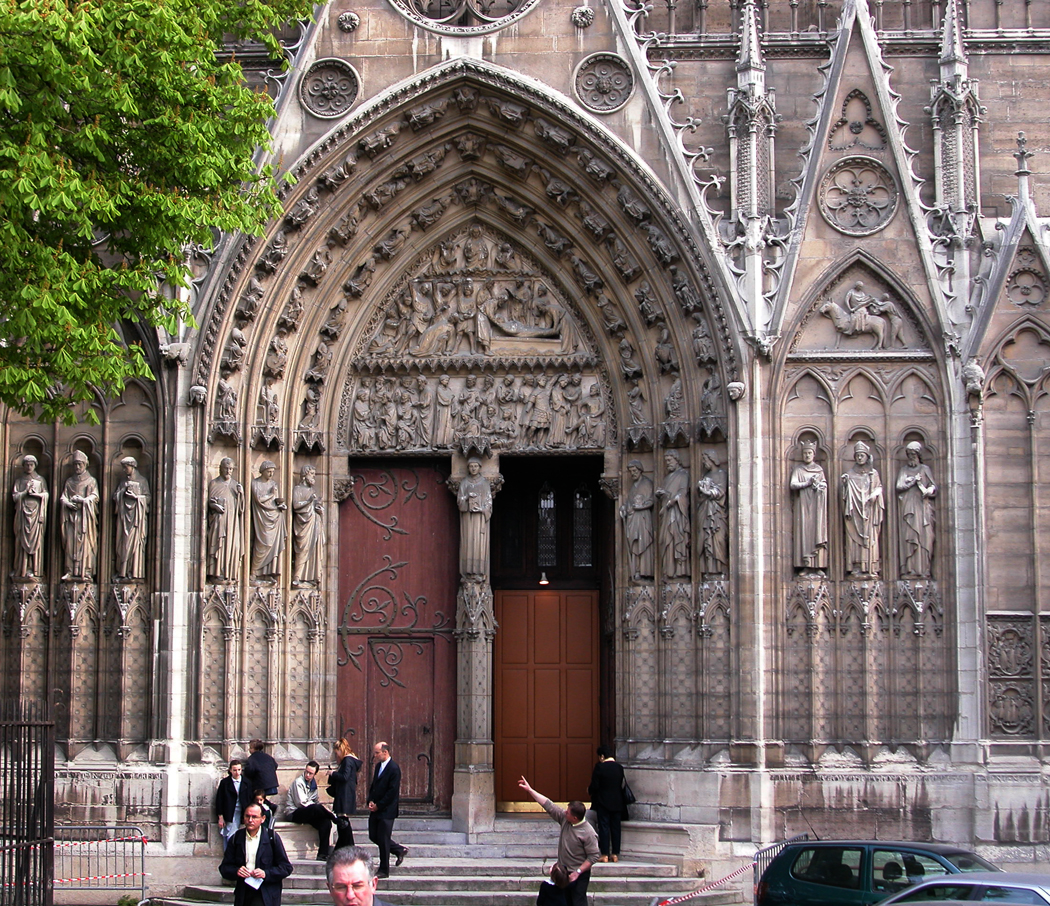
NDP north portalI continued making the photographs I had come to make, getting all the details of the West Facade, the sculptures and portals. While moving from point to point, I left Carole waiting in the crowded plaza so she wouldn’t have to keep up with me while I jumped around.

Then, I reentered the cathedral through the West door. I thought I’d see what the service was like looking down the spine of the nave. The choir was silent, but the organ was playing some Messaien. I could hardly believe it: The French composer was being taken seriously enough to play at an event as important as this. And the music was transformed by the place and event, too.

It was no longer an esthetic construct. Messaien is a joy, rich as pastry, if you have the ears to stand it. But Messaien didn’t write music — especially his organ music — so his listeners could get their jollies. No, he wrote it out of religious devotion to serve a function.

And it, like the cathedral itself, became a machine to take you somewhere. It couldn’t have been designed to be more perfect for its job.NDP church garden tondo

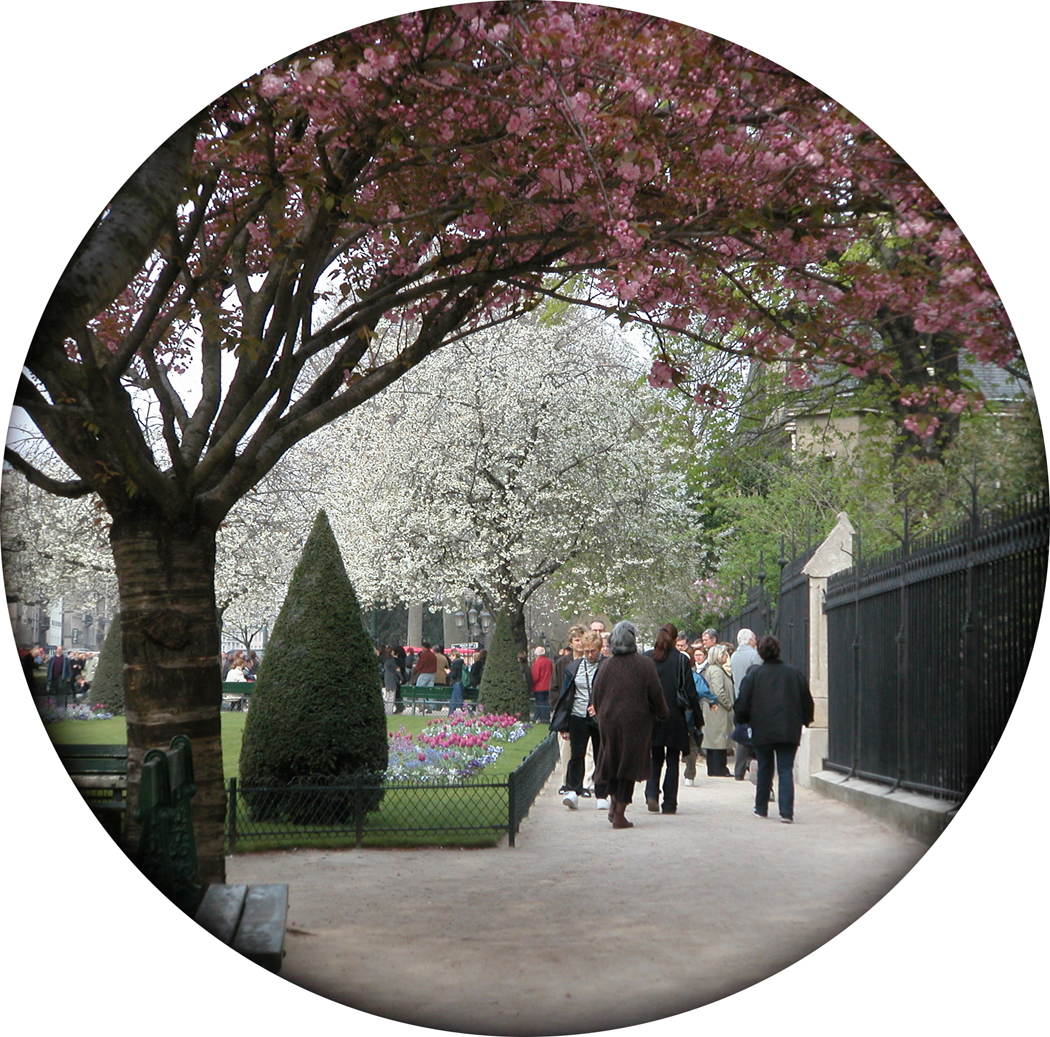
Bach organ music is great for a Lutheran service, but that deep, familiar tonic-dominant drive of the fugues and passacaglias would have seemed all out of place in the middle of Catholic mass. The Messaien is as powerful a music as Bach’s on the organ, but it is built on another schema, one that doesn’t give you an expectation and fulfills it. No, it is much more like the mystery, going into unexpected places and finding awe, finding sublimity.

To see the mass, hear the choir and the organ, on an Easter morning, in a 13th Century cathedral, Gothic to the core, with those windows, that color, that light, that theater: It is one of the highlights, not of this trip, but of my life. I was overwhelmed, which is the only appropriate response to the Great Mystery.

Addendum: The martyrdom of St. Denis

NDP st Denis with angelsThe exterior of Notre Dame de Paris is covered with the tall, attenuated statues of saints. Most of the sculpture there today is the work of Eugène Viollet-le Duc, who restored the worn, weathered and often insulted cathedral in the middle of the 19th century. (After the French Revolution, the deconsecrated structure was used as a barn to store grain.) His work on Notre Dame, like his work elsewhere, freshened the architecture and sculpture. No one knows for sure who each of the saints are. Some are obvious from the symbolism, others are obscure. But St. Denis (Dionysius) is clear as can be: The third century saint was beheaded during the persecutions of the Emperor Decius, and he stands at the cathedral in stone, holding his head in his hands. According to Butler’s Lives of the Saints, after he was decapitated, he picked up his head and walked six miles north from Montmartre, where he was executed, to what is now the banlieu of St. Denis, where the basilica bearing his name was later built, and where so many of the kings of France are entombed.

luxembourg garden horizLuxembourg Gardens

We wandered through the crowds along the river, gazing at the bookstalls, walked up Boulevard St. Michel to the Luxembourg Gardens.rue de huchette

As profound as the cathedral is, the area around it in Paris is a tourist sewer. Even the bookstalls are geared to moving merchandise to a herd of passing tourists. The awful Rue de Huchette is clogged with places to separate you from your lucre, and sell you “naughty” French postcards or mass-produced “original” paintings of the cathedral or the Eiffel Tower.

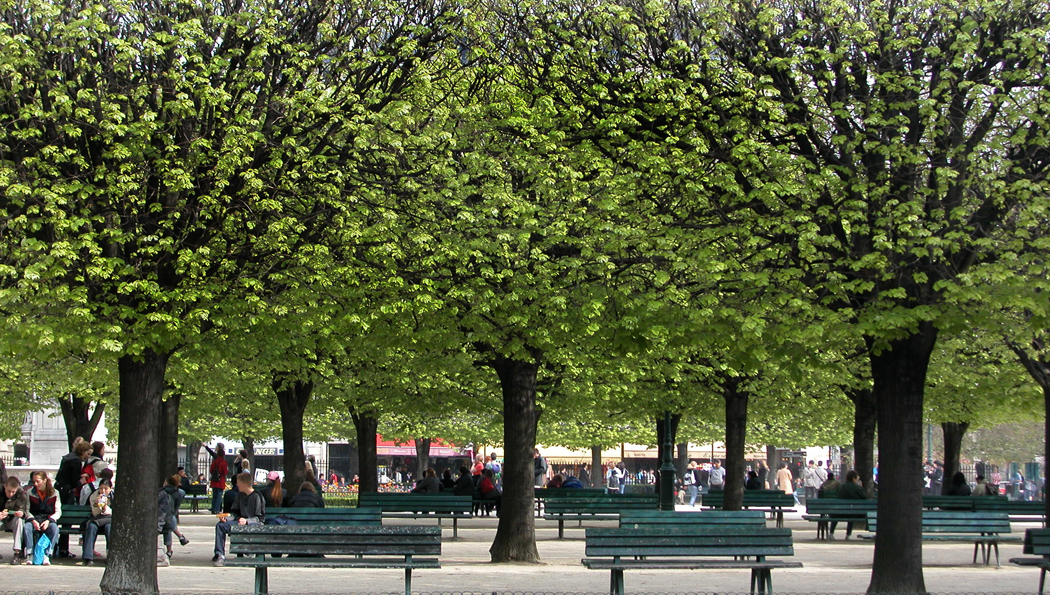
But as we moved up the hill toward the Luxembourg Gardens, Paris reasserted itself and the tourists disappeared. We walked through the gardens, among the statues and horsechestnut trees and were in the middle, once more, of a living city. People all around were walking dogs, sitting under trees and reading, or cuddling or smoking. Teenagers rolled past on their inline skates and joggers puffed around corners. All I heard was French.jardin de luxembourg horiz

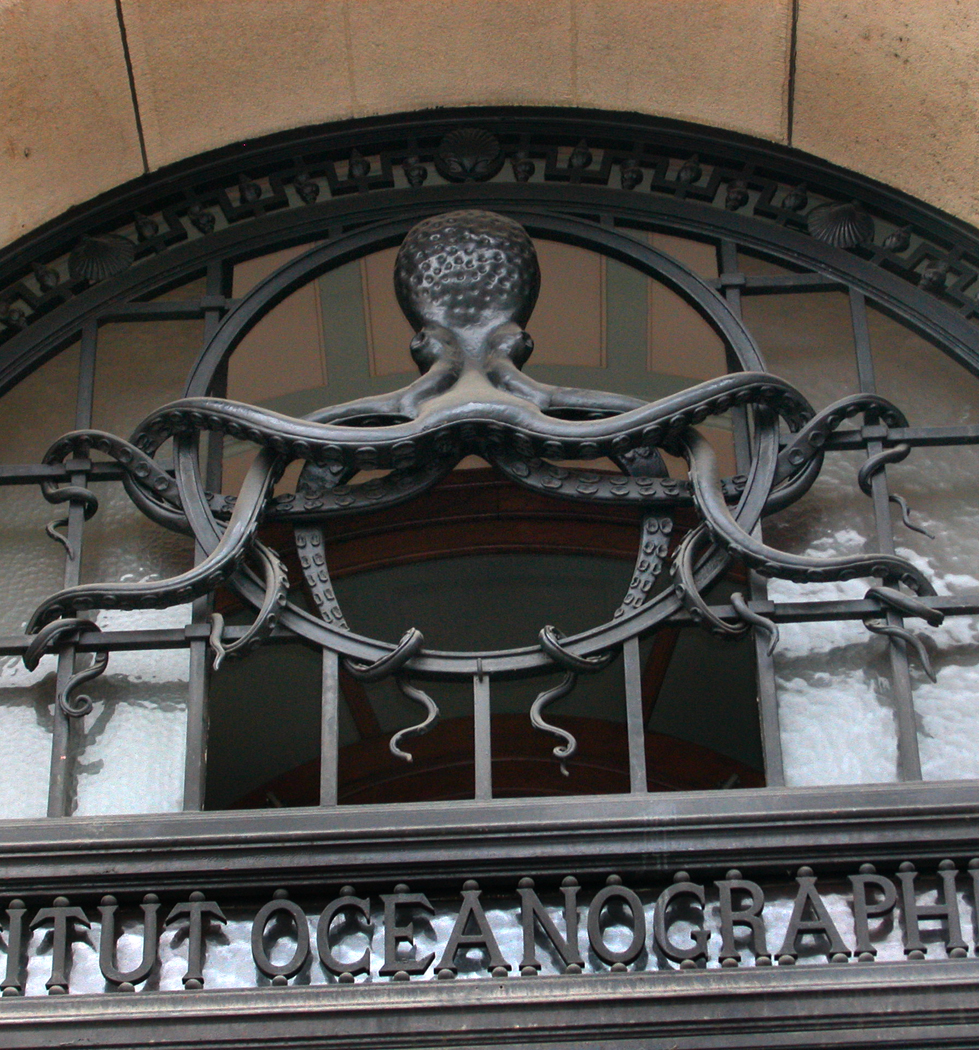
As we walked back from the gardens, we passed an older section of town (if that isn’t redundant in this ancient city) and had fun spotting all the sculptured apartment facades. octopusThere were not only the usual satyr faces and acanthus leaves, but giant elephant heads and lions. The Institute of Maritime Science had a great wrought iron octopus above its door.

Passing back around the Pantheon — an ungainly building — we came down the hill on Rue de Cardinal Lemoine and home territory. We stopped at l’Etoile d’Or again for a late lunch of Boeuf Bourgignon. Carole had a creme brulee and told the waiter that the crystalized caramelized sugar on the top of the custard was “like the glass in the windows of the cathedral.”

He laughed and appreciated the comment. Later we heard him telling the chef what she said, and the chef said simply, “Vrai.”

When we got back to the hotel, it rained a good clean rain.

Carole’s response:

NDP mary doorpostI had the sensation of being pulled up and up and up. First my eyes and then my body and then my soul. And I don’t know how to say this, but it makes you want to be better. Being inside that building appeals to the best part of you. The incense really worked: It appealed to my sense of smell. I was “smelling in a sacred manner.” And when we left the cathedral I carried some of that incense in my hair for a long time. It smelled a little like cloves, but more like the resin of some wonderful tree. Outside, when we saw some of the members of the choir, they were really young, laughing and being lighthearted, and just a moment before they had been angels. It reminded me of Bergman’s Magic Flute, the way the characters are also regular people and also in the play.
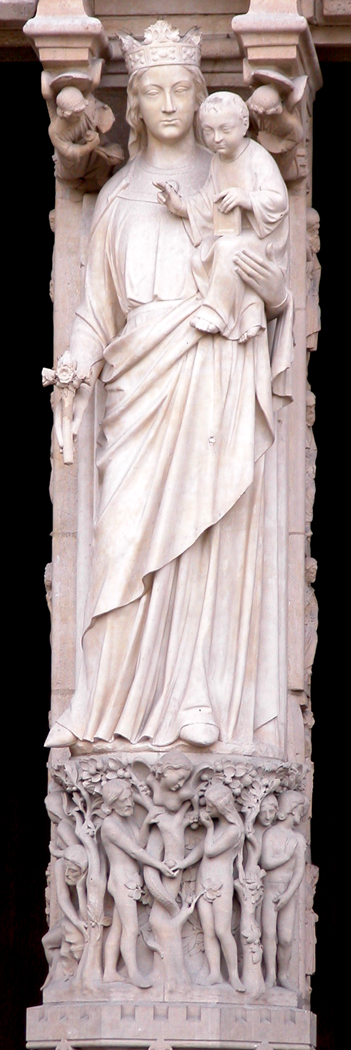
I loved seeing the statue of Mary, and she was wearing a crown and holding the infant Jesus, but she didn’t seem sacred to me because she was the mother of God, she looked sacred to me because she was a sweet little mother with her baby.

For as often as we’ve been to France, we still have never been to the Eiffel Tower. We’ve walked past it — and were nearly hustled by a team of pickpockets. The first, meant to distract us, walked quickly past us from behind, leaned over to pick up a shiny object from the sidewalk in front of us, and asked “Is this yours?” Meanwhile, his confederates, leaning against a wall to our left began to stir and move toward us. We had been warned of this scam, so I pointed at the youth meant to distract us and said, “Voleur.” He didn’t object or even react, but simply turned quickly to find another mark. But we’ve been to many places normal tourists don’t find: out-of-the-way streets, the guignol puppet show on the Champs de Mars, and the parenthetical “forests” — the Bois de Boulogne and the Bois de Vincennes, one on the east and one on the west of the city. And we’ve eaten our way across the town, trying everything from Indian food to Chinese to a McDonalds (just to see the difference).

Click on any picture to enlarge

paris sign at bois
Saturday, March 30

Paris is a city of heads.

doorhead 1It seems over every door, or at the corner of every cornice is a head. Sometimes a Pan head, sometimes a kingly head, sometimes, as at the Opera, the Palais Garnier, it is the head of every mediocrity who ever composed an opera: Halevy, Spontini, Adam, and a dozen others. Yes, they have Beethoven and Mozart, too, but they seem to be there only to provide caché for the hacks.

We took the metro up to the opera because I thought I might be able to find the street and hotel I stayed at in 1965. But it was futile. Nothing looked right. Perhaps I stayed near some other opera house. Or maybe it was a railway station. It’s hard to tell the difference here: All the official windowhead femalearchitecture is monumental and any of it built before Francois Mitterand seems to be Baroque or Beaux Arts, and covered with rocaille, stone wreaths, volutes, acanthus and — most of all — heads.

Just walking down the street, apartment buildings have volutes supporting the cornices of their doorways, and often a medallion just above the lintel with the head of a grotesque or a muse.

And it isn’t only heads. There are caryatids and bas-reliefs, usually with some mythological import. Ovid seems so much more alive here than you would ever know in America. At home, no one under the age of 50 knows what the Metamorphoses is, or who its author was, but in Paris, when you go to the grocery store, there is Daphne or Syrinx staring at you from above the door.

Further, when it isn’t a definable character — a muse or an Olympian — it is one of those ever-repeating European stereotypes: the satyr, the putto, the nymph.

The Classical world cannot be easily forgotten in Paris, with so much architecture to keep it alive.door carving elephant

In America, we are used to statues only on New England town squares, opposite the white-steepled church, or scattered through Washington, D.C., or at Civil War battlegrounds. Statues are not part of the everyday experience of most of us. But in Paris, they are everywhere. Every park is full of classical Neptunes or Junos or Napoleonic generals. There are fountains with water nymphs and curlicue fish spouting water from their mouths.opera pigeon

It means, among other things, that art is not just something you go to the museum to see, but rather, a way to give directions: “Turn left at the statue of Leon Blum.” The statuary means that the ordinary Parisian (as if there were such a thing) lives in a world in which antiquity is not only still alive, it is the visual language of everyday. If the American eye is trained on commercial signage and corporate logos, the French eye is trained on the muscles of Theseus, the helmet of Ulysses, the straight nose of Artemis, the bust of Venus. There are putti galore, and wistful angels, of both genders, and flaming swords of St. Michael. It is all a great stew of history, art, religion and tradition.vincennes 1

Bois de Vincennes

We took the RER to the Bois de Vincennes, but the day, which had been gloriously overcast, broke out in dappling sunlight and ruined any possibility I had of photographing the trees. There was the Parc Floral, though, and it was filled with blossoms, even at this early point in the year.vincennes mille fleur

Carole noticed — and she is certainly correct — that the lawns are filled with little flowers in exactly the same way that the tapestries are filled in their millefleur designs. One place, in particular, was a slope, reducing the effect of perspective, so that the flowers, spotted evenly across the grass, was even more like the textiles. It was uncanny, and reminds us once again, how naturalistic — in their way — were the Gothic designers and artists.

I had trouble reading a legend on our subway map and Carole hailed a passing woman for help. Her name turned out to be Marie Ifrah and she might as well be a lifelong friend now.

She is Spanish, living in Paris and couldn’t have been more friendly and open. I mentioned that everyone we had met in Paris has been “tres amical,” but was surprised, because she says that Parisians are not always to open to outsiders.

vincennes astersWe talked for nearly an hour, in a macaronic melange of English, French and Spanish. Oddly, when we couldn’t understand a word, or she couldn’t remember one, Spanish became our lingua franca, and I was surprised to discover how comfortable I felt in Spanish. French is still a trial for me, though I’m getting better — speaking it, that is; understanding it is tough. But Spanish almost felt like a home tongue.

We agreed that Americans are naive as a people, but disagreed about whether that is a good thing. She felt it is, that it is America’s naivete that is its salvation.

At any rate, she couldn’t help us with the map, but we became fast friends, in a macaronic way, and planned to phone each other “sometime” to arrange a trip in her car to Montmartre, which she tells us is wonderful.

“Where all the peinteurs are, not the good ones, but the ones selling souvenir to the tourists.”

She also pointed out that the French are steeped in culture. That the opera, the theater and such, are as bread and butter. Not like the Americans, she said. She didn’t want to insult us, so she pussyfooted around the issue, but America is all cuisine rapide, she hinted, and bang-bang movies.

Les Americaines lack the discipline, she said. There are things she disapproves of in the French, but she admires their discipline.cafe with author in corner

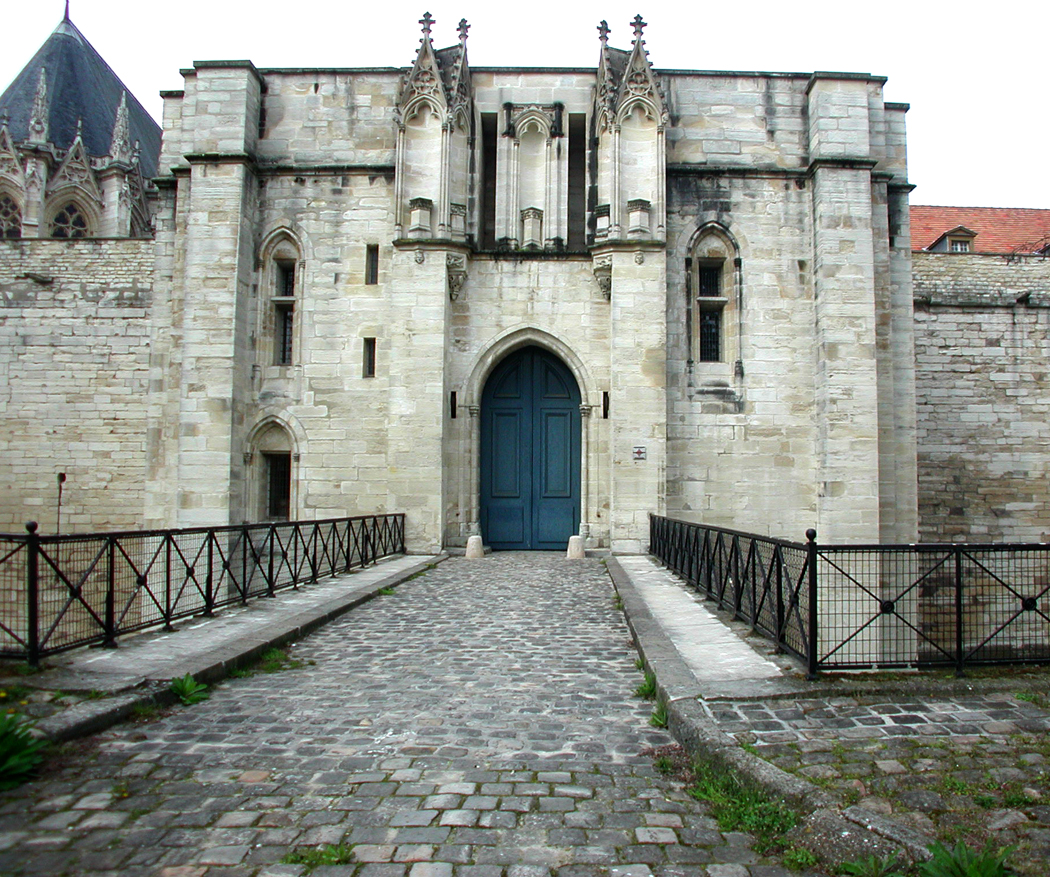
We didn’t expect the chateau at Vincennes; we came for woods. The palace was a surprise. But it is extensive and old. We walked through the grounds, but didn’t get into any of the buildings. Many are closed for restoration, and others were only open for tour groups and at hours that were inconvenient for us.vincennes chapel and wall

But the Sainte-Chapelle there was a delight of Gothique flamboyant, with a huge Rose window, all out of proportion to its width.

Because we had to walk all the way around the chateau grounds — and they are extensive — we had a late dejeuner, but it was worth it. We tried a little Italian restaurant in Vincennes, and had le menu, with an entree, plat and dessert.

I had the mortadella, which Carole called “the world’s best bologna,” but she had several bites and seemed to enjoy it. Her own entree was the oeufes mayonnaise.

We both had the lasagne boulognese, and it was rich with cheese.big billboard

Carole called the maitre d’ over and said, in halting French with a North Carolina accent, “This is the best lasagne I’ve ever had, in my entire life.”

He seemed pleased.

It only got better with the chocolate mousse that was so dusky you could have parked a truck on it.

It is 11 p.m. as I write this and lunch is still with us, but in a good way.
It feels silly writing about our food every day, but it is truly a highlight. Paris is a city where your lunchtime conversation is likely to be about where you will eat dinner.

In the evening, I took a walk around the neighborhood to snap out of a drowse fit. Took beaucoup photos and stopped at the supermarket for a loaf of bread and some confiture so Carole wouldn’t have to take her medicine on an empty stomach.

Carole’s bests:

vincennes castle entranceSo enlightening and thrilling to look at the grass and wildflowers and see that the millefleurs are real, truthful expressions of the ground here. The flowers I saw that are precisely the ones in the tapestries are the little daisies, violets, and a little plant I call rabbit plant, but I think it’s plantain, and a little pink flower I recognized. I loved seeing the castle because it was like the white castles in the books of hours I’ve seen before. And I loved walking in the woods in the places where the horses feet fell when the king went hunting. I found a flint arrowhead and wonder if it is one and is from the stone age. In the courtyard at the palace, it was easy to picture all the royalty there coming in on horses or in carriages. Seeing all these ACTUAL places and scenes that were only conceptual to me before; now they seem real human. Also, I’d like to know why the church was so important to the king that he had such a huge and fancy chapel there at the palace. The lasagne was incredible, with bechamel sauce in it. The chocolate mousse was actually a religious experience. The wonderful lady we met, Marie. The poissonerie, with all the fish.  I am surprised that the women here do not have coiffures; they all seem to have medium short hair pulled back with a rubber band or clasp. But even so, they look chic, and almost every woman is wearing a dress-length fitted black coat. But no curls.

And today, I got a rose.

Richard’s picks:

night scene 5It was a quiet day in Lake Woebegone, which leaves lunch as the high point of the day, with the mortadella entree, tres riches lasagne and the chocolate mousse. For the second day, we didn’t eat supper because the lunch was so overwhelming. The Bois de Vincennes was disappointing because the sun was out, making too many shadows for good photography, but the flowers were ecstatic. Walking around the neighborhood after dark was good, too.

In a corner of the Fifth Arrondissement, next to the Gare d’Austerlitz, is a public garden that has come to be one of our touchstones of a visit to France. We go back each time. It is not one of the tourist hotspots, like the Eiffel Tower or the Louvre, but because we found it on our own during our first trip to Paris, it has become an old friend.
The Jardin des Plantes was built in the 17th century as the king’s garden, and initially grew medicinal and kitchen herbs, but later became one of those demonstration gardens in which pioneering botanists planted samples of vegetation they had collected on voyages around the globe.
Around the periphery of the garden are a zoo and several museums of natural history. Some are so old they practically grow fungus; one has been updated to become a sight-seeing draw — at least for the thousands of school children who bus there daily on class trips.
As we visited in 2002, it seems I was caught up again in the conundrum of the opposing French tendencies to formalize and regularize nature, as in its famous gardens, and to see nature as something red in tooth and claw: the opposing tendencies of classicism and romanticism.

Again, click on any photo to enlarge.

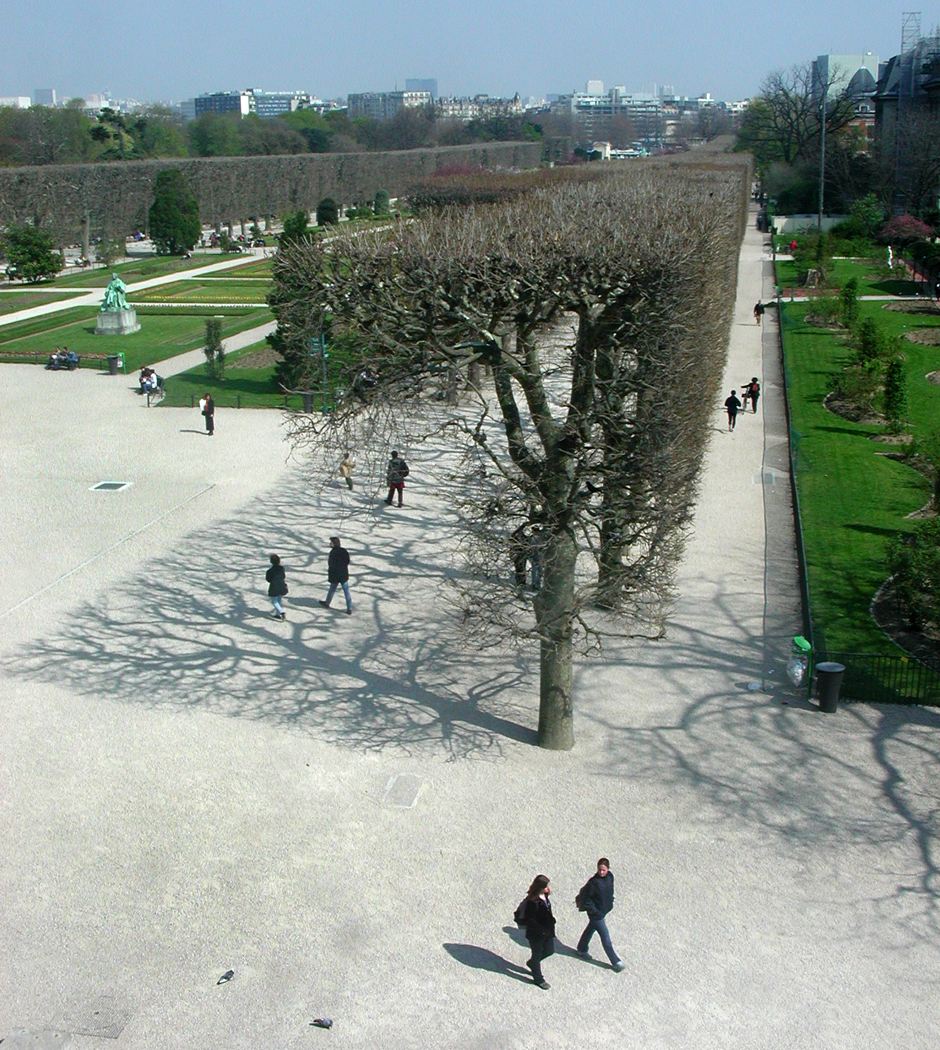
jardin main walkway

Friday, March 29
Jardin des Plantes

The Jardin des Plantes is a collection of odds and ends — various gardens, a small zoo, a bunch of superannuated museums, some sooperwhoopie new attractions and lots of old, old trees.jardin natural history facade

At the far end is one of the true treasures of France, although I’m not sure anyone here knows it. The Galerie de paléontologie et d’anatomie comparée is one of those Beaux Arts buildings, the kind with the names of noted scientists carved around the frieze, that are so common in the old museum world.

It is a long, thin building, two stories tall. From the side, you can see in the windows that there are “wonderful things,” as Howard Carter once said: the long spiny backbone of a whale, skeletons of prehistoric mammals and birds.jardin natural history eagle

But the building itself is notable. It is decorated on all sides with the most beautiful and decorative sculpture of the natural world. As an underpinning to window sills there are lobsters, hermit crabs, birds. In panels along the side of the building are giant wolves and lions. Above the entrance is a great eagle holding a lamb. A frieze completely bands the building with alternating scallop and vollute shells. Another panel on the west side has a beaver. Yet another has a scene with a man grappling with a bear cub over the dead body of its mother. Another had two men stealing young eaglets, having killed one adult, but with a second adult attacking the men.Orang and Indian

It was a 19th Century version of the Gothic love of nature.

But there is also a clue to the essential French character. As we entered the museum, on the queue for the tickets, there was a grand marble statue of a crazed adult orangutan strangling a prostrate nude Indian. It was a horrible struggle, with the man wounded, a gaping slash in his forearm, and the ape with his long arms extended down, holding the neck and head of the man flat, with his eyes bulging.

This is a version of nature with long teeth, a vision of nature as both beautiful and vicious, a kind of sublime: awesome in its seductive danger.

There is a dichotomy in French culture. One is first made aware of it in the Gothic cathedrals. There, nature is everywhere, and not a storybook nature, but an experienced one, a familiar one. If the church preached a contemptus mundi, it failed to gain traction, at least on first go-around. You can sense the love of the natural world that invests every carving, every Gothic tapestry.jardin walkway with pollard trees

That classicism that I mentioned yesterday, that stylizes and sublimated grubby nature is the other French impulse. And I see a kind of continuous war between the love of nature and the fear of it. Classicism is on one level a kind of defanging of nature.

But the French seem always aware, underneath, of the tooth and claw. So, in the Gallery of Paleontology and Comparative Anatomy, the orang is seizing man, elsewhere, man is seizing the eaglet and bear cub. It is “man against nature, nature against man, god against man, man against god. Very funny religion.”jardin from above

Perhaps the perpetual French classicizing derives not from a separation of humankind and nature, but rather from a constant awareness — and wariness — of the natural world.

The need to create, as at the Jardin des plantes, of a “jardin systematique,” or to display, as at the Gallery of Paleontology, all those gory skeletons of Siamese twins, and cats’ brains in formaldehyde, comes from that fascination with nature that is akin to a fascination with death, violent, bloody death.

I had never before understood — or thought I understood — this classicizing impulse in French culture, but today’s visit to the natural history museum has given me a clue.

Americans think of nature as vast and sublime. For Germans, nature is a place to exercise briskly. English nature tends to be bucolic: a cottage, a few sheep and a porringer. French nature is all tentacles and talons.jardin tree

O'keeffe Lawrence TreeAside from all this theorizing, the Jardin was a wonderful place. There is a huge tree, a cedar of Lebanon, planted here in 1743. It’s feathery canopy spreads out like Yggdrasil. I made a photo of it in imitation of Georgia O’Keeffe’s “Lawrence Tree.”

The Grande Galerie de l’Évolution — also at the Jardin des plantes — is as modern as the paleontology museum is musty. A shining example of modern museology, it houses an old collection of taxidermy and gives it a new spin, assembling the old stuffed animals in new arrangements, with dramatic lighting and display.jardin interior

On four floors — although to call them floors is an injustice, for they are really a series of catwalks and mezzanines hanging over a four-story cavity, filled with glass elevator shafts. Meanwhile, a parade of animals, as if marching to Noah’s boat, weaves through the central second floor.jardin elephant

It was a great plan to modernize what was once a dusty old display of vitrines and taxidermy.

But the final highlight of the day came next door at the great 19th century greenhouse and conservatory, Les Grandes Serres. The three-story-high greenhouse, like a long loaf of glass, was filled with tropical and exotic plants, dripping with moisture. At one end of the interior, a two-story waterfall has been built of concrete, with vines hanging down, dripping water.

My eyes turned on and I began making photos, in a way it only happens when my eyes are on. Made nearly 200 pictures. Another in the series of garden photos.grand serre 1

grand serre 4grand serre banana treegrand serre displaySpent from that, we began walking home. Carole got a cassis ice cream cone, purple and sharp.jardin ice cream stand

We got back to the room and dropped off to sleep, missing dinner.

Carole’s picks of the day:

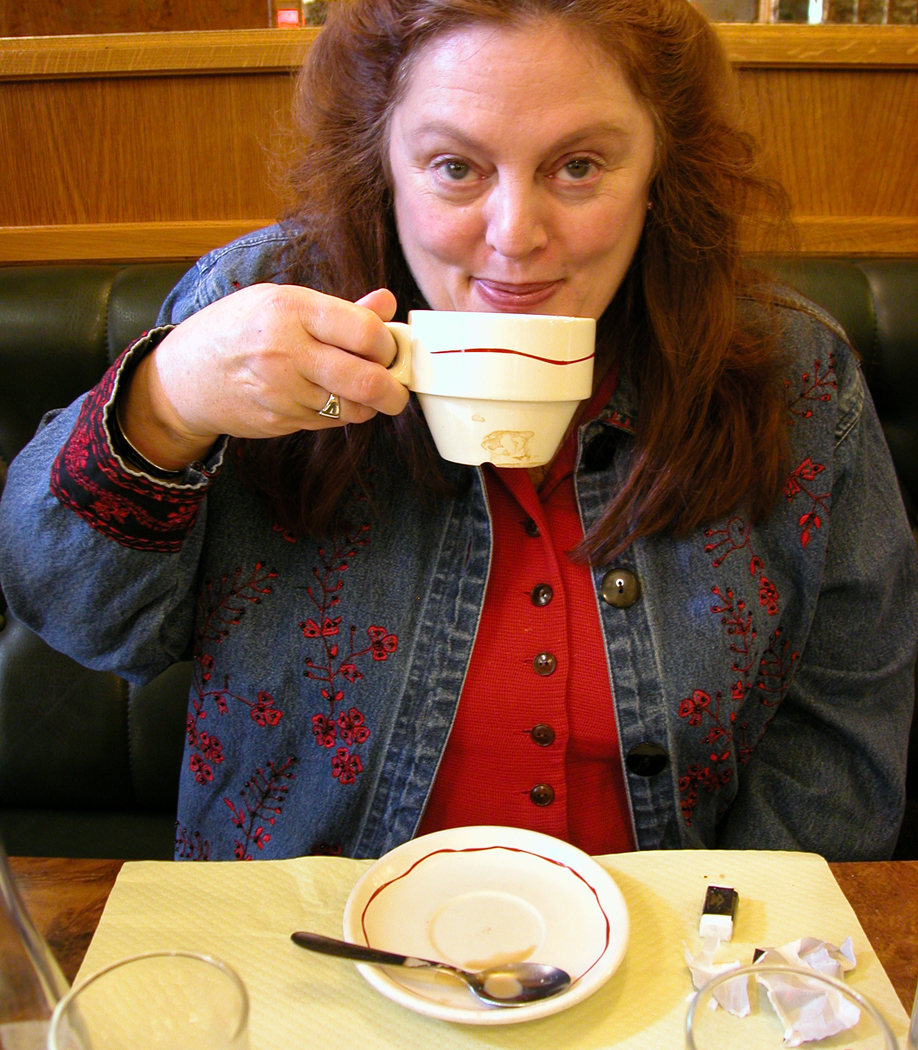
carole and coffeeThat cafe au lait and the croissant. The one I had today was even better than the one I had before. I enjoyed being able to communicate in French. The images of the images at Ste. Chapelle keep coming back to me. I loved the statue of the orangutan strangling the Indian. The parade of animals at the museum of evolution (like a Disney Noah’s ark). The plants in the garden systematique. My favorite thing was the female lions on the front of the museum of natural history. All the wonderful sculptures of animals there: lobsters on windowsills, hermit crabs. Those wonderful animals. Oh, the croque monsieur was incredible. Sliced bread with very thin ham and bechemal sauce and some kind of white cheese, then fried, perhaps dipped in egg batter first. Oh, and finding the wonderful little wooden toys for the grandbabies. Oh, and the Redoute rose and lily book. Richard looked so serious about the grandbabies. Seeing Richard’s joy in the greenhouse.

Richard’s faves:

grand serre 5The sculptural decor on the Galerie de paléontologie et d’anatomie comparée was unforgettable. All those rich animal designs crusted on the masonry. I’m sure I don’t know why they don’t sell a catalogue raisonee of the carvings. It’s a treasure. Inside, the Orang attacking the Indian was a hoot. The hoard of skeletons inside was breathtaking (photographie interdite). The Jardins des plantes in general was special, but when we entered the greenhouse, I went buggy: My eyes turned on and I went nuts with the camera. All that vegetal variety, all that green fecundity, all that sinuous vinosity and verdant threat. It was the mille fleurs and Gothic acanthus leaves come to life.

When we visited Paris for the first time in 2002, we felt like yokels: Everything was new and we gawked. Now that we have been there often enough to feel at home on its boulevards, and have visited its most familiar sites enough times that the Musee d’Orsay can feel “old hat,” these initial  notes, written at the end of each day on that trip, can still bring back that feeling, that sense of excitement at seeing the world through a different culture, and with a wholly different sense of history. These notes and photos are from that virgin trip. Click any photo to enlarge. 

Thursday March 28

ste chapelle clerestory

Sainte Chapelle

There is no denying the beauty of Sainte Chapelle, with its two floors of chapel: a lower floor for the servants and the brilliantly lit upper floor for the king. But one can see a creeping French classicism overtaking the richness of the earlier Gothic. At Notre Dame de Paris, every pier is different, every capital, every boss in the vaulting. At Ste. Chapelle, there is greater unity: only two styles of pier, alternating along the nave walls. The bosses are uniform. The fleur-de-lis motif crops up everywhere, further unifying the decor of the building.ste chapelle exterior from street

Even in the 13th century, you can see Poussin coming, and Racine. There is a fecundity to the earlier Gothic. Metaphorically, the buildings mimic the variety of nature. One senses in Notre Dame, for instance, a connection with the earth, the seasons, the stars, the animals. At Ste. Chapelle, nature has become an ensignia for royal power and wealth.

No one at Ste. Chapelle, you feel, has ever shoveled manure.

The difference, as Carole stated it, is that Notre Dame feels like a machine meant to take you somewhere, like a traveling machine for the universe, or a time machine. You know, in Notre Dame, that something is happening to you.ste chapelle interior

At Ste. Chapelle, you admire the decor, recognize the royal taste — the gout royale — and it something you observe, look at, admire, rather than participate in. That doesn’t mean it isn’t astonishingly beautiful.

Ste. Chapelle, of course, is late Gothic, le style flamboyant, with neither aisles nor triforium. The windows hang like banners down the walls from just above head level to the top, at over 50 feet. Ste. Chapelle is filled with light in a way Notre Dame isn’t. There is nothing murky about Ste. Chapelle. It is brilliant.

There are two stories, in both senses of the word. Upstairs is reserved for royalty.

The first floor is a low chapel for servants and burgers. Its ceiling is blue and gold, and anyone using it must have felt privileged indeed, with all that gold leaf and those gilt vaults. (Granted, they are 19th century restorations and only approximate what must originally have been there.)ste chapelle downstairs

There is a tiny circular stone staircase that leads up to the main event on the second floor. Because of its two tier nature, Ste. Chapelle looks oddly gangly and tall. Because its foundation is hid from the street, the chapel looks as if it is built on a small hill, above the surrounding buildings. But there is no hill on the Ile de la Cite. The church is just jacked up a full story on its servant chapel, leaving the King’s chapel floating in the stratosphere.ste chapelle rose window, stained glass, ceiling

ste chapelle downstairs ceilingWhen the sun breaks out, as it doesn’t often do in Paris, the stained glass projects color on the floor, in blues, reds and a little yellow.

We spent a couple of hours in St. Chapelle, trying to see everything and absorb it. Every inch of the place is either gilt or painted or sculpted. There is little resting place for the eye. Perhaps that contributes to the sense that Ste. Chapelle doesn’t function as Notre Dame does.

It is something that allows Louis IX to show off, nearly 800 years after his death. He would have liked that, I’m sure.

Cluny winemaking taperstry

Musee de Moyen Age, Cluny

At the Musee Cluny, we began to wear down. We saw the first dozen rooms just fine, and had time to linger over the many tapestries, but eventually, our muscles and bones — to say nothing of our fried brains — made the last part of the museum a mad dash to get through. Which is a shame, because there is so much to enjoy.Musee Cluny exterior

The Middle Ages speaks to me in a deep and profound way: I am simpatico with its sense of multiplicity, and its sense of particularity.
“To generalize is to be an idiot,” said William Blake, and with that, he dismissed all of English neoclassicism.millefleur

But I feel as he does: Every flower, every tree on the mille fleur tapestries is identifiable. There is a daisy, there an iris. It might as well be a Peterson guide.

For me, the Gothic evidences a genuine love for the things of the world. The various classicisms that follow seem infatuated with ideas rather than things.

But you cannot rub an idea between your fingers, hold it to your nose and smell the camphor, as you can in an herb in a garden.Cluny column leaves

Yes, I admire the rigor of the classicisms. Poussin is no slouch: You have to respect the intellectual energy expended in regularizing the universe.
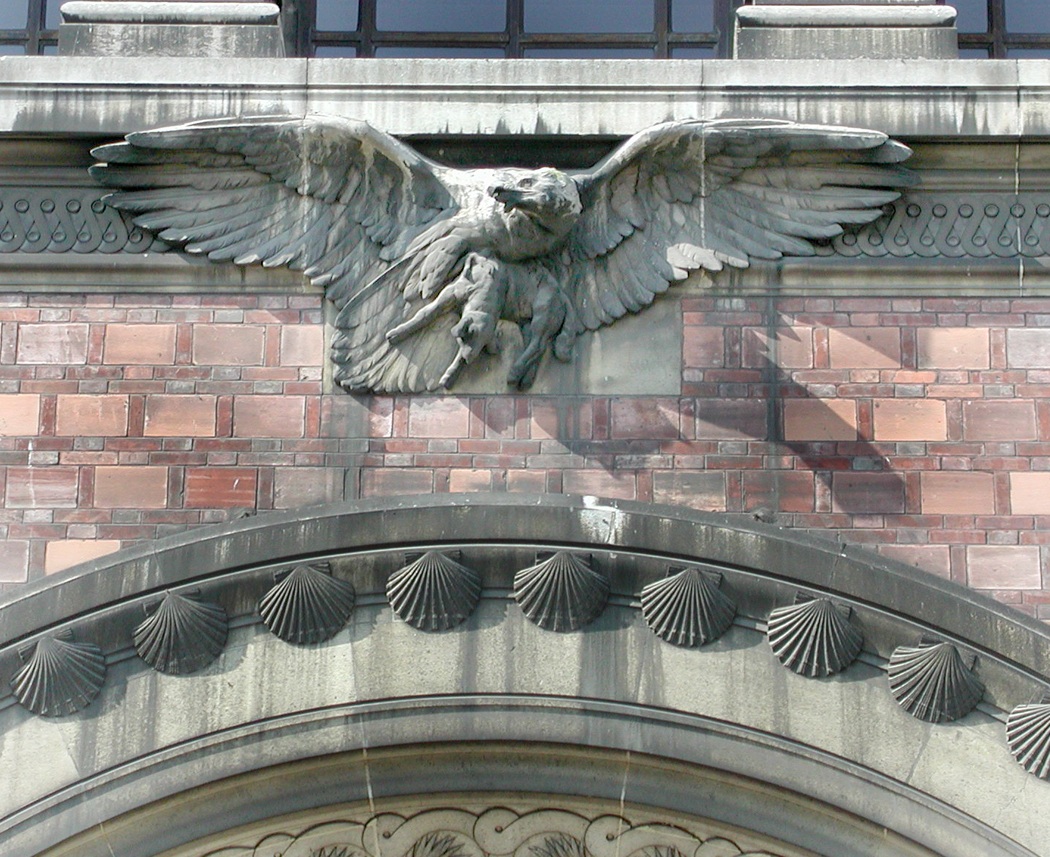
But in my heart of hearts, it seems like a kind of avoidance. The real world, with its real textures, real smells, real colors, real tactility, real sounds — seem so much more satisfying than the concepts that underlie classicism.

So, the Gothic world dug its arms up to the elbows in the soil, sniffing the moisture in the loam. You see it in the illuminated manuscripts, with their love of the seasons; you see it in the architecture, with its leafy pier capitals; you see it in the tapestries, with their mille fleur horror vacuii.Cluny stainded glass angel with flower tondo

The classical worlds that followed — and in France, even the Baroque is classical — it is all turned into ideas. Even French Romanticism seems wordy and literary.

So, you have to go back past the 13th century, to the early Medieval world, before you find such quiddity in French culture.

Adam Gopnik, in his book, talks about the French love of “theory.” Theory to them, is paramount: Without a solid logic in your theory, your conclusions are suspect.

But theory can be a dread evil. It is just such ideas that, twisted and mangled, turn into fascism, Stalinism, Maoism. No room for goats in such worlds.

When we finally got back to the hotel, we were destroyed. Could barely move. Slept for several hours before supper.

But then, we walked down the street to a little glass-fronted brasserie for some onion soup and apple tart. Quel marvelleuse!Cluny animal ivory tiles

ste chapelle floor lionsCarole’s favorites, day three:

Windows at Ste. Chapelle; Cafe au lait while walking to subway, and the pain au chocolat; learning about Ste. Chapelle from Richard as my own private teacher; I liked the servants’ chapel very much. Really really enjoyed was the cut on the fold animal patterns inlaid on floor at Ste. Chapelle; there were hounds, boars, vultures, wolves; At Cluny, saw some little metal pots that were children’s play dishes; saw some little metal whistles in the form of animal heads that were children’s whistles. I thought the combs were very interesting. The second most wonderful thing, after Ste. Chapelle stained glass, was Medieval garden at Musee Cluny. Saw some blue violets blooming.

Cluny gold rose 2Richard’s favorites, day three:

The Omelette Emental for lunch, which was heaven. The stained glass at Ste. Chapelle, although it was too overwhelming to see in detail. The fleur-de-lis stars on the vaulting of the lower level of St. Chapelle. The tapestries, in general, at Musee Cluny. There was a gold rose there, too.

PARIS 2002
Days 1-3

Along the Seine

The Flight

In the spring of 2002, my wife, Carole, and I went to Paris for the first time. Some friends had just got back from Rome and waxed effusive over the experience and they encouraged us to follow their example and travel. We thought about it but decided that the north felt more simpatico than the sunny Mediterranean, and so finally decided on France. On March 25, we flew from Phoenix to London and on to the City of Light.

We left the house in Phoenix, Ariz., at 4:15 on Monday and got to our hotel in Paris at 4 p.m. the next day. It isn’t as bad as it sounds: With the 9 hour time difference, we were only in transit 15 hours. Well, it is as bad as it sounds. The time waiting in airports, cramped on airplanes, and riding around town adds up to one great pain in the ass.

And while British Airways is much to be preferred to most American airlines, that is still faint praise. The seats were sardined, the hours tedious, and the food bland. The flight from Phoenix to London was bad enough, but the short hop from London to Paris was a nightmare. The plane loaded up with Scottish soccer fans, all dressed in kilts, with tam-o-shanters and beer guts, and they yammered and yelled for the whole flight, making it more like a school bus than a jet plane.

“Hey, laddie, when you gonna take a rest,” yelled a Scot from one end of the plane to another. “Aye, and I suppose you are, too,” said his buddy at the back. And they all laughed at the joke, which was mute to the rest of us. It was like that the whole way.

One minor note: On the short leg, they fed us only drinks and snacks, which were “Pfeiffers’s Bread Sticks with Worcester Sauce Flavour.” Truly a bizarre taste. Little pegs of dry bread, about 3/4 inch long with the sharp taste of worcestershire sauce, coated as a dry powder on the surface.

Worse: the note on the back of the pack. “Best before Sep 02 2059.”

Now that’s a shelf life.

The following notes are from the daily journal I kept of the journey, day by day, excising some of the more quotidian bits. The photographs were all taken on the day described in the journal, even if better examples might be had on revisits. Click on any photo to enlarge. Each entry ends with a short summation, one each by me and by Carole. The first three days get kind of garbled together. That’s the way it felt with the jet lag.

Hotel Vendome horiz

The Hotel
March 27, 2002

Paris airshaftWe stayed at the Hotel Vendome St. Germain, which is a hole in the wall place off the Rue Monge in the Quartier Latin. We got a room on the sixth floor, the top floor, looking into the courtyard. At the bottom, there are a few potted plants that serve as the “jardin,” of which the hotel website promises a “view.”

The hotel couldn’t be more Parisian, as far as we could tell. It is old, with peeling paint on the exterior — although the interior was nice enough.
The rooms are tiny, just room for a double bed, a small desk and closet. But it has a bathroom — even tinier — right off the room.Through window

As night descended, we could see the people in the rooms across the “view,” apparently in apartments, cooking their suppers and sitting down to eat.

I could practically hear accordion music. Ou est Jacques Tati?

We were so exhausted from our flight that we collapsed in the bed without supper and fell asleep. Which sleep proved fitful at best, with both of us waking up about hourly, and trying to get back to slumberland.

By 6 a.m., we gave up trying to sleep and got up to start our first day in Paris.

Seine with tower
WEDNESDAY

Breakfast

Breakfast in the hotel cafe — really just a room in the basement where they stack up a bunch of croissants and baguettes with some rolled ham, yogurt, butter, Laughing Cow cheese and confiture (jam).

The coffee machine hissed and spumed, and the hotel maid, doing morning cafe service, brought out the cafe au lait.

To say the least, even this modest petit déjeuner was a revelation.
The croissant was flaky and buttery. But that we expected. The coffee was marvelous. But that Carole expected, too.selling strawberries

“The butter is too rich for me,” she said, after spreading a little on the croissant. I pointed out that it wasn’t butter, but cheese in a package that said, “la Vache qui Rit.”

The real butter was from Normandy: ice cold and fresh, and was as tasty a spread as you could put on a bread.

But the real champ was the baguette. Who knew bread could taste this good. With a shattering crust and a light interior, it had that kind of browned, crusty flavor you can only imagine.

I remembered growing up on Wonder Bread. American white bread. Wretched stuff. I could never understand, as a kid, why people would call bread the “staff of life.” Uncle Tony loved bread. And food writers wrote panegyrics to the stuff. But the bread I knew — and the ONLY bread I had any experience of — was banal, pasty, tasteless, or when not completely devoid of flavor, redolent of the stale air of the grocery store.

I hated bread as a kid. I hated sandwiches, which only wasted good filling between slices of inanity.

That isn’t this French bread.

Now, I’m not a complete tyro. Certainly in my adult years I got over my childish hate of bread. I make my own, which is wonderful hot out of the oven. And local bakeries make baguettes that are a pleasure to eat.

But I wasn’t prepared for the difference between even good American French-bread and plain, ordinary old French French-bread. This was bread to give you orgasms. Flavor — no, flavors — that rang from lip to pharynx with a medley of sensations, and those sensations were as physical as they were chemical. The initial crunch led to a repertoire of smaller crunches inside the closed mouth, and then the teeth broke through the crust into the heart of the bread and felt the giving elasticity of the gluten.

This was no bread to erase errant pencil lines with. This is bread to build an altar to.

Notre Dame west facade

Notre Dame de Paris

After our repast, we walked up the rue Monge toward the Seine. We could see the spire of Notre Dame at the end of the road, less than a half-mile off. Along the way, we past a billion cafes, bistros, tea bars and restaurants. In between were shops, fruit stands, book stores and churches.Notre Dame interior

A lot of churches. Anything built after 1700 is hardly worth mentioning, but there are plenty built before then, and you can enter them at any time, gaze up the nave toward the apse and see the sunlight throw color from the south clerestory onto the stone of the north triforium.

We got to Notre Dame, crossed the river to the Ile de la Cite and walked along the southern edge of the building, around the apse and along the north side, taking the exterior measure of the place.

Carole became fascinated with the scores of gargoyles. Some are truly spooky.Notre Dame exterior

The building’s age is obvious. Many of the stone blocks are so eroded they look “texturized.” The difference between the weathered old masonry from the 12th century, and the tighter, cleaner restoration of Viollet-le-Duc in the 19th century is quite apparent. And although he tried his best to match his restoration work with the original Gothic, there is still a kind of Romantic sensibility to it.

That is fits right in with the original work is another proof of the kinship between the Gothic and the 19th century Romantic.

When we came around to the West side of the cathedral, which is all a tawny white since the sandblasting of the 1960s, when they cleaned the place, and walked inside.

Notre Dame de Paris is not the biggest of the famous Gothic cathedrals. Nor is it the most beautiful, either by reputation or by the photos I have studied. And much is defaced by either restoration or careless modernization. A tres moderne altar is greatly out of place.

But none of that matters, as the building moves its visitors. Turn one way and the light breaks through the clerestory. Turn another and you can see the great rose windows. Walk past the crossing and you see the choir screen.

At every turn, there is something pure, beautiful, unconcerned with profit and loss. Something meant to awe its visitors. Something which does awe its visitors.Notre Dame north Rose Window

The north and south transepts are shallow, but that hardly matters, given the splendor of the two rose windows. Carole and I had the same response: being overwhelmed.

It’s one thing to see pictures in books. It’s quite another to experience the flesh. The windows are huge, colorful, intricate. They serve as metaphors for the same thing as Dante’s mystic rose at the end of the Paradiso. Radiant, radiating, they speak — no they sing — of a divine order, a shape and meaning to the universe. You can practically hear a great C-major chord sung by a Mormon Tabernacle Choir, or more apt, like the great C-major chord in Haydn’s Creation at the moment they chorus sings, “And there was …. LIGHT!!!!!”

As a well-known atheist, I don’t believe in anything like the theology of this masonry, yet, I cannot help being moved deeply by the spiritual metaphor. Ranks of angels, rotating as they sing, like some ethereal Busby Berkeley choreography, singing in 8-part polyphony to elaborate harmonies, sliding from suspension to suspension — dissonance, resolution, all headed for that great C-major.

“When you see this,” I said to Carole, “it kind of makes you laugh when they call some pop star an ‘artist.’ “

Whoever made the great rose windows knew what real art was, and how difficult it is, and what ambition it takes, and how impossible it is to be satisfied with less.

I nearly broke out in sobs.

We will return to Notre Dame later to spend more time and do the tower tour, or “tour de la tour.”

Toupary horiz

Lunch

We walked along the Ile de la Cite, past flower stands on the north side of the island, past the horologue, the city jail, and on to Sainte  Chapelle. Unfortunately, by that time, the crowds had assembled, and the line to the church was down the street. We decided to wait until tomorrow and try to get there early, before the throngs.

We continued down the south side of the island to its very end, under the Pont Neuf. The current of the Seine is surprisingly strong, causing standing waves across its surfaced.

When we consider what makes Paris different from Phoenix — well, there are many things — but one that is not often noted is that the river, with its current, gives a kind of physical yet metaphorical pulse to the city, serving as its aorta, shooting blood and life through it. In comparison, Town Lake is a clogged artery of stagnant algae.Samaritaine

Just north of the Ile, we could see the great Samaritaine department store and I remembered that there was a restaurant at its top with a legendary view.

When we got there, the fifth floor restaurant, Toupary, was not yet open for lunch. It was about 11:15, and it opens at 11:45. So we toured the store first. It is stunning with its Art Nouveau details, its glass roof, five floor escalators running like a “canyon” down the center of the building, and the peacock murals across the top floor of the store.

The Toupary is the kind of restaurant where they don’t look at you standing there until 11:45 sharp. You are invisible. Suddenly, as if a bell went off, the hostess suddenly has her eyesight back and asks if there are two for dejeuner. She seats us near a window out which we can see the Seine, and off in the distance, the Eiffel Tower.

There is a crisp linen tablecloth, linen napkins, plates engraved with the name of the restaurant.

A young man brings the cartes and asks us if we want wine or water. We opt for water. We order the Lambchop grille aux herbes de Provence avec pommes sautees Provencales.

When it comes, it is artistically presented on the plate, with the lambchop symmetrically cut and dropped on top of the diced potatoes and garnished with some spring greens.

I put the fork in the potatoes and raise it to my mouth and I realize we have entered heaven. With a garlic and wine sauce, but not too much of either, the potatoes are divine.

The meat and salad followed suit, and we recognized that gastronomically, Paris is already a success, a triumph, a coup de brilliance.

St Germain Aucerrois nave

Afternoon

After lunch we drop into the St. Germain Auxerrois, the Gothic church next door to the department store. Miniscule compared with the cathedral, it is nevertheless beautiful.

What makes all these ancient churches so compelling is the way their history is composted on their faces, a palimpsest, a pentimento, with each age remaking a part of the past in its image, so that a 17th century door gets spliced onto a 14th century transept, or a 19th century stained glass replaces a missing earlier scene.St Severin 1

A Neoclassic church cannot stand this tampering: the effect is ruined. But the Gothic style screams out for such fecundity. It is a style rooted in the variety and richness of the world, and its strength is in that stylistic midden. It also makes us all the more aware of the age of the edifice.

We stopped also at St. Severin to see the sunlight on the nave walls.

We walked back toward the hotel by a different route, through the worst of the tourist section of the Latin Quarter, past endless little restaurants and souvenir stands, although there were also all those book stalls along the river.

And Carole found a place that sells crepes, and bought a chocolate one. It was a tiny storefront, with a shelf along the street lined with colored decanters, presumably flavoring agents. Through the door and inside, Carole ordered a crepe de chocolate.

The young woman, who seemed to be an apprentice, dropped a load of batter on a large round hotplate, using a special device somewhat like a flour sifter, but with a funnel shape that dropped the batter out the small end. She then took a squeegee and dragged the batter out on the hot surface to cook. Before it was completely done, she turned part of it over with a long metal spatula onto itself, then turned the whole thing over to finish cooking, ladled some chocolate sauce on the upraised surface, smoothing it out with the ladle bottom.

Then she very neatly folded half of the crepe back on itself, forming a line in the middle, then folded the other side, making a seam in the middle.

Then, wrapping the whole thing in wax paper, she handed it to Carole, who joined the angels for a polka around the divinity.

Carole said it reminded her of the Hopis making piki.

We passed by some exceptional architecture on the way. Paris is an oddly layered city, with the newest on the bottom and the oldest above. Almost every building houses some modern shop on the ground floor, with neon lights, plate glass and corporate logo. While from the second floor upwards, you see the old wrought iron balconies to the small casement windows, peeling paint, rotting plaster or concrete, and surmounted by a gaggle of chimneys, each with a half dozen flues poking out the top.

How they got those modern shops underneath the old apartments, I don’t know. It looks like they jacked the buildings up and constructed a shopping mall underneath.

We got back to the hotel about 3 p.m. and rested a bit.

About 7 p.m. we went out for dinner, wandered around the neighborhood looking at all the bistros and Turkish restaurants. We finally decided on a Afghan restaurant, called Kootchi, and had a grand saebzi chalow.

Carole’s highlights of the day:

Mary standing on a demon, the roots on the wall at Notre Dame, the rose window. The chocolate crepe, the cafe au lait in the morning. All the pink jasmine I saw for sale on the sidewalk. The tree just budding with the sparrows mating in it under the Pont Neuf. And all the bridges over the Seine. The gargoyle with the human face. Learning about Notre Dame from Richard while standing in it. Oh, and finding out that I can communicate a little bit in French.St Germaine light on floor

There is some gray area when deciding whether the biggest event of the day was Notre Dame de Paris or the chocolate crepe.

Richard’s highlights of the day:

The baguettes at breakfast. The rose windows of the north and south transepts at Notre Dame. The current of the Seine. The smaller churches of St. Germain Auxerrois and St. Severin, and most particularly, the colored sunlight filtered through the stained glass at St. Germain Auxerrois and hitting the wall of the chapel of the apse, and spreading across the checkered floor.