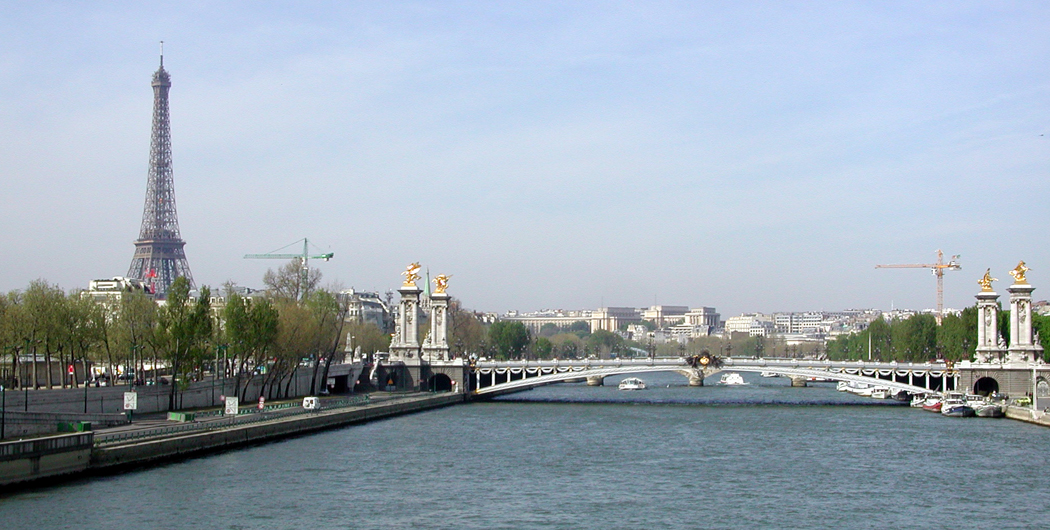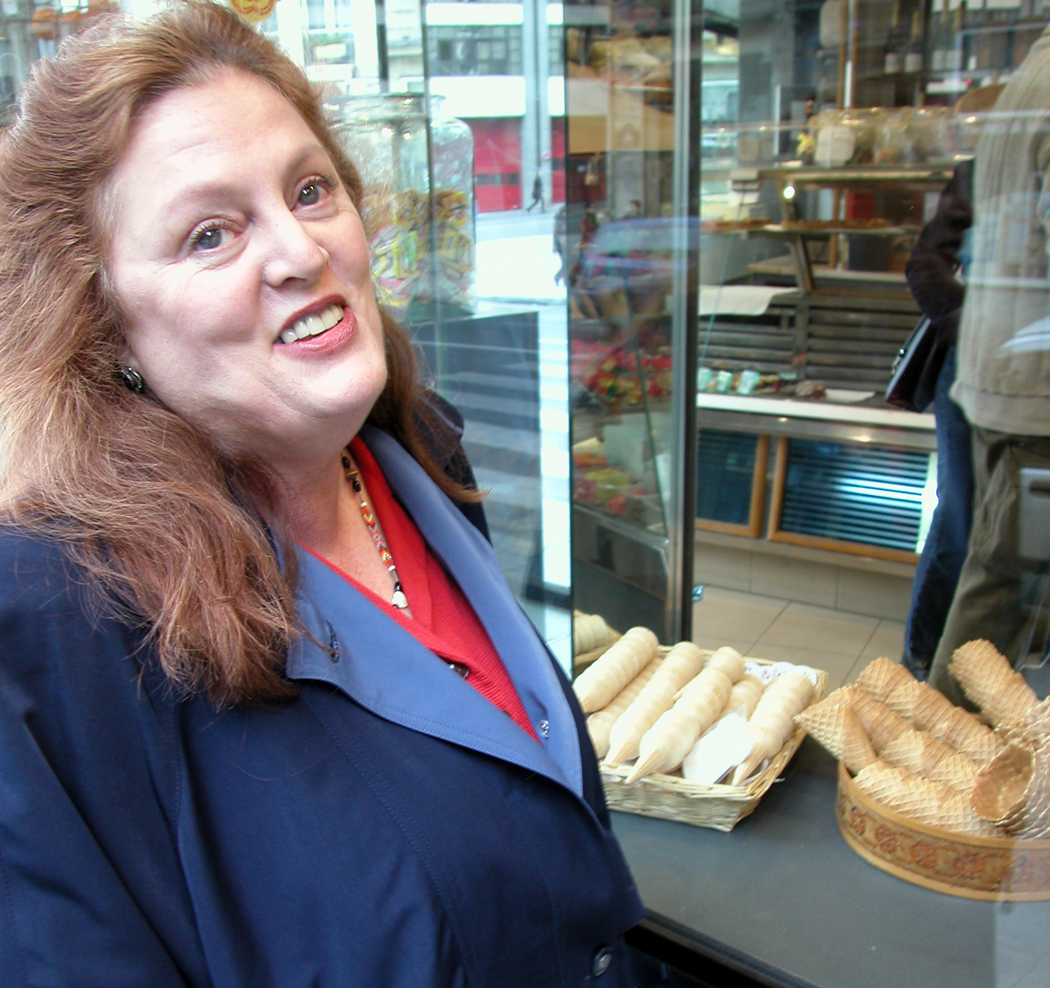
For as often as we’ve been to France, we still have never been to the Eiffel Tower. We’ve walked past it — and were nearly hustled by a team of pickpockets. The first, meant to distract us, walked quickly past us from behind, leaned over to pick up a shiny object from the sidewalk in front of us, and asked “Is this yours?” Meanwhile, his confederates, leaning against a wall to our left began to stir and move toward us. We had been warned of this scam, so I pointed at the youth meant to distract us and said, “Voleur.” He didn’t object or even react, but simply turned quickly to find another mark. But we’ve been to many places normal tourists don’t find: out-of-the-way streets, the guignol puppet show on the Champs de Mars, and the parenthetical “forests” — the Bois de Boulogne and the Bois de Vincennes, one on the east and one on the west of the city. And we’ve eaten our way across the town, trying everything from Indian food to Chinese to a McDonalds (just to see the difference).

Click on any picture to enlarge
paris sign at bois
Saturday, March 30

Paris is a city of heads.

doorhead 1It seems over every door, or at the corner of every cornice is a head. Sometimes a Pan head, sometimes a kingly head, sometimes, as at the Opera, the Palais Garnier, it is the head of every mediocrity who ever composed an opera: Halevy, Spontini, Adam, and a dozen others. Yes, they have Beethoven and Mozart, too, but they seem to be there only to provide caché for the hacks.

We took the metro up to the opera because I thought I might be able to find the street and hotel I stayed at in 1965. But it was futile. Nothing looked right. Perhaps I stayed near some other opera house. Or maybe it was a railway station. It’s hard to tell the difference here: All the official windowhead femalearchitecture is monumental and any of it built before Francois Mitterand seems to be Baroque or Beaux Arts, and covered with rocaille, stone wreaths, volutes, acanthus and — most of all — heads.

Just walking down the street, apartment buildings have volutes supporting the cornices of their doorways, and often a medallion just above the lintel with the head of a grotesque or a muse.

And it isn’t only heads. There are caryatids and bas-reliefs, usually with some mythological import. Ovid seems so much more alive here than you would ever know in America. At home, no one under the age of 50 knows what the Metamorphoses is, or who its author was, but in Paris, when you go to the grocery store, there is Daphne or Syrinx staring at you from above the door.

Further, when it isn’t a definable character — a muse or an Olympian — it is one of those ever-repeating European stereotypes: the satyr, the putto, the nymph.

The Classical world cannot be easily forgotten in Paris, with so much architecture to keep it alive.door carving elephant

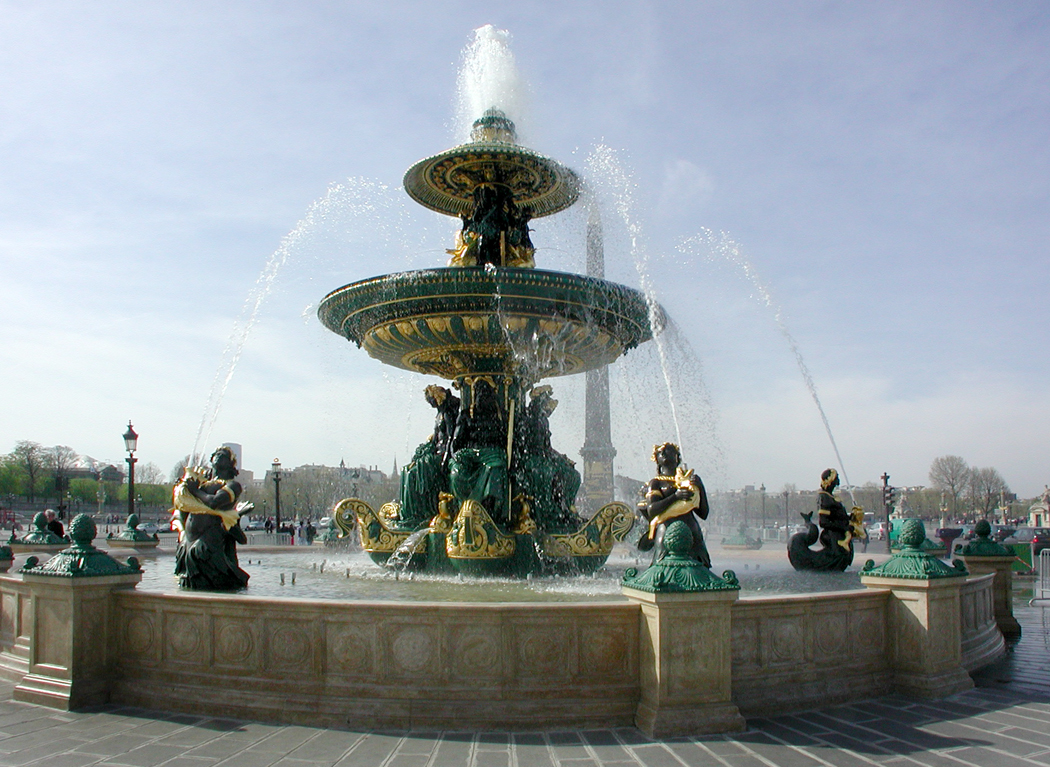
In America, we are used to statues only on New England town squares, opposite the white-steepled church, or scattered through Washington, D.C., or at Civil War battlegrounds. Statues are not part of the everyday experience of most of us. But in Paris, they are everywhere. Every park is full of classical Neptunes or Junos or Napoleonic generals. There are fountains with water nymphs and curlicue fish spouting water from their mouths.opera pigeon

It means, among other things, that art is not just something you go to the museum to see, but rather, a way to give directions: “Turn left at the statue of Leon Blum.” The statuary means that the ordinary Parisian (as if there were such a thing) lives in a world in which antiquity is not only still alive, it is the visual language of everyday. If the American eye is trained on commercial signage and corporate logos, the French eye is trained on the muscles of Theseus, the helmet of Ulysses, the straight nose of Artemis, the bust of Venus. There are putti galore, and wistful angels, of both genders, and flaming swords of St. Michael. It is all a great stew of history, art, religion and tradition.vincennes 1

Bois de Vincennes

We took the RER to the Bois de Vincennes, but the day, which had been gloriously overcast, broke out in dappling sunlight and ruined any possibility I had of photographing the trees. There was the Parc Floral, though, and it was filled with blossoms, even at this early point in the year.vincennes mille fleur

Carole noticed — and she is certainly correct — that the lawns are filled with little flowers in exactly the same way that the tapestries are filled in their millefleur designs. One place, in particular, was a slope, reducing the effect of perspective, so that the flowers, spotted evenly across the grass, was even more like the textiles. It was uncanny, and reminds us once again, how naturalistic — in their way — were the Gothic designers and artists.

I had trouble reading a legend on our subway map and Carole hailed a passing woman for help. Her name turned out to be Marie Ifrah and she might as well be a lifelong friend now.

She is Spanish, living in Paris and couldn’t have been more friendly and open. I mentioned that everyone we had met in Paris has been “tres amical,” but was surprised, because she says that Parisians are not always to open to outsiders.

vincennes astersWe talked for nearly an hour, in a macaronic melange of English, French and Spanish. Oddly, when we couldn’t understand a word, or she couldn’t remember one, Spanish became our lingua franca, and I was surprised to discover how comfortable I felt in Spanish. French is still a trial for me, though I’m getting better — speaking it, that is; understanding it is tough. But Spanish almost felt like a home tongue.

We agreed that Americans are naive as a people, but disagreed about whether that is a good thing. She felt it is, that it is America’s naivete that is its salvation.

At any rate, she couldn’t help us with the map, but we became fast friends, in a macaronic way, and planned to phone each other “sometime” to arrange a trip in her car to Montmartre, which she tells us is wonderful.

“Where all the peinteurs are, not the good ones, but the ones selling souvenir to the tourists.”

She also pointed out that the French are steeped in culture. That the opera, the theater and such, are as bread and butter. Not like the Americans, she said. She didn’t want to insult us, so she pussyfooted around the issue, but America is all cuisine rapide, she hinted, and bang-bang movies.

Les Americaines lack the discipline, she said. There are things she disapproves of in the French, but she admires their discipline.cafe with author in corner

We didn’t expect the chateau at Vincennes; we came for woods. The palace was a surprise. But it is extensive and old. We walked through the grounds, but didn’t get into any of the buildings. Many are closed for restoration, and others were only open for tour groups and at hours that were inconvenient for us.vincennes chapel and wall

But the Sainte-Chapelle there was a delight of Gothique flamboyant, with a huge Rose window, all out of proportion to its width.

Because we had to walk all the way around the chateau grounds — and they are extensive — we had a late dejeuner, but it was worth it. We tried a little Italian restaurant in Vincennes, and had le menu, with an entree, plat and dessert.

I had the mortadella, which Carole called “the world’s best bologna,” but she had several bites and seemed to enjoy it. Her own entree was the oeufes mayonnaise.

We both had the lasagne boulognese, and it was rich with cheese.big billboard

Carole called the maitre d’ over and said, in halting French with a North Carolina accent, “This is the best lasagne I’ve ever had, in my entire life.”

He seemed pleased.

It only got better with the chocolate mousse that was so dusky you could have parked a truck on it.

It is 11 p.m. as I write this and lunch is still with us, but in a good way.
It feels silly writing about our food every day, but it is truly a highlight. Paris is a city where your lunchtime conversation is likely to be about where you will eat dinner.

In the evening, I took a walk around the neighborhood to snap out of a drowse fit. Took beaucoup photos and stopped at the supermarket for a loaf of bread and some confiture so Carole wouldn’t have to take her medicine on an empty stomach.

Carole’s bests:

vincennes castle entranceSo enlightening and thrilling to look at the grass and wildflowers and see that the millefleurs are real, truthful expressions of the ground here. The flowers I saw that are precisely the ones in the tapestries are the little daisies, violets, and a little plant I call rabbit plant, but I think it’s plantain, and a little pink flower I recognized. I loved seeing the castle because it was like the white castles in the books of hours I’ve seen before. And I loved walking in the woods in the places where the horses feet fell when the king went hunting. I found a flint arrowhead and wonder if it is one and is from the stone age. In the courtyard at the palace, it was easy to picture all the royalty there coming in on horses or in carriages. Seeing all these ACTUAL places and scenes that were only conceptual to me before; now they seem real human. Also, I’d like to know why the church was so important to the king that he had such a huge and fancy chapel there at the palace. The lasagne was incredible, with bechamel sauce in it. The chocolate mousse was actually a religious experience. The wonderful lady we met, Marie. The poissonerie, with all the fish.  I am surprised that the women here do not have coiffures; they all seem to have medium short hair pulled back with a rubber band or clasp. But even so, they look chic, and almost every woman is wearing a dress-length fitted black coat. But no curls.

And today, I got a rose.

Richard’s picks:

night scene 5It was a quiet day in Lake Woebegone, which leaves lunch as the high point of the day, with the mortadella entree, tres riches lasagne and the chocolate mousse. For the second day, we didn’t eat supper because the lunch was so overwhelming. The Bois de Vincennes was disappointing because the sun was out, making too many shadows for good photography, but the flowers were ecstatic. Walking around the neighborhood after dark was good, too.

In a corner of the Fifth Arrondissement, next to the Gare d’Austerlitz, is a public garden that has come to be one of our touchstones of a visit to France. We go back each time. It is not one of the tourist hotspots, like the Eiffel Tower or the Louvre, but because we found it on our own during our first trip to Paris, it has become an old friend.
The Jardin des Plantes was built in the 17th century as the king’s garden, and initially grew medicinal and kitchen herbs, but later became one of those demonstration gardens in which pioneering botanists planted samples of vegetation they had collected on voyages around the globe.
Around the periphery of the garden are a zoo and several museums of natural history. Some are so old they practically grow fungus; one has been updated to become a sight-seeing draw — at least for the thousands of school children who bus there daily on class trips.
As we visited in 2002, it seems I was caught up again in the conundrum of the opposing French tendencies to formalize and regularize nature, as in its famous gardens, and to see nature as something red in tooth and claw: the opposing tendencies of classicism and romanticism.

Again, click on any photo to enlarge.

jardin main walkway

Friday, March 29
Jardin des Plantes

The Jardin des Plantes is a collection of odds and ends — various gardens, a small zoo, a bunch of superannuated museums, some sooperwhoopie new attractions and lots of old, old trees.jardin natural history facade

At the far end is one of the true treasures of France, although I’m not sure anyone here knows it. The Galerie de paléontologie et d’anatomie comparée is one of those Beaux Arts buildings, the kind with the names of noted scientists carved around the frieze, that are so common in the old museum world.

It is a long, thin building, two stories tall. From the side, you can see in the windows that there are “wonderful things,” as Howard Carter once said: the long spiny backbone of a whale, skeletons of prehistoric mammals and birds.jardin natural history eagle

But the building itself is notable. It is decorated on all sides with the most beautiful and decorative sculpture of the natural world. As an underpinning to window sills there are lobsters, hermit crabs, birds. In panels along the side of the building are giant wolves and lions. Above the entrance is a great eagle holding a lamb. A frieze completely bands the building with alternating scallop and vollute shells. Another panel on the west side has a beaver. Yet another has a scene with a man grappling with a bear cub over the dead body of its mother. Another had two men stealing young eaglets, having killed one adult, but with a second adult attacking the men.Orang and Indian

It was a 19th Century version of the Gothic love of nature.

But there is also a clue to the essential French character. As we entered the museum, on the queue for the tickets, there was a grand marble statue of a crazed adult orangutan strangling a prostrate nude Indian. It was a horrible struggle, with the man wounded, a gaping slash in his forearm, and the ape with his long arms extended down, holding the neck and head of the man flat, with his eyes bulging.

This is a version of nature with long teeth, a vision of nature as both beautiful and vicious, a kind of sublime: awesome in its seductive danger.

There is a dichotomy in French culture. One is first made aware of it in the Gothic cathedrals. There, nature is everywhere, and not a storybook nature, but an experienced one, a familiar one. If the church preached a contemptus mundi, it failed to gain traction, at least on first go-around. You can sense the love of the natural world that invests every carving, every Gothic tapestry.jardin walkway with pollard trees

That classicism that I mentioned yesterday, that stylizes and sublimated grubby nature is the other French impulse. And I see a kind of continuous war between the love of nature and the fear of it. Classicism is on one level a kind of defanging of nature.

But the French seem always aware, underneath, of the tooth and claw. So, in the Gallery of Paleontology and Comparative Anatomy, the orang is seizing man, elsewhere, man is seizing the eaglet and bear cub. It is “man against nature, nature against man, god against man, man against god. Very funny religion.”jardin from above

Perhaps the perpetual French classicizing derives not from a separation of humankind and nature, but rather from a constant awareness — and wariness — of the natural world.

The need to create, as at the Jardin des plantes, of a “jardin systematique,” or to display, as at the Gallery of Paleontology, all those gory skeletons of Siamese twins, and cats’ brains in formaldehyde, comes from that fascination with nature that is akin to a fascination with death, violent, bloody death.

I had never before understood — or thought I understood — this classicizing impulse in French culture, but today’s visit to the natural history museum has given me a clue.

Americans think of nature as vast and sublime. For Germans, nature is a place to exercise briskly. English nature tends to be bucolic: a cottage, a few sheep and a porringer. French nature is all tentacles and talons.jardin tree

O'keeffe Lawrence TreeAside from all this theorizing, the Jardin was a wonderful place. There is a huge tree, a cedar of Lebanon, planted here in 1743. It’s feathery canopy spreads out like Yggdrasil. I made a photo of it in imitation of Georgia O’Keeffe’s “Lawrence Tree.”

The Grande Galerie de l’Évolution — also at the Jardin des plantes — is as modern as the paleontology museum is musty. A shining example of modern museology, it houses an old collection of taxidermy and gives it a new spin, assembling the old stuffed animals in new arrangements, with dramatic lighting and display.jardin interior

On four floors — although to call them floors is an injustice, for they are really a series of catwalks and mezzanines hanging over a four-story cavity, filled with glass elevator shafts. Meanwhile, a parade of animals, as if marching to Noah’s boat, weaves through the central second floor.jardin elephant

It was a great plan to modernize what was once a dusty old display of vitrines and taxidermy.

But the final highlight of the day came next door at the great 19th century greenhouse and conservatory, Les Grandes Serres. The three-story-high greenhouse, like a long loaf of glass, was filled with tropical and exotic plants, dripping with moisture. At one end of the interior, a two-story waterfall has been built of concrete, with vines hanging down, dripping water.

My eyes turned on and I began making photos, in a way it only happens when my eyes are on. Made nearly 200 pictures. Another in the series of garden photos.grand serre 1

grand serre 4grand serre banana treegrand serre displaySpent from that, we began walking home. Carole got a cassis ice cream cone, purple and sharp.jardin ice cream stand

We got back to the room and dropped off to sleep, missing dinner.

Carole’s picks of the day:

carole and coffeeThat cafe au lait and the croissant. The one I had today was even better than the one I had before. I enjoyed being able to communicate in French. The images of the images at Ste. Chapelle keep coming back to me. I loved the statue of the orangutan strangling the Indian. The parade of animals at the museum of evolution (like a Disney Noah’s ark). The plants in the garden systematique. My favorite thing was the female lions on the front of the museum of natural history. All the wonderful sculptures of animals there: lobsters on windowsills, hermit crabs. Those wonderful animals. Oh, the croque monsieur was incredible. Sliced bread with very thin ham and bechemal sauce and some kind of white cheese, then fried, perhaps dipped in egg batter first. Oh, and finding the wonderful little wooden toys for the grandbabies. Oh, and the Redoute rose and lily book. Richard looked so serious about the grandbabies. Seeing Richard’s joy in the greenhouse.

Richard’s faves:

grand serre 5The sculptural decor on the Galerie de paléontologie et d’anatomie comparée was unforgettable. All those rich animal designs crusted on the masonry. I’m sure I don’t know why they don’t sell a catalogue raisonee of the carvings. It’s a treasure. Inside, the Orang attacking the Indian was a hoot. The hoard of skeletons inside was breathtaking (photographie interdite). The Jardins des plantes in general was special, but when we entered the greenhouse, I went buggy: My eyes turned on and I went nuts with the camera. All that vegetal variety, all that green fecundity, all that sinuous vinosity and verdant threat. It was the mille fleurs and Gothic acanthus leaves come to life.

When we visited Paris for the first time in 2002, we felt like yokels: Everything was new and we gawked. Now that we have been there often enough to feel at home on its boulevards, and have visited its most familiar sites enough times that the Musee d’Orsay can feel “old hat,” these initial  notes, written at the end of each day on that trip, can still bring back that feeling, that sense of excitement at seeing the world through a different culture, and with a wholly different sense of history. These notes and photos are from that virgin trip. Click any photo to enlarge. 

Thursday March 28

ste chapelle clerestory

Sainte Chapelle

There is no denying the beauty of Sainte Chapelle, with its two floors of chapel: a lower floor for the servants and the brilliantly lit upper floor for the king. But one can see a creeping French classicism overtaking the richness of the earlier Gothic. At Notre Dame de Paris, every pier is different, every capital, every boss in the vaulting. At Ste. Chapelle, there is greater unity: only two styles of pier, alternating along the nave walls. The bosses are uniform. The fleur-de-lis motif crops up everywhere, further unifying the decor of the building.ste chapelle exterior from street

Even in the 13th century, you can see Poussin coming, and Racine. There is a fecundity to the earlier Gothic. Metaphorically, the buildings mimic the variety of nature. One senses in Notre Dame, for instance, a connection with the earth, the seasons, the stars, the animals. At Ste. Chapelle, nature has become an ensignia for royal power and wealth.

No one at Ste. Chapelle, you feel, has ever shoveled manure.

The difference, as Carole stated it, is that Notre Dame feels like a machine meant to take you somewhere, like a traveling machine for the universe, or a time machine. You know, in Notre Dame, that something is happening to you.ste chapelle interior

At Ste. Chapelle, you admire the decor, recognize the royal taste — the gout royale — and it something you observe, look at, admire, rather than participate in. That doesn’t mean it isn’t astonishingly beautiful.

Ste. Chapelle, of course, is late Gothic, le style flamboyant, with neither aisles nor triforium. The windows hang like banners down the walls from just above head level to the top, at over 50 feet. Ste. Chapelle is filled with light in a way Notre Dame isn’t. There is nothing murky about Ste. Chapelle. It is brilliant.

There are two stories, in both senses of the word. Upstairs is reserved for royalty.

The first floor is a low chapel for servants and burgers. Its ceiling is blue and gold, and anyone using it must have felt privileged indeed, with all that gold leaf and those gilt vaults. (Granted, they are 19th century restorations and only approximate what must originally have been there.)ste chapelle downstairs

There is a tiny circular stone staircase that leads up to the main event on the second floor. Because of its two tier nature, Ste. Chapelle looks oddly gangly and tall. Because its foundation is hid from the street, the chapel looks as if it is built on a small hill, above the surrounding buildings. But there is no hill on the Ile de la Cite. The church is just jacked up a full story on its servant chapel, leaving the King’s chapel floating in the stratosphere.ste chapelle rose window, stained glass, ceiling

ste chapelle downstairs ceilingWhen the sun breaks out, as it doesn’t often do in Paris, the stained glass projects color on the floor, in blues, reds and a little yellow.

We spent a couple of hours in St. Chapelle, trying to see everything and absorb it. Every inch of the place is either gilt or painted or sculpted. There is little resting place for the eye. Perhaps that contributes to the sense that Ste. Chapelle doesn’t function as Notre Dame does.

It is something that allows Louis IX to show off, nearly 800 years after his death. He would have liked that, I’m sure.

Cluny winemaking taperstry

Musee de Moyen Age, Cluny

At the Musee Cluny, we began to wear down. We saw the first dozen rooms just fine, and had time to linger over the many tapestries, but eventually, our muscles and bones — to say nothing of our fried brains — made the last part of the museum a mad dash to get through. Which is a shame, because there is so much to enjoy.Musee Cluny exterior

The Middle Ages speaks to me in a deep and profound way: I am simpatico with its sense of multiplicity, and its sense of particularity.
“To generalize is to be an idiot,” said William Blake, and with that, he dismissed all of English neoclassicism.millefleur

But I feel as he does: Every flower, every tree on the mille fleur tapestries is identifiable. There is a daisy, there an iris. It might as well be a Peterson guide.

For me, the Gothic evidences a genuine love for the things of the world. The various classicisms that follow seem infatuated with ideas rather than things.

But you cannot rub an idea between your fingers, hold it to your nose and smell the camphor, as you can in an herb in a garden.Cluny column leaves

Yes, I admire the rigor of the classicisms. Poussin is no slouch: You have to respect the intellectual energy expended in regularizing the universe.

But in my heart of hearts, it seems like a kind of avoidance. The real world, with its real textures, real smells, real colors, real tactility, real sounds — seem so much more satisfying than the concepts that underlie classicism.

So, the Gothic world dug its arms up to the elbows in the soil, sniffing the moisture in the loam. You see it in the illuminated manuscripts, with their love of the seasons; you see it in the architecture, with its leafy pier capitals; you see it in the tapestries, with their mille fleur horror vacuii.Cluny stainded glass angel with flower tondo

The classical worlds that followed — and in France, even the Baroque is classical — it is all turned into ideas. Even French Romanticism seems wordy and literary.

So, you have to go back past the 13th century, to the early Medieval world, before you find such quiddity in French culture.

Adam Gopnik, in his book, talks about the French love of “theory.” Theory to them, is paramount: Without a solid logic in your theory, your conclusions are suspect.

But theory can be a dread evil. It is just such ideas that, twisted and mangled, turn into fascism, Stalinism, Maoism. No room for goats in such worlds.

When we finally got back to the hotel, we were destroyed. Could barely move. Slept for several hours before supper.

But then, we walked down the street to a little glass-fronted brasserie for some onion soup and apple tart. Quel marvelleuse!Cluny animal ivory tiles

ste chapelle floor lionsCarole’s favorites, day three:

Windows at Ste. Chapelle; Cafe au lait while walking to subway, and the pain au chocolat; learning about Ste. Chapelle from Richard as my own private teacher; I liked the servants’ chapel very much. Really really enjoyed was the cut on the fold animal patterns inlaid on floor at Ste. Chapelle; there were hounds, boars, vultures, wolves; At Cluny, saw some little metal pots that were children’s play dishes; saw some little metal whistles in the form of animal heads that were children’s whistles. I thought the combs were very interesting. The second most wonderful thing, after Ste. Chapelle stained glass, was Medieval garden at Musee Cluny. Saw some blue violets blooming.

Cluny gold rose 2Richard’s favorites, day three:

The Omelette Emental for lunch, which was heaven. The stained glass at Ste. Chapelle, although it was too overwhelming to see in detail. The fleur-de-lis stars on the vaulting of the lower level of St. Chapelle. The tapestries, in general, at Musee Cluny. There was a gold rose there, too.

PARIS 2002
Days 1-3

Along the Seine

The Flight

In the spring of 2002, my wife, Carole, and I went to Paris for the first time. Some friends had just got back from Rome and waxed effusive over the experience and they encouraged us to follow their example and travel. We thought about it but decided that the north felt more simpatico than the sunny Mediterranean, and so finally decided on France. On March 25, we flew from Phoenix to London and on to the City of Light.

We left the house in Phoenix, Ariz., at 4:15 on Monday and got to our hotel in Paris at 4 p.m. the next day. It isn’t as bad as it sounds: With the 9 hour time difference, we were only in transit 15 hours. Well, it is as bad as it sounds. The time waiting in airports, cramped on airplanes, and riding around town adds up to one great pain in the ass.

And while British Airways is much to be preferred to most American airlines, that is still faint praise. The seats were sardined, the hours tedious, and the food bland. The flight from Phoenix to London was bad enough, but the short hop from London to Paris was a nightmare. The plane loaded up with Scottish soccer fans, all dressed in kilts, with tam-o-shanters and beer guts, and they yammered and yelled for the whole flight, making it more like a school bus than a jet plane.

“Hey, laddie, when you gonna take a rest,” yelled a Scot from one end of the plane to another. “Aye, and I suppose you are, too,” said his buddy at the back. And they all laughed at the joke, which was mute to the rest of us. It was like that the whole way.

One minor note: On the short leg, they fed us only drinks and snacks, which were “Pfeiffers’s Bread Sticks with Worcester Sauce Flavour.” Truly a bizarre taste. Little pegs of dry bread, about 3/4 inch long with the sharp taste of worcestershire sauce, coated as a dry powder on the surface.

Worse: the note on the back of the pack. “Best before Sep 02 2059.”

Now that’s a shelf life.

The following notes are from the daily journal I kept of the journey, day by day, excising some of the more quotidian bits. The photographs were all taken on the day described in the journal, even if better examples might be had on revisits. Click on any photo to enlarge. Each entry ends with a short summation, one each by me and by Carole. The first three days get kind of garbled together. That’s the way it felt with the jet lag.

Hotel Vendome horiz

The Hotel
March 27, 2002

Paris airshaftWe stayed at the Hotel Vendome St. Germain, which is a hole in the wall place off the Rue Monge in the Quartier Latin. We got a room on the sixth floor, the top floor, looking into the courtyard. At the bottom, there are a few potted plants that serve as the “jardin,” of which the hotel website promises a “view.”

The hotel couldn’t be more Parisian, as far as we could tell. It is old, with peeling paint on the exterior — although the interior was nice enough.
The rooms are tiny, just room for a double bed, a small desk and closet. But it has a bathroom — even tinier — right off the room.Through window

As night descended, we could see the people in the rooms across the “view,” apparently in apartments, cooking their suppers and sitting down to eat.

I could practically hear accordion music. Ou est Jacques Tati?

We were so exhausted from our flight that we collapsed in the bed without supper and fell asleep. Which sleep proved fitful at best, with both of us waking up about hourly, and trying to get back to slumberland.

By 6 a.m., we gave up trying to sleep and got up to start our first day in Paris.

Seine with tower
WEDNESDAY

Breakfast

Breakfast in the hotel cafe — really just a room in the basement where they stack up a bunch of croissants and baguettes with some rolled ham, yogurt, butter, Laughing Cow cheese and confiture (jam).

The coffee machine hissed and spumed, and the hotel maid, doing morning cafe service, brought out the cafe au lait.

To say the least, even this modest petit déjeuner was a revelation.
The croissant was flaky and buttery. But that we expected. The coffee was marvelous. But that Carole expected, too.selling strawberries

“The butter is too rich for me,” she said, after spreading a little on the croissant. I pointed out that it wasn’t butter, but cheese in a package that said, “la Vache qui Rit.”

The real butter was from Normandy: ice cold and fresh, and was as tasty a spread as you could put on a bread.

But the real champ was the baguette. Who knew bread could taste this good. With a shattering crust and a light interior, it had that kind of browned, crusty flavor you can only imagine.

I remembered growing up on Wonder Bread. American white bread. Wretched stuff. I could never understand, as a kid, why people would call bread the “staff of life.” Uncle Tony loved bread. And food writers wrote panegyrics to the stuff. But the bread I knew — and the ONLY bread I had any experience of — was banal, pasty, tasteless, or when not completely devoid of flavor, redolent of the stale air of the grocery store.

I hated bread as a kid. I hated sandwiches, which only wasted good filling between slices of inanity.

That isn’t this French bread.

Now, I’m not a complete tyro. Certainly in my adult years I got over my childish hate of bread. I make my own, which is wonderful hot out of the oven. And local bakeries make baguettes that are a pleasure to eat.

But I wasn’t prepared for the difference between even good American French-bread and plain, ordinary old French French-bread. This was bread to give you orgasms. Flavor — no, flavors — that rang from lip to pharynx with a medley of sensations, and those sensations were as physical as they were chemical. The initial crunch led to a repertoire of smaller crunches inside the closed mouth, and then the teeth broke through the crust into the heart of the bread and felt the giving elasticity of the gluten.

This was no bread to erase errant pencil lines with. This is bread to build an altar to.

Notre Dame west facade

Notre Dame de Paris

After our repast, we walked up the rue Monge toward the Seine. We could see the spire of Notre Dame at the end of the road, less than a half-mile off. Along the way, we past a billion cafes, bistros, tea bars and restaurants. In between were shops, fruit stands, book stores and churches.Notre Dame interior

A lot of churches. Anything built after 1700 is hardly worth mentioning, but there are plenty built before then, and you can enter them at any time, gaze up the nave toward the apse and see the sunlight throw color from the south clerestory onto the stone of the north triforium.

We got to Notre Dame, crossed the river to the Ile de la Cite and walked along the southern edge of the building, around the apse and along the north side, taking the exterior measure of the place.

Carole became fascinated with the scores of gargoyles. Some are truly spooky.Notre Dame exterior

The building’s age is obvious. Many of the stone blocks are so eroded they look “texturized.” The difference between the weathered old masonry from the 12th century, and the tighter, cleaner restoration of Viollet-le-Duc in the 19th century is quite apparent. And although he tried his best to match his restoration work with the original Gothic, there is still a kind of Romantic sensibility to it.

That is fits right in with the original work is another proof of the kinship between the Gothic and the 19th century Romantic.

When we came around to the West side of the cathedral, which is all a tawny white since the sandblasting of the 1960s, when they cleaned the place, and walked inside.

Notre Dame de Paris is not the biggest of the famous Gothic cathedrals. Nor is it the most beautiful, either by reputation or by the photos I have studied. And much is defaced by either restoration or careless modernization. A tres moderne altar is greatly out of place.

But none of that matters, as the building moves its visitors. Turn one way and the light breaks through the clerestory. Turn another and you can see the great rose windows. Walk past the crossing and you see the choir screen.

At every turn, there is something pure, beautiful, unconcerned with profit and loss. Something meant to awe its visitors. Something which does awe its visitors.Notre Dame north Rose Window

The north and south transepts are shallow, but that hardly matters, given the splendor of the two rose windows. Carole and I had the same response: being overwhelmed.

It’s one thing to see pictures in books. It’s quite another to experience the flesh. The windows are huge, colorful, intricate. They serve as metaphors for the same thing as Dante’s mystic rose at the end of the Paradiso. Radiant, radiating, they speak — no they sing — of a divine order, a shape and meaning to the universe. You can practically hear a great C-major chord sung by a Mormon Tabernacle Choir, or more apt, like the great C-major chord in Haydn’s Creation at the moment they chorus sings, “And there was …. LIGHT!!!!!”

As a well-known atheist, I don’t believe in anything like the theology of this masonry, yet, I cannot help being moved deeply by the spiritual metaphor. Ranks of angels, rotating as they sing, like some ethereal Busby Berkeley choreography, singing in 8-part polyphony to elaborate harmonies, sliding from suspension to suspension — dissonance, resolution, all headed for that great C-major.

“When you see this,” I said to Carole, “it kind of makes you laugh when they call some pop star an ‘artist.’ “

Whoever made the great rose windows knew what real art was, and how difficult it is, and what ambition it takes, and how impossible it is to be satisfied with less.

I nearly broke out in sobs.

We will return to Notre Dame later to spend more time and do the tower tour, or “tour de la tour.”

Toupary horiz

Lunch

We walked along the Ile de la Cite, past flower stands on the north side of the island, past the horologue, the city jail, and on to Sainte  Chapelle. Unfortunately, by that time, the crowds had assembled, and the line to the church was down the street. We decided to wait until tomorrow and try to get there early, before the throngs.

We continued down the south side of the island to its very end, under the Pont Neuf. The current of the Seine is surprisingly strong, causing standing waves across its surfaced.

When we consider what makes Paris different from Phoenix — well, there are many things — but one that is not often noted is that the river, with its current, gives a kind of physical yet metaphorical pulse to the city, serving as its aorta, shooting blood and life through it. In comparison, Town Lake is a clogged artery of stagnant algae.Samaritaine

Just north of the Ile, we could see the great Samaritaine department store and I remembered that there was a restaurant at its top with a legendary view.

When we got there, the fifth floor restaurant, Toupary, was not yet open for lunch. It was about 11:15, and it opens at 11:45. So we toured the store first. It is stunning with its Art Nouveau details, its glass roof, five floor escalators running like a “canyon” down the center of the building, and the peacock murals across the top floor of the store.

The Toupary is the kind of restaurant where they don’t look at you standing there until 11:45 sharp. You are invisible. Suddenly, as if a bell went off, the hostess suddenly has her eyesight back and asks if there are two for dejeuner. She seats us near a window out which we can see the Seine, and off in the distance, the Eiffel Tower.

There is a crisp linen tablecloth, linen napkins, plates engraved with the name of the restaurant.

A young man brings the cartes and asks us if we want wine or water. We opt for water. We order the Lambchop grille aux herbes de Provence avec pommes sautees Provencales.

When it comes, it is artistically presented on the plate, with the lambchop symmetrically cut and dropped on top of the diced potatoes and garnished with some spring greens.

I put the fork in the potatoes and raise it to my mouth and I realize we have entered heaven. With a garlic and wine sauce, but not too much of either, the potatoes are divine.

The meat and salad followed suit, and we recognized that gastronomically, Paris is already a success, a triumph, a coup de brilliance.

St Germain Aucerrois nave

Afternoon

After lunch we drop into the St. Germain Auxerrois, the Gothic church next door to the department store. Miniscule compared with the cathedral, it is nevertheless beautiful.

What makes all these ancient churches so compelling is the way their history is composted on their faces, a palimpsest, a pentimento, with each age remaking a part of the past in its image, so that a 17th century door gets spliced onto a 14th century transept, or a 19th century stained glass replaces a missing earlier scene.St Severin 1

A Neoclassic church cannot stand this tampering: the effect is ruined. But the Gothic style screams out for such fecundity. It is a style rooted in the variety and richness of the world, and its strength is in that stylistic midden. It also makes us all the more aware of the age of the edifice.

We stopped also at St. Severin to see the sunlight on the nave walls.

We walked back toward the hotel by a different route, through the worst of the tourist section of the Latin Quarter, past endless little restaurants and souvenir stands, although there were also all those book stalls along the river.

And Carole found a place that sells crepes, and bought a chocolate one. It was a tiny storefront, with a shelf along the street lined with colored decanters, presumably flavoring agents. Through the door and inside, Carole ordered a crepe de chocolate.

The young woman, who seemed to be an apprentice, dropped a load of batter on a large round hotplate, using a special device somewhat like a flour sifter, but with a funnel shape that dropped the batter out the small end. She then took a squeegee and dragged the batter out on the hot surface to cook. Before it was completely done, she turned part of it over with a long metal spatula onto itself, then turned the whole thing over to finish cooking, ladled some chocolate sauce on the upraised surface, smoothing it out with the ladle bottom.

Then she very neatly folded half of the crepe back on itself, forming a line in the middle, then folded the other side, making a seam in the middle.

Then, wrapping the whole thing in wax paper, she handed it to Carole, who joined the angels for a polka around the divinity.

Carole said it reminded her of the Hopis making piki.

We passed by some exceptional architecture on the way. Paris is an oddly layered city, with the newest on the bottom and the oldest above. Almost every building houses some modern shop on the ground floor, with neon lights, plate glass and corporate logo. While from the second floor upwards, you see the old wrought iron balconies to the small casement windows, peeling paint, rotting plaster or concrete, and surmounted by a gaggle of chimneys, each with a half dozen flues poking out the top.

How they got those modern shops underneath the old apartments, I don’t know. It looks like they jacked the buildings up and constructed a shopping mall underneath.

We got back to the hotel about 3 p.m. and rested a bit.

About 7 p.m. we went out for dinner, wandered around the neighborhood looking at all the bistros and Turkish restaurants. We finally decided on a Afghan restaurant, called Kootchi, and had a grand saebzi chalow.

Carole’s highlights of the day:

Mary standing on a demon, the roots on the wall at Notre Dame, the rose window. The chocolate crepe, the cafe au lait in the morning. All the pink jasmine I saw for sale on the sidewalk. The tree just budding with the sparrows mating in it under the Pont Neuf. And all the bridges over the Seine. The gargoyle with the human face. Learning about Notre Dame from Richard while standing in it. Oh, and finding out that I can communicate a little bit in French.St Germaine light on floor

There is some gray area when deciding whether the biggest event of the day was Notre Dame de Paris or the chocolate crepe.

Richard’s highlights of the day:

The baguettes at breakfast. The rose windows of the north and south transepts at Notre Dame. The current of the Seine. The smaller churches of St. Germain Auxerrois and St. Severin, and most particularly, the colored sunlight filtered through the stained glass at St. Germain Auxerrois and hitting the wall of the chapel of the apse, and spreading across the checkered floor.

Eiffel TowerI am not watching Downton Abbey. I reached my quotient of British TV drama with Upstairs, Downstairs 40 years ago. Since then, it has been rehash on rehash, and I no longer feel any connection.

It is a widely held truism that American intelligentsia is divided between Anglophiles and Francophiles. The one portion watches Masterpiece Theatre on PBS and cannot get enough of Edwardian melodrama. They swoon over Merchant-Ivory films and generally rate Henry James as readable.Books

The other half reads Camus, loves Montaigne, adores Truffaut.

The one side grieved the death of Princess Di; the other the death of Claude Levi-Strauss.

It is a divide as solid as red-state, blue-state: In one corner, you have Sherlock Holmes, in the other, Inspector Maigret.

The English sleuth, cool, rational, friendless; the Frenchman, intuitive, patient, uxorious and with a small glass of pastis in one hand.

When the English talk of logic, you know a tweedy lecture is in the offing. When the French talk of logique, you know something as baroque as an 18-car pile-up will follow.Palais Garnier - putti

Just as psychologists can divide personalities into types: introvert vs. extrovert — so, too, can we divide Americans into those who identify with the island or the continent.

This is, of course, a divide entirely set amongst the reading, thinking public.  Outside of the library, Americans are suspicious of anything foreign, and especially anything European.

Which is why Americans so much love to despise France. It is hard to understand this, given the history of our two countries, from the time of the American Revolution onwards.

“Cheese-eating surrender monkeys,” we say. Which shows how little we Americans understand about French history. Doesn’t exactly describe Napoleon or his army. And who was it, after all, who won the American Revolution for us? Ah, yes, Admiral de Grasse. And Lafayette was no monkey of any sort.

But back to the bookish Yankee: Perhaps this divide became palpable in 1789. Many Englishman at first applauded the French Revolution, but even most of them eventually grew horrified at the excesses of the Terror.Rabbitshangingmarche

It left England with a slowly dwindling monarchy, and gave France a fresh, if confused start. It has never really comfortably settled, the current Republic being the Fifth, merely five decades old.

The English much earlier had their own paroxysm, but that one ended with the restoration of the monarchy, and an inbred conservatism that has lasted to this day, and I believe, is what so appeals to that brand of American college-educated reader who would rather watch The English Patient.

Or perhaps it is the British Protestant history vs. the lingering Catholicism of France. America is more at ease with the strict, moralistic Puritanism it inherited from its English forebears. There is something suspect about the theatrical exuberance of the Roman religion that is the cultural inheritance of even French atheists.

England says, No, or at least, Not Now. France says Yes, or at least Let’s Try. It is why English food is the butt of jokes, while French food is the world’s standard for gustation. The English do not believe they should enjoy their food.Bayeux store window

For the English, anything of which you partake should be good for you, that is, make you a better person. For the French, it is the same with this difference: Something that excites the senses is good for you and does make you a better person.

The Puritan influence in America wishes to outlaw foie gras.

Well, I love foie gras. It is the most intense flavor I can remember eating,  sunburst of umami, with the cloak of saccharine provided by the onion confiture and finally washed with an excellent fruity sauterne — not the cheap sugary drink Americans buy by that name.

Which means I fall into the camp of Francophiles. I love everything about the country, even their craziness.Rouen Lingerie shop window

I love that the French Revolution elevated reason above all other virtues, and proceeded to get all unreasonable about it. I love that they have a theory for everything, and will argue for an hour on a TV talk show, not about whether a speaker has his facts right, but whether he has his theory right. There is a kind of divine looniness in it all.

In contrast, the British can suck the life out of any proposition. While we can agree that Adam Smith was a genius, have you ever actually tried to read him? Or David Hume? Not bloody likely.

So, you can have your boiled joint and your suet pudding, I will always go for the cassoulet and the moules Normande. There is nothing better tasting than a properly prepared magret de canard. You can keep your English goose.Driving France

When I am in France, I feel at home in a way that is irrational. I do not speak the language; I can never dress as stylishly; I can barely read Le Monde or Figaro. But somehow the culture feels familiar. There is an easy fit, a comfortable tolerance, in the engineer’s sense, you have room to rattle around.

Even the landscape is home. The trees of Verdun, the mountains of the Vosges, the beaches of Normandy, the craggy peaks of the Massif Central, the caves of the Perigord, the waves of the Mediterranean, the 2,000 year history of Arles, the white hills of Aix.Forests of Verdun

And finally, and most importantly, the small, highway-ringed city of Paris, where the girl in the flower shop asks how your wife is doing when you pass in the afternoon and your wife is resting in the hotel room.

I find it all so inviting, so warm, friendly and comfortable. Paris is a city you can negotiate, where every corner — every one of its 20 arrondissements spiraling out from the Ile de la Cité — is as familiar as a classmate from school, and just as distinct.

It is the Berber faces, the Jews of the Marais, the Asians running the butcher shop, the Turks selling pizza, the line each morning and evening at the boulangerie for baguettes, the sculptured heads over the doors, the fountains, the public statues, the warren of roads changing names every few blocks. The squalid suburbs, the train stations, the Bois de Vincennes, the violinist echoing through the tunnels of the Metro, the fromage blanc at the Chinese restaurant, the old men playing pétanque in the flat dust of the Tuileries.Blvd de l'Hopital

There is nothing wrong if you prefer London. If you like bad food and dirty streets, boring television and infuriating politeness.

À chacun ses goûts.

My wife and I have been to France many times and cannot wait to get back. I recently came across the diary I kept on our first trip there, in 2002 (I had visited much earlier — in 1966) and I will be sharing portions of it over the next several blog entries. I don’t know if I can persuade any of you to give up your Downton Abbey for the French version of Inspector Maigret (with Bruno Cremer), but perhaps I can suggest why we find the nation so compelling.

three brothers 1978Some years ago, I began writing an autobiography. Don’t worry, you’ll never have to read it.

I didn’t begin it with any thought of publication. I may have worked at a zoo and lived in a coal bin, but my life is not so interesting or important that anyone else should be forced to know about it.

It began with a deal with my two brothers: I’ll write my life if you’ll write yours.

I realized that I didn’t know the details of their lives. We’ve always been close enough that I’ve known the basic direction of their lives, but from the point I left for college 40 years ago, the details became fuzzy. And it is the details that add up to create a personality.

So, I tasked them to write down the major points of their lives so we might better know each other: who their girlfriends were, what jobs they had, what books were important to them.

In the process, I thought, we might also get a different point of view on the shared episodes of our lives in childhood. Perhaps what I thought of as roughhousing, my younger brothers might have thought of as terrorism. Perhaps an uncle I thought hilarious, they might have found tedious.

But writing it has been one of the most engrossing tasks I have ever set myself.

I realize now, too, that this task really began when I visited my aging parents and began asking them all those questions that too many people ask only after their parents are dead. I recorded their recollections on my laptop and wrote up a piece of oral history to send to my brothers. It included family trees for both sides of the family, memories my mother had of her childhood and that my father had of World War II in Europe.Boys April 1956

It was a revelation: Relatives that had been vaporous ghosts in my own memory were brought back to life and their interrelationships made clear.

I came to know my parents much better and began to admire things in them that had been previously obscured by what I had taken to be their faults.

Perhaps, I reasoned, this same sort of thing could be undertaken amongst us brothers.

“Something like 20 pages,” I told them, “It shouldn’t be too hard.”

Neither of my brothers is a writer by trade, as I am. I didn’t want to make it too daunting for them.

But when I began writing my own version, I found that 20 pages was a mere sneeze.

I have now written about 250 pages and haven’t even gotten to the moment when I met my wife. The first 50 pages only get me through high school.

It turns out that writing one’s memoirs is an endless unfolding of  memory. Each tiny recollection is a door that opens into rooms with more doors. And each of these doors open on yet more. A memory, it turns out, is only an iceberg’s tip. Perhaps you recall a family picnic, but as you write about it, you discover you remember the way your mother made a certain sandwich, which connects, more surely than any internet link, with the larger issues of her cooking and the part food played in our family dynamics.Jack in Fla

We are each one of us a Proust waiting to unlock our own brains.

It is astonishing what is buried in the synapses, unused for decades, but still there for downloading.

The other lesson of writing an autobiography is to see the shape of one’s life unfold: What had seemed a jumble of unrelated episodes takes a narrative form and you discover that what you did as a 5-year-old flows with the certainty of a great river into what you do as a 50-year-old. It is all of a piece; the child is indeed father to the man.

It has been a while since I continued writing it: My brothers never took up the challenge. Now, one of them has died; I’ll never learn about his life. The other brother has more important things to do than write his autobiography. My version sits in my harddrive, worked over and rewritten several times, unread by anyone but me. The fervor for self-expression has died down like last week’s campfire.

One of the things that has dampened my enthusiasm is that as I’ve gotten to be an old man, I recognize how useless it is for anyone else to know about my life. It is one of the futilities of age that you recognize how much you have learned over six decades of life, and how little it helps the younger generation, who are feverishly intent on committing all the same mistakes you made, and are deaf to any guidance you may offer. This should be no surprise: I didn’t listen to my elders when I was young.

Perhaps one day, my granddaughters will want to read about their grandfather. I certainly wish I could have talked to mine, to find out more about the long line of people that led up to my entrance on the stage. But when I was young, I had better things to do. It wasn’t until after my grandfathers were both long dead that the wish came upon me to have asked them important questions only they could have answered.Craig in Fla 2

So, for whom am I writing these notes? Clearly, for myself. One doesn’t start an autobiography for the benefit of readers, but for the benefit of oneself, to find and delineate the patterns found in the weave, to discover or create the plot that conveys meaning to the life lived. We have a sense of ourselves not merely through our five senses, but through the remembered narrative we have created of our transport through this single, unexpectedly short lifetime. Pulling the memories out of the doors behind doors behind doors of our synapses gives us the matter for this novel we are writing by getting up each morning.

So, my autobiography is unfinished; it may remain so. I learned what I needed by the doing — I sifted through the first 35 years of my life to find the turns and bends that led me to this now. The subsequent 33 years have taken their own shape through the living. The only person I would wish to share them with has no need of my notes: She lived those years with me.

I would, though, love to read her version of those years. Perhaps I will attempt to persuade her to write her autobiography. It would be enlightening to compare notes.

falling into blue 1It was a doozie.

My wife and don’t often fight. We’ve been married over 30 years and I know few marriages better balanced. But she is no pushover. I’ve always maintained that a good marriage must be based on having a “worthy opponent.” It’s no fair if you can overwhelm your spouse, or be overwhelmed. My wife can walk through walls.

But she does see many things differently. The basic difference is that I made my living writing prose, and she is a poet (her book, “Rust Sings,” was published last year.)

Anyway, this one fight we had was memorable. We never fought over the normal stupid things that bring friction to a marriage. No, we never came to words over money or brothers-in-law or politics. Our biggest fight went on for three days — three days in which we got no sleep. We argued all day and all night, with a fervor and focus usually used to keep an armed kidnapper talking instead of shooting.

And what did we argue about? The color blue.

It started innocently enough. She saw something — I don’t remember what it was: a dress, a painting, a photograph — and said to me, “Couldn’t you fall into that blue?”falling into blue 2

I took the bait. “What do you mean, ‘fall into’?”

“It’s a blue you can dive into and drown in,” she said.

“Oh, you mean metaphorically.”

“No, I mean you can fall into it.”

And we were off. I was pigheaded and literal, she was insistent that she didn’t mean what she said figuratively, but literally. Her “literal” was different from mine. I said you can’t actually drown in a color. It’s a hard surface. I poked it, whatever it was. My finger couldn’t break the surface tension.

“That’s not what I mean,” she said. She looked disgustedly at me for my failure to understand what seemed so simple to her.

That’s when I lit the fuse. “Well, then,” I said, “you have to define your terms.”

“No I don’t.”

“If you don’t, I can’t argue with you, I can’t understand what you mean. You use words so loosely.”

“It’s simple,” she said, getting more impatient. “Let yourself down into that blue and swim in it.”

“How can I? It isn’t liquid.”

“Yes it is,” she said.

“No, it’s not.”

It should be obvious by now, we were not talking about the same thing at all. But deep in the discussion, it wasn’t apparent to either of us. We were both stuck to our umwelt, and her’s was liquid. Mine was lumpen.night sky window

“You know how at night, the dark blue sky can slip in under the window sash? The night is a blue liquid that wants to drown you.”

“No, I don’t know that. Night is merely the absence of daylight. It’s dark because there’s no sun up in the sky.”

“But you have to know the dark is a thing itself.”

She described how when she was a year or two old, she was out playing in front of the house and when night fell, she thought it was a dark fluid that would drown her. It scared her and she ran inside.

But inside, the dark could seep in under the window and fill her room.

“The night is a man, paper thin, like a cutout, that can just fit under the window frame.”

I shook my head. This made no sense to me, logical positivist that I was.

“All well and good,” I said, “as poetry. But scientifically, the dark is just the earth turning away from the sun for 12 hours. So, I still don’t get what you mean when you say you can fall into blue.”

“Not any blue, but that blue,” she said.

I can in no wise reproduce what transpired for the next 36 or 40 hours, but it only got more intense. I stupidly dug in my heels about the need for clear language and vocabulary, and she dug in her heels just as stubbornly.

“Why are you yelling at me?”

“I’m not yelling.”

“Yes, you are.”

“No, I’m not. This is my normal voice; I’m just from New Jersey.”

I was yelling. But she only made me angrier, because her response was not to raise her voice, but to lower it to a level almost inaudible. She played the “calm” card. She wasn’t calm: It was a ploy. But it wound me up.

We tried going to bed the first night, but we couldn’t stop talking and the next thing we knew, it was dawn and we were still arguing. It continued all the next day. We didn’t even stop to eat. And into the second night. In the end, it came to a conclusion the way all such things do: The husband gives up.

Well, not so simple. The husband — in this case, me — comes to recognize that the way of understanding the world I was born into is not the only way of understanding the world. I had to enlarge my psyche to take in her way of expressing herself, and not think so literally. Maybe defining one’s terms is really only a way of cutting off conversation.

But it also defined for me the essential difference between my prose and her poetry, between prose per se, and poetry in general.hopper van gogh

My “literal” was based on the assumption that the outside world was the essential reality, and that my perception is merely the intake of that reality into my brain. Her “literal” was the experience of her mind as it takes in the things of the world. If you posit reality outside the brain, you think one way; if you place it inside the skull, you get a whole nother ballgame. “All things exist as they are perceived,” wrote Percy Shelley, “at least in relation to the percipient.”

I had an unexamined faith that the world is a thing in itself; she had no such faith, but never doubted her experience of the world. It is the only thing, she says, that she knows is true. If it can be tagged onto something measurable by a thermometer or geiger counter, fine, but that is not what is real: The only “real” is its experience. And blue, QED, is something she can fall into.

This three-day argument happened more than 25 years ago, and it has in some ways come to define our marriage, and my appreciation of my wife’s different way of understanding the world. It is why she can write poetry with no calculation — it just flows out of her. Or, rather, comes to her. “You just make your chest wet,” she says, “and it will stick.”

And it is why I can write prose. Clarity, exactitude, structure, rewriting and testing. No ambiguous pronouns, no duplicitous definitions.

But as one gets older, one either grows or fossilizes. I have tried to learn as much as I can from my wife. There is much there to learn from. She continues to astonish me.

wall street bombing 1920 street sceneAt about noon on Sept. 16, 1920, a horse-drawn dray pulled up Wall Street in lower Manhattan and stopped in front of the J.P. Morgan Bank. Its driver got out and walked away. At 12:01 p.m. the 100 lbs. of dynamite inside blew up, blasting 500 lbs. of shrapnel — mainly iron window sash weights — into hundreds of people coming out of their offices for lunch. The explosion killed 38 and seriously wounded another 143. Stockbroker Joseph P. Kennedy, father of the future president reported being lifted clean off the floor by the blast, several buildings away. Pieces of the horse landed a hundred yards away.

“I saw the explosion, a column of smoke shoot up into the air and then saw people dropping all around me, some of them with their clothing afire,” said one witness.

The Toronto Star reported, “Great blotches of blood appeared on the white walls of several of Wall Street’s office buildings. Almost every pane of glass in the vicinity was shattered and beside a mantle of broken crystal the streets were covered with fragments of brick and stone blasted from the base walls of the skyscrapers.”

The newspaper thought it was too graphic to mention the butchered body parts of those blown to fragments.

It has been called the worst terrorist attack in the U.S. until the Oklahoma City bombing 75 years later.

But it was not the first. It was, if anything, the culmination of years of anarchist bombings that plagued the country from the turn of the century into the 1920s.bomb thrower detail

Beginning with the assassination of President William McKinley in Buffalo, N.Y. by anarchist Leon Czolgosz, and peaking during and just after World War I, there were dozens of bombings and assassinations by anarchists and followers of Italian anarchist Luigi Galleani. Among these were:

–The Los Angeles Times bombing, Oct. 1, 1910, which killed 21;

–The Preparedness Day Bombing in San Francisco, July 22, 1916, which killed 10 and injured 40;

–And in April 1919, some 36 bombs were sent to various politicians and businessmen;

–In June of the same year, Galleanists exploded eight pipe bombs in several cities.bomb throwing cartoon

The rash of bombings and assassinations and assassination attempts (many failed, and several anarchists were blown up by their own bombs) led to widespread fear and paranoia about immigrants and bombings. Cartoons of the day attest to the stereotyping of “mad bombers” as primarily Eastern European immigrants, often mistakenly typed as “bolsheviks.”

Laws were passed, immigrants were blamed en masse, there were many deportations. In February 1919, Galleanists distributed a flyer that said, “Deportation will not stop the storm from reaching these shores. The storm is within and very soon will leap and crash and annihilate you in blood and fire … We will dynamite you!”anarchist cartoon 2

What really happened, of course, is that the fervor of the bombers died down and the nation tended to forget about anarchists. After all, they had a new boogeyman: Communists. The Red Scare subsumed the anarchist scare and violence was meted out both by labor agitators on one side and police and military on the other. Strikes were squelched; many people died.

The fact is, terrorist violence — and its ensuing fear — comes in waves. There is a continuous drip of violent acts over the years, but if you draw a timeline, you will find clusters of terrorism in several wads.

We should not forget these isolated landmarks:

–Oct. 10, 1933: The first bomb on a commercial airplane killed seven people over Indiana;

–July 4, 1940: Two policemen killed by bomb at the New York World’s Fair;

–George Metesky, the “Mad Bomber” placed over 30 bombs in New York City from 1940 to 1956, in protest of high utility rates;

–March 1, 1954, Four Puerto Rican nationalists shoot and wound five members of the U.S. Congress at the Capitol building;

–Sept. 16, 1963: Members of the Ku Klux Klan bombed the 16th Street Baptist Church in Birmingham, Ala., killing four young girls.

Hate and self-righteousness are always with us. But we cannot overlook the clusters of events.

The anarchist wave in the early part of the 20th century finds its counterpart in the 1970s, when dozens of radical groups rationalized violence against their perceived enemies.

The Puerto Rican FALN launched 40 attacks in New York City during the decade; The Jewish Defense League was responsible for 27 attacks; anti-Castro groups were responsible for 16 attacks.KKK cartoon

The list of groups engaged in terrorism — just in the U.S. — during that decade includes: The Black Liberation Army; The Covenant, the Sword and the Arm of the Lord; The Jewish Defense League; the Ku Klux Klan; The Symbionese Liberation Army; The United Freedom Front; The Weather Underground. Bombings, deaths, police shoot-outs; claims and counter-claims; threats and rhetoric; fear and paranoia.

Around the rest of the world, the rise in Maoist groups, nationalist groups and subgroups, and anti-colonialist groups spread terror globally. There were bombings, shootings, assassinations and threats from the Irish Republican Army, the Front de Liberation du Quebec, the Palestine Liberation Organization, the Japanese Red Army, the Italian Red Brigades, the Tamil Tigers, the Shining Path, the Kurdistan Workers Party (PKK) in Turkey, the ASALA in Armenia, Euskadi Ta Askatasuna (ETA, or “Basque Nationalist Freedom Party) in Spain, the Greek Revolutionary Organization, the Baader-Meinhof Gang (Red Army Faction) in West Germany; Unkhonto we Sizwe (MK, the militant wing of the African National Congress) in South Africa.

Ulrike Meinhof

Ulrike Meinhof

According to the Global Terrorism Database, this worldwide terror surge peaked in 1979, with 1,019 attacks.

What happened to all of these groups? Some won their cause, others were suppressed, most just petered out as enthusiasm waned and by-and-large, the acts of violence didn’t have their intended results. Probably the greatest cause of their diminishment was sheer exhaustion and the growing up of their members: Most terrorists are young men, poisoned with testosterone; give them a few years and they settle down.

This is not to imply that terrorism ended. But the groups we feared in the 1970s changed. Terror attacks in the U.S. nearly disappeared. There were major attacks in Europe and Asia during the 1980, including the 1988 bombing of Pan Am Flight 103 over Lockerbie, Scotland.

In the 1990s, things picked up again in the U.S., mostly through white-supremacy groups, anti-abortion groups and anti-government militias. This reached a climax on April 19, 1995 with the Oklahoma City Bombing, killing 168 people by right-wing terrorists Timothy McVeigh and Terry Nichols.Theodore Kaczynski

One man bridged the years between the violence of the 1970s and that of the ’90s: Ted Kaczynski, the “Unabomber,” who carried out attacks over 17 years, from 1978 to his capture in 1996.

But we shouldn’t forget the Centennial Olympic Park bombing by Eric Robert Rudolph in Atlanta in 1996, and a series of anti-abortion shooting sprees by James Kopp in 1998.

We have largely forgotten the militias that were such a concern in the 1990s, because the slate was wiped clean and a new title written at the head of the slate on Sept. 11, 2001. From that point on, our terrorists are all Muslims — of course, except that they are not. Most of the terrorist deaths in this country have continued to be by white supremacists and right-wing nutjobs. But it is the high-profile cases of Islamic terrorists that drive our current fear and paranoia.

Islam is not the problem, and we should, as one commentator insightfully wrote, recognize not the radicalization of Islam, but the Islamicization of radicalism: Radicalism has always shared the same characteristics: a sense of grievance (real or imagined), moral certainty, self-righteousness, lack of empathy, and an almost childish fascination with destruction (how few of the terror groups of the past have an actual agenda, other than the destruction of the status quo.)

I am not trying to downplay the seriousness of such attacks, but rather to place them in context: Acts like these are nothing new, and their most probably future is that they will die out on their own, like the anarchists and Weathermen before them. If we take the long view, and the rational view, we will outlast such groups.weather underground poster

But the second half of the historical equation is just as important to pay attention to: Fear and paranoia has led politicians to feed deeply at the trough. The Red Scares of the 1920s, Father Coughlin in the 1930s, the McCarthyism of the 1950s, the Silent Majority of the 1970s — and the current xenophobia exploited by virtually all the Republican presidential candidates — are all of a piece. They use the fear-de-jour to seek power. The desire to stop Syrian refugees from entering the country is not different from the passage of the Sedition Act of 1918 and the subsequent “Palmer Raids” and deportations, the imprisonment of Japanese-Americans during World War II, the “lists” that Sen. Joseph McCarthy threatened to make public in the 1950s, and the “Southern Strategy” of Richard Nixon in the 1970s. All play on a fear that is more imaginary than real.

And we see it again in the demagoguery not just of Donald Trump — who is more clown than threat — but in the piling on of Ted Cruz, Mario Rubio and others. The nation has many problems, including income disparity, racism, an epidemic of gun-deaths (far worse than those committed in the name of terrorism), climate change, corrupt Congressional reapportionment, educational slide, under-employment, financial institution crime, sectional factionalism, the loss of newspapers and the rise of Murdoch-inspired propaganda journalism — the list could go on. And I am not suggesting that terrorism shouldn’t be on the list, but rather that we need some sense of proportion.

Terrorism is not new. It has been around at least since the Sicarii Zealots of the 1st Century and the Hashshashin of the 11th century. We have outlasted all but the most recent, and I’m reasonably sure we will outlast them, too.

A sense of history can provide the calm and deliberation we need to address the current problems. But what we hear from the loudest and shrillest of the current crop of politicians, seeking to exploit and fan our fears, is simply ignorance.

George Santayana got it wrong when he said, “Those who cannot remember the past are condemned to repeat it.”

The truth is that for those who cannot remember the past, every event is brand-spanking new; it is those who do remember history who are condemned to see it happen all over again.


mackerel sky   PART FIVE: THEORY OF RELATIVITY

1.

It was Thanksgiving and Stuart and Genevieve were fixing a big dinner.

Outside, it was a Maine November, dry and crisp but not yet cold. The fallen maple leaves textured the ground at the base of the trees. There was a mackerel sky.

Bernard was there with his wife. Stuart’s younger brother was there, too. Mitch came in from New Jersey with his new lady friend. Bernard’s two children had come, also. Both now grown and Liz had her own children. She came with her best friend, Dell. Jason came with his girlfriend. They all drove in from Allentown. Stuart’s father sat in the corner; he barely moved all day, taking in the scene — probably. It’s hard to know. Bernard and Ellen had picked him up on the way.

It was full house. Mia hadn’t shown up yet.

Bernard: “So, little brother, how’s life treating you?”

Mitch: “Just fine.”

In Stuart’s family, this counted as an extended conversation.

Liz: “Dell, can you take the brussels sprouts off the burner? I have to mix the Jell-O.”

Dell: “Which are the brussels sprouts? I’ve never had brussels sprouts.”

Pots were steaming, with rutabagas, potatoes, brussels sprouts and green beans. In the oven were the turkey and two pans of oyster stuffing. The gravy was yet to be made. That was Stuart’s job. He was the gravy man.

Mitch: “Hey, you’ve got Coltrane here.”coltrane

He was flipping through the CD collection.

Mitch: “A Love Supreme. Geez, what music.”

Stuart: “Put it on if you want.”

Thanksgiving was the only holiday Stuart enjoyed. The others seemed like obligations, but Thanksgiving seemed like a warm, humid, cozy indoors played against a cold, dry outdoors: You could feel it when you touched the window.

There was a brief discussion, as Bernie wanted to watch the game, but Mitch wanted to play Coltrane. They compromised and watched silent football with a jazz soundtrack.

Stuart: “Now that’s what I love about Thanksgiving.”

Meanwhile the grandkids were pinging and buzzing their Gameboys. The women gravitated to the kitchen. Mitch’s girl, Jerri, came in to help.

Jerri: “Pie!”

Liz: “Pumpkin”

Dell: “Cherry.”

In the living room, Mitch and Jason had taken to comparing political theory. Uncle Mitch was a Democrat; Jason was a Republican. It is one of the anomalies of history that as the millennium winds down, it should be the younger generation who turn conservative. It is as if time were out of joint.

Mitch: “Yeah? What do you know? You’re just a kid.”

Jason: “Well, I know Bush is going to trounce Gore.”reagan-bonzo-in-bed-time-for-bonzo

Mitch: “God help us. We’ll have gone from Reagan to Bonzo.”

Politics brings out the analytic elegance in people.

The doorbell rang and Stuart opened the door. Mia came from the bright blue sunny outdoors to the dark, warm inside, thick with the scent of turkey, dressing and nutmeg and cloves. With her came Michael. Yes, they were still together, 10 years later.

Mia: “Everyone, this is Michael.” Mia went around the room introducing everyone and they all shook hands.

Dinner was a feast; everyone ate till their bellies hurt. Conversation was warm, funny, by turns nostalgic.

To Mia, this was family, even if she wasn’t related by blood to any of them. She knew many of them well — Stuart and Genevieve might as well have been family; Bernie and Ellen; even Mitch, although she had never met Jerri. Others were more peripheral, but Mia knew which was which, for the most part. It was hard, though, to tell the twins apart at that age.

With the meal packed solidly in their collective guts, like sausages stuffed into their casings, the evening wore on. The women put up the leftovers. Stuart told them to leave the pots and dishes; he would get them in the morning. The men sat on the sofa; Mitch’s head was cocked back and a slow stertorous snore echoed in his gullet. Stuart began to talk about ancient Egypt.

“Not now,” Genevieve said, heading him off. It was not bossy, but teasing. He stopped.

After dessert and coffee, when the evening wore down, Bernie and family, along with dear old dad, left for the motel. A pile of others found a place in the guest room or on the sofa, wrapped in a down comforter.

2

Mia and Stuart stayed up late.

“Gen is great,” she said. “But you realize, don’t you, that you have been with her for more than a decade. You are breaking precedent.”

“Well, yes. But I have gotten old. It isn’t as easy to wander aimlessly. And we get to travel a lot, as she gets gigs all over. Spent most of the summer up in Hancock for the Monteux Festival. She got to play the Shostakovich sonata. It was great.”

“She’s a steady presence,” Mia said. “I can’t tell whether Michael is a steady presence for me, or if I’m the steady presence for him.”

“Does it matter?”

“Maybe not.”Dirty dishes

They stood over the kitchen sink, piled with dishes. Stuart had his arms up to the elbows in suds.

“Let me tell you about my first official marriage. Before I married your mother.

“I was unfaithful to my first ex-wife before we were married. I loved Ruth, although she drove me nuts. She was always worried about things like window curtains and insurance. She wanted kids; I wanted to continue being able to sleep late for the next 18 years and I knew that her plan would have made that impossible.

“But Ruth was really a great woman. She was beautiful. Had great eyes. And she was smart as hell. Maybe a little skinny. But there was this conventional side to her. In my lovesickness for Ruth, I pretended I didn’t see that, or at least pretended that it didn’t matter. She insisted we wait till marriage. I was so smitten, I didn’t even question that.

“Oh, but there was Helen. This was a different Helen. She wrote poetry. It wasn’t bad poetry, considering we were all just sophomores in college. Helen was not a beginner at love. In fact, she was the ‘college widow,’ as Groucho Marx might call it. A completely free spirit. I fell hard; Helen admitted me to the inner circle — so’s to speak — inner circle: I’ve never heard it called that before —  as one of many admirers.

“You should have seen me. I panted like a puppydog, waiting to be patted on the head. Helen and I hitchhiked one week to the coast and spent the nights sleeping in the sand. We made love in the dunes, in full sight of anyone. A fisherman in a passing boat waved to us.

“We left love stains all over campus. Our favorite was a practice room in the music building, and boy, we got lots of practice.”

“Yes, I remember you told me about the Organ Room on campus.”

“At night, it was unlocked for some reason, and we snuck in.

“Oh, but there was Ruth. And I loved Ruth, too. I didn’t know what I wanted. Sensible Ruth or crazy, passionate Helen? Should I go with the sensible choice or should I go with my gonads? Thrill or stability?

“I knew I was not terribly stable, that I was not really a fully mature human being, that I was flamboyant in my irresponsibility, and so I finally decided that I needed Ruth for balance. I did the sensible thing; we got married. I learned my lesson: Never do the sensible thing again.

“I made life miserable for her and without trying, she made it miserable for me. Years later, friends told me they knew it wouldn’t last and I wanted to slap them — Why didn’t you say anything then? But I also knew it wouldn’t have made any difference if they did.”

Mia looked confused.

“Wait a minute,” she said. “Isn’t this what you’re doing right now, with Gen? Aren’t you making the ‘sensible’ choice all over again?”

“Of course,” Stuart admitted. “Of course, I’m doing the same thing all over again. I’m a lot older now, so it’s different.”

“Different?”

“Well, maybe it’s not different. As you get older it isn’t so much you get wiser in the sense that you make better choices, but that you get wiser in that you recognize the fact that you’re never going to get any smarter and you’ll always do the same stupid thing.”

“That’s wisdom?”

“I dunno. Maybe.”

“That’s depressing.”

“No, not really. It’s liberating. That’s the thing about getting older. All the stuff that used to drive you nuts, you let go of. It no longer matters.”

“So, it’s OK to be comfortable in a relationship? Without fireworks?”

“Violas seldom break out in fireworks,” he said. “But I’m happy.”

“But you said it was a mistake.”

“Did I?”

3.

I’m coming out of my duck blind for the last time. I just turned 40; I got tenure. I published a book last year — a new translation — or retelling, really — of Ovid for children. I’ve been living with Michael for about as long as Stuart has lived with Genevieve. I’m not sure it’s a good idea to compare my life with his, but there is no one I’ve known as long or as closely as I’ve known Stuart. He is the only touchstone I have.

This has been a strangely skewed memoir — I have left out so much: my career at the university, several relationships that went nowhere, the whole world of Greek and Roman letters that are so central to my life — because I wanted to focus on this single aspect of my life that has been so muddled. Family. What is it, why is it, does it need to be?

When my dad died, it hit me in a way I didn’t foresee. I always thought of Stuart as my father; he’s the one who was there when I was a little girl, and he has remained there through my life in a way Dan never did. Yet, I felt so odd when I went to visit Dan in the hospital. I saw something in him — gesture, voice — that caught me unawares: They were mine, too. Dan had tried to tell me about it, but I didn’t have ears to hear, or to pay attention. He was dying, after all. Other things seemed more important.

It was the day after that Thanksgiving, when I talked with Stuart’s brother, Bernie, that he brought it all together for me. Stuart and Ellen went to the kitchen to finish cleaning up what we hadn’t washed the night before, and Gen was in her study practicing. The dulcet tones of the viola filled the house like dinner had the night before. Bernie and I sat in the front room and talked.

4.

“What do you think about family? Why is it important? Stuart always says his friends are his family — except for you, he says. You are more friend than family, he says.”

Bernie had bad knees, and sat on the sofa. His hair was mostly gone and his mouth had settled, the way they do as you get older: Younger mouths show off the upper teeth; aged mouths show the lowers.

“I take your point,” he said. “Families can be quite a burden. We have to take care of dear old dad, for instance. He’s barely there anymore. But I have the example of my wife.

“You’ve been with her a long time.”

“Thirty years …”

“Can’t fathom that. Mind you, Ellen’s great. You hit the lottery, as it were.”

“Ellen has a take on family I’d never really considered,” he said. “Family is something different for her. For her, it is where she came from.”

“You mean, like genealogy?”

“Sort of, but she isn’t so much into the family tree as such, or into whether or not she has a coat-of-arms, but rather, that she is made up of the hand-me-downs, genetically, of the ancestors, the piling up of character — of meaning — that has concentrated in her. Her family is her roots, deep in the ground, and she is connected to them as literally as the tree is to the root ball, all of a piece.Great grandmother

“She sees her hair in her grandmother’s hair, her jawline in her father’s, her love of nature — and, I might add, her stubbornness — in her grandfather. She grew up with her great-grandmother in the house, who was a Civil-War widow, and sees history not in paragraphs on a page in a book, but in her wrinkly skin. She wants to know how her great grandfather came to live in North Carolina, whether he is Scots-Irish, why they eat collards or sing certain hymns as opposed to others. Obviously, this is not all genetic. A good deal is cultural, but I don’t think Ellen makes that much distinction: It is all roots, all the long line of ancestors, which, for her, go back — and I’m not kidding — to Adam and Eve, or whoever you want to pick as the ur-progenitors. Her interest in cave men is part of the same thing. She calls it ‘the long man,’ the person drawn from one generation to the next the same way a plant goes to flower, a flower to seed, a seed to seedling, to plant, to flower, to seed and so on in a continuous recreation of the same life — the same DNA shuffled around — of which she is merely the latest flowering. Or the antepenultimate: She has now sprouted a daughter, and that daughter twin granddaughters. So now Ellen  can see she isn’t the end of a long line of ancestry, but only one link in a continuity.

“Thus, family for her isn’t simply the people who she shares Thanksgiving dinner with, as if they were all discrete entities, but rather as if they were the acorns hanging on the same oak tree, in a sense, a single person with multiple incarnations. At Thanksgiving, even if she is alone, she is having dinner with all of them.”

“Well, that is Ellen, through and through, isn’t it?”

“Yes, and it has made me think differently about family. I share your sense of relatives as something you’d rather not have to spend time with. I have chosen my own ‘family’ of friends, who mean a great deal to me. But I also have come to see the ‘mystic bonds’ of family — again, not as a question of whether I want to spend time with them. I don’t, really. But rather as a continuation of a process.

“Looked at another way, I am a bit of my parents planted in the future to grow, and to plant my children there in the future that extends beyond my harvesting.

“I had the oddest experience a few years ago. Did I ever tell you about it? You know, before Ellen, I was married and divorced. We had a son. When we split up, she took our son and I didn’t see him for something like 30 years.”

“I didn’t know.”

Mia was surprised. Bernie always seemed so rock solid. How could he have not seen his son for so long?

“I was young and a prat,” he explained. “So I moved on without much thought of it. Most men are prats when they are young; I was no exception.

“But a few years ago, I got a phone call and on the other end a voice said, “Are you my father?” It was my son. I had not seen or had any contact with him for 30 years.

“Well, Ellen and I went to Austin, Texas, where he was living and we met him and the shock was palpable: He looked exactly like I did when I was his age. Not just in physiognomy, but he wore the same kind of thick-rimmed glasses, the same plaid shirts, the same long hair I had back then. It was uncanny. He was living with a woman who came from the same county in North Carolina that Ellen came from. His house was a mess of books and CDs and DVDs. He worked, at the time, in a used bookstore and was in charge of the classics section and the poetry section. His favorite literature was the classics. The resemblance was uncanny.

“I had always assumed that in the ‘Nature vs. Nurture’ controversy, that nurture was by far the more important. We were raised at a time when we thought, ‘It’s all cultural.’ But here was evidence in front of me that perhaps it wasn’t all cultural. Perhaps DNA ruled not only the shape of our noses, but the preference we might have for Manhattan or New England clam chowder.globe

“The real clincher came when we walked through his office at the back of his house and there, on the top of a bookshelf, he had a world globe with the ball taken off, turned upside down with Antarctica now at the top, and replaced. I laughed. Back home, on top of my bookshelf in my office was a world globe that I had reversed to put Antarctica on the top. It was almost scary. How many people have done that with their globes? What are the chances that father and son, with no interaction for three decades, would each do the same peculiar thing?”

“So, you’re saying then, that as opposed to the question of whether you choose family or friends, that the question is basically irrelevant: That family is who you are, that ancestry defines your nature and you have family to thank or blame for it.”

“I remember having this discussion many years ago with a colleague. We had both grown up in New Jersey in the 1950s and ‘60s. We shared a good deal of nurture and could understand many of the same cultural references. But he was from an Italian family and I was from a Norwegian family. Despite how much we shared, he had a preference for Fellini films and I had a preference for Bergman.

“Not that I couldn’t appreciate Fellini — I do — but that deep in my bones, I knew the Bergman world; it was my interior world. While the Fellini was tremendous, but exterior to me. There is something in my genes that responds in a family way to the world of Bergman that Fellini doesn’t hit. But it was the reverse for my colleague. Italian genes felt at home in Fellini.

“In the old days, I would have chalked it all up to culture: He grew up in an Italian family and so the folk ways would have felt familiar. But now, I think — it’s only tentative, of course — but I think perhaps it may be something genetic. This may be the collective unconscious that Jung wrote about. The pile of chromosomal tendencies, tastes, judgments, behaviors, that have been reinforced over the generations by the distillation and concentration of DNA.

“I’m sure that upbringing and culture plays a part, no doubt, but I now think that there may be something inherent, that if I had been adopted by an Italian family, I would still feel more at home in Bergman. Not provable in my case, perhaps, but I think plausible.”

“So, I think you are saying, that you are inevitable in terms of family as you are in terms of history, that you may not like the times in which you are born, but you simply have no choice in the matter, and that all those relatives who bore you on holidays are just the titrations of chromosomes and you are thus embedded in your family like raisins in a muffin. No choice. Just is.”

“Yes.”

“Still don’t want them over for dinner.”

ceiling 2

PART FOUR: JE NE C’EST QUOI

1

Two people sat in the front room; they obviously had never met before. He was about 60 years old, with a full head of gray hair, brushed back neatly. She was several years younger, but with a shock of white in her forelock, giving her a kind of Susan Sontag look. Their respective others were in the next room talking seriously. Their respective others used to be married to each other. It was late afternoon and no one had turned on the lights. All color in the room was grayed out.

“Portland,” said gray hair to forelock.

“Me, too,” she said in an accent that implied “Moi, aussi.”

“Oregon,” he said.

“Maine,” she said.

It was awkward. They had all flown in from their respective corners of the map to see Mia for the holidays. And now Esther and Stuart were in the bedroom with Mia. She had something important to tell them.

“I heard from Dan,” Mia said. “He’s dying. Lung cancer.”

“He never smoked,” Esther said, sitting on the edge of the bed.

“I know,” Mia said. “But it’s far gone. He’s asked me to come.”

“Back to Poughkeepsie?”

“Yeah.”

Esther now lived in Oregon with gray-haired Roger. They had been married for a decade and it seemed to have taken. She didn’t expect to find any more Waynes or Bobs or Eds — or Stuarts. He was a good man, and he suffered patiently while Esther discussed her first husband with her second husband in the next room. Current husbands must face the closed door of their wive’s previous lives. But not a closed door, one left just enough ajar to let him know there will always be a portion of his mate’s life that will be strange to him, even as it remains vital to her. He hears the stories, but they are like fictions read in books. Esther’s life with Dan, her later marriage to Stuart and her briefer liaisons have formed the woman he inherited, and he was grown up enough to know he must not be jealous of those earlier men, but grateful to them for creating the woman he now loved. But still. It can be hard to live with all those shadows on the bedroom wall.

Mia didn’t see her mother all that much anymore, now that Esther had moved to Oregon. But the holidays gave them an excuse to travel back east to Morgantown, where Mia now had her Ph.D. and was a novice instructor teaching classical literature in translation, first-year Latin and the mythology course that was her great pleasure.

Stuart also lived in Portland, but Maine, not Oregon.

“I may be an old hippie, but I’ve aged out of Portlandia,” he told me. “I’m more Whole Earth Catalog than I am fair-trade coffee.”

He was now living with a viola player who teaches and plays part-time with the Portland Symphony. “I’m learning to listen to the middle of the music,” he said. “I’m ignoring the tunes and the bass and hearing the filler. It’s hard. Have you ever tried to listen to a viola part in a symphony? It takes great ears.”

She was the other sitting in the front room with Roger. Her name was Genevieve.

“It’s Je-Ne-Vee-Ev, not Jeneveev,” said Stuart. “Je ne vieve pas,” he punned. “Je ne c’est quoi.” She was born in Belgium and took the same offense as Hercule Poirot for being assumed French.

This was the undercurrent as Mia explained to Esther and Stuart about the cancer that had appeared out of their shared past. Stuart stood in the corner He was never good at real stuff. He wasn’t sure what to say.
“So, should I go?” she asked. “I think I should.”

Esther took Mia’s hand; Mia sat on the bed next to her. They hugged.
To fill in: Dan was alone in the world. He had no living relatives other than his daughter, and had been something of a hermit for many years, moving back and forth from the job to the house and back. It was believed there were cats. Mia had not seen him in years, and what contact they had was awkward.

“Can you take me?” she asked Stuart.

“Me?”

“I need support.”

2.

In the front room, Roger waited for the confab to conclude.

“Mia’s rather quiet,” he said. “Isn’t she?”

“Well, she keeps her own council.”

“I’ve tried to talk to her, but it’s like pulling teeth,” he said.

“She is maybe a little withdrawn,” said the French accent. I mean, Belgian.

“Not like Stuart,” he said. “He talks a lot.” He tried to be neutral about it.

“It is true,” she said. “He won’t shut up. But that is why I like him. He is … inextinguishable.” She said the word slowly, with no syllable accented. Was she thinking of the Nielsen symphony?

“How long have you been together?”

“A long time, I think. Maybe eight, nine months.”

“Can you take it?” Roger was letting his tact slip.

“We shall see.”

December 01
3.

Sometime here, we will have to admit that Mia was not a normal woman, had not been a normal girl. Her mother was voluble, friendly, chatty, even. Moved easily from man to man in her earlier days. There was a brightness to her that lit a room and attracted many a keen suitor. But Mia inherited none of that; rather, she had her father’s melancholy — at least that’s the old word for it. It probably didn’t rise to the diagnosis of depression, but it edged the border. Mia took few chances in life, let it flow around her, accepted what came her way, but seldom took the initiative. She kept to herself, found building relationships difficult, but in return, felt a kind of quiet satisfaction in those little things that floated her way. She would never have called herself unhappy, but there was not a great deal of effusive joy in her bearing, either.

In a way, Stuart provided that effusion for her, and she enjoyed his silliness. He had enough for both of them.

And so, they drove from Morgantown to Poughkeepsie, a December thaw left clods of melting snow hung on the trees higher up on the hills. The roads were all clear, but often still wet, even in the sunshine.

“What do we believe?”

Stuart said that with an emphasis on the “we.” His arm crossed the steering wheel with his left hand at the 2 o’clock position, he leaned in to Mia riding shotgun.

“Yes, I don’t mean ‘What do we believe?’ the way so many people question what our nation or society stands for, or if we anymore stand for anything. I’m not asking what we as a culture believe in, or if we have a common spine of belief to stiffen our civic polity. I leave that to the punditocracy.

“No, what I’m wondering about these days is what do we take so for granted we never even think about it, the way ancient people believed the earth was flat, or that the daytime sun moved in procession across the sky and ducked under it at night. What we believe to be true without question, indeed, we don’t even recognize it as a question, or a possible question. What is the water we swim in?”

Mia watched Pennsylvania out the window pass by, hoping to stop soon for lunch.

“You mean,” she said, “like the Medievals believed in a Christian god, or the 18th century believed in a rational order to the universe?”

“Yes, that sort of thing. I’ve been wondering because it is such a tough question. It is asking to see the invisible, to step out of the zeitgeist and look at it from above, like we were watching rats in a psychology lab wander in a maze. Can we even begin to see what we don’t recognize as the ether of our universe?”

“Maybe what we’re talking about is a slow dawning,” she said. “I mean like slavery. At one point in history — actually, in most points in history — slavery was seen as right and proper, the order of the universe, even sanctioned by God. In Greece and Rome, slavery was as much a part of everyday life as bread and wine. In America when they made the Constitution, slavery was accepted by a large segment of the population as being the natural order. But there were those who saw it differently. Slowly, the majority began to see slavery as an evil and nowadays, we unquestioningly assume slavery to be indefensible.”
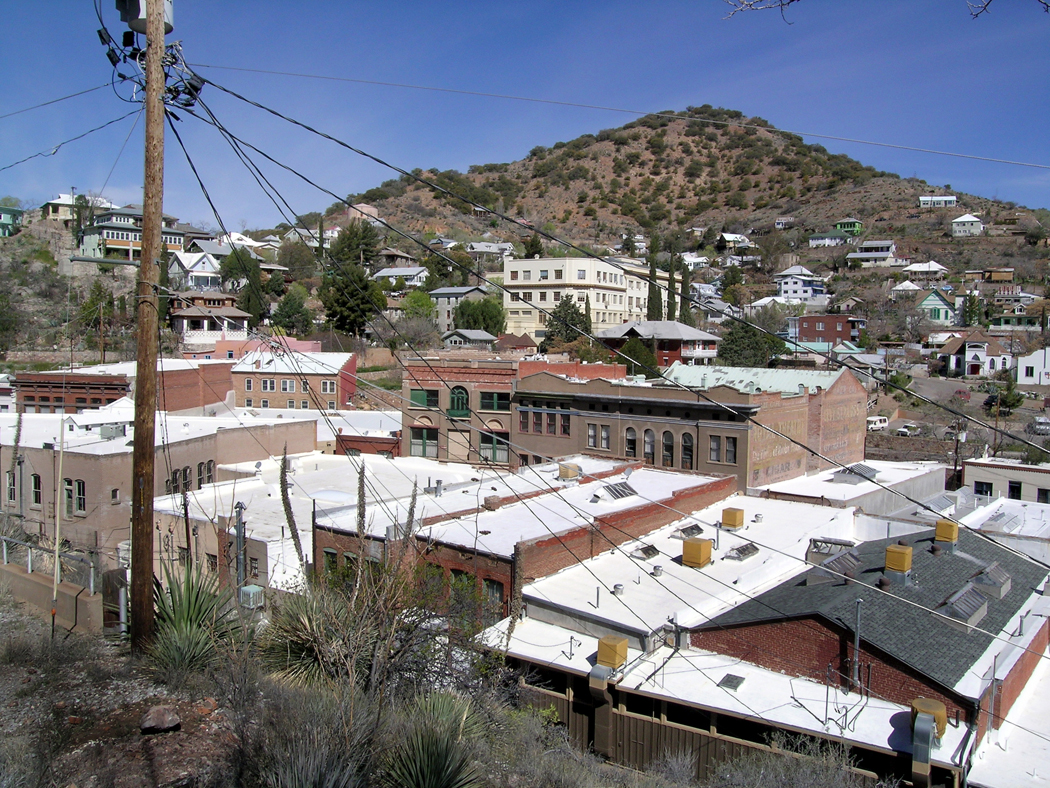
“Of course,” he said, “that hasn’t stopped slavery, but only changed its face: Slavery is still accepted in parts of Muslim Africa and the sex trade is hardly anything but slavery.”

“Yes, but the issue you have raised is whether slavery was at one time the water we swam in — that for most people, there was no issue at all. The sky was above, the earth below, kings ruled the domain and slaves had their eternal link in the Great Chain of Being. It was only the exceptional person who asked if the scheme were moral or just.”

“This is true, but it is also such a hot-button item that we may fail to grasp what I’m really asking. In the case of slavery, we can now feel superior and look back on our forefathers and judge them for their failure to see the obvious. But I’m certain we are no less blind today than they were, but in other areas. What are we going to be judged for a hundred years from now?”
“Animal rights, perhaps?”

“Maybe. Certainly, there will be those who wonder why we didn’t do anything about the ozone or overfishing or nuclear proliferation. But in part, these are political failings rather than what I’m asking about.

“I’m asking rather, what do we not even question. The issue came up when I started rereading Plato. God, I hate that man. But it was the Greeks in general I’m talking about.”

Stuart had no humility about bringing up the Greeks to the classical scholar sitting next to him.

“They had a peculiar relation to their language,” he went on. “They had what we now take as a naive belief that language and existence were one: If there was something in creation, there was a word for it, and likewise, if there was a word, it described something real in the world. There was no disjunction, no sense that language had its own structure and limits, and they were different from the structure and limits of existence. No sense that if there were a word, it might describe something false, something that doesn’t really exist, or really happen. The fact that there was a word was proof that the thing existed. They could not see outside their language. This led to some kinds of absurdities, like Zeno’s paradox. The language describes a problem: Achilles and a tortoise are in a race, but with the latter given a head start, Achilles can never catch up to it, and hence can never win the race.”

Before Achilles can catch up to the tortoise, he has to go halfway to catching up with the tortoise, and then before he can close the gap, he has to cover half the remaining gap, and then half that, and half that, onto infinity, and therefore, never catch up.

“An obvious absurdity if you set the experiment up and see what happens. The problem is only in the language, not in the reality. ‘Half’ and ‘half,’ and ‘half’ are merely concepts, not observable, not physical.

“There are many versions of this problem: It is the essential problem of Plato, who sees his ideals in terms of language, in terms, more specifically, of nouns. His ideal forms are ideal verbal, linguistic forms. Being Greek, he cannot transcend that constraint. Language is reality, reality language. That is all they know and all they needed to know.”

“Sometimes, I think we’re not much better,” Mia said. “We still seem to believe words more than experience. Politics is full of such things: Welfare mothers, for instance, or tickle-down economics. Make the verbal classification and you have proved that such a thing actually exists. Maybe you can’t really find any out there, but you’ve set up the idea with the word.”

Stuart: “My favorite has always been the international conspiracy of Communist Jewish bankers. Communist bankers — have they thought this one through?”

He went on. “Of course, philosophy these days — especially in America — is practically nothing but philology, a study of in how many ways language obscures reality or is at least in serious disjunction with it.”

“So, what is our equivalent of Greek language blindness?” she said.

“I can think of a few things that might count, but I despair of being able to escape my own swimming water,” he said. “This language-reality dilemma is never gone.

“Take a sentence like ‘Whales are mammals, not fish.’ It seems to most of us that this says something about cetaceans, but in fact it is a statement about language, not biology. It says ‘We have created a language class — a noun — that we apply to some sea creatures and not others. ‘Whales are mammals not fish,’ is a statement about language.”

He was thinking about his copy of Oliver Goldsmith’s History of the Earth and Animated Nature, from 1825, which divides fish up into ‘spinous fishes,’ ‘cartilaginous fishes,’ ‘testacious fishes’ — that is, shellfish — ‘crustaceous fishes’ and ‘cetaceous fishes.’

“A whale, after all, is shaped like a fish, swims like a fish, has fins like a fish and lives in the ocean. Like the old saying, ‘If is looks like a duck and quacks like a duck…’ But nowadays, we accept the Linnean classification system as describing reality, while in fact, it is merely one way — one very useful way in a scientific and technological society, I might add — but only one way or organizing reality. The Bible doesn’t say Jonah was swallowed by a whale, but by a ‘great fish.’ We naturally make the leap, because a whale is, in some manner, a big fish. Just one that breathes air and gives birth to live young. There are many ways of organizing experience, but we assume the primacy of only one.

“Genius is being able to shift from one to the other seamlessly.”

“I have another good example,” she said. “Anti-abortionists say that abortion is murder. But murder isn’t a fact, it is a legal class. And we change laws all the time. Taking of life comes in many forms, some which we justify and others we criminalize, and different people draw the line at different points. Would it have been justifiable to kill Hitler in 1933 to prevent the millions of deaths in World War II? Would it have been justifiable to suffocate the infant Hitler in his crib? There is homicide, manslaughter, justifiable homicide, and, of course, war. Eichmann maintained that the Holocaust was merely the justifiable death of war, but we have chosen to draw the line differently. And what now of those now being ethnically cleansed in Bosnia? So, is abortion murder? It is killing, but for some it is justifiable, even necessary. Many on the anti-abortion side nevertheless justify executions for some crimes, but for that, they don’t use the word, ‘murder.’ For some it isn’t. But ‘murder’ is a verbal classification, not a fact.”

“Bingo,” he said. “It is hard to recognize what is mere language and what is genuinely out there, existent in the world, divorced from the language we use to describe things.

“Perhaps one thing — and this is related to the Greek problem — is our belief, unexamined, in the permanence of certain things.” Stuart went on.  “We have a tendency, not only to believe, but to actually create wars to defend the idea that national borders are something other than temporary lines drawn by powers that be. Just look at Poland: It moves around the map like a ball of mercury in a dish. First it’s here, then it’s there. It grows, shrinks and sometimes disappears altogether. There’s an idea that national borders depend on ethnicity, but that clearly isn’t the case. Poland, when it has existed, included Polish speakers, German speakers, Ukranian speakers, Lithuanian speakers, Yiddish speakers and Czechs, among others. Yes, most French speakers live in France, but some live in Quebec, and others in Belgium, where half the population doesn’t speak French at all, but Flemish …”

“‘In France they speak French; in Belgium, they speak Belch.’”

She was talking about Genevieve.

“… and just look at the shifting borders of the United States through the 19th century,” she said. “Nationhood is always a momentary thing. Yet we think of it as heaven-ordained.”

“Exactamente. We swim in an ocean of conceptual habits that we seldom give any thought to. Like our expectation of a beginning, middle and end. We want that in a play we watch or a song we sing. But there is no beginning, middle and end in our existence: It is all just flow. ‘Panta horein,’ Heraclitus has. ‘Everything flows.’ But the idea of beginning, middle and end is how we think of our own lives, not just that we are born and die and have a few years in between, but that each step in our life is a story that follows, episode on episode, in a coherent pattern that we recognize as our ‘self.’ We tell stories about our lives as though we were writing novels or short stories. The connection we make — the through-line — is something we cast over events, not something inherent in them.

“Experience, like the stars in the heavens, is a welter, a chaos of instances, but we make constellations out of them to be able to make sense, but if we take the constellations as something ‘real’ — like astrology does — then we mistake the pattern for the substance.”

Mia had her own example, thinking of life in academia and faculty meetings.

“The other example I can think of is hierarchy. This is perhaps beginning to be exploded, but we reflexively think of things in hierarchy. The real world of experience doesn’t provide immutable hierarchies, but in our thoughts, we make them line up in marching order and pretend there is this rank and file. Where once we had kings, knights, yeomen, vassals and serfs, now we have department chairmen, academic deans, provosts. We still have this idea that some organisms are “higher” on the evolutionary scale than others. The vestigial concept of the ‘great chain of being’ remains in our culture, even when the full-blown version has disintegrated into a confetti of vestiges.

“We decry the ‘patriarchy,’ or at least some of us do, while a good part of the population unthinkingly assumes as the default that the husband is head of the household. Real families are no longer like that.”

“Don’t get me started,” Stuart said, but the horse was out of that barn.

“The number of things we accept without thought is probably infinitely more than those things we do think about. Seven day weeks? Any real reason for that? Weekends are such a part of our experience, yet, I doubt cavemen ever thought about constantly recycling work weeks. And the decimal system. A duodecimal system would work just as well, or even a system based on 8 or 15. The 10 is just a convention.”

“Well, we have 10 fingers…”

“And 10 toes, so why not base it all on 20? In fact, I’ve seen this — in some cultures the counting is based on 12 because if we use our thumb as a counter, we can reel off a fast dozen, by first counting the fingertips of the remaining four fingers, then the second joint and then the third, adding up to 12. And with the other hand, we can keep track of the groupings of 12, and count quite efficiently on our fingers up to 144. You can see the foremen doing this on South American rivers as they load bales onto the boats. Inventory is kept on the knuckles.

“I’m sure there are so many more things we accept without thought. But my original point is that it is so hard — nearly impossible to discover what you don’t know to be mere convention.”

When they reached the Tappan Zee Bridge, it was hard to know if their exhaustion was from the long drive or the conversation.

poughkeepsie 3
4.

When they got there, it was worse than she had thought. Dan was in bed with tubes in his nose and an IV plugged into his forearm. His eyes were dark, as if he had on eyeshadow, and his cheeks were scoured out; his skin was sallow. He barely spoke above a wheeze.

Stuart waited at the hotel while Mia went to visit.

“I’m going to die,” Dan said. Slowly, very slowly, one word squeezed out at a time before gathering wind to say the next. “You are the only person …” He waited to finish his thought while sucking air. “…” He didn’t finish his thought, hoping Mia would finish it for him.

Dan had spent the three months in hospice, but a turn for the worse had landed him back in the hospital. Mia held his hand; she didn’t know what else to do. Dan closed his eyes and slept. Mia sat there for a half hour, watching the sunlight on the bare trees out the window. Then she got up to leave the room. A nurse came to her with a clipboard.

“There are some forms to sign,” she said.

Mia growled her eyebrows. “What do you mean?”

She hadn’t expected anything official; she was just there to see her father.

“You are next of kin,” the nurse said.

“What about …’ Mia realized that an ex-wife didn’t count. All of Dan’s blood family was gone. She was all there was. She signed whatever she needed to and went back to the hotel.

“It’s bad,” she said to Stuart. “He’s barely able to speak.”

“Is there anything we can do?”

“I signed a bunch of papers.”

“I mean, anything to help?”

The air was crisp, the sun was sharp, the day seemed at odds with Mia’s mood. They went to the hotel cafe for dinner.

Motel 1

5.

The next morning, when they went back to the hospital, a different nurse, this one much taller and older, met them with the news that Dan had sunk into a coma and was not expected to come out of it.

“We need to know your wishes,” she said.

“My wishes?” Mia frowned. She didn’t think her wishes were important. “What can we do for him?” she asked.

“I mean, at this stage, we are only keeping him alive with feeding tubes and a respirator. We need to know if it is your wish to continue life support or should we let him go.”

This is not a decision anyone should have to make. Mia certainly didn’t think she should have to make it. She barely knew the man; it was only an accident of DNA that she was being asked to make this choice. For the first time, she started crying. She found a chair in the hall and lowered her head and let the hot salt water drain. Her brain was seized up; the tenuous connection between her birth father and the grown daughter was made sensibly, palpably real. She reached for Stuart’s hand; she held it in both of hers.

“I don’t see that I have a choice,” she said. She told the nurse to let him die. It felt so cold; it felt so unfair to be made to choose.

“He’s going to die anyway,” Stuart said, trying to comfort her. “You are only helping him get there.”

The trip back to Morgantown was much quieter than the trip to New York.

6.

There was a lot to manage after Dan died. What to do with his remains, what to do with his apartment and all his stuff. It was all strange to Mia; she hadn’t known Dan in any real sense, so the books on his shelf were a surprise, the clothes in his dresser, the foods in his pantry. They all spoke of someone who had had an actual existence, but no longer did. Where did he go? Vanished, except for the cans of tomatoes and the box of Cheerios, the bottle of soured milk leftover in the fridge. Throw it all out, she thought.

An estate sale was arranged, the body was cremated, the gas and electric turned off, the deposits promised to be returned, the key given back to the landlord. Mia felt a deep sadness, but it wasn’t grief. She barely knew the man, so that wasn’t why she was feeling this profound emptiness. She had now a personal connection, a bodily connection with death, with non-existence. It didn’t matter whether she ever spent time with Dan; there was a cause-and-effect connection with a dead man: He had caused her to exist in the world, and his world was now over. The flower had give way to seed. Was this, perhaps, what it meant to be grown up?