fog bank

Life is made up of experiences. Not thoughts, but body-experience. It is what brings us wisdom, what brings us the game pieces we draw out of the well of our lives, that make up our literature, our art, and the myths we make of our own lives. Experiences are the building blocks of our psyches.

And the experiences of one generation are different from those of the next or the previous. We can never really know what it was like to be in Napoleon’s army or Wyatt Earp’s Dodge City or on a viking ship sailing the coast of Greenland.

Our children will never know what it was like to be us. You didn’t listen to your parents lecturing you, and you shouldn’t expect your children to be any more interested in what you have to say to them. Experience, it turns out, is non-tranferable.

But, at times, we get hints. Some bit of the past reoccurs and we get an insight.

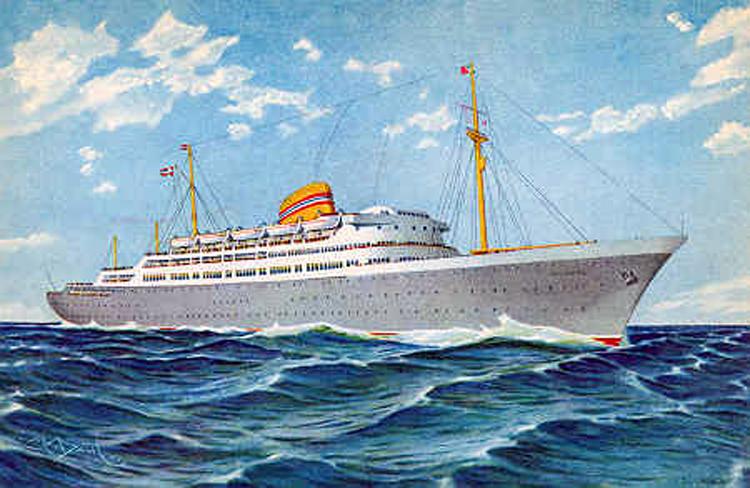
There is little in travel so romantic sounding as a trans-Atlantic ocean voyage, and little in reality quite so tedious. When I was a teenager, I got the chance, in the dying days of ocean liners, to sail from New York to Oslo aboard the MS Oslofjord. Oslofjord postcard

Day after day, the horizon remains pancake flat, and the only thing that changes is the dining-room menu.

Maybe it was because I was young and most passengers seemed so ancient: Shuffleboard was the amusement of choice, followed by casino night in the lounge. Neither was particularly appealing to me.

Yet, despite the monotony of the weeklong voyage, there is something about the sea that lodges itself deep inside and refuses to go away, even all these years later, in an age when crossing the ocean on a ship is no longer a realistic possibility.

It began in New York, a harbor crisscrossed by wakes like particle trails in a Wilson cloud chamber. The ship I was on threaded its way among the bee-buzz of harbor activity and passed the Statue of Liberty, which my grandmother saw on entering the same harbor in 1905, when she was a little girl.

I was on my way to the ”old country” to see where she had come from and was taking a boat, just as she had coming the other way.

But you can’t get the feel of ocean travel while in the harbor. You have to get out into the sea swell for that.

If you have never been out there, you might not have any sense of just how hilly the ocean is. Sure, the horizon looks flat, but nearby, you can sense the shifting pileup of waves of all sizes.

On the water’s surface are the wavelets, blown into white horses by the wind that always blows at sea. And the wavelets skitter up and down with the larger waves that move with more stately pomp, coming at the ship from all directions and crossing each other in patterns so complex that even chaos theory has a hard time dealing with them. swell1

But more impressive is the slow, almost geologic movement of the swell, that massive up and down that is measured by the rise and drop of the ship.

On some days, the swell is hardly felt, as the calm ocean sprinkles the sunlight in its shivered surface. But out in the North Atlantic, it is never long before some distant storm rocks the water into the swell that is the oceanic equivalent of the long ridge mountains of eastern Pennsylvania, one after the other, up and down, twisting the ship into yaw and roll.

The constant rumble of the engines shake the walls in ”D” deck, deep in the hull of the ship. Every surface is painted and repainted and each iron surface is covered in enamel like the thick shiny glazing of a doughnut. In the stateroom, there is no sense of motion, only the vibration of the engines. It has been the same for six days.

In midsummer, the sun doesn’t set until nearly midnight, rising again a few hours later. Most of the evening is spent in the low sunlight, which rakes the waves into glitter.

And I am up at 3:30 in the morning, walking the decks of the ship, which seems ready to roll over on first one side and then the other. Nearly a week into this trance-inducing boredom, I have read all my books and cannot sleep any more. The walk on deck in the dusky dark is meant to wake me up from the hypnotic state the ocean can put you in.

Then, out in the darkness I can see a light, miles off through the humid air. It is another ship going the other way. But no, it is not a ship, the lights are too irregular. In the growing light, I can begin to make out the grayish shape of it, barely legible in the murk.

It is one of the Orkney Islands, off northern Scotland. The trance is broken. The Atlantic is crossed, land is sighted.

I have some sense of what Columbus must have felt, although I have eaten better than he did, and my six days is rather less than the months he spent at sea.

But I still felt something special when the sea birds once more began flying overhead.gull

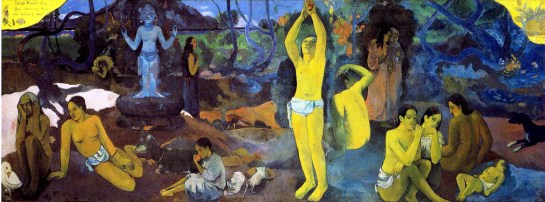
gauguin

Are the arts important?

It is the question at the bottom of the debate over public funding, and a lot of hooey has been written on the subject, from both sides of the issue.

Yet, the question remains. Is art important, or is it merely one of the frills of life? Is it more than the amusement of the rich people who can afford to buy it or attend its performances? Does it serve some essential function in our lives?

The answers usually provided are too often soft and squishy, with a lot of feel-good oohing-and-aahing alternating with benign platitudes.

All of which miss the point.

There are three major things that art provides that we can ill afford to do without. They have nothing to do with ”identity,” ”self-expression” or ”healing,” or any of the pop-oriented, new age or parochial apologies being given in the discussion.

No, what art does is as fundamental as language. Far from being an ornament, it is the foundation of culture.

Put another way, civilization doesn’t make art, art makes civilization.

How does it do this?

First, art asks, ”What is real?” It is the first line of investigation into what is true. Art is the acid test we give our assumptions about reality to find if they are gold or lead.

If science is the test we give to hard fact, art is the test we give to everything else.

Second, it gives us a way out of the isolation of our egos. The greatest art forces us to sympathize and empathize with others and enlarge ourselves and our moral compass in the process.

And third — and least familiar and most difficult to understand — it asks, ”What is the meaning and purpose of structure?” This last has unforseen ramifications.

They may be summed up in Paul Gauguin’s famous painting from Tahiti: Where Did We Come From? What Are We? Where Are We Going? Those three questions give us a clue about why art is important, why it isn’t merely window dressing.

When we ask, ”Where did we come from?” we are asking what is the ground of reality.

When we ask, ”What are we?” we are asking about those things that make us most human.

And when we ask ”Where are we going?” we are asking how art might show us the possibilities for making a life.

Let’s look at them one at a time.

ART AND REALITY

When art addresses reality, it does so on several levels.

On the simplest, it attempts to find out what the world looks like. That may seem unnecessary at first, but it isn’t as easy as it sounds.

We must learn to see, not only as individuals, but as a culture. And art is our most important teacher.

We could be taught to see other than as we do.

It is through art as a mediator and not through direct perception that you come to recognize the world. This is a fact we are almost always blind to. We see it no more than we see the retina on which the image is formed. durer
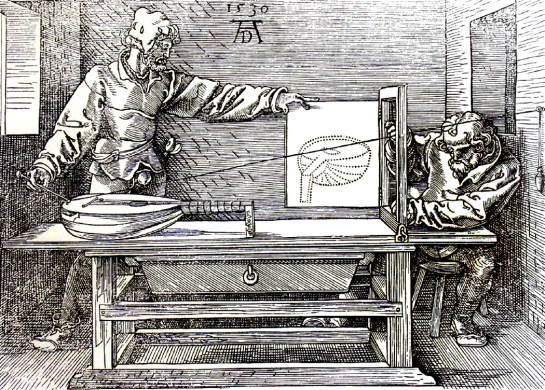
It was a heroic thing for those Renaissance artists who worked out the mathematics of perspective. They were grappling with reality; they were wrestling with an angel.

In some sense, every artist does that when he sets up a bowl of fruit and begins drawing, trying to stare that stubborn reality into submission.

But reality isn’t only about what we see. It is the question of what we feel and believe as a people. So theater and novels investigate the nature of justice or love or violence. In each case, the artist or playwright is creating a model of the world — a virtual reality — that we must come to accept or reject.

It is also important to recognize that every one of these artistic answers is provisional, and each is modified or rejected by succeeding generations. All reality is a working hypothesis.

To those who see art only as surface, the history of art is a history of changing styles. To those who look beneath the surface, style is irrelevant, nothing but distraction. The changes are not mere fashion but result from the constant testing of art against reality and back.

ART AND EGO

The second issue of art is just as important. Too many of us live our lives in the prison of our own egos.

We know what we have experienced but not what others have experienced. We trust our reality but no one else’s.

Art gives us a way out of this prison, by presenting us with other worlds, other realities, deeper emotions and more profound thoughts.

It is the reach of imagination that allows us to grow beyond ourselves and feel those emotions.

Art forces open those prison doors and sends us out into the light of day, where we must learn and feel what it is like to be Madame Bovary, Henry V or Shakuntala.

Art gives us a way of escaping the happenstance of history and birth for a chance at a more comprehensive, more universal understanding. We grow in worth as human beings.

For the great moral lessons, one turns to Aeschylus’ Persians, Sophocles’ Oedipus, Dostoevsky’s Aloysha or James Baldwin’s Beale Street.

It is doubtful whether, without the powerful emotions of pity and love, we would ever be able to create a civilization worth living in.

ART AND STRUCTURE

The third issue is more subtle and difficult.

We understand the things of this world not merely as an accumulation of unrelated facts, but as system. We see not leaves and sticks, but trees.

What we understand in that instance is structure — the ”big picture.” It is the glue that holds together our perception.

That structure doesn’t appear out of nowhere; it has its roots deep in the human psychology. It is the archetype of Jung, the mothers of Goethe, the poetic imagination of Blake. It is the central core of comprehensibility. We measure all things against it, whether we recognize it or not.

A good story isn’t just a collection of episodes, but episodes with a certain shape to them: a beginning, middle and end.

The structure of a story is every bit as important as its content.

Imagine two newspaper stories about the same train wreck. One is a cluttered assemblage of facts, in no particular order; the other is a well-told story with direction and emphasis. Each contains the identical facts, but the second can be read and remembered. The first is fact confetti. We cannot even read it; it makes no sense.

The only difference between them is the structure.

MYTHOLOGY OF CULTURE 

We can take the same structure and apply it so some other news event. The facts may change, but the import of the story remains the same. We see it over and over in newspapers: the child in peril, the senseless killing, the arbitrary natural disaster. Each is a structure of story that we fill in with the facts of the case. Each 40-car pileup is identical, except to those involved.

Each of these stories is a small myth in the larger mythology of our culture.

We think of myth as being a story that isn’t true, but the truth or falsity of a myth is irrelevant. All that matters is its persuasiveness.

The artist recognizes this fact and uses it in his art, working the changes on the myths and archetypes.

What makes this important is that we all use these myths — recognized or not — to give meaning to our lives. We live out our roles as father, mother, hero, victim, lover, loyal friend, all following the internalized archetype we have either learned or been born with.

Art, literature, theater, dance, music, provide models for us, so we may know how to make a life.

Like ritual, they show us the steps to the dance, and the steps are structure.

EMPATHETIC COMMUNICATION 

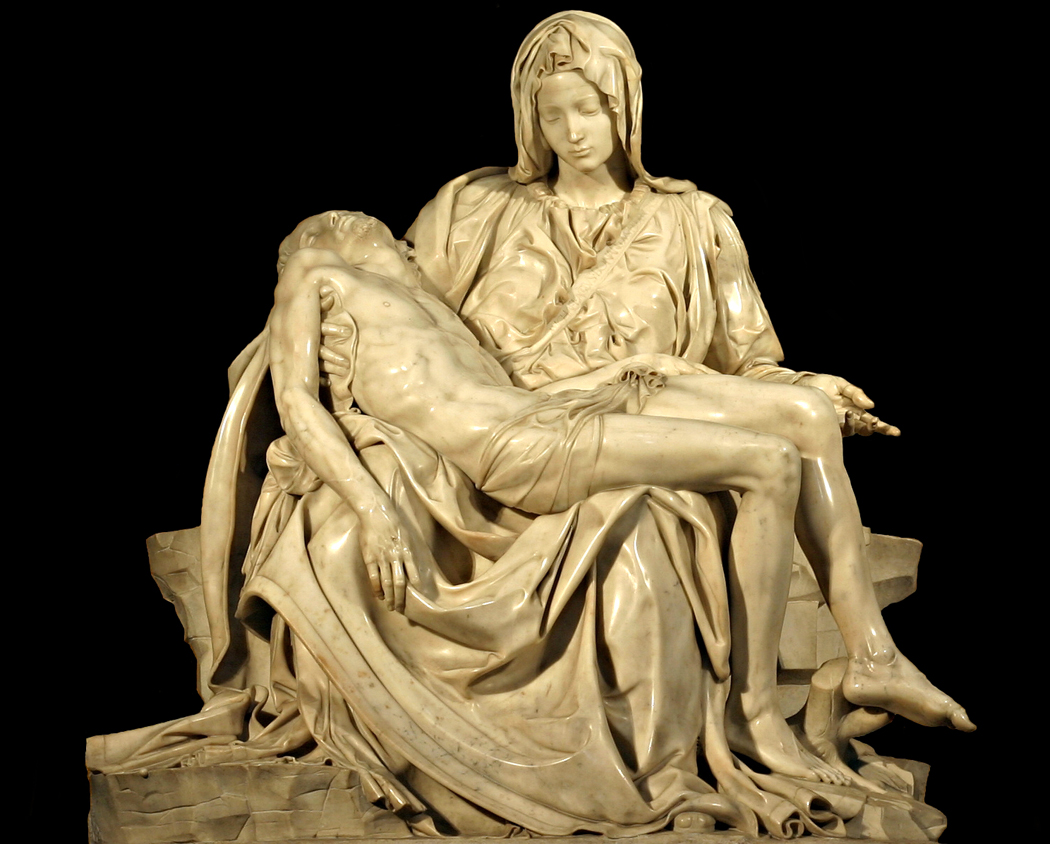
Take Michelangelo’s Pieta.

It is on one level an attempt to make a statue as lifelike as possible, with poses and emotions as true to their condition as possible. On that level, Michelangelo is exploring the reality of surfaces.

But we don’t look at the grieving Virgin and the dead Jesus as a test of what reality looks like or of what we would do in the same situation. pieta

We feel the emotions of the Virgin almost telepathically. It becomes possible to know what it is like to lose a child, lose a part of your own flesh. Even if we have lived the most sheltered and protected life, we cannot avoid coming to know at least a little about the experience of tragedy, and we are made bigger by it.

It is a work of profound human emotion, and you needn’t be a Christian to feel it.

But Mary is also the archetype of the mother, and Jesus is the archetype of all of us who know we will eventually die. We are given a role in the cosmic drama and the means of playing it with dignity.

The very greatest art, from James Joyce’s Ulysses to Wagner’s Ring Cycle to the Mahabharata does this for us.

A DIGRESSION

Stories have a narrative content, but they have a structure, too, or they would fall apart.

Is it possible to write a story with the structure alone, with no facts to plug in?

That is in essence the direction of what we call Modern Art.

In the Renaissance, a painting was metaphorically a window through which we looked at the virtual reality presented. The paint resting on the canvas was intended to be rendered invisible, like glass.

But in Modern Art, we are meant to look not through the window, but at it. The paint, the brushes’ marks, the canvas, the colors up against each other: They are the very point of the art.

At its most heroic, Modern Art attempts to put us in contact directly with reality and with our emotions, unrelated to mere narrative event. That is the effect of Kandinsky or Pollock or Rothko.

But we have spent nearly a century investigating that level of reality and it has gotten a little moldy with use.

It is now the job of Postmodernism to write with its finger in that now-dusty window, ”Wash Me.” triptych
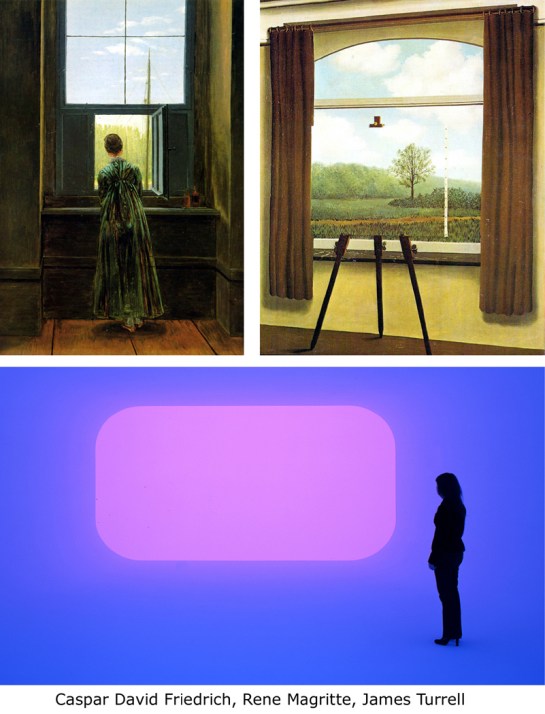
Yet, that layer of structure, unrelated to fact, remains in art, as it always has. Sometimes art uses it to give meaning to our lives without our knowing it, sometimes art points its arrow at the structure and says, notice it and enjoy it.

Without structure, there is no meaning, and art gives meaning to life.

bball trio

Basketball, when truly appreciated, is not merely a knock-down, drag-out testosterone-drenched form of male competition. It can also be a thing of beauty, a form of ballet that even tough guys can appreciate. 

Looking from one direction, no one who has watched ballet in rehearsal, with its sweat and grunting, with the sound of feet thudding on the wooden floor, can doubt ballet is as much athletic achievement as art. 

But from the other direction, neither should we be blind to the aesthetics of the NBA. At its best, the game gives us grace and transcendence. swan lake bball

One thinks of Michael Jordan, performing a grand jete, hanging in the air like a Japanese lantern, light as a skein of silk, delighting the crowd, connoisseurs of the art who can recognize a master when they see one. 

It’s like Baryshnikov: virility and grace combined. bball ballet arms

I’m not thinking of the goofy, arts-as-camp beginning of West Side Story, where the Sharks and Jets finger-snap their choreographed way through a bout of playground B-ball. A real fan would gag. 

No, I mean the muscled, sinewed power under complete control of an Elgin Baylor. 

Elgin Baylor

Elgin Baylor

Dance, after all, is nothing but graceful, controlled movement. A Baryshnikov could spin in the air and hit the floor with no noticeable impact and swoop into a demi-plie as if he had no weight at all. Every move contributed to the total effect of animal muscle tuned to the hum of an angel’s song. 

Connie Hawkins, for example. Like Nijinsky, he could hang in the air for what seemed like forever, but in reality was only seven minutes. Hawkins could, while in the air, switch the ball from one hand to the other five times before shooting. 

Connie Hawkins

Connie Hawkins

I came to Roundball in the 1970s and ’80s, listening to the Boston Celtics on radio with Johnny Most and his gravel voice play-by-play. And it was then that the issue of grace was first brought to my attention. My college friend who came to school on a basketball scholarship, approached the game esthetically, he said, and was put off by the win-at-all-cost jock attitude. Needless to say, he didn’t last long on the team. But he taught me the esthetics. 

He was enormously talented, and when we played Horse in the back yard, we had to have a singular variation to the game: I played Pig and at the same time, he played Archaeopteryx. He still won every time.  

Not every NBA player is a Baryshnikov, of course. Only a choice few stand out as danseurs nobles. 

The league has also had its share of Billy Paultzes and Manute Bols, the ungainly klutzes who have performed their tasks with spastic awkwardness. 

Billy ”The Whopper” Paultz, for instance, was one of the original wide bodies. He was there for rebounds, not shooting. When he did take a jump shot, his heels never broke contact with the floor. He had negative hang time. 

Or Jack Sikma, who was ”robo-center.” Although a fine player for Seattle, he moved mechanically. You could almost hear the gears whirring when he turned for his jumper. That’s not ballet. 

But that’s the esthetic bottom end. In between are the journeymen, who fill the lineups and can rise to the occasion in a good game and produce a memorable show. 

Wes Unseld

Wes Unseld


Unfortunately, it seems as if the NBA these days no longer values the esthetic side of the game. The heyday of the leaping danseur was the ’70s and ’80s. The best games then seemed more like aerial warfare than infantry slogging it out in the trenches. 

Jordan was the last — and greatest — of a generation of gazelles that began with Baylor, continued through Hawkins and reached critical mass with Dr. J. 

Since Jordan retired, the game seems headed toward a more earthbound and elbow-swinging muscle game. Hang time gives way to bang time. Intimidation counts more than style: Shaquille O’Neal wasn’t so much a leaper as he was a Sherman tank. 

Nowadays, I have a harder time keeping interest in the NBA. 

Critics of the game complain about what they call ”thugball,” but it’s always been part of the game, too. It’s just that too often these days, it seems to be all of the game. 

Jamaal Wilkes

Jamaal Wilkes

But even that aspect of the game has its art. One recalls Wes Unseld in his prime with the Bullets, built like a tree stump, immovable under the opponents’ basket, daring leapers to bounce off him. There was nobility in that. Like a sturdy Nureyev providing a rock-solid pedestal for the pinioned Margot Fonteyn. 

Yet, it is still Jordan whom one remembers most, or Magic Johnson, or Jamaal Wilkes, who never seemed to break a sweat while performing the most amazing acrobatics. His nickname, Silk, said it perfectly. 

toborposter 2

A friend just asked me what I think will be the ultimate end of the computer.

It’s a good question and although there have been many entertaining science-fiction answers to that question — mostly involving supercomputers developing artificial intelligence to a point the computer no longer needs humans to operate it and thus enslaving humankind — the real cyberuebermensch — what came to my mind was something else.

And that is that the computer — and by extension the whole cyberworld — has no throat. No pancreas, either.

That is, in the eternal division we idiot humans have made between mind and body, the computer is all mind and no body. Not even the beige box can count as a body, when we can download the whole brain on a thumbdrive and move it over to another interchangeable box.

No, the computer is the final version of the mind existing for itself alone.

And that, I think, is where we will finally recognize the limitations of the computer.

After all, why did intelligence evolve? It developed to help our bodies survive. The smarter animals were better able to get food, protect themselves and their young, and know when to move to a new neighborhood when the ripe bananas gave out. In other words, the mind is the servant of the body.

In the computer, however, the mind serves only the mind.

Sometimes our human brains forget this simple fact and think that our bodies exist to cart our brains around from place to place, that it is the function of our bodies to turn the pages in the books, or to push the buttons on our remotes or shuffle our computer mouse around.

Our brains have everything backward. In fact, our brains were created by our bodies to serve them.

One senses a theme: machine carries body

One senses a theme: machine carries body

What can be the function of a brain without a body? To serve only itself, a function that is ultimately trivial, narcissistic, onanistic and pointless.

Because we live in a media-saturated culture, we think that the purpose of intelligence is to amuse us, keep us entertained. We use our minds to fill out crossword puzzles, write books and split the atom.

In essence, we are spinning our wheels. And we invent computers to spin our wheels even faster.

Please don’t misunderstand me. I’m not against computers. I love my iMac; I even love the blank-faced golem I face every day on which I write these words.

But ultimately, humankind will come face to face with the problem of being chunks of meat walking around. And the computer, as glorious an invention as it is, is irrelevant to our physical lives.

Oh, I know that our air-conditioning is controlled by computer, and that we wouldn’t be able to fly from Phoenix to Boston without them. The computer is a tool, and a useful one.

But when it comes to the future of the computer, we will have to recognize that mind and intelligence are not ultimately what life is about, and that the computer, which makes our lives both easier and infinitely more complicated, has no voice on the subject.

The expectation that the computer will eventually grow into artificial intelligence is likewise an irrelevant question.

But they have it backwards. Body really carries machine

But they have it backwards. Body really carries machine

Artificial intelligence is hotly debated between those scientists who think the human brain is inimitable and those who think it is merely a mechanism.

They are both missing the point. The problem with artificial intelligence is that it serves no purpose. It is really just one gigantic mega-New York Times crossword puzzle for scientists to play with.

Meanwhile, our pancreases and our throats keep us alive.

vanloo sextet

In the 1970s, a few crackpot music directors attempted to play early classical music — primarily Baroque music — on the instruments that were available 250 years ago: valveless trumpets and horns, keyless oboes and violins with gut strings. Those early attempts today are hard to listen to, with scratchy fiddles and sour brass, all terribly out of tune.

Things have gotten a lot better since then.

But those pioneers were the vanguard of a burgeoning movement in the classical music world, and in the intervening years have wielded such power, they are now the mainstream of the art, even when they aren’t there.

That is, even standard symphony orchestras now attempt to play what they call “historically informed performance practice,” or HIPP. Even if they use modern instruments, they have been infected with the dogma of the original instrument cadre. It has not been to the advantage of Bach, Mozart or Beethoven.

As the HIPP movement extends its tentacles into the 19th century repertoire, it has been more than unkind to that century’s composers, it has mangled and misrepresented them.

Because, in fact, the historical performance movement is less about historical accuracy in performance technique, and more about making classical music become like the popular music of our own time: There is a decided de-emphasis on harmonic movement and structure, and a peculiar emphasis on forward movement and the beat. Always the inflexible beat. It is so relentlessly percussive, might as well be rock and roll.

I don’t know how its proponents can be so blind to their own propaganda. If you want to know what’s going on in Bach’s music, look at it. Don’t worry about a lot of dogma. How can Baroque specialists so completely misread Bach’s music? How can they break up those long, flowing lines into short choppy phrases and not understand they are butchering the score.

“Baroque music is all based on the dance,” they say. It is dance music. So, they say, it should be bouncy and rhythmic. Well, maybe. But the allemandes and courantes of Bach are only as close to their original dances as Chopin’s Polonaise-Fantasie is to the original Polish court dance, which is to say, very distantly. They are no longer dance music, they are musical essays on the dance. To turn them into jiggy-boom-boom is to do violence to the profound thought and imagination that have transformed them.

It’s like the way an undergrad grabs onto some small and obvious insight and thinks he has found the key to unlock the universe.

This isn’t to say that the HIPP movement hasn’t helped us hear once more a good deal of pre-Bach music that had been previously ignored or misunderstood. Certainly Handel has benefited from the rethinking of his music. We cannot now hear a Furtwangler performance of a Handel concerto grosso without feeling it is soggy and underwater. The new brightness and fleetness helps.

But that doesn’t make HIPP a kind of syrup we pour over the entire history of music.

My biggest gripe, after the loss of the Bach long line, is the enfeeblement of Beethoven.

One can see how the century has moved in this direction. An ironic 20th century didn’t know quite what to do with a 19th century that believed in such things as nobility, heroism, providence, fate and triumph. After even the First World War, these concepts seemed iffy at best. After the Second World War, they seemed downright dangerous.

So, nobility and heroism are out the window. One can understand why, but without them, Beethoven no longer seems important. He might as well be dinner music.

This ties in with Modernism’s faith in the abstract form, and so, music lost its belief in narrative, in the possibility of carrying philosophical thought.

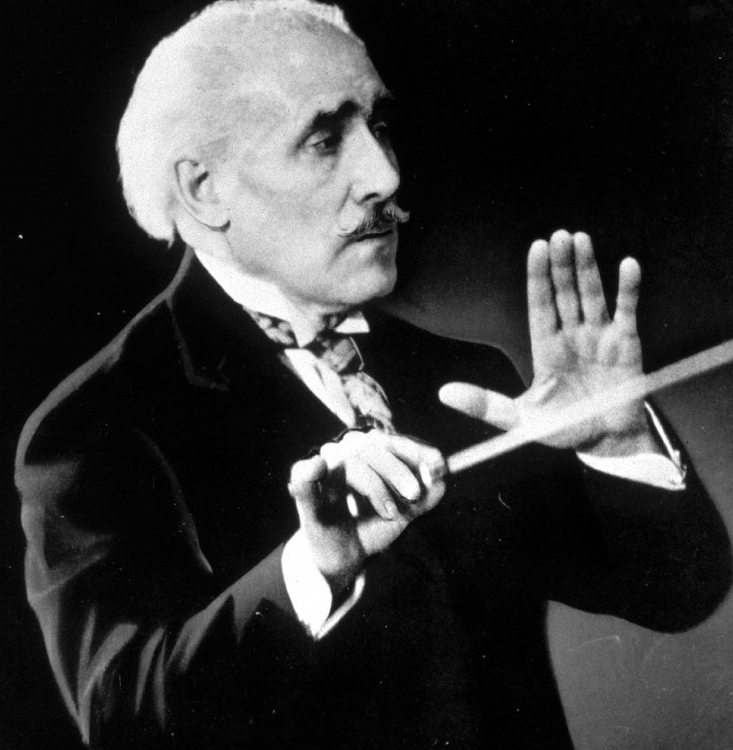
“To some, the Eroica is about heroism,” said conductor Arturo Toscanini. “To me it is just allegro con brio.”

Arturo Toscanini

Arturo Toscanini

Or, as Igor Stravinsky put it, “Music can express nothing.”

It was a provincialism of the 20th century. It could not possibly understand what was going on in Beethoven’s most difficult music.

(I understand that the 19th century didn’t make things easy for us, by going overboard on “programs” for symphonies, and tying specific narratives to otherwise abstract music. Perhaps if those programs hadn’t been so universally mawkish and sentimental, they wouldn’t have caused such a backlash in the century that followed).

But Beethoven himself said as clearly as could be, that he put those extra-musical ideas into his music. They are meant to be there. Excising them in a kind of battlefield surgery: an amputation that only leaves the music disfigured or dead.

If you want to hear the difference, you should listen first to a modern recording of Beethoven’s Fifth Symphony. One could stack the deck and try the recording by Gunther Schuller and a studio orchestra, made in 1995 as a companion to his book, The Compleat Conductor. His argument: That a conductor should not “interpret” the music, but just present what there in the score.

Gunther Schuller

Gunther Schuller

That means, an inflexible beat, a speed based on questionable metronome markings left by the composer years after having written the music, and a complete lack of expressivity.

Or, try recordings by David Zinmann or John Eliot Gardiner, both fine conductors as far as it goes. But they both have been influenced by HIPP, and therefore play the music too fast, too metronomically and purposely suck the philosophical subtext out of the music. They simply don’t believe in it.

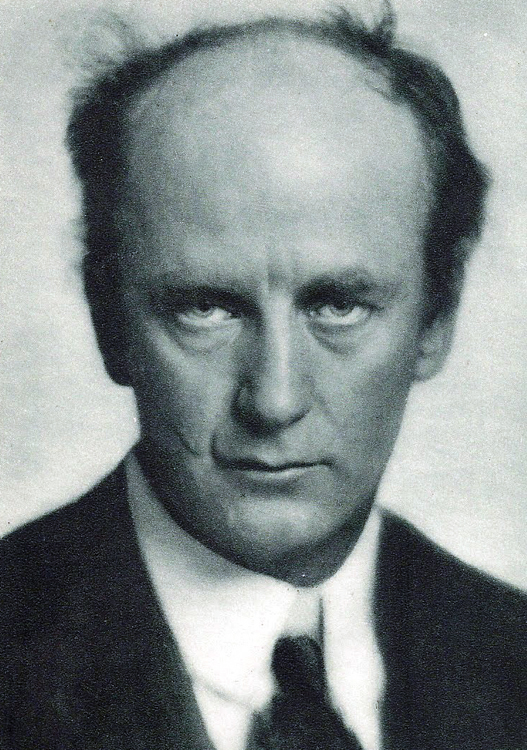
Compare any of those with the wartime recording by Wilhelm Furtwangler, in which the weight of the world is felt in the music, and the hope of transcendence burns brightly in the finale. It is an emotional experience that will leave you breathless and sweaty. Beethoven’s struggle is your own struggle.

Wilhelm Furtwangler

Wilhelm Furtwangler

Many listeners today prefer the modern performances, and find the Furtwangler version overwrought. I can do nothing for them; they should listen to pop music outright and not look for a “classier” simulacrum. But they are missing the overwhelming experience classical music can give them. What they get instead is background music.

The musicians are not robots, reproducing some Platonic ideal; they are rather deeply feeling artists who use the score to express their own inner selves. To complain that Bernstein’s Beethoven is more Lenny than Ludwig is to miss the point entirely. He was doing his job, bringing the music alive from the cage of the music staff, freeing it into life. Gardiner’s Beethoven is likewise more John Eliot than Ludwig, too, but no one seems to notice.

This isn’t just a question of rubato. It is a question of how the rhetoric of performance can communicate the essence of the music. There are some conductors who speed up and slow down irrationally; that doesn’t help the music. But a great conductor will change speeds when it makes his point.

Heck, even Toscanini changes tempo constantly, although by such a small amount, some people don’t even notice it.

One problem is that the tradition has been broken.

Toscanini famously said, “Tradition is nothing but the last bad performance,” but he was wrong. Nowadays, we could turn that on its head: “HIPP is nothing but the last bad performance.”

Tradition is essential. It is the way all classical art forms, whether Indian classical music, Japanese Noh theater or Russian ballet. They are handed down elder to student over generations. Classical music is no different, except that there is a notation to help guide us. We are fooled if we think the one is a substitute for the other.

The 20th century piety is that the score is everything and faithfulness to the score is somehow a measure of the success of a performance. On the contrary, the score is only a guide. It has some information; it is a blueprint, not an edifice. But much is also missing; that missing part comes from a teacher handing down a tradition to the student. Without that tradition learned in the bone from an early age, there can be no early second beat in a Viennese waltz, no paring of dotted notes from fourths to thirds in jazz. Learning the tradition, getting it in your blood, is why American orchestras do Copland and Ives better than a German orchestra, and why, if you want to hear the Blue Danube played right, you have to go to Vienna, or hear musicians trained in the Viennese tradition.

HIPP is instant tradition, like instant tea. It is tradition not learned from elders but picked up from books and research. Book learning ain’t music.

I’ve sat in a number of master classes, taught by some of the greatest musicians of the first half, and middle of the 20th century. They learned from the old masters, and they handed over the wisdom they had learned — the musicianship — from their elders. It is a glorious thing to see: the lumpen student plays the notes, and then the teacher plays the music.

Faithfulness to the score is such a canard. Completely beside the point. All the great conductors of the past jimmied the orchestrations around when they felt it necessary to make the music communicate more directly. Even Toscanini, the poster child for the “objective” conductor, altered the scores, adding brass to the coda of the Eroica where they knew Beethoven’s valveless instrument couldn’t play the notes it was clear he would have had them play if they could.

Mahler re-orchestrated Schumann. Even Mozart re-wrote Handel’s Messiah. There is plenty of precedent for using the score as a starting point, not a prison. What you’re looking for is music, not a museum exhibit.

All of the arguments I have heard in favor of HIPP fail to persuade me. We cannot listen to 18th century music with 18th century ears. It’s an impossibility. To pretend that if we play Bach on recorders and harpsichords, with short-neck gut-string violins, we are somehow more “faithful” to the composer’s intentions is simple-minded. As someone once said, “The loudest sound Bach heard was a door slamming. If you wanted to give our listeners the experience that Bach had, you’d have to create a world without the last two centuries of history.”

Our ears are more assaulted every day. The context for an “authentic” performance cannot be had, making the performance inauthentic.

I admit to enjoying a performance or two of Mozart or Bach played on the original instruments, but it is only as an experiment, or as an approximation, for historical understanding. I no more want to hear only HIPP any more than I want to read text printed with the long “S” and ligatures. They look quaint, but they get in the way of reading.

Unexamined through all this is the basic premise that music should reflect the composer’s intent. It’s taken as an axiom. But few people are asking why.

We don’t insist that Shakespeare be performed outdoors, with boys playing the women’s parts and with the rhetorical delivery of Elizabethan actors. We don’t blanch at Richard Burton playing Hamlet in suit and tie. So why do we argue over whether Bach’s musicians played with a vibrato or not?

The music, after all, no longer belongs to Bach. It belongs to us.

Ashe Co. plowed field

You cannot walk five feet in the South without knowing there is blood in the dirt.

It gives July 4 a special meaning, for you know that no matter where you turn, there is history under your foot.

There is history elsewhere in the country, too: Bunker Hill, Mass., Fort Ticonderoga in New York or Tombstone, Ariz. But they are singular places you go to visit — somebody else’s history. The South is so full of history that its land and people seem buried under the sense of it.

The first democratic legislature in the New World was Virginia’s House of Burgesses. The author of the Declaration of Independence was a Virginian. And the Revolutionary War came to a close at Yorktown, Va.

Each state has its Civil War sites, where thousands of its men are buried.

There are the street corners where civil-rights workers were hosed and beaten by police. Cotton fields where slaves were whipped.

It is interesting that the one place in the country where Black and White share the most is the South.

For most Americans, history is a story told in a schoolbook. It seems removed from the lives we live. For most Southerners, history is something their grandparents did or was done to them.

It isn’t just that the Civil War raged over the landscape. No part of the United States has suffered so much warfare on its land.

There had been battles with Indians from the very first European settlements.

The Revolutionary War brought Gen. Nathanael Greene to the South, where he led the British on a wild goose chase. The South also was the stage for Francis Marion, called the ”Swamp Fox.” Towns are named for them throughout the South.

natgreenemonument

The War of 1812 brought Andrew Jackson to fight with both the British and the Creek Indians.

The Mexican War helped bring Texas to the South and later to the Confederacy.

And, in the meantime, the blood of countless slaves and freedmen enlarged the tragedy of the South. There were lynchings and later the violence of the civil-rights movement.

It isn’t only rancor and slaughter that give the South its sense of history, but the land itself.

sprott evans

You can stand in a cornfield in rural Sprott, Ala., 25 miles north of Selma, and see the stand of trees at its border, knowing the trees are no more than 60 years old. And that before those trees began filling in the countryside, there were cotton, sharecroppers and poverty. A dilapidated wooden shack sits in the middle of the woods, and you wonder why anyone ever built there.

sprott farmhouse

Then you recognize they didn’t. The sharecroppers’ home — just like those written about by James Agee in his Let Us Now Praise Famous Men of 1941 — was built by a cotton field, but times change and history presses on and the fields are now woods.

I have lived in the South for the better part of my life. Every town, every pasture, every street corner brings to mind details of what they call ”The Great War.”
The library in Greensboro, N.C., where I lived, was a wartime hospital. In Madison, N.C., where my wife grew up, the family names of the wealthy whites and the poorest blacks were often the same, a legacy of slave times. The constant presence of the Civil War in the South crosses color lines.

In most other regions of the United States, the Civil War is something you read about in a book. In the South, the Civil War is now, a perennial now. A Southerner’s perspective on the war is personal. It is in the blood.

So, when I hear the battle names reeled off on TV documentaries — Shiloh, Vicksburg, Gettysburg — they sound distant on the narrator’s tongue, distant as Gallipoli, Waterloo or Omaha Beach. To most Northerners, they are just distant names.

But when I lived near Norfolk, Va., and traveled to Richmond on Interstate 64, I passed the Elizabeth River, where the Monitor steamed out to meet the Virginia (nee Merrimac); I passed Fort Monroe, where Jefferson Davis was imprisoned after the war; I passed Malvern Hill, where the Peninsular Campaign sputtered in frustration.

My wife, Carole Steele, was born in North Carolina and learned about the war firsthand from her great-grandmother, Nancy Hutcherson Steele, who was 10 when it began. She had plowed the fields during the war while her father and brothers were away fighting. When she died at the age of 98, she did so in my wife’s childhood bed in a small house on the banks of the Dan River. Carole was 8 at the time.

Nancy Hutcherson Steele

Nancy Hutcherson Steele

After the war, Nancy had married Rowan Steele, who had joined the Confederate army at the age of 14, becoming a bugler in the cavalry. He was allowed to join the cavalry because he owned his own horse.

At war’s end, as a courier for the 16th Battalion, N.C. Cavalry, he was wounded in the head at Appomattox and left deaf in one ear.

One of the first things he told his family when he returned from the war was that he could no longer tolerate to eat black-eyed peas. In one of his battles — he would never say which one — in a field of black-eyed peas the blood flowed in the furrows like irrigation water, a vision he could never shake when confronted with a bowl of the peas.

Rowan and Nancy were married in 1868. He lived until 1917, when because of his deafness, he didn’t hear the train that killed him.

Rowan Steele

Rowan Steele

She lived long enough to teach Carole how to tie things up with hickory strips instead of rope, a trick she had learned in the great deprivation of the war, when they stretched what little game they could kill with ”peckerwood dressing” (sawdust), when they ate pokeweed and made ”coffee” from parched rye and wheat.

And she taught Carole to make the paper flowers that many Confederate women sold after the war to make a few dollars for disabled veterans.

As Henry Miller wrote, ”The Old South was ploughed under. But the ashes are still warm.”

For a Fourth of July in the South, history is what fertilizes the rich red clay.

Linville falls from upper look

I first saw Linville Falls 40 years ago. Getting there meant finding an unmarked gravel road and an unmarked dirt parking lot — really just a thicker place in the road to pull over onto.

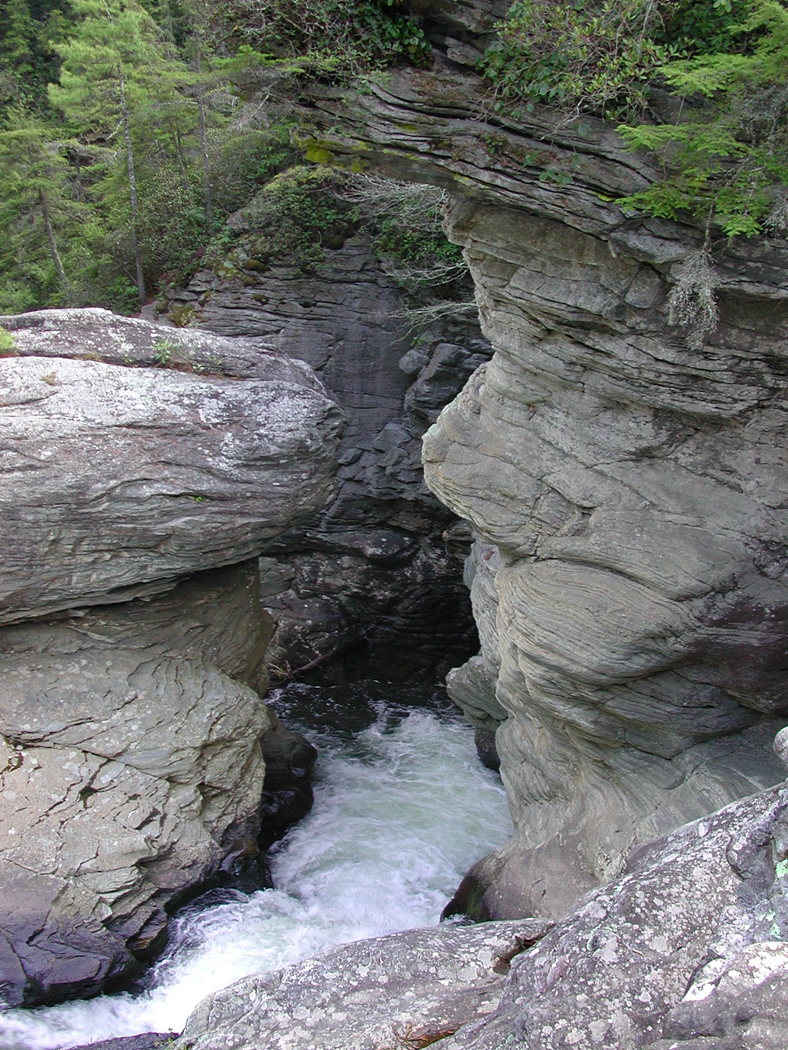
Then we followed a spongy, loamy footpath under the hickories and oaks toward the distant roar of the waterfall on North Carolina’s Linville River. No one was there but us, and we picnicked on the rocks over the crashing water. The upper falls are a broad, shallow drop, but at the lower falls, the quartzite pulls tight, constricting the river and forcing it down a spiraling chute that drops over the edge of the cliff and down 75 feet to the river and Linville Gorge.

Linville Falls 03

It is an impressive torrent with a basso profundo roar, and nothing will ever change the way it seemed to me that day, as I leaped over rocks, crossing the white water to the other shore so I could climb on the gnarled rock to see down the waterway.

I’ve been back many times over the years. The National Park Service built a paved road from the Blue Ridge Parkway, making it easier to find. Then they paved the parking lot and built a pedestrian bridge over the river upstream from the falls.

The last time I went back, there was a visitor’s center and a souvenir shop and a parade of vacationers trotting down the path to the fenced-in overlook. The falls are just as impressive, but the experience isn’t.

If I speed up those 40 years in my head like time-lapse photography, I can see time take shape. It builds and it destroys in a constant rise and fall like an ocean tide.

And what comes in, ebbs.

Linville trillium

A few years ago, my wife and I visited another familiar site, on Old Route 16, a dirt road that drops down the side of the Blue Ridge toward North Wilkesboro. When we lived in the mountains, we used to visit an abandoned farm along the road, halfway down the mountain face.

There was a clearing in the wood and an old wooden house with a broad porch that looked out over the steep valley below. Above us was the spot ominously known as the ”Jumpin’-Off Place.”

We could picnic on the porch with the bluebird and tanager singing in front of us, the buzz of insects all around and the gentle breeze rattling the grass in the field.

It had been 14 years since we visited that farmhouse, and we thought we should see what had become of it.

About three miles down the old dirt road, we passed where it should have been, but there was no break in the forest, no open field. We couldn’t find the house. We kept driving, hoping we’d find something that looked familiar, but we didn’t. Finally we stopped the car where the farm should have been and walked deep into the woods.

Buried a hundred yards into the tangle of maple trees was a naked standing chimney, completely eaten up by brush and undergrowth.

When I climbed down the hill toward it, I discovered the forest floor was spongy with rotten boards, completely collapsed in on themselves, with a few nail heads showing.

In the 14 years since we last visited, the old house had been completely digested by the woods, leaving only the indigestible brickwork of the twin-sided chimney.

And the once-glorious view of the declivity was now completely obscured by trees and brush. Instead of a vacant field overgrown, the house was survived only by complete woods.

In 14 years.

Nature can reclaim an entire farm in 14 years and leave nothing behind but the masonry. And that won’t last much longer.

Linville Gorge1

manzanar

My attraction to Manzanar was initially artistic, not political.

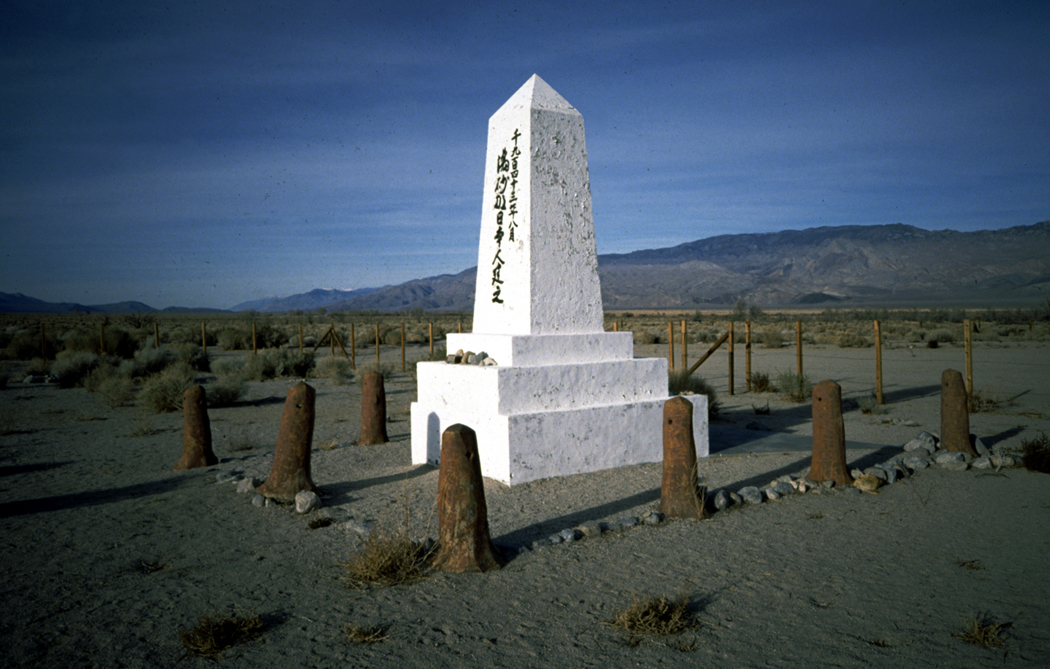
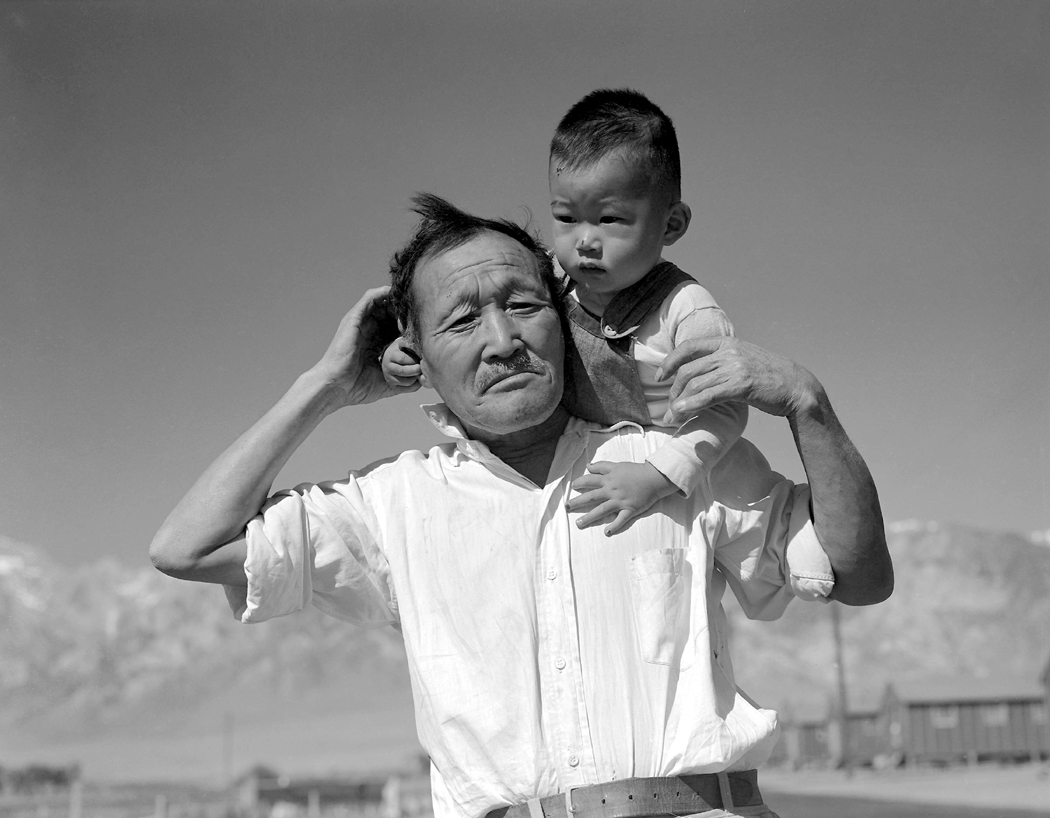
The 500-acre site in California’s Owens Valley on the eastern slope of the Sierra Nevada is now a dusty spot of desert under the snow-capped peaks, but in 1943 it was home to 10,000 Japanese-Americans detained under federal order in a concentration camp built there, one of 10 such camps in the American West.

That year, it was visited by photographer Ansel Adams, who was invited to make a series of photographs of camp life. I had seen prints of those photographs while doing research at the Library of Congress, where they are stored, and had long wondered about the place.
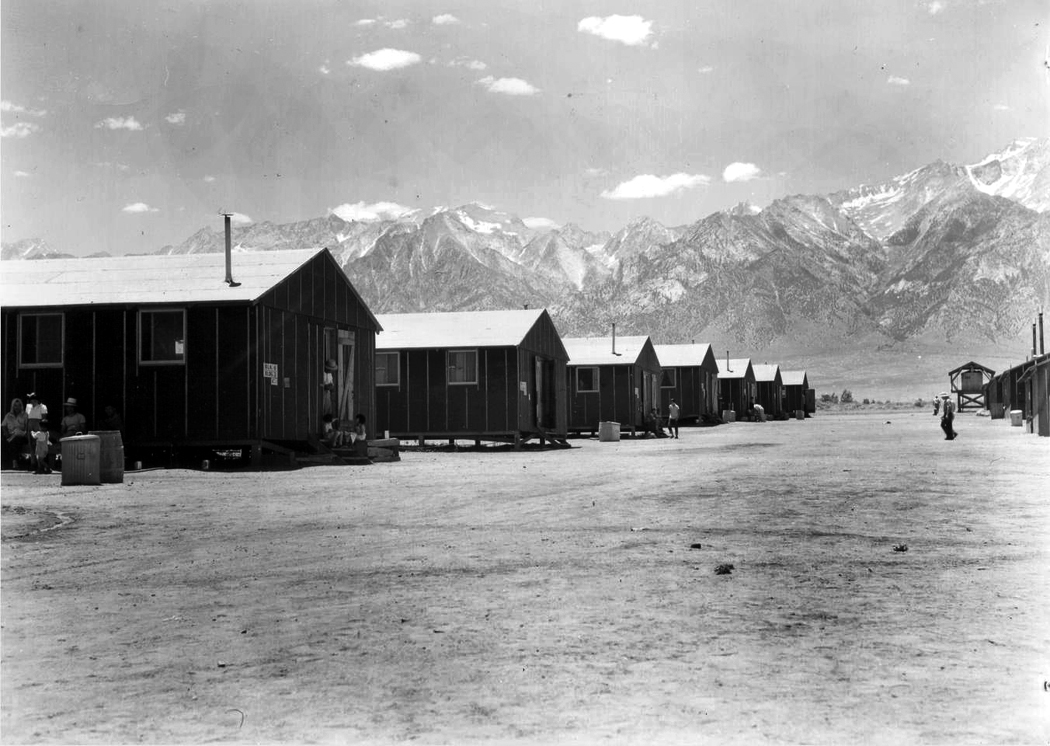
”My first impression of Manzanar,” Adams wrote in his autobiography, ”was of a dry plain on which appeared a flat rectangular layout of shacks, ringed with towering mountains. … row upon row of black tar-paper shacks only somewhat softened by the occasional greenery.”

manzanar barracks

Most of the photographs he made are of the people, their homes and the social lives they maintained under impossible circumstances. But he also found something redemptive in the landscape.

”I have been accused of sentimental conjecture when I suggest that the beauty of the natural scene stimulated the people in the camp. No other relocation center could match Manzanar in this respect, and many of the people spoke to me of these qualities and their thankfulness for them,” he wrote.

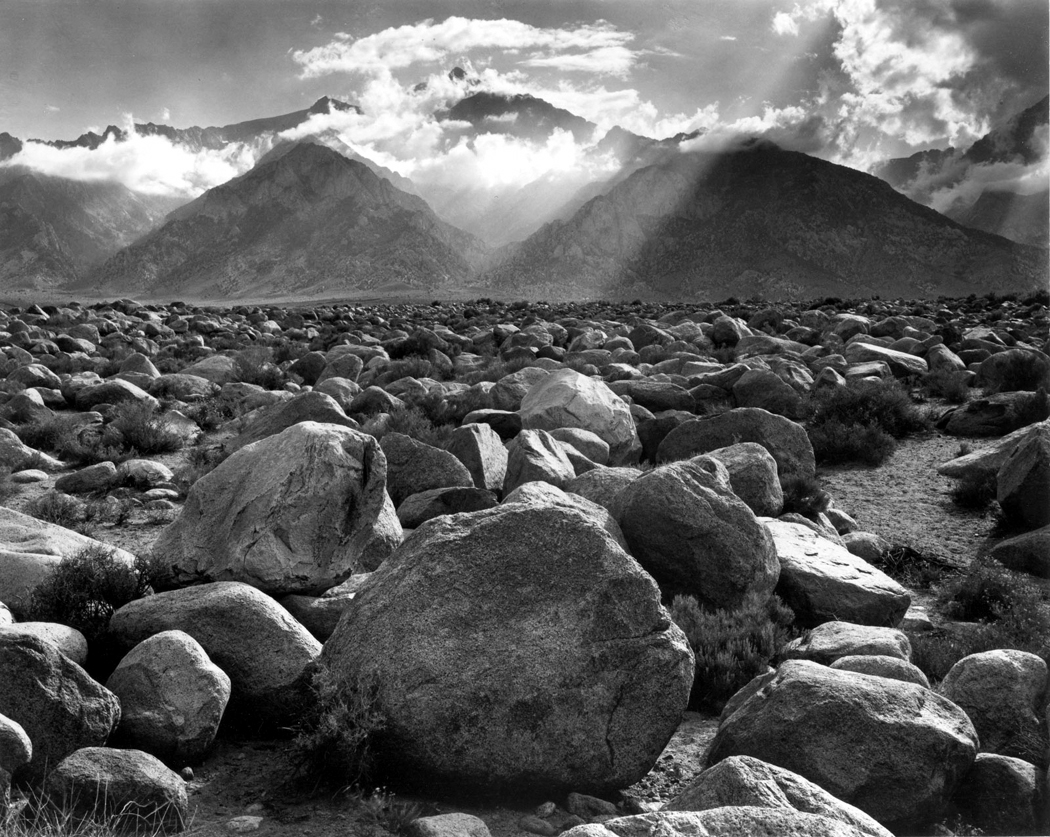
And the single most famous image from Adams’ time in the camp is his Mount Williamson, Sierra Nevada, from Manzanar, California. It was prominently featured in the Museum of Modern Art show ”The Family of Man” in the 1950s, with its foreground of gargantuan boulders and background of sunlight breaking through a storm over the mountain peak. If ever there was a photograph meant to evoke the spiritual power of landscape, this is it.

manzanar mt williamson

So I was drawn to Manzanar to see the land. Certainly nothing was left of the camp, I was certain.

And the only thing that gives away the location of the camp is a stone sentry booth off the side of U.S. 395 about 15 miles north of Lone Pine. Behind it, all you see at first glance is gravel, dry grass, mesquite trees and clumps of datura wobbling their coarse white lace in the breeze.

But as soon as you drive into the camp and crawl along the old dirt roads, you discover what the decades have tried to obscure: flat concrete foundations of barracks, some weathered lumber littering the ground and the odd sight of water-system standpipes poking up like leafless shrubbery in the emptiness.

Walking through the old foundations, you discover broken bits of dinner plates and an occasional fork with its tines splayed. In one plaza area between the concrete ruins, there was a 5-foot mound of earth ringed with stones. It had been a Japanese rock garden built by the internees.

Above the camp, Mount Williamson still looks impressive although nothing in nature ever looks quite so impressive as it does in Adams’ prints.

And the reality of American politics is sometimes less impressive than it looks in the Constitution. Here in Manzanar, American citizens were locked up for no reason but their race.

When Adams published a book, Born Free and Equal, of his Manzanar photographs in 1944, copies were actually burned by what Adams called ”reactionary groups with racial phobias and commercial interests” who questioned his loyalty and patriotism.

manzanar father and son

I became adult as the Vietnam War raged both here and in Asia, and I recall many of the same sentiments expressed then.

And as I left the camp, I poked through the sentry booth, which is filled with 50 years’ worth of graffiti, most of it in Japanese and left by those who were detained there and now by their descendants, who often come back to visit.

A young Japanese man pulled up on his Kawasaki while I was there and started photographing the booth interior. He spoke almost no English, but when I asked him if he could translate the words, he told me that most were names.

I pointed to one set of characters carved into the woodwork around a window, and he told me it was the Japanese transliteration of the name Clark.

In 1992 Congress designated Manzanar as a National Historic Site. It was the 50th anniversary of Franklin Roosevelt’s executive order authorizing the internment.

John Burroughs at Slabsides

John Burroughs at Slabsides

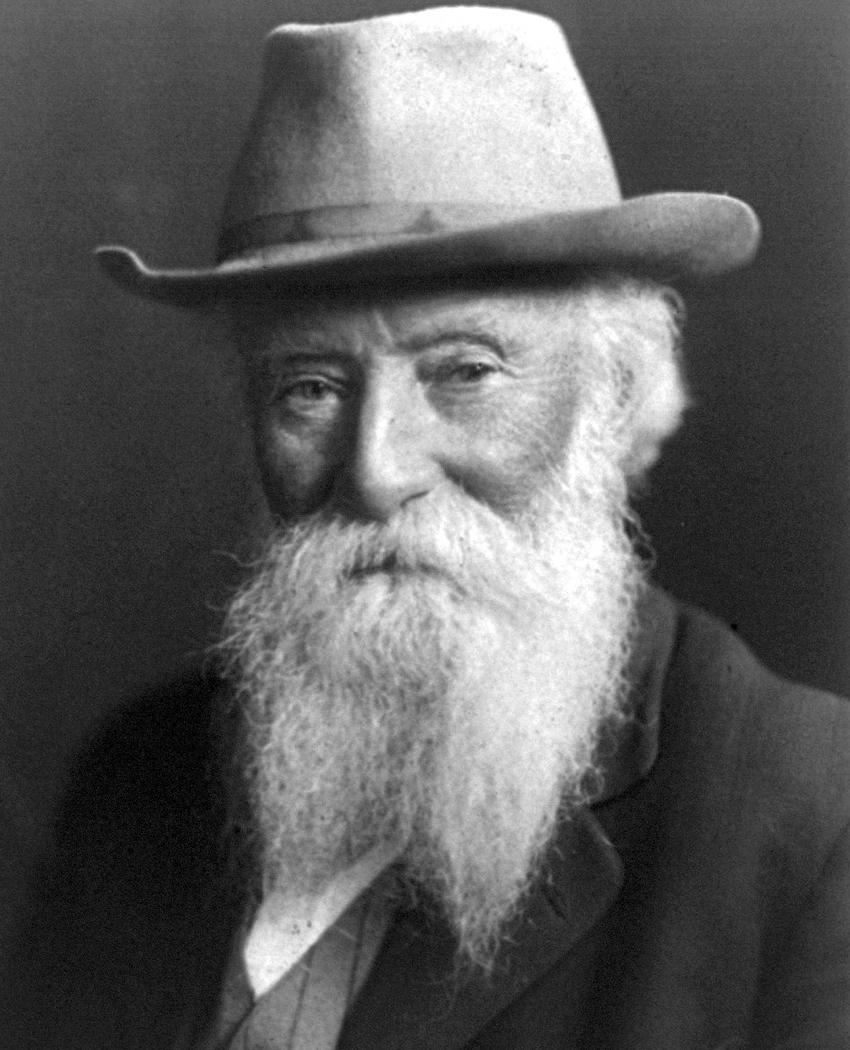
I doubt if you’ve ever heard of John Burroughs.

He died as an old, old whitebeard in 1921. Not many people now alive recognize his name.

But between the Civil War and his death, Burroughs was the most popular and respected writer in America on natural subjects.

His 23 volumes of essays sold millions of copies for his publisher, Houghton Mifflin. They sold in such profusion, in such a variety of formats, that they can still be found fairly easily in used-book stores. Many also remain in print.

I mention Burroughs because we share a connection, although I didn’t know it until a few years ago. Actually, what we share is a place: West Park, N.Y.

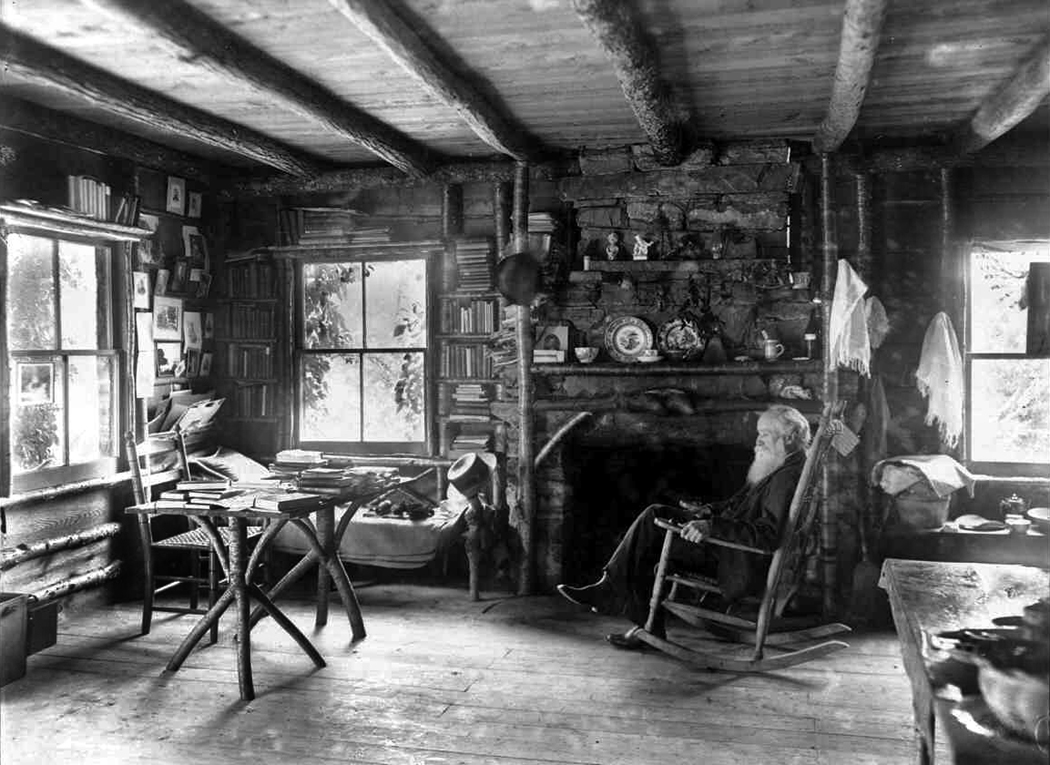
It is a tiny community on the western shore of the Hudson River, midway between Poughkeepsie and Kingston. It was there that Burroughs spent his adult life in a slate farmhouse he built called Riverby, on the Hudson, and a rustic cabin called Slabsides a mile back in the woods.


Slabsides

Slabsides

And it is in West Park that my grandparents had an even more rustic vacation bungalow with no name at all a hundred yards up a stony driveway in the woods.

Our bungalow was built in 1916. My grandfather worked in the Hoboken shipyards and had constructed it himself from wood salvaged from a burned ship.

The bungalow was primitive by any standards. There was no plumbing, no insulation and no room.

When they spent summers there before World War II, grandmother and six children slept, ate and lived in three tiny rooms and a screened-in porch. At the end of the school year, the seven rode the train from Fort Lee, N.J., to West Park and walked, carrying all their baggage, the two miles to the bungalow. Grandfather took the train up on weekends.

They bought their milk fresh from the cow at Vandewater’s farm over the hill and got their mail at the post office by the train station. When I was a boy, the postmaster was Mrs. Ackert. She was a very round woman and I remember the rhyme: ”Sweet Mrs. Ackert / is as wide as a Packard.”

The main road in West Park was named for her son, Floyd, who was killed in World War II.

After the war, with the six children grown, they would all continue to spend time in West Park, now with their own children.

My parents, aunts and uncles were less ecstatic about cramming up to 20 people in less than 200 square feet, less enthusiastic about using the ”two-seater” down the path in the back yard, less than happy about having to walk up the road to the pump for water.

And then there were the mosquitoes, as large as hailstones and just as stinging.

But even the adults loved the chance to do some fishing or go swimming in Charlie’s Lake on Black Creek, with its cascading waterfall down the slabs of rock by Valli Road.


Swimming hole

Swimming hole

Growing up as I did in suburban New Jersey, West Park was my introduction to nature: The lake was not a concrete-bottom swimming pool, and the little fish nips that you would get while swimming were reminders that nature is wild and unruly.

The loam underfoot was springy, the rocks covered with lichens and the underbrush thick as bird nests. The wood thrush sang in the trees and perch jumped in the lake.

These same birds and fish, the same spongy soil were written about nearly a century earlier by Burroughs.

”Life has a different flavor here,” he wrote in Wild Life About My Cabin. ”It is reduced to simpler terms; its complex equations all disappear.”

Instead, around his Slabsides grew the saxifrage, wood aster and witch hazel. He heard the whistle of the pewee and dry scratch of the cicada.

Slabsides was named for the slabs it was shingled with.

”A slab is the first cut from the log,” he wrote, ”and the bark goes with it. It is like the first cut from the loaf, which we call the crust, and which the children reject, but which we older ones often prefer. I wanted to take a fresh cut of life — something that had the bark on.”

Burroughs’ prose is leisurely; it breathes. It was certainly more popular with its Victorian reader than it would be now for a generation of short attention spans. But give him his space and his writing is still worth reading. It is detailed and humane; it gives a flavor and a sense of the place.


Burroughs fishing

Burroughs fishing

He was also surprisingly modern. In fact, I don’t know how he managed to be so popular in pious Victorian America. He had little use for the pat moral or anthropomorphic Disneyfication of nature. He was no Aesop.

Indeed the biggest controversy of his career was over an article he wrote excoriating the cute but popular ”nature fakers” who made up mawkish animal stories.

And unlike Henry Thoreau, for whom all nature was a metaphor, Burroughs wrote, ”The universe is no more a temple than it is a brothel or a library.”

John Burroughs

John Burroughs

He had a scientist’s sensibility, brooked no sentimentality and was as close as you could be to an atheist in 19th-century America. Several of his essays take organized religion to task. This doesn’t seem like the route to popularity in the time of Ella Wheeler Wilcox and James Whitcomb Riley.

He did not see any need for a providence that took interest in his life. Rather, he took great comfort in the impersonality of the beauty around him. ”I love nature, even if it does not love me,” he said.
Slabsides and the land around it is now a nature sanctuary and open to the public. His farmhouse, Riverby, is slowly falling into disrepair, and Burroughs’ vineyard is grown-over.

Our own bungalow is now long gone from the family. But I still visit West Park every time I drive to the East. Now I make the trip to visit Slabsides and slap the mosquitoes there.

”The American West was not only a land of new beginnings, it was also one of bad endings.”

— Albert Castel, historian

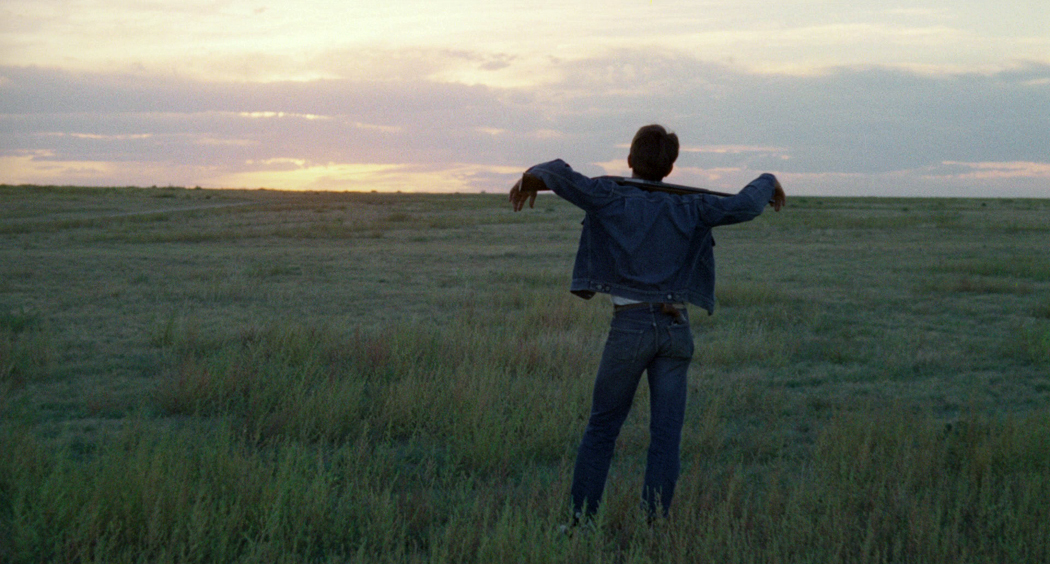
"Badlands"

“Badlands”

People talk about the ”Myth of the West,” yet there are really two myths.

The old Western myth was that of the cowboys and Indians. It was the myth of Manifest Destiny, of expansion, growth and nation building.

The old myth was optimistic. It gave us wide-open spaces in which anything was possible and in which a civilization could be created. It was a myth in which a single determined man could make a difference.

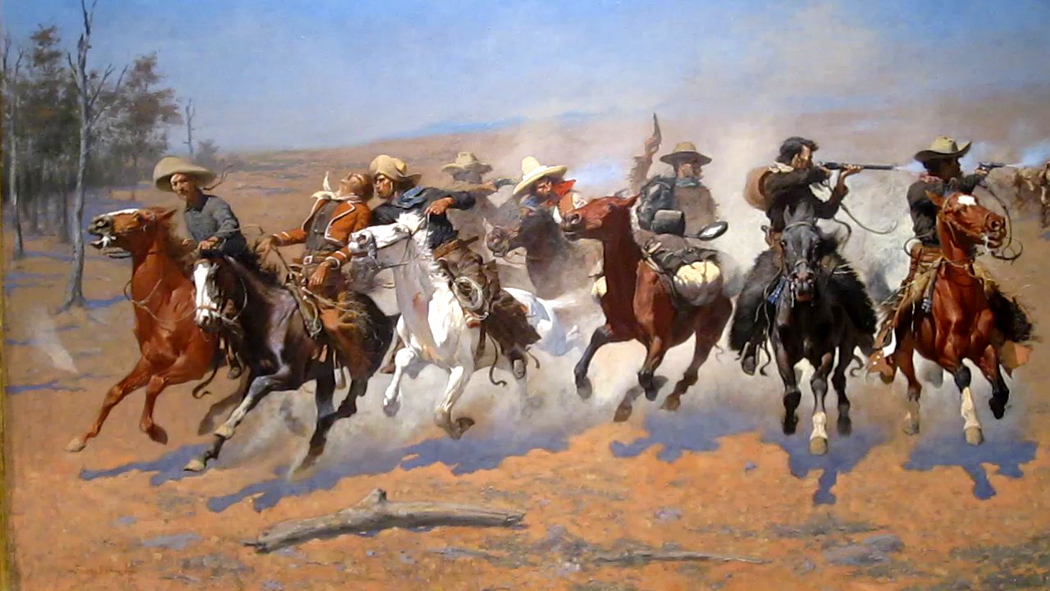
It is the myth represented in Randolph Scott Westerns, Frederic Remington paintings — and all its sad modern-day imitators — and even the common rhetoric of patriotic politicians.

Frederic Remington, "Dash for the Timbers"

Frederic Remington, “Dash for the Timbers”

But there has grown a second myth, a yin to the former yang: the modern myth of the Great Plains as an existential hell where the flatness of the wide-open spaces closes in on you, offering no options. It is dry, dusty, vacant and soulless. In it, no one has a future and there is no escape.

Neither of these myths is necessarily true, but each has developed an aesthetic tradition around it. The new myth became dominant after the Second World War: In mass culture it gave us spaghetti Westerns, TV’s adult Westerns and Sam Peckinpah.

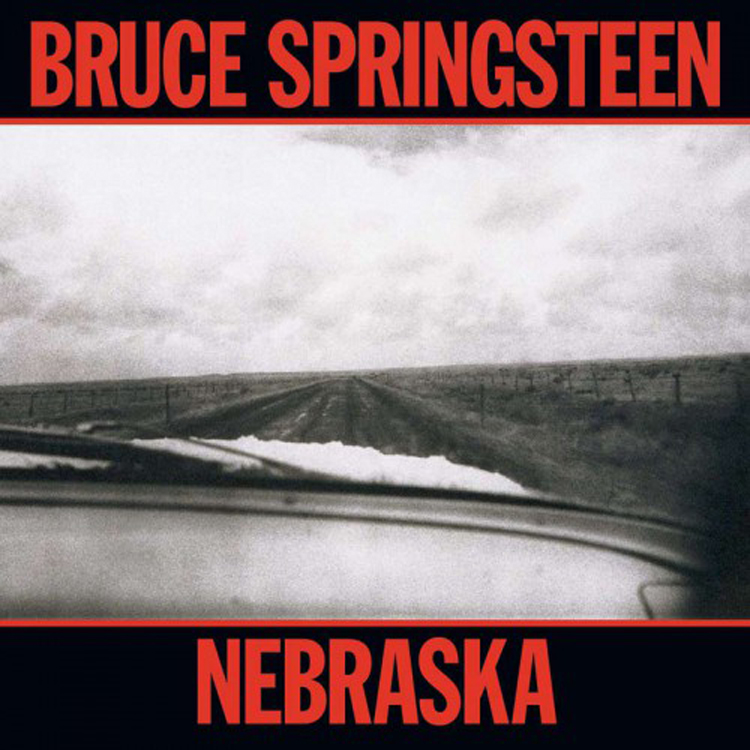
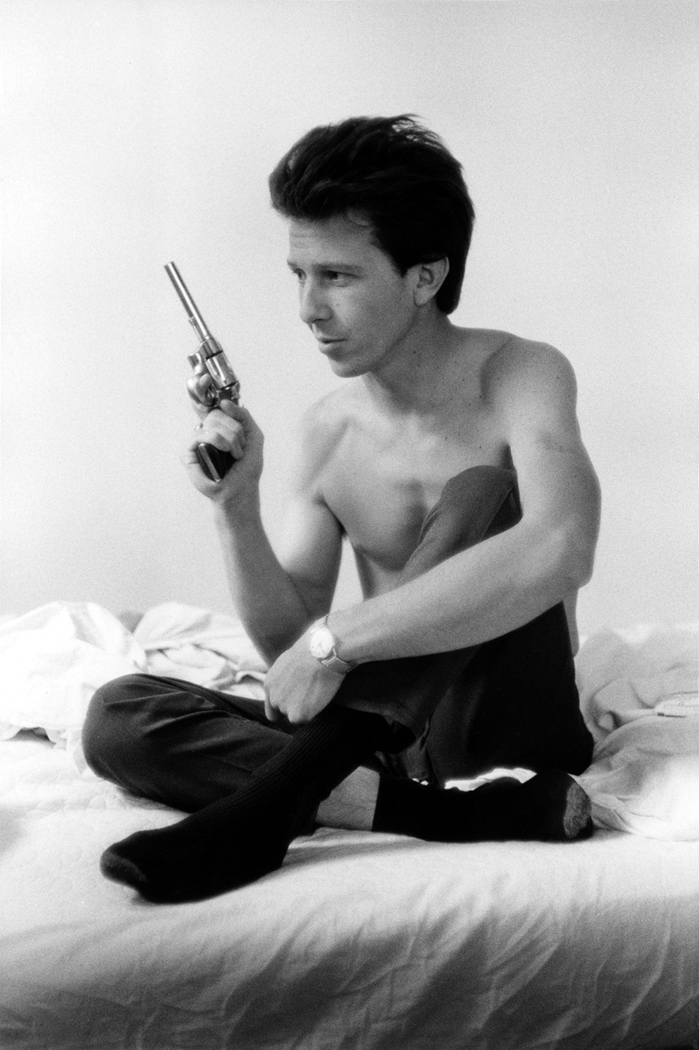
On a higher aesthetic plane it is the raw emptiness of Terrence Malick’s Badlands, the Kansas of Truman Capote’s In Cold Blood. It is the theme of the Bruce Springsteen album, Nebraska, and the place where Larry Clark took the photos in his legendary book Tulsa, with its drug addicts and domestic violence.

springsteen nebraska

In this pessimistic West, we want redemption, and there is none to be had.

”Well, sir, I guess there’s just a meanness in this world,” Springsteen sings.

It is a landscape populated by incipient Charles Starkweathers and Richard Hickockses, people who work in dead-end mill jobs and meet each night after work in filthy dives for beer and fistfights.

They are a generation with no purpose in life, no reason for living past the next cigarette and Budweiser, drunk from a quart bottle with the screw-top thrown on the floor.

It is a world of incredible sensory deprivation. The houses they occupy — for they cannot be said to be living in them — have no pictures on the walls. The furniture is from Goodwill and the blank eye of the television is the center of the room.

Their eyes are as dead as ball bearings.

They have no inner lives, and the only way they can express themselves is with a knife or a penis.

Larry Clark, "Tulsa"

Larry Clark, “Tulsa”

The Old West was a landscape in which all things were possible; the new, affectless West is where all things are permitted.

You can see the new mythology building in the Eisenhower years. All the optimism of the new suburbs was subverted in the photographs of Robert Frank, whose book The Americans was published in 1958.

In that book, a disturbing underside of American chamber-of-commerce idealism was pictured. Frank’s photographs are populated with poverty, desperation, brutishness and lonesome highways leading nowhere.

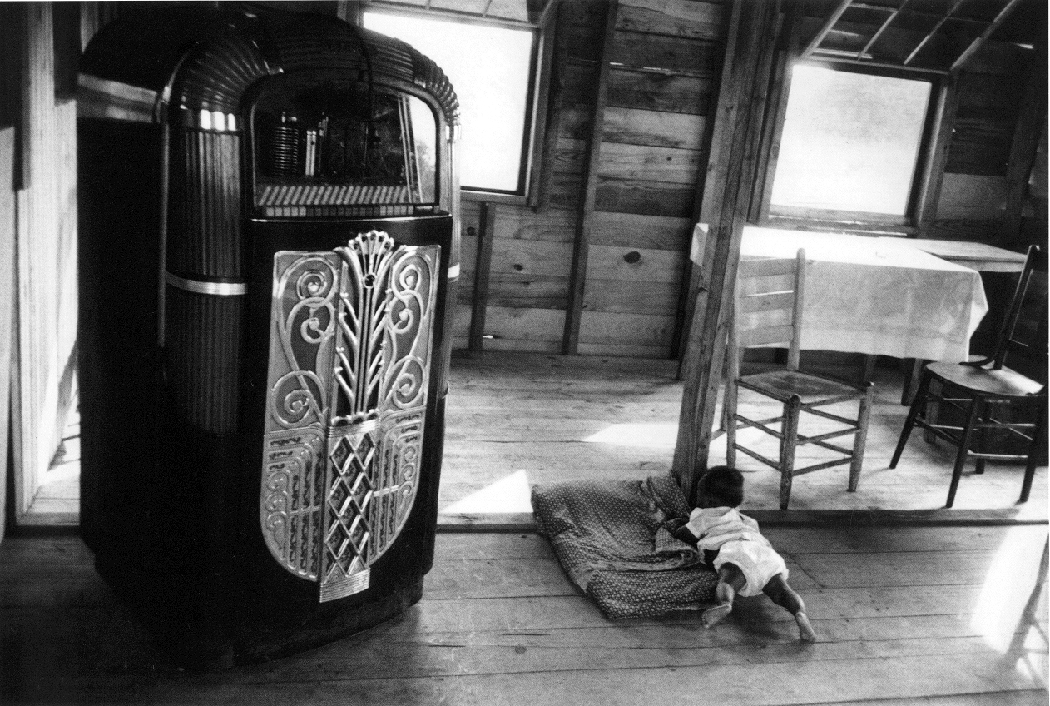
In the book, the only divinity is the glare from the jukebox.

frank jukebox with baby

Frank’s off-the-cuff style was a revelation in the stylized, artificial ’50s of Richard Avedon and Irving Penn.

Avedon himself later used this second Western myth in his powerful book The American West. It was roundly criticized when it came out for its alleged ”West bashing,” but the photographs were as honest and direct as they could be. You can see any of the people in them walking the streets of Phoenix or Albuquerque on any given day.

avedon

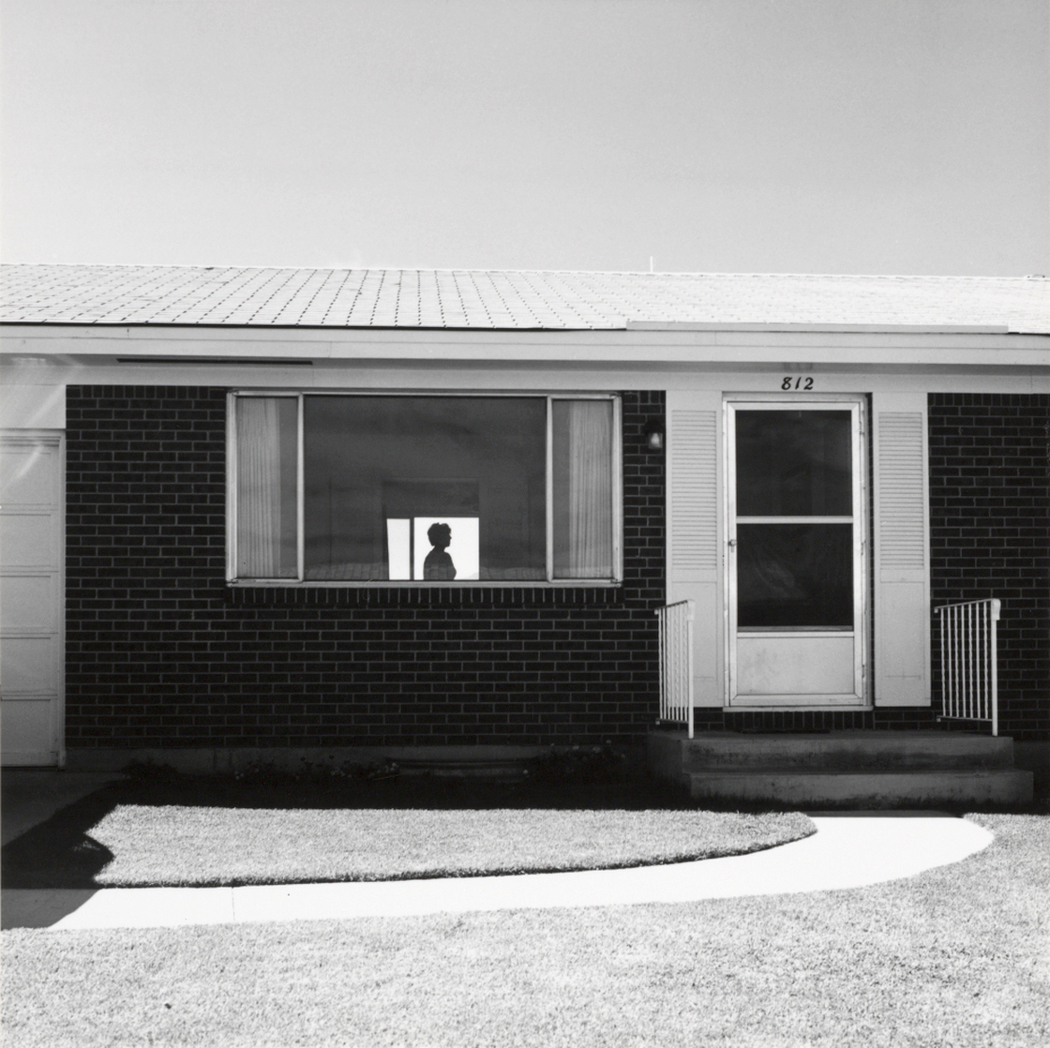
The old myth shines from the images of Ansel Adams; the new, bleaker myth informs the photos of Robert Adams, Frank Gohlke, Lewis Baltz and Richard Misrach.

Robert Adams, "Colorado Springs, Colo. 1968"

Robert Adams, “Colorado Springs, Colo. 1968”

Those who have a romantic notion of America’s Beat generation have not really paid attention to Jack Kerouac’s On the Road, for it is a book about this second Western myth. Instead of a panegyric to youth and poetry, it is really an elegy to spiritual emptiness and hunger.

The book is the prose equivalent of Frank’s pictures. Indeed, Kerouac wrote the introduction to The Americans when it was published.

Clark’s Tulsa fills out the image with dirty heroin needles and pregnant girlfriends with black eyes.

Malick made the landscape beautiful in his film Badlands, but he filled the film with senseless, ugly violence.

It is a Hobbesian world: nasty, brutish and short.

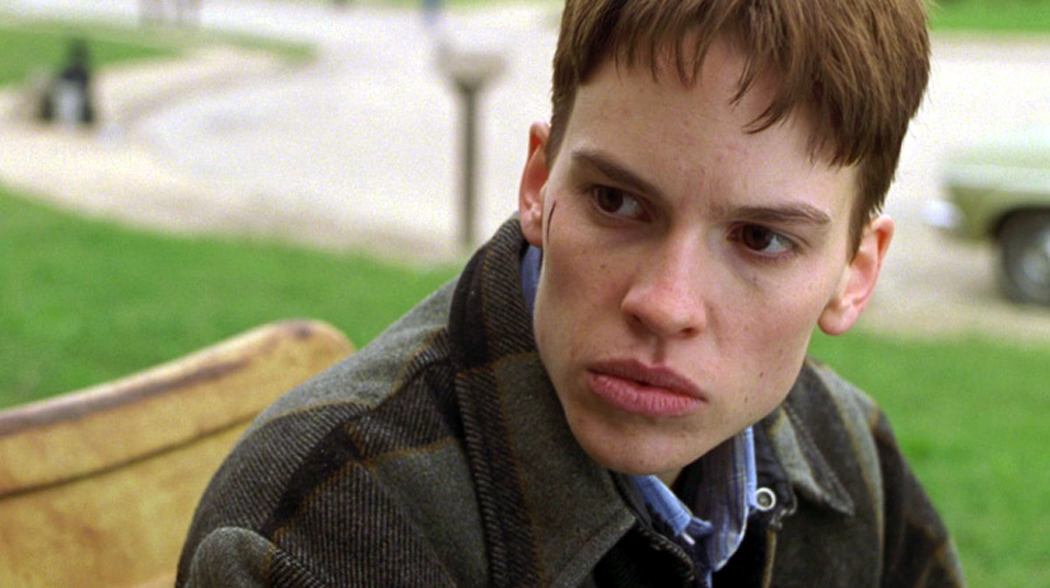
It’s there in director Kimberly Peirce’s desolate film, Boys Don’t Cry.

"Boys Don't Cry"

“Boys Don’t Cry”

Yet, the film does imply an answer. And it is found in the landscape itself.

Peirce periodically interrupts the action with stop-motion footage of the Nebraska sky both day and night. In the day, the clouds speed across the face of the blankness; at night, the cars speeding down the highways make smears of light along the bottom of the picture while the stars spiral across the blue-blackness.

The lives portrayed in Boys Don’t Cry are squalid at best, but your heart breaks to see such smallness lived out in a landscape so sublimely vast.

So many scenes in the film are shot at night, where the tiny area of land illuminated by a car’s headlights is a metaphor for the limited vision of the landscape’s inhabitants.

Ultimately, the new Western myth is one of disappointment, that, as the gnostic gospel of Thomas says: ”The kingdom of God is spread out before us, and yet men do not see it.”