Archive

Tag Archives: books

A Facebook friend left a challenge for her followers: 

“In a text post, list 10 books that have stayed with you in some way. Don’t take but a few minutes, and don’t think too hard — they don’t have to be the “right” or “great” works, just the ones that have touched you. Tag ten friends, including me, so I’ll see your list.”

birds

This is about two very unpleasant men and a third about whom I know little except his work and talent. I learned from all three.

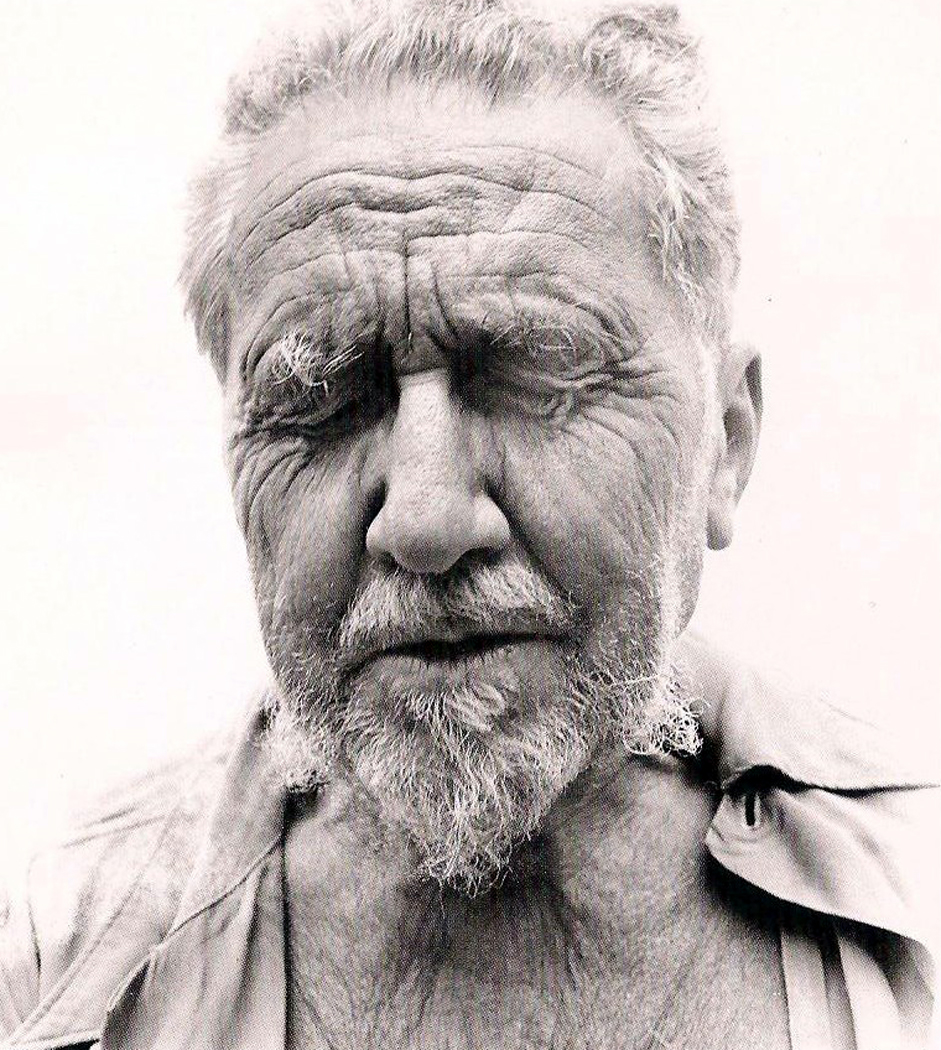
Old EzThe first is Ezra Pound, a vile anti-semite and spouter of crackpot economic and political — to say nothing of conspiracy — theories. He also wrote some profoundly beautiful verse. When I was in college, I pored over his Personae, the collection of his shorter poems. But that is not why he makes this list. I read a lot of wonderful poetry by lots of excellent poets.

The one thing you have to say about Pound is that he knows a lot of stuff. And as he got older, more and more of that stuff became the upholstery of his writing — cushion stuffing, basically. Pound couldn’t help writing about what he knew — or rather what he had read about. It is very literary knowledge and you wonder if he ever looked around him to see the street traffic or the overcoats his fellow pedestrians were wearing against the winter. Instead, his head is stuck in the world of Procne and Philomela, that of Greek classical culture, Renaissance finance, the historical concepts of founding fathers and Provencal verse forms.

I mention Procne and Philomela for a reason. In his early poetry, any reference to nature comes in the form of a literary reference. Hence nightingales and doves. In the myth, Procne was turned into a swallow and her sister into a nightingale. In Pound, owls are Athena and eagles are imperial. One gets used to this as one gets used to the scenic flats in a stage set. pound mugshot

But then, after the war, when Pound, who had been making rather silly anti-American radio broadcasts for il Duce, was arrested and imprisoned as a traitor in a POW camp in Pisa, his poetry begins to crack, much like he cracked mentally. The Pisan Cantos, for which he won the Bollingen Prize for poetry in 1948, has its share of remembered, misremembered and half-remembered arcana, but throughout the many sections of the book, moments pop through where you are suddenly out of the dusty library of his brain and in a cage in Pisa, noticing actual weather and actual birds.

“4 birds on 3 wires, one bird on one”

And you see them, black notes on a musical staff. The world begins to break through the battlements of book learning. Air ventilates the stony cell of his brain.

“The Pisan clouds are undoubtedly various

and splendid as any I have seen since

at Scudder’s Falls on the Schuylkill

by which stream I seem to recall a feller

settin’ in a rudimentary shack doin’ nawthin’

not fishin’, just watchin’ the water,

a man of about forty-five

nothing counts save the quality of the affection”

At several points he notices small but very real details:

“That butterfly has gone out thru my smoke hole.”

And you weep to know that buried under all that pointless erudition — an erudition that is a deflection of experience — there is a genuine human soul who might have been truly great. Cantos

The final fragments of Cantos speak of his dawning understanding of what he has failed to grasp.

“Let the gods forgive what I

have made

Let those I love try to forgive

what I have made”

These are the final words of his Cantos, and your heart breaks. And you remember the quote from Henry Miller: “What is not in the open street is false, derived, that is to say, literature.”

Literature is nice, but living one’s life in the actual weather wearing actual galoshes is more to the point.

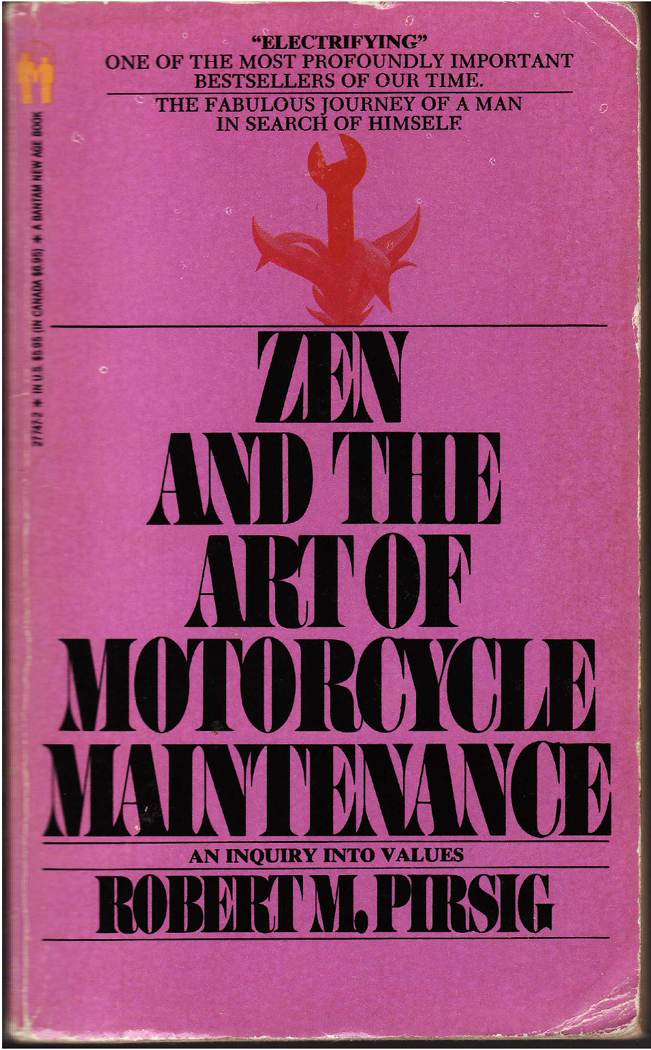
The relationship between brain and book is explored in the next book — which has the most unfortunate title since the now out-of-print Design of Active-Site Directed Irreversible Enzyme Inhibitors: ZenbookIt is Robert Pirsig’s Zen and the Art of Motorcycle Maintenance. The title is a faddish one, that practically screams, “I was written in 1974!” The book has nothing meaningful to say about either Zen Buddhism or motorcycles. But it has a lot to say about the central distinction between nouns and verbs as they play out both in our minds and in the world before us.

Pirsig makes no attempt to be likable. He is spiny, querulous, bossy, pedantic, and exhibits some of the anempathetic qualities of Asberger syndrome. Yet, he is unquestionably brilliant.

He uses Plato’s dialog, Phaedrus, to examine what he calls “Quality,” which he defines in an entirely idiosyncratic way, essentially remaking the word entirely. Pirsig

“Quality is not a thing. It is an event.”

That is, a verb, not a noun. It is one’s engagement with the world in the instantaneous present, before anything is named or understood.

The book slowly builds to this understanding as Pirsig takes a motorcycle trip with his son. The tour is interrupted by long stretches of philosophical discussion taking us into the issues of perception.

“Any intellectually conceived object is always in the past, and therefore unreal.” When you have experienced something and given it a name, it is already over. That unintellectualized instant of engagement is an active boiling; anything after it is already a snapshot looked at in leisure.

And we tend to fit what we experience into the patterns of the snapshots we already have in our photo album. As I have said many times, “What you know prevents learning.”

The climax of the book, for me, comes when Pirsig makes the leap from this to the words of the Tao Te Ching of Lao Tzu, and suddenly, the odd, incomprehensible language of that Chinese classic pops into palpable reality: “The name that can be named is not the absolute name.” Pirsig substitutes his odd definition of “quality:” “Fathomless! Like the fountainhead of all things …  Yet crystal clear like water it seems to remain.”

I have since substituted the word “beauty” for “quality.” If art seeks beauty, it is in the form of engagement with “the fountainhead of all things,” the precious, unslotted, uncataloged now and its very active nowness. Beauty is the engagement, not the thing: A verb, not a noun.

But language itself can be bypassed. Too many seem to believe that thought comes in words. It may do so, but a good deal of thought comes non-verbally. There is visual thinking, aural thinking, spatial thinking, temporal thinking. You cannot verbally engage your brain with a pitcher’s slider and hope to connect with the bat. The thinking involved is completely non-verbal.artur schnabel

Music is the great cultural means of making an argument over time without words, and you cannot get a better example of this than Beethoven’s piano sonatas.

Of all the things I learned at college, the one I am most grateful for is the ability to read musical scores. I collect scores — Eulenberg and Kalmus miniatures — the same as language books, and read them with much pleasure. If you are on an airplane and try to listen to music through headphones, all you get is static drowned in jet noise. But if you bring along the score, say, to Beethoven’s Seventh Symphony, you can read it and hear it in your head and the jet noise disappears.

And no score has meant more to me than Artur Schnabel’s edition of Beethoven’s sonatas. The notes sit on the pages like Pound’s blackbirds on their wires and sing their song. schnabel edition score

Schnabel is a micromanager as an editor, and many pages have more footnotes than musical notes. But he was one of the greatest performers of this music ever — his recordings of the complete set, made in the 1930s, is still in print and has never been superseded, even as technology has progressed. And his insight into the music, expressed in those footnotes, is always enlightening. I have gone through those two volumes of sonatas many, many times, always with profound enjoyment and growing depth.

I cannot imagine my library without them.

NEXT: What has fallen by the wayside

A Facebook friend left a challenge for her followers: 

“In a text post, list 10 books that have stayed with you in some way. Don’t take but a few minutes, and don’t think too hard — they don’t have to be the “right” or “great” works, just the ones that have touched you. Tag ten friends, including me, so I’ll see your list.”

Henry Miller horizontal copy

I was now 30 years old and I knew I was going to be a writer. The only problem was that I had not written anything, outside of a few letters to my parents asking for money.

I nevertheless had a firm belief in the isotonic theory of artistic production, which is that the osmotic pressure would eventually reverse: For the time being, I was taking in all the influences — the life reversals, the sufferings, the travel … and the books I read, paintings I looked at and music I heard — and eventually, I would be so full, that it would reverse the flow and it would all come out in an esthetic eructation forced by a kind of intellectual back-pressure. henry miller books

In this, I had a model: As I was reading, as I say, not books but authors, I absorbed through my skin everything written by Henry Miller. He had not had anything meaningful published until he was 40, so I figured I had at least 10 years to make it work out.

Miller helped me another way, too.

Everything I had written had a problem, capsulized by an episode from high school. I had written a play for a drama course I had taken. It was about suicide and it was told — “borrowing” an idea from John Updike’s The Centaur — as a kind of Greek myth. The play was supposed to be performed by the drama class, along with two other plays written by two other pupils, but the school principal banned my play because of its subject matter. I felt crazy proud of being banned. It was a badge of honor. But this pride was quashed considerably by my English teacher, a kindly and intellectual man who managed to see something in me when I was just a lazy C-student. I showed him my play and he said, “Don’t you think perhaps it might be a little too … literary?”

It had never occurred to me that “literary” might be a pejorative.

His kind criticism had little effect on me at the time. I believed that great writing should be literary. In fact, what I was attempting to write was the verbal equivalent of having a stick up my ass. henry miller brassai

But Miller told me “What is not in the open street is false, derived, that is to say, literature.”

And, in the opening pages of Tropic of Cancer, he wrote: “I have no money, no resources, no hopes. I am the happiest man alive. A year ago, six months ago, I thought that I was an artist. I no longer think about it, I am. Everything that was literature has fallen from me. There are no more books to be written, thank God.”

In effect, I gave up wanting to be a writer, and instead needed to write. There is a huge difference. Many young people want to be artists. There is something romantic about the very idea; the issue of having to actually create something seems less germane than the idea of sleeping on a mattress on the floor amid a scruff of unlaundered sheets stained with sex and coffee or perhaps sucking the smoke out of a Gitane. It is all pose.

And all my talk of being a writer was the same kind of pose. joe gould's secret

It came to a head with a letter from one of my college professors who told me to read Joe Gould’s Secret, by Joseph Mitchell. Gould was a Greenwich Village eccentric in the first half of the 20th century who claimed to be writing the compendious oral history of modern life — millions of words that he refused to show anyone, but shared his notes for. Of course, such manuscript never actually existed, but Gould talked a good game.

My professor was warning me that I was in danger of following Gould’s footsteps. I was unemployed and living off the generosity of friends. I needed to put up or shut up. If I was going to write, I needed to write. And it was Miller who showed me the way.

I gave up any thought of being a writer and instead began writing.

But sitting down at — at the time — a small, aqua plastic portable typewriter and pounding out something, anything, was in and of itself a joy. It was liberating. Mostly, it was letters. With no thought of publication, I spewed endless accounts of my days to friends, like William Blake’s Los forming a never-ending chain. It was my apprenticeship. In one month, in March, 1978, I wrote a total of 500 typed pages of letters. henry miller 2 nudes

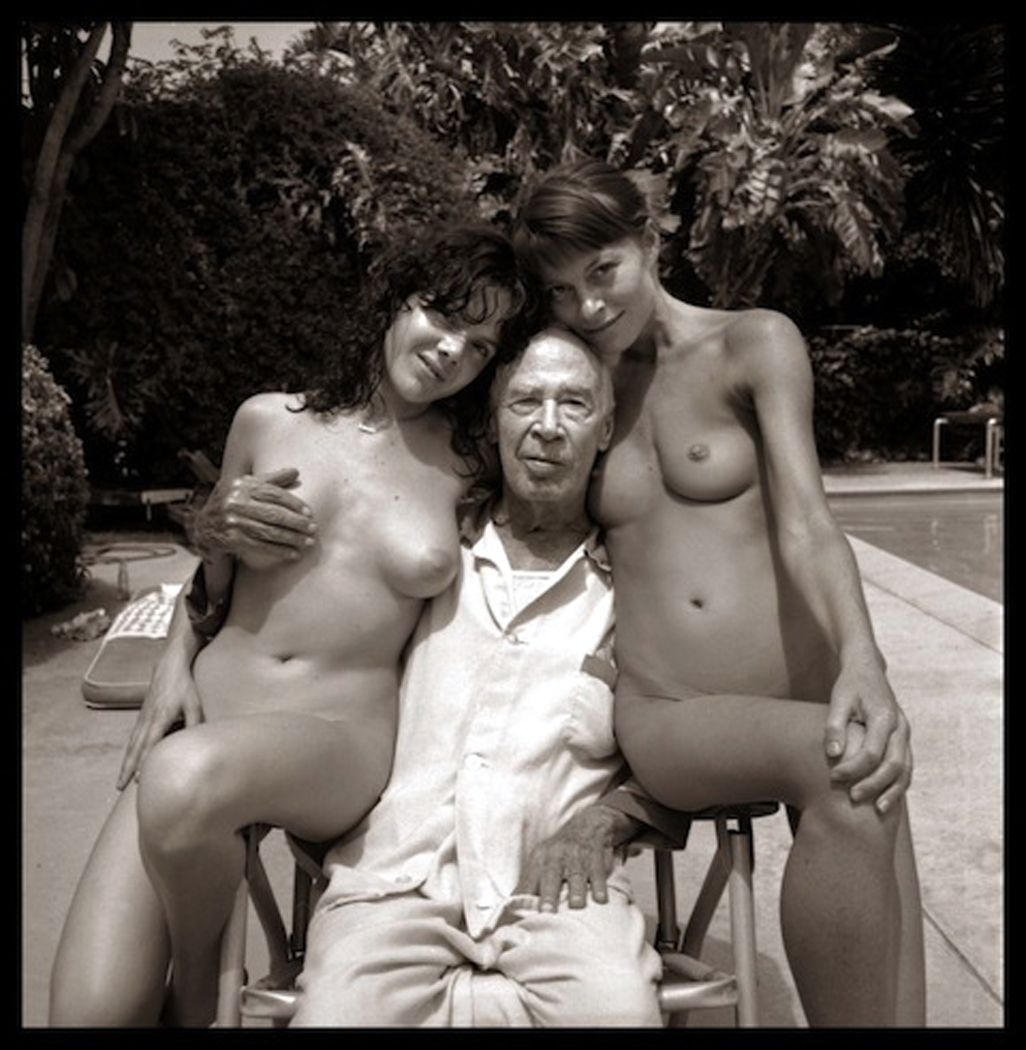
It wasn’t the sex-saturated Miller that I loved. It was his ability to tell a story, one step after another, and his talent for character and caricature. The sex hardly seemed like sex; it was more like a Futurist description of steam pistons chugging and spurting. It was the other Miller that kept me turning pages. I loved Plexus, the large middle volume of his Rosy Crucifixion, with its endless tales of making do in Depression-era Brooklyn and all the dramatis personae that kept him eternally amused, frustrated and filled, like a well drawn from but never emptied.

Mostly it was the torrent of words, piling up. Yes, there were doldrums and I could hardly bear his occasional descent into surrealism — it was like reading an account of someone telling you his dreams, and we all know what a trial that can be.

I read his two trilogies, and all his New Directions anthologies of essays. The only pieces that escaped me were some of the late books put out by small arthouse publishers. It was just too hard to keep track of them.

There is still an entire shelf in my library filled with Miller’s work, although I have moved past them and no longer read them. They are more of an altar to a turning point in my life. They served their purpose for me and for that I am ever grateful.

NEXT: The wilderness years, Part 3 — Diving in

A Facebook friend left a challenge for her followers: 

“In a text post, list 10 books that have stayed with you in some way. Don’t take but a few minutes, and don’t think too hard — they don’t have to be the “right” or “great” works, just the ones that have touched you. Tag ten friends, including me, so I’ll see your list.”

bear after me

It was after college that my real education began.

There was one official marriage of three years and one unofficial marriage of seven. There were also several crash-and-burn episodes of affection and desire before, during and after. There were many jobs, too: sales clerk, grounds crew, substitute teacher, delivery driver, teacher of crime-scene photography, editor of a black weekly newspaper, and year spent working at the Seattle zoo, but also a year and a half spent almost homeless and broke. At one point, I was literally down to two nickels and three pennies.

There was nevertheless much travel, north and south along the East Coast and east-west taking a train cross country. I knew what it like to sit in the smelly back of a Trailways bus watching 2 a.m. passing in Virginia. And there was a summer hiking part of the Appalachian Trail and feasting on Velveeta, Slim Jims, and Tang mixed with Blue Ridge spring water.Doug as pervert 1978

In Seattle, I lived in a house with two lesbian medical students and the world’s most obscene man. When I was broke and moved back to North Carolina, I was taken in by my college best friend, who, with his wife, nurtured me back to something like sanity.

One learns a lot this way, although they are often things you wish you didn’t have to learn.

But there was a parallel education, and that came from endless reading.

The thing about hard knocks and waxing maturity is that the books and the knocks come to be mirror reflections of each other. You learn the answer to the surly, snotty question you probably asked in high school: “Why do I have to read Jane Austen? It has nothing to do with my life.” Or Gatsby, or Dickens. At that callow age, it all seems so irrelevant (outside, say, Catcher in the Rye, which you insert directly into your vein with a needle).

It is as if they are trying to make you learn things you don’t want to learn. (Hint: They are; and hint: You’re an idiot at that age). Richard back porch 1975

But with a few divorces under your belt, and a couple of employers whipping you from pillar to post, and a few miles under your tires, the world opens up and you begin to understand things you blessedly had no clue of.

It is that parallel education, then, I mean to write about. Those books that cascaded through the years in the wilderness. I tore through a lot of books. Frequently unemployed, I had a lot of time on my hands.

And I didn’t just read books; I read authors. I read all of Hawthorne, all of Melville, all of Thoreau. And when I say all, I mean Israel Potter and A Yankee in Canada. Reams of Faulkner, Hemingway and Steinbeck. I couldn’t get enough Wallace Stevens, Pablo Neruda or William Carlos Williams.

A few spoke to me most directly.alexandria quartet

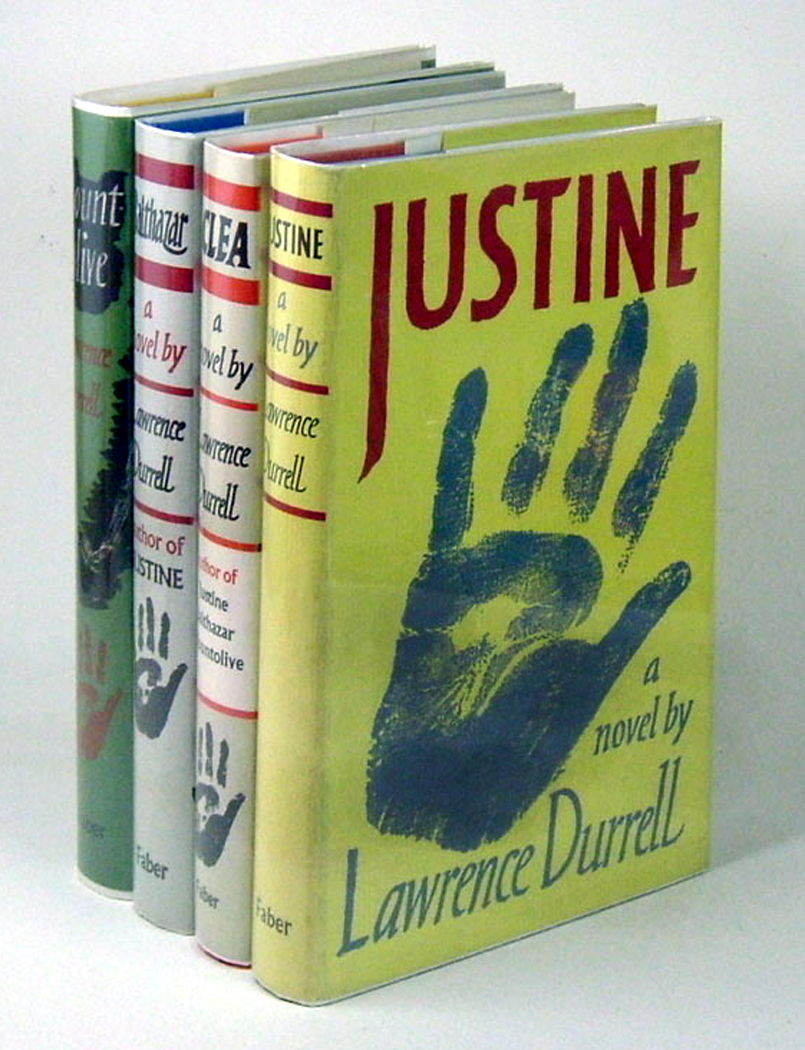
One was Lawrence Durrell’s Alexandria Quartet. You have to be a certain age and in a certain state to take in those four books. I was. Thirty is its age, just as 14 is Salinger’s.

The “trick”of the four books is a kind of Rashomon retelling of the story several times. First through the eyes of a man in love, second from the point of view of a disinterested outsider, and third from an omniscient narrator and each version contradicts the previous and fills in missing information and corrects their misunderstandings and misperceptions. It is a byzantine tale set in a duplicitous ex-pat Egypt before and during World War II. The prose is dense and florid; the plot is even more so, and the characters even more than that. It is a huge pile of musk, perfume and offal.

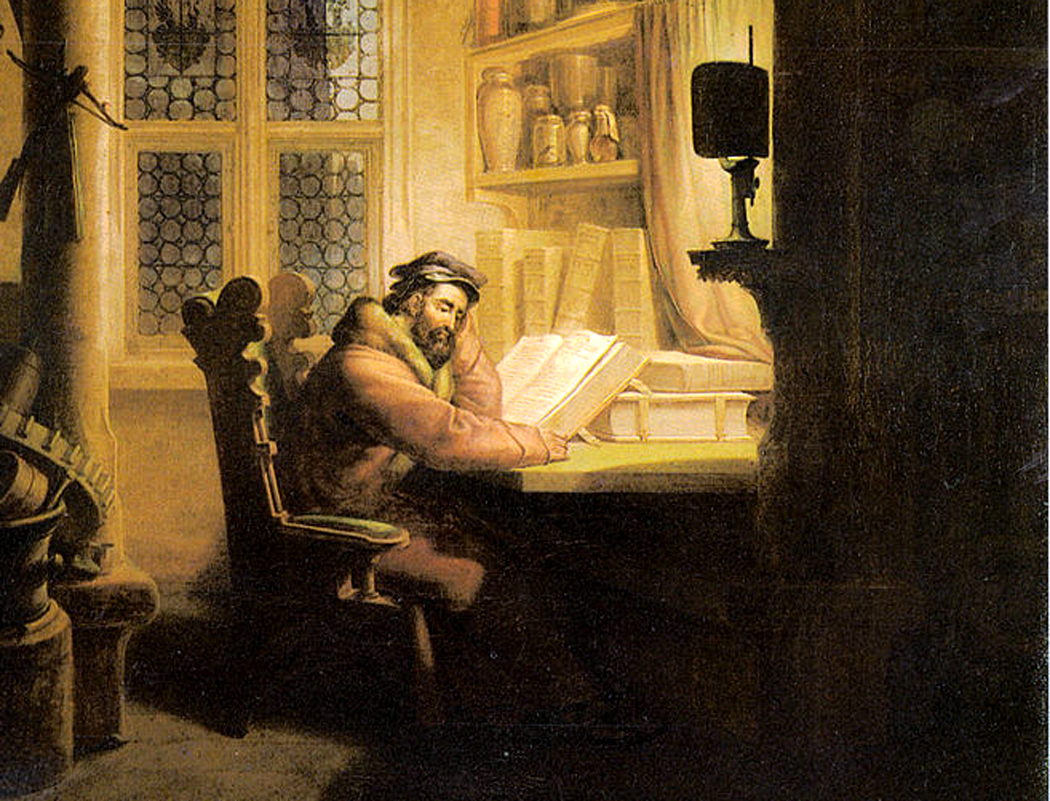
I read it with a dictionary at hand. Durrell rather likes arcane and esoteric words and the list I drew up while reading became a daily vocabulary lesson. Etiolated, pegamoid, ululation, exiguous, exigent, vulpine, objurgations, tenebrous, integument, hebetude, fatidic, pullulation, crepitating, emollient, cachinnation, splenetic, comminatory, plethoric, usufruct, mansuetude, titubating.

The author’s habit leads to such sentences as:  “He has manumitted the colloquial…”

But there is a concomitant grace and directness of balancing sentences, such as: “She took kisses like so many coats of paint.”

It is a baroque style that is meat to only a few. I was hungry for it and the reasons were personal.

I only late found out that the woman I had been living with had had a very active secret life of which I knew nothing. I was as naive as Darley in Justine. I had friends who could have written me a Balthazar, but they didn’t and I fled cross country in exile and in metaphysical pain.

This was a devastating case of literature as a mirror and the face I saw there shamed me. But it also instilled in me a sense of caution, a humility concerning what I think I know and a skepticism for what others think they know.

Balthazar at one point says, “Truth naked and unashamed. That’s a splendid phrase. But we always see her as she seems, never as she is. Each man has his own interpretation.” rules of the game

Or, as Octave says in Jean Renoir’s film, Rules of the Game, “The awful thing about life is this: Everyone has his reasons.”

We almost never know enough to make informed judgments: The truth is always hidden from us and people act from motives we cannot be privy to.

Durrell taught me to be perpetually in a state of tolerant unknowing.

Or at least he reinforced through art the lesson I had been given but perhaps did not fully comprehend. Some lessons come in the form of a ball-peen hammer to the head.

NEXT: Part 2 Wilderness years: A bigger library

A Facebook friend left a challenge for her followers: 

“In a text post, list 10 books that have stayed with you in some way. Don’t take but a few minutes, and don’t think too hard — they don’t have to be the “right” or “great” works, just the ones that have touched you. Tag ten friends, including me, so I’ll see your list.”

guilford 2

College is where the majority of attendees do the most reading of their lives. Indeed, surveys consistently record that at least a third of college grads never read another book after graduation. One must assume that these are the people who become politicians.

For the rest of us, college is where we encounter the first books that we recognize as opening the doors of our minds and either forming the adults we become, or providing reinforcing arguments for the personalities we have already developed: Really, both.

Coursework reading is where we first discover that other people have had the same thoughts we have had, and what is more, have been entirely more articulate about those thoughts. And those writers have considered issues that had never, as yet, occurred to us.

It is a four-year span in which we are, for the second time in our lives, slapped awake.

As for me, I couldn’t wait. College was an escape from the oppressive banality of suburbia. I was told by my parents that upon entering second grade I asked if that meant I could “go to college next year.”

I really wanted to get away and enter what I imagined to be the real “adult” world of intellectual pursuit.

However, when I got there, I proceeded to waste most of my time and my parents’ money. I was a terrible student. Oh, I worked hard and made excellent grades in those courses that interested me, but in courses that didn’t interest me, or in which I felt contempt for the professor (being the know-it-all that we all are as adolescents), I hardly attended class and instead slept late, drank beer, or spent time in the company of the serial list of women who let me into the mysteries for which I was such an eager sleuth.

There were, nevertheless, a few things from early-morning classrooms that have stuck with me. I want to mention four of them.shelley

The first, and probably most indelible, is Percy Bysshe Shelley’s Defence of Poetry.

There are many for whom art, whether poetry or TV sitcom is essentially a branch of entertainment. These people includes highbrows as well as low. But there are some — and I am unfortunately one — who see a more serious purpose for art. It is probably just a genetic relic of the Norwegian Lutheranism I was born into, but boy, did I ever suffer from it.

This is a position that it is difficult to maintain in part because of the solemn piety of its adherents: easy to make fun of. And the grand claims made by Victorian do-gooders and Modernist manifestos are often preposterous, even laughable, and further undermine any effort to find a moral purpose to scribbling on paper, whether with pen or brush.

Too often, moral purpose in the arts has led to boring, didactic works, espousing this partisan view or that, whether Christian or Marxist — or in the case of that great fashioner of doorstops, Ayn Rand, unreadable tracts.

But Shelley makes clear in his argument that it is not the modeling of behavior that makes art moral, but the very act of imagination: The ability to conceive of thoughts, emotions, pains and motives not our own. Imagination fuels empathy.

“The great instrument of moral good is the imagination; and poetry administers to the effect by acting upon the cause.”

At the heart of great art is compassion. Not as a subject matter — that is left to the preacher’s sermons — but through opening each of us up to the multifariousness of experience and the variety of responses to experience. A great work of art must make us understand even that which we abhor. Humbert Humbert, for instance.

As Yeats wrote, “From our arguments with others, we make rhetoric; poetry from our arguments with ourselves.”

The class where I read the Defence was one in English Romantic Poetry, and it left me with a trove of things I return to over and over, from Wordsworth’s Intimations Ode (which I re-read at least once a month), to William Blake’s Marriage of Heaven and Hell, to the psychedelic fourth act of Shelley’s Prometheus Unbound, which is my substitute for bong and hash: “With a mighty whirl the multitudinous orb/ Grinds the bright brook into an azure mist /Of elemental subtlety, like light.” Flashing, man.greek myths 2

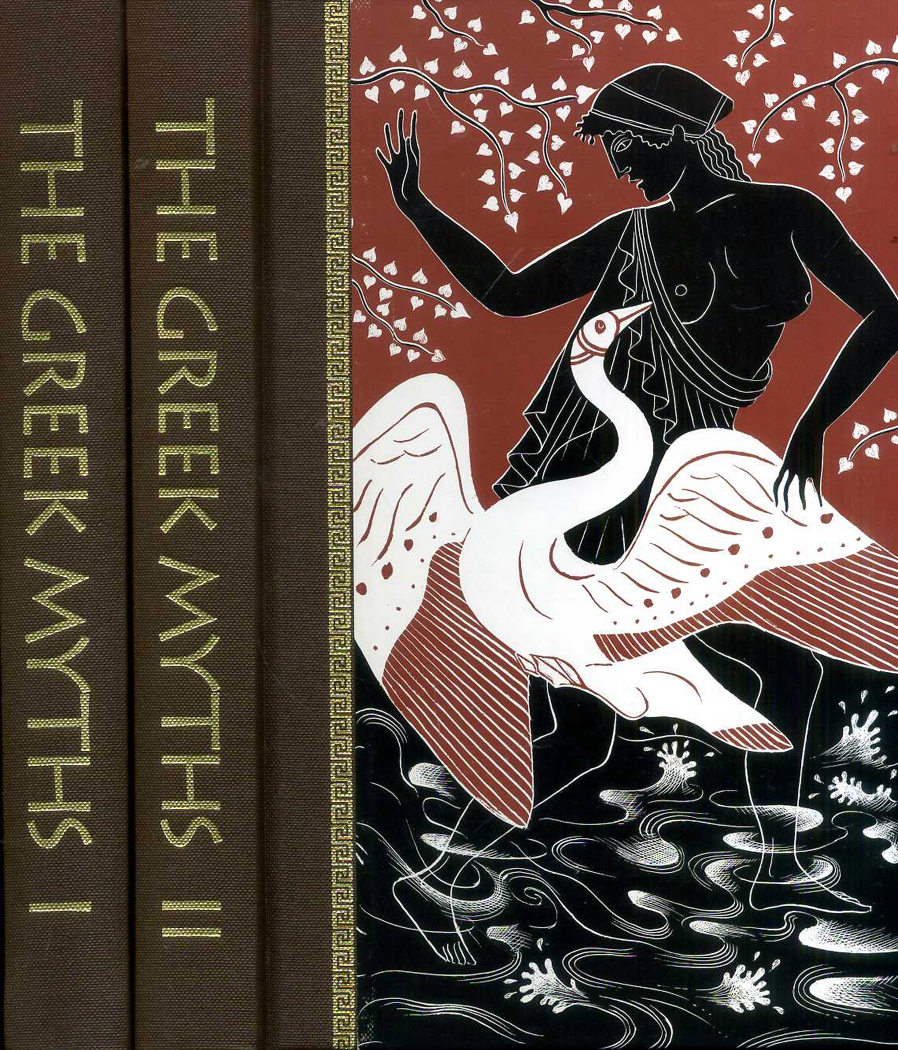
The second lingering from class is Robert Graves’ Greek Myths. I took several courses in classical literature, including a blunted attempt to learn the language of the ancient Greeks. En arche hen ho logos. I foundered on the aorist voice, among other things, including my growing dislike of the word-games and fascistic tendencies of Plato, whose Euthyphro I was tasked to translate.

But, I came to love the classics. They have enriched my life from then to now (more about them in a later blog entry). But Graves gave me a deeper and richer appreciation of mythology, and upset any naive notion I had that it was all a coherent, organized system of gods and goddesses (as it was made to appear in Edith Hamilton or Hawthorne’s Wonder Book), but rather a welter of conflicting local stories, changing over time and mixed into a stew that no one ever held onto in a single grip. Again: multifarious and complex. robt graves

One of the underlying messages of any important reading: Everything you know is wrong. Or at least, no single idea or ideology can adequately describe the world. It is always more complex than that, and we should beware of anyone who tells us they have the answer.

It is true that Graves had his hobby horse and you can’t take everything he avers as solid truth. But the underlying mash of malt and hops captures the brew pretty well.

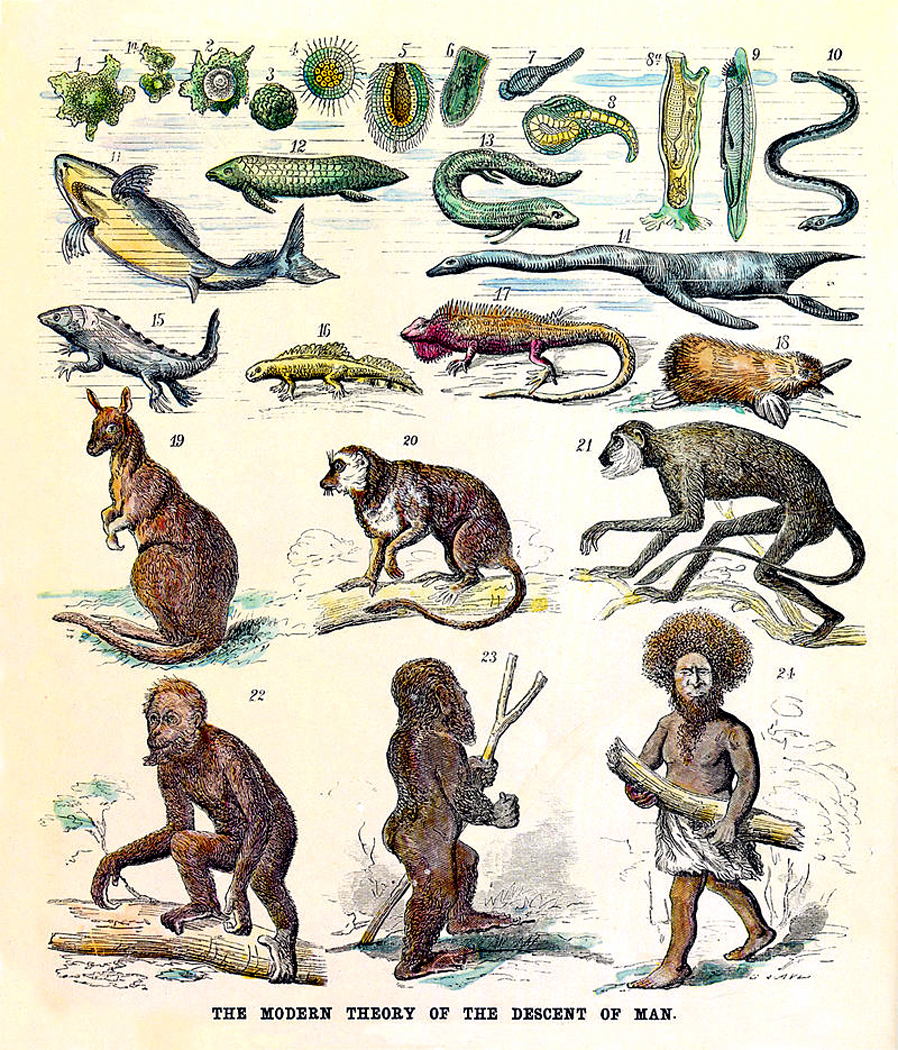
Third, there was E.M.W. Tillyard’s The Elizabethan World Picture, which I read for a Shakespeare course. Tillyard covers several aspects of that world view, but most essentially, the idea of hierarchy, the sense that God created a world in which everything exists on a rung of a ladder of which there is always something above and something below. Thus, lions are the “king of beasts,” the way gold is the most noble of metals and the oak is the top tree. Further, that trees as a whole top minerals, and animals top trees, and man is atop all this, yet under angels, which in turn, are under God, who is the end of the line, very like Canarsie. descent of man

It can get quite silly and convoluted: arguing whether a siamang or white-handed gibbon is higher on the chain, or whether a peach is more noble than an apricot, since clearly, one must rank higher. Medieval literature is chock full of such debates: Who ranks higher, king or pope? But we still have these arguments, all over the place.

Becoming aware of this persistent trope in our culture turned the lights on: We are still suffering from this idea, and it is all around us, unexamined. Tillyard made me see and examine it: Every time someone talks about something being “higher on the evolutionary ladder,” one must counter that such an idea is a misunderstanding of Darwin. But that misunderstanding drives so much policy and inflames so much political rhetoric.

Tillyard made me re-examine many of the axioms and assumptions of our culture in a way more direct and concrete — and easier to understand — than all the horse-hair stuffing of the French Post-structuralist philosophers and deconstructionists. prolog canterbury tales

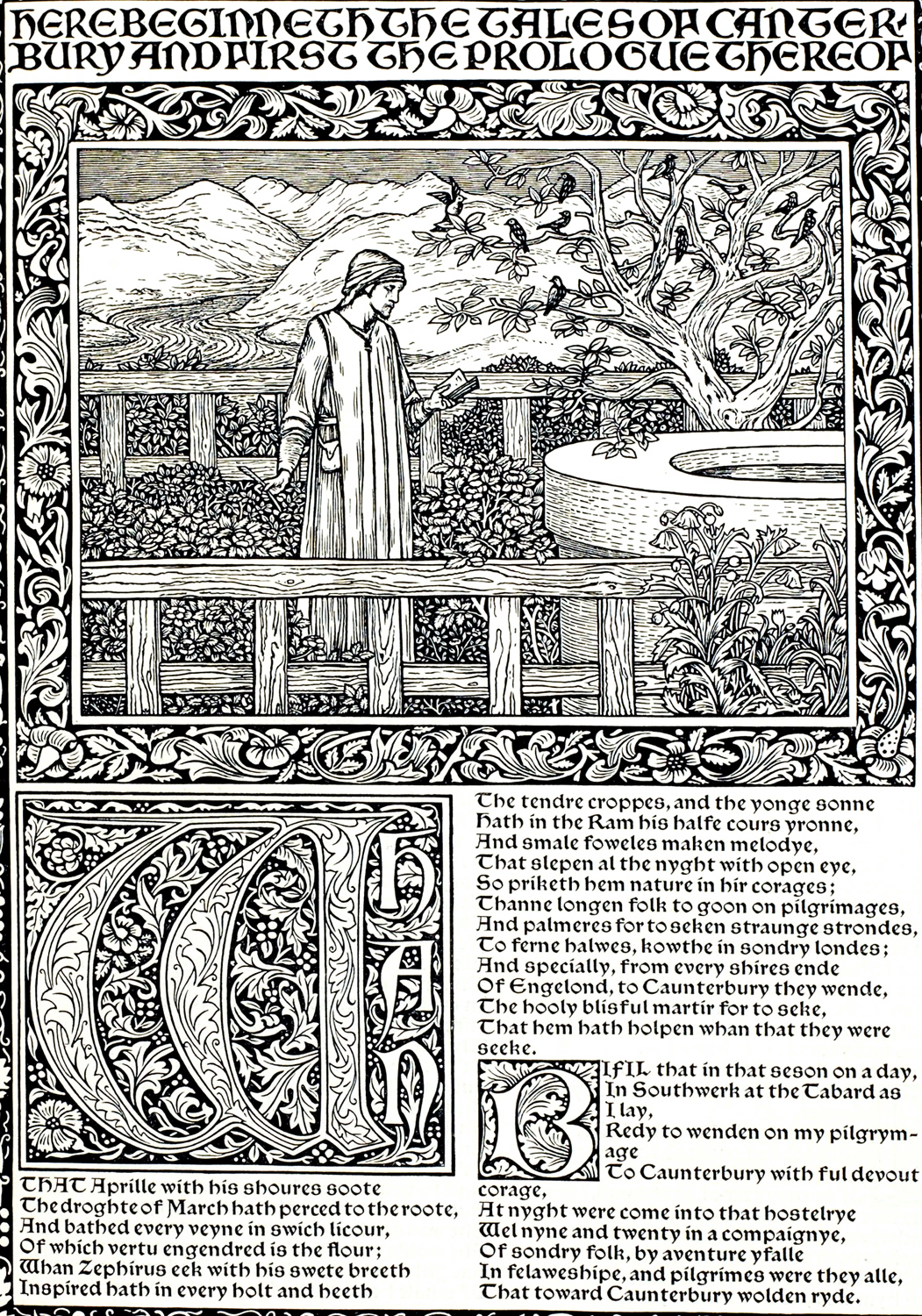
Finally, from class, and by no means least, I came to love Geoffrey Chaucer. I have become a fair reciter of Middle English, with a credible accent. And I found that reading Chaucer out loud enhances his comprehensibility. It become very like getting used to a thick Scottish burr or the sing-song of English spoken in the Indian subcontinent. When you get used to it, it disappears. Outside of some arcane vocabulary, Chaucer’s language isn’t all that difficult.

What is more, the poetry itself is overwhelming, whether it is the Wife of Bath’s prologue or the short poem, Trouthe, the language is as delicious as can be found in our mother tongue.

“The wrastling for the world axeth a fall.”

“Here is noon hoom, here nis but wildernesse.”

“Much wele stant in littel businesse.”

My wife periodically asks me to recite the general prologue to the Canterbury Tales, which I have fairly well committed to memory, and I can’t think of a greater or more pleasurable chunk of poetry in the English language.

NEXT: The years in the wilderness

A Facebook friend left a challenge for her followers: 

“In a text post, list 10 books that have stayed with you in some way. Don’t take but a few minutes, and don’t think too hard — they don’t have to be the “right” or “great” works, just the ones that have touched you. Tag ten friends, including me, so I’ll see your list.”

bookshelves

Of the 20 books on my top 10 list, none of them comes from my high school years. This is hardly surprising; adolescence is a time apart from the normal flow of life — actually years of pupation between childhood and adulthood, spent in a chrysalis of self-regard, dread and hero worship.

That doesn’t mean books weren’t important. Indeed, they may have been most important in those years, but it does mean that the books that were important then have faded. Indeed, have become more likely a source of personal embarrassment as we remember them. selby cover

For me, those years were filled with almost obsessive reading. I ate up books like potato chips, at times during summer vacations at the rate of a book-a-day. And I devoured more contemporary fiction than I have at any other period in my life. I read everything Saul Bellow had written up to that time. I read John Updike, Malcolm Purdy, Hubert Selby Jr., Thomas Pynchon, Jules Feiffer, James Drought, Herbert Roth, James Baldwin, Norman Mailer and a host of others I cannot recall at the moment.

The fact I don’t recall them is germane. I hardly remember what was in any of these books because, clearly, I was reading way over my head. What could a goyishe 14-year-old suburban boy, pimply-faced and horny, ever understand about urban Jewish angst or African-American anger? Simply beyond my realm of experience. More to my concern: whether my shoes were pointy enough, my hair wavy enough and if my trousers had cuffs or not. I forget now whether it was cool to have cuffs or supremely uncool. OLYMPUS DIGITAL CAMERAI tried to instruct my parents in these finely parsed issues, but they were too block-headed to understand.

And speaking of not understanding: My young libido, raging but unfocused, led me to Terry Southern’s Candy and Robert Gover’s One Hundred Dollar Misunderstanding. It was my primary source of sex education, and it is a wonder to this day that I survived.

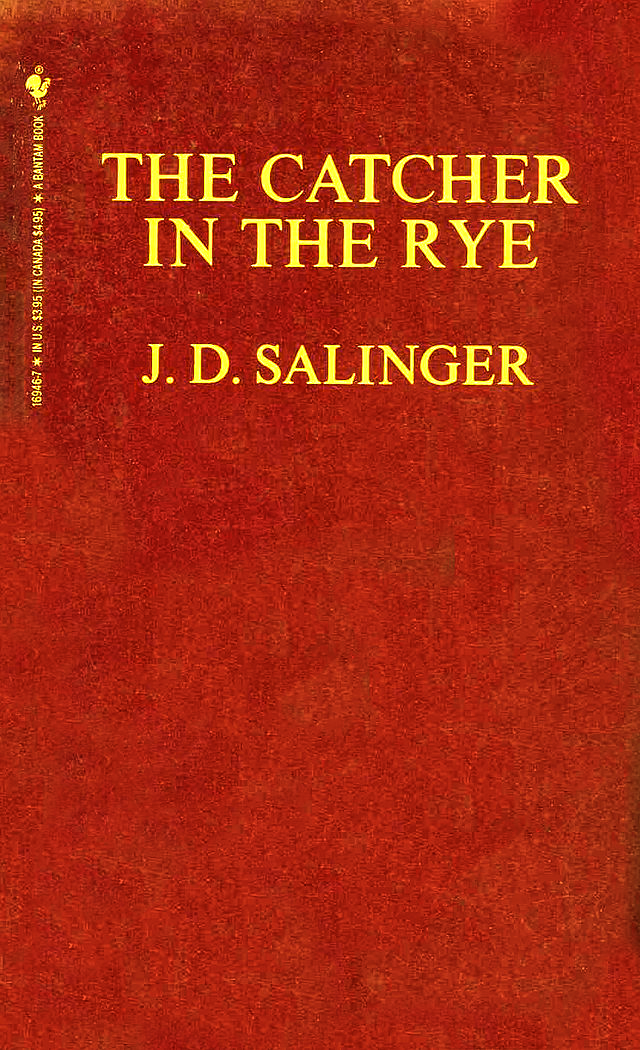
But I’m dancing around the central issue. The bible of pubescence was and remains J.D. Salinger’s The Catcher in the Rye. Here was a book that addressed my concerns directly, that understood my life from the inside, that expressed those unsayable thoughts. I gobbled it up, and all the Glass family sagas and short stories. I wanted more; there were no more.

There were other books that teens revered, and I read those, too: John Knowles’ A Separate Peace and William Golding’s Lord of the Flies — which, because I was a teenager and therefore an idiot, so it never bothered me that Golding told of a world-view diametrically opposed to Salinger’s fable of self-righteous innocence. catcher cover

Holden Caulfield recognized the essential hypocrisy of adulthood and pointed fingers everywhere but reflexively. The purity of his heart guarded the cleanliness of his soul. I signed on. It was society that was rotten.

Of course, looking back, one realizes Holden Caulfield was the biggest phony of them all. But it is the nature of hucksters and demogogues that they project their limitations outward. It is what makes them so convincing, at least to the unformed souls they lead around by the nose.

I have tried to reread Salinger a few times as a grown-up, but the treacle leaves an unpleasant coating on the inside of my mouth.

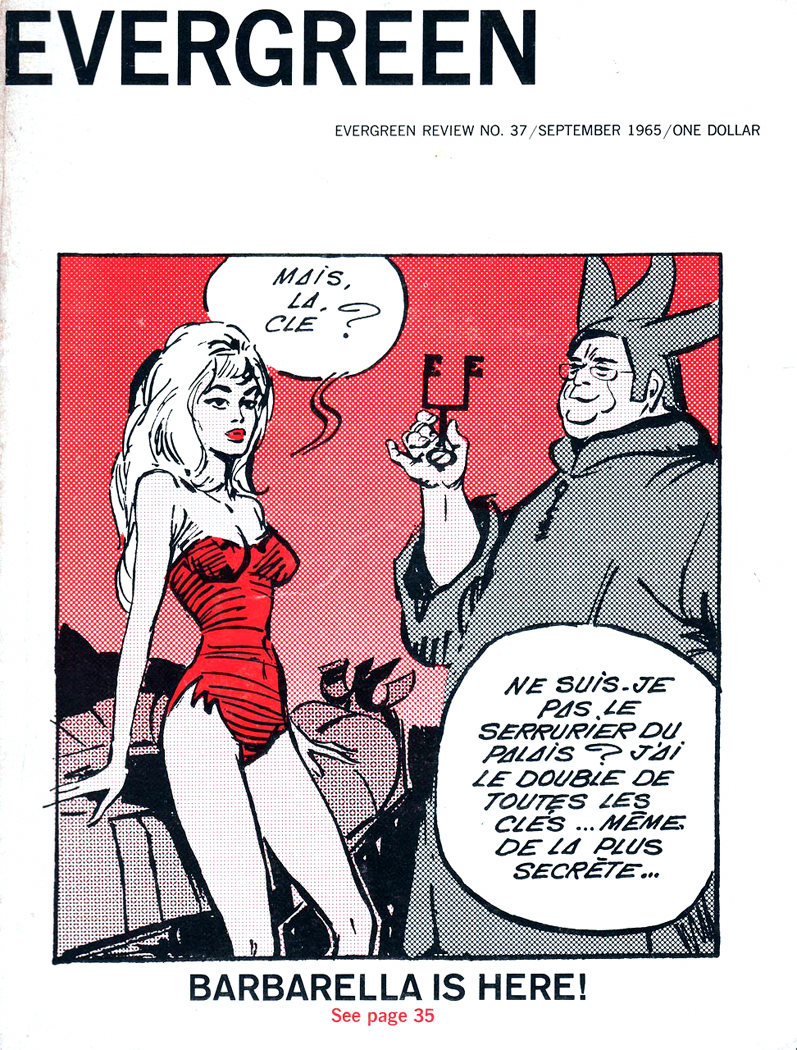
My self-image at the time was that I was a budding bohemian, that I was an intellectual among cattle. I had subscriptions to Evergreen magazine and Paul Krassner’s The Realist. I read Jean-Paul Sartre’s Les Mots. I listened most nights in my bed to Jean Shepherd on the radio, and never really understood that the “hipsters” he railed against were the very people I idealized. evergreen 1965Irony, at that age, is invisible. We look right through it without seeing it. I went to Greenwich Village every opportunity I got and frequented the Sheridan Square Paperback Corner.

Lordy, I was a pretentious twit.

There were books I was required to read for school, but while these books are worthy, they are wasted on adolescents who cannot grasp their import. I read The Great Gatsby for school, and never quite understood that Gatsby was a gangster. Over my head. The Scarlet Letter was assigned, and I don’t think I even understood that Pearl was Hester’s daughter. I’m not sure why a punk kid was ever asked to read such a rich and subtle book. There was clearly no way I could wrap my tiny, unformed brain around the complexity of that book — to say nothing of the boredom induced by paragraphs that long without being broken up into constant bites of dialog.

There was a tendency during those years, when introduced to a book I enjoyed, to attempt to read everything else by that author. Gobble it all up, nine-yards and a tail. That is the way it was with the Glass family, and that is how it was with Jack Kerouac.juliette greco

There was scarcely a Kerouac book in print in the mid-1960s, that I didn’t inhale, starting with On the Road, which I read twice. I fantasized riding the rails, driving a broad-hipped Hudson at a hundred miles an hour through the nights of Nebraska, listening to Ornette Coleman and dispensing off-the-cuff witticisms to the Juliette Greco on my lap. When I had a chance to travel to Europe between my junior and senior years, I took Lonesome Traveler with me, and in the bookstalls along the Seine in Paris, found Big Sur and Subterraneans in British paperback editions.

I am amazed when I look back, at how much I read — all of which was outside schoolwork, which I neglected. And I am amazed now at how little of anything I read then I retained. It went through me like a sieve. All that verbiage accumulated around me like gravel around a caddis fly larva, and when I left for college, I shed that cocoon and started fresh with a new set of enthusiasms.

Next: Reading outside the curriculum

Faust reading
A Facebook friend left a challenge for her followers:

“In a text post, list 10 books that have stayed with you in some way. Don’t take but a few minutes, and don’t think too hard — they don’t have to be the “right” or “great” works, just the ones that have touched you. Tag ten friends, including me, so I’ll see your list.”

My initial response was to laugh at myself, because my list would undoubtedly make me sound like a dusty old pedant. It would include a good number of the “right” or “great” works, but not because I wanted to sound learned, but because they are the ones that have touched me. I can’t help it; given a choice between John Milton and Jonathan Franzen, I will always choose Milton — with no calumny directed at Franzen: It is merely my pleasure. And I mean pleasure.paradise lost

My old newspaper deskmate, Kerry Lengel, who is a very good writer, used to laugh at me because I would wax eloquent about how much I enjoyed reading Paradise Lost. He couldn’t imagine anyone actually enjoying that dense verbiage. But I was genuine about it. Milton gives me tremendous pleasure. I read it not for its theological import, but for its organ-tone language, which I can roll around on my tongue like a good, well-seasoned, well-aged piece of beef. Poetic umami. meat

But the request, sent out on the ether, did make me consider which books have meant the most to me. As we enter an age where printed matter goes the way of papyrus and clay tablets, I wonder at just how decisive have been the books that entered my life.

I don’t expect anyone to be absorbed by the fact that this or that book changed my life. My life is fairly banal. I certainly don’t expect anyone to run out and buy these books in hopes they might change their lives. But, I hope it might be interesting enough to see just how an anthill of tiny black marks on a page can affect the growth of a sensibility, and perhaps reading about it might give someone the urge to consider not merely which books most affected them, but how and why.

There are books we read with no more lasting effect than a sitcom we watch on TV. They are still worth reading, and they add to our experience of life, but they don’t leave lasting footprints. They make up the bulk of our reading.

There are books that we enjoy more than others and that we want to read and reread many times, and when we do, we discover the book itself has grown as we have grown and is completely different from the one we read as a callow youth. Rereading is one of life’s imperatives.

But beyond these, there are the fewer books that completely changed our way of regarding the world, changed our outlook, our philosophy, our very umwelt. They are the life-changing books and they stay under our skin like chiggers for a lifetime.

They are not necessarily the best books, but the ones that altered our lives. When we are children, they may very well be otherwise insignificant books that nevertheless opened our hearts and minds to things we knew not of.

As young adults, they are the books that removed the scales from our eyes, so that we emerged from our adolescent pupae into the brighter world.

As adults, they are the books that re-oriented us and the direction of our lives.

And as old age closes over, they are the books that remind us most powerfully of our connection to the eons.

I cannot winnow the list down to a mere 10. But I can give you a list divided into the different ages of life and how they helped me navigate into the present.

I will consider them over the next several blogs. First, though, I want to look at the books that ruled my childhood. “As the twig is bent, so the tree inclines.” the world we live in

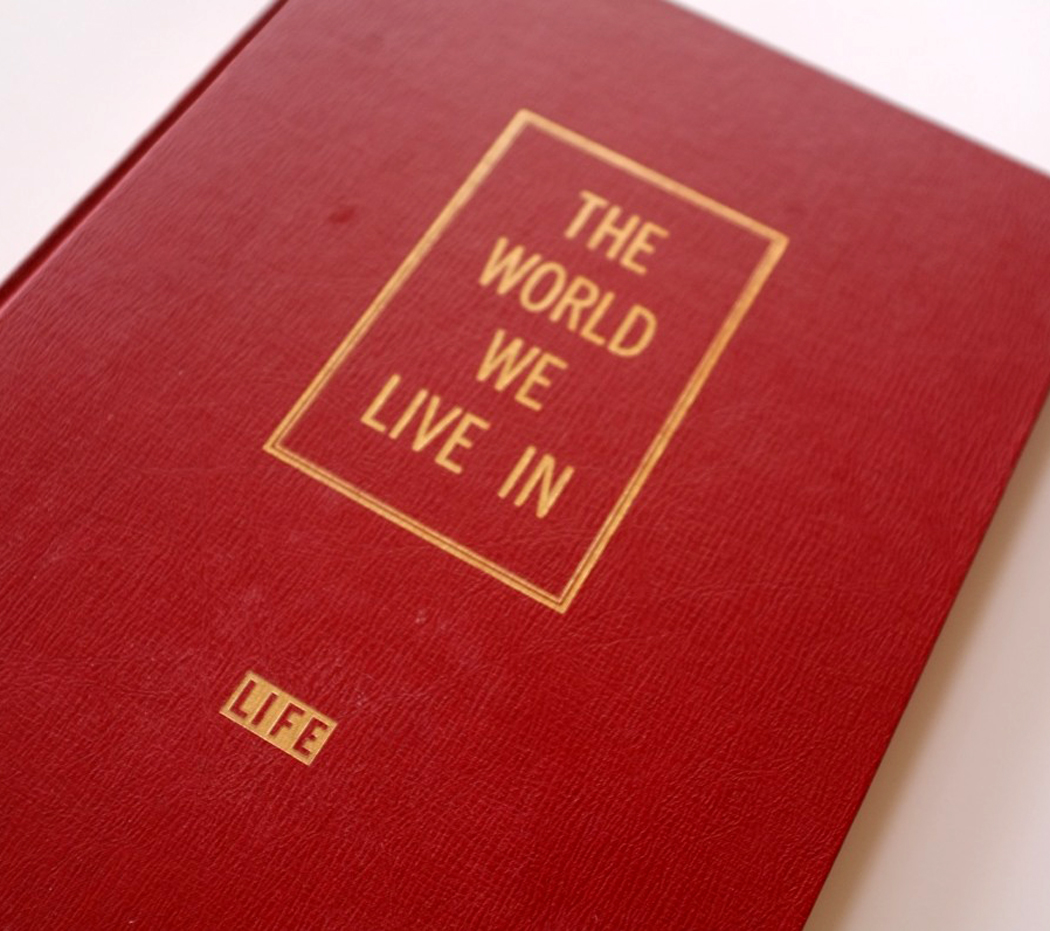
In 1956, on my eighth birthday, my grandmother gave me a copy of Life magazine’s The World We Live In. I still have it, in its red leatherette binding, although with a few nicks in it. There is no book that more completely threads the boy I was with the man I became.

The chapters of the book — “The Earth is Born,” “The Miracle of the Sea,” “The Face of the Land,” “The Pageant of Life,” “The Starry Universe” — taught me the great variety of life on the planet, and, more important, the great time frame of the cosmos. It instilled in me — or reinforced what was already an inclination — a love for the things of this earth and conversely, though not actually an argument of the book, a mistrust of things merely “spiritual” or conceptual. I wanted to rub it between my fingers; to taste and smell it. dinosaur 2

The photos and illustrations of sea life, dinosaurs, and “The Woods of Home” became a catalog of those things I continue to hold in my cor cordiumall about dinosaurs

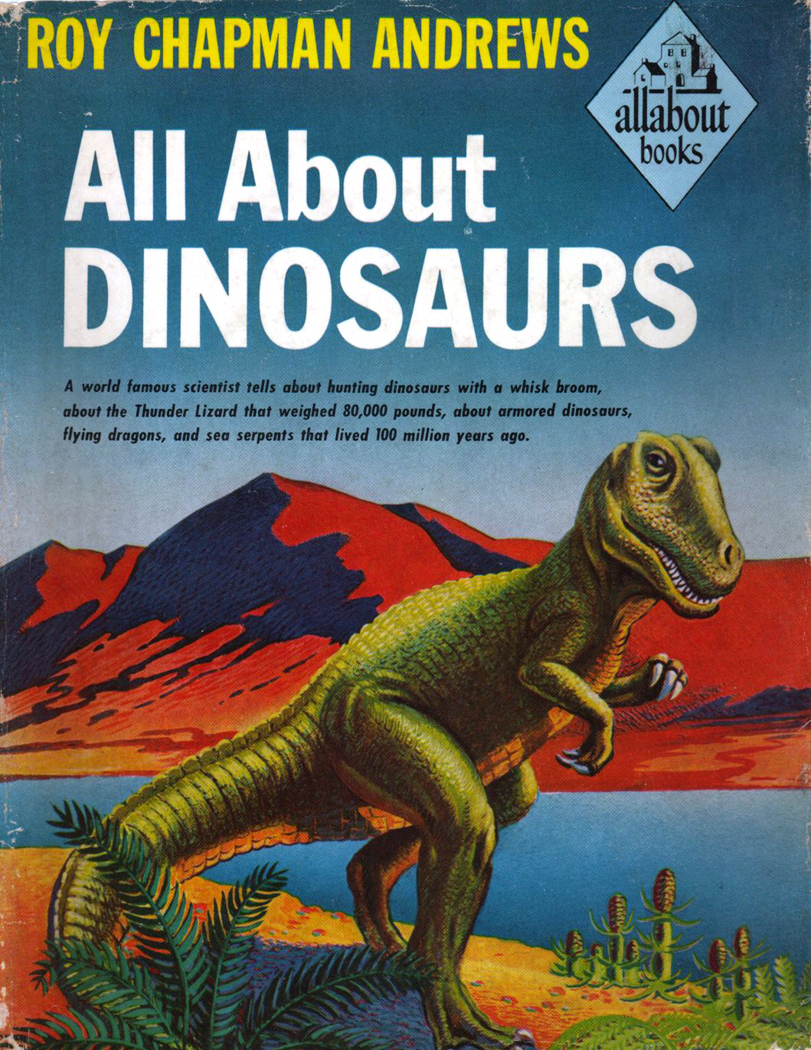
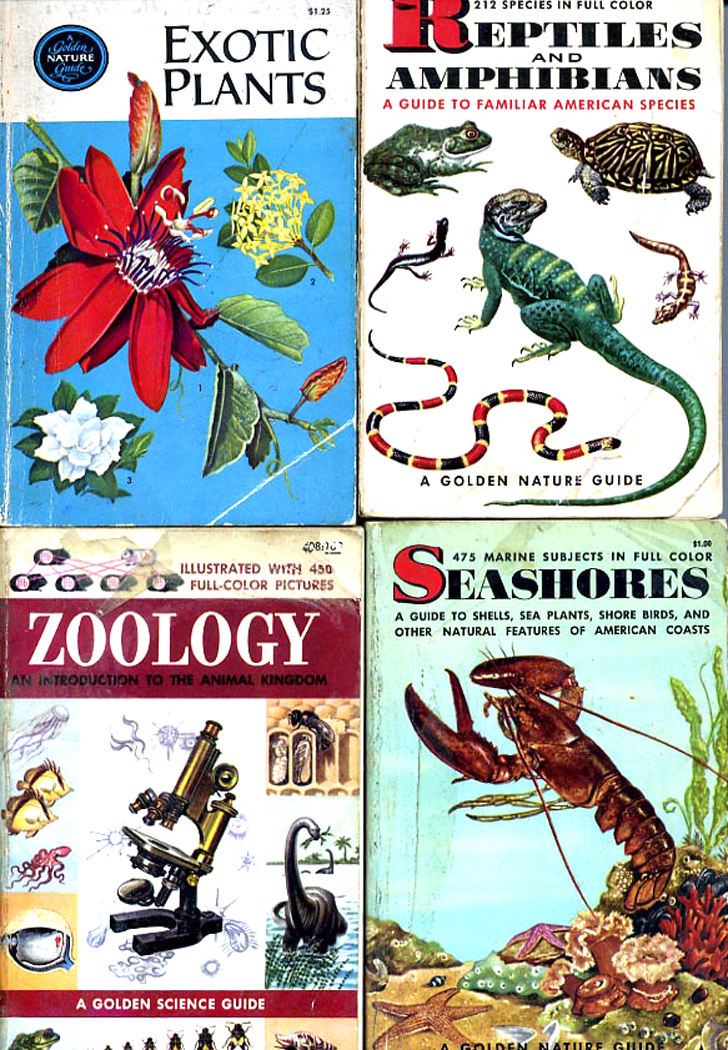
There were other books, too. All About Dinosaurs, by Roy Chapman Andrews, which fed my childhood fascination with the Mesozoic, and other in the “All About” series, each taking on some aspect of the natural world. There were the Golden Nature Guides, those tiny books on insects, weather, geology or weeds written or edited by Herbert S. Zim. golden guidesI have lost and rebought copies of most of them throughout my life. I still have about 25 of them, tucked away on my bookshelves, and I still take them out periodically and leaf through their simple illustrations — pictures that lit up my childhood from within.

One can see from the number of hits on Google that Zim bent many twigs for many young readers.

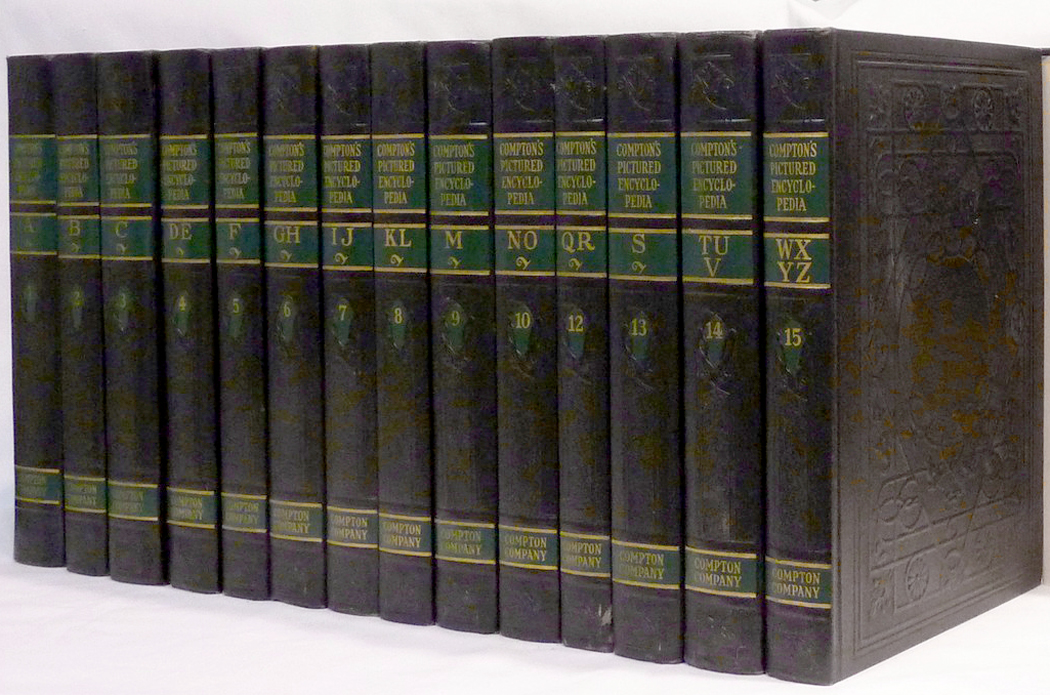
And there was Compton’s Picture Encyclopedia, an edition from the 1930s that our neighbor gave us.comptons It was filled with pictures of autogyros, streamlined trains and soldiers wearing puttees. It further reinforced a vision of the world that infinitely varied and multifarious. There was more to life, clearly, than the New Jersey suburbia I grew up in.

When I was a little older, my parents bought for me a young-adult novel, thinking that I might enjoy it. Their hearts were in the right place, but they didn’t really understand where my little brain was going. I thanked them, but told them outright, “I don’t like fiction; I don’t want to read anything that isn’t true.”

Yes, I was an idiot, but who isn’t at that age. autogyros

The bottom line was that my childhood reading put me in touch with the physical world and its magnificent diversity. Even as an adult, I inclined (there is that word again) toward the “thingness” of the world, and later in life, that what Kant calls the “noumenon” can best be reached through awareness and connection with the physical presence of the world, rather than through words and mere ideas. In other words, poetry, not philosophy.

Yes, as the twig is bent, so the tree inclines.

NEXT: The maelstrom of adolescent reading

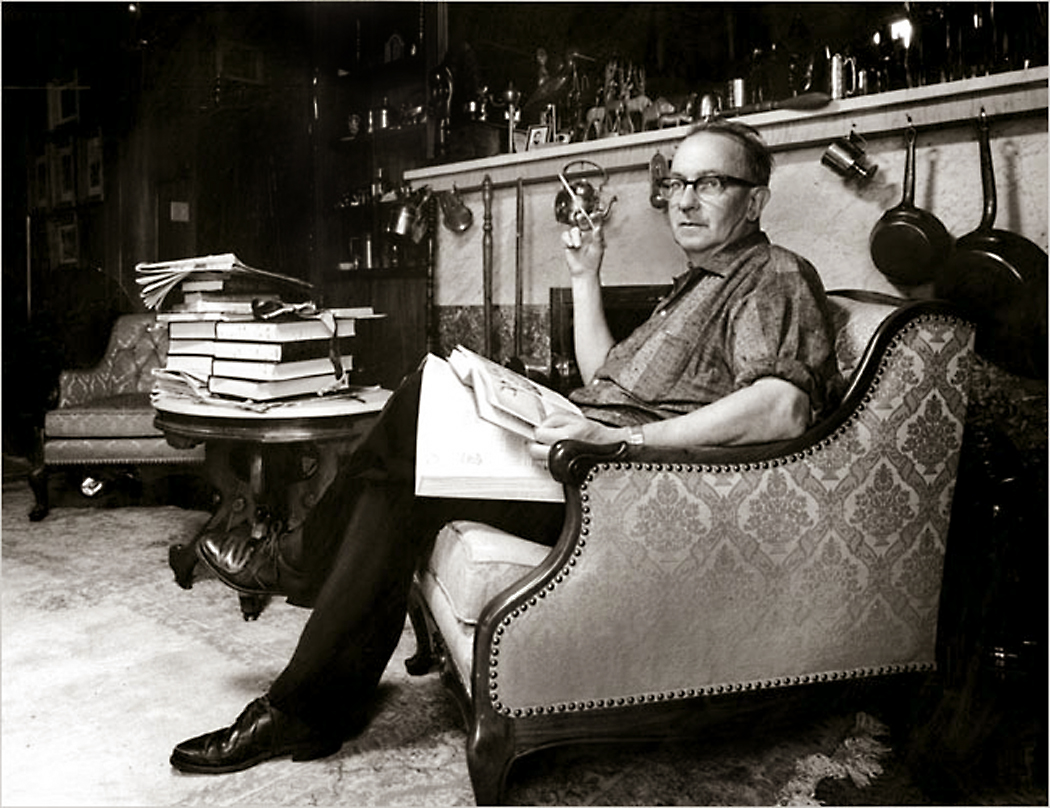
George Leonard Herter

George Leonard Herter

The British have their eccentrics, but America has crackpots.

There is something quaint about the Englishman wearing a cutaway and top hat in the Sahara sun, or refusing to read any book unless its author’s name begins with the letter “A”. But the American version of this tendency usually comes out in something more oracular: Americans create new religions and build temples out of bottlecaps. And they are obsessed with peculiar certainty that nobody has got history correctly except themselves. herters catalog

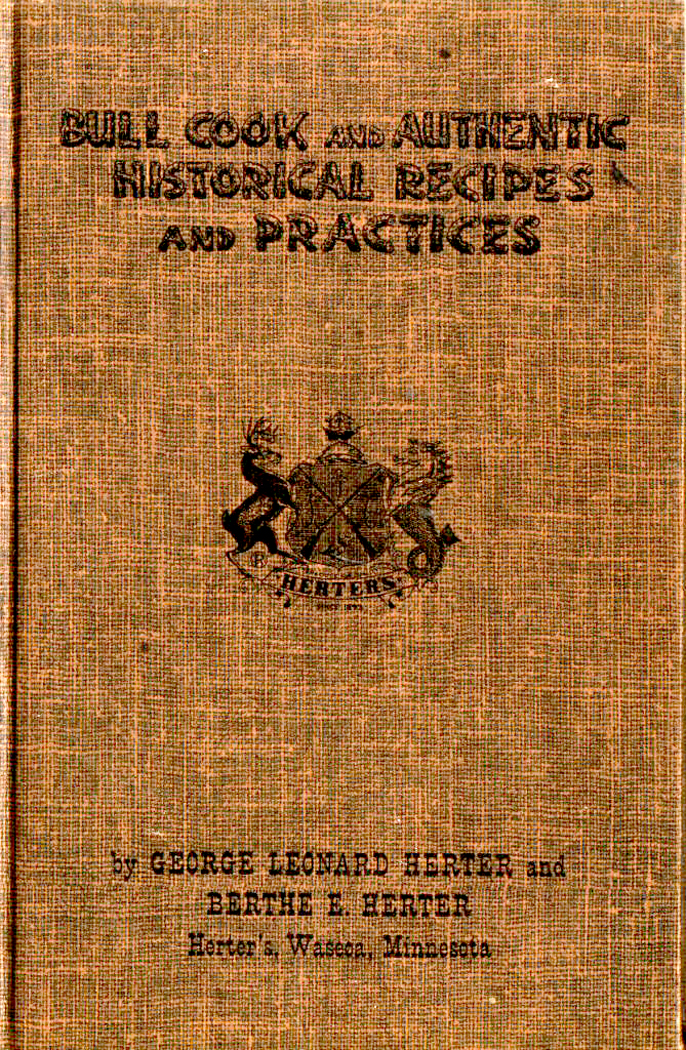
One of the great American crackpots wrote cookbooks. George Leonard Herter built one of the nation’s great outfitting businesses, in Waseca, Minn. His fortune was founded on shotgun cartridges and duck calls. But his lasting place in history comes from the books he wrote, most notably, the Bull Cook and Authentic Historical Recipes and Practices, and it is not for the faint of heart.

In what other cookbook would you find the claim: ”The Virgin Mary, Mother of Christ, was very fond of spinach”?

Herter goes on to say, ”This is as well a known fact in Nazareth today as it was 19 centuries ago. Her favorite music was that of the crude bagpipes of that time, and this is a well-known fact.” bull cook cover

He then proceeds to give us her recipe for spinach, which, he says, was the only thing she ate in the stable where Jesus was born.

No, this is not a religious book. Other ”historical” claims include, ”Sauerbraten was invented by Charlemagne,” and that St. Thomas Aquinas was so fat, ”He simply sawed out a half circle in his eating table so that his stomach could fit comfortably into the sawed out section.”

He tells us that Johannes Kepler’s work on astronomy has long since been forgotten, ”but his creating liverwurst will never be forgotten.”

He has Bat Masterson’s recipe for prairie dog, Marie Antoinette’s recipe, not for cake, but for trout. He says Joan of Arc was responsible for the invention of pate de foie gras.

His standard recipe runs something like this: ”No one knows how to bake a potato anymore. I’ll tell you how to bake a potato.”

It is clear from the presentation that Herter is not trying to be funny. He is dead serious. As when he opens the book with this: how to live with a bitch

”For your convenience, I will start with meats, fish, eggs, soups and sauces, sandwiches, vegetables, the art of French frying, desserts, how to dress game, how to properly sharpen a knife, how to make wines and beer, how to make French soap, what to do in case of hydrogen or cobalt bomb attack. Keeping as much in alphabetical order as possible.”

Of course, the index is not in alphabetical order.

Herter wrote a number of books; among the more notable were How to Live With a Bitch and The Truth About Hunting in Today’s Africa and How to Go on a Safari for $690.00 (“Baboons are simply too small for leopard bait”).

I can’t vouch for any Bull Cook recipes. Most seem to involve a “well-buttered slice of bread” and some ground beef fried in even more butter. But I can say that Herter seems to have two entertaining obsessions that make up the bulk of the book, and its sequels, volumes 2 and 3. truth about hunting

He expresses the absolute certainty of the crackpot when he tells us his version of history:

“Napoleon Bonaparte always remained a great mama’s boy.”

“Napoleon not only liked green beans very well, but believed that they helped to produce more sperm in male humans. As he was always a man who played the ladies frequently, this was just as important to him as winning wars.”

Napoleon shows up frequently in the book. So does Cleopatra. Let Herter explain ancient Roman Egypt for you.

According to Herter’s version of ancient history, Cleopatra tired of Marc Anthony and tricked him into killing himself.

“Cleopatra went over to where Mark Anthony lay and made sure that he was dead. She then sent a messenger to Octavian telling the good news and asking him to come over for the weekend. Octavian did come over to visit her as he well remembered her charms when she lived in Rome. She did her best to charm him in every way possible and he was willing. Cleopatra was now thirty-nine and had produced five children. They did not have girdles in those days, nor uplift brassieres. She had widened out and her famous bosom had sagged considerably. The old charm simply was not there. Octavian decided that the younger models were more to his liking and told her she better get out of Egypt and he did not want to see her in Italy either. Octavian made Egypt a part of the Roman Empire. The Roman Legion, now that the fighting was over, had a well-earned vacation putting Italian blood into Egypt. It is still very much there today. They actually changed the appearance of the Egyptians to a very Italian look which they still have today. Cleopatra was just in the way. Octavian had one of his men pay a servant to poison her. Her record proved she was not the type to kill herself for anything or anyone. Besides, there were no asps anywhere near the town she was in. If she did have an asp and let it bite in one of her breasts as the fable goes, it would not have killed her anyway. A woman’s breast is mostly fat and it is one of the places where the bite of any poisonous snake has little effect.”

There follows a recipe for “Watermelon Pickles Cleopatra.”

He is a fountain of prejudices, and has no doubts about his opinions.

“Henry the VIII actually never amounted to anything and would not have made a good ditchdigger. The only thing that he ever did to to his credit was to highly endorse the kidneys made by Elizabeth Grant, one of his many cooks.”

He knows with dead certainty how Genghis Kahn liked his steaks prepared and how Gregor Mendel cooked his eggs. And according to Herter, it is not his banditry or gunslinging for which Billy the Kid will be remembered by posterity, but for his recipe for cornmeal pancakes.

“Here is his own recipe which will long outlive Billy’s memory.”

Herter’s other obsession is sex, and most specifically, women’s breasts. The second volume of the Bull Cook is full of bad black-and-white reproductions of famous paintings of the nude, and his historical commentary often features descriptions of famous cleavages of the past.

He tells us that Cleopatra “was said to have the longest, most pointed breasts in all the world. The movie actresses that have tried to play Cleopatra from time to time never qualified on this point.”

“Greek women have always been known for their unusually well-developed breasts. They have always felt that bare breasts gave them more grace and beauty and that exposing breasts was not at all immodest.”

“In those days, if you didn’t have breasts worth showing, you were really in trouble. A flat chested pendulent breasted woman just did not have a chance in life.

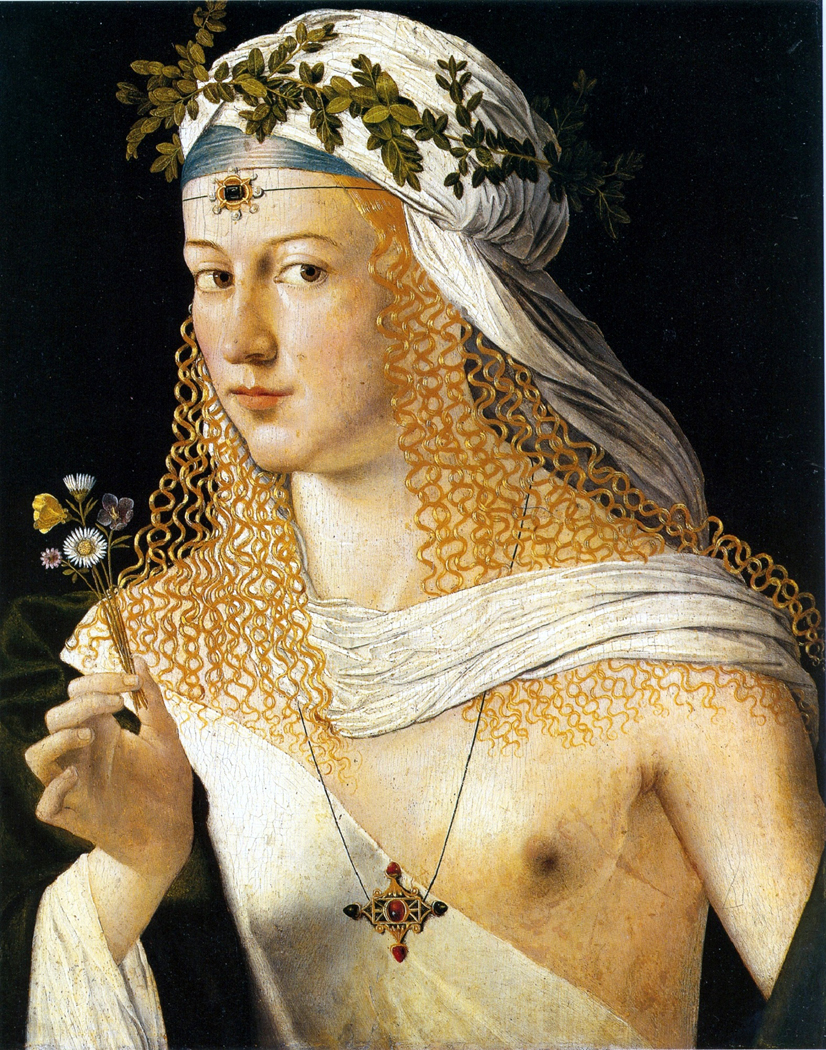
Lucrezia Borgia by Bartolomeo Veneto

Lucrezia Borgia by Bartolomeo Veneto

In another place, he reprints a portrait by Bartolomeo Veneto (and misattributing it as he does so) and tell us:

“Lucrezia Borgia, well-known poisoner, painted by Veneziano in 1520. By this time, it was popular to wear dresses with one breast exposed and the breast nicely rouged. As you can well see, this style did nothing for Lucrezia as she had nothing special to show.”

He has a chapter titled: “Bare Breasts and Food In the United States.” In it and passim, he describes various topless establishments, comparing those in Paris with those in Las Vegas. Vegas wins, by his reckoning.

“For my part I enjoy eating very much. I do not like to look at female breasts while I am eating as I like to concentrate on my food. There is a time and place for everything and I prefer exposed female breasts in a bedroom, a tepee or a clean cave.”

It isn’t only breasts, though.

“Michelangelo learned to paint and sculpture sexual organs probably better than anyone that ever lived. He never learned to use his own properly, however, and was a homosexual.”

And he has a way of combining his questionable grasp on history with his prurience:

“Charles the II of England was born in 1630 and died Feb. 6 in 1685. He married the beautiful Portuguese woman, Catherine of Braganza who brought Bombay, India and Tangier to England as part of her dowry. Those were the days when getting married could really get you something. He never had any legitimate children as Catherine was just plain scared of pushing out a child through so small a space. She became an early expert and exponent on birth control.”

There is more than an undercurrent of bigotry in him. While he exults American Indians (not always reliably: “Pizza pies were of course, unknown as these too are of American Indian origin.”), and recounts many instances where white America has raped and pillaged the Indians, he holds many questionable ideas about women and other races.

In that section on Michelangelo, for instance, he says: “Michelangelo’s statue of David shows what can be done with a piece of marble. As far as showing what David might have looked like, it is a masterpiece of errors. David was a  Jew and undoubtedly had the high cheekbones and nose of a Jew. This figure is strictly Anglo-Saxon in appearance, not even Roman.”

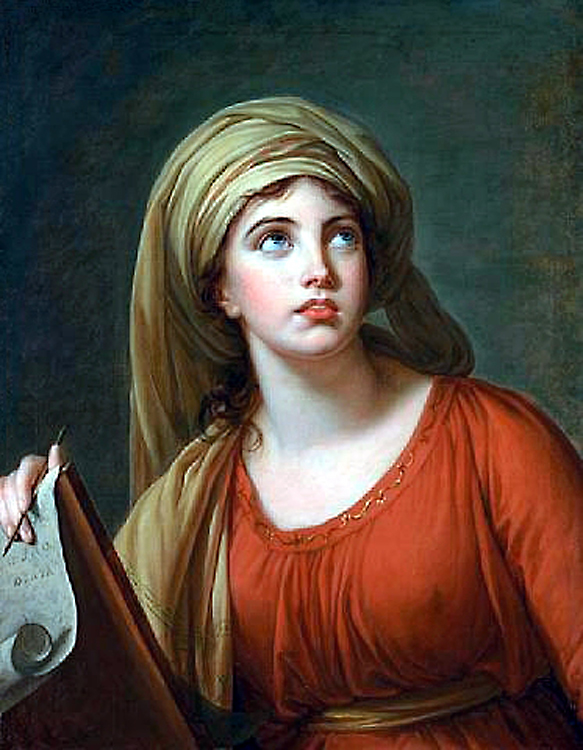
Lady Hamilton as the Cumean Sibyl by Vigee-Lebrun

Lady Hamilton as the Cumean Sibyl by Vigee-Lebrun

On a section (see below) spent with Horatio Nelson and his mistress Lady Hamilton, he includes a portrait of the woman, misspelling the name of the artist (Elizabeth Vigee-Lebrun) and in his caption tells us something about his opinion of women.

“The portrait was painted by Madam Vigee-Ledrun , one of the few good women artists the world has ever known. Women because of the effect of menstruation upon them, rarely can become even fair painters.”

Not to mention his take on Joan of Arc: “Never underestimate the strength and courage of a woman that is really mad at you.”

Among his other obsessions are nuclear war and art.

“Red pepper good for radiation and upset stomachs”

“We always have the money to buy good soap in this country and women folk look down on such menial tasks as making soap these days. An H bomb strike in this country would change the whole picture.”

“I never have  been an admirer of the paintings of Matisse but I always thought his cooking was excellent.” What follows is a recipe for “Beans Matisse.”

I could go on all day giving you quotes from the Bull Cook.

“Joshua 10:13 in about 1451 years before Christ says that the sun stood still in heaven and did not go down for the space of one day. This caused Indian Mexico to become dark.”

Or:

“Mozart was a man that believed just putting a lady on her back was not at all enough. Seducing an actress was a game with him that had to be done properly or not at all. He wined and dined his amours very well before getting down to any serious romancing. His dessert I like far better than his music and his orange wine is a classic. Here are his original recipes.”

Not to mention:

Eggs “are best eaten in a well ventilated room.”

Or:

“Never drink coffee right after eating peppered fried eggs or soft-boiled eggs.”

The combination of sex and history, scrambled, fried and soft-boiled can be enjoyed in his version of the life and appetites of Lord Horatio Nelson:

“Horatio Nelson was a fragile, very sensitive man nearly always in poor health. He was not at all good looking and women shunned him.”

“In the West Indies, on March 11, 1787, he made the greatest blunder of his life. He was more or less trapped into marrying Frances Nesbit, the widow of a doctor Nevis. Nelson had simply spent too many years on the seas with only men to look at and the prospect of having any nude woman looked like a catch to him.”

“Emma Lyon was born on May 12, 1765 … She grew up to be a lively, robust, big-breasted beauty that attracted any normal man.”

“Emma had a way with men, which consisted mainly of taking off her clothes. During Nelson’s battle of the Nile she obtained valuable information for Nelson. When Nelson returned from the campaign of the Nile to Naples, Emma arranged to meet him in her bedroom with nothing on but a string of pearls. Nelson’s wife had turned out to be a cold unenthusiastic bed partner and Emma, the vivacious, warm, bubbling prostitute was a welcome change.”

“I have always admired Horatio Nelson. He was not much physically or mentally, but he was an honest, hard-working man. He never cared what anyone thought or said about him. He liked Emma because she was a good bed partner and a light-hearted, depression chaser around the house.

“Horatio Nelson was not much of an eater as he had a bad stomach. His favorite food was a sandwich which he ate both on ship and shore. Here is his original recipe.”

It is a kind of onion sandwich on well-buttered bread. “Eat with a bottle of strong beer,” Herter recommends.

“This is a truly great sandwich befitting a truly great man and besides, it burps beautifully.”

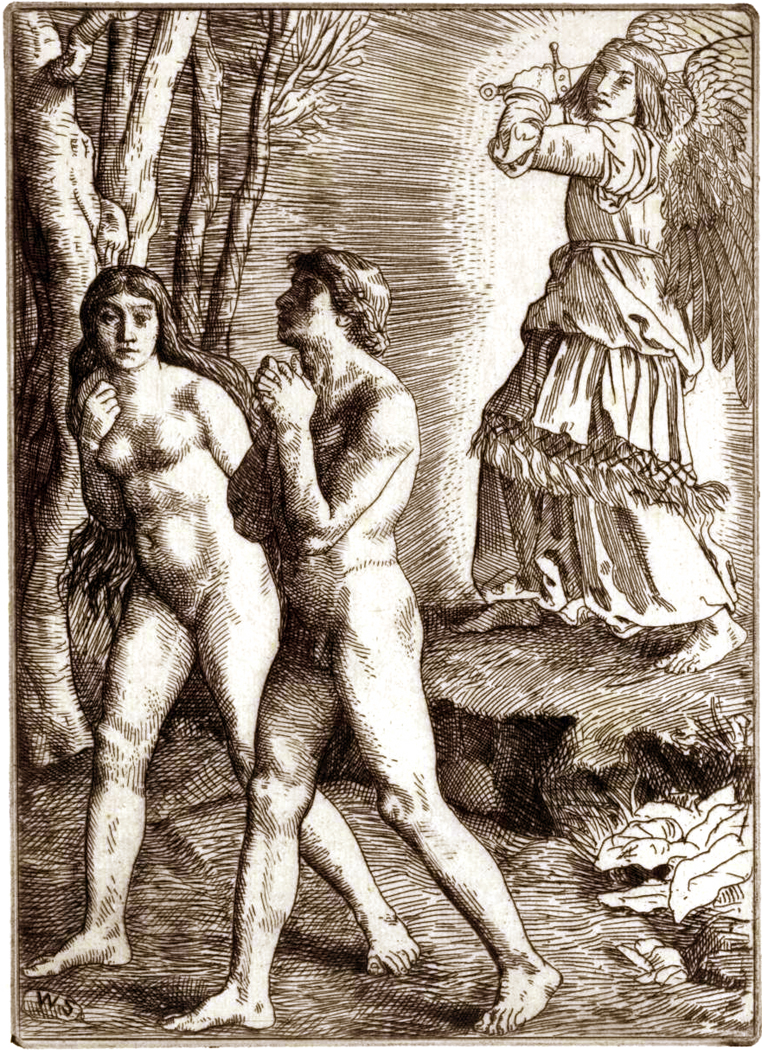
adam and eve

OK, so then what is the “canon,” with which we should all be familiar?

There are scores of lists, put forth by scores of people, ranging from insightful critics to close-minded boobs (Yes, Bill Bennett, I’m talking about you). Such lists usually share the usual suspects: Here’s Hamlet, there’s War and Peace, and over there is the Recherche of Marcel Proust. All of them worthy of your deepest attention and capable of inciting the most delightful pleasure.

But as I’ve written before, the purpose of engaging with the canon of Western culture is to understand who your grandparents were, whose cultural DNA you were born to — the common inheritance of all of us in the modern world, our Adams and Eves.

Through most of my youth and into my adult life, my version of the list has grown and grown. I have, after all, at least 50 films on my Top Ten list. I could not do without hundreds of books I have read, paintings I have seen in the flesh, music I know by heart.

But, as I have grown old, I have jettisoned more and more baggage. “Simplify, simplify,” Thoreau said. I’ve given away books, CDs, DVDs. I’m tempted to dump even more. Those that were important, I have internalized; those I want to keep are those I reread and reread.

Under even those, however, is a foundation level, the cultural footings on which I have built my intellectual life, and that the civilization I have inherited was founded upon, almost as its Constitution.

So, I am proposing a canon. A very short one, but an essential one.

First, there is Homer. Everyone should have read the Iliad, at least. The Odyssey is initially more fun — or at least the chapters that chronicle the wanderings of Odysseus — but the Iliad is one of the founding documents of Western civilization and provides a necessary backdrop for everything that has come since.

I reread the Iliad about once a year. I try different translations, because any bit of ancient Greek I used to study has evaporated. The newest translations are usually the best, not because they are more literary, but because they speak the language I use. Older translations sniff of their age, smelling of linsey-woolsey or gaberdeen. I can sense the antimacassar oil on the Lang-Leaf-Myers translation. I sense the Cold War in the Lattimore.

So, the Robert Fagles translation is my standard, although the most recent re-read was in the even newer Stephen Mitchell version.

In Homer, you find the myths that have been re-used and re-energized in all the books written since, that outline the archetypes, give us the parameters of story and narration. The scope of Homer is the widest: from the bee’s tongue to the planet’s motions among the stars.

This is all beside the wonderful enjoyment gotten from reading it, 2500 years after he (or she) set it down.

The second book in my canon is the Bible. Not for any religious reason; I’m completely an atheist and have no use for religion. But the Bible is, like Homer, one of the founding documents and underlies all that has followed. I may wish otherwise, and may often wonder if the Bible wasn’t really authored by a group of people who have spent too long out under the desert sun. It may have been written by white bearded patriarchs under the influence of sunstroke, but they are our grizzled patriarchs.

There are two important considerations when approaching the Bible.

The first is the translation. The King James version is the primary one, and it is the organ-pipe tones of the KJV that underpin our own ideas of language, of majesty, of ritual and solemnity. It is the KJV you hear behind the sentences of Melville and Thoreau, behind the speeches of Martin Luther King.

But the King James is also miserably out-of-date, with usages that are no longer current and oftentimes either misleading or downright incomprehensible. So, a more modern translation may make the stories of the Bible easier to assimilate.

Even so, I prefer mixing the King James and a modern translation with an interlinnear word-for-word translation that demonstrates how much any translation of the Bible is de facto an interpretation. I have valued greatly the Everett Fox version of The Five Books of Moses from the Schocken Bible. Any version of the Hebrew and Christian Bibles is a moving target.

The second thing is that you should read the whole Bible, not just the familiar parts. Some of it is heavy slogging, but you should have read the whole thing. It’s one of the best ways to counteract the baleful influence of all those fundamentalists that would have you believe only their way. You see how they pick and choose only the parts they want and that reinforce their prejudices. You will be astonished at how many things are held to be “an abomination.” You will scratch your head over most of them.

The Bible stories are the Semitic balance to the Hellenic myths and between the two, they are the parents of all that followed.

Finally, in my canon, are the plays and sonnets of William Shakespeare. Ideally, one should see them on stage, in an excellent production (since a mediocre production can be the kiss of death for someone whose language is a florid and baroque as Shakespeare’s), but the fact is that it is as text on a page that Shakespeare has most influenced the course of Western Civ. We read Hamlet, Lear, Othello, and their words continue to astonish the attentive reader with their fire, their brilliance, their wit, and their expansiveness. The “sirrahs” and “prithees” may certainly feel dated, but everything else is bursting with life.

It was after a long-ago divorce that I first decided that if I was going off into exile, I needed to pack only three books: The Iliad, the Bible and a complete Shakespeare, and that somehow, if the world were destroyed all around me, I could resurrect an entire civilization with just these three.

And we would see everything that followed.

hisitory mosaic

History is endlessly fascinating.

If I were restricted to one class of reading, history would be it. I am not alone. Whenever politicians are asked for their favorite books, they seem to be history and biography (even as you suspect that the list was actually compiled by an aide), and the busiest corners of used bookstores seem to be the history sections.

When I was a boy, devouring the school library, I avoided fiction. “I don’t want to read anything that isn’t true,” I told my parents — misunderstanding the nature of truth, as one is likely to do in the second grade.

History provides at least four important things for the growing brain. In order of ascending importance, they are:

Entertainment — A well-written history is fun to read. When you are reading Barbara Tuchman or Edward Gibbons, you are reading a page-turner. As one history lover has written on his Web page: “It’s not the facts or dates we want. We want, for a time, to be the person who rode out of Paris to go on a Crusade, and rode past serfs tilling the land, dressed in browns and blacks because they were forbidden to wear bright colors by law. We want to feel the pride of being French, thinking that we could defeat the German army because, we are French! But alas, the Germans crush us anyway. What did we feel then? Tuchman tells history as a story, and makes us feel the wonder of the connection we have with all the myriad, strange, and beautiful humans who have lived and died to bring us to where we are today.”

Guidance — Reading history shows you what other people have done when faced with situations similar to those you may find yourself facing. You can benefit by their mistakes as well as their successes. It is also useful to know history to recognize the prospects for current policy choices made for us by government. Should we get into this war?

Before entering Syria, we might want to re-read our Herodotus. We wish to god George W. Bush had read it before going into Iraq.

But you don’t have to go all the way back to the Persian Wars. You have a different view of it if you know the history of the division of the Mideast into mandates after World War I. If you want to really understand the recent presidential elections, you must know the organization of the Roman imperial and republican governments and the sway they held over this nation’s founding fathers. The roots are that deep.

The saddest truth of all — after Jean Renoir’s quote from Rules of the Game: “The awful thing about life is this: Everyone has his reasons” — is that, pace Santayana, it is not those who don’t learn from history who are condemned to repeat it; those who have learned their history are the ones who see it repeated endlessly. To those who know nothing of history, it’s brand spanking new each time it happens.

Humility — More important than reading popular histories, though, is attempting to do some actual history, yourself. Few people ever give much thought to what a historian does. I suppose if you asked the man on the street, he would say a historian reads a lot of books and then writes his own. But history is altogether more difficult and tenuous. For what is history? (I know Gibbon himself gives one answer: “little more than the register of the crimes, follies, and misfortunes of mankind.”) No, history is the tentative answer to the puzzle of missing parts. history tondo

A historian sifts through the extant records of a time long extinguished and attempts to piece them together in a way that makes convincing sense. He reads letters, court records, newspaper accounts, bank statements, weather records, church chronicles and royal edicts; he attempts to put them in chronological order and reconcile the inconsistencies; he has to weigh which records to trust and which to doubt; he has to be familiar with the biases of the times, to know what “code words” mean — and each age has its code words.

You can do some genuine history for yourself: Attempt to write the story of your grandparents, for instance, using your parents’ recollections, old family Bibles, family snapshots, birth and marriage certificates. You will be astonished at two things: how difficult it is to make it all coherent, and how fascinating it is to make the attempt. And that leads to the fourth and most important thing history can bring us.

Respect — If there is a single sin that is most widely committed by the public, it is that of presentism — the belief that people in the past thought and acted just as we would, only without the benefits of modern technology.

In fact, those in the past not only thought differently, they lived in a world differently defined: Things which were manifest to them are ignored by us; things we find self-evident, they never gave a thought to. What we learn is a different kind of humility. Not just the humility of the historian knowing what effort it takes to recreate the past, but the humility of knowing that there are other ways to organize and value the world than those we currently take for granted.

We wander into church in shorts and shirts; our grandparents wouldn’t have dared. They lived in a more formal world, in which the formality expressed respect. We live in a culture that values independence and individuality. Other cultures valued group cooperation more highly.

History shows us that we aren’t always “right” and the past isn’t always “wrong,” but that at all times, we are seeking to know and do what is real and just, but are blinded or frustrated by the biases of the day.

I’m not talking about excusing our slave-owning founding fathers but understanding how they believed the world to be organized by the divinity they believed in. Understanding is different from judging. If we recognize the sincerity of Thomas Jefferson, and not just the hypocrisy, we may allow the possibility that we, living now, may be just as guilty of another sin, which we ourselves cannot see clearly.

History makes us less self-righteous. And the less smug, the less likely we are to make evil on our fellow human beings. This is why the last aspect of reading history is the most important.

Books

I love travel, and next to that, reading about it. But most of what I read leaves me flat; most travel writers upholster their pages with supposedly useful bits of information meant to lead me to a favorite hotel or a great nude beach where I can buy the killer margarita.

Most travel writing is in essence consumer news, and consumerism is both shallow and boring. That is not what I seek when I open up a book. I want to be transported to the place the author writes about; if I cannot afford the airfare, I want the words on the page to vanish, leaving me underneath the palm trees or on the mountain crest. I want to feel the moist tropical breeze on my cheek.

The best writing is not about four-star restaurants, but about the experience of the place, whether hotel or Irish bog. I have found that happens most often not in the works of so-called travel writers, but in the works of those who are writers first, travelers only by happenstance.

Lawrence

Lawrence

That is because, ultimately, the travel experience happens not on the ground, but in the head. It is the digestive sensibility of a great writer that can suck the marrow out of an experience and present it to us for our own understanding and enjoyment.

”One says Mexico: One means, after all, one little town away south in the Republic,” wrote D.H. Lawrence in Corasmin and the Parrots. ”And in this little town, one rather crumbly adobe house built round two sides of a garden patio; and of this house, one spot on the deep shady veranda facing inwards to the trees, where there are an onyx table and three rocking-chairs and one little wooden chair, a pot with carnations, and a person with a pen.”

Now that puts you in a place. And a very particular place, seen through very particular eyes.

Miller

Miller

Henry Miller opens up his wonderful travel book, The Colossus of Maroussi, saying, ”I would never have gone to Greece had it not been for a girl named Betty Ryan who lived in the same house with me in Paris. One evening, over a glass of white wine, she began to talk of her experiences in roaming about the world. I always listened to her with great attention, not only because her experiences were strange, but because when she talked about her wanderings, she seemed to paint them: Everything she described remained in my head like finished canvases by a master. It was a peculiar conversation that evening: We began by talking about China and the Chinese language, which she had begun to study. Soon we were in North Africa, in the desert among people I had never heard of before. And then suddenly she was all alone, walking beside a river, and the light was intense and I was following her as best I could in the blinding sun, but she got lost and I found myself wandering about in a strange land listening to a language I had never heard before. She is not exactly a story teller, this girl, but she is an artist of some sort, because nobody has ever given me the ambience of a place so thoroughly as she did that of Greece.”

Miller then turns that favor over to us in his book. It is not just about a place, but about how a particular and intelligent sensibility interacts with a place.

Sometimes that happens in a novel, such as Jack Kerouac’s On the Road or Herman Melville’s Typee. These give us such a strong sense of being there that the plot sometimes seems little more than an excuse to travel to a new place to feel unfamiliar weather and sunlight.

But it is on their books specifically about travel that I mean to write. I’m sure you have your favorites, just as I have mine. Try some of these out next time you can’t afford two weeks in Tahiti:

1. Sea and Sardinia, by D.H. Lawrence. ”Comes over one an absolute necessity to move. And what is more, to move in some particular direction.” His other travel books are just as direct, just as full of the feeling of life and energy, populated with odd and compelling personalities. Mornings in Mexico, Twilight in Italy, Etruscan Places — if I were to name the single best travel writer, it would be Lawrence. colossus cover

2. The Colossus of Maroussi, by Henry Miller. Forget the four-letter Miller of the Paris gutter. His vision of Greece, uncorrupted by pious Classicism, is all about location, location, location. His American travel books, The Air-Conditioned Nightmare and Remember to Remember, are more episodic, but still among his best work.

3. The Encantadas, by Herman Melville. ”Take five-and-twenty heaps of cinders dumped here and there in an outside city lot; imagine some of them magnified into mountains, and the vacant lot the sea; and you will have a fit idea of the general aspect of the Encantadas, or Enchanted Isles.” Melville takes us to the Galapagos Islands and gives us all we know of them outside of Darwin.

4. The Narrow Road to the Deep North, by Matsuo Basho. The greatest writer of Japanese Haiku takes us on a walking tour of the northern portions of Edo-period Japan. ”Days and months are travelers of eternity. So are the years that pass by. Those who steer a boat across the sea, or drive a horse over the earth till they succumb to the weight of years, spend every minute of their lives traveling.”

5. The Desert, by John C. Van Dyke. One of the most peculiar books ever written, it is the love letter of an obsessed stalker to his beloved Southwest deserts. Written in 1901, it is full of the most effulgent language ever put to paper. And it would be pure breathless kitsch if every word weren’t the most truthful and accurate observation of the land.

”The reds are always salmon-colored, terra-cotta or Indian red; the greens are olive-hued, plum-colored, sage-green; the yellows are as pallid as the leaves of yellow roses. Fresh breaks in the wall of rock may show brighter colors that have not yet been weather-worn, or they may reveal the oxidation of various minerals. Often long strata and beds, and even whole mountain tops show blue and green with copper, or orange with iron, or purple with slates, or white with quartz. But the tones soon become subdued. A mountain wall may be dark red within, but it is weather-stained and lichen-covered without; long-reaching shafts of granite that loom upward from a peak may be yellow at heart but they are silver-gray on the surface. The colors have undergone years of ‘toning down’ until they blend and run together like the faded tints of an Eastern rug.”

Bartram

Bartram

6. Travels, by William Bartram. The full title gives us the wonderful 18th-century flavor of the book: Travels through North and South Carolina, Georgia, East and West Florida, the Cherokee Country, the Extensive Territories of the Muscogulges, or the Creek Confederacy, and the Country of the Chactaws; Containing An Account of the Soil and Natural Productions of Those Regions, Together With Observations on the Manners of the Indians, Published in Philadelphia, 1791.

It is my favorite of any number of similar books that follow the author through what was at the time unknown and miraculous new territories. Jonathan Carver’s Travels through North America, from 1778, or William Dampier’s A New Voyage Around the World, from 1697, are full of ”travelers’ tales.”

Later, the journals of Lewis and Clark and of John James Audubon are full of the same sense of being there.

7. Life on the Mississippi, by Mark Twain. Such a classic, it hardly needs touting, but there is no more completely compelling vision of a river and the life that survives because of it.

8. California and the West, by Charis Wilson Weston. The reason most people pick up this book is for the historic photographs by Edward Weston. But the stories his wife, Charis, tells about their travels while making the photographs are a complete delight and present a picture of America between the wars with dusty roads, bad food and cheesy tourist traps.

9. Italian Journey, by Johann Wolfgang von Goethe. The great German writer and natural philosopher managed to get into the spirit of Europe’s sunny south by meeting a bunch of Germans in Rome and rhapsodizing about Classical civilization. It is a funny, moving and infectious memoir, and I can’t put it down.

Thoreau

Thoreau


10. A Week on the Concord and Merrimack Rivers, by Henry David Thoreau. This is only one of several quirky and idiosyncratic travel books by the Transcendentalist author. You could as well choose The Maine Woods, Cape Cod or A Yankee in Canada. How idiosyncratic? ”I fear I have not got much to say about Canada, not having seen much; what I got by going to Canada was a cold,” he writes. He also lies. He has got much to write about Canada.