Archive

Tag Archives: travel

forest lawn 3

Some people lament the passing of the old Hollywood. Others put it on their vacation schedules.

For the old Hollywood may be dead and buried, but it’s not gone. It is still there under the loamy earth of Los Angeles.

You can visit Cecil B. DeMille’s burial plot, Peter Lorre’s crypt site, even the final resting place of Hopalong Cassidy’s horse, Topper.

Lest you think this too ghoulish, I should mention that there are tours and theme parks devoted to the dear departed. You can find full-color tourism brochures at hotel check-in desks. Tourism is encouraged at some (though not all) celebrity graveyards.

You want to see Tyrone Power’s grave? Hollywood Forever Cemetery will give you a map to the tombstones of the famous dead.

Forest Lawn even has a gift shop.

So if you are tired of all the usual destinations in Southern California or if you want an offbeat vacation, try visiting some of these sites.

It works best if you have a sense of humor about it. But it should be a quiet sense of humor. These are working cemeteries and although they welcome visitors, rowdiness and impertinence — to say nothing of loud radios and beer drinking — can wind up in your being asked to leave.

Enjoy the peace and solitude but no picnicking.

forest lawn 1

FOREST LAWN MEMORIAL PARK

The largest and most famous cemetery in the Los Angeles area is Forest Lawn. Actually, there are five Forest Lawns, with sites in Glendale, Hollywood Hills, Cypress, Covina Hills and Sunnyside. Each has a different organizational theme.

But it is the original location in Glendale that should be visited first.

”So much to see for free!” says the memorial park’s brochure.

”Imagine, in one afternoon you can see exact replicas of Michelangelo’s greatest works … Leonardo da Vinci’s immortal Last Supper re-created in brilliant stained glass … two of the world’s largest paintings … original bronze and marble statuary, rare coins, valuable 13th-century stained glass, Old World architecture.”

And several suits of armor, to say nothing of a stone head named Henry from Easter Island. Forestlawn mosaic

The exhibits mix high art with religious kitsch and naive patriotism.

The Court of Freedom, for instance, includes a 20-foot-high mosaic of the signing of the Declaration of Independence, flanked by tablets engraved with selected highlights of the Bill of Rights and the Declaration of Independence.

And make sure you get a copy of the event schedule at the gate so you don’t miss anything.

One season, Forest Lawn featured concerts by the Valleyaires Barber Shop Singers, the Burbank Chamber Orchestra and the Notre Dame Irish Knight Band.

”It’s Showtime!” the leaflet says. ”History comes alive at Forest Lawn.”

Sample shows include ”A Visit with Michelangelo,” with an actor impersonating the famous sculptor, and similar events with visits with Lincoln, Washington and Montezuma.

Each of the locations hosts a million visitors a year. mystery of life forest lawn

Forest Lawn probably could not have happened anywhere but Los Angeles.

The vision for Forest Lawn came to a former cowboy and miner named Hubert Easton. At age 31 in 1912, he came to a 55-acre cemetery in Tropico, now Glendale, as sales manager.

He found the cemetery business too dreary and decided to eliminate tombstones and add lots of rolling lawns, statues and fountains.

”Forest Lawn will be more than a cemetery,” he wrote. ”It will be a memorial park, a place for people young and old to visit and enjoy … a place where not only will the sorrowing be comforted but the spirits of all who enter will be uplifted.”

He also figured out that he could sell burial plots to the living in anticipation of later need — a revolutionary idea at the beginning of the century — and he added a working mortuary to the grounds on the principle that people would be attracted to one-stop shopping. Forestlawn David

His ideas caught fire. His sales jumped 250 percent the first year alone.

Over the years, the property was decorated with a huge quantity of art, mostly reproductions of famous pieces. Most of Michelangelo’s best-known statues can be found on-site.

Perhaps the most memorable art is not the most famous. What you never can forget once you have been through the memorial park is the incredible number of maudlin and sentimental statues, Victorian kitsch of angels protecting unbearably innocent little babes or mothers standing protectively over their children or faces of white-bread Sunday-school devotion.

They are everywhere in the park, which also is divided into sections with names such as Slumberland, Lullabyland and Inspiration Slope.

In many portions of the park, there is a continual murmur of devotional music, the kind of Mantovani Londonderry Air that makes the park into something very like a perpetual car dealership commercial.

The kitsch reaches high dudgeon at the Hall of the Crucifixion-Resurrection, which houses one of the world’s largest paintings, Polish artist Jan Styka’s 195-foot-long Crucifixioncrucifixion theater forest lawn

It dwarfs an IMAX film screen and shows a Victorian vision of the death of Christ with a cast of thousands. It is presented in a huge, very dark and reverent theater, complete with theater seats and a recorded narration that leaves you walking out of the building to the sounds of Handel’s Hallelujah Chorus.

The building also shares its space with Robert Clark’s Resurrection, which makes the Styka painting seem low-key and tasteful in comparison.

I am in no way intending to make fun of anyone’s religion. The reverence anyone feels toward these spiritual events is noble and understandable. It is the aesthetic garishness of the paintings that makes me turn my head in embarrassment.

Yet they must be seen. For to understand America, you must understand Hollywood, and to understand Hollywood, you must come to know Forest Lawn.

Hollywood Forever Cemetary02

HOLLYWOOD FOREVER CEMETERY

Forest Lawn takes itself very seriously — I suppose it should.

But management there is reluctant to tell visitors where celebrities are buried. It is the final resting place of such Hollywood luminaries as Clark Gable, W.C. Fields, Nat ”King” Cole and Jean Harlow, but you will discover the grave sites only by luck.

At the Hollywood Forever Cemetery, 6000 Santa Monica Blvd., Hollywood, stop at the front office to get a photocopied map marked with many of the celebrity graves.

The atmosphere is very different from Forest Lawn. Gone is the grandiosity, gone is the perfect manicure. The graveyard is falling down and not always perfectly mowed. Many headstones are tumbling over, and even the larger monuments are looking kind of sad.

Yet it is the place to go to see Rudolph Valentino’s final resting place, a shoulder-high drawer in the Hollywood Cathedral Mausoleum. The famous ”Lady in Black” no longer visits, yet on the day I visited, there were fresh roses ornamenting the plaque.

Cecil B. DeMille’s plot is suitably gaudy, and Douglas Fairbanks Sr.’s grave has a reflecting pool although the water is rather murky. And both Darla Hood and Carl ”Alfalfa” Switzer are found here. Among the other celebrities are Edward G. Robinson, John Huston, Eleanor Powell, Janet Gaynor, Erich Wolfgang Korngold, Adolphe Menjou, Paul Muni and Woody Herman. mel blanc grave

If you are a real Hollywood buff, you may notice the small, bronze plaque for Virginia Rappe. She was the unfortunate starlet who died in the Fatty Arbuckle scandal.

Someone besides me remembers, for the small cypress tree above the plaque was adorned with several red ribbons and there were flowers on the nameplate.

And Mel Blanc’s headstone actually says, ”That’s all folks.”

In all, about 400 celebrities are buried there.

The Hollywood Forever Cemetery was founded in 1899 and originally consisted of 100 acres. It has shrunk considerably and is backed now by a factory of corrugated tin.

Los Angeles Pet Memorial Park

LA MEMORIAL PET CEMETERY 

”It’s sad, but Rudolph Valentino’s dog’s grave is better kept than his own,” says the woman at the Los Angeles Memorial Pet Cemetery in Calabasas.

Valentino’s Doberman pinscher, Kabar, is only one of many celebrity pets buried on the hillside next to the U.S. 101 freeway. The cemetery is immaculately well-kept. It was not always so. Kabar headstone pet cemetery

The park opened in 1928, and among the 30,000 or so animals interred there are the pets of Jimmy Durante, Mickey Rooney, Humphrey Bogart, Angie Dickinson, Bud Abbott and Eddie Fisher.

But by the late ’60s, the family who owned the cemetery no longer could keep it up and donated it to the Los Angeles Society for the Prevention of Cruelty to Animals, which also found it too expensive and difficult to operate. They were in the process of selling the land to a developer when a group of the pet owners banded together to save the place.

In 1986, the consortium of pet lovers bought the land and managed in the process to persuade the California Legislature to pass a law declaring that all pet cemeteries must remain so in perpetuity, so no dog lover should worry that someday his Fido’s grave will be bulldozed over for a 7-Eleven. topper headstone pet cemetery

The entrance to the cemetery is obscure, and you must drive through some nasty industrial roads to get there, but once inside the gates, everything is sunlight and green hills.

There is a fountain and a statue of St. Francis, and you can tell that the non-profit S.O.P.H.I.E. Inc. (Save Our Pets’ History In Eternity) that operates the park really cares about the animals in its charge.

It does not encourage tourism and doesn’t want to be seen as a freak show, but it will accept visits from anyone interested in what it has been doing.

And perhaps you may find the grave of Hopalong Cassidy’s horse, Topper, or the modest plaque above the final resting place of Petey, the ring-eyed dog from the Our Gang comedies.

LA freeways

An awful lot of bull hockey has been written about Los Angeles: It has been called the ”City of Dreams” and ”the world’s storyteller.”

But I am not interested in that part of the city. You can keep all the actors (save those still waiting tables) and keep all the studios. Underneath and beyond is a Los Angeles that I love. It is the city of smog, freeways, barrios and signs written in Korean and Armenian. It is a city so alive that it actually buzzes.

When I tell my friends that I love LA, they look at me funny. But it is true. I love the traffic. I love the commercial clutter. I love the bad air.

The traffic gives me time to listen to music on the radio. The commercial clutter turns into poetry if read in the right mood, and the bad air diffuses the naked sunlight to bathe the city in a brilliant glow that makes house paint seem incandescent.

I’m not sure I would want to live in the city, but once or twice a year, it is good to visit the City of Angels just to have the voltage increased in my neurological wiring.

Just what is LA?

According to one writer, it is ”mudslides, fires, earthquakes, Santa Ana winds.” And to another, it is ”falafel joints, collapsible apartments, visible air.”

And for performance artist Ann Magnuson, it is ”cheap pedicures, perpetual sun, guilt-free careerism, seeing Vincent Price at the 7-Eleven, having a back yard, no cockroaches, true love and Disneyland. Every day is like Saturday.”

It is a city that looks like a living hand-tinted postcard. LA panorama with snowcaps

Of course, Los Angeles is more than Los Angeles. It is in Dorothy Parker’s words or H.L. Mencken’s — the saying is so apt, any wit might well have said it — ”27 suburbs in search of a city.”

From San Bernardino to Calabasas, from Costa Mesa to the Santa Clarita Valley, it is a sprawling, throbbing, thriving endless urban glory.

It is strip malls with Korean groceries and underground parking, and it is great Indian restaurants.

Or as demographer Kevin McCarthy puts it: ”Los Angeles is the new Ellis Island.”

And that means that you can find things in Los Angeles. Ethnic food isn’t confined to Chinese and Thai. You can find Armenian food, Sri Lankan food, Honduran food, and I have no doubt if I looked hard enough, I could find a place to eat the cuisine of the Fiji Islanders.

I can find books in any language, recordings of any music, clothing of any national origin.

Los Angeles is genuinely cosmopolitan; I feel there as I must likely have felt in Amsterdam in the 17th century or Venice in the 16th century. I cannot remain awake and self-satisfied at the same time.

Of course, when something is cosmopolitan, that means it includes a great deal we might feel uncomfortable about.

Mystery writer Walter Mosley wrote, ”It’s a land on the surface of dreams. And then there’s a kind of slimy underlayer. The contrast of beauty and possibility and that ugliness and corruption is very powerful.”

You ride up over Sepulveda Pass on the 405 and spread out before you is all of the San Fernando Valley, one vast Vaseline smear of suburbia and middle-class values — and you know that this is the world capital of porno films.

As George Will put it, ”Some Americans despise Los Angeles, just as some Europeans despise America, and for the same reason. Los Angeles, like America, like freedom applied, is strong medicine — an untidy jumble of human diversity and perversity.”

It is also hazy sunlight and palm trees.

”The light in Southern California demands strong colors,” wrote Postmodernist architect Michael Graves. ”Here the sun plays a major role in modeling the texture and surface of buildings, making them sparkle and dance.”

Los Angeles is the most verbal city I know. Signs are everywhere and prodigiously redundant.

For Los Angeles, more than any city I’ve ever seen, is a city of small business. Sure there are chains and franchises, but butted up against one another like soup cans on a grocery-store shelf along any major street are small shops selling everything imaginable: shalom hunan

Teriyaki burritos — Shalom Hunan, Kosher Chinese Restaurant — Modern Prosthetics.

The smallest corner minimall has a rack of signs along the street with something like 25 small logos plastered on it. Then the stores themselves have signs over their doors and windows, and finally there are broadsheets taped up against the glass. It is an alphabetical bombardment:

Any plain garment cleaned and pressed $1.25 — 100 percent human hair and wig sale — Two-Star Bakery — A-1 Smog, pass or don’t pay — Tabu Tattoos.

What do you make of “Donuts and Chinese Food”?

They all add up to a kind of commercial poetry.

When I’m in LA, I cruise up and down Wilshire Boulevard, enjoying the Deco Moderne architecture; up and down the Sunset Strip, looking at the storefront restaurants; and up and down La Brea Avenue, looking at the art galleries and antiques shops.

I take La Cienega Boulevard over the Baldwin Hills, Mulholland Drive past the homes of Madonna and Jack Nicholson.

But most of all, I take the small streets with unremembered names past the one-floor houses with their front lawns and front porches, the tiny, unglamorized neighborhoods of the city — California bungalows and stucco homes on hillsides. calif bungalow

Children play in the streets, cars sit in driveways outside garages too stuffed with dunnage to be driven into, and on the corner a Burger King with exactly six (already full) parking spots.

It is the city’s great cosmic joke that everything depends on having a car but nowhere in LA is there available parking. It is like musical chairs. You can circle a block 10 times waiting to pull up to the curb to get your morning bagel.

Of course, there is that other LA, the one we know from television and the movies. That is the city where all the starlets have day jobs and the men all wear shades to protect their eyes from the shine of their own smiles.
You find this LA, too, in the trendier restaurants, where you can overhear people say things like: ”I’ve done a lot of second A.D. work” and ”My boyfriend keeps buying properties and he wants me to produce them.”

But that’s not the LA I’m talking about.

I’m talking about the Los Angeles River: All the city’s riverbeds are concrete troughs. You drive over them on bridges from the 1930s and see under you broad, dry expanses of concrete, with narrow sluices in the middle filled with flowing water — or is it sewage? The riverbeds are so evocative they’ve shown up in films ranging from Terminator 2 to Them!, in which giant ants live in the city’s underworld.

I’m talking about the cemeteries: Los Angeles graveyards are filled with stars. And Forest Lawn, the most famous, is filled with music. Smarmy string orchestras play Danny Boy over loudspeakers so that you feel like you are stuck in an eternal Lawrence Welk show. At the Hollywood Memorial Cemetery, you can find the mausoleum with Rudolph Valentino’s ashes. At the L.A. Pet Cemetery, you can find the plot of his dog.

Oh, and then, there are the freeway flyovers: Traffic whirls around like a video game, up and over. Driving under the overpasses, you have a great sculptural, architectural sense of the space dissected by concrete. Driving over them, you have views of the city and its mountain borders. You are flying.nat hist museum

And there are institutions, like the Museum of Natural History. At Exhibition Park, it seems the badly-cared-for 80-year-old Los Angeles County Museum of Natural History is always under restoration. Whole wings are closed off for repair. But every time I visit the city, I have to go to see the great taxidermy and diorama halls of North American mammals. You stand in the darkened hall and imagine yourself at Yellowstone looking at moose or in Virginia looking at the possum.OLYMPUS DIGITAL CAMERA

And don’t forget the La Brea Tar Pits. There is a very good museum at the tar pits, which will explain all about the saber-toothed tiger and the dire wolf. There are mastodon skeletons and a working lab you can watch. But I just like to walk around the surrounding fields and watch the bubbles blurt up through the goo and smell the petro-stink. Once in a while you find a bird caught dead in the tar at the bottom of a small steaming pit. It tells you at least as much about the power of the tar as the museum exhibits.

Most tourists visit Hollywood Boulevard, and the walk of stars. But I like the Baldwin Hills. In the 1940s, a low-cost housing development modeled on a New Jersey project was built on the hills south of Venice Boulevard. It is 80 acres of one- and two-story homes with gardens and sycamore trees. It is one of the most pleasant neighborhoods to drive through when you feel the need to get off the screaming meemies of La Cienega Boulevard on your way south to the airport. It is bordered by fields of petroleum pumps, dipping their beaks up and down.

Tourists like the Santa Monica Pier, and so do I. The arch over the pier says ”yacht harbor, sport fishing, boating, cafes,” but this pier is better visited for skeet ball and cotton candy. There is a carousel and always dozens of people hanging over the edge with fishing lines. Underneath, the surf washes up on the sand and sunbathers stretch out on terry cloth. There is a seedy quality to it, which brings it to life, where many more modern and clean amusement parks feel synthetic.watts tower

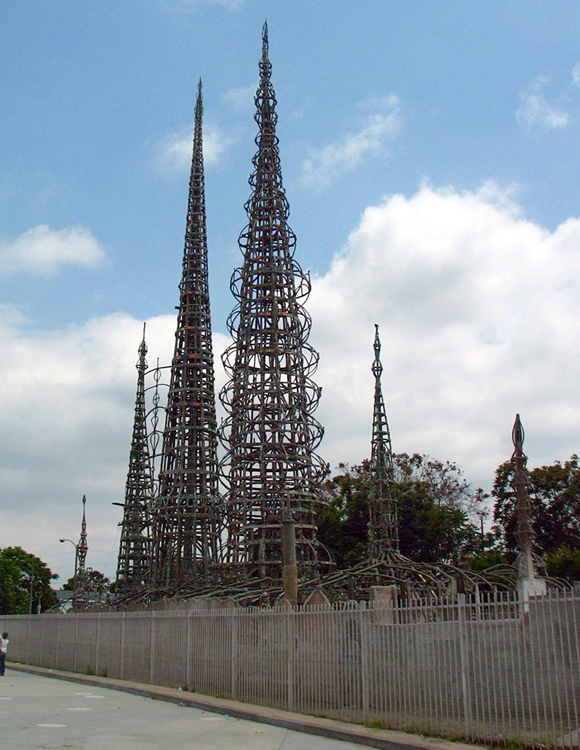
There is great art at the LA County Museum of Art (LACMA), but there is also the Watts Tower. In 1921, Italian immigrant Simon Rodia began building a monument to trash. Using any scraps of pottery, glass, steel and concrete he could find, he put together LA’s answer to the Eiffel Tower. He worked on the tower for 33 years, and it rises nearly 100 feet over the neighborhood. Of his life’s work, he said, ”I had in mind to do something big, and I did it.” It is one of the world’s greatest pieces of folk art.

That’s Los Angeles. It is sui generis, and, if not always a delight for the senses, it is always a ripe and luscious source of sense data.

As Raymond Chandler said, ”Anyone who doesn’t like it is either crazy or sober.”

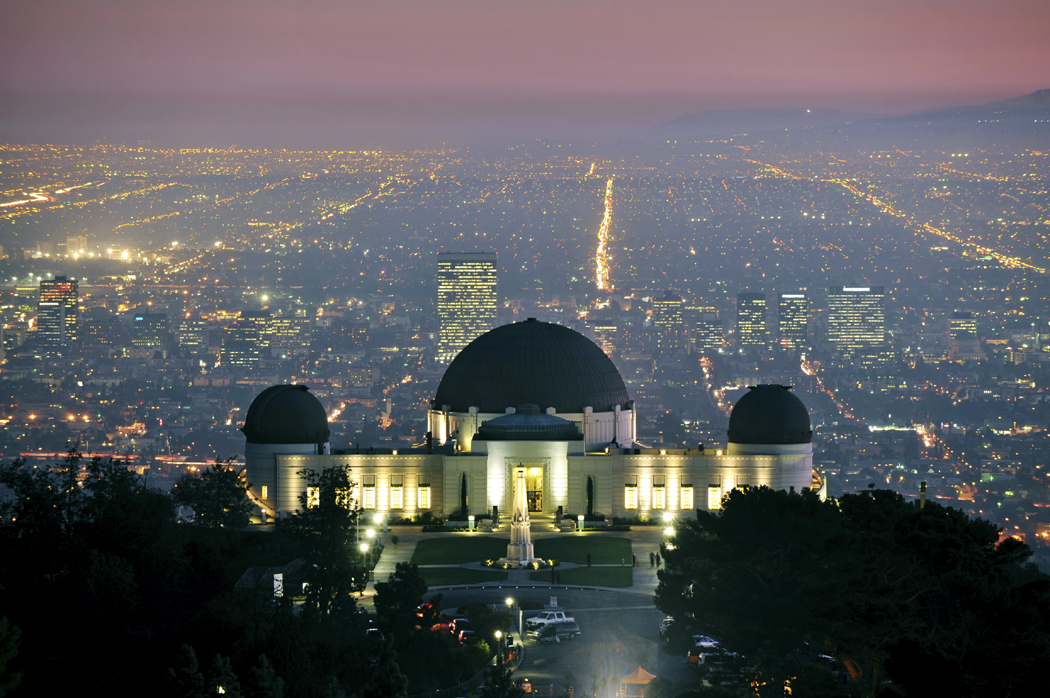
No, what I love is to walk along the grass on the beach side of Ocean Avenue in Santa Monica and smell the heady combination of salt spray and bus fumes, watching the sun expire into the hazy horizon, knowing I’m on my way to a great souvlakia. Skateboarders squirt past and retirees sit on the benches and read newspapers. The hotel signs begin to light up and you know that the city doesn’t close down, it just puts on its night face. LA griffith observatory

hale telescope

When I was a boy, like many boys, I developed an interest in astronomy.

I spent many frozen February nights outside my New Jersey home enjoying “good seeing,” when the cold air kept the stars from twinkling too aqueously. It was an interest I shared with my best high school friend — known as “Gizmo” — and we often used his 6-inch telescope to watch the rings of Saturn or the wrinkled “terminator” of the moon — the deckled line between sunlight and shadow roughened by lunar craters and mountains.

And when there was a total eclipse of the sun in 1964, Gizmo’s father drove us both up to Maine to get the best view. The birds stopped singing in the sudden darkness and Giz and I stopped talking as we were caught up by the final glimmer of Bailey’s Beads — that last-second “diamond ring” before totality — which gave way to a black hole in the sky surrounded by a fluorescent curtain of corona.

As we grew older, Gizmo’s interest proved more genuine. He was inclined toward science and mathematics and went off to Rensselaer Polytechnic Institute in upstate New York. My interest in the heavens turned out to be the interest of a humanities student — a little too much gee-whiz and not enough trigonometry.

Nevertheless, as a boy, I read everything I could on the subject. One name kept popping up: that of Palomar Observatory with its 200-inch Hale Telescope. All the best photographs, it seemed, were taken through that monster instrument.star picture

It was, I knew, the largest telescope in the world — a title it held until only recently — and sat on a mountaintop somewhere in the West.

And that is the rub. Being from New Jersey, everything beyond the Delaware River was a little fuzzy to me. I guess I knew Palomar was in California, but where in that state, I never really had a clue. The telescope existed rather in some ideal region, not subject to county zoning restrictions or state tax laws. It was just “Palomar.”

So, when I found ourselves in Southern California, driving up Interstate 15 from San Diego, when I came upon the exit for Cal. 76 north of Escondido and a roadsign mentioned Palomar.

I took the detour.

Palomar Mountain is a real place, with real stones and real trees, and, I’m sure, real county ordinances.

It is not easy to get to. It is way off the Interstate, down winding narrow roads through small towns and valley farms. The road gets narrower and more twisted as you turn off Cal. 76 and begin to climb Palomar Mountain on Cal. Route S6. There are some 24 switchbacks on the way up, with long views of an empty part of the state each time the road pokes into the open.090-S24342

The mountain is 5,600 feet high, with a broad flat saddle top. You turn off Cal. S6 onto Canfield Road and it loops the final miles to the parking lot at the observatory.

The woods that have bounded the road gives way to an open space filled with more ferns than you normally find outside of coastal Maine. They sit in the fields along the final few hundred yards to the glaring white dome at the edge of a rise.

The building is immense. The rotating dome is 135 feet in diameter and tall enough to fit a 13-story building inside and still raise a flagpole on top of the building.Palomar Observatory

Although the observatory opened in 1948, its design is from an earlier decade. Plans for a giant telescope were begun in the 1920s and work on casting the telescope’s glass mirror began in 1934. Work had to be halted during World War II. So, when it opened after the war, the building still bore the stylistic marks of the earlier Art Deco style. It is a plain building, but the ornament and proportions are unmistakable.

Yet, it is the machine inside the building we have come to see.

Little effort has been made to accommodate the visitor: There is a parking lot and a small, outdated museum and gift shop at the bottom of the hill. Inside the dome, there is only a small, poorly marked visitors’ gallery, glassed-in to keep the hoi polloi from gumming up the work of busy scientists.

Still, in the daylight murk of the closed up dome, you can see a giant, mechanical eye, the size of a coastal gunnery emplacement.

And it does bear some resemblance to a mammoth cannon, with a barrel that can be pointed in any direction.

Only, instead of pumping ordnance into enemy lines, it swallows down the buckshot of stars, giving astronomers a peek at distant points of light so dim and distant, they speak of the birth of the universe.

The very first photographs taken through the telescope doubled the size of the known universe. Later work doubled it again, when Palomar astronomers discovered quasars.

Size isn’t just for the heavens, though. The rotating part of the dome weighs in at 1,000 tons. The moving parts of the telescope weighs 530 tons. The mirror, nearly 17 feet across, weighs 14.5 tons.hale telescope cutaway

Yet, despite its massiveness, it only takes a tiny motor of one-twelfth horsepower to slew it around its bearings. In fact, you could, if anyone would let you, move that 530 tons with a single finger judiciously placed, it is balanced so well. It helps that it is mounted on a pad of moving oil, a thousandth of an inch thick, which keeps the weight riding frictionlessly.

Astronomy has moved ahead, working with computer images now instead of photographic plates. Yet, in the small museum at the site, you can see large transparencies of some of the observatory’s more famous images.

Perhaps because I grew up and became a writer rather than a scientist, I miss the awe and beauty of those million-dotted pictures, glowing white hot, like Moses’ bush, and giving a visual, esthetic image of the majesty and immensity of the universe.

The great full-color and false-color images from the Hubble telescope have replaced the old Palomar pictures in the minds of most younger humanities students, giving a newer, more rainbowed sense of the awe of the universe. But for me, it is a reminder of who I was and how I got to where I am.

Sometimes, it is why we travel, rather than where, that is the story.

Bakersfield

Bakersfield

California is probably the best known state in the union. The whole state, it seems, has been thrown up in Technicolor on local movie screens around the country, or used as a set for some TV show or other.

The hills of San Francisco, the peaks of the Sierra Nevada, the back lots of Los Angeles all are widely known and recognized.

But the long, flat middle of the state is for most Americans a total mystery. The Great Central Valley — called San Joaquin to the south and Sacramento to the north — has the visibility of mud.

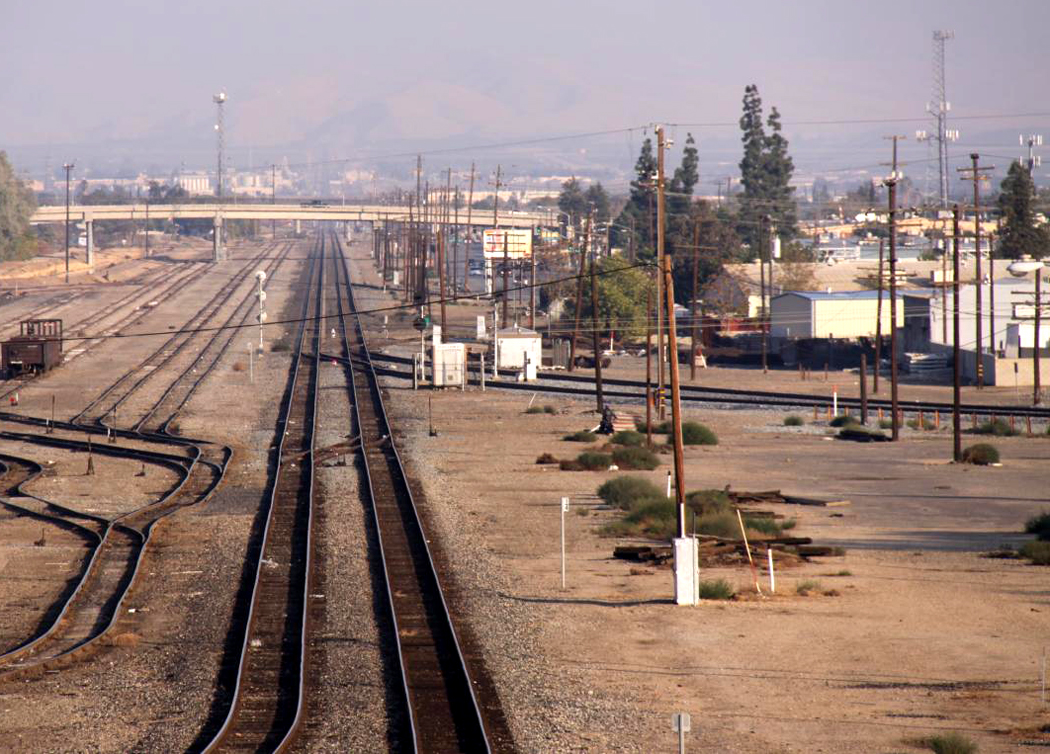
As you drive down from the Tehachapi Mountains, you can see the valley stretch out in front of you, flat as a billiard table and topped off with a familiar-looking brown cloud. To the west, you can see the coast ranges; to the east, the Sierra Nevada, crested with a line of white this time of year. And down the middle, the boring, flat, squared-off agricultural land that feeds the nation. outside bakersfield

It has been estimated that the annual income from agriculture in the Central Valley is greater than the total value of all the gold mined in the state since 1848.

It is true that tourists don’t often come through the valley. Unless they are crossing from Yosemite to San Francisco, they are unlikely to ever come near it. And there is not much to see, if you are looking for Knott’s Berry Farm or Disneyland.

What there is are vast fields of vegetables, orchards of oranges, vineyards of grapes, interrupted by corrugated aluminum processing plants with adjacent high-tension power lines and railroad sidings.

And, in the southern end of the valley, around Bakersfield, oil wells, refineries and vast, ugly tank farms, with row on row of oil tanks, painted white and lettered with corporate logos. oil pumps outside bakersfield

And in between, a great scattering of dust. It rises like a plume behind every tractor, every pickup that edges a plowed field.

Most of the Central Valley looks like it came right out of one of those WPA photographs from the Depression: sun-baked migrant workers in old paint-flaked clapboard houses with collapsed front porches next to the irrigation canal.

And always the wind and sun and dust. The elements are leading citizens in the San Joaquin Valley.

The connection with the Depression is even more real than apparent: Between 1935 and 1940, the population of Bakersfield and surrounding Kern County grew more than 63 percent, with most of that increase accounted for by the ”Okies” who migrated from the Dust Bowl in America’s middle.

It is probably a great place to live. But it doesn’t seem like much of a place to visit.

Yet, there are reasons to visit. Aside from finding out where your beans and asparagus come from, you can learn something of the history of the region and its ethnic makeup.

In Bakersfield, for instance, you should stop at Benji’s Basque restaurant on the edge of town.

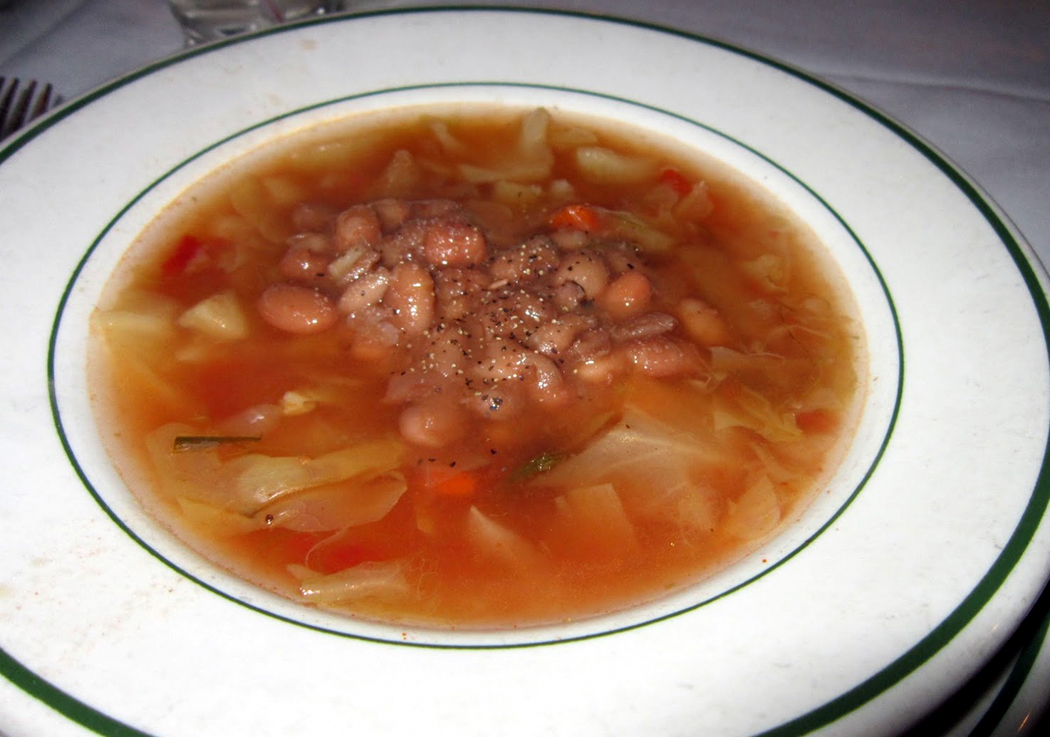
Inside, they will serve you family-style with huge portions of food. First comes the cabbage soup with hot sauce and beans; you add them to taste.

Basque bean and cabbage soup

Basque bean and cabbage soup

A loaf of sourdough bread and fresh butter sit on the table.

Lamb comes to you in a wine gravy, with heaps of fried potatoes.

And if you have room for dessert, Basque cake tastes a bit like a zwieback before it has gotten hard.

Bakersfield’s long and contentious history can be learned at the Kern County Museum and the Pioneer Village next door.

Kern County Museum

Kern County Museum

You learn how waves of development swept over the area. Land interests bought up huge tracts, and when irrigation made farming possible, the town grew, with all the local chamber-of-commerce pride that usually accompanies such economic success.

Large brick buildings sprang up downtown. Railroad depots were built. And large mercantile stores opened their doors.

You can see the process at the museum, although it is also true that, local pride notwithstanding, the process is the same in almost any agricultural town. The same farm implements are on display, the same original newspaper office, the same ”old-time” drugstore.

For it is Bakersfield’s ordinariness that is its fascination.

The town almost could have been dropped in place from Iowa or Kansas.

And although California has a reputation for political wackiness, with Hollywood celebrities endorsing pet causes and so-called ”tree-huggers” in the north, the huge Central Valley is as conservative as water.

tehachapi loop

You don’t get an adequate idea of California’s southern mountains when approaching from the east through the Mojave Desert. They look like little more than stony hills breaking through from the plain.

But climb them from the west and you will rise 4,000 feet through grassy canyons. Or from the south along Interstate 15, when you climb from Rancho Cucamonga to the cloudy heights of Cajon Summit at 4,257 feet. It is all uphill, but after you reach the top, there is no other side to climb down. The Mojave Desert sits on a plateau that stretches from the northern side of the San Gabriel Mountains.

The desert stretches out flat, with straight roads for a hundred miles. U.S. 395 runs along its western side in an arrow shot from Adelanto to Red Mountain. It crosses California 58 and skirts the edge of Edwards Air Force Base, where NASA’s shuttle frequently landed, to an audience of appreciative retirees who brought their RVs to the desert to see the event.

Edwards Air Force Base

Edwards Air Force Base

The small, scrubby town of Mojave sits on the junction of 58 and California 14. In December, it is cold at night, and aside from the dozen or so truck stops and convenience stores, the most notable thing about the town is the number of freight trains that barrel through, blasting their horns all night long, at the rate of something like one every 10 or 20 minutes. The ground rumbles as they spew sooty turbocharger exhaust into the air.

It’s a good place to watch for locomotive paint jobs, too. In this day of railroad mergers, you never know what you will see.

Mojave, Calif.

Mojave, Calif.

Originally, the line was shared by the Southern Pacific and the Santa Fe in an unusual agreement in which the corporate competitors decided to cooperate and share expenses. But now that the Santa Fe has linked up with Burlington Northern (already a corporate mix of earlier railroads), and the SP has joined with the Union Pacific, trains pass through town with engines from any of the ancestral rail lines.

The diesels sport the colorful red, yellow and silver or the navy and yellow of AT&SF, interspersed with transient locomotives bearing the old Burlington Northern green. One experimental paint job I saw was an unconvincing hybrid with a big, ugly BNSF written on the side of the engine in non-too-professional lettering.

The SP locomotives are painted soot black and are the least interesting in the country (or were until the conglomerate Norfolk Southern began to copy them with the attitude of ”paint ’em black and the dirt won’t show.”

But the yellow and gray of UP spruces up the look along the line, and every once in a while, you see the sickly blue of a Conrail engine.

I mention all this about the trains for two reasons. First, because they kept me awake most of the night, rattling my motel windows. And second, because it is at Mojave that the trains make the big turn westward to drop down Tehachapi Pass.

The pass, again, isn’t much from the east. A slight rise over the pass, at 3,793 feet, and an initially slow descent, hardly visible, through the town of Tehachapi and the broad Tehachapi Valley, with its ranches and cement plants.

But then the hill steepens, dropping toward the great San Joaquin Valley below. And just above the town of Keene, the track makes a huge, nearly double loop, letting the train down more gently than the slope of the canyon would otherwise allow. tehachapi look aerial

This is the famous Tehachapi Loop, built in 1876 by the Southern Pacific under its engineer, William Hood. To allow the trains to climb a 2-1/2 percent grade from Caliente, near the bottom of the hill, to Tehachapi Summit, a distance of about 15 miles, Hood had to lay 27 miles of track, looping and curving all through the hillsides and over Tehachapi Creek. There are innumerable bridges and 17 tunnels.

Or, there were 17 tunnels until the earthquake of 1952. Now, there are 16.

You can take a narrow, winding road from Keene back up under the freeway and up the canyon to get a good look at the loop. About three miles from the town, there is a stone monument that tells very briefly the story of the engineering feat. From the parking pullout, you have a pretty good view of the grand circle of tracks.

But to really get a sense of the spiral, you need to drive an additional 150 yards uphill and take the well-worn footpath onto the grassy knoll that rises above the loop. Below you to the southeast, the track winds back uphill. As the track goes under you, through a tunnel, it comes out to the north and begins a wide turn to the west, around a pyramid hill in the center of the loop, creating a circle that is 3,795 feet in circumference.

The dual line of rail then sweeps back around the hill toward you again, and circles down underneath itself and into a tunnel.

A normal-length freight train at this point doubles under itself as it circles around the track. Nothing I’ve ever seen in the real world of railroads looks so much like the standard model-train layout, with its combination of tunnels, spirals and circles.

In the days of steam, SP had some of the biggest locomotives ever built to climb the Tehachapi Mountains. With 16 drive wheels each, they were used in teams of three and four at the head of each freight train, with another three or four scattered in the middle and at the end as ”helpers.” steaam power2

The giant steam engines had their cabs at the front, so that their engineers wouldn’t asphyxiate from engine smoke as they pulled through the tunnels.

Nowadays, as many as a dozen diesels will be scattered throughout the train for pulling power. Because not so many engines are needed to go downhill, sometimes a group of four diesels will ”deadhead” downhill, without any train behind, so they can link up with another uphill train.

Aside from the diesels and the four-lane divided highway that parallels the tracks most of the way downhill, not much has changed over the years. What was written in the 1939 Federal Writers Project Guide to California still holds true:

The Tehachapi grade ends below Caliente, and ”the mountains are behind, imposing, verdant, dulled with purple; ahead is the flat and monotonous plain of the San Joaquin Valley. The tops of grimy oilwell derricks loom in the distance; as the road continues westward, their numbers increase, dotting the checkerboard of tilled fields like black-headed pins on a field map.”

imperial dunes

What Americans have done to the desert is not encouraging.

The drive from Blythe, Calif., to Brawley on California 78 is a microcosm of the problem. You can pile up the insults that the desert has suffered.

California 78 is an old, two-lane blacktop that passes through the agricultural area outside Blythe. Before you leave the river, you pass retirement communities and winter-resident trailer parks. They pile directly on scrap yards and petroleum tanks. One wonders what the attraction of living there might be. The whiff of gasoline in the dawn? The lulling sound of traffic on the interstate?

Blythe, California

Blythe, California

Farther away from Blythe, the bustle of franchise foods and self-serve gas stations gives way to the quiet perpetuity of farmland.

The buildings you pass are poor and the names on mailboxes and storefronts are largely Hispanic. Community stores, such as the ones in Ripley or Neighbors, are dilapidated and have graffiti sprayed on their side walls.

Ripley, California

Ripley, California

The Colorado river plain is flat and fields spread out to the horizons. At one point, the highway passes close to the river, or rather, the oxbow lakes left behind when the meandering river cut through its own bottomland. The rushy, reedy water’s edge comes up to the shoulder.

The road takes several right-angle turns — as such roads always do in farmland — and eventually passes beyond the reach of the canal irrigation and back into Sonoran Desert, with its ash-pile hills and scrubby creosote.

But just as you think you are passing into wilderness, you find the slag hills of industrial mining. What appears at first to be mesas in the distance turn out to be piles of industrial debris. The closer you get, the more obvious are the dirt roads cut into the hills. Derelict mine-shaft machinery sits silhouetted on the horizon.

And as you pass the Gold Basin Mine and the Rainbow Mine, suddenly the desert is fenced off, with spirals of barbed wire cresting the tornado fence that goes on for miles. But it is not a fence to protect the private property of the mine owners, rather it is to protect the desert tortoise.

Signs every 50 yards or so posted on the fence warn you to keep out, that the tortoise is endangered and is protected behind the fences. But one look through the mesh and you know the tortoise hasn’t got much of a chance: The hills are slag and the dirt has been scraped flat.

If there are mountains in the distance, they are hard to see as I drive through. A blue haze, the color of stale cigarette smoke, hangs in the air and blots out the view. When a range of mountains finally shows in front of you, it turns out to be not rock but sand. dunes sign

The Imperial Dunes cross the highway, catching the smoky, filtered sunlight at an angle, showing off their sensuous curves and rhythmic flow.

But as soon as you are upon them, you see that the sand is not so smooth as you thought. In fact, it is scarred like a burn-victim’s skin. Every foot of dune is lined and corrugated with thousands and thousands of dune-buggy tracks. There is a section protected from the abuse, but outside the ”Angle” on the west side of the road, not a single square rod of unblemished sand remains.

And I’m passing on a weekday, which tells me that this damage doesn’t repair so quickly as the sand on the beach that smoothes out after each change of tide.

The dunes are still impressive: They are much more so here than along I-8, where most people are familiar with them. The view from the Osborne Overlook is like that from a mountain turnout. If it were not for the blue murk, you could see two states and two countries.

As the road drops down from the dunes back into the desert, you think, perhaps, now it will be OK. But the signs along the road read ”Danger” and ”Peligro.” It is a live bombing range. Don’t enter the desert, the signs along the road warn, because there are unexploded shells buried in the sand. blythe farmfield

Finally, the road re-enters the agricultural area east of Brawley. A sea of green. Lettuce or sugar beet extend to the horizon, and more salt cedar trees are being cut down as they age and rot. More used farm machinery for sale. More small, wooden homes beside the road with old cars parked in their dusty driveways.

The houses and the people you pass, with their donkeys in paddocks and their battered pickup trucks, seem like something directly out of the WPA photographs of the ’30s. You almost look for Tom Joad. Used farm machinery piles up in rusty lots.

Brawley, California

Brawley, California

The town of Brawley is just as decayed. It once must have been a pretty place. The main street is wide, with an island down the middle. But along its edges are empty stores and a boarded-up movie theater whose style says that perhaps in the ’40s, it was the kind of place that people came to for a Hollywood escape from the hard life of the farm.

From Brawley, you drive down California 86 to the interstate and pass sugar refineries and agricultural warehouses. Closer in to El Centro, the seas of growing green turn into seas of red-tile roofs, in the brand-new but already debilitating sameness of the desert’s version of Long Island’s Levittown. ”And they’re all made of ticky tacky and they all look just the same.”

Life in the desert has always been hard. It used to be hard on the residents and turned them into wizened whiskered eccentrics who live in lopsided mobile homes piled up with dirt on their sides.

Nowadays, life in the desert remains hard, but it is hardest now on the desert itself.

For the next several weeks, this blog will chronicle a road trip taken from Tijuana, Mexico, to Vancouver, Canada, up through California, Oregon and Washington. In 1937, photographer Edward Weston was awarded a Guggenheim Fellowship and set out on a similar trip, and in 1940, published a book of his photographs, with text by his wife, Charis Wilson, called “California and the West.” In some humble way, this is an update. 

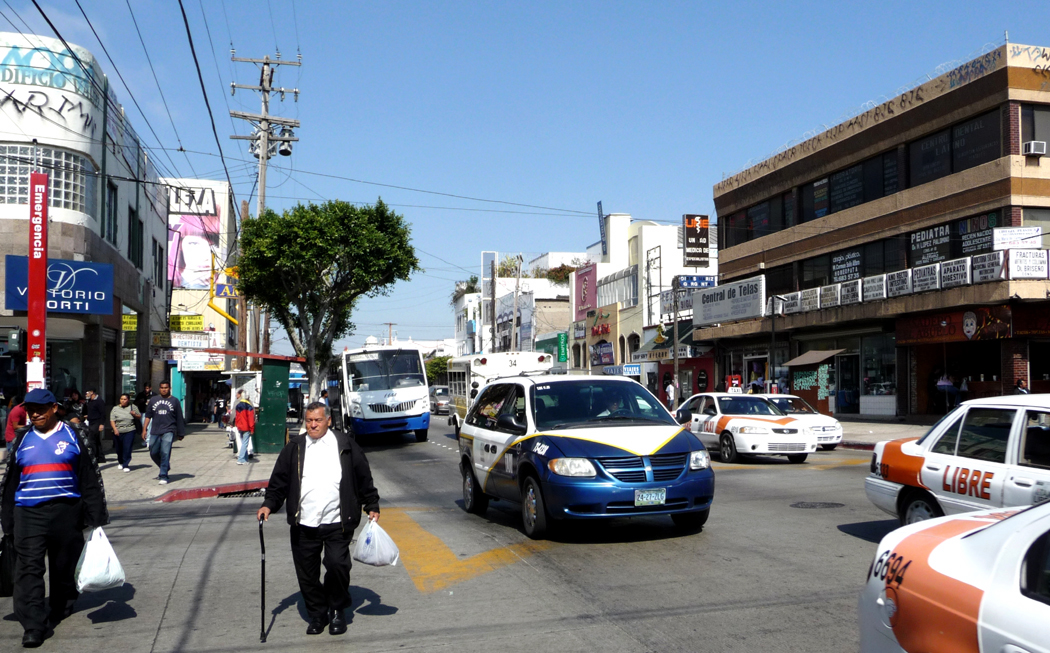
Avenida Constitucion

Avenida Constitucion

 VISITING TIJUANA

I hadn’t really looked forward to visiting Tijuana. It is, after all, a border town. Such places traditionally are tacky beyond belief. I’d seen Nogales, Sonoyta and Ciudad Juarez, and must say they give me the creeps.

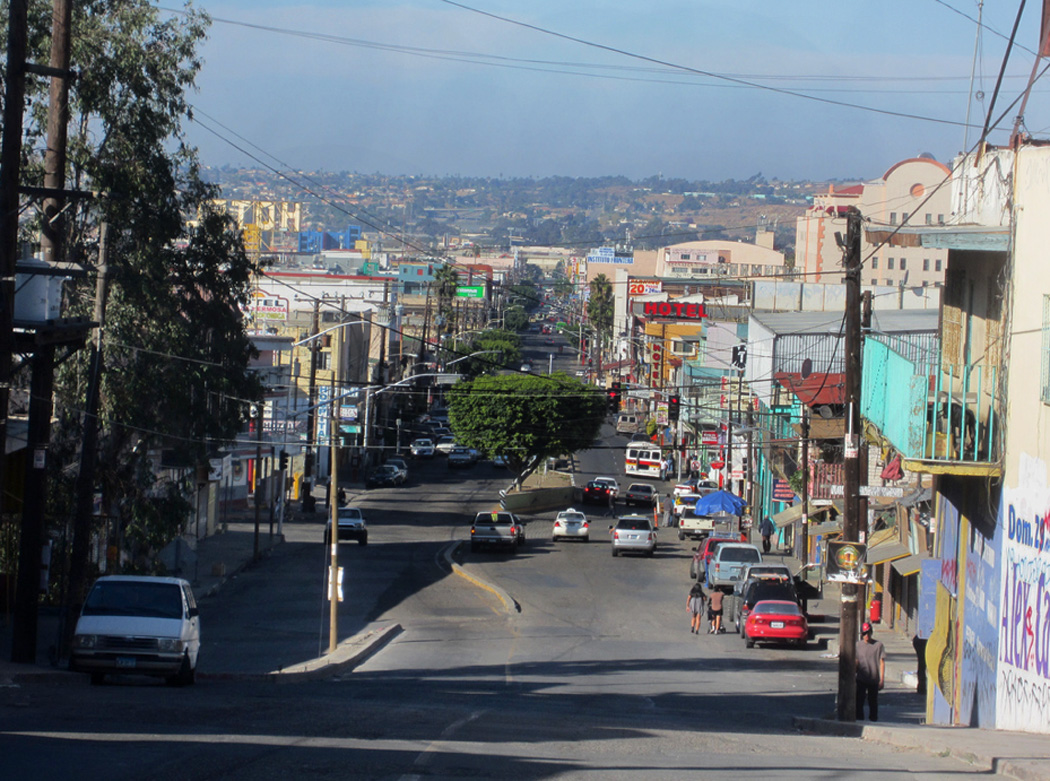
But I was pleasantly surprised by Tijuana. Of course, it’s tacky. It wouldn’t be Tijuana without that. But it is also a legitimate city and, if you get off the main tourist drag, a thrilling town to be in.

Just a few hours in the city will teach you things about your own country that you hadn’t considered. Our own folkways contrast to the Mexican so that for the first time, you understand your own quirks.

Noise, for instance. In the United States, we are used to a lower level of sound than you find in Tijuana, where every store seems to blast musica into the street in deafening volumes. tijuana storefront

And there are smells. Almost all of them are wonderful smells. I didn’t smell any stale urine until I walked back into the U.S.

Instead, I smelled lemons, roasting chickens, fresh leather, chile peppers, piles of fresh vegetables, cilantro and vanilla.

There are some less pleasant smells, too. Cigarette smoke is everywhere. And Mexican ideas of automobile emissions are very different from ours. They seem to think the more emissions, the more money you make.

Money is the single ubiquitous thought in Tijuana. Economics blot out every other concern. I didn’t see any religious symbols except those for sale, I didn’t see any art except that for sale, I didn’t see any culture except that for sale.

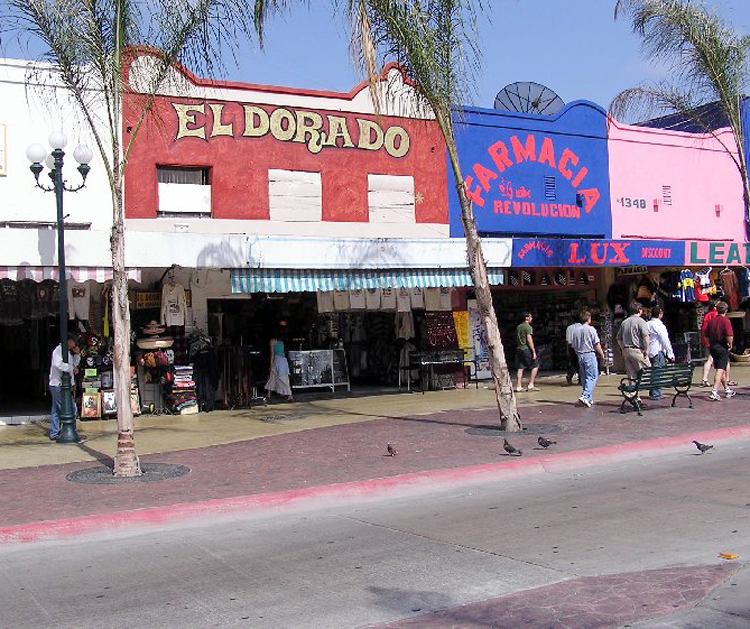
At every square inch of the city, there is somebody scratching out a buck, or a peso — although almost everything sold on Avenida Revolucion is priced in American dollars.

Jewelry, leather, tequila, cheap blankets, more marionettes than I’ve ever seen in one place — they tend to be Disney cartoon characters.

And questionably Cuban cigars — the sign on the store awning read: ”Cuban Cigars Since 1492.”

And mannequins. Most stores show off their wares on stiff Anglo-looking mannequins. In one, gender identity turned into street theater as fake beards were displayed on women’s fashion-model heads.

In another, the most elaborate wedding dresses were in the storefront, on mannequins with their faces turned away from the street. tijuana wax museum

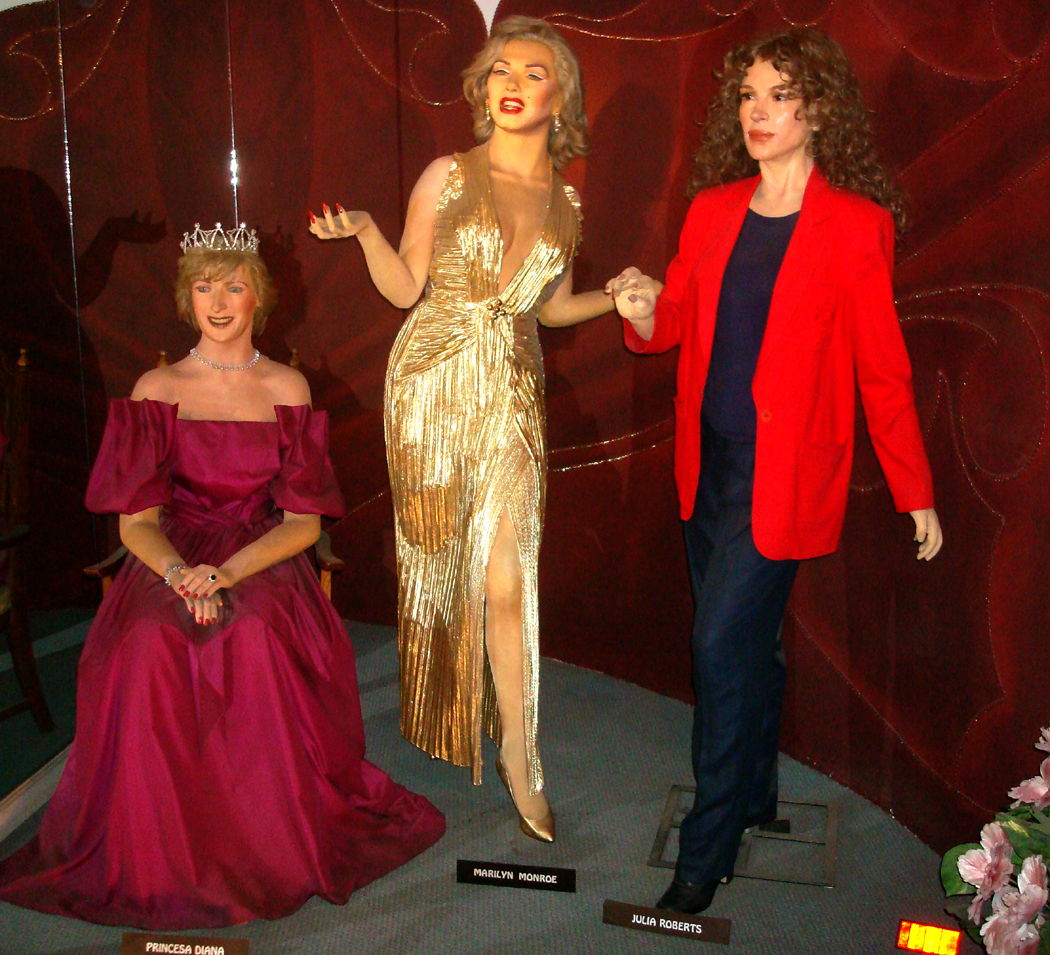
MUSEO DE CERA

If you don’t find enough of the mannequins in the stores, you should try the Tijuana Wax Museum, which advertises ”More than 60 figures,” although I didn’t count quite that many when I walked through.

Many of the figures are distinctively Mexican: There are Emiliano Zapata and Pancho Villa. Cantinflas has his place of honor. But so do Elvis and Michael Jackson.

Mexican history is prominent, but the figure of Father Eusebio Kino looked uncomfortably like Bela Lugosi. I wondered if he had been recycled from an old Dracula tableau.

I was there at opening time, but no one else was, including the people who ran the place. About 15 minutes later, someone showed up and unlocked the door, flipped on the lights and began taking admission money.

Don’t miss Rita Canseco — she is a national heroine, although we know her here better as Rita Hayworth. And whole halls are devoted to the Mexican equivalents of Merle Haggard and Hank Snow.

I knew I couldn’t leave town without eating some Mexican food, so I wandered into Tilly’s Fifth Avenue, a dark little smoky place on Avenida Revolucion. An attractive young woman stood outside the door hawking for the place. There are people outside every door in Tijuana like carnival barkers trying to draw you in, even in mid-December, when I seemed to be about the only gringo on the streets. tijuana streethawker

The food was very good, a great deal funkier than the normal American version of the cuisine — with more character and flavor. The big combo plate and a homemade lemonade came to $6. But the best thing was the bowl of chips and salsa.

The chips were thick, crunchy and corn. The salsa fresca was the best I’ve ever eaten. It came in a tacky plastic bowl textured to imitate the ancient soapstone molcajetes of the countryside.

Meanwhile, American TV blasted over our heads on multiple monitors, flickering like moths. You couldn’t hear it, however, because the Beatles played on the jukebox without end. ”Love, love me do.”

TWO TASKS

I had two things I wanted to get done in Tijuana. First, I needed to find a place to buy crepe paper. My wife had charged me with the responsibility of bringing her the paper so she can make paper flowers.

Second, I wanted a Tijuana haircut.

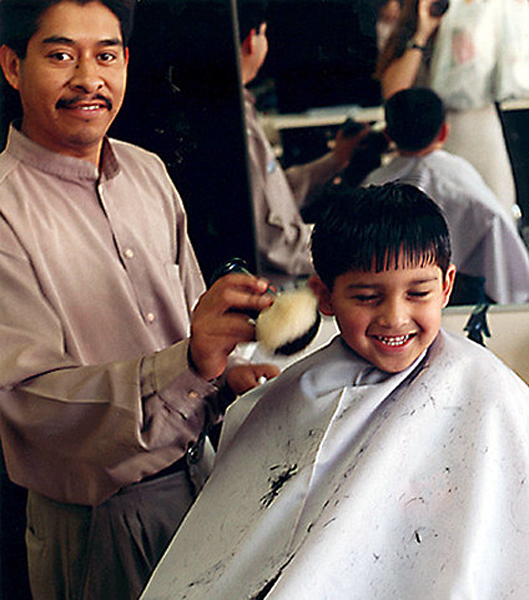
I know that sounds like something you say about Mexican traffic: ”That bus cut me off so close, I got a Tijuana haircut.” But really, I just wanted to try out a Mexican barber. Mexican barber

It was a chilly, drizzly December day and I walked up and down the streets of downtown. Men on street corners asked each time I went by, ”Taxi, you want taxi?” Others held out armfuls of cheap costume jewelry necklaces, ”Hey, Mr. Whiskers, look at this. You buy?”

Tijuana is a border town and full of all the heroic tackiness that implies, but it is different from Nogales. For one thing, it is bigger. It is the fourth-largest city in Mexico, with a population of about a million. Which makes it considerably more urban and cosmopolitan. You know you are in a city.

Avenida Revolucion, the main street in downtown, exists mainly for the tourists. It’s hard to believe there is a large enough market counting the entire world for all the leather that is being sold. Open-front stores with piles of cheap blankets alternate with shops selling cheap watches and restaurants selling cheap tequila. Outside every one of them, someone is calling out to you as you walk past: ”Look at this. You buy?” and ”Hungry, Mister? We got lunch.”

Even at 10 in the morning, they are selling lunch.

I soon wandered off Revolution Avenue. If you walk west a few blocks, past Avenida de Constitucion, you come across something a little less like Mexican Disneyland. Markets sell food, stationery supplies, wedding dresses — all the things a normal Mexican needs.

I was looking for a store that sold crepe paper. I stopped at a magazine kiosk and asked, in my best dime-store Spanish, ”Donde esta un papelador?” The news vendor looked at me as if I were speaking Uzbekh, so I tried again, ”Necesito papel para flores.” tijuana street

This made sense to him. His eyes lit up and he held up four fingers and pointed west. ”Tres cuadros,” he said, pulling back one of the fingers. ”Three blocks this way.”

So I walked through the rain past the hordes of people, smelling delicious food from streetside vendors as I went. After four blocks, there still was nothing that looked like it sold paper. I found lots of cassette tapes, more leather, plenty of fruit-juice stands, but no paper.

I asked another news vendor. He held up one finger, then held it up again, but covered the top joints. One and a half blocks, he means, and back the other way.

TIJUANA HAIRCUT

I walk, but find no store. What I do find is a barber. It is a tiny storefront shop with red and white stripes above the door. It is an old, falling-apart building wedged between leather shops.

So I go in. An elderly man is seated in the near chair, getting his hair trimmed. A woman sits in the other chair, waiting for a customer. She is not sure I am it.

I make the international gesture of haircut to her, swooping a karate chop over the top of my head, and she smiles, gets up and tells me to sit. I am not sure what to tell her. I want a crew cut — my semiannual hatchet job.

”Corta?” she asks.

”Cortissima,” I reply.

The shop is large enough for only two ancient barber chairs, a few waiting chairs and a mirror that hangs shoulder-high along the wall. At the back of the shop near the ceiling is printed, in very neat block letters, professionally painted, ”El Trabajo todo se vence” — Work conquers all.

I had the odd feeling that this sounded rather too much like the words over the front gate of Auschwitz, but I’m sure it had more to do with the barber’s work ethic.

And she gave me a full going-over. I swear before God and man that my ears have never been lower. After the buzz saw came the scissors to clean up anything left and finally, lather and straight razor to make a passing lane between my ears and hairline.

All this was accompanied by choking clouds of powder, brushed on liberally, and the splash of flowery, yet medicinal, cologne up the back of my neck.

It was all I could have asked for, short of macassar oil. I got my Tijuana haircut and I will wear it proudly for the rest of my travels.

FINALLY, PAPER

And as I left the shop, dropping a huge tip into the barber’s hand, I asked again for a paper shop. The barber took me outside the shop, pointed down the street and told me to go one block, cross the street, go a half-block up and on the right would be a papelaria. He repeated it.

And sure enough, when I walked there, a huge warehouse of a store was filled with everything you could possibly make from paper, from school notebooks to wallpaper. And down the end of the store were huge racks of crepe paper. Mexican papelaria

My wife had sent me to Mexico to buy the paper because, she says, American crepe paper is no good anymore. If you want to make Third World crafts, you have to start with Third World supplies.

I piled up about $20 worth in an assortment of floral colors and wrapped them up in a plastic garbage bag I had brought along for the purpose.

I felt like Martha Stewart or something: I had planned ahead, knowing it would likely be raining in Tijuana and I would likely be buying paper products, so I brought the bag to protect the paper from the rain.

And when I got back on the bus to return to the United States, the sun broke through and briefly scratched a piece of rainbow against the dark clouds to the north.border crossing

As I left town, I passed more shops, more barkers yelping. I passed old women sitting on the sidewalk with trinkets for sale. I passed bars, restaurants and more leather.

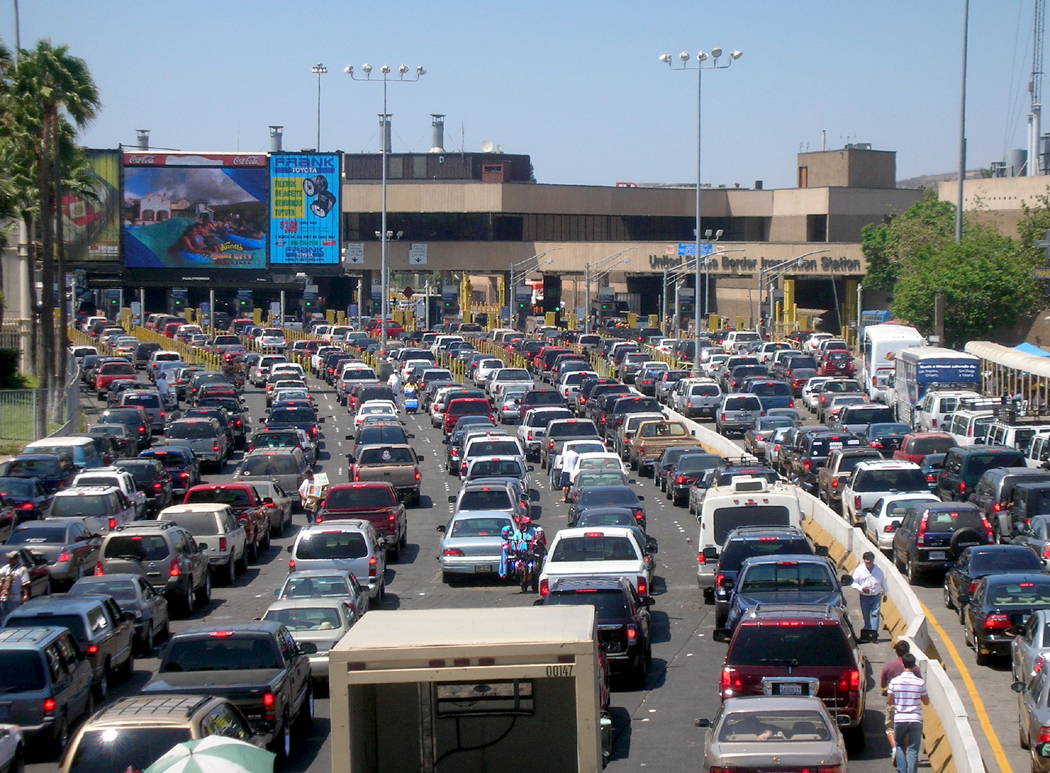
And when we got as far as the lines of cars backed up at the border when the bus driver told me it might be faster if I got out and walked the rest of the way. I did.

texashillcountry1

I’ve gotten an early start on a long day’s driving. It is dawn on the plains of west Texas and as the sun pops its first bright blast over the horizon, Schubert’s Trout Quintet plays on the car stereo.

Its first chord is also a bright blast, beginning like a sunrise, with a skyrocket of an arpeggio on the keyboard that bounds out like that first instant blaze as the edge of the sun explodes on the horizon.trout score 2

And when the quintet’s first melody breaks free, the arpeggio is joined by the string bass descending to rock bottom. It’s like the unfolding of a musical universe. It’s almost like getting out of bed, stretching your arms up over your head and planting your feet firmly on the floor.trout score1

I often find myself whistling along with the music when I’m driving, but with the Trout, I find myself singing along, bellowing like a playful calf.

It’s a different thing altogether. The whistling is just a kind of inattentive tagging along with the tune.

The singing, however, is my physical presence in the music.

Bump-bump-bump-bummmmm, I yell out with the string bass.

It is that deep resonance that gives an anchor to the music. It is like the footings of a skyscraper dug 60 feet into the bedrock.

The Texas hill country glows in the first rays of the sun, each rolling rise of earth catching the light like the drapery on a Greek statue.

There are a few low sunrise clouds, but the sun enters underneath them and the road is so empty, they just undulate as they run up over the hills. There is nothing on the highway for miles, just the occasional transfer truck that you pass.

What gives the Trout its phenomenal sense of emotional rightness is its constant balancing of the upward and downward motion of its melodies, often at the same time, like the bass and piano at the outset.

It’s not often in life that the emotions coincide in such a perfect sense of morning, light, a new day, optimism and hope.

Such is the Texas daybreak; such is the Schubert. It is a sunny quintet, with hardly the whisper of a shadow in its five bright movements. Even the minor-key variation in the fourth movement is dispelled with a major chord — “I was just playing,” its composer seems to be saying.

Yet, the Trout is an anomaly among Schubert’s major compositions. He wrote it when he was only 22 and it spreads sunshine from beginning to end.

Through most of his best music — the late piano sonatas, late quartets and the great C-major string quintet — there is a strain of despair that is heartbreaking. Even in his short piano pieces, beloved of amateurs for a century and a half, there runs a vein of deep melancholy that shades even his happiest moments.

For soon after he wrote the Trout, Schubert knew he was going to die, and to die soon. He had contracted an incurable syphilis, and it left him an outcast. He was dead before he was 32.

That knowledge, along with his poverty and his habitual sense of isolation and loneliness, give the dark tincture to his mature music.trout titlepage

And even the Trout gives expression — although in the most oblique way — to the melancholy that was constitutional in the composer: The earlier song he had written, also called The Trout, was the basis for his variations in the fourth movement of the quintet. The song tells the story of a bright, wily trout — “who gaily shoots past me like an arrow” — who then gets caught by an “cold-blooded” angler. The poet laments the loss of such a happy, bright fish. It is a miniature exposition of the theme, “Et in Arcadia ego.”

Somewhere east of Balmorhea, sunflowers begin showing up on the shoulders of the highway, great yellow clumps of them — sunshine growing from the roadside dirt.

I drive along in the shade under a cloud, but the sunlight rings the horizon with the tawny sand color of dry grass. I am an audience in the shade, but the spotlight is on a stage in all directions.

The rays of the sun break through the clouds in the north, making lines like rain hitting the ground.

There are lots of birds — finches, and swallows and swifts — darting around in the air over the road. I’m one of them.

Panamint Valleybw

You know you are a devoted traveler — or a complete idiot — when you go to Death Valley in July. No mere vacationer or tourist would risk it.

But it is the only way to get the genuine Death Valley experience. After all, a cool, refreshing wintertime Death Valley isn’t really Death Valley at all.

No, the real deal is baking hot and glaring with sunlight. The air shimmers, as if uncertain on its feet and about to faint.

That’s the way I first saw it, about 15 years ago in a car with no air-conditioning. It’s the only way to go.

Since then, I’ve been back many times, and always in midsummer. Death Valley National Monument is one of the wonders of the world, and it will disabuse you of any notion that nature is a comfortable place or that wilderness should be equated with warm, furry animals with big brown eyes.

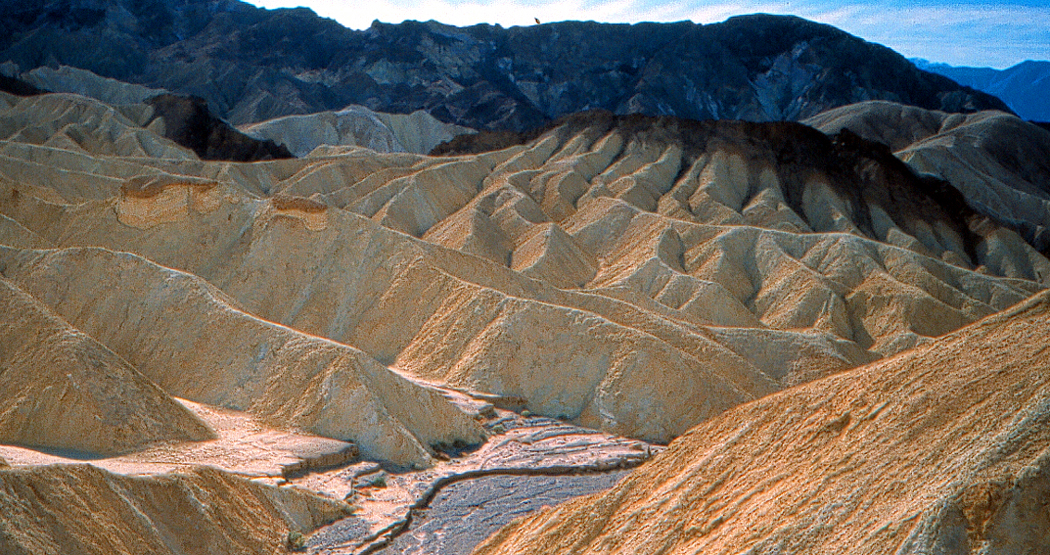
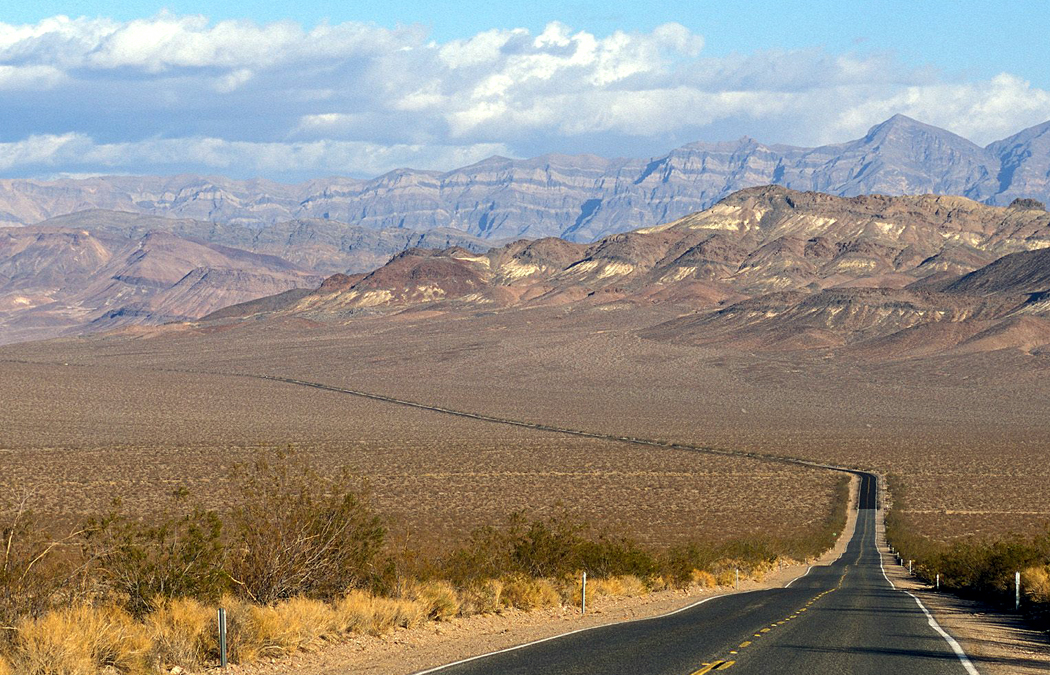
Even before reaching the National Monument, I was astonished by Nevada. The road north from Las Vegas passed the Sheep, Spotted and Pintwater ranges, and bordered the Desert National Wildlife Refuge, though it doesn’t look like the land could support any wildlife aside from sidewinders and scorpions. Zabriskie Point

I passed the Joshua trees in the flatlands of the Nellis Bombing and Gunnery Range. The armed forces have used Nevada to test weapons, though how they can interpret the results, I’ll never know. How can a bomb crater look much different from a soda wash?

The names of places in the area are trying to tell you something: Coffin Peak, Ash Springs, Last Chance Range, Valley of Fire State Park, Furnace Creek, Chloride Cliff — each geographic name serves as a warning sign.

The heat, as I descended the Funeral Mountains past Corkscrew Peak, rose even higher. At Stovepipe Wells in the center of Death Valley, the air temperature was more than 120 degrees and the ground was cooked to 150. The average high temperature in July is 116 degrees, and the highest ever recorded was 134 — on July 10, 1913, the highest temperature ever recorded in the Western Hemisphere, just over 100 years ago. That is serious heat.

The air rushing in through the open car window could have roasted a Christmas goose. It was literally like the blast of heat you get when your face is too close to the oven door when you open it. It singed my eyebrows. badwaterroad deathvalley

In Death Valley in July, you are alone in an area 1 1/2 times the size of Delaware, and all you can see are baked rock and the laser beam of sunlight. If you falter, no one is there to rescue you. And there are no Circle-Ks, no Slurpees, and most of all, no shade.

At a rest stop, I picked up a park brochure titled ”How to Survive Your Trip Through Death Valley.” And they weren’t kidding.

Even at rest in the shade, the brochure said, you can perspire away a quart of water in an hour. It admonished me to drink water frequently.

I had been getting a headache; I thought it was from driving hundreds of miles, but the brochure said it was more likely the first stage of heatstroke and I should down great quantities of water. I drank a half-gallon immediately and began to feel better. By noon, I had drunk well more than a gallon. Strangely, no matter how much I drank, I never needed to pee.

The high point of any trip to Death Valley has to be the lowest point: Badwater, at 282 feet below sea level — another record for the hemisphere.

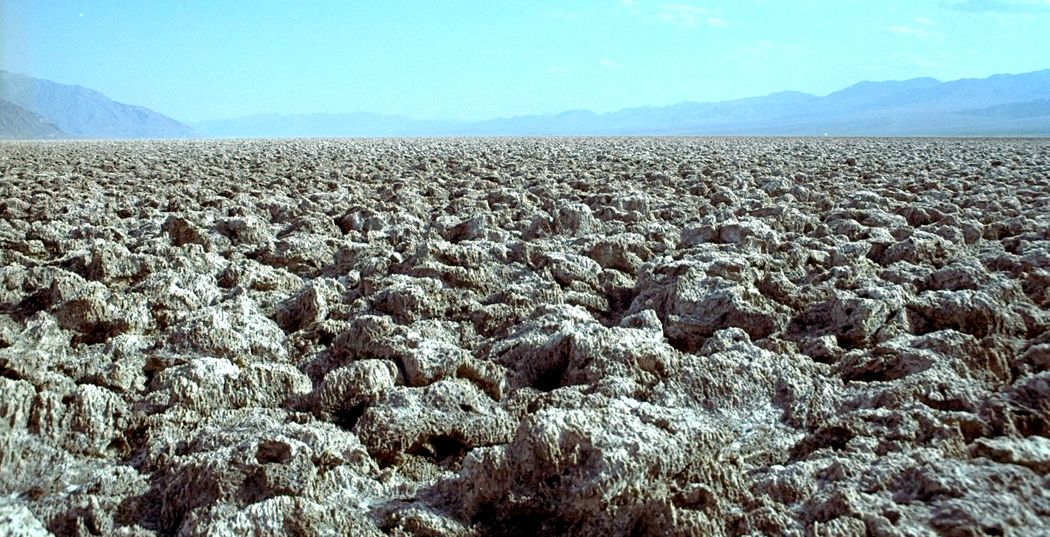
From your car, you look out on a vast sea of blinding white. You might mistake it for snow, but a closer look shows you the spiky, lacerating surface of evaporated salts, like the pavement of Hades. If you walk across it, it crunches under your boot sole like plaster, which it very nearly is.

Road to Dante's View

Road to Dante’s View

But the best vantage point on Badwater is more than a mile directly above it. Dante’s View is a scenic overlook on the crest of the Black Mountains at the end of a 12-mile road. It gives you a panoramic vista of Death Valley and its surrounding mountains, the Amargosas and Panamints. The flat basin stretches 100 miles north to south below you, glistening with the white of the salt pan.

You can see it over the shoulder of a soaring vulture a thousand feet below you, wondering what it will find to eat, and knowing it could have been you.

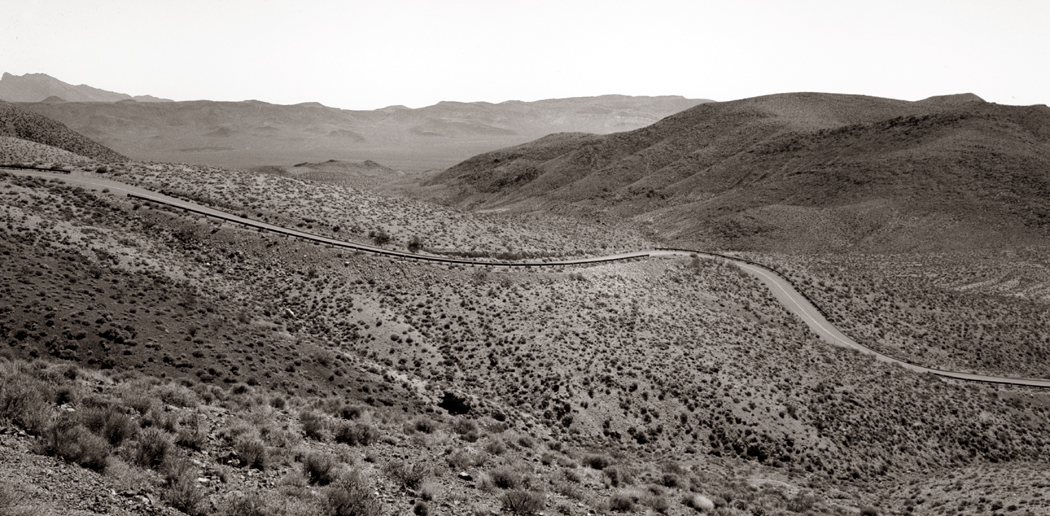
There are many roads through the park, but, for mortification of the flesh, none beats the West Side Road, a gravel route designed by Torquemada.

I love to drive my little sedan where sensible people fear to take their Range Rovers.

I’ve driven through dust, sand and slop, spinning my wheels and sliding back and forth through icy clay and spitting gravel. I always come prepared with a military-surplus entrenching tool and a Hudson Bay ax, though I have only had to use them twice. Once was on a dirt road near Dynamite Road in north Scottsdale, Ariz., as I got caught in the deep sand of a stream bed and had to dig the car out. In fact, I had to dig until I hit bedrock before I could muster any traction.

The second time was on the Navajo Reservation after a rain when the wheels sprayed so much mud on my running board that the Toyota weighed a good 50 percent more than it did when it came fully equipped from the factory. I had to use the ax to hack off layers of mudpack. I couldn’t get it all, and by the time I got back home, the remaining layer had so dried that it took a pneumatic drill to peel off the stucco. The whole thing looked like a gigantic corn dog with windshield wipers.

So, the thought of going down West Side Road had a certain martyrish appeal.

I packed a picnic lunch at Furnace Creek and headed south to the 36-mile West Side Road that would take me along the western edge of the valley. It is a hypocrite of a road: As you leave the solid pavement of Calif. 178, the gravel looks well graded and flat. Don’t believe it.westsideroad1

It turned out to be the worst piece of washboard driving I’ve ever suffered through. Usually, you can either slow down or speed up and escape the resonance of the corrugation, but not here. No matter how fast or how slow I drove, my teeth turned into castanets.

Every mile or so, there would come a smooth spot, just long enough to delude me into believing the rough part was over and dissuade me from turning back. But in a hundred yards, the bumping would begin again in earnest.

In fact, the rattle was so bad, it turned my pint of milk into butter. And when I stopped to make my sandwich, the bread had had the leavening shook out of it. So I buttered my matzoh and when I reached for my bottle of water, the vibration had turned it into seltzer. I received the benefit of sparkling water without having to pay the premium National Park price for Perrier.

There were several sights on the way, including the ruins of an old Borax works, which were now nothing more than a few mounds of dirt covering the archeology. The road flirted with the foothills of the Panamint range and every so often, a subsidiary road would head out perpendicular into the mountains. Most warned that they were recommended only for 4-wheel drive.devilsgolfcoursedeathvalley

They would have had to be better driving than the road I was on.

And the worst was the last bit of it. As I could see on the horizon the junction of my road with the main, smooth, paved road, the corrugation took a turn for the nasty.

The last bit looked especially smooth; it was white dust and gravel and promised a change from the rattle-bone right of way, but in fact, it was the worst lie of the day. When I got to that part, it was the equivalent of a speed bump every eight inches for a half mile. I had to take it in first gear.

When I finally made it back to the pavement, I made a solemn promise to the Toyota that I would not venture out onto the gravel again for the duration of the trip. The car had made it through with its only damage being a dangling muffler.

It took me a good half hour of driving into Nevada before my eyesight regained control of its vertical hold.

fog bank

Life is made up of experiences. Not thoughts, but body-experience. It is what brings us wisdom, what brings us the game pieces we draw out of the well of our lives, that make up our literature, our art, and the myths we make of our own lives. Experiences are the building blocks of our psyches.

And the experiences of one generation are different from those of the next or the previous. We can never really know what it was like to be in Napoleon’s army or Wyatt Earp’s Dodge City or on a viking ship sailing the coast of Greenland.

Our children will never know what it was like to be us. You didn’t listen to your parents lecturing you, and you shouldn’t expect your children to be any more interested in what you have to say to them. Experience, it turns out, is non-tranferable.

But, at times, we get hints. Some bit of the past reoccurs and we get an insight.

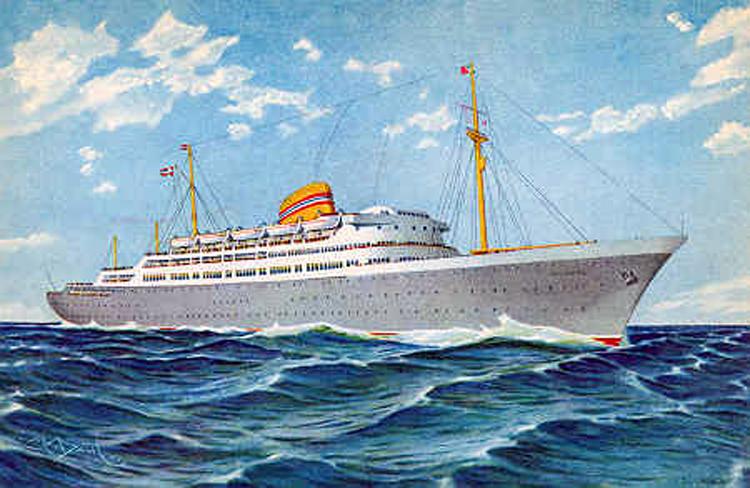
There is little in travel so romantic sounding as a trans-Atlantic ocean voyage, and little in reality quite so tedious. When I was a teenager, I got the chance, in the dying days of ocean liners, to sail from New York to Oslo aboard the MS Oslofjord. Oslofjord postcard

Day after day, the horizon remains pancake flat, and the only thing that changes is the dining-room menu.

Maybe it was because I was young and most passengers seemed so ancient: Shuffleboard was the amusement of choice, followed by casino night in the lounge. Neither was particularly appealing to me.

Yet, despite the monotony of the weeklong voyage, there is something about the sea that lodges itself deep inside and refuses to go away, even all these years later, in an age when crossing the ocean on a ship is no longer a realistic possibility.

It began in New York, a harbor crisscrossed by wakes like particle trails in a Wilson cloud chamber. The ship I was on threaded its way among the bee-buzz of harbor activity and passed the Statue of Liberty, which my grandmother saw on entering the same harbor in 1905, when she was a little girl.

I was on my way to the ”old country” to see where she had come from and was taking a boat, just as she had coming the other way.

But you can’t get the feel of ocean travel while in the harbor. You have to get out into the sea swell for that.

If you have never been out there, you might not have any sense of just how hilly the ocean is. Sure, the horizon looks flat, but nearby, you can sense the shifting pileup of waves of all sizes.

On the water’s surface are the wavelets, blown into white horses by the wind that always blows at sea. And the wavelets skitter up and down with the larger waves that move with more stately pomp, coming at the ship from all directions and crossing each other in patterns so complex that even chaos theory has a hard time dealing with them. swell1

But more impressive is the slow, almost geologic movement of the swell, that massive up and down that is measured by the rise and drop of the ship.

On some days, the swell is hardly felt, as the calm ocean sprinkles the sunlight in its shivered surface. But out in the North Atlantic, it is never long before some distant storm rocks the water into the swell that is the oceanic equivalent of the long ridge mountains of eastern Pennsylvania, one after the other, up and down, twisting the ship into yaw and roll.

The constant rumble of the engines shake the walls in ”D” deck, deep in the hull of the ship. Every surface is painted and repainted and each iron surface is covered in enamel like the thick shiny glazing of a doughnut. In the stateroom, there is no sense of motion, only the vibration of the engines. It has been the same for six days.

In midsummer, the sun doesn’t set until nearly midnight, rising again a few hours later. Most of the evening is spent in the low sunlight, which rakes the waves into glitter.

And I am up at 3:30 in the morning, walking the decks of the ship, which seems ready to roll over on first one side and then the other. Nearly a week into this trance-inducing boredom, I have read all my books and cannot sleep any more. The walk on deck in the dusky dark is meant to wake me up from the hypnotic state the ocean can put you in.

Then, out in the darkness I can see a light, miles off through the humid air. It is another ship going the other way. But no, it is not a ship, the lights are too irregular. In the growing light, I can begin to make out the grayish shape of it, barely legible in the murk.

It is one of the Orkney Islands, off northern Scotland. The trance is broken. The Atlantic is crossed, land is sighted.

I have some sense of what Columbus must have felt, although I have eaten better than he did, and my six days is rather less than the months he spent at sea.

But I still felt something special when the sea birds once more began flying overhead.gull