robert

lobstersDo lobsters have personalities? Sure, some of them are bigger, some greener, some more overgrown with algae. But are they individuals? Do they see each other as individuals? And if you discovered depictions of them in some newly found underwater cave, would you think of them as people? Or would they be like so many crustaceans crawling over themselves in the tank of a lobby of a seafood restaurant?

This, in essence, was the question facing the aliens who finally managed to land on the planet Earth, some undetermined time in the far future, when the human beings who invented calendars were long gone in some cataclysm also undetermined, and the world inherited by some evolutionary development of insects, now turned warm blooded, and with some convergent evolutionary change that gave them something very like feathers and who communicated on very high levels with each other by the deposition of various foul- or fair-smelling gels on the substrate upon which they traveled, left there for the next to sense with antennae turned prehensile.

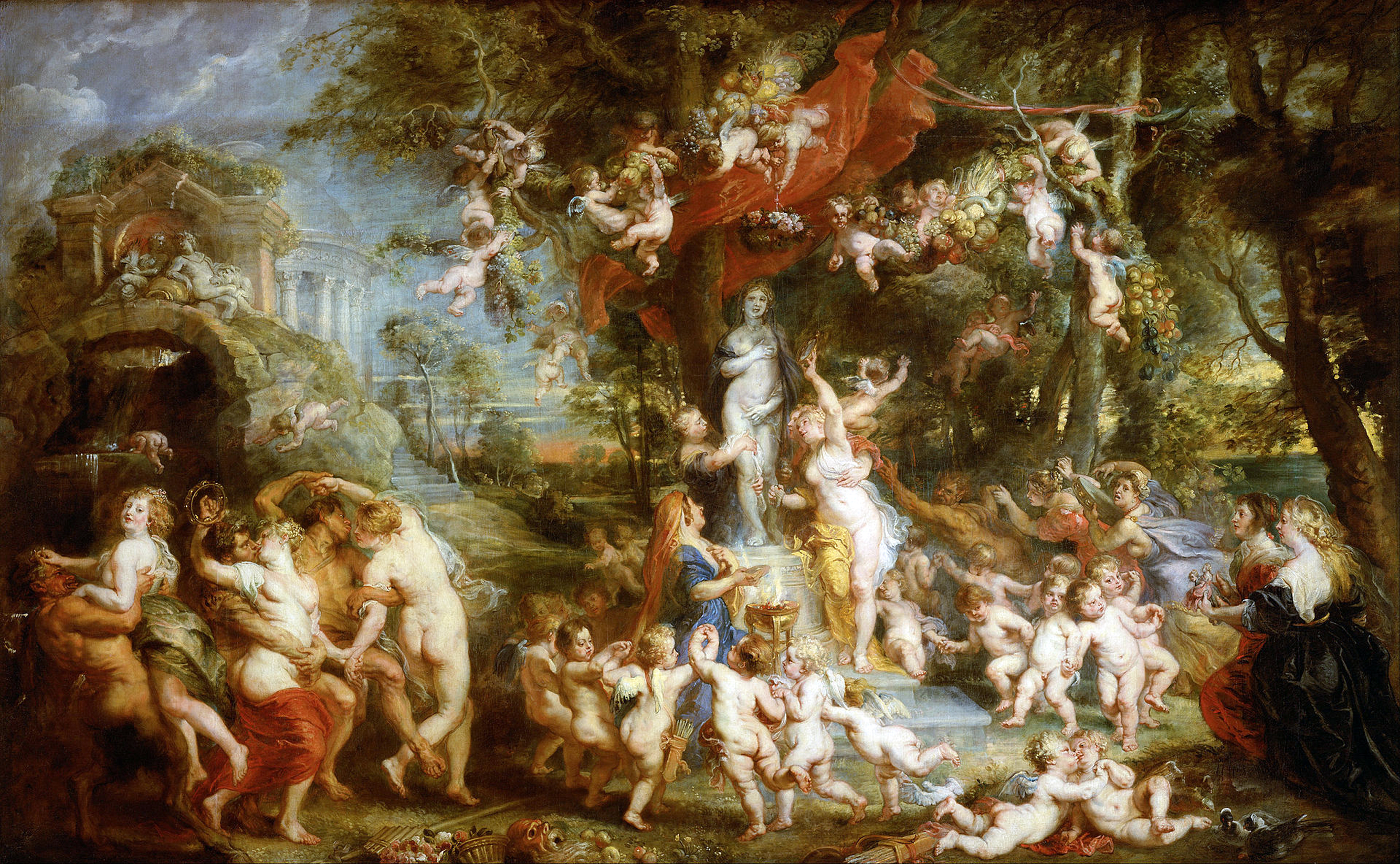
For these aliens found the ruins of our cities, overgrown with vines, with trees buckling the crumble of ancient paved streets where these feathered insects scrambled. Among the detritus, they also found statues and paintings of some unknown species of biped. We would know them as Titians and Caravaggios, Donatellos and Berninis, for the aliens landed in the region just north of the Apennines in the boot-shaped peninsula where their earlier robotic spacecraft had told them was a good spot to land, with flat surfaces and interesting geology nearby. And when they scraped away the encrustations that had built up on the paintings, and stared on them blankly, for certain they looked upon these creatures depicted as some form of lobster. Do these pasty, white morphs have personalities? They crawl over each other in a Rubens painting like so many crabs in a bucket. What are these aliens to make of this extinct species?

rubens

And did Goya or Vermeer foresee their work outlasting humankind to be discovered by uncomprehending eyes who paw over them like so many cobbles on a stony beach? What immortality did those painters think they were gaining, when the work remains, but the meaning has evaporated?

When we uncover the buildings of Pompeii, we recognize that they were constructed by people like us, with the same interests and drives, commercial, erotic, ambitious and civic. Through all of hominid history, back to the first tool-making pre-humans, we recognize mon frere, mon semblable.

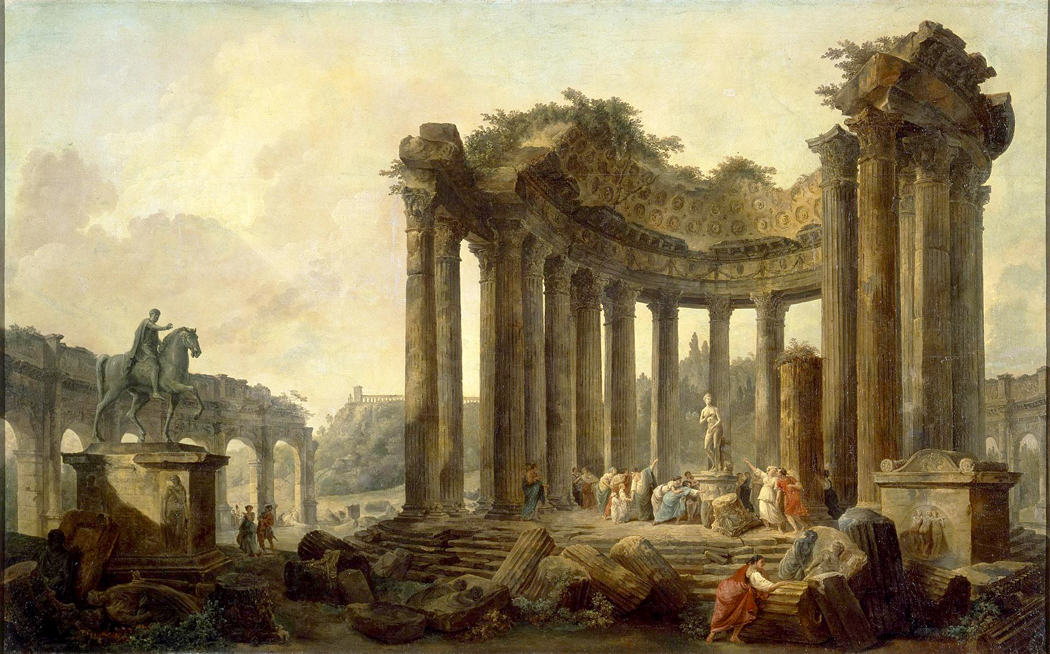
But these aliens, coming upon the ruins of architecture do not see them as picturesque, like the paintings of a Hubert Robert, but rather like the bleached coral of a reef killed off in acidic seas. The buildings might as well be ant-hills left by a colony of pismires. The roads they find, broken by vines and weeds, are mere cobwebs. The square rooms under tumbled down roofs no different from the hexagonal cells of a honeybee comb. They look, presuming the aliens have something analogous to eyes, and they see design, they see intention, but they do not see us.

We might break out in some kind of premonitory indignation, thinking of how misunderstood we shall be in the future that shoves out beyond us, beyond where we will not exist. Instead, these aliens want to know if these feathery insects that crawl over the ruins are edible.


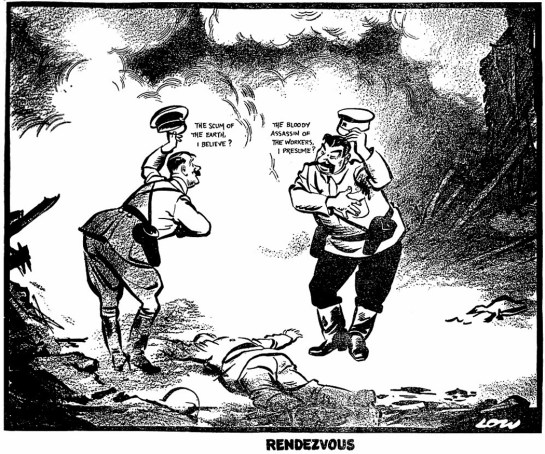
hitler stalin say hi

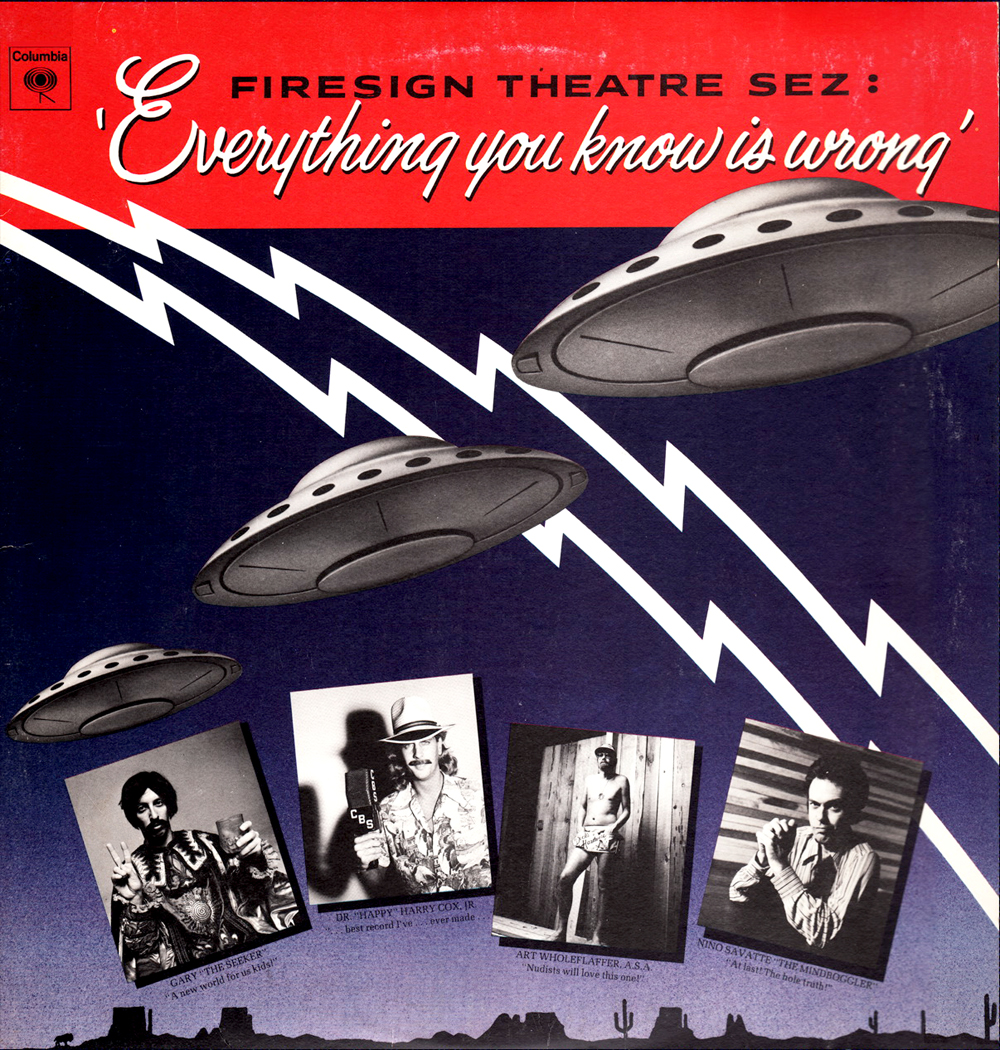
firesign theatreAll of us grow as we age; some more than others. Things we thought simple and obvious when we were children turn out to be infinitely complex. Judgments we handed down when we were innocent later turn out to be self-righteous piffle. Uncles we thought were hilarious when we were 6, when we are 15 turn out to be insufferable. If you live long enough, your life gives proof to the Firesign Theatre dictum: “Everything you know is wrong.”

This is the evolution of — what? Of an understanding. A widening of the historical record. I’m using the Second World War as my exemplar. I have been aware of it from my earliest childhood, but my understanding of it has changed radically over the decades.

I was born just after the war ended, and it was an immediate presence in those years. My childhood featured the shabby remainders of that war gotten from the proliferation of war surplus stores. We all played war, and the nerdier kids were condemned to play Japs and Krauts, while the alpha kids were Americans. I envied my friends who had helmet liners, machetes, canteens or drilled and emptied hand grenades to play with.
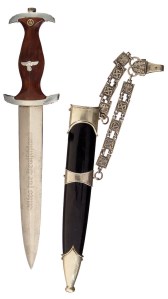
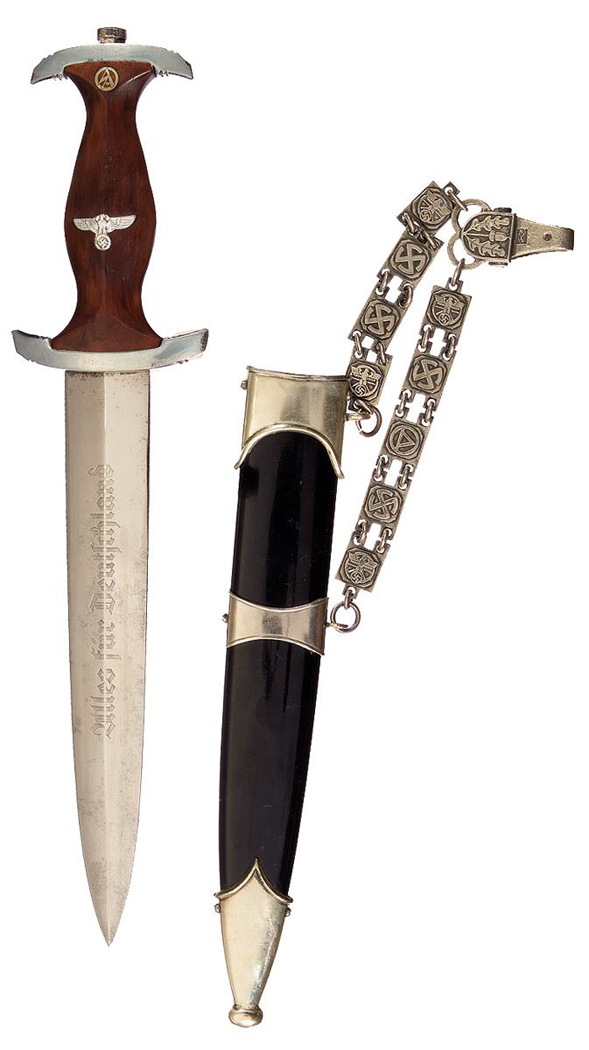
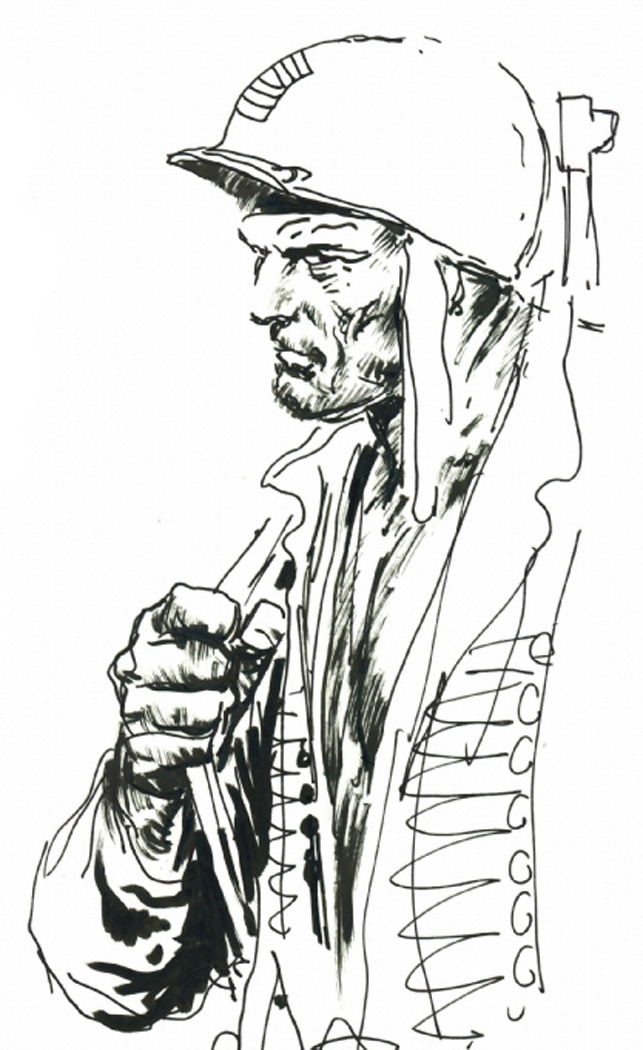
daggerMy father saw France and Czechoslovakia in that war, although he downplayed his part in it. He had several war souvenirs that were kept in the basement: a German helmet, an SS dagger, pair of binoculars, a Walther PPK pistol. I was fascinated by them, and pulled them out to play with. (When he found out I had been playing “war” with the PPK, he immediately took it and sold it to get it out of the house). These things were catnip to a little boy.

This was the early 1950s, and I learned about World War II through movies shown on television. This was the war of John Wayne and William Bendix. The Americans were the heroes; the Japanese and the Germans were the villains. It was an easy call; there were the good guys and the bad guys.

The version of Hitler that shows up in these films is insubstantial. When mentioned at all, he is satirized as a clown with a funny mustache, but most often the Nazis are an undifferentiated enemy with nefarious aims. Little distinction is made between Germans and Nazis. We argued over which way the swastika bent, and whether they were “knot-sees” or “nah-zees.”

guadalcanal diary bendix

When the German war aims are mentioned, it was that they sought “world domination.” When the movie is set in the Pacific, the Japanese war aims were never mentioned at all: They were just evil and our enemy.

There were documentaries, also. On TV, there was also the resonant voice of Leonard Graves and the music of Richard Rodgers on Victory at Sea, and a Saturday morning filler program produced by the Army called The Big Picture. Both fed a version of the war that was about the United States defeating its enemies.
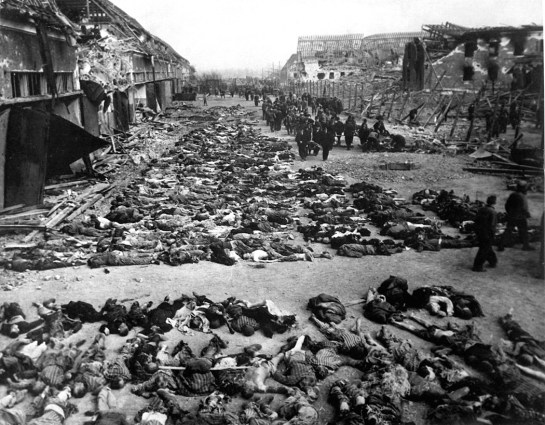
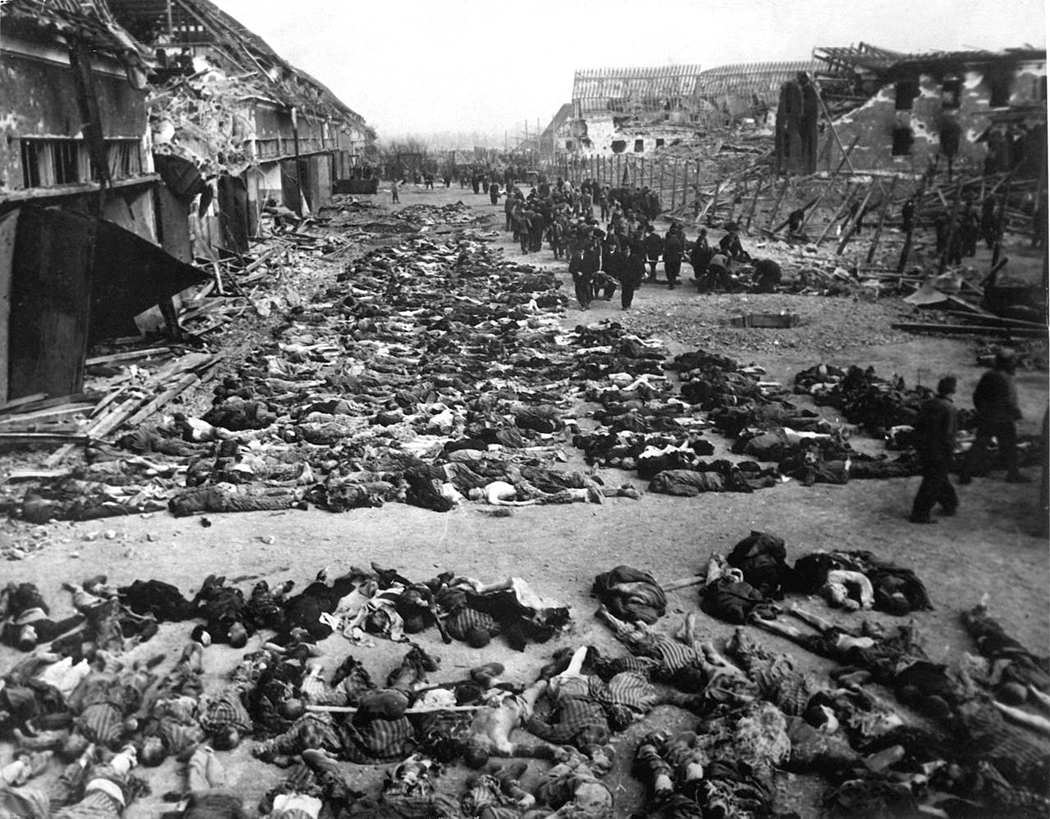
dead bodies at Nordhausen

It was in those Army documentaries that I first saw images of the liberated concentration camps when I was a boy. I was horrified — and fascinated — by those piles of dead naked bodies bulldozed into mass graves by the American soldiers, and the spindly, glaze-eyed skeleton-survivors. I don’t know how these images affected others, but in my tiny 6-year-old brain, they were the fountainhead of moral development: Those images are indelible; I can draw them up in my mind anytime. Nothing from my childhood has such potent emotional power as the memory of those films. But the Holocaust was a separate issue, barely related in my boyish brain with the war my father had fought. Only later, did the Holocaust become central to my understanding of the war, of Nazism, of Hitler.

sgt rockBy the time I was in the seventh grade, my interest in the war had changed: In typical adolescent (male) fashion, I became hypnotized by the machinery and regalia of the war. I learned the names of each type of Panzer tank, fighter plane, each sort of submarine and corvette, destroyer and cruiser. I drew them endlessly in stereotyped scenes learned from primarily from Sergeant Rock comic books.

By then, I was also becoming aware of the centrality of Auschwitz. But German anti-semitism made no more emotional sense to me than the “world domination dictator” image of Hitler. I grew up in northern New Jersey and my Boy Scout troop leader was Mr. Weinstein. I knew many Jewish people and I could not see any difference between them and the Italians, Irish, Germans or South African families sprinkled through the suburban neighborhoods. Anti-semitism seemed no more possible than men in the moon.

The version of the war that persists in the American imagination is the one in which Americans, with a little help from England, beat back Hitler and won the war.  D-Day was the turning point. There was a niggling awareness that there might also be some fighting on the eastern front, and that somehow the Soviet Union was our ally in the war, despite their being “godless communists.”

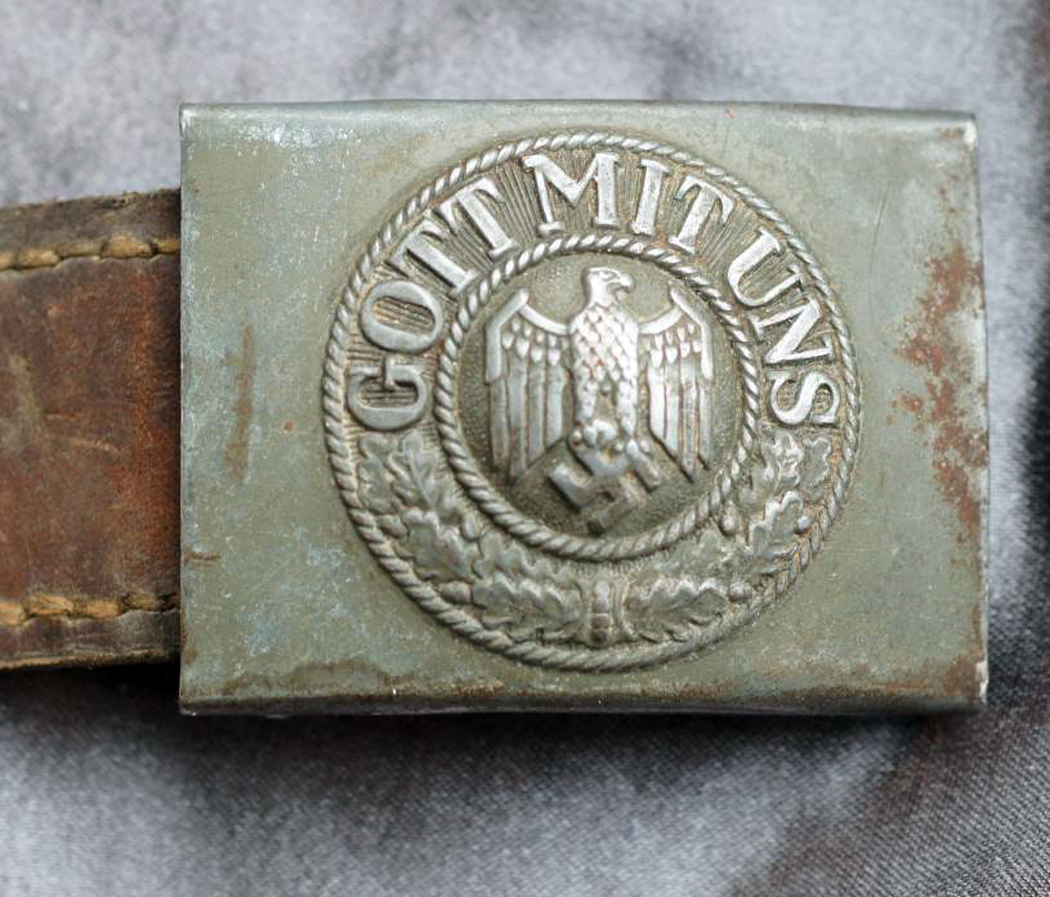
belt buckleThis version was filled with stories of American heroism in the war. We won, it was implied, because democracy always wins. It was our system vs. their system, and ours was more virtuous. After all, God was on our side (despite the Wehrmacht beltbuckles that read “Gott mit uns.”)

I had read a good deal about the war and had finally come to the conclusion that perhaps D-Day was not the central turning point of the war and that perhaps the conflict with the Soviets was a bigger deal than the war in France. (This is not to diminish the efforts of the Allied soldiers in western Europe, but to recognize the balance of the death and fighting was in the east).

I began to see World War II as the “Great Patriotic War,” a war primarily between Germany and the Soviet Union, with the Western Allies as a sort of sideshow. All those riveting TV documentaries about D-Day and the retro-movie version of the war in Saving Private Ryan seemed like empty chauvinism. How many Americans died in the war? About 400,000, which is a staggering number until you compare it with the number of Soviet forces killed: 10 million. If you add in the civilian war deaths, the number rises to  27 million. That is nearly 14 percent of their total population. In the U.S., that percentage is less than one-third of one percent. (Again, I don’t mean to diminish the enormity of the American suffering or the part played by our soldiers, but to put it into the larger context of the war horror).
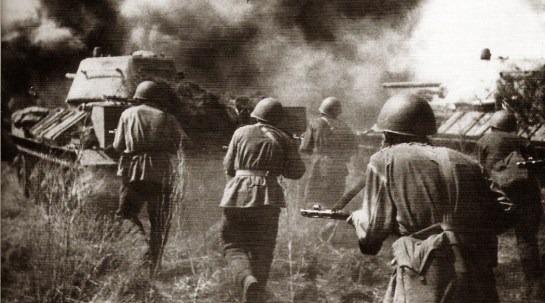
Kursk

Kursk

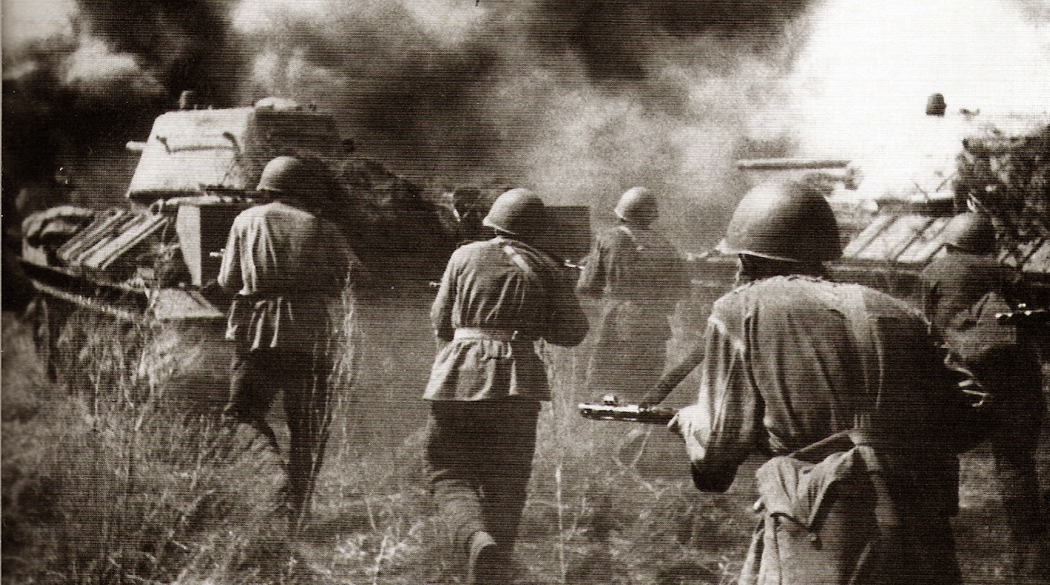
On D-Day, American deaths were about 2,500, roughly the same number as died in the World Trade Center on Sept. 11, 2001 (and roughly the same number who were killed in the attack on Pearl Harbor Dec. 7, 1941), but consider the battle of Kursk in the Soviet Union, when some 10,000 Germans were killed and the Soviet deaths estimated at three times that. Or the Battle of Stalingrad, which admittedly continued over several months, but wound up with nearly 2 million casualties. If there was a turning point in the war, it was Stalingrad, not D-Day. Germany never recovered.

Stalingrad

Stalingrad

japanese stereotype 2Forgotten in all of this is Japan. When I was a child, it was clear that the Japanese were treacherous people who designed the deaths of Americans, presumably for irrational reasons. They were a crazed nation of  squint-eyed, buck-toothed people insanely loyal to an emperor.

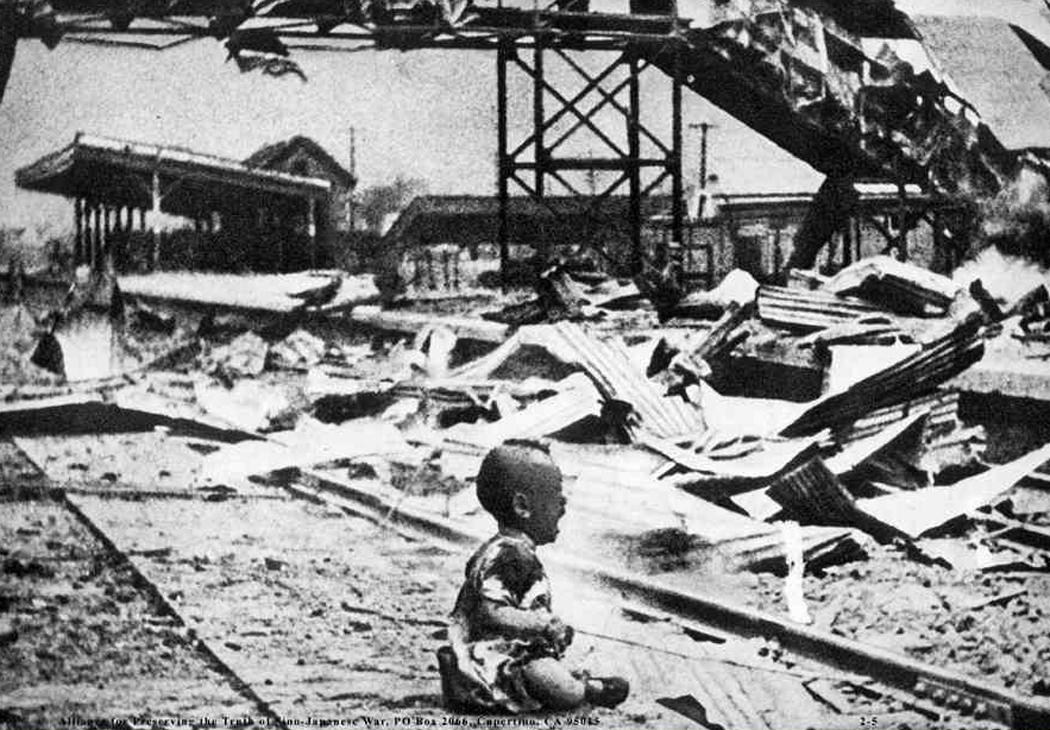
World War II was in most books a single entity with combat theaters in Europe and in the Pacific. But at some point, I came to understand that there were really two unrelated wars being fought concurrently, or rather that the two wars overlapped. The European war began in 1939, if you were Polish, 1941 if you were Russian (June 22) or American (Dec. 7). But the Pacific war had begun in 1931 with the Japanese invasion of Manchuria and turned into the so-called Second Sino-Japanese War beginning in 1937. Just as in Europe, where we glory over D-Day and forget the millions who died in Eastern Europe, so in the Pacific, we remember Iwo Jima and Guadalcanal and tend to forget that the real misery was felt in China, where the war death estimates run from 10 million to 25 million. (It should also be remembered that until Pearl Harbor, Germany and the Soviet Union both allied themselves with the Chinese against the Japanese.)
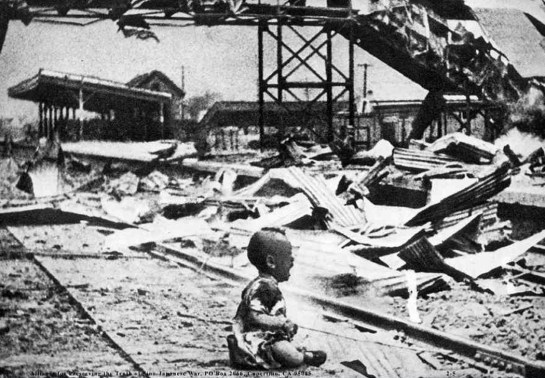
rape of nanking baby

But the one question I could never quite answer to my satisfaction, the issue I could not quite understand was: What were the goals of the Axis powers? What did they hope to accomplish?

warner bros hitlerThe standard answer was: World domination. Hitler wanted to invade Europe to achieve power. Why he might want to conquer France was a mystery. Why he bombed London never made sense. And that was just the Germans. The Italians hardly entered the equation. They were an afterthought. And finally, it was never clear what sort of domination the Japanese might be after.

In the Warner Brothers cartoons I was weened on, Hitler, Tojo and Mussolini were three comic villains with the same aim: world domination. (No one asked if they had accomplished this goal, whether they would turn their rifles on each other).

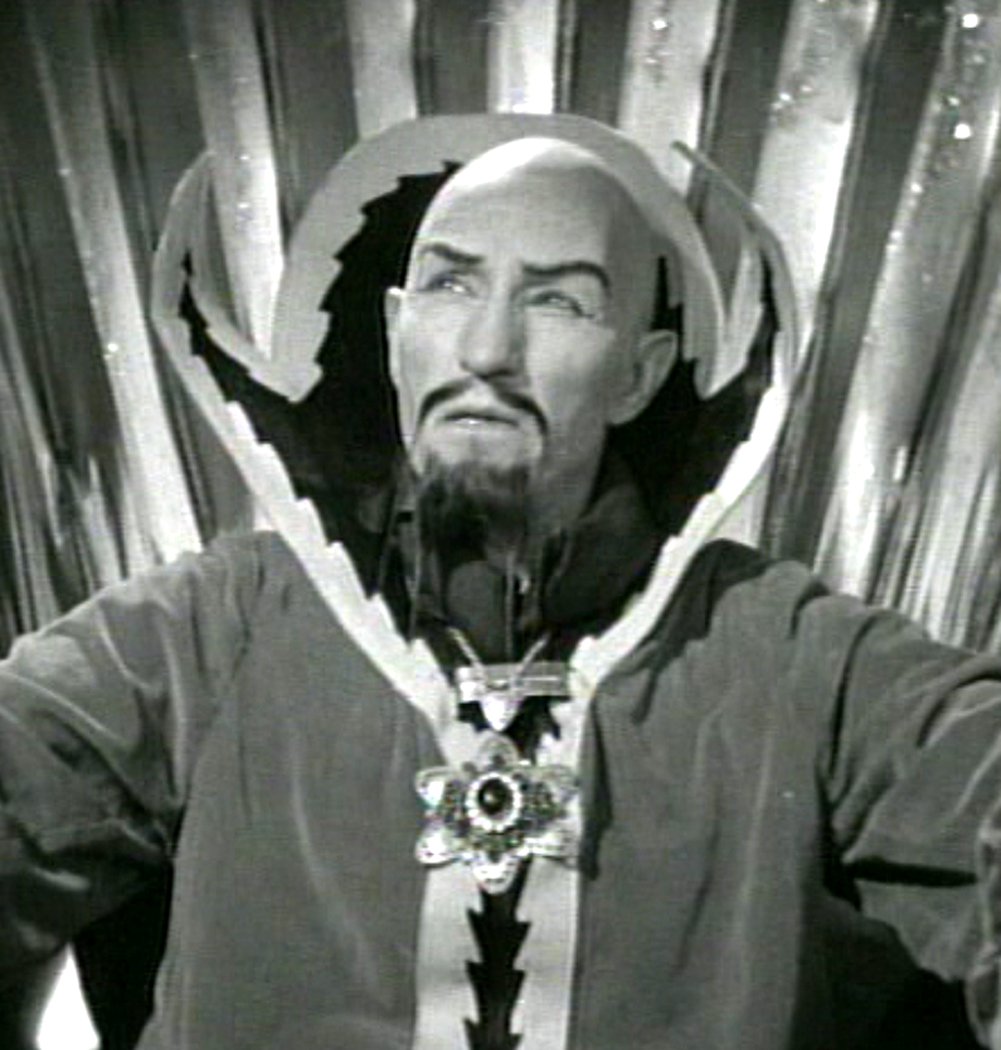
Ming the Merciless

Ming the Merciless

Hitler was, in this view, hardly different from the nefarious Fu Manchu or Dr. Mabuse or Ming the Merciless. Why any nation would bend to the will of such a madman was an enigma.

Wars are political and economic. We remember them militarily, but they are gestated through power and money. Now that I am an old man, I no longer see World War II as the “Good War” — the American version — or the “Great Patriotic War” — the Russian version — but rather as The War between Hitler and Stalin over Poland.

Poland has rolled around eastern Europe for centuries, expanding and shrinking, becoming an empire and disappearing altogether. You could make an animated map showing how over time Poland moved east, then north, then west like a ball of mercury on a plate, then evaporated like a dried-up puddle. In western Europe, nationality conveniently tends to follow ethnicity. France is filled with the French, the Netherlands are filled with the Dutch. But throughout eastern Europe, ethnicities are scattered like confetti. There were Germans in Poland, Poles in Ukraine, Lithuanians in Poland, Russians in Lithuania, and Jews all over. It made national borders more arbitrary than they are in the west. Much of Hitler’s plan before the war broke out in earnest concerned bringing ethnic Germans together under one nation-state. Hence the Anschluss and the annexation of the Sudetenland in Czechoslovakia. His ostensible aims were to “protect” the German people from persecution by non-Germans. The Nazi slogan was “Ein Volk, ein Reich, ein Führer” — One people, one country, one leader.einvolk einreich einfuhrer

Ein Volk” — this was a nearly mystical idea of race and genetics. Hitler believed in two things that were current in his age. One was Social Darwinism, that competition was not only between individuals, not only between species, but between “races,” or genetic bloodlines. His Germanic race was in competition with all other races, and only the strong would survive. Second, he believed in a neo-Malthusian sense that as population increased, food production would begin to fail. And, as Germany industrialized, fewer people were producing food, and less land was given to farming. These two things were behind his announced need for “Lebensraum” — living room. He proposed not only to aggregate the Deutsche Volk under one political system, but also to annex new farmland to Germany and repopulate that land with German farmers.

In this, one ventures to say, he was little different from American Manifest Destiny in the 19th century. As we proposed forced migration of Native Americans and to appropriate their lands, so Hitler proposed to move Poles and other non-German people out of his section of Poland and repatriate a growing population of Germans into it.

He faced two international political problems with this plan. The Soviet Union would likely object, and the allied forces of western Europe had a treaty to defend the independence of Poland.

Molotov and Ribbentrop

Molotov and Ribbentrop

To eliminate those problems, he made a pact with Stalin — the Molotov-Ribbentrop non-aggression pact — which freed him up, he expected, to face the armies of France and England that intended to protect the sovereignty of Poland.

In reality, there was an unpublished portion of the Molotov-Ribbentrop Pact that split Poland in two, with one half going to Hitler, and the remains going to Stalin.

So, when Hitler invaded Poland on Sept. 1, 1939, he planned also to turn his Blitzkrieg on France, which he neutered in 1940, taking over most of western Europe save Great Britain and the neutral countries of Spain, Switzerland and Sweden. This meant he thought he no longer had to worry about a two-front war. In this sense, the whole war in western Europe was a sideshow to the real carnage.

When the forced immigration of Poles, Jews and other non-Germans proved problematic, and after Hitler decided Blitzkrieg could bring him not only Poland, but also most of the European territory of the Soviet Union, he invaded eastern Poland (by then, a part of the Soviet Union) and headed for Moscow.

A separate industry developed to deal with the displaced peoples, which, by Hitler’s racial thinking were Untermensch, or lesser humans, and with his own propaganda blaming Jews for the loss of the First World War, and the “Jewish Bolshevism” of Communist Russia, his Nazi planners came up with a “final solution” for what to do with all those unwanted people. Six million Jews were exterminated over the course of the war, mostly from 1942 to the end of the war. But also nearly 2 million ethnic Poles, 3 million Ukrainian and other non-Jewish victims.

liberated prisoners at Ebensee 1945
bloodlands cover(Timothy Snyder’s 2010 book, Bloodlands, covers all the deaths in the tragic lands between Germany and Russia from the 1930s through 1945, including the Holodomor — the deliberate starvation of between 3 and 7 million Ukrainians by Stalin’s order. In all, between Hitler and Stalin, Snyder estimates that some 14 million non-combatants were murdered for political reasons between 1933 and 1945. The numbers are all estimates; the death was so pervasive, accurate records for most deaths were impossible. And these 14 million were all separate from the military deaths of the war.)

What I have written here is an obviously very simplified version of things. Almost every sentence here could be expanded into a book. I have left out many important things (not the least of which is the bifurcation of Europe after World War I into camps espousing Communism and camps promoting Fascism. For a time in the 1930s, it even looked as if America was going to have to choose between them).

MBDRUOF EC010This is a lot of words, all to show the slow development of ideas about the war, from childish to mature, from simple and unexamined to complex and nuanced. The case I am trying to make is that this is true not simply for my pathetic little understanding of World War II, but that this kind of growing complexity is symptomatic of getting older, seeing more of the world, and tying it all together.

I could have chosen almost any subject and gone on at length about how my understanding has changed, widened, saddened. For, if there is anything that results from broader experience — which is what getting old gives you, want it nor not — is the sad truth expressed in Jean Renoir’s 1939 film, Rules of the Game, spoken by Octave (played by Renoir himself): “You see, in this world, there is one awful thing, and that is that everyone has his reasons.”

Detroit 1967

Detroit 1967

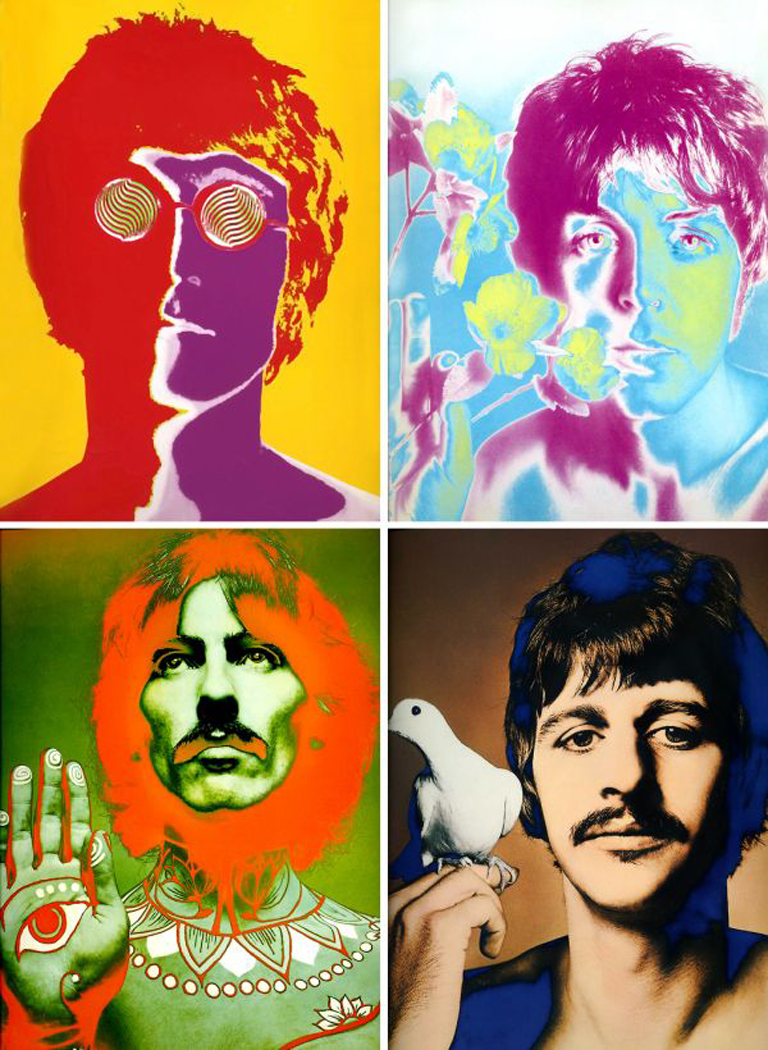
beatles-1967-avedonIt was 1967 and 10,000 people gather in New York City for the Central Park “Be-In,” the oil tanker Torrey Canyon runs aground off the coast of Britain, Charles Manson is released from prison (although he requested to allowed to stay), Israel fights the Six Day War, anti-war rallies and protests are held around the country, Elvis and Priscilla are married, anti-miscegenation laws are declared unconstitutional, China tests its hydrogen bomb, there are riots in Newark, NJ, Minneapolis, Detroit, and Washington DC (many people die), Che Guevara is captured and killed, Allen Ginsberg attempts to “levitate” the Pentagon, Sen. Eugene McCarthy announces his candidacy for president, challenging LBJ — who is counting “how many kids” he killed today. And the Beatles release Sgt. Pepper, Magical Mystery Tour and the single, All You Need is Love.

It was 1967, the “Summer of Love.” The Nobel Peace Prize was not awarded that year.

Be-in

Be-in

It was 1967 and I was young and idealistic, that is to say, an idiot, and I had a warm relationship with the dean of my college. Warm is perhaps the wrong word. Heated is more precise; I despised him. Do I need to say I was a sophomore?

che guevara deadI was an activist student. I protested the Vietnam War, I published the underground newspaper (the “KMRIA Journal,” named after a passage in James Joyce’s Ulysses), I rankled under many of the restrictions placed by the college on its students. Why was there only a single African-American student and no African-American faculty, when the dining-hall staff was almost entirely Black? It was a Quaker college, after all, and should be more progressive.

I spent many an hour in the dean’s office making demands. There was so much wrong with the world and with the college, and I and my generation knew how to fix things. It was time to end the core curriculum, I told my dean. Who needs to learn a foreign language? Why should I be forced to take a math course when I was an English major?

Then, there was the school’s responsibility in loco parentis. We were all adults, I averred, why should the school prohibit women from traveling off campus unaccompanied? Why should they be forced to wear dresses to dinner, and the men suits and ties? Women were not allowed to smoke “in transit,” meaning, they could puff a ciggie in the parlor, or when standing still outside, but not walking. Who makes this stuff up? The rules seemed especially peculiar for women.

One young woman had been expelled for spending the weekend with her basketball star boyfriend. He, on the other hand, was merely scolded. “Double standard!” I yelled at the poor dean. And what was wrong with the two of them taking a trip together? Hypocrisy, I claimed. Hypocrisy. (I had some self-interest here, having spent some time away on trips with my college girlfriend. The difference: We hadn’t been caught).

Me, "the freak years"

Me, “the freak years”

And then, there was Jerry. A class younger than me, Jerry was a charismatic young hippie who bought Romilar cough syrup by the six-pack. A small group of students, including me, were “freaks” on campus, with long hair, bell-bottom jeans, and an uncontained contempt for the buzz-cut, patriotic, church-going straight-arrows of the campus.

For a time in my sophomore year, we became a foursome: my girlfriend, KC, and me; and Jerry and his pan-pneumatic girlfriend, Carol the Barrel. There was cough syrup, marijuana, and gin and Sprite, drunk in the Quaker graveyard, where we poured libations to the grave slab of poet Randall Jarrell.

Jerry had lived a terrible life, he said. His father was a retired Army colonel and now belonged to a religious cult. His father and his brother regularly beat Jerry and sometimes locked him in his room, for up to a week at a time. His mother was also beaten, he said. Getting away to college was salvation. Jerry told us stories about the cult, which wasn’t exactly a Christian sect, but some offshoot, that glorified patriarchal power and the dominion of fatherhood over all his family. Paterfamilias, he called it, modeled on the ancient Roman family structure. “Power of life and death over all of them,” Jerry said.

One day, in his dorm room, Jerry showed me his needle. “I shoot heroin,” he told me. “Don’t let anyone know.” The hypodermic syringe was one of the old-fashioned sort, made from glass and stainless steel, and kept in a velvet-lined box. I wasn’t ready to dive into narcotics.

There was this sliver of time when drug-taking was not merely recreational, at least for the more serious among us. Beer was recreational. Alcohol was the drug for getting a buzz. But smoking weed was — again, for this brief time — sacral. Under the influence of Timothy Leary, drugs were to be used to uncover “alternative realities,” and discover the secrets of the universe. To use drugs simply to get high seemed shallow and unworthy. (We were serious prigs, in our own way.)

hypodemic syringeThe idea of heroin seemed beyond that. It was dangerous. It was criminal in a way we would never consider marijuana. Jerry was the first junkie I ever knew.

One day, Jerry came to my room with a frightened eyes. “My brother is coming,” he said. “They are going to take me and force me back to the cult. I need to hide.”

I told him he could stay in my room for the while. I went to see the dean. I explained Jerry’s situation to him and asked for help. The dean looked disturbed but told me, everything was OK. There was no problem. “Yes,” I said. “There is.”

For the next several weeks, Jerry had the look of a deer in the headlights, and there were phone calls from his father, and I made more visits to the dean. He had to do something, I told him. At each visit, the dean told me to stop worrying. It began to feel as if the dean were part of the conspiracy.

Between moving Jerry from room to room, avoiding calls, hiding out in the woods one day when Jerry’s brother came to get him (he eventually left without Jerry), and my expostulating with the dean and finding new hideouts for Jerry, my schoolwork was suffering, and we were all a little jittery. This felt big.

It came to a climax when I went to the dean’s office and threatened to call the police. The dean — who held cards I knew nothing about — sat me down and said, “There are things I shouldn’t tell you. It’s illegal to discuss another student. There are privacy issues. But you need to understand Jerry is a very disturbed young man.”

“But, his father wants to kidnap him,” I said.

“No, his father is coming to take him back to the hospital.”

“What hospital?”

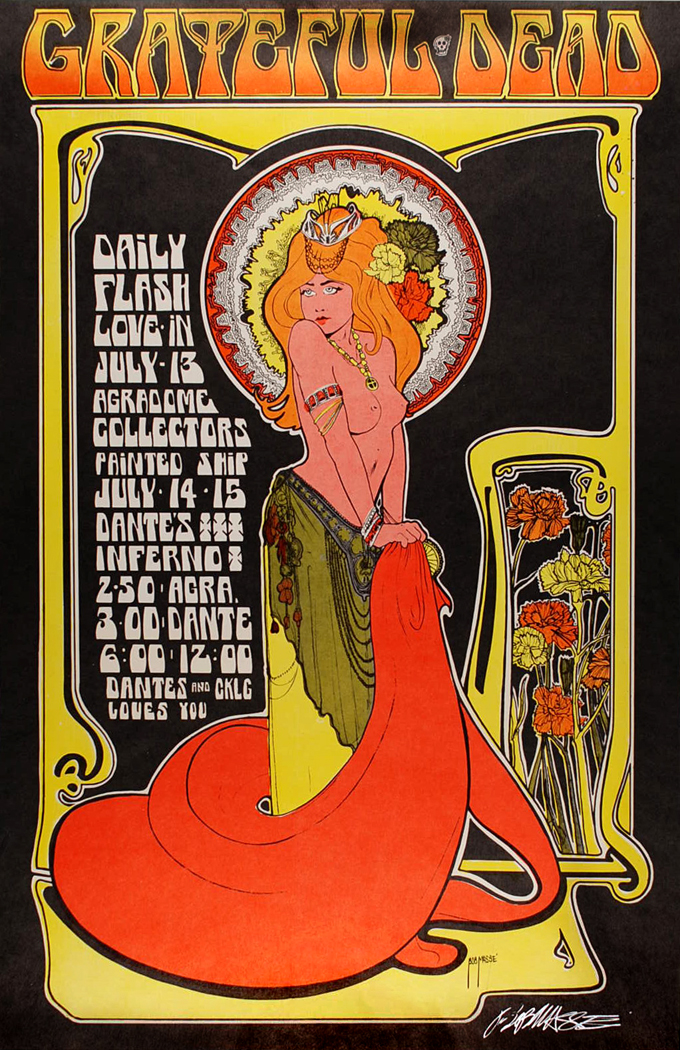
1967 Artist Bob Masse. Grateful Dead“Jerry was here provisionally; he had been committed to Butner for several years. They thought he was getting better, but he wasn’t.”

“What do you mean?” I was sideswiped. You mean Jerry had been lying? Making it all up? He had been diagnosed as schizophrenic after an episode in high school. (It was a popular diagnosis back then; nowadays, he would more likely have been called bipolar. That is our popular diagnosis.)

The dean showed me a manila folder with medical records. Physicians’ notices, letters back and forth, even a note from his high school principal.

“What about the needle?”

“Jerry is diabetic,” the dean said. “He takes insulin.”

There is nothing so deflating as punctured indignation. My high horse was a rocking horse. I was flashing cap pistols.

I met Jerry’s brother, who came to take him back home. He seemed as reasonable a human as I could imagine.

“Thank you for caring about Jerry,” he said. “We love Jerry, but he needs help.” There was no cult; there was no abuse.

Later that day, I watched Jerry get in the car with his brother and drive off. I never saw him again.

alexandria-quartetA few years later, I had the glint of recognition when I read through Lawrence Durrell’s Alexandria Quartet. The first of four books tells of a doomed love affair as told by an British writer, Darley. The second tells the same story from the point of view of a friend, in possession of more information, so we learn that Darley completely misunderstood everything that has happened to him. The third volume retells the story from the omniscient point of view and we discover that both the previous books were wrong and everything we had come to understand was partial, often totally misguided, and dark with ignorance. (The fourth book, Clea, takes the story past the narrative of the first three books).

The four novels hit me with the force of a brick to the parietal bone: I recognized the syndrome.

Soon after reading the novels, I went through a tortured relationship with a woman I was crazy about (“The only thing blonder than your hair is the sun,” I told her). She ran hot and cold in a way I could never understand, sometimes libidinous, sometimes antsy and standoffish. She finally broke it off with me. I moved away from the city to hibernate (not unlike Darley in Justine), and only found out when I accidentally bumped into her decades later that she had been sexually assaulted by a boss at work, and had gone through a difficult and traumatic trial and had been unable to come to terms with love or sex for years afterward. I did not know what drama had played out behind the scenes of our stumbling courtship.

Rashomon posterOne could liken it to Kurosawa’s film, Rashomon, except that the movie tells each version of the single story through the self-interest of the parties doing the telling. It is not merely a case of the reality being larger than the parts, but of each person lying to make himself (and herself) look good.

What I am talking about, instead, is the fact that we can never know the wider context, the whole story. We can see some sliver of the world through the chink in our psyches called our senses.

And I am not concerned here with conspiracy theories: That someone is withholding the key facts we need to know and balefully controlling the course of history. If we don’t know the full story of the Kennedy assassination, it isn’t because some cabal is secretly pulling the strings, but because reality is too complex, too messy, too variegated and too ornery to stuff neatly into a poke. If there were a cabal, even they wouldn’t have all the facts.

We are each in a dark hole, with only a little light from above. We peer out at the daylight and can see a few people staring down from the rim. We make relationships, we imagine the world, we tell ourselves stories. But we never have a sure grasp on the whole. The dark whole.

It is why the scariest thing I know is the profession of certainty. Only the ignorant make such a claim.

jacob-bronowski-bbcI am reminded of a chapter in a book by the late Jacob Bronowski, who wrote in his Ascent of Man about the evils of certainty.

After an explanation of Werner Heisenberg’s uncertainty principle, Bronowski brings the reader to Auschwitz and shows us a lake bottom muddy with the ashes of those killed there.

For Bronowski, the uncertainty is not merely about electrons, but about all knowledge. Uncertainty breeds humility, he said; certainty breeds arrogance.

“Look for yourself,” he wrote. “This is the concentration camp and crematorium at Auschwitz. This is where people were turned into numbers. Into this pond were flushed the ashes of some four million people. And that was not done by gas. It was done by arrogance. It was done by dogma. It was done by ignorance. When people believe that they have absolute knowledge, with no test in reality, this is how they behave.”

That test in reality means that all knowledge is provisional. And there is always some data that we don’t yet know. Every wife, every girlfriend, every husband, son, confederate, colleague, nemesis, enemy, is a world contained, filled with complexities we will never fully know.

Humility is the only sane response.

Mercator map

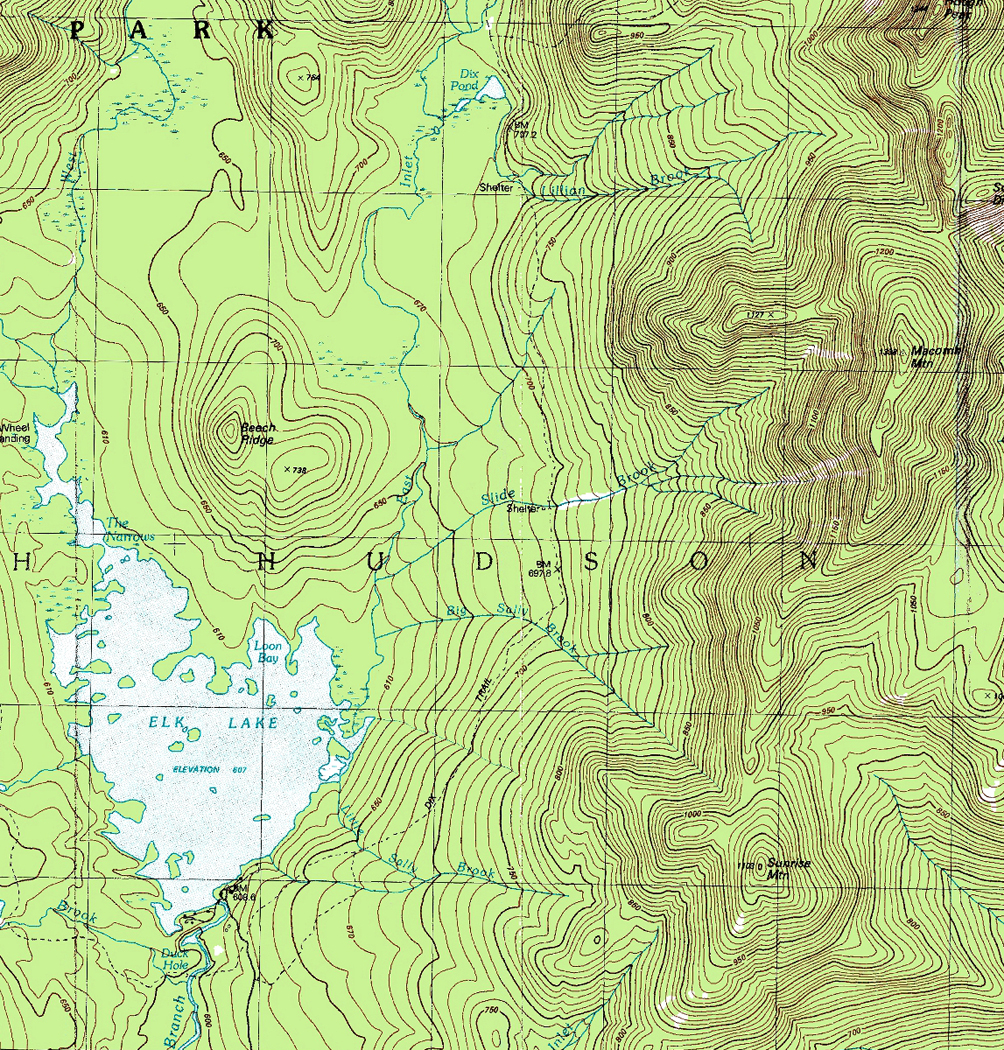
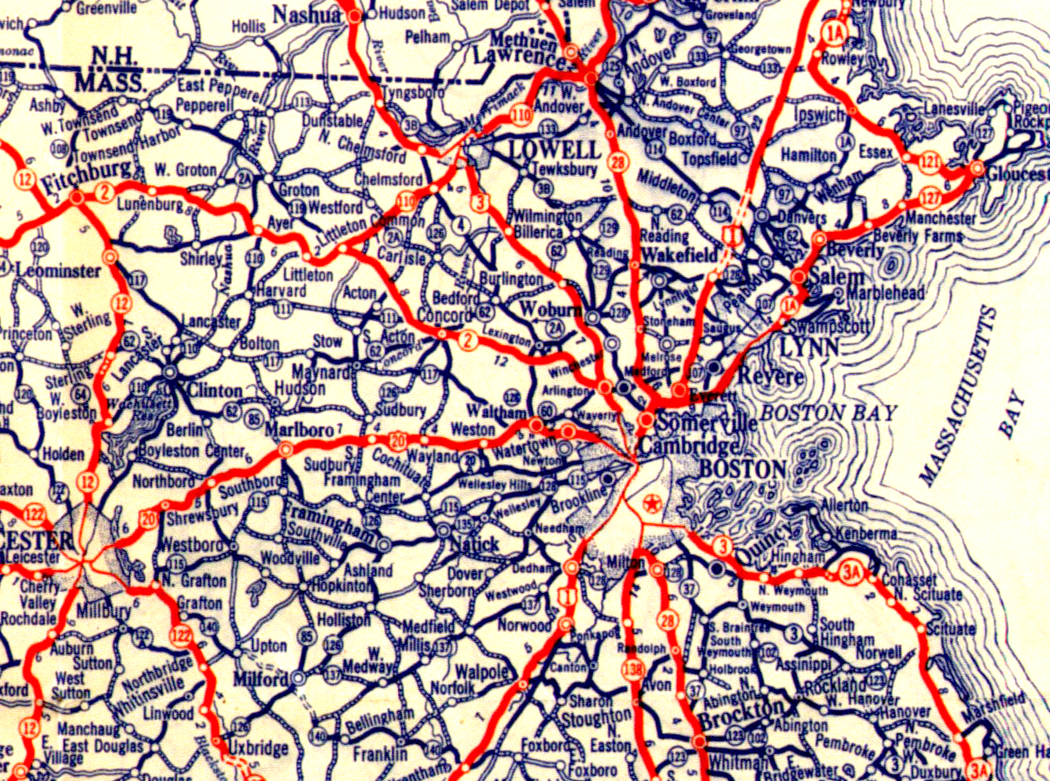
Topo mapAn ideology is like a road map. It contains a schematized version of the world. But, it is always a simplified and distorted version. It may show the roads, or be covered with circles of topographic tree rings, or be great blotches of geological information. But it by necessity ignores a great deal of information to clarify some single small aspect.

It is hardly surprising, then, that a conservative sees a different world from a liberal; one is looking at highways and the other is looking at landforms. But this is not simply binary: The libertarian has a different map from a neocon, the religious right has yet another map, and the fiscal conservative yet another — and all call themselves, in one sense or another, conservative. The same variety can be found at every point in the political spectrum. Just consider how many spatting socialist parties join in war against each other.

geological mapAnd all of this is only the plethora of maps held by political enthusiasts. Politics, after all, is only one tiny corner of human consideration. Look at the range of literary theory, from Formalism through Structuralism to Post-structuralism, from deconstruction to neo-Marxian criticism. Each of them has its own roadmap and each ignores any tiny detail that might confuse the clarity of their ideology.

Or religion. No, let’s narrow it to Christianity. Or further, let’s narrow it to Protestant Christianity with its Methodists, Lutherans, Congregationalists, Presbyterians, Baptists — oh, heck, lets just look at Baptists. There are Free Will Baptists, Primitive Baptists, African-American Baptists, Landmarkism, Missionary Baptists, Fundamental Baptists, Progressive Baptists, Reformed Baptists, Sovereign Grace Baptists, Southern Baptists and Two-Seed-in-the-Spirit Predestination Baptists. And that only scratches the surface. Each is separated from the others by a map that emphasizes some single detail that serves as sufficient cause for a schism from some parent group, whose roadmap leads directly to Hell.

Treasure Island map

Treasure Island map

(This is the sticking point for Pascal’s wager: That if you don’t believe in God and he exists, you go to eternal damnation; if you do believe and there turns out not to be a God, then you are no worse off than if you didn’t believe. Therefore, said Pascal, the smart money is on believing: You have a one-in-four chance of salvation; the atheist belief has a certainty of annihilation. The fly in the ointment is this proliferation of sects. Which God do you place your wager upon? Choose wrong and, whoosh, you slide down the chute to perdition. That one-in-four bet now looks more like the state lottery.)

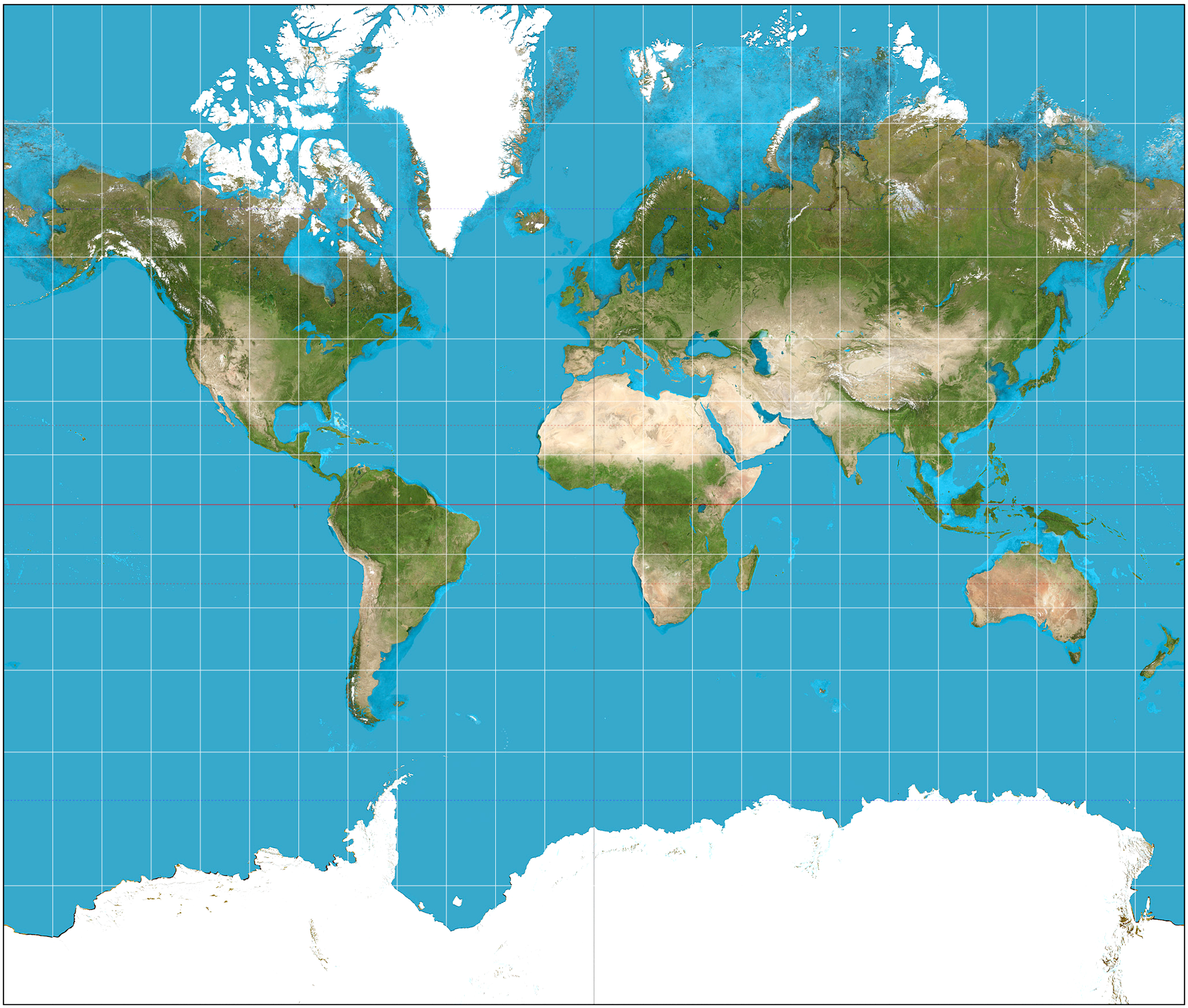
Mercator projection

Mercator projection

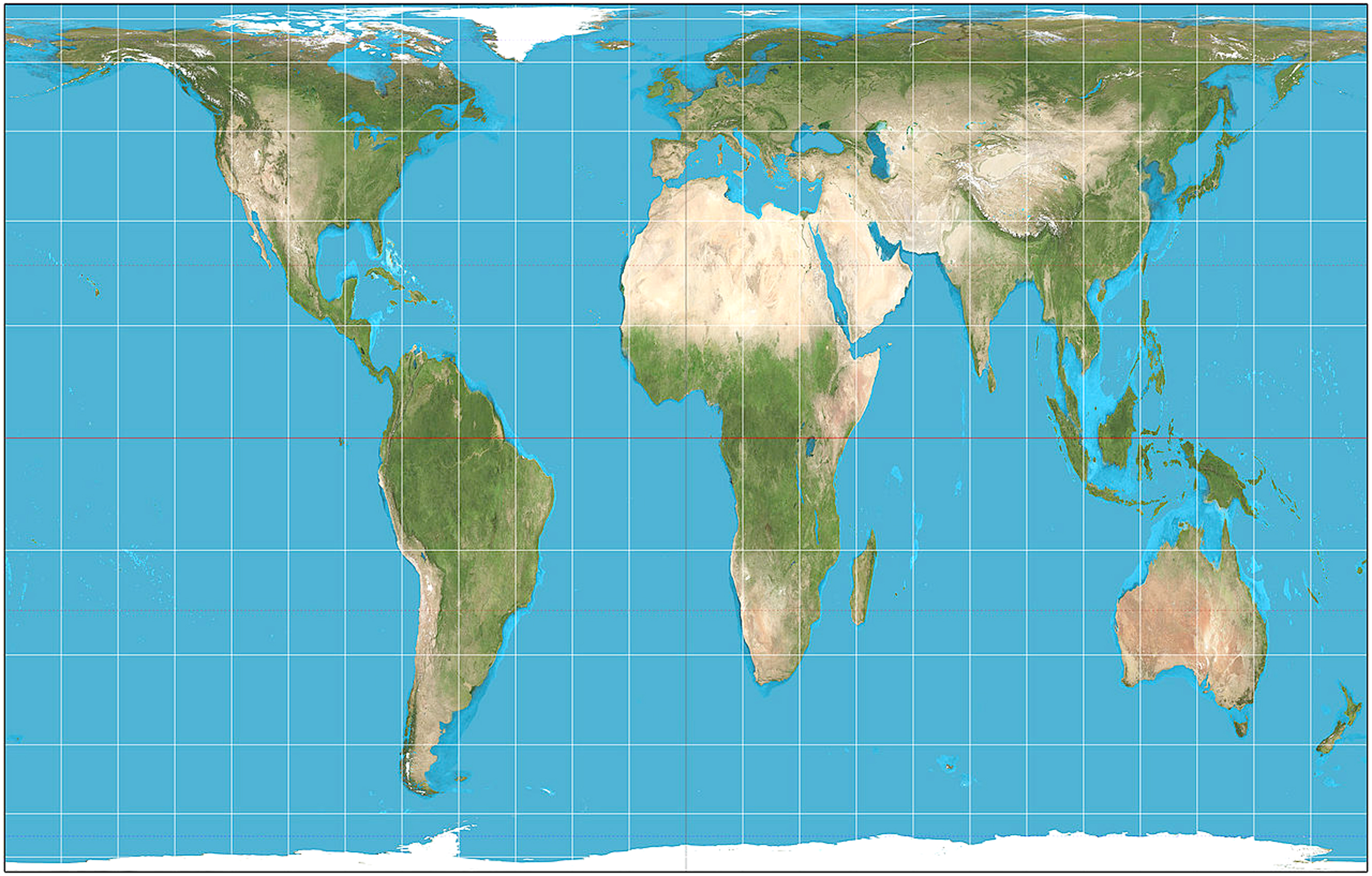
The world map most of us remember from the walls of our schoolrooms was the Mercator map, which attempted to show the oceans most accurately to aid navigation, while distorting the landmasses to accommodate that. We have become so used to the Mercator look, that any other map looks somehow “wrong.” If you take the Peters map, for instance, it looks highly ideological, as if it’s trying to make a propaganda point. Of course, it is, but so was the Mercator map. Where is Europe? Why shouldn’t China be at the center?

Gall-Peters projection

Gall-Peters projection

Try to take the globe and flatten it into a map and you are forced to distort. No way around it. The problem is that a map is not an accurate depiction of reality, but a schema, a simplified, diagrammatic visual representation.

Goode homolosine projection

Goode homolosine projection

Comedian Steven Wright once said, “I have a map of the United States … Actual size. It says, ‘Scale: 1 mile equals 1 mile.’ I spent last summer folding it. I hardly ever unroll it. People ask me where I live, and I say, ‘E6.’ ”

But even life size, the map is still flat when the world is all bumpy, and Wright’s lifesize map is still on the human scale.

Norwegian coastlineConsider the fractal nature of the Norwegian coast (as designed by Slartibartfast). How many miles of coastline is there in Norway? Depends entirely on how accurate you want to be. If you look at it as the crow flies, it is something like a thousand miles. But there are all those fjords and inlets. Add them to the calculation and you wind up with an accepted length of 25,000 miles — enough to circle the globe. But that doesn’t count the islands. Add those and you are up to 80,000 miles. But let’s lower the fractal scale: The usual numbers are calculated in a rather crude way. The fjords might be considered, but how about the river mouths leading to the fjords, the creeks feeding the rivers, the constant wavering of shoreline zigging and zagging. Look at it not at a mere human scale, but on the microscopic, and you realize that you can re-add-up the length of the coast of Norway to something like infinity. Reality is that infinity. Existence is overwhelming. So forgive me if I snort at your conservative roadmap, or your Marxist theory of history, or your prescriptive grammar.

It is no different from any other version of reality, any ideology, religion, artistic convention or psychological theory. Reality is maimed.

And so, ideology is always mistaken. Always. It cannot be otherwise.

road mapEvery ideology is based on a synoptic description of the world, a limited model of the way things are: a map. That map, whether it is the right-wing Mercator of nationalism, privatized economy, traditional marriage and organized religion, or the left-wing Peters of fair distribution of wealth, cultural tolerance, the evils of a class system and mistrust of big business – that model is always too simplistic, too limited, too rationalized, too coherent, to encompass the vast, unwieldy, incoherent, and imponderable experience of being alive.

Our lives, among the swirling trillions of stars, the millions of species of plant and animal, in the midst of an atmosphere ruled by chaos theory, with the billions of synapses in each of the billions of brains that populate this ball of dirt, are too complex to fit into any ideology. Is the standard-bearer of Progressivism a millionaire? Is the Christian conservative a secret frottagist or Republican pedophile? Is the classical scholar a fan of hip-hop?  Does the Andean priest speak Church Latin? We should never be surprised.

No ideology can grasp the shifting variety of the world: When we look for the particle, we find the wave; when we look for the wave, we find the particle.

“What do you read, my lord?”
“Words, words, words.”

words words words

For 25 years, I made my living by writing words. In all, some two and a half million of them, writing an average of three stories a week. Yet, in all that time, I had an underlying mistrust of language, a sense that, even if I could still diagram a compound-complex sentence on a blackboard, the structure I saw in chalk did not necessarily mirror the structure of things I saw around me in the world before it is named. The one was neat and tidy, the other was wooly and wiggly.

A good deal of misery and misunderstanding derives from a failure to recognize that the logic of language and that of the real world are not the same.

tomatoWe find this in simple form whenever someone tells you that, for instance, “a tomato is not a vegetable, it is a fruit.” This is a sorry assertion. A tomato is neither animal nor mineral, therefore, it is a vegetable. But, of course, that is not what is meant. In common usage, we use the word, “fruit,” to name a sweet edible and “vegetable” to name a savory. But “vegetable” is also an umbrella word, describing all things vegetative. To aver that a tomato is not a vegetable is to confuse these two usages, and therefore to make an assertion both pedantic and ignorant.

More importantly, this doesn’t really say anything about the Solanum lycopersicum, but about the categories we use language to establish. It is an argument not about the berry (and that is the technical term for the red globe you slice onto your salad), but about the English language.

Whales GoldsmithOr consider this: “A whale is not a fish.” When such a statement is made, it does not discuss whales or fish, but rather, makes a claim about language. The whale is unaffected by the words and fish swim happily past it. But it is a discussion about the categories of nouns: We choose to make the definition of the two classes mutually exclusive. A whale is a mammal.

But it needn’t be so. Through the 18th century, a whale was a fish. Jonah was swallowed by a “great fish.” Anything torpedo-shaped that swims in the sea by the action of its fins was considered a fish. A whale was a very large fish, who just happened to be one that gave birth to live young and suckled them. It was an idiosyncrasy of the whale, just as it is an idiosyncrasy of the salmon that it swims upriver to spawn.

spinous and testaceous fish goldsmithgoldsmith crustaceous fishIn fact, if you read Oliver Goldsmith’s “History of the Earth and Animated Nature,” the best-selling nature book of its century, the category “fish,” also included many other things that live in the watery parts of the world. Whales were “cetaceous fishes,” flounder were “spinous fishes,” sharks were “cartilaginous fishes,” crabs and lobsters were “crustaceous fishes,” and clams and oysters were “testaceous fishes.” It was a perfectly natural way to divide up the various denizens of the undersea. It wasn’t till Carl Linne decided to slice up the world in a new way, based on a combination of skeletal morphology and reproduction, that the whale was surgically removed from the universe of fishes and told to line up on the other side of the room with lemurs, llamas and raccoons. Did the whales even notice?

The basic problem is that language is an intercessor. It sits between experience and understanding. When we approach language, we see only the intercessor — we mistake the priest for the deity.

Words always distort, they always lie. Yet, at bottom, we trust words more than we trust our own eyes. We judge politicians by the labels they are tagged with, not by paying attention to what they actually say or do: Conservative or liberal — when applied to reality, the labels are close to meaningless.

The case may be a little easier to understand in terms of Greek. The ancient Greeks were the first logarchs, they valued verbal meaning over experiential meaning; they actually thought language was a one-to-one descriptor of reality. Their faith is naive to us now. For instance, Zeno’s paradox is only possible in words. Set a tortoise and Achilles out on a race and see if Achilles can’t catch it. No problem. Set it in words, and suddenly, it can’t be done: The problem is entirely in the words, words, words.

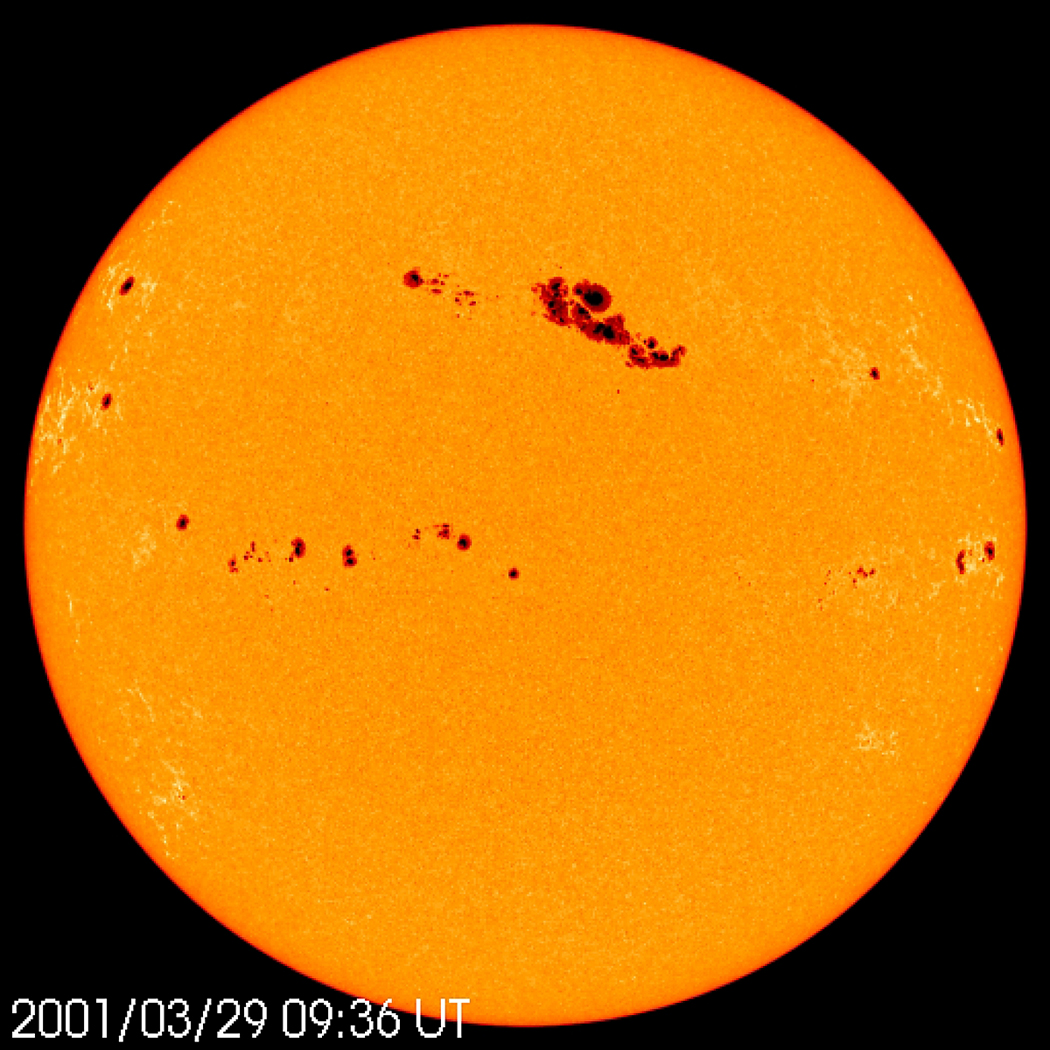
sunspotsIt is the logic of language that frustrates Achilles, not the tortoise. It guided how the Greek thought about the world. Polarity, opposites, hidden ironies and surprising conjunctions,  it’s how the language is organized,  even before you even consult reality. So, when the Greek saw language as a mirror of the reality and language posits polarity, it must be because the world is polar. But is it? Opposites are only a linguistic trick. Hot and cold are just relative points on a single thermometer: Sunspots are “cold” places on the sun, even though they are thousands of degrees Farenheit; liquid nitrogen is “warmer” than absolute zero. Linguistic legerdemain.
Even liberals and conservatives are just guys in the same blue suits. They don’t look like a dime’s worth of difference to the Fiji Islander.

By the logic of language, the world is divided into nouns and verbs; look out the window, however, and what you see is the conflation of noun and verb: something very much closer to Ovid’s Metamorphoses: a constant velocity of things ever growing and changing. No noun is static; no verb without its referent.

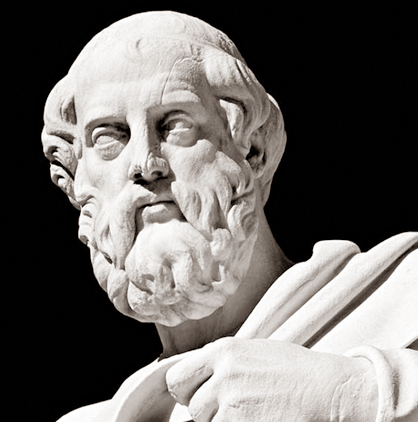
Marble statue of the ancient greek philosopher PlatoThe issue I have with Plato — aside from his totalitarian fascism — is his faith in an “ideal” of things. The ideal bed, unlike any real bed, is a stultified noun, not a bed. To Plato, the world is cataloged with nouns, only nouns. The perfect human is a form of arrested development. For Plato, the perfect human form is a male figure, age of about 25, all muscle and lithe, with little fat. But a real person is born tiny, grows, ages, marries, has his own bairns, gains experience, grows feeble and dies. Just as a rose isn’t the pretty flower, but a shoot, a bud, a flower, a rose-hip bursting to seed and once more from the top. Over and over. All the world is at every moment changing, growing, shrinking, spreading, running, molting, squawking, collapsing, weeping and rising. It is a churn, not a noun. “Panta horein,” as Heraclitus says: “Everything changes.”

Language is this thin veneer, the shiny surface, the packaging we are cajoled by. Break open the box, and the reality is something else.

It is much like the belief that geometry transcends embodiment. In other words, a triangle is a universal possibility, no matter if one was ever built. It is one of Plato’s ideals. God himself cannot create a four-sided triangle. But to change this “truth,” all we have to do is change our definition of the word. We don’t need a deity to do that, all we need is a lexicographer.

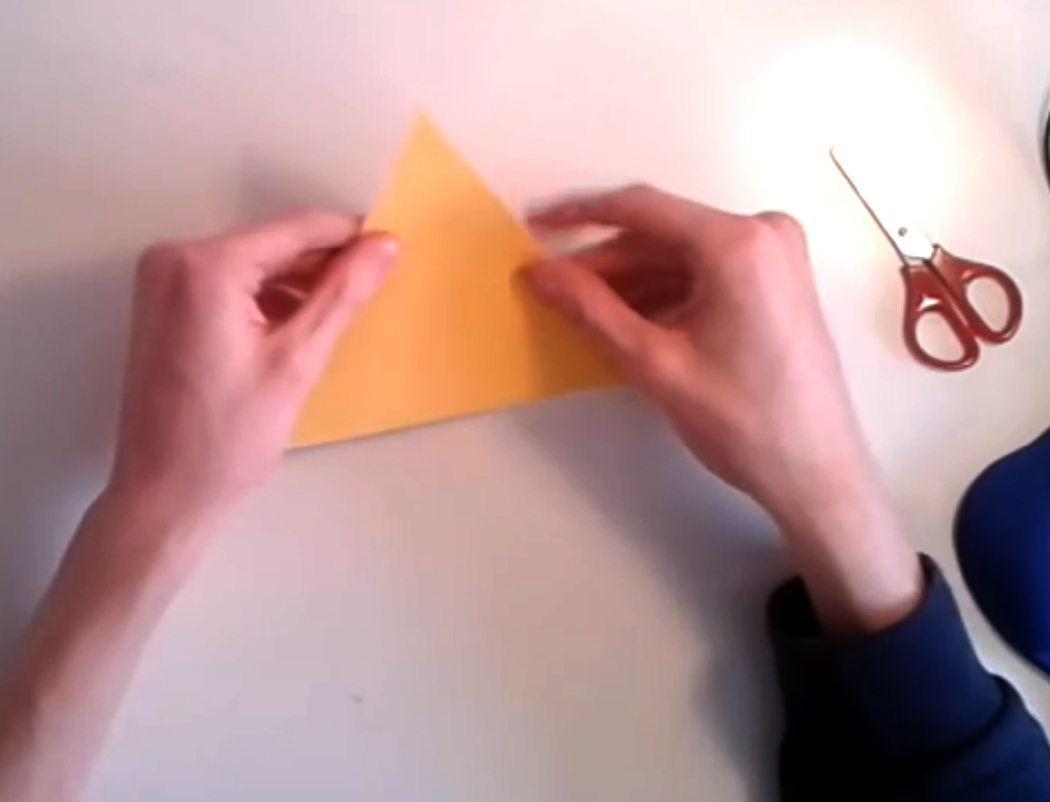
Or better, we can look at the problem a different way: I have written elsewhere (https://richardnilsen.com/2012/06/24/artists-math) that a triangle is a five-sided figure — the three usual sides, plus the top, looking down on it, and the bottom, resting on the desk. You can turn any triangle over from its back and lay it on its belly. triangleIf triangles exist in the world of things, they must have five sides. Language, like the axioms in geometry, pales in comparison to the real world of mud and bricks. There are 300,000 words defined in the Oxford English Dictionary, but that is an infinitesimal number compared with the number of things, acts, colors and sizes in the phenomenological world. There are an infinitely large number of things in the universe for which there are no words.

Take this, for instance. Here, where two walls meet is a corner. But where the wall and the ceiling meet? What is its name? In English, it has none.

Or this place on the wall — it is named the “center.” But this point, just as real, only a few inches from the center, is nameless and so is the one a few inches beyond that.

starsNames are like the stars in the sky, only points, between which is an infinity of space, just as real as the stars.

Language is feeble. It is up to us to see the space between the words, to recognize the feelings between the signpost emotions of hate, joy, anger, sadness — this million slight inflections that are nameless.

Up to us to explore the confusing rush of sense data, the confusing signals of society and nature, the overwhelming input that we censor with our language, allowing only those portions that sport nametags, as if they were Shriners at a convention.

It is up to us to recognize and celebrate all the things, times, places, acts, flavors, feelings, breath and abysses that don’t have names, to enjoy the cold floor and sunlight coming through the window in the morning when the birds haven’t yet begun chattering.

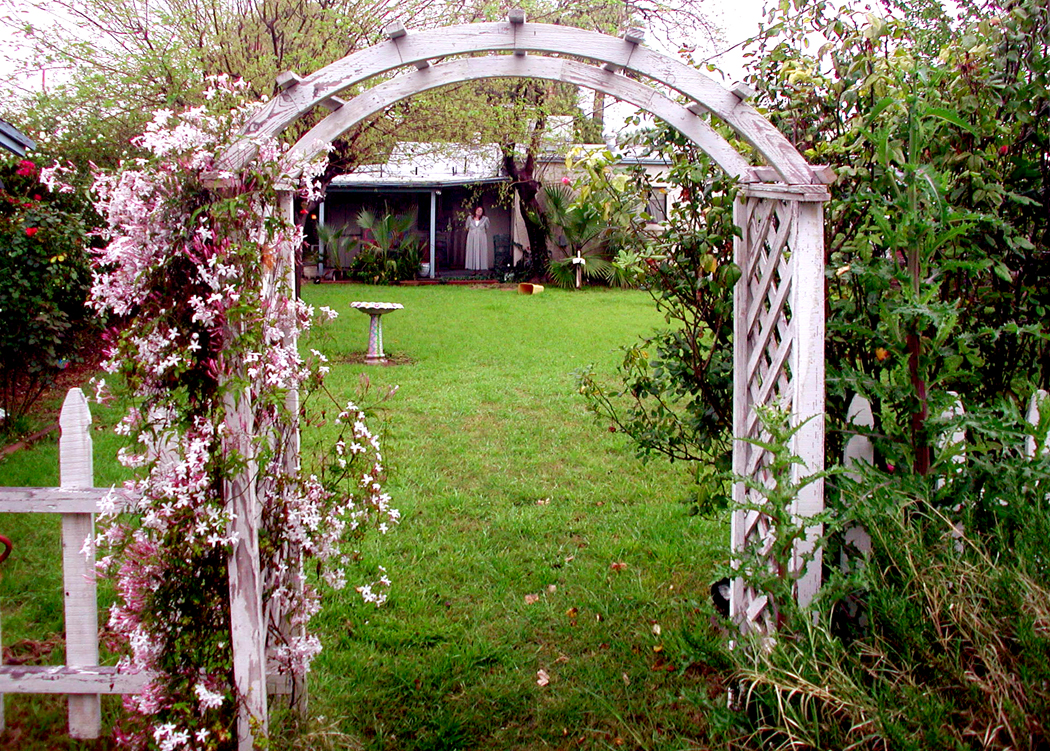
Garden

There is a line in Andrew Marvell’s “The Garden” that should be a starting point: “The mind, that ocean where each kind/ Does straight its own resemblance find.”

These are two primary foci for our existence: There is the world and there is our mind working on the world. Mind and world, the face and the mirror. The central problem is that the world is incomprehensible, multifarious, immense and unimaginably complicated, self-entwined and raw, while our minds, however brilliant, are puny organizers and pattern-finders. What we believe of the world is what we have been able to make of it, and we are simply not humble enough to recognize the insufficiency.

bee blossomTake something as basic as sight. We look upon the world and take what we see as something “real,” something actually “out there.” Yet, we know that visible light is such a tiny sliver of the electromagnetic spectrum, that our human vision is essentially nothing more than the chink of Pyramus and Thisbe, the slat of a Venetian blind lifted to see a wedge of the  world outside the window. Other animals are sensitive to different parts of the spectrum, and for them, the world is a different world: The bee sees not the daisy that you or I see.

We know this because human ingenuity has given us instruments that can measure those portions of the wavelengths that we cannot apprehend directly, and proves their existence. But we cannot know them directly: We are too limited. For that matter, so are the instruments.

Also limited are the odors we can smell, the sounds we can hear, the tastes we can enjoy or revile, or, for that matter, the languages we can understand or the names we have for the emotions we feel. And yet, somehow we feel we can say we know the world.

I am constantly amazed at human arrogance in the face of the vast ignorance we daily confront. Perhaps it is unavoidable that we have faith in our senses and our minds, that we believe what we have learned of the world is the way the world in actuality, is. It takes an act of imagination to escape our shortsightedness.

And it is not only the world beyond our skins that escapes us: The conscious mind — that part of ourselves we generally consider to be “us” — is such a small part of what our brains do for us. We are not consciously aware of our guts squeezing the chyme along our bowel, not aware of our capillaries constricting, our irises expanding, our hearts beating faster or slower, depending on the unconscious monitoring of our inner bodily needs. Consider yourself at this very second, sitting or standing. Are you fingers curled? Are you tapping them? Is your head tilted slightly? Are you yawning? Have you sneezed? Did you “decide” to do any of those things? Your body seems to work quite autonomously, and your administration has delegated authority to its constituent parts to act on their own. Let’s face it, you would die if you had to will each heartbeat, each breath, each eye blink: Keeping track of it all would be impossible.

And yet, we have faith in that little voice in our heads that seems to be in charge: It blithely makes assumptions that cannot be justified.

This is not to toss out the little voice: We could not operate in the world if we did not simplify it to our purpose; we would be overwhelmed. We make schemas and function within those schemas quite happily, but are seldom aware of their artificiality.

tres riches heuresA good deal of trouble is caused by our unawareness. In politics, for instance, one side believes in pure capitalism, the other in socialism, but each view is only a schema, and takes not into account the great variability of human want, need, ability, and the inevitability of change, both historical and social. Remember feudalism? Monarchy and aristocracy? These were earlier schema, and sustained over centuries, even millennia. One thing might work better at some point, while its opposite might be more functional at another, neither perfectly, while all are always mere band-aids. No human reality can be encompassed by an ideology. They are all simplifications to the point of absurdity.

take outRepublicans who now believe things diametrically opposed to what they had once believed, think that if they can finally pass the laws they want, everything will work like a well-oiled machine from thence onward. Conservatives, who once championed strong central power, now believe the least government is best. (In reality, they believe in whatever will best preserve their own hegemony and wealth and if that changes, so will their ideal of proper government). But in practice, nothing is ideal, nothing is unchanging and perfect: Politics is always ad hoc. It doesn’t fit into cardboard pint containers like so much chop suey.

Religions, political ideologies, psychologies, even science are all such partial schemata and none can be said to encompass all of existence. It isn’t that we should trash all of them, but rather that we should recognize their agendas. And beyond that we should embrace, enjoy and revel in all that is not contained therein. The universe is vast, it contains multitudes. It is this plenitude and fecundity that ultimately sustains us. No system is enough.

Largest ever galaxy portrait - stunning HD image of Pinwheel GalWhat wakes us to the complexity is experience: travel, reading, learning other languages, meeting other people (as a “thou” not an “it”), education, and most of all, the exercise and strengthening of imagination, which all the previous foster. Openness to the world rather than stricture according to ideology or schema. Pulling our turtle heads into the shells of our small perceptions is nothing but retreat.

And whenever possible — and this is the biggest lesson I have swallowed in 68 years on this round, bubbly planet — to love the things of this world. All of it, helter-skelter, unapologetic and enthusiastic, chaotic, overwhelming, incomprehensible and glorious. And recognize our smallness, our ignorance, in the face of it.

RW ca 1975When I was young and just out of college, my ambition was simple: to know everything. I mean, to read and study, and do, and finally to be able to put together all the pieces into a single grand scheme: My own unified field theory. I was not daft, I knew at the time this was an impossibility, but I thought as a goal, it was at least a starting place.

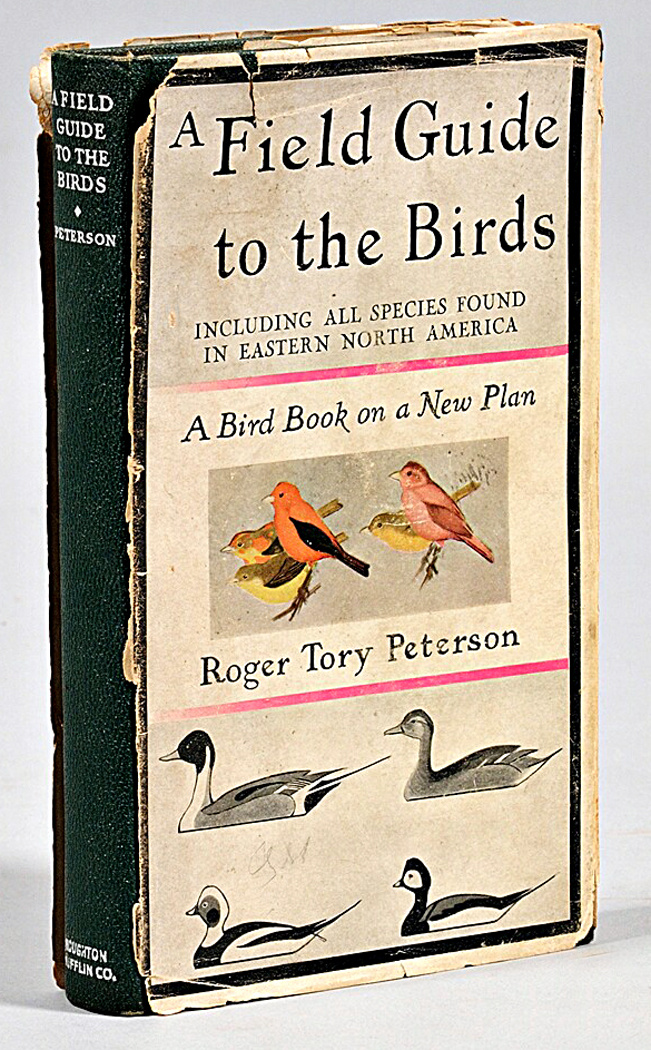
peterson guideOthers in my graduating class had more specific goals — to become a doctor or lawyer or research scientist. Such goals required focus and specialization. They would have to learn all they could about law or medicine or pigeon behavior, but I would be purposely unfocused. I wanted to take in the whole horizon. I collected Peterson guides to learn the names and calls of all the birds, the names of trees and wildflowers. I read all the poetry I could find and all the history, too. Ancient, modern and otherwise. I had books on physics and astronomy, and I listened to all kinds of music and learned to read scores. I was in pig heaven.

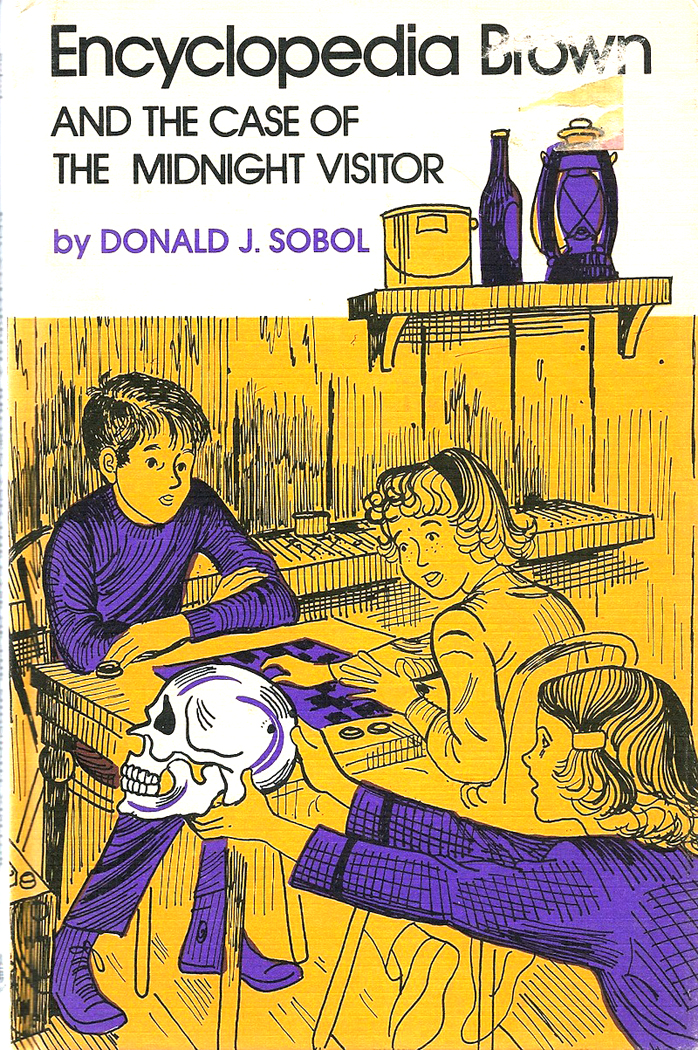
encyclopedia brownDo not laugh. Of course this was all silly. But when you are young, you are an idiot. I was no exception, in fact, I was probably the the very model of youthful and ignorant assurance. It helped that I had a retentive memory. Or as I now put it: Facts stick because my brain is gummy. I developed something of a reputation, both as a know-it-all, and as “Encyclopedia Brown.” One girlfriend used to make spare cash by betting her coworkers that when I came to pick her up after work, that I would be able to answer a question they thought they could stump me with. “Who was the first secretary-general of the U.N?” “Trygve Lie,” I would say, and money would change hands.

These were sparse years: With no specialization, it was hard to find a meaningful job. I didn’t much care, as long as I had enough money to feed myself and rent a garret apartment. Recreational reading included the Encyclopedia Britannica and the Oxford English Dictionary. I was a vacuum cleaner.

I do not know where this drive to learn came from, but I have always had it. Others may learn for reasons of usefulness; I never thought about the pragmatic aspects of knowledge: The learning was the end itself. More, more, I wanted more.

You might point out that a vast accumulation of fact is not really erudition, and that merely knowing bits of fact confetti is not the same as understanding or wisdom. For me, back then, that was beside the point. I wasn’t concerned with wisdom, I just wanted to know everything.

I was lucky, I didn’t have to live with me. I’m sure I drove people nuts with my Cliff Clavin act.

Audubon's Mockingbird

Audubon’s Mockingbird

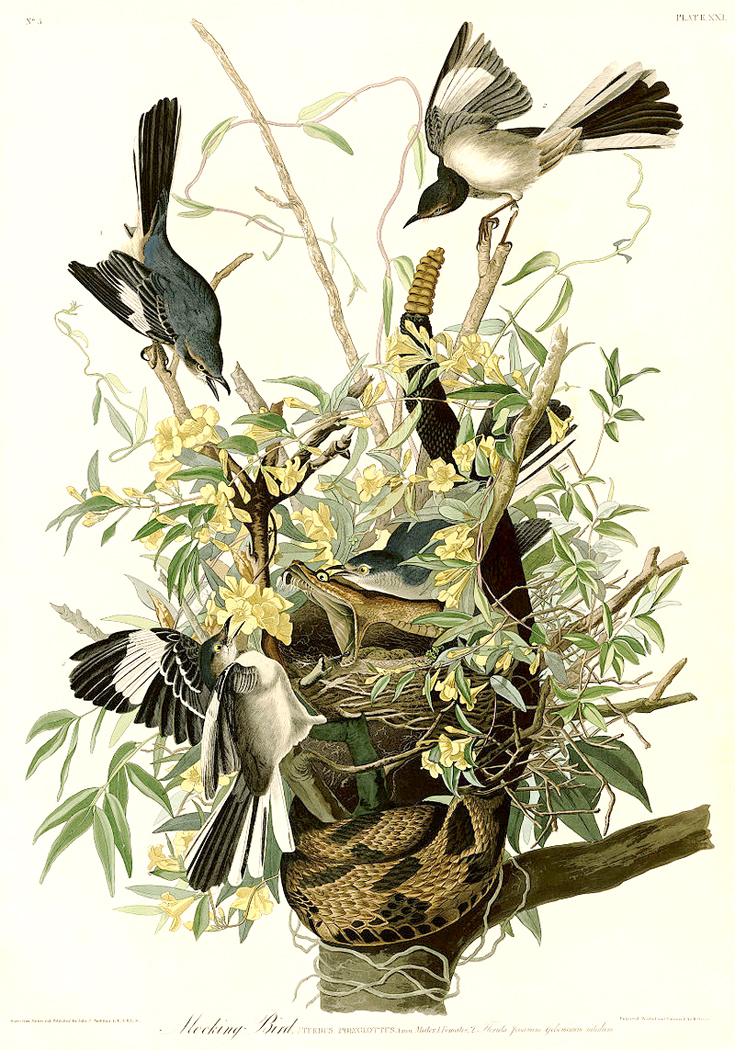
Time passes and it is now 50 years since I first entered college and took up the study of ancient Greek and the poetry of Chaucer. My memory is no longer so acute. I cannot always bring up the name of the Duchesnea indica or the Mimus polyglottos. But in the long course of years, I have absorbed so much minutiae that it has all transmuted into something else. I cannot call it wisdom; I’m still an idiot. But, at 68, I have accumulated so much experience, I have a very different perspective. The simple enthusiasms of youth have given way to the calmer, chastened complexities of a life both illuminated and deflated. I have no wisdom to impart, but I have observations.

RW at 67In the past, people talked about the wisdom of old age, but now that I am there, I know it isn’t wisdom, it is only the result of long years of witnessing human folly, of many, many head-buttings with the harder facts of existence, and having built up a vast treasury of our own personal mistakes, misunderstandings and imbecilities.

Gustav Mahler’s Third Symphony has six movements and each originally came with a short explanation. After the first movement, the remaining ones are: “What the meadow flowers tell me,” “What the forest animals tell me,” “What Man tells me,” “What the angels tell me,” and finally, “What love tells me.” It is clear that no single one of these is sufficient in itself, but the whole presumes all. No single truth suffices.

I hope to present in the next several weeks my humble version of what Gustav loaded into his symphony. The things I have come to understand over nearly seven decades of breathing, seeing, tasting, feeling, dancing, hurting (both transitive and intransitive), and finally coming to some glimpse of loving.

University professors, if they have reached some level of eminence, are occasionally asked to prepare a “last lecture,” which subsumes all the most important lessons they have to give. This is a lecture that cuts through all the burly detail to undiscover the essence of what those details outline.

Me lecturingIt may seem the height of hubris to attempt such a “last lecture,” when I am not a tenured faculty member at an Ivy League academy, and make no claim to exceptional brilliance or wisdom, but the fact is that anyone who lives long enough has a longer view, and sees things differently from when youth fills us with self-righteousness and certainty.

Nor is this one of those inspirational harangues. I am not Mitch Albom and I am not dying immanently, like Randy Pausch. I do not expect to teach you how to be a “better” human being, or to make the world a better place, or disclose the secrets of a happier life. My goal is merely to see a little more clearly and to attempt to make sense of what cannot be made sense of.

In short outline, I have maybe 10 or a dozen themes to fill out, which I hope to do in the next few weeks in this blog spot. It is a challenge I have set myself. Have I learned anything?

deep end of the poolThere are two approaches to learning: Some prefer to take small steps and try out the simplest and easiest first; others like to dive headfirst into the deep end of the pool.

When it comes to classical music, the first approach is most common. We don’t want to scare our pupil, so we spoon feed the shorter, easier, more comfortable pieces to them: a Chopin waltz or a Rachmaninoff piano concerto. At its worst, this leads to a belief in the student, that classical music is a warm bath to soak in, a place to let your mind drift, to let soothing images wander through your imagination.

Dickand JaneThe “Dick and Jane” approach, though, can be patronizing. If you have a real hunger for emotional and intellectual depth, the approach trivializes the subject. It pretends that the more difficult music isn’t the real heart of classical music, but some sort of broccoli to be had along with your Satie Gymnopedie or your Carmen Suite. Classical music is meant to be listened to with intensity and focus, as you might read Dostoevsky or a Greek tragedy. If your mind wanders, you have lost the trail.

I recently wrote a blog about sharing my music with my granddaughter, Tallulah Rose; she, in turn, shared with me her contemporary indie-pop music (You can find it here: https://richardnilsen.com/2016/03/14/both-sides-now).

The response to this blog entry was overwhelming: More people have clicked on it than any other, and the comments added to it are legion. The piece must have hit a nerve.

Among those comments have been a number of repeated questions, and one of those is a request for further “guidance,” as to what to listen to in order to become more familiar with classical music. There is a hunger out there for something more serious or formal than the 3-minute song.

So, I’m assuming an adventurous listener, perhaps with a collection of Frank Zappa, Nick Cave or Radiohead. That is a listener who does not want to start out on baby food, but wants to dive into the deep end, who wants to drink the hard stuff.

So, here is my preliminary list of deep-end music for those who want to find out what classical music is really all about: It isn’t about style (there is a great deal of so-called classical music that is really just the conventional style of its day and has no particular claim to posterity — one thinks of Ditters von Dittersdorf or Friedrich Kalkbrenner) but about sounding depths, expanding on form, creating sound narratives and searching for meaning. I have written in the past that the essential question of classical music is “How do you write a piece of music that lasts longer than three minutes?”monk stamp And that the idea of classical music needs to be expanded to include the classical musics of other cultures, such as that of India or Japan, and also to include jazz, which is really just another classical music, at least in the hands of its most serious practitioners, such as Miles Davis, Thelonious Monk or Duke Ellington.

But here, I am going to restrict myself to what is commonly called classical music: the European-American tradition of art music.

So, here’s a first go-round of suggestions for the brave new listener.

Ludwig van Beethoven, Grosse Fuge. Originally the final movement of his string quartet in B-flat, Op. 130, it proved to challenging for both the audiences and the performers of his day, so he felt compelled to write a replacement for it and publish the fugue separately as his Op. 133. It might be the toughest nut to crack in all of classical music. In it, Beethoven builds such a huge double fugue (that is, a fugue not on one theme, but on two themes played simultaneously, upping the ante and the difficulty by not doubling, but squaring the complexity), that it breaks the mold of what a fugue can be, as the fiddlers nearly saw their instruments in half. Playing this music is like taming wild tigers. If you survive this, everything else is a piece of cake.

grosse fuge furtwangler

There is one performance that nearly tames this wild animal, and that is a recording from 1954 with conductor Wilhelm Furtwangler leading the Vienna Philharmonic in an orchestral version of the music. It can be found on You Tube at: https://www.youtube.com/watch?v=pSfcE3HH7dk.

Grosse fuge animation

A version for quartet in more modern sound can be had from an unidentified quartet with an entertaining animation that makes visual the notes at: https://www.youtube.com/watch?v=6s0Mp7LFI-k.

polonaise fantaisie horowitz

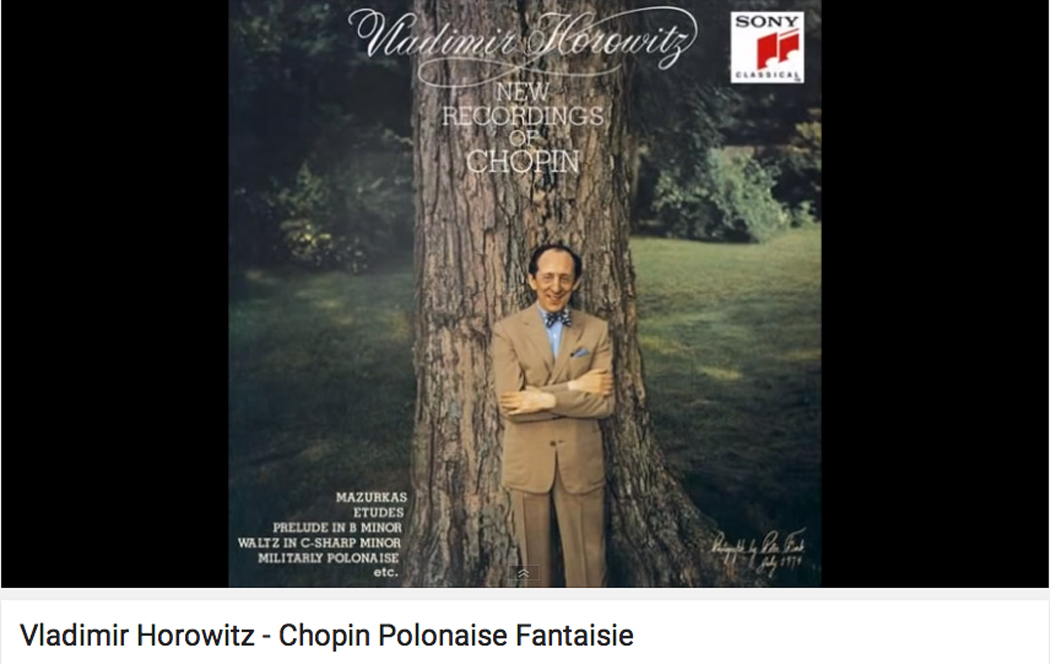
Frederic Chopin, Polonaise Fantaisie, Op. 61. This must be the hairiest thing Chopin ever wrote, incomprehensible on first listening — it seems to wander and never make up its mind. But after many hearings, it is one of the high points of western music. Give it a chance. Those opening chords are the most desolate in all music, especially the way Vladimir Horowitz plays them. Horowitz owned this piece. Here he is from 1966 in Carnegie Hall: https://www.youtube.com/watch?v=KI38MuQ4YdQ.

bach chaconne heifetz

Johann Sebastian Bach, Chaconne from Partita in D-minor for solo violin. A great teacher of mine said that this is what he called “serious” music, that is, music not meant to paint a picture or tell a story, but music so abstract, so pure as to exist practically in a Platonic realm. On a single fiddle, he has the violinist play variants of the same series of chords over and over, gaining in depth and complexity as it moves along. Here is Jascha Heifetz playing at about the age of 70. It doesn’t get much better than this: https://www.youtube.com/watch?v=6q-Zqz7mNjQ.

bach chaconne grimaud

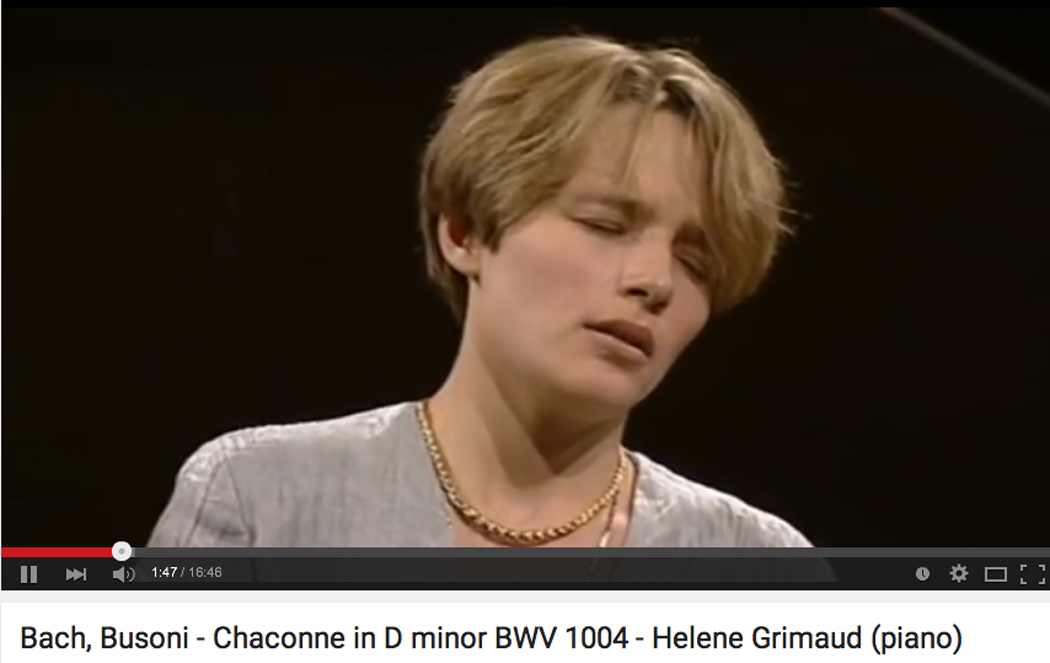
For contrast, the Chaconne has been transcribed several times for piano. Here is Helene Grimaud playing it as opened up by the great pianist Ferruccio Busoni (don’t expect pure Bach; this is a 19th century re-imagining, but it is glorious): https://www.youtube.com/watch?v=sw9DlMNnpPM.

bartok quartet

Bela Bartok, String Quartet No. 5. Written in 1934, Bartok’s next-to-last string quartet is a model of construction, built in an arch-like form, so that it moves fast-slow-fast-slow-fast, with key structures and melodies equally symmetrical. The two slow movements imitate the sounds of night, with chirping and cawing, crickets and crows. The central movement is in a time signature typical of Bulgarian folk music, with beats broken up into nines broken into patterns of 4+2+3 and later into tens, broken into 3+2+2+3. And, in the finale, just before the end, you hear an imitation of a hurdy gurdy. It’s a lot to fit into a tightly argued quartet. Here it is played by the Hungarian String Quartet: https://www.youtube.com/watch?v=lMjRjLHbacw

berg violin concerto

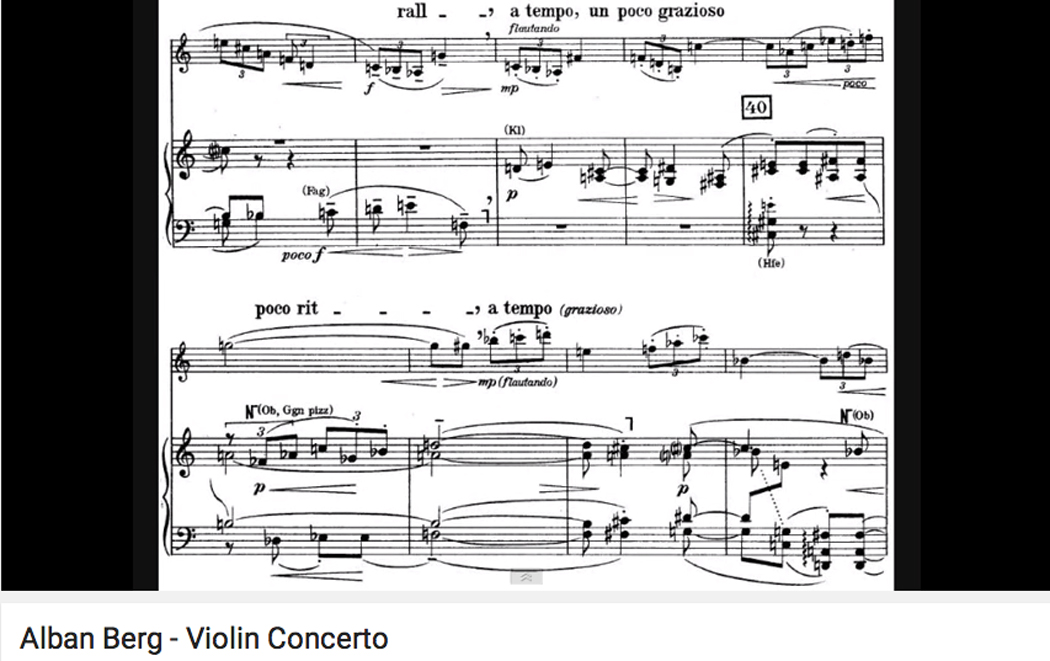
Alban Berg, Violin Concerto. This is one of the most emotionally draining pieces of music from the 20th century, written “in memory of an angel,” the angel being Manon Gropius, daughter of Alma

Manon Gropius

Manon Gropius

Mahler and Walter Gropius. Manon died a teenager from Polio in 1934 and Berg, who was exceptionally close to the family, wrote this concerto in elegy. It is composed in the 12-tone technique, but in an accessible style, because the tone-row he built the music around has obvious tonal implications. It is heartfelt and moving, and in the final movement, the last notes of the tone row miraculously turn into the Bach chorale, “Is est Genug,” “It is enough.” If you can hear this and not blubber like a baby, you are more stalwart than me. Anne-Sophie Mutter, New York Philharmonic, Lorin Maazel. https://www.youtube.com/watch?v=gd0dMs0MTg8.


giza view from cairo

We were watching a TV show about ancient Egypt and the voiceover told us the pyramids we were visiting were “35 centuries old,” and that phrase suddenly struck me in a new way.

I am now 68 years old, which is a bit more than two-thirds of a century, and I have a body-sense, a memory-sense — a conceptual awareness — of what a century feels like. I wrote for the newspaper for a quarter of a century. Four times that and Bingo! So, a century has a palpable meaning for me. I feel it in my bones. Hearing the TV presenter, then, made me react, “Thirty-five is not a very large number.” I can picture in my mind’s eye what 35 centuries might be, and it really doesn’t seem like all that long. The Viking Age ended only 10 of them ago.

Anton and Laura Nilsen

Anton and Laura Nilsen

After all, my grandfather, who I knew when I was a boy, was born in 1890, which was the year Vincent van Gogh died. It was also the year Sitting Bull died, and the Elephant Man (John Merrick), and Heinrich Schliemann — the man who discovered Troy. My grandfather was seven years old before Johannes Brahms died. These historical figures seem that much less remote when I think of it that way.

Rowan and Nancy Steele

Rowan and Nancy Steele

For my wife, it is even more present. When she was a girl, her great-grandmother lived with her family. Her great-grandmother, Nancy Jane Steele, was a Civil War widow. She married Rowan Steele after that war, but Rowan had been a cavalry soldier during the battle at Appomattox. That dumps the War Between the States right in my wife’s lap. History is not some remote collection of facts gathered from a book, it is family.

The word, “century,” has its roots in family. The Latin word was “saeculum,” which was an indistinct time period that measured, basically, the time from your grandfather to the time of your grandchild. Caesar Augustus regularized that time to be 110 years, but in effect it varied from 90 years to about 120 years. It was an “age.”

History, as a subject, is different if you think of it that way. It is not a set of facts for a trivia contest, but a continuity, of which we are each a knot along a string.

For many, these days, that continuity is found in genealogy: How far back can you trace your ancestors? With various DNA tests, you can discover ancestry beyond the civic records of the standard genealogy. A y-DNA test can follow the paternal haplogroup all the way back to Africa, with punctuated stops along the way. A maternal mitochondrial DNA test can do the same for the distaff side.

It means that you are very personally connected to the history you study in school. Somewhere among those pogroms, crusades, wars and massacres, your strands of DNA were either slaughtered or doing the slaughtering, and probably both at different times. Looked at through the small lens, genealogy is your story; looked at through the big lens, all of history is your story. How can one not be interested?

Carol Lily

Carol Lily

My granddaughter is now studying AP world history, and sometimes, she comes to me for help understanding the subject. I wish I could somehow inspire her to see it not as an impersonal school subject she has to be graded on, but the story of how she got here, what happened on the way to her creation, and how she fits into that grand, long picture. She makes good grades, but it would be more important to think of history as something personal, something that informs her life: She is Southern, so the slavery that ended 151 years ago colors her life every day; the arguments held in Philadelphia in 1787 affect what she can and cannot do today; that the battle of Plataea in 479 BC is part of the reason she speaks English today and not some descendant of Farsi.

The horsemen from Mongolia shaped what later became Russia, which became the Soviet Union, which defeated Nazi Germany, became our enemy in the Cold War, and led to Vladimir Putin today. It is not ancient history, it is merely the dangling end of a long cord: The same people who gave us Xanadu and Kublai Khan gave us the Silk Road and the Golden Horde, and is one of the reasons given for why Hungary is named HUN-gary, and, incidentally, gave their name to the tartar sauce you put on fried fish.

Know-Nothing poster

Know-Nothing poster

It is disappointing to see so many Americans with so little sense of history, of where we came from. We hear the resurrected Know-Nothing-ism of Donald Trump and too many of his followers hear no resonance of the anti-Catholic, anti-Irish sentiment of the earlier wave of xenophobia. The past, for them, is a black hole out of which no wisdom can emerge.

Presentism, as it is sometimes called, is rampant: the belief that what is now is somehow “true,” and the past was all a big mistake; it is the error that what we think and believe now is the “right” and “correct” version of the world, and those benighted people of old were merely beta-versions of humanity. We require more humility; history can provide that humility.

I can remember when the faces of Eisenhower and Stevenson on the tiny black and white television we had in the house when I was yet too young to go to school. I remember the Dodgers at Ebbets Field. I remember when they added the second deck to the George Washington Bridge. ike and adlai 1952These things are now history. They are ink on a page in the history book my granddaughter reads for class. But I was a real person who lived through them. My father lived through the Battle of the Bulge in World War II. My great-uncle wore puttees as a dough boy in the first War to End Wars. My wife’s great-grandfather fought in the Civil War. Somewhere, back before my genealogy became writ into the family bible, I surely had ancestors who went a-viking and worshipped the lord Odin.

I feel those connections, not as dry intellectual answers to history-class homework questions. History is not something merely read, it is red, it runs through our veins. It’s been there for 35 centuries, at least.

kelly briar

It is impossible to listen to the final quartets of Beethoven and not recognize in them something quite different from the optimistic and heroic thrust of his most popular works, the Eroica, the Appassionata, the Razumovskies. The quartets in question no longer follow the standard four-movement shape of the classical quartet and symphony, and they no longer seem addressed to the world and society, but rather, they are discursive, wandering and seem turned completely inward.

Innigkeit

Innigkeit

It has been called his “late style” ever since 1855, when Wilhelm von Lenz wrote his book, “Beethoven and his three styles,” which attempts to give shape to the composer’s career, with an “early style” in imitation of Haydn and Mozart; a “middle period” with all those grand exhortations to heroism and the overcoming of obstacles and the establishment of freedom and individualism; to the “late style” of innigkeit and apparent formlessness.

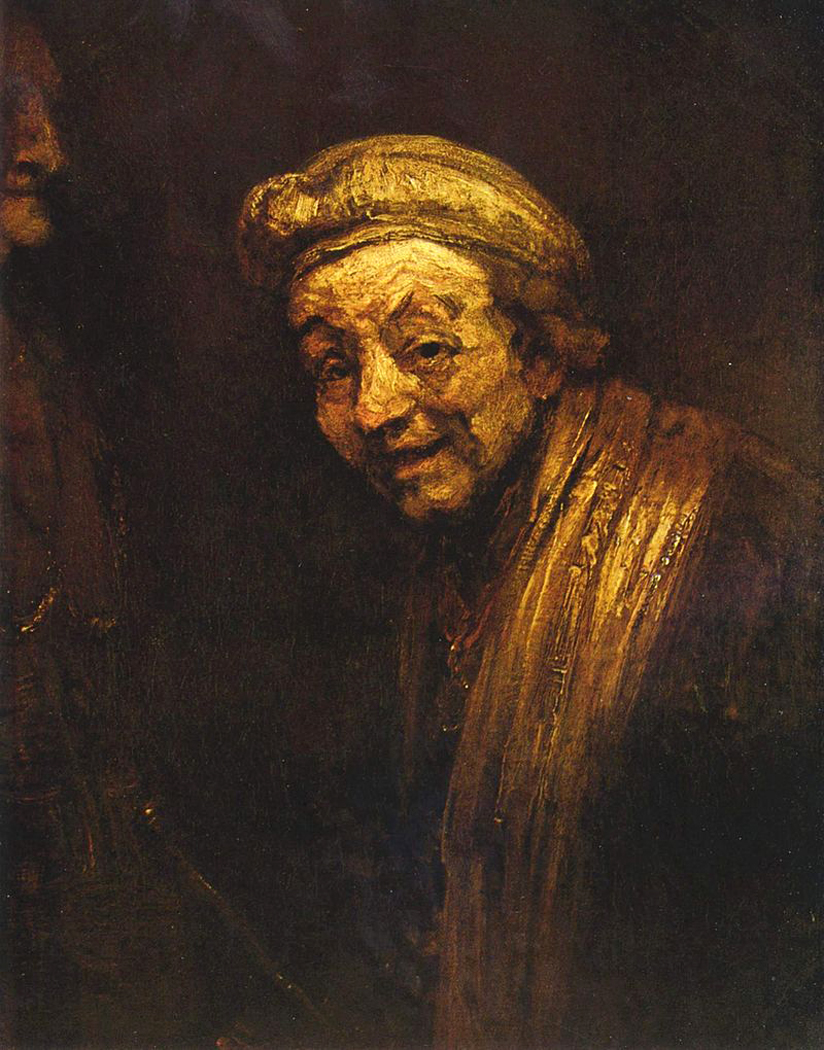
Since then, it has become standard to view an artist’s career into three: apprenticeship, mastery, and a “late style” in which the artist perhaps gives up his public function to investigate his private concerns. Within this pattern, it has become usual to see the late period as the culmination of an artist’s life and work, as its height, as its reduced essence.rembrandt self portrait

And so, we see the final paintings of Rembrandt, the late romances of Shakespeare, the last dark photographs of Edward Weston or the Ninth Symphony of Mahler as somehow special, as more meaningful, as “better” even as “best.” We look to them for something like a peroration of wisdom, the final words or notes or brushstrokes of a sage. Goya’s black paintings, or the black paintings of Jackson Pollock. (Usually, there is some element of darkness in late work, whether it is the Beethoven quartets or the quiet “ersterbend” that ends the Mahler Ninth.)

weston china cove pointlobosAs Minor White said of the Weston photographs: “Rarely are we shown the maturest work of men who have lived richly and whose spirit has grown all their lives … the last photographs of Edward Weston made at Point Lobos … may parallel in content the last quartets of Beethoven.”

There are many problem with this formulation. First, so many artists — certainly the majority — don’t fit into this pattern. Second, while we can recognize a “late style” in the final works of Franz Schubert, Schubert died at 31. Can that be considered his late period? Suppose he had lived his three score years and ten? What would have followed his “late style?” Obviously, a late style is something we apply only in retrospect. Even Beethoven, whose late style defines the idea, died at a fairly young age of 56. Where would he have gone if he had lived to 70? His late style would then have been something transitional.

Then, there are artists whose supposed late style is generally admitted to be a decline. One thinks of the final paintings of De Kooning. And there is the problem of someone like Wagner, who strove self-consciously for the prestige of having a late style with the artificial spirituality of “Parsifal.”

There is another issue, too. Late style means more than one thing. Initially, we think of art that is intensely personal rather than public, art that reaches the darker and more private parts of the human experience. But that is not the only thing — perhaps not even the primary thing — that defines late style. As Edward Said said in his study of the subject, late style is characterized by an increasing simplicity of technique. Take those late quartets, which are a bouquet of dances, marches, recitativ and arias, and movements sometimes so short, they hardly count as movements at all. They alternate with long fugal passages where the counterpoint is hidden in blocks of chordal harmony. Even their sonata-form movements are choppy with short, punchy themes entering stage right and quickly running off stage left, chased by the next patch of tune. There is a superfluity of material and an economy of means.Heiliger Dankgesang

It is as though an artist, a composer, a poet, had spent his youth perfecting an elaborate craft, the mastery of which is part of his declaration to the world, but having become increasingly confident of his ability, he no longer considers it to be the important part of his work. The competence is still there, but the showing-off is gone: The artist only uses so much of his virtuosity as is needed to make his point.

Another way of putting it is that when young, an artist is in love with his artform — with his villanelle, his twelve tones, his impasto — and so aware of the tradition and history of that technique, that he wants to strive to shoulder his way into that history, to take his place. But as age and its concomitant wisdom encroach, the technique seems a shallow exercise compared with the content: The balance shifts to what he has to say rather than how he says it.

As Arnold Schoenberg said, “There is still plenty of good music to be written in C major.”

This is Picasso’s arc: Early work is meant to rattle art history. He goes through his “periods,” which are each an exploration of a particular technique or “ism.” But in his later life, he freed himself to simply play with his paints or his pottery. It is clearly Picasso’s “voice,” his “look,” but the ism ceases to be the point: the work becomes an endless parade of bulls, women, birds, still lifes and images of concupiscent artists, often with bulls or women.matisse cutout

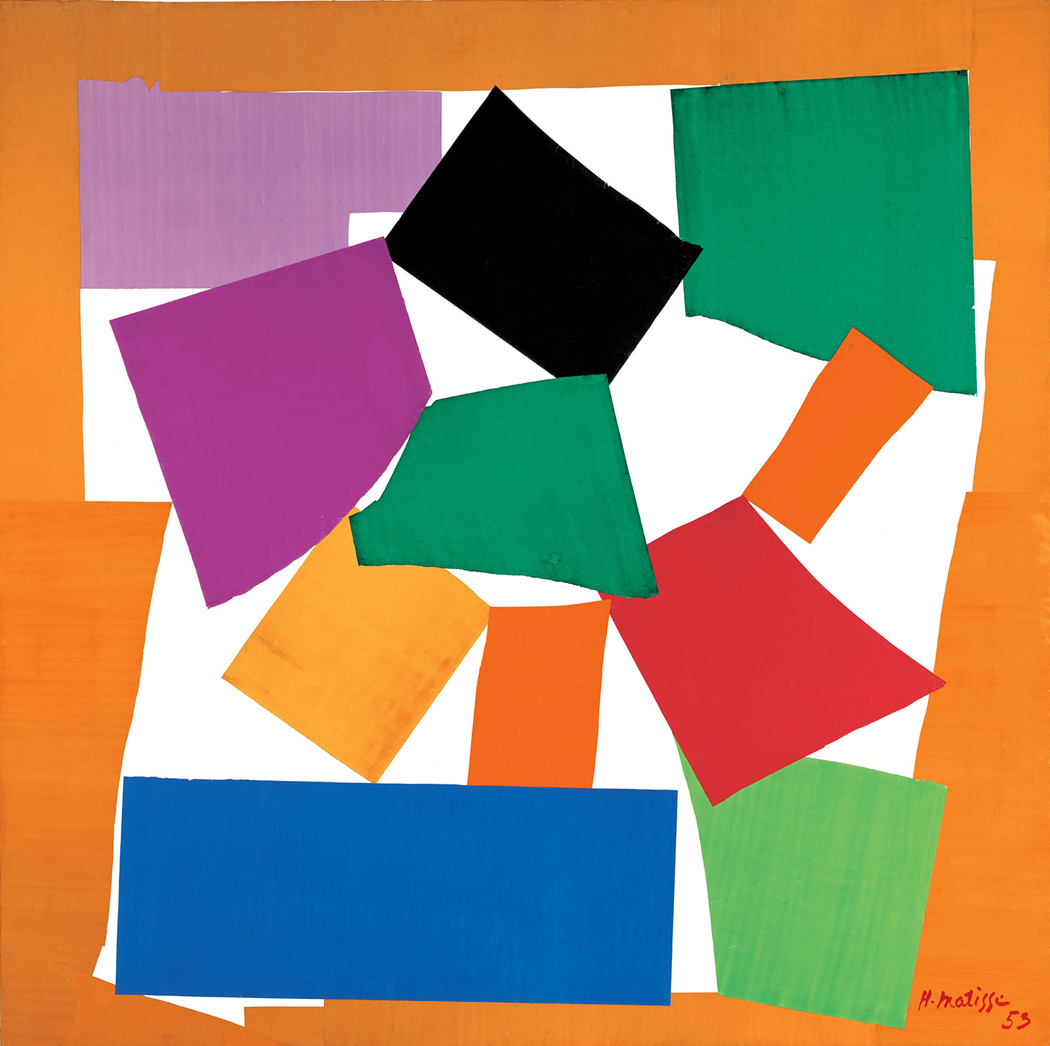
Or Matisse, who ended with paper cutouts, as simple as a child’s finger painting.

One sees this in many a career, where the young artist finds his voice and shouts to make a name, but once having established his bona fides, feels then free to explore what he is really interested in. One thinks perhaps of Richard Diebenkorn, who made a name with abstract art, and after becoming famous, started making “pictures.”

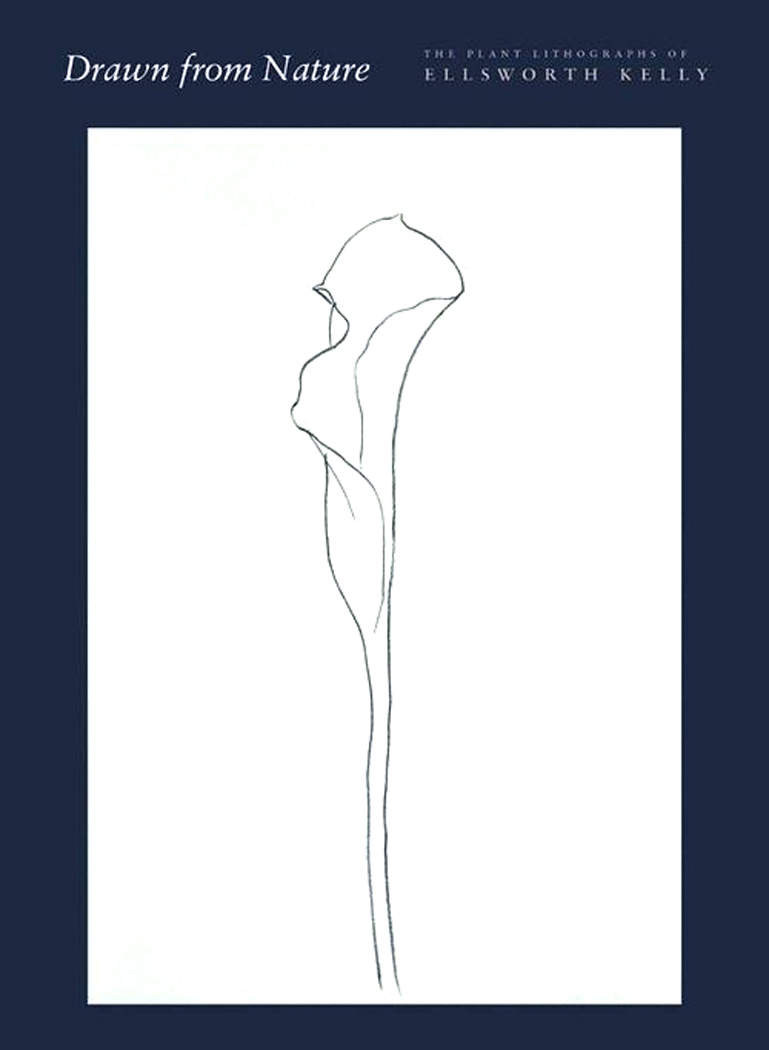
kelly coverI was struck seeing some drawings by Ellsworth Kelly, who made his career with minimalist Color Field paintings — they might as well have been models for flags — but these drawings were of plants, in simple black line on simple white paper. They were elegant and expressive and nothing like the bland paintings. He has made them throughout his career, but they had been seen only once (in 1970) before they made a big splash, showing them in 2012 at the Metropolitan Museum of Art in New York. Kelly clearly loved the plant forms he drew.

There comes with age and experience — and perhaps prodded along by the awareness of the extreme shortness of life — a need to say what needs saying unencumbered by all the apparatus and hoopla that seduce our younger selves.

And this is where the simplicity of means becomes the same thing as the profundity of meaning. In his middle period, at the height of his Beethoven-ness, he can spend an entire symphony showing us how an obsessive rhythmic motiv in C-minor can grow into a triumphal shout of joy in C-major. But by the late quartets, the emotional expressions pass moment by moment, as if attention to the present were more important than presentiment of the future or reminiscence of what has gone before. There is an intensity of the now, an urgency of being present. And that is where we find the marriage of the late style’s depth and its simplicity.