shatley meal
If Mr. Yelverton had a first name, I never knew it. Everyone used the more formal address.

George YelvertonHe ran a barbecue restaurant in Greensboro, N.C., and I knew him in the early 1970s. To call it a restaurant is an exaggeration: It was a hole-in-the-wall behind the main line of storefronts along the city’s main street. Butted up against the brick back walls of department stores and banks, Yelverton’s Barbecue faced only a parking lot.

Mr. Yelverton was thin, wiry, with high cheekbones and short silver hair and with the reserved demeanor of a gentleman. He made pork barbecue in the eastern North Carolina style.barbecue 2

Most people who know anything about barbecue know that the nation is subdivided by regional chauvinisms. There is Kansas City barbecue and Texas barbecue. Even North Carolina is split between Halifax style — eastern North Carolina style — and Lexington style.

It was a time of rapid change in the South, and change in Southern cooking as well. Many local barbecue establishments had changed their method of making hush puppies, using a new device that extruded corn batter into the hot grease like a carnival funnel cake. Mr. Yelverton didn’t approve.

“I never saw the advantage of doing things faster and easier,” I remember him saying one day. He showed me his technique.

“You mix up your cornmeal with water,” he said, making a stiff, granular dough rather than a batter. “Then you take a dollop of it up in a serving spoon.” He had a large, steel-handled spoon about 15 inches long. “Then you use the back of a tablespoon to whip off bits into the grease.”

Each serving spoon was subdivided into four or five hush puppies, each cut away from the gob with a flick of his wrist on the convexity of the tablespoon, leaving a perfect hush puppy, shaped like a lemon wedge, with ridges. They turned a beautiful, aromatic coppery color and were absolute heaven when you bit into them hot.

hushpuppies 3Recently, my wife and I were back in North Carolina and, though Yelverton has long gone, we stopped at a barbecue joint in Shelby. The hush puppies had changed: Not only were they plopped into the grease via the ubiquitous extruder, making little round cigar shapes (I’m being polite), but they were made with added onion and sugar.

“That’s not a real hush puppy,” my wife said. She can be very strict when it comes to the right way to do things, and hush puppies with sweetener counts for her not simply as a variant, but as a perversion.

“Hush puppies don’t have sugar in them,” she stated categorically.

My wife is typical of many Southerners: certain the way she grew up was the “right” way. It fuels many a heated discussion. You get obstinate opinions about whether to soak country ham, about whether Brunswick stew requires squirrel meat, about the best apple to fry.

“I like June apples,” my wife says. “My great-grandmother said they were the best.”

Her great-grandmother was a genuine Civil War widow and had the bona fides.

If there is one thing that defines Southern food, it must be the soil, the terroir, the sandy podzols of eastern North Carolina or the black loam of the Mississippi Delta. You can see it in the flesh of catfish made pink by the red-clay river bottoms.

Like patriotism, food preference grows from the land where you grew up and the people who raised you. It is what you know and what you are comfortable with.

Southern food is divided by region, by class, by race. The food of Louisiana is sui generis. The menus of South Carolina plantations were more upscale than on the small farm holdings in Piedmont North Carolina or Virginia. The hardscrabble diet of the Blue Ridge Mountains is something else again.

Yet, there is a certain overlap. Soul food and Southern cooking emphasize different aspects of the cuisine but share more than they don’t. Cooked greens, side meat, cornbread — these are the common denominators.

The original of both was humble — pronounced “umble” without the “h.” It was food grown on family farms, from hogs slaughtered on a frosty morn and made into sausage and head cheese.

greenfields mealThere is nothing fancy about it. I remember once a friend visited from New York, where he was an investment lawyer. We took him to Shatley Springs in Ashe County, N.C., where they serve family-style meals with piles of fried chicken, country ham, boiled greens, scraped corn, hot biscuits, mashed potatoes and gravy so thick a knife can stand upright in it, served with little dishes of corn relish and pickled beets and washed down with sweet tea.

“I loved it,” he said later. “Especially the chicken sauce.” Chicken sauce! We all laughed good over that one.sally lunn bread

There is an upscale Southern cooking. It comes from plantations and includes such things as peanut soup and Sally Lunn bread and Lane cake.

But for me, the best is the down-and-dirty recipes that came through grandmothers and aunts. Foods so primal there aren’t even recipes for them, like the dog bread I came to love — a form of cornbread so basic its ingredients might as well be earth, wind and fire. I first ate it in Halifax County, among the cotton fields and abandoned tractors, pickup trucks and windbreaks of oak trees. I asked how to make it.

“First, you mix up a mess of cornmeal,” she said. No half-cup of this, or 6 ounces of that. Just mix up a mess.

That’s white stone-ground cornmeal, if you are brave enough to try this, with salt and enough water to make a thick batter or thin dough.

In a black-iron fry pan, you melt some bacon grease or the renderings from streak-o’-fat-streak-o’-lean and heat it up till it sputters at you. Dump in the cornmeal and stick it in the oven till it’s done. Can’t tell you how long. It depends.

When it comes out, it is heavy as a transuranium element, with a thick, dark undercrust that makes it all worthwhile.

Cut it into wedges and use it to soak up your “pot likker” or your sop.

THE SEVEN KEYS

There are seven defining ingredients in Southern cooking. From Virginia through Alabama and out towards eastern Texas, these are the comestibles essential for your pantry. hog snout

Pigmeat

The hog is Providence’s gift to the Southern belly. Pork is central to so much that defines the cuisine, from barbecue to country ham to the many varieties of bacon — side meat, fatback, not to mention bacon grease. Nothing seasons pintos like ham hocks. “The hog seasons everything that isn’t him,” said one Southern cook. Pigmeat also defines the McCoy-Hatfield divisions between those who soak their ham before cooking and eating it and those who cherish the crust of salt that develops as they fry their slice of unsoaked country ham in a black-iron frying pan. Special mention should be made of liver mush, which is to North Carolina what scrapple is to Philadelphia.fried chicken

Fried chicken

There is almost no controversy over fried chicken. It defines White Southerners and Black Southerners, upper-crust and redneck. Fried chicken, slowly cooked in a black-iron frying pan till it’s brown and crusty on the outside and hot and juicy on the inside, is the very badge of Southern regional pride.biscuits

Hot breads

You don’t find a lot of yeast breads, but baking-powder breads are all over. Biscuit dough can be baked into biscuits, buttered, covered in jam or jelly with dinner, or split in two and slathered with gravy for breakfast. It can also be dropped into boiling stock with cooked chicken to make dumplings. On the other side, cornbread can be baked in a sizzling-hot frying pan or in a black-iron form to make cornpone, or dropped into hot fat to make hush puppies, or, what may be the best, cornbread cakes, which are cornmeal pancakes, buttered and served in a stack with your pintos. You can’t beat a meal of fried fish, caught yourself, with new potatoes and scallions, eaten with a helping of cornbread crumbled into buttermilk.collards

Greens

The recipe reads, “Cook up a mess of greens.” This means you take a pile of collards or mustard greens, turnip greens, young pokeweed, or peppery “creasy greens” — which is wild watercress, “the caviar of Southern greens,” one woman called them — and cook them down with some fatback or bacon until they are a fraction of their precooked volume. You serve them with vinegar, and don’t forget to sop up some of the “pot likker” with your cornbread.leather britches

Field peas and beans

The number of varieties of Southern pulse is immense — field peas, Crowder peas, black-eyed peas, pinto beans, butter beans — and whether dried or fresh, makes a daily contribution to the plate. A variety of green beans, dried on a string on your front porch, is called “leather breeches” (or britches) and when reconstituted in a pot of water with seasoning meat, develops a deep flavor almost beeflike in character.biscuits and gravy

Gravy

In France, they say, “La sauce c’est tout,” the sauce is everything. In North Carolina, they say, “Could I have some more gravy on them biscuits.” A Southern gravy is sometimes so thick you might be forgiven for thinking it is mortar for bricks. Gravy comes in many forms: sawmill gravy, red-eye gravy, chicken gravy, chocolate gravy.peach pie 2

Pie

Finally, you can barely survive in the South without pie or its kissin’ cousin, cobbler. Sometimes, lunch is just a slice of pie and a cup of coffee. Southern food isn’t always the most heart-healthy, for sure, but as one Southerner put it, “Is there a better way to commit suicide than pie?”


apostle 1When I was leaving the theater after seeing Robert Duvall’s The Apostle, way back in 1997, a loud woman in the back of the crowd screamed out, somewhat redundantly, ”That’s the worst movie I have ever seen … in my entire life.”

At first, I couldn’t understand her reaction. It was a very good film, a quiet, intense character study of a Southern preacher. Perhaps, I thought, there were not enough car crashes in it, not enough glowing, cherry-red petro-explosions.

Certainly the film had not fulfilled her expectations.

And that was the sticking point. I have thought about it long and hard. Was The Apostle an outlier or a harbinger? There have been many articles written about the death of irony, yet, irony refuses quite to go away. The attacks of Sept. 11, 2001, led to a brief hiccup in our otherwise comforting embrace of the snarky, but it soon returned. If we briefly took a breath and said to ourselves, some things are too real, too important to sniff at, well, then it didn’t stop Stephen Colbert, it didn’t put an end to The Onion.

But there was still something in Duvall’s film. The singular quality of the film is its lack of irony. Everything is presented utterly straight, with no snide comments under the breath, no revelation of hypocrisy, no hidden agenda. Duvall neither makes fun of the Apostle’s deeply held religion, nor does he proselytize for it: It is not a “Christian” film, but a sober look at the complexities of a Christian life, fully rounded, and not a summation of a generic Christian life, but rather only this one person. Irony depends on stereotypes, on “classes” of people, not on individuals.

This straightforwardness is rare in Hollywood, perhaps unique, where we expect a cushion of irony to protect us from messy experience. hangover 1

Irony, narrowly defined, is saying one thing but meaning another. As when we see a friend green-skinned and hung over in the morning and say to him, ”You look bright and chipper today.”

In that, we are both in on the joke. Often, though, an audience is split between those who get it and those who don’t. Irony is thus used frequently as a kind of shibboleth for a clique. Those who ”get it” are in, those who don’t move to a retirement community in Florida.

Irony is also a literary trope, which means, its expectations are linguistic and not experiential. Most Hollywood movies set up a form and audiences know where the story is going. A gun flashed in an early scene will by expectation be used in a later scene. The surprise we wait for is the when.

But The Apostle never quite does this. Each time we spot an obvious plot development, the movie goes elsewhere, and where it goes is closer to what might happen in real life than what we would normally expect in a movie.

All setups are frustrated.

Unlike almost any mainstream Hollywood film, there was no ”in joke” to be in on.

Instead, the story of the Apostle E.F. is given to us as an esthetic construct, something to apprehend and appreciate, to hold in our mind, whole, as we might hold in our hands a glass orb, rotating it and seeing it from all angles.

In its lack of irony, The Apostle is an odd fit for our cultural moment. The 20th Century was a century of irony; irony has been our lingua franca. But, there are some indications that as we descend into the 21st, irony has begun to wear out its welcome. It is still pervasive, but oftentimes, it seems to come by rote, as in so many sitcom pilots, seemingly written from some formula. Irony is tired; it wants to put up its feet and rest. We expect the irony, but we don’t really believe in it anymore. It’s just the norm, which we also are too tired to give up.

This shift away from irony has happened before: It is clearest in the change from the 18th to 19th centuries, from the irony of Alexander Pope to the sincerity of William Wordsworth.

daffodilsOne has only to compare the mock epic tone of The Rape of the Lock with the straightforwardness, almost blandness of “I wandered lonely as a cloud/ That floats on high o’er vales and hills,/ When all at once I saw a crowd,/ A host, of golden daffodils.”

A younger generation back then, tired of the artificiality of the older and sought to substitute an authenticity for the artifice.

There were things that were important to be said, the younger generation thought, and to be said clearly and meaningfully. The century that followed Wordsworth was a century without irony — and almost, at times, it seemed without a sense of humor.

Eventually, the century gagged on its own sincerity, so that when the new one began, the page flipped back. Poets such as T.S. Eliot and Ezra Pound stoked their verses heavily with irony, never saying quite what they meant, always approaching their subject obliquely.

We no longer trusted the Great Truth spelled out in large, direct letters, and for good reason. Too many Great Truths turned out to be miserable lies. Colonialism, Imperialism, racism, purity, idealism. There have been many deaths. picasso violin

This wasn’t true only in literature. Music turned from Tchaikovsky’s grand passions to Stravinsky’s tweaked noses, art from grand historical paintings to pasted bits of daily newspapers and deconstructed violins.

One has only to compare the historical straggler, such as D.W. Griffith’s sentimental Way Down East with Ernst Lubitsch’s brassy Ninotchka. It is the same change. You can see the pendulum swing, saeculorum decursum, over and over.

Between the irony and the directness there is constant battle, for neither is sufficient. Each mode has both its strengths and weaknesses. Direct sentiment soon devolves into Victorian sentimentality, so that we laugh now at the mawkishness of much of it. But irony declines into mere cleverness, so that we admire an author’s wit, without much regard for his sense.

This has certainly been the case in Hollywood. It is rare to find a film in which actors behave the way any real people behave or feel the feelings of real people. Instead, they speak in catch phrases that ring with bell-like cleverness. The plots are artificial; their resolutions preposterous.

”Hasta la vista, baby!”

”Go ahead, punk, make my day!”

”Show me the money.”

“I have had it with these motherfucking snakes on this motherfucking plane!”

On television, it is even thicker. Seinfeld was a wonderfully clever sitcom, but it was, by its own admission, about ”nothing.” All style, no substance.

Most sitcoms are the same, and most hourlong dramas are numbingly formulaic. Forrest gump

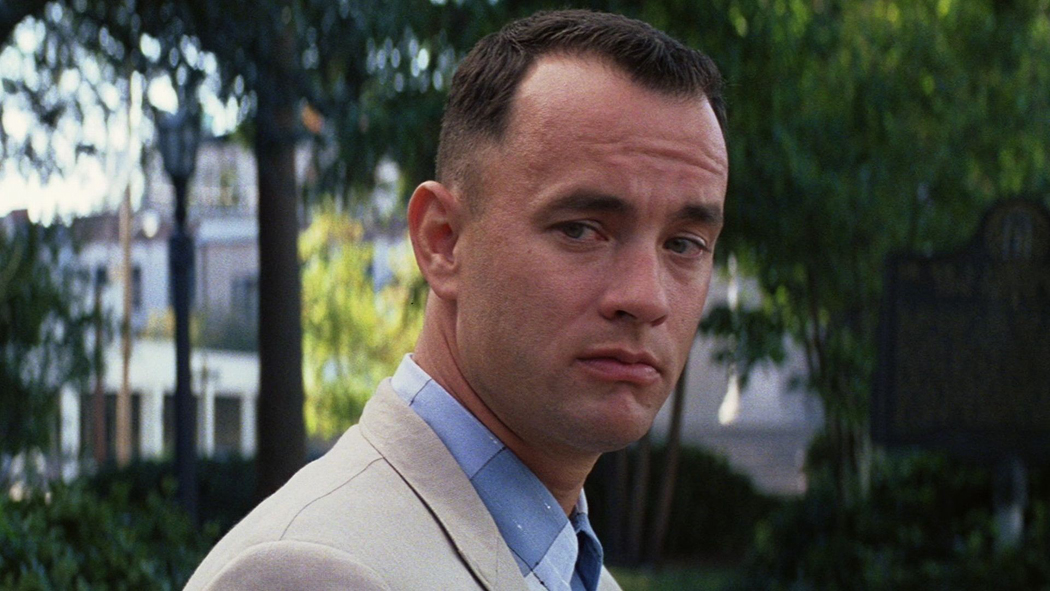
Yet, there is a hunger for substance. It shows up in such mainstream places as movies like Forrest Gump, where the sincerity and lack of irony of its main character seems like a breath of life. The movie itself was mildly ironic, but the character was guileless. And what is more, his earnestness — that is, his ”pure heart” — won him all his prizes. (I am not defending the film as a whole, but only making a point about its underlying proposal of directness and sincerity — many people despise the film for this very reason).

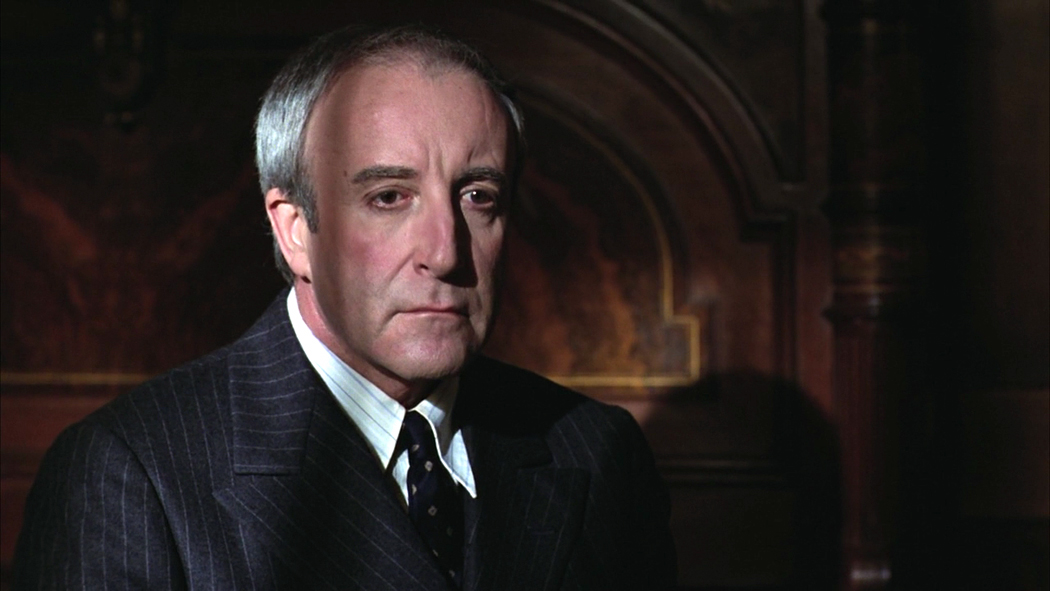
In that, the tone of the movie was completely at odds with its predecessor, Being There, where we were all in on the great in-joke, as the idiot gardener, Chance, fools all the supposedly smart stuffed shirts into finding profundity in his inanities. Chauncey Gardner

And just as a clever century distrusts an earnest one, the pendulum swings back and we are beginning to be unsatisfied by the cleverness. The deeper Quentin Tarantino dives into genre film pastiche, the more irrelevant he becomes. His first films were about something — the deaths in Pulp Fiction, however clever in terms of plot, were real deaths with consequences; in Kill Bill, the deaths are just tin ducks in a shooting gallery. They carry no punch.

This great cultural sea change may be due, but it hasn’t become pervasive yet. Still, there are warning signs: Sincerity has also brought us political correctness; it has brought New Age philosophy; it has brought us any part of a Tyler Perry movie that isn’t Madea.

For, while irony requires a modicum of intelligence, sincerity is democratic: Everyone is invited — no brain too small. It runs the gamut from genius to imbecility. Not every 19th century poet was Wordsworth; heck, even Wordsworth was only Wordsworth on a good day.

The watchword for irony is skepticism; for sincerity, credulity. Blind faith in alternative medicines, UFOs and astrology is only possible in a time when our irony is eroding.

Yet, irony doesn’t get off the hook so easily, either. There are reasons some people feel compelled to give it up as the new century reaches its teen years.

The first is that irony is words, not life. It is essentially linguistic. That is, its rules and habits are linguistic rules, not experiential rules.

With irony, as with a joke, you have to have the setup and punch line come in the right order, followed by the rim shot. Out of sequence, they fall flat and meaningless.

Real life has other demands, but with irony, we translate the experience of life into the language. Language is a kind of parallel universe, divorced from reality, but somehow accepted as its mirror: When we are laughing at a joke on a sitcom, we are laughing not at life, but at language.

It is at the core of what is called Modern Art, that the process becomes the subject: The painter paints paintings about paint, the playwright constructs dialogue about speech, the sculptor shows us the raw surface of stone. Modernism has been about the tools it uses.

And that is why, at the end of the Modern century, the armor of irony that has protected our egos from the embarrassment of our sentiment has begun to fall off. We demand real experience.

When that woman yelled out her frustration at The Apostle, she was complaining that her linguistic expectations — the language of film we have all become accustomed to — were violated. Robert Duvall was doing something different.

But our culture now requires of all of us that we rise above our comfortable irony and attempt to see what is actually out there, floating in reality.

And deal with it.


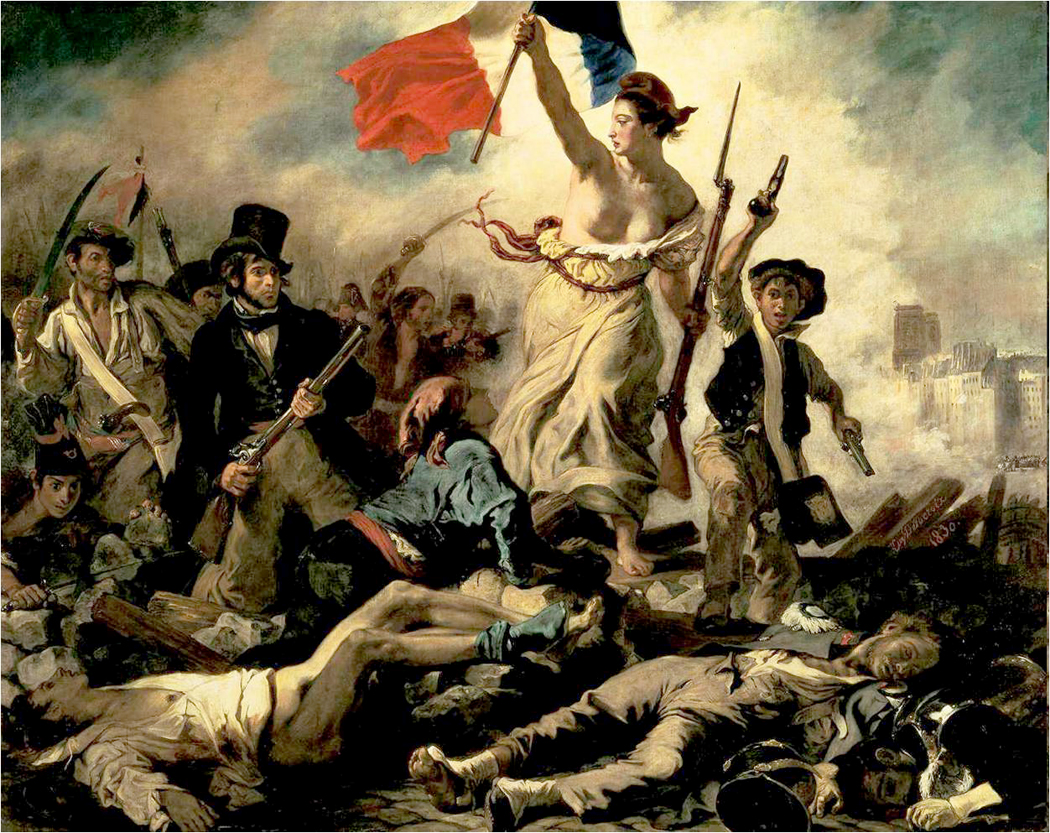
delacroixPro patria mori,” said Stuart.

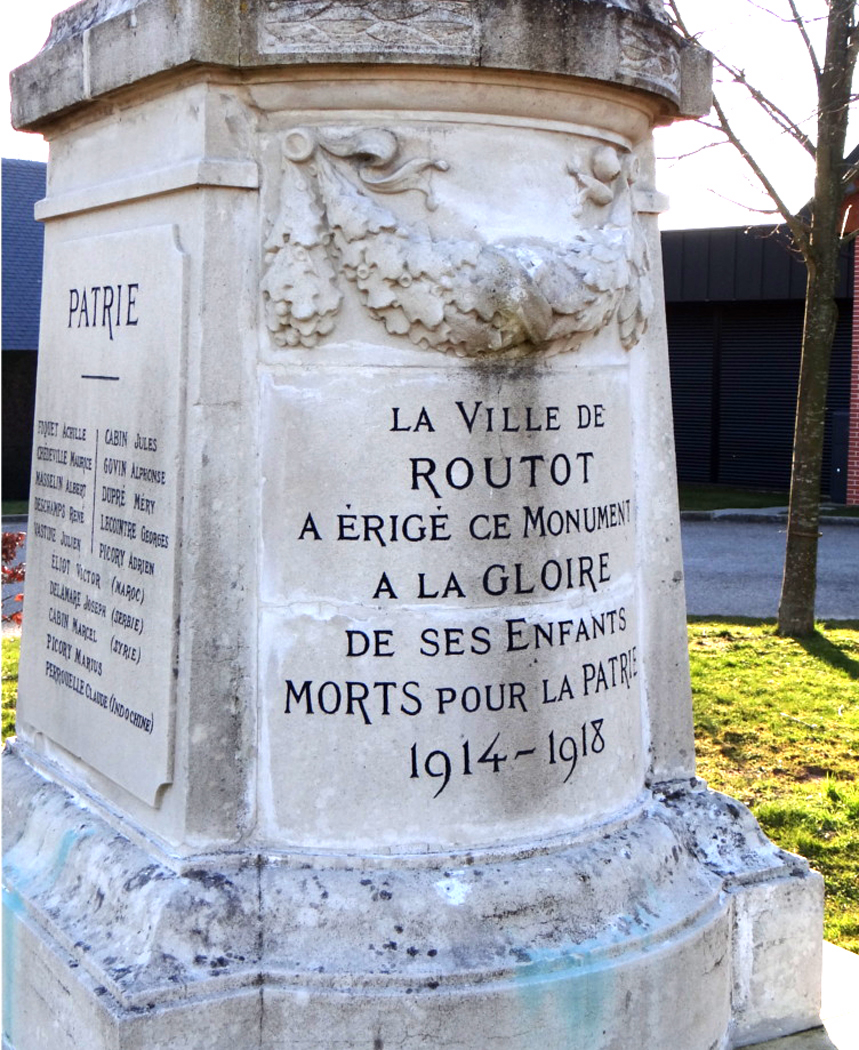
Dulce et decorum est pro patria mori. I’m not sure I ever understood that.  I remember traveling through France and in every town, usually near the oldest church, there would be a monument with the names of those who died in the First World War, and always the phrase, ‘pour la gloire de la patrie.’ Routot monument textAnd I always wondered what those named on the stone would now think of that phrase. Was the gloire de la patrie worth the pain and loss? The lives truncated, the families not earned, the whole sacrifice really just a preparation for the next guerre, the next round of destruction. Stultum est pro patria mori.”

“Is it the war you despise?” I asked, “or is it the patriotism?”

“No question, the patriotism. War will always be with us; I have little hope for humankind’s redemption. I can see no way ending the habit of the strong using brute force to coerce the weaker. But patriotism is something I cannot fathom.”

“Well, we both came of age during the Vietnam war, and I think that must color what we feel, both the anti-war and anti-patriotism. I certainly felt jerked around during those years by the constant appeal to a cheap patriotism…”get a haircut

“Yes, ‘Get a haircut’ was the summum bonum of love for country…”

“You’re feeling very Latin this morning.”

“Perhaps because the Romans seem to have invented the concept. Not so much love of country, but rather a jingoistic sense of ‘Hooray for our side,’ that ‘We’re Number One.’ That we should root for the nation simply because we were born here, or decided to move here. ‘My country right or wrong.’ That always seemed to be a thoughtless idea.”

“An idea rather more of team spirit, like in high school, rather than love of country.”

“Exactly. That reminds me of how I felt when we were required to attend those pep rallies. Why am I supposed to believe my school is better than the other guy’s, or that I owe some sort of allegiance to my school rather than the school in the next town over, which was basically the identical thing, with the identical pep rally but for their team. Didn’t add up.

“There has to be a reason to assent to this tribalism, and I can seldom see it. One nation, like one high school, can be better at some things and less good at others. But school spirit or rabid patriotism demands you believe your side is always better, always right, always worthy.

“So, when I hear politicians say, ‘You don’t want to be like France, do you?’ I say, well, yes, I would love it if we were more like France. Or Norway, or a dozen other places where the standard of living is higher than in the U.S., with better health care, safer streets and happier populations. Why am I supposed to believe that the U.S. is the greatest country on earth, when we rank so low in so many categories. Pretty much the only place we are Number One is in having the biggest military.”

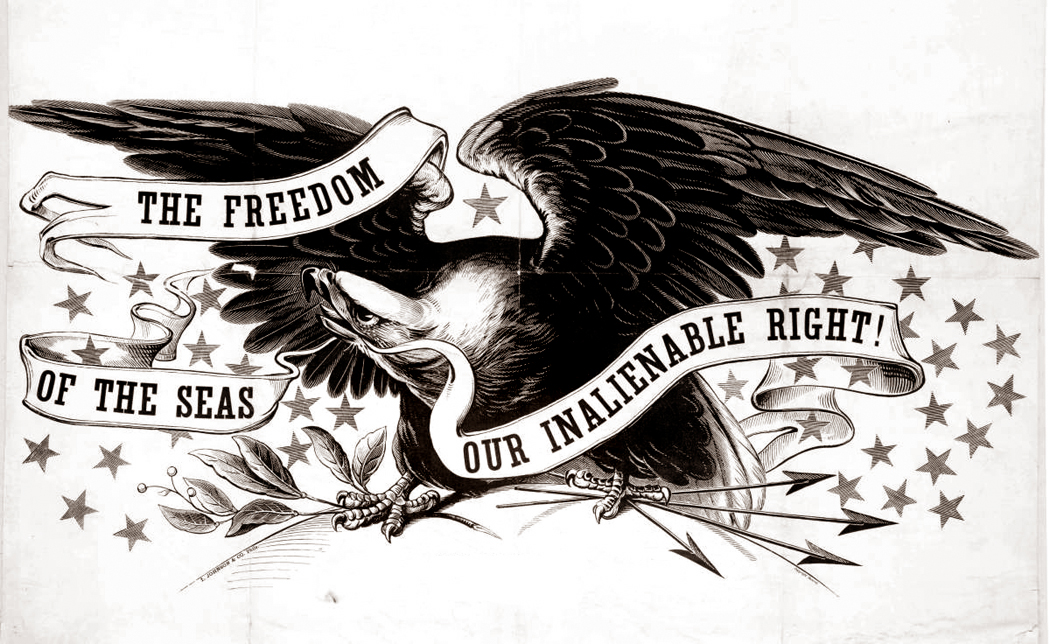
eagle“I see, you hate America.” I was teasing, of course.

“No, but I see a big difference between patriotism and love of country. They are not the same thing.

“I can easily see loving the place you were born; not because you were born there, but because it is the landscape and people you know, that you grew up with. You know the very weeds beside the road. It doesn’t mean you believe it is necessarily better than anyplace else, but because you simply love it.”

“The way you can argue with your spouse, or glance at pretty young women, but it in no way changes the fact you love your wife.”

“Yes, very much like marriage. You don’t have to believe your wife can write better than Virginia Woolf, or play piano better than Valentina Lisitsamadeleine albright or conduct foreign affairs better than Madeleine Albright. You don’t have to believe your wife has no flaws. You may, in fact, love her because of her flaws. It is the same with your love of country.”

“Lately, the right-wing has been upping the rhetoric on so-called American exceptionalism. They want to change the way history is taught in schools, emphasizing the special mission they see for America in the world. They complain that President Obama doesn’t love America enough. It all sounds so high-school, so puerile. After all, every country believes in its own exceptionalism. Is there any nation with more faith in its specialness than France? And Putin’s whole shtick in Russia is reasserting its special place in history. It’s like the Special Olympics: We’re all exceptional. China has its thousands of years history, Tanzania has its cradle of humanity, Great Britain has its never-setting sun, Greece — little Greece, wallowing in economic quicksand — is the birthplace of democracy. American exceptionalism is hardly exceptional.

“And these yahoo Republicans complain if we mention slavery, or the Indian wars or Jim Crow. If you love your country, it has to be warts and all; it cannot be a whitewash job.”

“Ah, but it winds up that way, doesn’t it?”

“Yes, if your love of country is summed up by flag waving.”

“But, isn’t there a problem with that formulation …”

“Probably many…”

“…in that you can love and have that kind of familiarity with a chunk of land and people — say, northern New Jersey, where I was born — but that Iowa or Utah remain as foreign as Northumberland or Brittany? In other words, what is the geographical extent of this love of country?”RE Lee

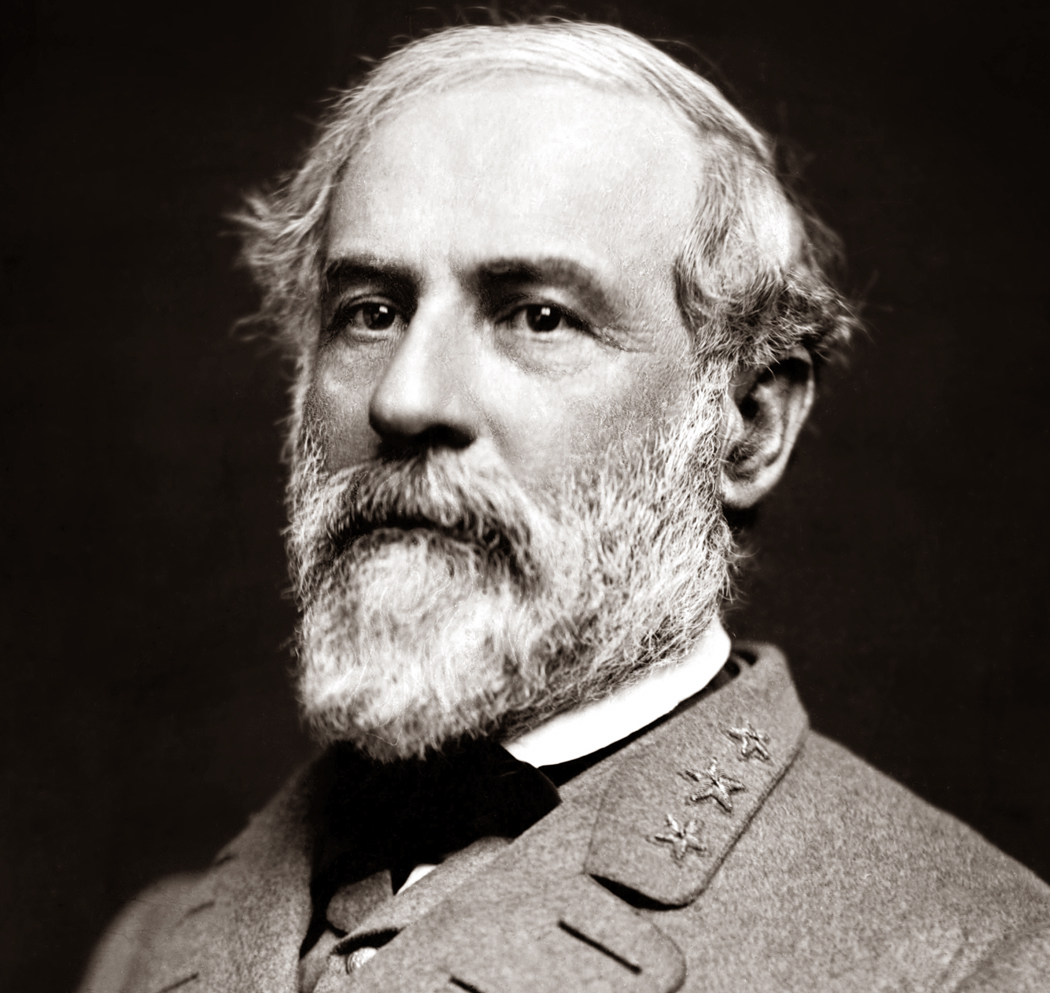
“Robert E. Lee talked about his love of country. It led him to general an army in revolt against the Union; his love extended to Virginia. He didn’t even have much feeling for Alabama or Texas. His patriotism was reserved for his home state. And I expect it was focused primarily in the northern part of the state. One wonders what he would have made of Wise or Norfolk. It isn’t imbecilic “Hooray for our side,” but a deep reverence for the land. But it is the land whose dirt you know between your knuckles when you squeeze it in spring to decide if it’s time to plant.”

“So, you are saying love of country and patriotism are two separate impulses.”

“Of course. And by extension, we have to remember that what we call a country, a nation, is a fairly recent invention. Treaty of Westphalia and all that. Before that, nationhood was defined primarily by ethnicity, unless it was co-opted by conquest and you had to pay your taxes to a foreign invader. Borders were whatever you could defend and were constantly shifting.”

“There was a neat internet animation that showed the shifting borders of Europe from Medieval times to the present; looked like squirming worms on the map. Whole countries appeared, disappeared and reappeared in another location. Poland, especially rolls around the map like mercury on a dinnerplate.”

“And so, your patriotism is a fugitive thing, dependent on the vagaries of time. But this only brings up another dragon to slay. The modern notion of nationhood is defined by lines on the world map: Here is France, here is Indonesia. But all across the world, there are people corralled inside those lines screaming to get out: Basques and Catalans in Spain, Kurds in Iraq and Turkey, Chechens in the Russian Federation, Russians in Ukraine, Scots from Great Britain, Quebecois from Canada, Tamils in Sri Lanka, the Flemish and Walloons in Belgium, Uighurs in China …”

“Driving around southern France and the Camargue, I kept coming across angry graffiti demanding Occitan separatism.”

“… It is everywhere, it seems. Northern California wants to split from Southern California. So, in all this, where does your patriotic duty lie? Are you a Jerseyite, a Northerner, and Easterner, a Tri-Stater, a Yankee, an American, and English speaker, a Norwegian-descent immigrant, a world citizen, what?”

“You can be all those things, can’t you? Can’t you like Jersey pizza and Chicago pizza, too?”

“And what happens when one allegiance conflicts with another? That is certainly what many Southerners faced in 1861. Heck, many still face it. How many times have you heard the extreme right say, ‘I love my country but I hate my government’? Is your love of country based on the dirt you stand on or the government you pay taxes to? Is it all amber waves of grain and purple mountains majesty? Because, you know Russia has those, too.”Russian wheat

Russian wheat

“You have made a dichotomy, but really, I see a three-way split. One can feel allegiance to the nation, as defined by arbitrary borders, or to the land you grew up in and know like the breath you breathe, or, thirdly, to the people you know and feel comfortable with. And this third may be the most human, and the most dangerous. When the national borders break down and you swear upon the sword of ethnicity, you get the former Yugoslavia, or the genocide in Rwanda.”

“All of which is why I find the very notion of patriotism toxic,” Stuart said. “A curse on both your houses.”

“Or all three.”


Linville Falls
It has been nearly 50 years since I first saw Linville Falls in the Blue Ridge Mountains of North Carolina. Back then, getting there meant finding an unmarked gravel road and an unmarked dirt parking lot — really just a thicker place in the road to pull over into.Linville Falls 03

Then we followed a spongy, loamy footpath under the hickories and oaks toward the distant roar of the waterfall on North Carolina’s Linville River. No one was there but us and we picnicked on the rocks over the crashing water. The upper falls are a broad, shallow drop, but at the lower falls, the quartzite pulls tight, constricting the river and forcing it down a spiraling chute that drops over the edge of the cliff and down 75 feet to the river and Linville Gorge.Linville upper falls

It is an impressive torrent with a basso profundo roar, and nothing will ever change the way it seemed to me that day, as I leaped over rocks, crossing the white water to the other shore so I could climb on the gnarled rock to see down the waterway.

Leaping from rock to rock across the cataract could easily have got me killed, swept over the precipice, but I was young, and therefore, an idiot.

I’ve been back many times over the years. The National Park Service built a paved road from the Blue Ridge Parkway, making it easier to find. Then they paved the parking lot and built a pedestrian bridge over the river upstream from the falls.Linville Falls from above

The last time I went back, there was a visitor’s center and a souvenir shop and a parade of vacationers trotting down the path to the fenced-in overlook. The falls are just as impressive, but the experience isn’t.

If I speed up those five decades in my head like time-lapse photography, I can see time take shape. It builds and it destroys in a constant rise and fall like an ocean tide.

And what comes in, ebbs.

A few years ago, my wife and I visited another familiar site, on Old Route 16, a dirt road that drops down the side of the Blue Ridge from Ashe County towards North Wilkesboro. When we lived in the mountains, we used to visit an abandoned farmsite along the road, halfway down the mountain face.

There was a clearing in the wood and an old wooden house with a broad porch that looked out over the steep valley below. Above us was the spot ominously known as the “Jumpin’-Off Place.”

We could picnic on the porch with the bluebird and tanager singing in front of us, the buzz of insects all around and the gentle breeze rattling the grass in the field.Linville trillium

It had been 20 years since we visited that farmhouse and we thought we should see what had become of it.

About three miles down the old dirt road, we passed where it should have been, but there was no break in the forest, no open field. We couldn’t find the house. We kept driving, hoping we’d find something that looked familiar, but we didn’t. Finally we stopped the car where the farm should have been and walked deep into the woods.

Buried a hundred yards into the tangle of maple trees was a naked standing chimney, completely eaten up by brush and undergrowth.

When I climbed down the hill towards it, I discovered the forest floor was spongy with rotten boards, completely collapsed in on themselves, with a few nailheads still showing.

In the years since we last visited, the old house had been completely digested by the woods, leaving only the indigestible brickwork of the twin-sided chimney.OLYMPUS DIGITAL CAMERA

And the once-glorious view of the declivity was now completely obscured by trees and brush. Instead of a vacant field overgrown, the house was survived only by complete woods.

In just those few years.

Nature can reclaim an entire farm in 20 years and leave nothing behind but the masonry. And that won’t last much longer.


rules of the game 5In Jean Renoir’s 1939 classic, “The Rules of the Game,” one character sums up the problems of existence: “The awful thing about life is this: Everyone has his reasons.”

The film, which tops many lists as the greatest film ever made, has no heroes, no villains; it has no right, no wrong; no simple lessons to be learned, no closure. It is as French as it gets, and despite Hollywood’s penchant for remakes, it could never be made in America.

On the other hand, the 1980 “Star Wars” sequel, “The Empire Strikes Back,” has plenty of heroes and villains: It’s the quintessential American film; it could never have been made in France. “Horizontal boosters. Alluvial dampers? Ow! That’s not it, bring me the hydrospanner.” empire strikes back 1

Jamais!

The difference is more than merely language; it’s sensibility. Both excellent films, they sum up the divide between European cinema and Hollywood movies, a divide filled by more than the Atlantic Ocean.

One doesn’t have to take sides. There are great films from both sides of the pond. But it is important to realize when you go into the theater that there is a difference and which kind of film you’re about to see. If you’re looking for an amusement-park ride, European cinema probably will bore you to tears; if you want intense drama about the human condition, Hollywood films will feel trivial. You pays your money and you takes your choice.

This is not to dismiss American films. First of all, they remain the most popular films worldwide. Many countries, including France, have felt the need to restrict the percentage of American films available to their citizens, to subsidize the local product. Steven Spielberg would always sell more tickets than Jacques Rivette. It doesn’t matter where you go, American films remain popular.

Second, American films remain the major influence on world cinema: The tics of Hollywood become the universal style of everyone else, too. There are the editing rhythms, the lenses and equipment, the green-screen technology, the CGI — these are all the lingua franca of movies everywhere. Even a quiet film like Jean-Pierre Jeunet’s popular “Amelie” would not be possible without computer assistance: Most of its signature color was digitally added.

One should not forget that the inspiration for the French New Wave in the 1960s were the Hollywood films the movement loved. Jean-Luc Godard’s “Breathless” is his take on American films, with their gangsters and girlfriends.breathless 2

We in the U.S. now are exposed to more foreign films than ever before. There are Hong Kong martial-arts films, Bollywood films, the emerging films of China and Korea, not to mention those from Iran, Israel and the Arab world.

All that is in addition to the many French, German, Italian and British films that traditionally have constituted the world of foreign films.

They’re not only in theaters but frequently available on cable channels, on DVD and from Netflix. Even Turner Classics has its percentage of foreign-language films.

It’s nearly impossible for the curious filmgoer to remain provincial in the comparative flood of world cinema.

It is true there are American indie films, but even those, no matter how gritty they are, tend to follow an American world view.

Americans see the world differently, so their films portray the world differently. We prize directness and informality; we despise hypocrisy and airs; we look for answers, not questions. We are fundamentally optimistic.

It is partly a matter of history. Because we have seldom suffered the devastation of war on our homeland, we have a different relationship with the past. Europe is haunted by history; for Americans, history is largely a matter of colorful costumes.paul schrader

The American writer and director with the most European sensibility is Paul Schrader, who wrote Martin Scorsese’s “Taxi Driver,” and he puts it simply:

“American movies are based on the assumption that life presents you with problems, while European films are based on the conviction that life confronts you with dilemmas — and while problems are something you solve, dilemmas cannot be solved; they’re merely probed.”

The American sensibility demands we open the box to find out if the cat is dead or alive.

For American audiences, an unsolved story is profoundly unsatisfying. We demand closure.

It’s the Oprah in us.


triangles
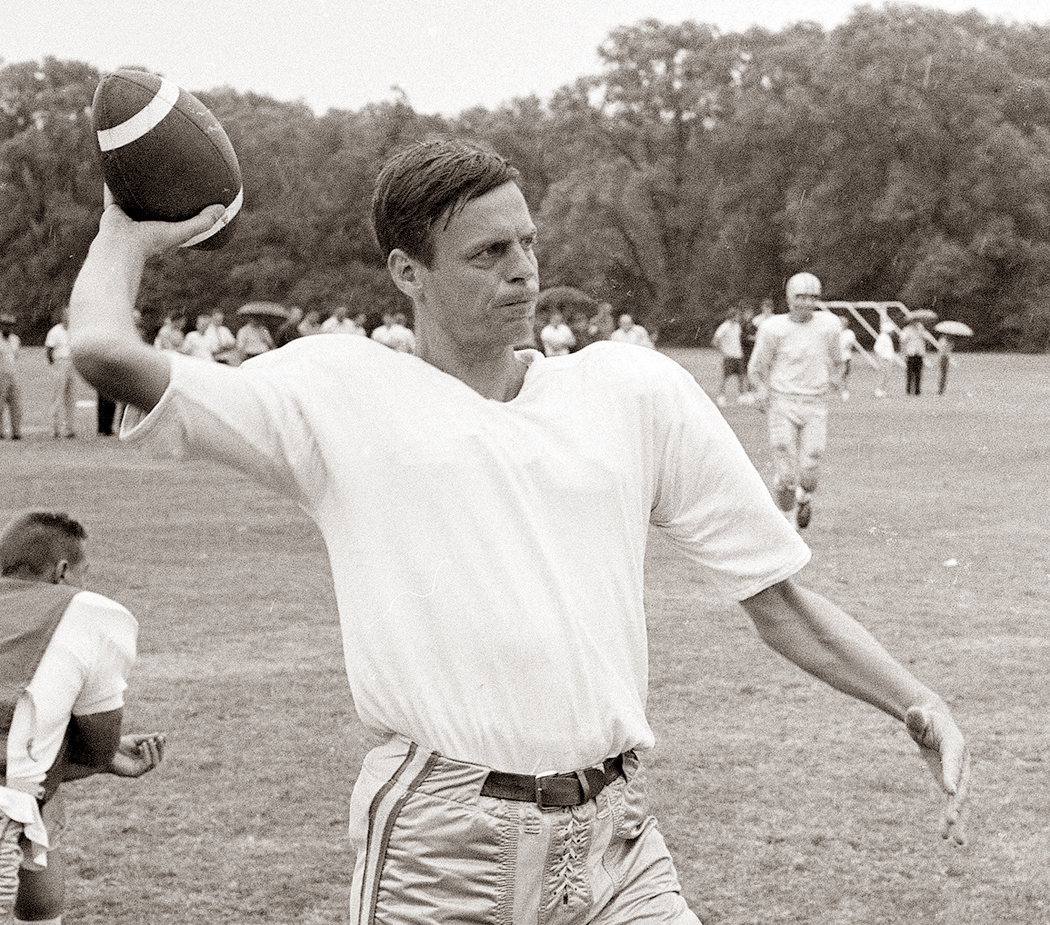
The late writer George Plimpton was famous for his participatory journalism: He risked life and limb while playing quarterback for the Detroit Lions, trading punches with boxer Archie Moore, blocking 100-mile-an-hour hockey pucks as goaltender for the Boston Bruins. All to get a good story. plimpton

But the only time Plimpton admitted getting scared was when he played triangle for the New York Philharmonic, facing conductor Leonard Bernstein.

“He would stare at Bernstein over the top of the triangle, metal rods gripped tightly, and look for some cue in the whirlwind of Bernstein’s movements that suggested it was time for him to play. And then: Ping!

The story was remembered in Barry Green’s book The Mastery of Music, by Philharmonic percussionist Walter Rosenberg, who tried to help the poor journalist.

“Bernstein would look at him and say, ‘George, would you play that note for us again?’

“George would pick up the triangle and play it again: Ping!

“The maestro would ask George to try it one more time.

“Another, rather tentative Ping.

“‘Once more,’ Bernstein would say as he cupped his hand behind his ear.

Ping.

“The tension in the room was mounting — the orchestra members didn’t quite know where Lenny was going to take this one. Finally, he said to George in a rather impatient, dissatisfied manner:

” ‘Now, which of those four pings do you mean? They’re all different.’

“Poor George was obviously in shock. He stood there trembling, his face a complete blank, not knowing what he had done wrong, or what he could possibly do to play his ping any better.”

He was playing the triangle, for goodness’ sake, an instrument that even kindergartners negotiate easily in rhythm bands. How hard could it be?

“A lot of people come up to me and say it must be easy to hit the triangle,” says Bill Wanser, former principal percussionist for the Phoenix Symphony, who retired in 2013 after 38 years at the back of the orchestra. “I tell all my students, you don’t hit anything, you play it. You touch the instrument because the touch you give the instrument determines the kind of sound you get from the instrument.”bill wanser and triangle

Bill Wanser

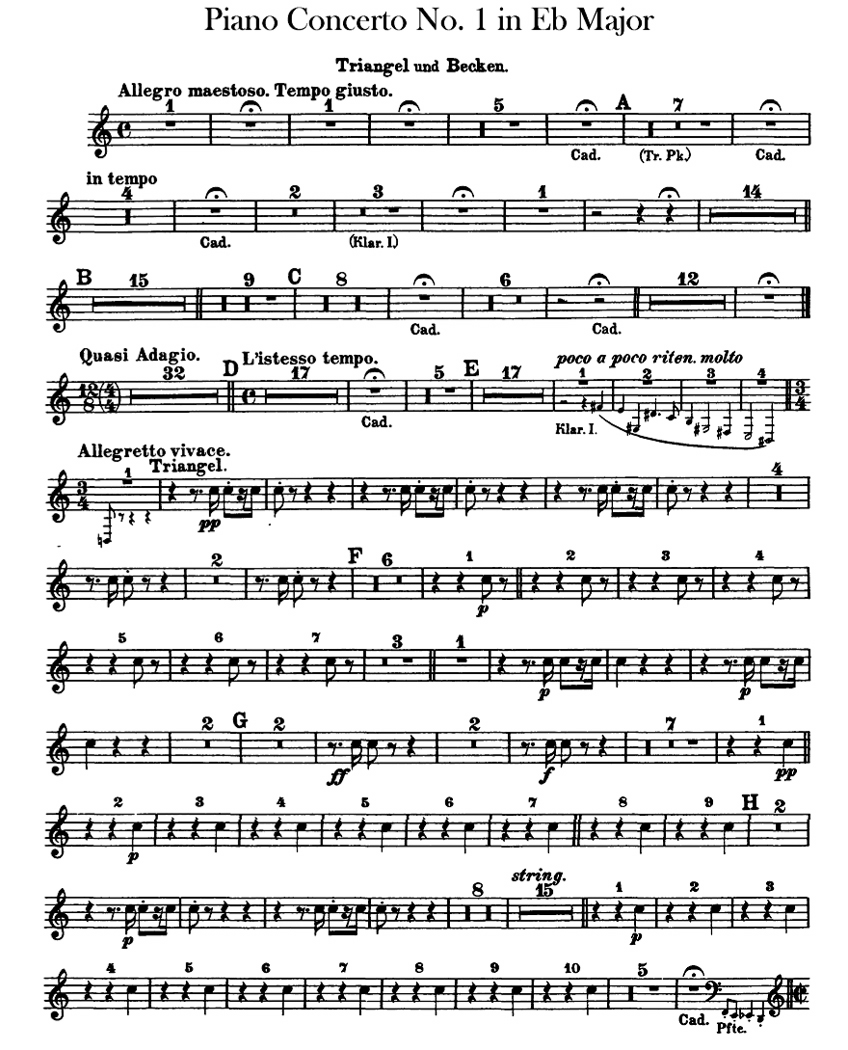
I talked to Wanser when the orchestra was going to play the Franz Liszt Piano Concerto No. 1 in E-Flat, which has such a prominent part for the lowly triangle that when critic Eduard Hanslick first heard it in during its premiere in 1855, he dubbed it the “Triangle Concerto.”

We talked in his home studio, surrounded by the drums, xylophones and timpani of his trade. A soft-spoken man, then 62, he had been with the Phoenix Symphony since 1975. He was hired by the late Eduardo Mata and has seen the orchestra through five music directors.

He has thought a lot about the lowly triangle and his part in the concerto.

“You have to have a concept in your head of what you want that sound to be like, before you actually play that note, because that’s going to translate, if you practice, to what kind of touch you give that beater when the triangle and the beater meet. If the touch is correct, the sound you have in your mind will come out correctly. But you have to have that idea.

“I’ve heard recordings when the triangle just sounds terrible because someone’s just hitting it. But with the right kind of touch, the right feel to the rhythm, the whole thing sparkles. That is what I try to do.”

Thus begins a mini lesson on the complexities of playing the triangle.Grover Pro triangle

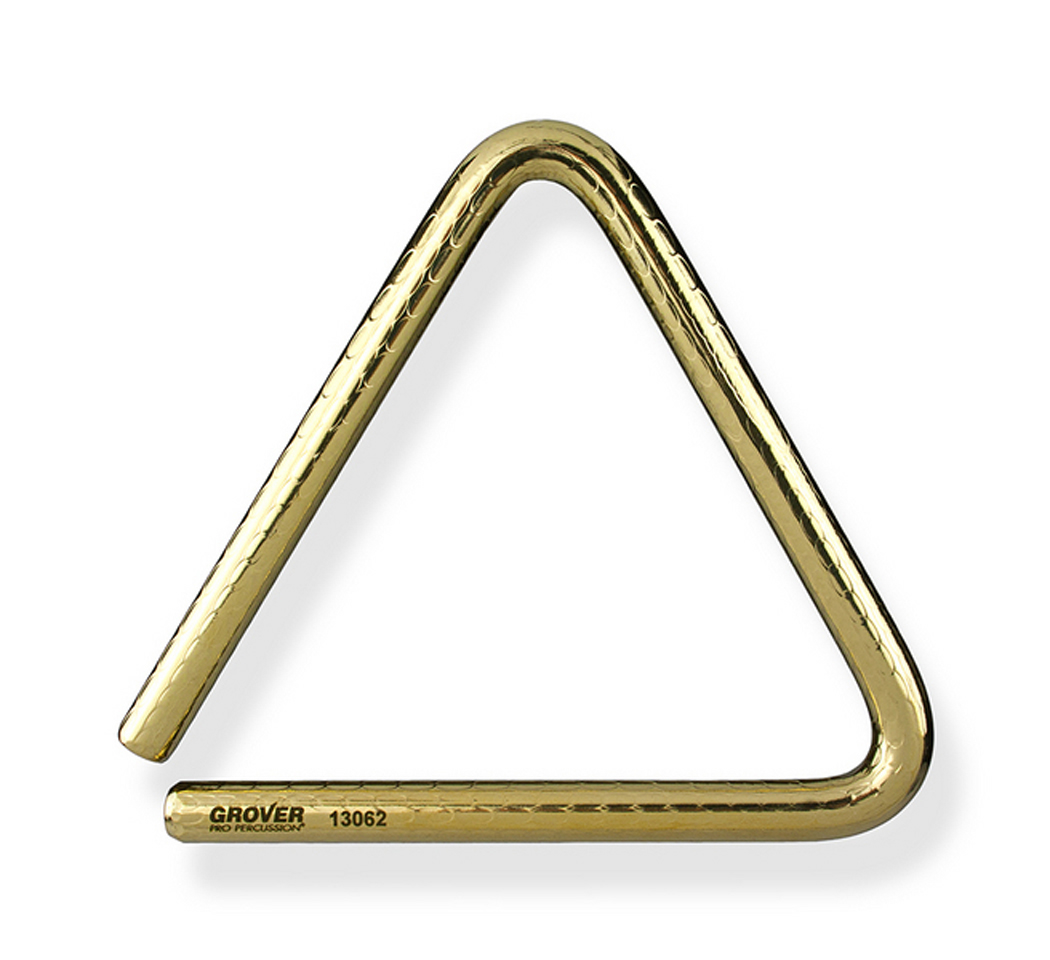
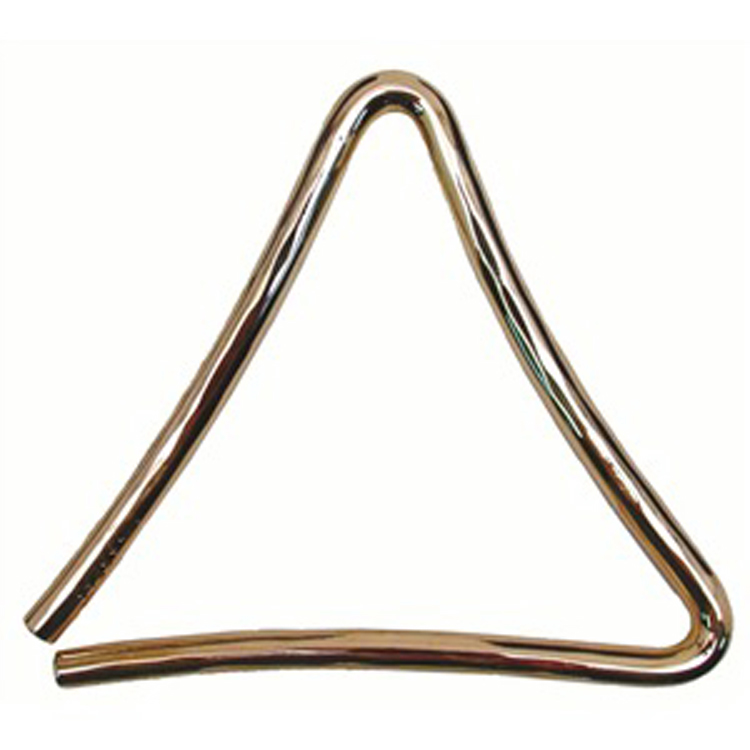
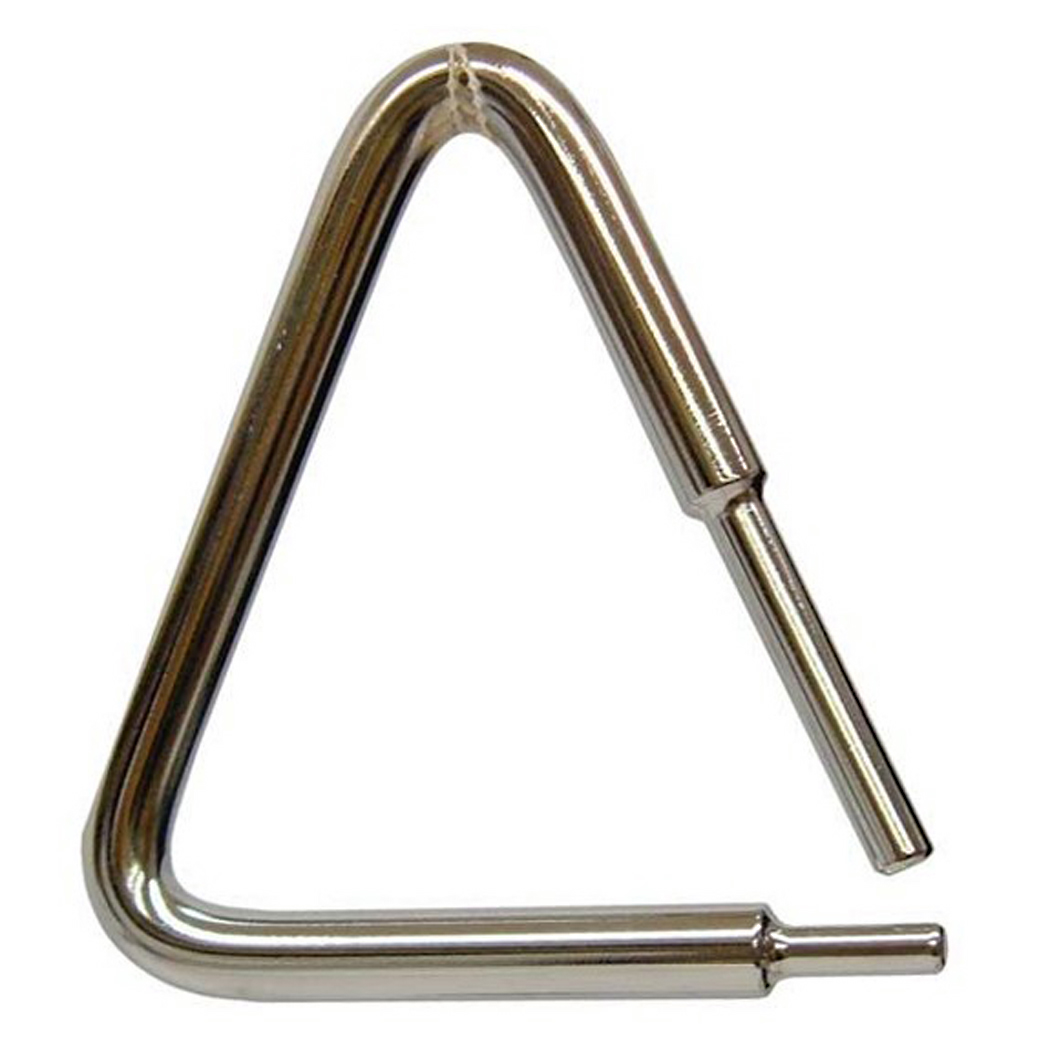
First, there’s the triangle itself. It comes in many forms and sizes, mostly from 4 inches to 8 inches, made from steel, bronze or some alloy.

While a grade-school triangle can cost as little as a couple of bucks, a professional triangle sells for an average of about $75.

A Grover Pro bronze model is “meticulously hammered in a compact randomized pattern,” as the company’s catalog says, which “ensures that the inherent fundamental pitch is dampened and that the instrument’s intricate and complex harmonic structure is enhanced.”

The 6-inch version sells for $140.buddy and thien gold triangle

For those who admire James Galway’s gold flute, there is a 9-inch all-gold triangle, sold by Buddy and Thein, which goes for a cool $650.

The triangle came to European orchestras from Turkish janissary — or military — bands. The original version of the triangle had a series of rings attached to the bottom rung to make more jangle when the instrument was played.

It came to Europe after the defeat of the Ottoman Turks outside Vienna in 1683, when, supposedly, the fleeing Turks dropped their instruments in the field. By the time of Mozart and Beethoven, such “Turkish” instruments as cymbals and triangles had become part of the orchestra, at least for military effects.

That percussion became a regular part of the orchestra in the 19th century, and such exotic instruments as the cymbal, the tam-tam (Chinese gong) and the lowly triangle became means for composers to “colorize” their music.

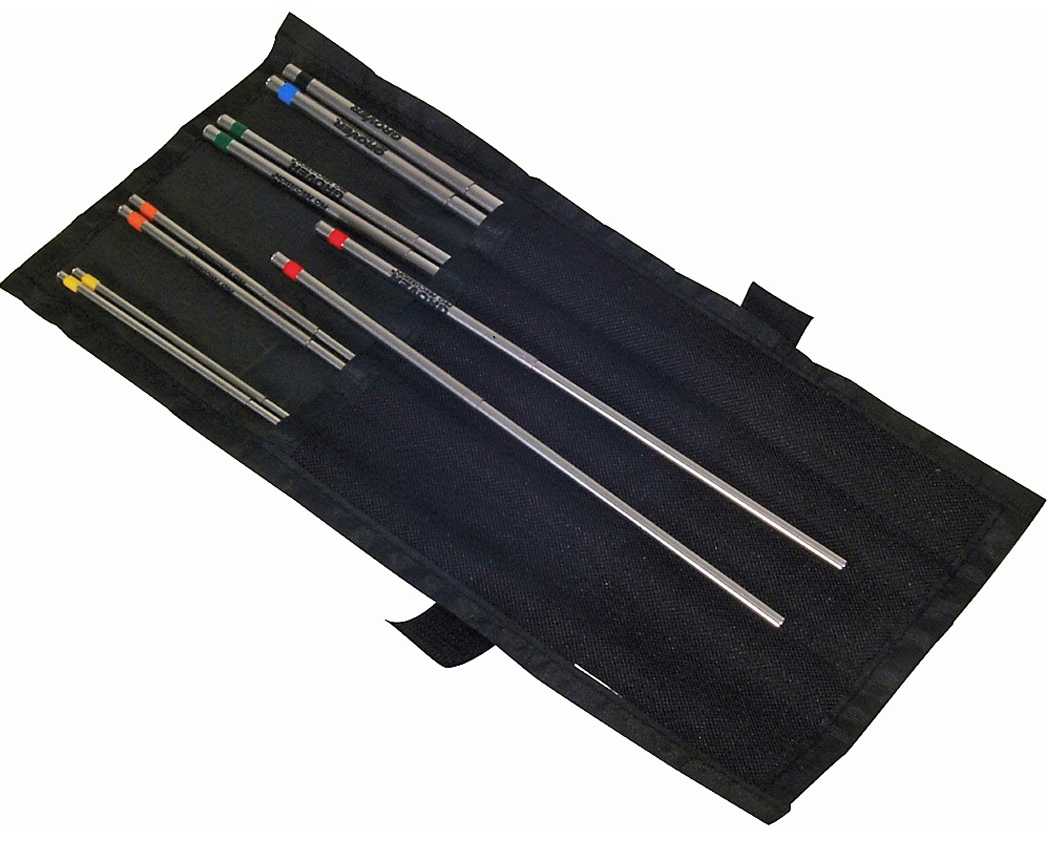
But the triangle itself is only the beginning. There is the beater to consider.triangle beaters

Black Swan Percussion offers a set of six differently weighted beaters in a nylon case for $127.

“I have a collection of color-coded beaters,” Wanser says. “They’re various thicknesses. They used to make triangle beaters from solid metal, but these are not solid.

“We found that we can eliminate some of the contact sound if we don’t use solid beaters. So this guy came up with different thicknesses of metal wrapped around a shaft and separated from the shaft with epoxy.”abel triangle

Wanser has spread out his collection of triangles and beaters on a soft cloth over one of his xylophones. There are eight triangles of various sizes and metals and some 20 beaters.

He picks one up.

“I’ll probably use this one for the Liszt,” he says. “The metal is fairly thin, just a nylon insert in there, but still enough weight I can produce a pretty big sound. And then, it won’t have quite the tick.”

The tick, he says, is the enemy. You don’t want a metallic sound, like machine parts clanging together. You want something more like the “eructation of an angel,” a scintillant, chiming ping. If you hit the triangle the wrong way, or with the wrong beater, you can make it sound like a traffic accident.

“You have to think about where you hit the triangle. These are things most people don’t know.

“Hit it here and you get this tone: Ping.

“If I play more toward the corner, where the metal is a little denser, then you get this: Ping, but a different ping.

“Or hit it near the top, and you have this: Ping.”

The sound of a triangle is not a simple note, like a violin note or a piano note. It is a mix of upper harmonics, all mixed together in a ping without a pitch. But hit it in different places, and you draw out different harmonics.

“You can almost get a triad out of it,” Wanser says. “Ping; ping; ping.

“And, of course, if I play at the very tip of the beater, I’m going to get a brighter sound. If I play more in the center of the beater, I get a much darker sound. Halfway in between, I get this sound: Ping.”

The sound of the triangle is usually meant to blend in with the orchestra, a coloration effect.

“There are not a lot of triangle solos,” Wanser says. “One that comes to mind is in Brahms’ Third Symphony. It’s a single triangle note that comes at the end of a quiet string passage and puts a period at the end of it: ‘Ding.’ It’s just a color that you want.

“But for the Liszt concerto, you want a bright, articulate sound because it’s a rhythmic passage, not just color, and you don’t want too much shimmer in it.

“When I play that, I’m going to move the beater around on the triangle because the second note is going to be a little brighter than the first, a little sharper sounding.

“Plus, it’s easier rhythmically if you move your beater along the triangle instead of hitting it in the same spot over and over. If you’re playing rapid successive notes, if you move just a little bit, it’s easier to phrase and make the rhythm clear and more articulate.”

And we haven’t even mentioned counting.liszt score

The score for the triangle — like that of many percussion instruments — has very few notes on it and many, many rests. Sometimes a hundred bars of rest before a note is hit. Percussionists count those rests. Wanser’s score for the Liszt concerto shows four lines of empty staves, with bars numbered on them. Over a single rest on the staff, there will be a number — 17 in one place, 32 in another — that tells you that rest covers 17 or 32 bars of tacit, or silence from the triangle. Wanser counts each bar.

“There’s tons of counting,” he says. “I’ve played for a lot of years, and I’ll find myself counting my steps as I walk down the street. I’ll sit and have big, long rests, and it’s a challenge to keep focused on what you’re doing.”

Click to enlarge

There are stories of percussionists reading books or checking how their stocks are doing while they are waiting for their single cymbal crash or gong cataclysm.

“That was probably more prevalent in the past than it is today,” Wanser says. “I studied with the legendary Fred Hinger, who was percussionist for the Philadelphia Orchestra and later for the Metropolitan Opera. I asked him, ‘How do you count?’

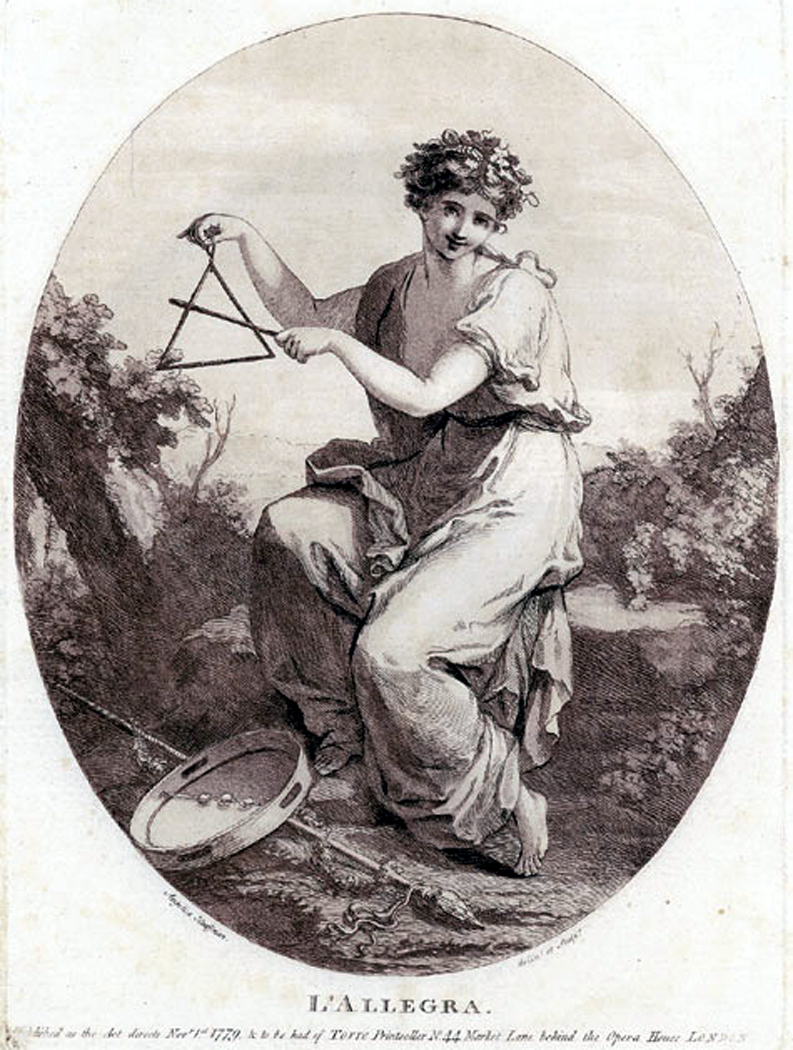
” ‘First of all,’ he said, ‘Never rely on any cues; never rely on anybody else. Do your own counting and always be 100 percent sure of where you are in the score.’angelica kauffmann Allegra

“You have cues written in your score,” Wanser says, “but I don’t rely on those cues because maybe the horn has miscounted or something. It doesn’t happen very often, but it would be the one time it happens, and it could throw everybody off.”

Is it any wonder that Plimpton sweated his time with Bernstein?

Of course, a triangle player doesn’t only play the triangle. He is a percussionist who will play whatever instruments are called for, drums, xylophones, woodblocks, glockenspiels, and even back up the principal timpanist if needed.

“I have a friend who plays with local amateur groups, and he’ll come over to discuss a part once in a while,” Wanser says. “He’s a decent drummer, but I’ll show him what I would do, and he’s amazed because he hasn’t been able to do it. He’s not a professional player.

“The perception is that anyone can be a drummer, but it’s not so. There’s a lot of people who can play drums and pick up the sticks and hit a drum, they have the coordination and can play very complicated rhythms. But do they practice eight hours a day, the way a professional musician does? Have they developed the muscle memory?

“So, when people say, ‘You’re a drummer,’ I say, ‘No, I’m a musician.’ “


missionariesThe time was, that when Mormon missionaries or Jehovah’s Witnesses rang my door, I would argue with them. Not angry arguments, but bantering ones, at least on my part. It was a pleasant form of entertainment.

“Did God create the animals before he created Adam? Or did he create Adam first? The Bible has it both ways, you know.”

Or: “Where in the Bible does it say that it is the inspired word of God? Is that belief not as deeply buried in tradition — unexamined tradition — as the Catholic saints that you disparage or the veneration of Mary?”

I’ve read the thing from end to end, and while I can see why the faithful might come to the belief that it is inerrant — just as the Islamist believes in the Quran or Republicans in Fox News — nowhere have I found a Bible verse that makes that claim.

Some of those door-jambers would argue points, some would be flummoxed and a few would engage in genuinely interesting dialog. I enjoyed the back-and-forth.

Mainly, they wanted to know if I had been “saved” and I could never quite understand what I needed to be “saved” from. Being human?

They were usually so earnest, I eventually came to feel bad toying with them.

I was a proclaimed atheist at the time, and although I didn’t recognize it then, those door-frame debates were the rituals of atheism, as regular in form as the Eucharist or full-immersion baptism.

Then, at some point, I lost interest. I gave up arguing; it had become repetitive. At that point, I would say to anyone who asked, that I was a “lapsed atheist.” Not that my beliefs had changed, but that I no longer participated in the rituals.

I was happy for anyone to believe anything they wanted; I still am. But I cannot share those beliefs. They are something I cannot partake of. While much of the world goes on slaughtering each other for using the wrong name when addressing their deity, or for not eating fish on Friday, or eating pork chops on any day, or cutting or not cutting off tender bits of anatomy, or whether God does or does not turn into a loaf of bread, my current response is a sigh. After all, some of these people believe a three-personed god surrounded by winged godlets and opposed by an evil god named Satan somehow counts as monotheism. One scratches one’s head.

Most peculiar to me: God killed his son because he loves us so very very much. Is this something God’s dog told him to do, like Son of Sam? It’s as if God were schizophrenic; we lock people away who contemplate such things. For good reason.

These are not the only peculiar things that human beings believe, and it seems that a need to believe is inbred and genetic.

The question of god seems so unnecessary. I suppose when the DNA was handed out, the part of the sequence that causes one to believe was left out of my portion. I just don’t see the point; and now, I don’t see the point in arguing over it. You can have whatever supernatural beings you want, as long as you leave me out of it.

I certainly recognize that for some people, the need for a deity is intense, and I cannot gainsay their belief. Again, I see such sincerity in their quest, in their faith. But there is nothing in me that responds to the same issue: an invisible man who lives in the sky and grants your wishes?

Nowadays, I just say I have no religion; I’m not even an atheist.

Because, let’s face it, for most people who make the claim, atheism is a religion. It is a creed that needs to rebel against Big Daddy and destroy him. Atheism on this level feels adolescent in impulse. For me, it seems just as silly to deny something that doesn’t exist as it does to pray to it. Simply let me go my way and you can go yours. Just, please, don’t slaughter me over it.

gabin 1I love French films; I own well over 200 of them on DVD. And not just the New Wave films we all know, but the pre-war films of Julien Duvivier, Jacques Becker, Marcel Carne, Sacha Guitry — and above all, those of Jean Renoir and Marcel Pagnol.

I am afraid that under the influence of such films as “Le jour se leve,” “La bete humaine,” and “Quai des brumes,” I am guilty of writing a pastiche short story Which I here present to you. Please read it in black and white. 

L’echafaud de mon desir
ou
Mon desir pour l’echafaud

My name is Etienne Duford and I am the chef de cuisine of a small restaurant in the town of _________. It is hardly more than a village, near Orleans, and a stopping place for truck drivers hauling cargo from Bourges to Paris.

And my restaurant cannot be called haute cuisine. It is only irony that causes me to name myself “chef.” Mostly I serve the truckers blanquette and gigot along with vin de table and rather a lot of digestif. I guess there was a lot of digestion needed to process the food I served. Next door is a small six-room auberge called the relais de St. Pierre. The restaurant is part of the St. Pierre, and its owner is my boss.

St. Pierre. It makes me laugh. “On this rock I build my church,” said Jesus. Well, we grow sugar beets in this corner of the world, and they are hard as rocks. Farmer, I joke, do you really need to plant the beets, can’t you just plow up the rocks that are already in the ground?

The beets pile up in the autumn in little pyramids beside the fields and along the roads, waiting to be picked up and brought to the factory. That paysage is the only thing that gives our region anything you might claim to be distinctif. Otherwise, this is flat country, both as geography and as culture.

Yes, I am married, to la belle Helene, as I like to say, a farmer’s daughter. No, she is not really all that belle anymore, although, for 47, she still has a decent figure and I can’t complain. We still sleep together, although I seldom touch her. Not that she doesn’t have her own affairs to keep in order. Affairs. I can’t really call them amours. That would be much too grand a word. I don’t mind them, and it leaves her a little extra spending money.

But it is the other one you want to know about — my Juliette. Daughter of old Ambroise, owner of the St. Pierre. Julie, ma jolie. The perfect ideal of womanhood. Une vierge de 28 ans, and the main reason I have never left this dusty town. I knew her when she was a child and I was in my 20s, just opening my restaurant. I watched her grow up. She is the only pinpoint of grace in this town, or in my existence.

I would see her sweeping the dirt in front of the auberge every morning and see her shake the laundry out back. No, I didn’t pay much attention to  her when she was young. It’s strange, now that I think about it. This isn’t something that happened those many years ago. I really thought of her as a child, at least until she was in her mid 20s. Then, I realized how beautiful she was, how graceful, and how she was a door to un monde plus gentil, more refined. Too refined for me, helas. I watched her, but I could never approach her.

Then, there was Jean. If a movie were to be made, he would be Gabin. He was one of the truckers who stopped regularly at the St. Pierre. He ate at my place, and perhaps drank a bit more of the vin ordinaire than was good for him. I loathed him.

Why? Because of the attention he paid Julie, ma jolie.  She deserved better. He smiled at her. I wanted to paste him one. This was no belle et la bete. There was no prince buried underneath the coarse skin.

Twice a month he came through with his truck, spent the night at the St. Pierre and ate my rillons with mashed potatoes and mustard sauce. He smacked his lips. In others I would have taken that as a compliment.

“What do you think,” he said one evening. “Great piece of meat, no?”

Surely, he wasn’t talking about the cutlet, which should have been turned into a shoe.

“I would love to get me some of that.” And he indicated, by a rude gesture, he was referring to his nether regions in contact with something soft and feminine. “She’s really something.”
Loathing doesn’t accurately describe my feelings; I hated him. He was a pig.

That Thursday, he came to dinner. I remember, he had only oeufs and some vin rouge. There was pomade in his hair and the smell of the barber shop. His suit hadn’t exactly been pressed, but it was cleaner than usual and I assumed that he had steamed it in his room.

“She gave me the high sign.”

“She?”

“The morsel. I’ve been after her for years, and I think she’s finally ready to give in.”

A big grin covered his face like the wrong sauce on a magret de canard. He wiped his mouth with his forearm.

“Another glass, s’il vous plait,” and he slammed the empty glass down on the table.

When he left, I pulled the towel from my belt, put it on the bar, and followed him. I kept a ways behind, and ducked behind the corner of the St. Pierre as he went in. Looking in the window, I saw him laugh his greasy laugh, slap the concierge’s desk and yell out, “Juliette!” I had an instant chunk of ice coagulate in my gut.

I went back to the restaurant, closed up for the day, and went upstairs. Helene was sitting by the door.

“I’m going out tonight,” she said. “Don’t wait up.”

I’m a man with some small education, although I claim no sophistication. I never finished school. But, I have a tolerant nature. I was not going to make a fuss over this habitual betrayal. I haven’t been the best husband to Helene, and she hasn’t been the best wife to me. It’s a little compromise we both make with life. I don’t ask and she doesn’t rub my nose in it.

But that wasn’t a good night to hear it one more time. I put my coat on, went back downstairs and out the door. I walked down the street and out of the village, out into the fields. I could see only black. It was still twilight and I could make out the hills of beets by the roadside, and the windbreak of trees at the far end of the fields. I could see the windows of the village light up behind me. But inside, it was all black. I wasn’t thinking about Helene. My thoughts passed instead to Julie. “How could such a gem exist even in the same dimension as that slug? How could she abide his barbarity?”

By the time I got to the trees just to the west of the village, I sat on the ground, looking back at the houses, silhouettes now against the graying sky. I’m a grown man, but I sobbed, wiped my nose and took a deep breath. I pulled my knees up to my chest, wrapped my arms around them and sat still, continuing to look back at the cluster of homes.

Homes? What is a home? What is one supposed to expect from life? Is there anything like a good marriage? Is it all accommodation? All a matter of giving up? In those books, there are great love affairs, but how do they all end? They all end in death. Anna and Vronsky, Romeo, Juliet. Juliette?

If they end in marriage, they are Charles and Emma. Helene.

The air was unseasonably warm that night. Thursday. The day of the week with the least character. It is a bland day. An empty day.

I heard something in the woods to my left, a shifting of branches and leaves.

I hoped Helene had found more in existence than I had. I had looked for foie gras and found turnips. No sauce helps the turnips.

What’s that?

I was certainly feeling sorry for myself. The son of man knows not where to lay his head.

Again?

I wiped my nose and took a deep breath. Then there was a giggle. There was no doubting that voice.

I got up and walked quietly down to the noise.

There she was on the ground, with her legs split open and the beast wedged between, grunting and rooting. She giggled again. I yelled out. I picked up a beet, hard as stone and took a whack at the beast’s head. He rolled off his prize and looked up at me with the slack uncomprehension of a farm animal. I lifted my arm for a second sally when he pushed me off, grabbed his trousers from around his ankles, yanked them up, rolled away from me, got up and began running off into the beet field, leaving the astonished Julie on her back, white and naked from the waist down, and her tuft of pubic hair, smoke above the fire, a punctuating point in the whiteness where the two legs met, downhill from her upraised knees. I yelled a second time and brought my arm down on her head. I did it again. And again, and again. Her head split open, it was gummy with blood. Her eyes looked up, but they didn’t see anything anymore. I dropped the beet and yelled a third time.

“Julie, ma jolie!” And I cried. I cried like a baby and collapsed next to the slab of meat that used to be the girl I loved.

Now my only assignation is with la veuve, the “widow.” Its blade will will take my best part — my mind — and slice it from my gross part, and the division will be the end of me. No great loss to the world, I fear, but rather a disappointment to myself.

Signed on this 30th day of November, 1937
Etienne Duford

treblinka sign

I’m wearing a virtual foam collar around my brain stem, suffering from a kind of whiplash, having finished one book, so devastating and depressing, and having begun another so invigorating and life-affirming — really, brain-affirming — that my poor psyche feels like Faye Dunaway in Chinatown, slapped back and forth by Jack Nicholson.

I recommend both.

The first is a recounting of the inhumanity humanity deals to itself; it is a tale of humankind seen not as individuals, but as an aggregate of categories. The second is a memoir of humans seen as individuals, with all their flaws and foibles. It is the macro view vs. the micro view.

The most distressing thing is that we all have to live in both worlds; we have our families and friends, but we also cannot escape the things our governments, our religions and our employers do in our name.

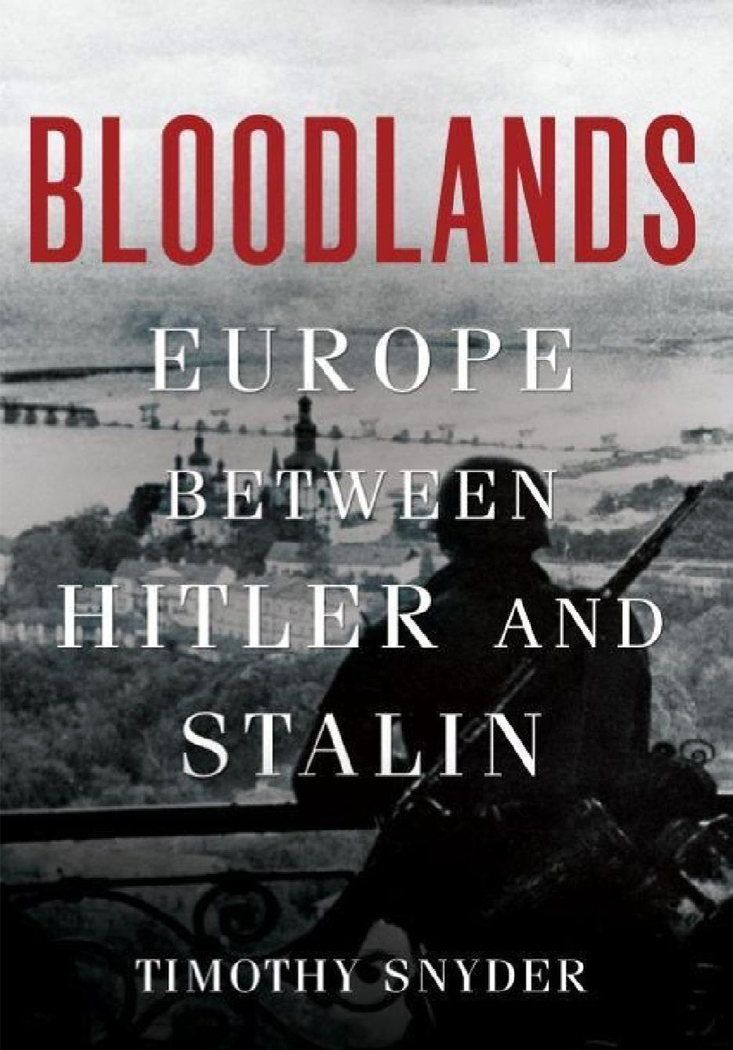
bloodlandsThe first book is Bloodlands, by Timothy Snyder, which recasts the central story of World War II — really from 1933 to 1948 — in a way which finally makes sense to me, and is a needed antidote for all the triumphalist D-Day feel-goodism you are weighed down by in endless TV documentaries about the war.

We are too often deluded into thinking that World War II was a time in which America waged a “good war” against Nazism and won. I had always found this view indefensible, simple minded and ultimately jingoistic. The U.S. certainly had its part to play — and I don’t mean to denigrate the sacrifice of our soldiers, sailors and those on the homefront —  but when I looked at the figures, it was hard to reconcile the idea that we were the major player when our war dead totaled half a million but the Soviet Union’s dead exceeded 12 million. Either they were terrible soldiers and ours were magnificently efficient, or the real war was not in Normandy, but in the Eastern Front.

But even my own prejudice about the war really being between Germany and Russia turns out to be a gross simplification.

The book is an accounting of all the dying that took place in the shifting-border areas between Germany and Russia — the areas that were sometimes Poland, sometimes Ukraine, Belarus and parts of the Baltic states, Romania and Hungary — death caused by the political choices and policies first of Stalin in the Soviet Union and then Hitler in Germany.Jew_Killings_in_Ivangorod_(1942)

By the accounting of the author, they are culpable in the deaths of 14 million civilians. This is above and beyond the military deaths caused by the war itself. This was the deliberate starvation of Ukrainian farmers in the 1933, the “Great Terror” of 1938, in which Stalin wiped out his political enemies, rivals and phantoms of his paranoia, followed by the mass shootings in occupied Poland from 1939 to 1941, the starvation policy used by the Germans on 3.1 million Soviet prisoners of war and the intended extermination of Jews by Germans from 1941 to 1945. It is a dismal story of humanity’s inhumanity. These were not accidental deaths, but deaths of central planning and political purpose.

The overwhelming bulk of death during those years took place between the so-called Molotov-Ribbentrop line that divided pre-war Poland in half, and the eastern borders of Ukraine and Belarus.

Snyder footnotes the exact counts, often village by village, with anecdotal horror stories of those shot, burned, gassed and garroted. One hardly turns the pages without choking and weeping.

From Snyder’s view, the war in Europe was not merely one between Nazi Germany and the Communist Soviet Union, but rather one in which Hitler and Stalin colluded in first wiping Poland off the map, splitting it between them in 1939 (the aforesaid Molotov-Ribbentrop line), and then, when Hitler’s plan to evict all the Poles and Jews from what was formerly western Poland got bogged down in difficulty (the plan to deport them all to the east, vaguely somewhere in the Soviet Union, perhaps Kazakhstan was nixed by Stalin), it turned into a plan to murder them all.

It should be noted that in Russia, the official dates of World War II are 1941 to 1945. They don’t acknowledge the invasion of Poland by Germany on Sept. 1, 1939 as the start of the war, because they were equally culpable in that dissolution of the state of Poland. But they start the conflict in 1941, when Hitler invaded the Soviet Union. Except, of course, that Hitler didn’t first invade the Soviet Union. He invaded what used to be eastern Poland, on the other side of the Molotov-Ribbentrop line, but had since been declared to be part of the Soviet Union — the formerly Polish part. For Stalin it made no difference that this was formerly Poland; now it was de facto part of his Soviet Union.

When Hitler’s army failed to take Moscow quickly, as his Blitzkrieg model had planned, the war turned into a protracted and mass slaughter of German and Soviet armies.

While we in the West call World War II “the good war,” in Russia they remember it as the Great Patriotic War, but in reality the whole thing should be called the Soviet-German war over the dismemberment of Poland.

To that bloody conflict, D-Day, Sicily, North Africa, Dunkirk, the Battle of Brittain were all basically a side-show. Our propaganda portrayed Hitler as seeking “world domination,” but that was never more than a comic-book arch-villain sort of plot. France and England were brought into the war because they had a defense treaty with Poland. Hitler would have preferred to avoid war with England and France. His beef was with Stalin over the land he wanted in Poland for German expansion — primarily to provide farming land and food for an expanding and industrialized Germany. Having to deal with England and France in the west was a pesky bother to him.

(The war in the Pacific, which happened concurrently, can be seen as primarily a separate war, beginning with Japanese invasions of Manchuria and China in the 1930s and ending after the war in Europe. The Pacific war was essentially America’s war, unlike the war in Europe.)

Back to the book: What makes it so dismal is not just the magnitude of the statistics — how many million shot in the back of the head here, so many million run through the death camps there — but the documented stories of individual deaths, or whole villages prisoned in churches that were then burned down, or men required to dig pits the length of two football fields, and then told to lie down in the graves, where they were shot, and layered like lasagne with another pile of bodies, shot, and another, and another, then covered up with dirt.

One fears turning the page in Bloodlands to find more starvation, more cold-blooded planning of mass murder, more mothers torn from their babies, more husbands worked to death in labor camps, while their parents were shipped off to Treblinka or Chelmno.

We too often think of the concentration camps as the place of the Holocaust, but Snyder makes clear that as many Jews were killed by bullets as by gas, and that the version of camp death we most often think of — say Auschwitz or Buchenwald — were not actually death camps, but rather holding camps in which death was a too-common byproduct. The real death camps were small facilities with no barracks, just changing rooms. The victims arrived by train, stripped of clothing and possessions and were herded directly into gas chambers where internal combustion engines piped carbon monoxide in, killing all in about 20 minutes of terror, and then the corpses were carried out an burned in huge pyres, kept fired up like so many charcoal grills. Treblinka was built exclusively to empty out the Warsaw ghetto. When that was accomplished, Treblinka was closed down. The extermination camp at Chelmno did the same thing for the Jews of the Lodz ghetto. The industrialized purposefulness of such factories is all the more chilling. deportation to treblinka 1942

We tend to think of Hitler’s atrocities as being 6 million Jews killed in the Holocaust. And in terms of ethnic cleansing, it is one of the most ghastly in human history, but the suffering was also spread out in the period Snyder covers, from so-called kulaks in Ukraine to Polish officers massacred after the division of Poland in 1939, to dissidents and potential dissidents in the Soviet Union. Some 60 million people died in those years from political violence, less than half of them were military. That was 3 percent of the world’s population at the time.

One of the arguments one hears from the so-called Holocaust deniers, is that the Shoah was simply too vast to be believed. No humans could possibly have exterminated that many people in that short a time. Yes, they say, Hitler had anti-Semitic policies and maybe a few were killed, but the vast numbers were not believable. One has to laugh at this argument, not only in the face of Snyder’s careful accounting, but in the long view of history, and the slaughter of conquered peoples from the dawn of time. The Holocaust was not a singular event, but something like the standard order of things. This is what people do to each other, over and over and over. One must remember the wholesale extermination of city populations by Genghis Khan, the pyramids of skulls of Tamerlane. The slaughter of Cathars in the 13th century, or earlier, of the Wu Hu in China in the Fourth Century. One voice echoes through history: Carthago delenda est. So, ethnic cleansing continues in our own time, whether in Rwanda or Sudan or Cambodia.

I have gone on is rather more length than I had intended. The book is overwhelming, the pessimism it engenders is oppressive. I do not hope for a brighter future; I cannot knowing the lessons of history.

But I can put the book down when finished, and pick up another, one that gives me as much pleasure as Bloodlands gives me pain.

And here’s where the whiplash may hit you, too.

trilogyBecause the next tome I picked up was H.L. Mencken’s three autobiographical books, published as a single volume by the Library of America. I cannot convey to you quite the pleasure to be had by reading Mencken. His writing is full of the vigor and intellectual energy of a man in love with life and in love with the way language can convey that love.

It is not that everything is wonderful in Mencken’s life, but rather that the failings of human existence — seen as the acts of individuals, rather than classes of people — are at bottom so entertaining.

It is particularly his volume on his early newspaper work that fills me with joy. Newspaper Days covers the years from about 1899 to 1906, and lets me know that journalism hadn’t changed much from his day to mine (that it is now nearly extinct is another sorrow I feel).

Just as I dreaded each new chapter in Bloodlands, I check to see how many more pages I have left of Mencken and dread instead the final page, when my pleasure will come to its end. Prejudices

The Library of America had previously published his six series of  Prejudices, which were collected essays, always a joy to read, even when what he says might be outrageous and, well, prejudiced. At bottom, Mencken is clear-eyed and unbowed, and we value his fellowship, even in print, as we might value it sitting on a barstool next to him, sharing banter over a foamy beer. You might not agree with Mencken’s opinions, but they were always magnificently expressed, in a kind of journalistic language raised to the level of poetry.

I have his three volume The American Language, which is about as entertaining a scholarly book as you could find. Thorough, amused and amusing, it is indispensable.

The best way I can convey to you the qualities of Mencken’s writing, and of his mind, is to quote him. Here is a section from Newspaper Days, in which he talks about the artists employed back at the turn of the century to illustrate newspaper stories, before the days when photographs could be easily reproduced. As editor, he had to deal with their eccentricities.

After a few anecdotes about artists getting themselves into trouble and drink, he reminds us that:

“The cops of those days, in so far as they were aware of artists at all, accepted them at their own valuation, and thus regarded them with suspicion. If they were not actually on the level of water-front crimps, dope-pedlars and piano-players in houses of shame, they at least belonged somewhere south of sporty doctors, professional bondsmen and handbooks [obsolete slang clarification: bookies]. This attitude once cost an artist of my acquaintance his liberty for three weeks, though he was innocent of any misdemeanor. On a cold Winter night he and his girl lifted four or five ash-boxes, made a roaring wood-fire in the fireplace of his fourth-floor studio, and settled down to listen to a phonograph, then a novelty in the world. The glare of the blaze, shinning red through the cobwebbed windows, led a rookie cop to assume that the house was afire, and he turned in an alarm. When the firemen came roaring up, only to discover that the fire was in a fireplace, the poor cop sought to cover his chagrin by collaring the artist, and charging him with contributing to the delinquency of a minor. There was, of course, no truth in this, for the lady was nearly forty years old and had served at least two terms in a reformatory for soliciting on the street, but the lieutenant at the station-house, on learning that the culprit was an artist, ordered him locked up for investigation and he had been in the cooler three weeks before his girl managed to round up a committee of social-minded saloonkeepers to demand his release. The cops finally let him go with a warning, and for the rest of that Winter no artist in Baltimore dared to make a fire.”

mencken 3The book moves forward with speed and irony, full of vivid expressions and entertaining stories. Mencken recalls cops and judges, editors and pressmen, drummers for patent medicines and press agents of dubious veracity, kindly murderers and scapegrace yobs of all descriptions, many of which Mencken counted as his special angels of the kind of humanity he most valued. He detested all cant and corporate or governmental doublethink, and anyone who would put life into a file cabinet alphabetically.

It is the pleasure of coming across his book after reading Bloodlands that restores the oxygen to a world otherwise noisome with the mephitic stench of death. And reminds us that it is a grace that we live in a world of individuals rather than in the statistical world of categories and proscription lists. Grace is what keeps us alive.

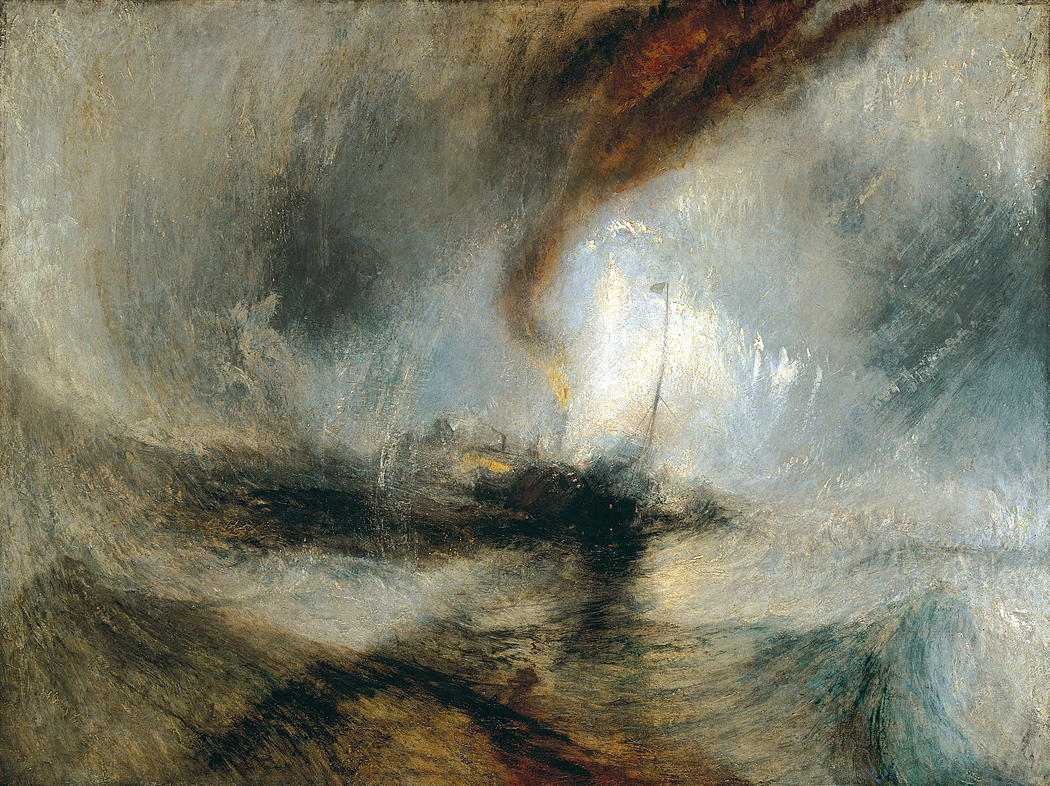
Rain_Steam_and_Speed_the_Great_Western_RailwayI grew up in an age when there was a distinct category called “Modern Art.” It was reviled by many and championed by the rest, and it was taken to be a complete break with the past — which is why it was both reviled and championed.

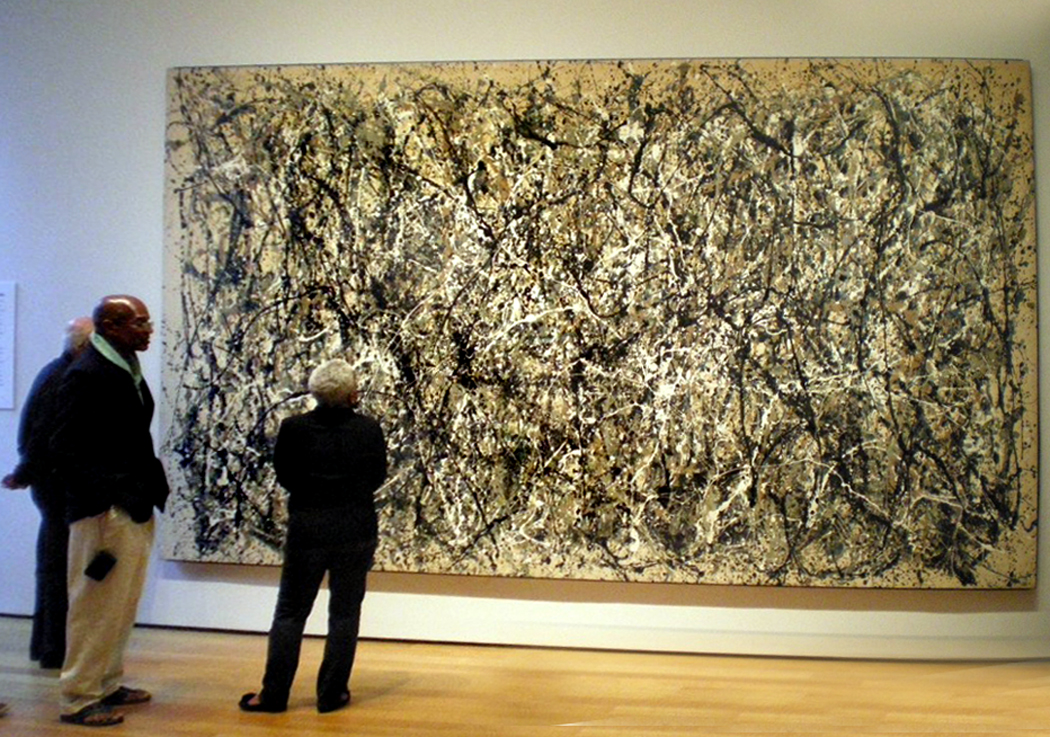
It may be hard to imagine now, but in the 1950s and ’60s, a large portion of the population actually believed “My kid could paint better than that.” In response, proselytizers mounted campaigns in support of Picasso and Kandinsky. When Life magazine ran a story on Jackson Pollock, it was an intentionally provocative act. “Is this the greatest living painter in the United States?” the story asked, daring its middle-class readers to argue back.pollock life magazine

Indeed, as late as the 1980s, a particularly condescending gallery owner in Scottsdale, Ariz., attempted to persuade me that abstract art was the wave of the future. He made the assumption that since I lived in Arizona, my tastes ran to cowboys. He wanted to “deprovincialize” me.

Modern Art was subsequently eclipsed by “Contemporary Art,” and after that the whole thing fell apart in a Postmodern disintegration. What we have now is “the trendy stuff at the gallery.”

But in my time, when I was a teenager whose personality was being forged, I had the immense privilege of living an easy trip to New York City and a subway ride away from the Museum of Modern Art, where my initial sense of taste was formed. I absorbed whole Picasso’s Guernica — which I always thought would be forever available to me — Jackson Pollock’s One: Number 31, and Van Gogh’s Starry Nightpollack 1

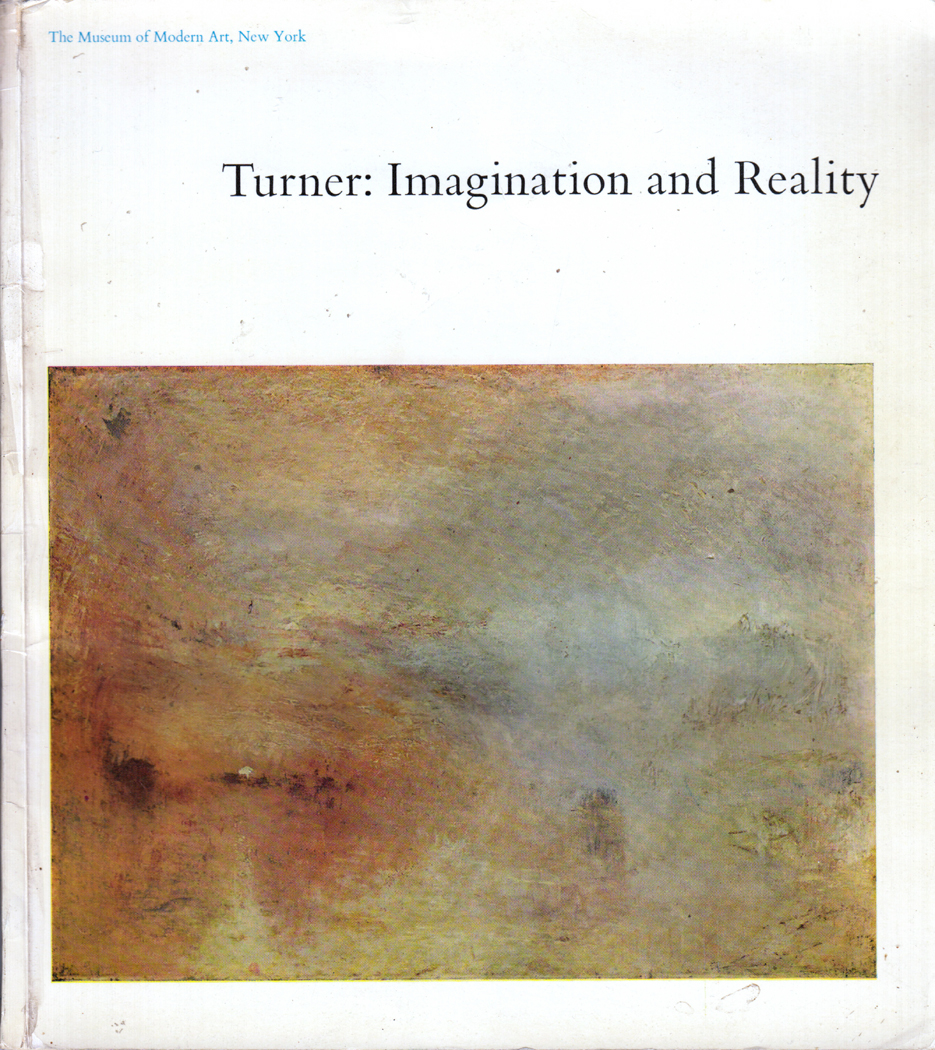
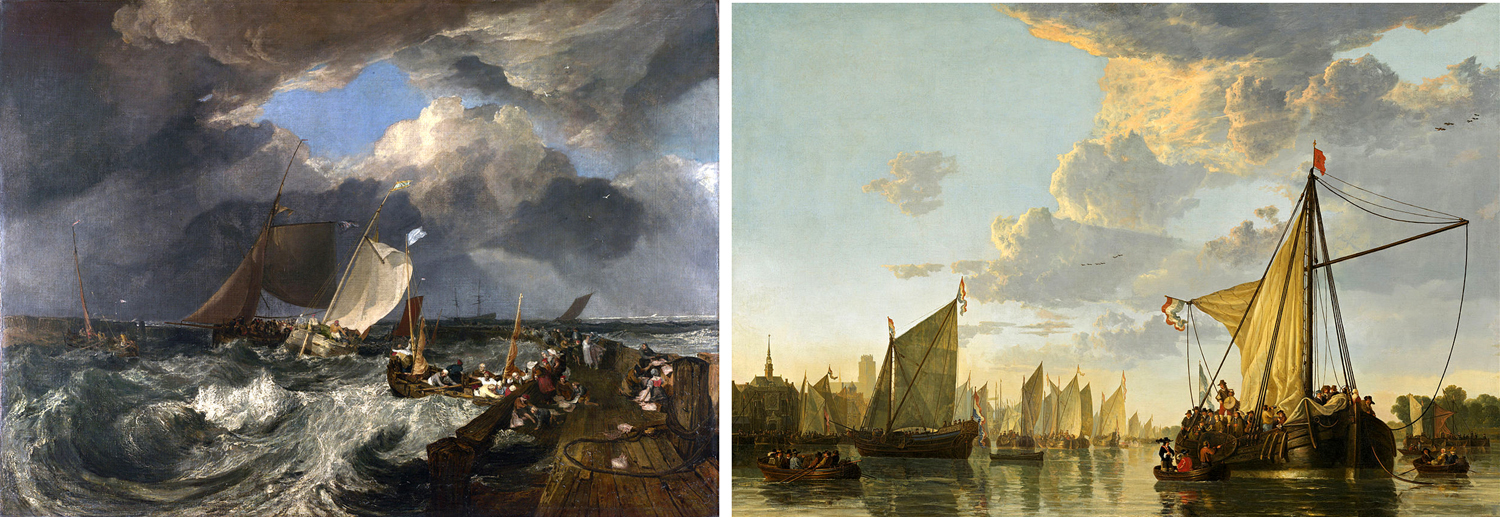
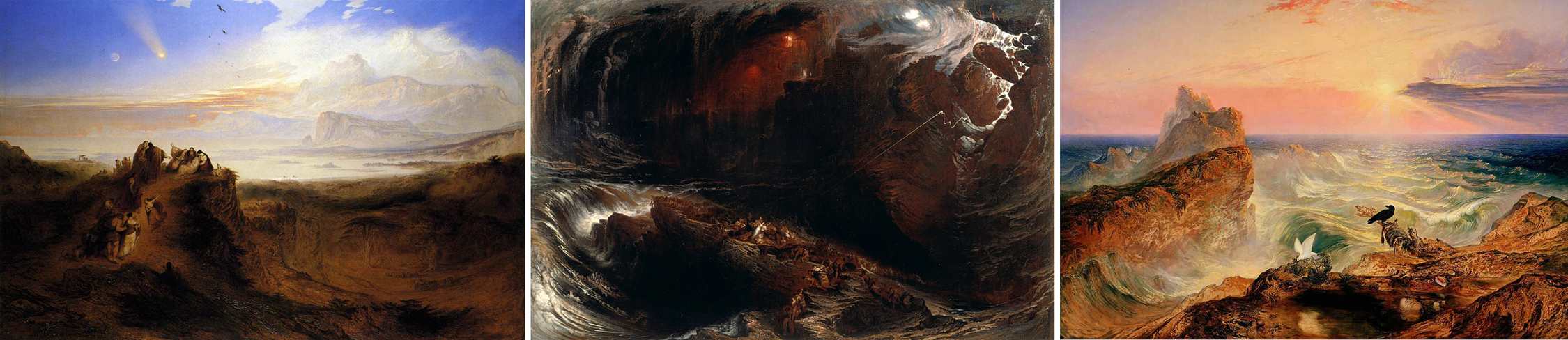
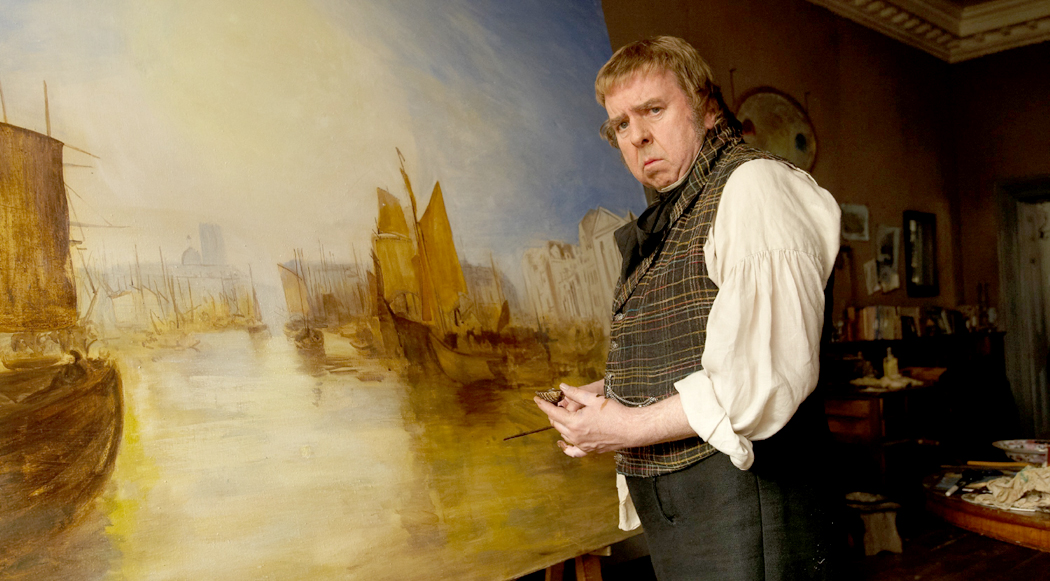
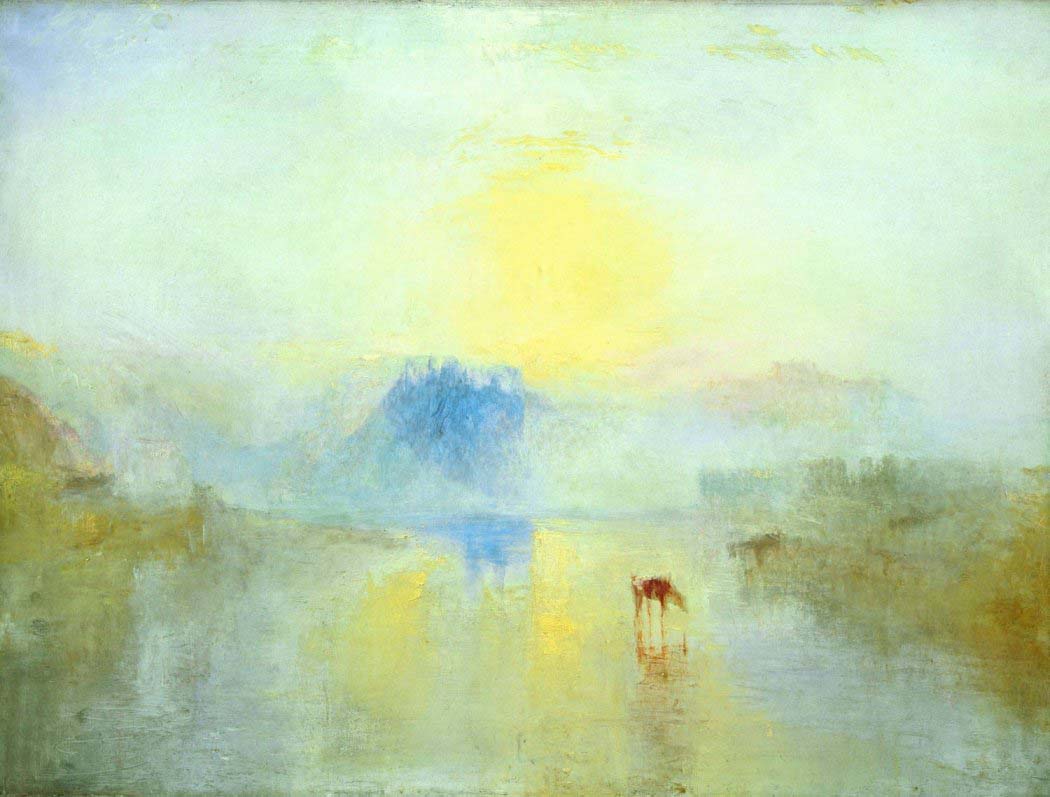
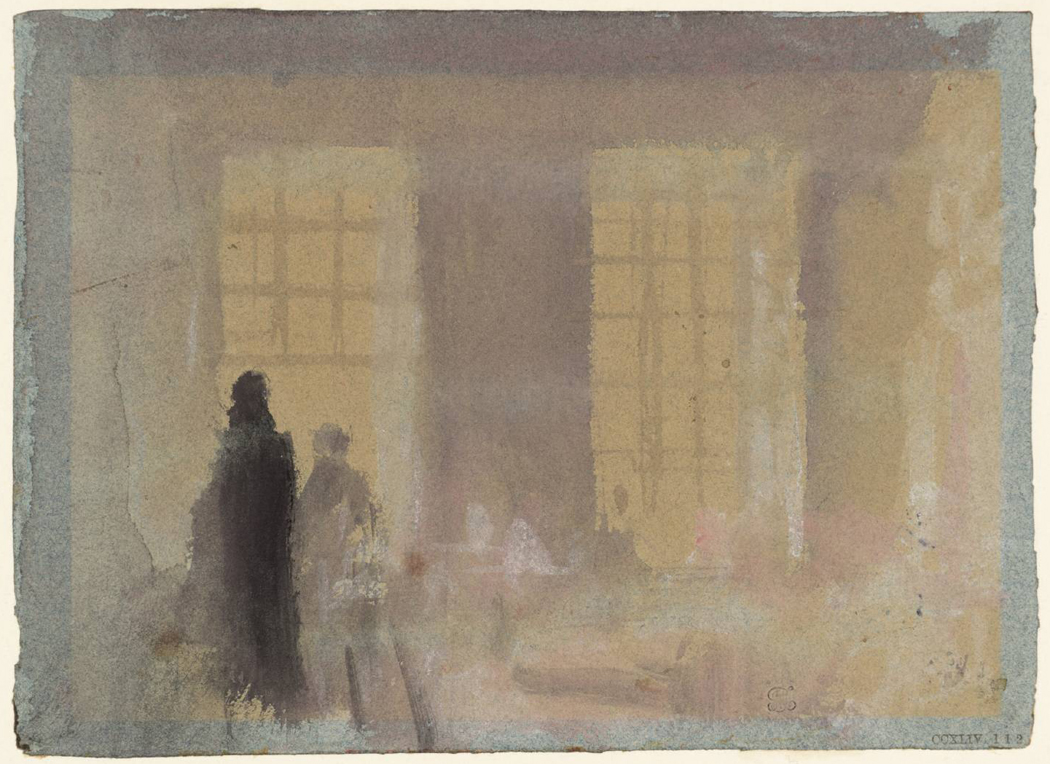
Turner catalogThe biggest single contribution to my growth, however, and the nudge that eased me into a life as an art critic, was the show in the spring of 1966 at MOMA of JMW Turner’s late paintings, called, “Turner: Imagination and Reality.” I was still a high school student and knew that there must certainly be a bigger, more impressive and powerful world out there than the one I knew in suburban New Jersey.

In that show, the English painter was dressed up as the precursor not only to Impressionism, but to such High Modernist painters as Mark Rothko. Turner’s watercolor washes were mere gestures with a loaded brush and implied an early morning sunrise barely seen through a frosty fog — hardly an edge or line in sight. turner rothko pair

Left: Turner “Pink Sky”               Right: Rothko detail

The show kicked off a resurgence in Turner’s reputation at the same time Vivaldi was getting a boost from the Baroque revival. It isn’t that either the Red Priest or the shaggy Brit were unknown or unappreciated, at least by those with their acquaintance, but that the wider world had largely — if not forgotten them, had relegated them to a “yes-them-too” sub-paragraph in the catalog. Turner emerged as not just a major artist, but a springboard for all the upcoming progress in art that resulted in — hooray — the glorious moment that is us.

That view seems quite laughable now, but we should instruct those X-ers and Millennials that came after us that the idea was that all of history was an inevitable march toward a single goal, and that in 1966, we had achieved it. The Age of Aquarius meant more than a bogarted doobie and a flower in the barrel of a National Guard rifle. We had reached some sort of checkered flag, some tape we had breasted.

Our history since then seems like a winded generation bent over with hands on knees, trying to catch a sweaty breath. It was Francis Fukuyama who was gasping.

Yet, if I can no longer see Modernism as some target bulls-eyed, I can still look back on that time, and that show, with a special fondness. It hit at just the right moment: my adolescence. I was ripe to be picked. turner cuyp pair

Left: Turner, “Calais Pier”               Right: Cuyp, “The Maas at Dordrecht 

Click to enlarge

For Joseph Mallord William Turner kept two plates spinning. On one hand, he does seem to prefigure the Impressionist fascination with light and color. But on the other hand, Turner was yet one more British huckster of the Sublime. He began as primarily a marine painter of ships, sea and clouds, patterned after so many earlier Dutch painters, like Aelbert Cuyp, but soon joined those painters of vast and menacing landscapes based on biblical or classical themes. Plagues of Egypt, destruction of Babylon, Noah’s flood, the Trojan War — they all show up.

Compare, for instance, Turner’s first entry into the Royal Academy, in 1800, with John Martin’s painting of the same subject: The Seventh Plague of Egypt (although, Turner, not a religious man and a desultory reader of the Bible at best, mislabled his plague as the Fifth). Turner Martin Seventh (fifth) plague

Turner, left; Martin, right

(Just for fun, let’s see Martin’s trilogy of paintings on the Flood: Eve of the Deluge, The Deluge, and The Assuaging of the Waters. The last was bought by Prince Albert for his Queen.)Martin Deluge trilogy copy

Click to enlarge

Martin’s grandiose paintings — clearly the inspiration for reels of Sword and Sandals epics by the likes of de Mille, Griffith and Giovanni Pastrone — are less competently painted and tend toward a darker palette of blues and blacks, while Turner’s paintbox veered increasingly to gamboge and flake white. Yet, his salability in the first half of the 19th century was based on his ability to provide the epic subject matter.

Consider the pair of paintings Turner made on The Deluge: Shadow and Darkness — The Evening of the Deluge, and Light and Colour — The Morning After the Deluge, from 1843.Shade and Darkness - the Evening of the Deluge exhibited 1843 by Joseph Mallord William Turner 1775-1851

 Click to enlarge

 So there I was, at the ripe, pimply age of 17, with all the world before me, and an ambition in my heart that transcended the possible, and there was Turner. I was being told he was the seed from which something important grew, but my primary and adolescent response was to the sublime — that sense that the world — nay, the universe — was grander, more intense and more alive than what I knew of Bergen County, New Jersey.

There were wind and waves, fire and brimstone, death and destruction, rocky precipices and roaring cataracts — Blow you hurricanoes, etc., etc. I was electrified at the idea that Turner had tied himself to a ship’s mast in a snowstorm to experience — like Odysseus — the siren call of destruction and death.snowstorm steamboat

Snow Storm: Steamboat off a Harbour’s Mouth, 1843

Author Lawrence Gowing, curator of the MOMA Turner show had written about the premonitory Impressionism in Turner, but in my saladgreen youth, that early seed was proof of Turner’s artistic heroism the same as his bodily courage he shows on the ship. Gowing was making an art-historical point; I was swept by the mythology. sharknado

Sharknado (2013)

It is the same impulse, I believe, that turns so many young men these days on to superheroes and supervillains and that whole genre of film where the planet is doomed by ice, fire, green monsters or evil multinational corporations. The FX movies that shake the separating walls of our cineplexes are the modern replacement for Byron’s Manfred and Shelley’s Prometheus.turner in studio movie still

I mention all this now because I have just seen Mike Leigh’s film, Mr. Turner, with Timothy Spall playing the painter, in a movie that advances with exactly the same pace and precision as paint drying. It is not a movie for the X-men crowd. Nothing blows up, no one turns the equator into an iceberg, and the earth doesn’t split into two.

Now as an adult, and with some 50 years under my belt since my exposure, I have a more sedate view of JMW Turner and his paintings. The film resonated with that: Turner had a living to make and catastrophe painting was his niche. Disaster was his shtick. That “vortex of obscurity,” those paint daubs. An avid public bought them up, and if some, such as John Ruskin, could see the work as the art of the future, most saw them as great, ecstatic expressions of the Romantic sensibility that was already passing into sedate and sententious Victorianism.  frosty morning

What MOMA chose to emphasize were the watercolors, primarily sketches for oil paintings. They were vague and washy and could more easily be seen as proto-Impressionism. The exhibit rather ignored the ships and sails of Turner’s more ordinary output. It also conveniently brushed aside that part of Impressionism that didn’t stoke the fires of Modernism: That Impressionism wasn’t just about paint and color, but about depicting the daily life of ordinary people rather than the grand mythology of the Academy painters. The present always chooses its past. At Petworth: Morning Light through the Windows 1827 by Joseph Mallord William Turner 1775-1851

And what one sees in Leigh’s film is not some spiritual visionary, but a Cockney artist, largely inarticulate, who has found a way to turn a little trick of paint daubs into a lucrative industry. Yet, I don’t mean to denigrate Turner: There was some level of genius in his ability to elevate the Mad-Martin extravaganza into something personal, idiosyncratic and, yes, forward looking. Turner was no revolutionary; he was bourgeois to the core, yet, that combination of conventional and ecstatic give his work that extra boost into the pages of art history textbooks. It’s what separates him from Martin, Samuel Palmer, Henry Fuseli and the rest of that forgotten ilk.