Archive

Author Archives: Richard Nilsen

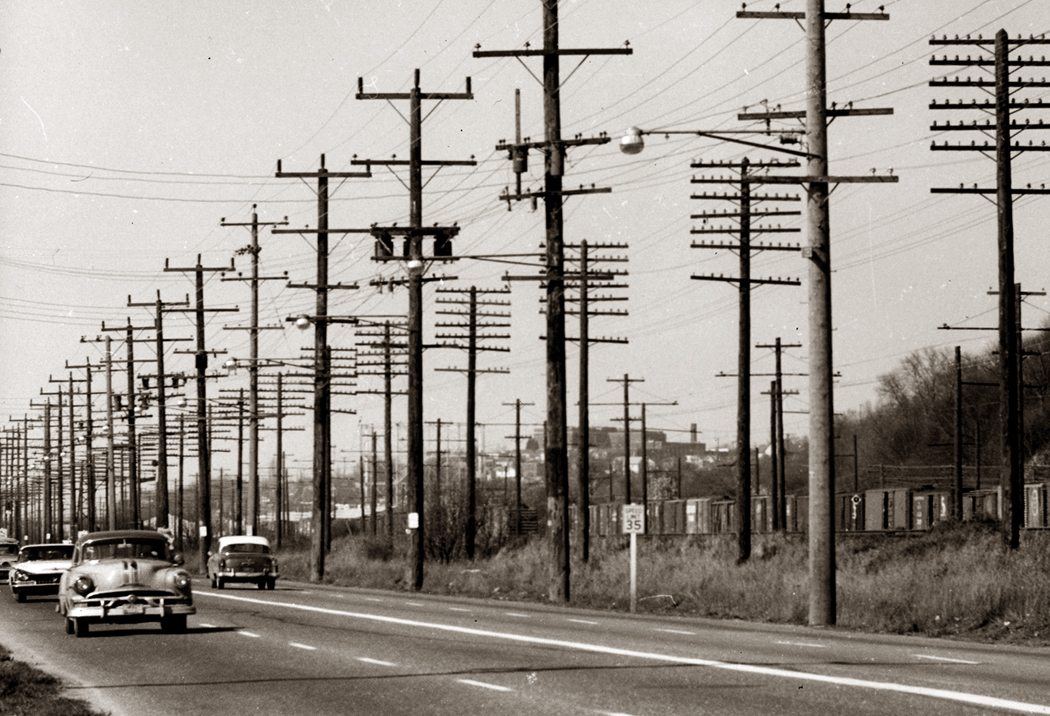
phone pole forest bw

“What makes human beings different from animals,” Stuart asked.

“They have names,” I said.

“Animals have names, too,” Stuart said.

I could see that there would be no stopping the next Stuart verbal avalanche.

“So, what does separate us from the beasts?” I bit.

“When I was young, I learned that what separated us from the monkeys was that we made tools.”

“Tools?”

“Yeah, Homo habilis. But some years later, Jane Goodall ruined that theory when she discovered chimpanzees poked sticks down termite nests to pull out a tasty gob of bugs to eat.”

“Yum.”streetlights at night

“When I was in college, a stuffed-shirt teacher told me that humans were the only animals that used language.

“But now, not only are some gorillas using sign language — and  more articulately than many politicians — but scientists are  striving to learn the languages of dolphins and whales.”

“Whales can talk?”

“Uh-huh.”

“What do they say?”

“I don’t know. Maybe, ‘Here I am, come get me,’ or ‘Haven’t I seen you here before?’

“And honeybees dance to talk.”

I considered this bit of information while Stuart circled in for a landing at his main point.

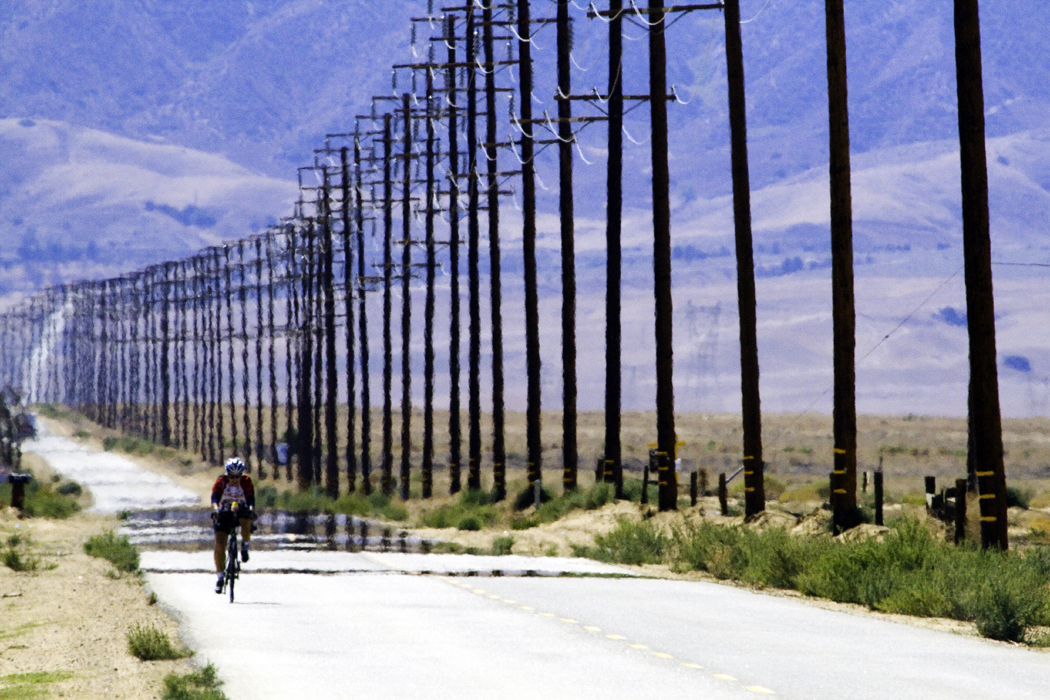
“But there is something that humans do that nothing else in the universe, so far as we know, can duplicate.phone poles

“Human beings are crazy to poke sticks into the ground.”

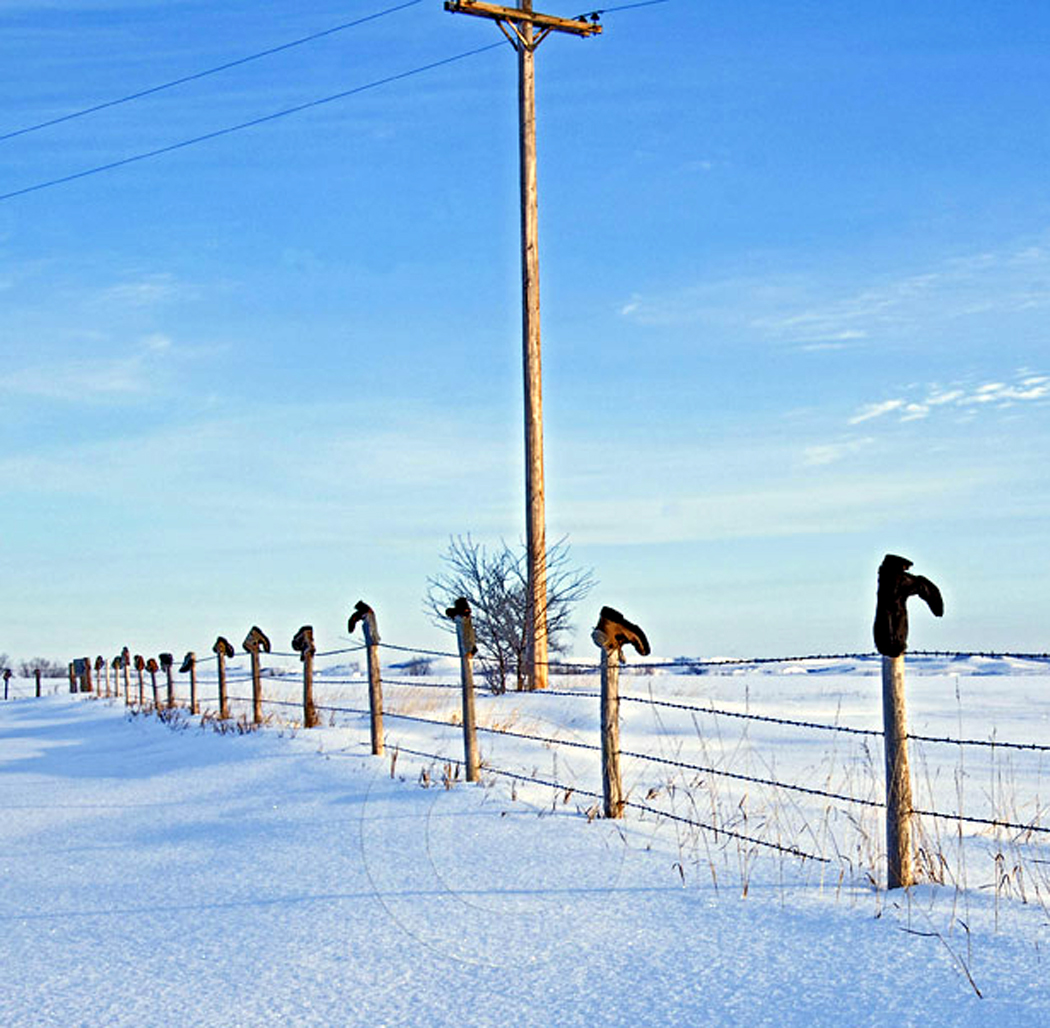
“Sticks?”north dakota snow fence

“Look around you. There are sticks everywhere. Streetlights. Traffic signs. Mile markers.

“Go to the most godforsaken plain in North Dakota and you will see lines of fence poles stretching out to the horizons.

“We are a species mad about sticks.

“Flags on golf greens. Citronella poles in back yards. Surveyors’ stakes. Bean poles and tomato stakes. Crosses in front of churches. Maypoles.

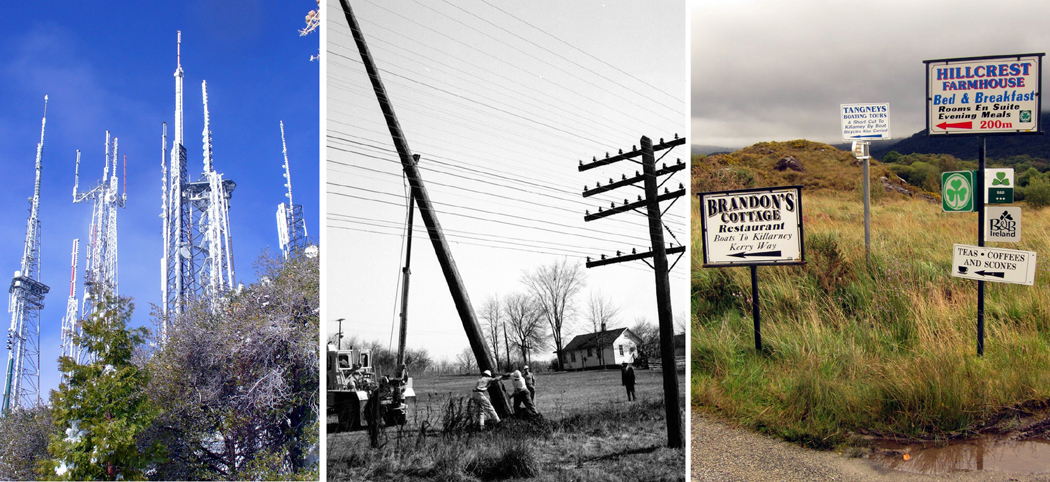
“We can hardly play a game without plunging a pole into the ground: goal posts, foul poles, supports for basketball  hoops and tennis nets. You can’t even play croquet without sticks in the ground.TV and radio towers on Mt Wilsonmultiples

“And it’s not just now I’m talking about. In the Bible, Aaron’s rod was stuck into the ground and sprouted. Sioux Indians had to place a pole in the ground for their Sun Dance. Hey, and digging sticks. Totem Poles. Prayer sticks…moonflag

“We travel 169,000 miles to the moon and what do we do? Plop down a flagpole and take our photo beside it.

“You can’t walk 30 yards in this town and not see some pole drilled into the dirt: street signs; business signs.

“We have turned our planet into a porcupine.”

I laughed. “But didn’t you say chimpanzees stick sticks in the ground for termites?”

“Oh, yeah. I guess I’m wrong, then. Never mind.”

But I had my own theory.

“Human beings are the only animals who use toilet paper,” I said.

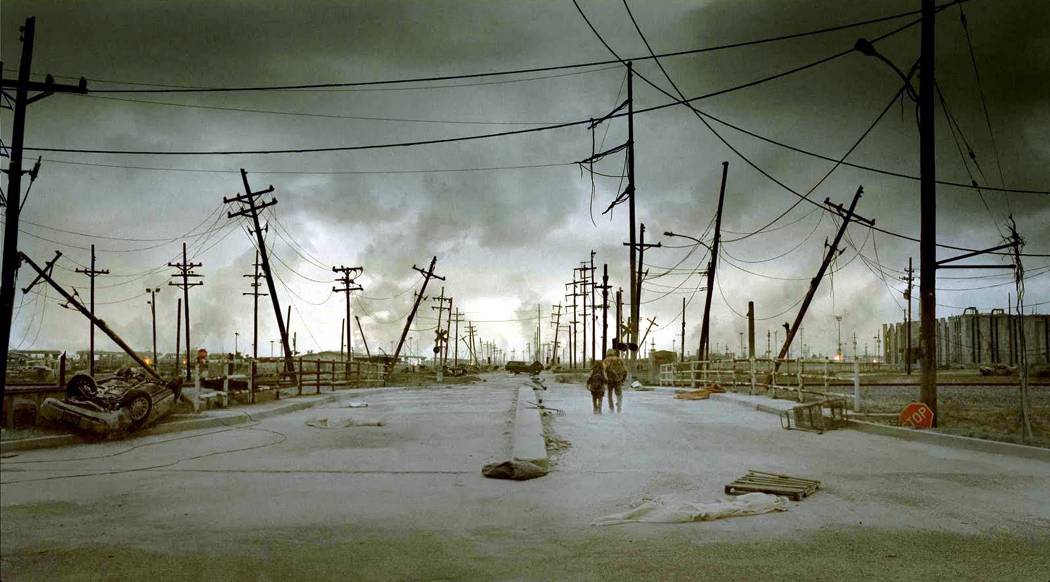
That seemed to make Stuart happy. He would steal that line. The Road poles

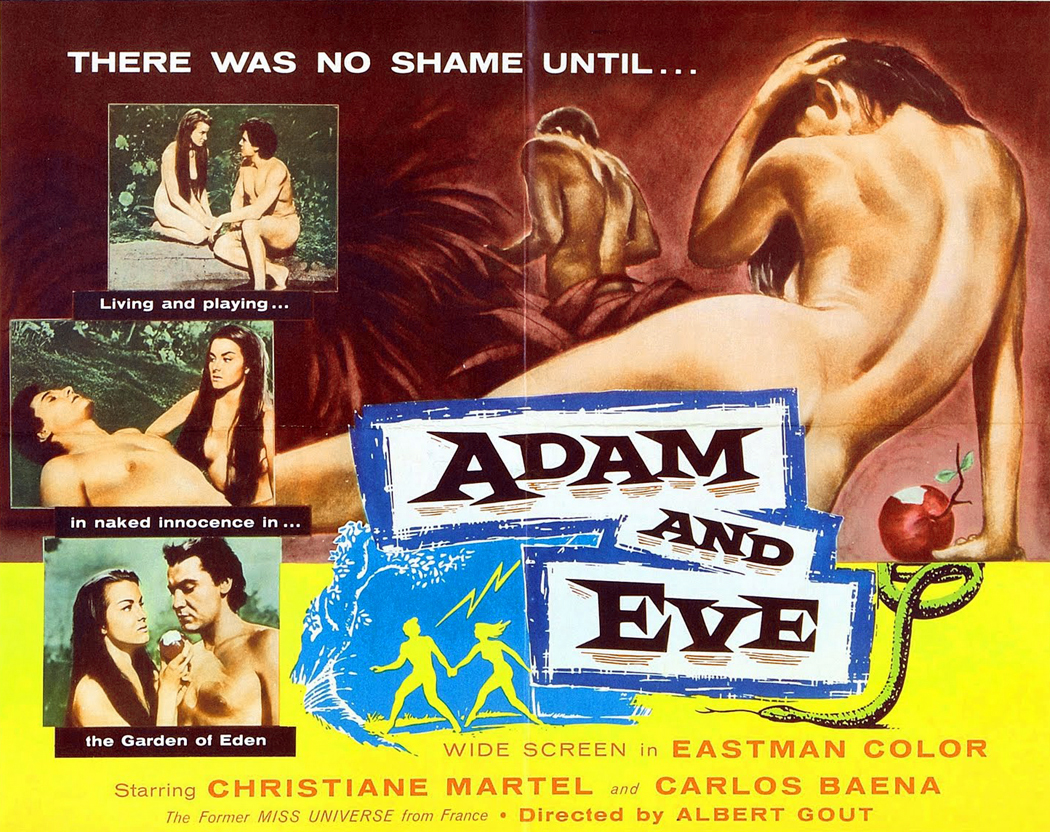
adam and eve poster 1958

Stuart is a friend of mine and he always has an opinion. They aren’t always completely thought out, but then, that’s the way it often is with our opinions; we form them out of instinct and then seek factual support.

Stuart has always had definite opinions about men and women. The fact that he has had two official and two unofficial marriages, and continues to forge his way through one failed relationship after another has not blunted his faith in his grasp of the matter.

I recently wrote a blog about the difficulty most men have in multi-tasking (https://richardnilsen.com/2014/02/17/keeping-life-simple/), and Stuart brought it up when he came to visit on another one of his cross-country trips, unsure of where he would settle this time.

Stuart did, in fact, have a theory. Like all his theories, it was more about spouting off than about solid sociological, theological or scientific research.

“OK, here goes.

“Men are all fetishists. This is the primary distinction between men and women,” he said.

“I don’t mean all men are into leather or vinyl, but that men localize their interests. It all comes down to a focus on a single issue, and all others can fend for themselves.”

“You mean men can’t multi-task?”

“That’s a good way of putting it.

“Think of porn. Why do women not respond? Why do men? People say it’s because women are not visual and men are, but that’s not the main problem. After all, women don’t respond to verbal porn either. It’s because men localize their sexual interest in one spot on their bodies. And, believe me, it’s always the same spot.

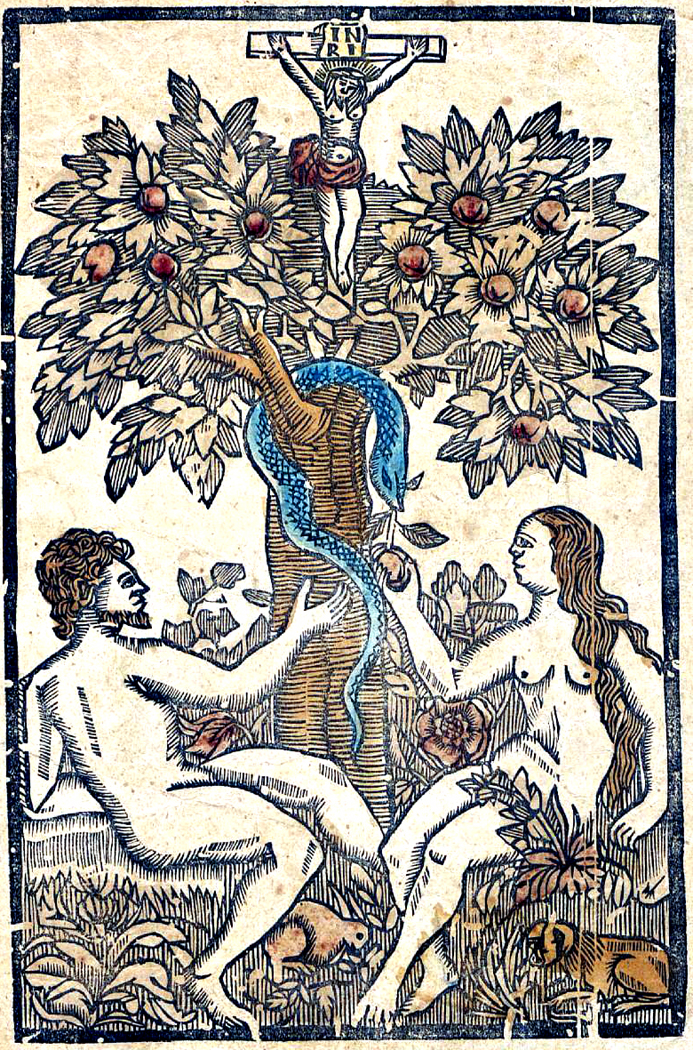
“By the way, if you attend to that spot, it doesn’t matter what else you do, they’ll be happy. It’s really rather simple. Everything about men is really rather simple. I know that’s hard for women to understand, because women are wired for complexity.”adam and eve woodcut

“That seems like a stereotype,” I said. “As in: Women can multitask.”

“But it’s true,” he continued. “Look at D.H. Lawrence. He adds a religious layer to the whole thing, and makes a god of that spot on his body, and believes that both men and women worship that dangling deity. But it’s really only a man’s religion.

“It colors everything in a man’s life. But it especially colors his attraction to women. Not only does he believe that women care about his equipment, he actually believes women go around talking about it in hushed, worshipful tones. Is it big enough? Am I man enough? Very little thought goes into anything else that might be thought manly.

“So now, when a man looks upon a woman, that same single-mindedness makes him pick out a single attribute of the woman for worship. It is seldom her equipment. Why? I don’t know. Ask Freud. Wait. No, don’t ask Freud.

“So, for a man, it is her boobies he fixates on, or her hair, or her legs. Her big booty or the light down of hair on her arms. It becomes the trigger for his attraction.adam and eve comic

“You see it all the time. A man loves a woman because her hair is blond, or because she has a turned-up nose, or pouty lips. She can weigh 200 pounds, but because her hair is curly, he sighs and pines.

“It can be something less tangible, like a sense of humor, but it seldom is. Mostly it is a physical endowment. Some like saggy boobs, some like a high arch on the instep. Some like just the hint of a mustache on her upper lip.”

“Gross!”

“But it’s true.

“When in the act of love, it is usually this one particular that the man is obsessing on. He is wildly in love with her hair, or the mole on her cheek, or the way she cuts her fingernails short.

“It can be perfume. It can be the fact she wears short pants. It can be the one button left undone on her blouse. But it is one thing.

“Women, on the other hand, tend to see the whole man, to see him as a person. When women complain about the objectification of themselves by men, they are right to do so, but they also miss a central truth of existence and the propagation of the species.

“Men simply don’t see the counter-indications: If that blonde in fact does weigh 200 pounds, or is a shrieking harpy, it doesn’t figure into his erotic calculations.

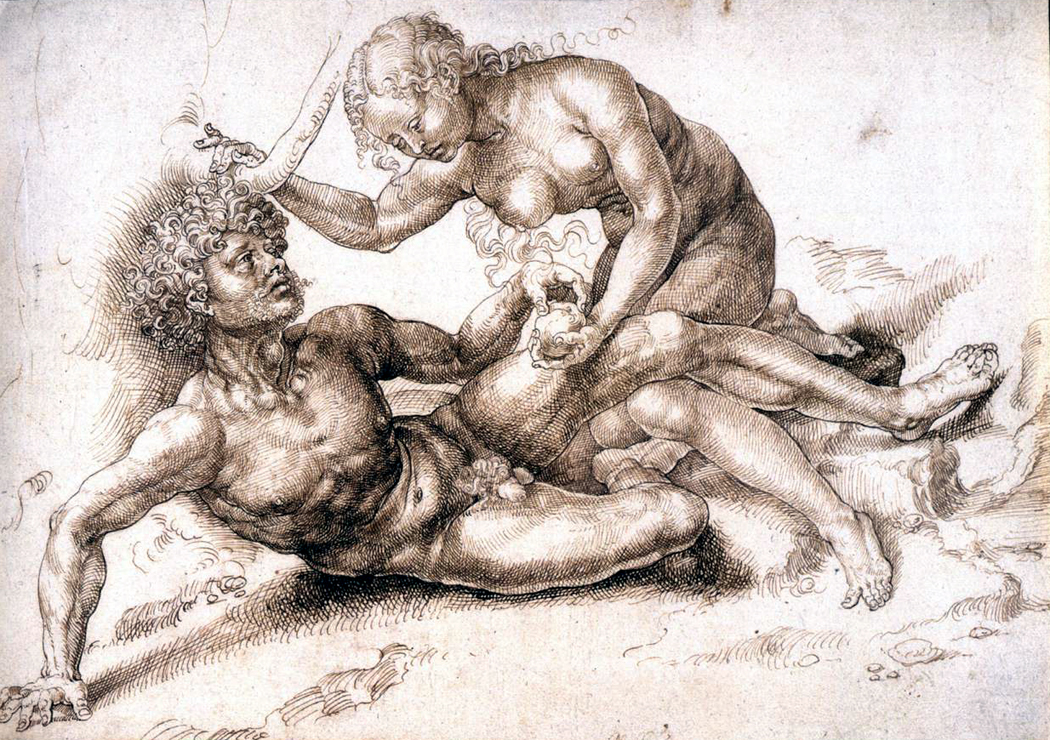
“The woman, however, always takes all the conflicting data into account and makes a profit-loss calculation. Is there enough there to work with? Does the good outweigh the bad.”adam and eve etching

I objected, the way you do when presented with something you know is true but don’t wish to acknowledge, hoping that denying it will make it go away, at least for the moment.

“It can’t be that simple,” I said.

“It isn’t. And I always make room for the standard disclaimer: Individual variation trumps gender variation. You can find exceptions to every so-called rule, but in aggregate, women and men have their ways. There are women who could beat me to a pulp, and I wouldn’t want to tangle with one of them, but on the whole, men have greater upper-body strength.

“I’m not saying you should make laws based on this. Should you outlaw women from operating bulldozers or backhoes? Of course not. Individual variation is greater than any difference between men and women as a whole.

“But, what’s most interesting to me about this thesis about men and their fetish-oriented sexuality is this: In the long run, the whole thing reverses.”vigeland old age

“What do you mean?”

“I mean that after living with a woman for 20 years, a man finally learns to see the whole woman, to access all the other parts of her personality and personhood that he was blind to in the first rush of ‘let’s-make-babies.’ She grows in his estimation. What he should have seen from the beginning, he now understands. The fire has spread into a circle, leaving the grass in the middle burnt, but a wider horizon of concern and interest expanding.

“By the way, learning more about the woman isn’t always a good thing. It also may lead to divorce.

“But the reverse is true for the woman. After living with the man for years, she is likely to latch onto the one thing, the one attribute, the one saving grace he has that makes up for all the failings.

“So, his appreciation for his wife grows, her appreciation for him narrows, but deepens.”

“At some point, though, it would seem there should be a crossing of the lines on the graph,” I said. “There should be a point when her narrowing and his expanding meet at one perfect moment of mutual understanding.”

“Well thought. I don’t know,” Stuart said. “That’s what you will have to find out. I never got there.”

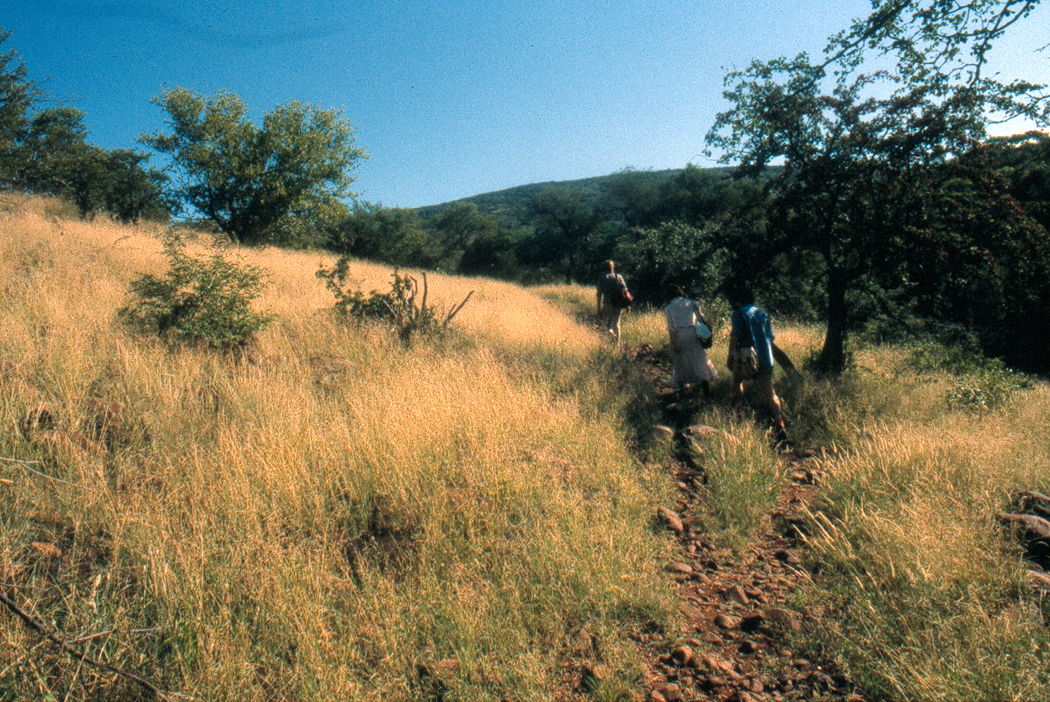
Hiking to the lake in Nwadeni Provincial Park

Hiking to the lake in Nwanedi Provincial Park

In America, when you see a Land Rover, it’s likely to be in Beverly Hills. Here it is a shiny status symbol for those whose ”other car” really is a BMW.

But in the veld country of southern Africa, the Land Rover is a necessity. Usually beat up and painted with an inch or two of dried mud, it is a life support system in a region, like the Venda region of South Africa’s Limpopo Province, that has only seven miles of paved road.

Venda is stuck in the northeast corner of South Africa and is slightly larger than Delaware. It has only one city, Thohoyandou, where most of the pavement can be found. Outside the city, you depend on gravel roads and dirt. rondavals

It is a land where most people farm and raise cattle. Almost everyone lives in a round mud hut called a rondavel that is at most 15 feet in diameter. Small villages are scattered through the hills. You can tell who has status, or at least who has money. While most rondavels have thatched roofs, some of them show off by having tin roofs.

Even more ostentatious are those with double-hung windows cut into the mud walls and at least one rondavel in the capital is two stories tall. giraffe

And in the north, about 30 miles south of the Limpopo River that divides South Africa from Zimbabwe, there is a primitive provincial park called Nwanedi. Covered with low hills and scrub vegetation, it is a place where your Land Rover may very well have to stop to allow a herd of giraffes in front of you to cross what passes for a road.

The grassland passed by and we headed up into the hills. We passed the defining baobab and acacia trees of the region. The baobab is built like a gargantuan broccoli, with a massive trunk and only the wisp of foliage floating around its top. The Venda people say that God planted the baobab tree upside down, with its roots in the air.

Baobab

Baobab

The acacia is the tree you see in every photograph of Africa, where the top of the tree seems spread out like the anvil on an aging thunderhead. It is a spiky tree and sometimes called the ”umbrella thorn.”

But two other trees were more interesting to our guide. One is the marula tree, which is related to the mango, and bears a sweet, tasty fruit that ripens just as it falls from the tree. Tasting a little like a persimmon, the fruit quickly ferments on the ground where it is sometimes eaten by animals. Elephants have been known to go on a bender when the marula fruit ripens.

And the mopane tree, with large leaf pairs that look like the twin prints of a deer hoof. A type of caterpillar feasts on the tree and in turn the Venda people feast on the mopane worm.

Marula fruit

Marula fruit

Unfortunately, the worms were out of season when we were there.

It’s a dusty trip, and in January on the other side of the equator, quite hot.

So our guide — who would make Crocodile Dundee look like a sissy — suggested we drive up to a little place he knew for a swim under a waterfall.

The Land Rover left anything that could even be mistaken for a road and went into the bush. When we crossed a dry stream bed, the Land Rover climbed over boulders the size of Holsteins and dipped and lifted its wheels individually as the engine pulled us along at the speed of a snail. lake vertical

When we could drive no more, we got out and walked. At the end of the path was a waterfall and a pool cut into the rocks underneath a 50-foot yellow sandstone cliff.

Sunlight angled in from one side and the blue sky and yellow rock were fragmented and reflected in the pool.

And the most extraordinary thing happened. A troop of baboons peeked over the top of the cliff at us. There were eight or a dozen of them — it was hard to count them as their heads tentatively bobbed up and down among the rocks — and they were led by one aggressive alpha male who picked me out to negotiate with, probably because I was the only one out of the water at the time, sunning myself on the rocks.

While the rest of the baboons would poke their heads up and squawk and then disappear, the leader stared at me and bared his teeth. He sat on a promontory and rocked slowly back and forth, holding himself up with his arching front legs.

Watching the baboons

Watching the baboons

I didn’t know what the body language meant exactly, but I thought I’d reciprocate. So, I faced him, bared my teeth and bobbed back and forth. It drove him nuts. He screeched and ran behind a rock. When he reappeared, he went through the process again. So did I. He screeched and ran behind a rock. baboon teeth

We did this four or five times before he seemed to give up. I don’t know if he accepted me as his new boss, or whether he just thought the water hole wasn’t important enough to defend at that moment, but it felt to me as if I were communicating with an alien. He might as well have been from another planet, and we made halting and fretful attempts to figure each other out.

At any rate, they left us alone and went back to gleaning through the grass at the top of the rocks.

And I wondered if I were now an adopted baboon.

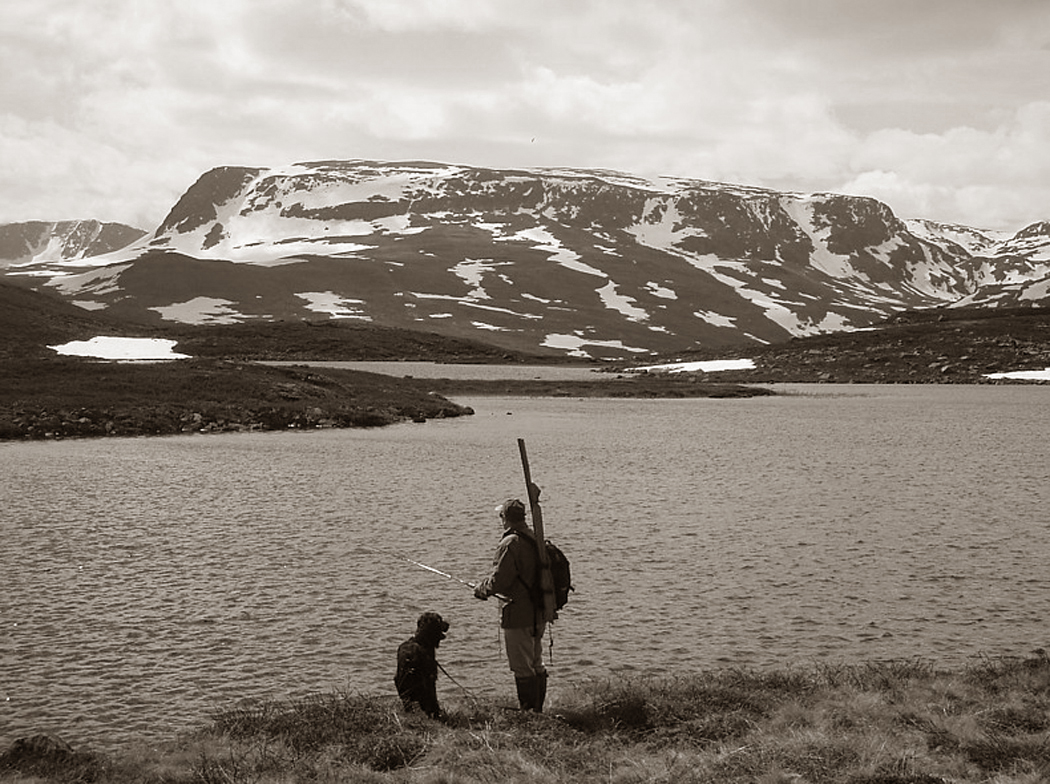
fishing hallingdal bw

There are two things Norwegians love beyond all measure. One is coffee, which is drunk all day long; the other is what they call ”the Nature.”

The Nature is what Norway is about. Less than 10 percent of the land is usable for farming or industry, and the rest is craggy mountains, deep, dark forests and steep-sided fjords cut hundreds of miles inland from the sea.

For the Norwegian, to be out in the Nature is to be where it is healthy, both physically and mentally, and it is the only place where it is possible to be ekte Norsk, or truly Norwegian.

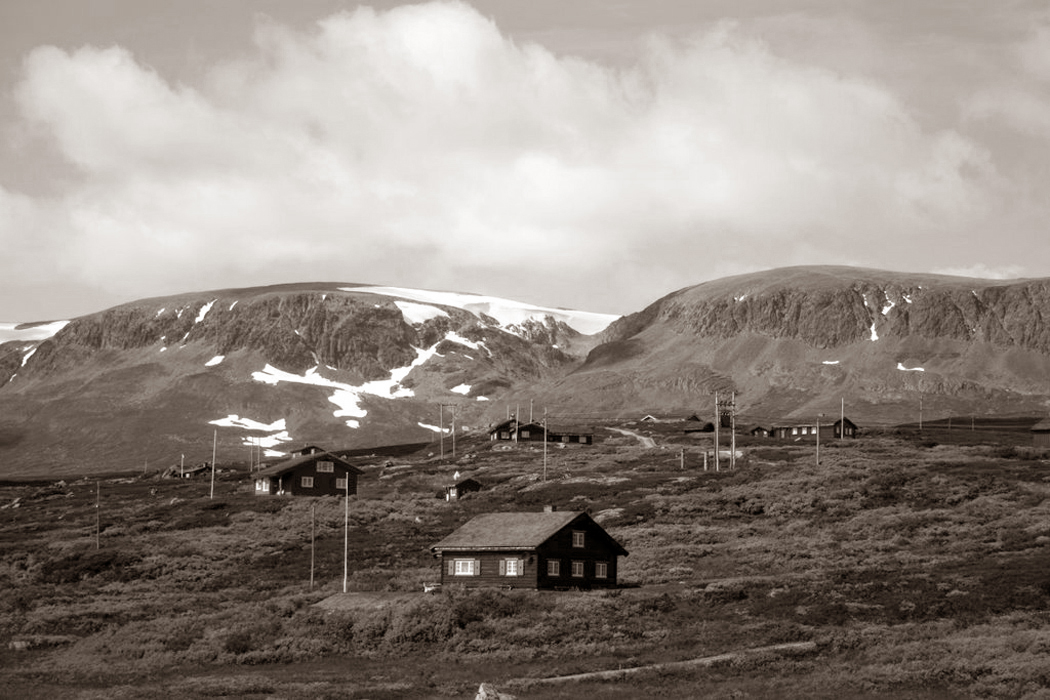
Collection of hytte, Hallingdal, Norway

Collection of hytte, Hallingdal, Norway

So any self-respecting urbanite owns a small hytte, or cabin, out in the wilderness where he repairs on holiday. In the summer, it is for relaxation and hiking. In winter, it is for skiing.

It was the summer when I visited Hallingdal, a long valley in the middle of the ”spoon” bowl of the country. I had been staying with relatives in Oslo, and they wanted to get away one week to the hytte and introduce me to the Nature.

Our first full day in Hallingdal, Astrid, who was 69, and her brother Einar, a year younger, got me out of bed early for a hike. Einar wore shorts, hiking boots and knee socks accessorized by an enthusiastic grin. He slung an old canvas haversack over his back. His brother-in-law, Lars, carried a woodsman’s bag full of kindling on his back. Astrid wore a wide-brim straw hat with a scarf to hold it down.

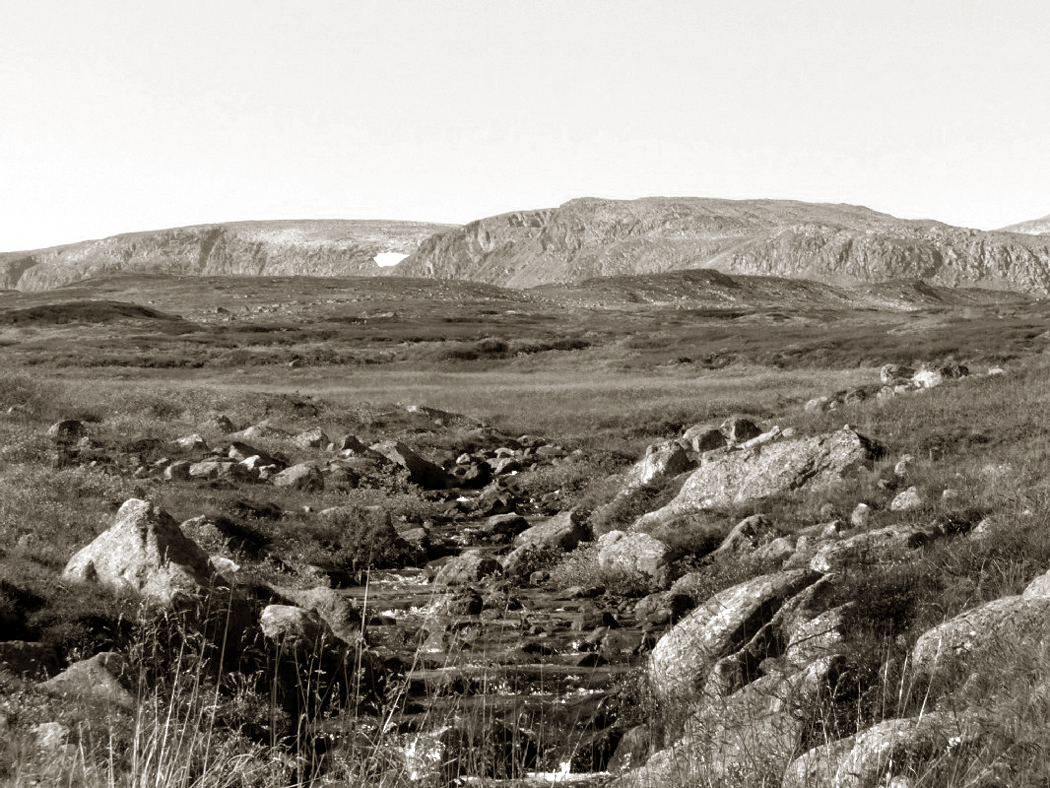
We walked a short ways down the hill, across the middle of the valley and then started climbing the Hallingskarvet, which is a 30-mile-long mountain range that runs like an inverted crescent moon along the south side of the valley. Hallingskarvet stream bw

The air was crisp, the hillsides green with spongy moss and curling grass, and the trail followed many small meltwater streams.

Most Americans have little idea just how far north Norway is on our globe. Just remember that Paris is as far north as Newfoundland. Hallingdal is as far north as Greenland. It is only 300 miles south of the Arctic Circle. That puts the tree line very low on the hillsides; it also puts a July dawn at about 2 a.m. and sunset near midnight. That low light makes the green all the more intense.

We climbed up granite cliffs and over plateaus marshy with meltwater. When we reached the highest point on the hike, we stopped for lunch. Lars unloaded the wood he’d been carrying, scrunched a few rocks together and built a fire on which he balanced his coffeepot.

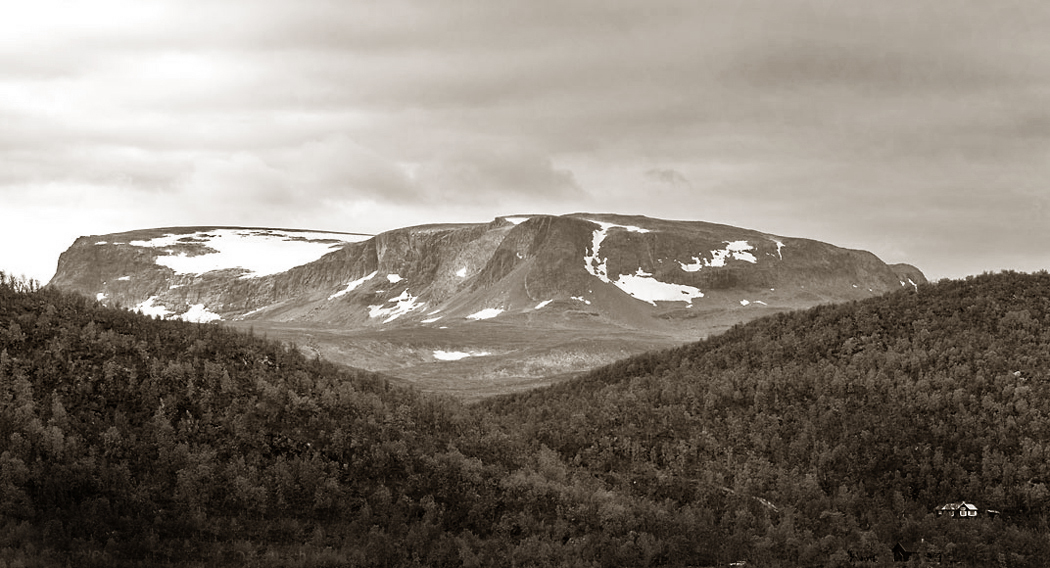
While the coffee water came to a boil, Einar sliced gjetost, or sweet, brown goat cheese, and loaded up the knekkebrod, which is the Norwegian version of Rye-Krisp. The view was stunning. On one side, below us, was the 10-mile-long lake, Strandevatn, and on the other side, the highest point in the Hallingskarvet, a 6,342-foot-high peak named Folarskardnuten, crisscrossed with snow and standing over its own valley like a blue eagle over its nest.

Folarskardnuten

Folarskardnuten

After the sandwiches and coffee, Einar pulled a few bottles of beer from his sack, and we finished off the lunch with a toast to the Nature.

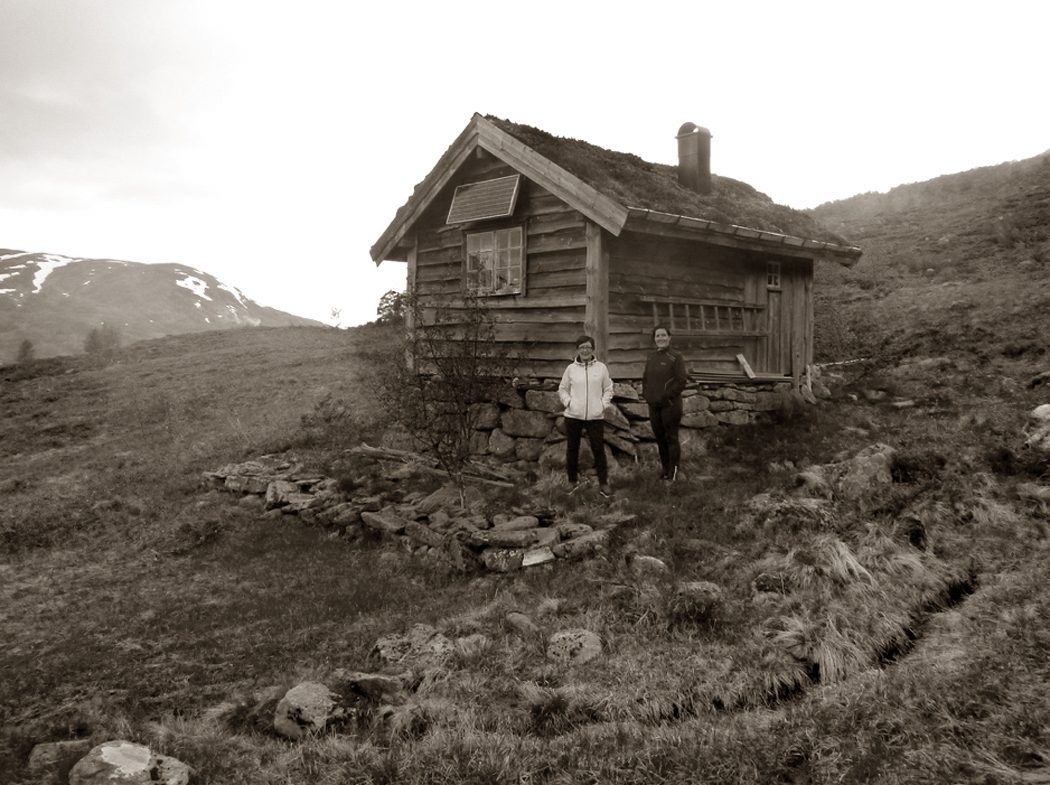
On the way down the mountain, we passed many seter, tiny summer farms that families use when they pasture their goat- and cowherds up on the mountains. The typical seter is made of logs or roughly sawn lumber, with a grass roof and a split-rail fence around the ”estate.” It couldn’t be more rustic.

Seter

Seter

In one was a newlywed bride whom Astrid knew. We stopped, knocked on the front door and were invited to enter. She was making romme, a Norwegian version of creme fraiche, and she gave us all some. In Norway, you never visit someone without making selskap, or company. And that always includes food. If there is no smorgasbord, there is always at least a bowl of fresh romme from a rosy-cheeked bride in a grass-thatched one-room farmhouse on a steep grassy mountainside with a view of the valley.

There must be something to this Nature. For every Norwegian I met was maniacally healthy.

Even senior-citizen Astrid, who hiked and climbed mountains like a Marine, put me to shame. On reaching the hytte, she glowed and said she couldn’t wait to begin skiing again next winter.

Father and Son

This is not news to America’s wives, but: Men hate change.

I don’t mean only a pocketful of pennies and dimes — fishing weights in the trousers — I mean that a man feels uncomfortable if his favorite easy chair has been moved for vacuuming and put back no more than an inch from its original spot. He will feel compelled to nudge it that last inch.

I mean that when a favorite shirt finally blows through at the elbows, he won’t throw it out, but will wear it on Saturdays, to the dismay of his wife and daughter; and when it is finally no more than strings of tattered fabric hanging from a collar, he will use it to polish the car.

And what is more, when he needs to replace a work shirt, he will find a carbon copy, preferably bought from the same store, even the same rack, as the first.

I mean that when an old TV goes on the fritz, a man will stand there holding the aerial in his hand, watching the Cubs through the snow, rather than go out and buy a new tube.

Guys who buy Fords trade them in on new Fords, guys who buy Chevys later buy more Chevys.

How many men do you know who try different hairstyles?

Most men I know settled on a hairdo in high school and have kept it until there was no hair left to do.

I’ve seen 50-year-old bald men who have gathered what fringe remains and greased it into a ducktail.

Sometimes this aversion to change is misread by wives as being laziness. And sometimes it may be, but by and large, a man doesn’t fix that creaky door because for him the creak has become a familiar part of the home, and he simply doesn’t want to change it.

The great example of this principle in literature is the story by Herman Melville, “I and my Chimney.” It is comic and depressing at the same time.

Its narrator stands guard against the constant plans for improvement his wife devises.

“Old myself, I take to oldness in things; for that cause mainly loving old Montague, and old cheese, and old wine; and eschewing young people, hot rolls, new books, and early potatoes and very fond of my old claw-footed chair … But she, out of the infatuate juvenility of hers, takes to nothing but newness; for that cause mainly, loving new cider in autumn, and in spring, as if she were own daughter of Nebuchadnezzar, fairly raving after all sorts of salads and spinages, and more particularly green cucumbers (though all the time nature rebukes such unsuitable young hankerings in so elderly a person, by never permitting such things to agree with her).”

The narrator’s fallback position, always, like the hero of Melville’s other story, “Bartleby, the Scrivener,” remains, “I would prefer not to.”

The basic instinct men have for what can be seen as monotony is a part of the way life is compartmentalized for them. For women, I often feel, life is all of a piece. Each part flows into the next, and women seem quite happy to think about or do several things at once.

Men are not that talented, and part of what has become an aversion to change is really just a man’s way of putting certain things on automatic pilot so he doesn’t have to think and act on them, so he can focus his attention on whatever he believes is important.

If one attacks life freshly and alertly each day, there are millions of decisions that will have to be made. A man feels overwhelmed by them. busy mom

So whatever can be decided by rote — the shirt, the socks, the route to work — is preset and unaltered, so that he can expend his energy creatively at the office.

So it is a matter of priorities. For mothers, what must be attended to is whatever minor emergencies present themselves, in whatever order they occur. The baby needs changing, the third-grader has skinned his knee, the teen-ager needs the car keys.

She cannot do as the man does and make a list of things in their order of importance, and address them in that order. Some men spend their whole lives on that list, rearranging it as new problems present themselves and never getting to the actual problems themselves.

Like many people, I used to think that gender differences are merely learned behaviors, but the older I get, the more I realize that the different wiring of men and women is more fundamental. If women are unhappy about the way men act, they shouldn’t immediately ask that men be different; you might as well ask that they have three arms instead of two.

It is more to the point to ask why they are as they are, whether tens of thousands of years ago on the veldt such behavior made a kind of genetic sense that in a 20th-century city is now obsolete.

Perhaps women as nurturers must keep their attention as widely spread as possible, so as not to miss the one kid headed for the pool while attending to the other’s bruised arm.

Men as protectors needed to focus their attention very narrowly, ignoring lesser commotions for the larger one of a preying lion or wolf.

At which point matching socks are kind of silly.

Nature

Jack Foley has ruined nature. Or at least, he’s ruined Naturejack foley

Foley, who died in 1967 at the age of 76, was a film editor at Universal Studios, where he developed the process of adding sound effects to movies in the editing stage.

You can see his name, turned eponymous, in the credits of any movie: The Foley artist is the one who matches the sounds to the action.

When you hear a dying thug breathe his last wheezy gasp, or a potential victim step on a squeaky floorboard or snap a twig underfoot, it is the Foley artist who put that sound there in post-production.

Which is fine for an Arnold Schwarzenegger movie, with its explosions and ammunition magazines being snapped into their Uzis with a click so solid even a Chevy ad has to smile with envy. But the Foley art is less helpful when PBS shows us row of ducks swimming in the Okefenokee. comic

Then the ducks always make a sound like a guy wiggling his fingers in a tub of tap water, with a microphone held a few inches away. It has ruined Nature, Wild America and every other filmed nature show on PBS or the Discovery Channel. duckling

The obviousness and artificiality of that wretched tinkle is for me like fingernails on a blackboard.

I know the reason for avoiding the real sounds of the real ducks: The camera, with its close-ups, can effectively edit out anything but the ducks; the microphone can’t edit. Along with the ducks, we will hear the ook-la-roo of the redwing, the overhead jet and perhaps even the whirring of the camera. It is too much aural information and can be confusing.

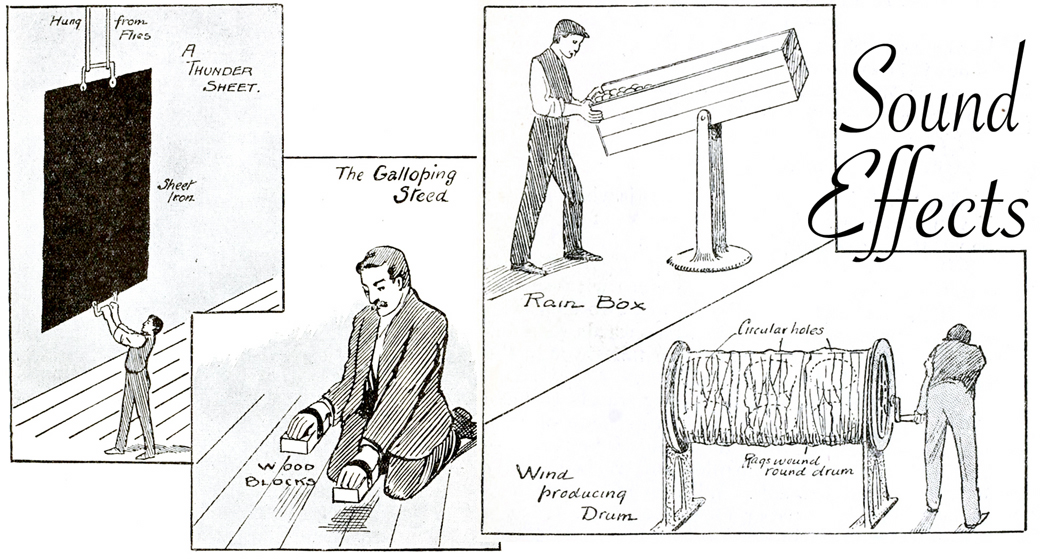
So standard procedure in nature films is to work with silent filmstock and add the sounds later. Some of these sounds are collected by technicians who tape the ducks when the blackbirds are momentarily quiet and match that sound to the film. But more commonly, sound is created by a group of sound-effects people, who work like they used to in radio days with crushed cellophane for fire and coconut halves for horses’ hooves. sound effects

Well, maybe they’re a little more sophisticated than that, but not by much.

If you want a good contrast, tune in to CBS’ Sunday Morning with Charles Osgood at about five minutes before the end on Sunday morning. Each week, it features a few minutes of nature, videotaped rather than filmed, and with the unedited sound of that moment in the wild.

You will hear not only the ducks, but the wind in the tree branches, the redwing, the grasses, occasional passing cars and airplanes, all balled up into one giant ambience.

It is the way it really sounds out there in the light of day.

After all, what we call nature is less the individual animals and plants than the interaction of the whole thing. Nature is context, if anything.

And that only underlines the basic problem, that for most Americans nature is something you see on a TV screen. Nature is a sideshow and entertainment. Cute little ducklings or sea otters vie for our attention with herds of wildebeest and salmon-fishing grizzlies. Gnu pack

Television nature, even shot in the wild, is just a technological zoo: Each animal is displayed in its own filmed cage. As with most of European culture, it is the fragments of the whole we understand best. The bigger picture eludes us.

But turn the TV off, get out of the city and then out of the car. Almost anyplace will do, it doesn’t have to be dramatic. You will hear and smell, as well as see, the great imbroglio that is nature.

It isn’t just that it is all interconnected, which it is. It isn’t just that the whole is complicated beyond comprehension, which it is.

The difference is that you are in it, a part of it. On TV, nature is something separate. TV is always behind glass.

Carole portrait

It is not unusual for my wife to finish my sentences. I used to find it slightly annoying, but after 30 years of marriage, I hardly notice it. When I do, I now find it comforting.

My wife and I have developed some kind of radio signal between us, and conversation can consist of little more than random adjectives and conjunctions:

”Do you . . .”

”OK, but then . . .”

”Of course, and I’ll . . .”

”Thursday.”

No one else knows the code.

It has happened that while watching television, she will turn toward me, and without saying anything, I will get up and take out the garbage.

Now, that’s true love.

Another time, the same gesture will empty the cat box. And neither of us will realize that no words were uttered.

I am not a believer in ESP, but this phenomenon has reinforced for me a belief that marriage is a kind of magic. A magic that grows perfect through practice.

For too many young people, marriage is seen as merely an extension of dating, only for a very long time and with only one person. Put that way, it hardly sounds enticing. An endless job interview.

For many others, especially for younger women sensitized to the very real sins of the patriarchy, there is grave suspicion of the whole notion of giving yourself up for the other, which is seen as the effacing of individuality. This suspicion prevents the kind of surrender that makes a good marriage.

It is no wonder the divorce rate is stratospheric.

It is a hard lesson to learn: To lose yourself is to find yourself.

It isn’t for the wife to be subservient to the husband, but for each to surrender to the other: This is the equality of marriage.

The problem is that at some level we are unwilling to admit to ourselves that we are incomplete. Feminism, on one side, has taught that a woman should not be dependent on a man. And men are taught never to be dependent on anyone. We suffer as islands.

And all around me, I see these self-sufficient people looking for love in a mirror. They look for someone who shares their interests, beliefs, personality quirks and housekeeping habits. In short, they look for themselves with different plumbing.

And when they get what they are looking for, they find it is no more than they already possess. Boredom and disappointment are unavoidable.

Magic happens when you find your opposite, not your clone.

It is a plus and minus charge that makes a nuclear family. The yin and yang of opposition.

We admit this when we say, ”Opposites attract,” but deny it when we say, ”Birds of a feather flock together.” Flocking is fine for guys sitting at a bar watching a ballgame and pulling for the same team. But marriage is more than a brew and a point spread.

In Plato’s Symposium, the comic playwright Aristophanes explains that human beings were once round with four arms and four legs, but that an angry Zeus split them in half. Love, he says, is each half’s desire to find its missing opposite.

This is a nice tale but only part of the story. The reality isn’t quite that static. Finding your other half isn’t the conclusion of love, but the beginning of a long process of growth, and it is change and growth that keep the marriage vital.

When we make mates of our opposites, they can prod us on to new things and deeper understandings. It keeps life fresh, challenging and intense.

That ”ripening” is the core of the magic in marriage.

Which is why I always advise people not to look for someone who always agrees with them, but to find a ”worthy opponent.”

Which is what my wife is to me. She has a personality strong enough to withstand mine. When I press, there is resistance.

If I try to get away with something, if I try to do less than my best, she is there as my conscience, prodding me to be better.

If I carelessly do something that might hurt someone’s feelings, she is there to make me less careless.

We have had some great fights, but they were never pointless. They always led somewhere. Neither of us wins these arguments, because we both learn from them.

The perfect coat of arms for marriage is an apple surrounded by the words ”Eros” and ”Eris.” These are the Greek deities of erotic love and discord. The two make a lovely couple.

I am loud, she is soft-spoken.

I tend to think things through analytically. My wife is more intuitive.

While I think straightforward, my wife thinks sideways. Together, we create a waltz.

This is my valentine to her.

2001 Smeslov meeting

It sounded like a great idea. ”We’re having a movie party. Not whole movies, just scenes. Bring a few DVDs over and we’ll fast-forward to your favorite scenes.”

You can learn a lot about people from what they choose. We watched everything from Steve Martin singing about pain and dentistry to Max von Sydow playing chess with death. BERGMAN BOGART

There are a lot of familiar scenes. They are almost the soundtrack to American lives: ”It doesn’t take much to see that the problems of three little people don’t amount to a hill of beans in this crazy world.”

Or, ”I coulda had class. I coulda been a contender. I coulda been somebody. Instead of a bum, which is what I am.”

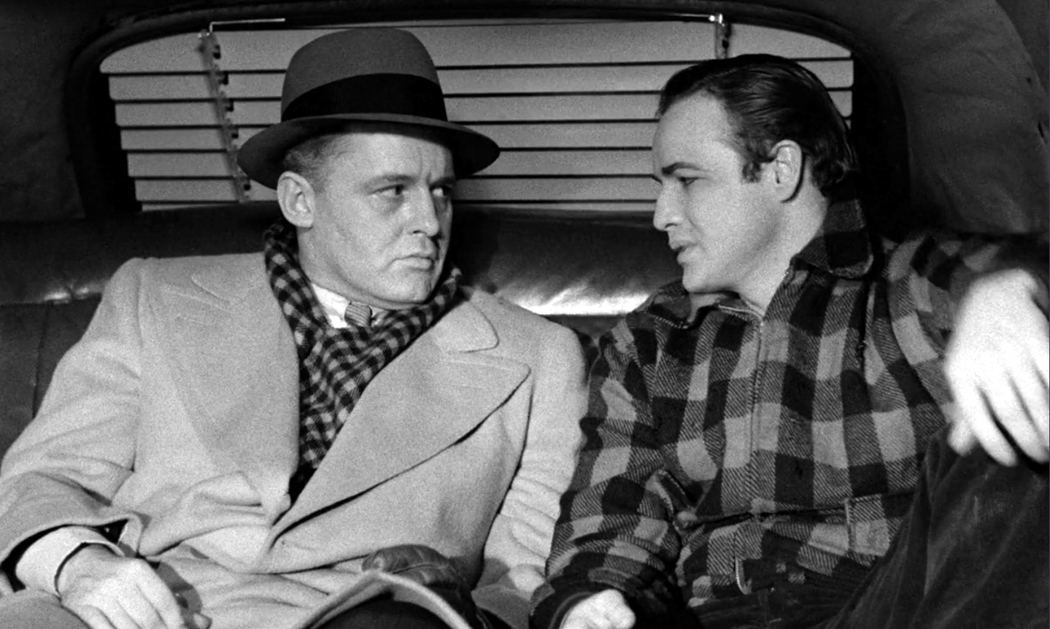
But two scenes had the profoundest effect on me. Totally opposite in effect and both brilliant. And seeing them together made an important point about movies, art and life. brando back seat

In The Third Man (1949), Orson Welles has been selling tainted penicillin on the black market in postwar Vienna. As a fugitive, he meets his American friend Joseph Cotten in an amusement park. As they ride the huge Ferris wheel above the city, Cotten asks disgustedly, ”Have you ever seen any of your victims?” third man welles

”Victims? You’re being melodramatic,” Welles replies. They look down at the antlike people below them on the ground. ”Tell me, would you really feel any pity if one of those dots stopped moving forever? If I offered you 20,000 Pounds for every dot that stopped, would you really, old man, tell me to keep my money? Or would you calculate how many dots you could afford to spend? Free of income tax.”

When they descend to earth, Welles rationalizes, with a con man’s glint in his eyes: ”After all, it’s not that awful. You know what the fellow says: ‘In Italy for 30 years under the Borgias, they had warfare, terror, murder and bloodshed. But they produced Michelangelo, Leonardo da Vinci and the Renaissance. In Switzerland, they had brotherly love, 500 years of democracy and peace and what did that produce? The cuckoo clock.’ ”

It is a wonderful scene. Visually, it is stunning, with the city turned into a stark black-and-white toy below them. Verbally, it is stark, pithy writing.

But no one speaks that persuasively in real life. Writers do that; they have the time to. All those witty retorts that come to you as you descend the stairs are used by the writer as if they occurred during the conversation.

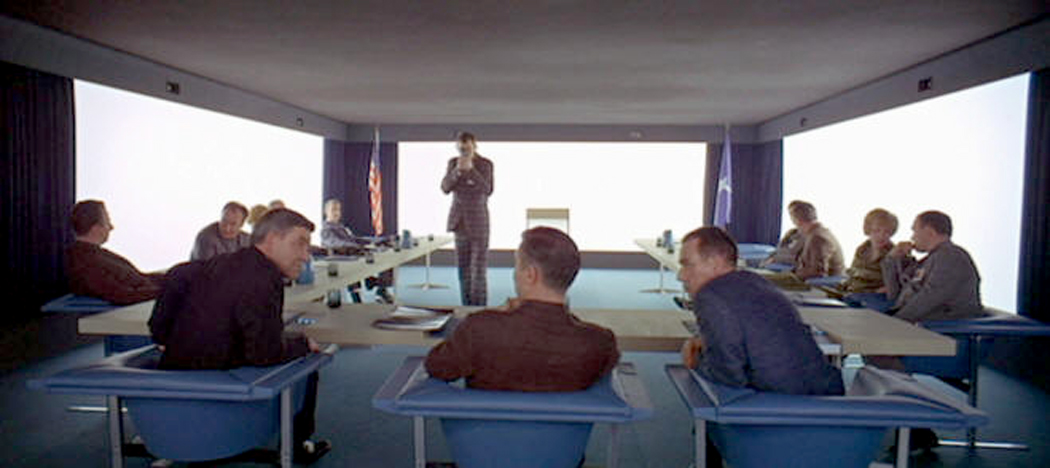
But in Stanley Kubrick’s 2001: A Space Odyssey (1968), there is an odd intrusion of real life, clabbering in its banality. 2001 council room

Government bureaucrat Dr. Heywood Floyd visits the moon to speak to other bureaucrats. He is introduced: ”I know you’ll all want to join with me in welcoming our distinguished friend and colleague from the National Council of Astronautics, Dr. Heywood Floyd. Now, Dr. Floyd has come up specially to Clavius to be with us today, and before the briefing, I know he would like to have a few words with you. Dr Floyd?”

The words are flat and empty.

”Thank you, Dr. Halvorsen. Hi, everybody. Nice to be back with you. Well . . . first of all, I bring a personal message from Dr. Howell. . .” And he continues with this palaver for some minutes, ending with, ”The purpose of my visit here is to gather additional facts and opinions on the situation and to prepare a report to council recommending when and how the news should eventually be announced.”

John Kerry could have said those words. There are a few forced laughs, a lot of awkward silences and polite applause at the end of the speech, as if Floyd had said something worth hearing.

It is a scene that most people snooze through, just as the bureaucrats would in real life. But it and all the ”intense inane” of the first three-quarters of the film set up the splendor of the final psychedelic trip with its light show and surrealism.

It took guts on the part of Kubrick to play up that banality, to insert real life into an art form normally spruced up for its audience with witty rejoinders and double entendres.

And great art to be so artless.

adam and eve

OK, so then what is the “canon,” with which we should all be familiar?

There are scores of lists, put forth by scores of people, ranging from insightful critics to close-minded boobs (Yes, Bill Bennett, I’m talking about you). Such lists usually share the usual suspects: Here’s Hamlet, there’s War and Peace, and over there is the Recherche of Marcel Proust. All of them worthy of your deepest attention and capable of inciting the most delightful pleasure.

But as I’ve written before, the purpose of engaging with the canon of Western culture is to understand who your grandparents were, whose cultural DNA you were born to — the common inheritance of all of us in the modern world, our Adams and Eves.

Through most of my youth and into my adult life, my version of the list has grown and grown. I have, after all, at least 50 films on my Top Ten list. I could not do without hundreds of books I have read, paintings I have seen in the flesh, music I know by heart.

But, as I have grown old, I have jettisoned more and more baggage. “Simplify, simplify,” Thoreau said. I’ve given away books, CDs, DVDs. I’m tempted to dump even more. Those that were important, I have internalized; those I want to keep are those I reread and reread.

Under even those, however, is a foundation level, the cultural footings on which I have built my intellectual life, and that the civilization I have inherited was founded upon, almost as its Constitution.

So, I am proposing a canon. A very short one, but an essential one.

First, there is Homer. Everyone should have read the Iliad, at least. The Odyssey is initially more fun — or at least the chapters that chronicle the wanderings of Odysseus — but the Iliad is one of the founding documents of Western civilization and provides a necessary backdrop for everything that has come since.

I reread the Iliad about once a year. I try different translations, because any bit of ancient Greek I used to study has evaporated. The newest translations are usually the best, not because they are more literary, but because they speak the language I use. Older translations sniff of their age, smelling of linsey-woolsey or gaberdeen. I can sense the antimacassar oil on the Lang-Leaf-Myers translation. I sense the Cold War in the Lattimore.

So, the Robert Fagles translation is my standard, although the most recent re-read was in the even newer Stephen Mitchell version.

In Homer, you find the myths that have been re-used and re-energized in all the books written since, that outline the archetypes, give us the parameters of story and narration. The scope of Homer is the widest: from the bee’s tongue to the planet’s motions among the stars.

This is all beside the wonderful enjoyment gotten from reading it, 2500 years after he (or she) set it down.

The second book in my canon is the Bible. Not for any religious reason; I’m completely an atheist and have no use for religion. But the Bible is, like Homer, one of the founding documents and underlies all that has followed. I may wish otherwise, and may often wonder if the Bible wasn’t really authored by a group of people who have spent too long out under the desert sun. It may have been written by white bearded patriarchs under the influence of sunstroke, but they are our grizzled patriarchs.

There are two important considerations when approaching the Bible.

The first is the translation. The King James version is the primary one, and it is the organ-pipe tones of the KJV that underpin our own ideas of language, of majesty, of ritual and solemnity. It is the KJV you hear behind the sentences of Melville and Thoreau, behind the speeches of Martin Luther King.

But the King James is also miserably out-of-date, with usages that are no longer current and oftentimes either misleading or downright incomprehensible. So, a more modern translation may make the stories of the Bible easier to assimilate.

Even so, I prefer mixing the King James and a modern translation with an interlinnear word-for-word translation that demonstrates how much any translation of the Bible is de facto an interpretation. I have valued greatly the Everett Fox version of The Five Books of Moses from the Schocken Bible. Any version of the Hebrew and Christian Bibles is a moving target.

The second thing is that you should read the whole Bible, not just the familiar parts. Some of it is heavy slogging, but you should have read the whole thing. It’s one of the best ways to counteract the baleful influence of all those fundamentalists that would have you believe only their way. You see how they pick and choose only the parts they want and that reinforce their prejudices. You will be astonished at how many things are held to be “an abomination.” You will scratch your head over most of them.

The Bible stories are the Semitic balance to the Hellenic myths and between the two, they are the parents of all that followed.

Finally, in my canon, are the plays and sonnets of William Shakespeare. Ideally, one should see them on stage, in an excellent production (since a mediocre production can be the kiss of death for someone whose language is a florid and baroque as Shakespeare’s), but the fact is that it is as text on a page that Shakespeare has most influenced the course of Western Civ. We read Hamlet, Lear, Othello, and their words continue to astonish the attentive reader with their fire, their brilliance, their wit, and their expansiveness. The “sirrahs” and “prithees” may certainly feel dated, but everything else is bursting with life.

It was after a long-ago divorce that I first decided that if I was going off into exile, I needed to pack only three books: The Iliad, the Bible and a complete Shakespeare, and that somehow, if the world were destroyed all around me, I could resurrect an entire civilization with just these three.

And we would see everything that followed.

"Michael Jackson and Bubbles" by Jeff Koons, and Elgin Marbles figure

“Michael Jackson and Bubbles” by Jeff Koons, and Elgin Marbles figure

In 1632, the young English poet John Milton, just out of college, took up residence at his father’s country estate at Horton, near Windsor. And for the next six years he managed to read everything that had ever been written and was extant, in all languages living and dead, that a European scholar of the time might have heard of. That included literature, history, biography, philosophy, science, mathematics — the whole throatful of it. milton cigar

Everything that had ever been written.

It boggles the mind. Today, we cannot even keep up with the magazines we subscribe to; most of human knowledge falls off the edge of the Earth, where the map of our erudition shows nothing but serpents. reading the oed
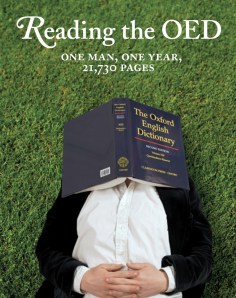
We can never achieve what Milton did; it’s foolish to even try. But shouldn’t we attempt at least some sketch of what was fully painted for the poet? There have been recent books by writers who have read every article in the Encyclopedia Britannica (The Know-It-All, One Man’s Humble Quest to Become the Smartest Person in the World, A.J. Jacobs, 2004), The Oxford English Dictionary (Reading the OED: One Man, One Year, 21,730 Pages, Ammon Shea, 2008), or the equivalent of the Harvard Five-Foot Shelf (Great Books, David Denby, 1996), but such ventures are little more than stunts.

To absorb 5,000 years of human culture requires more than memorizing almanacs or dictionaries. It means to have a grounding in the art, literature, theater, music and architecture of our ancestors.

Of course, most of human knowledge, at least in ordinary life, in mass or pop culture and in our individual autobiographies is utterly trivial, and it would be a crime to stuff our brains with it.

But not all knowledge in this information age is trivial. There is still a core of useful literature — and I use the word in the broadest possible sense — that it behooves us to be acquainted with.

It is unfortunate that there is an argument over this. In the imbecilic culture wars that currently ravage the intellectual countryside, the lines are drawn between ignorant armies.

On one side, you find right-wing reactionary fossils fighting to maintain the canon of mainly European classics. On the other side, there is a cadre of victimization that wants to eliminate anything written by dead white males.

A pox on both their houses.

Milton didn’t have to worry about the canon. For him, the canon encompassed everything he could possible encounter.

Since that time, though, we have had to become more selective. Those items we have, as a culture, thought worth perpetuating we have called ”classics” and added them to the list — the canon — of ”required reading.”

But we misunderstand the very idea of culture if we believe the world froze solid with the publication of the Harvard Five Foot Shelf.

Corneille

Corneille

The canon is a garden that must be weeded and tended, and each season may call forth a different harvest.

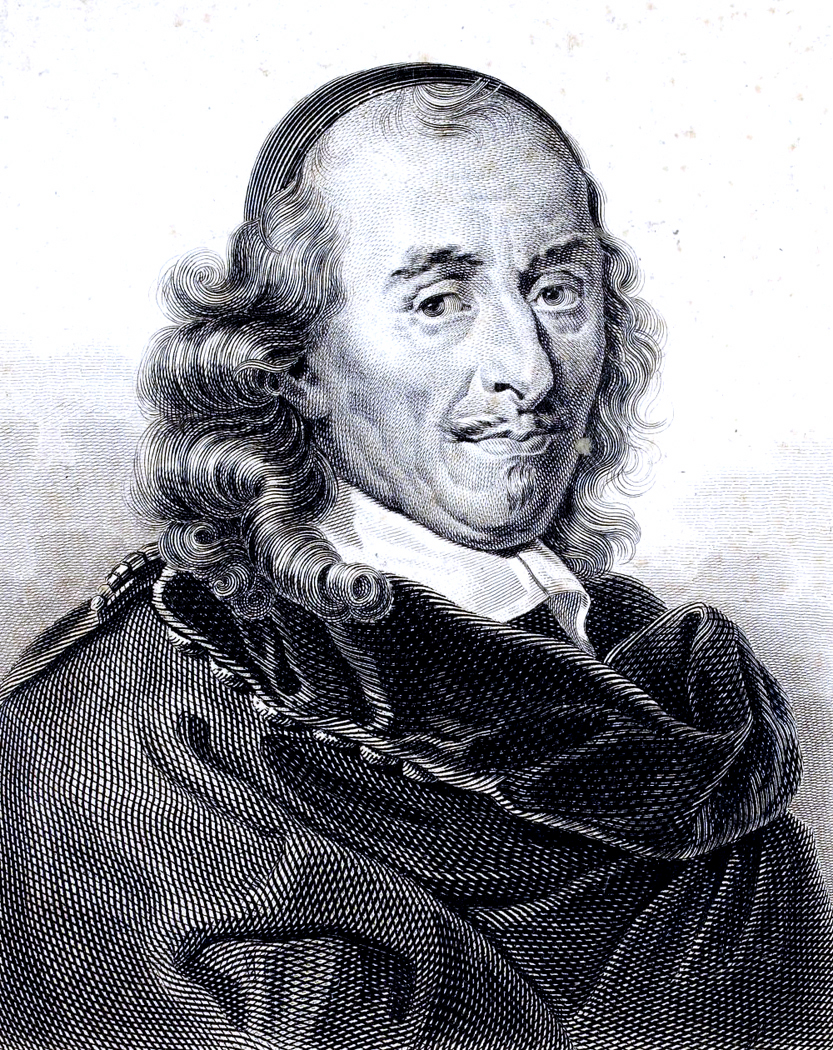
The problem with the conservative view is that it values a former ”golden age” that our own time never measures up to. It is a sentimental view of life and history, and deaf to the fact that we live now, not in the imaginary ”then.” It is the voice of Cato, of Corneille, of William Bennett — a man of whom it is said he cannot sleep a-nights if he suspects someone, somewhere is having fun.

It is a view of an idealized perfection that we have disastrously fallen short of. It is one form of imbecility.

The problem from the other side is an egalitarianism that is just as moronic. According to them, nothing is better than anything else. Either it is merely a question of personal taste, or it is one of cultural identity.

By their standards, it is elitist to prefer Pablo Neruda to Rod McKuen. Let them, I say, let them renew their subscriptions to Us magazine.

They can deconstruct its gossip to death and find the parallels with Plutarch — if they only knew who Plutarch was.

To consider one “text” more important than another, for them, is to promote colonialism and the subjugation of the downtrodden.

Hence, they judge not by esthetic considerations — it’s all just personal taste to them — but rather by politics.

For them, politics overwhelms aesthetics — overwhelms reason, emotion, common sense and experience. For them, everything has a party line. Ah, but they forget, politics answers no question worth asking.

It also worries me that behind the masks of intellectual argument, I sense a fascism on each side — at the very least a certain priggishness to both sides that any reasonable human finds dangerous.

At bottom, the problem is that both sides make the mistake of believing the canon immutable and fixed. They see the canon as an end, one side blindly despising it and the other defending it like Texans at the Alamo.

But the canon, properly seen, is a beginning, not an end; a foundation, not a roof.

It is the ABC of cultural literacy, the cardinal numbers of thought.

One used to hear the warning that when you have sex, you are having sex with everyone your partner has ever slept with. Well, when you read a book, you are also reading everything that the author read. When you hear music, you also hear everything that composer heard.

Culture is the slow accumulation of thoughts and habits. To read Melville is to hear the diapason of King James under the rich melody of the prose. Every author is the product of multiplier and multiplicand: the writer’s imagination and the long road of history leading to his standing on the curb with his thumb out.

The fact is, we cannot read everything, the way Milton did. We must be more selective. Suggestions for that selective offering is what we call the canon. But it changes constantly: It now includes James Baldwin and Toni Morrison; it includes Derek Wolcott and Yukio Mishima;  The Beatles and Duke Ellington.

The Laocoon

The Laocoon

How can you understand Jacques Derrida without standing firmly on the firm ground of Kant’s a priori? How can you read Isabel Allende without sensing the spirituality of Calderon behind her words?

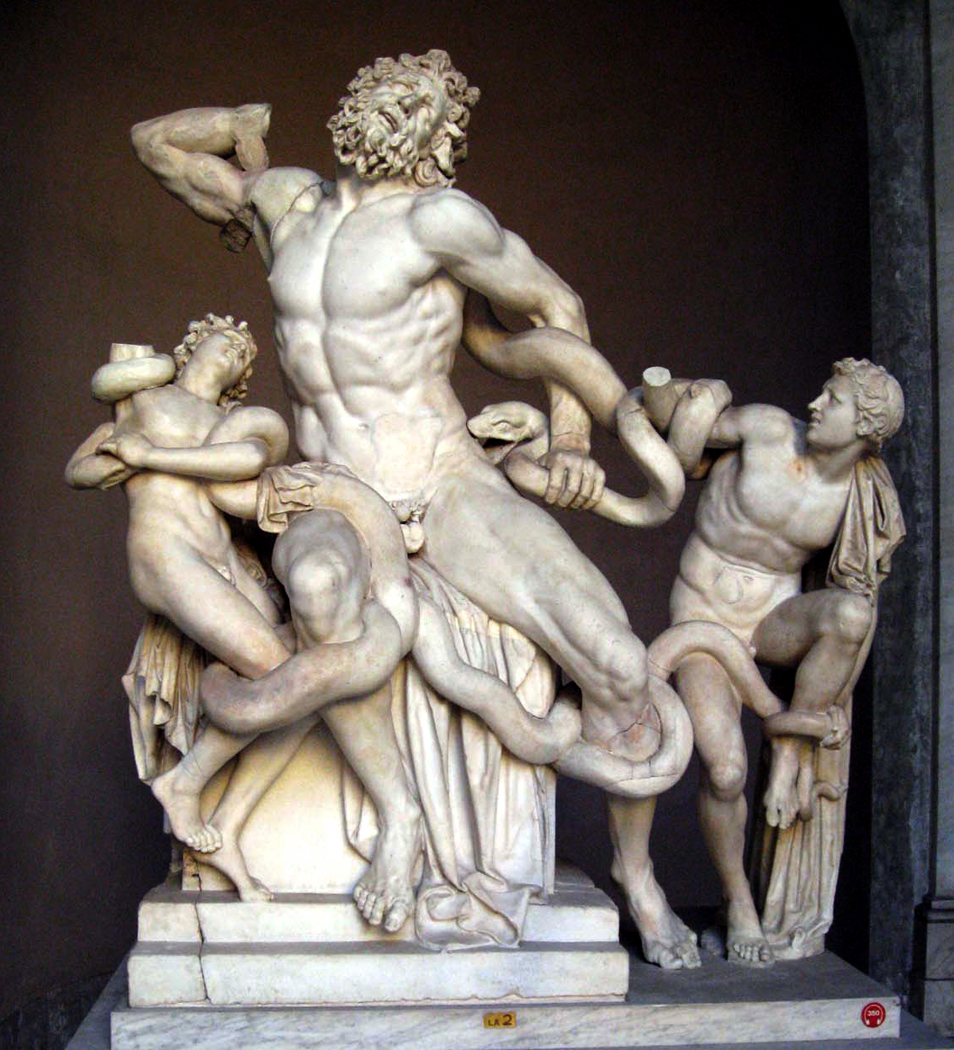
How can you understand Jeff Koons’ Michael Jackson and Bubbles if you don’t already have the Elgin Marbles in your system? You can’t. How can you get the joke on the back of countless Yellow Pages if you don’t know the Laocoon?

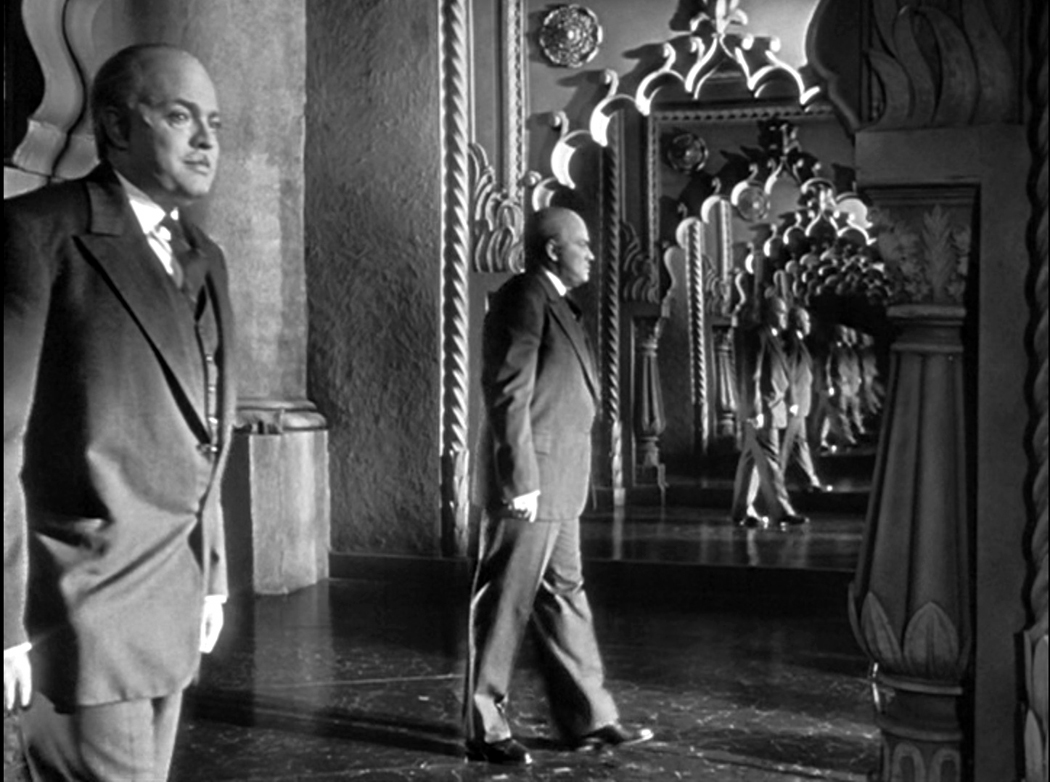
Certainly, the old rationale for learnedness remains: These are great writers, profound thinkers and brilliant painters and sculptors and we cannot consider ourselves educated without their acquaintance. Knowing them is its own excuse. But even more important is that when you hear the echoes in a piece of art, see its ancestry, the piece resonates. Resonance is what gives art and literature is power. kane

Like the mirror scene in Citizen Kane, one man is multiplied into an army. Like Isaac Newton said, if we see further, it is because we stand on the shoulders of giants. It is a wise man who knows his parents.