huck finn modern book cover

“All modern American literature comes from one book by Mark Twain called Huckleberry Finn,” Ernest Hemingway wrote. mark twain

In that book, nearly every theme that identifies our art as American is established and explored: migration, race, individualism, anti-intellectualism, optimism, religion, social climbing, moneygrubbing and the comfortable informality that marks us as a people.

It’s as if Huck Finn were the instruction manual for how to be American. In that, Twain is just as clearly American as Debussy is French or Basho is Japanese. john smith We often look to our art for clues to national identity. But although Twain gives us Americanness in concentrated form, most of the arts made on this continent, from Capt. John Smith’s General History of Virginia (1624) and Anne Bradstreet’s poetry, all the way up to this week’s latest rap song, partake in certain common traits.

What are they? First, we need to eliminate some of the things we like to think are particularly American, such as patriotism or respect for family. Every culture feels these qualities are particularly their own, but in fact, they are universal.

Even such negatives as bigotry and racism have their American coloration, but they are evils found in every culture.

It needs to be noted, too, that what we admire in ourselves is not necessarily admired elsewhere. Americans are direct, which others often see as rude. We are informal, which others translate as slobbishness. We are optimistic, which can be taken as arrogance. We believe in individualism, which others see as selfishness. But there are six things that we can see as particularly American: migration, individualism, optimism, religiosity, informality and expansiveness. source_28

Migration

The one thing all Americans share is that we are immigrants.

Even Native Americans, although they hate to think so, came here from somewhere else, whether it is across an Arctic land bridge or up through a sipapu.

It is the parent fact that gives birth to all our other traits. jumping a freight Even after our ancestors came here from far shores, we have never ceased from peregrinating. First we moved West, populating the great wilderness.

Now, we move away from home to college or career, and find our parents retired to Florida and our siblings spread across four time zones.

To Europeans or Asians whose families have lived in the same villages for centuries, we must seem utterly rootless.

So it can hardly be surprising that the central metaphor of Huck Finn is a journey: The book is many things, from its hero’s double negatives and “ain’ts” to his climactic choice to follow his instinct instead of his schooling about runaway slave Jim, but first and foremost, it’s a “road book,” marking the peripatetic nature of American life.

Much of our art reflects this continuous travel. From the moment we arrived on the Atlantic Coast we began moving west. As art, The Godfather speaks of the immigrant experience, but so does every B Western ever filmed.

All the other traits we think of as American ultimately owe their birth to this constant moving: It gives birth to our self-reliance, our willingness to risk tomorrow on faith, and our freedom from many of the cultural straitjackets found back in the Old Country. It’s all there in the art. All either necessary for immigration or fostered by it. high noon

Individualism

Make that “rugged individualism.”

We trust our own instincts, like Huck Finn, rather then the wisdom of the group. We are Mr. Smith in Washington, Gary Cooper at high noon, Ellen Ripley blasting aliens.

The single most potent distillation of this individualism can be found in John Wayne, love him or despise him. But Wayne didn’t spring up ex nihilo; rather, he grew from the soil: He was originally Natty Bumppo, or Hawkeye, from James Fenimore Cooper’s Leatherstocking Tales: self-reliant, unschooled but wise and practical, with an unshaken faith in his own code of behavior. He’s Walt Disney’s Davey Crockett saying, “Make sure you’re right, then go ahead,” which is just a pop culture simplification of Henry Thoreau’s Civil Disobedience.

Sometimes it’s shocking to realize how of a piece our cultural heritage is. davy crockett march

The flip side of individualism is our tendency to isolationism: “Good fences make good neighbors,” as Robert Frost ironically wrote. Going it alone is usually seen as a virtue.

The downside of this self-reliance is our anti-intellectualism. We trust our own ignorance more than someone else’s knowledge. This is nothing new: It’s why Andrew Jackson was elected president. It’s Huck Finn fearing to be “sivilized” by his Aunt Sally. It’s why one of the most powerful political factions of the 19th century was called the “Know-Nothings.”

It’s a trait of national identity that we should never misunderestimate. oklahoma!

Optimism

Against all reason and the evidence of history, Americans believe they can do anything. It is our “can-do” attitude, and you find it in the barking joy of Walt Whitman’s poetry and the songs of Oklahoma!Doris Day

To others in the world, this makes us look naive and foolish; fatalism is not part of our makeup.

Which is why America is home to pop psychology and Doris Day. As a corollary, for Americans, the future only holds a better world. “Tomorrow, tomorrow,” Annie sings. “Make it new,” said poet Ezra Pound, and although he was speaking of literature, he could just as well have been speaking of Thomas Edison, the Chrysler Building or Elvis Presley.

Take what you’re given and do something new with it. Never accept the past as the final word. billy sunday preaching

Religion

Many peoples are religious, but in America, religion is something else.

From the utopian religious communities of the 19th century to today’s fundamentalism, there is a glint of zealotry in American spirituality. Elmer Gantry would not be thinkable in France.

We have gone through at least four “Great Awakenings,” in which we rediscover the old-time religion and the narrow virtues of belief. rev whitefield

It was, after all, religion that founded this country, whether it is Congregationalists in New England, Quakers in Pennsylvania, Roman Catholics in Maryland. Each of them came here for religious freedom, although they were perfectly willing to oppress any religion not their own.

The separation of church and state in our Constitution is there not because we were an agnostic nation, but because everyone was so nuts on the subject and we wanted to keep from each others’ throats.

You hear the religion in the symphonic music of Charles Ives and in Negro spirituals. It echoes in Moby-Dick, and even the window behind the dour couple in Grant Wood’s American Gothic. leaves of grass frontispiece

Informality

“I lean and loaf at my ease, observing a spear of summer grass,” Whitman writes in a poem of expansive informality, turning his back on the formal expression of European art: No villanelles for Americans, no Rime Royal.

In Europe, you have Oedipus, in America, Stanley Kowalski.stanley kowalski Mark Twain wrote Huckleberry Finn in colloquial American English and even put a note about it at the beginning of the book. Take that, Henry James!

“Whatever is not of the street,” wrote novelist Henry Miller, “is false, derived, that is to say, literature.” And he wasn’t using the word as a compliment.

You can see it in the portrait of Whitman at the front of his book, Leaves of Grass: There he is, sleeves rolled back, collar unbuttoned, hips shifted comfortably, hat at a rakish angle. You could never imagine Tennyson like that. manifest destiny gast

Expansiveness

Everything in America is supersized, whether it’s fast food or our landscape.

In America, bigger is better: We drive SUVs and watch blockbuster movies. It’s a Texas mentality. Star Wars isn’t big enough; we need a director’s cut, added scenes, a DVD packed with extras. A movie isn’t a success unless it makes $200 million. And the TVs on which we watch those DVDs continue to grow; soon they’ll cover our living room walls. larry hagman with cash

One Marilyn Monroe isn’t enough; Warhol must print her by the dozens, just as Babe Ruth must eat hot dogs by the score.

The tall tale is our national mythology, from Paul Bunyan to Jim Carrey’s face.

Of course, how could it be otherwise with the Rocky Mountains, the Grand Canyon and the Great Plains? Our very landscape calls out for grandiosity and grandiloquence. Over the top is America’s starting line, and the next frontier is our constant goal.

OH, AND AMERICANS LOVE LISTS:

Most-American Americans

John_Wayne - overland stage raidersJohn Wayne: Love him or hate him, we can’t think of him as merely an actor. He has become an icon, the movie roles and the man bound into one, indivisible: the lone, laconic hero, man of action rather than words, graceful and bullying in turns.

4 more:

Louis Armstrong: American as soul.

Eleanor Roosevelt: American as do-gooder.

Babe Ruth: American as appetite.

Thomas Edison: American as inventor.

Most American Movies godfather

The Godfather Saga, Francis Ford Coppola, 1977: The conflated version of the first two Godfather films tells the immigrant experience writ large: family, business, love, loyalty, betrayal and the move west, told with the force and mythology of opera.

4 more:

The Man Who Shot Liberty Valance, John Ford, 1962: “When the legend becomes fact, print the legend.”

Star Wars, George Lucas, 1977: Good vs. evil supersized.

Gone With the Wind, David O. Selznick, 1939: History whitewashed.

Do the Right Thing, Spike Lee, 1989: Race will not go away.

American Contributions to global culture constitution go

The Constitution: Our “governmental instruction manual” has become a model for the world, and its first 10 amendments have become the guiding principles of many an emerging nation. It’s more than merely political, it’s at the center of our culture, and the one thing the world really does want from us.

4 more:

Jazz: From which all popular music ultimately derives.

Hollywood: America’s secret plan for world domination.

Technology: The physical evidence of the can-do spirit.

Coca-Cola: Las aguas negras del imperialismo.

Most American Novels

huck finn book coverHuckleberry Finn, Mark Twain: The Great American Novel, filled with everything, good and bad, about ourselves: race, individualism, anti-intellectualism, optimism, religion, social climbing, moneygrubbing and our comfortable informality.

4 more:

On the Road, Jack Kerouac: An essential national theme takes center stage.

Beloved, Toni Morrison: The evils of slavery haunt even the freed.

The Leatherstocking Tales, James Fenimore Cooper: The invention of John Wayne.

The Great Gatsby, F. Scott Fitzgerald: Money, glamour, celebrity and loss.

Most American Plays angels in america

Angels in America, Tony Kushner: The hugely ambitious “Gay Fantasia on National Themes,” takes on more American themes than anything since Huck Finn: politics, sex, generations, religious revelation, Reaganism, bigotry and forgiveness; so expansive a single night can’t hold it.

4 more:

Death of a Salesman, Arthur Miller: The underside of the American dream.

Oklahoma!, Rodgers and Hammerstein: Gushy, American cornpone classic.

Streetcar Named Desire, Tennessee Williams: Torn T-shirts and sweaty thighs.

Fences, August Wilson: Black view from Pisgah.

American Classical-music compositions

ives album coverThree Places in New England, Charles Ives: The crusty New England composer reinvents classical music to make it more American: loud, brash, nostalgic and patriotic at turns, and finds its subject in landscape and history.

4 more:

Rhapsody in Blue, George Gershwin: Jazz, Tin Pan Alley, Chopin and Carnegie Hall.

Appalachian Spring, Aaron Copland: Shaker hymn goes mainstream.

Symphony No. 3, Roy Harris: The type of the American symphony.

New World Symphony, Antonin Dvorak: Is the Most American Symphony written by a Czech?

American Architecture

monticello stampMonticello, Thomas Jefferson: Just as equivocal as its owner and designer, this icon from the back of the common nickel is both paean to Europe’s classical past and the American’s love of invention, gimmickry and nature: Palladian windows and a moose head.

4 more:

Chrysler Building: American industrial dynamism with grace.

Sleeping Beauty Castle at Disneyland: Architecture as play-pretend.

Fenway Park: So cranky we actually love it.

Falling Water, Frank Lloyd Wright: Built over a waterfall like a diving board.

American Poems

Whitman at 50Song of Myself, Walt Whitman: The “good gray poet” could not have arisen anywhere else; he is completely American, from his deification of democracy to his catalogs of diversity to his “I sound my barbaric yawp over the roofs of the world.”

4 more:

Song of Hiawatha, Henry Wadsworth Longfellow: Closest thing we have to a national epic poem.

Poems, Emily Dickenson: Nothing more American than her quirky New England eccentricity.

Howl, Allen Ginsberg: “Visions! omens! hallucinations! miracles! ecstasies! gone down the American river!”

Mending Wall, Robert Frost: “Good fences make good neighbors.”

American Visual arts

American gothicAmerican Gothic, Grant Wood: This iconic painting is more enigmatic than the Mona Lisa: encomium of hardcore American values or satire of Midwestern provincialism? Conservative or avant-garde? He’s not telling.

4 more:

Watson and the Shark, John Singleton Copley: Art ripped from the headlines, circa 1777.

Marilyn Monroe multiple, Andy Warhol: If one is good, a dozen must be better.

Dogs Playing Poker series, Cassius Marcellus Coolidge: Now, that’s OTT!

Freedom From Want, Norman Rockwell: Turkey, potatoes and lots of corn.

American Popular music

shenandoahShenandoah: A folk song of undetermined origin, this is the quintessential song about migration and loss; with its odd strophic form and 19th-century sentiment, it borrows elements from Irish shanties and African-American blues.

4 more:

One O’Clock Jump: Count Basie and swing.

Born to Run: Rebels on wheels, a la the Boss.

Hound Dog: Elvis frees America all over again.

Swing Low, Sweet Chariot: The suffering of a people, caught in the throat.

gojira over the sea

Who knew Godzilla was an art film?

Those of us who grew up on the American re-edit with Raymond Burr jimmied in remember it most fondly as one of the campier entries in the 1950s-era giant mutant monster genre: Godzilla: King of the Monsters. A man in a rubber dinosaur suit stomps on a model-train layout, crushing cardboard buildings.

That version, released in 1956 and badly — even comically — dubbed, was aimed at kiddies and the drive-in market. The basic story is familiar, recycled not merely from The Beast From 20,000 Fathoms (1953), but from older classics such as King Kong (1933) and the 1925 silent film Lost World. In all of these, a dinosaur or other prehistoric monster is found alive in modern times, wreaking havoc on a major city until it is subdued by modern science or a well-equipped military. gojira with bridges

Godzilla, played over and over on TV, became a classic of its genre, but we all sensed that underneath, there was a Japanese original that we never knew. It was rumored to be a quite different film, and now that is available on DVD and Blu-Ray, and cleaned up by the people at Criterion, with a new transcription of its title — Gojira — we can see for ourselves.

The real models for Gojira were Hiroshima, Nagasaki and the more recent (at the time) case of the Japanese tuna fishing boat Lucky Dragon Five, which was caught downwind of the U.S. Castle Bravo nuclear test at the Bikini Atoll.

It is a revelation: Ishiro Honda’s original film (in Japanese and subtitled) is a moving anti-war and anti-nuclear parable, and its intended audience is adult, not juvenile.

The film is still a victim of its minuscule budget, and some special effects are laughable — hardly more sophisticated than in a Gumby cartoon — and not all the acting passes muster. But these faults can also be found in the rarefied art films of both Pier Paolo Pasolini and the fountainhead of Italian Neorealism, Roberto Rossellini.

In fact, Honda’s film shares a visual aesthetic with Rossellini — the style is meant to be almost documentary. And the style serves the subject well: This isn’t a monster film, but a film about the devastation and suffering of war. mothers and children duo

Made only eight years after the end of World War II, the effects of the incendiary bombing of Tokyo and the nuclear bombing of Hiroshima and Nagasaki were even fresher in Japanese minds than the World Trade Center is now in American minds. When the Japanese audience saw Gojira in 1954, they saw a vision of cities flattened and burning, with hundreds, thousands of maimed people on stretchers in bandages, waiting for care and moaning in pain. It must have raised the hair on their necks.gojira burning city

The scenes in the movie are lingered over — and largely trimmed out of the American version — and they are accompanied not by the rapid pulse of a Hollywood sound score to pump up our energy level, but by the elegiac strains of funeral music. The score, by composer Akira Ifukube, is one of the great film scores of all times, deeply affecting; it’s hard to hear it, even without the visual, without a profound sadness welling up from inside.

In Hollywood thrillers, people may die by the boatload, but there are seldom corpses to clear away. They are somehow forgotten about. Not in Gojira. They are in our face.two colossuses

Gojira winds up being a metaphor of war and its horror, much like Picasso’s Guernica. And the first time we see Gojira, looming over a hillside, he looks uncannily like Francisco Goya’s late dark painting, Colossus, in which a giant stalks the war-torn countryside.

A break in filming

A break in filming

The original film was 98 minutes long. The American version chopped out nearly half of it and reinserted the refilmed Burr footage, usually talking to a stand-in for one of the Japanese stars, seen only from the back. Even with the new footage, the American version is only 79 minutes long.

The DVD includes both versions and fascinating extras, like a description of the “Godzilla suit” used to create the monster.

The original film should be seen by anyone who cares deeply about cinema. It isn’t the joke we thought it was. It is art.

janissary 1

East is east and west is west. But the twain have met many times before the current unpleasantness.

The West and Islam go way back.

On the serious side, there were the Crusades, the Moorish conquest of Spain and Charlemagne. On the more trivial side, there was the Dutch craze for Asian tulips in the 17th century.

And one of the more interesting collisions between the West and Islam occurred in Europe in the 18th century with a craze for all things Turkish. It gave us coffee, croissants, Angora sweaters and Mozart’s Rondo “alla Turca.”

It also finally gave us Rossini’s Italian Girl in Algiers (L’Italiana in Algeri), and its sequel, The Turk in Italy (Il Turco in Italia).

Europe had been under the gun from the Ottoman Empire for centuries, but when the Treaty of Karlowitz was signed in 1699, it ushered in not only an era of peace but a fad in fashion. For the next century and a half, all things Turkish, Moorish and Islamic became the source of the culturally exotic in European minds.

Eugene Delacroix "Women of Algiers" 1834

Eugene Delacroix “Women of Algiers” 1834

It’s really quite stunning to see it all: Turkish cigarettes, Turkish baths, Turkish carpets, harem pants, slippers with upturned toes. There were harem girls painted by Ingres and Delacroix. The turkey named for the color of its wattles, which matched a popular fabric dye of the time, called “Turkey red.”

And one of the most pervasive effects was the popularity of “Turkish music.” Haydn, Mozart and Beethoven all wrote versions of Turkish music.

When the Ottoman Turks sent janissary bands — their military bands — to Vienna as a kind of cultural-exchange program, the European ears were perked by the exotic sounds of their drums, cymbals and chimes. It was a clattery music with an insistent rhythmic drive.

You hear the European orchestra expanded with new percussion instruments at just this time, when Haydn wrote his Military Symphony and Mozart his Turkish concerto for violin.

The characteristic rhythm of Turkish music was the march beat of “Left… left … left, right, left,” and you can hear it in Mozart’s Turkish rondo as well as in the concerto.

rondo boom

And Beethoven even included a segment of Turkish music in his sublime Ninth Symphony, the “Ode to Joy,” when the whole thing comes to a momentary halt, interrupted by the burps of a contrabassoon, followed by the Turkish marching music that sounds remarkably like the theme song to Hogan’s Heroes.

In fact, German military music made such pervasive use of the Turkish rhythm that it soon lost all sense of being exotic and became the drumbeat of Germanic militarism: If you watch the Leni Riefenstahl film, Triumph of the Will, about the Nazi Party rallies in Nuremberg before the war, you are nearly oppressed with that “boom … boom … boom-boom-boom” rhythm. Nürnberg, Reichsparteitag, Marsch der Wehrmacht

That is a baleful end to what began as pure fluff. Operas about Turkish pashas and European women were a regular occurrence.

Mozart wrote his Abduction From the Serail, filled with Turkish effects, and Rossini, decades later, imitated that sound — and pretty well stole the plot — from the Mozart, for his Italian Girl in Algiers. In it, a crafty Italian woman outwits a foolish Turkish bey and saves herself and her fiance from a fate worse than Wagner.

It’s a wonderful opera, full of Rossini’s best tunes and imbroglios.

"The Death of Marat," by Jean-Louis David, 1793

“The Death of Marat,” by Jacques-Louis David, 1793

It was called, simply, “the Terror.”

the last death no one leftIt was probably the closest Western Europe ever came to the horrors of Rwanda — not just in body count, but as mere anarchy loosed upon the world.

It was the French Revolution, and from September 1793 to July 1794, nearly 2,000 people a month were beheaded in Paris, many for nothing more than being too tepid in support of the Revolution.

And in the middle of this bloody storm was painter Jacques-Louis David, who created the most famous painting of the Revolution, The Death of Marat, in 1793. It was a masterpiece of political propaganda.

But that is not all David did for the Revolution: That is not red paint on the artist’s hands. The painter personally signed at least 300 death warrants as a member of the Jacobin government’s Committee for General Security.

The painting, originally called Marat at His Last Breath, created a martyr of the revolution from a man who is more properly a war criminal. And it again raises the question of art’s moral responsibility.

Marat

Marat

The dead man in the painting, Jean-Paul Marat, was a journalist who called for thousands of heads to roll. “No, hundreds of thousands,” he wrote.

And on July 13, 1793 — the day before what is now Bastille Day — this greatest, most bloodthirsty exponent of the Terror was stabbed to death by a young woman.

“I killed one man to save a hundred thousand others,” she said.

She miscalculated. She had killed Jean-Paul Marat, but his death unleashed the worst of the Terror.

Jean-Paul Marat was not the kind of person you would think of if you wanted to create a hero.

He was a peculiar man, formerly a physician — some called him a quack — and at turns vicious and paranoid. He cut an unpossessing figure: Ugly, short, he suffered from a skin disease, likely a psoriatic arthritis, that left his face scarred: He called it “leprous.” To salve his discomfort, he conducted his daily business from a bathtub filled with cool water. On his head he wore a towel soaked in vinegar for relief. A board across the tub provided a desk.

Marat published a newspaper called Friend of the People, which harangued and incited. He lauded what he considered republican virtue and selflessness, and called for the death of anyone he considered a traitor: that is, anyone who didn’t agree with him. Patriotism and selfless devotion to the cause drove Marat.

James Gilray on The Terror

James Gilray on The Terror

It went well beyond a call for the beheading of the aristocracy.

In fact, during the Terror, 70 percent of those killed were from the lower classes. People settled grudges by informing on their neighbors. An accusation was enough.

But for painter Jacques-Louis David, Marat became the perfect subject to deify when he was assassinated in the early months of the “Reign of Terror.”

"Charlotte Corday" by Paul Jacques Aime Baudry, 1860

“Charlotte Corday” by Paul Jacques Aime Baudry, 1860

His assassin, Charlotte Corday, then just 23, felt just as keen a patriotism as Marat. But for her, patriotic duty meant she must kill “the monster, Marat,” even if it meant her own death.

She came to Paris, bought a 6-inch kitchen knife, wrote a note explaining her actions and pinned it to the inside of her dress. In it she called Marat “the savage beast fattened on the blood of Frenchmen.” She also bought a new hat, a green one.

On the morning of July 13, 1793, she went to Marat’s apartment, armed and determined. She couldn’t get past Marat’s bodyguards. But she came back in the evening, slipped in behind some delivery men, flashed a phony list of the names of “traitors.” Marat showed interest, calling her to his tub.

Marat looked the list over and told her, “Don’t worry, in a few days I will have them all guillotined at Paris.”

She then pulled out the knife and stabbed him in the chest once, severing his aorta and puncturing a lung. A jet of blood sprayed the room. He died calling for help from his friends.

Four days later Corday was beheaded for her crime, and Marat was transformed into a patriotic martyr.

And David was just the man to do it. He had been the artist of the Revolution, creating images of republican virtue and the glorious past.

When the news of Marat’s death reached the National Convention, one delegate yelled out, “David, where are you? Take up your brush — there is yet one more painting for you to make.”

Cartoon of Marat as defender of the People and the Peoples' rights

Cartoon of Marat as defender of the People and the Peoples’ rights

The propaganda machine went into high gear. A great public funeral was held — organized by David — streets were renamed for Marat, poems and songs were written. At least one new restaurant opened in the rue Saint-Honore called the Grand Marat.

“Indeed, Marat dead was perhaps more useful to the Jacobins than the unpredictable, choleric live politician,” wrote Simon Schama in Citizens, his history of the French Revolution.

A commission for a painting was voted and David began three months’ work on what would be seen as his masterpiece.

When it was finished, it was paraded around Paris like a Mexican santo, rallying the people to redouble their republican ardor and sharpen the cleansing edge of the guillotine’s blade.

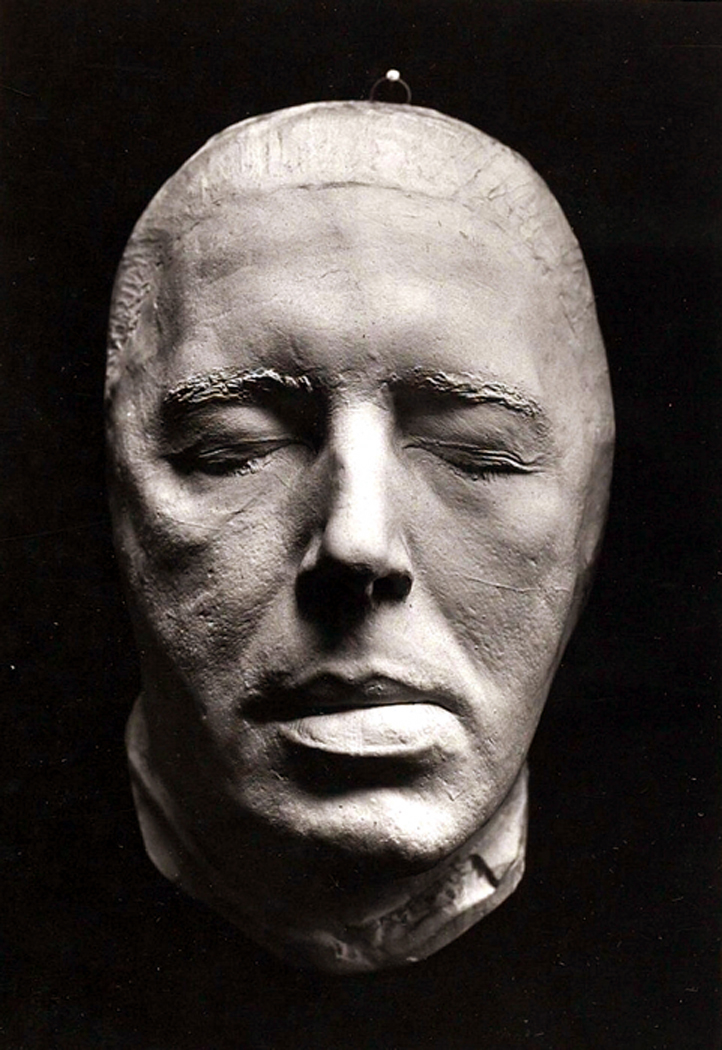
Marat's death mask

Marat’s death mask

Thousands of cheap engravings were distributed, made from a death-mask portrait drawn by David. Marat’s eyes closed, his head tilted in death.

Copies of the painting were ordered from David and his atelier, to be sent to the other cities of France.

Instead of stopping the violence, as Corday had hoped, her act only worsened the Terror. The assassination now became a cause.

As for David, when the Terror ultimately collapsed and its architect, Maximilien Robespierre, was guillotined, the painter went to prison. At least he kept his head.

He was released after about a year in a general amnesty.

When Napoleon came to power, David became the imperial artist, glamorizing the First Consul as he had glamorized the Revolution. David was a political chameleon, a slippery eel. The artist was always looking for a “great man” to glorify, whether it was Marat or Napoleon.

"Napoleon in his study"

“Napoleon in his study”

When Napoleon fell, David went into exile in Belgium, where he died in 1825.

His great painting had a similar fate: It was withdrawn from the public shortly after the fall of Robespierre and sent back to the artist’s studio, where it remained, unexhibited till well after David’s death.

Finally, in 1848, republican sentiment arose once more in France and Marat came out of storage. The poet Charles Baudelaire saw it and wrote a famous encomium, which raised public awareness of the masterpiece once more. The painting became canonized.

Today, the most recognized souvenir of Marat’s life and death is the painting David made to immortalize the journalist.

It is powerful: “David weaponizes art,” said one museum curator.

David’s painting is hugely original, mixing an almost journalistic sense of the here and now with familiar iconographic symbols, like the hanging arm of Michelangelo’s Pieta, turning the dying journalist into a Christ figure.pieta arm

That isn’t just a conceit: The subconscious reading of the painting can’t help seeing the echoes of earlier, religious paintings. David was able to mythologize current events and give them depth and power.

“If there’s ever a picture that would make you want to die for a cause, it is Jacques-Louis David’s Death of Marat,” historian Simon Schama says in his TV series The Power of Art. “That’s what makes it so dangerous — hidden from view for so many years. I’m not sure how I feel about this painting, except deeply conflicted. You can’t doubt that it’s a solid-gold masterpiece, but that’s to separate it from the appalling moment of its creation, the French Revolution.

“If ever a work of art says that beauty can be lethal, it’s Jacques-Louis David’s Marat.”

David has turned the paranoid fanatic into a saint of the revolution. He had also made what some have called the first “modern” painting: spare, direct, almost abstract in its design.

But the image raises a question: Can great art be made for evil reasons?

The question is not merely academic. These questions have come up many times in the past: Can Leni Riefenstahl be a great filmmaker if the films she made glorify Hitler? Can D.W. Griffith’s Birth of a Nation really be one of the most important films ever made if its heroes are the Ku Klux Klan?

And what about Westerns? Are our heroes cowboys? Or do we acknowledge our own genocide? What was once the patriotic foundation myth of our nation now embarrasses any thoughtful American. The once-famous Battle of Wounded Knee has now become the Massacre at Wounded Knee.

So, what do we make of art when we question the artist’s motives?

There are some who believe composer Aaron Copland’s music can’t be any good because of his lefty political leanings. And the take people have on Shostakovich often depends on whether they see him as a Soviet apologist or a secret dissident.

The art of Englishman Damien Hirst horrifies some people, because he may use dead animals, pickled in formaldehyde, as part of his art. His shows bring out the picketers.

Wagner cannot be played in Israel because of his anti-Semitism and because Wagner was Hitler’s favorite composer. Where can we draw the line on this?

Do we ban politically injurious art, the way many would ban the use of Nazi medical research?

"Execution of Robespierre" detail

“Execution of Robespierre” detail

“I can appreciate pure ‘art for art’s sake,’ ” says artist Anne Coe, whose paintings are never politically neutral.

Coe is an ardent environmentalist and lover of animals, and her paintings promote her views.

“But to me, the really knock-your-socks-off art has a little more,” she says. “It has ideas behind it. I think art is insipid without some sort of idea in it.”

And David’s art is all about ideas.

“David is the artiste engage par exellence,” says Mary Morton, associate curator of paintings at the J. Paul Getty Museum. “He gave himself completely to politics.”

The subject of the painting, she points out, is not so much Marat the man but the virtues of republican self-sacrifice.

“David’s art is very didactic,” Morton says. “It is about civic responsibility.”

And perhaps we are removed enough from the events of 1793 that we can see in David’s painting the idea rather than the man — the spirit of democracy instead of the call for blood.

“What is that line between propaganda posters, like ‘Uncle Sam Wants You,’ and the David painting, or the paintings of religious martyrs?” Coe asks.

“Does some art lead to evil things? That is the risk you take in a society that says everything is relative.”

There is no single answer to the question; you have to take each case individually and weigh it in your own conscience.

“I listen to Wagner. I love Wagner,” Coe says. “You can’t have an answer.”

Orangerie Paris

What is culture, and why should we care?

These are questions that don’t get asked often enough when we discuss such inflammatory issues as government funding of the arts and humanities.

To many people, culture simply means a lot of wealthy people going to the opera and sitting through a hare-brained story in a language they don’t understand while listening to a soprano shriek so loud their elbows go numb.

Or it means drinking bad white wine from a plastic champagne glass at an art gallery opening or long, dense scholarly papers deconstructing Little Red Riding Hood as a text about the patriarchal hegemony.

We too often talk about culture as if it meant only evenings in the theater and long Russian novels.

But what would happen if all these so-called ”high” arts suddenly disappeared? Do we actually need them?

To understand the answer, we need to understand what culture is. Culture is broader than just the arts.

It’s what you eat for breakfast and whether your trousers have cuffs. It is who you are allowed to marry and what happens to your body when you die.

Culture is the set of rules — mostly in the form of traditions — by which society runs.

It is the software for our social lives.

In fact, far from being a luxury, culture is something you cannot live without. It is religion, art, laws, ethics, history and even our clothing.

Culture is who we are.

And who we are at this moment: No culture is static. It is an evolving thing — to keep up with the computer metaphor, there are constant upgrades. Culture 2.7 gives way to Culture 3.0, as the circumstances of our lives and our cultural needs change. The culture of the clipper ship means little on a jumbo jet.

Yet, although culture changes, it is inherently conservative. It changes very slowly. Nobody wants to get caught with a beta version of untested software.

Patterns from our ancestors persist in our lives. We enter the jumbo jet from the left side because our great-grandfathers wore their swords on their left sides and consequently mounted their horses from the left, to avoid entangling their swords.

You can see the history of aviation change from the stirrup on the left side of a World War I biplane to the door on a 747.

And how many children today play with ”choo-choo trains,” although not even their parents ever lived in a world with steam locomotives?

The patterns stick with us even when they no longer make sense.

But culture does change. The three-minute song remains the cultural pattern, although Dinah Shore has given way to Taylor Swift.

Songs from our agricultural past, lauding springtime and the moon, make little sense to our urban present, where nocturnal lighting is more likely neon. So we change. Slowly.

And where does cultural change come from? More often than not, from the arts.

The arts try out possible ideas onstage to see if they might make sense. Sometimes they do, sometimes they don’t. But the best minds and imaginations give it their best.

That is why we think of theater as ”culture.” Or literature, or painting.

Yes, there are some people who want to keep their old software version, and some who want to return to earlier versions. But culture cannot stand still.

Therefore, we need to be on the lookout for meaningful directions to go in. Art is our investigation of our values, testing them and throwing out some and reinforcing others.

Without art, culture ossifies and the people become emotionally and spiritually dead. So, if we mean to maintain a vital culture, we must support the best in the arts.

There is another computer saying: GIGO — garbage in, garbage out. In other words, if we don’t care for the changes in our culture, we are likely to wind up with the lowest common denominator. We are likely to wind up with nothing more than Duck Dynasty and microwave pizza.

woody mugshot

Woody Allen’s peccadilloes are in the news again, as his ex and his purported son publically dis his recent Golden Globe “lifetime achievement” award.

This is not to defend Allen. Whether he is a child molester or not is not a question I can weigh in on. There is certainly something creepy about the whole affair with him and his current wife, Soon-Yi.

But whether the filmmaker deserves recognition for his films is a completely different question from whether his conduct in life is reprehensible.

We so often confuse private morality with public achievement, and demand they complement each other. They seldom do.

Not that Woody hasn’t given us a few hints over time. father andrei

In his Love and Death, Diane Keaton asks shriveled old patriarch Father Andrei for his wisdom.

He answers haltingly from behind a 9-foot beard: ”I have lived many years, and after many trials and tribulations, I have come to the conclusion that the best thing is — blond 12-year-old girls. Two of them whenever possible.”

This used to be a joke; it is now evidence.

Former fans, turned prosecutorial, now search the Wood-man’s films for this kind of evidence, ever since Allen’s former squeeze Mia Farrow accused him of sexually abusing their adopted 7-year-old girl, Dylan, and Allen admitted having an affair with Farrow’s 21-year-old adopted daughter Soon-Yi Previn. ronan farrow

Not that Farrow gets off: She has recently implied that her son, Ronan, may not have been Woody’s child, after all. She may have been cheating with Frank Sinatra. Looking for old-time sexual morality in Hollywood can be like looking for sympathetic liberals on Fox News.

But about Woody, there’s lots of evidence to be unearthed from the films, from the underage girlfriend in Manhattan to the shifting family connections in Hannah and Her Sisters.

Rightly or wrongly, Allen’s life and films have always been confused by his fans. After all, Allen plays the same character in each film, a character that seems to be a stand-in for the film maker. No one mistakes Chaplin for a tramp, but Allen seems to be so much like Alvy Singer in Annie Hall, Isaac Davis in Manhattan and Gabe Roth in Husbands and Wives, that the confusion is natural.

So it’s no surprise that some formerly devoted fans have decided that they can no longer stand to see their fallen hero’s films.

So, let us please re-establish the separation between the artist and his creation. For his real sins, take him to court, for his art, remember the art exists, now, on its own, just as a son or daughter now exists separate from parent, and should not be held guilty of the parent’s crimes or vices. Polish director Polanski attends news conference for film "Chacun son Cinema" at 60th Cannes Film Festival

Roman Polanski is a reprehensible human being, but a very good filmmaker. Should we stop showing his Macbeth to high school students because of his crimes? Not if we want to convince those teens that Shakespeare is actually an exciting playwright.

Separating the artist from his work is essential. Otherwise, we will need to get rid of our copies of Alice in Wonderland. Lewis Carroll, after all, enjoyed taking photographs of nude little girls.

And if we are religious, we will have to stop singing that Ave Maria, because Franz Schubert liked sex with underage boys.Robert Frost

Artists are as venal, evil, self-centered, confused and destructive as the rest of us. The history of art is a landfill of disturbing biography.

Robert Frost sounds wise and paternal in his poems, but he was such an S.O.B. off the page that he drove his son to suicide.

William Burroughs and Norman Mailer have been hell on wives. Charges of child abuse now dog even James Joyce.

Benvenuto Cellini was a murderer. Ezra Pound was an anti-Semitic apologist for Fascism. Herbert von Karajan was a card-carrying Nazi. Samuel Taylor Coleridge and Hector Berlioz were drug fiends.

And we cannot begin to count the number of drunken novelists.

Sometimes we forget that Lord Byron diddled his sister. Or that Percy Shelley married a 16-year-old girl and then told her that he was in love with another teen-ager and that maybe all three could live together. Wagner

Or that Richard Wagner wrote Tristan und Isolde while enjoying a love affair with a woman he borrowed from her husband, who was housing and feeding the freeloading composer at the time. Wagner’s wife wasn’t happy about the arrangement, either.

This rogue’s gallery of adulterers, criminals, perverts and wackos made some of the greatest art of all time.

I am not suggesting that we let Woody off the hook. If he is guilty of child abuse, he should have to pay the price. He is certainly guilty of foolishness and self-deception in his relations with Soon-Yi.

But it is the man, not the art that should have to pay. Allen is one of America’s best film makers, the one of the few who consistently make films that examine the quality and meaning of life. That his films vary widely in quality is not in question, but even Allen’s worst films — Interiors and September — are serious attempts to deal with issues.

And his best, from Annie Hall to Crimes and Misdemeanors and Husbands and Wives, are as rich and textured as the best of Jean Renoir, who, by the way, married one of his father’s nude models and later divorced her.

What is so hard to understand is that Woody Allen can be so wise on celluloid and so foolish on the streets of New York.

But this goes well beyond Allen, and well beyond artists.

Our heroes just can’t seem to keep their noses clean.

One after the other they self-destruct, turning from demigods into blackguards before our very eyes.

Pick one, let his luster shine for a few moments and then notice the worm.Lindbergh

And I mean some of the most accomplished and meaningful personalities of the American century: Charles Lindbergh was a Nazi sympathizer. Martin Luther King Jr. was a womanizer. Elvis was a drug addict.

The list is long and luxurious, and the heroes in question come from politics, sports and the arts. We admire their accomplishments, even aspire to be like them, and then come to find out, as with O.J. Simpson, that they beat their wives and perhaps worse.

It isn’t just a recent phenomenon.

For every Woody Allen there is a Charlie Chaplin; for every Roman Polanski there is a Fatty Arbuckle. And let’s not forget Ingrid Bergman.

Let us not forget the charm of Ty Cobb, the graciousness of Babe Ruth and the temperance of Pete Rose.

Madonna raised eyebrows with her reputed NBA exploits, but what of  Clara Bow, who had a thing for the 1927 University of Southern California football team. The whole team.

Horatio Alger

Horatio Alger

Just think of some of their stories, moving backward in time. Errol Flynn, the patriotic hero on screen, was a Nazi sympathizer who died in a hotel room with an underage girl.

Horatio Alger, before he became the author of those inspirational rags-to-riches stories that Republicans like to recommend to those on welfare, was a minister who lost his job because he liked to seduce young boys.

It seems as if no one can escape: Who was the most saintly man of this century? Mahatma Gandhi liked to sleep naked with young girls, and he regularly weighed his excrement in the morning.

So beside that, a governor with his pants down in a motel room may seem kind of tame.

Even if he later became president.

I do not mean to debunk all our heroes, but to better understand what they are and what role they play in public life.

Heroism is a story we fashion from someone’s life, gaining nourishment from the pulp and spitting out the pits. As a story, it is tidied up with a beginning, middle and end, and it sports a moral that is meant to make our lives better or more meaningful. Unlike a real human life, it cannot sustain the complexities, contradictions and ambiguities that are always found in people, so it simplifies to make a point.

Charles Barkley is right to complain about being a called a role model — role model is the term we use instead of hero in an increasingly bureaucratic society — because the role he is asked to play is so much smaller than the life he lives.

Flesh-and-blood heroes are like actors that step into a part we need them to play.

And we do need them.

In earlier times, the hero was the person who translated the will of the gods into history. We no longer may believe in the gods and destiny, but we still need heroes. The hero is the link between the everyday life we live in and something transcendent. He brings the sky down to us so we can see it, feel it and taste it.

Michael Jordan hanging in the air like an angel who doesn’t need wings. richard burton

But when we hold our heroes up to higher standards than humans can sustain, we are like little children who cannot tell the actor from the part.

An adult doesn’t condemn Hamlet because Richard Burton was a lush.

Our heroes are capable of doing all the things ordinary people can do, including lying, cheating and stealing. Murder and rape are not beyond them, nor is mere vanity or meanness.

Like humans, our heroes are bundles of contradictions; they are large and contain multitudes.

For their crimes, we prosecute them as we do anyone else. For their simpler sins, we develop short memories. For their heroics, we need to be grateful.

What we forget is that a hero is a hero for what he does, not for who he is.

oregon ice copy

I had forgotten how beautiful ice is.

But as I drove over the eastern side of the Cascade Mountains in Oregon, I saw the flat, silver surface of motionless lakes that caught the light from the sky.

And as I drove late last year past frozen creeks, I saw the shelf of white crusted a few inches above the water, caught on the reeds.

Above me at the top of the mountains, the snow scumbled across the near peaks looking like powdered sugar on a stony doughnut.

There’s a lot to be said for ice.

The only problem is that the ice is also on the road. And as I drive east into the low morning sun, it is glowing white on the blacktop, and I cannot tell what is ice from what is melted water until I am on top of it and can distinguish the wet hiss under the tires from the thudding bumps of crusted ice. It makes the trip from Bend to Silver Lake a trial of nerves.

I can remember when snow and ice hit in New Jersey, where I grew up. The snow was the color of ash and piled up on roadsides, filled with cinders and soot. Cars clanked by on tire chains, and others spun their wheels on the hill outside the house.

Ice was never a welcome event in New Jersey.

But after I lived for 10 years in the Western desert, I discovered that I missed the ice, not so much on roads, but in lakes and streams. I missed the rime on the grass early in the morning and the squeak of white powder under my boot soles.

So, as I pass near Fort Rock, coming out of Fremont National Forest, I slow to avoid the slick spots on the road, but I also slow to enjoy the concentric rings of increasing whiteness on the pond I pass that mark the nightly shrink of water. It is all solid now.

The ripples on its surface are motionless. A few slivers of straw from the bordering reeds blow across its top without getting wet. The ice is like a scab formed over the water to protect the pond and its fish and weeds from the killing cold of the air above.

In larger lakes, like Summer Lake and Goose Lake, there is a darker circle in the center, of still unfrozen water, and it shivers in the cold, breaking up the reflection of the mountains in wavelets that run across the water blown by wind. A front is coming in from the northwest. The high clouds filter a hazy, frigid sun. The forefront of the clouds is broken into stripes; it looks like fish bones.

Where the sun catches the snow patches on the slopes, it gleams with a brightness that seems of a different order of reality from the rest of the scene: almost like the psychedelic landscapes screaming by in 2001: A Space Odyssey.

And in the castellated crest of the Warner Mountains, as I enter California again, there is a bright coating of orange lichen that plays against the blue shadows in the snow so that the rocks sing out like a chorus: Kyrie Eleison.

Perhaps it is the cold, which makes the air seem as solid as crystal. Perhaps it is the sun, which even at noon comes in from such a low angle that it drowns all the landscape in the orange light of dusk. Perhaps it is the deep lapis of the sky at this altitude, which reflects off the ice of Goose Lake.

Or perhaps it is the contrast of the teeth-chattering cold against the steam that rises from the thick grasses in the meadows south of Lakeview, where thermal water boils from the ground and makes a network of streams in the valley floor.

But I had forgotten how beautiful ice is.

winogrand hollywood

Curiosity is the libido of art, and photographer Garry Winogrand was its visual Don Juan.

Over a 40-year career, he photographed with prodigal fascination the cities, foibles and mores of America. He pointed his Leica, with its wide- angle lens, at a roiling chaos of visual information. Anything might tickle his curiosity.

So prolific was he, promiscuous some might say, that at his death in 1984 at age 52, he left behind a third of a million exposures either undeveloped or unedited. He could never catch up in the darkroom with the conquests of his shutter button.

To be more specific: He ran through film like an alcoholic runs through gin. He left behind 2,500 rolls of film undeveloped, 6,500 rolls developed but not edited or printed and about 300 contact sheets unedited.

The pictures he did print are often enigmatic: You can’t always tell why he took a particular picture, at least until you look long and hard, and look through an entire box of them. Then, Winogrand’s odd world view takes hold and his pictures become addictive. It is a Winogrand world.

Someone once said, “The world is not only stranger than you imagine, it is stranger than you can imagine.”

This is the truth Winogrand captures in his pictures. winogrand elephant 2

winogrand monkey in carIn many cases the photographs he left are jokes we can enjoy. An elephant’s trunk stretches across the frame to catch some peanuts dropped from a hand. No elephant in the picture; no person. Just hand and trunk.

A middle-age couple sit in a convertible on Park Avenue in Manhattan; an angry monkey perches on the seat back. What does such a thing mean?

A bagpiper in full Scots drag plays a bagpipe in a men’s room in front of a rank of urinals.

Few of the pictures have titles, and for those that do, the titles tell us very little: Park Avenue, New York, for instance, for the scowling monkey, or Apollo 11 Moonshot, Cape Kennedy, Florida. That picture shows a crowd of people from the back watching — and photographing — a rocket launch, while one small woman in the foreground looks in the opposite direction and makes a picture — we can never know of what — with her Kodak Instamatic. winogrand cape canaveral

But more often than not, the punch line is equivocal; more often it looks as if there must be a joke we do not get. It is on this edge of comprehension, subtle and uncomfortable, that Winogrand’s most important photography creates its meaning. For pictures with punch lines, Elliott Erwitt is much more consistently funny. But Winogrand tells us something deeper and more disquieting. winogrand richardson 1977

Most of us live in a world where things proceed largely as we expect them to. We hardly notice the anomalies. Winogrand was never so acculturated that he had conventional expectations; it freed him up to see what was really in front of him. Nixon Attorney General Elliot Richardson in a press conference alone and isolated — small — at a folding table and surrounded by tape recorders. A man and a woman — their backs to us — stare at a gorilla in a zoo; the gorilla stares back. winogrand phonebooth pair

Other photographers made consciously surreal pictures — Les Krims, for instance, who taped dozens of photos to his mother’s nude body, or Duane Michals, who used camera trickery to show a soul departing through an apartment window.

But Winogrand isn’t surreal. His world is the everyday one in front of us all the time, but which we do not see. Nothing is more bizarre than the ordinary. winogrand underwater pair

But it isn’t just the world by itself. As Winogrand insists, it is the world wrung through a camera lens. The act of making a picture changes the world.

He often said he made pictures to find out what the world looked like in photographs. And there is an awareness in Winogrand’s work that photographs rewrite reality. He makes us question our belief in the supposed truthfulness of photographs. winogrand nyc 1970

Winogrand knew that the four edges of a picture frame are a cookie cutter that slices out a bit of reality’s dough and separates it from its context and remakes the facts. No doubt there were a bevy of reporters listening to Richardson’s comments, but because they don’t appear inside the image frame, they cease to exist. This is what Winogrand means when he talks about seeing how something looks in a picture. It is changed. Utterly and inutterably. winogrand 1991 1

Winogrand was aware that a photograph has a grammar and syntax that we have learned to read. He makes us distrust that syntax.

He also plays God, making order out of chaos. Or at least, being aware that human perception will force meaning from chaos, he creates an artificial meaning from something that has none. In doing so, he forces us to consider the very existence and nature of meaning itself. Perhaps meaning is just a pattern we have gotten used to, a habit. Perhaps all it takes to create new meaning is a new pattern. Winogrand 1984 2

It is the artistic equivalent of naming constellations in the night sky. In that sky is a confused mass of stars, but we have grouped some together and named their configuration. The Big Dipper does not exist of itself, but only in that we have invented it. Orion, Scorpio, Gemini: The boundaries of any of these constellations could be redrawn and renamed. Put together the tail of the Big Dipper with the stars Spica and Arcturus and call it ”The Great Sky Scythe.”

Winogrand realized that we create such patterns; they are not inherent in reality. Winogrand understood that perception creates reality, or at least that we have no way of knowing reality except as it is ordered by our perception. winogrand nyc

He will find four or five people walking down the street, or gathered at a party, and use the edge of his picture as that cookie cutter. He makes us see those people as a coherent group, just as we see the Big Dipper. A part of us knows we have been manipulated, but the instinctive part of us accepts the fiction. Photographs confer validity even to lies.

Yes, Winogrand presents a picture of America over the past 30 years; yes, the photographs often have a visual punch line; yes, they show sometimes grotesque people. But above all, they experiment with what the mere fact of pressing the shutter button does to reality. winogrand 1984 4

They don’t all work: That would be too much to ask of such a prolific seer. But even the boring photos play with what the camera does. An ordinary person standing with a drink in his hand at a party, someone else stands behind him. We are forced to stare at the photo until we satisfy ourselves that we understand why he took that photo.

At times no reason ever emerges. But the event, framed in the viewfinder, probably a meaningless juxtaposition of two partygoers, is forced to seem as if it were meaningful. The simple fact of its being taken creates that fiction.

The bottom line becomes not whether the picture has any meaning, but our understanding that we automatically assume it must. We see ourselves seeing. We become aware of the picture’s frame as an event in itself. winogrand street women pair

He was a peculiar man, neurotic and obsessive. His thousands of photographs of women, for instance. He took pictures over and over of women on the streets. He seems to have been sexually obsessed with them, but only as seen. They drown us in their banality, but Winogrand saw something different. Photography has made them worth ogling; it has made them into cover models, no matter how dreary the reality.

“Whenever I’ve seen an attractive woman, I’ve done my best to photograph her,” he said. “I don’t know if all the women in the photographs are beautiful, but I do know that the women are beautiful in the photographs.”winogrnd nyc 1982

Of course, everyone and his student is now playing with the ”medium as message.” But what is different with Winogrand — aside from the fact that he was doing it 30 years before the crowd — is that most of the facile youngsters doing so now almost seem to have no conscience about it. The tricks of the media hustler are used as if they were of themselves profound. winogrand nyc 1969

But Winogrand’s investigations are less glib, less pat. He is an intellectual intuiting a Postmodern truth. And there is an implied criticism of this packaged meaning. Winogrand is intuiting how images convey meaning and how they do so without any linear, verbal sense.

Others have used what he found, made theories about it. They turn what Winogrand found into sales pitches for Coke and Big Macs. But Winogrand was a discoverer, someone delighted and sometimes horrified by what he found.

kenneth clark

Without the cosmos, there would have been no civilization.

But, without Civilisation, there would have been no Cosmos.

Bettany Hughes

Bettany Hughes

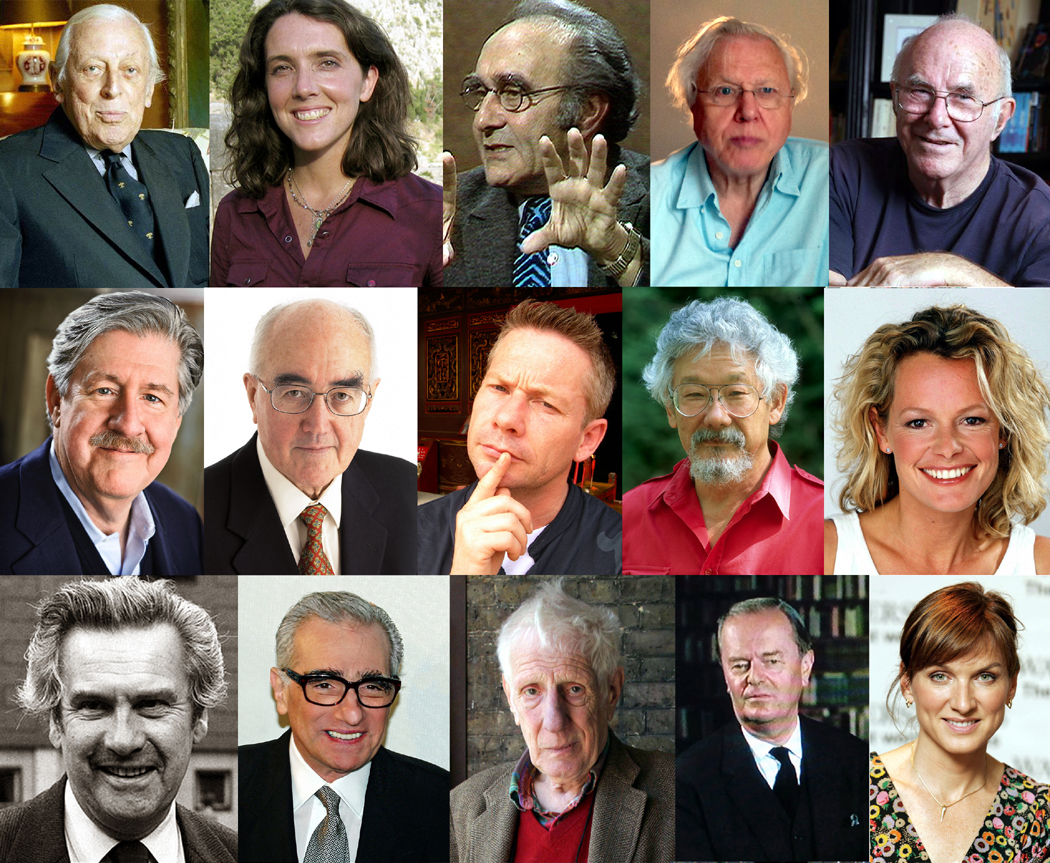
And probably no Civil War or Jazz. And no jobs for all those BBC presenters, from Bettany Hughes to Michael Wood.

And Michael Palin would have been merely another retired Python.

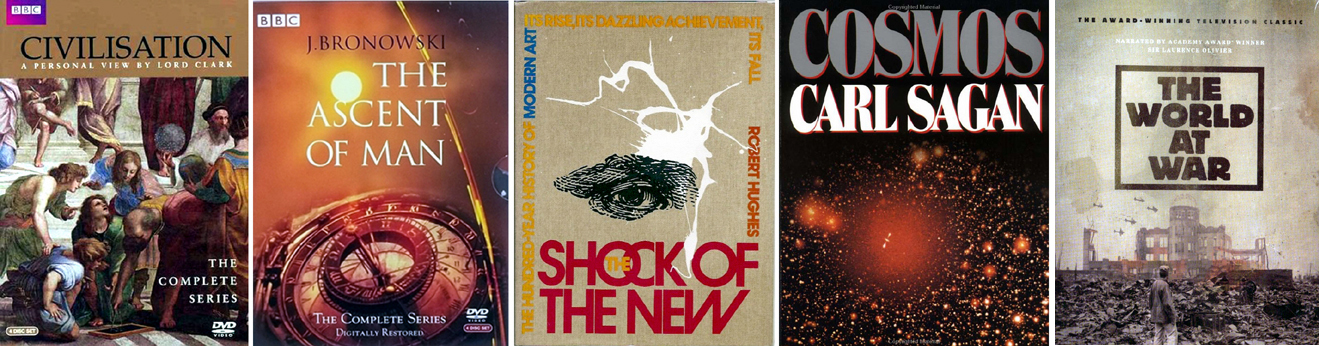
Sir Kenneth Clark’s 1969 BBC television series is the granddaddy of all BBC and PBS high-culture series, where an engaging personality teaches us history or art from a personal point of view. For anyone who remembers seeing Civilisation when it was first broadcast in the United States in 1970, seeing it again, now on DVD, will be a revelation.

First of all, the film quality is excellent. Unlike other old series, presented in grainy, contrasty aged versions, Civilisation looks mahvelous, just as crisp and bright as when it was first broadcast. civilisation dvd cover

The series was initially filmed in color, and on 35mm stock, making it visually stunning. The BBC has remastered the original films onto HD and they are now available on Blu-Ray, at least in Europe. (One hopes that an American Blu-Ray version is soon in the offing).

Second, it is a much better, more nuanced view of its subject than you probably remember. If you recall it as Clark, with the British public-school back-palate drawl, talking about the “great masterpieces” as if he were an Oxfordian tour bus guide, you will be in for a surprise: His view is much more subtle than that.

Certainly, since the series was made, the general view of art and history has broadened, and the view of Western civilization as the be-all and end-all of human existence has been tossed out on the rubbish heap of ideas. Deconstructionists have shown us how our aggrandization of certain fetish items of cultural history has merely served to legitimize a particular ruling elite.

Yeah, yeah, yeah — we know that. But Clark’s view isn’t so simple. It is true that he exemplifies an old-fashioned “great man” view of history, and for that we have to listen to him with a grain or two of sodium chloride, but he is not merely the smug purveyor of status quo. He makes a serious attempt to discover just what civilization might be, and uses the past 500 years of European history to make his discovery.

“Writers and politicians may come out with all sorts of edifying sentiments,” he says in the series, “but they are what is known as declarations of intent. If I had to say which was telling the truth about society, a speech by a minister of housing or the actual buildings put up in his time, I should believe the buildings.”

And look at the buildings, we do. That is a third surprise in the series: Clark’s willingness to shut up for long periods of time while the camera shows us the art, the building or the landscape, so we may discover it for ourselves and not just take Clark’s word for it. He is more interested in sharing something with us than pounding us with his point of view.

We could do worse than consider his point of view, for it isn’t just about justifying power, but about seeing the results of how we view ourselves and our culture.

Civilization, Clark says, is energetic above all, always making something new. It is aware of the past and supremely confident and willing to plan for a future that will extend beyond our lifetimes, and therefore has a belief in permanence. It also has a firm belief in self-doubt. It fosters compassion and is willing to consider other points of view.

It is this last that the current wave of deconstructionists has failed to notice: Deconstruction itself depends on one of the supreme ideals of Western culture.

Charlemagne reliquary

Charlemagne reliquary

The full title of the series, with its British spelling, is Civilisation: A Personal View, and we should never forget — and Clark never forgets — that it is a single take on the subject. It is an opening statement in a conversation, not a final word to close off discussion.

And carping critics who complain that Western civilization — and post-Classical civilization at that — is hardly the be-all and end-all of civilizations in the world — well, Clark admits he has enough on his plate to cover Charlemagne to Monet. We wait for his counterpart to give us a similar personal overview of China, India, Africa or the New World. Clark has given us the template. Have at it.

The BBC took a chance when it made its first full-color TV series. It ultimately proved so popular that it was followed by Jacob Bronowsky’s The Ascent of Man and a host of others, from James Burke’s Connections to Ken Burns’ Civil War. It has proved a durable genre, but this release shows the first of its type remains one of the best of its type.

Pawnee Buttes 6

Space and time.

As you stand in the grassy expanse of the Great Plains, you are forced to confront them, Einstein’s two-faced god, the Janus of existence.

Time and space.

You stand at the stony edge of a low bluff and look out at a sea of grass and the cloud shadows racing over the buttes in Colorado’s Pawnee National Grassland, wetting them and drying them with shade and sun.

You feel yourself alone in the circle of the horizon — dead center in the universe of your own perception — and know, in a way you never do in the city, that you are alive on a planet. Pawnee road to horizon

Pawnee National Grassland is about 90 miles northeast of Denver. Within a 30- by 60-mile area just south of the Colorado-Wyoming state line, the Pawnee National Grassland encompasses old short-grass prairie and reclaimed farmland. The area is crossed mainly by unpaved roads, and the birds peel off from the side of the road as you drive by like the wake of a motorboat.

Sunflowers yellow the barbed wire on the shoulders of the roadway. Hordes of sunflowers, bobbing in the wind that is always exhaling. Pawnee sunflowers

It is easiest to get to the National Grassland from Denver. Usually, when we think of Denver, we think of the Rocky Mountains that loom above the city, but that is only if you face west. If you face east, Denver is the gateway to the Great Plains — the vast fifth of the United States that houses less than 3 percent of its people. Pawnee phone pole

A deeper beauty

The mountains are beautiful, but in a conventional way: Everyone can recognize their looks. But the Great Plains have a deeper beauty, and only those who spend time in this space can be gifted with seeing it.

As Walt Whitman wrote, “I am not so sure but the prairies and plains, while less stunning at first sight, last longer, fill the esthetic sense fuller, precede all the rest and make North America’s characteristic landscape. Even the prairie’s simplest statistics are sublime.” Pawnee fencepost

This region of northeastern Colorado was the subject of James Michener’s 1974 book, Centennial, and the history of the place was fictionalized in his tale.

But the real story is hardly less compelling. The prehistoric seas gave up the sea bottoms to become the middle of the continent. Dinosaurs, and later the great Cenozoic beasts, inhabited the area. Then there were Indians and buffaloes. Pronghorn, the fastest land animals in the western hemisphere

Finally, the buffalo hunter, the railroad, the cattle industry, the dry farmer, the droughts, the financial busts, the Dust Bowl, the emigrations and the land remaining like the butt end of a used cigarette.

You can feel all that history in the grass under your boot sole. windmill and sun vertical

By the mid-1930s, this portion of Weld County dropped to a tenth of its pre-Dust Bowl population.

That’s when the federal government and its Work Projects Administration tried to stabilize the economy, and the government began buying up plots of land. In 1938, responsibility for administering the land fell to the Soil Conservation Service.

In 1960, the Pawnee National Grassland was created. It is divided into two sections, each roughly square, just north of Colorado 14.

‘Rattlesnake Buttes’

The town of Briggsdale sits to the south of the road in the western sector. The towns of Buckingham and Raymer do the same in the eastern sector. They hardly qualify as towns: more like a collection of farm buildings, a few houses and maybe a grange hall.

The western sector contains the only campground, the Crow Valley Recreation Area, which sits in a depression of cottonwoods along Crow Creek. Crow Valley campgroungs

The eastern sector features the Pawnee Buttes, two erosional remnants that Michener calls “Rattlesnake Buttes” in Centennial.

“They were extraordinary, these two sentinels of the plains. Visible for miles in each direction, they guarded a bleak and silent empire,” he wrote. Pawnee Buttes 1

They tower about 350 feet over the plains at an altitude of 5,375 feet.

Getting to them requires a commitment. You have to drive on dirt roads about 15 miles, switching roads several times. It would be easy to get lost without a map. Get a map — available at a ranger station near Briggsdale.

You will pass Keota, a Dust Bowl ghost town, on the way. In its heyday, just after World War I, there were 140 people living there. Now, there are a few holdouts in the few remaining buildings. grasslands oil rig

Oil was found in the area in 1924, but that didn’t save the town. Even now, there are some oil pumps in the grasslands.

Between cattle grazing and mineral rights, the grasslands more than pay for themselves: 25 percent of oil and gas revenues are returned to Weld County for roads and schools. A similar percentage comes from grazing rights.

Wildlife treasured

But mostly the treasure to be found is in the wildlife: 301 species of birds; 400 species of plants. There are deer and pronghorns, prairie dogs, rattlesnakes.

The grasslands are not for the tourist, but for the traveler. There are no attractions in the flatness except the flatness itself. Lark Bunting

But for those who feel the atavistic call of the savanna, the veldt, the steppes, the pampas, this reminder of the tawny places in Africa that humankind came from, the grasslands speak volumes.

Grasslands, which cover 40 percent of the Earth’s surface, are home to almost 1 billion people.

Too often overlooked by tourists, who just want to get through the expanse as quickly as possible, the grassy middle of the country is, instead, what they should be looking for. Pawnee Buttes 5

Here you stand in a field of grasses that billow in the wind, with the same horizon you gaze at sea, and the same sky, and you recognize, more than in other landscapes, that each point in the endlessness is its very center.

It is the source of our national identity. It is the West we think of as our coming of age. It is the cradle of our greatest authors, the heart of our economy: the “amber waves of grain” and the “fruited plain.” Sunflower 2

And a sense of the bigness of the planet.

Time and space.