George Leonard Herter

George Leonard Herter

The British have their eccentrics, but America has crackpots.

There is something quaint about the Englishman wearing a cutaway and top hat in the Sahara sun, or refusing to read any book unless its author’s name begins with the letter “A”. But the American version of this tendency usually comes out in something more oracular: Americans create new religions and build temples out of bottlecaps. And they are obsessed with peculiar certainty that nobody has got history correctly except themselves. herters catalog

One of the great American crackpots wrote cookbooks. George Leonard Herter built one of the nation’s great outfitting businesses, in Waseca, Minn. His fortune was founded on shotgun cartridges and duck calls. But his lasting place in history comes from the books he wrote, most notably, the Bull Cook and Authentic Historical Recipes and Practices, and it is not for the faint of heart.

In what other cookbook would you find the claim: ”The Virgin Mary, Mother of Christ, was very fond of spinach”?

Herter goes on to say, ”This is as well a known fact in Nazareth today as it was 19 centuries ago. Her favorite music was that of the crude bagpipes of that time, and this is a well-known fact.” bull cook cover

He then proceeds to give us her recipe for spinach, which, he says, was the only thing she ate in the stable where Jesus was born.

No, this is not a religious book. Other ”historical” claims include, ”Sauerbraten was invented by Charlemagne,” and that St. Thomas Aquinas was so fat, ”He simply sawed out a half circle in his eating table so that his stomach could fit comfortably into the sawed out section.”

He tells us that Johannes Kepler’s work on astronomy has long since been forgotten, ”but his creating liverwurst will never be forgotten.”

He has Bat Masterson’s recipe for prairie dog, Marie Antoinette’s recipe, not for cake, but for trout. He says Joan of Arc was responsible for the invention of pate de foie gras.

His standard recipe runs something like this: ”No one knows how to bake a potato anymore. I’ll tell you how to bake a potato.”

It is clear from the presentation that Herter is not trying to be funny. He is dead serious. As when he opens the book with this: how to live with a bitch

”For your convenience, I will start with meats, fish, eggs, soups and sauces, sandwiches, vegetables, the art of French frying, desserts, how to dress game, how to properly sharpen a knife, how to make wines and beer, how to make French soap, what to do in case of hydrogen or cobalt bomb attack. Keeping as much in alphabetical order as possible.”

Of course, the index is not in alphabetical order.

Herter wrote a number of books; among the more notable were How to Live With a Bitch and The Truth About Hunting in Today’s Africa and How to Go on a Safari for $690.00 (“Baboons are simply too small for leopard bait”).

I can’t vouch for any Bull Cook recipes. Most seem to involve a “well-buttered slice of bread” and some ground beef fried in even more butter. But I can say that Herter seems to have two entertaining obsessions that make up the bulk of the book, and its sequels, volumes 2 and 3. truth about hunting

He expresses the absolute certainty of the crackpot when he tells us his version of history:

“Napoleon Bonaparte always remained a great mama’s boy.”

“Napoleon not only liked green beans very well, but believed that they helped to produce more sperm in male humans. As he was always a man who played the ladies frequently, this was just as important to him as winning wars.”

Napoleon shows up frequently in the book. So does Cleopatra. Let Herter explain ancient Roman Egypt for you.

According to Herter’s version of ancient history, Cleopatra tired of Marc Anthony and tricked him into killing himself.

“Cleopatra went over to where Mark Anthony lay and made sure that he was dead. She then sent a messenger to Octavian telling the good news and asking him to come over for the weekend. Octavian did come over to visit her as he well remembered her charms when she lived in Rome. She did her best to charm him in every way possible and he was willing. Cleopatra was now thirty-nine and had produced five children. They did not have girdles in those days, nor uplift brassieres. She had widened out and her famous bosom had sagged considerably. The old charm simply was not there. Octavian decided that the younger models were more to his liking and told her she better get out of Egypt and he did not want to see her in Italy either. Octavian made Egypt a part of the Roman Empire. The Roman Legion, now that the fighting was over, had a well-earned vacation putting Italian blood into Egypt. It is still very much there today. They actually changed the appearance of the Egyptians to a very Italian look which they still have today. Cleopatra was just in the way. Octavian had one of his men pay a servant to poison her. Her record proved she was not the type to kill herself for anything or anyone. Besides, there were no asps anywhere near the town she was in. If she did have an asp and let it bite in one of her breasts as the fable goes, it would not have killed her anyway. A woman’s breast is mostly fat and it is one of the places where the bite of any poisonous snake has little effect.”

There follows a recipe for “Watermelon Pickles Cleopatra.”

He is a fountain of prejudices, and has no doubts about his opinions.

“Henry the VIII actually never amounted to anything and would not have made a good ditchdigger. The only thing that he ever did to to his credit was to highly endorse the kidneys made by Elizabeth Grant, one of his many cooks.”

He knows with dead certainty how Genghis Kahn liked his steaks prepared and how Gregor Mendel cooked his eggs. And according to Herter, it is not his banditry or gunslinging for which Billy the Kid will be remembered by posterity, but for his recipe for cornmeal pancakes.

“Here is his own recipe which will long outlive Billy’s memory.”

Herter’s other obsession is sex, and most specifically, women’s breasts. The second volume of the Bull Cook is full of bad black-and-white reproductions of famous paintings of the nude, and his historical commentary often features descriptions of famous cleavages of the past.

He tells us that Cleopatra “was said to have the longest, most pointed breasts in all the world. The movie actresses that have tried to play Cleopatra from time to time never qualified on this point.”

“Greek women have always been known for their unusually well-developed breasts. They have always felt that bare breasts gave them more grace and beauty and that exposing breasts was not at all immodest.”

“In those days, if you didn’t have breasts worth showing, you were really in trouble. A flat chested pendulent breasted woman just did not have a chance in life.

Lucrezia Borgia by Bartolomeo Veneto

Lucrezia Borgia by Bartolomeo Veneto

In another place, he reprints a portrait by Bartolomeo Veneto (and misattributing it as he does so) and tell us:

“Lucrezia Borgia, well-known poisoner, painted by Veneziano in 1520. By this time, it was popular to wear dresses with one breast exposed and the breast nicely rouged. As you can well see, this style did nothing for Lucrezia as she had nothing special to show.”

He has a chapter titled: “Bare Breasts and Food In the United States.” In it and passim, he describes various topless establishments, comparing those in Paris with those in Las Vegas. Vegas wins, by his reckoning.

“For my part I enjoy eating very much. I do not like to look at female breasts while I am eating as I like to concentrate on my food. There is a time and place for everything and I prefer exposed female breasts in a bedroom, a tepee or a clean cave.”

It isn’t only breasts, though.

“Michelangelo learned to paint and sculpture sexual organs probably better than anyone that ever lived. He never learned to use his own properly, however, and was a homosexual.”

And he has a way of combining his questionable grasp on history with his prurience:

“Charles the II of England was born in 1630 and died Feb. 6 in 1685. He married the beautiful Portuguese woman, Catherine of Braganza who brought Bombay, India and Tangier to England as part of her dowry. Those were the days when getting married could really get you something. He never had any legitimate children as Catherine was just plain scared of pushing out a child through so small a space. She became an early expert and exponent on birth control.”

There is more than an undercurrent of bigotry in him. While he exults American Indians (not always reliably: “Pizza pies were of course, unknown as these too are of American Indian origin.”), and recounts many instances where white America has raped and pillaged the Indians, he holds many questionable ideas about women and other races.

In that section on Michelangelo, for instance, he says: “Michelangelo’s statue of David shows what can be done with a piece of marble. As far as showing what David might have looked like, it is a masterpiece of errors. David was a  Jew and undoubtedly had the high cheekbones and nose of a Jew. This figure is strictly Anglo-Saxon in appearance, not even Roman.”

Lady Hamilton as the Cumean Sibyl by Vigee-Lebrun

Lady Hamilton as the Cumean Sibyl by Vigee-Lebrun

On a section (see below) spent with Horatio Nelson and his mistress Lady Hamilton, he includes a portrait of the woman, misspelling the name of the artist (Elizabeth Vigee-Lebrun) and in his caption tells us something about his opinion of women.

“The portrait was painted by Madam Vigee-Ledrun , one of the few good women artists the world has ever known. Women because of the effect of menstruation upon them, rarely can become even fair painters.”

Not to mention his take on Joan of Arc: “Never underestimate the strength and courage of a woman that is really mad at you.”

Among his other obsessions are nuclear war and art.

“Red pepper good for radiation and upset stomachs”

“We always have the money to buy good soap in this country and women folk look down on such menial tasks as making soap these days. An H bomb strike in this country would change the whole picture.”

“I never have  been an admirer of the paintings of Matisse but I always thought his cooking was excellent.” What follows is a recipe for “Beans Matisse.”

I could go on all day giving you quotes from the Bull Cook.

“Joshua 10:13 in about 1451 years before Christ says that the sun stood still in heaven and did not go down for the space of one day. This caused Indian Mexico to become dark.”

Or:

“Mozart was a man that believed just putting a lady on her back was not at all enough. Seducing an actress was a game with him that had to be done properly or not at all. He wined and dined his amours very well before getting down to any serious romancing. His dessert I like far better than his music and his orange wine is a classic. Here are his original recipes.”

Not to mention:

Eggs “are best eaten in a well ventilated room.”

Or:

“Never drink coffee right after eating peppered fried eggs or soft-boiled eggs.”

The combination of sex and history, scrambled, fried and soft-boiled can be enjoyed in his version of the life and appetites of Lord Horatio Nelson:

“Horatio Nelson was a fragile, very sensitive man nearly always in poor health. He was not at all good looking and women shunned him.”

“In the West Indies, on March 11, 1787, he made the greatest blunder of his life. He was more or less trapped into marrying Frances Nesbit, the widow of a doctor Nevis. Nelson had simply spent too many years on the seas with only men to look at and the prospect of having any nude woman looked like a catch to him.”

“Emma Lyon was born on May 12, 1765 … She grew up to be a lively, robust, big-breasted beauty that attracted any normal man.”

“Emma had a way with men, which consisted mainly of taking off her clothes. During Nelson’s battle of the Nile she obtained valuable information for Nelson. When Nelson returned from the campaign of the Nile to Naples, Emma arranged to meet him in her bedroom with nothing on but a string of pearls. Nelson’s wife had turned out to be a cold unenthusiastic bed partner and Emma, the vivacious, warm, bubbling prostitute was a welcome change.”

“I have always admired Horatio Nelson. He was not much physically or mentally, but he was an honest, hard-working man. He never cared what anyone thought or said about him. He liked Emma because she was a good bed partner and a light-hearted, depression chaser around the house.

“Horatio Nelson was not much of an eater as he had a bad stomach. His favorite food was a sandwich which he ate both on ship and shore. Here is his original recipe.”

It is a kind of onion sandwich on well-buttered bread. “Eat with a bottle of strong beer,” Herter recommends.

“This is a truly great sandwich befitting a truly great man and besides, it burps beautifully.”

jefferson and hamilton

I lament the loss of the republic. Like the Roman senators under the emperors, who longed for the halcyon time before Julius Caesar, I long for the good old days when we had a republic in these United States.

For all the prating about democracy, and our current boilerplate pieties about the “will of the people,” it should be remembered that our Founding Fathers never intended that we should be a democracy. They feared democracy.

That is why they carefully crafted a republic.

The Romans and I lament the loss of the republic from opposite ends of the governance spectrum, but we lament nonetheless. Yes, just as Rome under the Claudians and Antonines maintained a certain hypocritical observance of the forms of the republic while the realpolitik was despotism, the United States maintains the observance of certain republican relics — like the Electoral College — while in reality giving over ourselves to mob rule.

“We are now forming a republican government,” wrote Alexander Hamilton during the debates of the Federal Convention in 1787. “Real liberty is neither found in despotism or in the extremes of democracy, but in moderate governments.”

And we wrote republicanism into our Constitution, giving the people the right to choose their leaders. The expectation was that these elected leaders would govern us. Instead, over the past 200 years, there has been an erosion of that idea into one where the people have come to micromanage. We vote or voice out about every single issue that comes up with the odd self-assurance that any regular Joe can know and understand complex issues as well as the thoughtful and educated people who have studied them for years.

It’s as if we elbowed Steve Jobs out of his position at Apple and let the assembly-line workers make the corporate and financial decisions. Jobs was a leader for a reason. We expect talent at the head of our businesses, we expect them to know more than we can possible know about the particularities of their fields. They are hired to know what we cannot: Specialists, not generalists.

So, leaders no longer lead. We complain about it all the time, yet in fact, when it comes to politics, we don’t want our leaders to lead. We want them to follow. To follow public opinion. If this week we want English as an “official language,” then, bigod, we’ll have it. If next week we want something else, then we’ll change once more. American history is fraught with the warnings of this.

There was a time, if constitutional republicanism hadn’t won out, that American voters would have outlawed Roman Catholicism. We would have prevented the Irish from immigrating. The majority has scant respect for minority rights. And how many times in the past decade has some group discovered that if given the chance, most Americans would revoke the First Amendment? And if Lyndon Johnson hadn’t actually led, but had instead followed the vox populi, we still might not have a voting rights act.

John Adams wrote Thomas Jefferson in 1815, “The fundamental article of my political creed is that despotism, or unlimited sovereignty, or absolute power, is the same in a majority of a popular assembly, an aristocratical council, an oligarchical junto, and a single emperor.”

It is instead with thoughtful, careful, prudent people that we should hope to entrust our governance. Admittedly, educated people are quite capable of stupidity. It was the “best and the brightest,” after all, who got us into Vietnam in the first place. But stupid half the time is an improvement on stupid all the time. If we leave government to momentary passion and popular prejudice, we will always be stupid as a people. At least the “aristocracy of merit” that Thomas Jefferson foresaw has the chance to lower the percentage of egregiousness in our governance.

“There is a natural aristocracy among men,” wrote Thomas Jefferson. “The grounds of this are virtue and talents.” That idea has faded into a lumpen and ignorant interpretation of his “all men are created equal,” as though you or I could play point guard for the Chicago Bulls, or build a moon rocket in our garage or write good law.

In a republic, we hire the best people to spend their time understanding just such things. In a democracy, such as we pretend to have now, our leaders need know nothing, as long as they do what we tell them in this week’s Gallup Poll, and change it all over again next week.

BILT E3

One very trendy New York artist has said, ”Money creates taste,” but the truth is otherwise. Money can create fashion, but never taste. 

In fact, more often than not, the only taste that seems to come from wealth is bad taste, and that in huge, ostentatious quantities. 

For instance, the money of George Vanderbilt poured into the mountains of North Carolina near Asheville has created a garish monument to obscene wealth and acquisitional excess called the Biltmore Estate. 

Begun in 1887, it is a 250-room mansion in phony French chateau style that took an army of stonecutters and craftsmen six years to finish. Even today, in the possession of Vanderbilt’s descendants, it is the largest private home in America, situated on 8,000 acres of North Carolina mountain real estate. This has shrunk from its original 125,000 acres. 

It is an astonishing collection of bric-a-brac and great art treated as bric-a-brac. Durer engravings are treated like knickknacks, like so much plundered lucre, heisted from the trove of Europe to show off to admiring Americans, unable to create great art, but sure as hell able to buy it. 

Designed by the ”architect to the robber barons,” Richard Morris Hunt, it is a mind-boggling showcase of things to gawk at, but not to admire. 

It took six years and 1,000 men to build. With a 390-foot facade, the house has more than 11 million bricks, 250 rooms, 65 fireplaces, 43 bathrooms, 34 bedrooms and three kitchens, all of which are contained on over four acres of floor space. 

Bowling alley

Bowling alley

The massive stone spiral landscape rises four floors and has 102 steps. 

Through its center hangs an iron chandelier weighing 1,700 pounds. 

Inside can be found a vast collection of art and furniture, more than 70,000 cataloged items, including 23,000 books, furniture from 13 countries, more than 1,600 art prints and hundreds of paintings. One cannot help but think of Citizen Kane

There were indoor bowling, billiards, a swimming pool, a gym. Outdoors, there were croquet, fishing, horseback riding, more swimming and hunting, hiking and camping. 

It is a monument to excess, of a kind Bill Gates can only dream about. 

The Vanderbilts could entertain a few close friends at a dinner table that could seat 64 guests in a banquet hall that is 72 feet long. Meals served at the table were usually seven courses long and required as many as 15 utensils per person. banquet hall

Enough fresh fish to feed 50 people was shipped in daily from New York City. Lobster, twice a week. 

But then, the Vanderbilts were wealthy people. 

George was a grandson of Cornelius Vanderbilt, aka the Commodore, who is best remembered as one of the great robber barons of American monopoly capitalism. It was the Commodore’s son, William, who responded to questions of how the family business practices might affect the public by saying, ”The public be damned.” 

The Commodore paid for the Breakers in Newport, R.I., also designed by Hunt, which is a mere 70-room ”cottage.” 

It pales beside the splendiferosity of Biltmore House. 

In fact, the estate is so impressive, it’s a shame it isn’t beautiful. Instead, its a hodgepodge of architectural styles, each displayed with the same aesthetic care as the collected artwork, which is often hidden behind furniture. 

Hunt pulled together a little of this and a little of that, with no controlling idea, so the house is a kind of architectural landfill. 

Library, ca. 1910

Library, ca. 1910

There are some very nice details, but they never add up to a satisfying whole. Instead, like a meal of too much rich food: garlicked langostinos and chocolate cake, they sit in the belly undigestible, waking you up in the middle of the night with disturbing dreams. 

It certainly isn’t aesthetics that brings the crowds. There may be a great deal of art on the walls of the Biltmore mansion, but these gawkers would not be paying the hefty admission price to see Claudes and Renoirs. No, like some tabloid version of ”America’s Most Wanted Mansions,” it is the excess and wealth that bring them in. They want to see how real money lives. 

For Americans have an oddly unsolved double standard when it comes to wealth. They are decidedly democratic in the sense that they believe, fervently, that no one is better than anyone else. They wear their sloganed T-shirts and shorts to prove it. But they don’t imagine that this equality rests at the level of a working middle class. No, they imagine an equality where everyone wins the lottery and has tons of moolah and can make themselves just such a mansion to live in and watch Wheel of Fortune while their servants bring them lite beer and corn nuts. 

It is a proletarian dream of money: Cash without the scruples of good taste. Let’s all put a dozen Jaguars in the garage. Let’s light cheap cigars with $100 bills and bring Uncle Ed around for a game of snooker in the basement while the kids bang away, attempting Heart and Soul on the Steinway. 

For these crowds of gawkers at the Biltmore see the Vanderbilt family as a 19th-century version of the Lotto grand prize. 

And I’m afraid, the Vanderbilts have obliged them by building the world’s largest, most expensive double-wide.with trailer

warhol

Andy Warhol was a sphinx. His public pronouncements were often so bland as to be dumbfounding. Yet he is one of the most influential artists of the second half of the 20th century.

Because his public persona was so passive, we cast our ideas upon his blank slate: There are as many Warhols as there are viewers of his work.

To some, he was the great democratizer; his prints were — originally — affordable to all. To some, the great charlatan; he admitted his favorite thing was money.

To others, he was the harbinger of celebrity culture while to still more, he was a mocker of celebrity.

He either knocked off commercial imagery, or he allowed us to see that imagery for the first time as art. marilyn

Was he ironic or sincere?

We each have our own Warhol.

My Warhol is the best artist of the past 50 years, not only influential but unlike some other influential artists such as Joseph Beuys, Warhol also provides us with beauty. Like Picasso or Matisse, his work isn’t just about theory, but about pleasure.

The academicians and theorists point out that Warhol’s art is about repetition and multiple versions of the same thing: a dozen Maos or Marilyns. And although that is tangentially true, what is truly astounding in Warhol’s work is the variation. Each repetition is brand new. The artist’s inventiveness is magical. 1972 mao 1

You can look at a dozen Maos and see repetition, or you can see a dozen variations on a theme, ranging from Mao in blackface to Mao in green, each version with its own particular scribbles. Not repeated, but varied. jagger

1964 soup canThen, there’s the Mick Jagger series from 1975, in which the images are partly photographs, partly abstract shapes and partly line drawings — and make no mistake, Warhol’s line was as distinct and fluent as Picasso’s.

There are Campbell’s soup cans here, too. Warhol made his reputation with these.

It is the job of artists to direct our attention to what is going on around us, whether that is the grand landscape of 19th-century America or the commercial landscape of Pop Art. In this sense, Warhol is no different from Thomas Moran.

Once we’ve seen Warhol’s soup cans, we cannot be blind to the originals in the store: Instead of their disappearing into the background noise of our lives, we pay attention.

Paying attention is the sine qua non of art. car wreck five deaths

And though we think of Warhol as being the abettor of celebrity (and at his crassest, he provides “Warhol” portraits of anyone rich enough to commission one), the celebrities he chose for his uncommissioned work tended to be those with the aura of tragedy about them, like Marilyn Monroe. His early work often included car wrecks or disasters from the news. One of the sets is about the Kennedy assassination. geronimo

Warhol is more committed to the real world than he often is given credit for: Even the seemingly simple Pop images of cowboys and Indians remind us of the tragedy of Native America. There is Geronimo; there is John Wayne.

Or the series of “Jews in the 20th Century,” which may show us the Marx Brothers and George Gershwin as well as Martin Buber and Albert Einstein, but behind them all is our awareness of the tragedy of Jews in the century past.

As Percy Shelley said, “Our sincerest laughter with some pain is fraught.”

Warhol the celebrity was a bright blot, a blank face of banal utterance, but it was a mask he was forced into in order not to have to trivialize his work by talking about it. His famously obtuse interviews were a defense mechanism: When you have torn the veil, as Warhol had, how can you come back to this side?

Andy preferred to let his work speak for itself, and that is why everyone can have his own Warhol.

Jack Nicholson with cigar

It is one of the mysteries of the universe that the cigar that smells so delightful to me when I’m smoking it, smells so rank to me when the other guy lights up.

The author

The author

There are few adult pleasures that can match the nerve-settling effects of a draft on a good, a really good cigar. And few adults who can bear the stench of someone else smoking one.

So I sympathize when someone complains that cigars are unbearably nasty. They are, hands down, the most fumigatious pestilence this side of old tires burning in a city dump — except, that is, for the one I’m smoking.

Of course, I would never ignite one in a restaurant. It is the height of brutishness to fire up a stogie in a closed and inhabited space. Maybe even worse than smoking a cigarette.

And I would never smoke in someone else’s home. The stale odor penetrates the furniture and hangs in the air for days.

But that doesn’t change the truth of the matter, that a good cigar is one of the greatest joys this planet affords.

How can I explain it to someone who has never tried or has only managed a few acrid puffs of a grocery-store panatela? I’d rather suck the exhaust fumes of a city bus with a bad turbocharger. groucho

Cigars are often compared with wines. There is a difference between a screw-top muscatel drunk from a brown paper poke and Chateauneuf-du-Pape. If one makes you gag, it’s no reflection on the nobility of the other.

The appeal of a good cigar is strong. On the evening before he signed the Cuban Trade Embargo in 1961, which made Cuban cigars illegal in the United States, John Kennedy sent his aide Pierre Salinger out to scour the streets of Washington to buy 1,000 Havana cigars for him.

Cuban cigars are still contraband, but other fancy cigars have taken up the slack. churchill

Although the cigar business has declined overall since 1964, when 9 billion were sold — current annual sales run just more than 2 billion — the figures for “premium” cigars, those that currently sell for more than $1.25 each, have gone just the other way. In 1974, some 50 million were sold, while today, that number is 100 million.

That speaks of a rise in taste among cigar smokers. No longer must the cigar be the skag-end of a butt chewed to a gooey wad in a mouth full of uneven brown teeth. It has become upscale in the polished smile of an Arnold Schwarzenegger or a David Letterman.

But I also fear that could be the death of the cigar experience. Yuppies know how to trivialize anything: The point seems to be who can pay more for a hand-wrapped Dominican robusto. Is a $23 cigar really that much better than a $2 cigar?smug smoker

The pricey glossy magazines that feature photographs of movie stars, metrosexuals or smug investment bankers and their single-malt scotches and tailored suits make me want to give up my cigar. That is not what I mean. Like prayer, let me smoke privately, not to show off my income level. cigar girls

Yet, a good cigar, like a good wine, is complex. It has tastes and aftertastes, aromas and essences. And one should not forget the visual aspects of a good smoke: The twining strands of rising smoke and the exhaled clouds that spin and curl in the air.

American Indians knew this part of smoking. The so-called peace pipe was really a religious ritual. The smoke, swirling about in the lightest breeze, revealed the existence of Wakan Tanka, the Great Spirit. The smoke made the invisible visible.

It is easy, almost unavoidable, to wax philosophical under the influence of a good cigar appreciated slowly with the time and attention you give to a fine brandy. cigar ladies

It takes a good half-hour to go through the ritual, from clipping the end, to lighting it while holding the match flame just off the surface of the tobacco, to rolling the tube between your fingers while exhaling, to tapping the ash off the tip, to the final decision to extinguish the cigar butt after one last lingering puff.

The ritual is like entering a cathedral: You enter a different time frame, one where the pulse slackens, blood pressure relaxes, and the buzz of everyday concerns stands off for that space of time and leaves you be.

I feel that way when my friend Alexander and I climb out his second-story window onto the roof and light up at night, watching the stars and the smoke, and talking about the things that friends talk about.

We don’t smoke inside; Alexander’s wife would kill us.

snow on peaks 2

Some people say the best thing about traveling is coming home.

I say, you never do come home.

That is, if you have gotten from your travels what they best offer, you can never return to the life you had been living. You are changed.

Of course, the return to normal life, after weeks of living out of suitcases and eating out of McDonald’s bags, is a relief. Vacationing is hard work. You use all the hours of the day like each day is the last.

But an engine is not meant to run full throttle 24 hours a day.

At home, you can finally take your shoes off, sit back and watch Seinfeld reruns, knowing that you are going back to the office in the morning. It is like the rerailing of a derailed locomotive; you are back on track, you know where you are going and when. The schedule is published and you can consult your timetable.

And there is also something comfortable about being surrounded by all your things. They are familiar. Your books, your TV, your sofa — and most of all, your bed.

Home is where your family and friends are, too — or so it used to be before America decided to move every few years.

It’s like putting on an old pair of sneakers after wearing rented shoes for a week.

Yet back home, there is something you miss from the traveling. A kind of rush from not knowing what comes next, from having to pay attention. Travel can be exhausting, but it is also enlivening.

For the workaday life is a life that is not fully awake. Routine dulls the luster of the stones under your feet, turns the music of the blackbirds in your back yard to an irritating squabble.

Feijoada

Feijoada

Travel provides many other benefits. It makes you less provincial, for one thing. You can no longer believe that your local way of doing things is the only way. You may have been brought up on meatloaf and mashed potatoes, but only the most stubborn of us is not seduced by Brazil’s feijoada or London’s aloo matar. We learn that other nations may be more civilized than our own. Certainly there are many that are safer.

Travel also entertains. The scenery shifts, the menus shift, the languages shift. There is always something new to tickle our attention.

And travel can separate us from our problems, like a two-week bender. We forget office politics, forget project deadlines, forget our debts and trespasses. It is like halftime in the game of life.

But none of these things is as important as the power travel has to reawaken us to our own lives.

Drakensbergs

Drakensbergs

What travel gives us that our regular lives cannot is newness. Everything seems brand new; you can’t get enough of it. We may have mountains at home, but we don’t really see mountains until we drive through the Rockies or the Drakensbergs in South Africa. We have desert at home, or a river, but we don’t see them until we cross Death Valley in July, or see the moon glowing on the fast midnight current of the Rhine near Dusseldorf.

Our work lives are formed of clay and mud. Our travel lives burn with flame.

But if we have done our travel properly, we bring that flame home with us. And we are reawakened to our own lives; we can see it again for the first time.

It can be even more true if the travel has lasted too long. Twenty-five years too long.  A lifetime of travel, and a later return to what was once familiar. The Ithaka you left is never the Ithaka you return to.

As I write this, snow has just left the lower heights of the Blue Ridge and hangs over the tops of the bowl-rim of peaks that form the zig-zag horizon just outside Asheville in North Carolina. Up on the ridges, the white remaining on the ground provides a visual relief allowing us to see the leafless trees as distant hashmarks inked onto the hills like pen-strokes, in a way we can never see it in summer, when the foliage softens the view and makes ever mountain furry instead of hairy. snow on forest floor 2

Seeing that again this year is refreshed in a way it never was when winter was the ordinary slush of melting snow, greyed with soot and piled by snowplows into tiny cordilleras parallel to the curbs of the wet, slick streets. Coming back to the East after a quarter-century in the Arizona desert has allowed me to see the snow all over again as something miraculous, a world-state of the intensely beautiful.

And the ordinary light of day is rendered what it always is, extraordinary.

phone pole forest bw

“What makes human beings different from animals,” Stuart asked.

“They have names,” I said.

“Animals have names, too,” Stuart said.

I could see that there would be no stopping the next Stuart verbal avalanche.

“So, what does separate us from the beasts?” I bit.

“When I was young, I learned that what separated us from the monkeys was that we made tools.”

“Tools?”

“Yeah, Homo habilis. But some years later, Jane Goodall ruined that theory when she discovered chimpanzees poked sticks down termite nests to pull out a tasty gob of bugs to eat.”

“Yum.”streetlights at night

“When I was in college, a stuffed-shirt teacher told me that humans were the only animals that used language.

“But now, not only are some gorillas using sign language — and  more articulately than many politicians — but scientists are  striving to learn the languages of dolphins and whales.”

“Whales can talk?”

“Uh-huh.”

“What do they say?”

“I don’t know. Maybe, ‘Here I am, come get me,’ or ‘Haven’t I seen you here before?’

“And honeybees dance to talk.”

I considered this bit of information while Stuart circled in for a landing at his main point.

“But there is something that humans do that nothing else in the universe, so far as we know, can duplicate.phone poles

“Human beings are crazy to poke sticks into the ground.”

“Sticks?”north dakota snow fence

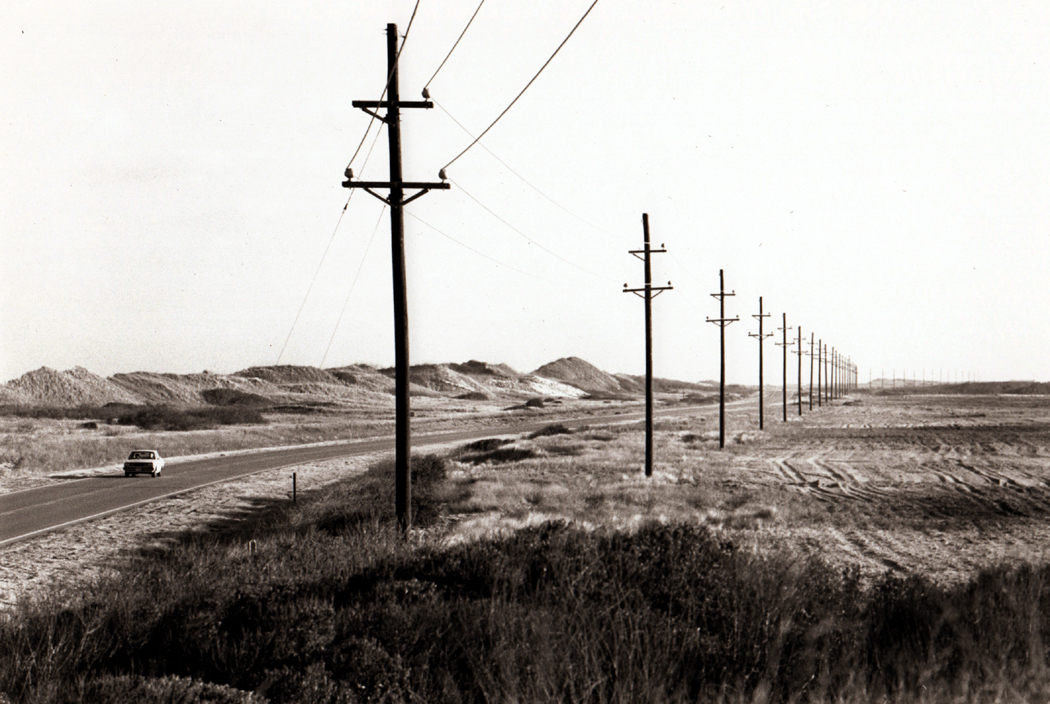
“Look around you. There are sticks everywhere. Streetlights. Traffic signs. Mile markers.

“Go to the most godforsaken plain in North Dakota and you will see lines of fence poles stretching out to the horizons.

“We are a species mad about sticks.

“Flags on golf greens. Citronella poles in back yards. Surveyors’ stakes. Bean poles and tomato stakes. Crosses in front of churches. Maypoles.

“We can hardly play a game without plunging a pole into the ground: goal posts, foul poles, supports for basketball  hoops and tennis nets. You can’t even play croquet without sticks in the ground.TV and radio towers on Mt Wilsonmultiples

“And it’s not just now I’m talking about. In the Bible, Aaron’s rod was stuck into the ground and sprouted. Sioux Indians had to place a pole in the ground for their Sun Dance. Hey, and digging sticks. Totem Poles. Prayer sticks…moonflag

“We travel 169,000 miles to the moon and what do we do? Plop down a flagpole and take our photo beside it.

“You can’t walk 30 yards in this town and not see some pole drilled into the dirt: street signs; business signs.

“We have turned our planet into a porcupine.”

I laughed. “But didn’t you say chimpanzees stick sticks in the ground for termites?”

“Oh, yeah. I guess I’m wrong, then. Never mind.”

But I had my own theory.

“Human beings are the only animals who use toilet paper,” I said.

That seemed to make Stuart happy. He would steal that line. The Road poles

adam and eve poster 1958

Stuart is a friend of mine and he always has an opinion. They aren’t always completely thought out, but then, that’s the way it often is with our opinions; we form them out of instinct and then seek factual support.

Stuart has always had definite opinions about men and women. The fact that he has had two official and two unofficial marriages, and continues to forge his way through one failed relationship after another has not blunted his faith in his grasp of the matter.

I recently wrote a blog about the difficulty most men have in multi-tasking (https://richardnilsen.com/2014/02/17/keeping-life-simple/), and Stuart brought it up when he came to visit on another one of his cross-country trips, unsure of where he would settle this time.

Stuart did, in fact, have a theory. Like all his theories, it was more about spouting off than about solid sociological, theological or scientific research.

“OK, here goes.

“Men are all fetishists. This is the primary distinction between men and women,” he said.

“I don’t mean all men are into leather or vinyl, but that men localize their interests. It all comes down to a focus on a single issue, and all others can fend for themselves.”

“You mean men can’t multi-task?”

“That’s a good way of putting it.

“Think of porn. Why do women not respond? Why do men? People say it’s because women are not visual and men are, but that’s not the main problem. After all, women don’t respond to verbal porn either. It’s because men localize their sexual interest in one spot on their bodies. And, believe me, it’s always the same spot.

“By the way, if you attend to that spot, it doesn’t matter what else you do, they’ll be happy. It’s really rather simple. Everything about men is really rather simple. I know that’s hard for women to understand, because women are wired for complexity.”adam and eve woodcut

“That seems like a stereotype,” I said. “As in: Women can multitask.”

“But it’s true,” he continued. “Look at D.H. Lawrence. He adds a religious layer to the whole thing, and makes a god of that spot on his body, and believes that both men and women worship that dangling deity. But it’s really only a man’s religion.

“It colors everything in a man’s life. But it especially colors his attraction to women. Not only does he believe that women care about his equipment, he actually believes women go around talking about it in hushed, worshipful tones. Is it big enough? Am I man enough? Very little thought goes into anything else that might be thought manly.

“So now, when a man looks upon a woman, that same single-mindedness makes him pick out a single attribute of the woman for worship. It is seldom her equipment. Why? I don’t know. Ask Freud. Wait. No, don’t ask Freud.

“So, for a man, it is her boobies he fixates on, or her hair, or her legs. Her big booty or the light down of hair on her arms. It becomes the trigger for his attraction.adam and eve comic

“You see it all the time. A man loves a woman because her hair is blond, or because she has a turned-up nose, or pouty lips. She can weigh 200 pounds, but because her hair is curly, he sighs and pines.

“It can be something less tangible, like a sense of humor, but it seldom is. Mostly it is a physical endowment. Some like saggy boobs, some like a high arch on the instep. Some like just the hint of a mustache on her upper lip.”

“Gross!”

“But it’s true.

“When in the act of love, it is usually this one particular that the man is obsessing on. He is wildly in love with her hair, or the mole on her cheek, or the way she cuts her fingernails short.

“It can be perfume. It can be the fact she wears short pants. It can be the one button left undone on her blouse. But it is one thing.

“Women, on the other hand, tend to see the whole man, to see him as a person. When women complain about the objectification of themselves by men, they are right to do so, but they also miss a central truth of existence and the propagation of the species.

“Men simply don’t see the counter-indications: If that blonde in fact does weigh 200 pounds, or is a shrieking harpy, it doesn’t figure into his erotic calculations.

“The woman, however, always takes all the conflicting data into account and makes a profit-loss calculation. Is there enough there to work with? Does the good outweigh the bad.”adam and eve etching

I objected, the way you do when presented with something you know is true but don’t wish to acknowledge, hoping that denying it will make it go away, at least for the moment.

“It can’t be that simple,” I said.

“It isn’t. And I always make room for the standard disclaimer: Individual variation trumps gender variation. You can find exceptions to every so-called rule, but in aggregate, women and men have their ways. There are women who could beat me to a pulp, and I wouldn’t want to tangle with one of them, but on the whole, men have greater upper-body strength.

“I’m not saying you should make laws based on this. Should you outlaw women from operating bulldozers or backhoes? Of course not. Individual variation is greater than any difference between men and women as a whole.

“But, what’s most interesting to me about this thesis about men and their fetish-oriented sexuality is this: In the long run, the whole thing reverses.”vigeland old age

“What do you mean?”

“I mean that after living with a woman for 20 years, a man finally learns to see the whole woman, to access all the other parts of her personality and personhood that he was blind to in the first rush of ‘let’s-make-babies.’ She grows in his estimation. What he should have seen from the beginning, he now understands. The fire has spread into a circle, leaving the grass in the middle burnt, but a wider horizon of concern and interest expanding.

“By the way, learning more about the woman isn’t always a good thing. It also may lead to divorce.

“But the reverse is true for the woman. After living with the man for years, she is likely to latch onto the one thing, the one attribute, the one saving grace he has that makes up for all the failings.

“So, his appreciation for his wife grows, her appreciation for him narrows, but deepens.”

“At some point, though, it would seem there should be a crossing of the lines on the graph,” I said. “There should be a point when her narrowing and his expanding meet at one perfect moment of mutual understanding.”

“Well thought. I don’t know,” Stuart said. “That’s what you will have to find out. I never got there.”

Hiking to the lake in Nwadeni Provincial Park

Hiking to the lake in Nwanedi Provincial Park

In America, when you see a Land Rover, it’s likely to be in Beverly Hills. Here it is a shiny status symbol for those whose ”other car” really is a BMW.

But in the veld country of southern Africa, the Land Rover is a necessity. Usually beat up and painted with an inch or two of dried mud, it is a life support system in a region, like the Venda region of South Africa’s Limpopo Province, that has only seven miles of paved road.

Venda is stuck in the northeast corner of South Africa and is slightly larger than Delaware. It has only one city, Thohoyandou, where most of the pavement can be found. Outside the city, you depend on gravel roads and dirt. rondavals

It is a land where most people farm and raise cattle. Almost everyone lives in a round mud hut called a rondavel that is at most 15 feet in diameter. Small villages are scattered through the hills. You can tell who has status, or at least who has money. While most rondavels have thatched roofs, some of them show off by having tin roofs.

Even more ostentatious are those with double-hung windows cut into the mud walls and at least one rondavel in the capital is two stories tall. giraffe

And in the north, about 30 miles south of the Limpopo River that divides South Africa from Zimbabwe, there is a primitive provincial park called Nwanedi. Covered with low hills and scrub vegetation, it is a place where your Land Rover may very well have to stop to allow a herd of giraffes in front of you to cross what passes for a road.

The grassland passed by and we headed up into the hills. We passed the defining baobab and acacia trees of the region. The baobab is built like a gargantuan broccoli, with a massive trunk and only the wisp of foliage floating around its top. The Venda people say that God planted the baobab tree upside down, with its roots in the air.

Baobab

Baobab

The acacia is the tree you see in every photograph of Africa, where the top of the tree seems spread out like the anvil on an aging thunderhead. It is a spiky tree and sometimes called the ”umbrella thorn.”

But two other trees were more interesting to our guide. One is the marula tree, which is related to the mango, and bears a sweet, tasty fruit that ripens just as it falls from the tree. Tasting a little like a persimmon, the fruit quickly ferments on the ground where it is sometimes eaten by animals. Elephants have been known to go on a bender when the marula fruit ripens.

And the mopane tree, with large leaf pairs that look like the twin prints of a deer hoof. A type of caterpillar feasts on the tree and in turn the Venda people feast on the mopane worm.

Marula fruit

Marula fruit

Unfortunately, the worms were out of season when we were there.

It’s a dusty trip, and in January on the other side of the equator, quite hot.

So our guide — who would make Crocodile Dundee look like a sissy — suggested we drive up to a little place he knew for a swim under a waterfall.

The Land Rover left anything that could even be mistaken for a road and went into the bush. When we crossed a dry stream bed, the Land Rover climbed over boulders the size of Holsteins and dipped and lifted its wheels individually as the engine pulled us along at the speed of a snail. lake vertical

When we could drive no more, we got out and walked. At the end of the path was a waterfall and a pool cut into the rocks underneath a 50-foot yellow sandstone cliff.

Sunlight angled in from one side and the blue sky and yellow rock were fragmented and reflected in the pool.

And the most extraordinary thing happened. A troop of baboons peeked over the top of the cliff at us. There were eight or a dozen of them — it was hard to count them as their heads tentatively bobbed up and down among the rocks — and they were led by one aggressive alpha male who picked me out to negotiate with, probably because I was the only one out of the water at the time, sunning myself on the rocks.

While the rest of the baboons would poke their heads up and squawk and then disappear, the leader stared at me and bared his teeth. He sat on a promontory and rocked slowly back and forth, holding himself up with his arching front legs.

Watching the baboons

Watching the baboons

I didn’t know what the body language meant exactly, but I thought I’d reciprocate. So, I faced him, bared my teeth and bobbed back and forth. It drove him nuts. He screeched and ran behind a rock. When he reappeared, he went through the process again. So did I. He screeched and ran behind a rock. baboon teeth

We did this four or five times before he seemed to give up. I don’t know if he accepted me as his new boss, or whether he just thought the water hole wasn’t important enough to defend at that moment, but it felt to me as if I were communicating with an alien. He might as well have been from another planet, and we made halting and fretful attempts to figure each other out.

At any rate, they left us alone and went back to gleaning through the grass at the top of the rocks.

And I wondered if I were now an adopted baboon.

fishing hallingdal bw

There are two things Norwegians love beyond all measure. One is coffee, which is drunk all day long; the other is what they call ”the Nature.”

The Nature is what Norway is about. Less than 10 percent of the land is usable for farming or industry, and the rest is craggy mountains, deep, dark forests and steep-sided fjords cut hundreds of miles inland from the sea.

For the Norwegian, to be out in the Nature is to be where it is healthy, both physically and mentally, and it is the only place where it is possible to be ekte Norsk, or truly Norwegian.

Collection of hytte, Hallingdal, Norway

Collection of hytte, Hallingdal, Norway

So any self-respecting urbanite owns a small hytte, or cabin, out in the wilderness where he repairs on holiday. In the summer, it is for relaxation and hiking. In winter, it is for skiing.

It was the summer when I visited Hallingdal, a long valley in the middle of the ”spoon” bowl of the country. I had been staying with relatives in Oslo, and they wanted to get away one week to the hytte and introduce me to the Nature.

Our first full day in Hallingdal, Astrid, who was 69, and her brother Einar, a year younger, got me out of bed early for a hike. Einar wore shorts, hiking boots and knee socks accessorized by an enthusiastic grin. He slung an old canvas haversack over his back. His brother-in-law, Lars, carried a woodsman’s bag full of kindling on his back. Astrid wore a wide-brim straw hat with a scarf to hold it down.

We walked a short ways down the hill, across the middle of the valley and then started climbing the Hallingskarvet, which is a 30-mile-long mountain range that runs like an inverted crescent moon along the south side of the valley. Hallingskarvet stream bw

The air was crisp, the hillsides green with spongy moss and curling grass, and the trail followed many small meltwater streams.

Most Americans have little idea just how far north Norway is on our globe. Just remember that Paris is as far north as Newfoundland. Hallingdal is as far north as Greenland. It is only 300 miles south of the Arctic Circle. That puts the tree line very low on the hillsides; it also puts a July dawn at about 2 a.m. and sunset near midnight. That low light makes the green all the more intense.

We climbed up granite cliffs and over plateaus marshy with meltwater. When we reached the highest point on the hike, we stopped for lunch. Lars unloaded the wood he’d been carrying, scrunched a few rocks together and built a fire on which he balanced his coffeepot.

While the coffee water came to a boil, Einar sliced gjetost, or sweet, brown goat cheese, and loaded up the knekkebrod, which is the Norwegian version of Rye-Krisp. The view was stunning. On one side, below us, was the 10-mile-long lake, Strandevatn, and on the other side, the highest point in the Hallingskarvet, a 6,342-foot-high peak named Folarskardnuten, crisscrossed with snow and standing over its own valley like a blue eagle over its nest.

Folarskardnuten

Folarskardnuten

After the sandwiches and coffee, Einar pulled a few bottles of beer from his sack, and we finished off the lunch with a toast to the Nature.

On the way down the mountain, we passed many seter, tiny summer farms that families use when they pasture their goat- and cowherds up on the mountains. The typical seter is made of logs or roughly sawn lumber, with a grass roof and a split-rail fence around the ”estate.” It couldn’t be more rustic.

Seter

Seter

In one was a newlywed bride whom Astrid knew. We stopped, knocked on the front door and were invited to enter. She was making romme, a Norwegian version of creme fraiche, and she gave us all some. In Norway, you never visit someone without making selskap, or company. And that always includes food. If there is no smorgasbord, there is always at least a bowl of fresh romme from a rosy-cheeked bride in a grass-thatched one-room farmhouse on a steep grassy mountainside with a view of the valley.

There must be something to this Nature. For every Norwegian I met was maniacally healthy.

Even senior-citizen Astrid, who hiked and climbed mountains like a Marine, put me to shame. On reaching the hytte, she glowed and said she couldn’t wait to begin skiing again next winter.