Archive

Tag Archives: art

Waterlilies Brookgreen Garden, SC

Some years ago — never mind how long precisely — when I was still earning a crust as an art critic, I wrote a nasty review about a painter who had genuinely made me angry. This artist had some currency in the region, and a cadre of fans. I was not one of them.

Some years later, I discovered that the review I wrote had caused the artist to stop painting altogether for five years. When I was  asked if I felt bad about that, I always said, no, I felt I had performed a public service. There was a smugness in my flippancy which I now regret.

Because, now in my senescence, I have become somewhat gentler, and regret the tone of that review, although I cannot gainsay the content. (When I met the artist many years later, when she came to a lecture I was giving — after she had survived not only my review, her hiatus from work and a fight with cancer — she was surprisingly forgiving and said she did not hold the review against me. I don’t know why not.)

She has recovered from her cancer and from my review and recently mounted a new show. She still has her cadre. I wish her well. But I do want to explain my anger. It wasn’t simply the quality of her work, or its purported subject.

I didn’t get angry over her technique, which was rather sloppy — I’m sure her fans call it “spontaneous,” although I took her to task for it. And I didn’t get angry over her popularity. Certainly lots of popular artists are awful, sentimental, shallow — but there are also quite popular artists who are among the best. It’s hard to knock Van Gogh or Monet for being popular, although the general run of popular, in the demotic sense, tends to be in the Thomas Kinkade and LeRoy Neiman or P. Buckley Moss camps.

The sins of this painter I refer to — aside from painting poorly — was that she presented her work as “spiritual,” and surrounded it with all the cliche buzzwords that accompany such pretensions. The show was called “The Lotus as Metaphor,” and it purported to lead us on a spiritual journey.

There is a whole class of artist who gush spiritual, a quality less evidenced in the work, but more in the words they pack around their work. They claim a kind of spirituality and it is usually of the soft-focus kind that blurs all inconvenient edges. Often they pick up the conventional symbols and signs of a religious tradition and use them like bumper stickers. This is mistaking the Völkergedanken for the source.  Not so much spirituality as it is cultural tourism.lily-lotus comparison

The particular show that got my dander up was a series of paintings of “sacred lotus.” The first problem was, she had not painted lotus but waterlilies. Not the same plant, not the same cultural meaning.

It isn’t that I was being pedantic about botanical nomenclature, but that I have noticed over the years that those who wax ecstatic about the spiritual often have such an indifferent relationship with the real.

The lotus (genus Nelumbo) has a different growth pattern, leaf shape and flower — to say nothing of cultural meaning — than the more common water lily (Nymphaea). The painter’s plants were not clearly drawn, but they grew more like Nymphaea, have the heart-shaped leaves of Nymphaea and the flowers of Nymphaea.

This may seem like caviling, but I firmly believe that before you start jumping on the otherworldly bandwagon, you should learn something about this world. This retreat into “spirituality” evidences a certain medieval contempt for the world that is not earned. In fact, as any dedicated artist knows, looking closely at something, as when you draw it with total concentration, will lead you to the edge of mystical experience. (See: https://richardnilsen.com/2012/06/21/apple-of-my-eye/ ) Without the commitment to this world, you cannot break on through to the other side.

Rather than starting with the here and now and taking the path to eternity, the artist seemed content with the road map. She approached spirituality from the exterior, with not a hint of introspection. She started — and ended — with the public symbol — borrowed though it be from an alien public — instead of finding a fresh, direct and personal symbol that might express personal experience. Borrowed profundity isn’t profound. It is hearsay.

That kind of facile pontificating on “harmony with nature” and “celebrating the joyousness of life” is what I call “Mah-jong mysticism,” the kind that seems to satisfy bored middle-class housewives with too much time on their hands. Surely one should be suspicious of any warm and fuzzy mysticism that tells us only what we want to hear. And make no mistake, this sort of thing is usually quite self-congratulatory.

In fact, after seeing these paintings, I’m not convinced the artist has ever had a mystical experience more profound than the buzz from white wine at a gallery opening. The artist wore the word “spiritual” the way some coffeehouse poets used to wear berets.

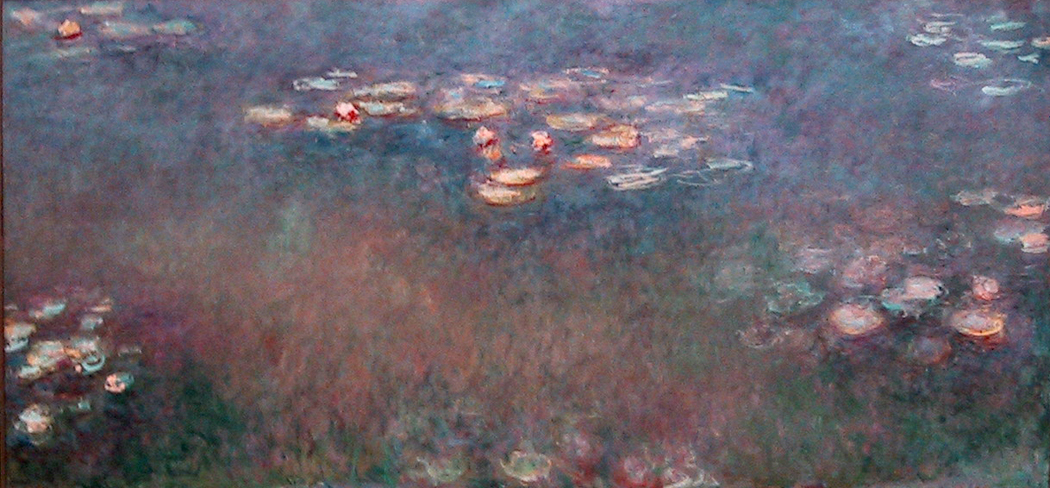
The paintings were like third- or fourth-generation color Xerox copies of Monet waterlilies, with all the subtlety of color and drawing sucked out. Indeed, my initial response was generated by the effrontery of copying Monet so blatantly and yet so ineptly.

It isn’t that waterlilies aren’t a perfectly good subject, but for many of these paintings, the painter adopted the same angle of view, the same distance from her subject and the same loose, scumbly brushwork that is so familiar from Monet. The debt was too obvious.

monet waterlilies st louis

monument valley 2It was as if she hadn’t looked at waterlilies at all, but looked at Monets instead. This is secondhand experience, like reading the Cliff Notes instead of the book. If she had looked at waterlilies intently and followed them down into the depths of her mind and heart, she might have painted something astonishing. That’s what Monet did. But imitating the look of Monet is no better than standing at the visitor center of Monument Valley and photographing the Mitten Buttes, thinking you have equaled Ansel Adams.

Her art mimicked the words and images that have conventional currency among those who bask in what is held to be spirituality. But those words and images have less to do with genuine spirituality than they have to do with conventionality. They are like gamepieces in a board game with all the rules known and understood, at least by the initiates. They are Tarot cards, ouija boards, seance knocks, and are at root just as fraudulent.

All this might well provoke a bad review in the local newspaper, but it might not, in any other critic, provoke anger. My reaction was not merely to the work on the gallery walls, but to an entire class of thought, a class that seems to me to be cheating. I felt cheated. Here the world is all around you, a vast forest of burning bush speaking “I am that I am,” and yet the artist does not see it, but rather gives us the names of metaphors other people have used to describe the ineffable. I have always called this “imitation art,” not just imitation of already existing art, but imitation of the origin and purpose of the genuine article. It is a variety of “play-pretend,” and avoids the real work of art to give us instead a pale simulacrum.

The deep roots of art is a profound love for the things of this world. Not ideas about things, but the things themselves. We live so much by habit and fail to notice what is about us. Not merely raindrops on roses and whiskers on kittens, not just birdsong and clouds, but the smell of hot tar on the road, the hurt of a stubbed toe, the layer of dust on the enamel gloss of a car hood. And not solely the physical manifestations of the world, but the inner workings as well, the emotions and sensations, the perceptions and the occasional borborygmus. That is, the entire world filtered through your sensibility. It is only when you are not aware of the world and the things of the world that you find existence so drab and monotonous that you need to invent a bogus “spirit” world to revitalize your life, to make it — and you — feel special.

hare krishnaThose who see “auras,” read horoscopes and feel the cold presence of “emanations,” seem precisely those who are incapable of finding the transcendent in fleas or sphagnum moss. Those who wear yellow robes in downtown Cleveland and chant “Om” are not actually connecting with the source, but with an imitation of it. The Edgar Cayce-ites, the crystal gazers, the astral-projectionists and clearers of engrams, seem not aware of or interested in the fact that the ordinary world given us is astonishing enough on its own. Nothing they have come up with matches the weirdness of an elephant or coconut or the shimmering skin of a squid.

I suspect any use of such buzz words as “energies,” “toxins” or “healing.” They are bogey-words, intended to invest their users with a sacerdotal shine. You can have Atlantis; I’ll take the Bronx. I can predict what  you will find in Atlantis — such things are defined by the conventions of the occult, and seldom vary much — but I could never predict what I might find on any house on any street in the Bronx, or in any city. The real world is too varied and multifarious and constantly challenges our expectations.

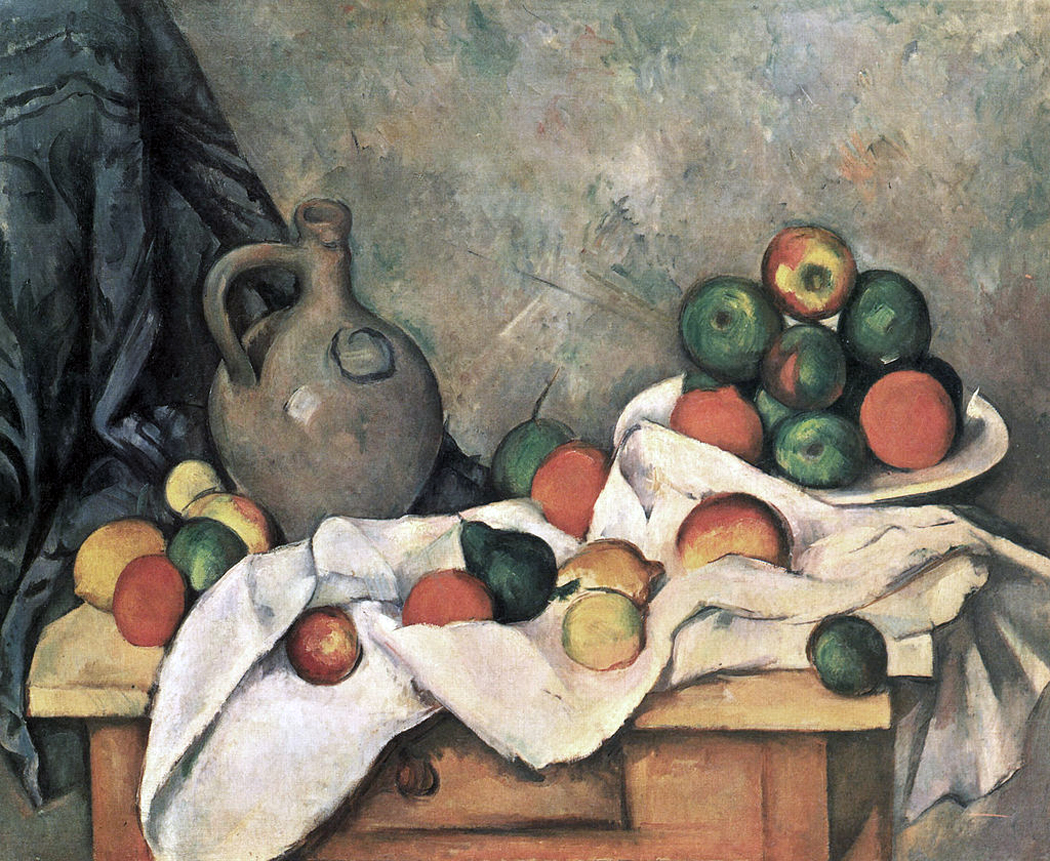
cezanne

So, I say, look at those apples and pears in the Cezanne painting, look at the roofs and olive trees in the Van Gogh, or hear the birdcalls transmogrified in Messiaen’s music, or regard the madeleine in Proust. Engage with the world, become engorged with it, swallow it whole, let it illuminate your inner life and become the passageway to transcendence. All of it, good and bad, joyful and hurtful, fulfilling and frustrating, pointed and aimless.

It is inexhaustible and inextinguishable.

kelly briar

It is impossible to listen to the final quartets of Beethoven and not recognize in them something quite different from the optimistic and heroic thrust of his most popular works, the Eroica, the Appassionata, the Razumovskies. The quartets in question no longer follow the standard four-movement shape of the classical quartet and symphony, and they no longer seem addressed to the world and society, but rather, they are discursive, wandering and seem turned completely inward.

Innigkeit

Innigkeit

It has been called his “late style” ever since 1855, when Wilhelm von Lenz wrote his book, “Beethoven and his three styles,” which attempts to give shape to the composer’s career, with an “early style” in imitation of Haydn and Mozart; a “middle period” with all those grand exhortations to heroism and the overcoming of obstacles and the establishment of freedom and individualism; to the “late style” of innigkeit and apparent formlessness.

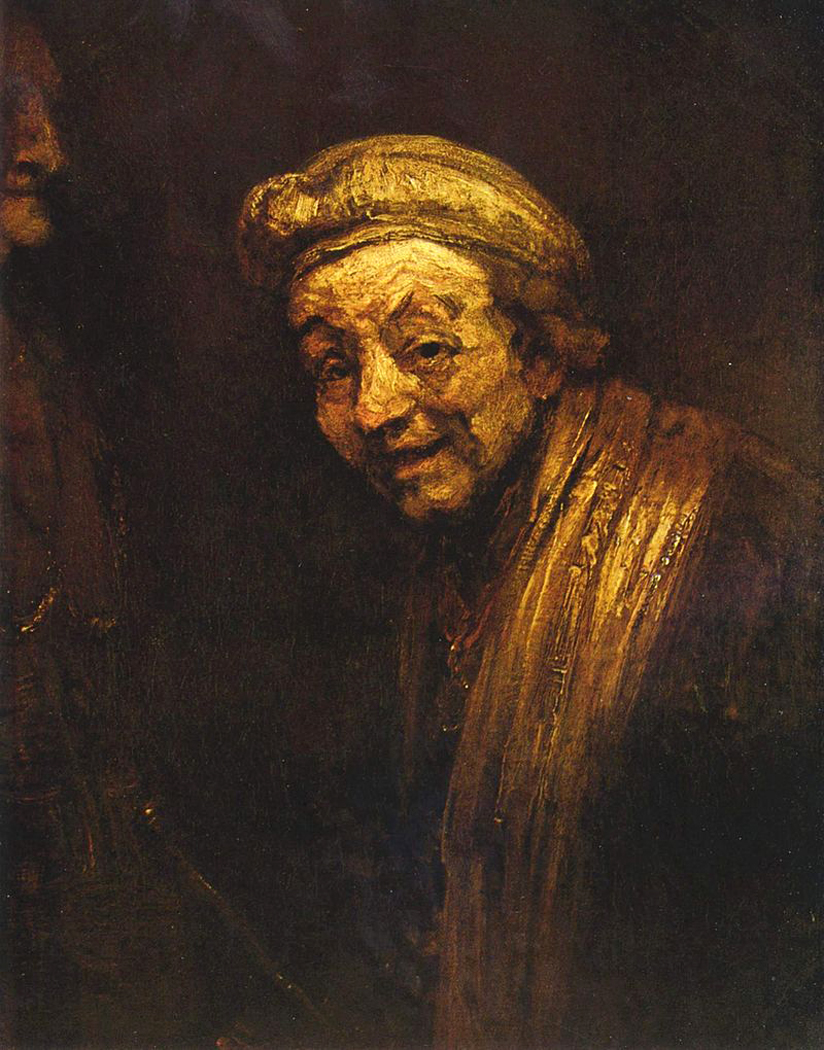
Since then, it has become standard to view an artist’s career into three: apprenticeship, mastery, and a “late style” in which the artist perhaps gives up his public function to investigate his private concerns. Within this pattern, it has become usual to see the late period as the culmination of an artist’s life and work, as its height, as its reduced essence.rembrandt self portrait

And so, we see the final paintings of Rembrandt, the late romances of Shakespeare, the last dark photographs of Edward Weston or the Ninth Symphony of Mahler as somehow special, as more meaningful, as “better” even as “best.” We look to them for something like a peroration of wisdom, the final words or notes or brushstrokes of a sage. Goya’s black paintings, or the black paintings of Jackson Pollock. (Usually, there is some element of darkness in late work, whether it is the Beethoven quartets or the quiet “ersterbend” that ends the Mahler Ninth.)

weston china cove pointlobosAs Minor White said of the Weston photographs: “Rarely are we shown the maturest work of men who have lived richly and whose spirit has grown all their lives … the last photographs of Edward Weston made at Point Lobos … may parallel in content the last quartets of Beethoven.”

There are many problem with this formulation. First, so many artists — certainly the majority — don’t fit into this pattern. Second, while we can recognize a “late style” in the final works of Franz Schubert, Schubert died at 31. Can that be considered his late period? Suppose he had lived his three score years and ten? What would have followed his “late style?” Obviously, a late style is something we apply only in retrospect. Even Beethoven, whose late style defines the idea, died at a fairly young age of 56. Where would he have gone if he had lived to 70? His late style would then have been something transitional.

Then, there are artists whose supposed late style is generally admitted to be a decline. One thinks of the final paintings of De Kooning. And there is the problem of someone like Wagner, who strove self-consciously for the prestige of having a late style with the artificial spirituality of “Parsifal.”

There is another issue, too. Late style means more than one thing. Initially, we think of art that is intensely personal rather than public, art that reaches the darker and more private parts of the human experience. But that is not the only thing — perhaps not even the primary thing — that defines late style. As Edward Said said in his study of the subject, late style is characterized by an increasing simplicity of technique. Take those late quartets, which are a bouquet of dances, marches, recitativ and arias, and movements sometimes so short, they hardly count as movements at all. They alternate with long fugal passages where the counterpoint is hidden in blocks of chordal harmony. Even their sonata-form movements are choppy with short, punchy themes entering stage right and quickly running off stage left, chased by the next patch of tune. There is a superfluity of material and an economy of means.Heiliger Dankgesang

It is as though an artist, a composer, a poet, had spent his youth perfecting an elaborate craft, the mastery of which is part of his declaration to the world, but having become increasingly confident of his ability, he no longer considers it to be the important part of his work. The competence is still there, but the showing-off is gone: The artist only uses so much of his virtuosity as is needed to make his point.

Another way of putting it is that when young, an artist is in love with his artform — with his villanelle, his twelve tones, his impasto — and so aware of the tradition and history of that technique, that he wants to strive to shoulder his way into that history, to take his place. But as age and its concomitant wisdom encroach, the technique seems a shallow exercise compared with the content: The balance shifts to what he has to say rather than how he says it.

As Arnold Schoenberg said, “There is still plenty of good music to be written in C major.”

This is Picasso’s arc: Early work is meant to rattle art history. He goes through his “periods,” which are each an exploration of a particular technique or “ism.” But in his later life, he freed himself to simply play with his paints or his pottery. It is clearly Picasso’s “voice,” his “look,” but the ism ceases to be the point: the work becomes an endless parade of bulls, women, birds, still lifes and images of concupiscent artists, often with bulls or women.matisse cutout

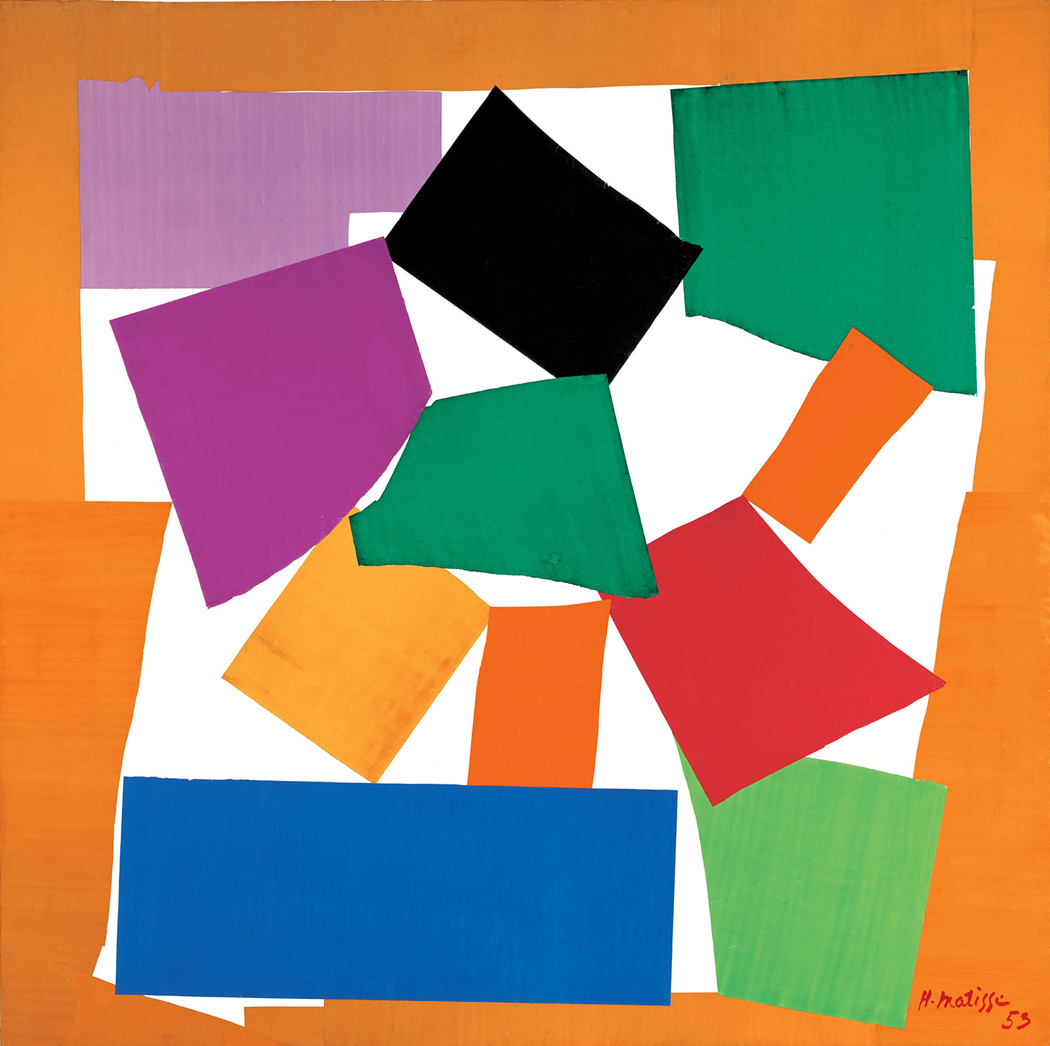
Or Matisse, who ended with paper cutouts, as simple as a child’s finger painting.

One sees this in many a career, where the young artist finds his voice and shouts to make a name, but once having established his bona fides, feels then free to explore what he is really interested in. One thinks perhaps of Richard Diebenkorn, who made a name with abstract art, and after becoming famous, started making “pictures.”

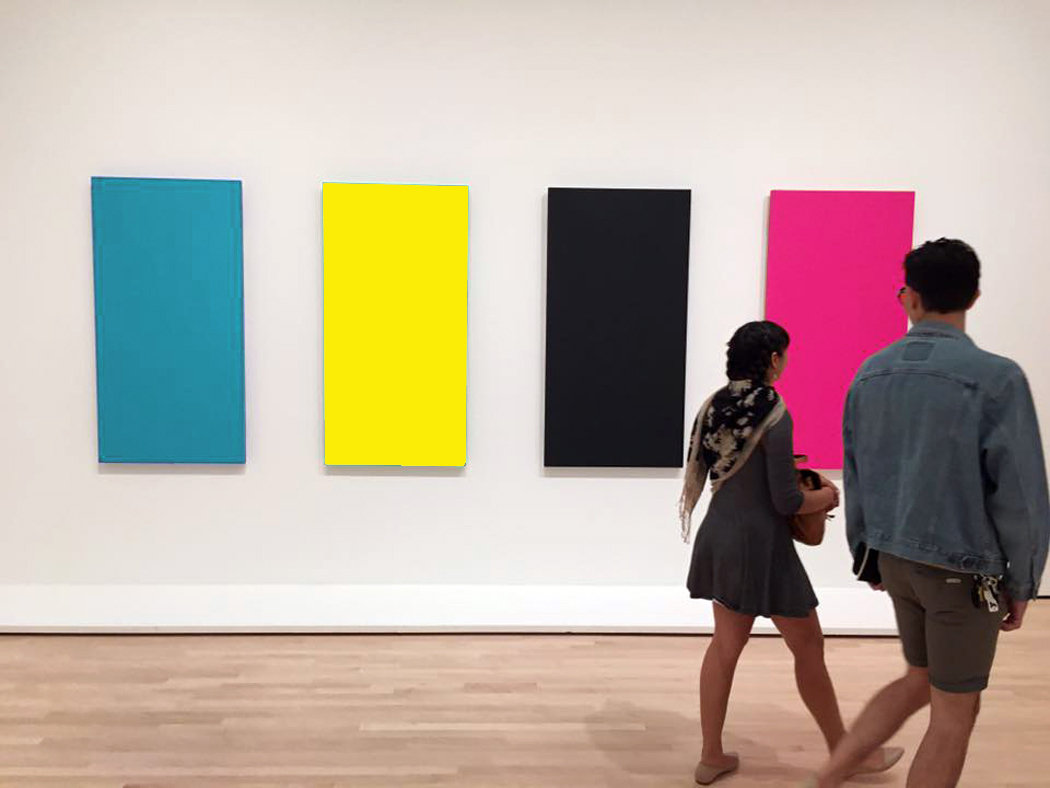
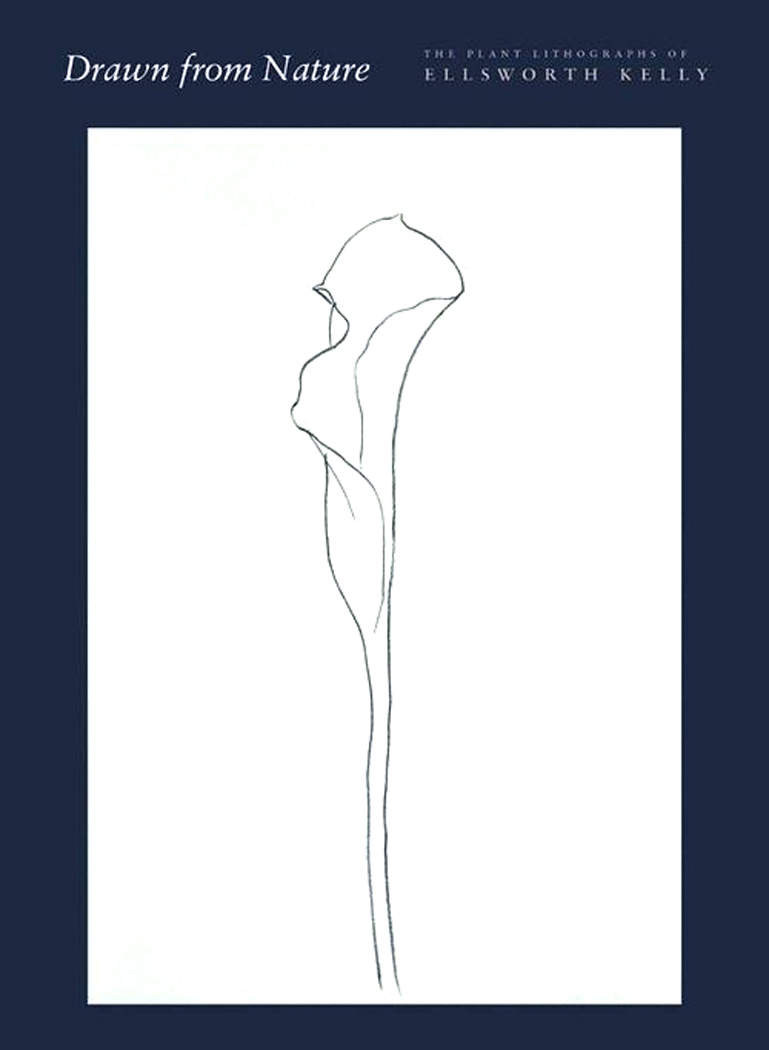
kelly coverI was struck seeing some drawings by Ellsworth Kelly, who made his career with minimalist Color Field paintings — they might as well have been models for flags — but these drawings were of plants, in simple black line on simple white paper. They were elegant and expressive and nothing like the bland paintings. He has made them throughout his career, but they had been seen only once (in 1970) before they made a big splash, showing them in 2012 at the Metropolitan Museum of Art in New York. Kelly clearly loved the plant forms he drew.

There comes with age and experience — and perhaps prodded along by the awareness of the extreme shortness of life — a need to say what needs saying unencumbered by all the apparatus and hoopla that seduce our younger selves.

And this is where the simplicity of means becomes the same thing as the profundity of meaning. In his middle period, at the height of his Beethoven-ness, he can spend an entire symphony showing us how an obsessive rhythmic motiv in C-minor can grow into a triumphal shout of joy in C-major. But by the late quartets, the emotional expressions pass moment by moment, as if attention to the present were more important than presentiment of the future or reminiscence of what has gone before. There is an intensity of the now, an urgency of being present. And that is where we find the marriage of the late style’s depth and its simplicity.

Near Pendleton, Ore.

Near Pendleton, Ore.

There are books that give us pleasure in the reading, books that inform us, books we are required to read, and there are books that become so internalized, they essentially shape the course of our lives. We can probably all name such books for ourselves. I made a list, maybe 15 years ago, in a moment of quo vadis self reflection, of those books that have most shaped who I am. I stopped listing after 50 books. Since I made the list, I could add several more; after all, I keep reading.

Pageant of Life

Pageant of Life

Of course, it is the earliest reading that had the most influence — as the twig is bent, so the tree inclines. Even the best of the more recent books cannot have influenced me even a percentage of how much I was shaped by, say, the Life magazine book, The World We Live In, which my grandmother gave me on my eighth birthday, and which left me wide-eyed at the wonder and diversity of nature  — volcanoes, blue whales, dinosaurs, jellyfish, rainforests, barchan sand dunes. I wear the badge of that book in my deepest heart’s core. It is the holy of holies.

But what caught my attention as I reread my old list, was that it continued to include lists of other things that shaped who I have become: music that influenced my developing psyche; art (that I saw in person, not just in books); movies; TV shows; — and last on the list of lists —  landscapes.

We don’t often think of how deeply landscape affects us, guides the direction of our lives — but how different might be the novels written by Fenimore Cooper or Washington Irving, or Mark Twain if those authors had lived elsewhere and seen different rivers, different mountains, different forests. I think of James Joyce’s Ulysses, which is practically a landscape — a cityscape — spread into lines of type.

Back Bay, Va.

Back Bay, Va.

Joyce had Dublin; Thomas Wolfe had Asheville, N.C., where my wife and I now live. Recently, I opened the first pages of Thomas Wolfe’s Look Homeward, Angel and read his description of Oliver Gant’s trip to western North Carolina. At one point, he describes a trip up the face of the Blue Ridge from “Old Stockade” to “Altamont” — thinly disguised versions of Old Fort and Asheville —  and as I read it, I knew that landscape — I knew that gravel road; I’ve driven it myself just last month. It’s still gravel and few cars venture it as it wanders and loops through the trees and snakes up the mountain. The interstate long ago made the trip faster and easier. But freeways are boring. As the old road loops and hairpins its way, you can frequently spy the railroad line as it winds its way uphill. That railroad was just being built as Wolfe wrote about it but even now, it  passes just under the hill where I live, and hear the locomotive whistle blow every night. It is uncanny to read about something fictionalized that you know as real.

But, in a sense, all the landscapes that are buried in the psyche are fictionalized: They have been transformed from mere fact into meaning. They are now metaphor and their existence takes on a reality that is imaginative rather than quotidian. It is imprinted as deeply as the smells of childhood, a mother’s kisses, the woodgrain of the school desk scratched with initials and scribbles.

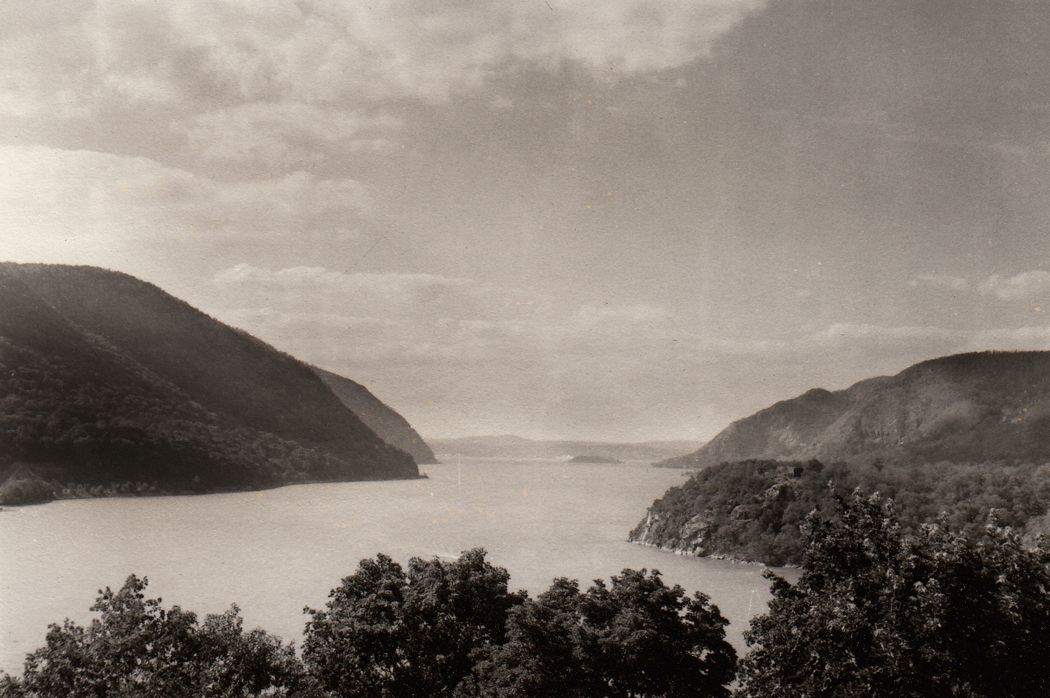
Hudson River, West Point

Hudson River, West Point

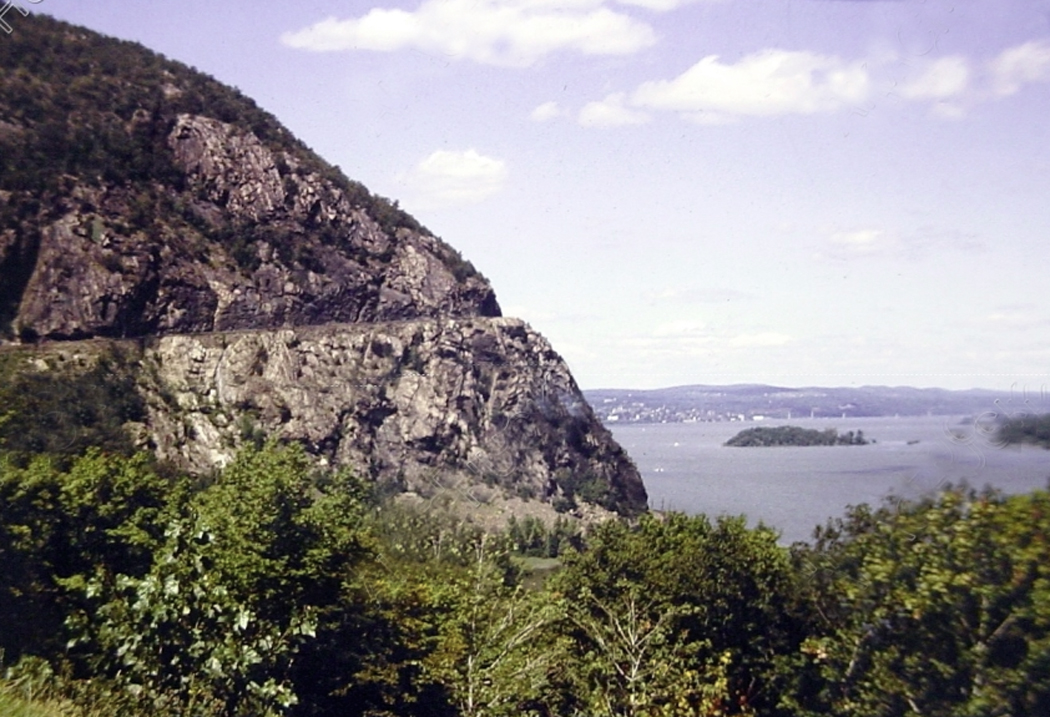
Dunderberg

Dunderberg

My own internal landscape begins as I do, in New Jersey and New York, with the Hudson River running through it and the Catskills bumping one bank and the Taconics the other. The automobile drive around the dizzying Dunderberg north of Tomkins Bay was a white-knuckle ride when I was young, the three-lane highway incised into the edge of the cliff. My father hated that part of the drive; we kids loved it. The “mothball fleet” of rusting liberty ships off Jones Point was a living link to the war my father had returned from only a few years before. There was Bear Mountain, with its ski jump and the suspension bridge over the Hudson; there was Seven Lakes Drive through Harriman State Park, all trees and granite; there was the Red Apple Rest and its billboards on the highway.Bear Mountain Bridge for blog copy

I don’t know why, but the suburban life I lived in Bergen County barely registered as landscape. The housing developments and county roads never embossed themselves on my synapses in any significant way. But the summer vacation trips we took up the Hudson to Newburgh, NY, and to the “bungalow” that was my father’s family summer cottage in West Park burned themselves deeply into my awareness of the world. The Hudson River was the aorta that pumped the lifeblood of my awareness of the larger world.

Deep River, NC

Deep River, NC

So, when I moved to North Carolina and college, I was amused at the Tar River or the Deep River. They weren’t rivers. The Hudson was a river. Guilford County’s Deep River was a wet gully. I could have jumped across it.

I have lived many places, and in many landscapes, but they haven’t all dug wormholes into my psyche. I’ve traveled to every continental state of the union — most several times. When Hank Snow sings, “I’ve been everywhere, man, I’ve been everywhere,” I can honestly say that I have been to the places he names in the song: “Hackensack, Cadillac, Fond Du Lac … Pittsburgh, Parkersburg, Gravellburg, Colorado, Ellensburg, Rexburg, Vicksburg, El Dorado, Larrimore, Atmore, Haverstraw” … the song goes on.

And all those places have landscapes that accompany them, the way a song accompanies each Fred Astaire dance number. They are there in the memory. But not all of them have transformed from geography to mythology. There are moments in life when you are particularly open, when your very skin seems adhesive to experience. It is like that when you are a child, but it also happens when you go through some life altering change, a first divorce, or a move across country, a close call, the birth of a child, or a new job. The rind of the psyche gets pulped, and becomes a place for a mythic sense of life to become rooted.

At vulnerable moments in the course of living, the world takes on an extra glow, a mythic noumenon and becomes fixed in the synapses as something larger than itself. The landscape thus internalized becomes an emotional nexus, a place where complex thoughts and feelings can be induced merely by seeing an image of that landscape, or reading an evocative description, perhaps even hearing a certain piece of music.

Mendocino County, Calif.

Mendocino County, Calif.

And so, these landscapes can influence the way you see the world. If you live by the river, you become Twain, if you live by the sea, you become Sarah Orne Jewett, if you live in Manhattan, you become Woody Allen — and all you write takes on the world view the land provides. Think of Faulkner and the red clay, of Hemingway and Michigan, of Henry Miller and Brooklyn (I know Paris comes first to mind, but it is the Brooklyn of the Rosy Crucifixion where you see the real Miller world view).

And so, when a seven-year relationship was breaking down in suspicion and acrimony, we took a trip up through Pennsylvania and the Delaware River to try to make things right. The heart was a sodden wet rag, and one chill fall morning at Port Jervis, the sun rose over a field by a railroad roundhouse that was choked with more wildflowers than I have ever seen before: yarrow, aster, ironweed, joe pye weed, mullein, sunflower, black-eyed susan, queen-anne’s lace. It burned into me, and is still there as a kind of metaphor for the infinite sadness of paradise.

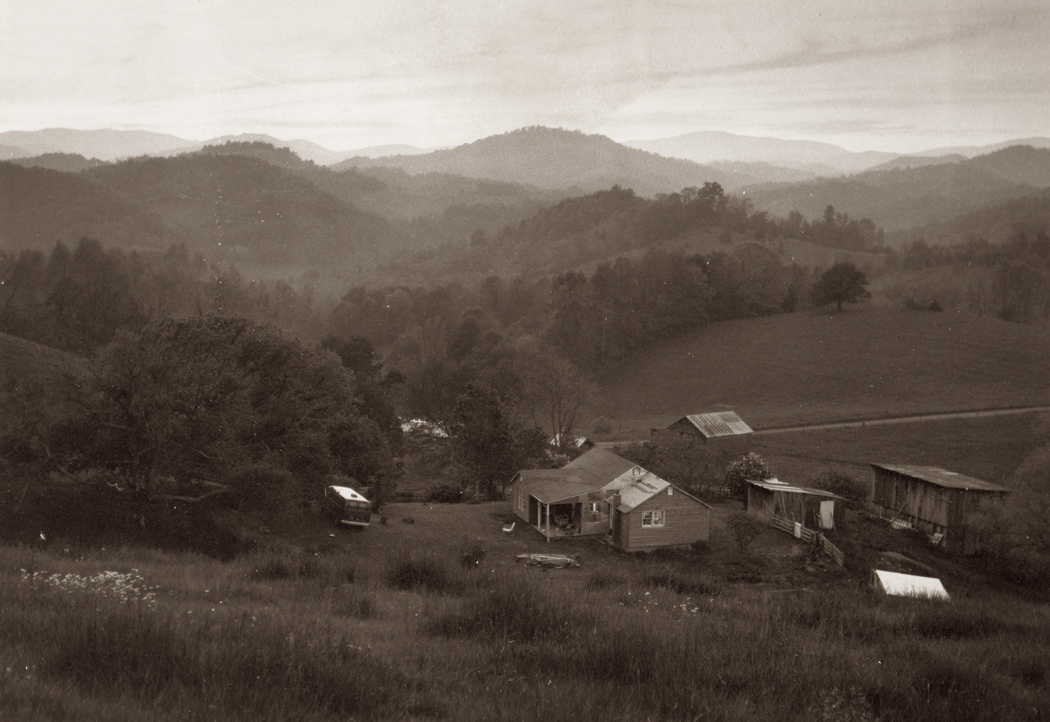
Watauga County, NC

Watauga County, NC

Years later, when I first came to live with the woman who has been my wife for the past 30 years, our house was on a ridge overlooking the New River in the Blue Ridge, and the landscape of rolling mountains and hills, divided between pastures and forest, coves and hollows, whitewashed churches and unpainted barns, took on that numinous glow. It is why we have moved back to the mountains, although the same landscape has now quieted down into comfortable daily life.

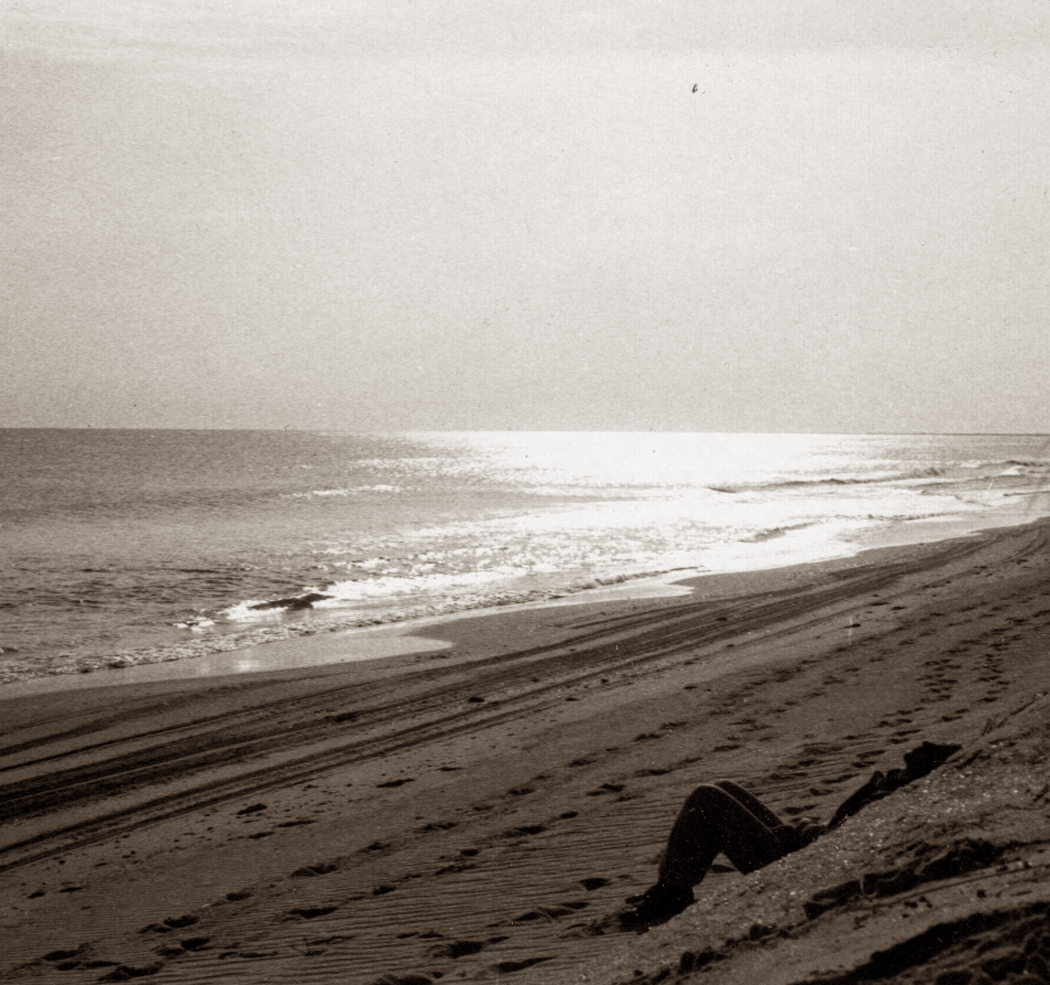
Hatteras

Hatteras

When I first entered college, and the intellectual world gaped open for me, I traveled several times with my friend Alexander to the Outer Banks. The sea oats and dunes, the long beach, Hatteras point — climbing illegally to the top of the lighthouse at night under a blanket of stars, feeling the steady wind on my cheeks, the smell of salt in the air — so that coming back to the dorm and  listening to Debussy’s La Mer on the tiny Sears Silvertone portable phonograph, sealed the experience into the brain like a mordant fixes dye in a fabric.

In the years I was unemployed and nearly homeless, I traveled back to New Jersey with my brother for Christmas. On the way back South, we drove through West Virginia, where he had friends, and we spent New Years Day on the top of a mountain. Before dawn, I woke and dressed and went out into the biting cold, where the grass was brittle with frost and my breath clouded in front of me and I surveyed the Cumberland Plateau, bumpy with mountains, spread out to the horizon. I felt lost and alone in all that frozen landscape.

Tsegi Canyon, Ariz.

Tsegi Canyon, Ariz.

The opposite emotions were engaged the first time my wife and I drove out West, in 1980, and the first time we saw buttes and mesas. The land seemed even more expansive than the West Virginia mountains, but they seemed to offer unlimited potential. The air was clear; you could see mountain ranges a hundred miles away. Over the quarter-century we lived in the West, there were many such landscapes printed on my psyche, from Christmas in the snow in Walpi, on First Mesa, spent with a Hopi family; to driving across the Escalante National Monument alone; to spending the night camping north of the Grand Canyon in a forsaken part of the Arizona Strip, one of the least populated plots of land in the country.

Landscape functions not merely as a stage set, a backdrop of other memorable occurrences, but for themselves alone, as metaphor, as an image of the inside state of one’s emotions and mind. It can be as if the landscape were not injected into your mind through your eyes, but rather, projected outward upon existence from the deepest recesses of your mind. If you were to enter my skull and photograph what you found, it would be landscape.

Big Bend NP, Texas

Big Bend NP, Texas

From my list, other landscapes you will find inside my head include the Olympic Mountains in Washington; Schoodic Point in Maine; Big Bend National Park in Texas; the sea-swell grasslands of eastern Montana that I rode past on the Empire Builder train from Chicago to Seattle; driving by night through the Big Sur in California; and Walden Pond in Concord, Mass., which I have circumambulated half a dozen times.

I do not know if it is rare — I have not asked many people — but many of the dreams I manage to remember as I wake up, are dreams consisting purely of landscape, often highly imaginary, exaggerated like the Andes of Frederick Church. It is the space in these dreams that seems to carry meaning, the emptiness from the spot where I stand to the thing I see before me: In between is air, and the air has shape and meaning.

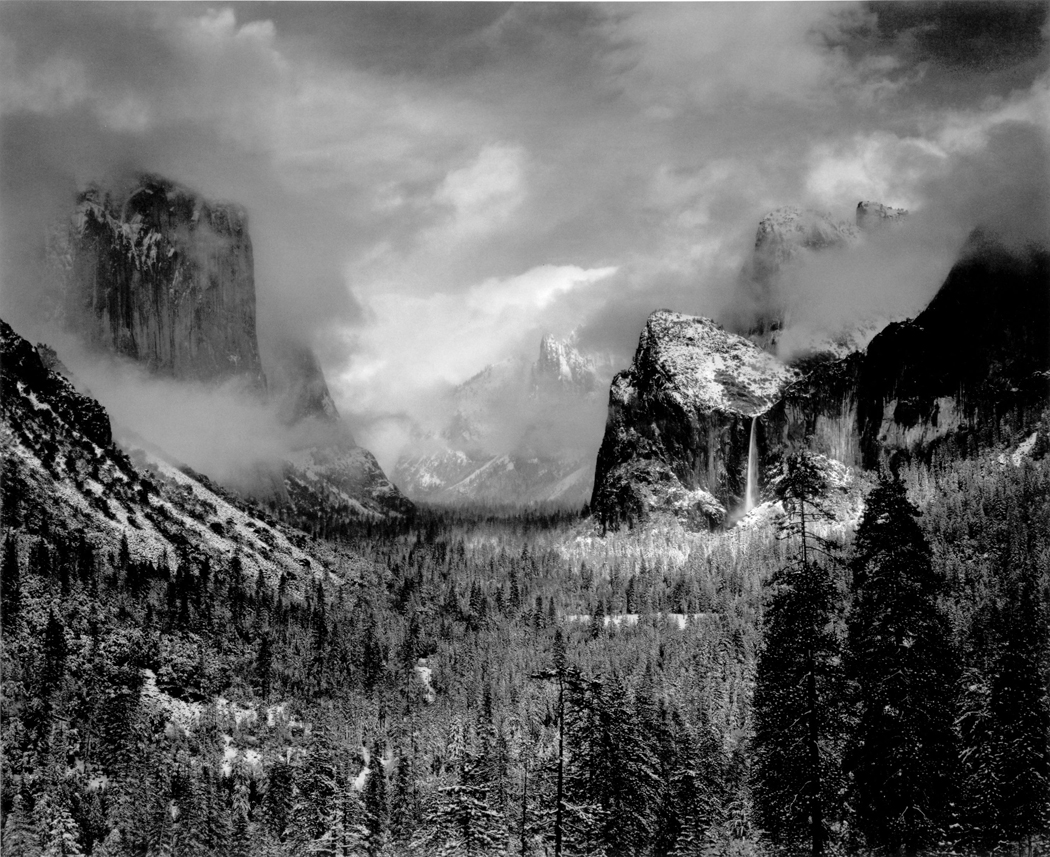
Ansel Adams, Clearing Storm, Yosemite

Ansel Adams, Clearing Storm, Yosemite

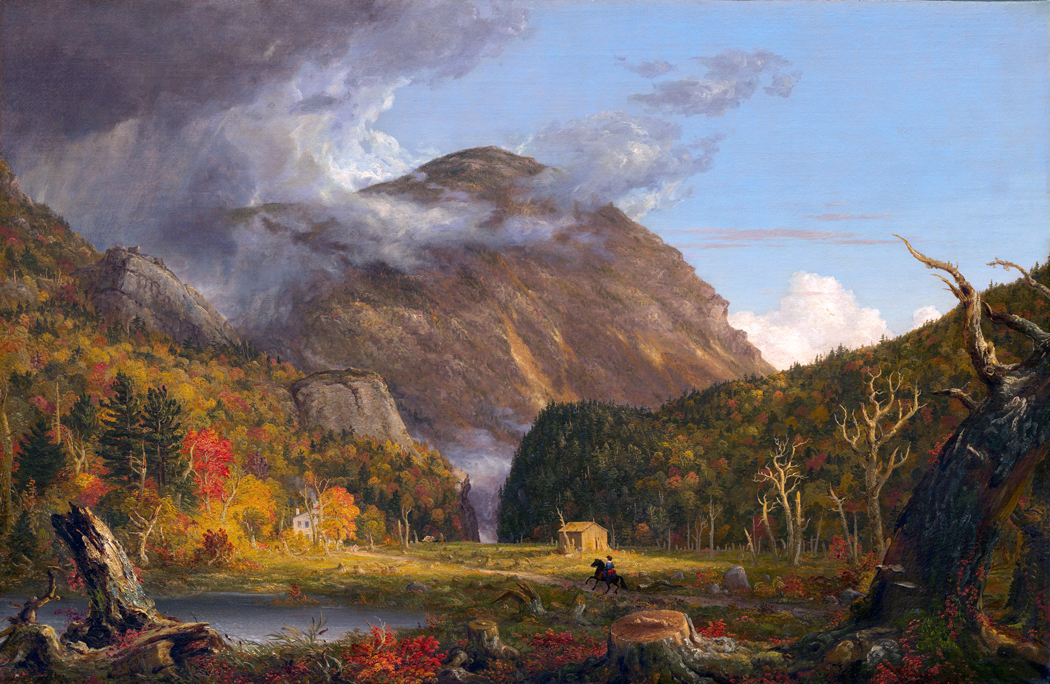
The best landscape painting and photography functions not as a record of the topography, but rather as an image of the interior state, vast and romantic, like Ansel Adams’ Yosemite in a winter storm, or Thomas Cole’s Crawford Notch. O blow you cataracts and hurricanoes, in the scumble of Turner, or cooly glow on the horizon, like the misty suns of Claude Lorrain, or the chessboard order of Canaletto.


Thomas Cole, Crawford Notch

Thomas Cole, Crawford Notch


Skull Island

Skull Island

When I was very young, perhaps 6 or 7, I first watched King Kong on TV, and what has stuck from then to now is the steamy, vine-clogged, rocky-cliffed landscape of Skull Island. That skull is mine, seen from the inside out.

If you want to shake the world out and make it larger again, get up at 3 in the morning and drive across the flatness of Indiana and Illinois. It is dark, the stars are thick as the July humidity. And the world seems quiet, empty and stretched once more to full size.

The sky grows upward as the stars populate it, lightyears away. Not only is the earth big, but you can see that you are a pebble at the bottom of a very deep universe.

You drive alone for miles and the only thing you see is distant headlights, like fireflies, flitting along the horizon line that shows up as the boundary between two different shades of black.

One set of headlights gets closer. You recognize a kindred spirit, someone else is driving in the lonely, vacant night. You wait a very long time for the lights to draw close. They are still miles away.

As the car gets nearer and dims its headlights — that salute of recognition in the dark — you see that it is the God of the Nighttime Highway, whose eyes are headlights and whose halogen gaze keeps the world from disappearing when everyone else is asleep.

And he passes and you drop once more into the large darkness.

Click on any image to enlarge

Baldwin County, Ala.

Baldwin County, Ala.

Caspar David Friedrich, Sea of Ice

Caspar David Friedrich, Sea of Ice

Werner Herzog can always give me a good chuckle.

Herzog's jokeThe dour German is more than a film director, he is a world treasure. If he did not exist, we would have to invent him. Just his voice, narrating a bit of documentary, or when filmed eating his own shoe, tells us that here is a man of substance, one who measures his gait against the cosmos. I will watch anything made by him, or in which he appears.

So, it made me laugh out loud when I was reading his book, Werner Herzog: A Guide for the Perplexed (conversations with journalist Paul Cronin), to see him disavow any romantic tendencies in his work.

“You can’t get a more contrary position towards the Romantic point of view than mine. Go back and listen to what I say in Burden of Dreams — the film Les Blank made on the set of Fitzcarraldo — about nature being vile and base, lacking in harmony, full of creatures constantly fighting for survival. Anyone who understands such things knows those could never be the words of a Romantic. If you’re interested in what I think about nature, take a look up into the night sky and consider it’s a complete mess, full of recalcitrant  chaos. …”

Does he know what Romanticism is? Here’s what he said in the film, talking about the Amazon jungle where he filmed Fitzcarraldo:

“The trees here are in misery and the birds are in misery. I don’t think they sing, they just screech in pain. … It’s a land that God, if he exists, has created in anger. It’s the only land where Creation is unfinished. Taking a close look at what’s around us, there is some sort of harmony. It is the harmony of overwhelming and collective murder. We in comparison to the articulate vileness and baseness and obscenity of all this jungle, we in comparison to that enormous articulation, we only sound and look like badly pronounced and half-finished sentences out of a stupid suburban novel, a cheap novel. And we have to become humble in front of this overwhelming misery and overwhelming fornication, overwhelming growth and overwhelming lack of order. Even the stars up here in the sky look like a mess. There is no harmony in the universe. We have to get acquainted to this idea that there is no real harmony as we have conceived it. But when I say this, I say this all full of  admiration for the jungle. It is not that I hate it. I love it very much. I love it against my better judgment.”

If that isn’t the very definition of Romanticism, I don’t know what is. It reminds me of the lines by Lord Byron in Manfred, when the hero is wandering the Alps in search of an escape from his suffering and guilt. He summons the spirits of nature, which are vast and impersonal. They describe nature much the same way Herzog does.

One says of nature, it is “ Where the slumbering earthquake/ Lies pillow’d on fire,/ And the lakes of bitumen/ Rise boilingly higher;/ Where the roots of the Andes/ Strike deep in the earth,/ As their summits to heaven/ Shoot soaringly forth …”

Another says, “ The star which rules thy destiny … became/ A wandering mass of shapeless flame,/ A pathless comet, and a curse,/ The menace of the universe;/ Still rolling on with innate force,/ Without a sphere, without a course,/ A bright deformity on high,/ The monster of the upper sky!”

Friedrich, The Monk at the Sea

Friedrich, The Monk at the Sea

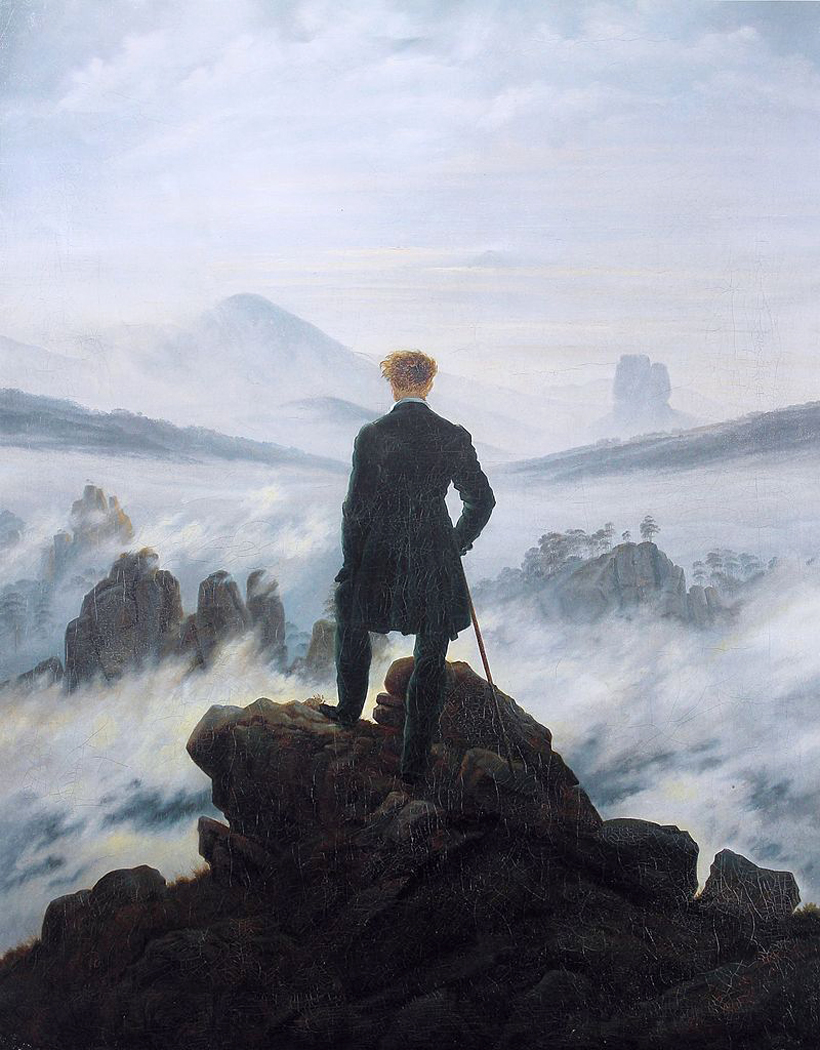
Wanderer Above the Sea of Fog

Wanderer Above the Sea of Fog

On the next page in Herzog’s book, even he seems to admit his basic romanticism, when he admires the German Romantic painter, Caspar David Friedrich. He is “someone I do have great affinity for. In his paintings Der Mönch am Meer [“The Monk by the Sea”] and Der Wanderer über dem Nebelmeer [“The Wanderer Before the Sea of Fog”] a man stands alone, looking out over the landscape. Compared to the grandeur of the environment surrounding him, he is small and insignificant. Friedrich didn’t paint landscapes per se, he revealed inner landscapes to us, ones that exist only in our dreams. It’s something I have always tried to do with my films.”

There is a common misunderstanding of Romanticism, that it is somehow warm and fuzzy, that it has something to do with being in love. But if you read the texts, look at the photos, listen to the music, you discover that Romanticism is something dark and mysterious, placing tiny humanity in the looming shadows of a vast, hard and roiling universe. You find it in Friedrich, with his ship crushed by

Sadak In Search of the Waters of Oblivion

Sadak In Search of the Waters of Oblivion

icebergs; or Shelley, with the depressing parade in Triumph of Life, or the spinning orbs  “intertranspicuous” grinding “the bright brook into an azure mist/ Of elemental subtlety, like light” in Prometheus Unbound; or William Blake staring down into the abyss in Marriage of Heaven and Hell, and seeing “beneath us at an immense distance was the sun, black but shining; round it were fiery tracks on which revolv’d vast spiders, crawling after their prey; which flew or rather swum in the infinite deep, in the most terrific shapes of animals sprung from corruption, & the air was full of them, & seem’d composed of them.”

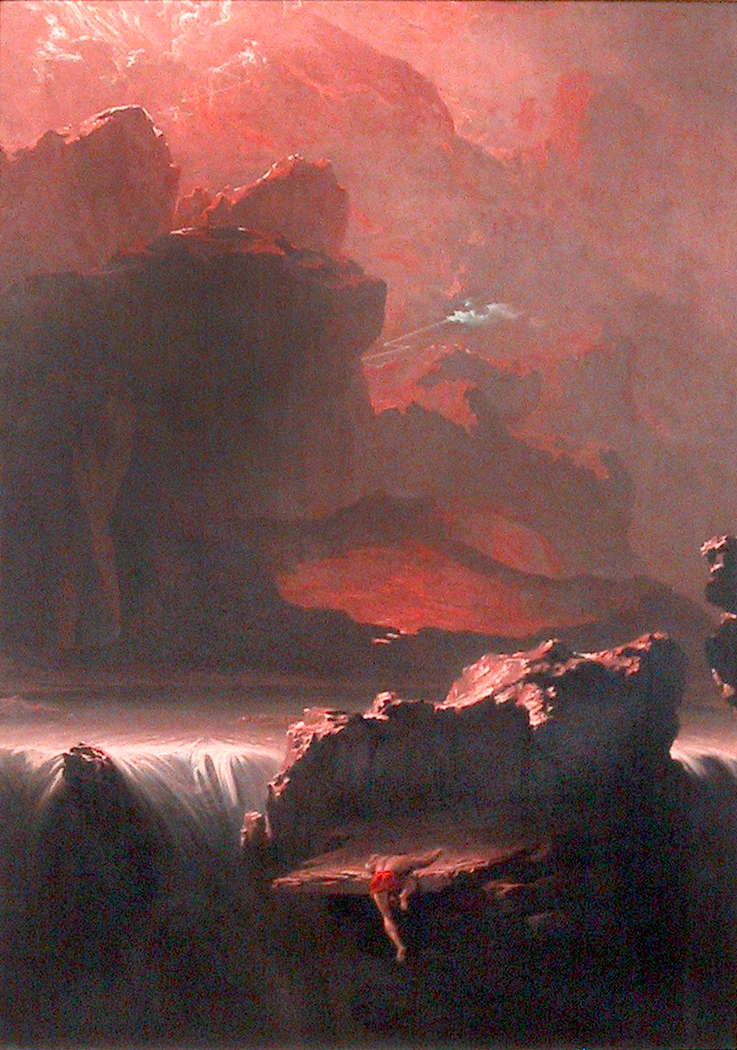
Romanticism is John Martin’s Sadak in Search of the Waters of Oblivion, and Berlioz discovering his beloved is turned to a harpie at the Witches’ Sabbath at the end of the Symphonie Fantastique, and Ahab blaspheming on the quarter deck in Moby Dick.

So, Werner Herzog, you gave me a good laugh.

If there is one theme that overrides the whole set of notes on our trip to France in 2002, it is that of the French love of “logique” and systemization, versus the older Gothic love of “the things of this world.” Even the Baroque in France is oddly static and toned down. So, when we finally got to the megaplex that is the Louvre, it is hardly surprising that the same questions arose again.

As usual, click to enlarge any photo.

Louvre and pyramid

Louvre
Friday April 5

After nearly two weeks, we finally made it to the Louvre. It isn’t that we weren’t interested, but we’ve had a lot of other stuff on our agenda, mostly dealing with Gothic churches.

Hall of RubensTo say the Louvre is big is to say the Pacific Ocean is wide. It hardly covers it. We spent the whole day there and saw maybe a 20th of it. We saw parts of the Greek statuary, the northern European late Medieval painting, the big hall of Italian Renaissance and Baroque painting and a few halls of French Baroque painting, to take in the Poussins and Claudes, which I was hungry to see.

That not only wore us out, it took from about 10 a.m. to about 4:30 p.m., when, exhausted and with throbbing feet, we finally set our course back to the hotel.

There is a problem seeing so many “hall of fame” paintings, so many “greatest hits” in one go round. You cannot do much but cover the highlights and you look at one famous painting after another and take notes on this small aspect or that: the way the brushstrokes feather in Leonardo’s La belle jardiniereVirgin and Saint Anne; the overall bluish caste to Ingres’ Odalisque; the tricolor reflections of the water drops in Delacroix’s Dante in the Boat.

It isn’t just that there wasn’t time to spend an hour or two with each masterwork, but that just being in the Louvre, with the crowds of tourists, and the hugger-mugger of Jansen regulars, the occasion of it all, prevents you from being able to concentrate.

Here is Raphael’s Belle Jardiniere, there is the Mona Lisa. Here is the Avignon Pieta, there is the Bust of Homer. You take them in with the instantaneity of an art appreciation slide show, one after the other. Even if you wanted to spend a few extra minutes with the Wedding at Cana, there is Liberty on the Barricades calling to you.

Which is all a terrible shame, because even with the little time you get to spend with each painting, you recognize once and again, deep in your eye sockets, how different the real painting is from the picture in the book. The looking at libertythickness of the layer of oil paint, the fineness of detail, the actuality of the color — uncaptured by the cyan, magenta and yellow inks in your Jansen text — gives you that sense of quiddity, that sense of thusness, of actualness, of event, of richness, of sense experience, that the pictures in the book can never deliver.

It is probably the ubiquity of reproduction that has led to the pathetic and word-ridden French philosophies that rule art criticism currently. All you can get out of the reproduction is the iconography, which is the intellectualized part of the painting, and if that is all you get, you miss the sense experience, which subverts the intellectualization and renders it shallow.

For me, this is most evident in the northern Medieval and Renaissance paintings, which have a textured surface of paint, mimicking the damasked cloth being represented, or the gold leaf which sits atop the oil paint.Van Eyck Rolin Madonna

And what a deep and satisfying green Van Eyck has found. You can practically see it as ground up emerald or other jewel, suspended in the oil. The green is dark, intense as a clear night and transparent as stained glass. Louvre guardWhen one sees a real painting, one knows great beauty, and great joy in its apprehension. Though it soaks in through your eyes, you feel it in your fingertips, smell it, taste it, and almost hear it. It makes all your senses buzz.

Part of it is taste, certainly — gout. Others may prefer the Italian Renaissance to the Northern one, or may really like the sweeping flesh tones of Rubens or the sausage fingers of Ingres. But whether it is the vermilion in the cloth painted by Poussin or the ultramarine of Mary’s robe in a million other paintings, the direct, uninterpreted experience is the primary gift of great art.

Of course, not all the great art in Paris is paint.

Chez Alexis&DanielWe went back to Chez Daniel et Alexis for dinner tonight. The tiny toy pinscher met us at the door and followed us to the table. He must have remembered my petting him the other night, because he was all affection. He climbed up on the seat next to me and nuzzled his little nose in my coat the whole time we ate supper.

Which was, again, magnificent. Carole’s asparagus in melted gruyer was heaven in a dish. Our chicken plat, stuffed with mushrooms, was tres bien, and our desserts — well, we couldn’t finish them.Louvre lunch

And this is only dinner. For lunch, we ate at one of the Louvre restaurants and had quiche with tomato and chicken in it, and desserts: Carole had three little custards, and I had chocolate.

It is embarrassing to keep on about the food, but food by itself is sufficient reason to visit Paris. Everything else is gravy — I mean, sauce.

Carole’s take on things:

Felt good all day because I wore black, like the French women. And fashionable shoes, rather than the athletic shoes I’ve been wearing.

Thrilled to be going to the Louvre. I still can’t believe we went.

Carole & LaurenWe got a beautiful bouquet of lilacs for Lauren, our waitress at Le Petit Cardinal and she was very pleased.

Now, at the Petit Cardinal, no one even asks us what our breakfast order will be. This morning, it was simply delivered to our table.

Richard hugged me on the way down the steps to the metro and smiled at me.

There’s no highlight better than that.

The Louvre was vast and I was amazed. I thought it would be like the old Smithsonian, with paintings from the floor to the ceiling, and the interior spaces jammed with objects, but it was very open and some rooms had only three paintings. I saw the son of god crucified for probably four continuous hours and then a lot of rosy flesh flying through the air (Rubens). A whole lot of satin flying through the air. But the first part of our visit to the Louvre was my favorite, seeing the northern European late Medieval paintings of the Virgin and child, and other religious subjects.

I like them because they’re fervent.Avignon Pieta

Winged VictoryNear the end of the day, after seeing all of the extravagant paintings on biblical subjects and historical paintings, the museum began to smell funny to me, at first it seemed like the bathrooms, then I thought maybe it was the restaurant. Then I became disgusted with what I thought might be the smell of all the people. And then, because I was getting so tired, I began to have a horrible feeling that I was smelling death around the old Grecian tombs and I was very happy to go out into the air.

On the way back to our hotel, we stopped at a perfumerie and I had a wonderful time there and got some Lalique for Paul, Jolie Madame for mother and a little tube of cologne for Aunt Veosie and a bottle La Nuit for myself. Jasmine.

I chose perfumes you could only get in France. These are not exported.

We came back and rested. And the sweetest part of the day was seeing the little dog nestled against Richard in the restaurant.

Richard’s version of events:

Carole wanted to see northern European late Medieval paintings. I wanted to see Claude and Poussin. We did both, but in the end, I had to agree the northern European art was better, or more enjoyable, with a deeper commitment to real life.

I was a bit surprised at how loose much of Poussin’s paintings are, and especially, how dark, brown and gray they are. How much of the dinginess comes from too much varnish over too many centuries and how much was by design, I cannot tell.

I wanted to love the Poussins more. But I have to admit, on the whole, they seem constipated, both in subject matter and in execution.

The Claudes fared a bit better, although they also seemed yellowed with ancient varnish. Perhaps the film of yellow suits him better than it suits Poussin.

But, ultimately, the Claudes disappoint, too. They are simply too far removed from real experience, too stylized, too fantasized. Too intellectualized, and not immediate enough.

Unlike the Memlings, Holbeins, van der Weydens and — hallelujah — van Eycks in the northern European section, which bristle with real experience.Graces recto et verso

Constitutionally, I also respond to the textures of those early Flemish and German paintings, with their tight patterns and brilliant color, so unlike the artificially brown and slate tones of the French Baroque.

Gericault dans le LouvreIt wasn’t really a big surprise to see how vast the Louvre is. I knew it was big. But I was surprised by several familiar paintings that are much bigger than I ever imagined: Veronese’s Wedding at Cana; Gericault’s Raft of the Medusa; David’s Rape of the Sabine Women; Gros’s Napoleon at the Pest House of Joffa. They would have taken scaffolding to paint.Twin Venuses

Oh, and Delacroix’s Death of Sardanapalus. Another giant.

I can’t say I was overwhelmed by the Big Noises in Hellenistic sculpture: the Venus de Milo, the Winged Victory of Samothrace. Yes, they’re nice enough, but a little too deracinated for my taste. I want either the Classical Hellenic sculpture of the Elgin marbles, or the really over the top Hellenism of the Laocoon. These marquee pieces at the Louvre seem a bit tame, and the stylization of the nude female figure bothers me: No real woman was ever built the way the Venus de Milo is — and I’m not referring to her missing arms.

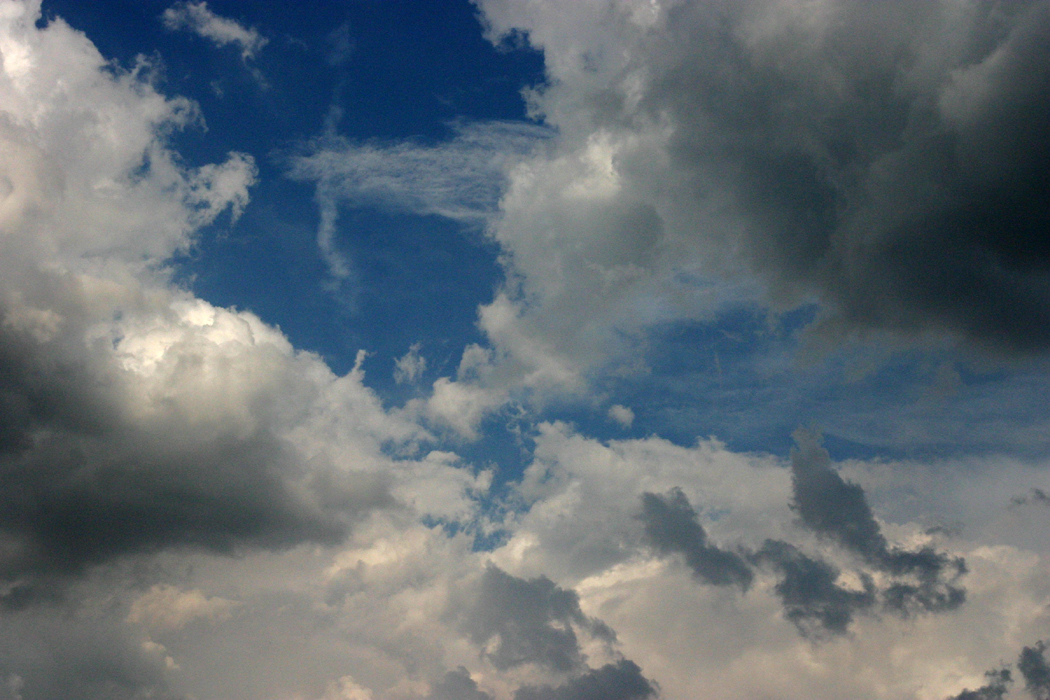
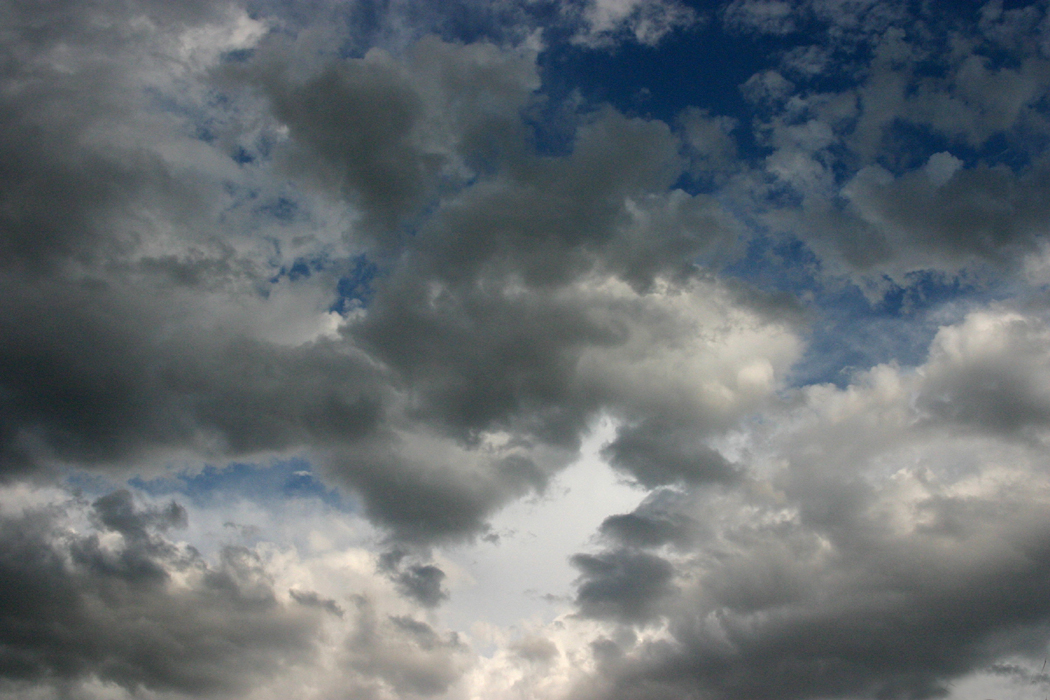
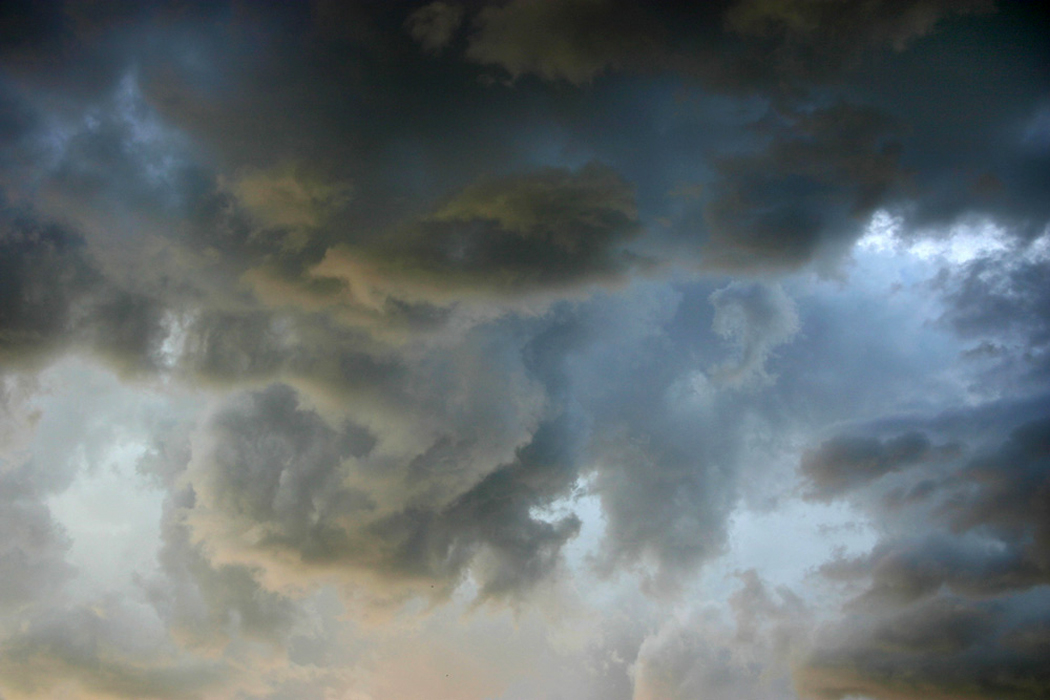
color sky 03One grows as a human being, and the art cannot help but grow, too. When I was young, it was art that impressed me most: the forms, textures, colors, the transformation of stimuli into esthetic forms. Don’t blame me — it was the times in which I grew up; Modernism was in the ascendency and we all mouthed such platitudes as “art changes nothing,” and “Subject matter? The subject doesn’t matter, only what you make from it.” In those years, life drawing ceased to be taught in most art schools; students were asked merely to “be creative.” The divorce between life and art was complete. cloud30 The prejudice was that the subject, say in my chosen medium, photography, was only there to catch light and make for a splendid arrangement of greys and blacks printed out in rich silver on glossy paper. Anything else was pretty pictures for calendars or chamber of commerce brochures. A kind of puritanism set in. If you are old enough, I’m sure you remember it: No cropping, previsualize, etc. So, when I was younger, I concentrated on the beautiful print, in black and white, and archivally processed. Zone system, anyone? cloud 01 My life turned in a different direction. Instead of a photographer, I turned out to be a writer. And lucky for me, it was on a newspaper and not in academia. I never had to slog through the atrocious trends of literary theory then current (still current). When asked to lecture to writing classes, I always had one lesson to give: Good writing is having something to say. Writing in fancy words or jargon, clever euphues, gongorisms, or acrostics or esoteric allusion only get in the way. One can be so caught up in the allure of a classic Bugatti that you forget its purpose is to get you somewhere. Fancy writing is that shiny Bugatti sitting unused in a garage, cherished and polished but useless. cloud08 I continued to make photographs, nevertheless. And I have had gallery shows. But as I got older I came to see that the Bugatti was there to drive somewhere, not to show off. Subject matter not only counted, it was the reason for making the picture in the first place. But — and this is a big proviso — not to share the subject with your audience so you can all go “Ooh, what a beautiful sunset.” That really is a calendar photo. cloud16 No, the entire purpose of art, if it can be said to have a purpose, is to make a connection with the world. To reconnect with what habit has made invisible. To see what you normally ignore, to find the glow of liveliness in the experience of being alive. Few people need to be told that a sunset is pretty; there is no art in that.cloud25 But to find the chispas — the sparks — in the crack of a sidewalk, or the bare winter trees, or the clouds that sail over us every day — this is not so much a finding of a source for perfect prints to hang on the wall, but rather the illumination of a hidden fire. These things are all alive: Every bush is the burning bush. That is what makes Van Gogh’s landscapes so alive. They burn from within. This is not something he has applied from the outside; it is something he was able to see as the scales fell from his eyes. And so it can be for anyone willing to look, to see. It is what makes life drawing so indispensable for an artist. Drawing is not simply making an art object, drawing is learning to see, to break through the cataracts of habit. cloud26 And so, when I come back to clouds as an old man, I see in them not merely abstract shapes from which I can make suitable art. I don’t care about art. I see something that wakes me up, and I try to capture it with the snap of my shutter. For me. Not for some appreciative audience. For me. I am the one I want to keep awake, alive. Others have helped me in this; if I can pass this on to others, all to the good. But I no longer care about making art.cloud38 (Note: All but three of these photographs were taken on the same day during monsoon season from my back yard in Phoenix, Ariz.) cloud42 cloud43

color sky 01 cloud45 color sky 02 cloud07

clouds134In the 1920s, a fundamental change occurred in the part of photography that was attempting to be seen as art. What had always previously been seen as a picture of something became a picture of its own.

In this, it followed the progress of Modernism in other media. What had been a photograph of a house or a boat, and judged by how well it set off the house or boat, it now became an arrangement of grey and black, of line and form.

If anyone could claim to be the leader of this shift, it would be Alfred Stieglitz. “I was born in Hoboken. I am an American. Photography is my passion. The search for truth is my obsession.”

Despite his tendency toward oracular declamation — or perhaps because of it — Stieglitz became the prophet of a new type of photography in America. Modernist. Stieglitz equivalent 1

His first work, from the late 1890s through the 1920s was mostly figurative, but he became dissatisfied with the idea that his photographs were praised for their subject matter.

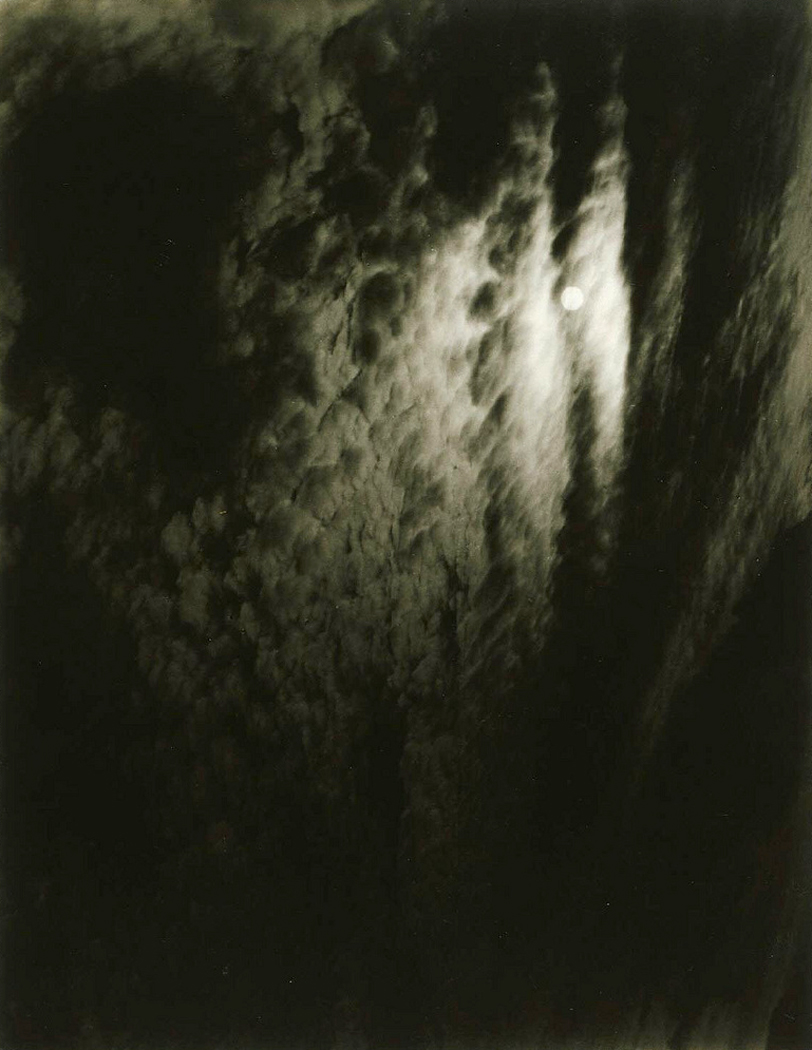
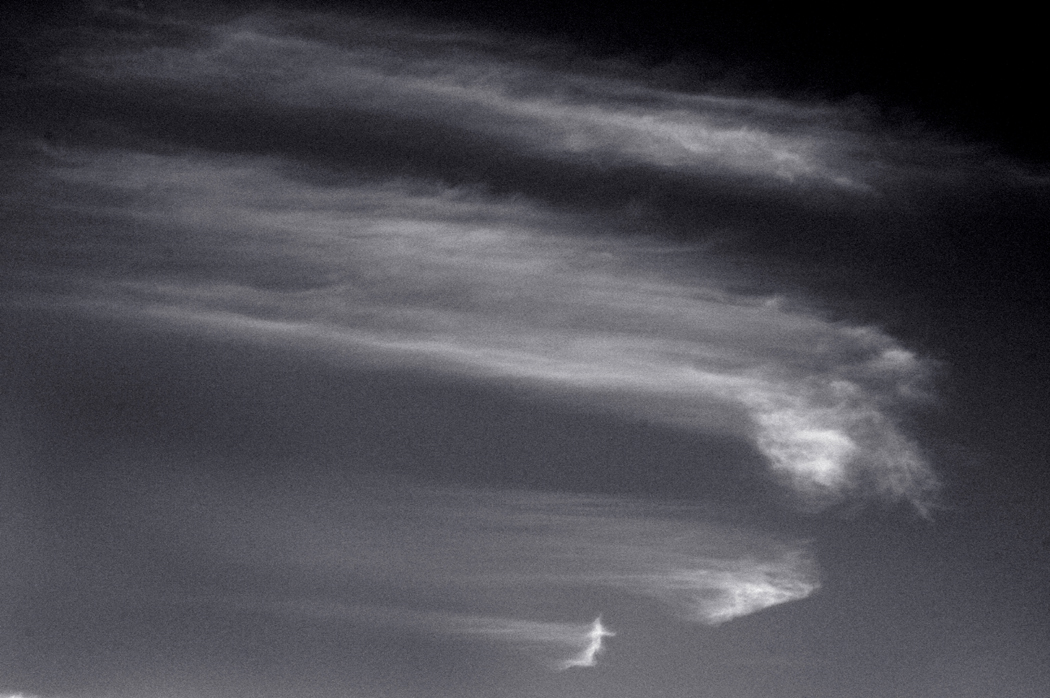
In 1922, he began photographing clouds and turning them into the equivalent of abstract paintings.

“Through clouds to put down my philosophy of life — to show that my photographs were not due to subject matter — not to special trees or faces, or interiors, to special privileges — clouds were there for everyone — no tax as yet on them — free.”

These first series of cloud abstractions he called “A Sequence of Ten Cloud Photographs.”  When he showed a new series in 1924, he renamed them “Songs of the Sky.” He continued making these prints, usually exaggerated in contrast and printed quite dark, making the blue sky black. He made them by the dozens, and by 1925, he was calling them “Equivalents.”stieglitz equivalent 2

“I have a vision of life and I try to find equivalents for it sometimes in the form of photographs…(Cloud photographs) are equivalents of my most profound life experience.”

This idea of “equivalents” was later taken up and expanded by photographer Minor White and others, but in essence, the abstraction of the clouds were to stand for “equivalent” emotional and intellectual experiences.

There is certainly a grandiosity to Stieglitz’s language, indeed to his person. But the photographs remain and many of them are deeply moving, perhaps compared to the late quartets of Beethoven.

But the underlying idea was that the medium of photography, rather than the subject matter the camera is pointed at, could be expressive: that the surface of palladium printed paper, or silver prints, and the blacks and whites of the silver on its surface, and the shapes they make, almost as if a Rohrschach test, could be sufficient for art.

Abstraction became a subset of 20th century photography, and even when there was a subject, such as a portrait or landscape, the photographer, whether Edward Weston or Paul Strand, or White or Bill Brandt, would insist on its essential abstraction as the basis of its value.

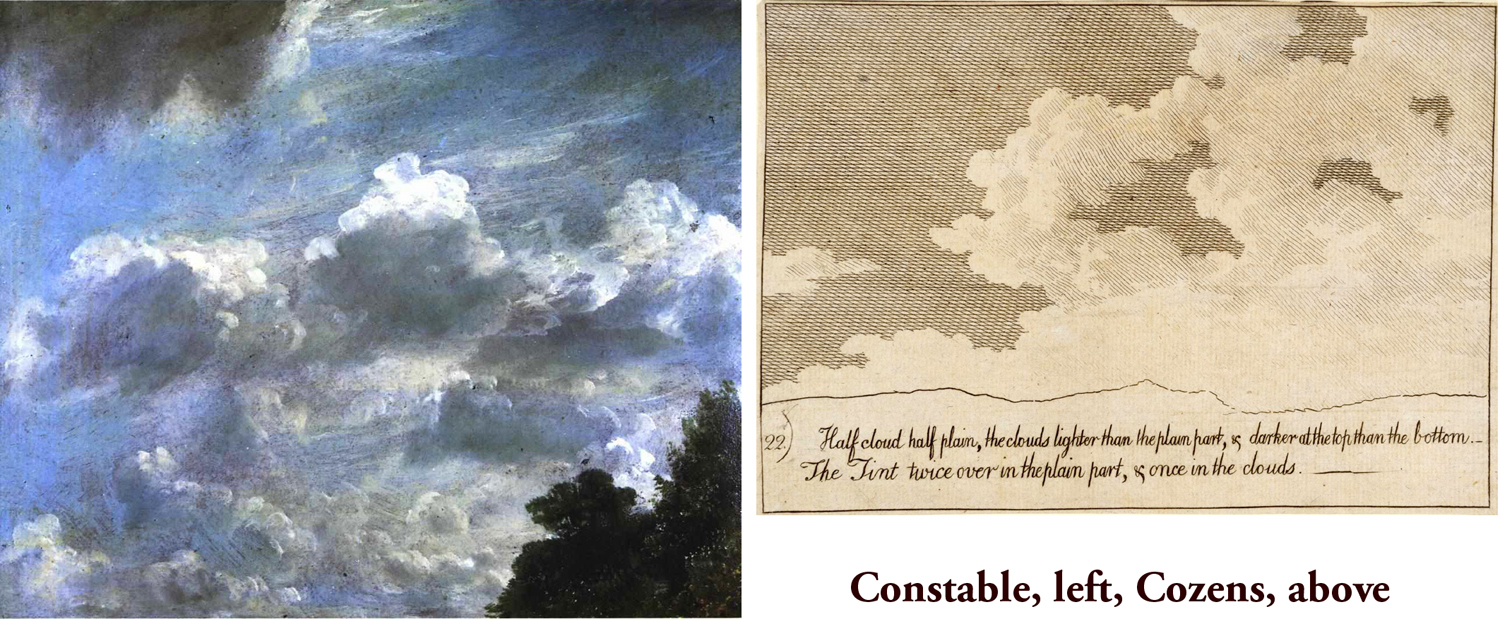
constable cozens pair But there is a problem with this: Those Equivalents that Stieglitz made are still clouds, and clouds carry with them all the baggage of subject matter. From the clouds in Renaissance paintings through the glorious cumulous in the seascapes of Aelbert Cuyp to the drawings of Alexander Cozens and countryside of John Constable. Clouds are an endless source of inspiration for the imagination of shape.

charlie brown and clouds In photography, it is almost impossible to eliminate subject matter, short of making photograms. The forms, colors, shadows, textures of the recognizable sensuous world keep intruding, no matter how extracted from context. When I was a teacher, one of the assignments I gave my students was “to photograph something so that I cannot tell what it is.” I expected them to get ultra close, or turn something upside down, or extend the contrast. But, try as they might, I could always tell what I was looking at.

I do not see this as a deficiency in photography, but a strength. Photography can keep us tethered to the world when we might wish to float free; it reminds us that our primary obligation is to the existence we occupy and work in.

clouds105 Given that, photographs of clouds still has a powerful attraction: We can see that abstraction and reality are not necessarily in opposition: We can have both at once.

Put this way, it seems obvious, a commonplace. But this “double vision” is one of the things that keeps art lively, and informs our interaction with the everyday — keeps us aware that the world is alive, not inert.

And so, I have made my own cloud photographs. The first series, seen here, are a rank imitation of Stieglitz’s Equivalents. The next blog installment will follow with the development of the idea. clouds116 clouds129 clouds115 clouds119

clouds130 clouds131 clouds139 clouds142 clouds145

curtis and isabel
Portrait photographs come in basically two varieties: the formal and the candid. These days, with selfies monopolizing the social media, almost all portraits are informal. And when asked, most people say they prefer the candid picture, perhaps because the formal portrait has fossilized into the Olan Mills mall photo, in garish color against phony backgrounds. It would be hard to make an esthetic case for these assembly-line excrescences, with their banal smiles and enforced familial geniality.olan mills family
karsh sibeliusThen, there is a prejudice against artifice: Many people prefer the snapshots because they seem more natural, more spontaneous. If you look at one of those highly massaged portraits by Yousef Karsh, there would seem nothing less spontaneous. Every light, every specular reflection in an eye, seems calculated, even marmoreal, like his portrait of composer Jean Sibelius. If we’re a “rock and roll” nation, we are one that values the brash, the riff, the off-the-cuff: Indeed, we trust it to be more “truthful” than the rhetoric of the planned, controlled and considered. As Allen Ginsberg mendaciously preached: “First thought, best thought.” (Despite the fact that his best poems, such as Howl, were thoroughly revised and rewritten; we have the typescript for evidence, with all its emendations.)karsh churchill

Yet, some of our most iconic images — the ones we remember, the ones that fix in our minds some large truth about their subjects, are exactly the careful, posed and arranged portraits, such as Karsh’s take on Winston Churchill — a photo that might have won the war all by itself.

The idea of the formal portrait survives, even in the gaudy, awful Olan Mills photos: The idea that the subject wants to be seen in his Sunday best, with his best teeth put forward for posterity: “This is how I want to be remembered.” Even though the actual life may be more squalid or confused, or complex– certainly infinitely richer. But “this version is the one with the barnacles scraped off.”

olan mills family portThe photographer Richard Avedon said, “What ends up in your scrapbook? The pictures where you look like a good guy and a good family man, and the children look adorable — and they’re screaming the next minute. I’ve never seen a family album of screaming people.”

But when done well, it isn’t the vanity of the subject that is portrayed, but the insight of the photographer. A good portrait should tell us something about the subject that the subject doesn’t want us to know, or is not aware of, or is somehow larger than the public face intended.

A photographic portrait also tells us something about the artist who makes it. This is something that Avedon always stressed.

“My portraits are always more about me than they are about the people I’ve photographed,” he said. You can spot an Avedon immediately: It’s style is uniquely his. The same can be said for Irving Penn, or for Arnold Newman, or Yousef Karsh — any of those who made a name as portraitists. An Avedon portrait — or a Penn — is a world view, consistent from image to image. avedon eisenhower

And it is in this sense that the portrait rises from vanity icon to art. The picture tells us not merely, what does this person look like, but rather the larger message: This is what being human is.

It is in the eyes, most often, that the humanity is tethered. You can see the light behind them. Nothing is worse than a picture of someone who is bored with the process of being photographed: The eyes turn into ball bearings, lifeless and extinct. A good portrait is a picture, instead, of being alive, of being in the moment, even if that moment is for posterity, or for eternity.

I bring all this up, because in the age before I became a writer, I thought I would be a photographer. It was in the days of chemicals and dim amber lights, and I became a proficient darkroom worker: My prints, I say with some pride, were as good as anyone’s. Crawford 1977 copy

And I took many portraits, working my way through the learning and development that any artist goes through: Imitation, innovation and finally, something personal that emerges.

Most of these portraits were friends or more. I went through cameras, always seeking the right one, never actually finding it: Nikons, Rolleis, Hasselblads. I went through lighting schemes, through backdrops.

And I went through the history of portraiture, from Holbein to Raphael to Rembrandt to Gainsborough to Chuck Close. The model I felt closest to was the Renaissance portrait, such as Raphael’s portrait of Baldassare Castiglione. Here was a face to look at: Eyes that had seen a good deal of the best and worst of the world: It registers. raphael castiglione portThere is also a sense of moment; this is for posterity. The figure makes a pyramid in the frame, giving it foundation and security. The background is broken into interesting shapes — the so-called negative space, not ignored, but make essential to the impact of the image.

I saw something of the same in the photographs of Avedon: formality, interesting negative space, and the centrality of eyes.

There is one major difference between these great images and the Olan Mills smile-o-thons: So many of them have equivocal expressions on their faces. They aren’t genial and smiling; indeed, it’s hard to quite know what they are expressing. There is a neutrality to their faces; not slack, as if thoughtless, but rather as if thoughts were unresolved.Henry Parrish Lippincott Hackett

In other words, the faces were not billboards flashing their message, but rather something denser, meant to be read and fathomed. Not the momentary but the monumental.

This is a portrait of Henry Parrish Lippincott Hackett, I made it in about 1973. It is a model of what I was trying to get in those years.

Of course, they were also shapes in a frame, and the graphic quality of the images counted for a lot, such as the eye of Picasso in Penn’s version, or the indistinct edge of Eisenhower’s head in Avedon’s portrait.

I used the eye in a photo I made of Pam Henry, in the mid-1970s. double picasso pam

Other imitations, conscious or otherwise can be found in other portraits I made from 1970 to about 1986, when I gave up teaching photography and became a writer at The Arizona Republic.

 My Degas:double chrysanthemums

Not a conscious imitation, but clearly a resonance of Ingres in a portrait of artist Mel Steele.double ingres mel


This is Doug Nufer in 1978, when he was officially dubbed “The World’s Most Obscene Man,” against Avedon’s portrait of Willem de Kooning. Nufer has since gone on to become one of the avant-garde literary lights of Seattle. Made from work print, 9/25/06, 12:15 PM, 16C, 5364x6131 (1182+1975), 125%, Hennessey 0823,  1/15 s, R38.2, G21.9, B47.9

double MK Elks and VenusOr, Botticelli’s Venus in a picture of Kathy Elks.

But it wasn’t all imitation. It was an education, and a slow development of what I was trying to find in portraiture. I wanted it to be formal; I wanted it to be graphic; I wanted it to be more than a snapshot reminder of who my friends were. When I was teaching photography, I ran a course on portraiture and I was not so much concerned with the usual lighting schemes or lens choices, but with engaging with the sitter, finding something human there. And while book after book told us that we should use a long lens for more natural perspective, I found that a normal lens, or even a wide angle lens brought the photographer and the sitter closer together, making interaction unavoidable: The photographer could not be aloof from the sitter, as though the sitter were a mere object, and the sitter could not be indifferent to the photographer invading his private space. The interaction was forced. Always use a short lens, I taught. Get in their faces.

Here is artist and friend, Charles Williams, who returned the favor by making a drawing of my wife and me. Charles Williams

Second lesson: Always have the sitter look into the lens, so that in the photograph, he gazes out of the picture into the eyes of the person looking at the image. This makes the portrait not a neutral event, but it forces the viewer to have a relationship with the subject. In other words, the photographer confronts the sitter; the photograph confronts the viewer. This makes for a more active work of art.

These are three photos I took for The Carolina Peacemaker, when I worked for that weekly black newspaper in Greensboro, N.C. I was looking for that directness, rather than the mere animation that most photo editors want.triple peacemaker ports

Third, no smiles. Unless they are genuine and are more than a tightened muscle at the mouth corner. There is a story about Greta Garbo, when an observer at a studio shoot said afterwards, “I couldn’t see her doing anything,” and the film director said, “But it will show up on film, just wait and see.” And of course, when the dailies were screened, every emotion ran riot across her face — primarily because she didn’t underline each one melodramatically. The film sees things you don’t. Let it do its job.double iott wolf

There were many other points in the course, but these three were most important, even if they ran counter to what is usually taught. After all, I told my students at the beginning of every class that I considered it my job as a teacher in the art department, not to train them for careers, but to make them unemployable. I wanted them to dig deeper than the stereotype. Many of them did. It was a great class.double robin reid linda olson

When I moved to Arizona and started work at the newspaper, I stopped taking as many photographs. I spent my time writing the two-and-a-half million words I pumped out in 25 years. There were photos meant to illustrate stories, but my emphasis had shifted.

Now, I still make the occasional photograph, and I still use the shorter lens, the in-your-face, and the attention to eyes.Mel BW

And I’ve gotten older, and so have my friends. You saw my Ingres-photo of brother-in-law Mel Steele. Here he is a couple of months ago, more informal — almost a snapshot, but with the lessons I learned from years of looking.


Rain_Steam_and_Speed_the_Great_Western_RailwayI grew up in an age when there was a distinct category called “Modern Art.” It was reviled by many and championed by the rest, and it was taken to be a complete break with the past — which is why it was both reviled and championed.

It may be hard to imagine now, but in the 1950s and ’60s, a large portion of the population actually believed “My kid could paint better than that.” In response, proselytizers mounted campaigns in support of Picasso and Kandinsky. When Life magazine ran a story on Jackson Pollock, it was an intentionally provocative act. “Is this the greatest living painter in the United States?” the story asked, daring its middle-class readers to argue back.pollock life magazine

Indeed, as late as the 1980s, a particularly condescending gallery owner in Scottsdale, Ariz., attempted to persuade me that abstract art was the wave of the future. He made the assumption that since I lived in Arizona, my tastes ran to cowboys. He wanted to “deprovincialize” me.

Modern Art was subsequently eclipsed by “Contemporary Art,” and after that the whole thing fell apart in a Postmodern disintegration. What we have now is “the trendy stuff at the gallery.”

But in my time, when I was a teenager whose personality was being forged, I had the immense privilege of living an easy trip to New York City and a subway ride away from the Museum of Modern Art, where my initial sense of taste was formed. I absorbed whole Picasso’s Guernica — which I always thought would be forever available to me — Jackson Pollock’s One: Number 31, and Van Gogh’s Starry Nightpollack 1

Turner catalogThe biggest single contribution to my growth, however, and the nudge that eased me into a life as an art critic, was the show in the spring of 1966 at MOMA of JMW Turner’s late paintings, called, “Turner: Imagination and Reality.” I was still a high school student and knew that there must certainly be a bigger, more impressive and powerful world out there than the one I knew in suburban New Jersey.

In that show, the English painter was dressed up as the precursor not only to Impressionism, but to such High Modernist painters as Mark Rothko. Turner’s watercolor washes were mere gestures with a loaded brush and implied an early morning sunrise barely seen through a frosty fog — hardly an edge or line in sight. turner rothko pair

Left: Turner “Pink Sky”               Right: Rothko detail

The show kicked off a resurgence in Turner’s reputation at the same time Vivaldi was getting a boost from the Baroque revival. It isn’t that either the Red Priest or the shaggy Brit were unknown or unappreciated, at least by those with their acquaintance, but that the wider world had largely — if not forgotten them, had relegated them to a “yes-them-too” sub-paragraph in the catalog. Turner emerged as not just a major artist, but a springboard for all the upcoming progress in art that resulted in — hooray — the glorious moment that is us.

That view seems quite laughable now, but we should instruct those X-ers and Millennials that came after us that the idea was that all of history was an inevitable march toward a single goal, and that in 1966, we had achieved it. The Age of Aquarius meant more than a bogarted doobie and a flower in the barrel of a National Guard rifle. We had reached some sort of checkered flag, some tape we had breasted.

Our history since then seems like a winded generation bent over with hands on knees, trying to catch a sweaty breath. It was Francis Fukuyama who was gasping.

Yet, if I can no longer see Modernism as some target bulls-eyed, I can still look back on that time, and that show, with a special fondness. It hit at just the right moment: my adolescence. I was ripe to be picked. turner cuyp pair

Left: Turner, “Calais Pier”               Right: Cuyp, “The Maas at Dordrecht 

Click to enlarge

For Joseph Mallord William Turner kept two plates spinning. On one hand, he does seem to prefigure the Impressionist fascination with light and color. But on the other hand, Turner was yet one more British huckster of the Sublime. He began as primarily a marine painter of ships, sea and clouds, patterned after so many earlier Dutch painters, like Aelbert Cuyp, but soon joined those painters of vast and menacing landscapes based on biblical or classical themes. Plagues of Egypt, destruction of Babylon, Noah’s flood, the Trojan War — they all show up.

Compare, for instance, Turner’s first entry into the Royal Academy, in 1800, with John Martin’s painting of the same subject: The Seventh Plague of Egypt (although, Turner, not a religious man and a desultory reader of the Bible at best, mislabled his plague as the Fifth). Turner Martin Seventh (fifth) plague

Turner, left; Martin, right

(Just for fun, let’s see Martin’s trilogy of paintings on the Flood: Eve of the Deluge, The Deluge, and The Assuaging of the Waters. The last was bought by Prince Albert for his Queen.)Martin Deluge trilogy copy

Click to enlarge

Martin’s grandiose paintings — clearly the inspiration for reels of Sword and Sandals epics by the likes of de Mille, Griffith and Giovanni Pastrone — are less competently painted and tend toward a darker palette of blues and blacks, while Turner’s paintbox veered increasingly to gamboge and flake white. Yet, his salability in the first half of the 19th century was based on his ability to provide the epic subject matter.

Consider the pair of paintings Turner made on The Deluge: Shadow and Darkness — The Evening of the Deluge, and Light and Colour — The Morning After the Deluge, from 1843.Shade and Darkness - the Evening of the Deluge exhibited 1843 by Joseph Mallord William Turner 1775-1851

 Click to enlarge

 So there I was, at the ripe, pimply age of 17, with all the world before me, and an ambition in my heart that transcended the possible, and there was Turner. I was being told he was the seed from which something important grew, but my primary and adolescent response was to the sublime — that sense that the world — nay, the universe — was grander, more intense and more alive than what I knew of Bergen County, New Jersey.

There were wind and waves, fire and brimstone, death and destruction, rocky precipices and roaring cataracts — Blow you hurricanoes, etc., etc. I was electrified at the idea that Turner had tied himself to a ship’s mast in a snowstorm to experience — like Odysseus — the siren call of destruction and death.snowstorm steamboat

Snow Storm: Steamboat off a Harbour’s Mouth, 1843

Author Lawrence Gowing, curator of the MOMA Turner show had written about the premonitory Impressionism in Turner, but in my saladgreen youth, that early seed was proof of Turner’s artistic heroism the same as his bodily courage he shows on the ship. Gowing was making an art-historical point; I was swept by the mythology. sharknado

Sharknado (2013)

It is the same impulse, I believe, that turns so many young men these days on to superheroes and supervillains and that whole genre of film where the planet is doomed by ice, fire, green monsters or evil multinational corporations. The FX movies that shake the separating walls of our cineplexes are the modern replacement for Byron’s Manfred and Shelley’s Prometheus.turner in studio movie still

I mention all this now because I have just seen Mike Leigh’s film, Mr. Turner, with Timothy Spall playing the painter, in a movie that advances with exactly the same pace and precision as paint drying. It is not a movie for the X-men crowd. Nothing blows up, no one turns the equator into an iceberg, and the earth doesn’t split into two.

Now as an adult, and with some 50 years under my belt since my exposure, I have a more sedate view of JMW Turner and his paintings. The film resonated with that: Turner had a living to make and catastrophe painting was his niche. Disaster was his shtick. That “vortex of obscurity,” those paint daubs. An avid public bought them up, and if some, such as John Ruskin, could see the work as the art of the future, most saw them as great, ecstatic expressions of the Romantic sensibility that was already passing into sedate and sententious Victorianism.  frosty morning

What MOMA chose to emphasize were the watercolors, primarily sketches for oil paintings. They were vague and washy and could more easily be seen as proto-Impressionism. The exhibit rather ignored the ships and sails of Turner’s more ordinary output. It also conveniently brushed aside that part of Impressionism that didn’t stoke the fires of Modernism: That Impressionism wasn’t just about paint and color, but about depicting the daily life of ordinary people rather than the grand mythology of the Academy painters. The present always chooses its past. At Petworth: Morning Light through the Windows 1827 by Joseph Mallord William Turner 1775-1851

And what one sees in Leigh’s film is not some spiritual visionary, but a Cockney artist, largely inarticulate, who has found a way to turn a little trick of paint daubs into a lucrative industry. Yet, I don’t mean to denigrate Turner: There was some level of genius in his ability to elevate the Mad-Martin extravaganza into something personal, idiosyncratic and, yes, forward looking. Turner was no revolutionary; he was bourgeois to the core, yet, that combination of conventional and ecstatic give his work that extra boost into the pages of art history textbooks. It’s what separates him from Martin, Samuel Palmer, Henry Fuseli and the rest of that forgotten ilk.

madison lede pix
The 1930s remain in our visual imagination with a vividness that hardly exists from other eras — at least eras we didn’t actually live through. And it is through the photography of the period that this happens: It is hard to recognize how many of the canonized photographers from that era gave us documentary and quasi-documentary images of the times. Elsewhen, artists — and the photographers — often sought something more universal, or general, or eternal, but the quota of work from the 1930s screams out the time of its birth. madison color quad

Think of them: Brassai, Bill Brandt, Walker Evans, Cartier-Bresson, the whole army of photographers working for the Works Project Administration under Roy Stryker — our image trove from the 1930s is a stuffed portfolio. Madison bw quad 1

Click to enlarge

If we tend to distinguish between photography as journalism and photography as art — art with its formal concerns — then the work of Life magazine photographers falls into the first camp and the more elevated work of photographers such as Edward Weston, Imogen Cunningham or Frederick Sommer would seem to be of another genus. But especially in the prewar decade, the photographers we honor as artists often were the ones who left us with a chronicle of their times. It is hard to picture America during the Depression without the black and white images of breadlines, dustbowl farms, iron workers and iron-willed matriarchs reigning over raw wood kitchen tables in unelectrified Appalachian cabins.madison bw quad 2

(I am not forgetting later movements of “street photography,” and certainly not forgetting Robert Frank, William Klein or Garry Winogrand, but their work on one hand also seems like a throwback to an earlier era, and on the other, is more consciously concerned with formal problems, like composition, lighting and contrast — and often with even more Postmodern concerns, such as how photography makes the world look. In the ’30s, the primary concern was sociological: These people we have been privileged to look at.)madison bw quad 3

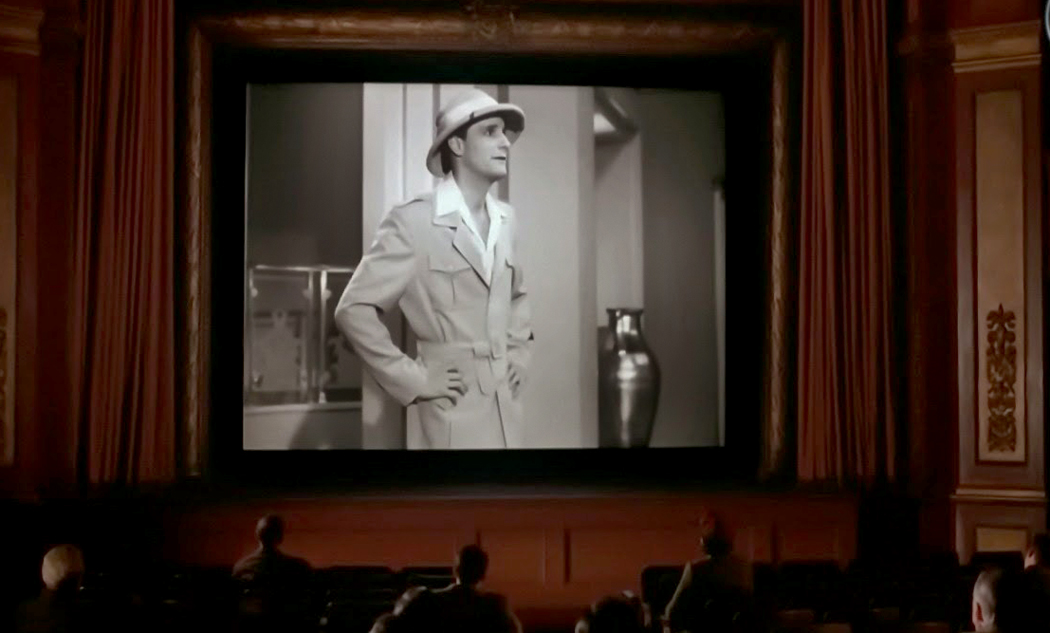
I bring all this up because a friend sent me a link to an unusual archive at Duke University of old documents, photographs and films, primarily from North Carolina. In it, there is a set of three films, or rather three reels of randomly edited home movies, from Madison, N.C., taken between 1939 and 1941 and available for download. You can find them at:

http://library.duke.edu/digitalcollections/hleewaters/Spatial_Coverage/Madison%20%28N.C.%29

madison bw quad 4These films appear to have been taken by a single person, who filmed schoolkids, class by class, streaming out of the schoolhouse, workers leaving the factory and pedestrians walking down the streets of Madison and neighboring Mayodan. At times, he attempts trick photography, and they are not always in perfect focus. The first reel is in color, the remaining two reels are black and white. It is clear he (or she) favors framing with the subject in the right half of the picture, but it seems less like a formal concern and more like a idiosyncratic tic.

madison bw quad 5Madison particularly interests me because it is where my wife grew up. She was born in 1941 and so, the images in these movies pretty closely approximates the town she knew as a little girl. A few of the teachers shown in them are teachers she knew in school. madison bw quad 6

But I also found that if I excised individual frames from the motion, I could see them almost as a new source of FSA photos, or undiscovered images of Walker Evans. I have included a bunch of them with this blog post. madison bw quad 7

One has to forgive the lower quality of focus or color, taken as they are from what must be a 16mm original, but what strikes me most in them is the quality of individual human beings, the person behind the eyes that stares out at us from the pictures. It is the same face — or the same kind of face — that we see in Dorothea Lange’s California agriculture photos. There is joy, suspicion, hope, hopelessness, anger, privilege, satisfaction and shyness in these faces (sometimes as the film progresses, the same suspicious face turns friendly).

madison bw quad 8And I come to see them not so much as impersonal esthetic constructs, but as a doorway into each of them as people. Individuals, shining lights of the cosmos bound in skin. madison bw quad 9

And then, by way of looking back at the old, familiar pictures of Jack Delano, Russell Lee, Marion Post Wolcott, John Vachon, Ben Shahn and others, you come to the realization that what makes them special — what, indeed, makes them important — is not their photographic quality, not their compositional innovations or formal intent, but that through those rectangular frames burn the lives of actual beings. What brings them alive for us esthetically is exactly the quotient of compassion, of empathy, we bring to them. Do we see them as esthetic exercises? Certainly that aspect exists in them, but such aspect exists in abstract torn-paper collages, too. No, what gives them power is that connection they enable between us in our age, and those people in the pictures, in their age and we see they are us. madison color quad 2