Johann Sebastian Bach is the alpha and omega of music.
It’s one of the few things most musicians agree on. The question is whether to pay attention to the alpha part or the omega part.
For many, he’s the beginning of 250 years of the classical-music tradition: During most of that time, his music was the earliest regularly programmed and, for composers, the model of what good music should be.
Beethoven called him “the father of us all.”
But for an increasing number of listeners, he just as importantly is the culmination — the end — of the long tradition of polyphonic music dating back to the Renaissance and the Middle Ages. Like the Roman god Janus, he faces both directions at once.
He is the hinge on which the history of music turns, the hinge between early music and our modern tradition.
J.S. Bach was born 325 years ago in the dead center of what now is Germany. In 1685, it was the town of Eisenach in Thuringia.

So many of his family were musicians — uncles, cousins, grandparents — that in parts of Germany at the time, Bach was a slang term for musician the way “Einstein” is sometimes used for a scientist. His father was Eisenach’s bandleader.
The young Bach was a spirited fellow — caught once with a girl in the choir loft; another time, he fought a duel in the streets; and later, for another offense, spent a week in jail.
He must have had a very passionate side, given his two wives and 20 children, even in a cold German habitat.
He joined the family business, as it were, and had a series of musical jobs for the rest of his life.
His career can be divided into three distinct parts. From age 18 to 32, he was a church organist, mostly in the city of Weimar. From 32 to 38, he wrote secular music for Prince Leopold of Anhalt-Cothen in Cothen. And from then until his death at 65, he was in charge of all music at St. Thomas Church in Liepzig.
At St. Thomas, he wrote a new sacred cantata every week for five years. About 250 of them survive: They make up a third of his output.
The composer didn’t get around much; few people did back then. All these places were within 50 miles of each other.

The High Baroque
We call J.S. Bach a Baroque composer, but what does that mean?
Mostly, it means energy, emotion, drama and density.
From roughly 1600 to 1750, whether it is the painting by Rubens or Rembrandt, the poetry of John Milton or the counterpoint of Bach, Baroque art embraced its own artifice and reveled in florid extravagance.
You can listen to the music of Bach like any other, of course, letting it flow over you. Its tunes are memorable and its rhythms and harmonies are always interesting and pleasurable.
But Bach’s music offers special rewards that you can uncover if you try listening with your attention focused on these three things:
* Counterpoint: Much of Bach’s music is written in counterpoint, which means the playing of multiple melodies at the same time, overlapping each other. You can pick the top line and hear it as the “main tune” or you can listen to the subordinate parts and discover a tremendous richness of detail and meaning. Bach wrote many fugues, which are pieces of music in which the same melody overlaps itself in a different key, and races after itself (“fugue” comes from the Latin word for “flight,” as in “tempus fugit,” “time flies”). Listening to a fugue is like juggling with your ears.
* Bass line: Bach’s music has a forward movement driven by a clear and distinct bass line. You will find the music opens up for you if, instead of listening to the main tune, you focus on the lowest notes and see where they go: They will always guide where the top melody can settle. The 19th-century composer Johannes Brahms used to cover up the upper staves of music when looking at a new piece of music, and concentrate on the bass line. “That’s how you can tell if the music is good or not,” he said. You learn new things, like the way a football play opens up if, instead of keeping your eye on the quarterback, you follow the left tackle or linebacker.
* Dissonance: Oddly, for music that’s so listener friendly, Bach is one of the most dissonant of composers. It hardly sounds that way, because the sharp conflicts of notes are always resolved into a satisfying and harmonious manner, but the great emotional depth of Bach’s music — and its tremendous sense of humanity — comes in part from his use of dissonance as a metaphor for human suffering. (In an experiment, you might play one of Bach’s chorale hymn settings, such as “A Mighty Fortress Is Our God,” and play only the offbeats — it will sound surprisingly like Schoenberg.)
One of the canards about Bach’s music is that it is somehow academic and mathematical; the truth is, he was all over the map.
There is a core of irrationality in Bach’s music, a Dionysian freedom: You never know where he’s going next.
When Bach was working, music for church or concerts was polyphonic; that is, written not so much as a melody with accompaniment but as multiple melodies played one on top of the other to make a single whole.
Bach had an astonishing facility for combining separate lines and overlapping melodies with themselves, sometimes at different speeds at the same time, sometimes turning a melody upside down or playing it backwards.
There are worlds within worlds, and the contradiction of seeming to be the epitome of both order and spontaneity.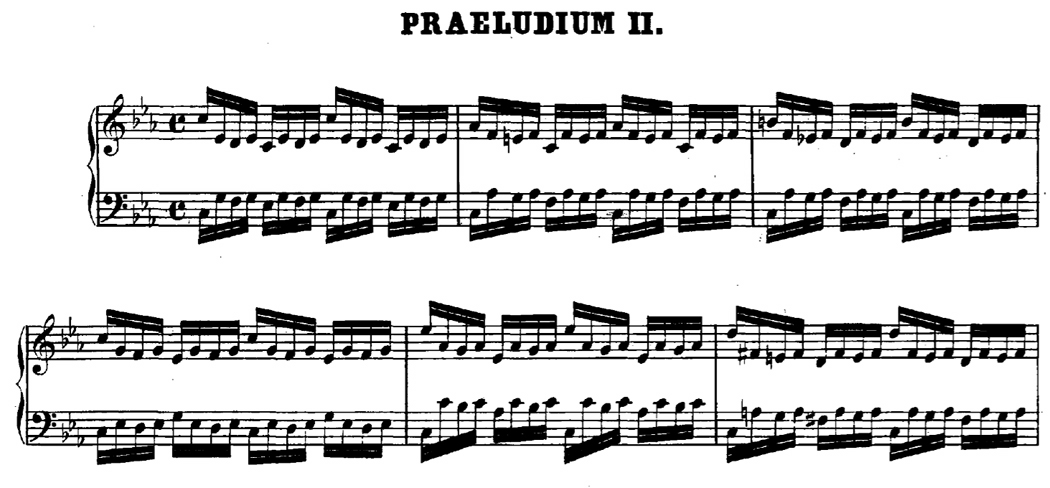
His music may have wheels spinning inside wheels, but it’s always surprising, like the C-minor prelude from the Well-Tempered Clavier, Book I, which begins with a repeated rhythmic figure, unchanging over a constantly shifting harmony, but about three-quarters of the way through, he simply gives up on the pattern and takes off on a flourish of notes like a skyrocket spinning in air, and just when you get comfortable with that, he settles into a melismatic cadence that keeps promising to come to a rest but refuses to stop.
Or that moment in the Fifth Brandenburg Concerto where everyone stops for fully five minutes to let the keyboard wander off on its own for a brilliant cadenza, essentially a rhapsody on a dominant pedal, that seems to find every possible permutation of its ideas, before the orchestra re-enters to conclude the piece.
Barroca
The word “Baroque” comes from the Portuguese word for a misshapen pearl, and it was initially applied to the art of the period as an insult, by the calmer minds of the era that followed.
The history of art is an alternation of periods that idealized order and simplicity with a succeeding age that valued emotion and drama. The Renaissance calm gave way to a Baroque frenzy, just as the Neo-classical stability of Haydn and Mozart gave way to the Romantic yearning of Berlioz or Wagner.
You can find this alternation as far back as you want: The Hellenic stasis of the Parthenon frieze in ancient Greece gave way to the wild extravagance of Hellenistic sculpture of the time of Alexander the Great, with its writhing figures and tortured faces. The dour Romanesque of the early Middle Ages gave way to the bustling aspiration of the Gothic.
Philosopher Friedrich Nietzsche named the guiding spirits of the alternating eras Apollonian and Dionysian. They also are called Classic and Romantic.
Perhaps one of the reasons the music of Bach speaks to us again so strongly, through the newer interpretations, is that we’re currently entering another era of Baroque sensibility. The virtues of Bach’s time are re-emerging: variety and diversity rather than unity, the recycling of artistic material — Bach was not afraid to reuse material; he was one of the original samplers — and a mixing of high and low cultures. Bach used dance rhythms as the basis of much of his music, the way Duke Ellington and Chubby Checker might have.
(A modern version of the Baroque suite, with its allemande, courante, sarabande and gigue, might be an orchestral suite made up of a fox-trot, a waltz, a tango and a Charleston.)
Postmodernism has become a neo-Baroque, and Bach is speaking our language once more.

Bach-Werke Verzeichnis
Bach’s output was enormous: The complete works fill 155 CDs in one collection. There are more than a thousand numbered compositions, running from music for solo violin to grand vocal works for multiple choruses and orchestras. Half the music was written for church services.
Much of the music is among the best known and dearest loved in the repertoire. Even those with no interest in classical music know his Toccata and Fugue in D-Minor for organ — it’s played endlessly every Halloween — and the Prelude to his first Suite for Unaccompanied Cello can be heard in several television commercials, including one for American Express.
His music connects with a lot of different audiences.
Culture wars
The problem is, there are two primary constituencies for the music of Bach, and the difference between them might as well be between red states and blue states: It’s a culture war.
The older tradition plays a beautiful Bach, with long, flowing melodic lines and a profoundly emphasized bass line, with clearly delineated harmonies. It is the Bach that for many, including Romanian philosopher Emil Cioran, “is the only argument proving the creation of the universe cannot be regarded as a complete failure.”
The composer Debussy said, “Bach is our lord of music. Every composer would do well to pray to him before commencing work.”
This is the Bach we inherited, thick with 250 years of performance tradition. It is Bach as the Alpha of our music. For this contingent, Bach is something universal, primordial, fundamental: Homer in music, or Shakespeare.
The name Bach in German means “brook” or “stream.” “He is not a brook,” Beethoven punned. “He is an ocean.”
But that’s the Bach who is the first modern composer; there’s a rising contingent that views him instead as the culmination of a century and a half of an older music tradition — The Omega. It is a Baroque style of playing completely at odds with the traditional symphonic approach.
The younger tradition mistrusts such grand religio-philosophical interpretations as pretentious piffle. And for them, as for the conductor Arturo Toscanini, “Tradition is just the last bad performance.” They want to clean the browned varnish from Bach and find the bright colors underneath.
These new historically informed performance-practice people want to dance, dance, dance, and they emphasize the rhythm and up the tempo, sometimes approximating speed metal.
“Sometimes the tempi have become absurd,” says organist Kimberly Marshall. “You’d think you were playing your LP at 78 rpm, like the Energizer Bunny or something.”
The revisionists quote poet Ezra Pound, who famously averred that “music begins to atrophy when it departs too far from the dance.”
And they believe they’re performing the music in a more authentic way, meaning, the way Bach would have performed it himself. Usually, on the musical instruments that Bach would have known: valveless horns and trumpets, oboes with few keys, wooden flutes and short-necked violins with light bows. They strive to recreate the sound that would have resounded in Bach’s ear.
And this is the sticking point: Like believers in competing religions, their dogmas are irreconcilable. Whose ear is more important? Bach’s ear or the contemporary listener’s ear? After all, we can never have 18th-century ears. Too much has happened since.
“The loudest sound Bach would have heard might have been a door slamming,” says conductor Benjamin Rous, who began his career leading the Boston Baroque Ensemble at Harvard University. “If you wanted to give our listeners the experience that Bach had, you’d have to create a world without the last two centuries of history.” So, pick your side and make your argument.

“It’s like politics,” says cellist Blythe Tretick of the trio Paradisa. “You get into some pretty heated discussions about these things. You can’t win, because it’s a matter of taste.”
Unexamined through all this is the basic premise that music should reflect the composer’s intent. It’s taken as an axiom. But few people are asking why. We don’t insist that Shakespeare be performed outdoors, with boys playing the women’s parts and with the rhetorical delivery of its actors. We don’t blanch at Richard Burton playing Hamlet in suit and tie.
So why do we argue over whether Bach’s musicians played with a vibrato or not? Shouldn’t the music be played to mean the most to modern audiences, the way we do with Hamlet? How much is composer’s intention and how much merely the limitations and conventions of his age? And is a performance something alive, or a museum piece under a vitrine?
Rock ‘n’ Roll
Perhaps this is the underlying truth of the historical-performance people: Unacknowledged by them, they aren’t so much re-creating historical fact as reflecting contemporary taste. We have grown up with a popular music based on rhythm and energy, so we may well now prefer our Bach the same way. Perhaps our ears are attuned to the virtues of Creedence Clearwater Revival  and feel more comfortable with a Bach that sounds very like it.
And, too, after a violent century, we have become a little more circumspect about claiming the great philosophical ideas and universal truths we found in Bach’s music and that too often justified war and genocide. We have been humbled into seeking a more modest music.
Yet, the emotional and spiritual profundity is there, goading us into recognizing that if the current age is modest, the universe is still infinite, and someone with the genius to write the Mass in B-minor or the St. Matthew Passion is a brilliant mirror to that something bigger than our paltry selves.
You pays your money and takes your choice
Both styles of Bach performance are generously represented on CD. Arkivmusic.com lists more than 5,700 recordings.
You might compare the recording of his violin concertos by Isaac Stern (old style) with those by Lara St. John (new style). You’ll get whiplash going from the first to the second.
The older style is warmer and richer; the newer style is bouncier and more rhythmic — and a whole lot faster. Discover which performance tradition speaks best to you.
One CD everyone should own is Glenn Gould’s 1955 recording of the “Goldberg Variations.” It’s not only one of the greatest Bach performances on disc, it’s one of the greatest recordings of all times: exuberant, manic in places, and with its counterpoint always clear. It has never been out of print. It’s neither old school nor new school: It is Gould school. Sui generis.
Here are other recordings to check out.
3 traditional recordings you can’t do without

* “Bach: The Great Solo Works,” with Rosalyn Tureck, piano. Tureck was a Bach specialist, and here she shows just how Baroque the composer could be, in a disc of lesser-known works. A must-have.
* “The Brandenburg Concertos,” with the Marlboro Festival Orchestra, Pablo Casals, conductor. This is old-style Bach, including a piano instead of a harpsichord in the Fifth Concerto (played by the great Rudolf Serkin).
* “Well Tempered Clavier, Book I,” with Daniel Barenboim, piano. Barenboim uses all the possibilities of the piano — pedal, arpeggios, strong bass notes — to make a heroic performance of this iconic music.
Revisionist Bach

* “Six Suites for Violoncello Solo,” with Anner Bylsma, cello. The music is played on a Baroque-style cello (the Stradavarius “Servais” instrument from the Smithsonian Institution) and shows it off at its best.
* “The Brandenburg Concertos,” with Concentus Musicus Wien, Nikolaus Harnoncourt, conductor. Harnoncourt is one of the leaders of the “original instruments” movement, and he buffs up and shines Bach’s chestnuts with a fresh vision.
* “Bach Cantatas,” with the Amsterdam Baroque Orchestra and Chorus, Ton Koopman, conductor. This DVD includes performances of five of Bach’s church cantatas, including the famous Nos. 140 and 147 — with the chorus “Jesu Joy of Man’s Desiring” — and his secular “Coffee Cantata,” which was essentially a singing commercial for the composer’s favorite coffeehouse.
Bottom line
The fact is, the music is so strong, so compelling, so moving — so graceful and so inevitable — that almost any performance will leave you in awe of the imagination and humanity of the grumpy little burger who wrote it.
It hardly matters if its the clever intertwining of voices in a Two-part Invention or a cantata in praise of a good cup of coffee or the cosmic agony of the final chorus of the St. Matthew Passion. 
A former editor of mine created a little mind-game of an intellectual Cartesian co-ordinate system. Up and down its ordinate you map a person’s depth — how profoundly he or she can think and feel, and avoid cliche and generalization, with maybe Justin Bieber on one end and, say, Nelson Mandela near the other. And along its perpendicular abscissa you can map a person’s “width,” or how broad are his or her interests and competence.
There are people with great depth in a narrow band. They have a Ph.D. and know everything there is about the design of active site-directed irreversible enzyme inhibitors, but never heard of the infield fly rule. And there are those with a tiny dabs of knowledge in a very wide field — “Jack of all trades but master of none” — but very few, as my old boss pointed out, that score in both depth and width.
There is Shakespeare; there is Homer; there is Johann Sebastian Bach.
Alpha and Omega.