Archive

Tag Archives: music

Until relatively recently, 20th century concert music was a tough sell. It had the reputation of being dissonant, noisy, difficult, and unpleasant. It was a century that began with Arnold Schoenberg dispensing with harmony and Igor Stravinsky upending rhythm, followed by a World War that knocked the complaisance out of any rational being and told us that the coming century was going to be anything but calm and easy. 

A number of composers felt that music needed to reflect the mood of the angst-ridden age. 

But even Schoenberg admitted “There is still plenty of music left to be written in C-major.” He didn’t believe his 12-tone revolution would destroy all tunes to come, but was simply a logical conclusion to music history from Bach through Wagner, from tonality through chromaticism to atonality. And we shouldn’t blame poor Arnold for all the dreary ruckus that followed: His own music is quite emotional and beautiful, even if it often requires some serious commitment from his listeners. 

He was right about one thing certainly: There was plenty of music written in C-major, throughout the century. And F-major and D-minor. In fact, most of the music written in that century was based on familiar scales, albeit with plenty of playing around and trying new ways to use them. 

 It’s just that the music-industrial complex, so to speak, was hijacked around mid-century by a clutch of academically-minded composers — the “Darmstadt Mafia” — insisting that serialism was the only music to take seriously, and that the more unlistenable it was, the greater it must therefore be. (Some of these composers did write interesting music in that style — it wasn’t a complete loss — but they looked down their noses at anything that might stink of a tune.) 

And so, contemporary music turned its back on the concert audiences and those composers wrote only for other composers of their ilk, and audiences shrunk from any concert program that insisted they listen to the stuff. Modern music acquired a very bad reputation. 

But I find that after 60 years of concert-going and music absorption, I listen to 20th century music more than that of any other era. It is music that speaks directly to me. Oh, I listen to bunches of Haydn, Mozart, Beethoven, Brahms and Tchaikovsky, but the plurality of my music listening edges to the century in which I grew up. 

So, I wanted to create a list of representative compositions from the century in question and present them as a course in great music that anyone can listen to and enjoy. 

I went through my collection of thousands of CDs and chose 30 pieces to offer. I listened to each one, in order, to refresh my memory — and to flat out enjoy them all over again. 

The roughly chronological list begins with a surprising entry. Most people think of Ives’ music (if they think of it at all) as noisy, crashing, impish tomfoolery. But Ives was a well-trained musician, with a degree from Yale University. His Symphony No. 2 is pretty tame, except for his borrowing of familiar popular tunes, and a raspberry at the end. 

Here is my list:

1900-1920

Charles Ives (1874-1954) — Symphony No. 2 (1902; premiered in 1951) (42 minutes long). Performance listened to: Eugene Ormandy, Philadelphia Orchestra, recorded 1973.

Ives studied under the respectable, if stuffy Yale professor Horatio Parker, and after graduating in 1898, began working on his second symphony (the first was his senior thesis composition for Parker) and included bits from Camptown Races, Turkey in the Straw and Columbia the Gem of the Ocean run through a kitchen blender. He finished Symphony No. 2 in 1902, although, with Ives, he was never completely finished and continued tinkering until his death in 1952. The symphony wasn’t premiered until Leonard Bernstein and the New York Philharmonic played it in a radio performance in 1951. The house-bound but still cantankerous Ives heard it on his radio in Connecticut and his response was that he spit. 

I listened to Ormandy’s version from 1973. The recordings listed here are not my choices as “best” — although they are all good — but merely the ones I had to hand when I started this project. 

Frederick Delius (1862-1934) — On Hearing the First Cuckoo of Spring (1912) (7 minutes long). Performance: Thomas Beecham and Royal Philharmonic, recorded 1958.

Delius’ score instructs, “With easy flowing movement,” and the quiet, peaceful evocation of the countryside (presumably English) and its birdcalls, it is a calming balm for a tussled soul. Originally, it was one of Two Pieces for Small Orchestra, the other half being Summer Night on the River. Beecham championed the composer’s music and his performances of the music are definitive.

Manuel de Falla (1876-1946) — Nights in the Gardens of Spain (1916) (21 minutes long). Performance: Arthur Rubinstein, piano, Ormandy, Philadelphia Orch., recorded 1969.

Falla was an Andalusian composer and the quasi-Impressionist Nights in the Gardens of Spain functions as a kind of piano concerto, with three movements, each describing a different Andalusian garden. Rubinstein heard it first soon after its premiere in 1916 and performed it regularly after that.   

Serge Prokofiev (1891-1953) — Classical Symphony (1918) (13 minutes long) Performance: Ormandy, Philadelphia Orchestra, recorded 1961.

Prokofiev’s Symphony No. 1 is the Sara Lee of symphonies: No one doesn’t love it. It is a jaunty, energetic gloss on the Classical-era symphonies of Haydn, seen through the “wrong-note Romanticism” of the composer’s style.  

Gustav Holst (1874-1934) — The Planets (1918) (50 minutes long)

 Performance: Ormandy, Philadelphia, recorded 1975.

Marketed as “space-age music,” the intent of Holst’s seven-movement suite is astrological, not astronomical, and each movement is a musical description of a psychological type. It has become enormously popular, and it has been recorded more than 80 times, first in 1926 with the composer conducting.  

Igor Stravinsky (1882-1971) — Pulcinella (1920) (39 minutes long) Performance: Claudio Abbado, London Symphony Orchestra, recorded 1979.

Stravinsky took some old compositions by 18th century composers and reworked them into bright, colorful Stravinskian cogs in what Leonard Bernstein once called “Uncle Igor’s Asymmetry Machine,” giving them new life as a ballet score, complete with voices. 

1920s

Ralph Vaughan Williams (1872-1958) — The Lark Ascending (1921) (16 minutes long) Performance: Zina Schiff, violin, Dalia Atlas, Israel Philharmonic, recorded 1989.

Poet George Meredith wrote of the lark in his poem from 1881, “He rises and begins to round, He drops the silver chain of sound…” and Vaughan Williams gives us the violin and orchestra version, with the British pastoral, And whose primary intent seems to be the creation of simple beauty.

Darius Milhaud (1892-1974) — La Création du Monde (1923) (17 minutes long) Performance: Simon Rattle, London Sinfonietta, recorded 1986.

European composers began hearing jazz and they loved it. Milhaud even moved to Harlem for a while, to soak it all up. One of the best translations of jazz to the classical idiom is his Création du Monde, with its resonant  saxophone solo at the beginning. 

Arthur Honegger (1892-1955) — Pacific 231 (1923) (6 minutes long) Performance: Charles Dutoit, Bavarian Radio Symphony, recorded 1985.

A steam locomotive begins to move, gathers speed, churns along and comes slowly to a stop, in this propulsive tone poem to modernity. Trains have been a theme in 20th century music, from Duke Ellington’s Happy-Go-Lucky Local to Villa-Lobos’ Little Train of the Caipira. Chug-chug. 

Ottorino Respighi (1879-1936) — The Pines of Rome (1924) (20 minutes long) Performance: Ormandy, Philadelphia, recorded 1958.

There were no flying humpback whales in Respighi’s original score; blame Disney for that. But what you do get are rousing tunes and some spooky catacomb music, with a grand finish, the kind that gets you out of your chair cheering. 

Jean Sibelius (1865-1957) — Symphony No. 7 (1924) (22 minutes long) Performance: John Barbirolli, Halle Orchestra, recorded 1966.

Sibelius’ final symphony is also his shortest, being in one movement, but by some accounts his best. My old teacher said when he was young, he wanted to play the French horn, because it had all the great solos. But he wound up with the trombone, which “only plays supporting material,” he said. But in this symphony, the trombones get the big tune, the one you will most likely remember and hum after it’s over. 

George Gershwin (1898-1937) — Piano Concerto in F (1925) (32 minutes long) Performance: Andre Previn, piano and conductor, Pittsburgh Symphony, recorded 1998.

Who was Arnold Schoenberg’s favorite composer in America? His frequent tennis partner, George Gershwin, who was much more than a Tin-Pan Alley songster. At the time, there was a big rush to figure out how to incorporate jazz into concert music. Well, here’s how. 

Leos Janacek (1854-1928) — Sinfonietta (1926) (23 minutes long) Performance: Claudio Abbado, Berlin Philharmonic, recorded 1989

What grabs you at first are the 14 trumpets, four horns, trombones, tuba and euphoniums. But the rest of the music pops with chunks of memorable tunes, piled like crabs in a bucket, and the way Janacek uses musical “jump cuts” to go from one to the next. 

1930s

Howard Hanson (1896-1981) — Symphony No. 2 “Romantic” (1930) (29 minutes long) Performance: Gerard Schwarz, Seattle Symphony, recorded 1989.

All those American symphonies written in the 1930s and ’40s have been largely forgotten, despite their quality, but when Ridley Scott used Hanson’s music during the closing credits of his 1979 film Alien, it resurrected this “Romantic” symphony, which developed a second life. Scott did it without Hanson’s permission, which pissed off the composer, but Hanson never sued, probably because of the boost it gave his music with audiences. 

Maurice Ravel (1875-1937) — Piano Concerto in G (1932) (21 minutes long)

Performance: Samson François, piano, André Cluyten, Orchestre de la Société des Concerts du Conservatoire, recorded 1959.

The French were just as taken with jazz as Americans were, in the 1930s. Lots of composers attempted to weave the syncopations and blues notes into their work. Ravel did it twice, with each of his piano concertos. But this one has a slow movement of such hypnotic ethereal peaceful beauty that you feel in a trance, broken by the explosion of the finale. 

Alexander Glazunov (1865-1936) — Saxophone Concerto (1934) (14 minutes long) Performance: Marc Chisson, saxophone, José Serebrier, Russian National Orchestra, recorded 2010.

Glazunov was exiled to Paris when he wrote his own jazz-influenced concerto for alto saxophone, which is perhaps less jazzy than Russian, but is nevertheless probably the best concerto ever written for the instrument. 

Samuel Barber (1910-1981) — Adagio for Strings (1936) (8 minutes long) Performance: Ormandy, Philadelphia, recorded 1957.

Canadian filmmaker Guy Maddin made a movie in 2003 titled The Saddest Music in the World, about a contest to find such music. Well, he needn’t have worried: Hands down, the winner (ignored by the film) is Sam Barber’s orchestral transcription of the slow movement of his string quartet. Unbearably beautiful, it is near impossible to hear it without weeping. 

Colin McPhee (1900-1964) — Tabuh-Tabuhan: A Toccata for Orchestra (1936) (17 minutes long) Performance: Howard Hanson, Eastman-Rochester Orchestra, recorded 1956.

McPhee heard Javanese gamelan music on a visit to Bali and then moved there. He became an ethnomusicologist as well as composer and wrote his own gamelan-influenced music full of the percussive tintinnabulation that is so catchy. Tabuh-Tabuhan is his most popular work, meaning it’s pretty much the only piece most people know, McPhee having otherwise fallen into undeserved oblivion.

Heitor Villa-Lobos (1887-1959) — Bachianas Brasileiras No. 5 (1938) (7 minutes long) Performance: Bidú Sayão, soprano, orchestra of cellos, conducted by Leonard Rose, recorded 1949.

The composer was fascinated by the long-line melodies that Bach sometimes wrote and came up with his own. Originally a single movement for soprano and eight cellos, it was recorded that way in 1949 by Bidú Sayão in a recording of singular beauty and power. It is very difficult, as the final third of the movement is required to be hummed through the nose, with the mouth closed, and ending on a nearly impossible octave leap. He later wrote a second movement, but this recording of just the first is so exceptional, it has to be heard. 

1940s

Sergei Rachmaninoff (1873-1943) — Symphonic Dances (1940) (35 minutes long) Performance: Leonard Slatkin, Detroit Symphony, recorded 2002.

It is sometimes hard to realize that Rachmaninoff is essentially a 20th century composer. And all his later music (the Paganini Rhapsody, Third Symphony and this, the Symphonic Dances) is rife with irony and astringency. Heart no-longer on sleeve, but with unforgettable tunes and absolutely brilliant orchestration. These Dances were his final composition, and for my money, his best. 

Aram Khachaturian (1903-1978) — Violin Concerto (39 minutes long) Performance: Ruggiero Ricci, violin, Anatole Fistoulari, London Philharmonic Orch., recorded 1956.

Khachaturian doesn’t get much love. His music is catchy, tuneful, and never very deep. And so, the Music-Industrial Complex (i.e. German musicographers) turn their noses up. But what is music if not melody? And bright arresting orchestrations. At some point, the world will catch up with Khachaturian and realize there’s room for music that is simply enjoyable, with no philosophical baggage attached. 

Bela Bartok (1881-1945) — Concerto for Orchestra (1943) (47 minutes long) Performance: Fritz Reiner, Chicago Symphony Orchestra, recorded 1958.

Bartok was ill and in hospital when Serge Koussevitzky visited him in 1943 and presented him with the commission for this orchestral masterpiece. Bartok had fled Hungary because of the war and was dying of leukemia, but he got out of bed, left the hospital and wrote what became his most popular work, essentially his symphony, a five movement piece featuring brilliant solo work for pretty much everyone member of the orchestra. He died two years later. 

Paul Hindemith (1895-1963) — Symphonic Metamorphosis on a Theme by Weber (1943) (22 minutes long) Performance: Wolfgang Sawallisch, Philadelphia Orchestra, recorded 1994.

So much of the century’s music seems to have been written as gloss on music of the past: Stravinsky’s Pulcinella, Rachmaninoff’s Paganini Rhapsody; Prokofiev’s Classical Symphony — even Ives’ symphonies constantly quote old tunes. Hindemith’s most popular piece (popularity not having followed the composer into the 21st century) is his recasting of melodies written by Carl Maria von Weber. It is brilliant. Hindemith should be played more. 

Aaron Copland (1900-1990) — Appalachian Spring (1944) (24 minutes long) Performance: Leonard Bernstein, New York Phil, recorded 1961.

When the century’s music seemed to becoming more intellectualized and abstruse, Aaron Copland developed a simpler, more audience-friendly style, best captured in this hugely popular ballet score. Copland became the American composer. Originally for a chamber group, the orchestral version is now a standard concert piece. 

Erich Wolfgang Korngold (1897-1957) — Violin Concerto in D (1945) (24 minutes long) Performance: Jascha Heifetz, Alfred Wallenstein, LA Philharmonic, recorded 1953.

Korngold was a prodigy once compared to Mozart, came to America and became the Ur-film composer (three Oscar nominations). But after WWII, he tried to reestablish his bona fides as a serious composer, with this most beautiful of 20th century violin concertos, now in the standard repertoire. It begins with a startling two-octave run in just five notes. Championed by Jascha Heifetz, it is now in every serious violinists repertoire. 

Benjamin Britten (1913-1976) — Variations and Fugue on a Theme by Purcell (“Young People’s Guide to the Orchestra”) (1946) (17 minutes long) Performance: Ormandy, Philadelphia, recorded 1974-1978.

Another gloss on old music, Britten wrote his “Young People’s Guide to the Orchestra” as a means to teach about the instruments, along with narration.  But much better without the sometimes condescending talking, it is a brilliant showpiece for the orchestra. 

1950s

Joaquin Rodrigo (1901-1999) — Fantasia para un Gentilhombre (1954) ( 22 minutes long) Performance: Manuel Barrueco, guitar, Philharmonia Orchestra, Placido Domingo, conductor, recorded 1996. 

Rodrigo reworked the music of 17th-century Spanish composer Gaspar Sanz, in another retro work, mixing the old dance music with eminently listenable modern orchestra colors.  

Alan Hovhaness (1911-2000) — Mysterious Mountain (Symphony No. 2) (1955) (19 minutes long) Performance: Fritz Reiner, Chicago, recorded 1958. 

Hovhaness wrote 67 symphonies and sometimes it is hard to tell them apart: His style was his style and he stuck to it. But his second symphony, called Mysterious Mountain, is his most popular and a perfect introduction into what you get with this Armenian-American stalwart. 

Leonard Bernstein (1918-1990) — Candide Overture (1956) (4 minutes long)  Performance: Leonard Bernstein, London Symphony Orchestra, recorded 1989. 

The best overtures are bouncy, tuneful, catchy and bright. It is almost as if Bernstein had absorbed all of the best overtures of the past and wrapped them up in his ultra-brilliant Candide overture, certainly the composer’s most-often programmed work. 

Dimitri Shostakovich (1906-1975) — Piano Concerto No. 2 (1957) (20 minutes long) Performance: Christina Ortiz, piano, Royal Philharmonic Orchestra, Vladimir Ashkenazy, cond., recorded 1989.  

The composer write this late concerto for his son, Maxim, to perform. He didn’t have a very high opinion of the work, thinking it a throw-away piece, but it is his most accessible concerto, with a second movement nearly as hypnotic as the Ravel. It may be lightweight Shostie, but it is nothing to sneeze at. 

In going through these recordings, some of which had to be dug up out of the lower shelves of my collection, I have redoubled my admiration for the music of the previous century. 

“You’ve gone all mellow,” Annie said, teasing me. 

In the past, I have had some rather unforgiving opinions about the poetry I was force-fed as a youngster — you know, the Victorian stuff about the light brigade, or Barbara Frietchie. And now, I was reading it again. On purpose. 

At college, I foolishly took a Victorian Lit course and hated every second-hand tick of the classroom clock. Turgid, sentimental, maudlin, and unbearably prolix. (I had been primed to hate the stuff since the time I was  forced to read Oliver Twist in eighth grade and hated every word of that — I still can’t read Dickens. I know: My loss. But you shouldn’t be forced to read stuff before you are ready for it.) 

In that Vic Lit course, I found Browning asphyxiating, Tennyson hollow, Christina Rossetti cloying. I could see no difference in the verse of these hallowed poets from the mewlings of Ella Wheeler Wilcox or Edgar Guest. It was all a smear of treacle and oh-so-earnest goo. 

“I am the master of my fate, I am the captain of my soul.” Who came up with this stuff? 

Now, Anne is reminding me, I am waxing enthusiastic about the selfsame verse to her, quoting lines and rhymes with affection. I have gone mellow. But what has changed? 

I grew up in a time of ascending Modernism, an era of “less is more,” of irony sidelining sentiment and of skepticism in place of belief. When I was just on the cusp of turning adolescent, Modern art was still widely dismissed as something “my kid could do.” And in the eternal wheel of generations, I was signing on to the new version and leaving the old to such fuddy-duddies as my parents and teachers. 

(At least, I saw it that way. In reality, my parents were as much a product of Modernism as I was — my father was born the same year that the Bauhaus was founded and that Marcel Duchamp painted a mustache on the Mona Lisa. But the Modernism that affected his life was one of wars, electrification, washing machines and radio. Artistic matters mattered not at all to the solid, middle-class parental units.)

  And, like all such newly-awakened youths, I saw through the lies and hypocrisies of the elder generations while surpassingly blind to my own. My generation was going to fix all the botches those fools had made of the past. 

I read all the most current novels, ate up contemporary poetry (and all that written after Prufrock), regularly made my pilgrimage to the Museum of Modern Art in New York, and preached to all near and far the supremacy of the new.

In short, the modern was true; the old was a lie. A pretty lie, perhaps, but a lie nonetheless. As H.L. Mencken put it, “it’s essential character lies in its bold flouting of what every reflective adult knows to be the truth.” 

And all that verse: Mencken really had it in for poetry. He said, roundly including everything written from Chaucer to e.e. cummings, “Poetry represents imagination’s bold effort to escape from the cold and clammy facts that hedge us in — too soothe the wrinkled and fevered brow with beautiful balderdash.” 

That certainly summed up my take on Tennyson: “balderdash.” 

H.L. was not one to hedge his opinions. He went on to call poetry, “a series of ideas, false in themselves, that offer a means of emotional and imaginative escape from the harsh realities of everyday. In brief, poetry is a comforting piece of fiction set to more or less lascivious music.”

But it is that “lascivious music” that caught me short. No doubt Mencken rather misses the point, but it is the music of the old poetry, the poetry I so despised, that has brought me back to it. Let me explain — and apologize. 

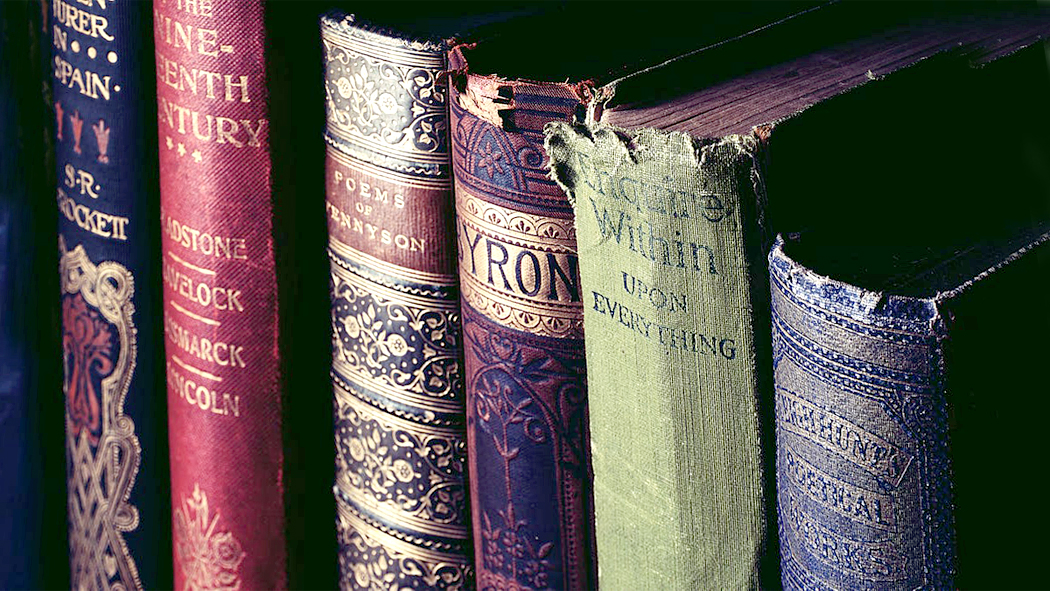
It started when I recently came across a set of McGuffey’s Eclectic Readers, compiled beginning in the 1830s by William Holmes McGuffey. The books were the most common grade-school texts for nearly a century, and are still the preferred books for many current home-schoolers. 

They are popular now because of the unrelenting Victorian religiosity of them for Christian home-schoolers. Every lesson seems to have some biblical homily to teach, training youngsters to be pious, faithful, honest, loyal, earnest, frugal and industrious. McGuffey, himself, was a preacher, in addition to being an educator and college president. 

But what is often lost in the haze of piety, is just how progressive McGuffey was for his time. Most education was then mere rote memorization enforced with the rod; McGuffey thought that instead of just giving kids lists of words to master, it would work better if the words were embedded in stories, and that new words in one story would crop up again for reinforcement in later stories. He taught an early version of phonics, to parse out the sounds of written words, and followed each story-lesson with a short set of questions to test comprehension. 

Really, aside from the heavy Jesus-ness of it all, it was really very forward-looking. 

I valued the reprints I own for their classic typography, for the quaint illustrations that go with the stories, and for the insight the whole gives me into that formidable century. 

And in amongst the stories of boot-blacks making good, mothers dying, little orphans learning the virtues of truthfulness and the importance of being generous to the poor, McGuffey included many old poems. Some are just versifications of Bible passages, but others are the old standards that I once made fun of. 

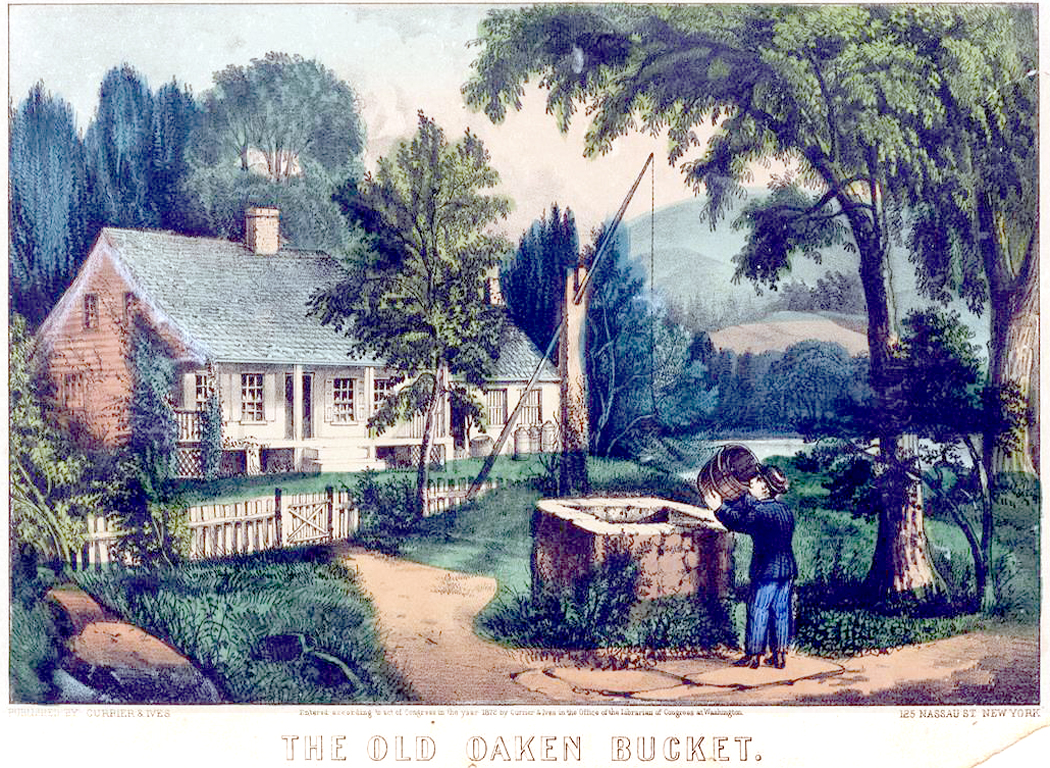
For instance, in McGuffey’s Eclectic Third Reader, I came across an old chestnut I had not encountered since I was a boy: The Moss Covered Bucket, by Samuel Woodworth. It’s one of those that most people have some vague recollection of, but perhaps not where the lines come from or what they mean. 

“The old oaken bucket, the iron-bound bucket, the moss-covered bucket, which hung in the well.” 

But as I began reading it, I found two very surprising virtues. The first was how much sense-memory there was in the poem — the noticing of small physical things that connect us with the world and that readers can almost feel, taste, or smell as they read the lines. 

It is a poem about remembering the things of youth, and there is a scent of sentimentality to it, but the memories evoked feel genuine. Sometimes, reading a pile of “O thou art…” poetry you wonder if a poet has ever actually seen a nightingale, let alone a “knight with burning brand,” but have merely read about such things in other poems. But here, I believe Woodworth really knew “the orchard, the meadow, the deep tangled wild wood…  the wide spreading pond, and the mill which stood by it; the bridge and the rock where the cataract fell; the cot of my father, the dairy house nigh it, and even the rude bucket which hung in the well.”  

Noticing — as I have often repeated — is essential to art. To life. 

But the second thing I found in the poem was the “lascivious melody.” Woodworth’s prosody was finished and refined, the meter and rhyme made the lines sing. Maybe not quite the level of Milton, but a danged good ditty. 

He describes coming in from working in the field and dropping the bucket down into the well “to the white pebbled bottom it fell,” and then how “dripping with coolness,” it rose from the well. “How sweet from the green mossy brim to receive it, and posed on the curb it inclined to my  lips! Not a full blushing goblet could tempt me to leave it, though filled with the nectar that Jupiter sips.” 

It moves with a forward-thrusting momentum hied on by the meter. 

I’m not trying to make too great a case for the old oaken bucket. It is not earth-shaking poetry. But it does afford a moment of pleasure as you read it, the way you get pleasure from a memorable tune. 

There were other poems in the Reader that now sang to me in ways I had formerly ignored. Byron’s “The Assyrian came down like the wolf on the fold, and his cohorts were gleaming with purple and gold…” 

In the Eclectic Fifth Reader, compiled some years later by McGuffey’s brother, Alexander Hamilton McGuffey, you find the familiar, “Under the spreading chestnut tree the village smithy stands; the smith, a mighty man is he, with large and sinewy hands; and the muscles of his brawny arms are strong as iron bands.”  

There is through all of the Readers a level of maudlin sentimentality that cannot be overlooked, but if you can wade through that, there are some true gems to enjoy, if primarily for their lascivious music. 

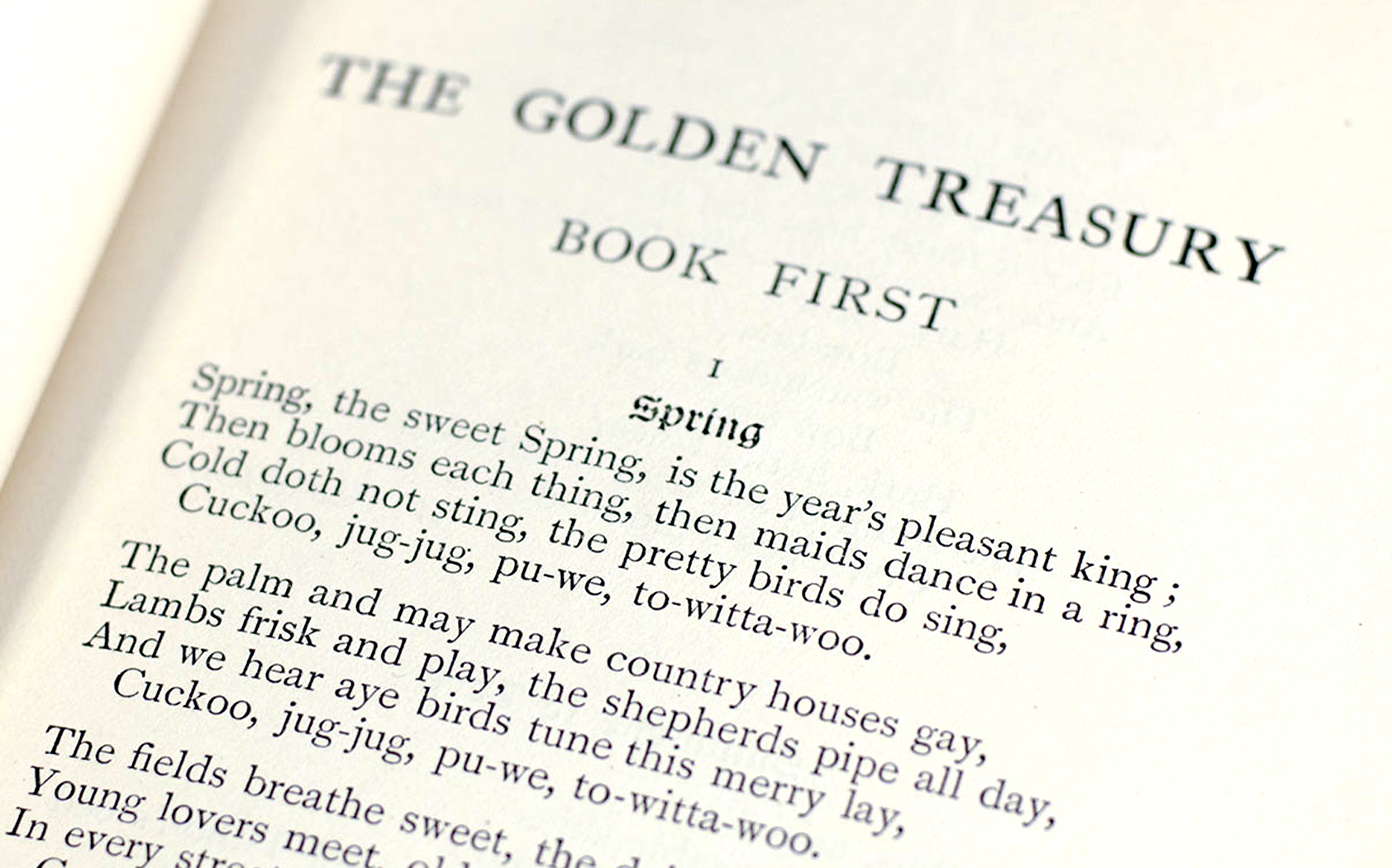
This discovery led me to another old book, one I have owned since I was a boy, but had hardly looked at in 60 years: Francis Turner Palgrave’s Golden Treasury of English Verse. First published in 1861, the book was an anthology of “the best English songs and lyrics,” and included Palgrave’s selection of verse written by poets of the past — his past; Palgrave made the decision not to include any poetry written by living poets, so, no Tennyson, no Browning. 

The book was originally divided into four “books,” one each per century from the Elizabethan era to the 19th century. There is a good deal of Shakespeare and an equal measure of Wordsworth, but all the usual names are included, and some that have largely been forgotten. Thomas Grey, William Cowper, Thomas Wyatt, Josuah Sylvester (no, that’s not misspelled). 

Having put aside my McGuffeys, I took up my Palgrave and read it from cover to cover. I found myself enjoying page after page, for the music of it more than for the sense. A good deal of the early verse is highly conventional in sentiment. Everyone had a version of “carpe diem,” many birds are extolled — I haven’t counted the skylarks, but there be many — many women described with coral lips and alabaster skin. It all gets a bit thick.

But listen to the music instead. “Whenas in silks my Julia goes Then, then (methinks) how sweetly flows That liquifaction of her clothes.

“Next, when I cast mine eyes and see That brave vibration each way free; O how that glittering taketh me!”

There is a perfection in the meter, rhythm and rhyme to Herrick’s little stanzas. Felix Mendelssohn wrote “Songs Without Words,” but Herrick has turned that around and written a song without the sheet music. 

Throughout my Palgrave, I came across piece after piece like that, with a flow of words as natural in metrical expression as a stream rushing over its rocky bed. 

“The curfew tolls the knell of parting day, The lowing herd winds slowly o’er the lea, The plowman homeward plods his weary way, And leaves the world to darkness and to me.” 

“A chieftain to the Highlands bound Cries, ‘Boatman, do not tarry! And I’ll give thee a silver pound To row us o’er the ferry!’ ‘Now who be ye, would cross Lochgyle, This dark and stormy water?’ O I’m the chief of Ulva’s isle, And this, Lord Ullin’s daughter.” 

The marriage of word and rhythm, with the fulfilled expectation of rhyme make these verses trot along like a tune sung well in time. 

It is the pleasure of tennis being played with a net. 

One listens to music for the pleasure it brings. Yes, there are mighty symphonies and Wagnerian music dramas meant to express deep emotional and philosophical things, but most, like a Mozart serenade or a Cole Porter tune, are meant to delight, devoid of any extra-musical sense. And that is what I am finding in this old verse I once so roundly denounced. 

If you don’t need to have profound thoughts as you read the words, then you can find the melody for its own sake and revel in the ear and craftsmanship of the poet. 

Yes, I’ve gone mellow in my senescence, and there is a touch of sentimental remembrance for the poetry I was fed when a boy. I guess I share that with those horrible Victorians. That is my apology.

Click on any image to enlarge

I recently discovered Glazunov. 

Discoveries are what keeps life interesting. Some are life-changing, like when you first discover the opposite sex, or late in life encounter the music of Bruckner. Others are just a pleasure you hadn’t known the universe afforded, such as chipotle chiles or books by David Sedaris. 

Glazunov is one of the latter. I don’t want to make too big a case for him, but his music is effortless enjoyment. 

Alexander Glazunov was a Russian composer, born in 1865, the same year as Sibelius and five years after Mahler. He grew up in a Russian musical world split between nationalists and internationalists. On one side, you had “the Mighty Handful,” of largely self-taught composers, such as Glinka, Borodin, Balakirev, Mussorgsky and Rimsky-Korsakov (the last distinctly well-trained), all of whom wanted to create a genuinely Russian brand of music. On the other side were Tchaikovsky, Anton Rubinstein and others, who looked to Germany and western Europe for their influence. It was isolationism vs. assimilation. 

Glazunov, born into this world, was a prodigy and he was taken on as a student by Rimsky-Korsakov when little Alexander was still a high school student. “His musical development progressed not by the day, but literally by the hour,” Rimsky-Korsakov wrote. Young Glazunov excelled in counterpoint, harmony, orchestration and large-scale form. It seemed he could do anything. 

His first symphony was performed when he was just 16, and was a huge success — the audience was astonished when the composer came onstage to accept their applause and turned out to be a kid in his school uniform. It was unofficially titled, “The Slavic Symphony,” for its use of Russian and Russian-style melodies, and it would have seemed as if the young composer was going to launch a new generation of nationalist composers. (To put the symphony in context, when it was written, Tchaikovsky had only written four of his six symphonies.) It joins Bizet’s Symphony in C and Shostakovich’s First Symphony as prodigies of teenage composers. 

Glazunov as student, young man, middle aged and old

But Glazunov’s second symphony, written only five years later, was “dedicated to Franz Liszt,” and clearly showed Glazunov gazing westward to more modern musical influences. 

In all, Glazunov wrote eight symphonies and part of a ninth. Every one of them is a joy to hear, full of great tunes, rich harmonies, fresh orchestration. His style is seen now as conservative and old fashioned, but while it is always familiar, it is never clichéd. He finds new ways of using the old composing tools. 

His music also never attempts to move heaven and earth, like Bruckner or later, Mahler, but rather attempts to please, to keep his listeners entertained. For this, he has sometimes been belittled and, as the 20th century progressed, largely forgotten. 

But you need to remember that most of Mozart’s output was simply meant to entertain, also, and it is a worthy goal. Glazunov’s music is a delight. Beethoven may churn our souls, but Glazzy just wanted to show us something of beauty and craftsmanship. 

That doesn’t mean all his music is major-key bouncy and empty. There is plenty of introspective substance, and the occasional disruption to remind us that the world isn’t always placid. But it is all to the end of keeping our ears interested. 

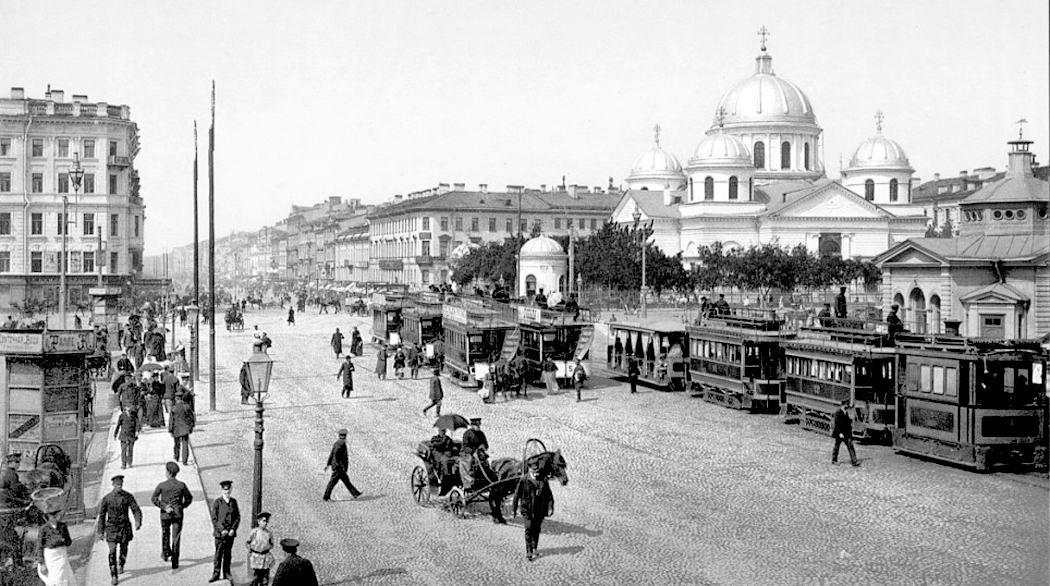
St. Petersburg Conservatory, ca. 1900

As his career developed, he became a respected member of the Russian art establishment, and eventually became head of the St. Petersburg Conservatory, where he trained many younger musicians, most importantly, Dimitri Shostakovich. His tenure was marked by a great improvement in the conservatory’s reputation and the quality of its instruction. Glazunov took his directorship seriously. 

He ran the school from 1905 to 1930, and while the instruction remained rather conservative, built on the principles of 19th century romanticism, its students entered the new century with other ideas. 

“Glazunov was ‘born in the middle,’ so to speak,” wrote critic Leo Eylar.  “He was born a generation later than the initial great Russian composers such as Tchaikovsky and Rimsky-Korsakov, and was born a generation before the modernist revolutionaries such as Stravinsky, Prokofiev, and Shostakovich.  As such, he was destined to occupy a rather difficult position in Russian music history.”

Glazunov continued writing music into the 1930s, and by then seemed like some musical dinosaur. But it is important to remember that he was 32 before Brahms died. His taste was formed before Modernism was even thought of. 

St. Petersburg

He was born in czarist Russia and lived through the Communist revolution and into the Stalinist era. He held the conservatory together during some tumultuous years, and with considerable integrity. When he was offered honors (and extra pay) by the regime, he replied asking for some firewood instead, so the students could heat their classrooms. During the privations of the Revolution and civil war, many students were near starvation and would have died but that Glazunov ensured they were given scholarships and the food allowance that came with them. 

“This was a period of terrible famine,” said Shostakovich. “The gist of the scholarship was that its possessor was able to receive some groceries. In a word, it was a question of life and death. If you’re on the list, you live. If you’re crossed off, it’s quite possible that you may die.” 

Shostakovich was on the list. 

And when an increasingly anti-Semitic government required he list the names of all the Jewish students, he sent back a message: “We don’t keep track of such things.” 

He listened carefully to his students’ music, even if he was sometimes shocked by it. He attended all of the school’s recitals. If he didn’t like something, he would listen over and over until he understood what was being attempted. This quality made the young Shostakovich love his schoolmaster. 

“After the Revolution, everything around Glazunov changed and he lived in a terrible world that he didn’t understand,” Shostakovich said. “But he thought that if he died, important work would perish. He felt responsible for the lives of hundreds of musicians, so he didn’t die himself.”

Shostakovich describes his perfect pitch, his ability to spot any mistakes in a student’s composition, like hidden “parallel fifths,” and his astounding memory. When Borodin died, leaving his opera, Prince Igor, unfinished, Glazunov reconstructed parts from memory, having heard Borodin play them on the piano years earlier. 

He understood the instruments of the orchestra. He learned to play the violin well so he could write his violin concerto. Once, visiting London, a french horn player complained that a note in the score was “unplayable.” Glazunov picked up the horn and played the note for him. 

“And Glazunov played the piano well,” said Shostakovich. “He didn’t have a real piano technique and he often played without removing his famous cigar from his right hand. Glazunov held the cigar between his third and fourth fingers. I’ve seen it myself. And yet he managed to play every note, absolutely everything, including the most difficult passages. It looked as though Glazunov’s fat fingers were melting in the keys, drowning in them.”  

On the minus side, though, Glazunov was a lifelong alcoholic, who kept a hidden bottle of hooch in his office desk, with a tube running from the desk drawer to his mouth, so he could sip while discussing music with his students. His alcoholism is sometimes blamed for the disastrous premiere of Rachmaninov’s First Symphony, which Glazunov conducted in 1887. The performance was so disastrous that Rachmaninov stopped composing for three years. 

During his life, Glazunov’s music was held in high esteem, especially in Russia. But as the 20th century began, his music was seen as more and more out-of-date. His efforts at the conservatory slowed his musical production, and by the time of his death in 1936, only his violin concerto remained in the active repertoire, helped mainly by the fact that virtuoso Jascha Heifetz played it frequently. 

Glazunov gave up active directorship of the conservatory in 1928 and left Russia. He never expressed any political concern, but it was clear that Stalinism was not going to put up with Glazunov’s independence of spirit, and so the composer moved to France, where he remained until his death. 

In all, Glazunov composed eight symphonies, with a fragment of a ninth. He also wrote several multi-movement orchestral suites, which might as well be counted among his symphonies including From the Middle Ages and The Kremlin. He composed several successful ballets that continue to be staged even in the 21st century, most famously, Raymonda and The Seasons. 

He was a master of orchestral color and orchestration, and handled the large forms admirably. Especially his inner movements — the slow movements and the scherzi — are memorable and moving. He was fond of unequal phrase lengths, which kept the melodies from being predictable or monotonous (a problem that often beset Robert Schumann, who too often fell into 8- or 16-bar patterns). 

Glazunov wrote a handful of concertos, among them the popular violin concerto and, as his last major composition, a concerto for alto saxophone, which is quite forward-looking for the old master. There are a pair of piano concertos and some concertante works for cello. 

But for me, his real masterpieces are his quartets. He wrote seven numbered quartets, a Suite for string quartet, and his Five Novelettes, a full-length Elegy, and a Quintet for strings. These works highlight what Glazunov was best at.  

Quartet writing after Beethoven became a problem for many subsequent composers. The importance and depth of Beethoven’s quartets, especially the dense late quartets, tended to lead later composers to approach the form with such utter seriousness that they become clogged with polyphony (ahem: Reger) and the need to keep each string player occupied all the time. There are exceptions, like the quartets of Dvorak, but even Brahms gummed up his string quartets with thickness. 

Glazunov, however, could write counterpoint with clarity and grace. Many of his quartets start with a fugal introduction, but you never get the feeling that he is writing an obligatory chunk of polyphony to prove his seriousness. Rather, his fugues flow like real music, charming and direct. 

The quartets have almost orchestral color, as Glazunov alternates timbre with changes in register, double stops, muting, harmonics, and pizzicati. You never tire of the string tone, it is always varied. 

He splits the melodic material among his players so that everyone gets a turn with the big tunes. Glazunov wrote his quartets primarily for his friends to play among themselves, and I think they must have been a joy to perform, even more than to listen to. It’s a mystery to me why they don’t show up more often on recital programs. Audiences would love them.

For his symphonies and concertos, there is an inexpensive box set on Warner Classics, conducted by Jose Serebrier that is, I think, the best currently available set. There are other versions with Vladimir Fedoseyev and the Tchaikovsky Symphony Orchestra of Moscow Radio, in somewhat lesser sound engineering; and Naxos has its series of Glazunov’s music, with the symphonies conducted by Alexander Anissimov and the Moscow Symphony Orchestra. Serebrier beats them all with sound, performance and price. 

As for the quartets, there is a complete set box with the Utrecht String Quartet that is beautifully played and recorded, on MDG. You can get them individually played by the St. Petersburg String Quartet and several by the Shostakovich Quartet. 

And, since everything — and I mean everything — is available on YouTube, you can find multiple versions of almost everything Glazunov wrote, often with the musical scores to read as the music plays. 

I am not making the case that Glazunov should be seen as some forgotten Brahms or Dvorak. His music lacks the emotional and philosophical ambition to take on the deepest meanings you find in Beethoven, Wagner or Mahler, but none of the big names can claim supremacy in terms of technical proficiency or tunefulness. Glazunov wrote music, and seen in purely musical terms, he was a great master. 

Much art and music from before the First World War fell out of favor with the rise of Modernism. Glazunov fell with them. But now that Modernism is old-fashioned, we can reappraise a good deal of work that was denigrated in the 20th century. Rachmaninov no longer has noses turned up at his music. Even academic painting from the second half of the 19th century is finding new audiences. Glazunov deserves to be among the rediscovered.

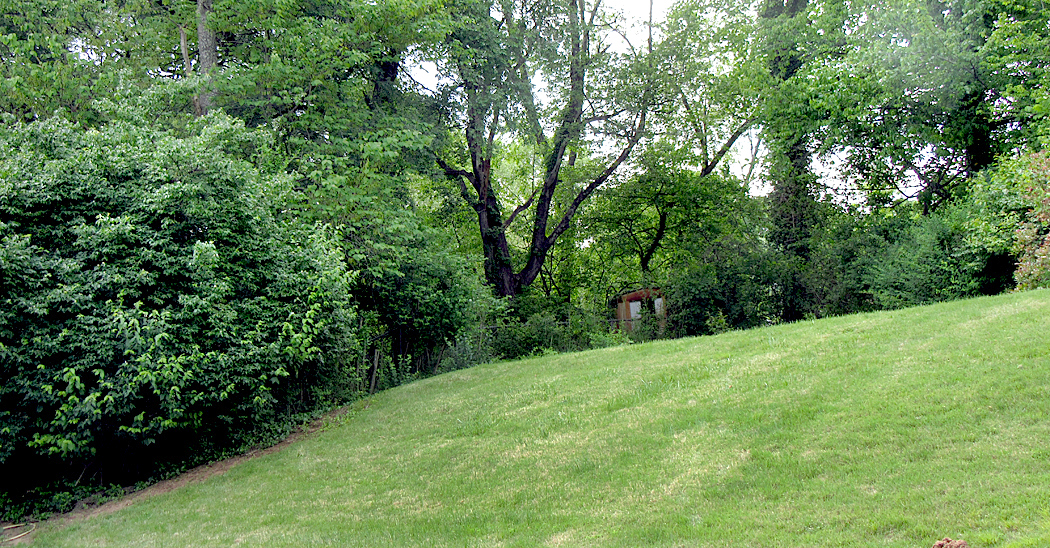
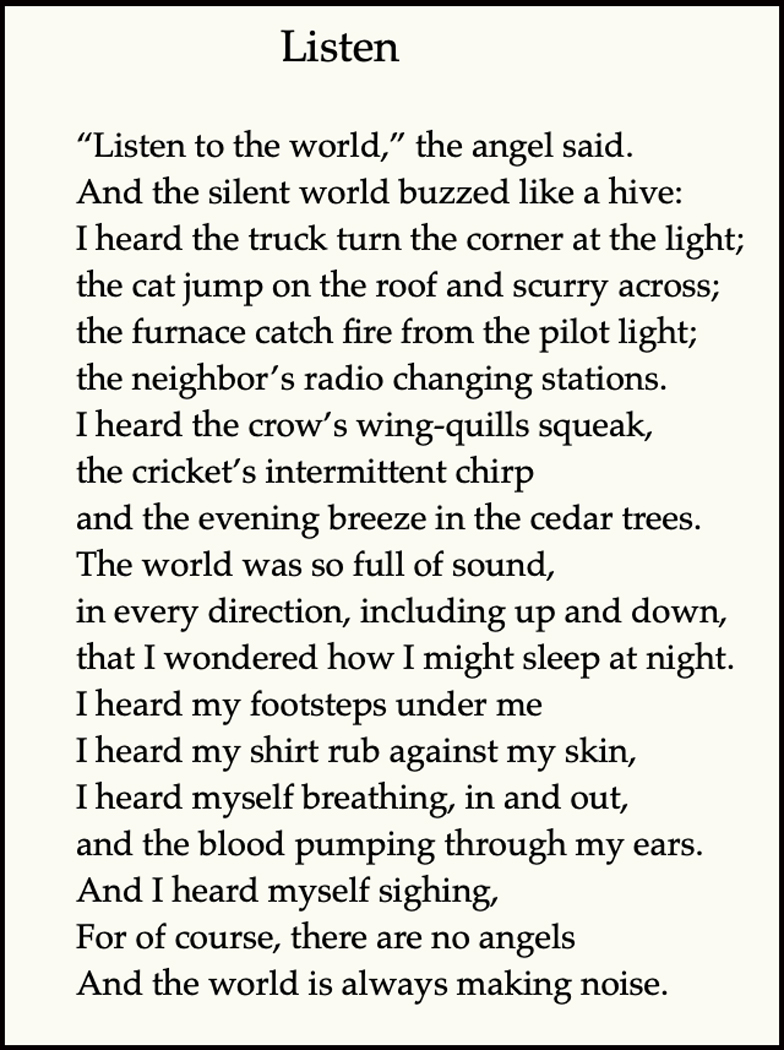
Now that it is well into spring, I like to sit in the back yard and just soak up the experience. On a chair on the patio, I can sit for a half-hour or so and just listen to what is going on around me. Often, I just close my eyes and enjoy the bird calls, the distant lawnmower, the occasional and distant roar of a passing jet high in the air. It is my form of meditation. 

It affords me great pleasure to hear all the sounds, and more, to hear them all at once, piled up in counterpoint, like so many voices in a Bach fugue. Indeed, I try with the same effort to be able to hear all the parts simultaneously. It is great training to hear the more traditional music of the concert hall. 

For, in any decent music, there are many things going on at the same time. Not only in dense Baroque counterpoint, but in all music. There is melody, harmony, rhythm, timbre, texture — to say nothing about a bass line. If you listen only for the tune, you miss so much else. 

And so, in the concert hall, I often close my eyes and concentrate on taking in all the bits. It takes some practice, but it is possible to hear multiple lines of melody at the same time. At the very basic, to hear the tune on top and the bass line at the bottom playing off one another. 

In my back yard, I enjoy the stereo effects of a cardinal squawking to my right, while a chickadee yawps to the left, while the mower sounds two blocks away and a dog barks somewhere behind me, down the hill. There is always traffic on the main road, about a quarter-mile up the hill, and the breeze shuffles the leaves on the trees that ring my yard in an aleatory rhythm that serves as bass line to the rest. The mockingbird has his repetitive medley of greatest hits. You can’t fool me. I know it is you. 

Listening to it all tells me the world is alive. It is animated and bustling, and it sings an earthy chant. 

I am reminded of John Cage’s infamous 4’33’’ — the piece where the pianist sits in front of his keyboard for that amount of time and plays nothing at all. Often seen as a hoax by those unwilling to take Cage at his word, and feeling they are being cheated, such a listener misses the point. The composer intends for his audience to actually hear the sounds of the hall — the rustling of programs, the passing truck outside, the AC unit clicking on, the throat clearing and feet shuffling — and appreciate them as a kind of music of their own.

It is one of the primary functions of art, and music included, to wake you up to the world, to see what is usually ignored, to hear what surrounds you, to feel what is churning inside. It all boils down to paying attention. 

The world is full of miraculous sound. I remember Kathy Elks, from eastern North Carolina, telling us of when she was an infant, just after World War II, and would hear the propeller sounds of an airplane too high in the sky to see, and how she always thought that buzz was “just the sound the sky makes.” 

Or Emily Dickinson’s “I heard a fly buzz when I died.” Or the “good grey poet,” Walt Whitman: “Now I will do nothing but listen,/ To accrue what I hear into this song, to let sounds contribute toward it./ I hear bravuras of birds, bustle of growing wheat, gossip of flames, clack of sticks cooking my meals…” 

Samuel Taylor Coleridge, in the Ancient Mariner: “A noise like of a hidden brook/ In the leafy month of June,/ That to the sleeping woods all night/ Singeth a quiet tune.” 

“Listen to them. Children of the night. What myoosik they make,” says Bela Lugosi in Dracula (1931). 

Beethoven included a quail, nightingale and cuckoo in the slow movement of his Pastoral symphony. Messiaen wrote whole symphonies built from transcribed birdcalls. Charles Ives built the sounds of his Connecticut village into his music. Rautavaara’s Concerto for birdsong and orchestra. Vivaldi imitates birds in his Spring concerto. Alan Hovhaness And God Created Great Whales, with its whalesong sounds buried in orchestral texture. 

Gustav Mahler said the symphony must embrace the world, and he included cowbells, hammer blows, distant military bands, bird calls, the memory of the postillion’s watery horn call, and even begins his first symphony with seven-octaves of unison A-naturals, almost a tinnitus of the universe — the music of the spheres — interrupted by a cuckoo in the woods. His own defective heartbeat was the opening of his final completed symphony. 

Bedrich Smetana wrote his tinnitus into his first string quartet, “From My Life,” in the form of a long-held high “E.” 

 The same world of sound that fills all this music waits outside my back door, waiting to be organized into coherence. The first step is paying attention. Engagement is the secret to unlocking the world. The ear is a gate to paradise. 

Some years ago, when I was still regularly penning verse, I wrote about this:

Happiness is the most innocuous of emotions; it is plain and uninflected. Compared with its brawny cousins, such as hatred, passion, grief or joy, it is rather simple and nondescript. It is to those as water is to wine. 

Happiness is what you see on the faces of children playing outdoors. It is for them, who don’t yet have the burdens of adulthood or the cares of life. They can innocently play with happy abandon. Heaven lies about us in our infancy! 

Yet, in those cares of life, who doesn’t wish for a few seconds freedom to experience once again the simple happiness of when we were young and didn’t know any better.

Most of our art and music concerns the bigger things. The emotions you get from Mahler are big, complex emotions, piled Pelion on Ossa, building overpowering climaxes that leave us hollowed and purged. 

Think about Bach’s B-minor mass, Wagner’s Tristan, Stravinsky’s Oedipus Rex and you find the complexity of life threaded around itself. Of the big emotions, none is uninflected, but includes a tincture of its opposite.   “Our sweetest songs are those that tell of saddest thought. Our sincerest laughter with some pain is fraught.” 

Happiness, as I’m using the term here, is unalloyed. And while most of the greater emotions are felt as “happening” to yourself, happiness takes you out of yourself. You are unaware of your self when experiencing it. It is a grace.

In that sense, there is ego invested in the transcendence of Mahler or the Ode to Joy of Beethoven, but when you are happy, you barely exist: Only the happiness exists. You are only really aware of it when you wake from it and realize what you have been gifted. 

Of course, such a state can only last a comparatively short time. When the philosopher asks if you have had a happy life, the only accurate answer is that life is not happy, but only moments are. 

Art can rouse in us a huge range of emotions, and classical music is designed to explore the subtleties of them, and we are overwhelmed by the passions in Mahler, the transcendence in Bruckner, the joy in Beethoven’s Ninth, the angst in Berg’s violin concerto. All huge, complex emotions. 

But surely, there must be some music completely devoid of such cares, and can arouse in us those feelings of abandon and freedom we had as little children. Is there music that is simply happy? This is music I put in the CD player when I just want to rock back and enjoy the simple tunes and unfettered sounds of being happy. Bouncy, tune-filled, catchy feel-good music. 

The place to start, where most of the habits of classical music start, is Joseph Haydn. He seems to have invented everything: the symphony, the string quartet, the sonata form — they all descend from Haydn. And Haydn was perhaps the sanest person ever to write music, burdened by no metaphysical agonies. But even his music expresses a variety of thoughts and emotions, movement by movement, from the depth of the Seven Last Words of Christ to the finale of Symphony No. 88, which bounces with unfettered happiness. (Link here). 

That kind of ebullience is hard to sustain, but here are five examples from classical music that bounce from beginning to end, along with some suggestions for recordings. (Not “the best” for I have not heard all of the recordings, but these are my favorites). 

Franz Schubert Piano Quintet in A “The Trout”

The Trout Quintet is unusual in that it includes a double bass, which provides a solid bottom for the music, which allows the tunes to float along like rafters down a river. It is a sunny quintet, with hardly the whisper of a shadow in its five bright movements. Even the minor-key variation in the fourth movement is dispelled with a major chord — “I was just playing,” its composer seems to be saying.

It was written in 1819, when Schubert was 22, for piano, violin, viola, cello and bass. Through most of his best music — the late piano sonatas, late quartets and the great C-major string quintet — there is a strain of despair that is heartbreaking. Even in his short piano pieces, beloved of amateurs for a century and a half, there runs a vein of deep melancholy that shades even his happiest moments.

But none of this in the Trout. It spreads sunshine from beginning to end.

Almost any performance of The Trout will leave you giddy, but the one essential element of any recording is that you can hear — even feel — the string bass at the bottom. It is the foundation for the edifice. 

I’ve always loved two performances. The first is Alexander Schneider with Peter Serkin on piano, Michael Tree on viola, David Soyer on cello and the indomitable Julius Levine on bass. It was on the Vanguard label. And Peter’s father, Rudolf Serkin anchors the Marlboro Festival musicians on Sony (then, Columbia). With Serkin is Jaime Laredo on fiddle, Philipp Naegele on viola, Leslie Parnas on cello and Levine, again, on bass. A classic performance, much loved by many, features Clifford Curzon on piano, with musicians from the Vienna Philharmonic. Originally on Decca (classical music labels are in constant flux, as mega-corporations gobble up older established labels; you never know where a classic performance will show up. Just check Amazon and you’ll find it.)

YouTube video at this link

Gioacchino Rossini String Sonata No. 1 in G

It shouldn’t be surprising that most of the music that expresses mere happiness should have been written by very young composers. The six sonatas for strings were written by Rossini when he was 12 years old, arranged for four string parts: two violin parts, one for cello and one for double bass — again providing that delightful solid bottom for the tunes. 

The bass is there because Rossini wrote them while visiting the home of bass player Agostini Triossi in Ravenna, Italy, in 1804, and tossed all six sonatas out in the space of three days to be played by members of the household, with Rossini himself on second violin. 

Although written for a quartet of players, they are usually performed by a full ensemble. Versions have been adapted for normal string quartet and for wind band, but the string ensemble has that fresh appeal that matches the music. 

I could have chosen any of the six sonatas. They are each in three movements, fast-slow-fast, and in major keys. But I mention the first because I particularly love its jaunty finale, with a tune I can’t get out of my head. 

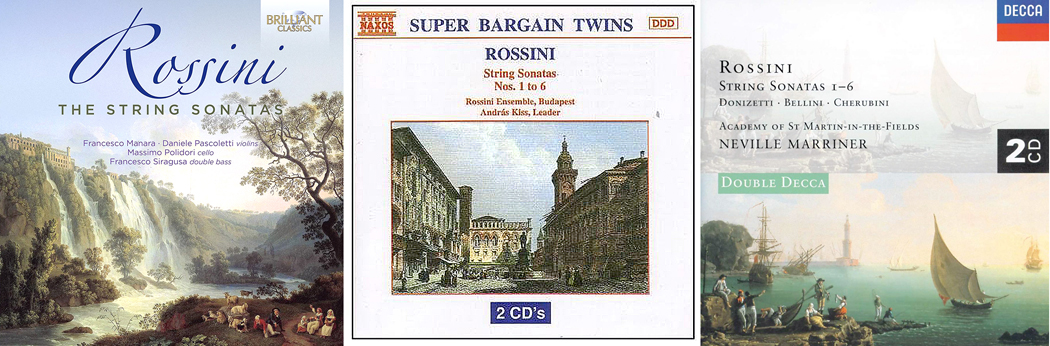
I’ve never heard a bad performance on disc, but mostly I listen to the Naxos recording of the Rossini Ensemble, Budapest. They almost always come in a pack of all six sonatas, so you are likely to love them all. Neville Marriner has a smooth set with the Academy of St. Martin’s in the Field, and Brilliant Classics has the version with four solo players. 

YouTube video at this link


 Georges Bizet Symphony in C

Another prodigy, Bizet wrote his symphony when he was 17 years old and a student at the Paris Conservatoire. It was never performed in the composer’s lifetime and indeed was lost and forgotten until 1933, when it was found in the composer’s papers, and was given a first performance by Felix Weingartner in 1935. Since then, its infectious tunes and untroubled elan have found it a place in the repertoire. 

I have always thought of it as a 19th century version of a Haydn symphony — perfectly proportioned, tuneful, and with no dead spots. Others may have stormed the heavens with Wagnerian thunder and Blitzen, but this symphony contents itself with pleasing its listener with melody, rhythm and smooth harmony. 

It has also been lucky on disc, when three of the most lively conductors have taken it on. Leonard Bernstein with the NY Phil, and Leopold Stokowski with the National Philharmonic (a pickup orchestra), and Thomas Beecham with the Royal Philharmonic. You can’t go wrong. 

YouTube video at this link

Serge Prokofiev Classical Symphony in D major, Op. 25

Another student work, in 1917 Serge Prokofiev wrote his first symphony in a kind of parodistic style of Haydn or Mozart, but with modern piquant dissonances — what has been derisively called “wrong-note romanticism.” 

But the four-movement symphony has proved enormously popular. It bounces from first to last, with memorable tunes and sharp wit. 

The composer Boris Asafyev, according to Prokofiev, “put into my mind an idea he was developing, that there is no true joyfulness to be found in Russian music. Thinking about this, I composed a new finale, lively and blithe enough for there to be a complete absence of minor triads in the whole movement, only major ones.” 

The energy in this music is propulsive. If anyone is feeling down, with the feeling of systematically knocking the hats off anyone you meet on the streets, a listen to the Classical Symphony will cure you and leave you with a goofy grin on your face. 

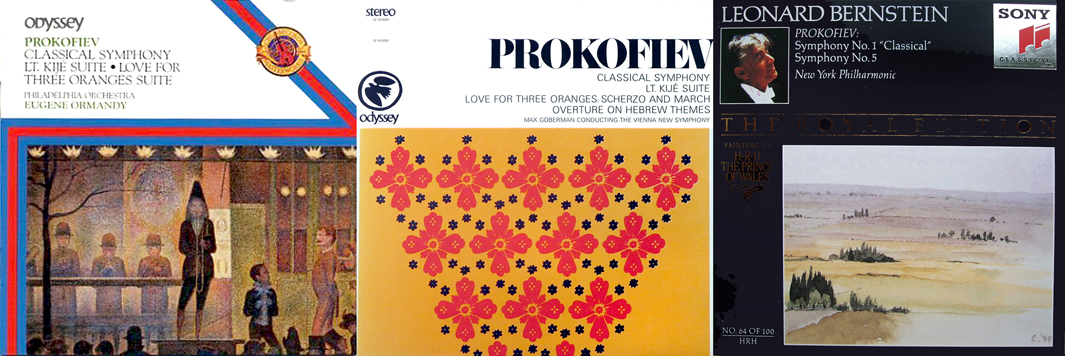
Many have recorded the symphony. The only failures are when the conductor takes the music too seriously or lacks any sense of humor. There are several dry versions. But I have three that I have loved. Leonard Bernstein and the NY Phil have all the elan and vigor you could ask for, if the ensemble is a tad scruffy. Eugene Ormandy and Philadelphia cannot be topped. It is a perfect recording of the music, bright and witty with gorgeous string playing. And I remember an old Odyssey LP I once owned with Max Goberman and the Vienna New Symphony. Perhaps one day a CD version will be offered. 

YouTube video at this link


Darius Milhaud Le Boeuf sur le Toit, Op. 58

Imagine you are in a Brazilian dance hall and the crowd, sloppy with  drink and dance, are bouncing to the music of an exuberant band — not all of whom are playing the the same key. And you cannot help but tap your toe, then jiggle your leg, and then get up and dance and sweat with the crowd. That is Milhaud’s Le Boeuf sur le Toit (“The Bull on the Roof”). 

It is a string of mostly Brazilian tunes, some borrowed, some invented by Milhaud, all of which are infectious and life-affirming. It is the most single-mindedly happy music I have ever encountered, completely unselfconscious and joyful. Milhaud himself called it, “15 minutes of music, rapid and gay, as a background to any Charlie Chaplin silent movie.” 

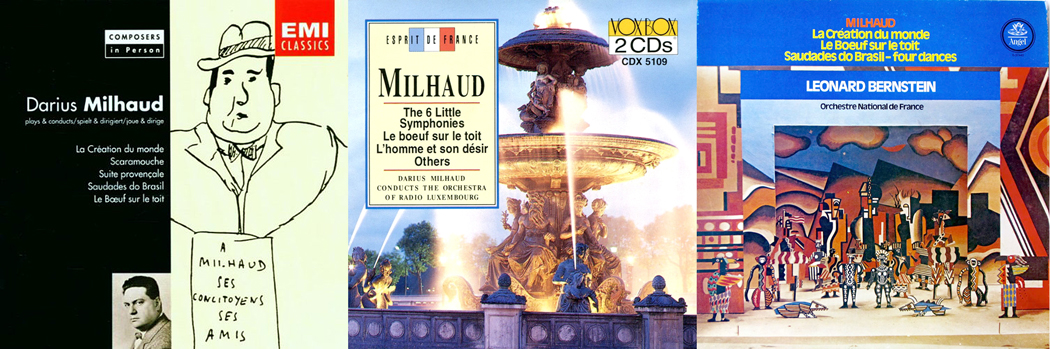
 You can get a recording of Milhaud himself conducting the Orchestre du Théâtre des Champs-Elysées from 1958, perhaps a bit ragged, but with all the spirit. A standard for decades has been Louis de Froment and the Orchestra of Radio Luxumbourg. But for me the perfect embodiment of this happy music is the Orchestra National de France under Leonard Bernstein; he is the perfect vehicle for the life-spirit of this music. 

YouTube video at this link

Those are my five suggestions. There are others: Benjamin Britten’s 1834 Simple Symphony, made up of tunes he wrote when he was 10 years old; or  perhaps Shostakovich’s Three Fantastic Dances from 1920, which he wrote between the ages of 14 and 16 — before the specter of Joseph Stalin darkened his art. Perhaps you have other suggestions to leave in the comments. 

It has been now perhaps 30 years since what was once called the “original instrument” movement in classical music took solid hold. Now usually referred to as the “historically-informed performance practice” movement (what a bureaucratic sounding phrase; I loathe it; there must be something better to call it), it has permeated not only the small bands of re-enactors (like Civil War re-enactors, really), but the mainstream classical music culture as a whole. Even when playing on modern instruments, performances are likely to be inflected by the historical re-enactor crowd. 

And so, you get bouncy Beethoven and manic Mozart, often played with two or three fiddles to a part. It all sound anemic to me. 

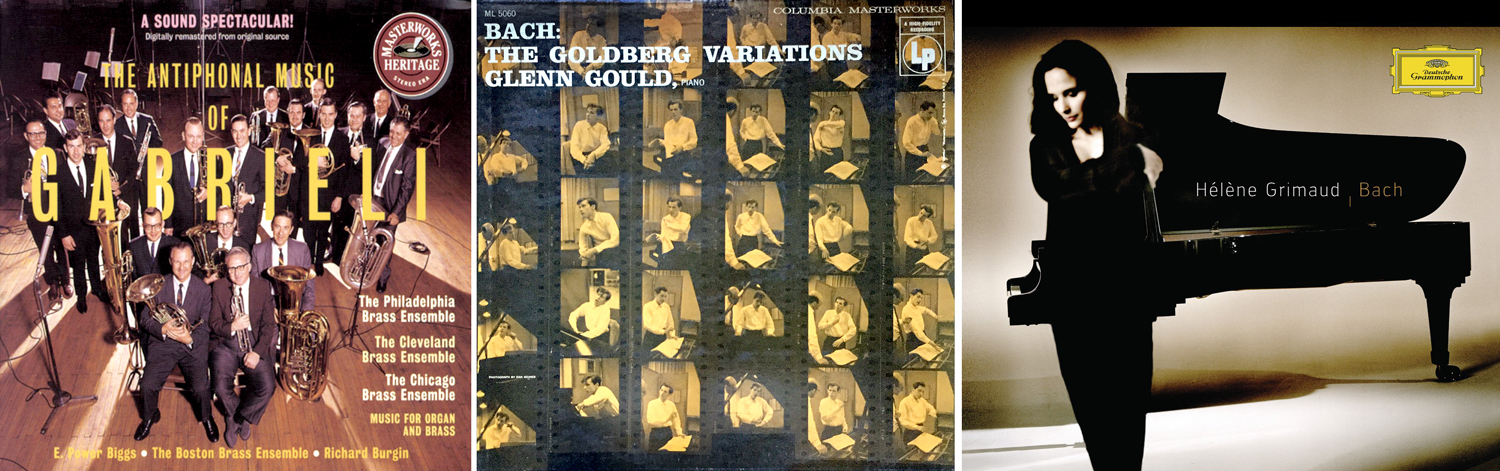
But I’ve been listening to the perfect antidote. I recommend you listen to the 1968 recording of The Antiphonal Music of Gabrieli, played by the combined brass sections of the Philadelphia, Cleveland and Chicago orchestras. It is absolutely glorious and I cannot imagine anyone coming away from listening to these choirs and not thinking “Wow!” and wishing they instead had heard the music on wheezing sackbutts and cornetts. (Sample here). 

Or Glenn Gould in his 1955 recording of Bach’s Goldberg Variations, a disc that can still shock a listener with its energy and life. The re-enactors insist Johann Sebastian should only be played on a harpsichord, but there is no keyboard more prone to monotony of tone and expression than the clangy jangly ear-assault of a harpsichord. Give me Bach on a piano any day, whether Gould or Rosalyn Tureck or Daniel Barenboim or Jeremy Denk. (Sample Gould here).

Just listen to Hélène Grimaud play the Busoni transcription of the chaconne from the Bach second violin partita, listen to it build to a glorious climax, with such brilliant pianism. This is music. (Link here). 

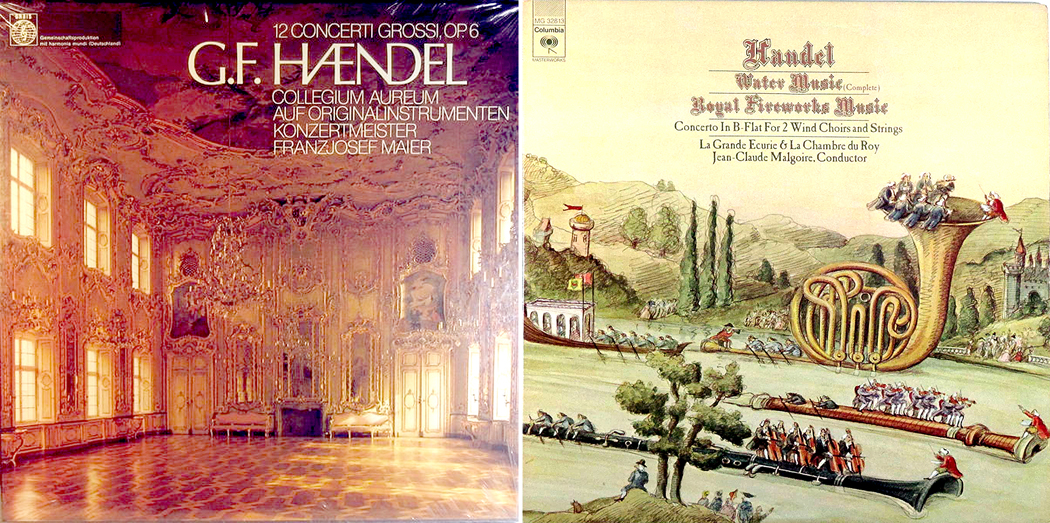
Now, before you go away thinking I am a cranky old codger refusing to move with the times, I assure you I recognize the benefit to humankind wrought by the young whippersnappers. As far back as 1978, I got on board when I purchased an LP set of Handel’s Op. 6 concerti grossi led by Franzjosef Maier with the Collegium Aureum. It was bright, energetic, forceful and clean. For me, it was a revelation, compared with those soggy older recordings I had on Nonesuch or Turnabout. Handel was freed from the concrete shoes he had been wearing since the 19th century. It was liberation.
Many a composer has benefited from the historically-informed performance practice and many of the old works have been rediscovered. Vivaldi, Telemann, Geminiani and others have been reborn with new interest in their works. Beyond the Four Seasons, we now have scores of recordings of Vivaldi’s operas and vocal works. And a host of French work by Lully, Couperin, Rameau. 

It wasn’t all peaches and roses, however. Under the mistaken idea that “original instruments” would refresh just about anything, I bought another LP, this time of Handel’s Water Music played by La Grande Ecurie and La Chambre du Roy under Jean-Claude Malgoire. What a horrible sound they made, scratchy, whiny, out of tune and struggling with the notes. The horns in the minuet, about 20 minutes in, is enough to make your eyes water. It didn’t just put me off original instruments, it put me off my soup. (Sample the opening of the Royal Fireworks Music here).  

Of course, in those prehistoric-instrument days, string players were way ahead of wind players, who had not yet quite figured out how to play the old hautbois and chalumeaux. Things have improved greatly since then and many old-music specialists have become quite virtuosic. Nowadays, you can buy a CD of some obscure Baroque composer and feel sure you’re getting the real goods. 

But, of course, while the re-enactors have gotten better, there has been a down side, also. When you find a new plaything, you want to daub it everywhere, and so, we even now have “historically informed” Berlioz, Wagner, even Bruckner. Like mustard on watermelon.

The tenets of the historically informed have become a kind of dogma and doctrine, and it gets applied to everything. A recent recording of a Beethoven symphony had four first and second violins, two violas, two cellos and a single bass. That might work well for Vivaldi, but for Beethoven it is a travesty. When he had the opportunity, Beethoven himself preferred 20 first and second violins. Brahms, who is now offered with chamber orchestras (because he once did that at Meiningen), actually much preferred the Vienna orchestra with 68 string players. 

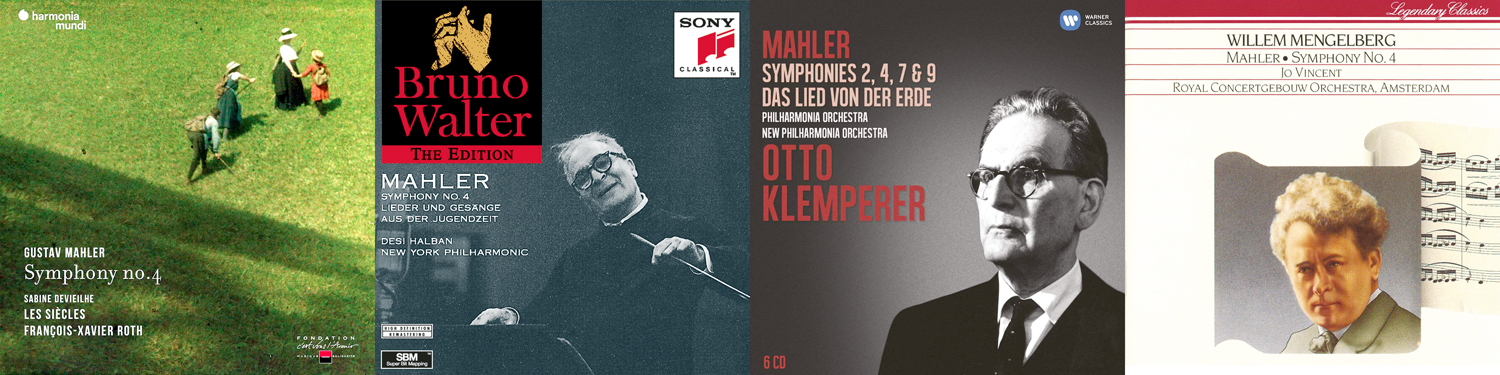
A recent recording of Mahler’s Fourth Symphony was released, conducted by François-Xavier Roth, according to “historical” practice. All the rules were followed. A reviewer lauded the performance, writing, “Thanks to Roth’s fleet interpretation — he seems intent on freeing Mahler from excess romantic baggage — we hear details usually buried under bulbous bellows and portamento-laden strings.” I had a good laugh: Mahler went to great lengths to put that romantic baggage into the work.

I wonder if next we can expect an edition of Mark Twain with all the excess humor taken out, or perhaps a Picasso run through a computer program to rearrange those Cubist faces back into something more like a passport photo. The portamentos are written into the score, after all. 

As far as it being performed according to historical principles, well, one has to wonder what principles these might be. Roth could, for instance, have checked with the recordings of at least three conductors who actually knew Mahler, and two who actually conducted with him. Perhaps they might have some insight in the way the Fourth Symphony is supposed to sound and what true historical performance practice was. Check with Bruno Walter, Otto Klemperer, or Willem Mengelberg (who performed the Fourth for Mahler and got his direct approval and appreciation — and there is a recording to check.) Note: They all play with vibrato. Roth’s twin vices of arrogance and ignorance are astonishing.

But, of course, Roth isn’t really interested in the composer’s intent. The movement has given up all pretense that they are recreating the music the way it was first heard. (“We’re trying to show what the symphony would have sounded like when Beethoven first heard it.” “But Beethoven was deaf.”) Because the actual driving force behind the movement isn’t historical accuracy, but rock and roll, popular music, which privileges — as do the HIPP performers — rhythm, beat, and energy over harmony and melody. “Beat me, daddy, eight to the bar.” 

Younger musicians have grown up with rock music, with heavy metal, with the drive of rhythm guitars (i.e., the continuo), and the pounding beat of drums. And as with rock music, there creeps into HIPP performances a kind of sameness — the mustard on the melon. 

And so, Roth, like the other re-enactors, is interested in making the music sound like all the other HIPP performances — whether Handel, Berlioz or Bruckner. Thin strings, clipped rhythms, rushed tempi. 

Modern conductors now too often have ideas where their ears are supposed to be. And so, instead of a performance of music, you get a lecture on how the music is “supposed” to be played. 

It reminds me of film director Lars von Trier and his Dogme 95  film movement and its “vow of cinematic chastity,” where a filmmaker was required to  adhere to a series of “dogmas:” required to shoot on location, not on a constructed set; to avoid using music unless it was being played onscreen as part of the story; to use no artificial lighting; to make no film not set in the present time, no costumes but what the actors bring with them … and a host of other rules restricting the “artifice” of moviemaking. It was a set of rules so puritanical that even von Trier had to give them up eventually. 

The period re-enactors of classical music have their own manifesto: To avoid vibrato; to observe strictly the composers’ metronome markings (even when Beethoven specifically tells them not do to so); to phrase in short, often two- and three-note groups; to hit the rhythms by barline with a sledgehammer; to use small instrumental groups; to employ countertenors when possible (given castrati are no longer available); to employ valveless trumpets and horns; to use old instruments or recreations of old instruments, with fewer keys, and wooden flutes, or recorders. And please, no pianos allowed; harpsichords or vintage fortepianos only. 

The result, too often, is music in a strait-jacket. We know that Beethoven complained harshly about the restrictions of instruments available in his day, and that future instruments would be better able to express his intentions. In essence, some of the peculiarities of Beethoven’s orchestration are because of the limitations of instruments in his time. 

As Donald Francis Tovey once observed, “Scholarship itself is not obliged to insist on the restoration of conditions that ought never to have existed.”

Which brings me back to Gabrieli and the great brass players of the big American orchestras. This is music as a glory, as joyous, as sheer pleasure. Is it what Gabrieli would have heard in Venice in 1597? No, but I’m sure he would have loved it. It was meant to be music, not a treatise. 

The current dogma forgets one important fact: The music doesn’t belong to Gabrieli; it belongs to us. The same with Bach, Beethoven, Chopin, or Mozart. They are dead and the music survives. And it is we who now own it. The sheet music is an artifact that needs musicianship to bring it to the ear and musicianship is now and always has been more important than scholarship. 

Imagine if we insisted that Shakespeare be performed only outdoors, with boys dressed up in the women’s parts, and all declaiming their lines loudly enough to be heard in the back rows, and no breaks into acts and scenes. Interesting as an experiment, to understand the theater of Shakespeare’s day, but hardly an ideal way to do Hamlet. Could we now take seriously Romeo making love to a Juliet in drag? 

You can now find Mozart, for instance, played by John Eliot Gardiner or Roy Goodman or Frans Brüggen and it zips along almost like a mechanical clock, fleet, crisp and rhythmic. All the notes are there, and the instructions in the score are obeyed. But something vital is missing. Something human. 

And so, I turn to hear Mozart played with humanity and and emphasis on songfulness, not metronome markings and I hear Bruno Walter’s Mozart, or Pablo Casals’. 

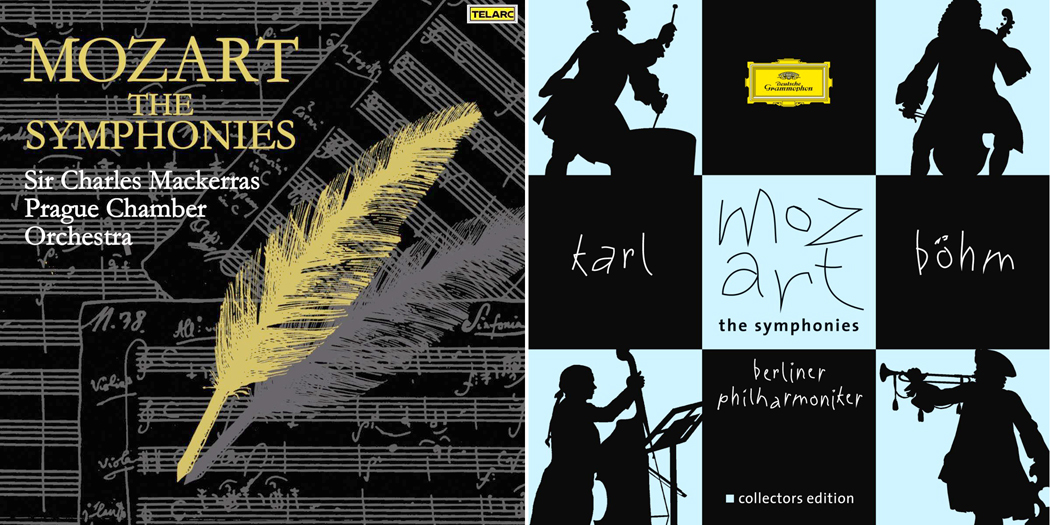
I used to have the complete Mozart symphonies played by Charles Mackerras, in period style, but I gave them away and got Karl Böhm and the Berlin Philharmonic. Böhm understood the style, the music, and what the music meant. There is nothing really wrong with Mackerras — he was a wonderful conductor — but his Mozart imitates the period-re-enactor esthetic and turns what should be warm melody into a patter-song. I have given up on historically-informed Mozart.

(I make a slight exception for the early symphonies performed by Nikolaus Harnoncourt, but then Harnoncourt, aka “the Wild Man of Borneo” was sui generis — not really original instruments as much as the original Harnon-world. He was never afraid of bringing his Harnon-personality to the performance. Harnoncourt is always full of personality, albeit, sometimes you scratch your head.)

One of the seeming goals of period-re-enactors is to erase the musician from the music. They complain, for instance, that Leonard Bernstein’s Mozart is more Bernstein than Mozart. Well, of course — it is meant to be Mozart filtered through the sensibility of a performer. The notes on the page are neutral. The performance should not be. The musician puts the blood back into the notes. The score is only a skeleton. 

I’m not making a case here particularly for Bernstein’s Mozart; he was never as trenchant in Mozart as he was, say in Haydn, where he was magnificent. But rather making a case for interpretation. The re-enactors say they don’t want their music “interpreted,” but merely played. 

Someone once said that reading a cookbook doesn’t make you a good cook. Period-re-enactors want us to enjoy the raw ingredients — the mise en place — without the actual cooking. Really, more like eating a cookbook. 

I don’t wish to proscribe historically-informed performance practice. After all, it revitalized Baroque and earlier music. But I should point out that we can’t actually know what the music sounded like back then. It is guesswork. The sources for period performance practice are not in agreement. Some 18th century writers tell string players not to use vibrato; others instruct the opposite. Which pedagogue do you believe (obviously, the one that makes your music sound more like rock and roll). 

Further, the fact that some of the old teachers instruct their students not to use vibrato is actually evidence that they were bucking the system, that, in fact, most fiddlers back then really were using it and needed to be told to give it up. 

Even if re-enactors can re-animate the forgotten Baroque composers, and make us understand Handel and Vivaldi in a newer, brighter way, musicianship is still more important than scholarship. I cannot stand the revisionism applied to Bach. The two- and three-note phrasing makes hash of Bach’s long line, and ignores the intricate play of harmonies in order to emphasize the forward drive — the relentless bang-bang-bang. 

But most of all, I miss the personality of the performer in the re-enactors. When I listen to Bach by Gould or Tureck or Martha Argerich, I hear the music as the melded expression of both composer and performer — someone making sense of the notes. And that sense changes over time and place. It cannot be fixed in an imaginary historical moment. It is ours to parse out. Mozart has no say in it, and obviously, cannot. 

And so, if we get Walter’s Mozart on one night, we get Harnoncourt’s on another. Or the warmth and humanity of Pablo Casals. (Bruno Walter’s Mozart Symphony No. 39 here). Each version is valid, but the music is waiting there for yet another. Of course, HIPP is an interpretation, too. John Eliot Gardiner  brings his personality to the Orchestre Révolutionnaire et Romantique. Unfortunately, it is the personality of an accountant.

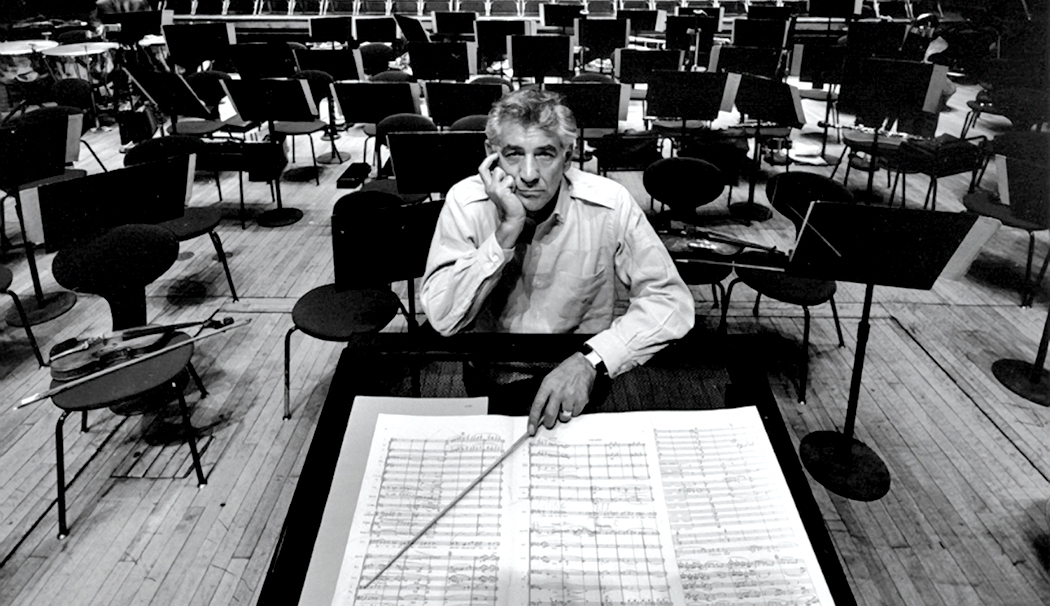
Yesterday, I accidentally came across a YouTube video of Leonard Bernstein conducting the Vienna Philharmonic in the finale of Joseph Haydn’s Symphony No. 88, which is one of the composer’s bounciest, most ebullient movements, and therefore one of the bounciest, most ebullient in all music. And I was transfixed: After a tiny initial tempo beat with the baton, the conductor dropped his arms and stood there, letting the orchestra play the entire movement, indicating directions entirely with facial expressions. (Link here). 

He was conducting with his face. It was brilliant. Every fleeting emotion played across his face, as if he were the music. And each expression came a half-second before the orchestra reacted, so Bernstein wasn’t following the music, but leading it. Extraordinary. It was one of the best performances of that finale I’ve ever heard, with a naturalness and clarity, but more important, a joy and spontaneity. 

I go back a long way with Lenny. When I was a mere bairn, I watched him on the Young People’s Concerts and I remember his explanation of Beethoven’s Fifth Symphony on the Omnibus TV show. I was just six years old in 1954, so I don’t remember much of what he said, but I remember the set, with the score of the symphony on the floor, so he could position his players on their staffs to show what they were doing. I was fascinated. 

Since then, Lenny has been a part of my life. Sometimes a small part, in the background, sometimes I spent extra money to buy one of his recordings over a cheaper Turnabout or Vox recording, with the trust that I would be rewarded by something special. I usually was. 

I heard Lenny conduct at New York’s Philharmonic Hall (later Avery Fisher Hall, now David Geffen Hall — it changes as much as the names on ballparks). I remember a rousing version of Debussy’s La Mer with the New York Phil. But mostly, I heard Lenny via recordings, first LP and then CD. There were also videos and TV presentations. 

I don’t deny that Lenny talking could be hard to take, with that resonant basso voice that he seemed to be in love with, and sometimes a ham actor’s thesbianicity. But if you can get past that surface, what he says is almost always revelatory, precise, and true. I listen to his Harvard lectures over and over, and despite some tedious Chomskian linguistic folderol, really insightful. (He drops the Chomsky in the latter lectures, thank god). 

But it is the music that really counts. For many, Bernstein was the great podium presence of the second half of the 20th century. The singer Christa Ludwig, who performed with Lenny often, once said she worked with three truly great conductors: Karl Böhm, Herbert von Karajan and Bernstein, but the difference was, she said, “Bernstein was a genius.” 

Others have commented that when he conducted, he “became” the music. A member of the Vienna Philharmonic told my old friend, the late music critic Dimitri Drobatschewsky, “Name one other conductor who, just by standing in front of the orchestra, could make them play better than they thought they could.” Bernstein seemed to have a special relationship with the Vienna Phil, and many of his later recordings were with them.

Lenny had his detractors, who thought he was showing off in front of the audience and orchestra, or that he exaggerated details, or — especially later in his career — dragged tempos. But, as critic David Hurwitz has said many times, “Every time I think Bernstein has distorted something, I look in the score and see that it is exactly what the composer had notated. He was truer to the score than almost any other conductor I know.” 

It is true that for Lenny, as for Old Lodge Skins in Little Big Man, “Sometimes the magic works, sometimes it doesn’t.” But the best recordings have something to give that few others can match: commitment, power, emotion, persuasiveness. 

I have chosen 10 of Lenny’s recordings that for me summarize his best. There are many others. He was especially great with Haydn, with Beethoven, with Mahler, with Stravinsky, with Shostakovich. And Modern music — if it was tonal or polytonal, like Milhaud — he made it all just bounce. 

We’ll start with Haydn’s Paris Symphonies, that is symphonies Nos. 82-87, including “The Hen” and “The Bear.” It is pretty well consensus that Bernstein’s Paris Symphonies are the reference recordings. Sprightly, bright, witty, energetic and beautifully played. Bernstein was always good in Haydn, and I would have listed his Creation here, or his Nelson Mass or Tempore Belli Mass. You can’t go wrong with Bernstein and Haydn. In comparison, almost everyone else just feels soggy. 

In roughly chronological order, we come to one of his most controversial recordings ever: the live recording of Beethoven’s Ninth Symphony from 1989 and the fall of the Berlin Wall. Bernstein substituted the word “Freiheit” (“freedom”) for Schiller’s “Freude” (“joy”) in the finale, caught up in the moment’s exhilaration over the fall of East Berlin and Communism. Actually, he only does it once, and later reverts back to the original. But it is jarring when you hear the baritone intone it at the start of the finale. Yet, I am listening to it now as I write this and it is an absolutely thrilling version of the Beethoven’s greatest symphony. Members of six different orchestras came together and meld perfectly under Lenny’s baton. It is my go-to version of the symphony. It is a symphony played so often (I can’t count the number of times I’ve heard it live) that it has lost some of its magic as occasion, but here, it magnifies that sense of occasion. Despite the mutilation of the “Freiheit,” but because of the intensity and emotional engagement of the 20-minute Adagio — more like a prayer than anything else. (Roger Norrington takes it in 10 minutes of throw-away carelessness.) 

Then, there’s Berlioz’s Grande Messe de Morts, or Requiem. There are few decent recordings, and most fail for exactly the same reason: They attempt to make sense of the thing, toning it down into something “normal.” That is the issue with Colin Davis’ version. But Lenny lets it all hang out. What is fevered and hysterical, comes across as fevered and hysterical, just as Berlioz wrote it. 

If there is any symphony from the 19th century more Haydnesque than Bizet’s Symphony in C, I have yet to discover it. It is fresh, bright, tuneful and unendingly happy. The composer wrote it in 1855, when he was 17, and it remained unplayed until 1935 and I feel pity for all those audiences who, for 80 years could have been enjoying it, but never had the chance. Lenny was the perfect conductor for its joie de vivre and rhythmic snap. It is as if Bizet wrote it with Bernstein in mind. 

Lenny recorded Tchaikovsky’s Sixth Symphony at least twice, once with the New York Philharmonic, in 1964 for Columbia, and then again in 1987 for Deutsche Grammophon, with the same orchestra. What a difference. The first — an excellent version — takes about the usual 45 minutes. The second comes in at just a chip under an hour. Most of that extra time comes in the finale, which in the second recording is wrenching and heartbreaking. One critic wrote that it “devastates the emotions. … At the end of the last movement, the despair is complete.” Of course, the performance has its detractors, with some finding it distended and, as one always hears the complaint against Lenny, “is more about the conductor than the composer.” Poppycock. This is Tchaikovsky titrated and distilled into pure essence. 

Lenny recorded Stravinsky’s Rite of Spring many times, also, but there is no quibbling about the one to go to. It is his first, from 1958 with the New York Phil. When the composer first heard the recording, his only response was “Wow!” Lots of conductors have the measure of the Rite, but there is a rhythmic vitality, a violence and explosiveness to the 1958 recording that has never been matched, even by Lenny. 

Just seven years after Stravinsky’s blast, came Darius Milhaud’s Le Boeuf sur le toit (“The Bull on the Roof”), which he says he wrote as “fifteen minutes of music, rapid and gay, as a background to any Charlie Chaplin silent movie.” It is a piling up of Brazilian tunes, in several keys at once, and is as bright and toe-tappy as anything. Indeed, it becomes an ear-worm and you will be hearing its tunes over and over in your head for the rest of the day. The Bernstein recording also features La Création du Monde from 1923, which is a fully realized jazz composition for a ballet about an African creation story. This is Lenny in his element. You can just see him dancing on the podium with happiness and joy. 

Then, there is another highly controversial recording — his DG performance of George Gershwin’s Rhapsody in Blue. Lenny, playing the piano part himself, plays it not as a jazz riff, but as if it were, from bottom-to-top, a classical piano concerto, rather like Ravel’s Concerto in G. Critics miss the easy jazzy element of famous performances by Earl Wilde or Oscar Levant, but Bernstein’s version seems to those who adore it (as I do) as a perfectly genuine alternate view. And it is gorgeous. Did I mention that? Absolutely gorgeous. 

Dimitri Shostakovich wrote his massive Symphony No. 7 “Leningrad” during the German siege of that city in 1942. It is a piece that defeats many orchestras and conductors; it is very difficult to keep it from diffusing into long, undigested sections. Lenny keeps it going as a single directional line from beginning to glorious end, and the Chicago Symphony has the cojones to perform what is asked of them. Almost everyone agrees, this is the Leningrad Symphony to hear. 

Finally, I’ve kept last (and out of order), Mahler, which sometimes seems like Bernstein’s personal property. It isn’t, of course, but he brings something special to his Mahler performances, and none more so than with the Ninth, which he recorded at least six times (1965 NY Phil; 1971 Vienna Phil; 1979 Berlin Phil; 1979 Boston Symphony; 1985 Concertgebouw; 1985 Israel Phil). It is perhaps the Mahler symphony Bernstein felt closest to. Only four of these are genuine releases, not bootlegs, and among them it is hard to choose, but I suppose I migrate to the late Concertgebouw recording. Berlin has the intensity, but there is a major cock-up in the finale when the trombone section failed to play in the climax (apparently an audience member had died of a heart attack directly behind the brass section and there was some commotion that distracted the players). But listening to any one of them seems as if the music becomes more than music; it is a direct communication from one soul or heart to another. There are other great performances of the Ninth — it seems to draw out the best in most conductors — but there is something extra in the Bernstein versions, something more immediate, more direct. 

That is a list of 10 (or more), but I feel I’ve left out so much. There’s his Bartok Music for Strings, Percussion and Celeste; there’s two complete surveys of Beethoven symphonies; there’s his Copland, his Ives, his Schumann, his Sibelius. And so much more. But I believe the 10 I’ve chosen are not just great, but peculiar to Lenny — and I choose the word carefully. He was an idiosyncratic conductor, but all the personality that went in to his performances meant they are often memorable in a way more straightforward ones are not. 

Many moons ago, when I was a snotty college kid, I went through a period of disdaining Lenny. I bought the canard that he was shallow, heart-on-sleeve and bombastic. I wuz a idjit. One should never let the opinions of others block your ears. There is a world of difference between words and sounds, and the sounds are always more meaningful. I am older now, have experienced a great deal more of living, discovered depths in myself I hadn’t understood, and now Lenny’s insistence on finding the marrow is what I value. My ears are opened to what is gifted to me. 

Click on any image to enlarge

When piano sonatas first became popular, in the 18th century, they were primarily written for home use, for talented amateurs to play for evenings with the family. Some sonatas were obviously more difficult than others, and a few by Haydn or Mozart, required a professional level of ability, and indeed, were written for the composers themselves to show off their performing abilities. But most were written to be sold as sheet music, and that’s how their composers made their livings. 

At the time, there were no public piano recitals to attend. There were private performances given for the aristocracy. Public concerts tended to feature concertos and concert arias, with maybe a little symphony or two thrown in. But no one bought tickets to hear a piano sonata — why? when you could play them yourself at home after dinner.

Then came Beethoven. 

Piano sonatas also used to run from perhaps 10 minutes to 15 or 20 minutes. Mozart’s C-major sonata (K. 545) comes in three movements. The first runs a tad over two minutes; the second just under four minutes; and the finale about a minute and a half. The bigger sonatas, such as his Sonata in A (K. 331) with the famous Ronda a la Turca, comes in at about 14 minutes, as played by pianist Mikhail Pletnev. 

Then came Beethoven, the revolutionary pounder of the keyboard, who shocked his contemporary listeners with the power, difficulty and length of his piano sonatas. The Appassionata Sonata of 1805 is devilishly difficult and a bit over 21 minutes. 

Then there’s the Hammerklavier Sonata of 1818, which is twice as long (Barenboim’s most recent recording takes 50 minutes) and 10 times more difficult, ending with a giant double fugue that confused his first listeners. What the heck is going on? It’s the original knucklebuster. Just look at that pile of notes:

Things changed after Beethoven. The 19th century saw fewer piano sonatas, but much bigger and more difficult specimens. You could say that Beethoven seems to have presented a challenge to all those who came after him: how to live up to his example. 

And the example he gave was for a longer, more complicated sonata — a kind not to be played by prosperous daughters of the middle class after dinner, but by traveling virtuosi giving piano recitals to a paying public. Franz Liszt began the practice, but the long, knucklebusting piano sonata was established. 

There were less ambitious works written, and the standard for most of the 19th century was the character piece, not the sonata. These were short catchy pieces sometimes singly and sometimes strung together in a suite, such as Schumann’s Carnivale or Tchaikovsky’s The Seasons. 

This was the heyday of Chopin’s waltzes, mazurkas and polonaises, of Grieg’s Lyric Pieces, of Brahms’ intermezzi and capriccios. 

And when there were sonatas, they went big. They became symphonies for the keyboard. 

I’ve chosen six of these knucklebusters as exemplars. There were more, but they haven’t joined the repertoire of regular performances. But these six as regulars of the recital hall. 

I’ve also appended a list of my favorite recordings of these sonatas. Notice, I did not say “best.” There are too many CDs out there and I haven’t listened to them all (although I have come close with the Hammerklavier — I once owned 21 complete sets of Beethoven piano sonatas and another five sets of the late sonatas by themselves, so I’ve heard quite a few). I’ve only listed recordings I have listened to. 

Beethoven Sonata No. 29 in B-flat, opus 106, “Hammerklavier”

Beethoven was at the height of his fame after the premiere of his Seventh Symphony, but the years that followed were thin ones for the composer. He was tied up in endless legal difficulties over his nephew, Karl, and was suffering from endless bouts of gastritis. He produced little between 1813 and 1818. But then came the final flourishing of late quartets, late piano sonatas and, of course, the Ninth. 

The first big explosion was the “Hammerklavier” sonata, that giant monstrosity of pianistic torture. It begins with a grand military fanfare, makes fun of the same in the teensy second movement, reaches the heart of things in a 20-minute adagio and concludes with a monumental fugue which demonstrates every trick in the book of fugue writing —- play the tune upside down, play it backwards, slow it down, speed it up, slow it down upside down, speed it up backwards and end it all with an explosion of hiccups and trills. 

It was the longest piano sonata written to that point and still one of the most challenging. 

It is the adagio that holds the key and the emotional power of the sonata. It has been called a “mausoleum of collective sorrow,” and “the apotheosis of pain, of that deep sorrow for which there is no remedy, and which finds expression not in passionate outpourings, but in the immeasurable stillness of utter woe.” It is that rare sort of music that you inhabit rather than simply listen to. 

My favorite recording, since I first heard it 50 years ago is also the first recording made, in 1935, by Artur Schnabel. It has been in print since it was first made and despite being in rusty sonics, comes across clearly as music of the most profound sort. 

If you want more modern sound, I recommend the 1970 recording by Rudolf Serkin. In completely modern sound, I love — especially the adagio — by Daniel Barenboim in his 2012 release of the complete sonatas. 

Schubert Sonata No. 21 in B-flat, op. posthumus, D. 960

When Franz Schubert reached the age when Mozart had died, he’d been dead for four years already. Mozart died at age 35 and mourned as a genius who died too soon. Schubert died at 31 and we can only mourn the lost of what he could have written in those missing four years, to say nothing of what we could have had if he had lived a normal life span. 

As it was, in the last year or so of Schubert’s life — when he knew he was dying — he produced a stunning series of works of such profound depth and beauty, it can only be called a miracle. There were the final three string quartets, the C-major Quintet, and the final three piano sonatas. If all we had from Schubert were these works, he would be given a first-class ticket at the front of the bus with Bach, Mozart, and Beethoven. 

The final sonata, in B-flat, is one of the longest written by that time, rivaling Ludwig’s “Hammerklavier.” It, too, has a central slow movement of intense emotion. Arthur Rubinstein, who played the sonata as well as anyone ever has, said of the adagio, “This movement is like death. There is nothing else as close as this music that shows us what death feels like.”

Rubinstein recorded it twice, only a few years apart, but it is his first, from 1965, that I think is the best ever. There is a gracefulness and a humanity in the playing that is uniquely Rubinstein’s. 

There are tons of other performances, from everyone from Horowitz (a bit clangy) to Alfred Brendel (a bit stodgy). But I also recommend the versions by Radu Lupu and by Mitsuko Uchida. 


 Liszt Sonata in B-minor

Franz Liszt is the guy who invented the piano recital: people paying good money to hear a pianist on stage all by himself, amazing them with his showmanship and technical brilliance. Liszt was the equivalent of a rock star in his day. Oh the women! Oh the humanity!

A lot of what Liszt wrote is surely just showboating — “Look what I can do!” But he wanted to establish his bona fides, also, as a great composer, and among those things he wrote of more serious intent is his gigantic Piano Sonata in B-minor. 

Written in 1853, it divided the listening audience in two, half hating, half loving it. Brahms fell asleep while hearing it. The critic Eduard Hanslick said “Anyone who has heard it and finds it beautiful is beyond help.” Another German critic, Otto Gumprecht, referred to it as “an invitation to hissing and stomping.” 

Liszt sent Clara Schumann a copy of the sonata. In her diary she described the sonata as “a blind noise … and yet I must thank him for it. … It really is too awful.” 

Yet, the more avant-garde audiences found it thrilling, adventurous and exciting. Richard Wagner loved it. And today, it is a staple of the concert repertoire. I have heard two great live performances of it, first by Emil Gilels and more recently by Andre Watts — both overwhelming experiences.

My favorite performance is by Ukranian pianist Valentina Lisitsa. Too many upstanding and earnest pianists have attempted to overcome the showmanship and flash in Liszt to, supposedly, “find the music.” But Liszt without the dash and flash isn’t really Liszt. The exhibitionism is built into the score, and Lisitsa’s Liszt (not just in the sonata) is the perfect presentation of what Liszt is supposed to be. It’s louder, faster, more dazzling. (Hence, Lisitsa is sometimes pooh-poohed by the snobbier critics).

If you don’t mind a slightly older audio sound, you also can’t go wrong with Vladimir Horowitz, who also knows what this music is about. Finally, I treasure the CD of Watts playing the sonata, with panache and taste, which reminds me of hearing him do it live. 

Brahms Sonata No. 3 in F#-minor, op. 5

We think of Brahms as the old man with the beard spattered with cigar ash, but he was young once, full of piss and vinegar, and at the start of his career he wrote three monumental piano sonatas, opuses 1, 2, and 5. Each busting knuckles with the best of them. They are big, even by the standards of the time. 

The third is the one that caught on. He wrote it in 1853, the same years as Liszt wrote his sonata, and when he was just 20. It is vast, passionate, and gawky. It’s aggressive opening uses the whole length of the keyboard from booming bass to tintinnabulating treble. The second movement is tender andante inspired by a poem about pale moonlight and love. A rumbling scherzo follows and then an extra movement thrown in — a “recollection” or “remembrance” (“Rückblick”) that recalls the sweet andante with sweet nostalgia. (Did I mention that through all five movements, there is also a subtle recollection of the Dah-dah-dah-Dum of Beethoven’s Fifth Symphony — a ghost in the mechanism). Finally, an agitated rondo finale. The contrast between the more assertive segments and the more quiet, thoughtful parts give this sonata a sense of encompassing the range of human thought and emotion. 

No one plays Brahms better than Arthur Rubinstein. Period. Brahms is his mother tongue and compared with him, every other pianist, no matter how good, is speaking a second language in Brahms idiosyncratic keyboard style — the opposite of the natural pianism of, say, Chopin. But Rubinstein makes it flow and sing. 

He recorded it twice. The more recent, from 1959, is in better sound, so it is my first choice, but I have to put the 1949 version in as my second choice. There are many other good recordings of the sonata, but the only one which comes close to Rubinstein (that I have heard) is by Helene Grimaud. 

Ives Sonata No. 2, “Concord, Mass. 1840-1860” 

England has a centuries-long tradition of eccentrics, but America, in contrast, has its crackpots. Charles Ives was one of them. 

He began writing his second piano sonata in 1904, but didn’t finish it until 1915. I use the word “finished” provisionally, because after it was published, in 1920, Ives continued fiddling with it, rewriting it and republishing it in 1947. It was not performed, in full, before a paying public until 1939. And each performance after was slightly different, partly because there are ad lib sections of the score, and partly because Ives kept jiggering with it. He said it was never meant to be finished, but always to be a work in progress. 

Oh, and it comes with a 120-page preface, called Essays Before a Sonata, in which he discusses not just the music, but the whole of the Transcendentalist movement in New England in the 19th century. 

Ives wrote the work was his “impression of the spirit of transcendentalism that is associated in the minds of many with Concord, Massachusetts of over a half century ago. This is undertaken in impressionistic pictures of Emerson and Thoreau, a sketch of the Alcotts, and a scherzo supposed to reflect a lighter quality which is often found in the fantastic side of Hawthorne.”

The first movement, “Emerson,” is quite craggy, but there is humor in the following “Hawthorne,” and quotes from Beethoven’s Fifth, played after dinner on a parlor piano, in “Alcotts,” and finally a quiet, moody reflection of Nature, with a capital “N” in “Thoreau.” 

I got to hear Jeremy Denk play the Concord Sonata at Zankel Hall in New York, in a program that also included the “Hammerklavier.” Back to back in the same recital was more than impressive: It was like watching someone run a marathon in the morning and after lunch complete an iron man competition. It was exhausting. For a recording of the sonata, Denk is my man. 

But I also have a soft spot for a recording I have cherished for almost 50 years, first on vinyl and now on CD — Nina Deutsch in a Vox Box with a host of other Ives piano music. She brings a slightly softer edge to the Ives. And there is the original recording, made in 1949 by John Kirkpatrick, who first championed the piece. 


Prokofiev Sonata No. 7 in B-flat, op. 83

Schubert had his final three sonatas; Brahms had his first three. Knucklebusters seem to like coming in threes. Serge Prokofiev wrote his group of three during World War II, and are hence often grouped as his “War Sonatas.” Each is a job-and-a-half to tackle, and any of them could be chosen to represent Prokofiev as a knucklebuster. But the one that has become popular is the Seventh, in the middle of the trio. 

The sonata is usually seen as a reflection on the war, but, like so much Soviet music of the time, it holds an unspoken reference to the terror under Stalin. Prokofiev was friends and working colleague with theater director Vsevolod Meyerhold, who was arrested, tortured and murdered by the NKVD in 1939. Meyerhold’s wife, the actress Zinaida Reich, was stabbed 27 times in her apartment after Meyerhold’s arrest, also by the NKVD. Prokofiev (like Shostakovich) constantly feared they might come for him, also. He wrote a panegyric cantata “To the Glory of Stalin” for the dictator’s 60th birthday, in hopes to be left alone, but also wrote this piano sonata, in a more personal style, to maintain his self-respect. 

The first movement is a rough and tumble Allegro Inquieto. The second movement, Andante Caloroso, quotes a song by Robert Schumann, with lyrics that read, “I can sometimes sing as if I were glad, yet secretly tears well … everyone delights, yet no one feels the pain, the deep sorrow in the song.” It is one of the most beautiful moments Prokofiev ever wrote.

That is all followed by the toccata-like finale, Precipitato, which explodes and doesn’t relent until the final pounding chords. It is an angry, propulsive moto perpetuo, with an obsessive repetition in the left hand of a figure in the odd time signature of ⅞. It beats and crashes over and over till audience and pianist are exhausted. 

I heard Maurizio Pollini play the Prokofiev Seventh in Los Angeles many years ago in another monumental program (which also included all the Chopin Preludes and ended with Stravinsky’s Three Scenes from Petrushka). Pollini was great. 

But my first choice remains a dark horse: Barbara Nissman, on a disc with all three of the War Sonatas. Nissman makes the music less brutal, more musical, and I have loved this disc since I first got it in 1989. Nissman was the first pianist to record all the Prokofiev sonatas on CD. The first recording of the Seventh Sonata, by itself, was by Vladimir Horowitz, and it is still a show-off piece. And there is also a great recording by Pollini. 

Not on the list

These six pieces hardly exhaust the 19th century’s love of the big and difficult piano piece. I stuck with sonatas. I could have included Schumann’s Fantasie, op. 17, which could be considered a sonata. I could have included Cesar Franck’s Prelude, Choral et Fugue, which could also pass as a sonata incognito. Or either of Serge Rachmaninoff’s piano sonatas, which are clearly knucklebusters — but not so firmly established in the repertoire as the pieces I have chosen. Some will complain I didn’t include Alkan, but his music will probably never be generally popular. 

You may have your own candidates, either for compositions or performances. These are mine. 

It’s completely meaningless to rate art. Is Picasso greater than Rembrandt? Beethoven than Mozart? Is Beethoven’s Fifth better than Beethoven’s Eroica? Pointless.

But there is a different question: faves. It’s possible to have favorites without making claims to supremacy. We all have them. Yes, they shift over the years: The older me appreciates different art and appreciates it in different ways than the young me did. But even day-to-day the favorites may change. Often my favorite symphony is the one I’m listening to at the moment. 

Still, Top Ten lists will be made. Or Top Five, or Top 100. There’s no hope for it. It’s instinctive, built into our DNA. And so, I’ve put together my list of my Top Dozen  favorite works of art — a baker’s dozen. Your mileage may vary. (For the ultimate list of lists, link here). 
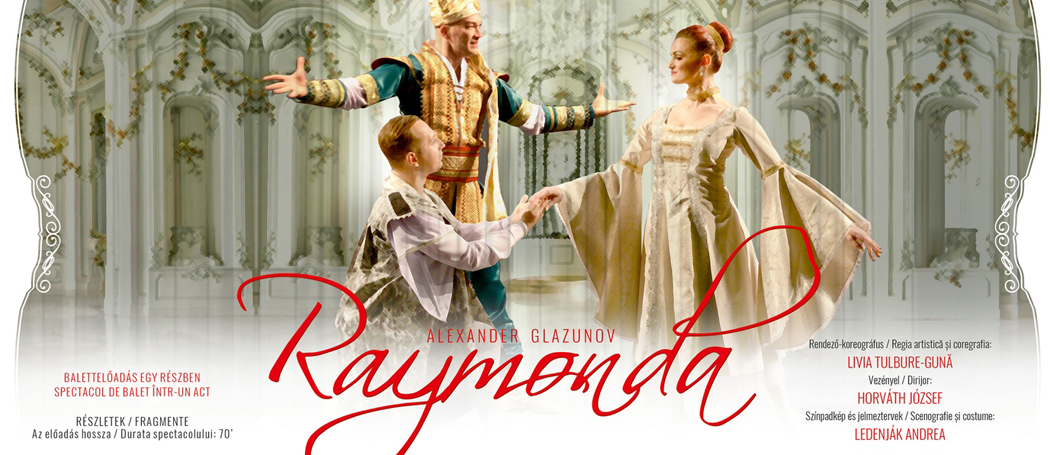
And so, here are my favorites, listed by genre. I’ve tried to narrow my choices to art I have experienced in person — paintings I have actually seen, dances I have attended, books I have read. Book reproductions or sound recordings don’t count. I have a lifetime of art-going and concert-attending, and so I may have access to more than the average bear. But I am well aware that there’s a whole lot more that I haven’t seen. 

And by favorite, I don’t just mean something I like, but rather, something that has wormed into my very being and become a part of who I am, so that encountering it can explain to others a bit of who I am. It has been grafted into my personality. 

This list is entirely personal, flexible and apologetically incomplete. Ask me again tomorrow and this could be a very different list. 

Painting: None of these choices changes more often than painting. today’s favorite fades with tomorrow’s. I’ve simply come to love too many paintings to have a single choice. But today, I will go with Jackson Pollock’s Blue Poles. It was a painting I had wanted to see for years, and then got my chance when the Museum of Modern Art held a Pollock retrospective in 1998 and the elusive work was borrowed back from Australia, where it had sat for decades, out of the reach of us Northern Hemisphere shut-ins. Its appeal came from its elusiveness, for sure, but also for its unique place in Pollock’s catalog — more than just paint squiggles, it had the structure of the bars across its surface. I loved it in reproduction, but it bowled me over in person. 

Alternate takes: Picasso’s Guernica; John Singleton Copley’s Watson and the Shark

Sculpture: I grew up visiting the American Museum of Natural History in New York City as often as I could. I loved the place — and I mean loved. And deep in its bowels resided the giant Olmec head, chiseled from basalt (actually, the one in New York is a plaster copy, but I didn’t know that when I was 10 years old and rapt in wonder). In the darkened hall of the museum, the head seemed immense and the original weighs 20 tons. It impressed me no end and to this day, it is my favorite sculpture. No doubt there is other, more important sculpture elsewhere, but I have not been to Rome or Egypt to see them. I have spent considerable time in the Louvre in Paris and have several faves there, such as the Three Graces or the Winged Victory, but none has stuck in my psyche with quite the force of the Olmec head. 

Alternate takes: Rodin’s Burghers of Calais; Louvre’s Three Graces

Architecture: As architecture critic for The Arizona Republic, I got to visit a lot of buildings, including most of the Frank Lloyd Wright sites in the U.S. (Wright was a longtime resident of Scottsdale, Ariz.) I was blown away by Taliesin in Wisconsin and his studio in Oak Park, Ill. But the building that struck me as most beautiful was Falling Water in Pennsylvania. Everything you have ever heard about it is true — about its siting in the woods over the waterfall; about how its interior is micromanaged by Wright’s designs; and (I’m one of the few who have been given access to this) the pathetic orphan of a bathroom hidden in the basement. Wright really didn’t like having to deal with kitchens or bathrooms. 

Alternate takes: Chartres cathedral; George Washington Bridge

Orchestral music: this is the hardest category for me because I have so much music bottled up in the ol’ storage batteries, and faves change not only day to day, but hour to hour. But I studied Mozart’s Symphony in G-minor, K. 550, score in hand, for most of an entire semester in college and it is drilled into my memory so that I can hear the whole thing in my head, from beginning to end, even without the score. If ever a piece of music felt like home to me, it is Mozart’s 40th Symphony. Dissecting it has given me an approach to all other classical music. 

Alternate takes: Mahler’s Symphony No. 3; Stravinsky’s Rite of Spring

Choral music: I’m not a religious man, and neither was Johannes Brahms, so his German Requiem can console my most grief-stricken moments in a way more devout music cannot. More than any other music, I go to the Deutsches Requiem for consolation and peace. Each year, on the anniversary of the death of my wife, I drive up the Blue Ridge Parkway, find a quiet forest road and park and listen to my Brahms and weep for my loss and for the loss all humankind must suffer. 

Alternate takes: Haydn’s Creation; Rachmaninoff All-Night Vigil

Chamber music: I want so much to claim Schubert’s C-major String Quintet, for it is the deepest, most emotionally moving piece of chamber music in the repertoire. Yet, I cannot, as long as there is Schubert’s competing “Trout” Quintet, which must be the most ebullient, life-affirming piece of music ever written. One cannot come away from it not feeling — despite all the sorrows of the world — that life is pure joy. It is no end of astonishment for me that Schubert wrote both. 

Alternate takes: Brahms Clarinet Quintet; Shostakovich Piano Trio No. 2 

Opera: Mozart’s most subversive opera wasn’t The Marriage of Figaro, which was often banned for making fun of the aristocracy, but rather Don Giovanni, with its lusty chorus of “Viva la libertad” and its turning topsy-turvy the villain-hero model. The Don is the life force embodied, for good and bad, and when he is threatened with hell, he laughs and refuses to recant, choosing damnation over hypocrisy. Its first act is the most completely flawless in all of opera history and despite the phony ending usually tacked-on to the second act, a model of moral complexity. 

Alternate takes: Alban Berg’s Wozzeck; Richard Strauss’s Der Rosenkavalier 

Dance: Of all the artforms, dance moves me the most. And I was extremely lucky, because when I became dance critic, Ballet Arizona was taken over by Ib Andersen, former star dancer for George Balanchine and brilliant choreographer himself. He staged many Balanchine ballets and I was hooked. I have now seen Balanchine’s Apollo four times, once by the New York City Ballet in Paris, and I cannot watch it now without welling up with emotion. I love dance and Apollo stands in for all of it. 

Alternate takes: Ib Andersen’s choreography for Prokofiev’s Romeo and Juliet; Frances Smith Cohen’s choreography for Center Dance Ensemble’s Rite of Spring

Theater: Bad theater, or worse, mediocre theater can give the impression that live drama is hopelessly, well, theatrical. You know: dinner theater. But when it is done well, there is nothing that can match it, a lesson I learned by seeing the original Broadway production of Tony Kushner’s Angels in America. I’ve now seen it — both parts together — four times and it destroys me every time. In great theater, you soon forget all the artifice and everything becomes immediate and real. Movies are great, but they can’t match the breathing now-ness of live theater. 

Alternate takes: Eugene O’Neill’s Long Day’s Journey into Night; Peter Shaffer’s Amadeus

Film: There are films that are exciting, films that are visually beautiful, that are clever, that are cultural barometers, and there are films that are wise. Jean Renoir’s La Règle du Jeu has informed my own life more than any other film I’ve seen. How can you beat Octave’s observation: “The terrible thing about life is that everybody has their reasons.” I will watch Rules of the Game over and over for the rest of my life. It is cinematic comfort food. 

Alternative takes: Andrei Tarkovsky’s Andrei Rublev; Ingmar Bergman’s Seventh Seal

Novel: Most books, you read once. If it’s a mystery, you have the killer caught; if it’s a Victorian saga, you get the heroine married. But some books you can read over and over and get intense pleasure from the language used and the perspective offered. For me, that book is Herman Melville’s Moby Dick. I don’t always read the whole thing from beginning to end, but I bet I’ve read the first chapter, at least, a hundred times. Melville’s language has seeped into my own writing more than any other (for good or ill). 

Alternative takes: James Joyce’s Ulysses; Laurence Sterne’s Tristram Shandy

Poetry: I read a lot of poetry, mostly modern and contemporary, but the poem I go back to over and over, read out loud for the sound the words make in my mouth, proselytize to others and keep in my heart is Geoffrey Chaucer’s Trouthe. The antique language isn’t so hard, once you get used to it — sort of like listening to a working class Mancunian accent, or a Yorkshireman gabble — and once you’ve caught the knack of it, it’s like any other English. God, I love that poem. “The wrastling for the worlde axeth a fal.” 

Alternative takes: Eliot’s Four Quartets; Pablo Neruda’s Odas Elementales

And the Number One, hors compétition and sans genre, is: 

The north rose window, Chartres cathedral. As I have written many times, the north rose window is the single most beautiful human-made object I have ever seen. I am in awe of it. Reproduction cannot give you a sense of its glowing color and implied motion — it virtually spins (and I mean virtually literally). I can sit in its presence for an hour at a time. 

Again, I am not making the claim that these are all the greatest works, although they may be, but that they, more than their compeers, have buried their way into my innermost being, where they reside as a permanent part of my unconscious. They are who I am. 

In 2003, idiosyncratic filmmaker Guy Maddin released his most popular film (these things are relative), starring Isabella Rossellini and titled The Saddest Music in the World, about a contest held in Winnipeg, Canada, to find the most depressing music in the world. Each country sent its representative to win the $25,000 prize put up by beer baroness Helen Port-Huntley (played by Rossellini with artificial glass legs filled with beer). The middle portion of the film features performances by many of the contestants. But the film misses the serious winner in its hijinx of weirdness. 

Because the truly saddest music in the world is, hands down, Edward Elgar’s Cello Concerto, music that can only rip your heart out and leave you prostrate with Weltschmerz. For it is not simple personal grief that Elgar wrote into the music, but the sense of the core sadness of life and the failure, of the world he knew, to survive the First World War.

Elgar was born in 1857, a decade before the deaths of Rossini and Berlioz, and became widely regarded as the first great English composer since Henry Purcell (1659-1695). He lived to see the rise of Adolf Hitler in Germany — a long life full of incident and occasion. 

But until the age of about 40, he was primarily a choral composer and a maker of musical trifles — salon music such as the ever-popular Salut d’Amour that is still an occasional encore piece. Still, that music gave him the reputation as the most important composer in England, second only to  Sir Arthur Sullivan. He became an itinerant musician, sometimes teacher, and, at 29, married his student, Caroline Alice Roberts, whom he remained married to for 31 years. Because Elgar was Roman Catholic and from a working-class background, Alice’s upper-class parents disapproved and disinherited her. But their marriage was successful and productive. After her death in 1920, Elgar wrote no more music of significance. He died in 1934. (Despite his Catholicism, he told his doctor at the end that he had no belief in an afterlife. “I believe there is nothing but complete oblivion.”) 

Elgar always wanted to write more significant music and then, in 1899, at the age of 42, he made his bid for musical importance with a set of variations for orchestra. The “Enigma” Variations remain his most popular and most performed composition, a brilliant set of 14 variations, each of which was meant as a portrait of one of his friends. 

The following year, he premiered his masterpiece oratorio, The Dream of Gerontius, setting the poetry of Alfred Cardinal Newman, in a rich, late-Romantic orchestration rivaling the style of Richard Strauss. Its Catholic doctrine (a soul’s journey to Purgatory) may have prevented it becoming as popular as it might, but it is lush and gorgeous. 

In the years up to the First World War, Elgar wrote the bulk of what he is now famous for. His Introduction and Allegro for String Quartet and Orchestra (1904); First Symphony (1908); Violin Concerto (1910); Second Symphony (1911); Falstaff (1913). He was knighted in 1904 and a shower of awards and honors fell upon him after that. 

He is usually thought of as an Edwardian composer, and identified with those years of English jingoism and colonialism. And it is hard to shake that notion when you hear, once again, his Pomp and Circumstance marches. But he really was no Colonel Blimp. And the Great War defeated him, knocked him down and left him deflated. The world order he grew up in was ripped apart and left in tatters. As British Foreign Secretary Sir Edward Grey remarked in 1914, “The lamps are going out all over Europe and I do not think we will see them lit again in our lifetime.” 

All the optimism and faith in progress that marked late Victorianism and the early years of the century were gone. It can be hard for us to imagine now, after the even-worse cataclysm of WWII and gulags and the Cultural Revolution, just how monumental and devastating the Great War was. It was to those who lived through it, as if the world were ending. Twenty million deaths, the overturning of governments, the shift of world power from the Old World to the New. 

All this, Elgar felt. The concerto was composed during the summer of 1919 at Elgar’s cottage in Sussex, where during previous years he had heard the sound of the artillery at night rumbling across the Channel from France. And at the end of the war, he summed up his despair in the Cello Concerto in E-minor, his last great orchestral work. After it, he could never work up the enthusiasm to write more. 

The work is intensely beautiful, but also profoundly sad. All the sense of loss is bound up in it. And while Elgar’s music had been regularly applauded wildly on premiere, sometimes encored twice. The Cello Concerto was a failure when it was first played at Queen’s Hall, London, in 1919, partly to being under-rehearsed and badly played, but, mostly because of its somber tone. 

In fact, it languished, rarely programed until a 1965 recording by 20-year-old Jacqueline du Pré with John Barbirolli and the London Symphony — a recording that has never been out of print since its first release. Du Pré’s performance was so emotionally present and direct, so attuned to the music, that it has been the benchmark performance ever since. And it reawakened interest in the concerto, so that now almost any cellist worth his or her salt, has it in their repertoire. 

After the concerto, Elgar wrote three great pieces of chamber music: his Violin Sonata, a string quartet and a piano quintet, all written by 1920. After that, only trifles — reworkings of old music and orchestrations of the music of other composers. He found an interest in the new technology of recording and made a groundbreaking series of discs of his own music, recordings still available, now on CD. 

But the war and Alice’s death seem to have taken the drive out of him. Elgar died Feb. 23, 1934 at the age of 76 and was buried next to his wife at St Wulstan’s Roman Catholic Church in Little Malvern, in the English Midlands.

Elgar was without doubt a great composer, but, as critic David Hurwitz has said, “a great composer but not a necessary one.” Elgar himself knew he was a bit of an anachronism, a late-Romantic composer in a century headed toward Modernism. By the time of his Cello Concerto, Stravinsky had already written his Sacre du Printemps and Schoenberg his Pierrot Lunaire. Some of the loss and longing of Elgar’s concerto is surely his sense of being adrift in the Luft von anderem Planeten — the air from another planet, that Schoenberg announced. 

The history of music would not have been any different if Elgar had never written — something that cannot be said of Stravinsky or Schoenberg. Yet, you cannot listen to Elgar’s best music — the two concertos, Gerontius or the “Enigma” Variations — and not sense in him a power and emotional sweep that lifts him to the first rank. In that sense, his music is indeed necessary. 
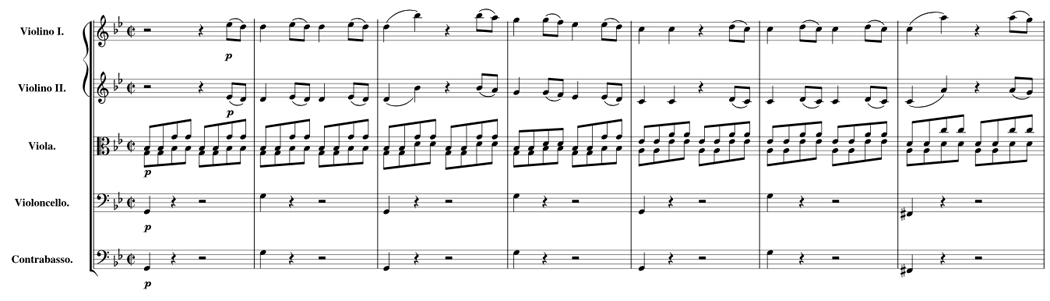
__________________________________

“There is music in the air, music all around us, the world is full of it and you simply take as much as you require.”

—Edward Elgar, 1896

__________________________________

There are certain pieces of music that everyone knows, whether they know it or not. They are simply in the air. They are heard not just in concert halls, but in film, TV commercials, pop songs — and at every high school graduation ceremony in the English-speaking world. Edward Elgar’s Pomp and Circumstance March No. 1 is the graduation music — or at least the “trio” portion of it. 

It is the portion of the march that was re-written, by Elgar himself, as the popular British patriotic song, Land of Hope and Glory, now sung by the home crowd with soccer victories, and as the audience stands and sings along at the final Proms concert of the season in London. And as the new high school graduates line up to receive their diplomas in school auditoriums everywhere. 

The practice began at Yale University in 1905 when Elgar was awarded an honorary degree for which the composer traveled to the U.S. It was decided to surprise him by playing his own music for the event, and they played Pomp and Circumstance. The practice caught on elsewhere, and is now ubiquitous as “The Graduation March.” 

And so, generations of Americans know the music well, without knowing, necessarily, what the music is they are hearing. It’s just “the Graduation March” of unknown provenance, as if it had just always existed. 

There are other such tunes, well known but genericized. There is Wagner’s Wedding March from Lohengrin — “Here comes the bride, all dressed in white…” — probably not recognized as from an opera. Or Mendelssohn’s Wedding March from his incidental music to A Midsummer Night’s Dream. Mendelssohn has ceased to own it: It is truly public domain. 

For many Americans, our first exposure to classical music came from Warner Brothers cartoons, and Bugs Bunny conducting Liszt’s Hungarian Rhapsody No. 2 in a parody of Leopold Stokowski. Or Elmer Fudd singing “Kill the Wabbit. Kill the Wabbit” to the tune of Wagner’s Ride of the Valkyries. 

That Hungarian Rhapsody got heavy use from animated films. Not only Bugs conducting, but Bugs playing the piano, and others, from Tom and Jerry to Woody the Woodpecker also took their turns with Liszt. 

Or maybe watching the Lone Ranger on TV and hearing the William Tell Overture. Or television reruns of the old Buster Crabbe serials of Flash Gordon, with Liszt’s Les Preludes as its persistent soundtrack. 

Some scores have been used scores of times in movies. Samuel Barber’s heartbreaking Adagio for Strings has shown up in at least 32 films and TV shows, including: The Elephant Man (1980); El Norte (1983); Platoon (1986); Lorenzo’s Oil (1991); The Scarlet Letter (1995); Amelie (2001); S1mOne (2002); and three episodes of The Simpsons. 

Popular songs have stolen classical tunes. The Minuet in G from Bach’s “Anna Magdelena Bach Notebook” became The Lover’s Concerto, recorded in 1965 by the Detroit girl group, The Toys. The Big Tune from Rachmaninoff’s Second Piano Concerto became Full Moon and Empty Arms, sung by Frank Sinatra in 1945. Tony Martin turned Tchaikovsky’s First Piano Concerto into Tonight We Love. I’m Always Chasing Rainbows was originally Chopin. The Negro Spiritual Goin’ Home was actually taken from Antonin Dvorak’s “New World” Symphony. Stranger in Paradise is one of Borodin’s Polovetsian Dances, and so is Baubles, Bangles and Beads. 
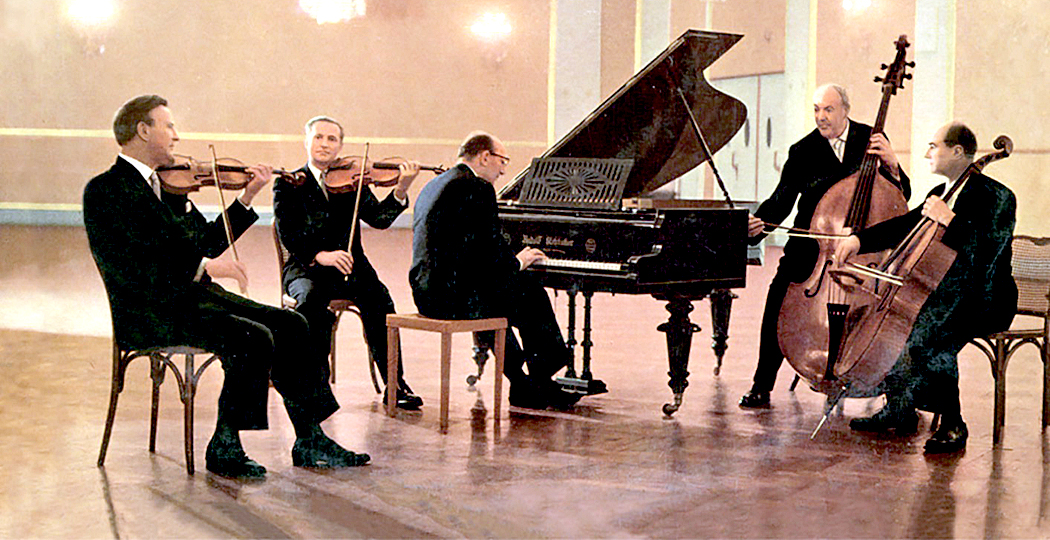
The list goes on: Tin Pan Alley was full of burglars. Hot Diggity, Dog Ziggity was based on Chabrier’s España; Catch a Falling Star (and Put it in Your Pocket) was the Academic Festival Overture by Brahms; Love of My Life, by Dave Matthews and Carlos Santana is from Brahms’ Third Symphony. You can find hundreds of these “steals” on Wikipedia.  

I asked my brother, Craig, for any examples he might think of, and he sent back this barrage:

“So, what’s Classical? It’s probably a close cousin to porn — I know it when I hear it.

“There are Classical music quotes all over TV and movies, and my Classical education was jump-started by Bugs Bunny and his friends, and a little later by Fantasia and Silly Symphonies. A really surprising amount of music got introduced to me in cartoons.

“But that is a different thing from pieces of music being a part of our lives, like ‘Here comes the bride,’ and ‘Pomp and circumcision’ at every graduation ever. WW2’s theme song was Beethoven’s 5th. The military loves them some Sousa marches. Everybody knows the more popular Ave Maria. Everyone knows some snippet of Figaro. In fact there are a ton of little pieces of operas than we are all a little familiar with, even if we can’t name the opera or composer. If we played “Name that Carmen” most people would say, oh, yeah, I know that, but couldn’t name the source. There are a whole poop load of snippets we’ve all heard without knowing where the came from. (Thanks, Bugs.)

“Toccata and Fugue, a passel of Puccini, Bolero, (Thanks, Bo Derek), The Blue Danube, the Saber Dance (Thanks Bugs?), the Ritual Fire Dance (Thanks Ed Sullivan and the plate spinners), Für Elise, Chopsticks (Thanks, Tom Hanks), the Ode to Joy, the thoroughly quotable Swan Lake, Ride of the Valkyries (Thanks Robert Duvall), Voices of Spring, O Fortuna from Carmina Burana (Thanks Madison Avenue), Funeral March of the Marionettes, (Thanks, Hitch), Adagio for Strings, The Skater’s Waltz, Minuet in G, the Olympics theme, “Moonlight” Sonata, anything from the Nutcracker, The Sorcerer’s Apprentice (Thanks, Uncle Walt). 

“This is a pretty pointless list, because it is kind of endless. And I might well be making a baseless assumption about American’s familiarity with these things, just like I am thinking that American’s familiarity with these pieces of music is inversely proportional with the number of guns they own.

“Pachelbel’s Canon in D (which is much more memorable than his Canons A through C), Flight of the Bumblebee (the theme music for The Green Hornet, which is I’m sure too obscure a reference to be very useful), the 1812 Overture (Thanks, Boston Pops and Quaker Puffed Rice), A Clockwork Orange made the point pretty directly about Classical music being embedded in the culture, with street thug Alex loving Beethoven deeply.  Strauss’ Zarathustra in 2001 (Thanks, Stanley), Flash Gordon used Liszt’s Les Preludes (which I have had playing nonstop in my head since I thought of it). Lugosi’s Dracula used Swan Lake (which always strikes me as a real cheapskate move to do).

“The Lone Ranger music isn’t even a decent trivia question anymore because everyone knows the musical source.

“So I’m just throwing up blunderbuss answers to ‘what’s embedded in our culture.’ So I’m gonna stop here. I hope there’s something you can use.”

And I’m sure, you, dear reader, can think of many more.