Eyes on Pollock
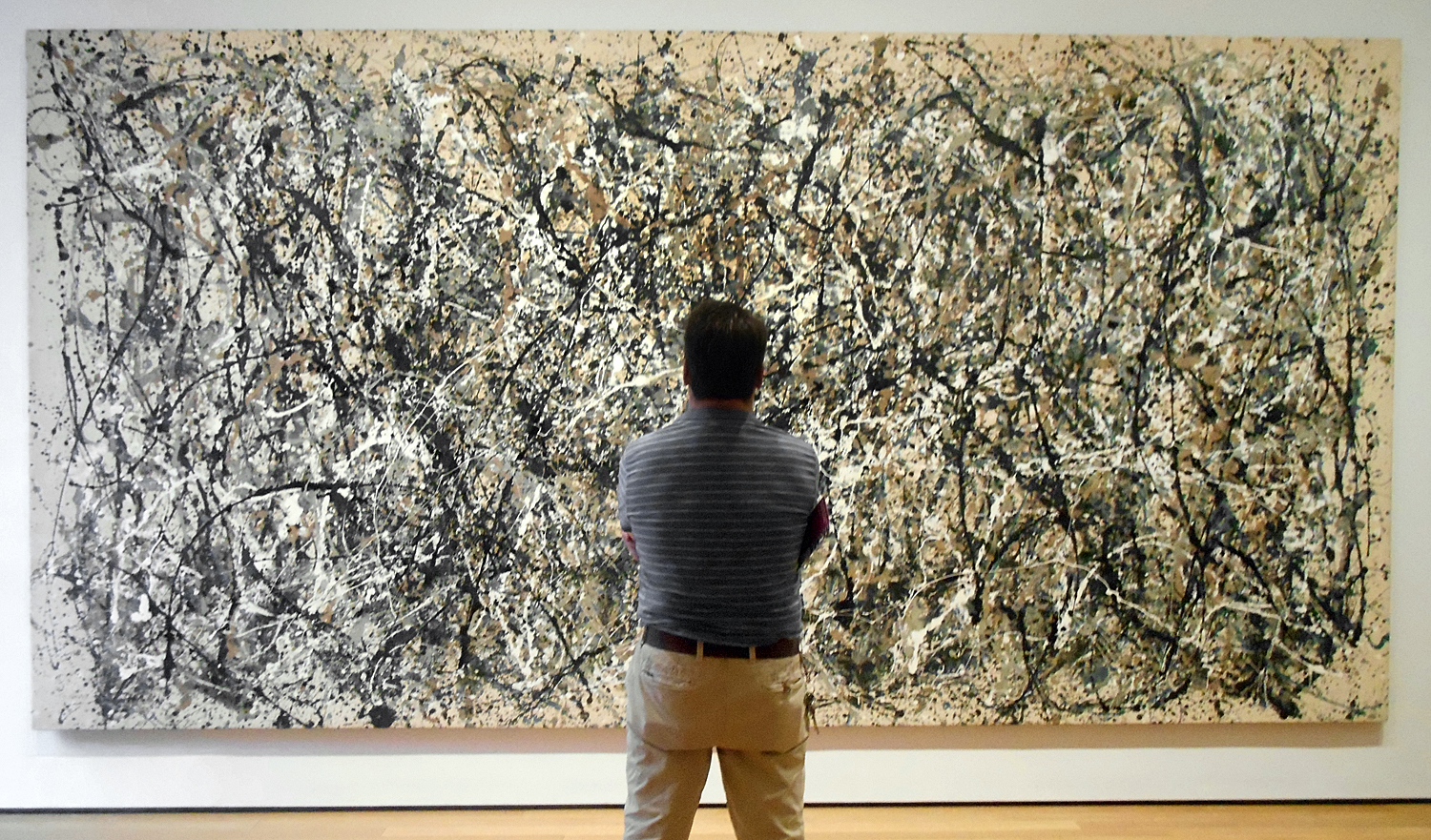
I first went to the Museum of Modern Art in New York when I was in eighth grade. I took the Public Service bus into Manhattan and the subway down to Columbus Circle, and then on foot to 57th Street. Inside the museum were famous paintings I had only seen as reproductions in books and magazine articles. There, in person, was Van Gogh’s Starry Night and Picasso’s Guernica, the latter an astonishing 25 feet wide along its own wall. I was too young to understand the tragedy behind that work, but old enough to be blown away by the size and imagery.
Growing up in New Jersey, just on the other side of the George Washington Bridge, I spent as much time as I could in the city, visiting the various museums, theaters and concert halls, to say nothing of the book stores. New Jersey seemed so banal and flavorless, and New York seemed like the center of the universe. I cannot tell the number of times I went to the American Museum of Natural History, which was like a second home to me, or the Hayden Planetarium. And MoMA was the epicenter of art. I came to know every painting and sculpture in the place, and considered it, if not holy, then whatever the secular equivalent is.
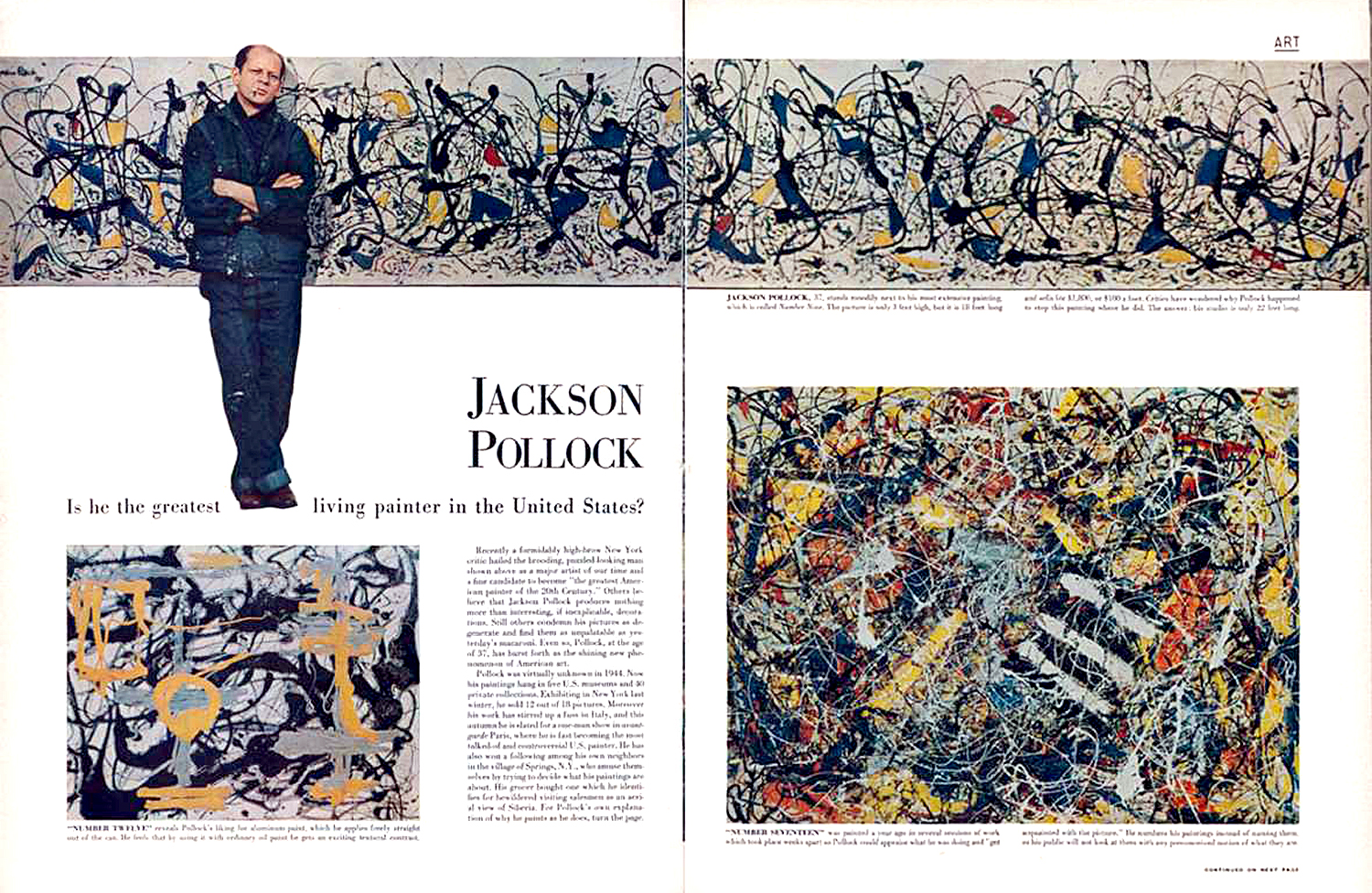
And it is where I first saw my first live Pollock. Jackson Pollock was everywhere in those days, as an escutcheon for Modern Art, or as a whipping boy for those who felt it was all a huge scam. Life magazine had dubbed him in 1949 as possibly “America’s Greatest Living Painter,” while in 1959, a British newspaper wrote, “This is not art — it’s a joke in bad taste.” Even former New Yorker art critic Robert Coates once called his work “mere unorganized explosions of random energy, and therefore meaningless.”
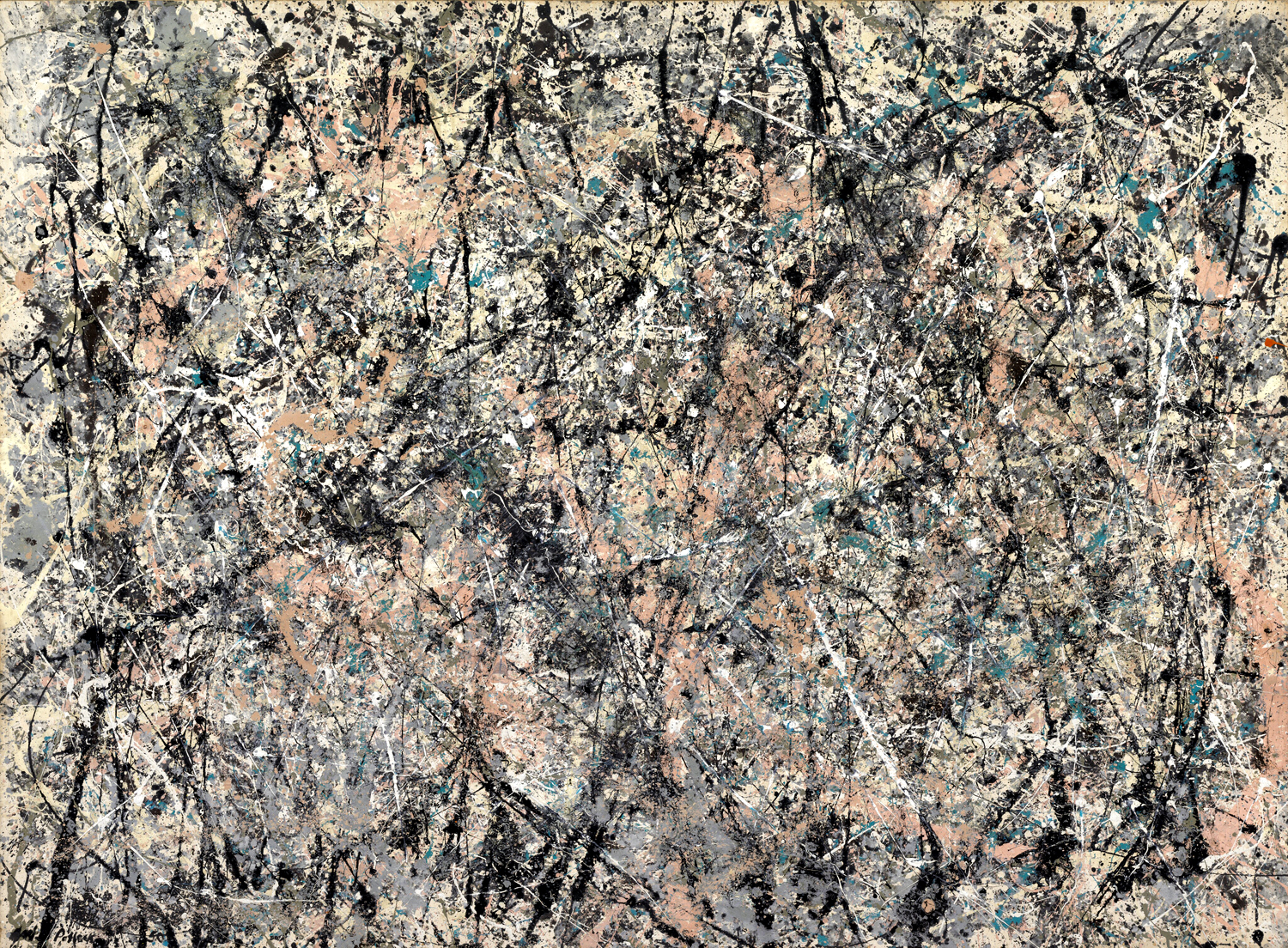
“Number 1, 1950 (Lavender Mist)” National Gallery, D.C.
The paintings were made by pouring and dripping and flinging paint on a canvas on the floor of his studio, like random scribbles. And to his detractors, that is all it was: scribbles. Many a puzzled civilian looked and complained, “My kid could do that.”
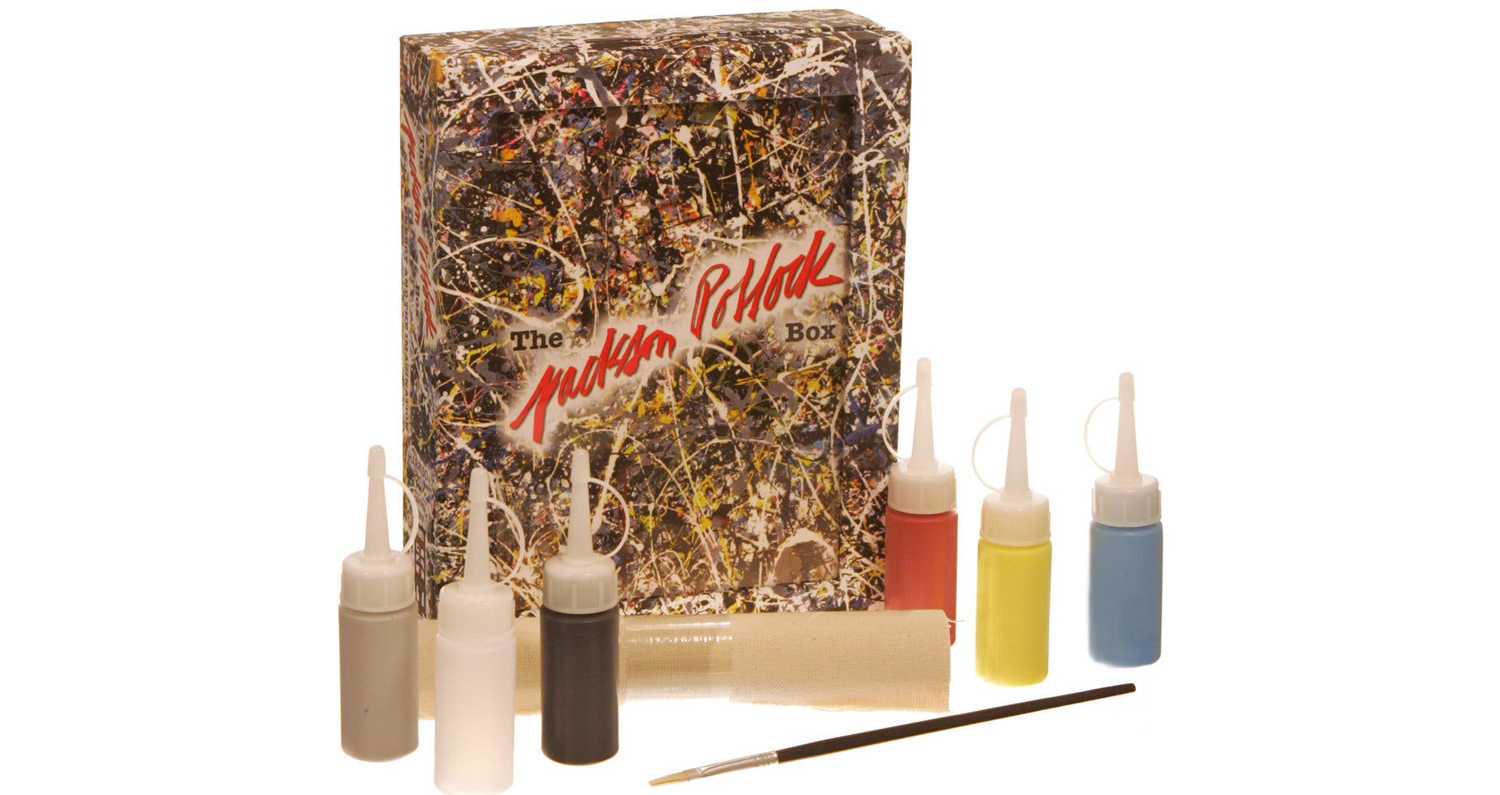
Author Helen Harrison wrote a book and put it in a box — The Jackson Pollock Box (available from Amazon for $29.95) — that includes canvas and several squirt bottles of paint, so you can make your own drip paintings. “People thought it was arbitrary, that anyone can fling paint around,” Harrison said. “Well, that’s true. Anyone can fling paint around, and this was my point. You can do that, but you don’t necessarily come up with anything.” Pollock did.
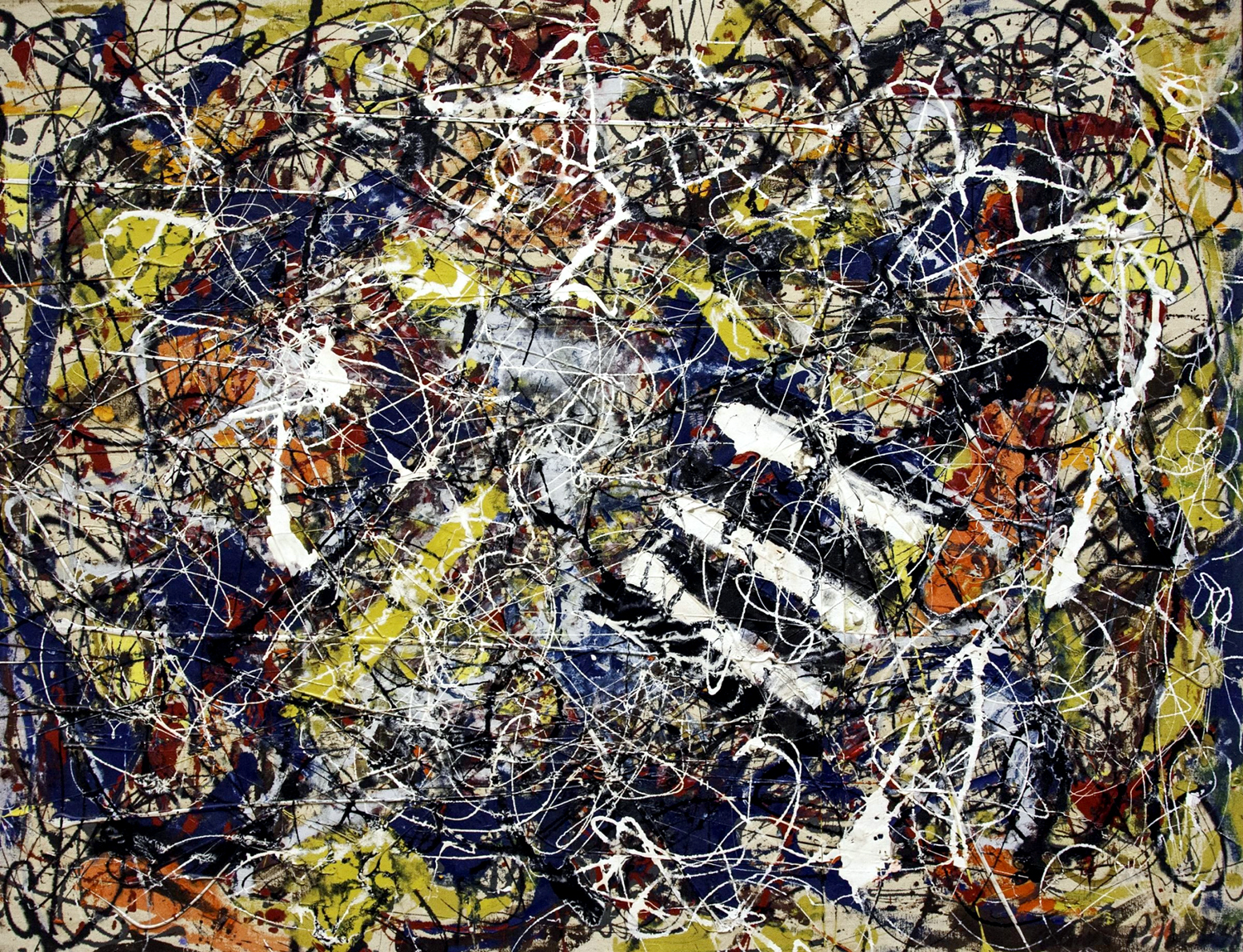
“Number 17A 1948” Private collection
To this day — with Pollock now largely canonized in the art world, and even Modern Art in general having won the battle — he splits his viewership into those who love the work and those who still consider it a fraud committed on a gullible public.
I am obviously in the first cohort. His art speaks to me more than most post-War art (partly because of my age — as a Boomer, I grew up during a time Modern Art was still hotly debated, and to be courant, required the taking of sides), but I also think Pollock has not been helped by his admirers, who have published a grand catalog of piffle about the work, using it to justify theories that are as empty as their prose is turgid.
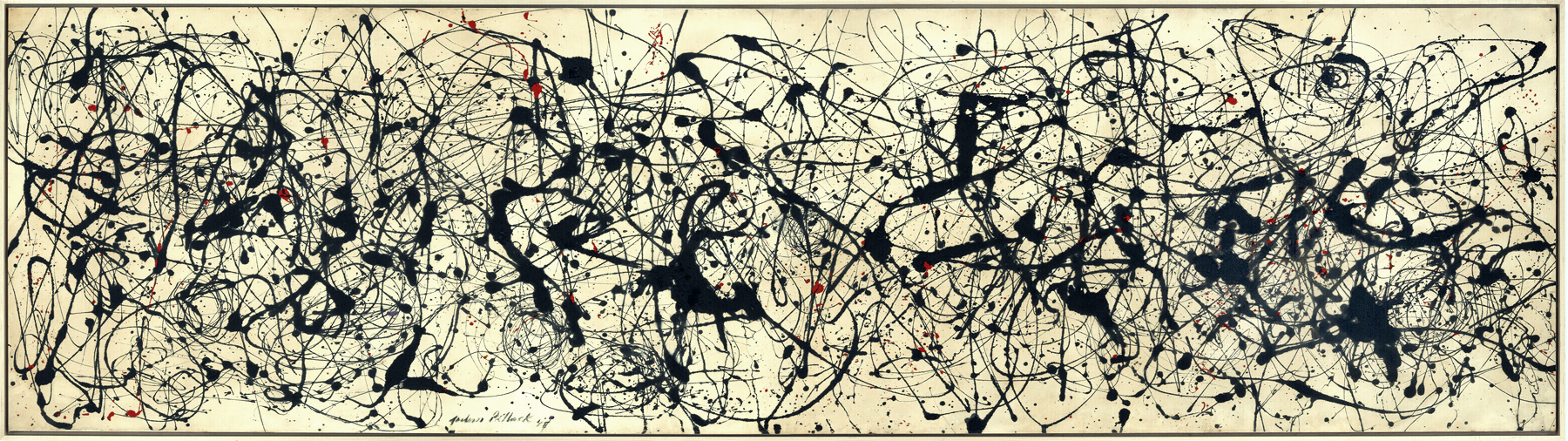
Number 7A 1948” Private collection
The work stands on its own. It has no need of theory propping it up. If you remove the scaffolding, you can see the art. Words only get in the way.
The two most guilty culprits were the Bergs, the two critics writing in the middle of the last century who told us what art was supposed to be. One, Harold Rosenberg gave us the idea of Action Painting, that is, that the object on the wall was only the record of the actual art, which was its making through performance. According to Rosenberg the canvas was “an arena in which to act.” The other, Clement Greenberg, told us that Modern Art was supposed to be flat. It should not attempt to trivialize itself with attempting illusionary depth. Paint on surface is what it was all about. “Flatness, two-dimensionality, was the only condition painting shared with no other art, and so Modernist painting oriented itself to flatness as it did to nothing else.”
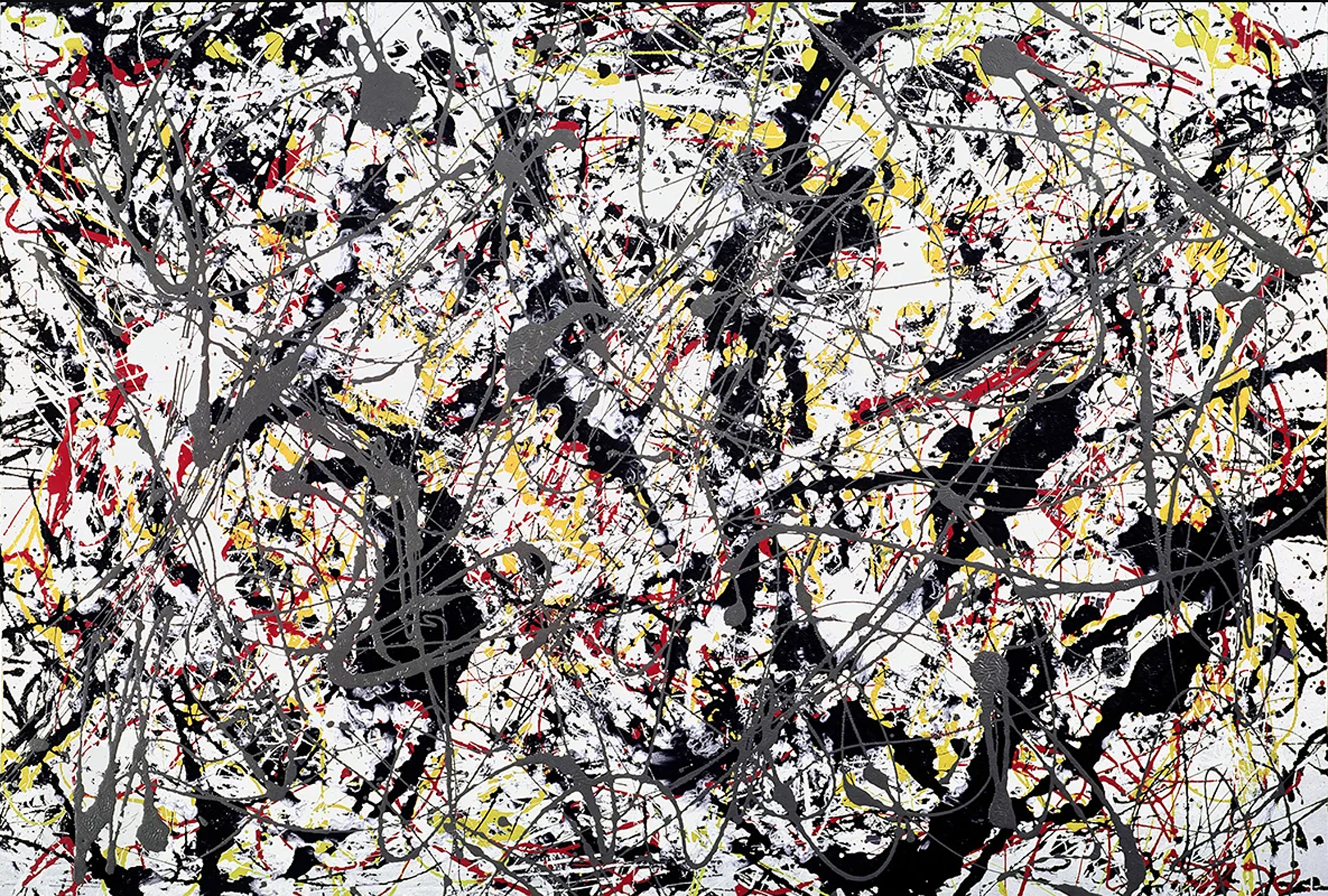
“Silver Over Black White Yellow and Red” Musee National d’Art Moderne, Paris
All this wasn’t about the art; it was ideas about the art. It was interpretation. And interpretation takes us away from the art, away from the visual world and into the verbal world. Ideas about the thing, not the thing itself.
I learned very early that more important than speaking was looking. As Yogi Berra said, “You can observe a lot just by looking.” Most of us see with our brains and not with our eyes. We are shown a picture and immediately name what we see. “That’s a picture of a house,” we say, or “That’s my brother Barney the day he joined the Army.” Our reflex is to repackage what we see as what we can name. And barring that, we use words to explain why what we see matters, or why it doesn’t, or how something reinforces or questions our assumptions. All words.
I was taught by a wise professor to look first, describe what I see, and pay attention to everything in a frame. Light, shadow; line, color; aspect ratio and physical size of the work; dynamic range and even pigment type. There is a lot to be seen. It’s why it was painted and not written down. After you have looked and seen (two different things), then you can discuss the subject matter, and attempt to make out why the artist made this particular work. But look first, and look carefully.
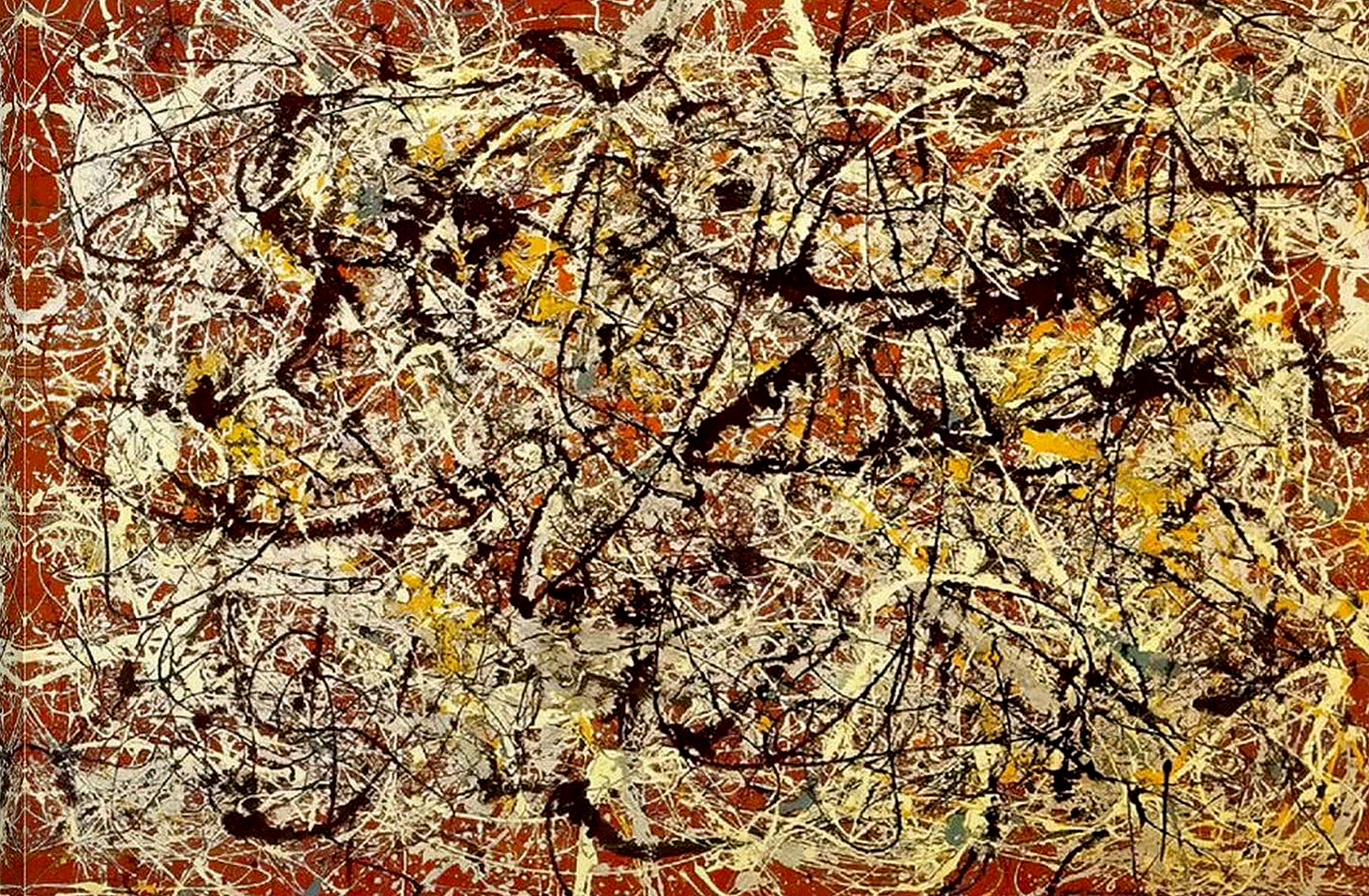
“Mural on Indian Red Ground” Tehran Museum of Contemporary Art
With Pollock, this is especially important, since there is no easy “subject.” There is paint.
But there is a whole lot going on with the paint, and not just that the artist has sprayed paint around like a lawn sprinkler. In fact, there is little that is random about the spatter. “I can control the flow of paint,” he said. “There is no accident.”
And to call them drips is not to do them justice. He had a whole repertoire of drips. Some were spread out like ink lines, others were a kind of polka-dot splat. Sometimes the paint would puddle in the middle; sometimes when the puddle began drying, he would yank back its skin as if he were picking a scab. It left a torn, ridged surface.
It is one of the revelations of the show to see just how many different things Pollock found to do with his basic drip. In some paintings, the paint is thick on the canvas; in others, he dripped thin paint on unprimed canvas, staining them rather than painting them. The line would bleed, like a fountain pen on porous paper.
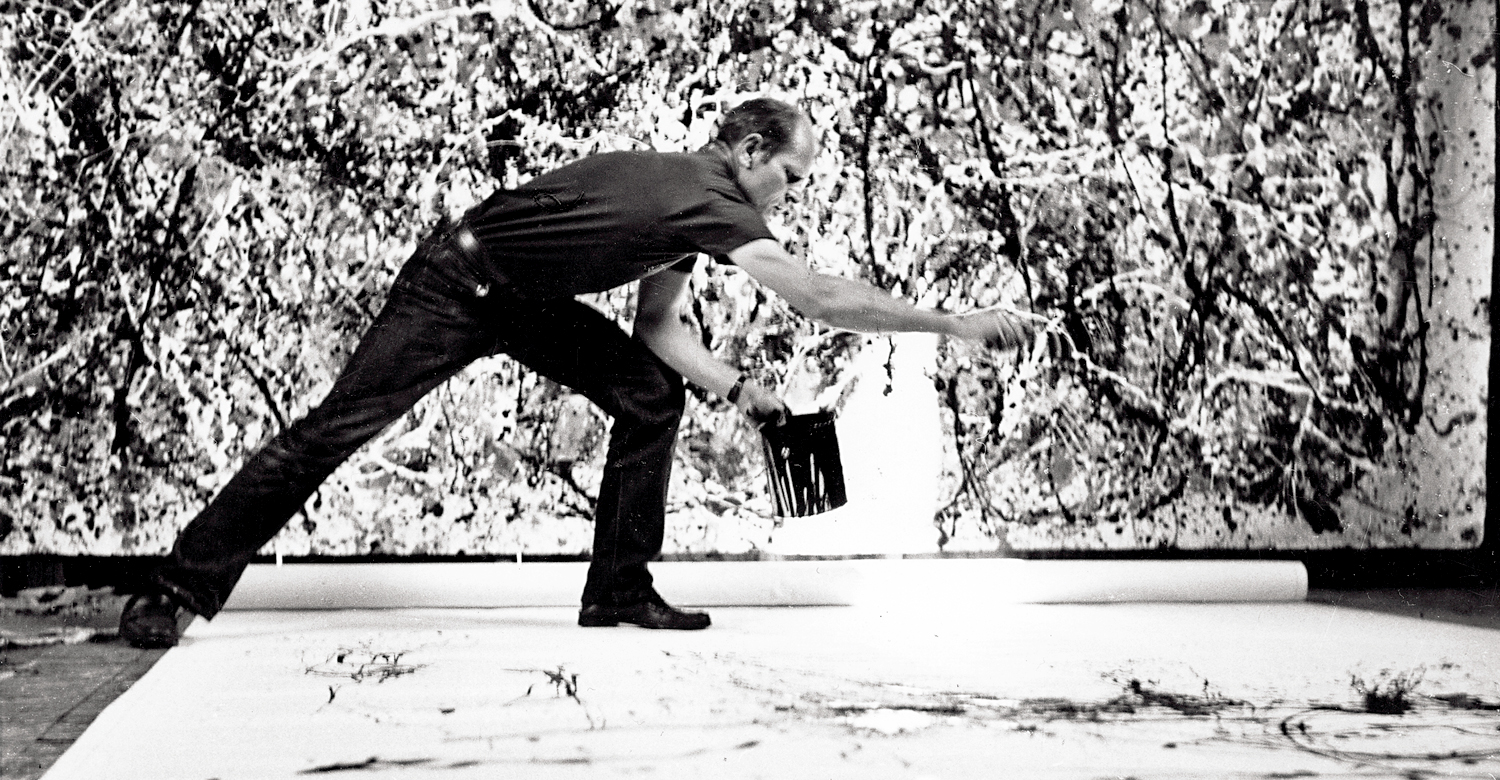
Pollock normally painted with his canvas on the floor. He stood over it, half crouched, with a can of commercial house paint in one hand and a stick or crusty dried brush in the other, dipping it into the can and swirling the brush over the canvas, about 6 inches above the surface. Back and forth he would move, like a caged animal, repeating his arm motions, stepping a half-jig step to the left and repeating, over and over. A change of color or a new kind of wrist-flick would make a different kind of drip. The paintings built up slowly, so that the first drips often were hidden by the later ones.
For instance, if you are careless, you may not notice that most Pollock drip paintings are not dribbles from edge to edge or top to bottom. The paint makes a shape in the middle of the canvas. And usually, that shape either settles toward the bottom of the canvas, or rises to the top. The first seems weightier, the second more buoyant.
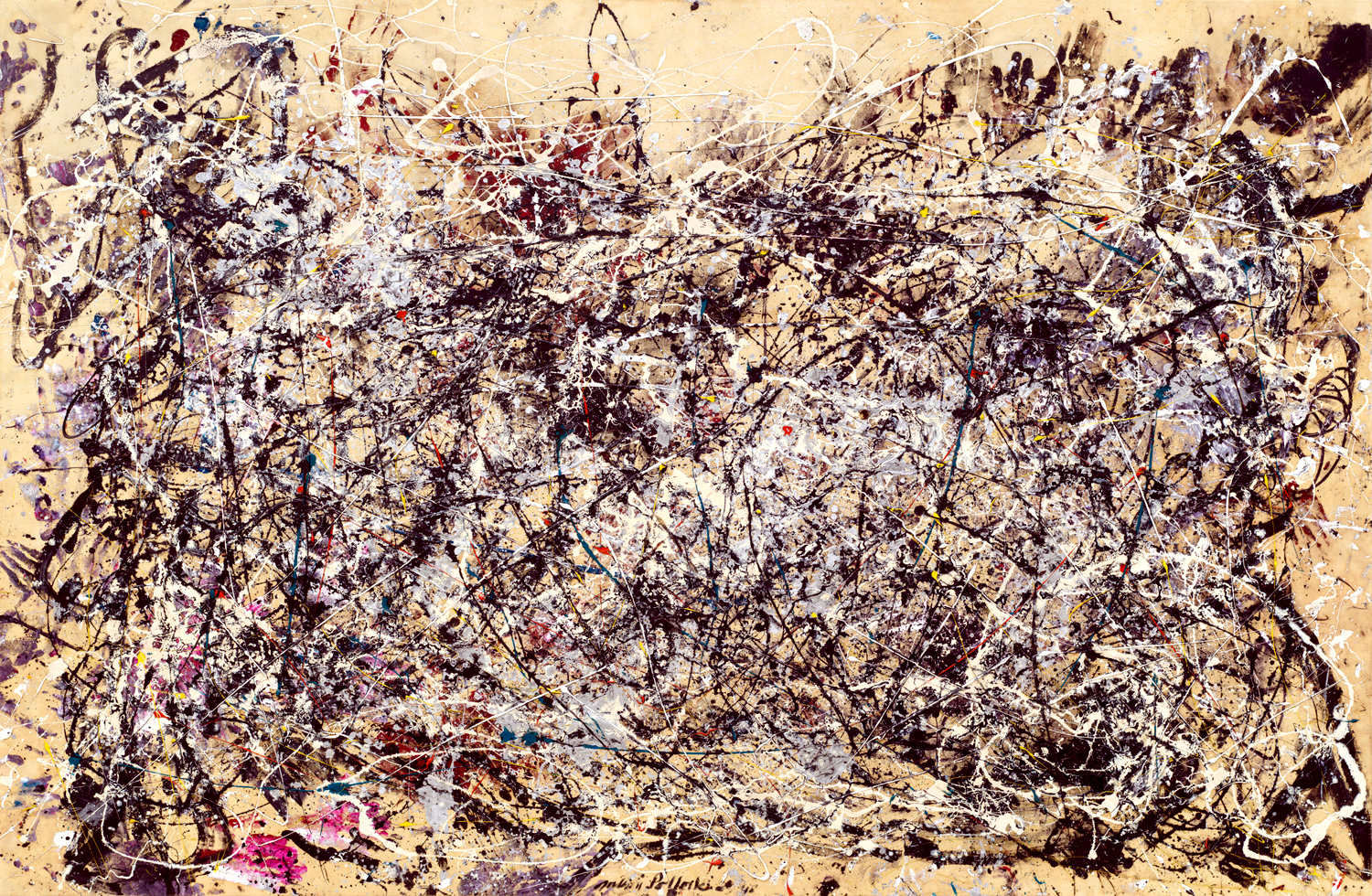
“Number 1A 1948” MoMA
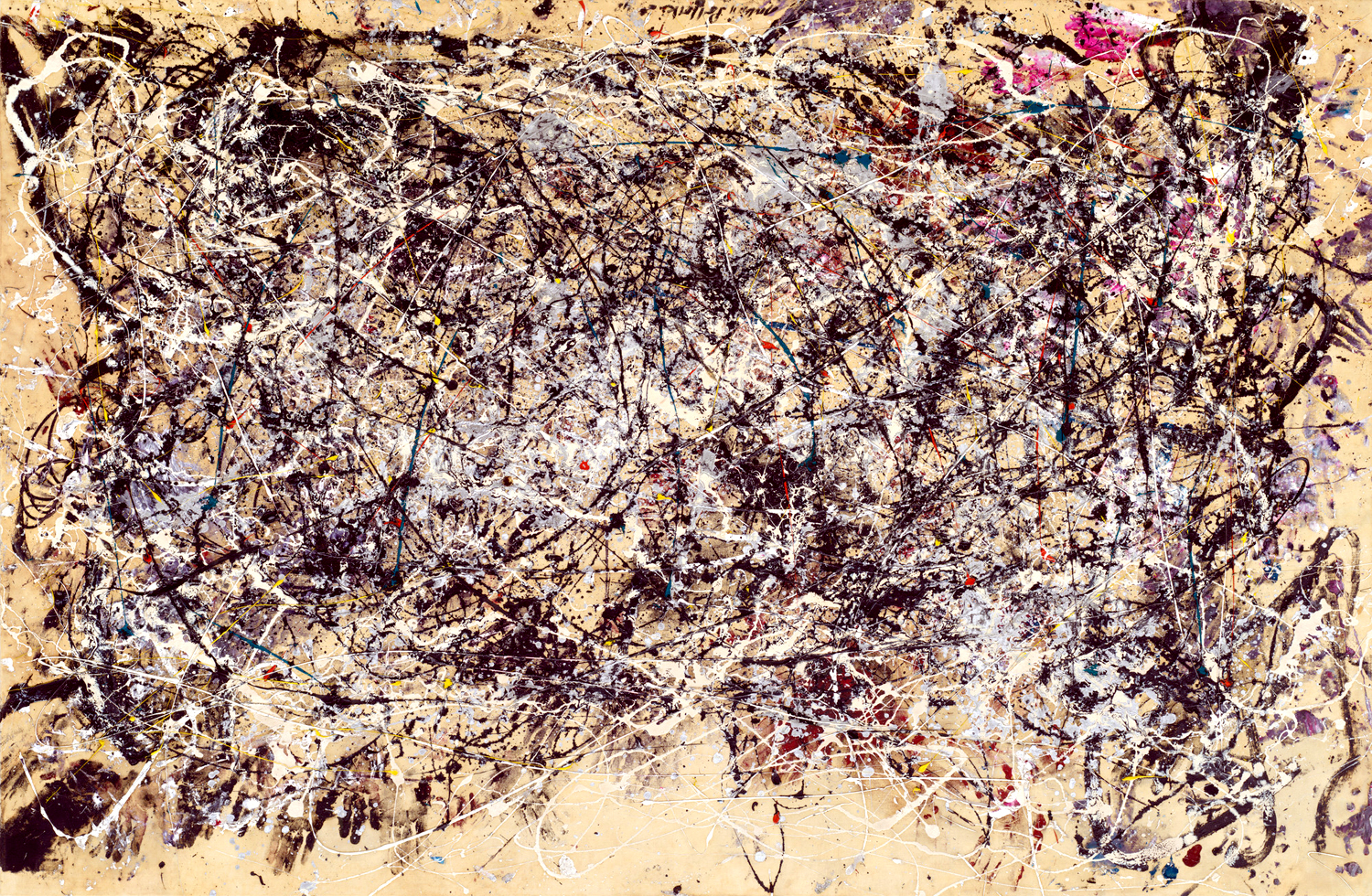
The randomness of the scatter is never completely random. Take his Number 1A from 1948, which is 8 feet, 8 inches side to side and 5.6 feet high. It is an early drip painting and the placing of the bulk of drip is not random, but makes a shape of its own in the center of the canvas, with a margin around the edge. It is placed. If it were not, you could hang it on the wall upside down and it would make no difference. But notice how different it looks that way.
And for that central shape of paint pother, the detail is scrunched in the middle, with a wedge taken out of the top.
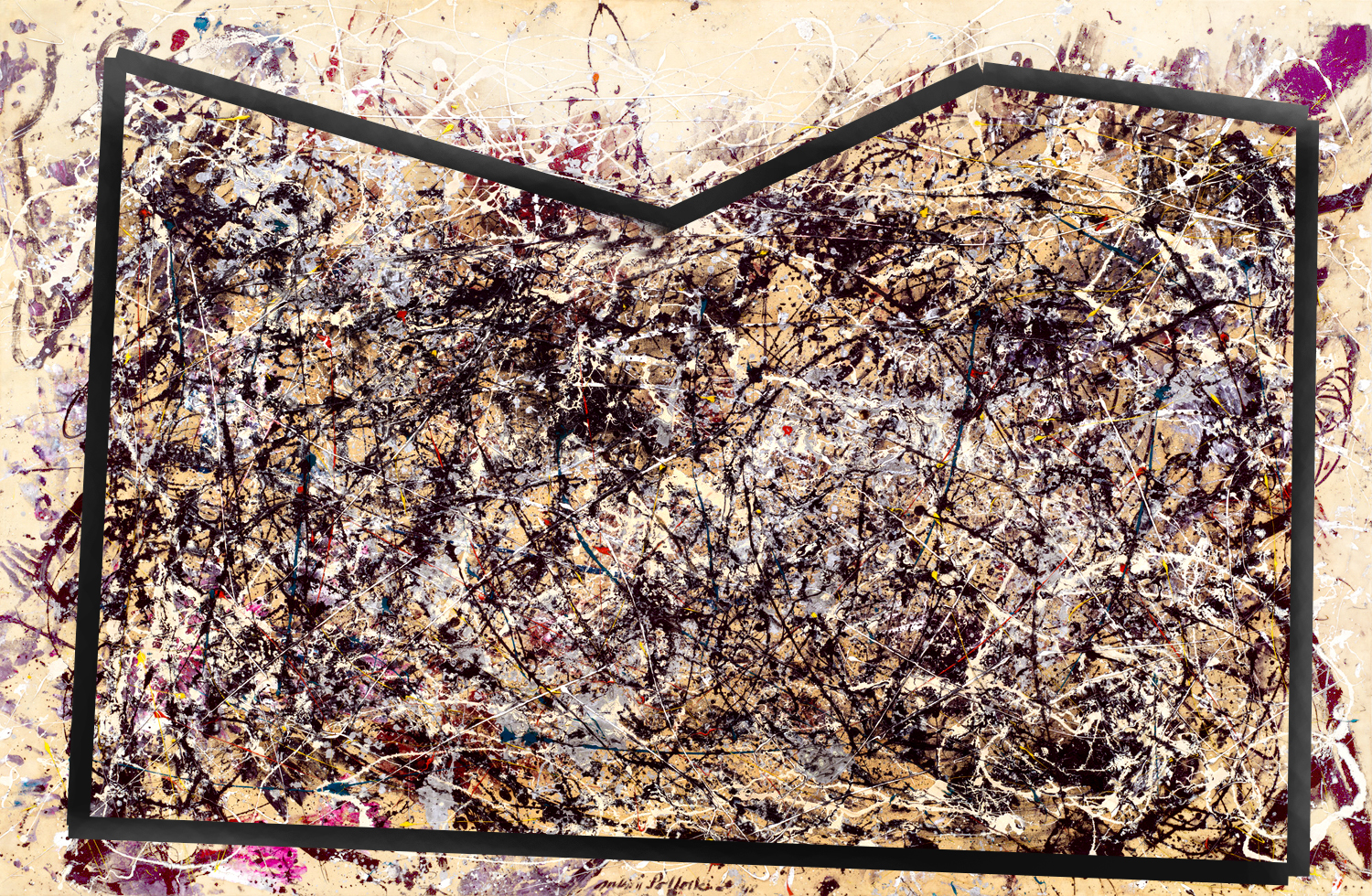
It is not random. This is true of most of his best-known drip paintings, including the one I first saw at MoMA, One, Number 31.
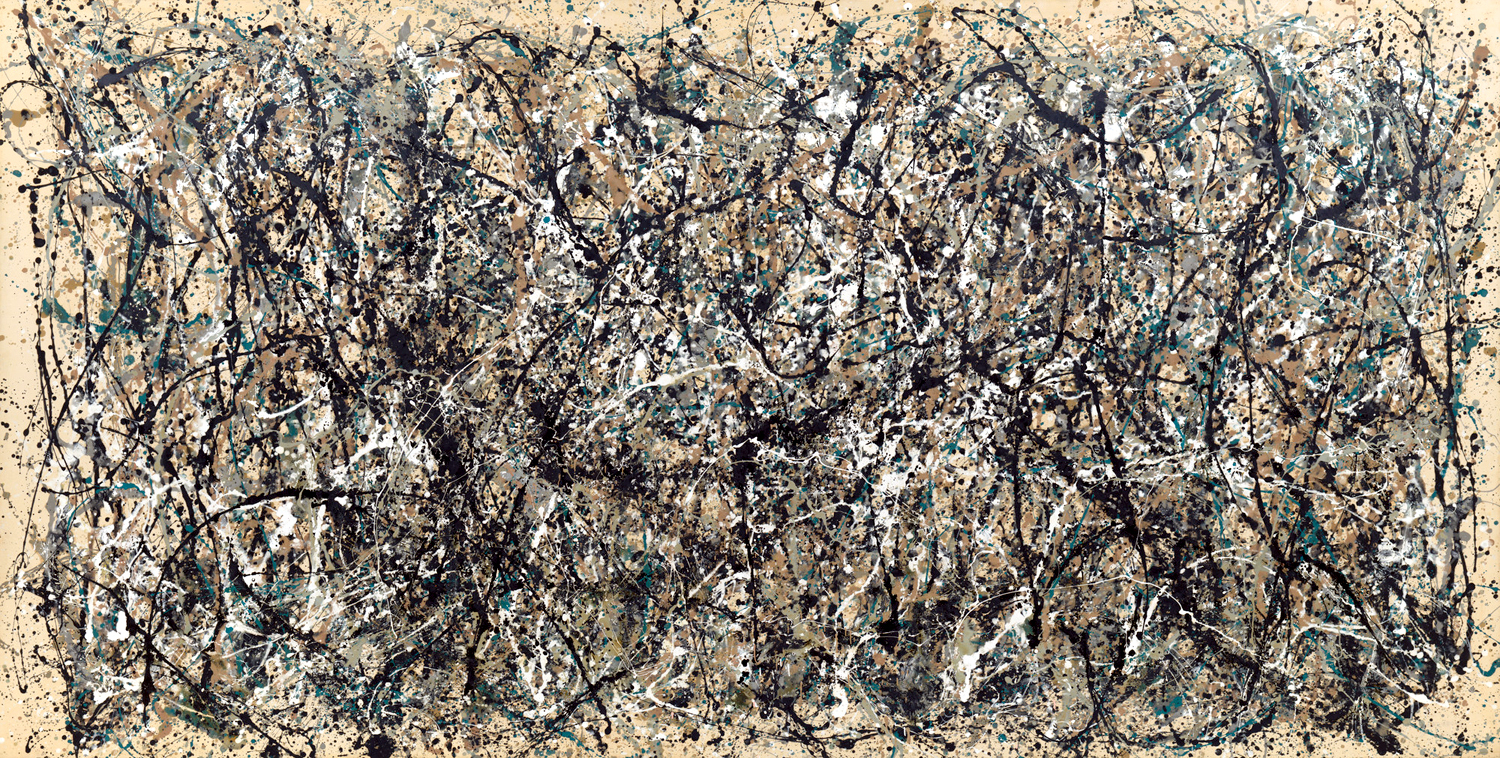
“One: Number 31 1950” MoMA
The second thing you can notice is that the paintings are not flat, but deeply illusionistic. They have depth, and you look into them like a tangled skein of yard in a basket.
Pollock went out of his way to create that depth. An early image of the painting, after the first few drippings of black paint, show us the base coat, as it were
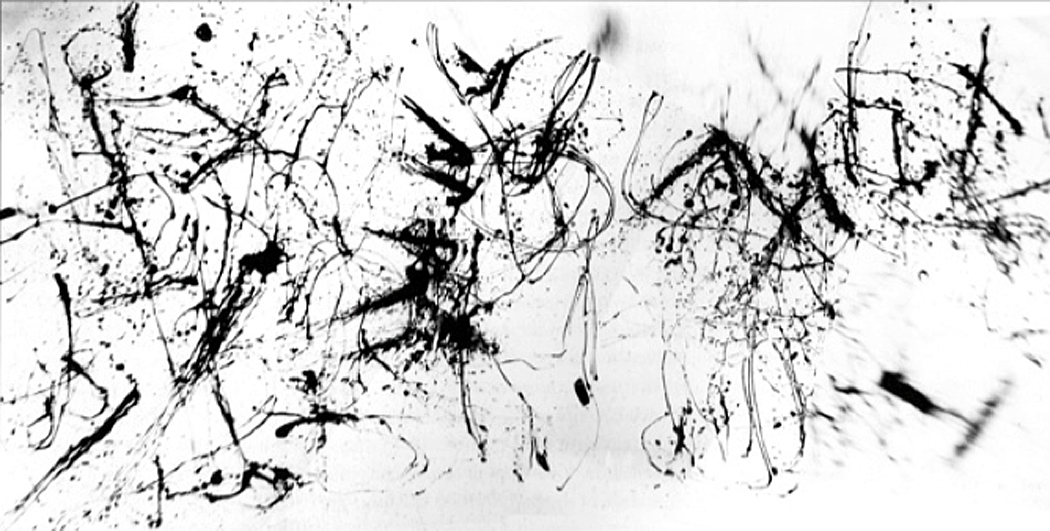
First layer, “Autumn Rhythm”
He then added white, and other colors, partially obscuring the base black lines, but then he added a second coat of black lines on top, partially covering the colors underneath, so that it is never simply each new color blocking the earlier, but rather a welter of lines and puddle.
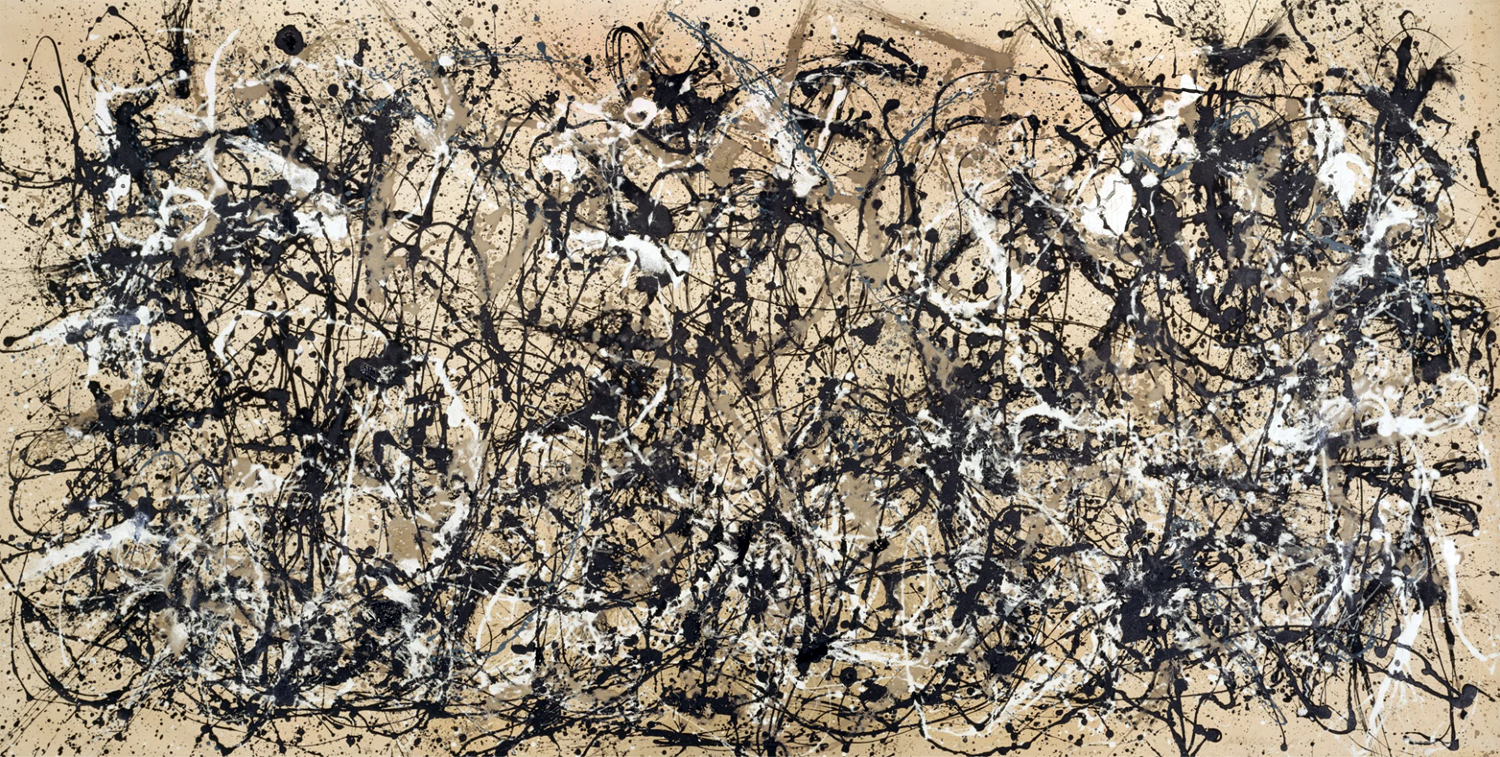
“Autumn Rhythm (Number 30)” Metropolitan Museum of Art
You look into them as if they might be a microphotograph of neurons in the brain.
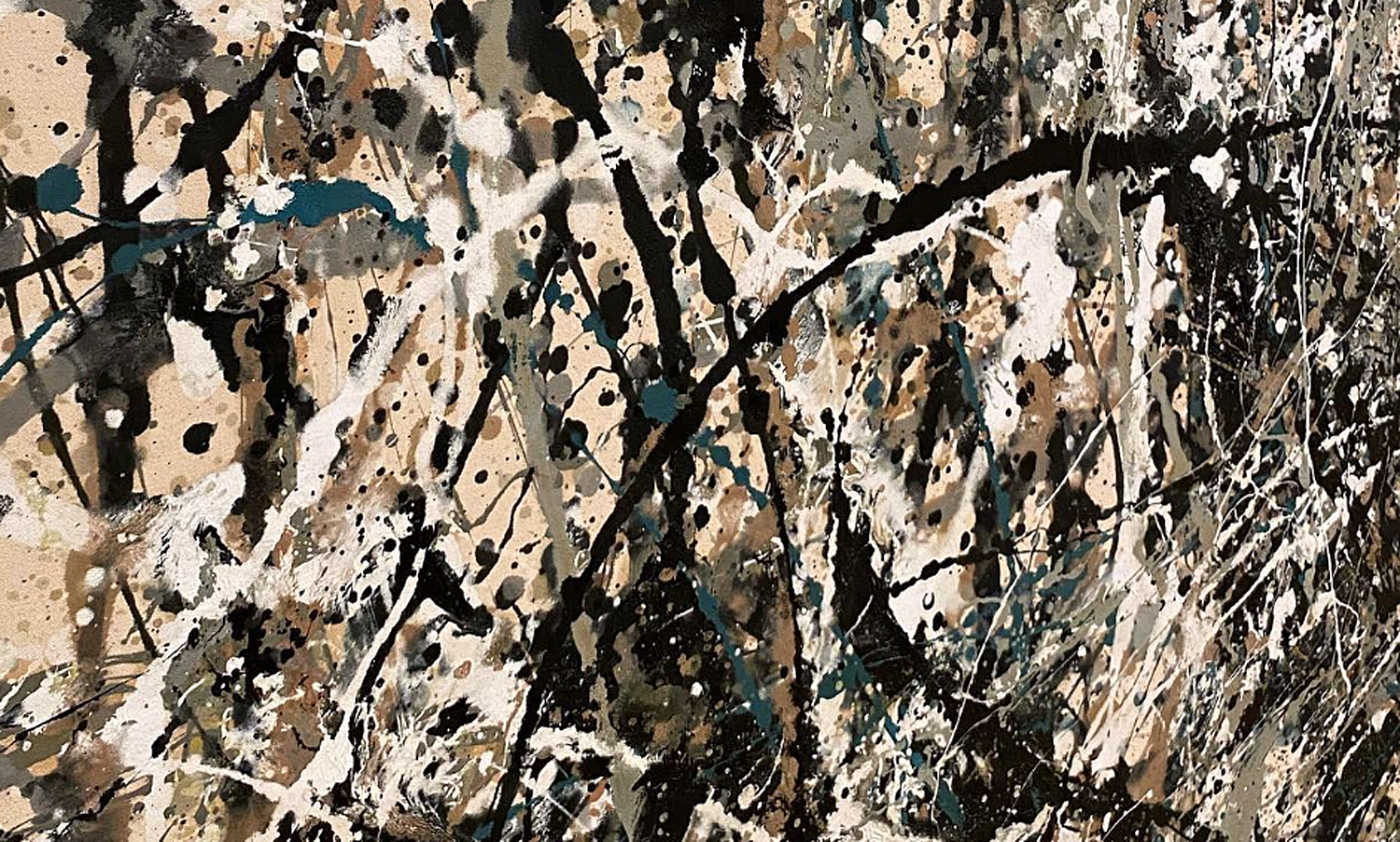
Detail “Autumn Rhythm”
The major problem that Pollock faced, and never completely resolved, is: Where to go to next. His peak drip painting period lasted perhaps three years, but at some point, continuing means just repeating himself.
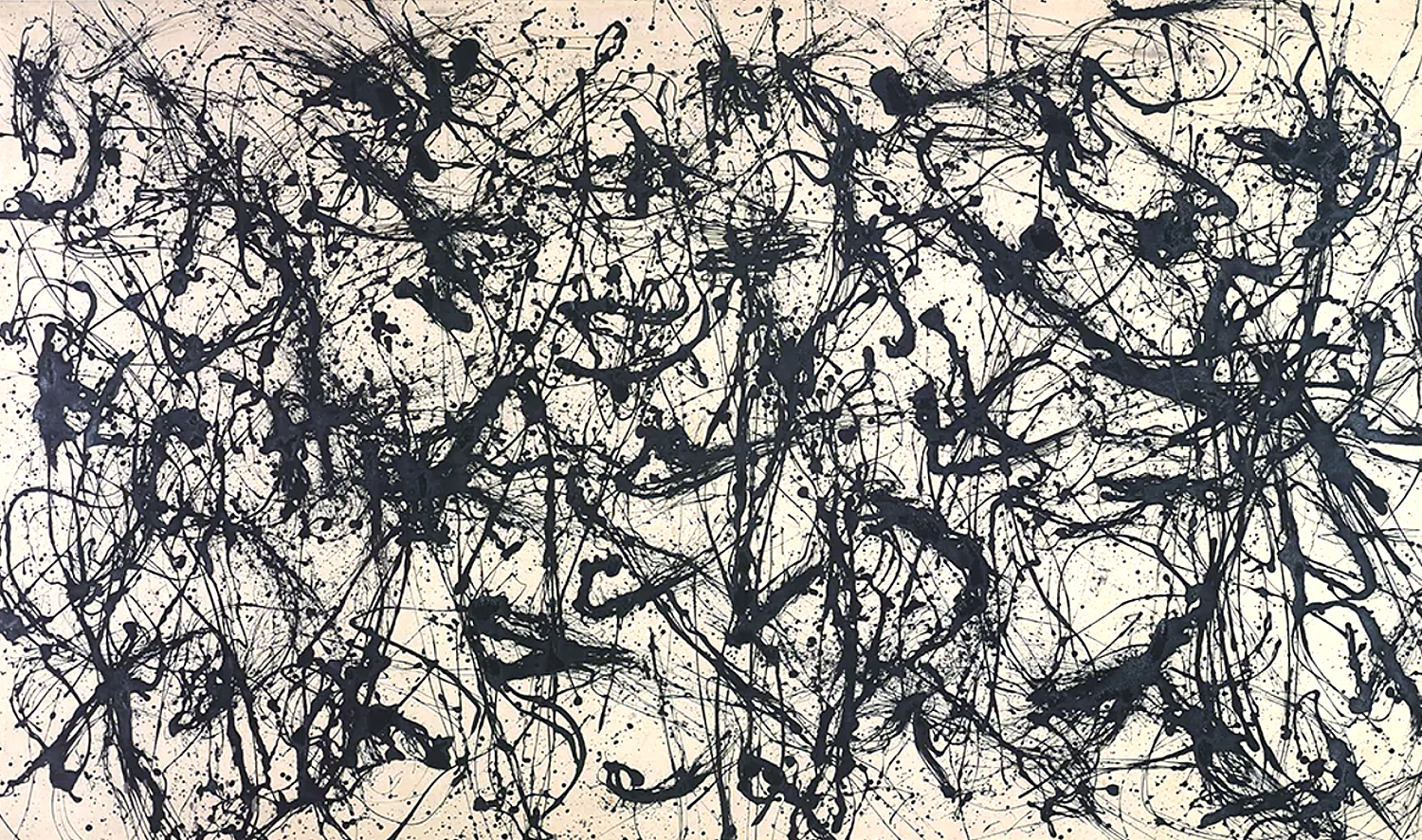
“Number 32 1950” Kunstsammlung Nordrhein-Westfalen, Germany
One: Number 31 and Autumn Rhythm were made from the same huge bolt of canvas. Each about 8 feet tall and 17 feet across. A third painting, in black, Number 32, filled out a kind of trilogy of giant paintings.
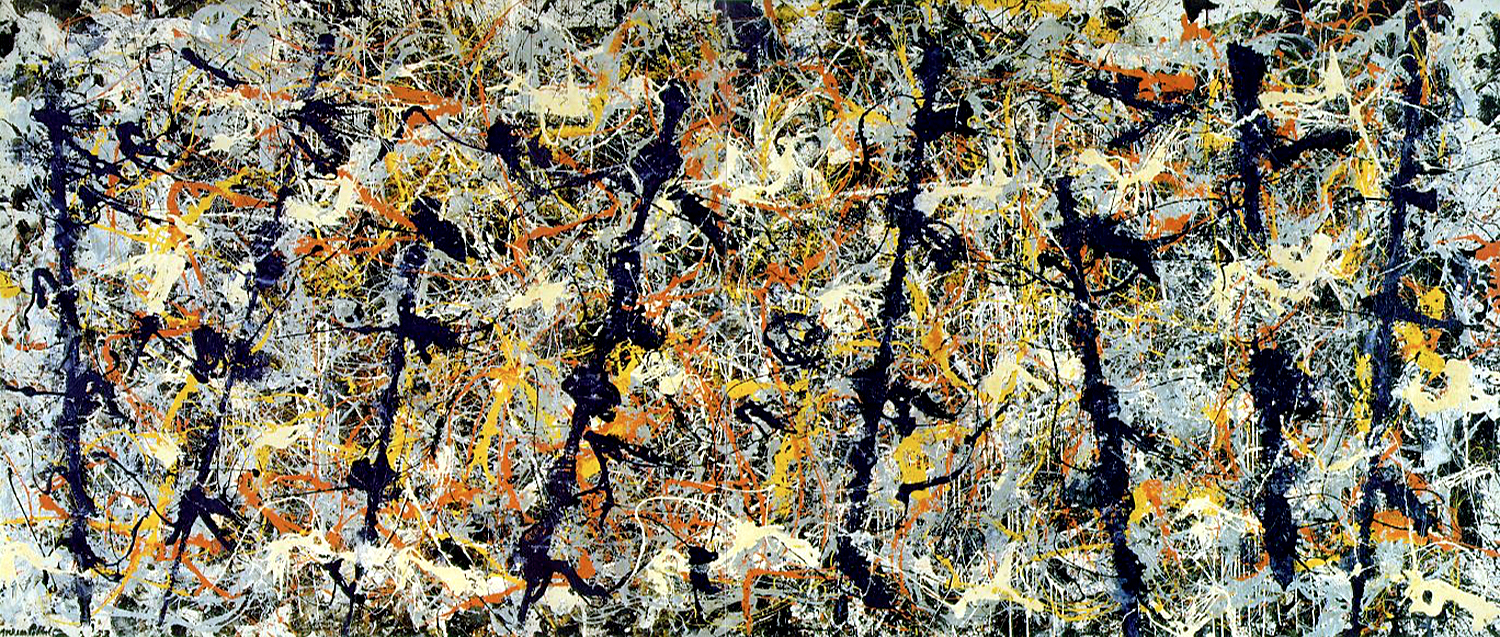
“Blue Poles: Number 11 1952” National Gallery of Australia
One of his last great drip paintings, from 1952, was Blue Poles, where he tried to solve the issue of how to organize the drips by imposing eight large dark slanted lines across the 16-foot canvas.
I had longed to see the painting in person, but it had been sold in 1973 to the National Gallery of Australia and shipped off to Canberra. But in 1998, I got to visit the Pollock retrospective at MoMA, where more than a hundred Pollocks were on view, with Blue Poles holding the place of honor in the final gallery.
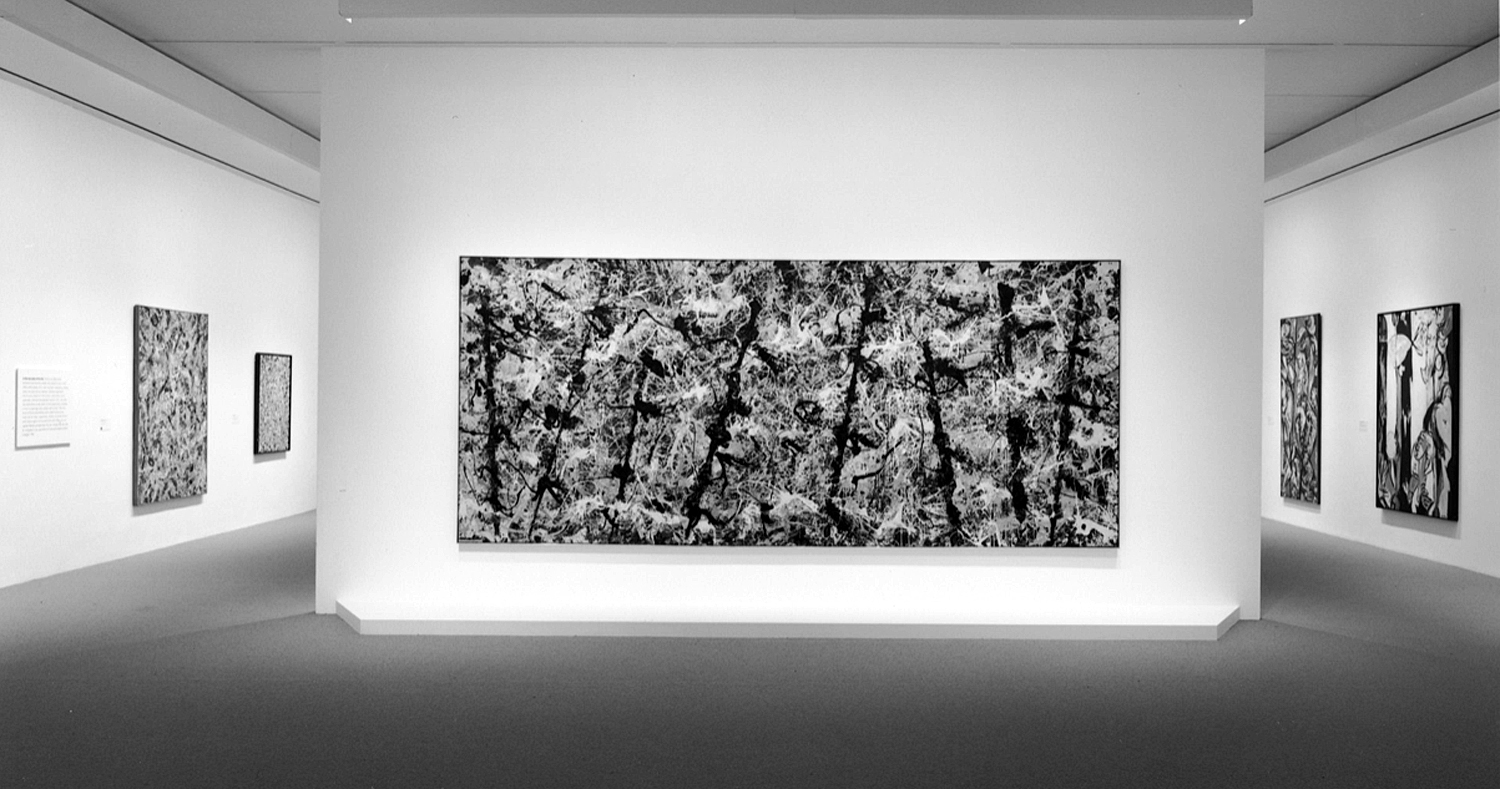
There wasn’t a breakthrough after the breakthrough. Pollock never discovered where to go next. There are inkings, so to speak, when he began to return to the themes of his earlier paintings, bits of mythology and Jungian psychology.
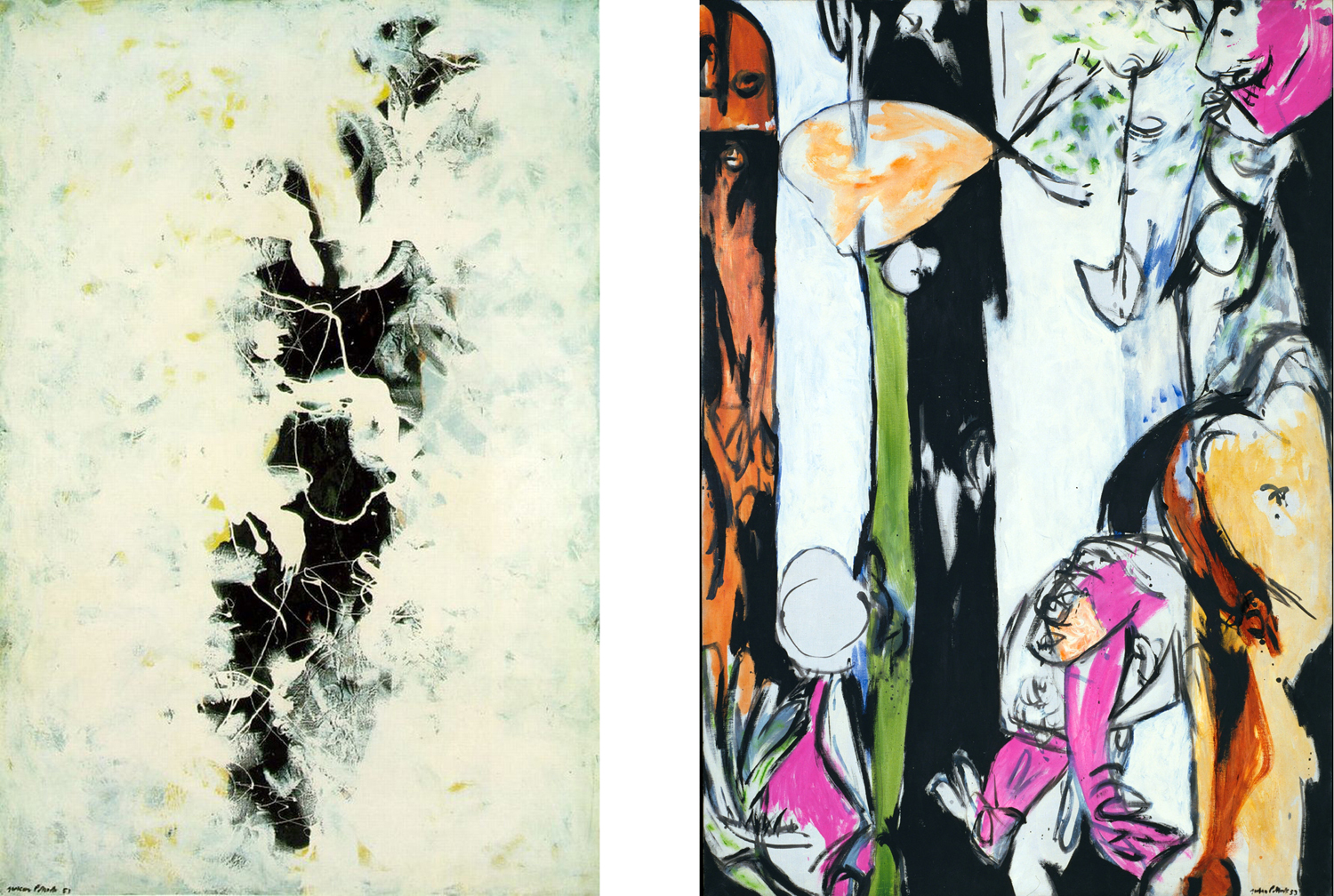
“The Deep” and “Easter and the Totem”
But seeing the life’s work spread out at MoMA, proved that the drip paintings were the reason for his fame, that before them and following were only lesser works.
Pollock always seemed like a once-lost soul trying his damnedest to be a great artist, but with very little of what is traditionally called talent. His early paintings are hardly more accomplished than those of a moderately talented high school student. They mimic, first, his mentor, Thomas Hart Benton, with bucolic agrarian landscapes, then they mimic the harder-edged style of the Mexican muralists, especially the more surreal Siqueiros. But his mimickry was never very good.
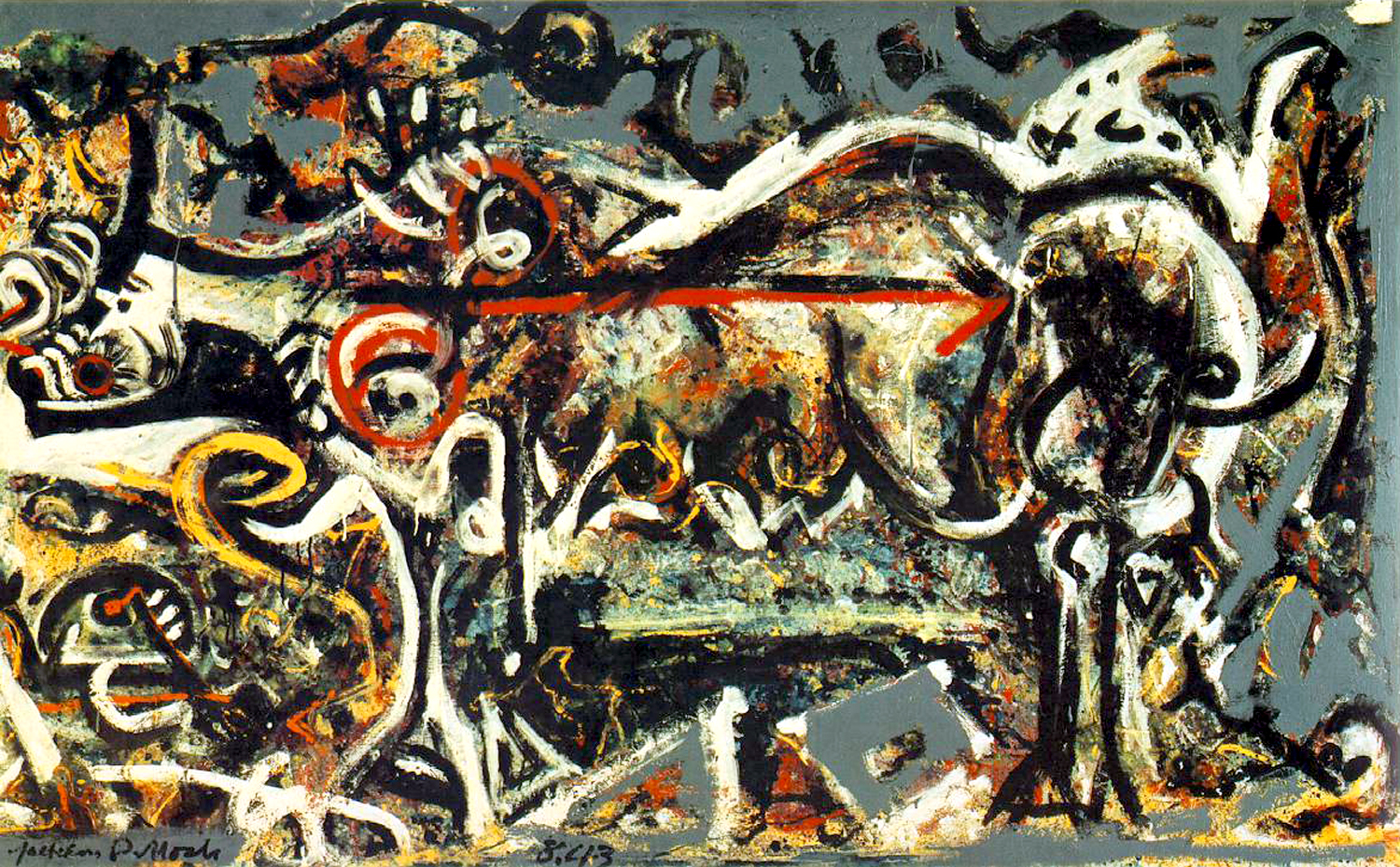
“She-Wolf” 1943 MoMA
In the early 1940s, his paintings became thicker with paint and took on as subject matter a kind of Jungian symbolism, with crusty paintings titled Moon Woman, Guardians of the Secret and She-Wolf. They were the stuff of deeply felt, perhaps, but clumsy efforts at best, lumpy with thickly applied gobs of paint.
Then, in the late 1940s, he happened upon the idea of dripping paint directly on canvas, allowing the spillage to form images. It was as if Pollock discovered himself. What had been clumsy became elegant. What had been derivative became authentic. He had found his “adequate means of expression.”
“Every age finds its own technique,” Pollock said.
Even now, Pollock the myth is better known than his paintings. Yes, the paintings are known, but they are recognized rather than seen. Seeing takes effort. But as a well-told story, he filled a cultural role in the 1950s, when rebellious artists, swimming in testosterone, were having their moment.
As critic Luis Camnitzer wrote in ArtNexus magazine, he fulfilled “two myths that still seem to have a certain (at least nostalgic) attraction. One is that of the male artist, just as he was conceived in the United States, with motorcycles, women and alcohol. The other is that of the ingenious inventor who creates things from scratch and with minimal resources. … The character conjured up by all this is the product of a strange blend of Van Gogh, Thomas Alva Edison, and James Dean.”
So, when a drunk Pollock died in 1956, slamming his convertible and two young women into a tree, it immediately became the story that took over in the public consciousness.
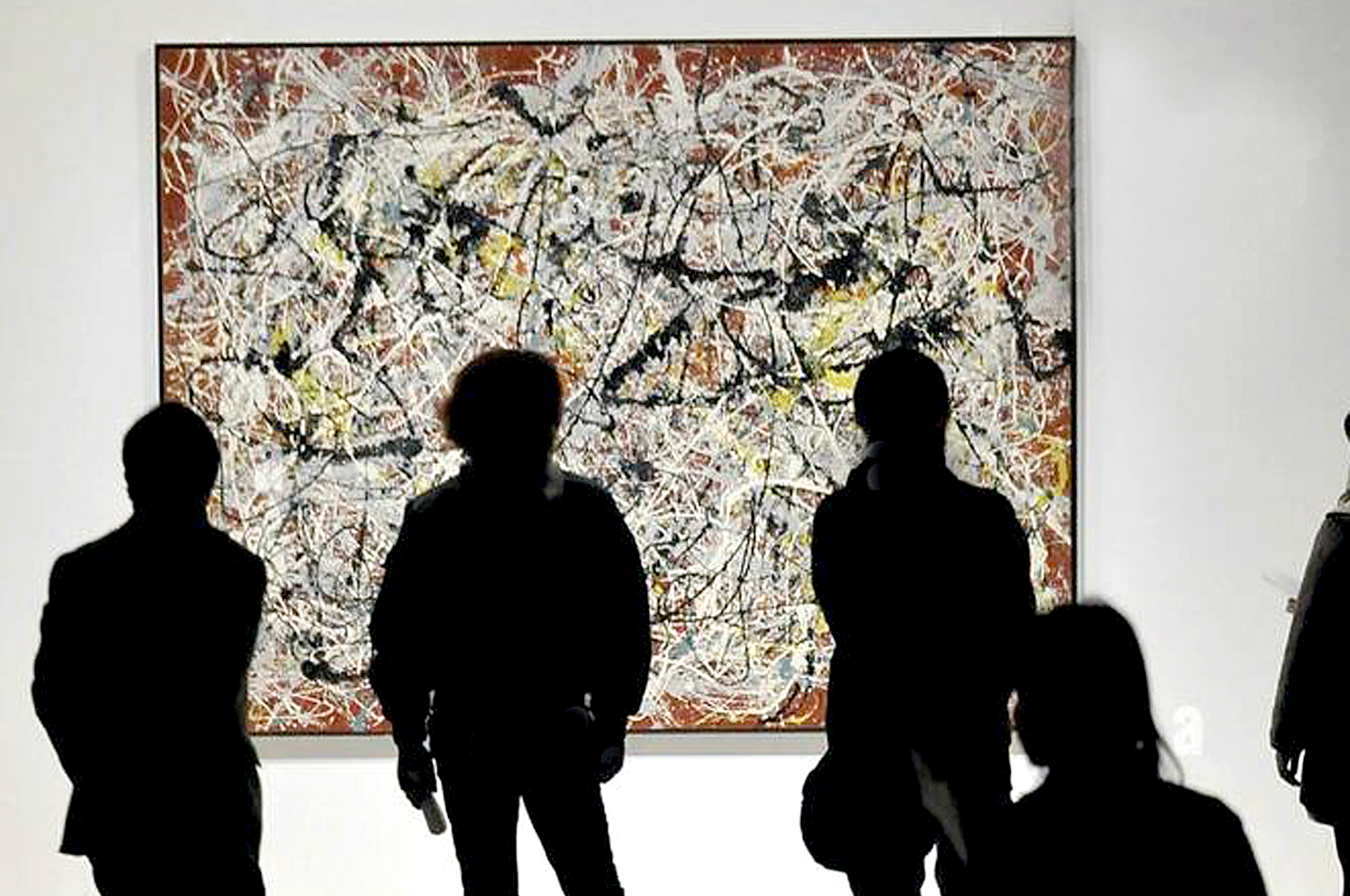
But it is the large canvasses for which he should be remembered. You can look at them and recognize their visual depth, the motion and movement in the spirals of enamel and pools of paint. Because they are so large, you stand close enough, they become a horizon-to-horizon event, and the paint has its own message — a busy energetic universe of pigment, and a modern version of the Sublime. You don’t need to make up stories; just look and absorb.
Click on any image to enlarge


Always dribble, dribble, dribble, eh Mr. Gibbon?