Archive

Tag Archives: Painting

Waterlily pond at Giverny

Waterlily pond at Giverny

When Claude Oscar Monet arrived at his new home in the spring of 1883, he had to borrow money to pay the rent.

The sturdy burger with the black Babylonian beard, smoker of strong cigarettes and painter of soft paintings was broke. He was one of many Frenchmen still suffering from the economic depression that had hit 10 years earlier and reduced the demand for paintings — among other things. Unable to sell his work, Monet had trouble feeding the mouths that depended on him.

For when he moved into the great barn of a house in Giverny, some 40 miles northwest of Paris, he didn’t come alone. He came equipped with his two sons, his companion, Alice Hoschede, and her six children. The youngest was only 5. They soon added a half-dozen servants.

The painter lived in his pink and green house in Giverny, along with his alternately growing and shrinking family, for the next 43 years, producing the body of work for which he is best known, a body of work that cannot be separated from the home he lived in.

That home served not only to shelter him, but to inspire him. The house and its surrounding gardens became, as he got older, the only thing he painted.
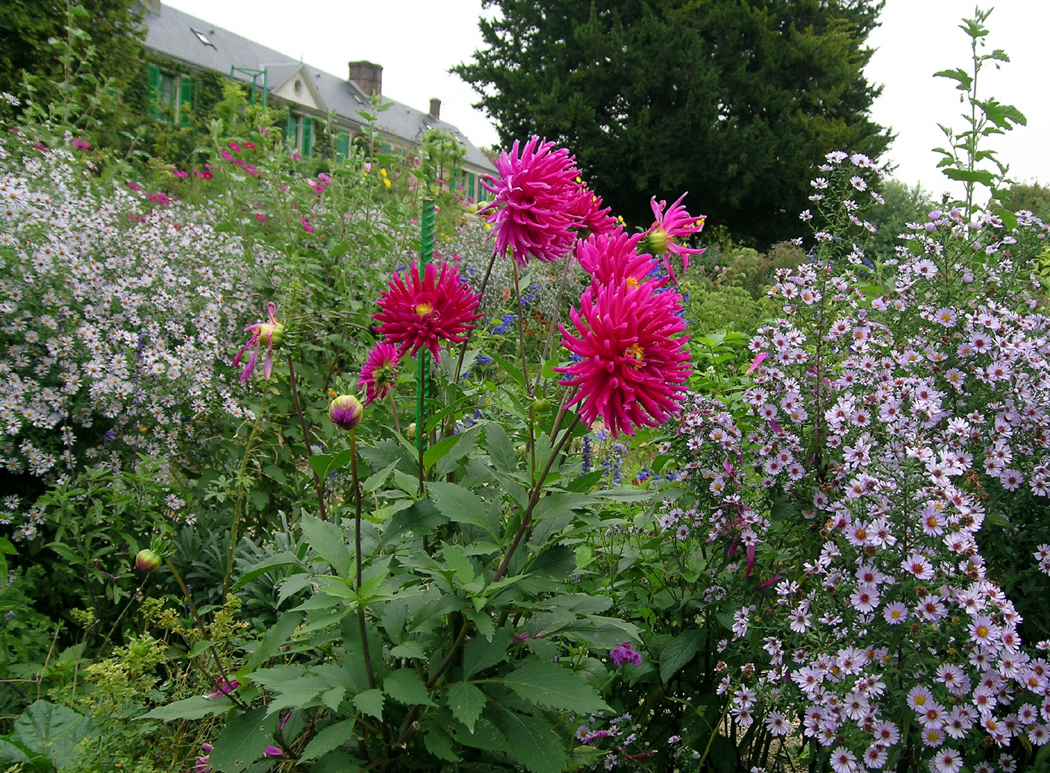
 

House at Giverny

House at Giverny

COMFORTABLY MIDDLE CLASS

Monet was born in 1840 in Paris and moved to Le Havre when he was 5 years old, and grew up there in comfortable middle-class surroundings. When he was a teenager, he decided he wanted to be an artist, began his studies and finally set up as a painter along with a ”brat pack” of his buddies, all of whom challenged the status quo in the French art world of the 1860s.

They later were called Impressionists and among their number was Renoir, Pissarro, Degas, Caillebotte, Sisley and Berthe Morisot.

They were beginning to achieve success when a double-headed ax fell on their careers. First, there was the Franco-Prussian War of 1870-71, and then the bank crash in 1873.

By 1880, things had improved, but Monet had to start from scratch building his career. He was lucky in that he had Paul Durand-Ruel as his dealer. Durand-Ruel was a saint among dealers and regularly advanced Monet money on paintings he hadn’t painted yet.

That is how he managed to pay the annual rent on the 2 acres of land with the house and outbuildings.

The bank crash had brought him Alice, too. Originally the wife of one of his benefactors, Ernest Hoschede, who had commissioned paintings and decorations from Monet, she gravitated to the painter when her husband fell bankrupt and abandoned his family.

At first, Alice and her six children lived with Monet and his wife, Camille, and their two boys in the town of Vetheuil. But Camille died in 1879 and Monet and Alice set up house together quickly after that.

It was one of the great partnerships in art, a perfect match between people, one intemperate and moody, the other steady and gracious, with all the tact the painter himself lacked.


Punt at waterlily pond

Punt at waterlily pond

ON THE BANKS OF THE SEINE 

Giverny was not more than a village, with fewer than 300 residents, when they moved there. It sat on the north bank of the Seine River in the angle where the Epte joins it, on a slightly rising bank above the river and below the wooded hills that rose behind.

Monet’s new home sat near the edge of town between the two main roads. The house itself was a monster of an old farmhouse, looking something more like a warehouse than a home. On one end was a barn that Monet turned into his studio. The building was covered in a pinkish stucco that Monet made pinker, with gray shutters that Monet painted green.

The yard that came with the house had an old orchard in it and room for the gardens that Monet planned. Within a few years, the grounds were overgrown with the many flowers and trees Monet planted.

And life began slowly to improve for the Monet-Hoschede family. At a time when a common laborer made about 10,000 francs a year, Monet was selling his canvases for 12,000 francs each. By 1888, Monet was making 100,000 francs a year.

He spent it lavishly, building studios and greenhouses, adding to the house, improving the garden.

”Everything I have earned has gone into these gardens,” he wrote.

And when his lease ran out in 1890, he had no trouble buying the house and grounds for 22,000 francs, payable over four years.

In 1893, he bought an adjacent lot, on the other side of the railroad tracks that bordered his property, and began making a pond to grow waterlilies.


Japanese bridge at Giverny

Japanese bridge at Giverny

AN EARLY RISER 

Monet’s life in Giverny turned into an ordered process of days, not only as the seasons progressed through the year, but even as the day progressed.

He got up early, between 5 and 6 in the morning, took a cold bath and ate a big breakfast, often an ”English” breakfast of bacon and eggs. From then until midday dinner, held promptly at 11:30 a.m. every day, he painted. He carried his canvases with him, often working on more than one, passing from canvas to canvas as the light changed with the hour.

He would sit out in the sun in his tweed suit and pleated shirt wearing a broad-brimmed old hat and smoking his stinky Caporal Rose cigarettes.

Monet had begun working in series, attempting to catch the evanescent effects of light as they flew by. A series of haystacks was followed by a series of poplar trees, each showing what their subject looked like at dawn, early morning, late morning, midday, afternoon and evening. As the sun changed, he changed canvases.
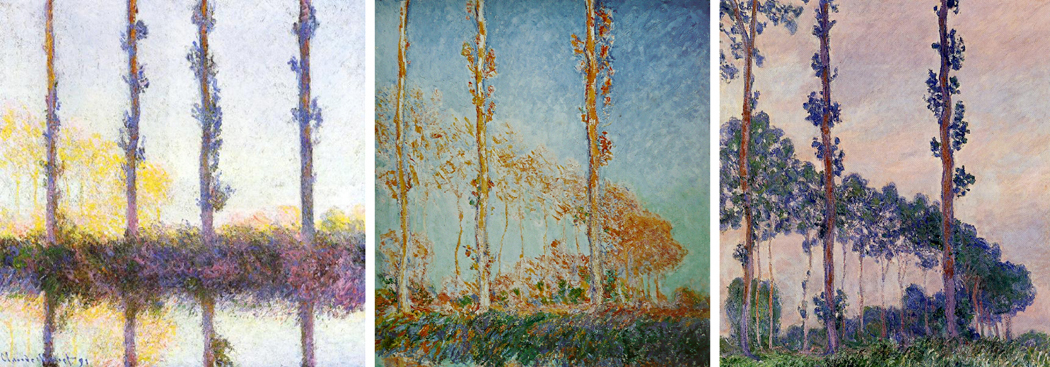
Monet poplars series

His critics complained that he was just trying to sell the same painting many times over. But Monet showed a dogged determination to make these series.

When the land with the poplars was sold, Monet paid the new owner not to cut down the trees until he was finished painting them.

Lunch was the major social event of the day. When Monet had visitors — which was often, more often than he sometimes wanted — they did their visiting at midday.

The afternoon was given over to painting once again, followed by a small supper at 7, and for Monet, bed by 9:30. He was notoriously bearish if this schedule wasn’t kept precisely.

So that, when his son-in-law, who was a slow eater, visited, Monet gave orders to the servants that no seconds should be offered.

And the painter could get out in the field with his canvases and brushes on time.
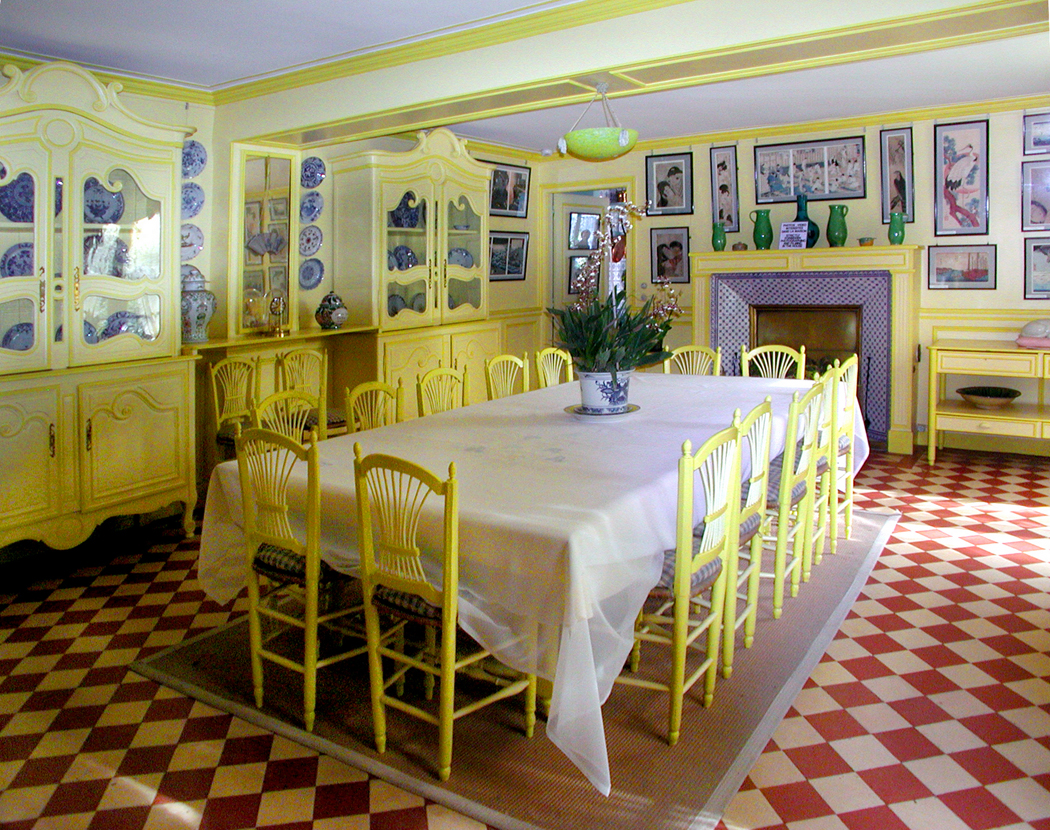
 

Dining room at Giverny

Dining room at Giverny

THE GOLDEN YEARS 

The 20 years after he moved to Giverny were the best of his life. His prices kept rising, he painted happily and productively through the year, taking time most years for an extended trip. One year, he went to Venice, another to Norway.

In 1892, after Ernest Hoschede’s death, Monet and Alice got married. The following year, he built his first water garden. In 1897, his son, Jean, married Alice’s daughter Blanche. Monet’s solo exhibitions regularly sold out.

The only troubles he had were in getting the municipal cooperation on improving his pond. Local residents were concerned that Monet’s plan to divert water from the Ru River, actually little more than a brook, would affect their crops and cattle grazing, but some help from the mayor swayed them and the permits were issued.

Alice’s daughter Suzanne married the American painter Theodore Butler and another daughter, Germaine, married a businessman from Monaco. The marriages soon brought four grandchildren to the family.

Meanwhile, Monet added more acreage to his holdings, including the ”Maison bleu” — the ”Blue House” — in the middle of town, where he installed a gardener named Florimond to cultivate his kitchen garden, which supplied the family with vegetables for their elaborate menus.

At one point, he employed six gardeners alone, along with a cook named Marguerite, a butler and valet named Paul, who was Marguerite’s husband, a maid named Delphine and a combination chauffeur and wine steward named Sylvain.

He needed the chauffeur because, although he owned automobile after fancy automobile — fast cars were a passion, along with watching auto racing — he never learned to drive.

The family also owned four boats, which they moored on the Seine, including the one boat Monet had fitted out as a floating studio. Monet often was accompanied on his painting forays by his step-daughter Blanche, also a painter, and they shared space on the boat.

Once a month, Monet retreated to Paris to have dinner with his circle of artist friends. He and Alice would take in the latest theater, see the gallery shows, and attend concerts.

Or watch wrestling — a particular favorite of the otherwise demure Alice.


Clos Normand

Clos Normand

A DISTRESSING UNDERTOW

Yet underneath the comfortable bourgeois existence of the increasingly wealthy painter was a distressing undertow. If Monet made paintings that soothed — he once called them a ”refuge for a peaceful meditation” — perhaps it was because he had a better than passing acquaintance with death and loss.

His mother had died when he was 18. Friends had died in the war. His wife, Camille, had died in 1879 after three years of lingering illness. The very month he moved into Giverny, his mentor, Edouard Manet, had died and Monet had served as pallbearer.

The early years at Giverny had proved a reprieve, but as Monet’s once black beard turned into a vast white haystack on his chest, time caught up with him.

Monet in the garden

In 1894, Suzanne developed a paralysis and five years later, she died. Alice went into a depression from which she never fully recovered.

”Our beloved Suzanne died last night,” Monet wrote Durand-Ruel, ”while her poor mother was in bed with a bad case of bronchitis which she caught the other day at Moret. One sorrow after another.”

Around him, his colleagues began dying, too. Caillebotte — a particular friend — had died in 1894. Alfred Sisley died only a week before Suzanne.

Pissarro died in 1903; Cezanne in 1906. By 1917, Rodin and Degas were dead, along with Monet’s friend, the playwright Mirbeau. And in 1919, Renoir died.

Part of this was the natural result of living a very long life. But there were special sorrows for Monet.

A flood destroyed his lily pond and large portions of his gardens in 1910. It took several years to rebuild.

In 1911, Alice died after a long illness. Monet entered a deep depression that prevented his painting for some time.

In 1914, his son, Jean, died. Jean’s widow, Blanche, returned to Giverny and served Monet as hostess and housekeeper.

And the outbreak of World War I weighed heavily on the painter.

”I’m back at work,” he wrote. ”It is still the best way of not thinking about present sorrows, although I’m rather ashamed of thinking about little researches into forms and colors while so many suffer and die for us.”
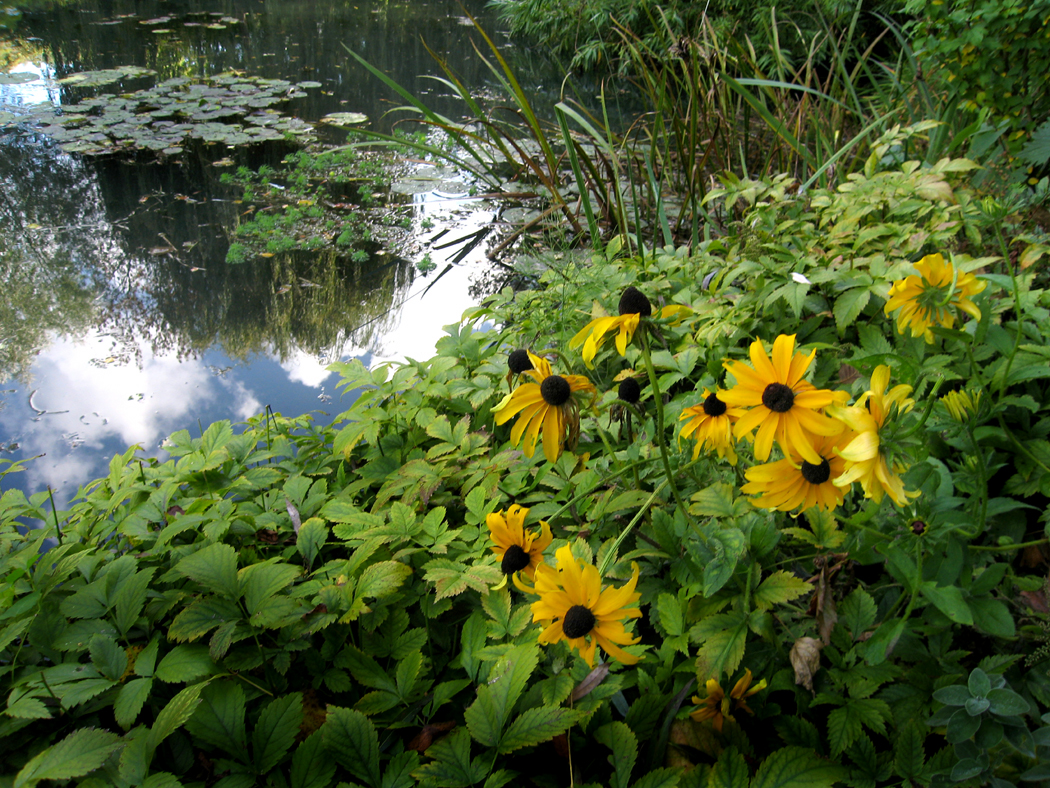
 

Pond edge, Giverny

Pond edge, Giverny


FAILING EYESIGHT

There was another sorrow for Monet, one that threatened his very identity as a painter.

Beginning at the turn of the century, Monet’s eyes, which had bothered him since his youth, began to develop thick cataracts that interfered with his vision.

He painted through them, but friends and critics noticed a change in the paintings, which sometimes seemed oddly colored.

”I’m working very hard and I would like to paint everything before I cannot see anymore,” he wrote Durand-Ruel.

The condition worsened and relented over the years, but by 1922, his eye doctor reported that Monet’s vision was reduced to ”one-tenth in the left eye and to perception of light with good projection in the right eye.”

Monet continued painting, sometimes knowing what color he used only by reading the label on the tube of paint.

”I could paint almost blind,” he told a visiting journalist, ”as Beethoven composed completely deaf.”

The operation his doctor recommended on his right eye helped things in 1923, but resulted in a peculiar condition called ”xanthopsia,” which caused him to see everything too yellow. When this condition abated, it resulted in its opposite, in which Monet saw everything as too blue.

”It’s disgusting, I see everything in blue,” Monet complained to a visiting professor.

”How do you know it’s blue?” the visitor asked.

”By the tubes of paint I choose.”

His ophthalmologist finally found a pair of tinted glasses that brought his vision back to something approaching normal, and Monet painted like a demon.

In 1925, he wrote, ”My vision has improved tremendously. I am working harder than ever, I am pleased with what I do, and if the new glasses are better still, I would like to live to be a hundred.”


Orangerie, Paris

Orangerie, Paris

A FINAL GIFT

He didn’t make it to a hundred, but the final years were spent on a vast project of painting the waterlilies in his water garden.

Conceived as a gift to France, he worked in increasingly larger formats, finally building a new studio to house the 8-foot-tall, 12-foot-long segments of the murals he was painting.

”These ‘water and reflection’ landscapes have become an obsession,” he wrote the journalist Gustave Geffroy in 1908. ”They’re too much for an old man’s strength, yet I should like to be able to reproduce what I feel.”

He destroyed paintings he didn’t think up to his standards. At one point, he wrote Durand-Ruel, ”I have five or six at most that merit consideration, and have just, to my great satisfaction, destroyed at least 30.”

The large waterlilies marked a significant change in Monet’s approach. In the past, he had been rigorous in painting outdoors, directly from life. But for these ”decorations,” as he called them, he worked inside, in his studio, from his imagination.
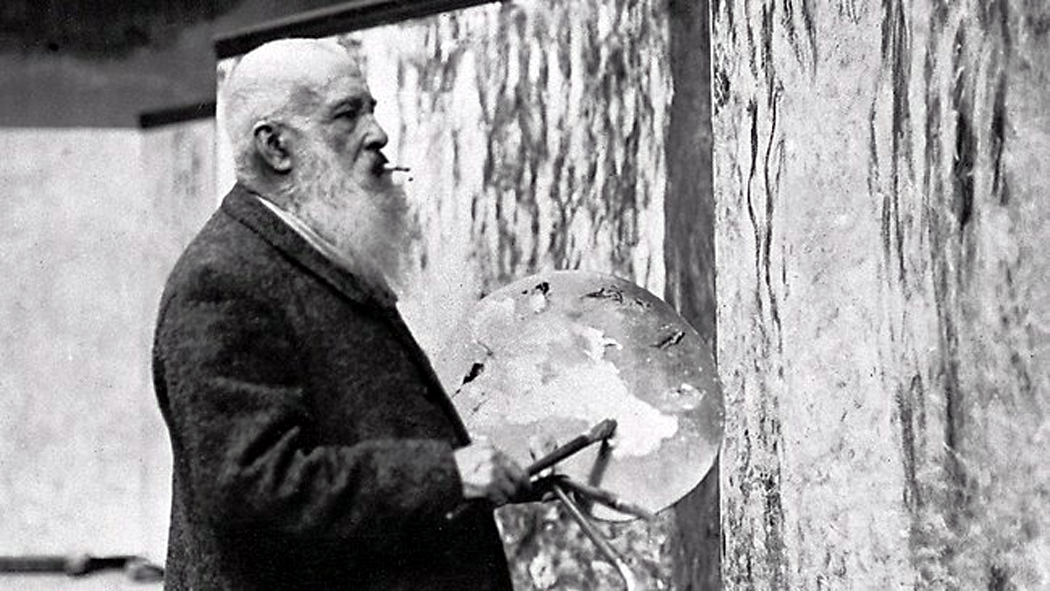
Monet at canvas

That underlined not just a change in technique, but in the basic purpose of his painting. What had been an attempt to reproduce an accurate record of what his eye saw became an involvement in what paint can do and mean.

Pablo Picasso had painted his first Cubist painting in 1906 and the winds of Modernism were blowing the old smoke out of the room. Monet caught the fresh air and enthusiastically took part in the change. The late waterlilies are no longer Impressionism; they are modern art.

”I am looking for something I have not done before, a shiver my painting has not yet given,” he wrote.

In 1926, a lifetime of smoking cigarettes caught up with Monet. By late summer, he was bedridden with pulmonary sclerosis. His eyesight had deteriorated; he no longer could paint. He died on Dec. 5 with his family around him.

The following year, his waterlily decorations were installed at the Musee de l’Orangerie in Paris.

As for his beloved home, it stayed in the family, eventually abandoned in World War II. But in 1957, Monet’s surviving son, Michel, donated the deteriorating property to the Academie des Beaux-Arts, along with the paintings left behind by the painter at his death.

The Giverny site, now renovated with gardens replanted in the 1970s, draws about a half-million visitors a year.

On Michel’s death in 1966, the paintings reverted to the Musee Marmottan in Paris.

It is hard to calculate how much this one small piece of provincial property has given to art. Monet painted what he loved, and what he loved for the final four decades of his life was his home in Giverny.

”My heart is to Giverny for ever and ever,” Monet wrote.


Loon

Who is America’s greatest painter?

There are many who could be named, from Eakins to Homer to Whistler to Pollock, but the name I would like to place in nomination is John James Audubon.

That comes as a surprise to me as well. I once knew him, as most Americans do, as the author of a book of overly familiar colored engravings of birds.

But the original watercolor paintings reveal him to be a soul of great emotional power, even moral force. An exhibition of many of them is currently on view at the New York Historical Society, through May 19, and changing shows continue through 2015, until all of the 474 originals for his book have been displayed. (A stunning book, “Audubon’s Aviary,” is also available through the NYHS or Amazon).

Audubon — America’s most famous Haitian immigrant — was born there in 1785 as the illegitimate son of a French merchant and slave trader. He moved to France with his father when he was 5, and to the United States when he was 18.

He went through a series of disastrous business ventures, making and losing several fortunes and wound up, at 35, as a part-time taxidermist and portrait painter.

It was then he conceived a plan to publish a book about American birds with his paintings as illustrations. Audubon had been a nature lover since boyhood and had often drawn the birds he loved. It came to him that these drawings could be supplemented to illustrate all the bird species then known in America. It was an ambitious plan.

John_James_Audubon_1826

Too ambitious

Too ambitious, as it turned out, to interest any American publisher, so he wound up in England, where he found Robert Havell Jr., an engraver with the perfect talent match for Audubon’s drawings.

The book they published in installments over a dozen years beginning in 1827 was the ”double-elephant edition,” named after the page size: 29 1/2 by 39 1/2 inches, with engravings by Havell made from the paintings of Audubon and hand-colored by apprentices.

They sold by subscription for $1,000, an astronomical sum in those days. It is hard to compare dollars over centuries, but at the time, the average laborer made the proverbial dollar a day, so it would not be out of line to say they sold for the equivalent of about $30,000.

In Dec., 2010, a complete first edition of “The Birds of America” sold at Sotheby’s in London for $11.5 million — a record for the most expensive printed book ever sold at auction.

Over three decades, Audubon tracked down, studied, shot, drew and painted more than 400 of the country’s bird species, with the paintings turned into a book that would document them for the first time, and eventually make its author’s name synonymous with nature and conservation.

And he did so with a commitment so intense that he became one with his subject. In some sense, every bird he painted is a self-portrait.

More than anything else, it is for this reason they rise above documentary art to become among the greatest art ever made by an American.

But it was the book Audubon meant us to see, not the watercolors. They were painted only as studies for the engravings that illustrate the book.

And so, Audubon felt comfortable doing things he would never do for a display picture. He mixed media like crazy, using ink, watercolor, gouache, pencil, even collaging birds scissored from earlier drawings.

He used each of these techniques to particular expressive ends that could not always survive the engraving transformation. In the case of the Magnificent Frigatebird, for instance, he used the sheen of his graphite pencil over the top of watercolor to imitate the iridescent effect of the bird’s plumage.

Magnificent Frigatebird

Magnificent Frigatebird

Still, the very first thing that wallops you as you enter the Audubon show at the Art Institute is the monumental size of the paintings.

Everybody knows what Audubon’s bird pictures look like, or at least they think they do. But seeing poor reproductions in books will not prepare you for the real thing.

What we are used to seeing are small reproductions of large engravings that are themselves reproductions of Audubon’s original paintings. Each painting is about 2 by 3 feet. Poster size, not postage-stamp size.

In that giant space, Audubon places all his birds. It was his intention to paint every bird life-size, whether hummingbird or eagle.

It meant that very large birds, such as flamingoes or condors, had to be contorted to fit into the space.

Total involvement

Yet it isn’t mere exigency that causes Audubon’s animals to be so animated. More than anything else, it is his total body identification. He is one of the world’s most haptic artists.

Over and over, you sense that Audubon felt his own muscles and sinews moving in sympathy with the birds he drew.

Time after time, you can see the intense life reflected in the eyes of his birds. They are never mere circles, but always pools of living awareness.

One of his secrets may be that he remained always a child in his direct response to nature.

”Every child is an artist,” Picasso said. ”The problem is how to remain an artist once he grows up.”

It was a problem Audubon solved.

Look at his poses. The competency of the drawing is a different level from a child’s but the poses are straight out of first or second grade. The animal is always moving and live.

Naturalists have always carped that the Audubon bird prints are not as realistic as those of Louis Agassiz Fuertes or Roger Tory Peterson. They cavil that Audubon poses his birds in exaggerated positions that are unnatural for the real bird when alive.

But these people are not letting Audubon be Audubon. While it is true that he was on some level making identification pictures, it isn’t that level that rises to greatness. It isn’t as a field guide he is to be judged.

Audubon watched his birds with the minute carefulness of a mother bird, and recognized in every bird action an analogous human emotion. He then projected the human back into his avian. Like the leader strike of lightning that makes a path for the great burst of electricity back in the opposite direction.

A human element

Audubon’s birds function metaphorically as symbols of human affective states.

Fuertes is more useful scientifically precisely because he treats his birds as an ”it.” Audubon treats them as a ”thou.”

Detail, Chuck-Will's Widow

Detail, Chuck-Will’s Widow

You can see it in his Chuck-Will’s-Widow with its giant gaping mouth, the essence of appetite. In the uxorial affection of his Passenger Pigeons, which almost seem to kiss as the one feeds the other. In his nesting Barn Swallows, where the one shields the other with his upraised wing.

Ultimately, Audubon’s paintings are not about birds, but about human beings. Where Bach or Beethoven uses a series of notes to convey a human emotion, Audubon used a picture of a bird. And more than anything, it was that Audubon felt the importance of paying attention.

It isn’t that his paintings are so detailed, but that he paid attention to that detail with an urgency that approached love.

”To be awake is to be alive,” wrote Henry Thoreau. ”I have never yet met a man who was quite awake. How could I have looked him in the face?”

But to see the preliminary studies Audubon made for his “Birds of North America” is to see the work of a man wide awake and with his abilities at full throttle.

Sometime around 1515, the Venetian artist Titian painted a scene usually titled “Sacred and Profane Love.” In it, two women are seated at a marble well; one is nude, the other elaborately dressed. It comes as a shock to many Americans to find out that in this allegory, sacred love is represented by the naked lady.

And in general, Americans seem to have a difficult time with the nude in art. Maybe it is America’s Puritan heritage, maybe it is the low priority given art education in our schools.

Sometimes it’s just pig ignorance.

But to many Americans, the nude is something dirty, lewd and embarrassing. At the very least, nudity is equated with sexuality and eroticism.

As they said on “Seinfeld,” “Not that there’s anything wrong with that.”

We can laugh at the silliness of such a view, but it governs much of what Americans think about sexual morality, including former U.S. Attorney General John Ashcroft, who spent $8,000 in 2002 on blue drapes to hide two giant Art Deco statues — “The Spirit of Justice” and “The Majesty of Law” — at the Great Hall of the Department of Justice in Washington.

Certainly, there is a good deal of eros in art history.

Take for instance, Francois Boucher’s “Reclining Nude” from the French 18th century.

There is not much about this luscious painting that is different from, say a photograph with a staple in the middle.

An in America, too often, this is all that a nude is.

A few years ago, a woman in Tucson demanded that art and art books be removed from a public school, calling works by established masters ”pornographic and morbid.”

She was talking about Michelangelo’s “David” and Picasso’s  “Demoiselles d’Avignon.”

What is more astounding is that she managed, at least temporarily, to have 10 art books and four posters yanked from the school. The works in question were by Edouard Manet, Frida Kahlo, Paul Gauguin, Hieronymus Bosch and El Greco.

She said she considered El Greco a ”pervert.”

”We left the art teacher with about five books,” she said, with some pride. ”I took out anything with nudity in it. There’s no difference between a nude (in an art book) and a ‘Playboy’ picture.”

I’m not interested so much in the question of what is appropriate for fifth- and sixth-graders; there may be some legitimate concern for their sensibilities. Although, in this case, I doubt the kids are getting anything from Gauguin they haven’t learned long ago from Aaron Spelling.

But, I am very much interested in the widespread belief that nudes are necessarily pornographic.

Such a view ignores the evidence of centuries of art that has portrayed the human body for other, more complex purposes.

Varieties of nudity 

So what are those purposes? In other words, what does the nude mean?

All but a few cultures in the history of the world have had a place in their art for the undressed human body. Although it is probably more developed in European art than elsewhere, the nude body appears prominently in African, Persian, Hindu, Tibetan and Japanese arts.

It occurs with different meanings in them: In Chinese art, the nude is rare; the most frequent nudes are not sleek ideals of human form but fat Buddhist monks, looking like the sileni of Greek art.

But you will see that these are not different merely in style, but in purpose: These are all different meanings for the nude and the human form.

Of course, in the geography in which humans evolved, there was less need of heat-conserving hair. And in those climes, nudity has different cultural meanings.

And titillation is rarely the primary factor involved.

Like the prisoners in Abu Ghraib — Surely being made to exhibit themselves naked means more to them than it would to us, even if we feel humiliation in our nudity, how much worse is it for these Arab men?

In the temple art of India, nudity and copulation are used as a metaphor for the Cosmos. There is not one single meaning for the nude, but rather a series of layers of meaning that can overlap. Those layers run from the most primitive to the most sophisticated. There are at least four distinct layers of meaning to be addressed:

–> Appetite;

–> Intellect;

–> Power;

–> and Spirituality.

The first layer is really that of plumbing.   At the level of appetite, we have the gaze of the voyeur.

It is here we find everything from men’s room drawings to “Debbie Does Dallas” to the pillow books created by Japanese artists in the 18th century.

The faces mean little, the beauty or fitness of the physiques mean little. There is nothing going on but what Joseph Campbell has called the ”zeal of the organs for each other.”

All true pornography stops at this basement level.

And it is this level that most of the moralizing critics of the nude are stuck in, unable to see any higher.

The rippling of silk 

The second layer is that of both eroticism and idealization.

In both cases, the mind takes over from the organs and imposes standards.

Eroticism is the level at which the rippling of a silk dress is more arousing than raw flesh, with all its hair, bruises and cellulite. Pornography is stunningly literal-minded; eroticism is imaginative.

And eroticism’s flip side is the idealized nude of ancient Greece or “Playboy” centerfolds. In each case, an ideal form is held in the mind – an ideal the real world cannot actually live up to; hence the canon of Polyclitus, which defined the proportions of the perfect body, and the airbrush of Hugh Hefner.

When Sir Kenneth Clark wrote his famous book about the nude, he focused almost exclusively on this aspect of the figure in Western art: The idealization of beauty.

Here we find the pneumatic Boucher cuties and the massive Classic Zeus in bronze throwing his thunderbolt.

If pornography is often physically repulsive, no matter how fascinating, the idealized nude is  intended to be attractive. The idea of beauty enters into the equation.

The so-called Venus of Willendorf, from at least 24,000 years ago, found in what is now Austria. Is this an ideal of beauty? It is certainly an image of fertility. And fertility and beauty are often the same thing, when you live in a time and place that survival depends on fertility.

In Ancient Greece, where we generally start our narrative of Western art, the earliest statues were an expression of human perfection. And for the Greeks, human perfection meant the male human form. They worshipped male beauty. Greek vases are full of nude male bodies — athletes in the Panathanaic Games, for instance.

The early kouros was still rather stiff, by modern standards, but compared to what went before, in Egypt or Babylonia, it is a model of realism and accurate observation.

I don’t want to make this a chronological history. You have schools for that.

But you are familiar with lots of nudes in European art from the Renaissance to now.

Rather, I want to look at some thematic ideas, how the nude changes meaning.

The body still remains, however, essentially an object rather than a person.

How the world works 

We’ve seen the erotic nude, but that’s not all there is.

A third level, above the erotic and the idealized, is the level of power and the political, psychological and scientific.

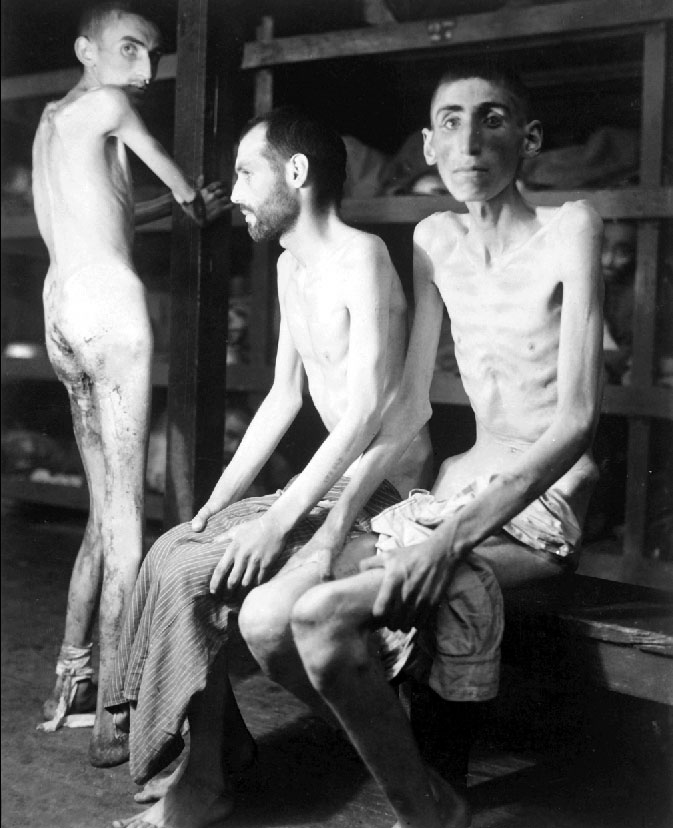
What does the nakedness here tell us? It tells us these people are powerless, humiliated, tortured and suffering.

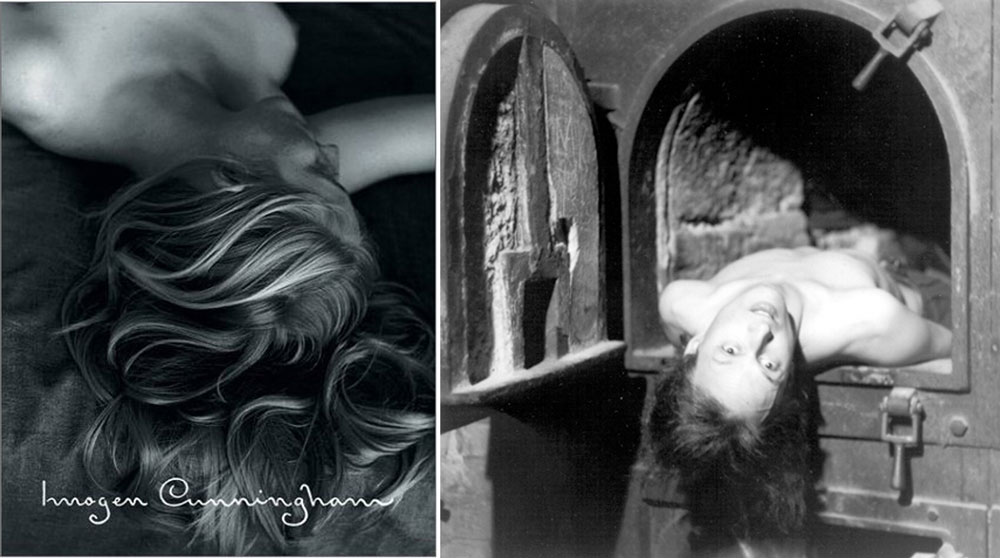
There is a famous picture by Imogen Cunningham of a young woman with her head and hair hanging off the edge of a bed. It is erotic.

But put it beside this and you see the similar pose with a completely different meaning.

No one who has seen pictures of naked Jews herded into the showers of Auschwitz can fail to recognize the political significance of nakedness. It functions to underline the powerlessness of the victims and their vulnerability.

Context makes a huge difference.

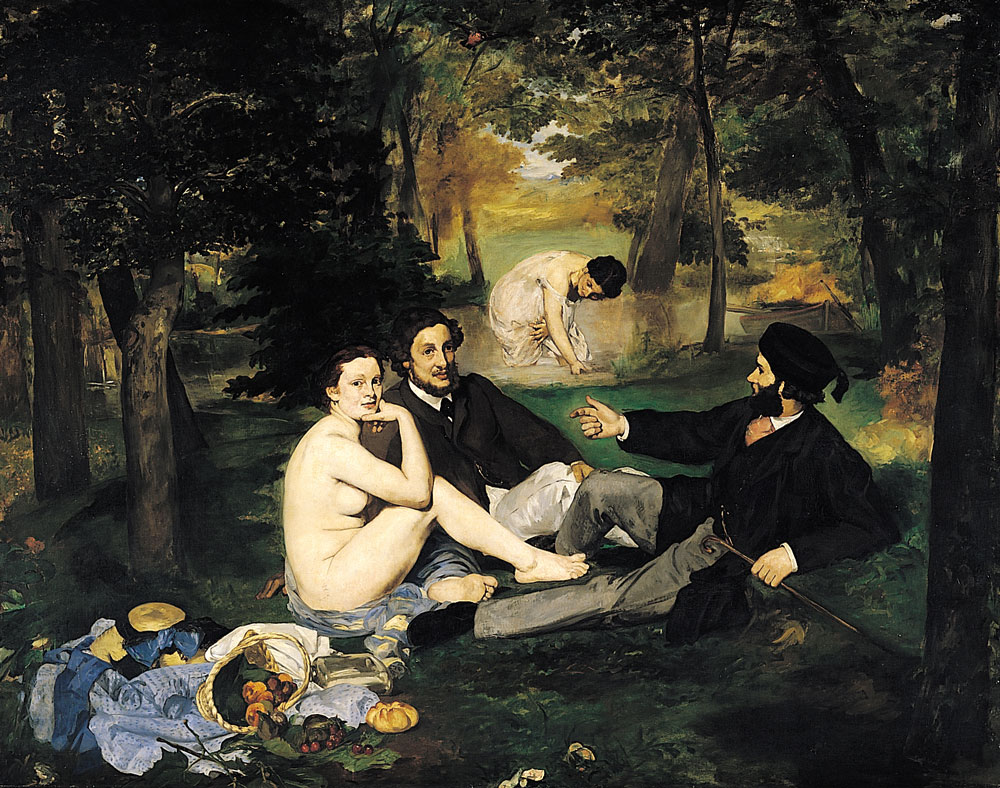
And in Manet’s famous painting, “Dejeuner sur l’herbe,” the message that comes through is ostensibly erotic, but in reality is political: Two fully clothed middle-class men are having a picnic with two nude women.

The ridiculousness of the scene makes fun of the traditional power relationship between men and women. The painting pointedly comments on such earlier paintings as Georgione’s “Fete Champetre,”   in which two Renaissance courtiers talk animatedly with each other while attended by two docile and idealized nude women.

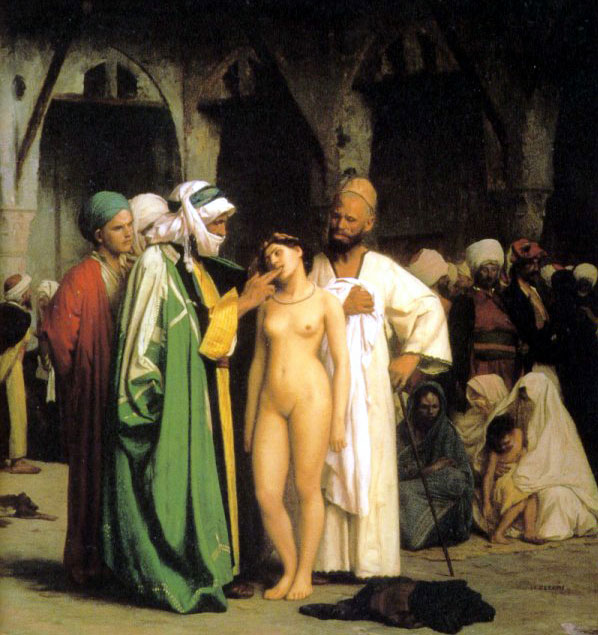
And it comments on such popular paintings of Manet’s time as Gerome’s “Slave Market,” in which clothed men paw over a nude woman, checking her teeth before purchasing her.

Gerome’s painting is merely a salacious bit of kitsch; Manet’s is biting and political. (One shouldn’t discount the tacit political message in the Gerome, probably unnoticed by the painter: Who has the power here? It isn’t the woman.)

It’s no wonder that “Dejeuner” was declared indecent while such paintings as the “Slave Market” made Gerome a wealthy man: By making his figures  bourgeois, Manet was pointing a finger at his audience. It is political commentary.

Many left-wing feminist critics of the nude get just as stuck in this level as their Christian right-wing counterparts get stuck in the first.

But the power I’m talking about at this level isn’t only political power. It is the power of  humankind over itself and the power to understand the world it lives in.

For instance: If Renaissance artists hadn’t become obsessed with drawing the nude figure, modern life expectancy would likely still be short and brutal. Modern medicine could not have developed without such artists as Leonardo and Michelangelo taking an interest in how the human body looks and how it is put together.

Before the Renaissance, Gothic artists created the figures they used to decorate the cathedrals from their imagined forms. If a figure had a torso, two legs, two arms and a head, it was enough. The bones, muscles, tendons and sinews that lay underneath the surface might as well not have existed.

”It seems rather as if you were looking at a sack of nuts than a human form, or at a bundle of radishes rather than the muscles of nudes,” wrote Leonardo of unobservant figure drawing.

But the Renaissance brought with it an interest in how the world works, how the parts of the body work.

Those artists studied the world around them intently. And to them, the most interesting thing in the universe was humankind. The human figure was to them the most perfect and beautiful form found below the level of the angels.

”Who is so barbarous as not to understand that the foot of a man is nobler than his shoe, and his skin nobler than that of the sheep with which he is clothed?” wrote Michelangelo.

In other words, clothes are trivial, the naked human body, essential.

But even at this level, so much more profound and moving, the figures still represent ideas and are not fully humanized, not fully individualized.

Empathetic encounters  

At its highest level, the nude represents spiritual virtues, unencumbered by fashion. The nude is universally true. That is why Titian’s sacred love must not wear the silks and finery of her earthly sister.

Angels are nude, and so are the putti, or cherubs, that flit around so many Baroque allegories.

Michelangelo’s designs for the Sistine Chapel are monumental nudes for that reason, and for another:

When art is most profound, it draws us out of  ourselves and forces us into an empathetic encounter with things and people who are radically different from us.

It is not possible to view the figures of the Sistine Chapel with any intensity and not feel your own body compared with them. Their sinews are your sinews; their contorted muscles are yours.

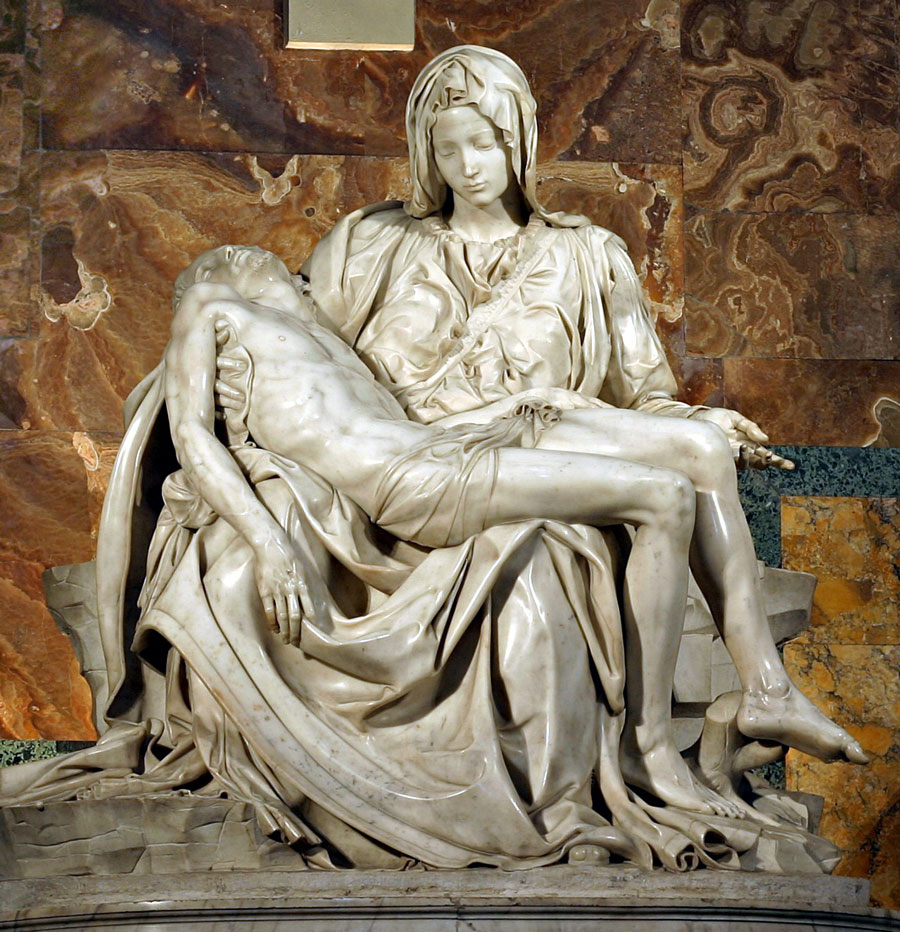
It is why the nude is used for the most profound tragedies in art: the nude Pieta and the Crucifixion, to name two very Christian uses of the nude.

Angels are often drawn as putti, or cupids, in part for their association with innocence.

We look at one of Matthias Grunewald’s tortured crucifixions and cannot help but feel the pain in our own flesh.

In all the greatest art, we are thus drawn out of ourselves and identify with the grace, power, suffering and love of others and come to escape   the isolation — and loneliness — of the ego. We recognize the similarities of all humanity and not its petty differences.

Whatever it means in religious dogma, the Christ is symbolic of our own mortality.

A lot of wind has been spent on the argument over whether there are any universal truths in the world. So many of the old Truths now seem mendacious. But there are two truths that are inescapable. We die, and people we love die. Loss is central to the human experience. It is why Michelangelo’s “Pieta” is meaningful, even for the atheist.

Our recognition of our humanity is one of the highest aims art can attempt.

It is why Rembrandt’s nude portraits of his two wives are so compelling, why Goya’s “Disasters of War” are so frightening.

And not only are the figures in the art thus humanized, but the viewers are as well.