In Genesis 18, when Jehovah was still on speaking terms with humans, He negotiated with Abraham over the fate of the city of Sodom. Jehovah had decided to destroy the place, and all its wicked inhabitants, but Abraham said, “Whoa, there,” and asked, but what if there are 50 righteous men in the city (women apparently didn’t count), will you destroy the righteous along with the wicked? Jehovah paused, perhaps stroking His whiskers. “OK, then, if there are 50 righteous men…”
“But what if there are only 45?” asked Abe. Jehovah pondered. “What if only 30? Or only 10?” The Almighty allowed, most likely in a voice of pique, since He was not accustomed to pushback: “I will not destroy it for the sake of 10.”
(Let the record show that in Genesis 19, Jehovah rained down His fire and brimstone anyway and flattened the cities of the plain, saving only Abraham’s brother, Lot, and Lot’s family. Not quite 10 of them.)
I thought about this haggling between the patriarch and his boss, and I realized that whole thing might apply to YouTube as well. What a sewer of AI slop, ignorant ranting, political bloviating, fanboy nonsense and religious sophistry.
Should we destroy the whole shebang? But what if there are 50 sites that have value? What if only 45? Or 30, or 10?
I have enjoyed YouTube for years, but I have to avoid almost everything offered by my new Almighty Deity: the Algorithm. Most of what It thinks I might find interesting is pointless, useless, misleading, stupid and downright wrong.
But there are a few sites that I go to frequently, either because I learn things from them, or I like the presenter, or they are genuinely entertaining. I thought I’d discuss a few of them and recommend them to likeminded individuals, pace the Algorithm.

THE GREEN BOYS
The brothers Green, elder John and younger Hank, can be said to have justified the existence of YouTube all by their lonesomes. They have contributed to the “reduction in world suck” more than most can have dreamed of.
In 2007, they began posting videos on YouTube as “letters” back and forth, from one brother to the other, mostly twice a week, one from John, in Indiana, to Hank, in Montana, and another from Hank to John. That took off as the Vlog Brothers, and became not just a family news catch-up, but each brother talking about whatever interesting thing had caught their fancy. And they were a very thoughtful pair.
John was an enormously successful author of Young Adult Fiction, and Hank was a budding science explainer. More than that, Hank shot out ideas like a Roman candle, and soon, they started up a host of other YouTube sites. They developed a devoted online following for their endeavors, informally called “nerdfighters.”

Hank and John with the Nerdfighter hand gesture
Nerdfighteria was largely made up of young idealistic people, wanting to make and inhabit a better world. In the Brothers Green, they found two young men who could be non-ironic and sincere without ever becoming sentimental or mawkish (the concomitant sins of earnestness).
They have since become an industry, pumping out scads of entertaining and educational content, and managing to do practical good in the world.
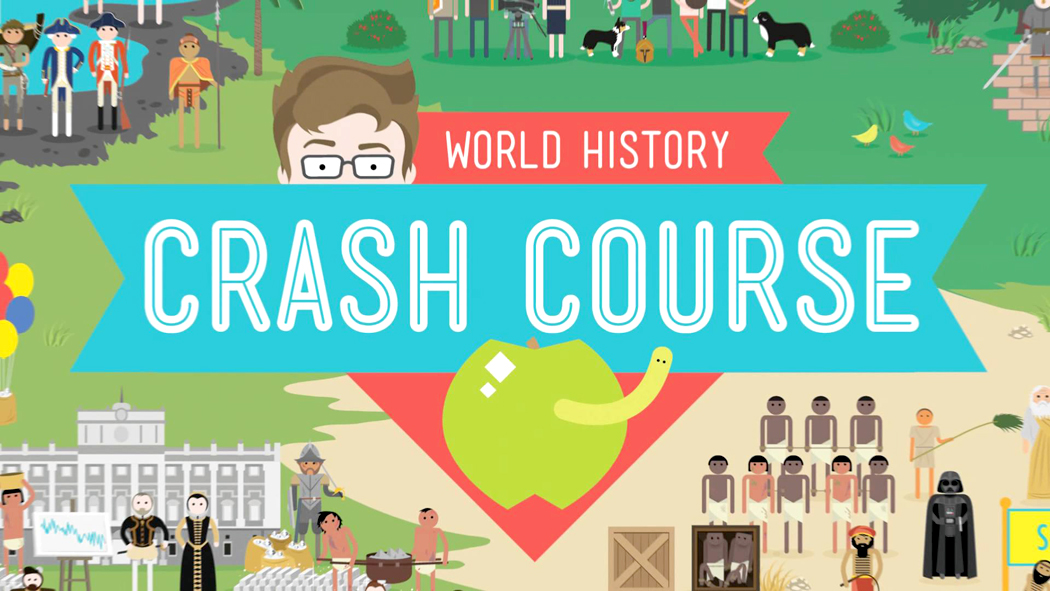
Together, in 2012, they developed Crash Course, a series of educational videos, meant primarily for high school students, that explained episodes of world history, and concepts of biology. Crash Course was eventually picked up by PBS and expanded to series on English literature, U.S. history, chemistry, psychology, anatomy, physiology, astronomy, government and politics, economics, and philosophy. Each series used animation and cleverly written explanations and video to make the major points of the discipline clear and entertaining. Eventually, there were some 50 Crash Course series made. They are commonly used in classrooms across the world.
Parallel to Crash Course came SciShow, a group of series more specifically aimed at science education. There was also The Brain Scoop, with Emily Graslie, which looked at the practical side of science and research; Sexplanations, with Lindsey Doe, about human sexuality; Crash Course Kids, for younger viewers; PBS Eons, a history of life on earth; The Art Assignment, with Sarah Urist Green (John’s museum curator wife); and my favorite, Journey to the Microcosmos, in which Hank Green narrates microphotographic video footage of protozoan life, one of the most hauntingly beautiful and hypnotic series on YouTube.

(It should be mentioned that Hank Green has also performed and recorded five albums of his own music, written two science fiction novels, performed a stand-up comedy show, and created Focus Friend, an app designed to temporarily block other apps, to allow easily distracted people to focus on the task at hand — an app named “App of the Year” in 2025. He has also devised a series of fund-raising not-for-profit businesses, selling everything from designer socks to artisanal coffees. The man is a dynamo.)

Hank Green’s “Hanklerfish” logo — “Don’t Forget To Be Awesome”
The brothers set up a not-for-profit company, called Complexly, to oversee all their projects, including over 10,000 videos and has built a substantial audience on YouTube, with more than 32 million subscribers and 55 million views per month. It collaborates with institutions and organizations such as PBS, Arizona State University, the National Science Foundation, and The Poetry Foundation to expand its reach and, according to industry sources, as of July, 2026, Complexly employs 134 people.
Meanwhile, directed by the brothers, Nerdfighteria has raised millions for philanthropic causes, including some $50 million toward the construction of the first maternity hospital in Sierra Leone, which opened earlier this year. That country had the highest infant mortality rate in the world, but that rate has now been halved.
There are other fundraising and charitable organizations the Green boys have created, including the annual Project for Awesome event, that has, since 2010, raised more than $30 million for various charities, under its parent organization, The Foundation to Decrease World Suck.

And there’s Pizzamas, a two week event each September when Nerdfighter merch is sold and the receipts given to various charities. (The insignia for Pizzamas is a shirt with the image of John with his ill-advised — and temporary — mustache.)
John also led a Nerdfighter campaign to persuade pharmaceutical company Johnson & Johnson to allow generic versions of the tuberculosis drug bedaquiline to be produced, for sale in countries with high TB rates, making it cheaper for poor countries. (He also wrote a best-selling book, Everything is Tuberculosis, about the history and epidemiology of the disease. A best-seller — did I mention that?)

When they started online, their target viewership was ages 13 to 30, but both brothers are now in their 40s, and perhaps their fans have aged along with them, but younger audiences have continued to sign on. Their attitude and vocabulary skews young, but I’m 78, and I’m hooked.
I’ve only skirted the bounds of Nerdfighteria. There are also the podcasts, and the books (and the films made from John’s books). When I say they are an industry, I am not exaggerating.

Journey to the Microcosmos
BUT WAIT — THERE’S MORE
There is no end to YouTube videos. Most are of limited interest, at least to me. But there are a bunch I regularly check out when they post new entries. These are not all of them, but a recommended sample.

DAVID HURWITZ
The Green brothers are frighteningly prolific, but David Hurwitz is no slouch, producing an average of three new videos every day. He is a classical music critic and editor of the online magazine Classics Today.
His videos are uniformly produced, as he sits at his desk in front of shelves and shelves of CDs, occasionally interrupted by his cats, and he talks about classical music recordings, both historical and current. He is lively and engaged. I have thousands of CDs on my shelves, but his must number in the hundreds of thousands, and he seems to have instant recall for all of them.
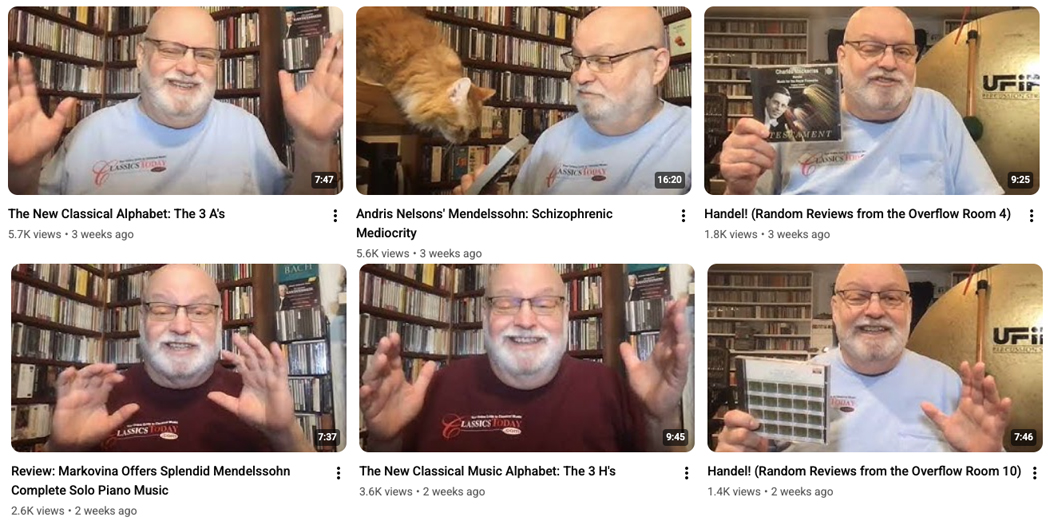
I find myself simpatico with most of his taste, although he has a few blind spots and undeserving enthusiasms. He can’t mention Lalo’s Symphonie Espagnole without making a retching noise, and it seems anything conductor Charles Mackerras records is perfection personified. And he will tell you, for every performance, whether the tam-tam has been featured properly. At times his uninflected enthusiasms remind me of the old radio host DeKoven. (How many are old enough to remember him?)
Classical music may be a niche subject for most Americans, but for those of us who have been listening to our Beethoven and Bartok for 60 years, Hurwitz is a joy. I watch him daily on the iPad while eating my breakfast.
MAP MEN
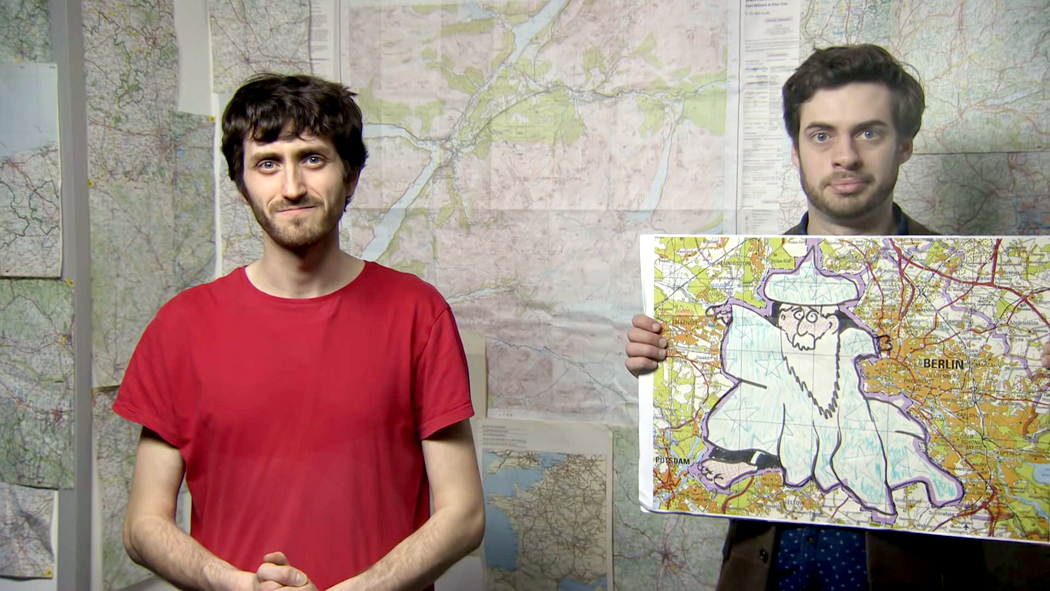
The Map Men is a British video channel and is either an educational channel that is comic, or a pair of comedians talking about geography. And it is very funny. I mean laugh-out-loud funny.
In it Jay Foreman and Mark Cooper-Jones dress up in costumes, add animations, write songs, and generally act out their themes with one-liners, sight gags, puns, and the ear-worm theme song: “Map Men Map Men Map Map Map Men Men.”

They take on such subjects as how many countries are there in the world (it is not an easy answer); why is north at the top of the maps; why the Netherlands is 17 percent fake; what makes a city versus a town in England.
Many YouTube sites are sponsored, and their makers interrupt their bits to sell you Incogni or Skillshare, but Jay and Mark make their ads just as entertaining as their regular content, so you never are tempted to fast forward through them.
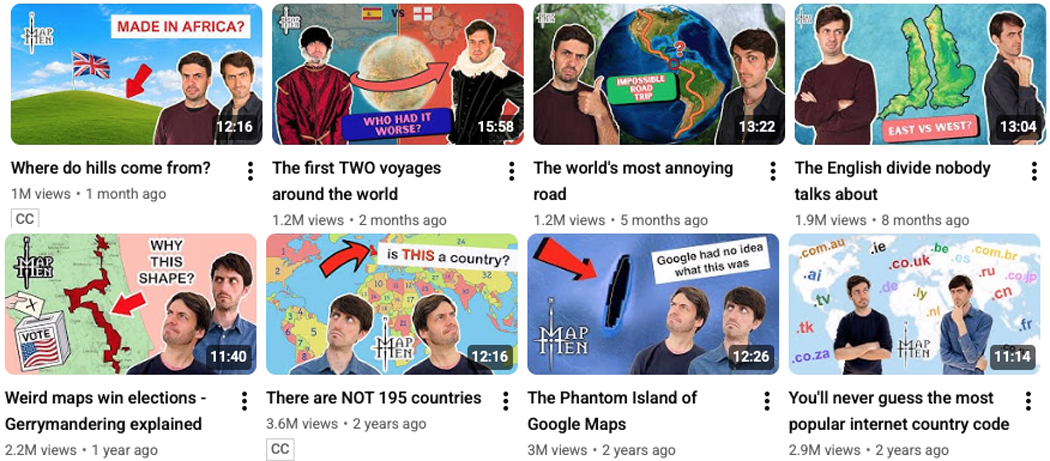
Their most recent video is from March this year and talks about the first geological map of England and the madman who created it and published it in 1799.
ROB WATTS
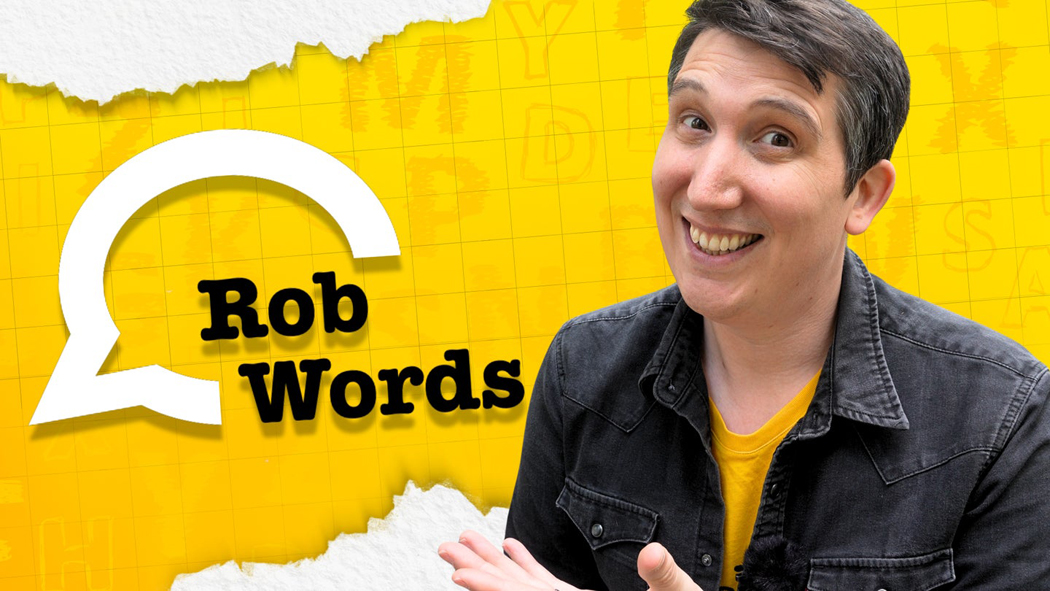
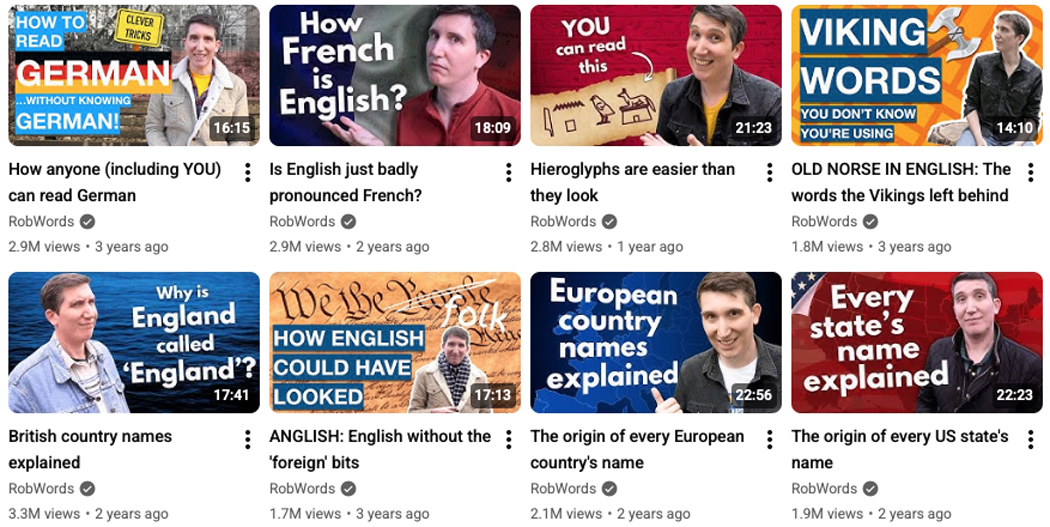
There are a host of language channels on YouTube. I tend to watch them all, but Robwords is probably my favorite. Rob Watts is described by his book publisher, Penguin, as creator of “the world’s most-followed channel for the dissemination on intriguing if vaguely pointless facts about the English language.”
Born English, he now lives in Germany and is a newsreader for Deutsche Welle, but he makes this YouTube channel about etymology, alphabets, language culture, and the odd bits of speech and print. Watts is personable, good humored without entering into stand-up territory, and well researched.
He also takes part in a second YT channel, Words Unravelled, with an American counterpart Jess Zafarris, but I can’t bear watching it, as they are both too awfully bubbly and giddy, and Jess has an annoying vocal fry.
I also frequently watch Taylor Jones, whose Language Jones site sometimes gets too polemical for my bland taste, and Geoff Lindsey, at drgeofflindsey, which is more academic and often quite technical. But I learn a lot.

J.J. McCULLOUGH
McCullough was originally a political columnist, a Canadian conservative, but way too outlandish for any stateside version of that. With his towering hair and his weaving and bouncy body language, his primary concern on his videos is popular culture, of which he is a voracious consumer and thoughtful analyst.
His videos are fast, energetically edited, with lots of quick cuts to referenced material. Occasionally, he talks about Canadian politics, which are opaque to his southern neighbors, but mostly it is American pop culture — not just movies and TV, but toys, comics, advertising, packaging, fashion, architecture and design. He has wide interests and has insightful things to say.

Some may find his vocal delivery annoying, as he pauses and speeds up in a kind of herky-jerky speech rhythm as his head bobs to and fro. But, he is just fun to watch.

BEKAH HARDING
A Brush with Bekah is a YouTube channel where (usually) purple-haired Bekah explores rare, historically forgotten, often toxic, sometimes radioactive pigments, and finds sources for them, and makes her own paints from them. She also discusses art history, and sometimes just has a political rant she needs to get off her chest.
One such is titled “I Hate Picasso and You Should Too.” But most run toward “Making paint from Bugs,” “The dark history of mummy brown,” and “Science is changing the color of dinosaurs.”

Sometimes she shows up as blond, sometimes a redhead, most often when not purple, her hair is black. And she wears punk or emo eye makeup. But she is clearly very smart, her research is thorough, and she has taught me a lot, not just about color, but more importantly, about pigment.

MYSTERY
Whoever is behind the Moviewise site wants to remain anonymous. I can’t find him anywhere. But he produces some of the best, most insightful videos about the technical side of movies that I’ve come across. His narrative accent sounds very like that of Ernie Kovacs, but he has been cagey about where his roots are. Perhaps his family was also Hungarian? I dunno. Perhaps they just share the same adenoids.
But if you want to see clips explaining the secrets of cinematic blocking, or expressive lighting or camera movement, he will have them to show, and take you through them almost frame by frame.

He says, “I defend that, regardless of artistic intent or personal interpretation or cultural influence, there are objective aspects in stories and visuals that make movies succeed or fail, and by examining shots and screenplays we can find out what they are.”
I wait, champing at the bit, for each new installment. This is not a site about the great humanistic side of film history, but about how those films were constructed.

Geoff Lindsey videos
WHAT ELSE
What any one person watches is a microscopic mote of dust in the forgotten corner of the room, compared with what is proffered. According to Wikipedia, even in 2019, videos were being uploaded to the platform at an inconceivable rate — 500 hours every minute, and estimates of the total number on the platform range from 15 billion to 40 billion.
And so much of that is unwatchable — I don’t mean you can’t find them if you look, but such bad quality you can’t bring yourself to do it. Bad sound, bad editing, bad camerawork. And add into that all the political huff and chuff, and all the misinformation, all the conspiracy theories, all the fanboy rot, and cat videos, you could be excused for giving up.
So, we rely on the newest deity, the Algorithm, to choose for us. And there are some worthy spots that leak through. These have been some for me.

Captain Steeeve
Dan McClellan deals with biblical matters in a scholarly way, and debunks quite a bit of blather. Retired commercial pilot Steve Scheibner talks about aviation on the Captain Steeeve site (somehow, although he is 15 years younger than me, he still sounds more like my father than anyone — including the dad jokes).

Rick Beato
Rick Beato is mainly about pop music, but has genuinely intelligent things to say about the notes and their structure, and not just, as most pop music critics do, the lyrics. Simon Whistler hosts a variety of videos on various channels. He’s more script-reader than writer, and some people are put off by what seems like a streak of careerism in him, but there is a lot to learn from the videos he hosts.

Tom Scott
And one of the oldest continuous contributors has to be Tom Scott, who has been posting informative videos on odd topics since 2004, and on YouTube since 2014. He has a ranging curiosity, and his videos look to find answers to questions of geography, history, science, language, technology.

He has created more than 900 videos and has 6.5 million subscribers with over 1.7 views. In 2024, he decided he was exhausted and stopped making videos, but now, he’s back again and at it once more. His genial way and genuine engagement always make him worth watching.
I’ve mentioned a few sites that I have enjoyed. They cover things I am interested in. But there are worthy sites for other interests, whether astronomy, railroads, antiques, literature, insects, pick-a-subject. But you have to plod through the weeds to find them.
So, perhaps we won’t rain down fire and brimstone upon YouTube, but we are still better off avoiding the dreck.
Click any image to enlarge