Archive

Tag Archives: art history

gauguin

Are the arts important?

It is the question at the bottom of the debate over public funding, and a lot of hooey has been written on the subject, from both sides of the issue.

Yet, the question remains. Is art important, or is it merely one of the frills of life? Is it more than the amusement of the rich people who can afford to buy it or attend its performances? Does it serve some essential function in our lives?

The answers usually provided are too often soft and squishy, with a lot of feel-good oohing-and-aahing alternating with benign platitudes.

All of which miss the point.

There are three major things that art provides that we can ill afford to do without. They have nothing to do with ”identity,” ”self-expression” or ”healing,” or any of the pop-oriented, new age or parochial apologies being given in the discussion.

No, what art does is as fundamental as language. Far from being an ornament, it is the foundation of culture.

Put another way, civilization doesn’t make art, art makes civilization.

How does it do this?

First, art asks, ”What is real?” It is the first line of investigation into what is true. Art is the acid test we give our assumptions about reality to find if they are gold or lead.

If science is the test we give to hard fact, art is the test we give to everything else.

Second, it gives us a way out of the isolation of our egos. The greatest art forces us to sympathize and empathize with others and enlarge ourselves and our moral compass in the process.

And third — and least familiar and most difficult to understand — it asks, ”What is the meaning and purpose of structure?” This last has unforseen ramifications.

They may be summed up in Paul Gauguin’s famous painting from Tahiti: Where Did We Come From? What Are We? Where Are We Going? Those three questions give us a clue about why art is important, why it isn’t merely window dressing.

When we ask, ”Where did we come from?” we are asking what is the ground of reality.

When we ask, ”What are we?” we are asking about those things that make us most human.

And when we ask ”Where are we going?” we are asking how art might show us the possibilities for making a life.

Let’s look at them one at a time.

ART AND REALITY

When art addresses reality, it does so on several levels.

On the simplest, it attempts to find out what the world looks like. That may seem unnecessary at first, but it isn’t as easy as it sounds.

We must learn to see, not only as individuals, but as a culture. And art is our most important teacher.

We could be taught to see other than as we do.

It is through art as a mediator and not through direct perception that you come to recognize the world. This is a fact we are almost always blind to. We see it no more than we see the retina on which the image is formed. durer

It was a heroic thing for those Renaissance artists who worked out the mathematics of perspective. They were grappling with reality; they were wrestling with an angel.

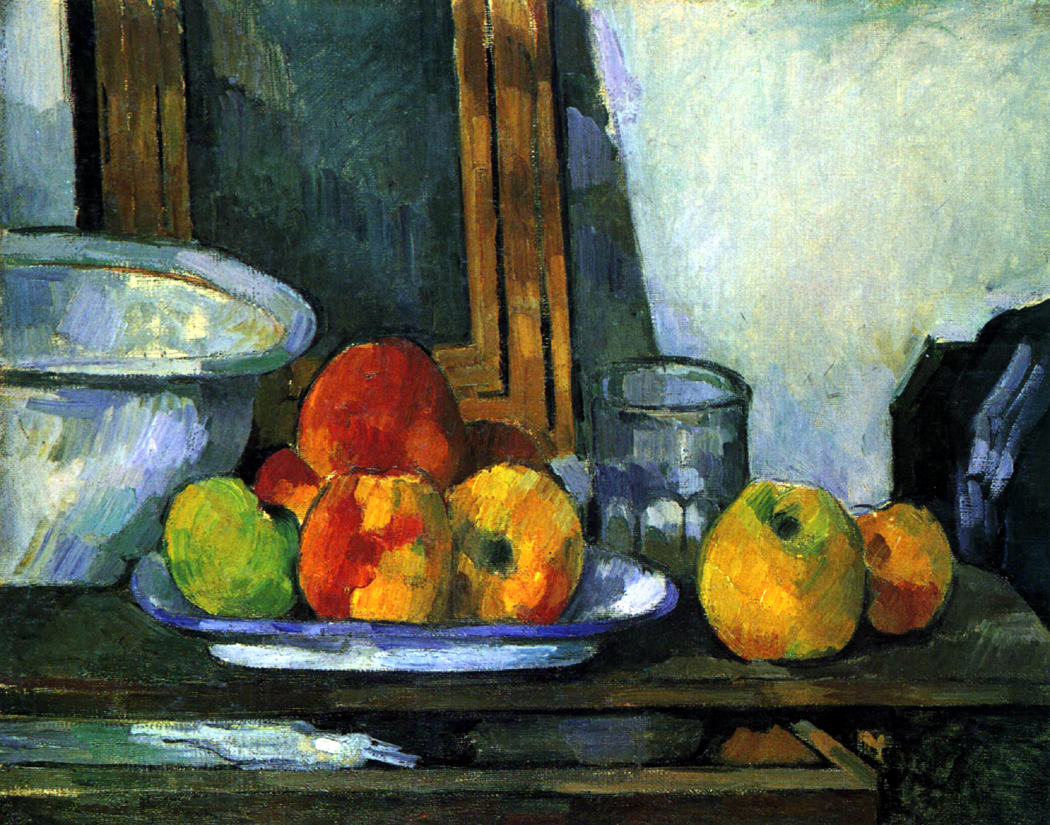
In some sense, every artist does that when he sets up a bowl of fruit and begins drawing, trying to stare that stubborn reality into submission.

But reality isn’t only about what we see. It is the question of what we feel and believe as a people. So theater and novels investigate the nature of justice or love or violence. In each case, the artist or playwright is creating a model of the world — a virtual reality — that we must come to accept or reject.

It is also important to recognize that every one of these artistic answers is provisional, and each is modified or rejected by succeeding generations. All reality is a working hypothesis.

To those who see art only as surface, the history of art is a history of changing styles. To those who look beneath the surface, style is irrelevant, nothing but distraction. The changes are not mere fashion but result from the constant testing of art against reality and back.

ART AND EGO

The second issue of art is just as important. Too many of us live our lives in the prison of our own egos.

We know what we have experienced but not what others have experienced. We trust our reality but no one else’s.

Art gives us a way out of this prison, by presenting us with other worlds, other realities, deeper emotions and more profound thoughts.

It is the reach of imagination that allows us to grow beyond ourselves and feel those emotions.

Art forces open those prison doors and sends us out into the light of day, where we must learn and feel what it is like to be Madame Bovary, Henry V or Shakuntala.

Art gives us a way of escaping the happenstance of history and birth for a chance at a more comprehensive, more universal understanding. We grow in worth as human beings.

For the great moral lessons, one turns to Aeschylus’ Persians, Sophocles’ Oedipus, Dostoevsky’s Aloysha or James Baldwin’s Beale Street.

It is doubtful whether, without the powerful emotions of pity and love, we would ever be able to create a civilization worth living in.

ART AND STRUCTURE

The third issue is more subtle and difficult.

We understand the things of this world not merely as an accumulation of unrelated facts, but as system. We see not leaves and sticks, but trees.

What we understand in that instance is structure — the ”big picture.” It is the glue that holds together our perception.

That structure doesn’t appear out of nowhere; it has its roots deep in the human psychology. It is the archetype of Jung, the mothers of Goethe, the poetic imagination of Blake. It is the central core of comprehensibility. We measure all things against it, whether we recognize it or not.

A good story isn’t just a collection of episodes, but episodes with a certain shape to them: a beginning, middle and end.

The structure of a story is every bit as important as its content.

Imagine two newspaper stories about the same train wreck. One is a cluttered assemblage of facts, in no particular order; the other is a well-told story with direction and emphasis. Each contains the identical facts, but the second can be read and remembered. The first is fact confetti. We cannot even read it; it makes no sense.

The only difference between them is the structure.

MYTHOLOGY OF CULTURE 

We can take the same structure and apply it so some other news event. The facts may change, but the import of the story remains the same. We see it over and over in newspapers: the child in peril, the senseless killing, the arbitrary natural disaster. Each is a structure of story that we fill in with the facts of the case. Each 40-car pileup is identical, except to those involved.

Each of these stories is a small myth in the larger mythology of our culture.

We think of myth as being a story that isn’t true, but the truth or falsity of a myth is irrelevant. All that matters is its persuasiveness.

The artist recognizes this fact and uses it in his art, working the changes on the myths and archetypes.

What makes this important is that we all use these myths — recognized or not — to give meaning to our lives. We live out our roles as father, mother, hero, victim, lover, loyal friend, all following the internalized archetype we have either learned or been born with.

Art, literature, theater, dance, music, provide models for us, so we may know how to make a life.

Like ritual, they show us the steps to the dance, and the steps are structure.

EMPATHETIC COMMUNICATION 

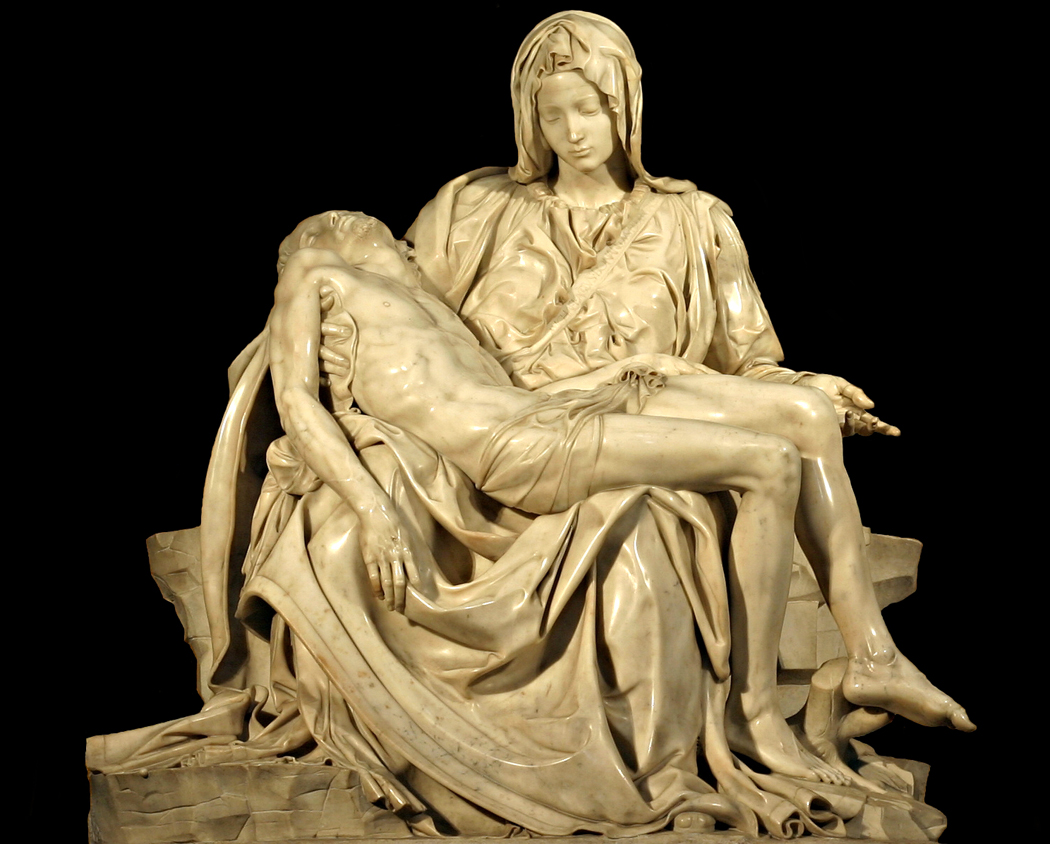
Take Michelangelo’s Pieta.

It is on one level an attempt to make a statue as lifelike as possible, with poses and emotions as true to their condition as possible. On that level, Michelangelo is exploring the reality of surfaces.

But we don’t look at the grieving Virgin and the dead Jesus as a test of what reality looks like or of what we would do in the same situation. pieta

We feel the emotions of the Virgin almost telepathically. It becomes possible to know what it is like to lose a child, lose a part of your own flesh. Even if we have lived the most sheltered and protected life, we cannot avoid coming to know at least a little about the experience of tragedy, and we are made bigger by it.

It is a work of profound human emotion, and you needn’t be a Christian to feel it.

But Mary is also the archetype of the mother, and Jesus is the archetype of all of us who know we will eventually die. We are given a role in the cosmic drama and the means of playing it with dignity.

The very greatest art, from James Joyce’s Ulysses to Wagner’s Ring Cycle to the Mahabharata does this for us.

A DIGRESSION

Stories have a narrative content, but they have a structure, too, or they would fall apart.

Is it possible to write a story with the structure alone, with no facts to plug in?

That is in essence the direction of what we call Modern Art.

In the Renaissance, a painting was metaphorically a window through which we looked at the virtual reality presented. The paint resting on the canvas was intended to be rendered invisible, like glass.

But in Modern Art, we are meant to look not through the window, but at it. The paint, the brushes’ marks, the canvas, the colors up against each other: They are the very point of the art.

At its most heroic, Modern Art attempts to put us in contact directly with reality and with our emotions, unrelated to mere narrative event. That is the effect of Kandinsky or Pollock or Rothko.

But we have spent nearly a century investigating that level of reality and it has gotten a little moldy with use.

It is now the job of Postmodernism to write with its finger in that now-dusty window, ”Wash Me.” triptych

Yet, that layer of structure, unrelated to fact, remains in art, as it always has. Sometimes art uses it to give meaning to our lives without our knowing it, sometimes art points its arrow at the structure and says, notice it and enjoy it.

Without structure, there is no meaning, and art gives meaning to life.

Waterlily pond at Giverny

Waterlily pond at Giverny

When Claude Oscar Monet arrived at his new home in the spring of 1883, he had to borrow money to pay the rent.

The sturdy burger with the black Babylonian beard, smoker of strong cigarettes and painter of soft paintings was broke. He was one of many Frenchmen still suffering from the economic depression that had hit 10 years earlier and reduced the demand for paintings — among other things. Unable to sell his work, Monet had trouble feeding the mouths that depended on him.

For when he moved into the great barn of a house in Giverny, some 40 miles northwest of Paris, he didn’t come alone. He came equipped with his two sons, his companion, Alice Hoschede, and her six children. The youngest was only 5. They soon added a half-dozen servants.

The painter lived in his pink and green house in Giverny, along with his alternately growing and shrinking family, for the next 43 years, producing the body of work for which he is best known, a body of work that cannot be separated from the home he lived in.

That home served not only to shelter him, but to inspire him. The house and its surrounding gardens became, as he got older, the only thing he painted.


House at Giverny

House at Giverny

COMFORTABLY MIDDLE CLASS

Monet was born in 1840 in Paris and moved to Le Havre when he was 5 years old, and grew up there in comfortable middle-class surroundings. When he was a teenager, he decided he wanted to be an artist, began his studies and finally set up as a painter along with a ”brat pack” of his buddies, all of whom challenged the status quo in the French art world of the 1860s.

They later were called Impressionists and among their number was Renoir, Pissarro, Degas, Caillebotte, Sisley and Berthe Morisot.

They were beginning to achieve success when a double-headed ax fell on their careers. First, there was the Franco-Prussian War of 1870-71, and then the bank crash in 1873.

By 1880, things had improved, but Monet had to start from scratch building his career. He was lucky in that he had Paul Durand-Ruel as his dealer. Durand-Ruel was a saint among dealers and regularly advanced Monet money on paintings he hadn’t painted yet.

That is how he managed to pay the annual rent on the 2 acres of land with the house and outbuildings.

The bank crash had brought him Alice, too. Originally the wife of one of his benefactors, Ernest Hoschede, who had commissioned paintings and decorations from Monet, she gravitated to the painter when her husband fell bankrupt and abandoned his family.

At first, Alice and her six children lived with Monet and his wife, Camille, and their two boys in the town of Vetheuil. But Camille died in 1879 and Monet and Alice set up house together quickly after that.

It was one of the great partnerships in art, a perfect match between people, one intemperate and moody, the other steady and gracious, with all the tact the painter himself lacked.


Punt at waterlily pond

Punt at waterlily pond

ON THE BANKS OF THE SEINE 

Giverny was not more than a village, with fewer than 300 residents, when they moved there. It sat on the north bank of the Seine River in the angle where the Epte joins it, on a slightly rising bank above the river and below the wooded hills that rose behind.

Monet’s new home sat near the edge of town between the two main roads. The house itself was a monster of an old farmhouse, looking something more like a warehouse than a home. On one end was a barn that Monet turned into his studio. The building was covered in a pinkish stucco that Monet made pinker, with gray shutters that Monet painted green.

The yard that came with the house had an old orchard in it and room for the gardens that Monet planned. Within a few years, the grounds were overgrown with the many flowers and trees Monet planted.

And life began slowly to improve for the Monet-Hoschede family. At a time when a common laborer made about 10,000 francs a year, Monet was selling his canvases for 12,000 francs each. By 1888, Monet was making 100,000 francs a year.

He spent it lavishly, building studios and greenhouses, adding to the house, improving the garden.

”Everything I have earned has gone into these gardens,” he wrote.

And when his lease ran out in 1890, he had no trouble buying the house and grounds for 22,000 francs, payable over four years.

In 1893, he bought an adjacent lot, on the other side of the railroad tracks that bordered his property, and began making a pond to grow waterlilies.


Japanese bridge at Giverny

Japanese bridge at Giverny

AN EARLY RISER 

Monet’s life in Giverny turned into an ordered process of days, not only as the seasons progressed through the year, but even as the day progressed.

He got up early, between 5 and 6 in the morning, took a cold bath and ate a big breakfast, often an ”English” breakfast of bacon and eggs. From then until midday dinner, held promptly at 11:30 a.m. every day, he painted. He carried his canvases with him, often working on more than one, passing from canvas to canvas as the light changed with the hour.

He would sit out in the sun in his tweed suit and pleated shirt wearing a broad-brimmed old hat and smoking his stinky Caporal Rose cigarettes.

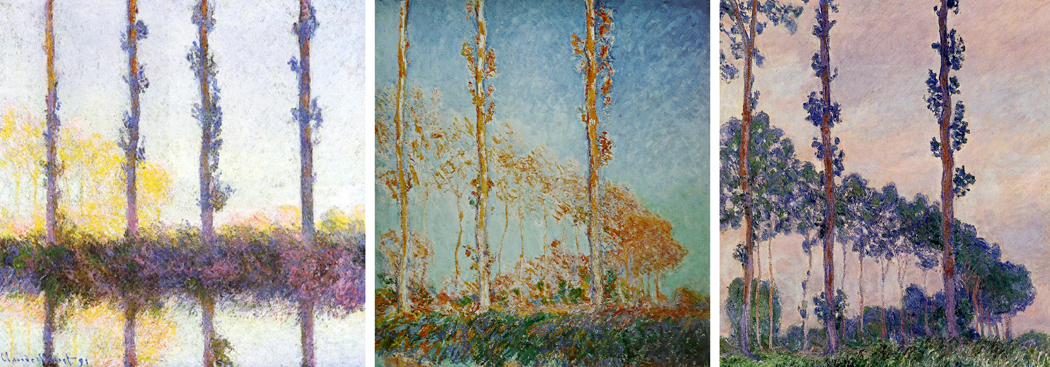
Monet had begun working in series, attempting to catch the evanescent effects of light as they flew by. A series of haystacks was followed by a series of poplar trees, each showing what their subject looked like at dawn, early morning, late morning, midday, afternoon and evening. As the sun changed, he changed canvases.

Monet poplars series

His critics complained that he was just trying to sell the same painting many times over. But Monet showed a dogged determination to make these series.

When the land with the poplars was sold, Monet paid the new owner not to cut down the trees until he was finished painting them.

Lunch was the major social event of the day. When Monet had visitors — which was often, more often than he sometimes wanted — they did their visiting at midday.

The afternoon was given over to painting once again, followed by a small supper at 7, and for Monet, bed by 9:30. He was notoriously bearish if this schedule wasn’t kept precisely.

So that, when his son-in-law, who was a slow eater, visited, Monet gave orders to the servants that no seconds should be offered.

And the painter could get out in the field with his canvases and brushes on time.
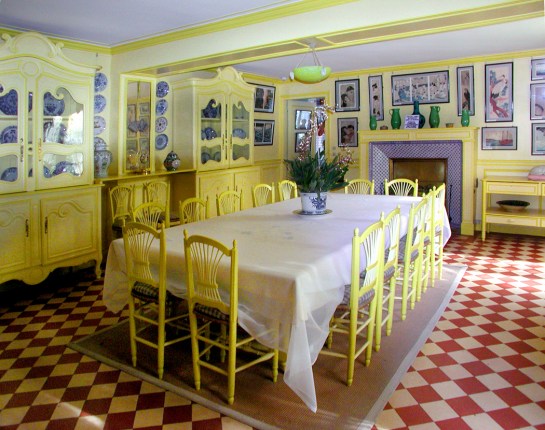
 

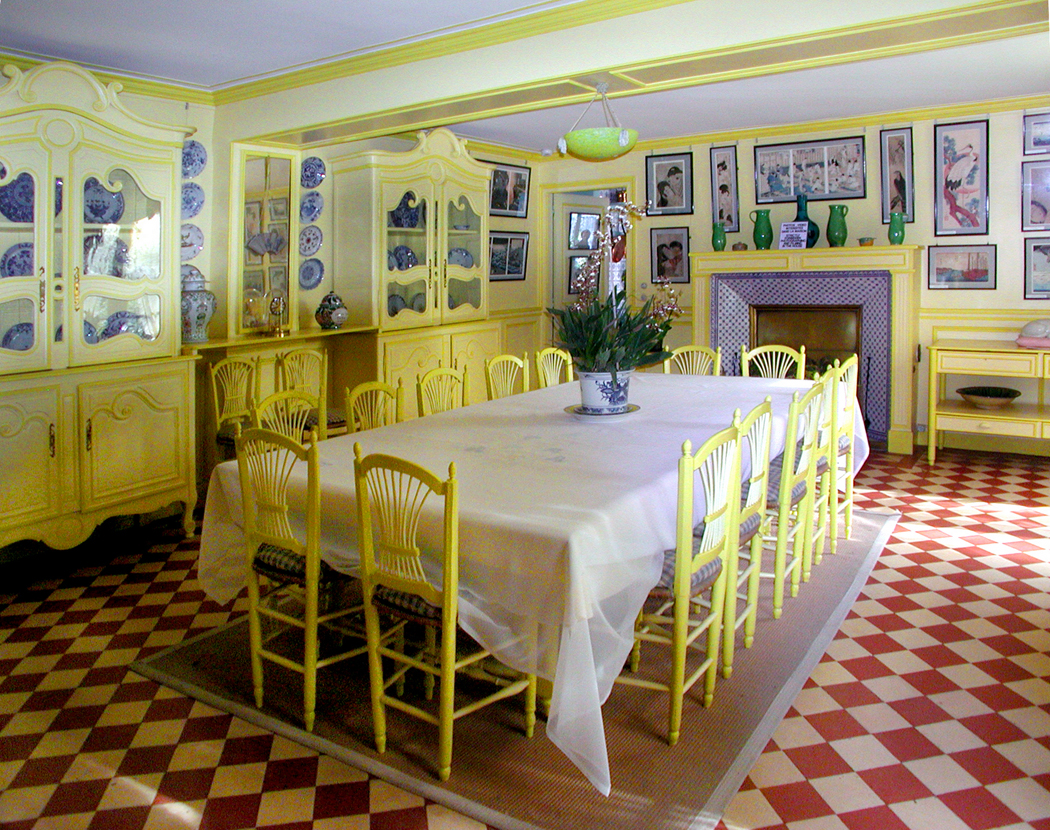
Dining room at Giverny

Dining room at Giverny

THE GOLDEN YEARS 

The 20 years after he moved to Giverny were the best of his life. His prices kept rising, he painted happily and productively through the year, taking time most years for an extended trip. One year, he went to Venice, another to Norway.

In 1892, after Ernest Hoschede’s death, Monet and Alice got married. The following year, he built his first water garden. In 1897, his son, Jean, married Alice’s daughter Blanche. Monet’s solo exhibitions regularly sold out.

The only troubles he had were in getting the municipal cooperation on improving his pond. Local residents were concerned that Monet’s plan to divert water from the Ru River, actually little more than a brook, would affect their crops and cattle grazing, but some help from the mayor swayed them and the permits were issued.

Alice’s daughter Suzanne married the American painter Theodore Butler and another daughter, Germaine, married a businessman from Monaco. The marriages soon brought four grandchildren to the family.

Meanwhile, Monet added more acreage to his holdings, including the ”Maison bleu” — the ”Blue House” — in the middle of town, where he installed a gardener named Florimond to cultivate his kitchen garden, which supplied the family with vegetables for their elaborate menus.

At one point, he employed six gardeners alone, along with a cook named Marguerite, a butler and valet named Paul, who was Marguerite’s husband, a maid named Delphine and a combination chauffeur and wine steward named Sylvain.

He needed the chauffeur because, although he owned automobile after fancy automobile — fast cars were a passion, along with watching auto racing — he never learned to drive.

The family also owned four boats, which they moored on the Seine, including the one boat Monet had fitted out as a floating studio. Monet often was accompanied on his painting forays by his step-daughter Blanche, also a painter, and they shared space on the boat.

Once a month, Monet retreated to Paris to have dinner with his circle of artist friends. He and Alice would take in the latest theater, see the gallery shows, and attend concerts.

Or watch wrestling — a particular favorite of the otherwise demure Alice.
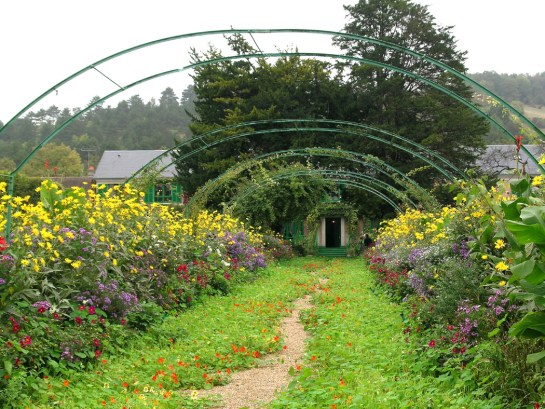
 

Clos Normand

Clos Normand

A DISTRESSING UNDERTOW

Yet underneath the comfortable bourgeois existence of the increasingly wealthy painter was a distressing undertow. If Monet made paintings that soothed — he once called them a ”refuge for a peaceful meditation” — perhaps it was because he had a better than passing acquaintance with death and loss.

His mother had died when he was 18. Friends had died in the war. His wife, Camille, had died in 1879 after three years of lingering illness. The very month he moved into Giverny, his mentor, Edouard Manet, had died and Monet had served as pallbearer.

The early years at Giverny had proved a reprieve, but as Monet’s once black beard turned into a vast white haystack on his chest, time caught up with him.
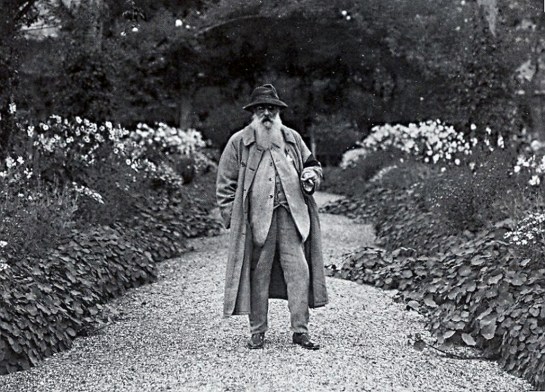
Monet in the garden

In 1894, Suzanne developed a paralysis and five years later, she died. Alice went into a depression from which she never fully recovered.

”Our beloved Suzanne died last night,” Monet wrote Durand-Ruel, ”while her poor mother was in bed with a bad case of bronchitis which she caught the other day at Moret. One sorrow after another.”

Around him, his colleagues began dying, too. Caillebotte — a particular friend — had died in 1894. Alfred Sisley died only a week before Suzanne.

Pissarro died in 1903; Cezanne in 1906. By 1917, Rodin and Degas were dead, along with Monet’s friend, the playwright Mirbeau. And in 1919, Renoir died.

Part of this was the natural result of living a very long life. But there were special sorrows for Monet.

A flood destroyed his lily pond and large portions of his gardens in 1910. It took several years to rebuild.

In 1911, Alice died after a long illness. Monet entered a deep depression that prevented his painting for some time.

In 1914, his son, Jean, died. Jean’s widow, Blanche, returned to Giverny and served Monet as hostess and housekeeper.

And the outbreak of World War I weighed heavily on the painter.

”I’m back at work,” he wrote. ”It is still the best way of not thinking about present sorrows, although I’m rather ashamed of thinking about little researches into forms and colors while so many suffer and die for us.”


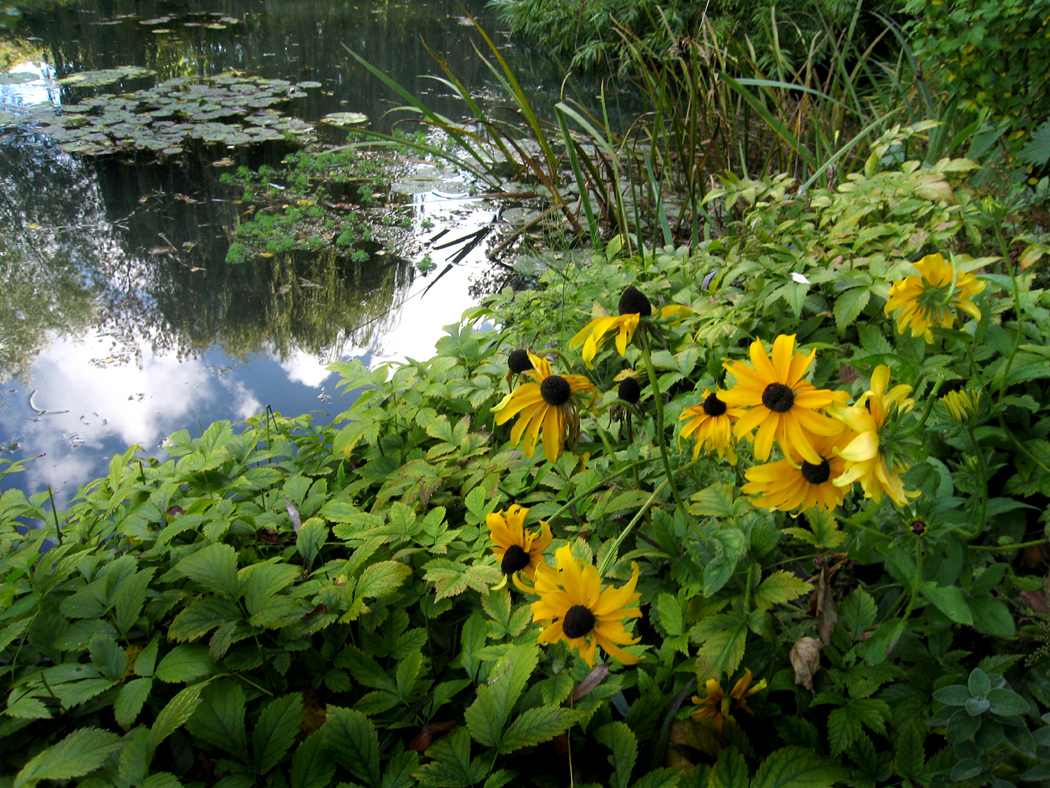
Pond edge, Giverny

Pond edge, Giverny


FAILING EYESIGHT

There was another sorrow for Monet, one that threatened his very identity as a painter.

Beginning at the turn of the century, Monet’s eyes, which had bothered him since his youth, began to develop thick cataracts that interfered with his vision.

He painted through them, but friends and critics noticed a change in the paintings, which sometimes seemed oddly colored.

”I’m working very hard and I would like to paint everything before I cannot see anymore,” he wrote Durand-Ruel.

The condition worsened and relented over the years, but by 1922, his eye doctor reported that Monet’s vision was reduced to ”one-tenth in the left eye and to perception of light with good projection in the right eye.”

Monet continued painting, sometimes knowing what color he used only by reading the label on the tube of paint.

”I could paint almost blind,” he told a visiting journalist, ”as Beethoven composed completely deaf.”

The operation his doctor recommended on his right eye helped things in 1923, but resulted in a peculiar condition called ”xanthopsia,” which caused him to see everything too yellow. When this condition abated, it resulted in its opposite, in which Monet saw everything as too blue.

”It’s disgusting, I see everything in blue,” Monet complained to a visiting professor.

”How do you know it’s blue?” the visitor asked.

”By the tubes of paint I choose.”

His ophthalmologist finally found a pair of tinted glasses that brought his vision back to something approaching normal, and Monet painted like a demon.

In 1925, he wrote, ”My vision has improved tremendously. I am working harder than ever, I am pleased with what I do, and if the new glasses are better still, I would like to live to be a hundred.”


Orangerie, Paris

Orangerie, Paris

A FINAL GIFT

He didn’t make it to a hundred, but the final years were spent on a vast project of painting the waterlilies in his water garden.

Conceived as a gift to France, he worked in increasingly larger formats, finally building a new studio to house the 8-foot-tall, 12-foot-long segments of the murals he was painting.

”These ‘water and reflection’ landscapes have become an obsession,” he wrote the journalist Gustave Geffroy in 1908. ”They’re too much for an old man’s strength, yet I should like to be able to reproduce what I feel.”

He destroyed paintings he didn’t think up to his standards. At one point, he wrote Durand-Ruel, ”I have five or six at most that merit consideration, and have just, to my great satisfaction, destroyed at least 30.”

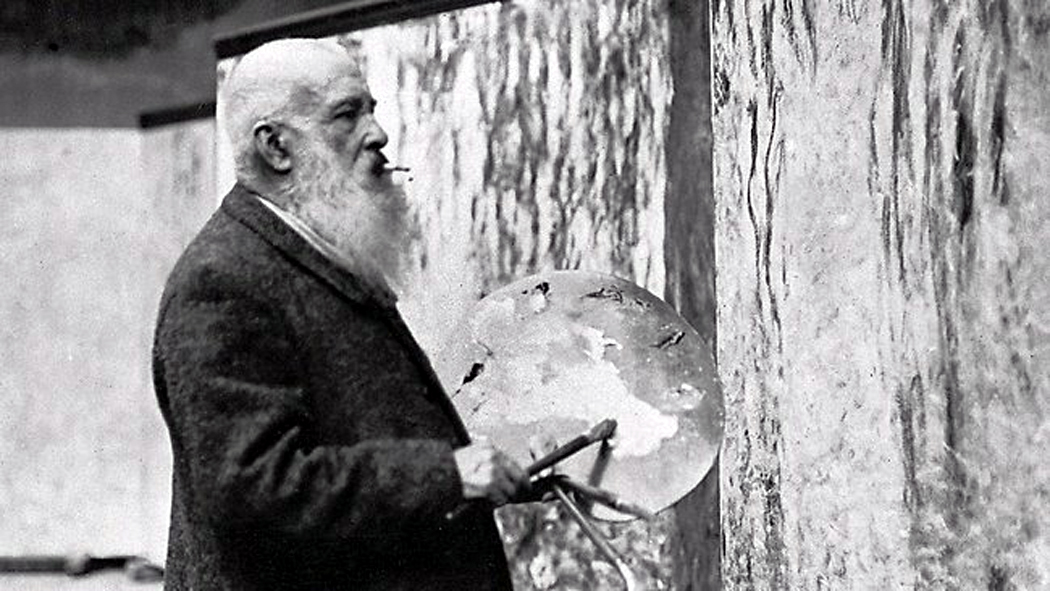
The large waterlilies marked a significant change in Monet’s approach. In the past, he had been rigorous in painting outdoors, directly from life. But for these ”decorations,” as he called them, he worked inside, in his studio, from his imagination.
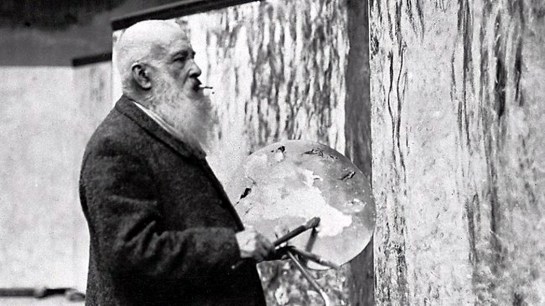
Monet at canvas

That underlined not just a change in technique, but in the basic purpose of his painting. What had been an attempt to reproduce an accurate record of what his eye saw became an involvement in what paint can do and mean.

Pablo Picasso had painted his first Cubist painting in 1906 and the winds of Modernism were blowing the old smoke out of the room. Monet caught the fresh air and enthusiastically took part in the change. The late waterlilies are no longer Impressionism; they are modern art.

”I am looking for something I have not done before, a shiver my painting has not yet given,” he wrote.

In 1926, a lifetime of smoking cigarettes caught up with Monet. By late summer, he was bedridden with pulmonary sclerosis. His eyesight had deteriorated; he no longer could paint. He died on Dec. 5 with his family around him.

The following year, his waterlily decorations were installed at the Musee de l’Orangerie in Paris.

As for his beloved home, it stayed in the family, eventually abandoned in World War II. But in 1957, Monet’s surviving son, Michel, donated the deteriorating property to the Academie des Beaux-Arts, along with the paintings left behind by the painter at his death.

The Giverny site, now renovated with gardens replanted in the 1970s, draws about a half-million visitors a year.

On Michel’s death in 1966, the paintings reverted to the Musee Marmottan in Paris.

It is hard to calculate how much this one small piece of provincial property has given to art. Monet painted what he loved, and what he loved for the final four decades of his life was his home in Giverny.

”My heart is to Giverny for ever and ever,” Monet wrote.

 

Nixon birthplace

”I was born in a house my father built.”

It is one of the great first lines in American literature and says more than perhaps the entire rest of the book toward explaining Richard M. Nixon. It is an expression of the politician’s essentially mythological sense of his own life.

Others might have written, “I was born in Yorba Linda, Calif.,” or “I was born a month before the 16th Amendment was ratified, creating the income tax.” But no, Nixon goes for the archetypes: birth, father, home.

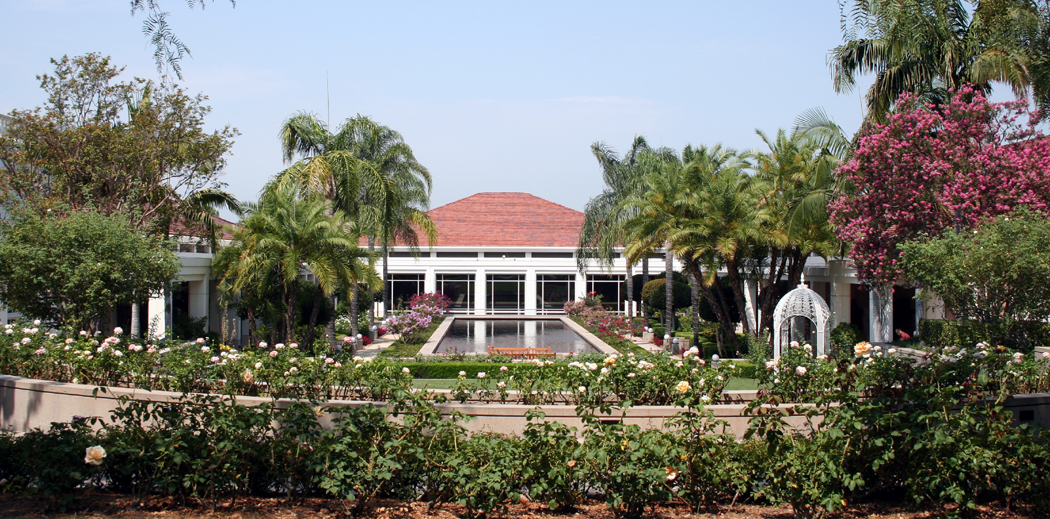
The little white clapboard house that Nixon’s father built, and that opens his memoirs, still can be found, at the Richard Nixon Library and Birthplace in Yorba Linda.

The house, shaded under a grove, is rather dwarfed by the huge, impersonal marble and glass library, with its parking lot and fountains.

Nixon Library and Gardens

But the house is the only real reason to visit. Inside the tiny cottage, which Nixon’s father had ordered from a catalog, is the niche of a bedroom and the bed on which the future president was born.

Richard Nixon's birth bed

Richard Nixon’s birth bed

It makes Nixon feel almost human.

You can get a sense of the small-town bourgeois life that he sprang from, the piano in the parlor and the small bookshelf with the equivalent of the Harvard Classics that must have given Nixon his early sense of education and culture.

I have to admit, I never much liked Nixon — more accurately, I despised him and his politics — until Watergate. My reaction is probably the opposite of most of those who lived through those times: Nixon was elected in a landslide in 1972 and after his resignation, widely denounced. For me, I hated him until his crimes and venality humanized him.

Politics tends to flatten its heroes, to turn them into one-dimensional factional puppets. We don’t like to find out that our presidents are mere people, that they have faults, fudge the truth, create political lists, philander.

It was only after Watergate that the more complicated, vast, conflicted, confusing, contradictory Nixon became widely known and written about. Nixon, the contemporary Richard III, the one candidate who could deal with evil in foreign affairs because he was conversant with it in himself.

He was surely the only 20th-century politician who plausibly can star in his own opera: John Adams’ Nixon in China.

The real Nixon won my respect because he was larger than life, or, more precisely, he was as big as life.

So, it was a huge disappointment to discover that the Nixon Library, and the museum attached, do their best to turn Nixon back into a plaster bust, denying him all the richness that made him so fascinating.

It is a sanitized Richard Nixon that shows up at the library, one who doesn’t use expletives, deleted or otherwise. The old newspaper clippings glorify his career without ever mentioning his pink-paper campaign tactics, his smearing of Helen Gahagan Douglas, his ”enemies” list.

The real Nixon was Shakespearean, the enshrined Nixon is as polyethylene as Reagan.

The real Nixon saw himself mythologically, and like myth, is open to various, equally defensible interpretations. He was not coherent, but multifarious. There is something in his life for everyone, whether they want to hate or admire.

Which is why the Oliver Stone movie seems so true, no matter how loose he plays with fact. Stone recognizes the essentially mythic quality of Nixon’s personality, which is why he built his entire movie as a gloss on Nixon’s farewell speech to his staff, which is concocted of archetype: ”I remember my old man. I think that they would have called him sort of a little man, common man. He didn’t consider himself that way.” And, ”Nobody will ever write a book, probably, about my mother. Well, I guess all of you would say this about your mother: My mother was a saint.”

It was a gloriously bathetic speech, mawkish and sentimental, but it summed up the essential Nixon, not as one man in a planet full of its congested billions, but as the single Shakespearean king, the central player, not only in history, but in his own life story, as in each of our lives, where we are all the king.

One glorious piece of mythologizing snuck in, although the museum staff doesn’t seem to recognize it for the glorious kitsch it is.

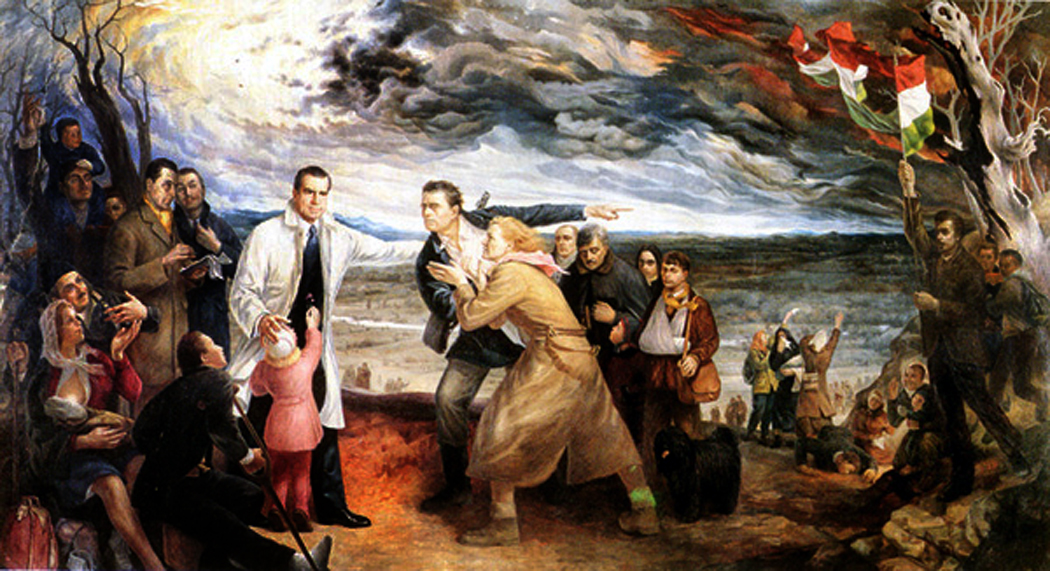
There is a large painting of Nixon by the Hungarian-American artist Ferenc Daday. In 1956, Eisenhower sent Vice-President Nixon on a fact-finding tour of Europe. He made an unscheduled late-night visit with refugees of the Hungarian Revolt at the Austrian border town of Andau.

One can imagine Nixon in reality, getting out of his limo, stopping to talk with a few people, as awkward as he was with the anti-war protesters at the Lincoln Memorial. But the painting doesn’t show that; it shows a heroic Nixon in a white trench coat under an anagogic sky — it could be a leftover from Gone With the Wind. The refugees plead with him for succor.

nixon painting

The whole thing is a wild sendup of the great history paintings of art history, populated with suffering masses, a man on crutches, another with a Hungarian flag unfurled in the wind. The vast plains of Hungary spread out in the background like the landscape in an Altdorfer painting.

And standing next to one poor woman, her arm in a sling, is a shaggy Puli hound, its tongue hanging out. It is such a piece of deflating silliness, the artist surely must have put it there satirically. But if so, the Nixon Library staffers are not in on the joke. Apparently, they have since taken the painting down, perhaps embarrassed by its schmaltz. They should reconsider; the painting says more about Nixon than all the official policy papers and bronze statuary.

When I asked about the painting, many years ago, when I first visited, I got only the party-line response, almost as if the staffer were reading off a TelePrompTer.

The only one who got it was the young man at the gift shop.

”What’s the kitschiest thing you have here?” I asked him.

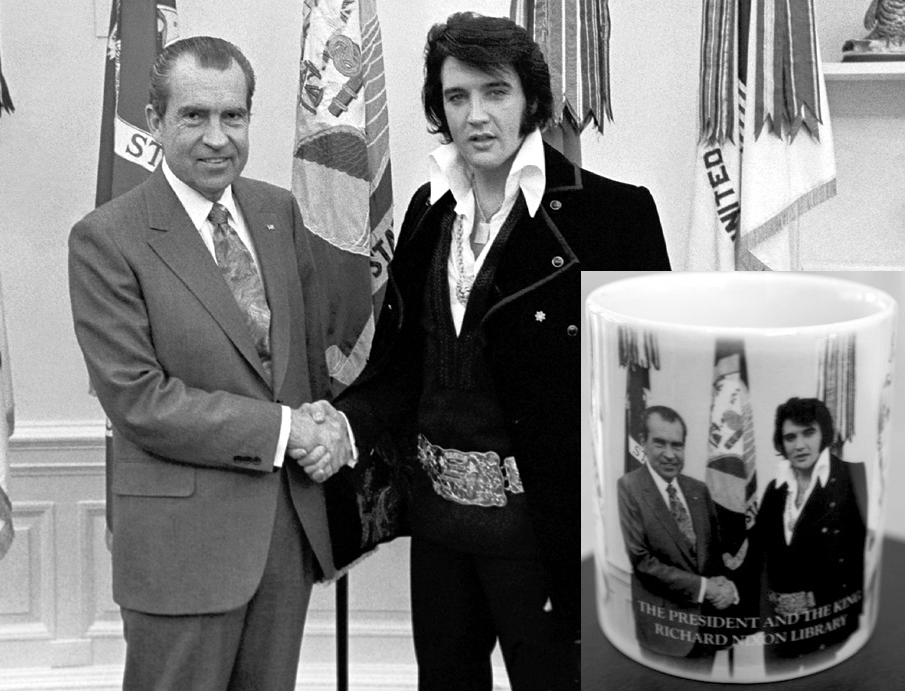
”This is our bestseller,” he told me, and dragged me with a smile over to the shelf with the coffee mug on which is printed a photograph of Nixon and Elvis.

nixon and elvis with mug

Now, that’s mythology.

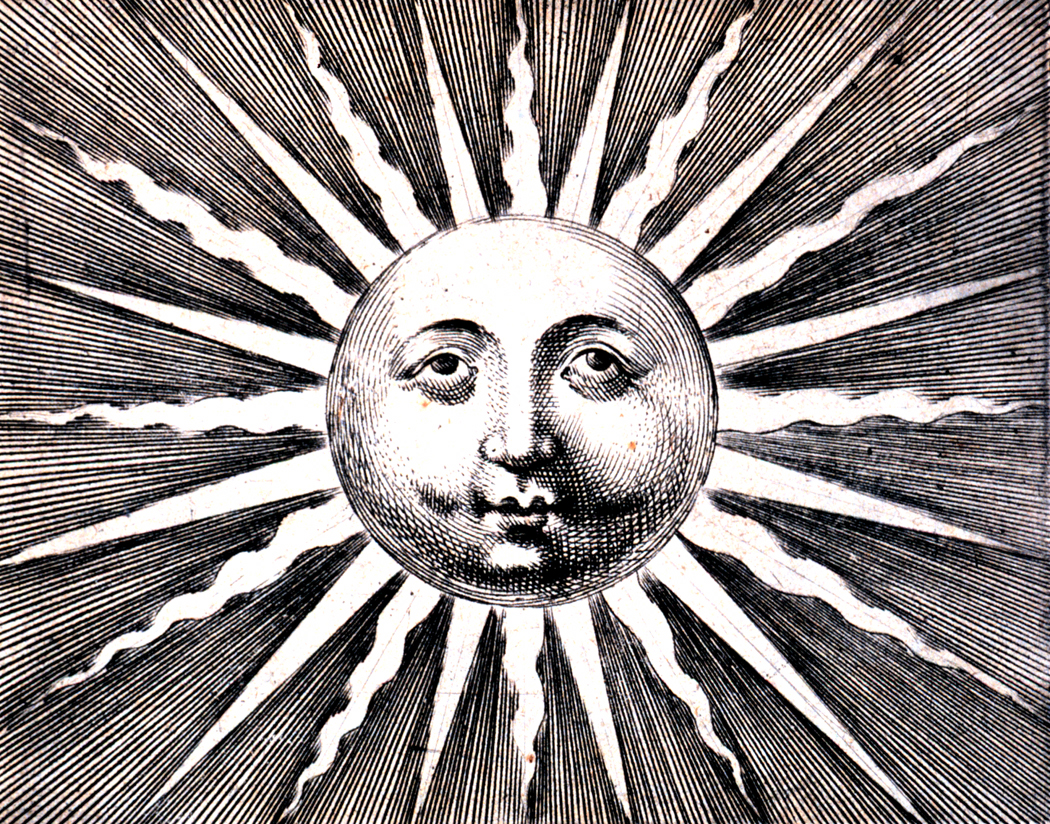
cun 18th century

What does the midday sun look like?

That may sound like a simple question, but it’s not. You can’t really look at the sun: If you try, the result is sensory overload, like the distortion of loud music on cheap speakers. You can even go blind, rather quickly.

Yet, everyone thinks he knows what the sun looks like. It’s everywhere in art, beginning with the tempera paintings kids make in elementary school: They so often put a wedge of sun in the corner of the painting, with rays spread out below like sea urchin spines.

kid turtle

But the sun doesn’t look like that: The child’s version of the sun is a symbolic representation of the solar disk.

But then, so are all adult representations.

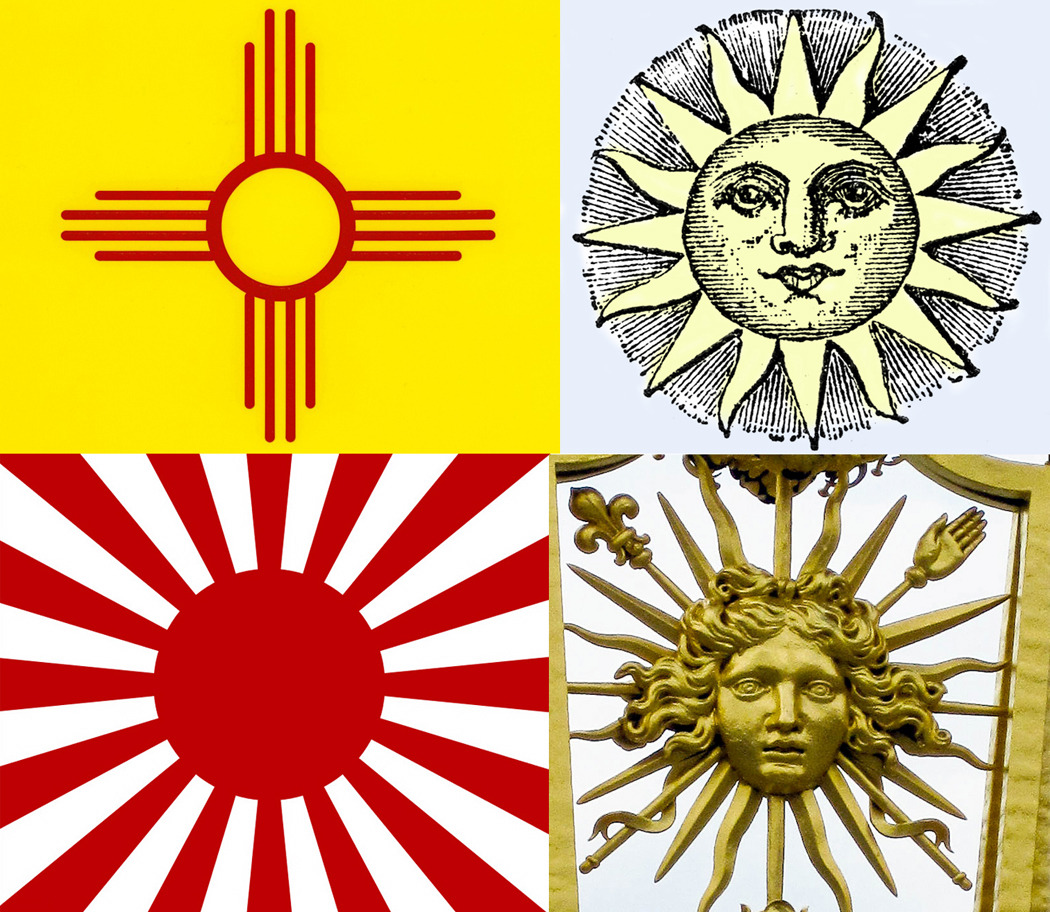
So we also recognize the gilt centrifugal rays of Louis XIV’s Sun King symbol and the terra cotta sun face of Mexico and the red ball and rays of the World War II Japanese “Rising Sun” naval ensign.

sunmosaic

The sun is the paradigm of art problems, because it can never be portrayed accurately as it looks. Paint cannot be so bright.

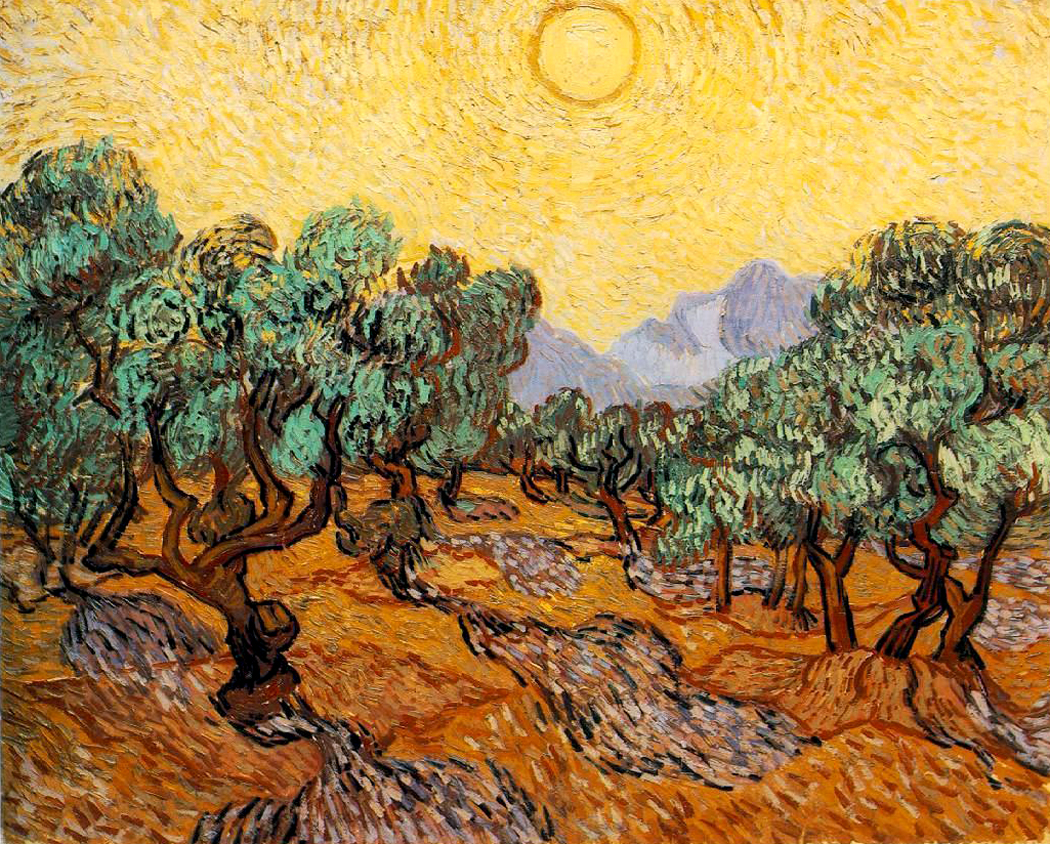
But that doesn’t stop artists from attempting it. Van Gogh painted the solar disk over and over in his landscapes. Usually, the sun is a yellow circle surrounded by concentric brushstrokes in a darker ocher. The only way he could make the sun seem bright was by making the sky unnaturally dark.

vangoghsun1


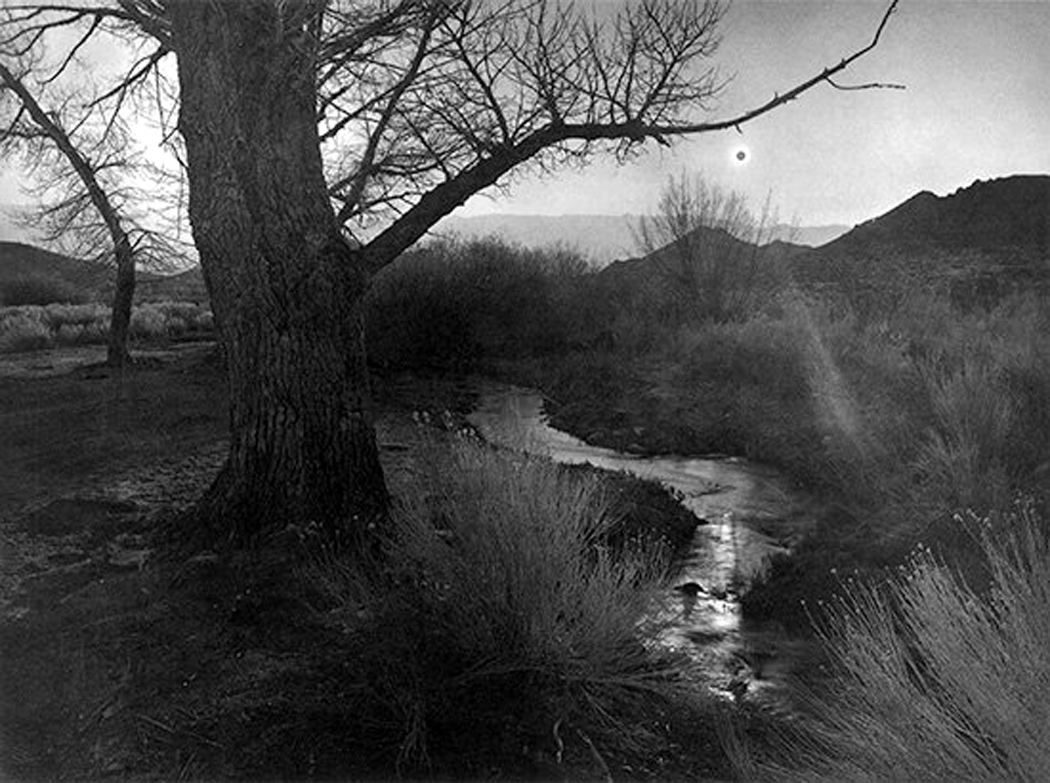
Ansel Adams had a photograph he called The Black Sun, in which a long exposure caused the image of the sun to solarize, making it a dark dot in the picture, surrounded by a halo of rays. It looks almost like an eclipse photo.


Ansel Adams' "Black Sun"

Ansel Adams’ “Black Sun”

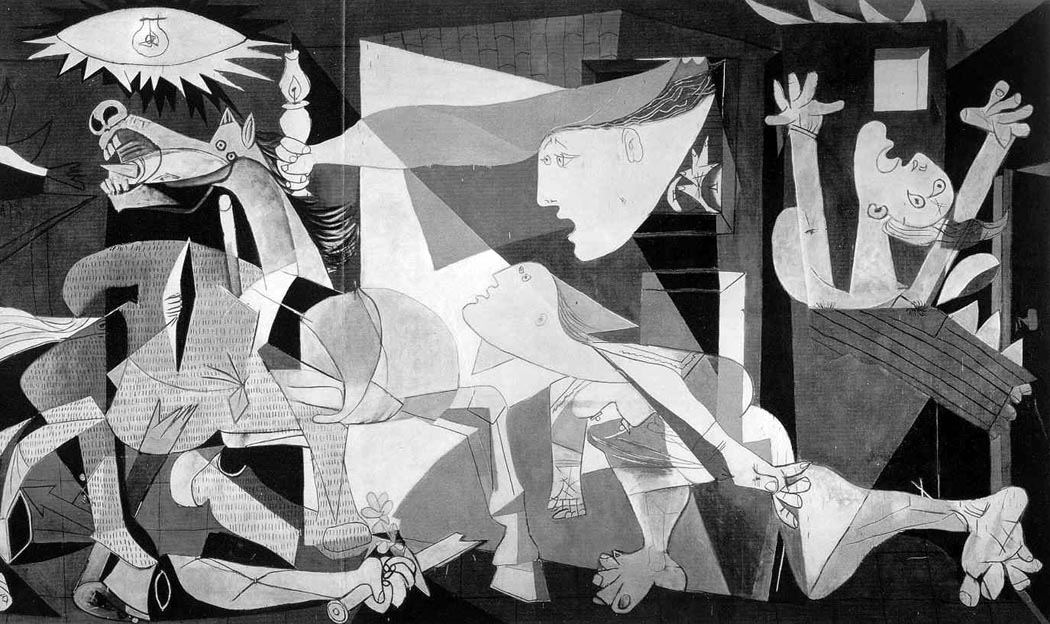
In Picasso’s Guernica, the sun is an edgy elliptical disk with spiked rays, in the middle of which is a light bulb.

guernica detail

Each of these is an attempt to portray something that cannot be portrayed.

On a piece of paper or a canvas, the brightest white is no more than 40 times brighter than the deepest black. In the Arizona summer, the sun is thousands of times brighter than the shadow under a mesquite. A canvas just cannot accommodate that brightness range. We compress that range and accept it.

But the emotional effect of the sun’s brightness is just as hard to portray. When artists attempt it, they have to leave the realm of naturalism and create a fiction, a symbol for the sun instead of its snapshot.

So, what does the world look like? The sun is only one minor example of the complexity of this question. It is a question that has been at the core of art for 30,000 years and has still not been answered in any finality.

The problem in formulating an answer is that human perception is both so complex — scientists keep finding more astonishing whirligigs in the brain’s apparatus — and at the same time, so universally believed simple. We all have eyes; and seeing, after all, is believing.

We see with our eyes, most people think. The world looks the way a photograph makes it look.

But of course, we don’t see with our eyes, but with our brains – and even more difficult, with our minds, which means we see through the haze of emotions, culture and individual life experience. We so thoroughly process the data that our eyes collect that the final result barely matches the patterns on the tickled retina.

Seeing doesn’t just happen; it is a complex mental process. And it is a learned process, as any of hundreds of studies have confirmed. One of the ways it is learned is through art — or, to use the more modern term, through media.

Which is why, until the Modernist revolution in this century, artists concerned themselves with attempting to accurately depict the world around them.

It was to this end that such men as Leon Battista Alberti and Filippo Brunelleschi attempted in the 15th century to devise a mathematical formula for creating the illusion of three-dimensional reality on a two-dimensional canvas. The linear perspective they created became the mother tongue of European painting for four centuries.

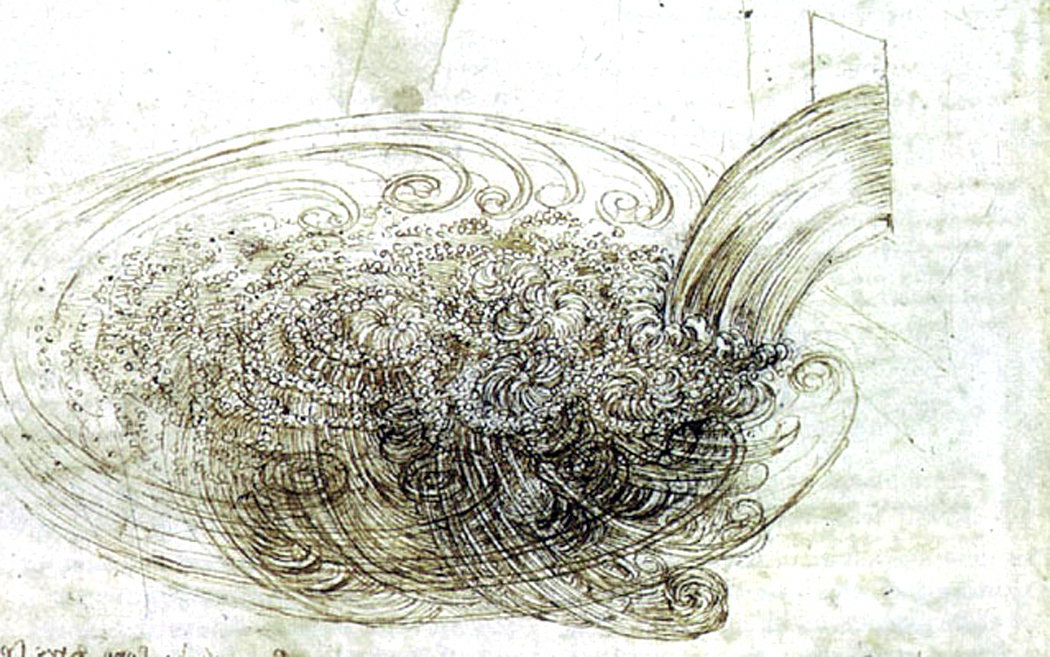
But perspective wasn’t the only question: We’ve all seen the obsessive drawings of Leonardo da Vinci, attempting to get down on paper the swirl of water in motion.

leonardowater

Or Michelangelo’s attempts to show every anatomical muscle under the marble skin of his statuary.

The Italian Renaissance was so thorough in its quest for realism, and so successful, in contrast to the Romanesque and Gothic art that came before it, that we have on some level considered the question answered ever since: This is what the world looks like.

Yet, it isn’t so. There are gross distortions built into perspective: Its grid of parallel lines is pure fiction. Leonardo’s water looks more like masonry than fluid, and Michelangelo’s muscles are a little too manic to be visually true.

Yet, the schematic system of image-making they came up with was so persuasive that we still accept the look of it.

Photographs, for instance, which are often taken for the ultimate in realism, are actually made through lenses carefully designed to mimic Renaissance perspective. Rectilinear imagery doesn’t happen naturally.

No art is ultimately realistic. What we tend to call realistic art, whether it is 200 years old and hanging on a museum wall, or hanging in the “starving artist” corner of your shopping mall, is more properly called ”conventional” art. It partakes of the conventions of art that we have, for the moment, accepted.

But those conventions are just as stylized – just as unrealistic – as the ”King Tut” angular figures on an Egyptian frieze, or the misty landscapes on Chinese scrolls.

Take any so-called realistic piece of art and ask just how like life it might be.

When a British cleric, Dr. Thomas Church, visited Rome in 1816, he sat to have his portrait drawn by Jean Auguste Dominique Ingres, one of the leading French artists of the time. The 6- by 8-inch pencil drawing Ingres made is now owned by the Los Angeles County Museum of Art. It is a drawing almost everyone would call a realistic likeness. Certainly, if you knew the drawing, you could have picked out Church from a police lineup.

Ingres' Dr. Thomas Church

Ingres’ Dr. Thomas Church

Yet, the drawing is realistic in only a conventional sense; we are so used to those conventions, we don’t even think about them. We are fish, the conventions are water. It almost seems silly if I point them out. But it isn’t silly; it is profoundly important for us to think about them.

First of all, I doubt the good reverend was only 15 inches tall, as he is in the drawing, or would be if he stood up and his legs hadn’t been cut off by the edge of the paper. We have no trouble believing that a small likeness is realistic, any more than we have trouble with Georgia O’Keeffe’s larger-than-life flowers.

Second, Church probably had a little more color in his cheeks than in this monochrome drawing. We accept black and white as realistic.

We even accept his high-collared coat as black because we know such coats, even though in the drawing, it is the same blank-paper color as his nose and cheek.

Third, the real doctor was three-dimensional; the drawing is not. We could walk around the real person and see his back; the verso of the drawing is just blank paper.

Then, too, the real person moved and the drawing is frozen still.

The real person moved through time, too. It should also be noted that the drawing still exists; the same cannot be said for the good cleric. Ars longa, vita brevis.

The real person made noise — I cannot imagine such a cleric not talking constantly, even prattling. The only noise the drawing can make is a crinkling sound if you were to crush it in your hands — a sound to draw the immediate attention of the museum guard, no doubt, but not exactly conversation.

The drawing also has no odor of humanity about it. Then, too, the drawing is made up of pencil lines. Examine as you will the world around you, you will not discover lines in it that outline the borders of objects. The use of line in drawing is one of the most persistent, and least realistic conventions.

And the last thing I’ll mention: There is a frame, an edge of the picture that cuts off the bottom half of the good reverend. Real experience does not come with a frame line.

All these things we look right past and accept the drawing as an accurate rendering of reality. I’m sure you can come up with a dozen other hidden conventions I have passed over. But that is the power of convention. And it is all the more reason we should be concerned with the question: What does the world look like?

A century of Modernism has taught us not to ask such a question, and we have largely bought into the propaganda. Instead of asking the question, “What does the world look like, from the time of Cezanne on, art has primarily asked, ”What does art look like?” When a visitor looked at one of Jackson Pollock’s swirls of paint drippings, he asked, wondering what the picture’s subject might be, ”What is it?” Pollock answered, ”A painting.” He wasn’t just being cute. All of art critical theory at the time asked us to consider the effects of colors against other colors, forms against form, line against line.

But as great as some of the century’s art is, the overall effect is of a mirror held up to a mirror. It is intentionally mute: ”Music can express nothing,” said the arch-Modernist composer Igor Stravinsky. He was wrong, but he summed up this century’s own unacknowledged provincialism.

Art must regain its connection with the life we live. There is no better way to do this than attempt to answer the basic question about the appearance of the world.

For seeing is active, not passive. It is something we do, not something that happens to us. Each generation must keep up this dialogue with the world.

It is still a noble goal of art: to discover the difference between the schematic and the mimetic, between convention and experience — between what is and what has to be.

To parse it all out.

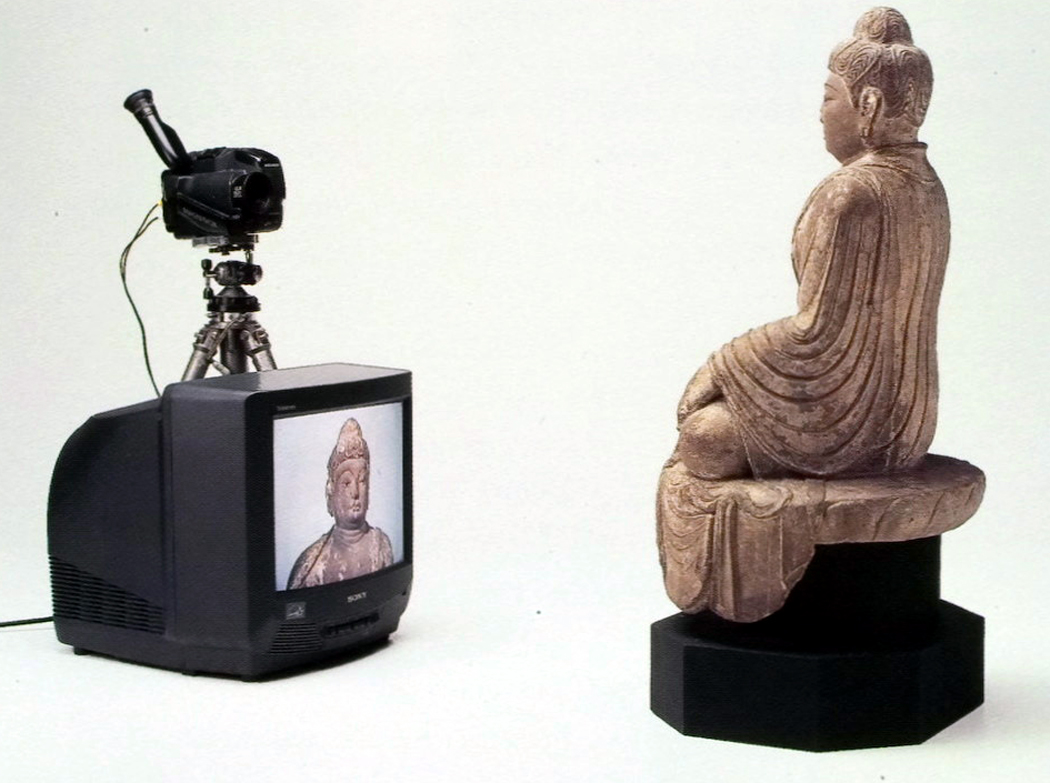
What is called Postmodernism doesn’t effectively do this. If Modernism is a mirror looking at a mirror, what has followed is a TV set looking at a TV set.

nam june paik1

A generation of media-savvy savants has created an art that is self-referential, and its main reference is The Brady Bunch.

I am certainly not calling for artists to imitate the look of Norman Rockwell. I hope I have made clear that Rockwell is not realistic.

I am calling for artists to take a really close look at the world around them — actually, I am calling for them to love the world, to caress the things of the world with their eyes.

The most effective way of doing that is to draw. Not until you have drawn something have you really seen it, felt its texture in your mind, tasted its color on front and back of tongue, known its shape and the shape of the air around it.

You can see this in Ingres’ drawing again. The coat, the pose, the chair arm — they are all merely conventional. But look at the eyes. They fairly swell with life, there is a softness to the bags underneath, a bristliness to the eyebrows and a live intensity to their gaze. The eyes are the animated center of the drawing, a jewel in a supportive setting.

In the coat, one sees the artist’s training; in the eyes, his connection with the world. There is no doubt which is more important.

So I ask the question of artists, what does the world look like?

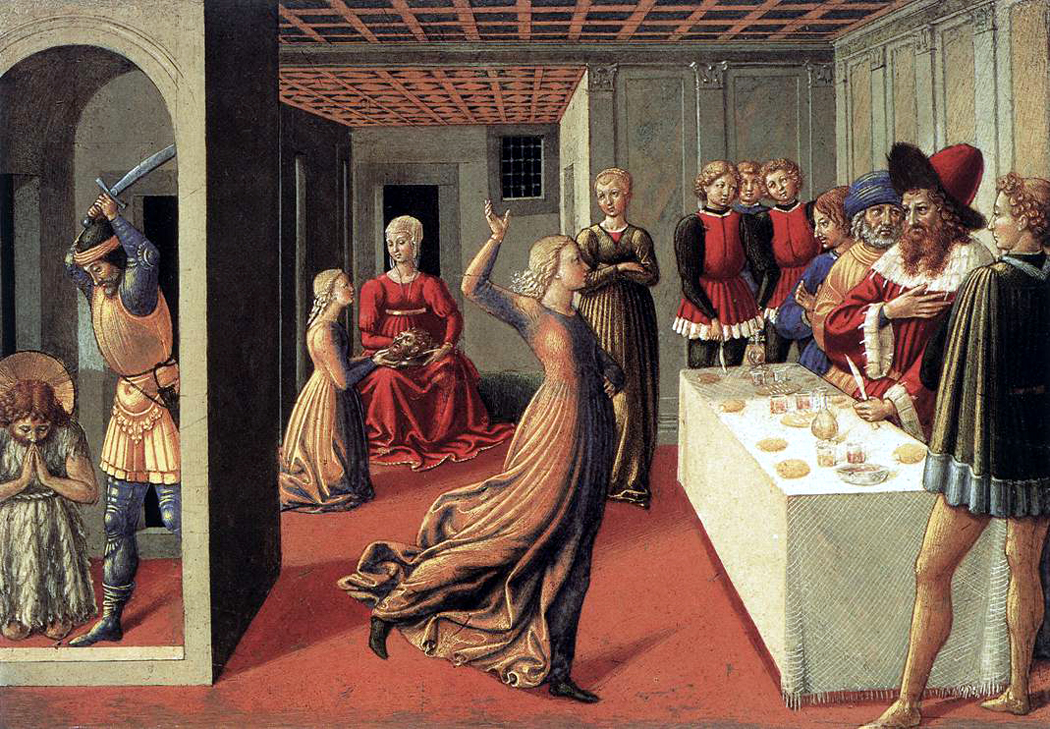
Take take just one of those issues: motion, for instance. In the early Renaissance, it was not unusual to repeat a figure several times in a painting, depicting action as it is shown in the frames of a comic strip – showing the same figure in different parts of the frame at different moments in the action.

salome

One depicts Salome dancing in one part of the picture and John the Baptist in his cell in another. Another corner of the picture shows John bent over the block with an executioner’s ax raised over his head and a final portion has Salome watching John’s head on a platter.

Even God appears twice, from front and back, in Michelangelo’s Sistine Chapel Creation.

An entire century of art grappled with this problem as Baroque artists painted violent action at its most unstable point in time, suggesting the motion even when the figures are still as statuary.

Marcel Duchamp’s Nude Descending a Staircase is an attempt to portray the motion itself.

nudedescendingstair

Jackson Pollock’s action paintings are visually active with the result of the painter’s own motion.

Jean Tinguely created kinetic sculpture that actually did move.

Which of these is most “realistic”?

The depiction of visual reality is only one of the purposes of art, but it is a great and noble purpose that has been in eclipse as artists have been seduced by the cleverness of conceptual art.

As though the problem of mimesis in art had somehow been solved, freeing us for other endeavors.

But every time an artist picks up a pencil and tries to get the proportions of a figure right, every time an artist mixes a rose madder with an alizarin crimson to match the color of a landscape, she is tackling the biggest and most intractable question of art.

Looking is hard work, worthy work for an artist.

The sun streams in through the window, I go to it, look out at the world beyond and wonder what it looks like.

Astonish us.