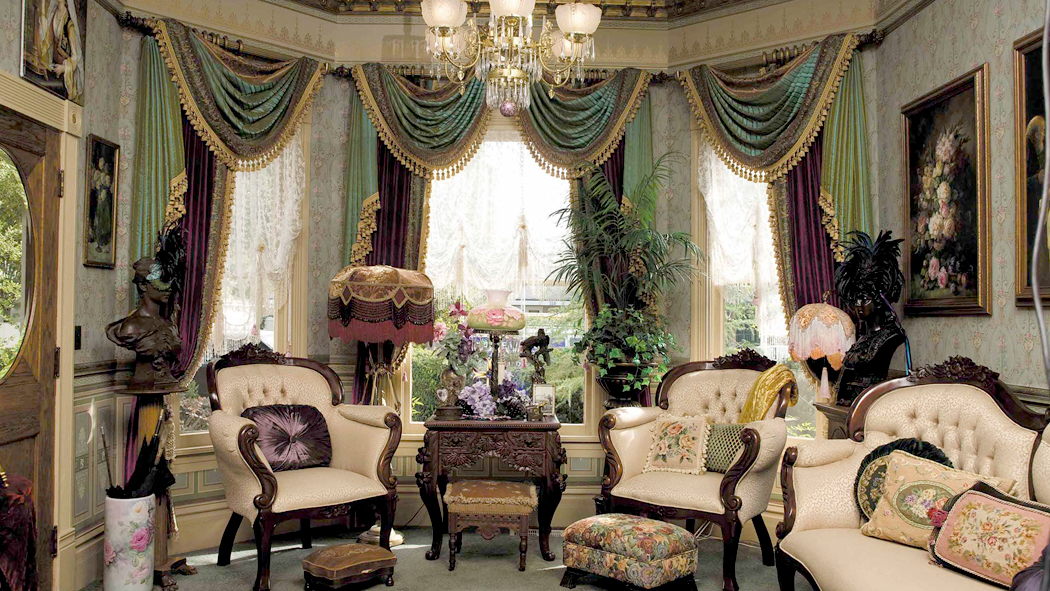
As a little boy in the 1950s, I remember visiting my great-grandmother in Jersey City. She had a darkened living room, with great stuffy chairs, a mantel clock surrounded by tchotchkes, floor-length curtains over the windows, and the back of every chair featured a lacy antimacassar. There were cut-glass bowls on the animal-claw end-tables, one of which was filled with hard candy, from which we children were offered “one.”
It was for my tiny little brain, simply what old people lived in, so unlike the split-level suburban home where I grew up. There was the smell of oldness, the wool of oldness, the dark mahogany of oldness. Above all, everything seemed upholstered and dark. Later, when I was an adult, I recognized the style as Victorian.
As in Norse mythology, there were three separate worlds — the world I knew, with my schoolmates; the world of my parents, with its privileges and authorities; and the distant and rarefied world of the ancients. These were not simply different houses, but completely different universes.
Each of these reflected the “taste” of its generation. Victorian; Mid-Century Modern; now Postmodern.
They were three different “tastes.” And taste rules so much of what we like, what we choose, and who we think we are. It is the way we groom our hair, the clothes we wear, the car we drive — we don’t choose a BMW over a Honda because it gets us to our destination any faster, but because it presents to the world the person we think we are — or want to be. The same with a Volvo or a Ford truck. Taste is a powerful driving force in our lives, whether we are aware of it or not. But sometimes, it must be transcended.
When I made my living as an art critic, I had to put aside my individual tastes and attempt to judge art by more impersonal standards. For instance, I have never responded to what are called the Mexican muralists — the Diego Rivera, David Siqueiros, José Orozco paintings and their peasant-proletarian mythologizing. It shared too much with socialist realism and was, to me, rather drab in its muddy earth colors. Nevertheless, I had to acknowledge the importance, art historically, of their work, and to be able to distinguish between the best of Mexican muralism and the lesser, more humdrum examples. To be able to distinguish and understand was more important than my “taste.”
This problem has cropped up again recently when a friend and former colleague posted a series of videos on YouTube cataloguing the biblical paintings of Marc Chagall, accompanied by ironic and meaningful music by Tori Amos, John Lennon, Mix Master Mike and others. He asked for my opinion. I watched all nine short videos (watch the first one here) and was impressed by his graphic and editing skills, but had a hard time otherwise. I simply don’t much like Chagall’s painting. Never have.
I recognize his significance in art history, and there are things of his I respond to — a few paintings, such as
I and the Village (1911); View of Paris from My Window (1913); Cubist Landscape (1919)
his stained glass at Reims Cathedral;
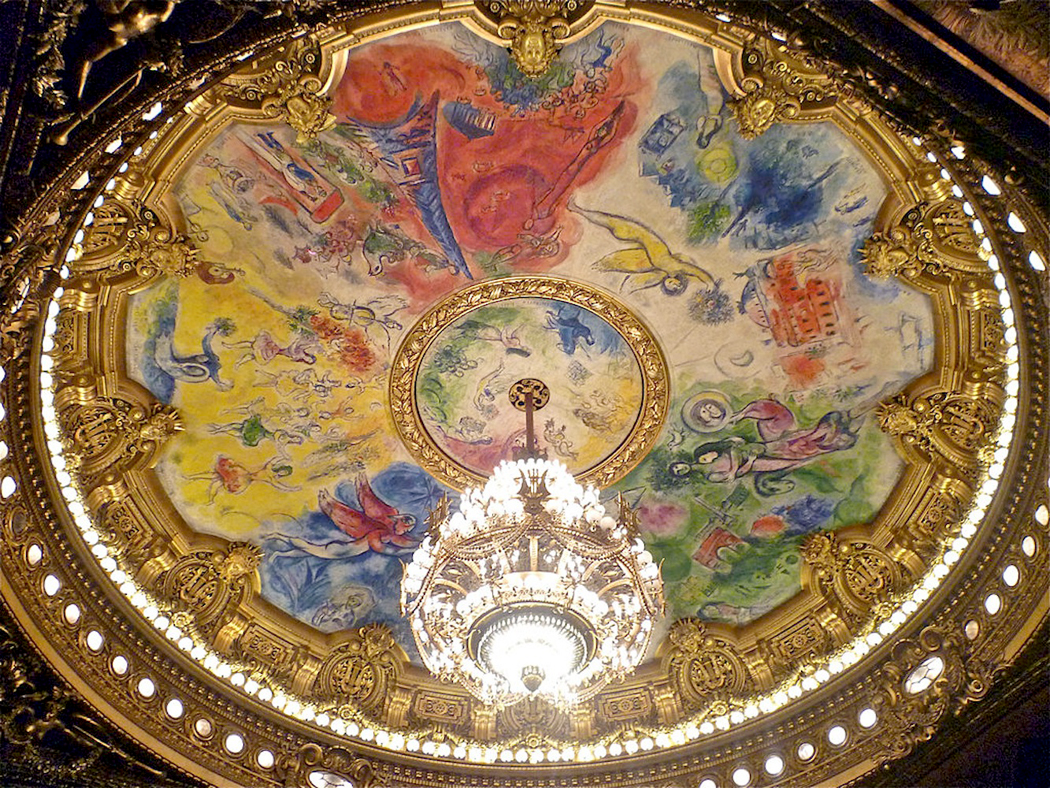
and the ceiling of the Palais Garnier in Paris. But the general run of Chagall has always struck me not as childlike, but childish. And he produced way too much with too little editing, leaving dozens and dozens of images virtually identical except for their finish — a blue coat here, turned red coat there, or left as a scribble. This was especially true of the biblical images, of which there seemed to be hundreds.
My friend had collected them all and divided them into the familiar episodes or stories of the Bible, adding the music and sometimes his own commentary to them. I dutifully sat through all nine chapters of the video, but in the end did not come away with any higher opinion of the artist — indeed, the need for editing seemed all the more imperative.
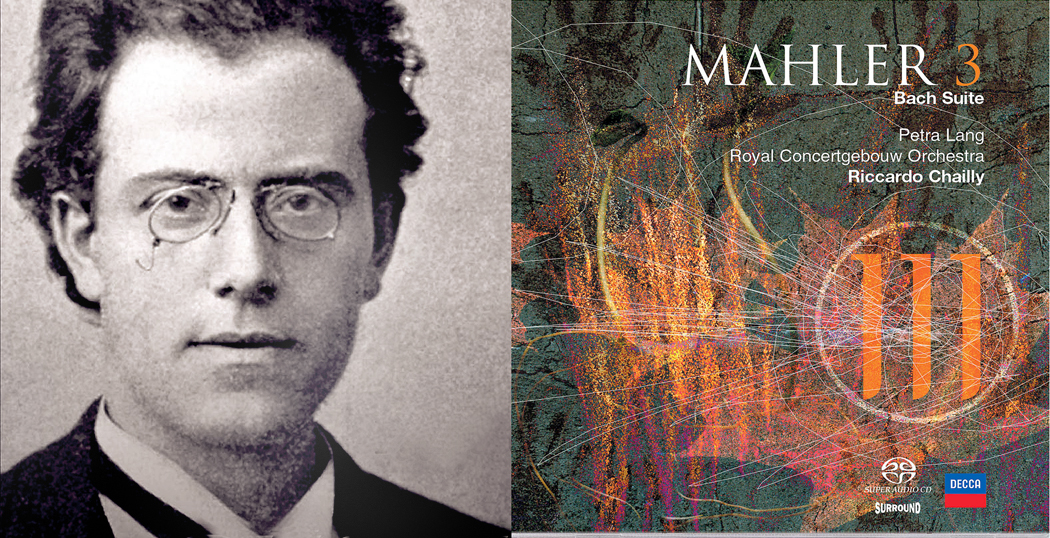
I don’t fault anyone for their taste. I recognize it as an individual thing. My taste is not better than anyone else’s, it is just mine. If I respond to Mahler more than I do to Max Reger, well, then, that’s me. If I would rather re-read Milton than James Dickey, so be it. Would travel across the country to see a Pollock retrospective but wouldn’t cross the street for Frank Stella, that’s just the way it is. (This may have something to do with a sense that the world is not tidy and organized, but chaotic and spontaneous. I share Pollock’s sense and not Stella’s).
Yet…
Yet, there is that passage in Coleridge’s Biographia Literaria where he makes the distinction between gustibus and gustus. Plural and singular. We all know the Latin phrase, “de gustibus non est desputandum,” but, Coleridge says, “gustibus” is what I have been talking about so far — personal preference. We like some things more than others. Any argument is silly: “I like pickles.” “No, you’re wrong, I don’t like pickles.”
But “gustus,” he says is different. It is the ability to differentiate between value and trash. Tastes are personal, but taste is about discernment. It is what allows us to know that Marc Chagall — no matter what I personally think about him — has value that, say, Thomas Kinkade does not. That James Dickey wrote poetry and that Rod McKuen wrote whatever you want to call it, but not really poetry.
Gustibus allows us to enjoy even trash. It is OK to like Kinkade’s brand of nostalgic goo, but it should never confuse it with quality.
John Waters is the master of bad taste, but he has taste. The interior of Elvis Presley’s Graceland is also in bad taste, but there is no evidence of actual taste involved. Hence the word “tasteless.”
The distinction to be made is one of awareness. Taste comes from engagement, from paying attention. Lack of taste comes from acceptance of the conventional, of the expression of sentimentality, or the dependence on what someone else says is good.
Much has been made of taste as a class distinction. But that is not what I am talking about here. Artist Jenny Holzer has famously said that “Money creates taste,” but it doesn’t. Money creates fashion and fashions change. Taste is a way of experiencing the world; it is not a hemline or this year’s color pairing. British aristocracy includes some of the world’s most tasteless people.
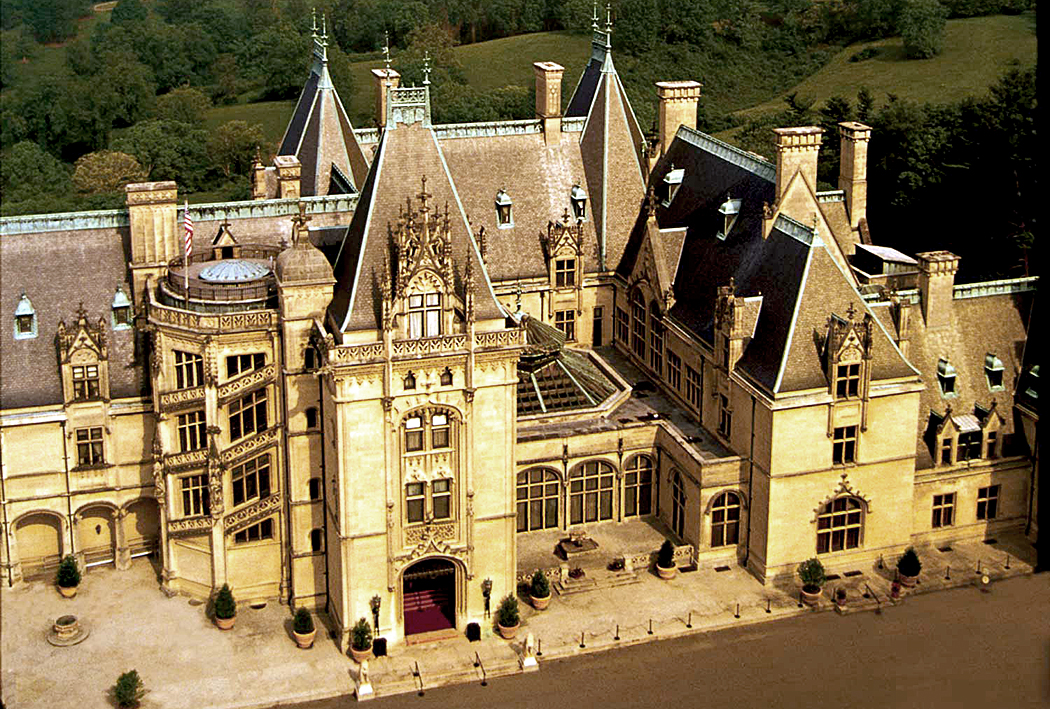
Here in Asheville, N.C., there is a mansion called the Biltmore House, which is one of the most tasteless, garish pieces of architecture I know. Money creates smugness, not taste. Think of all the money Donald Trump has.
Taste in the sense I mean it is at its foundation an engagement with the world, with all of it. It is the attempt to see things as they are and appreciate them for their worth.
There is a problem. It is so easy for gustibus to blind us to gustus. We easily take our tastes as taste and assume that things we like are therefore universally good. It takes some doing to divorce one from the other. We assume we like something because it is good and therefore, everyone should agree with us. I like pickles and if you don’t, you must be a Communist.
It’s a trap we all fall into at times. Myself certainly included. But I’ve seen many things I initially didn’t appreciate later come to be favorites. Did Bruckner suddenly become better than he used to be? I wrote a whole piece about how my mind changed on the paintings of Joseph (not Frank) Stella (here). The acquisition of taste is an ongoing process and requires constant engagement and re-engagement. Make up your mind too soon and you miss a lot.
In short, our tastes close us off, while fostering your taste opens you up. Tastes are our hidey-hole, where we burrow in and stave off the parts of the world that make us uncomfortable. Tastes are lazy; taste is adventurous.
The cultivation of taste is a question of experience. The more we become familiar with, the better our choices will be.
I remember when the film critic at The Arizona Republic was brand new. Bill Muller had been a political reporter, and when the previous critic left the paper, the feeling was he had been too “arty.” And so, they wanted an “ordinary Joe” to speak for the ordinary moviegoer. Muller seemed the perfect choice. He knew nothing about film (which he readily admitted to. Muller was a very smart guy and honest).
And so, for his first year as a critic, he loved movies where things “blowed up real good.” He was the demotic critic the company hoped for. The problem was, once you’ve seen 20 or 30 movies where “things blowed up real good,” you begin to be able to distinguish between those films done well and those done poorly. And so, Muller began to give negative reviews to sloppy and cliched movies. His taste grew.
When he was first hired, Muller often shuffled off art and foreign films to me to review. It was a great gift to me. I loved those films. But as Muller’s taste grew, he began to appreciate the finer points of filmmaking and — as I said, he was a hugely intelligent man — he began to keep the art films for himself. He became a cultured critic. He never lost his common touch and became an Andrew Sarris, for instance, but I watched him with great interest as his taste level rose with his exposure.
I don’t mean that Muller became a stodgy old pedant like me. He still loved popular movies — if they were good — but popular wasn’t enough. It had to be popular and good. His tastes were always different from mine, but his taste became more and more discerning.
Taste requires exposure and it grows unbidden. There are no rules for it, as Susan Sontag wrote, “Taste has no system and no proofs.” But you miss it when it’s absent.
We were invited to dinner with one of Carole’s fellow art teachers. They lived in a fairly new housing development, where all the houses were cookie cutter matches, up and down the streets, with the streets lined up-and-down the newly developed Arizona desert. Urbanization was filling up the outskirts of Phoenix like water filling up a pot.
Our hosts were a very nice young couple with two kids; Carole and Margaret were friends over years of teaching in the sprawling Peoria Unified School District and we both knew Margaret and Curt well. But this was the first time we had come to their house. It was a shock.
Through the whole house, there was not a single picture on the walls. Not a clock, nor children’s painting on the fridge, nor framed Bible verse — not even an Olan Mills family photograph with the stiff smiles and Sunday dress-up clothing. Nothing. An empty room is spooky.
I don’t think I’d ever seen a house so blank. It was as if they had just moved in and packing boxes were stacked in the corner, except there were no boxes and they’d lived in the house for years. There was a full set of furniture and curtains on the windows, but no art. All the more surprising since Margaret was an art teacher.
Even cheap motels put decorations on the walls.
This is not to complain about Margaret and Curt. The dinner was fine and we had a great night together. But the house haunted me afterwards. A house with blank walls is a house without a soul. You feel it in the gut. A void, an emptiness.
Something on the wall seems almost instinctual, from the cave walls of Altamira to the poster of Farrah Fawcett taped up in the dorm room. If nature abhors a vacuum, house cannot abide a blank expanse of plasterboard. Something — please, something. A framed halftone image from Target of a tree or a cliched Parisian street scene. Something.
In Medieval Jewish folklore, a golem is a clay statue that comes to life when a magic incantation is inserted into its mouth. And so a home becomes alive when a painting or photograph is hung above the sofa or piano.
When I moved into my first rented house, after leaving the college dorm, I hung photographs on the wall and a color-field painting made by Doug Feeney, a fellow collegian. I even put a frame around the wall phone, as if it were a Duchampian ready-made. Wasn’t I clever.
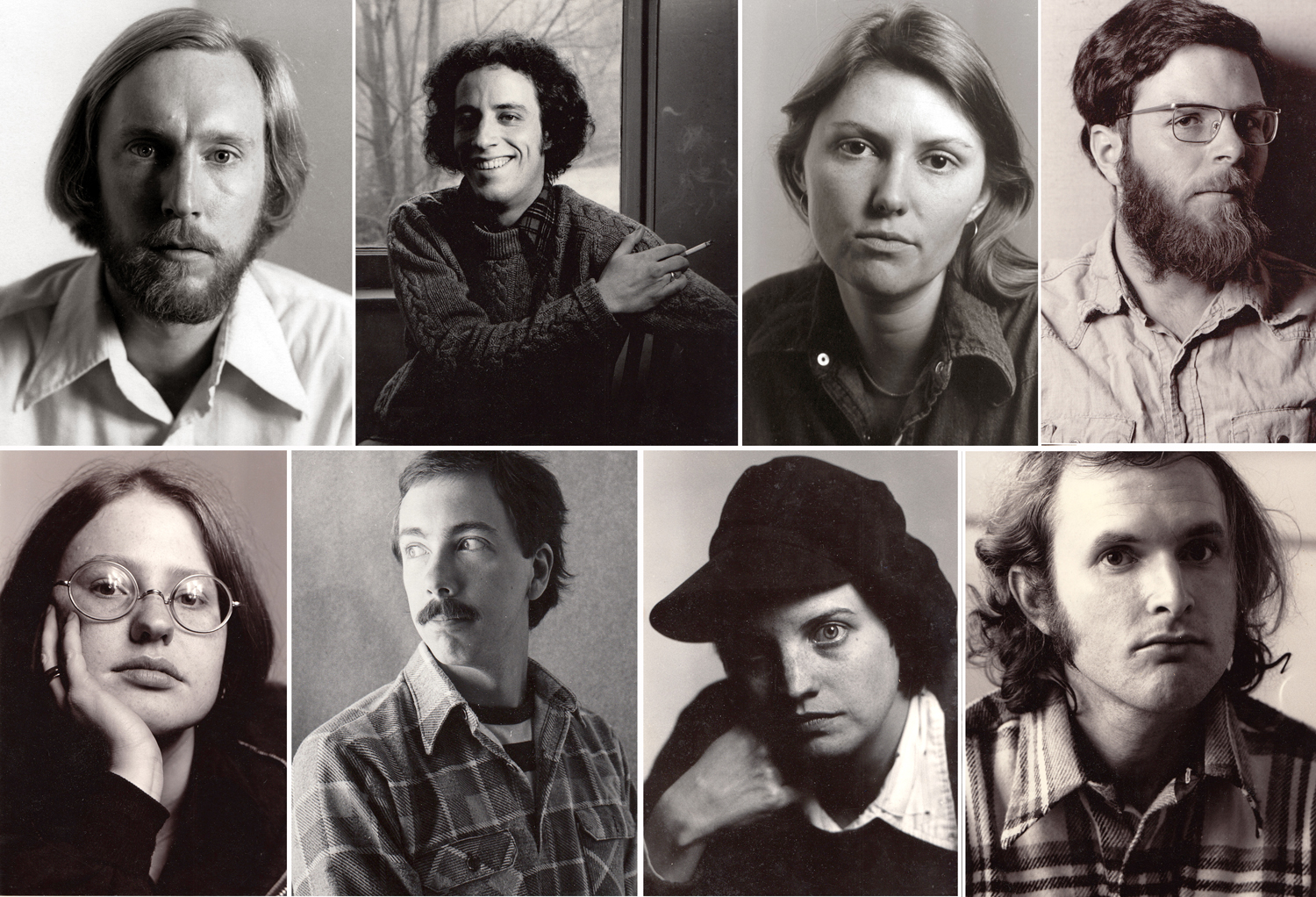
Later, in another house, I filled the entire dining room wall, from top to bottom, with photos I made of all our friends. There must have been 30 or 40 pictures there. I couldn’t afford matting and frames, so they were all scattered across the wall, held up with masking tape. They kept us company. Because I was a photographer, most of the art in the houses I have lived in were decorated with my own work. But a good deal of the work that hung was traded for with other artists. This is a great thing about having artist friends and about making art. We mix and match. I now have enough art to fill a gallery.
I most value art made by my brother, who is a working artist, and by my late wife, Carole, who was a visionary. She made a painting of the tree at night that grew outside our Phoenix house; it is surrounded by stars and the bluest dark sky I’ve ever seen. It now resides over our dining table, sharing the wall with an embroidered copy of a detail of the Unicorn Tapestries from the Museum of Medieval Art in Paris.
The tree painting is not only a fragment of Carole’s soul remaining with me after her death, it is a window into the larger world she had access to.
And that is one of the functions of art in the home. For many, it is a photograph of the family or of the parents or grandparents. It is a reminder of our unbreakable bond with the past — both our growing up and our ancestors.
In old British manor houses, the walls are covered with the stiff, starchy paintings of lineage going back centuries. “That was the third Marquis of Snotsbury. He was hanged as a horsethief.” Thieves are hanged; artwork is hung.
Sometimes the art is a souvenir of someplace that was meaningful to us: that trip to London or the landscape or our childhood. Sometimes, it is just a pretty picture. For my religious grandmother, it was praying hands and scriptural verses. We find meaning and display it.
Unfortunately, the art in the house is often just a pro forma accessory, something perhaps picked out by an interior designer. Such art usually offers no emotional connection, just the fulfillment of a middle class expectation. The decor in such cases is usually not more than tchotchkes — something merely to fill the vacuum. Very tasteful — but soulless.
(I remember that time in college when I painted a large abstract canvas in reds and ochers and gave it to my parents to hang over their sofa. It stayed there perhaps a year. But then, my mother asked me if I could do another one to replace it, one in blues and greens that would better match the room’s decor. I did it for them, after all, they were my parents. But I was miffed. I have rebelled against anything “matching” ever since.)
The interior design impulse means that for some, a concatenation of artwork, collected from various sources over years, is simply not unified enough. It really helps such an impulse if you are an artist yourself and can fill the house with your own artwork. Then it all hangs together.
And, as I said, most of the art in my house is by me, but there is no unity at all. That is not a quality I admire. I love diversity — a kind of Postmodern mix of everything. I have Hopi pottery, African Tsi-Waras, a Ganesh of sandalwood and a bronze Shiva Nataraja.
There is some Blue Willow crockery and a gorgeous giant etching made by Carole’s childhood friend, Ruth Haggerty.
A snow scene by Georgia artist James Lyle. A vintage cookie jar in the rotund shape of a G.I., that we named “Urnie.” And a life-size copy of the Venus of Willendorf made by Tempe artist and friend Bill Tonnesen.
In the bedroom is a gigantic painting of an abstract nude by Virginia painter Steve Wolf.
And over my computer is a framed drawing of me made by my granddaughter Carol Lily Cloos when she was 8 or 9.
And next to my computer, at eye level so I can look at it every day, is a pencil drawing that Carole made of a dead starling. It is resonant in ways that make me weep.
Over the piano is a large painting by my brother, Craig, that is one of his typical flying antelopes, and in the bathroom there is his “portrait” of our late lamented cat, Ruthie, complete with spaying scar on belly. There is also a Japanese Ukiyo-e print of two graceful women in the snow, under an umbrella. So, there is no order or reason, just a collection of things I love.
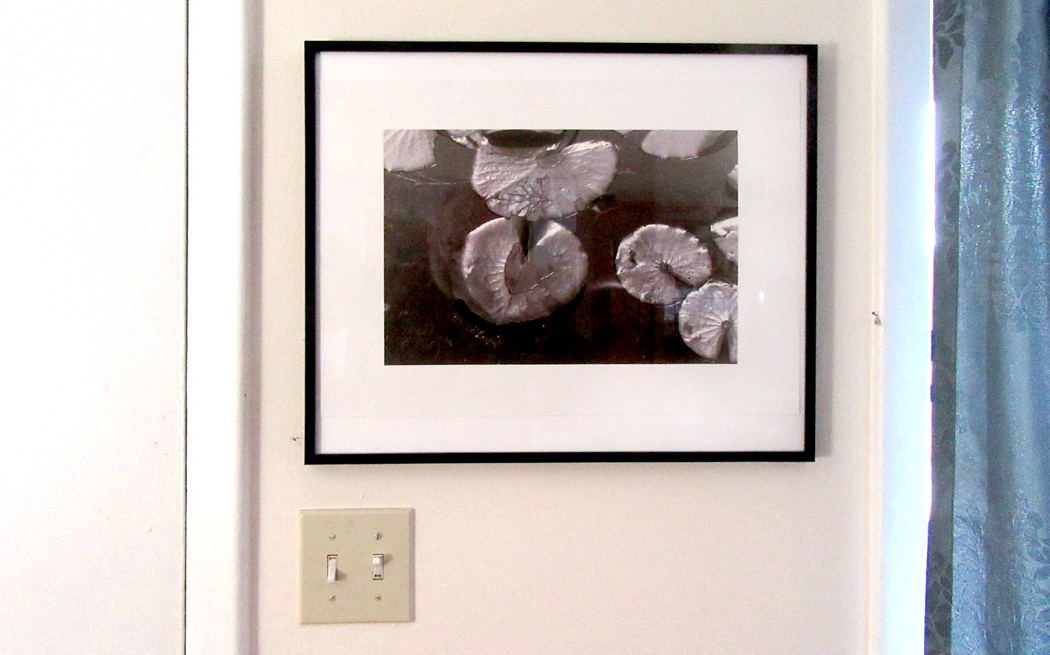
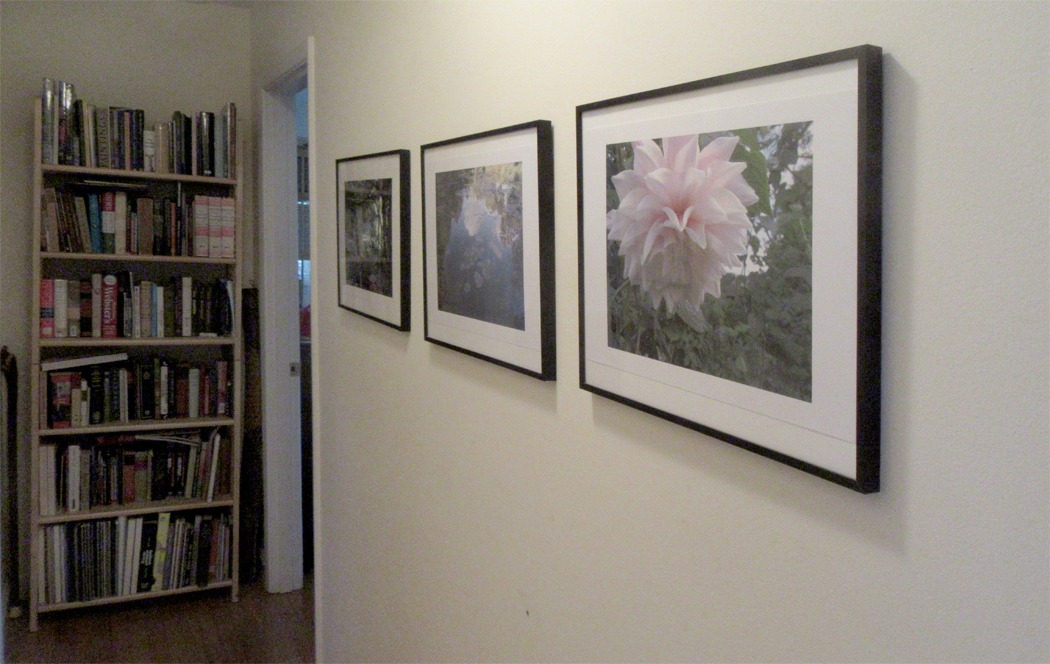
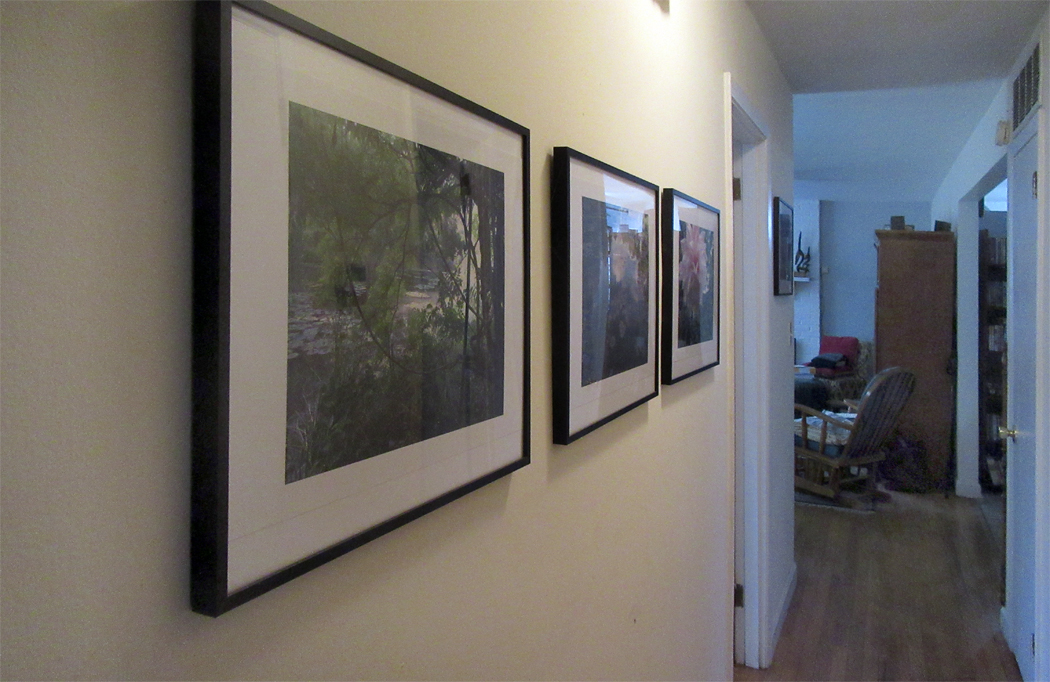
I have several dozen of my own photographs that I framed and showed at the Desert Botanical Garden in Phoenix, and now I have them stored away, but I retrieve a group and I switch them out occasionally on the walls. Currently, most of them hanging in the hall, office and bedrooms are images of Monet’s gardens at Giverny.
All of them give character to the house, and more to the point, to life lived in the house. The house isn’t just a group of walls, doors and windows, but a personality.
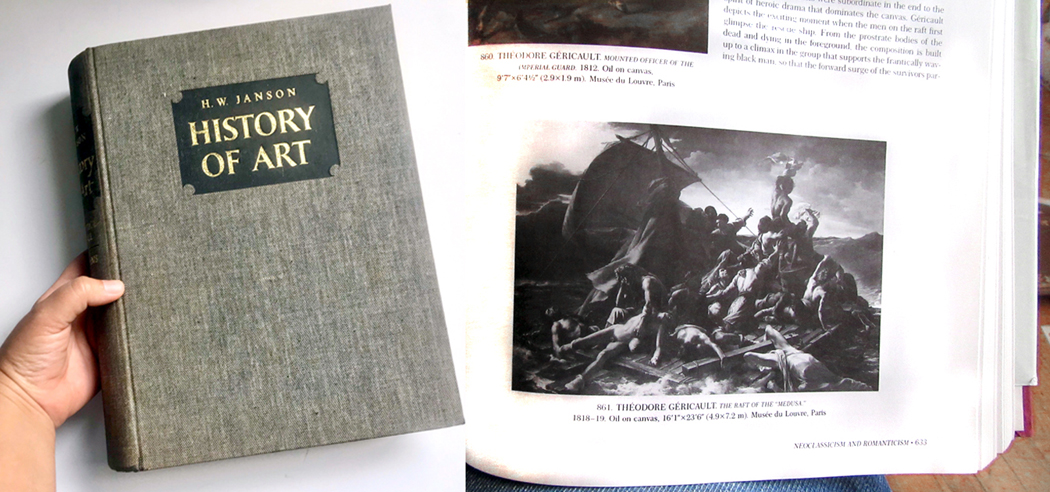
The first time I ever saw Théodore Géricault’s Raft of the Medusa, it was in my art history textbook — the infamous Janson. It was about 5 inches wide on the bottom of page 633.
Most of the world’s most famous art I first contacted in reproduction; it is the same for most people. It would be hard to travel the world’s great museums to see all the Vermeers, Rembrandts, Titians or Chardins. Instead, we see reproductions in books, or on the computer screen. I’ve seen hundreds, probably thousands of paintings in reproductions before I ever saw the real things.
So, imagine my amazement when I encountered the real thing at the Louvre in Paris. There it was, the size of a barn. It was a lesson — if I really needed one — teaching me that a picture of a picture is not the same thing as a picture. But so much of what we imbibe of culture comes not in its original form, but as reproduction, whether it is Canaletto in art history class, or Beethoven on a disc.
One of the things that divides the world I grew up in from the world I live in now is the unconsidered acceptance of a media experience for the live reality. We all have our noses in our screens. In many ways, what was once the secondary simulacrum of a genuine experience has become the end product itself. Since the days of Sgt. Pepper’s Lonely Hearts Club Band, a great deal of music simply cannot be performed live; the recording is the original.
In our Postmodern world, suffused with media, many an artist and musician has taken the secondary product as the original. And so, images are designed to be seen on the computer screen. No one asks to see a TikTok video in a movie theater; that would be silly. Content viewed on an iPhone is not an imitation of something else.
I, myself, now take photographs specifically to be viewed on screen rather than printed out. I edit them differently, I frame them differently. It is a different esthetic. But aside from work made for the virtual world, there is still the palpable object to take into account.
But the fact is, that many more people listen to recordings than attend concerts; see paintings in book reproductions or on computer screens than visit galleries or museums; prefer audiobooks to sitting in a chair and quietly turning paper pages. It gives a false impression of the art.
We keep stepping back from an original and choose a Xerox copy.
I am not here arguing against digital devices — you are reading this blog on one, so where would I be without such devices? — but I am worried that the ubiquity of reproduced media makes us forget that there can be something more immediate, and that through most of history, that immediacy was the primary mode of experiencing art and music.
My brother and I were once talking about theater. He stated that he didn’t much care for live theater but preferred movies as being so much more realistic — despite the obvious fact that live actors are very real and that celluloid images are only simulacra, and that movies are cut and edited all over the place, while live action must take place in real time.
But I recognized his point, and when I was younger, I would have agreed with him. Most of us are only subject to live theater, if we are exposed to it at all, in uninspired productions with bad or mediocre acting — the community theater or dinner theater sort of thing. And undistinguished theater is admittedly tedious.
Most of the theater I had been exposed to was just that sort of thing. Sometimes quite entertaining, but always so darned “theatrical,” i.e. phony.
Then, in 1994, I got to see the original Broadway production of Tony Kushner’s Angels in America, both parts over two days. It was the most riveting, even mind-blowing thing I had ever seen. And what was so moving was that it was there, live in front of me. They were real people doing and saying those lines and feeling — or evoking — those very primal emotions. It is still the single greatest experience I ever had in an audience.
I have now seen the two-play cycle four times and each time it has grabbed me by the lapels and yelled into my face in a way that has left me shaken. I’ve seen the Mike Nichols film version, with Al Pacino, and it is a wonderful production, but it cannot move me with quite the same seismic force that the live version had. If I had seen those same actors in the theater instead of on the TV screen, I’m certain it would have been earthshaking, but the remove of the screen gives the whole thing a distance that the live actors don’t suffer from.
I since have become an advocate for live theater, though it is hard to convince anyone who has not had the experience of great live performances. I have seen really good professional performances since Angels, and they have something nothing else has. Whether it is Fences by August Wilson, or Amadeus by Peter Shaffer or Hamlet performed by the Royal Shakespeare Company, I am completely drawn in, with the same complete concentration one has when reading a great book — the day-to-day world disappears and the esthetic world takes over.
(Amadeus, by the way, as a play is very different from Amadeus the movie. As wonderful as the film was, a good production of the play is so much more devastating.)
It isn’t only plays that have to be seen live. I have watched a good deal of dance on video or on PBS, and I am always disappointed at some deep level. Ballet and dance theater is the art form that speaks to my inner being the most directly and I love dance profoundly. But only live dance will do it. Balanchine knew this and attempted to re-choreograph a few of his masterpieces especially for video and however beautiful his video versions are, they pale beside seeing them live. You have to see the living, breathing (huffing and puffing), muscle-twisting movement in three dimensions for it to register fully.
(Mediocre dance, like mediocre theater is the worst ambassador for the artform — how many people have been turned off by watching the local civic ballet company galumph through the annual Nutcracker? That is no more the real thing than little league pitching is like Bob Gibson or Sandy Koufax.)
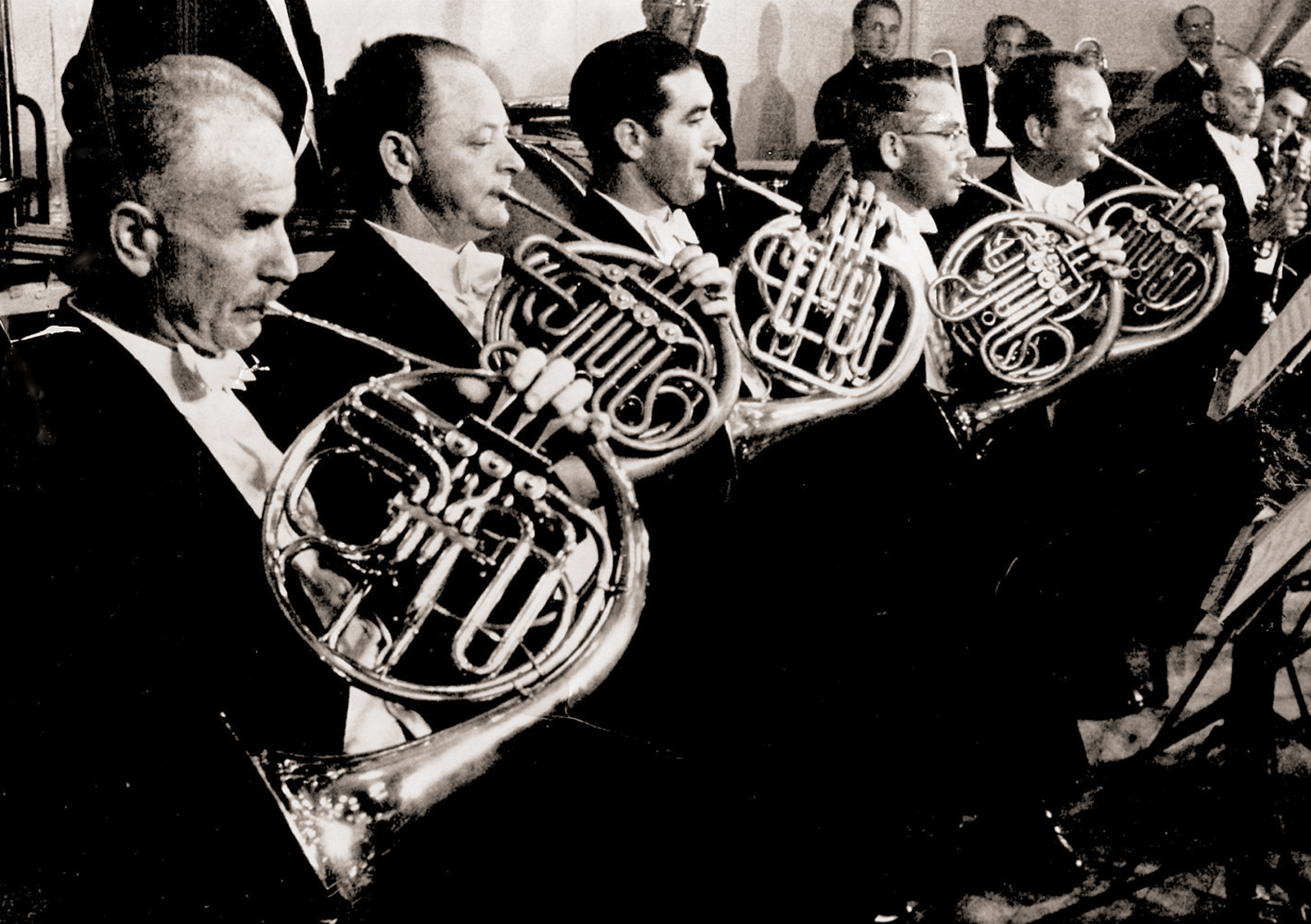
I have well over a thousand CDs on the shelves in my office and listen daily to recordings of Brahms, Bartok, Weill, Mahler and Glazunov. And I don’t know where I’d be without them. But I also know that the real thrills I have had with classical music have been in the concert or recital hall, listening to live music. It has a presence that the recording cannot duplicate. I’ve written before about hearing the eight horns in Strauss’s Don Juan peel off the great horn call and feeling the sound through my chest and my fundament as much as through my ears.
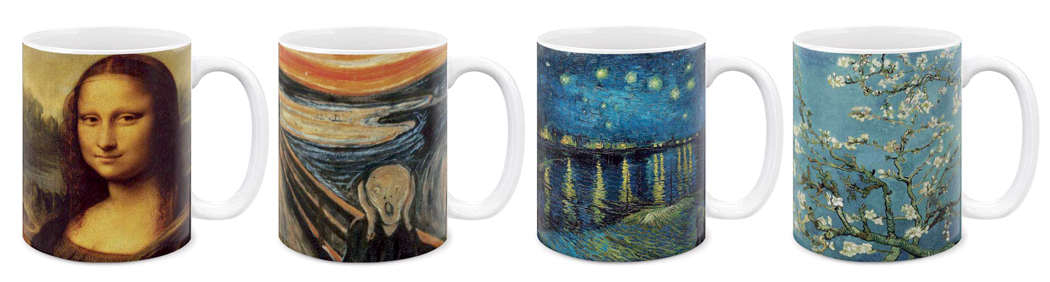
I want to make the same case for visual art. Everyone knows what the Mona Lisa looks like. Or do they? Almost to a person, those who have seen the original has remarked how small the painting is. It is a very different thing from the same image on a coffee mug or even in an art book.
But it’s not merely size I mean. The colors cannot be precisely conveyed by printer’s ink or by a computer’s palette. The paint has a texture that isn’t conveyed, and varying levels of gloss or matte. This was brought home to me — very like the revelation of Angels — when I saw a collection of Cezanne still lifes at Washington’s National Gallery of Art. I had not imagined such an exquisite range of greens; way too many variants than can be named. The Cezannes in my Janson were dull and lifeless in comparison. Yes, I could name the subject in them — an apple here, a vase there — but apple and vase were not what the painting was about. This rich range of visual information was the real subject. Gone in the reproduction. The real paintings made me want to chew the colors like a great meal.
We are led to accept imagery as the purpose of art, but it is only one portion of it. Alone, it is hardly more than the male or female silhouette on a restroom door. It also must include the scale, the finer shades of color and texture — and as with theater — the “presence.” The fact. Van Gogh’s Starry Night is everywhere from lampshades to mouse pads, but if you stand before it at the Museum of Modern Art in New York, you absorb how complex the painting is. Not just a swirl of blue night sky, but an object, a painting made of pigments and oils.
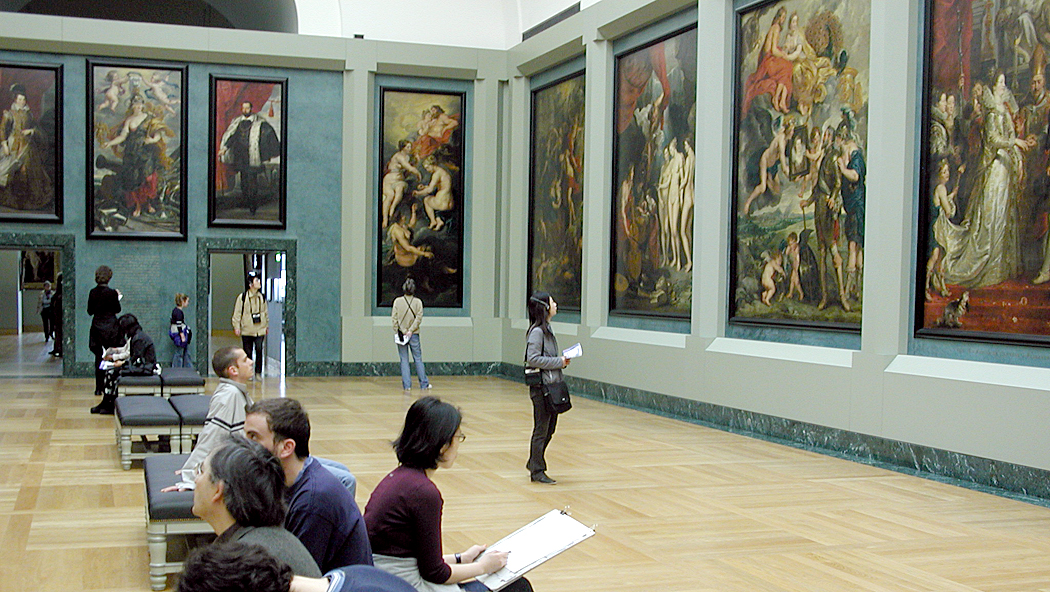
The same with the huge paintings of Maria Medici by Rubens, or the meticulous brushstrokes of Robert Campin’s Mérode Alterpiece at the Cloisters in New York.
But, I hear someone say, you should not let the best be the enemy of the good. As Chaucer said, “Muche wele stant in litel besynesse.” And many of us cannot visit the Louvre or the Prado, or get tickets to the New York City Ballet. Does everything have to be great?
I am not arguing that. I am saying that we should not be bamboozled into thinking that a reproduction can stand in for the genuine and that the real thing can be a life-changing experience, causing you to discover depths in yourself you hadn’t even suspected, whether it is the sympathetic feel of your muscles watching a dancer, or the empathy you extend to Salieri in Amadeus, or the hunger for color you get from Cezanne.
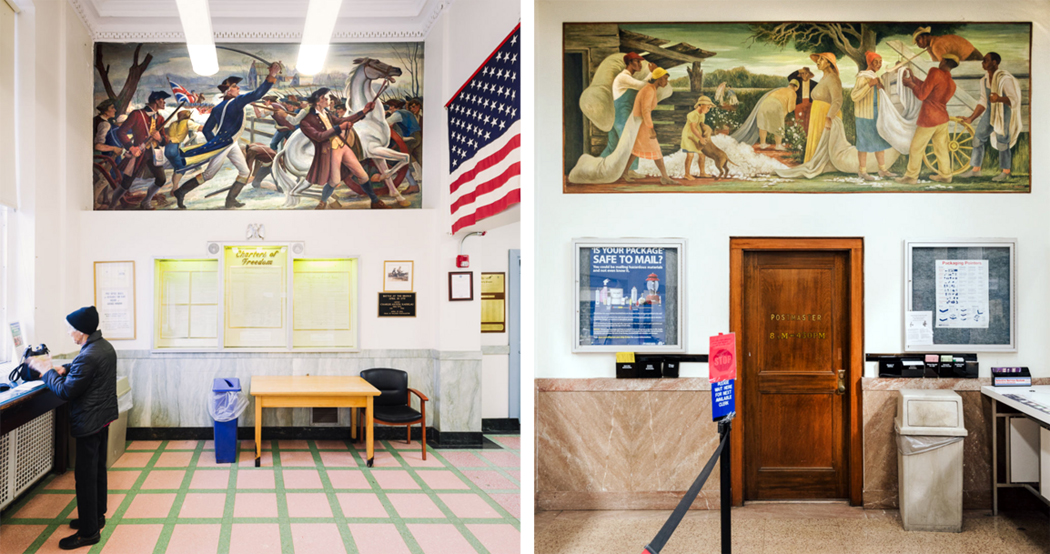
I am arguing that, in fact, you should look at real paintings and sculpture. Not all of it will be great, but it will be real. It will be present. There is plenty of local art in every town and city. If there is no museum, there may be some Depression-era murals in your post office, or a World War I soldier in your town square. There are local artists working in your neck of the woods, and what they do is real, not virtual.
Every locale has artists working, and art worth experiencing isn’t only found in museums, or only found in New York or Berlin.
I remember pulling into a supermarket in Boone, N.C. one fall afternoon and hearing three or four local musicians plucking guitar and banjo on the front steps, gathered informally to play some tunes. It was genuine and I sat and listened with the small crowd for 20 minutes or so before going in for my butter and eggs.
You never know what you’re going to get. Even the best performer can have an off night, and sometimes an amateur can hit the spot. It isn’t frogs you have to kiss, but you do need to weed through a good deal of acceptable but unexceptional work to find those few that will stick with you for life.
If I say we have entered a new Romantic era, you may lick your chops and anticipate the arrival of great poetry and music. But hold on.
Nothing gets quite so romanticized as Romanticism. It all seems so — well — romantic. We get all fuzzy inside and think pretty thoughts. Romanticism means emotional music, beautiful paintings, expansive novels, and poetry of deep feeling.
Or so we think, forgetting that Johann Wolfgang von Goethe called Romanticism a “disease.”
The surface of Romanticism may be attractive, but its larger implications are more complex. We should look deeper into what we mean by “Romanticism.”
Initially, it is a movement in art and literature from the end of the 18th century to the middle or latter years of the 19th century. It responded to the rationalism of the Age of Reason with a robust faith in emotion, intuition and all things natural. We now tend to think of Romanticism as a welcome relief from the artificiality of the aristocratic past and a plunge into the freedom of unbuttoned democracy. We read our Shelley and Keats, we listen to our Chopin and Berlioz and revel in the color of Turner and Delacroix. Romanticism was the ease of breathing after we have unlaced our corset or undone our necktie.
Yet, there is something adolescent about Romanticism, something not quite grown up. It is too concerned with the self and not enough with the community. There is at heart a great deal of wish fulfillment in it, and a soft pulpy core of nostalgia and worse, an unapologetic grandiosity. One cannot help think of Wagner and his Ring cycle explaining the world to his acolytes. Music of the Future, indeed.
I’m not writing to compose a philippic against a century of great art, but to consider the wider meanings of what we narrowly define as Romanticism.
Most importantly, one has to understand the pendulum swing from the various historical classicisms to the various historical romanticisms. Romanticism didn’t burst fully grown from the head of Beethoven’s Eroica, but rather recurs through history predictably. One age’s thoughtfulness is the next generation’s tired old pusillanimity. Then, that generation’s expansiveness is followed by the next and its judiciousness.
The classicism of Pericles’ Athens is followed by the energy of Hellenism. The dour stonework of the Romanesque is broken open by the lacy streams of light of the Gothic. The formality of Renaissance painting is blown away by the extravagance of the Baroque. Haydn is thrown overboard for Liszt, and later the tired sentimentality of the Victorians (the last gasping breaths of Romanticism) is replaced by the irony and classicism of Modernism. Back and forth. This is almost the respiration of cultural time; breathe in, breathe out. You could call it “cultural yoga.”
We tend to label the serene and balanced cultures as classical and the expansive and teetering ones as romantic. The labels are not important. Nietzsche called them Apollonian and Dionysian. William Blake personified them in his poems as reason and energy.
We are however misled if we simplify the two impulses as merely rationality vs. emotion. The twin poles of culture are much more than that.
Classicism tends to engage with society, the interactions of humans, the ascendency of laws instituted by men (and it is men who have instituted most of them and continue to do so — just look at Congress). AT its heart, it is a recognition of limits.
Romanticism, of whatever era it reveals itself, engages with the cosmos, with history, with those things larger than mere human institutions, with Nature with a capital “N.” Romanticism distrusts anything invented by humans alone, and surrenders to those forces mortals cannot control. Romanticism has no truck with limits.
These classical-romantic oppositions concern whether the artist is engaged with man as a social being, an individual set in a welter of humanity — or whether he is concerned with the individual against the background of nature or the cosmos.
Yet there is an egotism in the “me vs. the universe” formulation. It tends to glorify the individual as hero and disparage the community which makes life possible.
In the 18th Century, for instance, Alexander Pope wrote that “The proper study of mankind is man.” The novel, which investigates human activity in its social setting, came from the same century. Fielding and Defoe come from that century.
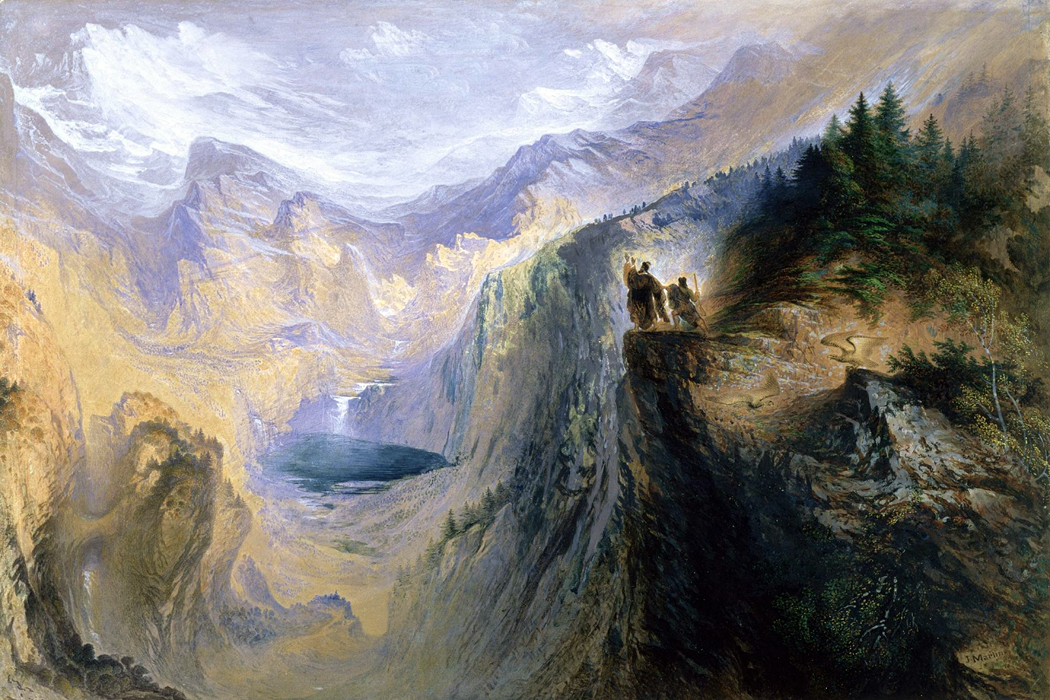
The succeeding century is concerned more with man in nature, or man in his loneliness, or fighting the gods and elements. One thinks of Shelley’s Prometheus Unbound or Byron’s Manfred.
There are many more polarities to these movements in art and culture. One side privileges clarity, the other complexity. Just compare a Renaissance painting with a Baroque one. The classical Renaissance tends to line its subjects up across the canvas in a line, while the Baroque wants to draw us in to the depth of the painting from near to far. Renaissance paintings like to light things up evenly, so all corners can be seen clearly. The romanticised Baroque loves the great patches of light and dark, obscuring outlines and generally muddying up the works.
Look at this Last Supper by Andrea del Castagno. See how clear it all is.
But the Baroque painter Tintoretto had a different vision of the same biblical event. It is writhing, twisting out into deep space, with deep shadows and obscure happenings. The Renaissance liked stability and clarity; the Baroque, motion and confusion.
One side values unity, the other, diversity. One side values irony, the other sincerity. One side looks at the past with a skeptical eye, the other with nostalgia. One side sees the present as the happy result of progress, the other sees the present as a decline from a more natural and happier past. One side unabashedly embraces internationalism, the other, ethnic identity and nationalism. If this sounds familiar, think red and blue states.
One of the big shifts is between what I call “ethos” and “ego.”
That is, art that is meant to embody the beliefs of an age, thoughts and emotions that everyone is assumed to share — or art that is the personal expression of the individual making it.
We have so long taken it for granted that an artist is supposed to “express himself,” that we forget it has not always been so. Did Homer express his inner feelings in the Iliad? Or are those emotions he (or she) described the emotions he expected everyone would understand and share? He tells of what Achilles is feeling, or Ajax or Hector or Priam — and they are deep and profound emotions — but they give no clue to what Homer was feeling.
In music, Haydn’s symphonies were written about in his day as being powerfully emotional. Nowadays, we think of Haydn as a rather witty and cerebral composer. If we want emotion, we go to Beethoven or Schubert. You cannot listen to Schubert’s string quintet and not believe it expresses the deepest emotions that its composer was suffering at the time. It is his emotion. We may share it, but it is his.
The history of art pulsates with the shift from nationalistic to international styles, from that which is specific to an ethnic or identity group, and that which seeks to transcends those limitations.
In music, Bach imitated the national styles in his English and French suites and his Italian Concerto. The styles are distinct and identifiable.
But the Galant and Classical styles that replaced it vary little from country to country. Perhaps the Italian is a little lighter and the German a little more complex, but you can’t get simpler or more direct than Mozart.
Nationalism reasserted itself in the next century, so that you have whole schools of Czech music, French, Russian. In the early 20th Century, internationalism took charge once more and for a while, everybody was writing like Stravinsky.
The main architectural style of the first half of this century is even called “The International Style.” That style is now so passé as to be the butt of jokes.
The classical eras value rationality and clear thinking, while its mirror image values irrationality and chaos.
You’re ahead of me if you have recognized that much of what I am calling Romanticism is playing out in the world and in current politics as a new Romantic age.
Nationalism is reasserting its ugly head in Brexit, in Marine Le Pen, Vladimir Putin — and in Donald Trump and his followers.
The mistrust or outright disbelief in science is a recasting of Rousseau. Stephen Colbert invented the term “truthiness,” and nothing could be a better litmus test of Romanticism: The individual should be the arbiter of truth; if it feels true, we line up and salute. In a classical age, the judgments of society are taken as a prime value. Certainly, there are those who resist, but by and large, the consensus view is adopted.
The previous Romantic age had its Castle of Otranto and its Frankenstein. The current one has its Game of Thrones and its hobbits, and wizards and witches. The 19th Century looked to the Middle Ages with a nostalgia; the Postmodern 21st Century looks to a pre-civilized barbarian past (equally mythologized) with a vision for a post-apocalyptic future.
(Right-wing nostalgia is for a pre-immigrant, pre-feminist, pre-integration utopia that never actually existed. The good old days — before penicillin.)
This neo-barbarianism also shares with its 19th Century counterpart a glorification of violence, both criminal and battlefield — as the huge armies that contend in the Lord of the Rings films, to say nothing of the viciousness of Game of Thrones.
As we enter a new Romantic age around the world, one of dissociation, confusion and realignment, we need to recognize the darker side of Romanticism and not merely its decorative accoutrements.
We will have to accept some of those adages propounded in William Blake’s Marriage of Heaven and Hell: “Sooner murder an infant in its cradle than nurse unacted desires.” And, “The tigers of wrath are wiser than the horses of instruction.” Is this not the Taliban? The Brexiteers? The Republican Party? And those elements in academia who want cover their ears and yell “nyah-nyah-nyah” when faced with anything outside their orthodoxy?
Because it isn’t only on the right. The Noble Savage has come back to us as a new privileging of indigenous cultures over Western culture. The disparagement of European science, art, culture and philosophy as “hegemonic” and corrupt is just Rousseau coming back to bite us on the butt. (The West has plenty to answer for, but clitoridectomies are not routine in New Jersey. There is shame and blame found everywhere.)
And the political right has discovered “natural immunity” and fear of pharmaceuticals, while still thinking it OK to run Clorox up the kiester.
The last Age of Romanticism kicked off with the storming of the Bastille — a tactically meaningless act (only seven prisoners remained prison, four of them were forgers and another two were mentally ill) which inspired the French Revolution and all the bloodshed of Terror, but had enough symbolic significance to become the focus of France’s national holiday. We have our January 6, just as meaningless and perhaps just as symbolic. But perhaps that riot has more in common with a certain putsch in Munich.
The first time America entered a Romantic age, in the 19th century, it elected Andrew Jackson, arguably the most divisive president (outside the Civil War) before Donald Trump, and certainly the most cock-sure of himself and the truthiness he felt in his gut. Facts be damned. For many of us, Trump feels like the reincarnation of Jackson, and this era feels like the reemergence of a Romantic temperament, and we may need to rethink just how warm and cuddly that truly is.
This piece is updated, expanded and rewritten from an April 2017 essay for the Spirit of the Senses
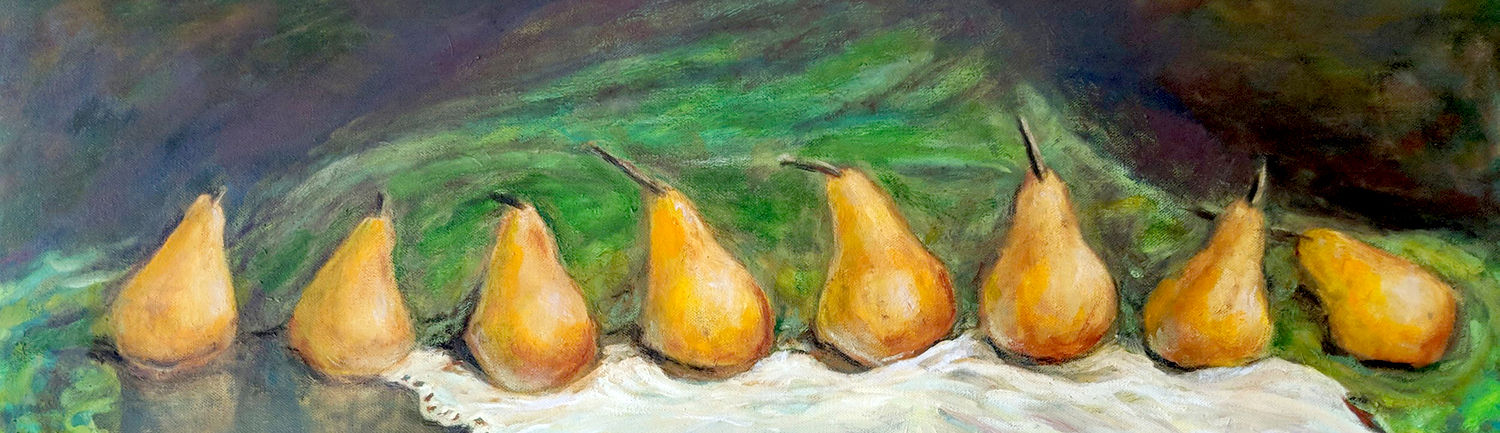
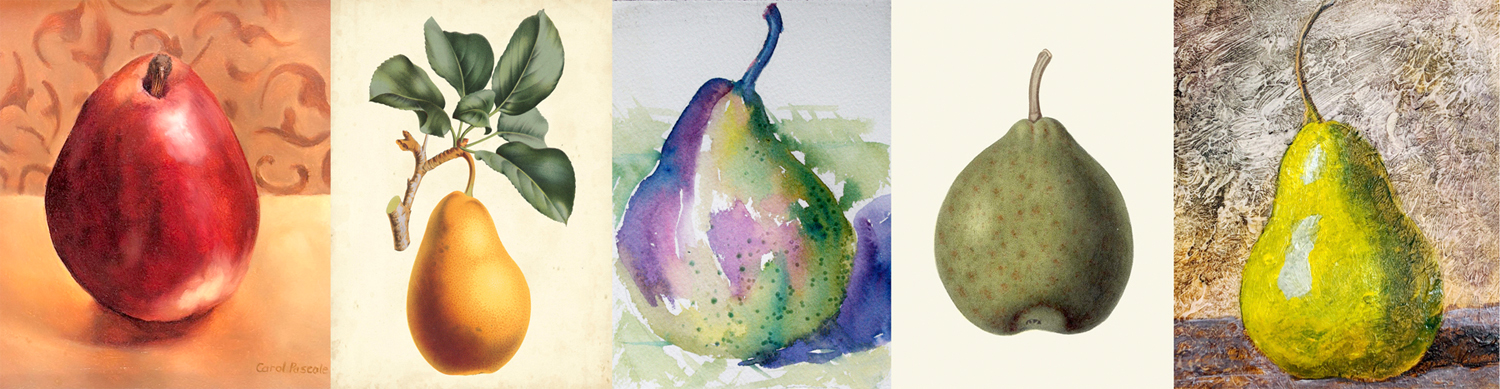
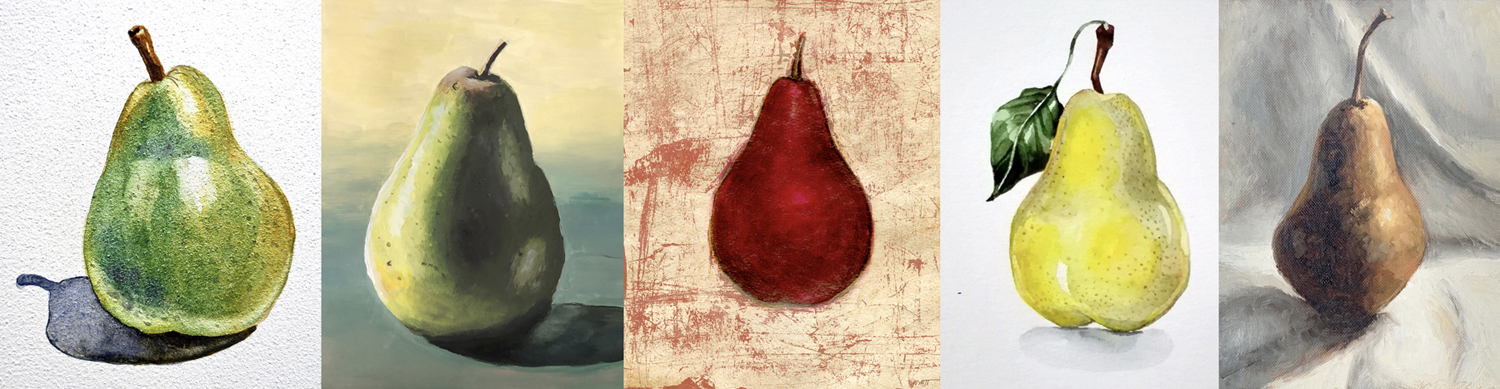
I started to write about philosophy, but realized I really wanted to talk about pears. Crisp, delicious succulent pears, the kind with small brown spots on the skin and a roly-poly bottom. Given a choice between reading Hegel (insert dry cough here) and slicing wedges off a Bartlett pear, the fruit wins hands down every time.
I have been thinking about this because of philosophy. The intellectual world seems divided irrevocably between art and philosophy — image and word. One side deals with categories of thought, the other side deals with hubcaps, clouds, tight shoes and the sound of twigs snapping underfoot, to say nothing of pastrami sandwiches and corduroy trousers.
I’m sorry if I value the one vastly over the other. I am a Dichter not a Denker. I have — this is my ideological burden — a congenital mistrust of language, particularly abstract language and language of categories. The world is too multifarious, indeed, infinite, and language by nature and requirement, simplifies and schematizes, ultimately to the point that language and reality split paths and go in separate directions. When one relies too much on language, one misses the reality.
The tragedy is, that language is all we have. We are stuck with it. We can try to write better, more clearly, use evocative metaphor when declarative words fail, use imagery rather than abstractions, and do our best — our absolute best — to avoid thinking categorically, and attempt to see freshly, with eye and mind unsullied by the words that have preceded us. It’s hard, but it is essential. To begin with the categories, and to attempt to wedge our experience into them, is to mangle and to mutilate the reality.
The matter is only made worse by the impenetrable fustian written by so many philosophers — and especially the recent crop of Postmodern and Poststructuralist explainers.
Take Hegel — please. Georg Wilhelm Friedrich Hegel (1770-1839) is just the kind of philosopher who thinks thoughtful thoughts and writes incomprehensible prose.
“Knowledge of the Idea of the absolute ethical order depends entirely on the establishment of perfect adequacy between intuition and concept, because the Idea itself is nothing other than the identity of the two. But if this identity is to be actually known, it must be thought as a made adequacy.”
“A made adequacy?” That’s from his System of Ethical Life (1803-4). I’m sure if you spent an hour or two going over it again and again, you might be able to parse something out of it. But, jeez. It’s the kind of prose you get from academia all over the place:
“As histories of excluded bodies, the bodies that made national Englishness possible, this counterpastoral challenged the politics of visibility that made the very modern English models of nature, society, and the individual visible through the invisibility of bodies that did not matter.”
That’s from Kathleen Biddick’s The Shock of Medievalism (1998). She is also the author of The Typological Imaginary: Circumcision, Technology, History.
In such writing, individual abstract words are made to stand in as shorthand for long complex ideas, not always adequately explained. And the words are then categories, and the categories allow blanket statements that cover the world like Sherwin-Williams paint.
The basic problem is that words are always about words. When Plato talks about “the Good,” he is talking about how we define the word, “good.” Plato is about language. The linguistic grammar and language has its own rules, its own logic, and they soon supersede what the philosophers call “the case.”
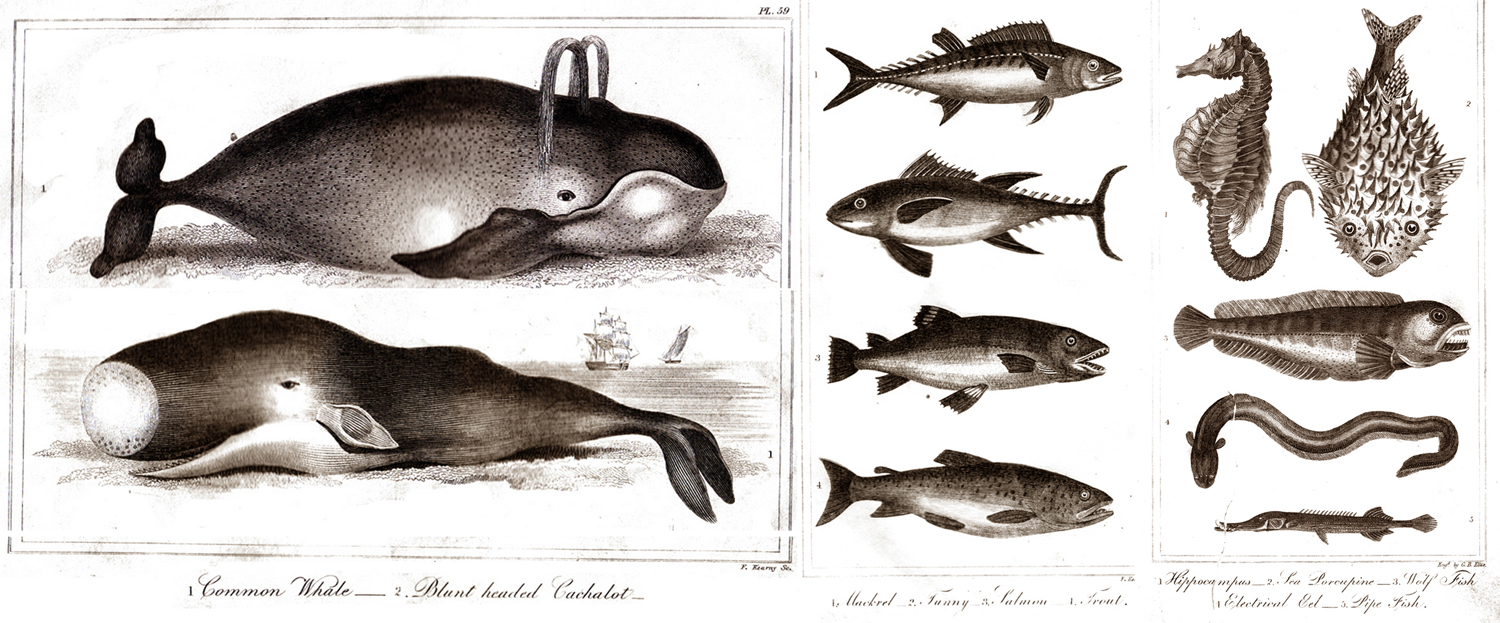
There is a book out there now titled Why Fish Don’t Exist, by Lulu Miller. And taxonomists now largely agree that what we used to call the class of animals Pisces (fish), are really a bunch of increasingly unrelated classes or clades, in fact at least 12 of them, not counting subclasses. For example, a salmon is more closely related to a camel than to a hagfish.
But, back in the 18th century, both whales and sea urchins were also classified as “fish.” That we distinguish them separately now has made no difference to either whales or urchins, but only to dictionaries. That a whale is not a fish but a mammal is a shift in language, not biology. Fish still swim in the sea, even if we hesitate to call them fish.
And in the same way, the parsing of philosophers is mostly a shift of wordplay. The philosopher Ludwig Wittgenstein made this the central issue of his later work.
Meanwhile, as the philosophers mince language in their mental blenders, Gloucester fishermen keep pulling fish out of the oceans. When it comes to trust, I take the fishermen over the philosophers. The world is filled with sensible, seeable, feelable, hearable things. Things that give us pleasure and made the world we find ourselves cast into, like poached salmon.
Our lives are filled with the things of this world and their shapes, colors, sounds, textures, smells and tastes. And so is our art, which makes images, poems, dances, music and theater from those shapes, colors, sounds, etc., is a direct connection with the things of this world — the “case” as it were.
And I think of pears in art — those buttery layers of paint by Paul Cezanne — and the other still life art that singles out this bit or that of the physical presences of the world and shows them to us so we may notice them and appreciate them.
Most of our art tends to be divided between people and things — “things” being mostly landscapes and still life. In our art, we privilege people over things and that is only fitting. I’m sure squirrels are most interested in other squirrels, too.
But the non-human and non-living things things are so much a part of our lives, and a certain percentage of our art has been made about things. Like pears.
I step outside into the sun and I hear distant traffic, the breeze hissing in the tree leaves, and, from several blocks away, the intermittent rattle of a chainsaw. In the morning, there are birds — mockingbirds and chickadees. There is the feel of the air and the sun on my skin. There is the smell of the grass, new mown, or maybe the oily resonance of diesel fumes. I stand and feel the temperature. I live in the welter of the world.
And so, I am in love with the things of this world. I am mad for them to be in contact with me, to absorb them, to notice and appreciate them. To pay attention. To be alive.
And I slice a pear. The insides are both pulpy and wet; the skin keeps the flesh from drying out. The stem at the top curves off. The nub at the bottom shows where the white flower had been.
I take pears instead of apples here, because apples have too many words stuck to them, making them gummy with ideas, from Eve’s fruit of temptation to the computer on which I am writing these words.
But a pear can be seen with less baggage. It bruises more easily than an apple, yet its pulp is firmer, stiffer, unless overripe, when it can go mushy. Nor is it as sweet as an apple, although we must point out that there are hundreds of different varieties of apple and that a red delicious is sweeter than a granny smith. (Yet the granny smith makes a better pie).
There are varieties of pear, also, and they are perhaps more distinct than the apples. The lanky brown Bosc, the squat green Anjou, the nearly round Le Conte, the very sweet Seckel. In Japan, there is the ruddy, round Kosui, or russet apple pear. The Comice is great with ripe cheese. Yellow Huffcap for making perry — a cider made from pears.
I believe the central fact of existence is variety, in infinite forms, which in contrast makes the categories of philosophers seem puerile and simplistic. And dry. Pears have juice. Derrida, none.
These are smart people. I don’t begrudge them that. And perhaps we need people thinking such thoughts. But if we leave these words to the philosophers, I will have more time for myself with all the plants, rocks, fruit, animals, clouds, stars, cheeses and oceans.
Ultimately, to experience things is more important — more rewarding — than explaining them.
When it comes time to leave this planet and join oblivion, in those last moments left to my life, mostly, I will be thinking about the people I have loved and who have loved me. But beyond that, will I be thinking about Hegel or will I be remembering pears? My money is on the palpable. There is love there, too.
From the last half of the Eighteenth Century through the last quarter of the Nineteenth, an idea permeated popular and intellectual culture and showed itself in literature, art and music, although no one could quite agree on its definition. Like wit in the seventeenth and early eighteenth centuries, which also defied simple definition, the sublime was something no one couldn’t quite pin down, but like Justice Potter Stewart said, you knew it when you saw it.
The Sublime features representations of vast spaces, horrifying disasters and universal chaos. Anything dark, scary, awe inspiring or supernatural.
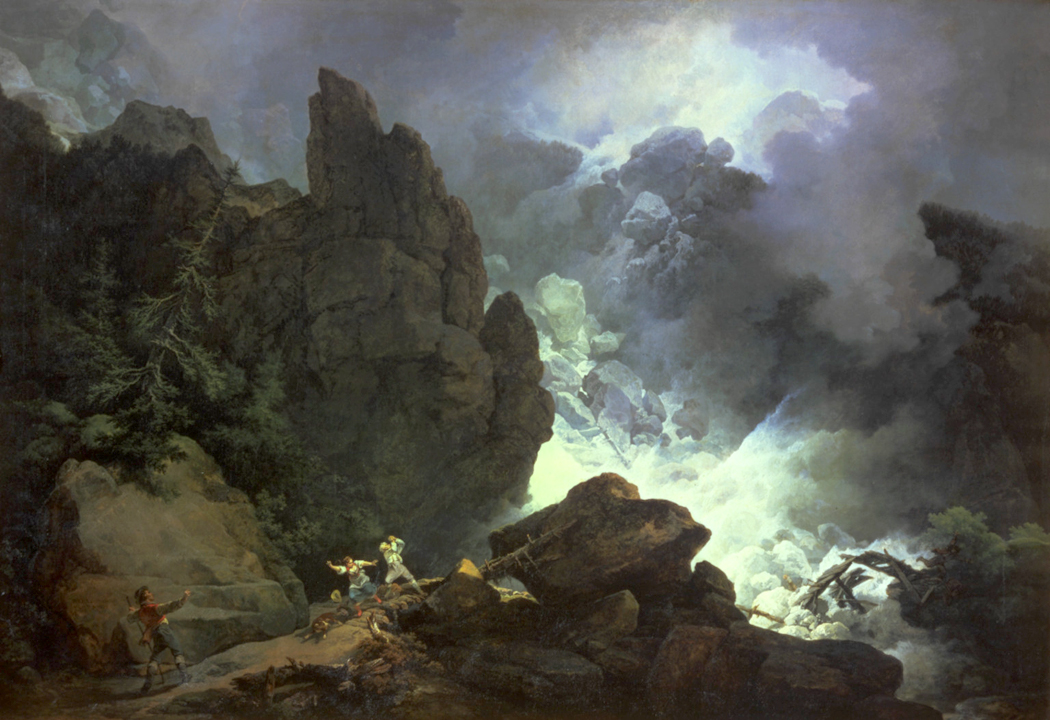
“Alpine Avalanche,” Philip James de Loutherbourg, 1803
Of course, the idea isn’t limited to the Eighteenth and Nineteenth centuries. It has been around as long as there has been art and literature. There is The Sublime in the epic of Gilgamesh and it is all over the Bible.
There had always been a subspecies of The Sublime in art. It is in Shakespeare, in Titian, in Rubens. It runs throughout John Milton’s Paradise Lost, especially in those parts describing Satan and his acts.
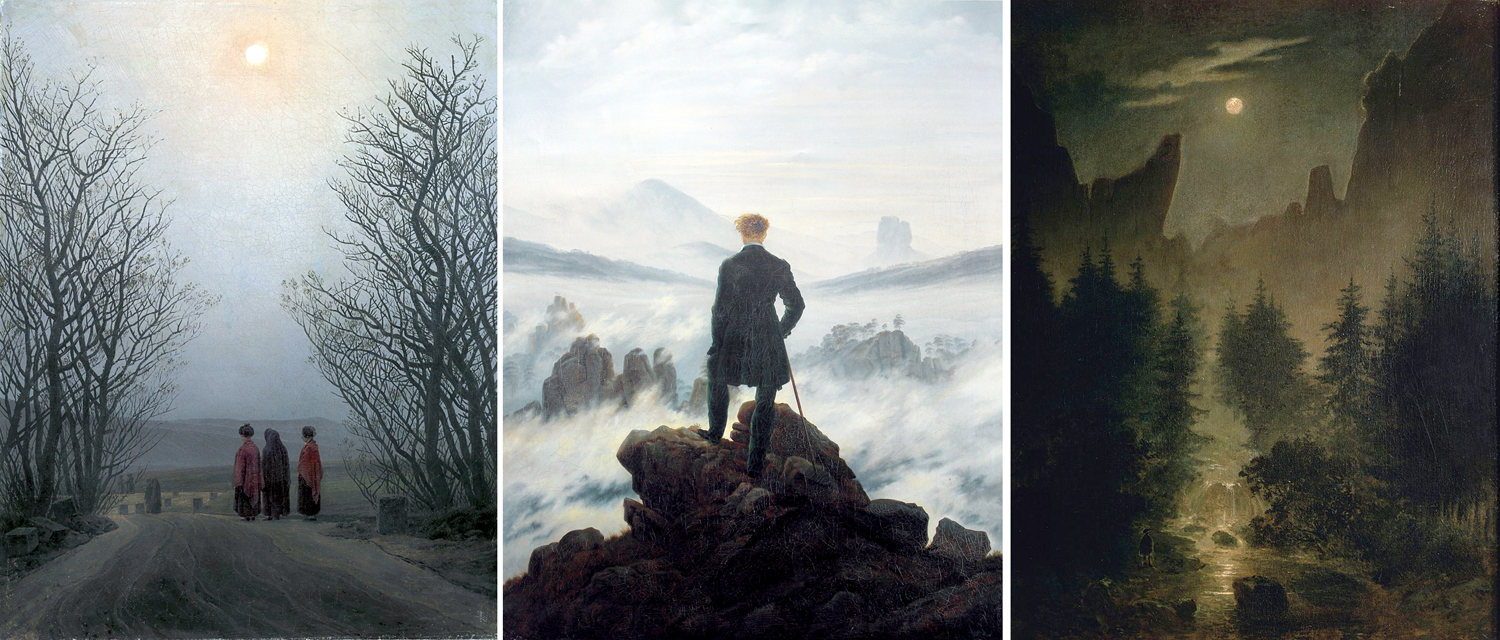
But The Sublime steps into the spotlight with the advent of Romanticism. It is in the poetry of Byron, the novels of Victor Hugo, the paintings of Caspar David Friedrich. It is behind the fad for Gothic novels and the nature poetry of Wordsworth and Coleridge.
The first clear enunciation of The Sublime in literature was set down in the First Century by an anonymous author, usually called Longinus. His treatise, usually called On the Sublime, is primarily a guidebook to rhetoric, with all the usual tropes, but he also discusses how great writing — as opposed to the merely good — overwhelms us, and it is great subjects that lend themselves to great writing.
In the climactic 35th chapter, he writes: “What was it they saw, those godlike writers who in their work aim at what is greatest and overlook precision in every detail? … (W)e are by nature led to marvel, not, indeed, at little streams, clear and useful though they be, but at the Nile, the Danube, or the Rhine, and still more at the Ocean. … nor do we consider out little hearthfire more worthy of admiration than the craters of Etna whose eruptions throw up rocks and boulders or at times pour forth rivers of lava from that single fire within the earth.
“Vesuvius Erupting,” Pierre-Jacques Volaire, 1877
“We might say of all such matters that man can easily understand what is useful or necessary, but he admires what passes his understanding.”
What happened between the century of Voltaire and that of Shelley is the cultural shift from Neo-classicism to Romanticism. It is a shift from a concern for society and relations of humans to humans to a different frame of reference — to the relation of the individual to the cosmos.
Relations between people are between roughly equal, similar size entities; relations with the cosmos pit the infinitesimal human being against the infinite. There is no satisfactory reaction but awe, terror, and admiration: That is The Sublime.
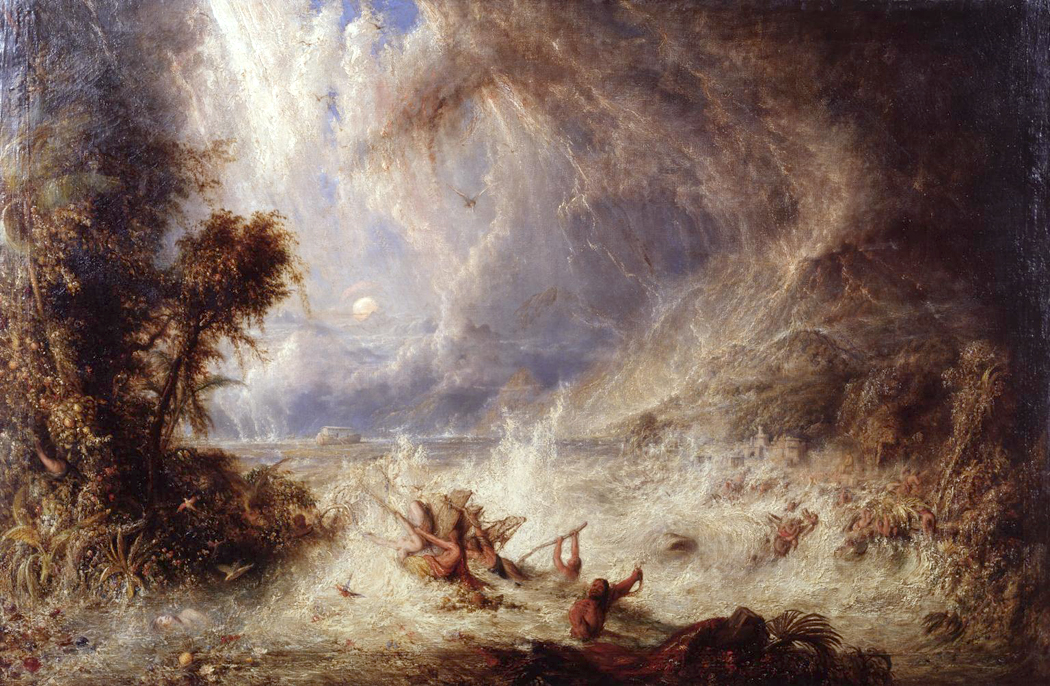
“The Deluge” William Westall, 1848
Coleridge describes a Sublime experience in his 1818 lecture on “European Literature” by recalling: “My whole being expands into the infinite; earth and air, nature and art, all swell up into eternity, and the only sensible expression left is, ‘that I am nothing!’ which concludes that his ultimate realization of The Sublime was of his own human insignificance.”
In 1757, a young Edmund Burke wrote an influential treatise, A Philosophical Enquiry into the Origin of our Ideas of the Sublime and Beautiful. He wrote: “Whatever is fitted in any sort to excite the ideas of pain, and danger, that is to say, whatever is in any sort terrible, or is conversant about terrible objects, or operates in a manner analogous to terror, is a source of the sublime; that is, it is productive of the strongest emotion which the mind is capable of feeling.”
He sorted The Sublime into seven constituents: darkness; obscurity; deprivation; vastness; magnificence; loudness; and suddenness. When used in art or literature, The Sublime reminds us of things we find frightening in the world, but by being framed in art, lets us contemplate it in safety, and thus we find pleasure in it.
“Chamounix, Mont Blanc and the Arve Valley” JMW Turner 1803
The next generation sought out The Sublime in reality as well as in literature. When Mary and Percy Shelley visited the valley of the Arve River in the Alps, they noted in their History of a Six Weeks Tour through a Part of France, Switzerland, Germany, and Holland: “Mont Blanc was before us, but it was covered with cloud; its base, furrowed with dreadful gaps, was seen above. Pinnacles of snow intolerably bright, part of the chain connected with Mont Blanc, shone through the clouds at intervals on high. I never knew — I never imagined what mountains were before. The immensity of these aerial summits excited, when they suddenly burst upon the sight, a sentiment of ecstatic wonder, not unallied to madness.”
Shelley transformed this into his poem, Mont Blanc: Lines Written in the Vale of Chamouni:
In her 1794 gothic novel The Mysteries of Udolpho, Ann Radcliffe has her heroine face the Alps:
“They quitted their carriages and began to ascend the Alps. And here such scenes of Sublimity opened upon them as no colors of language must dare to paint … Emily seemed to have arisen in another world, and to have left every trifling thought, every trifling sentiment, in that below: those only of grandeur and sublimity now dilated her mind and elevated the affections of her heart.”
“Hannibal Crossing the Alps in Snowstorm” JMW Turner 1812
And Byron is nothing without The Sublime. He takes his doomed hero to the Jungfrau in Manfred and used it in Childe Harold’s Pilgrimage over and over, as in the lines, “Roll on thou deep and dark blue Ocean — roll!”
In Canto 3 of Childe Harold, he takes his hero to the Alps:
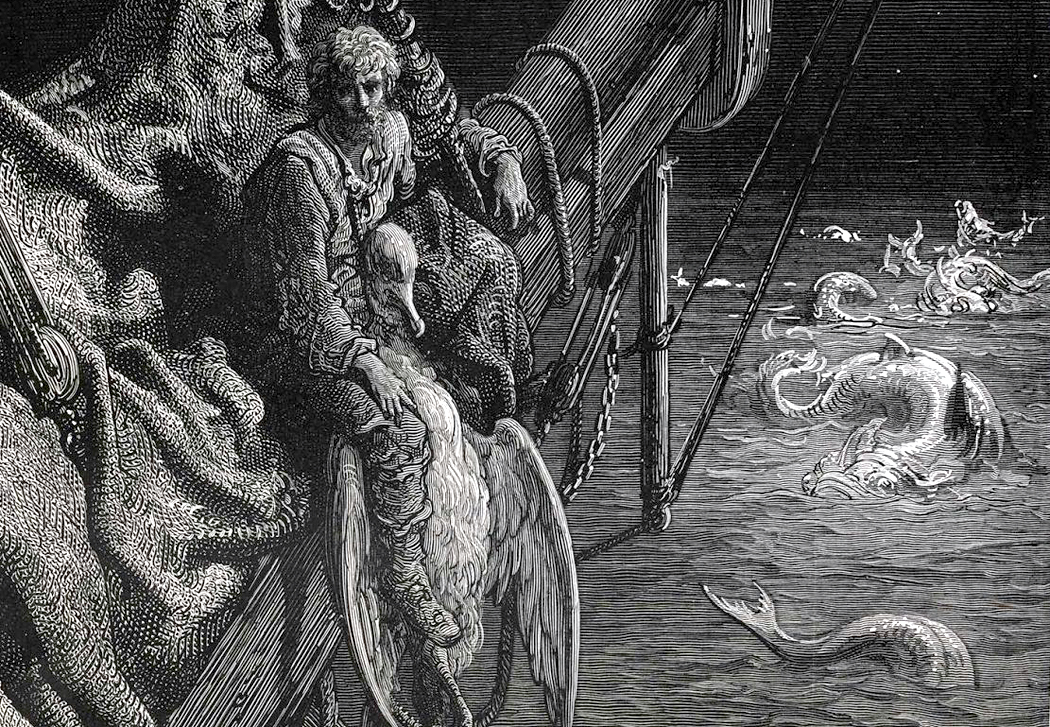
Coleridge’s Rime of the Ancyent Marinere (1798) is all about The Sublime and its terror — and ultimately, its beauty.
Its hero, aboard a death ship is surrounded by a sea of monsters: “The very deep did rot: O Christ!/ That ever this should be!/ Yea slimy things did crawl with legs/ Upon a slimy sea.” But our mariner has a transformation of heart:
Certain artists and painters became transfixed by The Sublime. First comes Joseph Wright of Derby (he is always referred to this way, apparently to distinguish him from other Joseph Wrights, including an American artist of the same time, who designed the Liberty Hat penny).
In many of the English Wright’s paintings, a bright light glows in the darkness. He painted multiple canvasses of the eruption of Mt. Vesuvius in the 1770s.
“Vesuvius in Eruption, With a View of the Bay of Naples,” Joseph Wright of Derby, 1776
Although he didn’t have to travel that far. Many of his landscapes feature brooding moonlight scenes, or images of fire in the darkness, such as
“Cottage on Fire,” Joseph Wright of Derby 1786
This fascination with The Sublime is primarily a northern European thing. You find it in British art, in German art and Scandinavian art, but less so in Italian or Spanish (Goya excepted).
Germany produced Caspar David Friedrich, who specialized in images of the contemplation of vast nature.
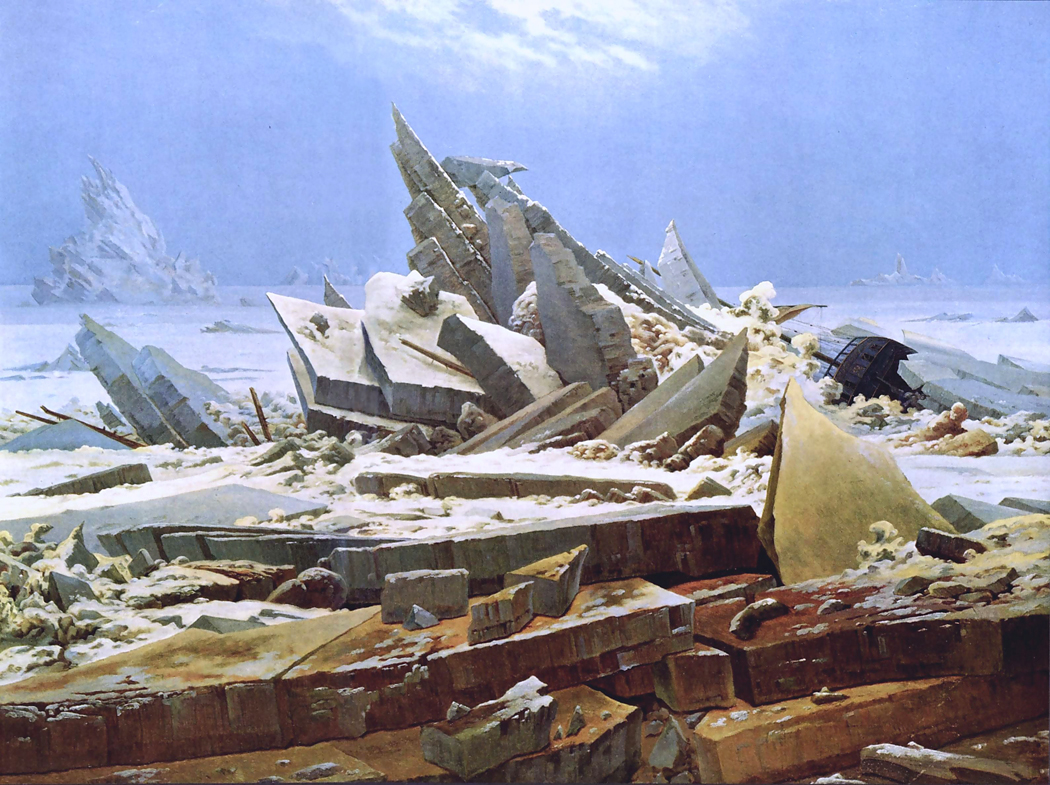
The arctic inspired a good deal of Sublime art, as in Friederich’s Sea of Ice, with its barely noticeable shipwreck.
“Das Eismeer” Caspar David Friedrich, 1823
The ice of the arctic is where Mary Shelley had her Frankenstein creature float away on an ice raft to his death.
“We are still surrounded by mountains of ice, still in imminent danger of being crushed in their conflict. The cold is excessive, and many of my unfortunate comrades have already found a grave amidst this scene of desolation.”
And the final words of the novel:
“He sprang from the cabin-window as he said this, upon the ice raft which lay close to the vessel. He was soon borne away by the waves and lost in darkness and distance.”
Later in the century, American painter Frederick Edwin Church painted a dozen or so studies of icebergs.
“Floating Iceberg,” Frederick Edwin Church 1859
Church also painted volcanoes, such as Cotopaxi in Ecuador.
“Cotopaxi,” Frederick Edwin Church 1862
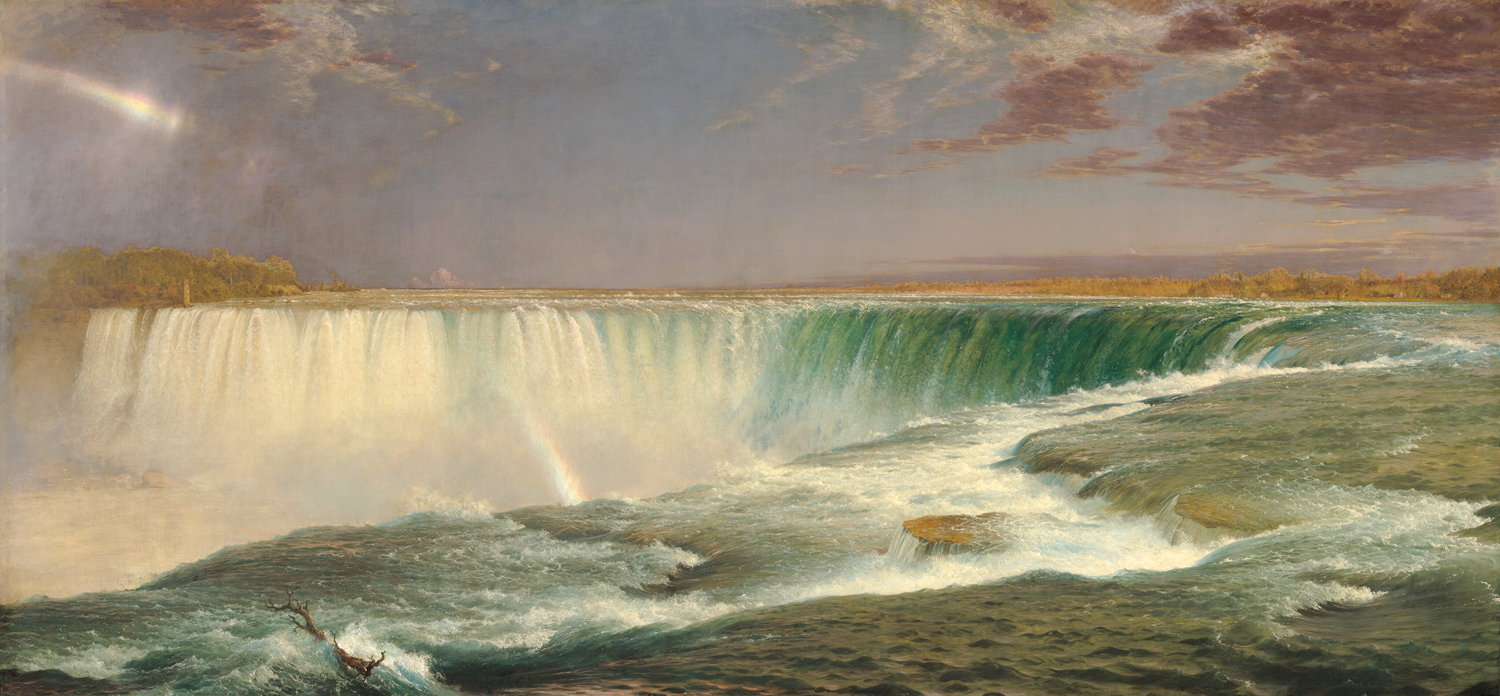
Church’s most famous painting, now at the National Gallery in Washington DC, is his Niagara, a nearly 8-foot across panorama of the falls. It was shown in New York in 1857, where visitors could pay 25 cents to view the painting in a darkened art gallery (for best effect). The painting went on a cross-Atlantic tour, shown the same way.
“Niagara,” Frederick Edwin Church 1857
Its effect was stunning for the time. Even a century later, writer David Harrington could say “Niagara is the American’s mythical Deluge which washes away the memory of an Old World so that man may live at home in a New World. The painting is an icon of psychic natural purgation and rebirth. Poetically a New World emerges as the waters of a flood subside. The rainbow, sign of the ‘God of Nature’s’ covenant with man, transfixes the beholder. … Niagara is a revelation of the cosmos to each and every man.”
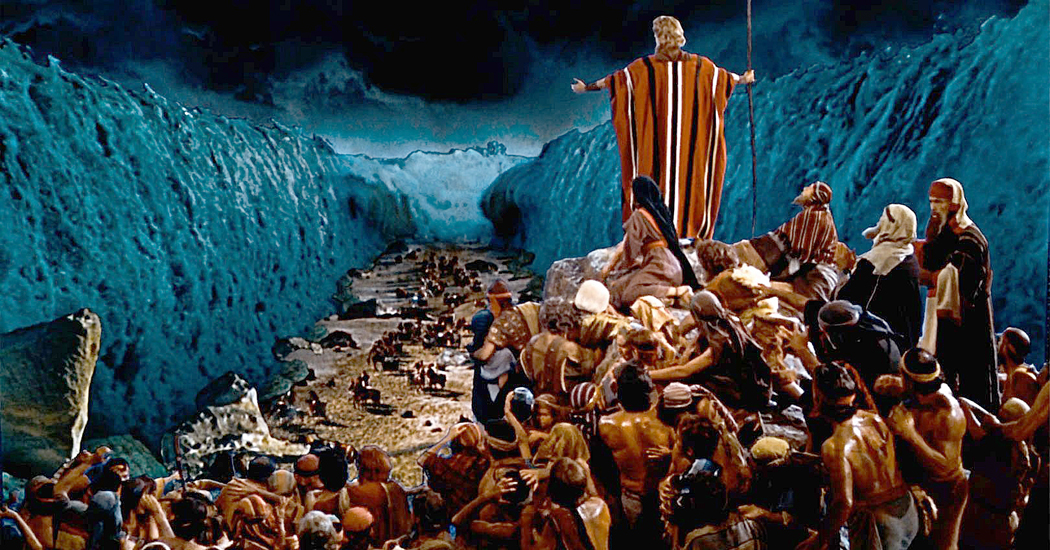
The biblical reference is apposite. Much of the imagery of The Sublime in the 19th Century comes from the Bible. Painters loved to depict certain scenes from the Old Testament: the Deluge; the Destruction of Sodom and Gomorrah; Balshazzar’s Feast; Samson destroying the temple of the Philistines; the Plagues of Egypt — anything that would have delighted Cecil B. Demille.
In such paintings, you can see the difference between earlier ages and the rise of The Sublime. In Renaissance and Baroque paintings, the action centers on the people involved. Landscape is mere backdrop. But in the century and a half I’m writing about, the people shrink to insignificance and the landscape takes over, full of rocky climes, lightning bolts, hurtling boulders, spewing volcanoes and roiling stormclouds. You can almost make a stop-action movie, like watching a flower unfold in a nature film, showing the people getting smaller and smaller and the landscape becoming ever more menacing.
“Gordale Scar, Yorkshire,” James Ward 1812
It is clear that as you go later into the 19th Century, The Sublime verges all too often at the edge of kitsch. The sense of cosmic overload funnels into a kind of religious sentimentality. Where you draw the line, personally, depends very much on your willingness to accept the underlying metaphor of the vastness and impenetrability of the universe.
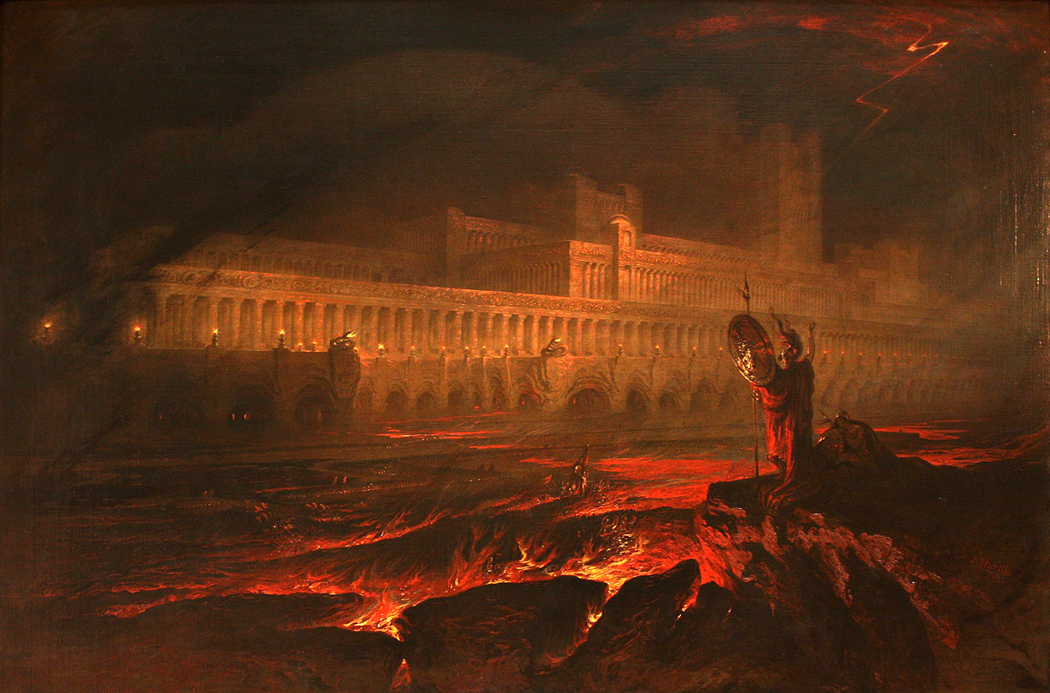
There are two British artists who straddle that line. John Martin and Joseph Mallord William Turner. Martin was very popular in the early years of the century, but is largely forgotten now. Turner was popular then and even more so today. Still, I have to admit a soft spot in my head for John Martin and his extravagance.
“Pandemonium,” John Martin 1841
I first learned of him and his large painting (now in the St. Louis Art Museum) called Sadak in Search of the Waters of Oblivion. First painted in 1812, it exists in several forms, both in paint and as print. In it, the Persian prince, Sadak, must fulfill a quest for the legendary Waters of Oblivion, in order to save his kidnapped wife. It is based on one of the Tales of the Genii, by English author James Ridley and was a huge success when first exhibited.
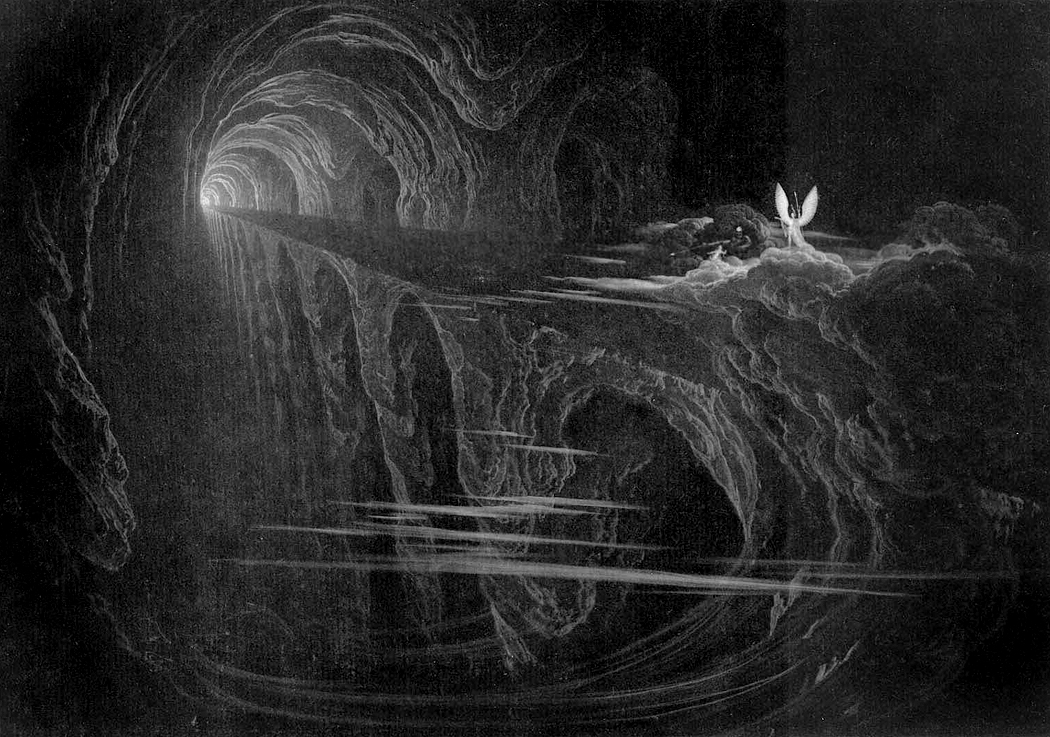
Martin turned to printmaking to make his work available to a wider audience and published, in 1824, an enormously popular series of illustrations to John Milton’s Paradise Lost. (These were, in part, the inspiration for the later Gustave Dore to make his own series for the epic poem).
“The Bridge Over Chaos” from “Paradise Lost,” John Martin 1826
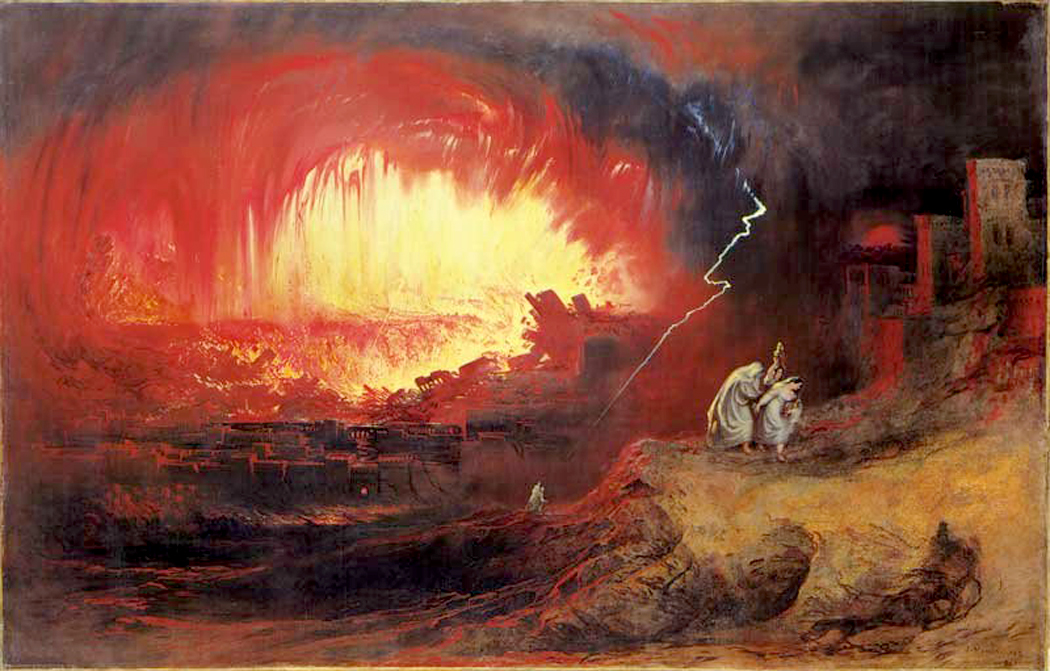
Biblical subjects became Martin’s bread and butter. The more grandiose the image, the more popular became his prints. They include The Fall of Babylon:
The Destruction of Sodom and Gomorrah:
The Seventh Plague of Egypt:
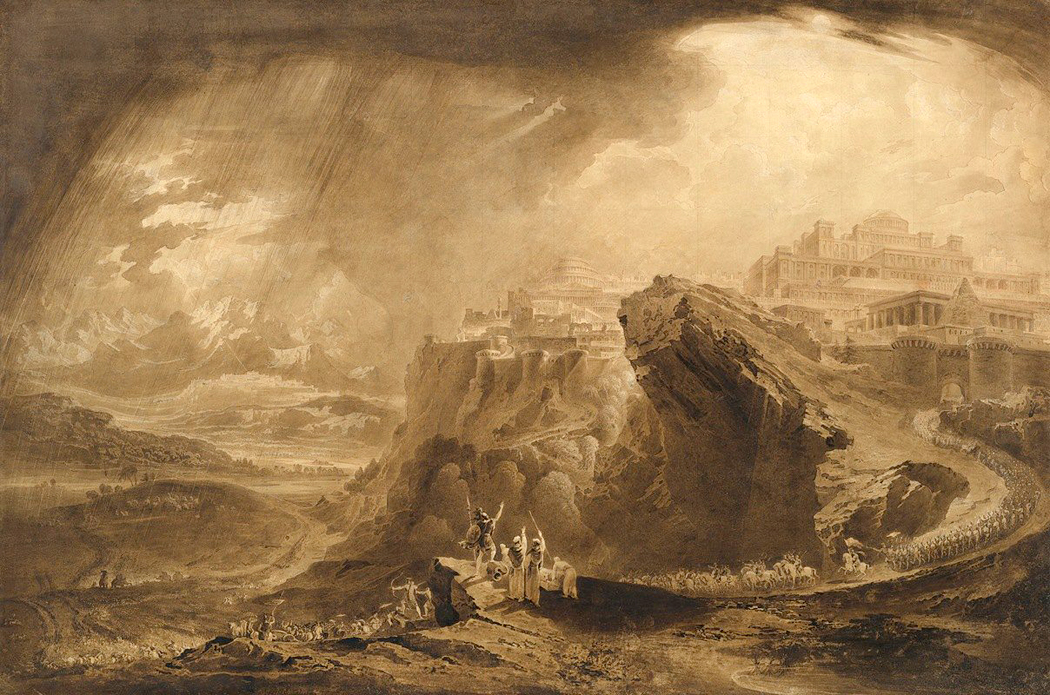
And Joshua Commanding the Sun to Stand Still Upon Gideon:
And my favorite — The Great Day of His Wrath:
He ventured out of his biblical Fach for the historical:
“The Destruction of Pompeii,” John Martin 1822
And even the prehistorical — on of my favorite for its goofiness. It was the frontispiece illustration for Gideon Mantell’s book, The Wonders of Geology:
“The Country of the Iguanodon,” John Martin 1837
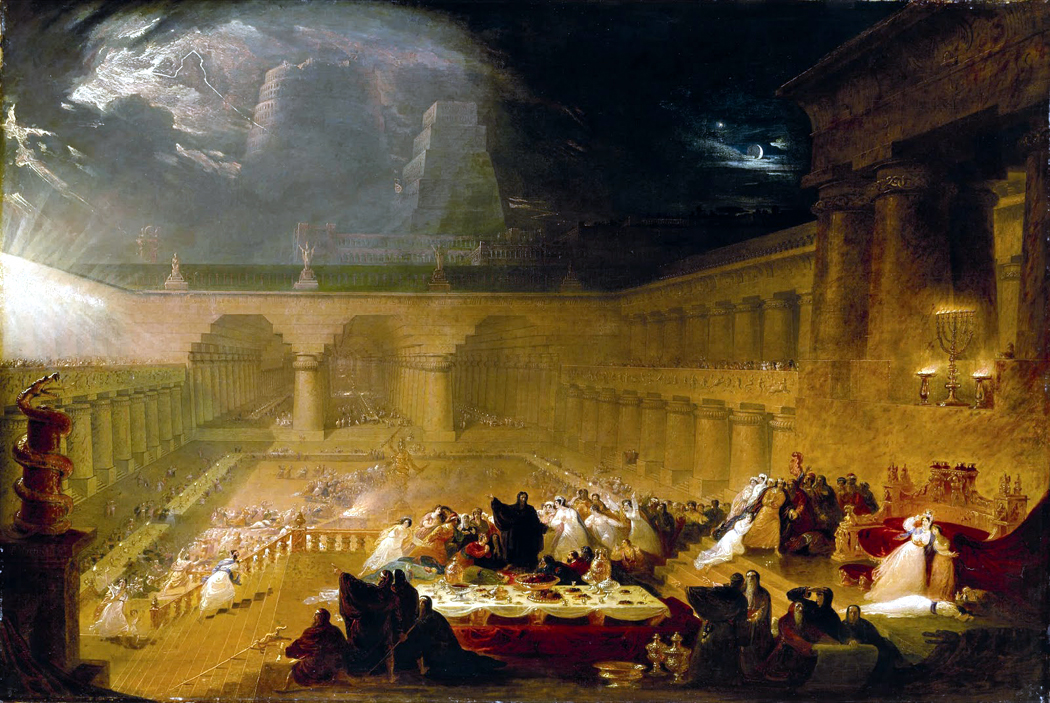
Martin’s appeal was to vastness and number. His Balshazzar’s Feast prompted Charles Lamb to deem it “vulgar and bombastic.”
“Balshazzar’s Feast,” John Martin 1821
In contrast, JMW Turner also painted one of the plagues of Egypt, and it has its share of grandiosity, but Turner’s shtick was mist and fog, indistinct outlines — and uncertain scholarship (It is titled the Fifth Plague, but actually illustrates the biblical Seventh Plague).
“The Fifth Plague of Egypt,” JMW Turner 1800
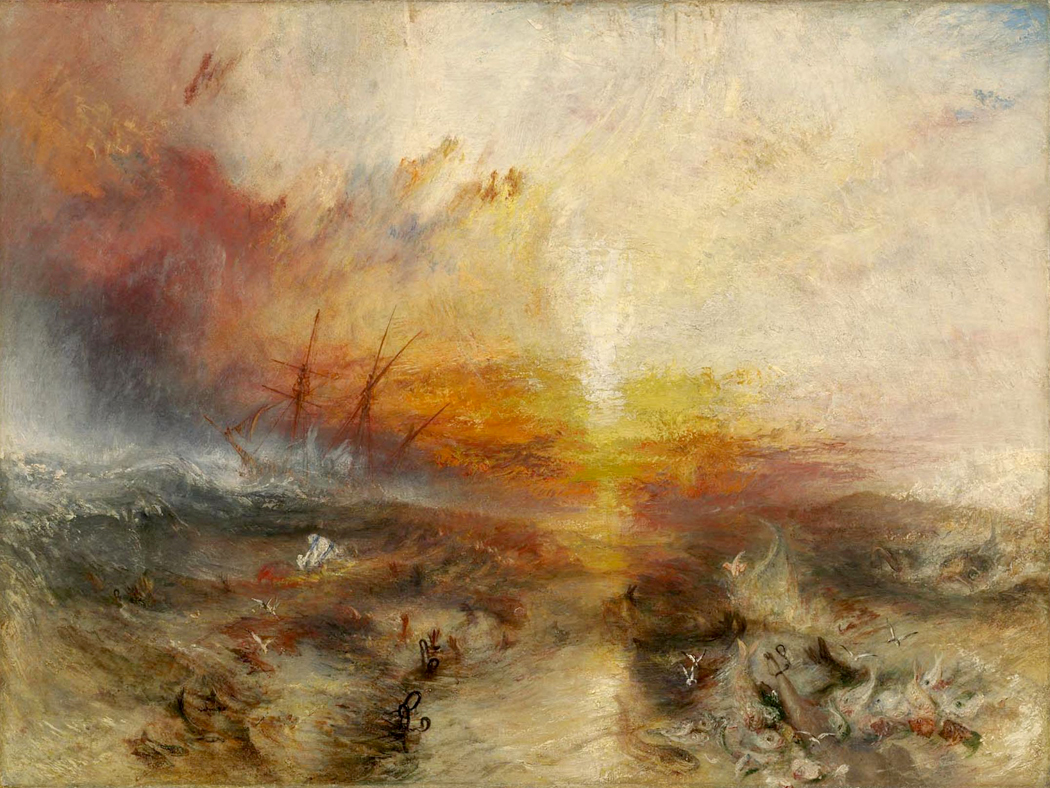
In 1840, Turner exhibited a painting called Slavers Throwing Overboard the Dead and Dying — Typhoon Coming On. It depicts an event from 1781 when the captain of the slave ship Zong threw overboard 132 of his captives when drinking water was running low. Since insurance would not cover the cost of slaves dying of natural causes, he drowned them instead, so he could collect. Turner seems to have added the typhoon for effect.
“Slave Ship,” JMW Turner 1840
The storm, the swirling air and sea, the lurid color and the loose brushwork all contribute to the sense of disaster. While the painting had an abolitionist intent, it is its forward-looking esthetics that appealed to critic John Ruskin. Turner is often seen as a precursor to the Impressionists. But while they tended to paint everyday scenes, Turner favored turmoil and disaster.
“Disaster at Sea,” JMW Turner 1835
The circular swirl was a trademark of the later Turner. In 1842, he had himself lashed to the mast of a ship in a snowstorm in order to paint Snow Storm – Steam-Boat off a Harbour’s Mouth Making Signals in Shallow Water, and going by the Lead. The Author was in this Storm on the Night the “Ariel” left Harwich. Yes, that was its full title when first exhibited.
“Snow Storm: Steam-Boat off a Harbour’s Mouth,” JMW Turner 1842
He also did a snow storm in the Alps.
“Valley of Aosta: Snowstorm, Avalanche and Thunderstorm,” JMW Turner 1836
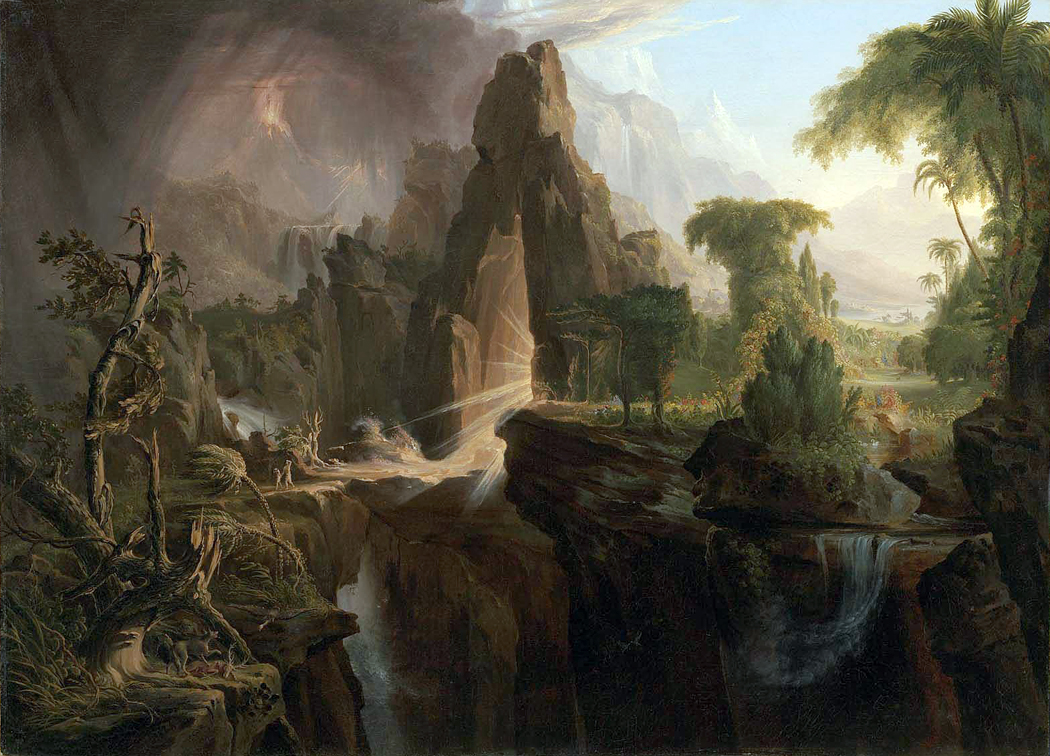
In the United States, The Sublime was a natural. The American West lent itself to large paintings of vast landscape, often in mist or early sunrise. An entire school of artists, usually called the Hudson River School, latched onto The Sublime, beginning with Thomas Cole.
“The Expulsion from Eden,” Thomas Cole 1828
Cole’s most famous protege was Frederic Edwin Church, whose paintings of South America brought the exotic landscape to the U.S.
“Rainy Season in the Tropics,” Frederic Edwin Church 1866
And Martin Johnson Heade verged on the surreal in many of his paintings.
“Approaching Storm — Beach Near Newport,” Martin Johnson Heade 1859
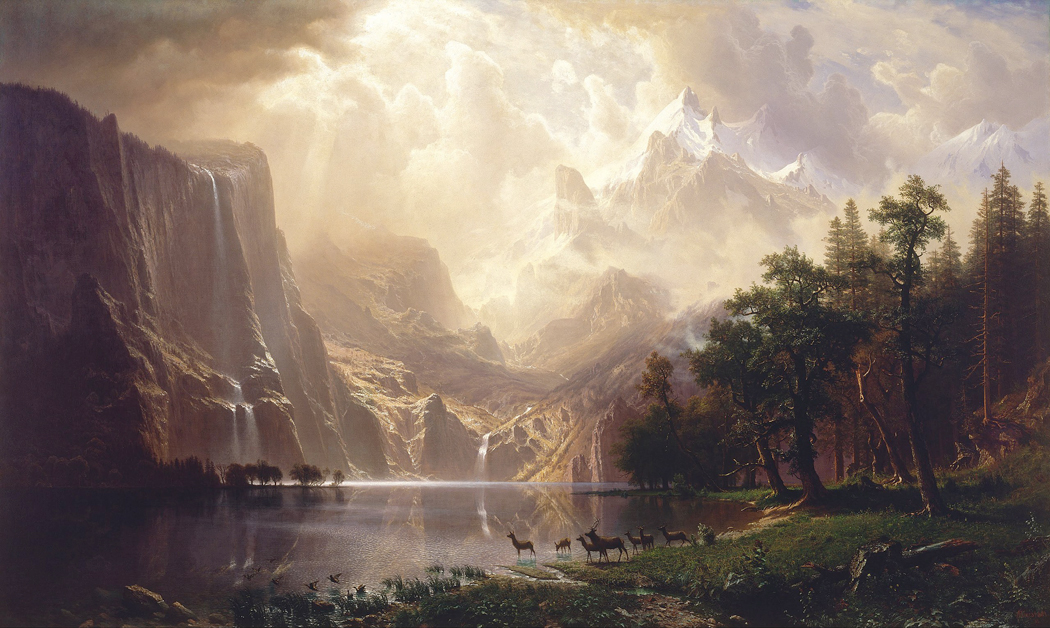
But it was the West that threw open the gates of heaven, with any number of painters, first among them, German-born Albert Bierstadt.
“Among the Sierra Nevada, California,” Albert Bierstadt 1858
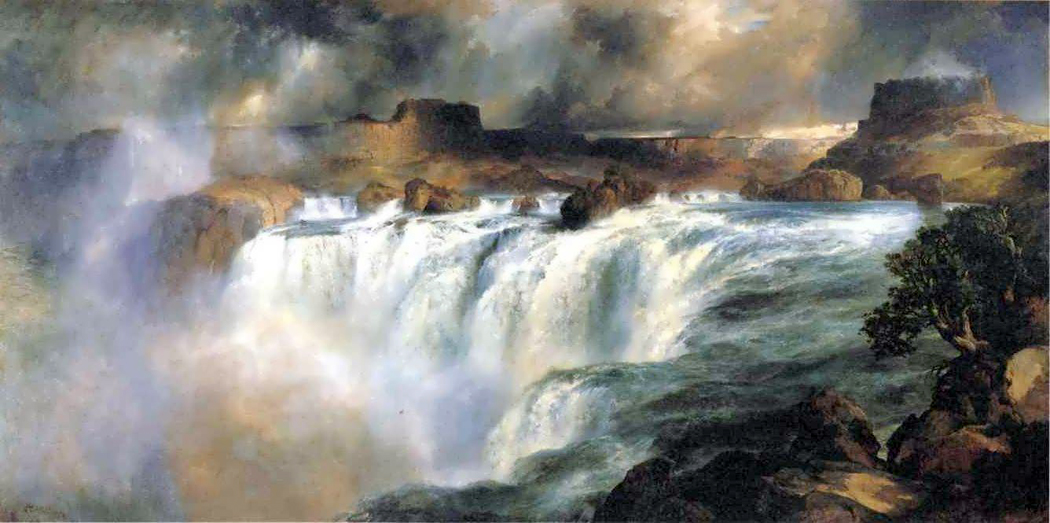
Latterly among them was Thomas Moran, whose huge and colorful canvases persuaded Congress to create our first national parks.
“Shoshone Falls,” Thomas Moran 1900
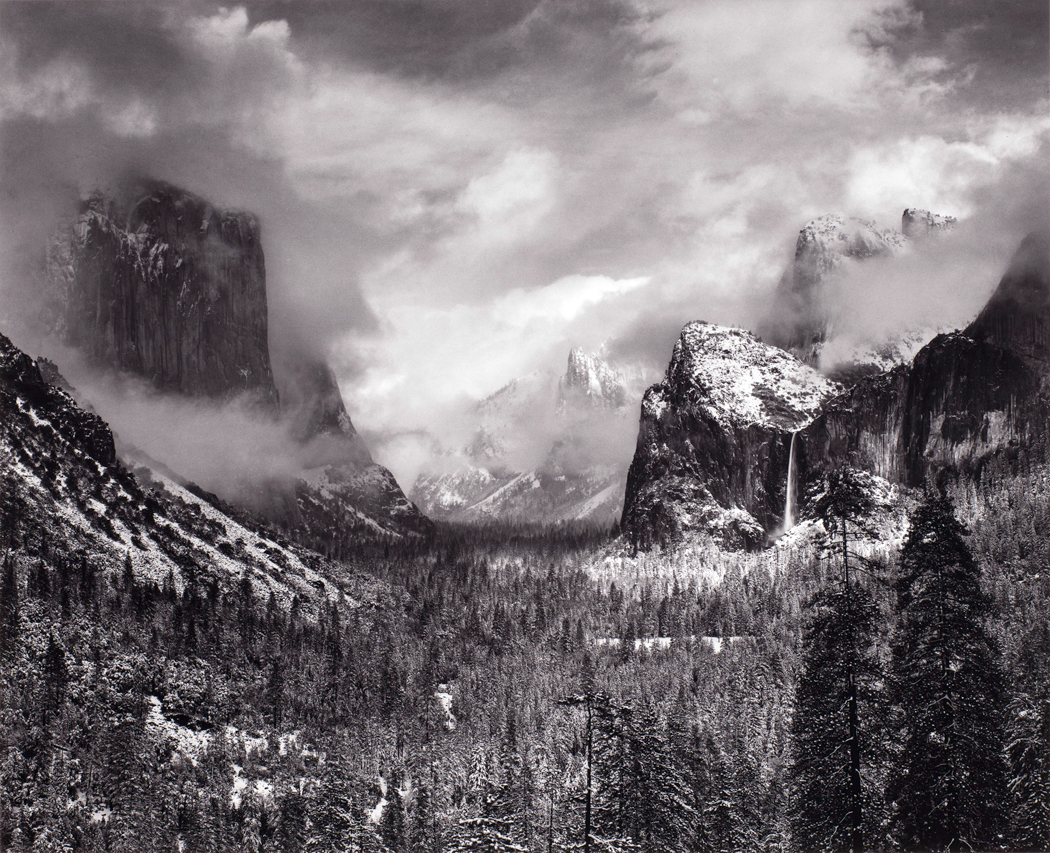
These painters are the clear progenitors of the landscape photographs of Ansel Adams.
“Clearing Storm, Yosemite,” Ansel Adams 1944
But The Sublime had pretty well worked itself out by the end of the 19th Century. It was harder to believe in the awesome beauty of Providence after the First World War, to say nothing of the horrors that followed. Post-Traumatic Stress wasn’t quite the same thing. Still, The Sublime hung on in the paintings of Jackson Pollock, and especially Mark Rothko, whose mysterious canvases of hovering colors evoke the same sort of awe among those willing to be seduced by them.
“Black on Maroon,” Mark Rothko 1958
I’ve covered literature and painting, but The Sublime appears in music, also. The first sound depiction of it occurred when Franz Joseph Haydn depicted biblical Chaosas the prelude to his oratorio The Creation, which premiered in 1803.
Hector Berlioz assayed The Sublime in several of his works, but none more grippingly than in the Tuba Mirum section of the Dies Irae of his Requiem Mass of 1837, which requires, in addition to a huge orchestra and chorus, four extra brass bands, set into the four corners of the concert hall, and 20 tympani, which roll doom out in the Dies Irae.
Another Dies Irae with the power to blow you away is Giuseppe Verdi’s, from his Requiem Mass, which whacks the bass drum in alternation of staccato blasts from the strings and brass.
Perhaps the cake is taken by Gustav Mahler’s Symphony of a Thousand — his Symphony No. 8, which in an ideal performance has an orchestra of about 200 and a chorus of 800. It is gargantuan, and the opening Veni Creator Spiritus is as close to manic insanity as music can probably sustain.
There are moments in Wagner, in Liszt, Bruckner and many in Mahler’s other symphonies.
Then, there’s The Ninth. I don’t need to mention whose. The Sublime makes itself present in each of the four movements, but rises to a climax in the choral finale, where voices and instruments poise at the limits of their abilities and hold those notes as they sing, “Seid umschlungen, Millionen!” — “Be embraced, you millions” and then “Ahnest du den Schopfer… — hold it, and then belt out — “Welt?” There follows a coda of ecstasy bringing home the central message of the symphony: “Freude, schöner Götterfunken” — “Joy, beautiful spark of divinity.”
But perhaps the greatest moment of The Sublime, as terror and grandeur, comes with the recapitulation section of the first movement. The theme that began the symphony in uncertainty and mist — we don’t even know originally what key it is in — comes back forte underlined by two solid minutes of rolling tympani thunder. Some conductors downplay this moment, letting the tympani merely enforce the bass line, but done right, the drums are an earthquake of apocalyptic rumble.
Perhaps I have been fascinated by The Sublime in art and poetry so much because I have experienced in life — probably a dozen times or so, maybe a score if I catalogued them — a moment when you don’t merely feel the joy of beauty found in nature, but experience a cosmic tingle, a sense of life magnified, intensified, made mythic. A body-sense of the vastness of existence and my minuscule place in it.
It tends to come, as it does in art, in mountains or deserts or at sea. I recall the sense while crossing the Atlantic on a ship and walking the deck after midnight and seeing in the vast emptiness of the ocean a twinkle of a light on a ship many miles off, heading in the opposite direction. The sea swells were rocking the boat and I could make out the shifting facets of waves in the dark, where some starlight was caught in the reflection of the water.
Or the Grand Canyon at five in the morning just before the sun broke the horizon.
Once, driving east in North Carolina on my way to Cape Hatteras, it was near sunset and in front of me in the windshield was a sooty-dark thunderhead and rain on the road perhaps a mile in front of me, obscuring the road and any horizon. It was a canyon of charcoal cloud climbing up to the stratosphere, with spikes of lightning, while in the rear window, the sun was brilliant and red in a clear sky. It was the definition of The Sublime.
What do we talk about when we talk about color? Too often we talk at cross purposes. The fact is, color isn’t a thing. It is several things, and we often stir them all up into a single confection — all of which leads to avoidable confusions. And arguments.
One of the greatest arguments my late wife and I had was over the color blue. The fight lasted three days. We didn’t sleep the first night, but kept trying to persuade the other of our righteousness.
“Isn’t that a blue you could fall into?” she asked.
“I know what you mean, but of course, you’re talking metaphorically, not literally.”
“No, I mean it literally. You can fall into it.”
And we were off to the races. Of course, at the end of the third day, I capitulated. She was right. She was always right, and it was a lesson I finally learned, after years of not recognizing the fact of it. And now, I can fall into blue.
But before I got sidetracked there, I meant to say that when we discuss color, we are really talking about at least three separate things, and the three don’t play well together.
The three separate color discussions come from science, from art, and from language.
SCIENCE
The first begins with Isaac Newton. He proved experimentally that white light is actually composed of a spectrum of colors, ranging from blue on the short end and red on the long end. Short and long wavelengths, that is. For, scientifically, color is a function of light’s electromagnetic wave construction.
The problem is that there is no forest green in the spectrum. No magenta, either. The spectrum — which we see in a rainbow — contains only a single version of a wide range of hue, but none of the subtlety of actual color.
And so, you can talk about blue being at a place on the electromagnetic band measured in wavelengths of 450 to 500 nanometers and red at the other end, at 700 nanometers.
But these are numbers, not colors.
Science also causes issues when it comes to color perception: How do we see the colors we do?
Humans don’t see spectral color. That is, human color perception is not dictated by wavelength, but rather by the mechanisms of color vision. What the eye sees and the brain interprets is only marginally related to the color defined by wavelength.
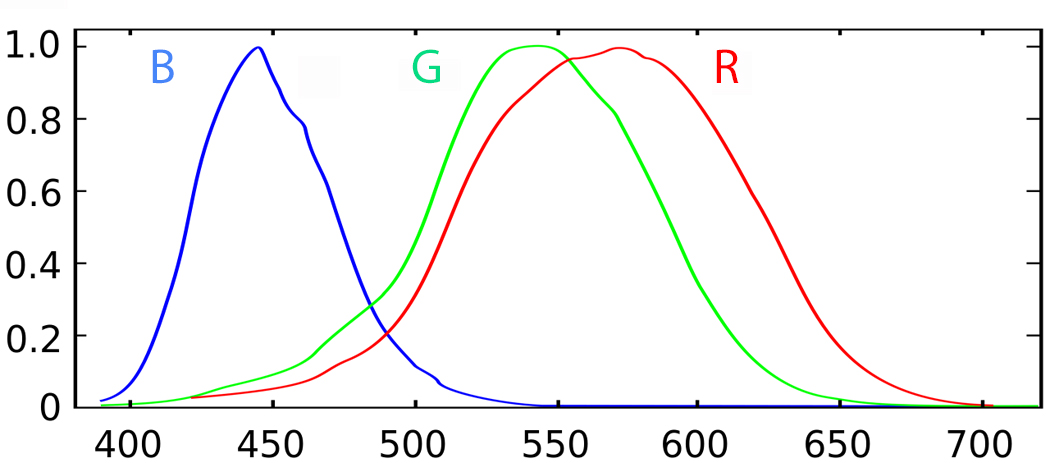
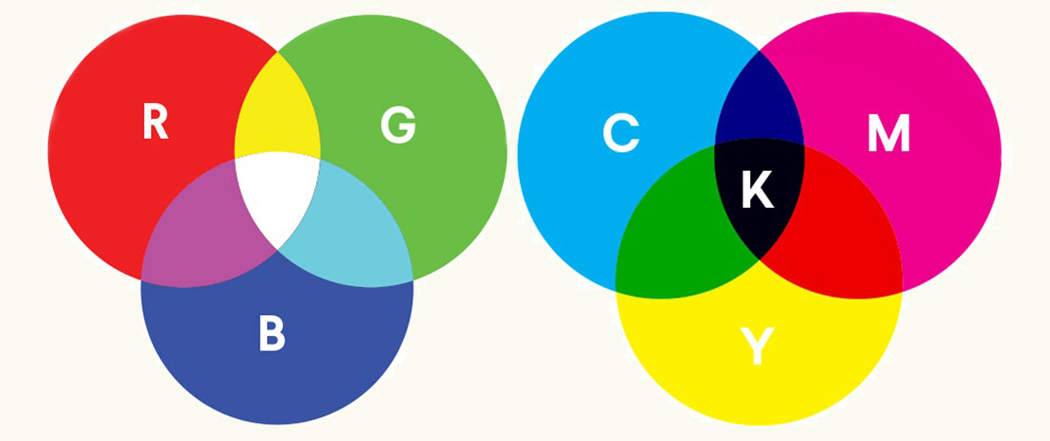
There are three color sensors in the eye, one tripped by red light, another tripped by green light, and a third by blue light. The ratios of how much each is stimulated governs what colors we see. (Yes, I know this is a grossly simplified version, but it is basically correct).
When both blue and red are tickled, we see violet; when blue and green are set off together, we see blue-green or aqua; when green and red are stimulated, we see yellow.
Yellow is particularly interesting. While there is a wavelength on the spectrum that is yellow, we almost never see that wavelength. It is rare in nature.
What we call “white” light, or sunlight, contains all the hues, which can be separated by a prism into its component parts. But when this white light hits something red, the blues, yellows, greens, etc., are absorbed by the object and the red is reflected, and so it is only red that hits our eyes. The blues, yellows and greens are digested by the object and turned into heat, which is why the sun makes things hot.
But if an object absorbs blue and reflects both red and green — this may seem bizarre, but it’s true — we see those colors combined and our brains interpret them as yellow.
The famous Kodak-yellow film box isn’t really yellow. It is red and green together, but our brains stir them together and see yellow. Indeed, most of the colors we see are impure mixes and what our brains see are the interpretations, not the wavelengths.
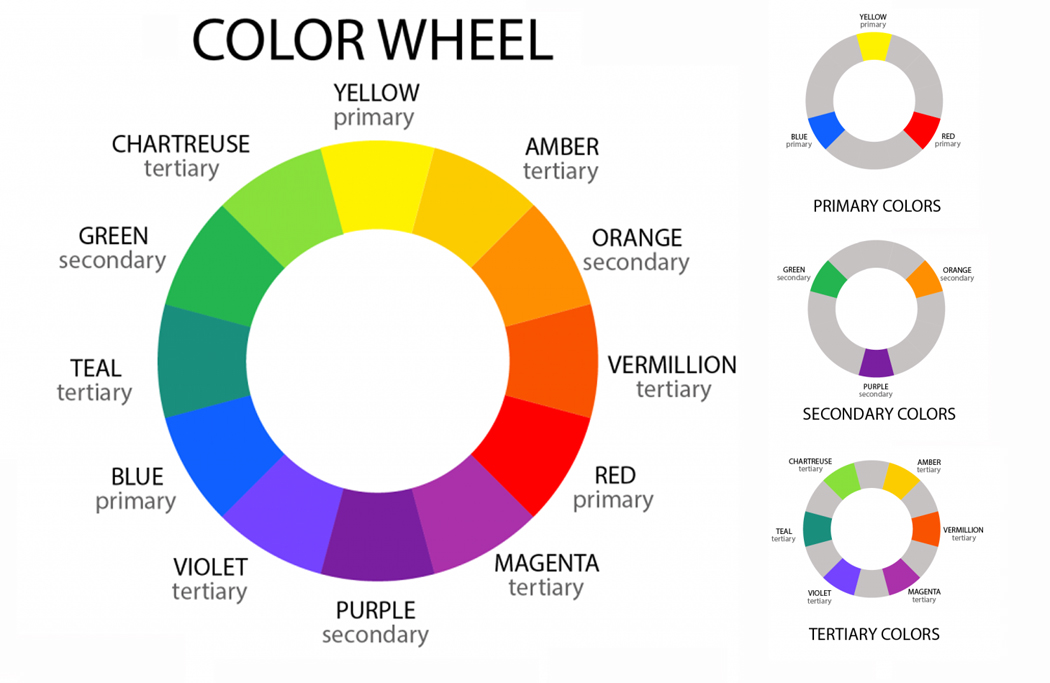
Take purple, or violet, or magenta (the names for this section of the so-called “color wheel” are terribly imprecise; more on that later). It is a color that does not have a wavelength. That is, it doesn’t exist on the spectrum. It exists solely in our brains as the combination of blue and red.
All color, or what we call color, is subjective. That is, it is a phenomenon created in our brain as a way to code the visual information of the world, very like the so-called “false color” of Hubble space photographs. It is an interpretive trick our brains play, useful for deciding which berries are ripe. The wavelengths may be real, but the redness is a figment.
ART
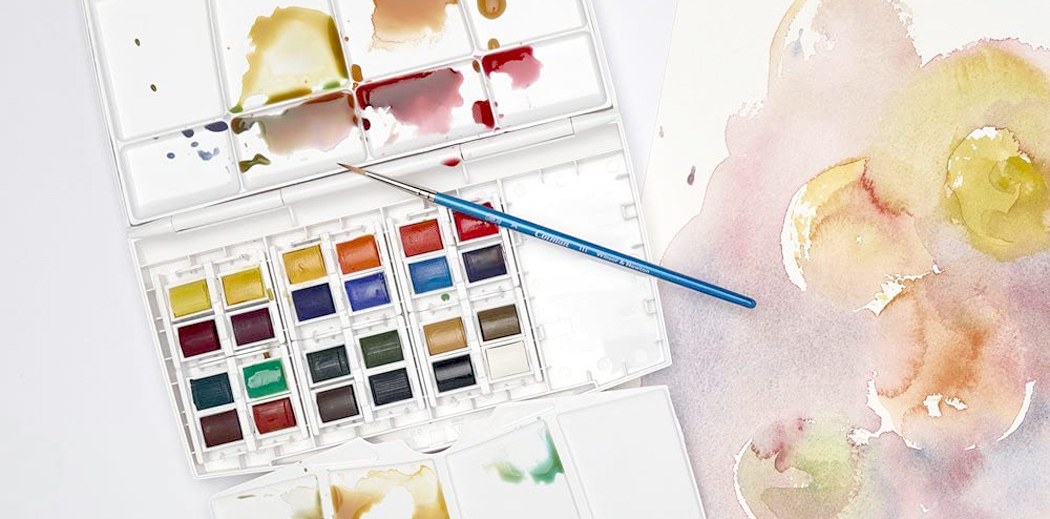
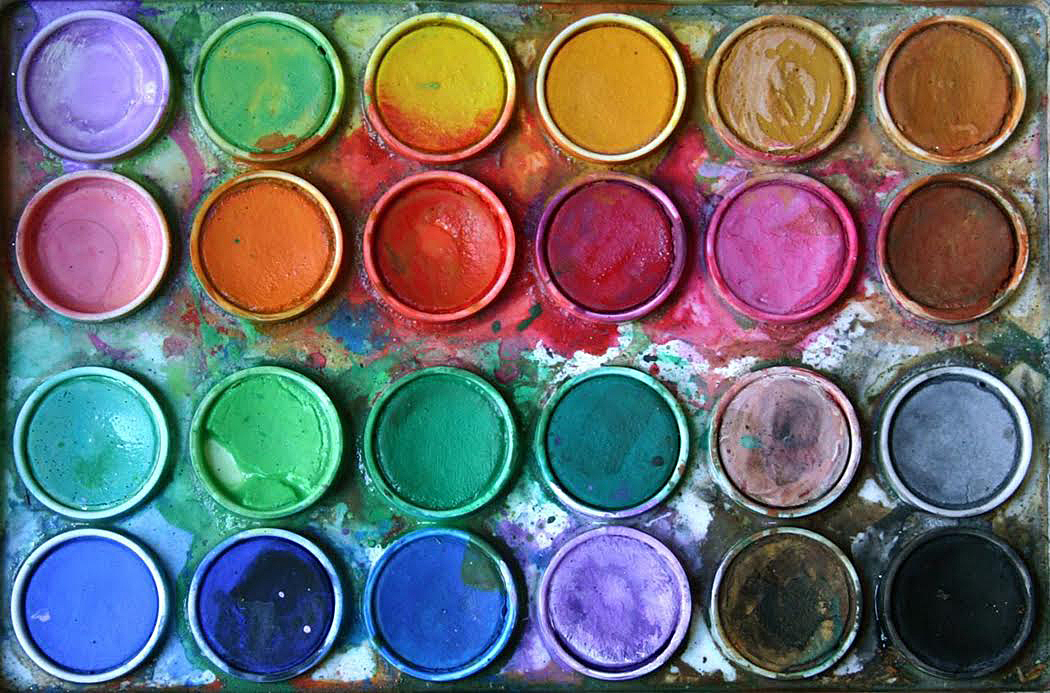
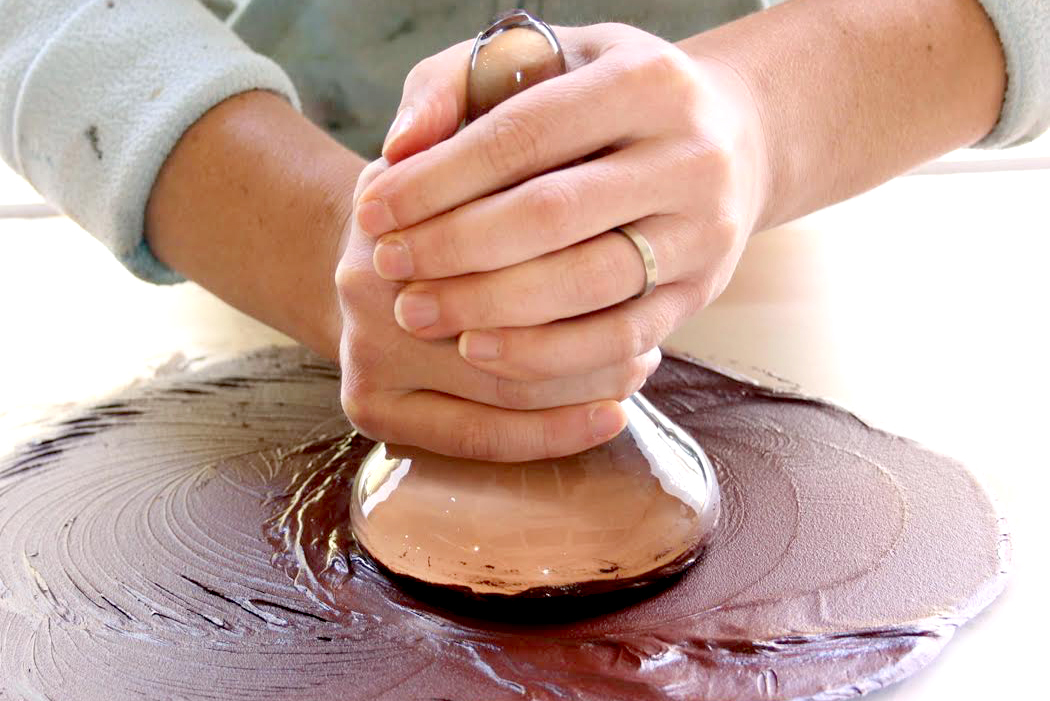
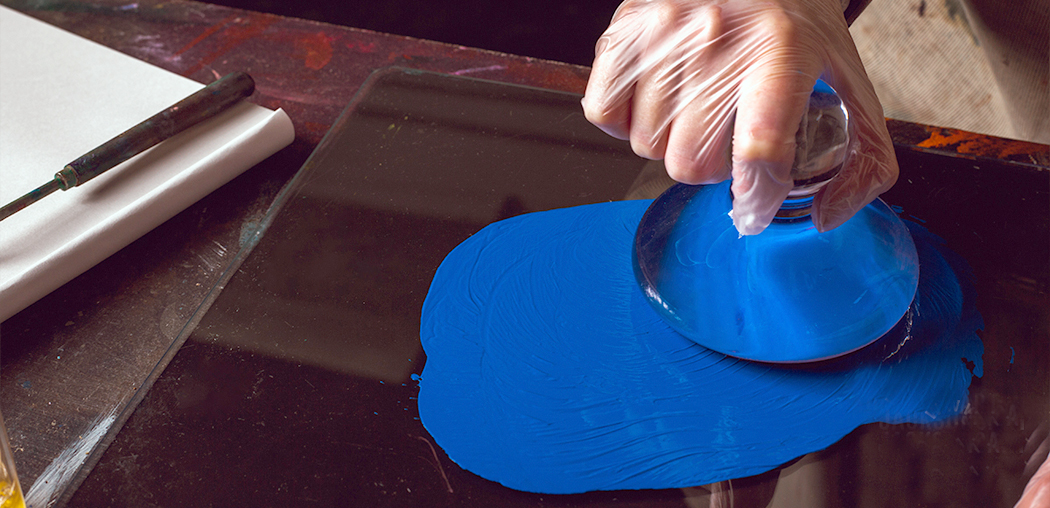
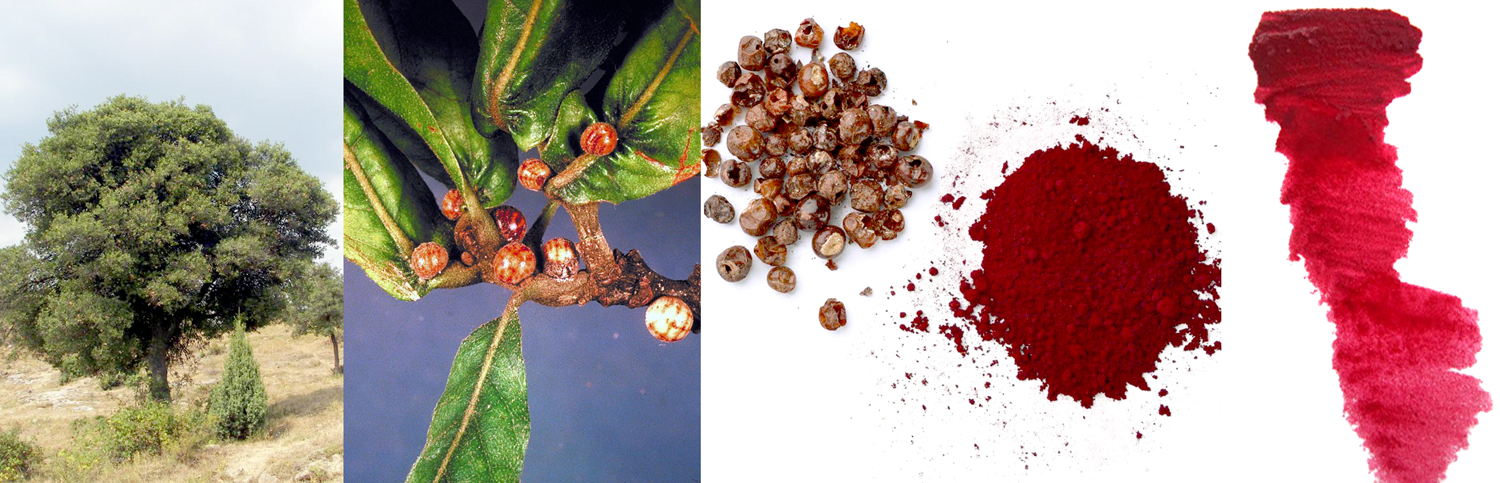
For a painter, all the stuff about wavelengths and spectrums is dryly theoretical and idealized, which is to say, lies. Painters work with paint, not theory, and the pigments that make those paints are cantankerous. No blue is spectrum-blue, no green is pure green. The paints are made from dirt, or ground up stones, or plant dyes (or, nowadays, from alchemically manipulated petroleum), and all are amalgams of various ingredients. Probably 95 percent of the colors used by painters don’t occur in the spectrum. Real paint is impure.
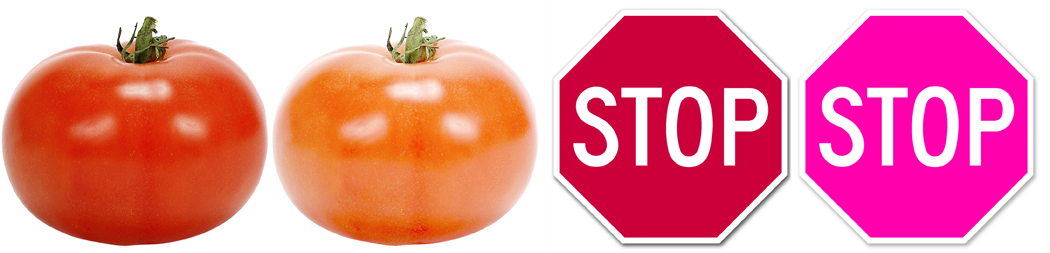
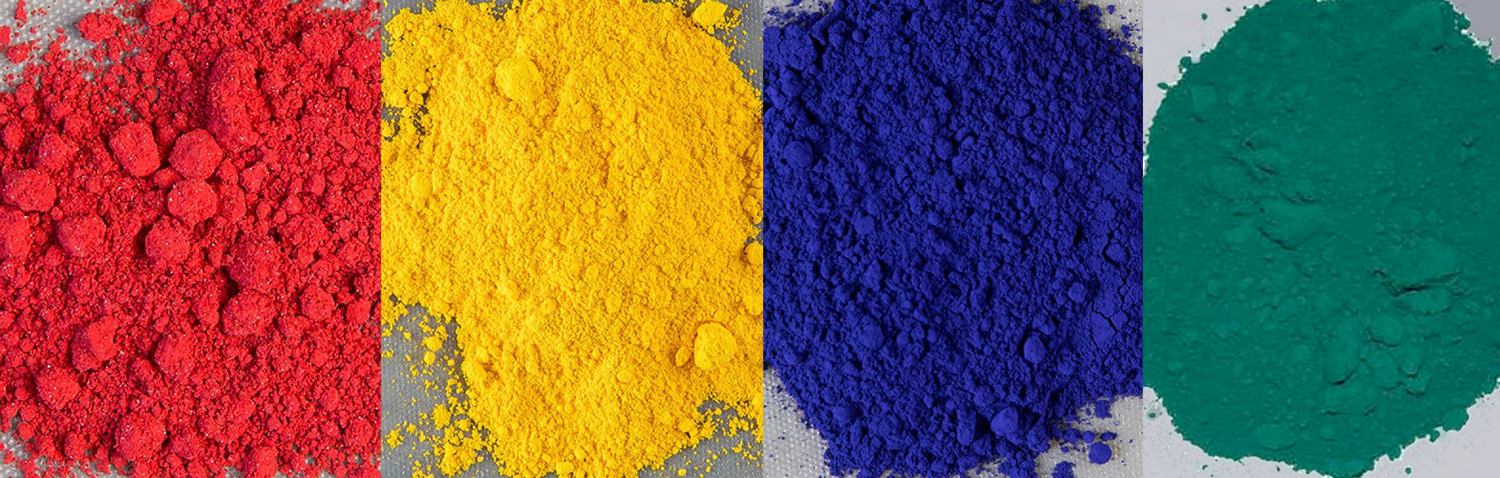
One yellow might mix with black to make a dun, another yellow that looks the same, might turn greenish when mixed. An artist has to know not merely color theory, but the individual nature of his paints. Some greens are bluer than others; some reds are more orangey, some more violet. A tomato is one red, a stop sign, another. Lighten tomato-red and you get an orange. Lighten stop-sign red and you get a pink.
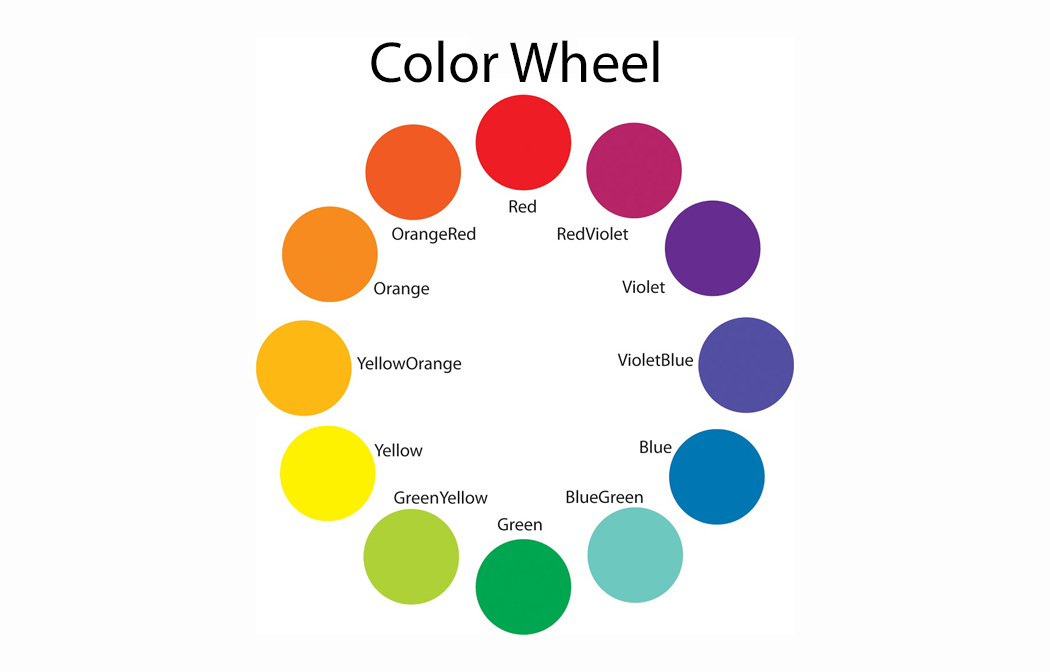
For artists, colors don’t come in a lineup, like a spectrum, but a wheel. And on that wheel, there are three “primary” colors — red, blue and yellow — from which all the other colors can be mixed. Theoretically, that is.
There are painters who have used only four tubes of paint for their work, usually a blue, a red and a yellow and the ubiquitous titanium white. You can’t paint without a white: the colors themselves are too dark to make a bright sky or a tawny lion.
But there are limitations to this. You can mix a blue and yellow to get a green, but it will never be quite as bright and pure as a dedicated green paint. If you want the deepest, richest greens, you will buy a tube of green paint.
The problem is, that there are at least three sets of primary colors. There’s the painter’s set, of red, blue and yellow. But now that much art and design is made on a computer, another set of primary colors is common, called the “additive primaries” of red, blue and green. Then, there is the printer’s primaries, known as “subtractive, made of cyan, magenta and yellow (with black added in, making it often called “CYMK,” with the “K” standing for black.)
But there are other issues, too. The spectrum exists theoretically, but real-world color has a physical presence, and so the same hue will appear different whether glossy or matte. And there are metallic colors, with specular reflections. Some paints are opaque and others transparent. Then, too, colors on one wall, which gets sunlight, will appear different from colors on the opposite wall, in the shade.
And there is something called “simultaneous contrast,” which means that colors are affected by the colors around them.
There’s a lot to keep track of, and the ability to do so is one of the things that marks a professional from an amateur.
LANGUAGE
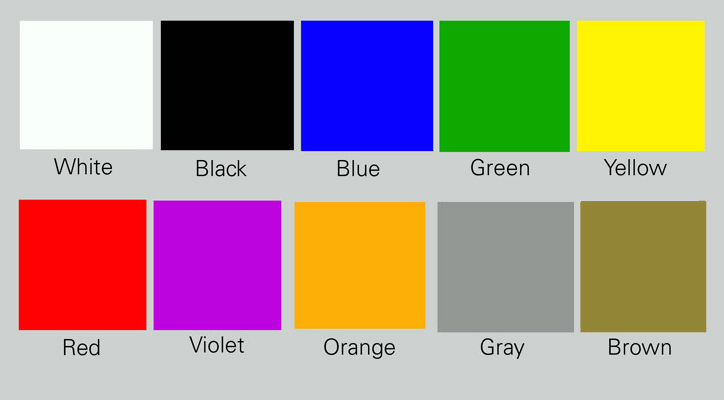
In the English language, there are really ten primary colors, that is, color names that are distinct and cover generic territories of color. They are: red, blue, green, yellow, violet, orange, brown, black, white and gray. All other color names are either shades or tints of these main color names (such as “tan” being a variety of “brown”) or metaphorical and named after some object of that color (such as “fuchsia” being named after the flower).
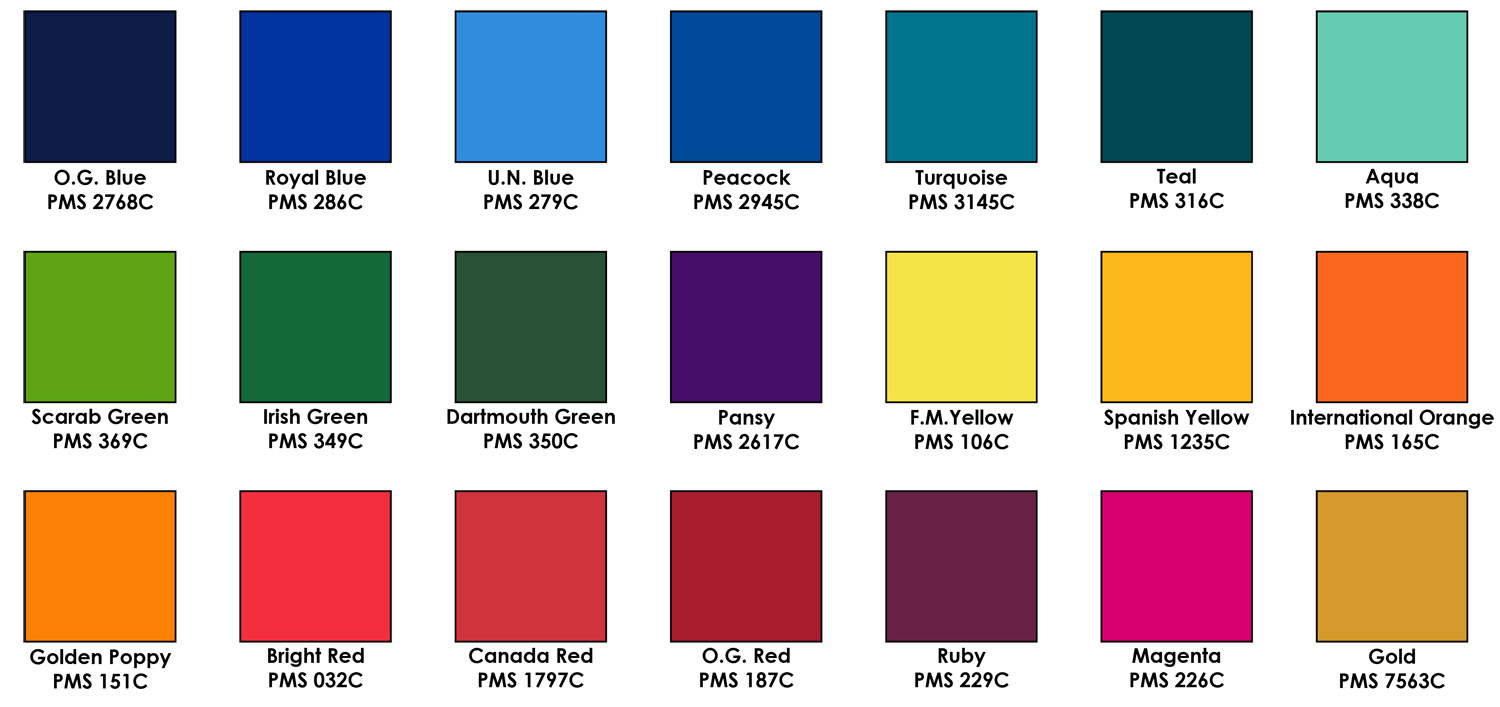
There are hundreds, probably thousands of variations of the primary colors, and designers and marketers keep coming up with fresh, new names, usually for the same old colors. Marketers try to make their color names more appealing (would you rather buy a fabric that was a yellow called “morning haze,” or the same one, but called “piss yellow?”)
But beyond that, there is the problem of the squishiness of color names. The boundaries between colors is indistinct. Where, for instance, does blue become green? There is a greenish blue, and a bluish green. Where do you draw the line? We each have our judgement, but that changes with context. Against a red background, even a greenish blue will appear bluer.
Where does red become magenta? Where does purple merge into a deep, dark blue?
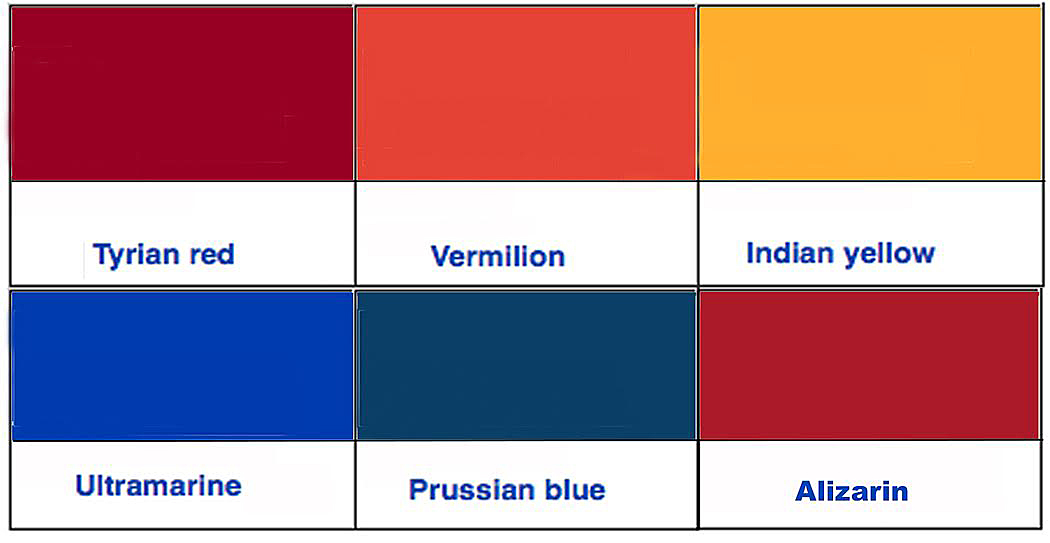
Even more problematic are all those tertiary colors. Is Turquoise green or blue? The stones for which the color is named comes in both forms, and also a version in between. One person’s “amber” is another’s “golden.” Vermilion is also cinnabar. What the Roman’s called “royal purple” is to our eyes closer to red. These names shift over time and by individual perception. It makes it very hard to talk about color between two people with different color palettes in their brains.
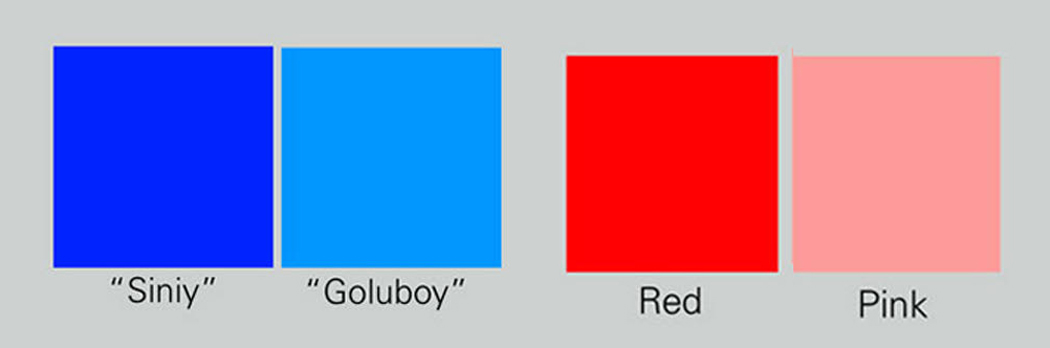
Of course, that hardly accounts for the various color organizations across different languages. Many languages had only words for black, white and red. Blue, for them, was a variety of black. The Ancient Greeks talked about the “wine-dark sea,” but the Mediterranean was never ruby colored. In traditional Japanese, the same word, “ao,” covered both green and blue (modern Japanese has, after WWII, added the word “gurin” as an English cognate). In Russian light blue (“goluboy”) is considered a separate color from dark blue (“siniy”), just as in English, we distinguish “pink” from “red.”
Here’s an alphabet of English color names, and please feel free to argue over what they each mean: azure; burgundy; coral; dun; ecru; fulvous; gules; heather; ivory; jasper; lavender; mustard; navy; oxblood; periwinkle; quimper; rose; sapphire; topaz; umber; viridian, watchet; xylous; yapan; zaffre.
So, you see, any discussion of color needs to take into account which sort of color system you mean. Pedants will complain that white isn’t a color, but the absence of color, but then, why do you need to buy a tube of white paint? And, of course, in the additive system, white is not the absence, but the combination of all the colors. So, which is it? Well, they are three distinct ways of talking about white. You need to be clear.
And even white isn’t just one thing: It comes in alabaster, in ivory, in cream, bone white, snow white, chalk white, Chinese white, eggshell white, vanilla and off-white. No doubt, interior designers and marketers could come up with a hundred new shades and names. There are warm whites and cool whites. You can paint with zinc white, titanium white and flake white, aka white lead or lead white. The range in any color is nearly infinite.
All of which makes talking about color difficult and misunderstanding almost inevitable.
I sit across the table from my brother at the seafood restaurant in Virginia and he doodles on a napkin with a Sharpie.
My brother is an artist — primarily a printmaker, but more recently a painter. And while he isn’t terribly prolific, he is constantly drawing. His mind is always coming up with visual ideas and he jots them down. Most never go anywhere, but he just cannot stop himself from playing. It is his way of processing experience: What he sees he transforms.
Lee Friedlander
It reminds me of the photographer Lee Friedlander, who describes his addiction to making photographs as “pecking.” Like a hen darting at cracked corn on the ground, he clicks his camera — peck, peck, peck. Some of the results of his pecking turn into finished photographs he displays in galleries and publishes in books. But there is an improvisatory quality to his work that comes — like a jazz musician woodshedding — from constantly working his instrument.
Among the images caught by pecking, Friedlander will periodically find something he hadn’t considered before, and thus his body of work takes a new direction, constantly refreshing his art.
In part, the importance of this kind of sketching is that it is not art — or rather, not meant as art. It is more the flexing of an esthetic muscle. One can become intellectually paralyzed if all you aim at is writing deathless prose, or painting the museum masterpiece, or composing the next Eroica. Not everything needs to be The Brothers Karamazov. There is great value in just pecking. It keeps your senses alive.
Mel Steele
I periodically visit my brother-in-law, Mel Steele, who is also an artist, a very accomplished artist who regularly sells his paintings to clients both private and corporate.
I often spend a portion of my time doodling — pecking — with my tiny point-and-shoot digital camera. We would sit on their patio talking about the things one yammers on about with one’s relations — old times, where former acquaintances have gone, the horror of recent politics, the joys of fishing — and I would distractedly point my camera around me at the things one seldom notices.
I wasn’t thinking of making art. I barely paid attention to what I was doing with the camera, but I pecked. The result is a kind of notebook of the things we lived among, seen in some different way, so as to lift them from their context, to suck them out of the everydayness they languish in.
It reminded me of an assignment I used to give my photography students, some 35 years ago, when I taught the subject at the same school where my brother also taught. “Make a photograph of something so I cannot tell what it is.” I made sure they understood I didn’t mean to make it out of focus or poorly run through the darkroom, but to find something we see everyday, but pay so little attention to, that when faced with its presence, we might be baffled until that moment when, the proud student, having fooled us all, tells us what we’re looking at and we all let out a gasp of breath and say, “Of course, now I see it.”
Try it:
Quiz photo No. 1 (Answers at the end of story)
These pecked pictures are mostly details.
Quiz photo No. 2
They are not the grand view or the concatenated whole, but the tiny bits out of which the larger scene is built.
Quiz photo No. 3
Most of us pay attention only to the whole, when we pay attention at all; for most Americans — maybe most humans anywhere — only use their eyes for useful things. They see the road they drive on, the cloud that tells them it will rain, the house, the car, closet. But every house has a door, and every door a door-handle; every car has tires and every tire a tread and each tread is made up of an intricate series of rubber squiggles and dents. Attention must be paid.
Aime Groulx
Many years before, when I taught photography at a private art school in Greensboro, N.C., the artist Aime Groulx, who ran the school, made a photograph he called Doorknob to the Doors of Perception. I still have my copy. It was his version of “pecking.”
Doorknob to the Doors of Perception
Paying attention to the details means being able to see the whole more acutely, more vividly. The generalized view is the unconsidered view. When you see a house, you are seeing an “it.” When you notice the details, they provide the character of the house and it warms, has personality and becomes a Buberesque “thou.” The “thou” is a different way of addressing the world and one that makes not only the world more alive, but the seer also.
(It doesn’t hurt that isolating detail makes it more necessary to create a design. You can make a photo of a house and just plop it in the middle of the frame and we can all say, “Yes, that’s a house,” and let the naming of it be the end-all. But if you find the tiny bits, they have to organize them in the frame to make something interesting enough to warrant looking at.)
Side panels of a pickup truck
Sectioning out a detail not only makes you look more closely, but forces your viewer to look more closely, too. Puzzling out what he sees without the plethora of context makes him hone in on its shape, color, and texture. It is a forced look, not a casual one.
So, when I gave my students that assignment, it wasn’t just to be clever, but to make them pay attention to the minutiae that are the bricks of the visual world they inhabit. And paying attention is a form of reverence.
The mental view of the world is telescopic. It zooms from the blue watery globe in the blackness of space, down to the map of the U.S., to your state, to your city — each step focusing on closer detail — and then to your street, to your house, to the room you are sitting in to the armrest you are tapping your fingers on, to the hairs on your knuckles. Always more detail.
Turn from the tapping hand to the floor and see the woodgrain in the flooring, or the ceiling and see the cobweb you had not noticed before. The clothes you are wearing has a texture and a color. The wrinkles in the shirt of blouse are replications of the drapery in Greek sculpture.
Each of these details is a microcosm, worth looking at — it is your world, after all. What did William Blake write? “To see the world in a blade of grass. And heaven in a wild flower. To hold infinity in the palm of your hand. And eternity in an hour.”
Or, as he scribbled in annotation to the pages of Joshua Reynolds’ Discourses, “To generalize is to be an idiot. To particularize is alone the distinction of merit.”
The general is the world of politicians and businessmen, of carnival barkers and evangelists. Dogma, ideology, commercial advertisement, are founded on generalizations, while what genuinely matters in our lives is the particular. It is generalizations that permit the destruction of Bamiyan Buddha statues, the bombing of synagogues, mosques and Sikh temples. The stoning of homosexuals. It is generalizations that lurk behind the Shoah. It was generalization that justified the enslavement of a race of people.
To know any individual is to know the stereotype is a lie. The world, and its peoples, are infinitely complex and varied. So much so, that no broad statement can ever be anything but a lie. And so, there is actually a moral level to this paying of attention to detail, to the minutiae, to the individual.
And so, you peck. Finding this bit or that bit, that shape, that texture, that precise color. This is the context of your life.
You can focus your attention on color. How much yellow is in your field of view at this moment. Look around. Single it out. Or blue. How many different blues can you spot right now? Paying attention is being alive; paying attention is reverence. Attention must be paid.
Duck eggs
Your life is not made up of the broad swathes, but of the minute details, and when we pay too much attention to the big picture, we are likely to miss the particles that give that picture its character.
And when you come to make your art, write your novel, dance your dance, that detail means there is a truth to what you do, a reality behind the fantasy that gives it depth and meaning.
Exercise makes your muscles strong. Pecking keeps your senses alive and alert. Peck Peck Peck
Click on any image to enlarge
Answers to quiz: No. 1 — the twill of denim jeans; No. 2 — dried coffee stains on a white table top; No. 3 — garden hose on patio tiles.
As I continue to contemplate the possibility of perhaps, maybe, decluttering my trove of Classical music CDs, I come to the 20th century. I have to admit, that I listen to music from that period more than any other. It was my century. And so, I have a ton of discs from composers who wrote, beginning in the 19th, but extending their careers into the 20th, and now, music from the 21st century.
Sometimes, we forget that such lush music as that of Rachmaninoff or Richard Strauss continued to be written: Strauss’ Four Last Songs, perhaps the most high-calorie confection ever put to paper, was premiered in 1949, four years after the end of World War II, and 36 years after Stravinsky’s Rite of Spring. “There’s still plenty of good music to be written in C-major,” said Arnold Schoenberg.
So now, as I did last time, I am going to sort through the violent century and salvage what I think needs to be saved, making a pile of recordings and regretfully saying goodbye to too much great music, but, you know — I’m 73 years old and I’m not going to be able to listen to all of the thousands of CDs that currently clog my shelves.
I’ve set the goal of picking a single work (or set of works) by significant composers to throw on the pile. I’m going by chronological order, according to birth dates. And we start by remembering that Edward Elgar was a 20th century composer. Yes. He was.
Edward Elgar 1857-1934 — Initially I thought the work I could not do without was the doleful Cello Concerto, from 1919. The First World War speaks directly through that music. But, no, I have to go with the Violin Concerto of 1910, which is one of the few noble concertos that can stand with those of Beethoven, Brahms, Sibelius, Berg and Shostakovich — not merely tuneful, but an expression of the highest thoughts and emotions that humans are capable of.
But, I’m in luck. Because I can save the Violin Concerto, played by Pinchas Zukerman on a disc package that includes the Cello Concerto, played by Jacqueline Du Pre, with the Enigma Variations thrown in. A perfect summing up of the best of Elgar.
Gustav Mahler 1860-1911 — Choosing is too hard. I have double-decker shelves devoted to Mahler, the composer who moves me above all others. How can I clear it out? How can I consider any of it as “clutter?” I thought originally I would have to save Das Lied von der Erde, and I don’t know how I can say goodbye to it. But Mahler said famously, the symphony must contain the world, and the piece that does that more than any other is the Third Symphony, and so, I’m putting that on the pile.
I just counted, and I currently have 14 recordings of the Third (with another on the way from Amazon). The one I keep is Riccardo Chailly and the Concertgebouw Orchestra. Not only is it a great performance, but the 2-discs are magnificently engineered. The sound is stunning.
Claude Debussy 1862-1918 — While I love Debussy’s piano music (especially played by Paul Jacobs), the keeper is La Mer. I have not counted the versions on my shelf, but there are not a few.
Pierre Boulez recorded it twice. The second is OK, but nothing special, but his first go-round, on Sony, is cut by diamond and the most exciting one I know. It may not be a sea-spray evocative as some, but it makes a compelling case for it as belonging to the 20th century. It comes in a package with a pile of other Debussy.
Richard Strauss 1864-1949 — Strauss can sometimes seem a bit reptilian. How much is show-biz with his show-off orchestration. But there is no doubt to the sincerity of his Four Last Songs. They are the most profoundly moving orchestral songs I know, outside Mahler’s Der Abschied.
I wanted to save Jessye Norman’s version, with Kurt Masur, but I have to admit, my heart has always belonged to Leontyne Price in these songs, accompanied by Erich Leinsdorf. Both versions are gorgeous, but Price is now packaged with Fritz Reiner’s Also Sprach Zarathustra. On the pile.
Jean Sibelius 1865-1957 — As tightly argued as Mahler is spacious, Sibelius packs a great deal into a well-cinched frame. Of his seven symphonies, the one that speaks to me loudest is the final one, which makes me feel in my bones the vast icy spaces of Scandanavia.
Leonard Bernstein recorded it twice, once for Columbia (now Sony) and later for Deutsche Grammophon. The first is tighter, but the second comes with the Fifth Symphony, giving me the chance to save two symphonies for the price of one. Bernstein slowed his tempos as he got older, and some people don’t like the broadened Fifth, but I have no problem with it. And the Seventh takes me to other places.
Serge Rachmaninoff 1873-1943 — My dearest friend, Alexander, refuses to listen to Rachmaninoff, saying he is too gooey and Romantic. But I have been trying to get him to recognize that his music — especially his later music — is oozing with Modernist irony. What is more sly than the Paganini Rhapsody? Yes, there’s the “big tune,” but even that is undermined by what surrounds it. But if I have to save just one piece, that would be the Symphonic Dances. I love them to death.
But, like so many other things in this list, I can have cake and eat it at the same time, with the recording by Andre Previn and the London Symphony Orchestra, bundled with the gooey, Romantic Second Symphony under Mariss Jansons, and the tornado of the Third Piano Concerto, played by Leif Ove Andsness.
Arnold Schoenberg 1874-1951 — Now we’re entering territory fully recognizable as Modernist. I wish I could save Pierrot Lunaire, but I have only one slot available, and it has to go to Verklaerte Nacht. While I admire Pierrot, I love Transfigured Night.
Of the versions I have, both in its orchestral form and its original sextet form, I am surprised at how good the version is that was recorded by Herbert von Karajan and the Berlin Philharmonic. It goes onto the pile, and gives me the bonus of the Orchestral Variations.
Charles Ives 1874-1954 — I have three or four versions of the Concord Sonata, and heard it live played by Jeremy Denk. It should be saved. But I am going, instead, with the Fourth Symphony, which is pure Ives, with all his usual tricks. Friends think I’m joshing when I claim that Ives’ music is beautiful. But it is. You just have to get used to the idiom.
The best version (I have four of these, too) is the first recording, led by Leopold Stokowski. One word for it: Transcendental.
Maurice Ravel 1875-1937 — Stravinsky dismissed him as a “Swiss watchmaker,” but I think that was only professional jealousy. Yes, we’re all tired of Bolero. But I want to save the Concerto for Left Hand, which is jazzy in parts, terrifying in parts, and always makes you wonder that anyone can play two-hand piano with only one hand.
But there is also that ethereal slow movement of the G-major Piano Concerto. The disc with Martha Argerich playing the G-major and Michel Beroff playing the Left-Hander, with Claudio Abbado and the LSO, also gives us the orchestral version of Le Tombeau de Couperin. What a luscious disc.
Bela Bartok 1881-1945 — There’s a lot to save with Bartok, also. But I can’t have the Contrasts, the piano concertos, the six quartets and the Concerto for Orchestra. No. One disc. And the piece I want to keep most is the Music for Strings, Percussion and Celesta.
Luckily, one of the greatest performances of that music, by Fritz Reiner and the Chicago Symphony, also features one of the greatest performances of the Concerto for Orchestra. It is essential listening for any music lover.
Igor Stravinsky 1882-1971 — Much music, many styles. Part of me wants to save the Requiem Canticles and the Movements for Piano and Orchestra, just to tweak those who hate 12-tone music. But since the entire 20th century seems launched by The Rite of Spring, just as the 19th was launched by the Eroica, I have to save it.
There are lots of great performances, but none as feral and primal as the first of them recorded by Leonard Bernstein and the NY Phil. Even Stravinsky, who hated “interpretation” in performance agreed that it was like no other. The disc also includes Petrushka, so, what’s not to love?
Anton Webern 1883-1945 — Do we have to? I’m afraid so. Luckily, there isn’t much of it. No one can make blips and blurps like Webern. He was the godfather of all subsequent serial music, disconnected, alienated and difficult. Yet, he makes such interesting sounds. And few pieces last more than a few minutes, even seconds. Take at least one bit of the broccoli: Try a little Webern.
Karajan put out a tight, condensed disc with the Passacaglia, the 5 Movements for String Orchestra, Op. 5, the 6 Pieces for Orchestra, Op. 6, and the Symphony, Op. 21. This is a fair sampling, really well played. And the entire symphony lasts only 10 minutes.
Alban Berg 1885-1935 — The third wheel of the Second Vienna School is the easiest to love and enjoy. He is the most emotional, and found a way to cheat on his 12-tones, to suggest key areas. His Violin Concerto is the most powerful fiddle concerto of the whole century, the most personal, the most emotional, and the most beautiful.
No one plays it who doesn’t give it his or her most serious efforts. It cannot be just tossed off. My favorite is by Anne-Sophie Mutter with the Chicago Symphony and James Levine. It also includes Wolfgang Rihm’s Time Chant, which, I’m afraid, I find utterly forgettable. I’m saving the disc, anyway, for Mutter and Berg and all the pain of loss in the world condensed to music.
Serge Prokofiev 1891-1953 — Shouldn’t I save the Seventh Piano Sonata? Or the Third Piano Concerto? Or the Fifth or First symphonies? Yes, I should, but I’m going to save the full ballet score of Romeo and Juliet, which, I believe, is the greatest ballet score of all time. The whole thing, not just the suite. I might be swayed by having seen it danced many times, in some of the best productions ever. But the music stands on its own.
There are three possibilities: Previn, Maazel and Gergiev. I’m going with Maazel and the Cleveland Orchestra. It just noses out the others.
Paul Hindemith 1895-1963 — Hindemith used to be the third part of the triad of Stravinsky, Bartok and Hindemith as the top Modernists in music. But he has fallen on hard times. Stravinsky and Bartok have better tunes. But when Hindemith borrows tunes from Carl Maria von Weber, he is as good as any. I love a lot of Hindemith, but I admit, he is not overtly lovable. But the Symphonic Metamorphosis on Themes by Weber is jaunty, catchy and a ton of fun.
A really good performance by the Philadelphia Orchestra under Wolfgang Sawallisch also gives us two of Hindemith’s best other scores, the Mathis der Maler symphony and Nobilissima Visione. This is Hindemith you could actually learn to love.
Duke Ellington 1899-1974 — Yes, in my book, this is classical music. Ellington does for his group of instruments nothing less than what Ravel can do for the standard symphony orchestra, with all the colors and surprises. And harmonically, Ellington is ages ahead of many more traditional composers. I have about 50 discs of Ellington’s music, and I love him in each of his decades. But the height of his creativity and originality was with the band he had in the 1941-42, the so-called Blanton-Webster band, named for bassist Jimmy Blanton and tenor sax, Ben Webster. It’s a misnomer, because you can’t forget all the other luminaries in the band, from Harry Carney to Cootie Williams to Johnny Hodges.
There is a three-disc release that has most of the work the band did in those two years, including Ko-Ko, Cotton Tail, Harlem Air Shaft, Take the A Train, Blue Serge, Sophisticated Lady, Perdido and the C-Jam Blues. Each a miniature tone-poem. This is music to take seriously. Seriously.
Aaron Copland 1900-1990 — There are two Coplands, the earlier, knottier Modernist of the Piano Variations, and the later, popular composer of Rodeo, El Salon Mexico and Billy the Kid. But to my mind, his very best is Appalachian Spring, a ballet score he wrote for Martha Graham. It is usually heard as a truncated suite and enlarged for full orchestra.
But the version I love best, and the one going on my pile, is the original full-length chamber version. Copland recorded it himself, along with the suite from Billy the Kid. Unfortunately, you have to put up with the tedious and tendentious Lincoln Portrait, here narrated by Henry Fonda.
Harry Partch 1901-1974 — England has its eccentrics, but America has its crackpots, and Partch is Exhibit A. Having decided that the tempered musical scale is a “mutilation” of true music, he invented and built a whole orchestra of new instruments, such as the chromelodion, the quadrangularis reversum, the zymo-xyl, the gourd tree and cloud-chamber bowls, in order to play music in his 43-note octave. I saw an exhibit of them at the Museum of Modern Art in New York in the 1960s. They were stunningly beautiful to look at. Hearing them, is something different.
Partch wrote a lot of music for his instruments, some enchanting, like his songs on Hobo graffiti, Barstow. I am saving his full-length Delusions of the Fury, which is based on a Japanese Noh play and an African legend and a codification of Partch’s own delusions. Hooray for him.
Dimitri Shostakovich 1906-1975 — Surely the major composer of the middle of the 20th century, Shostakovich labored hard under the yoke of Stalinism, and his music expresses his deep humanity (except when he is buckling under the pressure of the commissars and pumping out party-hack material; but we can ignore all that). His symphonies 1, 4, 5, 7, 9, 10, 13, 14 and 15 are among the greatest works of the century. But I’m saving his first Violin Concerto. It is, I believe, his ultimate masterwork.
Its dedicatee, David Oistrakh, recorded it with Dimitri Mitropoulos and the the New York Philharmonic and anyone who cares about classical music should know this performance. It is coupled with Rostropovich playing the first Cello Concerto with Ormandy and the Philadelphia. Together this is a powerful pair.
Olivier Messiaen 1908-1992 — Harry Partch wasn’t alone. French composer Olivier Messiaen had his own ideas about harmony and rhythm, and created an idiosyncratic body of music that is built on bird song and Eastern mysticism, combined with fervent Christianity.
He wrote his Quartet for the End of Time in a Nazi prisoner camp and played it for the first time for its inmates and guards. His most popular work (if you can call anything so peculiar “popular”) must be the Turangalila Symphony, a rich, spicy, aromatic blend of orchestral colors, and you can get both works together in a set with conductor Myung-Whun Chung and the Orchestre de l’Opera Bastille.
Henryk Gorecki 1933-2010 — Gorecki had the misfortune to have become popular. His Third Symphony topped the pop charts in England in 1992 and sold a million copies world-wide. Officially titled the Symphony of Sorrowful Songs, it speaks of war, love and loss. It is a slow piece, moving only by tiny steps from first to last. Its popularity has led some critics to pooh-pooh its depth and beauty, believing nothing that popular could be any good. They should listen more carefully.
The version that sold so well was the premiere recording with Dawn Upshaw and David Zinman conducting the London Sinfonietta. I have several versions on my shelves, but this first one is still the best. Onto the pile.
Morton Subotnick 1933- — The California-born composer of electronica had a brief moment of fame in the late 1960s when Nonesuch Records released his Silver Apples of the Moon, and followed it up with The Wild Bull. The first, with its synthesizer squeaks and blips was bright and energetic, the second with its groans and wheezes, was much darker.
Both deserve to be remembered. They may be a relic of their times, but they really are worth listening to. And they are now both on a single Wergo CD.
Arvo Pärt 1935- — The Estonian composer’s meditative music is what he calls “tintinnabuli,” and in 2018, Part was the most performed living composer in the world. His music appeals not only to the classical audience, but to the New Age one as well. It is spiritually-aimed music and is both beautiful, well-constructed, and easy to listen to. You can wash in it like a warm bath, or you can listen as intently as you might to Bach or Bartok.
He has arranged his most popular piece, Fratres, for any number of instruments and combinations (there is even an entire CD of nothing but variations of the piece), and I could save pretty much any one of his discs. But I am going to put Te Deum on the pile, primarily for the Berlin Mass that is on the disc.
Philip Glass 1937- — Glass is unavoidable, even in popular culture. He must be the most prolific composer since Vivaldi. He began as a strict Minimalist, but loosened up that style to become what can only be called a “Glassian.” At his best, he is hypnotic and powerful. At his worst, he can become tedious. His Einstein on the Beach was epochal and groundbreaking. I have an entire shelf devoted to his releases. His trilogy of movie scores for the Godfrey Reggio abstract-narrative films in the quatsi series are a perfect introduction to Glass. Koyaanisqatsi was the first and best known.
But I am going to save the third, Naqoyqatsi, mainly because it can be heard as an extended cello concerto played by Yo-Yo Ma.
John Adams 1945- — Almost neck-and-neck with Glass is John Adams, another lapsed Minimalist who has created his own distinct voice. His opera, Nixon in China, is pretty well the only contemporary opera to join the mainstream repertoire. I’ve seen it live, and I’ve seen Adams’ Doctor Atomic live. They are both thrilling as Verdi or Puccini.
But I’m going to save a particular favorite orchestral work, Harmonielehre, or “Harmony Lesson.” Its opening chords are even more startling than the two E-flat bangs at the start of Beethoven’s Eroica. And the disc I’m saving includes two of Adam’s most popular and gripping overture pieces, The Chairman Dances and A Short Ride in a Fast Machine.
Osvaldo Golijov 1960- — The youngest composer on my pile is now 60. I first heard his music in a live performance of Ainadamar with Dawn Upshaw singing the lead. It blew me away. And I was going to put my recording on my pile, but then I heard his Passion of Saint Mark or La Pasión Según San Marco, and fell in love with it.
It combines Latin and African rhythms and folk music with a huge percussion section and more than 50 singers. When it was premiered, it got a 15-minute standing ovation. It deserves its place on my pile.
____________________
And so, my fantasy ends. I have now an imaginary pile of music to listen to, to the exclusion of a thousand other CDs. But it is just a fantasy; I could never actually declutter my shelves. I have, in the past, culled recordings to make space for new, but now those I culled are just stuffed into old dressers, cluttering up the drawers in both of them, hidden from view as if I had actually gotten rid of them. But I can’t. And with new recordings coming my way from Amazon, I may have to cull once more, just to make space. And I may need another old dresser in the storage room just to take care of my rejects. Marie Kondo can go jump in a lake.
What do cows in India, Mexican bugs and Egyptian mummies have in common?
If you said, “Rembrandt,” give yourself a cigar.
Most of us, when think of color, think in the abstract. Color is the spectrum or the rainbow. Or the deciding factor in which car we buy. We think we know what “blue” means, or “yellow,” but that doesn’t say what particular blue or what of many possible yellows. Just an abstract approximation. Exact hues require incarnation.
And so, for an artist, color is pigment, and pigment is ornery, peculiar and sometimes toxic, sometimes distressing, even morally questionable.
Poet William Carlos Williams wrote in his book-length Paterson, “No ideas but in things.” It was the total anti-Platonic declaration of faith in the here-and-now, the lumpy, gritty, quotidian things we can feel with our fingers or stub our toe with. I paraphrase his dictum with “No color but in things.” This is not abstract, but palpable.
A painter cannot simply decide on green or yellow, but on what pigment that paint is made from. Each acts in its own way, mixes with others differently, dilutes differently, requires a different thinner, binder or medium, displays varying levels of permanence, transparency and glossiness. The painter cannot think in abstract hues, but in the actuality of the physical world. Hands in the mud, so to speak.
The earliest pigments were dug from the earth or sifted from the cook-fire: Ochers and soot. The caves of France and Spain were painted with these pigments.
They had to be worked into submission by the artist, grinding, mixing, adding medium and binder. His — or her (we cannot know for sure) — hands got dirty in the process. There was a smell to it, fresh loamy smell or the acrid residue of the hearth. There was a feel, gritty or pulverized, oily, or smudgy like moist clay.
So, until the mid-19th century, all paints were made from the things of this world. Soils and rocks, plants and snails. Each pigment had its idiosyncrasies and those had to be reckoned with when mixing them or placing them side-by-side. None was pure, save, perhaps, the blackness of soot.
Then, in 1856, an 18-year-old chemist named William Henry Perkin, trying to find a cure for malaria, found instead a new, synthetic purple dye — the first aniline dye. He called it “mauve,” or “mauveine.”
A decade later, the German chemists Carl Graebe and Carl Liebermann, working for BASF, synthesized alizarin crimson, making an artificial pigment that matched the natural alizarin dye that had been extracted from the madder plant. It was the first color created from an element of coal tar — a byproduct of turning coal into coke.
“Apres moi, le deluge” — Since then, there has been a flood of synthetic colors, all devised in the laboratories of giant corporations. There are the aniline dyes, the azo dyes, the phthalocyanine dyes, diazonium dyes, anthraquinone dyes — a whole chemistry lab of new industrial color. Many of these new dyes and pigments were brighter and purer of hue and more permanent.
(Not all: the new chrome yellow that Vincent Van Gogh used developed a tendency to turn brown on contact with air. Properly protected, chrome yellow is familiar as the paintjob on most schoolbusses).
Nowadays, even oil and acrylic paints with traditional names, such as burnt umber and ultramarine are likely to be produced industrially using chemical derivatives. But that shouldn’t blind us to the fact that Rembrandt or Michelangelo had to arrive at their paints through laborious and time-consuming processes.
Most pigments came to the artist’s atelier in the form of a rock or a sediment. It had to be ground down to a powder, a process normally done by an apprentice — basically an intern: “Bring me a latte, a bearclaw and the powdered cinnabar.” Being ground to a grit wasn’t enough; the poor apprentice sometimes had to spend days with the pigment between grinding stone and levigator or muller, working it into pulverized paste that could be mixed with a binder and medium and finally used by the artist on canvas.
It wasn’t until the advent of the industrial revolution and the invention of a pigment-grinding machine in 1718, that the tedious work of pigment making became doable in large quantities. And it wasn’t until the mid-19th century that prepared paints, sold in zinc tubes, made it possible for artists to buy portable paints they could carry out into the countryside to paint in the open.
But we should not forget the sometimes ancient origins of the paints used for the canvasses of the Renaissance, the Baroque — the Old Masters. This is where the Indian cows, the Mexican bugs and the Egyptian mummies come in.
First, let’s look at a few of the standard paint-sources from this pre-industrial age. Many of them have wonderful and memorable names, now largely gone out of use.
We’ll take the reds first. None was perfect, several were lethal.
Carmine — This is the Mexican bug I mentioned above. The cochineal scale insect grows on certain cactuses in Central and South America. It is a bright violet- to deep-red color. The Aztecs called it “nocheztli,” which means “tuna blood,” and dyed the tunics of Aztec and Inca royalty.
Crimson — Before the Conquista, a European scale insect, growing on the kermes oak, provided a red dye. These insects were picked from the twigs with fingernails and processed into a scarlet dye. It was the color used to dye the curtains of the Temple in Jerusalem. Also widely used by ancient Egyptians and Romans. It was less efficiently grown and produced than the cochineal of Mexico, and so was replaced. Michelangelo used it in his paint.
Vermilion — A scarlet red form of mercury sulfide and highly poisonous, it was mined in Europe, Asia and the New World as cinnabar and was used also for cosmetics and medicine — hardly a wise use. In its mineral form, it was used to color Chinese lacquer. A finer, and redder version was first synthesized in China in the fourth century BCE, and depending how well powdered it has been ground, produces hues from orangey-red to a reddish purple that one writer compared to “fresh duck liver.” It is still also produced by grinding cinnabar.
The terms “cinnabar” “vermilion” and “Chinese red” are often loosely interchangeable. The finer the grinding, the brighter the red. Painter Cennino Cennini in his 15th century Craftsman’s Handbook wrote: “If you were to grind it every day for 20 years it would simply become better and more perfect.” It was the most common red in painting until it was replaced in the 20th century by cadmium red.
Dragon’s blood — Mentioned in a First-Century Roman travel guide (a periplus), it is a maroon-red pigment made from the sap of various plants, most notably the Dracaena cinnabari. Medieval sources wrote that it was made from the blood of actual dragons. It is also what gives classic violins their reddish varnish. In several folk-religions and in neo-paganism, it is a source of magical power, presumably because of its supposed connection to dragons.
Minium — Also known as red lead, this orange-red pigment was commonly used in Medieval illuminated manuscripts. It was made by roasting oxidized lead in the air to form lead tetroxide. It is named for the Minius River between Spain and Portugal, and because this red lead was used for the small letterings and illustrations in hand-made books, it is the source of our word, “miniature.”
Near colors of yellow, orange and purple had their sources, too.
Gamboge — A yellow pigment formed from the resin of the evergreen Cambodian gamboge tree (genus Garcinia). Coincidentally, the name comes from the Latin name for Cambodia. It is the traditional color used to dye Buddhist monks’ robes. The pigment first reached Europe in the early 17th century. When mixed with Prussian blue, it creates Hooker’s green. A strong laxative if ingested; in large doses can cause death.
Orpiment — A bright yellow pigment gathered from volcanoes and hot springs and is a highly poisonous compound of arsenic and was once used as an insecticide and to tip poison arrows. It was traded as far back as the Roman empire. Its name is a corruption of the latin auripigmentum or “gold pigment.”
Realgar — Realgar was, along with orpiment, a significant item of trade in the ancient Roman Empire and was used as a red paint pigment. It is an arsenic sulfide mineral and sometimes called “ruby of arsenic.” Early occurrences of realgar as a red paint pigment are known for works of art from China, India, Central Asia and Egypt. It was used in European fine-art painting during the Renaissance, a use which died out by the 18th century. It was also once used as medicine and to kill weeds, insects and rodents. Be grateful for modern medicine.
Madder — Another dye that goes as far back as ancient Egypt, it is a violet to red color extracted from the Rubia tinctorum and related species, plants that grows on many continents, and in southern France is called garance — for those of you who love the great French film Les Enfants du Paradis. It is turned into a pigment from a dye by the process known as “laking,” and so often encountered as madder lake.
Tyrian purple — This is the purple of the Roman emperors, and is extracted from a mucous secretion from the hypobranchial gland of a predatory sea snail found in the eastern Mediterranean. It was worth its weight in silver and it might take 12,000 snails to produce enough dye for a single garment.
Blues and greens were often so close as to be made from variants of the same thing.
Bice — Is a dark green-blue or blue-green pigment made from copper carbonates, primarily the mineral azurite, sometimes malachite. Lightened, it was often used for skies.
Smalt — First used in ancient Egypt, it is a cobalt oxide use to color glass a deep blue. The glass is then ground into a powder used as a pigment.
Ultramarine — The ultimate blue, made from the mineral lapis lazuli, found almost exclusively in Afghanistan, which, for Europeans, was “beyond the (Mediterranean) sea” or “ultra-marine.” The process of making the pigment from the mineral was complex and the final color was so highly prized, and so expensive, that its use had to be expressed in the contract commissioning a painting by Renaissance artists, less they use some less costly, and less glorious blue.
Prussian blue — The first modern synthetic pigment, Prussian blue is iron hexacyanoferrate and a very dark, intense blue. It is also sometimes called Berlin blue or Paris blue. It is the blue of traditional blueprints and became popular among painters soon after it was formulated in 1708 — by accident when a chemist attempted to make a red dye and got blue instead. It largely replaced the more expensive ultramarine. After it was imported to Japan, it became the standard blue of woodblock prints.
Egyptian blue — Long before Prussian blue, the ancient Egyptians manufactured a light blue pigment from calcium copper silicate, by mixing silica, lime, copper and an alkali. First synthesized during the Fourth Dynasty (ca. 2500 BCE), its use continued through the Roman period. The Egyptians called it “artificial lapis lazuli,” and used it to decorate beads, pots, scarabs and tomb walls.
Indigo blue — The familiar color of blue jeans comes from indigo, made from the indigo plant Indigofera tinctoria. At least, it once did. Now the dye is synthetic. It is a deep, dark blue, almost black. Before the Asian indigo plant was imported to Europe, the dye was made from the woad plant Isatis tintoria. Before the American Revolution, Asian indigo, grown in South Carolina, was the colony’s second-most important cash crop (after rice), and counting for a third of the value of exports from the American colonies. Initially, European woad processors fought against the importation of Asian indigo dyes, as later, after adopting the Asian product, they fought tooth and nail against the synthetic. Progress.
Verdigris — A green pigment formed by copper carbonate, chloride or acetate. It is the patina on the Statue of Liberty, but in oil paint, it has the odd property of being initially a light blue-green and turning, after about a month into a bright grass green.
Viridian — A darkish blue-green pigment, a hydrated chromium oxide, popularized by Venetian painter Paolo Veronese.
Sepia — a dark brown to black dye and pigment extracted from various species of squid. Most popular as an ink, it has also been used for oil paint.
You will have undoubtedly noticed how many of these pigments were poisonous. It has certainly been suggested that Van Gogh’s madness may have been caused by his habit of tipping his brushes on his tongue.
So many of these pigments relied on the unholy trinity of toxins: mercury, arsenic, and lead. Their toxicity was understood from ancient times. The cinnabar used for vermilion was mined in China by convicts, whose life expectancy was — well, who cared? They were convicts.
The most common toxic color through history was white, which was most often lead carbonate, or flake white, aka white lead. It was easy to manufacture by soaking sheets of lead in vinegar for weeks at a time and scraping the resulting white powder off the surface of the metal. Flake white was a wonderful, opaque and brilliant white pigment. Unfortunately, it could kill, blind or make mad those who used it. Even today, older houses have sometimes to be de-leaded of their original paint in order to be sold legally. Children are especially vulnerable.
A substitute for white lead was looked for. Zinc white — an oxide of zinc — was tried, but was not as opaque or as white. Nowadays, titanium white is used, safer and nearly as good a pigment.
But, as I said at the top of this article, some of the old pigments were not only dangerous, but morally questionable.
Ivory black — made from elephant ivory, and essentially ivory charcoal, it is (or was) an intense black pigment. Nowadays, it is most often made from bones, as bone black, aka Mars black.
Indian yellow — A pigment brought to Europe from the east, it was described as being made by feeding cows solely on mango leaves, which made their urine an intense yellow, which was then evaporated into a sludge, dried and sold. The cattle were severely malnourished by this diet, and the practice outlawed. There are those who doubt this explanation of the pigment, but no one doubts the strong stench of the bolus. It is no longer made.
Mummy brown — A bituminous brown, made from ground-up Egyptian mummies, both human and feline. Popular from the 16th century, it was good for “glazes, shadows, flesh tones and shading.” In the 19th century, the supply of Egyptian mummies was so great that in England, they were used as fuel for steam locomotives. But when the actual origin of the pigment became widely known, a moral repugnance swept England and the Pre-Raphaelite painter, Edward Burne-Jones was horrified to find out what he was using, “and when he heard what his brown was made of, he gave all his tubes of this color a decent burial” in his garden.
Makes you look at all those rich, warm browns in Rembrandt with a slightly different eye.
——————————————
This blog entry is significantly rewritten and expanded from an earlier essay published on the Spirit of the Senses website in March, 2018.